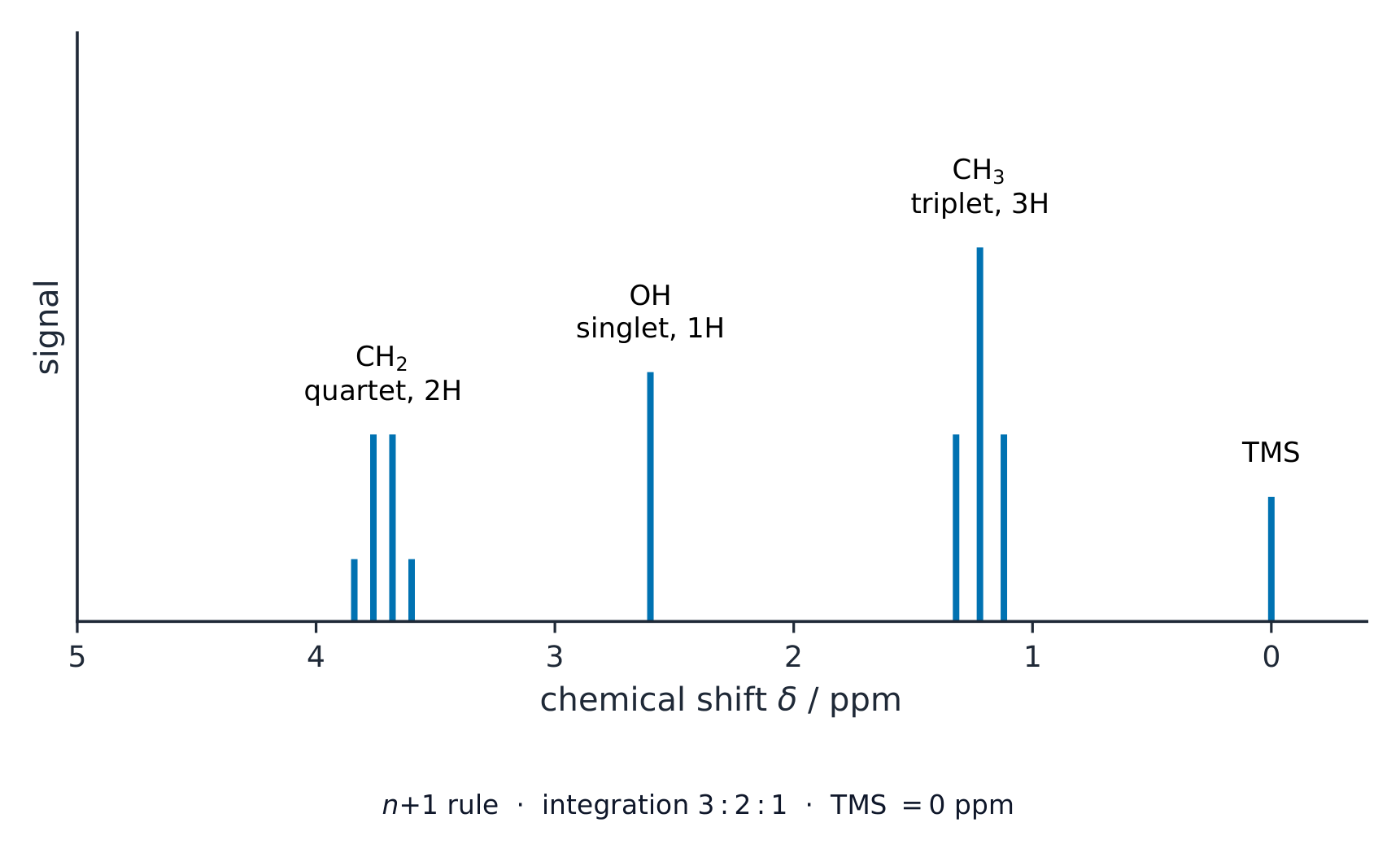
Hóa học A-Level (9701) thực chất là ba môn học phải liên kết với nhau: vật lý hóa (năng lượng, cân bằng, tốc độ phản ứng, điện hóa), hóa vô cơ (chu kỳ, Nhóm 2, Nhóm 17, nguyên tố chuyển tiếp) và hóa hữu cơ, phát triển từ ankan thành một chuỗi dài các cơ chế và kết thúc với qu phổ NMR và phổ khối.
Hầu hết các điểm bị mất ở đây không đến từ hóa học quá khó. Nó đến từ việc bỏ sót điều kiện, phương trình chưa cân bằng, không có ký hiệu trạng thái, và các câu trả lời hữu cơ chỉ đưa ra sản phẩm mà không có mũi tên cơ chế mà đề thi yêu cầu.
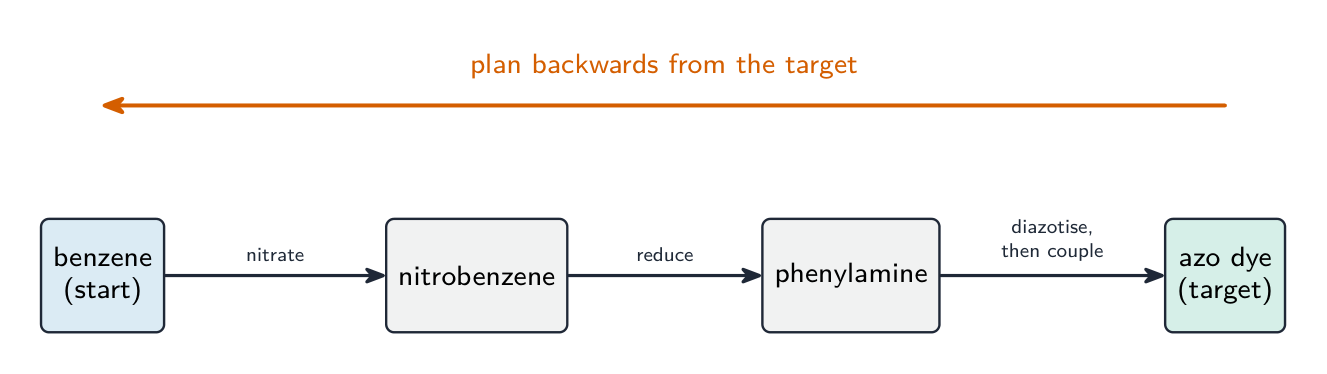
Hóa hữu cơ đòi hỏi một kiểu ôn tập khác: vẽ tay một sơ đồ phản ứng và liên tục bổ sung vào đó. Đề thi yêu cầu bạn đi từ nhóm chức này sang nhóm chức khác, chứ không phảiท่อง thuộc từng phản ứng riêng lẻ.
understand that atoms are mostly empty space surrounding a very small, dense nucleus that contains protons and neutrons; electrons are found in shells in the empty space around the nucleus
identify and describe protons, neutrons and electrons in terms of their relative charges and relative masses
understand the terms atomic and proton number; mass and nucleon number
describe the distribution of mass and charge within an atom
describe the behaviour of beams of protons, neutrons and electrons moving at the same velocity in an electric field
determine the numbers of protons, neutrons and electrons present in both atoms and ions given atomic or proton number, mass or nucleon number and charge
state and explain qualitatively the variations in atomic radius and ionic radius across a period and down a group
Tiếng Việt
hiểu rằng nguyên tử chủ yếu là khoảng trống bao quanh một hạt nhân rất nhỏ, đặc chứa proton và neutron; electron nằm trong vỏ ở khoảng trống xung quanh hạt nhân
xác định và mô tả proton, neutron và electron dựa trên điện tích tương đối và khối lượng tương đối của chúng
hiểu các thuật ngữ số nguyên tử và số proton; khối lượng và số nucleon
mô tả sự phân bố khối lượng và điện tích bên trong một nguyên tử
mô tả hành vi của chùm proton, neutron và electron di chuyển với cùng vận tốc trong điện trường
xác định số lượng proton, neutron và electron có trong cả nguyên tử và ion khi biết số nguyên tử hoặc số proton, khối lượng hoặc số nucleon và điện tích
nêu và giải thích định tính sự biến thiên của bán kính nguyên tử và bán kính ion qua một chu kỳ và dọc theo một nhóm
Source: Cambridge International syllabus · Nguồn: Chương trình Cambridge International
English
Everything is made of atoms 原子. An atom is mostly empty space. At its centre is a tiny, heavy nucleus 原子核. The nucleus holds two kinds of particle: protons 质子 and neutrons 中子. Around the nucleus, in the empty space, move the electrons 电子. The electrons stay in shells 壳层 — layers at set distances from the nucleus.
The nucleus is very small but holds almost all the mass. The electrons take up almost all the space but have almost no mass.
Relative charge and relative mass
We compare the three particles using relative charge 相对电荷 and relative mass 相对质量. These are simple numbers, not real units.
Particle
Relative charge
Relative mass
proton
$+1$
$1$
neutron
$0$
$1$
electron
$-1$
$\tfrac{1}{1836}$ (about $0$)
A proton and a neutron have almost the same mass. An electron is about 1836 times lighter. The proton is positive, the electron is negative, and the neutron has no charge — it is neutral 中性.
Proton number and nucleon number
Two numbers describe the nucleus:
the proton number 质子数 (also called the atomic number 原子序数), symbol $Z$ — the number of protons.
the nucleon number 核子数 (also called the mass number 质量数), symbol $A$ — the total number of protons and neutrons. Protons and neutrons are both nucleons 核子.
So the number of neutrons is $A - Z$.
Counting particles in an atom or ion
For a neutral atom, the number of electrons equals the number of protons, which equals $Z$.
An ion 离子 is an atom that has lost or gained electrons, so it has a charge:
a positive ion has fewer electrons than protons.
a negative ion has more electrons than protons.
Example: $^{27}_{13}\text{Al}^{3+}$ has $13$ protons, $27 - 13 = 14$ neutrons, and $13 - 3 = 10$ electrons (it lost 3 electrons to become $3+$).
How mass and charge are spread out
Almost all the mass sits in the nucleus, because protons and neutrons are heavy and electrons are very light. All the positive charge is in the nucleus (the protons). The negative charge is spread out in the shells (the electrons).
Beams of particles in an electric field
Imagine beams of protons, neutrons and electrons moving at the same speed into an electric field 电场 between two charged plates:
the proton beam bends towards the negative plate (protons are positive).
the electron beam bends the other way, towards the positive plate. It bends much more, because the electron is far lighter — the same force gives a bigger deflection 偏转 to a smaller mass.
the neutron beam goes straight through. It has no charge, so the field gives it no force.
Atomic radius and ionic radius
The atomic radius 原子半径 is the size of an atom. The ionic radius 离子半径 is the size of an ion.
Across a period 周期 (left to right), the atomic radius gets smaller. The nuclear charge 核电荷 (the pull from the protons) rises, but the electrons go into the same outer shell, so the shielding 屏蔽 by inner shells stays about the same. The stronger pull draws the outer shell inwards.
Down a group 族 (top to bottom), the atomic radius gets larger. Each step down adds a new shell, so the outer electrons are further out and feel more shielding from the nucleus.
For ions:
a positive ion (cation 阳离子) is smaller than its atom. It has lost its outer shell, and the electrons that remain feel a stronger pull each.
a negative ion (anion 阴离子) is larger than its atom. It has gained electrons, so there is more repulsion 排斥 between the electrons.
among ions that have the same number of electrons, the one with more protons is smaller.
Tiếng Việt
Kính hiển vi quét đường hầm có thể hình ảnh hóa từng nguyên tử riêng lẻ.
Mọi thứ đều được cấu tạo từ nguyên tử. Nguyên tử chủ yếu là không gian trống. Ở trung tâm là một hạt nhân rất nhỏ nhưng nặng (hạt nhân). Hạt nhân chứa hai loại hạt: proton và neutron. Xung quanh hạt nhân, trong không gian trống, di chuyển các electron. Các electron nằm trong vỏ — các lớp ở các khoảng cách xác định từ hạt nhân.
Hạt nhân rất nhỏ nhưng chứa gần như toàn bộ khối lượng. Các electron chiếm hầu hết không gian nhưng có gần như không có khối lượng.
Nguyên tử chủ yếu là không gian trống: proton và neutron nằm trong hạt nhân trung tâm nhỏ bé, trong khi electron di chuyển trên các vỏ xung quanh
Điện tích tương đối và khối lượng tương đối
Chúng ta so sánh ba loại hạt bằng điện tích tương đối và khối lượng tương đối. Đây là những con số đơn giản, không phải đơn vị thực tế.
Hạt
Điện tích tương đối
Khối lượng tương đối
proton
$+1$
$1$
neutron
$0$
$1$
electron
$-1$
$\tfrac{1}{1836}$ (khoảng $0$)
Proton và neutron có khối lượng gần như bằng nhau. Electron nhẹ hơn khoảng 1836 lần. Proton mang điện tích dương, electron mang điện tích âm, và neutron không mang điện tích — nó trung hòa.
Số hiệu nguyên tử và số khối
Hai con số mô tả hạt nhân:
số hiệu nguyên tử (còn gọi là số atomic), ký hiệu $Z$ — số lượng proton.
số nucleon (còn gọi là số khối), ký hiệu $A$ — tổng số proton và neutron. Cả proton và neutron đều là nucleon.
Vì vậy, số lượng neutron là $A - Z$.
Đếm số hạt trong nguyên tử hoặc ion
Đối với nguyên tử trung hòa, số lượng electron bằng số lượng proton, cũng bằng $Z$.
Ion là nguyên tử đã mất hoặc nhận thêm electron, nên mang điện tích:
ion dương có ít electron hơn proton.
ion âm có nhiều electron hơn proton.
Ví dụ: $^{27}_{13}\text{Al}^{3+}$ có $13$ proton, $27 - 13 = 14$ neutron, và $13 - 3 = 10$ electron (nó đã mất 3 electron để trở thành $3+$).
Sự phân bố khối lượng và điện tích
Gần như toàn bộ khối lượng nằm ở hạt nhân, vì proton và neutron nặng còn electron rất nhẹ. Toàn bộ điện tích dương nằm trong hạt nhân (các proton). Điện tích âm phân tán trong các vỏ (các electron).
Chùm hạt trong điện trường
Hãy tưởng tượng các chùm proton, neutron và electron di chuyển với cùng tốc độ vào một điện trường giữa hai tấm mang điện:
chùm proton lệch về phía tấm âm (proton mang điện dương).
chùm electron lệch theo hướng ngược lại, về phía tấm dương. Nó lệch nhiều hơn rất nhiều, vì electron nhẹ hơn rất nhiều — cùng một lực sẽ tạo ra độ lệch lớn hơn đối với khối lượng nhỏ hơn.
chùm neutron đi thẳng qua. Nó không mang điện tích, nên điện trường không tác dụng lực lên nó.
Trong điện trường, proton lệch về phía tấm $-$ và electron lệch theo hướng ngược lại và nhiều hơn (nó nhẹ hơn rất nhiều); neutron đi thẳng qua
Bán kính nguyên tử và bán kính ion
Bán kính nguyên tử là kích thước của nguyên tử. Bán kính ion là kích thước của ion.
Dọc theo một chu kỳ (từ trái sang phải), bán kính nguyên tử giảm. Điện tích hạt nhân (lực hút từ các proton) tăng lên, nhưng các electron đi vào cùng vỏ ngoài, nên hiệu ứng chắn bởi các vỏ bên trong vẫn giữ khoảng không đổi. Lực hút mạnh hơn kéo vỏ ngoài vào trong.
Dọc theo một nhóm (từ trên xuống dưới), bán kính nguyên tử trở nên lớn hơn. Mỗi bước xuống dưới đều thêm một lớp vỏ mới, do đó các electron ngoài cùng nằm xa hơn và chịu hiệu ứng chắn nhiều hơn từ hạt nhân.
Qua một chu kỳ, các nguyên tử co lại (lực hút hạt nhân mạnh hơn lên cùng một lớp vỏ ngoài); dọc theo một nhóm, chúng mở rộng ra (mỗi bước xuống đều thêm một lớp vỏ)
Đối với ion:
một ion dương (cation) nhỏ hơn nguyên tử của nó. Nó đã mất lớp vỏ ngoài, và các electron còn lại cảm nhận lực hút mạnh hơn mỗi lần.
một ion âm (anion) lớn hơn nguyên tử của nó. Nó đã nhận thêm electron, nên có sự lực đẩy nhiều hơn giữa các electron.
đối với các ion có cùng số lượng electron, ion nào có nhiều proton hơn thì sẽ nhỏ hơn.
Explore · Khám phá
Explore the atom · Khám phá nguyên tử
Tap each part. A tiny dense nucleus of protons and neutrons holds the mass; light electrons orbit it in shells. · Nhấn vào từng phần. Một hạt nhân nhỏ đặc chứa proton và neutron giữ khối lượng; electron nhẹ quay quanh nó trong các lớp vỏ.
Explore · Khám phá
Atomic and ionic radius trends · Xu hướng bán kính nguyên tử và ion
Atomic radius falls across a period (rising nuclear charge pulls the same shell in) and rises down a group (an extra shell each time). Step across Period 3 to see it. · Bán kính nguyên tử giảm dọc theo chu kỳ (điện tích hạt nhân tăng kéo cùng một lớp vỏ vào trong) và tăng xuống dưới một nhóm (mỗi lần thêm một lớp). Hãy bước sang Chu kỳ 3 để xem điều đó.
define the term isotope in terms of numbers of protons and neutrons
understand the notation $_y^x\text{A}$ for isotopes, where $x$ is the mass or nucleon number and $y$ is the atomic or proton number
state that and explain why isotopes of the same element have the same chemical properties
state that and explain why isotopes of the same element have different physical properties, limited to mass and density
Tiếng Việt
định nghĩa thuật ngữ đồng vị dựa trên số lượng proton và neutron
hiểu ký hiệu $_y^x\text{A}$ cho đồng vị, trong đó $x$ là khối lượng hoặc số nucleon và $y$ là số nguyên tử hoặc số proton
nêu và giải thích tại sao các đồng vị của cùng một nguyên tố có cùng tính chất hóa học
nêu và giải thích tại sao các đồng vị của cùng một nguyên tố có tính chất vật lý khác nhau, giới hạn ở khối lượng và mật độ
Source: Cambridge International syllabus · Nguồn: Chương trình Cambridge International
English
Isotopes 同位素 are atoms of the same element with the same number of protons but a different number of neutrons. So isotopes have the same proton number $Z$ but a different nucleon number $A$.
We write an isotope as $^{A}_{Z}\text{X}$: the nucleon number $A$ on top, the proton number $Z$ below. For example, chlorine has two main isotopes, $^{35}_{17}\text{Cl}$ and $^{37}_{17}\text{Cl}$.
Same chemical properties
Chemical properties 化学性质 depend on the electrons, especially the outer electrons. Isotopes of one element have the same number of electrons arranged in the same way. So they react in exactly the same way — they have the same chemical properties.
Different physical properties
Some physical properties 物理性质 depend on mass, so they differ between isotopes. A heavier isotope has more neutrons, so more mass, and therefore a higher density 密度. (The syllabus limits this difference to mass and density.)
Tiếng Việt
Đồng vị là các nguyên tử của cùng một nguyên tố nhưng có cùng số lượng proton mà lại khác nhau về số lượng neutron. Do đó, đồng vị có cùng số hiệu nguyên tử $Z$ nhưng khác nhau về số khối $A$.
Hai đồng vị của clo: số proton giống nhau, số neutron khác nhau
Chúng ta ký hiệu một đồng vị là $^{A}_{Z}\text{X}$: số khối $A$ ở phía trên, số hiệu nguyên tử $Z$ ở phía dưới. Ví dụ, clo có hai đồng vị chính là $^{35}_{17}\text{Cl}$ và $^{37}_{17}\text{Cl}$.
Tính chất hóa học giống nhau
Tính chất hóa học phụ thuộc vào electron, đặc biệt là các electron ngoài cùng. Các đồng vị của một nguyên tố có cùng số lượng electron được sắp xếp theo cách giống hệt nhau. Vì vậy, chúng phản ứng hoàn toàn giống nhau — chúng có tính chất hóa học như nhau.
Tính chất vật lý khác nhau
Một số tính chất vật lý phụ thuộc vào khối lượng, nên chúng khác nhau giữa các đồng vị. Một đồng vị nặng hơn có nhiều neutron hơn, do đó có khối lượng lớn hơn và vì thế có mật độ cao hơn. (Syllabus giới hạn sự khác biệt này chỉ ở mức khối lượng và mật độ.)
Explore · Khám phá
Isotope lab · Phòng thí nghiệm đồng vị
Classify isotope facts by what changes and what stays the same. · Phân loại sự thật về đồng vị dựa trên những gì thay đổi và những gì giữ nguyên.
Electrons, energy levels and orbitals · Electron, mức năng lượng và orbital
Syllabus · Chương trình
English
understand the terms: shells, sub-shells and orbitals; principal quantum number (n); ground state, limited to electronic configuration
describe the number of orbitals making up s, p and d sub-shells, and the number of electrons that can fill s, p and d sub-shells
describe the order of increasing energy of the sub-shells within the first three shells and the 4s and 4p sub-shells
describe the electronic configurations to include the number of electrons in each shell, sub-shell and orbital
explain the electronic configurations in terms of energy of the electrons and inter-electron repulsion
determine the electronic configuration of atoms and ions given the atomic or proton number and charge, using either of the following conventions: e.g. for Fe: $1\text{s}^2 2\text{s}^2 2\text{p}^6 3\text{s}^2 3\text{p}^6 3\text{d}^6 4\text{s}^2$ (full electronic configuration) or [Ar] $3\text{d}^6 4\text{s}^2$ (shorthand electronic configuration)
understand and use the electrons in boxes notation
describe and sketch the shapes of s and p orbitals
describe a free radical as a species with one or more unpaired electrons
Tiếng Việt
hiểu các thuật ngữ: vỏ, phân vỏ và orbital; số lượng tử chính (n); trạng thái cơ bản, chỉ giới hạn trong cấu hình electron
mô tả số lượng orbital tạo nên các phân vỏ s, p và d, và số lượng electron có thể lấp đầy các phân vỏ s, p và d
mô tả thứ tự năng lượng tăng dần của các phân vỏ trong ba vỏ đầu tiên và các phân vỏ 4s và 4p
mô tả các cấu hình electron bao gồm số lượng electron trong mỗi vỏ, phân vỏ và orbital
giải thích các cấu hình electron dựa trên năng lượng của electron và sự đẩy giữa các electron
xác định cấu hình electron của nguyên tử và ion khi biết số hiệu nguyên tử hoặc số proton và điện tích, sử dụng một trong hai quy ước sau: ví dụ với Fe: $1\text{s}^2 2\text{s}^2 2\text{p}^6 3\text{s}^2 3\text{p}^6 3\text{d}^6 4\text{s}^2$ (cấu hình electron đầy đủ) hoặc [Ar] $3\text{d}^6 4\text{s}^2$ (cấu hình electron rút gọn)
hiểu và sử dụng ký hiệu electron trong ô vuông
mô tả và vẽ hình dạng của các orbital s và p
mô tả một gốc tự do là một loài có một hoặc nhiều electron không ghép đôi
Source: Cambridge International syllabus · Nguồn: Chương trình Cambridge International
English
Electrons are arranged in shells, sub-shells and orbitals.
Shells and the principal quantum number
Each shell is labelled by the principal quantum number 主量子数$n = 1, 2, 3, \dots$ A larger $n$ means a shell that is further from the nucleus and higher in energy.
Sub-shells and orbitals
Each shell is split into sub-shells 亚层, named s, p and d. Each sub-shell is built from orbitals 轨道. An orbital is a small region that can hold up to two electrons.
Sub-shell
Number of orbitals
Maximum electrons
s
1
2
p
3
6
d
5
10
So an s sub-shell holds 2 electrons, a p sub-shell holds 6, and a d sub-shell holds 10.
Order of increasing energy
Electrons fill the lowest-energy sub-shell first. For the first three shells, plus 4s and 4p, the order of rising energy is:
You can write a shorthand using the nearest noble gas 稀有气体 in square brackets:
$$[\text{Ar}]\,3\text{d}^6\,4\text{s}^2$$
Here $[\text{Ar}]$ stands for the full configuration of argon.
For ions, you add or remove electrons. One key rule: when a transition metal forms a positive ion, it loses its 4s electrons before its 3d electrons. So $\text{Fe}^{3+}$ is $[\text{Ar}]\,3\text{d}^5$.
Electrons in boxes
The electrons in boxes notation draws each orbital as a box and each electron as an arrow. Two electrons in the same orbital must point opposite ways, because each electron has a property called spin 自旋, and a shared orbital needs opposite spins.
Within a sub-shell, electrons fill empty orbitals one at a time, with parallel arrows, before any orbital gets a second electron. Spreading out like this keeps the electrons apart and lowers the repulsion between them.
Why the configuration takes this shape
Electrons fill from low energy to high energy because that gives the most stable (lowest-energy) atom. Within a sub-shell they spread out singly first to reduce the repulsion between the negative electrons.
Shapes of s and p orbitals
an s orbital is a sphere 球形 centred on the nucleus.
a p orbital has two lobes, like a dumbbell, pointing along one axis. The three p orbitals point along three directions at right angles (the $x$, $y$ and $z$ axes).
Free radicals
A free radical 自由基 is a species with one or more unpaired electrons 未成对电子. Free radicals are very reactive.
Tiếng Việt
Hydro chỉ phát ra ánh sáng ở những bước sóng rời rạc, đặc trưng — quang phổ phát xạ vạch của nó.
Electron được sắp xếp trong các lớp, phân lớp và orbital.
Lớp vỏ và số lượng tử chính
Mỗi lớp vỏ được đánh dấu bằng số lượng tử chính$n = 1, 2, 3, \dots$. Một $n$ lớn hơn nghĩa là lớp vỏ nằm xa hạt nhân hơn và có mức năng lượng cao hơn.
Phân lớp và orbital
Mỗi lớp vỏ được chia thành các phân lớp, được đặt tên là s, p và d. Mỗi phân lớp được cấu tạo từ các orbital. Một orbital là một vùng không gian nhỏ có thể chứa tối đa hai electron.
Phân lớp
Số lượng orbital
Số electron tối đa
s
1
2
p
3
6
d
5
10
Vì vậy, một phân lớp s chứa 2 electron, một phân lớp p chứa 6, và một phân lớp d chứa 10.
Thứ tự tăng dần năng lượng
Electron sẽ điền vào phân lớp có mức năng lượng thấp nhất trước. Đối với ba lớp đầu tiên, cộng thêm 4s và 4p, thứ tự tăng dần năng lượng là:
Bạn có thể viết dạng rút gọn bằng cách dùng khí hiếm gần nhất trong ngoặc vuông:
$$[\text{Ar}]\,3\text{d}^6\,4\text{s}^2$$
Ở đây $[\text{Ar}]$ đại diện cho cấu hình đầy đủ của argon.
Đối với ion, bạn thêm hoặc bỏ đi electron. Một quy tắc quan trọng: khi kim loại chuyển tiếp tạo thành ion dương, nó sẽ mất electron 4s trước khi mất electron 3d. Vì vậy $\text{Fe}^{3+}$ là $[\text{Ar}]\,3\text{d}^5$.
Electron trong ô
Ký hiệu electron trong ô biểu diễn mỗi orbital bằng một ô và mỗi electron bằng một mũi tên. Hai electron trong cùng một orbital phải chỉ theo hướng ngược nhau, vì mỗi electron sở hữu một tính chất gọi là spin, và một orbital chung yêu cầu spin ngược chiều.
Trong một phân lớp, electron sẽ điền vào các orbital trống từng cái một, với các mũi tên song song, trước khi bất kỳ orbital nào nhận thêm electron thứ hai. Việc phân bố rộng rãi như vậy giúp các electron tách xa nhau và giảm lực đẩy giữa chúng.
Electron trong ô cho nitơ ($1\text{s}^2\,2\text{s}^2\,2\text{p}^3$): các electron cặp chỉ ngược chiều, và các orbital 2p được điền đơn lẻ với spin song song
Tại sao cấu hình lại có dạng này
Electron điền từ mức năng lượng thấp đến cao vì điều đó tạo ra nguyên tử ổn định nhất (có mức năng lượng thấp nhất). Trong cùng một phân lớp, chúng phân bố đơn lẻ trước để giảm lực đẩy giữa các electron mang điện tích âm.
Hình dạng của orbital s và p
một orbital s là một hình cầu tâm tại hạt nhân.
một orbital p có hai thùy, giống như quả tạ, chỉ dọc theo một trục. Ba orbital p chỉ theo ba hướng vuông góc với nhau (các trục $x$, $y$ và $z$).
Một orbital s là hình cầu; mỗi orbital p là hình quả tạ, và ba orbital p chỉ dọc theo các trục $x$, $y$ và $z$
Gốc tự do
Một gốc tự do là một loài có một hoặc nhiều electron đơn lẻ. Gốc tự do rất dễ phản ứng.
Explore · Khám phá
Filling the electron shells · Lấp đầy lớp vỏ electron
Change the atomic number Z and watch the electrons fill the shells (2, 8, 8, …) — the pattern that builds the Periodic Table. · Thay đổi số hiệu nguyên tử Z và quan sát các electron lấp đầy các lớp (2, 8, 8, …) — mô hình tạo nên Bảng tuần hoàn.
define and use the term first ionisation energy, IE
construct equations to represent first, second and subsequent ionisation energies
identify and explain the trends in ionisation energies across a period and down a group of the Periodic Table
identify and explain the variation in successive ionisation energies of an element
understand that ionisation energies are due to the attraction between the nucleus and the outer electron
explain the factors influencing the ionisation energies of elements in terms of nuclear charge, atomic/ionic radius, shielding by inner shells and sub-shells and spin-pair repulsion
deduce the electronic configurations of elements using successive ionisation energy data
deduce the position of an element in the Periodic Table using successive ionisation energy data
Tiếng Việt
định nghĩa và sử dụng thuật ngữ năng lượng ion hóa lần đầu, IE
viết phương trình biểu diễn năng lượng ion hóa lần đầu, lần hai và các lần sau
nhận diện và giải thích các xu hướng về năng lượng ion hóa dọc theo một chu kỳ và xuống một nhóm trong Bảng tuần hoàn
nhận diện và giải thích sự biến thiên của các năng lượng ion hóa liên tiếp của một nguyên tố
hiểu rằng năng lượng ion hóa phát sinh từ lực hút giữa hạt nhân và electron ngoài cùng
giải thích các yếu tố ảnh hưởng đến năng lượng ion hóa của các nguyên tố dựa trên điện tích hạt nhân, bán kính nguyên tử/ion, hiệu ứng chắn bởi các vỏ trong và phân vỏ trong, và lực đẩy cặp spin
suy ra cấu hình electron của các nguyên tố bằng cách sử dụng dữ liệu năng lượng ion hóa liên tiếp
suy ra vị trí của một nguyên tố trong Bảng tuần hoàn bằng cách sử dụng dữ liệu năng lượng ion hóa liên tiếp
Source: Cambridge International syllabus · Nguồn: Chương trình Cambridge International
English
First ionisation energy
The first ionisation energy 第一电离能 (IE) is the energy needed to remove one electron from each atom in one mole of gaseous atoms, forming one mole of gaseous $+1$ ions.
We use gaseous atoms so there are no forces between the particles. The unit is $\text{kJ mol}^{-1}$. As an equation, for an element X:
You can keep going. These are the successive ionisation energies 逐级电离能. Each is larger than the one before, because every electron is pulled away from a more positive ion.
What ionisation energy depends on
Ionisation energy comes from the attraction between the positive nucleus and the outer electron. Three main factors set how strong that attraction is:
nuclear charge: more protons pull the electrons more strongly, so the ionisation energy is higher.
atomic radius: the further the outer electron sits from the nucleus, the weaker the pull, so the ionisation energy is lower.
shielding: inner shells block some of the pull on the outer electron. More inner shells mean more shielding and a lower ionisation energy.
There is a smaller effect too — spin-pair repulsion 自旋成对排斥. When two electrons share one orbital, they push each other a little, so one is easier to remove.
Trends in first ionisation energy
Across a period, the first ionisation energy generally rises. The nuclear charge grows while shielding stays about the same, so the outer electrons are held more tightly.
Down a group, the first ionisation energy falls. Lower elements have more shells, so more shielding and a larger radius, and the outer electron is easier to remove.
The dips are evidence for sub-shells
The rise across a period is not smooth. Two small dips appear, and you should be able to explain both:
Group 2 to Group 13 (for example Mg to Al): the electron removed from Al comes from a 3p sub-shell, which is higher in energy than the full 3s sub-shell in Mg. A 3p electron is easier to remove, so the value dips.
Group 15 to Group 16 (for example P to S): in S, one 3p orbital now holds a pair of electrons. Spin-pair repulsion makes one of them easier to remove, so the value dips.
These dips are evidence that sub-shells exist.
Successive ionisation energies are evidence for shells
If you plot the successive ionisation energies of one element, the values rise, with big jumps at certain points. A big jump happens when the next electron must come from a shell closer to the nucleus.
Count how many electrons come off easily before the first big jump — that is the number of electrons in the outer shell, which tells you the group the element is in. You can also use the pattern to work out the electronic configuration and the position of the element in the Periodic Table.
Electrons removed before the first big jump
Group
1
Group 1
2
Group 2
3
Group 13
Worked example. The first five successive ionisation energies of an element are $590$, $1150$, $4940$, $6480$ and $8120\ \text{kJ}\,\text{mol}^{-1}$. Which group is it in? Look for the big jump, not the biggest number. From the 1st to the 2nd the value roughly doubles, which is a normal rise. From the 2nd ($1150$) to the 3rd ($4940$) it more than quadruples: that is the jump. So two electrons come off easily before it, the outer shell holds 2 electrons, and the element is in Group 2. Count the electrons removed before the jump, and explain the jump properly: the next electron is being pulled from a shell closer to the nucleus, not from a different element.
Tiếng Việt
Năng lượng ion hóa lần đầu
Năng lượng ion hóa lần đầu (IE) là năng lượng cần thiết để tách một electron ra khỏi mỗi nguyên tử trong một mol nguyên tử khí, tạo thành một mol ion $+1$ khí.
Chúng ta sử dụng nguyên tử ở trạng thái khí nên không có lực tương tác giữa các hạt. Đơn vị là $\text{kJ mol}^{-1}$. Dưới dạng phương trình, đối với một nguyên tố X:
Bạn có thể tiếp tục quá trình này. Đây là năng lượng ion hóa liên tiếp. Mỗi giá trị đều lớn hơn giá trị trước đó, vì mỗi electron bị kéo ra khỏi một ion mang điện tích dương nhiều hơn.
Những yếu tố ảnh hưởng đến năng lượng ion hóa
Năng lượng ion hóa xuất phát từ lực hút giữa nhân mang điện tích dương và electron lớp ngoài. Ba yếu tố chính quyết định độ mạnh của lực hút này:
Điện tích hạt nhân: nhiều proton hơn sẽ hút electron mạnh hơn, do đó năng lượng ion hóa cao hơn.
Bán kính nguyên tử: electron lớp ngoài càng cách xa hạt nhân thì lực hút càng yếu, nên năng lượng ion hóa thấp hơn.
Hiệu ứng chắn (Shielding): các lớp vỏ bên trong chặn bớt một phần lực hút lên electron lớp ngoài. Nhiều lớp vỏ bên trong hơn nghĩa là hiệu ứng chắn lớn hơn và năng lượng ion hóa thấp hơn.
Còn có một hiệu ứng nhỏ khác — lực đẩy cặp spin. Khi hai electron cùng chia sẻ một orbital, chúng đẩy nhau nhẹ nhàng, khiến một trong số chúng dễ bị loại bỏ hơn.
Xu hướng năng lượng ion hóa đầu tiên
Dọc theo chu kỳ, năng lượng ion hóa đầu tiên thường tăng. Điện tích hạt nhân tăng trong khi hiệu ứng chắn gần như không đổi, nên electron lớp ngoài bị giữ chặt hơn.
Xuống dưới một nhóm, năng lượng ion hóa đầu tiên giảm. Các nguyên tố phía dưới có nhiều lớp vỏ hơn, dẫn đến hiệu ứng chắn lớn hơn và bán kính lớn hơn, khiến electron lớp ngoài dễ bị loại bỏ hơn.
Các điểm giảm là bằng chứng về phân lớp
Đường đi lên dọc theo chu kỳ không phải là đường thẳng liền mạch. Hai điểm giảm nhỏ xuất hiện, và bạn cần giải thích được cả hai:
Nhóm 2 sang Nhóm 13 (ví dụ Mg sang Al): electron bị loại bỏ từ Al đến từ phân lớp 3p, có mức năng lượng cao hơn so với phân lớp 3s đầy đủ trong Mg. Electron 3p dễ bị loại bỏ hơn, nên giá trị bị giảm.
Nhóm 15 sang Nhóm 16 (ví dụ P sang S): trong S, một orbital 3p giờ chứa một cặp electron. Lực đẩy cặp spin làm cho một trong hai electron dễ bị loại bỏ hơn, nên giá trị bị giảm.
Những điểm giảm này là bằng chứng cho sự tồn tại của các phân lớp.
Năng lượng ion hóa đầu tiên tăng dọc theo Chu kỳ 3 nhưng giảm tại Al và S — bằng chứng cho sự tồn tại của phân lớp
Năng lượng ion hóa liên tiếp là bằng chứng về các lớp
Nếu biểu diễn đồ thị năng lượng ion hóa liên tiếp của một nguyên tố, các giá trị sẽ tăng, với những bước nhảy lớn tại một số điểm nhất định. Bước nhảy lớn xảy ra khi electron tiếp theo phải đến từ một lớp vỏ gần hạt nhân hơn.
Đếm xem có bao nhiêu electron bị loại bỏ dễ dàng trước bước nhảy lớn đầu tiên — đó chính là số electron trong lớp ngoài cùng, điều này cho bạn biết nhóm mà nguyên tố thuộc về. Bạn cũng có thể dùng quy luật này để suy ra cấu hình electron và vị trí của nguyên tố trong Bảng tuần hoàn.
Năng lượng ion hóa liên tiếp của natri (thang log): các bước nhảy lớn tiết lộ cấu trúc $2,8,1$ lớp vỏ
Số electron bị loại bỏ trước bước nhảy lớn
Nhóm
1
Nhóm 1
2
Nhóm 2
3
Nhóm 13
Ví dụ minh họa. Năm năng lượng ion hóa liên tiếp đầu tiên của một nguyên tố là $590$, $1150$, $4940$, $6480$ và $8120\ \text{kJ}\,\text{mol}^{-1}$. Nguyên tố này thuộc nhóm nào? Hãy tìm bước nhảy lớn, chứ không phải con số lớn nhất. Từ lần 1 đến lần 2, giá trị khoảng gấp đôi, đây là mức tăng bình thường. Từ lần 2 ($1150$) đến lần 3 ($4940$), giá trị tăng hơn gấp bốn lần: đó chính là bước nhảy. Vì vậy, hai electron bị loại bỏ dễ dàng trước bước nhảy, lớp ngoài cùng chứa 2 electron, và nguyên tố nằm trong Nhóm 2. Đếm số electron bị loại bỏ trước bước nhảy, và giải thích đúng bản chất của bước nhảy: electron tiếp theo đang bị kéo từ một lớp gần hạt nhân hơn, chứ không phải từ một nguyên tố khác.
Explore · Khám phá
The ionisation-energy trend — and its dips · Xu hướng năng lượng ion hóa — và những điểm giảm
First ionisation energy generally rises across a period, but DIPS where a new p sub-shell starts and where a p-orbital pair first forms. Step across to find the two tell-tale dips. · Năng lượng ion hóa lần đầu nói chung tăng qua một chu kỳ, nhưng GIẢM ở nơi bắt đầu phân lớp p mới và nơi một cặp orbital p đầu tiên hình thành. Chuyển sang bước để tìm hai điểm giảm đặc trưng.
Define isotopes in full: atoms of the same element with the same number of protons but a different number of neutrons — the mark scheme wants both halves.
4s fills before 3d, but electrons are removed from 4s first when forming ions, so $\text{Fe}^{3+}$ is $[\text{Ar}]3\text{d}^5$ (not $[\text{Ar}]3\text{d}^3 4\text{s}^2$).
In successive ionisation energies, a big jump marks the start of a new (inner) shell — use the jumps to place the element in its group.
Explain every ionisation-energy trend with the same three factors: nuclear charge, distance and shielding, plus sub-shell effects for the small dips.
Learn the exact reason first ionisation energy of oxygen is below nitrogen: oxygen's paired 2p electrons repel, so one is easier to remove.
Tiếng Việt
Định nghĩa đồng vị đầy đủ: các nguyên tử của cùng một nguyên tố có cùng số proton nhưng số neutron khác nhau — đáp án cần cả hai vế.
4s được điền trước 3d, nhưng khi tạo ion, electron sẽ bị loại bỏ từ 4s trước, nên $\text{Fe}^{3+}$ là $[\text{Ar}]3\text{d}^5$ (không phải $[\text{Ar}]3\text{d}^3 4\text{s}^2$).
Trong năng lượng ion hóa liên tiếp, một bước nhảy lớn đánh dấu sự bắt đầu của một lớp vỏ mới (lớp trong) — hãy dùng các bước nhảy để xác định nhóm của nguyên tố.
Giải thích mọi xu hướng năng lượng ion hóa bằng ba yếu tố giống nhau: điện tích hạt nhân, khoảng cách và hiệu ứng chắn, cộng thêm các hiệu ứng phân lớp cho các điểm giảm nhỏ.
Học kỹ lý do chính xác tại sao năng lượng ion hóa đầu tiên của oxi thấp hơn nitơ: các electron 2p cặp đôi của oxi đẩy nhau, khiến một electron dễ bị loại bỏ hơn.
2
Atoms, molecules and stoichiometry · Nguyên tử, phân tử và định lượng hóa học
Relative masses of atoms and molecules · Khối lượng tương đối của nguyên tử và phân tử
Syllabus · Chương trình
English
define the unified atomic mass unit as one twelfth of the mass of a carbon-12 atom
define relative atomic mass, $A_r$, relative isotopic mass, relative molecular mass, $M_r$, and relative formula mass in terms of the unified atomic mass unit
Tiếng Việt
định nghĩa đơn vị khối lượng nguyên tử thống nhất là một phần mười hai khối lượng của nguyên tử carbon-12
định nghĩa khối lượng nguyên tử tương đối, $A_r$, khối lượng đồng vị tương đối, khối lượng phân tử tương đối, $M_r$, và khối lượng công thức tương đối theo đơn vị khối lượng nguyên tử thống nhất
Source: Cambridge International syllabus · Nguồn: Chương trình Cambridge International
English
Atoms 原子 are far too light to weigh in grams, so we compare every mass to one standard. The standard is the unified atomic mass unit 统一原子质量单位 (symbol u), defined as exactly one twelfth of the mass of one carbon-12 atom.
Using this unit, we state masses as simple numbers:
the relative atomic mass 相对原子质量$A_r$ of an element is the average mass of its atoms compared with $\tfrac{1}{12}$ of a carbon-12 atom. It is an average over all the isotopes 同位素, weighted by how common each one is.
the relative isotopic mass 相对同位素质量 is the mass of one atom of a single isotope, compared with $\tfrac{1}{12}$ of a carbon-12 atom.
the relative molecular mass 相对分子质量$M_r$ of a molecule 分子 is the sum of the relative atomic masses of all its atoms.
the relative formula mass 相对式量 is the same idea for a substance that is not made of molecules (such as an ionic compound). Add up the relative atomic masses shown in the formula.
To find $A_r$ from isotope data, multiply each isotope mass by its percentage, add these up, and divide by 100.
Worked example. Chlorine is $75\%$${}^{35}\text{Cl}$ and $25\%$${}^{37}\text{Cl}$. Find its relative atomic mass.
Nguyên tử quá nhẹ để cân bằng gam, nên chúng ta so sánh mọi khối lượng với một đơn vị chuẩn. Đơn vị chuẩn là đơn vị khối lượng nguyên tử thống nhất (ký hiệu u), được định nghĩa chính xác bằng một phần mười hai khối lượng của một nguyên tử carbon-12.
Sử dụng đơn vị này, chúng ta biểu diễn khối lượng dưới dạng các số đơn giản:
khối lượng nguyên tử tương đối$A_r$ của một nguyên tố là khối lượng trung bình của các nguyên tử nguyên tố đó so với $\tfrac{1}{12}$ của một nguyên tử carbon-12. Nó là giá trị trung bình trên tất cả các đồng vị, được tính trọng số theo độ phổ biến của từng đồng vị.
khối lượng đồng vị tương đối là khối lượng của một nguyên tử thuộc một đồng vị cụ thể, so với $\tfrac{1}{12}$ của một nguyên tử carbon-12.
khối lượng phân tử tương đối$M_r$ của một phân tử là tổng các khối lượng nguyên tử tương đối của tất cả các nguyên tử cấu thành phân tử đó.
khối lượng công thức tương đối là khái niệm tương tự áp dụng cho các chất không tạo bởi phân tử (như hợp chất ion). Hãy cộng tổng các khối lượng nguyên tử tương đối có trong công thức.
Khối lượng nguyên tử tương đối là giá trị trung bình gia quyền: hai đồng vị của clo (75% ³⁵Cl, 25% ³⁷Cl) có giá trị trung bình là Aᵣ = 35,5
Để tìm $A_r$ từ dữ liệu đồng vị, hãy nhân khối lượng mỗi đồng vị với phần trăm của nó, cộng các kết quả lại rồi chia cho 100.
Ví dụ minh họa. Clo có $75\%$${}^{35}\text{Cl}$ và $25\%$${}^{37}\text{Cl}$. Hãy tính khối lượng nguyên tử tương đối của nó.
Ví dụ minh họa. Máy quang phổ khối cho thấy đồng có $69.2\%$${}^{63}\text{Cu}$ và $30.8\%$${}^{65}\text{Cu}$. Hãy tính khối lượng nguyên tử tương đối của nó.
unified atomic mass unit/ˈjuːnɪfaɪd əˈtɒmɪk mæs ˈjuːnɪt/
đơn vị khối lượng nguyên tử thống nhất
relative atomic mass/ˈrelətɪv əˈtɒmɪk mæs/
khối lượng nguyên tử tương đối
isotope/ˈaɪsətəʊp/
đồng vị
relative isotopic mass/ˈrelətɪv ˌaɪsəˈtɒpɪk mæs/
khối lượng đồng vị tương đối
relative molecular mass/ˈrelətɪv məˈlekjʊlə mæs/
khối lượng phân tử tương đối
molecule/ˈmɒlɪkjuːl/
phân tử
relative formula mass/ˈrelətɪv ˈfɔːmjʊlə mæs/
khối lượng công thức tương đối
ion/ˈaɪɒn/
ion
molar mass/ˈməʊlə mæs/
khối lượng mol
compound/ˈkɒmpaʊnd/
hợp chất
ionic compound/aɪˈɒnɪk ˈkɒmpaʊnd/
hợp chất ion
oxidation number/ˌɒksɪˈdeɪʃn ˈnʌmbə/
số oxi hóa
balanced/ˈbælənst/
được cân bằng
state symbols/steɪt ˈsɪmblz/
ký hiệu trạng thái
aqueous/ˈeɪkwɪəs/
dung dịch nước
ionic equation/aɪˈɒnɪk ɪˈkweɪʒn/
phương trình ion
spectator ions/spekˈteɪtə ˈaɪɒnz/
ion không tham gia phản ứng
2.2
The mole and the Avogadro constant · Mol và hằng số Avogadro
Syllabus · Chương trình
English
define and use the term mole in terms of the Avogadro constant
Tiếng Việt
định nghĩa và sử dụng thuật ngữ mol theo hằng số Avogadro
Source: Cambridge International syllabus · Nguồn: Chương trình Cambridge International
English
Chemists count particles in groups called moles, just as we count eggs in dozens.
One mole 摩尔 (symbol mol) is the amount of substance that contains the same number of particles as there are atoms in exactly 12 g of carbon-12. That number is the Avogadro constant 阿伏伽德罗常量:
$$N_A = 6.02 \times 10^{23}\ \text{mol}^{-1}$$
So one mole of anything contains $6.02 \times 10^{23}$ particles. The particles may be atoms, molecules or ions 离子 — always say which.
The mass of one mole in grams equals the relative mass ($A_r$ or $M_r$). This is the molar mass 摩尔质量, with units $\text{g mol}^{-1}$. The key equation is:
$$n = \frac{m}{M}$$
where $n$ is the amount in moles, $m$ is the mass in grams, and $M$ is the molar mass.
Worked example. How many moles are in $8.0\ \text{g}$ of methane, $\text{CH}_4$? ($A_r$: C $= 12$, H $= 1$.)
The molar mass is $M = 12 + 4(1) = 16\ \text{g mol}^{-1}$, so
Cân điện tử hiện đại đo khối lượng — đây là cơ sở cho các tính toán mol.
Các nhà hóa học đếm hạt vật chất theo nhóm gọi là mol, giống như cách chúng ta đếm trứng theo đơn vị tá.
Một mol (ký hiệu mol) là lượng chất chứa cùng số hạt vật chất như số nguyên tử có trong chính xác 12 g carbon-12. Con số đó là hằng số Avogadro:
$$N_A = 6.02 \times 10^{23}\ \text{mol}^{-1}$$
Vậy một mol bất kỳ thứ gì đều chứa $6.02 \times 10^{23}$ hạt vật chất. Các hạt này có thể là nguyên tử, phân tử hoặc ion — luôn phải chỉ rõ loại nào.
Khối lượng của một mol tính bằng gam bằng với khối lượng tương đối ($A_r$ hoặc $M_r$). Đây là khối lượng mol, với đơn vị $\text{g mol}^{-1}$. Phương trình quan trọng là:
$$n = \frac{m}{M}$$
trong đó $n$ là lượng chất tính bằng mol, $m$ là khối lượng tính bằng gam, và $M$ là khối lượng mol.
Ví dụ minh họa. Có bao nhiêu mol trong $8.0\ \text{g}$ khí metan, $\text{CH}_4$? ($A_r$: C $= 12$, H $= 1$.)
Khối lượng mol là $M = 12 + 4(1) = 16\ \text{g mol}^{-1}$, nên
Mol là trung tâm của mọi phép tính về lượng chất: chuyển đổi sang khối lượng ($n=m/M$), số hạt ($\times N_A$), thể tích khí ($n=V/24$) hoặc dung dịch ($n=cV$)
Explore · Khám phá
Mole mass lab · Thí nghiệm khối lượng mol
n = m / M
Change mass and see moles scale through molar mass. · Đổi khối lượng và xem mol tăng theo khối lượng mol.
write formulas of ionic compounds from ionic charges and oxidation numbers (shown by a Roman numeral), including: (a) the prediction of ionic charge from the position of an element in the Periodic Table (b) recall of the names and formulas for the following ions: $\text{NO}_3^-$, $\text{CO}_3^{2-}$, $\text{SO}_4^{2-}$, $\text{OH}^-$, $\text{NH}_4^+$, $\text{Zn}^{2+}$, $\text{Ag}^+$, $\text{HCO}_3^-$, $\text{PO}_4^{3-}$
(a) write and construct equations (which should be balanced), including ionic equations (which should not include spectator ions) (b) use appropriate state symbols in equations
define and use the terms empirical and molecular formula
understand and use the terms anhydrous, hydrated and water of crystallisation
calculate empirical and molecular formulas, using given data
Tiếng Việt
viết công thức của hợp chất ion từ điện tích ion và số oxi hóa (hiển thị bằng chữ số La Mã), bao gồm: (a) dự đoán điện tích ion dựa trên vị trí của nguyên tố trong Bảng tuần hoàn (b) nhớ lại tên và công thức của các ion sau: $\text{NO}_3^-$, $\text{CO}_3^{2-}$, $\text{SO}_4^{2-}$, $\text{OH}^-$, $\text{NH}_4^+$, $\text{Zn}^{2+}$, $\text{Ag}^+$, $\text{HCO}_3^-$, $\text{PO}_4^{3-}$
(a) viết và xây dựng phương trình (phải cân bằng), bao gồm cả phương trình ion (không chứa ion không tham gia phản ứng) (b) sử dụng ký hiệu trạng thái thích hợp trong phương trình
định nghĩa và sử dụng các thuật ngữ công thức thực nghiệm và công thức phân tử
hiểu và sử dụng các thuật ngữ không nước, có nước kết tinh và nước kết tinh
tính toán công thức thực nghiệm và công thức phân tử, sử dụng dữ liệu đã cho
Source: Cambridge International syllabus · Nguồn: Chương trình Cambridge International
English
A compound 化合物 is a substance made of two or more elements chemically joined.
Charges and formulas of ionic compounds
In an ionic compound 离子化合物 the total positive charge balances the total negative charge, so the compound is neutral overall.
You can predict the charge of many ions from the element's position in the Periodic Table:
Group
1
2
13
15
16
17
Usual ion charge
$+1$
$+2$
$+3$
$-3$
$-2$
$-1$
Hydrogen forms $\text{H}^+$, and the Group 18 noble gases do not normally form ions.
Some ions you must know by name and formula:
Name
Formula
nitrate
$\text{NO}_3^{-}$
carbonate
$\text{CO}_3^{2-}$
sulfate
$\text{SO}_4^{2-}$
hydroxide
$\text{OH}^{-}$
ammonium
$\text{NH}_4^{+}$
zinc
$\text{Zn}^{2+}$
silver
$\text{Ag}^{+}$
hydrogencarbonate
$\text{HCO}_3^{-}$
phosphate
$\text{PO}_4^{3-}$
For a metal that can have more than one charge, a Roman numeral shows the oxidation number 氧化数. For example, iron(II) is $\text{Fe}^{2+}$ and iron(III) is $\text{Fe}^{3+}$. To write a formula, balance the charges: iron(III) oxide is $\text{Fe}_2\text{O}_3$, because two $\text{Fe}^{3+}$ balance three $\text{O}^{2-}$.
Equations and state symbols
A chemical equation must be balanced 配平 — the same number of each kind of atom on both sides. Add state symbols 状态符号 to show the state of each species: (s) solid, (l) liquid, (g) gas, and (aq) aqueous 水溶液 (dissolved in water).
An ionic equation 离子方程式 shows only the ions and molecules that actually change. The ions that do not change are spectator ions 旁观离子, and you leave them out. For example, the reaction that forms silver chloride is:
The empirical formula 实验式 is the simplest whole-number ratio of the atoms of each element in a compound. The molecular formula 分子式 shows the actual number of atoms of each element in one molecule.
For example, ethane has empirical formula $\text{CH}_3$ but molecular formula $\text{C}_2\text{H}_6$.
Hydrated and anhydrous solids
Some solids hold water inside their crystals. This water is the water of crystallisation 结晶水. A solid that contains it is hydrated 水合的; the same solid with the water removed is anhydrous 无水的.
For example, hydrated copper(II) sulfate is $\text{CuSO}_4 \cdot 5\text{H}_2\text{O}$. Heating it drives off the water to leave anhydrous $\text{CuSO}_4$.
Calculating empirical and molecular formulas
To find the empirical formula from masses (or percentages by mass):
divide each element's mass by its $A_r$ to get the moles.
divide all the mole values by the smallest one.
round to the nearest whole numbers — that ratio is the empirical formula.
To get the molecular formula, you also need $M_r$. Find how many times the empirical formula mass fits into $M_r$, then multiply the formula by that number.
Worked example. A compound is $40.0\%$ carbon, $6.7\%$ hydrogen and $53.3\%$ oxygen by mass. Find its empirical formula. ($A_r$: C $= 12$, H $= 1$, O $= 16$.)
Take $100\ \text{g}$ and divide each mass by its $A_r$ to get moles: C $= 40.0/12 = 3.33$, H $= 6.7/1 = 6.7$, O $= 53.3/16 = 3.33$. Dividing through by the smallest ($3.33$) gives a ratio C : H : O $= 1 : 2 : 1$, so the empirical formula is $\text{CH}_2\text{O}$.
Tiếng Việt
Một hợp chất là chất được tạo thành từ hai hoặc nhiều nguyên tố liên kết với nhau bằng liên kết hóa học.
Điện tích và công thức của hợp chất ion
Trong một hợp chất ion, tổng điện tích dương cân bằng với tổng điện tích âm, do đó hợp chất mang tính trung hòa điệnOverall.
Bạn có thể dự đoán điện tích của nhiều ion dựa vào vị trí của nguyên tố trong Bảng tuần hoàn:
Nhóm
1
2
13
15
16
17
Điện tích ion thường gặp
$+1$
$+2$
$+3$
$-3$
$-2$
$-1$
Hydro tạo thành $\text{H}^+$, và các khí hiếm ở Nhóm 18 thông thường không tạo thành ion.
Một số ion bạn cần biết bằng tên và công thức:
Tên
Công thức
nitrat
$\text{NO}_3^{-}$
cacbonat
$\text{CO}_3^{2-}$
sunfat
$\text{SO}_4^{2-}$
hiđroxit
$\text{OH}^{-}$
amoni
$\text{NH}_4^{+}$
kẽm
$\text{Zn}^{2+}$
bạc
$\text{Ag}^{+}$
hiđrocacbonat
$\text{HCO}_3^{-}$
photphat
$\text{PO}_4^{3-}$
Đối với kim loại có thể có nhiều điện tích, chữ số La Mã chỉ số oxy hóa. Ví dụ, sắt(II) là $\text{Fe}^{2+}$ và sắt(III) là $\text{Fe}^{3+}$. Để viết công thức, hãy cân bằng điện tích: oxit sắt(III) là $\text{Fe}_2\text{O}_3$, vì hai $\text{Fe}^{3+}$ cân bằng ba $\text{O}^{2-}$.
Phương trình hóa học và ký hiệu trạng thái
Một phương trình hóa học phải được cân bằng — số lượng từng loại nguyên tử ở hai vế phải bằng nhau. Thêm ký hiệu trạng thái để chỉ trạng thái của mỗi chất: (s) rắn, (l) lỏng, (g) khí, và (aq) tan trong nước (dung dịch nước).
Một phương trình ion chỉ hiển thị các ion và phân tử thực sự tham gia thay đổi. Các ion không thay đổi được gọi là ion trơ, và bạn sẽ bỏ qua chúng. Ví dụ, phản ứng tạo thành bạc clorua là:
Công thức tối giản là tỉ lệ số nguyên tử nhỏ nhất của mỗi nguyên tố trong một hợp chất. Công thức phân tử cho biết số lượng thực tế nguyên tử của mỗi nguyên tố trong một phân tử.
Ví dụ, etan có công thức tối giản là $\text{CH}_3$ nhưng công thức phân tử là $\text{C}_2\text{H}_6$.
Chất rắn có nước kết tinh và chất không nước
Một số chất rắn giữ nước bên trong tinh thể của chúng. Nước này được gọi là nước kết tinh. Một chất rắn chứa nó là có nước; cùng chất rắn đó nhưng đã loại bỏ nước thì gọi là không nước.
Ví dụ, đồng(II) sunfat có nước là $\text{CuSO}_4 \cdot 5\text{H}_2\text{O}$. Đun nóng sẽ làm bay hơi nước để lại dạng không nước $\text{CuSO}_4$.
Tính toán công thức tối giản và công thức phân tử
Để tìm công thức tối giản từ khối lượng (hoặc phần trăm khối lượng):
chia khối lượng của mỗi nguyên tố cho $A_r$ của nó để nhận được số mol.
chia tất cả các giá trị mol cho giá trị nhỏ nhất.
làm tròn đến số nguyên gần nhất — tỉ lệ đó chính là công thức tối giản.
Để có được công thức phân tử, bạn cũng cần $M_r$. Tìm xem công thức tối giản phù hợp vào $M_r$ bao nhiêu lần, sau đó nhân công thức với con số đó.
Ví dụ minh họa. Một hợp chất có $40.0\%$ cacbon, $6.7\%$ hydro và $53.3\%$ oxi theo khối lượng. Hãy tìm công thức tối giản của nó. ($A_r$: C $= 12$, H $= 1$, O $= 16$.)
Lấy $100\ \text{g}$ và chia mỗi khối lượng cho $A_r$ tương ứng để nhận số mol: C $= 40.0/12 = 3.33$, H $= 6.7/1 = 6.7$, O $= 53.3/16 = 3.33$. Chia hết cho giá trị nhỏ nhất ($3.33$) cho ra tỉ lệ C : H : O $= 1 : 2 : 1$, nên công thức tối giản là $\text{CH}_2\text{O}$.
Công thức tính công thức tối giản: chia cho Ar, chia cho số nhỏ nhất, đọc tỉ lệ
Explore · Khám phá
Equation balancing route · Lộ trình cân bằng phương trình
Follow atoms through a chemical equation so both sides match. · Theo dõi các nguyên tố xuyên suốt phương trình hóa học để cả hai vế khớp nhau.
Reacting masses and volumes · Khối lượng và thể tích phản ứng
Syllabus · Chương trình
English
perform calculations including use of the mole concept, involving: (a) reacting masses (from formulas and equations) including percentage yield calculations (b) volumes of gases (e.g. in the burning of hydrocarbons) (c) volumes and concentrations of solutions (d) limiting reagent and excess reagent (When performing calculations, candidates’ answers should reflect the number of significant figures given or asked for in the question. When rounding up or down, candidates should ensure that significant figures are neither lost unnecessarily nor used beyond what is justified (see also Mathematical requirements section).) (e) deduce stoichiometric relationships from calculations such as those in 2.4.1(a)–(d)
Tiếng Việt
thực hiện các phép tính bao gồm sử dụng khái niệm mol, liên quan đến: (a) khối lượng phản ứng (từ công thức và phương trình) bao gồm cả tính toán tỷ lệ thu hồi phần trăm (b) thể tích khí (ví dụ: trong quá trình đốt cháy hydrocacbon) (c) thể tích và nồng độ dung dịch (d) chất phản ứng giới hạn và chất phản ứng dư (Khi thực hiện phép tính, đáp án của thí sinh phải phản ánh đúng số chữ số có nghĩa đã cho hoặc yêu cầu trong đề bài. Khi làm tròn lên hoặc xuống, thí sinh cần đảm bảo rằng số chữ số có nghĩa không bị mất đi vô cớ hay sử dụng vượt quá mức cần thiết (xem thêm phần Yêu cầu Toán học).) (e) suy ra các mối quan hệ stoichiometric từ các phép tính như trong 2.4.1(a)–(d)
Source: Cambridge International syllabus · Nguồn: Chương trình Cambridge International
English
Reacting masses and percentage yield
The numbers in front of each species in a balanced equation give the mole ratio — this is the stoichiometry 化学计量. To find a reacting mass: change the known mass to moles, use the mole ratio to find the moles you want, then change back to mass.
Worked example. What mass of magnesium oxide forms when $4.8\ \text{g}$ of magnesium burns completely? $2\text{Mg} + \text{O}_2 \rightarrow 2\text{MgO}$. ($A_r$: Mg $= 24$, O $= 16$.)
Moles of Mg $= 4.8/24 = 0.20\ \text{mol}$. The ratio Mg : MgO is $1 : 1$, so $0.20\ \text{mol}$ of MgO forms. Its molar mass is $24 + 16 = 40\ \text{g mol}^{-1}$, so
$$m = nM = 0.20 \times 40 = 8.0\ \text{g}.$$
In real reactions you usually get less product than the maximum. The percentage yield 产率 compares the amount you actually made with the most you could make:
$$\text{percentage yield} = \frac{\text{actual amount of product}}{\text{maximum possible amount}} \times 100\%$$
Limiting and excess reagent
When two reactants are mixed, one usually runs out first. The limiting reagent 限量试剂 is the one that runs out — it decides how much product forms. The other is the excess reagent 过量试剂, because there is more than enough of it. Always base the calculation on the limiting reagent.
To find it: work out the moles of each reactant, divide each by its number in the equation, and the smallest result is the limiting reagent.
Volumes of gases
At the same temperature and pressure, equal volumes of any gases contain equal numbers of molecules. At room temperature and pressure (r.t.p.), one mole of any gas takes up $24.0\ \text{dm}^3$, so:
$$n = \frac{V}{24.0}\qquad (V \text{ in } \text{dm}^3 \text{ at r.t.p.})$$
This is used when burning hydrocarbons 碳氢化合物 (compounds of only carbon and hydrogen), where you compare gas volumes.
Volumes and concentrations of solutions
The concentration 浓度 of a solution is the amount of solute 溶质 in each cubic decimetre of solution 溶液, measured in $\text{mol dm}^{-3}$:
$$n = c \times V$$
where $c$ is the concentration and $V$ is the volume in $\text{dm}^3$. Remember that $1000\ \text{cm}^3 = 1\ \text{dm}^3$.
Worked example. In a titration, $25.0\ \text{cm}^3$ of sodium hydroxide solution is exactly neutralised by $20.0\ \text{cm}^3$ of $0.100\ \text{mol dm}^{-3}$ hydrochloric acid: $\text{NaOH} + \text{HCl} \rightarrow \text{NaCl} + \text{H}_2\text{O}$. Find the concentration of the sodium hydroxide.
Moles of HCl $= cV = 0.100 \times \dfrac{20.0}{1000} = 2.00 \times 10^{-3}\ \text{mol}$. The ratio is $1 : 1$, so there are $2.00 \times 10^{-3}\ \text{mol}$ of NaOH in $25.0\ \text{cm}^3$:
This is the basis of a titration 滴定, where you find an unknown concentration by reacting it with a solution whose concentration you already know.
Significant figures
Give your answer to a sensible number of significant figures 有效数字 — usually match the data in the question. Do not write more digits than the data supports, and do not round so early that you lose accuracy.
Tiếng Việt
Phép chuẩn độ xác định chính xác các thể tích phản ứng.
Khối lượng phản ứng và hiệu suất phần trăm
Các số đứng trước mỗi chất trong phương trình cân bằng cho ta tỷ lệ mol — đây là stoichiometry (tỷ lệ phản ứng). Để tìm khối lượng phản ứng: đổi khối lượng đã biết sang mol, dùng tỷ lệ mol để tìm số mol chất mong muốn, sau đó đổi ngược lại thành khối lượng.
Ví dụ giải mẫu. Khối lượng magiê oxide tạo thành là bao nhiêu khi $4.8\ \text{g}$ magiê cháy hoàn toàn? $2\text{Mg} + \text{O}_2 \rightarrow 2\text{MgO}$. ($A_r$: Mg $= 24$, O $= 16$.)
Số mol Mg $= 4.8/24 = 0.20\ \text{mol}$. Tỷ lệ Mg : MgO là $1 : 1$, nên $0.20\ \text{mol}$ MgO được tạo thành. Khối lượng mol của nó là $24 + 16 = 40\ \text{g mol}^{-1}$, do đó
$$m = nM = 0.20 \times 40 = 8.0\ \text{g}.$$
Cầu nối mol: từ khối lượng sang mol, tỷ lệ, rồi quay lại khối lượng
Trong các phản ứng thực tế, bạn thường thu được sản phẩm ít hơn mức tối đa. Hiệu suất phần trăm so sánh lượng thực tế thu được với lượng lớn nhất có thể tạo ra:
$$\text{percentage yield} = \frac{\text{actual amount of product}}{\text{maximum possible amount}} \times 100\%$$
Chất giới hạn và chất dư
Khi hai chất tham gia phản ứng được trộn lẫn, một chất thường bị tiêu hao trước. Chất giới hạn là chất bị hết trước — nó quyết định lượng sản phẩm tạo thành. Chất còn lại gọi là chất dư, vì lượng của nó nhiều hơn đủ cần thiết. Luôn dựa vào chất giới hạn để tính toán.
Để xác định chất giới hạn: tính số mol của từng chất tham gia, chia mỗi số mol cho hệ số của chất đó trong phương trình, kết quả nhỏ nhất chính là chất giới hạn.
Chất giới hạn bị hết trước và quyết định lượng sản phẩm; chất tham gia còn sót lại nằm ở trạng thái dư thừa
Thể tích khí
Ở cùng nhiệt độ và áp suất, các thể tích bằng nhau của bất kỳ loại khí nào đều chứa cùng số lượng phân tử. Ở điều kiện thường (rt.p.), một mol bất kỳ khí nào chiếm thể tích $24.0\ \text{dm}^3$, do đó:
$$n = \frac{V}{24.0}\qquad (V \text{ in } \text{dm}^3 \text{ at r.t.p.})$$
Thể tích bằng nhau của các khí ở cùng nhiệt độ và áp suất chứa cùng số lượng phân tử, bất kể loại khí
Điều này được sử dụng khi đốt cháy hydrocarbon (hợp chất chỉ gồm carbon và hydro), nơi bạn so sánh thể tích khí.
Thể tích và nồng độ dung dịch
Nồng độ của dung dịch là lượng chất tan trong mỗi decimét khối dung dịch, đo bằng đơn vị $\text{mol dm}^{-3}$:
$$n = c \times V$$
trong đó $c$ là nồng độ và $V$ là thể tích theo $\text{dm}^3$. Nhớ rằng $1000\ \text{cm}^3 = 1\ \text{dm}^3$.
Ví dụ minh họa. Trong một phép chuẩn độ, $25.0\ \text{cm}^3$ dung dịch natri hiđroxit bị trung hòa hoàn toàn bởi $20.0\ \text{cm}^3$ dung dịch $0.100\ \text{mol dm}^{-3}$ axit clohydric: $\text{NaOH} + \text{HCl} \rightarrow \text{NaCl} + \text{H}_2\text{O}$. Hãy tìm nồng độ của dung dịch natri hiđroxit.
Số mol HCl $= cV = 0.100 \times \dfrac{20.0}{1000} = 2.00 \times 10^{-3}\ \text{mol}$. Tỷ lệ là $1 : 1$, nên có $2.00 \times 10^{-3}\ \text{mol}$ NaOH trong $25.0\ \text{cm}^3$:
Đây là cơ sở của phép chuẩn độ, nơi bạn xác định nồng độ chưa biết bằng cách phản ứng với dung dịch có nồng độ đã biết.
Trong phép chuẩn độ, axitit thêm dung dịch có nồng độ已知 vào chất chưa biết trong phễu conical, cho đến khi chất chỉ thị thay đổi màu
Chữ số có nghĩa
Trình bày câu trả lời với một số lượng hợp lý các chữ số có nghĩa — thường khớp với dữ liệu trong đề bài. Đừng viết quá nhiều chữ số so với dữ liệu hỗ trợ, và cũng đừng làm tròn quá sớm khiến mất đi độ chính xác.
Explore · Khám phá
Reacting mass route · Con đường tính toán khối lượng phản ứng
Follow a balanced equation from known mass to predicted product mass. · Theo phương trình cân bằng từ khối lượng đã biết đến khối lượng sản phẩm dự kiến.
Explore · Khám phá
Gas volume lab · Phòng thí nghiệm thể tích khí
n = V / 24 dm3
Change gas volume and see moles scale at room conditions. · Thay đổi thể tích khí và xem cách mol thay đổi theo điều kiện phòng.
Convert volumes to $\text{dm}^3$before using concentration ($25.0\ \text{cm}^3 = 0.0250\ \text{dm}^3$); the missing $\div 1000$ is the most common titration error.
Use the balancing numbers as the mole ratio between species — never the $M_r$ values.
Empirical formula: divide each mass/percentage by $A_r$, then by the smallest, then scale to whole numbers; use $M_r$ to reach the molecular formula.
For gases at r.t.p. use $\text{volume} = \text{moles} \times 24\ \text{dm}^3$; quote the equation you use every time.
Give the answer to the same significant figures as the data (usually 3) and always include units.
Tiếng Việt
Chuyển đổi thể tích sang $\text{dm}^3$trước khi sử dụng nồng độ ($25.0\ \text{cm}^3 = 0.0250\ \text{dm}^3$); việc thiếu bước $\div 1000$ là lỗi phổ biến nhất trong chuẩn độ.
Sử dụng các số cân bằng làm tỷ lệ mol giữa các chất — tuyệt đối không dùng các giá trị $M_r$.
Công thức thực: chia mỗi khối lượng/tỷ lệ phần trăm cho $A_r$, sau đó chia cho giá trị nhỏ nhất, rồi nhân lên thành số nguyên; sử dụng $M_r$ để đạt được công thức phân tử.
Đối với khí ở rt.p., sử dụng $\text{volume} = \text{moles} \times 24\ \text{dm}^3$; luôn ghi rõ phương trình bạn đang dùng.
Trình bày đáp án với cùng số chữ số có nghĩa như dữ liệu (thường là 3) và luôn kèm theo đơn vị.
define electronegativity as the power of an atom to attract electrons to itself
explain the factors influencing the electronegativities of the elements in terms of nuclear charge, atomic radius and shielding by inner shells and sub-shells
state and explain the trends in electronegativity across a period and down a group of the Periodic Table
use the differences in Pauling electronegativity values to predict the formation of ionic and covalent bonds (the presence of covalent character in some ionic compounds will not be assessed) (Pauling electronegativity values will be given where necessary)
Tiếng Việt
định nghĩa độ âm điện là sức mạnh của một nguyên tử thu hút electron về phía nó
giải thích các yếu tố ảnh hưởng đến độ âm điện của các nguyên tố dựa trên điện tích hạt nhân, bán kính nguyên tử và hiệu ứng chắn bởi các lớp vỏ bên trong và phân lớp
nêu và giải thích xu hướng biến đổi của độ âm điện theo chiều ngang một chu kỳ và theo chiều dọc một nhóm trong Bảng tuần hoàn
sử dụng sự chênh lệch giữa các giá trị độ âm điện Pauling để dự đoán sự hình thành liên kết ion và liên kết cộng hóa trị (sự hiện diện của tính chất cộng hóa trị trong một số hợp chất ion sẽ không được kiểm tra) (Các giá trị độ âm điện Pauling sẽ được cung cấp khi cần thiết)
Source: Cambridge International syllabus · Nguồn: Chương trình Cambridge International
English
Electronegativity 电负性 is the power of an atom to attract the electrons 电子 in a bond towards itself.
Three factors decide how electronegative an atom is:
nuclear charge 核电荷: more protons pull the bonding electrons more strongly.
atomic radius 原子半径: the closer the bond is to the nucleus, the stronger the pull.
shielding 屏蔽 by inner shells and sub-shells: more inner electrons weaken the pull on the bonding electrons.
So electronegativity rises across a period (more nuclear charge, smaller radius) and falls down a group (larger radius, more shielding). Fluorine is the most electronegative element.
You can use the difference in Pauling electronegativity 鲍林电负性 values to predict the bond type. A large difference gives an ionic bond; a small difference gives a covalent bond.
Tiếng Việt
Độ âm điện là khả năng của một nguyên tử thu hút electron trong liên kết về phía mình.
Ba yếu tố quyết định độ âm điện của một nguyên tử:
Điện tích hạt nhân: càng nhiều proton thì lực kéo electron liên kết càng mạnh.
Bán kính nguyên tử: liên kết càng gần hạt nhân thì lực kéo càng mạnh.
Hiệu ứng chắn của lớp vỏ trong và phân lớp: càng nhiều electron lớp trong thì lực kéo lên electron liên kết càng yếu.
Vì vậy, độ âm điện tăng từ trái sang phải trong chu kỳ (điện tích hạt nhân tăng, bán kính giảm) và giảm từ trên xuống dưới trong nhóm (bán kính tăng, hiệu ứng chắn tăng). Flo là nguyên tố có độ âm điện lớn nhất.
Độ âm điện tăng từ trái sang phải và giảm từ trên xuống dưới, vì vậy氟 là nguyên tố có độ âm điện lớn nhất
Bạn có thể sử dụng sự chênh lệch trong giá trị độ âm điện Pauling để dự đoán loại liên kết. Sự chênh lệch lớn tạo ra liên kết ion; sự chênh lệch nhỏ tạo ra liên kết cộng hóa trị.
define ionic bonding as the electrostatic attraction between oppositely charged ions (positively charged cations and negatively charged anions)
describe ionic bonding including the examples of sodium chloride, magnesium oxide and calcium fluoride
Tiếng Việt
định nghĩa liên kết ion là lực hút tĩnh điện giữa các ion mang điện tích trái dấu (các cation mang điện tích dương và các anion mang điện tích âm)
mô tả liên kết ion bao gồm các ví dụ như natri clorua, magie oxit và canxi fluorua
Source: Cambridge International syllabus · Nguồn: Chương trình Cambridge International
English
Ionic bonding: electron transfer
Ionic bonding 离子键 is the electrostatic attraction 静电引力 between oppositely charged ions 离子 — positive cations 阳离子 and negative anions 阴离子.
It forms when a metal gives electrons to a non-metal. Good examples are sodium chloride ($\text{NaCl}$), magnesium oxide ($\text{MgO}$) and calcium fluoride ($\text{CaF}_2$). The ions pack into a regular giant lattice 晶格, held together by the attraction in every direction.
Tiếng Việt
Liên kết ion: chuyển giao electron
Liên kết ion là lực hút tĩnh điện giữa các ion mang điện tích trái dấu — cation dương và anion âm.
Nó hình thành khi kim loại nhường electron cho phi kim. Các ví dụ điển hình là natri clorua ($\text{NaCl}$), magnesium oxide ($\text{MgO}$) và canxi fluoride ($\text{CaF}_2$). Các ion xếp thành mạng tinh thể khổng lồ đều đặn (mạng), được giữ chặt bởi lực hút theo mọi hướng.
Liên kết ion trong NaCl: natri chuyển một electron lớp ngoài duy nhất cho clo, tạo ra Na$^+$ và Cl$^-$ có cấu hình octet đầy đủMột tinh thể thực tế của muối ăn (halite, NaCl); các hình khối lập phương phản ánh mạng tinh thể ion khổng lồ bên trong
Explore · Khám phá
Forming an ionic bond (NaCl) · Hình thành liên kết ion (NaCl)
Step through it. A metal hands its outer electron to a non-metal; the oppositely charged ions then attract in a giant lattice. · Quy trình từng bước. Một kim loại trao electron lớp ngoài cho phi kim; các ion mang điện tích trái dấu sau đó hút nhau trong mạng tinh thể khổng lồ.
define metallic bonding as the electrostatic attraction between positive metal ions and delocalised electrons
Tiếng Việt
định nghĩa liên kết kim loại là lực hút tĩnh điện giữa các ion kim loại mang điện tích dương và electron phân tán
Source: Cambridge International syllabus · Nguồn: Chương trình Cambridge International
English
Metallic bonding 金属键 is the electrostatic attraction between positive metal ions and a "sea" of delocalised electrons 离域电子.
The outer electrons are free to move through the whole metal. This explains why metals conduct electricity and are strong.
Tiếng Việt
Liên kết kim loại là lực hút tĩnh điện giữa các ion kim loại mang điện tích dương và "biển" electron tự do.
Các electron lớp ngoài có thể di chuyển tự do khắp toàn bộ kim loại. Điều này giải thích tại sao kim loại dẫn điện và có độ bền cao.
Liên kết kim loại: các ion kim loại mang điện tích dương nằm trong biển electron tự do có thể di chuyển
Explore · Khám phá
Inside a metal — and why it behaves that way · Bên trong kim loại — và tại sao nó có tính chất như vậy
Step through it. Positive ions sit in a shared sea of delocalised electrons. That one picture explains conduction, malleability, and strength. · Quy trình từng bước. Các ion dương nằm trong biển electron tự do chung. Một mô hình duy nhất giải thích khả năng dẫn điện, tính dẻo dai và độ bền.
Covalent and coordinate bonding · Liên kết cộng hóa trị và liên kết phối trí
Syllabus · Chương trình
English
define covalent bonding as electrostatic attraction between the nuclei of two atoms and a shared pair of electrons (a) describe covalent bonding in molecules including: • hydrogen, $\text{H}_2$ • oxygen, $\text{O}_2$ • nitrogen, $\text{N}_2$ • chlorine, $\text{Cl}_2$ • hydrogen chloride, $\text{HCl}$ • carbon dioxide, $\text{CO}_2$ • ammonia, $\text{NH}_3$ • methane, $\text{CH}_4$ • ethane, $\text{C}_2\text{H}_6$ • ethene, $\text{C}_2\text{H}_4$ (b) understand that elements in period 3 can expand their octet including in the compounds sulfur dioxide, $\text{SO}_2$, phosphorus pentachloride, $\text{PCl}_5$, and sulfur hexafluoride, $\text{SF}_6$ (c) describe coordinate (dative covalent) bonding, including in the reaction between ammonia and hydrogen chloride gases to form the ammonium ion, $\text{NH}_4^+$, and in the $\text{Al}_2\text{Cl}_6$ molecule
(a) describe covalent bonds in terms of orbital overlap giving $\sigma$ and $\pi$ bonds: • $\sigma$ bonds are formed by direct overlap of orbitals between the bonding atoms • $\pi$ bonds are formed by the sideways overlap of adjacent p orbitals above and below the $\sigma$ bond (b) describe how the $\sigma$ and $\pi$ bonds form in molecules including $\text{H}_2$, $\text{C}_2\text{H}_6$, $\text{C}_2\text{H}_4$, $\text{HCN}$ and $\text{N}_2$ (c) use the concept of hybridisation to describe $\text{sp}$, $\text{sp}^2$ and $\text{sp}^3$ orbitals
(a) define the terms: • bond energy as the energy required to break one mole of a particular covalent bond in the gaseous state • bond length as the internuclear distance of two covalently bonded atoms (b) use bond energy values and the concept of bond length to compare the reactivity of covalent molecules
Tiếng Việt
định nghĩa liên kết cộng hóa trị là lực hút tĩnh điện giữa hạt nhân của hai nguyên tử và một cặp electron chung (a) mô tả liên kết cộng hóa trị trong các phân tử bao gồm: • hiđro, $\text{H}_2$ • oxi, $\text{O}_2$ • nitơ, $\text{N}_2$ • clo, $\text{Cl}_2$ • hiđro clorua, $\text{HCl}$ • cacbon đioxit, $\text{CO}_2$ • amoniac, $\text{NH}_3$ • metan, $\text{CH}_4$ • etan, $\text{C}_2\text{H}_6$ • eten, $\text{C}_2\text{H}_4$ (b) hiểu rằng các nguyên tố thuộc chu kỳ 3 có thể mở rộng bộ tám outermost bao gồm trong các hợp chất lưu huỳnh điôxit, $\text{SO}_2$, photpho pentaclorua, $\text{PCl}_5$, và lưu huỳnh hexafluorua, $\text{SF}_6$ (c) mô tả liên kết phối trí (liên kết cộng hóa trị tọa độ), bao gồm trong phản ứng giữa khí amoniac và khí hiđro clorua để tạo thành ion amoni, $\text{NH}_4^+$, và trong phân tử $\text{Al}_2\text{Cl}_6$
(a) mô tả liên kết cộng hóa trị theo sự chồng chập orbital tạo ra liên kết $\sigma$ và $\pi$: • liên kết $\sigma$ được hình thành do sự chồng chập trực tiếp của orbital giữa các nguyên tử liên kết • liên kết $\pi$ được hình thành do sự chồng chập bên cạnh của các orbital p liền kề phía trên và dưới liên kết $\sigma$ (b) mô tả cách liên kết $\sigma$ và $\pi$ hình thành trong các phân tử bao gồm $\text{H}_2$, $\text{C}_2\text{H}_6$, $\text{C}_2\text{H}_4$, $\text{HCN}$ và $\text{N}_2$ (c) sử dụng khái niệm thủy lai hóa để mô tả orbital $\text{sp}$, $\text{sp}^2$ và $\text{sp}^3$
(a) định nghĩa các thuật ngữ: • năng lượng liên kết là năng lượng cần thiết để phá vỡ một mol liên kết cộng hóa trị cụ thể ở trạng thái khí • chiều dài liên kết là khoảng cách nội hạt nhân giữa hai nguyên tử liên kết cộng hóa trị (b) sử dụng giá trị năng lượng liên kết và khái niệm chiều dài liên kết để so sánh độ phản ứng của các phân tử cộng hóa trị
Source: Cambridge International syllabus · Nguồn: Chương trình Cambridge International
English
Covalent bonding: a shared pair
Covalent bonding 共价键 is the electrostatic attraction between the nuclei of two atoms and a shared pair of electrons.
Simple molecules with covalent bonds include $\text{H}_2$, $\text{O}_2$, $\text{N}_2$, $\text{Cl}_2$, $\text{HCl}$, $\text{CO}_2$, $\text{NH}_3$, $\text{CH}_4$, $\text{C}_2\text{H}_6$ and $\text{C}_2\text{H}_4$. A double bond shares two pairs; a triple bond (as in $\text{N}_2$) shares three pairs.
Atoms in Period 3 and below can expand the octet 扩展八隅体 — hold more than eight electrons in their outer shell. Examples are $\text{SO}_2$, $\text{PCl}_5$ and $\text{SF}_6$.
A coordinate bond 配位键 (also called a dative covalent bond) is a covalent bond where both shared electrons come from the same atom. For example, when ammonia and hydrogen chloride gases meet, the lone pair on the nitrogen forms a coordinate bond to $\text{H}^+$, making the ammonium ion $\text{NH}_4^+$. Coordinate bonds also join the two halves of the $\text{Al}_2\text{Cl}_6$ molecule.
Sigma and pi bonds
Covalent bonds form when orbitals 轨道 overlap:
a sigma bond σ键 forms by the direct, head-on overlap 重叠 of orbitals between the two atoms.
a pi bond π键 forms by the sideways overlap of two p orbitals, above and below the sigma bond.
A single bond is one sigma bond. A double bond (as in $\text{C}_2\text{H}_4$) is one sigma plus one pi bond. A triple bond (as in $\text{N}_2$ and $\text{HCN}$) is one sigma plus two pi bonds.
Hybridisation
Hybridisation 杂化 mixes orbitals in the same shell to make new, equal orbitals for bonding:
$\text{sp}$: two equal orbitals, used in a linear molecule.
$\text{sp}^2$: three equal orbitals, used in a flat molecule like $\text{C}_2\text{H}_4$.
$\text{sp}^3$: four equal orbitals, used in $\text{CH}_4$.
Bond energy and bond length
bond energy 键能 is the energy needed to break one mole of a particular covalent bond in the gas state.
bond length 键长 is the distance between the centres of the two bonded atoms.
A shorter bond is usually stronger (higher bond energy). Triple bonds are shorter and stronger than double bonds, which are shorter and stronger than single bonds. Stronger bonds make a molecule harder to react.
Tiếng Việt
Liên kết cộng hóa trị: cặp electron chia sẻ
Liên kết cộng hóa trị là lực hút tĩnh điện giữa hạt nhân của hai nguyên tử và một cặp electron chia sẻ.
Các phân tử đơn giản có liên kết cộng hóa trị bao gồm $\text{H}_2$, $\text{O}_2$, $\text{N}_2$, $\text{Cl}_2$, $\text{HCl}$, $\text{CO}_2$, $\text{NH}_3$, $\text{CH}_4$, $\text{C}_2\text{H}_6$ và $\text{C}_2\text{H}_4$. Một liên kết đôi chia sẻ hai cặp electron; một liên kết ba (như trong $\text{N}_2$) chia sẻ ba cặp.
Các nguyên tử ở Chu kỳ 3 trở xuống có thể mở rộng octet — giữ hơn tám electron ở lớp vỏ ngoài. Các ví dụ là $\text{SO}_2$, $\text{PCl}_5$ và $\text{SF}_6$.
Một liên kết phối trí (còn gọi là liên kết cộng hóa trị cho - nhận) là liên kết cộng hóa trị mà cả hai electron chia sẻ đều đến từ cùng một nguyên tử. Ví dụ, khi khí amoniac và khí hydro clorua gặp nhau, cặp electron tự do trên nitơ tạo thành liên kết phối trí với $\text{H}^+$, tạo ra ion amoni $\text{NH}_4^+$. Liên kết phối trí cũng nối hai phần của phân tử $\text{Al}_2\text{Cl}_6$.
Liên kết phối trí (cho - nhận): cặp electron tự do của nitơ tạo thành liên kết N–H thứ tư, cả hai electron đều đến từ N
Liên kết sigma và pi
Các liên kết cộng hóa trị hình thành khi orbital xen phủ:
một liên kết sigma σ hình thành do sự xen phủ trực tiếp, đầu-đầu của orbital giữa hai nguyên tử.
một liên kết pi π hình thành do sự xen phủ ngang của hai orbital p, phía trên và dưới liên kết sigma.
Một liên kết đơn là một liên kết sigma. Một liên kết đôi (như trong $\text{C}_2\text{H}_4$) là một sigma cộng một pi. Một liên kết ba (như trong $\text{N}_2$ và $\text{HCN}$) là một sigma cộng hai pi.
Một liên kết $\sigma$ hình thành do sự xen phủ trực tiếp đầu-đầu; một liên kết $\pi$ hình thành do sự xen phủ ngang của hai orbital p, phía trên và dưới
lai hóa
Lai hóa trộn lẫn các orbital trong cùng một lớp vỏ để tạo ra các orbital mới, đồng đẳng dùng cho liên kết:
$\text{sp}$: hai orbital đồng đẳng, dùng trong phân tử đường thẳng.
$\text{sp}^2$: ba orbital đồng đẳng, dùng trong phân tử phẳng như $\text{C}_2\text{H}_4$.
$\text{sp}^3$: bốn orbital đồng đẳng, dùng trong $\text{CH}_4$.
Năng lượng liên kết và độ dài liên kết
năng lượng liên kết là năng lượng cần thiết để phá vỡ một mol một loại liên kết cộng hóa trị cụ thể ở trạng thái khí.
độ dài liên kết là khoảng cách giữa tâm của hai nguyên tử liên kết.
Liên kết ngắn hơn thường mạnh hơn (năng lượng liên kết cao hơn). Liên kết ba ngắn và mạnh hơn liên kết đôi, mà lại ngắn và mạnh hơn liên kết đơn. Các liên kết mạnh làm cho phân tử khó phản ứng hơn.
Explore · Khám phá
Sharing a pair of electrons · Chia sẻ một cặp electron
Step through a covalent bond: two atoms overlap and share a pair so each reaches a full shell — when the two pull equally the bond is non-polar. · Quy trình hình thành liên kết cộng hóa trị: hai nguyên tử chồng lấn nhau và chia sẻ một cặp electron để mỗi nguyên tử đều đạt cấu hình vỏ ngoài đầy đủ — khi cả hai hút lực như nhau thì liên kết không phân cực.
Explore · Khám phá
Covalent bonding (sharing) · Liên kết cộng hóa trị (chia sẻ)
Two non-metal atoms overlap and share a pair of electrons — counted for both — so each reaches a full outer shell. O₂ shares two pairs (a double bond). · Hai nguyên tử phi kim chồng lấn và chia sẻ một cặp electron — được tính cho cả hai — nên mỗi nguyên tử đạt vỏ ngoài đầy đủ. O₂ chia sẻ hai cặp (liên kết đôi).
state and explain the shapes of, and bond angles in, molecules by using VSEPR theory, including as simple examples: • $\text{BF}_3$ (trigonal planar, 120°) • $\text{CO}_2$ (linear, 180°) • $\text{CH}_4$ (tetrahedral, 109.5°) • $\text{NH}_3$ (pyramidal, 107°) • $\text{H}_2\text{O}$ (non-linear, 104.5°) • $\text{SF}_6$ (octahedral, 90°) • $\text{PF}_5$ (trigonal bipyramidal, 120° and 90°)
predict the shapes of, and bond angles in, molecules and ions analogous to those specified in 3.5.1
Tiếng Việt
nêu và giải thích hình dạng, cũng như góc liên kết của các phân tử bằng cách sử dụng lý thuyết VSEPR, bao gồm các ví dụ đơn giản sau: • $\text{BF}_3$ (phẳng tam giác, 120°) • $\text{CO}_2$ (đường thẳng, 180°) • $\text{CH}_4$ (tứ diện, 109.5°) • $\text{NH}_3$ (chóp tam giác, 107°) • $\text{H}_2\text{O}$ (không đường thẳng, 104.5°) • $\text{SF}_6$ (bát diện, 90°) • $\text{PF}_5$ (tam giác lưỡng chóp, 120° và 90°)
dự đoán hình dạng và góc liên kết của các phân tử và ion tương tự như những cái đã chỉ ra trong mục 3.5.1
Source: Cambridge International syllabus · Nguồn: Chương trình Cambridge International
English
To work out a shape, use VSEPR theory 价层电子对互斥理论: the pairs of electrons around the central atom push apart as far as possible, because like charges repel.
A lone pair 孤对电子 (not in a bond) pushes more strongly than a bonding pair 成键电子对. Each lone pair squeezes the bond angle 键角 by about $2.5°$.
Molecule
Shape
Bond angle
$\text{CO}_2$
linear 直线形
$180°$
$\text{BF}_3$
trigonal planar 平面三角形
$120°$
$\text{CH}_4$
tetrahedral 四面体形
$109.5°$
$\text{NH}_3$
pyramidal 三角锥形
$107°$
$\text{H}_2\text{O}$
bent 角形
$104.5°$
$\text{PF}_5$
trigonal bipyramidal 三角双锥形
$120°$ and $90°$
$\text{SF}_6$
octahedral 八面体形
$90°$
$\text{NH}_3$ has one lone pair and $\text{H}_2\text{O}$ has two, which is why their angles drop below the $109.5°$ of $\text{CH}_4$. You can predict the shapes of similar molecules and ions in the same way.
Worked example. Predict the shape and bond angle of $\text{NH}_3$ and of $\text{H}_2\text{O}$. Nitrogen has 5 outer electrons and forms 3 bonds, leaving 3 bonding pairs and 1 lone pair - four pairs in total, so they start from the tetrahedral $109.5°$. The lone pair repels more strongly and squeezes the angle by about $2.5°$, giving a pyramidal shape at about $107°$. Oxygen forms 2 bonds and keeps 2 lone pairs: still four pairs, but now two squeezes, so the shape is bent at about $104.5°$. Count all the pairs to fix the basic geometry, subtract $2.5°$ for each lone pair, and name the shape from the atoms - $\text{NH}_3$ has four pairs but is pyramidal, not tetrahedral.
Tiếng Việt
Mô hình phân tử cho thấy hình dạng ba chiều của một phân tử cộng hóa trị.
Để xác định hình dạng, hãy sử dụng thuyết VSEPR: các cặp electron xung quanh nguyên tử trung tâm đẩy nhau xa nhất có thể, vì các điện tích giống nhau sẽ đẩy nhau.
Một cặp electron tự do (không tham gia liên kết) đẩy mạnh hơn cặp liên kết. Mỗi cặp electron tự do nén góc liên kết đi khoảng $2.5°$.
Phân tử
Hình dạng
Góc liên kết
$\text{CO}_2$
đường thẳng
$180°$
$\text{BF}_3$
phẳng tam giác
$120°$
$\text{CH}_4$
tứ diện
$109.5°$
$\text{NH}_3$
chóp tam giác
$107°$
$\text{H}_2\text{O}$
gập khúc
$104.5°$
$\text{PF}_5$
bipyramid tam giác
$120°$ và $90°$
$\text{SF}_6$
b bát diện
$90°$
$\text{NH}_3$ có một cặp electron tự do và $\text{H}_2\text{O}$ có hai, đó là lý do tại sao góc của chúng giảm xuống dưới $109.5°$ của $\text{CH}_4$. Bạn có thể dự đoán hình dạng của các phân tử và ion tương tự theo cách này.
Bảy hình dạng từ thuyết VSEPR; các cặp electron tự do trên NH$_3$ và H$_2$O đẩy mạnh hơn, nén góc liên kết xuống dưới $109.5°$
Ví dụ đã giải. Dự đoán hình dạng và góc liên kết của $\text{NH}_3$ và của $\text{H}_2\text{O}$. Nitơ có 5 electron lớp ngoài và tạo 3 liên kết, để lại 3 cặp liên kết và 1 cặp electron tự do - tổng cộng bốn cặp, nên chúng bắt đầu từ $109.5°$ tứ diện. Cặp electron tự do đẩy mạnh hơn và nén góc đi khoảng $2.5°$, tạo ra hình dạng chóp tam giác ở khoảng $107°$. Oxy tạo 2 liên kết và giữ 2 cặp electron tự do: vẫn là bốn cặp, nhưng giờ có hai cặp nén, nên hình dạng là gập khúc ở khoảng $104.5°$. Đếm tất cả các cặp để xác định hình học cơ bản, trừ $2.5°$ cho mỗi cặp electron tự do, và đặt tên hình dạng dựa vào các nguyên tử - $\text{NH}_3$ có bốn cặp nhưng là chóp tam giác, không phải tứ diện.
Explore · Khám phá
Shape from bonding and lone pairs · Hình dạng từ cặp liên kết và cặp tự do
Count the bonding pairs and lone pairs around the central atom; they repel into the shape with least strain. Three bonds and one lone pair give a pyramid, like ammonia (NH3). · Đếm các cặp liên kết và cặp tự do quanh nguyên tử trung tâm; chúng đẩy nhau tạo hình có độ căng ít nhất. Ba liên kết và một cặp tự do tạo thành hình chóp, như amoniac (NH3).
Explore · Khám phá
Predicting molecular shape · Dự đoán hình dạng phân tử
Set the bonding and lone pairs. Electron pairs repel and spread out as far apart as possible — that fixes the shape and bond angle. · Đặt các cặp liên kết và cặp electron không tham gia liên kết. Các cặp electron lục lọi nhau và phân tán xa nhất có thể — điều này cố định hình dạng và góc liên kết.
3.6
Intermolecular forces · Lực liên phân tử
Syllabus · Chương trình
English
(a) describe hydrogen bonding, limited to molecules containing N–H and O–H groups, including ammonia and water as simple examples (b) use the concept of hydrogen bonding to explain the anomalous properties of $\text{H}_2\text{O}$ (ice and water): • its relatively high melting and boiling points • its relatively high surface tension • the density of the solid ice compared with the liquid water
use the concept of electronegativity to explain bond polarity and dipole moments of molecules
(a) describe van der Waals’ forces as the intermolecular forces between molecular entities other than those due to bond formation, and use the term van der Waals’ forces as a generic term to describe all intermolecular forces (b) describe the types of van der Waals’ forces: • instantaneous dipole–induced dipole (id-id) forces, also called London dispersion forces • permanent dipole–permanent dipole (pd-pd) forces, including hydrogen bonding (c) describe hydrogen bonding and understand that hydrogen bonding is a special case of permanent dipole–permanent dipole forces between molecules where hydrogen is bonded to a highly electronegative atom
state that, in general, ionic, covalent and metallic bonding are stronger than intermolecular forces
Tiếng Việt
(a) mô tả liên kết hydro, giới hạn ở các phân tử chứa nhóm N–H và O–H, bao gồm ammonia và nước như các ví dụ đơn giản (b) sử dụng khái niệm liên kết hydro để giải thích các tính chất bất thường của $\text{H}_2\text{O}$ (nước đá và nước lỏng): • nhiệt độ nóng chảy và sôi tương đối cao của nó • sức căng bề mặt tương đối cao • mật độ của băng rắn so với nước lỏng
sử dụng khái niệm độ âm điện để giải thích tính phân cực liên kết và momen dipole của các phân tử
(a) mô tả lực van der Waals là lực liên phân tử giữa các thực thể phân tử khác không phải là lực do hình thành liên kết, và sử dụng thuật ngữ lực van der Waals như một thuật ngữ chung để mô tả tất cả các lực liên phân tử (b) mô tả các loại lực van der Waals: • lực dipole tức thời – dipole cảm ứng (id-id), còn gọi là lực phân tán London • lực dipole vĩnh cửu – dipole vĩnh cửu (pd-pd), bao gồm liên kết hydro (c) mô tả liên kết hydro và hiểu rằng liên kết hydro là một trường hợp đặc biệt của lực dipole vĩnh cửu – dipole vĩnh cửu giữa các phân tử mà tại đó hydro liên kết với một nguyên tố có độ âm điện cao
nêu rằng, nói chung, liên kết ion, liên kết cộng hóa trị và liên kết kim loại mạnh hơn lực liên phân tử
Source: Cambridge International syllabus · Nguồn: Chương trình Cambridge International
English
Intermolecular forces 分子间作用力 are the forces betweenmolecules 分子. They are much weaker than the ionic, covalent and metallic bonding inside substances.
Bond polarity and dipoles
When two atoms with different electronegativity share a bond, the electrons sit closer to the more electronegative atom. The bond then has a polarity 极性: one end is slightly negative ($\delta-$) and the other slightly positive ($\delta+$). This separation of charge is a dipole 偶极.
If the dipoles in a molecule do not cancel, the whole molecule has a dipole moment 偶极矩 and is polar. If they cancel by symmetry (as in $\text{CO}_2$), the molecule is non-polar.
Van der Waals' forces
Van der Waals' forces 范德华力 is the general name for all intermolecular forces. There are two main types.
The first type is the instantaneous dipole–induced dipole force, also called the London dispersion force 伦敦色散力. Moving electrons make a brief instantaneous dipole 瞬时偶极, which then creates a matching induced dipole 诱导偶极 in a nearby molecule. These forces act between all molecules and get stronger when there are more electrons.
The second type is the permanent dipole–permanent dipole force. It acts between molecules that are always polar, because each one has a permanent dipole 永久偶极.
Hydrogen bonding
Hydrogen bonding 氢键 is a strong, special case of permanent dipole forces. It forms when hydrogen is bonded to a very electronegative atom — nitrogen, oxygen or fluorine — and is attracted to a lone pair on an N, O or F atom in a neighbour. Look for N–H and O–H groups, as in ammonia and water.
Hydrogen bonding explains the strange behaviour of water:
its high melting and boiling point 沸点, because many hydrogen bonds must be broken.
its high surface tension 表面张力.
ice is less dense than liquid water, because hydrogen bonds hold the molecules in an open, spread-out structure, so ice floats.
Tiếng Việt
Lực liên phân tử là các lực giữaphân tử. Chúng yếu hơn nhiều so với liên kết ion, cộng hóa trị và kim loại bên trong chất.
Độ phân cực của liên kết và dipole
Khi hai nguyên tử có độ âm điện khác nhau chia sẻ một liên kết, electron sẽ nằm gần nguyên tử có độ âm điện lớn hơn hơn. Liên kết đó sẽ có độ phân cực: một đầu hơi âm ($\delta-$) và đầu kia hơi dương ($\delta+$). Sự tách biệt điện tích này tạo thành một dipole.
Nếu các dipole trong một phân tử không triệt tiêu lẫn nhau, toàn bộ phân tử sẽ có momen dipole và mang tính phân cực. Nếu chúng triệt tiêu do đối xứng (như trong $\text{CO}_2$), phân tử đó không phân cực.
Lực Van der Waals
Lực Van der Waals là tên gọi chung cho tất cả các lực liên phân tử. Có hai loại chính.
Loại đầu tiên là lực dipole tức thời – dipole cảm ứng, còn gọi là lực phân tán London. Các electron chuyển động tạo ra một dipole tức thời ngắn gọn, sau đó tạo ra một dipole cảm ứng tương ứng trong phân tử lân cận. Những lực này tác dụng giữa mọi phân tử và trở nên mạnh hơn khi có nhiều electron hơn.
Lực London: một dipole tạm thời ở một phân tử cảm ứng dipole ở phân tử lân cận, khiến chúng hút nhau — lực này tác dụng giữa mọi phân tử
Loại thứ hai là lực dipole vĩnh cửu – dipole vĩnh cửu. Nó tác dụng giữa các phân tử luôn mang tính phân cực, vì mỗi phân tử đều có một dipole vĩnh cửu.
Liên kết hydro
Liên kết hydro là một trường hợp đặc biệt, mạnh mẽ của lực dipole vĩnh cửu. Nó hình thành khi hydrogen liên kết với một nguyên tử có độ âm điện rất lớn — nitơ, oxi hay flo — và bị hút vào cặp electron tự do trên một nguyên tử N, O hoặc F của phân tử lân cận. Hãy tìm các nhóm N–H và O–H, như trong amoniac và nước.
Liên kết hydro trong nước: một $\delta+$ hydrogen bị hút vào cặp electron tự do trên $\delta-$ oxi của phân tử lân cận
Liên kết hydro giải thích những hành vi kỳ lạ của nước:
điểm nóng chảy và điểm sôi cao, vì cần phá vỡ rất nhiều liên kết hydro.
sức căng bề mặt cao.
băng nhỏ hơn mật độ so với nước lỏng, vì liên kết hydro giữ các phân tử ở cấu trúc mở, rộng rãi, khiến băng nổi lên.
Explore · Khám phá
Polarity and intermolecular forces lab · Thí nghiệm về tính cực và lực phân tử
Classify molecules by the feature that controls attractions. · Phân loại phân tử theo đặc điểm kiểm soát lực hút.
Explore · Khám phá
Why hydrogen bonds make water special · Tại sao liên kết hydro khiến nước đặc biệt
Step through it. One weak-but-strong force — the hydrogen bond — explains water's high boiling point, why ice floats, and why it dissolves so much. · Hãy xem xét từng bước. Một lực yếu nhưng mạnh — liên kết hydro — giải thích điểm sôi cao của nước, tại sao băng nổi, và tại sao nó hòa tan được nhiều chất.
London dispersion forces/ˈlʌndn dɪˈspɜːʃn ˈfɔːsɪz/
lực phân tán London
instantaneous dipole/ˌɪnstənˈteɪnɪəs ˈdaɪpəʊl/
lưỡng cực tức thời
induced dipole/ɪnˈdjuːst ˈdaɪpəʊl/
lưỡng cực cảm ứng
permanent dipole/ˈpɜːmənənt ˈdaɪpəʊl/
lưỡng cực vĩnh viễn
hydrogen bonding/ˈhaɪdrədʒn ˈbɒndɪŋ/
liên kết hydro
boiling point/ˈbɔɪlɪŋ pɔɪnt/
điểm sôi
surface tension/ˈsɜːfɪs ˈtenʃn/
sức căng bề mặt
dot-and-cross diagram/dɒt ænd krɒs ˈdaɪəɡræm/
sơ đồ chấm và dấu X
3.7
Dot-and-cross diagrams · Sơ đồ chấm và dấu X
Syllabus · Chương trình
English
use dot-and-cross diagrams to illustrate ionic, covalent and coordinate bonding including the representation of any compounds stated in 3.4 and 3.5 (dot-and-cross diagrams may include species with atoms which have an expanded octet or species with an odd number of electrons)
Tiếng Việt
sử dụng sơ đồ chấm và dấu chéo để minh họa liên kết ion, liên kết cộng hóa trị và liên kết phối trí, bao gồm biểu diễn bất kỳ hợp chất nào được nêu trong mục 3.4 và 3.5 (sơ đồ chấm và dấu chéo có thể bao gồm các loài có nguyên tử có lớp vỏ ngoài mở rộng hoặc các loài có số lượng electron lẻ)
Source: Cambridge International syllabus · Nguồn: Chương trình Cambridge International
English
A dot-and-cross diagram 点叉图 shows the outer electrons of each atom, using dots for one atom and crosses for the other. This makes it clear where each bonding electron came from. You can draw them for ionic, covalent and coordinate bonding, including molecules with an expanded octet or an odd number of electrons.
Tiếng Việt
Một sơ đồ chấm và dấu X thể hiện các electron lớp ngoài cùng của mỗi nguyên tử, dùng chấm cho một nguyên tử và dấu X cho nguyên tử kia. Điều này giúp rõ ràng electron liên kết đến từ đâu. Bạn có thể vẽ sơ đồ này cho liên kết ion, cộng hóa trị và liên kết phối trí, bao gồm cả phân tử có octet mở rộng hoặc số lượng electron lẻ.
Sơ đồ chấm và dấu X cộng hóa trị: mỗi cặp chia sẻ là một electron từ mỗi nguyên tử. Nước có hai cặp liên kết và hai cặp electron tự do; nitơ chia sẻ ba cặp (liên kết ba)
3.7
Exam tips · Mẹo làm bài thi
English
For shapes, count bonding pairs and lone pairs, name the shape, then give the exact bond angle (e.g. $\text{NH}_3$: pyramidal, $107^\circ$) — each lone pair lowers the angle by about $2.5^\circ$.
A dative (coordinate) bond has both electrons from one atom (e.g. $\text{NH}_4^+$, $\text{H}_3\text{O}^+$); draw the arrow from the lone pair.
Name the intermolecular force precisely: hydrogen bonding needs H bonded to N, O or F; otherwise it is permanent-dipole or induced-dipole (van der Waals). Never call van der Waals forces "bonds".
Explain a physical property by stating which forces are broken, not just "strong bonds".
Tiếng Việt
Đối với hình dạng, đếm số cặp liên kết và cặp electron tự do, đặt tên hình dạng, rồi给出 góc liên kết chính xác (ví dụ: $\text{NH}_3$: hình chóp, $107^\circ$) — mỗi cặp electron tự do làm giảm góc khoảng $2.5^\circ$.
Một liên kết cho - nhận (phối trí) có cả hai electron đến từ một nguyên tử (ví dụ: $\text{NH}_4^+$, $\text{H}_3\text{O}^+$); hãy vẽ mũi tên từ cặp electron tự do.
Đặt tên chính xác lực liên phân tử: liên kết hydro yêu cầu H liên kết với N, O hoặc F; nếu không thì là lực dipole vĩnh cửu hoặc dipole cảm ứng (Van der Waals). Tuyệt đối không gọi lực Van der Waals là "liên kết".
Giải thích một tính chất vật lý bằng cách nêu các lực nào bị phá vỡ, không chỉ nói "liên kết mạnh".
explain the origin of pressure in a gas in terms of collisions between gas molecules and the wall of the container
understand that ideal gases have zero particle volume and no intermolecular forces of attraction
state and use the ideal gas equation$pV = nRT$ in calculations, including in the determination of $M_r$
Tiếng Việt
giải thích nguồn gốc của áp suất trong khí dựa trên va chạm giữa các phân tử khí và thành bình chứa
hiểu rằng khí lý tưởng có thể tích hạt bằng không và không có lực liên phân tử hút
phát biểu và sử dụng phương trình khí lý tưởng$pV = nRT$ trong các phép tính, bao gồm cả việc xác định $M_r$
Source: Cambridge International syllabus · Nguồn: Chương trình Cambridge International
English
Where gas pressure comes from
Gas molecules move fast in all directions. They keep hitting — colliding 碰撞 with — the walls of their container. Each hit gives the wall a tiny push. The pressure 压强 of the gas is the overall result of these many collisions on the walls.
Ideal gases
An ideal gas 理想气体 is a simple model. We assume two things:
the particles themselves take up zero volume.
there are no intermolecular forces 分子间作用力 of attraction between the particles.
A real gas 实际气体 follows this model closely at low pressure and high temperature. It behaves least like an ideal gas at high pressure and low temperature, when the particles are squeezed close together and the forces between them start to matter.
The ideal gas equation
The ideal gas equation 理想气体方程 links pressure, volume, amount and temperature:
$$pV = nRT$$
where $p$ is the pressure in Pa, $V$ is the volume in $\text{m}^3$, $n$ is the amount in moles, $T$ is the temperature in kelvin 开尔文 (K), and $R$ is the gas constant 气体常量 ($8.31\ \text{J K}^{-1}\,\text{mol}^{-1}$).
Always change the units first: °C to K (add 273), and $\text{cm}^3$ or $\text{dm}^3$ to $\text{m}^3$.
Worked example. Find the volume of $0.50\ \text{mol}$ of an ideal gas at $27\ ^{\circ}\text{C}$ and $100\ \text{kPa}$. ($R = 8.31\ \text{J K}^{-1}\,\text{mol}^{-1}$.)
You can also use the equation to find a molar mass 摩尔质量. Since $n = m/M$:
$$pV = \frac{m}{M}RT \qquad\Rightarrow\qquad M = \frac{mRT}{pV}$$
This lets you work out $M_r$ from the mass (or the density) of a gas.
Worked example. A flask holds $0.96\ \text{g}$ of a gas in $600\ \text{cm}^3$ at $100\ \text{kPa}$ and $27\ ^{\circ}\text{C}$. Find the molar mass of the gas. ($R = 8.31\ \text{J K}^{-1}\,\text{mol}^{-1}$.)
Nấu sôi biến nước lỏng thành hơi nước — một sự thay đổi giữa các trạng thái vật chất.
Nguồn gốc áp suất khí
Các phân tử khí di chuyển nhanh theo mọi hướng. Chúng liên tục va chạm — va chạm với — thành bình chứa. Mỗi lần va chạm đều đẩy thành bình một chút nhỏ. Áp suất của khí là tổng kết của vô số va chạm này lên thành bình.
Áp suất khí: các phân tử di chuyển nhanh theo mọi hướng và va chạm với thành; vô số những lực đẩy nhỏ bé cộng lại tạo nên áp suất
Khí lý tưởng
Khí lý tưởng là một mô hình đơn giản. Chúng ta giả định hai điều:
bản thân các hạt chiếm thể tích bằng không.
không có lực liên phân tử hút giữa các hạt.
Một khí thực tuân theo mô hình này khá sát ở áp suất thấp và nhiệt độ cao. Nó behaves ít giống khí lý tưởng nhất ở áp suất cao và nhiệt độ thấp, khi các hạt bị nén sát vào nhau và các lực giữa chúng bắt đầu quan trọng.
Khí lý tưởng là một mô hình: các hạt điểm không có lực hút giữa chúng. Khí thực behaves ít giống mô hình này nhất ở áp suất cao và nhiệt độ thấp, khi các hạt chật chội và kích thước thật cũng như lực hút của chúng bắt đầu quan trọng
Phương trình khí lý tưởng
Phương trình khí lý tưởng liên hệ áp suất, thể tích, lượng chất và nhiệt độ:
$$pV = nRT$$
trong đó $p$ là áp suất tính bằng Pa, $V$ là thể tích tính bằng $\text{m}^3$, $n$ là lượng chất tính bằng mol, $T$ là nhiệt độ tính bằng kelvin (K), và $R$ là hằng số khí ($8.31\ \text{J K}^{-1}\,\text{mol}^{-1}$).
Luôn đổi đơn vị trước: °C sang K (cộng 273), và $\text{cm}^3$ hoặc $\text{dm}^3$ sang $\text{m}^3$.
Ví dụ minh họa. Tính thể tích của $0.50\ \text{mol}$ khí lý tưởng ở $27\ ^{\circ}\text{C}$ và $100\ \text{kPa}$. ($R = 8.31\ \text{J K}^{-1}\,\text{mol}^{-1}$.)
Chuyển đổi trước: $T = 300\ \text{K}$, $p = 1.00 \times 10^{5}\ \text{Pa}$. Sau đó
Bạn cũng có thể dùng phương trình để tìm khối lượng mol. Vì $n = m/M$:
$$pV = \frac{m}{M}RT \qquad\Rightarrow\qquad M = \frac{mRT}{pV}$$
Điều này giúp bạn tính được $M_r$ từ khối lượng (hoặc mật độ) của khí.
Ví dụ minh họa. Một bình chứa $0.96\ \text{g}$ khí trong $600\ \text{cm}^3$ ở $100\ \text{kPa}$ và $27\ ^{\circ}\text{C}$. Tìm khối lượng mol của khí. ($R = 8.31\ \text{J K}^{-1}\,\text{mol}^{-1}$.)
Chuyển đổi: $V = 6.00 \times 10^{-4}\ \text{m}^3$, $T = 300\ \text{K}$. Sau đó
describe, in simple terms, the lattice structure of a crystalline solid which is: (a) giant ionic, including sodium chloride and magnesium oxide (b) simple molecular, including iodine, buckminsterfullerene $\text{C}_{60}$ and ice (c) giant molecular, including silicon(IV) oxide, graphite and diamond (d) giant metallic, including copper
describe, interpret and predict the effect of different types of structure and bonding on the physical properties of substances, including melting point, boiling point, electrical conductivity and solubility
deduce the type of structure and bonding present in a substance from given information
Tiếng Việt
mô tả, bằng ngôn ngữ đơn giản, cấu trúc mạng tinh thể của chất rắn kết tinh là: (a) mạng ion lớn, bao gồm natri clorua và magiê oxit (b) mạng phân tử đơn, bao gồm iốt, buckminsterfullerene $\text{C}_{60}$ và nước đá (c) mạng phân tử lớn, bao gồm silicon(IV) oxit, than chì và kim cương (d) mạng kim loại lớn, bao gồm đồng
mô tả, giải thích và dự đoán ảnh hưởng của các loại cấu trúc và liên kết khác nhau lên tính chất vật lý của chất, bao gồm nhiệt độ nóng chảy, nhiệt độ sôi, độ dẫn điện và độ tan
suy luận ra loại cấu trúc và liên kết có mặt trong một chất dựa trên thông tin đã cho
Source: Cambridge International syllabus · Nguồn: Chương trình Cambridge International
English
How a substance behaves depends on how its particles are joined. There are four main structures of a crystalline solid 晶体.
Giant ionic
A giant ionic 离子晶体 structure is a huge regular lattice 晶格 of positive and negative ions 离子, held together by strong attraction in every direction. Examples are sodium chloride and magnesium oxide.
Simple molecular
A simple molecular 分子晶体 structure is made of small molecules 分子. The bonds inside each molecule are strong, but the intermolecular forces between the molecules are weak. Examples are iodine ($\text{I}_2$), fullerene 富勒烯 ($\text{C}_{60}$) and ice.
Giant molecular
A giant molecular 原子晶体 structure (also called giant covalent) is a huge network of atoms joined by strong covalent bonds 共价键. Examples are silicon(IV) oxide 二氧化硅, graphite 石墨 and diamond 金刚石.
Giant metallic
A giant metallic 金属晶体 structure is a lattice of positive metal ions in a "sea" of delocalised electrons 离域电子. An example is copper.
Physical properties
The structure decides the physical properties:
Structure
Melting/boiling point
Conducts electricity?
Solubility in water
giant ionic
high
only when molten or dissolved
usually soluble
simple molecular
low
no
usually low
giant molecular
very high
no (except graphite)
insoluble
giant metallic
high
yes (solid and molten)
insoluble
melting point 熔点 and boiling point 沸点 are high when strong forces (ionic, covalent or metallic) must be broken, and low when only weak intermolecular forces break.
electrical conductivity 导电性 needs charged particles that can move — ions that are free (when molten or dissolved) or delocalised electrons. Graphite conducts because some of its electrons are delocalised.
solubility 溶解度 in water is usually high for ionic solids and low for molecular and giant covalent solids.
You can work backwards too: from the melting point, conductivity and solubility of an unknown substance, deduce the type of structure and bonding it has.
Tiếng Việt
Thạch anh là cấu trúc cộng hóa trị khổng lồ gồm silicon và oxy.
Hành vi của một chất phụ thuộc vào cách các hạt liên kết với nhau. Có bốn loại cấu trúc chính của rắn tinh thể.
Bốn cấu trúc của rắn tinh thể — cấu trúc quyết định điểm nóng chảy, độ dẫn điện và độ tan
Ion khổng lồ
Cấu trúc ion khổng lồ là một mạng lưới lớn, đều đặn gồm các ion dương và âm, được giữ chặt bởi lực hút mạnh theo mọi hướng. Ví dụ là natri clorua và magie oxit.
Phân tử đơn giản
Cấu trúc phân tử đơn giản bao gồm các phân tử nhỏ. Các liên kết bên trong mỗi phân tử rất mạnh, nhưng lực liên phân tử giữa các phân tử thì yếu. Ví dụ là iot ($\text{I}_2$), fullerene ($\text{C}_{60}$) và băng.
Phân tử khổng lồ
Cấu trúc phân tử khổng lồ (còn gọi là cộng hóa trị khổng lồ) là một mạng lưới khổng lồ các nguyên tử được nối với nhau bằng các liên kết cộng hóa trị mạnh. Ví dụ là silicon(IV) oxit, graphite và kim cương.
Hai dạng cộng hóa trị khổng lồ của carbon: kim cương là mạng 3D cứng (rất cứng); graphite có các lớp trượt và electron dư dẫn điệnMột viên kim cương thật trong đá mẹ nó sinh ra. Toàn bộ tinh thể đó là một phân tử khổng lồ — một mạng lưới nguyên tử carbon liền mạch không bị gián đoạn, mỗi nguyên tử liên kết với bốn nguyên tử khác. Để phá vỡ nó, ta phải phá vỡ vô số liên kết cộng hóa trị mạnh, đó là lý do kim cương là vật liệu tự nhiên cứng nhất
Kim loại khổng lồ
Cấu trúc kim loại khổng lồ là mạng lưới các ion kim loại dương nằm trong "biển" các electron phân tán. Ví dụ là đồng.
Một mẩu kim loại đồng nguyên chất. Ánh bóng, cùng khả năng dẫn điện và uốn dẹt của kim loại, đều đến từ mạng lưới khổng lồ các ion đồng nằm trong biển chung các electron phân tán
Tính chất vật lý
Cấu trúc quyết định các tính chất vật lý:
Cấu trúc
Điểm nóng chảy/sôi
Dẫn điện?
Độ tan trong nước
Ion khổng lồ
cao
chỉ khi nóng chảy hoặc hòa tan
thường tan
Phân tử đơn giản
thấp
không
thường ít tan
Phân tử khổng lồ
rất cao
không (trừ graphite)
không tan
Kim loại khổng lồ
cao
có (rắn và lỏng)
không tan
điểm nóng chảy và điểm sôi cao khi phải phá vỡ các lực mạnh (ion, cộng hóa trị hoặc kim loại), và thấp khi chỉ phá vỡ các lực liên phân tử yếu.
độ dẫn điện cần các hạt mang điện có thể di chuyển — các ion tự do (khi nóng chảy hoặc hòa tan) hoặc electron phân tán. Graphite dẫn điện vì một phần electron của nó được phân tán.
độ tan trong nước thường cao đối với chất rắn ion và thấp đối với chất rắn phân tử và cộng hóa trị khổng lồ.
Bạn cũng có thể suy ngược lại: từ điểm nóng chảy, độ dẫn điện và độ tan của một chất chưa biết, hãy xác định loại cấu trúc và liên kết mà chất đó có.
Use SI units in $pV = nRT$: pressure in Pa, volume in $\text{m}^3$ ($\text{cm}^3 \times 10^{-6}$), temperature in K ($^\circ\text{C} + 273$).
State the ideal-gas assumptions (negligible molecular volume, no intermolecular forces) and when real gases deviate (high pressure, low temperature).
Link each property to structure: giant ionic (high m.p., conducts molten), giant covalent (very high m.p.), simple molecular (low m.p.), giant metallic (conducts, malleable).
Graphite conducts because each carbon has a delocalised electron; diamond does not — a favourite comparison.
Tiếng Việt
Sử dụng đơn vị SI trong $pV = nRT$: áp suất theo Pa, thể tích theo $\text{m}^3$ ($\text{cm}^3 \times 10^{-6}$), nhiệt độ theo K ($^\circ\text{C} + 273$).
Nêu các giả thiết khí lý tưởng (thể tích phân tử không đáng kể, không có lực liên phân tử) và khi nào khí thực lệch chuẩn (áp suất cao, nhiệt độ thấp).
Liên hệ từng tính chất với cấu trúc: ion khổng lồ (n.p. cao, dẫn điện khi nóng chảy), cộng hóa trị khổng lồ (n.p. rất cao), phân tử đơn giản (n.p. thấp), kim loại khổng lồ (dẫn điện, dễ biến dạng).
Graphite dẫn điện vì mỗi carbon có một electron phân tán; kim cương không — đây là so sánh kinh điển.
understand that chemical reactions are accompanied by enthalpy changes and these changes can be exothermic ($\Delta H$ is negative) or endothermic ($\Delta H$ is positive)
construct and interpret a reaction pathway diagram, in terms of the enthalpy change of the reaction and of the activation energy
define and use the terms: (a) standard conditions (this syllabus assumes that these are $298\text{ K}$ and $101\text{ kPa}$) shown by $^{\ominus}$. (b) enthalpy change with particular reference to: reaction, $\Delta H_r$, formation, $\Delta H_f$, combustion, $\Delta H_c$, neutralisation, $\Delta H_{\text{neut}}$
understand that energy transfers occur during chemical reactions because of the breaking and making of chemical bonds
use bond energies ($\Delta H$ positive, i.e. bond breaking) to calculate enthalpy change of reaction, $\Delta H_r$
understand that some bond energies are exact and some bond energies are averages
calculate enthalpy changes from appropriate experimental results, including the use of the relationships $q = mc\Delta T$ and $\Delta H = -mc\Delta T/n$
Tiếng Việt
hiểu rằng các phản ứng hóa học đi kèm với biến thiên enthalpy và những biến thiên này có thể là tỏa nhiệt ($\Delta H$ mang dấu âm) hoặc hấp nhiệt ($\Delta H$ mang dấu dương)
xây dựng và giải thích sơ đồ đường phản ứng, dựa trên biến thiên enthalpy của phản ứng và năng lượng hoạt hóa
định nghĩa và sử dụng các thuật ngữ: (a) điều kiện tiêu chuẩn (giáo trình này giả định rằng chúng là $298\text{ K}$ và $101\text{ kPa}$) được biểu thị bởi $^{\ominus}$. (b) biến thiên enthalpy với trọng tâm đặc biệt vào: phản ứng, $\Delta H_r$, tạo thành, $\Delta H_f$, đốt cháy, $\Delta H_c$, trung hòa, $\Delta H_{\text{neut}}$
hiểu rằng sự truyền năng lượng xảy ra trong các phản ứng hóa học do quá trình phá vỡ và hình thành liên kết hóa học
sử dụng năng lượng liên kết ($\Delta H$ mang dấu dương, tức là phá vỡ liên kết) để tính biến thiên enthalpy của phản ứng, $\Delta H_r$
hiểu rằng một số năng lượng liên kết là chính xác và một số năng lượng liên kết là giá trị trung bình
tính toán biến thiên enthalpy từ các kết quả thí nghiệm phù hợp, bao gồm việc sử dụng các hệ thức $q = mc\Delta T$ và $\Delta H = -mc\Delta T/n$
Source: Cambridge International syllabus · Nguồn: Chương trình Cambridge International
English
Reaction profile: activation energy and ΔH
Every chemical reaction takes in or gives out energy. This energy change, measured at constant pressure, is the enthalpy change 焓变, with symbol $\Delta H$.
in an exothermic 放热 reaction the system gives out heat, so the products have less energy than the reactants and $\Delta H$ is negative.
in an endothermic 吸热 reaction the system takes in heat, so the products have more energy than the reactants and $\Delta H$ is positive.
Reaction pathway diagrams
A reaction pathway diagram 反应路径图 shows the energy of the reactants and products, and the energy "hill" between them. The height of the hill is the activation energy 活化能 — the least energy the particles need before they can react.
exothermic: products sit lower than reactants ($\Delta H < 0$).
endothermic: products sit higher than reactants ($\Delta H > 0$).
Standard conditions and types of enthalpy change
Energy values are compared under standard conditions 标准条件: $298\ \text{K}$ and $101\ \text{kPa}$, shown by the symbol $^{\ominus}$. Each substance is in its normal physical state at those conditions.
Symbol
Name
Definition (per mole, under standard conditions)
$\Delta H_r^{\ominus}$
enthalpy change of reaction 反应焓变
for the amounts shown in the equation
$\Delta H_f^{\ominus}$
enthalpy change of formation 生成焓变
one mole of a compound forms from its elements
$\Delta H_c^{\ominus}$
enthalpy change of combustion 燃烧焓变
one mole of a substance burns completely in oxygen
$\Delta H_{\text{neut}}^{\ominus}$
enthalpy change of neutralisation 中和焓变
one mole of water forms from an acid and an alkali
Energy from breaking and making bonds
During a reaction, old bonds break and new bonds form. Breaking a bond needs energy (endothermic); making a bond releases energy (exothermic). The enthalpy change of the reaction is the difference between the two:
The bond energy 键能 is the energy needed to break one mole of a particular bond in the gas state, so it is always positive. Some bond energies are exact (for one specific molecule); others are averages taken over many different molecules, so calculations using them are only approximate.
Worked example. Use bond energies to find $\Delta H$ for $\text{H}_2 + \text{Cl}_2 \rightarrow 2\text{HCl}$. Bond energies (kJ mol⁻¹): H–H $= 436$, Cl–Cl $= 242$, H–Cl $= 431$.
When a reaction heats up (or cools down) a known mass of water or solution, the heat transferred is:
$$q = mc\Delta T$$
where $m$ is the mass, $c$ is the specific heat capacity 比热容 (how much energy raises 1 g by 1 K), and $\Delta T$ is the temperature change. The enthalpy change per mole is then:
$$\Delta H = -\frac{mc\Delta T}{n}$$
The minus sign makes $\Delta H$ negative when the temperature rises (an exothermic reaction).
Worked example. Burning $0.50\ \text{g}$ of methanol ($M_r = 32$) raises the temperature of $100\ \text{g}$ of water by $18\ ^{\circ}\text{C}$. Find the enthalpy change of combustion per mole. ($c = 4.18\ \text{J g}^{-1}\,\text{K}^{-1}$.)
The heat released is $q = mc\Delta T = 100 \times 4.18 \times 18 = 7520\ \text{J}$. The amount burnt is $n = 0.50/32 = 0.0156\ \text{mol}$, so
Đồ thị phản ứng: năng lượng hoạt hóa và ΔHĐốt nhiên liệu là quá trình tỏa nhiệt, giải phóng năng lượng ra môi trường.Gói lạnh tức thời sử dụng phản ứng thu nhiệt hấp thụ nhiệt.
Mọi phản ứng hóa học đều hấp thụ hoặc giải phóng năng lượng. Sự thay đổi năng lượng này, đo ở áp suất không đổi, là biến thiên enthalpy, ký hiệu $\Delta H$.
Trong phản ứng tỏa nhiệt, hệ tỏa nhiệt, nên sản phẩm có ít năng lượng hơn chất tham gia và $\Delta H$ là âm.
Trong phản ứng thu nhiệt, hệ hấp thụ nhiệt, nên sản phẩm có nhiều năng lượng hơn chất tham gia và $\Delta H$ là dương.
Sơ đồ đường đi phản ứng
Một sơ đồ đường phản ứng thể hiện năng lượng của chất tham gia và sản phẩm, cùng với "đồi" năng lượng giữa chúng. Chiều cao của đồi chính là năng lượng hoạt hóa — mức năng lượng tối thiểu mà các hạt cần có trước khi có thể phản ứng.
tỏa nhiệt: sản phẩm nằm ở vị trí thấp hơn so với chất tham gia ($\Delta H < 0$).
thu nhiệt: sản phẩm nằm ở vị trí cao hơn so với chất tham gia ($\Delta H > 0$).
Phản ứng tỏa nhiệt kết thúc ở vị trí thấp hơn nơi bắt đầu ($\Delta H<0$); phản ứng thu nhiệt kết thúc ở vị trí cao hơn ($\Delta H>0$)
Điều kiện chuẩn và các loại biến thiên enthalpy
Các giá trị năng lượng được so sánh dưới điều kiện chuẩn: $298\ \text{K}$ và $101\ \text{kPa}$, được ký hiệu bởi biểu tượng $^{\ominus}$. Mỗi chất ở trạng thái vật lý thông thường tại các điều kiện đó.
Ký hiệu
Tên gọi
Định nghĩa (trên mỗi mol, dưới điều kiện chuẩn)
$\Delta H_r^{\ominus}$
biến thiên enthalpy của phản ứng
cho lượng chất như trong phương trình
$\Delta H_f^{\ominus}$
biến thiên enthalpy tạo thành
một mol hợp chất tạo thành từ các nguyên tố cấu thành
$\Delta H_c^{\ominus}$
biến thiên enthalpy cháy
một mol chất cháy hoàn toàn trong oxi
$\Delta H_{\text{neut}}^{\ominus}$
biến thiên enthalpy trung hòa
một mol nước tạo thành từ axit và bazơ
Đừng nhầm lẫn: tạo thành xây dựng 1 mol hợp chất từ các nguyên tố; cháy đốt 1 mol chất trong oxi
Năng lượng từ việc phá và tạo liên kết
Trong quá trình phản ứng, các liên kết cũ bị phá vỡ và liên kết mới hình thành. Phá vỡ liên kết đòi hỏi năng lượng (thu nhiệt); tạo ra liên kết giải phóng năng lượng (tỏa nhiệt). Biến thiên enthalpy của phản ứng là chênh lệch giữa hai đại lượng này:
Năng lượng liên kết là năng lượng cần thiết để phá vỡ một mol liên kết cụ thể ở trạng thái khí, do đó nó luôn mang giá trị dương. Một số năng lượng liên kết là chính xác (cho một phân tử cụ thể); số khác là giá trị trung bình lấy trên nhiều phân tử khác nhau, nên các phép tính sử dụng chúng chỉ mang tính xấp xỉ.
Ví dụ minh họa. Sử dụng năng lượng liên kết để tìm $\Delta H$ cho $\text{H}_2 + \text{Cl}_2 \rightarrow 2\text{HCl}$. Năng lượng liên kết (kJ mol⁻¹): H–H $= 436$, Cl–Cl $= 242$, H–Cl $= 431$.
Phá vỡ liên kết nhận năng lượng vào; tạo liên kết đưa năng lượng ra. $\Delta H$ là chênh lệch giữa hai đại lượng
Đo lường biến thiên enthalpy trong phòng thí nghiệm
Khi một phản ứng làm nóng (hoặc làm lạnh) một khối lượng nước hoặc dung dịch đã biết, nhiệt lượng truyền đi là:
$$q = mc\Delta T$$
trong đó $m$ là khối lượng, $c$ là nhiệt dung riêng (lượng năng lượng cần để nâng 1 g lên 1 K), và $\Delta T$ là độ thay đổi nhiệt độ. Biến thiên enthalpy trên mỗi mol sẽ là:
$$\Delta H = -\frac{mc\Delta T}{n}$$
Dấu trừ khiến $\Delta H$ trở thành giá trị âm khi nhiệt độ tăng (phản ứng tỏa nhiệt).
Ví dụ minh họa. Đốt $0.50\ \text{g}$ metanol ($M_r = 32$) làm tăng nhiệt độ của $100\ \text{g}$ nước lên $18\ ^{\circ}\text{C}$. Tìm biến thiên enthalpy cháy trên mỗi mol. ($c = 4.18\ \text{J g}^{-1}\,\text{K}^{-1}$.)
Nhiệt lượng giải phóng là $q = mc\Delta T = 100 \times 4.18 \times 18 = 7520\ \text{J}$. Lượng chất đã đốt là $n = 0.50/32 = 0.0156\ \text{mol}$, vì vậy
Cốc cách nhiệt và nhiệt kế đo sự thay đổi nhiệt độ của một khối lượng dung dịch đã biết
Explore · Khám phá
Exothermic and endothermic reactions · Phản ứng tỏa nhiệt và thu nhiệt
Drag ΔH. An exothermic reaction releases energy (products lower); an endothermic one takes it in (products higher). · Kéo ΔH. Phản ứng tỏa nhiệt giải phóng năng lượng (sản phẩm thấp hơn); phản ứng hấp nhiệt thu vào năng lượng (sản phẩm cao hơn).
enthalpy change of reaction/enˈθælpi tʃeɪndʒ ɒv rɪˈækʃn/
biến thiên enthalpy của phản ứng
enthalpy change of formation/enˈθælpi tʃeɪndʒ ɒv fɔːˈmeɪʃn/
biến thiên enthalpy tạo thành
enthalpy change of combustion/enˈθælpi tʃeɪndʒ ɒv kəmˈbʌstʃn/
biến thiên enthalpy đốt cháy
enthalpy change of neutralisation/enˈθælpi tʃeɪndʒ ɒv ˌnjuːtrəlaɪˈzeɪʃn/
biến thiên enthalpy trung hòa
bond energy/bɒnd ˈenədʒi/
năng lượng liên kết
specific heat capacity/spəˈsɪfɪk hiːt kəˈpæsɪti/
nhiệt dung riêng
Hess's law/ˈhesɪz lɔː/
Định luật Hess
energy cycle/ˈenədʒi ˈsaɪkl/
chu kỳ năng lượng
5.2
Hess's law · Định luật Hess
Syllabus · Chương trình
English
apply Hess’s law to construct simple energy cycles
carry out calculations using cycles and relevant energy terms, including: (a) determining enthalpy changes that cannot be found by direct experiment (b) use of bond energy data
Tiếng Việt
áp dụng định luật Hess để xây dựng các chu kỳ năng lượng đơn giản
thực hiện các phép tính sử dụng các chu kỳ và các thuật ngữ năng lượng liên quan, bao gồm: (a) xác định biến thiên enthalpy không thể tìm thấy bằng thí nghiệm trực tiếp (b) sử dụng dữ liệu năng lượng liên kết
Source: Cambridge International syllabus · Nguồn: Chương trình Cambridge International
English
Hess's law 盖斯定律 says that the total enthalpy change for a reaction is the same, no matter which route you take from reactants to products. This is because energy is conserved.
This lets you draw an energy cycle 能量循环: link the reactants and products by a direct step and by an indirect route, then add the steps so that both routes give the same total.
Hess's law is useful in two ways:
it lets you find an enthalpy change that you cannot measure directly (for example, the formation of a compound that forms slowly or with side reactions).
it lets you calculate $\Delta H_r$ from bond energy data, or from formation or combustion data given in the question.
Tiếng Việt
Định luật Hess phát biểu rằng tổng biến thiên enthalpy của một phản ứng là như nhau, bất kể con đường nào bạn chọn từ chất tham gia đến sản phẩm. Điều này là do năng lượng được bảo toàn.
Điều này cho phép bạn vẽ một chu kỳ năng lượng: nối chất tham gia và sản phẩm bằng một bước trực tiếp và bằng một tuyến gián tiếp, sau đó cộng các bước sao cho cả hai tuyến đều cho cùng tổng.
Tuyến trực tiếp bằng tuyến gián tiếp, vì vậy $\Delta H_r = \Delta H_1 + \Delta H_2$
Định luật Hess hữu ích theo hai cách:
nó cho phép bạn tìm biến thiên enthalpy mà bạn không thể đo trực tiếp (ví dụ, sự tạo thành của một hợp chất tạo chậm hoặc có phản ứng phụ).
nó cho phép bạn tính toán $\Delta H_r$ từ dữ liệu năng lượng liên kết, hoặc từ dữ liệu tạo thành hoặc cháy được cung cấp trong đề bài.
Explore · Khám phá
Hess's law cycle · Chu trình Hess
Enthalpy change is the same whichever route you take — so an unknown ΔH can be found by an alternative path. · Biến đổi enthalpy là như nhau bất kể con đường nào bạn đi — vì vậy ΔH chưa biết có thể tìm thấy bằng một đường đi thay thế.
5.2
Exam tips · Mẹo làm bài thi
English
Define each enthalpy change with its exact standard conditions (e.g. combustion = one mole burned completely in excess oxygen).
Use $\Delta H = \sum(\text{bonds broken}) - \sum(\text{bonds made})$; breaking is endothermic ($+$), making is exothermic ($-$) — getting the sign the wrong way round is the classic error.
In $q = mc\Delta T$ use the mass of the water/solution, then divide by moles and add the minus sign for an exothermic reaction.
Draw Hess cycles with arrows the same way round, follow the alternative route, and always give $\Delta H$ a sign and units ($\text{kJ mol}^{-1}$).
Tiếng Việt
Định nghĩa từng biến thiên enthalpy kèm theo điều kiện chuẩn chính xác (ví dụ: cháy = một mol đốt hoàn toàn trong excess oxi).
Sử dụng $\Delta H = \sum(\text{bonds broken}) - \sum(\text{bonds made})$; phá vỡ là thu nhiệt ($+$), tạo là tỏa nhiệt ($-$) — việc đảo ngược dấu là lỗi điển hình.
Trong $q = mc\Delta T$ sử dụng khối lượng của nước/dung dịch, sau đó chia cho số mol và thêm dấu trừ cho phản ứng tỏa nhiệt.
Vẽ chu kỳ Hess với các mũi tên cùng hướng, đi theo tuyến thay thế, và luôn cho $\Delta H$ một dấu và đơn vị ($\text{kJ mol}^{-1}$).
calculate oxidation numbers of elements in compounds and ions
use changes in oxidation numbers to help balance chemical equations
explain and use the terms redox, oxidation, reduction and disproportionation in terms of electron transfer and changes in oxidation number
explain and use the terms oxidising agent and reducing agent
use a Roman numeral to indicate the magnitude of the oxidation number of an element
Tiếng Việt
tính số oxi hóa của các nguyên tố trong hợp chất và ion
sử dụng sự thay đổi số oxi hóa để giúp cân bằng phương trình hóa học
giải thích và sử dụng các thuật ngữ oxi hóa khử, oxi hóa, khử và phản ứng tự oxi hóa khử dựa trên sự truyền electron và thay đổi số oxi hóa
giải thích và sử dụng các thuật ngữ chất oxi hóa và chất khử
sử dụng chữ số La Mã để chỉ độ lớn của số oxi hóa của một nguyên tố
Source: Cambridge International syllabus · Nguồn: Chương trình Cambridge International
English
The oxidation number 氧化数 (also called the oxidation state) shows how many electrons 电子 an atom has lost or gained compared with the free element. You work it out using simple rules:
an uncombined element has an oxidation number of $0$.
a simple ion has an oxidation number equal to its charge (so $\text{Mg}^{2+}$ is $+2$).
Group 1 is always $+1$, Group 2 is always $+2$.
hydrogen is $+1$ (but $-1$ in metal hydrides).
oxygen is $-2$ (but $-1$ in peroxides).
fluorine is always $-1$.
the oxidation numbers in a neutral compound add up to $0$; in an ion they add up to the charge.
A Roman numeral shows the size of the oxidation number of an element, for example iron(II) means $+2$ and manganese(VII) in $\text{KMnO}_4$ means $+7$.
Worked example. Find the oxidation number of sulfur in the sulfate ion, $\text{SO}_4^{2-}$.
Each oxygen is $-2$, so the four oxygens give $4 \times (-2) = -8$. In an ion the numbers add up to the charge, here $-2$. If sulfur is $x$:
$$x + (-8) = -2 \quad\Rightarrow\quad x = +6.$$
Worked example. Find the oxidation number of nitrogen in the nitrate ion, $\text{NO}_3^-$.
$$x + 3 \times (-2) = -1 \quad\Rightarrow\quad x - 6 = -1 \quad\Rightarrow\quad x = +5.$$
Tiếng Việt
Số oxi hóa (còn gọi là trạng thái oxi hóa) cho biết bao nhiêu electron một nguyên tử đã mất hoặc nhận so với nguyên tố tự do. Bạn xác định nó bằng các quy tắc đơn giản:
một nguyên tố chưa liên kết có số oxi hóa là $0$.
một ion đơn có số oxi hóa bằng điện tích của nó (vì vậy $\text{Mg}^{2+}$ là $+2$).
Nhóm 1 luôn là $+1$, Nhóm 2 luôn là $+2$.
hydro là $+1$ (nhưng $-1$ trong hydride kim loại).
oxi là $-2$ (nhưng $-1$ trong peroxide).
flo luôn là $-1$.
tổng các số oxi hóa trong một hợp chất trung hòa bằng $0$; trong ion thì tổng bằng điện tích.
Một ký hiệu La Mã chỉ ra kích thước của số oxy hóa một nguyên tố, ví dụ sắt(II) có nghĩa là $+2$ và mangan(VII) trong $\text{KMnO}_4$ có nghĩa là $+7$.
Gán số oxy hóa: cố định các nguyên tử đã biết (K = +1, O = −2 mỗi nguyên tử), sau đó dùng "tổng bằng không" để tìm số chưa biết (Mn = +7)
Ví dụ minh họa. Tìm số oxy hóa của lưu huỳnh trong ion sunfat, $\text{SO}_4^{2-}$.
Mỗi nguyên tử oxy là $-2$, nên bốn nguyên tử oxy cho tổng $4 \times (-2) = -8$. Trong một ion, các con số cộng lại bằng điện tích, ở đây là $-2$. Nếu lưu huỳnh là $x$:
$$x + (-8) = -2 \quad\Rightarrow\quad x = +6.$$
Ví dụ minh họa. Tìm số oxy hóa của nitơ trong ion nitrat, $\text{NO}_3^-$.
$$x + 3 \times (-2) = -1 \quad\Rightarrow\quad x - 6 = -1 \quad\Rightarrow\quad x = +5.$$
Redox in terms of electrons · Phản ứng oxi hóa khử theo quan điểm electron
English
A redox 氧化还原 reaction is one where electrons move from one species to another.
oxidation 氧化 is the loss of electrons. The oxidation number goes up.
reduction 还原 is the gain of electrons. The oxidation number goes down.
A useful memory aid is OIL RIG: Oxidation Is Loss, Reduction Is Gain.
Oxidation and reduction always happen together, because the electrons lost by one species are gained by another. This electron transfer 电子转移 is why we call it a redox reaction.
Tiếng Việt
Pin sử dụng phản ứng oxi hóa khử để đẩy electron quay quanh mạch điện.
Phản ứng oxi hóa khử là phản ứng mà trong đó electron di chuyển từ một chất này sang chất khác.
oxi hóa là sự mất electron. Số oxy hóa tăng lên.
khử là sự nhận electron. Số oxy hóa giảm xuống.
Một cách ghi nhớ hữu ích là OIL RIG: Oxi hóa Là Mất, Khử Là Nhận.
Oxi hóa và khử luôn xảy ra cùng nhau, vì những electron mất đi của một chất sẽ được nhận bởi chất khác. Sự chuyển dịch electron này chính là lý do ta gọi nó là phản ứng oxi hóa khử.
Oxi hóa khử là sự chuyển dịch electron: chất khử mất electron (bị oxi hóa, số lên); chất oxi hóa nhận chúng (bị khử, số xuống)
Explore · Khám phá
Redox is electron transfer · Phản ứng oxi hóa - khử là sự chuyển electron
Step through it: the metal loses (is oxidised) and the non-metal gains (is reduced) — oxidation number rises for one, falls for the other. · Xét từng bước: kim loại mất (bị oxi hóa) và phi kim nhận (bị khử) — số oxi hóa tăng ở chất này, giảm ở chất kia.
Using oxidation numbers to balance equations · Sử dụng số oxy hóa để cân bằng phương trình
English
Changes in oxidation number help you balance a redox equation:
find the element whose oxidation number rises (it is oxidised) and the one whose number falls (it is reduced).
the total rise must equal the total fall, because every electron lost is gained somewhere.
choose the ratio of the two species so the rise and fall match, then balance the rest of the equation.
Worked example. Balance the reaction of manganate(VII) with iron(II) in acid: $\text{MnO}_4^- + \text{Fe}^{2+} + \text{H}^+ \rightarrow \text{Mn}^{2+} + \text{Fe}^{3+} + \text{H}_2\text{O}$.
Manganese falls from $+7$ to $+2$ (a fall of $5$); iron rises from $+2$ to $+3$ (a rise of $1$). To make the total fall equal the total rise, take $5$ iron ions for every $1$ manganate ion. Then balance oxygen with water ($4\,\text{H}_2\text{O}$) and hydrogen with $\text{H}^+$ ($8\,\text{H}^+$):
Sự thay đổi số oxy hóa giúp bạn cân bằng phương trình oxi hóa khử:
tìm nguyên tố có số oxy hóa tăng (bị oxi hóa) và nguyên tố có số giảm (bị khử).
tổng lượng tăng phải bằng tổng lượng giảm, vì mọi electron mất đi đều được nhận ở đâu đó.
chọn tỷ lệ giữa hai chất sao cho lượng tăng và giảm khớp nhau, sau đó cân bằng phần còn lại của phương trình.
Cân bằng phương trình oxi hóa khử: tổng lượng tăng số oxy hóa phải bằng tổng lượng giảm, điều này xác định tỷ lệ
Ví dụ minh họa. Cân bằng phản ứng giữa permanganat(VII) và sắt(II) trong môi trường axit: $\text{MnO}_4^- + \text{Fe}^{2+} + \text{H}^+ \rightarrow \text{Mn}^{2+} + \text{Fe}^{3+} + \text{H}_2\text{O}$.
Mangan giảm từ $+7$ xuống $+2$ (lượng giảm là $5$); sắt tăng từ $+2$ lên $+3$ (lượng tăng là $1$). Để lượng giảm tổng bằng lượng tăng tổng, hãy lấy $5$ ion sắt cho mỗi $1$ ion manganat. Sau đó cân bằng oxi bằng nước ($4\,\text{H}_2\text{O}$) và hydro bằng $\text{H}^+$ ($8\,\text{H}^+$):
Disproportionation 歧化 is a special redox reaction in which the same element is both oxidised and reduced at the same time. For example, when chlorine reacts with cold water, some chlorine atoms are reduced (to $\text{Cl}^-$) and others are oxidised (to $\text{ClO}^-$).
Tiếng Việt
Phân ly tự oxi hóa khử là một loại phản ứng oxi hóa khử đặc biệt trong đó cùng một nguyên tố vừa bị oxi hóa vừa bị khử đồng thời. Ví dụ, khi clo tác dụng với nước lạnh, một số nguyên tử clo bị khử (về $\text{Cl}^-$) và một số khác bị oxi hóa (về $\text{ClO}^-$).
Phân ly tự oxi hóa khử: clo ($0$) vừa bị oxi hóa thành ClO$^-$ ($+1$) vừa bị khử thành Cl$^-$ ($-1$) cùng lúc
Oxidising and reducing agents · Chất oxi hóa và chất khử
English
an oxidising agent 氧化剂 takes electrons away from another species. In doing so, it is itself reduced.
a reducing agent 还原剂 gives electrons to another species. In doing so, it is itself oxidised.
So in any redox reaction, the oxidising agent causes the oxidation of the other species, while the reducing agent causes the reduction.
Tiếng Việt
S gỉ là quá trình oxi hóa sắt bởi oxy.
chất oxi hóa rút electron khỏi một chất khác. Trong quá trình đó, bản thân nó bị khử.
chất khử cung cấp electron cho một chất khác. Trong quá trình đó, bản thân nó bị oxi hóa.
Vì vậy, trong bất kỳ phản ứng oxi hóa khử nào, chất oxi hóa gây ra sự oxi hóa của chất kia, trong khi chất khử gây ra sự khử.
6.1
Exam tips · Mẹo làm bài thi
English
Apply the oxidation-number rules in order: O is $-2$except in peroxides ($-1$); H is $+1$except in metal hydrides ($-1$).
In a redox equation the total increase equals the total decrease in oxidation number — use this to fix the ratio, then balance O with $\text{H}_2\text{O}$ and H with $\text{H}^+$.
An oxidising agent is itself reduced; name both what is oxidised/reduced and the agent for full marks.
Disproportionation is the same element both oxidised and reduced — show both oxidation-number changes.
Tiếng Việt
Áp dụng các quy tắc về số oxy hóa theo thứ tự: O là $-2$ngoại trừ trong peroxit ($-1$); H là $+1$ngoại trừ trong hydrua kim loại ($-1$).
Trong phương trình oxi hóa khử, tổng lượng tăng bằng tổng lượng giảm số oxy hóa — hãy dùng điều này để xác định tỷ lệ, sau đó cân bằng O bằng $\text{H}_2\text{O}$ và H bằng $\text{H}^+$.
Chất oxi hóa bị chính nó khử; hãy nêu cả chất bị oxi hóa/khử và tên chất oxi hóa/khử để đạt điểm tối đa.
Phân ly tự oxi hóa khử là cùng một nguyên tố vừa bị oxi hóa vừa bị khử — hãy thể hiện cả hai sự thay đổi số oxy hóa.
Reversible reactions and dynamic equilibrium · Phản ứng thuận nghịch và cân bằng động
Syllabus · Chương trình
English
(a) understand what is meant by a reversible reaction (b) understand what is meant by dynamic equilibrium in terms of the rate of forward and reverse reactions being equal and the concentration of reactants and products remaining constant (c) understand the need for a closed system in order to establish dynamic equilibrium
define Le Chatelier’s principle as: if a change is made to a system at dynamic equilibrium, the position of equilibrium moves to minimise this change
use Le Chatelier’s principle to deduce qualitatively (from appropriate information) the effects of changes in temperature, concentration, pressure or presence of a catalyst on a system at equilibrium
deduce expressions for equilibrium constants in terms of concentrations, $K_c$
use the terms mole fraction and partial pressure
deduce expressions for equilibrium constants in terms of partial pressures, $K_p$ (use of the relationship between $K_p$ and $K_c$ is not required)
use the $K_c$ and $K_p$ expressions to carry out calculations (such calculations will not require the solving of quadratic equations)
calculate the quantities present at equilibrium, given appropriate data
state whether changes in temperature, concentration or pressure or the presence of a catalyst affect the value of the equilibrium constant for a reaction
describe and explain the conditions used in the Haber process and the Contact process, as examples of the importance of an understanding of dynamic equilibrium in the chemical industry and the application of Le Chatelier’s principle
Tiếng Việt
(a) hiểu ý nghĩa của phản ứng thuận nghịch (b) hiểu ý nghĩa của cân bằng động dưới góc độ tốc độ phản ứng thuận và phản ứng nghịch bằng nhau, nồng độ chất tham gia và sản phẩm không đổi (c) hiểu sự cần thiết của hệ kín để thiết lập cân bằng động
định nghĩa nguyên lý Le Chatelier: nếu có một thay đổi tác động lên hệ đang ở trạng thái cân bằng động, vị trí cân bằng sẽ dịch chuyển theo hướng giảm thiểu thay đổi đó
sử dụng nguyên lý Le Chatelier để suy luận định tính (từ thông tin phù hợp) về ảnh hưởng của sự thay đổi nhiệt độ, nồng độ, áp suất hoặc sự hiện diện của xúc tác lên hệ đang ở trạng thái cân bằng
suy luận các biểu thức cho hằng số cân bằng theo nồng độ, $K_c$
sử dụng các thuật ngữ phần mol và áp suất riêng phần
suy luận các biểu thức cho hằng số cân bằng theo áp suất riêng phần, $K_p$ (không yêu cầu sử dụng mối liên hệ giữa $K_p$ và $K_c$)
sử dụng các biểu thức $K_c$ và $K_p$ để thực hiện tính toán (các phép tính này sẽ không yêu cầu giải phương trình bậc hai)
tính lượng chất tồn tại ở trạng thái cân bằng, khi có dữ liệu phù hợp
nêu xem sự thay đổi nhiệt độ, nồng độ hay áp suất, hoặc sự hiện diện của xúc tác có làm thay đổi giá trị hằng số cân bằng của phản ứng hay không
mô tả và giải thích các điều kiện được sử dụng trong quá trình Haber và quá trình Contact, như những ví dụ về tầm quan trọng của việc hiểu biết cân bằng động trong công nghiệp hóa chất và ứng dụng của nguyên lý Le Chatelier
Source: Cambridge International syllabus · Nguồn: Chương trình Cambridge International
English
Le Chatelier's principleDynamic equilibrium: the rates converge
A reversible reaction 可逆反应 can go both ways. The forward reaction 正反应 makes products; the reverse reaction 逆反应 turns products back into reactants. We show this with the sign $\rightleftharpoons$.
In a closed system 封闭系统 (nothing enters or leaves), the reaction reaches a dynamic equilibrium 动态平衡 when:
the rate of the forward reaction equals the rate of the reverse reaction.
the concentrations of reactants and products stay constant.
It is called dynamic because both reactions are still happening — they just cancel out. A closed system is needed, or products would escape and equilibrium could never be reached.
Tiếng Việt
Nguyên lý Le ChatelierCân bằng động: tốc độ hội tụCoban clorua đổi màu khi cân bằng dịch chuyển.
Phản ứng thuận nghịch có thể diễn ra theo cả hai chiều. Phản ứng thuận tạo ra sản phẩm; phản ứng nghịch biến sản phẩm trở lại thành chất tham gia. Chúng ta biểu thị điều này bằng ký hiệu $\rightleftharpoons$.
Trong một hệ kín (không có vật chất nào đi vào hay ra ngoài), phản ứng đạt đến cân bằng động khi:
tốc độ phản ứng thuận bằng tốc độ phản ứng nghịch.
nồng độ của chất tham gia và sản phẩm giữ nguyên không đổi.
Nó được gọi là động vì cả hai phản ứng vẫn tiếp tục diễn ra — chúng chỉ triệt tiêu lẫn nhau. Một hệ kín là cần thiết, nếu không sản phẩm sẽ thoát ra ngoài và cân bằng sẽ không bao giờ đạt được.
Tại cân bằng động, tốc độ thuận và nghịch đã trở nên bằng nhau, do đó nồng độ giữ nguyên không đổi
Explore · Khám phá
Dynamic equilibrium · Cân bằng động
forward rate = reverse rate · tốc độ thuận = tốc độ nghịch
At equilibrium the position can sit anywhere — change a condition and watch it shift. · Tại cân bằng, vị trí có thể nằm bất cứ đâu — thay đổi điều kiện và hãy xem nó dịch chuyển.
Le Chatelier's principle · Nguyên lý Le Chatelier
English
Le Chatelier's principle 勒夏特列原理 says: if you change a system at equilibrium, the position of equilibrium 平衡 moves to oppose (reduce) that change.
Change you make
Which way the equilibrium moves
increase concentration of a reactant
towards the products
increase pressure
towards the side with fewer gas molecules
increase temperature
towards the endothermic direction
add a catalyst 催化剂
no shift (it speeds up both ways equally)
A catalyst lets equilibrium be reached faster, but it does not change the position of equilibrium.
Tiếng Việt
Nguyên tắc Le Chatelier nói rằng: nếu bạn thay đổi một hệ đang ở trạng thái cân bằng, vị trí cân bằng sẽ dịch chuyển để chống lại (giảm bớt) sự thay đổi đó.
Sự thay đổi bạn thực hiện
Hướng dịch chuyển của cân bằng
tăng nồng độ chất tham gia
về phía sản phẩm
tăng áp suất
về phía bên có ít phân tử khí hơn
tăng nhiệt độ
về phía hướng吸热 (endothermic)
thêm xúc tác
không dịch chuyển (nó làm tăng tốc độ cả hai chiều như nhau)
Xúc tác giúp đạt được cân bằng nhanh hơn, nhưng nó không làm thay đổi vị trí cân bằng.
Nguyên tắc Le Chatelier: cân bằng luôn dịch chuyển để chống lại sự thay đổi bạn thực hiện
Explore · Khám phá
Shifting an equilibrium · Chuyển dịch cân bằng
Change the temperature, pressure or concentration and watch the equilibrium shift to oppose your change — Le Chatelier's principle in action. · Thay đổi nhiệt độ, áp suất hoặc nồng độ và quan sát cân bằng chuyển dịch để chống lại sự thay đổi của bạn — nguyên lý Le Chatelier đang hoạt động.
7.1
Equilibrium constants · Hằng số cân bằng
English
For a reaction at equilibrium, the equilibrium constant 平衡常数 links the amounts of products and reactants. For the reaction $a\text{A} + b\text{B} \rightleftharpoons c\text{C} + d\text{D}$:
(no units here, because the concentration powers cancel top and bottom).
Worked example (ICE table).$1.00\ \text{mol}$ each of $\text{H}_2$ and $\text{I}_2$ are sealed in a $1.00\ \text{dm}^3$ flask; at equilibrium $0.20\ \text{mol}$ of $\text{H}_2$ remains. Set out an ICE table (Initial, Change, Equilibrium):
$\text{H}_2$
$\text{I}_2$
$2\text{HI}$
Initial
1.00
1.00
0
Change
$-0.80$
$-0.80$
$+1.60$
Equilibrium
0.20
0.20
1.60
$0.80\ \text{mol}$ of $\text{H}_2$ reacted, so $2\times0.80 = 1.60\ \text{mol}$ HI formed. In the $1.00\ \text{dm}^3$ flask the concentrations equal the moles, so $K_c = \dfrac{1.60^2}{0.20\times0.20} = 64$.
For reactions of gases, we use partial pressure 分压 instead of concentration. The partial pressure of a gas is the share of the total pressure that it provides. It is found from the mole fraction 摩尔分数 (the fraction of all the moles that are that gas):
The constant written with partial pressures is $K_p$.
Worked example. A gas mixture holds $2.0\ \text{mol}$ of $\text{N}_2$ and $6.0\ \text{mol}$ of $\text{H}_2$ at a total pressure of $200\ \text{kPa}$. Find the partial pressure of each gas.
Worked example (a numeric $K_p$). For $\text{N}_2 + 3\text{H}_2 \rightleftharpoons 2\text{NH}_3$ the equilibrium partial pressures are $p(\text{N}_2)=20$, $p(\text{H}_2)=40$ and $p(\text{NH}_3)=10\ \text{kPa}$. Then
the units coming from $\dfrac{\text{kPa}^2}{\text{kPa}\times\text{kPa}^3}=\text{kPa}^{-2}$.
Only temperature changes the value of $K_c$ or $K_p$. Changing concentration or pressure shifts the position of equilibrium but leaves the constant unchanged; adding a catalyst changes neither the constant nor the position — it only makes equilibrium arrive faster.
Tiếng Việt
Đối với phản ứng ở trạng thái cân bằng, hằng số cân bằng liên kết lượng sản phẩm và chất tham gia. Đối với phản ứng $a\text{A} + b\text{B} \rightleftharpoons c\text{C} + d\text{D}$:
(không có đơn vị ở đây, vì các lũy thừa của nồng độ triệt tiêu lẫn nhau ở cả tử và mẫu).
Ví dụ tính toán (Bảng ICE).$1.00\ \text{mol}$ mol của $\text{H}_2$ và $\text{I}_2$ được đóng kín trong bình thể tích $1.00\ \text{dm}^3$; tại thời điểm cân bằng còn lại $0.20\ \text{mol}$ mol của $\text{H}_2$. Lập bảng ICE (Ban đầu, Thay đổi, Cân bằng):
$\text{H}_2$
$\text{I}_2$
$2\text{HI}$
Ban đầu
1.00
1.00
0
Thay đổi
$-0.80$
$-0.80$
$+1.60$
Cân bằng
0.20
0.20
1.60
$0.80\ \text{mol}$ mol của $\text{H}_2$ đã phản ứng, nên tạo thành $2\times0.80 = 1.60\ \text{mol}$ mol HI. Trong bình thể tích $1.00\ \text{dm}^3$, nồng độ bằng số mol, do đó $K_c = \dfrac{1.60^2}{0.20\times0.20} = 64$.
Đối với phản ứng khí, chúng ta sử dụng áp suất riêng phần thay vì nồng độ. Áp suất riêng phần của một khí là phần áp suất tổng mà khí đó đóng góp. Nó được tính từ phân số mol (phần trăm tổng số mol thuộc về khí đó):
Ví dụ tính toán. Một hỗn hợp khí chứa $2.0\ \text{mol}$ mol của $\text{N}_2$ và $6.0\ \text{mol}$ mol của $\text{H}_2$ ở áp suất tổng là $200\ \text{kPa}$. Hãy tìm áp suất riêng phần của mỗi khí.
Ví dụ tính toán (một hằng số $K_p$ có giá trị số). Đối với $\text{N}_2 + 3\text{H}_2 \rightleftharpoons 2\text{NH}_3$, áp suất riêng phần tại cân bằng là $p(\text{N}_2)=20$, $p(\text{H}_2)=40$ và $p(\text{NH}_3)=10\ \text{kPa}$. Khi đó
đơn vị xuất phát từ $\dfrac{\text{kPa}^2}{\text{kPa}\times\text{kPa}^3}=\text{kPa}^{-2}$.
Chỉ có nhiệt độ mới làm thay đổi giá trị của $K_c$ hoặc $K_p$. Thay đổi nồng độ hay áp suất sẽ dịch chuyển vị trí cân bằng nhưng giữ cho hằng số không đổi; thêm xúc tác sẽ không thay đổi cả hằng số lẫn vị trí — nó chỉ giúp cân bằng đến nhanh hơn.
Explore · Khám phá
Le Chatelier and Kc · Le Chatelier và Kc
Change temperature, pressure or concentration and watch the equilibrium shift to oppose it — Kc itself only changes with temperature. · Thay đổi nhiệt độ, áp suất hoặc nồng độ và quan sát sự di chuyển của cân bằng để chống lại nó — bản thân Kc chỉ thay đổi theo nhiệt độ.
The Haber and Contact processes · Quy trình Haber và Quy trình Contact
English
These two industrial processes are chosen by balancing yield, rate and cost using Le Chatelier's principle.
the Haber process 哈伯法 makes ammonia: $\text{N}_2 + 3\text{H}_2 \rightleftharpoons 2\text{NH}_3$ (exothermic). It uses about $450\,°\text{C}$, $200\ \text{atm}$ and an iron catalyst. A low temperature would give more ammonia but too slowly, so a moderate temperature is a compromise.
the Contact process 接触法 makes sulfur trioxide: $2\text{SO}_2 + \text{O}_2 \rightleftharpoons 2\text{SO}_3$ (exothermic). It uses about $450\,°\text{C}$, near $1$–$2\ \text{atm}$ and a vanadium(V) oxide catalyst.
Tiếng Việt
Amoniac dùng làm phân bón được sản xuất bằng quy trình Haber tại các nhà máy công nghiệp lớn như thế này.
Hai quy trình công nghiệp này được lựa chọn dựa trên việc cân bằng giữa năng suất, tốc độ và chi phí thông qua nguyên tắc Le Chatelier.
Quy trình Haber sản xuất amoniac: $\text{N}_2 + 3\text{H}_2 \rightleftharpoons 2\text{NH}_3$ (exothermic). Sử dụng khoảng $450\,°\text{C}$, $200\ \text{atm}$ và xúc tác sắt. Nhiệt độ thấp sẽ tạo ra nhiều amoniac hơn nhưng quá chậm, nên nhiệt độ trung bình là sự thỏa hiệp.
Quá trình tiếp xúc sản xuất lưu huỳnh trioxide: $2\text{SO}_2 + \text{O}_2 \rightleftharpoons 2\text{SO}_3$ (phóng nhiệt). Quá trình này sử dụng khoảng $450\,°\text{C}$, gần $1$–$2\ \text{atm}$ và chất xúc tác vanadi(V) oxide.
Cân bằng Haber tạo ra nhiều amoniac hơn ở nhiệt độ thấp và áp suất cao; khoảng $450\,°$°C và $200$ atm là sự thỏa hiệp trong vận hành
Explore · Khám phá
The Haber & Contact processes · Các quy trình Haber & Contact
compromise: yield vs rate · sự thỏa hiệp: năng suất so với tốc độ
High pressure boosts yield; high temperature speeds it up but lowers yield — a compromise. · Áp suất cao tăng năng suất; nhiệt độ cao làm tăng tốc độ nhưng làm giảm năng suất — đây là sự thỏa hiệp.
7.2
Acids and bases: the Brønsted–Lowry theory · Axit và bazơ: Thuyết Brønsted–Lowry
Syllabus · Chương trình
English
state the names and formulas of the common acids, limited to hydrochloric acid, $\text{HCl}$, sulfuric acid, $\text{H}_2\text{SO}_4$, nitric acid, $\text{HNO}_3$, ethanoic acid, $\text{CH}_3\text{COOH}$
state the names and formulas of the common alkalis, limited to sodium hydroxide, $\text{NaOH}$, potassium hydroxide, $\text{KOH}$, ammonia, $\text{NH}_3$
describe the Brønsted–Lowry theory of acids and bases
describe strong acids and strong bases as fully dissociated in aqueous solution and weak acids and weak bases as partially dissociated in aqueous solution
appreciate that water has pH of 7, acid solutions pH of below 7 and alkaline solutions pH of above 7
explain qualitatively the differences in behaviour between strong and weak acids including the reaction with a reactive metal and difference in pH values by use of a pH meter, universal indicator or conductivity
understand that neutralisation reactions occur when $\text{H}^+(\text{aq})$ and $\text{OH}^-(\text{aq})$ form $\text{H}_2\text{O}(\text{l})$
understand that salts are formed in neutralisation reactions
sketch the pH titration curves of titrations using combinations of strong and weak acids with strong and weak alkalis
select suitable indicators for acid-alkali titrations, given appropriate data ($\text{p}K_a$ values will not be used)
Tiếng Việt
nêu tên và công thức của các acid thông thường, giới hạn trong: acid hydrocloric, $\text{HCl}$, acid sulfuric, $\text{H}_2\text{SO}_4$, acid nitric, $\text{HNO}_3$, acid etanoic, $\text{CH}_3\text{COOH}$
nêu tên và công thức của các bazơ thông thường, giới hạn trong: natri hydroxide, $\text{NaOH}$, kali hydroxide, $\text{KOH}$, amonia, $\text{NH}_3$
mô tả thuyết Brønsted–Lowry về acid và bazơ
mô tả acid mạnh và bazơ mạnh là tách hoàn toàn trong dung dịch nước và acid yếu và bazơ yếu là tách một phần trong dung dịch nước
nhận thức rằng nước có pH là 7, dung dịch axit có pH dưới 7 và dung dịch kiềm có pH trên 7
giải thích định tính sự khác biệt trong hành vi giữa acid mạnh và acid yếu bao gồm phản ứng với kim loại hoạt động và sự khác biệt về giá trị pH thông qua máy đo pH, chỉ thị universal hoặc độ dẫn điện
hiểu rằng phản ứng trung hòa xảy ra khi $\text{H}^+(\text{aq})$ và $\text{OH}^-(\text{aq})$ tạo thành $\text{H}_2\text{O}(\text{l})$
hiểu rằng muối được tạo thành trong phản ứng trung hòa
vẽ sơ đồ đường cong chuẩn độ pH của các quá trình chuẩn độ sử dụng tổ hợp acid mạnh/yếu với bazơ mạnh/yếu
chọn chỉ thị phù hợp cho quá trình chuẩn độ acid-bazơ, khi có dữ liệu phù hợp ($\text{p}K_a$ sẽ không được sử dụng)
Source: Cambridge International syllabus · Nguồn: Chương trình Cambridge International
English
A proton 质子 is simply an $\text{H}^+$ ion. The Brønsted–Lowry theory defines acids and bases by what they do with protons:
an acid 酸 is a proton donor 质子供体 (it gives away $\text{H}^+$).
a base 碱 is a proton acceptor 质子受体 (it takes $\text{H}^+$). A base that dissolves in water is called an alkali.
Common acids you must know: hydrochloric acid ($\text{HCl}$), sulfuric acid ($\text{H}_2\text{SO}_4$), nitric acid ($\text{HNO}_3$) and ethanoic acid ($\text{CH}_3\text{COOH}$). Common alkalis: sodium hydroxide ($\text{NaOH}$), potassium hydroxide ($\text{KOH}$) and ammonia ($\text{NH}_3$).
Tiếng Việt
Một proton thực chất chỉ là ion $\text{H}^+$. Thuyết Brønsted–Lowry định nghĩa axit và bazơ dựa vào vai trò của chúng đối với proton:
một axit là người cho proton (nó nhường đi $\text{H}^+$).
một bazơ là chất nhận proton (nhận $\text{H}^+$). Bazơ tan được trong nước gọi là dung dịch kiềm.
Brønsted–Lowry: axit cho đi một proton ($\text{H}^+$) cho bazơ, tạo thành hai cặp axit–bazơ liên hợp
Các axit phổ biến cần biết: axit hydrocloric ($\text{HCl}$), axit sunfuric ($\text{H}_2\text{SO}_4$), axit nitric ($\text{HNO}_3$) và axit etanoic ($\text{CH}_3\text{COOH}$). Các bazơ phổ biến: natri hydroxid ($\text{NaOH}$), kali hydroxid ($\text{KOH}$) và amoniac ($\text{NH}_3$).
Explore · Khám phá
The pH scale · Thang đo pH
Slide the pH or tap a substance — each step down in pH means ten times more H⁺ ions; acids are below 7, alkalis above. · Trượt thanh điều chỉnh pH hoặc chọn một chất — mỗi bước xuống trên thang pH nghĩa là ten lần ion H⁺ hơn; axit nằm dưới 7, kiềm nằm trên.
Strong and weak acids and bases · Axit và bazơ mạnh và yếu
English
This is about how fully an acid or base splits up in water — not how concentrated it is.
a strong acid 强酸 or strong base 强碱 is fully dissociated 解离 in water (almost every molecule splits into ions).
a weak acid 弱酸 or weak base 弱碱 is only partly dissociated (most molecules stay whole).
The pH scale measures how acidic a solution is: pure water is pH 7, acids are below 7, and alkalis are above 7. A strong acid has a lower pH than a weak acid of the same concentration.
You can tell strong and weak acids apart by:
reaction with a reactive metal: a strong acid fizzes faster.
pH: measured with a pH meter or universal indicator 通用指示剂.
electrical conductivity: a strong acid conducts better, because it has more ions.
Tiếng Việt
Đây là về việc axit hay bazơ phân ly hoàn toàn trong nước đến đâu — chứ không phải độ đậm đặc của nó.
một axit mạnh hoặc bazơ mạnh bị phân ly hoàn toàn trong nước (hầu hết mọi phân tử đều tách thành ion).
một axit yếu hoặc bazơ yếu chỉ bị phân ly một phần (hầu hết phân tử vẫn giữ nguyên dạng).
Cùng nồng độ, nhưng độ điện ly khác nhau: axit mạnh bị phân ly hoàn toàn thành ion; axit yếu chủ yếu tồn tại dưới dạng phân tử nguyên vẹn
Thang pH đo lường mức độ axit của dung dịch: nước tinh khiết có pH 7, axit có pH dưới 7, và dung dịch kiềm có pH trên 7. Axit mạnh có pH thấp hơn axit yếu cùng nồng độ.
Bạn có thể phân biệt axit mạnh và axit yếu bằng cách:
phản ứng với kim loại hoạt động: axit mạnh sủi bọt nhanh hơn.
pH: đo bằng máy đo pH hoặc chỉ thị đa năng (universal indicator).
độ dẫn điện: axit mạnh dẫn điện tốt hơn, vì nó có nhiều ion hơn.
Explore · Khám phá
Strong vs weak acids · Axit mạnh so với axit yếu
A strong acid fully ionises (low pH); a weak acid only partly ionises, so at the same concentration its pH is higher. Slide to compare. · Axit mạnh ion hóa hoàn toàn (pH thấp); axit yếu chỉ ion hóa một phần, nên ở cùng nồng độ thì pH của nó cao hơn. Trượt để so sánh.
A salt 盐 is also formed, from the rest of the acid and base.
In a titration 滴定 you add one solution to another and follow the pH. The titration curve 滴定曲线 has a steep, almost vertical jump near the end point. The exact shape depends on whether each reactant is strong or weak.
To pick an indicator 指示剂, choose one whose colour change falls inside that steep jump. For a strong acid with a strong base most indicators work; for a weak acid with a strong base you need one that changes in the higher pH range.
Tiếng Việt
Phản ứng trung hòa xảy ra khi các ion hydro từ axit phản ứng với các ion hydroxide từ kiềm:
Một muối cũng được hình thành, từ phần còn lại của axit và bazơ.
Trong một phép chuẩn độ, bạn thêm một dung dịch vào dung dịch khác và theo dõi pH. Đường cong chuẩn độ có một bước nhảy dốc, gần như thẳng đứng ở điểm kết thúc. Hình dạng chính xác phụ thuộc vào việc mỗi chất tham gia là mạnh hay yếu.
Để chọn chất chỉ thị, hãy chọn chất có sự thay đổi màu sắc nằm trong khoảng bước nhảy dốc đó. Đối với axit mạnh và bazơ mạnh, hầu hết các chất chỉ thị đều hoạt động; đối với axit yếu và bazơ mạnh, bạn cần một chất chỉ thị thay đổi màu trong khoảng pH cao hơn.
Các đường cong chuẩn độ đều có bước nhảy pH dốc tại điểm kết thúc. Bước nhảy của axit yếu nằm ở vị trí cao hơn, do đó chất chỉ thị phải thay đổi màu trong khoảng đó
Explore · Khám phá
A titration curve · Đường cong chuẩn độ
Add alkali to acid and watch the pH climb. The steep jump is the equivalence point, where the acid is just neutralised. · Thêm kiềm vào axit và quan sát pH tăng dần. Đợt nhảy vọt dốc đứng là điểm tương đương, nơi axit vừa trung hòa.
Define dynamic equilibrium with all three points: forward and reverse rates equal, concentrations constant, closed system.
Answer Le Chatelier questions by stating the change, the direction of shift, and the reason; a catalyst does not shift the position (it speeds both rates).
Write $K_c$ as products over reactants, each raised to its balancing number; include state symbols to decide what appears.
Justify Haber/Contact conditions as a compromise between yield, rate and cost — do not just quote them.
Brønsted: acid = proton donor, base = proton acceptor; conjugate pairs differ by one $\text{H}^+$.
Tiếng Việt
Định nghĩa cân bằng động với đầy đủ ba điểm: tốc độ thuận và nghịch bằng nhau, nồng độ không đổi, hệ kín.
Trả lời câu hỏi về Le Chatelier bằng cách nêu rõ sự thay đổi, chiều dịch chuyển và lý do; xúc tác không làm dịch chuyển vị trí cân bằng (nó tăng tốc cả hai tốc độ).
Viết $K_c$ dưới dạng sản phẩm trên chất tham gia, mỗi chất mũ số cân bằng tương ứng; bao gồm ký hiệu trạng thái để xác định những gì sẽ xuất hiện.
Giải thích điều kiện Haber/Contact là một sự thỏa hiệp giữa năng suất, tốc độ và chi phí — đừng chỉ trích dẫn chúng.
Brønsted: axit = nhân cho proton, bazơ = nhận proton; cặp liên hợp khác nhau bởi một $\text{H}^+$.
explain and use the term rate of reaction, frequency of collisions, effective collisions and non-effective collisions
explain qualitatively, in terms of frequency of effective collisions, the effect of concentration and pressure changes on the rate of a reaction
use experimental data to calculate the rate of a reaction
Tiếng Việt
giải thích và sử dụng các thuật ngữ tốc độ phản ứng, tần va chạm, va chạm hiệu quả và va chạm không hiệu quả
giải thích định tính, dựa trên tần va chạm hiệu quả, ảnh hưởng của sự thay đổi nồng độ và áp suất lên tốc độ phản ứng
sử dụng dữ liệu thực nghiệm để tính tốc độ phản ứng
Source: Cambridge International syllabus · Nguồn: Chương trình Cambridge International
English
Collision theory: energy and orientation
The rate of reaction 反应速率 is how fast reactants turn into products. We measure it as the change in concentration (or amount) in each unit of time.
To react, particles must collide 碰撞. The collision frequency 碰撞频率 is how often the particles hit each other. But not every collision leads to a reaction:
an effective collision 有效碰撞 has enough energy and the correct direction, so a reaction happens.
a non-effective collision 无效碰撞 does not have enough energy, or the particles hit at the wrong angle, so nothing happens.
So the rate depends on the frequency of effective collisions — how many useful collisions happen each second.
Concentration and pressure
If you increase the concentration of a solution (or the pressure of a gas), the particles are packed closer together. They collide more often, so there are more effective collisions each second, and the rate goes up.
You can calculate a rate from experimental data — for example, the volume of gas made divided by the time taken.
Worked example. A reaction gives off carbon dioxide. In the first $30\ \text{s}$, $48\ \text{cm}^3$ of gas is collected. Find the average rate of reaction over this time.
The rate is fastest at the start (the graph is steepest there) because the reactants are most concentrated, then it slows as they are used up.
Tiếng Việt
Lý thuyết va chạm: năng lượng và hướng va chạm
Tốc độ phản ứng là tốc độ mà chất tham gia chuyển hóa thành sản phẩm. Chúng ta đo nó bằng sự thay đổi nồng độ (hoặc lượng) trong mỗi đơn vị thời gian.
Để phản ứng xảy ra, các hạt phải va chạm. Tần số va chạm là số lần các hạt va chạm với nhau. Nhưng không phải mọi va chạm đều dẫn đến phản ứng:
một va chạm hiệu quả có đủ năng lượng và đúng hướng, nên phản ứng xảy ra.
một va chạm không hiệu quả không có đủ năng lượng, hoặc các hạt va chạm ở góc sai, nên không có gì xảy ra.
Vì vậy, tốc độ phụ thuộc vào tần số va chạm hiệu quả — số lượng va chạm hữu ích diễn ra mỗi giây.
Một va chạm chỉ gây phản ứng khi có hướng va chạm đúng và đủ năng lượng (đầu màu = phần phản ứng)
Nồng độ và áp suất
Nếu bạn tăng nồng độ của dung dịch (hoặc áp suất của khí), các hạt được đóng gói chặt chẽ hơn. Chúng va chạm thường xuyên hơn, do đó có nhiều va chạm hiệu quả hơn mỗi giây, và tốc độ tăng lên.
Nhiều hạt hơn trong cùng một thể tích va chạm thường xuyên hơn, nên tốc độ tăng lên
Bạn có thể tính toán tốc độ từ dữ liệu thực nghiệm — ví dụ, thể tích khí tạo thành chia cho thời gian tiêu thụ.
Ví dụ minh họa. Một phản ứng giải phóng carbon dioxide. Trong $30\ \text{s}$ đầu tiên, $48\ \text{cm}^3$ khí được thu thập. Tìm tốc độ phản ứng trung bình trong khoảng thời gian này.
Temperature and activation energy · Nhiệt độ và năng lượng hoạt hóa
Syllabus · Chương trình
English
define activation energy, $E_A$, as the minimum energy required for a collision to be effective
sketch and use the Boltzmann distribution to explain the significance of activation energy
explain qualitatively, in terms both of the Boltzmann distribution and of frequency of effective collisions, the effect of temperature change on the rate of a reaction
Tiếng Việt
định nghĩa năng lượng kích hoạt, $E_A$, là mức năng lượng tối thiểu cần thiết để một va chạm trở nên hiệu quả
vẽ sơ đồ và sử dụng phân bố Boltzmann để giải thích ý nghĩa của năng lượng kích hoạt
giải thích định tính, dựa cả trên phân bố Boltzmann lẫn tần va chạm hiệu quả, ảnh hưởng của sự thay đổi nhiệt độ lên tốc độ phản ứng
Source: Cambridge International syllabus · Nguồn: Chương trình Cambridge International
English
Maxwell-Boltzmann distribution
The activation energy 活化能 ($E_A$) is the minimum energy a collision needs in order to be effective.
The Boltzmann distribution 玻尔兹曼分布 is a graph showing how the energies of the molecules are spread out at one temperature. The curve starts at the origin, rises to a peak, then falls away in a long tail. The total area under the curve is the total number of molecules. Only the molecules to the right of $E_A$ have enough energy to react.
When you raise the temperature:
the curve flattens and spreads to the right, so a much larger fraction of molecules now have energy greater than $E_A$.
the molecules also move faster and collide more often.
The first effect is the bigger one. This is why a small rise in temperature gives a large rise in rate.
Tiếng Việt
Phân bố Maxwell-Boltzmann
Năng lượng hoạt hóa ($E_A$) là mức năng lượng tối thiểu mà một va chạm cần thiết để trở nên hiệu quả.
Phân bố Boltzmann là đồ thị cho thấy cách các năng lượng của các phân tử được phân bố ở một nhiệt độ cụ thể. Đường cong bắt đầu từ gốc tọa độ, đi lên đến đỉnh, sau đó giảm dần thành một đuôi dài. Tổng diện tích dưới đường cong là tổng số phân tử. Chỉ những phân tử nằm bên phải $E_A$ mới có đủ năng lượng để phản ứng.
Khi bạn tăng nhiệt độ:
đường cong flattens và lan rộng sang phải, do đó một phần lớn hơn nhiều phân tử giờ đây có năng lượng lớn hơn $E_A$.
các phân tử cũng di chuyển nhanh hơn và va chạm thường xuyên hơn.
Hiệu ứng đầu tiên là hiệu ứng lớn hơn. Đây là lý do tại sao một sự gia tăng nhỏ về nhiệt độ dẫn đến sự gia tăng lớn về tốc độ.
Nhiệt độ cao hơn làm đường cong mở rộng sang phải, nên một tỷ lệ lớn hơn các phân tử có thể phản ứng
Explore · Khám phá
Why heat speeds up reactions · Tại sao nhiệt độ làm tăng tốc độ phản ứng
Raise the temperature: the curve spreads right, so more molecules have at least the activation energy and can react. · Nâng nhiệt độ: đường cong mở rộng sang phải, nên nhiều phân tử hơn có ít nhất năng lượng kích hoạt và có thể phản ứng.
explain and use the terms catalyst and catalysis: (a) explain that, in the presence of a catalyst, a reaction has a different mechanism, i.e. one of lower activation energy (b) explain this catalytic effect in terms of the Boltzmann distribution (c) construct and interpret a reaction pathway diagram, for a reaction in the presence and absence of an effective catalyst
Tiếng Việt
giải thích và sử dụng các thuật ngữ xúc tác và xúc tác hóa học: (a) giải thích rằng, trong sự hiện diện của xúc tác, phản ứng diễn ra theo cơ chế khác, tức là có năng lượng kích hoạt thấp hơn (b) giải thích hiệu ứng xúc tác này dựa trên phân bố Boltzmann (c) xây dựng và diễn giải sơ đồ đường đi phản ứng, cho phản ứng có và không có xúc tác hiệu quả
Source: Cambridge International syllabus · Nguồn: Chương trình Cambridge International
English
Reaction profile: a catalyst's lower-energy route
A catalyst 催化剂 speeds up a reaction but is not used up itself. Catalysis 催化作用 is the name for this action.
A catalyst works by giving the reaction a different reaction mechanism 反应机理 — a new route with a lower activation energy. On the Boltzmann distribution, lowering $E_A$ moves the line to the left, so more molecules now have enough energy. This means more effective collisions each second, and a faster rate.
On a reaction pathway diagram 反应路径图, the catalysed route has a lower energy "hill". The enthalpy change of the reaction, $\Delta H$, is not changed by the catalyst.
There are two types:
a homogeneous catalyst 均相催化剂 is in the same physical state as the reactants — for example, an acid catalyst dissolved in a solution of liquids.
a heterogeneous catalyst 多相催化剂 is in a different state from the reactants — for example, solid iron speeding up the reaction of gases in the Haber process.
Tiếng Việt
Đồ thị profile phản ứng: lộ trình ít năng lượng của xúc tác
Xúc tác làm tăng tốc độ phản ứng nhưng bản thân nó không bị tiêu hao. Xúc tác hóa học là tên gọi cho hành động này.
Xúc tác hoạt động bằng cách cung cấp cho phản ứng một cơ chế phản ứng khác — một lộ trình mới với năng lượng hoạt hóa thấp hơn. Trên phân bố Boltzmann, việc giảm $E_A$ di chuyển đường thẳng sang trái, do đó có nhiều phân tử hơn có đủ năng lượng. Điều này có nghĩa là nhiều va chạm hiệu quả hơn mỗi giây, và tốc độ nhanh hơn.
Trên sơ đồ lộ trình phản ứng, lộ trình có xúc tác có "ngọn đồi" năng lượng thấp hơn. Biến thiên enthalpy của phản ứng, $\Delta H$, không bị thay đổi bởi xúc tác.
Chất xúc tác cung cấp lộ trình có năng lượng kích hoạt thấp hơn; sự thay đổi enthalpy không đổi
Có hai loại:
một xúc tác đồng pha nằm trong cùng trạng thái vật lý với chất tham gia — ví dụ, xúc tác axit hòa tan trong dung dịch chất lỏng.
xúc tác dị thể nằm ở trạng thái khác so với chất tham gia phản ứng — ví dụ, sắt rắn làm tăng tốc độ phản ứng của các khí trong quá trình Haber.
Xúc tác đồng thể được trộn lẫn với chất tham gia (cùng trạng thái); xúc tác dị thể là một bề mặt riêng biệt (trạng thái khác), nơi chất tham gia gặp nhau và phản ứngBộ chuyển đổi xúc tác của ô tô là xúc tác dị thể; cấu trúc tổ ong tạo ra diện tích bề mặt rất lớn
Explore · Khám phá
Catalysts · Xúc tác
a catalyst lowers Ea · xúc tác làm giảm Ea
A catalyst lowers Ea, so a bigger fraction of molecules can react — without heating. · Xúc tác làm giảm Ea, do đó một tỷ lệ lớn hơn các phân tử có thể phản ứng — mà không cần gia nhiệt.
Explore · Khám phá
How a catalyst works · Catalyst hoạt động như thế nào
Add a catalyst and watch the activation-energy barrier drop — it gives an easier route, without changing ΔH. · Thêm catalyst và quan sát rào cản năng lượng kích hoạt giảm xuống — nó mang lại lối đi dễ dàng hơn, mà không thay đổi ΔH.
Explain rate changes with collision theory — more frequent and/or more energetic effective collisions.
On a Boltzmann distribution mark $E_A$, shade to its right, and show the curve flatten and shift right at higher temperature; it starts at the origin and never touches the axis.
A catalyst gives an alternative route with lower $E_A$ and does not change $\Delta H$.
Say why a small temperature rise gives a large rate rise: a much greater proportion of molecules now exceed $E_A$ (the main effect).
Tiếng Việt
Giải thích sự thay đổi tốc độ theo lý thuyết va chạm: số lượng va chạm hiệu quả thường xuyên hơn và/hoặc có năng lượng cao hơn.
Trên phân bố Boltzmann, đánh dấu $E_A$, tô màu vùng bên phải nó, và vẽ đường cong bằng phẳng hơn và dịch sang phải ở nhiệt độ cao hơn; đồ thị bắt đầu từ gốc tọa độ và không bao giờ chạm vào trục hoành.
Xúc tác cung cấp một con đường thay thế với $E_A$ thấp hơn và không làm thay đổi $\Delta H$.
Giải thích tại sao việc tăng nhiệt độ nhẹ lại làm tăng tốc độ đáng kể: một tỷ lệ phân tử lớn hơn nhiều hiện đã vượt qua $E_A$ (đây là yếu tố chính).
9
The Periodic Table: chemical periodicity · Bảng tuần hoàn: tính chu kỳ hóa học
Physical properties across Period 3 · Tính chất vật lý dọc theo chu kỳ 3
Syllabus · Chương trình
English
describe qualitatively (and indicate the periodicity in) the variations in atomic radius, ionic radius, melting point and electrical conductivity of the elements
explain the variation in melting point and electrical conductivity in terms of the structure and bonding of the elements
Tiếng Việt
mô tả định tính (và chỉ ra tính chu kỳ trong) sự biến thiên của bán kính nguyên tử, bán kính ion, nhiệt độ nóng chảy và độ dẫn điện của các nguyên tố
giải thích sự biến thiên của nhiệt độ nóng chảy và độ dẫn điện dựa trên cấu trúc và liên kết của các nguyên tố
Source: Cambridge International syllabus · Nguồn: Chương trình Cambridge International
English
Periodicity 周期性 means that properties repeat in a regular pattern as you go across each period 周期 of the Periodic Table. Period 3 (Na to Ar) is the standard example.
Property
Trend across Period 3
atomic radius 原子半径
gets smaller (more nuclear charge pulls the same shell in)
ionic radius 离子半径
positive ions are small; from $\text{P}^{3-}$ onwards the negative ions are larger
melting point 熔点
rises to a peak at silicon, then falls sharply
electrical conductivity 导电性
high for Na, Mg, Al; almost zero from Si onwards
The melting point and conductivity follow from the structure and bonding:
Na, Mg, Al are giant metallic 金属晶体. Melting points rise (Na → Al) because each atom gives more delocalised electrons and the ions get smaller, so the bonding is stronger. They conduct well.
Si is giant molecular 原子晶体 (giant covalent). It has the highest melting point, because strong covalent bonds must be broken. It barely conducts.
P, S, Cl, Ar are simple molecular 分子晶体 (or single atoms). Their melting points are low, because the only forces that break are the weak van der Waals' forces 范德华力between the molecules - the strong covalent bonds inside each molecule are never broken at all. They do not conduct.
Name van der Waals' forces when you explain that drop: it is the marking point, and "the covalent bonds are weak" is the error that loses it. Melting $\text{S}_8$ pulls whole molecules apart from each other; it does not touch a single $\text{S–S}$ bond. Their sizes still follow the molecule: $\text{S}_8$ melts higher than $\text{P}_4$ because it is bigger, with more electrons and so stronger van der Waals' forces, while $\text{Ar}$ (a single atom) is lowest of all.
Tiếng Việt
Các tính chất lặp lại theo một quy luật đều đặn dọc theo mỗi chu kỳ của bảng tuần hoàn.
Chu kỳ tính có nghĩa là các tính chất lặp lại theo một quy luật đều đặn khi đi ngang qua mỗi chu kỳ trong Bảng tuần hoàn. Chu kỳ 3 (từ Na đến Ar) là ví dụ tiêu chuẩn.
Bán kính nguyên tử giảm dần dọc theo chu kỳ 3: điện tích hạt nhân tăng kéo lớp vỏ ngoài cùng vào trong
Tính chất
Xu hướng dọc theo chu kỳ 3
bán kính nguyên tử
trở nên nhỏ hơn (nhiều điện tích hạt nhân kéo cùng lớp vỏ vào trong)
bán kính ion
ion dương có kích thước nhỏ; từ $\text{P}^{3-}$ trở đi, ion âm có kích thước lớn hơn
nhiệt độ nóng chảy
tăng lên đạt cực đại tại silicon, sau đó giảm mạnh
độ dẫn điện
cao đối với Na, Mg, Al; gần như bằng không từ Si trở đi
Nhiệt độ nóng chảy và độ dẫn điện phụ thuộc vào cấu trúc và liên kết:
Na, Mg, Al có cấu trúc kim loại khổng lồ. Nhiệt độ nóng chảy tăng (Na → Al) vì mỗi nguyên tử đóng góp nhiều electron tự do hơn và các ion trở nên nhỏ hơn, khiến liên kết bền vững hơn. Chúng dẫn điện tốt.
Si có cấu trúc phân tử khổng lồ (liên kết cộng hóa trị khổng lồ). Nó có nhiệt độ nóng chảy cao nhất vì cần phá vỡ các liên kết cộng hóa trị mạnh. Nó hầu như không dẫn điện.
P, S, Cl, Ar là phân tử đơn giản (hoặc nguyên tử đơn lẻ). Nhiệt độ nóng chảy của chúng thấp vì chỉ có các lực van der Waalsgiữa các phân tử bị phá vỡ — các liên kết cộng hóa trị mạnh bên trong mỗi phân tử không bao giờ bị đứt gãy. Chúng không dẫn điện.
Gọi là lực van der Waals khi giải thích sự giảm này: đó là điểm chấm, còn "liên kết cộng hóa trị yếu" là lỗi sẽ bị trừ điểm. Nóng chảy $\text{S}_8$ kéo tách toàn bộ các phân tử ra khỏi nhau; nó không làm đứt một liên kết $\text{S–S}$ đơn lẻ. Kích thước của chúng vẫn tuân theo quy luật phân tử: $\text{S}_8$ nóng chảy cao hơn $\text{P}_4$ vì nó lớn hơn, có nhiều electron hơn nên lực van der Waals mạnh hơn, trong khi $\text{Ar}$ (một nguyên tử đơn lẻ) có nhiệt độ nóng chảy thấp nhất.
Nhiệt độ nóng chảy dọc theo chu kỳ 3 đạt cực đại tại silicon (liên kết cộng hóa trị khổng lồ); nó cao đối với các kim loại và thấp đối với các nguyên tố phân tử đơn giản
Explore · Khám phá
Trends across Period 3 · Xu hướng dọc theo Chu kỳ 3
Switch between atomic radius, ionisation energy and melting point, and step across Period 3 to see each periodic trend. · Chuyển đổi giữa bán kính nguyên tử, năng lượng ion hóa và nhiệt độ nóng chảy, và bước sang dọc Chu kỳ 3 để xem mỗi xu hướng chu kỳ.
Chemical properties across Period 3 · Tính chất hóa học dọc theo chu kỳ 3
Syllabus · Chương trình
English
describe, and write equations for, the reactions of the elements with oxygen (to give $\text{Na}_2\text{O}$, $\text{MgO}$, $\text{Al}_2\text{O}_3$, $\text{P}_4\text{O}_{10}$, $\text{SO}_2$), chlorine (to give $\text{NaCl}$, $\text{MgCl}_2$, $\text{AlCl}_3$, $\text{SiCl}_4$, $\text{PCl}_5$) and water ($\text{Na}$ and $\text{Mg}$ only)
state and explain the variation in the oxidation number of the oxides ($\text{Na}_2\text{O}$, $\text{MgO}$, $\text{Al}_2\text{O}_3$, $\text{P}_4\text{O}_{10}$, $\text{SO}_2$ and $\text{SO}_3$ only) and chlorides ($\text{NaCl}$, $\text{MgCl}_2$, $\text{AlCl}_3$, $\text{SiCl}_4$, $\text{PCl}_5$ only) in terms of their outer shell (valence shell) electrons
describe, and write equations for, the reactions, if any, of the oxides $\text{Na}_2\text{O}$, $\text{MgO}$, $\text{Al}_2\text{O}_3$, $\text{SiO}_2$, $\text{P}_4\text{O}_{10}$, $\text{SO}_2$ and $\text{SO}_3$ with water including the likely pHs of the solutions obtained
describe, explain, and write equations for, the acid/base behaviour of the oxides $\text{Na}_2\text{O}$, $\text{MgO}$, $\text{Al}_2\text{O}_3$, $\text{P}_4\text{O}_{10}$, $\text{SO}_2$ and $\text{SO}_3$ and the hydroxides $\text{NaOH}$, $\text{Mg(OH)}_2$ and $\text{Al(OH)}_3$ including, where relevant, amphoteric behaviour in reactions with acids and bases (sodium hydroxide only)
describe, explain, and write equations for, the reactions of the chlorides $\text{NaCl}$, $\text{MgCl}_2$, $\text{AlCl}_3$, $\text{SiCl}_4$, $\text{PCl}_5$ with water including the likely pHs of the solutions obtained
explain the variations and trends in 9.2.2, 9.2.3, 9.2.4 and 9.2.5 in terms of bonding and electronegativity
suggest the types of chemical bonding present in the chlorides and oxides from observations of their chemical and physical properties
Tiếng Việt
mô tả và viết phương trình cho các phản ứng của các nguyên tố với oxi (tạo ra $\text{Na}_2\text{O}$, $\text{MgO}$, $\text{Al}_2\text{O}_3$, $\text{P}_4\text{O}_{10}$, $\text{SO}_2$), clo (tạo ra $\text{NaCl}$, $\text{MgCl}_2$, $\text{AlCl}_3$, $\text{SiCl}_4$, $\text{PCl}_5$) và nước (chỉ $\text{Na}$ và $\text{Mg}$)
nêu và giải thích sự biến thiên của số oxi hóa của oxit (chỉ $\text{Na}_2\text{O}$, $\text{MgO}$, $\text{Al}_2\text{O}_3$, $\text{P}_4\text{O}_{10}$, $\text{SO}_2$ và $\text{SO}_3$) và clorua (chỉ $\text{NaCl}$, $\text{MgCl}_2$, $\text{AlCl}_3$, $\text{SiCl}_4$, $\text{PCl}_5$) dựa trên electron lớp ngoài cùng (lớp valence)
mô tả, giải thích và viết phương trình cho các phản ứng (nếu có) của các oxit $\text{Na}_2\text{O}$, $\text{MgO}$, $\text{Al}_2\text{O}_3$, $\text{SiO}_2$, $\text{P}_4\text{O}_{10}$, $\text{SO}_2$ và $\text{SO}_3$ với nước, bao gồm cả pH dự kiến của các dung dịch thu được
mô tả, giải thích và viết phương trình cho hành vi acid/bazơ của các oxit $\text{Na}_2\text{O}$, $\text{MgO}$, $\text{Al}_2\text{O}_3$, $\text{P}_4\text{O}_{10}$, $\text{SO}_2$ và $\text{SO}_3$ cũng như các hydroxide $\text{NaOH}$, $\text{Mg(OH)}_2$ và $\text{Al(OH)}_3$, bao gồm cả hành vi lưỡng tính trong phản ứng với acid và bazơ (chỉ natri hydroxide)
mô tả, giải thích và viết phương trình cho các phản ứng của các clorua $\text{NaCl}$, $\text{MgCl}_2$, $\text{AlCl}_3$, $\text{SiCl}_4$, $\text{PCl}_5$ với nước bao gồm cả pH dự kiến của các dung dịch thu được
giải thích sự biến đổi và xu hướng trong 9.2.2, 9.2.3, 9.2.4 và 9.2.5 dựa trên liên kết và độ âm điện
đề xuất các loại liên kết hóa học có mặt trong các cloa và oxit từ việc quan sát các tính chất hóa học và vật lý của chúng
Source: Cambridge International syllabus · Nguồn: Chương trình Cambridge International
Sodium reacts fast; magnesium reacts only very slowly with cold water.
Oxidation number of the oxides and chlorides
The oxidation number 氧化数 of the Period 3 element in its oxide or chloride rises across the period, because it equals the number of outer-shell (valence shell 价层) electrons 电子 the atom uses in bonding:
Oxides
$\text{Na}_2\text{O}$
$\text{MgO}$
$\text{Al}_2\text{O}_3$
$\text{P}_4\text{O}_{10}$
$\text{SO}_2$ / $\text{SO}_3$
oxidation number
$+1$
$+2$
$+3$
$+5$
$+4$ / $+6$
The chlorides $\text{NaCl}$, $\text{MgCl}_2$, $\text{AlCl}_3$, $\text{SiCl}_4$, $\text{PCl}_5$ show oxidation numbers $+1$ to $+5$ in the same way.
Oxides with water, and acid–base behaviour
Across the period the oxides 氧化物 change from basic to acidic:
Metal oxides (left) are basic; non-metal oxides (right) are acidic. $\text{Al}_2\text{O}_3$ and its hydroxide 氢氧化物$\text{Al(OH)}_3$ are amphoteric — they react with both acids and bases:
These trends follow from the change in bonding and electronegativity 电负性. On the left, the elements are metals with low electronegativity, so their oxides and chlorides are ionic and basic (or neutral). On the right, the elements are non-metals with high electronegativity, so their oxides and chlorides are covalent and acidic. You can use a chloride's or oxide's properties (melting point, conductivity, effect on water) to suggest whether its bonding is ionic or covalent.
Worked example. Predict the pH when $\text{Na}_2\text{O}$, $\text{Al}_2\text{O}_3$ and $\text{SO}_3$ are each added to water. Acid-base character follows the metal to non-metal change across Period 3. $\text{Na}_2\text{O}$ is ionic and basic: it dissolves to give $\text{NaOH}$, so the pH is about 13. $\text{SO}_3$ is covalent and acidic: it reacts to give $\text{H}_2\text{SO}_4$, so the pH is about 1. $\text{Al}_2\text{O}_3$ sits at the changeover - it is amphoteric and essentially insoluble in water, so the pH stays about 7. The trap is that last one: amphoteric does not mean neutral, it means the oxide reacts with acids and with alkalis - it simply does not react with water.
Natri phản ứng nhanh; magiê chỉ phản ứng rất chậm với nước lạnh.
Số oxi hóa của oxit và clorua
Số oxi hóa của nguyên tố chu kỳ 3 trong oxit hoặc clorua của nó tăng dần dọc theo chu kỳ, vì nó bằng với số electron (vỏ ngoài) mà nguyên tử sử dụng để tạo liên kết:
Các oxit
$\text{Na}_2\text{O}$
$\text{MgO}$
$\text{Al}_2\text{O}_3$
$\text{P}_4\text{O}_{10}$
$\text{SO}_2$ / $\text{SO}_3$
Số oxi hóa
$+1$
$+2$
$+3$
$+5$
$+4$ / $+6$
Các clorua $\text{NaCl}$, $\text{MgCl}_2$, $\text{AlCl}_3$, $\text{SiCl}_4$, $\text{PCl}_5$ hiển thị các số oxi hóa từ $+1$ đến $+5$ tương tự như vậy.
Oxit phản ứng với nước và tính axit - bazơ
Dọc theo chu kỳ, các oxit chuyển từ tính bazơ sang tính axit:
Các oxit chu kỳ 3 chuyển từ tính bazơ (các kim loại) qua lưỡng tính (Al$_2$O$_3$) đến tính axit (các phi kim)
Oxit kim loại (bên trái) mang tính bazơ; oxit phi kim (bên phải) mang tính axit. $\text{Al}_2\text{O}_3$ và hydroxit$\text{Al(OH)}_3$ của nó mang tính lưỡng tính — chúng phản ứng được với cả axit lẫn bazơ:
Các cloua ion chỉ tan (trung tính); các cloua cộng hóa trị phản ứng với nước (thủy phân) tạo dung dịch axit và khói HCl
Giải thích xu hướng
Những xu hướng này xuất phát từ sự thay đổi về liên kết và điện âm. Ở bên trái, các nguyên tố là kim loại có điện âm thấp, nên oxit và cloua của chúng là ion và bazơ (hoặc trung tính). Ở bên phải, các nguyên tố là phi kim có điện âm cao, nên oxit và cloua của chúng là cộng hóa trị và axit. Bạn có thể sử dụng các tính chất của cloua hoặc oxit (nhiệt độ nóng chảy, độ dẫn điện, tác động lên nước) để gợi ý liệu liên kết của nó là ion hay cộng hóa trị.
Ví dụ minh họa. Dự đoán pH khi $\text{Na}_2\text{O}$, $\text{Al}_2\text{O}_3$ và $\text{SO}_3$ được thêm vào nước riêng biệt. Tính chất axit-bazơ thay đổi theo chiều từ kim loại sang phi kim qua Chu kỳ 3. $\text{Na}_2\text{O}$ mang tính ion và bazơ: nó tan để tạo ra $\text{NaOH}$, do đó pH khoảng 13. $\text{SO}_3$ mang tính cộng hóa và axit: nó phản ứng tạo ra $\text{H}_2\text{SO}_4$, do đó pH khoảng 1. $\text{Al}_2\text{O}_3$ nằm ở vùng chuyển tiếp - nó lưỡng tính và về cơ bản không tan trong nước, nên pH giữ nguyên khoảng 7. Cái bẫy nằm ở câu cuối cùng: lưỡng tính không có nghĩa là trung tính, mà có nghĩa là oxit phản ứng được với cả axit lẫn bazơ - chỉ là nó không phản ứng với nước thôi.
Explore · Khám phá
Period 3 reaction lab · Thí nghiệm phản ứng Period 3
Classify Period 3 reactions by what they reveal about bonding and acidity. · Phân loại các phản ứng Period 3 dựa trên những gì chúng tiết lộ về liên kết và độ axit.
Explore · Khám phá
Oxide and chloride hydrolysis route · Con đường thủy phân oxit và clorua
Follow how Period 3 oxides and chlorides change pH in water. · Theo dõi sự thay đổi độ pH của oxit và clorua Chu kỳ 3 trong nước.
Periodicity of other elements · Định kỳ tính của các nguyên tố khác
Syllabus · Chương trình
English
predict the characteristic properties of an element in a given group by using knowledge of chemical periodicity
deduce the nature, possible position in the Periodic Table and identity of unknown elements from given information about physical and chemical properties
Tiếng Việt
dự đoán các tính chất đặc trưng của một nguyên tố trong một nhóm xác định bằng cách sử dụng kiến thức về tính chu kỳ hóa học
suy luận bản chất, vị trí khả dĩ trong Bảng tuần hoàn và danh tính của các nguyên tố chưa biết từ thông tin đã cho về tính chất vật lý và hóa học
Source: Cambridge International syllabus · Nguồn: Chương trình Cambridge International
English
The same idea works for any group. If you know the pattern down a group and across a period, you can:
predict the properties of an element from its position (for example, a Group 1 element will be a reactive metal forming a $+1$ ion).
deduce the likely position and identity of an unknown element from its physical and chemical properties.
Tiếng Việt
Ý tưởng tương tự áp dụng cho mọi nhóm. Nếu bạn biết quy luật đi xuống một nhóm và đi ngang qua một chu kỳ, bạn có thể:
dự đoán tính chất của một nguyên tố dựa trên vị trí của nó (ví dụ, một nguyên tố nhóm 1 sẽ là kim loại phản ứng mạnh tạo ion $+1$).
suy luận vị trí và danh tính dự kiến của một nguyên tố chưa biết từ các tính chất vật lý và hóa học của nó.
Explore · Khám phá
Periodic trends · Xu hướng tuần hoàn
Step across Period 3 to see a property rise or fall, then repeat in the next period — that recurring pattern is periodicity. · Nhảy qua chu kỳ 3 để thấy một tính chất tăng hoặc giảm, sau đó lặp lại trong chu kỳ tiếp theo — quy luật lặp lại này gọi là chu kỳ tính chất.
Always pair the trend with its reason: atomic radius falls across Period 3 (rising nuclear charge, similar shielding).
Explain the melting-point pattern by structure: giant metallic (Na→Al), giant covalent (Si, highest), then simple molecular ($\text{P}_4$, $\text{S}_8$, $\text{Cl}_2$) and monatomic (Ar).
Oxides go basic → amphoteric ($\text{Al}_2\text{O}_3$) → acidic across the period; link to ionic-to-covalent bonding.
For reactions of oxides/chlorides with water, give the products and the resulting pH.
Tiếng Việt
Luôn đi kèm xu hướng với lý do: bán kính nguyên tử giảm đi ngang chu kỳ 3 (điện tích hạt nhân tăng, hiệu ứng chắn tương đương).
Giải thích quy luật nhiệt độ nóng chảy bằng cấu trúc: mạng tinh thể kim loại lớn (Na→Al), mạng tinh thể cộng hóa trị lớn (Si, cao nhất), sau đó là phân tử đơn giản ($\text{P}_4$, $\text{S}_8$, $\text{Cl}_2$) và nguyên tử đơn (Ar).
Oxide chuyển từ bazơ → lưỡng tính ($\text{Al}_2\text{O}_3$) → axit dọc theo chu kỳ; liên hệ với sự chuyển biến từ liên kết ion sang cộng hóa trị.
Đối với phản ứng của oxit/cloua với nước, hãy nêu sản phẩm và pH thu được.
describe, and write equations for, the reactions of the elements with oxygen, water and dilute hydrochloric and sulfuric acids
describe, and write equations for, the reactions of the oxides, hydroxides and carbonates with water and dilute hydrochloric and sulfuric acids
describe, and write equations for, the thermal decomposition of the nitrates and carbonates, to include the trend in thermal stabilities
describe, and make predictions from, the trends in physical and chemical properties of the elements involved in the reactions in 10.1.1 and the compounds involved in 10.1.2, 10.1.3 and 10.1.5
state the variation in the solubilities of the hydroxides and sulfates
Tiếng Việt
mô tả, và viết phương trình cho, các phản ứng của các đơn chất với oxi, nước và dung dịch axit hydrocloric và axit sunfuric loãng
mô tả, và viết phương trình cho, các phản ứng của oxit, hiđroxit và cacbonat với nước và dung dịch axit hydrocloric và axit sunfuric loãng
mô tả, và viết phương trình cho, phản ứng nhiệt phân của nitrat và cacbonat, bao gồm cả xu hướng về độ bền nhiệt
mô tả, và đưa ra dự đoán từ, các xu hướng về tính chất vật lý và hóa học của các đơn chất tham gia phản ứng ở 10.1.1 và các hợp chất tham gia phản ứng ở 10.1.2, 10.1.3 và 10.1.5
nêu sự biến thiên trong độ tan của các hiđroxit và sunfat
Source: Cambridge International syllabus · Nguồn: Chương trình Cambridge International
Limestone is calcium carbonate — a compound of the Group 2 metal calcium.
Group 族 2 holds the metals magnesium, calcium, strontium and barium. They all have two outer electrons, which they lose to form $2+$ ions. Going down the group, the atoms get larger and the outer electrons are easier to lose, so the metals get more reactive — their reactivity 反应活性 increases down the group.
Reactivity increases down Group 2: larger atoms hold their two outer electrons less tightly, so they are lost more easily
The thermal stability 热稳定性 of both the carbonates and the nitrates increases down the group. A larger metal ion pulls less on the carbonate or nitrate ion, so the compound is harder to break apart — it needs a higher temperature. So magnesium carbonate decomposes most easily, and barium carbonate is the hardest.
Thermal stability rises down the group: a small cation polarises (distorts) the carbonate ion more, weakening it so it decomposes more easily
Trends in solubility
Compound
Trend in solubility 溶解度 down the group
hydroxides
increase (Mg(OH)$_2$ almost insoluble; Ba(OH)$_2$ soluble)
sulfates
decrease (MgSO$_4$ soluble; BaSO$_4$ insoluble)
Down Group 2 the hydroxides become more soluble while the sulfates become less soluble (note the log scale)
From these trends you can predict the properties of the next element down, radium, and of its compounds.
Worked example.$\text{MgCO}_3$ decomposes at about $540\ °\text{C}$ and $\text{BaCO}_3$ at about $1360\ °\text{C}$. Explain the trend and predict where $\text{CaCO}_3$ sits. Going down Group 2 the cation gets larger, so its charge is spread over a bigger surface and its polarising power falls. A less polarising cation distorts the carbonate ion less, so the $\text{C-O}$ bond is weakened less and more heat is needed to break it. Thermal stability therefore increases down the group, and $\text{CaCO}_3$, lying between Mg and Ba, decomposes at an intermediate temperature of about $900\ °\text{C}$. Argue the whole chain - cation size, then polarising power, then distortion of the anion; "it is more reactive" explains nothing here.
Explore · Khám phá
Group 2 reactivity ladder · Thang phản ứng Nhóm 2
Move down Group 2 and see why reactions become more vigorous. · Di chuyển xuống Nhóm 2 và xem tại sao các phản ứng trở nên mãnh liệt hơn.
Physical properties of the halogens · Tính chất vật lý của halogen
Syllabus · Chương trình
English
describe the colours and the trend in volatility of chlorine, bromine and iodine
describe and explain the trend in the bond strength of the halogen molecules
interpret the volatility of the elements in terms of instantaneous dipole–induced dipole forces
Tiếng Việt
mô tả màu sắc và xu hướng tính bay hơi của clo, brom và iốt
mô tả và giải thích xu hướng về độ bền liên kết của các phân tử halogen
giải thích tính bay hơi của các đơn chất dựa trên lực dipol tức thời – dipol cảm ứng
Source: Cambridge International syllabus · Nguồn: Chương trình Cambridge International
English
The halogens 卤素 are the Group 族 17 elements. They exist as diatomic molecules ($\text{Cl}_2$, $\text{Br}_2$, $\text{I}_2$). Going down the group:
Element
Colour and state at room temperature
chlorine
pale green gas
bromine
red-brown liquid
iodine
grey-black solid (purple vapour)
The volatility 挥发性 (how easily a substance turns to vapour) decreases down the group: chlorine is a gas, but iodine is a solid. This is because the molecules get larger and have more electrons, so the instantaneous dipole 瞬时偶极 and induced dipole 诱导偶极 forces between them get stronger. Stronger forces are harder to break, so the boiling point rises and volatility falls.
The bond energy 键能 (bond strength) of the $\text{X}\text{–}\text{X}$ molecules generally falls from $\text{Cl}_2$ to $\text{I}_2$, because the shared electrons are further from the nuclei in the larger atoms.
Tiếng Việt
Bromine là một halogen thuộc Nhóm 17 — chất lỏng tối sinh khí màu cam.
Các halogen là các nguyên tố thuộc Nhóm 17. Chúng tồn tại dưới dạng phân tử hai nguyên tử ($\text{Cl}_2$, $\text{Br}_2$, $\text{I}_2$). Khi đi xuống nhóm:
Nguyên tố
Màu sắc và trạng thái ở nhiệt độ phòng
clo
khí màu xanh nhạt
brom
chất lỏng đỏ nâu
iốt
chất rắn xám đen (khí màu tím)
Độ thể bay hơi (khả năng chuyển sang thể khí của một chất) giảm xuống nhóm: clo là khí, nhưng iốt là chất rắn. Điều này là do các phân tử lớn hơn và có nhiều electron hơn, nên lực dipole tức thời và dipole cảm ứng giữa chúng trở nên mạnh hơn. Lực tương tác mạnh hơn khó bị phá vỡ hơn, nên điểm sôi tăng và độ thể bay hơi giảm.
Xuống Nhóm 17, các halogen thay đổi từ khí màu xanh nhạt thành chất lỏng đỏ nâu rồi thành chất rắn xám đen khi độ thể bay hơi giảm
Năng lượng liên kết (độ bền liên kết) của các phân tử $\text{X}\text{–}\text{X}$ nói chung giảm từ $\text{Cl}_2$ đến $\text{I}_2$, vì các electron dùng chung nằm xa hạt nhân hơn trong các nguyên tử lớn hơn.
Explore · Khám phá
Halogen physical trend lab · Thí nghiệm tính chất vật lý halogen
Follow halogens down the group and link state, colour and volatility. · Theo dõi halogen xuống nhóm và liên hệ trạng thái, màu sắc và độ bay hơi.
Chemical properties of the halogens and hydrogen halides · Tính chất hóa học của halogen và hiđro halogen
Syllabus · Chương trình
English
describe the relative reactivity of the elements as oxidising agents
describe the reactions of the elements with hydrogen and explain their relative reactivity in these reactions
describe the relative thermal stabilities of the hydrogen halides and explain these in terms of bond strengths
Tiếng Việt
mô tả độ hoạt động tương đối của các đơn chất như các chất oxy hóa
mô tả các phản ứng của các đơn chất với hiđro và giải thích độ hoạt động tương đối của chúng trong các phản ứng này
mô tả độ bền nhiệt tương đối của các hiđrohalogen và giải thích điều này dựa trên độ bền liên kết
Source: Cambridge International syllabus · Nguồn: Chương trình Cambridge International
English
Halogens as oxidising agents
Each halogen reacts by gaining one electron to form a $1-$ ion, so it acts as an oxidising agent 氧化剂. This power decreases down the group, because the larger atoms attract an extra electron less strongly. A more reactive halogen can push out a less reactive one from its salt:
The reaction gets less vigorous down the group: chlorine reacts explosively in light, bromine needs heat, and iodine reacts slowly and only partly.
Thermal stability of the hydrogen halides
The thermal stability 热稳定性 of the hydrogen halides decreases down the group. The H–X bond gets weaker as the halogen atom gets larger, so HI breaks apart on gentle heating while HCl is very stable.
Tiếng Việt
Halogen như chất oxi hóa
Mỗi halogen phản ứng bằng cách nhận một electron để tạo thành ion $1-$, do đó nó đóng vai trò là chất oxi hóa. Khả năng này giảm xuống nhóm, vì các nguyên tử lớn hơn hút thêm một electron yếu hơn. Một halogen phản ứng mạnh hơn có thể đẩy ra một halogen phản ứng kém hơn khỏi muối của nó:
Phản ứng trở nên kém mãnh liệt hơn xuống nhóm: clo phản ứng nổ trong ánh sáng, brom cần nhiệt, và iốt phản ứng chậm và chỉ một phần.
Độ bền nhiệt của hiđro halogen
Độ bền nhiệt của hiđro halogen giảm xuống nhóm. Liên kết H–X yếu đi khi nguyên tử halogen lớn lên, do đó HI bị phân rã khi gia nhiệt nhẹ trong khi HCl rất bền.
Explore · Khám phá
Halogen and hydrogen halide lab · Thí nghiệm halogen và hiđro halogenua
Classify halogen chemistry by oxidising and reducing strength. · Phân loại hóa học halogen theo khả năng oxi hóa và khử.
11.3
Reactions of the halide ions · Phản ứng của ion halogen
Syllabus · Chương trình
English
describe the relative reactivity of halide ions as reducing agents
describe and explain the reactions of halide ions with: (a) aqueous silver ions followed by aqueous ammonia (the formation and formula of the $[\text{Ag}(\text{NH}_3)_2]^+$ complex is not required) (b) concentrated sulfuric acid, to include balanced chemical equations
Tiếng Việt
mô tả độ hoạt động tương đối của các ion halogenide như các chất khử
mô tả và giải thích các phản ứng của ion halogenide với: (a) ion bạc trong dung dịch, sau đó thêm amoniac trong dung dịch (sự hình thành và công thức của phức chất $[\text{Ag}(\text{NH}_3)_2]^+$ không yêu cầu) (b) axit sunfuric đặc, bao gồm cả phương trình hóa học cân bằng
Source: Cambridge International syllabus · Nguồn: Chương trình Cambridge International
English
Halide ions as reducing agents
A halide ion 卤离子 (such as $\text{Cl}^-$) can give away an electron, acting as a reducing agent 还原剂. This power increases down the group, because a larger ion holds its outer electron less tightly.
Reaction with aqueous silver ions
Add aqueous silver nitrate, then aqueous ammonia 氨, to identify the halide from the colour of the silver halide precipitate 沉淀:
Halide
Precipitate with $\text{Ag}^+$
Solubility in ammonia
$\text{Cl}^-$
white
dissolves in dilute ammonia
$\text{Br}^-$
cream
dissolves only in concentrated ammonia
$\text{I}^-$
yellow
insoluble in ammonia
Reaction with concentrated sulfuric acid
All the halides first give the hydrogen halide. The lower halides are then oxidised by the acid, because they are stronger reducing agents:
bromide also gives some brown $\text{Br}_2$ and $\text{SO}_2$.
iodide gives $\text{I}_2$ and the smelly gases $\text{H}_2\text{S}$ and $\text{SO}_2$, because $\text{I}^-$ is the strongest reducing agent.
Tiếng Việt
Ion halogen như chất khử
Một ion halogen (như $\text{Cl}^-$) có thể nhường một electron, đóng vai trò là chất khử. Khả năng này tăng xuống nhóm, vì ion lớn hơn giữ electron lớp ngoài kém chặt chẽ hơn.
Hai xu hướng ngược chiều: khả năng oxi hóa của halogen giảm xuống nhóm, trong khi khả năng khử của ion halogen tăng
Phản ứng với ion bạc trong dung dịch
Thêm dung dịch bạc nitrat, sau đó dung dịch amoniak, để xác định halogen dựa vào màu của kết tủa silver halide:
Ion halogen
Kết tủa với $\text{Ag}^+$
Độ tan trong amoniak
$\text{Cl}^-$
trắng
tan trong amoniak loãng
$\text{Br}^-$
kem
tan chỉ trong amoniak đặc
$\text{I}^-$
vàng
không tan trong amoniak
Kết tủa silver halide: AgCl màu trắng, AgBr màu kem và AgI màu vàng — và độ tan của chúng trong amoniak xác định xem halogen nào đang có mặtThử nghiệm bạc halide: AgCl màu trắng, AgBr màu kem và AgI màu vàng
Phản ứng với axit sunfuric đặc
Tất cả các halogenu trước tiên tạo ra hiđro halogen. Các halogenu thấp hơn sau đó bị oxi hóa bởi axit, vì chúng là chất khử mạnh hơn:
describe and interpret, in terms of changes in oxidation number, the reaction of chlorine with cold and with hot aqueous sodium hydroxide and recognise these as disproportionation reactions
explain, including by use of an equation, the use of chlorine in water purification to include the production of the active species $\text{HOCl}$ and $\text{ClO}^-$ which kill bacteria
Tiếng Việt
mô tả và giải thích, dựa trên sự thay đổi số oxy hóa, phản ứng của clo với dung dịch natri hiđroxit lạnh và nóng, và nhận diện đây là các phản ứng disproportionation
giải thích, bao gồm cả việc sử dụng phương trình, việc sử dụng clo trong xử lý nước để bao gồm sự tạo thành các loài hoạt động $\text{HOCl}$ và $\text{ClO}^-$ tiêu diệt vi khuẩn
Source: Cambridge International syllabus · Nguồn: Chương trình Cambridge International
English
With sodium hydroxide
With cold, dilute sodium hydroxide, chlorine reacts to form chloride and chlorate(I):
The active species $\text{HOCl}$ and $\text{ClO}^-$ kill bacteria 细菌, making the water safe to drink.
Worked example. Solid $\text{NaCl}$, $\text{NaBr}$ and $\text{NaI}$ are each warmed with concentrated $\text{H}_2\text{SO}_4$. Predict the products. Reducing power increases down the group, so how far each halide reduces the sulfuric acid differs. $\text{Cl}^{-}$ is too weak to reduce it at all, so you get only steamy $\text{HCl}$ - an acid-base reaction. $\text{Br}^{-}$ reduces it a little: $\text{HBr}$ plus brown $\text{Br}_2$ and $\text{SO}_2$. $\text{I}^{-}$ is the strongest reducing agent: $\text{HI}$ plus $\text{I}_2$, and it drives the sulfur all the way down to $\text{H}_2\text{S}$, with its bad-egg smell. Every halide gives the hydrogen halide first; the extra products appear only where the halide is a strong enough reducing agent to attack the sulfur.
Tiếng Việt
Clo được thêm vào nước hồ bơi để tiêu diệt vi sinh vật.
Với natri hiđroxit
Với dung dịch natri hiđroxit lạnh, loãng, clo phản ứng tạo ra clorua và clorat(I):
Các loài hoạt động $\text{HOCl}$ và $\text{ClO}^-$ tiêu diệt vi khuẩn, làm cho nước an toàn để uống.
Ví dụ minh họa. Các chất rắn $\text{NaCl}$, $\text{NaBr}$ và $\text{NaI}$ được làm ấm riêng biệt với dung dịch $\text{H}_2\text{SO}_4$ đặc. Dự đoán sản phẩm. Khả năng khử tăng dần từ trên xuống dưới, do đó mức độ khử lưu huỳnh trioxit của mỗi halogenide khác nhau. $\text{Cl}^{-}$ quá yếu để khử nó, nên bạn chỉ thu được hơi $\text{HCl}$ - một phản ứng axit-bazơ. $\text{Br}^{-}$ khử nó một chút: tạo ra $\text{HBr}$ cùng với $\text{Br}_2$ màu nâu và $\text{SO}_2$. $\text{I}^{-}$ là chất khử mạnh nhất: tạo ra $\text{HI}$ và $\text{I}_2$, và nó đẩy lưu huỳnh đi sâu xuống đến $\text{H}_2\text{S}$, với mùi trứng thối đặc trưng. Mọi halogenide đều tạo ra hydrogen halide trước; các sản phẩm phụ xuất hiện chỉ nơi halogenide đủ mạnh để đóng vai trò là chất khử tấn công nguyên tử lưu huỳnh.
Explore · Khám phá
Chlorine reaction route · Lộ trình phản ứng của clo
Follow chlorine from water treatment to redox reactions. · Theo dõi clo từ xử lý nước đến phản ứng oxi hóa - khử.
Halogens get less reactive down the group (harder to gain an electron); oxidising power decreases.
Displacement: a more reactive halogen displaces a less reactive halide — state the colour change.
Test halide ions with $\text{AgNO}_3$: white ($\text{Cl}^-$), cream ($\text{Br}^-$), yellow ($\text{I}^-$), then confirm with dilute/concentrated ammonia.
Chlorine with water and with cold $\text{NaOH}$ are disproportionation — show the oxidation-number changes.
Tiếng Việt
Halogen trở nên ít phản ứng hơn khi đi xuống nhóm (khó nhận electron hơn); khả năng oxi hóa giảm.
Thay thế: một halogen phản ứng hơn sẽ thay thế halogenide ít phản ứng hơn — hãy nêu sự đổi màu.
Kiểm tra ion halogenide bằng cách thêm dung dịch $\text{AgNO}_3$: kết tủa trắng ($\text{Cl}^-$), kem ($\text{Br}^-$), vàng ($\text{I}^-$), sau đó xác nhận bằng amoniac loãng/dặc.
Clo với nước và với dung dịch $\text{NaOH}$ lạnh là phản ứng phân ly — hãy chỉ ra sự thay đổi số oxi hóa.
Why nitrogen is unreactive · Tại sao nitơ không phản ứng
Syllabus · Chương trình
English
explain the lack of reactivity of nitrogen, with reference to triple bond strength and lack of polarity
describe and explain: (a) the basicity of ammonia, using the Brønsted–Lowry theory (b) the structure of the ammonium ion and its formation by an acid–base reaction (c) the displacement of ammonia from ammonium salts by an acid–base reaction
state and explain the natural and man-made occurrences of oxides of nitrogen and their catalytic removal from the exhaust gases of internal combustion engines
understand that atmospheric oxides of nitrogen ($\text{NO}$ and $\text{NO}_2$) can react with unburned hydrocarbons to form peroxyacetyl nitrate, PAN, which is a component of photochemical smog
describe the role of $\text{NO}$ and $\text{NO}_2$ in the formation of acid rain both directly and in their catalytic role in the oxidation of atmospheric sulfur dioxide
Tiếng Việt
giải thích sự thiếu hoạt động của nitơ, liên quan đến độ bền của liên kết ba và sự không phân cực
mô tả và giải thích: (a) tính bazơ của amoniac, sử dụng thuyết Brønsted–Lowry (b) cấu trúc của ion amoni và sự hình thành của nó qua phản ứng axit-bazơ (c) sự thay thế amoniac khỏi muối amoni bằng phản ứng axit-bazơ
nêu và giải thích các nguồn gốc tự nhiên và nhân tạo của các oxit nitơ và quá trình loại bỏ xúc tác của chúng từ khí thải của động cơ đốt trong
hiểu rằng các oxit nitơ trong khí quyển ($\text{NO}$ và $\text{NO}_2$) có thể phản ứng với hydrocarbon chưa cháy hết để tạo thành peroxyacetyl nitrate, PAN, là một thành phần của khói quang hóa
mô tả vai trò của $\text{NO}$ và $\text{NO}_2$ trong sự hình thành mưa axit cả trực tiếp và trong vai trò xúc tác của chúng trong quá trình oxy hóa lưu huỳnh đioxyd trong khí quyển
Source: Cambridge International syllabus · Nguồn: Chương trình Cambridge International
English
Nitrogen gas, $\text{N}_2$, makes up most of the air but reacts with very little. There are two reasons:
the two nitrogen atoms are joined by a triple bond 三键, which has a very high bond energy 键能. A lot of energy is needed to break it.
the molecule has no polarity 极性 — it is perfectly symmetrical, so nothing pulls other molecules towards it.
Tiếng Việt
Khí nitơ, $\text{N}_2$, chiếm phần lớn không khí nhưng rất ít phản ứng. Có hai lý do:
Hai nguyên tử nitơ liên kết với nhau bằng liên kết ba, có năng lượng liên kết rất cao. Cần nhiều năng lượng để phá vỡ nó.
Phân tử này không có tính phân cực — nó đối xứng hoàn hảo, nên không có lực nào kéo các phân tử khác lại gần.
Nitơ không phản ứng vì hai lý do: liên kết ba rất mạnh, và phân tử đối xứng, không phân cực
Explore · Khám phá
The shape of ammonia · Hình dạng của amoniac
Ammonia has three bonding pairs and one lone pair — the lone pair pushes the bonds down into a pyramidal shape (about 107°). · Amoniac có ba cặp liên kết và một cặp electron tự do — cặp electron tự do đẩy các liên kết xuống thành hình chóp tam giác (khoảng 107°).
12.1
Ammonia and the ammonium ion · Amonia và ion amoni
English
Basicity of ammonia
The basicity 碱性 of ammonia (its ability to act as a base) comes from the lone pair 孤对电子 of electrons on the nitrogen atom. Using the Brønsted–Lowry theory, ammonia is a base because this lone pair can accept a proton 质子 ($\text{H}^+$):
When the lone pair forms a bond to $\text{H}^+$, it makes the ammonium ion 铵离子, $\text{NH}_4^+$. Because both shared electrons came from the nitrogen, this new bond is a coordinate bond 配位键. The ion has four identical N–H bonds and a tetrahedral shape.
Displacement of ammonia from its salts
If you warm an ammonium salt with a base (such as sodium hydroxide), you push out ammonia gas. This is an acid–base displacement 置换:
The sharp smell of ammonia, and damp red litmus turning blue, is a test for an ammonium salt.
Tiếng Việt
Amonia được chuyển hóa thành phân bón nitơ tại các nhà máy công nghiệp với quy mô khổng lồ.
Tính bazơ của ammonia
Tính bazơ của ammonia (khả năng đóng vai trò là bazơ) đến từ cặp electron tự do trên nguyên tử nitơ. Theo thuyết Brønsted–Lowry, ammonia là bazơ vì cặp electron tự do này có thể nhận một proton ($\text{H}^+$):
Amonia đóng vai trò là bazơ vì cặp electron tự do trên nitơ nhận proton, tạo ra ion amoni
Ion amoni
Khi cặp electron tự do tạo liên kết với $\text{H}^+$, nó tạo ra ion amoni, $\text{NH}_4^+$. Vì cả hai electron dùng chung đều đến từ nitơ, liên kết mới này là liên kết phối trí. Ion có bốn liên kết N–H giống hệt nhau và hình dạng tứ diện.
Thetagão ammonia khỏi muối của nó
Nếu bạn đun nóng muối amoni với bazơ (như natri hiđroxit), khí amonia sẽ bị đẩy ra. Đây là phản ứng thay thế axit-bazơ:
In sunlight, $\text{NO}$ and $\text{NO}_2$ react with unburned hydrocarbons to form peroxyacetyl nitrate (PAN). PAN is a harmful part of photochemical smog 光化学烟雾, the brown haze seen over busy cities.
Acid rain
The oxides of nitrogen also help make acid rain 酸雨 in two ways:
directly: $\text{NO}_2$ dissolves in rain to form nitric acid.
as a catalyst: $\text{NO}_2$ speeds up the oxidation of atmospheric sulfur dioxide 二氧化硫 ($\text{SO}_2$) into $\text{SO}_3$, which then forms sulfuric acid in the rain.
Worked example. A white solid is warmed with aqueous $\text{NaOH}$, and a gas is released that turns damp red litmus blue. Identify the gas and the ion in the solid, and explain the reaction. The only common gas that turns damp red litmus blue is ammonia, $\text{NH}_3$, so the solid contains the ammonium ion, $\text{NH}_4^{+}$. The hydroxide ion is the stronger base, so it takes the proton back from the ammonium ion:
This is the standard test for $\text{NH}_4^{+}$. Always say the litmus is damp: the ammonia must dissolve in the water before it can show its basicity, so dry litmus would give no colour change at all.
Tiếng Việt
Nguồn gốc
Oxit nitơ ($\text{NO}$ và $\text{NO}_2$, gọi chung là $\text{NO}_x$) đến từ hai nguồn:
tự nhiên: sét cung cấp đủ năng lượng để nitơ và oxy trong không khí kết hợp.
nhân tạo: nhiệt độ cao bên trong động cơ đốt trong khiến nitơ và oxy phản ứng:
Trong bộ chuyển đổi xúc tác, các khí độc hại NO và CO phản ứng trên bề mặt xúc tác để tạo ra N$_2$ và CO$_2$ vô hại
Khói quang hóa
Dưới ánh sáng mặt trời, $\text{NO}$ và $\text{NO}_2$ phản ứng với hydrocarbon chưa cháy hết để tạo peroxyacetyl nitrat (PAN). PAN là thành phần gây hại của khói quang hóa, lớp sương mù màu nâu thấy rõ ở các thành phố đông đúc.
Khói quang hóa trên một成大 thành phố. Lớp màu nâu bị mắc kẹt thấp, đúng nơi khí thải giao thông — ánh sáng mặt trời biến các oxit nitơ và hydrocarbon chưa cháy hết thành lớp sương mù bạn có thể nhìn thấy
Mưa axit
Các oxit nitơ cũng góp phần tạo ra mưa axit theo hai cách:
trực tiếp: $\text{NO}_2$ tan trong mưa để tạo axit nitric.
như một xúc tác: $\text{NO}_2$ đẩy nhanh quá trình oxi hóa sunfuro dioxide trong khí quyển ($\text{SO}_2$) thành $\text{SO}_3$, sau đó tạo axit sunfuric trong mưa.
Oxit nitơ và lưu huỳnh tạo ra mưa axit: NO$_2$ tạo axit nitric trực tiếp và cũng xúc tác cho quá trình oxi hóa SO$_2$ thành axit sunfuric
Ví dụ minh họa. Một chất rắn màu trắng được làm nóng với dung dịch $\text{NaOH}$, và một khí được giải phóng khiến giấy quỳ đỏ ẩm chuyển sang màu xanh. Xác định khí đó và ion trong chất rắn, đồng thời giải thích phản ứng. Khí phổ biến duy nhất khiến giấy quỳ đỏ ẩm xanh là ammonia, $\text{NH}_3$, do đó chất rắn chứa ion amoni, $\text{NH}_4^{+}$. Ion hydroxide là bazơ mạnh hơn, nên nó thu lại proton từ ion amoni:
Đây là phép thử chuẩn cho $\text{NH}_4^{+}$. Luôn phải nói rằng giấy quỳ là ẩm: ammonia cần tan trong nước trước khi thể hiện tính bazơ, nên nếu dùng giấy quỳ khô sẽ không có sự đổi màu nào.
Explore · Khám phá
NOx pollution route · lộ trình ô nhiễm NOx
Trace nitrogen oxides from hot engines to environmental harm. · Vết oxy nitơ từ động cơ nóng dẫn đến thiệt hại môi trường.
Formulas, functional groups and naming · Công thức, nhóm chức và đặt tên
Syllabus · Chương trình
English
define the term hydrocarbon as a compound made up of C and H atoms only
understand that alkanes are simple hydrocarbons with no functional group
understand that the compounds in the table on pages 29 and 30 contain a functional group which dictates their physical and chemical properties
interpret and use the general, structural, displayed and skeletal formulas of the classes of compound stated in the table on pages 29 and 30
understand and use systematic nomenclature of simple aliphatic organic molecules with functional groups detailed in the table on pages 29 and 30, up to six carbon atoms (six plus six for esters, straight chains only for esters and nitriles)
deduce the molecular and/or empirical formula of a compound, given its structural, displayed or skeletal formula
Tiếng Việt
định nghĩa thuật ngữ hydrocacbon là hợp chất chỉ được tạo thành từ các nguyên tử C và H
hiểu rằng ankan là các hydrocacbon đơn giản không có nhóm chức
hiểu rằng các hợp chất trong bảng ở trang 29 và 30 chứa một nhóm chức quyết định tính chất vật lý và hóa học của chúng
diễn giải và sử dụng các công thức tổng quát, cấu trúc, biểu diễn và khung của các nhóm hợp chất nêu trong bảng ở trang 29 và 30
hiểu và sử dụng hệ thống danh pháp của các phân tử hữu cơ no đơn giản có các nhóm chức được liệt kê trong bảng ở trang 29 và 30, với tối đa sáu nguyên tử carbon (sáu cộng sáu đối với este, chỉ chuỗi thẳng đối với este và nitrile)
suy ra công thức phân tử và/hoặc công thức đơn giản nhất của một hợp chất, dựa trên công thức cấu trúc, biểu diễn hoặc khung của nó
Source: Cambridge International syllabus · Nguồn: Chương trình Cambridge International
English
A hydrocarbon 碳氢化合物 is a compound of only carbon and hydrogen. Alkanes 烷烃 are the simplest hydrocarbons and have no functional group.
A functional group 官能团 is the reactive part of a molecule. It decides the physical and chemical properties of the compound, so molecules with the same functional group behave alike (for example the $\text{–OH}$ group in alcohols).
Types of formula
Formula
What it shows
general formula 通式
the pattern for a whole family, e.g. alkanes are $\text{C}_n\text{H}_{2n+2}$
molecular formula 分子式
the actual number of each atom, e.g. $\text{C}_4\text{H}_{10}$
structural formula 结构式
the groups in order, e.g. $\text{CH}_3\text{CH}_2\text{CH}_2\text{CH}_3$
displayed formula 展开式
every atom and every bond drawn out
skeletal formula 骨架式
lines for bonds; carbons at corners, hydrogens on carbon not shown
You can read off the empirical formula 实验式 (simplest ratio) from any of these.
Naming
Use systematic nomenclature 命名法: a stem for the number of carbons (meth-, eth-, prop-, but-, pent-, hex- for 1 to 6), an ending for the functional group, and numbers to show where groups are.
Tiếng Việt
Dầu thô là hỗn hợp phức tạp gồm hydrocarbon — nguyên liệu đầu vào cho hóa học hữu cơ.
Một hydrocarbon là hợp chất chỉ gồm carbon và hydro. Alkanes là hydrocarbon đơn giản nhất và không có nhóm chức.
Một nhóm chức là phần phản ứng của phân tử. Nó quyết định tính chất vật lý và hóa học của hợp chất, nên các phân tử có cùng nhóm chức sẽ có hành vi tương tự nhau (ví dụ như nhóm $\text{–OH}$ trong ancol).
Các loại công thức
Công thức
Ý nghĩa
công thức tổng quát
quy luật cho cả họ, ví dụ alkanes là $\text{C}_n\text{H}_{2n+2}$
công thức phân tử
số lượng thực tế của từng nguyên tố, ví dụ $\text{C}_4\text{H}_{10}$
công thức cấu tạo
thứ tự các nhóm, ví dụ $\text{CH}_3\text{CH}_2\text{CH}_2\text{CH}_3$
công thức biểu diễn
vẽ ra từng nguyên tử và từng liên kết
công thức khung
đường nét cho liên kết; carbon ở góc, hydro gắn với carbon không hiển thị
Cùng một phân tử (butane) được trình bày theo bốn cách — phân tử, cấu tạo, biểu diễn và khung — mỗi cách che giấu nhiều chi tiết hơn cách trước
Bạn có thể đọc ra công thức thực nghiệm (tỷ lệ đơn giản nhất) từ bất kỳ loại nào trong số này.
Đặt tên
Sử dụng danh pháp hệ thống: gốc tên chỉ số lượng carbon (meth-, eth-, prop-, but-, pent-, hex- cho 1 đến 6), đuôi chỉ nhóm chức, và các con số chỉ vị trí của các nhóm.
Explore · Khám phá
Functional group lab · Phòng thí nghiệm nhóm chức
Sort organic molecules by the group that controls their reactions. · Sắp xếp phân tử hữu cơ theo nhóm điều khiển phản ứng của chúng.
Characteristic organic reactions · Phản ứng đặc trưng hữu cơ
Syllabus · Chương trình
English
interpret and use the following terminology associated with types of organic compounds and reactions: (a) homologous series (b) saturated and unsaturated (c) homolytic and heterolytic fission (d) free radical, initiation, propagation, termination (e) nucleophile, electrophile, nucleophilic, electrophilic (f) addition, substitution, elimination, hydrolysis, condensation (g) oxidation and reduction (in equations for organic redox reactions, the symbol [O] can be used to represent one atom of oxygen from an oxidising agent and the symbol [H] to represent one atom of hydrogen from a reducing agent)
understand and use the following terminology associated with types of organic mechanisms: (a) free-radical substitution (b) electrophilic addition (c) nucleophilic substitution (d) nucleophilic addition (in organic reaction mechanisms, the use of curly arrows to represent movement of electron pairs is expected; the arrow should begin at a bond or a lone pair of electrons)
Tiếng Việt
diễn giải và sử dụng các thuật ngữ sau liên quan đến các loại hợp chất và phản ứng hữu cơ: (a) dòng đồng đẳng (b) no và không no (c) phân li đồng ly và dị ly (d) gốc tự do, khởi đầu, lan truyền, kết thúc (e) tác nhân nucleophile, tác nhân electrophile, tính nucleophile, tính electrophile (f) thêm, thay thế, loại bỏ, thủy phân, đồng condensation (g) oxy hóa và khử (trong phương trình phản ứng redox hữu cơ, ký hiệu [O] có thể được dùng để đại diện cho một nguyên tử oxy từ tác nhân oxy hóa và ký hiệu [H] để đại diện cho một nguyên tử hydro từ tác nhân khử)
hiểu và sử dụng các thuật ngữ sau liên quan đến các loại cơ chế phản ứng hữu cơ: (a) thay thế gốc tự do (b) thêm electrophile (c) thay thế nucleophile (d) thêm nucleophile (trong cơ chế phản ứng hữu cơ, việc sử dụng mũi tên cong để biểu thị sự di chuyển của cặp electron là yêu cầu; mũi tên phải bắt đầu từ một liên kết hoặc một cặp electron tự do)
Source: Cambridge International syllabus · Nguồn: Chương trình Cambridge International
English
Some key terms
a homologous series 同系列 is a family of compounds with the same functional group and general formula, where each member differs by $\text{CH}_2$.
a saturated 饱和 compound has only single C–C bonds; an unsaturated 不饱和 compound has a C=C double bond (or a triple bond).
Breaking bonds
A covalent bond can break in two ways:
homolytic fission 均裂: the bond splits evenly, one electron to each atom. This makes two free radicals 自由基 (species with an unpaired electron).
heterolytic fission 异裂: the bond splits unevenly, both electrons going to one atom. This makes two ions.
Attacking species
a nucleophile 亲核试剂 is a species with a lone pair that is attracted to a positive (electron-poor) centre.
an electrophile 亲电试剂 is a species attracted to a negative (electron-rich) centre, such as a C=C double bond.
Types of reaction
Reaction
What happens
addition 加成
two molecules join to make one
substitution 取代
one atom or group is swapped for another
elimination 消去
a small molecule is removed, making a double bond
hydrolysis 水解
a molecule is split apart by water
condensation 缩合
two molecules join and a small molecule (such as water) is lost
For organic redox, the symbol $[\text{O}]$ stands for one oxygen atom from an oxidising agent, and $[\text{H}]$ for one hydrogen atom from a reducing agent.
Types of mechanism
A free-radical reaction happens in three steps: initiation 引发 (radicals are made), propagation 增长 (radicals react and make new radicals), and termination 终止 (two radicals join and stop the chain).
The main mechanisms you meet are free-radical substitution 自由基取代 (alkanes), electrophilic addition 亲电加成 (alkenes), nucleophilic substitution 亲核取代 (halogenoalkanes) and nucleophilic addition 亲核加成 (carbonyls). In mechanisms, a curly arrow 弯箭头 shows a pair of electrons moving; it starts at a bond or a lone pair 孤对电子.
Tiếng Việt
Một số thuật ngữ quan trọng
một dãy đồng đẳng là họ hợp chất có cùng nhóm chức và công thức tổng quát, trong đó mỗi thành viên khác nhau bởi $\text{CH}_2$.
một hợp chất bão hòa chỉ có liên kết đơn C–C; một hợp chất không bão hòa có liên kết đôi C=C (hoặc liên kết ba).
Phá vỡ liên kết
Một liên kết cộng hóa trị có thể bị phá vỡ theo hai cách:
phân ly đồng tâm: liên kết chia đều, mỗi nguyên tử nhận một electron. Điều này tạo ra hai gốc tự do (loại có electron chưa ghép đôi).
phân ly dị tâm: liên kết chia không đều, cả hai electron đi về một nguyên tử. Điều này tạo ra hai ion.
Phân ly đồng tâm cung cấp một electron cho mỗi nguyên tử (hai gốc tự do); phân ly dị tâm cung cấp cả hai electron cho một nguyên tử (hai ion)
Các tác nhân tấn công
một nucleophile là loại có cặp electron tự do và bị hút về trung tâm dương (thiếu electron).
một electrophile là loại bị hút về trung tâm âm (giàu electron), chẳng hạn như liên kết đôi C=C.
Nucleophile sử dụng cặp electron tự do để tấn công trung tâm thiếu electron; electrophile bị hút về trung tâm giàu electron như liên kết C=C
Các loại phản ứng
Phản ứng
Điều gì xảy ra
cộng
hai phân tử kết hợp thành một
thay thế
một nguyên tử hoặc nhóm được thay thế bằng cái khác
trừ
một phân tử nhỏ bị loại bỏ, tạo ra liên kết đôi
thủy phân
một phân tử bị tách rời bởi nước
ngưng tụ
hai phân tử kết hợp và mất đi một phân tử nhỏ (như nước)
Đối với redox hữu cơ, ký hiệu $[\text{O}]$ đại diện cho một nguyên tử oxy từ chất oxi hóa, và $[\text{H}]$ cho một nguyên tử hydro từ chất khử.
Các loại cơ chế
Phản ứng gốc tự do diễn ra qua ba bước: khởi đầu (tạo gốc tự do), lan truyền (gốc tự do phản ứng và tạo ra gốc tự do mới), và kết thúc (hai gốc tự do kết hợp và dừng chuỗi).
Các cơ chế chính bạn gặp phải là thay thế gốc tự do (alkan), cộng electrophile (alken), thay thế nucleophile (halogenohydrocarbon) và cộng nucleophile (carbonyl). Trong cơ chế, mũi tên cong chỉ một cặp electron di chuyển; nó bắt đầu từ một liên kết hoặc một cặp electron tự do.
Explore · Khám phá
Bond fission and attack route · Đứt liên kết và lộ trình tấn công
Watch a polar bond lead to electrophiles, nucleophiles and radicals. · Xem xét làm thế nào liên kết phân cực dẫn đến electrophile, nucleophile và gốc tự do.
Explore · Khám phá
Organic reaction type lab · Phòng thí nghiệm loại phản ứng hữu cơ
Classify reaction examples by the pattern of bonds changing. · Phân loại ví dụ phản ứng theo mẫu thay đổi liên kết.
Shapes of organic molecules · Hình dạng phân tử hữu cơ
Syllabus · Chương trình
English
describe organic molecules as either straight-chained, branched or cyclic
describe and explain the shape of, and bond angles in, molecules containing $\text{sp}$, $\text{sp}^2$ and $\text{sp}^3$ hybridised atoms
describe the arrangement of $\sigma$ and $\pi$ bonds in molecules containing $\text{sp}$, $\text{sp}^2$ and $\text{sp}^3$ hybridised atoms
understand and use the term planar when describing the arrangement of atoms in organic molecules, for example ethene
Tiếng Việt
mô tả các phân tử hữu cơ là chuỗi thẳng, nhánh hoặc vòng
mô tả và giải thích hình dạng, cùng các góc liên kết trong, của các phân tử chứa các nguyên tử lai hóa $\text{sp}$, $\text{sp}^2$ và $\text{sp}^3$
mô tả sự sắp xếp của các liên kết $\sigma$ và $\pi$ trong các phân tử chứa các nguyên tử lai hóa $\text{sp}$, $\text{sp}^2$ và $\text{sp}^3$
hiểu và sử dụng thuật ngữ phẳng khi mô tả sự sắp xếp các nguyên tử trong các phân tử hữu cơ, ví dụ như etilen
Source: Cambridge International syllabus · Nguồn: Chương trình Cambridge International
English
Organic molecules can be straight-chained, branched or cyclic 环状 (in a ring).
The shape around a carbon depends on its hybridisation 杂化:
Hybridisation
Bonds
Shape
Angle
$\text{sp}^3$
4 single
tetrahedral
$109.5°$
$\text{sp}^2$
1 double + 2 single
planar 平面 (flat)
$120°$
$\text{sp}$
1 triple (or 2 doubles)
linear
$180°$
Every single bond is a sigma bond σ键, made by direct overlap. A double bond is one sigma bond plus one pi bond π键, made by sideways overlap of p orbitals. Ethene is planar because of its $\text{sp}^2$ carbons.
Tiếng Việt
Phân tử hữu cơ có những hình dạng ba chiều xác định.
Phân tử hữu cơ có thể là mạch thẳng, mạch nhánh hoặc vòng (trong vòng khép kín).
Hình dạng xung quanh carbon phụ thuộc vào ** lai hóa** của nó:
Lai hóa
Liên kết
Hình dạng
Góc
$\text{sp}^3$
4 liên kết đơn
tứ diện
$109.5°$
$\text{sp}^2$
1 liên kết đôi + 2 liên kết đơn
phẳng (phẳng)
$120°$
$\text{sp}$
1 liên kết ba (hoặc 2 liên kết đôi)
thẳng hàng
$180°$
Mọi liên kết đơn đều là liên kết sigma σ, được tạo ra bởi sự chồng chập trực tiếp. Liên kết đôi bao gồm một liên kết sigma cộng thêm một liên kết pi π, được tạo ra bởi sự chồng chập ngang của orbital p. Ethene có hình phẳng do các carbon $\text{sp}^2$ của nó.
Hình dạng tại một carbon phụ thuộc vào sự lai hóa của nó: sp$^3$ là tứ diện ($109.5°$), sp$^2$ là phẳng ($120°$), sp là thẳng ($180°$)
Explore · Khám phá
Shapes of organic molecules · Hình dạng của phân tử hữu cơ
VSEPR around each carbon · VSEPR xung quanh mỗi carbon
Around a single-bonded carbon the four pairs are tetrahedral (109.5°). · Xung quanh carbon liên kết đơn, bốn cặp là bát diện (109.5°).
describe structural isomerism and its division into chain, positional and functional group isomerism
describe stereoisomerism and its division into geometrical (cis/trans) and optical isomerism (use of E/Z nomenclature is acceptable but is not required)
describe geometrical (cis/trans) isomerism in alkenes, and explain its origin in terms of restricted rotation due to the presence of $\pi$ bonds
explain what is meant by a chiral centre and that such a centre gives rise to two optical isomers (enantiomers) (Candidates should appreciate that compounds can contain more than one chiral centre, but knowledge of meso compounds, or nomenclature such as diastereoisomers is not required.)
identify chiral centres and geometrical (cis/trans) isomerism in a molecule of given structural formula including cyclic compounds
deduce the possible isomers for an organic molecule of known molecular formula
Tiếng Việt
mô tả đồng phân cấu trúc và sự phân chia của nó thành đồng phân mạch cacbon, đồng phân vị trí và đồng phân nhóm chức
mô tả đồng phân lập thể và sự phân chia của nó thành đồng phân hình học (cis/trans) và đồng phân quang học (việc sử dụng hệ danh pháp E/Z là chấp nhận được nhưng không bắt buộc)
mô tả đồng phân hình học (cis/trans) trong anken, và giải thích nguồn gốc của nó dựa trên sự hạn chế quay quanh do sự hiện diện của các liên kết $\pi$
giải thích ý nghĩa của một trung tâm bất đối xứng và rằng trung tâm này tạo ra hai đồng phân quang học (enantiomer) (Thí sinh cần nhận biết rằng hợp chất có thể chứa nhiều hơn một trung tâm bất đối xứng, nhưng kiến thức về hợp chất meso, hoặc hệ danh pháp như diastereoisomer không yêu cầu.)
xác định các trung tâm bất đối xứng và đồng phân hình học (cis/trans) trong một phân tử có công thức cấu trúc đã cho bao gồm cả các hợp chất vòng
suy ra các đồng phân có thể có cho một phân tử hữu cơ có công thức phân tử đã biết
Source: Cambridge International syllabus · Nguồn: Chương trình Cambridge International
English
Isomers are compounds with the same molecular formula but a different arrangement of atoms. This is called isomerism 异构.
Structural isomerism
In structural isomerism 结构异构 the atoms are joined in a different order. There are three kinds:
chain isomerism 链异构: the carbon chain is branched in different ways.
positional isomerism 位置异构: the functional group is on a different carbon.
functional group isomerism 官能团异构: the atoms form a different functional group (for example an alcohol and an ether).
Stereoisomerism
In stereoisomerism 立体异构 the atoms are joined in the same order but point in different directions in space.
geometrical isomerism 几何异构 (cis/trans) happens at a C=C double bond. The pi bond stops the two carbons rotating (restricted rotation 受限旋转), so groups are fixed on the same side (cis 顺式) or opposite sides (trans 反式).
optical isomerism 旋光异构 happens at a chiral 手性 carbon — a chiral centre 手性中心 is a carbon with four different groups attached. Such a carbon gives two mirror-image forms called enantiomers 对映体. A molecule may have more than one chiral centre.
From a molecular formula you can deduce the possible isomers by trying different chains, positions and functional groups.
Worked example. Explain why but-2-ene shows cis-trans (E/Z) isomerism but but-1-ene does not. Stereoisomerism at a C=C needs two things: restricted rotation about the double bond (both alkenes have that), and two different groups on each of the two double-bond carbons. In but-2-ene, $\text{CH}_3\text{CH=CHCH}_3$, each double-bond carbon carries an $\text{H}$ and a $\text{CH}_3$ - different, so the methyl groups can sit on the same side (cis / Z) or on opposite sides (trans / E). In but-1-ene, $\text{CH}_2\text{=CHCH}_2\text{CH}_3$, the first carbon carries two hydrogens - identical, so swapping them changes nothing and only one form exists. Test each double-bond carbon separately: two identical groups on either carbon kills the isomerism, however different the other carbon may be.
Tiếng Việt
Đồng phân là các hợp chất có cùng công thức phân tử nhưng có cách sắp xếp nguyên tử khác nhau. Hiện tượng này gọi là đồng phân hóa.
Đồng phân cấu tạo
Trong đồng phân cấu tạo, các nguyên tử được liên kết theo thứ tự khác nhau. Có ba loại:
đồng phân mạch cacbon: mạch cacbon được phân nhánh theo các cách khác nhau.
đồng phân vị trí: nhóm chức nằm trên một carbon khác nhau.
đồng phân nhóm chức: các nguyên tử tạo thành một nhóm chức khác nhau (ví dụ như ancol và ête).
Ba loại đồng phân cấu tạo — mạch cacbon, vị trí và nhóm chức — mỗi cặp đều chia sẻ cùng một công thức phân tử
Đồng phân lập thể
Trong đồng phân lập thể, các nguyên tử được liên kết theo cùng thứ tự nhưng chỉ hướng về các hướng khác nhau trong không gian.
đồng phân hình học (cis/trans) xảy ra ở liên kết đôi C=C. Liên kết pi ngăn hai carbon quay (quay bị hạn chế), nên các nhóm cố định ở cùng phía (cis) hoặc đối diện nhau (trans).
Đồng phân cis–trans tại liên kết C=C: các nhóm methyl cố định ở cùng phía (cis) hoặc đối diện nhau (trans) vì liên kết không thể quay
đồng phân quang học xảy ra tại một carbon chiral — một trung tâm chiral là một carbon có bốn nhóm khác nhau gắn vào. Một carbon như vậy tạo ra hai dạng đối xứng qua gương gọi là enantiomer. Một phân tử có thể có hơn một trung tâm chiral.
Đồng phân quang học: một carbon có bốn nhóm khác nhau tạo ra hai dạng đối xứng qua gương (enantiomer) không thể chồng lên nhau
Từ công thức phân tử, bạn có thể suy luận ra các đồng phân có thể bằng cách thử các mạch, vị trí và nhóm chức khác nhau.
Ví dụ giải. Giải thích tại sao but-2-ene cho thấy đồng phân cis-trans (E/Z) nhưng but-1-ene thì không. Đồng phân lập thể tại C=C cần hai điều: quay bị hạn chế quanh liên kết đôi (cả hai anken đều có điều đó), và hai nhóm khác nhau trên mỗi carbon của liên kết đôi. Trong but-2-ene, $\text{CH}_3\text{CH=CHCH}_3$, mỗi carbon của liên kết đôi mang một $\text{H}$ và một $\text{CH}_3$ - khác nhau, nên các nhóm methyl có thể ngồi ở cùng phía (cis / Z) hoặc ở hai phía đối diện (trans / E). Trong but-1-ene, $\text{CH}_2\text{=CHCH}_2\text{CH}_3$, carbon đầu tiên mang hai hydro - giống hệt nhau, nên việc hoán đổi chúng không thay đổi gì và chỉ tồn tại một dạng. Kiểm tra mỗi carbon của liên kết đôi riêng biệt: hai nhóm giống nhau trên bất kỳ carbon nào sẽ triệt tiêu đồng phân hóa, dù carbon kia có khác nhau đến đâu.
Explore · Khám phá
Structural isomerism lab · Phòng thí nghiệm đồng phân cấu tạo
Compare molecules with the same formula but different structures. · So sánh các phân tử có cùng công thức nhưng cấu trúc khác nhau.
Know the difference between general, molecular, structural, displayed and skeletal formulas — questions ask for a specific one.
Name systematically: longest chain, lowest locants, substituents alphabetical; a wrong locant loses the mark.
Classify each reaction by type and reagent (addition, substitution, elimination, oxidation).
E/Z isomerism needs restricted rotation about a $\text{C}=\text{C}$and two different groups on each carbon.
Tiếng Việt
Phân biệt giữa công thức tổng quát, công thức phân tử, công thức cấu tạo, công thức biểu diễn và công thức xương — các câu hỏi yêu cầu một loại cụ thể.
Đặt tên hệ thống: mạch dài nhất, số hiệu thấp nhất, nhóm thế theo thứ tự bảng chữ cái; sai số hiệu sẽ mất điểm.
Phân loại mỗi phản ứng theo loại và tác nhân (thêm, thế, loại bỏ, oxy hóa).
Đồng phân E/Z cần quay bị hạn chế quanh một $\text{C}=\text{C}$và hai nhóm khác nhau trên mỗi carbon.
recall the reactions (reagents and conditions) by which alkanes can be produced: (a) addition of hydrogen to an alkene in a hydrogenation reaction, $\text{H}_2\text{(g)}$ and $\text{Pt/Ni}$ catalyst and heat (b) cracking of a longer chain alkane, heat with $\text{Al}_2\text{O}_3$
describe: (a) the complete and incomplete combustion of alkanes (b) the free-radical substitution of alkanes by $\text{Cl}_2$ or $\text{Br}_2$ in the presence of ultraviolet light, as exemplified by the reactions of ethane
describe the mechanism of free-radical substitution with reference to the initiation, propagation and termination steps
suggest how cracking can be used to obtain more useful alkanes and alkenes of lower $M_r$ from heavier crude oil fractions
understand the general unreactivity of alkanes, including towards polar reagents in terms of the strength of the $\text{C–H}$ bonds and their relative lack of polarity
recognise the environmental consequences of carbon monoxide, oxides of nitrogen and unburnt hydrocarbons arising from the combustion of alkanes in the internal combustion engine and of their catalytic removal
Tiếng Việt
nhớ lại các phản ứng (chất tham gia và điều kiện) để sản xuất ankan: (a) thêm hydro vào anken trong phản ứng hydro hóa, xúc tác $\text{H}_2\text{(g)}$ và $\text{Pt/Ni}$ cùng nhiệt độ (b)_temperature cracking của ankan có mạch dài hơn, nhiệt độ với $\text{Al}_2\text{O}_3$
mô tả: (a) sự cháy hoàn toàn và không hoàn toàn của ankan (b) sự thay thế gốc tự do của ankan bởi $\text{Cl}_2$ hoặc $\text{Br}_2$ trong điều kiện ánh sáng tử ngoại, được minh họa qua các phản ứng của etan
mô tả cơ chế thay thế gốc tự do liên quan đến các bước khởi đầu, lan truyền và kết thúc
đề xuất cách sử dụng quá trình cracking để thu được nhiều alkane và alkene hữu ích hơn có số carbon $M_r$ thấp hơn từ các phân đoạn dầu thô nặng hơn
hiểu tính trơ nói chung của ankan, bao gồm cả đối với các chất tham gia phân cực, dựa trên độ bền của các liên kết $\text{C–H}$ và thiếu tính phân cực tương đối của chúng
nhận biết các hậu quả môi trường của cacbon monoxide, oxit nitơ và hydrocarbon chưa cháy phát sinh từ quá trình đốt cháy ankan trong động cơ đốt trong cũng như quá trình loại bỏ chúng bằng xúc tác
Source: Cambridge International syllabus · Nguồn: Chương trình Cambridge International
Natural gas — mainly methane, the simplest alkane — burns on a stove.
Alkanes 烷烃 are saturated hydrocarbons (general formula $\text{C}_n\text{H}_{2n+2}$).
Making alkanes
hydrogenation 氢化: add hydrogen to an alkene 烯烃, using a $\text{Pt}$ or $\text{Ni}$ catalyst and heat.
cracking 裂化: break a long-chain alkane into shorter ones by heating with $\text{Al}_2\text{O}_3$.
Combustion
In combustion 燃烧 an alkane burns in oxygen:
Complete combustion gives CO2 and water; incomplete also gives CO and soot
complete combustion 完全燃烧 (plenty of oxygen) gives carbon dioxide and water.
incomplete combustion 不完全燃烧 (not enough oxygen) gives water plus toxic carbon monoxide 一氧化碳 ($\text{CO}$) and soot (carbon).
You are often asked to write the balanced equation. Balance it in a fixed order - carbon first, then hydrogen, and oxygen last - because oxygen is the only element left on just one side:
The 6 carbons fix $6\,\text{CO}_2$; the 14 hydrogens fix $7\,\text{H}_2\text{O}$; counting the oxygens on the right gives $12 + 7 = 19$, so the left needs $19 \div 2 = 9\tfrac{1}{2}$. A half of $\text{O}_2$ is perfectly acceptable in this equation - and if the question asks for whole numbers, simply double everything ($2\,\text{C}_6\text{H}_{14} + 19\,\text{O}_2 \rightarrow 12\,\text{CO}_2 + 14\,\text{H}_2\text{O}$).
Free-radical substitution
Alkanes react with chlorine or bromine by free-radical substitution 自由基取代, in ultraviolet light 紫外线. For ethane and chlorine the mechanism has three steps:
initiation 引发 — UV light splits the halogen into two free radicals 自由基: $\;\text{Cl}_2 \rightarrow 2\,\text{Cl}\cdot$
This kind of break is homolytic fission 均裂: the bond splits evenly, one electron going to each atom, which is what makes two radicals. (The opposite, heterolytic fission 异裂, sends both electrons to one atom and makes a pair of ions - that is what happens in the polar mechanisms such as electrophilic addition.) Examiners ask for this word by name, so use it.
propagation 增长 — radicals react and make new radicals:
termination 终止 — two radicals join, ending the chain: $\;\text{Cl}\cdot + \text{C}_2\text{H}_5\cdot \rightarrow \text{C}_2\text{H}_5\text{Cl}$
Free-radical substitution in three steps: initiation makes radicals, propagation carries the chain, and termination ends it
Why cracking is useful, and why alkanes are unreactive
Cracking turns heavy fractions of crude oil 原油 into more useful, lower-$M_r$ alkanes and alkenes. (A fraction 馏分 is a group of molecules with a similar boiling-point range.)
Alkanes are generally unreactive, especially towards polar reagents. This is because the C–H and C–C bonds are strong and have little polarity 极性, so there is no charge to attract an attacking species.
Environmental effects
Burning alkanes in an internal combustion engine gives off carbon monoxide, oxides of nitrogen and unburnt hydrocarbons. A catalytic converter removes these by turning them into harmless gases.
Explore · Khám phá
The tetrahedral carbon · Carbon tứ diện
Each carbon in an alkane has four bonding pairs and no lone pairs — they spread as far apart as possible into a tetrahedron (109.5°). · Mỗi carbon trong ankan có bốn cặp liên kết và không có cặp electron tự do — chúng phân bố xa nhau nhất để tạo thành tứ diện (109.5°).
Explore · Khám phá
Free-radical substitution · Thay thế gốc tự do
Methane reacts with chlorine in UV light by a chain of radical steps. · Methane phản ứng với clo dưới ánh sáng UV qua chuỗi các bước gốc tự do.
recall the reactions (including reagents and conditions) by which alkenes can be produced: (a) elimination of $\text{HX}$ from a halogenoalkane by ethanolic $\text{NaOH}$ and heat (b) dehydration of an alcohol, by using a heated catalyst (e.g. $\text{Al}_2\text{O}_3$) or a concentrated acid (e.g. concentrated $\text{H}_2\text{SO}_4$) (c) cracking of a longer chain alkane
describe the following reactions of alkenes: (a) the electrophilic addition of (i) hydrogen in a hydrogenation reaction, $\text{H}_2\text{(g)}$ and $\text{Pt/Ni}$ catalyst and heat (ii) steam, $\text{H}_2\text{O(g)}$ and $\text{H}_3\text{PO}_4$ catalyst (iii) a hydrogen halide, $\text{HX(g)}$, at room temperature (iv) a halogen, $\text{X}_2$ (b) the oxidation by cold dilute acidified $\text{KMnO}_4$ to form the diol (c) the oxidation by hot concentrated acidified $\text{KMnO}_4$ leading to the rupture of the carbon–carbon double bond and the identities of the subsequent products to determine the position of alkene linkages in larger molecules (d) addition polymerisation exemplified by the reactions of ethene and propene
describe the use of aqueous bromine to show the presence of a C=C bond
describe the mechanism of electrophilic addition in alkenes, using bromine/ethene and hydrogen bromide/propene as examples
describe and explain the inductive effects of alkyl groups on the stability of primary, secondary and tertiary cations formed during electrophilic addition (this should be used to explain Markovnikov addition)
Tiếng Việt
nhớ lại các phản ứng (bao gồm cả chất tham gia và điều kiện) để sản xuất alken: (a) loại bỏ $\text{HX}$ khỏi halogenoalkan bằng dung dịch ethanolic $\text{NaOH}$ và nhiệt độ (b) mất nước của ancol, bằng cách sử dụng xúc tác nóng (ví dụ: $\text{Al}_2\text{O}_3$) hoặc axit đặc (ví dụ: axit đặc $\text{H}_2\text{SO}_4$) (c)_temperature cracking của ankan có mạch dài hơn
mô tả các phản ứng sau của alken: (a) sự thêm electrophile của (i) hydro trong phản ứng hydro hóa, xúc tác $\text{H}_2\text{(g)}$ và $\text{Pt/Ni}$ cùng nhiệt độ (ii) hơi nước, xúc tác $\text{H}_2\text{O(g)}$ và $\text{H}_3\text{PO}_4$ (iii) một halogenhydric, $\text{HX(g)}$, ở nhiệt độ phòng (iv) một halogen, $\text{X}_2$ (b) sự oxy hóa bởi dung dịch loãng lạnh có axit $\text{KMnO}_4$ để tạo diol (c) sự oxy hóa bởi dung dịch đậm đặc nóng có axit $\text{KMnO}_4$ dẫn đến sự phá vỡ liên kết đôi cacbon–cacbon và xác định danh tính của các sản phẩm tiếp theo để xác định vị trí liên kết alken trong các phân tử lớn hơn (d) polymerisation cộng được minh họa qua các phản ứng của etilen và propilen
mô tả việc sử dụng dung dịch brom trong nước để chứng minh sự tồn tại của liên kết C=C
mô tả cơ chế thêm electrophile trong alken, sử dụng brom/etilen và hydro bromide/propilen làm ví dụ
mô tả và giải thích ảnh hưởng cảm ứng của các nhóm alkyl lên độ ổn định của các ion chính, ion thứ cấp và ion thứ ba được hình thành trong quá trình thêm electrophile (điều này nên được sử dụng để giải thích thêm Markovnikov)
Source: Cambridge International syllabus · Nguồn: Chương trình Cambridge International
Cracking heavy fractions at a refinery produces alkenes for plastics and fuels.
Alkenes have a C=C double bond (general formula $\text{C}_n\text{H}_{2n}$). The double bond is the functional group, so alkenes are reactive.
Making alkenes
elimination 消去 of $\text{HX}$ from a halogenoalkane 卤代烷, using $\text{NaOH}$ dissolved in ethanol, with heat.
dehydration 脱水 of an alcohol 醇, using a hot $\text{Al}_2\text{O}_3$ catalyst or concentrated sulfuric acid.
cracking of a longer-chain alkane.
Reactions of alkenes
Most reactions are electrophilic addition 亲电加成 across the double bond:
a hydrogen halide 卤化氢 ($\text{HX}$), room temperature
halogenoalkane
a halogen $\text{X}_2$
a di-substituted alkane
There are also two oxidation reactions with acidified $\text{KMnO}_4$:
cold, dilute$\text{KMnO}_4$ adds two $\text{–OH}$ groups to give a diol 二醇.
hot, concentrated$\text{KMnO}_4$ breaks the C=C bond right apart, and what each half turns into tells you exactly where the double bond used to be.
That second reaction is worth learning properly, because it is how the exam asks you to locate a double bond in a large molecule. Oxidation is written with $[\text{O}]$, meaning "an oxygen atom from the oxidising agent". Cut the molecule at the C=C, then look at what each of the two carbons was carrying:
The C=C carbon carries
It becomes
two alkyl groups ($\text{=CR}_2$)
a ketone 酮, $\text{R}_2\text{C=O}$
one alkyl and one $\text{H}$ ($\text{=CHR}$)
a carboxylic acid 羧酸, $\text{RCOOH}$
two hydrogens ($\text{=CH}_2$)
$\text{CO}_2$ and water
The pattern is simply how many hydrogens that carbon had: none stops at a ketone, one is pushed on to an acid, and two are oxidised all the way to $\text{CO}_2$.
Worked example. Give the products when $(\text{CH}_3)_2\text{C=CHCH}_3$ is heated with hot concentrated acidified $\text{KMnO}_4$. Cut at the C=C and take each carbon separately. The left carbon carries two methyl groups and no hydrogen, so it stops at a ketone: $(\text{CH}_3)_2\text{C=O}$, which is propanone. The right carbon carries one methyl and one H, so it goes on to a carboxylic acid: $\text{CH}_3\text{COOH}$, ethanoic acid. So:
Now run it backwards, which is the way the question is usually set. Given the products, rebuild the alkene by putting the two carbonyl carbons back together as a C=C: a ketone means that carbon had two alkyl groups, an acid means one alkyl and one H, and $\text{CO}_2$ means the chain ended in $\text{=CH}_2$. Getting $\text{CO}_2$ is the strongest clue of all - it can only come from a terminal double bond.
Test for a C=C bond
Shake the compound with orange bromine water 溴水. An alkene decolourises it (turns it colourless) by electrophilic addition. An alkane does not.
The bromine-water test: an alkene decolourises the orange bromine water, while an alkane leaves it orange
Addition polymerisation
In addition polymerisation 加成聚合, many alkene molecules join into one long chain, with no other product. Ethene gives poly(ethene). The long-chain product is a polymer 聚合物.
Addition polymerisation: many ethene molecules open their double bonds and join into the long chain of poly(ethene)
The mechanism and Markovnikov's rule
In electrophilic addition (for example bromine with ethene), the electron-rich C=C attracts the electrophile. This forms a positive intermediate called a carbocation 碳正离子, which the negative part then attacks.
Electrophilic addition of bromine to ethene: the C=C attacks Br$^{\delta+}$, a carbocation forms, then Br$^-$ attacks it
Alkyl groups push electrons towards the positive carbon — this is the inductive effect 诱导效应. So a carbocation with more alkyl groups is more stable: tertiary is more stable than secondary, which is more stable than primary. When $\text{HBr}$ adds to propene, the more stable carbocation forms, so hydrogen adds to the carbon that already has more hydrogens. This pattern is Markovnikov's rule 马氏规则.
Carbocation stability rises from primary to tertiary as more alkyl groups push electrons in — the basis of Markovnikov's rule
Worked example. Predict the major product when $\text{HBr}$ adds to propene, $\text{CH}_3\text{CH=CH}_2$. The $\text{H}^{+}$ adds first, and it adds in whichever way makes the more stable carbocation. Adding the $\text{H}$ to the end carbon puts the positive charge on the middle carbon, giving a secondary carbocation, which is stabilised by electron-releasing alkyl groups on two sides. Adding it to the middle carbon would leave a less stable primary carbocation. The bromide ion then attacks the secondary carbocation, so the major product is 2-bromopropane. That is Markovnikov's rule - but quote the reason (carbocation stability: tertiary > secondary > primary), because the rule on its own is not the explanation.
Explore · Khám phá
Alkene addition route · Con đường cộng alken
Follow how the C=C bond opens and new atoms add. · Theo dõi cách liên kết C=C mở ra và các nguyên tử mới thêm vào.
recall the reactions (reagents and conditions) by which halogenoalkanes can be produced: (a) the free-radical substitution of alkanes by $\text{Cl}_2$ or $\text{Br}_2$ in the presence of ultraviolet light, as exemplified by the reactions of ethane (b) electrophilic addition of an alkene with a halogen, $\text{X}_2$, or hydrogen halide, $\text{HX(g)}$, at room temperature (c) substitution of an alcohol, e.g. by reaction with $\text{HX(g)}$; or with $\text{KCl}$ and concentrated $\text{H}_2\text{SO}_4$ or concentrated $\text{H}_3\text{PO}_4$; or with $\text{PCl}_3$ and heat; or with $\text{PCl}_5$; or with $\text{SOCl}_2$
classify halogenoalkanes into primary, secondary and tertiary
describe the following nucleophilic substitution reactions: (a) the reaction with $\text{NaOH(aq)}$ and heat to produce an alcohol (b) the reaction with $\text{KCN}$ in ethanol and heat to produce a nitrile (c) the reaction with $\text{NH}_3$ in ethanol heated under pressure to produce an amine (d) the reaction with aqueous silver nitrate in ethanol as a method of identifying the halogen present as exemplified by bromoethane
describe the elimination reaction with $\text{NaOH}$ in ethanol and heat to produce an alkene as exemplified by bromoethane
describe the $\text{S}_\text{N}1$ and $\text{S}_\text{N}2$ mechanisms of nucleophilic substitution in halogenoalkanes including the inductive effects of alkyl groups
recall that primary halogenoalkanes tend to react via the $\text{S}_\text{N}2$ mechanism; tertiary halogenoalkanes via the $\text{S}_\text{N}1$ mechanism; and secondary halogenoalkanes by a mixture of the two, depending on structure
describe and explain the different reactivities of halogenoalkanes (with particular reference to the relative strengths of the C–X bonds as exemplified by the reactions of halogenoalkanes with aqueous silver nitrates)
Tiếng Việt
Nhắc lại các phản ứng (chất tham gia và điều kiện) để sản xuất halogenohydrocarbon: (a) phản ứng thế gốc tự do của hydrocacbon no bởi $\text{Cl}_2$ hoặc $\text{Br}_2$ trong điều kiện có ánh sáng tử ngoại, được minh họa bằng phản ứng của etan (b) phản ứng cộng điện tử với anken bởi một halogen, $\text{X}_2$, hoặc hydrogen halogen, $\text{HX(g)}$, ở nhiệt độ phòng (c) phản ứng thế của ancol, ví dụ: phản ứng với $\text{HX(g)}$; hoặc với $\text{KCl}$ và dung dịch $\text{H}_2\text{SO}_4$ đặc hoặc dung dịch $\text{H}_3\text{PO}_4$ đặc; hoặc với $\text{PCl}_3$ và nhiệt; hoặc với $\text{PCl}_5$; hoặc với $\text{SOCl}_2$
Phân loại halogenohydrocarbon thành nguyên cấp, thứ cấp và third cấp
Mô tả các phản ứng thế nucleophile sau: (a) phản ứng với $\text{NaOH(aq)}$ và nhiệt để tạo ra ancol (b) phản ứng với $\text{KCN}$ trong ethanol và nhiệt để tạo ra nitril (c) phản ứng với $\text{NH}_3$ trong ethanol đun nóng dưới áp suất để tạo ra amin (d) phản ứng với dung dịch bạc nitrat trong nước trong ethanol như một phương pháp xác định halogen có mặt, được minh họa bởi bromoetan
Mô tả phản ứng loại bỏ với $\text{NaOH}$ trong ethanol và nhiệt để tạo ra anken, được minh họa bởi bromoetan
Mô tả cơ chế $\text{S}_\text{N}1$ và $\text{S}_\text{N}2$ của phản ứng thế nucleophile trong halogenohydrocarbon bao gồm cả hiệu ứng cảm ứng của nhóm alkyl
Nhắc lại rằng halogenohydrocarbon nguyên cấp có xu hướng phản ứng theo cơ chế $\text{S}_\text{N}2$; halogenohydrocarbon third cấp theo cơ chế $\text{S}_\text{N}1$; và halogenohydrocarbon thứ cấp theo hỗn hợp của cả hai, tùy thuộc vào cấu trúc
Mô tả và giải thích sự khác nhau về tính hoạt động hóa học của halogenohydrocarbon (đặc biệt liên quan đến độ bền tương đối của liên kết C–X như được minh họa bởi phản ứng của halogenohydrocarbon với dung dịch bạc nitrat)
Source: Cambridge International syllabus · Nguồn: Chương trình Cambridge International
English
A halogenoalkane 卤代烷 is an alkane with one or more halogen atoms in place of hydrogen (a C–X bond, where X is a halogen).
Making halogenoalkanes
free-radical substitution 自由基取代 of an alkane with $\text{Cl}_2$ or $\text{Br}_2$ in ultraviolet light.
electrophilic addition 亲电加成 of an alkene with a halogen $\text{X}_2$ or a hydrogen halide $\text{HX}$.
substitution of an alcohol 醇, for example by $\text{HX}$, by $\text{PCl}_5$, by $\text{PCl}_3$ with heat, or by $\text{SOCl}_2$.
Three classes
A halogenoalkane is primary 伯, secondary 仲 or tertiary 叔, depending on how many carbon atoms are joined to the carbon that holds the halogen (one, two or three).
Tiếng Việt
Một halogenoalkane là ankan có một hoặc nhiều nguyên tử halogen thay thế cho hydrogen (liên kết C–X, trong đó X là halogen).
Các halogenoalkane bay hơi từng được sử dụng rộng rãi làm chất làm lạnh và chất đẩy trong aerosol
Sản xuất halogenoalkanes
thế gốc tự do của ankan với $\text{Cl}_2$ hoặc $\text{Br}_2$ trong ánh sáng cực tím.
cộng electrophilic của alken với halogen $\text{X}_2$ hoặc hydro halogenide $\text{HX}$.
thế của alcohol, ví dụ như bằng $\text{HX}$, bằng $\text{PCl}_5$, bằng $\text{PCl}_3$ có nhiệt, hoặc bằng $\text{SOCl}_2$.
Ba loại
Một halogenoalkane là bậc một, bậc hai hoặc bậc ba, phụ thuộc vào số lượng nguyên tử carbon liên kết với carbon mang halogen (một, hai hoặc ba).
Halogenoalkanes bậc một, bậc hai và bậc ba, phân loại dựa trên số carbon liên kết với carbon mang halogen
The C–X bond is polar, so the carbon is slightly positive. A nucleophilic substitution 亲核取代 happens when a nucleophile 亲核试剂 (a lone-pair species) attacks that carbon and replaces the halogen.
Reagent and conditions
Product
$\text{NaOH(aq)}$, heat
an alcohol
$\text{KCN}$ in ethanol, heat
a nitrile 腈 (adds one carbon to the chain)
$\text{NH}_3$ in ethanol, heated under pressure
an amine 胺
To identify the halogen, warm the halogenoalkane with silver nitrate 硝酸银 in ethanol. A silver halide precipitate 沉淀 forms, and its colour shows which halogen is present (white $\text{AgCl}$, cream $\text{AgBr}$, yellow $\text{AgI}$).
Tiếng Việt
Liên kết C–X phân cực, nên carbon mang điện tích dương nhẹ. Một phản ứng thế nucleophilic xảy ra khi một nucleophile (loại có cặp electron tự do) tấn công carbon đó và thay thế halogen.
Nhiều phản ứng của halogenoalkane được thực hiện bằng cách đun nóng hỗn hợp dưới hoàn lưu
Tác nhân và điều kiện
Sản phẩm
$\text{NaOH(aq)}$, nhiệt
một ancol
$\text{KCN}$ trong ethanol, đun nóng
một nitrile (tăng thêm một carbon vào mạch)
$\text{NH}_3$ trong ethanol, đun nóng dưới áp suất
một amine
Máy bayROTARY loại bỏ dung môi dưới áp suất giảm — bước sau phản ứng
Để xác định halogen, đun nóng nhẹ halogenoalkane với bạc nitrat trong ethanol. Một kết tủa bạc halogenide hình thành, và màu sắc của nó chỉ ra halogen nào đang có mặt (trắng $\text{AgCl}$, kem $\text{AgBr}$, vàng $\text{AgI}$).
Explore · Khám phá
Nucleophilic substitution · Thế nucleophile
A nucleophile swaps in for the leaving group on a halogenoalkane. · Một nucleophile thay thế nhóm leaving trên halogenohydrocarbon.
The S$_\text{N}$1 and S$_\text{N}$2 mechanisms · Cơ chế S$_\text{N}$1 và S$_\text{N}$2
English
Nucleophilic substitution can follow two routes:
S$_\text{N}$2: one step. The nucleophile attacks at the same time as the halogen leaves, passing through a crowded transition state 过渡态 where both are half-bonded. The rate depends on both the halogenoalkane and the nucleophile.
S$_\text{N}$1: two steps. First the C–X bond breaks to give a carbocation 碳正离子; then the nucleophile attacks it. The rate depends only on the halogenoalkane.
Alkyl groups push electrons towards the positive carbon (the inductive effect 诱导效应), so they stabilise the carbocation. This is why:
primary halogenoalkanes mostly react by S$_\text{N}$2.
tertiary halogenoalkanes mostly react by S$_\text{N}$1 (their carbocation is well stabilised).
secondary halogenoalkanes use a mixture of the two.
Tiếng Việt
Thế nucleophilic có thể diễn ra theo hai hướng:
S$_\text{N}$2: một bước. Nucleophile tấn công đồng thời khi halogen rời đi, đi qua trạng thái chuyển tiếp chật chội nơi cả hai đều liên kết bán phần. Tốc độ phụ thuộc vào cả halogenoalkane lẫn nucleophile.
S$_\text{N}$1: hai bước. Đầu tiên liên kết C–X bị phá vỡ tạo carbocation; sau đó nucleophile tấn công nó. Tốc độ chỉ phụ thuộc vào halogenoalkane.
S$_\text{N}$2 là một bước qua trạng thái chuyển tiếp chật chội; S$_\text{N}$1 là hai bước qua carbocation
Các nhóm alkyl đẩy electron về phía carbon dương (hiệu ứng inductive), giúp ổn định carbocation. Đây là lý do tại sao:
halogenoalkanes bậc một chủ yếu phản ứng theo S$_\text{N}$2.
halogenoalkanes bậc ba chủ yếu phản ứng theo S$_\text{N}$1 (carbocation của chúng được ổn định tốt).
halogenoalkanes bậc hai sử dụng hỗn hợp cả hai phương thức.
Explore · Khám phá
The SN2 mechanism, step by step · Cơ chế SN2, từng bước
Step through nucleophilic substitution. The nucleophile attacks from behind as the halide leaves — all in one smooth step, flipping the molecule inside-out. · Qua quá trình thế nucleophile. Nucleophile tấn công từ phía sau khi halogen rời đi — tất cả diễn ra trong một bước trơn tru, lật ngược cấu trúc phân tử.
How fast a halogenoalkane reacts depends on the strength of the C–X bond, measured by its bond energy 键能. The C–I bond is the weakest, so iodoalkanes react fastest; the C–Cl bond is the strongest of the three, so chloroalkanes react slowest. So when tested with silver nitrate, an iodoalkane gives its precipitate first — its higher reactivity 反应活性 comes from the weaker C–X bond.
Worked example. Predict the mechanism for the hydrolysis of 1-bromobutane and of 2-bromo-2-methylpropane. Classify the halogenoalkane first. 1-bromobutane is primary: the carbon carrying the $\text{Br}$ is barely shielded, so the nucleophile can attack the back of it and the mechanism is $\text{S}_\text{N}2$ - one step, with the rate depending on both the halogenoalkane and the nucleophile. 2-bromo-2-methylpropane is tertiary: three bulky methyl groups block that attack, but they also stabilise the carbocation formed once the $\text{Br}$ leaves, so it goes $\text{S}_\text{N}1$ - two steps, with the rate depending on the halogenoalkane only. Decide from the class (primary → $\text{S}_\text{N}2$, tertiary → $\text{S}_\text{N}1$), and note that the tertiary one hydrolyses faster despite being the more crowded.
Tiếng Việt
Tốc độ phản ứng của halogenoalkane phụ thuộc vào độ bền của liên kết C–X, được đo bằng năng lượng liên kết. Liên kết C–I yếu nhất, nên iodoalkanes phản ứng nhanh nhất; liên kết C–Cl mạnh nhất trong ba loại, nên chloroalkanes phản ứng chậm nhất. Vì vậy, khi thử nghiệm với bạc nitrat, iodoalkane tạo kết tủa đầu tiên — độ hoạt tính cao hơn của nó đến từ liên kết C–X yếu hơn.
Liên kết C–X càng yếu thì halogenoalkane phản ứng càng nhanh — do đó iodoalkane phản ứng nhanh nhất và chloroalkane chậm nhất
Ví dụ minh họa. Dự đoán cơ chế cho quá trình thủy phân 1-bromobutan và 2-bromo-2-metylpropan. Phân loại halogenoalkane trước. 1-bromobutan là bậc một: carbon mang $\text{Br}$ gần như không bị che chắn, nên nucleophile có thể tấn công mặt sau của nó và cơ chế là $\text{S}_\text{N}2$ — một bước, với tốc độ phụ thuộc vào cả halogenoalkane lẫn nucleophile. 2-bromo-2-metylpropan là bậc ba: ba nhóm metyl cồng kềnh chặn đứng sự tấn công đó, nhưng chúng cũng ổn định carbocation hình thành khi $\text{Br}$ rời đi, nên nó diễn ra theo $\text{S}_\text{N}1$ — hai bước, với tốc độ chỉ phụ thuộc vào halogenoalkane duy nhất. Xác định từ loại (bậc một → $\text{S}_\text{N}2$, bậc ba → $\text{S}_\text{N}1$), và lưu ý rằng hợp chất bậc ba thủy phân nhanh hơn dù bị đông đúc hơn.
recall the reactions (reagents and conditions) by which alcohols can be produced: (a) electrophilic addition of steam to an alkene, $\text{H}_2\text{O(g)}$ and $\text{H}_3\text{PO}_4$ catalyst (b) reaction of alkenes with cold dilute acidified potassium manganate(VII) to form a diol (c) substitution of a halogenoalkane using $\text{NaOH(aq)}$ and heat (d) reduction of an aldehyde or ketone using $\text{NaBH}_4$ or $\text{LiAlH}_4$ (e) reduction of a carboxylic acid using $\text{LiAlH}_4$ (f) hydrolysis of an ester using dilute acid or dilute alkali and heat
describe: (a) the reaction with oxygen (combustion) (b) substitution to form halogenoalkanes, e.g. by reaction with $\text{HX(g)}$; or with $\text{KCl}$ and concentrated $\text{H}_2\text{SO}_4$ or concentrated $\text{H}_3\text{PO}_4$; or with $\text{PCl}_3$ and heat; or with $\text{PCl}_5$; or with $\text{SOCl}_2$ (c) the reaction with $\text{Na(s)}$ (d) oxidation with acidified $\text{K}_2\text{Cr}_2\text{O}_7$ or acidified $\text{KMnO}_4$ to: (i) carbonyl compounds by distillation (ii) carboxylic acids by refluxing (primary alcohols give aldehydes which can be further oxidised to carboxylic acids, secondary alcohols give ketones, tertiary alcohols cannot be oxidised) (e) dehydration to an alkene, by using a heated catalyst, e.g. $\text{Al}_2\text{O}_3$ or a concentrated acid (f) formation of esters by reaction with carboxylic acids and concentrated $\text{H}_2\text{SO}_4$ as catalyst as exemplified by ethanol
(a) classify alcohols as primary, secondary and tertiary alcohols, to include examples with more than one alcohol group (b) state characteristic distinguishing reactions, e.g. mild oxidation with acidified $\text{K}_2\text{Cr}_2\text{O}_7$, colour change from orange to green
deduce the presence of a $\text{CH}_3\text{CH(OH)}-$ group in an alcohol, $\text{CH}_3\text{CH(OH)}-\text{R}$, from its reaction with alkaline $\text{I}_2\text{(aq)}$ to form a yellow precipitate of tri-iodomethane and an ion, $\text{RCO}_2^-$
explain the acidity of alcohols compared with water
Tiếng Việt
Nhắc lại các phản ứng (chất tham gia và điều kiện) để sản xuất ancol: (a) phản ứng cộng điện tử với hơi nước vào anken, $\text{H}_2\text{O(g)}$ và xúc tác $\text{H}_3\text{PO}_4$ (b) phản ứng của anken với dung dịch kali manganat(VII) loãng lạnh để tạo ra diol (c) phản ứng thế của halogenohydrocarbon sử dụng $\text{NaOH(aq)}$ và nhiệt (d) phản ứng khử aldehyde hoặc ketone sử dụng $\text{NaBH}_4$ hoặc $\text{LiAlH}_4$ (e) phản ứng khử axit cacboxylic sử dụng $\text{LiAlH}_4$ (f) thủy phân este sử dụng dung dịch axit loãng hoặc dung dịch kiềm loãng và nhiệt
Mô tả: (a) phản ứng với oxy (cháy) (b) phản ứng thế để tạo ra halogenohydrocarbon, ví dụ: phản ứng với $\text{HX(g)}$; hoặc với $\text{KCl}$ và dung dịch $\text{H}_2\text{SO}_4$ đặc hoặc dung dịch $\text{H}_3\text{PO}_4$ đặc; hoặc với $\text{PCl}_3$ và nhiệt; hoặc với $\text{PCl}_5$; hoặc với $\text{SOCl}_2$ (c) phản ứng với $\text{Na(s)}$ (d) phản ứng oxi hóa với dung dịch $\text{K}_2\text{Cr}_2\text{O}_7$ có axit hoặc dung dịch $\text{KMnO}_4$ có axit để tạo ra: (i) hợp chất carbonyl bằng cách chưng cất (ii) axit cacboxylic bằng cách đun hồi lưu (ancol nguyên cấp tạo ra aldehyde có thể tiếp tục bị oxi hóa thành axit cacboxylic, ancol thứ cấp tạo ra keton, ancol third cấp không thể bị oxi hóa) (e) phản ứng mất nước tạo ra anken, bằng cách sử dụng xúc tác.git, ví dụ: $\text{Al}_2\text{O}_3$ hoặc axit đặc (f) tạo ra este bằng cách phản ứng với axit cacboxylic và dung dịch $\text{H}_2\text{SO}_4$ đặc làm xúc tác, được minh họa bởi etanol
(a) phân loại ancol thành ancol bậc một, ancol bậc hai và ancol bậc ba, bao gồm cả các ví dụ có nhiều hơn một nhóm ancol (b) nêu các phản ứng đặc trưng phân biệt, ví dụ: oxy hóa nhẹ với dung dịch $\text{K}_2\text{Cr}_2\text{O}_7$ có axit, chuyển màu từ cam sang xanh lá
suy luận sự hiện diện của nhóm $\text{CH}_3\text{CH(OH)}-$ trong một ancol, $\text{CH}_3\text{CH(OH)}-\text{R}$, dựa trên phản ứng của nó với dung dịch kiềm $\text{I}_2\text{(aq)}$ để tạo thành kết tủa vàng tri-iodomethane và một ion, $\text{RCO}_2^-$
Giải thích tính axit của ancol so với nước
Source: Cambridge International syllabus · Nguồn: Chương trình Cambridge International
English
An alcohol 醇 has the $\text{–OH}$ (hydroxyl) functional group.
combustion: alcohols burn in oxygen to give carbon dioxide and water.
substitution to a halogenoalkane, for example with $\text{HX}$, $\text{PCl}_5$, $\text{PCl}_3$ and heat, or $\text{SOCl}_2$.
with sodium: alcohols react with sodium metal to give hydrogen and a sodium alkoxide — like water, but more slowly.
oxidation 氧化 with acidified $\text{K}_2\text{Cr}_2\text{O}_7$ (or $\text{KMnO}_4$). The product depends on the class of alcohol (see below).
dehydration 脱水 to an alkene, using a hot $\text{Al}_2\text{O}_3$ catalyst or concentrated acid.
ester formation: an alcohol reacts with a carboxylic acid (with concentrated $\text{H}_2\text{SO}_4$ catalyst) to make an ester.
Three classes and how oxidation tells them apart
An alcohol is primary 伯, secondary 仲 or tertiary 叔, depending on how many carbons are joined to the carbon holding the $\text{–OH}$. Some molecules have more than one $\text{–OH}$ group.
Class
Oxidation product
primary
aldehyde (by distillation 蒸馏), then carboxylic acid (by reflux 回流)
secondary
a ketone
tertiary
not oxidised
In a quick test, acidified $\text{K}_2\text{Cr}_2\text{O}_7$ turns from orange to green with a primary or secondary alcohol, but stays orange with a tertiary alcohol.
distillation removes the aldehyde as it forms, before it can be oxidised further.
reflux keeps boiling the mixture and returning the vapour, so the alcohol is fully oxidised to the carboxylic acid.
The iodoform test
If you warm an alcohol that contains the $\text{CH}_3\text{CH(OH)}-$ group with alkaline aqueous iodine, you get a pale yellow precipitate of tri-iodomethane 三碘甲烷 ($\text{CHI}_3$) and the ion $\text{RCO}_2^-$. This is a useful test for that group.
Acidity of alcohols
The $\text{–OH}$ group makes alcohols very weakly acidic: they can lose the $\text{H}^+$ to form an $\text{RO}^-$ ion. But their acidity 酸性 is lower than that of water. This is because the alkyl group pushes electron density onto the oxygen, which makes the $\text{RO}^-$ ion less stable, so the alcohol holds onto its $\text{H}^+$ more tightly.
Worked example. Three unlabelled bottles hold butan-1-ol, butan-2-ol and 2-methylpropan-2-ol. How does warming each with acidified $\text{K}_2\text{Cr}_2\text{O}_7$ tell them apart? What matters is how many hydrogens sit on the carbon carrying the $\text{OH}$. Butan-1-ol is primary (two such hydrogens): the orange dichromate turns green, and by distilling you collect an aldehyde (butanal), or by refluxing you get the carboxylic acid (butanoic acid). Butan-2-ol is secondary (one such hydrogen): also green, but the product is a ketone (butanone), which will not oxidise further. 2-methylpropan-2-ol is tertiary (no such hydrogen): there is nothing to remove, so the dichromate stays orange. The colour only separates the tertiary from the other two - to split primary from secondary you must identify the product (an aldehyde gives a silver mirror with Tollens', a ketone does not).
Tiếng Việt
Một rượu có nhóm chức $\text{–OH}$ (hydroxyl).
Ethanol, rượu trong nước sát khuẩn tay, tiêu diệt vi sinh vật
Điều chế rượu
Phương pháp
Thuốc thử và điều kiện
cộng hơi nước vào anken
$\text{H}_2\text{O(g)}$, $\text{H}_3\text{PO}_4$ xúc tác (cộng electrophilic)
một anken với dung dịch $\text{KMnO}_4$ loãng lạnh
tạo ra diol (hai nhóm $\text{–OH}$)
thay thế của halogenoalkane
$\text{NaOH(aq)}$, nhiệt
khử của aldehyde hoặc ketone
$\text{NaBH}_4$ hoặc $\text{LiAlH}_4$
khử axit cacboxylic
$\text{LiAlH}_4$
thủy phân của ester
axit loãng hoặc kiềm, nhiệt
Công nghiệp, ethanol còn được sản xuất bằng cách lên men đường; sau đó chưng cất phân đoạn tách nó khỏi nước
Phản ứng của rượu
đốt cháy: rượu cháy trong oxy để tạo carbon dioxide và nước.
thay thế thành halogenoalkane, ví dụ với $\text{HX}$, $\text{PCl}_5$, $\text{PCl}_3$ và nhiệt, hoặc $\text{SOCl}_2$.
với natri: rượu phản ứng với kim loại natri tạo hydro và natri alkoxide — giống nước nhưng chậm hơn.
oxy hóa với $\text{K}_2\text{Cr}_2\text{O}_7$ có axit (hoặc $\text{KMnO}_4$). Sản phẩm phụ thuộc vào loại rượu (xem bên dưới).
tách nước thành anken, dùng xúc tác $\text{Al}_2\text{O}_3$ nóng hoặc axit đặc.
tạo ester: một rượu phản ứng với axit cacboxylic (có xúc tác $\text{H}_2\text{SO}_4$ đặc) để tạo ester.
Ancol có thể cháy, khử nước, tạo ester hoặc bị oxy hóa
Ba loại và làm sao oxy hóa phân biệt chúng
Một rượu là bậc một, bậc hai hay bậc ba, tùy thuộc vào số lượng carbon liên kết với carbon mang $\text{–OH}$. Một số phân tử có nhiều hơn một nhóm $\text{–OH}$.
Loại được xác định bởi carbon mang –OH: một nhóm R khiến nó bậc một, hai nhóm R là bậc hai, ba nhóm R là bậc ba — điều này quyết định cách nó oxy hóa
Loại
Sản phẩm oxy hóa
bậc một
aldehyde (bằng chưng cất), sau đó axit cacboxylic (bằng huỳnh quang)
bậc hai
một ketone
bậc ba
không bị oxy hóa
Oxy hóa theo loại: rượu bậc một tạo aldehyde rồi axit cacboxylic, bậc hai tạo ketone, bậc ba không bị oxy hóa
Trong bài kiểm tra nhanh, $\text{K}_2\text{Cr}_2\text{O}_7$ có axit chuyển từ màu cam sang màu xanh lục với rượu bậc một hoặc bậc hai, nhưng giữ nguyên màu cam với rượu bậc ba.
Dichromat có axit chuyển từ cam sang xanh lục với rượu bậc một hoặc bậc hai, nhưng giữ nguyên màu cam với rượu bậc ba
chưng cất loại bỏ aldehyde ngay khi nó hình thành, trước khi nó có thể bị oxy hóa thêm.
huỳnh quang giữ hỗn hợp sôi và hoàn lại hơi, giúp rượu bị oxy hóa hoàn toàn thành axit cacboxylic.
Chưng cất loại bỏ aldehyde khi nó hình thành; huỳnh quang giữ hỗn hợp sôi và hoàn lại hơi, oxy hóa hoàn toàn thành axitBộ thiết bị chưng cất thực tế: hơi bốc lên, nguội trong máy ngưng tụ và được thu thập — cùng nguyên lý này tách ethanol khỏi hỗn hợp lên men
Bài kiểm tra iodoform
Nếu bạn đun nóng nhẹ một rượu chứa nhóm $\text{CH}_3\text{CH(OH)}-$ với dung dịch iodine kiềm, bạn sẽ thu được kết tủa vàng nhạt của triiodomethane ($\text{CHI}_3$) và ion $\text{RCO}_2^-$. Đây là bài kiểm tra hữu ích cho nhóm này.
Tính axit của ancol
Nhóm $\text{–OH}$ làm cho ancol có tính axit rất yếu: chúng có thể mất $\text{H}^+$ để tạo thành ion $\text{RO}^-$. Nhưng tính axit của chúng thấp hơn so với nước. Điều này là do nhóm alkyl đẩy mật độ electron lên nguyên tử oxy, khiến ion $\text{RO}^-$ kém ổn định hơn, do đó ancol giữ chặt $\text{H}^+$ của mình hơn.
Ví dụ minh họa. Ba chai không nhãn chứa butan-1-ol, butan-2-ol và 2-methylpropan-2-ol. Làm thế nào để phân biệt khi đun nóng mỗi chất với dung dịch $\text{K}_2\text{Cr}_2\text{O}_7$ đã được酸化? Điều quan trọng là số lượng hydro liên kết với carbon mang $\text{OH}$. Butan-1-ol là ancol bậc một (có hai hydro như vậy): màu cam của dichromat chuyển sang xanh lá, và bằng cách chưng cất bạn thu được aldehyde (butanal), hoặc bằng cách đun回流 bạn thu được axit cacboxylic (butanoic acid). Butan-2-ol là ancol bậc hai (có một hydro như vậy): cũng chuyển sang màu xanh lá, nhưng sản phẩm là ketone (butanone), sẽ không bị oxy hóa thêm nữa. 2-methylpropan-2-ol là ancol bậc ba (không có hydro như vậy): không có gì để loại bỏ, nên dichromat vẫn giữ màu cam. Màu sắc chỉ giúp phân biệt bậc ba với hai loại còn lại - để phân biệt bậc một và bậc hai, bạn phải xác định sản phẩm (aldehyde tạo gương bạc với Tollens', ketone thì không).
Explore · Khám phá
Alcohol reaction map · Sơ đồ phản ứng Alcohol
Choose what happens to alcohols under different reagents. · Chọn những gì xảy ra với alcohols dưới các tác nhân khác nhau.
Explore · Khám phá
Alcohol oxidation test lab · Thí nghiệm kiểm tra oxy hóa Alcohol
Classify alcohols by oxidation product and observation. · Phân loại alcohols dựa trên sản phẩm oxy hóa và quan sát.
Distinguish the conditions for aldehyde vs acid from a primary alcohol (distillation vs reflux).
Name esters correctly (the acid part comes second, ending "-oate").
Tiếng Việt
Phân loại ancol là bậc một, bậc hai hay bậc ba trước — điều này quyết định sản phẩm oxy hóa.
Oxy hóa với dung dịch $\text{K}_2\text{Cr}_2\text{O}_7$ đã酸化 (màu cam → xanh lá): bậc một → aldehyde (chưng cất) → axit (đun回流); bậc hai → ketone; bậc ba → không phản ứng.
Phân biệt điều kiện tạo aldehyde vs axit từ ancol bậc một (chưng cất so với đun回流).
Đặt tên ester đúng (phần axit nằm sau, kết thúc bằng "-oate").
recall the reactions (reagents and conditions) by which aldehydes and ketones can be produced: (a) the oxidation of primary alcohols using acidified $\text{K}_2\text{Cr}_2\text{O}_7$ or acidified $\text{KMnO}_4$ and distillation to produce aldehydes (b) the oxidation of secondary alcohols using acidified $\text{K}_2\text{Cr}_2\text{O}_7$ or acidified $\text{KMnO}_4$ and distillation to produce ketones
describe: (a) the reduction of aldehydes and ketones using $\text{NaBH}_4$ or $\text{LiAlH}_4$ to produce alcohols (b) the reaction of aldehydes and ketones with $\text{HCN}$, $\text{KCN}$ as catalyst, and heat to produce hydroxynitriles as exemplified by ethanal and propanone
describe the mechanism of the nucleophilic addition reactions of hydrogen cyanide with aldehydes and ketones in 17.1.2(b)
describe the use of 2,4-dinitrophenylhydrazine (2,4-DNPH reagent) to detect the presence of carbonyl compounds
deduce the nature (aldehyde or ketone) of an unknown carbonyl compound from the results of simple tests (Fehling's and Tollens' reagents; ease of oxidation)
deduce the presence of a $\text{CH}_3\text{CO}-$ group in an aldehyde or ketone, $\text{CH}_3\text{CO}-\text{R}$, from its reaction with alkaline $\text{I}_2(\text{aq})$ to form a yellow precipitate of tri-iodomethane and an ion, $\text{RCO}_2^-$
Tiếng Việt
Nhắc lại các phản ứng (chất tham gia và điều kiện) để sản xuất aldehyde và keton: (a) oxi hóa ancol nguyên cấp sử dụng dung dịch $\text{K}_2\text{Cr}_2\text{O}_7$ có axit hoặc dung dịch $\text{KMnO}_4$ có axit và chưng cất để tạo ra aldehyde (b) oxi hóa ancol thứ cấp sử dụng dung dịch $\text{K}_2\text{Cr}_2\text{O}_7$ có axit hoặc dung dịch $\text{KMnO}_4$ có axit và chưng cất để tạo ra keton
Mô tả: (a) phản ứng khử aldehyde và keton sử dụng $\text{NaBH}_4$ hoặc $\text{LiAlH}_4$ để tạo ra ancol (b) phản ứng của aldehyde và keton với $\text{HCN}$, $\text{KCN}$ làm xúc tác, và nhiệt để tạo ra hydroxynitril, được minh họa bởi etanal và propanone
Mô tả cơ chế của các phản ứng cộng nucleophile của hydrogen cyanide với aldehyde và keton trong mục 17.1.2(b)
Mô tả việc sử dụng 2,4-dinitrophenylhydrazine (thuốc thử 2,4-DNPH) để phát hiện sự hiện diện của hợp chất carbonyl
Suy luận bản chất (aldehyde hay keton) của hợp chất carbonyl chưa biết từ kết quả các thử nghiệm đơn giản (dung dịch Fehling và Tollens; độ dễ oxi hóa)
Suy luận sự hiện diện của nhóm $\text{CH}_3\text{CO}-$ trong aldehyde hoặc keton, $\text{CH}_3\text{CO}-\text{R}$, từ phản ứng của nó với dung dịch $\text{I}_2(\text{aq})$ kiềm để tạo ra kết tủa vàng triiodometan và ion, $\text{RCO}_2^-$
Source: Cambridge International syllabus · Nguồn: Chương trình Cambridge International
English
Aldehydes and ketones are carbonyl compounds 羰基化合物 — they contain the C=O carbonyl 羰基 group.
in an aldehyde 醛 the carbonyl carbon is on the end of the chain (it also carries an H), written $\text{–CHO}$.
in a ketone 酮 the carbonyl carbon is in the middle, between two other carbons.
Making aldehydes and ketones
Both are made by the oxidation 氧化 of an alcohol 醇 with acidified $\text{K}_2\text{Cr}_2\text{O}_7$ or $\text{KMnO}_4$:
a primary alcohol, with distillation 蒸馏, gives an aldehyde.
a secondary alcohol gives a ketone.
Reactions
reduction 还原 with $\text{NaBH}_4$ or $\text{LiAlH}_4$ turns a carbonyl compound back into an alcohol (an aldehyde gives a primary alcohol; a ketone gives a secondary alcohol).
reaction with hydrogen cyanide 氰化氢 ($\text{HCN}$), with $\text{KCN}$ as catalyst and heat, adds $\text{H}$ and $\text{CN}$ across the C=O to make a hydroxynitrile 羟基腈. This adds one carbon to the chain.
The mechanism: nucleophilic addition
The reaction with $\text{HCN}$ is a nucleophilic addition 亲核加成. The carbonyl carbon is slightly positive (oxygen pulls the electrons away). So:
the $\text{CN}^-$ ion (a nucleophile) attacks the slightly positive carbon.
this breaks the C=O double bond, leaving a negative oxygen ($\text{O}^-$).
the $\text{O}^-$ takes an $\text{H}^+$ (from $\text{HCN}$) to finish the hydroxynitrile.
Tiếng Việt
Aldehyde và ketone là hợp chất carbonyl — chúng chứa nhóm carbonyl C=O.
trong một aldehyde, carbon carbonyl nằm ở cuối mạch (nó cũng mang một H), được viết là $\text{–CHO}$.
trong một ketone, carbon carbonyl nằm ở giữa, giữa hai carbon khác.
Propanone (acetone), ketone đơn giản nhất, là dung môi trong dung dịch tẩy sơn móng tayCả hai đều có nhóm carbonyl C=O: trong aldehyde nó nằm ở cuối mạch (–CHO), trong ketone nó nằm ở giữa
Điều chế aldehyde và ketone
Cả hai đều được tạo ra bằng phương pháp oxy hóa ancol với dung dịch $\text{K}_2\text{Cr}_2\text{O}_7$ đã酸化 hoặc $\text{KMnO}_4$:
một ancol bậc một, với chưng cất, tạo ra aldehyde.
một ancol bậc hai tạo ra ketone.
Phản ứng
khử với $\text{NaBH}_4$ hoặc $\text{LiAlH}_4$ biến hợp chất carbonyl trở lại thành ancol (aldehyde tạo ancol bậc một; ketone tạo ancol bậc hai).
phản ứng với hydrocyanic acid ($\text{HCN}$), với $\text{KCN}$ làm xúc tác và gia nhiệt, thêm $\text{H}$ và $\text{CN}$ vào qua C=O để tạo thành hydroxynitrile. Quá trình này thêm một carbon vào mạch.
Cơ chế: Cộng nucleophilic
Phản ứng với $\text{HCN}$ là một cộng nucleophilic. Carbon carbonyl mang điện tích dương nhẹ (oxy kéo các electron đi). Vì vậy:
ion $\text{CN}^-$ (một nucleophile) tấn công carbon mang điện tích dương nhẹ.
điều này phá vỡ liên kết đôi C=O, để lại oxy mang điện tích âm ($\text{O}^-$).
$\text{O}^-$ nhận một $\text{H}^+$ (từ $\text{HCN}$) để hoàn thành hydroxynitrile.
Cộng nucleophil HCN: CN$^-$ tấn công carbon $\delta+$ của nhóm carbonyl, liên kết C=O bị phá vỡ thành O$^-$, sau đó O$^-$ nhận thêm H$^+$
Tests for carbonyl compounds · Các xét nghiệm cho hợp chất carbonyl
English
Detecting any carbonyl
Add 2,4-DNPH reagent (2,4-dinitrophenylhydrazine). An orange precipitate confirms that the compound is an aldehyde or a ketone.
Telling an aldehyde from a ketone
Aldehydes are easily oxidised to carboxylic acids, but ketones are not. Two tests use this difference:
Test
Aldehyde
Ketone
Fehling's reagent 斐林试剂 (blue solution)
turns to a brick-red precipitate
no change
Tollens' reagent 托伦试剂 (colourless)
gives a silver mirror
no change
The iodoform test
If the compound has the $\text{CH}_3\text{CO}-$ group, warming it with alkaline aqueous iodine gives a pale yellow precipitate of tri-iodomethane 三碘甲烷 ($\text{CHI}_3$) and the ion $\text{RCO}_2^-$.
Worked example. A liquid gives an orange precipitate with 2,4-DNPH, gives no silver mirror with Tollens' reagent, and gives a yellow precipitate with alkaline aqueous iodine. Identify it. Take the tests one at a time, using each for exactly what it proves. The orange precipitate with 2,4-DNPH proves a carbonyl group is present - an aldehyde or a ketone, nothing else. No silver mirror with Tollens' rules out an aldehyde, so it must be a ketone. The yellow precipitate in the iodoform test proves a $\text{CH}_3\text{CO}-$ group next to the carbonyl. The simplest compound satisfying all three is propanone, $\text{CH}_3\text{COCH}_3$. Keep the roles straight: 2,4-DNPH finds any carbonyl, Tollens' separates aldehyde from ketone, and iodoform detects the methyl group beside the C=O.
Tiếng Việt
Phát hiện bất kỳ hợp chất carbonyl nào
Thêm thuốc thử 2,4-DNPH (2,4-dinitrophenylhydrazine). Kết tủa màu cam xác nhận hợp chất đó là aldehyde hoặc ketone.
Phân biệt aldehyde và ketone
Aldehyde dễ bị oxy hóa thành axit cacboxylic, nhưng ketone thì không. Hai xét nghiệm sử dụng sự khác biệt này:
Xét nghiệm
Anđehit
Xeton
Thuốc thử Fehling (dung dịch màu xanh lam)
chuyển sang kết tủa đỏ gạch
không thay đổi
Thuốc thử Tollens (không màu)
tạo lớp gương bạc
không thay đổi
Phân biệt aldehyde và ketone: aldehyde tạo kết tủa đỏ gạch với Fehling và lớp gương bạc với Tollens'; ketone không có thay đổiKết quả dương tính với xét nghiệm Tollens: aldehyde phủ lên ống nghiệm một lớp gương bạc sáng bóng
Bài kiểm tra iodoform
Nếu hợp chất có nhóm $\text{CH}_3\text{CO}-$, khi đun nóng với iốt kiềm trong nước sẽ tạo kết tủa màu vàng nhạt của triiodomethane ($\text{CHI}_3$) và ion $\text{RCO}_2^-$.
Ví dụ đã giải. Một chất lỏng tạo kết tủa màu cam với 2,4-DNPH, không tạo gương bạc với thuốc thử Tollens, và tạo kết tủa màu vàng với dung dịch kiềm chứa iod. Xác định chất này. Hãy xét từng phép thử một, sử dụng mỗi phép thử đúng cho mục đích chứng minh của nó. Kết tủa màu cam với 2,4-DNPH chứng minh sự hiện diện của nhóm carbonyl - là anđehit hoặc xeton, không phải thứ khác. Không có gương bạc với Tollens loại bỏ khả năng là anđehit, vậy nó phải là một xeton. Kết tủa màu vàng trong phép thử iodoform chứng minh sự hiện diện của nhóm $\text{CH}_3\text{CO}-$ liền kề với carbonyl. Hợp chất đơn giản thỏa mãn cả ba điều kiện trên là propanone, $\text{CH}_3\text{COCH}_3$. Hãy phân biệt rõ vai trò: 2,4-DNPH tìm thấy mọi nhóm carbonyl, Tollens phân biệt anđehit và xeton, còn iodoform phát hiện nhóm metilen bên cạnh C=O.
Explore · Khám phá
Carbonyl test lab · Phòng thí nghiệm kiểm tra carbonyl
Match observations to aldehydes and ketones. · Ghép nối quan sát với anđehit và xeton.
17.1
Exam tips · Mẹo làm bài thi
English
2,4-DNPH gives an orange precipitate with any carbonyl — it tests for $\text{C}=\text{O}$.
Tollens' (silver mirror) and Fehling's (brick-red) are positive for aldehydes only — this is how you tell aldehydes from ketones.
Nucleophilic addition of HCN adds one carbon (→ hydroxynitrile); show the curly arrows.
The iodoform (tri-iodomethane) test is positive for $\text{CH}_3\text{CO}-$ groups.
Tiếng Việt
2,4-DNPH tạo kết tủa màu cam với bất kỳ nhóm carbonyl nào — nó dùng để kiểm tra sự hiện diện của $\text{C}=\text{O}$.
Tollens (gương bạc) và Fehling (đỏ gạch) chỉ dương tính với anđehit — đây là cách phân biệt anđehit và xeton.
Phản ứng cộng nucleophil của HCN thêm một nguyên tử carbon (→ hydroxynitrile); hãy vẽ các mũi tên cong.
Phép thử iodoform (tri-iodomethane) cho kết quả dương tính với các nhóm $\text{CH}_3\text{CO}-$.
recall the reactions by which carboxylic acids can be produced: (a) oxidation of primary alcohols and aldehydes with acidified $\text{K}_2\text{Cr}_2\text{O}_7$ or acidified $\text{KMnO}_4$ and refluxing (b) hydrolysis of nitriles with dilute acid or dilute alkali followed by acidification (c) hydrolysis of esters with dilute acid or dilute alkali and heat followed by acidification
describe: (a) the redox reaction with reactive metals to produce a salt and $\text{H}_2(\text{g})$ (b) the neutralisation reaction with alkalis to produce a salt and $\text{H}_2\text{O}(\text{l})$ (c) the acid–base reaction with carbonates to produce a salt and $\text{H}_2\text{O}(\text{l})$ and $\text{CO}_2(\text{g})$ (d) esterification with alcohols with concentrated $\text{H}_2\text{SO}_4$ as catalyst (e) reduction by $\text{LiAlH}_4$ to form a primary alcohol
Tiếng Việt
Nhắc lại các phản ứng để sản xuất axit cacboxylic: (a) oxi hóa ancol nguyên cấp và aldehyde với dung dịch $\text{K}_2\text{Cr}_2\text{O}_7$ có axit hoặc dung dịch $\text{KMnO}_4$ có axit và đun hồi lưu (b) thủy phân nitril với dung dịch axit loãng hoặc dung dịch kiềm loãng theo sau là axit hóa (c) thủy phân este với dung dịch axit loãng hoặc dung dịch kiềm loãng và nhiệt theo sau là axit hóa
mô tả: (a) phản ứng redox với kim loại hoạt động để tạo thành muối và $\text{H}_2(\text{g})$ (b) phản ứng trung hòa với base để tạo thành muối và $\text{H}_2\text{O}(\text{l})$ (c) phản ứng axit–base với cacbonat để tạo thành muối và $\text{H}_2\text{O}(\text{l})$ cùng $\text{CO}_2(\text{g})$ (d) tạo este với ancol có dung dịch đặc $\text{H}_2\text{SO}_4$ làm xúc tác (e) sự khử bởi $\text{LiAlH}_4$ để tạo thành ancol bậc một
Source: Cambridge International syllabus · Nguồn: Chương trình Cambridge International
English
A carboxylic acid 羧酸 has the $\text{–COOH}$ (carboxyl) functional group. It is a weak acid.
Making carboxylic acids
oxidation 氧化 of a primary alcohol 醇 or an aldehyde 醛 with acidified $\text{K}_2\text{Cr}_2\text{O}_7$ or $\text{KMnO}_4$, with reflux 回流 (so it is fully oxidised).
hydrolysis 水解 of a nitrile 腈 with dilute acid or alkali, then acidifying.
hydrolysis of an ester 酯 with dilute acid or alkali and heat, then acidifying.
Reactions of carboxylic acids
These reactions all show that carboxylic acids are acids:
with a reactive metal (a redox 氧化还原 reaction): gives a salt 盐 and hydrogen.
esterification 酯化 with an alcohol (concentrated $\text{H}_2\text{SO}_4$ catalyst) gives an ester.
reduction 还原 by $\text{LiAlH}_4$ gives a primary alcohol.
Tiếng Việt
Một axit cacboxylic chứa nhóm chức $\text{–COOH}$ (cacboxyl). Nó là một axit yếu.
Giấm là dung dịch loãng của axit etanoic, một axit cacboxylic
Điều chế axit cacboxylic
Oxid hóa ancol bậc một hoặc anđehit bằng dung dịch axit đã thêm $\text{K}_2\text{Cr}_2\text{O}_7$ hoặc $\text{KMnO}_4$, dưới điều kiện sôi回流 (để oxid hóa hoàn toàn).
Thủy phân một nitrile bằng axit loãng hoặc kiềm, sau đó axit hóa.
Thủy phân một ester bằng axit loãng hoặc kiềm và nhiệt, sau đó axit hóa.
Phản ứng của axit cacboxylic
Các phản ứng này đều chứng minh rằng axit cacboxylic có tính axit:
Với kim loại hoạt động (phản ứng redox): tạo ra muối và khí hydro.
recall the reaction (reagents and conditions) by which esters can be produced: (a) the condensation reaction between an alcohol and a carboxylic acid with concentrated $\text{H}_2\text{SO}_4$ as catalyst
describe the hydrolysis of esters by dilute acid and by dilute alkali and heat
Tiếng Việt
Nhắc lại phản ứng (chất tham gia và điều kiện) để sản xuất este: (a) phản ứng ngưng tụ giữa ancol và axit cacboxylic với dung dịch $\text{H}_2\text{SO}_4$ đặc làm xúc tác
mô tả thủy phân este bằng axit loãng và bazơ loãng cùng nhiệt
Source: Cambridge International syllabus · Nguồn: Chương trình Cambridge International
English
An ester has the $\text{–COO–}$ group. It often smells sweet or fruity.
Making esters
An ester forms in a condensation 缩合 reaction between an alcohol and a carboxylic acid, with concentrated $\text{H}_2\text{SO}_4$ as catalyst. A water molecule is lost, and the reaction is reversible:
Hydrolysis splits the ester back apart. The conditions change the products:
dilute acid and heat: reversible. Gives back the carboxylic acid and the alcohol.
dilute alkali and heat: not reversible. Gives the alcohol and the salt of the carboxylic acid (the carboxylate ion).
Worked example. Name the ester made from ethanol and propanoic acid, and say which part comes from which. In an ester name the alcohol gives the first word (the alkyl part) and the acid gives the second (the -oate part). Ethanol supplies $\text{C}_2\text{H}_5-$ and propanoic acid supplies $\text{CH}_3\text{CH}_2\text{COO}-$, so the ester is ethyl propanoate, $\text{CH}_3\text{CH}_2\text{COOC}_2\text{H}_5$. It is made by refluxing the two with a concentrated $\text{H}_2\text{SO}_4$ catalyst, and the reaction is reversible, so the yield is never complete. The trap is naming it backwards: propyl ethanoate is a completely different ester (made from propan-1-ol and ethanoic acid). Alcohol first, acid second.
Tiếng Việt
Một ester có nhóm $\text{–COO–}$. Nó thường có mùi ngọt hoặc trái cây.
Ester mang lại nhiều mùi ngọt cho trái cây và nước hoa
Điều chế ester
Ester hình thành trong phản ứng condensation giữa ancol và axit cacboxylic, với xúc tác $\text{H}_2\text{SO}_4$ đặc. Một phân tử nước bị mất đi, và phản ứng thuận nghịch:
Esterification là một condensation: –OH từ axit và –H từ ancol rời đi tạo thành nước, hình thành liên kết C–O–C của ester
Thủy phân ester
Thủy phân tách ester trở lại. Điều kiện thay đổi sản phẩm:
Axit loãng và nhiệt: thuận nghịch. Tạo lại axit cacboxylic và ancol.
Kiềm loãng và nhiệt: không thuận nghịch. Tạo ancol và muối của axit cacboxylic (ion cacboxylate).
Thủy phân một ester: axit loãng (thuận nghịch) tạo axit cacboxylic và ancol; kiềm loãng (không thuận nghịch) tạo muối cacboxylate và ancol
Ví dụ có lời giải. Đặt tên ester được tạo từ ethanol và axit propanoic, và chỉ ra phần nào đến từ đâu. Trong việc đặt tên ester, ancol cung cấp từ đầu tiên (phần alkyl) và axit cung cấp từ thứ hai (phần -oate). Ethanol cung cấp $\text{C}_2\text{H}_5-$ và axit propanoic cung cấp $\text{CH}_3\text{CH}_2\text{COO}-$, nên ester là ethyl propanoate, $\text{CH}_3\text{CH}_2\text{COOC}_2\text{H}_5$. Nó được tạo thành bằng cách sôi回流 hai chất này với xúc tác $\text{H}_2\text{SO}_4$ đặc, và phản ứng là thuận nghịch, nên hiệu suất không bao giờ hoàn toàn. Bẫy nằm ở việc đặt tên ngược lại: propyl ethanoate là một ester hoàn toàn khác (tạo từ propan-1-ol và axit etanoic). Ancol trước, axit sau.
Explore · Khám phá
Ester route lab · Phòng thí nghiệm con đường tạo Este
Follow ester formation and hydrolysis as reversible paths. · Theo dõi sự hình thành và thủy phân este như các đường dẫn thuận nghịch.
recall the reactions by which amines can be produced: (a) reaction of a halogenoalkane with $\text{NH}_3$ in ethanol heated under pressure Classification of amines will not be tested at AS Level.
Tiếng Việt
nhớ lại các phản ứng tạo ra amin: (a) phản ứng của halogenoalkane với $\text{NH}_3$ trong ethanol khi đun nóng dưới áp suất Phân loại amin sẽ không được kiểm tra ở Level AS.
Source: Cambridge International syllabus · Nguồn: Chương trình Cambridge International
English
An amine 胺 has an $\text{–NH}_2$ group (the nitrogen replaces a hydrogen of ammonia).
Making a primary amine
Heat a halogenoalkane 卤代烷 with ammonia dissolved in ethanol, under pressure:
This is a nucleophilic substitution 亲核取代: the lone pair on the nitrogen of ammonia attacks the slightly positive carbon and pushes out the halogen. You use an excess of ammonia, or the amine made can react again.
Tiếng Việt
Nhuộm vải: hóa học azo và amine là yếu tố tạo ra màu sắc bền và sáng cho sợi
Một amine có nhóm $\text{–NH}_2$ (nguyên tử nitơ thay thế một nguyên tử hydro của amoniac).
Điều chế amin bậc một
Đun nóng một halogenohydrocarbon với ammonia tan trong ethanol, dưới áp suất:
Đây là phản ứng thế nucleophilic: cặp electron tự do trên nitrogen của amoniac tấn công carbon mang điện tích dương nhẹ và đẩy halogen ra. Bạn sử dụng lượng dư amoniac, hoặc amin tạo thành có thể phản ứng tiếp.
Tạo amin bậc một: cặp electron tự do của amoniac tấn công carbon δ+ và đẩy halogen ra — đây là phản ứng thế nucleophilic
Nitriles and hydroxynitriles · Nitrile và hydroxynitrile
Syllabus · Chương trình
English
recall the reactions by which nitriles can be produced: (a) reaction of a halogenoalkane with $\text{KCN}$ in ethanol and heat
recall the reactions by which hydroxynitriles can be produced: (a) the reaction of aldehydes and ketones with $\text{HCN}$, $\text{KCN}$ as catalyst, and heat
describe the hydrolysis of nitriles with dilute acid or dilute alkali followed by acidification to produce a carboxylic acid
Tiếng Việt
nhớ lại các phản ứng tạo ra nitril: (a) phản ứng của halogenoalkane với $\text{KCN}$ trong ethanol và nhiệt
nhớ lại các phản ứng tạo ra hydroxynitril: (a) phản ứng của anđehit và xeton với $\text{HCN}$, $\text{KCN}$ làm xúc tác, và nhiệt
mô tả thủy phân nitril bằng axit loãng hoặc bazơ loãng, sau đó cho axit hóa để tạo ra axit cacboxylic
Source: Cambridge International syllabus · Nguồn: Chương trình Cambridge International
English
Making a nitrile
Heat a halogenoalkane with potassium cyanide ($\text{KCN}$) in ethanol:
This is also a nucleophilic substitution, with the $\text{CN}^-$ ion as the nucleophile. It is useful because it adds one carbon to the chain. The product is a nitrile 腈.
Making a hydroxynitrile
Add $\text{HCN}$ (with $\text{KCN}$ as catalyst, and heat) to an aldehyde 醛 or ketone 酮. The $\text{H}$ and $\text{CN}$ add across the C=O bond to give a hydroxynitrile 羟基腈. The reagent is hydrogen cyanide 氰化氢, and the mechanism is nucleophilic addition 亲核加成.
Hydrolysis of nitriles
Warm a nitrile with dilute acid (or dilute alkali, then acidify). This hydrolysis 水解 turns the $\text{–CN}$ group into a $\text{–COOH}$ group, giving a carboxylic acid 羧酸:
A nitrile can also be reduced by hydrogen and a catalyst to form an amine, which is the reduction 还原 route to a longer-chain amine.
Worked example. Starting from bromoethane, make propanoic acid. Compare the carbons first: bromoethane has 2, propanoic acid has 3, so a carbon must be added - and the $\text{KCN}$ step is the reaction that does it. Step 1: warm bromoethane with ethanolic $\text{KCN}$; nucleophilic substitution gives propanenitrile, $\text{CH}_3\text{CH}_2\text{CN}$, which now has 3 carbons because the $\text{CN}$ carbon joins the chain. Step 2: reflux the nitrile with dilute $\text{HCl}$; hydrolysis gives propanoic acid. Count the carbons before you plan: whenever the target has exactly one more than the starting material, the nitrile route is almost always the intended answer, and remember the $\text{CN}$ carbon is part of the new chain.
Tiếng Việt
Tạo nitrile
Đun nóng halogenoalkane với kali xyanua ($\text{KCN}$) trong ethanol:
Đây cũng là phản ứng thế nucleophilic, với ion $\text{CN}^-$ đóng vai trò là nucleophile. Phản ứng này hữu ích vì nó thêm một nguyên tử carbon vào mạch. Sản phẩm là nitrile.
Tạo hydroxynitrile
Thêm $\text{HCN}$ (với $\text{KCN}$ làm xúc tác, và đun nóng) vào anđehit hoặc xeton. $\text{H}$ và $\text{CN}$ cộng vào liên kết C=O để tạo thành hydroxynitrile. Thuốc thử là axit xyanhydric, và cơ chế là cộng nucleophilic.
Hai cách xyanua thêm carbon: KCN với halogenoalkane thực hiện thế tạo nitrile; HCN với nhóm cacbonyl thực hiện cộng tạo hydroxynitrile
Thủy phân nitrile
Làm ấm nitrile với axit loãng (hoặc kiềm loãng, sau đó axit hóa). Quá trình thủy phân này biến nhóm $\text{–CN}$ thành nhóm $\text{–COOH}$, tạo ra axit cacboxylic:
Nitrile cũng có thể bị khử bởi hiđro và chất xúc tác để tạo thành amin, đây là con đường khử để tổng hợp amin có mạch dài hơn.
Nitrile là trung tâm tổng hợp hữu ích: KCN thêm một carbon để tạo nitrile, sau đó nitrile thủy phân thành axit cacboxylic hoặc khử thành aminKhử nitrile tạo amin; amin và diacid liên kết lại tạo polyamide như nylon — loại sợi nổi tiếng đầu tiên được dùng trong tất
Ví dụ minh họa. Bắt đầu từ bromoethane, hãy tạo propanoic acid. So sánh số carbon trước: bromoethane có 2, propanoic acid có 3, nên cần thêm một carbon - và bước $\text{KCN}$ chính là phản ứng thực hiện việc này. Bước 1: làm ấm bromoethane với $\text{KCN}$ trong ethanol; phản ứng thế nucleophilic tạo propanenitrile, $\text{CH}_3\text{CH}_2\text{CN}$, lúc này đã có 3 carbon vì carbon $\text{CN}$ đã gắn vào mạch. Bước 2: đun回流 nitrile với $\text{HCl}$ loãng; quá trình thủy phân tạo propanoic acid. Đếm số carbon trước khi lên kế hoạch: bất cứ khi nào sản phẩm mục tiêu có đúng một carbon nhiều hơn chất bắt đầu, thì con đường nitrile gần như luôn là đáp án mong đợi, và nhớ rằng carbon $\text{CN}$ là một phần của mạch mới.
Explore · Khám phá
Nitrile synthesis route · Lộ trình tổng hợp nitrile
Follow nitriles and hydroxynitriles as carbon-chain extension tools. · Xét nitrile và hydroxynitrile như các công cụ mở rộng mạch carbon.
describe addition polymerisation as exemplified by poly(ethene) and poly(chloroethene), PVC
deduce the repeat unit of an addition polymer obtained from a given monomer
identify the monomer(s) present in a given section of an addition polymer molecule
recognise the difficulty of the disposal of poly(alkene)s, i.e. non-biodegradability and harmful combustion products
Tiếng Việt
mô tả polyme hóa cộng qua ví dụ về poly(etilen) và poly(chloroetilen), PVC
suy ra đơn vị lặp lại của một polyme cộng thu được từ một monome cho trước
xác định monome(s) có trong một đoạn cụ thể của phân tử polyme cộng
nhận thấy sự khó khăn trong việc xử lý poly(alken), tức là không phân hủy sinh học và sản phẩm đốt cháy độc hại
Source: Cambridge International syllabus · Nguồn: Chương trình Cambridge International
English
In addition polymerisation 加成聚合, many small molecules join into one very long chain, with no other product made.
Each small molecule is a monomer 单体. It must be unsaturated — it has a C=C double bond. The double bond opens up so that the monomers can link together. The long chain that forms is the polymer 聚合物.
Repeat units
The repeat unit 重复单元 is the small part that is copied again and again along the chain. To find it, take the monomer, change the C=C to a single C–C, and draw bonds going out at each end.
To go the other way, look at one repeat unit of the polymer, and put the C=C double bond back in. That gives you the monomer.
Worked example. A polymer has the repeat unit $-(\text{CH}_2{-}\text{CH}(\text{CH}_3))_n-$. Identify the monomer and name the polymer. Reverse the rule you used to build it: rub out the bonds sticking out at each end, and turn the single C-C in the backbone back into a C=C. That gives $\text{CH}_2{=}\text{CH}(\text{CH}_3)$, which is propene - so the polymer is poly(propene). Two checks catch most errors: the monomer must have the same molecular formula as the repeat unit (addition polymerisation adds nothing and loses nothing), and the double bond goes back into the backbone, never into the side group.
Tiếng Việt
Trong polyme hóa cộng, nhiều phân tử nhỏ liên kết với nhau tạo thành một mạch rất dài, không sinh ra sản phẩm phụ nào khác.
Mỗi phân tử nhỏ gọi là monomer. Nó phải không no — tức là chứa liên kết đôi C=C. Liên kết đôi mở ra để các monomer có thể liên kết với nhau. Mạch dài hình thành nên gọi là polymer.
Liên kết đôi của mỗi monomer mở ra, và các monomer nối đuôi vào đuôi tạo thành một mạch dài — không sinh ra sản phẩm phụPoly(ethene), một polyme cộng phổ biến, được cung cấp dưới dạng hạt nhỏ li ti đường kính vài milimet; những hạt này sau đó được nấu chảy và định hình thành chai, túi và các sản phẩm khác
Đơn vị lặp lại
Đơn vị lặp lại là phần nhỏ được sao chép nhiều lần dọc theo mạch. Để tìm đơn vị này, hãy lấy monomer, đổi liên kết C=C thành liên kết đơn C–C, và vẽ các liên kết hướng ra ở mỗi đầu.
Tìm đơn vị lặp lại: đổi liên kết C=C của monomer thành liên kết đơn và vẽ liên kết hướng ra ở mỗi đầu; đảo ngược quy trình này để tìm monomer
Tìm monomer
Để đi ngược lại, hãy nhìn vào một đơn vị lặp lại của polymer và đưa lại liên kết đôi C=C vào. Điều đó sẽ cho bạn monomer.
Ví dụ đã giải. Một polyme có đơn vị lặp lại là $-(\text{CH}_2{-}\text{CH}(\text{CH}_3))_n-$. Xác định monome và gọi tên polyme. Đảo ngược quy tắc bạn đã dùng để tổng hợp ra nó: xóa bỏ các liên kết nhô ra ở mỗi đầu, và biến liên kết đơn C-C trong mạch chính trở lại thành C=C. Điều đó sẽ tạo ra $\text{CH}_2{=}\text{CH}(\text{CH}_3)$, đó là propene - vậy polyme là poly(propene). Hai điểm kiểm tra giúp bắt hầu hết các sai lầm: monome phải có công thức phân tử giống đơn vị lặp lại (trùng hợp cộng không thêm gì và cũng không mất gì), và liên kết đôi phải quay trở về mạch chính, tuyệt đối không quay vào nhóm bên.
Explore · Khám phá
Addition polymerisation route · Lộ trình polymer hóa cộng
Watch alkene monomers join by opening their double bonds. · Xem các đơn monomer alkene nối nhau bằng cách mở liên kết đôi của chúng.
they are non-biodegradable 不可生物降解 — microbes cannot break them down, so they stay in the ground for a very long time.
their combustion 燃烧 (burning) can release harmful gases. For example, burning PVC gives off toxic hydrogen chloride.
Tiếng Việt
Poly(alkene) rất khó để loại bỏ:
chúng không phân hủy sinh học — vi sinh vật không thể phân giải chúng, do đó chúng tồn tại trong đất rất lâu dài.
quá trình đốt cháy (nhiệt phân) có thể giải phóng khí độc hại. Ví dụ, đốt PVC sẽ tạo ra khí hydro clorua độc.
Hầu hết các polyme cộng hợp đều không phân hủy sinh học, nên chúng tích tụ thành chất thải trong môi trườngChất thải poly(alken) khó xử lý: nó không phân hủy sinh học, và việc đốt PVC giải phóng khí hydro clorua độc
20.1
Exam tips · Mẹo làm bài thi
English
Draw the repeat unit in brackets with the two bonds crossing them and $n$ outside; keep the backbone carbons.
Deduce the monomer from a polymer (and vice versa) — a very common question.
Addition polymers are inert and non-biodegradable — link to landfill, recycling and incineration issues.
Do not confuse with condensation (no small molecule is lost in addition polymerisation).
Tiếng Việt
Vẽ đơn vị lặp lại trong ngoặc vuông với hai liên kết cắt ngang qua chúng và $n$ ở bên ngoài; giữ nguyên khung carbon chính.
Suy ra monome từ một polyme (và ngược lại) — đây là dạng câu hỏi rất thường gặp.
Polyme cộng hợp có tính trơ và không phân hủy sinh học — liên quan đến các vấn đề về bãi chôn lấp, tái chế và thiêu đốt.
Đừng nhầm lẫn với phản ứng ngưng tụ (không có phân tử nhỏ nào bị mất đi trong quá trình trùng hợp cộng hợp).
for an organic molecule containing several functional groups: (a) identify organic functional groups using the reactions in the syllabus (b) predict properties and reactions
devise multi-step synthetic routes for preparing organic molecules using the reactions in the syllabus
analyse a given synthetic route in terms of type of reaction and reagents used for each step of it, and possible by-products
Tiếng Việt
đối với một phân tử hữu cơ chứa nhiều nhóm chức: (a) xác định các nhóm chức hữu cơ bằng cách sử dụng các phản ứng trong chương trình học (b) dự đoán tính chất và phản ứng
thiết kế quy trình tổng hợp nhiều bước để điều chế các phân tử hữu cơ bằng cách sử dụng các phản ứng trong chương trình học
phân tích một quy trình tổng hợp đã cho theo loại phản ứng và thuốc thử được sử dụng cho từng bước, cũng như các sản phẩm phụ có thể xảy ra
Source: Cambridge International syllabus · Nguồn: Chương trình Cambridge International
English
This topic does not add new reactions. Instead it asks you to join up the reactions you already know, so you can build a target molecule in several steps.
Identifying functional groups
A molecule may have more than one functional group 官能团. Use the test reactions from the syllabus to identify each one, and then predict how the molecule will behave. For example:
decolourises bromine water → a C=C double bond (an alkene 烯烃).
gives a precipitate with silver nitrate → a halogenoalkane 卤代烷.
orange $\text{K}_2\text{Cr}_2\text{O}_7$ turns green → a primary or secondary alcohol 醇.
orange precipitate with 2,4-DNPH → an aldehyde 醛 or ketone 酮.
fizzes with a carbonate → a carboxylic acid 羧酸.
A map of the AS reactions
Each row turns one functional group into another. Learn it as a map you can travel around:
compare the target with the starting material — what has changed (the functional group, the number of carbons)?
work backwards from the target: which single reaction could make it, and from what?
repeat until you reach the starting material.
write each step with its reagent 试剂 and conditions.
If you need to add a carbon, the $\text{KCN}$ step is the key — it is the only AS reaction that lengthens the chain.
Analysing a route
When you are given a route, for each step state the type of reaction (such as oxidation 氧化, reduction 还原, substitution, addition or elimination) and the reagent used. Also think about possible by-products 副产物 — for example, making an amine from a halogenoalkane also gives a mixture of further-substituted amines, so the yield of the simple amine is low.
Worked example. Devise a route from propene to propanone, $\text{CH}_3\text{COCH}_3$. Work backwards from the target. A ketone comes from oxidising a secondary alcohol, so the step before propanone is propan-2-ol with acidified $\text{K}_2\text{Cr}_2\text{O}_7$ under reflux. Propan-2-ol comes from propene by adding steam over an $\text{H}_3\text{PO}_4$ catalyst - and Markovnikov's rule conveniently puts the $\text{OH}$ on the middle carbon, which is exactly the secondary alcohol needed. So the route is: propene, then steam with $\text{H}_3\text{PO}_4$, giving propan-2-ol; then acidified $\text{K}_2\text{Cr}_2\text{O}_7$ under reflux, giving propanone. Give a reagent and its conditions on every arrow: a route with the right intermediates but no reagents scores very little.
Tiếng Việt
Chủ đề này không bổ sung phản ứng mới. Thay vào đó, nó yêu cầu bạn kết nối các phản ứng đã biết của mình để xây dựng phân tử mục tiêu qua nhiều bước.
Thuốc được tổng hợp từ các nguyên liệu đầu vào đơn giản thông qua quá trình tổng hợp hữu cơ nhiều bước
Xác định nhóm chức
Một phân tử có thể chứa hơn một nhóm chức. Sử dụng các phản ứng thử nghiệm trong chương trình để xác định từng nhóm chức, sau đó dự đoán cách phân tử sẽ phản ứng. Ví dụ:
làm mất màu nước brom → có liên đôi C=C (anken).
tạo kết tủa với bạc nitrat → halogenohiđrocacbon.
dung dịch cam $\text{K}_2\text{Cr}_2\text{O}_7$ chuyển sang màu xanh lá → ancol bậc một hoặc bậc hai.
tạo kết tủa cam với 2,4-DNPH → aldehyde hoặc ketone.
sủi bọt với cacbonat → axit cacboxylic.
Các thí nghiệm nhận diện chuẩn: mỗi thuốc thử tạo ra một hiện tượng đặc trưng chỉ ra một nhóm chức
Bản đồ các phản ứng AS
Mỗi hàng biến đổi một nhóm chức thành nhóm chức khác. Hãy học nó như một bản đồ bạn có thể di chuyển qua lại:
Bản đồ các phản ứng AS: mỗi mũi tên biến đổi một nhóm chức thành nhóm chức khác. Làm việc ngược lại từ mục tiêu của bạn để lên kế hoạch cho lộ trình
Lập kế hoạch cho lộ trình nhiều bước
Để thiết kế một lộ trình tổng hợp:
so sánh phân tử mục tiêu với nguyên liệu đầu vào — đã có thay đổi gì (nhóm chức, số lượng carbon)?
làm việc ngược lại từ mục tiêu: phản ứng đơn lẻ nào có thể tạo ra nó, và từ đâu?
lặp lại cho đến khi bạn quay trở về nguyên liệu đầu vào.
viết mỗi bước cùng với thuốc thử và điều kiện của nó.
Nếu bạn cần thêm một carbon, bước $\text{KCN}$ là then chốt — đây là phản ứng duy nhất trong chương trình AS kéo dài chuỗi carbon.
Lập kế hoạch lộ trình bằng cách làm việc ngược lại từ mục tiêu, từng phản ứng một, cho đến khi đạt đến nguyên liệu đầu vào
Phân tích một lộ trình
Khi bạn được cung cấp một lộ trình, với mỗi bước hãy nêu loại phản ứng (như oxy hóa, khử, thế, cộng hoặc loại trừ) và thuốc thử đã sử dụng. Đồng thời hãy nghĩ đến các sản phẩm phụ có thể xảy ra — ví dụ, tạo amine từ halogenohiđrocacbon cũng tạo ra hỗn hợp các amine bị thế tiếp, nên hiệu suất của amine đơn giản sẽ thấp.
Phễu tách pha chia tách hai lớp không hòa tan — cách thu hồi sản phẩm hữu cơ từ hỗn hợp phản ứngVới mỗi bước trong một lộ trình cho trước, hãy hỏi loại phản ứng, thuốc thử và sản phẩm phụ của nóGọi tên loại phản ứng tại mỗi bước: oxy hóa, khử, thế, cộng hoặc loại trừ
Ví dụ đã giải. Xây dựng lộ trình từ propene sang propanone, $\text{CH}_3\text{COCH}_3$. Làm ngược từ mục tiêu. Một xeton đến từ quá trình oxi hóa một ancol bậc hai, nên bước ngay trước propanone là propan-2-ol với dung dịch axit chứa $\text{K}_2\text{Cr}_2\text{O}_7$ dưới hoàn lưu. Propan-2-ol đến từ propene bằng cách thêm hơi nước qua xúc tác $\text{H}_3\text{PO}_4$ - và quy tắc Markovnikov thuận tiện đặt $\text{OH}$ lên carbon ở giữa,这正是所需的二级醇。因此路线是:propene,然后与$\text{H}_3\text{PO}_4$的水蒸气反应,生成propan-2-ol;接着在回流条件下使用酸化的$\text{K}_2\text{Cr}_2\text{O}_7$,得到propanone。在每个箭头上都要给出试剂及其条件:只有中间产物正确但没有试剂的路线得分很低。
analyse an infrared spectrum of a simple molecule to identify functional groups (see the Data section for the functional groups required)
Tiếng Việt
phân tích phổ hồng ngoại của một phân tử đơn giản để xác định nhóm chức (xem phần Dữ liệu để biết các nhóm chức bắt buộc)
Source: Cambridge International syllabus · Nguồn: Chương trình Cambridge International
English
Infrared spectroscopy 红外光谱 helps you find the functional group 官能团 in a molecule. Each kind of bond soaks up (absorbs) infrared radiation at its own range of frequencies. Where the bond shows strong absorption 吸收, the spectrum has a dip.
The position is measured in wavenumber 波数 (in $\text{cm}^{-1}$). You are given a data table, so you do not memorise the numbers. You just match the dips to bonds:
a broad dip around $3200$–$3650\ \text{cm}^{-1}$ → an O–H bond in an alcohol.
a dip around $1700\ \text{cm}^{-1}$ → a C=O bond (aldehyde, ketone, acid or ester).
a broad dip $2500$–$3000\ \text{cm}^{-1}$ together with a C=O dip → a carboxylic acid.
This is useful for checking a reaction. For example, if propene has been turned into propan-2-ol, the C=C dip should be gone and an O–H dip should appear.
analyse mass spectra in terms of $m/e$ values and isotopic abundances (knowledge of the working of the mass spectrometer is not required)
calculate the relative atomic mass of an element given the relative abundances of its isotopes, or its mass spectrum
deduce the molecular mass of an organic molecule from the molecular ion peak in a mass spectrum
suggest the identity of molecules formed by simple fragmentation in a given mass spectrum
deduce the number of carbon atoms, $n$, in a compound using the $[M + 1]^+$ peak and the formula
$$n = \frac{100 \times \text{abundance of } [M + 1]^+ \text{ ion}}{1.1 \times \text{abundance of } M^+ \text{ ion}}$$
deduce the presence of bromine and chlorine atoms in a compound using the $[M + 2]^+$ peak
Tiếng Việt
phân tích phổ mass theo các giá trị $m/e$ và tỷ lệ đồng vị (không yêu cầu kiến thức về cơ chế hoạt động của máy phổ mass)
tính khối lượng nguyên tử tương đối của một nguyên tố khi biết tỷ lệ đồng vị tương đối hoặc phổ mass của nó
suy ra khối lượng phân tử của một phân tử hữu cơ từ đỉnh ion phân tử trong phổ mass
gợi ý danh tính của các phân tử được hình thành do phân mảnh đơn giản trong một phổ mass cho trước
suy ra số nguyên tử carbon, $n$, trong một hợp chất sử dụng đỉnh $[M + 1]^+$ và công thức
$$n = \frac{100 \times \text{abundance of } [M + 1]^+ \text{ ion}}{1.1 \times \text{abundance of } M^+ \text{ ion}}$$
suy ra sự tồn tại của nguyên tử brom và clo trong một hợp chất sử dụng đỉnh $[M + 2]^+$
Source: Cambridge International syllabus · Nguồn: Chương trình Cambridge International
English
In mass spectrometry 质谱, a molecule is turned into ions and sorted by its mass-to-charge ratio 质荷比 ($m/e$). The spectrum is a set of peaks at different $m/e$ values.
Relative atomic mass from isotopes
An element's isotope 同位素 mixture gives several peaks. From the isotopic abundance 同位素丰度 (how common each isotope is) you can find the relative atomic mass 相对原子质量 — a weighted average:
For example, chlorine is 75% $^{35}\text{Cl}$ and 25% $^{37}\text{Cl}$, giving $A_r = \dfrac{35 \times 75 + 37 \times 25}{100} = 35.5$.
The molecular ion and fragmentation
The peak at the highest $m/e$ (the molecular ion 分子离子 peak, or molecular ion peak 分子离子峰, $M^+$) gives the relative molecular mass of the whole molecule.
The molecule also breaks into smaller pieces — this is fragmentation 碎裂. The gap between two peaks tells you the mass of the lost piece, so you can suggest each fragment 碎片. For example, a loss of 15 means a $\text{CH}_3$ group was lost, and a loss of 29 means $\text{CHO}$ or $\text{C}_2\text{H}_5$.
The [M + 1] and [M + 2] peaks
a small [M + 1] peak comes from the $^{13}\text{C}$ isotope. The number of carbon atoms $n$ is:
$$n = \frac{100 \times \text{abundance of } [M + 1]^+}{1.1 \times \text{abundance of } M^+}$$
an [M + 2] peak shows chlorine or bromine. One chlorine gives an $[M + 2]$ peak about one third the height of $M^+$ (from $^{37}\text{Cl}$); one bromine gives an $[M + 2]$ peak about the same height as $M^+$ (from $^{81}\text{Br}$).
Worked example. A compound shows a molecular ion at $m/e = 108$ and a peak of almost equal height at $m/e = 110$. Its infrared spectrum shows no broad absorption near $3300\ \text{cm}^{-1}$. Deduce its identity. Two peaks two units apart with roughly equal heights are the $1:1$ signature of one bromine atom (from $^{79}\text{Br}$ and $^{81}\text{Br}$); one chlorine would have given a $3:1$ ratio instead. Take the bromine away from the molecular ion: $108 - 79 = 29$, which fits a $\text{C}_2\text{H}_5$ fragment. The absence of a broad peak near $3300\ \text{cm}^{-1}$ rules out an $\text{O-H}$, so there is no alcohol group. The compound is bromoethane, $\text{C}_2\text{H}_5\text{Br}$. Read the $[M+2]$ratio rather than merely noting the peak: $1:1$ means bromine, $3:1$ means chlorine.
Lattice energy and Born–Haber cycles · 晶格能与Born–Haber循环
Syllabus · Chương trình
English
define and use the terms: (a) enthalpy change of atomisation, $\Delta H_{\text{at}}$ (b) lattice energy, $\Delta H_{\text{latt}}$ (the change from gas phase ions to solid lattice)
(a) define and use the term first electron affinity, EA (b) explain the factors affecting the electron affinities of elements (c) describe and explain the trends in the electron affinities of the Group 16 and Group 17 elements
construct and use Born–Haber cycles for ionic solids (limited to +1 and +2 cations, –1 and –2 anions)
carry out calculations involving Born–Haber cycles
explain, in qualitative terms, the effect of ionic charge and of ionic radius on the numerical magnitude of a lattice energy
Tiếng Việt
định nghĩa và sử dụng các thuật ngữ: (a) biến thiên enthalpy nguyên tử hóa, $\Delta H_{\text{at}}$ (b) năng lượng mạng tinh thể, $\Delta H_{\text{latt}}$ (sự thay đổi từ ion pha khí sang mạng tinh thể rắn)
(a) định nghĩa và sử dụng thuật ngữ affinity electron lần đầu, EA (b) giải thích các yếu tố ảnh hưởng đến affinity electron của các nguyên tố (c) mô tả và giải thích xu hướng thay đổi affinity electron của các nguyên tố Nhóm 16 và Nhóm 17
xây dựng và sử dụng chu trình Born–Haber cho các chất rắn ion (giới hạn ở cation +1 và +2, anion –1 và –2)
thực hiện các phép tính liên quan đến chu trình Born–Haber
giải thích, dưới dạng định tính, ảnh hưởng của điện tích ion và bán kính ion đến độ lớn của năng lượng mạng tinh thể
Source: Cambridge International syllabus · Nguồn: Chương trình Cambridge International
English
These cycles use several enthalpy changes 焓变 ($\Delta H$). Two new ones are:
the enthalpy change of atomisation 原子化焓变, $\Delta H_{\text{at}}$ — the energy to make one mole of gaseous atoms from an element. It is always positive (bonds must break).
the lattice energy 晶格能, $\Delta H_{\text{latt}}$ — the energy change when one mole of a solid ionic lattice forms from its gaseous ions. It is always negative (strong bonds form).
Electron affinity
The first electron affinity 电子亲和能 (EA) is the energy change when one mole of gaseous atoms each gain one electron to form one mole of $1-$ ions. The first EA is usually negative.
The same factors as ionisation energy apply (nuclear charge, atomic radius, shielding). Going down Group 16 or 17, the EA becomes less exothermic, because the atom is larger and pulls the extra electron in less strongly. (The very top element is an exception: its atom is so small that electron repulsion makes its EA less exothermic than the one below it.)
Born–Haber cycles
A Born–Haber cycle 玻恩哈伯循环 is an energy cycle that links the enthalpy change of formation of an ionic solid with its atomisation, ionisation energy, electron affinity and lattice energy. Using Hess's law, you go round the cycle to find any one unknown step. (You only need $+1$ and $+2$ cations and $-1$ and $-2$ anions.)
Worked example. Find the lattice energy of sodium chloride from these data (kJ mol⁻¹): enthalpy of formation $\Delta H_f = -411$; atomisation $\Delta H_{\text{at}}(\text{Na}) = +107$ and $\Delta H_{\text{at}}(\text{Cl}) = +122$; first ionisation energy of Na $= +496$; electron affinity of Cl $= -349$.
By Hess's law the direct formation route equals the route up and round the cycle:
The lattice energy is more negative (stronger) when:
the ionic charge is higher (e.g. $\text{Mg}^{2+}$ beats $\text{Na}^+$).
the ionic radius is smaller.
Both make the attraction between the ions stronger.
Tiếng Việt
这些循环涉及多种焓变($\Delta H$)。其中有两个新的概念:
biến thiên enthalpy nguyên tử hóa, $\Delta H_{\text{at}}$ — năng lượng cần thiết để tạo ra một mol nguyên tử khí từ một nguyên tố. Giá trị này luôn dương (vì phải phá vỡ liên kết).
năng lượng mạng tinh thể, $\Delta H_{\text{latt}}$ — sự thay đổi năng lượng khi một mol mạng tinh thể ion rắn hình thành từ các ion khí của nó. Giá trị này luôn âm (tạo thành liên kết mạnh).
Một chất rắn ion như natri clorua là một mạng tinh thể ion khổng lồ, đều đặn — năng lượng mạng tinh thể được giải phóng khi nó hình thành
Affinity electron
Affinity electron thứ nhất (EA) là sự thay đổi năng lượng khi một mol nguyên tử khí mỗi nguyên tử nhận thêm một electron để tạo thành một mol ion $1-$. Affinity electron thứ nhất thường mang giá trị âm.
Một nguyên tử khí nhận thêm electron, thường giải phóng năng lượng
Các yếu tố giống như với năng lượng ion hóa áp dụng (điện tích hạt nhân, bán kính nguyên tử, hiệu ứng che chắn). Khi đi xuống Nhóm 16 hoặc 17, EA trở nên ít tỏa nhiệt hơn, vì nguyên tử lớn hơn và hút thêm electron kém mạnh hơn. (Nguyên tố ở đầu nhóm là ngoại lệ: nguyên tử của nó quá nhỏ nên sự đẩy giữa các electron khiến EA của nó ít tỏa nhiệt hơn so với nguyên tố ngay bên dưới.)
Chu trình Born–Haber
Một chu trình Born–Haber là chu trình năng lượng liên kết biến thiên enthalpy hình thành của chất rắn ion với quá trình nguyên tử hóa, năng lượng ion hóa, affinity electron và năng lượng mạng tinh thể. Sử dụng định luật Hess, bạn đi vòng quanh chu trình để tìm bất kỳ bước nào chưa biết. (Bạn chỉ cần $+1$ và $+2$ cation và $-1$ và $-2$ anion.)
Chu trình Born–Haber cho NaCl: đi lên tốn năng lượng (nguyên tử hóa, ion hóa); đi xuống giải phóng năng lượng (affinity electron, và năng lượng mạng tinh thể lớn)
Ví dụ tính toán. Tìm năng lượng mạng tinh thể của natri clorua từ các dữ liệu sau (kJ mol⁻¹): enthalpy hình thành $\Delta H_f = -411$; nguyên tử hóa $\Delta H_{\text{at}}(\text{Na}) = +107$ và $\Delta H_{\text{at}}(\text{Cl}) = +122$; năng lượng ion hóa thứ nhất của Na $= +496$; affinity electron của Cl $= -349$.
Theo định luật Hess, đường đi hình thành trực tiếp bằng tổng các bước đi lên và vòng quanh chu trình:
Những yếu tố kiểm soát kích thước năng lượng mạng tinh thể
Năng lượng mạng tinh thể càng âm (càng mạnh) khi:
Các ion nhỏ hơn và điện tích cao hơn tạo ra năng lượng mạng tinh thể mạnh hơn
điện tích ion cao hơn (ví dụ: $\text{Mg}^{2+}$ vượt trội hơn $\text{Na}^+$).
bán kính ion nhỏ hơn.
Cả hai điều kiện đều làm tăng lực hút giữa các ion.
Explore · Khám phá
The Born–Haber cycle · Chu trình Born–Haber
Lattice energy can't be measured directly, so it is found from a cycle of measurable steps. · Năng lượng mạng tinh thể không thể đo trực tiếp, nên được tính từ một chu trình gồm các bước đo lường được.
Enthalpies of solution and hydration · Enthalpy hòa tan và hydrat hóa
Syllabus · Chương trình
English
define and use the term enthalpy change with reference to hydration, $\Delta H_{\text{hyd}}$, and solution, $\Delta H_{\text{sol}}$
construct and use an energy cycle involving enthalpy change of solution, lattice energy and enthalpy change of hydration
carry out calculations involving the energy cycles in 23.2.2
explain, in qualitative terms, the effect of ionic charge and of ionic radius on the numerical magnitude of an enthalpy change of hydration
Tiếng Việt
định nghĩa và sử dụng thuật ngữ biến thiên enthalpy liên quan đến hydrat hóa, $\Delta H_{\text{hyd}}$, và dung dịch, $\Delta H_{\text{sol}}$
xây dựng và sử dụng vòng năng lượng bao gồm biến thiên enthalpy dung dịch, năng lượng mạng tinh thể và biến thiên enthalpy hydrat hóa
thực hiện các phép tính liên quan đến các chu trình năng lượng trong 23.2.2
giải thích, dưới dạng định tính, ảnh hưởng của điện tích ion và bán kính ion lên độ lớn về mặt số học của biến thiên enthalpy hydrat hóa
Source: Cambridge International syllabus · Nguồn: Chương trình Cambridge International
English
the enthalpy change of hydration 水合焓变, $\Delta H_{\text{hyd}}$ — the energy change when one mole of gaseous ions is surrounded by water to form aqueous ions. It is exothermic.
the enthalpy change of solution 溶解焓变, $\Delta H_{\text{sol}}$ — the energy change when one mole of solute dissolves fully in water.
(To dissolve, you first pull the lattice apart, then hydrate the ions.) Like lattice energy, $\Delta H_{\text{hyd}}$ is more exothermic for ions with a higher charge and a smaller radius.
Tiếng Việt
biến thiên enthalpy hydrat hóa, $\Delta H_{\text{hyd}}$ — sự thay đổi năng lượng khi một mol ion khí được bao quanh bởi nước để tạo thành ion trong dung dịch. Quá trình này tỏa nhiệt.
biến thiên enthalpy hòa tan, $\Delta H_{\text{sol}}$ — sự thay đổi năng lượng khi một mol chất tan tan hoàn toàn trong nước.
Gói lạnh tức thì cảm thấy mát vì muối trong đó tan theo chiều hướng thu nhiệt ($\Delta H_\text{sol}$ dương), được thúc đẩy bởi sự gia tăng entropy
Một chu trình năng lượng liên kết ba đại lượng này:
(Để tan, trước tiên bạn tách rời mạng tinh thể, sau đó hydrat hóa các ion.) Giống như năng lượng mạng tinh thể, $\Delta H_{\text{hyd}}$ tỏa nhiệt hơn đối với các ion có điện tích cao hơn và bán kính nhỏ hơn.
Chu trình năng lượng hòa tan: tách rời mạng tinh thể (ngược lại năng lượng mạng tinh thể), sau đó hydrat hóa các ion khí, do đó $\Delta H_\text{sol} = -\Delta H_\text{latt} + \Delta H_\text{hyd}$
Explore · Khám phá
Enthalpy of solution lab · Thí nghiệm enthalpy hòa tan
define the term entropy, $S$, as the number of possible arrangements of the particles and their energy in a given system
predict and explain the sign of the entropy changes that occur: (a) during a change in state, e.g. melting, boiling and dissolving (and their reverse) (b) during a temperature change (c) during a reaction in which there is a change in the number of gaseous molecules
calculate the entropy change for a reaction, $\Delta S$, given the standard entropies, $S^\ominus$, of the reactants and products, $\Delta S^\ominus = \Sigma S^\ominus \text{(products)} - \Sigma S^\ominus \text{(reactants)}$ (use of $\Delta S^\ominus = \Delta S^\ominus_{\text{surr}} + \Delta S^\ominus_{\text{sys}}$ is not required)
Tiếng Việt
định nghĩa thuật ngữ entropy, $S$, là số cách sắp xếp có thể có của các hạt và năng lượng của chúng trong một hệ thống cho trước
dự đoán và giải thích dấu của các biến thiên entropy xảy ra: (a) trong quá trình chuyển trạng thái, ví dụ: nóng chảy, sôi và hòa tan (cũng như quá trình ngược lại) (b) trong quá trình thay đổi nhiệt độ (c) trong phản ứng mà ở đó có sự thay đổi về số phân tử khí
tính độ biến thiên entropy cho một phản ứng, $\Delta S$, biết các entropy chuẩn, $S^\ominus$, của các chất tham gia và sản phẩm, $\Delta S^\ominus = \Sigma S^\ominus \text{(products)} - \Sigma S^\ominus \text{(reactants)}$ (không cần sử dụng $\Delta S^\ominus = \Delta S^\ominus_{\text{surr}} + \Delta S^\ominus_{\text{sys}}$)
Source: Cambridge International syllabus · Nguồn: Chương trình Cambridge International
English
Entropy 熵 ($S$) measures the number of ways the particles and their energy can be arranged in a system. More ways means more "disorder".
The entropy change 熵变 ($\Delta S$) is positive when disorder increases, and negative when it falls:
Change
Sign of $\Delta S$
solid → liquid → gas (melting, boiling), or dissolving
Here $T$ is the temperature in kelvin. A reaction is feasible (it can happen) when $\Delta G$ is negative or zero. The feasibility 可行性 therefore depends on temperature:
$\Delta H$
$\Delta S$
When feasible
negative
positive
at all temperatures
positive
positive
only at high temperature
negative
negative
only at low temperature
positive
negative
never
To find the changeover temperature, set $\Delta G = 0$, which gives $T = \Delta H / \Delta S$.
Worked example. A reaction has $\Delta H = +120\ \text{kJ mol}^{-1}$ and $\Delta S = +200\ \text{J K}^{-1}\,\text{mol}^{-1}$. Find $\Delta G$ at $298\ \text{K}$, and the temperature above which the reaction becomes feasible.
First match the units: $\Delta S = +0.200\ \text{kJ K}^{-1}\,\text{mol}^{-1}$. Then
$$\Delta G = \Delta H - T\Delta S = 120 - 298 \times 0.200 = +60\ \text{kJ mol}^{-1}\quad(\text{positive, so not yet feasible}).$$
Setting $\Delta G = 0$ gives $T = \Delta H/\Delta S = 120/0.200 = 600\ \text{K}$, so the reaction is feasible above $600\ \text{K}$.
Tiếng Việt
Biến thiên năng lượng tự do Gibbs quyết định xem một phản ứng có xảy ra tự phát hay không:
Ở đây $T$ là nhiệt độ theo kelvin. Một phản ứng xảy ra được (có thể diễn ra) khi $\Delta G$ âm hoặc bằng không. Do đó, tính khả thi phụ thuộc vào nhiệt độ:
$\Delta H$
$\Delta S$
Khi nào xảy được
âm
dương
ở mọi nhiệt độ
dương
dương
chỉ ở nhiệt độ cao
âm
âm
chỉ ở nhiệt độ thấp
dương
âm
không bao giờ
Việc một phản ứng có xảy được ($\Delta G \leq 0$) phụ thuộc vào dấu của $\Delta H$ và $\Delta S$, và đôi khi còn phụ thuộc vào nhiệt độ
Để tìm nhiệt độ chuyển đổi, đặt $\Delta G = 0$, điều này cho $T = \Delta H / \Delta S$.
Ví dụ tính toán. Một phản ứng có $\Delta H = +120\ \text{kJ mol}^{-1}$ và $\Delta S = +200\ \text{J K}^{-1}\,\text{mol}^{-1}$. Tìm $\Delta G$ tại $298\ \text{K}$, và nhiệt độ trên đó phản ứng trở nên xảy được.
Trước hết hãy đồng nhất đơn vị: $\Delta S = +0.200\ \text{kJ K}^{-1}\,\text{mol}^{-1}$. Sau đó
$$\Delta G = \Delta H - T\Delta S = 120 - 298 \times 0.200 = +60\ \text{kJ mol}^{-1}\quad(\text{positive, so not yet feasible}).$$
Đặt $\Delta G = 0$ cho $T = \Delta H/\Delta S = 120/0.200 = 600\ \text{K}$, nên phản ứng xảy ra được trên $600\ \text{K}$.
Explore · Khám phá
Gibbs free energy lab · Thí nghiệm năng lượng tự do Gibbs
deltaG = deltaH - T deltaS
Move temperature and see when deltaG becomes negative. · Di chuyển nhiệt độ và xem khi nào deltaG trở thành giá trị âm.
In a Born-Haber cycle get each step's direction and sign right (atomisation, ionisation $+$; electron affinity, lattice formation $-$) and apply Hess's law around it.
Lattice energy is more exothermic for smaller, more highly charged ions (higher charge density).
Predict the sign of $\Delta S$ from the state changes (more gas moles = more disorder).
Use $\Delta G = \Delta H - T\Delta S$; feasible when $\Delta G \le 0$ — convert $\Delta S$ from $\text{J K}^{-1}\,\text{mol}^{-1}$ ($\div 1000$).
Tiếng Việt
Trong một chu trình Born–Haber, hãy xác định đúng hướng và dấu của từng bước (nguyên tử hóa, ion hóa $+$; affinity electron, hình thành mạng tinh thể $-$) và áp dụng định luật Hess xung quanh chu trình.
Năng lượng mạng tinh thể càng giải phóng nhiệt nhiều hơn đối với các ion nhỏ hơn, mang điện tích cao hơn (mật độ điện tích lớn hơn).
Dự đoán dấu của $\Delta S$ dựa trên sự thay đổi trạng thái (số mol khí tăng = độ hỗn loạn tăng).
Sử dụng $\Delta G = \Delta H - T\Delta S$; xảy ra được khi $\Delta G \le 0$ — chuyển $\Delta S$ từ $\text{J K}^{-1}\,\text{mol}^{-1}$ ($\div 1000$).
predict the identities of substances liberated during electrolysis from the state of electrolyte (molten or aqueous), position in the redox series (electrode potential) and concentration
state and apply the relationship $F = Le$ between the Faraday constant, $F$, the Avogadro constant, $L$, and the charge on the electron, $e$
calculate: (a) the quantity of charge passed during electrolysis, using $Q = It$ (b) the mass and/or volume of substance liberated during electrolysis
describe the determination of a value of the Avogadro constant by an electrolytic method
Tiếng Việt
dự đoán danh tính của các chất được giải phóng trong quá trình điện phân dựa trên trạng thái của electrolyte (nóng chảy hoặc dung dịch nước), vị trí trong dãy redox (thế điện cực) và nồng độ
nêu và áp dụng mối liên hệ $F = Le$ giữa hằng số Faraday, $F$, hằng số Avogadro, $L$, và điện tích của electron, $e$
tính toán: (a) lượng điện tích đã đi qua trong quá trình điện phân, sử dụng $Q = It$ (b) khối lượng và/hoặc thể tích của chất được giải phóng trong quá trình điện phân
mô tả việc xác định giá trị của hằng số Avogadro bằng phương pháp điện phân
Source: Cambridge International syllabus · Nguồn: Chương trình Cambridge International
English
Electrolysis: ions discharge at the electrodes
Electrolysis 电解 uses electricity to break down a molten or aqueous electrolyte 电解质. Positive ions move to the negative electrode and negative ions move to the positive electrode.
At each electrode 电极 a half-reaction happens:
at the cathode 阴极 (negative): positive ions gain electrons (reduction).
at the anode 阳极 (positive): negative ions lose electrons (oxidation).
Predicting the products
a molten electrolyte gives the metal at the cathode and the non-metal at the anode.
an aqueous electrolyte also contains water. At the cathode, a less reactive metal is released, but for a reactive metal you get hydrogen instead. At the anode you usually get oxygen, but a concentrated halide solution gives the halogen.
Calculations
The charge on one mole of electrons is the Faraday constant 法拉第常量, linked to the Avogadro constant 阿伏伽德罗常量 ($L$) and the charge on one electron ($e$) by $F = Le$.
The charge passed is $Q = It$ (current $\times$ time). Then:
moles of electrons $= Q / F$.
use the half-equation to find moles of product.
find the mass ($\times M_r$) or the gas volume.
Measuring the mass deposited for a known charge lets you work back to a value of the Avogadro constant.
Worked example. A current of $2.0\ \text{A}$ flows for $30$ minutes through copper(II) sulfate solution, depositing copper at the cathode: $\text{Cu}^{2+} + 2\text{e}^- \rightarrow \text{Cu}$. Find the mass of copper deposited. ($F = 96\,500\ \text{C mol}^{-1}$, $A_r$ Cu $= 64$.)
Charge passed: $Q = It = 2.0 \times (30 \times 60) = 3600\ \text{C}$. Moles of electrons $= Q/F = 3600/96\,500 = 0.0373\ \text{mol}$. From the half-equation, $2\ \text{mol}$ of electrons give $1\ \text{mol}$ of Cu, so $n(\text{Cu}) = 0.0187\ \text{mol}$ and
Điện phân: các ion bị khử/oxi hóa tại các điện cực
Điện phân sử dụng điện để phân hủy một chất điện phân dạng nóng chảy hoặc dung dịch. Các ion dương di chuyển về phía điện cực âm và các ion âm di chuyển về phía điện cực dương.
Tại mỗi điện cực xảy ra một phản ứng bán phần:
tại catot (âm): các ion dương nhận electron (phản ứng khử).
tại anot (dương): các ion âm mất electron (phản ứng oxi hóa).
Điện phân: nguồn DC đẩy các ion dương về catot (khử) và các ion âm về anot (oxi hóa)Voltam kế Hofmann dùng cho điện phân nước: nguồn điện đẩy dòng điện qua hai điện cực, và khí sinh ra ở mỗi bên được thu vào ống tương ứng
Dự đoán sản phẩm
chất điện phân nóng chảy tạo kim loại ở catot và phi kim ở anot.
chất điện phân dung dịch cũng chứa nước. Tại catot, kim loại kém hoạt động hơn sẽ được giải phóng, nhưng nếu là kim loại hoạt động mạnh thì bạn sẽ thu được hiđro thay vì kim loại. Tại anot, thường thu được ôxy, nhưng dung dịch halogenide đặc sẽ tạo ra halogen.
Electrolyte nóng chảy tạo ra kim loại và phi kim; dung dịch nước cũng có nước
Tính toán
Điện tích của một mol electron là hằng số Faraday, liên hệ với hằng số Avogadro ($L$) và điện tích của một electron ($e$) qua $F = Le$.
Điện lượng đã truyền đi là $Q = It$ (cường độ dòng điện $\times$ × thời gian). Sau đó:
số mol electron $= Q / F$.
sử dụng phương trình bán phần để tìm số mol sản phẩm.
tính khối lượng ($\times M_r$) hoặc thể tích khí.
Đo khối lượng chất lắng đọng cho một điện lượng xác định cho phép bạn tính ngược lại giá trị của hằng số Avogadro.
Ví dụ minh họa. Dòng điện $2.0\ \text{A}$ chạy trong $30$ phút qua dung dịch đồng(II) sunfat, lắng đọng đồng ở catot: $\text{Cu}^{2+} + 2\text{e}^- \rightarrow \text{Cu}$. Tìm khối lượng đồng lắng đọng. ($F = 96\,500\ \text{C mol}^{-1}$, $A_r$ Cu $= 64$.)
Điện lượng truyền đi: $Q = It = 2.0 \times (30 \times 60) = 3600\ \text{C}$. Số mol electron $= Q/F = 3600/96\,500 = 0.0373\ \text{mol}$. Từ phương trình bán phần, $2\ \text{mol}$ electron tạo ra $1\ \text{mol}$ Cu, do đó $n(\text{Cu}) = 0.0187\ \text{mol}$ và
Điện phân được sử dụng để mạ điện cho một vật bằng một lớp kim loại mỏng, sáng bóng như crôm
Explore · Khám phá
Faraday's first law · Định luật Faraday thứ nhất
m = k·Q
Mass deposited is proportional to the charge passed (Faraday's law). · Khối lượng lắng đọng tỷ lệ thuận với điện lượng đã truyền (Định luật Faraday).
Explore · Khám phá
Inside an electrolysis cell · Bên trong cell điện phân
Choose an electrolyte and watch the ions move: cations to the cathode, anions to the anode, where they are discharged. · Chọn chất điện phân và quan sát các ion di chuyển: cation đến cathode, anion đến anode, nơi chúng bị giải phóng.
Standard electrode potentials and cell potentials · Thế điện cực chuẩn và thế pin chuẩn
Syllabus · Chương trình
English
define the terms: (a) standard electrode (reduction) potential (b) standard cell potential
describe the standard hydrogen electrode
describe methods used to measure the standard electrode potentials of: (a) metals or non-metals in contact with their ions in aqueous solution (b) ions of the same element in different oxidation states
calculate a standard cell potential by combining two standard electrode potentials
use standard cell potentials to: (a) deduce the polarity of each electrode and hence explain/deduce the direction of electron flow in the external circuit of a simple cell (b) predict the feasibility of a reaction
deduce from $E^{\ominus}$ values the relative reactivity of elements, compounds and ions as oxidising agents or as reducing agents
construct redox equations using the relevant half-equations
predict qualitatively how the value of an electrode potential, $E$, varies with the concentrations of the aqueous ions
use the Nernst equation, e.g. $E = E^{\ominus} + (0.059/z) \log \frac{[\text{oxidised species}]}{[\text{reduced species}]}$, to predict quantitatively how the value of an electrode potential varies with the concentrations of the aqueous ions; examples include $\text{Cu}^{2+}(\text{aq}) + 2\text{e}^- \rightleftharpoons \text{Cu}(\text{s})$, $\text{Fe}^{3+}(\text{aq}) + \text{e}^- \rightleftharpoons \text{Fe}^{2+}(\text{aq})$
understand and use the equation $\Delta G^{\ominus} = -n E^{\ominus}_{\text{cell}} F$
Tiếng Việt
định nghĩa các thuật ngữ: (a) thế điện cực chuẩn (khử) (b) thế pin chuẩn
mô tả điện cực hydro chuẩn
mô tả các phương pháp dùng để đo thế điện cực chuẩn của: (a) kim loại hoặc phi kim tiếp xúc với ion của chúng trong dung dịch nước (b) ion của cùng một nguyên tố ở các trạng thái oxi hóa khác nhau
tính thế pin chuẩn bằng cách kết hợp hai thế điện cực chuẩn
sử dụng thế pin chuẩn để: (a) suy luận độ phân cực của từng điện cực và từ đó giải thích/suy luận chiều dòng electron trong mạch ngoài của pin đơn giản (b) dự đoán khả năng xảy ra của phản ứng
suy luận từ các giá trị $E^{\ominus}$ mức độ hoạt động tương đối của các nguyên tố, hợp chất và ion với vai trò là chất oxi hóa hoặc chất khử
lập phương trình redox bằng cách sử dụng các phương trình nửa phản ứng phù hợp
dự đoán định tính thế nào giá trị của thế điện cực, $E$, thay đổi theo nồng độ của các ion trong dung dịch nước
sử dụng phương trình Nernst, ví dụ $E = E^{\ominus} + (0.059/z) \log \frac{[\text{oxidised species}]}{[\text{reduced species}]}$, để dự đoán định lượng thế nào giá trị của thế điện cực thay đổi theo nồng độ của các ion trong dung dịch nước; các ví dụ bao gồm $\text{Cu}^{2+}(\text{aq}) + 2\text{e}^- \rightleftharpoons \text{Cu}(\text{s})$, $\text{Fe}^{3+}(\text{aq}) + \text{e}^- \rightleftharpoons \text{Fe}^{2+}(\text{aq})$
hiểu và sử dụng phương trình $\Delta G^{\ominus} = -n E^{\ominus}_{\text{cell}} F$
Source: Cambridge International syllabus · Nguồn: Chương trình Cambridge International
English
The electrode potential 电极电势 ($E$) of a half-cell shows how easily it is reduced. We measure it against a reference, under standard conditions, to get the standard electrode potential 标准电极电势 ($E^{\ominus}$), always written as a reduction.
The reference is the standard hydrogen electrode 标准氢电极: hydrogen gas at $1\ \text{atm}$ over platinum in $1\ \text{mol dm}^{-3}$$\text{H}^+$, defined as exactly $0.00\ \text{V}$.
To measure an $E^{\ominus}$, connect the half-cell to the standard hydrogen electrode and read the voltage. A metal sits in a solution of its ions; for two ions of the same element (such as $\text{Fe}^{3+}/\text{Fe}^{2+}$), a platinum electrode dips into a solution containing both.
Combining half-cells
The standard cell potential 标准电池电势 is the difference between the two standard electrode potentials:
Worked example. Find the standard cell potential of a cell built from the $\text{Zn}^{2+}/\text{Zn}$ half-cell ($E^{\ominus} = -0.76\ \text{V}$) and the $\text{Cu}^{2+}/\text{Cu}$ half-cell ($E^{\ominus} = +0.34\ \text{V}$).
find the polarity: the more negative electrode is the negative terminal, and electrons flow from it through the external circuit to the positive electrode.
judge reactivity: a more positive $E^{\ominus}$ means a better oxidising agent 氧化剂 (easily reduced); a more negative $E^{\ominus}$ means a better reducing agent 还原剂.
Feasibility and redox equations
A reaction is feasible when $E^{\ominus}_{\text{cell}}$ is positive. To build the full equation, take the two half-equations 半反应方程式, reverse the one that is oxidised, and add them so the electrons cancel. This $E^{\ominus}$ test tells you the feasibility 可行性 of the reaction.
You can also link it to free energy: $\Delta G^{\ominus} = -n E^{\ominus}_{\text{cell}} F$, where $n$ is the moles of electrons.
The Nernst equation
If the concentrations are not standard, the electrode potential changes. Raising the concentration of the oxidised species makes $E$ more positive. The Nernst equation 能斯特方程 gives the exact value:
where $z$ is the number of electrons in the half-equation.
Tiếng Việt
Thế điện cực ($E$) của một bán pin cho biết mức độ dễ dàng bị khử của nó. Chúng ta đo nó so với một tham chiếu, dưới điều kiện chuẩn, để có được thế điện cực chuẩn ($E^{\ominus}$), luôn được viết dưới dạng phản ứng khử.
Tham chiếu là điện cực hydro chuẩn: khí hiđro ở áp suất $1\ \text{atm}$ trên platin trong dung dịch $1\ \text{mol dm}^{-3}$$\text{H}^+$, được quy ước chính xác là $0.00\ \text{V}$.
Điện cực hydro tiêu chuẩn: H$_2$ ở áp suất 1 atm trên platinum trong dung dịch 1 mol dm$^{-3}$ H$^+$, là tham chiếu $0.00$ V cho mọi thế điện cực
Để đo một $E^{\ominus}$, nối bán tế bào với điện cực hydro tiêu chuẩn và đọc điện áp. Một kim loại nằm trong dung dịch ion của nó; đối với hai ion của cùng một nguyên tố (như $\text{Fe}^{3+}/\text{Fe}^{2+}$), một điện cực platinum nhúng vào dung dịch chứa cả hai.
Kết hợp các bán pin
Thế pin chuẩn là hiệu giữa hai thế điện cực chuẩn:
Pin đơn giản: hai bán pin được nối bởi cầu muối, với vôn kế. Electron chảy từ điện cực âm (Zn) đến điện cực dương (Cu)
Ví dụ minh họa. Tìm thế pin tiêu chuẩn của một pin được cấu tạo từ bán tế bào $\text{Zn}^{2+}/\text{Zn}$ ($E^{\ominus} = -0.76\ \text{V}$) và bán tế bào $\text{Cu}^{2+}/\text{Cu}$ ($E^{\ominus} = +0.34\ \text{V}$).
xác định cực tính: điện cực có thế âm hơn là cực âm, và electron chảy từ đó qua mạch ngoài đến điện cực dương.
đánh giá tính hoạt động: $E^{\ominus}$ dương hơn nghĩa là tác nhân oxi hóa tốt hơn (dễ bị khử); $E^{\ominus}$ âm hơn nghĩa là tác nhân khử tốt hơn.
Dãy điện hóa: $E^{\ominus}$ dương hơn (trên cùng) là tác nhân oxi hóa mạnh hơn; $E^{\ominus}$ âm hơn (dưới cùng) là tác nhân khử mạnh hơn
Khả thi và phương trình redox
Phản ứng khả thi khi $E^{\ominus}_{\text{cell}}$ là dương. Để lập phương trình tổng quát, lấy hai phương trình bán phần, đảo ngược phương trình xảy ra oxi hóa, và cộng chúng lại sao cho electron triệt tiêu. $E^{\ominus}$ này kiểm tra cho thấy khả năng diễn ra của phản ứng.
Bạn cũng có thể liên kết nó với năng lượng tự do: $\Delta G^{\ominus} = -n E^{\ominus}_{\text{cell}} F$, nơi $n$ là số mol electron.
Phương trình Nernst
Nếu nồng độ không chuẩn, thế điện cực sẽ thay đổi. Tăng nồng độ các loài bị oxy hóa sẽ làm cho $E$ trở nên dương hơn. Phương trình Nernst cho giá trị chính xác:
$E^{\ominus}_{\text{cell}} = E^{\ominus}(\text{more positive}) - E^{\ominus}(\text{less positive})$; a positive$E^{\ominus}_{\text{cell}}$ means the reaction is feasible.
Standard conditions for $E^{\ominus}$: 298 K, $1\ \text{mol dm}^{-3}$, 100 kPa, platinum electrode — state them if asked.
A more negative electrode potential means a stronger reducing agent; use the series to predict the direction.
For electrolysis quantities use $Q = It$ and moles of electrons $= Q/F$.
Tiếng Việt
$E^{\ominus}_{\text{cell}} = E^{\ominus}(\text{more positive}) - E^{\ominus}(\text{less positive})$; một $E^{\ominus}_{\text{cell}}$dương có nghĩa là phản ứng có khả năng xảy ra.
Điều kiện chuẩn cho $E^{\ominus}$: 298 K, $1\ \text{mol dm}^{-3}$, 100 kPa, điện cực bạch kim — hãy nêu chúng nếu được yêu cầu.
Thế điện cực âm hơn có nghĩa là chất khử mạnh hơn; sử dụng dãy để dự đoán chiều phản ứng.
Đối với lượng chất trong điện phân, sử dụng $Q = It$ và số mol electron $= Q/F$.
Conjugate acids and bases · Axit liên hợp và bazơ liên hợp
Syllabus · Chương trình
English
understand and use the terms conjugate acid and conjugate base
define conjugate acid–base pairs, identifying such pairs in reactions
define mathematically the terms pH, $K_a$, $\text{p}K_a$ and $K_w$ and use them in calculations ($K_b$ and the equation $K_w = K_a \times K_b$ will not be tested)
(a) define a buffer solution (b) explain how a buffer solution can be made (c) explain how buffer solutions control pH; use chemical equations in these explanations (d) describe and explain the uses of buffer solutions, including the role of $\text{HCO}_3^-$ in controlling pH in blood
calculate the pH of buffer solutions, given appropriate data
understand and use the term solubility product, $K_{\text{sp}}$
write an expression for $K_{\text{sp}}$
calculate $K_{\text{sp}}$ from concentrations and vice versa
(a) understand and use the common ion effect to explain the different solubility of a compound in a solution containing a common ion (b) perform calculations using $K_{\text{sp}}$ values and concentration of a common ion
Tiếng Việt
hiểu và sử dụng các thuật ngữ axit liên hợp và bazơ liên hợp
định nghĩa cặp axit – bazơ liên hợp, nhận diện các cặp như vậy trong các phản ứng
định nghĩa toán học các thuật ngữ pH, $K_a$, $\text{p}K_a$ và $K_w$ và sử dụng chúng trong các phép tính ($K_b$ và phương trình $K_w = K_a \times K_b$ sẽ không được kiểm tra)
tính $[\text{H}^+(\text{aq})]$ và giá trị pH cho: (a) axit mạnh (b) bazơ mạnh (c) axit yếu
(a) định nghĩa dung dịch đệm (b) giải thích cách tạo dung dịch đệm (c) giải thích cách dung dịch đệm điều khiển pH; sử dụng phương trình hóa học trong các giải thích này (d) mô tả và giải thích các ứng dụng của dung dịch đệm, bao gồm vai trò của $\text{HCO}_3^-$ trong việc điều khiển pH trong máu
tính pH của dung dịch đệm, khi có dữ liệu phù hợp
hiểu và sử dụng thuật ngữ sản phẩm tan, $K_{\text{sp}}$
viết biểu thức cho $K_{\text{sp}}$
tính $K_{\text{sp}}$ từ nồng độ và ngược lại
(a) hiểu và sử dụng hiệu ứng ion chung để giải thích độ tan khác nhau của một hợp chất trong dung dịch chứa ion chung (b) thực hiện các phép tính sử dụng các giá trị $K_{\text{sp}}$ và nồng độ của ion chung
Source: Cambridge International syllabus · Nguồn: Chương trình Cambridge International
English
Titration curve and equivalence point
When a Brønsted acid loses an $\text{H}^+$, what is left is its conjugate base 共轭碱. When a base gains an $\text{H}^+$, it becomes its conjugate acid 共轭酸. The two species that differ by just one $\text{H}^+$ form a conjugate acid–base pair 共轭酸碱对.
For example, in $\text{CH}_3\text{COOH} \rightleftharpoons \text{CH}_3\text{COO}^- + \text{H}^+$, the pair is $\text{CH}_3\text{COOH}$ (acid) and $\text{CH}_3\text{COO}^-$ (its conjugate base).
Tiếng Việt
Đường cong chuẩn độ và điểm tương đương
Khi một axit Brønsted mất đi một $\text{H}^+$, phần còn lại là bazơ liên hợp của nó. Khi một bazơ nhận thêm một $\text{H}^+$, nó trở thành axit liên hợp của mình. Hai loài khác nhau chỉ bằng một $\text{H}^+$ tạo thành một cặp axit–bazơ liên hợp.
Ví dụ, trong $\text{CH}_3\text{COOH} \rightleftharpoons \text{CH}_3\text{COO}^- + \text{H}^+$, cặp này là $\text{CH}_3\text{COOH}$ (axit) và $\text{CH}_3\text{COO}^-$ (bazơ liên hợp của nó).
Cặp liên hợp chỉ khác nhau một proton: axit mất H$^+$ để tạo bazơ liên hợp; bazơ nhận H$^+$ để tạo axit liên hợp
Explore · Khám phá
pH and H⁺ concentration · pH và nồng độ H⁺
pH = −log[H⁺]: slide it and watch [H⁺] change tenfold per unit. A conjugate acid–base pair differ by a single proton. · pH = −log[H⁺]: di chuyển thanh trượt và xem [H⁺] thay đổi gấp mười lần mỗi đơn vị. Một cặp axit - bazơ liên hợp khác nhau bởi một proton duy nhất.
25.1
pH and the equilibrium constants · pH và hằng số cân bằng
English
pH measures acidity: $\text{pH} = -\log[\text{H}^+]$, so $[\text{H}^+] = 10^{-\text{pH}}$.
the acid dissociation constant 酸解离常数 of a weak acid $\text{HA}$ is $K_a = \dfrac{[\text{H}^+][\text{A}^-]}{[\text{HA}]}$, and $\text{p}K_a = -\log K_a$. A larger $K_a$ (smaller $\text{p}K_a$) means a stronger acid.
the ionic product of water 水的离子积 is $K_w = [\text{H}^+][\text{OH}^-] = 1.0 \times 10^{-14}$ at $298\ \text{K}$.
Calculating pH
strong acid 强酸: fully ionised, so $[\text{H}^+]$ equals the acid concentration; then take $-\log$.
strong alkali 强碱: find $[\text{OH}^-]$ from the concentration, then use $[\text{H}^+] = K_w / [\text{OH}^-]$.
weak acid 弱酸: only partly ionised, so use $[\text{H}^+] = \sqrt{K_a \times [\text{HA}]}$.
Worked example. Find the pH of $0.050\ \text{mol dm}^{-3}$ hydrochloric acid (a strong acid).
It is fully ionised, so $[\text{H}^+] = 0.050\ \text{mol dm}^{-3}$, giving $\text{pH} = -\log(0.050) = 1.30$.
Worked example. Find the pH of $0.10\ \text{mol dm}^{-3}$ sodium hydroxide (a strong base). ($K_w = 1.0 \times 10^{-14}$.)
pH đo độ axit: $\text{pH} = -\log[\text{H}^+]$, vì vậy $[\text{H}^+] = 10^{-\text{pH}}$.
hằng số phân ly axit của một axit yếu $\text{HA}$ là $K_a = \dfrac{[\text{H}^+][\text{A}^-]}{[\text{HA}]}$, và $\text{p}K_a = -\log K_a$. Một $K_a$ lớn hơn ($\text{p}K_a$ nhỏ hơn) có nghĩa là axit mạnh hơn.
tích ion của nước là $K_w = [\text{H}^+][\text{OH}^-] = 1.0 \times 10^{-14}$ tại $298\ \text{K}$.
Thang pH: pH = -log của nồng độ ion hydroGiấy pH ước lượng pH của dung dịch dựa trên màu sắc mà nó chuyển sang
Tính toán pH
axit mạnh: phân ly hoàn toàn, do đó $[\text{H}^+]$ bằng nồng độ axit; sau đó lấy $-\log$.
bazơ mạnh: tìm $[\text{OH}^-]$ từ nồng độ, sau đó sử dụng $[\text{H}^+] = K_w / [\text{OH}^-]$.
axit yếu: chỉ phân ly một phần, vì vậy sử dụng $[\text{H}^+] = \sqrt{K_a \times [\text{HA}]}$.
Ví dụ đã giải. Tìm pH của $0.050\ \text{mol dm}^{-3}$ axit clohydric (một axit mạnh).
Nó phân ly hoàn toàn, do đó $[\text{H}^+] = 0.050\ \text{mol dm}^{-3}$, tạo ra $\text{pH} = -\log(0.050) = 1.30$.
Ví dụ đã giải. Tìm pH của $0.10\ \text{mol dm}^{-3}$ natri hydroxide (một bazơ mạnh). ($K_w = 1.0 \times 10^{-14}$.)
$[\text{OH}^-] = 0.10$, vì vậy $[\text{H}^+] = K_w/[\text{OH}^-] = (1.0 \times 10^{-14})/0.10 = 1.0 \times 10^{-13}$, tạo ra $\text{pH} = 13.0$.
Ví dụ đã giải. Tìm pH của $0.10\ \text{mol dm}^{-3}$ axit etanoic (một axit yếu). ($K_a = 1.8 \times 10^{-5}$.)
A buffer solution 缓冲溶液 resists a change in pH when a small amount of acid or alkali is added. You make one from a weak acid and its conjugate base (for example ethanoic acid and sodium ethanoate).
It works because the mixture holds a store of both partners:
added $\text{H}^+$ is removed by the conjugate base: $\text{CH}_3\text{COO}^- + \text{H}^+ \rightarrow \text{CH}_3\text{COOH}$.
added $\text{OH}^-$ is removed by the weak acid: $\text{CH}_3\text{COOH} + \text{OH}^- \rightarrow \text{CH}_3\text{COO}^- + \text{H}_2\text{O}$.
To find the pH, put the concentrations of the acid and its salt into the $K_a$ expression. Buffers are important in living things — for example, $\text{HCO}_3^-$ keeps the pH of blood close to $7.4$.
Tiếng Việt
Một dung dịch đệm chống lại sự thay đổi pH khi thêm một lượng nhỏ axit hoặc bazơ vào. Bạn tạo ra nó từ một axit yếu và bazơ liên hợp của nó (ví dụ: axit etanoic và natri etanoat).
Nó hoạt động vì hỗn hợp giữ một kho lưu trữ cả hai đối tác:
$\text{H}^+$ được thêm vào sẽ bị bazơ liên hợp loại bỏ: $\text{CH}_3\text{COO}^- + \text{H}^+ \rightarrow \text{CH}_3\text{COOH}$.
$\text{OH}^-$ được thêm vào sẽ bị axit yếu loại bỏ: $\text{CH}_3\text{COOH} + \text{OH}^- \rightarrow \text{CH}_3\text{COO}^- + \text{H}_2\text{O}$.
Dung dịch đệm giữ một kho lưu trữ axit yếu và bazơ liên hợp của nó: H$^+$ được thêm vào được hấp thụ bởi A$^-$ và OH$^-$ được thêm vào bởi HA, do đó pH gần như không thay đổi
Để tìm pH, đưa nồng độ của axit và muối của nó vào biểu thức $K_a$. Dung dịch đệm rất quan trọng trong sinh học — ví dụ, $\text{HCO}_3^-$ giữ cho pH của máu gần với $7.4$.
Explore · Khám phá
Buffers and the titration curve · Dung dịch đệm và đường cong chuẩn độ
Add alkali to acid: the flat part is where a buffer resists pH change, and the steep jump is the equivalence point. · Thêm kiềm vào axit: phần phẳng là nơi dung dịch đệm kháng lại sự thay đổi pH, và đợt nhảy vọt dốc đứng là điểm tương đương.
25.1
Solubility product · Tích số tan
English
For a salt that barely dissolves, the solubility product 溶度积 ($K_{\text{sp}}$) is the product of the ion concentrations in a saturated solution, each raised to the power of its number in the formula:
You can find $K_{\text{sp}}$ from the solubility, or the solubility from $K_{\text{sp}}$.
The common ion effect
The common ion effect 同离子效应 is the way a salt becomes less soluble in a solution that already contains one of its ions. The extra ion pushes the dissolving equilibrium back (Le Chatelier), so less salt dissolves. You can calculate the new solubility using $K_{\text{sp}}$ and the concentration of the common ion.
Tiếng Việt
Đối với một muối khó tan, tích số tan ($K_{\text{sp}}$) là tích của nồng độ ion trong dung dịch bão hòa, mỗi ion được nâng lên lũy thừa theo số lượng của nó trong công thức:
Bạn có thể tìm thấy $K_{\text{sp}}$ từ độ tan, hoặc độ tan từ $K_{\text{sp}}$.
Nhũ đá phát triển khi canxi cacbonat đã hòa tan chậm rãi kết tủa trở lại từ dung dịch — một cân bằng độ tan thực tế
Hiệu ứng ion chung
Hiệu ứng ion chung là cách một muối trở nên ít tan hơn trong dung dịch đã chứa sẵn một trong các ion của nó. Ion dư thừa đẩy cân bằng tan ngược lại (Le Chatelier), do đó ít muối tan hơn. Bạn có thể tính độ tan mới bằng cách sử dụng $K_{\text{sp}}$ và nồng độ của ion chung.
Explore · Khám phá
Solubility product lab · Phòng thí nghiệm tích tan
ionic product compared with Ksp · sản phẩm ion so sánh với Ksp
Increase ion concentration and see when precipitation becomes likely. · Tăng nồng độ ion và xem khi nào kết tủa trở nên dễ xảy ra.
25.2
Partition coefficients · Hằng số phân bố
Syllabus · Chương trình
English
state what is meant by the term partition coefficient, $K_{\text{pc}}$
calculate and use a partition coefficient for a system in which the solute is in the same physical state in the two solvents
understand the factors affecting the numerical value of a partition coefficient in terms of the polarities of the solute and the solvents used
Tiếng Việt
nêu ý nghĩa của thuật ngữ hệ số phân bố, $K_{\text{pc}}$
tính toán và sử dụng hệ số phân bố cho một hệ thống mà ở đó chất tan ở cùng trạng thái vật lý trong hai dung môi
hiểu các yếu tố ảnh hưởng đến giá trị số học của hệ số phân bố dưới góc độ độ phân cực của chất tan và các dung môi được sử dụng
Source: Cambridge International syllabus · Nguồn: Chương trình Cambridge International
English
When a solute is shaken with two solvents that do not mix, it spreads between them. The partition coefficient 分配系数 ($K_{\text{pc}}$) is the ratio of its concentrations in the two layers (at constant temperature):
$$K_{\text{pc}} = \frac{[\text{solute in solvent 1}]}{[\text{solute in solvent 2}]}$$
This works when the solute 溶质 is in the same physical state in both solvents. The value depends on the polarity 极性 of the solute and of each solvent 溶剂: a non-polar solute dissolves more in the non-polar solvent, while a polar solute prefers the polar solvent.
Tiếng Việt
Khi một chất tan được lắc với hai dung môi không trộn lẫn, nó phân bố giữa chúng. Hằng số phân bố ($K_{\text{pc}}$) là tỷ lệ nồng độ của nó trong hai lớp (ở nhiệt độ không đổi):
$$K_{\text{pc}} = \frac{[\text{solute in solvent 1}]}{[\text{solute in solvent 2}]}$$
Điều này hoạt động khi chất tan ở cùng trạng thái vật lý trong cả hai dung môi. Giá trị phụ thuộc vào độ phân cực của chất tan và của mỗi dung môi: một chất tan không phân cực tan nhiều hơn trong dung môi không phân cực, trong khi một chất tan phân cực ưu tiên dung môi phân cực.
Một chất tan được lắc với hai dung môi không trộn lẫn sẽ phân bố giữa chúng; hằng số phân bố là tỷ lệ nồng độ của nó trong hai lớp
Explore · Khám phá
Partition coefficient lab · Thí nghiệm hằng số phân phối
Kpc = concentration organic / concentration aqueous · Kpc = nồng độ hữu cơ / nồng độ nước
Change organic-layer concentration and see the partition ratio. · Thay đổi nồng độ lớp hữu cơ và xem tỷ lệ phân phối.
ionic product of water/aɪˈɒnɪk ˈprɒdʌkt ɒv ˈwɔːtə/
tích ion của nước
strong acid/strɒŋ ˈæsɪd/
axit mạnh
strong alkali/strɒŋ ˈælkəlaɪ/
kiềm mạnh
weak acid/wiːk ˈæsɪd/
axit yếu
buffer solution/ˈbʌfə səˈluːʃn/
dung dịch đệm
solubility product/ˌsɒljuːˈbɪlɪti ˈprɒdʌkt/
tích số tan
common ion effect/ˈkɒmən ˈaɪɒn ɪˈfekt/
hiệu ứng ion chung
partition coefficient/pɑːˈtɪʃn ˌkəʊɪˈfɪʃənt/
hệ số phân bố
solute/ˈsɒljuːt/
chất tan
polarity/pəʊˈlærɪti/
tính cực
solvent/ˈsɒlvənt/
dung môi
25.2
Exam tips · Mẹo làm bài thi
English
$\text{pH} = -\log[\text{H}^+]$; for a strong acid$[\text{H}^+]$ = concentration, for a weak acid use $[\text{H}^+] = \sqrt{K_a[\text{HA}]}$.
For a base, get $[\text{H}^+]$ from $K_w = [\text{H}^+][\text{OH}^-] = 1.0 \times 10^{-14}$.
For a buffer use $[\text{H}^+] = K_a \times [\text{acid}]/[\text{salt}]$ and explain how it removes added $\text{H}^+$/$\text{OH}^-$.
Write the $K_{sp}$ expression with the correct powers; the number of decimal places in a pH equals the significant figures of $[\text{H}^+]$.
Tiếng Việt
$\text{pH} = -\log[\text{H}^+]$; đối với một axit mạnh$[\text{H}^+]$ = nồng độ, đối với một axit yếu sử dụng $[\text{H}^+] = \sqrt{K_a[\text{HA}]}$.
Đối với một bazơ, lấy $[\text{H}^+]$ từ $K_w = [\text{H}^+][\text{OH}^-] = 1.0 \times 10^{-14}$.
Đối với một dung dịch đệm sử dụng $[\text{H}^+] = K_a \times [\text{acid}]/[\text{salt}]$ và giải thích cách nó loại bỏ $\text{H}^+$/$\text{OH}^-$ được thêm vào.
Viết biểu thức $K_{sp}$ với số mũ đúng; số chữ số thập phân trong giá trị pH bằng với chữ số có nghĩa của $[\text{H}^+]$.
Rate equations and orders · Phương trình tốc độ và bậc phản ứng
Syllabus · Chương trình
English
explain and use the terms rate equation, order of reaction, overall order of reaction, rate constant, half-life, rate-determining step and intermediate
(a) understand and use rate equations of the form $\text{rate} = k [\text{A}]^m[\text{B}]^n$ (for which $m$ and $n$ are 0, 1 or 2) (b) deduce the order of a reaction from concentration–time graphs or from experimental data relating to the initial rates method and half-life method (c) interpret experimental data in graphical form, including concentration–time and rate–concentration graphs (d) calculate an initial rate using concentration data (e) construct a rate equation
(a) show understanding that the half-life of a first-order reaction is independent of concentration (b) use the half-life of a first-order reaction in calculations
calculate the numerical value of a rate constant, for example by: (a) using the initial rates and the rate equation (b) using the half-life, $t_{\frac{1}{2}}$, and the equation $k = 0.693/t_{\frac{1}{2}}$
for a multi-step reaction: (a) suggest a reaction mechanism that is consistent with the rate equation and the equation for the overall reaction (b) predict the order that would result from a given reaction mechanism and rate-determining step (c) deduce a rate equation using a given reaction mechanism and rate-determining step for a given reaction (d) identify an intermediate or catalyst from a given reaction mechanism (e) identify the rate determining step from a rate equation and a given reaction mechanism
describe qualitatively the effect of temperature change on the rate constant and hence the rate of a reaction
Tiếng Việt
giải thích và sử dụng các thuật ngữ phương trình tốc độ, bậc phản ứng, bậc tổng quát của phản ứng, hằng số tốc độ, thời gian bán hủy, bước quyết định tốc độ và chất trung gian
(a) hiểu và sử dụng phương trình tốc độ có dạng $\text{rate} = k [\text{A}]^m[\text{B}]^n$ (trong đó $m$ và $n$ là 0, 1 hoặc 2) (b) suy luận bậc của phản ứng từ đồ thị nồng độ - thời gian hoặc từ dữ liệu thực nghiệm liên quan đến phương pháp tốc độ ban đầu và phương pháp thời gian bán hủy (c) diễn giải dữ liệu thực nghiệm dưới dạng đồ thị, bao gồm cả đồ thị nồng độ - thời gian và đồ thị tốc độ - nồng độ (d) tính tốc độ ban đầu sử dụng dữ liệu nồng độ (e) lập phương trình tốc độ
(a) thể hiện sự hiểu biết rằng thời gian bán hủy của phản ứng bậc nhất độc lập với nồng độ (b) sử dụng thời gian bán hủy của phản ứng bậc nhất trong các phép tính
tính giá trị số của hằng số tốc độ phản ứng, ví dụ bằng cách: (a) sử dụng tốc độ ban đầu và phương trình tốc độ (b) sử dụng thời gian bán hủy, $t_{\frac{1}{2}}$, và phương trình $k = 0.693/t_{\frac{1}{2}}$
đối với phản ứng nhiều bước: (a) đề xuất cơ chế phản ứng phù hợp với phương trình tốc độ và phương trình tổng quát của phản ứng (b) dự đoán bậc phản ứng sẽ phát sinh từ một cơ chế phản ứng và bước xác định tốc độ đã cho (c) suy ra phương trình tốc độ sử dụng cơ chế phản ứng và bước xác định tốc độ đã cho cho một phản ứng cụ thể (d) xác định chất trung gian hoặc xúc tác từ một cơ chế phản ứng đã cho (e) xác định bước xác định tốc độ từ phương trình tốc độ và cơ chế phản ứng đã cho
mô tả định tính ảnh hưởng của sự thay đổi nhiệt độ lên hằng số tốc độ phản ứng và do đó lên tốc độ của phản ứng
Source: Cambridge International syllabus · Nguồn: Chương trình Cambridge International
English
A rate equation 速率方程 shows how the rate depends on the concentrations of the reactants:
$$\text{rate} = k\,[\text{A}]^m[\text{B}]^n$$
$m$ is the order of reaction 反应级数 with respect to A, and $n$ the order with respect to B. Each is $0$, $1$ or $2$.
the overall order of reaction 总反应级数 is $m + n$.
$k$ is the rate constant 速率常数. The rate equation can only be found by experiment, not from the balanced equation.
Finding the order
initial rates method: change one concentration at a time and see how the starting rate changes. If doubling $[\text{A}]$ doubles the rate, the order in A is 1; if it quadruples the rate, the order is 2; if the rate is unchanged, the order is 0.
Worked example. In experiments on $\text{A} + \text{B} \rightarrow$ products, doubling $[\text{A}]$ (with $[\text{B}]$ fixed) doubles the rate, and doubling $[\text{B}]$ (with $[\text{A}]$ fixed) quadruples the rate. Write the rate equation and give the overall order.
Doubling $[\text{A}]$ doubles the rate, so first order in A. Doubling $[\text{B}]$ quadruples ($2^2$) the rate, so second order in B. Hence
graphs: a concentration–time graph for a first-order reaction has a constant half-life 半衰期 (the time for the concentration to halve). A rate–concentration graph is a straight line through the origin for first order, and a curve for second order.
Half-life and the rate constant
For a first-order reaction the half-life is constant — it does not depend on the concentration. You can find the rate constant from it:
$$k = \frac{0.693}{t_{\frac{1}{2}}}$$
Worked example. A first-order reaction has a half-life of $120\ \text{s}$. Find its rate constant.
You can also find $k$ by putting initial-rate data into the rate equation.
Tiếng Việt
Một phương trình tốc độ cho thấy tốc độ phụ thuộc vào nồng độ của các chất tham gia phản ứng như thế nào:
$$\text{rate} = k\,[\text{A}]^m[\text{B}]^n$$
$m$ là bậc phản ứng theo A, và $n$ là bậc theo B. Mỗi cái là $0$, $1$ hoặc $2$.
bậc phản ứng tổng cộng là $m + n$.
$k$ là hằng số tốc độ phản ứng. Phương trình tốc độ chỉ có thể tìm được bằng thực nghiệm, không phải từ phương trình cân bằng.
Xileng khí đo thể tích khí tạo thành theo thời gian, từ đó suy ra tốc độ phản ứng
Xác định bậc phản ứng
phương pháp tốc độ ban đầu: thay đổi nồng độ của một chất trong mỗi lần thí nghiệm và quan sát sự thay đổi của tốc độ ban đầu. Nếu gấp đôi $[\text{A}]$ làm tăng gấp đôi tốc độ, thì bậc của A là 1; nếu làm tăng tốc độ lên bốn lần, bậc là 2; nếu tốc độ không đổi, bậc là 0.
Ví dụ đã giải. Trong các thí nghiệm về $\text{A} + \text{B} \rightarrow$ sản phẩm, khi gấp đôi $[\text{A}]$ (với $[\text{B}]$ không đổi) thì tốc độ tăng gấp đôi, và khi gấp đôi $[\text{B}]$ (với $[\text{A}]$ không đổi) thì tốc độ tăng lên bốn lần. Viết phương trình tốc độ và cho biết bậc tổng cộng.
Gấp đôi $[\text{A}]$ làm gấp đôi tốc độ, nên là bậc nhất theo A. Gấp đôi $[\text{B}]$ làm tăng tốc độ lên bốn lần ($2^2$), nên là bậc hai theo B. Do đó
đồ thị: đồ thị nồng độ – thời gian cho phản ứng bậc nhất có thời gian bán hủy không đổi (thời gian để nồng độ giảm đi một nửa). Đồ thị tốc độ – nồng độ là đường thẳng đi qua gốc tọa độ đối với bậc nhất, và là đường cong đối với bậc hai.
Tốc độ theo nồng độ: bậc không là đường ngang, bậc nhất là đường thẳng đi qua gốc tọa độ, bậc hai là đường cong hướng lên
Thời gian bán phân rã và hằng số tốc độ
Đối với phản ứng bậc nhất, thời gian bán hủy là không đổi — nó không phụ thuộc vào nồng độ. Bạn có thể tìm hằng số tốc độ từ nó:
$$k = \frac{0.693}{t_{\frac{1}{2}}}$$
Phản ứng bậc nhất có thời gian bán hủy không đổi: nồng độ giảm đi một nửa trong cùng một khoảng thời gian $t_{1/2}$ lặp lại mãi mãi, bất kể giá trị ban đầu
Ví dụ minh họa. Một phản ứng bậc nhất có thời gian bán hủy là $120\ \text{s}$. Tìm hằng số tốc độ của nó.
Most reactions happen in several steps. The slowest step is the rate-determining step 决速步骤, and it controls the overall rate. Only the species involved up to and including this step appear in the rate equation.
an intermediate 中间体 is a species made in one step and then used up in a later step. It is not in the overall equation.
you can suggest a mechanism that fits both the rate equation and the overall equation, predict the order from a given mechanism, or pick out the rate-determining step.
If you compare the initial rate 初始速率 of different mixtures, you can deduce the rate equation, and from that work out the mechanism.
Effect of temperature
Raising the temperature increases the rate constant $k$ (more molecules pass the activation energy), so the rate goes up.
Tiếng Việt
Hầu hết các phản ứng diễn ra qua nhiều bước. Bước chậm nhất được gọi là bước quyết định tốc độ, và nó kiểm soát tốc độ tổng quát của phản ứng. Chỉ các loài tham gia từ đầu đến và bao gồm cả bước này mới xuất hiện trong phương trình tốc độ.
Sơ đồ hai bước: bước chậm hơn có rào cản lớn hơn và là bước quyết định tốc độ; vùng trũng giữa hai rào cản là chất trung gian
chất trung gian là loài được tạo ra trong một bước nhưng bị tiêu thụ hoàn toàn trong một bước sau. Nó không xuất hiện trong phương trình tổng quát.
bạn có thể đề xuất cơ chế phù hợp với cả phương trình tốc độ và phương trình tổng quát, dự đoán bậc phản ứng từ một cơ chế cho trước, hoặc xác định bước quyết định tốc độ.
Nếu so sánh tốc độ ban đầu của các hỗn hợp khác nhau, bạn có thể suy luận ra phương trình tốc độ, và từ đó xác định cơ chế phản ứng.
Ảnh hưởng của nhiệt độ
Tăng nhiệt độ làm tăng hằng số tốc độ $k$ (số phân tử vượt qua năng lượng hoạt hóa nhiều hơn), do đó tốc độ phản ứng tăng lên.
Explore · Khám phá
Organic mechanism route · Lộ trình cơ chế hữu cơ
Trace electron-pair movement from reagent to product. · Theo dõi sự di chuyển cặp electron từ chất phản ứng đến sản phẩm.
explain that catalysts can be homogeneous or heterogeneous
describe the mode of action of a heterogeneous catalyst to include adsorption of reactants, bond weakening and desorption of products, for example: (a) iron in the Haber process (b) palladium, platinum and rhodium in the catalytic removal of oxides of nitrogen from the exhaust gases of car engines
describe the mode of action of a homogeneous catalyst by being used in one step and reformed in a later step, for example: (a) atmospheric oxides of nitrogen in the oxidation of atmospheric sulfur dioxide (b) $\text{Fe}^{2+}$ or $\text{Fe}^{3+}$ in the $\text{I}^- / \text{S}_2\text{O}_8^{2-}$ reaction
Tiếng Việt
giải thích rằng xúc tác có thể là đồng pha hoặc dị pha
mô tả cơ chế hoạt động của xúc tác dị pha bao gồm hấp phụ các chất tham gia, làm yếu liên kết và giải hấp phụ sản phẩm, ví dụ: (a) sắt trong quá trình Haber (b) palladium, bạch kim và rhodium trong việc loại bỏ oxit nitơ từ khí thải động cơ ô tô
mô tả cơ chế hoạt động của xúc tác đồng pha thông qua việc được sử dụng ở một bước và tái tạo thành ở bước sau, ví dụ: (a) oxit nitơ trong khí quyển trong quá trình oxy hóa sulfur dioxide trong khí quyển (b) $\text{Fe}^{2+}$ hoặc $\text{Fe}^{3+}$ trong phản ứng $\text{I}^- / \text{S}_2\text{O}_8^{2-}$
Source: Cambridge International syllabus · Nguồn: Chương trình Cambridge International
English
Catalysts 催化剂 can be homogeneous or heterogeneous.
Heterogeneous catalysts
A heterogeneous catalyst 多相催化剂 is in a different physical state from the reactants (usually a solid with gases). It works in three stages:
adsorption 吸附: reactant molecules stick to the catalyst surface.
the bonds in the reactants are weakened, so they react more easily.
desorption 脱附: the product molecules leave the surface.
Examples are iron in the Haber process, and platinum, palladium and rhodium in a catalytic converter.
Homogeneous catalysts
A homogeneous catalyst 均相催化剂 is in the same physical state as the reactants. It is used up in one step and then reformed in a later step, so it comes back unchanged. Examples are oxides of nitrogen helping to oxidise atmospheric sulfur dioxide, and $\text{Fe}^{2+}$ or $\text{Fe}^{3+}$ speeding up the reaction between $\text{I}^-$ and $\text{S}_2\text{O}_8^{2-}$.
Tiếng Việt
Xúc tác có thể là đồng thể hoặc dị thể.
Xúc tác dị thể
Xúc tác dị thể ở trạng thái vật lý khác với chất tham gia phản ứng (thường là chất rắn với khí). Nó hoạt động qua ba giai đoạn:
hấp phụ: các phân tử chất tham gia phản ứng bám vào bề mặt xúc tác.
các liên kết trong chất tham gia phản ứng bị yếu đi, giúp chúng dễ dàng phản ứng hơn.
giải hấp: các phân tử sản phẩm rời khỏi bề mặt.
Xúc tác dị thể hoạt động qua ba giai đoạn: chất tham gia phản ứng hấp phụ lên bề mặt, các liên kết bị yếu đi giúp chúng phản ứng, sau đó sản phẩm giải hấpCác xúc tác dị thể thực tế được chế tạo dưới dạng viên pellet, vòng tròn và đĩa perforated nhỏ gọn, mang lại diện tích bề mặt lớn để chất tham gia phản ứng bám vào
Ví dụ là sắt trong quá trình Haber, và bạch kim, paladi và rhodium trong bộ chuyển đổi xúc tác ô tô.
Xúc tác đồng thể
Xúc tác đồng thể ở cùng trạng thái vật lý với chất tham gia phản ứng. Nó bị tiêu thụ trong một bước và được tái tạo lại trong một bước sau, nên trở về trạng thái ban đầu không thay đổi. Ví dụ là oxit nitơ giúp oxy hóa sulfur dioxide trong khí quyển, và $\text{Fe}^{2+}$ hoặc $\text{Fe}^{3+}$ làm tăng tốc độ phản ứng giữa $\text{I}^-$ và $\text{S}_2\text{O}_8^{2-}$.
Explore · Khám phá
How a catalyst speeds a reaction · Cách xúc tác làm nhanh phản ứng
Turn the catalyst on and watch the rate jump — it gives more successful collisions per second by offering a lower-energy path. · Bật xúc tác lên và quan sát tốc độ tăng vọt — nó cung cấp nhiều va chạm hiệu quả hơn mỗi giây bằng cách mở ra con đường có năng lượng thấp hơn.
Find orders from initial-rate data: doubling a concentration that doubles the rate is first order, quadruples it is second order, no change is zero order.
Write $\text{rate} = k[\text{A}]^m[\text{B}]^n$ and work out the units of $k$ from it.
The rate-determining step contains the species (and orders) in the rate equation — use this to test a mechanism.
A constant half-life means first order.
Tiếng Việt
Tìm bậc từ dữ liệu tốc độ ban đầu: gấp đôi nồng độ làm gấp đôi tốc độ là bậc nhất, gấp tư tốc độ là bậc hai, không thay đổi là bậc không.
Viết $\text{rate} = k[\text{A}]^m[\text{B}]^n$ và tính đơn vị của $k$ từ đó.
Bước quyết định tốc độ chứa các loài (và bậc phản ứng) trong phương trình tốc độ — hãy sử dụng điều này để kiểm tra một cơ chế.
Thermal stability of the nitrates and carbonates · Độ bền nhiệt của nitrat và cacbonat
Syllabus · Chương trình
English
describe and explain qualitatively the trend in the thermal stability of the nitrates and carbonates including the effect of ionic radius on the polarisation of the large anion
describe and explain qualitatively the variation in solubility and of enthalpy change of solution, $\Delta H^{\ominus}_{\text{sol}}$, of the hydroxides and sulfates in terms of relative magnitudes of the enthalpy change of hydration and the lattice energy
Tiếng Việt
mô tả và giải thích định tính xu hướng về độ bền nhiệt của nitrat và cacbonat bao gồm ảnh hưởng của bán kính ion lên sự phân cực anion lớn
mô tả và giải thích định tính sự biến thiên độ tan và enthalpy hòa tan, $\Delta H^{\ominus}_{\text{sol}}$, của hydroxit và sunfat dựa trên độ tương đối giữa enthalpy hydrat hóa và năng lượng mạng tinh thể
Source: Cambridge International syllabus · Nguồn: Chương trình Cambridge International
English
The thermal stability 热稳定性 of the Group 2 nitrates 硝酸盐 and carbonates 碳酸盐increases down the group. Here is the reason, in terms of how the ions affect each other.
A small cation 阳离子 with a small ionic radius 离子半径 has a high charge density. It pulls on the electrons of the nearby anion and distorts its shape — this is polarisation 极化. Distorting the large anion 阴离子 (the carbonate or nitrate ion) weakens a bond inside it, so the compound breaks down more easily.
Going down the group, the cation gets larger. Its charge density drops, so it polarises the anion less. The anion is less distorted, so the compound is harder to break down — it is more thermally stable and needs a higher temperature to decompose.
Worked example. Down Group 2 the hydroxides become more soluble while the sulfates become less soluble. Explain why the two trends run in opposite directions. Solubility is a contest between the lattice energy holding the solid together and the hydration energy rewarding the ions for dissolving. Both get less exothermic as the cation grows, so whichever falls faster decides the trend. With the small hydroxide ion, the lattice energy depends strongly on the cation's size, so it falls faster than the hydration energy: the lattice gets relatively easier to break and solubility rises. With the large sulfate ion, the lattice energy is already dominated by that big anion and barely changes down the group, while the cation's hydration energy still falls - so solubility falls. Name both energies and say which one falls faster; simply restating the trends earns no explanation marks.
Tiếng Việt
Độ bền nhiệt của nitrat và cacbonat thuộc Nhóm 2 tăng dần xuống dưới trong nhóm. Dưới đây là lời giải thích dựa trên cách các ion ảnh hưởng lẫn nhau.
Nung đá vôi (calcium carbonate) trong lò sẽ phân hủy nó thành canxi oxide — đây là phản ứng phân hủy nhiệt
Một cation nhỏ có bán kính ion nhỏ sẽ có mật độ điện tích cao. Nó kéo các electron của anion lân cận và làm biến dạng hình dạng của nó — đây là sự phân cực. Việc làm biến dạng anion lớn (ion cacbonat hoặc nitrat) làm yếu một liên kết bên trong, do đó hợp chất dễ bị phân hủy hơn.
Di chuyển xuống nhóm, cation trở nên lớn hơn. Mật độ điện tích của nó giảm, nên nó phân cực anion ít hơn. Anion ít bị biến dạng hơn, nên hợp chất khó bị phá vỡ hơn — ổn định nhiệt hơn và cần nhiệt độ cao hơn để phân hủy.
Một cation nhỏ có mật độ điện tích cao, nên làm biến dạng (phân cực) anion lớn hơn — làm yếu liên kết, nên hợp chất kém bền hơn
Ví dụ minh họa. Dọc nhóm 2, các hydroxide trở nên tan nhiều hơn trong khi các sulfat trở nên tan ít hơn. Giải thích tại sao hai xu hướng này đi ngược chiều nhau. Độ tan là cuộc cạnh tranh giữa năng lượng mạng tinh thể giữ cho chất rắn kết dính với nhau và năng lượng hydrat hóa thưởng cho các ion khi hòa tan. Cả hai đều giảm độ tỏa nhiệt khi cation tăng kích thước, vì vậy cái nào giảm nhanh hơn sẽ quyết định xu hướng. Với ion hydroxide nhỏ, năng lượng mạng tinh thể phụ thuộc mạnh vào kích thước cation, do đó nó giảm nhanh hơn năng lượng hydrat hóa: mạng tinh thể tương đối dễ bị phá vỡ hơn và độ tan tăng. Với ion sulfat lớn, năng lượng mạng tinh thể đã bị chi phối bởi anion lớn này và gần như không thay đổi dọc theo nhóm, trong khi năng lượng hydrat hóa của cation vẫn giảm - nên độ tan giảm. Hãy nêu tên cả hai loại năng lượng và chỉ ra loại nào giảm nhanh hơn; chỉ lặp lại các xu hướng mà không giải thích sẽ không được điểm giải thích.
Explore · Khám phá
Group 2 thermal stability ladder · Thang độ bền nhiệt nhóm 2
Move down Group 2 and see why carbonates become harder to decompose. · Di chuyển xuống nhóm 2 và xem tại sao cacbonat trở nên khó phân hủy hơn.
Explore · Khám phá
Group 2 solubility lab · Phòng thí nghiệm độ tan nhóm 2
Classify Group 2 compounds by solubility trend. · Phân loại hợp chất nhóm 2 theo xu hướng độ tan.
you must first pull the lattice apart (this needs the lattice energy 晶格能).
then water surrounds the ions (this releases the enthalpy change of hydration 水合焓变).
If the energy released on hydration roughly matches (or beats) the energy needed to break the lattice, the solid dissolves easily.
Going down the group, both the lattice energy and the hydration enthalpy get smaller (less negative), because the cation is larger. But they shrink at different rates, and this explains the opposite trends:
Compound
Trend in solubility 溶解度 down the group
Why
hydroxides 氢氧化物
increases
the $\text{OH}^-$ ion is small, so the lattice energy falls a lot down the group; this change outweighs the fall in hydration energy
sulfates 硫酸盐
decreases
the $\text{SO}_4^{2-}$ ion is large, so the lattice energy stays almost the same; the fall in hydration energy then dominates, so dissolving becomes less favourable
Tiếng Việt
Khi một chất rắn ion tan, hai thay đổi năng lượng cạnh tranh với nhau. Biến thiên enthalpy hòa tan là tổng của chúng:
Dọc Nhóm 2, hydroxide tan tốt hơn nhưng sulfat kém tan hơn
bạn phải tách mạng tinh thể ra trước (cần năng lượng mạng),
sau đó nước bao quanh các ion (thông qua biến thiên enthalpy hydrat hóa).
Nếu năng lượng giải phóng khi hydrat hóa xấp xỉ (hoặc vượt qua) năng lượng cần thiết để phá vỡ mạng tinh thể, chất rắn sẽ tan dễ dàng.
Một hydroxide kim loại không tan tạo thành kết tủa gelatinous khi năng lượng mạng của nó quá lớn để được bù đắp bởi hydrat hóa
Di chuyển xuống nhóm, cả năng lượng mạng và enthalpy hydrat hóa đều trở nên nhỏ hơn (ít âm hơn), vì cation lớn hơn. Nhưng chúng thu hẹp với tốc độ khác nhau, và điều này giải thích các xu hướng ngược chiều:
Tại sao các xu hướng lại ngược nhau: năng lượng mạng OH$^-$ nhỏ giảm mạnh xuống nhóm (hydroxide tan nhiều hơn), nhưng năng lượng mạng SO$_4^{2-}$ lớn gần như không thay đổi (sunfat tan ít hơn)
Hợp chất
Xu hướng độ tan xuống nhóm
Tại sao
hydroxides
tăng lên
ion $\text{OH}^-$ nhỏ, nên năng lượng mạng giảm mạnh xuống nhóm; sự thay đổi này áp đảo sự giảm của năng lượng hydrat hóa
sulfates
giảm đi
ion $\text{SO}_4^{2-}$ lớn, nên năng lượng mạng gần như không đổi; sự giảm của năng lượng hydrat hóa sau đó chi phối, nên việc tan trở nên kém thuận lợi hơn
define a transition element as a d-block element which forms one or more stable ions with incomplete d orbitals
sketch the shape of a $3\text{d}_{xy}$ orbital and $3\text{d}_{z^2}$ orbital
understand that transition elements have the following properties: (a) they have variable oxidation states (b) they behave as catalysts (c) they form complex ions (d) they form coloured compounds
explain why transition elements have variable oxidation states in terms of the similarity in energy of the 3d and the 4s sub-shells
explain why transition elements behave as catalysts in terms of having more than one stable oxidation state, and vacant d orbitals that are energetically accessible and can form dative bonds with ligands
explain why transition elements form complex ions in terms of vacant d orbitals that are energetically accessible
Tiếng Việt
định nghĩa nguyên tố chuyển tiếp là nguyên tố khối d tạo ra một hoặc nhiều ion bền có orbital d không đầy đủ
vẽ sơ đồ hình dạng của orbital $3\text{d}_{xy}$ và orbital $3\text{d}_{z^2}$
hiểu rằng nguyên tố chuyển tiếp có các tính chất sau: (a) chúng có trạng thái oxy hóa đa dạng (b) chúng đóng vai trò như xúc tác (c) chúng tạo thành ion phức (d) chúng tạo thành hợp chất có màu
giải thích tại sao nguyên tố chuyển tiếp có trạng thái oxy hóa đa dạng dựa trên sự tương đồng năng lượng giữa các phân lớp 3d và 4s
giải thích tại sao nguyên tố chuyển tiếp đóng vai trò như xúc tác dựa trên việc có nhiều hơn một trạng thái oxy hóa bền, cùng các orbital d trống có mức năng lượng dễ tiếp cận và có thể tạo liên kết cho - nhận với phân tử phối trí
giải thích tại sao nguyên tố chuyển tiếp tạo thành ion phức dựa trên các orbital d trống có mức năng lượng dễ tiếp cận
Source: Cambridge International syllabus · Nguồn: Chương trình Cambridge International
English
A transition element 过渡元素 is a d-block element that forms one or more stable ions with incomplete d orbitals. (Scandium and zinc are in the d-block but are not transition elements, because their stable ions have empty or full d orbitals.)
The 3d orbitals 轨道 have set shapes: the $3\text{d}_{xy}$ orbital has four lobes pointing between the axes, and the $3\text{d}_{z^2}$ orbital has two lobes along the $z$-axis with a ring around the middle.
Four key properties (and why)
Property
Reason
variable oxidation state 氧化态
the 3d and 4s sub-shells are close in energy, so similar small amounts of energy remove different numbers of electrons
act as a catalyst 催化剂
they have more than one stable oxidation state, and vacant d orbitals that can form dative bonds
form complex ions
vacant d orbitals can accept lone pairs
form coloured compounds
electrons move between split d orbitals (see below)
Tiếng Việt
Một kim loại chuyển tiếp là một nguyên tố khối d tạo ra một hoặc nhiều ion bền có orbital d chưa đầy. (Scandium và zinc nằm trong khối d nhưng không phải là kim loại chuyển tiếp, vì các ion bền của chúng có orbital d trống hoặc đầy đủ.)
Các orbital 3d có hình dạng cố định: orbital $3\text{d}_{xy}$ có bốn thùy chỉ về phía giữa các trục, và orbital $3\text{d}_{z^2}$ có hai thùy dọc theo trục $z$ với một vòng tròn ở giữa.
Bốn tính chất chính (và lý do)
Tính chất
Lý do
trạng thái oxi hóa biến đổi
các phân lớp 3d và 4s gần nhau về năng lượng, nên lượng năng lượng nhỏ tương tự có thể loại bỏ số lượng electron khác nhau
đóng vai trò là xúc tác
chúng có nhiều hơn một trạng thái oxi hóa bền, và các orbital d trống có thể tạo liên kết cho nhận
tạo ion phức
các orbital d trống có thể chấp nhận cặp electron tự do
tạo hợp chất có màu
electron di chuyển giữa các orbital d bị tách (xem bên dưới)
Bốn tính chất quan trọng của các nguyên tố chuyển tiếpHồng ngọc có màu đỏ là do các ion kim loại chuyển tiếp (chromi) được giữ trong mạng tinh thể của nó
Explore · Khám phá
Transition element property lab · Phòng thí nghiệm tính chất kim loại chuyển tiếp
Sort transition-metal evidence by the property it shows. · Sắp xếp bằng chứng về kim loại chuyển tiếp theo tính chất mà chúng thể hiện.
describe and explain the reactions of transition elements with ligands to form complexes, including the complexes of copper(II) and cobalt(II) ions with water and ammonia molecules and hydroxide and chloride ions
define the term ligand as a species that contains a lone pair of electrons that forms a dative covalent bond to a central metal atom/ion
understand and use the terms: (a) monodentate ligand including as examples $\text{H}_2\text{O}$, $\text{NH}_3$, $\text{Cl}^-$ and $\text{CN}^-$ (b) bidentate ligand including as examples 1,2-diaminoethane, en, $\text{H}_2\text{NCH}_2\text{CH}_2\text{NH}_2$ and the ethanedioate ion, $\text{C}_2\text{O}_4^{2-}$ (c) polydentate ligand including as an example $\text{EDTA}^{4-}$
define the term complex as a molecule or ion formed by a central metal atom/ion surrounded by one or more ligands
describe the geometry (shape and bond angles) of transition element complexes which are linear, square planar, tetrahedral or octahedral
(a) state what is meant by coordination number (b) predict the formula and charge of a complex ion, given the metal ion, its charge or oxidation state, the ligand and its coordination number or geometry
explain qualitatively that ligand exchange can occur, including the complexes of copper(II) ions and cobalt(II) ions with water and ammonia molecules and hydroxide and chloride ions
predict, using $E^\ominus$ values, the feasibility of redox reactions involving transition elements and their ions
describe the reactions of, and perform calculations involving: (a) $\text{MnO}_4^- / \text{C}_2\text{O}_4^{2-}$ in acid solution given suitable data (b) $\text{MnO}_4^- / \text{Fe}^{2+}$ in acid solution given suitable data (c) $\text{Cu}^{2+} / \text{I}^-$ given suitable data
perform calculations involving other redox systems given suitable data
Tiếng Việt
mô tả và giải thích phản ứng của nguyên tố chuyển tiếp với phân tử phối trí để tạo thành phức, bao gồm các phức của ion đồng(II) và cobalt(II) với phân tử nước và amoniac cũng như ion hydroxide và chloride
định nghĩa thuật ngữ phân tử phối trí là một loài chứa cặp electron tự do tạo liên kết cộng hóa trị cho - nhận với nguyên tử/ion kim loại trung tâm
hiểu và sử dụng các thuật ngữ: (a) phối tử đơnSCII bao gồm các ví dụ $\text{H}_2\text{O}$, $\text{NH}_3$, $\text{Cl}^-$ và $\text{CN}^-$ (b) phối tử haiSCII bao gồm các ví dụ 1,2-diaminoethane, en, $\text{H}_2\text{NCH}_2\text{CH}_2\text{NH}_2$ và ion ethanedioate, $\text{C}_2\text{O}_4^{2-}$ (c) phối tử đaSCII bao gồm ví dụ $\text{EDTA}^{4-}$
định nghĩa thuật ngữ phức là một phân tử hoặc ion được tạo thành bởi một nguyên tử/ion kim loại trung tâm được bao quanh bởi một hoặc nhiều phân tử phối trí
mô tả hình học (hình dạng và góc liên kết) của các phức nguyên tố chuyển tiếp là thẳng hàng, phẳng vuông, tứ diện hoặc bát diện
(a) nêu ý nghĩa của số phối trí (b) dự đoán công thức và điện tích của một ion phức, biết ion kim loại, điện tích hoặc trạng thái oxy hóa của nó, phân tử phối trí và số phối trí hoặc hình học của nó
giải thích định tính rằng thay thế phân tử phối trí có thể xảy ra, bao gồm các phức của ion đồng(II) và cobalt(II) với phân tử nước và amoniac cũng như ion hydroxide và chloride
dự đoán, sử dụng các giá trị $E^\ominus$, khả năng diễn ra của các phản ứng oxi hóa - khử liên quan đến nguyên tố chuyển tiếp và ion của chúng
mô tả các phản ứng và thực hiện các phép tính liên quan đến: (a) $\text{MnO}_4^- / \text{C}_2\text{O}_4^{2-}$ trong dung dịch axit khi có dữ liệu thích hợp (b) $\text{MnO}_4^- / \text{Fe}^{2+}$ trong dung dịch axit khi có dữ liệu thích hợp (c) $\text{Cu}^{2+} / \text{I}^-$ khi có dữ liệu thích hợp
thực hiện tính toán liên quan đến các hệ thống oxi hóa - khử khác khi có dữ liệu phù hợp
Source: Cambridge International syllabus · Nguồn: Chương trình Cambridge International
English
A transition metal ion can be surrounded by complex ions 配离子. The species attached are ligands.
A ligand 配体 is a species with a lone pair of electrons that forms a dative covalent bond 配位键 to the central metal ion. (The lone pair 孤对电子 is what it donates.) Ligands are grouped by how many such bonds they can form:
monodentate 单齿: one bond ($\text{H}_2\text{O}$, $\text{NH}_3$, $\text{Cl}^-$, $\text{CN}^-$).
bidentate 双齿: two bonds (1,2-diaminoethane "en", and the ethanedioate ion $\text{C}_2\text{O}_4^{2-}$).
polydentate 多齿: many bonds ($\text{EDTA}^{4-}$, which uses six).
A complex 配合物 is a central metal atom or ion surrounded by one or more ligands. Its shape can be linear 直线形, square planar 平面正方形, tetrahedral 四面体形 or octahedral 八面体形.
The coordination number 配位数 is the number of dative bonds from the ligands to the central ion (6 → octahedral, 4 → tetrahedral or square planar, 2 → linear). To predict the charge of a complex, add the metal's charge and all the ligand charges.
Ligand exchange
In ligand exchange 配体交换 one ligand replaces another, often with a colour change. For copper(II):
With concentrated $\text{HCl}$ it becomes yellow $[\text{CuCl}_4]^{2-}$; cobalt(II) behaves in a similar way.
Redox reactions of transition ions
Use $E^{\ominus}$ values to predict whether a redox reaction is feasible. Common titrations you should be able to calculate include $\text{MnO}_4^-/\text{C}_2\text{O}_4^{2-}$ and $\text{MnO}_4^-/\text{Fe}^{2+}$ in acid (purple to colourless), and $\text{Cu}^{2+}/\text{I}^-$ (which makes iodine, then titrated with thiosulfate).
Worked example. In acid, $\text{MnO}_4^-$ reacts with $\text{Fe}^{2+}$ in the ratio $1:5$ (see the balanced equation above). A $25.0\ \text{cm}^3$ sample of $\text{Fe}^{2+}$ solution needs $22.0\ \text{cm}^3$ of $0.0200\ \text{mol dm}^{-3}$$\text{KMnO}_4$ to reach the end point. Find the concentration of the $\text{Fe}^{2+}$.
Moles of $\text{MnO}_4^-$ used $= 0.0200 \times \dfrac{22.0}{1000} = 4.40 \times 10^{-4}\ \text{mol}$. Each mole of $\text{MnO}_4^-$ reacts with $5$ moles of $\text{Fe}^{2+}$, so moles of $\text{Fe}^{2+} = 5 \times 4.40 \times 10^{-4} = 2.20 \times 10^{-3}\ \text{mol}$. This was in $25.0\ \text{cm}^3$, so
Một ion kim loại chuyển tiếp có thể được bao quanh bởi các ion phức. Các loài gắn vào gọi là ligand.
Một ligand là một loài có một cặp electron tự do tạo liên kết cộng hóa trị cho nhận với ion kim loại trung tâm. (Cặp electron tự do chính là thứ mà nó cho đi.) Ligand được phân loại dựa trên số lượng liên kết như vậy mà chúng có thể tạo ra:
monodentate: một liên kết ($\text{H}_2\text{O}$, $\text{NH}_3$, $\text{Cl}^-$, $\text{CN}^-$).
bidentate: hai liên kết (1,2-diaminoethane "en", và ion ethanedioate $\text{C}_2\text{O}_4^{2-}$).
polydentate: nhiều liên kết ($\text{EDTA}^{4-}$, sử dụng sáu).
Phối tử được phân loại theo số lượng liên kết cho: đơn dentate (một), hai dentate (hai) hoặc đa dentate (nhiều, như sáu của EDTA)
Một phức chất là nguyên tử hoặc ion kim loại trung tâm bao quanh bởi một hoặc nhiều phối tử. Hình dạng của nó có thể là dạng thẳng, phẳng vuông, tứ diện hoặc bát diện.
Số phối trí là số lượng liên kết cho từ các phối tử đến ion trung tâm (6 → bát diện, 4 → tứ diện hoặc phẳng vuông, 2 → dạng thẳng). Để dự đoán điện tích của phức chất, hãy cộng điện tích của kim loại và tất cả các điện tích của phối tử.
Hình dạng phức chất tuân theo số phối trí: 2 là dạng thẳng, 4 là tứ diện hoặc phẳng vuông, 6 là bát diện
Trao đổi phối tử
Trong trao đổi phối tử, một phối tử thay thế một phối tử khác, thường kèm theo sự thay đổi màu sắc. Đối với đồng(II):
Với $\text{HCl}$ đặc, nó trở thành màu vàng $[\text{CuCl}_4]^{2-}$; coban(II) hoạt động tương tự.
Trao đổi phối tử làm thay đổi màu của đồng(II): xanh nhạt với nước, xanh đậm với amoniac, vàng với HCl đặc
Phản ứng oxi hóa - khử của ion chuyển tiếp
Sử dụng giá trị $E^{\ominus}$ để dự đoán liệu phản ứng oxi hóa - khử có khả thi hay không. Các phép chuẩn độ phổ biến mà bạn nên có thể tính toán bao gồm $\text{MnO}_4^-/\text{C}_2\text{O}_4^{2-}$ và $\text{MnO}_4^-/\text{Fe}^{2+}$ trong môi trường axit (từ tím sang không màu), và $\text{Cu}^{2+}/\text{I}^-$ (tạo ra iot, sau đó chuẩn độ bằng thiosulfat).
Ví dụ giải. Trong môi trường axit, $\text{MnO}_4^-$ phản ứng với $\text{Fe}^{2+}$ theo tỉ lệ $1:5$ (xem phương trình cân bằng ở trên). Một mẫu $25.0\ \text{cm}^3$ dung dịch $\text{Fe}^{2+}$ cần $22.0\ \text{cm}^3$$0.0200\ \text{mol dm}^{-3}$$\text{KMnO}_4$ để đạt đến điểm cuối. Tìm nồng độ của $\text{Fe}^{2+}$.
Số mol $\text{MnO}_4^-$ đã dùng $= 0.0200 \times \dfrac{22.0}{1000} = 4.40 \times 10^{-4}\ \text{mol}$. Mỗi mol $\text{MnO}_4^-$ phản ứng với $5$ mol $\text{Fe}^{2+}$, do đó số mol $\text{Fe}^{2+} = 5 \times 4.40 \times 10^{-4} = 2.20 \times 10^{-3}\ \text{mol}$. Điều này nằm trong $25.0\ \text{cm}^3$, nên
Why complexes are coloured · Tại sao phức chất có màu
Syllabus · Chương trình
English
define and use the terms degenerate and non-degenerate d orbitals
describe the splitting of degenerate d orbitals into two non-degenerate sets of d orbitals of higher energy, and use of $\Delta E$ in: (a) octahedral complexes, two higher and three lower d orbitals (b) tetrahedral complexes, three higher and two lower d orbitals
explain why transition elements form coloured compounds in terms of the frequency of light absorbed as an electron is promoted between two non-degenerate d orbitals
describe, in qualitative terms, the effects of different ligands on $\Delta E$, frequency of light absorbed, and hence the complementary colour that is observed
use the complexes of copper(II) ions and cobalt(II) ions with water and ammonia molecules and hydroxide and chloride ions as examples of ligand exchange affecting the colour observed
Tiếng Việt
định nghĩa và sử dụng các thuật ngữ orbital d suy biến và orbital d không suy biến
mô tả sự tách splitting của các orbital d suy biến thành hai tập hợp orbital d không suy biến có năng lượng cao hơn, và việc sử dụng $\Delta E$ trong: (a) phức bát diện, hai orbital d năng lượng cao và ba orbital d năng lượng thấp (b) phức tứ diện, ba orbital d năng lượng cao và hai orbital d năng lượng thấp
giải thích tại sao nguyên tố chuyển tiếp tạo thành hợp chất có màu dựa trên tần số ánh sáng bị hấp thụ khi electron được kích thích giữa hai orbital d không suy biến
mô tả, theo định tính, ảnh hưởng của các phân tử phối trí khác nhau lên $\Delta E$, tần số ánh sáng bị hấp thụ, và do đó là màu bổ sung được quan sát
sử dụng các phức của ion đồng(II) và ion coban(II) với phân tử nước và amoniac cùng với ion hydroxide và ion chloride làm ví dụ về sự thay thế ligand ảnh hưởng đến màu sắc quan sát được
Source: Cambridge International syllabus · Nguồn: Chương trình Cambridge International
English
In a free ion the five d orbitals are degenerate 简并 — they have the same energy. When ligands come close, they split the d orbitals into two non-degenerate 非简并 sets, separated by an energy gap $\Delta E$:
octahedral: three lower and two higher orbitals.
tetrahedral: two lower and three higher orbitals.
A complex absorbs light whose frequency matches $\Delta E$, promoting an electron from a lower to a higher d orbital. The colour you see is the complementary colour 互补色 of the light absorbed. Different ligands give a different $\Delta E$, so they change the frequency absorbed and hence the colour — which is why ligand exchange changes the colour.
Tiếng Việt
Trong ion tự do, năm orbital d là lệch năng — chúng có cùng mức năng lượng. Khi phối tử tiến lại gần, chúng tách các orbital d thành hai tập hợp không lệch năng lượng, cách nhau bởi một khoảng trống năng lượng $\Delta E$:
bát diện: ba orbital thấp hơn và hai orbital cao hơn.
tứ diện: hai orbital thấp hơn và ba orbital cao hơn.
Phức chất hấp thụ ánh sáng có tần số khớp với $\Delta E$, kích thích electron từ orbital d thấp lên orbital d cao. Màu sắc bạn thấy là màu bổ sung của ánh sáng bị hấp thụ. Các phối tử khác nhau tạo ra một $\Delta E$ khác nhau, do đó chúng thay đổi tần số hấp thụ và vì vậy thay đổi màu sắc — đó là lý do tại sao trao đổi phối tử làm thay đổi màu sắc.
Phối tử tách năm orbital d thành hai tập hợp cách nhau bởi khoảng trống $\Delta E$; phức chất hấp thụ ánh sáng có năng lượng đó, nên chúng ta thấy màu bổ sungCác kim loại và trạng thái oxi hóa khác nhau tạo ra màu sắc khác nhau: coban(II) (đỏ), dichromat (cam), cromat (vàng), niken(II) (xanh lá), đồng(II) (xanh dương) và permanganat (tím)
Explore · Khám phá
Complex colour route · Lối đi màu của phức chất
Follow light absorption from d-orbital splitting to observed colour. · Theo dõi quá trình hấp thụ ánh sáng từ sự tách orbital d đến màu quan sát được.
28.4
Stereoisomerism in complexes · Đồng phân lập thể trong phức chất
Syllabus · Chương trình
English
describe the types of stereoisomerism shown by complexes, including those associated with bidentate ligands: (a) geometrical (cis/trans) isomerism, e.g. square planar such as $[\text{Pt}(\text{NH}_3)_2\text{Cl}_2]$ and octahedral such as $[\text{Co}(\text{NH}_3)_4(\text{H}_2\text{O})_2]^{2+}$ and $[\text{Ni}(\text{H}_2\text{NCH}_2\text{CH}_2\text{NH}_2)_2(\text{H}_2\text{O})_2]^{2+}$ (b) optical isomerism, e.g. $[\text{Ni}(\text{H}_2\text{NCH}_2\text{CH}_2\text{NH}_2)_3]^{2+}$ and $[\text{Ni}(\text{H}_2\text{NCH}_2\text{CH}_2\text{NH}_2)_2(\text{H}_2\text{O})_2]^{2+}$
deduce the overall polarity of complexes such as those described in 28.4.1(a) and 28.4.1(b)
Tiếng Việt
mô tả các loại đồng phân lập thể được thể hiện bởi các phức chất, bao gồm cả những loại liên quan đến phối tử haiSCII: (a) đồng phân hình học (cis/trans), ví dụ: phẳng vuông như $[\text{Pt}(\text{NH}_3)_2\text{Cl}_2]$ và bát diện như $[\text{Co}(\text{NH}_3)_4(\text{H}_2\text{O})_2]^{2+}$ và $[\text{Ni}(\text{H}_2\text{NCH}_2\text{CH}_2\text{NH}_2)_2(\text{H}_2\text{O})_2]^{2+}$ (b) đồng phân quang học, ví dụ: $[\text{Ni}(\text{H}_2\text{NCH}_2\text{CH}_2\text{NH}_2)_3]^{2+}$ và $[\text{Ni}(\text{H}_2\text{NCH}_2\text{CH}_2\text{NH}_2)_2(\text{H}_2\text{O})_2]^{2+}$
suy ra độ phân cực tổng thể của các phức chất như đã mô tả ở 28.4.1(a) và 28.4.1(b)
Source: Cambridge International syllabus · Nguồn: Chương trình Cambridge International
English
geometrical isomerism 几何异构 (cis 顺式 / trans 反式) appears in square planar complexes such as $[\text{Pt}(\text{NH}_3)_2\text{Cl}_2]$, and in octahedral complexes such as $[\text{Co}(\text{NH}_3)_4(\text{H}_2\text{O})_2]^{2+}$.
optical isomerism 旋光异构 appears in octahedral complexes with bidentate ligands, such as $[\text{Ni}(\text{en})_3]^{2+}$, which has two non-superimposable mirror images.
You can also deduce the polarity of a complex: a cis form may be polar, while the matching trans form is often non-polar because its dipoles cancel.
Tiếng Việt
đồng phân hình học (cis / trans) xuất hiện trong các phức chất phẳng vuông như $[\text{Pt}(\text{NH}_3)_2\text{Cl}_2]$, và trong các phức chất bát diện như $[\text{Co}(\text{NH}_3)_4(\text{H}_2\text{O})_2]^{2+}$.
Đồng phân hình học trong phức chất phẳng vuông: hai phối tử giống nhau nằm liền kề (cis) hoặc đối diện nhau (trans)
đồng phân quang học xuất hiện trong các phức chất bát diện có phối tử hai dentate, chẳng hạn như $[\text{Ni}(\text{en})_3]^{2+}$, có hai ảnh gương không chồng khít lên nhau.
Bạn cũng có thể suy luận độ phân cực của phức chất: dạng cis có thể phân cực, trong khi dạng trans tương ứng thường không phân cực vì các dipole triệt tiêu lẫn nhau.
Explore · Khám phá
Complex stereoisomer lab · Phòng thí nghiệm đồng phân lập thể phức chất
Classify complex isomers by ligand arrangement. · Phân loại các đồng phân phức chất theo cách sắp xếp ligand.
define the stability constant, $K_{\text{stab}}$, of a complex as the equilibrium constant for the formation of the complex ion in a solvent (from its constituent ions or molecules)
write an expression for a $K_{\text{stab}}$ of a complex ($[\text{H}_2\text{O}]$ should not be included)
use $K_{\text{stab}}$ expressions to perform calculations
describe and explain ligand exchanges in terms of $K_{\text{stab}}$ values and understand that a large $K_{\text{stab}}$ is due to the formation of a stable complex ion
Tiếng Việt
định nghĩa hằng số ổn định, $K_{\text{stab}}$, của một phức chất là hằng số cân bằng cho quá trình tạo thành ion phức trong dung môi (từ các ion hoặc phân tử cấu thành)
viết biểu thức cho một $K_{\text{stab}}$ của phức chất ($[\text{H}_2\text{O}]$ không nên được bao gồm)
sử dụng biểu thức $K_{\text{stab}}$ để thực hiện tính toán
mô tả và giải thích sự thay thế ligand dựa trên giá trị $K_{\text{stab}}$ và hiểu rằng một $K_{\text{stab}}$ lớn là do sự hình thành của ion phức chất ổn định
Source: Cambridge International syllabus · Nguồn: Chương trình Cambridge International
English
The stability constant 稳定常数 ($K_{\text{stab}}$) is the equilibrium constant for forming a complex ion from the metal ion and its ligands in solution (water is left out of the expression).
A large$K_{\text{stab}}$ means a very stable complex. In a ligand exchange, the position moves towards the complex with the larger $K_{\text{stab}}$ — that is why a ligand that forms a more stable complex can push out a weaker one.
Tiếng Việt
Hằng số ổn định ($K_{\text{stab}}$) là hằng số cân bằng cho việc tạo thành ion phức chất từ ion kim loại và các phối tử của nó trong dung dịch (nước bị bỏ khỏi biểu thức).
Một giá trị $K_{\text{stab}}$lớn có nghĩa là phức chất rất ổn định. Trong trao đổi phối tử, cân bằng di chuyển về phía phức chất có $K_{\text{stab}}$ lớn hơn — đó là lý do tại sao một phối tử tạo phức chất ổn định hơn có thể đẩy ra một phối tử yếu hơn.
larger Kstab favours complex · Kstab lớn hơn ưu tiên phức chất
Increase ligand binding strength and see complex formation become more complete. · Tăng cường độ liên kết của ligand và thấy sự hình thành phức trở nên hoàn toàn hơn.
28.5
Exam tips · Mẹo làm bài thi
English
Define a transition element: it forms at least one ion with a partially filled d sub-shell — so Sc and Zn are excluded.
Colour comes from d-d transitions (ligands split the d orbitals); the colour seen is the complement of the light absorbed.
State the ligand and coordination number and predict the shape (6 = octahedral, 4 = tetrahedral or square planar).
Ligand exchange can change colour and coordination number; a larger stability constant = a more stable complex.
Tiếng Việt
Định nghĩa nguyên tố chuyển tiếp: nó tạo ra ít nhất một ion có phân lớp d chưa đầy — do đó Sc và Zn bị loại trừ.
Màu sắc đến từ chuyển tiếp d-d (phối tử tách các orbital d); màu sắc quan sát được là màu bổ sung của ánh sáng bị hấp thụ.
Nêu phối tử và số phối trí và dự đoán hình dạng (6 = bát diện, 4 = tứ diện hoặc phẳng vuông).
Trao đổi phối tử có thể thay đổi màu sắc và số phối trí; hằng số ổn định lớn hơn = phức chất ổn định hơn.
29
An introduction to A Level organic chemistry · Giới thiệu về hóa hữu cơ A Level
understand that the compounds in the table on page 47 contain a functional group which dictates their physical and chemical properties
interpret and use the general, structural, displayed and skeletal formulas of the classes of compound stated in the table on page 47
understand and use systematic nomenclature of simple aliphatic organic molecules (including cyclic compounds containing a single ring of up to six carbon atoms) with functional groups detailed in the table on page 47, up to six carbon atoms (six plus six for esters and amides, straight chains only for esters and nitriles)
understand and use systematic nomenclature of simple aromatic molecules with one benzene ring and one or more simple substituents, for example 3-nitrobenzoic acid or 2,4,6-tribromophenol
Tiếng Việt
hiểu rằng các hợp chất trong bảng trang 47 chứa một nhóm chức quyết định tính chất vật lý và hóa học của chúng
diễn giải và sử dụng công thức tổng quát, công thức cấu trúc, công thức hiển thị và công thức khung của các lớp hợp chất được nêu trong bảng trang 47
hiểu và sử dụng hệ thống đặt tên cho các phân tử hữu cơ aliphatic đơn giản (bao gồm cả hợp chất vòng chứa một vòng có tối đa sáu nguyên tử carbon) với các nhóm chức chi tiết trong bảng trang 47, tối đa sáu nguyên tử carbon (sáu cộng sáu đối với este và amid, chỉ chuỗi thẳng đối với este và nitrile)
hiểu và sử dụng hệ thống đặt tên cho các phân tử thơm đơn giản có một vòng benzen và một hoặc nhiều nhóm thế đơn giản, ví dụ như axit 3-nitrobenzoic hoặc 2,4,6-tribromophenol
Source: Cambridge International syllabus · Nguồn: Chương trình Cambridge International
At A Level you meet more functional group 官能团 families, including the amide 酰胺 group and aromatic 芳香 compounds (those built on a benzene ring). As before, the functional group decides the properties, and you read it from the general, structural, displayed or skeletal formula.
Naming aromatic compounds
A benzene 苯 molecule is a ring of six carbons. When you name an aromatic compound, use the benzene ring 苯环 as the parent and number the positions of the substituents. For example, 3-nitrobenzoic acid has a $\text{–NO}_2$ group on carbon 3, and 2,4,6-tribromophenol has three bromine atoms on a phenol ring. You can also name cyclic compounds with a single ring of up to six carbons.
Number the ring from the principal group (carbon 1); the substituent positions then give the name
Explore · Khám phá
Aromatic naming lab · Phòng thí nghiệm đặt tên hợp chất thơm
Classify aromatic substituents by how they are named. · Phân loại các nhóm thế thơm dựa trên cách đặt tên.
understand and use the following terminology associated with types of organic mechanisms: (a) electrophilic substitution (b) addition–elimination
Tiếng Việt
hiểu và sử dụng các thuật ngữ sau đây liên quan đến các loại cơ chế hữu cơ: (a) thay thế electrophil; (b) thêm–loại trừ
Source: Cambridge International syllabus · Nguồn: Chương trình Cambridge International
electrophilic substitution 亲电取代: an electrophile replaces a hydrogen atom on a benzene ring (this is how benzene reacts).
addition–elimination 加成消去: a molecule first adds on, then a small molecule is removed (seen with 2,4-DNPH and with acyl chlorides).
Two aromatic mechanisms: electrophilic substitution and addition-elimination
Explore · Khám phá
Electrophilic substitution on benzene · Thế electrophilic trên benzene
Step through how benzene reacts. An electrophile swaps for a hydrogen — keeping the stable ring — instead of adding across it. · Nối tiếp quá trình phản ứng của benzene. Một electrophile thay thế hydrogen — giữ nguyên vòng bền — thay vì cộng vào nó.
describe and explain the shape of benzene and other aromatic molecules, including $\text{sp}^2$ hybridisation, in terms of $\sigma$ bonds and a delocalised$\pi$ system
Tiếng Việt
mô tả và giải thích hình dạng của benzen và các phân tử thơm khác, bao gồm ** lai hóa $\text{sp}^2$**, dựa trên các liên kết $\sigma$ và một hệ thống $\pi$ phân tán
Source: Cambridge International syllabus · Nguồn: Chương trình Cambridge International
Benzene is a flat, regular hexagon. Each carbon is sp² hybridised, using its three hybridisation 杂化 orbitals to make sigma bonds σ键 to two neighbouring carbons and one hydrogen. This gives the ring of σ bonds.
Each carbon also has one electron left in a p orbital, standing up at right angles to the ring. These p orbitals overlap sideways all the way round, making a single delocalised 离域pi bond π键 system — a ring of electrons above and below the plane. Because the electrons are shared evenly, all six C–C bonds are the same length, and benzene is very stable.
Benzene's bonding: an sp$^2$$\sigma$ framework makes the flat hexagon, while the p orbitals overlap into one delocalised $\pi$ system above and below the ring
How do we know benzene really is delocalised? One strong piece of evidence is its enthalpy change of hydrogenation 氢化焓变. Adding hydrogen to one C=C double bond (as in cyclohexene) releases about $120\ \text{kJ}\,\text{mol}^{-1}$, so a Kekulé ring of three separate double bonds should release about $3 \times 120 = 360\ \text{kJ}\,\text{mol}^{-1}$. Real benzene releases only $208\ \text{kJ}\,\text{mol}^{-1}$ — it is about $152\ \text{kJ}\,\text{mol}^{-1}$more stable than the model predicts.
Evidence for delocalisation: real benzene releases far less on hydrogenation ($-208\ \text{kJ}\,\text{mol}^{-1}$) than the Kekulé model predicts ($-360 = 3\times$ cyclohexene), so it is about $152\ \text{kJ}\,\text{mol}^{-1}$ more stable than expected
Explore · Khám phá
Benzene bonding lab · Phòng thí nghiệm liên kết benzene
Follow the evidence for a planar delocalised benzene ring. · Theo dõi bằng chứng về vòng benzene phẳng liên hợp.
enthalpy change of hydrogenation/enˈθælpi tʃeɪndʒ ɒv haɪˈdrɒdʒəneɪʃn/
biến thiên enthalpy hydro hóa
29.4
Optical isomerism
Syllabus · Chương trình
English
understand that enantiomers have identical physical and chemical properties apart from their ability to rotate plane polarised light and their potential biological activity
understand and use the terms optically active and racemic mixture
describe the effect on plane polarised light of the two optical isomers of a single substance
explain the relevance of chirality to the synthetic preparation of drug molecules including: (a) the potential different biological activity of the two enantiomers (b) the need to separate a racemic mixture into two pure enantiomers (c) the use of chiral catalysts to produce a single pure optical isomer (Candidates should appreciate that compounds can contain more than one chiral centre, but knowledge of meso compounds and nomenclature such as diastereoisomers is not required.)
Tiếng Việt
hiểu rằng enantiomer có các tính chất vật lý và hóa học giống hệt nhau ngoại trừ khả năng quay ánh sáng phân cực mặt phẳng và tiềm năng hoạt động sinh học của chúng
hiểu và sử dụng các thuật ngữ hoạt động quang học và hỗn hợp racemic
mô tả tác động lên ánh sáng phân cực mặt phẳng của hai đồng phân quang học của một chất duy nhất
giải thích tầm quan trọng của tính chiral trong việc tổng hợp điều chế các phân tử thuốc bao gồm: (a) tiềm năng hoạt động sinh học khác nhau của hai enantiomer; (b) nhu cầu tách hỗn hợp racemic thành hai enantiomer tinh khiết; (c) sử dụng xúc tác chiral để sản xuất một đồng phân quang học tinh khiết duy nhất (Thí sinh cần nhận thức rằng các hợp chất có thể chứa hơn một trung tâm chiral, nhưng kiến thức về hợp chất meso và hệ thống đặt tên như diastereoisomer không yêu cầu.)
Source: Cambridge International syllabus · Nguồn: Chương trình Cambridge International
Two enantiomers 对映体 (mirror-image isomers) have identical physical and chemical properties, with two exceptions:
they rotate plane polarised light 平面偏振光 in opposite directions. A substance that does this is optically active 旋光活性.
they may have different effects in living things (biological activity).
A racemic mixture 外消旋混合物 is a 50:50 mix of the two enantiomers. It does not rotate plane polarised light, because the two opposite rotations cancel out.
The two enantiomers rotate plane-polarised light in opposite directions; a 50:50 racemic mixture gives no net rotation
Why chirality matters for drugs
Chirality 手性 is important when making medicines. A molecule with a chiral centre 手性中心 has two enantiomers, and they can behave very differently in the body — one may cure while the other does harm. So drug makers either:
separate a racemic mixture into the two pure enantiomers, or
use a chiral catalyst 手性催化剂 to make just the single enantiomer they want.
Worked example. Which of butan-1-ol, butan-2-ol and 2-methylpropan-2-ol is chiral? A molecule is chiral if it has a carbon carrying four different groups. Take the carbons one at a time. In butan-2-ol, $\text{CH}_3\text{CH(OH)CH}_2\text{CH}_3$, carbon 2 carries $\text{OH}$, $\text{H}$, $\text{CH}_3$ and $\text{C}_2\text{H}_5$ - four different groups, so it is a chiral centre and butan-2-ol exists as two optical isomers. Butan-1-ol's carbon 1 carries two hydrogens, and the central carbon of 2-methylpropan-2-ol carries two identical methyl groups, so neither is chiral. It takes only one repeated group on a carbon to destroy the chirality there - and compare groups properly: $\text{CH}_3$ and $\text{C}_2\text{H}_5$ differ, but only once you look past the first atom.
Explore · Khám phá
Optical isomerism lab · Phòng thí nghiệm đồng phân quang học
Identify when a molecule can have non-superimposable mirror images. · Xác định khi nào một phân tử có thể có ảnh gương không chồng lên nhau.
describe the chemistry of arenes as exemplified by the following reactions of benzene and methylbenzene: (a) substitution reactions with $\text{Cl}_2$ and with $\text{Br}_2$ in the presence of a catalyst, $\text{AlCl}_3$ or $\text{AlBr}_3$, to form halogenoarenes (aryl halides) (b) nitration with a mixture of concentrated $\text{HNO}_3$ and concentrated $\text{H}_2\text{SO}_4$ at a temperature between $25\text{ }^{\circ}\text{C}$ and $60\text{ }^{\circ}\text{C}$ (c) Friedel–Crafts alkylation by $\text{CH}_3\text{Cl}$ and $\text{AlCl}_3$ and heat (d) Friedel–Crafts acylation by $\text{CH}_3\text{COCl}$ and $\text{AlCl}_3$ and heat (e) complete oxidation of the side-chain using hot alkaline $\text{KMnO}_4$ and then dilute acid to give a benzoic acid (f) hydrogenation of the benzene ring using $\text{H}_2$ and $\text{Pt/Ni}$ catalyst and heat to form a cyclohexane ring
describe the mechanism of electrophilic substitution in arenes: (a) as exemplified by the formation of nitrobenzene and bromobenzene (b) with regards to the effect of delocalisation (aromatic stabilisation) of electrons in arenes to explain the predomination of substitution over addition
predict whether halogenation will occur in the side-chain or in the aromatic ring in arenes depending on reaction conditions
describe that in the electrophilic substitution of arenes, different substituents direct to different ring positions (limited to the directing effects of $-\text{NH}_2$, $-\text{OH}$, $-\text{R}$, $-\text{NO}_2$, $-\text{COOH}$ and $-\text{COR}$)
Tiếng Việt
mô tả hóa học của arenes được minh họa qua các phản ứng sau của benzene và methylbenzene: (a) phản ứng thế với $\text{Cl}_2$ và với $\text{Br}_2$ trong sự hiện diện của xúc tác, $\text{AlCl}_3$ hoặc $\text{AlBr}_3$, để tạo ra halogenoarene (halide aryl) (b) nitrat hóa với hỗn hợp $\text{HNO}_3$ đặc và $\text{H}_2\text{SO}_4$ đặc ở nhiệt độ giữa $25\text{ }^{\circ}\text{C}$ và $60\text{ }^{\circ}\text{C}$ (c) alkyl hóa Friedel–Crafts bởi $\text{CH}_3\text{Cl}$ và $\text{AlCl}_3$ cùng nhiệt (d) acyl hóa Friedel–Crafts bởi $\text{CH}_3\text{COCl}$ và $\text{AlCl}_3$ cùng nhiệt (e) oxy hóa hoàn toàn nhánh bên bằng $\text{KMnO}_4$ kiềm nóng sau đó là axit loãng để tạo ra axit benzoic (f) hiđro hóa vòng benzene bằng $\text{H}_2$ và xúc tác $\text{Pt/Ni}$ cùng nhiệt để tạo ra vòng cyclohexane
mô tả cơ chế thế electrophilic trong arenes: (a) được minh họa bởi sự hình thành nitrobenzene và bromobenzene (b) liên quan đến ảnh hưởng của sự phân bố (stabilisation thơm) của electron trong arenes để giải thích sự chi phối của phản ứng thế so với phản ứng cộng
dự đoán liệu halogen hóa sẽ xảy ra ở nhánh phụ hay ở vòng thơm trong arenes tùy thuộc vào điều kiện phản ứng
mô tả rằng trong phản ứng thế electrophilic của arenes, các nhóm thế khác nhau sẽ định hướng đến các vị trí vòng khác nhau (giới hạn ở các hiệu ứng định hướng của $-\text{NH}_2$, $-\text{OH}$, $-\text{R}$, $-\text{NO}_2$, $-\text{COOH}$ và $-\text{COR}$)
Source: Cambridge International syllabus · Nguồn: Chương trình Cambridge International
English
Arenes 芳烃 are aromatic hydrocarbons, built on the benzene 苯 ring. The delocalised ring of electrons is stable and electron-rich, so benzene mostly reacts by electrophilic substitution 亲电取代 — keeping the ring — rather than by addition.
Reactions of benzene and methylbenzene
Reaction
Reagents and conditions
Product
halogenation
$\text{Cl}_2$ or $\text{Br}_2$, with $\text{AlCl}_3$ or $\text{AlBr}_3$ as a catalyst 催化剂
In the side-chain oxidation, the whole side-chain 侧链 (such as the $\text{–CH}_3$ on methylbenzene) is turned into a $\text{–COOH}$ group, giving benzoic acid. In the hydrogenation, three molecules of $\text{H}_2$ add to the benzene ring 苯环 to make a saturated cyclohexane ring.
The mechanism: electrophilic substitution
Take nitration as the example. The acid mix makes the electrophile $\text{NO}_2^+$. Then:
the delocalised electrons of the ring form a bond to the electrophile, giving an unstable intermediate.
an $\text{H}^+$ is lost from that carbon, which restores the stable ring.
Substitution wins over addition because the delocalisation 离域 (aromatic stabilisation) of the ring is kept. Addition would destroy this stable system, so it is not favoured.
Side-chain or ring?
Where a halogen reacts depends on the conditions:
with a halogen-carrier catalyst (such as $\text{AlCl}_3$) and no UV light → substitution in the ring.
with UV light and no catalyst → free-radical substitution in the side-chain.
Directing effects
A group already on the ring decides where the next group goes — its directing effect 定位效应:
Group already present
Directs the new group to
$\text{–NH}_2$, $\text{–OH}$, $\text{–R}$
positions 2 and 4
$\text{–NO}_2$, $\text{–COOH}$, $\text{–COR}$
position 3
Worked example. Methylbenzene and nitrobenzene are each nitrated. Predict where the new $\text{NO}_2$ group goes, and which compound reacts faster. Look at the group already on the ring. In methylbenzene the $\text{–CH}_3$ is an alkyl group: it directs the new group to positions 2 and 4, and it releases electrons into the ring, making the ring more attractive to an electrophile - so methylbenzene nitrates faster than benzene. In nitrobenzene the $\text{–NO}_2$ directs to position 3, and it withdraws electrons from the ring - so nitrobenzene nitrates more slowly than benzene. The group already present controls both the position and the rate, and the two always travel together: 2,4-directors activate the ring, 3-directors deactivate it.
Tiếng Việt
Aren là hydrocarbon thơm, được xây dựng trên vòng benzen. Vòng electron phân tán rất bền và giàu electron, nên benzen hầu như chủ yếu phản ứng bằng thay thế điện tử — giữ nguyên vòng — thay vì phản ứng cộng.
Naphthalene, được dùng trong viên chống mọt, là một aren đơn giản — hai vòng benzen nối liền nhau
Phản ứng của benzen và metilbenzen
Phản ứng
Thuốc thử và điều kiện
Sản phẩm
halogen hóa
$\text{Cl}_2$ hoặc $\text{Br}_2$, với $\text{AlCl}_3$ hoặc $\text{AlBr}_3$ làm chất xúc tác
một halogenoarene (aryl halide)
nitrat hóa
$\text{HNO}_3$ đặc + $\text{H}_2\text{SO}_4$ đặc, $25$–$60\,°\text{C}$
nitrobenzene
Friedel–Crafts alkylation
$\text{CH}_3\text{Cl}$ + $\text{AlCl}_3$, nhiệt
methylbenzene (thêm nhóm alkyl)
Friedel–Crafts acylation
$\text{CH}_3\text{COCl}$ + $\text{AlCl}_3$, nhiệt
một phenyl ketone (thêm nhóm acyl)
oxy hóa nhánh
dung dịch kiềm $\text{KMnO}_4$ nóng, sau đó axit loãng
axit benzoic
hydro hóa
$\text{H}_2$, chất xúc tác $\text{Pt/Ni}$, nhiệt
cyclohexane
Friedel-Crafts: alkylation thêm nhóm alkyl, acylation thêm nhóm acylBenzene giữ vòng ổn định của nó, phản ứng chủ yếu qua thế electrophil (và chỉ cộng hợp với hydro)
Trong quá trình oxy hóa nhánh, toàn bộ nhánh (như $\text{–CH}_3$ trên methylbenzene) được biến đổi thành nhóm $\text{–COOH}$, tạo ra axit benzoic. Trong quá trình hydro hóa, ba phân tử $\text{H}_2$ cộng hợp vào vòng benzene để tạo nên vòng cyclohexane bão hòa.
Cơ chế: thế electrophil
Lấy nitrat hóa làm ví dụ. Hỗn hợp axit tạo ra electrophile là $\text{NO}_2^+$. Sau đó:
các electron liên kết trong vòng hình thành liên kết với electrophile, tạo ra chất trung gian không ổn định.
một $\text{H}^+$ bị loại bỏ khỏi carbon đó, khôi phục lại vòng ổn định.
Thế thắng cộng hợp vì sự liên hợp (ổn định thơm) của vòng được giữ nguyên. Cộng hợp sẽ phá hủy hệ thống ổn định này, nên không được ưu tiên.
Thế electrophil (nitrat hóa): vòng tấn công electrophile NO$_2^+$ để tạo trung gian không ổn định, sau đó mất H$^+$ để khôi phục vòng
Nhánh hay vòng?
Vị trí phản ứng của halogen phụ thuộc vào điều kiện:
với chất xúc tác mang halogen (như $\text{AlCl}_3$) và không có ánh sáng UV → thế trong vòng.
với ánh sáng UV và không có chất xúc tác → thế gốc tự do trong nhánh.
Điều kiện quyết định: chất mang halogen (AlCl₃) thế vào vòng; ánh sáng UV thế vào nhánh
Hiệu ứng định hướng
Một nhóm đã có sẵn trên vòng quyết định vị trí nhóm tiếp theo đi vào — hiệu ứng định hướng của nó:
Một nhóm đã có trên vòng định hướng nhóm tiếp theo: –NH$_2$/–OH/–R đưa nó đến vị trí 2 và 4; –NO$_2$/–COOH/–COR đưa nó đến vị trí 3
Nhóm đã hiện diện
Định hướng nhóm mới đến
$\text{–NH}_2$, $\text{–OH}$, $\text{–R}$
vị trí 2 và 4
$\text{–NO}_2$, $\text{–COOH}$, $\text{–COR}$
vị trí 3
Ví dụ giải. Methylbenzene và nitrobenzene đều bị nitrat hóa. Dự đoán vị trí nhóm $\text{NO}_2$ mới đi vào, và hợp chất nào phản ứng nhanh hơn. Xem xét nhóm đã có sẵn trên vòng. Trong methylbenzene, $\text{–CH}_3$ là nhóm alkyl: nó định hướng nhóm mới vào các vị trí 2 và 4, và nó phóng thích electron vào vòng, làm vòng trở nên hấp dẫn hơn với electrophile - do đó methylbenzene nitrat hóa nhanh hơn so với benzene. Trong nitrobenzene, $\text{–NO}_2$ định hướng vào vị trí 3, và nó hút electron từ vòng - do đó nitrobenzene nitrat hóa chậm hơn so với benzene. Nhóm đã có sẵn kiểm soát cả vị trí và tốc độ, và hai yếu tố luôn đi kèm nhau: các chất định hướng 2,4 kích hoạt vòng, các chất định hướng 3 khử hoạt hóa vòng.
Explore · Khám phá
Arene substitution route · Lộ trình thế Arenes
Follow electrophilic substitution on benzene. · Làm theo phản ứng thế điện tử dương trên benzene.
Explore · Khám phá
Directing effects lab · Phòng thí nghiệm tác dụng định vị
Classify substituents by how they affect the benzene ring. · Phân loại các nhóm thế theo cách chúng ảnh hưởng đến vòng benzene.
Benzene undergoes electrophilic substitution, not addition, because addition would destroy the stable delocalised ring.
Learn nitration (concentrated $\text{HNO}_3$/$\text{H}_2\text{SO}_4$, $50-60\ ^\circ\text{C}$) and halogenation (halogen + $\text{AlCl}_3$) with the electrophile-generating step.
Compare reactivity: benzene resists addition far more than an alkene because of delocalisation.
Tiếng Việt
Benzene trải qua thế electrophil, không phải cộng hợp, vì cộng hợp sẽ phá hủy vòng liên hợp ổn định.
Học nitrat hóa ($\text{HNO}_3$/$\text{H}_2\text{SO}_4$ đặc, $50-60\ ^\circ\text{C}$) và halogen hóa (halogen + $\text{AlCl}_3$) cùng bước tạo electrophile.
So sánh tính phản ứng: benzene kháng lại cộng hợp mạnh hơn nhiều so với anken do liên hợp.
recall the reactions by which halogenoarenes can be produced: substitution of an arene with $\text{Cl}_2$ or $\text{Br}_2$ in the presence of a catalyst, $\text{AlCl}_3$ or $\text{AlBr}_3$ to form a halogenoarene, exemplified by benzene to form chlorobenzene and methylbenzene to form 2-chloromethylbenzene and 4-chloromethylbenzene
explain the difference in reactivity between a halogenoalkane and a halogenoarene as exemplified by chloroethane and chlorobenzene
Tiếng Việt
nhớ lại các phản ứng mà qua đó halogenoarenes có thể được sản xuất: phản ứng thế của một arene với $\text{Cl}_2$ hoặc $\text{Br}_2$ trong sự hiện diện của xúc tác, $\text{AlCl}_3$ hoặc $\text{AlBr}_3$ để tạo thành halogenoarene, được minh họa bởi benzene tạo chlorobenzene và methylbenzene tạo 2-chloromethylbenzene và 4-chloromethylbenzene
giải thích sự khác biệt về độ phản ứng giữa một halogenoalkane và một halogenoarene được minh họa bởi chloroethane và chlorobenzene
Source: Cambridge International syllabus · Nguồn: Chương trình Cambridge International
English
A halogenoarene 卤代芳烃 (also called an aryl halide) is formed when an arene 芳烃 reacts with $\text{Cl}_2$ or $\text{Br}_2$, using $\text{AlCl}_3$ or $\text{AlBr}_3$ as a catalyst 催化剂. This is the electrophilic substitution from the arenes topic — the halogen replaces a hydrogen on the ring.
benzene gives chlorobenzene.
methylbenzene gives 1-chloro-2-methylbenzene and 1-chloro-4-methylbenzene (the methyl group directs the chlorine to positions 2 and 4).
Tiếng Việt
Một halogenoarene (còn gọi là aryl halide) được hình thành khi một arene phản ứng với $\text{Cl}_2$ hoặc $\text{Br}_2$, sử dụng $\text{AlCl}_3$ hoặc $\text{AlBr}_3$ làm chất xúc tác. Đây là phản ứng thế electrophil từ chủ đề arene — halogen thay thế một hydrogen trên vòng.
benzene tạo ra chlorobenzene.
methylbenzene tạo ra 1-chloro-2-methylbenzene và 1-chloro-4-methylbenzene (nhóm methyl định hướng clo vào vị trí 2 và 4).
Điều chế halogenoarene qua thế electrophil: với chất xúc tác AlCl₃, một chlorine thay thế một hydrogen trên vòng (tạo HCl)Nhiều thuốc trừ sâu và thuốc diệt cỏ là halogenoarene — các nguyên tử clo liên kết với vòng benzene
Why a halogenoarene is less reactive than a halogenoalkane · Tại sao halogenoarene kém phản ứng hơn halogenoalkane
English
Compare chloroethane (a halogenoalkane 卤代烷) with chlorobenzene (a halogenoarene).
A halogenoalkane reacts easily by nucleophilic substitution 亲核取代: its C–Cl bond is polar, so a nucleophile can attack the slightly positive carbon and push the halogen out.
A halogenoarene is very unreactive towards nucleophilic substitution. There are two reasons:
a lone pair 孤对电子 on the chlorine overlaps sideways with the delocalised 离域 ring of electrons. This gives the C–Cl bond partial double-bond character, making it shorter and stronger, so it is much harder to break.
the electron-rich ring repels an approaching nucleophile 亲核试剂.
So chlorobenzene does not react with nucleophiles such as $\text{OH}^-$ under normal conditions, while chloroethane does.
Tiếng Việt
So sánh chloroethane (một halogenoalkane) với chlorobenzene (một halogenoarene).
Một halogenoalkane dễ dàng phản ứng qua thế nucleophile: liên kết C–Cl của nó phân cực, nên một nucleophile có thể tấn công carbon hơi mang điện tích dương và đẩy halogen ra ngoài.
Một halogenoarene rất kém phản ứng đối với thế nucleophile. Có hai lý do:
một cặp electron tự do trên clo xen ngang với vòng electron liên hợp. Điều này tạo cho liên kết C–Cl tính chất liên kết đôi một phần, khiến nó ngắn hơn và bền hơn, do đó khó bị phá vỡ hơn nhiều.
vòng giàu electron đẩy lùi một nucleophile đang tiến lại gần.
Vì vậy chlorobenzene không phản ứng với các nucleophile như $\text{OH}^-$ trong điều kiện thường, trong khi chloroethane thì có.
Chloroethane phản ứng (một nucleophile tấn công carbon $\delta+$), nhưng chlorobenzene không: cặp electron tự do của Cl làm bền liên kết C–Cl và vòng benzen đẩy lùi nucleophile
A halogenoarene is less reactive than a halogenoalkane: the lone pair delocalises into the ring, giving the $\text{C-X}$ bond partial double-bond character.
Distinguish a halogen on the ring (needs a catalyst, unreactive to substitution) from one on a side chain (reacts like a halogenoalkane).
Tiếng Việt
Một halogenoareneít phản ứng hơn một halogenoalkane: cặp electron tự do liên hợp vào vòng, tạo cho liên kết $\text{C-X}$ tính chất liên kết đôi một phần.
Phân biệt halogen trên vòng (cần xúc tác, không phản ứng thế) với một nguyên tử trên chuỗi nhánh (phản ứng giống halogenoalkane).
Alcohols with acyl chlorides · Rượu với acyl chloride
Syllabus · Chương trình
English
describe the reaction with acyl chlorides to form esters using ethyl ethanoate
Tiếng Việt
mô tả phản ứng với acyl chlorides để tạo esters sử dụng ethyl ethanoate
Source: Cambridge International syllabus · Nguồn: Chương trình Cambridge International
English
At A Level you meet one more reaction of an alcohol 醇: it reacts with an acyl chloride 酰氯 to make an ester 酯. This works faster and more completely than using a carboxylic acid. For example, ethanol and ethanoyl chloride give ethyl ethanoate, plus fumes of $\text{HCl}$.
Tiếng Việt
Ở mức A-Level bạn sẽ gặp thêm một phản ứng nữa của rượu: nó phản ứng với acyl chloride để tạo ra ester. Phản ứng này diễn ra nhanh hơn và hoàn toàn hơn so với việc sử dụng axit cacboxylic. Ví dụ, ethanol và ethanoyl chloride tạo ra etyl ethanoat, cùng với khói $\text{HCl}$.
Một acyl chloride phản ứng với rượu nhanh hơn và hoàn toàn hơn so với axit cacboxylic, tạo ra ester và khói HCl
Explore · Khám phá
Acyl chloride with alcohol route · Con đường acyl chloride với ancol
Follow nucleophilic acyl substitution to an ester. · Theo dõi thế acyl nucleophile để tạo ester.
recall the reactions (reagents and conditions) by which phenol can be produced: (a) reaction of phenylamine with $\text{HNO}_2$ or $\text{NaNO}_2$ and dilute acid below $10\text{ }^\circ\text{C}$ to produce the diazonium salt; further warming of the diazonium salt with $\text{H}_2\text{O}$ to give phenol
recall the chemistry of phenol, as exemplified by the following reactions: (a) with bases, for example $\text{NaOH(aq)}$ to produce sodium phenoxide (b) with $\text{Na(s)}$ to produce sodium phenoxide and $\text{H}_2\text{(g)}$ (c) in $\text{NaOH(aq)}$ with diazonium salts, to give azo compounds (d) nitration of the aromatic ring with dilute $\text{HNO}_3\text{(aq)}$ at room temperature to give a mixture of 2-nitrophenol and 4-nitrophenol (e) bromination of the aromatic ring with $\text{Br}_2\text{(aq)}$ to form 2,4,6-tribromophenol
explain the acidity of phenol
describe and explain the relative acidities of water, phenol and ethanol
explain why the reagents and conditions for the nitration and bromination of phenol are different from those for benzene
recall that the hydroxyl group of a phenol directs to the 2-, 4- and 6-positions
apply knowledge of the reactions of phenol to those of other phenolic compounds, e.g. naphthol
Tiếng Việt
nhớ lại các phản ứng (thuốc thử và điều kiện) mà qua đó phenol có thể được sản xuất: (a) phản ứng của phenylamine với $\text{HNO}_2$ hoặc $\text{NaNO}_2$ và axit loãng dưới $10\text{ }^\circ\text{C}$ để tạo muối diazonium; làm ấm thêm muối diazonium với $\text{H}_2\text{O}$ để thu được phenol
nhớ lại hóa học của phenol, được minh họa bởi các phản ứng sau: (a) với base, ví dụ $\text{NaOH(aq)}$ để tạo sodium phenoxide (b) với $\text{Na(s)}$ để tạo sodium phenoxide và $\text{H}_2\text{(g)}$ (c) trong $\text{NaOH(aq)}$ với muối diazonium, để tạo hợp chất azo (d) nitrat hóa vòng thơm với $\text{HNO}_3\text{(aq)}$ loãng ở nhiệt độ phòng để tạo hỗn hợp 2-nitrophenol và 4-nitrophenol (e) brom hóa vòng thơm với $\text{Br}_2\text{(aq)}$ để tạo 2,4,6-tribromophenol
giải thích tính axit của phenol
mô tả và giải thích độ axit tương đối của nước, phenol và ethanol
giải thích tại sao các tác nhân và điều kiện cho phản ứng nitrat hóa và brom hóa phenol khác với benzene
ghi nhớ rằng nhóm hydroxyl của phenol định hướng vào vị trí 2-, 4- và 6-
áp dụng kiến thức về phản ứng của phenol vào các hợp chất phenolic khác, ví dụ: naphthol
Source: Cambridge International syllabus · Nguồn: Chương trình Cambridge International
English
Phenol 苯酚 has an $\text{–OH}$ group joined directly to a benzene 苯 ring. This changes the chemistry of both the $\text{–OH}$ group and the ring.
Making phenol
Cool phenylamine 苯胺 with $\text{NaNO}_2$ and dilute acid below $10\,°\text{C}$ to make a diazonium salt 重氮盐. Warming this salt with water then gives phenol (and nitrogen gas).
Reactions of phenol
with a base such as $\text{NaOH(aq)}$: phenol reacts to give sodium phenoxide and water. (Ordinary alcohols do not react with $\text{NaOH}$ — this shows phenol is more acidic.)
with sodium metal: gives sodium phenoxide and hydrogen.
with a diazonium salt in $\text{NaOH(aq)}$: forms a coloured azo compound 偶氮化合物 (used in dyes).
nitration 硝化 with dilute$\text{HNO}_3$ at room temperature: gives a mixture of 2-nitrophenol and 4-nitrophenol.
bromination 溴化 with bromine water at room temperature (no catalyst): gives a white precipitate of 2,4,6-tribromophenol.
Acidity of phenol
Phenol loses its $\text{H}^+$ to form a phenoxide ion. This ion is stabilised because its negative charge is spread (delocalised) into the ring. So phenol's acidity 酸性 is higher than that of water or ethanol:
$$\text{ethanol} < \text{water} < \text{phenol}$$
(Phenol is still a weak acid — weaker than a carboxylic acid.)
Why the conditions are milder than for benzene
A lone pair on the phenol oxygen is partly delocalised 离域 into the ring. This makes the ring more electron-rich, so it attracts electrophiles more strongly. Phenol therefore reacts faster and under much milder conditions than benzene — no catalyst is needed, and dilute reagents work at room temperature.
The $\text{–OH}$ group directs new substituents to the 2-, 4- and 6-positions. The same ideas apply to other phenolic compounds, such as naphthol.
Worked example. Phenol, ethanol and ethanoic acid are each shaken with aqueous $\text{NaOH}$ and then with aqueous $\text{Na}_2\text{CO}_3$. Predict what happens, and order the three by acidity. Acidity depends on how well the anion left behind is stabilised. Ethanol's ethoxide keeps its charge stuck on one oxygen, so ethanol is weakest and reacts with neither. Phenol's phenoxide spreads the charge into the ring, making phenol acidic enough to react with the strong base $\text{NaOH}$ but not with the weaker $\text{Na}_2\text{CO}_3$ - so no fizzing. Ethanoate spreads the charge over two oxygens, the most effective of the three, so ethanoic acid reacts with both and fizzes with the carbonate. Order: ethanol < phenol < ethanoic acid. The carbonate is the discriminating test - only a carboxylic acid fizzes, which is exactly how you tell phenol from an acid.
Tiếng Việt
Phenol có một nhóm $\text{–OH}$ gắn trực tiếp lên vòng benzene. Điều này thay đổi hóa học của cả nhóm $\text{–OH}$ và vòng.
*Phenol là chất rắn nóng chảy thấp; nó chậm chóng chuyển sang màu hồng khi bị oxy hóa trong không khí
Điều chế phenol
Làm lạnh phenylamine với $\text{NaNO}_2$ và axit loãng dưới $10\,°\text{C}$ để tạo ra muối diazonium. Đun nóng muối này với nước sau đó sẽ thu được phenol (và khí nitơ).
Phản ứng của phenol
với bazơ như $\text{NaOH(aq)}$: phenol phản ứng tạo natri phenoxide và nước. (Rượu thông thường không phản ứng với $\text{NaOH}$ — điều này chứng minh phenol có tính axit cao hơn.)
với kim loại natri: tạo natri phenoxide và hydro.
với muối diazonium trong $\text{NaOH(aq)}$: tạo hợp chất azo có màu (dùng trong thuốc nhuộm).
nitrat hóa bằng dung dịch loãng$\text{HNO}_3$ ở nhiệt độ phòng: tạo ra hỗn hợp 2-nitrophenol và 4-nitrophenol.
brom hóa với nước brom ở nhiệt độ phòng (không cần xúc tác): tạo kết tủa trắng 2,4,6-tribromophenol.
Tính axit của phenol
Phenol mất đi $\text{H}^+$ để tạo ion phenoxide. Ion này được ổn định vì điện tích âm của nó lan tỏa (liên hợp) vào vòng. Vì vậy tính axit của phenol cao hơn của nước hoặc ethanol:
$$\text{ethanol} < \text{water} < \text{phenol}$$
Phenol có tính axit mạnh hơn nước hoặc rượu: việc mất H$^+$ tạo ion phenoxide mà điện tích âm lan tỏa vào vòng, giúp ổn định nó
(Phenol vẫn là axit yếu — yếu hơn axit cacboxylic.)
Tại sao điều kiện phản ứng nhẹ hơn so với benzene
Cặp electron tự do trên oxy phenol một phần liên hợp vào vòng. Điều này làm vòng giàu electron hơn, nên hút electrophile mạnh hơn. Do đó phenol phản ứng nhanh hơn và trong điều kiện nhẹ hơn nhiều so với benzene — không cần xúc tác, và các thuốc thử loãng hoạt động tốt ở nhiệt độ phòng.
Vòng của phenol được kích hoạt, nên nước brom brom hóa vị trí 2, 4 và 6 ở nhiệt độ phòng không cần xúc tác, tạo kết tủa trắng
Nhóm $\text{–OH}$ định hướng các nhóm thế mới vào các vị trí 2-, 4- và 6-. Những ý tưởng tương tự cũng áp dụng cho các hợp chất phenolic khác, chẳng hạn như naphthol.
*Xà phòng phenol chứa phenol, vốn là một trong những chất kháng khuẩn đầu tiên
Ví dụ giải. Phenol, ethanol và axit ethanoic lần lượt được lắc với dung dịch $\text{NaOH}$ và sau đó với dung dịch $\text{Na}_2\text{CO}_3$. Dự đoán hiện tượng xảy ra và sắp xếp ba chất theo thứ tự tăng dần tính axit. Tính axit phụ thuộc vào khả năng ổn định của anion còn lại. Ion ethoxide của ethanol giữ điện tích tập trung trên một nguyên tử oxy, nên ethanol có tính axit yếu nhất và không phản ứng với cả hai. Ion phenoxide của phenol lan tỏa điện tích vào vòng, khiến phenol đủ axit để phản ứng với bazơ mạnh $\text{NaOH}$ nhưng không với bazơ yếu hơn $\text{Na}_2\text{CO}_3$ - nên không sủi bọt. Ion ethanoate lan tỏa điện tích trên hai nguyên tử oxy, hiệu quả nhất trong ba trường hợp, nên axit ethanoic phản ứng với cả hai và sủi bọt với muối carbonat. Thứ tự: ethanol < phenol < axit ethanoic. Muối carbonat là phép phân biệt - chỉ có axit cacboxylic mới sủi bọt, đúng như cách bạn phân biệt phenol với axit.
Phenol is a stronger acid than alcohols (its anion is stabilised by delocalisation) but weaker than carboxylic acids — it does not react with carbonates.
Phenol decolourises bromine water and gives a white precipitate without a catalyst (the ring is activated by oxygen).
Acyl chlorides react with alcohols/phenols to give esters readily (better than the reversible acid route); misty HCl fumes are the observation.
Tiếng Việt
Phenol là axit mạnh hơn rượu (anion được ổn định bằng liên hợp) nhưng yếu hơn axit cacboxylic — nó không phản ứng với muối carbonat.
Phenol làm mất màu nước brom và tạo kết tủa trắng không cần xúc tác (vòng được kích hoạt bởi oxy).
Acyl chloride phản ứng với rượu/phenol dễ dàng tạo ester (tốt hơn con đường axit thuận nghịch); khói HCl mù là quan sát được.
33
Carboxylic acids and derivatives · Axit cacboxylic và dẫn xuất
recall the reaction by which benzoic acid can be produced: (a) reaction of an alkylbenzene with hot alkaline $\text{KMnO}_4$ and then dilute acid, exemplified by methylbenzene
describe the reaction of carboxylic acids with $\text{PCl}_3$ and heat, $\text{PCl}_5$ or $\text{SOCl}_2$ to form acyl chlorides
recognise that some carboxylic acids can be further oxidised: (a) the oxidation of methanoic acid, $\text{HCOOH}$, with Fehling’s reagent or Tollens’ reagent or acidified $\text{KMnO}_4$ or acidified $\text{K}_2\text{Cr}_2\text{O}_7$ to carbon dioxide and water (b) the oxidation of ethanedioic acid, $\text{HOOCCOOH}$, with warm acidified $\text{KMnO}_4$ to carbon dioxide
describe and explain the relative acidities of carboxylic acids, phenols and alcohols
describe and explain the relative acidities of chlorine-substituted carboxylic acids
Tiếng Việt
ghi nhớ phản ứng tạo ra axit benzoic: (a) phản ứng giữa một alkylbenzene với $\text{KMnO}_4$ kiềm nóng sau đó là axit loãng, minh họa bằng methylbenzene
mô tả phản ứng của axit cacboxylic với $\text{PCl}_3$ và nhiệt, $\text{PCl}_5$ hoặc $\text{SOCl}_2$ để tạo thành acyl clorua
nhận biết rằng một số axit cacboxylic có thể bị oxy hóa tiếp: (a) sự oxy hóa của axit metanoic, $\text{HCOOH}$, với dung dịch Fehling hoặc dung dịch Tollens hoặc $\text{KMnO}_4$ có axit hoặc $\text{K}_2\text{Cr}_2\text{O}_7$ có axit thành carbon dioxide và nước (b) sự oxy hóa của axit etanđioic, $\text{HOOCCOOH}$, với $\text{KMnO}_4$ có axit ấm thành carbon dioxide
mô tả và giải thích độ axit tương đối của axit cacboxylic, phenol và ancol
mô tả và giải thích độ axit tương đối của các axit cacboxylic thay thế bằng clo
Source: Cambridge International syllabus · Nguồn: Chương trình Cambridge International
English
Making and reacting
an alkylbenzene 烷基苯 (such as methylbenzene) is oxidised by hot alkaline $\text{KMnO}_4$, then dilute acid, to give benzoic acid 苯甲酸. The whole side-chain becomes a $\text{–COOH}$ group.
a carboxylic acid reacts with $\text{PCl}_3$ and heat, $\text{PCl}_5$, or $\text{SOCl}_2$ to form an acyl chloride 酰氯.
Acids that can be oxidised further
Two carboxylic acids 羧酸 are special because they can still be oxidised:
methanoic acid ($\text{HCOOH}$) is oxidised by Fehling's or Tollens' reagent, or acidified $\text{KMnO}_4$ / $\text{K}_2\text{Cr}_2\text{O}_7$, to carbon dioxide and water.
ethanedioic acid ($\text{HOOCCOOH}$) is oxidised by warm acidified $\text{KMnO}_4$ to carbon dioxide.
A carboxylic acid is the strongest because, when it loses $\text{H}^+$, the negative charge is spread over two oxygen atoms, making the ion very stable. In a phenol 苯酚 the charge spreads only into the ring, and in an alcohol 醇 (giving $\text{RO}^-$) it is not spread at all.
Chlorine atoms make a carboxylic acid more acidic. Chlorine is electron-withdrawing 吸电子: through the inductive effect 诱导效应 it pulls electron density away, helping to spread the negative charge and stabilise the ion. So more chlorine atoms (closer to the $\text{–COOH}$) give a stronger acid.
Tiếng Việt
*Trái cây họ cam chanh có vị chua vì chúng chứa axit citric, một axit cacboxylic
Điều chế và phản ứng
một alkylbenzene (như methylbenzene) bị oxy hóa bởi $\text{KMnO}_4$ kiềm nóng, sau đó axit loãng, để tạo ra axit benzoic. Toàn bộ nhánh bên trở thành nhóm $\text{–COOH}$.
một axit cacboxylic phản ứng với $\text{PCl}_3$ và nhiệt độ, $\text{PCl}_5$, hoặc $\text{SOCl}_2$ để tạo thành acyl chloride.
KMnO4 nóng oxy hóa nhánh methyl thành nhóm COOH
Các axit có thể oxy hóa thêm
Hai axit cacboxylic là đặc biệt vì chúng vẫn có thể bị oxy hóa:
acid methanoic ($\text{HCOOH}$) bị oxy hóa bởi thuốc thử Fehling hoặc Tollens, hoặc dung dịch $\text{KMnO}_4$ / $\text{K}_2\text{Cr}_2\text{O}_7$ có axit, thành carbon dioxide và nước.
axit etanedioic ($\text{HOOCCOOH}$) bị oxy hóa bởi $\text{KMnO}_4$酸化 ấm thành carbon dioxide.
Một axit cacboxylic mạnh nhất vì khi nó mất $\text{H}^+$, điện tích âm được phân tán trên hai nguyên tử oxy, làm cho ion rất ổn định. Trong một phenol, điện tích chỉ lan vào vòng, và trong một ancol (tạo $\text{RO}^-$), nó không được phân tán chút nào.
Độ axit tăng từ ancol đến phenol rồi axit cacboxylic: càng nhiều điện tích âm trên bazơ liên hợp được phân tán thì ion càng ổn định và axit càng mạnh
Các nguyên tử clo làm cho axit cacboxylic mạnh hơn về mặt axit. Clo là hút electron: thông qua hiệu ứng cảm ứng nó kéo mật độ electron đi, giúp phân tán điện tích âm và ổn định ion. Vì vậy, càng nhiều nguyên tử clo (càng gần với $\text{–COOH}$) thì axit càng mạnh.
recall the reaction by which esters can be produced: (a) reaction of alcohols with acyl chlorides using the formation of ethyl ethanoate and phenyl benzoate as examples
Tiếng Việt
ghi nhớ phản ứng tạo ra ester: (a) phản ứng giữa ancol với acyl clorua, lấy việc tạo ethyl ethanoate và phenyl benzoate làm ví dụ
Source: Cambridge International syllabus · Nguồn: Chương trình Cambridge International
English
An alcohol (or phenol) reacts with an acyl chloride at room temperature to give an ester 酯 and $\text{HCl}$. Examples are ethyl ethanoate (from ethanol) and phenyl benzoate (from phenol).
Tiếng Việt
Một ancol (hoặc phenol) phản ứng với acyl chloride ở nhiệt độ phòng để tạo ra ester và $\text{HCl}$. Ví dụ là ethyl ethanoate (từ ethanol) và phenyl benzoate (từ phenol).
Aspirin là một ester, được tạo ra từ axit salicylic
Explore · Khám phá
Ester A2 reaction map · Sơ đồ phản ứng Ester A2
Compare ester formation, hydrolysis and transesterification routes. · So sánh các con đường tạo ester, thủy phân và transesterification.
recall the reactions (reagents and conditions) by which acyl chlorides can be produced: (a) reaction of carboxylic acids with $\text{PCl}_3$ and heat, $\text{PCl}_5$ or $\text{SOCl}_2$
describe the following reactions of acyl chlorides: (a) hydrolysis on addition of water at room temperature to give the carboxylic acid and $\text{HCl}$ (b) reaction with an alcohol at room temperature to produce an ester and $\text{HCl}$ (c) reaction with phenol at room temperature to produce an ester and $\text{HCl}$ (d) reaction with ammonia at room temperature to produce an amide and $\text{HCl}$ (e) reaction with a primary or secondary amine at room temperature to produce an amide and $\text{HCl}$
describe the addition–elimination mechanism of acyl chlorides in reactions in 33.3.2(a)–(e)
explain the relative ease of hydrolysis of acyl chlorides, alkyl chlorides and halogenoarenes (aryl chlorides)
Tiếng Việt
ghi nhớ các phản ứng (tác nhân và điều kiện) tạo acyl clorua: (a) phản ứng giữa axit cacboxylic với $\text{PCl}_3$ và nhiệt, $\text{PCl}_5$ hoặc $\text{SOCl}_2$
mô tả các phản ứng sau của acyl chloride: (a) thủy phân khi thêm nước ở nhiệt độ phòng để tạo axit cacboxylic và $\text{HCl}$ (b) phản ứng với ancol ở nhiệt độ phòng để tạo este và $\text{HCl}$ (c) phản ứng với phenol ở nhiệt độ phòng để tạo este và $\text{HCl}$ (d) phản ứng với amoniac ở nhiệt độ phòng để tạo amid và $\text{HCl}$ (e) phản ứng với amin sơ cấp hoặc thứ cấp ở nhiệt độ phòng để tạo amid và $\text{HCl}$
mô tả cơ chế cộng - loại trừ của acyl clorua trong các phản ứng ở 33.3.2(a)–(e)
giải thích mức độ dễ dàng thủy phân tương đối của acyl clorua, alkyl clorua và halogenoarene (aryl clorua)
Source: Cambridge International syllabus · Nguồn: Chương trình Cambridge International
English
Acyl chlorides are made from carboxylic acids (with $\text{PCl}_3$, $\text{PCl}_5$ or $\text{SOCl}_2$). They are very reactive. At room temperature they react with:
Reactant
Product (plus $\text{HCl}$)
water
the carboxylic acid
an alcohol
an ester
phenol
an ester
ammonia 氨
an amide 酰胺
a primary or secondary amine 胺
an amide
The addition–elimination mechanism
All these reactions follow an addition–elimination 加成消去 mechanism: a nucleophile first adds to the slightly positive carbonyl carbon, then $\text{HCl}$ is eliminated.
Ease of hydrolysis
Compare how easily three chlorides react with water (hydrolysis 水解):
An acyl chloride reacts violently with cold water; an alkyl chloride reacts slowly; an aryl chloride (halogenoarene) does not react, because its C–Cl bond is strengthened by the ring.
Worked example. Ethanoyl chloride reacts violently with cold water, while ethyl ethanoate needs prolonged reflux with acid or alkali. Explain the difference. Both are attacked at the carbonyl carbon, so compare how open that carbon is to attack and how good the leaving group is. In ethanoyl chloride the chlorine is strongly electronegative and withdraws electrons, making the carbonyl carbon much more $\delta+$ and so far more open to a nucleophile; and $\text{Cl}^{-}$, the anion of a strong acid, is a good leaving group. In the ester the $\text{–OR}$ oxygen donates a lone pair into the carbonyl, reducing that $\delta+$ charge, and $\text{RO}^{-}$ is a poor leaving group. So the acyl chloride hydrolyses far more easily. Argue from both the $\delta+$ on the carbon and the leaving group: either one alone is usually only half the marks.
Tiếng Việt
Acyl chlorides được tạo ra từ axit cacboxylic (với $\text{PCl}_3$, $\text{PCl}_5$ hoặc $\text{SOCl}_2$). Chúng rất phản ứng. Ở nhiệt độ phòng chúng phản ứng với:
Chất tham gia
Sản phẩm (cùng với $\text{HCl}$)
nước
axit cacboxylic
một ancol
một este
phenol
một este
ammonia
một amide
một amine sơ cấp hoặc thứ cấp
một amide
Acyl chlorides rất phản ứng: với nước, ancol, phenol, ammonia hoặc một amine, chúng tạo ra sản phẩm được ghi nhãn cùng HCl
Cơ chế cộng - loại bỏ
Tất cả các phản ứng này tuân theo cơ chế cộng - loại bỏ: một nucleophile trước tiên cộng vào carbon carbonyl hơi dương, sau đó $\text{HCl}$ bị loại bỏ.
Cộng - loại bỏ: nucleophile cộng vào $\delta+$ carbon carbonyl, sau đó C=O tái hình thành và Cl$^-$ rời đi như HCl
Ease of hydrolysis
So sánh mức độ dễ dàng mà ba loại chloride phản ứng với nước (thủy phân):
Một acyl chloride phản ứng mãnh liệt với nước lạnh; một alkyl chloride phản ứng chậm; một aryl chloride (halogenoarene) không phản ứng, vì liên kết C–Cl của nó được củng cố bởi vòng.
Ví dụ minh họa. Ethanoyl chloride phản ứng mãnh liệt với nước lạnh, trong khi ethyl ethanoate cần đun回流 lâu dài với axit hoặc kiềm. Giải thích sự khác biệt. Cả hai đều bị tấn công tại carbon carbonyl, nên hãy so sánh xem carbon đó mở cửa cho tấn công thế nào và nhóm rời đi tốt thế nào. Trong Ethanoyl chloride, clo có điện âm tính mạnh và rút electrons, khiến carbon carbonyl mang $\delta+$ lớn hơn nhiều và do đó mở cửa hơn cho nucleophile; và $\text{Cl}^{-}$, anion của một axit mạnh, là nhóm rời tốt. Trong ester, $\text{–OR}$ oxygen cho một cặp electron tự do vào carbonyl, làm giảm $\delta+$ điện tích đó, và $\text{RO}^{-}$ là nhóm rời kém. Vì vậy acyl chloride thủy phân dễ dàng hơn nhiều. Lập luận từ cả hai phía $\delta+$ trên carbon và nhóm rời đi: mỗi yếu tố riêng lẻ thường chỉ nhận được một nửa điểm số.
Primary and secondary amines · Amins sơ cấp và thứ cấp
Syllabus · Chương trình
English
recall the reactions (reagents and conditions) by which primary and secondary amines are produced: (a) reaction of halogenoalkanes with $\text{NH}_3$ in ethanol heated under pressure (b) reaction of halogenoalkanes with primary amines in ethanol, heated in a sealed tube/under pressure (c) the reduction of amides with $\text{LiAlH}_4$ (d) the reduction of nitriles with $\text{LiAlH}_4$ or $\text{H}_2/\text{Ni}$
describe the condensation reaction of ammonia or an amine with an acyl chloride at room temperature to give an amide
describe and explain the basicity of aqueous solutions of amines
Tiếng Việt
ghi nhớ các phản ứng (tác nhân và điều kiện) tạo amin sơ cấp và thứ cấp: (a) phản ứng giữa halogenoalkane với $\text{NH}_3$ trong ethanol đun nóng dưới áp suất (b) phản ứng giữa halogenoalkane với amin sơ cấp trong ethanol, đun nóng trong ống kín/dưới áp suất (c) sự khử amid với $\text{LiAlH}_4$ (d) sự khử nitrile với $\text{LiAlH}_4$ hoặc $\text{H}_2/\text{Ni}$
mô tả phản ứng ngưng tụ của amoniac hoặc amin với acyl clorua ở nhiệt độ phòng để tạo amid
mô tả và giải thích tính bazơ của dung dịch nước của amin
Source: Cambridge International syllabus · Nguồn: Chương trình Cambridge International
English
An amine 胺 has an $\text{–NH}_2$ (primary) or $\text{–NH}$ (secondary) group.
Making amines
a halogenoalkane 卤代烷 with $\text{NH}_3$ in ethanol, heated under pressure → a primary amine.
a halogenoalkane with a primary amine, heated under pressure → a secondary amine.
reduction 还原 of an amide 酰胺 with $\text{LiAlH}_4$.
reduction of a nitrile 腈 with $\text{LiAlH}_4$ or $\text{H}_2/\text{Ni}$.
An amine (or ammonia 氨) reacts with an acyl chloride in a condensation 缩合 reaction to give an amide. The reagent is an acyl chloride 酰氯.
Basicity of amines
The basicity 碱性 of an amine comes from the lone pair on its nitrogen, which can accept an $\text{H}^+$ from water.
Tiếng Việt
Một amine có một nhóm $\text{–NH}_2$ (sơ cấp) hoặc $\text{–NH}$ (thứ cấp).
Amine sơ cấp có -NH2; amine thứ cấp có -NH-
Tạo amines
một halogenoalkane với $\text{NH}_3$ trong ethanol, đun dưới áp suất → một amine sơ cấp.
một halogenoalkane với một amine sơ cấp, đun dưới áp suất → một amine thứ cấp.
khử một amide với $\text{LiAlH}_4$.
khử một nitrile với $\text{LiAlH}_4$ hoặc $\text{H}_2/\text{Ni}$.
Hai con đường dẫn đến amine: từ halogenoalkane, hoặc bằng cách khử nitrile
Một amine (hoặc ammonia) phản ứng với acyl chloride trong phản ứng ngưng tụ để tạo ra amide. Thuốc thử là acyl chloride.
Basicity của amines
Basicity của một amine đến từ cặp electron tự do trên nitơ của nó, có thể nhận một $\text{H}^+$ từ nước.
Explore · Khám phá
Amine type lab · lab phân loại amin
Classify amines by substitution at nitrogen and basic behaviour. · Phân loại amin dựa trên sự thế ở nitơ và hành vi bazơ.
Phenylamine and azo compounds · Phenylamine và hợp chất azo
Syllabus · Chương trình
English
describe the preparation of phenylamine via the nitration of benzene to form nitrobenzene followed by reduction with hot Sn/concentrated $\text{HCl}$ followed by $\text{NaOH(aq)}$
describe: (a) the reaction of phenylamine with $\text{Br}_2\text{(aq)}$ at room temperature (b) the reaction of phenylamine with $\text{HNO}_2$ or $\text{NaNO}_2$ and dilute acid below $10\text{ }^\circ\text{C}$ to produce the diazonium salt; further warming of the diazonium salt with $\text{H}_2\text{O}$ to give phenol
describe and explain the relative basicities of aqueous ammonia, ethylamine and phenylamine
recall the following about azo compounds: (a) describe the coupling of benzenediazonium chloride with phenol in $\text{NaOH(aq)}$ to form an azo compound (b) identify the azo group (c) state that azo compounds are often used as dyes (d) that other azo dyes can be formed via a similar route
Tiếng Việt
mô tả phương pháp điều chế phenylamine thông qua quá trình nitrat hóa benzene tạo nitrobenzene, sau đó khử với Sn nóng/$\text{HCl}$ đặc, rồi $\text{NaOH(aq)}$
mô tả: (a) phản ứng của phenylamine với $\text{Br}_2\text{(aq)}$ ở nhiệt độ phòng (b) phản ứng của phenylamine với $\text{HNO}_2$ hoặc $\text{NaNO}_2$ và axit loãng dưới $10\text{ }^\circ\text{C}$ để tạo muối diazonium; làm ấm thêm muối diazonium với $\text{H}_2\text{O}$ để tạo phenol
mô tả và giải thích tính bazơ tương đối của amoniac nước, ethylamine và phenylamine
ghi nhớ những điều sau về hợp chất azo: (a) mô tả quá trình ghép nối benzenediazonium clorua với phenol trong $\text{NaOH(aq)}$ để tạo hợp chất azo (b) xác định nhóm azo (c) nêu rằng hợp chất azo thường được dùng làm thuốc nhuộm (d) các thuốc nhuộm azo khác cũng có thể được tạo ra qua con đường tương tự
Source: Cambridge International syllabus · Nguồn: Chương trình Cambridge International
English
Making phenylamine
Make phenylamine 苯胺 from benzene in two steps: nitrate benzene to nitrobenzene, then reduce it with hot $\text{Sn}$ and concentrated $\text{HCl}$, followed by $\text{NaOH(aq)}$.
Reactions
with bromine water at room temperature → 2,4,6-tribromophenylamine (a white precipitate). The ring is activated, like phenol.
with $\text{HNO}_2$ (from $\text{NaNO}_2$ and dilute acid) below $10\,°\text{C}$ → a diazonium salt; warming this with water gives phenol.
Ethylamine is the strongest base: its alkyl group pushes electron density onto the nitrogen, making the lone pair more available. Phenylamine is the weakest, because its lone pair is delocalised 离域 into the benzene ring, so it is less available to accept an $\text{H}^+$.
Azo compounds
A diazonium salt 重氮盐 (benzenediazonium chloride) couples with phenol 苯酚 in $\text{NaOH(aq)}$ to form an azo compound 偶氮化合物. The azo group is $\text{–N=N–}$. Azo compounds are brightly coloured and are often used as dye 染料s; many other azo dyes are made the same way.
Worked example. An amino acid has an isoelectric point of pH 6.0. Give its charge, and the electrode it moves towards in electrophoresis, at pH 2, at pH 6.0 and at pH 11. Compare the solution's pH with the isoelectric point each time. At pH 2, well below it, the solution is acidic, so the $\text{–NH}_2$ gains an $\text{H}^{+}$: the amino acid is positive and moves to the cathode (negative electrode). At pH 6.0, exactly its isoelectric point, it is the zwitterion with no net charge, so it does not move. At pH 11, well above it, the $\text{–COOH}$ loses its $\text{H}^{+}$: the amino acid is negative and moves to the anode. Compare the pH with the isoelectric point, never with 7 - and note the zwitterion still carries both charges, it simply has no net charge.
Tiếng Việt
Tạo phenylamine
Tạo phenylamine từ benzene trong hai bước: nitrat hóa benzene thành nitrobenzene, sau đó khử nó bằng $\text{Sn}$ nóng và $\text{HCl}$ cô đặc, tiếp theo là $\text{NaOH(aq)}$.
Phản ứng
với nước brom ở nhiệt độ phòng → 2,4,6-tribromophenylamine (kết tủa trắng). Vòng thơm được kích hoạt, tương tự như phenol.
với $\text{HNO}_2$ (từ $\text{NaNO}_2$ và axit loãng) dưới $10\,°\text{C}$ → muối diazonium; đun nóng dung dịch này với nước sẽ tạo ra phenol.
Ethylamine là bazơ mạnh nhất: nhóm alkyl của nó đẩy mật độ electron lên nguyên tử nitơ, làm cặp electron tự do trở nên dễ tiếp nhận hơn. Phenylamine là bazơ yếu nhất vì cặp electron tự do của nó phân tán vào vòng benzen, khiến nó khó tiếp nhận một $\text{H}^+$ hơn.
Tính bazơ phụ thuộc vào cặp electron tự do của nitơ: nhóm alkyl giúp chúng dễ tiếp nhận hơn (ethylamine mạnh nhất), còn vòng benzen kéo chúng đi (phenylamine yếu nhất)
Hợp chất azo
Một muối diazonium (clorua benzenđiazoni) phản ứng coupling với phenol trong điều kiện $\text{NaOH(aq)}$ để tạo thành hợp chất azo. Nhóm azo là $\text{–N=N–}$. Các hợp chất azo có màu sắc rực rỡ và thường được dùng làm chất nhuộm; nhiều loại thuốc nhuộm azo khác cũng được sản xuất theo cách tương tự.
Methyl cam, một loại thuốc nhuộm azo màu cam sáng; màu sắc mạnh mẽ đến từ $\text{–N=N–}$ nhóm azo, đó là lý do các hợp chất azo được sử dụng rộng rãi làm chất nhuộm
Ví dụ minh họa. Một amino acid có điểm đẳng điện là pH 6.0. Nêu điện tích của nó và điện cực mà nó di chuyển đến trong điện di ở pH 2, ở pH 6.0 và ở pH 11. So sánh pH của dung dịch với điểm đẳng điện mỗi lần. Ở pH 2, thấp hơn nhiều so với điểm đẳng điện, dung dịch có tính axit, vì vậy $\text{–NH}_2$ nhận thêm một $\text{H}^{+}$: amino acid có điện tích dương và di chuyển về phía cathode (điện cực âm). Ở pH 6.0, đúng bằng điểm đẳng điện của nó, nó là zwitterion không có điện tích tổng, vì vậy nó không di chuyển. Ở pH 11, cao hơn nhiều so với điểm đẳng điện, $\text{–COOH}$ mất đi $\text{H}^{+}$ của nó: amino acid có điện tích âm và di chuyển về phía anode. So sánh pH với điểm đẳng điện, đừng bao giờ so sánh với 7 - và lưu ý rằng zwitterion vẫn mang cả hai điện tích, chỉ là nó không có điện tích tổng.
Explore · Khám phá
Phenylamine to azo dye route · Con đường Phenylamine đến thuốc nhuộm azo
Follow phenylamine from diazotisation to coloured azo compound. · Theo dõi phenylamine từ quá trình diazotisation đến hợp chất azo màu.
recall the reactions (reagents and conditions) by which amides are produced: (a) the reaction between ammonia and an acyl chloride at room temperature (b) the reaction between a primary amine and an acyl chloride at room temperature
describe the reactions of amides: (a) hydrolysis with aqueous alkali or aqueous acid (b) the reduction of the CO group in amides with $\text{LiAlH}_4$ to form an amine
state and explain why amides are much weaker bases than amines
Tiếng Việt
ghi nhớ các phản ứng (tác nhân và điều kiện) tạo amid: (a) phản ứng giữa amoniac và acyl clorua ở nhiệt độ phòng (b) phản ứng giữa amin sơ cấp và acyl clorua ở nhiệt độ phòng
mô tả các phản ứng của amid: (a) thủy phân với dung dịch kiềm hoặc dung dịch axit aqueous (b) sự khử nhóm CO trong amid với $\text{LiAlH}_4$ để tạo amin
nêu và giải thích tại sao amid là bazơ yếu hơn nhiều so với amin
Source: Cambridge International syllabus · Nguồn: Chương trình Cambridge International
English
An amide is made from ammonia or a primary amine with an acyl chloride at room temperature.
Its reactions:
hydrolysis with aqueous acid or alkali, giving the carboxylic acid (or its salt) and the amine (or ammonium).
reduction of the C=O group with $\text{LiAlH}_4$ to give an amine.
An amide is a much weaker base than an amine, because the nitrogen lone pair is delocalised onto the neighbouring C=O group, so it is not available to accept an $\text{H}^+$.
Tiếng Việt
Amide được tạo thành từ amoniac hoặc amin sơ cấp phản ứng với acyl chloride ở nhiệt độ phòng.
Paracetamol là một loại thuốc giảm đau phổ biến chứa nhóm amide (–CONH–)
Các phản ứng của nó:
thủy phân với axit hoặc kiềm.ConnectionString, tạo ra axit cacboxylic (hoặc muối của nó) và amin (hoặc muối amoni).
khử nhóm C=O bằng $\text{LiAlH}_4$ để tạo thành amin.
Amide là một bazơ yếu hơn rất nhiều so với amin, vì cặp electron tự do của nitơ bị phân tán vào nhóm C=O liền kề, nên không còn khả năng tiếp nhận một $\text{H}^+$.
Explore · Khám phá
Amide formation route · Con đường tổng hợp amide
Follow acyl chloride or acid derivative to an amide. · Theo dõi từ acyl chloride hoặc dẫn xuất axit đến amide.
34.4
Amino acids · Amino acid
Syllabus · Chương trình
English
describe the acid/base properties of amino acids and the formation of zwitterions, to include the isoelectric point
describe the formation of amide (peptide) bonds between amino acids to give di- and tripeptides
interpret and predict the results of electrophoresis on mixtures of amino acids and dipeptides at varying pHs (the assembling of the apparatus will not be tested)
Tiếng Việt
mô tả tính chất axit/bazơ của amino acid và sự hình thành zwitterion, bao gồm cả điểm đẳng điện
mô tả sự hình thành liên kết amid (peptide) giữa các amino acid để tạo dipeptide và tripeptide
diễn giải và dự đoán kết quả của điện di trên hỗn hợp amino acid và dipeptide ở các độ pH khác nhau (việc lắp đặt thiết bị sẽ không được kiểm tra)
Source: Cambridge International syllabus · Nguồn: Chương trình Cambridge International
English
An amino acid 氨基酸 has both a basic $\text{–NH}_2$ group and an acidic $\text{–COOH}$ group.
Zwitterions and the isoelectric point
The $\text{–COOH}$ can give its $\text{H}^+$ to the $\text{–NH}_2$ in the same molecule, forming a zwitterion 两性离子 ($\text{H}_3\text{N}^+\text{–CHR–COO}^-$) — an ion with both a positive and a negative end but no overall charge.
in acid (low pH), the amino acid gains $\text{H}^+$ and becomes positive.
in alkali (high pH), it loses $\text{H}^+$ and becomes negative.
at one special pH, the isoelectric point 等电点, it is mostly the zwitterion with no net charge.
Peptide bonds
Two amino acids join in a condensation reaction: the $\text{–COOH}$ of one and the $\text{–NH}_2$ of the other react, losing water and forming a peptide bond 肽键 (an amide link). Two amino acids give a dipeptide 二肽, three give a tripeptide.
Electrophoresis
In electrophoresis 电泳, a mixture is placed in an electric field at a chosen pH:
above its isoelectric point, an amino acid is negative and moves to the positive electrode.
below its isoelectric point, it is positive and moves to the negative electrode.
at its isoelectric point, it does not move. So different amino acids separate.
Tiếng Việt
Một amino acid có cả nhóm bazơ $\text{–NH}_2$ và nhóm axit $\text{–COOH}$.
Zwitterion và điểm đẳng điện
Nhóm $\text{–COOH}$ có thể cho $\text{H}^+$ của nó cho $\text{–NH}_2$ trong cùng một phân tử, tạo thành zwitterion ($\text{H}_3\text{N}^+\text{–CHR–COO}^-$) — một ion có cả đầu dương và đầu âm nhưng không có điện tích tổng thể.
trong môi trường axit (pH thấp), amino acid nhận $\text{H}^+$ và trở nên mang điện tích dương.
trong môi trường kiềm (pH cao), nó mất $\text{H}^+$ và trở nên mang điện tích âm.
tại một mức pH đặc biệt gọi là điểm đẳng điện, phần lớn tồn tại dưới dạng zwitterion không có điện tích tổng.
Điện tích của amino acid phụ thuộc vào pH: dương trong axit, zwitterion trung hòa tại điểm đẳng điện, và âm trong kiềm
Liên kết peptid
Hai amino acid liên kết trong phản ứng condensation: nhóm $\text{–COOH}$ của cái này và nhóm $\text{–NH}_2$ của cái kia phản ứng, giải phóng nước và hình thành liên kết peptid (liên kết amide). Hai amino acid tạo thành dipeptide, ba amino acid tạo thành tripeptide.
Hai amino acid thực hiện condensation: –OH từ –COOH của cái này và –H từ –NH$_2$ của cái kia tách ra tạo thành nước, hình thành liên kết peptid (amide)
Điện phân
Trong điện phân, hỗn hợp được đặt trong điện trường ở một mức pH đã chọn trước:
nếu pH cao hơn điểm đẳng điện, amino acid mang điện tích âm và di chuyển về phía điện cực dương.
nếu pH thấp hơn điểm đẳng điện, nó mang điện tích dương và di chuyển về phía điện cực âm.
tại điểm đẳng điện, nó không di chuyển. Do đó, các amino acid khác nhau sẽ tách rời nhau.
Điện phân ở pH đã chọn: amino acid dương di chuyển về điện cực âm, amino acid âm về điện cực dương, và amino acid trung hòa đứng yên — giúp chúng tách rời nhau
Explore · Khám phá
Amino acid lab · Thực hành amino acid
Classify amino acid behaviour by the group that reacts. · Phân loại hành vi của amino acid dựa trên nhóm tham gia phản ứng.
Condensation polymerisation · Polyme hóa condensation
Syllabus · Chương trình
English
describe the formation of polyesters: (a) the reaction between a diol and a dicarboxylic acid or dioyl chloride (b) the reaction of a hydroxycarboxylic acid
describe the formation of polyamides: (a) the reaction between a diamine and a dicarboxylic acid or dioyl chloride (b) the reaction of an aminocarboxylic acid (c) the reaction between amino acids
deduce the repeat unit of a condensation polymer obtained from a given monomer or pair of monomers
identify the monomer(s) present in a given section of a condensation polymer molecule
Tiếng Việt
mô tả sự hình thành polyester: (a) phản ứng giữa diol và axit dicarboxylic hoặc dioyl clorua (b) phản ứng của hydroxycarboxylic acid
mô tả sự hình thành polyamide: (a) phản ứng giữa diamine và axit dicarboxylic hoặc dioyl clorua (b) phản ứng của aminocarboxylic acid (c) phản ứng giữa các amino acid
suy ra đơn vị lặp lại của một polymer ngưng tụ từ monomer hoặc cặp monomer đã cho
xác định monomer có trong một đoạn phân tử polymer ngưng tụ đã cho
Source: Cambridge International syllabus · Nguồn: Chương trình Cambridge International
English
In condensation polymerisation 缩合聚合, monomers join into a long chain and a small molecule (such as water or $\text{HCl}$) is lost each time a new bond forms. Each monomer needs two reactive groups, so the chain can grow at both ends.
Polyesters
A polyester 聚酯 has many ester links along its chain. You can make one from:
a diol 二醇 (two $\text{–OH}$ groups) and a dicarboxylic acid 二羧酸 (two $\text{–COOH}$ groups), or a dioyl chloride.
a single hydroxycarboxylic acid, which has both an $\text{–OH}$ and a $\text{–COOH}$.
Polyamides
A polyamide 聚酰胺 has many amide links. You can make one from:
a diamine 二胺 (two $\text{–NH}_2$ groups) and a dicarboxylic acid or a dioyl chloride.
a single aminocarboxylic acid, or from amino acids 氨基酸 joining together (proteins are natural polyamides).
Repeat units and monomers
The repeat unit 重复单元 of a condensation polymer contains parts of both monomers, minus the atoms lost as the small molecule. To find the monomers 单体 from a section of polymer, break the chain at each ester or amide link, then add back $\text{–OH}$ and $\text{–H}$ (or $\text{–Cl}$).
Worked example. A polymer chain contains repeating $\text{–CONH–}$ links. Name the type of polymer, identify the monomers, and give the small molecule lost. A $\text{–CONH–}$ link is an amide, so this is a polyamide made by condensation polymerisation. To find the monomers, break the chain at each amide link and give the cut ends their atoms back: the carbon side takes $\text{–OH}$, making a dicarboxylic acid, and the nitrogen side takes $\text{–H}$, making a diamine. The small molecule lost at each link is water (or $\text{HCl}$, if an acyl dichloride was used in place of the acid). Each monomer must have two functional groups, or the chain could never keep growing - if the monomer you propose has only one, you have broken the chain in the wrong place.
Tiếng Việt
Trong polyme hóa condensation, các monomer liên kết lại thành chuỗi dài và một phân tử nhỏ (như nước hoặc $\text{HCl}$) bị mất đi mỗi khi liên kết mới hình thành. Mỗi monomer cần hai nhóm phản ứng, do đó chuỗi có thể phát triển ở cả hai đầu.
Liên kết ngưng tụ: một polyester tạo liên kết este và một polyamide tạo liên kết amid; mỗi liên kết mới giải phóng một phân tử nhỏ (ở đây là nước)
Polyester
Một polyester có nhiều liên kết dọc theo mạch của nó. Bạn có thể tổng hợp nó từ:
một diol (hai $\text{–OH}$) và một axit dicarboxylic (hai $\text{–COOH}$), hoặc một dioxy clorua.
một axit hydroxycarboxylic đơn lẻ, chứa cả một $\text{–OH}$ và một $\text{–COOH}$.
Chai nước uống PET được làm từ một polyester — một polymer ngưng tụ, được thu gom ở đây để tái chế
Polyamide
Một polyamide có nhiều liên kết amid. Bạn có thể tổng hợp nó từ:
một diamine (hai $\text{–NH}_2$) và một axit dicarboxylic hoặc một dioxy clorua.
một axit aminocarboxylic đơn lẻ, hoặc từ axit amin liên kết với nhau (protein là các polyamide tự nhiên).
"Thí nghiệm dây thừng nylon": nylon (một polyamide) hình thành nơi hai dung dịch tác dụng gặp nhau, vì vậy một sợi dài duy nhất có thể được kéo ra (nó có màu hồng ở đây do thêm chỉ thị)
Đơn vị lặp lại và monomer
Đơn vị lặp lại của một polymer ngưng tụ chứa các phần của cả hai monomer, trừ đi các nguyên tử bị mất dưới dạng phân tử nhỏ. Để tìm monomer từ một đoạn polymer, hãy cắt mạch tại mỗi liên kết este hoặc amid, sau đó thêm lại $\text{–OH}$ và $\text{–H}$ (hoặc $\text{–Cl}$).
Để tìm monomer, hãy cắt mạch tại mỗi liên kết và bổ sung –OH và –H vào các đầu cắt — ở đây tạo ra diol và axit dicarboxylic
Ví dụ đã giải. Một mạch polymer chứa các liên kết $\text{–CONH–}$ lặp lại. Hãy gọi tên loại polymer, xác định các monomer và cho biết phân tử nhỏ nào đã bị mất. Một liên kết $\text{–CONH–}$ là một amide, vì vậy đây là một polyamide được tạo thành bằng cách ngưng tụ polymer hóa. Để tìm monomer, hãy cắt mạch tại mỗi liên kết amid và hoàn trả các nguyên tử cho các đầu cắt: phía carbon nhận $\text{–OH}$, tạo thành một axit dicarboxylic, và phía nitơ nhận $\text{–H}$, tạo thành một diamine. Phân tử nhỏ bị mất tại mỗi liên kết là nước (hoặc $\text{HCl}$, nếu acyl dichloride được sử dụng thay cho axit). Mỗi monomer phải có hai nhóm chức, nếu không mạch sẽ không bao giờ tiếp tục phát triển - nếu monomer bạn đề xuất chỉ có một, bạn đã cắt mạch sai chỗ.
Explore · Khám phá
Condensation polymer route · Con đường polymer hóa ngưng tụ
Watch monomers join while a small molecule leaves each time. · Quan sát monomer liên kết trong khi mỗi lần có một phân tử nhỏ rời đi.
Predicting the type of polymerisation · Dự đoán loại polymer hóa
Syllabus · Chương trình
English
predict the type of polymerisation reaction for a given monomer or pair of monomers
deduce the type of polymerisation reaction which produces a given section of a polymer molecule
Tiếng Việt
dự đoán loại phản ứng polymer hóa cho một monomer hoặc cặp monomer đã cho
suy ra loại phản ứng polymer hóa tạo ra một đoạn phân tử polymer đã cho
Source: Cambridge International syllabus · Nguồn: Chương trình Cambridge International
English
Clue
Type
the monomer has a C=C double bond, and nothing else is lost
addition polymerisation 加成聚合
each monomer has two functional groups, and a small molecule is lost; the chain has ester or amide links
condensation polymerisation
Tiếng Việt
Manh mối
Loại
monomer có liên kết đôi C=C và không có gì khác bị mất
polymer hóa cộng
mỗi monomer có hai nhóm chức, và một phân tử nhỏ bị mất; mạch có liên kết este hoặc amid
polymer hóa ngưng tụ
Hai loại polymer hóa: cộng mở C=C và không mất gì; ngưng tụ nối các monomer hai nhóm chức và mất một phân tử nhỏ
Explore · Khám phá
Polymerisation type lab · Phòng thí nghiệm loại trùng hợp
Classify monomers by whether they form addition or condensation polymers. · Phân loại monome dựa trên việc chúng tạo thành polymer cộng hay polymer ngưng tụ.
recognise that poly(alkenes) are chemically inert and can therefore be difficult to biodegrade
recognise that some polymers can be degraded by the action of light
recognise that polyesters and polyamides are biodegradable by acidic and alkaline hydrolysis
Tiếng Việt
nhận biết rằng poly(alken) có tính trơ về mặt hóa học và do đó khó bị phân hủy sinh học
nhận biết rằng một số polyme có thể bị phân hủy dưới tác dụng của ánh sáng
nhận biết rằng polyester và polyamide có thể phân hủy sinh học thông qua phản ứng thủy phân trong môi trường axit và kiềm
Source: Cambridge International syllabus · Nguồn: Chương trình Cambridge International
English
poly(alkene)s 聚烯烃 are chemically inert — they have only strong, non-polar C–C and C–H bonds, so they are hard to biodegrade 可生物降解 and last a long time.
some polymers are made so that light can break them down (they are photodegradable).
polyesters and polyamides are biodegradable, because their ester and amide links can be broken by acidic or alkaline hydrolysis 水解.
Tiếng Việt
poly(alkene) trơ về mặt hóa học — chúng chỉ có các liên kết C–C và C–H mạnh, không phân cực, nên khó phân hủy sinh học và tồn tại lâu dài.
một số polymer được thiết kế sao cho ánh sáng có thể phá vỡ chúng (chúng dễ phân hủy bởi ánh sáng).
polyester và polyamide có thể phân hủy sinh học, vì các liên kết este và amid của chúng có thể bị phá vỡ bởi quá trình thủy phân trong môi trường axit hoặc kiềm.
Explore · Khám phá
Degradable polymer route · Con đường polymer phân hủy sinh học
Follow how polymer structure controls breakdown. · Theo dõi cấu trúc polymer kiểm soát quá trình phân rã như thế nào.
Condensation polymers (polyesters, polyamides) form with loss of a small molecule ($\text{H}_2\text{O}$ or HCl) — draw the repeat unit and the lost molecule.
Identify the monomers from the polymer by breaking the ester or amide link — a common question.
Predict the type from the monomers: a $\text{C}=\text{C}$ gives addition; two functional groups give condensation.
Polyesters and polyamides are hydrolysable (more degradable); addition polymers are not.
Tiếng Việt
Polymer ngưng tụ (polyester, polyamide) hình thành kèm theo sự mất đi của một phân tử nhỏ ($\text{H}_2\text{O}$ hoặc HCl) — hãy vẽ đơn vị lặp lại và phân tử bị mất.
Xác định monomer từ polymer bằng cách cắt liên kết este hoặc amid — một câu hỏi thường gặp.
Dự đoán loại từ monomer: một $\text{C}=\text{C}$ cho cộng; hai nhóm chức cho ngưng tụ.
Polyester và polyamide có thể bị thủy phân (dễ phân hủy hơn); polymer cộng thì không.
for an organic molecule containing several functional groups: (a) identify organic functional groups using the reactions in the syllabus (b) predict properties and reactions
devise multi-step synthetic routes for preparing organic molecules using the reactions in the syllabus
analyse a given synthetic route in terms of type of reaction and reagents used for each step of it, and possible by-products
Tiếng Việt
đối với một phân tử hữu cơ chứa nhiều nhóm chức: (a) xác định các nhóm chức hữu cơ bằng cách sử dụng các phản ứng trong chương trình học (b) dự đoán tính chất và phản ứng
thiết kế quy trình tổng hợp nhiều bước để điều chế các phân tử hữu cơ bằng cách sử dụng các phản ứng trong chương trình học
phân tích một quy trình tổng hợp đã cho theo loại phản ứng và thuốc thử được sử dụng cho từng bước, cũng như các sản phẩm phụ có thể xảy ra
Source: Cambridge International syllabus · Nguồn: Chương trình Cambridge International
English
Like the AS synthesis topic, this asks you to join up known reactions to build a target molecule. Now you also have the A Level reactions of arenes, phenol, amines, amides and acyl chlorides.
Identifying functional groups
A molecule may carry several functional group 官能团 types. Use the test reactions to spot each one, then predict its behaviour. For example:
decolourises bromine water with no catalyst, giving a white precipitate → a phenol or a phenylamine (the ring is activated).
reacts violently with cold water, giving fumes of $\text{HCl}$ → an acyl chloride 酰氯.
gives a purple colour with neutral $\text{FeCl}_3$ → a phenol 苯酚.
$\text{Sn}$ / conc $\text{HCl}$, then $\text{NaOH}$ (reduction 还原)
phenylamine
phenylamine
$\text{HNO}_2$, below $10\,°\text{C}$
a diazonium salt
diazonium salt
warm water
phenol; or couple with phenol → azo dye
methylbenzene
hot $\text{KMnO}_4$ (oxidation 氧化)
benzoic acid
carboxylic acid 羧酸
$\text{SOCl}_2$ or $\text{PCl}_5$
acyl chloride
acyl chloride
alcohol / phenol
an ester 酯
acyl chloride
ammonia / amine 胺
an amide 酰胺
amide or nitrile 腈
$\text{LiAlH}_4$
an amine
halogenoalkane
$\text{KCN}$
a nitrile (adds one carbon)
Planning and analysing a route
To devise a synthetic route 合成路线, work backwards from the target: which single reaction makes it, and from what? Repeat until you reach the starting material, then write each step with its reagent 试剂 and conditions.
When you analyse a route, state the type of reaction for each step (for example electrophilic substitution, addition–elimination 加成消去, oxidation or reduction) and watch for likely by-products 副产物 — for example, making an amine from a halogenoalkane also gives over-substituted amines, lowering the yield.
Worked example. Devise a route from benzene to phenylamine, $\text{C}_6\text{H}_5\text{NH}_2$. Work backwards: phenylamine comes from reducing nitrobenzene, and nitrobenzene comes from nitrating benzene - so the route is two steps. Step 1: benzene with concentrated $\text{HNO}_3$ and concentrated $\text{H}_2\text{SO}_4$ at $55\ °\text{C}$; electrophilic substitution gives nitrobenzene (keep below $55\ °\text{C}$, or further substitution follows). Step 2: reduce the nitrobenzene with tin and concentrated $\text{HCl}$, then add $\text{NaOH}$ to free the amine from its salt. There is no direct route - you cannot put an $\text{–NH}_2$ straight onto a ring, which is exactly why this nitrate-then-reduce pair is worth knowing by heart.
Tiếng Việt
Giống như chủ đề tổng hợp AS, câu hỏi này yêu cầu bạn kết nối các phản ứng đã biết để xây dựng một phân tử mục tiêu. Bây giờ bạn còn có thêm các phản ứng A Level của arene, phenol, amine, amide và acyl chloride.
Xác định nhóm chức
Một phân tử có thể mang nhiều loại nhóm chức khác nhau. Sử dụng các phản ứng kiểm tra để nhận diện từng loại, sau đó dự đoán tính chất của nó. Ví dụ:
làm mất màu nước brom với không có xúc tác, tạo kết tủa trắng → phenol hoặc phenylamine (vòng được kích hoạt).
phản ứng dữ dội với nước lạnh, tạo khói $\text{HCl}$ → acyl chloride.
tạo màu tím với $\text{FeCl}_3$ trung tính → một phenol.
Các bài kiểm tra nhận diện được thêm vào A Level: mỗi thuốc thử cho kết quả đặc trưng chỉ ra một nhóm chức
Bản đồ các phản ứng A Level
Bắt đầu
Thuốc thử và điều kiện
Sản phẩm
benzene (một arene)
$\text{HNO}_3$ / $\text{H}_2\text{SO}_4$ (thay thế điện tử dương)
nitrobenzene
nitrobenzene
$\text{Sn}$ / $\text{HCl}$ đặc, sau đó $\text{NaOH}$ (khử)
phenylamine
phenylamine
$\text{HNO}_2$, dưới $10\,°\text{C}$
một muối diazonium
muối diazonium
nước nóng
phenol; hoặc ghép cặp với phenol → thuốc nhuộm azo
methylbenzene
$\text{KMnO}_4$ nóng (oxy hóa)
axit benzoic
acid cacboxylic
$\text{SOCl}_2$ hoặc $\text{PCl}_5$
acyl clorua
acyl chloride
alcohol / phenol
một ester
acyl chloride
ammonia / amine
một amide
amide hoặc nitrile
$\text{LiAlH}_4$
một amine
halogenoalkane
$\text{KCN}$
một nitrile (thêm một carbon)
Bản đồ các phản ứng A Level: chuỗi aromatic (trên) và chuỗi acyl-chloride (dưới), cùng các chất đầu vào. Hãy suy luận ngược từ sản phẩm mục tiêu
Lập kế hoạch và phân tích lộ trình
Để xây dựng một lộ trình tổng hợp, hãy làm việc ngược từ sản phẩm mục tiêu: phản ứng đơn lẻ nào tạo ra nó, và bắt nguồn từ đâu? Lặp lại cho đến khi chạm đến nguyên liệu ban đầu, sau đó viết từng bước với chất phản ứng và điều kiện tương ứng.
Lập kế hoạch lộ trình bằng cách làm việc ngược lại từ mục tiêu, từng phản ứng một, cho đến khi đạt đến nguyên liệu đầu vào
Khi bạn phân tích một lộ trình, hãy nêu loại phản ứng cho từng bước (ví dụ: thế electrophilic, cộng – loại trừ, oxy hóa hoặc khử) và chú ý đến các sản phẩm phụ có khả năng xảy ra — ví dụ: tạo amine từ halogenoalkane cũng sinh ra các amine bị thế quá mức, làm giảm hiệu suất.
Ví dụ giải. Xây dựng lộ trình từ benzene thành phenylamine, $\text{C}_6\text{H}_5\text{NH}_2$. Làm việc ngược: phenylamine đến từ khử nitrobenzene, và nitrobenzene đến từ nitrat hóa benzene - vì vậy lộ trình gồm hai bước. Bước 1: benzene với $\text{HNO}_3$ đặc và $\text{H}_2\text{SO}_4$ đặc ở nhiệt độ $55\ °\text{C}$; thế electrophilic tạo nitrobenzene (giữ nhiệt độ dưới $55\ °\text{C}$, nếu không sẽ xảy ra thế nhiều hơn). Bước 2: khử nitrobenzene bằng thiếc và $\text{HCl}$ đặc, sau đó thêm $\text{NaOH}$ để giải phóng amine khỏi muối của nó. Không có lộ trình trực tiếp - bạn không thể gắn trực tiếp một $\text{–NH}_2$ lên vòng, đó chính là lý do tại sao cặp phản ứng nitrat hóa rồi khử này cần học thuộc lòng.
Explore · Khám phá
A-Level synthesis planner · Lộ trình tổng hợp A-Level
Build a route by matching functional-group changes to reagents. · Xây dựng lộ trình bằng cách khớp các thay đổi nhóm chức với thuốc thử.
describe and understand the terms (a) stationary phase, for example aluminium oxide (on a solid support) (b) mobile phase; a polar or non-polar solvent (c) $R_{\text{f}}$ value (d) solvent front and baseline
interpret $R_{\text{f}}$ values
explain the differences in $R_{\text{f}}$ values in terms of interaction with the stationary phase and of relative solubility in the mobile phase
Tiếng Việt
mô tả và hiểu các thuật ngữ (a) giai đoạn cố định, ví dụ như nhôm oxit (trên chất mang rắn) (b) giai đoạn di chuyển; dung môi phân cực hoặc không phân cực (c) giá trị $R_{\text{f}}$ (d) đường biên dung môi và đường gốc
giải thích ý nghĩa của các giá trị $R_{\text{f}}$
giải thích sự khác biệt về các giá trị $R_{\text{f}}$ dựa trên tương tác với giai đoạn cố định và độ tan tương đối trong giai đoạn di chuyển
Source: Cambridge International syllabus · Nguồn: Chương trình Cambridge International
English
Chromatography 色谱 separates a mixture using two "phases" — one that stays still and one that moves. In thin-layer chromatography 薄层色谱 (TLC):
the stationary phase 固定相 stays still (for example aluminium oxide on a plate).
the mobile phase 流动相 moves (a polar or non-polar solvent that travels up the plate).
the baseline 基线 is the starting line where the spots are placed; the solvent front 溶剂前沿 is the highest level the solvent reaches.
The $R_{\text{f}}$ value compares how far a spot moves with how far the solvent moves:
$$R_{\text{f}} = \frac{\text{distance moved by the spot}}{\text{distance moved by the solvent front}}$$
It is always between 0 and 1. A substance that sticks more strongly to the stationary phase, or is less soluble in the mobile phase, moves less and has a smaller$R_{\text{f}}$.
Tiếng Việt
Sắc ký tách một hỗn hợp sử dụng hai "môi trường" — một môi trường cố định và một môi trường di chuyển. Trong sắc ký lớp mỏng (TLC):
môi trường cố định giữ nguyên vị trí (ví dụ: nhôm oxide trên tấm bản).
môi trường di chuyển di chuyển (dung môi phân cực hoặc không phân cực di chuyển lên tấm bản).
đường gốc là đường khởi đầu nơi các chấm mẫu được đặt; vạch dung môi là mức cao nhất mà dung môi đạt đến.
Giá trị $R_{\text{f}}$ so sánh khoảng cách một chấm mẫu di chuyển với khoảng cách dung môi di chuyển:
$$R_{\text{f}} = \frac{\text{distance moved by the spot}}{\text{distance moved by the solvent front}}$$
Nó luôn nằm trong khoảng từ 0 đến 1. Một chất bám dính mạnh hơn vào môi trường cố định, hoặc ít tan hơn trong môi trường di chuyển, sẽ di chuyển ít hơn và có giá trị $R_{\text{f}}$nhỏ hơn.
Sắc ký lớp mỏng: giá trị $R_\text{f}$ là khoảng cách chấm mẫu di chuyển chia cho khoảng cách vạch dung môi di chuyểnMột tấm TLC thực tế dưới ánh sáng UV: mỗi chấm phát sáng là một thành phần đã được tách của hỗn hợp
Explore · Khám phá
TLC route · Lộ trình TLC
Follow a spot up a plate and use Rf to identify substances. · Theo dõi một đốm lên tấm và dùng Rf để xác định các chất.
describe and understand the terms (a) stationary phase; a high boiling point non-polar liquid (on a solid support) (b) mobile phase; an unreactive gas (c) retention time
interpret gas/liquid chromatograms in terms of the percentage composition of a mixture
explain retention times in terms of interaction with the stationary phase
Tiếng Việt
mô tả và hiểu các thuật ngữ (a) giai đoạn cố định; chất lỏng không phân cực có nhiệt độ sôi cao (trên chất mang rắn) (b) giai đoạn di chuyển; khí trơ (c) thời gian lưu giữ
giải thích sắc ký đồ khí/lỏng theo thành phần phần trăm của hỗn hợp
giải thích thời gian lưu giữ dựa trên tương tác với giai đoạn cố định
Source: Cambridge International syllabus · Nguồn: Chương trình Cambridge International
English
In gas/liquid chromatography 气液色谱 (GLC):
the stationary phase is a high-boiling-point non-polar liquid on a solid support.
the mobile phase is an unreactive carrier gas.
the retention time 保留时间 is how long a component takes to pass through.
The area of each peak gives the percentage of that component in the mixture. A component that interacts more with the stationary phase has a longer retention time.
Tiếng Việt
Trong sắc ký khí/lỏng (GLC):
môi trường cố định là một dung dịch không phân cực có nhiệt độ sôi cao trên chất mang rắn.
môi trường di chuyển là một khí mang trơ.
Thời gian lưu giữ là khoảng thời gian một thành phần mất để đi qua cột sắc ký.
Diện tích của mỗi đỉnh cho biết phần trăm của thành phần đó trong hỗn hợp. Một thành phần tương tác nhiều hơn với môi trường cố định sẽ có thời gian lưu dài hơn.
Biểu đồ sắc ký khí-lỏng: mỗi thành phần tạo ra một đỉnh ở thời gian lưu riêng của nó, và diện tích đỉnh là phần trăm của nó trong hỗn hợp
Explore · Khám phá
Gas/liquid chromatography route · quy trình sắc ký khí/lỏng
Follow a volatile sample through column separation to a chromatogram. · Theo dõi mẫu bay hơi qua quá trình tách trên cột để tạo ra biểu đồ sắc ký.
37.3
Carbon-13 NMR spectroscopy · Phổ cộng hưởng từ hạt nhân Carbon-13 (¹³C)
Syllabus · Chương trình
English
analyse and interpret a carbon-13 NMR spectrum of a simple molecule to deduce: (a) the different environments of the carbon atoms present (b) the possible structures for the molecule
predict or explain the number of peaks in a carbon-13 NMR spectrum for a given molecule
Tiếng Việt
phân tích và giải thích phổ cộng hưởng từ hạt nhân carbon-13 NMR của một phân tử đơn giản để suy ra: (a) các môi trường khác nhau của các nguyên tử carbon có mặt (b) các cấu trúc có thể có của phân tử
dự đoán hoặc giải thích số lượng đỉnh trong phổ cộng hưởng từ hạt nhân carbon-13 NMR cho một phân tử xác định
Source: Cambridge International syllabus · Nguồn: Chương trình Cambridge International
English
NMR 核磁共振 (nuclear magnetic resonance) studies how certain nuclei behave in a strong magnetic field.
In carbon-13 NMR, each different chemical environment 化学环境 of carbon gives one peak. So:
the number of peaks tells you how many different carbon environments there are (equivalent carbons share a peak).
the position of each peak (its chemical shift) suggests the type of carbon, which helps you deduce possible structures.
Tiếng Việt
NMR (cộng hưởng từ hạt nhân) nghiên cứu cách các hạt nhân cụ thể hành xử trong từ trường mạnh.
Máy quang phổ NMR: thân hình trụ lớn chứa nam châm siêu dẫn tạo ra từ trường rất mạnh mà kỹ thuật này yêu cầu
Trong phổ C-13 NMR, mỗi môi trường hóa học khác nhau của carbon tạo ra một đỉnh. Vì vậy:
số lượng đỉnh cho bạn biết có bao nhiêu môi trường carbon khác nhau (các carbon tương đương chia sẻ một đỉnh).
vị trí của mỗi đỉnh (dịch chuyển hóa học) gợi ý loại carbon, giúp bạn suy luận cấu trúc có thể.
Proton (¹H) NMR spectroscopy · Phổ cộng hưởng từ hạt nhân Proton (¹H)
Syllabus · Chương trình
English
analyse and interpret a proton ($^1\text{H}$) NMR spectrum of a simple molecule to deduce: (a) the different environments of proton present using chemical shift values (b) the relative numbers of each type of proton present from relative peak areas (c) the number of equivalent protons on the carbon atom adjacent to the one to which the given proton is attached from the splitting pattern, using the $n + 1$ rule (limited to singlet, doublet, triplet, quartet and multiplet) (d) the possible structures for the molecule
predict the chemical shifts and splitting patterns of the protons in a given molecule
describe the use of tetramethylsilane, TMS, as the standard for chemical shift measurements
state the need for deuterated solvents, e.g. $\text{CDCl}_3$, when obtaining a proton NMR spectrum
describe the identification of O–H and N–H protons by proton exchange using $\text{D}_2\text{O}$
Tiếng Việt
phân tích và giải thích phổ cộng hưởng từ hạt nhân proton ($^1\text{H}$) NMR của một phân tử đơn giản để suy ra: (a) các môi trường khác nhau của proton có mặt bằng cách sử dụng các giá trị dịch chuyển hóa học (b) tỷ lệ số lượng tương đối của mỗi loại proton có mặt từ diện tích đỉnh tương đối (c) số lượng proton tương đương trên nguyên tử carbon kề cạnh nguyên tử mà proton đã cho liên kết, dựa vào mẫu tách, sử dụng quy tắc $n + 1$ (giới hạn ở đơn đỉnh, đôi, ba, bốn và đa đỉnh) (d) các cấu trúc có thể có của phân tử
dự đoán các dịch chuyển hóa học và mẫu tách của các proton trong một phân tử xác định
mô tả việc sử dụng tetramethylsilane, TMS, làm chuẩn đo dịch chuyển hóa học
nêu yêu cầu sử dụng dung môi deutero, ví dụ: $\text{CDCl}_3$, khi thu được phổ cộng hưởng từ hạt nhân proton
mô tả việc xác định proton O–H và N–H bằng phương pháp trao đổi proton thông qua $\text{D}_2\text{O}$
Source: Cambridge International syllabus · Nguồn: Chương trình Cambridge International
English
Proton NMR looks at the hydrogen atoms (proton 质子 nuclei). From the spectrum you read off:
chemical environments: protons in different environments appear at different chemical shift 化学位移 values.
relative numbers: the relative peak areas give the ratio of each type of proton.
splitting 裂分: a peak is split by the protons on the neighbouring carbon, following the $n+1$ rule — $n$ equivalent neighbours split a peak into $n+1$ lines:
Neighbours ($n$)
Pattern
0
singlet 单峰
1
doublet 双峰
2
triplet 三峰
3
quartet 四峰
many
multiplet 多重峰
Practical points
tetramethylsilane 四甲基硅烷 (TMS) is the standard, set at a chemical shift of $0$.
a deuterated solvent 氘代溶剂 (such as $\text{CDCl}_3$) is used so that the solvent itself gives no proton signal.
shaking the sample with $\text{D}_2\text{O}$ makes the O–H and N–H peaks disappear (their hydrogen is swapped for deuterium), which identifies those protons.
Worked example. A compound $\text{C}_4\text{H}_8\text{O}_2$ gives three proton NMR peaks: a triplet at $\delta\ 1.2$ (area 3), a quartet at $\delta\ 4.1$ (area 2), and a singlet at $\delta\ 2.0$ (area 3). Deduce the structure. Read the areas first, then the splitting. Areas $3:2:3$ give three proton environments holding 3, 2 and 3 hydrogens. Apply the $n+1$ rule in reverse: a triplet (area 3) is a $\text{CH}_3$ with 2 neighbours, and a quartet (area 2) is a $\text{CH}_2$ with 3 neighbours - each splitting the other, which is the classic ethyl group, $\text{CH}_3\text{CH}_2-$. That $\text{CH}_2$ lies far downfield at $\delta\ 4.1$, so it is attached to an oxygen. The remaining singlet (area 3) is a $\text{CH}_3$ with no neighbours at $\delta\ 2.0$, so it sits next to the C=O. Together: $\text{CH}_3\text{COOCH}_2\text{CH}_3$, ethyl ethanoate. A triplet-and-quartet pair is almost always an ethyl group - spot it first and the rest follows.
Tiếng Việt
Phổ H-NMR xem xét các nguyên tử hydro (hạt nhân proton). Từ phổ, bạn đọc được:
môi trường hóa học: các proton trong các môi trường khác nhau xuất hiện ở các giá trị dịch chuyển hóa học khác nhau.
số lượng tương đối: diện tích đỉnh tương đối cho tỷ lệ của mỗi loại proton.
tách peak: một peak bị tách bởi các proton trên carbon lân cận, tuân theo quy tắc $n+1$ — $n$ proton lân cận tương đương sẽ tách một peak thành $n+1$ đường:
Lân cận ($n$)
Mẫu hình
0
singlet
1
doublet
2
triplet
3
quartet
nhiều
multiplet
Quy tắc $n+1$: $n$ proton lân cận tương đương tách một đỉnh thành $n+1$ vạch (đơn, đôi, ba, bốn)NMR proton của ethanol: ba môi trường tạo ra CH$_3$ triplet, CH$_2$ quartet và OH singlet, với diện tích theo tỷ lệ $3:2:1$
Điểm thực hành
tetramethylsilane (TMS) là chuẩn, được đặt tại độ dịch chuyển hóa học $0$.
dung môi deuterated (như $\text{CDCl}_3$) được sử dụng để dung môi không tạo tín hiệu proton.
lắc mẫu với $\text{D}_2\text{O}$ làm biến mất các đỉnh O–H và N–H (hydro của chúng bị thay thế bằng deuterium), giúp xác định các proton này.
Ví dụ có lời giải. Một hợp chất $\text{C}_4\text{H}_8\text{O}_2$ cho ba đỉnh NMR proton: triplet tại $\delta\ 1.2$ (diện tích 3), quartet tại $\delta\ 4.1$ (diện tích 2), và singlet tại $\delta\ 2.0$ (diện tích 3). Xác định cấu trúc. Đọc diện tích trước, sau đó mới đến sự tách vạch. Diện tích $3:2:3$ chỉ ra ba môi trường proton chứa 3, 2 và 3 hydro. Áp dụng quy tắc $n+1$ngược lại: một triplet (diện tích 3) là $\text{CH}_3$ với 2 lân cận, và một quartet (diện tích 2) là $\text{CH}_2$ với 3 lân cận - mỗi cái tách vạch cho cái kia, đây chính là nhóm ethyl điển hình, $\text{CH}_3\text{CH}_2-$. Nhóm $\text{CH}_2$ nằm xa về phía trái ở $\delta\ 4.1$, nên nó liên kết với oxygen. Singlet còn lại (diện tích 3) là $\text{CH}_3$ với không có lân cận tại $\delta\ 2.0$, nên nó nằm cạnh C=O. Kết hợp lại: $\text{CH}_3\text{COOCH}_2\text{CH}_3$, ethyl ethanoate. Cặp triplet-quartet gần như luôn là nhóm ethyl - hãy nhận diện nó trước thì phần còn lại sẽ tự nhiên xuất hiện.
Explore · Khám phá
Proton NMR lab · Phòng thí nghiệm Proton NMR
Match proton evidence to chemical environment and neighbours. · Gắn kết bằng chứng proton với môi trường hóa học và các nguyên tử lân cận.
In $^{13}\text{C}$ NMR the number of peaks equals the number of carbon environments — use symmetry to count them.
In $^1\text{H}$ NMR use chemical shift (data booklet), integration (ratio of H's) and splitting (the $n+1$ rule): a triplet + quartet means an ethyl group.
TMS is the reference ($\delta = 0$); a $\text{D}_2\text{O}$ shake removes O-H and N-H peaks.
Combine IR, mass spectrum and NMR to deduce a structure, stating which evidence gives which feature.
Tiếng Việt
Trong $^{13}\text{C}$ NMR, số lượng đỉnh bằng số lượng môi trường carbon — hãy dùng đối xứng để đếm.
Trong $^1\text{H}$ NMR, hãy dùng độ dịch chuyển hóa học (sổ tay dữ liệu), tích phân (tỷ lệ H) và tách vạch (quy tắc $n+1$): triplet + quartet nghĩa là có nhóm ethyl.
TMS là tham chiếu ($\delta = 0$); một lần $\text{D}_2\text{O}$ lắc sẽ loại bỏ các đỉnh O-H và N-H.
Kết hợp IR, phổ khối và NMR để suy luận cấu trúc, nêu rõ bằng chứng nào cho thấy đặc điểm nào.
Pick one and the site follows you — notes, papers, videos and practice all open on it. · Chọn một môn và trang sẽ điều hướng theo — ghi chú, tài liệu, video và bài tập đều mở ở đó.
Type to search notes, lessons, code, vocabulary and past-paper questions across every subject. · Nhập để tìm ghi chú, bài học, mã, từ vựng và câu hỏi đề thi cũ trên mọi môn học.


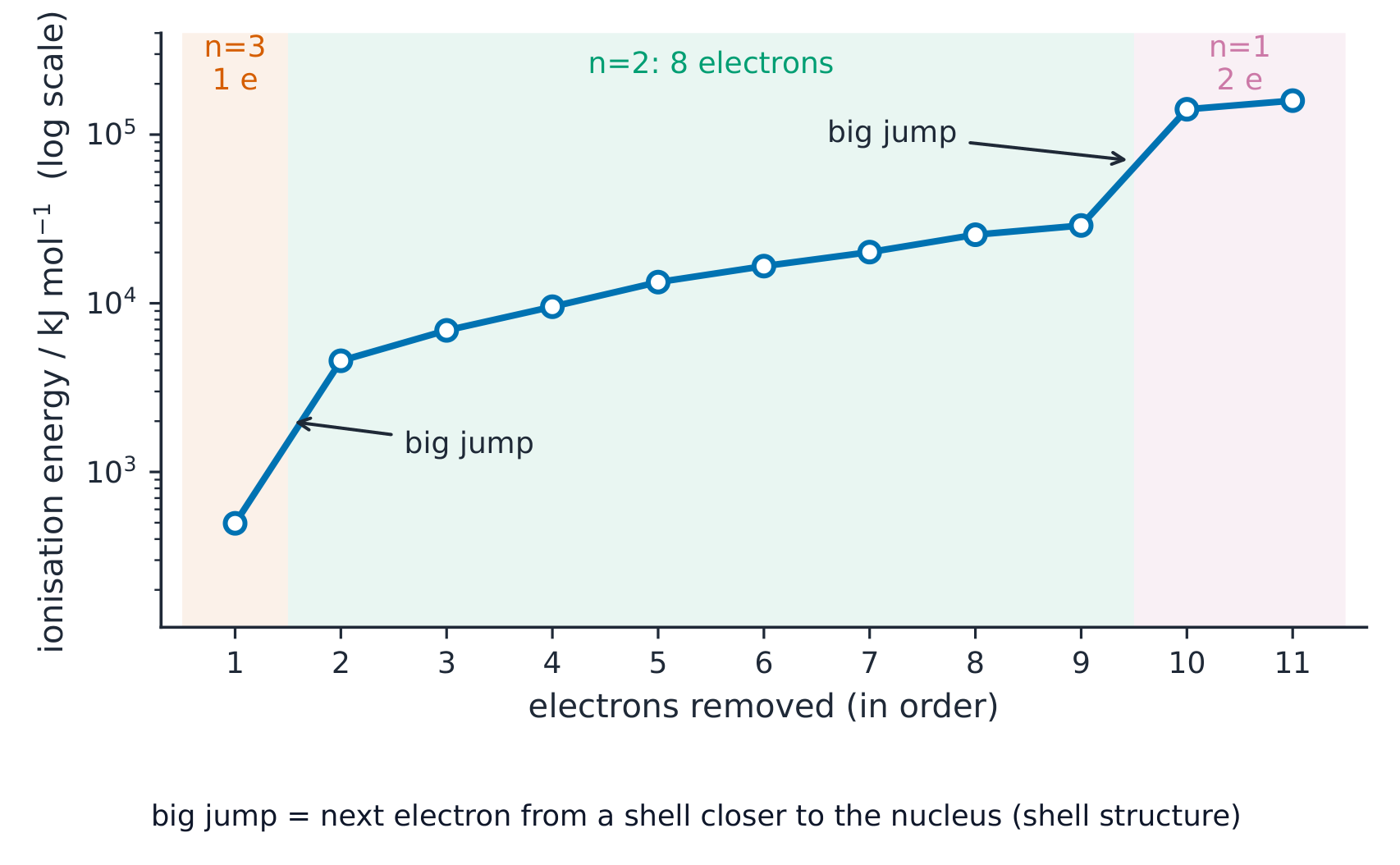

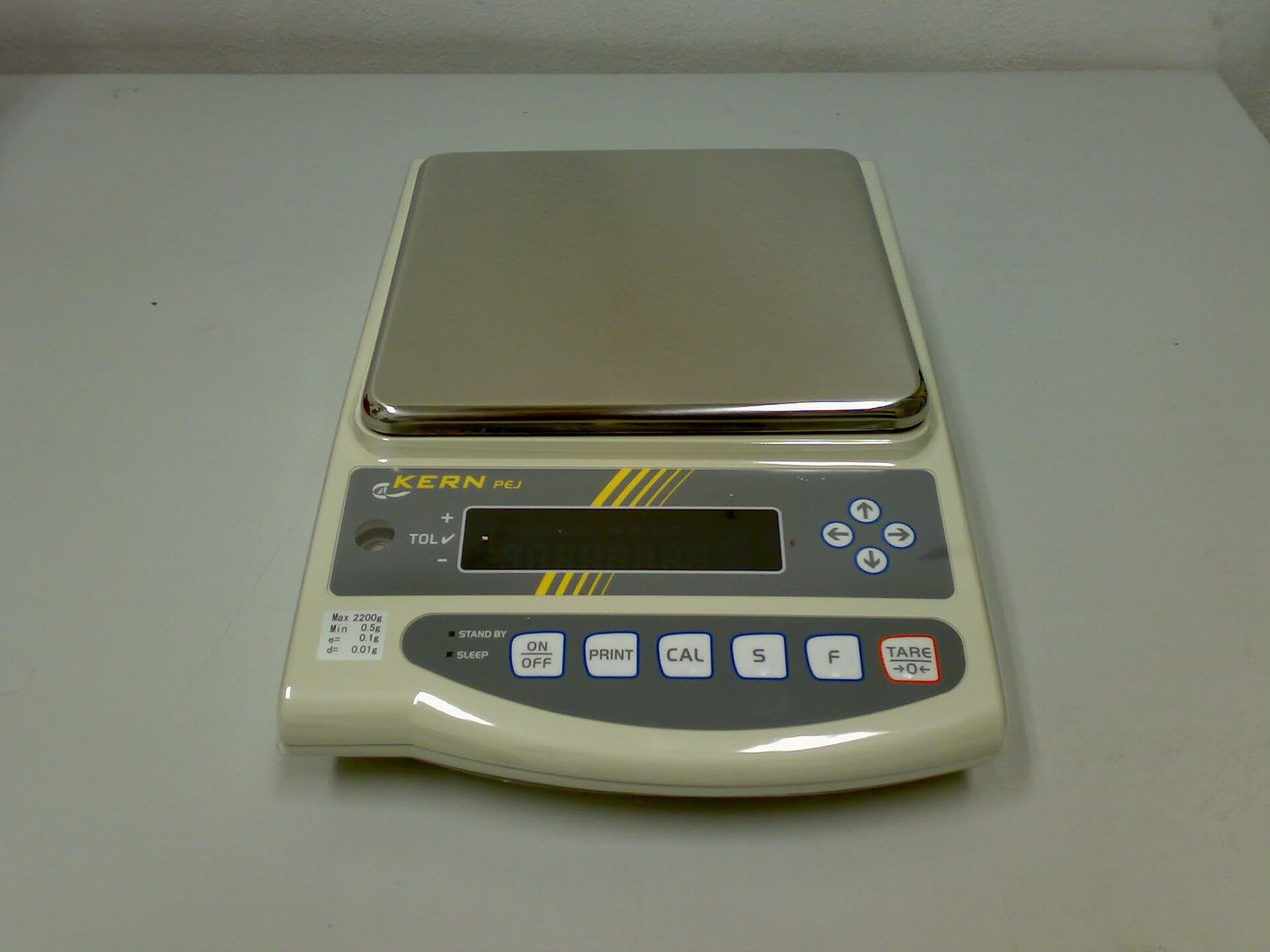


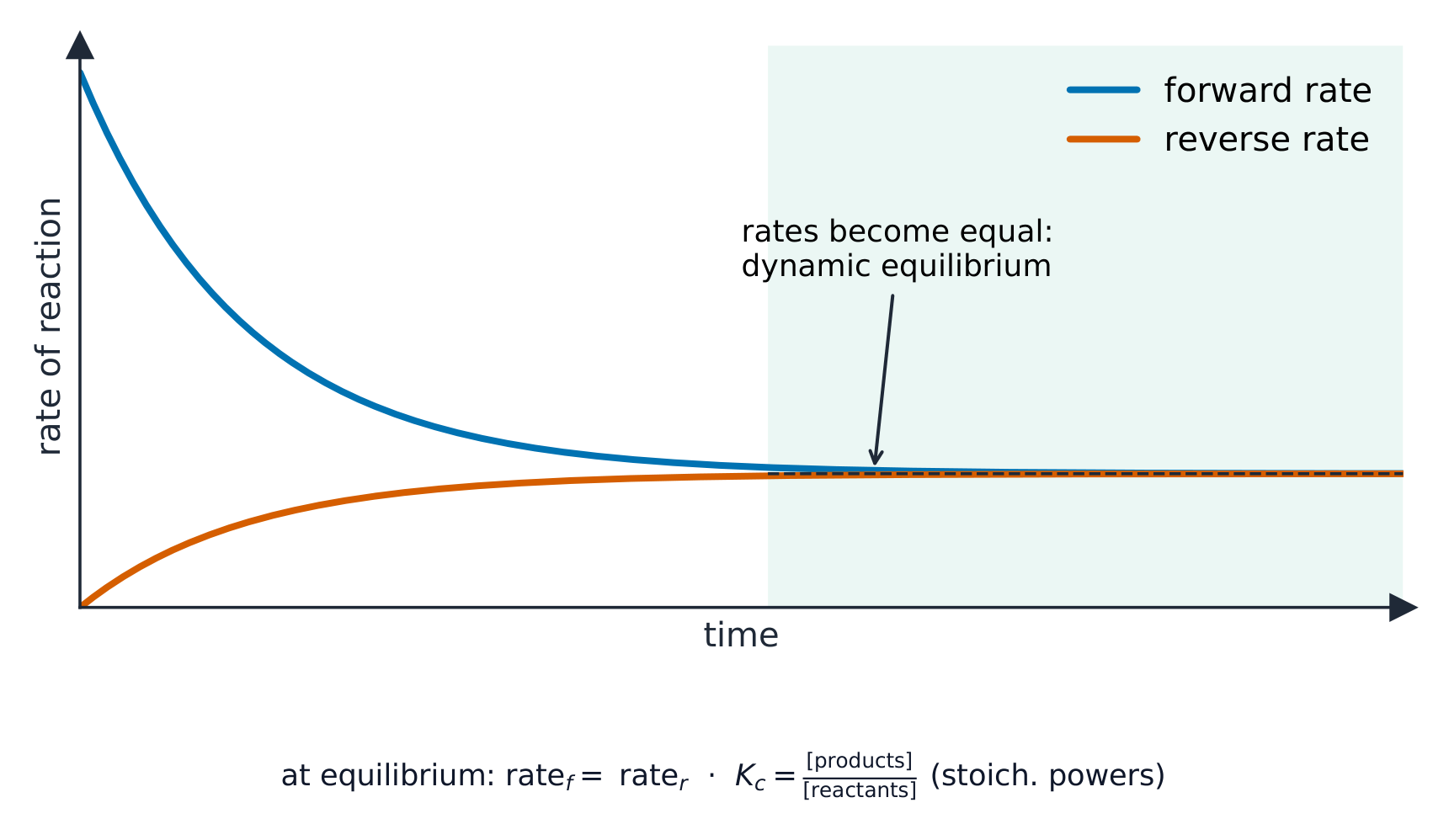


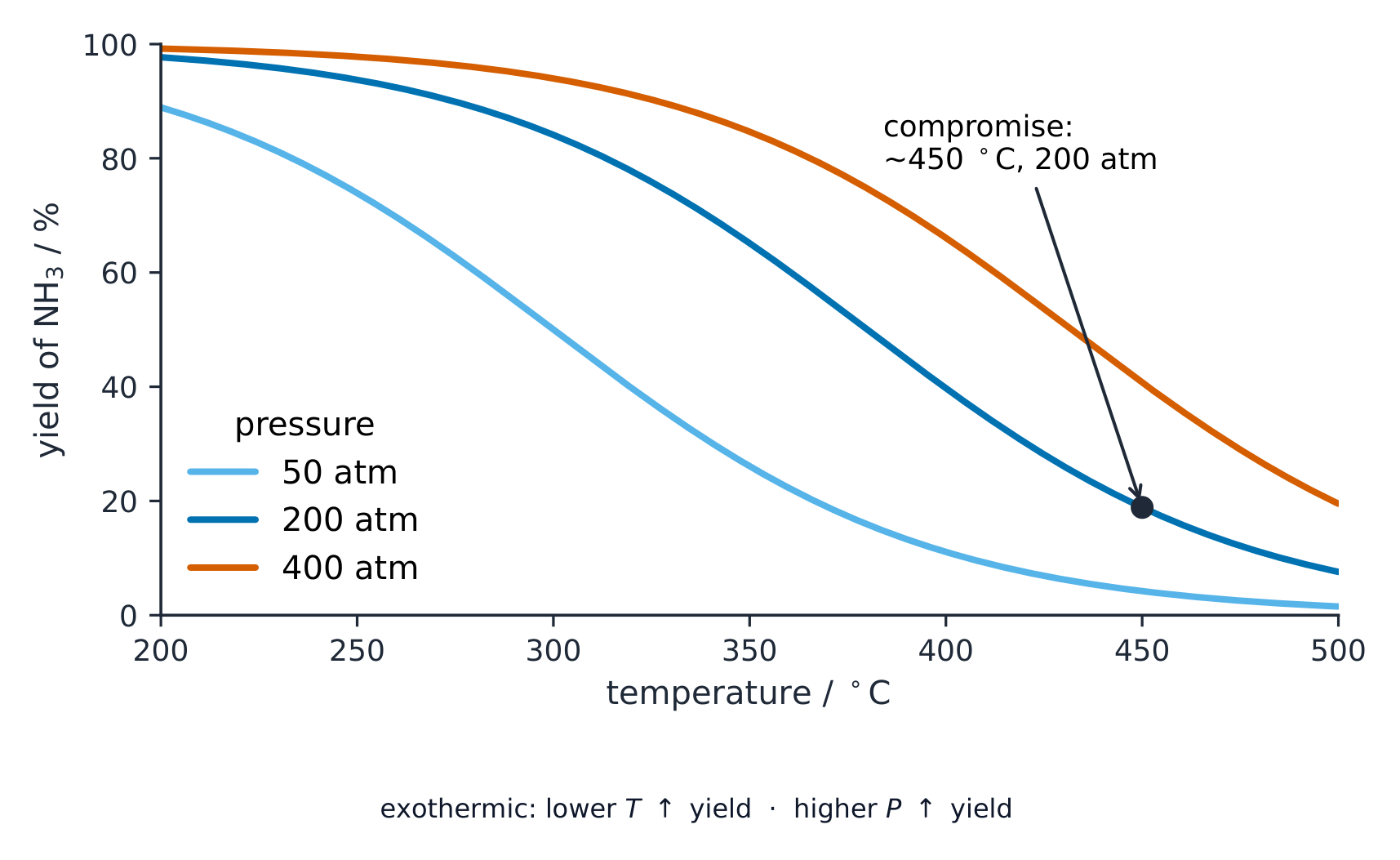


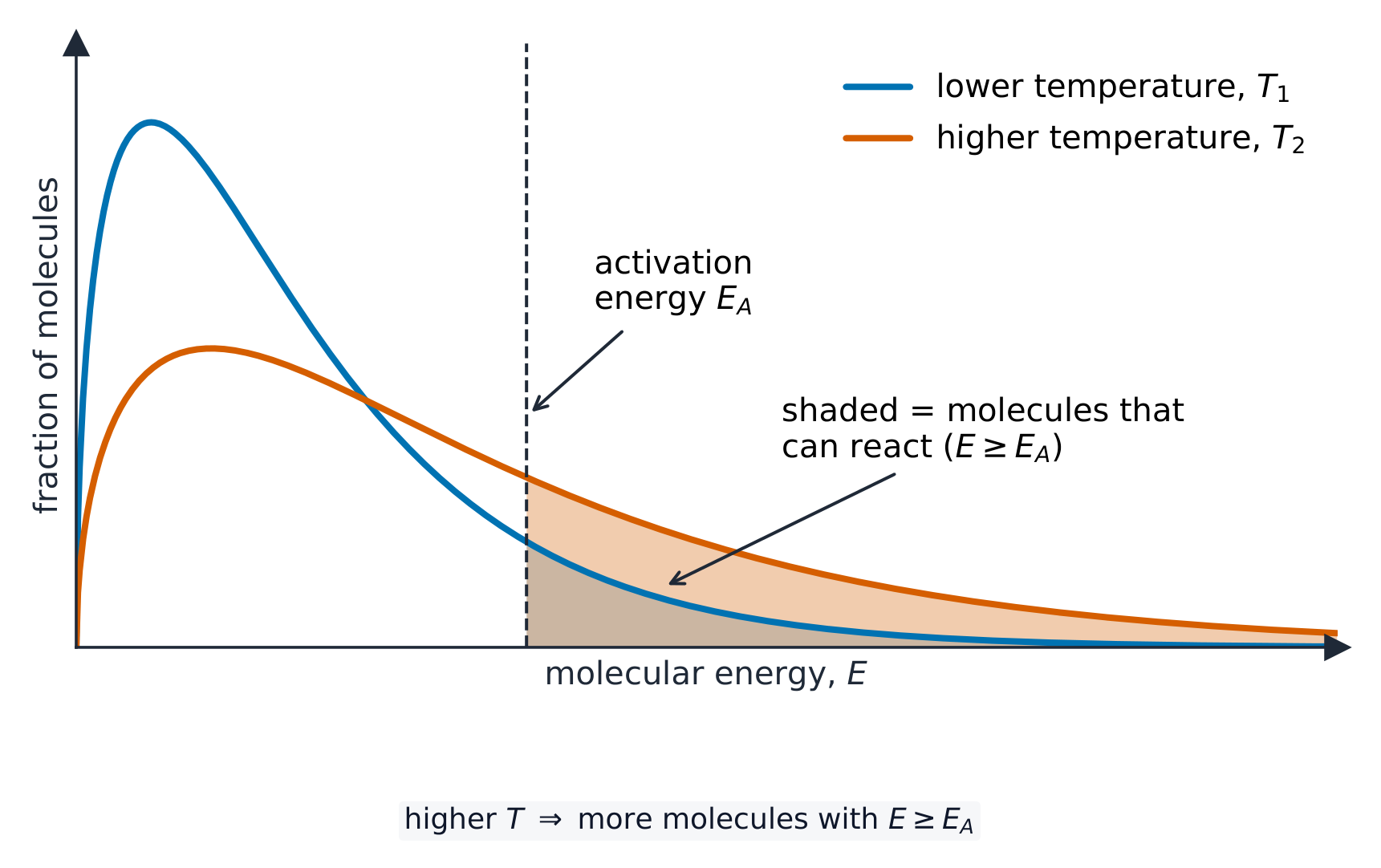

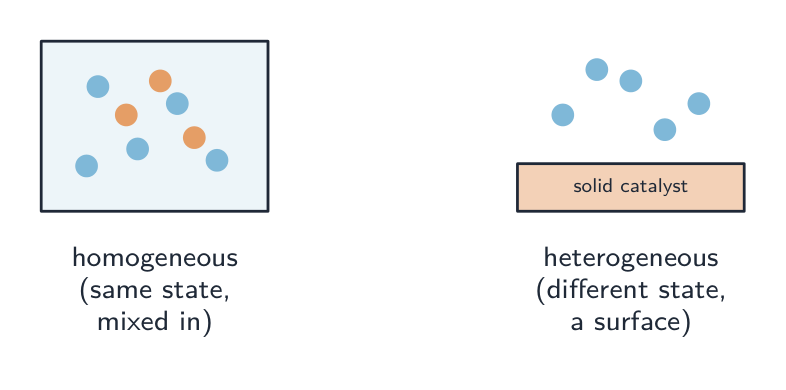


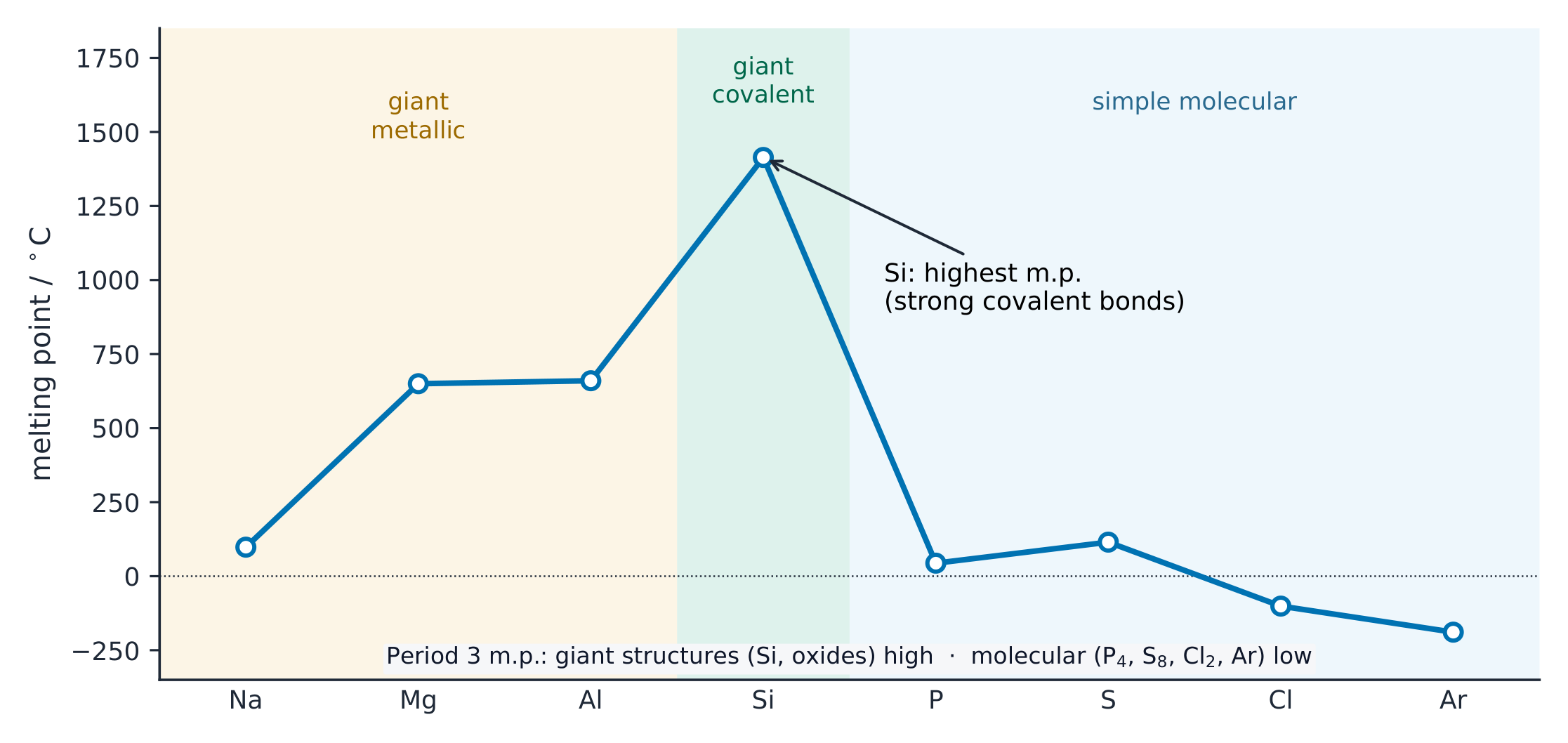


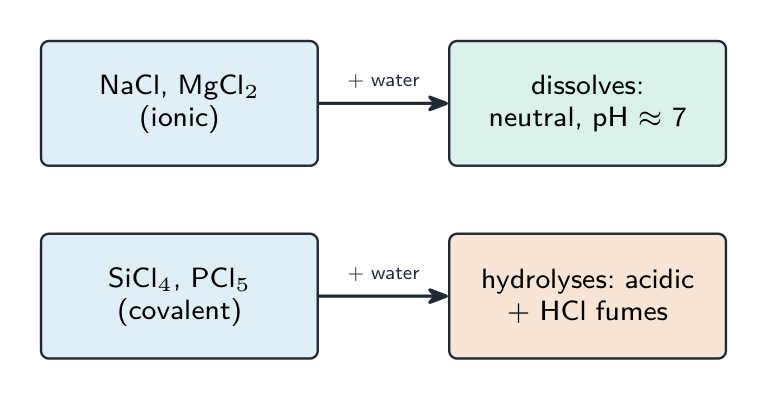


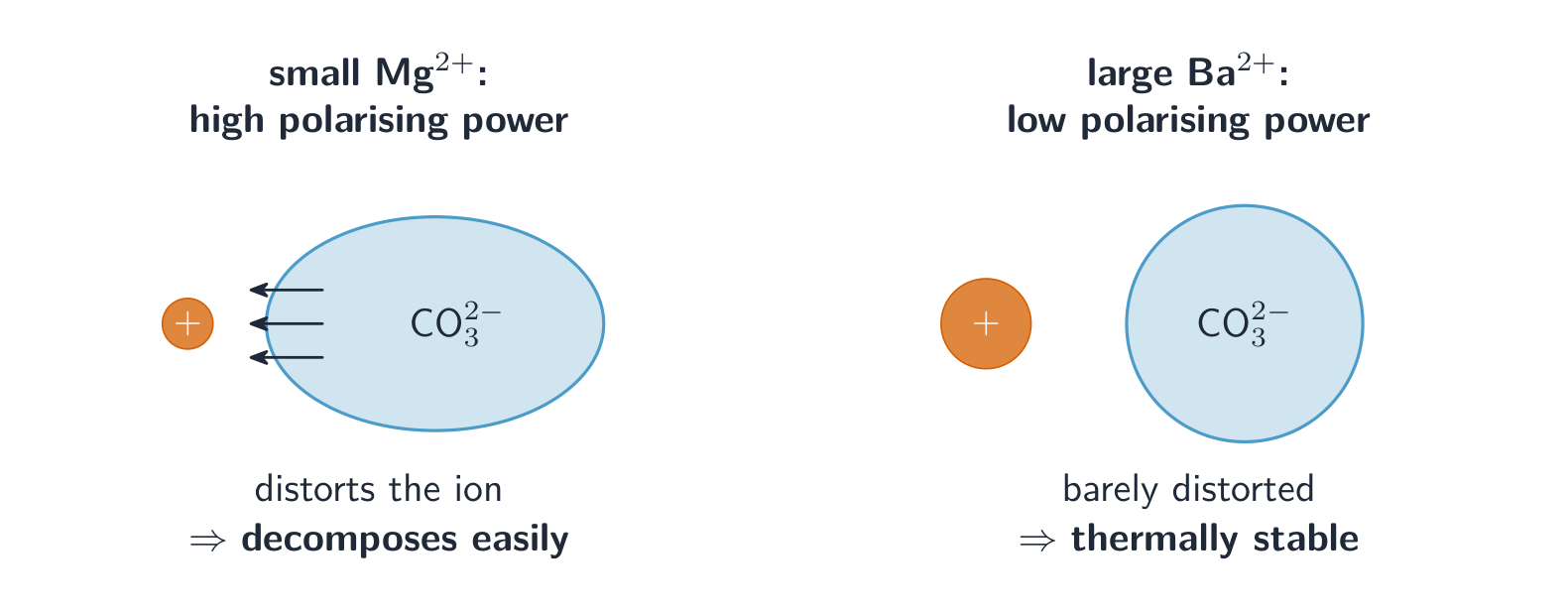
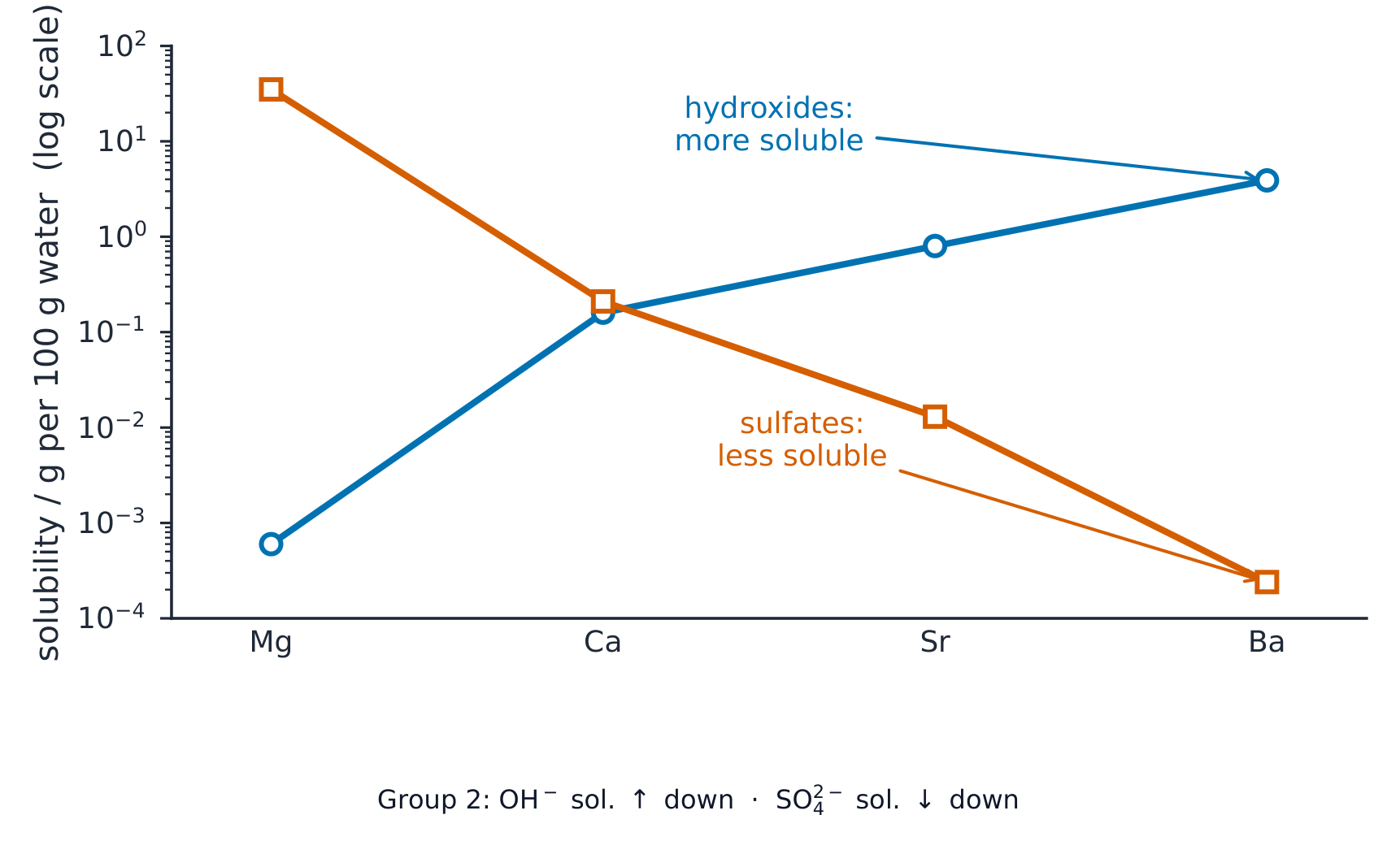


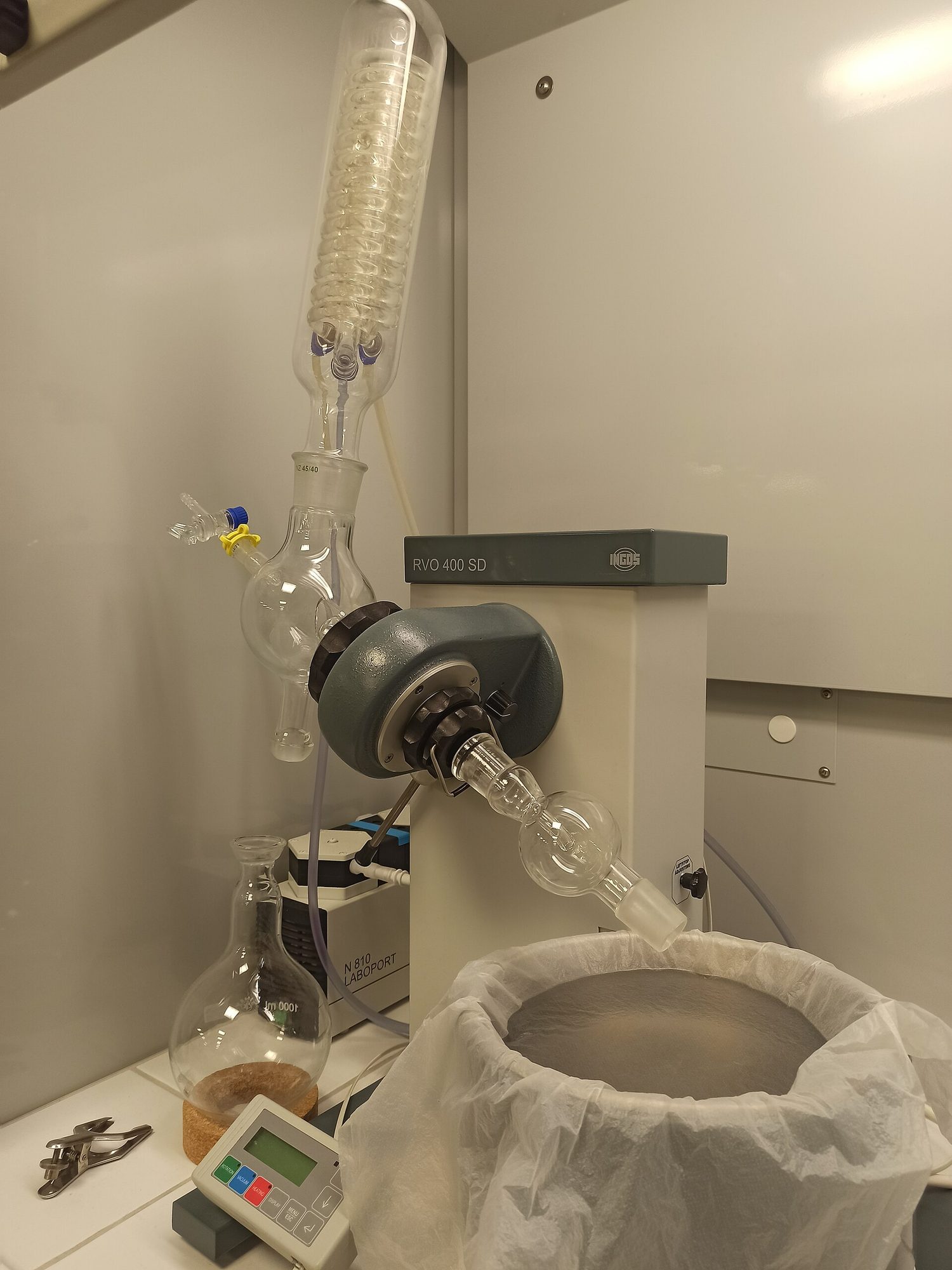


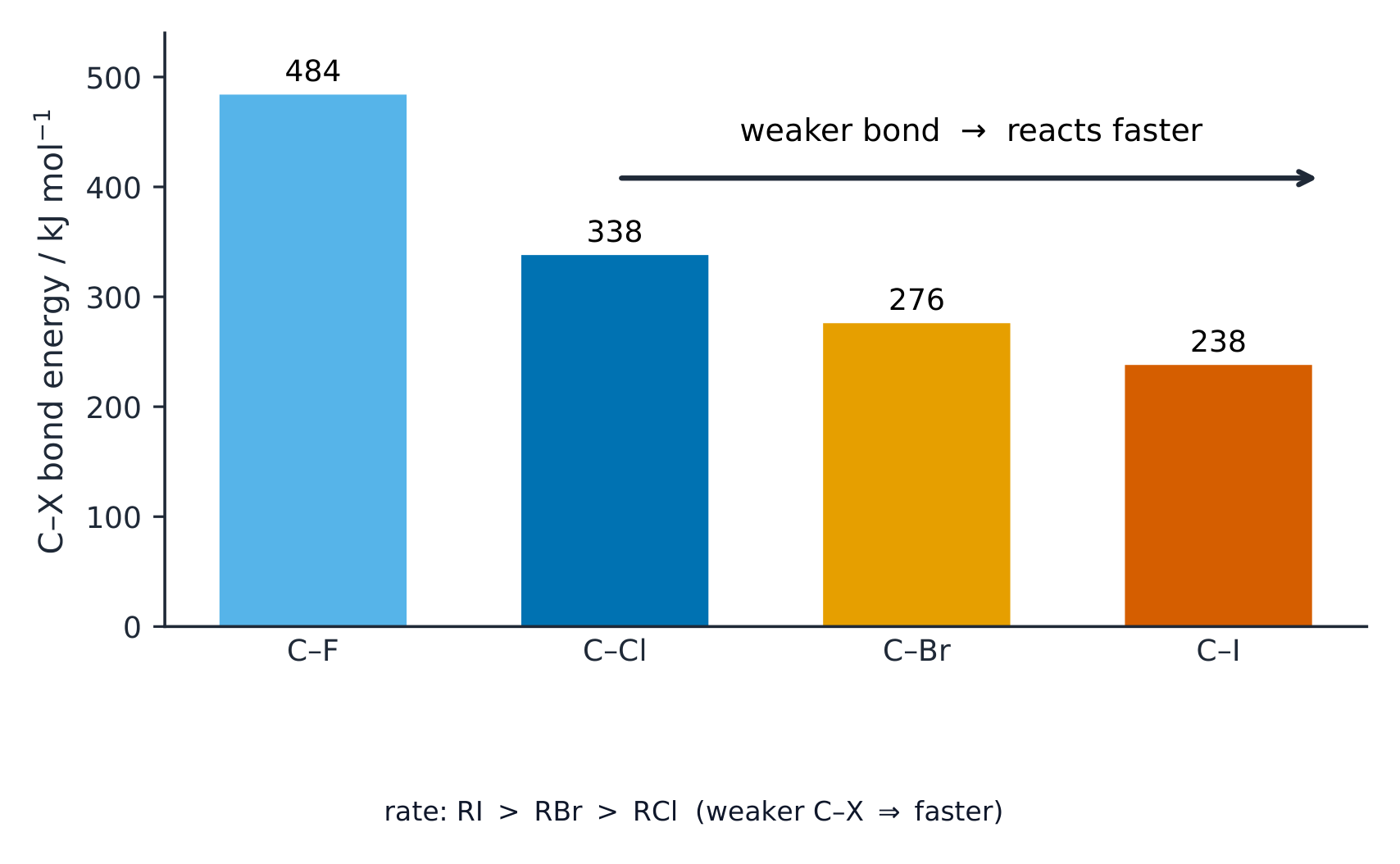





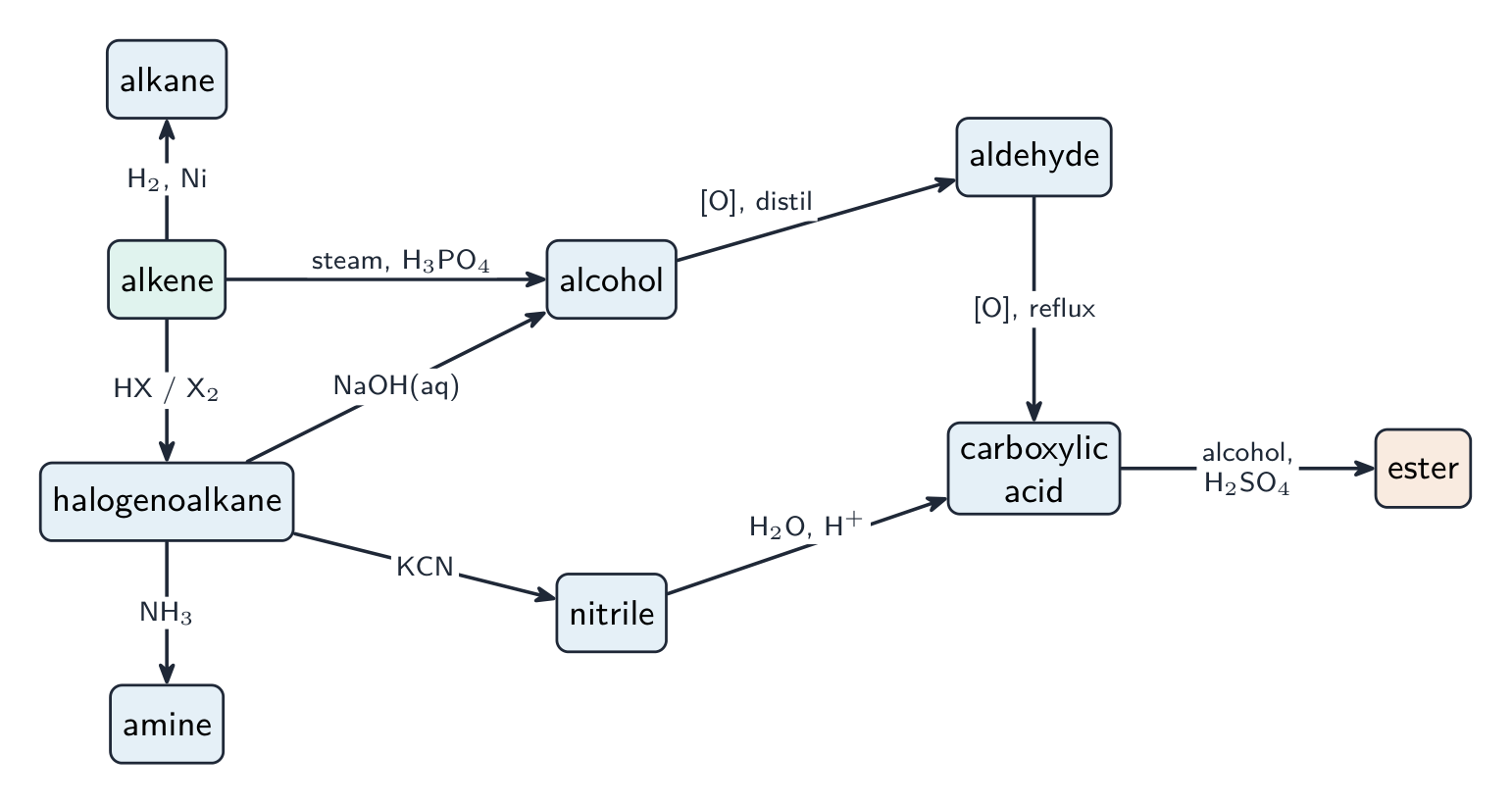
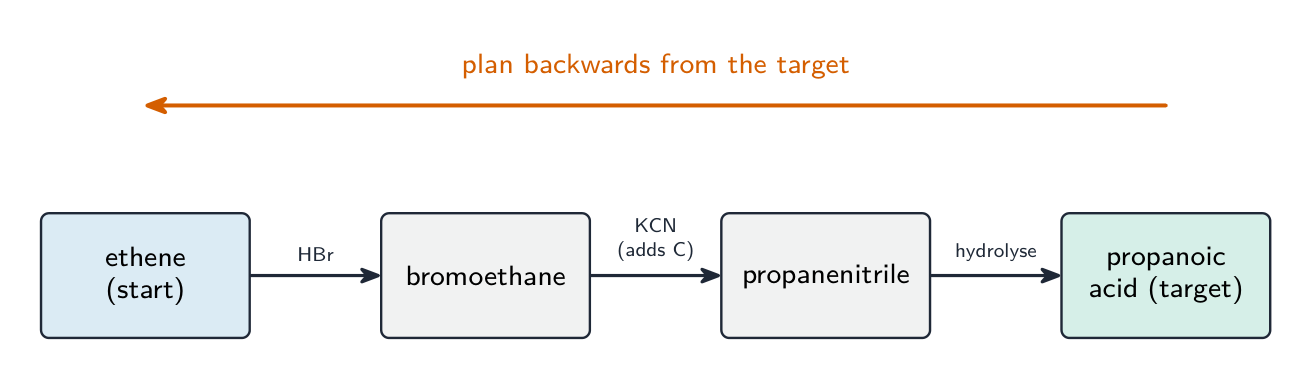
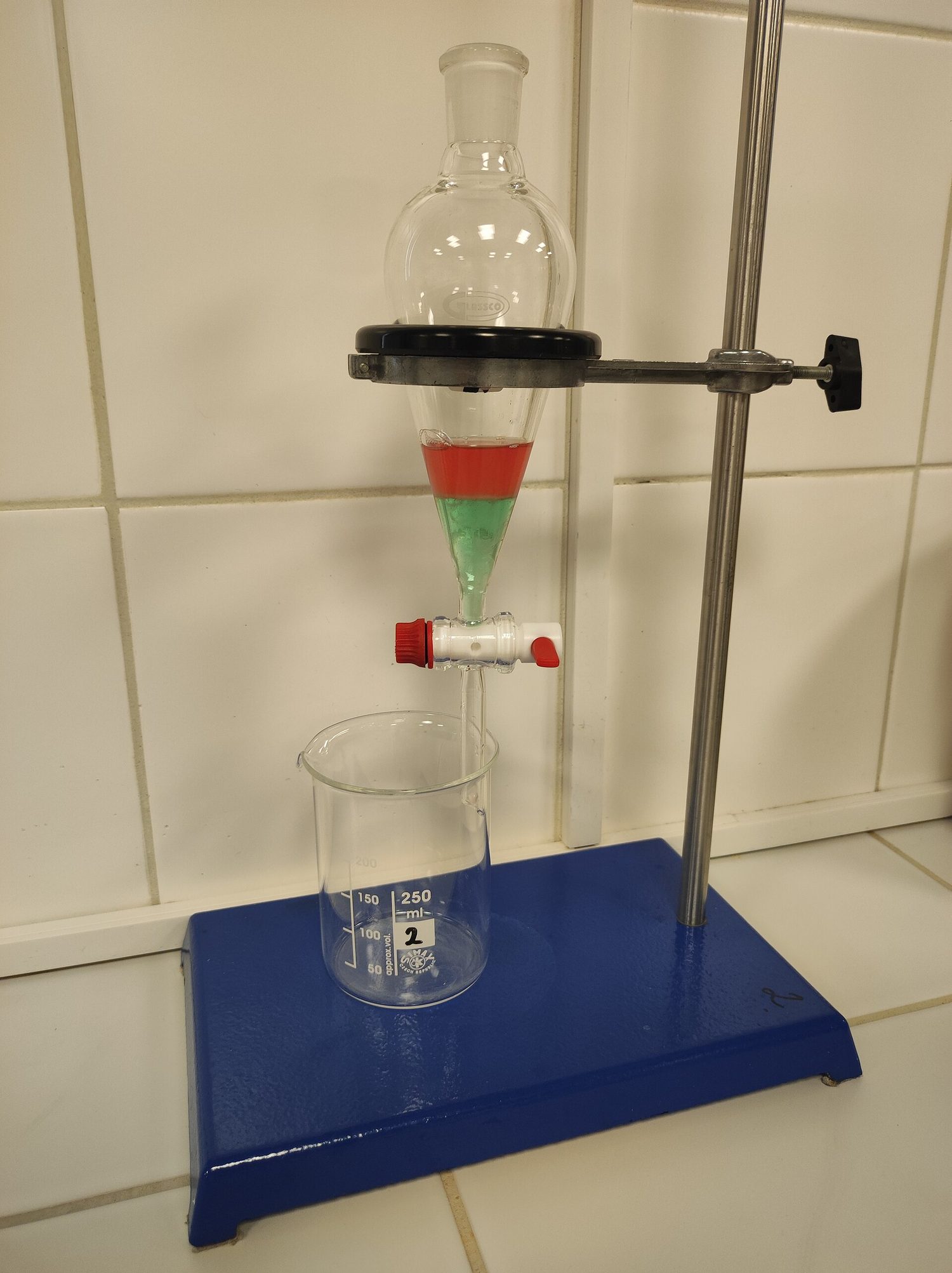


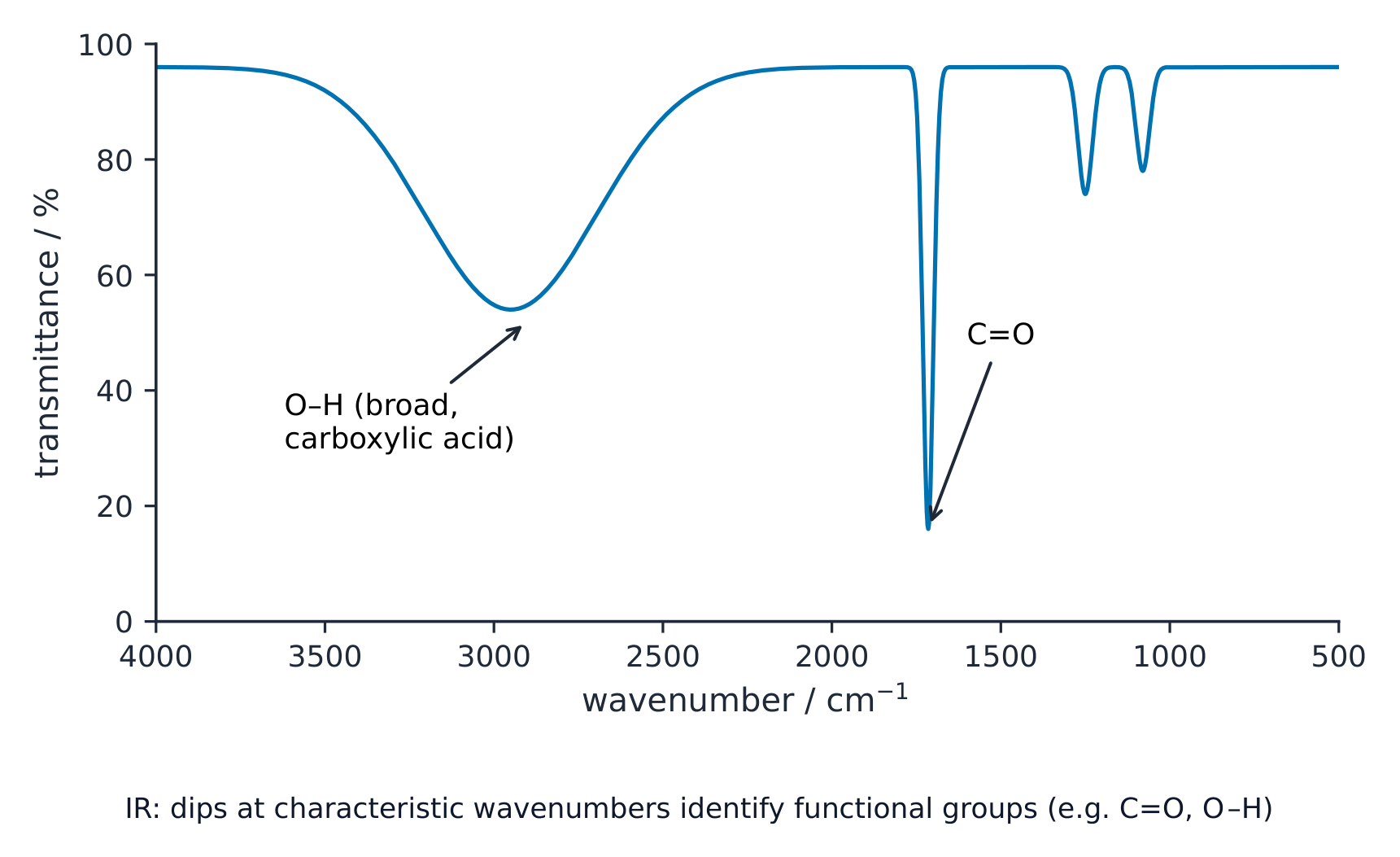

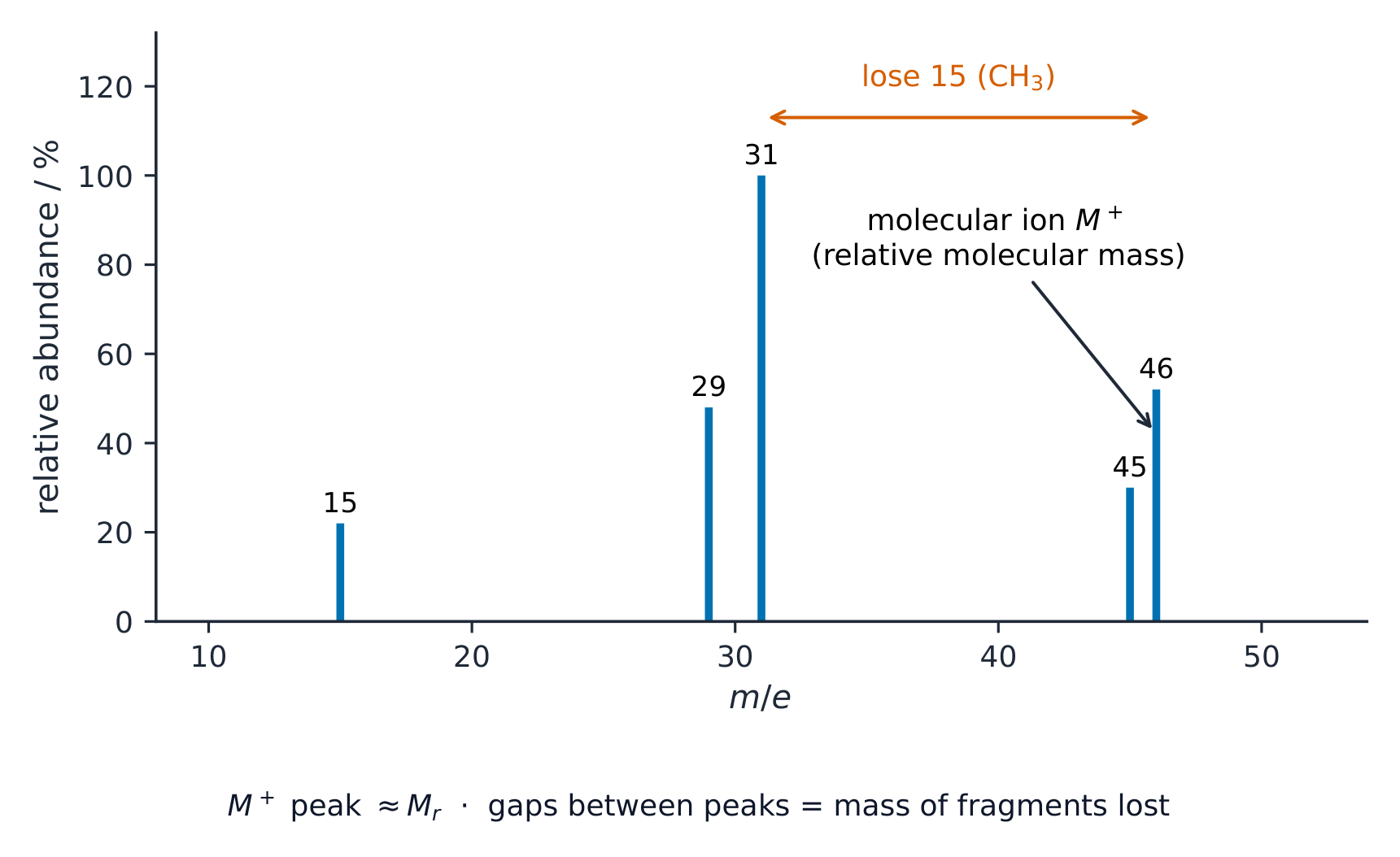
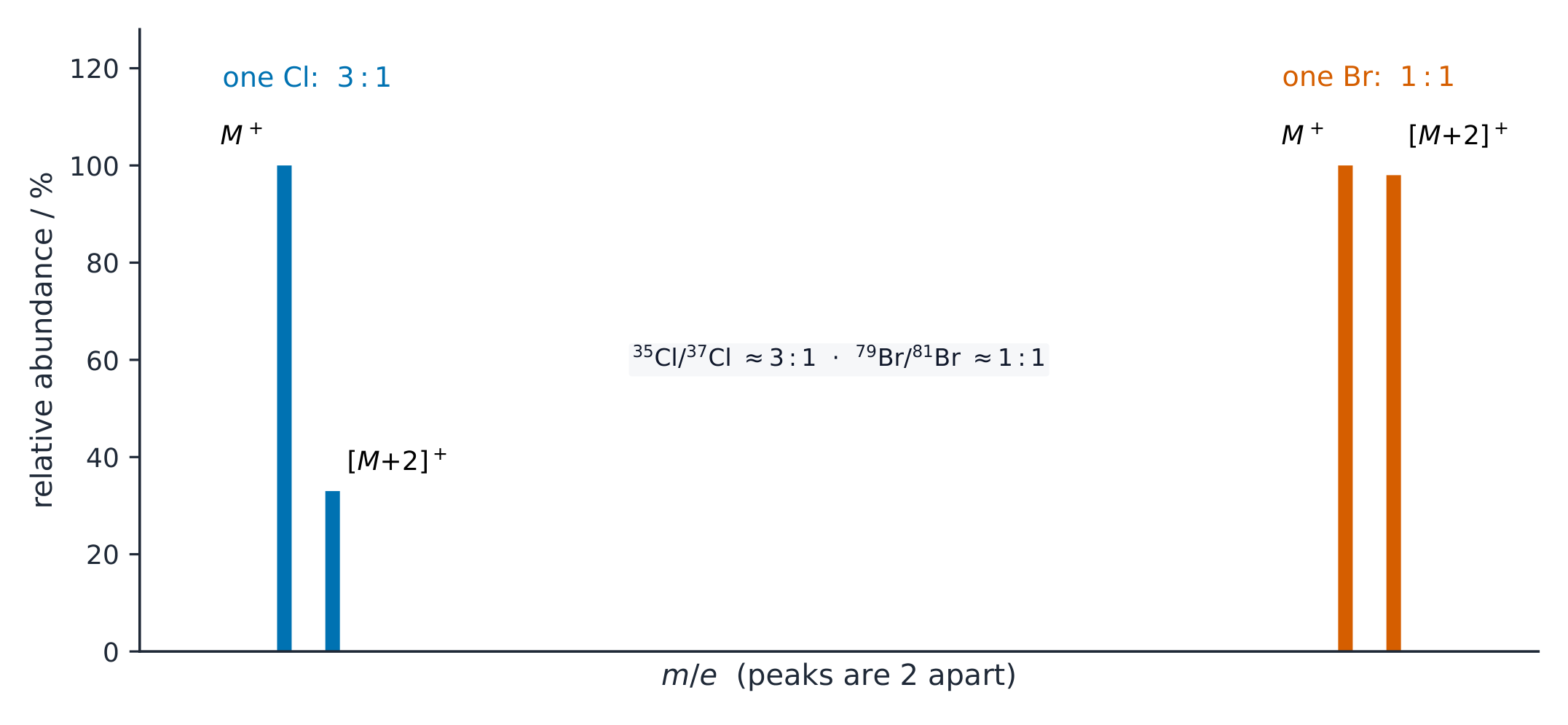


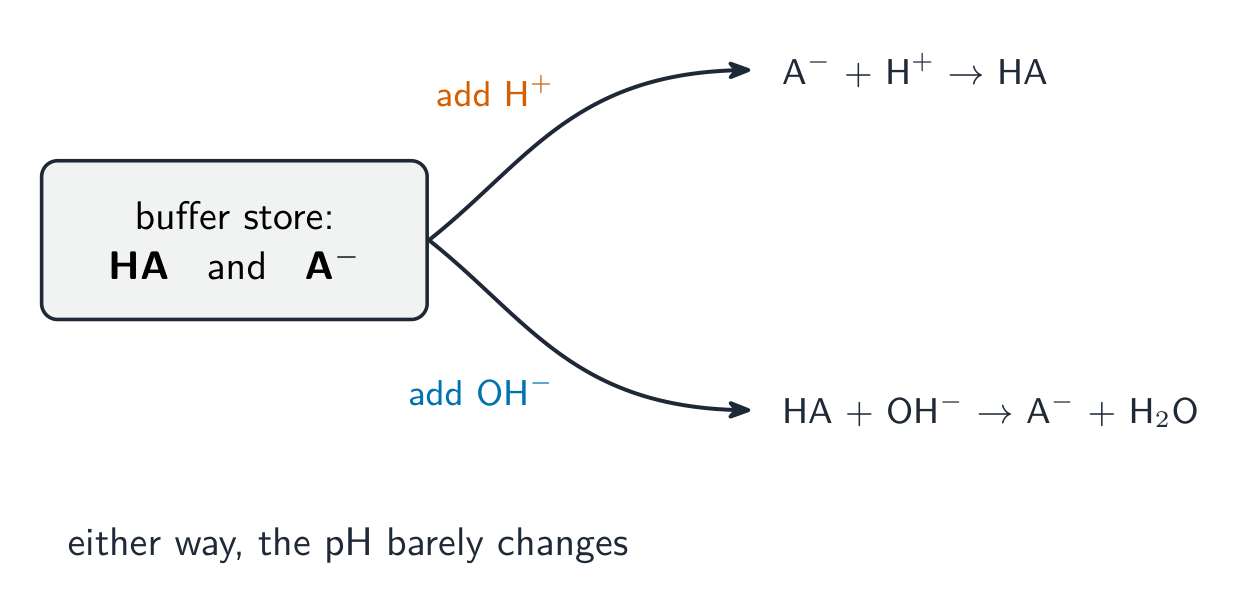


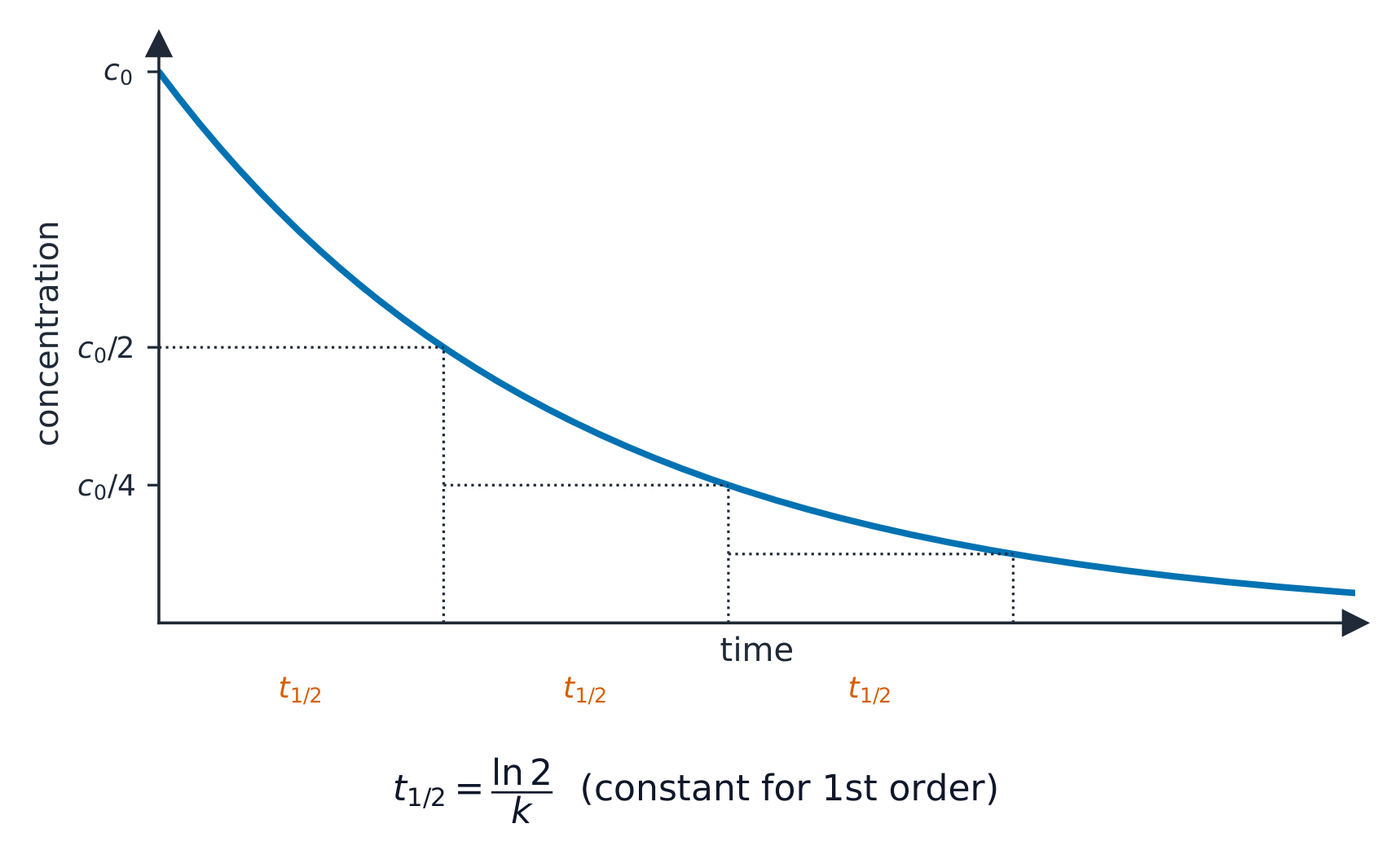
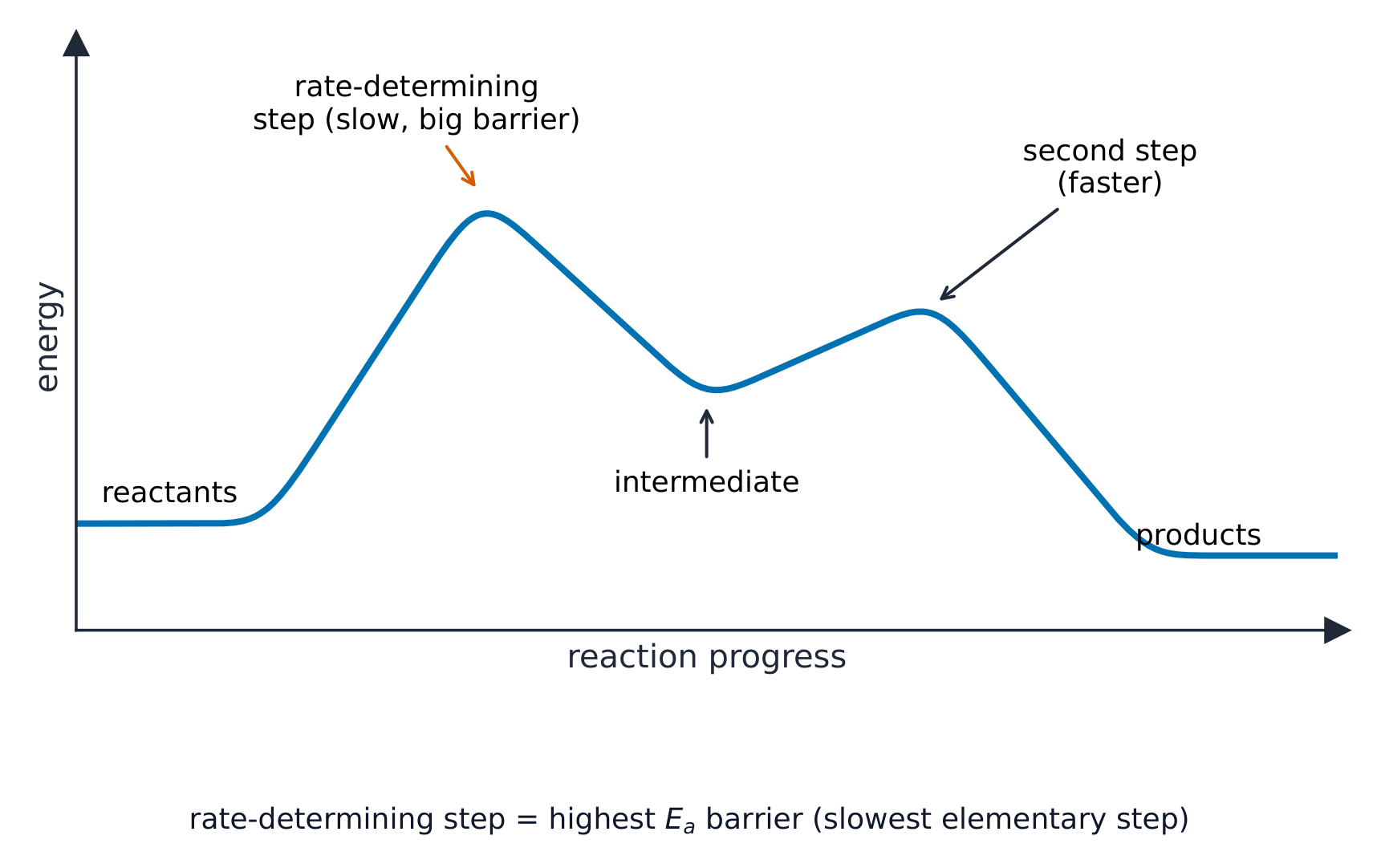




 *Xà phòng phenol chứa phenol, vốn là một trong những chất kháng khuẩn đầu tiên