- define the term hydrocarbon as a compound made up of C and H atoms only
- understand that alkanes are simple hydrocarbons with no functional group
- understand that the compounds in the table on pages 29 and 30 contain a functional group which dictates their physical and chemical properties
- interpret and use the general, structural, displayed and skeletal formulas of the classes of compound stated in the table on pages 29 and 30
- understand and use systematic nomenclature of simple aliphatic organic molecules with functional groups detailed in the table on pages 29 and 30, up to six carbon atoms (six plus six for esters, straight chains only for esters and nitriles)
- deduce the molecular and/or empirical formula of a compound, given its structural, displayed or skeletal formula
An introduction to AS Level organic chemistry
A-Level Chemistry · Topic 13
 8:56
8:56
An introduction to AS Level organic chemistry
Chemists have found more than ten million hydrocarbons and carbon compounds. Ten million. So how can anyone learn organic chemistry? Because almost all of them…
English narration · English + 中文 subtitles burned in
13.1
Formulas, functional groups and naming

Syllabus
Source: Cambridge International syllabus
A hydrocarbon 碳氢化合物 is a compound of only carbon and hydrogen. Alkanes 烷烃 are the simplest hydrocarbons and have no functional group.
A functional group 官能团 is the reactive part of a molecule. It decides the physical and chemical properties of the compound, so molecules with the same functional group behave alike (for example the $\text{–OH}$ group in alcohols).
Types of formula
| Formula | What it shows |
|---|---|
| general formula 通式 | the pattern for a whole family, e.g. alkanes are $\text{C}_n\text{H}_{2n+2}$ |
| molecular formula 分子式 | the actual number of each atom, e.g. $\text{C}_4\text{H}_{10}$ |
| structural formula 结构式 | the groups in order, e.g. $\text{CH}_3\text{CH}_2\text{CH}_2\text{CH}_3$ |
| displayed formula 展开式 | every atom and every bond drawn out |
| skeletal formula 骨架式 | lines for bonds; carbons at corners, hydrogens on carbon not shown |

You can read off the empirical formula 实验式 (simplest ratio) from any of these.
Naming
Use systematic nomenclature 命名法: a stem for the number of carbons (meth-, eth-, prop-, but-, pent-, hex- for 1 to 6), an ending for the functional group, and numbers to show where groups are.
Explore
Functional group lab
Sort organic molecules by the group that controls their reactions.
Vocabulary
Train
| English |
|---|
| hydrocarbon/ˈhaɪdrəkɑːbən/ |
| alkane/ˈælkeɪn/ |
| functional group/ˈfʌŋkʃənl ɡruːp/ |
| general formula/ˈdʒenərəl ˈfɔːmjʊlə/ |
| molecular formula/məˈlekjʊlə ˈfɔːmjʊlə/ |
| structural formula/ˈstrʌktʃərəl ˈfɔːmjʊlə/ |
| displayed formula/dɪˈspleɪd ˈfɔːmjʊlə/ |
| skeletal formula/ˈskelɪtl ˈfɔːmjʊlə/ |
| empirical formula/emˈpɪrɪkl ˈfɔːmjʊlə/ |
| nomenclature/nəˈmeŋklətʃə/ |
13.2
Characteristic organic reactions
Syllabus
- interpret and use the following terminology associated with types of organic compounds and reactions: (a) homologous series (b) saturated and unsaturated (c) homolytic and heterolytic fission (d) free radical, initiation, propagation, termination (e) nucleophile, electrophile, nucleophilic, electrophilic (f) addition, substitution, elimination, hydrolysis, condensation (g) oxidation and reduction (in equations for organic redox reactions, the symbol [O] can be used to represent one atom of oxygen from an oxidising agent and the symbol [H] to represent one atom of hydrogen from a reducing agent)
- understand and use the following terminology associated with types of organic mechanisms: (a) free-radical substitution (b) electrophilic addition (c) nucleophilic substitution (d) nucleophilic addition (in organic reaction mechanisms, the use of curly arrows to represent movement of electron pairs is expected; the arrow should begin at a bond or a lone pair of electrons)
Source: Cambridge International syllabus
Some key terms
- a homologous series 同系列 is a family of compounds with the same functional group and general formula, where successive members differ by $\text{CH}_2$.
- a saturated 饱和 compound has only single C–C bonds; an unsaturated 不饱和 compound has a C=C double bond (or a triple bond).
Breaking bonds
A covalent bond can break in two ways:
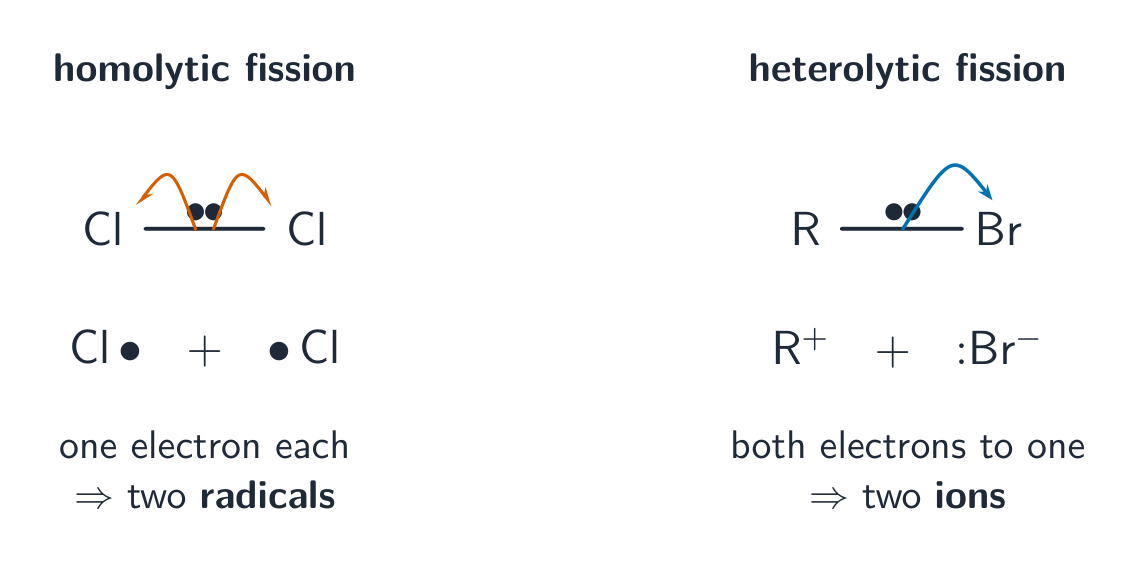
- homolytic fission 均裂: the bond splits evenly, one electron to each atom. This makes two free radicals 自由基 (species with an unpaired electron).
- heterolytic fission 异裂: the bond splits unevenly, both electrons going to one atom. This makes two ions.
Attacking species
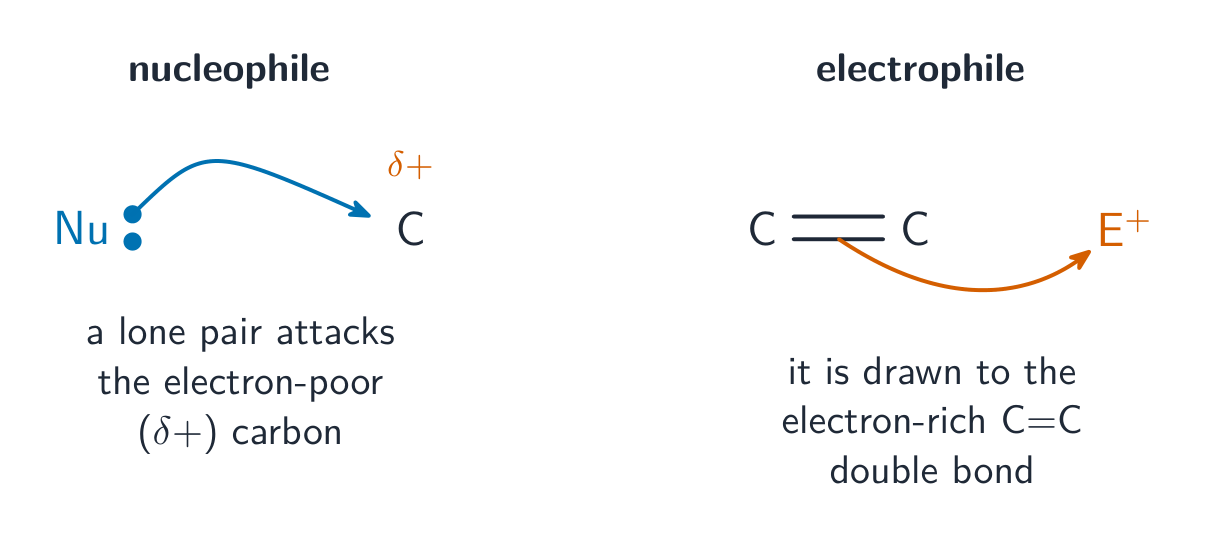
- a nucleophile 亲核试剂 is an electron-pair donor: it uses a lone pair to form a bond to an electron-poor centre. A nucleophile can be neutral, such as ammonia, or negative, such as hydroxide.
- an electrophile 亲电试剂 is an electron-pair acceptor: it accepts a pair from an electron-rich region, such as the pi bond of C=C.
Types of reaction
| Reaction | What happens |
|---|---|
| addition 加成 | two molecules join to make one |
| substitution 取代 | one atom or group is swapped for another |
| elimination 消去 | a small molecule is removed, making a double bond |
| hydrolysis 水解 | a molecule is split apart by water |
| condensation 缩合 | two molecules join and a small molecule (such as water) is lost |
For organic redox, the symbol $[\text{O}]$ stands for one oxygen atom from an oxidising agent, and $[\text{H}]$ for one hydrogen atom from a reducing agent.
Worked classification. Ethene plus HBr makes bromoethane by addition; bromoethane plus hydroxide replaces Br with OH by substitution; ethanol losing water to make ethene is elimination. Ester plus water giving acid and alcohol is hydrolysis, while acid plus alcohol giving ester and water is condensation. Classify from the structural change and the role of water.
Types of mechanism
A free-radical reaction happens in three steps: initiation 引发 (radicals are made), propagation 增长 (radicals react and make new radicals), and termination 终止 (two radicals join and stop the chain).
The main mechanisms you meet are free-radical substitution 自由基取代 (alkanes), electrophilic addition 亲电加成 (alkenes), nucleophilic substitution 亲核取代 (halogenoalkanes) and nucleophilic addition 亲核加成 (carbonyls). In mechanisms, a full curly arrow 弯箭头 shows a pair of electrons moving; it starts at a bond or a lone pair 孤对电子.
Follow the electron pair in a substitution
A full curly arrow starts on a bond or a lone pair and shows two electrons moving. A half-headed arrow shows one electron moving in a radical step. Do not start an arrow at a positive charge.
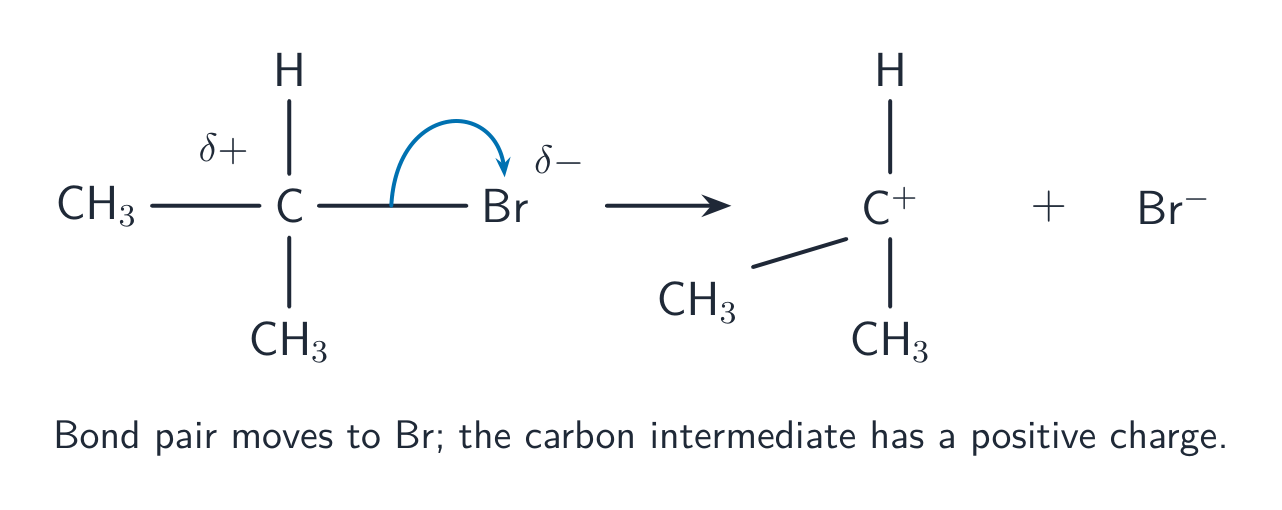
Original application: 9701/24 N25 Q3(b)(ii). The question states an $S_\mathrm{N}1$ mechanism for 2-bromopropane with $(\text{CH}_3)_2\text{CHO}^-$. Follow the stated mechanism. First show the $\delta+$ carbon and $\delta-$ bromine, then move the C–Br pair to bromine. This gives a carbocation and $\text{Br}^-$.
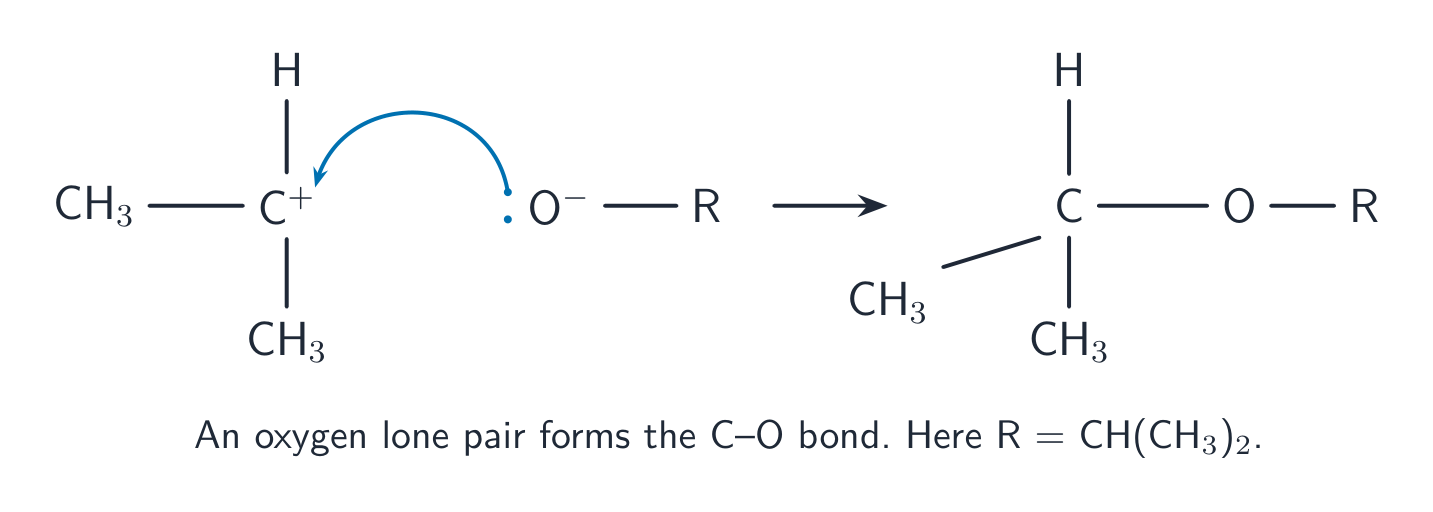
Next, move a lone pair on the nucleophile's oxygen to the positive carbon. A new C–O bond forms. In the figure, R means $\text{CH(CH}_3)_2$.
For the worksheet's 2-bromo-2-methylpropane case, the same two-stage pattern gives a tertiary carbocation, then attack by $\text{OH}^-$. Three alkyl groups help stabilise the positive charge by their electron-releasing effect. A primary carbocation is much less stable. In the worksheet's 1-bromobutane $S_\mathrm{N}2$ case, attack and C–Br breaking occur together in one stage, without a carbocation intermediate. Draw both pair-moving arrows in that stage.
Identify radical stages from what they do
For methane and chlorine under UV light: initiation $\text{Cl}_2\rightarrow2\text{Cl}\boldsymbol{\cdot}$ makes radicals. Propagation $\text{Cl}\boldsymbol{\cdot}+\text{CH}_4\rightarrow\text{HCl}+\boldsymbol{\cdot}\text{CH}_3$, followed by $\boldsymbol{\cdot}\text{CH}_3+\text{Cl}_2\rightarrow\text{CH}_3\text{Cl}+\text{Cl}\boldsymbol{\cdot}$, consumes and regenerates one radical in each step. Termination $\boldsymbol{\cdot}\text{CH}_3+\text{Cl}\boldsymbol{\cdot}\rightarrow\text{CH}_3\text{Cl}$ consumes two radicals without making a new radical.
Explore
Bond fission and attack route
Watch a polar bond lead to electrophiles, nucleophiles and radicals.
Explore
Organic reaction type lab
Classify reaction examples by the pattern of bonds changing.
Vocabulary
Train
| English |
|---|
| homologous series/həˈmɒləɡəs ˈsɪəriːz/ |
| saturated/ˈsætʃəreɪtɪd/ |
| unsaturated/ʌnˈsætʃəreɪtɪd/ |
| homolytic fission/ˌhɒməˈlɪtɪk ˈfɪʃn/ |
| free radical/friː ˈrædɪkl/ |
| heterolytic fission/ˌhetrəˈlɪtɪk ˈfɪʃn/ |
| nucleophile/ˈnjuːklɪɒfaɪl/ |
| electrophile/ɪˌlektrəʊˈfaɪl/ |
| addition/əˈdɪʃn/ |
| substitution/ˌsʌbstɪˈtjuːʃn/ |
| elimination/ɪˌlɪmɪˈneɪʃn/ |
| hydrolysis/haɪˈdrɒləsɪs/ |
| condensation/kɒndenˈseɪʃn/ |
| initiation/ɪˌnɪʃɪˈeɪʃn/ |
| propagation/ˌprɒpəˈɡeɪʃn/ |
| termination/ˌtɜːmɪˈneɪʃn/ |
| free-radical substitution/friː ˈrædɪkl ˌsʌbstɪˈtjuːʃn/ |
| electrophilic addition/ɪˌlektrəʊˈfɪlɪk əˈdɪʃn/ |
| nucleophilic substitution/ˌnjuːklɪəˈfɪlɪk ˌsʌbstɪˈtjuːʃn/ |
| nucleophilic addition/ˌnjuːklɪəˈfɪlɪk əˈdɪʃn/ |
| curly arrow/ˈkɜːli ˈærəʊ/ |
| lone pair/ləʊn peə/ |
| pi bond/paɪ bɒnd/ |
13.3
Shapes of organic molecules

Syllabus
- describe organic molecules as either straight-chained, branched or cyclic
- describe and explain the shape of, and bond angles in, molecules containing $\text{sp}$, $\text{sp}^2$ and $\text{sp}^3$ hybridised atoms
- describe the arrangement of $\sigma$ and $\pi$ bonds in molecules containing $\text{sp}$, $\text{sp}^2$ and $\text{sp}^3$ hybridised atoms
- understand and use the term planar when describing the arrangement of atoms in organic molecules, for example ethene
Source: Cambridge International syllabus
Organic molecules can be straight-chained, branched or cyclic 环状 (in a ring).
The shape around a carbon depends on its hybridisation 杂化:
| Hybridisation | Bonds | Shape | Angle |
|---|---|---|---|
| $\text{sp}^3$ | 4 single | tetrahedral | $109.5°$ |
| $\text{sp}^2$ | 1 double + 2 single | planar 平面 (flat) | $120°$ |
| $\text{sp}$ | 1 triple (or 2 doubles) | linear | $180°$ |
Every single bond is a sigma bond σ键, made by direct overlap. A double bond is one sigma bond plus one pi bond π键, made by sideways overlap of p orbitals. Ethene is planar because of its $\text{sp}^2$ carbons.

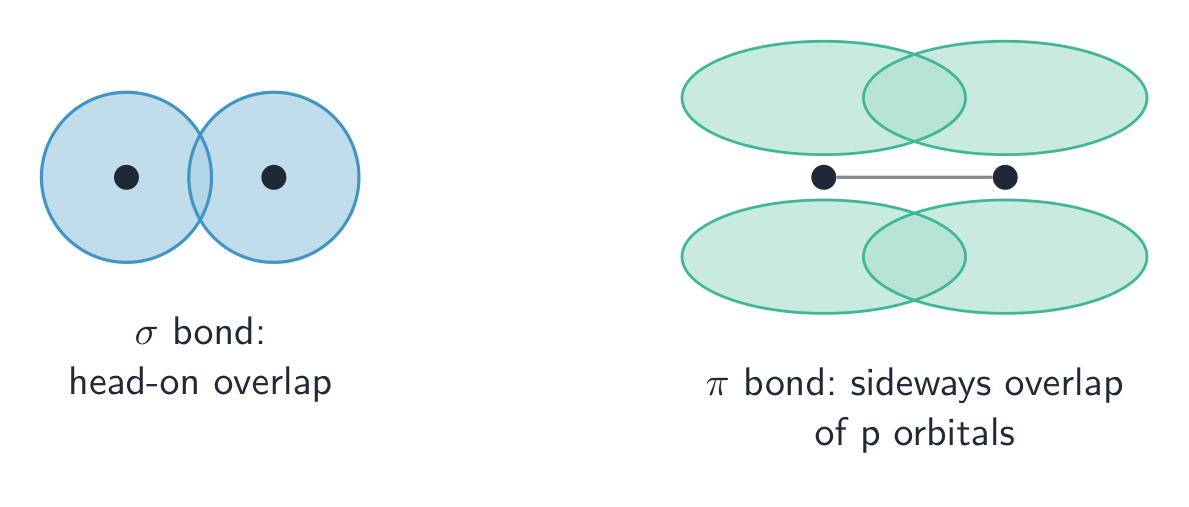
Work locally, then count the whole molecule
Original application: 9701/14 N25 Q6. In propyne, $\text{CH}_3\text{–C}\equiv\text{CH}$, the methyl carbon has four bonding regions: sp$^3$, tetrahedral, $109.5^\circ$. Each triple-bond carbon has two regions: sp, linear, $180^\circ$. A multiple bond counts as one region for shape. The molecule therefore contains sp and sp$^3$ carbons, not sp$^2$.
For bond counts, each bonded atom pair contributes one $\sigma$ bond. A double bond adds one $\pi$; a triple bond adds two $\pi$ bonds. Methane has four $\sigma$ and no $\pi$ bonds. Ethene has five $\sigma$ (four C–H and one C–C) and one $\pi$. Ethyne has three $\sigma$ and two $\pi$ bonds. Include the C–H bonds when counting the whole molecule.
Original application: 9701/12 N25 Q25. Methanal, $\text{H}_2\text{C=O}$, has three bonding regions around carbon: sp$^2$, trigonal planar, approximately $120^\circ$. All four atoms are in a plane. It has three $\sigma$ bonds (two C–H and one C–O) plus one $\pi$ bond. Both original statements are correct: answer A.
Orbital drawing: 9701/24 N25 Q3(a)(iv). The original scheme shows the $\pi$ overlap above and below the propene framework:
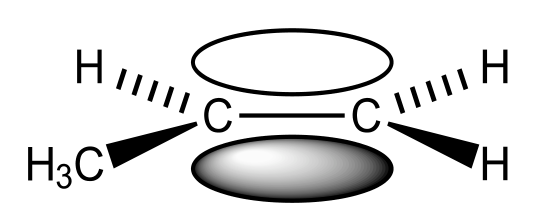
Transfer to a non-organic molecule: 9701/12 N25 Q5. The question states that each N in $\text{N}_2$ is sp hybridised. Of its two sp orbitals, one holds a lone pair and one forms a head-on sp–sp $\sigma$ overlap. The two remaining p orbitals form two $\pi$ bonds by sideways overlap. The original answer is B.
Explore
Shapes of organic molecules
VSEPR around each carbon
Around a single-bonded carbon the four pairs are tetrahedral (109.5°).
Vocabulary
Train
| English |
|---|
| cyclic/ˈsaɪklɪk/ |
| hybridisation/ˌhaɪbrɪdaɪˈzeɪʃn/ |
| planar/ˈpleɪnə/ |
| sigma bond/ˈsɪɡmə bɒnd/ |
13.4
Isomerism

Syllabus
- describe structural isomerism and its division into chain, positional and functional group isomerism
- describe stereoisomerism and its division into geometrical (cis/trans) and optical isomerism (use of E/Z nomenclature is acceptable but is not required)
- describe geometrical (cis/trans) isomerism in alkenes, and explain its origin in terms of restricted rotation due to the presence of $\pi$ bonds
- explain what is meant by a chiral centre and that such a centre gives rise to two optical isomers (enantiomers) (Candidates should appreciate that compounds can contain more than one chiral centre, but knowledge of meso compounds, or nomenclature such as diastereoisomers is not required.)
- identify chiral centres and geometrical (cis/trans) isomerism in a molecule of given structural formula including cyclic compounds
- deduce the possible isomers for an organic molecule of known molecular formula
Source: Cambridge International syllabus
Isomers are compounds with the same molecular formula but a different arrangement of atoms. This is called isomerism 异构.
Structural isomerism
In structural isomerism 结构异构 the atoms are joined in a different order. There are three kinds:
- chain isomerism 链异构: the carbon chain is branched in different ways.
- positional isomerism 位置异构: the functional group is on a different carbon.
- functional group isomerism 官能团异构: the atoms form a different functional group (for example an alcohol and an ether).
Stereoisomerism
In stereoisomerism 立体异构 the atoms are joined in the same order but point in different directions in space.
- geometrical isomerism 几何异构 (cis/trans) happens at a C=C double bond. The pi bond stops the two carbons rotating (restricted rotation 受限旋转), so groups are fixed on the same side (cis 顺式) or opposite sides (trans 反式).

- optical isomerism 旋光异构 happens at a chiral 手性 carbon — a chiral centre 手性中心 is a carbon with four different groups attached. Such a carbon gives two mirror-image forms called enantiomers 对映体. A molecule may have more than one chiral centre.

From a molecular formula you can deduce the possible isomers by trying different chains, positions and functional groups.
Worked example. Explain why but-2-ene shows cis-trans (E/Z) isomerism but but-1-ene does not. Stereoisomerism at a C=C needs two things: restricted rotation about the double bond (both alkenes have that), and two different groups on each of the two double-bond carbons. In but-2-ene, $\text{CH}_3\text{CH=CHCH}_3$, each double-bond carbon carries an $\text{H}$ and a $\text{CH}_3$ - different, so the methyl groups can sit on the same side (cis / Z) or on opposite sides (trans / E). In but-1-ene, $\text{CH}_2\text{=CHCH}_2\text{CH}_3$, the first carbon carries two hydrogens - identical, so swapping them changes nothing and only one form exists. Test each double-bond carbon separately: two identical groups on either carbon kills the isomerism, however different the other carbon may be.
Explore
Structural isomerism lab
Compare molecules with the same formula but different structures.
Vocabulary
Train
| English |
|---|
| isomerism/ˈaɪsəmərɪzəm/ |
| structural isomerism/ˈstrʌktʃərəl ˈaɪsəmərɪzəm/ |
| chain isomerism/tʃeɪn ˈaɪsəmərɪzəm/ |
| positional isomerism/pəˈzɪʃənl ˈaɪsəmərɪzəm/ |
| functional group isomerism/ˈfʌŋkʃənl ɡruːp ˈaɪsəmərɪzəm/ |
| stereoisomerism/ˈsterɪəʊɪsəmərɪzəm/ |
| geometrical isomerism/ˌdʒiːəʊˈmetrɪkl ˈaɪsəmərɪzəm/ |
| restricted rotation/rɪˈstrɪktɪd rəʊˈteɪʃn/ |
| cis/sɪs/ |
| trans/trænz/ |
| optical isomerism/ˈɒptɪkl ˈaɪsəmərɪzəm/ |
| chiral/ˈkaɪrəl/ |
| chiral centre/ˈkaɪrəl ˈsentə/ |
| enantiomers/eˈnæntɪəməz/ |
13.4
Exam tips
- Know the difference between general, molecular, structural, displayed and skeletal formulas — questions ask for a specific one.
- Name systematically: longest chain, lowest locants, substituents alphabetical; a wrong locant loses the mark.
- Classify each reaction by type and reagent (addition, substitution, elimination, oxidation).
- E/Z isomerism needs restricted rotation about a $\text{C}=\text{C}$ and two different groups on each carbon.
Interactive lessons on this topic
Work through it step by step, with instant-check exercises.