- understand that atoms are mostly empty space surrounding a very small, dense nucleus that contains protons and neutrons; electrons are found in shells in the empty space around the nucleus
- identify and describe protons, neutrons and electrons in terms of their relative charges and relative masses
- understand the terms atomic and proton number; mass and nucleon number
- describe the distribution of mass and charge within an atom
- describe the behaviour of beams of protons, neutrons and electrons moving at the same velocity in an electric field
- determine the numbers of protons, neutrons and electrons present in both atoms and ions given atomic or proton number, mass or nucleon number and charge
- state and explain qualitatively the variations in atomic radius and ionic radius across a period and down a group
Tips
A-Level Chemistry (9701) is really three subjects that must talk to each other: physical (energy, equilibrium, rates, electrochemistry), inorganic (periodicity, Group 2, Group 17, transition elements) and organic, which grows from alkanes into a long chain of mechanisms and ends with NMR and mass spectrometry.
Most lost marks here are not from hard chemistry. They come from missing conditions, unbalanced equations, no state symbols, and organic answers that give a product but not the mechanism arrows the scheme pays for.
Organic needs a different kind of revision: draw one reaction map by hand and keep adding to it. The exam asks you to get from one functional group to another, not to recite a single reaction.
-
1
Atomic structure
Watch lesson1.1
What an atom is made of

Syllabus
Source: Cambridge International syllabus
A scanning tunnelling microscope can image individual atoms. Everything is made of atoms 原子. An atom is mostly empty space. At its centre is a tiny, heavy nucleus 原子核. The nucleus holds two kinds of particle: protons 质子 and neutrons 中子. Around the nucleus, in the empty space, move the electrons 电子. The electrons stay in shells 壳层 — layers at set distances from the nucleus.
The nucleus is very small but holds almost all the mass. The electrons take up almost all the space but have almost no mass.

An atom is mostly empty space: protons and neutrons sit in the tiny central nucleus, while electrons move in shells around it Relative charge and relative mass
We compare the three particles using relative charge 相对电荷 and relative mass 相对质量. These are simple numbers, not real units.
Particle Relative charge Relative mass proton $+1$ $1$ neutron $0$ $1$ electron $-1$ $\tfrac{1}{1836}$ (about $0$) A proton and a neutron have almost the same mass. An electron is about 1836 times lighter. The proton is positive, the electron is negative, and the neutron has no charge — it is neutral 中性.
Proton number and nucleon number
Two numbers describe the nucleus:
- the proton number 质子数 (also called the atomic number 原子序数), symbol $Z$ — the number of protons.
- the nucleon number 核子数 (also called the mass number 质量数), symbol $A$ — the total number of protons and neutrons. Protons and neutrons are both nucleons 核子.
So the number of neutrons is $A - Z$.
Counting particles in an atom or ion
For a neutral atom, the number of electrons equals the number of protons, which equals $Z$.
An ion 离子 is an atom that has lost or gained electrons, so it has a charge:
- a positive ion has fewer electrons than protons.
- a negative ion has more electrons than protons.
Example: $^{27}_{13}\text{Al}^{3+}$ has $13$ protons, $27 - 13 = 14$ neutrons, and $13 - 3 = 10$ electrons (it lost 3 electrons to become $3+$).
How mass and charge are spread out
Almost all the mass sits in the nucleus, because protons and neutrons are heavy and electrons are very light. All the positive charge is in the nucleus (the protons). The negative charge is spread out in the shells (the electrons).
Beams of particles in an electric field
Imagine beams of protons, neutrons and electrons moving at the same speed into an electric field 电场 between two charged plates:
- the proton beam bends towards the negative plate (protons are positive).
- the electron beam bends the other way, towards the positive plate. It bends much more, because the electron is far lighter — the same force gives a bigger deflection 偏转 to a smaller mass.
- the neutron beam goes straight through. It has no charge, so the field gives it no force.

In an electric field the proton bends towards the $-$ plate and the electron bends the opposite way and far more (it is much lighter); the neutron passes straight through Atomic radius and ionic radius
The atomic radius 原子半径 is the size of an atom. The ionic radius 离子半径 is the size of an ion.
Across a period 周期 (left to right), the atomic radius gets smaller. The nuclear charge 核电荷 (the pull from the protons) rises, but the electrons go into the same outer shell, so the shielding 屏蔽 by inner shells stays about the same. The stronger pull draws the outer shell inwards.
Down a group 族 (top to bottom), the atomic radius gets larger. Each step down adds a new shell, so the outer electrons are further out and feel more shielding from the nucleus.

Across a period the atoms shrink (stronger nuclear pull on the same outer shell); down a group they grow (each step adds a shell) For ions:
- a positive ion (cation 阳离子) is smaller than its atom. It has lost its outer shell, and the electrons that remain feel a stronger pull each.
- a negative ion (anion 阴离子) is larger than its atom. It has gained electrons, so there is more repulsion 排斥 between the electrons.
- among ions that have the same number of electrons, the one with more protons is smaller.
ExploreExplore the atom
Tap each part. A tiny dense nucleus of protons and neutrons holds the mass; light electrons orbit it in shells.
ExploreAtomic and ionic radius trends
Atomic radius falls across a period (rising nuclear charge pulls the same shell in) and rises down a group (an extra shell each time). Step across Period 3 to see it.
Vocabulary TrainEnglish atom/ˈætəm/ nucleus/ˈnjuːklɪəs/ proton/ˈprəʊtɒn/ neutron/ˈnjuːtrɒn/ electron/ɪˈlektrɒn/ shell/ʃel/ relative charge/ˈrelətɪv tʃɑːdʒ/ relative mass/ˈrelətɪv mæs/ neutral/ˈnjuːtrəl/ proton number/ˈprəʊtɒn ˈnʌmbə/ atomic number/əˈtɒmɪk ˈnʌmbə/ nucleon number/ˈnjuːklɪən ˈnʌmbə/ mass number/mæs ˈnʌmbə/ nucleon/ˈnjuːklɪən/ ion/ˈaɪɒn/ electric field/ɪˈlektrɪk fiːld/ deflection/dɪˈflekʃn/ atomic radius/əˈtɒmɪk ˈreɪdɪəs/ ionic radius/aɪˈɒnɪk ˈreɪdɪəs/ period/ˈpɪərɪəd/ nuclear charge/ˈnjuːklɪə tʃɑːdʒ/ shielding/ˈʃiːldɪŋ/ group/ɡruːp/ cation/ˈkætaɪən/ anion/ˈænaɪən/ repulsion/rɪˈpʌlʃn/ 1.2
Isotopes

Syllabus
- define the term isotope in terms of numbers of protons and neutrons
- understand the notation $_y^x\text{A}$ for isotopes, where $x$ is the mass or nucleon number and $y$ is the atomic or proton number
- state that and explain why isotopes of the same element have the same chemical properties
- state that and explain why isotopes of the same element have different physical properties, limited to mass and density
Source: Cambridge International syllabus
Isotopes 同位素 are atoms of the same element with the same number of protons but a different number of neutrons. So isotopes have the same proton number $Z$ but a different nucleon number $A$.
Two chlorine isotopes: same protons, different neutrons We write an isotope as $^{A}_{Z}\text{X}$: the nucleon number $A$ on top, the proton number $Z$ below. For example, chlorine has two main isotopes, $^{35}_{17}\text{Cl}$ and $^{37}_{17}\text{Cl}$.
Same chemical properties
Chemical properties 化学性质 depend on the electrons, especially the outer electrons. Isotopes of one element have the same number of electrons arranged in the same way. So they react in exactly the same way — they have the same chemical properties.
Different physical properties
Some physical properties 物理性质 depend on mass, so they differ between isotopes. A heavier isotope has more neutrons, so more mass, and therefore a higher density 密度. (The syllabus limits this difference to mass and density.)
ExploreIsotope lab
Classify isotope facts by what changes and what stays the same.
Vocabulary TrainEnglish isotope/ˈaɪsətəʊp/ chemical properties/ˈkemɪkl ˈprɒpətiz/ physical properties/ˈfɪzɪkl ˈprɒpətiz/ density/ˈdensɪti/ 1.3
Electrons, energy levels and orbitals

Syllabus
- understand the terms: shells, sub-shells and orbitals; principal quantum number (n); ground state, limited to electronic configuration
- describe the number of orbitals making up s, p and d sub-shells, and the number of electrons that can fill s, p and d sub-shells
- describe the order of increasing energy of the sub-shells within the first three shells and the 4s and 4p sub-shells
- describe the electronic configurations to include the number of electrons in each shell, sub-shell and orbital
- explain the electronic configurations in terms of energy of the electrons and inter-electron repulsion
- determine the electronic configuration of atoms and ions given the atomic or proton number and charge, using either of the following conventions: e.g. for Fe: $1\text{s}^2 2\text{s}^2 2\text{p}^6 3\text{s}^2 3\text{p}^6 3\text{d}^6 4\text{s}^2$ (full electronic configuration) or [Ar] $3\text{d}^6 4\text{s}^2$ (shorthand electronic configuration)
- understand and use the electrons in boxes notation
- describe and sketch the shapes of s and p orbitals
- describe a free radical as a species with one or more unpaired electrons
Source: Cambridge International syllabus
Hydrogen emits light only at discrete, characteristic wavelengths — its line emission spectrum. Electrons are arranged in shells, sub-shells and orbitals.
Shells and the principal quantum number
Each shell is labelled by the principal quantum number 主量子数 $n = 1, 2, 3, \dots$ A larger $n$ means a shell that is further from the nucleus and higher in energy.
Sub-shells and orbitals
Each shell is split into sub-shells 亚层, named s, p and d. Each sub-shell is built from orbitals 轨道. An orbital is a small region that can hold up to two electrons.
Sub-shell Number of orbitals Maximum electrons s 1 2 p 3 6 d 5 10 So an s sub-shell holds 2 electrons, a p sub-shell holds 6, and a d sub-shell holds 10.
Order of increasing energy
Electrons fill the lowest-energy sub-shell first. For the first three shells, plus 4s and 4p, the order of rising energy is:
$$1\text{s} < 2\text{s} < 2\text{p} < 3\text{s} < 3\text{p} < 4\text{s} < 3\text{d} < 4\text{p}$$Notice the surprise: 4s is slightly lower in energy than 3d, so 4s fills first.

The sub-shells in order of increasing energy. 4s lies just below 3d, so 4s fills first Electronic configuration
The electronic configuration 电子排布 lists how many electrons are in each sub-shell. The lowest-energy arrangement is the ground state 基态.
For iron (Fe, $Z = 26$):
$$1\text{s}^2\,2\text{s}^2\,2\text{p}^6\,3\text{s}^2\,3\text{p}^6\,3\text{d}^6\,4\text{s}^2$$You can write a shorthand using the nearest noble gas 稀有气体 in square brackets:
$$[\text{Ar}]\,3\text{d}^6\,4\text{s}^2$$Here $[\text{Ar}]$ stands for the full configuration of argon.
For ions, you add or remove electrons. One key rule: when a transition metal forms a positive ion, it loses its 4s electrons before its 3d electrons. So $\text{Fe}^{3+}$ is $[\text{Ar}]\,3\text{d}^5$.
Electrons in boxes
The electrons in boxes notation draws each orbital as a box and each electron as an arrow. Two electrons in the same orbital must point opposite ways, because each electron has a property called spin 自旋, and a shared orbital needs opposite spins.
Within a sub-shell, electrons fill empty orbitals one at a time, with parallel arrows, before any orbital gets a second electron. Spreading out like this keeps the electrons apart and lowers the repulsion between them.

Electrons in boxes for nitrogen ($1\text{s}^2\,2\text{s}^2\,2\text{p}^3$): paired electrons point opposite ways, and the 2p orbitals fill singly with parallel spins Why the configuration takes this shape
Electrons fill from low energy to high energy because that gives the most stable (lowest-energy) atom. Within a sub-shell they spread out singly first to reduce the repulsion between the negative electrons.
Shapes of s and p orbitals
- an s orbital is a sphere 球形 centred on the nucleus.
- a p orbital has two lobes, like a dumbbell, pointing along one axis. The three p orbitals point along three directions at right angles (the $x$, $y$ and $z$ axes).

An s orbital is a sphere; each p orbital is a dumbbell, and the three p orbitals point along the $x$, $y$ and $z$ axes Free radicals
A free radical 自由基 is a species with one or more unpaired electrons 未成对电子. Free radicals are very reactive.
ExploreFilling the electron shells
Change the atomic number Z and watch the electrons fill the shells (2, 8, 8, …) — the pattern that builds the Periodic Table.
Vocabulary TrainEnglish principal quantum number/ˈprɪnsɪpl ˈkwɒntəm ˈnʌmbə/ sub-shell/sʌb ʃel/ orbital/ˈɔːbɪtl/ electronic configuration/ɪlekˈtrɒnɪk kənˌfɪɡjəˈreɪʃn/ ground state/ɡraʊnd steɪt/ noble gas/ˈnəʊbl ɡæs/ spin/spɪn/ sphere/sfɪə/ free radical/friː ˈrædɪkl/ unpaired electrons/ʌnˈpeəd ɪˈlektrɒnz/ 1.4
Ionisation energy
Syllabus
- define and use the term first ionisation energy, IE
- construct equations to represent first, second and subsequent ionisation energies
- identify and explain the trends in ionisation energies across a period and down a group of the Periodic Table
- identify and explain the variation in successive ionisation energies of an element
- understand that ionisation energies are due to the attraction between the nucleus and the outer electron
- explain the factors influencing the ionisation energies of elements in terms of nuclear charge, atomic/ionic radius, shielding by inner shells and sub-shells and spin-pair repulsion
- deduce the electronic configurations of elements using successive ionisation energy data
- deduce the position of an element in the Periodic Table using successive ionisation energy data
Source: Cambridge International syllabus
First ionisation energy
The first ionisation energy 第一电离能 (IE) is the energy needed to remove one electron from each atom in one mole of gaseous atoms, forming one mole of gaseous $+1$ ions.
We use gaseous atoms so there are no forces between the particles. The unit is $\text{kJ mol}^{-1}$. As an equation, for an element X:
$$\text{X}(\text{g}) \rightarrow \text{X}^{+}(\text{g}) + \text{e}^{-}$$The $(\text{g})$ shows the species is a gas.
Successive ionisation energies
After removing one electron, you can remove another. The second ionisation energy removes one electron from each $+1$ ion:
$$\text{X}^{+}(\text{g}) \rightarrow \text{X}^{2+}(\text{g}) + \text{e}^{-}$$You can keep going. These are the successive ionisation energies 逐级电离能. Each is larger than the one before, because every electron is pulled away from a more positive ion.
What ionisation energy depends on
Ionisation energy comes from the attraction between the positive nucleus and the outer electron. Three main factors set how strong that attraction is:
- nuclear charge: more protons pull the electrons more strongly, so the ionisation energy is higher.
- atomic radius: the further the outer electron sits from the nucleus, the weaker the pull, so the ionisation energy is lower.
- shielding: inner shells block some of the pull on the outer electron. More inner shells mean more shielding and a lower ionisation energy.
There is a smaller effect too — spin-pair repulsion 自旋成对排斥. When two electrons share one orbital, they push each other a little, so one is easier to remove.
Trends in first ionisation energy
Across a period, the first ionisation energy generally rises. The nuclear charge grows while shielding stays about the same, so the outer electrons are held more tightly.
Down a group, the first ionisation energy falls. Lower elements have more shells, so more shielding and a larger radius, and the outer electron is easier to remove.
The dips are evidence for sub-shells
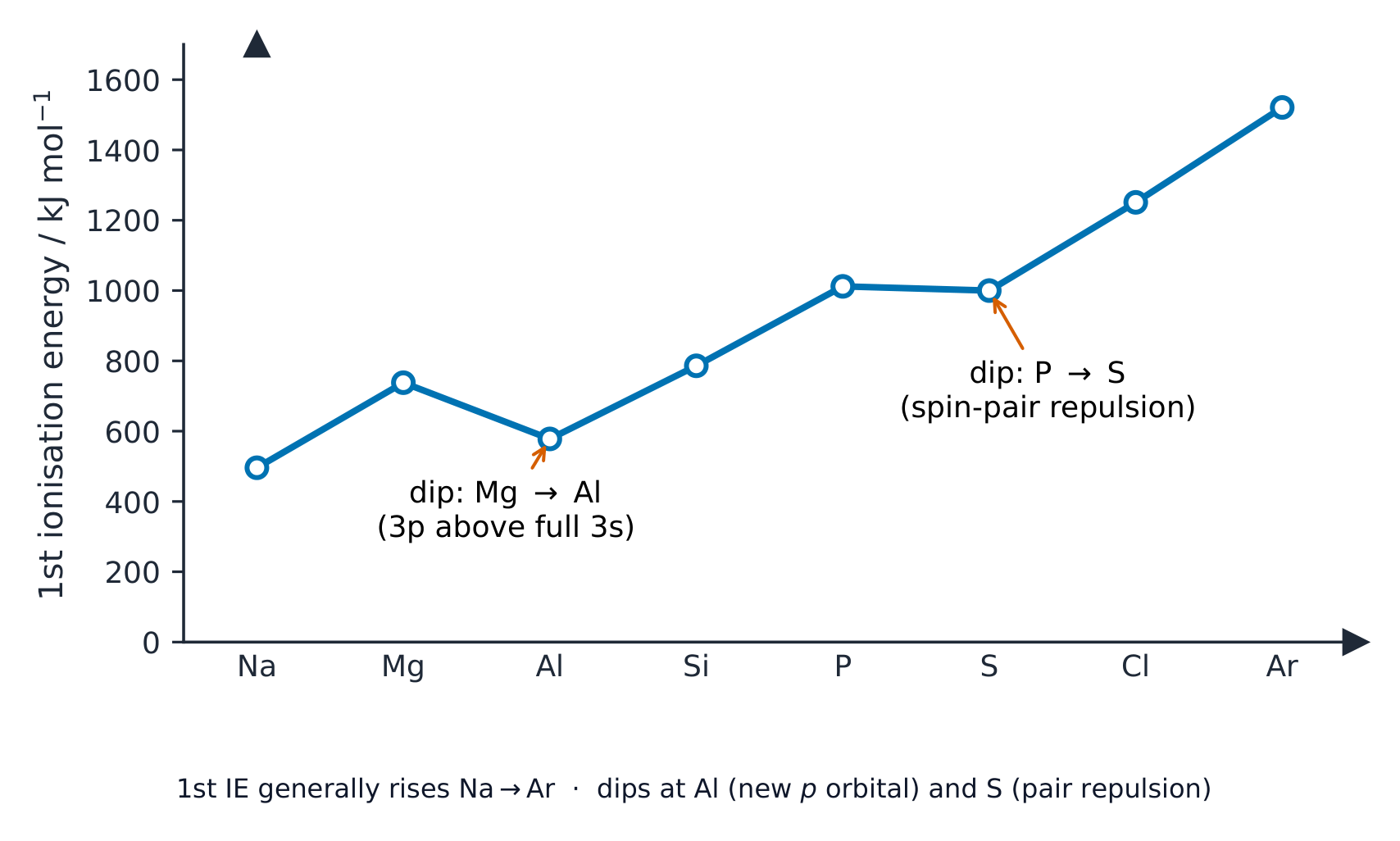
The rise across a period is not smooth. Two small dips appear, and you should be able to explain both:
- Group 2 to Group 13 (for example Mg to Al): the electron removed from Al comes from a 3p sub-shell, which is higher in energy than the full 3s sub-shell in Mg. A 3p electron is easier to remove, so the value dips.
- Group 15 to Group 16 (for example P to S): in S, one 3p orbital now holds a pair of electrons. Spin-pair repulsion makes one of them easier to remove, so the value dips.
These dips are evidence that sub-shells exist.
First ionisation energy rises across Period 3 but dips at Al and at S — evidence that sub-shells exist Successive ionisation energies are evidence for shells
If you plot the successive ionisation energies of one element, the values rise, with big jumps at certain points. A big jump happens when the next electron must come from a shell closer to the nucleus.
Count how many electrons come off easily before the first big jump — that is the number of electrons in the outer shell, which tells you the group the element is in. You can also use the pattern to work out the electronic configuration and the position of the element in the Periodic Table.
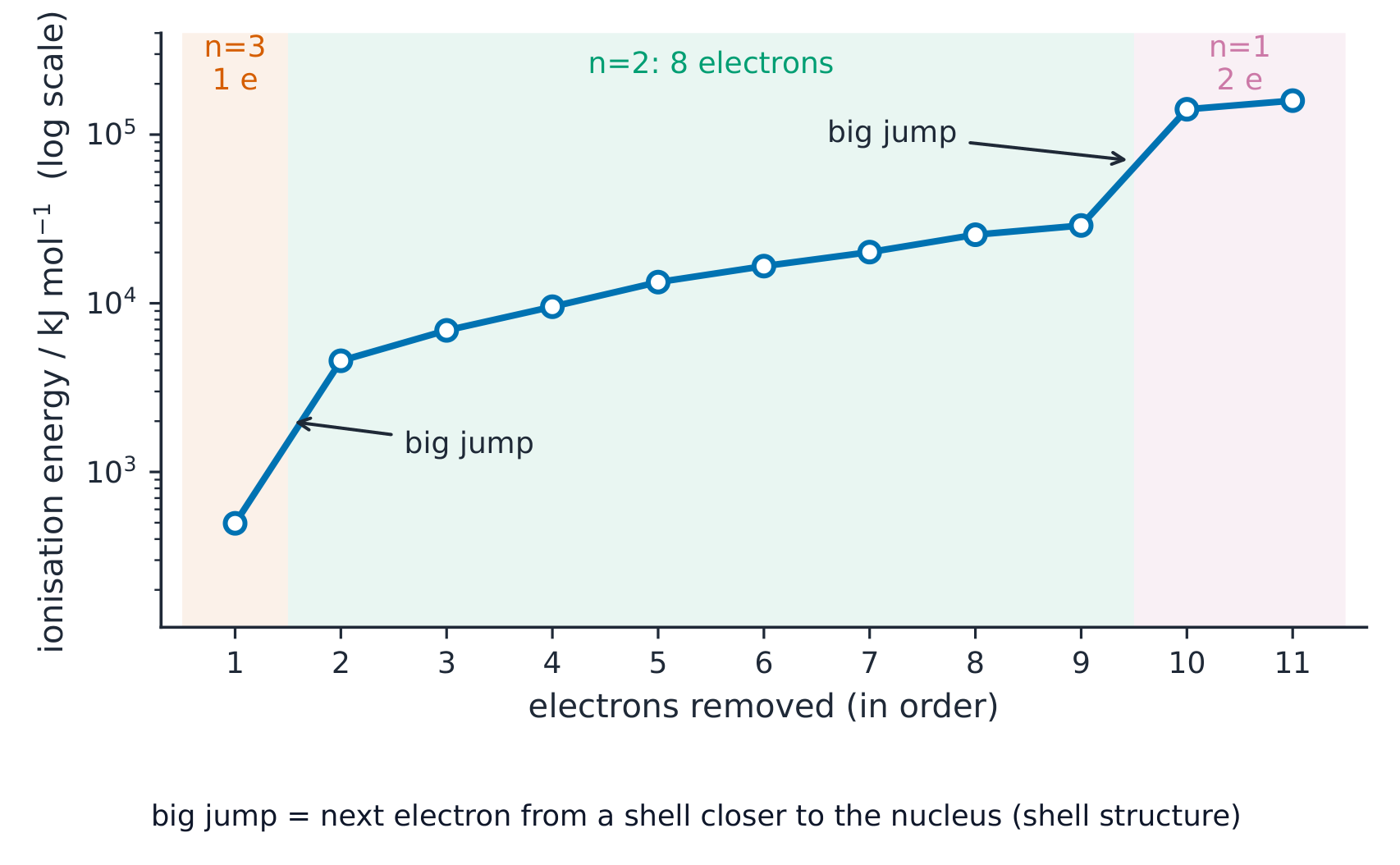
Successive ionisation energies of sodium (log scale): the big jumps reveal the $2,8,1$ shell structure Electrons removed before the first big jump Group 1 Group 1 2 Group 2 3 Group 13 Worked example. The first five successive ionisation energies of an element are $590$, $1150$, $4940$, $6480$ and $8120\ \text{kJ}\,\text{mol}^{-1}$. Which group is it in? Look for the big jump, not the biggest number. From the 1st to the 2nd the value roughly doubles, which is a normal rise. From the 2nd ($1150$) to the 3rd ($4940$) it more than quadruples: that is the jump. So two electrons come off easily before it, the outer shell holds 2 electrons, and the element is in Group 2. Count the electrons removed before the jump, and explain the jump properly: the next electron is being pulled from a shell closer to the nucleus, not from a different element.
ExploreThe ionisation-energy trend — and its dips
First ionisation energy generally rises across a period, but DIPS where a new p sub-shell starts and where a p-orbital pair first forms. Step across to find the two tell-tale dips.
Vocabulary TrainEnglish first ionisation energy/fɜːst ˌaɪənaɪˈzeɪʃn ˈenədʒi/ successive ionisation energies/səkˈsesɪv ˌaɪənaɪˈzeɪʃn ˈenədʒiz/ spin-pair repulsion/spɪn peə rɪˈpʌlʃn/ 1.4
Exam tips
- Define isotopes in full: atoms of the same element with the same number of protons but a different number of neutrons — the mark scheme wants both halves.
- 4s fills before 3d, but electrons are removed from 4s first when forming ions, so $\text{Fe}^{3+}$ is $[\text{Ar}]3\text{d}^5$ (not $[\text{Ar}]3\text{d}^3 4\text{s}^2$).
- In successive ionisation energies, a big jump marks the start of a new (inner) shell — use the jumps to place the element in its group.
- Explain every ionisation-energy trend with the same three factors: nuclear charge, distance and shielding, plus sub-shell effects for the small dips.
- Learn the exact reason first ionisation energy of oxygen is below nitrogen: oxygen's paired 2p electrons repel, so one is easier to remove.
-
2
Atoms, molecules and stoichiometry
Watch lesson2.1
Relative masses of atoms and molecules

Syllabus
- define the unified atomic mass unit as one twelfth of the mass of a carbon-12 atom
- define relative atomic mass, $A_r$, relative isotopic mass, relative molecular mass, $M_r$, and relative formula mass in terms of the unified atomic mass unit
Source: Cambridge International syllabus
Atoms 原子 are far too light to weigh in grams, so we compare every mass to one standard. The standard is the unified atomic mass unit 统一原子质量单位 (symbol u), defined as exactly one twelfth of the mass of one carbon-12 atom.
Using this unit, we state masses as simple numbers:
- the relative atomic mass 相对原子质量 $A_r$ of an element is the average mass of its atoms compared with $\tfrac{1}{12}$ of a carbon-12 atom. It is an average over all the isotopes 同位素, weighted by how common each one is.
- the relative isotopic mass 相对同位素质量 is the mass of one atom of a single isotope, compared with $\tfrac{1}{12}$ of a carbon-12 atom.
- the relative molecular mass 相对分子质量 $M_r$ of a molecule 分子 is the sum of the relative atomic masses of all its atoms.
- the relative formula mass 相对式量 is the same idea for a substance that is not made of molecules (such as an ionic compound). Add up the relative atomic masses shown in the formula.
Relative atomic mass is a weighted average: chlorine's two isotopes (75% ³⁵Cl, 25% ³⁷Cl) average to Aᵣ = 35.5 To find $A_r$ from isotope data, multiply each isotope mass by its percentage, add these up, and divide by 100.
Worked example. Chlorine is $75\%$ ${}^{35}\text{Cl}$ and $25\%$ ${}^{37}\text{Cl}$. Find its relative atomic mass.
$$A_r = \frac{(75 \times 35) + (25 \times 37)}{100} = \frac{2625 + 925}{100} = 35.5.$$Worked example. A mass spectrometer shows copper is $69.2\%$ ${}^{63}\text{Cu}$ and $30.8\%$ ${}^{65}\text{Cu}$. Find its relative atomic mass.
$$A_r = \frac{(69.2 \times 63) + (30.8 \times 65)}{100} = \frac{4359.6 + 2002.0}{100} = 63.6.$$ExploreRelative mass lab
relative atomic mass = weighted mean
Change isotope abundance and see the weighted mean move.
Vocabulary TrainEnglish atom/ˈætəm/ unified atomic mass unit/ˈjuːnɪfaɪd əˈtɒmɪk mæs ˈjuːnɪt/ relative atomic mass/ˈrelətɪv əˈtɒmɪk mæs/ isotope/ˈaɪsətəʊp/ relative isotopic mass/ˈrelətɪv ˌaɪsəˈtɒpɪk mæs/ relative molecular mass/ˈrelətɪv məˈlekjʊlə mæs/ molecule/ˈmɒlɪkjuːl/ relative formula mass/ˈrelətɪv ˈfɔːmjʊlə mæs/ 2.2
The mole and the Avogadro constant
Syllabus
- define and use the term mole in terms of the Avogadro constant
Source: Cambridge International syllabus
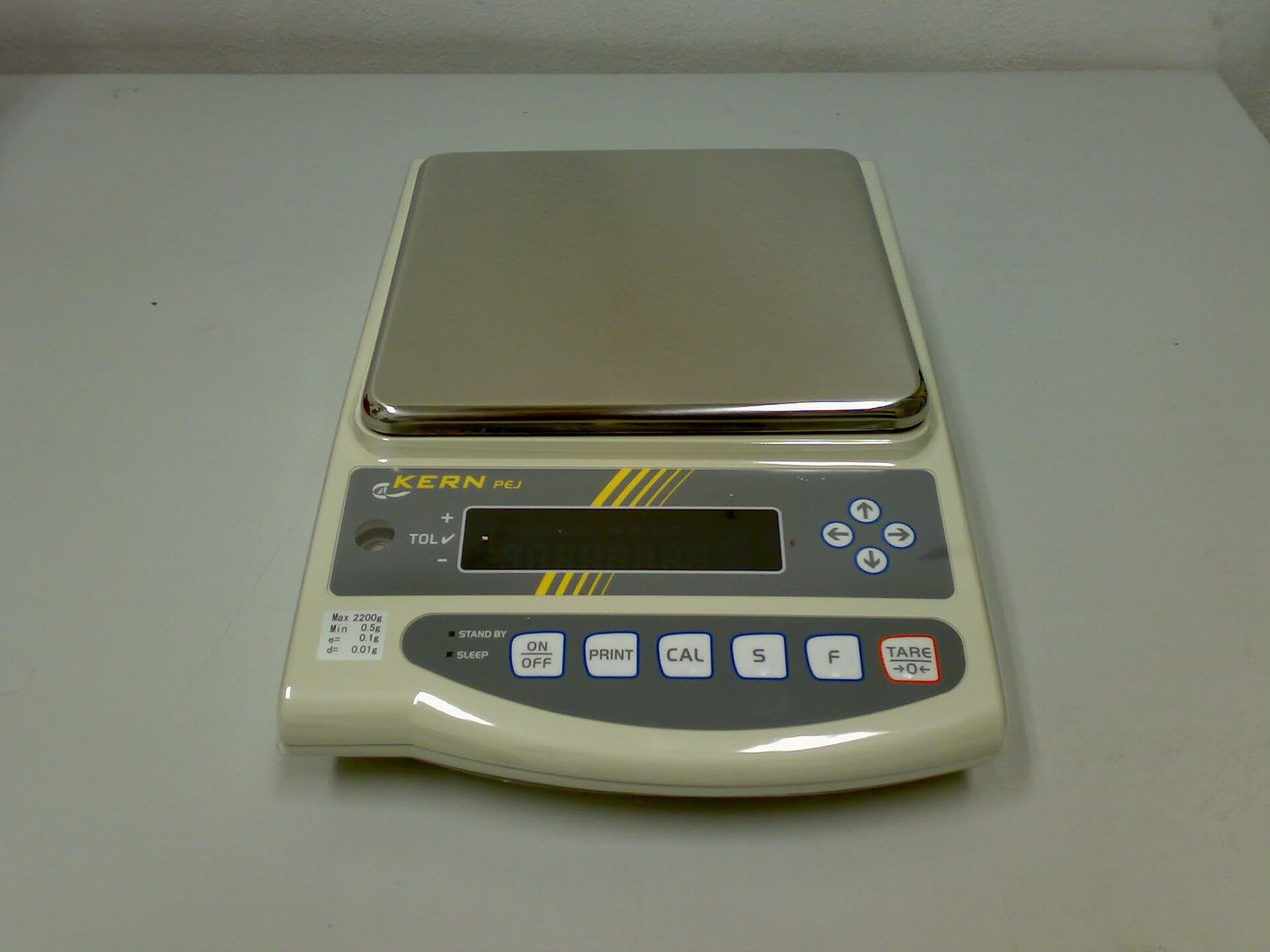
A modern electronic balance measures mass — the basis of mole calculations. Chemists count particles in groups called moles, just as we count eggs in dozens.
One mole 摩尔 (symbol mol) is the amount of substance that contains the same number of particles as there are atoms in exactly 12 g of carbon-12. That number is the Avogadro constant 阿伏伽德罗常量:
$$N_A = 6.02 \times 10^{23}\ \text{mol}^{-1}$$So one mole of anything contains $6.02 \times 10^{23}$ particles. The particles may be atoms, molecules or ions 离子 — always say which.
The mass of one mole in grams equals the relative mass ($A_r$ or $M_r$). This is the molar mass 摩尔质量, with units $\text{g mol}^{-1}$. The key equation is:
$$n = \frac{m}{M}$$where $n$ is the amount in moles, $m$ is the mass in grams, and $M$ is the molar mass.
Worked example. How many moles are in $8.0\ \text{g}$ of methane, $\text{CH}_4$? ($A_r$: C $= 12$, H $= 1$.)
The molar mass is $M = 12 + 4(1) = 16\ \text{g mol}^{-1}$, so
$$n = \frac{m}{M} = \frac{8.0}{16} = 0.50\ \text{mol}.$$
The mole is the hub of every amount calculation: convert to mass ($n=m/M$), particles ($\times N_A$), gas volume ($n=V/24$) or solution ($n=cV$) ExploreMole mass lab
n = m / M
Change mass and see moles scale through molar mass.
Vocabulary TrainEnglish mole/məʊl/ Avogadro constant/ˌævəˈɡædrəʊ ˈkɒnstənt/ ion/ˈaɪɒn/ molar mass/ˈməʊlə mæs/ 2.3
Formulas

Syllabus
- write formulas of ionic compounds from ionic charges and oxidation numbers (shown by a Roman numeral), including: (a) the prediction of ionic charge from the position of an element in the Periodic Table (b) recall of the names and formulas for the following ions: $\text{NO}_3^-$, $\text{CO}_3^{2-}$, $\text{SO}_4^{2-}$, $\text{OH}^-$, $\text{NH}_4^+$, $\text{Zn}^{2+}$, $\text{Ag}^+$, $\text{HCO}_3^-$, $\text{PO}_4^{3-}$
- (a) write and construct equations (which should be balanced), including ionic equations (which should not include spectator ions) (b) use appropriate state symbols in equations
- define and use the terms empirical and molecular formula
- understand and use the terms anhydrous, hydrated and water of crystallisation
- calculate empirical and molecular formulas, using given data
Source: Cambridge International syllabus
A compound 化合物 is a substance made of two or more elements chemically joined.
Charges and formulas of ionic compounds
In an ionic compound 离子化合物 the total positive charge balances the total negative charge, so the compound is neutral overall.
You can predict the charge of many ions from the element's position in the Periodic Table:
Group 1 2 13 15 16 17 Usual ion charge $+1$ $+2$ $+3$ $-3$ $-2$ $-1$ Hydrogen forms $\text{H}^+$, and the Group 18 noble gases do not normally form ions.
Some ions you must know by name and formula:
Name Formula nitrate $\text{NO}_3^{-}$ carbonate $\text{CO}_3^{2-}$ sulfate $\text{SO}_4^{2-}$ hydroxide $\text{OH}^{-}$ ammonium $\text{NH}_4^{+}$ zinc $\text{Zn}^{2+}$ silver $\text{Ag}^{+}$ hydrogencarbonate $\text{HCO}_3^{-}$ phosphate $\text{PO}_4^{3-}$ For a metal that can have more than one charge, a Roman numeral shows the oxidation number 氧化数. For example, iron(II) is $\text{Fe}^{2+}$ and iron(III) is $\text{Fe}^{3+}$. To write a formula, balance the charges: iron(III) oxide is $\text{Fe}_2\text{O}_3$, because two $\text{Fe}^{3+}$ balance three $\text{O}^{2-}$.
Equations and state symbols
A chemical equation must be balanced 配平 — the same number of each kind of atom on both sides. Add state symbols 状态符号 to show the state of each species: (s) solid, (l) liquid, (g) gas, and (aq) aqueous 水溶液 (dissolved in water).
An ionic equation 离子方程式 shows only the ions and molecules that actually change. The ions that do not change are spectator ions 旁观离子, and you leave them out. For example, the reaction that forms silver chloride is:
$$\text{Ag}^{+}(\text{aq}) + \text{Cl}^{-}(\text{aq}) \rightarrow \text{AgCl}(\text{s})$$Empirical and molecular formulas
The empirical formula 实验式 is the simplest whole-number ratio of the atoms of each element in a compound. The molecular formula 分子式 shows the actual number of atoms of each element in one molecule.
For example, ethane has empirical formula $\text{CH}_3$ but molecular formula $\text{C}_2\text{H}_6$.
Hydrated and anhydrous solids
Some solids hold water inside their crystals. This water is the water of crystallisation 结晶水. A solid that contains it is hydrated 水合的; the same solid with the water removed is anhydrous 无水的.
For example, hydrated copper(II) sulfate is $\text{CuSO}_4 \cdot 5\text{H}_2\text{O}$. Heating it drives off the water to leave anhydrous $\text{CuSO}_4$.
Calculating empirical and molecular formulas
To find the empirical formula from masses (or percentages by mass):
- divide each element's mass by its $A_r$ to get the moles.
- divide all the mole values by the smallest one.
- round to the nearest whole numbers — that ratio is the empirical formula.
To get the molecular formula, you also need $M_r$. Find how many times the empirical formula mass fits into $M_r$, then multiply the formula by that number.
Worked example. A compound is $40.0\%$ carbon, $6.7\%$ hydrogen and $53.3\%$ oxygen by mass. Find its empirical formula. ($A_r$: C $= 12$, H $= 1$, O $= 16$.)
Take $100\ \text{g}$ and divide each mass by its $A_r$ to get moles: C $= 40.0/12 = 3.33$, H $= 6.7/1 = 6.7$, O $= 53.3/16 = 3.33$. Dividing through by the smallest ($3.33$) gives a ratio C : H : O $= 1 : 2 : 1$, so the empirical formula is $\text{CH}_2\text{O}$.
The empirical-formula recipe: divide by Ar, divide by the smallest, read off the ratio ExploreEquation balancing route
Follow atoms through a chemical equation so both sides match.
Vocabulary TrainEnglish compound/ˈkɒmpaʊnd/ ionic compound/aɪˈɒnɪk ˈkɒmpaʊnd/ oxidation number/ˌɒksɪˈdeɪʃn ˈnʌmbə/ balanced/ˈbælənst/ state symbols/steɪt ˈsɪmblz/ aqueous/ˈeɪkwɪəs/ ionic equation/aɪˈɒnɪk ɪˈkweɪʒn/ spectator ions/spekˈteɪtə ˈaɪɒnz/ empirical formula/emˈpɪrɪkl ˈfɔːmjʊlə/ molecular formula/məˈlekjʊlə ˈfɔːmjʊlə/ water of crystallisation/ˈwɔːtə ɒv ˌkrɪstəlaɪˈzeɪʃn/ hydrated/haɪˈdreɪtɪd/ anhydrous/ænˈhaɪdrəs/ 2.4
Reacting masses and volumes

Syllabus
- perform calculations including use of the mole concept, involving: (a) reacting masses (from formulas and equations) including percentage yield calculations (b) volumes of gases (e.g. in the burning of hydrocarbons) (c) volumes and concentrations of solutions (d) limiting reagent and excess reagent (When performing calculations, candidates’ answers should reflect the number of significant figures given or asked for in the question. When rounding up or down, candidates should ensure that significant figures are neither lost unnecessarily nor used beyond what is justified (see also Mathematical requirements section).) (e) deduce stoichiometric relationships from calculations such as those in 2.4.1(a)–(d)
Source: Cambridge International syllabus
A titration finds reacting volumes precisely. Reacting masses and percentage yield
The numbers in front of each species in a balanced equation give the mole ratio — this is the stoichiometry 化学计量. To find a reacting mass: change the known mass to moles, use the mole ratio to find the moles you want, then change back to mass.
Worked example. What mass of magnesium oxide forms when $4.8\ \text{g}$ of magnesium burns completely? $2\text{Mg} + \text{O}_2 \rightarrow 2\text{MgO}$. ($A_r$: Mg $= 24$, O $= 16$.)
Moles of Mg $= 4.8/24 = 0.20\ \text{mol}$. The ratio Mg : MgO is $1 : 1$, so $0.20\ \text{mol}$ of MgO forms. Its molar mass is $24 + 16 = 40\ \text{g mol}^{-1}$, so
$$m = nM = 0.20 \times 40 = 8.0\ \text{g}.$$
The mole bridge: mass to moles, ratio, then back to mass In real reactions you usually get less product than the maximum. The percentage yield 产率 compares the amount you actually made with the most you could make:
$$\text{percentage yield} = \frac{\text{actual amount of product}}{\text{maximum possible amount}} \times 100\%$$Limiting and excess reagent
When two reactants are mixed, one usually runs out first. The limiting reagent 限量试剂 is the one that runs out — it decides how much product forms. The other is the excess reagent 过量试剂, because there is more than enough of it. Always base the calculation on the limiting reagent.
To find it: work out the moles of each reactant, divide each by its number in the equation, and the smallest result is the limiting reagent.

The limiting reagent runs out first and decides how much product forms; the leftover reactant is in excess Volumes of gases
At the same temperature and pressure, equal volumes of any gases contain equal numbers of molecules. At room temperature and pressure (r.t.p.), one mole of any gas takes up $24.0\ \text{dm}^3$, so:
$$n = \frac{V}{24.0}\qquad (V \text{ in } \text{dm}^3 \text{ at r.t.p.})$$
Equal volumes of gases at the same temperature and pressure hold equal numbers of molecules, whatever the gas This is used when burning hydrocarbons 碳氢化合物 (compounds of only carbon and hydrogen), where you compare gas volumes.
Volumes and concentrations of solutions
The concentration 浓度 of a solution is the amount of solute 溶质 in each cubic decimetre of solution 溶液, measured in $\text{mol dm}^{-3}$:
$$n = c \times V$$where $c$ is the concentration and $V$ is the volume in $\text{dm}^3$. Remember that $1000\ \text{cm}^3 = 1\ \text{dm}^3$.
Worked example. In a titration, $25.0\ \text{cm}^3$ of sodium hydroxide solution is exactly neutralised by $20.0\ \text{cm}^3$ of $0.100\ \text{mol dm}^{-3}$ hydrochloric acid: $\text{NaOH} + \text{HCl} \rightarrow \text{NaCl} + \text{H}_2\text{O}$. Find the concentration of the sodium hydroxide.
Moles of HCl $= cV = 0.100 \times \dfrac{20.0}{1000} = 2.00 \times 10^{-3}\ \text{mol}$. The ratio is $1 : 1$, so there are $2.00 \times 10^{-3}\ \text{mol}$ of NaOH in $25.0\ \text{cm}^3$:
$$c = \frac{n}{V} = \frac{2.00 \times 10^{-3}}{25.0/1000} = 0.0800\ \text{mol dm}^{-3}.$$This is the basis of a titration 滴定, where you find an unknown concentration by reacting it with a solution whose concentration you already know.

In a titration a burette adds a solution of known concentration to the unknown in the conical flask, until the indicator changes Significant figures
Give your answer to a sensible number of significant figures 有效数字 — usually match the data in the question. Do not write more digits than the data supports, and do not round so early that you lose accuracy.
ExploreReacting mass route
Follow a balanced equation from known mass to predicted product mass.
ExploreGas volume lab
n = V / 24 dm3
Change gas volume and see moles scale at room conditions.
Vocabulary TrainEnglish stoichiometry/ˌstəʊɪkɪˈɒmətri/ percentage yield/pəˈsentɪdʒ jiːld/ limiting reagent/ˈlɪmɪtɪŋ rɪˈeɪdʒənt/ excess reagent/ekˈses rɪˈeɪdʒənt/ hydrocarbons/ˈhaɪdrəkɑːbənz/ concentration/ˌkɒnsənˈtreɪʃn/ solute/ˈsɒljuːt/ solution/səˈluːʃn/ titration/taɪˈtreɪʃn/ significant figures/sɪɡˈnɪfɪkənt ˈfɪɡəz/ 2.4
Exam tips
- Convert volumes to $\text{dm}^3$ before using concentration ($25.0\ \text{cm}^3 = 0.0250\ \text{dm}^3$); the missing $\div 1000$ is the most common titration error.
- Use the balancing numbers as the mole ratio between species — never the $M_r$ values.
- Empirical formula: divide each mass/percentage by $A_r$, then by the smallest, then scale to whole numbers; use $M_r$ to reach the molecular formula.
- For gases at r.t.p. use $\text{volume} = \text{moles} \times 24\ \text{dm}^3$; quote the equation you use every time.
- Give the answer to the same significant figures as the data (usually 3) and always include units.
-
3
Chemical bonding
Watch lesson3.1
Electronegativity

Syllabus
- define electronegativity as the power of an atom to attract electrons to itself
- explain the factors influencing the electronegativities of the elements in terms of nuclear charge, atomic radius and shielding by inner shells and sub-shells
- state and explain the trends in electronegativity across a period and down a group of the Periodic Table
- use the differences in Pauling electronegativity values to predict the formation of ionic and covalent bonds (the presence of covalent character in some ionic compounds will not be assessed) (Pauling electronegativity values will be given where necessary)
Source: Cambridge International syllabus
Electronegativity 电负性 is the power of an atom to attract the electrons 电子 in a bond towards itself.
Three factors decide how electronegative an atom is:
- nuclear charge 核电荷: more protons pull the bonding electrons more strongly.
- atomic radius 原子半径: the closer the bond is to the nucleus, the stronger the pull.
- shielding 屏蔽 by inner shells and sub-shells: more inner electrons weaken the pull on the bonding electrons.
So electronegativity rises across a period (more nuclear charge, smaller radius) and falls down a group (larger radius, more shielding). Fluorine is the most electronegative element.
Electronegativity rises across a period and falls down a group, so fluorine is the most electronegative element You can use the difference in Pauling electronegativity 鲍林电负性 values to predict the bond type. A large difference gives an ionic bond; a small difference gives a covalent bond.
Vocabulary TrainEnglish electronegativity/ɪˌlektrəʊŋɡəˈtɪvɪti/ electron/ɪˈlektrɒn/ nuclear charge/ˈnjuːklɪə tʃɑːdʒ/ atomic radius/əˈtɒmɪk ˈreɪdɪəs/ shielding/ˈʃiːldɪŋ/ Pauling electronegativity/ˈpɔːlɪŋ ɪˌlektrəʊŋɡəˈtɪvɪti/ 3.2
Ionic bonding

Syllabus
- define ionic bonding as the electrostatic attraction between oppositely charged ions (positively charged cations and negatively charged anions)
- describe ionic bonding including the examples of sodium chloride, magnesium oxide and calcium fluoride
Source: Cambridge International syllabus
Ionic bonding: electron transfer Ionic bonding 离子键 is the electrostatic attraction 静电引力 between oppositely charged ions 离子 — positive cations 阳离子 and negative anions 阴离子.
It forms when a metal gives electrons to a non-metal. Good examples are sodium chloride ($\text{NaCl}$), magnesium oxide ($\text{MgO}$) and calcium fluoride ($\text{CaF}_2$). The ions pack into a regular giant lattice 晶格, held together by the attraction in every direction.
Ionic bonding in NaCl: sodium transfers its single outer electron to chlorine, giving Na$^+$ and a full-octet Cl$^-$ 
A real crystal of rock salt (halite, NaCl); the cubic shapes mirror the giant ionic lattice inside ExploreForming an ionic bond (NaCl)
Step through it. A metal hands its outer electron to a non-metal; the oppositely charged ions then attract in a giant lattice.
Vocabulary TrainEnglish ionic bonding/aɪˈɒnɪk ˈbɒndɪŋ/ electrostatic attraction/ɪˌlektrəʊˈstætɪk əˈtrækʃn/ ion/ˈaɪɒn/ cation/ˈkætaɪən/ anion/ˈænaɪən/ lattice/ˈlætɪs/ 3.3
Metallic bonding

Syllabus
- define metallic bonding as the electrostatic attraction between positive metal ions and delocalised electrons
Source: Cambridge International syllabus
Metallic bonding 金属键 is the electrostatic attraction between positive metal ions and a "sea" of delocalised electrons 离域电子.
The outer electrons are free to move through the whole metal. This explains why metals conduct electricity and are strong.
Metallic bonding: positive metal ions sit in a sea of delocalised electrons that are free to move ExploreInside a metal — and why it behaves that way
Step through it. Positive ions sit in a shared sea of delocalised electrons. That one picture explains conduction, malleability, and strength.
Vocabulary TrainEnglish metallic bonding/məˈtælɪk ˈbɒndɪŋ/ delocalised electrons/dɪˈlɒkəlaɪzd ɪˈlektrɒnz/ 3.4
Covalent and coordinate bonding

Syllabus
- define covalent bonding as electrostatic attraction between the nuclei of two atoms and a shared pair of electrons (a) describe covalent bonding in molecules including: • hydrogen, $\text{H}_2$ • oxygen, $\text{O}_2$ • nitrogen, $\text{N}_2$ • chlorine, $\text{Cl}_2$ • hydrogen chloride, $\text{HCl}$ • carbon dioxide, $\text{CO}_2$ • ammonia, $\text{NH}_3$ • methane, $\text{CH}_4$ • ethane, $\text{C}_2\text{H}_6$ • ethene, $\text{C}_2\text{H}_4$ (b) understand that elements in period 3 can expand their octet including in the compounds sulfur dioxide, $\text{SO}_2$, phosphorus pentachloride, $\text{PCl}_5$, and sulfur hexafluoride, $\text{SF}_6$ (c) describe coordinate (dative covalent) bonding, including in the reaction between ammonia and hydrogen chloride gases to form the ammonium ion, $\text{NH}_4^+$, and in the $\text{Al}_2\text{Cl}_6$ molecule
- (a) describe covalent bonds in terms of orbital overlap giving $\sigma$ and $\pi$ bonds: • $\sigma$ bonds are formed by direct overlap of orbitals between the bonding atoms • $\pi$ bonds are formed by the sideways overlap of adjacent p orbitals above and below the $\sigma$ bond (b) describe how the $\sigma$ and $\pi$ bonds form in molecules including $\text{H}_2$, $\text{C}_2\text{H}_6$, $\text{C}_2\text{H}_4$, $\text{HCN}$ and $\text{N}_2$ (c) use the concept of hybridisation to describe $\text{sp}$, $\text{sp}^2$ and $\text{sp}^3$ orbitals
- (a) define the terms: • bond energy as the energy required to break one mole of a particular covalent bond in the gaseous state • bond length as the internuclear distance of two covalently bonded atoms (b) use bond energy values and the concept of bond length to compare the reactivity of covalent molecules
Source: Cambridge International syllabus
Covalent bonding: a shared pair Covalent bonding 共价键 is the electrostatic attraction between the nuclei of two atoms and a shared pair of electrons.
Simple molecules with covalent bonds include $\text{H}_2$, $\text{O}_2$, $\text{N}_2$, $\text{Cl}_2$, $\text{HCl}$, $\text{CO}_2$, $\text{NH}_3$, $\text{CH}_4$, $\text{C}_2\text{H}_6$ and $\text{C}_2\text{H}_4$. A double bond shares two pairs; a triple bond (as in $\text{N}_2$) shares three pairs.
Atoms in Period 3 and below can expand the octet 扩展八隅体 — hold more than eight electrons in their outer shell. Examples are $\text{SO}_2$, $\text{PCl}_5$ and $\text{SF}_6$.
A coordinate bond 配位键 (also called a dative covalent bond) is a covalent bond where both shared electrons come from the same atom. For example, when ammonia and hydrogen chloride gases meet, the lone pair on the nitrogen forms a coordinate bond to $\text{H}^+$, making the ammonium ion $\text{NH}_4^+$. Coordinate bonds also join the two halves of the $\text{Al}_2\text{Cl}_6$ molecule.
A coordinate (dative) bond: nitrogen's lone pair forms the fourth N–H bond, both electrons coming from N Sigma and pi bonds
Covalent bonds form when orbitals 轨道 overlap:
- a sigma bond σ键 forms by the direct, head-on overlap 重叠 of orbitals between the two atoms.
- a pi bond π键 forms by the sideways overlap of two p orbitals, above and below the sigma bond.
A single bond is one sigma bond. A double bond (as in $\text{C}_2\text{H}_4$) is one sigma plus one pi bond. A triple bond (as in $\text{N}_2$ and $\text{HCN}$) is one sigma plus two pi bonds.

A $\sigma$ bond forms by direct head-on overlap; a $\pi$ bond forms by the sideways overlap of two p orbitals, above and below Hybridisation
Hybridisation 杂化 mixes orbitals in the same shell to make new, equal orbitals for bonding:
- $\text{sp}$: two equal orbitals, used in a linear molecule.
- $\text{sp}^2$: three equal orbitals, used in a flat molecule like $\text{C}_2\text{H}_4$.
- $\text{sp}^3$: four equal orbitals, used in $\text{CH}_4$.
Bond energy and bond length
- bond energy 键能 is the energy needed to break one mole of a particular covalent bond in the gas state.
- bond length 键长 is the distance between the centres of the two bonded atoms.
A shorter bond is usually stronger (higher bond energy). Triple bonds are shorter and stronger than double bonds, which are shorter and stronger than single bonds. Stronger bonds make a molecule harder to react.
ExploreSharing a pair of electrons
Step through a covalent bond: two atoms overlap and share a pair so each reaches a full shell — when the two pull equally the bond is non-polar.
ExploreCovalent bonding (sharing)
Two non-metal atoms overlap and share a pair of electrons — counted for both — so each reaches a full outer shell. O₂ shares two pairs (a double bond).
Vocabulary TrainEnglish covalent bonding/ˈkəʊvələnt ˈbɒndɪŋ/ expand the octet/ekˈspænd ðɪ ɒkˈtet/ coordinate bond/kəʊˈɔːdɪnət bɒnd/ orbital/ˈɔːbɪtl/ sigma bond/ˈsɪɡmə bɒnd/ overlap/ˌəʊvəˈlæp/ pi bond/paɪ bɒnd/ hybridisation/ˌhaɪbrɪdaɪˈzeɪʃn/ bond energy/bɒnd ˈenədʒi/ bond length/bɒnd leŋθ/ 3.5
Shapes of molecules

Syllabus
- state and explain the shapes of, and bond angles in, molecules by using VSEPR theory, including as simple examples: • $\text{BF}_3$ (trigonal planar, 120°) • $\text{CO}_2$ (linear, 180°) • $\text{CH}_4$ (tetrahedral, 109.5°) • $\text{NH}_3$ (pyramidal, 107°) • $\text{H}_2\text{O}$ (non-linear, 104.5°) • $\text{SF}_6$ (octahedral, 90°) • $\text{PF}_5$ (trigonal bipyramidal, 120° and 90°)
- predict the shapes of, and bond angles in, molecules and ions analogous to those specified in 3.5.1
Source: Cambridge International syllabus
A molecular model shows the three-dimensional shape of a covalent molecule. To work out a shape, use VSEPR theory 价层电子对互斥理论: the pairs of electrons around the central atom push apart as far as possible, because like charges repel.
A lone pair 孤对电子 (not in a bond) pushes more strongly than a bonding pair 成键电子对. Each lone pair squeezes the bond angle 键角 by about $2.5°$.
Molecule Shape Bond angle $\text{CO}_2$ linear 直线形 $180°$ $\text{BF}_3$ trigonal planar 平面三角形 $120°$ $\text{CH}_4$ tetrahedral 四面体形 $109.5°$ $\text{NH}_3$ pyramidal 三角锥形 $107°$ $\text{H}_2\text{O}$ bent 角形 $104.5°$ $\text{PF}_5$ trigonal bipyramidal 三角双锥形 $120°$ and $90°$ $\text{SF}_6$ octahedral 八面体形 $90°$ $\text{NH}_3$ has one lone pair and $\text{H}_2\text{O}$ has two, which is why their angles drop below the $109.5°$ of $\text{CH}_4$. You can predict the shapes of similar molecules and ions in the same way.

The seven shapes from VSEPR theory; the lone pairs on NH$_3$ and H$_2$O push harder, squeezing the bond angle below $109.5°$ Worked example. Predict the shape and bond angle of $\text{NH}_3$ and of $\text{H}_2\text{O}$. Nitrogen has 5 outer electrons and forms 3 bonds, leaving 3 bonding pairs and 1 lone pair - four pairs in total, so they start from the tetrahedral $109.5°$. The lone pair repels more strongly and squeezes the angle by about $2.5°$, giving a pyramidal shape at about $107°$. Oxygen forms 2 bonds and keeps 2 lone pairs: still four pairs, but now two squeezes, so the shape is bent at about $104.5°$. Count all the pairs to fix the basic geometry, subtract $2.5°$ for each lone pair, and name the shape from the atoms - $\text{NH}_3$ has four pairs but is pyramidal, not tetrahedral.
ExploreShape from bonding and lone pairs
Count the bonding pairs and lone pairs around the central atom; they repel into the shape with least strain. Three bonds and one lone pair give a pyramid, like ammonia (NH3).
ExplorePredicting molecular shape
Set the bonding and lone pairs. Electron pairs repel and spread out as far apart as possible — that fixes the shape and bond angle.
Vocabulary TrainEnglish VSEPR theory/ˈvespə ˈθɪəri/ lone pair/ləʊn peə/ bonding pair/ˈbɒndɪŋ peə/ bond angle/bɒnd ˈæŋɡl/ linear/ˈlɪnɪə/ trigonal planar/ˈtrɪɡənl ˈpleɪnə/ tetrahedral/ˌtetrəˈhiːdrəl/ pyramidal/pɪˈræmɪdl/ bent/bent/ trigonal bipyramidal/ˈtrɪɡənl baɪˈpɪrəmɪdl/ octahedral/ˌɒktəˈhiːdrəl/ 3.6
Intermolecular forces

Syllabus
- (a) describe hydrogen bonding, limited to molecules containing N–H and O–H groups, including ammonia and water as simple examples (b) use the concept of hydrogen bonding to explain the anomalous properties of $\text{H}_2\text{O}$ (ice and water): • its relatively high melting and boiling points • its relatively high surface tension • the density of the solid ice compared with the liquid water
- use the concept of electronegativity to explain bond polarity and dipole moments of molecules
- (a) describe van der Waals’ forces as the intermolecular forces between molecular entities other than those due to bond formation, and use the term van der Waals’ forces as a generic term to describe all intermolecular forces (b) describe the types of van der Waals’ forces: • instantaneous dipole–induced dipole (id-id) forces, also called London dispersion forces • permanent dipole–permanent dipole (pd-pd) forces, including hydrogen bonding (c) describe hydrogen bonding and understand that hydrogen bonding is a special case of permanent dipole–permanent dipole forces between molecules where hydrogen is bonded to a highly electronegative atom
- state that, in general, ionic, covalent and metallic bonding are stronger than intermolecular forces
Source: Cambridge International syllabus
Intermolecular forces 分子间作用力 are the forces between molecules 分子. They are much weaker than the ionic, covalent and metallic bonding inside substances.
Bond polarity and dipoles
When two atoms with different electronegativity share a bond, the electrons sit closer to the more electronegative atom. The bond then has a polarity 极性: one end is slightly negative ($\delta-$) and the other slightly positive ($\delta+$). This separation of charge is a dipole 偶极.
If the dipoles in a molecule do not cancel, the whole molecule has a dipole moment 偶极矩 and is polar. If they cancel by symmetry (as in $\text{CO}_2$), the molecule is non-polar.
Van der Waals' forces
Van der Waals' forces 范德华力 is the general name for all intermolecular forces. There are two main types.
The first type is the instantaneous dipole–induced dipole force, also called the London dispersion force 伦敦色散力. Moving electrons make a brief instantaneous dipole 瞬时偶极, which then creates a matching induced dipole 诱导偶极 in a nearby molecule. These forces act between all molecules and get stronger when there are more electrons.
A London force: a momentary dipole in one molecule induces a dipole in its neighbour, so they attract — this acts between all molecules The second type is the permanent dipole–permanent dipole force. It acts between molecules that are always polar, because each one has a permanent dipole 永久偶极.
Hydrogen bonding
Hydrogen bonding 氢键 is a strong, special case of permanent dipole forces. It forms when hydrogen is bonded to a very electronegative atom — nitrogen, oxygen or fluorine — and is attracted to a lone pair on an N, O or F atom in a neighbour. Look for N–H and O–H groups, as in ammonia and water.

Hydrogen bonding in water: a $\delta+$ hydrogen is attracted to a lone pair on the $\delta-$ oxygen of a neighbouring molecule Hydrogen bonding explains the strange behaviour of water:
- its high melting and boiling point 沸点, because many hydrogen bonds must be broken.
- its high surface tension 表面张力.
- ice is less dense than liquid water, because hydrogen bonds hold the molecules in an open, spread-out structure, so ice floats.
ExplorePolarity and intermolecular forces lab
Classify molecules by the feature that controls attractions.
ExploreWhy hydrogen bonds make water special
Step through it. One weak-but-strong force — the hydrogen bond — explains water's high boiling point, why ice floats, and why it dissolves so much.
Vocabulary TrainEnglish intermolecular forces/ˌɪntəməˈlekjʊlə ˈfɔːsɪz/ molecule/ˈmɒlɪkjuːl/ polarity/pəʊˈlærɪti/ dipole/ˈdaɪpəʊl/ dipole moment/ˈdaɪpəʊl ˈməʊmənt/ van der Waals' forces/ˈvændɜː wɑːlz ˈfɔːsɪz/ London dispersion forces/ˈlʌndn dɪˈspɜːʃn ˈfɔːsɪz/ instantaneous dipole/ˌɪnstənˈteɪnɪəs ˈdaɪpəʊl/ induced dipole/ɪnˈdjuːst ˈdaɪpəʊl/ permanent dipole/ˈpɜːmənənt ˈdaɪpəʊl/ hydrogen bonding/ˈhaɪdrədʒn ˈbɒndɪŋ/ boiling point/ˈbɔɪlɪŋ pɔɪnt/ surface tension/ˈsɜːfɪs ˈtenʃn/ 3.7
Dot-and-cross diagrams

Syllabus
- use dot-and-cross diagrams to illustrate ionic, covalent and coordinate bonding including the representation of any compounds stated in 3.4 and 3.5 (dot-and-cross diagrams may include species with atoms which have an expanded octet or species with an odd number of electrons)
Source: Cambridge International syllabus
A dot-and-cross diagram 点叉图 shows the outer electrons of each atom, using dots for one atom and crosses for the other. This makes it clear where each bonding electron came from. You can draw them for ionic, covalent and coordinate bonding, including molecules with an expanded octet or an odd number of electrons.
Covalent dot-and-cross: each shared pair is one electron from each atom. Water has two bonding pairs and two lone pairs; nitrogen shares three pairs (a triple bond) Vocabulary TrainEnglish dot-and-cross diagram/dɒt ænd krɒs ˈdaɪəɡræm/ 3.7
Exam tips
- For shapes, count bonding pairs and lone pairs, name the shape, then give the exact bond angle (e.g. $\text{NH}_3$: pyramidal, $107^\circ$) — each lone pair lowers the angle by about $2.5^\circ$.
- A dative (coordinate) bond has both electrons from one atom (e.g. $\text{NH}_4^+$, $\text{H}_3\text{O}^+$); draw the arrow from the lone pair.
- Name the intermolecular force precisely: hydrogen bonding needs H bonded to N, O or F; otherwise it is permanent-dipole or induced-dipole (van der Waals). Never call van der Waals forces "bonds".
- Explain a physical property by stating which forces are broken, not just "strong bonds".
-
4
States of matter
Watch lesson4.1
The gaseous state

Syllabus
- explain the origin of pressure in a gas in terms of collisions between gas molecules and the wall of the container
- understand that ideal gases have zero particle volume and no intermolecular forces of attraction
- state and use the ideal gas equation $pV = nRT$ in calculations, including in the determination of $M_r$
Source: Cambridge International syllabus
Boiling turns liquid water into steam — a change between states of matter. Where gas pressure comes from
Gas molecules move fast in all directions. They keep hitting — colliding 碰撞 with — the walls of their container. Each hit gives the wall a tiny push. The pressure 压强 of the gas is the overall result of these many collisions on the walls.

Gas pressure: fast molecules move in all directions and collide with the walls; the many tiny pushes add up to the pressure Ideal gases
An ideal gas 理想气体 is a simple model. We assume two things:
- the particles themselves take up zero volume.
- there are no intermolecular forces 分子间作用力 of attraction between the particles.
A real gas 实际气体 follows this model closely at low pressure and high temperature. It behaves least like an ideal gas at high pressure and low temperature, when the particles are squeezed close together and the forces between them start to matter.

An ideal gas is a model: point particles with no forces between them. A real gas behaves least like this at high pressure and low temperature, when the particles are crowded and their real size and attractions start to matter The ideal gas equation
The ideal gas equation 理想气体方程 links pressure, volume, amount and temperature:
$$pV = nRT$$where $p$ is the pressure in Pa, $V$ is the volume in $\text{m}^3$, $n$ is the amount in moles, $T$ is the temperature in kelvin 开尔文 (K), and $R$ is the gas constant 气体常量 ($8.31\ \text{J K}^{-1}\,\text{mol}^{-1}$).
Always change the units first: °C to K (add 273), and $\text{cm}^3$ or $\text{dm}^3$ to $\text{m}^3$.
Worked example. Find the volume of $0.50\ \text{mol}$ of an ideal gas at $27\ ^{\circ}\text{C}$ and $100\ \text{kPa}$. ($R = 8.31\ \text{J K}^{-1}\,\text{mol}^{-1}$.)
Convert first: $T = 300\ \text{K}$, $p = 1.00 \times 10^{5}\ \text{Pa}$. Then
$$V = \frac{nRT}{p} = \frac{0.50 \times 8.31 \times 300}{1.00 \times 10^{5}} = 0.0125\ \text{m}^3\ (= 12.5\ \text{dm}^3).$$You can also use the equation to find a molar mass 摩尔质量. Since $n = m/M$:
$$pV = \frac{m}{M}RT \qquad\Rightarrow\qquad M = \frac{mRT}{pV}$$This lets you work out $M_r$ from the mass (or the density) of a gas.
Worked example. A flask holds $0.96\ \text{g}$ of a gas in $600\ \text{cm}^3$ at $100\ \text{kPa}$ and $27\ ^{\circ}\text{C}$. Find the molar mass of the gas. ($R = 8.31\ \text{J K}^{-1}\,\text{mol}^{-1}$.)
Convert: $V = 6.00 \times 10^{-4}\ \text{m}^3$, $T = 300\ \text{K}$. Then
$$M = \frac{mRT}{pV} = \frac{0.96 \times 8.31 \times 300}{(1.00 \times 10^{5})(6.00 \times 10^{-4})} \approx 40\ \text{g mol}^{-1}.$$ExploreThe gaseous state
p = k / V
Boyle's law: at constant temperature pressure ∝ 1/volume.
Vocabulary TrainEnglish collide/kəˈlaɪd/ pressure/ˈpreʃə/ ideal gas/aɪˈdɪəl ɡæs/ intermolecular forces/ˌɪntəməˈlekjʊlə ˈfɔːsɪz/ real gas/rɪəl ɡæs/ ideal gas equation/aɪˈdɪəl ɡæs ɪˈkweɪʒn/ kelvin/ˈkelvɪn/ gas constant/ɡæs ˈkɒnstənt/ molar mass/ˈməʊlə mæs/ 4.2
Bonding and structure

Syllabus
- describe, in simple terms, the lattice structure of a crystalline solid which is: (a) giant ionic, including sodium chloride and magnesium oxide (b) simple molecular, including iodine, buckminsterfullerene $\text{C}_{60}$ and ice (c) giant molecular, including silicon(IV) oxide, graphite and diamond (d) giant metallic, including copper
- describe, interpret and predict the effect of different types of structure and bonding on the physical properties of substances, including melting point, boiling point, electrical conductivity and solubility
- deduce the type of structure and bonding present in a substance from given information
Source: Cambridge International syllabus
Quartz is a giant covalent structure of silicon and oxygen. How a substance behaves depends on how its particles are joined. There are four main structures of a crystalline solid 晶体.

The four structures of a crystalline solid — the structure decides the melting point, conductivity and solubility Giant ionic
A giant ionic 离子晶体 structure is a huge regular lattice 晶格 of positive and negative ions 离子, held together by strong attraction in every direction. Examples are sodium chloride and magnesium oxide.
Simple molecular
A simple molecular 分子晶体 structure is made of small molecules 分子. The bonds inside each molecule are strong, but the intermolecular forces between the molecules are weak. Examples are iodine ($\text{I}_2$), fullerene 富勒烯 ($\text{C}_{60}$) and ice.
Giant molecular
A giant molecular 原子晶体 structure (also called giant covalent) is a huge network of atoms joined by strong covalent bonds 共价键. Examples are silicon(IV) oxide 二氧化硅, graphite 石墨 and diamond 金刚石.

Two giant covalent forms of carbon: diamond is a rigid 3D network (very hard); graphite has sliding layers and spare electrons that conduct 
A real diamond in the rock it grew in. That whole crystal is one giant molecule — a single unbroken network of carbon atoms, each bonded to four others. Breaking it means breaking countless strong covalent bonds, which is why diamond is the hardest natural material Giant metallic
A giant metallic 金属晶体 structure is a lattice of positive metal ions in a "sea" of delocalised electrons 离域电子. An example is copper.

A piece of pure copper metal. The shine, and the way metals conduct and bend, all come from that giant lattice of copper ions sitting in a shared sea of delocalised electrons Physical properties
The structure decides the physical properties:
Structure Melting/boiling point Conducts electricity? Solubility in water giant ionic high only when molten or dissolved usually soluble simple molecular low no usually low giant molecular very high no (except graphite) insoluble giant metallic high yes (solid and molten) insoluble - melting point 熔点 and boiling point 沸点 are high when strong forces (ionic, covalent or metallic) must be broken, and low when only weak intermolecular forces break.
- electrical conductivity 导电性 needs charged particles that can move — ions that are free (when molten or dissolved) or delocalised electrons. Graphite conducts because some of its electrons are delocalised.
- solubility 溶解度 in water is usually high for ionic solids and low for molecular and giant covalent solids.
You can work backwards too: from the melting point, conductivity and solubility of an unknown substance, deduce the type of structure and bonding it has.
ExploreGiant structure lab
Compare giant structures by particles and bonding.
Vocabulary TrainEnglish crystalline solid/ˈkrɪstəlaɪn ˈsɒlɪd/ giant ionic/ˈdʒaɪənt aɪˈɒnɪk/ lattice/ˈlætɪs/ ion/ˈaɪɒn/ simple molecular/ˈsɪmpl məˈlekjʊlə/ molecule/ˈmɒlɪkjuːl/ fullerene/ˈfʊləren/ giant molecular/ˈdʒaɪənt məˈlekjʊlə/ covalent bonds/ˈkəʊvələnt bɒndz/ silicon(IV) oxide/ˈsɪlɪkən ˈɒksaɪd/ graphite/ˈɡræfaɪt/ diamond/ˈdaɪəmənd/ giant metallic/ˈdʒaɪənt məˈtælɪk/ delocalised electrons/dɪˈlɒkəlaɪzd ɪˈlektrɒnz/ melting point/ˈmeltɪŋ pɔɪnt/ boiling point/ˈbɔɪlɪŋ pɔɪnt/ electrical conductivity/ɪˈlektrɪkl kɒndəkˈtɪvɪti/ solubility/ˌsɒljuːˈbɪlɪti/ 4.2
Exam tips
- Use SI units in $pV = nRT$: pressure in Pa, volume in $\text{m}^3$ ($\text{cm}^3 \times 10^{-6}$), temperature in K ($^\circ\text{C} + 273$).
- State the ideal-gas assumptions (negligible molecular volume, no intermolecular forces) and when real gases deviate (high pressure, low temperature).
- Link each property to structure: giant ionic (high m.p., conducts molten), giant covalent (very high m.p.), simple molecular (low m.p.), giant metallic (conducts, malleable).
- Graphite conducts because each carbon has a delocalised electron; diamond does not — a favourite comparison.
-
5
Chemical energetics
Watch lesson5.1
Enthalpy change, ΔH

Syllabus
- understand that chemical reactions are accompanied by enthalpy changes and these changes can be exothermic ($\Delta H$ is negative) or endothermic ($\Delta H$ is positive)
- construct and interpret a reaction pathway diagram, in terms of the enthalpy change of the reaction and of the activation energy
- define and use the terms: (a) standard conditions (this syllabus assumes that these are $298\text{ K}$ and $101\text{ kPa}$) shown by $^{\ominus}$. (b) enthalpy change with particular reference to: reaction, $\Delta H_r$, formation, $\Delta H_f$, combustion, $\Delta H_c$, neutralisation, $\Delta H_{\text{neut}}$
- understand that energy transfers occur during chemical reactions because of the breaking and making of chemical bonds
- use bond energies ($\Delta H$ positive, i.e. bond breaking) to calculate enthalpy change of reaction, $\Delta H_r$
- understand that some bond energies are exact and some bond energies are averages
- calculate enthalpy changes from appropriate experimental results, including the use of the relationships $q = mc\Delta T$ and $\Delta H = -mc\Delta T/n$
Source: Cambridge International syllabus
Reaction profile: activation energy and ΔH Burning fuel is exothermic, releasing energy to the surroundings. 
An instant cold pack uses an endothermic reaction that takes in heat. Every chemical reaction takes in or gives out energy. This energy change, measured at constant pressure, is the enthalpy change 焓变, with symbol $\Delta H$.
- in an exothermic 放热 reaction the system gives out heat, so the products have less energy than the reactants and $\Delta H$ is negative.
- in an endothermic 吸热 reaction the system takes in heat, so the products have more energy than the reactants and $\Delta H$ is positive.
Reaction pathway diagrams
A reaction pathway diagram 反应路径图 shows the energy of the reactants and products, and the energy "hill" between them. The height of the hill is the activation energy 活化能 — the least energy the particles need before they can react.
- exothermic: products sit lower than reactants ($\Delta H < 0$).
- endothermic: products sit higher than reactants ($\Delta H > 0$).

Exothermic reactions end lower than they start ($\Delta H<0$); endothermic reactions end higher ($\Delta H>0$) Standard conditions and types of enthalpy change
Energy values are compared under standard conditions 标准条件: $298\ \text{K}$ and $101\ \text{kPa}$, shown by the symbol $^{\ominus}$. Each substance is in its normal physical state at those conditions.
Symbol Name Definition (per mole, under standard conditions) $\Delta H_r^{\ominus}$ enthalpy change of reaction 反应焓变 for the amounts shown in the equation $\Delta H_f^{\ominus}$ enthalpy change of formation 生成焓变 one mole of a compound forms from its elements $\Delta H_c^{\ominus}$ enthalpy change of combustion 燃烧焓变 one mole of a substance burns completely in oxygen $\Delta H_{\text{neut}}^{\ominus}$ enthalpy change of neutralisation 中和焓变 one mole of water forms from an acid and an alkali 
Don't confuse them: formation builds 1 mol of a compound from its elements; combustion burns 1 mol of a substance in oxygen Energy from breaking and making bonds
During a reaction, old bonds break and new bonds form. Breaking a bond needs energy (endothermic); making a bond releases energy (exothermic). The enthalpy change of the reaction is the difference between the two:
$$\Delta H_r = \sum (\text{bond energies broken}) - \sum (\text{bond energies made})$$The bond energy 键能 is the energy needed to break one mole of a particular bond in the gas state, so it is always positive. Some bond energies are exact (for one specific molecule); others are averages taken over many different molecules, so calculations using them are only approximate.
Worked example. Use bond energies to find $\Delta H$ for $\text{H}_2 + \text{Cl}_2 \rightarrow 2\text{HCl}$. Bond energies (kJ mol⁻¹): H–H $= 436$, Cl–Cl $= 242$, H–Cl $= 431$.
$$\Delta H = \sum(\text{broken}) - \sum(\text{made}) = (436 + 242) - (2 \times 431) = 678 - 862 = -184\ \text{kJ mol}^{-1}.$$
Breaking bonds takes energy in; making bonds gives energy out. $\Delta H$ is the difference between the two Measuring enthalpy change in the lab
When a reaction heats up (or cools down) a known mass of water or solution, the heat transferred is:
$$q = mc\Delta T$$where $m$ is the mass, $c$ is the specific heat capacity 比热容 (how much energy raises 1 g by 1 K), and $\Delta T$ is the temperature change. The enthalpy change per mole is then:
$$\Delta H = -\frac{mc\Delta T}{n}$$The minus sign makes $\Delta H$ negative when the temperature rises (an exothermic reaction).
Worked example. Burning $0.50\ \text{g}$ of methanol ($M_r = 32$) raises the temperature of $100\ \text{g}$ of water by $18\ ^{\circ}\text{C}$. Find the enthalpy change of combustion per mole. ($c = 4.18\ \text{J g}^{-1}\,\text{K}^{-1}$.)
The heat released is $q = mc\Delta T = 100 \times 4.18 \times 18 = 7520\ \text{J}$. The amount burnt is $n = 0.50/32 = 0.0156\ \text{mol}$, so
$$\Delta H_c = -\frac{q}{n} = -\frac{7520}{0.0156} \approx -480\ \text{kJ mol}^{-1}.$$
An insulated cup and a thermometer measure the temperature change of a known mass of solution ExploreExothermic and endothermic reactions
Drag ΔH. An exothermic reaction releases energy (products lower); an endothermic one takes it in (products higher).
Vocabulary TrainEnglish enthalpy change/enˈθælpi tʃeɪndʒ/ exothermic/eɡzəˈðɜːmɪk/ endothermic/ˌendəʊˈθɜːmɪk/ reaction pathway diagram/rɪˈækʃn ˈpæθweɪ ˈdaɪəɡræm/ activation energy/ˌæktɪˈveɪʃn ˈenədʒi/ standard conditions/ˈstændəd kənˈdɪʃnz/ enthalpy change of reaction/enˈθælpi tʃeɪndʒ ɒv rɪˈækʃn/ enthalpy change of formation/enˈθælpi tʃeɪndʒ ɒv fɔːˈmeɪʃn/ enthalpy change of combustion/enˈθælpi tʃeɪndʒ ɒv kəmˈbʌstʃn/ enthalpy change of neutralisation/enˈθælpi tʃeɪndʒ ɒv ˌnjuːtrəlaɪˈzeɪʃn/ bond energy/bɒnd ˈenədʒi/ specific heat capacity/spəˈsɪfɪk hiːt kəˈpæsɪti/ 5.2
Hess's law

Syllabus
- apply Hess’s law to construct simple energy cycles
- carry out calculations using cycles and relevant energy terms, including: (a) determining enthalpy changes that cannot be found by direct experiment (b) use of bond energy data
Source: Cambridge International syllabus
Hess's law 盖斯定律 says that the total enthalpy change for a reaction is the same, no matter which route you take from reactants to products. This is because energy is conserved.
This lets you draw an energy cycle 能量循环: link the reactants and products by a direct step and by an indirect route, then add the steps so that both routes give the same total.
The direct route equals the indirect route, so $\Delta H_r = \Delta H_1 + \Delta H_2$ Hess's law is useful in two ways:
- it lets you find an enthalpy change that you cannot measure directly (for example, the formation of a compound that forms slowly or with side reactions).
- it lets you calculate $\Delta H_r$ from bond energy data, or from formation or combustion data given in the question.
ExploreHess's law cycle
Enthalpy change is the same whichever route you take — so an unknown ΔH can be found by an alternative path.
Vocabulary TrainEnglish Hess's law/ˈhesɪz lɔː/ energy cycle/ˈenədʒi ˈsaɪkl/ 5.2
Exam tips
- Define each enthalpy change with its exact standard conditions (e.g. combustion = one mole burned completely in excess oxygen).
- Use $\Delta H = \sum(\text{bonds broken}) - \sum(\text{bonds made})$; breaking is endothermic ($+$), making is exothermic ($-$) — getting the sign the wrong way round is the classic error.
- In $q = mc\Delta T$ use the mass of the water/solution, then divide by moles and add the minus sign for an exothermic reaction.
- Draw Hess cycles with arrows the same way round, follow the alternative route, and always give $\Delta H$ a sign and units ($\text{kJ mol}^{-1}$).
-
6
Electrochemistry
Watch lesson6.1
Oxidation number

Syllabus
- calculate oxidation numbers of elements in compounds and ions
- use changes in oxidation numbers to help balance chemical equations
- explain and use the terms redox, oxidation, reduction and disproportionation in terms of electron transfer and changes in oxidation number
- explain and use the terms oxidising agent and reducing agent
- use a Roman numeral to indicate the magnitude of the oxidation number of an element
Source: Cambridge International syllabus
The oxidation number 氧化数 (also called the oxidation state) shows how many electrons 电子 an atom has lost or gained compared with the free element. You work it out using simple rules:
- an uncombined element has an oxidation number of $0$.
- a simple ion has an oxidation number equal to its charge (so $\text{Mg}^{2+}$ is $+2$).
- Group 1 is always $+1$, Group 2 is always $+2$.
- hydrogen is $+1$ (but $-1$ in metal hydrides).
- oxygen is $-2$ (but $-1$ in peroxides).
- fluorine is always $-1$.
- the oxidation numbers in a neutral compound add up to $0$; in an ion they add up to the charge.
A Roman numeral shows the size of the oxidation number of an element, for example iron(II) means $+2$ and manganese(VII) in $\text{KMnO}_4$ means $+7$.
Assigning an oxidation number: fix the known atoms (K = +1, O = −2 each), then use "they sum to zero" to find the unknown (Mn = +7) Worked example. Find the oxidation number of sulfur in the sulfate ion, $\text{SO}_4^{2-}$.
Each oxygen is $-2$, so the four oxygens give $4 \times (-2) = -8$. In an ion the numbers add up to the charge, here $-2$. If sulfur is $x$:
$$x + (-8) = -2 \quad\Rightarrow\quad x = +6.$$Worked example. Find the oxidation number of nitrogen in the nitrate ion, $\text{NO}_3^-$.
$$x + 3 \times (-2) = -1 \quad\Rightarrow\quad x - 6 = -1 \quad\Rightarrow\quad x = +5.$$Vocabulary TrainEnglish oxidation number/ˌɒksɪˈdeɪʃn ˈnʌmbə/ electron/ɪˈlektrɒn/ 6.1
Redox in terms of electrons

A battery uses redox reactions to push electrons round a circuit. A redox 氧化还原 reaction is one where electrons move from one species to another.
- oxidation 氧化 is the loss of electrons. The oxidation number goes up.
- reduction 还原 is the gain of electrons. The oxidation number goes down.
A useful memory aid is OIL RIG: Oxidation Is Loss, Reduction Is Gain.
Oxidation and reduction always happen together, because the electrons lost by one species are gained by another. This electron transfer 电子转移 is why we call it a redox reaction.

Redox is electron transfer: the reducing agent loses electrons (oxidised, number up); the oxidising agent gains them (reduced, number down) ExploreRedox is electron transfer
Step through it: the metal loses (is oxidised) and the non-metal gains (is reduced) — oxidation number rises for one, falls for the other.
Vocabulary TrainEnglish redox/rɪˈdɒks/ oxidation/ˌɒksɪˈdeɪʃn/ reduction/rɪˈdʌkʃn/ electron transfer/ɪˈlektrɒn ˈtrænsfɜː/ 6.1
Using oxidation numbers to balance equations

Changes in oxidation number help you balance a redox equation:
- find the element whose oxidation number rises (it is oxidised) and the one whose number falls (it is reduced).
- the total rise must equal the total fall, because every electron lost is gained somewhere.
- choose the ratio of the two species so the rise and fall match, then balance the rest of the equation.
Balancing a redox equation: the total rise in oxidation number must equal the total fall, which fixes the ratio Worked example. Balance the reaction of manganate(VII) with iron(II) in acid: $\text{MnO}_4^- + \text{Fe}^{2+} + \text{H}^+ \rightarrow \text{Mn}^{2+} + \text{Fe}^{3+} + \text{H}_2\text{O}$.
Manganese falls from $+7$ to $+2$ (a fall of $5$); iron rises from $+2$ to $+3$ (a rise of $1$). To make the total fall equal the total rise, take $5$ iron ions for every $1$ manganate ion. Then balance oxygen with water ($4\,\text{H}_2\text{O}$) and hydrogen with $\text{H}^+$ ($8\,\text{H}^+$):
$$\text{MnO}_4^- + 5\text{Fe}^{2+} + 8\text{H}^+ \rightarrow \text{Mn}^{2+} + 5\text{Fe}^{3+} + 4\text{H}_2\text{O}.$$6.1
Disproportionation

Disproportionation 歧化 is a special redox reaction in which the same element is both oxidised and reduced at the same time. For example, when chlorine reacts with cold water, some chlorine atoms are reduced (to $\text{Cl}^-$) and others are oxidised (to $\text{ClO}^-$).
Disproportionation: chlorine ($0$) is both oxidised to ClO$^-$ ($+1$) and reduced to Cl$^-$ ($-1$) at once Vocabulary TrainEnglish disproportionation/ˌdɪsprəˈpɔːʃəneɪʃn/ 6.1
Oxidising and reducing agents

Rusting is the oxidation of iron by oxygen. - an oxidising agent 氧化剂 takes electrons away from another species. In doing so, it is itself reduced.
- a reducing agent 还原剂 gives electrons to another species. In doing so, it is itself oxidised.
So in any redox reaction, the oxidising agent causes the oxidation of the other species, while the reducing agent causes the reduction.
Vocabulary TrainEnglish oxidising agent/ˈɒksɪdaɪzɪŋ ˈeɪdʒənt/ reducing agent/rɪˈdjuːsɪŋ ˈeɪdʒənt/ 6.1
Exam tips
- Apply the oxidation-number rules in order: O is $-2$ except in peroxides ($-1$); H is $+1$ except in metal hydrides ($-1$).
- In a redox equation the total increase equals the total decrease in oxidation number — use this to fix the ratio, then balance O with $\text{H}_2\text{O}$ and H with $\text{H}^+$.
- An oxidising agent is itself reduced; name both what is oxidised/reduced and the agent for full marks.
- Disproportionation is the same element both oxidised and reduced — show both oxidation-number changes.
-
7
Equilibria
Watch lesson7.1
Reversible reactions and dynamic equilibrium

Syllabus
- (a) understand what is meant by a reversible reaction (b) understand what is meant by dynamic equilibrium in terms of the rate of forward and reverse reactions being equal and the concentration of reactants and products remaining constant (c) understand the need for a closed system in order to establish dynamic equilibrium
- define Le Chatelier’s principle as: if a change is made to a system at dynamic equilibrium, the position of equilibrium moves to minimise this change
- use Le Chatelier’s principle to deduce qualitatively (from appropriate information) the effects of changes in temperature, concentration, pressure or presence of a catalyst on a system at equilibrium
- deduce expressions for equilibrium constants in terms of concentrations, $K_c$
- use the terms mole fraction and partial pressure
- deduce expressions for equilibrium constants in terms of partial pressures, $K_p$ (use of the relationship between $K_p$ and $K_c$ is not required)
- use the $K_c$ and $K_p$ expressions to carry out calculations (such calculations will not require the solving of quadratic equations)
- calculate the quantities present at equilibrium, given appropriate data
- state whether changes in temperature, concentration or pressure or the presence of a catalyst affect the value of the equilibrium constant for a reaction
- describe and explain the conditions used in the Haber process and the Contact process, as examples of the importance of an understanding of dynamic equilibrium in the chemical industry and the application of Le Chatelier’s principle
Source: Cambridge International syllabus
Le Chatelier's principle Dynamic equilibrium: the rates converge Cobalt chloride changes colour as its equilibrium shifts. A reversible reaction 可逆反应 can go both ways. The forward reaction 正反应 makes products; the reverse reaction 逆反应 turns products back into reactants. We show this with the sign $\rightleftharpoons$.
In a closed system 封闭系统 (nothing enters or leaves), the reaction reaches a dynamic equilibrium 动态平衡 when:
- the rate of the forward reaction equals the rate of the reverse reaction.
- the concentrations of reactants and products stay constant.
It is called dynamic because both reactions are still happening — they just cancel out. A closed system is needed, or products would escape and equilibrium could never be reached.
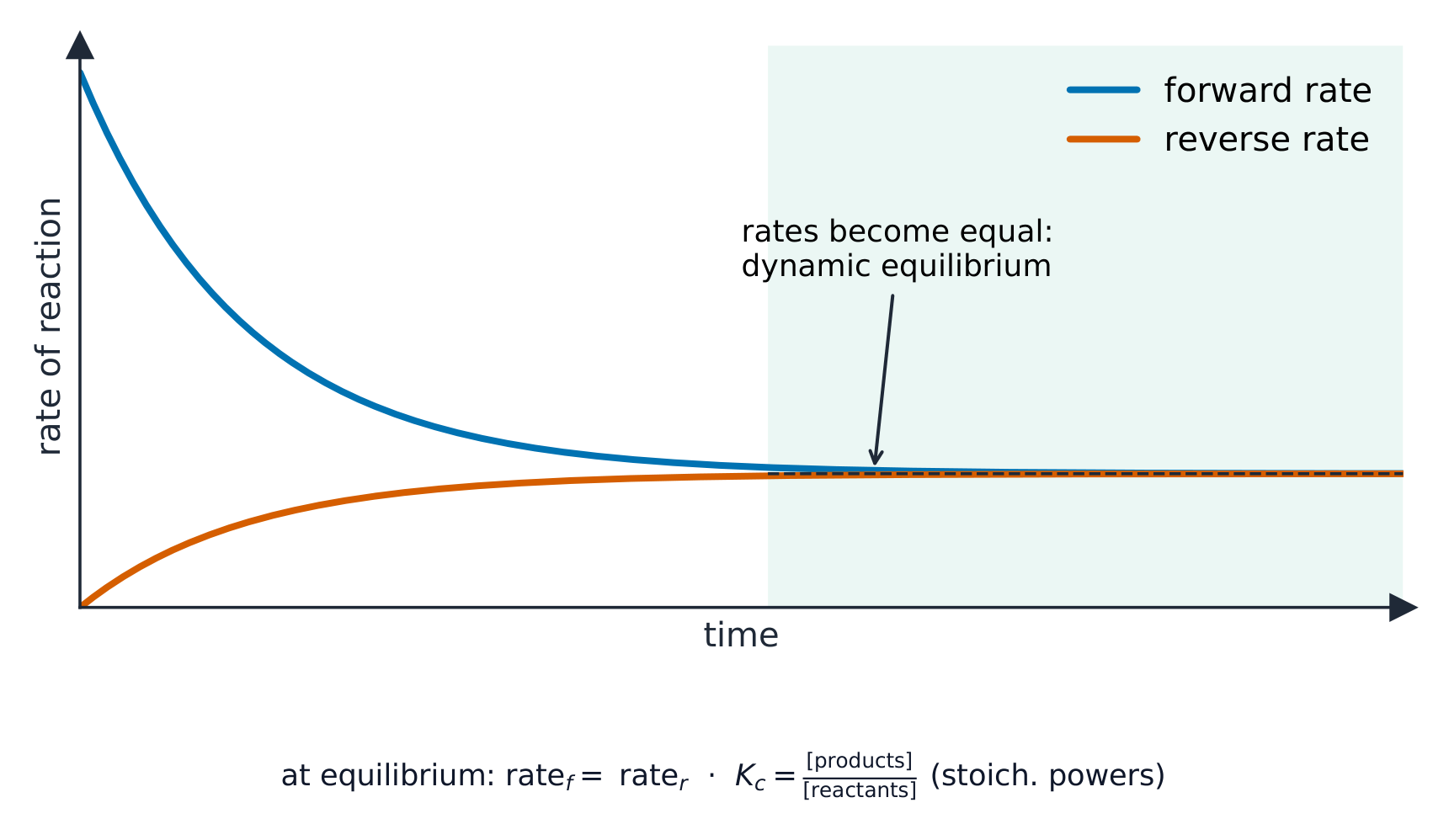
At dynamic equilibrium the forward and reverse rates have become equal, so the concentrations stay constant ExploreDynamic equilibrium
forward rate = reverse rate
At equilibrium the position can sit anywhere — change a condition and watch it shift.
Vocabulary TrainEnglish reversible reaction/rɪˈvɜːsɪbl rɪˈækʃn/ forward reaction/ˈfɔːwəd rɪˈækʃn/ reverse reaction/rɪˈvɜːs rɪˈækʃn/ closed system/kləʊzd ˈsɪstəm/ dynamic equilibrium/daɪˈnæmɪk ˌiːkwɪˈlɪbrɪəm/ 7.1
Le Chatelier's principle

Le Chatelier's principle 勒夏特列原理 says: if you change a system at equilibrium, the position of equilibrium 平衡 moves to oppose (reduce) that change.
Change you make Which way the equilibrium moves increase concentration of a reactant towards the products increase pressure towards the side with fewer gas molecules increase temperature towards the endothermic direction add a catalyst 催化剂 no shift (it speeds up both ways equally) A catalyst lets equilibrium be reached faster, but it does not change the position of equilibrium.
Le Chatelier's principle: the equilibrium always shifts to oppose the change you make ExploreShifting an equilibrium
Change the temperature, pressure or concentration and watch the equilibrium shift to oppose your change — Le Chatelier's principle in action.
Vocabulary TrainEnglish Le Chatelier's principle/lə ˈtʃeɪtlɪəz ˈprɪnsɪpl/ equilibrium/ˌiːkwɪˈlɪbrɪəm/ catalyst/ˈkætəlɪst/ 7.1
Equilibrium constants
For a reaction at equilibrium, the equilibrium constant 平衡常数 links the amounts of products and reactants. For the reaction $a\text{A} + b\text{B} \rightleftharpoons c\text{C} + d\text{D}$:
$$K_c = \frac{[\text{C}]^c\,[\text{D}]^d}{[\text{A}]^a\,[\text{B}]^b}$$where the square brackets mean concentration in $\text{mol dm}^{-3}$.
Worked example. At equilibrium the mixture $\text{H}_2 + \text{I}_2 \rightleftharpoons 2\text{HI}$ has $[\text{H}_2] = 0.20$, $[\text{I}_2] = 0.20$ and $[\text{HI}] = 1.6\ \text{mol dm}^{-3}$. Find $K_c$.
$$K_c = \frac{[\text{HI}]^2}{[\text{H}_2][\text{I}_2]} = \frac{1.6^2}{0.20 \times 0.20} = 64$$(no units here, because the concentration powers cancel top and bottom).
Worked example (ICE table). $1.00\ \text{mol}$ each of $\text{H}_2$ and $\text{I}_2$ are sealed in a $1.00\ \text{dm}^3$ flask; at equilibrium $0.20\ \text{mol}$ of $\text{H}_2$ remains. Set out an ICE table (Initial, Change, Equilibrium):
$\text{H}_2$ $\text{I}_2$ $2\text{HI}$ Initial 1.00 1.00 0 Change $-0.80$ $-0.80$ $+1.60$ Equilibrium 0.20 0.20 1.60 $0.80\ \text{mol}$ of $\text{H}_2$ reacted, so $2\times0.80 = 1.60\ \text{mol}$ HI formed. In the $1.00\ \text{dm}^3$ flask the concentrations equal the moles, so $K_c = \dfrac{1.60^2}{0.20\times0.20} = 64$.
For reactions of gases, we use partial pressure 分压 instead of concentration. The partial pressure of a gas is the share of the total pressure that it provides. It is found from the mole fraction 摩尔分数 (the fraction of all the moles that are that gas):
$$\text{partial pressure} = \text{mole fraction} \times \text{total pressure}$$The constant written with partial pressures is $K_p$.
Worked example. A gas mixture holds $2.0\ \text{mol}$ of $\text{N}_2$ and $6.0\ \text{mol}$ of $\text{H}_2$ at a total pressure of $200\ \text{kPa}$. Find the partial pressure of each gas.
There are $8.0\ \text{mol}$ in total, so
$$p(\text{N}_2) = \frac{2.0}{8.0} \times 200 = 50\ \text{kPa}, \qquad p(\text{H}_2) = \frac{6.0}{8.0} \times 200 = 150\ \text{kPa}.$$Worked example (a numeric $K_p$). For $\text{N}_2 + 3\text{H}_2 \rightleftharpoons 2\text{NH}_3$ the equilibrium partial pressures are $p(\text{N}_2)=20$, $p(\text{H}_2)=40$ and $p(\text{NH}_3)=10\ \text{kPa}$. Then
$$K_p = \frac{p(\text{NH}_3)^2}{p(\text{N}_2)\,p(\text{H}_2)^3} = \frac{10^2}{20\times40^3} = 7.8\times10^{-5}\ \text{kPa}^{-2},$$the units coming from $\dfrac{\text{kPa}^2}{\text{kPa}\times\text{kPa}^3}=\text{kPa}^{-2}$.Only temperature changes the value of $K_c$ or $K_p$. Changing concentration or pressure shifts the position of equilibrium but leaves the constant unchanged; adding a catalyst changes neither the constant nor the position — it only makes equilibrium arrive faster.
ExploreLe Chatelier and Kc
Change temperature, pressure or concentration and watch the equilibrium shift to oppose it — Kc itself only changes with temperature.
Vocabulary TrainEnglish equilibrium constant/ˌiːkwɪˈlɪbrɪəm ˈkɒnstənt/ partial pressure/ˈpɑːʃl ˈpreʃə/ mole fraction/məʊl ˈfrækʃn/ 7.1
The Haber and Contact processes

Ammonia for fertiliser is made by the Haber process in large industrial plants like this one. These two industrial processes are chosen by balancing yield, rate and cost using Le Chatelier's principle.
- the Haber process 哈伯法 makes ammonia: $\text{N}_2 + 3\text{H}_2 \rightleftharpoons 2\text{NH}_3$ (exothermic). It uses about $450\,°\text{C}$, $200\ \text{atm}$ and an iron catalyst. A low temperature would give more ammonia but too slowly, so a moderate temperature is a compromise.
- the Contact process 接触法 makes sulfur trioxide: $2\text{SO}_2 + \text{O}_2 \rightleftharpoons 2\text{SO}_3$ (exothermic). It uses about $450\,°\text{C}$, near $1$–$2\ \text{atm}$ and a vanadium(V) oxide catalyst.
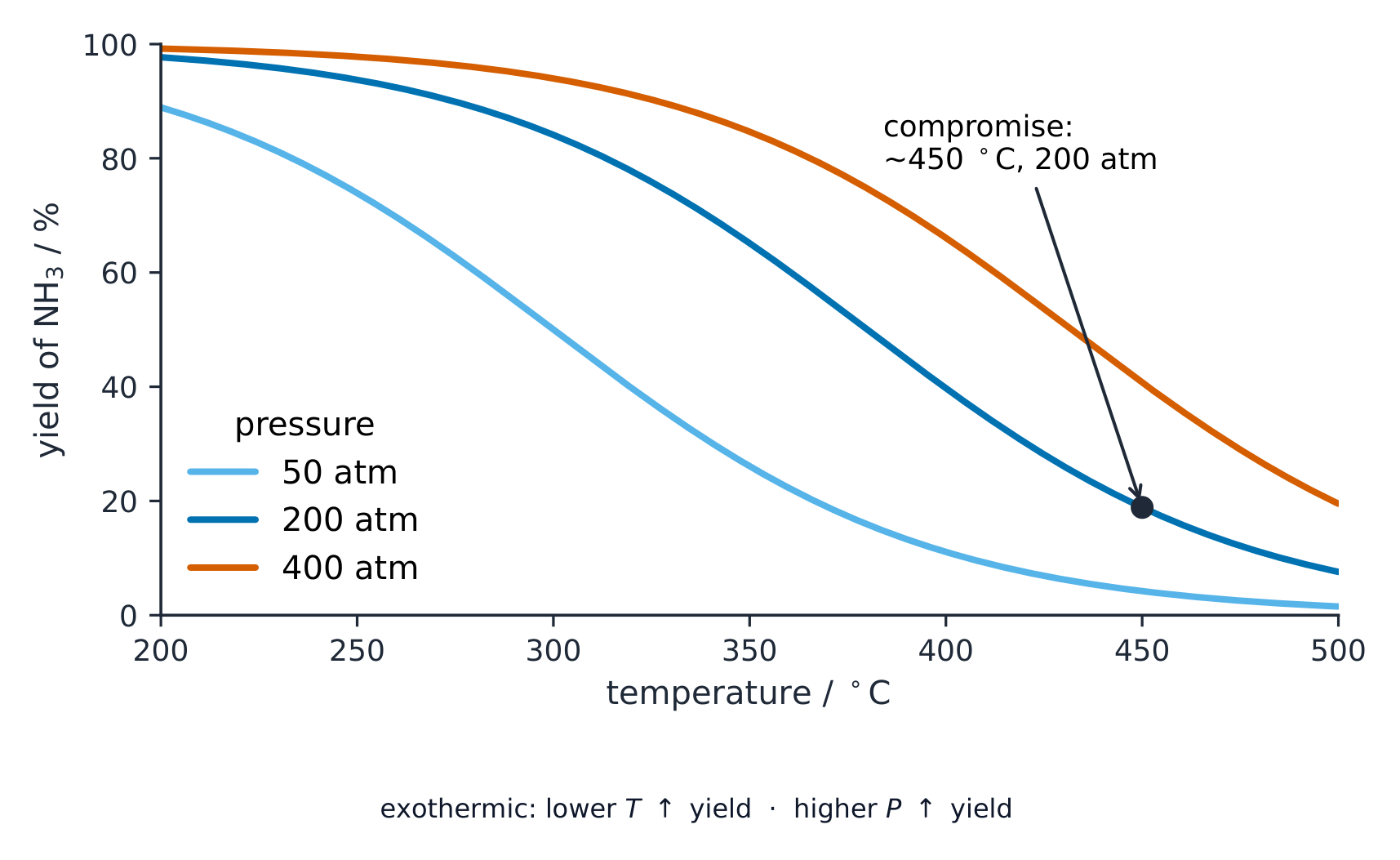
The Haber equilibrium gives more ammonia at lower temperature and higher pressure; about $450\,°$C and $200$ atm is the working compromise ExploreThe Haber & Contact processes
compromise: yield vs rate
High pressure boosts yield; high temperature speeds it up but lowers yield — a compromise.
Vocabulary TrainEnglish Haber process/ˈheɪbə ˈprəʊses/ Contact process/ˈkɒntækt ˈprəʊses/ 7.2
Acids and bases: the Brønsted–Lowry theory

Syllabus
- state the names and formulas of the common acids, limited to hydrochloric acid, $\text{HCl}$, sulfuric acid, $\text{H}_2\text{SO}_4$, nitric acid, $\text{HNO}_3$, ethanoic acid, $\text{CH}_3\text{COOH}$
- state the names and formulas of the common alkalis, limited to sodium hydroxide, $\text{NaOH}$, potassium hydroxide, $\text{KOH}$, ammonia, $\text{NH}_3$
- describe the Brønsted–Lowry theory of acids and bases
- describe strong acids and strong bases as fully dissociated in aqueous solution and weak acids and weak bases as partially dissociated in aqueous solution
- appreciate that water has pH of 7, acid solutions pH of below 7 and alkaline solutions pH of above 7
- explain qualitatively the differences in behaviour between strong and weak acids including the reaction with a reactive metal and difference in pH values by use of a pH meter, universal indicator or conductivity
- understand that neutralisation reactions occur when $\text{H}^+(\text{aq})$ and $\text{OH}^-(\text{aq})$ form $\text{H}_2\text{O}(\text{l})$
- understand that salts are formed in neutralisation reactions
- sketch the pH titration curves of titrations using combinations of strong and weak acids with strong and weak alkalis
- select suitable indicators for acid-alkali titrations, given appropriate data ($\text{p}K_a$ values will not be used)
Source: Cambridge International syllabus
A proton 质子 is simply an $\text{H}^+$ ion. The Brønsted–Lowry theory defines acids and bases by what they do with protons:
- an acid 酸 is a proton donor 质子供体 (it gives away $\text{H}^+$).
- a base 碱 is a proton acceptor 质子受体 (it takes $\text{H}^+$). A base that dissolves in water is called an alkali.
Brønsted–Lowry: the acid donates a proton ($\text{H}^+$) to the base, making two conjugate acid–base pairs Common acids you must know: hydrochloric acid ($\text{HCl}$), sulfuric acid ($\text{H}_2\text{SO}_4$), nitric acid ($\text{HNO}_3$) and ethanoic acid ($\text{CH}_3\text{COOH}$). Common alkalis: sodium hydroxide ($\text{NaOH}$), potassium hydroxide ($\text{KOH}$) and ammonia ($\text{NH}_3$).
ExploreThe pH scale
Slide the pH or tap a substance — each step down in pH means ten times more H⁺ ions; acids are below 7, alkalis above.
Vocabulary TrainEnglish proton/ˈprəʊtɒn/ acid/ˈæsɪd/ proton donor/ˈprəʊtɒn ˈdəʊnə/ base/beɪs/ proton acceptor/ˈprəʊtɒn əkˈseptə/ 7.2
Strong and weak acids and bases

This is about how fully an acid or base splits up in water — not how concentrated it is.
- a strong acid 强酸 or strong base 强碱 is fully dissociated 解离 in water (almost every molecule splits into ions).
- a weak acid 弱酸 or weak base 弱碱 is only partly dissociated (most molecules stay whole).
Same concentration, different ionisation: a strong acid is fully dissociated into ions; a weak acid stays mostly as whole molecules The pH scale measures how acidic a solution is: pure water is pH 7, acids are below 7, and alkalis are above 7. A strong acid has a lower pH than a weak acid of the same concentration.
You can tell strong and weak acids apart by:
- reaction with a reactive metal: a strong acid fizzes faster.
- pH: measured with a pH meter or universal indicator 通用指示剂.
- electrical conductivity: a strong acid conducts better, because it has more ions.
ExploreStrong vs weak acids
A strong acid fully ionises (low pH); a weak acid only partly ionises, so at the same concentration its pH is higher. Slide to compare.
Vocabulary TrainEnglish strong acid/strɒŋ ˈæsɪd/ strong base/strɒŋ beɪs/ dissociated/dɪˈsəʊsɪeɪtɪd/ weak acid/wiːk ˈæsɪd/ weak base/wiːk beɪs/ universal indicator/ˌjuːnɪˈvɜːsl ˈɪndɪkeɪtə/ 7.2
Neutralisation, salts and titration curves

Neutralisation 中和 happens when the hydrogen ions from an acid react with the hydroxide ions from an alkali:
$$\text{H}^+(\text{aq}) + \text{OH}^-(\text{aq}) \rightarrow \text{H}_2\text{O}(\text{l})$$A salt 盐 is also formed, from the rest of the acid and base.
In a titration 滴定 you add one solution to another and follow the pH. The titration curve 滴定曲线 has a steep, almost vertical jump near the end point. The exact shape depends on whether each reactant is strong or weak.
To pick an indicator 指示剂, choose one whose colour change falls inside that steep jump. For a strong acid with a strong base most indicators work; for a weak acid with a strong base you need one that changes in the higher pH range.
Titration curves each have a steep pH jump at the end point. The weak-acid jump sits higher, so the indicator must change colour in that range ExploreA titration curve
Add alkali to acid and watch the pH climb. The steep jump is the equivalence point, where the acid is just neutralised.
Vocabulary TrainEnglish Neutralisation/ˌnjuːtrəlaɪˈzeɪʃn/ salt/sɒlt/ titration/taɪˈtreɪʃn/ titration curve/taɪˈtreɪʃn kɜːv/ indicator/ˈɪndɪkeɪtə/ 7.2
Exam tips
- Define dynamic equilibrium with all three points: forward and reverse rates equal, concentrations constant, closed system.
- Answer Le Chatelier questions by stating the change, the direction of shift, and the reason; a catalyst does not shift the position (it speeds both rates).
- Write $K_c$ as products over reactants, each raised to its balancing number; include state symbols to decide what appears.
- Justify Haber/Contact conditions as a compromise between yield, rate and cost — do not just quote them.
- Brønsted: acid = proton donor, base = proton acceptor; conjugate pairs differ by one $\text{H}^+$.
-
8
Reaction kinetics
Watch lesson8.1
Rate of reaction

Syllabus
- explain and use the term rate of reaction, frequency of collisions, effective collisions and non-effective collisions
- explain qualitatively, in terms of frequency of effective collisions, the effect of concentration and pressure changes on the rate of a reaction
- use experimental data to calculate the rate of a reaction
Source: Cambridge International syllabus
Collision theory: energy and orientation The rate of reaction 反应速率 is how fast reactants turn into products. We measure it as the change in concentration (or amount) in each unit of time.
To react, particles must collide 碰撞. The collision frequency 碰撞频率 is how often the particles hit each other. But not every collision leads to a reaction:
- an effective collision 有效碰撞 has enough energy and the correct direction, so a reaction happens.
- a non-effective collision 无效碰撞 does not have enough energy, or the particles hit at the wrong angle, so nothing happens.
So the rate depends on the frequency of effective collisions — how many useful collisions happen each second.
A collision only reacts with the right orientation and enough energy (coloured ends = the reactive part) Concentration and pressure
If you increase the concentration of a solution (or the pressure of a gas), the particles are packed closer together. They collide more often, so there are more effective collisions each second, and the rate goes up.

More particles in the same volume collide more often, so the rate rises You can calculate a rate from experimental data — for example, the volume of gas made divided by the time taken.
Worked example. A reaction gives off carbon dioxide. In the first $30\ \text{s}$, $48\ \text{cm}^3$ of gas is collected. Find the average rate of reaction over this time.
$$\text{average rate} = \frac{\text{volume of gas}}{\text{time}} = \frac{48}{30} = 1.6\ \text{cm}^3\,\text{s}^{-1}.$$The rate is fastest at the start (the graph is steepest there) because the reactants are most concentrated, then it slows as they are used up.
ExploreRate of reaction
[A] = [A]₀·bᵗ
Reactant concentration falls over time as it's used up.
Vocabulary TrainEnglish rate of reaction/reɪt ɒv rɪˈækʃn/ collide/kəˈlaɪd/ collision frequency/kəˈlɪʒn ˈfriːkwənsi/ effective collision/ɪˈfektɪv kəˈlɪʒn/ non-effective collision/nɒn ɪˈfektɪv kəˈlɪʒn/ 8.2
Temperature and activation energy
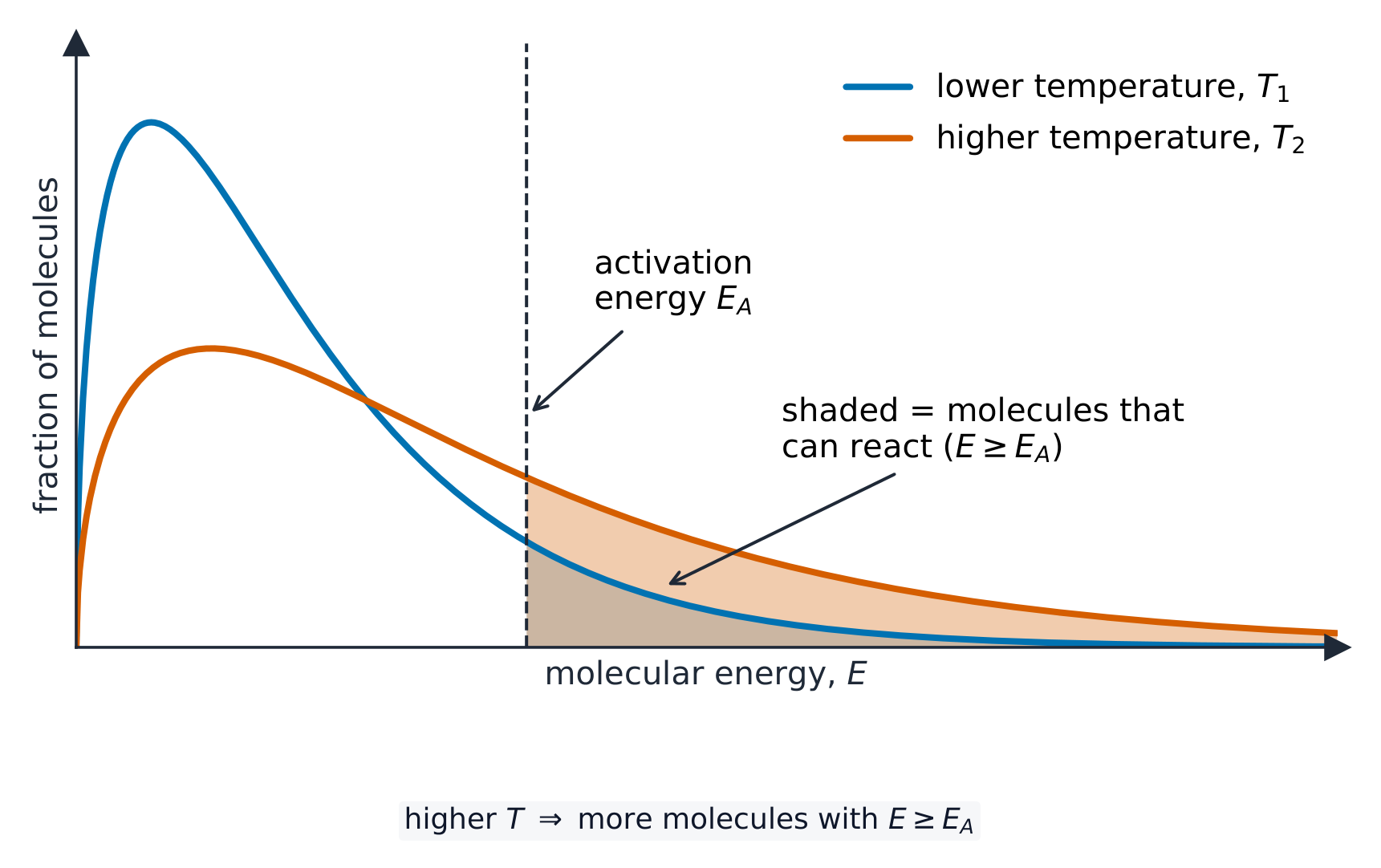
Syllabus
- define activation energy, $E_A$, as the minimum energy required for a collision to be effective
- sketch and use the Boltzmann distribution to explain the significance of activation energy
- explain qualitatively, in terms both of the Boltzmann distribution and of frequency of effective collisions, the effect of temperature change on the rate of a reaction
Source: Cambridge International syllabus
Maxwell-Boltzmann distribution The activation energy 活化能 ($E_A$) is the minimum energy a collision needs in order to be effective.
The Boltzmann distribution 玻尔兹曼分布 is a graph showing how the energies of the molecules are spread out at one temperature. The curve starts at the origin, rises to a peak, then falls away in a long tail. The total area under the curve is the total number of molecules. Only the molecules to the right of $E_A$ have enough energy to react.
When you raise the temperature:
- the curve flattens and spreads to the right, so a much larger fraction of molecules now have energy greater than $E_A$.
- the molecules also move faster and collide more often.
The first effect is the bigger one. This is why a small rise in temperature gives a large rise in rate.
At higher temperature the curve spreads to the right, so a larger fraction of molecules can react ExploreWhy heat speeds up reactions
Raise the temperature: the curve spreads right, so more molecules have at least the activation energy and can react.
Vocabulary TrainEnglish activation energy/ˌæktɪˈveɪʃn ˈenədʒi/ Boltzmann distribution/ˈbɒltsmən ˌdɪstrɪˈbjuːʃn/ 8.3
Catalysts

Syllabus
- explain and use the terms catalyst and catalysis: (a) explain that, in the presence of a catalyst, a reaction has a different mechanism, i.e. one of lower activation energy (b) explain this catalytic effect in terms of the Boltzmann distribution (c) construct and interpret a reaction pathway diagram, for a reaction in the presence and absence of an effective catalyst
Source: Cambridge International syllabus
Reaction profile: a catalyst's lower-energy route A catalyst 催化剂 speeds up a reaction but is not used up itself. Catalysis 催化作用 is the name for this action.
A catalyst works by giving the reaction a different reaction mechanism 反应机理 — a new route with a lower activation energy. On the Boltzmann distribution, lowering $E_A$ moves the line to the left, so more molecules now have enough energy. This means more effective collisions each second, and a faster rate.
On a reaction pathway diagram 反应路径图, the catalysed route has a lower energy "hill". The enthalpy change of the reaction, $\Delta H$, is not changed by the catalyst.
A catalyst gives a route with lower activation energy; the enthalpy change is unchanged There are two types:
- a homogeneous catalyst 均相催化剂 is in the same physical state as the reactants — for example, an acid catalyst dissolved in a solution of liquids.
- a heterogeneous catalyst 多相催化剂 is in a different state from the reactants — for example, solid iron speeding up the reaction of gases in the Haber process.
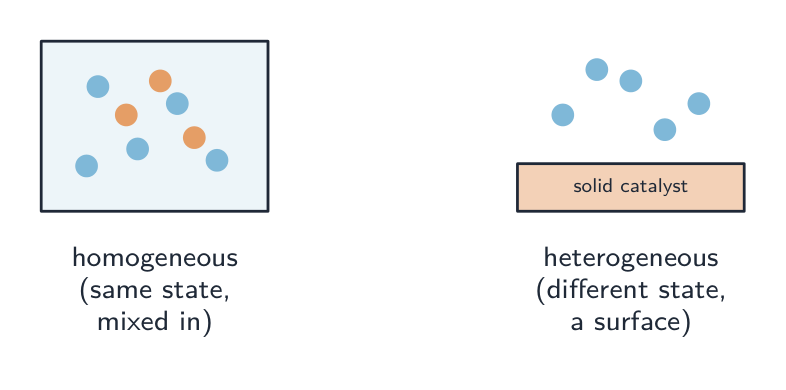
A homogeneous catalyst is mixed in with the reactants (same state); a heterogeneous catalyst is a separate surface (different state), where reactants meet and react 
A car's catalytic converter is a heterogeneous catalyst; its honeycomb gives a huge surface area ExploreCatalysts
a catalyst lowers Ea
A catalyst lowers Ea, so a bigger fraction of molecules can react — without heating.
ExploreHow a catalyst works
Add a catalyst and watch the activation-energy barrier drop — it gives an easier route, without changing ΔH.
Vocabulary TrainEnglish catalyst/ˈkætəlɪst/ catalysis/kæˈtæləsɪs/ reaction mechanism/rɪˈækʃn ˈmekənɪzəm/ reaction pathway diagram/rɪˈækʃn ˈpæθweɪ ˈdaɪəɡræm/ homogeneous catalyst/həˈməʊdʒnɪəs ˈkætəlɪst/ heterogeneous catalyst/ˌhetrəˈdʒiːnɪəs ˈkætəlɪst/ 8.3
Exam tips
- Explain rate changes with collision theory — more frequent and/or more energetic effective collisions.
- On a Boltzmann distribution mark $E_A$, shade to its right, and show the curve flatten and shift right at higher temperature; it starts at the origin and never touches the axis.
- A catalyst gives an alternative route with lower $E_A$ and does not change $\Delta H$.
- Say why a small temperature rise gives a large rate rise: a much greater proportion of molecules now exceed $E_A$ (the main effect).
-
9
The Periodic Table: chemical periodicity
Watch lesson9.1
Physical properties across Period 3

Syllabus
- describe qualitatively (and indicate the periodicity in) the variations in atomic radius, ionic radius, melting point and electrical conductivity of the elements
- explain the variation in melting point and electrical conductivity in terms of the structure and bonding of the elements
Source: Cambridge International syllabus
Properties repeat in a regular pattern across each period of the table. Periodicity 周期性 means that properties repeat in a regular pattern as you go across each period 周期 of the Periodic Table. Period 3 (Na to Ar) is the standard example.

Atomic radius decreases across Period 3: the rising nuclear charge pulls the same outer shell inwards Property Trend across Period 3 atomic radius 原子半径 gets smaller (more nuclear charge pulls the same shell in) ionic radius 离子半径 positive ions are small; from $\text{P}^{3-}$ onwards the negative ions are larger melting point 熔点 rises to a peak at silicon, then falls sharply electrical conductivity 导电性 high for Na, Mg, Al; almost zero from Si onwards The melting point and conductivity follow from the structure and bonding:
- Na, Mg, Al are giant metallic 金属晶体. Melting points rise (Na → Al) because each atom gives more delocalised electrons and the ions get smaller, so the bonding is stronger. They conduct well.
- Si is giant molecular 原子晶体 (giant covalent). It has the highest melting point, because strong covalent bonds must be broken. It barely conducts.
- P, S, Cl, Ar are simple molecular 分子晶体 (or single atoms). Their melting points are low, because the only forces that break are the weak van der Waals' forces 范德华力 between the molecules - the strong covalent bonds inside each molecule are never broken at all. They do not conduct.
Name van der Waals' forces when you explain that drop: it is the marking point, and "the covalent bonds are weak" is the error that loses it. Melting $\text{S}_8$ pulls whole molecules apart from each other; it does not touch a single $\text{S–S}$ bond. Their sizes still follow the molecule: $\text{S}_8$ melts higher than $\text{P}_4$ because it is bigger, with more electrons and so stronger van der Waals' forces, while $\text{Ar}$ (a single atom) is lowest of all.
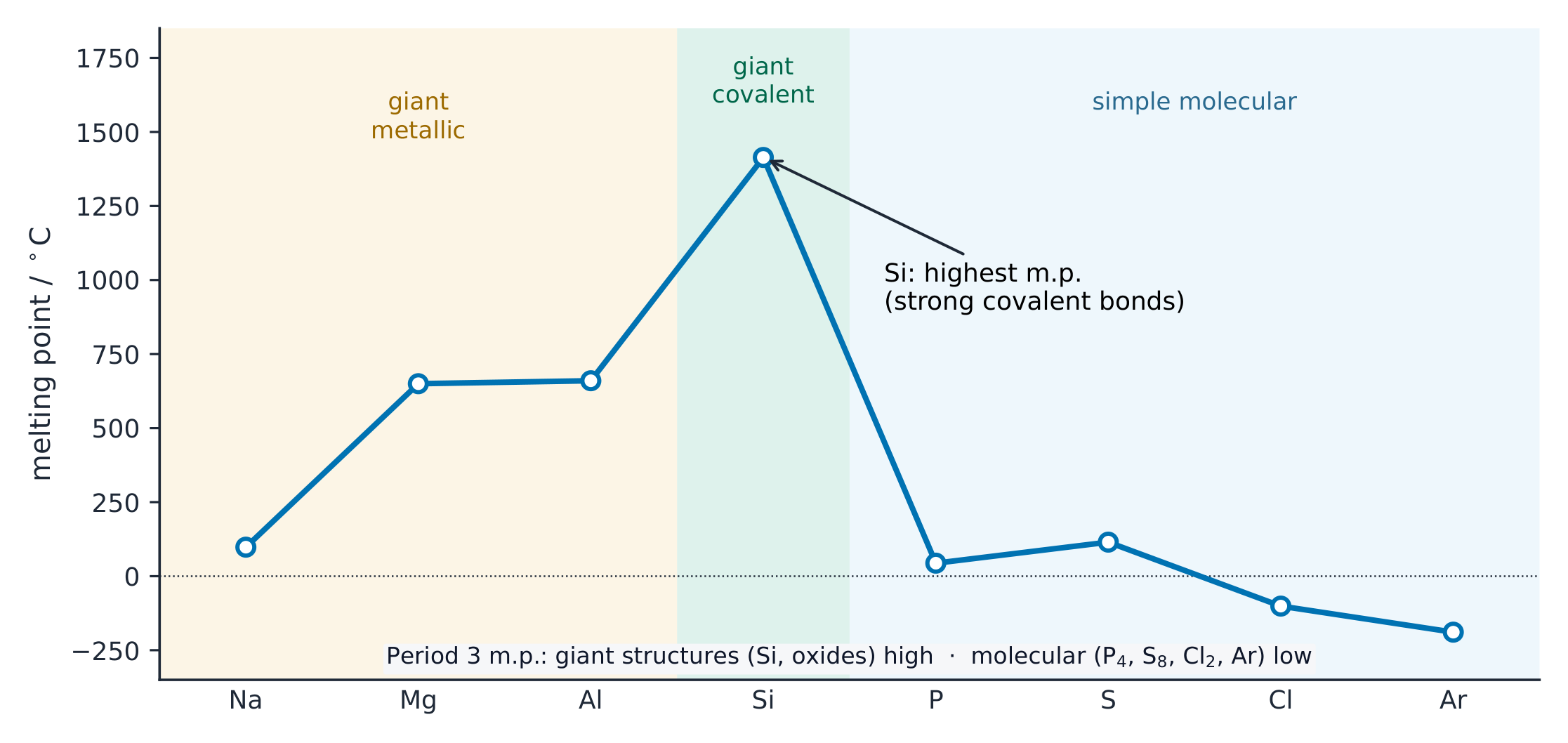
Melting point across Period 3 peaks at silicon (giant covalent); it is high for the metals and low for the simple molecular elements ExploreTrends across Period 3
Switch between atomic radius, ionisation energy and melting point, and step across Period 3 to see each periodic trend.
Vocabulary TrainEnglish periodicity/ˌpɪərɪˌɒˈdɪsɪti/ period/ˈpɪərɪəd/ atomic radius/əˈtɒmɪk ˈreɪdɪəs/ ionic radius/aɪˈɒnɪk ˈreɪdɪəs/ melting point/ˈmeltɪŋ pɔɪnt/ electrical conductivity/ɪˈlektrɪkl kɒndəkˈtɪvɪti/ giant metallic/ˈdʒaɪənt məˈtælɪk/ giant molecular/ˈdʒaɪənt məˈlekjʊlə/ simple molecular/ˈsɪmpl məˈlekjʊlə/ van der Waals' forces/ˈvændɜː wɑːlz ˈfɔːsɪz/ 9.2
Chemical properties across Period 3

Syllabus
- describe, and write equations for, the reactions of the elements with oxygen (to give $\text{Na}_2\text{O}$, $\text{MgO}$, $\text{Al}_2\text{O}_3$, $\text{P}_4\text{O}_{10}$, $\text{SO}_2$), chlorine (to give $\text{NaCl}$, $\text{MgCl}_2$, $\text{AlCl}_3$, $\text{SiCl}_4$, $\text{PCl}_5$) and water ($\text{Na}$ and $\text{Mg}$ only)
- state and explain the variation in the oxidation number of the oxides ($\text{Na}_2\text{O}$, $\text{MgO}$, $\text{Al}_2\text{O}_3$, $\text{P}_4\text{O}_{10}$, $\text{SO}_2$ and $\text{SO}_3$ only) and chlorides ($\text{NaCl}$, $\text{MgCl}_2$, $\text{AlCl}_3$, $\text{SiCl}_4$, $\text{PCl}_5$ only) in terms of their outer shell (valence shell) electrons
- describe, and write equations for, the reactions, if any, of the oxides $\text{Na}_2\text{O}$, $\text{MgO}$, $\text{Al}_2\text{O}_3$, $\text{SiO}_2$, $\text{P}_4\text{O}_{10}$, $\text{SO}_2$ and $\text{SO}_3$ with water including the likely pHs of the solutions obtained
- describe, explain, and write equations for, the acid/base behaviour of the oxides $\text{Na}_2\text{O}$, $\text{MgO}$, $\text{Al}_2\text{O}_3$, $\text{P}_4\text{O}_{10}$, $\text{SO}_2$ and $\text{SO}_3$ and the hydroxides $\text{NaOH}$, $\text{Mg(OH)}_2$ and $\text{Al(OH)}_3$ including, where relevant, amphoteric behaviour in reactions with acids and bases (sodium hydroxide only)
- describe, explain, and write equations for, the reactions of the chlorides $\text{NaCl}$, $\text{MgCl}_2$, $\text{AlCl}_3$, $\text{SiCl}_4$, $\text{PCl}_5$ with water including the likely pHs of the solutions obtained
- explain the variations and trends in 9.2.2, 9.2.3, 9.2.4 and 9.2.5 in terms of bonding and electronegativity
- suggest the types of chemical bonding present in the chlorides and oxides from observations of their chemical and physical properties
Source: Cambridge International syllabus
Reactions with oxygen, chlorine and water
With oxygen:
$$4\text{Na} + \text{O}_2 \rightarrow 2\text{Na}_2\text{O} \qquad 2\text{Mg} + \text{O}_2 \rightarrow 2\text{MgO} \qquad 4\text{Al} + 3\text{O}_2 \rightarrow 2\text{Al}_2\text{O}_3$$$$\text{P}_4 + 5\text{O}_2 \rightarrow \text{P}_4\text{O}_{10} \qquad \text{S} + \text{O}_2 \rightarrow \text{SO}_2$$With chlorine:
$$2\text{Na} + \text{Cl}_2 \rightarrow 2\text{NaCl} \qquad \text{Mg} + \text{Cl}_2 \rightarrow \text{MgCl}_2 \qquad 2\text{Al} + 3\text{Cl}_2 \rightarrow 2\text{AlCl}_3$$$$\text{Si} + 2\text{Cl}_2 \rightarrow \text{SiCl}_4 \qquad 2\text{P} + 5\text{Cl}_2 \rightarrow 2\text{PCl}_5$$With water (only Na and Mg react):
$$2\text{Na} + 2\text{H}_2\text{O} \rightarrow 2\text{NaOH} + \text{H}_2 \qquad \text{Mg} + 2\text{H}_2\text{O} \rightarrow \text{Mg(OH)}_2 + \text{H}_2$$Sodium reacts fast; magnesium reacts only very slowly with cold water.
Oxidation number of the oxides and chlorides
The oxidation number 氧化数 of the Period 3 element in its oxide or chloride rises across the period, because it equals the number of outer-shell (valence shell 价层) electrons 电子 the atom uses in bonding:
Oxides $\text{Na}_2\text{O}$ $\text{MgO}$ $\text{Al}_2\text{O}_3$ $\text{P}_4\text{O}_{10}$ $\text{SO}_2$ / $\text{SO}_3$ oxidation number $+1$ $+2$ $+3$ $+5$ $+4$ / $+6$ The chlorides $\text{NaCl}$, $\text{MgCl}_2$, $\text{AlCl}_3$, $\text{SiCl}_4$, $\text{PCl}_5$ show oxidation numbers $+1$ to $+5$ in the same way.
Oxides with water, and acid–base behaviour
Across the period the oxides 氧化物 change from basic to acidic:
The Period 3 oxides change from basic (the metals) through amphoteric (Al$_2$O$_3$) to acidic (the non-metals) Oxide With water Acid–base nature Approximate pH $\text{Na}_2\text{O}$ $\text{Na}_2\text{O} + \text{H}_2\text{O} \rightarrow 2\text{NaOH}$ basic 13–14 $\text{MgO}$ $\text{MgO} + \text{H}_2\text{O} \rightarrow \text{Mg(OH)}_2$ basic 9–10 $\text{Al}_2\text{O}_3$ insoluble amphoteric 两性 7 $\text{SiO}_2$ insoluble weakly acidic 7 $\text{P}_4\text{O}_{10}$ $\text{P}_4\text{O}_{10} + 6\text{H}_2\text{O} \rightarrow 4\text{H}_3\text{PO}_4$ acidic 1–2 $\text{SO}_3$ $\text{SO}_3 + \text{H}_2\text{O} \rightarrow \text{H}_2\text{SO}_4$ strongly acidic 0–1 Metal oxides (left) are basic; non-metal oxides (right) are acidic. $\text{Al}_2\text{O}_3$ and its hydroxide 氢氧化物 $\text{Al(OH)}_3$ are amphoteric — they react with both acids and bases:
$$\text{Al}_2\text{O}_3 + 6\text{HCl} \rightarrow 2\text{AlCl}_3 + 3\text{H}_2\text{O}$$$$\text{Al}_2\text{O}_3 + 2\text{NaOH} + 3\text{H}_2\text{O} \rightarrow 2\text{NaAl(OH)}_4$$
Aluminium oxide is amphoteric — it reacts with acids (behaving as a base) and with bases (behaving as an acid) Chlorides with water
- $\text{NaCl}$ and $\text{MgCl}_2$ are ionic. They simply dissolve, giving a near-neutral solution.
- $\text{SiCl}_4$ and $\text{PCl}_5$ are covalent. They undergo hydrolysis 水解 (react with water) to make acidic solutions and fumes of $\text{HCl}$:
$$\text{SiCl}_4 + 2\text{H}_2\text{O} \rightarrow \text{SiO}_2 + 4\text{HCl} \qquad \text{PCl}_5 + 4\text{H}_2\text{O} \rightarrow \text{H}_3\text{PO}_4 + 5\text{HCl}$$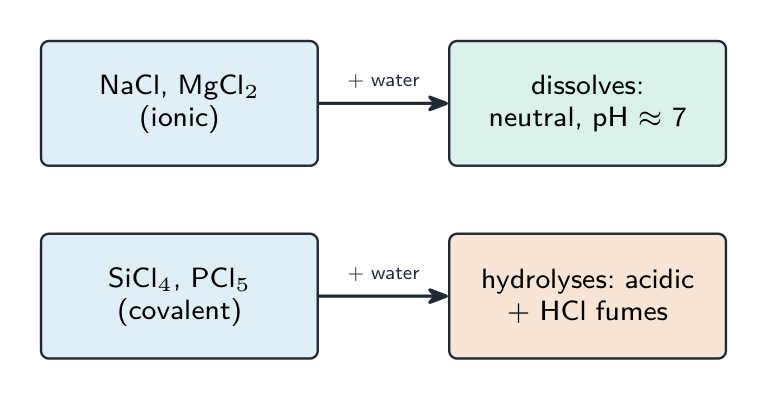
The ionic chlorides just dissolve (neutral); the covalent chlorides react with water (hydrolyse) to give an acidic solution and HCl fumes Explaining the trends
These trends follow from the change in bonding and electronegativity 电负性. On the left, the elements are metals with low electronegativity, so their oxides and chlorides are ionic and basic (or neutral). On the right, the elements are non-metals with high electronegativity, so their oxides and chlorides are covalent and acidic. You can use a chloride's or oxide's properties (melting point, conductivity, effect on water) to suggest whether its bonding is ionic or covalent.
Worked example. Predict the pH when $\text{Na}_2\text{O}$, $\text{Al}_2\text{O}_3$ and $\text{SO}_3$ are each added to water. Acid-base character follows the metal to non-metal change across Period 3. $\text{Na}_2\text{O}$ is ionic and basic: it dissolves to give $\text{NaOH}$, so the pH is about 13. $\text{SO}_3$ is covalent and acidic: it reacts to give $\text{H}_2\text{SO}_4$, so the pH is about 1. $\text{Al}_2\text{O}_3$ sits at the changeover - it is amphoteric and essentially insoluble in water, so the pH stays about 7. The trap is that last one: amphoteric does not mean neutral, it means the oxide reacts with acids and with alkalis - it simply does not react with water.
ExplorePeriod 3 reaction lab
Classify Period 3 reactions by what they reveal about bonding and acidity.
ExploreOxide and chloride hydrolysis route
Follow how Period 3 oxides and chlorides change pH in water.
Vocabulary TrainEnglish oxidation number/ˌɒksɪˈdeɪʃn ˈnʌmbə/ valence shell/ˈveɪləns ʃel/ electron/ɪˈlektrɒn/ oxide/ˈɒksaɪd/ amphoteric/ˌæmfəʊˈterɪk/ hydroxide/haɪˈdrɒksaɪd/ hydrolysis/haɪˈdrɒləsɪs/ electronegativity/ɪˌlektrəʊŋɡəˈtɪvɪti/ 9.3
Periodicity of other elements
Syllabus
- predict the characteristic properties of an element in a given group by using knowledge of chemical periodicity
- deduce the nature, possible position in the Periodic Table and identity of unknown elements from given information about physical and chemical properties
Source: Cambridge International syllabus
The same idea works for any group. If you know the pattern down a group and across a period, you can:
- predict the properties of an element from its position (for example, a Group 1 element will be a reactive metal forming a $+1$ ion).
- deduce the likely position and identity of an unknown element from its physical and chemical properties.
ExplorePeriodic trends
Step across Period 3 to see a property rise or fall, then repeat in the next period — that recurring pattern is periodicity.
9.3
Exam tips
- Always pair the trend with its reason: atomic radius falls across Period 3 (rising nuclear charge, similar shielding).
- Explain the melting-point pattern by structure: giant metallic (Na→Al), giant covalent (Si, highest), then simple molecular ($\text{P}_4$, $\text{S}_8$, $\text{Cl}_2$) and monatomic (Ar).
- Oxides go basic → amphoteric ($\text{Al}_2\text{O}_3$) → acidic across the period; link to ionic-to-covalent bonding.
- For reactions of oxides/chlorides with water, give the products and the resulting pH.
-
10
Group 2
Watch lesson10.1
The Group 2 metals

Syllabus
- describe, and write equations for, the reactions of the elements with oxygen, water and dilute hydrochloric and sulfuric acids
- describe, and write equations for, the reactions of the oxides, hydroxides and carbonates with water and dilute hydrochloric and sulfuric acids
- describe, and write equations for, the thermal decomposition of the nitrates and carbonates, to include the trend in thermal stabilities
- describe, and make predictions from, the trends in physical and chemical properties of the elements involved in the reactions in 10.1.1 and the compounds involved in 10.1.2, 10.1.3 and 10.1.5
- state the variation in the solubilities of the hydroxides and sulfates
Source: Cambridge International syllabus
Limestone is calcium carbonate — a compound of the Group 2 metal calcium. Group 族 2 holds the metals magnesium, calcium, strontium and barium. They all have two outer electrons, which they lose to form $2+$ ions. Going down the group, the atoms get larger and the outer electrons are easier to lose, so the metals get more reactive — their reactivity 反应活性 increases down the group.

Reactivity increases down Group 2: larger atoms hold their two outer electrons less tightly, so they are lost more easily Reactions of the elements
With oxygen, they burn to form an oxide:
$$2\text{Mg} + \text{O}_2 \rightarrow 2\text{MgO}$$
Magnesium burns in air with a brilliant white flame, forming white magnesium oxide With water, they form a hydroxide and hydrogen. The reaction gets faster down the group:
$$\text{Ca} + 2\text{H}_2\text{O} \rightarrow \text{Ca(OH)}_2 + \text{H}_2$$Magnesium is slow with cold water but reacts fast with steam, giving $\text{MgO}$ and $\text{H}_2$.
With dilute hydrochloric or sulfuric acid, they form a salt and hydrogen:
$$\text{Mg} + 2\text{HCl} \rightarrow \text{MgCl}_2 + \text{H}_2 \qquad \text{Mg} + \text{H}_2\text{SO}_4 \rightarrow \text{MgSO}_4 + \text{H}_2$$With sulfuric acid the reaction slows down the group, because the sulfates 硫酸盐 formed (such as $\text{BaSO}_4$) are insoluble and coat the metal.
Reactions of the compounds
The oxides 氧化物 and hydroxides 氢氧化物 are basic. They react with water and with dilute acids:
$$\text{MgO} + \text{H}_2\text{O} \rightarrow \text{Mg(OH)}_2 \qquad \text{Mg(OH)}_2 + 2\text{HCl} \rightarrow \text{MgCl}_2 + 2\text{H}_2\text{O}$$The carbonates 碳酸盐 react with dilute acids to give a salt, water and carbon dioxide:
$$\text{CaCO}_3 + 2\text{HCl} \rightarrow \text{CaCl}_2 + \text{H}_2\text{O} + \text{CO}_2$$Thermal decomposition
Thermal decomposition 热分解 means breaking a compound apart by heating it.
- the carbonates break into the oxide and carbon dioxide:
$$\text{CaCO}_3 \rightarrow \text{CaO} + \text{CO}_2$$- the nitrates 硝酸盐 break into the oxide, brown nitrogen dioxide gas and oxygen:
$$2\text{Ca(NO}_3)_2 \rightarrow 2\text{CaO} + 4\text{NO}_2 + \text{O}_2$$The thermal stability 热稳定性 of both the carbonates and the nitrates increases down the group. A larger metal ion pulls less on the carbonate or nitrate ion, so the compound is harder to break apart — it needs a higher temperature. So magnesium carbonate decomposes most easily, and barium carbonate is the hardest.
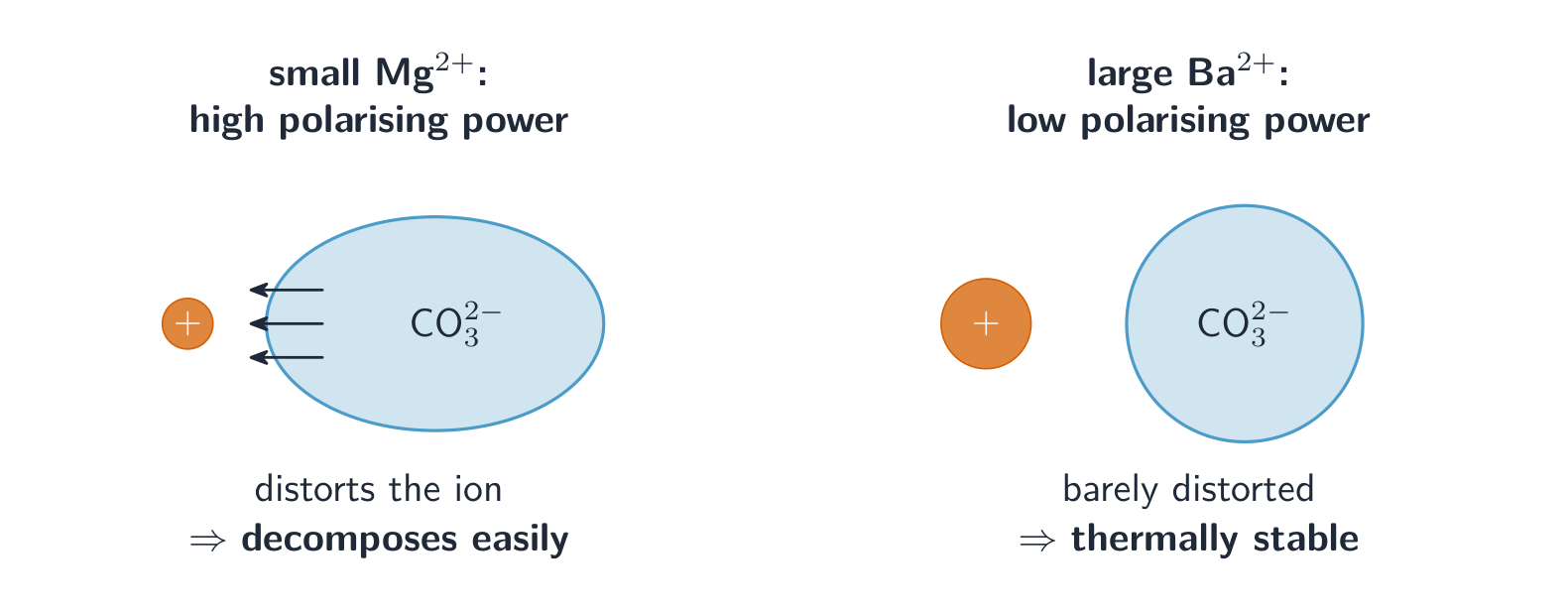
Thermal stability rises down the group: a small cation polarises (distorts) the carbonate ion more, weakening it so it decomposes more easily Trends in solubility
Compound Trend in solubility 溶解度 down the group hydroxides increase (Mg(OH)$_2$ almost insoluble; Ba(OH)$_2$ soluble) sulfates decrease (MgSO$_4$ soluble; BaSO$_4$ insoluble) 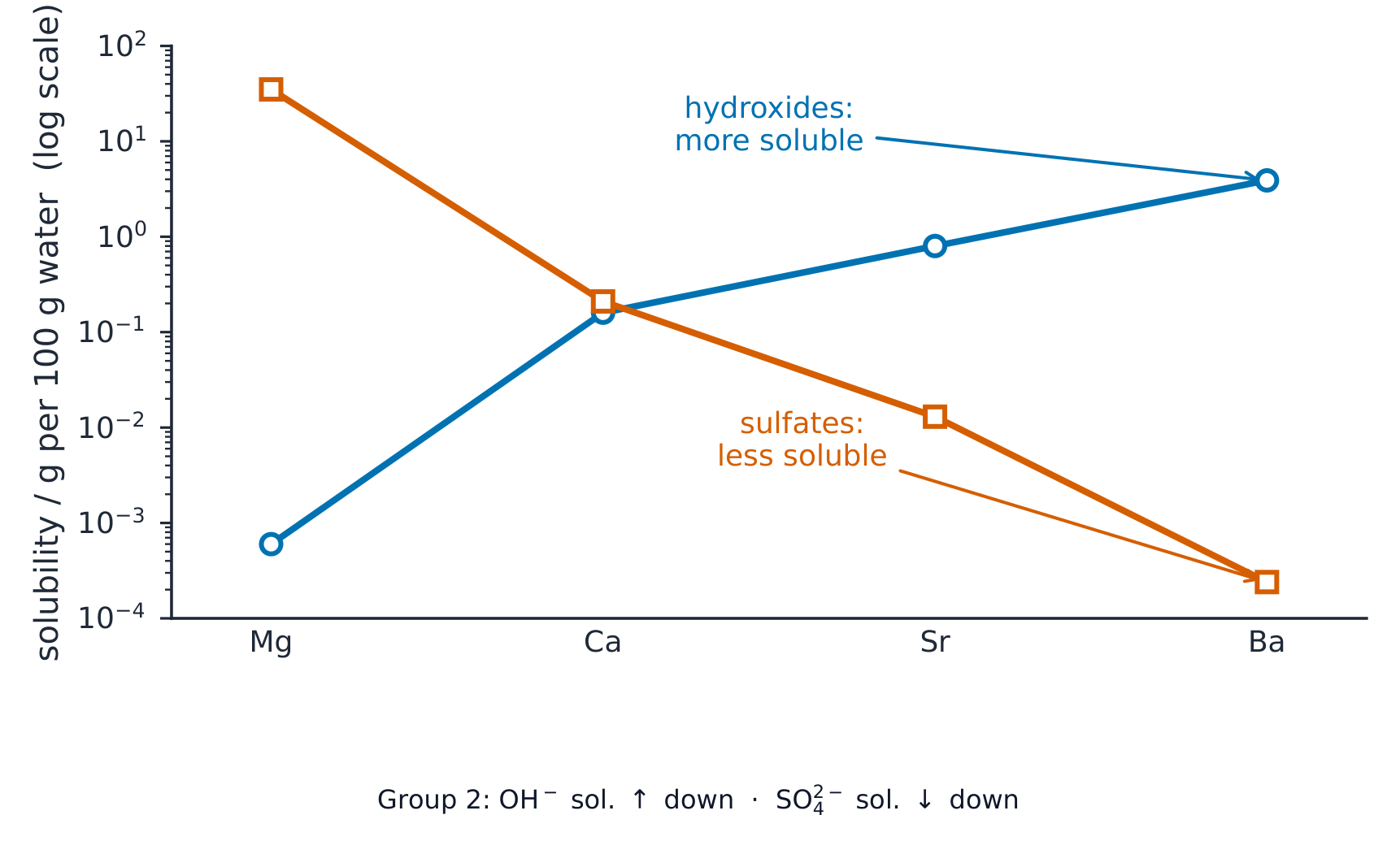
Down Group 2 the hydroxides become more soluble while the sulfates become less soluble (note the log scale) From these trends you can predict the properties of the next element down, radium, and of its compounds.
Worked example. $\text{MgCO}_3$ decomposes at about $540\ °\text{C}$ and $\text{BaCO}_3$ at about $1360\ °\text{C}$. Explain the trend and predict where $\text{CaCO}_3$ sits. Going down Group 2 the cation gets larger, so its charge is spread over a bigger surface and its polarising power falls. A less polarising cation distorts the carbonate ion less, so the $\text{C-O}$ bond is weakened less and more heat is needed to break it. Thermal stability therefore increases down the group, and $\text{CaCO}_3$, lying between Mg and Ba, decomposes at an intermediate temperature of about $900\ °\text{C}$. Argue the whole chain - cation size, then polarising power, then distortion of the anion; "it is more reactive" explains nothing here.
ExploreGroup 2 reactivity ladder
Move down Group 2 and see why reactions become more vigorous.
ExploreGroup 2 trend lab
Compare thermal stability and solubility trends down Group 2.
Vocabulary TrainEnglish group/ɡruːp/ reactivity/rɪəkˈtɪvɪti/ sulfate/ˈsʌlfeɪt/ oxide/ˈɒksaɪd/ hydroxide/haɪˈdrɒksaɪd/ carbonate/ˈkɑːbəneɪt/ thermal decomposition/ˈθɜːml ˌdiːkɒmpəˈzɪʃn/ nitrate/ˈnaɪtreɪt/ thermal stability/ˈθɜːml stəˈbɪlɪti/ solubility/ˌsɒljuːˈbɪlɪti/ 10.1
Exam tips
- Reactivity increases down Group 2: ionisation energy falls as atoms get larger, so electrons are lost more easily.
- Reactions with water become more vigorous down the group; Mg reacts slowly with cold water but fast with steam (→ MgO).
- Hydroxides get more soluble down the group; sulfates get less soluble ($\text{BaSO}_4$ insoluble — the basis of the sulfate test).
- Write equations with the correct $+2$ ion and state the observations (fizzing, dissolving).
-
11
Group 17
Watch lesson11.1
Physical properties of the halogens

Syllabus
- describe the colours and the trend in volatility of chlorine, bromine and iodine
- describe and explain the trend in the bond strength of the halogen molecules
- interpret the volatility of the elements in terms of instantaneous dipole–induced dipole forces
Source: Cambridge International syllabus
Bromine is a Group 17 halogen — a dark liquid that gives off an orange vapour. The halogens 卤素 are the Group 族 17 elements. They exist as diatomic molecules ($\text{Cl}_2$, $\text{Br}_2$, $\text{I}_2$). Going down the group:
Element Colour and state at room temperature chlorine pale green gas bromine red-brown liquid iodine grey-black solid (purple vapour) The volatility 挥发性 (how easily a substance turns to vapour) decreases down the group: chlorine is a gas, but iodine is a solid. This is because the molecules get larger and have more electrons, so the instantaneous dipole 瞬时偶极 and induced dipole 诱导偶极 forces between them get stronger. Stronger forces are harder to break, so the boiling point rises and volatility falls.

Down Group 17 the halogens change from a pale green gas to a red-brown liquid to a grey-black solid as volatility falls The bond energy 键能 (bond strength) of the $\text{X}\text{–}\text{X}$ molecules generally falls from $\text{Cl}_2$ to $\text{I}_2$, because the shared electrons are further from the nuclei in the larger atoms.
ExploreHalogen physical trend lab
Follow halogens down the group and link state, colour and volatility.
Vocabulary TrainEnglish halogen/ˈhælədʒn/ group/ɡruːp/ volatility/ˌvɒləˈtɪlɪti/ instantaneous dipole/ˌɪnstənˈteɪnɪəs ˈdaɪpəʊl/ induced dipole/ɪnˈdjuːst ˈdaɪpəʊl/ bond energy/bɒnd ˈenədʒi/ 11.2
Chemical properties of the halogens and hydrogen halides

Syllabus
- describe the relative reactivity of the elements as oxidising agents
- describe the reactions of the elements with hydrogen and explain their relative reactivity in these reactions
- describe the relative thermal stabilities of the hydrogen halides and explain these in terms of bond strengths
Source: Cambridge International syllabus
Halogens as oxidising agents
Each halogen reacts by gaining one electron to form a $1-$ ion, so it acts as an oxidising agent 氧化剂. This power decreases down the group, because the larger atoms attract an extra electron less strongly. A more reactive halogen can push out a less reactive one from its salt:
Chlorine displaces bromine: the solution turns orange $$\text{Cl}_2 + 2\text{KBr} \rightarrow 2\text{KCl} + \text{Br}_2$$Reactions with hydrogen
Each halogen reacts with hydrogen to form a hydrogen halide 卤化氢:
$$\text{H}_2 + \text{Cl}_2 \rightarrow 2\text{HCl}$$The reaction gets less vigorous down the group: chlorine reacts explosively in light, bromine needs heat, and iodine reacts slowly and only partly.
Thermal stability of the hydrogen halides
The thermal stability 热稳定性 of the hydrogen halides decreases down the group. The H–X bond gets weaker as the halogen atom gets larger, so HI breaks apart on gentle heating while HCl is very stable.
ExploreHalogen and hydrogen halide lab
Classify halogen chemistry by oxidising and reducing strength.
Vocabulary TrainEnglish oxidising agent/ˈɒksɪdaɪzɪŋ ˈeɪdʒənt/ hydrogen halide/ˈhaɪdrədʒn ˈhælaɪd/ thermal stability/ˈθɜːml stəˈbɪlɪti/ 11.3
Reactions of the halide ions

Syllabus
- describe the relative reactivity of halide ions as reducing agents
- describe and explain the reactions of halide ions with: (a) aqueous silver ions followed by aqueous ammonia (the formation and formula of the $[\text{Ag}(\text{NH}_3)_2]^+$ complex is not required) (b) concentrated sulfuric acid, to include balanced chemical equations
Source: Cambridge International syllabus
Halide ions as reducing agents
A halide ion 卤离子 (such as $\text{Cl}^-$) can give away an electron, acting as a reducing agent 还原剂. This power increases down the group, because a larger ion holds its outer electron less tightly.
Two opposite trends: the oxidising power of the halogens falls down the group, while the reducing power of the halide ions rises Reaction with aqueous silver ions
Add aqueous silver nitrate, then aqueous ammonia 氨, to identify the halide from the colour of the silver halide precipitate 沉淀:
Halide Precipitate with $\text{Ag}^+$ Solubility in ammonia $\text{Cl}^-$ white dissolves in dilute ammonia $\text{Br}^-$ cream dissolves only in concentrated ammonia $\text{I}^-$ yellow insoluble in ammonia 
Silver halide precipitates: AgCl is white, AgBr cream and AgI yellow — and their solubility in ammonia confirms which halide is present 
The silver halide test: AgCl is white, AgBr cream and AgI yellow Reaction with concentrated sulfuric acid
All the halides first give the hydrogen halide. The lower halides are then oxidised by the acid, because they are stronger reducing agents:
$$\text{NaCl} + \text{H}_2\text{SO}_4 \rightarrow \text{NaHSO}_4 + \text{HCl}$$- chloride gives only $\text{HCl}$ (no redox).
- bromide also gives some brown $\text{Br}_2$ and $\text{SO}_2$.
- iodide gives $\text{I}_2$ and the smelly gases $\text{H}_2\text{S}$ and $\text{SO}_2$, because $\text{I}^-$ is the strongest reducing agent.

With concentrated sulfuric acid, chloride gives only HCl, but bromide and iodide (stronger reducing agents) are also oxidised to the halogen ExploreHalide ion test lab
Match halide ion evidence to the ion present.
Vocabulary TrainEnglish halide ion/ˈhælaɪd ˈaɪɒn/ reducing agent/rɪˈdjuːsɪŋ ˈeɪdʒənt/ ammonia/æˈməʊnɪə/ precipitate/prɪˈsɪpɪteɪt/ 11.4
Reactions of chlorine

Syllabus
- describe and interpret, in terms of changes in oxidation number, the reaction of chlorine with cold and with hot aqueous sodium hydroxide and recognise these as disproportionation reactions
- explain, including by use of an equation, the use of chlorine in water purification to include the production of the active species $\text{HOCl}$ and $\text{ClO}^-$ which kill bacteria
Source: Cambridge International syllabus
Chlorine is added to pool water to kill microbes. With sodium hydroxide
With cold, dilute sodium hydroxide, chlorine reacts to form chloride and chlorate(I):
$$\text{Cl}_2 + 2\text{NaOH} \rightarrow \text{NaCl} + \text{NaClO} + \text{H}_2\text{O}$$With hot, concentrated sodium hydroxide, it forms chloride and chlorate(V):
$$3\text{Cl}_2 + 6\text{NaOH} \rightarrow 5\text{NaCl} + \text{NaClO}_3 + 3\text{H}_2\text{O}$$In both, the oxidation number 氧化数 of chlorine goes both up and down (from $0$), so both are disproportionation 歧化 reactions.
Chlorine in water purification
A little chlorine is added to water for water purification 水净化. It reacts with water:
$$\text{Cl}_2 + \text{H}_2\text{O} \rightleftharpoons \text{HOCl} + \text{HCl}$$The active species $\text{HOCl}$ and $\text{ClO}^-$ kill bacteria 细菌, making the water safe to drink.
Worked example. Solid $\text{NaCl}$, $\text{NaBr}$ and $\text{NaI}$ are each warmed with concentrated $\text{H}_2\text{SO}_4$. Predict the products. Reducing power increases down the group, so how far each halide reduces the sulfuric acid differs. $\text{Cl}^{-}$ is too weak to reduce it at all, so you get only steamy $\text{HCl}$ - an acid-base reaction. $\text{Br}^{-}$ reduces it a little: $\text{HBr}$ plus brown $\text{Br}_2$ and $\text{SO}_2$. $\text{I}^{-}$ is the strongest reducing agent: $\text{HI}$ plus $\text{I}_2$, and it drives the sulfur all the way down to $\text{H}_2\text{S}$, with its bad-egg smell. Every halide gives the hydrogen halide first; the extra products appear only where the halide is a strong enough reducing agent to attack the sulfur.
ExploreChlorine reaction route
Follow chlorine from water treatment to redox reactions.
Vocabulary TrainEnglish oxidation number/ˌɒksɪˈdeɪʃn ˈnʌmbə/ disproportionation/ˌdɪsprəˈpɔːʃəneɪʃn/ water purification/ˈwɔːtə ˌpjʊərɪfɪˈkeɪʃn/ bacteria/bækˈtɪərɪə/ 11.4
Exam tips
- Halogens get less reactive down the group (harder to gain an electron); oxidising power decreases.
- Displacement: a more reactive halogen displaces a less reactive halide — state the colour change.
- Test halide ions with $\text{AgNO}_3$: white ($\text{Cl}^-$), cream ($\text{Br}^-$), yellow ($\text{I}^-$), then confirm with dilute/concentrated ammonia.
- Chlorine with water and with cold $\text{NaOH}$ are disproportionation — show the oxidation-number changes.
-
12
Nitrogen and sulfur
Watch lesson12.1
Why nitrogen is unreactive

Syllabus
- explain the lack of reactivity of nitrogen, with reference to triple bond strength and lack of polarity
- describe and explain: (a) the basicity of ammonia, using the Brønsted–Lowry theory (b) the structure of the ammonium ion and its formation by an acid–base reaction (c) the displacement of ammonia from ammonium salts by an acid–base reaction
- state and explain the natural and man-made occurrences of oxides of nitrogen and their catalytic removal from the exhaust gases of internal combustion engines
- understand that atmospheric oxides of nitrogen ($\text{NO}$ and $\text{NO}_2$) can react with unburned hydrocarbons to form peroxyacetyl nitrate, PAN, which is a component of photochemical smog
- describe the role of $\text{NO}$ and $\text{NO}_2$ in the formation of acid rain both directly and in their catalytic role in the oxidation of atmospheric sulfur dioxide
Source: Cambridge International syllabus
Nitrogen gas, $\text{N}_2$, makes up most of the air but reacts with very little. There are two reasons:
- the two nitrogen atoms are joined by a triple bond 三键, which has a very high bond energy 键能. A lot of energy is needed to break it.
- the molecule has no polarity 极性 — it is perfectly symmetrical, so nothing pulls other molecules towards it.
Nitrogen is unreactive for two reasons: a very strong triple bond, and a symmetrical, non-polar molecule ExploreThe shape of ammonia
Ammonia has three bonding pairs and one lone pair — the lone pair pushes the bonds down into a pyramidal shape (about 107°).
Vocabulary TrainEnglish triple bond/ˈtrɪpl bɒnd/ bond energy/bɒnd ˈenədʒi/ polarity/pəʊˈlærɪti/ 12.1
Ammonia and the ammonium ion

Ammonia is converted into nitrogen fertilisers in industrial plants on a huge scale. Basicity of ammonia
The basicity 碱性 of ammonia (its ability to act as a base) comes from the lone pair 孤对电子 of electrons on the nitrogen atom. Using the Brønsted–Lowry theory, ammonia is a base because this lone pair can accept a proton 质子 ($\text{H}^+$):
$$\text{NH}_3 + \text{H}^+ \rightarrow \text{NH}_4^+$$
Ammonia acts as a base because the lone pair on its nitrogen accepts a proton, making the ammonium ion The ammonium ion
When the lone pair forms a bond to $\text{H}^+$, it makes the ammonium ion 铵离子, $\text{NH}_4^+$. Because both shared electrons came from the nitrogen, this new bond is a coordinate bond 配位键. The ion has four identical N–H bonds and a tetrahedral shape.
Displacement of ammonia from its salts
If you warm an ammonium salt with a base (such as sodium hydroxide), you push out ammonia gas. This is an acid–base displacement 置换:
$$\text{NH}_4\text{Cl} + \text{NaOH} \rightarrow \text{NaCl} + \text{NH}_3 + \text{H}_2\text{O}$$The sharp smell of ammonia, and damp red litmus turning blue, is a test for an ammonium salt.
Vocabulary TrainEnglish basicity/beɪˈsɪsɪti/ lone pair/ləʊn peə/ proton/ˈprəʊtɒn/ ammonium ion/æˈməʊnɪəm ˈaɪɒn/ coordinate bond/kəʊˈɔːdɪnət bɒnd/ displacement/dɪˈspleɪsmənt/ 12.1
Oxides of nitrogen and air pollution

Where they come from
Oxides of nitrogen ($\text{NO}$ and $\text{NO}_2$, together called $\text{NO}_x$) come from two sources:
- natural: lightning gives enough energy for nitrogen and oxygen in the air to combine.
- man-made: the high temperature inside an internal combustion engine 内燃机 makes nitrogen and oxygen react:
$$\text{N}_2 + \text{O}_2 \rightarrow 2\text{NO}$$Removing them from car exhaust
A catalytic converter 催化转化器 cleans the exhaust gases 尾气. It lets the harmful gases react together to form harmless ones:
$$2\text{NO} + 2\text{CO} \rightarrow \text{N}_2 + 2\text{CO}_2$$In a catalytic converter the harmful gases NO and CO react over the catalyst to form harmless N$_2$ and CO$_2$ Photochemical smog
In sunlight, $\text{NO}$ and $\text{NO}_2$ react with unburned hydrocarbons to form peroxyacetyl nitrate (PAN). PAN is a harmful part of photochemical smog 光化学烟雾, the brown haze seen over busy cities.

Photochemical smog over a big city. The brown layer is trapped low down, exactly where the traffic fumes are — sunlight turns those nitrogen oxides and unburned hydrocarbons into the haze you can see Acid rain
The oxides of nitrogen also help make acid rain 酸雨 in two ways:
- directly: $\text{NO}_2$ dissolves in rain to form nitric acid.
- as a catalyst: $\text{NO}_2$ speeds up the oxidation of atmospheric sulfur dioxide 二氧化硫 ($\text{SO}_2$) into $\text{SO}_3$, which then forms sulfuric acid in the rain.

Nitrogen and sulfur oxides make acid rain: NO$_2$ forms nitric acid directly and also catalyses the oxidation of SO$_2$ to sulfuric acid Worked example. A white solid is warmed with aqueous $\text{NaOH}$, and a gas is released that turns damp red litmus blue. Identify the gas and the ion in the solid, and explain the reaction. The only common gas that turns damp red litmus blue is ammonia, $\text{NH}_3$, so the solid contains the ammonium ion, $\text{NH}_4^{+}$. The hydroxide ion is the stronger base, so it takes the proton back from the ammonium ion:
$$\text{NH}_4^{+} + \text{OH}^{-} \rightarrow \text{NH}_3 + \text{H}_2\text{O}$$This is the standard test for $\text{NH}_4^{+}$. Always say the litmus is damp: the ammonia must dissolve in the water before it can show its basicity, so dry litmus would give no colour change at all.
ExploreNOx pollution route
Trace nitrogen oxides from hot engines to environmental harm.
Vocabulary TrainEnglish internal combustion engine/ɪnˈtɜːnl kəmˈbʌstʃn ˈendʒɪn/ catalytic converter/ˌkætəˈlɪtɪk kənˈvɜːtə/ exhaust gases/eɡˈzɔːst ˈɡæsɪz/ photochemical smog/ˌfəʊtəʊˈkemɪkl smɒɡ/ acid rain/ˈæsɪd reɪn/ sulfur dioxide/ˈsʌlfɜː daɪˈɒksaɪd/ 12.1
Exam tips
- $\text{N}_2$ is unreactive because of its strong triple bond (very high bond energy) — state this exactly.
- Ammonia is a base and a ligand because of its lone pair; the ammonium ion forms by a dative bond.
- Explain how oxides of nitrogen form (high temperature in engines) and their link to acid rain and photochemical smog.
- Give balanced equations and correct observations for reactions of ammonia and the ammonium ion.
-
13
An introduction to AS Level organic chemistry
Watch lesson13.1
Formulas, functional groups and naming

Syllabus
- define the term hydrocarbon as a compound made up of C and H atoms only
- understand that alkanes are simple hydrocarbons with no functional group
- understand that the compounds in the table on pages 29 and 30 contain a functional group which dictates their physical and chemical properties
- interpret and use the general, structural, displayed and skeletal formulas of the classes of compound stated in the table on pages 29 and 30
- understand and use systematic nomenclature of simple aliphatic organic molecules with functional groups detailed in the table on pages 29 and 30, up to six carbon atoms (six plus six for esters, straight chains only for esters and nitriles)
- deduce the molecular and/or empirical formula of a compound, given its structural, displayed or skeletal formula
Source: Cambridge International syllabus
Crude oil is a complex mixture of hydrocarbons — the feedstock for organic chemistry. A hydrocarbon 碳氢化合物 is a compound of only carbon and hydrogen. Alkanes 烷烃 are the simplest hydrocarbons and have no functional group.
A functional group 官能团 is the reactive part of a molecule. It decides the physical and chemical properties of the compound, so molecules with the same functional group behave alike (for example the $\text{–OH}$ group in alcohols).
Types of formula
Formula What it shows general formula 通式 the pattern for a whole family, e.g. alkanes are $\text{C}_n\text{H}_{2n+2}$ molecular formula 分子式 the actual number of each atom, e.g. $\text{C}_4\text{H}_{10}$ structural formula 结构式 the groups in order, e.g. $\text{CH}_3\text{CH}_2\text{CH}_2\text{CH}_3$ displayed formula 展开式 every atom and every bond drawn out skeletal formula 骨架式 lines for bonds; carbons at corners, hydrogens on carbon not shown 
The same molecule (butane) shown four ways — molecular, structural, displayed and skeletal — each hiding more detail than the last You can read off the empirical formula 实验式 (simplest ratio) from any of these.
Naming
Use systematic nomenclature 命名法: a stem for the number of carbons (meth-, eth-, prop-, but-, pent-, hex- for 1 to 6), an ending for the functional group, and numbers to show where groups are.
ExploreFunctional group lab
Sort organic molecules by the group that controls their reactions.
Vocabulary TrainEnglish hydrocarbon/ˈhaɪdrəkɑːbən/ alkane/ˈælkeɪn/ functional group/ˈfʌŋkʃənl ɡruːp/ general formula/ˈdʒenərəl ˈfɔːmjʊlə/ molecular formula/məˈlekjʊlə ˈfɔːmjʊlə/ structural formula/ˈstrʌktʃərəl ˈfɔːmjʊlə/ displayed formula/dɪˈspleɪd ˈfɔːmjʊlə/ skeletal formula/ˈskelɪtl ˈfɔːmjʊlə/ empirical formula/emˈpɪrɪkl ˈfɔːmjʊlə/ nomenclature/nəˈmeŋklətʃə/ 13.2
Characteristic organic reactions
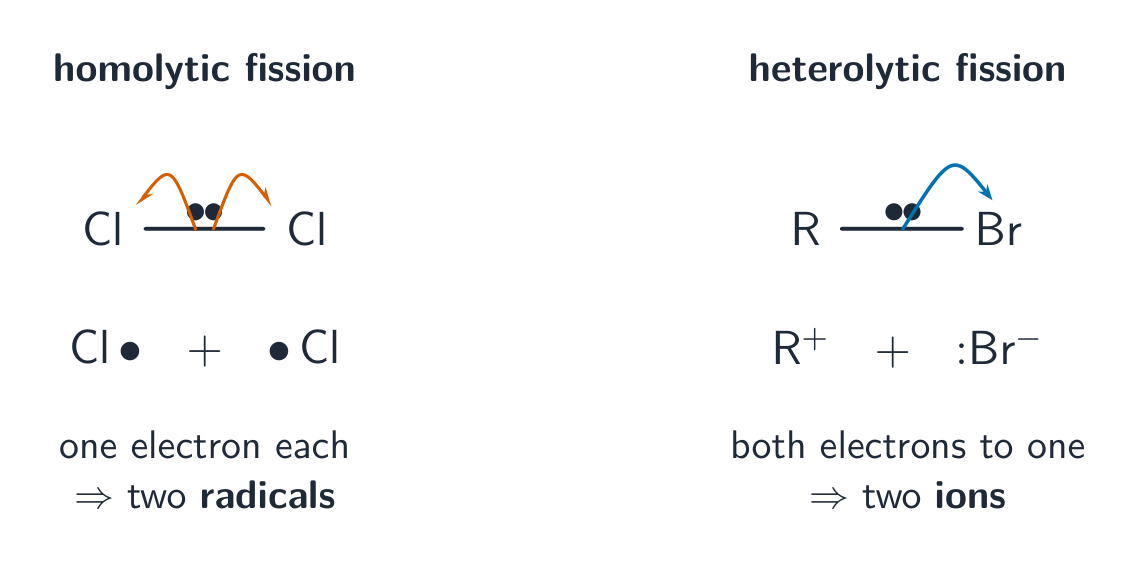
Syllabus
- interpret and use the following terminology associated with types of organic compounds and reactions: (a) homologous series (b) saturated and unsaturated (c) homolytic and heterolytic fission (d) free radical, initiation, propagation, termination (e) nucleophile, electrophile, nucleophilic, electrophilic (f) addition, substitution, elimination, hydrolysis, condensation (g) oxidation and reduction (in equations for organic redox reactions, the symbol [O] can be used to represent one atom of oxygen from an oxidising agent and the symbol [H] to represent one atom of hydrogen from a reducing agent)
- understand and use the following terminology associated with types of organic mechanisms: (a) free-radical substitution (b) electrophilic addition (c) nucleophilic substitution (d) nucleophilic addition (in organic reaction mechanisms, the use of curly arrows to represent movement of electron pairs is expected; the arrow should begin at a bond or a lone pair of electrons)
Source: Cambridge International syllabus
Some key terms
- a homologous series 同系列 is a family of compounds with the same functional group and general formula, where successive members differ by $\text{CH}_2$.
- a saturated 饱和 compound has only single C–C bonds; an unsaturated 不饱和 compound has a C=C double bond (or a triple bond).
Breaking bonds
A covalent bond can break in two ways:
- homolytic fission 均裂: the bond splits evenly, one electron to each atom. This makes two free radicals 自由基 (species with an unpaired electron).
- heterolytic fission 异裂: the bond splits unevenly, both electrons going to one atom. This makes two ions.
Homolytic fission gives one electron to each atom (two radicals); heterolytic fission gives both electrons to one atom (two ions) Attacking species
- a nucleophile 亲核试剂 is an electron-pair donor: it uses a lone pair to form a bond to an electron-poor centre. A nucleophile can be neutral, such as ammonia, or negative, such as hydroxide.
- an electrophile 亲电试剂 is an electron-pair acceptor: it accepts a pair from an electron-rich region, such as the pi bond of C=C.
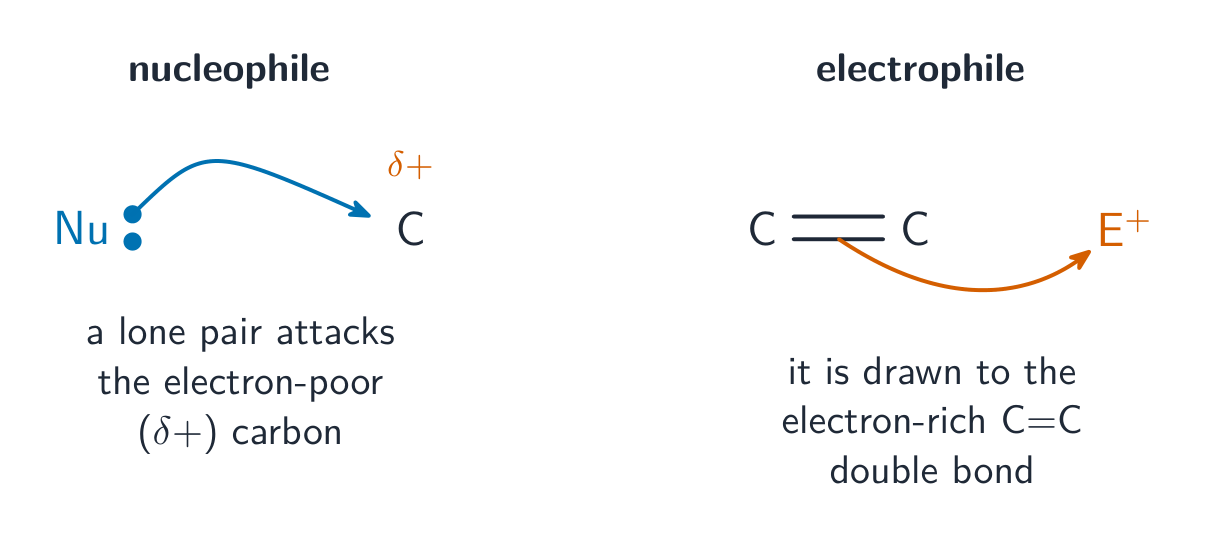
A nucleophile uses its lone pair to attack an electron-poor centre; an electrophile is drawn to an electron-rich one such as a C=C bond Types of reaction
Reaction What happens addition 加成 two molecules join to make one substitution 取代 one atom or group is swapped for another elimination 消去 a small molecule is removed, making a double bond hydrolysis 水解 a molecule is split apart by water condensation 缩合 two molecules join and a small molecule (such as water) is lost For organic redox, the symbol $[\text{O}]$ stands for one oxygen atom from an oxidising agent, and $[\text{H}]$ for one hydrogen atom from a reducing agent.
Worked classification. Ethene plus HBr makes bromoethane by addition; bromoethane plus hydroxide replaces Br with OH by substitution; ethanol losing water to make ethene is elimination. Ester plus water giving acid and alcohol is hydrolysis, while acid plus alcohol giving ester and water is condensation. Classify from the structural change and the role of water.
Types of mechanism
A free-radical reaction happens in three steps: initiation 引发 (radicals are made), propagation 增长 (radicals react and make new radicals), and termination 终止 (two radicals join and stop the chain).
The main mechanisms you meet are free-radical substitution 自由基取代 (alkanes), electrophilic addition 亲电加成 (alkenes), nucleophilic substitution 亲核取代 (halogenoalkanes) and nucleophilic addition 亲核加成 (carbonyls). In mechanisms, a full curly arrow 弯箭头 shows a pair of electrons moving; it starts at a bond or a lone pair 孤对电子.
Follow the electron pair in a substitution
A full curly arrow starts on a bond or a lone pair and shows two electrons moving. A half-headed arrow shows one electron moving in a radical step. Do not start an arrow at a positive charge.
Original application: 9701/24 N25 Q3(b)(ii). The question states an $S_\mathrm{N}1$ mechanism for 2-bromopropane with $(\text{CH}_3)_2\text{CHO}^-$. Follow the stated mechanism. First show the $\delta+$ carbon and $\delta-$ bromine, then move the C–Br pair to bromine. This gives a carbocation and $\text{Br}^-$.
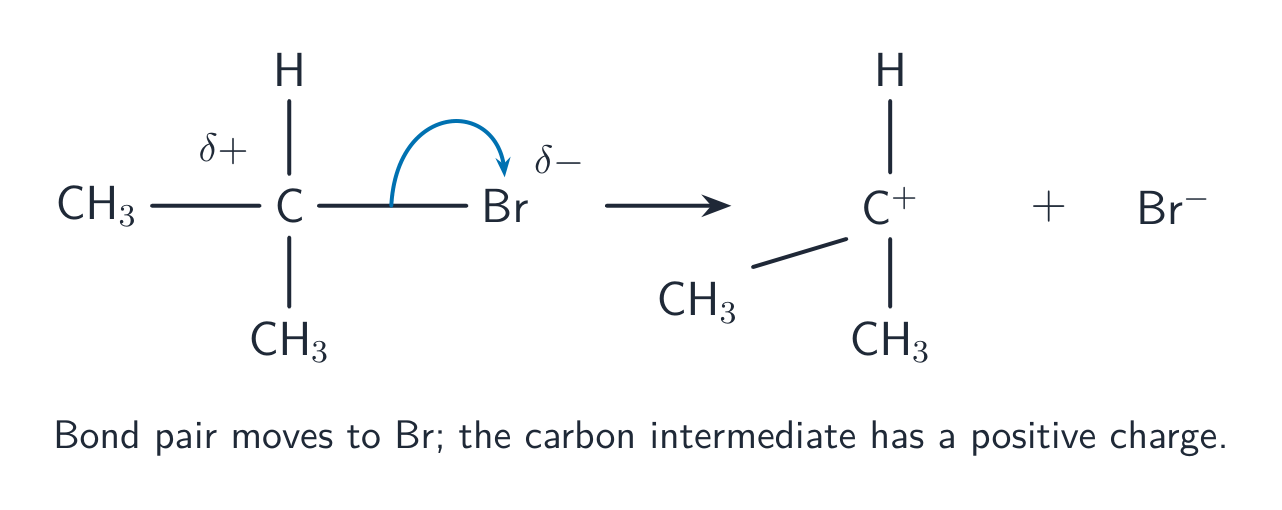
Full curly arrow from the C–Br bond to Br; the intermediate carbon has a positive charge. Next, move a lone pair on the nucleophile's oxygen to the positive carbon. A new C–O bond forms. In the figure, R means $\text{CH(CH}_3)_2$.
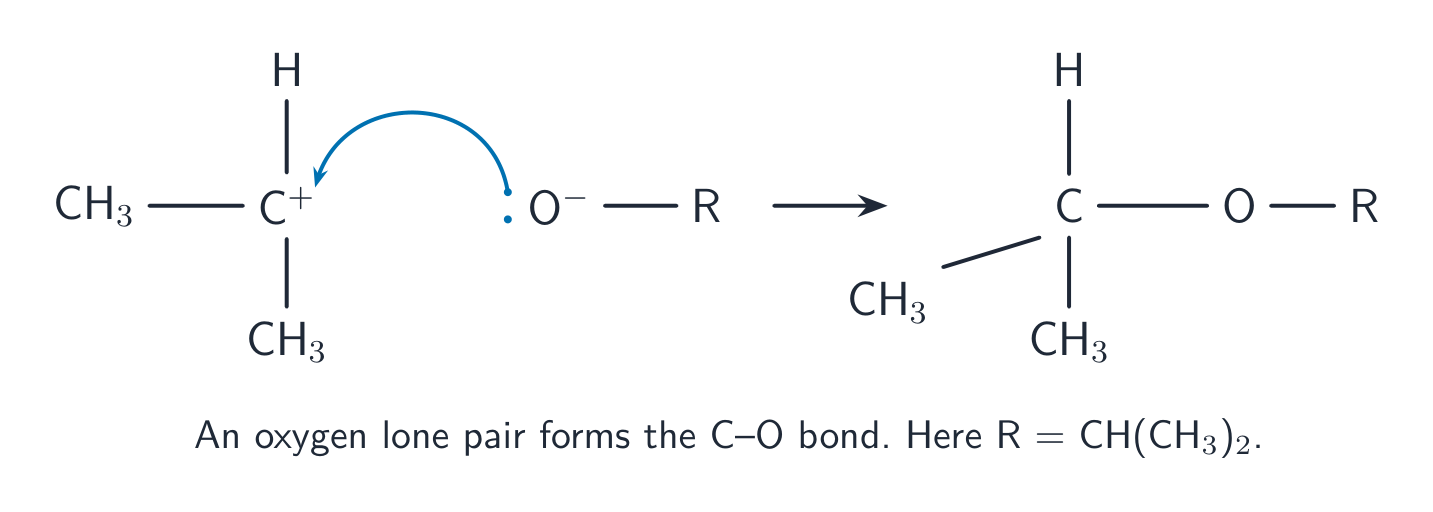
The arrow begins at the lone pair; it shows electron movement, not the movement of an entire molecule. For the worksheet's 2-bromo-2-methylpropane case, the same two-stage pattern gives a tertiary carbocation, then attack by $\text{OH}^-$. Three alkyl groups help stabilise the positive charge by their electron-releasing effect. A primary carbocation is much less stable. In the worksheet's 1-bromobutane $S_\mathrm{N}2$ case, attack and C–Br breaking occur together in one stage, without a carbocation intermediate. Draw both pair-moving arrows in that stage.
Identify radical stages from what they do
For methane and chlorine under UV light: initiation $\text{Cl}_2\rightarrow2\text{Cl}\boldsymbol{\cdot}$ makes radicals. Propagation $\text{Cl}\boldsymbol{\cdot}+\text{CH}_4\rightarrow\text{HCl}+\boldsymbol{\cdot}\text{CH}_3$, followed by $\boldsymbol{\cdot}\text{CH}_3+\text{Cl}_2\rightarrow\text{CH}_3\text{Cl}+\text{Cl}\boldsymbol{\cdot}$, consumes and regenerates one radical in each step. Termination $\boldsymbol{\cdot}\text{CH}_3+\text{Cl}\boldsymbol{\cdot}\rightarrow\text{CH}_3\text{Cl}$ consumes two radicals without making a new radical.
ExploreBond fission and attack route
Watch a polar bond lead to electrophiles, nucleophiles and radicals.
ExploreOrganic reaction type lab
Classify reaction examples by the pattern of bonds changing.
Vocabulary TrainEnglish homologous series/həˈmɒləɡəs ˈsɪəriːz/ saturated/ˈsætʃəreɪtɪd/ unsaturated/ʌnˈsætʃəreɪtɪd/ homolytic fission/ˌhɒməˈlɪtɪk ˈfɪʃn/ free radical/friː ˈrædɪkl/ heterolytic fission/ˌhetrəˈlɪtɪk ˈfɪʃn/ nucleophile/ˈnjuːklɪɒfaɪl/ electrophile/ɪˌlektrəʊˈfaɪl/ addition/əˈdɪʃn/ substitution/ˌsʌbstɪˈtjuːʃn/ elimination/ɪˌlɪmɪˈneɪʃn/ hydrolysis/haɪˈdrɒləsɪs/ condensation/kɒndenˈseɪʃn/ initiation/ɪˌnɪʃɪˈeɪʃn/ propagation/ˌprɒpəˈɡeɪʃn/ termination/ˌtɜːmɪˈneɪʃn/ free-radical substitution/friː ˈrædɪkl ˌsʌbstɪˈtjuːʃn/ electrophilic addition/ɪˌlektrəʊˈfɪlɪk əˈdɪʃn/ nucleophilic substitution/ˌnjuːklɪəˈfɪlɪk ˌsʌbstɪˈtjuːʃn/ nucleophilic addition/ˌnjuːklɪəˈfɪlɪk əˈdɪʃn/ curly arrow/ˈkɜːli ˈærəʊ/ lone pair/ləʊn peə/ pi bond/paɪ bɒnd/ 13.3
Shapes of organic molecules

Syllabus
- describe organic molecules as either straight-chained, branched or cyclic
- describe and explain the shape of, and bond angles in, molecules containing $\text{sp}$, $\text{sp}^2$ and $\text{sp}^3$ hybridised atoms
- describe the arrangement of $\sigma$ and $\pi$ bonds in molecules containing $\text{sp}$, $\text{sp}^2$ and $\text{sp}^3$ hybridised atoms
- understand and use the term planar when describing the arrangement of atoms in organic molecules, for example ethene
Source: Cambridge International syllabus
Organic molecules have definite three-dimensional shapes. Organic molecules can be straight-chained, branched or cyclic 环状 (in a ring).
The shape around a carbon depends on its hybridisation 杂化:
Hybridisation Bonds Shape Angle $\text{sp}^3$ 4 single tetrahedral $109.5°$ $\text{sp}^2$ 1 double + 2 single planar 平面 (flat) $120°$ $\text{sp}$ 1 triple (or 2 doubles) linear $180°$ Every single bond is a sigma bond σ键, made by direct overlap. A double bond is one sigma bond plus one pi bond π键, made by sideways overlap of p orbitals. Ethene is planar because of its $\text{sp}^2$ carbons.

The shape at a carbon follows from its hybridisation: sp$^3$ is tetrahedral ($109.5°$), sp$^2$ is planar ($120°$), sp is linear ($180°$) 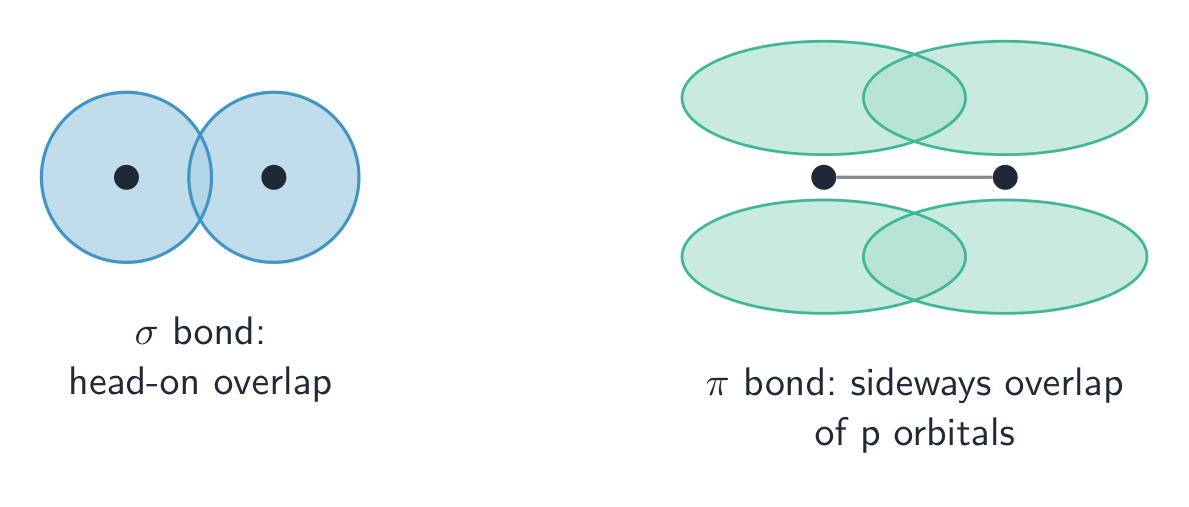
Sigma density lies on the internuclear axis; pi density is on both sides of it. Work locally, then count the whole molecule
Original application: 9701/14 N25 Q6. In propyne, $\text{CH}_3\text{–C}\equiv\text{CH}$, the methyl carbon has four bonding regions: sp$^3$, tetrahedral, $109.5^\circ$. Each triple-bond carbon has two regions: sp, linear, $180^\circ$. A multiple bond counts as one region for shape. The molecule therefore contains sp and sp$^3$ carbons, not sp$^2$.
For bond counts, each bonded atom pair contributes one $\sigma$ bond. A double bond adds one $\pi$; a triple bond adds two $\pi$ bonds. Methane has four $\sigma$ and no $\pi$ bonds. Ethene has five $\sigma$ (four C–H and one C–C) and one $\pi$. Ethyne has three $\sigma$ and two $\pi$ bonds. Include the C–H bonds when counting the whole molecule.
Original application: 9701/12 N25 Q25. Methanal, $\text{H}_2\text{C=O}$, has three bonding regions around carbon: sp$^2$, trigonal planar, approximately $120^\circ$. All four atoms are in a plane. It has three $\sigma$ bonds (two C–H and one C–O) plus one $\pi$ bond. Both original statements are correct: answer A.
Orbital drawing: 9701/24 N25 Q3(a)(iv). The original scheme shows the $\pi$ overlap above and below the propene framework:
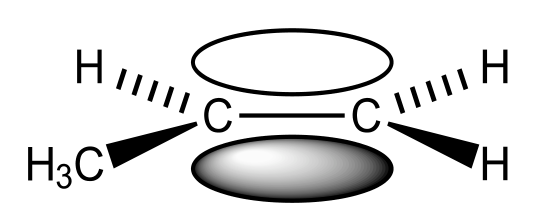
Sideways overlap of parallel p orbitals forms one pi bond with two regions of density; the regions are not separate pi bonds. Transfer to a non-organic molecule: 9701/12 N25 Q5. The question states that each N in $\text{N}_2$ is sp hybridised. Of its two sp orbitals, one holds a lone pair and one forms a head-on sp–sp $\sigma$ overlap. The two remaining p orbitals form two $\pi$ bonds by sideways overlap. The original answer is B.
ExploreShapes of organic molecules
VSEPR around each carbon
Around a single-bonded carbon the four pairs are tetrahedral (109.5°).
Vocabulary TrainEnglish cyclic/ˈsaɪklɪk/ hybridisation/ˌhaɪbrɪdaɪˈzeɪʃn/ planar/ˈpleɪnə/ sigma bond/ˈsɪɡmə bɒnd/ 13.4
Isomerism

Syllabus
- describe structural isomerism and its division into chain, positional and functional group isomerism
- describe stereoisomerism and its division into geometrical (cis/trans) and optical isomerism (use of E/Z nomenclature is acceptable but is not required)
- describe geometrical (cis/trans) isomerism in alkenes, and explain its origin in terms of restricted rotation due to the presence of $\pi$ bonds
- explain what is meant by a chiral centre and that such a centre gives rise to two optical isomers (enantiomers) (Candidates should appreciate that compounds can contain more than one chiral centre, but knowledge of meso compounds, or nomenclature such as diastereoisomers is not required.)
- identify chiral centres and geometrical (cis/trans) isomerism in a molecule of given structural formula including cyclic compounds
- deduce the possible isomers for an organic molecule of known molecular formula
Source: Cambridge International syllabus
Isomers are compounds with the same molecular formula but a different arrangement of atoms. This is called isomerism 异构.
Structural isomerism
In structural isomerism 结构异构 the atoms are joined in a different order. There are three kinds:
- chain isomerism 链异构: the carbon chain is branched in different ways.
- positional isomerism 位置异构: the functional group is on a different carbon.
- functional group isomerism 官能团异构: the atoms form a different functional group (for example an alcohol and an ether).
The three kinds of structural isomerism — chain, positional and functional-group — each pair sharing the same molecular formula Stereoisomerism
In stereoisomerism 立体异构 the atoms are joined in the same order but point in different directions in space.
- geometrical isomerism 几何异构 (cis/trans) happens at a C=C double bond. The pi bond stops the two carbons rotating (restricted rotation 受限旋转), so groups are fixed on the same side (cis 顺式) or opposite sides (trans 反式).

Cis–trans isomerism at a C=C bond: the methyl groups are fixed on the same side (cis) or opposite sides (trans) because the bond cannot rotate - optical isomerism 旋光异构 happens at a chiral 手性 carbon — a chiral centre 手性中心 is a carbon with four different groups attached. Such a carbon gives two mirror-image forms called enantiomers 对映体. A molecule may have more than one chiral centre.

Optical isomerism: a carbon with four different groups gives two mirror-image forms (enantiomers) that cannot be superimposed From a molecular formula you can deduce the possible isomers by trying different chains, positions and functional groups.
Worked example. Explain why but-2-ene shows cis-trans (E/Z) isomerism but but-1-ene does not. Stereoisomerism at a C=C needs two things: restricted rotation about the double bond (both alkenes have that), and two different groups on each of the two double-bond carbons. In but-2-ene, $\text{CH}_3\text{CH=CHCH}_3$, each double-bond carbon carries an $\text{H}$ and a $\text{CH}_3$ - different, so the methyl groups can sit on the same side (cis / Z) or on opposite sides (trans / E). In but-1-ene, $\text{CH}_2\text{=CHCH}_2\text{CH}_3$, the first carbon carries two hydrogens - identical, so swapping them changes nothing and only one form exists. Test each double-bond carbon separately: two identical groups on either carbon kills the isomerism, however different the other carbon may be.
ExploreStructural isomerism lab
Compare molecules with the same formula but different structures.
Vocabulary TrainEnglish isomerism/ˈaɪsəmərɪzəm/ structural isomerism/ˈstrʌktʃərəl ˈaɪsəmərɪzəm/ chain isomerism/tʃeɪn ˈaɪsəmərɪzəm/ positional isomerism/pəˈzɪʃənl ˈaɪsəmərɪzəm/ functional group isomerism/ˈfʌŋkʃənl ɡruːp ˈaɪsəmərɪzəm/ stereoisomerism/ˈsterɪəʊɪsəmərɪzəm/ geometrical isomerism/ˌdʒiːəʊˈmetrɪkl ˈaɪsəmərɪzəm/ restricted rotation/rɪˈstrɪktɪd rəʊˈteɪʃn/ cis/sɪs/ trans/trænz/ optical isomerism/ˈɒptɪkl ˈaɪsəmərɪzəm/ chiral/ˈkaɪrəl/ chiral centre/ˈkaɪrəl ˈsentə/ enantiomers/eˈnæntɪəməz/ 13.4
Exam tips
- Know the difference between general, molecular, structural, displayed and skeletal formulas — questions ask for a specific one.
- Name systematically: longest chain, lowest locants, substituents alphabetical; a wrong locant loses the mark.
- Classify each reaction by type and reagent (addition, substitution, elimination, oxidation).
- E/Z isomerism needs restricted rotation about a $\text{C}=\text{C}$ and two different groups on each carbon.
-
14
Hydrocarbons
Watch lesson14.1
Alkanes

Syllabus
- recall the reactions (reagents and conditions) by which alkanes can be produced: (a) addition of hydrogen to an alkene in a hydrogenation reaction, $\text{H}_2\text{(g)}$ and $\text{Pt/Ni}$ catalyst and heat (b) cracking of a longer chain alkane, heat with $\text{Al}_2\text{O}_3$
- describe: (a) the complete and incomplete combustion of alkanes (b) the free-radical substitution of alkanes by $\text{Cl}_2$ or $\text{Br}_2$ in the presence of ultraviolet light, as exemplified by the reactions of ethane
- describe the mechanism of free-radical substitution with reference to the initiation, propagation and termination steps
- suggest how cracking can be used to obtain more useful alkanes and alkenes of lower $M_r$ from heavier crude oil fractions
- understand the general unreactivity of alkanes, including towards polar reagents in terms of the strength of the $\text{C–H}$ bonds and their relative lack of polarity
- recognise the environmental consequences of carbon monoxide, oxides of nitrogen and unburnt hydrocarbons arising from the combustion of alkanes in the internal combustion engine and of their catalytic removal
Source: Cambridge International syllabus
Natural gas — mainly methane, the simplest alkane — burns on a stove. Alkanes 烷烃 are saturated hydrocarbons (general formula $\text{C}_n\text{H}_{2n+2}$).
Making alkanes
- hydrogenation 氢化: add hydrogen to an alkene 烯烃, using a $\text{Pt}$ or $\text{Ni}$ catalyst and heat.
- cracking 裂化: break a long-chain alkane into shorter ones by heating with $\text{Al}_2\text{O}_3$.
Combustion
In combustion 燃烧 an alkane burns in oxygen:

Complete combustion gives CO2 and water; incomplete also gives CO and soot - complete combustion 完全燃烧 (plenty of oxygen) gives carbon dioxide and water.
- incomplete combustion 不完全燃烧 (not enough oxygen) gives water plus toxic carbon monoxide 一氧化碳 ($\text{CO}$) and soot (carbon).
You are often asked to write the balanced equation. Balance it in a fixed order - carbon first, then hydrogen, and oxygen last - because oxygen is the only element left on just one side:
$$\text{C}_6\text{H}_{14} + 9\tfrac{1}{2}\,\text{O}_2 \rightarrow 6\,\text{CO}_2 + 7\,\text{H}_2\text{O}$$The 6 carbons fix $6\,\text{CO}_2$; the 14 hydrogens fix $7\,\text{H}_2\text{O}$; counting the oxygens on the right gives $12 + 7 = 19$, so the left needs $19 \div 2 = 9\tfrac{1}{2}$. A half of $\text{O}_2$ is perfectly acceptable in this equation - and if the question asks for whole numbers, simply double everything ($2\,\text{C}_6\text{H}_{14} + 19\,\text{O}_2 \rightarrow 12\,\text{CO}_2 + 14\,\text{H}_2\text{O}$).
Free-radical substitution
Alkanes react with chlorine or bromine by free-radical substitution 自由基取代, in ultraviolet light 紫外线. For ethane and chlorine the mechanism has three steps:
- initiation 引发 — UV light splits the halogen into two free radicals 自由基: $\;\text{Cl}_2 \rightarrow 2\,\text{Cl}\cdot$ This kind of break is homolytic fission 均裂: the bond splits evenly, one electron going to each atom, which is what makes two radicals. (The opposite, heterolytic fission 异裂, sends both electrons to one atom and makes a pair of ions - that is what happens in the polar mechanisms such as electrophilic addition.) Examiners ask for this word by name, so use it.
- propagation 增长 — radicals react and make new radicals:
$$\text{Cl}\cdot + \text{C}_2\text{H}_6 \rightarrow \text{C}_2\text{H}_5\cdot + \text{HCl} \qquad \text{C}_2\text{H}_5\cdot + \text{Cl}_2 \rightarrow \text{C}_2\text{H}_5\text{Cl} + \text{Cl}\cdot$$
- termination 终止 — two radicals join, ending the chain: $\;\text{Cl}\cdot + \text{C}_2\text{H}_5\cdot \rightarrow \text{C}_2\text{H}_5\text{Cl}$

Free-radical substitution in three steps: initiation makes radicals, propagation carries the chain, and termination ends it Why cracking is useful, and why alkanes are unreactive
Cracking turns heavy fractions of crude oil 原油 into more useful, lower-$M_r$ alkanes and alkenes. (A fraction 馏分 is a group of molecules with a similar boiling-point range.)
Alkanes are generally unreactive, especially towards polar reagents. This is because the C–H and C–C bonds are strong and have little polarity 极性, so there is no charge to attract an attacking species.
Environmental effects
Burning alkanes in an internal combustion engine gives off carbon monoxide, oxides of nitrogen and unburnt hydrocarbons. A catalytic converter removes these by turning them into harmless gases.
ExploreThe tetrahedral carbon
Each carbon in an alkane has four bonding pairs and no lone pairs — they spread as far apart as possible into a tetrahedron (109.5°).
ExploreFree-radical substitution
Methane reacts with chlorine in UV light by a chain of radical steps.
Vocabulary TrainEnglish alkane/ˈælkeɪn/ hydrogenation/haɪˈdrɒdʒəneɪʃn/ alkene/ˈælkiːn/ cracking/ˈkrækɪŋ/ combustion/kəmˈbʌstʃn/ complete combustion/kəmˈpliːt kəmˈbʌstʃn/ incomplete combustion/ɪŋkəmˈpliːt kəmˈbʌstʃn/ carbon monoxide/ˈkɑːbən mʌˈnɒksaɪd/ free-radical substitution/friː ˈrædɪkl ˌsʌbstɪˈtjuːʃn/ ultraviolet light/ˌʊltrəˈvaɪəlɪt laɪt/ initiation/ɪˌnɪʃɪˈeɪʃn/ free radical/friː ˈrædɪkl/ propagation/ˌprɒpəˈɡeɪʃn/ termination/ˌtɜːmɪˈneɪʃn/ crude oil/kruːd ɔɪl/ fraction/ˈfrækʃn/ polarity/pəʊˈlærɪti/ homolytic fission/ˌhɒməˈlɪtɪk ˈfɪʃn/ heterolytic fission/ˌhetrəˈlɪtɪk ˈfɪʃn/ 14.2
Alkenes

Syllabus
- recall the reactions (including reagents and conditions) by which alkenes can be produced: (a) elimination of $\text{HX}$ from a halogenoalkane by ethanolic $\text{NaOH}$ and heat (b) dehydration of an alcohol, by using a heated catalyst (e.g. $\text{Al}_2\text{O}_3$) or a concentrated acid (e.g. concentrated $\text{H}_2\text{SO}_4$) (c) cracking of a longer chain alkane
- describe the following reactions of alkenes: (a) the electrophilic addition of (i) hydrogen in a hydrogenation reaction, $\text{H}_2\text{(g)}$ and $\text{Pt/Ni}$ catalyst and heat (ii) steam, $\text{H}_2\text{O(g)}$ and $\text{H}_3\text{PO}_4$ catalyst (iii) a hydrogen halide, $\text{HX(g)}$, at room temperature (iv) a halogen, $\text{X}_2$ (b) the oxidation by cold dilute acidified $\text{KMnO}_4$ to form the diol (c) the oxidation by hot concentrated acidified $\text{KMnO}_4$ leading to the rupture of the carbon–carbon double bond and the identities of the subsequent products to determine the position of alkene linkages in larger molecules (d) addition polymerisation exemplified by the reactions of ethene and propene
- describe the use of aqueous bromine to show the presence of a C=C bond
- describe the mechanism of electrophilic addition in alkenes, using bromine/ethene and hydrogen bromide/propene as examples
- describe and explain the inductive effects of alkyl groups on the stability of primary, secondary and tertiary cations formed during electrophilic addition (this should be used to explain Markovnikov addition)
Source: Cambridge International syllabus
Cracking heavy fractions at a refinery produces alkenes for plastics and fuels. Alkenes have a C=C double bond (general formula $\text{C}_n\text{H}_{2n}$). The double bond is the functional group, so alkenes are reactive.
Making alkenes
- elimination 消去 of $\text{HX}$ from a halogenoalkane 卤代烷, using $\text{NaOH}$ dissolved in ethanol, with heat.
- dehydration 脱水 of an alcohol 醇, using a hot $\text{Al}_2\text{O}_3$ catalyst or concentrated sulfuric acid.
- cracking of a longer-chain alkane.
Reactions of alkenes
Most reactions are electrophilic addition 亲电加成 across the double bond:
Reagent and conditions Product $\text{H}_2$, $\text{Pt/Ni}$ catalyst, heat alkane steam 水蒸气 ($\text{H}_2\text{O}$), $\text{H}_3\text{PO}_4$ catalyst alcohol a hydrogen halide 卤化氢 ($\text{HX}$), room temperature halogenoalkane a halogen $\text{X}_2$ a di-substituted alkane There are also two oxidation reactions with acidified $\text{KMnO}_4$:
- cold, dilute $\text{KMnO}_4$ adds two $\text{–OH}$ groups to give a diol 二醇.
- hot, concentrated $\text{KMnO}_4$ breaks the C=C bond right apart, and what each half turns into tells you exactly where the double bond used to be.
That second reaction is worth learning properly, because it is how the exam asks you to locate a double bond in a large molecule. Oxidation is written with $[\text{O}]$, meaning "an oxygen atom from the oxidising agent". Cut the molecule at the C=C, then look at what each of the two carbons was carrying:
The C=C carbon carries It becomes two alkyl groups ($\text{=CR}_2$) a ketone 酮, $\text{R}_2\text{C=O}$ one alkyl and one $\text{H}$ ($\text{=CHR}$) a carboxylic acid 羧酸, $\text{RCOOH}$ two hydrogens ($\text{=CH}_2$) $\text{CO}_2$ and water The pattern is simply how many hydrogens that carbon had: none stops at a ketone, one is pushed on to an acid, and two are oxidised all the way to $\text{CO}_2$.
Worked example. Give the products when $(\text{CH}_3)_2\text{C=CHCH}_3$ is heated with hot concentrated acidified $\text{KMnO}_4$. Cut at the C=C and take each carbon separately. The left carbon carries two methyl groups and no hydrogen, so it stops at a ketone: $(\text{CH}_3)_2\text{C=O}$, which is propanone. The right carbon carries one methyl and one H, so it goes on to a carboxylic acid: $\text{CH}_3\text{COOH}$, ethanoic acid. So:
$$(\text{CH}_3)_2\text{C=CHCH}_3 + 3[\text{O}] \rightarrow \text{CH}_3\text{COCH}_3 + \text{CH}_3\text{COOH}$$Now run it backwards, which is the way the question is usually set. Given the products, rebuild the alkene by putting the two carbonyl carbons back together as a C=C: a ketone means that carbon had two alkyl groups, an acid means one alkyl and one H, and $\text{CO}_2$ means the chain ended in $\text{=CH}_2$. Getting $\text{CO}_2$ is the strongest clue of all - it can only come from a terminal double bond.
Test for a C=C bond
Shake the compound with orange bromine water 溴水. An alkene decolourises it (turns it colourless) by electrophilic addition. An alkane does not.

The bromine-water test: an alkene decolourises the orange bromine water, while an alkane leaves it orange Addition polymerisation
In addition polymerisation 加成聚合, many alkene molecules join into one long chain, with no other product. Ethene gives poly(ethene). The long-chain product is a polymer 聚合物.

Addition polymerisation: many ethene molecules open their double bonds and join into the long chain of poly(ethene) The mechanism and Markovnikov's rule
In electrophilic addition (for example bromine with ethene), the electron-rich C=C attracts the electrophile. This forms a positive intermediate called a carbocation 碳正离子, which the negative part then attacks.

Electrophilic addition of bromine to ethene: the C=C attacks Br$^{\delta+}$, a carbocation forms, then Br$^-$ attacks it Alkyl groups push electrons towards the positive carbon — this is the inductive effect 诱导效应. So a carbocation with more alkyl groups is more stable: tertiary is more stable than secondary, which is more stable than primary. When $\text{HBr}$ adds to propene, the more stable carbocation forms, so hydrogen adds to the carbon that already has more hydrogens. This pattern is Markovnikov's rule 马氏规则.

Carbocation stability rises from primary to tertiary as more alkyl groups push electrons in — the basis of Markovnikov's rule Worked example. Predict the major product when $\text{HBr}$ adds to propene, $\text{CH}_3\text{CH=CH}_2$. The $\text{H}^{+}$ adds first, and it adds in whichever way makes the more stable carbocation. Adding the $\text{H}$ to the end carbon puts the positive charge on the middle carbon, giving a secondary carbocation, which is stabilised by electron-releasing alkyl groups on two sides. Adding it to the middle carbon would leave a less stable primary carbocation. The bromide ion then attacks the secondary carbocation, so the major product is 2-bromopropane. That is Markovnikov's rule - but quote the reason (carbocation stability: tertiary > secondary > primary), because the rule on its own is not the explanation.
ExploreAlkene addition route
Follow how the C=C bond opens and new atoms add.
Vocabulary TrainEnglish elimination/ɪˌlɪmɪˈneɪʃn/ halogenoalkane/ˈheɪləʊdʒnəʊlkeɪn/ dehydration/ˌdiːhaɪˈdreɪʃn/ alcohol/ˈælkəhɒl/ electrophilic addition/ɪˌlektrəʊˈfɪlɪk əˈdɪʃn/ steam/stiːm/ hydrogen halide/ˈhaɪdrədʒn ˈhælaɪd/ diol/dɪˈɒl/ bromine water/ˈbrəʊmaɪn ˈwɔːtə/ addition polymerisation/əˈdɪʃn ˌpɒlɪməraɪˈzeɪʃn/ polymer/ˈpɒlɪmə/ carbocation/ˌkɑːbəˈkeɪʃn/ inductive effect/ɪnˈdʌktɪv ɪˈfekt/ Markovnikov's rule/ˈmɑːkəvnɪkɒvz ruːl/ ketone/ˈketəʊn/ carboxylic acid/ˌkɑːbəkˈsɪlɪk ˈæsɪd/ 14.2
Exam tips
- Alkanes: free-radical substitution needs UV light — show initiation, propagation and termination with the radical dots.
- Alkenes: electrophilic addition via a carbocation; draw curly arrows from the $\text{C}=\text{C}$.
- Markovnikov: H adds to the carbon with more H's, via the more stable carbocation (alkyl groups are electron-releasing).
- Test for $\text{C}=\text{C}$: bromine water decolourises (orange → colourless) — state the observation.
-
15
Halogen compounds
Watch lesson15.1
Halogenoalkanes

Syllabus
- recall the reactions (reagents and conditions) by which halogenoalkanes can be produced: (a) the free-radical substitution of alkanes by $\text{Cl}_2$ or $\text{Br}_2$ in the presence of ultraviolet light, as exemplified by the reactions of ethane (b) electrophilic addition of an alkene with a halogen, $\text{X}_2$, or hydrogen halide, $\text{HX(g)}$, at room temperature (c) substitution of an alcohol, e.g. by reaction with $\text{HX(g)}$; or with $\text{KCl}$ and concentrated $\text{H}_2\text{SO}_4$ or concentrated $\text{H}_3\text{PO}_4$; or with $\text{PCl}_3$ and heat; or with $\text{PCl}_5$; or with $\text{SOCl}_2$
- classify halogenoalkanes into primary, secondary and tertiary
- describe the following nucleophilic substitution reactions: (a) the reaction with $\text{NaOH(aq)}$ and heat to produce an alcohol (b) the reaction with $\text{KCN}$ in ethanol and heat to produce a nitrile (c) the reaction with $\text{NH}_3$ in ethanol heated under pressure to produce an amine (d) the reaction with aqueous silver nitrate in ethanol as a method of identifying the halogen present as exemplified by bromoethane
- describe the elimination reaction with $\text{NaOH}$ in ethanol and heat to produce an alkene as exemplified by bromoethane
- describe the $\text{S}_\text{N}1$ and $\text{S}_\text{N}2$ mechanisms of nucleophilic substitution in halogenoalkanes including the inductive effects of alkyl groups
- recall that primary halogenoalkanes tend to react via the $\text{S}_\text{N}2$ mechanism; tertiary halogenoalkanes via the $\text{S}_\text{N}1$ mechanism; and secondary halogenoalkanes by a mixture of the two, depending on structure
- describe and explain the different reactivities of halogenoalkanes (with particular reference to the relative strengths of the C–X bonds as exemplified by the reactions of halogenoalkanes with aqueous silver nitrates)
Source: Cambridge International syllabus
A halogenoalkane 卤代烷 is an alkane with one or more halogen atoms in place of hydrogen (a C–X bond, where X is a halogen).
Volatile halogenoalkanes were once widely used as refrigerants and aerosol propellants Making halogenoalkanes
- free-radical substitution 自由基取代 of an alkane with $\text{Cl}_2$ or $\text{Br}_2$ in ultraviolet light.
- electrophilic addition 亲电加成 of an alkene with a halogen $\text{X}_2$ or a hydrogen halide $\text{HX}$.
- substitution of an alcohol 醇, for example by $\text{HX}$, by $\text{PCl}_5$, by $\text{PCl}_3$ with heat, or by $\text{SOCl}_2$.
Three classes
A halogenoalkane is primary 伯, secondary 仲 or tertiary 叔, depending on how many carbon atoms are joined to the carbon that holds the halogen (one, two or three).

Primary, secondary and tertiary halogenoalkanes, set by how many carbons are joined to the carbon bearing the halogen Vocabulary TrainEnglish halogenoalkane/ˈheɪləʊdʒnəʊlkeɪn/ free-radical substitution/friː ˈrædɪkl ˌsʌbstɪˈtjuːʃn/ electrophilic addition/ɪˌlektrəʊˈfɪlɪk əˈdɪʃn/ alcohol/ˈælkəhɒl/ primary/ˈpraɪməri/ secondary/ˈsekəndəri/ tertiary/ˈtɜːʃjəri/ 15.1
Nucleophilic substitution

The C–X bond is polar, so the carbon is slightly positive. A nucleophilic substitution 亲核取代 happens when a nucleophile 亲核试剂 (a lone-pair species) attacks that carbon and replaces the halogen.
Many halogenoalkane reactions are carried out by heating the mixture under reflux Reagent and conditions Product $\text{NaOH(aq)}$, heat an alcohol $\text{KCN}$ in ethanol, heat a nitrile 腈 (adds one carbon to the chain) $\text{NH}_3$ in ethanol, heated under pressure an amine 胺 
A rotary evaporator removes solvent under reduced pressure — the step after the reaction To identify the halogen, warm the halogenoalkane with silver nitrate 硝酸银 in ethanol. A silver halide precipitate 沉淀 forms, and its colour shows which halogen is present (white $\text{AgCl}$, cream $\text{AgBr}$, yellow $\text{AgI}$).
ExploreNucleophilic substitution
A nucleophile swaps in for the leaving group on a halogenoalkane.
Vocabulary TrainEnglish nucleophilic substitution/ˌnjuːklɪəˈfɪlɪk ˌsʌbstɪˈtjuːʃn/ nucleophile/ˈnjuːklɪɒfaɪl/ nitrile/ˈnaɪtraɪl/ amine/ˈæmaɪn/ silver nitrate/ˈsɪlvə ˈnaɪtreɪt/ precipitate/prɪˈsɪpɪteɪt/ 15.1
Elimination

The same halogenoalkane can instead undergo elimination 消去 to form an alkene 烯烃. The conditions decide which reaction wins:
- $\text{NaOH}$ in water → nucleophilic substitution → an alcohol.
- $\text{NaOH}$ in ethanol, heated → elimination → an alkene.
$$\text{C}_2\text{H}_5\text{Br} + \text{NaOH} \rightarrow \text{C}_2\text{H}_4 + \text{NaBr} + \text{H}_2\text{O}$$The same halogenoalkane: NaOH in water substitutes to an alcohol, while NaOH in ethanol (with heat) eliminates to an alkene Vocabulary TrainEnglish elimination/ɪˌlɪmɪˈneɪʃn/ alkene/ˈælkiːn/ 15.1
The S$_\text{N}$1 and S$_\text{N}$2 mechanisms

Nucleophilic substitution can follow two routes:
- S$_\text{N}$2: one step. The nucleophile attacks at the same time as the halogen leaves, passing through a crowded transition state 过渡态 where both are half-bonded. The rate depends on both the halogenoalkane and the nucleophile.
- S$_\text{N}$1: two steps. First the C–X bond breaks to give a carbocation 碳正离子; then the nucleophile attacks it. The rate depends only on the halogenoalkane.
S$_\text{N}$2 is a single step through a crowded transition state; S$_\text{N}$1 is two steps via a carbocation Alkyl groups push electrons towards the positive carbon (the inductive effect 诱导效应), so they stabilise the carbocation. This is why:
- primary halogenoalkanes mostly react by S$_\text{N}$2.
- tertiary halogenoalkanes mostly react by S$_\text{N}$1 (their carbocation is well stabilised).
- secondary halogenoalkanes use a mixture of the two.
ExploreThe SN2 mechanism, step by step
Step through nucleophilic substitution. The nucleophile attacks from behind as the halide leaves — all in one smooth step, flipping the molecule inside-out.
Vocabulary TrainEnglish transition state/trænˈsɪʃn steɪt/ carbocation/ˌkɑːbəˈkeɪʃn/ inductive effect/ɪnˈdʌktɪv ɪˈfekt/ 15.1
Different reactivities
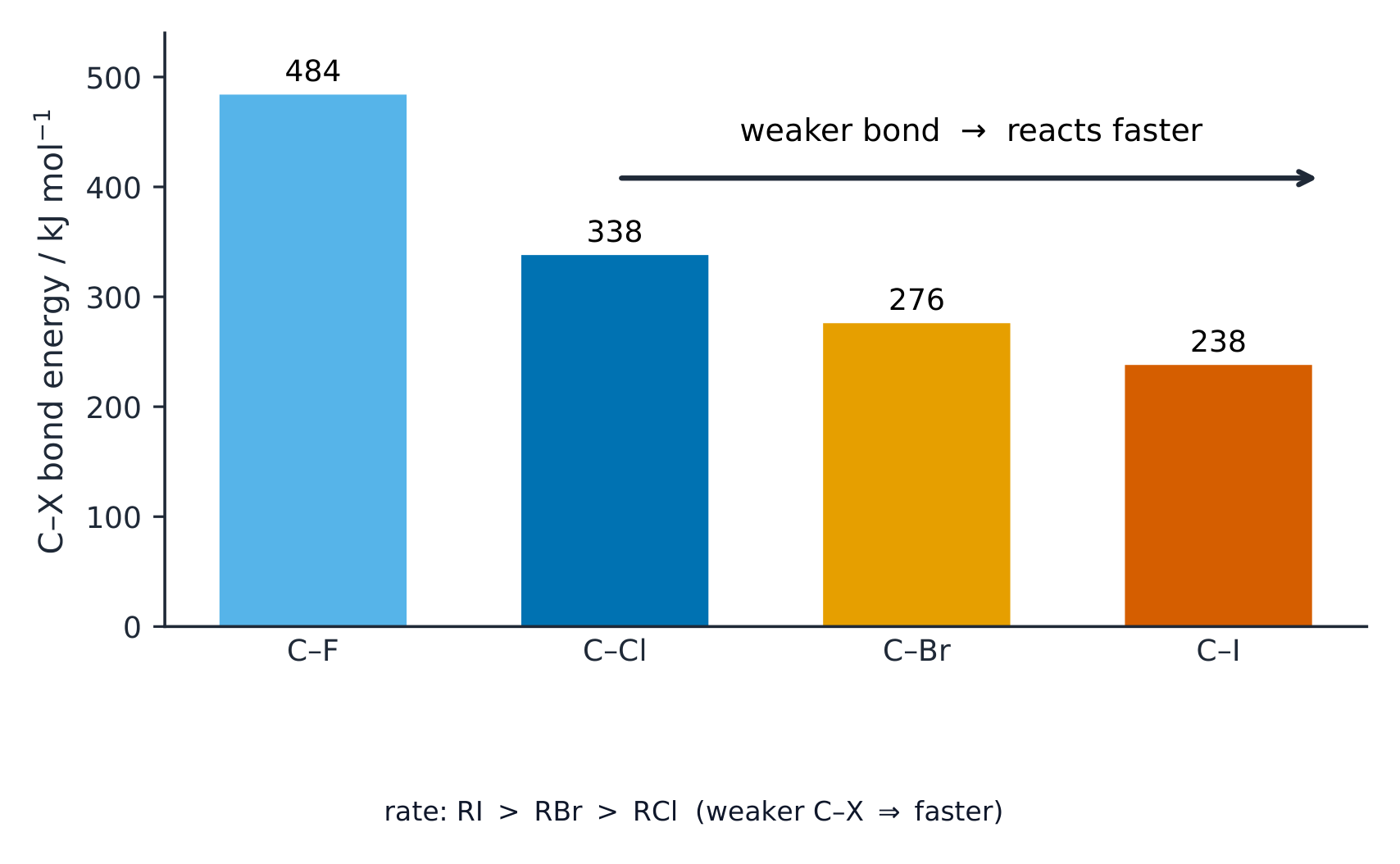
How fast a halogenoalkane reacts depends on the strength of the C–X bond, measured by its bond energy 键能. The C–I bond is the weakest, so iodoalkanes react fastest; the C–Cl bond is the strongest of the three, so chloroalkanes react slowest. So when tested with silver nitrate, an iodoalkane gives its precipitate first — its higher reactivity 反应活性 comes from the weaker C–X bond.
The weaker the C–X bond, the faster the halogenoalkane reacts — so iodoalkanes react fastest and chloroalkanes slowest Worked example. Predict the mechanism for the hydrolysis of 1-bromobutane and of 2-bromo-2-methylpropane. Classify the halogenoalkane first. 1-bromobutane is primary: the carbon carrying the $\text{Br}$ is barely shielded, so the nucleophile can attack the back of it and the mechanism is $\text{S}_\text{N}2$ - one step, with the rate depending on both the halogenoalkane and the nucleophile. 2-bromo-2-methylpropane is tertiary: three bulky methyl groups block that attack, but they also stabilise the carbocation formed once the $\text{Br}$ leaves, so it goes $\text{S}_\text{N}1$ - two steps, with the rate depending on the halogenoalkane only. Decide from the class (primary → $\text{S}_\text{N}2$, tertiary → $\text{S}_\text{N}1$), and note that the tertiary one hydrolyses faster despite being the more crowded.
Vocabulary TrainEnglish bond energy/bɒnd ˈenədʒi/ reactivity/rɪəkˈtɪvɪti/ 15.1
Exam tips
- Draw nucleophilic substitution with a curly arrow from the nucleophile's lone pair to the $\delta+$ carbon and one from the $\text{C-X}$ bond.
- Match mechanism to class: $S_\text{N}1$ (tertiary, carbocation, two steps) vs $S_\text{N}2$ (primary, one step, transition state).
- Reactivity is set by bond enthalpy: $\text{C-I}$ is weakest, so iodoalkanes react fastest (not electronegativity).
- Elimination (hot, ethanolic KOH) vs substitution (warm, aqueous KOH) — the conditions decide the product; state them.
-
16
Hydroxy compounds
Watch lesson16.1
Alcohols

Syllabus
- recall the reactions (reagents and conditions) by which alcohols can be produced: (a) electrophilic addition of steam to an alkene, $\text{H}_2\text{O(g)}$ and $\text{H}_3\text{PO}_4$ catalyst (b) reaction of alkenes with cold dilute acidified potassium manganate(VII) to form a diol (c) substitution of a halogenoalkane using $\text{NaOH(aq)}$ and heat (d) reduction of an aldehyde or ketone using $\text{NaBH}_4$ or $\text{LiAlH}_4$ (e) reduction of a carboxylic acid using $\text{LiAlH}_4$ (f) hydrolysis of an ester using dilute acid or dilute alkali and heat
- describe: (a) the reaction with oxygen (combustion) (b) substitution to form halogenoalkanes, e.g. by reaction with $\text{HX(g)}$; or with $\text{KCl}$ and concentrated $\text{H}_2\text{SO}_4$ or concentrated $\text{H}_3\text{PO}_4$; or with $\text{PCl}_3$ and heat; or with $\text{PCl}_5$; or with $\text{SOCl}_2$ (c) the reaction with $\text{Na(s)}$ (d) oxidation with acidified $\text{K}_2\text{Cr}_2\text{O}_7$ or acidified $\text{KMnO}_4$ to: (i) carbonyl compounds by distillation (ii) carboxylic acids by refluxing (primary alcohols give aldehydes which can be further oxidised to carboxylic acids, secondary alcohols give ketones, tertiary alcohols cannot be oxidised) (e) dehydration to an alkene, by using a heated catalyst, e.g. $\text{Al}_2\text{O}_3$ or a concentrated acid (f) formation of esters by reaction with carboxylic acids and concentrated $\text{H}_2\text{SO}_4$ as catalyst as exemplified by ethanol
- (a) classify alcohols as primary, secondary and tertiary alcohols, to include examples with more than one alcohol group (b) state characteristic distinguishing reactions, e.g. mild oxidation with acidified $\text{K}_2\text{Cr}_2\text{O}_7$, colour change from orange to green
- deduce the presence of a $\text{CH}_3\text{CH(OH)}-$ group in an alcohol, $\text{CH}_3\text{CH(OH)}-\text{R}$, from its reaction with alkaline $\text{I}_2\text{(aq)}$ to form a yellow precipitate of tri-iodomethane and an ion, $\text{RCO}_2^-$
- explain the acidity of alcohols compared with water
Source: Cambridge International syllabus
An alcohol 醇 has the $\text{–OH}$ (hydroxyl) functional group.
Ethanol, the alcohol in hand sanitiser, kills microbes Making alcohols
Method Reagents and conditions addition of steam to an alkene $\text{H}_2\text{O(g)}$, $\text{H}_3\text{PO}_4$ catalyst (electrophilic addition 亲电加成) an alkene 烯烃 with cold dilute $\text{KMnO}_4$ gives a diol 二醇 (two $\text{–OH}$ groups) substitution of a halogenoalkane 卤代烷 $\text{NaOH(aq)}$, heat reduction 还原 of an aldehyde 醛 or ketone 酮 $\text{NaBH}_4$ or $\text{LiAlH}_4$ reduction of a carboxylic acid 羧酸 $\text{LiAlH}_4$ hydrolysis 水解 of an ester 酯 dilute acid or alkali, heat 
Industrially, ethanol is also made by fermenting sugar; fractional distillation then separates it from the water Reactions of alcohols
- combustion: alcohols burn in oxygen to give carbon dioxide and water.
- substitution to a halogenoalkane, for example with $\text{HX}$, $\text{PCl}_5$, $\text{PCl}_3$ and heat, or $\text{SOCl}_2$.
- with sodium: alcohols react with sodium metal to give hydrogen and a sodium alkoxide — like water, but more slowly.
- oxidation 氧化 with acidified $\text{K}_2\text{Cr}_2\text{O}_7$ (or $\text{KMnO}_4$). The product depends on the class of alcohol (see below).
- dehydration 脱水 to an alkene, using a hot $\text{Al}_2\text{O}_3$ catalyst or concentrated acid.
- ester formation: an alcohol reacts with a carboxylic acid (with concentrated $\text{H}_2\text{SO}_4$ catalyst) to make an ester.

An alcohol can burn, dehydrate, esterify or be oxidised Three classes and how oxidation tells them apart
An alcohol is primary 伯, secondary 仲 or tertiary 叔, depending on how many carbons are joined to the carbon holding the $\text{–OH}$. Some molecules have more than one $\text{–OH}$ group.

The class is set by the carbon holding the –OH: one R group makes it primary, two secondary, three tertiary — which decides how it oxidises Class Oxidation product primary aldehyde (by distillation 蒸馏), then carboxylic acid (by reflux 回流) secondary a ketone tertiary not oxidised 
Oxidation by class: a primary alcohol gives an aldehyde then a carboxylic acid, a secondary gives a ketone, a tertiary is not oxidised In a quick test, acidified $\text{K}_2\text{Cr}_2\text{O}_7$ turns from orange to green with a primary or secondary alcohol, but stays orange with a tertiary alcohol.

Acidified dichromate turns orange to green with a primary or secondary alcohol, but stays orange with a tertiary alcohol - distillation removes the aldehyde as it forms, before it can be oxidised further.
- reflux keeps boiling the mixture and returning the vapour, so the alcohol is fully oxidised to the carboxylic acid.

Distillation removes the aldehyde as it forms; reflux keeps boiling and returning the vapour, fully oxidising to the acid 
A real distillation set-up: the vapour boils off, cools in the condenser and is collected — the same idea separates ethanol from a fermented mixture The iodoform test
If you warm an alcohol that contains the $\text{CH}_3\text{CH(OH)}-$ group with alkaline aqueous iodine, you get a pale yellow precipitate of tri-iodomethane 三碘甲烷 ($\text{CHI}_3$) and the ion $\text{RCO}_2^-$. This is a useful test for that group.
Acidity of alcohols
The $\text{–OH}$ group makes alcohols very weakly acidic: they can lose the $\text{H}^+$ to form an $\text{RO}^-$ ion. But their acidity 酸性 is lower than that of water. This is because the alkyl group pushes electron density onto the oxygen, which makes the $\text{RO}^-$ ion less stable, so the alcohol holds onto its $\text{H}^+$ more tightly.
Worked example. Three unlabelled bottles hold butan-1-ol, butan-2-ol and 2-methylpropan-2-ol. How does warming each with acidified $\text{K}_2\text{Cr}_2\text{O}_7$ tell them apart? What matters is how many hydrogens sit on the carbon carrying the $\text{OH}$. Butan-1-ol is primary (two such hydrogens): the orange dichromate turns green, and by distilling you collect an aldehyde (butanal), or by refluxing you get the carboxylic acid (butanoic acid). Butan-2-ol is secondary (one such hydrogen): also green, but the product is a ketone (butanone), which will not oxidise further. 2-methylpropan-2-ol is tertiary (no such hydrogen): there is nothing to remove, so the dichromate stays orange. The colour only separates the tertiary from the other two - to split primary from secondary you must identify the product (an aldehyde gives a silver mirror with Tollens', a ketone does not).
ExploreAlcohol reaction map
Choose what happens to alcohols under different reagents.
ExploreAlcohol oxidation test lab
Classify alcohols by oxidation product and observation.
Vocabulary TrainEnglish alcohol/ˈælkəhɒl/ electrophilic addition/ɪˌlektrəʊˈfɪlɪk əˈdɪʃn/ alkene/ˈælkiːn/ diol/dɪˈɒl/ halogenoalkane/ˈheɪləʊdʒnəʊlkeɪn/ reduction/rɪˈdʌkʃn/ aldehyde/ˈældɪhaɪd/ ketone/ˈketəʊn/ carboxylic acid/ˌkɑːbəkˈsɪlɪk ˈæsɪd/ hydrolysis/haɪˈdrɒləsɪs/ ester/ˈestə/ oxidation/ˌɒksɪˈdeɪʃn/ dehydration/ˌdiːhaɪˈdreɪʃn/ primary/ˈpraɪməri/ secondary/ˈsekəndəri/ tertiary/ˈtɜːʃjəri/ distillation/dɪstɪˈleɪʃn/ reflux/ˈriːflʌks/ tri-iodomethane/traɪ ˈaɪədəʊmθeɪn/ acidity/æˈsɪdɪti/ 16.1
Exam tips
- Classify the alcohol as primary, secondary or tertiary first — it decides the oxidation product.
- Oxidation with acidified $\text{K}_2\text{Cr}_2\text{O}_7$ (orange → green): primary → aldehyde (distil) → acid (reflux); secondary → ketone; tertiary → no reaction.
- Distinguish the conditions for aldehyde vs acid from a primary alcohol (distillation vs reflux).
- Name esters correctly (the acid part comes second, ending "-oate").
-
17
Carbonyl compounds
Watch lesson17.1
Aldehydes and ketones

Syllabus
- recall the reactions (reagents and conditions) by which aldehydes and ketones can be produced: (a) the oxidation of primary alcohols using acidified $\text{K}_2\text{Cr}_2\text{O}_7$ or acidified $\text{KMnO}_4$ and distillation to produce aldehydes (b) the oxidation of secondary alcohols using acidified $\text{K}_2\text{Cr}_2\text{O}_7$ or acidified $\text{KMnO}_4$ and distillation to produce ketones
- describe: (a) the reduction of aldehydes and ketones using $\text{NaBH}_4$ or $\text{LiAlH}_4$ to produce alcohols (b) the reaction of aldehydes and ketones with $\text{HCN}$, $\text{KCN}$ as catalyst, and heat to produce hydroxynitriles as exemplified by ethanal and propanone
- describe the mechanism of the nucleophilic addition reactions of hydrogen cyanide with aldehydes and ketones in 17.1.2(b)
- describe the use of 2,4-dinitrophenylhydrazine (2,4-DNPH reagent) to detect the presence of carbonyl compounds
- deduce the nature (aldehyde or ketone) of an unknown carbonyl compound from the results of simple tests (Fehling's and Tollens' reagents; ease of oxidation)
- deduce the presence of a $\text{CH}_3\text{CO}-$ group in an aldehyde or ketone, $\text{CH}_3\text{CO}-\text{R}$, from its reaction with alkaline $\text{I}_2(\text{aq})$ to form a yellow precipitate of tri-iodomethane and an ion, $\text{RCO}_2^-$
Source: Cambridge International syllabus
Aldehydes and ketones are carbonyl compounds 羰基化合物 — they contain the C=O carbonyl 羰基 group.
- in an aldehyde 醛 the carbonyl carbon is on the end of the chain (it also carries an H), written $\text{–CHO}$.
- in a ketone 酮 the carbonyl carbon is in the middle, between two other carbons.
Propanone (acetone), the simplest ketone, is the solvent in nail-polish remover 
Both have the C=O carbonyl group: in an aldehyde it is on the end of the chain (–CHO), in a ketone it is in the middle Making aldehydes and ketones
Both are made by the oxidation 氧化 of an alcohol 醇 with acidified $\text{K}_2\text{Cr}_2\text{O}_7$ or $\text{KMnO}_4$:
- a primary alcohol, with distillation 蒸馏, gives an aldehyde.
- a secondary alcohol gives a ketone.
Reactions
- reduction 还原 with $\text{NaBH}_4$ or $\text{LiAlH}_4$ turns a carbonyl compound back into an alcohol (an aldehyde gives a primary alcohol; a ketone gives a secondary alcohol).
- reaction with hydrogen cyanide 氰化氢 ($\text{HCN}$), with $\text{KCN}$ as catalyst and heat, adds $\text{H}$ and $\text{CN}$ across the C=O to make a hydroxynitrile 羟基腈. This adds one carbon to the chain.
The mechanism: nucleophilic addition
The reaction with $\text{HCN}$ is a nucleophilic addition 亲核加成. The carbonyl carbon is slightly positive (oxygen pulls the electrons away). So:
- the $\text{CN}^-$ ion (a nucleophile) attacks the slightly positive carbon.
- this breaks the C=O double bond, leaving a negative oxygen ($\text{O}^-$).
- the $\text{O}^-$ takes an $\text{H}^+$ (from $\text{HCN}$) to finish the hydroxynitrile.

Nucleophilic addition of HCN: CN$^-$ attacks the $\delta+$ carbonyl carbon, the C=O breaks to O$^-$, then O$^-$ takes an H$^+$ ExploreCarbonyl compound lab
Sort carbonyl reactions by what they reveal.
Vocabulary TrainEnglish carbonyl compound/ˈkɑːbənaɪl ˈkɒmpaʊnd/ carbonyl/ˈkɑːbənaɪl/ aldehyde/ˈældɪhaɪd/ ketone/ˈketəʊn/ oxidation/ˌɒksɪˈdeɪʃn/ alcohol/ˈælkəhɒl/ distillation/dɪstɪˈleɪʃn/ reduction/rɪˈdʌkʃn/ hydrogen cyanide/ˈhaɪdrədʒn ˈsaɪənaɪd/ hydroxynitrile/haɪˈdrɒksɪnaɪtraɪl/ nucleophilic addition/ˌnjuːklɪəˈfɪlɪk əˈdɪʃn/ 17.1
Tests for carbonyl compounds

Detecting any carbonyl
Add 2,4-DNPH reagent (2,4-dinitrophenylhydrazine). An orange precipitate confirms that the compound is an aldehyde or a ketone.
Telling an aldehyde from a ketone
Aldehydes are easily oxidised to carboxylic acids, but ketones are not. Two tests use this difference:
Test Aldehyde Ketone Fehling's reagent 斐林试剂 (blue solution) turns to a brick-red precipitate no change Tollens' reagent 托伦试剂 (colourless) gives a silver mirror no change Telling an aldehyde from a ketone: an aldehyde gives a brick-red precipitate with Fehling's and a silver mirror with Tollens'; a ketone gives no change 
A positive Tollens' test: an aldehyde coats the tube with a shiny silver mirror The iodoform test
If the compound has the $\text{CH}_3\text{CO}-$ group, warming it with alkaline aqueous iodine gives a pale yellow precipitate of tri-iodomethane 三碘甲烷 ($\text{CHI}_3$) and the ion $\text{RCO}_2^-$.
Worked example. A liquid gives an orange precipitate with 2,4-DNPH, gives no silver mirror with Tollens' reagent, and gives a yellow precipitate with alkaline aqueous iodine. Identify it. Take the tests one at a time, using each for exactly what it proves. The orange precipitate with 2,4-DNPH proves a carbonyl group is present - an aldehyde or a ketone, nothing else. No silver mirror with Tollens' rules out an aldehyde, so it must be a ketone. The yellow precipitate in the iodoform test proves a $\text{CH}_3\text{CO}-$ group next to the carbonyl. The simplest compound satisfying all three is propanone, $\text{CH}_3\text{COCH}_3$. Keep the roles straight: 2,4-DNPH finds any carbonyl, Tollens' separates aldehyde from ketone, and iodoform detects the methyl group beside the C=O.
ExploreCarbonyl test lab
Match observations to aldehydes and ketones.
Vocabulary TrainEnglish Fehling's reagent/ˈfeɪlɪŋz rɪˈeɪdʒənt/ Tollens' reagent/ˈtəʊlənz rɪˈeɪdʒənt/ tri-iodomethane/traɪ ˈaɪədəʊmθeɪn/ 17.1
Exam tips
- 2,4-DNPH gives an orange precipitate with any carbonyl — it tests for $\text{C}=\text{O}$.
- Tollens' (silver mirror) and Fehling's (brick-red) are positive for aldehydes only — this is how you tell aldehydes from ketones.
- Nucleophilic addition of HCN adds one carbon (→ hydroxynitrile); show the curly arrows.
- The iodoform (tri-iodomethane) test is positive for $\text{CH}_3\text{CO}-$ groups.
-
18
Carboxylic acids and derivatives
Watch lesson18.1
Carboxylic acids

Syllabus
- recall the reactions by which carboxylic acids can be produced: (a) oxidation of primary alcohols and aldehydes with acidified $\text{K}_2\text{Cr}_2\text{O}_7$ or acidified $\text{KMnO}_4$ and refluxing (b) hydrolysis of nitriles with dilute acid or dilute alkali followed by acidification (c) hydrolysis of esters with dilute acid or dilute alkali and heat followed by acidification
- describe: (a) the redox reaction with reactive metals to produce a salt and $\text{H}_2(\text{g})$ (b) the neutralisation reaction with alkalis to produce a salt and $\text{H}_2\text{O}(\text{l})$ (c) the acid–base reaction with carbonates to produce a salt and $\text{H}_2\text{O}(\text{l})$ and $\text{CO}_2(\text{g})$ (d) esterification with alcohols with concentrated $\text{H}_2\text{SO}_4$ as catalyst (e) reduction by $\text{LiAlH}_4$ to form a primary alcohol
Source: Cambridge International syllabus
A carboxylic acid 羧酸 has the $\text{–COOH}$ (carboxyl) functional group. It is a weak acid.
Vinegar is a dilute solution of ethanoic acid, a carboxylic acid Making carboxylic acids
- oxidation 氧化 of a primary alcohol 醇 or an aldehyde 醛 with acidified $\text{K}_2\text{Cr}_2\text{O}_7$ or $\text{KMnO}_4$, with reflux 回流 (so it is fully oxidised).
- hydrolysis 水解 of a nitrile 腈 with dilute acid or alkali, then acidifying.
- hydrolysis of an ester 酯 with dilute acid or alkali and heat, then acidifying.
Reactions of carboxylic acids
These reactions all show that carboxylic acids are acids:
- with a reactive metal (a redox 氧化还原 reaction): gives a salt 盐 and hydrogen.
$$2\text{CH}_3\text{COOH} + \text{Mg} \rightarrow (\text{CH}_3\text{COO})_2\text{Mg} + \text{H}_2$$- with an alkali (a neutralisation 中和): gives a salt and water.
$$\text{CH}_3\text{COOH} + \text{NaOH} \rightarrow \text{CH}_3\text{COONa} + \text{H}_2\text{O}$$- with a carbonate 碳酸盐: gives a salt, water and carbon dioxide. The fizzing of $\text{CO}_2$ is a test for a carboxylic acid.
$$2\text{CH}_3\text{COOH} + \text{Na}_2\text{CO}_3 \rightarrow 2\text{CH}_3\text{COONa} + \text{H}_2\text{O} + \text{CO}_2$$
Carboxylic acids behave as acids: a salt with a metal (+ H$_2$), with an alkali (+ water), or with a carbonate (+ water + CO$_2$ — the fizz is a test) Two reactions change the functional group:
- esterification 酯化 with an alcohol (concentrated $\text{H}_2\text{SO}_4$ catalyst) gives an ester.
- reduction 还原 by $\text{LiAlH}_4$ gives a primary alcohol.
ExploreCarboxylic acid reaction map
Follow carboxylic acids through neutralisation, esterification and reduction.
Vocabulary TrainEnglish carboxylic acid/ˌkɑːbəkˈsɪlɪk ˈæsɪd/ oxidation/ˌɒksɪˈdeɪʃn/ alcohol/ˈælkəhɒl/ aldehyde/ˈældɪhaɪd/ reflux/ˈriːflʌks/ hydrolysis/haɪˈdrɒləsɪs/ nitrile/ˈnaɪtraɪl/ ester/ˈestə/ redox/rɪˈdɒks/ salt/sɒlt/ neutralisation/ˌnjuːtrəlaɪˈzeɪʃn/ carbonate/ˈkɑːbəneɪt/ esterification/ˌestəˌrɪfɪˈkeɪʃn/ reduction/rɪˈdʌkʃn/ 18.2
Esters

Syllabus
- recall the reaction (reagents and conditions) by which esters can be produced: (a) the condensation reaction between an alcohol and a carboxylic acid with concentrated $\text{H}_2\text{SO}_4$ as catalyst
- describe the hydrolysis of esters by dilute acid and by dilute alkali and heat
Source: Cambridge International syllabus
An ester has the $\text{–COO–}$ group. It often smells sweet or fruity.
Esters give many fruits and perfumes their sweet smell Making esters
An ester forms in a condensation 缩合 reaction between an alcohol and a carboxylic acid, with concentrated $\text{H}_2\text{SO}_4$ as catalyst. A water molecule is lost, and the reaction is reversible:
$$\text{CH}_3\text{COOH} + \text{C}_2\text{H}_5\text{OH} \rightleftharpoons \text{CH}_3\text{COOC}_2\text{H}_5 + \text{H}_2\text{O}$$
Esterification is a condensation: the –OH from the acid and the –H from the alcohol leave as water, forming the C–O–C ester link Hydrolysis of esters
Hydrolysis splits the ester back apart. The conditions change the products:
- dilute acid and heat: reversible. Gives back the carboxylic acid and the alcohol.
- dilute alkali and heat: not reversible. Gives the alcohol and the salt of the carboxylic acid (the carboxylate ion).

Hydrolysing an ester: dilute acid (reversible) gives the carboxylic acid and alcohol; dilute alkali (not reversible) gives the carboxylate salt and alcohol Worked example. Name the ester made from ethanol and propanoic acid, and say which part comes from which. In an ester name the alcohol gives the first word (the alkyl part) and the acid gives the second (the -oate part). Ethanol supplies $\text{C}_2\text{H}_5-$ and propanoic acid supplies $\text{CH}_3\text{CH}_2\text{COO}-$, so the ester is ethyl propanoate, $\text{CH}_3\text{CH}_2\text{COOC}_2\text{H}_5$. It is made by refluxing the two with a concentrated $\text{H}_2\text{SO}_4$ catalyst, and the reaction is reversible, so the yield is never complete. The trap is naming it backwards: propyl ethanoate is a completely different ester (made from propan-1-ol and ethanoic acid). Alcohol first, acid second.
ExploreEster route lab
Follow ester formation and hydrolysis as reversible paths.
Vocabulary TrainEnglish condensation/kɒndenˈseɪʃn/ 18.2
Exam tips
- Carboxylic acids react with carbonates to give $\text{CO}_2$ (fizzing) — this distinguishes them from phenols.
- Explain acid strength via the delocalised carboxylate ion; electron-withdrawing groups (e.g. Cl) increase strength.
- Esterification (with concentrated $\text{H}_2\text{SO}_4$) is reversible; name esters as alkyl alkanoate.
- Know the products of acid vs alkaline hydrolysis of an ester (they differ).
-
19
Nitrogen compounds
Watch lesson19.1
Primary amines
Syllabus
- recall the reactions by which amines can be produced: (a) reaction of a halogenoalkane with $\text{NH}_3$ in ethanol heated under pressure Classification of amines will not be tested at AS Level.
Source: Cambridge International syllabus
Dyeing cloth: azo and amine chemistry is what puts fast, bright colour into fibres An amine 胺 has an $\text{–NH}_2$ group (the nitrogen replaces a hydrogen of ammonia).
Making a primary amine
Heat a halogenoalkane 卤代烷 with ammonia dissolved in ethanol, under pressure:
$$\text{C}_2\text{H}_5\text{Br} + \text{NH}_3 \rightarrow \text{C}_2\text{H}_5\text{NH}_2 + \text{HBr}$$This is a nucleophilic substitution 亲核取代: the lone pair on the nitrogen of ammonia attacks the slightly positive carbon and pushes out the halogen. You use an excess of ammonia, or the amine made can react again.

Making a primary amine: ammonia's lone pair attacks the δ+ carbon and pushes out the halogen — a nucleophilic substitution ExploreAmine reaction lab
Classify amine examples by basicity and nucleophilic behaviour.
Vocabulary TrainEnglish amine/ˈæmaɪn/ halogenoalkane/ˈheɪləʊdʒnəʊlkeɪn/ nucleophilic substitution/ˌnjuːklɪəˈfɪlɪk ˌsʌbstɪˈtjuːʃn/ 19.2
Nitriles and hydroxynitriles

Syllabus
- recall the reactions by which nitriles can be produced: (a) reaction of a halogenoalkane with $\text{KCN}$ in ethanol and heat
- recall the reactions by which hydroxynitriles can be produced: (a) the reaction of aldehydes and ketones with $\text{HCN}$, $\text{KCN}$ as catalyst, and heat
- describe the hydrolysis of nitriles with dilute acid or dilute alkali followed by acidification to produce a carboxylic acid
Source: Cambridge International syllabus
Making a nitrile
Heat a halogenoalkane with potassium cyanide ($\text{KCN}$) in ethanol:
$$\text{C}_2\text{H}_5\text{Br} + \text{KCN} \rightarrow \text{C}_2\text{H}_5\text{CN} + \text{KBr}$$This is also a nucleophilic substitution, with the $\text{CN}^-$ ion as the nucleophile. It is useful because it adds one carbon to the chain. The product is a nitrile 腈.
Making a hydroxynitrile
Add $\text{HCN}$ (with $\text{KCN}$ as catalyst, and heat) to an aldehyde 醛 or ketone 酮. The $\text{H}$ and $\text{CN}$ add across the C=O bond to give a hydroxynitrile 羟基腈. The reagent is hydrogen cyanide 氰化氢, and the mechanism is nucleophilic addition 亲核加成.
Two ways cyanide adds a carbon: KCN with a halogenoalkane substitutes to a nitrile; HCN with a carbonyl adds to a hydroxynitrile Hydrolysis of nitriles
Warm a nitrile with dilute acid (or dilute alkali, then acidify). This hydrolysis 水解 turns the $\text{–CN}$ group into a $\text{–COOH}$ group, giving a carboxylic acid 羧酸:
$$\text{CH}_3\text{CN} + 2\text{H}_2\text{O} + \text{HCl} \rightarrow \text{CH}_3\text{COOH} + \text{NH}_4\text{Cl}$$A nitrile can also be reduced by hydrogen and a catalyst to form an amine, which is the reduction 还原 route to a longer-chain amine.

Nitriles are a useful hub: KCN adds a carbon to make the nitrile, which then hydrolyses to a carboxylic acid or reduces to an amine 
Reducing a nitrile gives an amine; amines and diacids link up to make polyamides such as nylon — the fibre first made famous in stockings Worked example. Starting from bromoethane, make propanoic acid. Compare the carbons first: bromoethane has 2, propanoic acid has 3, so a carbon must be added - and the $\text{KCN}$ step is the reaction that does it. Step 1: warm bromoethane with ethanolic $\text{KCN}$; nucleophilic substitution gives propanenitrile, $\text{CH}_3\text{CH}_2\text{CN}$, which now has 3 carbons because the $\text{CN}$ carbon joins the chain. Step 2: reflux the nitrile with dilute $\text{HCl}$; hydrolysis gives propanoic acid. Count the carbons before you plan: whenever the target has exactly one more than the starting material, the nitrile route is almost always the intended answer, and remember the $\text{CN}$ carbon is part of the new chain.
ExploreNitrile synthesis route
Follow nitriles and hydroxynitriles as carbon-chain extension tools.
Vocabulary TrainEnglish nitrile/ˈnaɪtraɪl/ aldehyde/ˈældɪhaɪd/ ketone/ˈketəʊn/ hydroxynitrile/haɪˈdrɒksɪnaɪtraɪl/ hydrogen cyanide/ˈhaɪdrədʒn ˈsaɪənaɪd/ nucleophilic addition/ˌnjuːklɪəˈfɪlɪk əˈdɪʃn/ hydrolysis/haɪˈdrɒləsɪs/ carboxylic acid/ˌkɑːbəkˈsɪlɪk ˈæsɪd/ reduction/rɪˈdʌkʃn/ 19.2
Exam tips
- Amines are bases (the N lone pair accepts $\text{H}^+$); aliphatic amines are stronger bases than ammonia.
- Making amines: reduce a nitrile, or react a halogenoalkane with excess ammonia.
- KCN adds one carbon (halogenoalkane → nitrile) — track the carbon count carefully in synthesis routes.
- State reagents and conditions precisely for each conversion.
-
20
Polymerisation
Watch lesson20.1
Addition polymerisation

Syllabus
- describe addition polymerisation as exemplified by poly(ethene) and poly(chloroethene), PVC
- deduce the repeat unit of an addition polymer obtained from a given monomer
- identify the monomer(s) present in a given section of an addition polymer molecule
- recognise the difficulty of the disposal of poly(alkene)s, i.e. non-biodegradability and harmful combustion products
Source: Cambridge International syllabus
In addition polymerisation 加成聚合, many small molecules join into one very long chain, with no other product made.
Each small molecule is a monomer 单体. It must be unsaturated — it has a C=C double bond. The double bond opens up so that the monomers can link together. The long chain that forms is the polymer 聚合物.
Each monomer's double bond opens, and the monomers join end to end into one long chain — with no other product made 
Poly(ethene), a common addition polymer, is supplied as tiny pellets a few millimetres across; these are later melted and moulded into bottles, bags and other products Repeat units
The repeat unit 重复单元 is the small part that is copied again and again along the chain. To find it, take the monomer, change the C=C to a single C–C, and draw bonds going out at each end.
- poly(ethene) 聚乙烯 is made from ethene:
$$n\,\text{CH}_2{=}\text{CH}_2 \rightarrow -(\text{CH}_2{-}\text{CH}_2)_n-$$- poly(chloroethene) 聚氯乙烯 (PVC) is made from chloroethene:
$$n\,\text{CH}_2{=}\text{CHCl} \rightarrow -(\text{CH}_2{-}\text{CHCl})_n-$$
Finding the repeat unit: change the monomer's C=C to a single bond and draw bonds out at each end; reverse it to find the monomer Finding the monomer
To go the other way, look at one repeat unit of the polymer, and put the C=C double bond back in. That gives you the monomer.
Worked example. A polymer has the repeat unit $-(\text{CH}_2{-}\text{CH}(\text{CH}_3))_n-$. Identify the monomer and name the polymer. Reverse the rule you used to build it: rub out the bonds sticking out at each end, and turn the single C-C in the backbone back into a C=C. That gives $\text{CH}_2{=}\text{CH}(\text{CH}_3)$, which is propene - so the polymer is poly(propene). Two checks catch most errors: the monomer must have the same molecular formula as the repeat unit (addition polymerisation adds nothing and loses nothing), and the double bond goes back into the backbone, never into the side group.
ExploreAddition polymerisation route
Watch alkene monomers join by opening their double bonds.
Vocabulary TrainEnglish addition polymerisation/əˈdɪʃn ˌpɒlɪməraɪˈzeɪʃn/ monomer/ˈmɒnəʊmə/ polymer/ˈpɒlɪmə/ repeat unit/rɪˈpiːt ˈjuːnɪt/ poly(ethene)/ˈpɒlɪ/ poly(chloroethene)/ˈpɒlɪ/ 20.1
The problem of disposal

Poly(alkene)s are very hard to get rid of:
- they are non-biodegradable 不可生物降解 — microbes cannot break them down, so they stay in the ground for a very long time.
- their combustion 燃烧 (burning) can release harmful gases. For example, burning PVC gives off toxic hydrogen chloride.
Most addition polymers are non-biodegradable, so they build up as waste in the environment 
Poly(alkene) waste is hard to dispose of: it is non-biodegradable, and burning PVC releases toxic hydrogen chloride Vocabulary TrainEnglish non-biodegradable/nɒn ˌbaɪəʊdɪˈɡreɪdəbl/ combustion/kəmˈbʌstʃn/ 20.1
Exam tips
- Draw the repeat unit in brackets with the two bonds crossing them and $n$ outside; keep the backbone carbons.
- Deduce the monomer from a polymer (and vice versa) — a very common question.
- Addition polymers are inert and non-biodegradable — link to landfill, recycling and incineration issues.
- Do not confuse with condensation (no small molecule is lost in addition polymerisation).
-
21
Organic synthesis
Watch lesson21.1
Organic synthesis

Syllabus
- for an organic molecule containing several functional groups: (a) identify organic functional groups using the reactions in the syllabus (b) predict properties and reactions
- devise multi-step synthetic routes for preparing organic molecules using the reactions in the syllabus
- analyse a given synthetic route in terms of type of reaction and reagents used for each step of it, and possible by-products
Source: Cambridge International syllabus
This topic does not add new reactions. Instead it asks you to join up the reactions you already know, so you can build a target molecule in several steps.
Medicines are built up from simple starting materials by multi-step organic synthesis Identifying functional groups
A molecule may have more than one functional group 官能团. Use the test reactions from the syllabus to identify each one, and then predict how the molecule will behave. For example:
- decolourises bromine water → a C=C double bond (an alkene 烯烃).
- gives a precipitate with silver nitrate → a halogenoalkane 卤代烷.
- orange $\text{K}_2\text{Cr}_2\text{O}_7$ turns green → a primary or secondary alcohol 醇.
- orange precipitate with 2,4-DNPH → an aldehyde 醛 or ketone 酮.
- fizzes with a carbonate → a carboxylic acid 羧酸.

The standard identification tests: each reagent gives a characteristic observation that points to one functional group A map of the AS reactions
Each row turns one functional group into another. Learn it as a map you can travel around:
Start Reagent and conditions Product alkene $\text{H}_2$, Ni alkane alkene $\text{HX}$, or $\text{X}_2$ halogenoalkane alkene steam, $\text{H}_3\text{PO}_4$ alcohol halogenoalkane $\text{NaOH(aq)}$, heat alcohol halogenoalkane $\text{KCN}$ in ethanol, heat a nitrile 腈 (adds one carbon) halogenoalkane $\text{NH}_3$ in ethanol, pressure an amine 胺 alcohol $\text{K}_2\text{Cr}_2\text{O}_7$, distil / reflux aldehyde / carboxylic acid alcohol concentrated acid, heat alkene aldehyde or ketone $\text{NaBH}_4$ alcohol aldehyde or ketone $\text{HCN}$, $\text{KCN}$ hydroxynitrile nitrile dilute acid, heat carboxylic acid carboxylic acid + alcohol concentrated $\text{H}_2\text{SO}_4$ an ester 酯 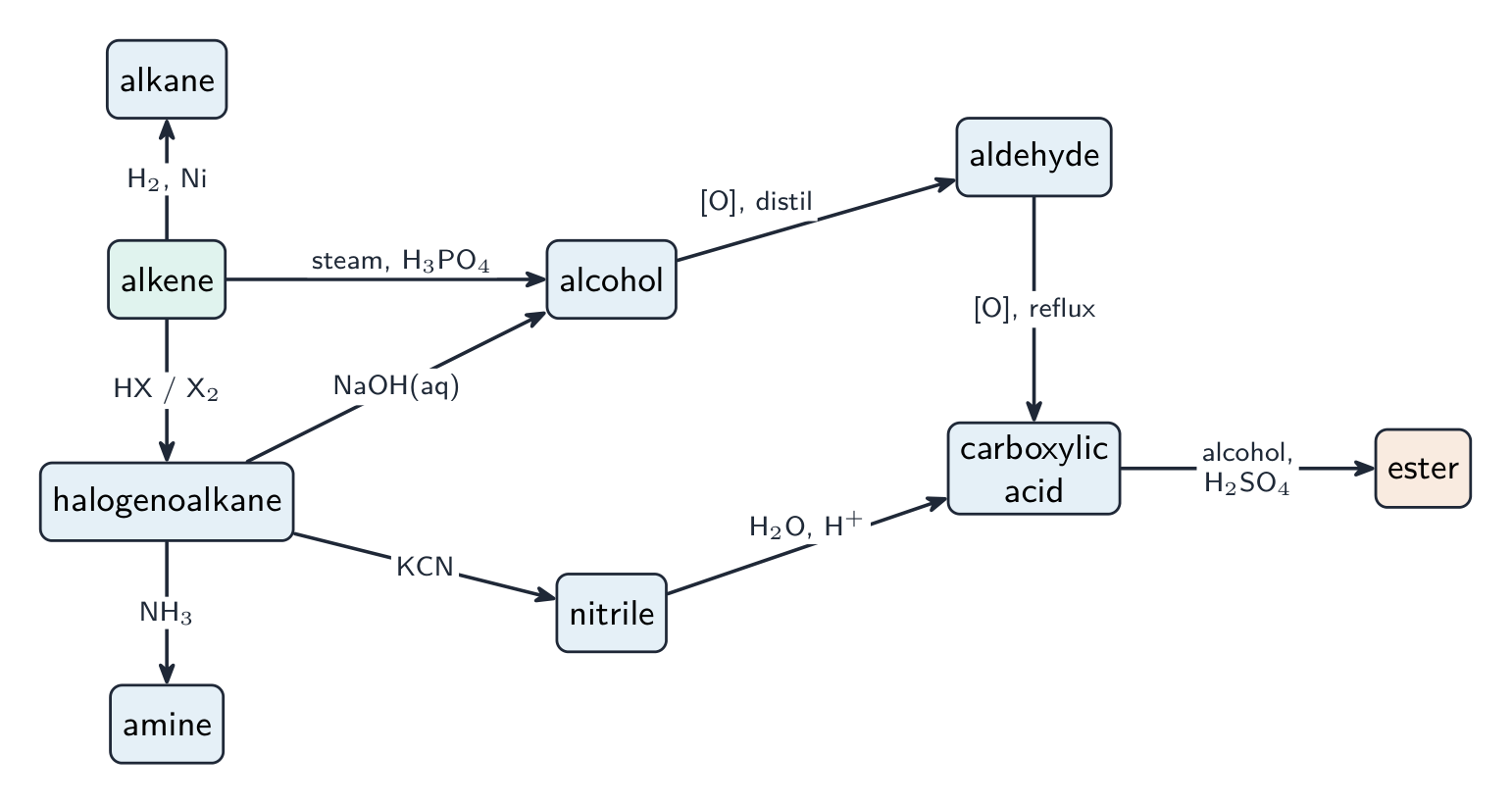
A map of the AS reactions: each arrow turns one functional group into another. Work backwards from your target to plan a route Planning a multi-step route
To devise a synthetic route 合成路线:
- compare the target with the starting material — what has changed (the functional group, the number of carbons)?
- work backwards from the target: which single reaction could make it, and from what?
- repeat until you reach the starting material.
- write each step with its reagent 试剂 and conditions.
If you need to add a carbon, the $\text{KCN}$ step is the key — it is the only AS reaction that lengthens the chain.
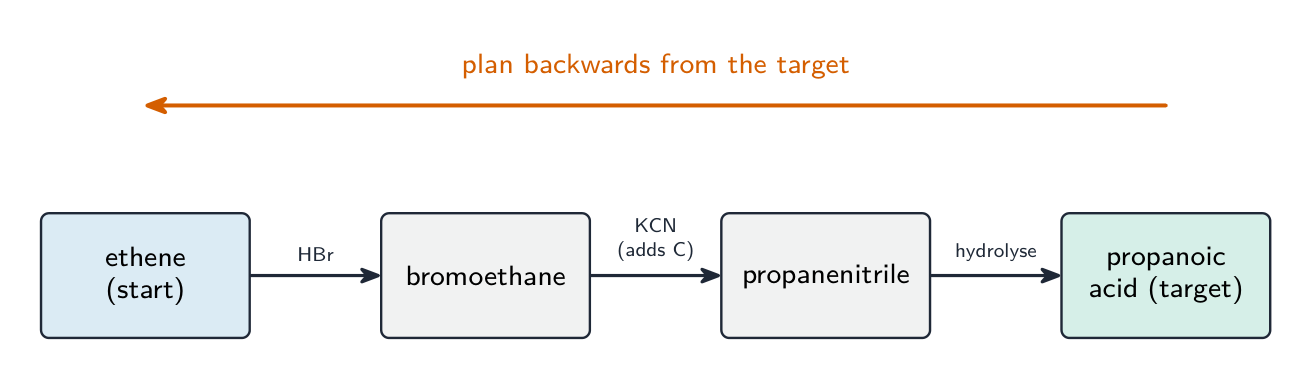
Plan a route by working backwards from the target, one reaction at a time, until you reach the starting material Analysing a route
When you are given a route, for each step state the type of reaction (such as oxidation 氧化, reduction 还原, substitution, addition or elimination) and the reagent used. Also think about possible by-products 副产物 — for example, making an amine from a halogenoalkane also gives a mixture of further-substituted amines, so the yield of the simple amine is low.
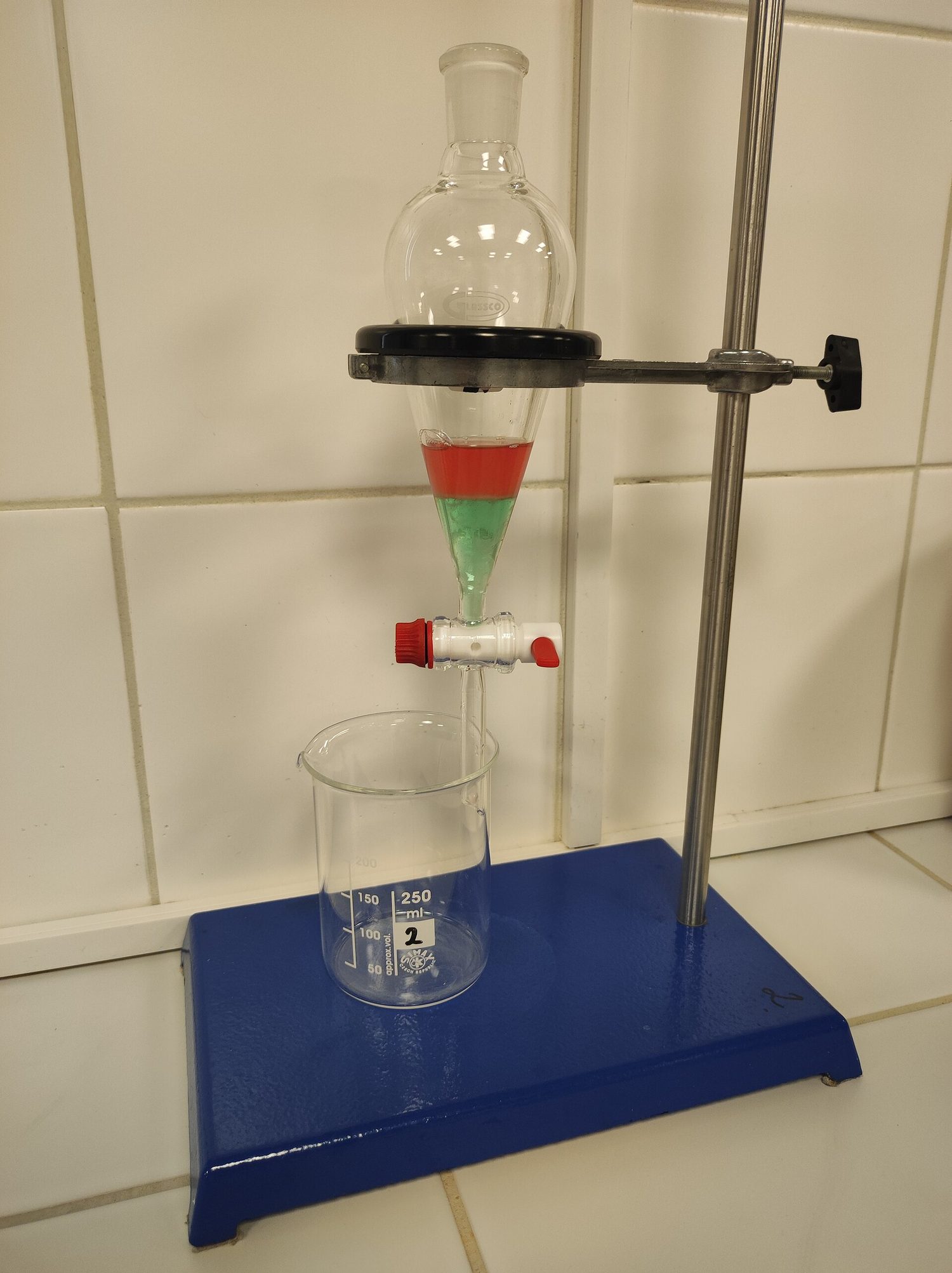
A separating funnel splits two immiscible layers — how the organic product is recovered from the reaction mixture 
For every step in a given route, ask its reaction type, reagent and by-products 
Name the reaction type at each step: oxidation, reduction, substitution, addition or elimination Worked example. Devise a route from propene to propanone, $\text{CH}_3\text{COCH}_3$. Work backwards from the target. A ketone comes from oxidising a secondary alcohol, so the step before propanone is propan-2-ol with acidified $\text{K}_2\text{Cr}_2\text{O}_7$ under reflux. Propan-2-ol comes from propene by adding steam over an $\text{H}_3\text{PO}_4$ catalyst - and Markovnikov's rule conveniently puts the $\text{OH}$ on the middle carbon, which is exactly the secondary alcohol needed. So the route is: propene, then steam with $\text{H}_3\text{PO}_4$, giving propan-2-ol; then acidified $\text{K}_2\text{Cr}_2\text{O}_7$ under reflux, giving propanone. Give a reagent and its conditions on every arrow: a route with the right intermediates but no reagents scores very little.
ExploreReaction map lab
Classify clues that identify functional groups and reaction pathways.
ExploreSynthetic route planning lab
Follow how a target molecule is planned backwards then made forwards.
Vocabulary TrainEnglish functional group/ˈfʌŋkʃənl ɡruːp/ alkene/ˈælkiːn/ halogenoalkane/ˈheɪləʊdʒnəʊlkeɪn/ alcohol/ˈælkəhɒl/ aldehyde/ˈældɪhaɪd/ ketone/ˈketəʊn/ carboxylic acid/ˌkɑːbəkˈsɪlɪk ˈæsɪd/ nitrile/ˈnaɪtraɪl/ amine/ˈæmaɪn/ ester/ˈestə/ synthetic route/sɪnˈθetɪk ruːt/ reagent/rɪˈeɪdʒənt/ oxidation/ˌɒksɪˈdeɪʃn/ reduction/rɪˈdʌkʃn/ by-product/baɪ ˈprɒdʌkt/ 21.1
Exam tips
- Learn the reagents and conditions for each conversion — that is exactly what synthesis questions test.
- Plan multi-step routes by functional group and watch the carbon count (KCN adds one carbon).
- Choose the shortest valid route and state every reagent and condition.
-
22
Analytical techniques
Watch lesson22.1
Infrared spectroscopy

Syllabus
- analyse an infrared spectrum of a simple molecule to identify functional groups (see the Data section for the functional groups required)
Source: Cambridge International syllabus
Infrared spectroscopy 红外光谱 helps you find the functional group 官能团 in a molecule. Each kind of bond soaks up (absorbs) infrared radiation at its own range of frequencies. Where the bond shows strong absorption 吸收, the spectrum has a dip.
An infrared spectrometer shines infrared through a sample and records which wavenumbers its bonds absorb The position is measured in wavenumber 波数 (in $\text{cm}^{-1}$). You are given a data table, so you do not memorise the numbers. You just match the dips to bonds:
- a broad dip around $3200$–$3650\ \text{cm}^{-1}$ → an O–H bond in an alcohol.
- a dip around $1700\ \text{cm}^{-1}$ → a C=O bond (aldehyde, ketone, acid or ester).
- a broad dip $2500$–$3000\ \text{cm}^{-1}$ together with a C=O dip → a carboxylic acid.
This is useful for checking a reaction. For example, if propene has been turned into propan-2-ol, the C=C dip should be gone and an O–H dip should appear.
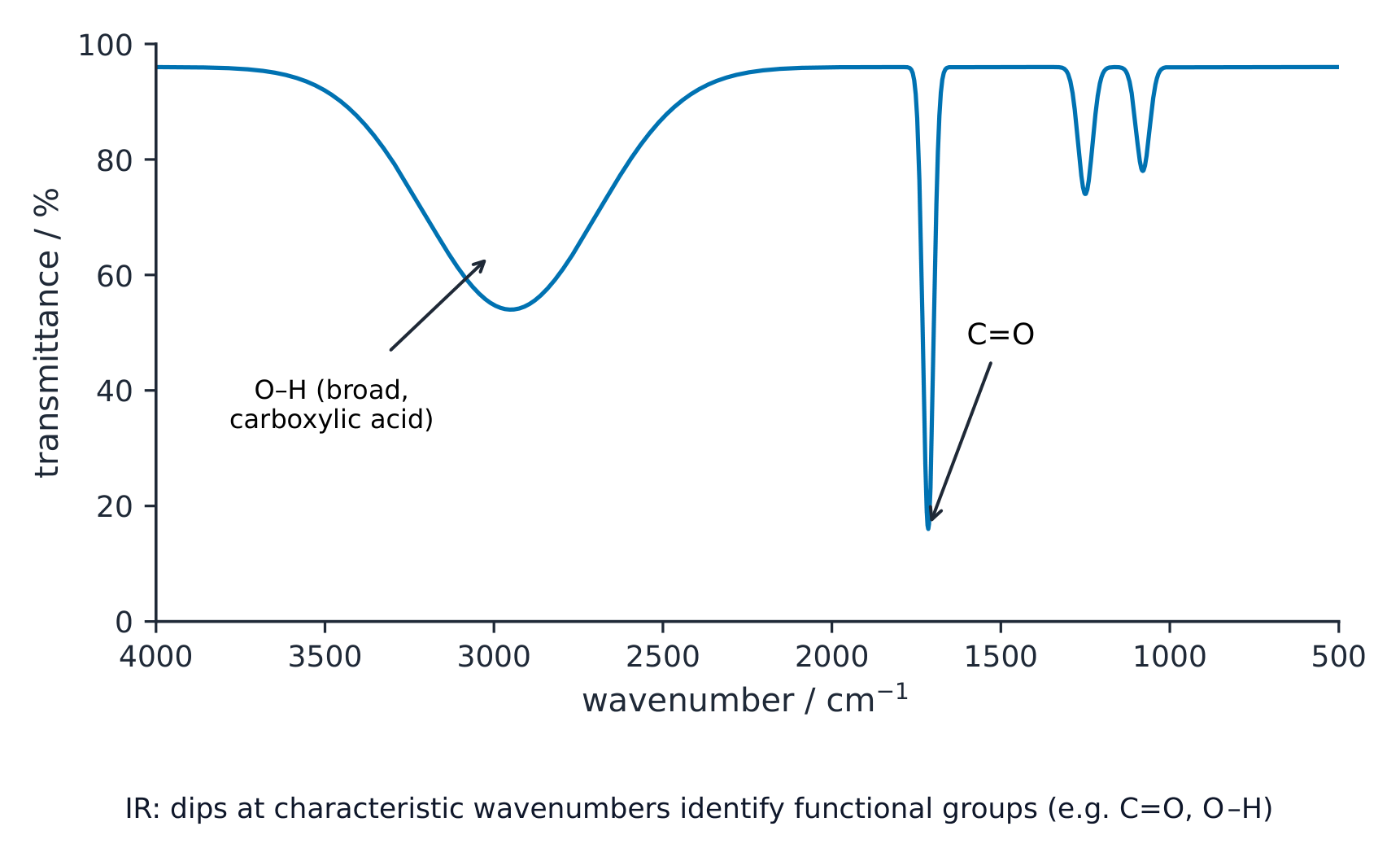
An infrared spectrum: each bond gives a dip at its own wavenumber. A broad O–H dip together with a C=O dip identifies a carboxylic acid ExploreIR spectroscopy lab
Match an absorption to the bond or functional group it reveals.
Vocabulary TrainEnglish infrared spectroscopy/ˌɪnfrəˈred spekˈtrɒskəpi/ functional group/ˈfʌŋkʃənl ɡruːp/ absorption/əbˈsɔːpʃn/ wavenumber/ˈweɪvnʌmbə/ 22.2
Mass spectrometry

Syllabus
- analyse mass spectra in terms of $m/e$ values and isotopic abundances (knowledge of the working of the mass spectrometer is not required)
- calculate the relative atomic mass of an element given the relative abundances of its isotopes, or its mass spectrum
- deduce the molecular mass of an organic molecule from the molecular ion peak in a mass spectrum
- suggest the identity of molecules formed by simple fragmentation in a given mass spectrum
- deduce the number of carbon atoms, $n$, in a compound using the $[M + 1]^+$ peak and the formula $$n = \frac{100 \times \text{abundance of } [M + 1]^+ \text{ ion}}{1.1 \times \text{abundance of } M^+ \text{ ion}}$$
- deduce the presence of bromine and chlorine atoms in a compound using the $[M + 2]^+$ peak
Source: Cambridge International syllabus
In mass spectrometry 质谱, a molecule is turned into ions and sorted by its mass-to-charge ratio 质荷比 ($m/e$). The spectrum is a set of peaks at different $m/e$ values.
A modern mass spectrometer: the sample is loaded at the front, then the machine ionises it and sorts the ions by their mass-to-charge ratio to give the spectrum Relative atomic mass from isotopes
An element's isotope 同位素 mixture gives several peaks. From the isotopic abundance 同位素丰度 (how common each isotope is) you can find the relative atomic mass 相对原子质量 — a weighted average:
$$A_r = \frac{\sum (\text{isotope mass} \times \text{abundance})}{\sum \text{abundance}}$$For example, chlorine is 75% $^{35}\text{Cl}$ and 25% $^{37}\text{Cl}$, giving $A_r = \dfrac{35 \times 75 + 37 \times 25}{100} = 35.5$.
The molecular ion and fragmentation
The peak at the highest $m/e$ (the molecular ion 分子离子 peak, or molecular ion peak 分子离子峰, $M^+$) gives the relative molecular mass of the whole molecule.
The molecule also breaks into smaller pieces — this is fragmentation 碎裂. The gap between two peaks tells you the mass of the lost piece, so you can suggest each fragment 碎片. For example, a loss of 15 means a $\text{CH}_3$ group was lost, and a loss of 29 means $\text{CHO}$ or $\text{C}_2\text{H}_5$.
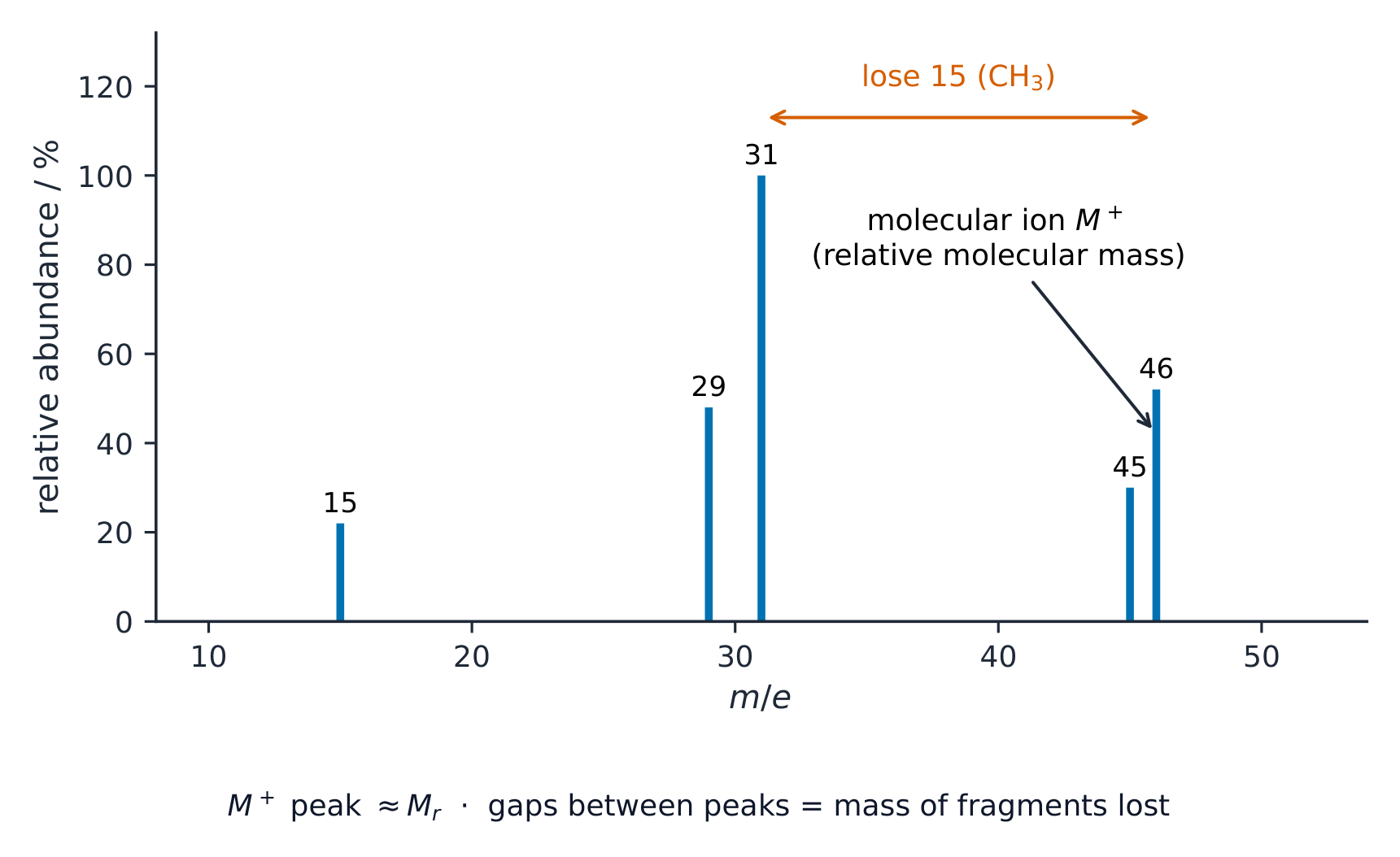
A mass spectrum: the highest-$m/e$ peak is the molecular ion ($M^+$, the $M_r$); the gaps between peaks give the masses of the lost fragments The [M + 1] and [M + 2] peaks
- a small [M + 1] peak comes from the $^{13}\text{C}$ isotope. The number of carbon atoms $n$ is:
$$n = \frac{100 \times \text{abundance of } [M + 1]^+}{1.1 \times \text{abundance of } M^+}$$- an [M + 2] peak shows chlorine or bromine. One chlorine gives an $[M + 2]$ peak about one third the height of $M^+$ (from $^{37}\text{Cl}$); one bromine gives an $[M + 2]$ peak about the same height as $M^+$ (from $^{81}\text{Br}$).
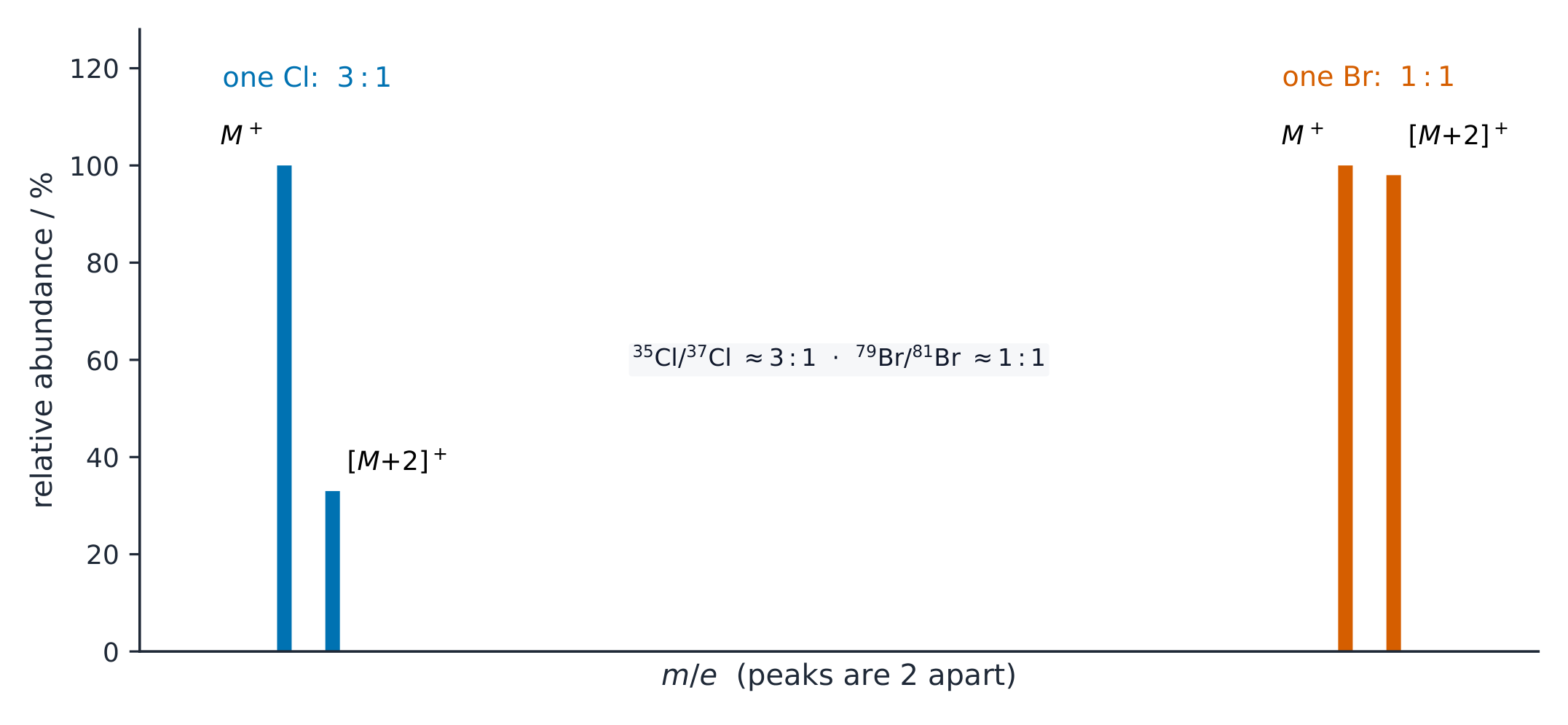
An $[M+2]$ peak two mass units above $M^+$ shows a halogen: one chlorine gives a $3:1$ ratio, one bromine a $1:1$ ratio Worked example. A compound shows a molecular ion at $m/e = 108$ and a peak of almost equal height at $m/e = 110$. Its infrared spectrum shows no broad absorption near $3300\ \text{cm}^{-1}$. Deduce its identity. Two peaks two units apart with roughly equal heights are the $1:1$ signature of one bromine atom (from $^{79}\text{Br}$ and $^{81}\text{Br}$); one chlorine would have given a $3:1$ ratio instead. Take the bromine away from the molecular ion: $108 - 79 = 29$, which fits a $\text{C}_2\text{H}_5$ fragment. The absence of a broad peak near $3300\ \text{cm}^{-1}$ rules out an $\text{O-H}$, so there is no alcohol group. The compound is bromoethane, $\text{C}_2\text{H}_5\text{Br}$. Read the $[M+2]$ ratio rather than merely noting the peak: $1:1$ means bromine, $3:1$ means chlorine.
ExploreMass spectrometry route
Follow a molecule through ionisation, separation and detection.
Vocabulary TrainEnglish mass spectrometry/mæs spekˈtrɒmətri/ mass-to-charge ratio/mæs tə tʃɑːdʒ ˈreɪʃɪəʊ/ isotope/ˈaɪsətəʊp/ isotopic abundance/ˌaɪsəˈtɒpɪk əˈbʌndəns/ relative atomic mass/ˈrelətɪv əˈtɒmɪk mæs/ molecular ion/məˈlekjʊlə ˈaɪɒn/ molecular ion peak/məˈlekjʊlə ˈaɪɒn piːk/ fragmentation/ˌfræɡmənˈteɪʃn/ fragment/ˈfræɡmənt/ 22.2
Exam tips
- On an IR spectrum quote the wavenumber and the bond (O-H broad $\sim 3200-3600$, C=O $\sim 1700$); use the data booklet.
- The peak at the highest $m/z$ is the molecular ion $\text{M}^+$ and gives the $M_r$.
- Explain fragmentation: the gap between peaks is the lost fragment (loss of 15 = $\text{CH}_3$, 29 = $\text{C}_2\text{H}_5$ or CHO).
- Learn common isotope patterns (Cl gives M and M+2 in about 3:1; M+1 from $^{13}\text{C}$).
-
23
Chemical energetics
Watch lesson23.1
Lattice energy and Born–Haber cycles

Syllabus
- define and use the terms: (a) enthalpy change of atomisation, $\Delta H_{\text{at}}$ (b) lattice energy, $\Delta H_{\text{latt}}$ (the change from gas phase ions to solid lattice)
- (a) define and use the term first electron affinity, EA (b) explain the factors affecting the electron affinities of elements (c) describe and explain the trends in the electron affinities of the Group 16 and Group 17 elements
- construct and use Born–Haber cycles for ionic solids (limited to +1 and +2 cations, –1 and –2 anions)
- carry out calculations involving Born–Haber cycles
- explain, in qualitative terms, the effect of ionic charge and of ionic radius on the numerical magnitude of a lattice energy
Source: Cambridge International syllabus
These cycles use several enthalpy changes 焓变 ($\Delta H$). Two new ones are:
- the enthalpy change of atomisation 原子化焓变, $\Delta H_{\text{at}}$ — the energy to make one mole of gaseous atoms from an element. It is always positive (bonds must break).
- the lattice energy 晶格能, $\Delta H_{\text{latt}}$ — the energy change when one mole of a solid ionic lattice forms from its gaseous ions. It is always negative (strong bonds form).
An ionic solid such as sodium chloride is a giant, regular lattice of ions — the lattice energy is released when it forms Electron affinity
The first electron affinity 电子亲和能 (EA) is the energy change when one mole of gaseous atoms each gain one electron to form one mole of $1-$ ions. The first EA is usually negative.

A gaseous atom gains an electron, usually releasing energy The same factors as ionisation energy apply (nuclear charge, atomic radius, shielding). Going down Group 16 or 17, the EA becomes less exothermic, because the atom is larger and pulls the extra electron in less strongly. (The very top element is an exception: its atom is so small that electron repulsion makes its EA less exothermic than the one below it.)
Born–Haber cycles
A Born–Haber cycle 玻恩哈伯循环 is an energy cycle that links the enthalpy change of formation of an ionic solid with its atomisation, ionisation energy, electron affinity and lattice energy. Using Hess's law, you go round the cycle to find any one unknown step. (You only need $+1$ and $+2$ cations and $-1$ and $-2$ anions.)

A Born–Haber cycle for NaCl: going up costs energy (atomisation, ionisation); coming down releases it (electron affinity, and the large lattice energy) Worked example. Find the lattice energy of sodium chloride from these data (kJ mol⁻¹): enthalpy of formation $\Delta H_f = -411$; atomisation $\Delta H_{\text{at}}(\text{Na}) = +107$ and $\Delta H_{\text{at}}(\text{Cl}) = +122$; first ionisation energy of Na $= +496$; electron affinity of Cl $= -349$.
By Hess's law the direct formation route equals the route up and round the cycle:
$$\Delta H_f = \Delta H_{\text{at}}(\text{Na}) + \Delta H_{\text{at}}(\text{Cl}) + \text{IE}_1 + \text{EA} + \Delta H_{\text{latt}},$$so $\Delta H_{\text{latt}} = -411 - (107 + 122 + 496 - 349) = -787\ \text{kJ mol}^{-1}.$
What controls the size of a lattice energy
The lattice energy is more negative (stronger) when:

Smaller ions and higher charges give a stronger lattice energy - the ionic charge is higher (e.g. $\text{Mg}^{2+}$ beats $\text{Na}^+$).
- the ionic radius is smaller.
Both make the attraction between the ions stronger.
ExploreThe Born–Haber cycle
Lattice energy can't be measured directly, so it is found from a cycle of measurable steps.
Vocabulary TrainEnglish enthalpy change/enˈθælpi tʃeɪndʒ/ enthalpy change of atomisation/enˈθælpi tʃeɪndʒ ɒv əˌtɒmaɪˈzeɪʃn/ lattice energy/ˈlætɪs ˈenədʒi/ electron affinity/ɪˈlektrɒn əˈfɪnɪti/ Born–Haber cycle/bɔːn ˈheɪbə ˈsaɪkl/ 23.2
Enthalpies of solution and hydration

Syllabus
- define and use the term enthalpy change with reference to hydration, $\Delta H_{\text{hyd}}$, and solution, $\Delta H_{\text{sol}}$
- construct and use an energy cycle involving enthalpy change of solution, lattice energy and enthalpy change of hydration
- carry out calculations involving the energy cycles in 23.2.2
- explain, in qualitative terms, the effect of ionic charge and of ionic radius on the numerical magnitude of an enthalpy change of hydration
Source: Cambridge International syllabus
- the enthalpy change of hydration 水合焓变, $\Delta H_{\text{hyd}}$ — the energy change when one mole of gaseous ions is surrounded by water to form aqueous ions. It is exothermic.
- the enthalpy change of solution 溶解焓变, $\Delta H_{\text{sol}}$ — the energy change when one mole of solute dissolves fully in water.
An instant cold pack feels cold because its salt dissolves endothermically (a positive $\Delta H_\text{sol}$), driven by the rise in entropy An energy cycle links the three:
$$\Delta H_{\text{sol}} = -\Delta H_{\text{latt}} + \Delta H_{\text{hyd}}$$(To dissolve, you first pull the lattice apart, then hydrate the ions.) Like lattice energy, $\Delta H_{\text{hyd}}$ is more exothermic for ions with a higher charge and a smaller radius.

Dissolving energy cycle: pull the lattice apart (reverse lattice energy), then hydrate the gaseous ions, so $\Delta H_\text{sol} = -\Delta H_\text{latt} + \Delta H_\text{hyd}$ ExploreEnthalpy of solution lab
deltaHsol = lattice + hydration terms
Change hydration strength and see solution enthalpy shift.
Vocabulary TrainEnglish enthalpy change of hydration/enˈθælpi tʃeɪndʒ ɒv haɪˈdreɪʃn/ enthalpy change of solution/enˈθælpi tʃeɪndʒ ɒv səˈluːʃn/ 23.3
Entropy change, ΔS

Syllabus
- define the term entropy, $S$, as the number of possible arrangements of the particles and their energy in a given system
- predict and explain the sign of the entropy changes that occur: (a) during a change in state, e.g. melting, boiling and dissolving (and their reverse) (b) during a temperature change (c) during a reaction in which there is a change in the number of gaseous molecules
- calculate the entropy change for a reaction, $\Delta S$, given the standard entropies, $S^\ominus$, of the reactants and products, $\Delta S^\ominus = \Sigma S^\ominus \text{(products)} - \Sigma S^\ominus \text{(reactants)}$ (use of $\Delta S^\ominus = \Delta S^\ominus_{\text{surr}} + \Delta S^\ominus_{\text{sys}}$ is not required)
Source: Cambridge International syllabus
Entropy 熵 ($S$) measures the number of ways the particles and their energy can be arranged in a system. More ways means more "disorder".
Entropy rises from solid to liquid to gas as the particles spread into more arrangements, so $\Delta S$ is positive The entropy change 熵变 ($\Delta S$) is positive when disorder increases, and negative when it falls:
Change Sign of $\Delta S$ solid → liquid → gas (melting, boiling), or dissolving positive a rise in temperature positive a reaction that makes more gas molecules positive a reaction that makes fewer gas molecules negative You can calculate it from standard entropies:
$$\Delta S^{\ominus} = \sum S^{\ominus}(\text{products}) - \sum S^{\ominus}(\text{reactants})$$ExploreEntropy change lab
deltaS = products disorder - reactants disorder
Increase disorder and see entropy change become more positive.
Vocabulary TrainEnglish entropy/ˈentrəpi/ entropy change/ˈentrəpi tʃeɪndʒ/ 23.4
Gibbs free energy change, ΔG

Syllabus
- state and use the Gibbs equation $\Delta G^\ominus = \Delta H^\ominus - T\Delta S^\ominus$
- perform calculations using the equation $\Delta G^\ominus = \Delta H^\ominus - T\Delta S^\ominus$
- state whether a reaction or process will be feasible by using the sign of $\Delta G$
- predict the effect of temperature change on the feasibility of a reaction, given standard enthalpy and entropy changes
Source: Cambridge International syllabus
The Gibbs free energy 吉布斯自由能 change decides whether a reaction can happen on its own:
$$\Delta G^{\ominus} = \Delta H^{\ominus} - T\Delta S^{\ominus}$$Here $T$ is the temperature in kelvin. A reaction is feasible (it can happen) when $\Delta G$ is negative or zero. The feasibility 可行性 therefore depends on temperature:
$\Delta H$ $\Delta S$ When feasible negative positive at all temperatures positive positive only at high temperature negative negative only at low temperature positive negative never Whether a reaction is feasible ($\Delta G \leq 0$) depends on the signs of $\Delta H$ and $\Delta S$, and sometimes on temperature To find the changeover temperature, set $\Delta G = 0$, which gives $T = \Delta H / \Delta S$.
Worked example. A reaction has $\Delta H = +120\ \text{kJ mol}^{-1}$ and $\Delta S = +200\ \text{J K}^{-1}\,\text{mol}^{-1}$. Find $\Delta G$ at $298\ \text{K}$, and the temperature above which the reaction becomes feasible.
First match the units: $\Delta S = +0.200\ \text{kJ K}^{-1}\,\text{mol}^{-1}$. Then
$$\Delta G = \Delta H - T\Delta S = 120 - 298 \times 0.200 = +60\ \text{kJ mol}^{-1}\quad(\text{positive, so not yet feasible}).$$Setting $\Delta G = 0$ gives $T = \Delta H/\Delta S = 120/0.200 = 600\ \text{K}$, so the reaction is feasible above $600\ \text{K}$.
ExploreGibbs free energy lab
deltaG = deltaH - T deltaS
Move temperature and see when deltaG becomes negative.
Vocabulary TrainEnglish Gibbs free energy/ɡɪbz friː ˈenədʒi/ feasibility/ˌfiːzɪˈbɪlɪti/ 23.4
Exam tips
- In a Born-Haber cycle get each step's direction and sign right (atomisation, ionisation $+$; electron affinity, lattice formation $-$) and apply Hess's law around it.
- Lattice energy is more exothermic for smaller, more highly charged ions (higher charge density).
- Predict the sign of $\Delta S$ from the state changes (more gas moles = more disorder).
- Use $\Delta G = \Delta H - T\Delta S$; feasible when $\Delta G \le 0$ — convert $\Delta S$ from $\text{J K}^{-1}\,\text{mol}^{-1}$ ($\div 1000$).
-
24
Electrochemistry
Watch lesson24.1
Electrolysis

Syllabus
- predict the identities of substances liberated during electrolysis from the state of electrolyte (molten or aqueous), position in the redox series (electrode potential) and concentration
- state and apply the relationship $F = Le$ between the Faraday constant, $F$, the Avogadro constant, $L$, and the charge on the electron, $e$
- calculate: (a) the quantity of charge passed during electrolysis, using $Q = It$ (b) the mass and/or volume of substance liberated during electrolysis
- describe the determination of a value of the Avogadro constant by an electrolytic method
Source: Cambridge International syllabus
Electrolysis: ions discharge at the electrodes Electrolysis 电解 uses electricity to break down a molten or aqueous electrolyte 电解质. Positive ions move to the negative electrode and negative ions move to the positive electrode.
At each electrode 电极 a half-reaction happens:
- at the cathode 阴极 (negative): positive ions gain electrons (reduction).
- at the anode 阳极 (positive): negative ions lose electrons (oxidation).
Electrolysis: the DC supply drives positive ions to the cathode (reduction) and negative ions to the anode (oxidation) 
A Hofmann voltameter for the electrolysis of water: the power supply drives current through two electrodes, and the gas made at each one collects in its side tube Predicting the products
- a molten electrolyte gives the metal at the cathode and the non-metal at the anode.
- an aqueous electrolyte also contains water. At the cathode, a less reactive metal is released, but for a reactive metal you get hydrogen instead. At the anode you usually get oxygen, but a concentrated halide solution gives the halogen.

A molten electrolyte gives the metal and non-metal; aqueous also has water Calculations
The charge on one mole of electrons is the Faraday constant 法拉第常量, linked to the Avogadro constant 阿伏伽德罗常量 ($L$) and the charge on one electron ($e$) by $F = Le$.
The charge passed is $Q = It$ (current $\times$ time). Then:
- moles of electrons $= Q / F$.
- use the half-equation to find moles of product.
- find the mass ($\times M_r$) or the gas volume.
Measuring the mass deposited for a known charge lets you work back to a value of the Avogadro constant.
Worked example. A current of $2.0\ \text{A}$ flows for $30$ minutes through copper(II) sulfate solution, depositing copper at the cathode: $\text{Cu}^{2+} + 2\text{e}^- \rightarrow \text{Cu}$. Find the mass of copper deposited. ($F = 96\,500\ \text{C mol}^{-1}$, $A_r$ Cu $= 64$.)
Charge passed: $Q = It = 2.0 \times (30 \times 60) = 3600\ \text{C}$. Moles of electrons $= Q/F = 3600/96\,500 = 0.0373\ \text{mol}$. From the half-equation, $2\ \text{mol}$ of electrons give $1\ \text{mol}$ of Cu, so $n(\text{Cu}) = 0.0187\ \text{mol}$ and
$$m = nM = 0.0187 \times 64 \approx 1.2\ \text{g}.$$
Electrolysis is used to electroplate an object with a thin, shiny layer of metal such as chromium ExploreFaraday's first law
m = k·Q
Mass deposited is proportional to the charge passed (Faraday's law).
ExploreInside an electrolysis cell
Choose an electrolyte and watch the ions move: cations to the cathode, anions to the anode, where they are discharged.
Vocabulary TrainEnglish electrolysis/ɪlekˈtrɒləsɪs/ electrolyte/ɪˈlektrəlaɪt/ electrode/ɪˈlektrəʊd/ cathode/ˈkæθəʊd/ anode/ˈænəʊd/ Faraday constant/ˈfærədeɪ ˈkɒnstənt/ Avogadro constant/ˌævəˈɡædrəʊ ˈkɒnstənt/ 24.2
Standard electrode potentials and cell potentials

Syllabus
- define the terms: (a) standard electrode (reduction) potential (b) standard cell potential
- describe the standard hydrogen electrode
- describe methods used to measure the standard electrode potentials of: (a) metals or non-metals in contact with their ions in aqueous solution (b) ions of the same element in different oxidation states
- calculate a standard cell potential by combining two standard electrode potentials
- use standard cell potentials to: (a) deduce the polarity of each electrode and hence explain/deduce the direction of electron flow in the external circuit of a simple cell (b) predict the feasibility of a reaction
- deduce from $E^{\ominus}$ values the relative reactivity of elements, compounds and ions as oxidising agents or as reducing agents
- construct redox equations using the relevant half-equations
- predict qualitatively how the value of an electrode potential, $E$, varies with the concentrations of the aqueous ions
- use the Nernst equation, e.g. $E = E^{\ominus} + (0.059/z) \log \frac{[\text{oxidised species}]}{[\text{reduced species}]}$, to predict quantitatively how the value of an electrode potential varies with the concentrations of the aqueous ions; examples include $\text{Cu}^{2+}(\text{aq}) + 2\text{e}^- \rightleftharpoons \text{Cu}(\text{s})$, $\text{Fe}^{3+}(\text{aq}) + \text{e}^- \rightleftharpoons \text{Fe}^{2+}(\text{aq})$
- understand and use the equation $\Delta G^{\ominus} = -n E^{\ominus}_{\text{cell}} F$
Source: Cambridge International syllabus
The electrode potential 电极电势 ($E$) of a half-cell shows how easily it is reduced. We measure it against a reference, under standard conditions, to get the standard electrode potential 标准电极电势 ($E^{\ominus}$), always written as a reduction.
The reference is the standard hydrogen electrode 标准氢电极: hydrogen gas at $1\ \text{atm}$ over platinum in $1\ \text{mol dm}^{-3}$ $\text{H}^+$, defined as exactly $0.00\ \text{V}$.
The standard hydrogen electrode: H$_2$ at 1 atm over platinum in 1 mol dm$^{-3}$ H$^+$, the $0.00$ V reference for every electrode potential To measure an $E^{\ominus}$, connect the half-cell to the standard hydrogen electrode and read the voltage. A metal sits in a solution of its ions; for two ions of the same element (such as $\text{Fe}^{3+}/\text{Fe}^{2+}$), a platinum electrode dips into a solution containing both.
Combining half-cells
The standard cell potential 标准电池电势 is the difference between the two standard electrode potentials:
$$E^{\ominus}_{\text{cell}} = E^{\ominus}(\text{more positive}) - E^{\ominus}(\text{less positive})$$
A simple cell: two half-cells joined by a salt bridge, with a voltmeter. Electrons flow from the negative (Zn) electrode to the positive (Cu) Worked example. Find the standard cell potential of a cell built from the $\text{Zn}^{2+}/\text{Zn}$ half-cell ($E^{\ominus} = -0.76\ \text{V}$) and the $\text{Cu}^{2+}/\text{Cu}$ half-cell ($E^{\ominus} = +0.34\ \text{V}$).
$$E^{\ominus}_{\text{cell}} = E^{\ominus}(\text{more positive}) - E^{\ominus}(\text{less positive}) = (+0.34) - (-0.76) = 1.10\ \text{V}.$$From $E^{\ominus}$ values you can:
- find the polarity: the more negative electrode is the negative terminal, and electrons flow from it through the external circuit to the positive electrode.
- judge reactivity: a more positive $E^{\ominus}$ means a better oxidising agent 氧化剂 (easily reduced); a more negative $E^{\ominus}$ means a better reducing agent 还原剂.

The electrochemical series: a more positive $E^{\ominus}$ (top) is a stronger oxidising agent; a more negative $E^{\ominus}$ (bottom) is a stronger reducing agent Feasibility and redox equations
A reaction is feasible when $E^{\ominus}_{\text{cell}}$ is positive. To build the full equation, take the two half-equations 半反应方程式, reverse the one that is oxidised, and add them so the electrons cancel. This $E^{\ominus}$ test tells you the feasibility 可行性 of the reaction.
You can also link it to free energy: $\Delta G^{\ominus} = -n E^{\ominus}_{\text{cell}} F$, where $n$ is the moles of electrons.
The Nernst equation
If the concentrations are not standard, the electrode potential changes. Raising the concentration of the oxidised species makes $E$ more positive. The Nernst equation 能斯特方程 gives the exact value:
$$E = E^{\ominus} + \frac{0.059}{z} \log \frac{[\text{oxidised species}]}{[\text{reduced species}]}$$where $z$ is the number of electrons in the half-equation.
ExploreElectrode potential lab
Ecell = Eright - Eleft
Change cell potential and see oxidising power increase.
Vocabulary TrainEnglish electrode potential/ɪˈlektrəʊd pəˈtenʃl/ standard electrode potential/ˈstændəd ɪˈlektrəʊd pəˈtenʃl/ standard hydrogen electrode/ˈstændəd ˈhaɪdrədʒn ɪˈlektrəʊd/ standard cell potential/ˈstændəd sel pəˈtenʃl/ oxidising agent/ˈɒksɪdaɪzɪŋ ˈeɪdʒənt/ reducing agent/rɪˈdjuːsɪŋ ˈeɪdʒənt/ half-equation/hɑːf ɪˈkweɪʒn/ feasibility/ˌfiːzɪˈbɪlɪti/ Nernst equation/nɜːnst ɪˈkweɪʒn/ 24.2
Exam tips
- $E^{\ominus}_{\text{cell}} = E^{\ominus}(\text{more positive}) - E^{\ominus}(\text{less positive})$; a positive $E^{\ominus}_{\text{cell}}$ means the reaction is feasible.
- Standard conditions for $E^{\ominus}$: 298 K, $1\ \text{mol dm}^{-3}$, 100 kPa, platinum electrode — state them if asked.
- A more negative electrode potential means a stronger reducing agent; use the series to predict the direction.
- For electrolysis quantities use $Q = It$ and moles of electrons $= Q/F$.
-
25
Equilibria
Watch lesson25.1
Conjugate acids and bases

Syllabus
- understand and use the terms conjugate acid and conjugate base
- define conjugate acid–base pairs, identifying such pairs in reactions
- define mathematically the terms pH, $K_a$, $\text{p}K_a$ and $K_w$ and use them in calculations ($K_b$ and the equation $K_w = K_a \times K_b$ will not be tested)
- calculate $[\text{H}^+(\text{aq})]$ and pH values for: (a) strong acids (b) strong alkalis (c) weak acids
- (a) define a buffer solution (b) explain how a buffer solution can be made (c) explain how buffer solutions control pH; use chemical equations in these explanations (d) describe and explain the uses of buffer solutions, including the role of $\text{HCO}_3^-$ in controlling pH in blood
- calculate the pH of buffer solutions, given appropriate data
- understand and use the term solubility product, $K_{\text{sp}}$
- write an expression for $K_{\text{sp}}$
- calculate $K_{\text{sp}}$ from concentrations and vice versa
- (a) understand and use the common ion effect to explain the different solubility of a compound in a solution containing a common ion (b) perform calculations using $K_{\text{sp}}$ values and concentration of a common ion
Source: Cambridge International syllabus
Titration curve and equivalence point When a Brønsted acid loses an $\text{H}^+$, what is left is its conjugate base 共轭碱. When a base gains an $\text{H}^+$, it becomes its conjugate acid 共轭酸. The two species that differ by just one $\text{H}^+$ form a conjugate acid–base pair 共轭酸碱对.
For example, in $\text{CH}_3\text{COOH} \rightleftharpoons \text{CH}_3\text{COO}^- + \text{H}^+$, the pair is $\text{CH}_3\text{COOH}$ (acid) and $\text{CH}_3\text{COO}^-$ (its conjugate base).
Conjugate pairs differ by one proton: an acid loses H$^+$ to give its conjugate base; a base gains H$^+$ to give its conjugate acid ExplorepH and H⁺ concentration
pH = −log[H⁺]: slide it and watch [H⁺] change tenfold per unit. A conjugate acid–base pair differ by a single proton.
Vocabulary TrainEnglish conjugate base/ˈkɒndʒuːɡeɪt beɪs/ conjugate acid/ˈkɒndʒuːɡeɪt ˈæsɪd/ conjugate acid–base pair/ˈkɒndʒuːɡeɪt ˈæsɪd beɪs peə/ 25.1
pH and the equilibrium constants

- pH measures acidity: $\text{pH} = -\log[\text{H}^+]$, so $[\text{H}^+] = 10^{-\text{pH}}$.
- the acid dissociation constant 酸解离常数 of a weak acid $\text{HA}$ is $K_a = \dfrac{[\text{H}^+][\text{A}^-]}{[\text{HA}]}$, and $\text{p}K_a = -\log K_a$. A larger $K_a$ (smaller $\text{p}K_a$) means a stronger acid.
- the ionic product of water 水的离子积 is $K_w = [\text{H}^+][\text{OH}^-] = 1.0 \times 10^{-14}$ at $298\ \text{K}$.
The pH scale: pH = -log of the hydrogen-ion concentration 
pH paper estimates the pH of a solution from the colour it turns Calculating pH
- strong acid 强酸: fully ionised, so $[\text{H}^+]$ equals the acid concentration; then take $-\log$.
- strong alkali 强碱: find $[\text{OH}^-]$ from the concentration, then use $[\text{H}^+] = K_w / [\text{OH}^-]$.
- weak acid 弱酸: only partly ionised, so use $[\text{H}^+] = \sqrt{K_a \times [\text{HA}]}$.
Worked example. Find the pH of $0.050\ \text{mol dm}^{-3}$ hydrochloric acid (a strong acid).
It is fully ionised, so $[\text{H}^+] = 0.050\ \text{mol dm}^{-3}$, giving $\text{pH} = -\log(0.050) = 1.30$.
Worked example. Find the pH of $0.10\ \text{mol dm}^{-3}$ sodium hydroxide (a strong base). ($K_w = 1.0 \times 10^{-14}$.)
$[\text{OH}^-] = 0.10$, so $[\text{H}^+] = K_w/[\text{OH}^-] = (1.0 \times 10^{-14})/0.10 = 1.0 \times 10^{-13}$, giving $\text{pH} = 13.0$.
Worked example. Find the pH of $0.10\ \text{mol dm}^{-3}$ ethanoic acid (a weak acid). ($K_a = 1.8 \times 10^{-5}$.)
$$[\text{H}^+] = \sqrt{K_a \times [\text{HA}]} = \sqrt{(1.8 \times 10^{-5})(0.10)} = 1.3 \times 10^{-3}, \qquad \text{pH} = -\log(1.3 \times 10^{-3}) = 2.87.$$Vocabulary TrainEnglish acid dissociation constant/ˈæsɪd dɪˌsəʊsɪˈeɪʃn ˈkɒnstənt/ ionic product of water/aɪˈɒnɪk ˈprɒdʌkt ɒv ˈwɔːtə/ strong acid/strɒŋ ˈæsɪd/ strong alkali/strɒŋ ˈælkəlaɪ/ weak acid/wiːk ˈæsɪd/ 25.1
Buffer solutions
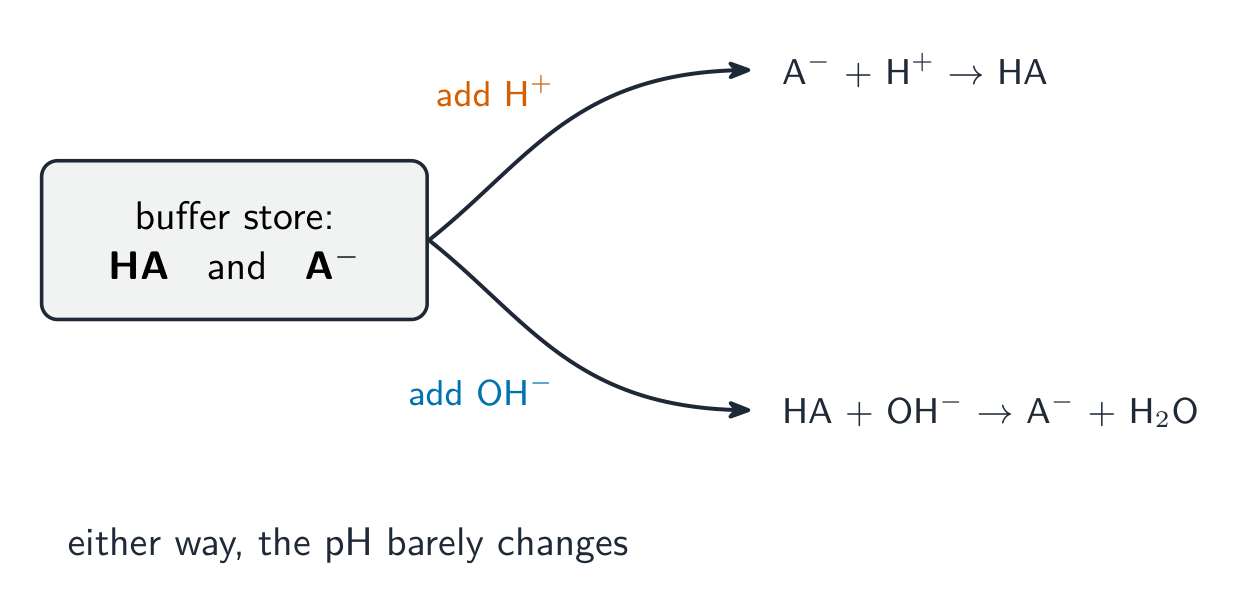
A buffer solution 缓冲溶液 resists a change in pH when a small amount of acid or alkali is added. You make one from a weak acid and its conjugate base (for example ethanoic acid and sodium ethanoate).
It works because the mixture holds a store of both partners:
- added $\text{H}^+$ is removed by the conjugate base: $\text{CH}_3\text{COO}^- + \text{H}^+ \rightarrow \text{CH}_3\text{COOH}$.
- added $\text{OH}^-$ is removed by the weak acid: $\text{CH}_3\text{COOH} + \text{OH}^- \rightarrow \text{CH}_3\text{COO}^- + \text{H}_2\text{O}$.
A buffer holds a store of a weak acid and its conjugate base: added H$^+$ is mopped up by A$^-$ and added OH$^-$ by HA, so the pH barely changes To find the pH, put the concentrations of the acid and its salt into the $K_a$ expression. Buffers are important in living things — for example, $\text{HCO}_3^-$ keeps the pH of blood close to $7.4$.
ExploreBuffers and the titration curve
Add alkali to acid: the flat part is where a buffer resists pH change, and the steep jump is the equivalence point.
Vocabulary TrainEnglish buffer solution/ˈbʌfə səˈluːʃn/ 25.1
Solubility product

For a salt that barely dissolves, the solubility product 溶度积 ($K_{\text{sp}}$) is the product of the ion concentrations in a saturated solution, each raised to the power of its number in the formula:
$$K_{\text{sp}} = [\text{Ag}^+][\text{Cl}^-] \qquad K_{\text{sp}} = [\text{Ca}^{2+}][\text{F}^-]^2$$You can find $K_{\text{sp}}$ from the solubility, or the solubility from $K_{\text{sp}}$.
Stalactites grow as dissolved calcium carbonate slowly comes back out of solution — a real solubility equilibrium The common ion effect
The common ion effect 同离子效应 is the way a salt becomes less soluble in a solution that already contains one of its ions. The extra ion pushes the dissolving equilibrium back (Le Chatelier), so less salt dissolves. You can calculate the new solubility using $K_{\text{sp}}$ and the concentration of the common ion.
ExploreSolubility product lab
ionic product compared with Ksp
Increase ion concentration and see when precipitation becomes likely.
Vocabulary TrainEnglish solubility product/ˌsɒljuːˈbɪlɪti ˈprɒdʌkt/ common ion effect/ˈkɒmən ˈaɪɒn ɪˈfekt/ 25.2
Partition coefficients

Syllabus
- state what is meant by the term partition coefficient, $K_{\text{pc}}$
- calculate and use a partition coefficient for a system in which the solute is in the same physical state in the two solvents
- understand the factors affecting the numerical value of a partition coefficient in terms of the polarities of the solute and the solvents used
Source: Cambridge International syllabus
When a solute is shaken with two solvents that do not mix, it spreads between them. The partition coefficient 分配系数 ($K_{\text{pc}}$) is the ratio of its concentrations in the two layers (at constant temperature):
$$K_{\text{pc}} = \frac{[\text{solute in solvent 1}]}{[\text{solute in solvent 2}]}$$This works when the solute 溶质 is in the same physical state in both solvents. The value depends on the polarity 极性 of the solute and of each solvent 溶剂: a non-polar solute dissolves more in the non-polar solvent, while a polar solute prefers the polar solvent.
A solute shaken with two immiscible solvents spreads between them; the partition coefficient is the ratio of its concentrations in the two layers ExplorePartition coefficient lab
Kpc = concentration organic / concentration aqueous
Change organic-layer concentration and see the partition ratio.
Vocabulary TrainEnglish partition coefficient/pɑːˈtɪʃn ˌkəʊɪˈfɪʃənt/ solute/ˈsɒljuːt/ polarity/pəʊˈlærɪti/ solvent/ˈsɒlvənt/ 25.2
Exam tips
- $\text{pH} = -\log[\text{H}^+]$; for a strong acid $[\text{H}^+]$ = concentration, for a weak acid use $[\text{H}^+] = \sqrt{K_a[\text{HA}]}$.
- For a base, get $[\text{H}^+]$ from $K_w = [\text{H}^+][\text{OH}^-] = 1.0 \times 10^{-14}$.
- For a buffer use $[\text{H}^+] = K_a \times [\text{acid}]/[\text{salt}]$ and explain how it removes added $\text{H}^+$/$\text{OH}^-$.
- Write the $K_{sp}$ expression with the correct powers; the number of decimal places in a pH equals the significant figures of $[\text{H}^+]$.
-
26
Reaction kinetics
Watch lesson26.1
Rate equations and orders

Syllabus
- explain and use the terms rate equation, order of reaction, overall order of reaction, rate constant, half-life, rate-determining step and intermediate
- (a) understand and use rate equations of the form $\text{rate} = k [\text{A}]^m[\text{B}]^n$ (for which $m$ and $n$ are 0, 1 or 2) (b) deduce the order of a reaction from concentration–time graphs or from experimental data relating to the initial rates method and half-life method (c) interpret experimental data in graphical form, including concentration–time and rate–concentration graphs (d) calculate an initial rate using concentration data (e) construct a rate equation
- (a) show understanding that the half-life of a first-order reaction is independent of concentration (b) use the half-life of a first-order reaction in calculations
- calculate the numerical value of a rate constant, for example by: (a) using the initial rates and the rate equation (b) using the half-life, $t_{\frac{1}{2}}$, and the equation $k = 0.693/t_{\frac{1}{2}}$
- for a multi-step reaction: (a) suggest a reaction mechanism that is consistent with the rate equation and the equation for the overall reaction (b) predict the order that would result from a given reaction mechanism and rate-determining step (c) deduce a rate equation using a given reaction mechanism and rate-determining step for a given reaction (d) identify an intermediate or catalyst from a given reaction mechanism (e) identify the rate determining step from a rate equation and a given reaction mechanism
- describe qualitatively the effect of temperature change on the rate constant and hence the rate of a reaction
Source: Cambridge International syllabus
A rate equation 速率方程 shows how the rate depends on the concentrations of the reactants:
$$\text{rate} = k\,[\text{A}]^m[\text{B}]^n$$- $m$ is the order of reaction 反应级数 with respect to A, and $n$ the order with respect to B. Each is $0$, $1$ or $2$.
- the overall order of reaction 总反应级数 is $m + n$.
- $k$ is the rate constant 速率常数. The rate equation can only be found by experiment, not from the balanced equation.
A gas syringe measures the volume of gas made over time, which gives the rate of reaction Finding the order
- initial rates method: change one concentration at a time and see how the starting rate changes. If doubling $[\text{A}]$ doubles the rate, the order in A is 1; if it quadruples the rate, the order is 2; if the rate is unchanged, the order is 0.
Worked example. In experiments on $\text{A} + \text{B} \rightarrow$ products, doubling $[\text{A}]$ (with $[\text{B}]$ fixed) doubles the rate, and doubling $[\text{B}]$ (with $[\text{A}]$ fixed) quadruples the rate. Write the rate equation and give the overall order.
Doubling $[\text{A}]$ doubles the rate, so first order in A. Doubling $[\text{B}]$ quadruples ($2^2$) the rate, so second order in B. Hence
$$\text{rate} = k[\text{A}][\text{B}]^2, \qquad \text{overall order} = 1 + 2 = 3.$$- graphs: a concentration–time graph for a first-order reaction has a constant half-life 半衰期 (the time for the concentration to halve). A rate–concentration graph is a straight line through the origin for first order, and a curve for second order.

Rate against concentration: zero order is a flat line, first order a straight line through the origin, second order an upward curve Half-life and the rate constant
For a first-order reaction the half-life is constant — it does not depend on the concentration. You can find the rate constant from it:
$$k = \frac{0.693}{t_{\frac{1}{2}}}$$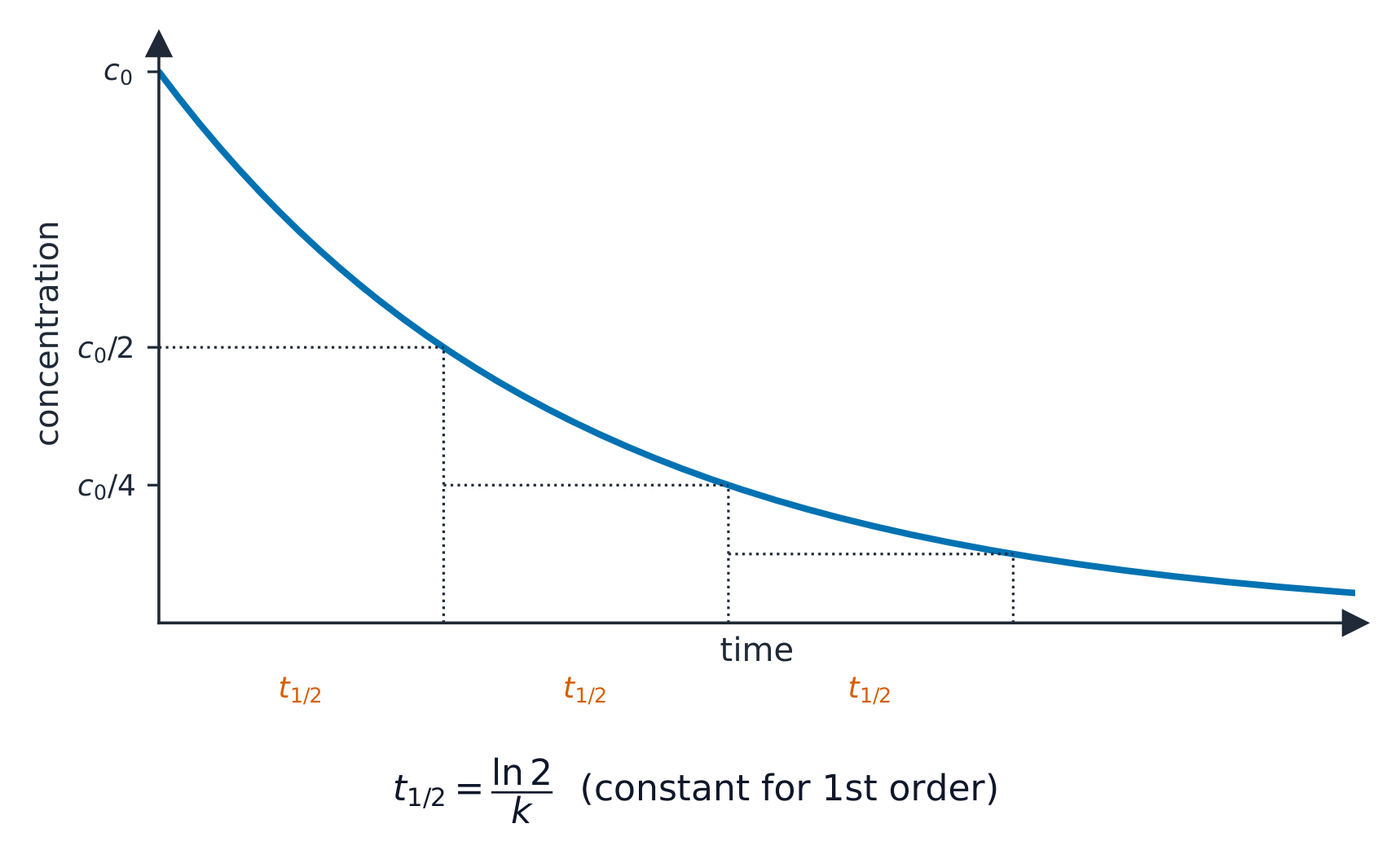
A first-order reaction has a constant half-life: the concentration halves in the same time $t_{1/2}$ again and again, whatever the starting value Worked example. A first-order reaction has a half-life of $120\ \text{s}$. Find its rate constant.
$$k = \frac{0.693}{t_{1/2}} = \frac{0.693}{120} = 5.8 \times 10^{-3}\ \text{s}^{-1}.$$You can also find $k$ by putting initial-rate data into the rate equation.
ExploreRate equations & orders
[A] = [A]₀·bᵗ
A first-order reaction decays exponentially — equal half-lives.
Vocabulary TrainEnglish rate equation/reɪt ɪˈkweɪʒn/ order of reaction/ˈɔːdə ɒv rɪˈækʃn/ overall order of reaction/ˌəʊvəˈrɔːl ˈɔːdə ɒv rɪˈækʃn/ rate constant/reɪt ˈkɒnstənt/ half-life/hɑːf laɪf/ 26.1
Reaction mechanisms
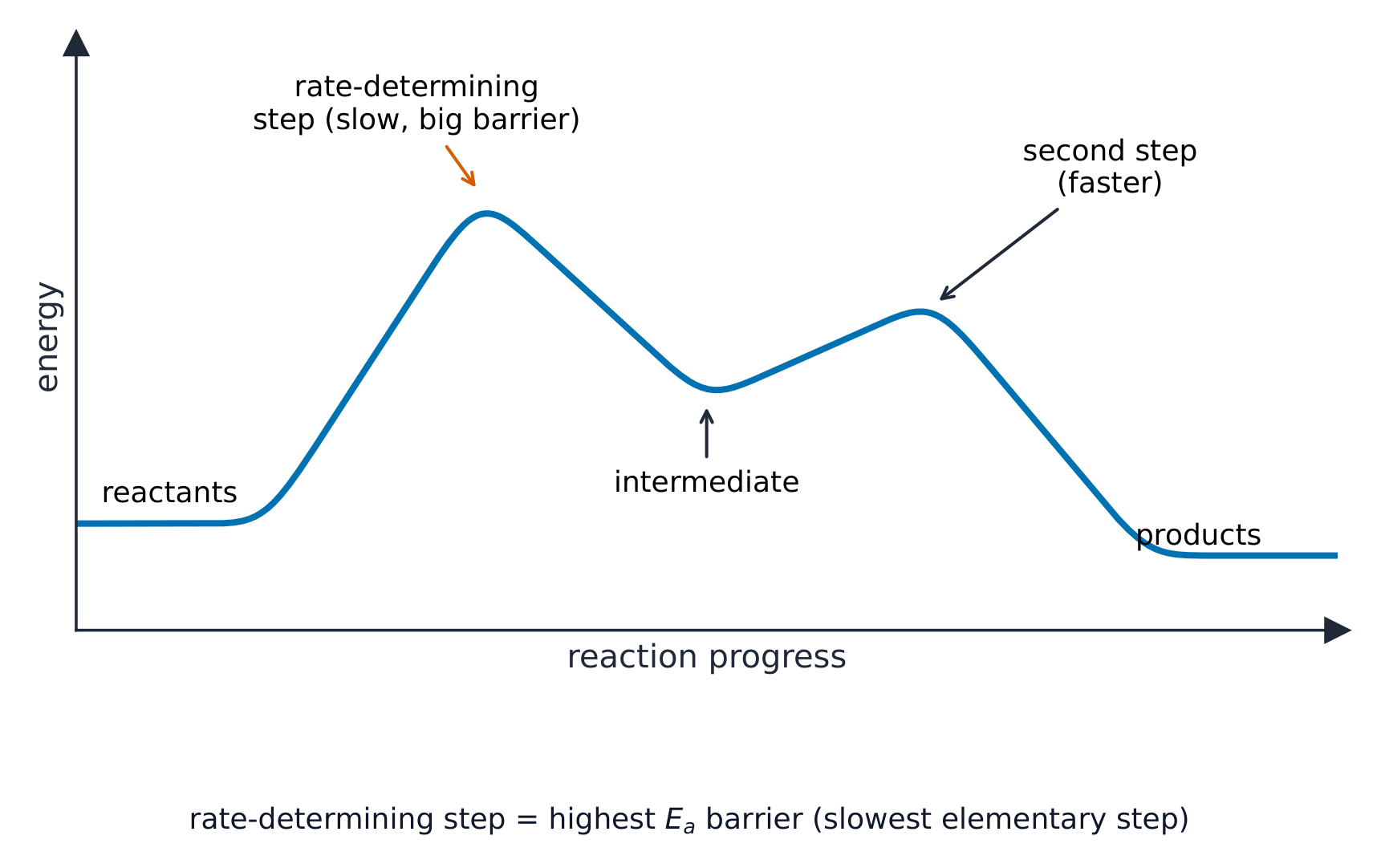
Most reactions happen in several steps. The slowest step is the rate-determining step 决速步骤, and it controls the overall rate. Only the species involved up to and including this step appear in the rate equation.
A two-step profile: the slower step has the bigger barrier and is rate-determining; the dip between the two barriers is an intermediate - an intermediate 中间体 is a species made in one step and then used up in a later step. It is not in the overall equation.
- you can suggest a mechanism that fits both the rate equation and the overall equation, predict the order from a given mechanism, or pick out the rate-determining step.
If you compare the initial rate 初始速率 of different mixtures, you can deduce the rate equation, and from that work out the mechanism.
Effect of temperature
Raising the temperature increases the rate constant $k$ (more molecules pass the activation energy), so the rate goes up.
ExploreOrganic mechanism route
Trace electron-pair movement from reagent to product.
Vocabulary TrainEnglish rate-determining step/reɪt dɪˈtɜːmɪnɪŋ step/ intermediate/ˌɪntəˈmiːdɪət/ initial rate/ɪˈnɪʃl reɪt/ 26.2
Catalysts

Syllabus
- explain that catalysts can be homogeneous or heterogeneous
- describe the mode of action of a heterogeneous catalyst to include adsorption of reactants, bond weakening and desorption of products, for example: (a) iron in the Haber process (b) palladium, platinum and rhodium in the catalytic removal of oxides of nitrogen from the exhaust gases of car engines
- describe the mode of action of a homogeneous catalyst by being used in one step and reformed in a later step, for example: (a) atmospheric oxides of nitrogen in the oxidation of atmospheric sulfur dioxide (b) $\text{Fe}^{2+}$ or $\text{Fe}^{3+}$ in the $\text{I}^- / \text{S}_2\text{O}_8^{2-}$ reaction
Source: Cambridge International syllabus
Catalysts 催化剂 can be homogeneous or heterogeneous.
Heterogeneous catalysts
A heterogeneous catalyst 多相催化剂 is in a different physical state from the reactants (usually a solid with gases). It works in three stages:
- adsorption 吸附: reactant molecules stick to the catalyst surface.
- the bonds in the reactants are weakened, so they react more easily.
- desorption 脱附: the product molecules leave the surface.
A heterogeneous catalyst works in three stages: the reactants adsorb onto the surface, their weakened bonds let them react, then the product desorbs 
Real heterogeneous catalysts are made as small shaped pellets, rings and perforated discs, which give a large surface area for the reactants to stick to Examples are iron in the Haber process, and platinum, palladium and rhodium in a catalytic converter.
Homogeneous catalysts
A homogeneous catalyst 均相催化剂 is in the same physical state as the reactants. It is used up in one step and then reformed in a later step, so it comes back unchanged. Examples are oxides of nitrogen helping to oxidise atmospheric sulfur dioxide, and $\text{Fe}^{2+}$ or $\text{Fe}^{3+}$ speeding up the reaction between $\text{I}^-$ and $\text{S}_2\text{O}_8^{2-}$.
ExploreHow a catalyst speeds a reaction
Turn the catalyst on and watch the rate jump — it gives more successful collisions per second by offering a lower-energy path.
Vocabulary TrainEnglish catalyst/ˈkætəlɪst/ heterogeneous catalyst/ˌhetrəˈdʒiːnɪəs ˈkætəlɪst/ adsorption/ədˈsɔːpʃn/ desorption/dɪˈsɔːpʃn/ homogeneous catalyst/həˈməʊdʒnɪəs ˈkætəlɪst/ 26.2
Exam tips
- Find orders from initial-rate data: doubling a concentration that doubles the rate is first order, quadruples it is second order, no change is zero order.
- Write $\text{rate} = k[\text{A}]^m[\text{B}]^n$ and work out the units of $k$ from it.
- The rate-determining step contains the species (and orders) in the rate equation — use this to test a mechanism.
- A constant half-life means first order.
-
27
Group 2
Watch lesson27.1
Thermal stability of the nitrates and carbonates

Syllabus
- describe and explain qualitatively the trend in the thermal stability of the nitrates and carbonates including the effect of ionic radius on the polarisation of the large anion
- describe and explain qualitatively the variation in solubility and of enthalpy change of solution, $\Delta H^{\ominus}_{\text{sol}}$, of the hydroxides and sulfates in terms of relative magnitudes of the enthalpy change of hydration and the lattice energy
Source: Cambridge International syllabus
The thermal stability 热稳定性 of the Group 2 nitrates 硝酸盐 and carbonates 碳酸盐 increases down the group. Here is the reason, in terms of how the ions affect each other.
Heating limestone (calcium carbonate) in a kiln decomposes it to calcium oxide — a thermal decomposition A small cation 阳离子 with a small ionic radius 离子半径 has a high charge density. It pulls on the electrons of the nearby anion and distorts its shape — this is polarisation 极化. Distorting the large anion 阴离子 (the carbonate or nitrate ion) weakens a bond inside it, so the compound breaks down more easily.
Going down the group, the cation gets larger. Its charge density drops, so it polarises the anion less. The anion is less distorted, so the compound is harder to break down — it is more thermally stable and needs a higher temperature to decompose.

A small cation has a high charge density, so it distorts (polarises) the large anion more — weakening it, so the compound is less stable Worked example. Down Group 2 the hydroxides become more soluble while the sulfates become less soluble. Explain why the two trends run in opposite directions. Solubility is a contest between the lattice energy holding the solid together and the hydration energy rewarding the ions for dissolving. Both get less exothermic as the cation grows, so whichever falls faster decides the trend. With the small hydroxide ion, the lattice energy depends strongly on the cation's size, so it falls faster than the hydration energy: the lattice gets relatively easier to break and solubility rises. With the large sulfate ion, the lattice energy is already dominated by that big anion and barely changes down the group, while the cation's hydration energy still falls - so solubility falls. Name both energies and say which one falls faster; simply restating the trends earns no explanation marks.
ExploreGroup 2 thermal stability ladder
Move down Group 2 and see why carbonates become harder to decompose.
ExploreGroup 2 solubility lab
Classify Group 2 compounds by solubility trend.
Vocabulary TrainEnglish thermal stability/ˈθɜːml stəˈbɪlɪti/ nitrate/ˈnaɪtreɪt/ carbonate/ˈkɑːbəneɪt/ cation/ˈkætaɪən/ ionic radius/aɪˈɒnɪk ˈreɪdɪəs/ polarisation/ˌpəʊləraɪˈzeɪʃn/ anion/ˈænaɪən/ 27.1
Solubility of the hydroxides and sulfates

When an ionic solid dissolves, two energy changes compete. The enthalpy change of solution 溶解焓变 is the sum of them:
Down Group 2 the hydroxides get more soluble but the sulfates less $$\Delta H^{\ominus}_{\text{sol}} = -\Delta H_{\text{latt}} + \Delta H_{\text{hyd}}$$- you must first pull the lattice apart (this needs the lattice energy 晶格能).
- then water surrounds the ions (this releases the enthalpy change of hydration 水合焓变).
If the energy released on hydration roughly matches (or beats) the energy needed to break the lattice, the solid dissolves easily.

An insoluble metal hydroxide forms as a gelatinous precipitate when its lattice energy is too large to be repaid by hydration Going down the group, both the lattice energy and the hydration enthalpy get smaller (less negative), because the cation is larger. But they shrink at different rates, and this explains the opposite trends:

Why the trends are opposite: the small OH$^-$ lattice energy falls a lot down the group (hydroxides dissolve more), but the large SO$_4^{2-}$ lattice energy barely changes (sulfates dissolve less) Compound Trend in solubility 溶解度 down the group Why hydroxides 氢氧化物 increases the $\text{OH}^-$ ion is small, so the lattice energy falls a lot down the group; this change outweighs the fall in hydration energy sulfates 硫酸盐 decreases the $\text{SO}_4^{2-}$ ion is large, so the lattice energy stays almost the same; the fall in hydration energy then dominates, so dissolving becomes less favourable Vocabulary TrainEnglish enthalpy change of solution/enˈθælpi tʃeɪndʒ ɒv səˈluːʃn/ lattice energy/ˈlætɪs ˈenədʒi/ enthalpy change of hydration/enˈθælpi tʃeɪndʒ ɒv haɪˈdreɪʃn/ solubility/ˌsɒljuːˈbɪlɪti/ hydroxide/haɪˈdrɒksaɪd/ sulfate/ˈsʌlfeɪt/ 27.1
Exam tips
- Thermal stability of carbonates and nitrates increases down the group — larger cations polarise the anion less.
- Give the decomposition products: carbonates → oxide + $\text{CO}_2$; nitrates → oxide + $\text{NO}_2$ + $\text{O}_2$ (brown gas).
- Hydroxides get more soluble and sulfates less soluble down the group.
- Explain trends with cation charge density (polarising power), not just size.
-
28
Chemistry of transition elements
Watch lesson28.1
Transition elements

Syllabus
- define a transition element as a d-block element which forms one or more stable ions with incomplete d orbitals
- sketch the shape of a $3\text{d}_{xy}$ orbital and $3\text{d}_{z^2}$ orbital
- understand that transition elements have the following properties: (a) they have variable oxidation states (b) they behave as catalysts (c) they form complex ions (d) they form coloured compounds
- explain why transition elements have variable oxidation states in terms of the similarity in energy of the 3d and the 4s sub-shells
- explain why transition elements behave as catalysts in terms of having more than one stable oxidation state, and vacant d orbitals that are energetically accessible and can form dative bonds with ligands
- explain why transition elements form complex ions in terms of vacant d orbitals that are energetically accessible
Source: Cambridge International syllabus
A transition element 过渡元素 is a d-block element that forms one or more stable ions with incomplete d orbitals. (Scandium and zinc are in the d-block but are not transition elements, because their stable ions have empty or full d orbitals.)
The 3d orbitals 轨道 have set shapes: the $3\text{d}_{xy}$ orbital has four lobes pointing between the axes, and the $3\text{d}_{z^2}$ orbital has two lobes along the $z$-axis with a ring around the middle.
Four key properties (and why)
Property Reason variable oxidation state 氧化态 the 3d and 4s sub-shells are close in energy, so similar small amounts of energy remove different numbers of electrons act as a catalyst 催化剂 they have more than one stable oxidation state, and vacant d orbitals that can form dative bonds form complex ions vacant d orbitals can accept lone pairs form coloured compounds electrons move between split d orbitals (see below) The four key properties of the transition elements 
A ruby is red because of transition-metal (chromium) ions held in its crystal lattice ExploreTransition element property lab
Sort transition-metal evidence by the property it shows.
Vocabulary TrainEnglish transition element/trænˈsɪʃn ˈelɪmənt/ orbital/ˈɔːbɪtl/ oxidation state/ˌɒksɪˈdeɪʃn steɪt/ catalyst/ˈkætəlɪst/ 28.2
Ligands and complexes

Syllabus
- describe and explain the reactions of transition elements with ligands to form complexes, including the complexes of copper(II) and cobalt(II) ions with water and ammonia molecules and hydroxide and chloride ions
- define the term ligand as a species that contains a lone pair of electrons that forms a dative covalent bond to a central metal atom/ion
- understand and use the terms: (a) monodentate ligand including as examples $\text{H}_2\text{O}$, $\text{NH}_3$, $\text{Cl}^-$ and $\text{CN}^-$ (b) bidentate ligand including as examples 1,2-diaminoethane, en, $\text{H}_2\text{NCH}_2\text{CH}_2\text{NH}_2$ and the ethanedioate ion, $\text{C}_2\text{O}_4^{2-}$ (c) polydentate ligand including as an example $\text{EDTA}^{4-}$
- define the term complex as a molecule or ion formed by a central metal atom/ion surrounded by one or more ligands
- describe the geometry (shape and bond angles) of transition element complexes which are linear, square planar, tetrahedral or octahedral
- (a) state what is meant by coordination number (b) predict the formula and charge of a complex ion, given the metal ion, its charge or oxidation state, the ligand and its coordination number or geometry
- explain qualitatively that ligand exchange can occur, including the complexes of copper(II) ions and cobalt(II) ions with water and ammonia molecules and hydroxide and chloride ions
- predict, using $E^\ominus$ values, the feasibility of redox reactions involving transition elements and their ions
- describe the reactions of, and perform calculations involving: (a) $\text{MnO}_4^- / \text{C}_2\text{O}_4^{2-}$ in acid solution given suitable data (b) $\text{MnO}_4^- / \text{Fe}^{2+}$ in acid solution given suitable data (c) $\text{Cu}^{2+} / \text{I}^-$ given suitable data
- perform calculations involving other redox systems given suitable data
Source: Cambridge International syllabus
A transition metal ion can be surrounded by complex ions 配离子. The species attached are ligands.
A ligand 配体 is a species with a lone pair of electrons that forms a dative covalent bond 配位键 to the central metal ion. (The lone pair 孤对电子 is what it donates.) Ligands are grouped by how many such bonds they can form:
- monodentate 单齿: one bond ($\text{H}_2\text{O}$, $\text{NH}_3$, $\text{Cl}^-$, $\text{CN}^-$).
- bidentate 双齿: two bonds (1,2-diaminoethane "en", and the ethanedioate ion $\text{C}_2\text{O}_4^{2-}$).
- polydentate 多齿: many bonds ($\text{EDTA}^{4-}$, which uses six).
Ligands are grouped by how many dative bonds they form: monodentate (one), bidentate (two) or polydentate (many, like EDTA's six) A complex 配合物 is a central metal atom or ion surrounded by one or more ligands. Its shape can be linear 直线形, square planar 平面正方形, tetrahedral 四面体形 or octahedral 八面体形.
The coordination number 配位数 is the number of dative bonds from the ligands to the central ion (6 → octahedral, 4 → tetrahedral or square planar, 2 → linear). To predict the charge of a complex, add the metal's charge and all the ligand charges.

Complex shapes follow the coordination number: 2 is linear, 4 is tetrahedral or square planar, 6 is octahedral Ligand exchange
In ligand exchange 配体交换 one ligand replaces another, often with a colour change. For copper(II):
$$[\text{Cu}(\text{H}_2\text{O})_6]^{2+} \;(\text{pale blue}) \;\xrightarrow{\text{NH}_3}\; [\text{Cu}(\text{NH}_3)_4(\text{H}_2\text{O})_2]^{2+} \;(\text{deep blue})$$With concentrated $\text{HCl}$ it becomes yellow $[\text{CuCl}_4]^{2-}$; cobalt(II) behaves in a similar way.

Ligand exchange changes the colour of copper(II): pale blue with water, deep blue with ammonia, yellow with concentrated HCl Redox reactions of transition ions
Use $E^{\ominus}$ values to predict whether a redox reaction is feasible. Common titrations you should be able to calculate include $\text{MnO}_4^-/\text{C}_2\text{O}_4^{2-}$ and $\text{MnO}_4^-/\text{Fe}^{2+}$ in acid (purple to colourless), and $\text{Cu}^{2+}/\text{I}^-$ (which makes iodine, then titrated with thiosulfate).
Worked example. In acid, $\text{MnO}_4^-$ reacts with $\text{Fe}^{2+}$ in the ratio $1:5$ (see the balanced equation above). A $25.0\ \text{cm}^3$ sample of $\text{Fe}^{2+}$ solution needs $22.0\ \text{cm}^3$ of $0.0200\ \text{mol dm}^{-3}$ $\text{KMnO}_4$ to reach the end point. Find the concentration of the $\text{Fe}^{2+}$.
Moles of $\text{MnO}_4^-$ used $= 0.0200 \times \dfrac{22.0}{1000} = 4.40 \times 10^{-4}\ \text{mol}$. Each mole of $\text{MnO}_4^-$ reacts with $5$ moles of $\text{Fe}^{2+}$, so moles of $\text{Fe}^{2+} = 5 \times 4.40 \times 10^{-4} = 2.20 \times 10^{-3}\ \text{mol}$. This was in $25.0\ \text{cm}^3$, so
$$[\text{Fe}^{2+}] = \frac{2.20 \times 10^{-3}}{25.0/1000} = 0.0880\ \text{mol dm}^{-3}.$$ExploreLigand and complex lab
Identify the part of a complex ion that controls its structure.
ExploreLigand exchange route
Follow one ligand replacing another around a metal ion.
Vocabulary TrainEnglish complex ion/ˈkɒmpleks ˈaɪɒn/ ligand/ˈlɪɡænd/ dative covalent bond/ˈdætɪv ˈkəʊvələnt bɒnd/ lone pair/ləʊn peə/ monodentate/ˈmɒnəʊdenteɪt/ bidentate/baɪˈdenteɪt/ polydentate/ˌpɒlɪˈdenteɪt/ complex/ˈkɒmpleks/ linear/ˈlɪnɪə/ square planar/skweə ˈpleɪnə/ tetrahedral/ˌtetrəˈhiːdrəl/ octahedral/ˌɒktəˈhiːdrəl/ coordination number/kəʊˈɔːdɪneɪʃn ˈnʌmbə/ ligand exchange/ˈlɪɡænd eksˈtʃeɪndʒ/ 28.3
Why complexes are coloured

Syllabus
- define and use the terms degenerate and non-degenerate d orbitals
- describe the splitting of degenerate d orbitals into two non-degenerate sets of d orbitals of higher energy, and use of $\Delta E$ in: (a) octahedral complexes, two higher and three lower d orbitals (b) tetrahedral complexes, three higher and two lower d orbitals
- explain why transition elements form coloured compounds in terms of the frequency of light absorbed as an electron is promoted between two non-degenerate d orbitals
- describe, in qualitative terms, the effects of different ligands on $\Delta E$, frequency of light absorbed, and hence the complementary colour that is observed
- use the complexes of copper(II) ions and cobalt(II) ions with water and ammonia molecules and hydroxide and chloride ions as examples of ligand exchange affecting the colour observed
Source: Cambridge International syllabus
In a free ion the five d orbitals are degenerate 简并 — they have the same energy. When ligands come close, they split the d orbitals into two non-degenerate 非简并 sets, separated by an energy gap $\Delta E$:
- octahedral: three lower and two higher orbitals.
- tetrahedral: two lower and three higher orbitals.
A complex absorbs light whose frequency matches $\Delta E$, promoting an electron from a lower to a higher d orbital. The colour you see is the complementary colour 互补色 of the light absorbed. Different ligands give a different $\Delta E$, so they change the frequency absorbed and hence the colour — which is why ligand exchange changes the colour.
Ligands split the five d orbitals into two sets separated by a gap $\Delta E$; the complex absorbs light of that energy, so we see the complementary colour 
Different metals and oxidation states give different colours: cobalt(II) (red), dichromate (orange), chromate (yellow), nickel(II) (green), copper(II) (blue) and permanganate (violet) ExploreComplex colour route
Follow light absorption from d-orbital splitting to observed colour.
Vocabulary TrainEnglish degenerate/dɪˈdʒenəreɪt/ non-degenerate/nɒn dɪˈdʒenəreɪt/ complementary colour/ˌkɒmplɪˈmentəri ˈkʌlə/ 28.4
Stereoisomerism in complexes

Syllabus
- describe the types of stereoisomerism shown by complexes, including those associated with bidentate ligands: (a) geometrical (cis/trans) isomerism, e.g. square planar such as $[\text{Pt}(\text{NH}_3)_2\text{Cl}_2]$ and octahedral such as $[\text{Co}(\text{NH}_3)_4(\text{H}_2\text{O})_2]^{2+}$ and $[\text{Ni}(\text{H}_2\text{NCH}_2\text{CH}_2\text{NH}_2)_2(\text{H}_2\text{O})_2]^{2+}$ (b) optical isomerism, e.g. $[\text{Ni}(\text{H}_2\text{NCH}_2\text{CH}_2\text{NH}_2)_3]^{2+}$ and $[\text{Ni}(\text{H}_2\text{NCH}_2\text{CH}_2\text{NH}_2)_2(\text{H}_2\text{O})_2]^{2+}$
- deduce the overall polarity of complexes such as those described in 28.4.1(a) and 28.4.1(b)
Source: Cambridge International syllabus
- geometrical isomerism 几何异构 (cis 顺式 / trans 反式) appears in square planar complexes such as $[\text{Pt}(\text{NH}_3)_2\text{Cl}_2]$, and in octahedral complexes such as $[\text{Co}(\text{NH}_3)_4(\text{H}_2\text{O})_2]^{2+}$.
Geometrical isomerism in a square planar complex: the two identical ligands are adjacent (cis) or opposite (trans) - optical isomerism 旋光异构 appears in octahedral complexes with bidentate ligands, such as $[\text{Ni}(\text{en})_3]^{2+}$, which has two non-superimposable mirror images.
You can also deduce the polarity of a complex: a cis form may be polar, while the matching trans form is often non-polar because its dipoles cancel.
ExploreComplex stereoisomer lab
Classify complex isomers by ligand arrangement.
Vocabulary TrainEnglish geometrical isomerism/ˌdʒiːəʊˈmetrɪkl ˈaɪsəmərɪzəm/ cis/sɪs/ trans/trænz/ optical isomerism/ˈɒptɪkl ˈaɪsəmərɪzəm/ 28.5
Stability constants
Syllabus
- define the stability constant, $K_{\text{stab}}$, of a complex as the equilibrium constant for the formation of the complex ion in a solvent (from its constituent ions or molecules)
- write an expression for a $K_{\text{stab}}$ of a complex ($[\text{H}_2\text{O}]$ should not be included)
- use $K_{\text{stab}}$ expressions to perform calculations
- describe and explain ligand exchanges in terms of $K_{\text{stab}}$ values and understand that a large $K_{\text{stab}}$ is due to the formation of a stable complex ion
Source: Cambridge International syllabus
The stability constant 稳定常数 ($K_{\text{stab}}$) is the equilibrium constant for forming a complex ion from the metal ion and its ligands in solution (water is left out of the expression).
A large $K_{\text{stab}}$ means a very stable complex. In a ligand exchange, the position moves towards the complex with the larger $K_{\text{stab}}$ — that is why a ligand that forms a more stable complex can push out a weaker one.
ExploreStability constant lab
larger Kstab favours complex
Increase ligand binding strength and see complex formation become more complete.
Vocabulary TrainEnglish stability constant/stəˈbɪlɪti ˈkɒnstənt/ 28.5
Exam tips
- Define a transition element: it forms at least one ion with a partially filled d sub-shell — so Sc and Zn are excluded.
- Colour comes from d-d transitions (ligands split the d orbitals); the colour seen is the complement of the light absorbed.
- State the ligand and coordination number and predict the shape (6 = octahedral, 4 = tetrahedral or square planar).
- Ligand exchange can change colour and coordination number; a larger stability constant = a more stable complex.
-
29
An introduction to A Level organic chemistry
Watch lesson29.1
New functional groups and naming

Syllabus
- understand that the compounds in the table on page 47 contain a functional group which dictates their physical and chemical properties
- interpret and use the general, structural, displayed and skeletal formulas of the classes of compound stated in the table on page 47
- understand and use systematic nomenclature of simple aliphatic organic molecules (including cyclic compounds containing a single ring of up to six carbon atoms) with functional groups detailed in the table on page 47, up to six carbon atoms (six plus six for esters and amides, straight chains only for esters and nitriles)
- understand and use systematic nomenclature of simple aromatic molecules with one benzene ring and one or more simple substituents, for example 3-nitrobenzoic acid or 2,4,6-tribromophenol
Source: Cambridge International syllabus
At A Level you meet more functional group 官能团 families, including the amide 酰胺 group and aromatic 芳香 compounds (those built on a benzene ring). As before, the functional group decides the properties, and you read it from the general, structural, displayed or skeletal formula.
Naming aromatic compounds
A benzene 苯 molecule is a ring of six carbons. When you name an aromatic compound, use the benzene ring 苯环 as the parent and number the positions of the substituents. For example, 3-nitrobenzoic acid has a $\text{–NO}_2$ group on carbon 3, and 2,4,6-tribromophenol has three bromine atoms on a phenol ring. You can also name cyclic compounds with a single ring of up to six carbons.
Number the ring from the principal group (carbon 1); the substituent positions then give the name ExploreAromatic naming lab
Classify aromatic substituents by how they are named.
Vocabulary TrainEnglish functional group/ˈfʌŋkʃənl ɡruːp/ amide/əˈmaɪd/ aromatic/ərəʊˈmætɪk/ benzene/ˈbenziːn/ benzene ring/ˈbenziːn rɪŋ/ 29.2
Two new types of mechanism

Syllabus
- understand and use the following terminology associated with types of organic mechanisms: (a) electrophilic substitution (b) addition–elimination
Source: Cambridge International syllabus
- electrophilic substitution 亲电取代: an electrophile replaces a hydrogen atom on a benzene ring (this is how benzene reacts).
- addition–elimination 加成消去: a molecule first adds on, then a small molecule is removed (seen with 2,4-DNPH and with acyl chlorides).
Two aromatic mechanisms: electrophilic substitution and addition-elimination ExploreElectrophilic substitution on benzene
Step through how benzene reacts. An electrophile swaps for a hydrogen — keeping the stable ring — instead of adding across it.
Vocabulary TrainEnglish electrophilic substitution/ɪˌlektrəʊˈfɪlɪk ˌsʌbstɪˈtjuːʃn/ addition–elimination/əˈdɪʃn ɪˌlɪmɪˈneɪʃn/ 29.3
The shape of benzene

Syllabus
- describe and explain the shape of benzene and other aromatic molecules, including $\text{sp}^2$ hybridisation, in terms of $\sigma$ bonds and a delocalised $\pi$ system
Source: Cambridge International syllabus
Benzene is a flat, regular hexagon. Each carbon is sp² hybridised, using its three hybridisation 杂化 orbitals to make sigma bonds σ键 to two neighbouring carbons and one hydrogen. This gives the ring of σ bonds.
Each carbon also has one electron left in a p orbital, standing up at right angles to the ring. These p orbitals overlap sideways all the way round, making a single delocalised 离域 pi bond π键 system — a ring of electrons above and below the plane. Because the electrons are shared evenly, all six C–C bonds are the same length, and benzene is very stable.
Benzene's bonding: an sp$^2$ $\sigma$ framework makes the flat hexagon, while the p orbitals overlap into one delocalised $\pi$ system above and below the ring How do we know benzene really is delocalised? One strong piece of evidence is its enthalpy change of hydrogenation 氢化焓变. Adding hydrogen to one C=C double bond (as in cyclohexene) releases about $120\ \text{kJ}\,\text{mol}^{-1}$, so a Kekulé ring of three separate double bonds should release about $3 \times 120 = 360\ \text{kJ}\,\text{mol}^{-1}$. Real benzene releases only $208\ \text{kJ}\,\text{mol}^{-1}$ — it is about $152\ \text{kJ}\,\text{mol}^{-1}$ more stable than the model predicts.

Evidence for delocalisation: real benzene releases far less on hydrogenation ($-208\ \text{kJ}\,\text{mol}^{-1}$) than the Kekulé model predicts ($-360 = 3\times$ cyclohexene), so it is about $152\ \text{kJ}\,\text{mol}^{-1}$ more stable than expected ExploreBenzene bonding lab
Follow the evidence for a planar delocalised benzene ring.
Vocabulary TrainEnglish hybridisation/ˌhaɪbrɪdaɪˈzeɪʃn/ sigma bond/ˈsɪɡmə bɒnd/ delocalised/dɪˈlɒkəlaɪzd/ pi bond/paɪ bɒnd/ enthalpy change of hydrogenation/enˈθælpi tʃeɪndʒ ɒv haɪˈdrɒdʒəneɪʃn/ 29.4
Optical isomerism

Syllabus
- understand that enantiomers have identical physical and chemical properties apart from their ability to rotate plane polarised light and their potential biological activity
- understand and use the terms optically active and racemic mixture
- describe the effect on plane polarised light of the two optical isomers of a single substance
- explain the relevance of chirality to the synthetic preparation of drug molecules including: (a) the potential different biological activity of the two enantiomers (b) the need to separate a racemic mixture into two pure enantiomers (c) the use of chiral catalysts to produce a single pure optical isomer (Candidates should appreciate that compounds can contain more than one chiral centre, but knowledge of meso compounds and nomenclature such as diastereoisomers is not required.)
Source: Cambridge International syllabus
Two enantiomers 对映体 (mirror-image isomers) have identical physical and chemical properties, with two exceptions:
- they rotate plane polarised light 平面偏振光 in opposite directions. A substance that does this is optically active 旋光活性.
- they may have different effects in living things (biological activity).
A racemic mixture 外消旋混合物 is a 50:50 mix of the two enantiomers. It does not rotate plane polarised light, because the two opposite rotations cancel out.
The two enantiomers rotate plane-polarised light in opposite directions; a 50:50 racemic mixture gives no net rotation Why chirality matters for drugs
Chirality 手性 is important when making medicines. A molecule with a chiral centre 手性中心 has two enantiomers, and they can behave very differently in the body — one may cure while the other does harm. So drug makers either:
- separate a racemic mixture into the two pure enantiomers, or
- use a chiral catalyst 手性催化剂 to make just the single enantiomer they want.
Worked example. Which of butan-1-ol, butan-2-ol and 2-methylpropan-2-ol is chiral? A molecule is chiral if it has a carbon carrying four different groups. Take the carbons one at a time. In butan-2-ol, $\text{CH}_3\text{CH(OH)CH}_2\text{CH}_3$, carbon 2 carries $\text{OH}$, $\text{H}$, $\text{CH}_3$ and $\text{C}_2\text{H}_5$ - four different groups, so it is a chiral centre and butan-2-ol exists as two optical isomers. Butan-1-ol's carbon 1 carries two hydrogens, and the central carbon of 2-methylpropan-2-ol carries two identical methyl groups, so neither is chiral. It takes only one repeated group on a carbon to destroy the chirality there - and compare groups properly: $\text{CH}_3$ and $\text{C}_2\text{H}_5$ differ, but only once you look past the first atom.
ExploreOptical isomerism lab
Identify when a molecule can have non-superimposable mirror images.
Vocabulary TrainEnglish enantiomers/eˈnæntɪəməz/ plane polarised light/pleɪn ˈpəʊləraɪzd laɪt/ optically active/ˈɒptɪkli ˈæktɪv/ racemic mixture/rəˈsiːmɪk ˈmɪkstʃə/ chirality/kaɪˈrælɪti/ chiral centre/ˈkaɪrəl ˈsentə/ chiral catalyst/ˈkaɪrəl ˈkætəlɪst/ 29.4
Exam tips
- Optical isomers need a chiral carbon (four different groups); they are non-superimposable mirror images that rotate plane-polarised light oppositely.
- A racemic mixture forms when a planar intermediate (carbocation or $\text{C}=\text{O}$) is attacked equally from both sides.
- Benzene's delocalised ring (equal bond lengths, planar) explains its stability versus the Kekulé model.
- Learn the two new mechanisms — electrophilic substitution of arenes, and nucleophilic addition-elimination.
-
30
Hydrocarbons
Watch lesson30.1
Arenes

Syllabus
- describe the chemistry of arenes as exemplified by the following reactions of benzene and methylbenzene: (a) substitution reactions with $\text{Cl}_2$ and with $\text{Br}_2$ in the presence of a catalyst, $\text{AlCl}_3$ or $\text{AlBr}_3$, to form halogenoarenes (aryl halides) (b) nitration with a mixture of concentrated $\text{HNO}_3$ and concentrated $\text{H}_2\text{SO}_4$ at a temperature between $25\text{ }^{\circ}\text{C}$ and $60\text{ }^{\circ}\text{C}$ (c) Friedel–Crafts alkylation by $\text{CH}_3\text{Cl}$ and $\text{AlCl}_3$ and heat (d) Friedel–Crafts acylation by $\text{CH}_3\text{COCl}$ and $\text{AlCl}_3$ and heat (e) complete oxidation of the side-chain using hot alkaline $\text{KMnO}_4$ and then dilute acid to give a benzoic acid (f) hydrogenation of the benzene ring using $\text{H}_2$ and $\text{Pt/Ni}$ catalyst and heat to form a cyclohexane ring
- describe the mechanism of electrophilic substitution in arenes: (a) as exemplified by the formation of nitrobenzene and bromobenzene (b) with regards to the effect of delocalisation (aromatic stabilisation) of electrons in arenes to explain the predomination of substitution over addition
- predict whether halogenation will occur in the side-chain or in the aromatic ring in arenes depending on reaction conditions
- describe that in the electrophilic substitution of arenes, different substituents direct to different ring positions (limited to the directing effects of $-\text{NH}_2$, $-\text{OH}$, $-\text{R}$, $-\text{NO}_2$, $-\text{COOH}$ and $-\text{COR}$)
Source: Cambridge International syllabus
Arenes 芳烃 are aromatic hydrocarbons, built on the benzene 苯 ring. The delocalised ring of electrons is stable and electron-rich, so benzene mostly reacts by electrophilic substitution 亲电取代 — keeping the ring — rather than by addition.
Naphthalene, used in mothballs, is a simple arene — two benzene rings fused together Reactions of benzene and methylbenzene
Reaction Reagents and conditions Product halogenation $\text{Cl}_2$ or $\text{Br}_2$, with $\text{AlCl}_3$ or $\text{AlBr}_3$ as a catalyst 催化剂 a halogenoarene 卤代芳烃 (aryl halide) nitration 硝化 concentrated $\text{HNO}_3$ + concentrated $\text{H}_2\text{SO}_4$, $25$–$60\,°\text{C}$ nitrobenzene Friedel–Crafts alkylation 傅克烷基化 $\text{CH}_3\text{Cl}$ + $\text{AlCl}_3$, heat methylbenzene (adds an alkyl group) Friedel–Crafts acylation 傅克酰基化 $\text{CH}_3\text{COCl}$ + $\text{AlCl}_3$, heat a phenyl ketone (adds an acyl group) side-chain oxidation hot alkaline $\text{KMnO}_4$, then dilute acid benzoic acid 苯甲酸 hydrogenation 氢化 $\text{H}_2$, $\text{Pt/Ni}$ catalyst, heat cyclohexane 
Friedel-Crafts: alkylation adds an alkyl group, acylation an acyl group 
Benzene keeps its stable ring, reacting mostly by electrophilic substitution (and by addition only with hydrogen) In the side-chain oxidation, the whole side-chain 侧链 (such as the $\text{–CH}_3$ on methylbenzene) is turned into a $\text{–COOH}$ group, giving benzoic acid. In the hydrogenation, three molecules of $\text{H}_2$ add to the benzene ring 苯环 to make a saturated cyclohexane ring.
The mechanism: electrophilic substitution
Take nitration as the example. The acid mix makes the electrophile $\text{NO}_2^+$. Then:
- the delocalised electrons of the ring form a bond to the electrophile, giving an unstable intermediate.
- an $\text{H}^+$ is lost from that carbon, which restores the stable ring.
Substitution wins over addition because the delocalisation 离域 (aromatic stabilisation) of the ring is kept. Addition would destroy this stable system, so it is not favoured.

Electrophilic substitution (nitration): the ring attacks the electrophile NO$_2^+$ to give an unstable intermediate, then loses H$^+$ to restore the ring Side-chain or ring?
Where a halogen reacts depends on the conditions:
- with a halogen-carrier catalyst (such as $\text{AlCl}_3$) and no UV light → substitution in the ring.
- with UV light and no catalyst → free-radical substitution in the side-chain.

The conditions decide: a halogen carrier (AlCl₃) substitutes the ring; UV light substitutes the side-chain Directing effects
A group already on the ring decides where the next group goes — its directing effect 定位效应:

A group already on the ring directs the next one: –NH$_2$/–OH/–R send it to positions 2 and 4; –NO$_2$/–COOH/–COR send it to position 3 Group already present Directs the new group to $\text{–NH}_2$, $\text{–OH}$, $\text{–R}$ positions 2 and 4 $\text{–NO}_2$, $\text{–COOH}$, $\text{–COR}$ position 3 Worked example. Methylbenzene and nitrobenzene are each nitrated. Predict where the new $\text{NO}_2$ group goes, and which compound reacts faster. Look at the group already on the ring. In methylbenzene the $\text{–CH}_3$ is an alkyl group: it directs the new group to positions 2 and 4, and it releases electrons into the ring, making the ring more attractive to an electrophile - so methylbenzene nitrates faster than benzene. In nitrobenzene the $\text{–NO}_2$ directs to position 3, and it withdraws electrons from the ring - so nitrobenzene nitrates more slowly than benzene. The group already present controls both the position and the rate, and the two always travel together: 2,4-directors activate the ring, 3-directors deactivate it.
ExploreArene substitution route
Follow electrophilic substitution on benzene.
ExploreDirecting effects lab
Classify substituents by how they affect the benzene ring.
Vocabulary TrainEnglish arene/ˈæren/ benzene/ˈbenziːn/ electrophilic substitution/ɪˌlektrəʊˈfɪlɪk ˌsʌbstɪˈtjuːʃn/ catalyst/ˈkætəlɪst/ halogenoarene/ˈheɪləʊdʒnɔːren/ nitration/naɪˈtreɪʃn/ Friedel–Crafts alkylation/ˈfriːdl kræfts ˌælkɪˈleɪʃn/ Friedel–Crafts acylation/ˈfriːdl kræfts əkɪˈleɪʃn/ benzoic acid/benˈzəʊɪk ˈæsɪd/ hydrogenation/haɪˈdrɒdʒəneɪʃn/ side-chain/saɪd tʃeɪn/ benzene ring/ˈbenziːn rɪŋ/ delocalisation/dɪˌlɒkəlaɪˈzeɪʃn/ directing effect/daɪˈrektɪŋ ɪˈfekt/ 30.1
Exam tips
- Benzene undergoes electrophilic substitution, not addition, because addition would destroy the stable delocalised ring.
- Learn nitration (concentrated $\text{HNO}_3$/$\text{H}_2\text{SO}_4$, $50-60\ ^\circ\text{C}$) and halogenation (halogen + $\text{AlCl}_3$) with the electrophile-generating step.
- Compare reactivity: benzene resists addition far more than an alkene because of delocalisation.
-
31
Halogen compounds
Watch lesson31.1
Making halogenoarenes

Syllabus
- recall the reactions by which halogenoarenes can be produced: substitution of an arene with $\text{Cl}_2$ or $\text{Br}_2$ in the presence of a catalyst, $\text{AlCl}_3$ or $\text{AlBr}_3$ to form a halogenoarene, exemplified by benzene to form chlorobenzene and methylbenzene to form 2-chloromethylbenzene and 4-chloromethylbenzene
- explain the difference in reactivity between a halogenoalkane and a halogenoarene as exemplified by chloroethane and chlorobenzene
Source: Cambridge International syllabus
A halogenoarene 卤代芳烃 (also called an aryl halide) is formed when an arene 芳烃 reacts with $\text{Cl}_2$ or $\text{Br}_2$, using $\text{AlCl}_3$ or $\text{AlBr}_3$ as a catalyst 催化剂. This is the electrophilic substitution from the arenes topic — the halogen replaces a hydrogen on the ring.
- benzene gives chlorobenzene.
- methylbenzene gives 1-chloro-2-methylbenzene and 1-chloro-4-methylbenzene (the methyl group directs the chlorine to positions 2 and 4).
Making a halogenoarene by electrophilic substitution: with an AlCl₃ catalyst, a chlorine replaces a hydrogen on the ring (giving HCl) 
Many pesticides and herbicides are halogenoarenes — chlorine atoms bonded to a benzene ring ExploreHalogenoarene lab
Compare halogenoarenes with halogenoalkanes.
Vocabulary TrainEnglish halogenoarene/ˈheɪləʊdʒnɔːren/ arene/ˈæren/ catalyst/ˈkætəlɪst/ 31.1
Why a halogenoarene is less reactive than a halogenoalkane

Compare chloroethane (a halogenoalkane 卤代烷) with chlorobenzene (a halogenoarene).
A halogenoalkane reacts easily by nucleophilic substitution 亲核取代: its C–Cl bond is polar, so a nucleophile can attack the slightly positive carbon and push the halogen out.
A halogenoarene is very unreactive towards nucleophilic substitution. There are two reasons:
- a lone pair 孤对电子 on the chlorine overlaps sideways with the delocalised 离域 ring of electrons. This gives the C–Cl bond partial double-bond character, making it shorter and stronger, so it is much harder to break.
- the electron-rich ring repels an approaching nucleophile 亲核试剂.
So chlorobenzene does not react with nucleophiles such as $\text{OH}^-$ under normal conditions, while chloroethane does.
Chloroethane reacts (a nucleophile attacks the $\delta+$ carbon), but chlorobenzene does not: the Cl lone pair strengthens the C–Cl bond and the ring repels nucleophiles Vocabulary TrainEnglish halogenoalkane/ˈheɪləʊdʒnəʊlkeɪn/ nucleophilic substitution/ˌnjuːklɪəˈfɪlɪk ˌsʌbstɪˈtjuːʃn/ lone pair/ləʊn peə/ delocalised/dɪˈlɒkəlaɪzd/ nucleophile/ˈnjuːklɪɒfaɪl/ 31.1
Exam tips
- A halogenoarene is less reactive than a halogenoalkane: the lone pair delocalises into the ring, giving the $\text{C-X}$ bond partial double-bond character.
- Distinguish a halogen on the ring (needs a catalyst, unreactive to substitution) from one on a side chain (reacts like a halogenoalkane).
-
32
Hydroxy compounds
Watch lesson32.1
Alcohols with acyl chlorides

Syllabus
- describe the reaction with acyl chlorides to form esters using ethyl ethanoate
Source: Cambridge International syllabus
At A Level you meet one more reaction of an alcohol 醇: it reacts with an acyl chloride 酰氯 to make an ester 酯. This works faster and more completely than using a carboxylic acid. For example, ethanol and ethanoyl chloride give ethyl ethanoate, plus fumes of $\text{HCl}$.
An acyl chloride reacts with an alcohol faster and more completely than a carboxylic acid does, giving the ester and HCl fumes ExploreAcyl chloride with alcohol route
Follow nucleophilic acyl substitution to an ester.
Vocabulary TrainEnglish alcohol/ˈælkəhɒl/ acyl chloride/əˈkɪl ˈklɔːraɪd/ ester/ˈestə/ 32.2
Phenol

Syllabus
- recall the reactions (reagents and conditions) by which phenol can be produced: (a) reaction of phenylamine with $\text{HNO}_2$ or $\text{NaNO}_2$ and dilute acid below $10\text{ }^\circ\text{C}$ to produce the diazonium salt; further warming of the diazonium salt with $\text{H}_2\text{O}$ to give phenol
- recall the chemistry of phenol, as exemplified by the following reactions: (a) with bases, for example $\text{NaOH(aq)}$ to produce sodium phenoxide (b) with $\text{Na(s)}$ to produce sodium phenoxide and $\text{H}_2\text{(g)}$ (c) in $\text{NaOH(aq)}$ with diazonium salts, to give azo compounds (d) nitration of the aromatic ring with dilute $\text{HNO}_3\text{(aq)}$ at room temperature to give a mixture of 2-nitrophenol and 4-nitrophenol (e) bromination of the aromatic ring with $\text{Br}_2\text{(aq)}$ to form 2,4,6-tribromophenol
- explain the acidity of phenol
- describe and explain the relative acidities of water, phenol and ethanol
- explain why the reagents and conditions for the nitration and bromination of phenol are different from those for benzene
- recall that the hydroxyl group of a phenol directs to the 2-, 4- and 6-positions
- apply knowledge of the reactions of phenol to those of other phenolic compounds, e.g. naphthol
Source: Cambridge International syllabus
Phenol 苯酚 has an $\text{–OH}$ group joined directly to a benzene 苯 ring. This changes the chemistry of both the $\text{–OH}$ group and the ring.
Phenol is a low-melting solid; it slowly turns pink as it oxidises in air Making phenol
Cool phenylamine 苯胺 with $\text{NaNO}_2$ and dilute acid below $10\,°\text{C}$ to make a diazonium salt 重氮盐. Warming this salt with water then gives phenol (and nitrogen gas).
Reactions of phenol
- with a base such as $\text{NaOH(aq)}$: phenol reacts to give sodium phenoxide and water. (Ordinary alcohols do not react with $\text{NaOH}$ — this shows phenol is more acidic.)
- with sodium metal: gives sodium phenoxide and hydrogen.
- with a diazonium salt in $\text{NaOH(aq)}$: forms a coloured azo compound 偶氮化合物 (used in dyes).
- nitration 硝化 with dilute $\text{HNO}_3$ at room temperature: gives a mixture of 2-nitrophenol and 4-nitrophenol.
- bromination 溴化 with bromine water at room temperature (no catalyst): gives a white precipitate of 2,4,6-tribromophenol.
Acidity of phenol
Phenol loses its $\text{H}^+$ to form a phenoxide ion. This ion is stabilised because its negative charge is spread (delocalised) into the ring. So phenol's acidity 酸性 is higher than that of water or ethanol:
$$\text{ethanol} < \text{water} < \text{phenol}$$
Phenol is more acidic than water or an alcohol: losing H$^+$ gives a phenoxide ion whose negative charge spreads into the ring, stabilising it (Phenol is still a weak acid — weaker than a carboxylic acid.)
Why the conditions are milder than for benzene
A lone pair on the phenol oxygen is partly delocalised 离域 into the ring. This makes the ring more electron-rich, so it attracts electrophiles more strongly. Phenol therefore reacts faster and under much milder conditions than benzene — no catalyst is needed, and dilute reagents work at room temperature.

Phenol's ring is activated, so bromine water brominates positions 2, 4 and 6 at room temperature with no catalyst, giving a white precipitate The $\text{–OH}$ group directs new substituents to the 2-, 4- and 6-positions. The same ideas apply to other phenolic compounds, such as naphthol.

Carbolic soap contains phenol, which was one of the first antiseptics Worked example. Phenol, ethanol and ethanoic acid are each shaken with aqueous $\text{NaOH}$ and then with aqueous $\text{Na}_2\text{CO}_3$. Predict what happens, and order the three by acidity. Acidity depends on how well the anion left behind is stabilised. Ethanol's ethoxide keeps its charge stuck on one oxygen, so ethanol is weakest and reacts with neither. Phenol's phenoxide spreads the charge into the ring, making phenol acidic enough to react with the strong base $\text{NaOH}$ but not with the weaker $\text{Na}_2\text{CO}_3$ - so no fizzing. Ethanoate spreads the charge over two oxygens, the most effective of the three, so ethanoic acid reacts with both and fizzes with the carbonate. Order: ethanol < phenol < ethanoic acid. The carbonate is the discriminating test - only a carboxylic acid fizzes, which is exactly how you tell phenol from an acid.
ExplorePhenol reaction lab
Classify phenol reactions by the role of the aromatic OH group.
Vocabulary TrainEnglish phenol/ˈfenɒl/ benzene/ˈbenziːn/ phenylamine/ˌfiːˈnaɪləmiːn/ diazonium salt/ˌdaɪəˈzəʊnɪəm sɒlt/ azo compound/ˈɑːzəʊ ˈkɒmpaʊnd/ nitration/naɪˈtreɪʃn/ bromination/ˌbrəʊmɪˈneɪʃn/ acidity/æˈsɪdɪti/ delocalised/dɪˈlɒkəlaɪzd/ 32.2
Exam tips
- Phenol is a stronger acid than alcohols (its anion is stabilised by delocalisation) but weaker than carboxylic acids — it does not react with carbonates.
- Phenol decolourises bromine water and gives a white precipitate without a catalyst (the ring is activated by oxygen).
- Acyl chlorides react with alcohols/phenols to give esters readily (better than the reversible acid route); misty HCl fumes are the observation.
-
33
Carboxylic acids and derivatives
Watch lesson33.1
Carboxylic acids

Syllabus
- recall the reaction by which benzoic acid can be produced: (a) reaction of an alkylbenzene with hot alkaline $\text{KMnO}_4$ and then dilute acid, exemplified by methylbenzene
- describe the reaction of carboxylic acids with $\text{PCl}_3$ and heat, $\text{PCl}_5$ or $\text{SOCl}_2$ to form acyl chlorides
- recognise that some carboxylic acids can be further oxidised: (a) the oxidation of methanoic acid, $\text{HCOOH}$, with Fehling’s reagent or Tollens’ reagent or acidified $\text{KMnO}_4$ or acidified $\text{K}_2\text{Cr}_2\text{O}_7$ to carbon dioxide and water (b) the oxidation of ethanedioic acid, $\text{HOOCCOOH}$, with warm acidified $\text{KMnO}_4$ to carbon dioxide
- describe and explain the relative acidities of carboxylic acids, phenols and alcohols
- describe and explain the relative acidities of chlorine-substituted carboxylic acids
Source: Cambridge International syllabus
Citrus fruits taste sour because they contain citric acid, a carboxylic acid Making and reacting
- an alkylbenzene 烷基苯 (such as methylbenzene) is oxidised by hot alkaline $\text{KMnO}_4$, then dilute acid, to give benzoic acid 苯甲酸. The whole side-chain becomes a $\text{–COOH}$ group.
- a carboxylic acid reacts with $\text{PCl}_3$ and heat, $\text{PCl}_5$, or $\text{SOCl}_2$ to form an acyl chloride 酰氯.

Hot KMnO4 oxidises a methyl side-chain to a COOH group Acids that can be oxidised further
Two carboxylic acids 羧酸 are special because they can still be oxidised:
- methanoic acid ($\text{HCOOH}$) is oxidised by Fehling's or Tollens' reagent, or acidified $\text{KMnO}_4$ / $\text{K}_2\text{Cr}_2\text{O}_7$, to carbon dioxide and water.
- ethanedioic acid ($\text{HOOCCOOH}$) is oxidised by warm acidified $\text{KMnO}_4$ to carbon dioxide.
Relative acidities
The acidity 酸性 order is:
$$\text{alcohol} < \text{phenol} < \text{carboxylic acid}$$A carboxylic acid is the strongest because, when it loses $\text{H}^+$, the negative charge is spread over two oxygen atoms, making the ion very stable. In a phenol 苯酚 the charge spreads only into the ring, and in an alcohol 醇 (giving $\text{RO}^-$) it is not spread at all.

Acidity rises from alcohol to phenol to carboxylic acid: the more the negative charge on the conjugate base is spread out, the more stable the ion and the stronger the acid Chlorine atoms make a carboxylic acid more acidic. Chlorine is electron-withdrawing 吸电子: through the inductive effect 诱导效应 it pulls electron density away, helping to spread the negative charge and stabilise the ion. So more chlorine atoms (closer to the $\text{–COOH}$) give a stronger acid.
ExploreCarboxylic acid A2 map
Follow carboxylic acids through acyl derivatives and salts.
Vocabulary TrainEnglish alkylbenzene/ˈælkɪlbenziːn/ benzoic acid/benˈzəʊɪk ˈæsɪd/ acyl chloride/əˈkɪl ˈklɔːraɪd/ carboxylic acid/ˌkɑːbəkˈsɪlɪk ˈæsɪd/ acidity/æˈsɪdɪti/ phenol/ˈfenɒl/ alcohol/ˈælkəhɒl/ electron-withdrawing/ɪˈlektrɒn wɪθˈdrɔːɪŋ/ inductive effect/ɪnˈdʌktɪv ɪˈfekt/ 33.2
Esters

Syllabus
- recall the reaction by which esters can be produced: (a) reaction of alcohols with acyl chlorides using the formation of ethyl ethanoate and phenyl benzoate as examples
Source: Cambridge International syllabus
An alcohol (or phenol) reacts with an acyl chloride at room temperature to give an ester 酯 and $\text{HCl}$. Examples are ethyl ethanoate (from ethanol) and phenyl benzoate (from phenol).
Aspirin is an ester, made from salicylic acid ExploreEster A2 reaction map
Compare ester formation, hydrolysis and transesterification routes.
Vocabulary TrainEnglish ester/ˈestə/ 33.3
Acyl chlorides

Syllabus
- recall the reactions (reagents and conditions) by which acyl chlorides can be produced: (a) reaction of carboxylic acids with $\text{PCl}_3$ and heat, $\text{PCl}_5$ or $\text{SOCl}_2$
- describe the following reactions of acyl chlorides: (a) hydrolysis on addition of water at room temperature to give the carboxylic acid and $\text{HCl}$ (b) reaction with an alcohol at room temperature to produce an ester and $\text{HCl}$ (c) reaction with phenol at room temperature to produce an ester and $\text{HCl}$ (d) reaction with ammonia at room temperature to produce an amide and $\text{HCl}$ (e) reaction with a primary or secondary amine at room temperature to produce an amide and $\text{HCl}$
- describe the addition–elimination mechanism of acyl chlorides in reactions in 33.3.2(a)–(e)
- explain the relative ease of hydrolysis of acyl chlorides, alkyl chlorides and halogenoarenes (aryl chlorides)
Source: Cambridge International syllabus
Acyl chlorides are made from carboxylic acids (with $\text{PCl}_3$, $\text{PCl}_5$ or $\text{SOCl}_2$). They are very reactive. At room temperature they react with:
Reactant Product (plus $\text{HCl}$) water the carboxylic acid an alcohol an ester phenol an ester ammonia 氨 an amide 酰胺 a primary or secondary amine 胺 an amide Acyl chlorides are very reactive: with water, an alcohol, phenol, ammonia or an amine they give the labelled product plus HCl The addition–elimination mechanism
All these reactions follow an addition–elimination 加成消去 mechanism: a nucleophile first adds to the slightly positive carbonyl carbon, then $\text{HCl}$ is eliminated.

Addition–elimination: the nucleophile adds to the $\delta+$ carbonyl carbon, then the C=O reforms and Cl$^-$ leaves as HCl Ease of hydrolysis
Compare how easily three chlorides react with water (hydrolysis 水解):
$$\text{acyl chloride} \gg \text{alkyl chloride} \gg \text{aryl chloride}$$An acyl chloride reacts violently with cold water; an alkyl chloride reacts slowly; an aryl chloride (halogenoarene) does not react, because its C–Cl bond is strengthened by the ring.
Worked example. Ethanoyl chloride reacts violently with cold water, while ethyl ethanoate needs prolonged reflux with acid or alkali. Explain the difference. Both are attacked at the carbonyl carbon, so compare how open that carbon is to attack and how good the leaving group is. In ethanoyl chloride the chlorine is strongly electronegative and withdraws electrons, making the carbonyl carbon much more $\delta+$ and so far more open to a nucleophile; and $\text{Cl}^{-}$, the anion of a strong acid, is a good leaving group. In the ester the $\text{–OR}$ oxygen donates a lone pair into the carbonyl, reducing that $\delta+$ charge, and $\text{RO}^{-}$ is a poor leaving group. So the acyl chloride hydrolyses far more easily. Argue from both the $\delta+$ on the carbon and the leaving group: either one alone is usually only half the marks.
ExploreAcyl chloride reaction map
Follow why acyl chlorides are reactive acylating agents.
Vocabulary TrainEnglish ammonia/æˈməʊnɪə/ amide/əˈmaɪd/ amine/ˈæmaɪn/ addition–elimination/əˈdɪʃn ɪˌlɪmɪˈneɪʃn/ hydrolysis/haɪˈdrɒləsɪs/ 33.3
Exam tips
- Acyl chlorides are very reactive — learn their products with water (HCl), alcohols (esters), ammonia (amides) and amines.
- Reactivity order of derivatives: acyl chloride > ester > amide.
- Acid strength: electron-withdrawing groups (e.g. Cl) increase it — explain via the carboxylate ion.
-
34
Nitrogen compounds
Watch lesson34.1
Primary and secondary amines

Syllabus
- recall the reactions (reagents and conditions) by which primary and secondary amines are produced: (a) reaction of halogenoalkanes with $\text{NH}_3$ in ethanol heated under pressure (b) reaction of halogenoalkanes with primary amines in ethanol, heated in a sealed tube/under pressure (c) the reduction of amides with $\text{LiAlH}_4$ (d) the reduction of nitriles with $\text{LiAlH}_4$ or $\text{H}_2/\text{Ni}$
- describe the condensation reaction of ammonia or an amine with an acyl chloride at room temperature to give an amide
- describe and explain the basicity of aqueous solutions of amines
Source: Cambridge International syllabus
An amine 胺 has an $\text{–NH}_2$ (primary) or $\text{–NH}$ (secondary) group.
A primary amine has -NH2; a secondary amine has -NH- Making amines
- a halogenoalkane 卤代烷 with $\text{NH}_3$ in ethanol, heated under pressure → a primary amine.
- a halogenoalkane with a primary amine, heated under pressure → a secondary amine.
- reduction 还原 of an amide 酰胺 with $\text{LiAlH}_4$.
- reduction of a nitrile 腈 with $\text{LiAlH}_4$ or $\text{H}_2/\text{Ni}$.

Two routes to an amine: from a halogenoalkane, or by reducing a nitrile An amine (or ammonia 氨) reacts with an acyl chloride in a condensation 缩合 reaction to give an amide. The reagent is an acyl chloride 酰氯.
Basicity of amines
The basicity 碱性 of an amine comes from the lone pair on its nitrogen, which can accept an $\text{H}^+$ from water.
ExploreAmine type lab
Classify amines by substitution at nitrogen and basic behaviour.
Vocabulary TrainEnglish amine/ˈæmaɪn/ halogenoalkane/ˈheɪləʊdʒnəʊlkeɪn/ reduction/rɪˈdʌkʃn/ amide/əˈmaɪd/ nitrile/ˈnaɪtraɪl/ ammonia/æˈməʊnɪə/ condensation/kɒndenˈseɪʃn/ acyl chloride/əˈkɪl ˈklɔːraɪd/ basicity/beɪˈsɪsɪti/ 34.2
Phenylamine and azo compounds

Syllabus
- describe the preparation of phenylamine via the nitration of benzene to form nitrobenzene followed by reduction with hot Sn/concentrated $\text{HCl}$ followed by $\text{NaOH(aq)}$
- describe: (a) the reaction of phenylamine with $\text{Br}_2\text{(aq)}$ at room temperature (b) the reaction of phenylamine with $\text{HNO}_2$ or $\text{NaNO}_2$ and dilute acid below $10\text{ }^\circ\text{C}$ to produce the diazonium salt; further warming of the diazonium salt with $\text{H}_2\text{O}$ to give phenol
- describe and explain the relative basicities of aqueous ammonia, ethylamine and phenylamine
- recall the following about azo compounds: (a) describe the coupling of benzenediazonium chloride with phenol in $\text{NaOH(aq)}$ to form an azo compound (b) identify the azo group (c) state that azo compounds are often used as dyes (d) that other azo dyes can be formed via a similar route
Source: Cambridge International syllabus
Making phenylamine
Make phenylamine 苯胺 from benzene in two steps: nitrate benzene to nitrobenzene, then reduce it with hot $\text{Sn}$ and concentrated $\text{HCl}$, followed by $\text{NaOH(aq)}$.
Reactions
- with bromine water at room temperature → 2,4,6-tribromophenylamine (a white precipitate). The ring is activated, like phenol.
- with $\text{HNO}_2$ (from $\text{NaNO}_2$ and dilute acid) below $10\,°\text{C}$ → a diazonium salt; warming this with water gives phenol.
Relative basicity
$$\text{phenylamine} < \text{ammonia} < \text{ethylamine}$$Ethylamine is the strongest base: its alkyl group pushes electron density onto the nitrogen, making the lone pair more available. Phenylamine is the weakest, because its lone pair is delocalised 离域 into the benzene ring, so it is less available to accept an $\text{H}^+$.
Basicity depends on the nitrogen lone pair: an alkyl group makes it more available (ethylamine strongest), a benzene ring pulls it away (phenylamine weakest) Azo compounds
A diazonium salt 重氮盐 (benzenediazonium chloride) couples with phenol 苯酚 in $\text{NaOH(aq)}$ to form an azo compound 偶氮化合物. The azo group is $\text{–N=N–}$. Azo compounds are brightly coloured and are often used as dye 染料s; many other azo dyes are made the same way.

Methyl orange, a bright orange azo dye; the strong colour comes from the $\text{–N=N–}$ azo group, which is why azo compounds are so widely used as dyes Worked example. An amino acid has an isoelectric point of pH 6.0. Give its charge, and the electrode it moves towards in electrophoresis, at pH 2, at pH 6.0 and at pH 11. Compare the solution's pH with the isoelectric point each time. At pH 2, well below it, the solution is acidic, so the $\text{–NH}_2$ gains an $\text{H}^{+}$: the amino acid is positive and moves to the cathode (negative electrode). At pH 6.0, exactly its isoelectric point, it is the zwitterion with no net charge, so it does not move. At pH 11, well above it, the $\text{–COOH}$ loses its $\text{H}^{+}$: the amino acid is negative and moves to the anode. Compare the pH with the isoelectric point, never with 7 - and note the zwitterion still carries both charges, it simply has no net charge.
ExplorePhenylamine to azo dye route
Follow phenylamine from diazotisation to coloured azo compound.
Vocabulary TrainEnglish phenylamine/ˌfiːˈnaɪləmiːn/ delocalised/dɪˈlɒkəlaɪzd/ diazonium salt/ˌdaɪəˈzəʊnɪəm sɒlt/ phenol/ˈfenɒl/ azo compound/ˈɑːzəʊ ˈkɒmpaʊnd/ dye/daɪ/ 34.3
Amides

Syllabus
- recall the reactions (reagents and conditions) by which amides are produced: (a) the reaction between ammonia and an acyl chloride at room temperature (b) the reaction between a primary amine and an acyl chloride at room temperature
- describe the reactions of amides: (a) hydrolysis with aqueous alkali or aqueous acid (b) the reduction of the CO group in amides with $\text{LiAlH}_4$ to form an amine
- state and explain why amides are much weaker bases than amines
Source: Cambridge International syllabus
An amide is made from ammonia or a primary amine with an acyl chloride at room temperature.
Paracetamol is a common painkiller that contains the amide group (–CONH–) Its reactions:
- hydrolysis with aqueous acid or alkali, giving the carboxylic acid (or its salt) and the amine (or ammonium).
- reduction of the C=O group with $\text{LiAlH}_4$ to give an amine.
An amide is a much weaker base than an amine, because the nitrogen lone pair is delocalised onto the neighbouring C=O group, so it is not available to accept an $\text{H}^+$.
ExploreAmide formation route
Follow acyl chloride or acid derivative to an amide.
34.4
Amino acids

Syllabus
- describe the acid/base properties of amino acids and the formation of zwitterions, to include the isoelectric point
- describe the formation of amide (peptide) bonds between amino acids to give di- and tripeptides
- interpret and predict the results of electrophoresis on mixtures of amino acids and dipeptides at varying pHs (the assembling of the apparatus will not be tested)
Source: Cambridge International syllabus
An amino acid 氨基酸 has both a basic $\text{–NH}_2$ group and an acidic $\text{–COOH}$ group.
Zwitterions and the isoelectric point
The $\text{–COOH}$ can give its $\text{H}^+$ to the $\text{–NH}_2$ in the same molecule, forming a zwitterion 两性离子 ($\text{H}_3\text{N}^+\text{–CHR–COO}^-$) — an ion with both a positive and a negative end but no overall charge.
- in acid (low pH), the amino acid gains $\text{H}^+$ and becomes positive.
- in alkali (high pH), it loses $\text{H}^+$ and becomes negative.
- at one special pH, the isoelectric point 等电点, it is mostly the zwitterion with no net charge.
An amino acid's charge depends on pH: positive in acid, the neutral zwitterion at the isoelectric point, negative in alkali Peptide bonds
Two amino acids join in a condensation reaction: the $\text{–COOH}$ of one and the $\text{–NH}_2$ of the other react, losing water and forming a peptide bond 肽键 (an amide link). Two amino acids give a dipeptide 二肽, three give a tripeptide.

Two amino acids condense: the –OH from one –COOH and the –H from the other –NH$_2$ leave as water, forming the peptide (amide) bond Electrophoresis
In electrophoresis 电泳, a mixture is placed in an electric field at a chosen pH:
- above its isoelectric point, an amino acid is negative and moves to the positive electrode.
- below its isoelectric point, it is positive and moves to the negative electrode.
- at its isoelectric point, it does not move. So different amino acids separate.

Electrophoresis at a chosen pH: a positive amino acid moves to the negative electrode, a negative one to the positive, and a neutral one stays — so they separate ExploreAmino acid lab
Classify amino acid behaviour by the group that reacts.
Vocabulary TrainEnglish amino acid/əˈmiːnəʊ ˈæsɪd/ zwitterion/zwɪˈtɪərɪən/ isoelectric point/ˌaɪsəʊˈlektrɪk pɔɪnt/ peptide bond/ˈpeptaɪd bɒnd/ dipeptide/ˈdaɪpptaɪd/ electrophoresis/ɪˌlektrəʊfɔːˈriːsɪs/ 34.4
Exam tips
- Phenylamine is a weaker base than aliphatic amines because the N lone pair delocalises into the ring.
- Diazotisation ($\text{NaNO}_2$/HCl, below $10\ ^\circ\text{C}$) then coupling gives azo dyes — learn the conditions and the coloured product.
- Amino acids are zwitterions (both $-\text{NH}_2$ and $-\text{COOH}$), so they are amphoteric; describe behaviour either side of the isoelectric point.
-
35
Polymerisation
Watch lesson35.1
Condensation polymerisation

Syllabus
- describe the formation of polyesters: (a) the reaction between a diol and a dicarboxylic acid or dioyl chloride (b) the reaction of a hydroxycarboxylic acid
- describe the formation of polyamides: (a) the reaction between a diamine and a dicarboxylic acid or dioyl chloride (b) the reaction of an aminocarboxylic acid (c) the reaction between amino acids
- deduce the repeat unit of a condensation polymer obtained from a given monomer or pair of monomers
- identify the monomer(s) present in a given section of a condensation polymer molecule
Source: Cambridge International syllabus
In condensation polymerisation 缩合聚合, monomers join into a long chain and a small molecule (such as water or $\text{HCl}$) is lost each time a new bond forms. Each monomer needs two reactive groups, so the chain can grow at both ends.
Condensation links: a polyester forms ester links and a polyamide forms amide links; each new link releases a small molecule (here water) Polyesters
A polyester 聚酯 has many ester links along its chain. You can make one from:
- a diol 二醇 (two $\text{–OH}$ groups) and a dicarboxylic acid 二羧酸 (two $\text{–COOH}$ groups), or a dioyl chloride.
- a single hydroxycarboxylic acid, which has both an $\text{–OH}$ and a $\text{–COOH}$.

PET drinks bottles are made of a polyester — a condensation polymer, collected here for recycling Polyamides
A polyamide 聚酰胺 has many amide links. You can make one from:
- a diamine 二胺 (two $\text{–NH}_2$ groups) and a dicarboxylic acid or a dioyl chloride.
- a single aminocarboxylic acid, or from amino acids 氨基酸 joining together (proteins are natural polyamides).

The "nylon rope trick": nylon (a polyamide) forms where two reactant solutions meet, so a single long thread can be pulled out (it is pink here from an added indicator) Repeat units and monomers
The repeat unit 重复单元 of a condensation polymer contains parts of both monomers, minus the atoms lost as the small molecule. To find the monomers 单体 from a section of polymer, break the chain at each ester or amide link, then add back $\text{–OH}$ and $\text{–H}$ (or $\text{–Cl}$).

To find the monomers, break the chain at each link and add back –OH and –H to the cut ends — here giving the diol and the dicarboxylic acid Worked example. A polymer chain contains repeating $\text{–CONH–}$ links. Name the type of polymer, identify the monomers, and give the small molecule lost. A $\text{–CONH–}$ link is an amide, so this is a polyamide made by condensation polymerisation. To find the monomers, break the chain at each amide link and give the cut ends their atoms back: the carbon side takes $\text{–OH}$, making a dicarboxylic acid, and the nitrogen side takes $\text{–H}$, making a diamine. The small molecule lost at each link is water (or $\text{HCl}$, if an acyl dichloride was used in place of the acid). Each monomer must have two functional groups, or the chain could never keep growing - if the monomer you propose has only one, you have broken the chain in the wrong place.
ExploreCondensation polymer route
Watch monomers join while a small molecule leaves each time.
Vocabulary TrainEnglish condensation polymerisation/kɒndenˈseɪʃn ˌpɒlɪməraɪˈzeɪʃn/ polyester/ˌpɒlɪˈestə/ diol/dɪˈɒl/ dicarboxylic acid/ˌdɪkɑːbəkˈsɪlɪk ˈæsɪd/ polyamide/ˌpɒlɪˈeɪmaɪd/ diamine/ˈdaɪəmaɪn/ amino acid/əˈmiːnəʊ ˈæsɪd/ repeat unit/rɪˈpiːt ˈjuːnɪt/ monomer/ˈmɒnəʊmə/ 35.2
Predicting the type of polymerisation
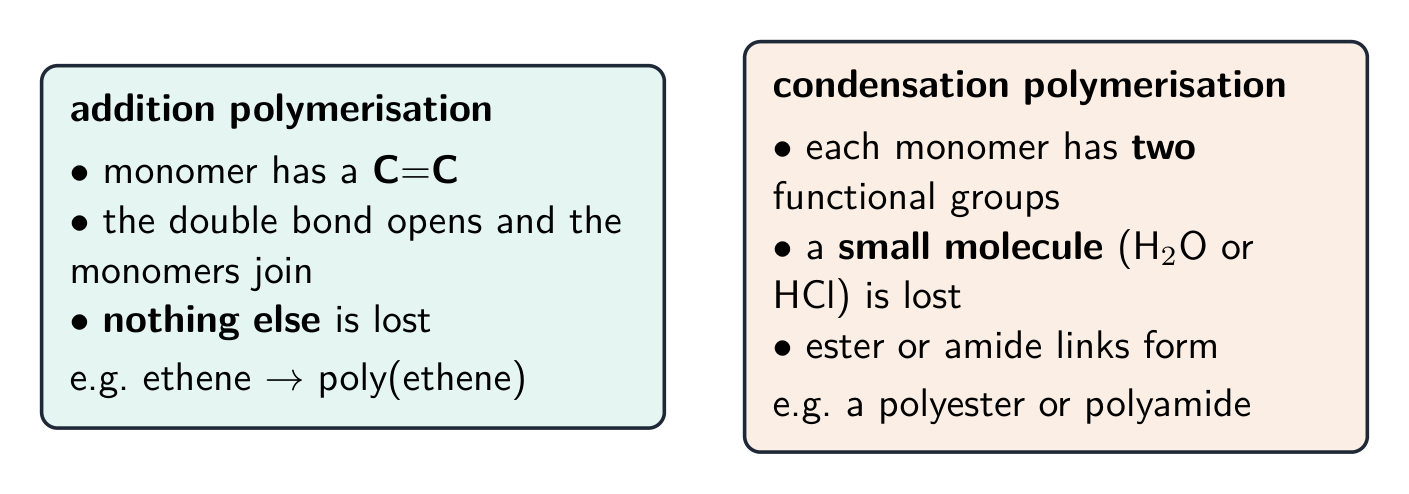
Syllabus
- predict the type of polymerisation reaction for a given monomer or pair of monomers
- deduce the type of polymerisation reaction which produces a given section of a polymer molecule
Source: Cambridge International syllabus
Clue Type the monomer has a C=C double bond, and nothing else is lost addition polymerisation 加成聚合 each monomer has two functional groups, and a small molecule is lost; the chain has ester or amide links condensation polymerisation The two kinds of polymerisation: addition opens a C=C and loses nothing; condensation joins two-group monomers and loses a small molecule ExplorePolymerisation type lab
Classify monomers by whether they form addition or condensation polymers.
Vocabulary TrainEnglish addition polymerisation/əˈdɪʃn ˌpɒlɪməraɪˈzeɪʃn/ 35.3
Degradable polymers
Syllabus
- recognise that poly(alkenes) are chemically inert and can therefore be difficult to biodegrade
- recognise that some polymers can be degraded by the action of light
- recognise that polyesters and polyamides are biodegradable by acidic and alkaline hydrolysis
Source: Cambridge International syllabus
- poly(alkene)s 聚烯烃 are chemically inert — they have only strong, non-polar C–C and C–H bonds, so they are hard to biodegrade 可生物降解 and last a long time.
- some polymers are made so that light can break them down (they are photodegradable).
- polyesters and polyamides are biodegradable, because their ester and amide links can be broken by acidic or alkaline hydrolysis 水解.
ExploreDegradable polymer route
Follow how polymer structure controls breakdown.
Vocabulary TrainEnglish poly(alkene)/ˈpɒlɪ/ biodegradable/ˌbaɪəʊdɪˈɡreɪdəbl/ hydrolysis/haɪˈdrɒləsɪs/ 35.3
Exam tips
- Condensation polymers (polyesters, polyamides) form with loss of a small molecule ($\text{H}_2\text{O}$ or HCl) — draw the repeat unit and the lost molecule.
- Identify the monomers from the polymer by breaking the ester or amide link — a common question.
- Predict the type from the monomers: a $\text{C}=\text{C}$ gives addition; two functional groups give condensation.
- Polyesters and polyamides are hydrolysable (more degradable); addition polymers are not.
-
36
Organic synthesis
Watch lesson36.1
Organic synthesis

Syllabus
- for an organic molecule containing several functional groups: (a) identify organic functional groups using the reactions in the syllabus (b) predict properties and reactions
- devise multi-step synthetic routes for preparing organic molecules using the reactions in the syllabus
- analyse a given synthetic route in terms of type of reaction and reagents used for each step of it, and possible by-products
Source: Cambridge International syllabus
Like the AS synthesis topic, this asks you to join up known reactions to build a target molecule. Now you also have the A Level reactions of arenes, phenol, amines, amides and acyl chlorides.
Identifying functional groups
A molecule may carry several functional group 官能团 types. Use the test reactions to spot each one, then predict its behaviour. For example:
- decolourises bromine water with no catalyst, giving a white precipitate → a phenol or a phenylamine (the ring is activated).
- reacts violently with cold water, giving fumes of $\text{HCl}$ → an acyl chloride 酰氯.
- gives a purple colour with neutral $\text{FeCl}_3$ → a phenol 苯酚.
Identification tests added at A Level: each reagent gives a characteristic result that points to a functional group A map of the A Level reactions
Start Reagent and conditions Product benzene (an arene 芳烃) $\text{HNO}_3$ / $\text{H}_2\text{SO}_4$ (electrophilic substitution 亲电取代) nitrobenzene nitrobenzene $\text{Sn}$ / conc $\text{HCl}$, then $\text{NaOH}$ (reduction 还原) phenylamine phenylamine $\text{HNO}_2$, below $10\,°\text{C}$ a diazonium salt diazonium salt warm water phenol; or couple with phenol → azo dye methylbenzene hot $\text{KMnO}_4$ (oxidation 氧化) benzoic acid carboxylic acid 羧酸 $\text{SOCl}_2$ or $\text{PCl}_5$ acyl chloride acyl chloride alcohol / phenol an ester 酯 acyl chloride ammonia / amine 胺 an amide 酰胺 amide or nitrile 腈 $\text{LiAlH}_4$ an amine halogenoalkane $\text{KCN}$ a nitrile (adds one carbon) 
A map of the A Level reactions: the aromatic chain (top) and the acyl-chloride chain (bottom), with their feed-ins. Work backwards from your target Planning and analysing a route
To devise a synthetic route 合成路线, work backwards from the target: which single reaction makes it, and from what? Repeat until you reach the starting material, then write each step with its reagent 试剂 and conditions.
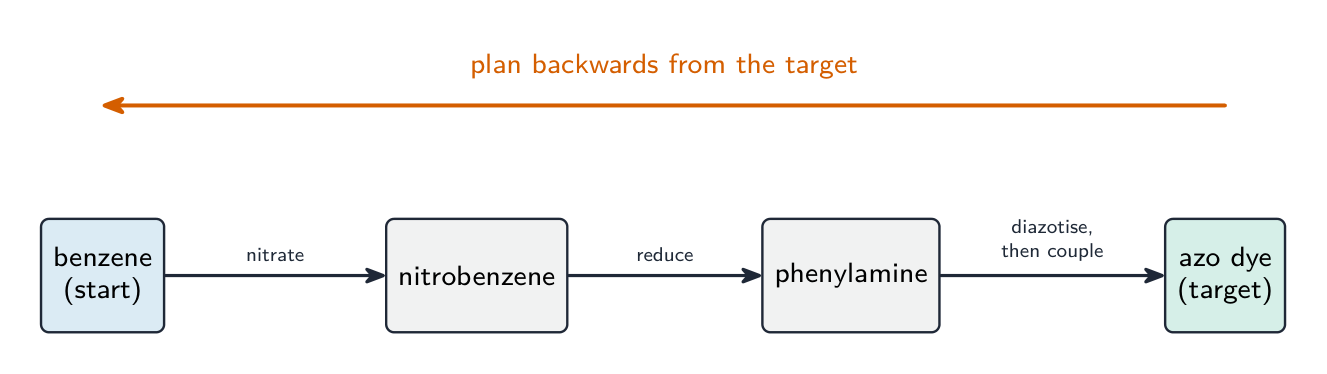
Plan a route by working backwards from the target, one reaction at a time, until you reach the starting material When you analyse a route, state the type of reaction for each step (for example electrophilic substitution, addition–elimination 加成消去, oxidation or reduction) and watch for likely by-products 副产物 — for example, making an amine from a halogenoalkane also gives over-substituted amines, lowering the yield.
Worked example. Devise a route from benzene to phenylamine, $\text{C}_6\text{H}_5\text{NH}_2$. Work backwards: phenylamine comes from reducing nitrobenzene, and nitrobenzene comes from nitrating benzene - so the route is two steps. Step 1: benzene with concentrated $\text{HNO}_3$ and concentrated $\text{H}_2\text{SO}_4$ at $55\ °\text{C}$; electrophilic substitution gives nitrobenzene (keep below $55\ °\text{C}$, or further substitution follows). Step 2: reduce the nitrobenzene with tin and concentrated $\text{HCl}$, then add $\text{NaOH}$ to free the amine from its salt. There is no direct route - you cannot put an $\text{–NH}_2$ straight onto a ring, which is exactly why this nitrate-then-reduce pair is worth knowing by heart.
ExploreA-Level synthesis planner
Build a route by matching functional-group changes to reagents.
Vocabulary TrainEnglish functional group/ˈfʌŋkʃənl ɡruːp/ acyl chloride/əˈkɪl ˈklɔːraɪd/ phenol/ˈfenɒl/ arene/ˈæren/ electrophilic substitution/ɪˌlektrəʊˈfɪlɪk ˌsʌbstɪˈtjuːʃn/ reduction/rɪˈdʌkʃn/ oxidation/ˌɒksɪˈdeɪʃn/ carboxylic acid/ˌkɑːbəkˈsɪlɪk ˈæsɪd/ ester/ˈestə/ amine/ˈæmaɪn/ amide/əˈmaɪd/ nitrile/ˈnaɪtraɪl/ synthetic route/sɪnˈθetɪk ruːt/ reagent/rɪˈeɪdʒənt/ addition–elimination/əˈdɪʃn ɪˌlɪmɪˈneɪʃn/ by-product/baɪ ˈprɒdʌkt/ 36.1
Exam tips
- Combine AS and A-level steps and watch for benzene-ring reactions and carbon-count changes.
- State every reagent and condition, and note when a step produces a racemic mixture.
- Choose the shortest route that reaches the target functional group.
-
37
Analytical techniques
Watch lesson37.1
Thin-layer chromatography

Syllabus
- describe and understand the terms (a) stationary phase, for example aluminium oxide (on a solid support) (b) mobile phase; a polar or non-polar solvent (c) $R_{\text{f}}$ value (d) solvent front and baseline
- interpret $R_{\text{f}}$ values
- explain the differences in $R_{\text{f}}$ values in terms of interaction with the stationary phase and of relative solubility in the mobile phase
Source: Cambridge International syllabus
Chromatography 色谱 separates a mixture using two "phases" — one that stays still and one that moves. In thin-layer chromatography 薄层色谱 (TLC):
- the stationary phase 固定相 stays still (for example aluminium oxide on a plate).
- the mobile phase 流动相 moves (a polar or non-polar solvent that travels up the plate).
- the baseline 基线 is the starting line where the spots are placed; the solvent front 溶剂前沿 is the highest level the solvent reaches.
The $R_{\text{f}}$ value compares how far a spot moves with how far the solvent moves:
$$R_{\text{f}} = \frac{\text{distance moved by the spot}}{\text{distance moved by the solvent front}}$$It is always between 0 and 1. A substance that sticks more strongly to the stationary phase, or is less soluble in the mobile phase, moves less and has a smaller $R_{\text{f}}$.
Thin-layer chromatography: the $R_\text{f}$ value is how far the spot moved divided by how far the solvent front moved 
A real TLC plate under UV light: each glowing spot is a separated component of the mixture ExploreTLC route
Follow a spot up a plate and use Rf to identify substances.
Vocabulary TrainEnglish chromatography/krəʊməˈtɒɡrəfi/ thin-layer chromatography/θɪn ˈleɪə krəʊməˈtɒɡrəfi/ stationary phase/ˈsteɪʃənəri feɪz/ mobile phase/ˈməʊbaɪl feɪz/ baseline/ˈbeɪslaɪn/ solvent front/ˈsɒlvənt frʌnt/ 37.2
Gas/liquid chromatography
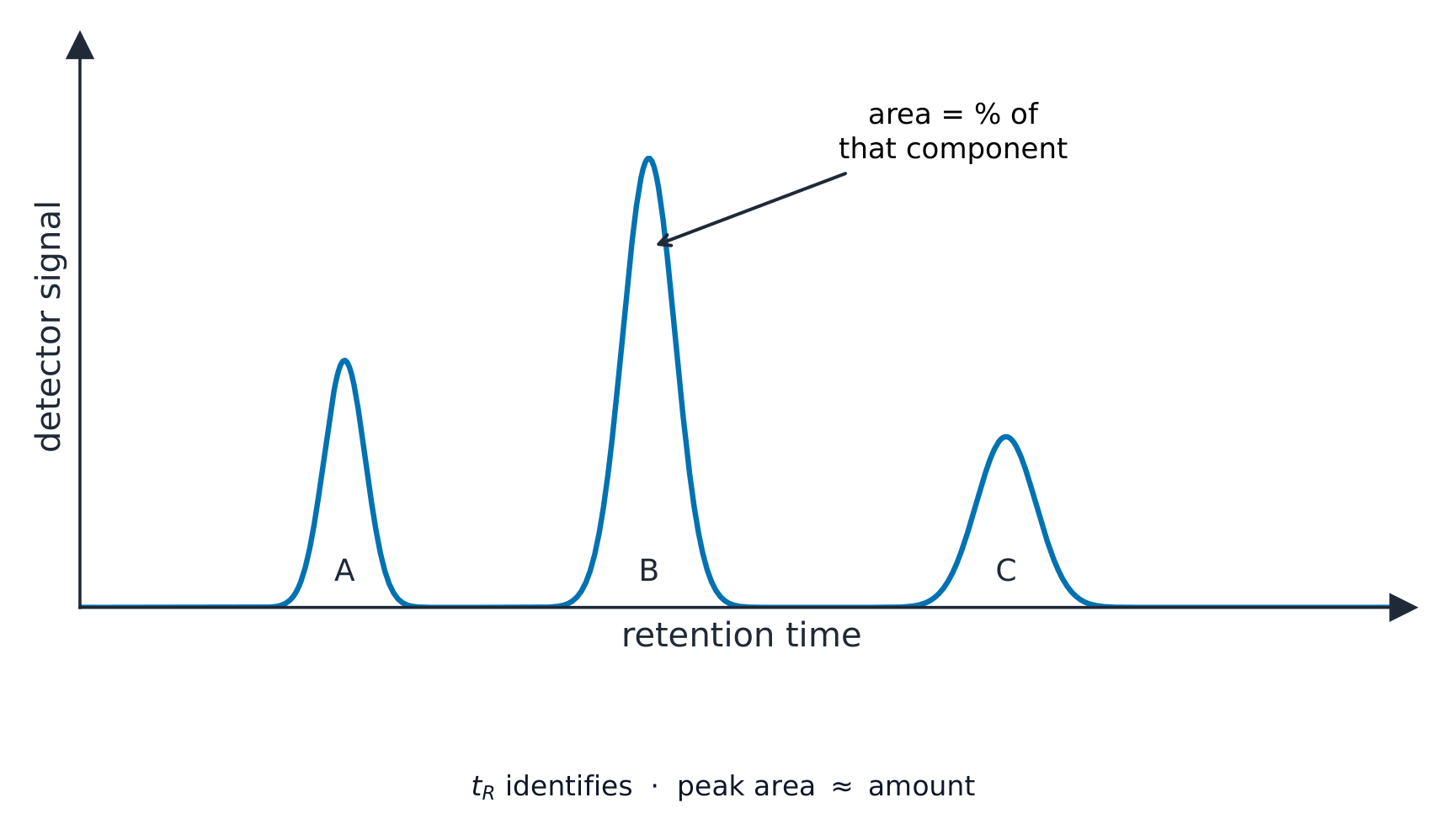
Syllabus
- describe and understand the terms (a) stationary phase; a high boiling point non-polar liquid (on a solid support) (b) mobile phase; an unreactive gas (c) retention time
- interpret gas/liquid chromatograms in terms of the percentage composition of a mixture
- explain retention times in terms of interaction with the stationary phase
Source: Cambridge International syllabus
In gas/liquid chromatography 气液色谱 (GLC):
- the stationary phase is a high-boiling-point non-polar liquid on a solid support.
- the mobile phase is an unreactive carrier gas.
- the retention time 保留时间 is how long a component takes to pass through.
The area of each peak gives the percentage of that component in the mixture. A component that interacts more with the stationary phase has a longer retention time.
A gas–liquid chromatogram: each component gives a peak at its own retention time, and the peak area is its percentage in the mixture ExploreGas/liquid chromatography route
Follow a volatile sample through column separation to a chromatogram.
Vocabulary TrainEnglish gas/liquid chromatography/ɡæs ˈlɪkwɪd krəʊməˈtɒɡrəfi/ retention time/rɪˈtenʃn taɪm/ 37.3
Carbon-13 NMR spectroscopy

Syllabus
- analyse and interpret a carbon-13 NMR spectrum of a simple molecule to deduce: (a) the different environments of the carbon atoms present (b) the possible structures for the molecule
- predict or explain the number of peaks in a carbon-13 NMR spectrum for a given molecule
Source: Cambridge International syllabus
NMR 核磁共振 (nuclear magnetic resonance) studies how certain nuclei behave in a strong magnetic field.
An NMR spectrometer: the large cylinder holds a superconducting magnet that makes the very strong magnetic field the technique needs In carbon-13 NMR, each different chemical environment 化学环境 of carbon gives one peak. So:
- the number of peaks tells you how many different carbon environments there are (equivalent carbons share a peak).
- the position of each peak (its chemical shift) suggests the type of carbon, which helps you deduce possible structures.
ExploreCarbon-13 NMR lab
Match carbon environments to C-13 NMR evidence.
Vocabulary TrainEnglish NMR/ˌen em ˈɑː/ chemical environment/ˈkemɪkl enˈvaɪrənmənt/ 37.4
Proton (¹H) NMR spectroscopy

Syllabus
- analyse and interpret a proton ($^1\text{H}$) NMR spectrum of a simple molecule to deduce: (a) the different environments of proton present using chemical shift values (b) the relative numbers of each type of proton present from relative peak areas (c) the number of equivalent protons on the carbon atom adjacent to the one to which the given proton is attached from the splitting pattern, using the $n + 1$ rule (limited to singlet, doublet, triplet, quartet and multiplet) (d) the possible structures for the molecule
- predict the chemical shifts and splitting patterns of the protons in a given molecule
- describe the use of tetramethylsilane, TMS, as the standard for chemical shift measurements
- state the need for deuterated solvents, e.g. $\text{CDCl}_3$, when obtaining a proton NMR spectrum
- describe the identification of O–H and N–H protons by proton exchange using $\text{D}_2\text{O}$
Source: Cambridge International syllabus
Proton NMR looks at the hydrogen atoms (proton 质子 nuclei). From the spectrum you read off:
- chemical environments: protons in different environments appear at different chemical shift 化学位移 values.
- relative numbers: the relative peak areas give the ratio of each type of proton.
- splitting 裂分: a peak is split by the protons on the neighbouring carbon, following the $n+1$ rule — $n$ equivalent neighbours split a peak into $n+1$ lines:
Neighbours ($n$) Pattern 0 singlet 单峰 1 doublet 双峰 2 triplet 三峰 3 quartet 四峰 many multiplet 多重峰 The $n+1$ rule: $n$ equivalent neighbouring protons split a peak into $n+1$ lines (singlet, doublet, triplet, quartet) 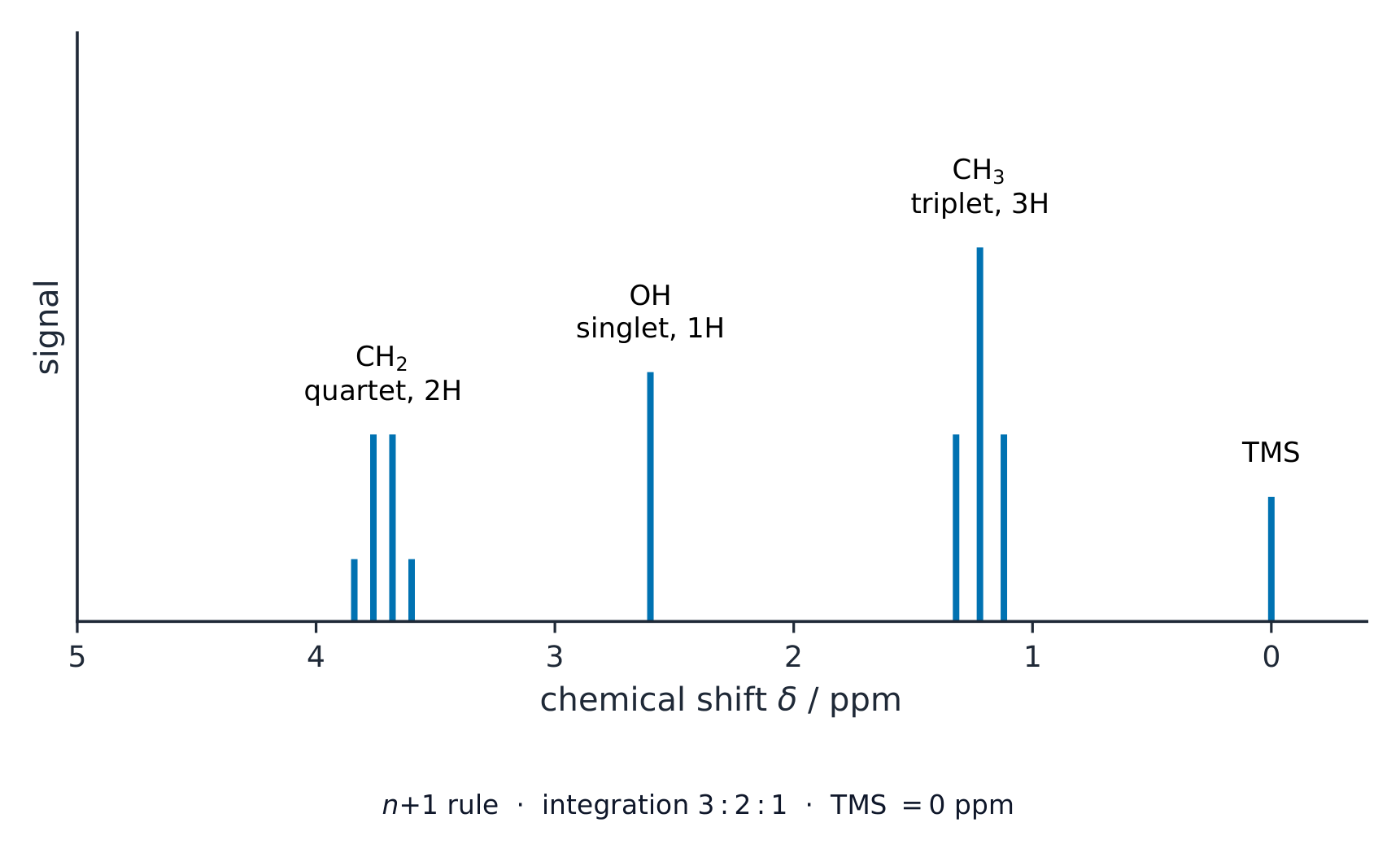
Proton NMR of ethanol: three environments give a CH$_3$ triplet, a CH$_2$ quartet and an OH singlet, with areas in the ratio $3:2:1$ Practical points
- tetramethylsilane 四甲基硅烷 (TMS) is the standard, set at a chemical shift of $0$.
- a deuterated solvent 氘代溶剂 (such as $\text{CDCl}_3$) is used so that the solvent itself gives no proton signal.
- shaking the sample with $\text{D}_2\text{O}$ makes the O–H and N–H peaks disappear (their hydrogen is swapped for deuterium), which identifies those protons.
Worked example. A compound $\text{C}_4\text{H}_8\text{O}_2$ gives three proton NMR peaks: a triplet at $\delta\ 1.2$ (area 3), a quartet at $\delta\ 4.1$ (area 2), and a singlet at $\delta\ 2.0$ (area 3). Deduce the structure. Read the areas first, then the splitting. Areas $3:2:3$ give three proton environments holding 3, 2 and 3 hydrogens. Apply the $n+1$ rule in reverse: a triplet (area 3) is a $\text{CH}_3$ with 2 neighbours, and a quartet (area 2) is a $\text{CH}_2$ with 3 neighbours - each splitting the other, which is the classic ethyl group, $\text{CH}_3\text{CH}_2-$. That $\text{CH}_2$ lies far downfield at $\delta\ 4.1$, so it is attached to an oxygen. The remaining singlet (area 3) is a $\text{CH}_3$ with no neighbours at $\delta\ 2.0$, so it sits next to the C=O. Together: $\text{CH}_3\text{COOCH}_2\text{CH}_3$, ethyl ethanoate. A triplet-and-quartet pair is almost always an ethyl group - spot it first and the rest follows.
ExploreProton NMR lab
Match proton evidence to chemical environment and neighbours.
Vocabulary TrainEnglish proton/ˈprəʊtɒn/ chemical shift/ˈkemɪkl ʃɪft/ splitting/ˈsplɪtɪŋ/ singlet/ˈsɪŋɡlɪt/ doublet/ˈdʌblət/ triplet/ˈtrɪplɪt/ quartet/kwɔːˈtet/ multiplet/ˈmʌltɪplɪt/ tetramethylsilane/ˈtetrəmiːθɪlsɪleɪn/ deuterated solvent/ˈdjuːtəreɪtɪd ˈsɒlvənt/ 37.4
Exam tips
- In $^{13}\text{C}$ NMR the number of peaks equals the number of carbon environments — use symmetry to count them.
- In $^1\text{H}$ NMR use chemical shift (data booklet), integration (ratio of H's) and splitting (the $n+1$ rule): a triplet + quartet means an ethyl group.
- TMS is the reference ($\delta = 0$); a $\text{D}_2\text{O}$ shake removes O-H and N-H peaks.
- Combine IR, mass spectrum and NMR to deduce a structure, stating which evidence gives which feature.