- explain and use the term rate of reaction, frequency of collisions, effective collisions and non-effective collisions
- explain qualitatively, in terms of frequency of effective collisions, the effect of concentration and pressure changes on the rate of a reaction
- use experimental data to calculate the rate of a reaction
Reaction kinetics
A-Level Chemistry · Topic 8
 7:13
7:13
Reaction kinetics
Iron left outside takes years to rust away. Strike a match, and almost the same chemistry — oxygen attacking a fuel — is over in less than a second. Same…
English narration · English + 中文 subtitles burned in
8.1
Rate of reaction

Syllabus
Source: Cambridge International syllabus
The rate of reaction 反应速率 is how fast reactants turn into products. We measure it as the change in concentration (or amount) in each unit of time.
To react, particles must collide 碰撞. The collision frequency 碰撞频率 is how often the particles hit each other. But not every collision leads to a reaction:
- an effective collision 有效碰撞 has enough energy and the correct direction, so a reaction happens.
- a non-effective collision 无效碰撞 does not have enough energy, or the particles hit at the wrong angle, so nothing happens.
So the rate depends on the frequency of effective collisions — how many useful collisions happen each second.
Concentration and pressure
If you increase the concentration of a solution (or the pressure of a gas), the particles are packed closer together. They collide more often, so there are more effective collisions each second, and the rate goes up.

You can calculate a rate from experimental data — for example, the volume of gas made divided by the time taken.
Worked example. A reaction gives off carbon dioxide. In the first $30\ \text{s}$, $48\ \text{cm}^3$ of gas is collected. Find the average rate of reaction over this time.
$$\text{average rate} = \frac{\text{volume of gas}}{\text{time}} = \frac{48}{30} = 1.6\ \text{cm}^3\,\text{s}^{-1}.$$
The rate is fastest at the start (the graph is steepest there) because the reactants are most concentrated, then it slows as they are used up.
Explore
Rate of reaction
[A] = [A]₀·bᵗ
Reactant concentration falls over time as it's used up.
Vocabulary
Train
| English |
|---|
| rate of reaction/reɪt ɒv rɪˈækʃn/ |
| collide/kəˈlaɪd/ |
| collision frequency/kəˈlɪʒn ˈfriːkwənsi/ |
| effective collision/ɪˈfektɪv kəˈlɪʒn/ |
| non-effective collision/nɒn ɪˈfektɪv kəˈlɪʒn/ |
8.2
Temperature and activation energy
Syllabus
- define activation energy, $E_A$, as the minimum energy required for a collision to be effective
- sketch and use the Boltzmann distribution to explain the significance of activation energy
- explain qualitatively, in terms both of the Boltzmann distribution and of frequency of effective collisions, the effect of temperature change on the rate of a reaction
Source: Cambridge International syllabus
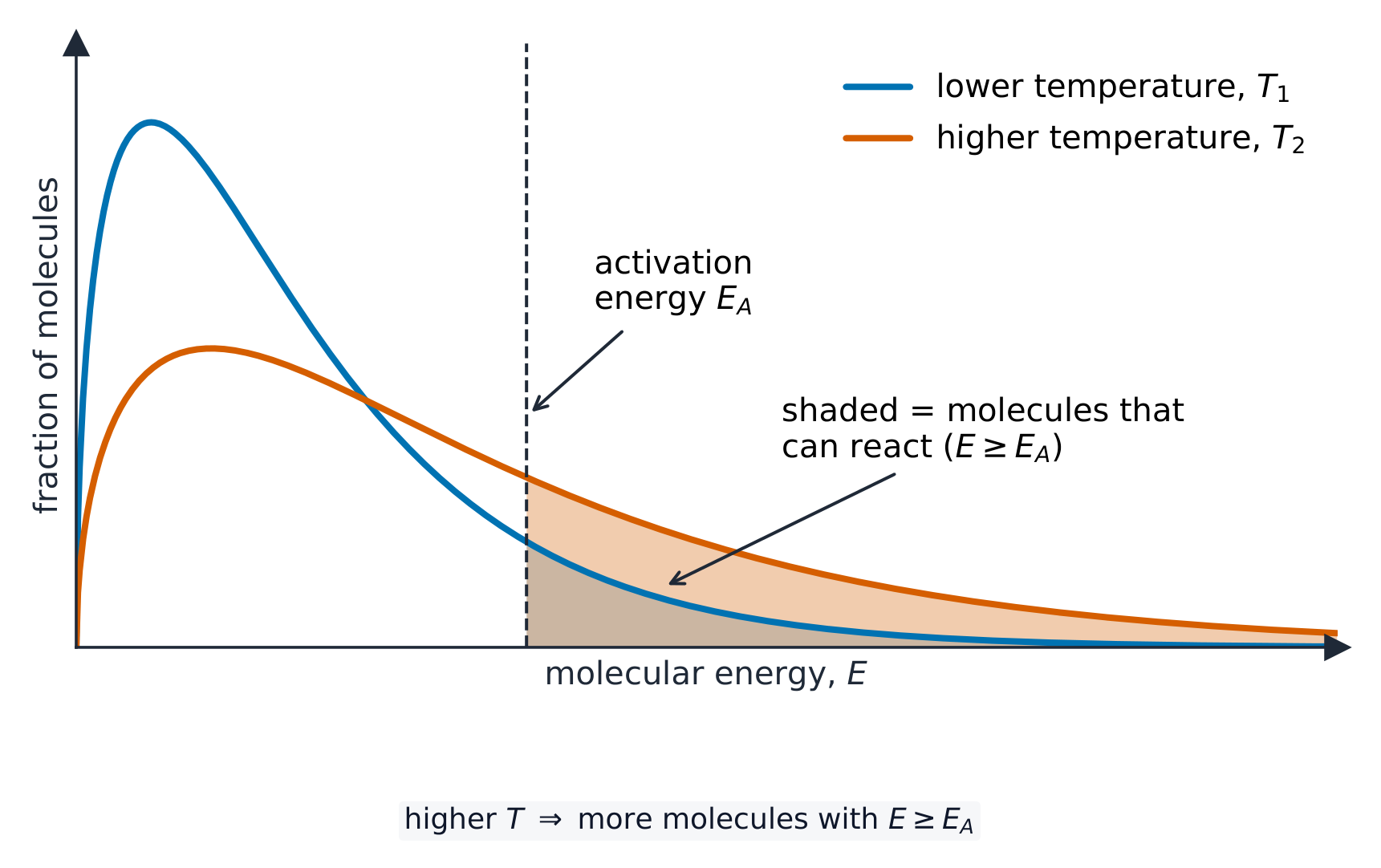
The activation energy 活化能 ($E_A$) is the minimum energy a collision needs in order to be effective.
The Boltzmann distribution 玻尔兹曼分布 is a graph showing how the energies of the molecules are spread out at one temperature. The curve starts at the origin, rises to a peak, then falls away in a long tail. The total area under the curve is the total number of molecules. Only the molecules to the right of $E_A$ have enough energy to react.
When you raise the temperature:
- the curve flattens and spreads to the right, so a much larger fraction of molecules now have energy greater than $E_A$.
- the molecules also move faster and collide more often.
The first effect is the bigger one. This is why a small rise in temperature gives a large rise in rate.
Explore
Why heat speeds up reactions
Raise the temperature: the curve spreads right, so more molecules have at least the activation energy and can react.
Vocabulary
Train
| English |
|---|
| activation energy/ˌæktɪˈveɪʃn ˈenədʒi/ |
| Boltzmann distribution/ˈbɒltsmən ˌdɪstrɪˈbjuːʃn/ |
8.3
Catalysts

Syllabus
- explain and use the terms catalyst and catalysis: (a) explain that, in the presence of a catalyst, a reaction has a different mechanism, i.e. one of lower activation energy (b) explain this catalytic effect in terms of the Boltzmann distribution (c) construct and interpret a reaction pathway diagram, for a reaction in the presence and absence of an effective catalyst
Source: Cambridge International syllabus
A catalyst 催化剂 speeds up a reaction but is not used up itself. Catalysis 催化作用 is the name for this action.
A catalyst works by giving the reaction a different reaction mechanism 反应机理 — a new route with a lower activation energy. On the Boltzmann distribution, lowering $E_A$ moves the line to the left, so more molecules now have enough energy. This means more effective collisions each second, and a faster rate.
On a reaction pathway diagram 反应路径图, the catalysed route has a lower energy "hill". The enthalpy change of the reaction, $\Delta H$, is not changed by the catalyst.
There are two types:
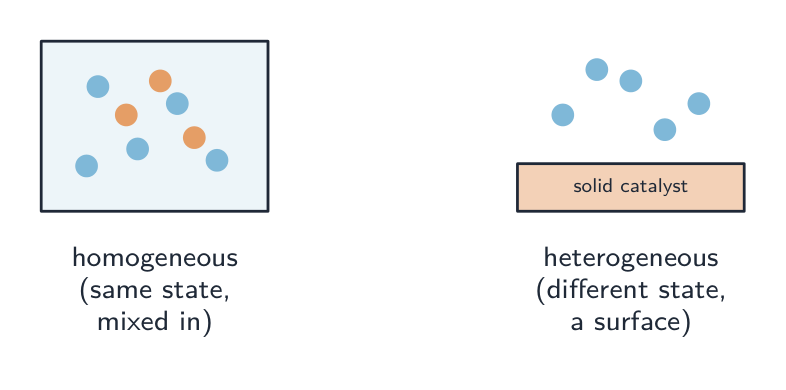
- a homogeneous catalyst 均相催化剂 is in the same physical state as the reactants — for example, an acid catalyst dissolved in a solution of liquids.
- a heterogeneous catalyst 多相催化剂 is in a different state from the reactants — for example, solid iron speeding up the reaction of gases in the Haber process.

Explore
Catalysts
a catalyst lowers Ea
A catalyst lowers Ea, so a bigger fraction of molecules can react — without heating.
Explore
How a catalyst works
Add a catalyst and watch the activation-energy barrier drop — it gives an easier route, without changing ΔH.
Vocabulary
Train
| English |
|---|
| catalyst/ˈkætəlɪst/ |
| catalysis/kæˈtæləsɪs/ |
| reaction mechanism/rɪˈækʃn ˈmekənɪzəm/ |
| reaction pathway diagram/rɪˈækʃn ˈpæθweɪ ˈdaɪəɡræm/ |
| homogeneous catalyst/həˈməʊdʒnɪəs ˈkætəlɪst/ |
| heterogeneous catalyst/ˌhetrəˈdʒiːnɪəs ˈkætəlɪst/ |
8.3
Exam tips
- Explain rate changes with collision theory — more frequent and/or more energetic effective collisions.
- On a Boltzmann distribution mark $E_A$, shade to its right, and show the curve flatten and shift right at higher temperature; it starts at the origin and never touches the axis.
- A catalyst gives an alternative route with lower $E_A$ and does not change $\Delta H$.
- Say why a small temperature rise gives a large rate rise: a much greater proportion of molecules now exceed $E_A$ (the main effect).
Interactive lessons on this topic
Work through it step by step, with instant-check exercises.