- describe qualitatively (and indicate the periodicity in) the variations in atomic radius, ionic radius, melting point and electrical conductivity of the elements
- explain the variation in melting point and electrical conductivity in terms of the structure and bonding of the elements
The Periodic Table: chemical periodicity
A-Level Chemistry · Topic 9
 8:43
8:43
The Periodic Table: chemical periodicity
Sodium and argon sit in the same row of the Periodic Table, with only six elements between them. Drop sodium into cold water and it melts into a shining ball…
English narration · English + 中文 subtitles burned in
9.1
Physical properties across Period 3

Syllabus
Source: Cambridge International syllabus
Periodicity 周期性 means that properties repeat in a regular pattern as you go across each period 周期 of the Periodic Table. Period 3 (Na to Ar) is the standard example.

| Property | Trend across Period 3 |
|---|---|
| atomic radius 原子半径 | gets smaller (more nuclear charge pulls the same shell in) |
| ionic radius 离子半径 | positive ions are small; from $\text{P}^{3-}$ onwards the negative ions are larger |
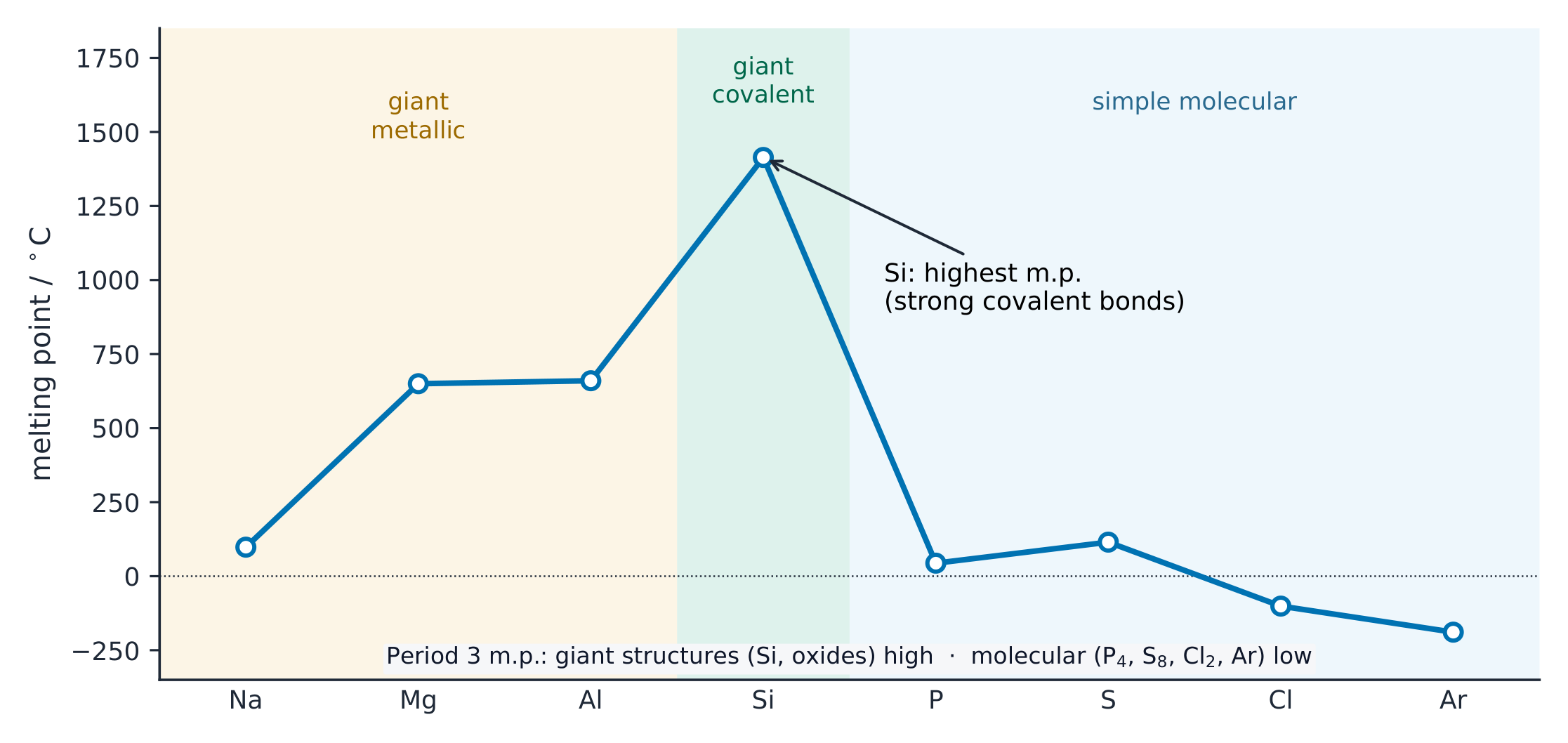
| melting point 熔点 | rises to a peak at silicon, then falls sharply |
| electrical conductivity 导电性 | high for Na, Mg, Al; almost zero from Si onwards |
The melting point and conductivity follow from the structure and bonding:
- Na, Mg, Al are giant metallic 金属晶体. Melting points rise (Na → Al) because each atom gives more delocalised electrons and the ions get smaller, so the bonding is stronger. They conduct well.
- Si is giant molecular 原子晶体 (giant covalent). It has the highest melting point, because strong covalent bonds must be broken. It barely conducts.
- P, S, Cl, Ar are simple molecular 分子晶体 (or single atoms). Their melting points are low, because the only forces that break are the weak van der Waals' forces 范德华力 between the molecules - the strong covalent bonds inside each molecule are never broken at all. They do not conduct.
Name van der Waals' forces when you explain that drop: it is the marking point, and "the covalent bonds are weak" is the error that loses it. Melting $\text{S}_8$ pulls whole molecules apart from each other; it does not touch a single $\text{S–S}$ bond. Their sizes still follow the molecule: $\text{S}_8$ melts higher than $\text{P}_4$ because it is bigger, with more electrons and so stronger van der Waals' forces, while $\text{Ar}$ (a single atom) is lowest of all.
Explore
Trends across Period 3
Switch between atomic radius, ionisation energy and melting point, and step across Period 3 to see each periodic trend.
Vocabulary
Train
| English |
|---|
| periodicity/ˌpɪərɪˌɒˈdɪsɪti/ |
| period/ˈpɪərɪəd/ |
| atomic radius/əˈtɒmɪk ˈreɪdɪəs/ |
| ionic radius/aɪˈɒnɪk ˈreɪdɪəs/ |
| melting point/ˈmeltɪŋ pɔɪnt/ |
| electrical conductivity/ɪˈlektrɪkl kɒndəkˈtɪvɪti/ |
| giant metallic/ˈdʒaɪənt məˈtælɪk/ |
| giant molecular/ˈdʒaɪənt məˈlekjʊlə/ |
| simple molecular/ˈsɪmpl məˈlekjʊlə/ |
| van der Waals' forces/ˈvændɜː wɑːlz ˈfɔːsɪz/ |
9.2
Chemical properties across Period 3

Syllabus
- describe, and write equations for, the reactions of the elements with oxygen (to give $\text{Na}_2\text{O}$, $\text{MgO}$, $\text{Al}_2\text{O}_3$, $\text{P}_4\text{O}_{10}$, $\text{SO}_2$), chlorine (to give $\text{NaCl}$, $\text{MgCl}_2$, $\text{AlCl}_3$, $\text{SiCl}_4$, $\text{PCl}_5$) and water ($\text{Na}$ and $\text{Mg}$ only)
- state and explain the variation in the oxidation number of the oxides ($\text{Na}_2\text{O}$, $\text{MgO}$, $\text{Al}_2\text{O}_3$, $\text{P}_4\text{O}_{10}$, $\text{SO}_2$ and $\text{SO}_3$ only) and chlorides ($\text{NaCl}$, $\text{MgCl}_2$, $\text{AlCl}_3$, $\text{SiCl}_4$, $\text{PCl}_5$ only) in terms of their outer shell (valence shell) electrons
- describe, and write equations for, the reactions, if any, of the oxides $\text{Na}_2\text{O}$, $\text{MgO}$, $\text{Al}_2\text{O}_3$, $\text{SiO}_2$, $\text{P}_4\text{O}_{10}$, $\text{SO}_2$ and $\text{SO}_3$ with water including the likely pHs of the solutions obtained
- describe, explain, and write equations for, the acid/base behaviour of the oxides $\text{Na}_2\text{O}$, $\text{MgO}$, $\text{Al}_2\text{O}_3$, $\text{P}_4\text{O}_{10}$, $\text{SO}_2$ and $\text{SO}_3$ and the hydroxides $\text{NaOH}$, $\text{Mg(OH)}_2$ and $\text{Al(OH)}_3$ including, where relevant, amphoteric behaviour in reactions with acids and bases (sodium hydroxide only)
- describe, explain, and write equations for, the reactions of the chlorides $\text{NaCl}$, $\text{MgCl}_2$, $\text{AlCl}_3$, $\text{SiCl}_4$, $\text{PCl}_5$ with water including the likely pHs of the solutions obtained
- explain the variations and trends in 9.2.2, 9.2.3, 9.2.4 and 9.2.5 in terms of bonding and electronegativity
- suggest the types of chemical bonding present in the chlorides and oxides from observations of their chemical and physical properties
Source: Cambridge International syllabus
Reactions with oxygen, chlorine and water
With oxygen:
$$4\text{Na} + \text{O}_2 \rightarrow 2\text{Na}_2\text{O} \qquad 2\text{Mg} + \text{O}_2 \rightarrow 2\text{MgO} \qquad 4\text{Al} + 3\text{O}_2 \rightarrow 2\text{Al}_2\text{O}_3$$
$$\text{P}_4 + 5\text{O}_2 \rightarrow \text{P}_4\text{O}_{10} \qquad \text{S} + \text{O}_2 \rightarrow \text{SO}_2$$
With chlorine:
$$2\text{Na} + \text{Cl}_2 \rightarrow 2\text{NaCl} \qquad \text{Mg} + \text{Cl}_2 \rightarrow \text{MgCl}_2 \qquad 2\text{Al} + 3\text{Cl}_2 \rightarrow 2\text{AlCl}_3$$
$$\text{Si} + 2\text{Cl}_2 \rightarrow \text{SiCl}_4 \qquad 2\text{P} + 5\text{Cl}_2 \rightarrow 2\text{PCl}_5$$
With water (only Na and Mg react):
$$2\text{Na} + 2\text{H}_2\text{O} \rightarrow 2\text{NaOH} + \text{H}_2 \qquad \text{Mg} + 2\text{H}_2\text{O} \rightarrow \text{Mg(OH)}_2 + \text{H}_2$$
Sodium reacts fast; magnesium reacts only very slowly with cold water.
Oxidation number of the oxides and chlorides
The oxidation number 氧化数 of the Period 3 element in its oxide or chloride rises across the period, because it equals the number of outer-shell (valence shell 价层) electrons 电子 the atom uses in bonding:
| Oxides | $\text{Na}_2\text{O}$ | $\text{MgO}$ | $\text{Al}_2\text{O}_3$ | $\text{P}_4\text{O}_{10}$ | $\text{SO}_2$ / $\text{SO}_3$ |
|---|---|---|---|---|---|
| oxidation number | $+1$ | $+2$ | $+3$ | $+5$ | $+4$ / $+6$ |
The chlorides $\text{NaCl}$, $\text{MgCl}_2$, $\text{AlCl}_3$, $\text{SiCl}_4$, $\text{PCl}_5$ show oxidation numbers $+1$ to $+5$ in the same way.
Oxides with water, and acid–base behaviour
Across the period the oxides 氧化物 change from basic to acidic:
| Oxide | With water | Acid–base nature | Approximate pH |
|---|---|---|---|
| $\text{Na}_2\text{O}$ | $\text{Na}_2\text{O} + \text{H}_2\text{O} \rightarrow 2\text{NaOH}$ | basic | 13–14 |
| $\text{MgO}$ | $\text{MgO} + \text{H}_2\text{O} \rightarrow \text{Mg(OH)}_2$ | basic | 9–10 |
| $\text{Al}_2\text{O}_3$ | insoluble | amphoteric 两性 | 7 |
| $\text{SiO}_2$ | insoluble | weakly acidic | 7 |
| $\text{P}_4\text{O}_{10}$ | $\text{P}_4\text{O}_{10} + 6\text{H}_2\text{O} \rightarrow 4\text{H}_3\text{PO}_4$ | acidic | 1–2 |
| $\text{SO}_3$ | $\text{SO}_3 + \text{H}_2\text{O} \rightarrow \text{H}_2\text{SO}_4$ | strongly acidic | 0–1 |
Metal oxides (left) are basic; non-metal oxides (right) are acidic. $\text{Al}_2\text{O}_3$ and its hydroxide 氢氧化物 $\text{Al(OH)}_3$ are amphoteric — they react with both acids and bases:
$$\text{Al}_2\text{O}_3 + 6\text{HCl} \rightarrow 2\text{AlCl}_3 + 3\text{H}_2\text{O}$$
$$\text{Al}_2\text{O}_3 + 2\text{NaOH} + 3\text{H}_2\text{O} \rightarrow 2\text{NaAl(OH)}_4$$

Chlorides with water
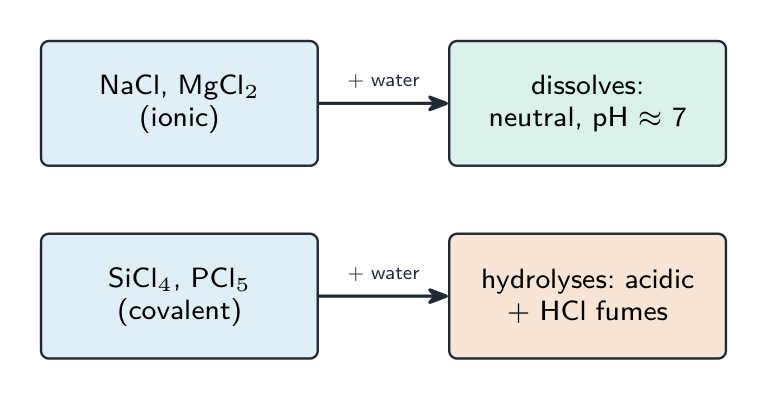
- $\text{NaCl}$ and $\text{MgCl}_2$ are ionic. They simply dissolve, giving a near-neutral solution.
- $\text{SiCl}_4$ and $\text{PCl}_5$ are covalent. They undergo hydrolysis 水解 (react with water) to make acidic solutions and fumes of $\text{HCl}$:
$$\text{SiCl}_4 + 2\text{H}_2\text{O} \rightarrow \text{SiO}_2 + 4\text{HCl} \qquad \text{PCl}_5 + 4\text{H}_2\text{O} \rightarrow \text{H}_3\text{PO}_4 + 5\text{HCl}$$
Explaining the trends
These trends follow from the change in bonding and electronegativity 电负性. On the left, the elements are metals with low electronegativity, so their oxides and chlorides are ionic and basic (or neutral). On the right, the elements are non-metals with high electronegativity, so their oxides and chlorides are covalent and acidic. You can use a chloride's or oxide's properties (melting point, conductivity, effect on water) to suggest whether its bonding is ionic or covalent.
Worked example. Predict the pH when $\text{Na}_2\text{O}$, $\text{Al}_2\text{O}_3$ and $\text{SO}_3$ are each added to water. Acid-base character follows the metal to non-metal change across Period 3. $\text{Na}_2\text{O}$ is ionic and basic: it dissolves to give $\text{NaOH}$, so the pH is about 13. $\text{SO}_3$ is covalent and acidic: it reacts to give $\text{H}_2\text{SO}_4$, so the pH is about 1. $\text{Al}_2\text{O}_3$ sits at the changeover - it is amphoteric and essentially insoluble in water, so the pH stays about 7. The trap is that last one: amphoteric does not mean neutral, it means the oxide reacts with acids and with alkalis - it simply does not react with water.
Explore
Period 3 reaction lab
Classify Period 3 reactions by what they reveal about bonding and acidity.
Explore
Oxide and chloride hydrolysis route
Follow how Period 3 oxides and chlorides change pH in water.
Vocabulary
Train
| English |
|---|
| oxidation number/ˌɒksɪˈdeɪʃn ˈnʌmbə/ |
| valence shell/ˈveɪləns ʃel/ |
| electron/ɪˈlektrɒn/ |
| oxide/ˈɒksaɪd/ |
| amphoteric/ˌæmfəʊˈterɪk/ |
| hydroxide/haɪˈdrɒksaɪd/ |
| hydrolysis/haɪˈdrɒləsɪs/ |
| electronegativity/ɪˌlektrəʊŋɡəˈtɪvɪti/ |
9.3
Periodicity of other elements
Syllabus
- predict the characteristic properties of an element in a given group by using knowledge of chemical periodicity
- deduce the nature, possible position in the Periodic Table and identity of unknown elements from given information about physical and chemical properties
Source: Cambridge International syllabus
The same idea works for any group. If you know the pattern down a group and across a period, you can:
- predict the properties of an element from its position (for example, a Group 1 element will be a reactive metal forming a $+1$ ion).
- deduce the likely position and identity of an unknown element from its physical and chemical properties.
Explore
Periodic trends
Step across Period 3 to see a property rise or fall, then repeat in the next period — that recurring pattern is periodicity.
9.3
Exam tips
- Always pair the trend with its reason: atomic radius falls across Period 3 (rising nuclear charge, similar shielding).
- Explain the melting-point pattern by structure: giant metallic (Na→Al), giant covalent (Si, highest), then simple molecular ($\text{P}_4$, $\text{S}_8$, $\text{Cl}_2$) and monatomic (Ar).
- Oxides go basic → amphoteric ($\text{Al}_2\text{O}_3$) → acidic across the period; link to ionic-to-covalent bonding.
- For reactions of oxides/chlorides with water, give the products and the resulting pH.
Interactive lessons on this topic
Work through it step by step, with instant-check exercises.