- describe, and write equations for, the reactions of the elements with oxygen, water and dilute hydrochloric and sulfuric acids
- describe, and write equations for, the reactions of the oxides, hydroxides and carbonates with water and dilute hydrochloric and sulfuric acids
- describe, and write equations for, the thermal decomposition of the nitrates and carbonates, to include the trend in thermal stabilities
- describe, and make predictions from, the trends in physical and chemical properties of the elements involved in the reactions in 10.1.1 and the compounds involved in 10.1.2, 10.1.3 and 10.1.5
- state the variation in the solubilities of the hydroxides and sulfates
Group 2
A-Level Chemistry · Topic 10
 8:01
8:01
Group 2
Before a stomach X-ray, the patient is asked to drink a thick white liquid. It is full of barium — and barium ions are poisonous. Swallow a soluble barium salt…
English narration · English + 中文 subtitles burned in
10.1
The Group 2 metals

Syllabus
Source: Cambridge International syllabus
Group 族 2 holds the metals magnesium, calcium, strontium and barium. They all have two outer electrons, which they lose to form $2+$ ions. Going down the group, the atoms get larger and the outer electrons are easier to lose, so the metals get more reactive — their reactivity 反应活性 increases down the group.

Reactions of the elements
With oxygen, they burn to form an oxide:
$$2\text{Mg} + \text{O}_2 \rightarrow 2\text{MgO}$$

With water, they form a hydroxide and hydrogen. The reaction gets faster down the group:
$$\text{Ca} + 2\text{H}_2\text{O} \rightarrow \text{Ca(OH)}_2 + \text{H}_2$$
Magnesium is slow with cold water but reacts fast with steam, giving $\text{MgO}$ and $\text{H}_2$.
With dilute hydrochloric or sulfuric acid, they form a salt and hydrogen:
$$\text{Mg} + 2\text{HCl} \rightarrow \text{MgCl}_2 + \text{H}_2 \qquad \text{Mg} + \text{H}_2\text{SO}_4 \rightarrow \text{MgSO}_4 + \text{H}_2$$
With sulfuric acid the reaction slows down the group, because the sulfates 硫酸盐 formed (such as $\text{BaSO}_4$) are insoluble and coat the metal.
Reactions of the compounds
The oxides 氧化物 and hydroxides 氢氧化物 are basic. They react with water and with dilute acids:
$$\text{MgO} + \text{H}_2\text{O} \rightarrow \text{Mg(OH)}_2 \qquad \text{Mg(OH)}_2 + 2\text{HCl} \rightarrow \text{MgCl}_2 + 2\text{H}_2\text{O}$$
The carbonates 碳酸盐 react with dilute acids to give a salt, water and carbon dioxide:
$$\text{CaCO}_3 + 2\text{HCl} \rightarrow \text{CaCl}_2 + \text{H}_2\text{O} + \text{CO}_2$$
Thermal decomposition
Thermal decomposition 热分解 means breaking a compound apart by heating it.
- the carbonates break into the oxide and carbon dioxide:
$$\text{CaCO}_3 \rightarrow \text{CaO} + \text{CO}_2$$
- the nitrates 硝酸盐 break into the oxide, brown nitrogen dioxide gas and oxygen:
$$2\text{Ca(NO}_3)_2 \rightarrow 2\text{CaO} + 4\text{NO}_2 + \text{O}_2$$
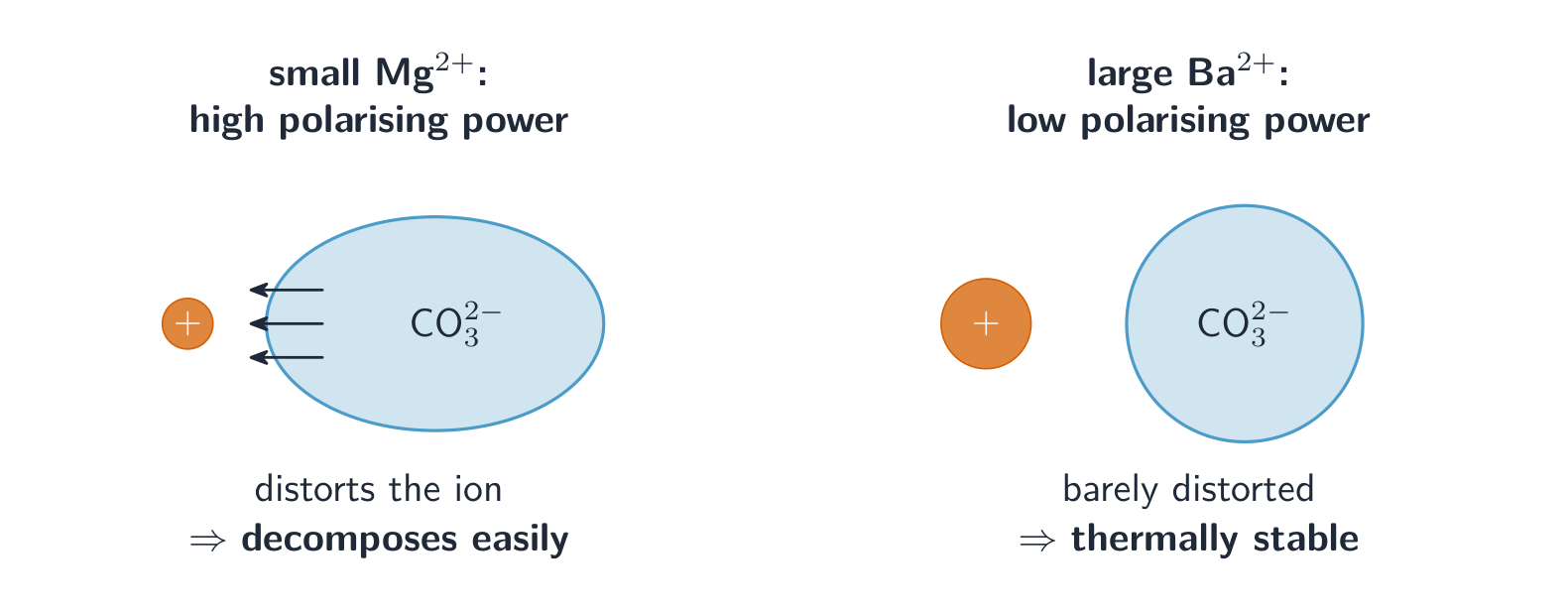
The thermal stability 热稳定性 of both the carbonates and the nitrates increases down the group. A larger metal ion pulls less on the carbonate or nitrate ion, so the compound is harder to break apart — it needs a higher temperature. So magnesium carbonate decomposes most easily, and barium carbonate is the hardest.
Trends in solubility
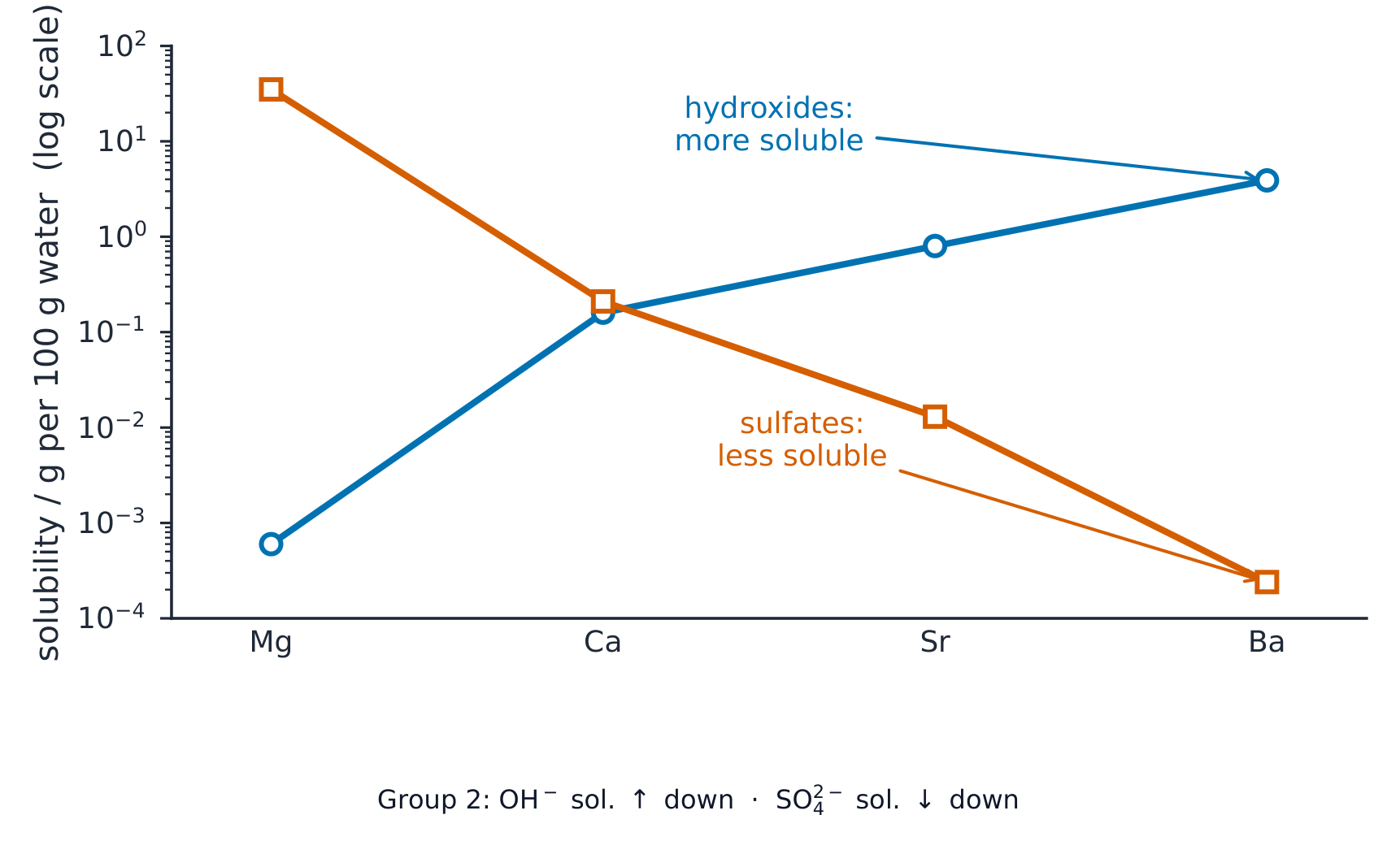
| Compound | Trend in solubility 溶解度 down the group |
|---|---|
| hydroxides | increase (Mg(OH)$_2$ almost insoluble; Ba(OH)$_2$ soluble) |
| sulfates | decrease (MgSO$_4$ soluble; BaSO$_4$ insoluble) |
From these trends you can predict the properties of the next element down, radium, and of its compounds.
Worked example. $\text{MgCO}_3$ decomposes at about $540\ °\text{C}$ and $\text{BaCO}_3$ at about $1360\ °\text{C}$. Explain the trend and predict where $\text{CaCO}_3$ sits. Going down Group 2 the cation gets larger, so its charge is spread over a bigger surface and its polarising power falls. A less polarising cation distorts the carbonate ion less, so the $\text{C-O}$ bond is weakened less and more heat is needed to break it. Thermal stability therefore increases down the group, and $\text{CaCO}_3$, lying between Mg and Ba, decomposes at an intermediate temperature of about $900\ °\text{C}$. Argue the whole chain - cation size, then polarising power, then distortion of the anion; "it is more reactive" explains nothing here.
Explore
Group 2 reactivity ladder
Move down Group 2 and see why reactions become more vigorous.
Explore
Group 2 trend lab
Compare thermal stability and solubility trends down Group 2.
Vocabulary
Train
| English |
|---|
| group/ɡruːp/ |
| reactivity/rɪəkˈtɪvɪti/ |
| sulfate/ˈsʌlfeɪt/ |
| oxide/ˈɒksaɪd/ |
| hydroxide/haɪˈdrɒksaɪd/ |
| carbonate/ˈkɑːbəneɪt/ |
| thermal decomposition/ˈθɜːml ˌdiːkɒmpəˈzɪʃn/ |
| nitrate/ˈnaɪtreɪt/ |
| thermal stability/ˈθɜːml stəˈbɪlɪti/ |
| solubility/ˌsɒljuːˈbɪlɪti/ |
10.1
Exam tips
- Reactivity increases down Group 2: ionisation energy falls as atoms get larger, so electrons are lost more easily.
- Reactions with water become more vigorous down the group; Mg reacts slowly with cold water but fast with steam (→ MgO).
- Hydroxides get more soluble down the group; sulfates get less soluble ($\text{BaSO}_4$ insoluble — the basis of the sulfate test).
- Write equations with the correct $+2$ ion and state the observations (fizzing, dissolving).
Interactive lessons on this topic
Work through it step by step, with instant-check exercises.