- (a) understand what is meant by a reversible reaction (b) understand what is meant by dynamic equilibrium in terms of the rate of forward and reverse reactions being equal and the concentration of reactants and products remaining constant (c) understand the need for a closed system in order to establish dynamic equilibrium
- define Le Chatelier’s principle as: if a change is made to a system at dynamic equilibrium, the position of equilibrium moves to minimise this change
- use Le Chatelier’s principle to deduce qualitatively (from appropriate information) the effects of changes in temperature, concentration, pressure or presence of a catalyst on a system at equilibrium
- deduce expressions for equilibrium constants in terms of concentrations, $K_c$
- use the terms mole fraction and partial pressure
- deduce expressions for equilibrium constants in terms of partial pressures, $K_p$ (use of the relationship between $K_p$ and $K_c$ is not required)
- use the $K_c$ and $K_p$ expressions to carry out calculations (such calculations will not require the solving of quadratic equations)
- calculate the quantities present at equilibrium, given appropriate data
- state whether changes in temperature, concentration or pressure or the presence of a catalyst affect the value of the equilibrium constant for a reaction
- describe and explain the conditions used in the Haber process and the Contact process, as examples of the importance of an understanding of dynamic equilibrium in the chemical industry and the application of Le Chatelier’s principle
Equilibria
A-Level Chemistry · Topic 7
 10:12
10:12
Equilibria
Some reversible reactions never finish. You mix the reactants, the colour changes, and then everything just stops — halfway. Leave it for a week and it looks…
English narration · English + 中文 subtitles burned in
7.1
Reversible reactions and dynamic equilibrium

Syllabus
Source: Cambridge International syllabus
A reversible reaction 可逆反应 can go both ways. The forward reaction 正反应 makes products; the reverse reaction 逆反应 turns products back into reactants. We show this with the sign $\rightleftharpoons$.
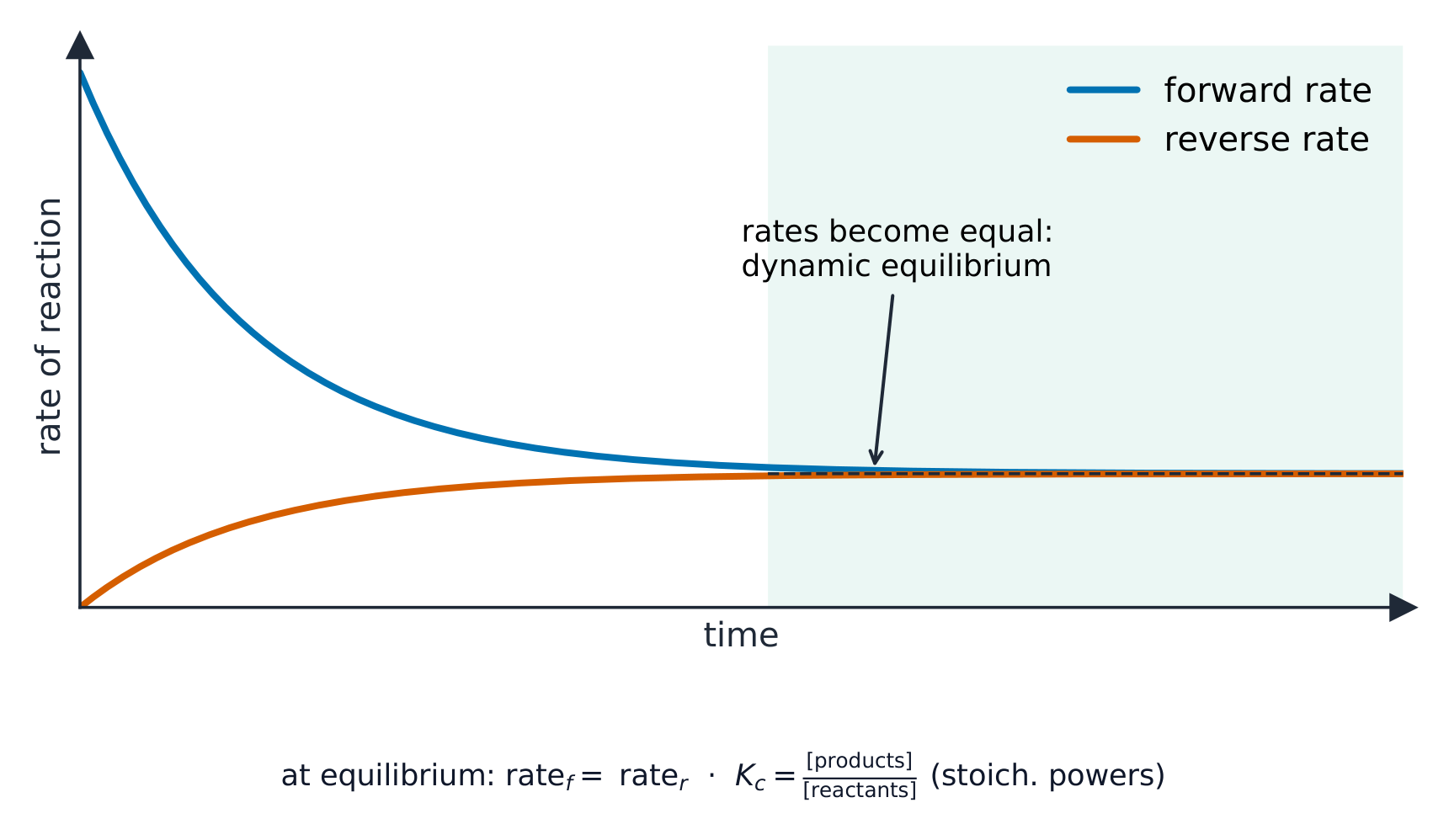
In a closed system 封闭系统 (nothing enters or leaves), the reaction reaches a dynamic equilibrium 动态平衡 when:
- the rate of the forward reaction equals the rate of the reverse reaction.
- the concentrations of reactants and products stay constant.
It is called dynamic because both reactions are still happening — they just cancel out. A closed system is needed, or products would escape and equilibrium could never be reached.
Explore
Dynamic equilibrium
forward rate = reverse rate
At equilibrium the position can sit anywhere — change a condition and watch it shift.
Vocabulary
Train
| English |
|---|
| reversible reaction/rɪˈvɜːsɪbl rɪˈækʃn/ |
| forward reaction/ˈfɔːwəd rɪˈækʃn/ |
| reverse reaction/rɪˈvɜːs rɪˈækʃn/ |
| closed system/kləʊzd ˈsɪstəm/ |
| dynamic equilibrium/daɪˈnæmɪk ˌiːkwɪˈlɪbrɪəm/ |
7.1
Le Chatelier's principle

Le Chatelier's principle 勒夏特列原理 says: if you change a system at equilibrium, the position of equilibrium 平衡 moves to oppose (reduce) that change.
| Change you make | Which way the equilibrium moves |
|---|---|
| increase concentration of a reactant | towards the products |
| increase pressure | towards the side with fewer gas molecules |
| increase temperature | towards the endothermic direction |
| add a catalyst 催化剂 | no shift (it speeds up both ways equally) |
A catalyst lets equilibrium be reached faster, but it does not change the position of equilibrium.
Explore
Shifting an equilibrium
Change the temperature, pressure or concentration and watch the equilibrium shift to oppose your change — Le Chatelier's principle in action.
Vocabulary
Train
| English |
|---|
| Le Chatelier's principle/lə ˈtʃeɪtlɪəz ˈprɪnsɪpl/ |
| equilibrium/ˌiːkwɪˈlɪbrɪəm/ |
| catalyst/ˈkætəlɪst/ |
7.1
Equilibrium constants
For a reaction at equilibrium, the equilibrium constant 平衡常数 links the amounts of products and reactants. For the reaction $a\text{A} + b\text{B} \rightleftharpoons c\text{C} + d\text{D}$:
$$K_c = \frac{[\text{C}]^c\,[\text{D}]^d}{[\text{A}]^a\,[\text{B}]^b}$$
where the square brackets mean concentration in $\text{mol dm}^{-3}$.
Worked example. At equilibrium the mixture $\text{H}_2 + \text{I}_2 \rightleftharpoons 2\text{HI}$ has $[\text{H}_2] = 0.20$, $[\text{I}_2] = 0.20$ and $[\text{HI}] = 1.6\ \text{mol dm}^{-3}$. Find $K_c$.
$$K_c = \frac{[\text{HI}]^2}{[\text{H}_2][\text{I}_2]} = \frac{1.6^2}{0.20 \times 0.20} = 64$$
(no units here, because the concentration powers cancel top and bottom).
Worked example (ICE table). $1.00\ \text{mol}$ each of $\text{H}_2$ and $\text{I}_2$ are sealed in a $1.00\ \text{dm}^3$ flask; at equilibrium $0.20\ \text{mol}$ of $\text{H}_2$ remains. Set out an ICE table (Initial, Change, Equilibrium):
| $\text{H}_2$ | $\text{I}_2$ | $2\text{HI}$ | |
|---|---|---|---|
| Initial | 1.00 | 1.00 | 0 |
| Change | $-0.80$ | $-0.80$ | $+1.60$ |
| Equilibrium | 0.20 | 0.20 | 1.60 |
$0.80\ \text{mol}$ of $\text{H}_2$ reacted, so $2\times0.80 = 1.60\ \text{mol}$ HI formed. In the $1.00\ \text{dm}^3$ flask the concentrations equal the moles, so $K_c = \dfrac{1.60^2}{0.20\times0.20} = 64$.
For reactions of gases, we use partial pressure 分压 instead of concentration. The partial pressure of a gas is the share of the total pressure that it provides. It is found from the mole fraction 摩尔分数 (the fraction of all the moles that are that gas):
$$\text{partial pressure} = \text{mole fraction} \times \text{total pressure}$$
The constant written with partial pressures is $K_p$.
Worked example. A gas mixture holds $2.0\ \text{mol}$ of $\text{N}_2$ and $6.0\ \text{mol}$ of $\text{H}_2$ at a total pressure of $200\ \text{kPa}$. Find the partial pressure of each gas.
There are $8.0\ \text{mol}$ in total, so
$$p(\text{N}_2) = \frac{2.0}{8.0} \times 200 = 50\ \text{kPa}, \qquad p(\text{H}_2) = \frac{6.0}{8.0} \times 200 = 150\ \text{kPa}.$$
Worked example (a numeric $K_p$). For $\text{N}_2 + 3\text{H}_2 \rightleftharpoons 2\text{NH}_3$ the equilibrium partial pressures are $p(\text{N}_2)=20$, $p(\text{H}_2)=40$ and $p(\text{NH}_3)=10\ \text{kPa}$. Then
$$K_p = \frac{p(\text{NH}_3)^2}{p(\text{N}_2)\,p(\text{H}_2)^3} = \frac{10^2}{20\times40^3} = 7.8\times10^{-5}\ \text{kPa}^{-2},$$
the units coming from $\dfrac{\text{kPa}^2}{\text{kPa}\times\text{kPa}^3}=\text{kPa}^{-2}$.
Only temperature changes the value of $K_c$ or $K_p$. Changing concentration or pressure shifts the position of equilibrium but leaves the constant unchanged; adding a catalyst changes neither the constant nor the position — it only makes equilibrium arrive faster.
Explore
Le Chatelier and Kc
Change temperature, pressure or concentration and watch the equilibrium shift to oppose it — Kc itself only changes with temperature.
Vocabulary
Train
| English |
|---|
| equilibrium constant/ˌiːkwɪˈlɪbrɪəm ˈkɒnstənt/ |
| partial pressure/ˈpɑːʃl ˈpreʃə/ |
| mole fraction/məʊl ˈfrækʃn/ |
7.1
The Haber and Contact processes

These two industrial processes are chosen by balancing yield, rate and cost using Le Chatelier's principle.
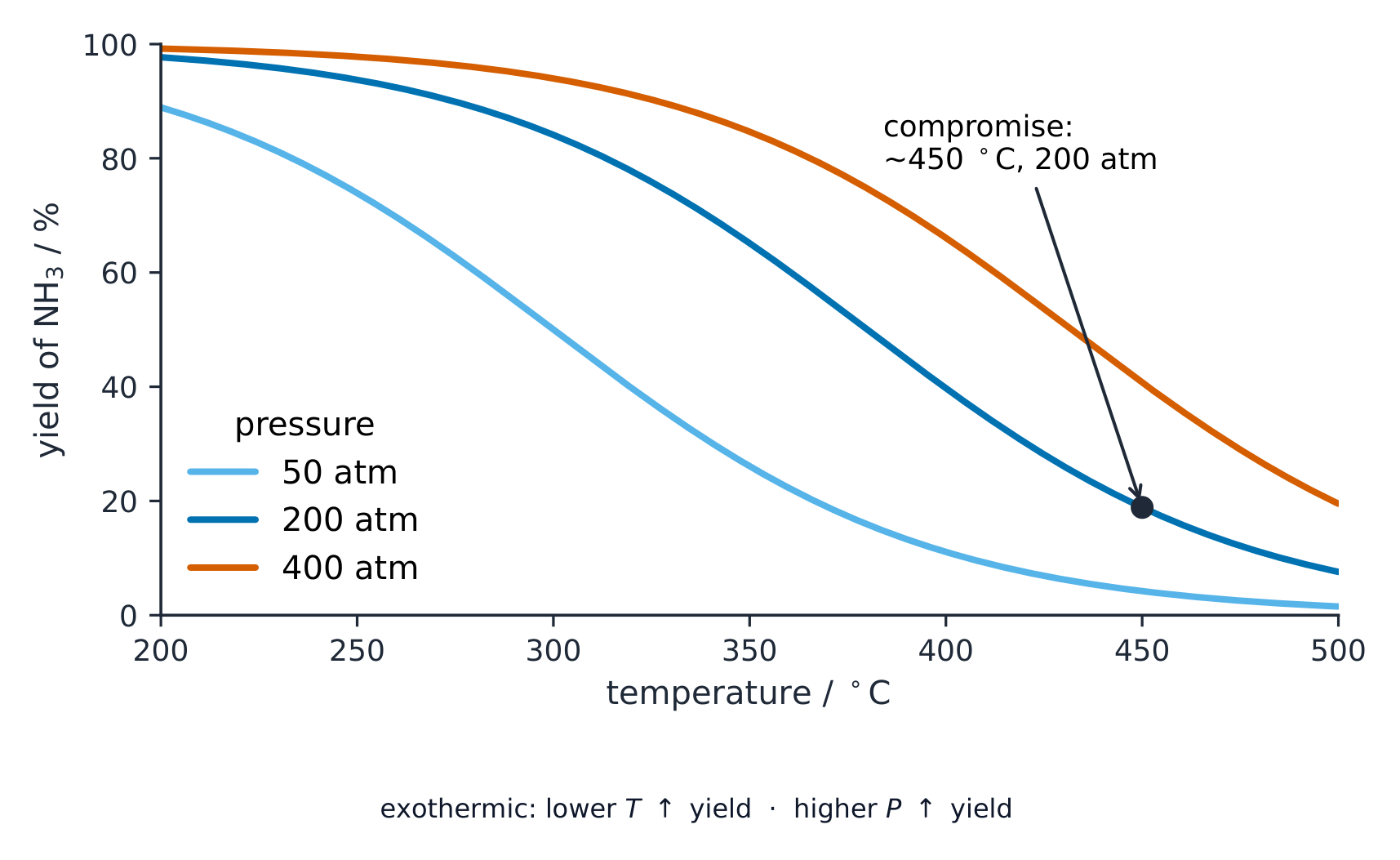
- the Haber process 哈伯法 makes ammonia: $\text{N}_2 + 3\text{H}_2 \rightleftharpoons 2\text{NH}_3$ (exothermic). It uses about $450\,°\text{C}$, $200\ \text{atm}$ and an iron catalyst. A low temperature would give more ammonia but too slowly, so a moderate temperature is a compromise.
- the Contact process 接触法 makes sulfur trioxide: $2\text{SO}_2 + \text{O}_2 \rightleftharpoons 2\text{SO}_3$ (exothermic). It uses about $450\,°\text{C}$, near $1$–$2\ \text{atm}$ and a vanadium(V) oxide catalyst.
Explore
The Haber & Contact processes
compromise: yield vs rate
High pressure boosts yield; high temperature speeds it up but lowers yield — a compromise.
Vocabulary
Train
| English |
|---|
| Haber process/ˈheɪbə ˈprəʊses/ |
| Contact process/ˈkɒntækt ˈprəʊses/ |
7.2
Acids and bases: the Brønsted–Lowry theory

Syllabus
- state the names and formulas of the common acids, limited to hydrochloric acid, $\text{HCl}$, sulfuric acid, $\text{H}_2\text{SO}_4$, nitric acid, $\text{HNO}_3$, ethanoic acid, $\text{CH}_3\text{COOH}$
- state the names and formulas of the common alkalis, limited to sodium hydroxide, $\text{NaOH}$, potassium hydroxide, $\text{KOH}$, ammonia, $\text{NH}_3$
- describe the Brønsted–Lowry theory of acids and bases
- describe strong acids and strong bases as fully dissociated in aqueous solution and weak acids and weak bases as partially dissociated in aqueous solution
- appreciate that water has pH of 7, acid solutions pH of below 7 and alkaline solutions pH of above 7
- explain qualitatively the differences in behaviour between strong and weak acids including the reaction with a reactive metal and difference in pH values by use of a pH meter, universal indicator or conductivity
- understand that neutralisation reactions occur when $\text{H}^+(\text{aq})$ and $\text{OH}^-(\text{aq})$ form $\text{H}_2\text{O}(\text{l})$
- understand that salts are formed in neutralisation reactions
- sketch the pH titration curves of titrations using combinations of strong and weak acids with strong and weak alkalis
- select suitable indicators for acid-alkali titrations, given appropriate data ($\text{p}K_a$ values will not be used)
Source: Cambridge International syllabus
A proton 质子 is simply an $\text{H}^+$ ion. The Brønsted–Lowry theory defines acids and bases by what they do with protons:
- an acid 酸 is a proton donor 质子供体 (it gives away $\text{H}^+$).
- a base 碱 is a proton acceptor 质子受体 (it takes $\text{H}^+$). A base that dissolves in water is called an alkali.
Common acids you must know: hydrochloric acid ($\text{HCl}$), sulfuric acid ($\text{H}_2\text{SO}_4$), nitric acid ($\text{HNO}_3$) and ethanoic acid ($\text{CH}_3\text{COOH}$). Common alkalis: sodium hydroxide ($\text{NaOH}$), potassium hydroxide ($\text{KOH}$) and ammonia ($\text{NH}_3$).
Explore
The pH scale
Slide the pH or tap a substance — each step down in pH means ten times more H⁺ ions; acids are below 7, alkalis above.
Vocabulary
Train
| English |
|---|
| proton/ˈprəʊtɒn/ |
| acid/ˈæsɪd/ |
| proton donor/ˈprəʊtɒn ˈdəʊnə/ |
| base/beɪs/ |
| proton acceptor/ˈprəʊtɒn əkˈseptə/ |
7.2
Strong and weak acids and bases

This is about how fully an acid or base splits up in water — not how concentrated it is.
- a strong acid 强酸 or strong base 强碱 is fully dissociated 解离 in water (almost every molecule splits into ions).
- a weak acid 弱酸 or weak base 弱碱 is only partly dissociated (most molecules stay whole).
The pH scale measures how acidic a solution is: pure water is pH 7, acids are below 7, and alkalis are above 7. A strong acid has a lower pH than a weak acid of the same concentration.
You can tell strong and weak acids apart by:
- reaction with a reactive metal: a strong acid fizzes faster.
- pH: measured with a pH meter or universal indicator 通用指示剂.
- electrical conductivity: a strong acid conducts better, because it has more ions.
Explore
Strong vs weak acids
A strong acid fully ionises (low pH); a weak acid only partly ionises, so at the same concentration its pH is higher. Slide to compare.
Vocabulary
Train
| English |
|---|
| strong acid/strɒŋ ˈæsɪd/ |
| strong base/strɒŋ beɪs/ |
| dissociated/dɪˈsəʊsɪeɪtɪd/ |
| weak acid/wiːk ˈæsɪd/ |
| weak base/wiːk beɪs/ |
| universal indicator/ˌjuːnɪˈvɜːsl ˈɪndɪkeɪtə/ |
7.2
Neutralisation, salts and titration curves

Neutralisation 中和 happens when the hydrogen ions from an acid react with the hydroxide ions from an alkali:
$$\text{H}^+(\text{aq}) + \text{OH}^-(\text{aq}) \rightarrow \text{H}_2\text{O}(\text{l})$$
A salt 盐 is also formed, from the rest of the acid and base.
In a titration 滴定 you add one solution to another and follow the pH. The titration curve 滴定曲线 has a steep, almost vertical jump near the end point. The exact shape depends on whether each reactant is strong or weak.
To pick an indicator 指示剂, choose one whose colour change falls inside that steep jump. For a strong acid with a strong base most indicators work; for a weak acid with a strong base you need one that changes in the higher pH range.
Explore
A titration curve
Add alkali to acid and watch the pH climb. The steep jump is the equivalence point, where the acid is just neutralised.
Vocabulary
Train
| English |
|---|
| Neutralisation/ˌnjuːtrəlaɪˈzeɪʃn/ |
| salt/sɒlt/ |
| titration/taɪˈtreɪʃn/ |
| titration curve/taɪˈtreɪʃn kɜːv/ |
| indicator/ˈɪndɪkeɪtə/ |
7.2
Exam tips
- Define dynamic equilibrium with all three points: forward and reverse rates equal, concentrations constant, closed system.
- Answer Le Chatelier questions by stating the change, the direction of shift, and the reason; a catalyst does not shift the position (it speeds both rates).
- Write $K_c$ as products over reactants, each raised to its balancing number; include state symbols to decide what appears.
- Justify Haber/Contact conditions as a compromise between yield, rate and cost — do not just quote them.
- Brønsted: acid = proton donor, base = proton acceptor; conjugate pairs differ by one $\text{H}^+$.
Interactive lessons on this topic
Work through it step by step, with instant-check exercises.