- understand and use the terms conjugate acid and conjugate base
- define conjugate acid–base pairs, identifying such pairs in reactions
- define mathematically the terms pH, $K_a$, $\text{p}K_a$ and $K_w$ and use them in calculations ($K_b$ and the equation $K_w = K_a \times K_b$ will not be tested)
- calculate $[\text{H}^+(\text{aq})]$ and pH values for: (a) strong acids (b) strong alkalis (c) weak acids
- (a) define a buffer solution (b) explain how a buffer solution can be made (c) explain how buffer solutions control pH; use chemical equations in these explanations (d) describe and explain the uses of buffer solutions, including the role of $\text{HCO}_3^-$ in controlling pH in blood
- calculate the pH of buffer solutions, given appropriate data
- understand and use the term solubility product, $K_{\text{sp}}$
- write an expression for $K_{\text{sp}}$
- calculate $K_{\text{sp}}$ from concentrations and vice versa
- (a) understand and use the common ion effect to explain the different solubility of a compound in a solution containing a common ion (b) perform calculations using $K_{\text{sp}}$ values and concentration of a common ion
Equilibria
A-Level Chemistry · Topic 25
 7:56
7:56
Equilibria (A2)
Your blood is held at pH seven point four. Move it a few tenths either way and you are in hospital. Yet all day, acid pours in — from your food, and from your…
English narration · English + 中文 subtitles burned in
25.1
Conjugate acids and bases

Syllabus
Source: Cambridge International syllabus
When a Brønsted acid loses an $\text{H}^+$, what is left is its conjugate base 共轭碱. When a base gains an $\text{H}^+$, it becomes its conjugate acid 共轭酸. The two species that differ by just one $\text{H}^+$ form a conjugate acid–base pair 共轭酸碱对.
For example, in $\text{CH}_3\text{COOH} \rightleftharpoons \text{CH}_3\text{COO}^- + \text{H}^+$, the pair is $\text{CH}_3\text{COOH}$ (acid) and $\text{CH}_3\text{COO}^-$ (its conjugate base).
Explore
pH and H⁺ concentration
pH = −log[H⁺]: slide it and watch [H⁺] change tenfold per unit. A conjugate acid–base pair differ by a single proton.
Vocabulary
Train
| English |
|---|
| conjugate base/ˈkɒndʒuːɡeɪt beɪs/ |
| conjugate acid/ˈkɒndʒuːɡeɪt ˈæsɪd/ |
| conjugate acid–base pair/ˈkɒndʒuːɡeɪt ˈæsɪd beɪs peə/ |
25.1
pH and the equilibrium constants

- pH measures acidity: $\text{pH} = -\log[\text{H}^+]$, so $[\text{H}^+] = 10^{-\text{pH}}$.
- the acid dissociation constant 酸解离常数 of a weak acid $\text{HA}$ is $K_a = \dfrac{[\text{H}^+][\text{A}^-]}{[\text{HA}]}$, and $\text{p}K_a = -\log K_a$. A larger $K_a$ (smaller $\text{p}K_a$) means a stronger acid.
- the ionic product of water 水的离子积 is $K_w = [\text{H}^+][\text{OH}^-] = 1.0 \times 10^{-14}$ at $298\ \text{K}$.

Calculating pH
- strong acid 强酸: fully ionised, so $[\text{H}^+]$ equals the acid concentration; then take $-\log$.
- strong alkali 强碱: find $[\text{OH}^-]$ from the concentration, then use $[\text{H}^+] = K_w / [\text{OH}^-]$.
- weak acid 弱酸: only partly ionised, so use $[\text{H}^+] = \sqrt{K_a \times [\text{HA}]}$.
Worked example. Find the pH of $0.050\ \text{mol dm}^{-3}$ hydrochloric acid (a strong acid).
It is fully ionised, so $[\text{H}^+] = 0.050\ \text{mol dm}^{-3}$, giving $\text{pH} = -\log(0.050) = 1.30$.
Worked example. Find the pH of $0.10\ \text{mol dm}^{-3}$ sodium hydroxide (a strong base). ($K_w = 1.0 \times 10^{-14}$.)
$[\text{OH}^-] = 0.10$, so $[\text{H}^+] = K_w/[\text{OH}^-] = (1.0 \times 10^{-14})/0.10 = 1.0 \times 10^{-13}$, giving $\text{pH} = 13.0$.
Worked example. Find the pH of $0.10\ \text{mol dm}^{-3}$ ethanoic acid (a weak acid). ($K_a = 1.8 \times 10^{-5}$.)
$$[\text{H}^+] = \sqrt{K_a \times [\text{HA}]} = \sqrt{(1.8 \times 10^{-5})(0.10)} = 1.3 \times 10^{-3}, \qquad \text{pH} = -\log(1.3 \times 10^{-3}) = 2.87.$$
Vocabulary
Train
| English |
|---|
| acid dissociation constant/ˈæsɪd dɪˌsəʊsɪˈeɪʃn ˈkɒnstənt/ |
| ionic product of water/aɪˈɒnɪk ˈprɒdʌkt ɒv ˈwɔːtə/ |
| strong acid/strɒŋ ˈæsɪd/ |
| strong alkali/strɒŋ ˈælkəlaɪ/ |
| weak acid/wiːk ˈæsɪd/ |
25.1
Buffer solutions
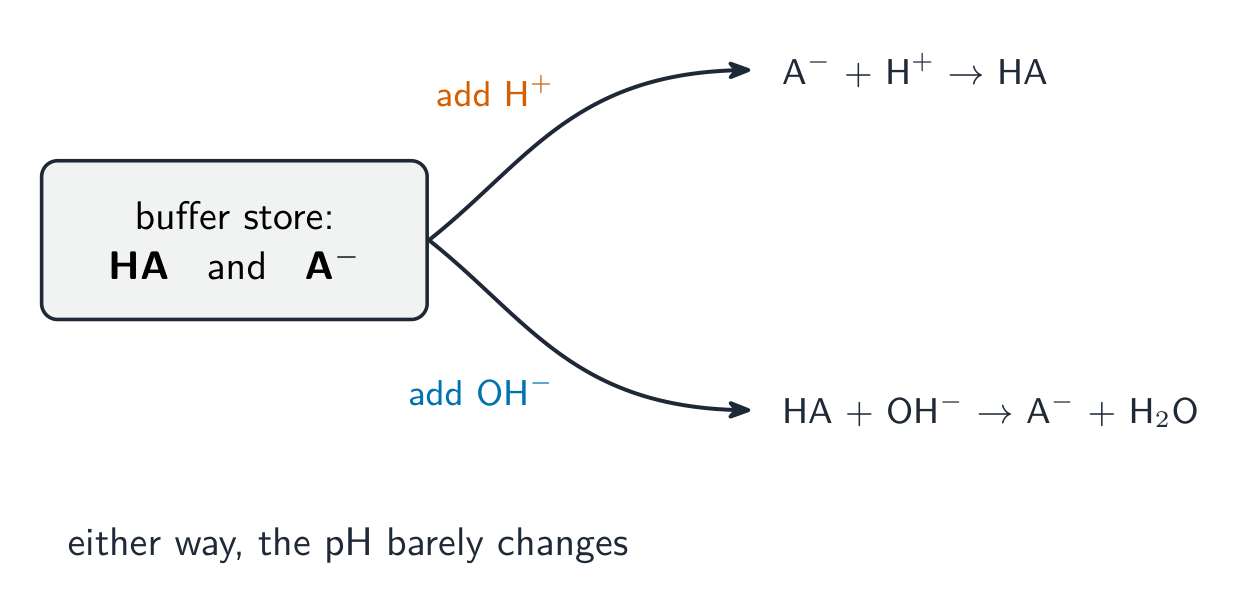
A buffer solution 缓冲溶液 resists a change in pH when a small amount of acid or alkali is added. You make one from a weak acid and its conjugate base (for example ethanoic acid and sodium ethanoate).
It works because the mixture holds a store of both partners:
- added $\text{H}^+$ is removed by the conjugate base: $\text{CH}_3\text{COO}^- + \text{H}^+ \rightarrow \text{CH}_3\text{COOH}$.
- added $\text{OH}^-$ is removed by the weak acid: $\text{CH}_3\text{COOH} + \text{OH}^- \rightarrow \text{CH}_3\text{COO}^- + \text{H}_2\text{O}$.
To find the pH, put the concentrations of the acid and its salt into the $K_a$ expression. Buffers are important in living things — for example, $\text{HCO}_3^-$ keeps the pH of blood close to $7.4$.
Explore
Buffers and the titration curve
Add alkali to acid: the flat part is where a buffer resists pH change, and the steep jump is the equivalence point.
Vocabulary
Train
| English |
|---|
| buffer solution/ˈbʌfə səˈluːʃn/ |
25.1
Solubility product

For a salt that barely dissolves, the solubility product 溶度积 ($K_{\text{sp}}$) is the product of the ion concentrations in a saturated solution, each raised to the power of its number in the formula:
$$K_{\text{sp}} = [\text{Ag}^+][\text{Cl}^-] \qquad K_{\text{sp}} = [\text{Ca}^{2+}][\text{F}^-]^2$$
You can find $K_{\text{sp}}$ from the solubility, or the solubility from $K_{\text{sp}}$.
The common ion effect
The common ion effect 同离子效应 is the way a salt becomes less soluble in a solution that already contains one of its ions. The extra ion pushes the dissolving equilibrium back (Le Chatelier), so less salt dissolves. You can calculate the new solubility using $K_{\text{sp}}$ and the concentration of the common ion.
Explore
Solubility product lab
ionic product compared with Ksp
Increase ion concentration and see when precipitation becomes likely.
Vocabulary
Train
| English |
|---|
| solubility product/ˌsɒljuːˈbɪlɪti ˈprɒdʌkt/ |
| common ion effect/ˈkɒmən ˈaɪɒn ɪˈfekt/ |
25.2
Partition coefficients

Syllabus
- state what is meant by the term partition coefficient, $K_{\text{pc}}$
- calculate and use a partition coefficient for a system in which the solute is in the same physical state in the two solvents
- understand the factors affecting the numerical value of a partition coefficient in terms of the polarities of the solute and the solvents used
Source: Cambridge International syllabus
When a solute is shaken with two solvents that do not mix, it spreads between them. The partition coefficient 分配系数 ($K_{\text{pc}}$) is the ratio of its concentrations in the two layers (at constant temperature):
$$K_{\text{pc}} = \frac{[\text{solute in solvent 1}]}{[\text{solute in solvent 2}]}$$
This works when the solute 溶质 is in the same physical state in both solvents. The value depends on the polarity 极性 of the solute and of each solvent 溶剂: a non-polar solute dissolves more in the non-polar solvent, while a polar solute prefers the polar solvent.
Explore
Partition coefficient lab
Kpc = concentration organic / concentration aqueous
Change organic-layer concentration and see the partition ratio.
Vocabulary
Train
| English |
|---|
| partition coefficient/pɑːˈtɪʃn ˌkəʊɪˈfɪʃənt/ |
| solute/ˈsɒljuːt/ |
| polarity/pəʊˈlærɪti/ |
| solvent/ˈsɒlvənt/ |
25.2
Exam tips
- $\text{pH} = -\log[\text{H}^+]$; for a strong acid $[\text{H}^+]$ = concentration, for a weak acid use $[\text{H}^+] = \sqrt{K_a[\text{HA}]}$.
- For a base, get $[\text{H}^+]$ from $K_w = [\text{H}^+][\text{OH}^-] = 1.0 \times 10^{-14}$.
- For a buffer use $[\text{H}^+] = K_a \times [\text{acid}]/[\text{salt}]$ and explain how it removes added $\text{H}^+$/$\text{OH}^-$.
- Write the $K_{sp}$ expression with the correct powers; the number of decimal places in a pH equals the significant figures of $[\text{H}^+]$.
Interactive lessons on this topic
Work through it step by step, with instant-check exercises.