- explain and use the terms rate equation, order of reaction, overall order of reaction, rate constant, half-life, rate-determining step and intermediate
- (a) understand and use rate equations of the form $\text{rate} = k [\text{A}]^m[\text{B}]^n$ (for which $m$ and $n$ are 0, 1 or 2) (b) deduce the order of a reaction from concentration–time graphs or from experimental data relating to the initial rates method and half-life method (c) interpret experimental data in graphical form, including concentration–time and rate–concentration graphs (d) calculate an initial rate using concentration data (e) construct a rate equation
- (a) show understanding that the half-life of a first-order reaction is independent of concentration (b) use the half-life of a first-order reaction in calculations
- calculate the numerical value of a rate constant, for example by: (a) using the initial rates and the rate equation (b) using the half-life, $t_{\frac{1}{2}}$, and the equation $k = 0.693/t_{\frac{1}{2}}$
- for a multi-step reaction: (a) suggest a reaction mechanism that is consistent with the rate equation and the equation for the overall reaction (b) predict the order that would result from a given reaction mechanism and rate-determining step (c) deduce a rate equation using a given reaction mechanism and rate-determining step for a given reaction (d) identify an intermediate or catalyst from a given reaction mechanism (e) identify the rate determining step from a rate equation and a given reaction mechanism
- describe qualitatively the effect of temperature change on the rate constant and hence the rate of a reaction
Reaction kinetics
A-Level Chemistry · Topic 26
 8:01
8:01
Reaction kinetics (A2)
Here is a real reaction: hydrogen peroxide reacting with iodide ions in acid. Look at the balanced equation. It uses two iodide ions and two hydrogen ions…
English narration · English + 中文 subtitles burned in
26.1
Rate equations and orders

Syllabus
Source: Cambridge International syllabus
A rate equation 速率方程 shows how the rate depends on the concentrations of the reactants:
$$\text{rate} = k\,[\text{A}]^m[\text{B}]^n$$
- $m$ is the order of reaction 反应级数 with respect to A, and $n$ the order with respect to B. Each is $0$, $1$ or $2$.
- the overall order of reaction 总反应级数 is $m + n$.
- $k$ is the rate constant 速率常数. The rate equation can only be found by experiment, not from the balanced equation.
Finding the order
- initial rates method: change one concentration at a time and see how the starting rate changes. If doubling $[\text{A}]$ doubles the rate, the order in A is 1; if it quadruples the rate, the order is 2; if the rate is unchanged, the order is 0.
Worked example. In experiments on $\text{A} + \text{B} \rightarrow$ products, doubling $[\text{A}]$ (with $[\text{B}]$ fixed) doubles the rate, and doubling $[\text{B}]$ (with $[\text{A}]$ fixed) quadruples the rate. Write the rate equation and give the overall order.
Doubling $[\text{A}]$ doubles the rate, so first order in A. Doubling $[\text{B}]$ quadruples ($2^2$) the rate, so second order in B. Hence
$$\text{rate} = k[\text{A}][\text{B}]^2, \qquad \text{overall order} = 1 + 2 = 3.$$
- graphs: a concentration–time graph for a first-order reaction has a constant half-life 半衰期 (the time for the concentration to halve). A rate–concentration graph is a straight line through the origin for first order, and a curve for second order.

Half-life and the rate constant
For a first-order reaction the half-life is constant — it does not depend on the concentration. You can find the rate constant from it:
$$k = \frac{0.693}{t_{\frac{1}{2}}}$$
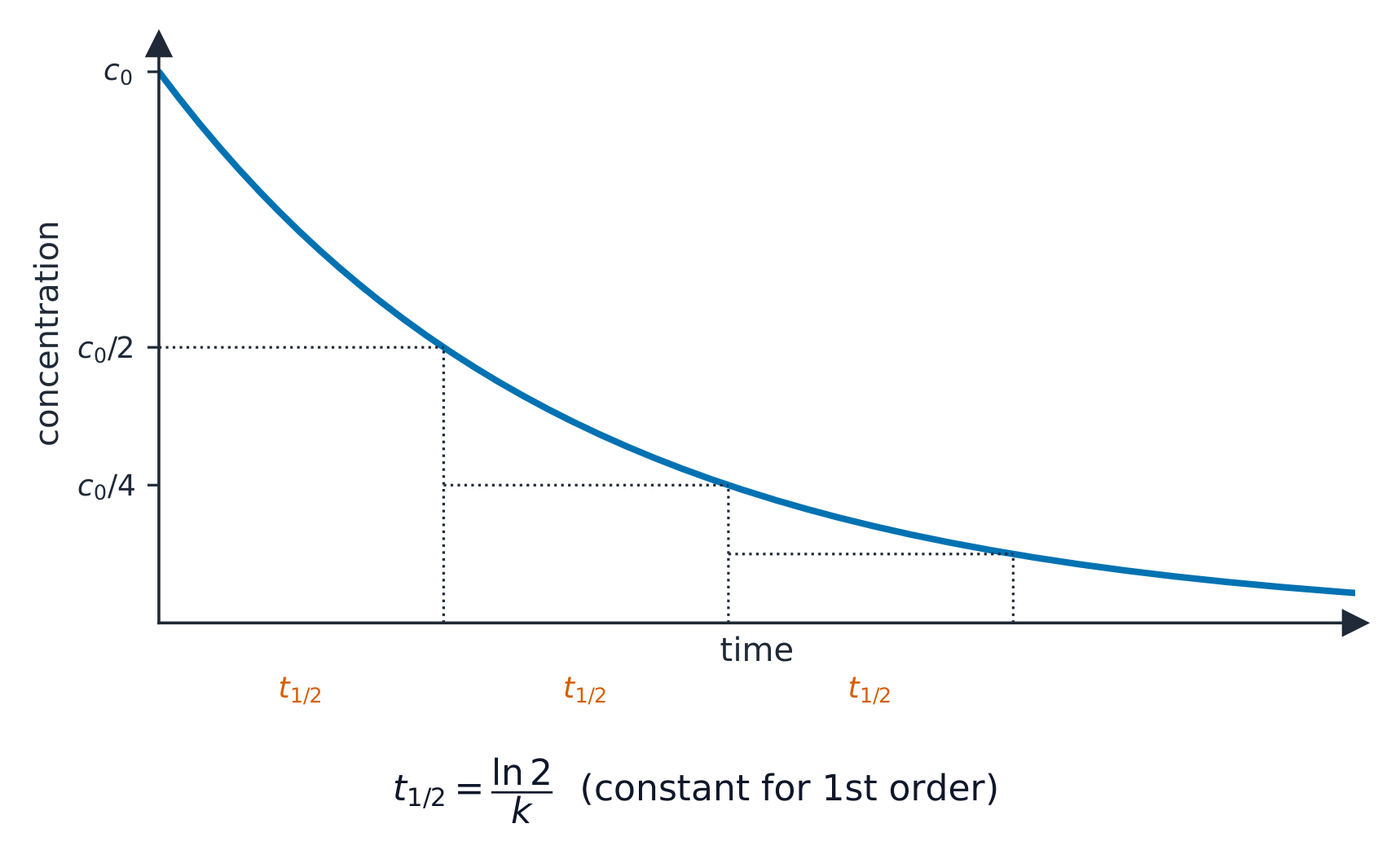
Worked example. A first-order reaction has a half-life of $120\ \text{s}$. Find its rate constant.
$$k = \frac{0.693}{t_{1/2}} = \frac{0.693}{120} = 5.8 \times 10^{-3}\ \text{s}^{-1}.$$
You can also find $k$ by putting initial-rate data into the rate equation.
Explore
Rate equations & orders
[A] = [A]₀·bᵗ
A first-order reaction decays exponentially — equal half-lives.
Vocabulary
Train
| English |
|---|
| rate equation/reɪt ɪˈkweɪʒn/ |
| order of reaction/ˈɔːdə ɒv rɪˈækʃn/ |
| overall order of reaction/ˌəʊvəˈrɔːl ˈɔːdə ɒv rɪˈækʃn/ |
| rate constant/reɪt ˈkɒnstənt/ |
| half-life/hɑːf laɪf/ |
26.1
Reaction mechanisms
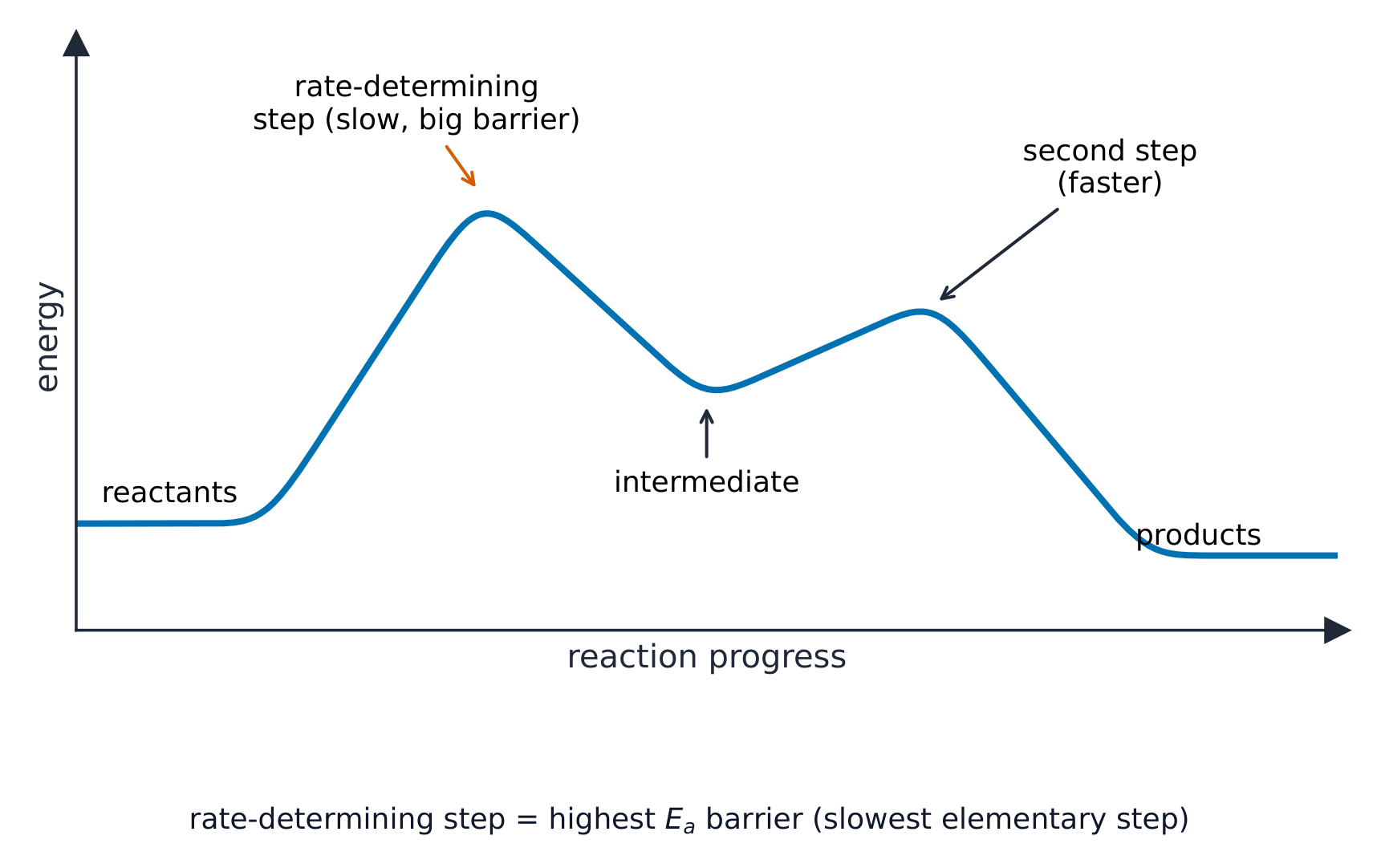
Most reactions happen in several steps. The slowest step is the rate-determining step 决速步骤, and it controls the overall rate. Only the species involved up to and including this step appear in the rate equation.
- an intermediate 中间体 is a species made in one step and then used up in a later step. It is not in the overall equation.
- you can suggest a mechanism that fits both the rate equation and the overall equation, predict the order from a given mechanism, or pick out the rate-determining step.
If you compare the initial rate 初始速率 of different mixtures, you can deduce the rate equation, and from that work out the mechanism.
Effect of temperature
Raising the temperature increases the rate constant $k$ (more molecules pass the activation energy), so the rate goes up.
Explore
Organic mechanism route
Trace electron-pair movement from reagent to product.
Vocabulary
Train
| English |
|---|
| rate-determining step/reɪt dɪˈtɜːmɪnɪŋ step/ |
| intermediate/ˌɪntəˈmiːdɪət/ |
| initial rate/ɪˈnɪʃl reɪt/ |
26.2
Catalysts

Syllabus
- explain that catalysts can be homogeneous or heterogeneous
- describe the mode of action of a heterogeneous catalyst to include adsorption of reactants, bond weakening and desorption of products, for example: (a) iron in the Haber process (b) palladium, platinum and rhodium in the catalytic removal of oxides of nitrogen from the exhaust gases of car engines
- describe the mode of action of a homogeneous catalyst by being used in one step and reformed in a later step, for example: (a) atmospheric oxides of nitrogen in the oxidation of atmospheric sulfur dioxide (b) $\text{Fe}^{2+}$ or $\text{Fe}^{3+}$ in the $\text{I}^- / \text{S}_2\text{O}_8^{2-}$ reaction
Source: Cambridge International syllabus
Catalysts 催化剂 can be homogeneous or heterogeneous.
Heterogeneous catalysts
A heterogeneous catalyst 多相催化剂 is in a different physical state from the reactants (usually a solid with gases). It works in three stages:
- adsorption 吸附: reactant molecules stick to the catalyst surface.
- the bonds in the reactants are weakened, so they react more easily.
- desorption 脱附: the product molecules leave the surface.

Examples are iron in the Haber process, and platinum, palladium and rhodium in a catalytic converter.
Homogeneous catalysts
A homogeneous catalyst 均相催化剂 is in the same physical state as the reactants. It is used up in one step and then reformed in a later step, so it comes back unchanged. Examples are oxides of nitrogen helping to oxidise atmospheric sulfur dioxide, and $\text{Fe}^{2+}$ or $\text{Fe}^{3+}$ speeding up the reaction between $\text{I}^-$ and $\text{S}_2\text{O}_8^{2-}$.
Explore
How a catalyst speeds a reaction
Turn the catalyst on and watch the rate jump — it gives more successful collisions per second by offering a lower-energy path.
Vocabulary
Train
| English |
|---|
| catalyst/ˈkætəlɪst/ |
| heterogeneous catalyst/ˌhetrəˈdʒiːnɪəs ˈkætəlɪst/ |
| adsorption/ədˈsɔːpʃn/ |
| desorption/dɪˈsɔːpʃn/ |
| homogeneous catalyst/həˈməʊdʒnɪəs ˈkætəlɪst/ |
26.2
Exam tips
- Find orders from initial-rate data: doubling a concentration that doubles the rate is first order, quadruples it is second order, no change is zero order.
- Write $\text{rate} = k[\text{A}]^m[\text{B}]^n$ and work out the units of $k$ from it.
- The rate-determining step contains the species (and orders) in the rate equation — use this to test a mechanism.
- A constant half-life means first order.
Interactive lessons on this topic
Work through it step by step, with instant-check exercises.