- for an organic molecule containing several functional groups: (a) identify organic functional groups using the reactions in the syllabus (b) predict properties and reactions
- devise multi-step synthetic routes for preparing organic molecules using the reactions in the syllabus
- analyse a given synthetic route in terms of type of reaction and reagents used for each step of it, and possible by-products
Organic synthesis
A-Level Chemistry · Topic 21
 8:01
8:01
Organic synthesis
Look at almost any medicine. It is a complicated molecule, and it began as something simple — often a small molecule from crude oil. No single reaction turns…
English narration · English + 中文 subtitles burned in
21.1
Organic synthesis

Syllabus
Source: Cambridge International syllabus
This topic does not add new reactions. Instead it asks you to join up the reactions you already know, so you can build a target molecule in several steps.
Identifying functional groups
A molecule may have more than one functional group 官能团. Use the test reactions from the syllabus to identify each one, and then predict how the molecule will behave. For example:
- decolourises bromine water → a C=C double bond (an alkene 烯烃).
- gives a precipitate with silver nitrate → a halogenoalkane 卤代烷.
- orange $\text{K}_2\text{Cr}_2\text{O}_7$ turns green → a primary or secondary alcohol 醇.
- orange precipitate with 2,4-DNPH → an aldehyde 醛 or ketone 酮.
- fizzes with a carbonate → a carboxylic acid 羧酸.

A map of the AS reactions
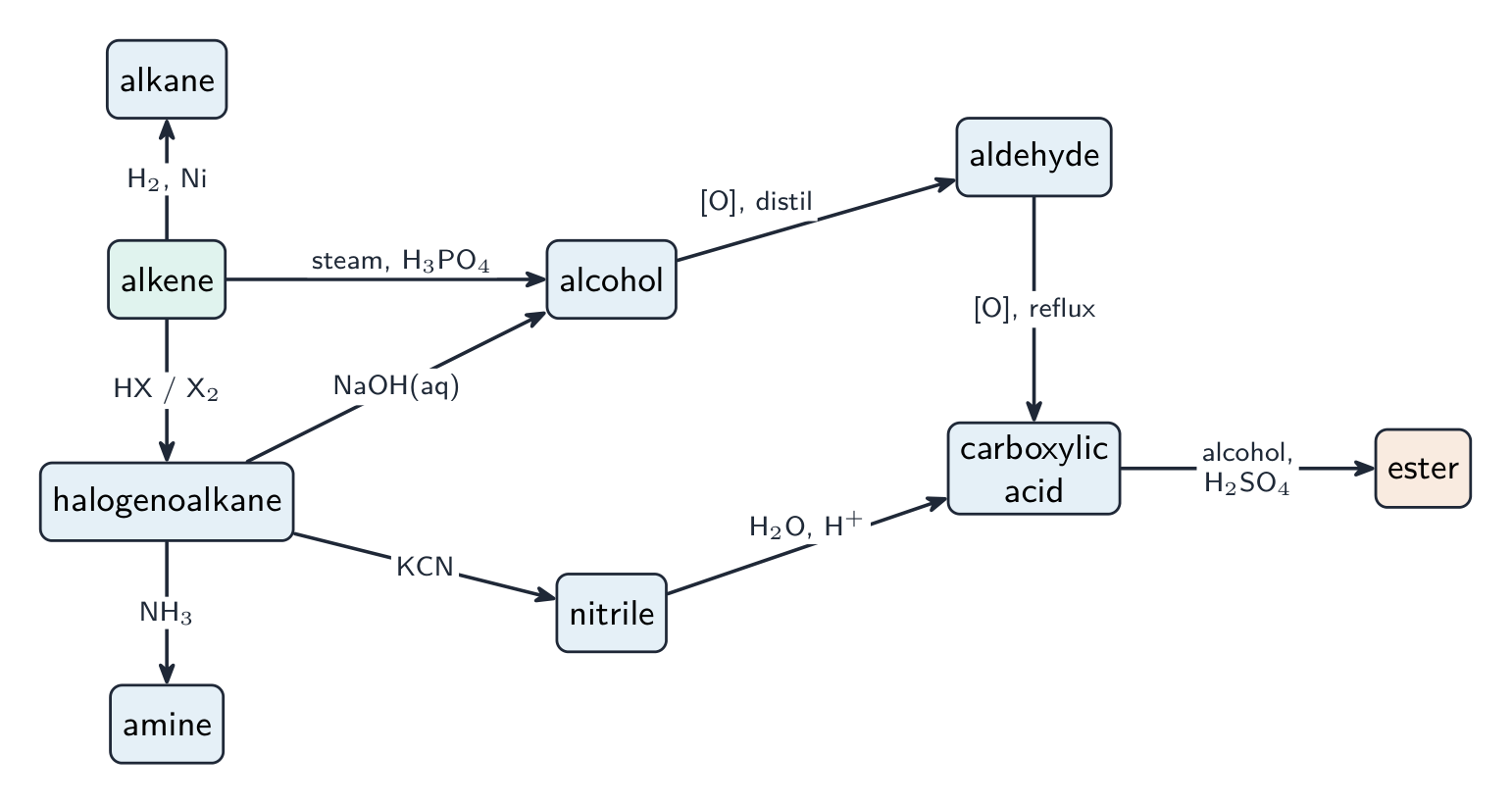
Each row turns one functional group into another. Learn it as a map you can travel around:
| Start | Reagent and conditions | Product |
|---|---|---|
| alkene | $\text{H}_2$, Ni | alkane |
| alkene | $\text{HX}$, or $\text{X}_2$ | halogenoalkane |
| alkene | steam, $\text{H}_3\text{PO}_4$ | alcohol |
| halogenoalkane | $\text{NaOH(aq)}$, heat | alcohol |
| halogenoalkane | $\text{KCN}$ in ethanol, heat | a nitrile 腈 (adds one carbon) |
| halogenoalkane | $\text{NH}_3$ in ethanol, pressure | an amine 胺 |
| alcohol | $\text{K}_2\text{Cr}_2\text{O}_7$, distil / reflux | aldehyde / carboxylic acid |
| alcohol | concentrated acid, heat | alkene |
| aldehyde or ketone | $\text{NaBH}_4$ | alcohol |
| aldehyde or ketone | $\text{HCN}$, $\text{KCN}$ | hydroxynitrile |
| nitrile | dilute acid, heat | carboxylic acid |
| carboxylic acid + alcohol | concentrated $\text{H}_2\text{SO}_4$ | an ester 酯 |
Planning a multi-step route
To devise a synthetic route 合成路线:
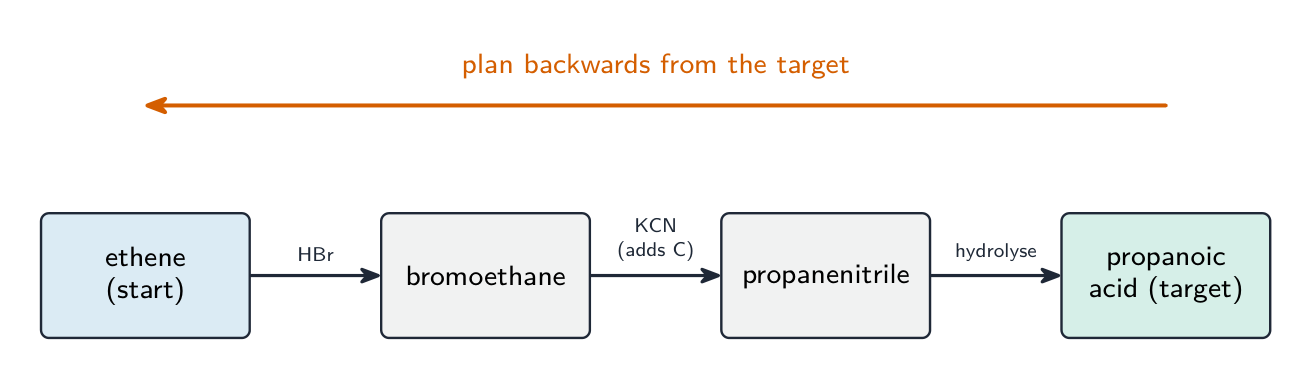
- compare the target with the starting material — what has changed (the functional group, the number of carbons)?
- work backwards from the target: which single reaction could make it, and from what?
- repeat until you reach the starting material.
- write each step with its reagent 试剂 and conditions.
If you need to add a carbon, the $\text{KCN}$ step is the key — it is the only AS reaction that lengthens the chain.
Analysing a route
When you are given a route, for each step state the type of reaction (such as oxidation 氧化, reduction 还原, substitution, addition or elimination) and the reagent used. Also think about possible by-products 副产物 — for example, making an amine from a halogenoalkane also gives a mixture of further-substituted amines, so the yield of the simple amine is low.


Worked example. Devise a route from propene to propanone, $\text{CH}_3\text{COCH}_3$. Work backwards from the target. A ketone comes from oxidising a secondary alcohol, so the step before propanone is propan-2-ol with acidified $\text{K}_2\text{Cr}_2\text{O}_7$ under reflux. Propan-2-ol comes from propene by adding steam over an $\text{H}_3\text{PO}_4$ catalyst - and Markovnikov's rule conveniently puts the $\text{OH}$ on the middle carbon, which is exactly the secondary alcohol needed. So the route is: propene, then steam with $\text{H}_3\text{PO}_4$, giving propan-2-ol; then acidified $\text{K}_2\text{Cr}_2\text{O}_7$ under reflux, giving propanone. Give a reagent and its conditions on every arrow: a route with the right intermediates but no reagents scores very little.
Explore
Reaction map lab
Classify clues that identify functional groups and reaction pathways.
Explore
Synthetic route planning lab
Follow how a target molecule is planned backwards then made forwards.
Vocabulary
Train
| English |
|---|
| functional group/ˈfʌŋkʃənl ɡruːp/ |
| alkene/ˈælkiːn/ |
| halogenoalkane/ˈheɪləʊdʒnəʊlkeɪn/ |
| alcohol/ˈælkəhɒl/ |
| aldehyde/ˈældɪhaɪd/ |
| ketone/ˈketəʊn/ |
| carboxylic acid/ˌkɑːbəkˈsɪlɪk ˈæsɪd/ |
| nitrile/ˈnaɪtraɪl/ |
| amine/ˈæmaɪn/ |
| ester/ˈestə/ |
| synthetic route/sɪnˈθetɪk ruːt/ |
| reagent/rɪˈeɪdʒənt/ |
| oxidation/ˌɒksɪˈdeɪʃn/ |
| reduction/rɪˈdʌkʃn/ |
| by-product/baɪ ˈprɒdʌkt/ |
21.1
Exam tips
- Learn the reagents and conditions for each conversion — that is exactly what synthesis questions test.
- Plan multi-step routes by functional group and watch the carbon count (KCN adds one carbon).
- Choose the shortest valid route and state every reagent and condition.
Interactive lessons on this topic
Work through it step by step, with instant-check exercises.