- define the unified atomic mass unit as one twelfth of the mass of a carbon-12 atom
- define relative atomic mass, $A_r$, relative isotopic mass, relative molecular mass, $M_r$, and relative formula mass in terms of the unified atomic mass unit
Atoms, molecules and stoichiometry
A-Level Chemistry · Topic 2
 19:02
19:02
Atoms, Molecules & Stoichiometry
Here is a problem. A single teaspoon of water holds about two hundred thousand billion billion molecules. You could never count them — not in a lifetime, not…
English narration · English + 中文 subtitles burned in
2.1
Relative masses of atoms and molecules

Syllabus
Source: Cambridge International syllabus
Atoms 原子 are far too light to weigh in grams, so we compare every mass to one standard. The standard is the unified atomic mass unit 统一原子质量单位 (symbol u), defined as exactly one twelfth of the mass of one carbon-12 atom.
Using this unit, we state masses as simple numbers:
- the relative atomic mass 相对原子质量 $A_r$ of an element is the average mass of its atoms compared with $\tfrac{1}{12}$ of a carbon-12 atom. It is an average over all the isotopes 同位素, weighted by how common each one is.
- the relative isotopic mass 相对同位素质量 is the mass of one atom of a single isotope, compared with $\tfrac{1}{12}$ of a carbon-12 atom.
- the relative molecular mass 相对分子质量 $M_r$ of a molecule 分子 is the sum of the relative atomic masses of all its atoms.
- the relative formula mass 相对式量 is the same idea for a substance that is not made of molecules (such as an ionic compound). Add up the relative atomic masses shown in the formula.
To find $A_r$ from isotope data, multiply each isotope mass by its percentage, add these up, and divide by 100.
Worked example. Chlorine is $75\%$ ${}^{35}\text{Cl}$ and $25\%$ ${}^{37}\text{Cl}$. Find its relative atomic mass.
$$A_r = \frac{(75 \times 35) + (25 \times 37)}{100} = \frac{2625 + 925}{100} = 35.5.$$
Worked example. A mass spectrometer shows copper is $69.2\%$ ${}^{63}\text{Cu}$ and $30.8\%$ ${}^{65}\text{Cu}$. Find its relative atomic mass.
$$A_r = \frac{(69.2 \times 63) + (30.8 \times 65)}{100} = \frac{4359.6 + 2002.0}{100} = 63.6.$$
Explore
Relative mass lab
relative atomic mass = weighted mean
Change isotope abundance and see the weighted mean move.
Vocabulary
Train
| English |
|---|
| atom/ˈætəm/ |
| unified atomic mass unit/ˈjuːnɪfaɪd əˈtɒmɪk mæs ˈjuːnɪt/ |
| relative atomic mass/ˈrelətɪv əˈtɒmɪk mæs/ |
| isotope/ˈaɪsətəʊp/ |
| relative isotopic mass/ˈrelətɪv ˌaɪsəˈtɒpɪk mæs/ |
| relative molecular mass/ˈrelətɪv məˈlekjʊlə mæs/ |
| molecule/ˈmɒlɪkjuːl/ |
| relative formula mass/ˈrelətɪv ˈfɔːmjʊlə mæs/ |
2.2
The mole and the Avogadro constant
Syllabus
- define and use the term mole in terms of the Avogadro constant
Source: Cambridge International syllabus
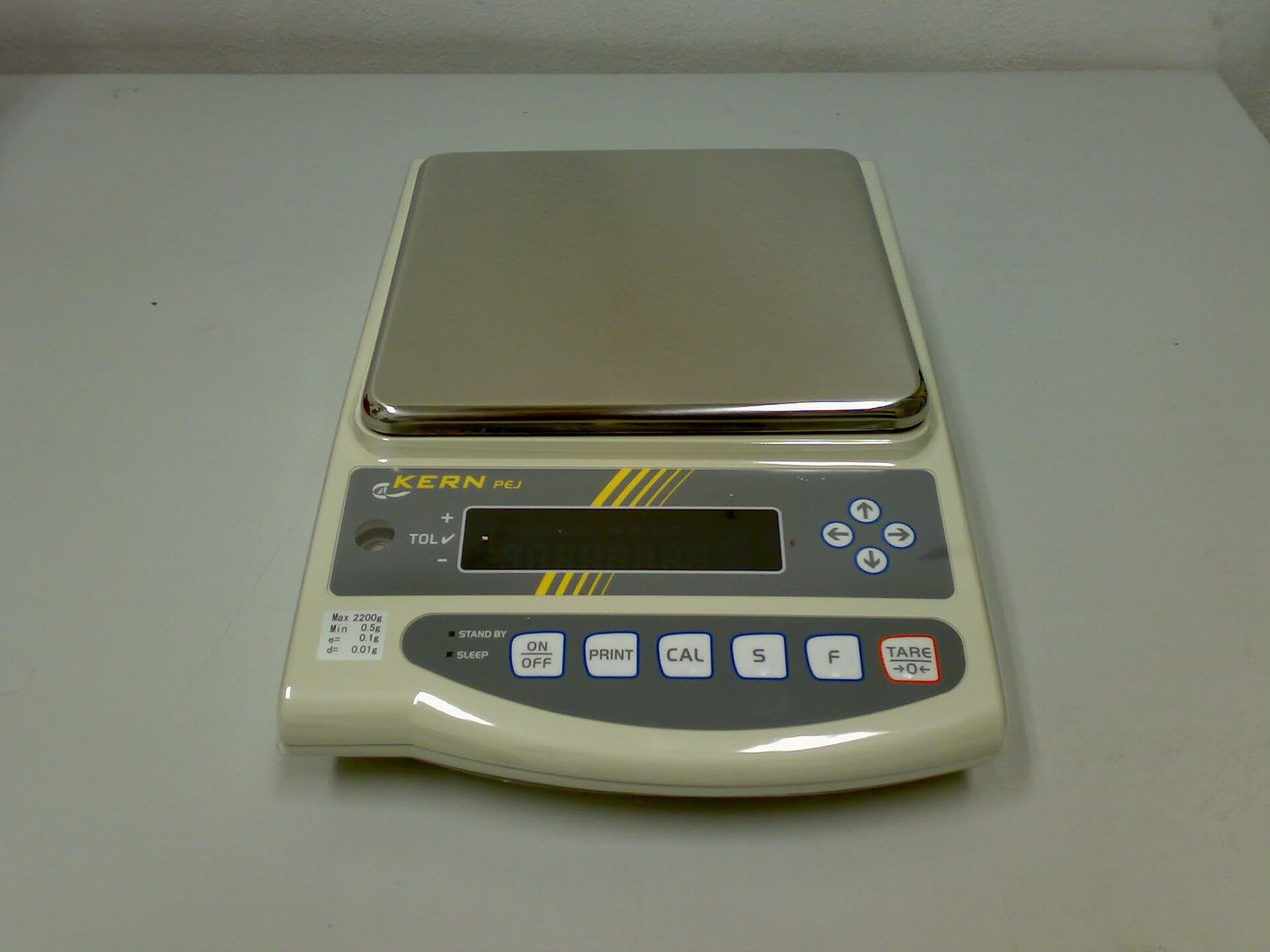
Chemists count particles in groups called moles, just as we count eggs in dozens.
One mole 摩尔 (symbol mol) is the amount of substance that contains the same number of particles as there are atoms in exactly 12 g of carbon-12. That number is the Avogadro constant 阿伏伽德罗常量:
$$N_A = 6.02 \times 10^{23}\ \text{mol}^{-1}$$
So one mole of anything contains $6.02 \times 10^{23}$ particles. The particles may be atoms, molecules or ions 离子 — always say which.
The mass of one mole in grams equals the relative mass ($A_r$ or $M_r$). This is the molar mass 摩尔质量, with units $\text{g mol}^{-1}$. The key equation is:
$$n = \frac{m}{M}$$
where $n$ is the amount in moles, $m$ is the mass in grams, and $M$ is the molar mass.
Worked example. How many moles are in $8.0\ \text{g}$ of methane, $\text{CH}_4$? ($A_r$: C $= 12$, H $= 1$.)
The molar mass is $M = 12 + 4(1) = 16\ \text{g mol}^{-1}$, so
$$n = \frac{m}{M} = \frac{8.0}{16} = 0.50\ \text{mol}.$$

Explore
Mole mass lab
n = m / M
Change mass and see moles scale through molar mass.
Vocabulary
Train
| English |
|---|
| mole/məʊl/ |
| Avogadro constant/ˌævəˈɡædrəʊ ˈkɒnstənt/ |
| ion/ˈaɪɒn/ |
| molar mass/ˈməʊlə mæs/ |
2.3
Formulas

Syllabus
- write formulas of ionic compounds from ionic charges and oxidation numbers (shown by a Roman numeral), including: (a) the prediction of ionic charge from the position of an element in the Periodic Table (b) recall of the names and formulas for the following ions: $\text{NO}_3^-$, $\text{CO}_3^{2-}$, $\text{SO}_4^{2-}$, $\text{OH}^-$, $\text{NH}_4^+$, $\text{Zn}^{2+}$, $\text{Ag}^+$, $\text{HCO}_3^-$, $\text{PO}_4^{3-}$
- (a) write and construct equations (which should be balanced), including ionic equations (which should not include spectator ions) (b) use appropriate state symbols in equations
- define and use the terms empirical and molecular formula
- understand and use the terms anhydrous, hydrated and water of crystallisation
- calculate empirical and molecular formulas, using given data
Source: Cambridge International syllabus
A compound 化合物 is a substance made of two or more elements chemically joined.
Charges and formulas of ionic compounds
In an ionic compound 离子化合物 the total positive charge balances the total negative charge, so the compound is neutral overall.
You can predict the charge of many ions from the element's position in the Periodic Table:
| Group | 1 | 2 | 13 | 15 | 16 | 17 |
|---|---|---|---|---|---|---|
| Usual ion charge | $+1$ | $+2$ | $+3$ | $-3$ | $-2$ | $-1$ |
Hydrogen forms $\text{H}^+$, and the Group 18 noble gases do not normally form ions.
Some ions you must know by name and formula:
| Name | Formula |
|---|---|
| nitrate | $\text{NO}_3^{-}$ |
| carbonate | $\text{CO}_3^{2-}$ |
| sulfate | $\text{SO}_4^{2-}$ |
| hydroxide | $\text{OH}^{-}$ |
| ammonium | $\text{NH}_4^{+}$ |
| zinc | $\text{Zn}^{2+}$ |
| silver | $\text{Ag}^{+}$ |
| hydrogencarbonate | $\text{HCO}_3^{-}$ |
| phosphate | $\text{PO}_4^{3-}$ |
For a metal that can have more than one charge, a Roman numeral shows the oxidation number 氧化数. For example, iron(II) is $\text{Fe}^{2+}$ and iron(III) is $\text{Fe}^{3+}$. To write a formula, balance the charges: iron(III) oxide is $\text{Fe}_2\text{O}_3$, because two $\text{Fe}^{3+}$ balance three $\text{O}^{2-}$.
Equations and state symbols
A chemical equation must be balanced 配平 — the same number of each kind of atom on both sides. Add state symbols 状态符号 to show the state of each species: (s) solid, (l) liquid, (g) gas, and (aq) aqueous 水溶液 (dissolved in water).
An ionic equation 离子方程式 shows only the ions and molecules that actually change. The ions that do not change are spectator ions 旁观离子, and you leave them out. For example, the reaction that forms silver chloride is:
$$\text{Ag}^{+}(\text{aq}) + \text{Cl}^{-}(\text{aq}) \rightarrow \text{AgCl}(\text{s})$$
Empirical and molecular formulas
The empirical formula 实验式 is the simplest whole-number ratio of the atoms of each element in a compound. The molecular formula 分子式 shows the actual number of atoms of each element in one molecule.
For example, ethane has empirical formula $\text{CH}_3$ but molecular formula $\text{C}_2\text{H}_6$.
Hydrated and anhydrous solids
Some solids hold water inside their crystals. This water is the water of crystallisation 结晶水. A solid that contains it is hydrated 水合的; the same solid with the water removed is anhydrous 无水的.
For example, hydrated copper(II) sulfate is $\text{CuSO}_4 \cdot 5\text{H}_2\text{O}$. Heating it drives off the water to leave anhydrous $\text{CuSO}_4$.
Calculating empirical and molecular formulas
To find the empirical formula from masses (or percentages by mass):
- divide each element's mass by its $A_r$ to get the moles.
- divide all the mole values by the smallest one.
- round to the nearest whole numbers — that ratio is the empirical formula.
To get the molecular formula, you also need $M_r$. Find how many times the empirical formula mass fits into $M_r$, then multiply the formula by that number.
Worked example. A compound is $40.0\%$ carbon, $6.7\%$ hydrogen and $53.3\%$ oxygen by mass. Find its empirical formula. ($A_r$: C $= 12$, H $= 1$, O $= 16$.)
Take $100\ \text{g}$ and divide each mass by its $A_r$ to get moles: C $= 40.0/12 = 3.33$, H $= 6.7/1 = 6.7$, O $= 53.3/16 = 3.33$. Dividing through by the smallest ($3.33$) gives a ratio C : H : O $= 1 : 2 : 1$, so the empirical formula is $\text{CH}_2\text{O}$.
Explore
Equation balancing route
Follow atoms through a chemical equation so both sides match.
Vocabulary
Train
| English |
|---|
| compound/ˈkɒmpaʊnd/ |
| ionic compound/aɪˈɒnɪk ˈkɒmpaʊnd/ |
| oxidation number/ˌɒksɪˈdeɪʃn ˈnʌmbə/ |
| balanced/ˈbælənst/ |
| state symbols/steɪt ˈsɪmblz/ |
| aqueous/ˈeɪkwɪəs/ |
| ionic equation/aɪˈɒnɪk ɪˈkweɪʒn/ |
| spectator ions/spekˈteɪtə ˈaɪɒnz/ |
| empirical formula/emˈpɪrɪkl ˈfɔːmjʊlə/ |
| molecular formula/məˈlekjʊlə ˈfɔːmjʊlə/ |
| water of crystallisation/ˈwɔːtə ɒv ˌkrɪstəlaɪˈzeɪʃn/ |
| hydrated/haɪˈdreɪtɪd/ |
| anhydrous/ænˈhaɪdrəs/ |
2.4
Reacting masses and volumes

Syllabus
- perform calculations including use of the mole concept, involving: (a) reacting masses (from formulas and equations) including percentage yield calculations (b) volumes of gases (e.g. in the burning of hydrocarbons) (c) volumes and concentrations of solutions (d) limiting reagent and excess reagent (When performing calculations, candidates’ answers should reflect the number of significant figures given or asked for in the question. When rounding up or down, candidates should ensure that significant figures are neither lost unnecessarily nor used beyond what is justified (see also Mathematical requirements section).) (e) deduce stoichiometric relationships from calculations such as those in 2.4.1(a)–(d)
Source: Cambridge International syllabus
Reacting masses and percentage yield
The numbers in front of each species in a balanced equation give the mole ratio — this is the stoichiometry 化学计量. To find a reacting mass: change the known mass to moles, use the mole ratio to find the moles you want, then change back to mass.
Worked example. What mass of magnesium oxide forms when $4.8\ \text{g}$ of magnesium burns completely? $2\text{Mg} + \text{O}_2 \rightarrow 2\text{MgO}$. ($A_r$: Mg $= 24$, O $= 16$.)
Moles of Mg $= 4.8/24 = 0.20\ \text{mol}$. The ratio Mg : MgO is $1 : 1$, so $0.20\ \text{mol}$ of MgO forms. Its molar mass is $24 + 16 = 40\ \text{g mol}^{-1}$, so
$$m = nM = 0.20 \times 40 = 8.0\ \text{g}.$$

In real reactions you usually get less product than the maximum. The percentage yield 产率 compares the amount you actually made with the most you could make:
$$\text{percentage yield} = \frac{\text{actual amount of product}}{\text{maximum possible amount}} \times 100\%$$
Limiting and excess reagent
When two reactants are mixed, one usually runs out first. The limiting reagent 限量试剂 is the one that runs out — it decides how much product forms. The other is the excess reagent 过量试剂, because there is more than enough of it. Always base the calculation on the limiting reagent.
To find it: work out the moles of each reactant, divide each by its number in the equation, and the smallest result is the limiting reagent.

Volumes of gases
At the same temperature and pressure, equal volumes of any gases contain equal numbers of molecules. At room temperature and pressure (r.t.p.), one mole of any gas takes up $24.0\ \text{dm}^3$, so:
$$n = \frac{V}{24.0}\qquad (V \text{ in } \text{dm}^3 \text{ at r.t.p.})$$

This is used when burning hydrocarbons 碳氢化合物 (compounds of only carbon and hydrogen), where you compare gas volumes.
Volumes and concentrations of solutions
The concentration 浓度 of a solution is the amount of solute 溶质 in each cubic decimetre of solution 溶液, measured in $\text{mol dm}^{-3}$:
$$n = c \times V$$
where $c$ is the concentration and $V$ is the volume in $\text{dm}^3$. Remember that $1000\ \text{cm}^3 = 1\ \text{dm}^3$.
Worked example. In a titration, $25.0\ \text{cm}^3$ of sodium hydroxide solution is exactly neutralised by $20.0\ \text{cm}^3$ of $0.100\ \text{mol dm}^{-3}$ hydrochloric acid: $\text{NaOH} + \text{HCl} \rightarrow \text{NaCl} + \text{H}_2\text{O}$. Find the concentration of the sodium hydroxide.
Moles of HCl $= cV = 0.100 \times \dfrac{20.0}{1000} = 2.00 \times 10^{-3}\ \text{mol}$. The ratio is $1 : 1$, so there are $2.00 \times 10^{-3}\ \text{mol}$ of NaOH in $25.0\ \text{cm}^3$:
$$c = \frac{n}{V} = \frac{2.00 \times 10^{-3}}{25.0/1000} = 0.0800\ \text{mol dm}^{-3}.$$
This is the basis of a titration 滴定, where you find an unknown concentration by reacting it with a solution whose concentration you already know.

Significant figures
Give your answer to a sensible number of significant figures 有效数字 — usually match the data in the question. Do not write more digits than the data supports, and do not round so early that you lose accuracy.
Explore
Reacting mass route
Follow a balanced equation from known mass to predicted product mass.
Explore
Gas volume lab
n = V / 24 dm3
Change gas volume and see moles scale at room conditions.
Vocabulary
Train
| English |
|---|
| stoichiometry/ˌstəʊɪkɪˈɒmətri/ |
| percentage yield/pəˈsentɪdʒ jiːld/ |
| limiting reagent/ˈlɪmɪtɪŋ rɪˈeɪdʒənt/ |
| excess reagent/ekˈses rɪˈeɪdʒənt/ |
| hydrocarbons/ˈhaɪdrəkɑːbənz/ |
| concentration/ˌkɒnsənˈtreɪʃn/ |
| solute/ˈsɒljuːt/ |
| solution/səˈluːʃn/ |
| titration/taɪˈtreɪʃn/ |
| significant figures/sɪɡˈnɪfɪkənt ˈfɪɡəz/ |
2.4
Exam tips
- Convert volumes to $\text{dm}^3$ before using concentration ($25.0\ \text{cm}^3 = 0.0250\ \text{dm}^3$); the missing $\div 1000$ is the most common titration error.
- Use the balancing numbers as the mole ratio between species — never the $M_r$ values.
- Empirical formula: divide each mass/percentage by $A_r$, then by the smallest, then scale to whole numbers; use $M_r$ to reach the molecular formula.
- For gases at r.t.p. use $\text{volume} = \text{moles} \times 24\ \text{dm}^3$; quote the equation you use every time.
- Give the answer to the same significant figures as the data (usually 3) and always include units.
Interactive lessons on this topic
Work through it step by step, with instant-check exercises.