- describe the formation of polyesters: (a) the reaction between a diol and a dicarboxylic acid or dioyl chloride (b) the reaction of a hydroxycarboxylic acid
- describe the formation of polyamides: (a) the reaction between a diamine and a dicarboxylic acid or dioyl chloride (b) the reaction of an aminocarboxylic acid (c) the reaction between amino acids
- deduce the repeat unit of a condensation polymer obtained from a given monomer or pair of monomers
- identify the monomer(s) present in a given section of a condensation polymer molecule
Polymerisation
A-Level Chemistry · Topic 35
 7:58
7:58
Polymerisation (A2)
Look at three very different things. A nylon rope. A plastic drinks bottle. The protein in your own hair. They seem to have nothing in common. Yet all three…
English narration · English + 中文 subtitles burned in
35.1
Condensation polymerisation

Syllabus
Source: Cambridge International syllabus
In condensation polymerisation 缩合聚合, monomers join into a long chain and a small molecule (such as water or $\text{HCl}$) is lost each time a new bond forms. Each monomer needs two reactive groups, so the chain can grow at both ends.
Polyesters
A polyester 聚酯 has many ester links along its chain. You can make one from:
- a diol 二醇 (two $\text{–OH}$ groups) and a dicarboxylic acid 二羧酸 (two $\text{–COOH}$ groups), or a dioyl chloride.
- a single hydroxycarboxylic acid, which has both an $\text{–OH}$ and a $\text{–COOH}$.

Polyamides
A polyamide 聚酰胺 has many amide links. You can make one from:
- a diamine 二胺 (two $\text{–NH}_2$ groups) and a dicarboxylic acid or a dioyl chloride.
- a single aminocarboxylic acid, or from amino acids 氨基酸 joining together (proteins are natural polyamides).

Repeat units and monomers
The repeat unit 重复单元 of a condensation polymer contains parts of both monomers, minus the atoms lost as the small molecule. To find the monomers 单体 from a section of polymer, break the chain at each ester or amide link, then add back $\text{–OH}$ and $\text{–H}$ (or $\text{–Cl}$).

Worked example. A polymer chain contains repeating $\text{–CONH–}$ links. Name the type of polymer, identify the monomers, and give the small molecule lost. A $\text{–CONH–}$ link is an amide, so this is a polyamide made by condensation polymerisation. To find the monomers, break the chain at each amide link and give the cut ends their atoms back: the carbon side takes $\text{–OH}$, making a dicarboxylic acid, and the nitrogen side takes $\text{–H}$, making a diamine. The small molecule lost at each link is water (or $\text{HCl}$, if an acyl dichloride was used in place of the acid). Each monomer must have two functional groups, or the chain could never keep growing - if the monomer you propose has only one, you have broken the chain in the wrong place.
Explore
Condensation polymer route
Watch monomers join while a small molecule leaves each time.
Vocabulary
Train
| English |
|---|
| condensation polymerisation/kɒndenˈseɪʃn ˌpɒlɪməraɪˈzeɪʃn/ |
| polyester/ˌpɒlɪˈestə/ |
| diol/dɪˈɒl/ |
| dicarboxylic acid/ˌdɪkɑːbəkˈsɪlɪk ˈæsɪd/ |
| polyamide/ˌpɒlɪˈeɪmaɪd/ |
| diamine/ˈdaɪəmaɪn/ |
| amino acid/əˈmiːnəʊ ˈæsɪd/ |
| repeat unit/rɪˈpiːt ˈjuːnɪt/ |
| monomer/ˈmɒnəʊmə/ |
35.2
Predicting the type of polymerisation
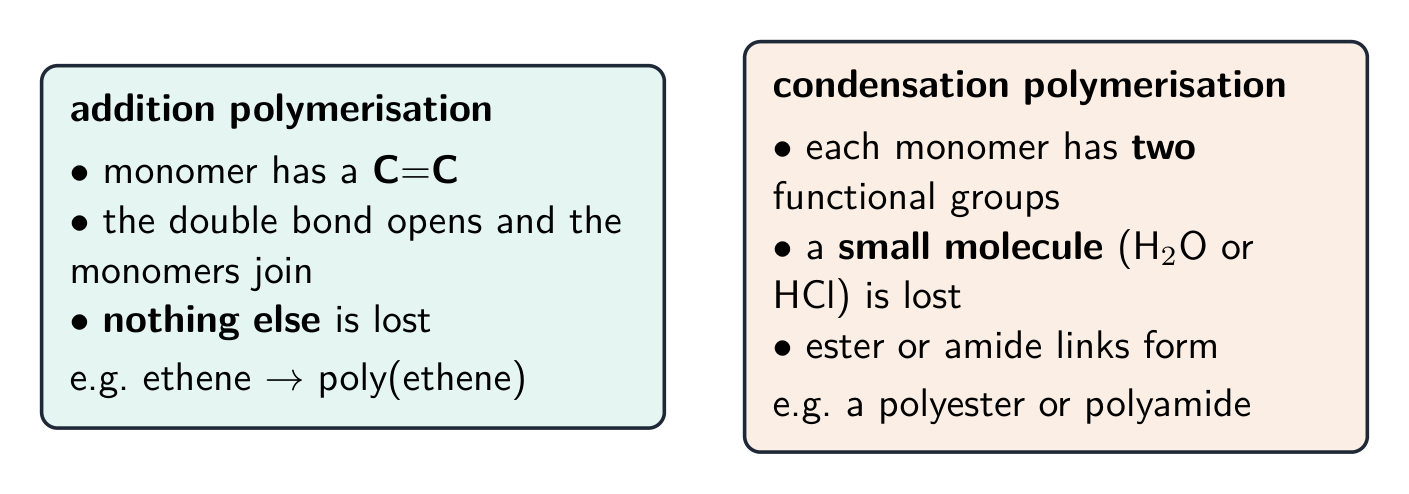
Syllabus
- predict the type of polymerisation reaction for a given monomer or pair of monomers
- deduce the type of polymerisation reaction which produces a given section of a polymer molecule
Source: Cambridge International syllabus
| Clue | Type |
|---|---|
| the monomer has a C=C double bond, and nothing else is lost | addition polymerisation 加成聚合 |
| each monomer has two functional groups, and a small molecule is lost; the chain has ester or amide links | condensation polymerisation |
Explore
Polymerisation type lab
Classify monomers by whether they form addition or condensation polymers.
Vocabulary
Train
| English |
|---|
| addition polymerisation/əˈdɪʃn ˌpɒlɪməraɪˈzeɪʃn/ |
35.3
Degradable polymers
Syllabus
- recognise that poly(alkenes) are chemically inert and can therefore be difficult to biodegrade
- recognise that some polymers can be degraded by the action of light
- recognise that polyesters and polyamides are biodegradable by acidic and alkaline hydrolysis
Source: Cambridge International syllabus
- poly(alkene)s 聚烯烃 are chemically inert — they have only strong, non-polar C–C and C–H bonds, so they are hard to biodegrade 可生物降解 and last a long time.
- some polymers are made so that light can break them down (they are photodegradable).
- polyesters and polyamides are biodegradable, because their ester and amide links can be broken by acidic or alkaline hydrolysis 水解.
Explore
Degradable polymer route
Follow how polymer structure controls breakdown.
Vocabulary
Train
| English |
|---|
| poly(alkene)/ˈpɒlɪ/ |
| biodegradable/ˌbaɪəʊdɪˈɡreɪdəbl/ |
| hydrolysis/haɪˈdrɒləsɪs/ |
35.3
Exam tips
- Condensation polymers (polyesters, polyamides) form with loss of a small molecule ($\text{H}_2\text{O}$ or HCl) — draw the repeat unit and the lost molecule.
- Identify the monomers from the polymer by breaking the ester or amide link — a common question.
- Predict the type from the monomers: a $\text{C}=\text{C}$ gives addition; two functional groups give condensation.
- Polyesters and polyamides are hydrolysable (more degradable); addition polymers are not.
Interactive lessons on this topic
Work through it step by step, with instant-check exercises.