- describe and understand the terms (a) stationary phase, for example aluminium oxide (on a solid support) (b) mobile phase; a polar or non-polar solvent (c) $R_{\text{f}}$ value (d) solvent front and baseline
- interpret $R_{\text{f}}$ values
- explain the differences in $R_{\text{f}}$ values in terms of interaction with the stationary phase and of relative solubility in the mobile phase
Analytical techniques
A-Level Chemistry · Topic 37
 8:06
8:06
Analytical techniques (A2): NMR
Here are seven different molecules. Every one has five carbons, ten hydrogens and one oxygen, and every one contains a carbonyl group. Weigh them in a mass…
English narration · English + 中文 subtitles burned in
37.1
Thin-layer chromatography

Syllabus
Source: Cambridge International syllabus
Chromatography 色谱 separates a mixture using two "phases" — one that stays still and one that moves. In thin-layer chromatography 薄层色谱 (TLC):
- the stationary phase 固定相 stays still (for example aluminium oxide on a plate).
- the mobile phase 流动相 moves (a polar or non-polar solvent that travels up the plate).
- the baseline 基线 is the starting line where the spots are placed; the solvent front 溶剂前沿 is the highest level the solvent reaches.
The $R_{\text{f}}$ value compares how far a spot moves with how far the solvent moves:
$$R_{\text{f}} = \frac{\text{distance moved by the spot}}{\text{distance moved by the solvent front}}$$
It is always between 0 and 1. A substance that sticks more strongly to the stationary phase, or is less soluble in the mobile phase, moves less and has a smaller $R_{\text{f}}$.

Explore
TLC route
Follow a spot up a plate and use Rf to identify substances.
Vocabulary
Train
| English |
|---|
| chromatography/krəʊməˈtɒɡrəfi/ |
| thin-layer chromatography/θɪn ˈleɪə krəʊməˈtɒɡrəfi/ |
| stationary phase/ˈsteɪʃənəri feɪz/ |
| mobile phase/ˈməʊbaɪl feɪz/ |
| baseline/ˈbeɪslaɪn/ |
| solvent front/ˈsɒlvənt frʌnt/ |
37.2
Gas/liquid chromatography
Syllabus
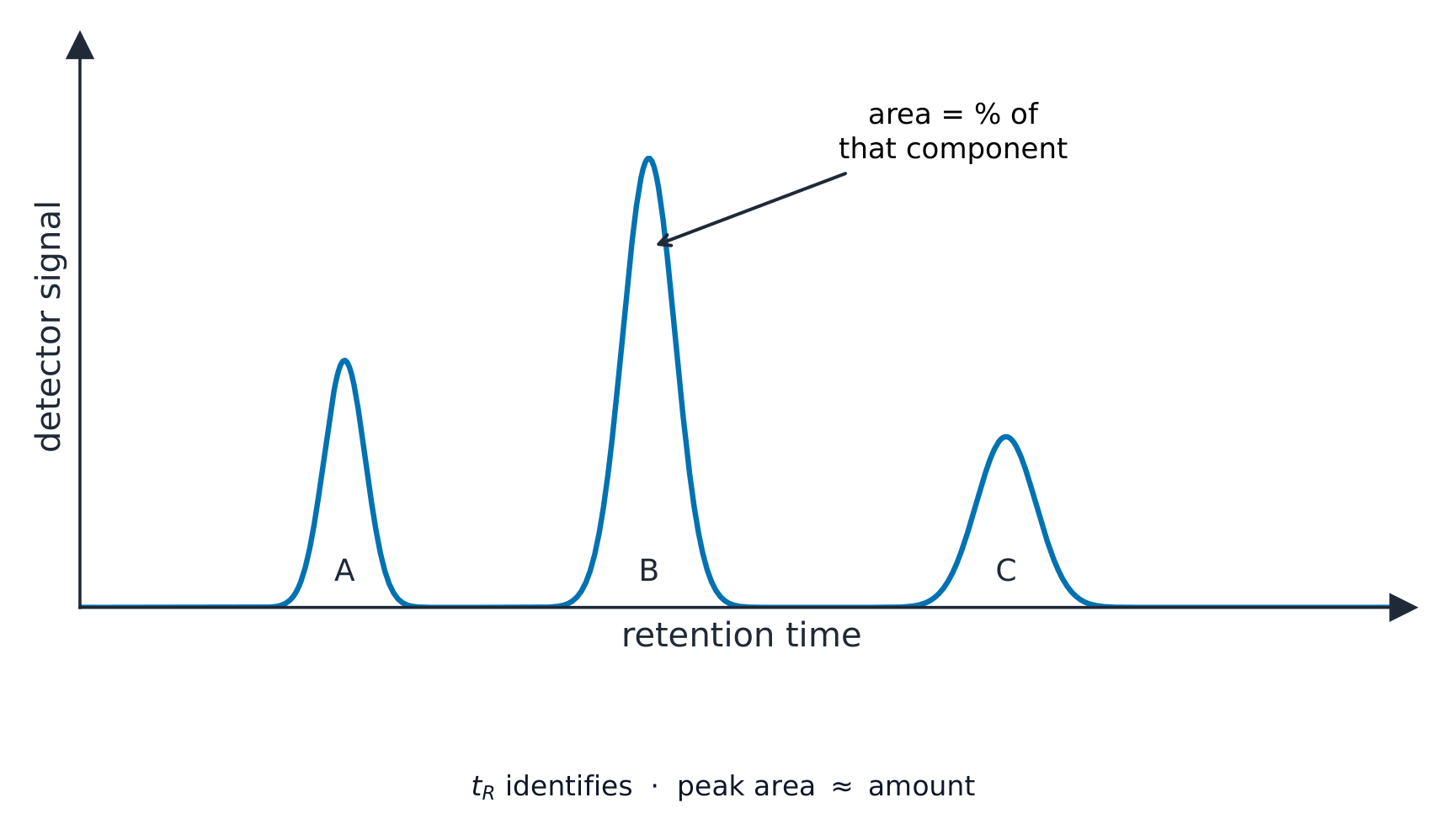
- describe and understand the terms (a) stationary phase; a high boiling point non-polar liquid (on a solid support) (b) mobile phase; an unreactive gas (c) retention time
- interpret gas/liquid chromatograms in terms of the percentage composition of a mixture
- explain retention times in terms of interaction with the stationary phase
Source: Cambridge International syllabus
In gas/liquid chromatography 气液色谱 (GLC):
- the stationary phase is a high-boiling-point non-polar liquid on a solid support.
- the mobile phase is an unreactive carrier gas.
- the retention time 保留时间 is how long a component takes to pass through.
The area of each peak gives the percentage of that component in the mixture. A component that interacts more with the stationary phase has a longer retention time.
Explore
Gas/liquid chromatography route
Follow a volatile sample through column separation to a chromatogram.
Vocabulary
Train
| English |
|---|
| gas/liquid chromatography/ɡæs ˈlɪkwɪd krəʊməˈtɒɡrəfi/ |
| retention time/rɪˈtenʃn taɪm/ |
37.3
Carbon-13 NMR spectroscopy

Syllabus
- analyse and interpret a carbon-13 NMR spectrum of a simple molecule to deduce: (a) the different environments of the carbon atoms present (b) the possible structures for the molecule
- predict or explain the number of peaks in a carbon-13 NMR spectrum for a given molecule
Source: Cambridge International syllabus
NMR 核磁共振 (nuclear magnetic resonance) studies how certain nuclei behave in a strong magnetic field.
In carbon-13 NMR, each different chemical environment 化学环境 of carbon gives one peak. So:
- the number of peaks tells you how many different carbon environments there are (equivalent carbons share a peak).
- the position of each peak (its chemical shift) suggests the type of carbon, which helps you deduce possible structures.
Explore
Carbon-13 NMR lab
Match carbon environments to C-13 NMR evidence.
Vocabulary
Train
| English |
|---|
| NMR/ˌen em ˈɑː/ |
| chemical environment/ˈkemɪkl enˈvaɪrənmənt/ |
37.4
Proton (¹H) NMR spectroscopy

Syllabus
- analyse and interpret a proton ($^1\text{H}$) NMR spectrum of a simple molecule to deduce: (a) the different environments of proton present using chemical shift values (b) the relative numbers of each type of proton present from relative peak areas (c) the number of equivalent protons on the carbon atom adjacent to the one to which the given proton is attached from the splitting pattern, using the $n + 1$ rule (limited to singlet, doublet, triplet, quartet and multiplet) (d) the possible structures for the molecule
- predict the chemical shifts and splitting patterns of the protons in a given molecule
- describe the use of tetramethylsilane, TMS, as the standard for chemical shift measurements
- state the need for deuterated solvents, e.g. $\text{CDCl}_3$, when obtaining a proton NMR spectrum
- describe the identification of O–H and N–H protons by proton exchange using $\text{D}_2\text{O}$
Source: Cambridge International syllabus
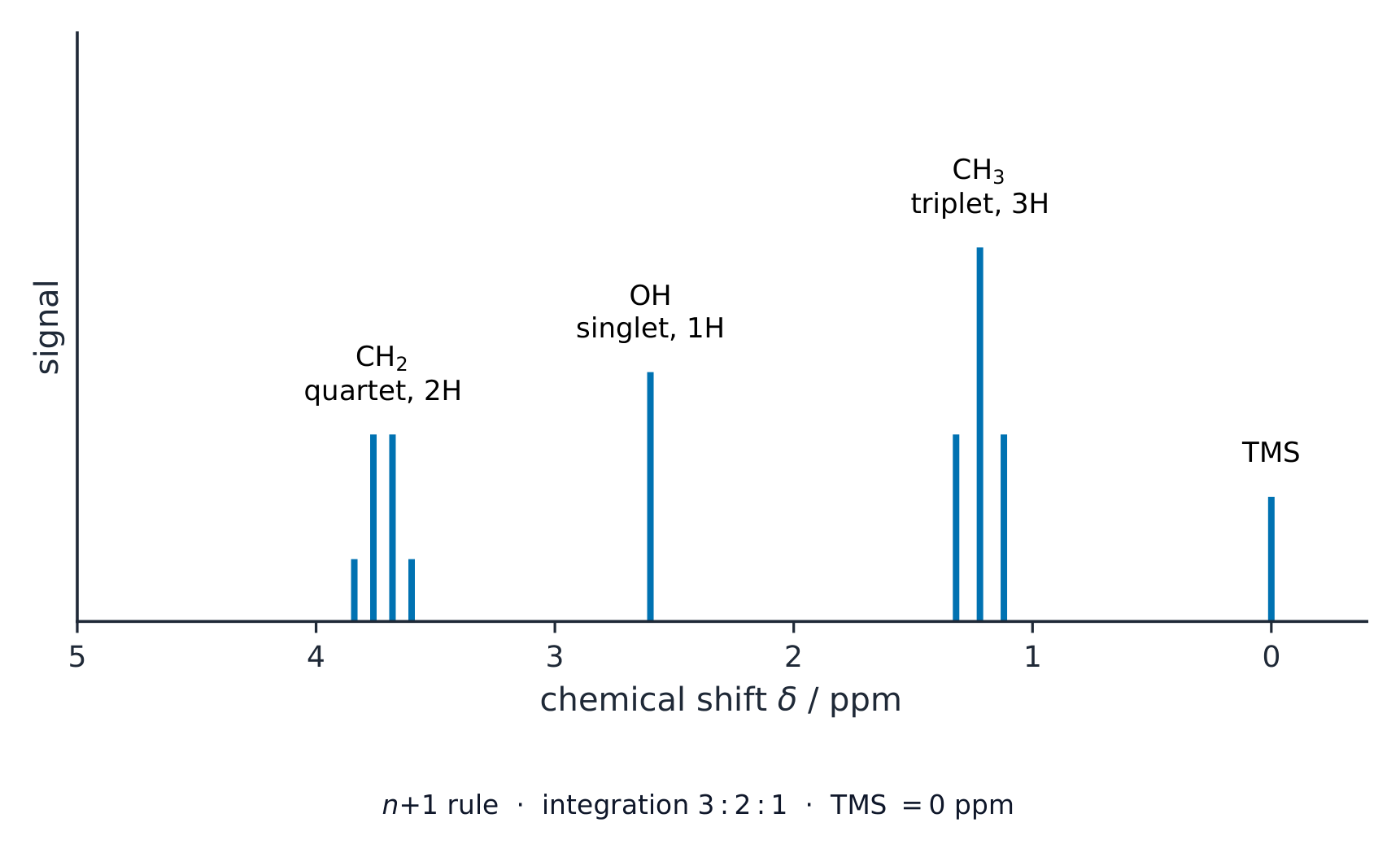
Proton NMR looks at the hydrogen atoms (proton 质子 nuclei). From the spectrum you read off:
- chemical environments: protons in different environments appear at different chemical shift 化学位移 values.
- relative numbers: the relative peak areas give the ratio of each type of proton.
- splitting 裂分: a peak is split by the protons on the neighbouring carbon, following the $n+1$ rule — $n$ equivalent neighbours split a peak into $n+1$ lines:
| Neighbours ($n$) | Pattern |
|---|---|
| 0 | singlet 单峰 |
| 1 | doublet 双峰 |
| 2 | triplet 三峰 |
| 3 | quartet 四峰 |
| many | multiplet 多重峰 |
Practical points
- tetramethylsilane 四甲基硅烷 (TMS) is the standard, set at a chemical shift of $0$.
- a deuterated solvent 氘代溶剂 (such as $\text{CDCl}_3$) is used so that the solvent itself gives no proton signal.
- shaking the sample with $\text{D}_2\text{O}$ makes the O–H and N–H peaks disappear (their hydrogen is swapped for deuterium), which identifies those protons.
Worked example. A compound $\text{C}_4\text{H}_8\text{O}_2$ gives three proton NMR peaks: a triplet at $\delta\ 1.2$ (area 3), a quartet at $\delta\ 4.1$ (area 2), and a singlet at $\delta\ 2.0$ (area 3). Deduce the structure. Read the areas first, then the splitting. Areas $3:2:3$ give three proton environments holding 3, 2 and 3 hydrogens. Apply the $n+1$ rule in reverse: a triplet (area 3) is a $\text{CH}_3$ with 2 neighbours, and a quartet (area 2) is a $\text{CH}_2$ with 3 neighbours - each splitting the other, which is the classic ethyl group, $\text{CH}_3\text{CH}_2-$. That $\text{CH}_2$ lies far downfield at $\delta\ 4.1$, so it is attached to an oxygen. The remaining singlet (area 3) is a $\text{CH}_3$ with no neighbours at $\delta\ 2.0$, so it sits next to the C=O. Together: $\text{CH}_3\text{COOCH}_2\text{CH}_3$, ethyl ethanoate. A triplet-and-quartet pair is almost always an ethyl group - spot it first and the rest follows.
Explore
Proton NMR lab
Match proton evidence to chemical environment and neighbours.
Vocabulary
Train
| English |
|---|
| proton/ˈprəʊtɒn/ |
| chemical shift/ˈkemɪkl ʃɪft/ |
| splitting/ˈsplɪtɪŋ/ |
| singlet/ˈsɪŋɡlɪt/ |
| doublet/ˈdʌblət/ |
| triplet/ˈtrɪplɪt/ |
| quartet/kwɔːˈtet/ |
| multiplet/ˈmʌltɪplɪt/ |
| tetramethylsilane/ˈtetrəmiːθɪlsɪleɪn/ |
| deuterated solvent/ˈdjuːtəreɪtɪd ˈsɒlvənt/ |
37.4
Exam tips
- In $^{13}\text{C}$ NMR the number of peaks equals the number of carbon environments — use symmetry to count them.
- In $^1\text{H}$ NMR use chemical shift (data booklet), integration (ratio of H's) and splitting (the $n+1$ rule): a triplet + quartet means an ethyl group.
- TMS is the reference ($\delta = 0$); a $\text{D}_2\text{O}$ shake removes O-H and N-H peaks.
- Combine IR, mass spectrum and NMR to deduce a structure, stating which evidence gives which feature.
Interactive lessons on this topic
Work through it step by step, with instant-check exercises.