- recall the reactions (reagents and conditions) by which halogenoalkanes can be produced: (a) the free-radical substitution of alkanes by $\text{Cl}_2$ or $\text{Br}_2$ in the presence of ultraviolet light, as exemplified by the reactions of ethane (b) electrophilic addition of an alkene with a halogen, $\text{X}_2$, or hydrogen halide, $\text{HX(g)}$, at room temperature (c) substitution of an alcohol, e.g. by reaction with $\text{HX(g)}$; or with $\text{KCl}$ and concentrated $\text{H}_2\text{SO}_4$ or concentrated $\text{H}_3\text{PO}_4$; or with $\text{PCl}_3$ and heat; or with $\text{PCl}_5$; or with $\text{SOCl}_2$
- classify halogenoalkanes into primary, secondary and tertiary
- describe the following nucleophilic substitution reactions: (a) the reaction with $\text{NaOH(aq)}$ and heat to produce an alcohol (b) the reaction with $\text{KCN}$ in ethanol and heat to produce a nitrile (c) the reaction with $\text{NH}_3$ in ethanol heated under pressure to produce an amine (d) the reaction with aqueous silver nitrate in ethanol as a method of identifying the halogen present as exemplified by bromoethane
- describe the elimination reaction with $\text{NaOH}$ in ethanol and heat to produce an alkene as exemplified by bromoethane
- describe the $\text{S}_\text{N}1$ and $\text{S}_\text{N}2$ mechanisms of nucleophilic substitution in halogenoalkanes including the inductive effects of alkyl groups
- recall that primary halogenoalkanes tend to react via the $\text{S}_\text{N}2$ mechanism; tertiary halogenoalkanes via the $\text{S}_\text{N}1$ mechanism; and secondary halogenoalkanes by a mixture of the two, depending on structure
- describe and explain the different reactivities of halogenoalkanes (with particular reference to the relative strengths of the C–X bonds as exemplified by the reactions of halogenoalkanes with aqueous silver nitrates)
Halogen compounds
A-Level Chemistry · Topic 15
 7:31
7:31
Halogen compounds
Press the button on a can of freezer spray, and your skin goes numb with cold. Inside is a halogenoalkane: an alkane with a halogen atom in place of one…
English narration · English + 中文 subtitles burned in
15.1
Halogenoalkanes

Syllabus
Source: Cambridge International syllabus
A halogenoalkane 卤代烷 is an alkane with one or more halogen atoms in place of hydrogen (a C–X bond, where X is a halogen).
Making halogenoalkanes
- free-radical substitution 自由基取代 of an alkane with $\text{Cl}_2$ or $\text{Br}_2$ in ultraviolet light.
- electrophilic addition 亲电加成 of an alkene with a halogen $\text{X}_2$ or a hydrogen halide $\text{HX}$.
- substitution of an alcohol 醇, for example by $\text{HX}$, by $\text{PCl}_5$, by $\text{PCl}_3$ with heat, or by $\text{SOCl}_2$.
Three classes
A halogenoalkane is primary 伯, secondary 仲 or tertiary 叔, depending on how many carbon atoms are joined to the carbon that holds the halogen (one, two or three).

Vocabulary
Train
| English |
|---|
| halogenoalkane/ˈheɪləʊdʒnəʊlkeɪn/ |
| free-radical substitution/friː ˈrædɪkl ˌsʌbstɪˈtjuːʃn/ |
| electrophilic addition/ɪˌlektrəʊˈfɪlɪk əˈdɪʃn/ |
| alcohol/ˈælkəhɒl/ |
| primary/ˈpraɪməri/ |
| secondary/ˈsekəndəri/ |
| tertiary/ˈtɜːʃjəri/ |
15.1
Nucleophilic substitution

The C–X bond is polar, so the carbon is slightly positive. A nucleophilic substitution 亲核取代 happens when a nucleophile 亲核试剂 (a lone-pair species) attacks that carbon and replaces the halogen.
| Reagent and conditions | Product |
|---|---|
| $\text{NaOH(aq)}$, heat | an alcohol |
| $\text{KCN}$ in ethanol, heat | a nitrile 腈 (adds one carbon to the chain) |
| $\text{NH}_3$ in ethanol, heated under pressure | an amine 胺 |
To identify the halogen, warm the halogenoalkane with silver nitrate 硝酸银 in ethanol. A silver halide precipitate 沉淀 forms, and its colour shows which halogen is present (white $\text{AgCl}$, cream $\text{AgBr}$, yellow $\text{AgI}$).
Explore
Nucleophilic substitution
A nucleophile swaps in for the leaving group on a halogenoalkane.
Vocabulary
Train
| English |
|---|
| nucleophilic substitution/ˌnjuːklɪəˈfɪlɪk ˌsʌbstɪˈtjuːʃn/ |
| nucleophile/ˈnjuːklɪɒfaɪl/ |
| nitrile/ˈnaɪtraɪl/ |
| amine/ˈæmaɪn/ |
| silver nitrate/ˈsɪlvə ˈnaɪtreɪt/ |
| precipitate/prɪˈsɪpɪteɪt/ |
15.1
Elimination

The same halogenoalkane can instead undergo elimination 消去 to form an alkene 烯烃. The conditions decide which reaction wins:
- $\text{NaOH}$ in water → nucleophilic substitution → an alcohol.
- $\text{NaOH}$ in ethanol, heated → elimination → an alkene.
$$\text{C}_2\text{H}_5\text{Br} + \text{NaOH} \rightarrow \text{C}_2\text{H}_4 + \text{NaBr} + \text{H}_2\text{O}$$
Vocabulary
Train
| English |
|---|
| elimination/ɪˌlɪmɪˈneɪʃn/ |
| alkene/ˈælkiːn/ |
15.1
The S$_\text{N}$1 and S$_\text{N}$2 mechanisms

Nucleophilic substitution can follow two routes:
- S$_\text{N}$2: one step. The nucleophile attacks at the same time as the halogen leaves, passing through a crowded transition state 过渡态 where both are half-bonded. The rate depends on both the halogenoalkane and the nucleophile.
- S$_\text{N}$1: two steps. First the C–X bond breaks to give a carbocation 碳正离子; then the nucleophile attacks it. The rate depends only on the halogenoalkane.
Alkyl groups push electrons towards the positive carbon (the inductive effect 诱导效应), so they stabilise the carbocation. This is why:
- primary halogenoalkanes mostly react by S$_\text{N}$2.
- tertiary halogenoalkanes mostly react by S$_\text{N}$1 (their carbocation is well stabilised).
- secondary halogenoalkanes use a mixture of the two.
Explore
The SN2 mechanism, step by step
Step through nucleophilic substitution. The nucleophile attacks from behind as the halide leaves — all in one smooth step, flipping the molecule inside-out.
Vocabulary
Train
| English |
|---|
| transition state/trænˈsɪʃn steɪt/ |
| carbocation/ˌkɑːbəˈkeɪʃn/ |
| inductive effect/ɪnˈdʌktɪv ɪˈfekt/ |
15.1
Different reactivities
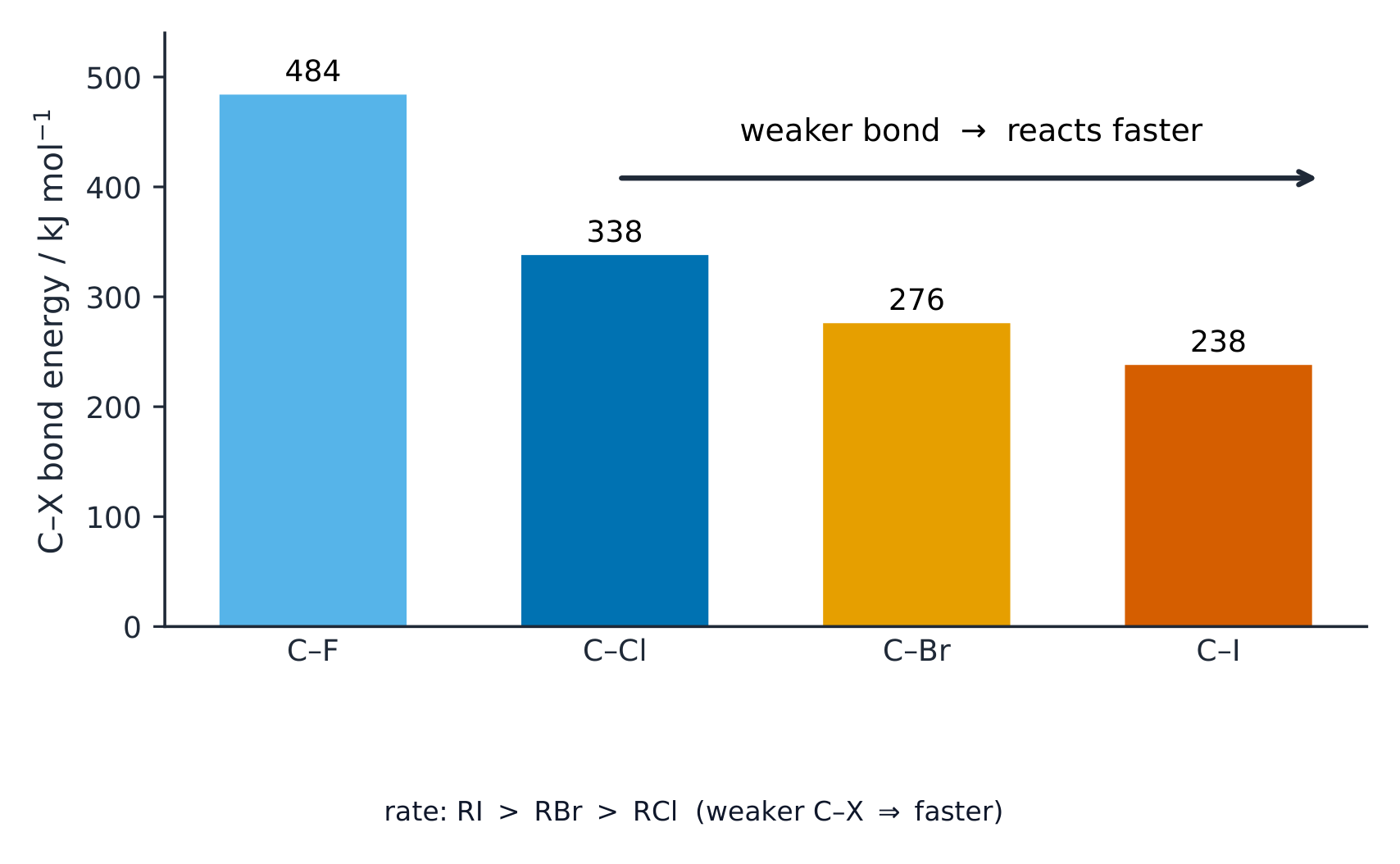
How fast a halogenoalkane reacts depends on the strength of the C–X bond, measured by its bond energy 键能. The C–I bond is the weakest, so iodoalkanes react fastest; the C–Cl bond is the strongest of the three, so chloroalkanes react slowest. So when tested with silver nitrate, an iodoalkane gives its precipitate first — its higher reactivity 反应活性 comes from the weaker C–X bond.
Worked example. Predict the mechanism for the hydrolysis of 1-bromobutane and of 2-bromo-2-methylpropane. Classify the halogenoalkane first. 1-bromobutane is primary: the carbon carrying the $\text{Br}$ is barely shielded, so the nucleophile can attack the back of it and the mechanism is $\text{S}_\text{N}2$ - one step, with the rate depending on both the halogenoalkane and the nucleophile. 2-bromo-2-methylpropane is tertiary: three bulky methyl groups block that attack, but they also stabilise the carbocation formed once the $\text{Br}$ leaves, so it goes $\text{S}_\text{N}1$ - two steps, with the rate depending on the halogenoalkane only. Decide from the class (primary → $\text{S}_\text{N}2$, tertiary → $\text{S}_\text{N}1$), and note that the tertiary one hydrolyses faster despite being the more crowded.
Vocabulary
Train
| English |
|---|
| bond energy/bɒnd ˈenədʒi/ |
| reactivity/rɪəkˈtɪvɪti/ |
15.1
Exam tips
- Draw nucleophilic substitution with a curly arrow from the nucleophile's lone pair to the $\delta+$ carbon and one from the $\text{C-X}$ bond.
- Match mechanism to class: $S_\text{N}1$ (tertiary, carbocation, two steps) vs $S_\text{N}2$ (primary, one step, transition state).
- Reactivity is set by bond enthalpy: $\text{C-I}$ is weakest, so iodoalkanes react fastest (not electronegativity).
- Elimination (hot, ethanolic KOH) vs substitution (warm, aqueous KOH) — the conditions decide the product; state them.
Interactive lessons on this topic
Work through it step by step, with instant-check exercises.