Skip to content · ⁨ข้ามไปยังเนื้อหา⁩
Subjects · ⁨รายวิชา⁩

A-Level Chemistry · ⁨Chemistry A-Level⁩

Tips · ⁨เคล็ดลับ⁩

เคมี A-Level (9701) จริงๆ แล้วคือ สามวิชาที่ต้องเชื่อมโยงกัน: ฟิสิกส์ (พลังงาน, สมดุล, อัตราปฏิกิริยา, เคมีไฟฟ้า), อนออร์แกนิก (ความเป็นช่วง, กลุ่มที่ 2, กลุ่มที่ 17, ธาตุทรานซิชัน) และ ออร์แกนิค ซึ่งพัฒนาจากอัลเคนไปสู่กลไกที่ยาวนานและสิ้นสุดด้วย NMR และ สเปกโทรเมทรีมวล

ส่วนใหญ่ของคะแนนที่หายไปไม่ใช่เพราะเนื้อหาเคมียาก แต่เกิดจากการ ขาดเงื่อนไข, สมการไม่สมดุล, ไม่มีสัญลักษณ์สถานะ และคำตอบออร์แกนิคที่ระบุผลิตภัณฑ์แต่ไม่ได้วาด ลูกศรกลไก ตามที่เกณฑ์ให้คะแนน

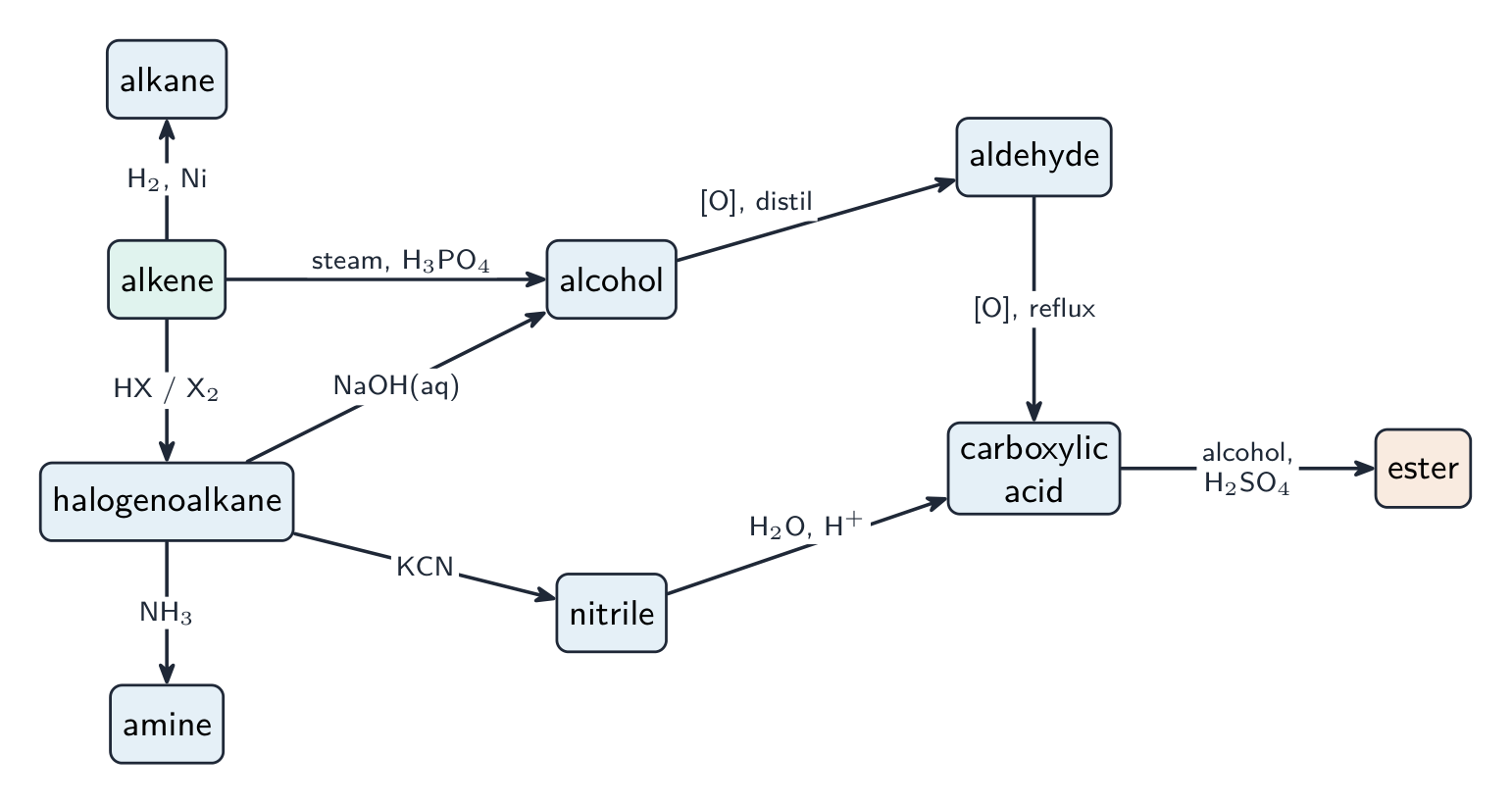
ออร์แกนิคต้องการวิธีการทบทวนที่ต่างกัน: วาดแผนภาพปฏิกิริยาหนึ่งฉบับด้วยมือ แล้วค่อยเติมเพิ่มเข้าไปเรื่อยๆ การสอบจะให้คุณเปลี่ยนจากหมู่ฟังก์ชันหนึ่งไปยังอีกหมู่หนึ่ง ไม่ใช่ท่องจำปฏิกิริยาเพียงอย่างเดียว

  • 1

    Atomic structure · ⁨โครงสร้างอะตอม⁩

    Watch lesson · ⁨ดูบทเรียน⁩
    1.1

    What an atom is made of · ⁨อะตอมประกอบด้วยอะไร⁩

    Syllabus · ⁨หลักสูตร⁩
    English
    1. understand that atoms are mostly empty space surrounding a very small, dense nucleus that contains protons and neutrons; electrons are found in shells in the empty space around the nucleus
    2. identify and describe protons, neutrons and electrons in terms of their relative charges and relative masses
    3. understand the terms atomic and proton number; mass and nucleon number
    4. describe the distribution of mass and charge within an atom
    5. describe the behaviour of beams of protons, neutrons and electrons moving at the same velocity in an electric field
    6. determine the numbers of protons, neutrons and electrons present in both atoms and ions given atomic or proton number, mass or nucleon number and charge
    7. state and explain qualitatively the variations in atomic radius and ionic radius across a period and down a group
    ไทย
    1. เข้าใจว่าอะตอมประกอบด้วยพื้นที่ว่างส่วนใหญ่ล้อมรอบ นิวเคลียส ที่มีขนาดเล็กและหนาแน่นมาก ซึ่งประกอบด้วย โปรตอน และ นิวตรอน; อิเล็กตรอน จะอยู่ใน ชั้นพลังงาน ในพื้นที่ว่างรอบนิวเคลียส
    2. ระบุและอธิบายโปรตอน นิวตรอน และอิเล็กตรอนในแง่ของประจุสัมพัทธ์และมวลสัมพัทธ์
    3. เข้าใจคำศัพท์ เลขอะตอมและเลขโปรตอน; เลขมวลและเลขนิวคลีออน
    4. อธิบายการกระจายตัวของมวลและประจุภายในอะตอม
    5. อธิบายพฤติกรรมของลำโปรตอน นิวตรอน และอิเล็กตรอนที่เคลื่อนที่ด้วยความเร็วเท่ากันในสนามไฟฟ้า
    6. หาจำนวนโปรตอน นิวตรอน และอิเล็กตรอนที่มีอยู่ในอะตอมและไอออน โดยกำหนดจากเลขอะตอมหรือเลขโปรตอน เลขมวลหรือเลขนิวคลีออน และประจุ
    7. บอกรายละเอียดและอธิบายโดยสังเขปถึงความแตกต่างของ รัศมีอะตอม และ รัศมีไอออน ผ่านคาบและลงกลุ่ม

    Source: Cambridge International syllabus · ⁨แหล่งที่มา: หลักสูตร Cambridge International⁩

    English

    Everything is made of atoms 原子. An atom is mostly empty space. At its centre is a tiny, heavy nucleus 原子核. The nucleus holds two kinds of particle: protons 质子 and neutrons 中子. Around the nucleus, in the empty space, move the electrons 电子. The electrons stay in shells 壳层 — layers at set distances from the nucleus.

    The nucleus is very small but holds almost all the mass. The electrons take up almost all the space but have almost no mass.

    Relative charge and relative mass

    We compare the three particles using relative charge 相对电荷 and relative mass 相对质量. These are simple numbers, not real units.

    Particle Relative charge Relative mass
    proton $+1$ $1$
    neutron $0$ $1$
    electron $-1$ $\tfrac{1}{1836}$ (about $0$)

    A proton and a neutron have almost the same mass. An electron is about 1836 times lighter. The proton is positive, the electron is negative, and the neutron has no charge — it is neutral 中性.

    Proton number and nucleon number

    Two numbers describe the nucleus:

    • the proton number 质子数 (also called the atomic number 原子序数), symbol $Z$ — the number of protons.
    • the nucleon number 核子数 (also called the mass number 质量数), symbol $A$ — the total number of protons and neutrons. Protons and neutrons are both nucleons 核子.

    So the number of neutrons is $A - Z$.

    Counting particles in an atom or ion

    For a neutral atom, the number of electrons equals the number of protons, which equals $Z$.

    An ion 离子 is an atom that has lost or gained electrons, so it has a charge:

    • a positive ion has fewer electrons than protons.
    • a negative ion has more electrons than protons.

    Example: $^{27}_{13}\text{Al}^{3+}$ has $13$ protons, $27 - 13 = 14$ neutrons, and $13 - 3 = 10$ electrons (it lost 3 electrons to become $3+$).

    How mass and charge are spread out

    Almost all the mass sits in the nucleus, because protons and neutrons are heavy and electrons are very light. All the positive charge is in the nucleus (the protons). The negative charge is spread out in the shells (the electrons).

    Beams of particles in an electric field

    Imagine beams of protons, neutrons and electrons moving at the same speed into an electric field 电场 between two charged plates:

    • the proton beam bends towards the negative plate (protons are positive).
    • the electron beam bends the other way, towards the positive plate. It bends much more, because the electron is far lighter — the same force gives a bigger deflection 偏转 to a smaller mass.
    • the neutron beam goes straight through. It has no charge, so the field gives it no force.

    Atomic radius and ionic radius

    The atomic radius 原子半径 is the size of an atom. The ionic radius 离子半径 is the size of an ion.

    Across a period 周期 (left to right), the atomic radius gets smaller. The nuclear charge 核电荷 (the pull from the protons) rises, but the electrons go into the same outer shell, so the shielding 屏蔽 by inner shells stays about the same. The stronger pull draws the outer shell inwards.

    Down a group 族 (top to bottom), the atomic radius gets larger. Each step down adds a new shell, so the outer electrons are further out and feel more shielding from the nucleus.

    For ions:

    • a positive ion (cation 阳离子) is smaller than its atom. It has lost its outer shell, and the electrons that remain feel a stronger pull each.
    • a negative ion (anion 阴离子) is larger than its atom. It has gained electrons, so there is more repulsion 排斥 between the electrons.
    • among ions that have the same number of electrons, the one with more protons is smaller.
    ไทย
    ภาพจุลทรรศน์แบบสแกนเนอร์แบบทะลุผ่านของอะตอม
    จุลทรรศน์แบบสแกนเนอร์แบบทะลุผ่านสามารถถ่ายภาพอะตอมเดี่ยวๆ ได้

    ทุกสิ่งประกอบด้วย อะตอม อะตอมส่วนใหญ่เป็นพื้นที่ว่าง ตรงกลางคือ นิวเคลียส เล็กๆ ที่หนัก นิวเคลียสมีอนุภาคสองชนิดคือ โปรตอน และ นิวตรอน รอบๆ นิวเคลียสในพื้นที่ว่าง มี อิเล็กตรอน เคลื่อนที่ อิเล็กตรอนอยู่ใน ชั้น — ชั้นที่ระยะห่างคงที่จากนิวเคลียส

    นิวเคลียสมีขนาดเล็กมากแต่มีมวลเกือบทั้งหมด อิเล็กตรอนกินพื้นที่เกือบทั้งหมดแต่มีมวลน้อยมาก

    อะตอมที่มีนิวเคลียสตรงกลางประกอบด้วยโปรตอนและนิวตรอน ล้อมรอบด้วยอิเล็กตรอนสองชั้น
    อะตอมส่วนใหญ่เป็นพื้นที่ว่าง: โปรตอนและนิวตรอนอยู่ภายในนิวเคลียสตรงกลางเล็กๆ ในขณะที่อิเล็กตรอนเคลื่อนที่อยู่ในชั้นรอบๆ

    ประจุสัมพัทธ์และมวลสัมพัทธ์

    เราเปรียบเทียบอนุภาคทั้งสามโดยใช้ ประจุสัมพัทธ์ และ มวลสัมพัทธ์ นี่คือตัวเลขง่ายๆ ไม่ใช่หน่วยจริง

    Particles Relative charge Relative mass
    โปรตอน $+1$ $1$
    นิวตรอน $0$ $1$
    อิเล็กตรอน $-1$ $\tfrac{1}{1836}$ (ประมาณ $0$)

    โปรตอนและนิวตรอนมีมวลใกล้เคียงกัน อิเล็กตรอนเบากว่าประมาณ 1836 เท่า โปรตอนมีประจุบวก อิเล็กตรอนมีประจุลบ และนิวตรอนไม่มีประจุ — มันคือ **กลาง

    เลขอะตอมและเลขมวล

    สองตัวเลขอธิบายนิวเคลียส:

    • เลขอะตอม (เรียกอีกอย่างว่า เลขอะตอม), สัญลักษณ์ $Z$ — จำนวนโปรตอน
    • เลขมวล (เรียกอีกอย่างว่า เลขมวล), สัญลักษณ์ $A$ — รวมจำนวนโปรตอนและนิวตรอน โปรตอนและนิวตรอนคือ นิวคลีออน ทั้งคู่

    ดังนั้นจำนวนนิวตรอนคือ $A - Z$

    นับอนุภาคในอะตอมหรือไอออน

    สำหรับอะตอมที่เป็นกลาง จำนวนอิเล็กตรอนเท่ากับจำนวนโปรตอน ซึ่งเท่ากับ $Z$

    ไอออน คืออะตอมที่สูญเสียหรือได้รับอิเล็กตรอน ทำให้มีประจุ:

    • ไอออนบวกมีอิเล็กตรอนน้อยกว่าโปรตอน
    • ไอออนลบมีอิเล็กตรอนมากกว่าโปรตอน

    ตัวอย่าง: $^{27}_{13}\text{Al}^{3+}$ มี $13$ โปรตอน, $27 - 13 = 14$ นิวตรอน, และ $13 - 3 = 10$ อิเล็กตรอน (มันสูญเสีย 3 อิเล็กตรอนเพื่อกลายเป็น $3+$)

    การกระจายตัวของมวลและประจุ

    มวลเกือบทั้งหมดอยู่ที่นิวเคลียส เพราะโปรตอนและนิวตรอนหนักและอิเล็กตรอนเบามาก ประจุบวกทั้งหมดอยู่ในนิวเคลียส (โปรตอน) ประจุลบกระจายอยู่ในชั้น (อิเล็กตรอน)

    ลำอนุภาคในสนามไฟฟ้า

    สมมติว่ามีลำโปรตอน นิวตรอน และอิเล็กตรอนเคลื่อนที่ด้วยความเร็วเท่ากันเข้าสู่ สนามไฟฟ้า ระหว่างแผ่นประจุสองแผ่น:

    • ลำโปรตอนเบี่ยงเบนเข้าหาแผ่นประจุลบ (โปรตอนมีประจุบวก)
    • ลำอิเล็กตรอนเบี่ยงเบนไปทางตรงข้าม เข้าหาแผ่นประจุบวก มันเบี่ยงเบนมากกว่ามาก เพราะอิเล็กตรอนเบากว่ามาก — แรงเดียวกันทำให้เกิด การเบี่ยงเบน มากขึ้นในวัตถุที่มีมวลน้อย
    • ลำนิวตรอนวิ่งตรงผ่าน มันไม่มีประจุ ดังนั้นสนามไฟฟ้าจึงไม่ออกแรง对它
    สามลำระหว่างแผ่นประจุ: อิเล็กตรอนเบี่ยงเบนรุนแรงเข้าหาแผ่นบวก, โปรตอนเบี่ยงเบนเล็กน้อยเข้าหาแผ่นลบ, นิวตรอนวิ่งตรง
    ในสนามไฟฟ้า โปรตอนเบี่ยงเบนเข้าหา $-$ แผ่น และอิเล็กตรอนเบี่ยงเบนไปทางตรงข้ามและมากกว่ามาก (มันเบากว่ามาก); นิวตรอนวิ่งตรงผ่าน

    รัศมีอะตอมและรัศมีไอออน

    รัศมีอะตอม คือขนาดของอะตอม รัศมีไอออน คือขนาดของไอออน

    ตาม คาบ (ซ้ายไปขวา) รัศมีอะตอมจะ เล็กลง ประจุนิวเคลียส (แรงดึงดูดจากโปรตอน) เพิ่มขึ้น แต่อิเล็กตรอนเข้าไปอยู่ในชั้นนอกเดียวกัน ดังนั้น การกั้น จากชั้นภายในจึงคงที่ใกล้เคียงเดิม แรงดึงดูดที่แรงขึ้นดึงชั้นนอกเข้าด้านใน

    เมื่อลงตาม กลุ่ม (จากบนลงล่าง) รัศมีอะตอมจะ ใหญ่ขึ้น ทุกขั้นตอนที่ลงมาจะเพิ่มชั้นอิเล็กตรอนใหม่ ทำให้อิเล็กตรอนชั้นนอกอยู่ห่างจากนิวเคลียสมากขึ้นและได้รับผลบดบังจากนิวเคลียสมากขึ้น

    แถวของอะตอมที่เล็กลงตามคาบ และคอลัมน์ของอะตอมที่ใหญ่ขึ้นตามกลุ่ม
    ตามคาบ อะตอมจะหดตัว (แรงดึงดูดจากนิวเคลียสต่อชั้นนอกเดียวกันเพิ่มขึ้น); ตามกลุ่มอะตอมจะขยายตัว (ทุกขั้นตอนเพิ่มชั้น)

    สำหรับไอออน:

    • ไอออนบวก (แคทไอออน) มีขนาดเล็กกว่าอะตอม它有它失去了外层电子壳,剩下的电子受到的吸引力更强。
    • ไอออนลบ (แอนไอออน) มีขนาดใหญ่กว่าอะตอม它有它获得了电子,因此电子之间有更多的排斥力。
    • ในหมู่ไอออนที่มีจำนวนอิเล็กตรอนเท่ากัน ไอออนที่มีโปรตอนมากกว่าจะมีขนาดเล็กกว่า
    Explore · ⁨สำรวจ⁩

    Explore the atom · ⁨สำรวจอะตอม⁩

    Tap each part. A tiny dense nucleus of protons and neutrons holds the mass; light electrons orbit it in shells. · ⁨แตะแต่ละส่วน นิวเคลียสเล็กหนาแน่นของโปรตอนและนิวตรอนยึดมวลไว้; อิเล็กตรอนเบาโคจรรอบ它以ในชั้น⁩

    Explore · ⁨สำรวจ⁩

    Atomic and ionic radius trends · ⁨แนวโน้มรัศมีอะตอมและรัศมีไอออน⁩

    Atomic radius falls across a period (rising nuclear charge pulls the same shell in) and rises down a group (an extra shell each time). Step across Period 3 to see it. · ⁨รัศมีอะตอมลดลงตามคาบ (ประจุนิวเคลียสเพิ่มขึ้นดึงชั้นเดียวกันเข้ามาใกล้) และเพิ่มขึ้นตามกลุ่ม (เพิ่มชั้นใหม่ทุกขั้นตอน) ลองเลื่อนผ่านคาบที่ 3 เพื่อดูการเปลี่ยนแปลงนี้⁩

    Vocabulary · ⁨คำศัพท์⁩ Train · ⁨ฝึกฝน⁩
    English ไทย
    atom/ˈætəm/ อะตอม
    nucleus/ˈnjuːklɪəs/ นิวเคลียส
    proton/ˈprəʊtɒn/ โปรตอน
    neutron/ˈnjuːtrɒn/ นิวตรอน
    electron/ɪˈlektrɒn/ อิเล็กตรอน
    relative charge/ˈrelətɪv tʃɑːdʒ/ ภาระสัมพัทธ์
    relative mass/ˈrelətɪv mæs/ มวลสัมพัทธ์
    neutral/ˈnjuːtrəl/ เป็นกลาง
    proton number/ˈprəʊtɒn ˈnʌmbə/ เลขอะตอม
    atomic number/əˈtɒmɪk ˈnʌmbə/ เลขอะตอม
    nucleon number/ˈnjuːklɪən ˈnʌmbə/ เลขนิวคลีออน
    mass number/mæs ˈnʌmbə/ เลขมวล
    nucleon/ˈnjuːklɪən/ นิวคลีออน (nucleon)
    ion/ˈaɪɒn/ ไอออน
    electric field/ɪˈlektrɪk fiːld/ สนามไฟฟ้า
    deflection/dɪˈflekʃn/ การเบี่ยงเบน
    atomic radius/əˈtɒmɪk ˈreɪdɪəs/ รัศมีอะตอม
    ionic radius/aɪˈɒnɪk ˈreɪdɪəs/ รัศมีไอออน
    1.2

    Isotopes · ⁨ไอโซโทป⁩

    Syllabus · ⁨หลักสูตร⁩
    English
    1. define the term isotope in terms of numbers of protons and neutrons
    2. understand the notation $_y^x\text{A}$ for isotopes, where $x$ is the mass or nucleon number and $y$ is the atomic or proton number
    3. state that and explain why isotopes of the same element have the same chemical properties
    4. state that and explain why isotopes of the same element have different physical properties, limited to mass and density
    ไทย
    1. นิยามคำว่า ไอโซโทป ในแง่ของจำนวนโปรตอนและนิวตรอน
    2. เข้าใจสัญลักษณ์ $_y^x\text{A}$ สำหรับไอโซโทป โดยที่ $x$ คือเลขมวลหรือเลขนิวคลีโอออน และ $y$ คือเลขอะตอมหรือเลขโปรตอน
    3. บอกรายละเอียดและอธิบายว่าทำไมไอโซโทปของธาตุเดียวกันจึงมีคุณสมบัติทางเคมีเหมือนกัน
    4. บอกรายละเอียดและอธิบายว่าทำไมไอโซโทปของธาตุเดียวกันจึงมีคุณสมบัติทางกายภาพแตกต่างกัน โดยเน้นที่มวลและความหนาแน่นเท่านั้น

    Source: Cambridge International syllabus · ⁨แหล่งที่มา: หลักสูตร Cambridge International⁩

    English

    Isotopes 同位素 are atoms of the same element with the same number of protons but a different number of neutrons. So isotopes have the same proton number $Z$ but a different nucleon number $A$.

    We write an isotope as $^{A}_{Z}\text{X}$: the nucleon number $A$ on top, the proton number $Z$ below. For example, chlorine has two main isotopes, $^{35}_{17}\text{Cl}$ and $^{37}_{17}\text{Cl}$.

    Same chemical properties

    Chemical properties 化学性质 depend on the electrons, especially the outer electrons. Isotopes of one element have the same number of electrons arranged in the same way. So they react in exactly the same way — they have the same chemical properties.

    Different physical properties

    Some physical properties 物理性质 depend on mass, so they differ between isotopes. A heavier isotope has more neutrons, so more mass, and therefore a higher density 密度. (The syllabus limits this difference to mass and density.)

    ไทย

    ไอโซโทป คืออะตอมของธาตุเดียวกันซึ่งมีจำนวนโปรตอนเท่ากันแต่มีจำนวนนิวตรอนต่างกัน ดังนั้นไอโซโทปจึงมีเลขอะตอม $Z$ เท่ากันแต่มีเลขมวล $A$ แตกต่างกัน

    ไอโซโทปของคลอรีนสองชนิด — ทั้งคู่มี 17 โปรตอน แต่หนึ่งชนิดมี 18 นิวตรอน อีกชนิดมี 20
    ไอโซโทปสองชนิดของคลอรีน: โปรตอนเท่ากัน นิวตรอนต่างกัน

    เราเขียนไอโซโทปในรูป $^{A}_{Z}\text{X}$: เลขมวล $A$ อยู่ด้านบน เลขอะตอม $Z$ อยู่ด้านล่าง ตัวอย่างเช่น คลอรีนมีไอโซโทปหลักสองชนิดคือ $^{35}_{17}\text{Cl}$ และ $^{37}_{17}\text{Cl}$

    คุณสมบัติทางเคมีเหมือนกัน

    คุณสมบัติทางเคมี ขึ้นอยู่กับอิเล็กตรอน โดยเฉพาะอิเล็กตรอนชั้นนอก ไอโซโทปของธาตุเดียวกันมีจำนวนอิเล็กตรอนเท่ากันและจัดเรียงในรูปแบบเดียวกัน ดังนั้นจึงเกิดปฏิกิริยาได้เหมือนกันอย่างสมบูรณ์ — มีคุณสมบัติทางเคมีเหมือนกัน

    คุณสมบัติทางกายภาพต่างกัน

    บาง คุณสมบัติทางกายภาพ ขึ้นอยู่กับมวล จึงแตกต่างกันระหว่างไอโซโทป ไอโซโทปที่มีมวลมากกว่าจะมีนิวตรอนมากกว่า ส่งผลให้มีมวลมากกว่าและดังนั้นมีความหนาแน่น выше (หลักสูตรกำหนดให้ข้อแตกต่างนี้อยู่ที่มวลและความหนาแน่นเท่านั้น)

    Explore · ⁨สำรวจ⁩

    Isotope lab · ⁨ห้องปฏิบัติการไอโซโทป⁩

    Classify isotope facts by what changes and what stays the same. · ⁨จำแนกข้อเท็จจริงเกี่ยวกับไอโซโทปโดยสิ่งที่เปลี่ยนและสิ่งที่คงที่⁩

    Vocabulary · ⁨คำศัพท์⁩ Train · ⁨ฝึกฝน⁩
    English ไทย
    isotope/ˈaɪsətəʊp/ ไอโซโทป
    chemical properties/ˈkemɪkl ˈprɒpətiz/ คุณสมบัติทางเคมี
    physical properties/ˈfɪzɪkl ˈprɒpətiz/ คุณสมบัติทางกายภาพ
    density/ˈdensɪti/ ความหนาแน่น
    principal quantum number/ˈprɪnsɪpl ˈkwɒntəm ˈnʌmbə/ เลขควอนตัมหลัก
    sub-shell/sʌb ʃel/ ซับชัลล์
    Watch lesson · ⁨ดูบทเรียน⁩
    1.3

    Electrons, energy levels and orbitals · ⁨อิเล็กตรอน ระดับพลังงาน และออร์บิทัล⁩

    Syllabus · ⁨หลักสูตร⁩
    English
    1. understand the terms: shells, sub-shells and orbitals; principal quantum number (n); ground state, limited to electronic configuration
    2. describe the number of orbitals making up s, p and d sub-shells, and the number of electrons that can fill s, p and d sub-shells
    3. describe the order of increasing energy of the sub-shells within the first three shells and the 4s and 4p sub-shells
    4. describe the electronic configurations to include the number of electrons in each shell, sub-shell and orbital
    5. explain the electronic configurations in terms of energy of the electrons and inter-electron repulsion
    6. determine the electronic configuration of atoms and ions given the atomic or proton number and charge, using either of the following conventions: e.g. for Fe: $1\text{s}^2 2\text{s}^2 2\text{p}^6 3\text{s}^2 3\text{p}^6 3\text{d}^6 4\text{s}^2$ (full electronic configuration) or [Ar] $3\text{d}^6 4\text{s}^2$ (shorthand electronic configuration)
    7. understand and use the electrons in boxes notation
    8. describe and sketch the shapes of s and p orbitals
    9. describe a free radical as a species with one or more unpaired electrons
    ไทย
    1. เข้าใจคำศัพท์: ชั้นอิเล็กตรอน (shells), ชั้นย่อย (sub-shells) และ ออร์บิทัล; เลขควอนตัมหลัก (n); สถานะพื้น, โดยจำกัดอยู่แค่การจัดเรียงอิเล็กตรอน
    2. อธิบายจำนวนออร์บิทัลที่ประกอบเป็นชั้นย่อย s, p และ d รวมถึงจำนวนอิเล็กตรอนที่สามารถเติมในชั้นย่อย s, p และ d ได้
    3. อธิบายลำดับพลังงานที่เพิ่มขึ้นของชั้นย่อยภายในสามชั้นแรก และชั้นย่อย 4s และ 4p
    4. อธิบาย การจัดเรียงอิเล็กตรอน โดยระบุจำนวนอิเล็กตรอนในแต่ละชั้น ชั้นย่อย และออร์บิทัล
    5. อธิบายการจัดเรียงอิเล็กตรอนในแง่ของพลังงานของอิเล็กตรอนและแรงผลักระหว่างอิเล็กตรอน
    6. หาการจัดเรียงอิเล็กตรอนของอะตอมและไอออน เมื่อทราบเลขอะตอมหรือเลขโปรตอนและประจุ โดยใช้รูปแบบใดรูปแบบหนึ่งจากด้านล่างนี้: เช่น สำหรับ Fe: $1\text{s}^2 2\text{s}^2 2\text{p}^6 3\text{s}^2 3\text{p}^6 3\text{d}^6 4\text{s}^2$ (การจัดเรียงอิเล็กตรอนแบบเต็ม) หรือ [Ar] $3\text{d}^6 4\text{s}^2$ (การจัดเรียงอิเล็กตรอนแบบย่อ)
    7. เข้าใจและใช้สัญลักษณ์กล่องอิเล็กตรอน
    8. อธิบายและวาดรูปทรงของออร์บิทัล s และ p
    9. อธิบาย ære radical ว่าเป็นสปีชีส์ที่มีอิเล็กตรอนเดี่ยวหนึ่งตัวหรือมากกว่า

    Source: Cambridge International syllabus · ⁨แหล่งที่มา: หลักสูตร Cambridge International⁩

    English

    Electrons are arranged in shells, sub-shells and orbitals.

    Shells and the principal quantum number

    Each shell is labelled by the principal quantum number 主量子数 $n = 1, 2, 3, \dots$ A larger $n$ means a shell that is further from the nucleus and higher in energy.

    Sub-shells and orbitals

    Each shell is split into sub-shells 亚层, named s, p and d. Each sub-shell is built from orbitals 轨道. An orbital is a small region that can hold up to two electrons.

    Sub-shell Number of orbitals Maximum electrons
    s 1 2
    p 3 6
    d 5 10

    So an s sub-shell holds 2 electrons, a p sub-shell holds 6, and a d sub-shell holds 10.

    Order of increasing energy

    Electrons fill the lowest-energy sub-shell first. For the first three shells, plus 4s and 4p, the order of rising energy is:

    $$1\text{s} < 2\text{s} < 2\text{p} < 3\text{s} < 3\text{p} < 4\text{s} < 3\text{d} < 4\text{p}$$

    Notice the surprise: 4s is slightly lower in energy than 3d, so 4s fills first.

    Electronic configuration

    The electronic configuration 电子排布 lists how many electrons are in each sub-shell. The lowest-energy arrangement is the ground state 基态.

    For iron (Fe, $Z = 26$):

    $$1\text{s}^2\,2\text{s}^2\,2\text{p}^6\,3\text{s}^2\,3\text{p}^6\,3\text{d}^6\,4\text{s}^2$$

    You can write a shorthand using the nearest noble gas 稀有气体 in square brackets:

    $$[\text{Ar}]\,3\text{d}^6\,4\text{s}^2$$

    Here $[\text{Ar}]$ stands for the full configuration of argon.

    For ions, you add or remove electrons. One key rule: when a transition metal forms a positive ion, it loses its 4s electrons before its 3d electrons. So $\text{Fe}^{3+}$ is $[\text{Ar}]\,3\text{d}^5$.

    Electrons in boxes

    The electrons in boxes notation draws each orbital as a box and each electron as an arrow. Two electrons in the same orbital must point opposite ways, because each electron has a property called spin 自旋, and a shared orbital needs opposite spins.

    Within a sub-shell, electrons fill empty orbitals one at a time, with parallel arrows, before any orbital gets a second electron. Spreading out like this keeps the electrons apart and lowers the repulsion between them.

    Why the configuration takes this shape

    Electrons fill from low energy to high energy because that gives the most stable (lowest-energy) atom. Within a sub-shell they spread out singly first to reduce the repulsion between the negative electrons.

    Shapes of s and p orbitals

    • an s orbital is a sphere 球形 centred on the nucleus.
    • a p orbital has two lobes, like a dumbbell, pointing along one axis. The three p orbitals point along three directions at right angles (the $x$, $y$ and $z$ axes).

    Free radicals

    A free radical 自由基 is a species with one or more unpaired electrons 未成对电子. Free radicals are very reactive.

    ไทย
    สเปกตรัมการปล่อยแสงที่มองเห็นได้ของไฮโดรเจน: เส้นสว่างสี่เส้นบนพื้นดำ
    ไฮโดรเจนปล่อยแสงเฉพาะที่ความยาวคลื่นที่เป็นจุดเฉพาะ ซึ่งเป็นลักษณะเฉพาะ — สเปกตรัมการปล่อยแสงแบบเส้น

    อิเล็กตรอนถูกจัดเรียงในชั้นย่อยและออร์บิทัล

    ชั้นและเลขควอนตัมหลัก

    แต่ละชั้นถูกกำหนดโดย เลขควอนตัมหลัก $n = 1, 2, 3, \dots$ ค่า $n$ ที่สูงกว่าหมายถึงชั้นที่อยู่ห่างจากนิวเคลียสมากและมีพลังงานสูงขึ้น

    ชั้นย่อยและออร์บิทัล

    แต่ละชั้นแบ่งออกเป็น ชั้นย่อย ชื่อ s, p และ d แต่ละชั้นย่อยประกอบด้วย ออร์บิทัล ออร์บิทัลคือพื้นที่ขนาดเล็กที่สามารถรองรับอิเล็กตรอนได้สูงสุด 2 ตัว

    ชั้นย่อย จำนวนออร์บิทัล อิเล็กตรอนสูงสุด
    s 1 2
    p 3 6
    d 5 10

    ดังนั้นชั้นย่อย s รองรับอิเล็กตรอนได้ 2 ตัว, ชั้นย่อย p รองรับได้ 6 ตัว และชั้นย่อย d รองรับได้ 10 ตัว

    ลำดับพลังงานที่เพิ่มขึ้น

    อิเล็กตรอนจะเติมในชั้นย่อยที่มีพลังงานต่ำที่สุดก่อน สำหรับสามชั้นแรก plus 4s และ 4p ลำดับพลังงานที่เพิ่มขึ้นคือ:

    $$1\text{s} < 2\text{s} < 2\text{p} < 3\text{s} < 3\text{p} < 4\text{s} < 3\text{d} < 4\text{p}$$

    สังเกตความประหลาดใจ: 4s มีพลังงานต่ำกว่า 3d เล็กน้อย ดังนั้น 4s จึงเติมก่อน

    แผนภูมิระดับพลังงานของชั้นย่อยตั้งแต่ 1s ถึง 4p โดย 4s ถูกวาดไว้ใต้ 3d เล็กน้อย
    ชั้นย่อยตามลำดับพลังงานที่เพิ่มขึ้น 4s อยู่ใต้ 3d เล็กน้อย ดังนั้น 4s จึงเติมก่อน

    การจัดเรียงอิเล็กตรอน

    การจัดเรียงอิเล็กตรอน บอกรายละเอียดว่าแต่ละชั้นย่อยมีอิเล็กตรอนกี่ตัว การจัดเรียงที่มีพลังงานต่ำที่สุดเรียกว่า สถานะพื้นฐาน

    สำหรับเหล็ก (Fe, $Z = 26$):

    $$1\text{s}^2\,2\text{s}^2\,2\text{p}^6\,3\text{s}^2\,3\text{p}^6\,3\text{d}^6\,4\text{s}^2$$

    คุณสามารถเขียนแบบย่อโดยใช้ แก๊สนoble ที่ใกล้เคียงที่สุดในวงเล็บเหลี่ยม:

    $$[\text{Ar}]\,3\text{d}^6\,4\text{s}^2$$

    ในที่นี้ $[\text{Ar}]$ แทนการจัดเรียงเต็มของอาร์กอน

    สำหรับไอออน ให้เพิ่มหรือลดอิเล็กตรอน กฎสำคัญหนึ่ง: เมื่อโลหะทรานซิชันสร้างไอออนบวก มันจะสูญเสียอิเล็กตรอน 4s ก่อน อิเล็กตรอน 3d ดังนั้น $\text{Fe}^{3+}$ จึงเป็น $[\text{Ar}]\,3\text{d}^5$

    อิเล็กตรอนในกล่อง

    สัญลักษณ์ อิเล็กตรอนในกล่อง วาดออร์บิทัลแต่ละตัวเป็นกล่องและอิเล็กตรอนแต่ละตัวเป็นลูกศร อิเล็กตรอนสองตัวในออร์บิทัลเดียวกันต้องชี้ไปในทิศทางตรงกันข้าม เพราะอิเล็กตรอนแต่ละตัวมีคุณสมบัติที่เรียกว่า สปิน และออร์บิทัลที่แชร์กันจำเป็นต้องมีสปินตรงกันข้าม

    ภายในชั้นย่อย อิเล็กตรอนจะเติมออร์บิทัลว่างทีละตัวด้วยลูกศรขนาน ก่อนที่ออร์บิทัลใดจะได้รับอิเล็กตรอนตัวที่สอง การกระจายตัวแบบนี้ช่วยให้อิเล็กตรอนอยู่ห่างจากกันและลดแรงผลักระหว่างกัน

    แผนภูมิกล่องสำหรับไนโตรเจน: กล่อง 1s และ 2s ที่เติมเต็มพร้อมลูกศรคู่ชี้ตรงกันข้าม และกล่อง 2p สามกล่อง แต่ละกล่องมีลูกศรชี้ขึ้นหนึ่งตัว
    อิเล็กตรอนในกล่องสำหรับไนโตรเจน ($1\text{s}^2\,2\text{s}^2\,2\text{p}^3$): อิเล็กตรอนคู่ชี้ตรงกันข้าม และออร์บิทัล 2p เติมเดี่ยวๆ ด้วยสปินขนาน

    เหตุผลที่การจัดเรียงมีรูปร่างเช่นนี้

    อิเล็กตรอนเติมจากพลังงานต่ำไปสูงเพื่อให้ได้อะตอมที่เสถียรที่สุด (พลังงานต่ำสุด) ภายในชั้นย่อย他们会先单独分散开来以降低带负电的电子之间的排斥力。

    รูปร่างของออร์บิทัล s และ p

    • ออร์บิทัล s เป็น ทรงกลม ที่มีนิวเคลียสอยู่ที่ศูนย์กลาง
    • ออร์บิทัล p มีสองกลีบคล้ายลูกตุ้มน้ำหนัก ชี้ไปตามแกนเดียว ออร์บิทัล p ทั้งสามชี้ไปตามสามทิศทางที่ตั้งฉากกัน (แกน $x$, $y$ และ $z$)
    ด้านซ้ายคือออร์บิทัล s ทรงกลมที่มีนิวเคลียสอยู่ตรงกลาง; ด้านขวาคือออร์บิทัล p รูปทรงลูกตุ้มน้ำหนักสามอันชี้ตามแกน x, y และ z
    ออร์บิทัล s เป็นทรงกลม; ออร์บิทัล p แต่ละอันเป็นลูกตุ้มน้ำหนัก และออร์บิทัล p ทั้งสามชี้ตามแกน $x$, $y$ และ $z$

    รากอิสระ

    รากอิสระ คือสปีชีส์ที่มี อิเล็กตรอนไม่จับคู่ อย่างน้อยหนึ่งตัว รากอิสระมีความไวต่อปฏิกิริยาสูงมาก

    Explore · ⁨สำรวจ⁩

    Filling the electron shells · ⁨เติมชั้นอิเล็กตรอน⁩

    Change the atomic number Z and watch the electrons fill the shells (2, 8, 8, …) — the pattern that builds the Periodic Table. · ⁨เปลี่ยนเลขอะตอม Z และดูอิเล็กตรอนเติมชั้น (2, 8, 8, …) — รูปแบบที่สร้าง ตารางสมมาตรธาตุ⁩

    Vocabulary · ⁨คำศัพท์⁩ Train · ⁨ฝึกฝน⁩
    English ไทย
    shell/ʃel/ เปลือกหอย
    orbital/ˈɔːbɪtl/ ออร์บิตัล
    electronic configuration/ɪlekˈtrɒnɪk kənˌfɪɡjəˈreɪʃn/ การจัดเรียงอิเล็กตรอน
    ground state/ɡraʊnd steɪt/ สถานะพื้น
    noble gas/ˈnəʊbl ɡæs/ แก๊สนoble
    Watch lesson · ⁨ดูบทเรียน⁩
    1.4

    Ionisation energy · ⁨พลังงานไอออไนเซชัน⁩

    Syllabus · ⁨หลักสูตร⁩
    English
    1. define and use the term first ionisation energy, IE
    2. construct equations to represent first, second and subsequent ionisation energies
    3. identify and explain the trends in ionisation energies across a period and down a group of the Periodic Table
    4. identify and explain the variation in successive ionisation energies of an element
    5. understand that ionisation energies are due to the attraction between the nucleus and the outer electron
    6. explain the factors influencing the ionisation energies of elements in terms of nuclear charge, atomic/ionic radius, shielding by inner shells and sub-shells and spin-pair repulsion
    7. deduce the electronic configurations of elements using successive ionisation energy data
    8. deduce the position of an element in the Periodic Table using successive ionisation energy data
    ไทย
    1. นิยามและใช้คำว่า พลังงานไอออไนเซชันแรก (first ionisation energy), IE
    2. เขียนสมการเพื่อแสดงพลังงานไอออไนเซชันครั้งแรก ครั้งที่สอง และครั้งถัดไป
    3. ระบุและอธิบายแนวโน้มของพลังงานไอออไนเซชันตามแนวนอนในคาบและตามแนวตั้งในกลุ่มของตารางธาตุ
    4. ระบุและอธิบายความแปรปรวนของพลังงานไอออไนเซชันต่อเนื่องกันของธาตุหนึ่ง
    5. เข้าใจว่าพลังงานไอออไนเซชันเกิดจากการดึงดูดระหว่างนิวเคลียสกับอิเล็กตรอนชั้นนอก
    6. อธิบายปัจจัยที่ส่งผลต่อพลังงานไอออไนเซชันของธาตุในแง่ของ ประจุ นิวเคลียส, รัศมีอะตอม/ไอออน, การป้องกัน (shielding) จากชั้นในและชั้นย่อย และ แรงผลักระยะใกล้ (spin-pair repulsion)
    7. สรุปการจัดเรียงอิเล็กตรอนของธาตุโดยใช้ข้อมูลพลังงานไอออไนเซชันต่อเนื่องกัน
    8. สรุปตำแหน่งของธาตุในตารางธาตุโดยใช้ข้อมูลพลังงานไอออไนเซชันต่อเนื่องกัน

    Source: Cambridge International syllabus · ⁨แหล่งที่มา: หลักสูตร Cambridge International⁩

    English

    First ionisation energy

    The first ionisation energy 第一电离能 (IE) is the energy needed to remove one electron from each atom in one mole of gaseous atoms, forming one mole of gaseous $+1$ ions.

    We use gaseous atoms so there are no forces between the particles. The unit is $\text{kJ mol}^{-1}$. As an equation, for an element X:

    $$\text{X}(\text{g}) \rightarrow \text{X}^{+}(\text{g}) + \text{e}^{-}$$

    The $(\text{g})$ shows the species is a gas.

    Successive ionisation energies

    After removing one electron, you can remove another. The second ionisation energy removes one electron from each $+1$ ion:

    $$\text{X}^{+}(\text{g}) \rightarrow \text{X}^{2+}(\text{g}) + \text{e}^{-}$$

    You can keep going. These are the successive ionisation energies 逐级电离能. Each is larger than the one before, because every electron is pulled away from a more positive ion.

    What ionisation energy depends on

    Ionisation energy comes from the attraction between the positive nucleus and the outer electron. Three main factors set how strong that attraction is:

    • nuclear charge: more protons pull the electrons more strongly, so the ionisation energy is higher.
    • atomic radius: the further the outer electron sits from the nucleus, the weaker the pull, so the ionisation energy is lower.
    • shielding: inner shells block some of the pull on the outer electron. More inner shells mean more shielding and a lower ionisation energy.

    There is a smaller effect too — spin-pair repulsion 自旋成对排斥. When two electrons share one orbital, they push each other a little, so one is easier to remove.

    Trends in first ionisation energy

    Across a period, the first ionisation energy generally rises. The nuclear charge grows while shielding stays about the same, so the outer electrons are held more tightly.

    Down a group, the first ionisation energy falls. Lower elements have more shells, so more shielding and a larger radius, and the outer electron is easier to remove.

    The dips are evidence for sub-shells

    The rise across a period is not smooth. Two small dips appear, and you should be able to explain both:

    • Group 2 to Group 13 (for example Mg to Al): the electron removed from Al comes from a 3p sub-shell, which is higher in energy than the full 3s sub-shell in Mg. A 3p electron is easier to remove, so the value dips.
    • Group 15 to Group 16 (for example P to S): in S, one 3p orbital now holds a pair of electrons. Spin-pair repulsion makes one of them easier to remove, so the value dips.

    These dips are evidence that sub-shells exist.

    Successive ionisation energies are evidence for shells

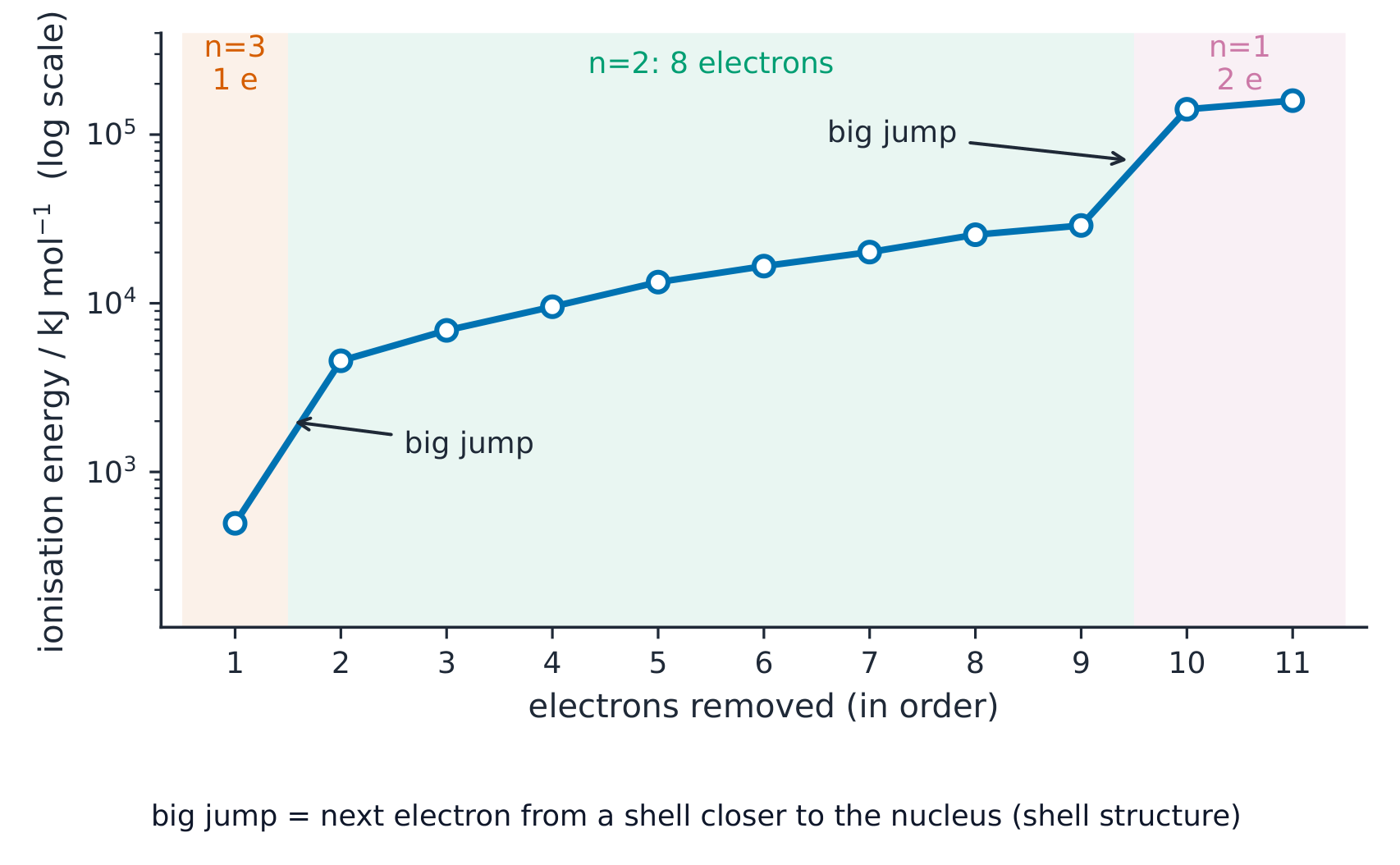
    If you plot the successive ionisation energies of one element, the values rise, with big jumps at certain points. A big jump happens when the next electron must come from a shell closer to the nucleus.

    Count how many electrons come off easily before the first big jump — that is the number of electrons in the outer shell, which tells you the group the element is in. You can also use the pattern to work out the electronic configuration and the position of the element in the Periodic Table.

    Electrons removed before the first big jump Group
    1 Group 1
    2 Group 2
    3 Group 13

    Worked example. The first five successive ionisation energies of an element are $590$, $1150$, $4940$, $6480$ and $8120\ \text{kJ}\,\text{mol}^{-1}$. Which group is it in? Look for the big jump, not the biggest number. From the 1st to the 2nd the value roughly doubles, which is a normal rise. From the 2nd ($1150$) to the 3rd ($4940$) it more than quadruples: that is the jump. So two electrons come off easily before it, the outer shell holds 2 electrons, and the element is in Group 2. Count the electrons removed before the jump, and explain the jump properly: the next electron is being pulled from a shell closer to the nucleus, not from a different element.

    ไทย

    พลังงานไอออไนเซชันครั้งแรก

    พลังงานไอออไนเซชันครั้งแรก (IE) คือพลังงานที่ต้องการในการดึงอิเล็กตรอนหนึ่งตัวออกจากอะตอมทั้งหมดในโมลของอะตอมแก๊ส เพื่อสร้างโมลของไอออน $+1$ แบบแก๊ส

    เราใช้อะตอมในสถานะแก๊สเพื่อให้ไม่มีแรงระหว่างอนุภาค หน่วยคือ $\text{kJ mol}^{-1}$ หากเขียนเป็นสมการ สำหรับธาตุ X:

    $$\text{X}(\text{g}) \rightarrow \text{X}^{+}(\text{g}) + \text{e}^{-}$$

    $(\text{g})$ แสดงว่าสปีชีสนั้นอยู่ในสถานะแก๊ส

    พลังงานไอออไนเซชันต่อเนื่อง

    หลังจากถอดอิเล็กตรอนออกไปหนึ่งตัวแล้ว คุณสามารถถอดอีกได้ พลังงานไอออไนเซชันที่สองจะถอดอิเล็กตรอนหนึ่งตัวออกจาก $+1$ ไอออนแต่ละตัว:

    $$\text{X}^{+}(\text{g}) \rightarrow \text{X}^{2+}(\text{g}) + \text{e}^{-}$$

    คุณสามารถทำต่อไปได้อีก พลังงานเหล่านี้เรียกว่า พลังงานไอออไนเซชันต่อเนื่อง ค่าของแต่ละตัวมีค่ามากกว่าตัวก่อนหน้าเสมอ เนื่องจากอิเล็กตรอนถูกดึงออกจากไอออนที่มีประจุบวกมากขึ้นเรื่อยๆ

    สิ่งที่พลังงานไอออไนเซชันขึ้นอยู่กับ

    พลังงานไอออไนเซชันเกิดจากแรงดึงดูดระหว่างนิวเคลียสที่มีประจุบวกกับอิเล็กตรอนชั้นนอก ปัจจัยหลักสามอย่างกำหนดความแข็งแกร่งของแรงนี้:

    • ประจุนิวเคลียส: โปรตอน越多 ดึงอิเล็กตรอนแรงขึ้น ทำให้พลังงานไอออไนเซชันสูงขึ้น
    • รัศมีอะตอม: อิเล็กตรอนชั้นนอกอยู่ห่างจากนิวเคลียสมากเท่าไหร่ แรงดึงยิ่งอ่อนลง ทำให้พลังงานไอออไนเซชันต่ำลง
    • การป้องกัน (Shielding): ชั้นภายในบดบังแรงดึงต่ออิเล็กตรอนชั้นนอก บางชั้นภายใน越多 การป้องกัน越多 และพลังงานไอออไนเซชัน越低

    ยังมีผลอื่นเล็กน้อยด้วย — แรงผลักของคู่สปิน (Spin-pair repulsion) เมื่ออิเล็กตรอนสองตัวอยู่ในออร์บิทัลเดียวกัน พวกมันจะผลักกันเล็กน้อย ทำให้ตัวหนึ่งถอดออกได้ง่ายกว่า

    แนวโน้มของพลังงานไอออไนเซชันแรก

    ข้ามคาบ พลังงานไอออไนเซชันแรกโดยทั่วไป เพิ่มขึ้น ประจุนิวเคลียสเพิ่มขึ้นในขณะที่การป้องกันคงที่เกือบเท่าเดิม ทำให้อิเล็กตรอนชั้นนอกถูกยึดเหนี่ยวแน่นขึ้น

    ตามกลุ่ม พลังงานไอออไนเซชันแรก ลดลง ธาตุที่อยู่ด้านล่างมีชั้นอิเล็กตรอน越多 ดังนั้นการป้องกัน越多 และรัศมี越大 อิเล็กตรอนชั้นนอกจึงถอดออกได้ง่ายกว่า

    จุดต่ำสุดเป็นหลักฐานของซับชัลล์

    การเพิ่มขึ้นข้ามคาบไม่ราบรื่น มีจุดต่ำสุดเล็กๆ สองจุดที่คุณควรอธิบายได้ทั้งสองจุด:

    • กลุ่มที่ 2 ไปยังกลุ่มที่ 13 (เช่น Mg ถึง Al): อิเล็กตรอนที่ถูกถอดจาก Al มาจากซับชัลล์ 3p ซึ่งมีพลังงานสูงกว่าซับชัลล์ 3s ที่เต็มอยู่ใน Mg อิเล็กตรอน 3p ถอดออกง่ายกว่า ทำให้ค่าลดลง
    • กลุ่มที่ 15 ไปยังกลุ่มที่ 16 (เช่น P ถึง S): ใน S ออร์บิทัล 3p ตัวหนึ่งตอนนี้มีคู่อิเล็กตรอนอยู่ด้วย แรงผลักของคู่สปินทำให้ตัวหนึ่งถอดออกง่ายขึ้น ทำให้ค่าลดลง

    จุดต่ำสุดเหล่านี้เป็นหลักฐานว่าซับชัลล์มีอยู่จริง

    กราฟพลังงานไอออไนเซชันแรกข้ามคาบที่ 3 ซึ่งโดยรวมเพิ่มขึ้นแต่มีจุดต่ำสุดที่อะลูมิเนียมและกำมะถัน
    พลังงานไอออไนเซชันแรกเพิ่มขึ้นข้ามคาบที่ 3 แต่มีจุดต่ำสุดที่ Al และ S — เป็นหลักฐานว่าซับชัลล์มีอยู่

    พลังงานไอออไนเซชันต่อเนื่องเป็นหลักฐานของชั้นอิเล็กตรอน

    หากคุณพล็อตพลังงานไอออไนเซชันต่อเนื่องของธาตุหนึ่ง ค่าจะเพิ่มขึ้น โดยมี การกระโดดใหญ่ ที่จุด tertentu การกระโดดใหญ่เกิดขึ้นเมื่ออิเล็กตรอนถัดไปต้องมาจากชั้นที่ใกล้กับนิวเคลียสมากขึ้น

    นับจำนวนอิเล็กตรอนที่ถอดออกได้ง่ายก่อนการกระโดดใหญ่ครั้งแรก—that คือจำนวนอิเล็กตรอนในชั้นนอก ซึ่งบอกคุณถึง กลุ่ม ของธาตุนั้น คุณยังสามารถใช้รูปแบบนี้เพื่อหาการจัดเรียงอิเล็กตรอนและตำแหน่งของธาตุในตารางสารเคมีด้วย

    กราฟสเกลลอการิทึมของพลังงานไอออไนเซชันต่อเนื่องทั้งสิบหนึ่งของโซเดียม ซึ่งมีการกระโดดใหญ่สองจุดแบ่งจุดข้อมูลออกเป็นกลุ่ม 1, 8 และ 2
    พลังงานไอออไนเซชันต่อเนื่องของโซเดียม (สเกลลอการิทึม): การกระโดดใหญ่เผยให้เห็นโครงสร้างชั้น $2,8,1$
    อิเล็กตรอนที่ถูกถอดออกก่อนการกระโดดใหญ่ครั้งแรก กลุ่ม
    1 กลุ่มที่ 1
    2 กลุ่มที่ 2
    3 กลุ่มที่ 13

    ตัวอย่างวิธีทำ พลังงานไอออไนเซชันต่อเนื่องห้าตัวแรกของธาตุหนึ่งคือ $590$, $1150$, $4940$, $6480$ และ $8120\ \text{kJ}\,\text{mol}^{-1}$ ธาตุนี้อยู่ในกลุ่มใด? ให้มองหา การกระโดดใหญ่ ไม่ใช่ตัวเลขที่ใหญ่ที่สุด จากตัวที่ 1 ไปตัวที่ 2 ค่าเพิ่มขึ้นประมาณสองเท่า ซึ่งเป็นปกติ จากตัวที่ 2 ($1150$) ไปตัวที่ 3 ($4940$) ค่าเพิ่มมากกว่าสี่เท่า: นั่นคือการกระโดด ดังนั้น สอง อิเล็กตรอนถูกถอดออกได้ง่ายก่อนการกระโดด ชั้นนอกมี 2 อิเล็กตรอน และธาตุนี้อยู่ใน กลุ่มที่ 2 นับจำนวนอิเล็กตรอนที่ถูกถอดออก ก่อน การกระโดด และอธิบายการกระโดดให้ถูกต้อง: อิเล็กตรอนถัดไปกำลังถูกดึงมาจากชั้นที่ ใกล้กับนิวเคลียสมากขึ้น ไม่ใช่จากธาตุอื่น

    Explore · ⁨สำรวจ⁩

    The ionisation-energy trend — and its dips · ⁨แนวโน้มพลังงานไอออนไนเซชัน — และจุดลดลง⁩

    First ionisation energy generally rises across a period, but DIPS where a new p sub-shell starts and where a p-orbital pair first forms. Step across to find the two tell-tale dips. · ⁨พลังงานไอออนไนเซชันครั้งแรกโดยทั่วไปเพิ่มขึ้นตลอดช่วง แต่มีการลดลง (DIPS) เมื่อเริ่ม sub-shell p ใหม่และเมื่อเกิดคู่ในออร์บิตัล p ครั้งแรก ลากข้ามเพื่อหาจุดลดลงทั้งสองที่เป็นสัญญาณบอก⁩

    Vocabulary · ⁨คำศัพท์⁩ Train · ⁨ฝึกฝน⁩
    English ไทย
    period/ˈpɪərɪəd/ รอบ
    nuclear charge/ˈnjuːklɪə tʃɑːdʒ/ ประจุนิวเคลียส
    shielding/ˈʃiːldɪŋ/ การป้องกันประจุ
    group/ɡruːp/ กลุ่ม
    cation/ˈkætaɪən/ แคทไอออน
    anion/ˈænaɪən/ แอนไอออน
    repulsion/rɪˈpʌlʃn/ แรงผลัก
    spin/spɪn/ สปิน
    sphere/sfɪə/ ทรงกลม
    free radical/friː ˈrædɪkl/ free radical
    unpaired electrons/ʌnˈpeəd ɪˈlektrɒnz/ อิเล็กตรอนคู่เดียว
    first ionisation energy/fɜːst ˌaɪənaɪˈzeɪʃn ˈenədʒi/ พลังงานไอออไนเซชันแรก
    successive ionisation energies/səkˈsesɪv ˌaɪənaɪˈzeɪʃn ˈenədʒiz/ พลังงานไอออไนเซชันต่อเนื่อง
    spin-pair repulsion/spɪn peə rɪˈpʌlʃn/ แรงผลัดกันของสปินคู่
    1.4

    Exam tips · ⁨ข้อแนะนำสำหรับการสอบ⁩

    English
    • Define isotopes in full: atoms of the same element with the same number of protons but a different number of neutrons — the mark scheme wants both halves.
    • 4s fills before 3d, but electrons are removed from 4s first when forming ions, so $\text{Fe}^{3+}$ is $[\text{Ar}]3\text{d}^5$ (not $[\text{Ar}]3\text{d}^3 4\text{s}^2$).
    • In successive ionisation energies, a big jump marks the start of a new (inner) shell — use the jumps to place the element in its group.
    • Explain every ionisation-energy trend with the same three factors: nuclear charge, distance and shielding, plus sub-shell effects for the small dips.
    • Learn the exact reason first ionisation energy of oxygen is below nitrogen: oxygen's paired 2p electrons repel, so one is easier to remove.
    ไทย
    • นิยาม ไอโซโทป อย่างครบถ้วน: อะตอมของธาตุเดียวกันที่มีจำนวนโปรตอนเท่ากันแต่มีจำนวนนิวตรอนต่างกัน — แผนการให้คะแนนต้องการทั้งสองส่วน
    • 4s เติมเต็ม ก่อน 3d แต่อิเล็กตรอนจะถูก ดึงออกจาก 4s ก่อน เมื่อสร้างไอออน ดังนั้น $\text{Fe}^{3+}$ จึงเป็น $[\text{Ar}]3\text{d}^5$ (ไม่ใช่ $[\text{Ar}]3\text{d}^3 4\text{s}^2$).
    • ในพลังงานไอออไนเซชันต่อเนื่อง การกระโดดใหญ่ บ่งชี้เริ่มต้นของชั้นใหม่ (ชั้นใน) — ใช้การกระโดดเพื่อบอกตำแหน่งกลุ่มของธาตุ
    • อธิบายแนวโน้มทุกประการของพลังงานไอออไนเซชันด้วยปัจจัยสามอย่างเดียวกัน: ประจุนิวเคลียส, ระยะทาง และการป้องกัน plus ผลกระทบของซับชัลล์สำหรับจุดต่ำสุดเล็กๆ
    • จำเหตุผลที่พลังงานไอออไนเซชันแรกของออกซิเจน ต่ำกว่า ไนโตรเจนอย่างแม่นยำ: คู่อิเล็กตรอน 2p ของออกซิเจน ผลักกัน ทำให้ตัวหนึ่งถอดออกได้ง่ายกว่า
  • 2

    Atoms, molecules and stoichiometry · ⁨อะตอม, โมเลกุลและสโตกิโอเมทรี⁩

    Watch lesson · ⁨ดูบทเรียน⁩
    2.1

    Relative masses of atoms and molecules · ⁨มวลสัมพัทธ์ของอะตอมและโมเลกุล⁩

    Syllabus · ⁨หลักสูตร⁩
    English
    1. define the unified atomic mass unit as one twelfth of the mass of a carbon-12 atom
    2. define relative atomic mass, $A_r$, relative isotopic mass, relative molecular mass, $M_r$, and relative formula mass in terms of the unified atomic mass unit
    ไทย
    1. นิยาม หน่วยมวลอะตอมรวม ว่าคือหนึ่งในสิบสองของมวลของอะตอม คาร์บอน-12
    2. นิยาม มวลอะตอมสัมพัทธ์, $A_r$, มวลไอโซโทปสัมพัทธ์, มวลโมเลกุลสัมพัทธ์, $M_r$ และ มวลสูตรสัมพัทธ์ โดยอ้างอิงจากหน่วยมวลอะตอมรวม

    Source: Cambridge International syllabus · ⁨แหล่งที่มา: หลักสูตร Cambridge International⁩

    English

    Atoms 原子 are far too light to weigh in grams, so we compare every mass to one standard. The standard is the unified atomic mass unit 统一原子质量单位 (symbol u), defined as exactly one twelfth of the mass of one carbon-12 atom.

    Using this unit, we state masses as simple numbers:

    • the relative atomic mass 相对原子质量 $A_r$ of an element is the average mass of its atoms compared with $\tfrac{1}{12}$ of a carbon-12 atom. It is an average over all the isotopes 同位素, weighted by how common each one is.
    • the relative isotopic mass 相对同位素质量 is the mass of one atom of a single isotope, compared with $\tfrac{1}{12}$ of a carbon-12 atom.
    • the relative molecular mass 相对分子质量 $M_r$ of a molecule 分子 is the sum of the relative atomic masses of all its atoms.
    • the relative formula mass 相对式量 is the same idea for a substance that is not made of molecules (such as an ionic compound). Add up the relative atomic masses shown in the formula.

    To find $A_r$ from isotope data, multiply each isotope mass by its percentage, add these up, and divide by 100.

    Worked example. Chlorine is $75\%$ ${}^{35}\text{Cl}$ and $25\%$ ${}^{37}\text{Cl}$. Find its relative atomic mass.

    $$A_r = \frac{(75 \times 35) + (25 \times 37)}{100} = \frac{2625 + 925}{100} = 35.5.$$

    Worked example. A mass spectrometer shows copper is $69.2\%$ ${}^{63}\text{Cu}$ and $30.8\%$ ${}^{65}\text{Cu}$. Find its relative atomic mass.

    $$A_r = \frac{(69.2 \times 63) + (30.8 \times 65)}{100} = \frac{4359.6 + 2002.0}{100} = 63.6.$$
    ไทย

    อะตอม มีน้ำหนักเบามากจนไม่สามารถชั่งด้วยกรัมได้ เราจึงเปรียบเทียบมวลทั้งหมดกับมาตรฐานหนึ่ง มาตรฐานนั้นคือ หน่วยมวลอะตอมรวม (unified atomic mass unit) (สัญลักษณ์ u) which ถูกนิยามว่าเป็นหนึ่งในสิบสองของมวลของคาร์บอน-12 อะตอมหนึ่ง

    โดยใช้หน่วยนี้ เราระบุมวลเป็นตัวเลขง่ายๆ:

    • มวลอะตอมสัมพัทธ์ $A_r$ ของธาตุคือมวลเฉลี่ยของอะตอมของมันเมื่อเทียบกับ $\tfrac{1}{12}$ ของคาร์บอน-12 อะตอม เป็นค่าเฉลี่ยของ ไอโซโทป ทั้งหมด โดยถ่วงน้ำหนักด้วยความถี่ของแต่ละไอโซโทป
    • มวลไอโซโทปสัมพัทธ์ คือมวลของอะตอมเดียวของไอโซโทปหนึ่ง เมื่อเทียบกับ $\tfrac{1}{12}$ ของคาร์บอน-12 อะตอม
    • มวลโมเลกุลสัมพัทธ์ $M_r$ ของ โมเลกุล คือผลรวมของมวลอะตอมสัมพัทธ์ของอะตอมทั้งหมดในโมเลกุลนั้น
    • มวลสัมพัทธ์ของสูตร เป็นแนวคิดเดียวกันสำหรับสารที่ไม่ประกอบด้วยโมเลกุล (เช่น สารประกอบไอออน) ให้บวกมวลอะตอมสัมพัทธ์ที่แสดงในสูตรเข้าด้วยกัน
    แท่งกราฟแสดงว่าคลอรีนประกอบด้วย 75% คลอรีน-35 และ 25% คลอรีน-37 โดยคำนวณค่ามวลอะตอมสัมพัทธ์จากค่าเฉลี่ยถ่วงน้ำหนักได้ 35.5
    มวลอะตอมสัมพัทธ์คือค่าเฉลี่ยถ่วงน้ำหนัก: ไอโซโทปสองชนิดของคลอรีน (75% ³Cl, 25% ³⁷Cl) มีค่าเฉลี่ย Aᵣ = 35.5

    ในการหาค่า $A_r$ จากข้อมูลไอโซโทป ให้คูณมวลของแต่ละไอโซโทปด้วยเปอร์เซ็นต์ แล้วนำผลรวมมาหารด้วย 100

    ตัวอย่างวิธีทำ คลอรีนมี $75\%$ ${}^{35}\text{Cl}$ และมี $25\%$ ${}^{37}\text{Cl}$ จงหามวลอะตอมสัมพัทธ์ของมัน

    $$A_r = \frac{(75 \times 35) + (25 \times 37)}{100} = \frac{2625 + 925}{100} = 35.5.$$

    ตัวอย่างวิธีทำ เครื่องสเปกโทรมิเตอร์มวลชี้ให้เห็นว่าทองแดงมี $69.2\%$ ${}^{63}\text{Cu}$ และมี $30.8\%$ ${}^{65}\text{Cu}$ จงหามวลอะตอมสัมพัทธ์ของมัน

    $$A_r = \frac{(69.2 \times 63) + (30.8 \times 65)}{100} = \frac{4359.6 + 2002.0}{100} = 63.6.$$
    Explore · ⁨สำรวจ⁩

    Relative mass lab · ⁨ห้องปฏิบัติการมวลสัมพัทธ์⁩

    relative atomic mass = weighted mean · ⁨มวลอะตอมสัมพัทธ์ = ค่าเฉลี่ยถ่วงน้ำหนัก⁩

    Change isotope abundance and see the weighted mean move. · ⁨เปลี่ยนความอุดมสมบูรณ์ของไอโซโทปเพื่อดูค่าเฉลี่ยถ่วงน้ำหนักเคลื่อนที่⁩

    Vocabulary · ⁨คำศัพท์⁩ Train · ⁨ฝึกฝน⁩
    English ไทย
    atom/ˈætəm/ อะตอม
    unified atomic mass unit/ˈjuːnɪfaɪd əˈtɒmɪk mæs ˈjuːnɪt/ หน่วยมวลอะตอมรวม
    relative atomic mass/ˈrelətɪv əˈtɒmɪk mæs/ มวลอะตอมสัมพัทธ์
    isotope/ˈaɪsətəʊp/ ไอโซโทป
    relative isotopic mass/ˈrelətɪv ˌaɪsəˈtɒpɪk mæs/ มวลไอโซโทปสัมพัทธ์
    relative molecular mass/ˈrelətɪv məˈlekjʊlə mæs/ มวลโมเลกุลสัมพัทธ์
    molecule/ˈmɒlɪkjuːl/ โมเลกุล
    relative formula mass/ˈrelətɪv ˈfɔːmjʊlə mæs/ มวลสูตรสัมพัทธ์
    2.2

    The mole and the Avogadro constant · ⁨โมลและค่าคงที่อาโวกาโดร⁩

    Syllabus · ⁨หลักสูตร⁩
    English
    1. define and use the term mole in terms of the Avogadro constant
    ไทย
    1. นิยามและใช้คำว่า โมล โดยอ้างอิงจาก ค่าคงที่อาวากาโดโร

    Source: Cambridge International syllabus · ⁨แหล่งที่มา: หลักสูตร Cambridge International⁩

    English

    Chemists count particles in groups called moles, just as we count eggs in dozens.

    One mole 摩尔 (symbol mol) is the amount of substance that contains the same number of particles as there are atoms in exactly 12 g of carbon-12. That number is the Avogadro constant 阿伏伽德罗常量:

    $$N_A = 6.02 \times 10^{23}\ \text{mol}^{-1}$$

    So one mole of anything contains $6.02 \times 10^{23}$ particles. The particles may be atoms, molecules or ions 离子 — always say which.

    The mass of one mole in grams equals the relative mass ($A_r$ or $M_r$). This is the molar mass 摩尔质量, with units $\text{g mol}^{-1}$. The key equation is:

    $$n = \frac{m}{M}$$

    where $n$ is the amount in moles, $m$ is the mass in grams, and $M$ is the molar mass.

    Worked example. How many moles are in $8.0\ \text{g}$ of methane, $\text{CH}_4$? ($A_r$: C $= 12$, H $= 1$.)

    The molar mass is $M = 12 + 4(1) = 16\ \text{g mol}^{-1}$, so

    $$n = \frac{m}{M} = \frac{8.0}{16} = 0.50\ \text{mol}.$$
    ไทย
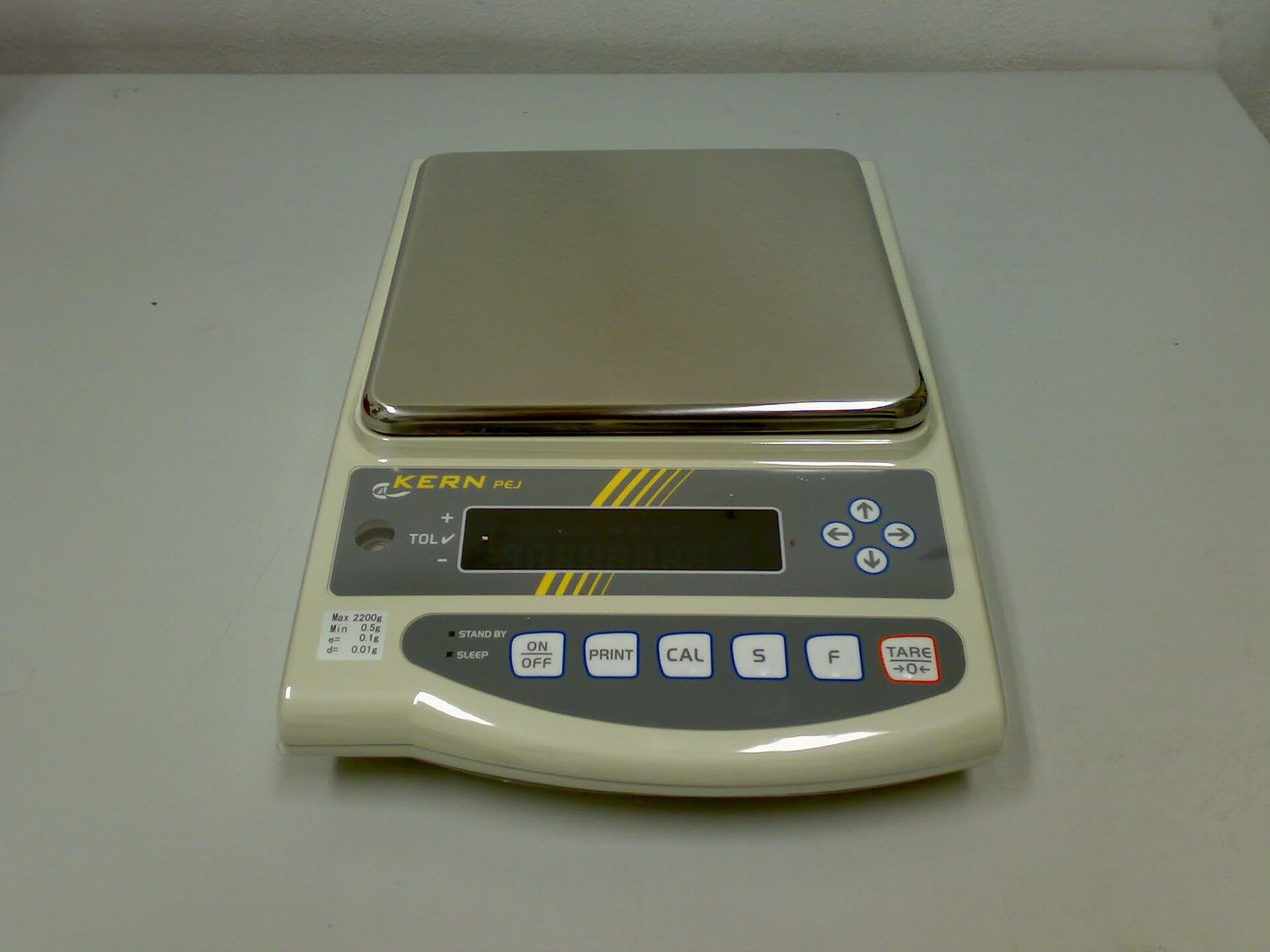
    เครื่องชั่งไฟฟ้าสมัยใหม่ในห้องปฏิบัติการ
    เครื่องชั่งไฟฟ้าสมัยใหม่ใช้วัดมวล — ซึ่งเป็นพื้นฐานของการคำนวณโมล

    นักเคมีนับอนุภาคเป็นกลุ่มที่เรียกว่าโมล เหมือนกับการนับไข่เป็น dozzen

    โมลหนึ่ง (สัญลักษณ์ mol) คือปริมาณสารที่มีจำนวนอนุภาคเท่ากับจำนวนอะตอมในคาร์บอน-12 จำนวน 12 กรัม พอดี จำนวนนี้คือ ค่าคงที่อาโวกาโดร:

    $$N_A = 6.02 \times 10^{23}\ \text{mol}^{-1}$$

    ดังนั้นโมลหนึ่งของสารใดๆ จะประกอบด้วย $6.02 \times 10^{23}$ อนุภาค อนุภาคอาจเป็นอะตอม โมเลกุลหรือ ไอออน — ต้องระบุให้ชัดเจนเสมอ

    มวลของโมลหนึ่งเป็นกรัมจะเท่ากับมวลสัมพัทธ์ ($A_r$ หรือ $M_r$) นี่คือ มวลโมล โดยมีหน่วย $\text{g mol}^{-1}$ สมการสำคัญคือ:

    $$n = \frac{m}{M}$$

    โดยที่ $n$ คือปริมาณเป็นโมล $m$ คือมวลเป็นกรัม และ $M$ คือมวลโมล

    ตัวอย่างวิธีทำ มีโมลกี่โมลใน $8.0\ \text{g}$ ของเมทาน $\text{CH}_4$ ? ($A_r$: C $= 12$, H $= 1$.)

    มวลโมลคือ $M = 12 + 4(1) = 16\ \text{g mol}^{-1}$ ดังนั้น

    $$n = \frac{m}{M} = \frac{8.0}{16} = 0.50\ \text{mol}.$$
    กล่องโมลอยู่ตรงกลาง เชื่อมด้วยลูกศรคู่ไปยังมวล จำนวนอนุภาค ปริมาตรแก๊ส และความเข้มข้นของสารละลาย แต่ละลูกศรมีฉลากบอกการแปลงหน่วย
    โมลเป็นศูนย์กลางของการคำนวณปริมาณทุกชนิด: แปลงเป็นมวล ($n=m/M$), จำนวนอนุภาค ($\times N_A$), ปริมาตรแก๊ส ($n=V/24$) หรือสารละลาย ($n=cV$)
    Explore · ⁨สำรวจ⁩

    Mole mass lab · ⁨ห้องปฏิบัติการมวลโมล⁩

    n = m / M

    Change mass and see moles scale through molar mass. · ⁨เปลี่ยนมวลเพื่อดูว่าโมลขยายตามมวลโมล⁩

    Vocabulary · ⁨คำศัพท์⁩ Train · ⁨ฝึกฝน⁩
    English ไทย
    mole/məʊl/ โมล
    Avogadro constant/ˌævəˈɡædrəʊ ˈkɒnstənt/ ค่าคงที่อาโวกาโดร
    2.3

    Formulas · ⁨สูตรเคมี⁩

    Syllabus · ⁨หลักสูตร⁩
    English
    1. write formulas of ionic compounds from ionic charges and oxidation numbers (shown by a Roman numeral), including: (a) the prediction of ionic charge from the position of an element in the Periodic Table (b) recall of the names and formulas for the following ions: $\text{NO}_3^-$, $\text{CO}_3^{2-}$, $\text{SO}_4^{2-}$, $\text{OH}^-$, $\text{NH}_4^+$, $\text{Zn}^{2+}$, $\text{Ag}^+$, $\text{HCO}_3^-$, $\text{PO}_4^{3-}$
    2. (a) write and construct equations (which should be balanced), including ionic equations (which should not include spectator ions) (b) use appropriate state symbols in equations
    3. define and use the terms empirical and molecular formula
    4. understand and use the terms anhydrous, hydrated and water of crystallisation
    5. calculate empirical and molecular formulas, using given data
    ไทย
    1. เขียนสูตรของสารประกอบไอออนิกจากประจุไอออนและเลขออกซิเดชัน (แสดงด้วยตัวอักษรโรมัน) รวมถึง: (ก) การทำนายประจุไอออนจากตำแหน่งของธาตุในตารางสมบัตินิวเคลียส (ข) ทบทวนชื่อและสูตรของไอออนต่อไปนี้: $\text{NO}_3^-$, $\text{CO}_3^{2-}$, $\text{SO}_4^{2-}$, $\text{OH}^-$, $\text{NH}_4^+$, $\text{Zn}^{2+}$, $\text{Ag}^+$, $\text{HCO}_3^-$, $\text{PO}_4^{3-}$
    2. (ก) เขียนและสร้างสมการ (ซึ่งควรจัดให้สมดุล) รวมถึงสมการไอออน (ซึ่งไม่ควรมีไอออนผู้ชม) (ข) ใช้สัญลักษณ์สถานะที่เหมาะสมในสมการ
    3. นิยามและใช้คำว่า สูตรเชิงประมาตและสูตรโมเลกุล
    4. เข้าใจและใช้คำว่า ไม่มีการผสมน้ำ (anhydrous), มีการผสมน้ำ (hydrated) และ น้ำผลึก (water of crystallisation)
    5. คำนวณสูตรเชิงประมาตและสูตรโมเลกุล โดยใช้ข้อมูลที่ได้รับกำหนดให้

    Source: Cambridge International syllabus · ⁨แหล่งที่มา: หลักสูตร Cambridge International⁩

    English

    A compound 化合物 is a substance made of two or more elements chemically joined.

    Charges and formulas of ionic compounds

    In an ionic compound 离子化合物 the total positive charge balances the total negative charge, so the compound is neutral overall.

    You can predict the charge of many ions from the element's position in the Periodic Table:

    Group 1 2 13 15 16 17
    Usual ion charge $+1$ $+2$ $+3$ $-3$ $-2$ $-1$

    Hydrogen forms $\text{H}^+$, and the Group 18 noble gases do not normally form ions.

    Some ions you must know by name and formula:

    Name Formula
    nitrate $\text{NO}_3^{-}$
    carbonate $\text{CO}_3^{2-}$
    sulfate $\text{SO}_4^{2-}$
    hydroxide $\text{OH}^{-}$
    ammonium $\text{NH}_4^{+}$
    zinc $\text{Zn}^{2+}$
    silver $\text{Ag}^{+}$
    hydrogencarbonate $\text{HCO}_3^{-}$
    phosphate $\text{PO}_4^{3-}$

    For a metal that can have more than one charge, a Roman numeral shows the oxidation number 氧化数. For example, iron(II) is $\text{Fe}^{2+}$ and iron(III) is $\text{Fe}^{3+}$. To write a formula, balance the charges: iron(III) oxide is $\text{Fe}_2\text{O}_3$, because two $\text{Fe}^{3+}$ balance three $\text{O}^{2-}$.

    Equations and state symbols

    A chemical equation must be balanced 配平 — the same number of each kind of atom on both sides. Add state symbols 状态符号 to show the state of each species: (s) solid, (l) liquid, (g) gas, and (aq) aqueous 水溶液 (dissolved in water).

    An ionic equation 离子方程式 shows only the ions and molecules that actually change. The ions that do not change are spectator ions 旁观离子, and you leave them out. For example, the reaction that forms silver chloride is:

    $$\text{Ag}^{+}(\text{aq}) + \text{Cl}^{-}(\text{aq}) \rightarrow \text{AgCl}(\text{s})$$

    Empirical and molecular formulas

    The empirical formula 实验式 is the simplest whole-number ratio of the atoms of each element in a compound. The molecular formula 分子式 shows the actual number of atoms of each element in one molecule.

    For example, ethane has empirical formula $\text{CH}_3$ but molecular formula $\text{C}_2\text{H}_6$.

    Hydrated and anhydrous solids

    Some solids hold water inside their crystals. This water is the water of crystallisation 结晶水. A solid that contains it is hydrated 水合的; the same solid with the water removed is anhydrous 无水的.

    For example, hydrated copper(II) sulfate is $\text{CuSO}_4 \cdot 5\text{H}_2\text{O}$. Heating it drives off the water to leave anhydrous $\text{CuSO}_4$.

    Calculating empirical and molecular formulas

    To find the empirical formula from masses (or percentages by mass):

    1. divide each element's mass by its $A_r$ to get the moles.
    2. divide all the mole values by the smallest one.
    3. round to the nearest whole numbers — that ratio is the empirical formula.

    To get the molecular formula, you also need $M_r$. Find how many times the empirical formula mass fits into $M_r$, then multiply the formula by that number.

    Worked example. A compound is $40.0\%$ carbon, $6.7\%$ hydrogen and $53.3\%$ oxygen by mass. Find its empirical formula. ($A_r$: C $= 12$, H $= 1$, O $= 16$.)

    Take $100\ \text{g}$ and divide each mass by its $A_r$ to get moles: C $= 40.0/12 = 3.33$, H $= 6.7/1 = 6.7$, O $= 53.3/16 = 3.33$. Dividing through by the smallest ($3.33$) gives a ratio C : H : O $= 1 : 2 : 1$, so the empirical formula is $\text{CH}_2\text{O}$.

    ไทย

    สารประกอบ คือสารที่เกิดจากธาตุสองชนิดขึ้นไปเชื่อมต่อกันทางเคมี

    ประจุและสูตรของสารประกอบไอออน

    ใน สารประกอบไอออน ผลรวมของประจุบวกจะสมดุลกับผลรวมของประจุลบ ทำให้สารประกอบมีสภาพเป็นกลางโดยรวม

    คุณสามารถทำนายประจุของไอออนหลายชนิดได้จากตำแหน่งของธาตุในตารางธาตุ:

    กลุ่ม 1 2 13 15 16 17
    ประจุไอออนปกติ $+1$ $+2$ $+3$ $-3$ $-2$ $-1$

    ไฮโดรเจนสร้าง $\text{H}^+$ และแก๊สนoble กลุ่มที่ 18 มักจะไม่สร้างไอออน

    บางไอออนที่คุณต้องจำชื่อและสูตรได้:

    ชื่อ สูตร
    ไนเตรต $\text{NO}_3^{-}$
    คาร์บอเนต $\text{CO}_3^{2-}$
    ซัลเฟต $\text{SO}_4^{2-}$
    ไฮดรอกไซด์ $\text{OH}^{-}$
    แอมโมเนียม $\text{NH}_4^{+}$
    สังกะสี $\text{Zn}^{2+}$
    เงิน $\text{Ag}^{+}$
    ไฮโดรเจนคาร์บอเนต $\text{HCO}_3^{-}$
    ฟอสเฟต $\text{PO}_4^{3-}$

    สำหรับโลหะที่มีประจุมากกว่าหนึ่งชนิด的数字โรมันจะบ่งบอกถึง เลขออกซิเดชัน ตัวอย่างเช่น แร่เหล็ก(II) คือ $\text{Fe}^{2+}$ และแร่เหล็ก(III) คือ $\text{Fe}^{3+}$ ในการเขียนสูตร ให้ปรับสมดุลประจุ: เหล็ก(III) ออกไซด์ คือ $\text{Fe}_2\text{O}_3$ เนื่องจาก $\text{Fe}^{3+}$ สองตัว ชดเชย $\text{O}^{2-}$ สามตัว.

    สมการและสัญลักษณ์สถานะ

    สมการเคมีต้อง สมดุล — มีจำนวนอะตอมแต่ละชนิดเท่ากันทั้งสองข้าง เพิ่ม สัญลักษณ์สถานะ เพื่อแสดงสถานะของสปีชีส์แต่ละตัว: (s) ของแข็ง, (l) ของเหลว, (g) แก๊ส และ (aq) สารละลายน้ำ (ละลายในน้ำ)

    สมการไอออน แสดงเฉพาะไอออนและโมเลกุลที่เปลี่ยนแปลงจริง ไอออนที่ไม่เปลี่ยนแปลงเรียกว่า ไอออนผู้สังเกตการณ์ และคุณตัดมันออกไป ตัวอย่างเช่น ปฏิกิริยาที่สร้างเงินคลอไรด์คือ:

    $$\text{Ag}^{+}(\text{aq}) + \text{Cl}^{-}(\text{aq}) \rightarrow \text{AgCl}(\text{s})$$

    สูตรเชิงประจักษ์และสูตรโมเลกุล

    สูตรเชิงประจักษ์ คืออัตราส่วนจำนวนเต็มอย่างง่ายที่สุดของอะตอมแต่ละธาตุในสารประกอบ สูตรโมเลกุล แสดงจำนวนอะตอมจริงของแต่ละธาตุในหนึ่งโมเลกุล

    ตัวอย่างเช่น เอเทนมีสูตรเชิงประจักษ์ $\text{CH}_3$ แต่มีสูตรโมเลกุล $\text{C}_2\text{H}_6$

    ของแข็งแบบมีน้ำและแบบไม่มีน้ำ

    บางชนิดของแข็งมีน้ำอยู่ภายในผลึก น้ำนี้คือ น้ำในผลึก ของแข็งที่มีน้ำอยู่คือ แบบมีน้ำ; ของแข็งเดียวกันเมื่อเอาน้ำออกแล้วจะเป็น แบบไม่มีน้ำ

    ตัวอย่างเช่น ทองคopper(II) ซัลเฟตแบบมีน้ำคือ $\text{CuSO}_4 \cdot 5\text{H}_2\text{O}$ การให้ความร้อนจะทำให้ระเหยน้ำออกไปเหลือ $\text{CuSO}_4$ แบบไม่มีน้ำ

    การคำนวณสูตรเชิงประจักษ์และสูตรโมเลกุล

    ในการหาสูตรเชิงประจักษ์จากมวล (หรือเปอร์เซ็นต์โดยมวล):

    1. หารมวลของแต่ละธาตุด้วย $A_r$ ของมันเพื่อจะได้จำนวนโมล
    2. หารค่าโมลทั้งหมดด้วยค่าน้อยที่สุด
    3. ปัดเศษให้เป็นจำนวนเต็มที่ใกล้ที่สุด — อัตราส่วนนั้นคือสูตรเชิงประจักษ์

    เพื่อให้ได้สูตรโมเลกุล คุณยังต้องใช้ $M_r$ ด้วย หาว่ามีสูตรเชิงประจักษ์เข้าไปใน $M_r$ กี่เท่า แล้วคูณสูตรด้วยตัวเลขนั้น

    ตัวอย่างวิธีทำ สารประกอบหนึ่งประกอบด้วย $40.0\%$ คาร์บอน $6.7\%$ ไฮโดรเจน และ $53.3\%$ ออกซิเจน โดยมวล จงหาสูตรเชิงประจักษ์ ($A_r$: C $= 12$, H $= 1$, O $= 16$.)

    ใช้ $100\ \text{g}$ และหารมวลแต่ละชนิดด้วย $A_r$ เพื่อได้โมล: C $= 40.0/12 = 3.33$, H $= 6.7/1 = 6.7$, O $= 53.3/16 = 3.33$ การหารตลอดด้วยค่าน้อยที่สุด ($3.33$) จะได้สัดส่วน C : H : O $= 1 : 2 : 1$ ดังนั้นสูตรเชิงประจักษ์คือ $\text{CH}_2\text{O}$

    การจัดรูปแบบตัวอย่างวิธีทำเป็นตาราง: เปอร์เซ็นต์โดยมวลหารด้วย Ar ได้โมล การหารด้วยค่าน้อยที่สุดจะได้สัดส่วน 1 ต่อ 2 ต่อ 1 ดังนั้นสูตรเชิงประจักษ์คือ CH2O
    สูตรการทำสูตรเชิงประจักษ์: หารด้วย Ar, หารด้วยค่าน้อยที่สุด, อ่านค่าสัดส่วนออกมา
    Explore · ⁨สำรวจ⁩

    Equation balancing route · ⁨เส้นทางการจัดสมการให้สมดุล⁩

    Follow atoms through a chemical equation so both sides match. · ⁨ติดตามอะตอมผ่านสมการเคมีเพื่อให้ทั้งสองฝั่งตรงกัน⁩

    Vocabulary · ⁨คำศัพท์⁩ Train · ⁨ฝึกฝน⁩
    English ไทย
    empirical formula/emˈpɪrɪkl ˈfɔːmjʊlə/ สูตรอย่างง่าย
    molecular formula/məˈlekjʊlə ˈfɔːmjʊlə/ สูตรโมเลกุล
    water of crystallisation/ˈwɔːtə ɒv ˌkrɪstəlaɪˈzeɪʃn/ น้ำในผลึก
    hydrated/haɪˈdreɪtɪd/ ไฮเดรต
    anhydrous/ænˈhaɪdrəs/ แอนไฮดรัส (ไร้สารละลาย)
    2.4

    Reacting masses and volumes · ⁨มวลและปริมาตรที่ทำปฏิกิริยากัน⁩

    Syllabus · ⁨หลักสูตร⁩
    English
    1. perform calculations including use of the mole concept, involving: (a) reacting masses (from formulas and equations) including percentage yield calculations (b) volumes of gases (e.g. in the burning of hydrocarbons) (c) volumes and concentrations of solutions (d) limiting reagent and excess reagent (When performing calculations, candidates’ answers should reflect the number of significant figures given or asked for in the question. When rounding up or down, candidates should ensure that significant figures are neither lost unnecessarily nor used beyond what is justified (see also Mathematical requirements section).) (e) deduce stoichiometric relationships from calculations such as those in 2.4.1(a)–(d)
    ไทย
    1. ทำการคำนวณรวมถึงการใช้แนวคิดโมล ซึ่งประกอบด้วย: (ก) มวลที่參與ปฏิกิริยา (จากสูตรและสมการ) รวมถึงการคำนวณเปอร์เซ็นต์ผลผลิต (ข) ปริมาตรของแก๊ส (เช่น ในการเผาไหม้ไฮโดรคาร์บอน) (ค) ปริมาตรและความเข้มข้นของสารละลาย (ง) สารตั้งต้นจำกัด และ สารตั้งต้นเกิน (เมื่อทำการคำนวณ คำตอบของผู้เข้าสอบควรสะท้อนจำนวนหลักที่มีนัยสำคัญตามที่ระบุหรือถามถึงในโจทย์ เมื่อปัดเศษขึ้นหรือลง ผู้เข้าสอบควรตรวจสอบว่าจำนวนหลักที่มีนัยสำคัญไม่สูญเสียไปโดยไม่จำเป็นหรือไม่ถูกใช้เกินกว่าที่จะ justification ได้ (ดูเพิ่มเติมในส่วน ความต้องการทางคณิตศาสตร์)) (จ) สรุปความสัมพันธ์ storeschiometric จากการคำนวณเช่นในข้อ 2.4.1(ก)–(ง)

    Source: Cambridge International syllabus · ⁨แหล่งที่มา: หลักสูตร Cambridge International⁩

    English

    Reacting masses and percentage yield

    The numbers in front of each species in a balanced equation give the mole ratio — this is the stoichiometry 化学计量. To find a reacting mass: change the known mass to moles, use the mole ratio to find the moles you want, then change back to mass.

    Worked example. What mass of magnesium oxide forms when $4.8\ \text{g}$ of magnesium burns completely? $2\text{Mg} + \text{O}_2 \rightarrow 2\text{MgO}$. ($A_r$: Mg $= 24$, O $= 16$.)

    Moles of Mg $= 4.8/24 = 0.20\ \text{mol}$. The ratio Mg : MgO is $1 : 1$, so $0.20\ \text{mol}$ of MgO forms. Its molar mass is $24 + 16 = 40\ \text{g mol}^{-1}$, so

    $$m = nM = 0.20 \times 40 = 8.0\ \text{g}.$$

    In real reactions you usually get less product than the maximum. The percentage yield 产率 compares the amount you actually made with the most you could make:

    $$\text{percentage yield} = \frac{\text{actual amount of product}}{\text{maximum possible amount}} \times 100\%$$

    Limiting and excess reagent

    When two reactants are mixed, one usually runs out first. The limiting reagent 限量试剂 is the one that runs out — it decides how much product forms. The other is the excess reagent 过量试剂, because there is more than enough of it. Always base the calculation on the limiting reagent.

    To find it: work out the moles of each reactant, divide each by its number in the equation, and the smallest result is the limiting reagent.

    Volumes of gases

    At the same temperature and pressure, equal volumes of any gases contain equal numbers of molecules. At room temperature and pressure (r.t.p.), one mole of any gas takes up $24.0\ \text{dm}^3$, so:

    $$n = \frac{V}{24.0}\qquad (V \text{ in } \text{dm}^3 \text{ at r.t.p.})$$

    This is used when burning hydrocarbons 碳氢化合物 (compounds of only carbon and hydrogen), where you compare gas volumes.

    Volumes and concentrations of solutions

    The concentration 浓度 of a solution is the amount of solute 溶质 in each cubic decimetre of solution 溶液, measured in $\text{mol dm}^{-3}$:

    $$n = c \times V$$

    where $c$ is the concentration and $V$ is the volume in $\text{dm}^3$. Remember that $1000\ \text{cm}^3 = 1\ \text{dm}^3$.

    Worked example. In a titration, $25.0\ \text{cm}^3$ of sodium hydroxide solution is exactly neutralised by $20.0\ \text{cm}^3$ of $0.100\ \text{mol dm}^{-3}$ hydrochloric acid: $\text{NaOH} + \text{HCl} \rightarrow \text{NaCl} + \text{H}_2\text{O}$. Find the concentration of the sodium hydroxide.

    Moles of HCl $= cV = 0.100 \times \dfrac{20.0}{1000} = 2.00 \times 10^{-3}\ \text{mol}$. The ratio is $1 : 1$, so there are $2.00 \times 10^{-3}\ \text{mol}$ of NaOH in $25.0\ \text{cm}^3$:

    $$c = \frac{n}{V} = \frac{2.00 \times 10^{-3}}{25.0/1000} = 0.0800\ \text{mol dm}^{-3}.$$

    This is the basis of a titration 滴定, where you find an unknown concentration by reacting it with a solution whose concentration you already know.

    Significant figures

    Give your answer to a sensible number of significant figures 有效数字 — usually match the data in the question. Do not write more digits than the data supports, and do not round so early that you lose accuracy.

    ไทย
    การไทเทรตกำลังดำเนินการอยู่
    การไทเทรตช่วยหาปริมาตรที่ทำปฏิกิริยากันได้อย่างแม่นยำ

    มวลสารที่เข้าทำปฏิกิริยาและผลผลิตเป็นเปอร์เซ็นต์

    ตัวเลขหน้าแต่ละสปีชีส์ในสมการที่ดุลแล้วแสดงถึงอัตราส่วนโมล — นี่คือ สโตਇโควมิตรี (stoichiometry) ในการหามวลสารที่เข้าทำปฏิกิริยา: เปลี่ยนมวลที่ทราบเป็นโมล ใช้ค่าอัตราส่วนโมลเพื่อหาจำนวนโมลที่ต้องการ แล้วแปลงกลับเป็นมวลอีกครั้ง

    ตัวอย่างวิธีทำ มวลของแมกนีเซียมออกไซด์ที่เกิดขึ้นเมื่อ $4.8\ \text{g}$ ของแมกนีเซียมเผาไหม้จนหมดคือเท่าใด? $2\text{Mg} + \text{O}_2 \rightarrow 2\text{MgO}$. ($A_r$: Mg $= 24$, O $= 16$.)

    โมลของ Mg $= 4.8/24 = 0.20\ \text{mol}$. อัตราส่วน Mg : MgO คือ $1 : 1$, ดังนั้น $0.20\ \text{mol}$ ของ MgO จะเกิดขึ้น. มวลโมลาร์ของมันคือ $24 + 16 = 40\ \text{g mol}^{-1}$, ดังนั้น

    $$m = nM = 0.20 \times 40 = 8.0\ \text{g}.$$
    สะพานโมลสำหรับตัวอย่างแมกนีเซียม: แมกนีเซียม 4.8 กรัมหารด้วย Ar ได้ 0.20 โมล, อัตราส่วน 1 ต่อ 1 ให้ 0.20 โมลของแมกนีเซียมออกไซด์, คูณด้วย Mr ได้ 8.0 กรัม
    สะพานโมล: จากมวลสู่โมล, สัดส่วน, แล้วกลับสู่มวล

    ในปฏิกิริยาจริง คุณมักจะได้ผลิตภัณฑ์น้อยกว่าปริมาณสูงสุด ผลผลิตเป็นเปอร์เซ็นต์ เปรียบเทียบปริมาณที่คุณสร้างได้จริงกับปริมาณมากที่สุดที่เป็นไปได้:

    $$\text{percentage yield} = \frac{\text{actual amount of product}}{\text{maximum possible amount}} \times 100\%$$

    สารกำหนดปฏิกิริยาและสารเกิน

    เมื่อผสมสารตั้งต้นสองชนิดเข้าด้วยกัน โดยทั่วไปจะชนิดหนึ่งหมดก่อน สารกำหนดปฏิกิริยา คือสารที่หมดไป — มันกำหนดปริมาณผลิตภัณฑ์ที่เกิดขึ้น สารที่เหลือคือ สารเกิน เพราะมีมากกว่าพอเสมอ ควรคำนวณโดยอ้างอิงจากสารกำหนดปฏิกิริยาเสมอ

    ในการหามัน: หาโมลของแต่ละสารตั้งต้น หารแต่ละตัวด้วยตัวเลขในสมการ และผลลัพธ์ที่น้อยที่สุดคือสารกำหนดปฏิกิริยา

    การเผาไหม้โมเลกุลไฮโดรเจน 4 ตัวกับโมเลกุลออกซิเจน 1 ตัว สร้างโมเลกุลน้ำ 2 ตัว และเหลือโมเลกุลไฮโดรเจนไม่เข้าทำปฏิกิริยาอีก 2 ตัว
    สารกำหนดปฏิกิริยาหมดก่อนและกำหนดปริมาณผลิตภัณฑ์; สารตั้งต้นที่เหลืออยู่ในรูปเกิน

    ปริมาตรของแก๊ส

    ที่อุณหภูมิและความดันเท่ากัน ปริมาตรที่เท่ากันของแก๊สใดๆ จะมีจำนวนโมเลกุลเท่ากัน ที่อุณหภูมิและความดันห้อง (r.t.p.), 1 โมลของแก๊สใดๆ ใช้พื้นที่ $24.0\ \text{dm}^3$, ดังนั้น:

    $$n = \frac{V}{24.0}\qquad (V \text{ in } \text{dm}^3 \text{ at r.t.p.})$$
    กล่องขนาดเท่ากันสองใบ ใบหนึ่งใส่ไฮโดรเจนและอีกใบใส่คาร์บอนไดออกไซด์ แต่ละใบมีโมเลกุลอยู่ 6 ตัว
    ปริมาตรที่เท่ากันของแก๊สที่อุณหภูมิและความดันเท่ากันจะมีจำนวนโมเลกุลเท่ากัน ไม่ว่าแก๊สนั้นจะเป็นชนิดใด

    ใช้เมื่อเผาไหม้ ไฮโดรคาร์บอน (สารประกอบที่มีคาร์บอนและไฮโดรเจนเท่านั้น) ซึ่งเปรียบเทียบปริมาตรของแก๊ส

    ปริมาตรและความเข้มข้นของสารละลาย

    ความเข้มข้น ของสารละลายคือปริมาณของ สารละลาย ในแต่ละลูกบาศก์เดซิมิเตอร์ของ สารละลาย, วัดเป็น $\text{mol dm}^{-3}$:

    $$n = c \times V$$

    โดยที่ $c$ คือความเข้มข้นและ $V$ คือปริมาตรใน $\text{dm}^3$. จำไว้ว่า $1000\ \text{cm}^3 = 1\ \text{dm}^3$.

    ตัวอย่างวิธีทำ ในการไทเทรต $25.0\ \text{cm}^3$ ของสารละลายโซเดียมไฮดรอกไซด์ถูกทำให้เป็นกลางพอดีโดย $20.0\ \text{cm}^3$ ของ $0.100\ \text{mol dm}^{-3}$ กรดไฮโดรคลอริก: $\text{NaOH} + \text{HCl} \rightarrow \text{NaCl} + \text{H}_2\text{O}$. จงหาความเข้มข้นของโซเดียมไฮดรอกไซด์

    โมลของ HCl $= cV = 0.100 \times \dfrac{20.0}{1000} = 2.00 \times 10^{-3}\ \text{mol}$. อัตราส่วนคือ $1 : 1$, ดังนั้นมี $2.00 \times 10^{-3}\ \text{mol}$ ของ NaOH ใน $25.0\ \text{cm}^3$:

    $$c = \frac{n}{V} = \frac{2.00 \times 10^{-3}}{25.0/1000} = 0.0800\ \text{mol dm}^{-3}.$$

    นี่คือพื้นฐานของ ไทเทรต ซึ่งคุณหาความเข้มข้นที่ไม่รู้จักโดยการให้มันทำปฏิกิริยากับสารละลายที่มีความเข้มข้นที่ทราบอยู่แล้ว

    บิวเรตต์ยึดติดกับขาตั้งเหนือกระบอกวัดแบบกรวยบนแผ่นกระเบื้องสีขาว *ในการไทเทรต บิวเรตต์จะเติมสารละลายที่มีความเข้มข้นKnown ลงไปในสารที่ไม่ทราบค่าในกระบอกวัดแบบกรวย จนกว่าอินดิเคเตอร์เปลี่ยนสี

    หลัก有意义的

    ตอบคำถามด้วยจำนวน หลัก有意义的 ที่เหมาะสม — มักจะตรงกับข้อมูลในโจทย์ อย่าเขียนทศนิยมมากกว่าที่ข้อมูลรองรับ และไม่ปัดเศษเร็วเกินไปจนสูญเสียความแม่นยำ

    Explore · ⁨สำรวจ⁩

    Reacting mass route · ⁨เส้นทางมวลทำปฏิกิริยา⁩

    Follow a balanced equation from known mass to predicted product mass. · ⁨ตามสมการที่ดุลจากมวลที่ทราบไปยังมวลผลิตภัณฑ์ที่คาดการณ์⁩

    Explore · ⁨สำรวจ⁩

    Gas volume lab · ⁨ห้องปฏิบัติการปริมาตรแก๊ส⁩

    n = V / 24 dm3

    Change gas volume and see moles scale at room conditions. · ⁨เปลี่ยนปริมาตรแก๊สและดูโมล按比例ที่อุณหภูมิห้อง⁩

    Vocabulary · ⁨คำศัพท์⁩ Train · ⁨ฝึกฝน⁩
    English ไทย
    ion/ˈaɪɒn/ ไอออน
    molar mass/ˈməʊlə mæs/ มวลโมลาร์
    compound/ˈkɒmpaʊnd/ สารประกอบ
    ionic compound/aɪˈɒnɪk ˈkɒmpaʊnd/ สารประกอบไอออนิก
    oxidation number/ˌɒksɪˈdeɪʃn ˈnʌmbə/ เลขออกซิเดชัน
    balanced/ˈbælənst/ balanced
    state symbols/steɪt ˈsɪmblz/ สัญลักษณ์สถานะ
    aqueous/ˈeɪkwɪəs/ สารละลายในน้ำ
    ionic equation/aɪˈɒnɪk ɪˈkweɪʒn/ สมการไอออนิก
    spectator ions/spekˈteɪtə ˈaɪɒnz/ ไอออนผู้ชม
    stoichiometry/ˌstəʊɪkɪˈɒmətri/ สโตichiometry
    percentage yield/pəˈsentɪdʒ jiːld/ เปอร์เซ็นต์ผลผลิต
    limiting reagent/ˈlɪmɪtɪŋ rɪˈeɪdʒənt/ สารตั้งต้นจำกัด
    excess reagent/ekˈses rɪˈeɪdʒənt/ สารตั้งต้นเกิน
    hydrocarbons/ˈhaɪdrəkɑːbənz/ ไฮโดรคาร์บอน
    concentration/ˌkɒnsənˈtreɪʃn/ ความเข้มข้น
    solute/ˈsɒljuːt/ ตัวละลาย
    solution/səˈluːʃn/ สารละลาย
    titration/taɪˈtreɪʃn/ การไทเทรต
    significant figures/sɪɡˈnɪfɪkənt ˈfɪɡəz/ ตัวเลข有意义的
    Watch lesson · ⁨ดูบทเรียน⁩
    2.4

    Exam tips · ⁨ข้อแนะนำสำหรับการสอบ⁩

    English
    • Convert volumes to $\text{dm}^3$ before using concentration ($25.0\ \text{cm}^3 = 0.0250\ \text{dm}^3$); the missing $\div 1000$ is the most common titration error.
    • Use the balancing numbers as the mole ratio between species — never the $M_r$ values.
    • Empirical formula: divide each mass/percentage by $A_r$, then by the smallest, then scale to whole numbers; use $M_r$ to reach the molecular formula.
    • For gases at r.t.p. use $\text{volume} = \text{moles} \times 24\ \text{dm}^3$; quote the equation you use every time.
    • Give the answer to the same significant figures as the data (usually 3) and always include units.
    ไทย
    • แปลงปริมาตรเป็น $\text{dm}^3$ ก่อน ให้ความเข้มข้น ($25.0\ \text{cm}^3 = 0.0250\ \text{dm}^3$); การขาด $\div 1000$ เป็นข้อผิดพลาดที่พบบ่อยที่สุดในไทเทรต
    • ใช้ เลขดุล เป็นอัตราส่วนโมลระหว่างสปีชีส์ — ห้ามใช้ค่า $M_r$
    • สูตรเชิงประจักษ์: หารมวล/เปอร์เซ็นต์ของแต่ละตัวด้วย $A_r$, แล้วหารด้วยค่า น้อยสุด, จากนั้นปรับให้เป็นจำนวนเต็ม; ใช้ $M_r$ เพื่อหาสูตรโมเลกุล
    • สำหรับแก๊สที่ r.t.p. ใช้ $\text{volume} = \text{moles} \times 24\ \text{dm}^3$; 引用สมการที่ใช้ทุกครั้ง
    • ตอบด้วย หลัก有意义的 เดียวกับข้อมูล (มักจะเป็น 3) และต้องระบุหน่วยเสมอ
  • 3

    Chemical bonding · ⁨พันธะเคมี⁩

    Watch lesson · ⁨ดูบทเรียน⁩
    3.1

    Electronegativity · ⁨อิเล็กตรอนเนกาติวิตี⁩

    Syllabus · ⁨หลักสูตร⁩
    English
    1. define electronegativity as the power of an atom to attract electrons to itself
    2. explain the factors influencing the electronegativities of the elements in terms of nuclear charge, atomic radius and shielding by inner shells and sub-shells
    3. state and explain the trends in electronegativity across a period and down a group of the Periodic Table
    4. use the differences in Pauling electronegativity values to predict the formation of ionic and covalent bonds (the presence of covalent character in some ionic compounds will not be assessed) (Pauling electronegativity values will be given where necessary)
    ไทย
    1. นิยาม electronegativity sebagai kekuatanของอะตอมในการดึงดูดอิเล็กตรอนเข้าหาตัวเอง
    2. อธิบายปัจจัยที่ส่งผลต่อ electronegativities ของธาตุใน terms of nuclear charge, atomic radius และ shielding by inner shells and sub-shells
    3. บอกลักษณะแนวโน้ม electronegativity Across a period และ down a group ของ Periodic Table
    4. ใช้ความแตกต่างใน Pauling electronegativity values เพื่อทำนายการเกิด ionic และ covalent bonds (การมีอยู่ของ covalent character ใน some ionic compounds จะไม่ถูกประเมิน) (Pauling electronegativity values จะให้เมื่อจำเป็น)

    Source: Cambridge International syllabus · ⁨แหล่งที่มา: หลักสูตร Cambridge International⁩

    English

    Electronegativity 电负性 is the power of an atom to attract the electrons 电子 in a bond towards itself.

    Three factors decide how electronegative an atom is:

    • nuclear charge 核电荷: more protons pull the bonding electrons more strongly.
    • atomic radius 原子半径: the closer the bond is to the nucleus, the stronger the pull.
    • shielding 屏蔽 by inner shells and sub-shells: more inner electrons weaken the pull on the bonding electrons.

    So electronegativity rises across a period (more nuclear charge, smaller radius) and falls down a group (larger radius, more shielding). Fluorine is the most electronegative element.

    You can use the difference in Pauling electronegativity 鲍林电负性 values to predict the bond type. A large difference gives an ionic bond; a small difference gives a covalent bond.

    ไทย

    อิเล็กตรอนเนกาติวิตี คือความสามารถของอะตอมในการดึงดูด อิเล็กตรอน ในพันธะเข้าหาตัวเอง

    ปัจจัยสามอย่างกำหนดระดับอิเล็กตรอนเนกาติวิตีของอะตอม:

    • ประจุนิวเคลียส: โปรตอน越多 ดึงอิเล็กตรอนในพันธะแรงขึ้น
    • รัศมีอะตอม: พันธะยิ่งใกล้ นิวเคลียส ดึงดูดแรงขึ้น
    • การป้องกัน由ชั้นภายในและซับชั้น: อิเล็กตรอนภายใน越多 ลดแรงดึงดูดต่ออิเล็กตรอนในพันธะ

    ดังนั้น อิเล็กตรอนเนกาติวิตี เพิ่มขึ้น ตามคาบ (ประจุนิวเคลียสเพิ่ม รัศมีลด) และ ลดลง ตามหมู่ (รัศมีใหญ่ขึ้น การป้องกันมากขึ้น) ฟลูออรีนเป็นธาตุที่มีอิเล็กตรอนเนกาติวิตีมากที่สุด

    ตารางที่ทึบแสงจากสีอ่อนด้านล่างซ้ายไปสีเข้มด้านบนขวา โดยมีฟลูออรีนระบุไว้ในมุมบนขวา *อิเล็กตรอนเนกาติวิตีเพิ่มขึ้นตามคาบและลดลงตามหมู่ ดังนั้นฟลูออรีนจึงเป็นธาตุที่มีอิเล็กตรอนเนกาติวิตีมากที่สุด

    คุณสามารถใช้ค่าต่างของ อิเล็กตรอนเนกาติวิตีของ保利ง เพื่อทำนายประเภทของพันธะ ค่าต่างมากให้ พันธะไอออน ; ค่าต่างน้อยให้ พันธะโคเวเลนต์ .

    Vocabulary · ⁨คำศัพท์⁩ Train · ⁨ฝึกฝน⁩
    English ไทย
    electronegativity/ɪˌlektrəʊŋɡəˈtɪvɪti/ ประจุไฟฟ้าวงจร
    electron/ɪˈlektrɒn/ อิเล็กตรอน
    nuclear charge/ˈnjuːklɪə tʃɑːdʒ/ ประจุนิวเคลียส
    atomic radius/əˈtɒmɪk ˈreɪdɪəs/ รัศมีอะตอม
    shielding/ˈʃiːldɪŋ/ การป้องกันประจุ
    Pauling electronegativity/ˈpɔːlɪŋ ɪˌlektrəʊŋɡəˈtɪvɪti/ ประจุไฟฟ้าวัดผลของเพลลิง
    3.2

    Ionic bonding · ⁨การเกิดพันธะไอออน⁩

    Syllabus · ⁨หลักสูตร⁩
    English
    1. define ionic bonding as the electrostatic attraction between oppositely charged ions (positively charged cations and negatively charged anions)
    2. describe ionic bonding including the examples of sodium chloride, magnesium oxide and calcium fluoride
    ไทย
    1. นิยาม ionic bonding sebagai electrostatic attraction ระหว่างไอออนที่มีประจุตรงข้าม (positively charged cations และ negatively charged anions)
    2. อธิบาย ionic bonding รวมถึง examples ของ sodium chloride, magnesium oxide และ calcium fluoride

    Source: Cambridge International syllabus · ⁨แหล่งที่มา: หลักสูตร Cambridge International⁩

    English
    Ionic bonding: electron transfer

    Ionic bonding 离子键 is the electrostatic attraction 静电引力 between oppositely charged ions 离子 — positive cations 阳离子 and negative anions 阴离子.

    It forms when a metal gives electrons to a non-metal. Good examples are sodium chloride ($\text{NaCl}$), magnesium oxide ($\text{MgO}$) and calcium fluoride ($\text{CaF}_2$). The ions pack into a regular giant lattice 晶格, held together by the attraction in every direction.

    ไทย

    *การเกิดพันธะไอออน: การถ่ายโอนอิเล็กตรอน

    การเกิดพันธะไอออน คือ แรงดึงดูดทางไฟฟ้าสถิต ระหว่าง ไอออน ที่มีประจุตรงข้าม — แคทไอออน ที่มีประจุบวกและ แอนไอออน ที่มีประจุลบ

    เกิดขึ้นเมื่อดาตุโลหะให้ الإلكترون kepada ธาตุไม่โลหะ ตัวอย่างที่ดีคือโซเดียมคลอไรด์ ($\text{NaCl}$), แมกนีเซียมออกไซด์ ($\text{MgO}$) และแคลเซียมฟลูออไรด์ ($\text{CaF}_2$). ไอออนจัดเรียงเป็น แลตทิซ ขนาดใหญ่ที่มีระเบียบ ถูกยึดเหนี่ยวด้วยกันโดยแรงดึงดูดในทุกทิศทาง

    แผนภาพจุดและกากบาท แสดงอะตอมโซเดียมที่มีกากบาทหนึ่งตัวถ่ายโอนไปยังอะตอมคลอรีน เกิดเป็นไอออน Na+ และ Cl- ในวงเล็บ
    พันธะไอออนิกใน NaCl: โซเดียมถ่ายโอนอิเล็กตรอนชั้นนอกเพียงตัวไปยังคลอรีน ทำให้เกิด Na$^+$ และ Cl$^-$ ที่มีอิเล็กตรอนครบแปดตัว
    ผลึกเกลือหินสีเทาอ่อนบนพื้นหลังสีดำ ซึ่งประกอบด้วยบล็อกทรงลูกเต๋าน้อยๆ จำนวนมากที่มีมุมฉาก
    ผลึกเกลือหินจริง (ฮาไลต์, NaCl); รูปทรงลูกเต๋าสอดคล้องกับโครงสร้างผลึกไอออนขนาดใหญ่ภายใน
    Explore · ⁨สำรวจ⁩

    Forming an ionic bond (NaCl) · ⁨การสร้างพันธะไอออนิก (NaCl)⁩

    Step through it. A metal hands its outer electron to a non-metal; the oppositely charged ions then attract in a giant lattice. · ⁨ขั้นตอนการสร้าง: โลหะมอบอิเล็กตรอนวงนอกให้กับไม่โลหะ; ไอออนที่มีประจุตรงข้ามกันจึง attractedกันในโครงสร้างผลึกขนาดใหญ่⁩

    Vocabulary · ⁨คำศัพท์⁩ Train · ⁨ฝึกฝน⁩
    English ไทย
    ionic bonding/aɪˈɒnɪk ˈbɒndɪŋ/ พันธะไอออนิก
    electrostatic attraction/ɪˌlektrəʊˈstætɪk əˈtrækʃn/ electrostatic attraction
    ion/ˈaɪɒn/ ไอออน
    cation/ˈkætaɪən/ แคทไอออน
    anion/ˈænaɪən/ แอนไอออน
    lattice/ˈlætɪs/ ผลึก (lattice)
    3.3

    Metallic bonding · ⁨พันธะโลหะ⁩

    Syllabus · ⁨หลักสูตร⁩
    English
    1. define metallic bonding as the electrostatic attraction between positive metal ions and delocalised electrons
    ไทย
    1. นิยาม metallic bonding sebagai electrostatic attraction ระหว่าง positive metal ions และ delocalised electrons

    Source: Cambridge International syllabus · ⁨แหล่งที่มา: หลักสูตร Cambridge International⁩

    English

    Metallic bonding 金属键 is the electrostatic attraction between positive metal ions and a "sea" of delocalised electrons 离域电子.

    The outer electrons are free to move through the whole metal. This explains why metals conduct electricity and are strong.

    ไทย

    พันธะโลหะ คือแรงดึงดูดทางไฟฟ้าสถิตระหว่างไอออนโลหะบวกกับ "ทะเล" ของ อิเล็กตรอนที่กระจายตัว

    อิเล็กตรอนชั้นนอกสามารถเคลื่อนที่ผ่านโลหะได้ทั้งชิ้น สิ่งนี้อธิบายได้ว่าทำไมโลหะจึงนำไฟฟ้าและมีความแข็งแรง

    ตารางของไอออนโลหะบวกที่มีอิเล็กตรอนขนาดเล็กกระจายอยู่ตามช่องว่างระหว่างกัน
    พันธะโลหะ: ไอออนโลหะบวกตั้งอยู่ในทะเลของอิเล็กตรอนที่กระจายตัวซึ่งสามารถเคลื่อนที่ได้
    Explore · ⁨สำรวจ⁩

    Inside a metal — and why it behaves that way · ⁨ภายในโลหะ — และเหตุผลที่มันมีพฤติกรรมเช่นนั้น⁩

    Step through it. Positive ions sit in a shared sea of delocalised electrons. That one picture explains conduction, malleability, and strength. · ⁨ขั้นตอนการสร้าง: ไอออนบวกนั่งอยู่ในทะเลของอิเล็กตรอนที่ delocalised ร่วมกัน ภาพเดียวนี้อธิบายการนำความร้อน การเปราะบาง และความแข็งแรง⁩

    Vocabulary · ⁨คำศัพท์⁩ Train · ⁨ฝึกฝน⁩
    English ไทย
    metallic bonding/məˈtælɪk ˈbɒndɪŋ/ การพันธะโลหะ
    delocalised electrons/dɪˈlɒkəlaɪzd ɪˈlektrɒnz/ อิเล็กตรอนที่กระจายตัว
    3.4

    Covalent and coordinate bonding · ⁨พันธะโคเวเลนต์และพันธะโคออร์ดิเนต⁩

    Syllabus · ⁨หลักสูตร⁩
    English
    1. define covalent bonding as electrostatic attraction between the nuclei of two atoms and a shared pair of electrons (a) describe covalent bonding in molecules including: • hydrogen, $\text{H}_2$ • oxygen, $\text{O}_2$ • nitrogen, $\text{N}_2$ • chlorine, $\text{Cl}_2$ • hydrogen chloride, $\text{HCl}$ • carbon dioxide, $\text{CO}_2$ • ammonia, $\text{NH}_3$ • methane, $\text{CH}_4$ • ethane, $\text{C}_2\text{H}_6$ • ethene, $\text{C}_2\text{H}_4$ (b) understand that elements in period 3 can expand their octet including in the compounds sulfur dioxide, $\text{SO}_2$, phosphorus pentachloride, $\text{PCl}_5$, and sulfur hexafluoride, $\text{SF}_6$ (c) describe coordinate (dative covalent) bonding, including in the reaction between ammonia and hydrogen chloride gases to form the ammonium ion, $\text{NH}_4^+$, and in the $\text{Al}_2\text{Cl}_6$ molecule
    2. (a) describe covalent bonds in terms of orbital overlap giving $\sigma$ and $\pi$ bonds: • $\sigma$ bonds are formed by direct overlap of orbitals between the bonding atoms • $\pi$ bonds are formed by the sideways overlap of adjacent p orbitals above and below the $\sigma$ bond (b) describe how the $\sigma$ and $\pi$ bonds form in molecules including $\text{H}_2$, $\text{C}_2\text{H}_6$, $\text{C}_2\text{H}_4$, $\text{HCN}$ and $\text{N}_2$ (c) use the concept of hybridisation to describe $\text{sp}$, $\text{sp}^2$ and $\text{sp}^3$ orbitals
    3. (a) define the terms: • bond energy as the energy required to break one mole of a particular covalent bond in the gaseous state • bond length as the internuclear distance of two covalently bonded atoms (b) use bond energy values and the concept of bond length to compare the reactivity of covalent molecules
    ไทย
    1. นิยาม covalent bonding sebagai electrostatic attraction ระหว่าง nuclei ของ two atoms และ shared pair of electrons (a) อธิบาย covalent bonding ใน molecules—including: • hydrogen, $\text{H}_2$ • oxygen, $\text{O}_2$ • nitrogen, $\text{N}_2$ • chlorine, $\text{Cl}_2$ • hydrogen chloride, $\text{HCl}$ • carbon dioxide, $\text{CO}_2$ • ammonia, $\text{NH}_3$ • methane, $\text{CH}_4$ • ethane, $\text{C}_2\text{H}_6$ • ethene, $\text{C}_2\text{H}_4$ (b) เข้าใจว่า elements ใน period 3 สามารถ expand their octet รวมถึงใน compounds sulfur dioxide, $\text{SO}_2$, phosphorus pentachloride, $\text{PCl}_5$, และ sulfur hexafluoride, $\text{SF}_6$ (c) อธิบาย coordinate (dative covalent) bonding, รวมถึงใน reaction ระหว่าง ammonia และ hydrogen chloride gases เพื่อสร้าง ammonium ion, $\text{NH}_4^+$, และใน $\text{Al}_2\text{Cl}_6$ molecule
    2. (ก) อธิบายพันธะโคเวเลนต์โดยพิจารณาจากการซ้อนทับของออร์บิทัล ซึ่งให้พันธะ $\sigma$ และ $\pi$: • พันธะ $\sigma$ เกิดจากการซ้อนทับโดยตรงของออร์บิทัลระหว่างอะตอมที่สร้างพันธะ • พันธะ $\pi$ เกิดจากการซ้อนทับด้านข้างของ p ออร์บิทัลที่อยู่ติดกันเหนือและใต้พันธะ $\sigma$ (ข) อธิบายการสร้างพันธะ $\sigma$ และ $\pi$ ในโมเลกุล เช่น $\text{H}_2$, $\text{C}_2\text{H}_6$, $\text{C}_2\text{H}_4$, $\text{HCN}$ และ $\text{N}_2$ (ค) ใช้แนวคิด关于 การผสมผสานออร์บิทัล เพื่ออธิบาย $\text{sp}$, $\text{sp}^2$ และ $\text{sp}^3$ ออร์บิทัล
    3. (ก) นิยามศัพท์: • พลังงานพันธะ คือพลังงานที่ต้องการเพื่อทำลายพันธะโคเวเลนต์ชนิดหนึ่งจำนวนหนึ่งโมลในสถานะแก๊ส • ความยาวพันธะ คือระยะห่างระหว่างนิวเคลียสของอะตอมสองตัวที่ถูกเชื่อมด้วยพันธะโคเวเลนต์ (ข) ใช้ค่าพลังงานพันธะและแนวคิดเรื่องความยาวพันธะเพื่อเปรียบเทียบความ reactive ของโมเลกุลโคเวเลนต์

    Source: Cambridge International syllabus · ⁨แหล่งที่มา: หลักสูตร Cambridge International⁩

    English
    Covalent bonding: a shared pair

    Covalent bonding 共价键 is the electrostatic attraction between the nuclei of two atoms and a shared pair of electrons.

    Simple molecules with covalent bonds include $\text{H}_2$, $\text{O}_2$, $\text{N}_2$, $\text{Cl}_2$, $\text{HCl}$, $\text{CO}_2$, $\text{NH}_3$, $\text{CH}_4$, $\text{C}_2\text{H}_6$ and $\text{C}_2\text{H}_4$. A double bond shares two pairs; a triple bond (as in $\text{N}_2$) shares three pairs.

    Atoms in Period 3 and below can expand the octet 扩展八隅体 — hold more than eight electrons in their outer shell. Examples are $\text{SO}_2$, $\text{PCl}_5$ and $\text{SF}_6$.

    A coordinate bond 配位键 (also called a dative covalent bond) is a covalent bond where both shared electrons come from the same atom. For example, when ammonia and hydrogen chloride gases meet, the lone pair on the nitrogen forms a coordinate bond to $\text{H}^+$, making the ammonium ion $\text{NH}_4^+$. Coordinate bonds also join the two halves of the $\text{Al}_2\text{Cl}_6$ molecule.

    Sigma and pi bonds

    Covalent bonds form when orbitals 轨道 overlap:

    • a sigma bond σ键 forms by the direct, head-on overlap 重叠 of orbitals between the two atoms.
    • a pi bond π键 forms by the sideways overlap of two p orbitals, above and below the sigma bond.

    A single bond is one sigma bond. A double bond (as in $\text{C}_2\text{H}_4$) is one sigma plus one pi bond. A triple bond (as in $\text{N}_2$ and $\text{HCN}$) is one sigma plus two pi bonds.

    Hybridisation

    Hybridisation 杂化 mixes orbitals in the same shell to make new, equal orbitals for bonding:

    • $\text{sp}$: two equal orbitals, used in a linear molecule.
    • $\text{sp}^2$: three equal orbitals, used in a flat molecule like $\text{C}_2\text{H}_4$.
    • $\text{sp}^3$: four equal orbitals, used in $\text{CH}_4$.

    Bond energy and bond length

    • bond energy 键能 is the energy needed to break one mole of a particular covalent bond in the gas state.
    • bond length 键长 is the distance between the centres of the two bonded atoms.

    A shorter bond is usually stronger (higher bond energy). Triple bonds are shorter and stronger than double bonds, which are shorter and stronger than single bonds. Stronger bonds make a molecule harder to react.

    ไทย
    พันธะโคเวเลนต์: คู่อิเล็กตรอนที่แบ่งปันกัน

    พันธะโคเวเลนต์ คือแรงดึงดูดทางไฟฟ้าสถิตระหว่างนิวเคลียสของอะตอมสองตัวกับคู่ อิเล็กตรอนที่แบ่งปันกัน

    โมเลกุลเล็กๆ ที่มีพันธะโคเวเลนต์ ได้แก่ $\text{H}_2$, $\text{O}_2$, $\text{N}_2$, $\text{Cl}_2$, $\text{HCl}$, $\text{CO}_2$, $\text{NH}_3$, $\text{CH}_4$, $\text{C}_2\text{H}_6$ และ $\text{C}_2\text{H}_4$. พันธะคู่แบ่งปันสองคู่; พันธะสาม (เช่นใน $\text{N}_2$) แบ่งปันสามคู่

    อะตอมในคาบที่ 3 ลงไปสามารถ ขยายออกเตต — ถืออิเล็กตรอนมากกว่าแปดตัวในชั้นนอก ตัวอย่างเช่น $\text{SO}_2$, $\text{PCl}_5$ และ $\text{SF}_6$

    พันธะโคออร์ดิเนต (หรือพันธะโคเวเลนต์แบบDonate) เป็นพันธะโคเวเลนต์ที่อิเล็กตรอนทั้งสองตัวที่แบ่งปันกันมาจากอะตอมเดียวกัน เช่นเดียวกับเมื่อแก๊สแอมโมเนียและไฮโดรเจนคลอไรด์พบกัน คู่อิเล็กตรอนอิสระบนไนโตรเจนจะสร้างพันธะโคออร์ดิเนตกับ $\text{H}^+$ เกิดเป็นไอออนแอมโมเนียม $\text{NH}_4^+$. พันธะโคออร์ดิเนตยังเชื่อมสองส่วนของโมเลกุล $\text{Al}_2\text{Cl}_6$ เข้าด้วยกันด้วย

    คู่อิเล็กตรอนอิสระของแอมโมเนียสร้างพันธะใหม่กับไอออนไฮโดรเจนที่กำลังเข้ามาแสดงด้วยลูกศร เพื่อสร้างไอออนแอมโมเนียมในวงเล็บพร้อมประจุบวก
    พันธะโคออร์ดิเนต (Donate): คู่อิเล็กตรอนอิสระของไนโตรเจนสร้างพันธะ N–H ที่สี่ โดยทั้งสองอิเล็กตรอนมาจาก N

    พันธะซิกมาและพันธะไพ

    พันธะโคเวเลนต์เกิดขึ้นเมื่อ ออร์บิทัล ซ้อนทับกัน:

    • พันธะซิกมา σ เกิดจากการซ้อนทับโดยตรงแบบหัวต่อหัวของออร์บิทัลระหว่างอะตอมทั้งสอง
    • พันธะไพ π เกิดจากการซ้อนทับด้านข้างของออร์บิทัล p สองตัว ข้างบนและข้างล่างของพันธะซิกมา

    พันธะเดี่ยวคือพันธะซิกมาหนึ่งตัว พันธะคู่ (เช่นใน $\text{C}_2\text{H}_4$) คือพันธะซิกมาหนึ่งตัวบวกพันธะไพหนึ่งตัว พันธะสาม (เช่นใน $\text{N}_2$ และ $\text{HCN}$) คือพันธะซิกมาหนึ่งตัวบวกพันธะไพสองตัว

    ทางซ้ายออร์บิทัลสองตัวซ้อนทับกันแบบหัวต่อหัวระหว่างนิวเคลียส; ทางขวาออร์บิทัล p ตั้งตรงสองตัวซ้อนทับกันด้านข้างข้างบนและข้างล่างของแกน
    พันธะ $\sigma$ เกิดจากการซ้อนทับโดยตรงแบบหัวต่อหัว; พันธะ $\pi$ เกิดจากการซ้อนทับด้านข้างของออร์บิทัล p สองตัว ข้างบนและข้างล่าง

    การผสม Orbital

    การผสม Orbital ผสมออร์บิทัลในชั้นเดียวกันเพื่อสร้างออร์บิทัลใหม่เท่ากันสำหรับการทำพันธะ:

    • $\text{sp}$: ออร์บิทัลเท่ากันสองตัว ใช้ในโมเลกุลเชิงเส้น
    • $\text{sp}^2$: ออร์บิทัลเท่ากันสามตัว ใช้ในโมเลกุลระนาบเช่น $\text{C}_2\text{H}_4$
    • $\text{sp}^3$: ออร์บิทัลเท่ากันสี่ตัว ใช้ใน $\text{CH}_4$

    พลังงานพันธะและความยาวพันธะ

    • พลังงานพันธะ คือพลังงานที่ใช้ในการทำลายพันธะโคเวเลนต์ชนิดหนึ่งจำนวนหนึ่งโมลในสถานะก๊าซ
    • ความยาวพันธะ คือระยะห่างระหว่างศูนย์กลางของอะตอมสองตัวที่ทำพันธะกัน

    พันธะที่สั้นกว่ามักจะแข็งแรงกว่า (มีพลังงานพันธะสูงกว่า) พันธะสามสั้นและแข็งแรงกว่าพันธะคู่ ซึ่งสั้นและแข็งแรงกว่าพันธะเดี่ยว พันธะที่แข็งแรงกว่าทำให้โมเลกุลปฏิกิริยากันยากขึ้น

    Explore · ⁨สำรวจ⁩

    Sharing a pair of electrons · ⁨การจับคู่ของอิเล็กตรอนหนึ่งคู่⁩

    Step through a covalent bond: two atoms overlap and share a pair so each reaches a full shell — when the two pull equally the bond is non-polar. · ⁨ขั้นตอนการสร้างพันธะโคเวเลนต์: อะตอมสองตัวซ้อนทับกันและแบ่งปันอิเล็กตรอนหนึ่งคู่ เพื่อให้แต่ละอะตอมมีวงนอกที่เต็ม — เมื่อทั้งสองดึงแรงเท่ากัน พันธะนั้นจะเป็นแบบไม่มีขั้ว (non-polar)⁩

    Explore · ⁨สำรวจ⁩

    Covalent bonding (sharing) · ⁨พันธะโคเวเลนต์ (การแบ่งปัน)⁩

    Two non-metal atoms overlap and share a pair of electrons — counted for both — so each reaches a full outer shell. O₂ shares two pairs (a double bond). · ⁨อะตอมของสารไม่โลหะสองตัวซ้อนทับกันและแบ่งปันคู่อิเล็กตรอนหนึ่งคู่ — นับสำหรับทั้งสองข้าง — เพื่อให้แต่ละตัวมีวงนอกเต็ม O₂ แบ่งปันสองคู่ (พันธะคู่)⁩

    Vocabulary · ⁨คำศัพท์⁩ Train · ⁨ฝึกฝน⁩
    English ไทย
    covalent bonding/ˈkəʊvələnt ˈbɒndɪŋ/ พันธะโคเวเลนต์
    expand the octet/ekˈspænd ðɪ ɒkˈtet/ ขยายวงแปด
    coordinate bond/kəʊˈɔːdɪnət bɒnd/ พันธะโคออร์ดิเนต
    orbital/ˈɔːbɪtl/ ออร์บิตัล
    sigma bond/ˈsɪɡmə bɒnd/ พันธะซิกมา
    overlap/ˌəʊvəˈlæp/ การทับซ้อน
    pi bond/paɪ bɒnd/ พันธะไพ
    hybridisation/ˌhaɪbrɪdaɪˈzeɪʃn/ การผสมข้าม
    bond energy/bɒnd ˈenədʒi/ พลังงานพันธะ
    bond length/bɒnd leŋθ/ ความยาวพันธะ
    VSEPR theory/ˈvespə ˈθɪəri/ ทฤษฎี VSEPR
    3.5

    Shapes of molecules · ⁨รูปร่างของโมเลกุล⁩

    Syllabus · ⁨หลักสูตร⁩
    English
    1. state and explain the shapes of, and bond angles in, molecules by using VSEPR theory, including as simple examples: • $\text{BF}_3$ (trigonal planar, 120°) • $\text{CO}_2$ (linear, 180°) • $\text{CH}_4$ (tetrahedral, 109.5°) • $\text{NH}_3$ (pyramidal, 107°) • $\text{H}_2\text{O}$ (non-linear, 104.5°) • $\text{SF}_6$ (octahedral, 90°) • $\text{PF}_5$ (trigonal bipyramidal, 120° and 90°)
    2. predict the shapes of, and bond angles in, molecules and ions analogous to those specified in 3.5.1
    ไทย
    1. บอกและอธิบายรูปร่างและมุมพันธะของโมเลกุลโดยใช้ ทฤษฎี VSEPR รวมถึงตัวอย่างอย่างง่าย: • $\text{BF}_3$ (ระนาบสามเหลี่ยม, 120°) • $\text{CO}_2$ (เส้นตรง, 180°) • $\text{CH}_4$ (ทรงแปดหน้าจั่ว, 109.5°) • $\text{NH}_3$ (ทรงกรวย, 107°) • $\text{H}_2\text{O}$ (ไม่เชิงเส้น, 104.5°) • $\text{SF}_6$ (ทรงแปดหน้าจั่ว, 90°) • $\text{PF}_5$ (ระนาบสามเหลี่ยมสองชั้น, 120° และ 90°)
    2. คาดเดารูปร่างและมุมพันธะของโมเลกุลและไอออนที่คล้ายคลึงกับที่ระบุไว้ใน 3.5.1

    Source: Cambridge International syllabus · ⁨แหล่งที่มา: หลักสูตร Cambridge International⁩

    English

    To work out a shape, use VSEPR theory 价层电子对互斥理论: the pairs of electrons around the central atom push apart as far as possible, because like charges repel.

    A lone pair 孤对电子 (not in a bond) pushes more strongly than a bonding pair 成键电子对. Each lone pair squeezes the bond angle 键角 by about $2.5°$.

    Molecule Shape Bond angle
    $\text{CO}_2$ linear 直线形 $180°$
    $\text{BF}_3$ trigonal planar 平面三角形 $120°$
    $\text{CH}_4$ tetrahedral 四面体形 $109.5°$
    $\text{NH}_3$ pyramidal 三角锥形 $107°$
    $\text{H}_2\text{O}$ bent 角形 $104.5°$
    $\text{PF}_5$ trigonal bipyramidal 三角双锥形 $120°$ and $90°$
    $\text{SF}_6$ octahedral 八面体形 $90°$

    $\text{NH}_3$ has one lone pair and $\text{H}_2\text{O}$ has two, which is why their angles drop below the $109.5°$ of $\text{CH}_4$. You can predict the shapes of similar molecules and ions in the same way.

    Worked example. Predict the shape and bond angle of $\text{NH}_3$ and of $\text{H}_2\text{O}$. Nitrogen has 5 outer electrons and forms 3 bonds, leaving 3 bonding pairs and 1 lone pair - four pairs in total, so they start from the tetrahedral $109.5°$. The lone pair repels more strongly and squeezes the angle by about $2.5°$, giving a pyramidal shape at about $107°$. Oxygen forms 2 bonds and keeps 2 lone pairs: still four pairs, but now two squeezes, so the shape is bent at about $104.5°$. Count all the pairs to fix the basic geometry, subtract $2.5°$ for each lone pair, and name the shape from the atoms - $\text{NH}_3$ has four pairs but is pyramidal, not tetrahedral.

    ไทย
    แบบจำลองโมเลกุลแบบลูกบอลและแท่ง
    แบบจำลองโมเลกุลแสดงรูปร่างสามมิติของโมเลกุลโคเวเลนต์

    ในการคำนวณรูปร่าง ให้ใช้ ทฤษฎี VSEPR: คู่อิเล็กตรอนรอบอะตอมกลางผลัก nhauให้ไกลที่สุด เพราะประจุเหมือนกันจะผลักกัน

    คู่อิเล็กตรอนอิสระ (ไม่ได้อยู่ในพันธะ) ผลักแรงกว่า คู่พันธะ แต่ละคู่อิเล็กตรอนอิสระจะบีบ มุมพันธะ ลงประมาณ $2.5°$

    โมเลกุล รูปร่าง มุมพันธะ
    $\text{CO}_2$ เชิงเส้น $180°$
    $\text{BF}_3$ ระนาบสามเหลี่ยม $120°$
    $\text{CH}_4$ สี่หน้า $109.5°$
    $\text{NH}_3$ สามเหลี่ยมฐานสี่เหลี่ยม $107°$
    $\text{H}_2\text{O}$ โค้งงอ $104.5°$
    $\text{PF}_5$ สามเหลี่ยมสองฐาน $120°$ และ $90°$
    $\text{SF}_6$ หกหน้า $90°$

    $\text{NH}_3$ มีคู่อิเล็กตรอนอิสระหนึ่งตัว และ $\text{H}_2\text{O}$ มีสองตัว นี่คือเหตุผลที่มุมของพวกมันลดลงต่ำกว่า $109.5°$ ของ $\text{CH}_4$ คุณสามารถทำนายรูปร่างของโมเลกุลและไอออนที่คล้ายกันได้ในวิธีเดียวกัน

    รูปร่างโมเลกุลเจ็ดแบบวาดโดยอะตอมกลางและอะตอมที่ทำพันธะ: เชิงเส้น, ระนาบสามเหลี่ยม, สี่หน้า, สามเหลี่ยมฐานสี่เหลี่ยม,弯曲, สามเหลี่ยมสองฐาน และ หกหน้า แต่ละแบบมีมุมพันธะของมัน
    รูปร่างเจ็ดแบบจากทฤษฎี VSEPR; คู่อิเล็กตรอนอิสระบน NH$_3$ และ H$_2$O ผลักแรงกว่า บีบมุมพันธะลงต่ำกว่า $109.5°$

    ตัวอย่างวิธีทำ. คาดการณ์รูปร่างและมุมพันธะของ $\text{NH}_3$ และ $\text{H}_2\text{O}$. ไนโตรเจนมี 5 อิเล็กตรอนชั้นนอกและสร้าง 3 พันธะ ทิ้งไว้ 3 คู่พันธะและ 1 คู่อิเล็กตรอนอิสระ - รวมสี่คู่ ดังนั้นจึงเริ่มต้นจากเรขาคณิตทรงสี่หน้า $109.5°$. คู่อิเล็กตรอนอิสระผลักกันแรงกว่าและบีบมุมลงประมาณ $2.5°$ ทำให้เกิดรูปร่าง ทรงกรวย ที่มุมประมาณ $107°$. ออกซิเจนสร้าง 2 พันธะและมี 2 คู่อิเล็กตรอนอิสระ: ยังคงเป็นสี่คู่ แต่ตอนนี้มีการบีบสองครั้ง จึงเกิดรูปร่าง โค้ง ที่มุมประมาณ $104.5°$.นับ ทุก คู่เพื่อกำหนดเรขาคณิตพื้นฐาน ลบ $2.5°$ สำหรับ แต่ละ คู่อิเล็กตรอนอิสระ และตั้งชื่อรูปร่างตาม อะตอม - $\text{NH}_3$ มีสี่คู่แต่เป็นทรงกรวย ไม่ใช่ทรงสี่หน้า.

    Explore · ⁨สำรวจ⁩

    Shape from bonding and lone pairs · ⁨รูปร่างจากคู่พันธะและคู่อิเล็กตรอนอิสระ⁩

    Count the bonding pairs and lone pairs around the central atom; they repel into the shape with least strain. Three bonds and one lone pair give a pyramid, like ammonia (NH3). · ⁨นับคู่พันธะและคู่อิเล็กตรอนอิสระรอบอะตอมกลาง; พวกมันผลักกันจนเป็นรูปร่างที่มีความเครียดน้อยที่สุด สามพันธะและหนึ่งคู่ อิเล็กตรอนอิสระให้รูปทรงกรวย เช่น แอมโมเนีย (NH3)⁩

    Explore · ⁨สำรวจ⁩

    Predicting molecular shape · ⁨ทำนายรูปร่างโมเลกุล⁩

    Set the bonding and lone pairs. Electron pairs repel and spread out as far apart as possible — that fixes the shape and bond angle. · ⁨กำหนดคู่พันธะและคู่อิเล็กตรอนอิสระ คู่อิเล็กตรอน ผลักกัน และกระจายตัวห่างกันมากที่สุด — ซึ่งกำหนดรูปร่างและมุมพันธะ⁩

    3.6

    Intermolecular forces · ⁨แรงระหว่างโมเลกุล⁩

    Syllabus · ⁨หลักสูตร⁩
    English
    1. (a) describe hydrogen bonding, limited to molecules containing N–H and O–H groups, including ammonia and water as simple examples (b) use the concept of hydrogen bonding to explain the anomalous properties of $\text{H}_2\text{O}$ (ice and water): • its relatively high melting and boiling points • its relatively high surface tension • the density of the solid ice compared with the liquid water
    2. use the concept of electronegativity to explain bond polarity and dipole moments of molecules
    3. (a) describe van der Waals’ forces as the intermolecular forces between molecular entities other than those due to bond formation, and use the term van der Waals’ forces as a generic term to describe all intermolecular forces (b) describe the types of van der Waals’ forces: • instantaneous dipole–induced dipole (id-id) forces, also called London dispersion forces • permanent dipole–permanent dipole (pd-pd) forces, including hydrogen bonding (c) describe hydrogen bonding and understand that hydrogen bonding is a special case of permanent dipole–permanent dipole forces between molecules where hydrogen is bonded to a highly electronegative atom
    4. state that, in general, ionic, covalent and metallic bonding are stronger than intermolecular forces
    ไทย
    1. (ก) อธิบาย พันธะไฮโดรเจน โดยจำกัดเฉพาะโมเลกุลที่มีกลุ่ม N–H และ O–H รวมถึงแอมโมเนียและน้ำเป็นตัวอย่างอย่างง่าย (ข) ใช้แนวคิดเรื่องพันธะไฮโดรเจนเพื่ออธิบายคุณสมบัติผิดปกติของ $\text{H}_2\text{O}$ (น้ำแข็งและน้ำ): • จุดหลอมเหลวและจุดเดือดที่สูงกว่าปกติ • ความตึงผิวที่สูงกว่าปกติ • ความหนาแน่นของน้ำแข็งเมื่อเทียบกับน้ำเหลว
    2. ใช้แนวคิดเรื่องอิเล็กตรอนเนกาติวิตีเพื่ออธิบาย ขั้วของพันธะ และ โมเมนต์ไดโพล ของโมเลกุล
    3. (ก) อธิบาย แรงวานเดอร์วาลส์ ในฐานะแรงระหว่างโมเลกุลระหว่างหน่วยโมเลกุลอื่นที่ไม่ใช่เนื่องจากพันธะเคมี และใช้คำว่าแรงวานเดอร์วาลส์เป็นคำทั่วไปเพื่ออธิบายแรงระหว่างโมเลกุลทั้งหมด (ข) อธิบายประเภทของแรงวานเดอร์วาลส์: • แรงไดโพลทันที–ไดโพลเหนี่ยวนำ (id-id) หรือเรียกว่า แรงลอนดอน • แรงไดโถถาวร–ไดโถถาวร (pd-pd) รวมถึงพันธะไฮโดรเจน (ค) อธิบายพันธะไฮโดรเจนและเข้าใจว่าพันธะไฮโดรเจนเป็นกรณีพิเศษของแรงไดโถถาวร–ไดโถถาวรระหว่างโมเลกุลที่ไฮโดรเจนถูกผูกกับอะตอมที่มีอิเล็กตรอนเนกาติวิตีสูง
    4. ระบุโดยทั่วไปว่า พันธไอออนิก พันธโคเวเลนต์ และพันธโลหะมีแรงกว่าแรงระหว่างโมเลกุล

    Source: Cambridge International syllabus · ⁨แหล่งที่มา: หลักสูตร Cambridge International⁩

    English

    Intermolecular forces 分子间作用力 are the forces between molecules 分子. They are much weaker than the ionic, covalent and metallic bonding inside substances.

    Bond polarity and dipoles

    When two atoms with different electronegativity share a bond, the electrons sit closer to the more electronegative atom. The bond then has a polarity 极性: one end is slightly negative ($\delta-$) and the other slightly positive ($\delta+$). This separation of charge is a dipole 偶极.

    If the dipoles in a molecule do not cancel, the whole molecule has a dipole moment 偶极矩 and is polar. If they cancel by symmetry (as in $\text{CO}_2$), the molecule is non-polar.

    Van der Waals' forces

    Van der Waals' forces 范德华力 is the general name for all intermolecular forces. There are two main types.

    The first type is the instantaneous dipole–induced dipole force, also called the London dispersion force 伦敦色散力. Moving electrons make a brief instantaneous dipole 瞬时偶极, which then creates a matching induced dipole 诱导偶极 in a nearby molecule. These forces act between all molecules and get stronger when there are more electrons.

    The second type is the permanent dipole–permanent dipole force. It acts between molecules that are always polar, because each one has a permanent dipole 永久偶极.

    Hydrogen bonding

    Hydrogen bonding 氢键 is a strong, special case of permanent dipole forces. It forms when hydrogen is bonded to a very electronegative atom — nitrogen, oxygen or fluorine — and is attracted to a lone pair on an N, O or F atom in a neighbour. Look for N–H and O–H groups, as in ammonia and water.

    Hydrogen bonding explains the strange behaviour of water:

    • its high melting and boiling point 沸点, because many hydrogen bonds must be broken.
    • its high surface tension 表面张力.
    • ice is less dense than liquid water, because hydrogen bonds hold the molecules in an open, spread-out structure, so ice floats.
    ไทย

    แรงระหว่างโมเลกุล คือแรง ระหว่าง โมเลกุล它们比物质内部的离子键、共价键和金属键弱得多。

    ความมีขั้วของพันธะและไดโพล

    เมื่ออะตอมสองตัวที่มีค่าอิเล็กตรอนเนกาติวิตีต่างกันสร้างพันธะกัน อิเล็กตรอนจะอยู่ใกล้กับอะตอมที่มีค่าอิเล็กตรอนเนกาติวิตีมากกว่า ทำให้พันธะนั้นเกิด ความมีขั้ว: ปลายหนึ่งมีประจุลบเล็กน้อย ($\delta-$) และอีกปลายหนึ่งมีประจุบวกเล็กน้อย ($\delta+$) การแยกตัวของประจุนี้เรียกว่า ไดโพล

    หากไดโพลในโมเลกุลไม่หักล้างกัน โมเลกุลทั้งหมดจะมี โมเมนต์ไดโพล และเป็นโมเลกุลที่มีขั้ว หากมันหักล้างกันด้วยสมมาตร (เช่นใน $\text{CO}_2$) โมเลกุลจะเป็นโมเลกุลที่ไม่มีขั้ว

    แรงวานเดอวาลส์

    แรงวานเดอวาลส์ เป็นชื่อเรียกทั่วไปสำหรับแรงระหว่างโมเลกุลทั้งหมด มีหลักๆ 2 ประเภท

    ประเภทแรกคือ แรงไดโพลชั่วขณะ–ไดโพลที่เหนี่ยวนำ (instantaneous dipole–induced dipole force) หรือที่เรียกว่า แรงลอนดอน (London dispersion force) อิเล็กตรอนที่เคลื่อนที่สร้าง ไดโพลชั่วขณะ briefly ซึ่ง سپس tạo ra một induced dipole trong phân tử lân cận. แรงเหล่านี้เกิดระหว่างทุกโมเลกุลและเข้มขึ้นเมื่อมีจำนวนอิเล็กตรอนมากขึ้น

    Two molecules side by side: a brief instantaneous dipole in one induces a matching dipole in its neighbour, so the two attract
    A London force: a momentary dipole in one molecule induces a dipole in its neighbour, so they attract — this acts between all molecules

    ประเภทที่สองคือ แรงไดโถถาวร–ไดโพลถาวร (permanent dipole–permanent dipole force) เกิดระหว่างโมเลกุลที่มีขั้วตลอดเวลา เนื่องจากแต่ละโมเลกุลมี ไดโพลถาวร

    พันธะไฮโดรเจน

    พันธะไฮโดรเจน เป็นกรณีพิเศษที่แข็งแรงของแรงไดโพลถาวร เกิดขึ้นเมื่อไฮโดรเจนจับกับอะตอมที่มีค่าอิเล็กตรอนเนกาติวิตีสูงมาก — นাইโตรเจน ออกซิเจน หรือ ฟลูออรีน — และถูกดึงดูดไปยังคู่ไอโซเลตบนอะตอม N, O หรือ F ในโมเลกุลข้างเคียง ให้มองหาหมู่ N–H และ O–H เช่นในแอมโมเนียและน้ำ

    Three water molecules linked by dashed hydrogen bonds, each running from a slightly positive hydrogen to the slightly negative oxygen of a neighbour
    Hydrogen bonding in water: a $\delta+$ hydrogen is attracted to a lone pair on the $\delta-$ oxygen of a neighbouring molecule

    พันธะไฮโดรเจนอธิบายพฤติกรรมแปลกประหลาดของน้ำ:

    • จุดหลอมเหลวและจุดเดือด สูง เพราะต้องทำลายพันธะไฮโดรเจนจำนวนมาก
    • แรงตึงผิว สูง
    • น้ำแข็งมีความหนาแน่น น้อยกว่า น้ำเหลว เพราะพันธะไฮโดรเจนจัดเรียงโมเลกุลให้อยู่ในโครงสร้างเปิดกว้าง กว้างขวาง ทำให้น้ำแข็งลอย
    Explore · ⁨สำรวจ⁩

    Polarity and intermolecular forces lab · ⁨การทดลองเรื่องขั้วไฟฟ้าและแรงระหว่างโมเลกุล⁩

    Classify molecules by the feature that controls attractions. · ⁨จำแนกโมเลกุลตามลักษณะที่กำหนดแรงดึงดูด⁩

    Explore · ⁨สำรวจ⁩

    Why hydrogen bonds make water special · ⁨ทำไมพันธะไฮโดรเจนถึงทำให้น้ำพิเศษ⁩

    Step through it. One weak-but-strong force — the hydrogen bond — explains water's high boiling point, why ice floats, and why it dissolves so much. · ⁨พิจารณาทีละขั้นตอน แรงหนึ่งแต่เข้ม — พันธะไฮโดรเจน — อธิบายจุดเดือดสูงของน้ำ ทำไมน้ำแข็งลอย และทำไมมันละลายได้ดีขนาดนั้น⁩

    Vocabulary · ⁨คำศัพท์⁩ Train · ⁨ฝึกฝน⁩
    English ไทย
    lone pair/ləʊn peə/ อิเล็กตรอนคู่โดดเดี่ยว
    molecule/ˈmɒlɪkjuːl/ โมเลกุล
    polarity/pəʊˈlærɪti/ ขั้วไฟฟ้า
    dipole/ˈdaɪpəʊl/ ไดโพล
    dipole moment/ˈdaɪpəʊl ˈməʊmənt/ โมเมนต์ไดโพล
    van der Waals' forces/ˈvændɜː wɑːlz ˈfɔːsɪz/ แรงวานเดอร์วาลส์
    London dispersion forces/ˈlʌndn dɪˈspɜːʃn ˈfɔːsɪz/ แรงลอนดอน
    instantaneous dipole/ˌɪnstənˈteɪnɪəs ˈdaɪpəʊl/ ไดโพลชั่วขณะ
    induced dipole/ɪnˈdjuːst ˈdaɪpəʊl/ ไดโพลถูกเหนี่ยวนำ
    permanent dipole/ˈpɜːmənənt ˈdaɪpəʊl/ ไดโพลถาวร
    hydrogen bonding/ˈhaɪdrədʒn ˈbɒndɪŋ/ พันธะไฮโดรเจน
    boiling point/ˈbɔɪlɪŋ pɔɪnt/ จุดเดือด
    surface tension/ˈsɜːfɪs ˈtenʃn/ แรงตึงผิว
    3.7

    Dot-and-cross diagrams · ⁨แผนภาพจุดและกากบาท⁩

    Syllabus · ⁨หลักสูตร⁩
    English
    1. use dot-and-cross diagrams to illustrate ionic, covalent and coordinate bonding including the representation of any compounds stated in 3.4 and 3.5 (dot-and-cross diagrams may include species with atoms which have an expanded octet or species with an odd number of electrons)
    ไทย
    1. ใช้ แผนภาพจุดและกากบาท เพื่ออธิบายพันธไอออนิก พันธโคเวเลนต์ และพันธโคออร์ดิเนต รวมถึงการแสดงความสัมพันธ์ของสารใดๆ ที่ระบุใน 3.4 และ 3.5 (แผนภาพจุดและกากบาทอาจรวมสปีชีส์ที่มีอะตอมที่มีออกเตทขยาย หรือสปีชีส์ที่มีจำนวนอิเล็กตรอนเป็นเลขคี่)

    Source: Cambridge International syllabus · ⁨แหล่งที่มา: หลักสูตร Cambridge International⁩

    English

    A dot-and-cross diagram 点叉图 shows the outer electrons of each atom, using dots for one atom and crosses for the other. This makes it clear where each bonding electron came from. You can draw them for ionic, covalent and coordinate bonding, including molecules with an expanded octet or an odd number of electrons.

    ไทย

    แผนภาพจุดและกากบาท แสดงอิเล็กตรอนชั้นนอกของแต่ละอะตอม โดยใช้จุดสำหรับอะตอมหนึ่งและกากบาทสำหรับอีกอะตอมหนึ่ง ทำให้เห็นชัดเจนว่าอิเล็กตรอนทำพันธะมาจากอะตอมไหน สามารถวาดได้ทั้งพันธะไอออนิก พันธะโคเวเลนต์ และพันธะkoordinative รวมถึงโมเลกุลที่มีออกเตทขยายหรือมีจำนวนอิเล็กตรอนเป็นเลขคี่

    Dot-and-cross diagrams for water and nitrogen: water shows two bonding pairs and two lone pairs on oxygen, nitrogen shows three shared pairs and a lone pair on each atom
    Covalent dot-and-cross: each shared pair is one electron from each atom. Water has two bonding pairs and two lone pairs; nitrogen shares three pairs (a triple bond)
    Vocabulary · ⁨คำศัพท์⁩ Train · ⁨ฝึกฝน⁩
    English ไทย
    bonding pair/ˈbɒndɪŋ peə/ คู่อิเล็กตรอนในพันธะ
    bond angle/bɒnd ˈæŋɡl/ มุมพันธะ
    linear/ˈlɪnɪə/ linear
    trigonal planar/ˈtrɪɡənl ˈpleɪnə/ ระนาบสามเหลี่ยม
    tetrahedral/ˌtetrəˈhiːdrəl/ เททราเฮดรัล
    dot-and-cross diagram/dɒt ænd krɒs ˈdaɪəɡræm/ แผนภาพจุดและกากบาท
    3.7

    Exam tips · ⁨ข้อแนะนำสำหรับการสอบ⁩

    English
    • For shapes, count bonding pairs and lone pairs, name the shape, then give the exact bond angle (e.g. $\text{NH}_3$: pyramidal, $107^\circ$) — each lone pair lowers the angle by about $2.5^\circ$.
    • A dative (coordinate) bond has both electrons from one atom (e.g. $\text{NH}_4^+$, $\text{H}_3\text{O}^+$); draw the arrow from the lone pair.
    • Name the intermolecular force precisely: hydrogen bonding needs H bonded to N, O or F; otherwise it is permanent-dipole or induced-dipole (van der Waals). Never call van der Waals forces "bonds".
    • Explain a physical property by stating which forces are broken, not just "strong bonds".
    ไทย
    • สำหรับ รูปร่าง นับจำนวนคู่ทำพันธะและคู่ไอโซเลต ตั้งชื่อรูปร่าง แล้วระบุมุมพันธะที่แม่นยำ (เช่น $\text{NH}_3$: Pyramidal, $107^\circ$) — คู่ไอโซเลตแต่ละตัวทำให้มุมลดลงประมาณ $2.5^\circ$
    • พันธะดิวาที (coordinate bond) มีอิเล็กตรอนทั้งสองตัวมาจากอะตอมเดียวกัน (เช่น $\text{NH}_4^+$, $\text{H}_3\text{O}^+$); วาดลูกศรจากคู่ไอโซเลต
    • ตั้งชื่อแรงระหว่างโมเลกุลให้ชัดเจน: พันธะไฮโดรเจน ต้องมี H จับกับ N, O หรือ F; มิฉะนั้นจะเป็นแรงไดโพลถาวรหรือไดโพลเหนี่ยวนำ (วานเดอวาลส์) ห้ามเรียกแรงวานเดอวาลส์ว่า "พันธะ" เด็ดขาด
    • อธิบายคุณสมบัติทางกายภาพโดยระบุว่า แรงชนิดใดถูกละลาย ไม่ใช่แค่บอกว่า "พันธะแข็งแรง"
    Vocabulary · ⁨คำศัพท์⁩ Train · ⁨ฝึกฝน⁩
    English ไทย
    pyramidal/pɪˈræmɪdl/ pyramidal
    bent/bent/ โค้งงอ
    trigonal bipyramidal/ˈtrɪɡənl baɪˈpɪrəmɪdl/ รูปทรงทรงแปดหน้าจั่วสามเหลี่ยมสองชุด
    octahedral/ˌɒktəˈhiːdrəl/ octahedral
    intermolecular forces/ˌɪntəməˈlekjʊlə ˈfɔːsɪz/ แรงระหว่างโมเลกุล
  • 4

    States of matter · ⁨สถานะของสาร⁩

    Watch lesson · ⁨ดูบทเรียน⁩
    4.1

    The gaseous state

    Syllabus · ⁨หลักสูตร⁩
    English
    1. explain the origin of pressure in a gas in terms of collisions between gas molecules and the wall of the container
    2. understand that ideal gases have zero particle volume and no intermolecular forces of attraction
    3. state and use the ideal gas equation $pV = nRT$ in calculations, including in the determination of $M_r$
    ไทย
    1. อธิบายกำเนิดของ แรงดัน ในแก๊สในแง่ของการชนระหว่างโมเลกุลแก๊สกับผนังภาชนะ
    2. เข้าใจว่า แก๊สในอุดมคติ มีปริมาตรอนุภาคเป็นศูนย์และไม่มีการดึงดูดระหว่างโมเลกุล
    3. ระบุและใช้ สมการแก๊สอุดมคติ $pV = nRT$ ในการคำนวณ รวมถึงในการหา $M_r$

    Source: Cambridge International syllabus · ⁨แหล่งที่มา: หลักสูตร Cambridge International⁩

    Steam rising from boiling water
    Boiling turns liquid water into steam — a change between states of matter.

    Where gas pressure comes from

    Gas molecules move fast in all directions. They keep hitting — colliding 碰撞 with — the walls of their container. Each hit gives the wall a tiny push. The pressure 压强 of the gas is the overall result of these many collisions on the walls.

    Fast-moving particles inside a box, each with a velocity arrow, some striking the walls and marked with an impact star
    Gas pressure: fast molecules move in all directions and collide with the walls; the many tiny pushes add up to the pressure

    Ideal gases

    An ideal gas 理想气体 is a simple model. We assume two things:

    • the particles themselves take up zero volume.
    • there are no intermolecular forces 分子间作用力 of attraction between the particles.

    A real gas 实际气体 follows this model closely at low pressure and high temperature. It behaves least like an ideal gas at high pressure and low temperature, when the particles are squeezed close together and the forces between them start to matter.

    Two boxes: on the left an ideal gas of tiny point particles with velocity arrows and no forces; on the right a real gas at high pressure and low temperature with larger crowded particles joined by dashed attraction lines
    An ideal gas is a model: point particles with no forces between them. A real gas behaves least like this at high pressure and low temperature, when the particles are crowded and their real size and attractions start to matter

    The ideal gas equation

    The ideal gas equation 理想气体方程 links pressure, volume, amount and temperature:

    $$pV = nRT$$

    where $p$ is the pressure in Pa, $V$ is the volume in $\text{m}^3$, $n$ is the amount in moles, $T$ is the temperature in kelvin 开尔文 (K), and $R$ is the gas constant 气体常量 ($8.31\ \text{J K}^{-1}\,\text{mol}^{-1}$).

    Always change the units first: °C to K (add 273), and $\text{cm}^3$ or $\text{dm}^3$ to $\text{m}^3$.

    Worked example. Find the volume of $0.50\ \text{mol}$ of an ideal gas at $27\ ^{\circ}\text{C}$ and $100\ \text{kPa}$. ($R = 8.31\ \text{J K}^{-1}\,\text{mol}^{-1}$.)

    Convert first: $T = 300\ \text{K}$, $p = 1.00 \times 10^{5}\ \text{Pa}$. Then

    $$V = \frac{nRT}{p} = \frac{0.50 \times 8.31 \times 300}{1.00 \times 10^{5}} = 0.0125\ \text{m}^3\ (= 12.5\ \text{dm}^3).$$

    You can also use the equation to find a molar mass 摩尔质量. Since $n = m/M$:

    $$pV = \frac{m}{M}RT \qquad\Rightarrow\qquad M = \frac{mRT}{pV}$$

    This lets you work out $M_r$ from the mass (or the density) of a gas.

    Worked example. A flask holds $0.96\ \text{g}$ of a gas in $600\ \text{cm}^3$ at $100\ \text{kPa}$ and $27\ ^{\circ}\text{C}$. Find the molar mass of the gas. ($R = 8.31\ \text{J K}^{-1}\,\text{mol}^{-1}$.)

    Convert: $V = 6.00 \times 10^{-4}\ \text{m}^3$, $T = 300\ \text{K}$. Then

    $$M = \frac{mRT}{pV} = \frac{0.96 \times 8.31 \times 300}{(1.00 \times 10^{5})(6.00 \times 10^{-4})} \approx 40\ \text{g mol}^{-1}.$$
    Explore · ⁨สำรวจ⁩

    The gaseous state · ⁨สถานะแก๊ส⁩

    p = k / V

    Boyle's law: at constant temperature pressure ∝ 1/volume. · ⁨กฎของบอยล์: ที่อุณหภูมิคงที่ ความดัน ∝ 1/ปริมาตร⁩

    Vocabulary · ⁨คำศัพท์⁩ Train · ⁨ฝึกฝน⁩
    English ไทย
    collide/kəˈlaɪd/ ชนกัน
    pressure/ˈpreʃə/ ความดัน
    ideal gas/aɪˈdɪəl ɡæs/ แก๊สอุดมคติ
    intermolecular forces/ˌɪntəməˈlekjʊlə ˈfɔːsɪz/ แรงระหว่างโมเลกุล
    real gas/rɪəl ɡæs/ แก๊สจริง
    ideal gas equation/aɪˈdɪəl ɡæs ɪˈkweɪʒn/ สมการแก๊สอุดมคติ
    kelvin/ˈkelvɪn/ เคลวิน
    gas constant/ɡæs ˈkɒnstənt/ ค่าคงตัวแก๊ส
    molar mass/ˈməʊlə mæs/ มวลโมลาร์
    4.2

    Bonding and structure

    Syllabus · ⁨หลักสูตร⁩
    English
    1. describe, in simple terms, the lattice structure of a crystalline solid which is: (a) giant ionic, including sodium chloride and magnesium oxide (b) simple molecular, including iodine, buckminsterfullerene $\text{C}_{60}$ and ice (c) giant molecular, including silicon(IV) oxide, graphite and diamond (d) giant metallic, including copper
    2. describe, interpret and predict the effect of different types of structure and bonding on the physical properties of substances, including melting point, boiling point, electrical conductivity and solubility
    3. deduce the type of structure and bonding present in a substance from given information
    ไทย
    1. อธิบายในเชิงง่ายๆ ซึ่ง โครงสร้างแลตทิซ ของ ของแข็งผลึก ที่มี: (a) แลตทิซไอออนขนาดใหญ่ بما其中包括โซเดียมคลอไรด์และแมกนีเซียมออกไซด์ (b) โมเลกุลขนาดเล็ก بما其中包括ไอโอไดน, บัคมินสเตอร์ฟูลเลเรน $\text{C}_{60}$ และน้ำแข็ง (c) โมเลกุลขนาดใหญ่ بما其中包括ซิลิคอน(IV)ออกไซด์, เกรไฟต์ และเพชร (d) โลหะขนาดใหญ่ بما其中包括ทองแดง
    2. อธิบาย ตีความ และทำนายผลกระทบของโครงสร้างและพันธะประเภทต่างๆ ต่อคุณสมบัติทางกายภาพของสาร بما其中包括 จุดหลอมเหลว, จุดเดือด, การนำไฟฟ้า และ ความสามารถในการละลาย
    3. ดัดแปลงชนิดของโครงสร้างและพันธะที่มีอยู่ในสารจากข้อมูลที่กำหนดให้

    Source: Cambridge International syllabus · ⁨แหล่งที่มา: หลักสูตร Cambridge International⁩

    A cluster of quartz crystals
    Quartz is a giant covalent structure of silicon and oxygen.

    How a substance behaves depends on how its particles are joined. There are four main structures of a crystalline solid 晶体.

    Four panels: a giant ionic lattice of alternating positive and negative ions, separate small molecules, a bonded covalent network, and metal ions in an electron sea
    The four structures of a crystalline solid — the structure decides the melting point, conductivity and solubility

    Giant ionic

    A giant ionic 离子晶体 structure is a huge regular lattice 晶格 of positive and negative ions 离子, held together by strong attraction in every direction. Examples are sodium chloride and magnesium oxide.

    Simple molecular

    A simple molecular 分子晶体 structure is made of small molecules 分子. The bonds inside each molecule are strong, but the intermolecular forces between the molecules are weak. Examples are iodine ($\text{I}_2$), fullerene 富勒烯 ($\text{C}_{60}$) and ice.

    Giant molecular

    A giant molecular 原子晶体 structure (also called giant covalent) is a huge network of atoms joined by strong covalent bonds 共价键. Examples are silicon(IV) oxide 二氧化硅, graphite 石墨 and diamond 金刚石.

    On the left a diamond node with each carbon bonded to four others; on the right graphite as stacked hexagonal layers held by weak forces
    Two giant covalent forms of carbon: diamond is a rigid 3D network (very hard); graphite has sliding layers and spare electrons that conduct
    A rough octahedral diamond crystal
    A real diamond in the rock it grew in. That whole crystal is one giant molecule — a single unbroken network of carbon atoms, each bonded to four others. Breaking it means breaking countless strong covalent bonds, which is why diamond is the hardest natural material

    Giant metallic

    A giant metallic 金属晶体 structure is a lattice of positive metal ions in a "sea" of delocalised electrons 离域电子. An example is copper.

    A rounded nugget of copper with a bright reddish metallic shine and small green spots of tarnish
    A piece of pure copper metal. The shine, and the way metals conduct and bend, all come from that giant lattice of copper ions sitting in a shared sea of delocalised electrons

    Physical properties

    The structure decides the physical properties:

    Structure Melting/boiling point Conducts electricity? Solubility in water
    giant ionic high only when molten or dissolved usually soluble
    simple molecular low no usually low
    giant molecular very high no (except graphite) insoluble
    giant metallic high yes (solid and molten) insoluble
    • melting point 熔点 and boiling point 沸点 are high when strong forces (ionic, covalent or metallic) must be broken, and low when only weak intermolecular forces break.
    • electrical conductivity 导电性 needs charged particles that can move — ions that are free (when molten or dissolved) or delocalised electrons. Graphite conducts because some of its electrons are delocalised.
    • solubility 溶解度 in water is usually high for ionic solids and low for molecular and giant covalent solids.

    You can work backwards too: from the melting point, conductivity and solubility of an unknown substance, deduce the type of structure and bonding it has.

    Explore · ⁨สำรวจ⁩

    Giant structure lab · ⁨ห้องปฏิบัติการโครงสร้างมหภาค⁩

    Compare giant structures by particles and bonding. · ⁨เปรียบเทียบโครงสร้างมหภาคโดยพิจารณาจากอนุภาคและการพันธะ⁩

    Vocabulary · ⁨คำศัพท์⁩ Train · ⁨ฝึกฝน⁩
    English ไทย
    crystalline solid/ˈkrɪstəlaɪn ˈsɒlɪd/ ของแข็งผลึก
    giant ionic/ˈdʒaɪənt aɪˈɒnɪk/ โครงสร้างไอออนขนาดใหญ่
    lattice/ˈlætɪs/ ผลึก (lattice)
    ion/ˈaɪɒn/ ไอออน
    simple molecular/ˈsɪmpl məˈlekjʊlə/ โมเลกุลขนาดเล็ก
    molecule/ˈmɒlɪkjuːl/ โมเลกุล
    fullerene/ˈfʊləren/ ฟูลเลนซีน
    giant molecular/ˈdʒaɪənt məˈlekjʊlə/ โมเลกุลยักษ์
    covalent bonds/ˈkəʊvələnt bɒndz/ พันธะโคเวเลนต์
    silicon(IV) oxide/ˈsɪlɪkən ˈɒksaɪd/ ซิลิคอน(IV) ออกไซด์
    graphite/ˈɡræfaɪt/ กราไฟต์
    diamond/ˈdaɪəmənd/ เพชร
    giant metallic/ˈdʒaɪənt məˈtælɪk/ โครงสร้างโลหะขนาดใหญ่
    delocalised electrons/dɪˈlɒkəlaɪzd ɪˈlektrɒnz/ อิเล็กตรอนที่กระจายตัว
    melting point/ˈmeltɪŋ pɔɪnt/ จุดหลอมเหลว
    boiling point/ˈbɔɪlɪŋ pɔɪnt/ จุดเดือด
    electrical conductivity/ɪˈlektrɪkl kɒndəkˈtɪvɪti/ การนำไฟฟ้า
    solubility/ˌsɒljuːˈbɪlɪti/ ความละลาย
    4.2

    Exam tips

    • Use SI units in $pV = nRT$: pressure in Pa, volume in $\text{m}^3$ ($\text{cm}^3 \times 10^{-6}$), temperature in K ($^\circ\text{C} + 273$).
    • State the ideal-gas assumptions (negligible molecular volume, no intermolecular forces) and when real gases deviate (high pressure, low temperature).
    • Link each property to structure: giant ionic (high m.p., conducts molten), giant covalent (very high m.p.), simple molecular (low m.p.), giant metallic (conducts, malleable).
    • Graphite conducts because each carbon has a delocalised electron; diamond does not — a favourite comparison.
  • 5

    Chemical energetics · ⁨อุณหพลศาสตร์เคมี (Chemical Energetics)⁩

    Watch lesson · ⁨ดูบทเรียน⁩
    5.1

    Enthalpy change, ΔH · ⁨การเปลี่ยนแปลงเอนثالปี, ΔH⁩

    Syllabus · ⁨หลักสูตร⁩
    English
    1. understand that chemical reactions are accompanied by enthalpy changes and these changes can be exothermic ($\Delta H$ is negative) or endothermic ($\Delta H$ is positive)
    2. construct and interpret a reaction pathway diagram, in terms of the enthalpy change of the reaction and of the activation energy
    3. define and use the terms: (a) standard conditions (this syllabus assumes that these are $298\text{ K}$ and $101\text{ kPa}$) shown by $^{\ominus}$. (b) enthalpy change with particular reference to: reaction, $\Delta H_r$, formation, $\Delta H_f$, combustion, $\Delta H_c$, neutralisation, $\Delta H_{\text{neut}}$
    4. understand that energy transfers occur during chemical reactions because of the breaking and making of chemical bonds
    5. use bond energies ($\Delta H$ positive, i.e. bond breaking) to calculate enthalpy change of reaction, $\Delta H_r$
    6. understand that some bond energies are exact and some bond energies are averages
    7. calculate enthalpy changes from appropriate experimental results, including the use of the relationships $q = mc\Delta T$ and $\Delta H = -mc\Delta T/n$
    ไทย
    1. เข้าใจว่าการทำปฏิกิริยาเคมีจะ.userIdด้วย การเปลี่ยนแปลงเอนทาลปี และการเปลี่ยนแปลงเหล่านี้สามารถเป็น เอกซ์ותרมิก ($\Delta H$ เป็นลบ) หรือ เอ็นโดเธอร์มิก ($\Delta H$ เป็นบวก)
    2. สร้างและตีความ แผนภาพเส้นทางปฏิกิริยา ในแง่ของการเปลี่ยนแปลงเอนทาลปีของปฏิกิริยาและ พลังงานกระตุ้น
    3. นิยามและใช้ศัพท์ดังนี้: (a) สภาวะมาตรฐาน (หลักสูตรนี้สันนิษฐานว่าสิ่งเหล่านี้คือ $298\text{ K}$ และ $101\text{ kPa}$) แสดงโดย $^{\ominus}$. (b) การเปลี่ยนแปลงเอนทาลปี โดยเฉพาะอย่างยิ่งในกรณี: ปฏิกิริยา, $\Delta H_r$, การเกิด, $\Delta H_f$, การเผาไหม้, $\Delta H_c$, การทำปฏิกิริยาระหว่างกรดและเบส, $\Delta H_{\text{neut}}$
    4. เข้าใจ rằngการถ่ายโอนพลังงานเกิดขึ้นระหว่างการ做ปฏิกิริยาเคมีเนื่องจากการทำลายและการสร้างพันธะเคมี
    5. ใช้พลังงานพันธะ ($\Delta H$ เป็นบวก, คือการทำลายพันธะ) เพื่อคำนวณการเปลี่ยนแปลงเอนทาลปีของปฏิกิริยา, $\Delta H_r$
    6. เข้าใจว่าบางค่าพลังงานพันธะมีค่าแน่นอนและบางค่าเป็นค่าเฉลี่ย
    7. คำนวณการเปลี่ยนแปลงเอนทาลปีจากผลการทดลองที่เหมาะสม بما其中包括การใช้ความสัมพันธ์ $q = mc\Delta T$ และ $\Delta H = -mc\Delta T/n$

    Source: Cambridge International syllabus · ⁨แหล่งที่มา: หลักสูตร Cambridge International⁩

    English
    Reaction profile: activation energy and ΔH

    Every chemical reaction takes in or gives out energy. This energy change, measured at constant pressure, is the enthalpy change 焓变, with symbol $\Delta H$.

    • in an exothermic 放热 reaction the system gives out heat, so the products have less energy than the reactants and $\Delta H$ is negative.
    • in an endothermic 吸热 reaction the system takes in heat, so the products have more energy than the reactants and $\Delta H$ is positive.

    Reaction pathway diagrams

    A reaction pathway diagram 反应路径图 shows the energy of the reactants and products, and the energy "hill" between them. The height of the hill is the activation energy 活化能 — the least energy the particles need before they can react.

    • exothermic: products sit lower than reactants ($\Delta H < 0$).
    • endothermic: products sit higher than reactants ($\Delta H > 0$).

    Standard conditions and types of enthalpy change

    Energy values are compared under standard conditions 标准条件: $298\ \text{K}$ and $101\ \text{kPa}$, shown by the symbol $^{\ominus}$. Each substance is in its normal physical state at those conditions.

    Symbol Name Definition (per mole, under standard conditions)
    $\Delta H_r^{\ominus}$ enthalpy change of reaction 反应焓变 for the amounts shown in the equation
    $\Delta H_f^{\ominus}$ enthalpy change of formation 生成焓变 one mole of a compound forms from its elements
    $\Delta H_c^{\ominus}$ enthalpy change of combustion 燃烧焓变 one mole of a substance burns completely in oxygen
    $\Delta H_{\text{neut}}^{\ominus}$ enthalpy change of neutralisation 中和焓变 one mole of water forms from an acid and an alkali

    Energy from breaking and making bonds

    During a reaction, old bonds break and new bonds form. Breaking a bond needs energy (endothermic); making a bond releases energy (exothermic). The enthalpy change of the reaction is the difference between the two:

    $$\Delta H_r = \sum (\text{bond energies broken}) - \sum (\text{bond energies made})$$

    The bond energy 键能 is the energy needed to break one mole of a particular bond in the gas state, so it is always positive. Some bond energies are exact (for one specific molecule); others are averages taken over many different molecules, so calculations using them are only approximate.

    Worked example. Use bond energies to find $\Delta H$ for $\text{H}_2 + \text{Cl}_2 \rightarrow 2\text{HCl}$. Bond energies (kJ mol⁻¹): H–H $= 436$, Cl–Cl $= 242$, H–Cl $= 431$.

    $$\Delta H = \sum(\text{broken}) - \sum(\text{made}) = (436 + 242) - (2 \times 431) = 678 - 862 = -184\ \text{kJ mol}^{-1}.$$

    Measuring enthalpy change in the lab

    When a reaction heats up (or cools down) a known mass of water or solution, the heat transferred is:

    $$q = mc\Delta T$$

    where $m$ is the mass, $c$ is the specific heat capacity 比热容 (how much energy raises 1 g by 1 K), and $\Delta T$ is the temperature change. The enthalpy change per mole is then:

    $$\Delta H = -\frac{mc\Delta T}{n}$$

    The minus sign makes $\Delta H$ negative when the temperature rises (an exothermic reaction).

    Worked example. Burning $0.50\ \text{g}$ of methanol ($M_r = 32$) raises the temperature of $100\ \text{g}$ of water by $18\ ^{\circ}\text{C}$. Find the enthalpy change of combustion per mole. ($c = 4.18\ \text{J g}^{-1}\,\text{K}^{-1}$.)

    The heat released is $q = mc\Delta T = 100 \times 4.18 \times 18 = 7520\ \text{J}$. The amount burnt is $n = 0.50/32 = 0.0156\ \text{mol}$, so

    $$\Delta H_c = -\frac{q}{n} = -\frac{7520}{0.0156} \approx -480\ \text{kJ mol}^{-1}.$$
    ไทย
    โปรไฟล์ปฏิกิริยา: พลังงานกระตุ้นและ ΔH
    เปลวไฟเบรนเนอร์สีฟ้า
    การเผาไหม้เชื้อเพลิงเป็นปฏิกิริยาคายความร้อน ปล่อยพลังงานสู่สิ่งแวดล้อม.
    แพ็คเย็นทันที
    แพ็คเย็นทันทีใช้ปฏิกิริยาดูดความร้อน yang takes in heat.

    ปฏิกิริยาเคมีทุกชนิด吸收了หรือ放出พลังงาน การเปลี่ยนแปลงพลังงานนี้ ซึ่งวัดได้ที่ความดันคงที่ คือ การเปลี่ยนแปลงเอนثالปี โดยมีสัญลักษณ์ $\Delta H$.

    • ใน ปฏิกิริยาคายความร้อน ระบบจะคายความร้อน ดังนั้นผลิตภัณฑ์จะมีพลังงานน้อยกว่าสารตั้งต้น และ $\Delta H$ เป็น ลบ .
    • ใน ปฏิกิริยา吸热 ระบบจะดูดความร้อน ดังนั้นผลิตภัณฑ์จะมีพลังงานมากกว่าสารตั้งต้น และ $\Delta H$ เป็น บวก .

    แผนภูมิเส้นทางปฏิกิริยา

    แผนภาพเส้นทางการเกิดปฏิกิริยาแสดงพลังงานของสารตั้งต้นและผลิตภัณฑ์ รวมถึง "เนิน" พลังงานระหว่างทั้งสอง ความสูงของเนินนี้คือ พลังงานก่อกวน — ซึ่งเป็นพลังงานขั้นต่ำที่อนุภาคต้องการก่อนจะเกิดปฏิกิริยาได้

    • ปฏิกิริยาคายความร้อน: ผลิตภัณฑ์อยู่ที่ระดับ ต่ำกว่า สารตั้งต้น ($\Delta H < 0$)
    • ปฏิกิริยาดูดความร้อน: ผลิตภัณฑ์อยู่ที่ระดับ สูงกว่า สารตั้งต้น ($\Delta H > 0$)
    แผนภาพเส้นทางการเกิดปฏิกิริยาสองแบบวางคู่กัน: แบบคายความร้อนที่มีผลิตภัณฑ์อยู่ด้านล่างของสารตั้งต้น และแบบดูดความร้อนที่มีผลิตภัณฑ์อยู่ด้านบน
    ปฏิกิริยาคายความร้อนจบลงที่จุดต่ำกว่าจุดเริ่มต้น ($\Delta H<0$); ปฏิกิริยาดูดความร้อนจบลงที่จุดสูงกว่า ($\Delta H>0$)

    สภาวะมาตรฐานและประเภทของการเปลี่ยนแปลงเอนทาลปี

    ค่าพลังงานถูกเปรียบเทียบภายใต้ สภาวะมาตรฐาน: $298\ \text{K}$ และ $101\ \text{kPa}$ ซึ่งแสดงด้วยสัญลักษณ์ $^{\ominus}$. แต่ละสารอยู่ในสถานะทางกายภาพปกติภายใต้สภาวะเหล่านั้น

    สัญลักษณ์ ชื่อ นิยาม (ต่อโมล, ภายใต้สภาวะมาตรฐาน)
    $\Delta H_r^{\ominus}$ การเปลี่ยนแปลงเอนทาลปีของปฏิกิริยา สำหรับปริมาณตามที่ระบุในสมการ
    $\Delta H_f^{\ominus}$ การเปลี่ยนแปลงเอนทาลปีของการเกิด การเกิดสารประกอบหนึ่งโมลจากธาตุองค์ประกอบ
    $\Delta H_c^{\ominus}$ การเปลี่ยนแปลงเอนทาลปีของการเผาไหม้ การเผาไหม้สารประกอบหนึ่งโมลอย่างสมบูรณ์ในออกซิเจน
    $\Delta H_{\text{neut}}^{\ominus}$ การเปลี่ยนแปลงเอนทาลปีของการเป็นกลาง การเกิดน้ำหนึ่งโมลจากกรดและเบส
    กระบวนการสองอย่าง: การเกิดเริ่มจากธาตุไปเป็นสารประกอบหนึ่งโมล; การเผาไหม้เริ่มจากสารประกอบหนึ่งโมลบวกออกซิเจนเป็นคาร์บอนไดออกไซด์และน้ำ
    อย่าสับสน: การสร้างสารประกอบ 1 โมลจากธาตุองค์ประกอบคือการเกิด; การเผาไหม้สารประกอบ 1 โมลในออกซิเจนคือการเผาไหม้

    พลังงานจากการตัดและสร้างพันธะ

    ระหว่างปฏิกิริยา พันธะเก่าจะแตกและพันธะใหม่จะเกิดขึ้น การตัด พันธะต้องใช้พลังงาน (ดูดความร้อน); การสร้าง พันธะจะปล่อยพลังงาน (คายความร้อน) การเปลี่ยนแปลงเอนทาลปีของปฏิกิริยาคือผลต่างระหว่างสองสิ่งนี้:

    $$\Delta H_r = \sum (\text{bond energies broken}) - \sum (\text{bond energies made})$$

    พลังงานพันธะ คือพลังงานที่ใช้ในการตัดพันธะเฉพาะชนิดหนึ่งโมลในสถานะก๊าซ ดังนั้นจึงมีค่าเป็นบวกเสมอ บางพลังงานพันธะมีค่าแน่นอน (สำหรับโมเลกุลเฉพาะชนิด); บางส่วนเป็นค่าเฉลี่ยที่คำนวณจากหลายโมเลกุลที่แตกต่างกัน ทำให้การคำนวณโดยใช้ค่าเหล่านี้เป็นเพียงค่าประมาณเท่านั้น

    ตัวอย่างวิธีทำ. ใช้พลังงานพันธะเพื่อหาค่า $\Delta H$ สำหรับ $\text{H}_2 + \text{Cl}_2 \rightarrow 2\text{HCl}$. พลังงานพันธะ (kJ mol⁻¹): H–H $= 436$, Cl–Cl $= 242$, H–Cl $= 431$.

    $$\Delta H = \sum(\text{broken}) - \sum(\text{made}) = (436 + 242) - (2 \times 431) = 678 - 862 = -184\ \text{kJ mol}^{-1}.$$
    แผนภาพขั้นบันไดแสดงพลังงาน: สารตั้งต้นเพิ่มขึ้นสู่อะตอมก๊าซแยกตัวเมื่อพันธะแตก แล้วลดลงสู่ผลิตภัณฑ์เมื่อพันธะเกิดขึ้น
    การตัดพันธะต้องรับพลังงานเข้า; การสร้างพันธะปล่อยพลังงานออก. $\Delta H$ คือผลต่างระหว่างสองสิ่งนี้

    การวัดการเปลี่ยนแปลงเอนทาลปีในห้องปฏิบัติการ

    เมื่อปฏิกิริยาทำให้มวลน้ำหรือสารละลายที่กำหนดทราบหนึ่งขึ้น (หรือลดลง) ปริมาณความร้อนที่ถ่ายโอนคือ:

    $$q = mc\Delta T$$

    โดยที่ $m$ คือมวล, $c$ คือ ความจุความร้อนจำเพาะ (ปริมาณพลังงานที่จำเป็นในการ升高อุณหภูมิ 1 g ขึ้น 1 K), และ $\Delta T$ คือการเปลี่ยนแปลงอุณหภูมิ จากนั้นการเปลี่ยนแปลงเอนทาลปีต่อโมลจะเป็น:

    $$\Delta H = -\frac{mc\Delta T}{n}$$

    เครื่องหมายลบทำให้ $\Delta H$ มีค่าน้อยกว่าศูนย์เมื่ออุณหภูมิสูงขึ้น (ปฏิกิริยาคายความร้อน)

    ตัวอย่างวิธีทำ. การเผาไหม้ $0.50\ \text{g}$ ของเมทานอล ($M_r = 32$) ทำให้อุณหภูมิของ $100\ \text{g}$ ของน้ำเพิ่มขึ้น $18\ ^{\circ}\text{C}$. จงหาการเปลี่ยนแปลงเอนทาลปีของการเผาไหม้ต่อโมล. ($c = 4.18\ \text{J g}^{-1}\,\text{K}^{-1}$.)

    ความร้อนที่ปล่อยออกมาคือ $q = mc\Delta T = 100 \times 4.18 \times 18 = 7520\ \text{J}$. ปริมาณที่เผาไหม้คือ $n = 0.50/32 = 0.0156\ \text{mol}$, ดังนั้น

    $$\Delta H_c = -\frac{q}{n} = -\frac{7520}{0.0156} \approx -480\ \text{kJ mol}^{-1}.$$
    ถ้วยฉนวนที่มีฝาปิดและเทอร์โมมิเตอร์จุ่มอยู่ภายใน ใช้เพื่อวัดการเปลี่ยนแปลงอุณหภูมิ
    ถ้วยฉนวนและเทอร์โมมิเตอร์ใช้วัดการเปลี่ยนแปลงอุณหภูมิของสารละลายที่มีมวลกำหนด Known
    Explore · ⁨สำรวจ⁩

    Exothermic and endothermic reactions · ⁨ปฏิกิริยาคายความร้อนและดูดความร้อน⁩

    Drag ΔH. An exothermic reaction releases energy (products lower); an endothermic one takes it in (products higher). · ⁨ลาก ΔH. ปฏิกิริยา คายความร้อน ปล่อยพลังงาน (ผลิตภัณฑ์ต่ำกว่า); ดูดความร้อน ดูดเข้าไป (ผลิตภัณฑ์สูงกว่า)⁩

    Vocabulary · ⁨คำศัพท์⁩ Train · ⁨ฝึกฝน⁩
    English ไทย
    enthalpy change/enˈθælpi tʃeɪndʒ/ การเปลี่ยนแปลงเอนثالปี
    exothermic/eɡzəˈðɜːmɪk/ คายความร้อน
    endothermic/ˌendəʊˈθɜːmɪk/ ดูดความร้อน
    reaction pathway diagram/rɪˈækʃn ˈpæθweɪ ˈdaɪəɡræm/ แผนภาพเส้นทางปฏิกิริยาเคมี
    activation energy/ˌæktɪˈveɪʃn ˈenədʒi/ พลังงานก่อกวน (activation energy)
    standard conditions/ˈstændəd kənˈdɪʃnz/ สภาวะมาตรฐาน
    enthalpy change of reaction/enˈθælpi tʃeɪndʒ ɒv rɪˈækʃn/ การเปลี่ยนแปลงเอนثالปีของปฏิกิริยา
    enthalpy change of formation/enˈθælpi tʃeɪndʒ ɒv fɔːˈmeɪʃn/ การเปลี่ยนแปลงเอนثالปีของการเกิด
    enthalpy change of combustion/enˈθælpi tʃeɪndʒ ɒv kəmˈbʌstʃn/ การเปลี่ยนแปลงเอนثالปีของการเผาไหม้
    enthalpy change of neutralisation/enˈθælpi tʃeɪndʒ ɒv ˌnjuːtrəlaɪˈzeɪʃn/ การเปลี่ยนแปลงเอนثالปีของการ中和
    bond energy/bɒnd ˈenədʒi/ พลังงานพันธะ
    specific heat capacity/spəˈsɪfɪk hiːt kəˈpæsɪti/ ความจุความร้อนจำเพาะ
    Hess's law/ˈhesɪz lɔː/ กฎของเฮส (Hess's law)
    energy cycle/ˈenədʒi ˈsaɪkl/ วงจรพลังงาน
    5.2

    Hess's law · ⁨กฎเฮสส์⁩

    Syllabus · ⁨หลักสูตร⁩
    English
    1. apply Hess’s law to construct simple energy cycles
    2. carry out calculations using cycles and relevant energy terms, including: (a) determining enthalpy changes that cannot be found by direct experiment (b) use of bond energy data
    ไทย
    1. ใช้ กฎเฮสส์ เพื่อสร้างวงจรราคาพลังงานอย่างง่าย
    2. ทำการคำนวณโดยใช้วงจรและพจน์พลังงานที่เกี่ยวข้อง بما其中包括: (a) การหาการเปลี่ยนแปลงเอนทาลปีที่ไม่สามารถหาได้จากการทดลองโดยตรง (b) การใช้ข้อมูลพลังงานพันธะ

    Source: Cambridge International syllabus · ⁨แหล่งที่มา: หลักสูตร Cambridge International⁩

    English

    Hess's law 盖斯定律 says that the total enthalpy change for a reaction is the same, no matter which route you take from reactants to products. This is because energy is conserved.

    This lets you draw an energy cycle 能量循环: link the reactants and products by a direct step and by an indirect route, then add the steps so that both routes give the same total.

    Hess's law is useful in two ways:

    • it lets you find an enthalpy change that you cannot measure directly (for example, the formation of a compound that forms slowly or with side reactions).
    • it lets you calculate $\Delta H_r$ from bond energy data, or from formation or combustion data given in the question.
    ไทย

    กฎเฮสส์ ระบุว่า مجموعการเปลี่ยนแปลงเอนทาลปีของปฏิกิริยานั้นเท่าเดิม ไม่ว่าคุณจะเลือกเส้นทางใดในการเปลี่ยนสารตั้งต้นให้เป็นผลิตภัณฑ์ สิ่งนี้เป็นเพราะพลังงานถูกอนุรักษ์ไว้

    สิ่งนี้ช่วยให้คุณสามารถวาด วงจรรายละเอียดพลังงาน: เชื่อมสารตั้งต้นและผลิตภัณฑ์ด้วยขั้นตอนโดยตรงและเส้นทางอ้อม แล้วรวมขั้นตอนเพื่อให้ทั้งสองเส้นทางให้ผลลัพธ์รวมเท่ากัน

    วงจรถล่มเฮสส์สามเหลี่ยมเชื่อมสารตั้งต้นและผลิตภัณฑ์ทั้งโดยตรงและผ่านสารกลาง พร้อมติดป้ายชื่อการเปลี่ยนแปลงเอนทาลปีทั้งสาม
    เส้นทางตรงเท่ากับเส้นทางอ้อม ดังนั้น $\Delta H_r = \Delta H_1 + \Delta H_2$

    กฎเฮสส์มีประโยชน์ในสองด้าน:

    • ช่วยให้หาค่าการเปลี่ยนแปลงเอนทาลปีที่คุณ ไม่สามารถ วัดโดยตรงได้ (เช่น การเกิดสารประกอบที่เกิดช้าหรือมีปฏิกิริยาร่วมข้างเคียง).
    • ช่วยให้คุณคำนวณ $\Delta H_r$ จากข้อมูลพลังงานพันธะ หรือจากข้อมูลการเกิดหรือการเผาไหม้ที่โจทย์กำหนดให้
    Explore · ⁨สำรวจ⁩

    Hess's law cycle · ⁨วงจรรูปแบบเฮส (Hess's law cycle)⁩

    Enthalpy change is the same whichever route you take — so an unknown ΔH can be found by an alternative path. · ⁨การเปลี่ยนแปลงเอนทาลปีเท่ากันไม่ว่าคุณจะเลือกเส้นทางไหน — ดังนั้นค่า ΔH ที่ไม่รู้สามารถหาได้จากเส้นทางอื่น⁩

    5.2

    Exam tips · ⁨ข้อแนะนำสำหรับการสอบ⁩

    English
    • Define each enthalpy change with its exact standard conditions (e.g. combustion = one mole burned completely in excess oxygen).
    • Use $\Delta H = \sum(\text{bonds broken}) - \sum(\text{bonds made})$; breaking is endothermic ($+$), making is exothermic ($-$) — getting the sign the wrong way round is the classic error.
    • In $q = mc\Delta T$ use the mass of the water/solution, then divide by moles and add the minus sign for an exothermic reaction.
    • Draw Hess cycles with arrows the same way round, follow the alternative route, and always give $\Delta H$ a sign and units ($\text{kJ mol}^{-1}$).
    ไทย
    • นิยามการเปลี่ยนแปลงเอนทาลปีแต่ละชนิดพร้อม สภาวะมาตรฐานที่ชัดเจน (เช่น การเผาไหม้ = การเผาไหม้สารประกอบหนึ่งโมลอย่างสมบูรณ์ในออกซิเจนส่วนเกิน).
    • ใช้ $\Delta H = \sum(\text{bonds broken}) - \sum(\text{bonds made})$; การตัดเป็นกระบวนการดูดความร้อน ($+$), การสร้างเป็นกระบวนการคายความร้อน ($-$) — การสลับเครื่องหมายผิดเป็นข้อผิดพลาดคลาสสิก
    • ใน $q = mc\Delta T$ ให้ใช้มวลของ น้ำ/สารละลาย, แล้วหารด้วยจำนวนโมลและเพิ่มเครื่องหมายลบสำหรับปฏิกิริยาคายความร้อน
    • วาด วงจรถล่มเฮสส์ โดยมีลูกศรชี้ทิศทางเดียวกัน ติดตามเส้นทางทางเลือก และให้ค่า $\Delta H$ ทั้งเครื่องหมายและหน่วยเสมอ ($\text{kJ mol}^{-1}$).
  • 6

    Electrochemistry · ⁨อิเล็กโทรเคมี⁩

    Watch lesson · ⁨ดูบทเรียน⁩
    6.1

    Oxidation number · ⁨เลขออกซิเดชัน⁩

    Syllabus · ⁨หลักสูตร⁩
    English
    1. calculate oxidation numbers of elements in compounds and ions
    2. use changes in oxidation numbers to help balance chemical equations
    3. explain and use the terms redox, oxidation, reduction and disproportionation in terms of electron transfer and changes in oxidation number
    4. explain and use the terms oxidising agent and reducing agent
    5. use a Roman numeral to indicate the magnitude of the oxidation number of an element
    ไทย
    1. คำนวณ เลขออกซิเดชัน ของธาตุในสารประกอบและไอออน
    2. ใช้การเปลี่ยนแปลงเลขออกซิเดชันเพื่อช่วยจัดรูปสมการเคมี
    3. อธิบายและใช้ศัพท์ redox, oxidation, reduction และ disproportionation ในแง่ของการถ่ายโอนอิเล็กตรอนและการเปลี่ยนแปลงเลขออกซิเดชัน
    4. อธิบายและใช้ศัพท์ ตัวออกซิไดซ์ และ ตัวรีดิวซ์
    5. ใช้เลขโรมันเพื่อบ่งบอกขนาดของเลขออกซิเดชันของธาตุหนึ่ง

    Source: Cambridge International syllabus · ⁨แหล่งที่มา: หลักสูตร Cambridge International⁩

    English

    The oxidation number 氧化数 (also called the oxidation state) shows how many electrons 电子 an atom has lost or gained compared with the free element. You work it out using simple rules:

    • an uncombined element has an oxidation number of $0$.
    • a simple ion has an oxidation number equal to its charge (so $\text{Mg}^{2+}$ is $+2$).
    • Group 1 is always $+1$, Group 2 is always $+2$.
    • hydrogen is $+1$ (but $-1$ in metal hydrides).
    • oxygen is $-2$ (but $-1$ in peroxides).
    • fluorine is always $-1$.
    • the oxidation numbers in a neutral compound add up to $0$; in an ion they add up to the charge.

    A Roman numeral shows the size of the oxidation number of an element, for example iron(II) means $+2$ and manganese(VII) in $\text{KMnO}_4$ means $+7$.

    Worked example. Find the oxidation number of sulfur in the sulfate ion, $\text{SO}_4^{2-}$.

    Each oxygen is $-2$, so the four oxygens give $4 \times (-2) = -8$. In an ion the numbers add up to the charge, here $-2$. If sulfur is $x$:

    $$x + (-8) = -2 \quad\Rightarrow\quad x = +6.$$

    Worked example. Find the oxidation number of nitrogen in the nitrate ion, $\text{NO}_3^-$.

    $$x + 3 \times (-2) = -1 \quad\Rightarrow\quad x - 6 = -1 \quad\Rightarrow\quad x = +5.$$
    ไทย

    เลขออกซิเดชัน (หรือสถานะออกซิเดชัน) แสดงว่าอะตอมหนึ่งสูญเสียหรือได้รับ อิเล็กตรอน จำนวนกี่ตัวเมื่อเทียบกับธาตุอิสระ คุณสามารถคำนวณได้โดยใช้กฎพื้นฐานดังนี้:

    • ธาตุที่ไม่มีการผสมผสานมีเลขออกซิเดชันเท่ากับ $0$
    • ไอออน đơnมีเลขออกซิเดชันเท่ากับประจุของมัน (ดังนั้น $\text{Mg}^{2+}$ จึงเป็น $+2$)
    • กลุ่มที่ 1 มีเลขออกซิเดชันเป็น $+1$ เสมอ, กลุ่มที่ 2 เป็น $+2$ เสมอ
    • ไฮโดรเจนมีเลขออกซิเดชันเป็น $+1$ (แต่เป็น $-1$ ในไฮดไรด์โลหะ)
    • ออกซิเจนมีเลขออกซิเดชันเป็น $-2$ (แต่เป็น $-1$ ในเพอร์ออกไซด์)
    • ฟลูออรีนมีเลขออกซิเดชันเป็น $-1$ เสมอ
    • ผลรวมของเลขออกซิเดชันในสารประกอบที่เป็นกลางเท่ากับ $0$; ในไอออนผลรวมจะเท่ากับประจุ

    เลขโรมันแสดงขนาดของเลขออกซิเดชันของธาตุ เช่น เหล็ก(II) หมายถึง $+2$ และแมงกานีส(VII) ใน $\text{KMnO}_4$ มีค่า $+7$

    วิธีหาเลขออกซิเดชันของแมงกานีสใน KMnO4: โพแทสเซียมมีค่า +1, ออกซิเจนสี่ตัวรวมกัน -8, และเมื่อผลรวมเป็นศูนย์ แมงกานีสต้องมีค่า +7
    การกำหนดเลขออกซิเดชัน: ตั้งค่าอะตอมที่ทราบไว้ (K = +1, O = −2 ต่อหนึ่งอะตอม), แล้วใช้ "ผลรวมเป็นศูนย์" เพื่อหาค่าที่ไม่รู้จัก (Mn = +7)

    ตัวอย่างฝึกปฏิบัติ จงหาเลขออกซิเดชันของซัลเฟอร์ในไอออนซัลเฟต $\text{SO}_4^{2-}$

    ออกซิเจนแต่ละตัวมีค่า $-2$ ดังนั้นออกซิเจนสี่ตัวจึงรวมได้ $4 \times (-2) = -8$ ในกรณีของไอออน เลขทั้งหมดจะรวมกันได้เท่ากับประจุ ใน اینجاคือ $-2$ หากซัลเฟอร์มีค่า $x$:

    $$x + (-8) = -2 \quad\Rightarrow\quad x = +6.$$

    ตัวอย่างฝึกปฏิบัติ จงหาเลขออกซิเดชันของไนโตรเจนในไอออนไนเตรต $\text{NO}_3^-$

    $$x + 3 \times (-2) = -1 \quad\Rightarrow\quad x - 6 = -1 \quad\Rightarrow\quad x = +5.$$
    Vocabulary · ⁨คำศัพท์⁩ Train · ⁨ฝึกฝน⁩
    English ไทย
    oxidation number/ˌɒksɪˈdeɪʃn ˈnʌmbə/ เลขออกซิเดชัน
    electron/ɪˈlektrɒn/ อิเล็กตรอน
    oxidation/ˌɒksɪˈdeɪʃn/ การออกซิเดชัน
    6.1

    Redox in terms of electrons · ⁨ปฏิกิริยารีดอกซ์ในเชิงอิเล็กตรอน⁩

    English

    A redox 氧化还原 reaction is one where electrons move from one species to another.

    • oxidation 氧化 is the loss of electrons. The oxidation number goes up.
    • reduction 还原 is the gain of electrons. The oxidation number goes down.

    A useful memory aid is OIL RIG: Oxidation Is Loss, Reduction Is Gain.

    Oxidation and reduction always happen together, because the electrons lost by one species are gained by another. This electron transfer 电子转移 is why we call it a redox reaction.

    ไทย
    แบตเตอรี่ AA หลายก้อน
    แบตเตอรี่ใช้ปฏิกิริยารีดอกซ์เพื่อขับเคลื่อนอิเล็กตรอนไปรอบวงจร

    ปฏิกิริยา รีดอกซ์ คือปฏิกิริยาที่มีอิเล็กตรอนเคลื่อนที่จากสปีชีส์หนึ่งไปยังอีกสปีชีส์หนึ่ง

    • ออกซิเดชัน คือการ สูญเสีย อิเล็กตรอน เลขออกซิเดชันจะ เพิ่มขึ้น
    • รีดักชัน คือการ ได้รับ อิเล็กตรอน เลขออกซิเดชันจะ ลดลง

    เทคนิคจำที่ใช้งานได้คือ OIL RIG: Oxidation Is Loss, Reduction Is Gain (ออกซิเดชันคือการสูญเสีย, รีดักชันคือการได้รับ)

    ออกซิเดชันและรีดักชันเกิดขึ้นพร้อมกันเสมอ เนื่องจากอิเล็กตรอนที่สปีชีส์หนึ่งสูญเสีย จะถูกสปีชีส์อื่นรับเข้า การ แลกเปลี่ยนอิเล็กตรอน นี้เองที่เป็นเหตุผลที่เราเรียกว่าปฏิกิริยารีดอกซ์

    สังกะสีสูญเสียอิเล็กตรอนสองตัวกลายเป็น Zn2+ ในขณะที่ไอออนทองแดงรับอิเล็กตรอนเหล่านั้นกลายเป็นทองแดง พร้อมลูกศรแสดงการแลกเปลี่ยนอิเล็กตรอน
    รีดอกซ์คือการแลกเปลี่ยนอิเล็กตรอน: ตัวลดเสียอิเล็กตรอน (เกิดออกซิเดชัน, เลขขึ้น); ตัวออกซิไดเซอร์ได้รับอิเล็กตรอน (เกิดรีดักชัน, เลขลง)
    Explore · ⁨สำรวจ⁩

    Redox is electron transfer · ⁨รีดอกซ์คือการถ่ายโอนอิเล็กตรอน⁩

    Step through it: the metal loses (is oxidised) and the non-metal gains (is reduced) — oxidation number rises for one, falls for the other. · ⁨พิจารณาทีละขั้นตอน: โลหะสูญเสีย (เกิดออกซิเดชัน) และสารไม่มีโลหะรับ (เกิดรีดักชัน) — เลขออกซิเดชันเพิ่มขึ้นสำหรับตัวหนึ่ง และลดลงสำหรับอีกตัวหนึ่ง⁩

    Vocabulary · ⁨คำศัพท์⁩ Train · ⁨ฝึกฝน⁩
    English ไทย
    redox/rɪˈdɒks/ รีด็อกซ์
    reduction/rɪˈdʌkʃn/ การลดรูป (reduction)
    electron transfer/ɪˈlektrɒn ˈtrænsfɜː/ การถ่ายโอนอิเล็กตรอน
    6.1

    Using oxidation numbers to balance equations · ⁨การใช้เลขออกซิเดชันในการตั้งสมการให้สมดุล⁩

    English

    Changes in oxidation number help you balance a redox equation:

    1. find the element whose oxidation number rises (it is oxidised) and the one whose number falls (it is reduced).
    2. the total rise must equal the total fall, because every electron lost is gained somewhere.
    3. choose the ratio of the two species so the rise and fall match, then balance the rest of the equation.

    Worked example. Balance the reaction of manganate(VII) with iron(II) in acid: $\text{MnO}_4^- + \text{Fe}^{2+} + \text{H}^+ \rightarrow \text{Mn}^{2+} + \text{Fe}^{3+} + \text{H}_2\text{O}$.

    Manganese falls from $+7$ to $+2$ (a fall of $5$); iron rises from $+2$ to $+3$ (a rise of $1$). To make the total fall equal the total rise, take $5$ iron ions for every $1$ manganate ion. Then balance oxygen with water ($4\,\text{H}_2\text{O}$) and hydrogen with $\text{H}^+$ ($8\,\text{H}^+$):

    $$\text{MnO}_4^- + 5\text{Fe}^{2+} + 8\text{H}^+ \rightarrow \text{Mn}^{2+} + 5\text{Fe}^{3+} + 4\text{H}_2\text{O}.$$
    ไทย

    การเปลี่ยนแปลงของเลขออกซิเดชันช่วยในการตั้งสมการรีดอกซ์ให้สมดุล:

    1. หาธาตุwhoseเลขออกซิเดชัน เพิ่มขึ้น (เกิดออกซิเดชัน) และธาตุwhoseเลขออกซิเดชัน ลดลง (เกิดรีดักชัน)
    2. ผลรวมของการเพิ่มขึ้นต้องเท่ากับผลรวมของการลดลง เนื่องจากอิเล็กตรอนที่สูญเสียทุกตัวจะถูกรับที่ไหนสักแห่ง
    3. เลือกอัตราส่วนของสปีชีส์ทั้งสองเพื่อให้ผลรวมของการเพิ่มและลดลงเท่ากัน จากนั้นตั้งสมการส่วนที่เหลือให้สมดุล
    เหล็กเพิ่มขึ้นจาก +2 เป็น +3 จำนวน 1 และแมงกานีสลดลงจาก +7 เป็น +2 จำนวน 5 ดังนั้นเหล็ก 5 ตัวจะสมดุลกับเพอร์แมงกาเนต 1 ตัว
    การตั้งสมการรีดอกซ์ให้สมดุล: ผลรวมของการเพิ่มขึ้นของเลขออกซิเดชันต้องเท่ากับผลรวมของการลดลง ซึ่งกำหนดอัตราส่วนไว้แล้ว

    ตัวอย่างฝึกปฏิบัติ จงตั้งสมการปฏิกิริยาของเพอร์แมงกาเนต(VII) กับเหล็ก(II) ในสารละลายกรด: $\text{MnO}_4^- + \text{Fe}^{2+} + \text{H}^+ \rightarrow \text{Mn}^{2+} + \text{Fe}^{3+} + \text{H}_2\text{O}$

    แมงกานีสลดลงจาก $+7$ เป็น $+2$ (ลดลง $5$); เหล็กเพิ่มขึ้นจาก $+2$ เป็น $+3$ (เพิ่มขึ้น $1$) เพื่อให้ผลรวมของการลดลงเท่ากับผลรวมของการเพิ่มขึ้น ให้ใช้ $5$ ไอออนเหล็กสำหรับ $1$ ไอออนเพอร์แมงกาเนต จากนั้นตั้งสมดุลออกซิเจนด้วยน้ำ ($4\,\text{H}_2\text{O}$) และไฮโดรเจนด้วย $\text{H}^+$ ($8\,\text{H}^+$):

    $$\text{MnO}_4^- + 5\text{Fe}^{2+} + 8\text{H}^+ \rightarrow \text{Mn}^{2+} + 5\text{Fe}^{3+} + 4\text{H}_2\text{O}.$$
    6.1

    Disproportionation · ⁨การเกิดปฏิกิริยาสองทาง⁩

    English

    Disproportionation 歧化 is a special redox reaction in which the same element is both oxidised and reduced at the same time. For example, when chlorine reacts with cold water, some chlorine atoms are reduced (to $\text{Cl}^-$) and others are oxidised (to $\text{ClO}^-$).

    ไทย

    การเกิดปฏิกิริยาสองทาง เป็นปฏิกิริยารีดอกซ์พิเศษที่ ธาตุเดียวกัน เกิดทั้งออกซิเดชันและรีดักชันในเวลาเดียวกัน ตัวอย่างเช่น เมื่อคลอรีนทำปฏิกิริยากับน้ำเย็น คลอรีนบางอะตอมเกิดการรีดักชัน (ไปเป็น $\text{Cl}^-$) และอีกบางอะตอมเกิดการออกซิเดชัน (ไปเป็น $\text{ClO}^-$)

    เส้นเลขออกซิเดชันแสดงคลอรีนที่ 0 ขึ้นไปเป็น +1 ใน ClO- และลดลงเป็น -1 ใน Cl-
    การเกิดปฏิกิริยาสองทาง: คลอรีน ($0$) เกิดทั้งออกซิเดชันเป็น ClO$^-$ ($+1$) และรีดักชันเป็น Cl$^-$ ($-1$) พร้อมกัน
    Vocabulary · ⁨คำศัพท์⁩ Train · ⁨ฝึกฝน⁩
    English ไทย
    disproportionation/ˌdɪsprəˈpɔːʃəneɪʃn/ การเกิดปฏิกิริยาแบบดีสโปรoportชันเนชัน
    oxidising agent/ˈɒksɪdaɪzɪŋ ˈeɪdʒənt/ สารออกซิไดซ์
    reducing agent/rɪˈdjuːsɪŋ ˈeɪdʒənt/ สารลด
    6.1

    Oxidising and reducing agents · ⁨ตัวออกซิไดเซอร์และตัวลด⁩

    English
    • an oxidising agent 氧化剂 takes electrons away from another species. In doing so, it is itself reduced.
    • a reducing agent 还原剂 gives electrons to another species. In doing so, it is itself oxidised.

    So in any redox reaction, the oxidising agent causes the oxidation of the other species, while the reducing agent causes the reduction.

    ไทย
    สนิมบนพื้นผิวเหล็ก
    การเกิดสนิมคือการออกซิเดชันของเหล็กโดยออกซิเจน
    • ตัวออกซิไดเซอร์ ดึงอิเล็กตรอนออกจากสปีชีส์อื่น ทำเช่นนี้ตัวมันเองจะเกิดการรีดักชัน
    • ตัวลด มอบอิเล็กตรอนให้กับสปีชีส์อื่น ทำเช่นนี้ตัวมันเองจะเกิดการออกซิเดชัน

    ดังนั้น在任何ปฏิกิริยารีดอกซ์ ตัวออกซิไดเซอร์จะทำให้สปีชีส์อื่นเกิดออกซิเดชัน ในขณะที่ตัวลดจะทำให้เกิดรีดักชัน

    6.1

    Exam tips · ⁨ข้อแนะนำสำหรับการสอบ⁩

    English
    • Apply the oxidation-number rules in order: O is $-2$ except in peroxides ($-1$); H is $+1$ except in metal hydrides ($-1$).
    • In a redox equation the total increase equals the total decrease in oxidation number — use this to fix the ratio, then balance O with $\text{H}_2\text{O}$ and H with $\text{H}^+$.
    • An oxidising agent is itself reduced; name both what is oxidised/reduced and the agent for full marks.
    • Disproportionation is the same element both oxidised and reduced — show both oxidation-number changes.
    ไทย
    • ใช้กฎเลขออกซิเดชันตามลำดับ: O มีค่า $-2$ ยกเว้น ในپرออกไซด์ ($-1$); H มีค่า $+1$ ยกเว้น ในไฮไรด์โลหะ ($-1$)
    • ในสมการรีดอกซ์ ผลรวมของการ เพิ่มขึ้น ต้องเท่ากับผลรวมของการ ลดลง ของเลขออกซิเดชัน — ใช้สิ่งนี้ในการกำหนดอัตราส่วน จากนั้นตั้งสมดุล O ด้วย $\text{H}_2\text{O}$ และ H ด้วย $\text{H}^+$
    • ตัวออกซิไดเซอร์จะเกิดการรีดักชัน; ระบุสิ่งที่เกิดออกซิเดชัน/รีดักชัน และ ตัวทำปฏิกิริยาเพื่อรับคะแนนเต็ม
    • การเกิดปฏิกิริยาสองทาง คือธาตุเดียวกันที่เกิดทั้งออกซิเดชันและรีดักชัน — แสดงการเปลี่ยนแปลงของเลขออกซิเดชันทั้งสอง
  • 7

    Equilibria · ⁨สมดุลทางเคมี⁩

    Watch lesson · ⁨ดูบทเรียน⁩
    7.1

    Reversible reactions and dynamic equilibrium · ⁨ปฏิกิริยาที่ย้อนกลับและสมดุลพลวัต⁩

    Syllabus · ⁨หลักสูตร⁩
    English
    1. (a) understand what is meant by a reversible reaction (b) understand what is meant by dynamic equilibrium in terms of the rate of forward and reverse reactions being equal and the concentration of reactants and products remaining constant (c) understand the need for a closed system in order to establish dynamic equilibrium
    2. define Le Chatelier’s principle as: if a change is made to a system at dynamic equilibrium, the position of equilibrium moves to minimise this change
    3. use Le Chatelier’s principle to deduce qualitatively (from appropriate information) the effects of changes in temperature, concentration, pressure or presence of a catalyst on a system at equilibrium
    4. deduce expressions for equilibrium constants in terms of concentrations, $K_c$
    5. use the terms mole fraction and partial pressure
    6. deduce expressions for equilibrium constants in terms of partial pressures, $K_p$ (use of the relationship between $K_p$ and $K_c$ is not required)
    7. use the $K_c$ and $K_p$ expressions to carry out calculations (such calculations will not require the solving of quadratic equations)
    8. calculate the quantities present at equilibrium, given appropriate data
    9. state whether changes in temperature, concentration or pressure or the presence of a catalyst affect the value of the equilibrium constant for a reaction
    10. describe and explain the conditions used in the Haber process and the Contact process, as examples of the importance of an understanding of dynamic equilibrium in the chemical industry and the application of Le Chatelier’s principle
    ไทย
    1. (ก) เข้าใจความหมายของ ปฏิกิริยาที่ย้อนกลับได้ (ข) เข้าใจความหมายของ สมดุลพลวัต ในแง่ที่อัตราของปฏิกิริยารวมไปและปฏิกิริยาย้อนกลับมีค่าเท่ากัน และความเข้มข้นของสารตั้งต้นและผลิตภัณฑ์คงที่ (ค) เข้าใจความจำเป็นของการใช้ระบบปิดเพื่อให้เกิดขึ้นสมดุลพลวัต
    2. นิยาม กฎของเลอชาเตอลิเยร์ ว่า: หากมีการเปลี่ยนแปลงกับระบบที่อยู่ในสมดุลพลวัต ตำแหน่งสมดุลจะเคลื่อนที่เพื่อลดทอนการเปลี่ยนแปลงนั้น
    3. ใช้กฎของเลอชาเตอลิเยร์เพื่อหาผลกระทบเชิงคุณภาพ (จากข้อมูลที่เหมาะสม) ของการเปลี่ยนแปลงอุณหภูมิ ความเข้มข้น ความดัน หรือการมีตัวเร่งปฏิกิริยาต่อระบบที่อยู่ภายใต้สมดุล
    4. หาสมการสำหรับ ค่าคงที่สมดุล ในรูปของความเข้มข้น, $K_c$
    5. ใช้คำว่า เศษส่วนโมล และ ความดันย่อย
    6. หาสมการสำหรับค่าคงที่สมดุลในรูปของความดันย่อย, $K_p$ (ไม่จำเป็นต้องใช้ความสัมพันธ์ระหว่าง $K_p$ และ $K_c$)
    7. ใช้ $K_c$ และ $K_p$ เพื่อทำการคำนวณ (การคำนวณดังกล่าวจะไม่ต้องการการแก้สมการกำลังสอง)
    8. คำนวณปริมาณที่มีอยู่เมื่อถึงสมดุล จากข้อมูลที่เหมาะสม
    9. ระบุว่าการเปลี่ยนแปลงอุณหภูมิ ความเข้มข้น หรือความดัน หรือการมีตัวเร่งปฏิกิริยา มีผลต่อค่าคงที่สมดุลของปฏิกิริยาหรือไม่
    10. อธิบายและอธิบายเงื่อนไขที่ใช้ใน กระบวนการฮาเบอร์ และ กระบวนการคอนแทค เป็นตัวอย่างถึงความสำคัญของการเข้าใจสมดุลพลวัตในอุตสาหกรรมเคมีและการประยุกต์ใช้กฎของเลอชาเตอลิเยร์

    Source: Cambridge International syllabus · ⁨แหล่งที่มา: หลักสูตร Cambridge International⁩

    English
    Le Chatelier's principle
    Dynamic equilibrium: the rates converge

    A reversible reaction 可逆反应 can go both ways. The forward reaction 正反应 makes products; the reverse reaction 逆反应 turns products back into reactants. We show this with the sign $\rightleftharpoons$.

    In a closed system 封闭系统 (nothing enters or leaves), the reaction reaches a dynamic equilibrium 动态平衡 when:

    • the rate of the forward reaction equals the rate of the reverse reaction.
    • the concentrations of reactants and products stay constant.

    It is called dynamic because both reactions are still happening — they just cancel out. A closed system is needed, or products would escape and equilibrium could never be reached.

    ไทย
    หลักการของเลอชาเตลียี
    สมดุลพลวัต: อัตราจะเข้าใกล้ nhau
    สารละลายโคบอลต์(II) คลอไรด์ที่มีสีต่างกัน
    โคบอลต์คลอไรด์เปลี่ยนสีเมื่อสมดุลเคลื่อนที่

    ปฏิกิริยา ย้อนกลับ สามารถเกิดได้ทั้งสองทิศทาง ปฏิกิริยาไปข้างหน้า สร้างผลิตภัณฑ์; ปฏิกิริยาย้อนกลับ เปลี่ยนผลิตภัณฑ์กลับเป็นสารตั้งต้น เราแสดงสิ่งนี้ด้วยสัญลักษณ์ $\rightleftharpoons$

    ในระบบ ปิด (ไม่มีอะไรเข้าหรือออก) ปฏิกิริยาจะถึง สมดุลพลวัต เมื่อ:

    • อัตราของปฏิกิริยาไปข้างหน้าเท่ากับอัตราของปฏิกิริยาย้อนกลับ
    • ความเข้มข้นของสารตั้งต้นและผลิตภัณฑ์คงที่

    เรียกว่า พลวัต เพราะปฏิกิริยาทั้งสองยังคงเกิดขึ้นอยู่ — เพียงแต่หักล้างกันเท่านั้น ระบบปิดจำเป็น มิฉะนั้นผลิตภัณฑ์จะหลุดออกไปและไม่สามารถถึงสมดุลได้

    กราฟที่อัตราการไปข้างหน้าลดลงและอัตราการย้อนกลับเพิ่มขึ้นจนทั้งสองพบกันและคงที่เท่ากัน
    ที่สมดุลพลวัต อัตราไปข้างหน้าและย้อนกลับจะเท่ากัน ทำให้ความเข้มข้นคงที่
    Explore · ⁨สำรวจ⁩

    Dynamic equilibrium · ⁨สมดุลพลวัต⁩

    forward rate = reverse rate · ⁨อัตราข้างหน้า = อัตรากลับ⁩

    At equilibrium the position can sit anywhere — change a condition and watch it shift. · ⁨ที่จุดสมดุล ตำแหน่งสามารถอยู่ได้ทุกที่ — เปลี่ยนเงื่อนไขแล้วดูว่ามัน เคลื่อน ไปทางใด⁩

    Vocabulary · ⁨คำศัพท์⁩ Train · ⁨ฝึกฝน⁩
    English ไทย
    reversible reaction/rɪˈvɜːsɪbl rɪˈækʃn/ ปฏิกิริยาที่ย้อนกลับได้
    forward reaction/ˈfɔːwəd rɪˈækʃn/ ปฏิกิริยาไปข้างหน้า
    reverse reaction/rɪˈvɜːs rɪˈækʃn/ ปฏิกิริยากลับด้าน
    closed system/kləʊzd ˈsɪstəm/ ระบบปิด
    dynamic equilibrium/daɪˈnæmɪk ˌiːkwɪˈlɪbrɪəm/ สมดุลพลวัต
    Le Chatelier's principle/lə ˈtʃeɪtlɪəz ˈprɪnsɪpl/ หลักการของเลอชาเตอลิเยร์
    equilibrium/ˌiːkwɪˈlɪbrɪəm/ จุดดุลยภาพ
    catalyst/ˈkætəlɪst/ ตัวเร่งปฏิกิริยา
    equilibrium constant/ˌiːkwɪˈlɪbrɪəm ˈkɒnstənt/ ค่าคงที่สมดุล
    Watch lesson · ⁨ดูบทเรียน⁩
    7.1

    Le Chatelier's principle · ⁨หลักการของเลอชาเตลียี⁩

    English

    Le Chatelier's principle 勒夏特列原理 says: if you change a system at equilibrium, the position of equilibrium 平衡 moves to oppose (reduce) that change.

    Change you make Which way the equilibrium moves
    increase concentration of a reactant towards the products
    increase pressure towards the side with fewer gas molecules
    increase temperature towards the endothermic direction
    add a catalyst 催化剂 no shift (it speeds up both ways equally)

    A catalyst lets equilibrium be reached faster, but it does not change the position of equilibrium.

    ไทย

    กฎของเลอชาเตอลิเยร์ ระบุว่า: หากคุณเปลี่ยนแปลงระบบที่สมดุล ตำแหน่งของ สมดุล จะเคลื่อนที่ไปเพื่อต้านทาน (ลดทอน) การเปลี่ยนแปลงนั้น

    การเปลี่ยนแปลงที่คุณทำ ทิศทางที่สมดุลเคลื่อนที่
    เพิ่มความเข้มข้นของสารตั้งต้น ไปทางผลิตภัณฑ์
    เพิ่มความดัน ไปด้านที่มีจำนวนโมเลกุลแก๊สน้อยกว่า
    เพิ่มอุณหภูมิ ไปในทิศทาง ดูดความร้อน
    เพิ่ม ตัวเร่งปฏิกิริยา ไม่มีการเลื่อนตำแหน่ง (เพราะเร่งได้ทั้งสองทางเท่าๆ กัน)

    ตัวเร่งปฏิกิริยาช่วยให้ถึงจุดสมดุลเร็วขึ้น แต่ไม่ได้ทำให้ ตำแหน่ง ของสมดุลเปลี่ยนไป

    การเปลี่ยนแปลงสามอย่างพร้อมลูกศรแสดงทิศทางการเคลื่อนที่ของสมดุล: เพิ่มสารตั้งต้นไปทางผลิตภัณฑ์, เพิ่มความดัน hacia ด้านที่มีโมเลกุลน้อยลง, เพิ่มอุณหภูมิไปในทิศดูดความร้อน
    กฎของเลอชาเตอลิเยร์: สมดุลจะเลื่อนไปเพื่อต้านทานการเปลี่ยนแปลงเสมอ
    Explore · ⁨สำรวจ⁩

    Shifting an equilibrium · ⁨การเลื่อนสมดุล⁩

    Change the temperature, pressure or concentration and watch the equilibrium shift to oppose your change — Le Chatelier's principle in action. · ⁨เปลี่ยนอุณหภูมิ ความดัน หรือความเข้มข้นและดูว่าสมดุล เลื่อนเพื่อต้านทาน การเปลี่ยนแปลงของคุณ — หลักการของ Le Chatelier正在发挥作用⁩

    7.1

    Equilibrium constants · ⁨ค่าคงที่สมดุล⁩

    English

    For a reaction at equilibrium, the equilibrium constant 平衡常数 links the amounts of products and reactants. For the reaction $a\text{A} + b\text{B} \rightleftharpoons c\text{C} + d\text{D}$:

    $$K_c = \frac{[\text{C}]^c\,[\text{D}]^d}{[\text{A}]^a\,[\text{B}]^b}$$

    where the square brackets mean concentration in $\text{mol dm}^{-3}$.

    Worked example. At equilibrium the mixture $\text{H}_2 + \text{I}_2 \rightleftharpoons 2\text{HI}$ has $[\text{H}_2] = 0.20$, $[\text{I}_2] = 0.20$ and $[\text{HI}] = 1.6\ \text{mol dm}^{-3}$. Find $K_c$.

    $$K_c = \frac{[\text{HI}]^2}{[\text{H}_2][\text{I}_2]} = \frac{1.6^2}{0.20 \times 0.20} = 64$$

    (no units here, because the concentration powers cancel top and bottom).

    Worked example (ICE table). $1.00\ \text{mol}$ each of $\text{H}_2$ and $\text{I}_2$ are sealed in a $1.00\ \text{dm}^3$ flask; at equilibrium $0.20\ \text{mol}$ of $\text{H}_2$ remains. Set out an ICE table (Initial, Change, Equilibrium):

    $\text{H}_2$ $\text{I}_2$ $2\text{HI}$
    Initial 1.00 1.00 0
    Change $-0.80$ $-0.80$ $+1.60$
    Equilibrium 0.20 0.20 1.60

    $0.80\ \text{mol}$ of $\text{H}_2$ reacted, so $2\times0.80 = 1.60\ \text{mol}$ HI formed. In the $1.00\ \text{dm}^3$ flask the concentrations equal the moles, so $K_c = \dfrac{1.60^2}{0.20\times0.20} = 64$.

    For reactions of gases, we use partial pressure 分压 instead of concentration. The partial pressure of a gas is the share of the total pressure that it provides. It is found from the mole fraction 摩尔分数 (the fraction of all the moles that are that gas):

    $$\text{partial pressure} = \text{mole fraction} \times \text{total pressure}$$

    The constant written with partial pressures is $K_p$.

    Worked example. A gas mixture holds $2.0\ \text{mol}$ of $\text{N}_2$ and $6.0\ \text{mol}$ of $\text{H}_2$ at a total pressure of $200\ \text{kPa}$. Find the partial pressure of each gas.

    There are $8.0\ \text{mol}$ in total, so

    $$p(\text{N}_2) = \frac{2.0}{8.0} \times 200 = 50\ \text{kPa}, \qquad p(\text{H}_2) = \frac{6.0}{8.0} \times 200 = 150\ \text{kPa}.$$

    Worked example (a numeric $K_p$). For $\text{N}_2 + 3\text{H}_2 \rightleftharpoons 2\text{NH}_3$ the equilibrium partial pressures are $p(\text{N}_2)=20$, $p(\text{H}_2)=40$ and $p(\text{NH}_3)=10\ \text{kPa}$. Then

    $$K_p = \frac{p(\text{NH}_3)^2}{p(\text{N}_2)\,p(\text{H}_2)^3} = \frac{10^2}{20\times40^3} = 7.8\times10^{-5}\ \text{kPa}^{-2},$$
    the units coming from $\dfrac{\text{kPa}^2}{\text{kPa}\times\text{kPa}^3}=\text{kPa}^{-2}$.

    Only temperature changes the value of $K_c$ or $K_p$. Changing concentration or pressure shifts the position of equilibrium but leaves the constant unchanged; adding a catalyst changes neither the constant nor the position — it only makes equilibrium arrive faster.

    ไทย

    สำหรับปฏิกิริยาที่สมดุล ค่าคงที่สมดุล เชื่อมโยงปริมาณของผลิตภัณฑ์และสารตั้งต้น สำหรับปฏิกิริยา $a\text{A} + b\text{B} \rightleftharpoons c\text{C} + d\text{D}$:

    $$K_c = \frac{[\text{C}]^c\,[\text{D}]^d}{[\text{A}]^a\,[\text{B}]^b}$$

    โดยที่วงเล็บเหลี่ยมหมายถึงความเข้มข้นใน $\text{mol dm}^{-3}$

    ตัวอย่างวิธีทำ. ที่สมดุล ผสมสาร $\text{H}_2 + \text{I}_2 \rightleftharpoons 2\text{HI}$ มี $[\text{H}_2] = 0.20$, $[\text{I}_2] = 0.20$ และ $[\text{HI}] = 1.6\ \text{mol dm}^{-3}$. หา $K_c$.

    $$K_c = \frac{[\text{HI}]^2}{[\text{H}_2][\text{I}_2]} = \frac{1.6^2}{0.20 \times 0.20} = 64$$

    (ไม่มีหน่วยในที่นี้ เพราะกำลังของความเข้มข้นหักล้างกันด้านบนและด้านล่าง)

    ตัวอย่างวิธีทำ (ตาราง ICE). $1.00\ \text{mol}$ ของ $\text{H}_2$ และ $\text{I}_2$ ถูกปิดในกระบอก $1.00\ \text{dm}^3$; ที่สมดุล มี $0.20\ \text{mol}$ ของ $\text{H}_2$ เหลืออยู่ จัดทำ ตาราง ICE (เริ่มต้น, การเปลี่ยนแปลง, สมดุล):

    $\text{H}_2$ $\text{I}_2$ $2\text{HI}$
    เริ่มต้น 1.00 1.00 0
    เปลี่ยนแปลง $-0.80$ $-0.80$ $+1.60$
    สมดุล 0.20 0.20 1.60

    $0.80\ \text{mol}$ ของ $\text{H}_2$ ได้ทำปฏิกิริยา ดังนั้น $2\times0.80 = 1.60\ \text{mol}$ HI จึงเกิดขึ้น ในกระบอก $1.00\ \text{dm}^3$ ความเข้มข้นมีค่าเท่ากับโมล ดังนั้น $K_c = \dfrac{1.60^2}{0.20\times0.20} = 64$.

    สำหรับปฏิกิริยาระหว่างแก๊ส เราใช้ ความดันย่อย แทนความเข้มข้น ความดันย่อยของแก๊สคือส่วนหนึ่งของความดันรวมที่แก๊สนั้นให้ไว้ ซึ่งหาได้จาก เศษส่วนโมล (สัดส่วนของโมลทั้งหมดที่เป็นแก๊สนั้น):

    $$\text{partial pressure} = \text{mole fraction} \times \text{total pressure}$$

    ค่าคงที่ที่เขียนด้วยความดันย่อยคือ $K_p$

    ตัวอย่างวิธีทำ. ผสมสารแก๊สมี $2.0\ \text{mol}$ ของ $\text{N}_2$ และ $6.0\ \text{mol}$ ของ $\text{H}_2$ ที่ความดันรวม $200\ \text{kPa}$. หาความดันย่อยของแต่ละแก๊ส

    มี $8.0\ \text{mol}$ รวม ดังนั้น

    $$p(\text{N}_2) = \frac{2.0}{8.0} \times 200 = 50\ \text{kPa}, \qquad p(\text{H}_2) = \frac{6.0}{8.0} \times 200 = 150\ \text{kPa}.$$

    ตัวอย่างวิธีทำ (ค่า $K_p$ แบบตัวเลข). สำหรับ $\text{N}_2 + 3\text{H}_2 \rightleftharpoons 2\text{NH}_3$ ความดันย่อยที่สมดุลคือ $p(\text{N}_2)=20$, $p(\text{H}_2)=40$ และ $p(\text{NH}_3)=10\ \text{kPa}$. ดังนั้น

    $$K_p = \frac{p(\text{NH}_3)^2}{p(\text{N}_2)\,p(\text{H}_2)^3} = \frac{10^2}{20\times40^3} = 7.8\times10^{-5}\ \text{kPa}^{-2},$$
    หน่วยที่ได้จาก $\dfrac{\text{kPa}^2}{\text{kPa}\times\text{kPa}^3}=\text{kPa}^{-2}$

    เพียง อุณหภูมิ เท่านั้นที่เปลี่ยนค่าของ $K_c$ หรือ $K_p$ การเปลี่ยนแปลงความเข้มข้นหรือความดันจะเลื่อนตำแหน่งสมดุลแต่ไม่เปลี่ยนค่าคงที่; การเพิ่มตัวเร่งปฏิกิริยาไม่ทำให้ ทั้ง ค่าคงที่ หรือ ตำแหน่งเปลี่ยน — มันแค่ทำให้ถึงจุดสมดุลเร็วขึ้นเท่านั้น

    Explore · ⁨สำรวจ⁩

    Le Chatelier and Kc · ⁨เลอชาตลเยร์และ Kc⁩

    Change temperature, pressure or concentration and watch the equilibrium shift to oppose it — Kc itself only changes with temperature. · ⁨เปลี่ยนอุณหภูมิ ความดัน หรือความเข้มข้น และสังเกตว่าสมดุล เลื่อน ไปเพื่อต้านทานสิ่งนั้น — ค่า Kc เองจะเปลี่ยนเฉพาะเมื่ออุณหภูมิเปลี่ยนเท่านั้น⁩

    Vocabulary · ⁨คำศัพท์⁩ Train · ⁨ฝึกฝน⁩
    English ไทย
    partial pressure/ˈpɑːʃl ˈpreʃə/ ความดันย่อย
    mole fraction/məʊl ˈfrækʃn/ เศษส่วนโมล
    Haber process/ˈheɪbə ˈprəʊses/ กระบวนการฮาเบอร์
    Contact process/ˈkɒntækt ˈprəʊses/ กระบวนการคอนแทค
    proton/ˈprəʊtɒn/ โปรตอน
    7.1

    The Haber and Contact processes · ⁨กระบวนการฮาเบอร์และคอนแทค⁩

    English

    These two industrial processes are chosen by balancing yield, rate and cost using Le Chatelier's principle.

    • the Haber process 哈伯法 makes ammonia: $\text{N}_2 + 3\text{H}_2 \rightleftharpoons 2\text{NH}_3$ (exothermic). It uses about $450\,°\text{C}$, $200\ \text{atm}$ and an iron catalyst. A low temperature would give more ammonia but too slowly, so a moderate temperature is a compromise.
    • the Contact process 接触法 makes sulfur trioxide: $2\text{SO}_2 + \text{O}_2 \rightleftharpoons 2\text{SO}_3$ (exothermic). It uses about $450\,°\text{C}$, near $1$–$2\ \text{atm}$ and a vanadium(V) oxide catalyst.
    ไทย
    โรงงานผลิตสารเคมีขนาดใหญ่
    แอมโมเนียสำหรับปุ๋ยถูกผลิตโดยกระบวนการฮาเบอร์ในโรงงานอุตสาหกรรมขนาดใหญ่เช่นนี้

    กระบวนการอุตสาหกรรมทั้งสองนี้ถูกเลือกโดยการปรับสมดุลระหว่างผลผลิต อัตรา และต้นทุน โดยใช้กฎของเลอชาเตอลิเยร์

    • กระบวนการฮาเบอร์ ผลิตแอมโมเนีย: $\text{N}_2 + 3\text{H}_2 \rightleftharpoons 2\text{NH}_3$ (คายความร้อน) ใช้ประมาณ $450\,°\text{C}$, $200\ \text{atm}$ และตัวเร่งปฏิกิริยาเหล็ก อุณหภูมิต่ำจะให้แอมโมเนียมากกว่าแต่ช้าเกินไป ดังนั้นอุณหภูมิปานกลางจึงเป็นการประนีประนอม
    • กระบวนการคอนแทค ผลิตซัลเฟอร์ไตรออกไซด์: $2\text{SO}_2 + \text{O}_2 \rightleftharpoons 2\text{SO}_3$ (คายความร้อน) ใช้ประมาณ $450\,°\text{C}$,近 $1$–$2\ \text{atm}$ และตัวเร่งปฏิกิริยาเวเนเดียม(V) ออกไซด์
    กราฟผลผลิตแอมโมเนียเทียบกับอุณหภูมิสำหรับสามระดับความดัน ผลผลิตลดลงตามอุณหภูมิและเพิ่มขึ้นตามความดัน พร้อมจุดการทำงานที่ระบุไว้
    สมดุลของฮาเบอร์ให้แอมโมเนียมากขึ้นที่อุณหภูมิต่ำและความดันสูง; ประมาณ $450\,°$°C และ $200$ atm เป็นจุดประนีประนอมในการใช้งาน
    Explore · ⁨สำรวจ⁩

    The Haber & Contact processes · ⁨กระบวนการฮาเบอร์ & คอนแทค⁩

    compromise: yield vs rate · ⁨การประนีประนอม: ผลผลิต vs ความเร็ว⁩

    High pressure boosts yield; high temperature speeds it up but lowers yield — a compromise. · ⁨ความดันสูงเพิ่มผลผลิต; อุณหภูมิสูงเร่งความเร็วแต่ ลด ผลผลิต — เป็นการประนีประนอม⁩

    7.2

    Acids and bases: the Brønsted–Lowry theory · ⁨กรดและเบส: ทฤษฎีบรอนสเตด-โลรี⁩

    Syllabus · ⁨หลักสูตร⁩
    English
    1. state the names and formulas of the common acids, limited to hydrochloric acid, $\text{HCl}$, sulfuric acid, $\text{H}_2\text{SO}_4$, nitric acid, $\text{HNO}_3$, ethanoic acid, $\text{CH}_3\text{COOH}$
    2. state the names and formulas of the common alkalis, limited to sodium hydroxide, $\text{NaOH}$, potassium hydroxide, $\text{KOH}$, ammonia, $\text{NH}_3$
    3. describe the Brønsted–Lowry theory of acids and bases
    4. describe strong acids and strong bases as fully dissociated in aqueous solution and weak acids and weak bases as partially dissociated in aqueous solution
    5. appreciate that water has pH of 7, acid solutions pH of below 7 and alkaline solutions pH of above 7
    6. explain qualitatively the differences in behaviour between strong and weak acids including the reaction with a reactive metal and difference in pH values by use of a pH meter, universal indicator or conductivity
    7. understand that neutralisation reactions occur when $\text{H}^+(\text{aq})$ and $\text{OH}^-(\text{aq})$ form $\text{H}_2\text{O}(\text{l})$
    8. understand that salts are formed in neutralisation reactions
    9. sketch the pH titration curves of titrations using combinations of strong and weak acids with strong and weak alkalis
    10. select suitable indicators for acid-alkali titrations, given appropriate data ($\text{p}K_a$ values will not be used)
    ไทย
    1. ระบุชื่อและสูตรเคมีของกรดทั่วไป ได้แก่ กรดไฮโดรคลอริก, $\text{HCl}$, กรดซัลฟิวริก, $\text{H}_2\text{SO}_4$, กรดไนตริก, $\text{HNO}_3$, กรดเอทานอยิก, $\text{CH}_3\text{COOH}$
    2. ระบุชื่อและสูตรเคมีของเบสทั่วไป ได้แก่ โซเดียมไฮดรอกไซด์, $\text{NaOH}$, โพแทสเซียมไฮดรอกไซด์, $\text{KOH}$, แอมโมเนีย, $\text{NH}_3$
    3. อธิบาย ทฤษฎีกรด-เบสของบรอนสเตด-โลว์รี
    4. อธิบาย กรดแรง และ เบสแรง ว่า แตกตัวสมบูรณ์ ในน้ำ และ กรดอ่อน และ เบสอ่อน ว่า แตกตัวบางส่วน ในน้ำ
    5. เข้าใจว่า น้ำมี pH เท่ากับ 7, กรดมี pH ต่ำกว่า 7 และเบสมี pH สูงกว่า 7
    6. อธิบายเชิงคุณภาพถึงความแตกต่างในพฤติกรรมระหว่างกรดแรงและกรดอ่อน รวมถึงปฏิกิริยากับโลหะที่ทำปฏิกิริยากันและความแตกต่างของค่า pH โดยใช้เครื่องวัด pH, ยูนิเวอร์سالอินดิเคเตอร์ หรือการนำไฟฟ้า
    7. เข้าใจว่าปฏิกิริยาการเกิดเกลือเกิดขึ้นเมื่อ $\text{H}^+(\text{aq})$ และ $\text{OH}^-(\text{aq})$ เกิด $\text{H}_2\text{O}(\text{l})$
    8. เข้าใจว่าเกลือถูกสร้างขึ้นมาในปฏิกิริยาการเกิดเกลือ
    9. วาดกราฟ pH ของการไทเทรต ของการไทเทรตโดยใช้กรดแรงและอ่อนผสมกับเบสแรงและอ่อน
    10. เลือกอินดิเคเตอร์ที่เหมาะสมสำหรับการไทเทรตกรด-เบส จากข้อมูลที่เหมาะสม (ไม่ใช้ $\text{p}K_a$)

    Source: Cambridge International syllabus · ⁨แหล่งที่มา: หลักสูตร Cambridge International⁩

    English

    A proton 质子 is simply an $\text{H}^+$ ion. The Brønsted–Lowry theory defines acids and bases by what they do with protons:

    • an acid 酸 is a proton donor 质子供体 (it gives away $\text{H}^+$).
    • a base 碱 is a proton acceptor 质子受体 (it takes $\text{H}^+$). A base that dissolves in water is called an alkali.

    Common acids you must know: hydrochloric acid ($\text{HCl}$), sulfuric acid ($\text{H}_2\text{SO}_4$), nitric acid ($\text{HNO}_3$) and ethanoic acid ($\text{CH}_3\text{COOH}$). Common alkalis: sodium hydroxide ($\text{NaOH}$), potassium hydroxide ($\text{KOH}$) and ammonia ($\text{NH}_3$).

    ไทย

    โปรตอน คือไอออน $\text{H}^+$ อย่างง่าย ทฤษฎีบรอนสเตด-โลรีกำหนดกรดและเบสโดยสิ่งที่พวกมันกระทำต่อโปรตอน:

    • กรด คือ ผู้ให้โปรตอน (มันมอบ $\text{H}^+$ ออกไป)
    • เบส คือ ผู้รับโปรตอน (มันรับ $\text{H}^+$) เบสที่ละลายน้ำได้เรียกว่า ด่าง
    ไฮโดรเจนคลอไรด์มอบโปรตอนให้กับโมเลกุลน้ำ เกิดไฮดรอกโซเนียมไอออนและคลอไรด์ไอออน พร้อมคู่กรด-เบสคู่ควบสองชุด
    บรอนสเตด-โลรี: กรดมอบโปรตอน ($\text{H}^+$) ให้เบส สร้างคู่กรด-เบสคู่ควบสองชุด

    กรดทั่วไปที่ต้องรู้: ไฮโดรคลอริกแอซิด ($\text{HCl}$), ซัลฟิวริกแอซิด ($\text{H}_2\text{SO}_4$), ไนترิกแอซิด ($\text{HNO}_3$) และเอทานอยิกแอซิด ($\text{CH}_3\text{COOH}$). ด่างทั่วไป: โซเดียมไฮดรอกไซด์ ($\text{NaOH}$), โพแทสเซียมไฮดรอกไซด์ ($\text{KOH}$) และแอมโมเนีย ($\text{NH}_3$).

    Explore · ⁨สำรวจ⁩

    The pH scale · ⁨มาตราส่วน pH⁩

    Slide the pH or tap a substance — each step down in pH means ten times more H⁺ ions; acids are below 7, alkalis above. · ⁨เลื่อน pH หรือแตะสาร — แต่ละขั้นลดลงของ pH หมายถึง H⁺ ions เพิ่มขึ้นสิบเท่า; กรดอยู่ต่ำกว่า 7, แอลคาไลน์อยู่เหนือ⁩

    Watch lesson · ⁨ดูบทเรียน⁩
    7.2

    Strong and weak acids and bases · ⁨กรดและเบสแรงและอ่อน⁩

    English

    This is about how fully an acid or base splits up in water — not how concentrated it is.

    • a strong acid 强酸 or strong base 强碱 is fully dissociated 解离 in water (almost every molecule splits into ions).
    • a weak acid 弱酸 or weak base 弱碱 is only partly dissociated (most molecules stay whole).

    The pH scale measures how acidic a solution is: pure water is pH 7, acids are below 7, and alkalis are above 7. A strong acid has a lower pH than a weak acid of the same concentration.

    You can tell strong and weak acids apart by:

    • reaction with a reactive metal: a strong acid fizzes faster.
    • pH: measured with a pH meter or universal indicator 通用指示剂.
    • electrical conductivity: a strong acid conducts better, because it has more ions.
    ไทย

    สิ่งนี้เกี่ยวกับความสามารถในการแตกตัวในน้ำของกรดหรือเบส — ไม่ใช่ความเข้มข้นของมัน

    • กรดแรง หรือ เบสแรง จะ แตกตัวสมบูรณ์ ในน้ำ (เกือบทุกโมเลกุลแตกเป็นไอออน)
    • กรดอ่อน หรือ เบสอ่อน จะ แตกตัวบางส่วน (โมเลกุลส่วนใหญ่ยังคงอยู่เป็นโมเลกุลเต็มรูปแบบ)
    ถ้วยทดลองสองใบที่มีความเข้มข้นเท่ากัน: กรดแรงเต็มไปด้วยไอออนแยกกัน, กรดอ่อนเต็มไปด้วยโมเลกุลเต็มรูปแบบพร้อมไอออนเพียงเล็กน้อย
    ความเข้มข้นเท่ากัน แต่การไอออไนซ์ต่างกัน: กรดแรงแตกตัวสมบูรณ์เป็นไอออน; กรดอ่อนส่วนใหญ่ยังอยู่เป็นโมเลกุลเต็มรูปแบบ

    สเกล pH วัดความเป็นกรดของสารละลาย: น้ำบริสุทธิ์มี pH 7, กรดมีค่าต่ำกว่า 7, และด่างมีค่าสูงกว่า 7. กรดแรงจะมีค่า pH ต่ำกว่ากรดอ่อนที่มีความเข้มข้นเท่ากัน

    คุณสามารถแยกแยะกรดแรงและกรดอ่อนได้ด้วย:

    • ปฏิกิริยากับโลหะที่มีฤทธิ์: กรดแรง会产生ฟองอากาศเร็วขึ้น
    • pH: วัดด้วยเครื่องวัด pH หรือ อินดิเคเตอร์สากล
    • การนำไฟฟ้า: กรดแรงนำไฟฟ้าได้ดีกว่า เนื่องจากมีไอออนมากกว่า
    Explore · ⁨สำรวจ⁩

    Strong vs weak acids · ⁨กรดแรงเทียบกับกรดอ่อน⁩

    A strong acid fully ionises (low pH); a weak acid only partly ionises, so at the same concentration its pH is higher. Slide to compare. · ⁨กรดแรงจะแตกตัวเป็นไอออนทั้งหมด (pH ต่ำ); กรดอ่อนจะแตกตัวเพียงบางส่วน ดังนั้นที่ความเข้มข้นเท่ากันจะมีค่า pH สูงกว่า เลื่อนเพื่อเปรียบเทียบ⁩

    Vocabulary · ⁨คำศัพท์⁩ Train · ⁨ฝึกฝน⁩
    English ไทย
    acid/ˈæsɪd/ กรด (acid)
    proton donor/ˈprəʊtɒn ˈdəʊnə/ ผู้ให้โปรตอน
    base/beɪs/ ฐาน
    proton acceptor/ˈprəʊtɒn əkˈseptə/ ผู้รับโปรตอน
    strong acid/strɒŋ ˈæsɪd/ กรดแก่
    strong base/strɒŋ beɪs/ เบสแก่
    dissociated/dɪˈsəʊsɪeɪtɪd/ แตกตัว
    weak acid/wiːk ˈæsɪd/ กรดอ่อน
    weak base/wiːk beɪs/ เบสอ่อน
    universal indicator/ˌjuːnɪˈvɜːsl ˈɪndɪkeɪtə/ อินดิเคเตอร์สากล
    Neutralisation/ˌnjuːtrəlaɪˈzeɪʃn/ การเกิดปฏิกิริยาระหว่างกรดและเบส (Neutralisation)
    salt/sɒlt/ เกลือ
    7.2

    Neutralisation, salts and titration curves · ⁨การทำปฏิกิริยาระหว่างกรดกับเบส เกลือ และโค้งการแทนที่⁩

    English

    Neutralisation 中和 happens when the hydrogen ions from an acid react with the hydroxide ions from an alkali:

    $$\text{H}^+(\text{aq}) + \text{OH}^-(\text{aq}) \rightarrow \text{H}_2\text{O}(\text{l})$$

    A salt 盐 is also formed, from the rest of the acid and base.

    In a titration 滴定 you add one solution to another and follow the pH. The titration curve 滴定曲线 has a steep, almost vertical jump near the end point. The exact shape depends on whether each reactant is strong or weak.

    To pick an indicator 指示剂, choose one whose colour change falls inside that steep jump. For a strong acid with a strong base most indicators work; for a weak acid with a strong base you need one that changes in the higher pH range.

    ไทย

    การเกิดปฏิกิริยา trung และ เกิดขึ้นเมื่อไฮโดรเจนไอออนจากกรดทำปฏิกิริยากับไฮดรอกไซด์ไอออนจากเบส:

    $$\text{H}^+(\text{aq}) + \text{OH}^-(\text{aq}) \rightarrow \text{H}_2\text{O}(\text{l})$$

    จะเกิด เกลือ ขึ้นด้วย จากส่วนที่เหลือของกรดและเบส

    ในการ การบ่งชี้ คุณต้องเติมสารละลายหนึ่งลงไปในอีกสารละลายหนึ่งและติดตามค่า pH กราฟของการบ่งชี้จะมีจุดกระโดดชันสูงเกือบแนวตั้งใกล้จุดสิ้นสุดรูปร่างที่แน่นอนขึ้นอยู่กับว่าสารตั้งแต่ละตัวเป็นแรงหรืออ่อน

    ในการเลือก อินดิเคเตอร์ ให้เลือกอันที่มีสีเปลี่ยนอยู่ในช่วงกระโดดชันนั้น สำหรับกรดแรงกับเบสแรง อินดิเคเตอร์ส่วนใหญ่ใช้ได้但对于กรดอ่อนกับเบสแรง คุณต้องใช้อันที่เปลี่ยนสีในช่วง pH สูงกว่า

    กราฟการบ่งชี้สองเส้นระหว่าง pH กับปริมาณเบสที่เติม เข้าไป แต่ละเส้นมีจุดกระโดดชันที่จุดสิ้นสุด; กราฟของกรดอ่อนกระโดดในช่วง pH สูงกว่า พร้อมแถบอินดิเคเตอร์ที่ทึบสี
    กราฟการบ่งชี้แต่ละเส้นมีจุดกระโดด steep ที่จุดสิ้นสุด จุดของกรดอ่อนอยู่สูงกว่า ดังนั้นอินดิเคเตอร์ต้องเปลี่ยนสีในช่วงนั้น
    Explore · ⁨สำรวจ⁩

    A titration curve · ⁨กราฟการ titration⁩

    Add alkali to acid and watch the pH climb. The steep jump is the equivalence point, where the acid is just neutralised. · ⁨เพิ่ม碱到酸中看pH上升。陡峭跳跃是 equivalence point, where acid is just neutralised.⁩

    Vocabulary · ⁨คำศัพท์⁩ Train · ⁨ฝึกฝน⁩
    English ไทย
    titration/taɪˈtreɪʃn/ การไทเทรต
    titration curve/taɪˈtreɪʃn kɜːv/ กราฟการไทเทรต
    indicator/ˈɪndɪkeɪtə/ อินดิเคเตอร์
    7.2

    Exam tips · ⁨ข้อแนะนำสำหรับการสอบ⁩

    English
    • Define dynamic equilibrium with all three points: forward and reverse rates equal, concentrations constant, closed system.
    • Answer Le Chatelier questions by stating the change, the direction of shift, and the reason; a catalyst does not shift the position (it speeds both rates).
    • Write $K_c$ as products over reactants, each raised to its balancing number; include state symbols to decide what appears.
    • Justify Haber/Contact conditions as a compromise between yield, rate and cost — do not just quote them.
    • Brønsted: acid = proton donor, base = proton acceptor; conjugate pairs differ by one $\text{H}^+$.
    ไทย
    • นิยาม สมดุลพลวัต ด้วยทั้งสามจุด: อัตราการเกิดปฏิกิริยาร่วมและย้อนกลับเท่ากัน ความเข้มข้นคงที่ ระบบปิด
    • ตอบคำถาม เลอชาเตอlie โดยระบุการเปลี่ยนแปลง ทิศทางของการเลื่อน และเหตุผล; ตัวเร่งปฏิกิริยาไม่เลื่อน ตำแหน่ง (แต่ทำให้ทั้งสองอัตราเร็วเพิ่มขึ้น)
    • เขียน $K_c$ เป็น ผลคูณหารด้วยสารตั้งต้น แต่ละตัวยกกำลังด้วยเลขสัมประสิทธิ์ในสมการที่ดุลแล้ว; รวมถึงสัญลักษณ์สถานะเพื่อตัดสินใจว่าอะไรปรากฏอยู่
    • อธิบายเงื่อนไข Haber/Contact ว่าเป็นการ ** compromises** ระหว่างผลผลิต อัตราเร็ว และต้นทุน — อย่าแค่ท่องจำมาตอบ
    • Brønsted: กรด = ผู้ให้โปรตอน, เบส = ผู้รับโปรตอน; คู่คู่คอนจูเกตต่างกันเพียง $\text{H}^+$ เดียว
  • 8

    Reaction kinetics · ⁨จลนศาสตร์ของปฏิกิริยา⁩

    Watch lesson · ⁨ดูบทเรียน⁩
    8.1

    Rate of reaction · ⁨อัตราการเกิดปฏิกิริยา⁩

    Syllabus · ⁨หลักสูตร⁩
    English
    1. explain and use the term rate of reaction, frequency of collisions, effective collisions and non-effective collisions
    2. explain qualitatively, in terms of frequency of effective collisions, the effect of concentration and pressure changes on the rate of a reaction
    3. use experimental data to calculate the rate of a reaction
    ไทย
    1. อธิบายและใช้คำว่า อัตราการเกิดปฏิกิริยา, ความถี่ของการชนกัน, การชนที่มีประสิทธิภาพ และการชนที่ไม่มีประสิทธิภาพ
    2. อธิบายเชิงคุณภาพ ในแง่ของความถี่ของการชนที่มีประสิทธิภาพ ผลของการเปลี่ยนแปลงความเข้มข้นและความดันต่ออัตราการเกิดปฏิกิริยา
    3. ใช้ข้อมูลจากการทดลองเพื่อคำนวณอัตราการเกิดปฏิกิริยา

    Source: Cambridge International syllabus · ⁨แหล่งที่มา: หลักสูตร Cambridge International⁩

    English
    Collision theory: energy and orientation

    The rate of reaction 反应速率 is how fast reactants turn into products. We measure it as the change in concentration (or amount) in each unit of time.

    To react, particles must collide 碰撞. The collision frequency 碰撞频率 is how often the particles hit each other. But not every collision leads to a reaction:

    • an effective collision 有效碰撞 has enough energy and the correct direction, so a reaction happens.
    • a non-effective collision 无效碰撞 does not have enough energy, or the particles hit at the wrong angle, so nothing happens.

    So the rate depends on the frequency of effective collisions — how many useful collisions happen each second.

    Concentration and pressure

    If you increase the concentration of a solution (or the pressure of a gas), the particles are packed closer together. They collide more often, so there are more effective collisions each second, and the rate goes up.

    You can calculate a rate from experimental data — for example, the volume of gas made divided by the time taken.

    Worked example. A reaction gives off carbon dioxide. In the first $30\ \text{s}$, $48\ \text{cm}^3$ of gas is collected. Find the average rate of reaction over this time.

    $$\text{average rate} = \frac{\text{volume of gas}}{\text{time}} = \frac{48}{30} = 1.6\ \text{cm}^3\,\text{s}^{-1}.$$

    The rate is fastest at the start (the graph is steepest there) because the reactants are most concentrated, then it slows as they are used up.

    ไทย
    ทฤษฎีการชน: พลังงานและการจัดวางตำแหน่ง

    อัตราการเกิดปฏิกิริยา คือความเร็วที่สารตั้งต้นเปลี่ยนเป็นผลผลิต เราวัด它以การเปลี่ยนแปลงของความเข้มข้น (หรือปริมาณ) ในหน่วยเวลา

    เพื่อให้ทำปฏิกิริยาได้อนุภาคต้อง ชนกัน ความถี่ของการชน คือจำนวนครั้งที่อนุภาคชนกัน แต่ไม่ใช่ทุกการชนจะนำไปสู่การเกิดปฏิกิริยา:

    • การชนที่มีประสิทธิภาพ มีพลังงาน และ ทิศทางที่ถูกต้องพอ ทำให้เกิดการเกิดปฏิกิริยา
    • การชนที่ไม่มีประสิทธิภาพ ไม่มีพลังงานเพียงพอ หรืออนุภาคชนกันที่มุมผิด จึงไม่เกิดอะไรขึ้น

    ดังนั้นอัตราจึงขึ้นอยู่กับ ความถี่ของการชนที่มีประสิทธิภาพ — จำนวนการชนที่เป็นประโยชน์ต่อวินาที

    โมเลกุลสองตัวชนกัน: เมื่อปลายที่มีปฏิกิริยาตรงกันจะเกิดปฏิกิริยาขึ้น แต่หากทิศทางไม่ถูกต้องจะไม่เกิดปฏิกิริยา
    การชนจะเกิดปฏิกิริยากับการจัดวางตำแหน่งที่ถูกต้องและมีพลังงานเพียงพอ (ปลายสี = ส่วนที่ทำปฏิกิริยา)

    ความเข้มข้นและความดัน

    หากคุณเพิ่มความเข้มข้นของสารละลาย (หรือความดันของแก๊ส) อนุภาคจะถูกอัดแน่นเข้าหากันมากขึ้น พวกมันชนกันบ่อยขึ้น ส่งผลให้มีการชนที่มีประสิทธิภาพมากขึ้นต่อวินาที และอัตราเร็วเพิ่มขึ้น

    กล่องสองใบขนาดเท่ากัน โดยกล่องที่สองมีอนุภาคมากกว่า จึงเกิดการชนกันบ่อยกว่า
    เมื่อมีอนุภาคมากขึ้นในพื้นที่เท่าเดิม จะชนกันบ่อยขึ้น ทำให้อัตราเพิ่มขึ้น

    คุณสามารถคำนวณอัตราจากข้อมูลการทดลอง — ตัวอย่างเช่น ปริมาตรของแก๊สที่เกิดขึ้นหารด้วยเวลาที่ใช้เวลา

    ตัวอย่างวิธีทำ. ปฏิกิริยานี้ปล่อยคาร์บอนไดออกไซด์ ใน $30\ \text{s}$ แรกแรก ได้แก๊ส $48\ \text{cm}^3$ มาเก็บไว้ หาอัตราเฉลี่ยของปฏิกิริยาระหว่างเวลานี้

    $$\text{average rate} = \frac{\text{volume of gas}}{\text{time}} = \frac{48}{30} = 1.6\ \text{cm}^3\,\text{s}^{-1}.$$

    อัตราเร็วที่สุดคือตอนเริ่มต้น (กราฟชันที่สุดที่นั่น) เพราะสารตั้งต้นมีความเข้มข้นมากที่สุด จากนั้นจะช้าลงเมื่อถูกใช้ไป

    Explore · ⁨สำรวจ⁩

    Rate of reaction · ⁨อัตราการเกิดปฏิกิริยา⁩

    [A] = [A]₀·bᵗ

    Reactant concentration falls over time as it's used up. · ⁨ความเข้มข้นของสารตั้งต้น ลดลง ตามเวลาเมื่อถูกใช้ไป⁩

    Vocabulary · ⁨คำศัพท์⁩ Train · ⁨ฝึกฝน⁩
    English ไทย
    rate of reaction/reɪt ɒv rɪˈækʃn/ อัตราของปฏิกิริยา
    collide/kəˈlaɪd/ ชนกัน
    collision frequency/kəˈlɪʒn ˈfriːkwənsi/ ความถี่การชน
    effective collision/ɪˈfektɪv kəˈlɪʒn/ การชนที่มีประสิทธิภาพ
    non-effective collision/nɒn ɪˈfektɪv kəˈlɪʒn/ การชนที่ไม่เกิดผล
    activation energy/ˌæktɪˈveɪʃn ˈenədʒi/ พลังงานก่อกวน (activation energy)
    Watch lesson · ⁨ดูบทเรียน⁩
    8.2

    Temperature and activation energy · ⁨อุณหภูมิและพลังงานก่อกวน⁩

    Syllabus · ⁨หลักสูตร⁩
    English
    1. define activation energy, $E_A$, as the minimum energy required for a collision to be effective
    2. sketch and use the Boltzmann distribution to explain the significance of activation energy
    3. explain qualitatively, in terms both of the Boltzmann distribution and of frequency of effective collisions, the effect of temperature change on the rate of a reaction
    ไทย
    1. นิยาม พลังงานก่อกวน, $E_A$, ว่าคือพลังงานขั้นต่ำที่ต้องการให้การชนมีประสิทธิภาพ
    2. วาดและใช้ การแจกแจงของโบลต์ซมันน์ เพื่ออธิบายความสำคัญของพลังงานก่อกวน
    3. อธิบายเชิงคุณภาพ ในแง่ของการแจกแจงของโบลต์ซมันน์และความถี่ของการชนที่มีผล ผลของการเปลี่ยนแปลงอุณหภูมิต่ออัตราการเกิดปฏิกิริยา

    Source: Cambridge International syllabus · ⁨แหล่งที่มา: หลักสูตร Cambridge International⁩

    English
    Maxwell-Boltzmann distribution

    The activation energy 活化能 ($E_A$) is the minimum energy a collision needs in order to be effective.

    The Boltzmann distribution 玻尔兹曼分布 is a graph showing how the energies of the molecules are spread out at one temperature. The curve starts at the origin, rises to a peak, then falls away in a long tail. The total area under the curve is the total number of molecules. Only the molecules to the right of $E_A$ have enough energy to react.

    When you raise the temperature:

    • the curve flattens and spreads to the right, so a much larger fraction of molecules now have energy greater than $E_A$.
    • the molecules also move faster and collide more often.

    The first effect is the bigger one. This is why a small rise in temperature gives a large rise in rate.

    ไทย
    การแจกแจงแม็กซ์เวลล์-โบลต์ซมานน์

    พลังงานก่อกวน ($E_A$) คือพลังงานขั้นต่ำที่การชนต้องการเพื่อให้มีประสิทธิภาพ

    การแจกแจงโบลต์ซมานน์ เป็นกราฟแสดงการกระจายตัวของพลังงานโมเลกุลที่อุณหภูมิหนึ่ง เส้นโค้งเริ่มจากจุดกำเนิด ขยับขึ้นไปสูงสุด แล้วลดลงเป็นหางยาว พื้นที่รวมใต้เส้นโค้งคือจำนวนโมเลกุลทั้งหมด เฉพาะโมเลกุลทางขวาของ $E_A$ เท่านั้นที่มีพลังงานเพียงพอที่จะทำปฏิกิริยา

    เมื่อคุณเพิ่มอุณหภูมิ:

    • เส้นโค้งแบนลงและแผ่ออกไปทางขวา ทำให้ สัดส่วนของโมเลกุลที่มีพลังงานมากกว่า $E_A$ มากขึ้นอย่างมีนัยสำคัญ
    • โมเลกุลยังเคลื่อนที่เร็วขึ้นและชนกันบ่อยขึ้น

    ผลกระทบแรกมีขนาดใหญ่กว่า นี่คือเหตุผลที่การเพิ่มขึ้นเล็กน้อยของอุณหภูมิทำให้ معدلReaction เพิ่มขึ้นอย่างมาก

    กราฟการกระจายของโบลต์ซมานน์ที่อุณหภูมิต่ำและสูง โดยมีการระบุพลังงานกระตุ้นและพื้นที่ที่แสดงสัดส่วนสารที่ทำปฏิกิริยา
    ที่อุณหภูมิสูงขึ้น กราฟจะขยายไปทางขวา ทำให้มีสัดส่วนโมเลกุล能做ปฏิกิริยาได้มากขึ้น
    Explore · ⁨สำรวจ⁩

    Why heat speeds up reactions · ⁨为什么热加速反应⁩

    Raise the temperature: the curve spreads right, so more molecules have at least the activation energy and can react. · ⁨提高温度:曲线向右扩展,所以 更多分子 至少具有活化能并能反应。⁩

    Vocabulary · ⁨คำศัพท์⁩ Train · ⁨ฝึกฝน⁩
    English ไทย
    Boltzmann distribution/ˈbɒltsmən ˌdɪstrɪˈbjuːʃn/ การแจกแจงแบบโบลต์ซมันน์
    Watch lesson · ⁨ดูบทเรียน⁩
    8.3

    Catalysts · ⁨ตัวเร่งปฏิกิริยา⁩

    Syllabus · ⁨หลักสูตร⁩
    English
    1. explain and use the terms catalyst and catalysis: (a) explain that, in the presence of a catalyst, a reaction has a different mechanism, i.e. one of lower activation energy (b) explain this catalytic effect in terms of the Boltzmann distribution (c) construct and interpret a reaction pathway diagram, for a reaction in the presence and absence of an effective catalyst
    ไทย
    1. อธิบายและใช้คำว่า ตัวเร่งปฏิกิริยา และ การเร่งปฏิกิริยา: (ก) อธิบายว่า ในpresenceของตัวเร่งปฏิกิริยา ปฏิกิริยามีกลไกที่แตกต่างกัน นั่นคือมีพลังงานก่อกวนต่ำลง (ข) อธิบายผลนี้ด้วยตัวเร่งปฏิกิริยาในแง่ของการแจกแจงของโบลต์ซมันน์ (ค) สร้างและตีความแผนภาพเส้นทางปฏิกิริยา สำหรับปฏิกิริยาที่มีและไม่มีตัวเร่งปฏิกิริยาที่มีประสิทธิภาพ

    Source: Cambridge International syllabus · ⁨แหล่งที่มา: หลักสูตร Cambridge International⁩

    English
    Reaction profile: a catalyst's lower-energy route

    A catalyst 催化剂 speeds up a reaction but is not used up itself. Catalysis 催化作用 is the name for this action.

    A catalyst works by giving the reaction a different reaction mechanism 反应机理 — a new route with a lower activation energy. On the Boltzmann distribution, lowering $E_A$ moves the line to the left, so more molecules now have enough energy. This means more effective collisions each second, and a faster rate.

    On a reaction pathway diagram 反应路径图, the catalysed route has a lower energy "hill". The enthalpy change of the reaction, $\Delta H$, is not changed by the catalyst.

    There are two types:

    • a homogeneous catalyst 均相催化剂 is in the same physical state as the reactants — for example, an acid catalyst dissolved in a solution of liquids.
    • a heterogeneous catalyst 多相催化剂 is in a different state from the reactants — for example, solid iron speeding up the reaction of gases in the Haber process.
    ไทย
    โปรไฟล์ปฏิกิริยา: เส้นทางที่มีพลังงานต่ำกว่าของตัวเร่งปฏิกิริยา

    ตัวเร่งปฏิกิริยา ช่วยเร่งปฏิกิริยาแต่ตัวเองไม่ถูกใช้สิ้น การเร่งปฏิกิริยา คือชื่อเรียกการกระทำนี้

    ตัวเร่งปฏิกิริยาทำงานโดยให้ปฏิกิริยามี กลไกการเกิดปฏิกิริยา ที่แตกต่างออกไป — เส้นทางใหม่ที่มี พลังงานก่อกวนต่ำ กว่า บนกราฟการแจกแจงโบลต์ซมานน์ การลด $E_A$ จะย้ายเส้นไปทางซ้าย ทำให้มีโมเลกุลที่มีพลังงานเพียงพอมากขึ้น นั่นหมายถึงการชนที่มีประสิทธิภาพมากขึ้นต่อวินาที และอัตราเร็วที่เร็วขึ้น

    บน แผนภาพเส้นทางปฏิกิริยา เส้นทางที่ถูกเร่งมี "ภูเขา" พลังงานต่ำกว่า การเปลี่ยนแปลงเอนทาลปีของปฏิกิริยา, $\Delta H$, ไม่ เปลี่ยนแปลงโดยตัวเร่งปฏิกิริยา

    แผนภาพเส้นทางการทำปฏิกิริยาคอยเปรียบเทียบเส้นทางที่ใช้ตัวเร่งปฏิกิริยากับไม่ใช้ โดยแสดงภูเขาพลังงานกระตุ้นที่ต่ำกว่าสำหรับเส้นทางที่ใช้ตัวเร่ง และค่าเอนทาลปีเปลี่ยนแปลงเท่าเดิม
    ตัวเร่งปฏิกิริยาให้เส้นทางที่มีพลังงานกระตุ้นต่ำกว่า; การเปลี่ยนแปลงเอนทาลปีไม่เปลี่ยน

    มีสองประเภท:

    • ตัวเร่งปฏิกิริยาแบบเดียวกัน อยู่ใน สถานะ ทางกายภาพเดียวกับสารตั้งต้น — ตัวอย่างเช่น ตัวเร่งปฏิกิริยากรดที่ละลายอยู่ในสารละลายของเหลว
    • ตัวเร่งปฏิกิริยาแบบ heterogeneous อยู่ใน สถานะที่ต่าง จากสารตั้งต้น — เช่น เหล็กแข็งตัวเร่งปฏิกิริยาของแก๊สในกระบวนการ Haber
    สองภาพ: ตัวเร่งปฏิกิริยาแบบ homogeneous ผสมอยู่กับอนุภาคสารตั้งต้นในสถานะเดียวกัน และตัวเร่งปฏิกิริยาแบบ heterogeneous เป็นพื้นผิวแข็งแยกต่างหากที่มีสารตั้งต้นอยู่ด้านบน
    ตัวเร่งปฏิกิริยาแบบ homogeneous ผสมกับสารตั้งต้น (สถานะเดียวกัน); ตัวเร่งปฏิกิริยาแบบ heterogeneous เป็นพื้นผิวแยกต่างหาก (สถานะต่างกัน) ซึ่งเป็นจุดที่สารตั้งต้นมาพบกันและทำปฏิกิริยา
    บล็อกตัวเปลี่ยนสภาพทางเคมีรูปทรงกระบอกที่มีพื้นผิวรังผึ้งละเอียด — ตัวเร่งปฏิกิริยาแบบ heterogeneous จริง
    ตัวเปลี่ยนสภาพทางเคมีในรถยนต์เป็นตัวเร่งปฏิกิริยาแบบ heterogeneous; โครงสร้างรังผึ้งให้พื้นที่ผิวมหาศาล
    Explore · ⁨สำรวจ⁩

    Catalysts · ⁨ตัวเร่งปฏิกิริยา⁩

    a catalyst lowers Ea · ⁨ตัวเร่งปฏิกิริยาลด Ea⁩

    A catalyst lowers Ea, so a bigger fraction of molecules can react — without heating. · ⁨ตัวเร่งปฏิกิริยาลด Eₐ ลง ทำให้ สัดส่วนที่กว้างขึ้น ของโมเลกุลสามารถทำปฏิกิริยาได้ — โดยไม่ต้องให้ความร้อน⁩

    Explore · ⁨สำรวจ⁩

    How a catalyst works · ⁨催化剂如何工作⁩

    Add a catalyst and watch the activation-energy barrier drop — it gives an easier route, without changing ΔH. · ⁨添加催化剂并看到 activation-energy barrier 下降——它提供了一条更容易的路径,不改变ΔH。⁩

    Vocabulary · ⁨คำศัพท์⁩ Train · ⁨ฝึกฝน⁩
    English ไทย
    catalyst/ˈkætəlɪst/ ตัวเร่งปฏิกิริยา
    catalysis/kæˈtæləsɪs/ การเร่งปฏิกิริยา
    reaction mechanism/rɪˈækʃn ˈmekənɪzəm/ กลไกของปฏิกิริยา
    reaction pathway diagram/rɪˈækʃn ˈpæθweɪ ˈdaɪəɡræm/ แผนภาพเส้นทางปฏิกิริยาเคมี
    homogeneous catalyst/həˈməʊdʒnɪəs ˈkætəlɪst/ ตัวเร่งปฏิกิริยาแบบ homogeneous
    heterogeneous catalyst/ˌhetrəˈdʒiːnɪəs ˈkætəlɪst/ ตัวเร่งปฏิกิริยาแบบ heterogeneous
    Watch lesson · ⁨ดูบทเรียน⁩
    8.3

    Exam tips · ⁨ข้อแนะนำสำหรับการสอบ⁩

    English
    • Explain rate changes with collision theory — more frequent and/or more energetic effective collisions.
    • On a Boltzmann distribution mark $E_A$, shade to its right, and show the curve flatten and shift right at higher temperature; it starts at the origin and never touches the axis.
    • A catalyst gives an alternative route with lower $E_A$ and does not change $\Delta H$.
    • Say why a small temperature rise gives a large rate rise: a much greater proportion of molecules now exceed $E_A$ (the main effect).
    ไทย
    • อธิบายการเปลี่ยนแปลงอัตราด้วย ทฤษฎีการชน — การชนที่มีประสิทธิภาพ (effective collisions) ที่ถี่ขึ้นและ/หรือมีพลังงานสูงขึ้น
    • บน กราฟการกระจายของโบลต์ซมันน์ ชี้ $E_A$, ทาเงาไปทางขวา และแสดงให้กราฟ แบนลงและเลื่อนไปทางขวา ที่อุณหภูมิสูงกว่า; กราฟเริ่มจากจุดกำเนิดและไม่สัมผัสแกน
    • ตัวเร่งปฏิกิริยา ให้เส้นทางทางเลือกที่มี พลังงานกัมเน็ตรัง更低 $E_A$ และ ไม่ เปลี่ยน $\Delta H$.
    • อธิบายว่าทำไมอุณหภูมิเพิ่มขึ้นเพียงเล็กน้อยจึงทำให้อัตราการเกิดปฏิกิริยาเพิ่มขึ้นอย่างมาก: มี สัดส่วนของโมเลกุลที่สูงกว่ามาก ที่ kini มีพลังงานเกิน $E_A$ (เป็นผลหลัก).
  • 9

    The Periodic Table: chemical periodicity · ⁨ตารางสารประกอบทางเคมี: ความซ้ำซ้อนทางเคมี (Chemical Periodicity)⁩

    Watch lesson · ⁨ดูบทเรียน⁩
    9.1

    Physical properties across Period 3 · ⁨คุณสมบัติทางกายภาพตลอดช่วงที่ 3⁩

    Syllabus · ⁨หลักสูตร⁩
    English
    1. describe qualitatively (and indicate the periodicity in) the variations in atomic radius, ionic radius, melting point and electrical conductivity of the elements
    2. explain the variation in melting point and electrical conductivity in terms of the structure and bonding of the elements
    ไทย
    1. อธิบายเชิงคุณภาพ (และแสดงความเป็นช่วง) การเปลี่ยนแปลงของ รัศมีอะตอม, รัศมีไอออน, จุดหลอมเหลว และ การนำไฟฟ้า ของธาตุต่างๆ
    2. อธิบายการเปลี่ยนแปลงของจุดหลอมเหลวและการนำไฟฟ้าในแง่ของโครงสร้างและพันธะของธาตุ

    Source: Cambridge International syllabus · ⁨แหล่งที่มา: หลักสูตร Cambridge International⁩

    English

    Periodicity 周期性 means that properties repeat in a regular pattern as you go across each period 周期 of the Periodic Table. Period 3 (Na to Ar) is the standard example.

    Property Trend across Period 3
    atomic radius 原子半径 gets smaller (more nuclear charge pulls the same shell in)
    ionic radius 离子半径 positive ions are small; from $\text{P}^{3-}$ onwards the negative ions are larger
    melting point 熔点 rises to a peak at silicon, then falls sharply
    electrical conductivity 导电性 high for Na, Mg, Al; almost zero from Si onwards

    The melting point and conductivity follow from the structure and bonding:

    • Na, Mg, Al are giant metallic 金属晶体. Melting points rise (Na → Al) because each atom gives more delocalised electrons and the ions get smaller, so the bonding is stronger. They conduct well.
    • Si is giant molecular 原子晶体 (giant covalent). It has the highest melting point, because strong covalent bonds must be broken. It barely conducts.
    • P, S, Cl, Ar are simple molecular 分子晶体 (or single atoms). Their melting points are low, because the only forces that break are the weak van der Waals' forces 范德华力 between the molecules - the strong covalent bonds inside each molecule are never broken at all. They do not conduct.

    Name van der Waals' forces when you explain that drop: it is the marking point, and "the covalent bonds are weak" is the error that loses it. Melting $\text{S}_8$ pulls whole molecules apart from each other; it does not touch a single $\text{S–S}$ bond. Their sizes still follow the molecule: $\text{S}_8$ melts higher than $\text{P}_4$ because it is bigger, with more electrons and so stronger van der Waals' forces, while $\text{Ar}$ (a single atom) is lowest of all.

    ไทย
    ตารางธาตุ
    คุณสมบัติซ้ำกันในรูปแบบที่เป็นระเบียบตลอดแต่ละช่วงของตาราง

    ความซ้ำซ้อนของคุณสมบัติ (Periodicity) หมายความว่าคุณสมบัติซ้ำกันในรูปแบบที่เป็นระเบียบเมื่อเราเดินผ่านแต่ละ ช่วง (period) ของตารางธาตุ ช่วงที่ 3 (Na ถึง Ar) เป็นตัวอย่างมาตรฐาน

    แถวอะตอมจากโซเดียมถึงคลอรีนที่หดขนาดจากซ้ายไปขวา พร้อมประจุนิวเคลียสเพิ่มขึ้นจาก +11 ถึง +17
    รัศมีอะตอมลดลงตลอดช่วงที่ 3: ประจุนิวเคลียสที่เพิ่มขึ้นดึงชั้นอิเล็กตรอนนอกสุดเข้าหาภายใน
    คุณสมบัติ แนวโน้มตลอดช่วงที่ 3
    รัศมีอะตอม เล็กลง (ประจุนิวเคลียสมากขึ้นดึงชั้นเดียวกันเข้าหา)
    รัศมีไอออน ไอออนบวกมีขนาดเล็ก; ตั้งแต่ $\text{P}^{3-}$ เป็นต้นไป ไอออนลบจะมีขนาดใหญ่กว่า
    จุดหลอมเหลว เพิ่มขึ้นสูงสุดที่ซิลิคอน แล้วลดลงอย่างฉับพลัน
    การนำไฟฟ้า สูงสำหรับ Na, Mg, Al; เกือบศูนย์ตั้งแต่ Si เป็นต้นไป

    จุดหลอมเหลวและการนำไฟฟ้าเกิดจากโครงสร้างและพันธะ:

    • Na, Mg, Al เป็น โลหะขนาดใหญ่ (giant metallic). จุดหลอมเหลวเพิ่มขึ้น (Na → Al) เพราะแต่ละอะตอมให้ อิเล็กตรอนอิสระมากขึ้น และไอออนมีขนาดเล็กลง ทำให้พันธะแข็งแรงขึ้น—they conduct well. They conduct well.
    • Si เป็น โครงสร้างโคเวเลนต์ขนาดใหญ่ (giant covalent) มีจุดหลอมเหลวสูงสุด เนื่องจากต้องทำลายพันธะโคเวเลนต์ที่แข็งแรง มันนำไฟฟ้าได้ยากมาก.
    • P, S, Cl, Ar เป็น โมเลกุล đơn giản (simple molecular) หรือเป็นอะตอมเดี่ยว จุดหลอมเหลวต่ำเพราะแรงที่แตกหักคือ แรงแวนเดอร์วาลส์ (van der Waals' forces) ที่อ่อนแอ ระหว่าง โมเลกุล — พันธะโคเวเลนต์ที่แข็งแรง ภายใน แต่ละโมเลกุลไม่ได้แตกหักเลย—they do not conduct. They do not conduct.

    ตั้งชื่อ แรงวานเดอวาลส์ เมื่ออธิบายความลดลงนี้: จุดให้คะแนนคือคำนี้ และข้อผิดพลาดที่เสียคะแนนคือ "พันธะโคเวเลนต์อ่อน" การหลอมเหลว $\text{S}_8$ จะดึงโมเลกุลทั้งโมเลกุลออกจากกัน; มันไม่ได้ทำลายพันธะเดี่ยว $\text{S–S}$. ขนาดของแรงเหล่านี้ยังคงขึ้นอยู่กับขนาดโมเลกุล: $\text{S}_8$ หลอมเหลวสูงกว่า $\text{P}_4$ เพราะมันมีขนาดใหญ่กว่า มีอิเล็กตรอนมากกว่า ทำให้แรงวานเดอวาลส์แข็งแรงขึ้น ในขณะที่ $\text{Ar}$ (อะตอมเดียว) มีค่าต่ำที่สุด.

    กราฟจุดหลอมเหลวตลอดช่วงที่ 3 ที่เพิ่มขึ้นผ่านโลหะไปสู่ยอดแหลมที่ซิลิคอน แล้วตกลงสู่ธาตุโมเลกุล đơn/simple molecular elements
    จุดหลอมเหลวตลอดช่วงที่ 3 ยอดอยู่ที่ซิลิคอน (covalent ขนาดใหญ่); สูงสำหรับโลหะและต่ำสำหรับธาตุโมเลกุล简单/simple molecular elements
    Explore · ⁨สำรวจ⁩

    Trends across Period 3 · ⁨แนวโน้มในคาบ 3⁩

    Switch between atomic radius, ionisation energy and melting point, and step across Period 3 to see each periodic trend. · ⁨สลับระหว่างรัศมีอะตอม พลังงานไอออนไนเซชัน และจุดหลอมเหลว แล้วเคลื่อนที่ข้ามคาบ 3 เพื่อดู แนวโน้มตามคาบ ของแต่ละอย่าง⁩

    Vocabulary · ⁨คำศัพท์⁩ Train · ⁨ฝึกฝน⁩
    English ไทย
    periodicity/ˌpɪərɪˌɒˈdɪsɪti/ ความเป็นช่วง
    period/ˈpɪərɪəd/ รอบ
    atomic radius/əˈtɒmɪk ˈreɪdɪəs/ รัศมีอะตอม
    ionic radius/aɪˈɒnɪk ˈreɪdɪəs/ รัศมีไอออน
    melting point/ˈmeltɪŋ pɔɪnt/ จุดหลอมเหลว
    electrical conductivity/ɪˈlektrɪkl kɒndəkˈtɪvɪti/ การนำไฟฟ้า
    giant metallic/ˈdʒaɪənt məˈtælɪk/ โครงสร้างโลหะขนาดใหญ่
    giant molecular/ˈdʒaɪənt məˈlekjʊlə/ โมเลกุลยักษ์
    simple molecular/ˈsɪmpl məˈlekjʊlə/ โมเลกุลขนาดเล็ก
    oxidation number/ˌɒksɪˈdeɪʃn ˈnʌmbə/ เลขออกซิเดชัน
    van der Waals' forces/ˈvændɜː wɑːlz ˈfɔːsɪz/ แรงวานเดอร์วาลส์
    9.2

    Chemical properties across Period 3 · ⁨คุณสมบัติทางเคมีตลอดช่วงที่ 3⁩

    Syllabus · ⁨หลักสูตร⁩
    English
    1. describe, and write equations for, the reactions of the elements with oxygen (to give $\text{Na}_2\text{O}$, $\text{MgO}$, $\text{Al}_2\text{O}_3$, $\text{P}_4\text{O}_{10}$, $\text{SO}_2$), chlorine (to give $\text{NaCl}$, $\text{MgCl}_2$, $\text{AlCl}_3$, $\text{SiCl}_4$, $\text{PCl}_5$) and water ($\text{Na}$ and $\text{Mg}$ only)
    2. state and explain the variation in the oxidation number of the oxides ($\text{Na}_2\text{O}$, $\text{MgO}$, $\text{Al}_2\text{O}_3$, $\text{P}_4\text{O}_{10}$, $\text{SO}_2$ and $\text{SO}_3$ only) and chlorides ($\text{NaCl}$, $\text{MgCl}_2$, $\text{AlCl}_3$, $\text{SiCl}_4$, $\text{PCl}_5$ only) in terms of their outer shell (valence shell) electrons
    3. describe, and write equations for, the reactions, if any, of the oxides $\text{Na}_2\text{O}$, $\text{MgO}$, $\text{Al}_2\text{O}_3$, $\text{SiO}_2$, $\text{P}_4\text{O}_{10}$, $\text{SO}_2$ and $\text{SO}_3$ with water including the likely pHs of the solutions obtained
    4. describe, explain, and write equations for, the acid/base behaviour of the oxides $\text{Na}_2\text{O}$, $\text{MgO}$, $\text{Al}_2\text{O}_3$, $\text{P}_4\text{O}_{10}$, $\text{SO}_2$ and $\text{SO}_3$ and the hydroxides $\text{NaOH}$, $\text{Mg(OH)}_2$ and $\text{Al(OH)}_3$ including, where relevant, amphoteric behaviour in reactions with acids and bases (sodium hydroxide only)
    5. describe, explain, and write equations for, the reactions of the chlorides $\text{NaCl}$, $\text{MgCl}_2$, $\text{AlCl}_3$, $\text{SiCl}_4$, $\text{PCl}_5$ with water including the likely pHs of the solutions obtained
    6. explain the variations and trends in 9.2.2, 9.2.3, 9.2.4 and 9.2.5 in terms of bonding and electronegativity
    7. suggest the types of chemical bonding present in the chlorides and oxides from observations of their chemical and physical properties
    ไทย
    1. อธิบายและเขียนสมการสำหรับปฏิกิริยาของธาตุกับออกซิเจน (ให้ได้ $\text{Na}_2\text{O}$, $\text{MgO}$, $\text{Al}_2\text{O}_3$, $\text{P}_4\text{O}_{10}$, $\text{SO}_2$), คลอรีน (ให้ได้ $\text{NaCl}$, $\text{MgCl}_2$, $\text{AlCl}_3$, $\text{SiCl}_4$, $\text{PCl}_5$) และน้ำ ($\text{Na}$ และ $\text{Mg}$ เท่านั้น)
    2. ระบุและอธิบายการเปลี่ยนแปลงของ เลขออกซิเดชัน ของออกไซด์ (เฉพาะ $\text{Na}_2\text{O}$, $\text{MgO}$, $\text{Al}_2\text{O}_3$, $\text{P}_4\text{O}_{10}$, $\text{SO}_2$ และ $\text{SO}_3$) และคลอไรด์ (เฉพาะ $\text{NaCl}$, $\text{MgCl}_2$, $\text{AlCl}_3$, $\text{SiCl}_4$, $\text{PCl}_5$) ในแง่ของอิเล็กตรอนชั้นนอก (ชั้นวาเลนซ์)
    3. อธิบาย และเขียนสมการสำหรับปฏิกิริยา (ถ้ามี) ของออกไซด์ $\text{Na}_2\text{O}$, $\text{MgO}$, $\text{Al}_2\text{O}_3$, $\text{SiO}_2$, $\text{P}_4\text{O}_{10}$, $\text{SO}_2$ และ $\text{SO}_3$ กับน้ำ รวมถึงค่า pH ที่คาดว่าจะได้รับของสารละลายที่ได้
    4. อธิบาย อธิบายเหตุผล และเขียนสมการสำหรับพฤติกรรมกรด/เบสของออกไซด์ $\text{Na}_2\text{O}$, $\text{MgO}$, $\text{Al}_2\text{O}_3$, $\text{P}_4\text{O}_{10}$, $\text{SO}_2$ และ $\text{SO}_3$ และไฮดรอกไซด์ $\text{NaOH}$, $\text{Mg(OH)}_2$ และ $\text{Al(OH)}_3$ รวมถึงพฤติกรรมเป็นแอมฟอเทอริกในการทำปฏิกิริยากับกรดและเบส (เฉพาะโซเดียมไฮดรอกไซด์)
    5. อธิบาย อธิบายความหมาย และเขียนสมการสำหรับปฏิกิริยาของคลอไรด์ $\text{NaCl}$, $\text{MgCl}_2$, $\text{AlCl}_3$, $\text{SiCl}_4$, $\text{PCl}_5$ กับน้ำ รวมถึงค่า pH ที่คาดว่าจะเกิดขึ้นของสารละลายที่ได้นี้
    6. อธิบายความแตกต่างและแนวโน้มใน 9.2.2, 9.2.3, 9.2.4 และ 9.2.5 โดยอธิบายในเชิงพันธะและประจุอิเล็กตรอน
    7. เสนอประเภทของพันธะเคมีที่มีอยู่ในคลอไรด์และออกไซด์ จากผลการสังเกตคุณสมบัติทางเคมีและฟิสิกส์

    Source: Cambridge International syllabus · ⁨แหล่งที่มา: หลักสูตร Cambridge International⁩

    English

    Reactions with oxygen, chlorine and water

    With oxygen:

    $$4\text{Na} + \text{O}_2 \rightarrow 2\text{Na}_2\text{O} \qquad 2\text{Mg} + \text{O}_2 \rightarrow 2\text{MgO} \qquad 4\text{Al} + 3\text{O}_2 \rightarrow 2\text{Al}_2\text{O}_3$$
    $$\text{P}_4 + 5\text{O}_2 \rightarrow \text{P}_4\text{O}_{10} \qquad \text{S} + \text{O}_2 \rightarrow \text{SO}_2$$

    With chlorine:

    $$2\text{Na} + \text{Cl}_2 \rightarrow 2\text{NaCl} \qquad \text{Mg} + \text{Cl}_2 \rightarrow \text{MgCl}_2 \qquad 2\text{Al} + 3\text{Cl}_2 \rightarrow 2\text{AlCl}_3$$
    $$\text{Si} + 2\text{Cl}_2 \rightarrow \text{SiCl}_4 \qquad 2\text{P} + 5\text{Cl}_2 \rightarrow 2\text{PCl}_5$$

    With water (only Na and Mg react):

    $$2\text{Na} + 2\text{H}_2\text{O} \rightarrow 2\text{NaOH} + \text{H}_2 \qquad \text{Mg} + 2\text{H}_2\text{O} \rightarrow \text{Mg(OH)}_2 + \text{H}_2$$

    Sodium reacts fast; magnesium reacts only very slowly with cold water.

    Oxidation number of the oxides and chlorides

    The oxidation number 氧化数 of the Period 3 element in its oxide or chloride rises across the period, because it equals the number of outer-shell (valence shell 价层) electrons 电子 the atom uses in bonding:

    Oxides $\text{Na}_2\text{O}$ $\text{MgO}$ $\text{Al}_2\text{O}_3$ $\text{P}_4\text{O}_{10}$ $\text{SO}_2$ / $\text{SO}_3$
    oxidation number $+1$ $+2$ $+3$ $+5$ $+4$ / $+6$

    The chlorides $\text{NaCl}$, $\text{MgCl}_2$, $\text{AlCl}_3$, $\text{SiCl}_4$, $\text{PCl}_5$ show oxidation numbers $+1$ to $+5$ in the same way.

    Oxides with water, and acid–base behaviour

    Across the period the oxides 氧化物 change from basic to acidic:

    Oxide With water Acid–base nature Approximate pH
    $\text{Na}_2\text{O}$ $\text{Na}_2\text{O} + \text{H}_2\text{O} \rightarrow 2\text{NaOH}$ basic 13–14
    $\text{MgO}$ $\text{MgO} + \text{H}_2\text{O} \rightarrow \text{Mg(OH)}_2$ basic 9–10
    $\text{Al}_2\text{O}_3$ insoluble amphoteric 两性 7
    $\text{SiO}_2$ insoluble weakly acidic 7
    $\text{P}_4\text{O}_{10}$ $\text{P}_4\text{O}_{10} + 6\text{H}_2\text{O} \rightarrow 4\text{H}_3\text{PO}_4$ acidic 1–2
    $\text{SO}_3$ $\text{SO}_3 + \text{H}_2\text{O} \rightarrow \text{H}_2\text{SO}_4$ strongly acidic 0–1

    Metal oxides (left) are basic; non-metal oxides (right) are acidic. $\text{Al}_2\text{O}_3$ and its hydroxide 氢氧化物 $\text{Al(OH)}_3$ are amphoteric — they react with both acids and bases:

    $$\text{Al}_2\text{O}_3 + 6\text{HCl} \rightarrow 2\text{AlCl}_3 + 3\text{H}_2\text{O}$$
    $$\text{Al}_2\text{O}_3 + 2\text{NaOH} + 3\text{H}_2\text{O} \rightarrow 2\text{NaAl(OH)}_4$$

    Chlorides with water

    • $\text{NaCl}$ and $\text{MgCl}_2$ are ionic. They simply dissolve, giving a near-neutral solution.
    • $\text{SiCl}_4$ and $\text{PCl}_5$ are covalent. They undergo hydrolysis 水解 (react with water) to make acidic solutions and fumes of $\text{HCl}$:
    $$\text{SiCl}_4 + 2\text{H}_2\text{O} \rightarrow \text{SiO}_2 + 4\text{HCl} \qquad \text{PCl}_5 + 4\text{H}_2\text{O} \rightarrow \text{H}_3\text{PO}_4 + 5\text{HCl}$$

    Explaining the trends

    These trends follow from the change in bonding and electronegativity 电负性. On the left, the elements are metals with low electronegativity, so their oxides and chlorides are ionic and basic (or neutral). On the right, the elements are non-metals with high electronegativity, so their oxides and chlorides are covalent and acidic. You can use a chloride's or oxide's properties (melting point, conductivity, effect on water) to suggest whether its bonding is ionic or covalent.

    Worked example. Predict the pH when $\text{Na}_2\text{O}$, $\text{Al}_2\text{O}_3$ and $\text{SO}_3$ are each added to water. Acid-base character follows the metal to non-metal change across Period 3. $\text{Na}_2\text{O}$ is ionic and basic: it dissolves to give $\text{NaOH}$, so the pH is about 13. $\text{SO}_3$ is covalent and acidic: it reacts to give $\text{H}_2\text{SO}_4$, so the pH is about 1. $\text{Al}_2\text{O}_3$ sits at the changeover - it is amphoteric and essentially insoluble in water, so the pH stays about 7. The trap is that last one: amphoteric does not mean neutral, it means the oxide reacts with acids and with alkalis - it simply does not react with water.

    ไทย

    ปฏิกิริยากับออกซิเจน คลอรีน และน้ำ

    กับ ออกซิเจน:

    $$4\text{Na} + \text{O}_2 \rightarrow 2\text{Na}_2\text{O} \qquad 2\text{Mg} + \text{O}_2 \rightarrow 2\text{MgO} \qquad 4\text{Al} + 3\text{O}_2 \rightarrow 2\text{Al}_2\text{O}_3$$
    $$\text{P}_4 + 5\text{O}_2 \rightarrow \text{P}_4\text{O}_{10} \qquad \text{S} + \text{O}_2 \rightarrow \text{SO}_2$$

    กับ คลอรีน:

    $$2\text{Na} + \text{Cl}_2 \rightarrow 2\text{NaCl} \qquad \text{Mg} + \text{Cl}_2 \rightarrow \text{MgCl}_2 \qquad 2\text{Al} + 3\text{Cl}_2 \rightarrow 2\text{AlCl}_3$$
    $$\text{Si} + 2\text{Cl}_2 \rightarrow \text{SiCl}_4 \qquad 2\text{P} + 5\text{Cl}_2 \rightarrow 2\text{PCl}_5$$

    กับ น้ำ (มีเพียง Na และ Mg เท่านั้นที่ทำปฏิกิริยา):

    $$2\text{Na} + 2\text{H}_2\text{O} \rightarrow 2\text{NaOH} + \text{H}_2 \qquad \text{Mg} + 2\text{H}_2\text{O} \rightarrow \text{Mg(OH)}_2 + \text{H}_2$$

    โซเดียมทำปฏิกิริยาเร็ว; แมกนีเซียมทำปฏิกิริยากับน้ำเย็นได้ช้ามากเท่านั้น

    เลขออกซิเดชันของออกไซด์และคลอไรด์

    เลขออกซิเดชัน ของธาตุในช่วงที่ 3 ในออกไซด์หรือคลอไรด์เพิ่มขึ้นตลอดช่วง เพราะเท่ากับจำนวน อิเล็กตรอนชั้นนอก (valence shell electrons) ที่อะตอมใช้ในการสร้างพันธะ:

    ออกไซด์ $\text{Na}_2\text{O}$ $\text{MgO}$ $\text{Al}_2\text{O}_3$ $\text{P}_4\text{O}_{10}$ $\text{SO}_2$ / $\text{SO}_3$
    เลขออกซิเดชัน $+1$ $+2$ $+3$ $+5$ $+4$ / $+6$

    คลอไรด์ $\text{NaCl}$, $\text{MgCl}_2$, $\text{AlCl}_3$, $\text{SiCl}_4$, $\text{PCl}_5$ แสดงเลขออกซิเดชัน $+1$ ถึง $+5$ ในลักษณะเดียวกัน

    ออกไซด์กับน้ำ และพฤติกรรมกรด-เบส

    ตลอดช่วง ออกไซด์เปลี่ยนจากเบสไปเป็นกรด:

    แท่งสีแบ่งเป็นเขตเบส, อัมฟอเทอริก และกรด โดยวางออกไซด์ของคาบ 3 ตามแท่งตั้งแต่ Na2O ถึง SO3 พร้อมค่า pH ประมาณ
    ออกไซด์ช่วงที่ 3 เปลี่ยนจากเบส (โลหะ) ผ่านแอมฟอเทอริก (Al$_2$O$_3$) ไปเป็นกรด ( phi-metals)
    ออกไซด์ กับน้ำ 的性质酸碱性 ค่า pH ประมาณ
    $\text{Na}_2\text{O}$ $\text{Na}_2\text{O} + \text{H}_2\text{O} \rightarrow 2\text{NaOH}$ เบส 13–14
    $\text{MgO}$ $\text{MgO} + \text{H}_2\text{O} \rightarrow \text{Mg(OH)}_2$ เบส 9–10
    $\text{Al}_2\text{O}_3$ ไม่ละลายน้ำ แอมฟอเทอริก 7
    $\text{SiO}_2$ ไม่ละลายน้ำ กรดอ่อน 7
    $\text{P}_4\text{O}_{10}$ $\text{P}_4\text{O}_{10} + 6\text{H}_2\text{O} \rightarrow 4\text{H}_3\text{PO}_4$ กรด 1–2
    $\text{SO}_3$ $\text{SO}_3 + \text{H}_2\text{O} \rightarrow \text{H}_2\text{SO}_4$ กรดจัด 0–1

    ออกไซด์โลหะ (ซ้าย) เป็นเบส; ออกไซด์ phi-metals (ขวา) เป็นกรด。$\text{Al}_2\text{O}_3$ และ ไฮดรอกไซด์ $\text{Al(OH)}_3$ ของมันเป็นแอมฟอเทอริก — ทำปฏิกิริยากับทั้งกรดและเบส:

    $$\text{Al}_2\text{O}_3 + 6\text{HCl} \rightarrow 2\text{AlCl}_3 + 3\text{H}_2\text{O}$$
    $$\text{Al}_2\text{O}_3 + 2\text{NaOH} + 3\text{H}_2\text{O} \rightarrow 2\text{NaAl(OH)}_4$$
    อะลูมิเนียมออกไซด์ตรงกลางทำปฏิกิริยากับกรดทางซ้ายและเบสทางขวา
    อะลูมิเนียมออกไซด์เป็นแอมฟอเทอริก — ทำปฏิกิริยากับกรด ( behaving as a base) และกับเบส (behaving as an acid)

    คลอไรด์กับน้ำ

    • $\text{NaCl}$ และ $\text{MgCl}_2$ เป็นไอออนิก พวกมันเพียงแต่ละลายน้ำ ให้สารละลายที่มีความเป็นกลางใกล้เคียง
    • $\text{SiCl}_4$ และ $\text{PCl}_5$ เป็นโควาเลนต์发生 ไฮโดรไลซิส (ทำปฏิกิริยากับน้ำ) เพื่อสร้างสารละลายที่เป็นกรดและควันของ $\text{HCl}$:
    $$\text{SiCl}_4 + 2\text{H}_2\text{O} \rightarrow \text{SiO}_2 + 4\text{HCl} \qquad \text{PCl}_5 + 4\text{H}_2\text{O} \rightarrow \text{H}_3\text{PO}_4 + 5\text{HCl}$$
    เส้นทางสองทาง: คลอไรด์แบบไอออนิกละลายเป็นสารละลายเป็นกลาง ในขณะที่คลอไรด์แบบโควาเลนต์เกิดไฮโดรไลซิสเป็นสารละลายเป็นกรดและมีควัน HCl
    คลอไรด์แบบไอออนิกแค่ละลาย (เป็นกลาง); คลอไรด์แบบโควาเลนต์ทำปฏิกิริยากับน้ำ (ไฮโดรไลซิส) ให้สารละลายเป็นกรดและควัน HCl

    อธิบายแนวโน้ม

    แนวโน้มเหล่านี้เกิดจากการเปลี่ยนแปลงในพันธะและ ค่าอิเล็กตรอนเนกาติฟ ทางซ้าย ธาตุเป็นโลหะที่มีค่าอิเล็กตรอนเนกาติฟต่ำ ดังนั้นออกไซด์และคลอไรด์จึงเป็นไอออนิกและเป็นเบส (หรือเป็นกลาง) ทางขวา ธาตุเป็นไม่ใช่โลหะที่มีค่าอิเล็กตรอนเนกาติฟสูง ดังนั้นออกไซด์และคลอไรด์จึงเป็นโควาเลนต์และเป็นกรด คุณสามารถใช้คุณสมบัติของคลอไรด์หรือออกไซด์ (จุดหลอมเหลว, การนำไฟฟ้า, ผลต่อสารละลายน้ำ) เพื่อเสนอว่าพันธะของมันคือไอออนิกหรือโควาเลนต์

    ตัวอย่างฝึกปฏิบัติ. คาดการณ์ค่า pH เมื่อ $\text{Na}_2\text{O}$, $\text{Al}_2\text{O}_3$ และ $\text{SO}_3$ ถูกเพิ่มลงในน้ำ Each character of acid-base property follows the change from metal to non-metal across Period 3. $\text{Na}_2\text{O}$ เป็นไอออนิกและเป็นเบส: มันละลายให้ $\text{NaOH}$ ดังนั้น pH จึงอยู่ที่ประมาณ 13. $\text{SO}_3$ เป็นโควาเลนต์และเป็นกรด: มันทำปฏิกิริยาให้ $\text{H}_2\text{SO}_4$ ดังนั้น pH จึงอยู่ที่ประมาณ 1. $\text{Al}_2\text{O}_3$ อยู่ตรงจุดเปลี่ยนผ่าน - มันเป็น แอมฟอเทอริก และanking essentially ไม่ละลาย ในน้ำ ดังนั้น pH จึงคงอยู่ที่ประมาณ 7. กับดักอยู่ที่ข้อสุดท้ายนี้: แอมฟอเทอริก ไม่ได้ หมายความว่าความเป็นกลาง แต่หมายถึงออกไซด์ทำปฏิกิริยากับทั้งกรด และ เบส - มันเพียงแต่ไม่ทำปฏิกิริยากับน้ำเท่านั้น

    Explore · ⁨สำรวจ⁩

    Period 3 reaction lab · ⁨ห้องปฏิบัติการปฏิกิริยาคาบที่ 3⁩

    Classify Period 3 reactions by what they reveal about bonding and acidity. · ⁨จำแนกปฏิกิริยาคาบที่ 3 ตามสิ่งที่เปิดเผยเกี่ยวกับพันธะและความกรด-เบส⁩

    Explore · ⁨สำรวจ⁩

    Oxide and chloride hydrolysis route · ⁨เส้นทางไฮโดรไลซิสของออกไซด์และคลอไรด์⁩

    Follow how Period 3 oxides and chlorides change pH in water. · ⁨ติดตามการเปลี่ยนแปลงค่า pH ในน้ำของออกไซด์และคลอไรด์คาบที่ 3⁩

    Vocabulary · ⁨คำศัพท์⁩ Train · ⁨ฝึกฝน⁩
    English ไทย
    valence shell/ˈveɪləns ʃel/ เปลือกวงนอก
    electron/ɪˈlektrɒn/ อิเล็กตรอน
    oxide/ˈɒksaɪd/ ออกไซด์
    amphoteric/ˌæmfəʊˈterɪk/ แอมฟอเทอริก
    hydroxide/haɪˈdrɒksaɪd/ ไฮดรอกไซด์
    hydrolysis/haɪˈdrɒləsɪs/ hydrolysis
    electronegativity/ɪˌlektrəʊŋɡəˈtɪvɪti/ ประจุไฟฟ้าวงจร
    9.3

    Periodicity of other elements · ⁨ความซ้ำซ้อนของธาตุอื่นๆ⁩

    Syllabus · ⁨หลักสูตร⁩
    English
    1. predict the characteristic properties of an element in a given group by using knowledge of chemical periodicity
    2. deduce the nature, possible position in the Periodic Table and identity of unknown elements from given information about physical and chemical properties
    ไทย
    1. คาดการณ์คุณสมบัติเฉพาะตัวของธาตุในกลุ่มที่กำหนด โดยใช้ความรู้เกี่ยวกับ ความเป็นระยะทางเคมี
    2. สรุปธรรมชาติ ตำแหน่งที่เป็นไปได้ในตารางธาตุ และตัวตนของธาตุที่ไม่รู้จัก จากข้อมูลที่กำหนดให้เกี่ยวกับคุณสมบัติทางกายภาพและเคมี

    Source: Cambridge International syllabus · ⁨แหล่งที่มา: หลักสูตร Cambridge International⁩

    English

    The same idea works for any group. If you know the pattern down a group and across a period, you can:

    • predict the properties of an element from its position (for example, a Group 1 element will be a reactive metal forming a $+1$ ion).
    • deduce the likely position and identity of an unknown element from its physical and chemical properties.
    ไทย

    แนวคิดเดียวกันใช้ได้กับทุกกลุ่ม หากคุณรู้รูปแบบตามกลุ่มและข้ามคาบ คุณสามารถ:

    • คาดการณ์ คุณสมบัติของธาตุจากตำแหน่งของมัน (เช่น ธาตุในกลุ่ม 1 จะเป็นโลหะที่ reactive สร้างไอออน $+1$).
    • อนุมาน ตำแหน่งและตัวตนของธาตุที่ไม่รู้จักจากคุณสมบัติทางกายภาพและเคมีของมัน.
    Explore · ⁨สำรวจ⁩

    Periodic trends · ⁨แนวโน้มตามคาบ⁩

    Step across Period 3 to see a property rise or fall, then repeat in the next period — that recurring pattern is periodicity. · ⁨ข้ามคาบที่ 3 เพื่อดูคุณสมบัติที่เพิ่มขึ้นหรือลดลง แล้วซ้ำในคาบถัดไป — รูปแบบที่ซ้ำนี้คือ คาบ⁩

    9.3

    Exam tips · ⁨ข้อแนะนำสำหรับการสอบ⁩

    English
    • Always pair the trend with its reason: atomic radius falls across Period 3 (rising nuclear charge, similar shielding).
    • Explain the melting-point pattern by structure: giant metallic (Na→Al), giant covalent (Si, highest), then simple molecular ($\text{P}_4$, $\text{S}_8$, $\text{Cl}_2$) and monatomic (Ar).
    • Oxides go basic → amphoteric ($\text{Al}_2\text{O}_3$) → acidic across the period; link to ionic-to-covalent bonding.
    • For reactions of oxides/chlorides with water, give the products and the resulting pH.
    ไทย
    • เสมอจับคู่ แนวโน้มกับเหตุผล: รัศมีอะตอมลดลงข้ามคาบ 3 (ประจุนิวเคลียสเพิ่มขึ้น, การป้องกันตัวคล้ายกัน).
    • อธิบาย รูปแบบจุดหลอมเหลว จากโครงสร้าง: โลหะขนาดใหญ่ (Na→Al), โควาเลนต์ขนาดใหญ่ (Si, สูงสุด), จากนั้นโมเลกุลเล็ก ($\text{P}_4$, $\text{S}_8$, $\text{Cl}_2$) และอะตอมเดี่ยว (Ar).
    • ออกไซด์เปลี่ยนจาก เบส → แอมฟอเทอริก ($\text{Al}_2\text{O}_3$) → กรด ข้ามคาบ; เชื่อมโยงกับพันธะจากไอออนิกไปเป็นโควาเลนต์.
    • สำหรับปฏิกิริยาของออกไซด์/คลอไรด์กับน้ำ ให้ระบุ ผลิตภัณฑ์และค่า pH ที่เกิดขึ้น.
  • 10

    Group 2 · ⁨กลุ่มที่ 2⁩

    Watch lesson · ⁨ดูบทเรียน⁩
    10.1

    The Group 2 metals · ⁨โลหะกลุ่ม 2⁩

    Syllabus · ⁨หลักสูตร⁩
    English
    1. describe, and write equations for, the reactions of the elements with oxygen, water and dilute hydrochloric and sulfuric acids
    2. describe, and write equations for, the reactions of the oxides, hydroxides and carbonates with water and dilute hydrochloric and sulfuric acids
    3. describe, and write equations for, the thermal decomposition of the nitrates and carbonates, to include the trend in thermal stabilities
    4. describe, and make predictions from, the trends in physical and chemical properties of the elements involved in the reactions in 10.1.1 and the compounds involved in 10.1.2, 10.1.3 and 10.1.5
    5. state the variation in the solubilities of the hydroxides and sulfates
    ไทย
    1. อธิบายและเขียนสมการสำหรับปฏิกิริยาของธาตุ分别与氧气、水、稀盐酸和稀硫酸的反应
    2. อธิบายและเขียนสมการสำหรับปฏิกิริยาของออกไซด์ ไฮดรอกไซด์ และคาร์บอเนต กับน้ำ กรดไฮโดรคลอริก และกรดซัลฟิวริก เขียวจาง
    3. อธิบายและเขียนสมการสำหรับการ การสลายตัวด้วยความร้อน ของไนเตรตและคาร์บอเนต โดยรวมแนวโน้มของ ความเสถียรต่อความร้อน
    4. อธิบายและทำนายจากแนวโน้มของคุณสมบัติทางกายภาพและเคมีของธาตุที่เกี่ยวข้องในข้อ 10.1.1 และสารประกอบที่เกี่ยวข้องในข้อ 10.1.2, 10.1.3 และ 10.1.5
    5. บอกลักษณะการเปลี่ยนแปลงของ ความละลาย ของไฮดรอกไซด์และซัลเฟต

    Source: Cambridge International syllabus · ⁨แหล่งที่มา: หลักสูตร Cambridge International⁩

    English

    Group 族 2 holds the metals magnesium, calcium, strontium and barium. They all have two outer electrons, which they lose to form $2+$ ions. Going down the group, the atoms get larger and the outer electrons are easier to lose, so the metals get more reactive — their reactivity 反应活性 increases down the group.

    Reactions of the elements

    With oxygen, they burn to form an oxide:

    $$2\text{Mg} + \text{O}_2 \rightarrow 2\text{MgO}$$

    With water, they form a hydroxide and hydrogen. The reaction gets faster down the group:

    $$\text{Ca} + 2\text{H}_2\text{O} \rightarrow \text{Ca(OH)}_2 + \text{H}_2$$

    Magnesium is slow with cold water but reacts fast with steam, giving $\text{MgO}$ and $\text{H}_2$.

    With dilute hydrochloric or sulfuric acid, they form a salt and hydrogen:

    $$\text{Mg} + 2\text{HCl} \rightarrow \text{MgCl}_2 + \text{H}_2 \qquad \text{Mg} + \text{H}_2\text{SO}_4 \rightarrow \text{MgSO}_4 + \text{H}_2$$

    With sulfuric acid the reaction slows down the group, because the sulfates 硫酸盐 formed (such as $\text{BaSO}_4$) are insoluble and coat the metal.

    Reactions of the compounds

    The oxides 氧化物 and hydroxides 氢氧化物 are basic. They react with water and with dilute acids:

    $$\text{MgO} + \text{H}_2\text{O} \rightarrow \text{Mg(OH)}_2 \qquad \text{Mg(OH)}_2 + 2\text{HCl} \rightarrow \text{MgCl}_2 + 2\text{H}_2\text{O}$$

    The carbonates 碳酸盐 react with dilute acids to give a salt, water and carbon dioxide:

    $$\text{CaCO}_3 + 2\text{HCl} \rightarrow \text{CaCl}_2 + \text{H}_2\text{O} + \text{CO}_2$$

    Thermal decomposition

    Thermal decomposition 热分解 means breaking a compound apart by heating it.

    • the carbonates break into the oxide and carbon dioxide:
    $$\text{CaCO}_3 \rightarrow \text{CaO} + \text{CO}_2$$
    • the nitrates 硝酸盐 break into the oxide, brown nitrogen dioxide gas and oxygen:
    $$2\text{Ca(NO}_3)_2 \rightarrow 2\text{CaO} + 4\text{NO}_2 + \text{O}_2$$

    The thermal stability 热稳定性 of both the carbonates and the nitrates increases down the group. A larger metal ion pulls less on the carbonate or nitrate ion, so the compound is harder to break apart — it needs a higher temperature. So magnesium carbonate decomposes most easily, and barium carbonate is the hardest.

    Trends in solubility

    Compound Trend in solubility 溶解度 down the group
    hydroxides increase (Mg(OH)$_2$ almost insoluble; Ba(OH)$_2$ soluble)
    sulfates decrease (MgSO$_4$ soluble; BaSO$_4$ insoluble)

    From these trends you can predict the properties of the next element down, radium, and of its compounds.

    Worked example. $\text{MgCO}_3$ decomposes at about $540\ °\text{C}$ and $\text{BaCO}_3$ at about $1360\ °\text{C}$. Explain the trend and predict where $\text{CaCO}_3$ sits. Going down Group 2 the cation gets larger, so its charge is spread over a bigger surface and its polarising power falls. A less polarising cation distorts the carbonate ion less, so the $\text{C-O}$ bond is weakened less and more heat is needed to break it. Thermal stability therefore increases down the group, and $\text{CaCO}_3$, lying between Mg and Ba, decomposes at an intermediate temperature of about $900\ °\text{C}$. Argue the whole chain - cation size, then polarising power, then distortion of the anion; "it is more reactive" explains nothing here.

    ไทย
    หน้าผาหินปูนชายฝั่งของแคลเซียมคาร์บอเนต
    หินปูนคือแคลเซียมคาร์บอเนต — สารประกอบของโลหะกลุ่ม 2 คือแคลเซียม.

    กลุ่ม 2 มีโลหะแมกนีเซียม แคลเซียม สตรอนเทียม และแบเรียม ทั้งสามมีอิเล็กตรอนชั้นนอกสองตัว ซึ่งพวกมันจะสูญเสียเพื่อสร้างไอออน $2+$. เมื่อ đi ลง กลุ่ม อะตอมจะมีขนาดใหญ่ขึ้นและอิเล็กตรอนชั้นนอกจะสูญเสียได้ง่ายขึ้น ดังนั้นโลหะจึง reactive มากขึ้น — ความ reactive ของ нихจะเพิ่มขึ้นตามกลุ่ม.

    อะตอมกลุ่ม 2 ที่มีขนาดใหญ่ขึ้นจากแมกนีเซียมลงไปถึงแบเรียม ถัดจากลูกศรชี้ลงที่มีป้าย reactive increases
    ความ reactive เพิ่มขึ้นตามกลุ่ม 2: อะตอมที่ใหญ่กว่ายึดอิเล็กตรอนชั้นนอกสองตัวไว้ได้ไม่แน่นเท่า ทำให้สูญเสียได้ง่ายขึ้น

    ปฏิกิริยาของธาตุ

    กับ ออกซิเจน พวกมันเผาไหม้เพื่อสร้างออกไซด์:

    $$2\text{Mg} + \text{O}_2 \rightarrow 2\text{MgO}$$
    แถบแมกนีเซียมที่ถูกจับด้วยคีมเผาไหม้อย่างสว่างไสว ให้ควันสีขาวของแมกนีเซียมออกไซด์
    แมกนีเซียมเผาไหม้ในอากาศด้วยเปลวไฟสีขาวเจิดจรัส สร้างแมกนีเซียมออกไซด์สีขาว

    กับ น้ำ พวกมันสร้างไฮดรอกไซด์และไฮโดรเจน. ปฏิกิริยาจะเร็วขึ้นตามกลุ่ม:

    $$\text{Ca} + 2\text{H}_2\text{O} \rightarrow \text{Ca(OH)}_2 + \text{H}_2$$

    แมกนีเซียม reacts ช้ากับน้ำเย็นแต่ reacts รวดเร็วกับไอน้ำ ให้ $\text{MgO}$ และ $\text{H}_2$.

    กับ กรดไฮโดรคลอริกหรือซัลฟิวริกเจือจาง พวกมันสร้างเกลือและไฮโดรเจน:

    $$\text{Mg} + 2\text{HCl} \rightarrow \text{MgCl}_2 + \text{H}_2 \qquad \text{Mg} + \text{H}_2\text{SO}_4 \rightarrow \text{MgSO}_4 + \text{H}_2$$

    กับกรดซัลฟิวริก ปฏิกิริยาจะช้าลงตามกลุ่ม เพราะ ซัลเฟต ที่เกิด (เช่น $\text{BaSO}_4$) ไม่ละลายและเคลือบผิวโลหะ.

    ปฏิกิริยาของสารประกอบ

    ออกไซด์ และ ไฮดรอกไซด์ เป็นเบส. พวกมันทำปฏิกิริยากับน้ำและกรดเจือจาง:

    $$\text{MgO} + \text{H}_2\text{O} \rightarrow \text{Mg(OH)}_2 \qquad \text{Mg(OH)}_2 + 2\text{HCl} \rightarrow \text{MgCl}_2 + 2\text{H}_2\text{O}$$

    คาร์บอเนต ทำปฏิกิริยากับกรดเจือจางให้เกลือ น้ำ และคาร์บอนไดออกไซด์:

    $$\text{CaCO}_3 + 2\text{HCl} \rightarrow \text{CaCl}_2 + \text{H}_2\text{O} + \text{CO}_2$$

    การแตกตัวด้วยความร้อน

    การแตกตัวด้วยความร้อน หมายถึงการทำลายสารประกอบด้วยการให้ความร้อน.

    • คาร์บอเนตแตกตัวเป็นออกไซด์และคาร์บอนไดออกไซด์:
    $$\text{CaCO}_3 \rightarrow \text{CaO} + \text{CO}_2$$
    • ไนเตรต แตกตัวเป็นออกไซด์ ก๊าซไนโตรเจนไดออกไซด์สีน้ำตาล และออกซิเจน:
    $$2\text{Ca(NO}_3)_2 \rightarrow 2\text{CaO} + 4\text{NO}_2 + \text{O}_2$$

    ความเสถียรต่อความร้อน ของทั้งคาร์บอเนตและไนเตรต เพิ่มขึ้น ตามกลุ่ม ไอออนโลหะที่ใหญ่กว่าดึงอิเล็กตรอนจากคาร์บอเนตหรือไนเตรตได้น้อยกว่า ดังนั้นสารประกอบจึงแตกตัวได้ยากกว่า — ต้องใช้อุณหภูมิที่สูงกว่า ดังนั้นแมกนีเซียมคาร์บอเนตจึงแตกตัวง่ายที่สุด และแบเรียมคาร์บอเนตเป็นที่ยากที่สุด

    ไอออนแมกนีเซียมขนาดเล็กบิดเบี้ยวนิయามคาร์บอเนตอย่างแรง ถัดจากไอออนแบเรียมขนาดใหญ่ที่บิดเบี้ยวนิยามนั้นน้อยมาก
    ความเสถียรต่อความร้อนเพิ่มขึ้นตามกลุ่ม:แคทไอออนขนาดเล็กทำให้ニयามคาร์บอเนตเกิดการโพลาไรซ์ (บิดเบี้ยว) มากกว่า ทำให้ weakened sehingga it decomposes more easily

    แนวโน้มในการละลาย

    สารประกอบ แนวโน้มของ การละลาย ตามกลุ่ม
    ไฮดรอกไซด์ เพิ่มขึ้น (Mg(OH)$_2$ ไม่ละลายเกือบ; Ba(OH)$_2$ ละลาย)
    ซัลเฟต ลดลง (MgSO$_4$ ละลาย; BaSO$_4$ ไม่ละลาย)
    เส้นสองเส้นบนสเกล log ตัดกัน: การละลายของไฮดรอกไซด์เพิ่มขึ้นจาก Mg ไปยัง Ba และการละลายของซัลเฟตลดลง
    ตามกลุ่ม 2 ไฮดรอกไซด์จะละลายได้ดีขึ้นในขณะที่ซัลเฟตจะละลายได้น้อยลง (สังเกตสเกล log)

    จากแนวโน้มเหล่านี้คุณสามารถคาดการณ์คุณสมบัติของธาตุถัดไป down, เรเดียม, และสารประกอบของมัน.

    ตัวอย่างที่แสดงวิธีทำ. $\text{MgCO}_3$ สลายตัวที่อุณหภูมิประมาณ $540\ °\text{C}$ และ $\text{BaCO}_3$ ที่อุณหภูมิประมาณ $1360\ °\text{C}$ อธิบายแนวโน้มและทำนายตำแหน่งของ $\text{CaCO}_3$ เมื่อพิจารณา ลง กลุ่ม 2 ไอออนบวกมีขนาด ใหญ่ขึ้น ทำให้ประจุกระจายอยู่บนพื้นที่ผิวที่ใหญ่ขึ้น ส่งผลให้ พลังการขั้ว ของมันลดลง ไอออนบวกที่มีพลังการขั้วน้อยกว่าจะทำให้ไอออนคาร์บอเนตบิดเบี้ยวน้อยลง ดังนั้นพันธะ $\text{C-O}$ จึงอ่อนล้าลงน้อยกว่า และต้องใช้ความร้อนมากขึ้นในการสลายตัว ดังนั้น ความเสถียรต่อความร้อนจึง เพิ่มขึ้นตามกลุ่ม และ $\text{CaCO}_3$ ซึ่งอยู่ระหว่าง Mg และ Ba จะสลายตัวที่อุณหภูมิระดับกลางประมาณ $900\ °\text{C}$ ให้ให้เหตุผลเชื่อมโยงทั้งลำดับ: ขนาดไอออนบวก, ตามด้วยพลังการขั้ว, ตามด้วยการบิดเบี้ยวของไอออนลบ; คำว่า "มันมีปฏิกิริยามากขึ้น" ไม่ได้อธิบายกรณีนี้เลย

    Explore · ⁨สำรวจ⁩

    Group 2 reactivity ladder · ⁨บันไดความไวต่อปฏิกิริยาของหมู่ที่ 2⁩

    Move down Group 2 and see why reactions become more vigorous. · ⁨เลื่อนลงหมู่ที่ 2 เพื่อดูว่าทำไมปฏิกิริยาจึงรุนแรงขึ้น⁩

    Explore · ⁨สำรวจ⁩

    Group 2 trend lab · ⁨กลุ่ม 2 การทดลองแนวโน้ม⁩

    Compare thermal stability and solubility trends down Group 2. · ⁨เปรียบเทียบความเสถียรต่อความร้อนและแนวโน้มความสามารถในการละลายตามหมู่ที่ 2⁩

    Vocabulary · ⁨คำศัพท์⁩ Train · ⁨ฝึกฝน⁩
    English ไทย
    group/ɡruːp/ กลุ่ม
    reactivity/rɪəkˈtɪvɪti/ ปฏิกิริยา
    sulfate/ˈsʌlfeɪt/ ซัลเฟต
    oxide/ˈɒksaɪd/ ออกไซด์
    hydroxide/haɪˈdrɒksaɪd/ ไฮดรอกไซด์
    carbonate/ˈkɑːbəneɪt/ คาร์บอเนต
    thermal decomposition/ˈθɜːml ˌdiːkɒmpəˈzɪʃn/ การสลายตัวด้วยความร้อน (Thermal Decomposition)
    nitrate/ˈnaɪtreɪt/ ไนเตรต
    thermal stability/ˈθɜːml stəˈbɪlɪti/ ความเสถียรทางความร้อน
    solubility/ˌsɒljuːˈbɪlɪti/ ความละลาย
    10.1

    Exam tips · ⁨ข้อแนะนำสำหรับการสอบ⁩

    English
    • Reactivity increases down Group 2: ionisation energy falls as atoms get larger, so electrons are lost more easily.
    • Reactions with water become more vigorous down the group; Mg reacts slowly with cold water but fast with steam (→ MgO).
    • Hydroxides get more soluble down the group; sulfates get less soluble ($\text{BaSO}_4$ insoluble — the basis of the sulfate test).
    • Write equations with the correct $+2$ ion and state the observations (fizzing, dissolving).
    ไทย
    • ปฏิกิริยา เพิ่มขึ้นตาม กลุ่ม 2: พลังงานไอออไนเซชันลดลงเมื่ออะตอมมีขนาดใหญ่ขึ้น ทำให้สูญเสียอิเล็กตรอนได้ง่ายขึ้น
    • ปฏิกิริยากับน้ำจะ รุนแรงขึ้น ตามกลุ่ม; Mg ปฏิกิริยากับน้ำเย็นได้ช้าแต่ปฏิกิริยากับไอน้ำได้เร็ว (→ MgO)
    • ไฮดรอกไซด์มี ความละลายได้มากขึ้น ตามกลุ่ม; ซัลเฟตมี ความละลายได้น้อยลง ($\text{BaSO}_4$ ไม่ละลาย — เป็นพื้นฐานของการทดสอบซัลเฟต)
    • เขียนสมการโดยใช้อิออน $+2$ ที่ถูกต้อง และระบุข้อสังเกต (ฟองอากาศ, การละลาย)
  • 11

    Group 17 · ⁨กลุ่มที่ 17⁩

    Watch lesson · ⁨ดูบทเรียน⁩
    11.1

    Physical properties of the halogens · ⁨คุณสมบัติทางกายภาพของฮาโลเจน⁩

    Syllabus · ⁨หลักสูตร⁩
    English
    1. describe the colours and the trend in volatility of chlorine, bromine and iodine
    2. describe and explain the trend in the bond strength of the halogen molecules
    3. interpret the volatility of the elements in terms of instantaneous dipole–induced dipole forces
    ไทย
    1. อธิบายสีและแนวโน้มของ ความระเหยง่าย ของคลอรีน บโรมีน และไอโอดีน
    2. อธิบายและอธิบายแนวโน้มของ ความแข็งแรงของพันธะ ในโมเลกุลของฮาโลเจน
    3. วิเคราะห์ความระเหยง่ายของธาตุในแง่ของแรง дипอลชั่วคราว- дипอลเหนี่ยวนำ

    Source: Cambridge International syllabus · ⁨แหล่งที่มา: หลักสูตร Cambridge International⁩

    English

    The halogens 卤素 are the Group 族 17 elements. They exist as diatomic molecules ($\text{Cl}_2$, $\text{Br}_2$, $\text{I}_2$). Going down the group:

    Element Colour and state at room temperature
    chlorine pale green gas
    bromine red-brown liquid
    iodine grey-black solid (purple vapour)

    The volatility 挥发性 (how easily a substance turns to vapour) decreases down the group: chlorine is a gas, but iodine is a solid. This is because the molecules get larger and have more electrons, so the instantaneous dipole 瞬时偶极 and induced dipole 诱导偶极 forces between them get stronger. Stronger forces are harder to break, so the boiling point rises and volatility falls.

    The bond energy 键能 (bond strength) of the $\text{X}\text{–}\text{X}$ molecules generally falls from $\text{Cl}_2$ to $\text{I}_2$, because the shared electrons are further from the nuclei in the larger atoms.

    ไทย
    บromine: ของเหลวสีเข้มที่ระเหยเป็นไอสีส้มในหลอดแก้วปิดสนิท
    Bromine เป็นฮาโลเจนกลุ่ม 17 — ของเหลวสีเข้มที่ระเหยเป็นไอสีส้ม

    哈ロgen ฮาโลเจน คือธาตุ กลุ่ม 17 พวกมันอยู่ในรูปโมเลกุลไดอะตอมมิก ($\text{Cl}_2$, $\text{Br}_2$, $\text{I}_2$) เมื่อพิจารณา ลง กลุ่ม:

    ธาตุ สีและสถานะที่อุณหภูมิห้อง
    คลอรีน ก๊าซสีเขียวอ่อน
    บรอมีน ของเหลวสีแดงน้ำตาล
    ไอดีน ของแข็งสีเทา-ดำ (ไอสีม่วง)

    ความระเหย (volatility (ความสามารถในการเปลี่ยนเป็นไอ)) ลดลง ตามกลุ่ม: คลอรีนเป็นก๊าซ แต่ไอดีนเป็นของแข็ง เนื่องจากโมเลกุลมีขนาดใหญ่ขึ้นและมีอิเล็กตรอนมากขึ้น ทำให้แรง ดิปอลชั่วขณะ และ แรงดิปอลเหนี่ยวนำ ระหว่างโมเลกุลแข็งแรงขึ้น แรงที่แข็งแรงกว่าทำให้แตกหักได้ยากขึ้น จุดเดือดจึงสูงขึ้นและความระเหยลดลง

    กระปุกแก๊สสามใบ: คลอรีนเป็นก๊าซสีเขียวอ่อน, บรอมีนเป็นของเหลวสีแดงน้ำตาล, ไอดีนเป็นของแข็งสีเทา-ดำ
    ลงกลุ่ม 17 ฮาโลเจนเปลี่ยนจากก๊าซสีเขียวอ่อน เป็นของเหลวสีแดงน้ำตาล แล้วเป็นของแข็งสีเทา-ดำ เมื่อความระเหยลดลง

    พลังงานพันธะ (bond energy (ความแข็งแรงของพันธะ)) ของโมเลกุล $\text{X}\text{–}\text{X}$ โดยทั่วไปลดลงจาก $\text{Cl}_2$ ไปยัง $\text{I}_2$ เนื่องจากอิเล็กตรอนร่วมอยู่ห่างจากนิวเคลียสในอะตอมที่มีขนาดใหญ่ขึ้น

    Explore · ⁨สำรวจ⁩

    Halogen physical trend lab · ⁨ห้องปฏิบัติการแนวโน้มทางกายภาพของฮาโลเจน⁩

    Follow halogens down the group and link state, colour and volatility. · ⁨ติดตามฮาโลเจนตามกลุ่มเพื่อเชื่อมโยงสถานะ สี และความระเหยง่าย⁩

    Vocabulary · ⁨คำศัพท์⁩ Train · ⁨ฝึกฝน⁩
    English ไทย
    halogen/ˈhælədʒn/ ฮาโลเจน
    volatility/ˌvɒləˈtɪlɪti/ ความระเหย
    instantaneous dipole/ˌɪnstənˈteɪnɪəs ˈdaɪpəʊl/ ไดโพลชั่วขณะ
    induced dipole/ɪnˈdjuːst ˈdaɪpəʊl/ ไดโพลถูกเหนี่ยวนำ
    bond energy/bɒnd ˈenədʒi/ พลังงานพันธะ
    oxidising agent/ˈɒksɪdaɪzɪŋ ˈeɪdʒənt/ สารออกซิไดซ์
    hydrogen halide/ˈhaɪdrədʒn ˈhælaɪd/ ไฮโดรเจนฮาไลด์
    thermal stability/ˈθɜːml stəˈbɪlɪti/ ความเสถียรทางความร้อน
    halide ion/ˈhælaɪd ˈaɪɒn/ ไอออนฮาไลด์
    reducing agent/rɪˈdjuːsɪŋ ˈeɪdʒənt/ สารลด
    11.2

    Chemical properties of the halogens and hydrogen halides · ⁨คุณสมบัติทางเคมีของฮาโลเจนและไฮโดรเจนฮาไลด์⁩

    Syllabus · ⁨หลักสูตร⁩
    English
    1. describe the relative reactivity of the elements as oxidising agents
    2. describe the reactions of the elements with hydrogen and explain their relative reactivity in these reactions
    3. describe the relative thermal stabilities of the hydrogen halides and explain these in terms of bond strengths
    ไทย
    1. อธิบายความเป็นปฏิกิริยาสัมพัทธ์ของธาตุในฐานะ ตัวออกซิไดซ์
    2. อธิบายปฏิกิริยาของธาตุกับไฮโดรเจนและอธิบายความเป็นปฏิกิริยาสัมพัทธ์ในปฏิกิริยานี้
    3. อธิบาย ความเสถียรต่อความร้อน สัมพัทธ์ของ ไฮโดรเจนฮาไลด์ และอธิบายสิ่งเหล่านี้ในแง่ของความแข็งแรงของพันธะ

    Source: Cambridge International syllabus · ⁨แหล่งที่มา: หลักสูตร Cambridge International⁩

    English

    Halogens as oxidising agents

    Each halogen reacts by gaining one electron to form a $1-$ ion, so it acts as an oxidising agent 氧化剂. This power decreases down the group, because the larger atoms attract an extra electron less strongly. A more reactive halogen can push out a less reactive one from its salt:

    $$\text{Cl}_2 + 2\text{KBr} \rightarrow 2\text{KCl} + \text{Br}_2$$

    Reactions with hydrogen

    Each halogen reacts with hydrogen to form a hydrogen halide 卤化氢:

    $$\text{H}_2 + \text{Cl}_2 \rightarrow 2\text{HCl}$$

    The reaction gets less vigorous down the group: chlorine reacts explosively in light, bromine needs heat, and iodine reacts slowly and only partly.

    Thermal stability of the hydrogen halides

    The thermal stability 热稳定性 of the hydrogen halides decreases down the group. The H–X bond gets weaker as the halogen atom gets larger, so HI breaks apart on gentle heating while HCl is very stable.

    ไทย

    ฮาโลเจนในฐานะสารออกซิไดซ์

    ฮาโลเจนแต่ละชนิดเกิดปฏิกิริยาโดยการรับอิเล็กตรอนหนึ่งตัวเพื่อสร้างไอออน $1-$ ดังนั้นจึงทำหน้าที่เป็น สารออกซิไดซ์ พลังงานนี้ ลดลง ตามกลุ่ม เพราะอะตอมที่มีขนาดใหญ่กว่าดึงดูดอิเล็กตรอนเพิ่มได้น้อยกว่า ฮาโลเจนที่มีปฏิกิริยามากกว่าสามารถแทนที่ฮาโลเจนที่มีปฏิกิมน้อยกว่าออกจากเกลือของมันได้:

    เพิ่มคลอรีนลงในโพแทสเซียมบロマไรด์ที่ไม่มีสี ทำให้สารละลายเปลี่ยนเป็นสีส้มเนื่องจากมีการแทนที่บรอมีน
    คลอเรนแทนที่บรอมีน: สารละลายเปลี่ยนเป็นสีส้ม
    $$\text{Cl}_2 + 2\text{KBr} \rightarrow 2\text{KCl} + \text{Br}_2$$

    ปฏิกิริยากับไฮโดรเจน

    ฮาโลเจนแต่ละชนิดเกิดปฏิกิริยากับไฮโดรเจนเพื่อสร้าง ไฮโดรเจนฮาไลด์:

    $$\text{H}_2 + \text{Cl}_2 \rightarrow 2\text{HCl}$$

    ปฏิกิริยามีความรุนแรงลดลงตามกลุ่ม: คลอรีนระเบิดได้ในแสง, บรอมีนต้องใช้ความร้อน, และไอดีนเกิดปฏิกิริยาช้าและเพียงบางส่วนเท่านั้น

    ความเสถียรต่อความร้อนของไฮโดรเจนฮาไลด์

    ความเสถียรต่อความร้อน ของไฮโดรเจนฮาไลด์ ลดลง ตามกลุ่ม พันธะ H–X อ่อนล้าลงเมื่ออะตอมฮาโลเจนมีขนาดใหญ่ขึ้น ดังนั้น HI จึงสลายตัวได้ด้วยการให้ความร้อนเล็กน้อยในขณะที่ HCl มีความเสถียรสูงมาก

    Explore · ⁨สำรวจ⁩

    Halogen and hydrogen halide lab · ⁨ห้องปฏิบัติการฮาโลเจนและไฮโดรเจนฮาไลด์⁩

    Classify halogen chemistry by oxidising and reducing strength. · ⁨จำแนกเคมีของฮาโลเจนตามกำลังออกซิไดซ์และรีดิวซ์⁩

    11.3

    Reactions of the halide ions · ⁨ปฏิกิริยาของไอออนฮาไลด์⁩

    Syllabus · ⁨หลักสูตร⁩
    English
    1. describe the relative reactivity of halide ions as reducing agents
    2. describe and explain the reactions of halide ions with: (a) aqueous silver ions followed by aqueous ammonia (the formation and formula of the $[\text{Ag}(\text{NH}_3)_2]^+$ complex is not required) (b) concentrated sulfuric acid, to include balanced chemical equations
    ไทย
    1. อธิบายความเป็นปฏิกิริยาสัมพัทธ์ของไอออนฮาไลด์ในฐานะ ตัวรีดิวซ์
    2. อธิบายและอธิบายปฏิกิริยาของไอออนฮาไลด์กับ: (ก) ไอออนเงินในน้ำ ตามด้วยแอมโมเนียในน้ำ (ไม่จำเป็นต้องรู้การเกิดและสูตรของคอมเพล็กซ์ $[\text{Ag}(\text{NH}_3)_2]^+$) (ข) กรดซัลฟิวริกเข้มข้น โดยรวมสมการเคมีที่สมดุลแล้ว

    Source: Cambridge International syllabus · ⁨แหล่งที่มา: หลักสูตร Cambridge International⁩

    English

    Halide ions as reducing agents

    A halide ion 卤离子 (such as $\text{Cl}^-$) can give away an electron, acting as a reducing agent 还原剂. This power increases down the group, because a larger ion holds its outer electron less tightly.

    Reaction with aqueous silver ions

    Add aqueous silver nitrate, then aqueous ammonia 氨, to identify the halide from the colour of the silver halide precipitate 沉淀:

    Halide Precipitate with $\text{Ag}^+$ Solubility in ammonia
    $\text{Cl}^-$ white dissolves in dilute ammonia
    $\text{Br}^-$ cream dissolves only in concentrated ammonia
    $\text{I}^-$ yellow insoluble in ammonia

    Reaction with concentrated sulfuric acid

    All the halides first give the hydrogen halide. The lower halides are then oxidised by the acid, because they are stronger reducing agents:

    $$\text{NaCl} + \text{H}_2\text{SO}_4 \rightarrow \text{NaHSO}_4 + \text{HCl}$$
    • chloride gives only $\text{HCl}$ (no redox).
    • bromide also gives some brown $\text{Br}_2$ and $\text{SO}_2$.
    • iodide gives $\text{I}_2$ and the smelly gases $\text{H}_2\text{S}$ and $\text{SO}_2$, because $\text{I}^-$ is the strongest reducing agent.
    ไทย

    ไอออนฮาไลด์ในฐานะสารรีดิวซ์

    ไอออนฮาไลด์ (เช่น $\text{Cl}^-$) สามารถให้/release อิเล็กตรอน ทำหน้าที่เป็น สารรีดิวซ์ พลังงานนี้ เพิ่มขึ้น ตามกลุ่ม เพราะไอออนที่มีขนาดใหญ่กว่ายึดอิเล็กตรอนชั้นนอกได้ไม่แน่นเท่า

    สองคอลัมน์ลงกลุ่ม: ฮาโลเจนพร้อมลูกศรชี้ลงสำหรับพลังออกซิไดซ์ที่ลดลง, ไอออนฮาไลด์พร้อมลูกศรชี้ขึ้นสำหรับพลังรีดิวซ์ที่เพิ่มขึ้น
    แนวโน้มตรงกันข้าม: พลังออกซิไดซ์ของฮาโลเจนลดลงตามกลุ่ม ในขณะที่พลังรีดิวซ์ของไอออนฮาไลด์เพิ่มขึ้น

    ปฏิกิริยากับไอออนเงินในน้ำ

    เพิ่ม银硝酸盐น้ำ (aq silver nitrate), แล้วเพิ่ม แอมโมเนีย น้ำ (aq ammonia) เพื่อระบุฮาไลด์จากสีของ ตะกอนdatetime halide:

    ฮาไลด์ ตะกอนกับ $\text{Ag}^+$ ความละลายในแอมโมเนีย
    $\text{Cl}^-$ ขาว ละลายในแอมโมเนียเจือจาง
    $\text{Br}^-$ ครีม ละลายได้เฉพาะในแอมโมเนียเข้มข้น
    $\text{I}^-$ เหลือง ไม่ละลายในแอมโมเนีย
    หลอดทดลองสามtube กับตะกอนdatetime halide:datetime chloride สีขาว,datetime bromide สีครีม และdatetime iodide สีเหลือง
    ตะกอนdatetime halide: AgCl เป็นสีขาว, AgBr เป็นสีครีมและAgI เป็นสีเหลือง — และความละลาย它们在氨水证实了存在的halide
    หลอดทดลองจริงสามtube ในที่วางไม้, ติดฉลากAgCl, AgBrและAgI, มีตะกอนสีขาว, สีครีมอ่อนและสีเหลืองอ่อน从左到右
    การทดสอบเงินไฮไลด์: AgCl เป็นสีขาว, AgBr เป็นสีครีม และ AgI เป็นสีเหลือง

    ปฏิกิริยากับกรดซัลฟิวริกเข้มข้น

    ฮาไลด์ทั้งหมดให้ไฮโดรเจนฮาไลด์ก่อน ฮาไลด์ที่อยู่ด้านล่างจะถูกออกซิไดซ์โดยกรด เนื่องจาก它们是更强的还原剂:

    $$\text{NaCl} + \text{H}_2\text{SO}_4 \rightarrow \text{NaHSO}_4 + \text{HCl}$$
    • chlorides ให้เพียง $\text{HCl}$ (ไม่มี redox).
    • bromides ให้棕色的 $\text{Br}_2$ และ $\text{SO}_2$ ด้วย
    • iodides ให้ $\text{I}_2$ และก๊าซที่มีกลิ่น $\text{H}_2\text{S}$ และ $\text{SO}_2$, เพราะ $\text{I}^-$ เป็นสารรีดิวซ์ที่แข็งแกร่งที่สุด
    สาม行:chlorides ให้HCl saja, bromides also give溴和二氧化硫, iodides give碘, hydrogen sulfide and sulfur dioxide, with an arrow showing reducing power increases down the group
    กับกรดซัลฟิวริกเข้มข้น, chlorides ให้HCl saja, แต่bromides และiodides (สารรีดิวซ์ที่แข็งแกร่งกว่า) ถูกออกซิไดซ์ให้เป็น哈洛jen
    Explore · ⁨สำรวจ⁩

    Halide ion test lab · ⁨ห้องปฏิบัติการทดสอบไอออนฮาไลด์⁩

    Match halide ion evidence to the ion present. · ⁨จับคู่หลักฐานของไอออนฮาไลด์กับไอออนที่มีอยู่⁩

    Vocabulary · ⁨คำศัพท์⁩ Train · ⁨ฝึกฝน⁩
    English ไทย
    group/ɡruːp/ กลุ่ม
    ammonia/æˈməʊnɪə/ แอมโมเนีย
    precipitate/prɪˈsɪpɪteɪt/ ตะกอน
    oxidation number/ˌɒksɪˈdeɪʃn ˈnʌmbə/ เลขออกซิเดชัน
    11.4

    Reactions of chlorine · ⁨ปฏิกิริยาของคลอรีน⁩

    Syllabus · ⁨หลักสูตร⁩
    English
    1. describe and interpret, in terms of changes in oxidation number, the reaction of chlorine with cold and with hot aqueous sodium hydroxide and recognise these as disproportionation reactions
    2. explain, including by use of an equation, the use of chlorine in water purification to include the production of the active species $\text{HOCl}$ and $\text{ClO}^-$ which kill bacteria
    ไทย
    1. อธิบายและวิเคราะห์ ในแง่ของการเปลี่ยนแปลงเลขออกซิเดชัน ปฏิกิริยาของคลอรีนกับโซเดียมไฮดรอกไซด์ในน้ำเย็นและน้ำร้อน และrecognize these as disproportionation reactions
    2. อธิบาย รวมถึงการใช้สมการ การใช้งานคลอรีนในการ บำบัดน้ำ โดยรวมถึงการผลิตสปีชีส์ที่มีประสิทธิภาพ $\text{HOCl}$ และ $\text{ClO}^-$ ที่ฆ่าเชื้อแบคทีเรีย

    Source: Cambridge International syllabus · ⁨แหล่งที่มา: หลักสูตร Cambridge International⁩

    English

    With sodium hydroxide

    With cold, dilute sodium hydroxide, chlorine reacts to form chloride and chlorate(I):

    $$\text{Cl}_2 + 2\text{NaOH} \rightarrow \text{NaCl} + \text{NaClO} + \text{H}_2\text{O}$$

    With hot, concentrated sodium hydroxide, it forms chloride and chlorate(V):

    $$3\text{Cl}_2 + 6\text{NaOH} \rightarrow 5\text{NaCl} + \text{NaClO}_3 + 3\text{H}_2\text{O}$$

    In both, the oxidation number 氧化数 of chlorine goes both up and down (from $0$), so both are disproportionation 歧化 reactions.

    Chlorine in water purification

    A little chlorine is added to water for water purification 水净化. It reacts with water:

    $$\text{Cl}_2 + \text{H}_2\text{O} \rightleftharpoons \text{HOCl} + \text{HCl}$$

    The active species $\text{HOCl}$ and $\text{ClO}^-$ kill bacteria 细菌, making the water safe to drink.

    Worked example. Solid $\text{NaCl}$, $\text{NaBr}$ and $\text{NaI}$ are each warmed with concentrated $\text{H}_2\text{SO}_4$. Predict the products. Reducing power increases down the group, so how far each halide reduces the sulfuric acid differs. $\text{Cl}^{-}$ is too weak to reduce it at all, so you get only steamy $\text{HCl}$ - an acid-base reaction. $\text{Br}^{-}$ reduces it a little: $\text{HBr}$ plus brown $\text{Br}_2$ and $\text{SO}_2$. $\text{I}^{-}$ is the strongest reducing agent: $\text{HI}$ plus $\text{I}_2$, and it drives the sulfur all the way down to $\text{H}_2\text{S}$, with its bad-egg smell. Every halide gives the hydrogen halide first; the extra products appear only where the halide is a strong enough reducing agent to attack the sulfur.

    ไทย
    ภาชนะบรรจุน้ำคลอรีนสำหรับสระว่ายน้ำ
    คลอรีนถูกเติมลงในน้ำสระว่ายน้ำเพื่อกำจัดจุลินทรีย์

    กับโซเดียมไฮดรอกไซด์

    กับ โซเดียมไฮดรอกไซด์เจือจางและเย็น คลอรีนทำปฏิกิริยากันเกิดคลอไรด์และคลอเรต(I):

    $$\text{Cl}_2 + 2\text{NaOH} \rightarrow \text{NaCl} + \text{NaClO} + \text{H}_2\text{O}$$

    กับ โซเดียมไฮดรอกไซด์เข้มข้นและร้อน เกิดคลอไรด์และคลอเรต(V):

    $$3\text{Cl}_2 + 6\text{NaOH} \rightarrow 5\text{NaCl} + \text{NaClO}_3 + 3\text{H}_2\text{O}$$

    ในทั้งสองกรณี เลขออกซิเดชัน ของคลอรีนจะเพิ่มขึ้นและลดลง (จาก $0$) ดังนั้นทั้งสองจึงเป็นปฏิกิริยา การเกิดออกซิเดชันและการลดตัวเอง (disproportionation)

    คลอรีนในการฟอกน้ำ

    เติมคลอรีนเล็กน้อยลงในน้ำเพื่อ การฟอกน้ำ มันทำปฏิกิริยากับน้ำ:

    $$\text{Cl}_2 + \text{H}_2\text{O} \rightleftharpoons \text{HOCl} + \text{HCl}$$

    สปีชีส์ที่ออกฤทธิ์คือ $\text{HOCl}$ และ $\text{ClO}^-$ ซึ่งกำจัด แบคทีเรีย ทำให้น้ำปลอดภัยต่อการดื่ม

    ตัวอย่างวิธีทำ. ของแข็ง $\text{NaCl}$, $\text{NaBr}$ และ $\text{NaI}$ ถูกให้ความร้อนร่วมกับ $\text{H}_2\text{SO}_4$ ที่มีความเข้มข้น Each predict the products. พลังการลดเพิ่มขึ้นตามกลุ่ม ดังนั้นแต่ละฮาโลเจนไอด์จะลดกรดซัลฟิวริกได้มากน้อยต่างกัน $\text{Cl}^{-}$ มีพลังการลดอ่อนเกินไปที่จะลดมันได้เลย จึงได้เพียง بخ gson $\text{HCl}$ - เป็นปฏิกิริยาระหว่างกรด-เบส $\text{Br}^{-}$ ลดมันได้บ้าง: $\text{HBr}$ บวกกับ $\text{Br}_2$ สีน้ำตาล และ $\text{SO}_2$ $\text{I}^{-}$ เป็นตัวรีดตัวที่แรงที่สุด: $\text{HI}$ บวกกับ $\text{I}_2$ และมันดึงซัลเฟอร์ลงไปถึง $\text{H}_2\text{S}$ พร้อมกลิ่นไข่เน่า ทุก ฮาโลเจนไอด์ให้ไฮโดรเจนฮาโลเจนมาก่อน; ผลิตภัณฑ์เพิ่มเติมนั้นปรากฏเฉพาะเมื่อฮาโลเจนไอด์มีพลังการลดพอที่จะโจมตีซัลเฟอร์ได้

    Explore · ⁨สำรวจ⁩

    Chlorine reaction route · ⁨เส้นทางปฏิกิริยาของคลอรีน⁩

    Follow chlorine from water treatment to redox reactions. · ⁨ติดตามคลอรีนตั้งแต่การบำบัดน้ำไปจนถึงปฏิกิริยารีดอกซ์⁩

    Vocabulary · ⁨คำศัพท์⁩ Train · ⁨ฝึกฝน⁩
    English ไทย
    disproportionation/ˌdɪsprəˈpɔːʃəneɪʃn/ การเกิดปฏิกิริยาแบบดีสโปรoportชันเนชัน
    water purification/ˈwɔːtə ˌpjʊərɪfɪˈkeɪʃn/ การบำบัดน้ำ
    bacteria/bækˈtɪərɪə/ แบคทีเรีย
    11.4

    Exam tips · ⁨ข้อแนะนำสำหรับการสอบ⁩

    English
    • Halogens get less reactive down the group (harder to gain an electron); oxidising power decreases.
    • Displacement: a more reactive halogen displaces a less reactive halide — state the colour change.
    • Test halide ions with $\text{AgNO}_3$: white ($\text{Cl}^-$), cream ($\text{Br}^-$), yellow ($\text{I}^-$), then confirm with dilute/concentrated ammonia.
    • Chlorine with water and with cold $\text{NaOH}$ are disproportionation — show the oxidation-number changes.
    ไทย
    • ฮาโลเจนมี ปฏิกิริยาน้อยลงตามลำดับในหมู่ (รับอิเล็กตรอนได้ยากขึ้น); พลังการออกซิไดซ์ลดลง
    • การแทนที่: ฮาโลเจนที่มีปฏิกิริยามากกว่าจะแทนที่ฮาโลเจนไอด์ที่มีปฏิกิมน้อยกว่า — ระบุการเปลี่ยนแปลงสี
    • ทดสอบไอออนฮาโลเจนไอด์ด้วย $\text{AgNO}_3$: ขาว ($\text{Cl}^-$), ครีม ($\text{Br}^-$), เหลือง ($\text{I}^-$) จากนั้นยืนยันด้วยแอมโมเนียเจือจาง/เข้มข้น
    • คลอรีนกับน้ำและกับ $\text{NaOH}$ ที่เย็น เป็น การเกิดออกซิเดชันและการลดตัวเอง — แสดงการเปลี่ยนแปลงเลขออกซิเดชัน
  • 12

    Nitrogen and sulfur · ⁨ไนโตรเจนและกำมะถัน⁩

    Watch lesson · ⁨ดูบทเรียน⁩
    12.1

    Why nitrogen is unreactive · ⁨ทำไมไนโตรเจนถึงไม่เกิดปฏิกิริยา⁩

    Syllabus · ⁨หลักสูตร⁩
    English
    1. explain the lack of reactivity of nitrogen, with reference to triple bond strength and lack of polarity
    2. describe and explain: (a) the basicity of ammonia, using the Brønsted–Lowry theory (b) the structure of the ammonium ion and its formation by an acid–base reaction (c) the displacement of ammonia from ammonium salts by an acid–base reaction
    3. state and explain the natural and man-made occurrences of oxides of nitrogen and their catalytic removal from the exhaust gases of internal combustion engines
    4. understand that atmospheric oxides of nitrogen ($\text{NO}$ and $\text{NO}_2$) can react with unburned hydrocarbons to form peroxyacetyl nitrate, PAN, which is a component of photochemical smog
    5. describe the role of $\text{NO}$ and $\text{NO}_2$ in the formation of acid rain both directly and in their catalytic role in the oxidation of atmospheric sulfur dioxide
    ไทย
    1. นิยามคำว่า ไฮโดรคาร์บอน ว่าเป็นสารประกอบที่ประกอบด้วยอะตอม C และ H เท่านั้น
    2. เข้าใจว่า อัลเคน เป็นไฮโดรคาร์บอนธรรมดาที่ไม่มี กลุ่มฟังก์ชัน
    3. ระบุและอธิบายการเกิดตามธรรมชาติและการกระทำของมนุษย์ของออกไซด์ของไนโตรเจน และการกำจัดด้วยตัวเร่งปฏิกิริยาจากก๊าซไอเสียของเครื่องยนต์สันดาปภายใน
    4. เข้าใจว่าออกไซด์ของไนโตรเจนในบรรยากาศ ($\text{NO}$ และ $\text{NO}_2$) สามารถทำปฏิกิริยากับไฮโดรคาร์บอนที่ไม่เผาไหม้สมบูรณ์เพื่อสร้าง เพอร์ออกซีแอสetil nitrate, PAN ซึ่งเป็นองค์ประกอบหนึ่งของ หมอกควันเคมีแสง
    5. อธิบายบทบาทของ $\text{NO}$ และ $\text{NO}_2$ ในการก่อตัวของ ฝนกรด ทั้งโดยตรงและในบทบาทการเร่งปฏิกิริยาในการออกซิเดชันของซัลเฟอร์ไดออกไซด์ในบรรยากาศ

    Source: Cambridge International syllabus · ⁨แหล่งที่มา: หลักสูตร Cambridge International⁩

    English

    Nitrogen gas, $\text{N}_2$, makes up most of the air but reacts with very little. There are two reasons:

    • the two nitrogen atoms are joined by a triple bond 三键, which has a very high bond energy 键能. A lot of energy is needed to break it.
    • the molecule has no polarity 极性 — it is perfectly symmetrical, so nothing pulls other molecules towards it.
    ไทย

    ก๊าซไนโตรเจน, $\text{N}_2$, เป็นองค์ประกอบหลักของอากาศแต่ทำปฏิกิริยากับสิ่งอื่นน้อยมาก มีสองเหตุผล:

    • อะตอมไนโตรเจนสองอะตอมเชื่อมต่อกันด้วย พันธะสาม ซึ่งมี พลังงานพันธะสูงมาก ต้องใช้พลังงานจำนวนมากในการทำลายมัน
    • โมเลกุลนี้ไม่มี ขั้ว — มีความสมมาตรอย่างสมบูรณ์ ดังนั้นไม่มีอะไรดึงโมเลกุลอื่นเข้ามาหา
    อะตอมไนโตรเจนสองตัวเชื่อมต่อกันด้วยพันธะสาม แต่ละอะตอมมีคู่อิเล็กตรอนคู่โดดเดี่ยว ชี้ว่าเป็นพันธะแข็งแรงและเป็นโมเลกุลสมมาตรไม่มีขั้ว
    ไนโตรเจนไม่เกิดปฏิกิริยาเพราะสองสาเหตุ: พันธะสามที่แข็งแกร่งมาก และโมเลกุลที่ไม่มีขั้วซึ่งมีความสมมาตร
    Explore · ⁨สำรวจ⁩

    The shape of ammonia · ⁨รูปทรงของแอมโมเนีย⁩

    Ammonia has three bonding pairs and one lone pair — the lone pair pushes the bonds down into a pyramidal shape (about 107°). · ⁨แอมโมเนียมีคู่อิเล็กตรอนคู่พันธะ 3 คู่และคู่อิเล็กตรอนอิสระ 1 คู่ — คู่อิเล็กตรอนอิสระดันพันธะลงสู่รูปร่าง สามเหลี่ยมมุมฉาก (ประมาณ 107°)⁩

    12.1

    Ammonia and the ammonium ion · ⁨แอมโมเนียและไอออนแอมโมเนียม⁩

    English

    Basicity of ammonia

    The basicity 碱性 of ammonia (its ability to act as a base) comes from the lone pair 孤对电子 of electrons on the nitrogen atom. Using the Brønsted–Lowry theory, ammonia is a base because this lone pair can accept a proton 质子 ($\text{H}^+$):

    $$\text{NH}_3 + \text{H}^+ \rightarrow \text{NH}_4^+$$

    The ammonium ion

    When the lone pair forms a bond to $\text{H}^+$, it makes the ammonium ion 铵离子, $\text{NH}_4^+$. Because both shared electrons came from the nitrogen, this new bond is a coordinate bond 配位键. The ion has four identical N–H bonds and a tetrahedral shape.

    Displacement of ammonia from its salts

    If you warm an ammonium salt with a base (such as sodium hydroxide), you push out ammonia gas. This is an acid–base displacement 置换:

    $$\text{NH}_4\text{Cl} + \text{NaOH} \rightarrow \text{NaCl} + \text{NH}_3 + \text{H}_2\text{O}$$

    The sharp smell of ammonia, and damp red litmus turning blue, is a test for an ammonium salt.

    ไทย
    โรงงานผลิตสารเคมีขนาดใหญ่
    แอมโมเนียถูกเปลี่ยนเป็นปุ๋ยไนโตรเจนในโรงงานอุตสาหกรรมในปริมาณมหาศาล

    ความเป็นเบสของแอมโมเนีย

    ความเป็นเบส ของแอมโมเนีย (ความสามารถในการทำหน้าที่เป็นเบส) มาจาก คู่อิเล็กตรอนอิสระ บนอะตอมไนโตรเจน โดยใช้ทฤษฎี Brønsted–Lowry แอมโมเนียเป็นเบสเพราะคู่อิเล็กตรอนนี้สามารถรับ โปรตอน ($\text{H}^+$):

    $$\text{NH}_3 + \text{H}^+ \rightarrow \text{NH}_4^+$$
    แอมโมเนียที่มีคู่อิเล็กตรอนอิสระบนไนโตรเจน รับไอออนไฮโดรเจนเพื่อสร้างไอออนแอมโมเนียมทรงสี่หน้า
    แอมโมเนียทำหน้าที่เป็นเบสเพราะคู่อิเล็กตรอนอิสระบนไนโตรเจนรับโปรตอน ทำให้เกิดไอออนแอมโมเนียม

    ไอออนแอมโมเนียม

    เมื่อคู่อิเล็กตรอนอิสระสร้างพันธะกับ $\text{H}^+$ จะเกิด ไอออนแอมโมเนียม, $\text{NH}_4^+$ เนื่องจากอิเล็กตรอนคู่ที่ร่วมพันธะมาทั้งหมดมาจากไนโตรเจน พันธะใหม่นี้จึงเป็น พันธะ koordinasi ไอออนนี้มีสี่พันธะ N–H เหมือนกันหมดและมีรูปทรงทรงสี่หน้า

    การแทนที่แอมโมเนียออกจากเกลือของมัน

    หากให้ความร้อนเกลือแอมโมเนียมกับเบส (เช่น โซเดียมไฮดรอกไซด์) จะขับแก๊สแอมโมเนียออกมา นี่คือปฏิกิริยา การแทนที่ ระหว่างกรด-เบส:

    $$\text{NH}_4\text{Cl} + \text{NaOH} \rightarrow \text{NaCl} + \text{NH}_3 + \text{H}_2\text{O}$$

    กลิ่นฉุนของแอมโมเนีย และการทำให้กระดาษลิทมัสแดงเปียกเปลี่ยนเป็นสีฟ้า เป็นการทดสอบหาเกลือแอมโมเนียม

    12.1

    Oxides of nitrogen and air pollution · ⁨ออกไซด์ของไนโตรเจนและมลพิษทางอากาศ⁩

    English

    Where they come from

    Oxides of nitrogen ($\text{NO}$ and $\text{NO}_2$, together called $\text{NO}_x$) come from two sources:

    • natural: lightning gives enough energy for nitrogen and oxygen in the air to combine.
    • man-made: the high temperature inside an internal combustion engine 内燃机 makes nitrogen and oxygen react:
    $$\text{N}_2 + \text{O}_2 \rightarrow 2\text{NO}$$

    Removing them from car exhaust

    A catalytic converter 催化转化器 cleans the exhaust gases 尾气. It lets the harmful gases react together to form harmless ones:

    $$2\text{NO} + 2\text{CO} \rightarrow \text{N}_2 + 2\text{CO}_2$$

    Photochemical smog

    In sunlight, $\text{NO}$ and $\text{NO}_2$ react with unburned hydrocarbons to form peroxyacetyl nitrate (PAN). PAN is a harmful part of photochemical smog 光化学烟雾, the brown haze seen over busy cities.

    Acid rain

    The oxides of nitrogen also help make acid rain 酸雨 in two ways:

    • directly: $\text{NO}_2$ dissolves in rain to form nitric acid.
    • as a catalyst: $\text{NO}_2$ speeds up the oxidation of atmospheric sulfur dioxide 二氧化硫 ($\text{SO}_2$) into $\text{SO}_3$, which then forms sulfuric acid in the rain.

    Worked example. A white solid is warmed with aqueous $\text{NaOH}$, and a gas is released that turns damp red litmus blue. Identify the gas and the ion in the solid, and explain the reaction. The only common gas that turns damp red litmus blue is ammonia, $\text{NH}_3$, so the solid contains the ammonium ion, $\text{NH}_4^{+}$. The hydroxide ion is the stronger base, so it takes the proton back from the ammonium ion:

    $$\text{NH}_4^{+} + \text{OH}^{-} \rightarrow \text{NH}_3 + \text{H}_2\text{O}$$

    This is the standard test for $\text{NH}_4^{+}$. Always say the litmus is damp: the ammonia must dissolve in the water before it can show its basicity, so dry litmus would give no colour change at all.

    ไทย

    แหล่งกำเนิด

    ออกไซด์ของไนโตรเจน ($\text{NO}$ และ $\text{NO}_2$ รวมเรียกว่า $\text{NO}_x$) มาจากสองแหล่ง:

    • ธรรมชาติ: ฟ้าผ่าให้พลังงานเพียงพอให้ไนโตรเจนและออกซิเจนในอากาศรวมตัวกัน
    • จากมนุษย์: อุณหภูมิสูงภายใน เครื่องยนต์สันดาปภายใน ทำให้ไนโตรเจนและออกซิเจนทำปฏิกิริยากัน:
    $$\text{N}_2 + \text{O}_2 \rightarrow 2\text{NO}$$

    การกำจัดออกจากไอเสียรถยนต์

    ตัวเร่งปฏิกิริยา ทำความสะอาด แก๊สไอเสีย โดยทำให้แก๊สที่เป็นอันตรายทำปฏิกิริยากันเกิดแก๊สที่ไม่เป็นอันตราย:

    $$2\text{NO} + 2\text{CO} \rightarrow \text{N}_2 + 2\text{CO}_2$$
    แก๊สที่เป็นอันตราย NO และ CO ผ่านบล็อกตัวเร่งปฏิกิริยาและกลายเป็นไนโตรเจนและคาร์บอนไดออกไซด์ที่ไม่เป็นอันตราย
    ในตัวเร่งปฏิกิริยา แก๊สที่เป็นอันตราย NO และ CO ทำปฏิกิริยาเหนือตัวเร่งเพื่อสร้าง N$_2$ และ CO$_2$ ที่ไม่เป็นอันตราย

    มลพิษทางอากาศจากแสงแดด (Photochemical smog)

    ภายใต้แสงแดด $\text{NO}$ และ $\text{NO}_2$ ทำปฏิกิริยากับ ไฮโดรคาร์บอน ที่เผาไหม้ไม่สมบูรณ์เพื่อสร้างเพอร์แซคิลไนเตรต (PAN) PAN เป็นส่วนประกอบที่เป็นอันตรายของ ควันหมอกจากแสงแดด ซึ่งเป็นหมอกสีน้ำตาลที่เห็นเหนือเมืองใหญ่ที่แออัด

    มุมมองจากมุมสูงของเมืองขนาดใหญ่ที่มีชั้นหมอกสีน้ำตาลเทาชัดเจนลอยอยู่เหนืออาคารใต้ท้องฟ้าสีฟ้าใส
    ควันหมอกจากแสงแดดเหนือเมืองใหญ่ ชั้นสีน้ำตาลถูกกักไว้ด้านล่างตรงที่ไอเสียจากยานพาหนะอยู่ — แสงแดดเปลี่ยนออกไซด์ของไนโตรเจนและไฮโดรคาร์บอนที่ไม่เผาไหม้ให้เป็นหมอกที่คุณมองเห็น

    ฝนกรด

    ออกไซด์ของไนโตรเจนยังช่วยให้เกิด ฝนกรด ในสองวิธี:

    • โดยตรง: $\text{NO}_2$ ละลายในฝนเพื่อสร้างกรดไนترิก
    • ในฐานะตัวเร่ง: $\text{NO}_2$ เร่งการออกซิเดชันของ ซัลเฟอร์ไดออกไซด์ ในบรรยากาศ ($\text{SO}_2$) ให้กลายเป็น $\text{SO}_3$ ซึ่งจะสร้างกรดซัลฟิวริกในฝนต่อไป
    แผนภาพการไหล: NO2 สร้างกรดไนทริกและ SO2 สร้างกรดซัลฟิวริก โดย NO2 ยังเร่งเส้นทางของซัลเฟอร์ ทั้งสองนำไปสู่ฝนกรด
    ออกไซด์ของไนโตรเจนและซัลเฟอร์สร้างฝนกรด: NO$_2$ สร้างกรดไนทริกโดยตรงและยังเร่งการออกซิเดชันของ SO$_2$ เป็นกรดซัลฟิวริก

    ตัวอย่างที่แสดงวิธีทำ สารแข็งสีขาวถูกให้ความร้อนร่วมกับ $\text{NaOH}$ ในน้ำ แล้วมีแก๊สปล่อยออกมาซึ่งทำให้กระดาษลิตมัสเปียกสีแดงเปลี่ยนเป็นสีฟ้า ระบุชนิดของแก๊สและไอออนในสารแข็ง และอธิบายปฏิกิริยานี้ แก๊สเพียงชนิดเดียวที่พบบ่อยและทำให้กระดาษลิตมัสเปียกสีแดงเปลี่ยนเป็น สีฟ้า คือ แอมโมเนีย $\text{NH}_3$ ดังนั้นสารแข็งจึงมี ไอออนแอมโมเนียม $\text{NH}_4^{+}$ ไอออนไฮดรอกไซด์เป็นเบสที่แรงกว่า จึงดึงโปรตอนกลับมาจากไอออนแอมโมเนียม:

    $$\text{NH}_4^{+} + \text{OH}^{-} \rightarrow \text{NH}_3 + \text{H}_2\text{O}$$

    นี่คือทดสอบมาตรฐานสำหรับ $\text{NH}_4^{+}$ ต้องระบุเสมอว่ากระดาษลิตมัสต้อง เปียก: เพราะแอมโมเนียต้องละลายในน้ำก่อนจึงจะแสดงความเป็นเบสได้ ดังนั้นกระดาษลิตมัสแห้งจะไม่มีการเปลี่ยนแปลงสีเลย

    Explore · ⁨สำรวจ⁩

    NOx pollution route · ⁨เส้นทางมลพิษ NOx⁩

    Trace nitrogen oxides from hot engines to environmental harm. · ⁨ไนโตรเจนออกไซด์ปริมาณน้อยจากเครื่องยนต์ร้อนสู่ความเสียหายต่อสิ่งแวดล้อม⁩

    Vocabulary · ⁨คำศัพท์⁩ Train · ⁨ฝึกฝน⁩
    English ไทย
    triple bond/ˈtrɪpl bɒnd/ พันธะสาม
    bond energy/bɒnd ˈenədʒi/ พลังงานพันธะ
    polarity/pəʊˈlærɪti/ ขั้วไฟฟ้า
    basicity/beɪˈsɪsɪti/ ความเป็นเบส
    lone pair/ləʊn peə/ อิเล็กตรอนคู่โดดเดี่ยว
    proton/ˈprəʊtɒn/ โปรตอน
    ammonium ion/æˈməʊnɪəm ˈaɪɒn/ ไอออนแอมโมเนียม
    coordinate bond/kəʊˈɔːdɪnət bɒnd/ พันธะโคออร์ดิเนต
    displacement/dɪˈspleɪsmənt/ การกระจัด
    internal combustion engine/ɪnˈtɜːnl kəmˈbʌstʃn ˈendʒɪn/ เครื่องยนต์สันดาปภายใน
    catalytic converter/ˌkætəˈlɪtɪk kənˈvɜːtə/ ตัวแปลงสภาพไอเสีย (catalytic converter)
    exhaust gases/eɡˈzɔːst ˈɡæsɪz/ ก๊าซไอเสีย
    photochemical smog/ˌfəʊtəʊˈkemɪkl smɒɡ/ หมอกควันจากแสง UV
    acid rain/ˈæsɪd reɪn/ ฝนกรด
    sulfur dioxide/ˈsʌlfɜː daɪˈɒksaɪd/ ซัลเฟอร์ไดออกไซด์
    12.1

    Exam tips · ⁨ข้อแนะนำสำหรับการสอบ⁩

    English
    • $\text{N}_2$ is unreactive because of its strong triple bond (very high bond energy) — state this exactly.
    • Ammonia is a base and a ligand because of its lone pair; the ammonium ion forms by a dative bond.
    • Explain how oxides of nitrogen form (high temperature in engines) and their link to acid rain and photochemical smog.
    • Give balanced equations and correct observations for reactions of ammonia and the ammonium ion.
    ไทย
    • $\text{N}_2$ ไม่เกิดปฏิกิริยาเนื่องจากมี พันธะสามที่แข็งแรง (พลังงานพันธะสูงมาก) — ระบุสิ่งนี้ให้ตรงตามคำ
    • แอมโมเนีย เป็นเบสและลิแกนด์เนื่องจากมี คู่อิเล็กตรอนอิสระ; ไอออนแอมโมเนียมเกิดจากพันธะโคออร์ดิเนต
    • อธิบายการเกิด ออกไซด์ของไนโตรเจน (อุณหภูมิสูงในเครื่องยนต์) และความเชื่อมโยงกับฝนกรดและหมอกควันทางเคมี
    • ให้สมการที่สมดุลและการสังเกตที่ถูกต้องสำหรับปฏิกิริยาของแอมโมเนียและไอออนแอมโมเนียม
  • 13

    An introduction to AS Level organic chemistry · ⁨บทนำสู่เคมีอินทรีย์ระดับ AS⁩

    Watch lesson · ⁨ดูบทเรียน⁩
    13.1

    Formulas, functional groups and naming · ⁨สูตร กลุ่มฟังก์ชัน และการตั้งชื่อ⁩

    Syllabus · ⁨หลักสูตร⁩
    English
    1. define the term hydrocarbon as a compound made up of C and H atoms only
    2. understand that alkanes are simple hydrocarbons with no functional group
    3. understand that the compounds in the table on pages 29 and 30 contain a functional group which dictates their physical and chemical properties
    4. interpret and use the general, structural, displayed and skeletal formulas of the classes of compound stated in the table on pages 29 and 30
    5. understand and use systematic nomenclature of simple aliphatic organic molecules with functional groups detailed in the table on pages 29 and 30, up to six carbon atoms (six plus six for esters, straight chains only for esters and nitriles)
    6. deduce the molecular and/or empirical formula of a compound, given its structural, displayed or skeletal formula
    ไทย
    1. นิยามคำว่า ไฮโดรคาร์บอน ว่าคือสารประกอบที่ประกอบด้วยอะตอม C และ H เท่านั้น
    2. เข้าใจว่า อัลเคน เป็นไฮโดรคาร์บอนอย่างง่ายที่ไม่มี กลุ่มฟังก์ชัน
    3. เข้าใจว่าสารประกอบในตารางหน้า 29 และ 30 มีกลุ่มฟังก์ชันซึ่งกำหนดคุณสมบัติทางกายภาพและเคมีของสารเหล่านั้น
    4. ตีความและใช้สูตรทั่วไป โครงสร้าง แบบแสดง และแบบโครงร่าง ของกลุ่มสารประกอบที่ระบุในตารางหน้า 29 และ 30
    5. เข้าใจและใช้ ชื่อเรียกตามระบบ ของโมเลกุลอินทรีย์แอลิฟาทิกที่มีหมู่ฟังก์ชันรายละเอียดในตารางหน้า 29 และ 30 โดยมีคาร์บอนไม่เกิน 6 อะตอม (รวม 6+6 สำหรับเอสเตอร์, เป็นสายตรงเฉพาะสำหรับเอสเตอร์และไนไตรล์)
    6. สรุปสูตรโมเลกุลและ/หรือสูตรเชิงประจักษ์ของสารประกอบ เมื่อให้โครงสร้าง แบบแสดง หรือแบบโครงร่างมา

    Source: Cambridge International syllabus · ⁨แหล่งที่มา: หลักสูตร Cambridge International⁩

    English

    A hydrocarbon 碳氢化合物 is a compound of only carbon and hydrogen. Alkanes 烷烃 are the simplest hydrocarbons and have no functional group.

    A functional group 官能团 is the reactive part of a molecule. It decides the physical and chemical properties of the compound, so molecules with the same functional group behave alike (for example the $\text{–OH}$ group in alcohols).

    Types of formula

    Formula What it shows
    general formula 通式 the pattern for a whole family, e.g. alkanes are $\text{C}_n\text{H}_{2n+2}$
    molecular formula 分子式 the actual number of each atom, e.g. $\text{C}_4\text{H}_{10}$
    structural formula 结构式 the groups in order, e.g. $\text{CH}_3\text{CH}_2\text{CH}_2\text{CH}_3$
    displayed formula 展开式 every atom and every bond drawn out
    skeletal formula 骨架式 lines for bonds; carbons at corners, hydrogens on carbon not shown

    You can read off the empirical formula 实验式 (simplest ratio) from any of these.

    Naming

    Use systematic nomenclature 命名法: a stem for the number of carbons (meth-, eth-, prop-, but-, pent-, hex- for 1 to 6), an ending for the functional group, and numbers to show where groups are.

    ไทย
    ตัวอย่างน้ำมันดิบสีดำ
    น้ำมันดิบเป็นส่วนผสมที่ซับซ้อนของไฮโดรคาร์บอน — ซึ่งเป็นวัตถุดิบสำหรับเคมีอินทรีย์

    ไฮโดรคาร์บอน คือสารประกอบที่มีเพียงคาร์บอนและไฮโดรเจนเท่านั้น อัลเคน เป็นไฮโดรคาร์บอนที่ง่ายที่สุดและไม่มีการจัดกลุ่มฟังก์ชัน

    กลุ่มฟังก์ชัน คือส่วนที่ทำปฏิกิริยาของโมเลกุล มันกำหนดคุณสมบัติทางกายภาพและเคมีของสารประกอบ ดังนั้นโมเลกุลที่มีกลุ่มฟังก์ชันเดียวกันจะมีพฤติกรรมคล้ายกัน (เช่น กลุ่ม $\text{–OH}$ ในแอลกอฮอล์)

    ประเภทของสูตร

    สูตร สิ่งที่แสดง
    สูตรทั่วไป รูปแบบของทั้งครอบครัว เช่น อัลเคนคือ $\text{C}_n\text{H}_{2n+2}$
    สูตรโมเลกุล จำนวนจริงของแต่ละอะตอม เช่น $\text{C}_4\text{H}_{10}$
    สูตรโครงสร้าง การจัดเรียงกลุ่ม เช่น $\text{CH}_3\text{CH}_2\text{CH}_2\text{CH}_3$
    สูตรแสดงโครงสร้าง อะตอมทุกตัวและพันธะทุกเส้นวาดออกมาทั้งหมด
    สูตรโครงร่าง เส้นแทนพันธะ; คาร์บอนอยู่ที่มุม, ไฮโดรเจนบนคาร์บอนไม่แสดง
    บิวเทนวาดสี่แบบ: สูตรโมเลกุล, สูตรโครงสร้าง, สูตรแสดงโครงสร้างที่มีอะตอมและพันธะครบถ้วน, และสูตรโครงร่างแบบซิกzag
    โมเลกุลเดียวกัน (บิวเทน) แสดงด้วยสี่รูปแบบ — โมเลกุล, โครงสร้าง, แสดงโครงสร้าง และโครงร่าง — แต่ละแบบซ่อนรายละเอียดมากขึ้นเรื่อยๆ ตามลำดับ

    คุณสามารถอ่าน สูตรเชิงประจักษ์ (อัตราส่วนที่ง่ายที่สุด) จาก任何一个แบบเหล่านี้ได้

    การตั้งชื่อ

    ใช้ระบบ การตั้งชื่อ systematically: ชื่อหลักสำหรับจำนวนคาร์บอน (meth-, eth-, prop-, but-, pent-, hex- สำหรับ 1 ถึง 6), suffix สำหรับกลุ่มฟังก์ชัน, และตัวเลขเพื่อแสดงตำแหน่งของกลุ่ม

    Explore · ⁨สำรวจ⁩

    Functional group lab · ⁨ห้องปฏิบัติการกลุ่มฟังก์ชัน⁩

    Sort organic molecules by the group that controls their reactions. · ⁨จัดเรียงโมเลกุลอินทรีย์ตามกลุ่มที่ควบคุมปฏิกิริยาของมัน⁩

    13.2

    Characteristic organic reactions · ⁨ปฏิกิริยาอินทรีย์ลักษณะเฉพาะ⁩

    Syllabus · ⁨หลักสูตร⁩
    English
    1. interpret and use the following terminology associated with types of organic compounds and reactions: (a) homologous series (b) saturated and unsaturated (c) homolytic and heterolytic fission (d) free radical, initiation, propagation, termination (e) nucleophile, electrophile, nucleophilic, electrophilic (f) addition, substitution, elimination, hydrolysis, condensation (g) oxidation and reduction (in equations for organic redox reactions, the symbol [O] can be used to represent one atom of oxygen from an oxidising agent and the symbol [H] to represent one atom of hydrogen from a reducing agent)
    2. understand and use the following terminology associated with types of organic mechanisms: (a) free-radical substitution (b) electrophilic addition (c) nucleophilic substitution (d) nucleophilic addition (in organic reaction mechanisms, the use of curly arrows to represent movement of electron pairs is expected; the arrow should begin at a bond or a lone pair of electrons)
    ไทย
    1. ตีความและใช้คำศัพท์ต่อไปนี้ที่เกี่ยวข้องกับประเภทของสารประกอบอินทรีย์และปฏิกิริยา: (a) อนุกรมโฮโมโลก (b) อิ่มตัวและไม่อิ่มตัว (c) การแตกตัวแบบโฮโมไลติกและเฮเทอโรไลติก (d) รากอิสระ, การเริ่มต้น, การแพร่กระจาย, การสิ้นสุด (e) นิวคลีโอไฟล์, อิเล็กโทรฟิล, นิวคลีโอฟิลิก, อิเล็กโทรฟิลิก (f) การเติม, การแทนที่, การกำจัด, การไฮโดรไลซิส, การควบแน่น (g) ออกซิเดชันและรีดักชัน (ในสมการปฏิกิริยารีดอกซ์อินทรีย์ สามารถใช้สัญลักษณ์ [O] แทนอะตอมออกซิเจนหนึ่งจากสารออกซิไดเซอร์ และใช้สัญลักษณ์ [H] แทนอะตอมไฮโดรเจนหนึ่งจากสารรีดิวเซอร์)
    2. เข้าใจและใช้คำศัพท์ต่อไปนี้ที่เกี่ยวข้องกับกลไกปฏิกิริยาอินทรีย์: (a) การแทนที่ด้วยรากอิสระ (b) การเติมอิเล็กโทรฟิล (c) การแทนที่นิวคลีโอ菲尔 (d) การเติมนิวคลีโอ菲尔 (ในกลไกปฏิกิริยาอินทรีย์ คาดหวังว่าจะมีการใช้ลูกศรโค้งเพื่อแสดงการเคลื่อนย้ายของคู่อิเล็กตรอน; ลูกศรควรเริ่มจากพันธะหรือคู่อิเล็กตรอนที่ไม่ได้จับคู่)

    Source: Cambridge International syllabus · ⁨แหล่งที่มา: หลักสูตร Cambridge International⁩

    English

    Some key terms

    • a homologous series 同系列 is a family of compounds with the same functional group and general formula, where each member differs by $\text{CH}_2$.
    • a saturated 饱和 compound has only single C–C bonds; an unsaturated 不饱和 compound has a C=C double bond (or a triple bond).

    Breaking bonds

    A covalent bond can break in two ways:

    • homolytic fission 均裂: the bond splits evenly, one electron to each atom. This makes two free radicals 自由基 (species with an unpaired electron).
    • heterolytic fission 异裂: the bond splits unevenly, both electrons going to one atom. This makes two ions.

    Attacking species

    • a nucleophile 亲核试剂 is a species with a lone pair that is attracted to a positive (electron-poor) centre.
    • an electrophile 亲电试剂 is a species attracted to a negative (electron-rich) centre, such as a C=C double bond.

    Types of reaction

    Reaction What happens
    addition 加成 two molecules join to make one
    substitution 取代 one atom or group is swapped for another
    elimination 消去 a small molecule is removed, making a double bond
    hydrolysis 水解 a molecule is split apart by water
    condensation 缩合 two molecules join and a small molecule (such as water) is lost

    For organic redox, the symbol $[\text{O}]$ stands for one oxygen atom from an oxidising agent, and $[\text{H}]$ for one hydrogen atom from a reducing agent.

    Types of mechanism

    A free-radical reaction happens in three steps: initiation 引发 (radicals are made), propagation 增长 (radicals react and make new radicals), and termination 终止 (two radicals join and stop the chain).

    The main mechanisms you meet are free-radical substitution 自由基取代 (alkanes), electrophilic addition 亲电加成 (alkenes), nucleophilic substitution 亲核取代 (halogenoalkanes) and nucleophilic addition 亲核加成 (carbonyls). In mechanisms, a curly arrow 弯箭头 shows a pair of electrons moving; it starts at a bond or a lone pair 孤对电子.

    ไทย

    คำศัพท์สำคัญบางประการ

    • อนุกรมโฮโมโลกัส คือครอบครัวของสารประกอบที่มีกลุ่มฟังก์ชันและสูตรเหมือนกัน โดยแต่ละสมาชิกแตกต่างกันไป $\text{CH}_2$
    • สารประกอบ อิ่มตัว มีเพียงพันธะเดี่ยว C–C; สารประกอบ ไม่อิ่มตัว มีพันธะคู่ C=C (หรือพันธะสาม)

    การแตกของพันธะ

    พันธะโคเวเลนต์สามารถแตกได้สองวิธี:

    • การแตกแบบโฮโมไลติก: พันธะแตกเท่าๆ กัน อิเล็กตรอนหนึ่งตัวไปยังแต่ละอะตอม สิ่งนี้จะสร้าง ** radikal อิสระ** (สปีชีส์ที่มีอิเล็กตรอนคู่โดดเดี่ยว)
    • การแตกแบบเฮเทโรไลติก: พันธะแตกไม่เท่าๆกัน อิเล็กตรอนทั้งสองไปอยู่ที่อะตอมเดียว สิ่งนี้จะสร้างไอออนสองตัว
    การแตกแบบโฮโมไลติกแตกพันธะ Cl–Cl เป็น radikal คลอรีนสองตัว; การแตกแบบเฮเทโรไลติกส่งอิเล็กตรอนพันธะทั้งสองไปที่โบรมีนเพื่อสร้างไอออนสองตัว
    การแตกแบบโฮโมไลติกให้อิเล็กตรอนหนึ่งตัวแก่แต่ละอะตอม ((radical สองตัว); การแตกแบบเฮเทโรไลติกให้อิเล็กตรอนสองตัวแก่อะตอมเดียว (ไอออนสองตัว)

    สปีชีส์โจมตี

    • นิวคลีโอไฟล์ คือสปีชีส์ที่มีคู่อิเล็กตรอนอิสระซึ่งดึงดูดสู่ศูนย์กลางที่มีประจุบวก (ขาดอิเล็กตรอน)
    • อิเล็กโทรฟิล คือสปีชีส์ที่ถูกดึงดูดสู่ศูนย์กลางที่มีประจุลบ (มีอิเล็กตรอนหนาแน่น) เช่น พันธะคู่ C=C
    นิวคลีโอไฟล์ใช้คู่อิเล็กตรอนอิสระโจมตีคาร์บอนที่มีประจุบวกเล็กน้อย; อิเล็กโทรฟิลถูกดึงดูดเข้าหาพันธะคู่ C=C
    นิวคลีโอไฟล์ใช้คู่อิเล็กตรอนอิสระโจมตีศูนย์กลางที่ขาดอิเล็กตรอน; อิเล็กโทรฟิลถูกดึงดูดเข้าสู่ศูนย์กลางที่มีอิเล็กตรอนหนาแน่นเช่นพันธะ C=C

    ประเภทของปฏิกิริยา

    ปฏิกิริยา สิ่งที่เกิดขึ้น
    การเพิ่ม โมเลกุลสองตัวรวมกันเป็นหนึ่งโมเลกุล
    การแทนที่ อะตอมหรือกลุ่มหนึ่งถูกแลกเปลี่ยนด้วยอีกกลุ่มหนึ่ง
    การกำจัด โมเลกุลขนาดเล็กถูกกำจัดออก ทำให้เกิดพันธะคู่
    ไฮโดรไลซิส โมเลกุลถูกแยกออกโดยน้ำ
    การควบแน่น โมเลกุลสองตัวรวมกันและมีโมเลกุลขนาดเล็ก (เช่น น้ำ) ปล่อยออกมา

    สำหรับการรีดักซ์-ออกซิเดชันในอินทรีย์ สัญลักษณ์ $[\text{O}]$ แทนอะตอมออกซิเจนหนึ่งตัวจากสารออกซิไดซ์, และ $[\text{H}]$ แทนอะตอมไฮโดรเจนหนึ่งตัวจากสารรีดิวซ์

    ประเภทของกลไก

    ปฏิกิริยาราดิเคิลอิสระเกิดขึ้นในสามขั้นตอน: การเริ่มต้น (การสร้าง radikal), การขยาย (radical ทำปฏิกิริยาและสร้าง radikal ใหม่), และ การสิ้นสุด (radical สองตัวรวมกันและหยุดลูกโซ่)

    กลไกหลักที่คุณพบคือ การแทนที่แบบ radikal อิสระ (อัลเคน), การเพิ่มแบบอิเล็กโทรฟิล (อัลคีน), การแทนที่แบบนิวคลีโอไฟล์ (ฮาโลเจนอัลเคน) และ การเพิ่มแบบนิวคลีโอไฟล์ (คาร์บอนิล) ในกลไก ลูกศรโค้ง แสดงการเคลื่อนย้ายของคู่อิเล็กตรอน; เริ่มที่พันธะหรือ คู่อิเล็กตรอนอิสระ

    Explore · ⁨สำรวจ⁩

    Bond fission and attack route · ⁨การแตกตัวของพันธะและเส้นทางโจมตี⁩

    Watch a polar bond lead to electrophiles, nucleophiles and radicals. · ⁨ดูว่าพันธะขั้วนำไปสู่อิเล็กโทรฟิล นิวคลีโอฟิล และærelics ได้อย่างไร⁩

    Explore · ⁨สำรวจ⁩

    Organic reaction type lab · ⁨ห้องปฏิบัติการประเภทปฏิกิริลอินทรีย์⁩

    Classify reaction examples by the pattern of bonds changing. · ⁨จำแนกตัวอย่างปฏิกิริยาตามรูปแบบการเปลี่ยนแปลงพันธะ⁩

    Vocabulary · ⁨คำศัพท์⁩ Train · ⁨ฝึกฝน⁩
    English ไทย
    hydrocarbon/ˈhaɪdrəkɑːbən/ ไฮโดรคาร์บอน
    alkane/ˈælkeɪn/ อัลเคน
    functional group/ˈfʌŋkʃənl ɡruːp/ กลุ่มฟังก์ชัน
    general formula/ˈdʒenərəl ˈfɔːmjʊlə/ สูตรทั่วไป
    molecular formula/məˈlekjʊlə ˈfɔːmjʊlə/ สูตรโมเลกุล
    structural formula/ˈstrʌktʃərəl ˈfɔːmjʊlə/ สูตรโครงสร้าง
    displayed formula/dɪˈspleɪd ˈfɔːmjʊlə/ โครงสร้างแสดง
    skeletal formula/ˈskelɪtl ˈfɔːmjʊlə/ โครงสร้างโครงกระดูก
    empirical formula/emˈpɪrɪkl ˈfɔːmjʊlə/ สูตรอย่างง่าย
    nomenclature/nəˈmeŋklətʃə/ การตั้งชื่อ
    homologous series/həˈmɒləɡəs ˈsɪəriːz/ ซีรีส์โฮโมโลกัส
    saturated/ˈsætʃəreɪtɪd/ อิ่มตัว
    unsaturated/ʌnˈsætʃəreɪtɪd/ ไม่อิ่มตัว
    homolytic fission/ˌhɒməˈlɪtɪk ˈfɪʃn/ การแตกตัวแบบโฮโมไลติก
    free radical/friː ˈrædɪkl/ free radical
    heterolytic fission/ˌhetrəˈlɪtɪk ˈfɪʃn/ การแตกตัวแบบเฮเทโรไลติก
    nucleophile/ˈnjuːklɪɒfaɪl/ nucleophile
    electrophile/ɪˌlektrəʊˈfaɪl/ electrophile
    addition/əˈdɪʃn/ addition
    substitution/ˌsʌbstɪˈtjuːʃn/ substitution
    elimination/ɪˌlɪmɪˈneɪʃn/ elimination
    hydrolysis/haɪˈdrɒləsɪs/ hydrolysis
    condensation/kɒndenˈseɪʃn/ การควบแน่น
    initiation/ɪˌnɪʃɪˈeɪʃn/ การเริ่มต้น (initiation)
    propagation/ˌprɒpəˈɡeɪʃn/ การ propagated (propagation)
    termination/ˌtɜːmɪˈneɪʃn/ การสิ้นสุด (termination)
    free-radical substitution/friː ˈrædɪkl ˌsʌbstɪˈtjuːʃn/ การแทนที่แบบ radikal อิสระ
    electrophilic addition/ɪˌlektrəʊˈfɪlɪk əˈdɪʃn/ การเติมแบบอิเล็กโทรฟิลิก
    nucleophilic substitution/ˌnjuːklɪəˈfɪlɪk ˌsʌbstɪˈtjuːʃn/ การแทนที่แบบนิวคลีโอ菲尔ิก
    nucleophilic addition/ˌnjuːklɪəˈfɪlɪk əˈdɪʃn/ การเติมแบบนิวคลีโอฟิลิก
    curly arrow/ˈkɜːli ˈærəʊ/ ลูกศรงอ (Curly arrow)
    lone pair/ləʊn peə/ อิเล็กตรอนคู่โดดเดี่ยว
    cyclic/ˈsaɪklɪk/ วงจรหมุนเวียน
    13.3

    Shapes of organic molecules · ⁨รูปทรงของโมเลกุลอินทรีย์⁩

    Syllabus · ⁨หลักสูตร⁩
    English
    1. describe organic molecules as either straight-chained, branched or cyclic
    2. describe and explain the shape of, and bond angles in, molecules containing $\text{sp}$, $\text{sp}^2$ and $\text{sp}^3$ hybridised atoms
    3. describe the arrangement of $\sigma$ and $\pi$ bonds in molecules containing $\text{sp}$, $\text{sp}^2$ and $\text{sp}^3$ hybridised atoms
    4. understand and use the term planar when describing the arrangement of atoms in organic molecules, for example ethene
    ไทย
    1. อธิบายโมเลกุลอินทรีย์ว่าเป็น สายตรง, กิ่งก้าน หรือ วง
    2. อธิบายและอธิบายรูปทรงของโมเลกุลและมุมพันธะในโมเลกุลที่มีอะตอมที่ $\text{sp}$, $\text{sp}^2$ และ $\text{sp}^3$ ทำ hybridization
    3. อธิบายการจัดเรียงของ $\sigma$ และ $\pi$ พันธะในโมเลกุลที่มี $\text{sp}$, $\text{sp}^2$ และ $\text{sp}^3$ อะตอมที่ทำ hybridization
    4. เข้าใจและใช้คำว่า ระนาบ ในการอธิบายการจัดเรียงของอะตอมในโมเลกุลอินทรีย์ เช่น เอทีน

    Source: Cambridge International syllabus · ⁨แหล่งที่มา: หลักสูตร Cambridge International⁩

    English

    Organic molecules can be straight-chained, branched or cyclic 环状 (in a ring).

    The shape around a carbon depends on its hybridisation 杂化:

    Hybridisation Bonds Shape Angle
    $\text{sp}^3$ 4 single tetrahedral $109.5°$
    $\text{sp}^2$ 1 double + 2 single planar 平面 (flat) $120°$
    $\text{sp}$ 1 triple (or 2 doubles) linear $180°$

    Every single bond is a sigma bond σ键, made by direct overlap. A double bond is one sigma bond plus one pi bond π键, made by sideways overlap of p orbitals. Ethene is planar because of its $\text{sp}^2$ carbons.

    ไทย
    แบบจำลองโมเลกุลแบบลูกบอลและแท่ง
    โมเลกุลอินทรีย์มีรูปทรงสามมิติที่กำหนดไว้

    โมเลกุลอินทรีย์อาจเป็นสายตรง, กิ่งก้าน หรือ วงกลม (อยู่ในวงแหวน)

    รูปทรงรอบคาร์บอนขึ้นอยู่กับ ไฮบริไดเซชัน ของมัน:

    ไฮบริไดเซชัน พันธะ รูปทรง มุม
    $\text{sp}^3$ 4 พันธะเดี่ยว เทตระเฮดรัล $109.5°$
    $\text{sp}^2$ 1 พันธะคู่ + 2 พันธะเดี่ยว ระนาบ (แบนราบ) $120°$
    $\text{sp}$ 1 พันธะสาม (หรือ 2 พันธะคู่) เส้นตรง $180°$

    พันธะเดี่ยวทุกเส้นเป็น พันธะ sigma σ, เกิดจากการซ้อนทับโดยตรง พันธะคู่ประกอบด้วยพันธะ sigma หนึ่งตัวและพันธะ pi π หนึ่งตัว ซึ่งเกิดจากการซ้อนทับด้านข้างของ p orbitals Ethene เป็นระนาบเนื่องจาก $\text{sp}^2$ คาร์บอน

    คาร์บอนสามชนิด: คาร์บอน sp3 ในเมเทนทรงสี่หน้า, คาร์บอน sp2 ในเอทิลีนระนาบ, และคาร์บอน sp ในเอทิลีนเชิงเส้น โดยแต่ละชนิดมีมุมพันธะ
    รูปทรงรอบคาร์บอนขึ้นอยู่กับไฮบริไดเซชัน: sp$^3$ เป็นทรงสี่หน้า ($109.5°$), sp$^2$ เป็นระนาบ ($120°$), sp เป็นเชิงเส้น ($180°$)
    Explore · ⁨สำรวจ⁩

    Shapes of organic molecules · ⁨รูปทรงของโมเลกุลอินทรีย์⁩

    VSEPR around each carbon · ⁨VSEPR รอบแต่ละคาร์บอน⁩

    Around a single-bonded carbon the four pairs are tetrahedral (109.5°). · ⁨รอบคาร์บอนที่มีพันธะเดี่ยว สี่คู่มีรูปร่าง tetrahedral (109.5°).⁩

    Vocabulary · ⁨คำศัพท์⁩ Train · ⁨ฝึกฝน⁩
    English ไทย
    hybridisation/ˌhaɪbrɪdaɪˈzeɪʃn/ การผสมข้าม
    planar/ˈpleɪnə/ ระนาบ
    sigma bond/ˈsɪɡmə bɒnd/ พันธะซิกมา
    pi bond/paɪ bɒnd/ พันธะไพ
    13.4

    Isomerism · ⁨ไอโซเมอร์⁩

    Syllabus · ⁨หลักสูตร⁩
    English
    1. describe structural isomerism and its division into chain, positional and functional group isomerism
    2. describe stereoisomerism and its division into geometrical (cis/trans) and optical isomerism (use of E/Z nomenclature is acceptable but is not required)
    3. describe geometrical (cis/trans) isomerism in alkenes, and explain its origin in terms of restricted rotation due to the presence of $\pi$ bonds
    4. explain what is meant by a chiral centre and that such a centre gives rise to two optical isomers (enantiomers) (Candidates should appreciate that compounds can contain more than one chiral centre, but knowledge of meso compounds, or nomenclature such as diastereoisomers is not required.)
    5. identify chiral centres and geometrical (cis/trans) isomerism in a molecule of given structural formula including cyclic compounds
    6. deduce the possible isomers for an organic molecule of known molecular formula
    ไทย
    1. อธิบาย ไอโซเมริซึมเชิงโครงสร้าง และการแบ่งย่อยเป็น ไอโซเมริซึมของสาย, ตำแหน่ง และ หมู่ฟังก์ชัน
    2. อธิบาย ไอโซเมริซึมเชิงเรขาคณิต และการแบ่งย่อยเป็น ไอโซเมริซึมทางเรขาคณิต ( cis/trans ) และ ไอโซเมริซึมทางแสง (การใช้ชื่อเรียก E/Z ยอมรับได้แต่ไม่จำเป็น)
    3. อธิบายไอโซเมริซึมทางเรขาคณิต (cis/trans) ในอัลคีน และอธิบายที่มาจากความหมายของการหมุนที่จำกัดเนื่องจากการมีอยู่ของ $\pi$ พันธะ
    4. อธิบายความหมายของ จุดควอรัล และว่าจุดดังกล่าวทำให้เกิดไอโซเมอร์ทางแสงสองชนิด (เอนาنشιοเมอร์) (ผู้เข้าสอบควรตระหนักว่าสารประกอบอาจมีจุดควอรัลมากกว่าหนึ่ง แต่ความรู้เกี่ยวกับเมโซคอมพาวด์ หรือชื่อเรียกเช่น ไดสเตรโอไอโซเมอร์ ไม่จำเป็นต้องรู้)
    5. ระบุจุดควอรัลและไอโซเมริซึมทางเรขาคณิต (cis/trans) ในโมเลกุลที่มีสูตรโครงสร้างที่กำหนด รวมถึงสารประกอบวง
    6. สรุปไอโซเมอร์ที่เป็นไปได้สำหรับโมเลกุลอินทรีย์ที่มีสูตรโมเลกุลที่ทราบ

    Source: Cambridge International syllabus · ⁨แหล่งที่มา: หลักสูตร Cambridge International⁩

    English

    Isomers are compounds with the same molecular formula but a different arrangement of atoms. This is called isomerism 异构.

    Structural isomerism

    In structural isomerism 结构异构 the atoms are joined in a different order. There are three kinds:

    • chain isomerism 链异构: the carbon chain is branched in different ways.
    • positional isomerism 位置异构: the functional group is on a different carbon.
    • functional group isomerism 官能团异构: the atoms form a different functional group (for example an alcohol and an ether).

    Stereoisomerism

    In stereoisomerism 立体异构 the atoms are joined in the same order but point in different directions in space.

    • geometrical isomerism 几何异构 (cis/trans) happens at a C=C double bond. The pi bond stops the two carbons rotating (restricted rotation 受限旋转), so groups are fixed on the same side (cis 顺式) or opposite sides (trans 反式).
    • optical isomerism 旋光异构 happens at a chiral 手性 carbon — a chiral centre 手性中心 is a carbon with four different groups attached. Such a carbon gives two mirror-image forms called enantiomers 对映体. A molecule may have more than one chiral centre.

    From a molecular formula you can deduce the possible isomers by trying different chains, positions and functional groups.

    Worked example. Explain why but-2-ene shows cis-trans (E/Z) isomerism but but-1-ene does not. Stereoisomerism at a C=C needs two things: restricted rotation about the double bond (both alkenes have that), and two different groups on each of the two double-bond carbons. In but-2-ene, $\text{CH}_3\text{CH=CHCH}_3$, each double-bond carbon carries an $\text{H}$ and a $\text{CH}_3$ - different, so the methyl groups can sit on the same side (cis / Z) or on opposite sides (trans / E). In but-1-ene, $\text{CH}_2\text{=CHCH}_2\text{CH}_3$, the first carbon carries two hydrogens - identical, so swapping them changes nothing and only one form exists. Test each double-bond carbon separately: two identical groups on either carbon kills the isomerism, however different the other carbon may be.

    ไทย

    ไอโซเมอร์ คือสารที่มีสูตรโมเลกุลเหมือนกันแต่มีการจัดเรียงของอะตอมต่างกัน การนี้เรียกว่า ไอโซเมอริซึม

    ไอโซเมอริซึมแบบโครงสร้าง

    ใน ไอโซเมอริซึมแบบโครงสร้าง อะตอมจะเชื่อมต่อกันเป็นลำดับที่ต่างกัน มี 3 ประเภท:

    • ไอโซเมอริซึมแบบสายโซ่: สายโซ่คาร์บอนมีการแตกแขนงในรูปแบบต่างกัน
    • ไอโซเมอริซึมตำแหน่ง: กลุ่มฟังก์ชันอยู่บนคาร์บอนตัวอื่น
    • ไอโซเมอริซึมกลุ่มฟังก์ชัน: อะตอมสร้างกลุ่มฟังก์ชันที่แตกต่างกัน (เช่น แอลกอฮอล์และอีเทอร์)
    โครงสร้างโครงกระดูกสามคู่: บิวเทนเทียบกับ 2-เมทิลโพรเพน, โพรพาน-1-อลเทียบกับ โพรพาน-2-อล, และเอทานอลเทียบกับ เมทอกซีเมทาน์
    ไอโซเมอริซึมแบบโครงสร้างทั้ง 3 ประเภท — แบบสายโซ่, แบบตำแหน่ง และแบบกลุ่มฟังก์ชัน — แต่ละคู่มีสูตรโมเลกุลเหมือนกัน

    ไอโซเมอริซึมเชิงพื้นที่

    ใน ไอโซเมอริซึมเชิงพื้นที่ อะตอมเชื่อมต่อกันเป็นลำดับเดียวกันแต่ชี้ไปในทิศทางต่างกันในอวกาศ

    • ไอโซเมอริซึมทางเรขาคณิต (cis/trans) เกิดขึ้นที่พันธะคู่ C=C พันธะ pi ป้องกันการหมุนของคาร์บอนทั้งสอง (การหมุนจำกัด) ทำให้กลุ่มต่างๆ ติดอยู่ที่ด้านเดียวกัน (cis) หรือตรงข้ามกัน (trans)
    บิว-2-ีนวาดซ้ำสองครั้ง: cis ที่มีกลุ่มเมทิลทั้งสองอยู่ด้านเดียวกันของพันธะคู่, trans ที่อยู่ในด้านตรงข้าม
    ไอโซเมอริซึม cis-trans ที่พันธะ C=C: กลุ่มเมทิลถูกยึดไว้ที่ด้านเดียวกัน (cis) หรือด้านตรงข้าม (trans) เนื่องจากพันธะไม่สามารถหมุนได้
    • ไอโซเมอริซึมเชิงแสง เกิดขึ้นที่ คาร์บอนไครัล — จุดไครัล คือคาร์บอนที่มีกลุ่ม differed สี่กลุ่มติดอยู่ คาร์บอนดังกล่าวทำให้เกิดรูปแบบสะท้อนกระจกสองแบบที่เรียกว่า เอนาน tio mer โมเลกุลอาจมีจุดไครัลมากกว่าหนึ่งจุด
    คาร์บอนที่เชื่อมกับสี่อะตอมแตกต่างกัน (F, H, Cl, Br) วาดไว้ข้างภาพสะท้อนกระจกของมัน ทั้งสองไม่ซ้อนทับกันได้
    ไอโซเมอริซึมเชิงแสง: คาร์บอนที่มีกลุ่ม differed สี่กลุ่มให้รูปแบบสะท้อนกระจกสองแบบ (เอนาน tio mer) ที่ไม่สามารถซ้อนทับกันได้

    จากสูตรโมเลกุล คุณสามารถหาไอโซเมอร์ที่เป็นไปได้โดยลองสายโซ่ ตำแหน่ง และกลุ่มฟังก์ชันต่างๆ

    ตัวอย่างวิธีทำ. อธิบายว่าทำไมบิว-2-ีนจึงแสดง ไอโซเมอริซึม cis-trans (E/Z) แต่บิว-1-ีนไม่ได้ ไอโซเมอริซึมเชิงพื้นที่ที่ C=C ต้องมีสองอย่าง: การหมุนจำกัดรอบพันธะคู่ (อัลเคนทั้งสองมีสิ่งนี้) และ กลุ่ม แตกต่าง สองกลุ่มบน แต่ละ คาร์บอนของพันธะคู่ ในบิว-2-ีน, $\text{CH}_3\text{CH=CHCH}_3$, คาร์บอนของพันธะคู่แต่ละตัวมี $\text{H}$ และ $\text{CH}_3$ - แตกต่างกัน ดังนั้นกลุ่มเมทิลสามารถอยู่ด้านเดียวกัน (cis / Z) หรือด้านตรงข้าม (trans / E) ในบิว-1-ีน, $\text{CH}_2\text{=CHCH}_2\text{CH}_3$, คาร์บอนตัวแรกมี ไฮโดรเจนสองตัว - เหมือนกัน ดังนั้นการสลับมันจะไม่เปลี่ยนอะไรและมีเพียงรูปแบบเดียวเท่านั้น ทดสอบ แต่ละ คาร์บอนของพันธะคู่แยกกัน: กลุ่มเหมือนกันสองกลุ่มบน 任何一方 คาร์บอนจะขัดขวางไอโซเมอริซึม ไม่ว่าคาร์บอนอีกฝ่ายจะต่างกันแค่ไหนก็ตาม

    Explore · ⁨สำรวจ⁩

    Structural isomerism lab · ⁨ห้องปฏิบัติการ Isomerism แบบโครงสร้าง⁩

    Compare molecules with the same formula but different structures. · ⁨เปรียบเทียบโมเลกุลที่มีสูตรเดียวกันแต่โครงสร้างต่างกัน⁩

    Vocabulary · ⁨คำศัพท์⁩ Train · ⁨ฝึกฝน⁩
    English ไทย
    isomerism/ˈaɪsəmərɪzəm/ ไอโซเมริซึม
    structural isomerism/ˈstrʌktʃərəl ˈaɪsəmərɪzəm/ ไอโซเมอรีซึมแบบโครงสร้าง
    chain isomerism/tʃeɪn ˈaɪsəmərɪzəm/ chain isomerism
    positional isomerism/pəˈzɪʃənl ˈaɪsəmərɪzəm/ positional isomerism
    functional group isomerism/ˈfʌŋkʃənl ɡruːp ˈaɪsəmərɪzəm/ functional group isomerism
    stereoisomerism/ˈsterɪəʊɪsəmərɪzəm/ ไอโซเมରିزمแบบสเตอริโอ
    geometrical isomerism/ˌdʒiːəʊˈmetrɪkl ˈaɪsəmərɪzəm/ geometrical isomerism
    restricted rotation/rɪˈstrɪktɪd rəʊˈteɪʃn/ การหมุนถูกจำกัด
    cis/sɪs/ ซิส
    trans/trænz/ ทรานส์
    optical isomerism/ˈɒptɪkl ˈaɪsəmərɪzəm/ ไอโซเมରିزمแบบออปติคอล
    chiral/ˈkaɪrəl/ ไม่สมมาตรทางมือ (chiral)
    chiral centre/ˈkaɪrəl ˈsentə/ ศูนย์คิรัล
    enantiomers/eˈnæntɪəməz/ เอนาเนئิเมอร์
    Watch lesson · ⁨ดูบทเรียน⁩
    13.4

    Exam tips · ⁨ข้อแนะนำสำหรับการสอบ⁩

    English
    • Know the difference between general, molecular, structural, displayed and skeletal formulas — questions ask for a specific one.
    • Name systematically: longest chain, lowest locants, substituents alphabetical; a wrong locant loses the mark.
    • Classify each reaction by type and reagent (addition, substitution, elimination, oxidation).
    • E/Z isomerism needs restricted rotation about a $\text{C}=\text{C}$ and two different groups on each carbon.
    ไทย
    • รู้ความแตกต่างระหว่าง สูตรทั่วไป, สูตรโมเลกุล, สูตรโครงสร้าง, สูตรแสดง และสูตรโครงกระดูก — ข้อสอบถามถึงสูตรเฉพาะอย่างใดอย่างหนึ่ง
    • ตั้งชื่อตามระบบ: สายโซ่ที่ยาวที่สุด, เลขประจำตำแหน่งต่ำสุด, ชื่อหมู่แทนที่เรียงตามอักษร; หากเลขประจำตำแหน่งผิดจะเสียคะแนน
    • จำแนกปฏิกิริยาแต่ละชนิดโดย ประเภทและสารตั้งต้น (เพิ่ม, แทนที่, กำจัด, ออกซิเดชัน)
    • ไอโซเมอริซึม E/Z ต้องการการหมุนจำกัดรอบ $\text{C}=\text{C}$ และ กลุ่มที่แตกต่างกันสองกลุ่มบนคาร์บอนแต่ละตัว
  • 14

    Hydrocarbons · ⁨ไฮโดรคาร์บอน⁩

    Watch lesson · ⁨ดูบทเรียน⁩
    14.1

    Alkanes · ⁨อัลเคน⁩

    Syllabus · ⁨หลักสูตร⁩
    English
    1. recall the reactions (reagents and conditions) by which alkanes can be produced: (a) addition of hydrogen to an alkene in a hydrogenation reaction, $\text{H}_2\text{(g)}$ and $\text{Pt/Ni}$ catalyst and heat (b) cracking of a longer chain alkane, heat with $\text{Al}_2\text{O}_3$
    2. describe: (a) the complete and incomplete combustion of alkanes (b) the free-radical substitution of alkanes by $\text{Cl}_2$ or $\text{Br}_2$ in the presence of ultraviolet light, as exemplified by the reactions of ethane
    3. describe the mechanism of free-radical substitution with reference to the initiation, propagation and termination steps
    4. suggest how cracking can be used to obtain more useful alkanes and alkenes of lower $M_r$ from heavier crude oil fractions
    5. understand the general unreactivity of alkanes, including towards polar reagents in terms of the strength of the $\text{C–H}$ bonds and their relative lack of polarity
    6. recognise the environmental consequences of carbon monoxide, oxides of nitrogen and unburnt hydrocarbons arising from the combustion of alkanes in the internal combustion engine and of their catalytic removal
    ไทย
    1. จำปฏิกิริยา (สารตั้งต้นและสภาวะ) ที่อัลเคนสามารถผลิตได้: (a) การเติมไฮโดรเจนเข้ากับอัลkeen ในปฏิกิริยาไฮโดรเจเนชัน, $\text{H}_2\text{(g)}$ และ $\text{Pt/Ni}$ ตัวเร่งปฏิกิริยาและความร้อน (b) การแตกตัวของอัลเคนที่มีสายยาวกว่า, ความร้อนร่วมกับ $\text{Al}_2\text{O}_3$
    2. อธิบาย: (ก) การเผาไหม้สมบูรณ์และไม่สมบูรณ์ของอัลเคน (ข) การแทนที่ด้วย radikalอิสระของอัลเคนโดย $\text{Cl}_2$ หรือ $\text{Br}_2$ ในสภาวะที่มีแสงยูวี ตามตัวอย่างจากปฏิกิริยาของเอทาน
    3. อธิบายกลไก การแทนที่ด้วยรากอิสระ โดยอ้างอิงถึงขั้นตอน การเริ่มต้น, การแพร่กระจาย และ การสิ้นสุด
    4. เสนอวิธีที่ใช้การแตกตัวเพื่อรับอัลเคนและอัลkeen ที่有用กว่าที่มี $M_r$ ต่ำกว่าจากส่วนประกอบน้ำมันดิบหนัก
    5. เข้าใจความไม่ทำปฏิกิริยาโดยทั่วไปของอัลเคน รวมถึงต่อสารตั้งต้นขั้วใน terms of ความแข็งแรงของ $\text{C–H}$ พันธะและการขาดขั้วสัมพัทธ์ของพวกเขา
    6. รับรู้ผลกระทบสิ่งแวดล้อมของ คาร์บอนมอนอกไซด์, ออกไซด์ของไนโตรเจน และไฮโดรคาร์บอนที่ไม่เผาไหม้ arising from การเผาไหม้ของอัลเคนในเครื่องยนต์สันดาปภายในและการกำจัดด้วยตัวเร่งปฏิกิริยาของพวกมัน

    Source: Cambridge International syllabus · ⁨แหล่งที่มา: หลักสูตร Cambridge International⁩

    English

    Alkanes 烷烃 are saturated hydrocarbons (general formula $\text{C}_n\text{H}_{2n+2}$).

    Making alkanes

    • hydrogenation 氢化: add hydrogen to an alkene 烯烃, using a $\text{Pt}$ or $\text{Ni}$ catalyst and heat.
    • cracking 裂化: break a long-chain alkane into shorter ones by heating with $\text{Al}_2\text{O}_3$.

    Combustion

    In combustion 燃烧 an alkane burns in oxygen:

    • complete combustion 完全燃烧 (plenty of oxygen) gives carbon dioxide and water.
    • incomplete combustion 不完全燃烧 (not enough oxygen) gives water plus toxic carbon monoxide 一氧化碳 ($\text{CO}$) and soot (carbon).

    You are often asked to write the balanced equation. Balance it in a fixed order - carbon first, then hydrogen, and oxygen last - because oxygen is the only element left on just one side:

    $$\text{C}_6\text{H}_{14} + 9\tfrac{1}{2}\,\text{O}_2 \rightarrow 6\,\text{CO}_2 + 7\,\text{H}_2\text{O}$$

    The 6 carbons fix $6\,\text{CO}_2$; the 14 hydrogens fix $7\,\text{H}_2\text{O}$; counting the oxygens on the right gives $12 + 7 = 19$, so the left needs $19 \div 2 = 9\tfrac{1}{2}$. A half of $\text{O}_2$ is perfectly acceptable in this equation - and if the question asks for whole numbers, simply double everything ($2\,\text{C}_6\text{H}_{14} + 19\,\text{O}_2 \rightarrow 12\,\text{CO}_2 + 14\,\text{H}_2\text{O}$).

    Free-radical substitution

    Alkanes react with chlorine or bromine by free-radical substitution 自由基取代, in ultraviolet light 紫外线. For ethane and chlorine the mechanism has three steps:

    • initiation 引发 — UV light splits the halogen into two free radicals 自由基: $\;\text{Cl}_2 \rightarrow 2\,\text{Cl}\cdot$ This kind of break is homolytic fission 均裂: the bond splits evenly, one electron going to each atom, which is what makes two radicals. (The opposite, heterolytic fission 异裂, sends both electrons to one atom and makes a pair of ions - that is what happens in the polar mechanisms such as electrophilic addition.) Examiners ask for this word by name, so use it.
    • propagation 增长 — radicals react and make new radicals:
      $$\text{Cl}\cdot + \text{C}_2\text{H}_6 \rightarrow \text{C}_2\text{H}_5\cdot + \text{HCl} \qquad \text{C}_2\text{H}_5\cdot + \text{Cl}_2 \rightarrow \text{C}_2\text{H}_5\text{Cl} + \text{Cl}\cdot$$
    • termination 终止 — two radicals join, ending the chain: $\;\text{Cl}\cdot + \text{C}_2\text{H}_5\cdot \rightarrow \text{C}_2\text{H}_5\text{Cl}$

    Why cracking is useful, and why alkanes are unreactive

    Cracking turns heavy fractions of crude oil 原油 into more useful, lower-$M_r$ alkanes and alkenes. (A fraction 馏分 is a group of molecules with a similar boiling-point range.)

    Alkanes are generally unreactive, especially towards polar reagents. This is because the C–H and C–C bonds are strong and have little polarity 极性, so there is no charge to attract an attacking species.

    Environmental effects

    Burning alkanes in an internal combustion engine gives off carbon monoxide, oxides of nitrogen and unburnt hydrocarbons. A catalytic converter removes these by turning them into harmless gases.

    ไทย
    เปลวไฟสีฟ้าบนเตาแก๊ส
    แก๊สธรรมชาติ — ส่วนใหญ่คือเมเทน ซึ่งเป็นอัลเคนที่เรียบง่ายที่สุด —燃烧บนเตา

    อัลเคน เป็นไฮโดรคาร์บอนอิ่มตัว (สูตรทั่วไป $\text{C}_n\text{H}_{2n+2}$)

    การสร้างอัลเคน

    • การเติมไฮโดรเจน: เติมไฮโดรเจนเข้าไปใน อัลเคน, ใช้ตัวเร่งปฏิกิริยา $\text{Pt}$ หรือ $\text{Ni}$ และความร้อน
    • การแตกตัว: ทำให้อัลเคนสายยาวแตกเป็นสายสั้นๆ โดยการให้ความร้อนร่วมกับ $\text{Al}_2\text{O}_3$

    การเผาไหม้

    ใน การเผาไหม้ อัลเคนจะเผาไหม้ในออกซิเจน:

    การเผาไหม้สมบูรณ์ให้ CO2 และน้ำ; การเผาไหม้ไม่สมบูรณ์ยังให้ CO และถ่านดำ *การเผาไหม้สมบูรณ์ให้ CO2 และน้ำ; การเผาไหม้ไม่สมบูรณ์ยังให้ CO และเขม่า

    • การเผาไหม้สมบูรณ์ (ออกซิเจนเพียงพอ) ให้คาร์บอนไดออกไซด์และน้ำ
    • การเผาไหม้ไม่สมบูรณ์ (ออกซิเจนไม่เพียงพอ) ให้น้ำพร้อมกับ คาร์บอนมอนออกไซด์ ที่เป็นพิษ ($\text{CO}$) และถ่านดำ (คาร์บอน)

    คุณมักจะถูกถามให้ เขียนสมการที่สมดุล สมการนั้นตามลำดับที่กำหนด固定的 — คาร์บอนก่อน แล้วไฮโดรเจน และออกซิเจนหลังสุด — เพราะออกซิเจนเป็นธาตุเดียวที่เหลืออยู่เพียงด้านเดียวของสมการ:

    $$\text{C}_6\text{H}_{14} + 9\tfrac{1}{2}\,\text{O}_2 \rightarrow 6\,\text{CO}_2 + 7\,\text{H}_2\text{O}$$

    คาร์บอน 6 ตัวกำหนด $6\,\text{CO}_2$; ไฮโดรเจน 14 ตัวกำหนด $7\,\text{H}_2\text{O}$; นับออกซิเจนทางด้านขวาจะได้ $12 + 7 = 19$, ดังนั้นด้านซ้ายจึงต้องการ $19 \div 2 = 9\tfrac{1}{2}$. ค่า ครึ่ง ของ $\text{O}_2$ ก็ยอมรับได้ในสมการนี้ — และหากโจทย์ถามเป็นจำนวนเต็ม ให้คูณทุกค่าด้วยสอง ($2\,\text{C}_6\text{H}_{14} + 19\,\text{O}_2 \rightarrow 12\,\text{CO}_2 + 14\,\text{H}_2\text{O}$).

    การแทนที่โดย radikal อิสระ

    อัลเคนทำปฏิกิริยากับคลอรีนหรือเบรมีน bằng การแทนที่โดย radikal อิสระ ใน แสงยูวี สำหรับเอทานและคลอรีน กลไกนี้มีสามขั้นตอน:

    • การเริ่มต้น — แสงยูวีทำให้_halogen_แตกเป็น radical อิสระ สองตัว: $\;\text{Cl}_2 \rightarrow 2\,\text{Cl}\cdot$ การแตกแบบนี้เรียกว่า การแตกแบบโฮโมลิติก: พันธะแตก เท่าๆ กัน อิเล็กตรอนหนึ่งตัวไปแต่ละอะตอม ซึ่งนี่คือสิ่งที่ทำให้เกิด radical สองตัว (ตรงกันข้ามคือ การแตกแบบเฮเทโรลิติก ส่ง อิเล็กตรอนทั้งสอง ไปที่อะตอมเดียวและสร้างคู่ของ ไอออน — นั่นคือสิ่งที่เกิดขึ้นในกลไกที่มีขั้ว เช่น การเพิ่มอิเล็กโทรฟิล) ผู้ตั้งข้อสอบถามคำนี้โดยตรง จึงควรใช้คำนี้
    • propagation — radicals ทำปฏิกิริยากันและสร้าง radicals ใหม่:
      $$\text{Cl}\cdot + \text{C}_2\text{H}_6 \rightarrow \text{C}_2\text{H}_5\cdot + \text{HCl} \qquad \text{C}_2\text{H}_5\cdot + \text{Cl}_2 \rightarrow \text{C}_2\text{H}_5\text{Cl} + \text{Cl}\cdot$$
    • การสิ้นสุด — radical สองตัวมารวมกัน จบห่วงโซ่: $\;\text{Cl}\cdot + \text{C}_2\text{H}_5\cdot \rightarrow \text{C}_2\text{H}_5\text{Cl}$
    ขั้นตอนที่ 3 ของการแทนที่ด้วยอนุมูลอิสระ: การเริ่มต้นโดยแตกคลอรีนเป็นอนุมูล, การขยายสายโซ่, และการสิ้นสุดโดยการรวมอนุมูลเข้าด้วยกัน
    การแทนที่ด้วยอนุมูลอิสระใน 3 ขั้นตอน: การเริ่มต้นสร้างอนุมูล, การขยายสายโซ่, และการสิ้นสุดปฏิกิริยา

    ทำไมการแตกตัวจึงมีประโยชน์ และทำไมอัลเคนถึงไม่เกิดปฏิกิริยาง่าย

    การแตกตัวเปลี่ยนส่วนประกอบหนักของ น้ำมันดิบ ให้เป็นอัลเคนและอัลคีนที่มีประโยชน์มากขึ้น และมี $M_r$ ต่ำกว่า. (A fraction คือกลุ่มโมเลกุลที่มีช่วงจุดเดือดใกล้เคียงกัน.)

    อัลเคนโดยทั่วไปแล้วไม่เกิดปฏิกิริยาง่าย โดยเฉพาะต่อสารตั้งต้นที่มีขั้ว เนื่องจาก C–H และ C–C พันธะมีความแข็งแรงและมี ขั้ว น้อย จึงไม่มีประจุเพื่อดึงดูดสปีชีส์ที่โจมตีเข้ามา.

    ผลกระทบต่อสิ่งแวดล้อม

    การเผาไหม้อัลเคนในเครื่องยนต์สันดาปภายในปล่อยคาร์บอนมอนอกไซด์ ออกไซด์ของไนโตรเจน และไฮโดรคาร์บอนที่ไม่ไหม้หมด กาว xúcromatic ช่วยกำจัดสิ่งเหล่านี้โดยเปลี่ยนให้เป็นแก๊สที่ไม่เป็นอันตราย.

    Explore · ⁨สำรวจ⁩

    The tetrahedral carbon · ⁨คาร์บอนแบบสี่หน้า⁩

    Each carbon in an alkane has four bonding pairs and no lone pairs — they spread as far apart as possible into a tetrahedron (109.5°). · ⁨คาร์บอนแต่ละตัวในอัลเคนมีคู่พันธะ 4 คู่และไม่คู่อิเล็กตรอนคู่โดดเดี่ยว — จะกระจายตัวออกจากกันให้ไกลที่สุดเป็นรูปทรง สี่หน้า (109.5°)⁩

    Explore · ⁨สำรวจ⁩

    Free-radical substitution · ⁨การแทนที่แบบ radikalอิสระ⁩

    Methane reacts with chlorine in UV light by a chain of radical steps. · ⁨เมทาน reacts กับคลอรีนภายใต้แสง UV ผ่านขั้นตอนของ radikalแบบต่อเนื่อง⁩

    Vocabulary · ⁨คำศัพท์⁩ Train · ⁨ฝึกฝน⁩
    English ไทย
    alkane/ˈælkeɪn/ อัลเคน
    hydrogenation/haɪˈdrɒdʒəneɪʃn/ hydrogenation
    alkene/ˈælkiːn/ อัลคีน
    cracking/ˈkrækɪŋ/ cracking
    combustion/kəmˈbʌstʃn/ การเผาไหม้
    complete combustion/kəmˈpliːt kəmˈbʌstʃn/ การเผาไหม้อย่างสมบูรณ์
    incomplete combustion/ɪŋkəmˈpliːt kəmˈbʌstʃn/ การเผาไหม้ไม่สมบูรณ์
    carbon monoxide/ˈkɑːbən mʌˈnɒksaɪd/ คาร์บอนมอนอกไซด์
    free-radical substitution/friː ˈrædɪkl ˌsʌbstɪˈtjuːʃn/ การแทนที่แบบ radikal อิสระ
    ultraviolet light/ˌʊltrəˈvaɪəlɪt laɪt/ แสงยูวี
    initiation/ɪˌnɪʃɪˈeɪʃn/ การเริ่มต้น (initiation)
    free radical/friː ˈrædɪkl/ free radical
    propagation/ˌprɒpəˈɡeɪʃn/ การ propagated (propagation)
    termination/ˌtɜːmɪˈneɪʃn/ การสิ้นสุด (termination)
    crude oil/kruːd ɔɪl/ น้ำมันดิบ (crude oil)
    fraction/ˈfrækʃn/ fraction
    polarity/pəʊˈlærɪti/ ขั้วไฟฟ้า
    elimination/ɪˌlɪmɪˈneɪʃn/ elimination
    halogenoalkane/ˈheɪləʊdʒnəʊlkeɪn/ ฮาโลเจนอัลเคน
    dehydration/ˌdiːhaɪˈdreɪʃn/ การกำจัดน้ำ
    alcohol/ˈælkəhɒl/ แอลกอฮอล์
    14.2

    Alkenes · ⁨อัลคีน⁩

    Syllabus · ⁨หลักสูตร⁩
    English
    1. recall the reactions (including reagents and conditions) by which alkenes can be produced: (a) elimination of $\text{HX}$ from a halogenoalkane by ethanolic $\text{NaOH}$ and heat (b) dehydration of an alcohol, by using a heated catalyst (e.g. $\text{Al}_2\text{O}_3$) or a concentrated acid (e.g. concentrated $\text{H}_2\text{SO}_4$) (c) cracking of a longer chain alkane
    2. describe the following reactions of alkenes: (a) the electrophilic addition of (i) hydrogen in a hydrogenation reaction, $\text{H}_2\text{(g)}$ and $\text{Pt/Ni}$ catalyst and heat (ii) steam, $\text{H}_2\text{O(g)}$ and $\text{H}_3\text{PO}_4$ catalyst (iii) a hydrogen halide, $\text{HX(g)}$, at room temperature (iv) a halogen, $\text{X}_2$ (b) the oxidation by cold dilute acidified $\text{KMnO}_4$ to form the diol (c) the oxidation by hot concentrated acidified $\text{KMnO}_4$ leading to the rupture of the carbon–carbon double bond and the identities of the subsequent products to determine the position of alkene linkages in larger molecules (d) addition polymerisation exemplified by the reactions of ethene and propene
    3. describe the use of aqueous bromine to show the presence of a C=C bond
    4. describe the mechanism of electrophilic addition in alkenes, using bromine/ethene and hydrogen bromide/propene as examples
    5. describe and explain the inductive effects of alkyl groups on the stability of primary, secondary and tertiary cations formed during electrophilic addition (this should be used to explain Markovnikov addition)
    ไทย
    1. จำปฏิกิริยา (รวมถึงสารตั้งต้นและสภาวะ) ที่อัลkeen สามารถผลิตได้: (a) การกำจัด $\text{HX}$ จากฮาโลเจนอลคาซีนโดย $\text{NaOH}$ ในเอทานอลและความร้อน (b) การdehydration ของแอลกอฮอล์, โดยใช้ตัวเร่งปฏิกิริยาที่อุ่น (เช่น $\text{Al}_2\text{O}_3$) หรือกรดเข้มข้น (เช่น集中的 $\text{H}_2\text{SO}_4$) (c) การแตกตัวของอัลเคนที่มีสายยาวกว่า
    2. อธิบายปฏิกิริยาต่อไปนี้ของอัลคีน: (ก) การเติมอิเล็กโทรฟิลิ克的 (i) ไฮโดรเจนในปฏิกิริยาไฮโดรเจเนชัน, $\text{H}_2\text{(g)}$ และ $\text{Pt/Ni}$ ตัวเร่งปฏิกิริยาและความร้อน (ii) ไอน้ำ, $\text{H}_2\text{O(g)}$ และ $\text{H}_3\text{PO}_4$ ตัวเร่งปฏิกิริยา (iii) ไฮโดรเจนฮาไลด์, $\text{HX(g)}$ ที่อุณหภูมิห้อง (iv) ฮาลอเจน, $\text{X}_2$ (ข) การออกซิเดชันด้วยกรดเจือจางเย็น $\text{KMnO}_4$ เพื่อสร้างไดอล (ค) การออกซิเดชันด้วยกรดเข้มข้นร้อน $\text{KMnO}_4$ นำไปสู่การแตกหักของพันธะคู่คาร์บอน–คาร์บอนและระบุผลิตภัณฑ์ที่เกิดขึ้นเพื่อหาตำแหน่งของพันธะคู่ในอัลคีนในโมเลกุลที่ใหญ่ขึ้น (ง) การพอลิเมอไรเซชันแบบเติม ซึ่งยกตัวอย่างจากปฏิกิริยาของเอทีนและโพรพีน
    3. อธิบายการใช้บโรมีนน้ำเพื่อแสดง presence ของพันธะ C=C
    4. อธิบายกลไก การเติมอิเล็กโทรฟิล ในอัลkeen โดยใช้บโรมีน/เอทีนและไฮโดรเจนบโรมายด์/โพรพีนเป็นตัวอย่าง
    5. อธิบายและอธิบายผลของ inductive ของหมู่アルキルต่อเสถียรภาพของ แคทไอออนปฐมภูมิ, ทุติยภูมิ และ ** tertiar** เกิดขึ้นระหว่าง addition อิเล็กโทรฟิล (นี่ควรจะถูกใช้เพื่ออธิบาย การเติม_markovnikov)

    Source: Cambridge International syllabus · ⁨แหล่งที่มา: หลักสูตร Cambridge International⁩

    English

    Alkenes have a C=C double bond (general formula $\text{C}_n\text{H}_{2n}$). The double bond is the functional group, so alkenes are reactive.

    Making alkenes

    • elimination 消去 of $\text{HX}$ from a halogenoalkane 卤代烷, using $\text{NaOH}$ dissolved in ethanol, with heat.
    • dehydration 脱水 of an alcohol 醇, using a hot $\text{Al}_2\text{O}_3$ catalyst or concentrated sulfuric acid.
    • cracking of a longer-chain alkane.

    Reactions of alkenes

    Most reactions are electrophilic addition 亲电加成 across the double bond:

    Reagent and conditions Product
    $\text{H}_2$, $\text{Pt/Ni}$ catalyst, heat alkane
    steam 水蒸气 ($\text{H}_2\text{O}$), $\text{H}_3\text{PO}_4$ catalyst alcohol
    a hydrogen halide 卤化氢 ($\text{HX}$), room temperature halogenoalkane
    a halogen $\text{X}_2$ a di-substituted alkane

    There are also two oxidation reactions with acidified $\text{KMnO}_4$:

    • cold, dilute $\text{KMnO}_4$ adds two $\text{–OH}$ groups to give a diol 二醇.
    • hot, concentrated $\text{KMnO}_4$ breaks the C=C bond right apart, and what each half turns into tells you exactly where the double bond used to be.

    That second reaction is worth learning properly, because it is how the exam asks you to locate a double bond in a large molecule. Oxidation is written with $[\text{O}]$, meaning "an oxygen atom from the oxidising agent". Cut the molecule at the C=C, then look at what each of the two carbons was carrying:

    The C=C carbon carries It becomes
    two alkyl groups ($\text{=CR}_2$) a ketone 酮, $\text{R}_2\text{C=O}$
    one alkyl and one $\text{H}$ ($\text{=CHR}$) a carboxylic acid 羧酸, $\text{RCOOH}$
    two hydrogens ($\text{=CH}_2$) $\text{CO}_2$ and water

    The pattern is simply how many hydrogens that carbon had: none stops at a ketone, one is pushed on to an acid, and two are oxidised all the way to $\text{CO}_2$.

    Worked example. Give the products when $(\text{CH}_3)_2\text{C=CHCH}_3$ is heated with hot concentrated acidified $\text{KMnO}_4$. Cut at the C=C and take each carbon separately. The left carbon carries two methyl groups and no hydrogen, so it stops at a ketone: $(\text{CH}_3)_2\text{C=O}$, which is propanone. The right carbon carries one methyl and one H, so it goes on to a carboxylic acid: $\text{CH}_3\text{COOH}$, ethanoic acid. So:

    $$(\text{CH}_3)_2\text{C=CHCH}_3 + 3[\text{O}] \rightarrow \text{CH}_3\text{COCH}_3 + \text{CH}_3\text{COOH}$$

    Now run it backwards, which is the way the question is usually set. Given the products, rebuild the alkene by putting the two carbonyl carbons back together as a C=C: a ketone means that carbon had two alkyl groups, an acid means one alkyl and one H, and $\text{CO}_2$ means the chain ended in $\text{=CH}_2$. Getting $\text{CO}_2$ is the strongest clue of all - it can only come from a terminal double bond.

    Test for a C=C bond

    Shake the compound with orange bromine water 溴水. An alkene decolourises it (turns it colourless) by electrophilic addition. An alkane does not.

    Addition polymerisation

    In addition polymerisation 加成聚合, many alkene molecules join into one long chain, with no other product. Ethene gives poly(ethene). The long-chain product is a polymer 聚合物.

    The mechanism and Markovnikov's rule

    In electrophilic addition (for example bromine with ethene), the electron-rich C=C attracts the electrophile. This forms a positive intermediate called a carbocation 碳正离子, which the negative part then attacks.

    Alkyl groups push electrons towards the positive carbon — this is the inductive effect 诱导效应. So a carbocation with more alkyl groups is more stable: tertiary is more stable than secondary, which is more stable than primary. When $\text{HBr}$ adds to propene, the more stable carbocation forms, so hydrogen adds to the carbon that already has more hydrogens. This pattern is Markovnikov's rule 马氏规则.

    Worked example. Predict the major product when $\text{HBr}$ adds to propene, $\text{CH}_3\text{CH=CH}_2$. The $\text{H}^{+}$ adds first, and it adds in whichever way makes the more stable carbocation. Adding the $\text{H}$ to the end carbon puts the positive charge on the middle carbon, giving a secondary carbocation, which is stabilised by electron-releasing alkyl groups on two sides. Adding it to the middle carbon would leave a less stable primary carbocation. The bromide ion then attacks the secondary carbocation, so the major product is 2-bromopropane. That is Markovnikov's rule - but quote the reason (carbocation stability: tertiary > secondary > primary), because the rule on its own is not the explanation.

    ไทย
    โรงงานกลั่นน้ำมัน
    การแตกตัวส่วนประกอบหนักในโรงงานผลิตอัลคีนเพื่อใช้ในพลาสติกและเชื้อเพลิง.

    อัลคีน มีพันธะคู่ C=C (สูตรทั่วไป $\text{C}_n\text{H}_{2n}$) พันธะคู่เป็นหมู่ฟังก์ชัน ดังนั้นอัลคีนจึงมีปฏิกิริยาทางเคมีสูง

    การสังเคราะห์อัลคีน

    • การกำจัด $\text{HX}$ ออกจาก ฮาโลเจนแอลเคน โดยใช้ $\text{NaOH}$ ที่ละลายในเอทานอล พร้อมให้ความร้อน
    • การ脱水 ของ แอลกอฮอล์ โดยใช้ตัวเร่งปฏิกิริยาสารตั้งต้น $\text{Al}_2\text{O}_3$ ที่ร้อน หรือกรดซัลฟิวริกเข้มข้น
    • การแตกตัวของแอลเคนที่มีโซ่คาร์บอนยาวกว่า

    ปฏิกิริยาของอัลคีน

    ปฏิกิริยาส่วนใหญ่คือ การเติมอิเล็กโทรฟิล ข้ามพันธะคู่:

    สารตั้งต้นและเงื่อนไข ผลิตภัณฑ์
    $\text{H}_2$, ตัวเร่ง $\text{Pt/Ni}$, ความร้อน แอลเคน
    ไอน้ำ ($\text{H}_2\text{O}$), ตัวเร่ง $\text{H}_3\text{PO}_4$ แอลกอฮอล์
    ไฮโดรเจนฮาไลด์ ($\text{HX}$), อุณหภูมิห้อง ฮาโลเจนแอลเคน
    ฮาลอเจน $\text{X}_2$ แอลเคนที่แทนที่ด้วยอะตอมสองตำแหน่ง

    ยังมีปฏิกิริยาออกซิเดชันอีกสองชนิดกับ $\text{KMnO}_4$ ที่มีกรดผสมอยู่ด้วย:

    • $\text{KMnO}_4$ ที่ เย็น และเจือจาง จะเติมหมู่ $\text{–OH}$ สองหมู่เพื่อเกิด ไดอล
    • $\text{KMnO}_4$ ที่ ร้อน และเข้มข้น จะทำให้พันธะ C=C แตกขาดอย่างสมบูรณ์ ซึ่งสิ่งที่แต่ละครึ่งโมเลกุลเปลี่ยนไปจะบอกตำแหน่งเดิมของพันธะคู่ได้อย่างชัดเจน

    ปฏิกิริยาล่าสุดนี้ควรเรียนรู้ให้ละเอียด เพราะเป็นการทดสอบในข้อสอบเกี่ยวกับวิธี ระบุตำแหน่งพันธะคู่ในโมเลกุลขนาดใหญ่ การออกซิเดชันเขียนด้วย $[\text{O}]$ ซึ่งหมายถึง "อะตอมออกซิเจนหนึ่งจากสารออกซิไดซ์" ตัดโมเลกุลที่พันธะ C=C แล้วดูว่า คาร์บอนทั้งสองตัวเคยยึดติดกับอะไรไว้:

    คาร์บอนใน C=C ยึดติดกับ จะกลายเป็น
    หมู่แอลคิลสองหมู่ ($\text{=CR}_2$) คีโตน, $\text{R}_2\text{C=O}$
    หมู่แอลคิลหนึ่งและ $\text{H}$ หนึ่ง ($\text{=CHR}$) กรดคาร์บ็อกซิลิก, $\text{RCOOH}$
    ไฮโดรเจนสองอะตอม ($\text{=CH}_2$) $\text{CO}_2$ และน้ำ

    รูปแบบนี้คือจำนวนไฮโดรเจนที่คาร์บอนนั้นเคยมี: ไม่มีหยุดอยู่ที่คีโทน, มีหนึ่งตัวจะถูกดันไปเป็นกรด, และมีสองตัวจะถูกออกซิไดซ์จนจบ $\text{CO}_2$

    ตัวอย่างวิธีทำ ระบุผลิตภัณฑ์เมื่อ $(\text{CH}_3)_2\text{C=CHCH}_3$ ถูกให้ความร้อนกับกรดเข้มข้นที่มีสารออกซิไดซ์ $\text{KMnO}_4$ ตัดที่ C=C และพิจารณาแต่ละคาร์บอนแยกกัน คาร์บอนด้าน ซ้าย มี กลุ่มเมทิลสองกลุ่ม และไม่มีไฮโดรเจน ดังนั้นจึงหยุดอยู่ที่ คีโทน: $(\text{CH}_3)_2\text{C=O}$ ซึ่งเป็นโปรพานोन คาร์บอนด้าน ขวา มี เมทิลหนึ่งกลุ่มและ H หนึ่งตัว ดังนั้นจึงต่อไปถึง กรดคาร์บอกซิลิก: $\text{CH}_3\text{COOH}$ คือเอทานอยิกแอซิด ดังนั้น:

    $$(\text{CH}_3)_2\text{C=CHCH}_3 + 3[\text{O}] \rightarrow \text{CH}_3\text{COCH}_3 + \text{CH}_3\text{COOH}$$

    ตอนนี้ให้ทำงาน ย้อนกลับ ซึ่งเป็นวิธีการตั้งคำถามทั่วไป ให้สร้างอัลkeen จากผลิตภัณฑ์โดยการนำคาร์บอนของหมู่คาร์บอนิลกลับมาเชื่อมต่อกันเป็น C=C: คีโทนหมายความว่าคาร์บอนนั้นมี กลุ่มอัลคิลสองกลุ่ม, กรดหมายถึง อัลคิลหนึ่งกลุ่มและ H หนึ่งตัว, และ $\text{CO}_2$ หมายถึงสายโซ่ สิ้นสุด ที่ $\text{=CH}_2$ การได้มาซึ่ง $\text{CO}_2$ เป็นหลักฐานที่ชัดเจนที่สุด - มันสามารถเกิดได้จากพันธะคู่ที่ ปลายสาย เท่านั้น

    การทดสอบพันธะ C=C

    เขย่าสารประกอบกับน้ำ บรอมีนสีส้ม อัลkeen จะทำให้ สลายสี (เปลี่ยนเป็นสีใส) ผ่านการเพิ่มแบบอิเล็กโทรฟิลิก ส่วนอัลเคนจะไม่ทำ如此

    两支装有橙色溴水的试管:含有烯烃的试管变为无色,含有烷烃的试管仍为橙色
    การทดสอบด้วยน้ำบรอมีน: อัลkeen ทำให้สีส้มของน้ำบรอมีนจางลง ในขณะที่อัลเคนทำให้สีส้มคงอยู่

    การพอลิเมอไรเซชันแบบเพิ่มเข้า

    ใน การพอลิเมอไรเซชันแบบเพิ่มเข้า โมเลกุลอัลkeen จำนวนมากจะเชื่อมต่อกันเป็นสายยาวเพียงชิ้นเดียว โดยไม่มีผลิตภัณฑ์อื่น เอทีนให้โพลี(เอทีน) ผลิตภัณฑ์ที่เป็นสายยาวนี้เรียกว่า พอลิเมอร์

    n โมเลกุลของเอทีนที่มีพันธะคู่ทางซ้ายกลายเป็นหน่วยซ้ำของโพลี(เอทีน)ในวงเล็บทางขวา
    การพอลิเมอไรเซชันแบบเพิ่มเข้า: เอทีนจำนวนมากเปิดพันธะคู่และเชื่อมต่อกันเป็นสายยาวของโพลี(เอทีน)

    กลไกและกฎของมาร์คอฟนิคอฟ

    ในการเพิ่มแบบอิเล็กโทรฟิลิก (เช่น บรอมีนกับเอทีน) พันธะ C=C ที่มีอิเล็กตรอนหนาจะดึงดูดอิเล็กโทรฟิล儿 เกิดสารกลางที่มีประจุบวกเรียกว่า คาร์โบแคตไอออน ซึ่งส่วนที่มีประจุลบจะโจมตีต่อไป

    กลไกของการเพิ่มบรอมีนลงในเอทีน: ลูกศรโค้งแสดงว่า C=C โจมตีบรอมีนตัวหนึ่ง, การเกิดคาร์โบแคตไอออน, แล้วเบรไมด์โจมตีเพื่อให้เกิด 1,2-ไดบรโมเอทเทน
    การเพิ่มอิเล็กโทรฟิลิกของบรอมีนลงในเอทีน: C=C โจมตี Br$^{\delta+}$, เกิดคาร์โบแคตไอออน, แล้ว Br$^-$ โจมตีมัน

    กลุ่มอัลคิลผลักอิเล็กตรอนเข้าสู่คาร์บอนที่มีประจุบวก - นี่คือ ผลอินดักทีฟ ดังนั้นคาร์โบแคตไอออนที่มีกลุ่มอัลคิล越多ยิ่งเสถียร: เทอร์เชียรีเสถียรกว่าSECONDARY, ซึ่งเสถียรกว่าPRIMARY เมื่อ $\text{HBr}$ เพิ่มเข้าไปในโพรพีน จะเกิดคาร์โบแคตไอออนที่เสถียรกว่า ดังนั้นไฮโดรเจนจึงเพิ่ม vào คาร์บอนที่มีไฮโดรเจนอยู่แล้วมากกว่า รูปแบบนี้เป็น กฎของมาร์คอฟนิคอฟ

    คาร์โบแคตไอออนระดับ PRIMARY, SECONDARY และ TERTIARY พร้อมลูกศรแสดงว่ากลุ่มอัลคิลผลักอิเล็กตรอนเข้าสู่คาร์บอนที่มีประจุบวก, ความเสถียรเพิ่มขึ้นจากซ้ายไปขวา
    ความเสถียรของคาร์โบแคทไอออนเพิ่มขึ้นจากพรีเมียร์ไปยังเทอร์เชียรี เมื่อมีหมู่แอลคิลมากขึ้นกดดันอิเล็กตรอนเข้าไป — ซึ่งเป็นพื้นฐานของกฎมาร์ควินικοฟ

    ตัวอย่างการคำนวณ. ทำนายผลิตภัณฑ์หลักเมื่อ $\text{HBr}$ ทำปฏิกิริยากับโพรพีน, $\text{CH}_3\text{CH=CH}_2$. $\text{H}^{+}$ จะเข้าทำปฏิกิริยาก่อน และจะเข้าในทิศทางที่ทำให้เกิด คาร์โบแคทไอออนที่เสถียรมากขึ้น การเพิ่ม $\text{H}$ ที่ ปลาย คาร์บอนจะทำให้ประจุบวกอยู่ที่คาร์บอนตรงกลาง ให้เป็น คาร์โบแคทไอออนแบบ secondary ซึ่งถูกทำให้เสถียรโดยหมู่แอลคิลที่ปล่อยอิเล็กตรอนอยู่ สอง ด้าน การเพิ่มมันที่คาร์บอนตรงกลางจะทำให้เกิดคาร์โบแคทไอออนแบบ primary ที่ไม่เสถียรกว่า ไอออนโบรมাইด์จึงโจมตีคาร์โบแคทไอออนแบบ secondary ดังนั้นผลิตภัณฑ์หลักคือ 2-บ्रोโมโพรเพน นั่นคือกฎมาร์ควินικοฟ - แต่ให้ระบุ เหตุผล (ความเสถียรของคาร์โบแคทไอออน: เทอร์เชียรี > เซกอนดารี > พรีเมียร์) เพราะกฎเพียงอย่างเดียวไม่ใช่คำอธิบาย

    Explore · ⁨สำรวจ⁩

    Alkene addition route · ⁨เส้นทางเติมเข้าอัลคีน⁩

    Follow how the C=C bond opens and new atoms add. · ⁨ติดตามการเปิดพันธะ C=C และการเพิ่มอะตอมใหม่⁩

    Vocabulary · ⁨คำศัพท์⁩ Train · ⁨ฝึกฝน⁩
    English ไทย
    electrophilic addition/ɪˌlektrəʊˈfɪlɪk əˈdɪʃn/ การเติมแบบอิเล็กโทรฟิลิก
    steam/stiːm/ ไอน้ำ
    hydrogen halide/ˈhaɪdrədʒn ˈhælaɪd/ ไฮโดรเจนฮาไลด์
    diol/dɪˈɒl/ diol
    bromine water/ˈbrəʊmaɪn ˈwɔːtə/ น้ำเบรรม
    addition polymerisation/əˈdɪʃn ˌpɒlɪməraɪˈzeɪʃn/ การพอลิเมอไรเซชันแบบเพิ่ม
    polymer/ˈpɒlɪmə/ พอลิเมอร์
    carbocation/ˌkɑːbəˈkeɪʃn/ carbocation
    inductive effect/ɪnˈdʌktɪv ɪˈfekt/ อิทธิพลอินดักทีฟ
    Markovnikov's rule/ˈmɑːkəvnɪkɒvz ruːl/ กฎของมาร์คอฟนิคอฟ
    homolytic fission/ˌhɒməˈlɪtɪk ˈfɪʃn/ การแตกตัวแบบโฮโมไลติก
    heterolytic fission/ˌhetrəˈlɪtɪk ˈfɪʃn/ การแตกตัวแบบเฮเทโรไลติก
    ketone/ˈketəʊn/ คีตอน
    carboxylic acid/ˌkɑːbəkˈsɪlɪk ˈæsɪd/ กรดคาร์บอกซิลิก
    Watch lesson · ⁨ดูบทเรียน⁩
    14.2

    Exam tips · ⁨ข้อแนะนำสำหรับการสอบ⁩

    English
    • Alkanes: free-radical substitution needs UV light — show initiation, propagation and termination with the radical dots.
    • Alkenes: electrophilic addition via a carbocation; draw curly arrows from the $\text{C}=\text{C}$.
    • Markovnikov: H adds to the carbon with more H's, via the more stable carbocation (alkyl groups are electron-releasing).
    • Test for $\text{C}=\text{C}$: bromine water decolourises (orange → colourless) — state the observation.
    ไทย
    • อัลเคน: การแทนที่ด้วย radikalอิสระต้องใช้ แสง UV — แสดงการเริ่มต้น การแพร่กระจาย และการหยุดยั้งพร้อมจุด radikal
    • อัลเคน: การเติมอิเล็กโทรฟิลผ่าน คาร์โบแคทไอออน; วาดลูกศรโค้งจาก $\text{C}=\text{C}$
    • มาร์ควินικοฟ: H เข้ากับคาร์บอนที่มี H มากกว่า ผ่าน คาร์โบแคทไอออนที่เสถียรมากขึ้น (หมู่แอลคิลเป็นหมู่ที่ปล่อยอิเล็กตรอน)
    • ทดสอบสำหรับ $\text{C}=\text{C}$: น้ำโบรมีนจางสีลง (ส้ม → ไร้สี) — ระบุผลการสังเกต
  • 15

    Halogen compounds · ⁨สารประกอบฮาโลเจน⁩

    Watch lesson · ⁨ดูบทเรียน⁩
    15.1

    Halogenoalkanes · ⁨ฮาลอเจนอัลเคน⁩

    Syllabus · ⁨หลักสูตร⁩
    English
    1. recall the reactions (reagents and conditions) by which halogenoalkanes can be produced: (a) the free-radical substitution of alkanes by $\text{Cl}_2$ or $\text{Br}_2$ in the presence of ultraviolet light, as exemplified by the reactions of ethane (b) electrophilic addition of an alkene with a halogen, $\text{X}_2$, or hydrogen halide, $\text{HX(g)}$, at room temperature (c) substitution of an alcohol, e.g. by reaction with $\text{HX(g)}$; or with $\text{KCl}$ and concentrated $\text{H}_2\text{SO}_4$ or concentrated $\text{H}_3\text{PO}_4$; or with $\text{PCl}_3$ and heat; or with $\text{PCl}_5$; or with $\text{SOCl}_2$
    2. classify halogenoalkanes into primary, secondary and tertiary
    3. describe the following nucleophilic substitution reactions: (a) the reaction with $\text{NaOH(aq)}$ and heat to produce an alcohol (b) the reaction with $\text{KCN}$ in ethanol and heat to produce a nitrile (c) the reaction with $\text{NH}_3$ in ethanol heated under pressure to produce an amine (d) the reaction with aqueous silver nitrate in ethanol as a method of identifying the halogen present as exemplified by bromoethane
    4. describe the elimination reaction with $\text{NaOH}$ in ethanol and heat to produce an alkene as exemplified by bromoethane
    5. describe the $\text{S}_\text{N}1$ and $\text{S}_\text{N}2$ mechanisms of nucleophilic substitution in halogenoalkanes including the inductive effects of alkyl groups
    6. recall that primary halogenoalkanes tend to react via the $\text{S}_\text{N}2$ mechanism; tertiary halogenoalkanes via the $\text{S}_\text{N}1$ mechanism; and secondary halogenoalkanes by a mixture of the two, depending on structure
    7. describe and explain the different reactivities of halogenoalkanes (with particular reference to the relative strengths of the C–X bonds as exemplified by the reactions of halogenoalkanes with aqueous silver nitrates)
    ไทย
    1. ทบทวนปฏิกิริยา (สารตั้งต้นและสภาวะ) ที่สามารถผลิตฮาโลเจนอัลเคนได้: (a) การแทนที่แบบ radikal อิสระของแอลเคนด้วย $\text{Cl}_2$ หรือ $\text{Br}_2$ ในpresence ของแสงยูวี โดยตัวอย่างจากปฏิกิริยาของเอทาน (b) การเพิ่มอิเล็กโทรฟิลิกของอัลซีนกับฮาโลเจน, $\text{X}_2$, หรือไฮโดรเจนฮาไลด์, $\text{HX(g)}$ ที่อุณหภูมิห้อง (c) การแทนที่ของแอลกอฮอล์ เช่น bằngปฏิกิริยากับ $\text{HX(g)}$; หรือกับ $\text{KCl}$ และ $\text{H}_2\text{SO}_4$ แบบเข้มข้น หรือ $\text{H}_3\text{PO}_4$ แบบเข้มข้น; หรือกับ $\text{PCl}_3$ และความร้อน; หรือกับ $\text{PCl}_5$; หรือกับ $\text{SOCl}_2$
    2. จัดประเภทฮาโลเจนอัลเคนเป็น ปฐม, ทุติยภูมิ และ ตติยภูมิ
    3. อธิบายปฏิกิริยา การแทนที่แบบนิวคลีโอฟิลิก ดังนี้: (a) ปฏิกิริยากับ $\text{NaOH(aq)}$ และความร้อนเพื่อผลิตแอลกอฮอล์ (b) ปฏิกิริยากับ $\text{KCN}$ ในเอทานอลและความร้อนเพื่อผลิตไนไตรล์ (c) ปฏิกิริยากับ $\text{NH}_3$ ในเอทานอลให้ความร้อนภายใต้ความดันเพื่อผลิตเอมีน (d) ปฏิกิริยากับdatetime silver nitrate ในเอทานอลเพื่อใช้ระบุฮาโลเจนที่มีอยู่ ตัวอย่างเช่น bromoethane
    4. อธิบายปฏิกิริยา การกำจัด (elimination) กับ $\text{NaOH}$ ในเอทานอลและความร้อนเพื่อผลิตอัลซีน ตัวอย่างเช่น bromoethane
    5. อธิบายกลไก $\text{S}_\text{N}1$ และ $\text{S}_\text{N}2$ ของการแทนที่แบบนิวคลีโอฟิลิกในฮาโลเจนอัลเคน รวมถึงผลเชิงประจุ (inductive effects) ของกลุ่มแอลคิล
    6. ทบทวนว่าฮาโลเจนอัลเคนปฐมมักเกิดปฏิกิริยาผ่านกลไก $\text{S}_\text{N}2$; ฮาโลเจนอัลเคนตติยภูมิผ่านกลไก $\text{S}_\text{N}1$; และฮาโลเจนอัลเคนทุติยภูมิโดยผสมผสานทั้งสองอย่าง ขึ้นอยู่กับโครงสร้าง
    7. อธิบายและอธิบายความแตกต่างของปฏิกิริยาของฮาโลเจนอัลเคน (โดยเน้นไปที่ความแข็งแรงสัมพัทธ์ของพันธะ C–X ตัวอย่างเช่นจากปฏิกิริยาของฮาโลเจนอัลเคนกับdatetime silver nitrates)

    Source: Cambridge International syllabus · ⁨แหล่งที่มา: หลักสูตร Cambridge International⁩

    English

    A halogenoalkane 卤代烷 is an alkane with one or more halogen atoms in place of hydrogen (a C–X bond, where X is a halogen).

    Making halogenoalkanes

    • free-radical substitution 自由基取代 of an alkane with $\text{Cl}_2$ or $\text{Br}_2$ in ultraviolet light.
    • electrophilic addition 亲电加成 of an alkene with a halogen $\text{X}_2$ or a hydrogen halide $\text{HX}$.
    • substitution of an alcohol 醇, for example by $\text{HX}$, by $\text{PCl}_5$, by $\text{PCl}_3$ with heat, or by $\text{SOCl}_2$.

    Three classes

    A halogenoalkane is primary 伯, secondary 仲 or tertiary 叔, depending on how many carbon atoms are joined to the carbon that holds the halogen (one, two or three).

    ไทย

    ฮาลอเจนอัลเคน คืออัลเคนที่มีอะตอมฮาลοгенหนึ่งหรือมากกว่าแทนที่ไฮโดรเจน (พันธะ C–X โดยที่ X คือฮาลοген)

    กระป๋องสเปรย์แช่กำลังปล่อยไอน้ำแข็งของสารฮาลอเจนอัลเคน
    ฮาลอเจนอัลเคนระเหยง่ายเคยถูกใช้เป็นสารทำความเย็นและสารขับเคลื่อนสเปรย์อย่างกว้างขวาง

    การสังเคราะห์ฮาลอเจนอัลเคน

    • การแทนที่ด้วย radikalอิสระ ของอัลเคนกับ $\text{Cl}_2$ หรือ $\text{Br}_2$ ในแสงยูวี
    • การเติมอิเล็กโทรฟิล ของอัลเคนกับฮาลοген $\text{X}_2$ หรือไฮโดรเจนฮาโลเจน $\text{HX}$
    • การแทนที่ของ แอลกอฮอล์ เช่น โดยใช้ $\text{HX}$, โดยใช้ $\text{PCl}_5$, โดยใช้ $\text{PCl}_3$ กับความร้อน, หรือโดยใช้ $\text{SOCl}_2$

    สามประเภท

    ฮาลอเจนอัลเคนเป็น พรีเมียร์, เซกอนดารี หรือ เทอร์เชียรี ขึ้นอยู่กับว่ามีคาร์บอนกี่ตัวเชื่อมต่อกับคาร์บอนที่ถือฮาลοเจน (หนึ่ง, สอง หรือสาม)

    โครงสร้างสามแบบโดยเน้นคาร์บอนที่ถือโบรมีน: พรีเมียร์ที่มีคาร์บอนเชื่อมต่อหนึ่งตัว, เซกอนดารีที่มีสองตัว, เทอร์เชียรีที่มีสามตัว
    ฮาลอเจนอัลเคนแบบพรีเมียร์ เซกอนดารี และเทอร์เชียรี จัดตามจำนวนคาร์บอนที่เชื่อมต่อกับคาร์บอนที่ถือฮาลοเจน
    Vocabulary · ⁨คำศัพท์⁩ Train · ⁨ฝึกฝน⁩
    English ไทย
    halogenoalkane/ˈheɪləʊdʒnəʊlkeɪn/ ฮาโลเจนอัลเคน
    free-radical substitution/friː ˈrædɪkl ˌsʌbstɪˈtjuːʃn/ การแทนที่แบบ radikal อิสระ
    electrophilic addition/ɪˌlektrəʊˈfɪlɪk əˈdɪʃn/ การเติมแบบอิเล็กโทรฟิลิก
    alcohol/ˈælkəhɒl/ แอลกอฮอล์
    primary/ˈpraɪməri/ ปฐมภูมิ
    secondary/ˈsekəndəri/ ทุติยภูมิ
    tertiary/ˈtɜːʃjəri/ เทอร์เทียรี
    nucleophilic substitution/ˌnjuːklɪəˈfɪlɪk ˌsʌbstɪˈtjuːʃn/ การแทนที่แบบนิวคลีโอ菲尔ิก
    nucleophile/ˈnjuːklɪɒfaɪl/ nucleophile
    nitrile/ˈnaɪtraɪl/ ไนไตรล์
    amine/ˈæmaɪn/ เอมีน
    silver nitrate/ˈsɪlvə ˈnaɪtreɪt/ สารกัลยาณิต
    precipitate/prɪˈsɪpɪteɪt/ ตะกอน
    15.1

    Nucleophilic substitution · ⁨การแทนที่นิวคลีโอไฟล⁩

    English

    The C–X bond is polar, so the carbon is slightly positive. A nucleophilic substitution 亲核取代 happens when a nucleophile 亲核试剂 (a lone-pair species) attacks that carbon and replaces the halogen.

    Reagent and conditions Product
    $\text{NaOH(aq)}$, heat an alcohol
    $\text{KCN}$ in ethanol, heat a nitrile 腈 (adds one carbon to the chain)
    $\text{NH}_3$ in ethanol, heated under pressure an amine 胺

    To identify the halogen, warm the halogenoalkane with silver nitrate 硝酸银 in ethanol. A silver halide precipitate 沉淀 forms, and its colour shows which halogen is present (white $\text{AgCl}$, cream $\text{AgBr}$, yellow $\text{AgI}$).

    ไทย

    พันธะ C–X มีความขั้ว ทำให้คาร์บอนมีประจุบวกเล็กน้อย发生了 การแทนที่นิวคลีโอไฟล เมื่อ นิวคลีโอไฟล (สปีชีส์ที่มีคู่อิเล็กตรอนคู่โดดเดี่ยว) โจมตีคาร์บอนนั้นและแทนที่ฮาลοเจน

    กระบอกปฏิกิริยาทรงกลมที่มีของเหลวเดือดพร้อมเครื่องควบแน่นตั้งตรงส่งกลับไอน้ำ
    ปฏิกิริยาของฮาลอเจนอัลเคนจำนวนมากดำเนินการด้วยการให้ความร้อนภายใต้การกลั่นคืน
    สารตั้งต้นและเงื่อนไข ผลิตภัณฑ์
    $\text{NaOH(aq)}$, ความร้อน แอลกอฮอล์
    $\text{KCN}$ ในเอทานอล, ให้ความร้อน ไนไตรล์ (เพิ่มคาร์บอนหนึ่งในสายโซ่)
    $\text{NH}_3$ ในเอทานอล, ให้ความร้อนภายใต้ความดัน เอมิ้น
    เครื่องระเหยหมุน: กระบอกปฏิกิริยาทรงกลมที่มีสารละลายหมุนอยู่ในอ่างน้ำอุ่น พร้อมไอน้ำ solvent ควบแน่นเข้าสู่กระบอกเก็บแยกต่างหาก
    เครื่องระเหยหมุนช่วยกำจัดสาร溶剂ภายใต้ความดันต่ำ — ขั้นตอนหลังจากปฏิกิริยา

    เพื่อ ระบุชนิดของฮาลοเจน ให้ความร้อนฮาลอเจนอัลเคนกับ สารละลายซilverไนเตรต ในเอทานอล เกิด ตะกอน silver halide และสีของตะกอนแสดงว่าฮาลοเจนชนิดใดมีอยู่ (สีขาว $\text{AgCl}$, สีครีม $\text{AgBr}$, สีเหลือง $\text{AgI}$)

    Explore · ⁨สำรวจ⁩

    Nucleophilic substitution · ⁨การแทนที่แบบนิวคลีโอ菲尔ิก⁩

    A nucleophile swaps in for the leaving group on a halogenoalkane. · ⁨นิวคลีโอ菲尔ิกเข้าแทนที่หมู่ที่ออก (leaving group) บนฮาโลเจน/alcanes⁩

    15.1

    Elimination · ⁨การกำจัด⁩

    English

    The same halogenoalkane can instead undergo elimination 消去 to form an alkene 烯烃. The conditions decide which reaction wins:

    • $\text{NaOH}$ in water → nucleophilic substitution → an alcohol.
    • $\text{NaOH}$ in ethanol, heated → elimination → an alkene.
    $$\text{C}_2\text{H}_5\text{Br} + \text{NaOH} \rightarrow \text{C}_2\text{H}_4 + \text{NaBr} + \text{H}_2\text{O}$$
    ไทย

    ฮาลอเจนอัลเคนเดียวกันสามารถเกิด การกำจัด เพื่อสร้าง อัลเคน แทนได้ สภาวะ决定的哪个反应获胜:

    • $\text{NaOH}$ ใน น้ำ → การแทนที่นิวคลีโอไฟล → แอลกอฮอล์
    • $\text{NaOH}$ ใน เอทานอล, ให้ความร้อน → การกำจัด → อัลเคน
    $$\text{C}_2\text{H}_5\text{Br} + \text{NaOH} \rightarrow \text{C}_2\text{H}_4 + \text{NaBr} + \text{H}_2\text{O}$$
    แผนภาพกิ่งก้าน: บromoethane กับ NaOH ในน้ำให้แอลกอฮอล์ผ่านการแทนที่ แต่กับ NaOH ในเอทานอลให้อัลเคนผ่านการกำจัด
    ฮาลอเจนอัลเคนเดียวกัน: NaOH ในน้ำแทนที่ให้เป็นแอลกอฮอล์ ในขณะที่ NaOH ในเอทานอล (ด้วยความร้อน) กำจัดให้เป็นอัลเคน
    Vocabulary · ⁨คำศัพท์⁩ Train · ⁨ฝึกฝน⁩
    English ไทย
    elimination/ɪˌlɪmɪˈneɪʃn/ elimination
    alkene/ˈælkiːn/ อัลคีน
    transition state/trænˈsɪʃn steɪt/ สถานะทรานซิชัน
    carbocation/ˌkɑːbəˈkeɪʃn/ carbocation
    inductive effect/ɪnˈdʌktɪv ɪˈfekt/ อิทธิพลอินดักทีฟ
    bond energy/bɒnd ˈenədʒi/ พลังงานพันธะ
    15.1

    The S$_\text{N}$1 and S$_\text{N}$2 mechanisms · ⁨กลไก S$_\text{N}$1 และ S$_\text{N}$2⁩

    English

    Nucleophilic substitution can follow two routes:

    • S$_\text{N}$2: one step. The nucleophile attacks at the same time as the halogen leaves, passing through a crowded transition state 过渡态 where both are half-bonded. The rate depends on both the halogenoalkane and the nucleophile.
    • S$_\text{N}$1: two steps. First the C–X bond breaks to give a carbocation 碳正离子; then the nucleophile attacks it. The rate depends only on the halogenoalkane.

    Alkyl groups push electrons towards the positive carbon (the inductive effect 诱导效应), so they stabilise the carbocation. This is why:

    • primary halogenoalkanes mostly react by S$_\text{N}$2.
    • tertiary halogenoalkanes mostly react by S$_\text{N}$1 (their carbocation is well stabilised).
    • secondary halogenoalkanes use a mixture of the two.
    ไทย

    การแทนที่นิวคลีโอไฟลสามารถดำเนินไปตามสองเส้นทาง:

    • S$_\text{N}$2:的一步. นิวคลีโอไฟลโจมตีในขณะที่ฮาลοเจนออกพร้อมกัน ผ่าน สถานะเปลี่ยนผ่านที่แออัด ทั้งสองเป็นพันธะครึ่งหนึ่ง ความเร็วขึ้นอยู่กับทั้งฮาลอเจนอัลเคนและนิวคลีโอไฟล
    • S$_\text{N}$1: สองขั้นตอน. ขั้นแรกพันธะ C–X แตกให้ คาร์โบแคทไอออน; จากนั้นนิวคลีโอไฟลโจมตี มัน ความเร็วขึ้นอยู่กับฮาลอเจนอัลเคนเท่านั้น
    S N 2 แสดงเป็นขั้นตอนเดียวที่นิวคลีโอไฟลโจมตีขณะฮาลοเจนออกผ่านสถานะเปลี่ยนผ่าน; S N 1 แสดงเป็นสองขั้นตอนผ่านคาร์โบแคทไอออน
    S$_\text{N}$2 เป็นขั้นตอนเดียวผ่านสถานะเปลี่ยนผ่านที่แออัด; S$_\text{N}$1 เป็นสองขั้นตอนผ่านคาร์โบแคทไอออน

    หมู่แอลคิลกดดันอิเล็กตรอนเข้าหาคาร์บอนบวก (ผลอินดักทีฟ), จึงทำให้คาร์โบแคทไอออนเสถียร นี่คือเหตุผลที่:

    • ฮาลอเจนอัลเคนแบบพรีเมียร์ ส่วนใหญ่เกิดปฏิกิริยาด้วย S$_\text{N}$2
    • ฮาลอเจนอัลเคนแบบเทอร์เชียรี ส่วนใหญ่เกิดปฏิกิริยาด้วย S$_\text{N}$1 (คาร์โบแคทไอออนของมันเสถียรดี)
    • ฮาลอเจนอัลเคนแบบเซกอนดารี ใช้ทั้งสองแบบผสมกัน
    Explore · ⁨สำรวจ⁩

    The SN2 mechanism, step by step · ⁨กลไก SN2 ขั้นตอนต่อขั้นตอน⁩

    Step through nucleophilic substitution. The nucleophile attacks from behind as the halide leaves — all in one smooth step, flipping the molecule inside-out. · ⁨ผ่านกระบวนการแทนที่แบบนิวคลีโอไฟล์ นิวคลีโอไฟล์จะโจมตีจากด้านหลังในขณะที่ฮาไลด์หลุดออก — ทั้งหมดนี้เกิดขึ้นในขั้นตอนเดียวที่เรียบเนียน โดยทำให้โมเลกุลกลับด้านภายใน⁩

    15.1

    Different reactivities · ⁨ความ reactive ที่แตกต่างกัน⁩

    English

    How fast a halogenoalkane reacts depends on the strength of the C–X bond, measured by its bond energy 键能. The C–I bond is the weakest, so iodoalkanes react fastest; the C–Cl bond is the strongest of the three, so chloroalkanes react slowest. So when tested with silver nitrate, an iodoalkane gives its precipitate first — its higher reactivity 反应活性 comes from the weaker C–X bond.

    Worked example. Predict the mechanism for the hydrolysis of 1-bromobutane and of 2-bromo-2-methylpropane. Classify the halogenoalkane first. 1-bromobutane is primary: the carbon carrying the $\text{Br}$ is barely shielded, so the nucleophile can attack the back of it and the mechanism is $\text{S}_\text{N}2$ - one step, with the rate depending on both the halogenoalkane and the nucleophile. 2-bromo-2-methylpropane is tertiary: three bulky methyl groups block that attack, but they also stabilise the carbocation formed once the $\text{Br}$ leaves, so it goes $\text{S}_\text{N}1$ - two steps, with the rate depending on the halogenoalkane only. Decide from the class (primary → $\text{S}_\text{N}2$, tertiary → $\text{S}_\text{N}1$), and note that the tertiary one hydrolyses faster despite being the more crowded.

    ไทย

    ความเร็วที่ฮาลอเจนอัลเคนทำปฏิกิริยาขึ้นอยู่กับความแข็งแรงของพันธะ C–X วัดด้วย พลังงานพันธะ. พันธะ C–I อ่อนที่สุดดังนั้นไอโอโดอัลเคนจึงทำปฏิกิริยาวที่สุด; พันธะ C–Cl แข็งแรงที่สุดในสามชนิดดังนั้นคลอโรอัลเคนจึงทำปฏิกิริยาช้าที่สุด ดังนั้นเมื่อทดสอบด้วยซilverไนเตรต ไอโอโดอัลเคนจะให้ตะกอนก่อน — ความ reactive ที่สูงกว่ามาจากการที่พันธะ C–X อ่อนกว่า

    แผนภูมิแท่งแสดงพลังงานพันธะ C-X ลดลงจาก C-F ไปยัง C-I มีลูกศรระบุว่าการทำปฏิกิริยากับพันธะที่อ่อนกว่าจะเร็วขึ้น
    ยิ่งพันธะ C–X อ่อนกว่า ปฏิกิริยาของฮาโลเจนอัลเคนก็ยิ่งเร็ว — ดังนั้นไอโอดินอัลเคนจึงทำปฏิกิริยารวดเร็วที่สุด และคลอโรอัลเคนช้าที่สุด

    ตัวอย่างวิธีทำ พยากรณ์กลไกสำหรับการไฮโดรไลซิสของ 1-โบรมอบิวเทนและ 2-โบโม-2-เมทิลโพรเพน จัดประเภทฮาโลเจนอัลเคนก่อน 1-โบรมอบิวเทนเป็น พรีเมย: คาร์บอนที่ถือ $\text{Br}$被 shielding น้อยมาก ดังนั้นนิวเคลโอไฟล์สามารถโจมตีด้านหลังได้ กลไกจึงเป็น $\text{S}_\text{N}2$ - ขั้นตอนเดียว ซึ่งอัตราขึ้นอยู่กับทั้ง ฮาโลเจนอัลเคนและนิวเคลโอไฟล์ 2-โบโม-2-เมทิลโพรเพนเป็น เทอร์เชอร์นารี: กลุ่มเมทิลขนาดใหญ่สามกลุ่มกั้นการโจมตีนั้น แต่他们也ช่วยเสถียรคาร์โบแคตไอออนที่เกิดขึ้นเมื่อ $\text{Br}$ ออกไป จึงเป็น $\text{S}_\text{N}1$ - สองขั้นตอน โดยอัตราขึ้นอยู่กับ ฮาโลเจนอัลเคนเท่านั้น ตัดสินจาก ประเภท (พรีเมย → $\text{S}_\text{N}2$, เทอร์เชอร์นารี → $\text{S}_\text{N}1$) และสังเกตว่าตัวเทอร์เชอร์นารีไฮโดรไลซ์ เร็วกว่า แม้จะมีกลุ่มหนาแน่นกว่าก็ตาม

    Vocabulary · ⁨คำศัพท์⁩ Train · ⁨ฝึกฝน⁩
    English ไทย
    reactivity/rɪəkˈtɪvɪti/ ปฏิกิริยา
    15.1

    Exam tips · ⁨ข้อแนะนำสำหรับการสอบ⁩

    English
    • Draw nucleophilic substitution with a curly arrow from the nucleophile's lone pair to the $\delta+$ carbon and one from the $\text{C-X}$ bond.
    • Match mechanism to class: $S_\text{N}1$ (tertiary, carbocation, two steps) vs $S_\text{N}2$ (primary, one step, transition state).
    • Reactivity is set by bond enthalpy: $\text{C-I}$ is weakest, so iodoalkanes react fastest (not electronegativity).
    • Elimination (hot, ethanolic KOH) vs substitution (warm, aqueous KOH) — the conditions decide the product; state them.
    ไทย
    • วาด แทนซิชูชันแบบนิวเคลโอ菲尔 ด้วยลูกศรโค้งจากคู่อิเล็กตรอนอิสระของนิวเคลโอ菲尔ไปยังคาร์บอน $\delta+$ และอีกเส้นหนึ่งจากพันธะ $\text{C-X}$
    • จับคู่กลไกกับประเภท: $S_\text{N}1$ (เทอร์เชอร์นารี, คาร์โบแคตไอออน, สองขั้นตอน) เทียบกับ $S_\text{N}2$ (พรีเมย, ขั้นเดียว, สถานะเปลี่ยนผ่าน)
    • ความ reactive กำหนดโดย bond enthalpy: $\text{C-I}$ อ่อนที่สุด ดังนั้นไอโอดินอัลเคนจึงทำปฏิกิริยารวดเร็วที่สุด (ไม่ใช่ electronegativity)
    • Elimination (ร้อน, ethanolic KOH) เทียบกับ substitution (อุ่น, aqueous KOH) — สภาวะ决定了产物; ระบุสภาวะให้ชัดเจน
  • 16

    Hydroxy compounds · ⁨สารประกอบไฮดรอกซี (Hydroxy compounds)⁩

    Watch lesson · ⁨ดูบทเรียน⁩
    16.1

    Alcohols · ⁨แอลกอฮอล์⁩

    Syllabus · ⁨หลักสูตร⁩
    English
    1. recall the reactions (reagents and conditions) by which alcohols can be produced: (a) electrophilic addition of steam to an alkene, $\text{H}_2\text{O(g)}$ and $\text{H}_3\text{PO}_4$ catalyst (b) reaction of alkenes with cold dilute acidified potassium manganate(VII) to form a diol (c) substitution of a halogenoalkane using $\text{NaOH(aq)}$ and heat (d) reduction of an aldehyde or ketone using $\text{NaBH}_4$ or $\text{LiAlH}_4$ (e) reduction of a carboxylic acid using $\text{LiAlH}_4$ (f) hydrolysis of an ester using dilute acid or dilute alkali and heat
    2. describe: (a) the reaction with oxygen (combustion) (b) substitution to form halogenoalkanes, e.g. by reaction with $\text{HX(g)}$; or with $\text{KCl}$ and concentrated $\text{H}_2\text{SO}_4$ or concentrated $\text{H}_3\text{PO}_4$; or with $\text{PCl}_3$ and heat; or with $\text{PCl}_5$; or with $\text{SOCl}_2$ (c) the reaction with $\text{Na(s)}$ (d) oxidation with acidified $\text{K}_2\text{Cr}_2\text{O}_7$ or acidified $\text{KMnO}_4$ to: (i) carbonyl compounds by distillation (ii) carboxylic acids by refluxing (primary alcohols give aldehydes which can be further oxidised to carboxylic acids, secondary alcohols give ketones, tertiary alcohols cannot be oxidised) (e) dehydration to an alkene, by using a heated catalyst, e.g. $\text{Al}_2\text{O}_3$ or a concentrated acid (f) formation of esters by reaction with carboxylic acids and concentrated $\text{H}_2\text{SO}_4$ as catalyst as exemplified by ethanol
    3. (a) classify alcohols as primary, secondary and tertiary alcohols, to include examples with more than one alcohol group (b) state characteristic distinguishing reactions, e.g. mild oxidation with acidified $\text{K}_2\text{Cr}_2\text{O}_7$, colour change from orange to green
    4. deduce the presence of a $\text{CH}_3\text{CH(OH)}-$ group in an alcohol, $\text{CH}_3\text{CH(OH)}-\text{R}$, from its reaction with alkaline $\text{I}_2\text{(aq)}$ to form a yellow precipitate of tri-iodomethane and an ion, $\text{RCO}_2^-$
    5. explain the acidity of alcohols compared with water
    ไทย
    1. ทบทวนปฏิกิริยา (สารตั้งต้นและสภาวะ) ที่สามารถผลิตแอลกอฮอล์ได้: (a) การเพิ่มอิเล็กโทรฟิลิกของไอน้ำกับอัลซีน, $\text{H}_2\text{O(g)}$ และตัวเร่งปฏิกิริยา $\text{H}_3\text{PO}_4$ (b) ปฏิกิริยาของอัลซีนกับdatetime potassium manganate(VII) เข้มข้นเจือจางเย็นเพื่อสร้างไดโอล (c) การแทนที่ของฮาโลเจนอัลเคนโดยใช้ $\text{NaOH(aq)}$ และความร้อน (d) การรีดิวซ์ของอัลดีไฮด์หรือคีทोनโดยใช้ $\text{NaBH}_4$ หรือ $\text{LiAlH}_4$ (e) การรีดิวซ์ของกรดคาร์บอกซิลิกโดยใช้ $\text{LiAlH}_4$ (f) การไฮโดรไลซิสของเอสเทอร์โดยใช้กรดเจือจางหรือเบสเจือจางและความร้อน
    2. อธิบาย: (a) ปฏิกิริยากับออกซิเจน (การเผาไหม้) (b) การแทนที่เพื่อสร้างฮาโลเจนอัลเคน เช่น bằngปฏิกิริยากับ $\text{HX(g)}$; หรือกับ $\text{KCl}$ และ $\text{H}_2\text{SO}_4$ แบบเข้มข้น หรือ $\text{H}_3\text{PO}_4$ แบบเข้มข้น; หรือกับ $\text{PCl}_3$ และความร้อน; หรือกับ $\text{PCl}_5$; หรือกับ $\text{SOCl}_2$ (c) ปฏิกิริยากับ $\text{Na(s)}$ (d) การออกซิเดชันด้วย $\text{K}_2\text{Cr}_2\text{O}_7$ หรือ $\text{KMnO}_4$ ที่ถูกทำให้เป็นกรดไปเป็น: (i) สารประกอบคาร์บอนิลด้วยการกลั่น (ii) กรดคาร์บอกซิลิกด้วยการ回流 (แอลกอฮอล์ปฐมให้อัลดีไฮด์ซึ่งสามารถออกซิเดชันต่อไปเป็นกรดคาร์บอกซิลิก, แอลกอฮอล์ทุติยภูมิให้คีทোন, แอลกอฮอล์ตติยภูมิไม่สามารถออกซิเดชันได้) (e) การกำจัดน้ำเพื่อเป็นอัลซีน, โดยใช้ตัวเร่งปฏิกิริยาที่ร้อน, เช่น $\text{Al}_2\text{O}_3$ หรือกรดเข้มข้น (f) การสร้างเอสเทอร์โดยการปฏิกิริยากับกรดคาร์บอกซิลิกและ $\text{H}_2\text{SO}_4$ แบบเข้มข้นเป็นตัวเร่งปฏิกิริยา ตัวอย่างเช่น ethanol
    3. (a) จัดประเภทแอลกอฮอล์เป็น แอลกอฮอล์ปฐม, แอลกอฮอล์ทุติยภูมิ และ แอลกอฮอล์ตติยภูมิ ซึ่งรวมถึงตัวอย่างที่มีหมู่แอลกอฮอล์มากกว่าหนึ่ง (b) ระบุปฏิกิริยาเฉพาะเจาะจงในการแยกแยะ เช่น การออกซิเดชันอ่อนๆ ด้วย $\text{K}_2\text{Cr}_2\text{O}_7$ ที่ทำให้เป็นกรด, เปลี่ยนสีจากส้มเป็นเขียว
    4. สรุปการมีอยู่ของหมู่ $\text{CH}_3\text{CH(OH)}-$ ในแอลกอฮอล์, $\text{CH}_3\text{CH(OH)}-\text{R}$, จากปฏิกิริยากับ $\text{I}_2\text{(aq)}$ ที่มีความเป็นเบสเพื่อสร้างตะกอนเหลืองของ tri-iodomethane และไอออน, $\text{RCO}_2^-$
    5. อธิบายความเป็น กรด ของแอลกอฮอล์เมื่อเทียบกับน้ำ

    Source: Cambridge International syllabus · ⁨แหล่งที่มา: หลักสูตร Cambridge International⁩

    English

    An alcohol 醇 has the $\text{–OH}$ (hydroxyl) functional group.

    Making alcohols

    Method Reagents and conditions
    addition of steam to an alkene $\text{H}_2\text{O(g)}$, $\text{H}_3\text{PO}_4$ catalyst (electrophilic addition 亲电加成)
    an alkene 烯烃 with cold dilute $\text{KMnO}_4$ gives a diol 二醇 (two $\text{–OH}$ groups)
    substitution of a halogenoalkane 卤代烷 $\text{NaOH(aq)}$, heat
    reduction 还原 of an aldehyde 醛 or ketone 酮 $\text{NaBH}_4$ or $\text{LiAlH}_4$
    reduction of a carboxylic acid 羧酸 $\text{LiAlH}_4$
    hydrolysis 水解 of an ester 酯 dilute acid or alkali, heat

    Reactions of alcohols

    • combustion: alcohols burn in oxygen to give carbon dioxide and water.
    • substitution to a halogenoalkane, for example with $\text{HX}$, $\text{PCl}_5$, $\text{PCl}_3$ and heat, or $\text{SOCl}_2$.
    • with sodium: alcohols react with sodium metal to give hydrogen and a sodium alkoxide — like water, but more slowly.
    • oxidation 氧化 with acidified $\text{K}_2\text{Cr}_2\text{O}_7$ (or $\text{KMnO}_4$). The product depends on the class of alcohol (see below).
    • dehydration 脱水 to an alkene, using a hot $\text{Al}_2\text{O}_3$ catalyst or concentrated acid.
    • ester formation: an alcohol reacts with a carboxylic acid (with concentrated $\text{H}_2\text{SO}_4$ catalyst) to make an ester.

    Three classes and how oxidation tells them apart

    An alcohol is primary 伯, secondary 仲 or tertiary 叔, depending on how many carbons are joined to the carbon holding the $\text{–OH}$. Some molecules have more than one $\text{–OH}$ group.

    Class Oxidation product
    primary aldehyde (by distillation 蒸馏), then carboxylic acid (by reflux 回流)
    secondary a ketone
    tertiary not oxidised

    In a quick test, acidified $\text{K}_2\text{Cr}_2\text{O}_7$ turns from orange to green with a primary or secondary alcohol, but stays orange with a tertiary alcohol.

    • distillation removes the aldehyde as it forms, before it can be oxidised further.
    • reflux keeps boiling the mixture and returning the vapour, so the alcohol is fully oxidised to the carboxylic acid.

    The iodoform test

    If you warm an alcohol that contains the $\text{CH}_3\text{CH(OH)}-$ group with alkaline aqueous iodine, you get a pale yellow precipitate of tri-iodomethane 三碘甲烷 ($\text{CHI}_3$) and the ion $\text{RCO}_2^-$. This is a useful test for that group.

    Acidity of alcohols

    The $\text{–OH}$ group makes alcohols very weakly acidic: they can lose the $\text{H}^+$ to form an $\text{RO}^-$ ion. But their acidity 酸性 is lower than that of water. This is because the alkyl group pushes electron density onto the oxygen, which makes the $\text{RO}^-$ ion less stable, so the alcohol holds onto its $\text{H}^+$ more tightly.

    Worked example. Three unlabelled bottles hold butan-1-ol, butan-2-ol and 2-methylpropan-2-ol. How does warming each with acidified $\text{K}_2\text{Cr}_2\text{O}_7$ tell them apart? What matters is how many hydrogens sit on the carbon carrying the $\text{OH}$. Butan-1-ol is primary (two such hydrogens): the orange dichromate turns green, and by distilling you collect an aldehyde (butanal), or by refluxing you get the carboxylic acid (butanoic acid). Butan-2-ol is secondary (one such hydrogen): also green, but the product is a ketone (butanone), which will not oxidise further. 2-methylpropan-2-ol is tertiary (no such hydrogen): there is nothing to remove, so the dichromate stays orange. The colour only separates the tertiary from the other two - to split primary from secondary you must identify the product (an aldehyde gives a silver mirror with Tollens', a ketone does not).

    ไทย

    แอลกอฮอล์มี $\text{–OH}$ (hydroxyl) เป็น functional group

    ขวดเจลล้างมือ
    เอทานอล ซึ่งเป็นแอลกอฮอล์ในเจลล้างมือ สามารถฆ่าจุลินทรีย์ได้

    การสร้างแอลกอฮอล์

    วิธี สารตั้งต้นและสภาวะ
    การเพิ่มไอน้ำให้กับอัลคีน $\text{H}_2\text{O(g)}$, $\text{H}_3\text{PO}_4$ ตัวเร่งปฏิกิริยา (electrophilic addition)
    อัลคีน กับ $\text{KMnO}_4$ จางเย็น ให้ diol (สอง $\text{–OH}$ groups)
    แทนซิชันของ ฮาโลเจนอัลเคน $\text{NaOH(aq)}$, ร้อน
    reduction ของ aldehyde หรือ ketone $\text{NaBH}_4$ หรือ $\text{LiAlH}_4$
    reduction ของ carboxylic acid $\text{LiAlH}_4$
    hydrolysis ของ ester กรดจางหรือเบส, ร้อน
    กระบอกวัดรูปกรวยที่มีของเหลวขุ่นปิดด้วยฟอยล์กำลังหมักในห้องปฏิบัติการ
    ในระดับอุตสาหกรรม เอทานอลยังผลิตจากการหมักน้ำตาล再用 fractional distillation แยกออกจากน้ำ

    ปฏิกิริยาของแอลกอฮอล์

    • combustion: แอลกอฮอล์เผาไหม้ในออกซิเจนเพื่อให้เกิดคาร์บอนไดออกไซด์และน้ำ
    • substitution เป็นฮาโลเจนอัลเคน เช่น กับ $\text{HX}$, $\text{PCl}_5$, $\text{PCl}_3$ และร้อน, หรือ $\text{SOCl}_2$
    • กับโซเดียม: แอลกอฮอล์ทำปฏิกิริยากับโลหะโซเดียมเพื่อเกิดไฮโดรเจนและ sodium alkoxide — เหมือนน้ำแต่ช้ากว่า
    • oxidation ด้วย $\text{K}_2\text{Cr}_2\text{O}_7$ ที่酸化 (หรือ $\text{KMnO}_4$). ผลิตภัณฑ์ขึ้นอยู่กับประเภทของแอลกอฮอล์ (ดูด้านล่าง)
    • dehydration เป็นอัลคีน โดยใช้ $\text{Al}_2\text{O}_3$ ตัวเร่งปฏิกิริาร้อนหรือกรดเข้มข้น
    • formation of ester: แอลกอฮอล์ทำปฏิกิริยากับ carboxylic acid (ด้วย $\text{H}_2\text{SO}_4$ ตัวเร่งปฏิกิริาเข้มข้น) เพื่อสร้าง ester
    แอลกอฮอล์ทำปฏิกิริยาสี่แบบ: combustion, dehydration เป็นอัลคีน, esterification, และ oxidation
    แอลกอฮอล์สามารถเผาไหม้,脱水,形成 ester หรือถูกออกซิไดซ์

    สามประเภทและวิธีการแยกแยะด้วยการ oxidation

    แอลกอฮอล์เป็น primary, secondary หรือ tertiary ขึ้นอยู่กับว่ามีคาร์บอนกี่ตัวเชื่อมต่อกับคาร์บอนที่ถือ $\text{–OH}$ บางโมเลกุลมี $\text{–OH}$ groups มากกว่าหนึ่ง

    คาร์บอนกลางสามตัวที่แต่ละตัวถือ OH: primary มี R group หนึ่งตัวและไฮโดรเจนสองตัว, secondary มี R group สองตัวและไฮโดรเจนหนึ่งตัว, tertiary มี R group สามตัว
    ประเภทกำหนดโดยคาร์บอนที่ถือ –OH: R group หนึ่งตัวคือ primary, สองตัวคือ secondary, สามตัวคือ tertiary — ซึ่งกำหนดการ氧化
    ประเภท ผลิตภัณฑ์ออกซิเดชัน
    primary aldehyde (โดย distillation), แล้ว carboxylic acid (โดย reflux)
    secondary ketone
    tertiary ไม่ถูก oxidize
    แผนภาพ: แอลกอฮอล์ primary oxidize เป็น aldehyde แล้วเป็น carboxylic acid, แอลกอฮอล์ secondary เป็น ketone, และแอลกอฮอล์ tertiary ไม่ถูก oxidize
    Oxidation ตามประเภท: แอลกอฮอล์ primary ให้ aldehyde แล้วเป็น carboxylic acid, secondary ให้ ketone, tertiary ไม่ถูก oxidize

    ในการทดสอบquick test, $\text{K}_2\text{Cr}_2\text{O}_7$ ที่酸化 เปลี่ยนจาก ส้มเป็นเขียว กับ primary หรือ secondary alcohol แต่คงสีส้มกับ tertiary alcohol

    หลอดทดลองสองtube ของ dichromate สีส้ม: tube ที่มี primary หรือ secondary alcohol เปลี่ยนเป็นเขียว, tube ที่มี tertiary alcohol ยังคงเป็นส้ม *Acidified dichromate เปลี่ยนจากส้มเป็นเขียวกับ primary หรือ secondary alcohol แต่คงเป็นส้มกับ tertiary alcohol

    • distillation เอา aldehyde ออกทันทีที่เกิด เพื่อไม่ให้ถูก oxidize ต่อ
    • reflux ทำให้อุณหภูมิเดือดและนำ vapor กลับมา ทำให้แอลกอฮอล์ถูก oxidize เป็น carboxylic acid เต็มรูปแบบ

    ชุดอุปกรณ์สองชุด: reflux พร้อม condenser ตั้งตรงนำ vapor กลับสู่กระบอก, และ distillation พร้อม condenserเฉียงนำไปยัง collection flask *Distillationเอา aldehyde ออกทันทีที่เกิด; refluxเก็บ boiling และนำ vapor กลับมา oxidize เป็น acid เต็มรูปแบบ

    คอลัมน์fractional-distillation ในห้องปฏิบัติการพร้อมเทอร์โมมิเตอร์และ water condenser
    setup Distillation จริง: vapor เดือดออก เย็นตัวใน condenser และถูกเก็บ — หลักการเดียวกันนี้ใช้แยกเอทานอลจากสารหมัก

    การทดสอบ iodoform

    หากคุณอุ่นแอลกอฮอล์ที่มี $\text{CH}_3\text{CH(OH)}-$ group กับไอโอดินในน้ำ碱性 คุณจะได้ precipitate สีเหลืองอ่อนของ tri-iodomethane ($\text{CHI}_3$) และ ion $\text{RCO}_2^-$. นี่คือ useful test สำหรับ group นั้น

    ความกรดของแอลกอฮอล์

    หมู่ $\text{–OH}$ ทำให้แอลกอฮอล์มีความเป็นกรดอ่อนมาก: สามารถสูญเสีย $\text{H}^+$ เพื่อสร้างไอออน $\text{RO}^-$ ได้ แต่ ความเป็นกรด ของมัน ต่ำกว่า น้ำ เนื่องจากหมู่อัลคิลดันความหนาแน่นของอิเล็กตรอนเข้าไปที่อะตอมออกซิเจน ซึ่งทำให้ไอออน $\text{RO}^-$ มีความเสถียรน้อยลง ดังนั้นแอลกอฮอล์จึงยึด $\text{H}^+$ ไว้แน่นกว่า

    ตัวอย่างวิธีทำ ขวดที่ไม่ติดฉลากสามขวดมี butan-1-ol, butan-2-ol และ 2-methylpropan-2-ol จะแยกแยะได้อย่างไรโดยการอุ่นแต่ละชนิดกับ $\text{K}_2\text{Cr}_2\text{O}_7$ ที่ผสมกรด สิ่งที่สำคัญคือจำนวนไฮโดรเจนที่ติดอยู่บน คาร์บอนที่ถือ $\text{OH}$ butan-1-ol เป็น พรีเมียวรี่ (มีไฮโดรเจนสองตัว): สีส้มของไดโครเมทเปลี่ยนเป็น สีเขียว และการกลั่นจะเก็บ อัลดีไฮด์ (butanal) หรือการ回流จะได้ กรดคาร์บอกซิลิก (butanoic acid) butan-2-ol เป็น เซคอนดารี (มีไฮโดรเจนหนึ่งตัว): ก็เปลี่ยนเป็น สีเขียว เช่นกัน แต่ผลิตภัณฑ์คือ คีโตน (butanone) ซึ่งจะไม่เกิดปฏิกิริยาออกซิเดชันต่อไป 2-methylpropan-2-ol เป็น เทอร์เชียรี่ (ไม่มี ไฮโดรเจนเช่นนี้): ไม่มีอะไรให้ดึงออก ดังนั้นสีไดโครเมทจึงคงเป็น สีส้ม สีเพียงอย่างเดียวที่แยกเทอร์เชียรี่ออกจากอีกสองชนิดได้ -若要 แยกพรีเมียวรี่จากเซคอนดารี คุณต้องระบุ ผลิตภัณฑ์ (อัลดีไฮด์ให้กระจกเงินกับ Tollens', คีโตนไม่ให้)

    Explore · ⁨สำรวจ⁩

    Alcohol reaction map · ⁨แผนภาพปฏิกิริยาของแอลกอฮอล์⁩

    Choose what happens to alcohols under different reagents. · ⁨เลือกสิ่งที่เกิดขึ้นกับแอลกอฮอล์ภายใต้รีเจ้นต์ต่างๆ⁩

    Explore · ⁨สำรวจ⁩

    Alcohol oxidation test lab · ⁨ห้องปฏิบัติการทดสอบออกซิเดชันแอลกอฮอล์⁩

    Classify alcohols by oxidation product and observation. · ⁨จำแนกแอลกอฮอล์ตามผลิตภัณฑ์ออกซิเดชันและผลสังเกต⁩

    Vocabulary · ⁨คำศัพท์⁩ Train · ⁨ฝึกฝน⁩
    English ไทย
    alcohol/ˈælkəhɒl/ แอลกอฮอล์
    electrophilic addition/ɪˌlektrəʊˈfɪlɪk əˈdɪʃn/ การเติมแบบอิเล็กโทรฟิลิก
    alkene/ˈælkiːn/ อัลคีน
    diol/dɪˈɒl/ diol
    halogenoalkane/ˈheɪləʊdʒnəʊlkeɪn/ ฮาโลเจนอัลเคน
    reduction/rɪˈdʌkʃn/ การลดรูป (reduction)
    aldehyde/ˈældɪhaɪd/ อัลดีไฮด์
    ketone/ˈketəʊn/ คีตอน
    carboxylic acid/ˌkɑːbəkˈsɪlɪk ˈæsɪd/ กรดคาร์บอกซิลิก
    hydrolysis/haɪˈdrɒləsɪs/ hydrolysis
    ester/ˈestə/ ester
    oxidation/ˌɒksɪˈdeɪʃn/ การออกซิเดชัน
    dehydration/ˌdiːhaɪˈdreɪʃn/ การกำจัดน้ำ
    primary/ˈpraɪməri/ ปฐมภูมิ
    secondary/ˈsekəndəri/ ทุติยภูมิ
    tertiary/ˈtɜːʃjəri/ เทอร์เทียรี
    distillation/dɪstɪˈleɪʃn/ การกลั่น
    reflux/ˈriːflʌks/ 回流
    tri-iodomethane/traɪ ˈaɪədəʊmθeɪn/ ไตรไอโอดোเมเทน
    acidity/æˈsɪdɪti/ ความเป็นกรด
    16.1

    Exam tips · ⁨ข้อแนะนำสำหรับการสอบ⁩

    English
    • Classify the alcohol as primary, secondary or tertiary first — it decides the oxidation product.
    • Oxidation with acidified $\text{K}_2\text{Cr}_2\text{O}_7$ (orange → green): primary → aldehyde (distil) → acid (reflux); secondary → ketone; tertiary → no reaction.
    • Distinguish the conditions for aldehyde vs acid from a primary alcohol (distillation vs reflux).
    • Name esters correctly (the acid part comes second, ending "-oate").
    ไทย
    • จำแนกแอลกอฮอล์ว่าเป็น พรีเมียวรี่, เซคอนดารี หรือ เทอร์เชียรี่ ก่อน — จะกำหนดผลิตภัณฑ์การออกซิเดชัน
    • ออกซิเดชัน ด้วย $\text{K}_2\text{Cr}_2\text{O}_7$ ที่ผสมกรด (ส้ม → เขียว): พรีเมียวรี่ → อัลดีไฮด์ (กลั่น) → กรด (reflux); เซคอนดารี → คีโตน; เทอร์เชียรี่ → ไม่เกิดปฏิกิริยา
    • แยกเงื่อนไขสำหรับ อัลดีไฮด์ vs กรด จากแอลกอฮอล์พรีเมียวรี่ (การกลั่น vs reflux)
    • ตั้งชื่อเอสเตอร์ให้ถูกต้อง (ส่วนกรดมาหลังสุด ลงท้ายด้วย "-oate")
  • 17

    Carbonyl compounds · ⁨สารประกอบคาร์บอนิล (Carbonyl compounds)⁩

    Watch lesson · ⁨ดูบทเรียน⁩
    17.1

    Aldehydes and ketones · ⁨อัลดีไฮด์และคีโตน⁩

    Syllabus · ⁨หลักสูตร⁩
    English
    1. recall the reactions (reagents and conditions) by which aldehydes and ketones can be produced: (a) the oxidation of primary alcohols using acidified $\text{K}_2\text{Cr}_2\text{O}_7$ or acidified $\text{KMnO}_4$ and distillation to produce aldehydes (b) the oxidation of secondary alcohols using acidified $\text{K}_2\text{Cr}_2\text{O}_7$ or acidified $\text{KMnO}_4$ and distillation to produce ketones
    2. describe: (a) the reduction of aldehydes and ketones using $\text{NaBH}_4$ or $\text{LiAlH}_4$ to produce alcohols (b) the reaction of aldehydes and ketones with $\text{HCN}$, $\text{KCN}$ as catalyst, and heat to produce hydroxynitriles as exemplified by ethanal and propanone
    3. describe the mechanism of the nucleophilic addition reactions of hydrogen cyanide with aldehydes and ketones in 17.1.2(b)
    4. describe the use of 2,4-dinitrophenylhydrazine (2,4-DNPH reagent) to detect the presence of carbonyl compounds
    5. deduce the nature (aldehyde or ketone) of an unknown carbonyl compound from the results of simple tests (Fehling's and Tollens' reagents; ease of oxidation)
    6. deduce the presence of a $\text{CH}_3\text{CO}-$ group in an aldehyde or ketone, $\text{CH}_3\text{CO}-\text{R}$, from its reaction with alkaline $\text{I}_2(\text{aq})$ to form a yellow precipitate of tri-iodomethane and an ion, $\text{RCO}_2^-$
    ไทย
    1. ทบทวนปฏิกิริยา (สารตั้งต้นและสภาวะ) ที่สามารถผลิตอัลดีไฮด์และคีทอนได้: (a) การออกซิเดชันของแอลกอฮอล์ปฐมโดยใช้ $\text{K}_2\text{Cr}_2\text{O}_7$ หรือ $\text{KMnO}_4$ ที่ทำให้เป็นกรดและการกลั่นเพื่อผลิตอัลดีไฮด์ (b) การออกซิเดชันของแอลกอฮอล์ทุติยภูมิโดยใช้ $\text{K}_2\text{Cr}_2\text{O}_7$ หรือ $\text{KMnO}_4$ ที่ทำให้เป็นกรดและการกลั่นเพื่อผลิตคีทอน
    2. อธิบาย: (a) การรีดิวซ์ของอัลดีไฮด์และคีทอนโดยใช้ $\text{NaBH}_4$ หรือ $\text{LiAlH}_4$ เพื่อผลิตแอลกอฮอล์ (b) ปฏิกิริยาของอัลดีไฮด์และคีทอนกับ $\text{HCN}$, $\text{KCN}$ เป็นตัวเร่งปฏิกิริยา, และความร้อนเพื่อผลิต hydroxynitriles ตัวอย่างเช่น ethanal และ propanone
    3. อธิบายกลไกของปฏิกิริยา การเพิ่มแบบนิวคลีโอฟิลิก ของไฮโดรเจนไซานิดกับอัลดีไฮด์และคีทอนใน 17.1.2(b)
    4. อธิบายการใช้ 2,4-dinitrophenylhydrazine (2,4-DNPH reagent) เพื่อตรวจจับการมีอยู่ของสารประกอบคาร์บอนิล
    5. สรุปลักษณะ (อัลดีไฮด์หรือคีทอน) ของสารประกอบคาร์บอนิลที่ไม่ทราบชนิดได้จากผลการทดสอบเบื้องต้น (Fehling's และ Tollens' reagents; ความง่ายในการออกซิเดชัน)
    6. สรุปการมีอยู่ของหมู่ $\text{CH}_3\text{CO}-$ ในอัลดีไฮด์หรือคีทอน, $\text{CH}_3\text{CO}-\text{R}$, จากปฏิกิริยากับ $\text{I}_2(\text{aq})$ ที่มีความเป็นเบสเพื่อสร้างตะกอนเหลืองของ tri-iodomethane และไอออน, $\text{RCO}_2^-$

    Source: Cambridge International syllabus · ⁨แหล่งที่มา: หลักสูตร Cambridge International⁩

    English

    Aldehydes and ketones are carbonyl compounds 羰基化合物 — they contain the C=O carbonyl 羰基 group.

    • in an aldehyde 醛 the carbonyl carbon is on the end of the chain (it also carries an H), written $\text{–CHO}$.
    • in a ketone 酮 the carbonyl carbon is in the middle, between two other carbons.

    Making aldehydes and ketones

    Both are made by the oxidation 氧化 of an alcohol 醇 with acidified $\text{K}_2\text{Cr}_2\text{O}_7$ or $\text{KMnO}_4$:

    • a primary alcohol, with distillation 蒸馏, gives an aldehyde.
    • a secondary alcohol gives a ketone.

    Reactions

    • reduction 还原 with $\text{NaBH}_4$ or $\text{LiAlH}_4$ turns a carbonyl compound back into an alcohol (an aldehyde gives a primary alcohol; a ketone gives a secondary alcohol).
    • reaction with hydrogen cyanide 氰化氢 ($\text{HCN}$), with $\text{KCN}$ as catalyst and heat, adds $\text{H}$ and $\text{CN}$ across the C=O to make a hydroxynitrile 羟基腈. This adds one carbon to the chain.

    The mechanism: nucleophilic addition

    The reaction with $\text{HCN}$ is a nucleophilic addition 亲核加成. The carbonyl carbon is slightly positive (oxygen pulls the electrons away). So:

    1. the $\text{CN}^-$ ion (a nucleophile) attacks the slightly positive carbon.
    2. this breaks the C=O double bond, leaving a negative oxygen ($\text{O}^-$).
    3. the $\text{O}^-$ takes an $\text{H}^+$ (from $\text{HCN}$) to finish the hydroxynitrile.
    ไทย

    อัลดีไฮด์และคีโตนคือ สารประกอบคาร์บอนิล — มีหมู่ คาร์บอนิล C=O

    • ใน อัลดีไฮด์ คาร์บอนของหมู่คาร์บอนิลจะอยู่ที่ปลายสายโซ่ (它还 carries an H), เขียน $\text{–CHO}$
    • ใน คีโตน คาร์บอนคาร์บอนิลอยู่ตรงกลาง ระหว่างคาร์บอนอีกสองตัว
    ขวดน้ำยาล้างเล็บวางข้างแผ่นสำลี
    Propanone (อะซีโทน), คีโตนที่ง่ายที่สุด, เป็นตัวทำละลายในน้ำยาล้างเล็บ
    เอทานอลที่มี C=O carbon at the end carrying an H, next to propanone with its C=O carbon in the middle between two carbons
    ทั้งสองมีหมู่คาร์บอนิล C=O: ในอัลดีไฮด์อยู่ที่ปลายโซ่ (–CHO), ในคีโตนอยู่ตรงกลาง

    การสร้างอัลดีไฮด์และคีโตน

    ทั้งสองสร้างจากการ ออกซิเดชัน ของ แอลกอฮอล์ ด้วย $\text{K}_2\text{Cr}_2\text{O}_7$ ที่ผสมกรดหรือ $\text{KMnO}_4$:

    • แอลกอฮอล์ พรีเมียวรี่,配合 การกลั่น, ให้ผลผลิตเป็นอัลดีไฮด์
    • แอลกอฮอล์ เซคอนดารี ให้ผลผลิตเป็นคีโตน

    ปฏิกิริยา

    • reduction ด้วย $\text{NaBH}_4$ หรือ $\text{LiAlH}_4$ เปลี่ยนสารประกอบคาร์บอนิลกลับเป็นแอลกอฮอล์ (อัลดีไฮด์ให้แอลกอฮอล์พรีเมียวรี่; คีโตนให้แอลกอฮอล์เซคอนดารี)
    • ปฏิกิริยากับ ไฮโดรเจนไซาน์ ($\text{HCN}$), ใช้ $\text{KCN}$ เป็นตัวเร่งปฏิกิริยาและความร้อน, เพิ่ม $\text{H}$ และ $\text{CN}$ ตัดผ่าน C=O เพื่อสร้าง ไฮดรอกไซานินไตรล์ ซึ่งเพิ่มคาร์บอนหนึ่งตัวลงในโซ่

    กลไก: Nucleophilic addition

    ปฏิกิริยากับ $\text{HCN}$ เป็น nucleophilic addition คาร์บอนคาร์บอนิลมีประจุบวกเล็กน้อย (ออกซิเจนดึงอิเล็กตรอนไป) ดังนั้น:

    1. ไอออน $\text{CN}^-$ (nucleophile) โจมตีคาร์บอนที่มีประจุบวกเล็กน้อย
    2. ทำให้พันธะคู่ C=O แตก เหลือออกซิเจนที่มีประจุลบ ($\text{O}^-$)
    3. $\text{O}^-$ จะรับ $\text{H}^+$ (จาก $\text{HCN}$) เพื่อสร้างไฮดรอกซีไนไตรล์ให้สมบูรณ์
    กลไกการเพิ่ม HCN: cyanide โจมตีคาร์บอนคาร์บอนิลที่มีประจุบวกเล็กน้อย, C=O แตกให้เป็นออกซิเจนประจุลบ, จากนั้นออกซิเจนรับโปรตอน
    Nucleophilic addition ของ HCN: CN$^-$ โจมตี $\delta+$ คาร์บอนคาร์บอนิล, C=O แตกเป็น O$^-$, จากนั้น O$^-$ รับ H$^+$
    Explore · ⁨สำรวจ⁩

    Carbonyl compound lab · ⁨ห้องปฏิบัติการสารประกอบคาร์บอไนล์⁩

    Sort carbonyl reactions by what they reveal. · ⁨จัดกลุ่มปฏิกิริยาของคาร์บอไนล์ตามสิ่งที่เปิดเผย⁩

    Vocabulary · ⁨คำศัพท์⁩ Train · ⁨ฝึกฝน⁩
    English ไทย
    aldehyde/ˈældɪhaɪd/ อัลดีไฮด์
    ketone/ˈketəʊn/ คีตอน
    oxidation/ˌɒksɪˈdeɪʃn/ การออกซิเดชัน
    alcohol/ˈælkəhɒl/ แอลกอฮอล์
    distillation/dɪstɪˈleɪʃn/ การกลั่น
    reduction/rɪˈdʌkʃn/ การลดรูป (reduction)
    hydrogen cyanide/ˈhaɪdrədʒn ˈsaɪənaɪd/ ไฮโดรเจนไซยานाइด์
    hydroxynitrile/haɪˈdrɒksɪnaɪtraɪl/ ไฮดรอก্সินाइไตรล์
    nucleophilic addition/ˌnjuːklɪəˈfɪlɪk əˈdɪʃn/ การเติมแบบนิวคลีโอฟิลิก
    17.1

    Tests for carbonyl compounds · ⁨การทดสอบสารประกอบคาร์บอนิล⁩

    English

    Detecting any carbonyl

    Add 2,4-DNPH reagent (2,4-dinitrophenylhydrazine). An orange precipitate confirms that the compound is an aldehyde or a ketone.

    Telling an aldehyde from a ketone

    Aldehydes are easily oxidised to carboxylic acids, but ketones are not. Two tests use this difference:

    Test Aldehyde Ketone
    Fehling's reagent 斐林试剂 (blue solution) turns to a brick-red precipitate no change
    Tollens' reagent 托伦试剂 (colourless) gives a silver mirror no change

    The iodoform test

    If the compound has the $\text{CH}_3\text{CO}-$ group, warming it with alkaline aqueous iodine gives a pale yellow precipitate of tri-iodomethane 三碘甲烷 ($\text{CHI}_3$) and the ion $\text{RCO}_2^-$.

    Worked example. A liquid gives an orange precipitate with 2,4-DNPH, gives no silver mirror with Tollens' reagent, and gives a yellow precipitate with alkaline aqueous iodine. Identify it. Take the tests one at a time, using each for exactly what it proves. The orange precipitate with 2,4-DNPH proves a carbonyl group is present - an aldehyde or a ketone, nothing else. No silver mirror with Tollens' rules out an aldehyde, so it must be a ketone. The yellow precipitate in the iodoform test proves a $\text{CH}_3\text{CO}-$ group next to the carbonyl. The simplest compound satisfying all three is propanone, $\text{CH}_3\text{COCH}_3$. Keep the roles straight: 2,4-DNPH finds any carbonyl, Tollens' separates aldehyde from ketone, and iodoform detects the methyl group beside the C=O.

    ไทย

    การตรวจพบคาร์บอนิลใดๆ

    เติมสารตั้งต้น 2,4-DNPH (2,4-dinitrophenylhydrazine) ผลตกตะกอนสีส้มยืนยันว่าสารนั้นเป็นอัลดีไฮด์หรือคีโตน

    แยกอัลดีไฮด์ออกจากคีโตน

    อัลดีไฮด์ถูกออกซิเดชันเป็นกรดคาร์บอกซิลิกได้ง่าย แต่คีโตนไม่สามารถ ทำได้ Two tests ใช้ความแตกต่างนี้:

    การทดสอบ อัลดีไฮด์ คีโตน
    Fehling's reagent (สารละลายสีน้ำเงิน) เปลี่ยนเป็นตะกอนสีแดงอิฐ ไม่มีการเปลี่ยนแปลง
    Tollens' reagent (ไร้สี) ให้กระจกเงิน ไม่มีการเปลี่ยนแปลง
    สองหลอดทดลอง: Fehling's solution ให้ตะกอนสีแดงอิฐ และ Tollens' reagent ให้กระจกเงิน, ทั้งสองใช้กับอัลดีไฮด์
    แยกอัลดีไฮด์ออกจากคีโตน: อัลดีไฮด์ให้ตะกอนสีแดงอิฐกับ Fehling's และกระจกเงินกับ Tollens'; คีโตนไม่มีการเปลี่ยนแปลง
    หลอดทดลอง whose inner wall is coated with a bright, shiny silver layer, like a mirror
    Tollens' test บวก: อัลดีไฮด์เคลือบหลอดด้วยกระจกเงินเงางาม

    การทดสอบ iodoform

    ถ้าสารนั้นมีหมู่ $\text{CH}_3\text{CO}-$ การอุ่น它与 alkaline aqueous iodine จะให้เกิดตะกอนสีเหลืองอ่อนของ tri-iodomethane ($\text{CHI}_3$) และไอออน $\text{RCO}_2^-$

    ตัวอย่างการคำนวณ. สารเหลวให้ตะกอนสีส้มกับ 2,4-DNPH, ไม่เกิดกระจกเงินกับสารละลาย_quizens_, และให้ตะกอนสีเหลืองกับไอโอดีนในน้ำด่าง ระบุชนิดของสารนั้น ให้พิจารณาการทดสอบทีละอย่าง โดยใช้แต่ละการทดสอบตามสิ่งที่มันพิสูจน์ได้จริง ตะกอนสีส้มกับ 2,4-DNPH บ่งชี้ว่ามีหมู่ คาร์บอซิล อยู่ - อาจเป็นอัลดีไฮด์หรือคีโตนเท่านั้น ไม่ เกิดกระจกเงินกับ_quizens_ ล้างออกว่าไม่ใช่ อัลดีไฮด์ ดังนั้นจึงต้องเป็น คีโตน ตะกอนสีเหลืองในการทดสอบ ไอดოฟอร์ม บ่งชี้ว่ามีหมู่ $\text{CH}_3\text{CO}-$ ติดอยู่กับคาร์บอซิล สารประกอบที่ง่ายที่สุดที่สอดคล้องกับการทดสอบทั้งสามคือ โพรพานอน, $\text{CH}_3\text{COCH}_3$ จำบทบาทให้ชัดเจน: 2,4-DNPH ตรวจพบ ทุก คาร์บอซิล, _quizens แยกอัลดีไฮด์ออกจากคีโตน, และไอดోฟอร์มตรวจหา หมู่เมทิลข้างๆ C=O

    Explore · ⁨สำรวจ⁩

    Carbonyl test lab · ⁨ห้องปฏิบัติการทดสอบคาร์บอนิล⁩

    Match observations to aldehydes and ketones. · ⁨จับคู่ผลการสังเกตเข้ากับอัลดีไฮด์และคีโทน⁩

    Vocabulary · ⁨คำศัพท์⁩ Train · ⁨ฝึกฝน⁩
    English ไทย
    carbonyl compound/ˈkɑːbənaɪl ˈkɒmpaʊnd/ สารประกอบคาร์บONYL
    carbonyl/ˈkɑːbənaɪl/ คาร์บอนิล
    Fehling's reagent/ˈfeɪlɪŋz rɪˈeɪdʒənt/ รีเจนท์เฟลिंग
    Tollens' reagent/ˈtəʊlənz rɪˈeɪdʒənt/ Tollens' reagent
    tri-iodomethane/traɪ ˈaɪədəʊmθeɪn/ ไตรไอโอดোเมเทน
    17.1

    Exam tips · ⁨ข้อแนะนำสำหรับการสอบ⁩

    English
    • 2,4-DNPH gives an orange precipitate with any carbonyl — it tests for $\text{C}=\text{O}$.
    • Tollens' (silver mirror) and Fehling's (brick-red) are positive for aldehydes only — this is how you tell aldehydes from ketones.
    • Nucleophilic addition of HCN adds one carbon (→ hydroxynitrile); show the curly arrows.
    • The iodoform (tri-iodomethane) test is positive for $\text{CH}_3\text{CO}-$ groups.
    ไทย
    • 2,4-DNPH ให้ตะกอนสีส้มกับ ทุก คาร์บอซิล — ใช้ตรวจหา $\text{C}=\text{O}$
    • quizens (กระจกเงิน) และ Fehling's (สีแดงอิฐ) เป็นปฏิกิริยาบวกเฉพาะสำหรับ อัลดีไฮด์เท่านั้น — นี่คือวิธีแยกอัลดีไฮด์ออกจากคีโตน
    • การเติมด้วย HCN แบบนิวคลีโฟิลิกเพิ่ม คาร์บอนหนึ่งตัว (→ ไฮดรอกซีไนไตรล์) แสดงลูกศรโค้ง
    • การทดสอบ ไอดോฟอร์ม (ไตรไอโอดอมيثาเน) เป็นบวกสำหรับหมู่ $\text{CH}_3\text{CO}-$
  • 18

    Carboxylic acids and derivatives · ⁨กรดคาร์บอกซิลิกและสารอนุพันธ์⁩

    Watch lesson · ⁨ดูบทเรียน⁩
    18.1

    Carboxylic acids · ⁨กรดคาร์บอกซิลิก⁩

    Syllabus · ⁨หลักสูตร⁩
    English
    1. recall the reactions by which carboxylic acids can be produced: (a) oxidation of primary alcohols and aldehydes with acidified $\text{K}_2\text{Cr}_2\text{O}_7$ or acidified $\text{KMnO}_4$ and refluxing (b) hydrolysis of nitriles with dilute acid or dilute alkali followed by acidification (c) hydrolysis of esters with dilute acid or dilute alkali and heat followed by acidification
    2. describe: (a) the redox reaction with reactive metals to produce a salt and $\text{H}_2(\text{g})$ (b) the neutralisation reaction with alkalis to produce a salt and $\text{H}_2\text{O}(\text{l})$ (c) the acid–base reaction with carbonates to produce a salt and $\text{H}_2\text{O}(\text{l})$ and $\text{CO}_2(\text{g})$ (d) esterification with alcohols with concentrated $\text{H}_2\text{SO}_4$ as catalyst (e) reduction by $\text{LiAlH}_4$ to form a primary alcohol
    ไทย
    1. ทบทวนปฏิกิริยาที่สามารถผลิตกรดคาร์บอกซิลิกได้: (a) การออกซิเดชันของแอลกอฮอล์ปฐมและอัลดีไฮด์ด้วย $\text{K}_2\text{Cr}_2\text{O}_7$ หรือ $\text{KMnO}_4$ ที่ทำให้เป็นกรดและการ回流 (b) การไฮโดรไลซิสของไนไตรล์ด้วยกรดเจือจางหรือเบสเจือจางตามด้วยการทำให้เป็นกรด (c) การไฮโดรไลซิสของเอสเทอร์ด้วยกรดเจือจางหรือเบสเจือจางและความร้อนตามด้วยการทำให้เป็นกรด
    2. อธิบาย: (a) ปฏิกิริยารีดอกซ์กับโลหะที่มีปฏิกิริยาสูงเพื่อผลิตเกลือและ $\text{H}_2(\text{g})$ (b) ปฏิกิริยาการกลางกับเบสเพื่อผลิตเกลือและ $\text{H}_2\text{O}(\text{l})$ (c) ปฏิกิริยากรด-เบสกับคาร์บอเนตเพื่อผลิตเกลือและ $\text{H}_2\text{O}(\text{l})$ และ $\text{CO}_2(\text{g})$ (d) การสร้างเอสเทอร์กับแอลกอฮอล์ด้วย $\text{H}_2\text{SO}_4$ แบบเข้มข้นเป็นตัวเร่งปฏิกิริยา (e) การรีดิวซ์โดย $\text{LiAlH}_4$ เพื่อสร้างแอลกอฮอล์ปฐม

    Source: Cambridge International syllabus · ⁨แหล่งที่มา: หลักสูตร Cambridge International⁩

    English

    A carboxylic acid 羧酸 has the $\text{–COOH}$ (carboxyl) functional group. It is a weak acid.

    Making carboxylic acids

    • oxidation 氧化 of a primary alcohol 醇 or an aldehyde 醛 with acidified $\text{K}_2\text{Cr}_2\text{O}_7$ or $\text{KMnO}_4$, with reflux 回流 (so it is fully oxidised).
    • hydrolysis 水解 of a nitrile 腈 with dilute acid or alkali, then acidifying.
    • hydrolysis of an ester 酯 with dilute acid or alkali and heat, then acidifying.

    Reactions of carboxylic acids

    These reactions all show that carboxylic acids are acids:

    • with a reactive metal (a redox 氧化还原 reaction): gives a salt 盐 and hydrogen.
    $$2\text{CH}_3\text{COOH} + \text{Mg} \rightarrow (\text{CH}_3\text{COO})_2\text{Mg} + \text{H}_2$$
    • with an alkali (a neutralisation 中和): gives a salt and water.
    $$\text{CH}_3\text{COOH} + \text{NaOH} \rightarrow \text{CH}_3\text{COONa} + \text{H}_2\text{O}$$
    • with a carbonate 碳酸盐: gives a salt, water and carbon dioxide. The fizzing of $\text{CO}_2$ is a test for a carboxylic acid.
    $$2\text{CH}_3\text{COOH} + \text{Na}_2\text{CO}_3 \rightarrow 2\text{CH}_3\text{COONa} + \text{H}_2\text{O} + \text{CO}_2$$

    Two reactions change the functional group:

    • esterification 酯化 with an alcohol (concentrated $\text{H}_2\text{SO}_4$ catalyst) gives an ester.
    • reduction 还原 by $\text{LiAlH}_4$ gives a primary alcohol.
    ไทย

    กรดคาร์บอกซิลิกมีหมู่ฟังก์ชัน $\text{–COOH}$ (คาร์บอกซิล) เป็นกรดอ่อน

    ขวดน้ำส้มสายชูบนชั้นวาง
    น้ำส้มสายชูคือสารละลายเจือจางของเอทานอยิกแอซิด ซึ่งเป็นกรดคาร์บอกซิลิก

    การสังเคราะห์กรดคาร์บอกซิลิก

    • ออกซิเดชัน ของแอลกอฮอล์ первичный หรืออัลดีไฮด์ ด้วยกรดที่มี $\text{K}_2\text{Cr}_2\text{O}_7$ หรือ $\text{KMnO}_4$ ที่ผสมกับกรด, ภายใต้สภาวะ reflux (เพื่อให้เกิดออกซิเดชันสมบูรณ์)
    • ไฮโดไลซิส ของ ไนไตรล์ ด้วยกรดเจือจางหรือเบส, จากนั้นทำให้เป็นกรด
    • ไฮโดไลซิสของ เอสเทอร์ ด้วยกรดเจือจางหรือเบสและความร้อน, จากนั้นทำให้เป็นกรด

    ปฏิกิริยาของกรดคาร์บอกซิลิก

    ปฏิกิริยาเหล่านี้ทั้งหมดแสดงว่ากรดคาร์บอกซิลิกเป็นกรด:

    • กับโลหะที่มีปฏิกิริยาสูง (ปฏิกิริยา redox): ได้ เกลือ และไฮโดรเจน
    $$2\text{CH}_3\text{COOH} + \text{Mg} \rightarrow (\text{CH}_3\text{COO})_2\text{Mg} + \text{H}_2$$
    • กับเบส (การทำปฏิกิริยาระหว่างกรดกับเบส): ได้เกลือและน้ำ
    $$\text{CH}_3\text{COOH} + \text{NaOH} \rightarrow \text{CH}_3\text{COONa} + \text{H}_2\text{O}$$
    • กับคาร์บอเนต: ได้เกลือ น้ำ และคาร์บอนไดออกไซด์ การฟองอากาศของ $\text{CO}_2$ เป็นการทดสอบกรดคาร์บอกซิลิก
    $$2\text{CH}_3\text{COOH} + \text{Na}_2\text{CO}_3 \rightarrow 2\text{CH}_3\text{COONa} + \text{H}_2\text{O} + \text{CO}_2$$

    แผนภาพแตกแขนงแสดงกรดคาร์บอกซิลิกทำปฏิกิริยากับโลหะที่มีปฏิกิริยาสูง เบส และคาร์บอเนตเพื่อผลิตภัณฑ์ที่ถูกติดฉลาก กรดคาร์บอกซิลิก behaves เป็นกรด: เกลือกับโลหะ (+ H$_2$), กับเบส (+ น้ำ), หรือกับคาร์บอเนต (+ น้ำ + CO$_2$ — การฟองอากาศเป็นการทดสอบ)

    ปฏิกิริยาสองชนิดเปลี่ยนหมู่ฟังก์ชัน:

    • การทำเอสเทอริฟิเคชัน กับแอลกอฮอล์ (ตัวเร่งปฏิกิริยาเข้มข้น $\text{H}_2\text{SO}_4$) ได้เอสเทอร์
    • รีดักชัน โดย $\text{LiAlH}_4$ ได้แอลกอฮอล์ primary
    Explore · ⁨สำรวจ⁩

    Carboxylic acid reaction map · ⁨แผนภาพปฏิกิริยาสาร羧酸 (Carboxylic acid)⁩

    Follow carboxylic acids through neutralisation, esterification and reduction. · ⁨ศึกษาปฏิกิริยาของกรด羧酸 ผ่านการเป็นกลาง การทำเอสเตอร์ และการรีดิวซ์⁩

    Vocabulary · ⁨คำศัพท์⁩ Train · ⁨ฝึกฝน⁩
    English ไทย
    carboxylic acid/ˌkɑːbəkˈsɪlɪk ˈæsɪd/ กรดคาร์บอกซิลิก
    oxidation/ˌɒksɪˈdeɪʃn/ การออกซิเดชัน
    alcohol/ˈælkəhɒl/ แอลกอฮอล์
    aldehyde/ˈældɪhaɪd/ อัลดีไฮด์
    reflux/ˈriːflʌks/ 回流
    redox/rɪˈdɒks/ รีด็อกซ์
    salt/sɒlt/ เกลือ
    neutralisation/ˌnjuːtrəlaɪˈzeɪʃn/ การเป็นกลาง
    carbonate/ˈkɑːbəneɪt/ คาร์บอเนต
    18.2

    Esters · ⁨เอสเทอร์⁩

    Syllabus · ⁨หลักสูตร⁩
    English
    1. recall the reaction (reagents and conditions) by which esters can be produced: (a) the condensation reaction between an alcohol and a carboxylic acid with concentrated $\text{H}_2\text{SO}_4$ as catalyst
    2. describe the hydrolysis of esters by dilute acid and by dilute alkali and heat
    ไทย
    1. ทบทวนปฏิกิริยา (สารตั้งต้นและสภาวะ) ที่สามารถผลิตเอสเทอร์ได้: (a) ปฏิกิริยาควบแน่นระหว่างแอลกอฮอล์กับกรดคาร์บอกซิลิกด้วย $\text{H}_2\text{SO}_4$ แบบเข้มข้นเป็นตัวเร่งปฏิกิริยา
    2. อธิบาย การไฮโดรไลซิส ของเอสเตอร์ด้วยกรดเจือจางและด้วยเบสเจือจางพร้อมความร้อน

    Source: Cambridge International syllabus · ⁨แหล่งที่มา: หลักสูตร Cambridge International⁩

    English

    An ester has the $\text{–COO–}$ group. It often smells sweet or fruity.

    Making esters

    An ester forms in a condensation 缩合 reaction between an alcohol and a carboxylic acid, with concentrated $\text{H}_2\text{SO}_4$ as catalyst. A water molecule is lost, and the reaction is reversible:

    $$\text{CH}_3\text{COOH} + \text{C}_2\text{H}_5\text{OH} \rightleftharpoons \text{CH}_3\text{COOC}_2\text{H}_5 + \text{H}_2\text{O}$$

    Hydrolysis of esters

    Hydrolysis splits the ester back apart. The conditions change the products:

    • dilute acid and heat: reversible. Gives back the carboxylic acid and the alcohol.
    • dilute alkali and heat: not reversible. Gives the alcohol and the salt of the carboxylic acid (the carboxylate ion).

    Worked example. Name the ester made from ethanol and propanoic acid, and say which part comes from which. In an ester name the alcohol gives the first word (the alkyl part) and the acid gives the second (the -oate part). Ethanol supplies $\text{C}_2\text{H}_5-$ and propanoic acid supplies $\text{CH}_3\text{CH}_2\text{COO}-$, so the ester is ethyl propanoate, $\text{CH}_3\text{CH}_2\text{COOC}_2\text{H}_5$. It is made by refluxing the two with a concentrated $\text{H}_2\text{SO}_4$ catalyst, and the reaction is reversible, so the yield is never complete. The trap is naming it backwards: propyl ethanoate is a completely different ester (made from propan-1-ol and ethanoic acid). Alcohol first, acid second.

    ไทย

    เอสเทอร์มีหมู่ $\text{–COO–}$ มักมีกลิ่นหวานหรือหอมผลไม้

    ขวดน้ำหอมแก้วแกะสลักตกแต่งสวยงาม
    เอสเทอร์ให้กลิ่นหวานแก่ผลไม้และน้ำหอมหลายชนิด

    การสังเคราะห์เอสเทอร์

    เอสเทอร์เกิดขึ้นจากปฏิกิริยา คอนเดนเซชัน ระหว่างแอลกอฮอล์กับกรดคาร์บอกซิลิก โดยใช้ตัวเร่งปฏิกิริยาเข้มข้น $\text{H}_2\text{SO}_4$ มีโมเลกุลน้ำสูญเสียไป และปฏิกิริยานี้ย้อนกลับได้:

    $$\text{CH}_3\text{COOH} + \text{C}_2\text{H}_5\text{OH} \rightleftharpoons \text{CH}_3\text{COOC}_2\text{H}_5 + \text{H}_2\text{O}$$
    สมการเอสเทอริฟิเคชันโดยเน้น OH จากกรดและ H จากแอลกอฮอล์ว่าเป็นอะตอมที่หลุดออกเป็นน้ำ, และการเชื่อมโยงออกซิเจนใหม่ของเอสเทอร์
    การเอสเทอริฟิเคชันเป็นคอนเดนเซชัน: –OH จากกรดและ –H จากแอลกอฮอล์หลุดออกเป็นน้ำ สร้างพันธะ C–O–C ของเอสเทอร์

    ไฮโดไลซิสของเอสเทอร์

    ไฮโดไลซิสจะแตกเอสเทอร์ออก สภาวะที่แตกต่างกันให้ผลิตภัณฑ์ต่างกัน:

    • กรดเจือจาง และความร้อน: ย้อนกลับได้ ให้กลับมาเป็นกรดคาร์บอกซิลิกและแอลกอฮอล์
    • เบสเจือจาง และความร้อน: ไม่ย้อนกลับ ได้แอลกอฮอล์และ เกลือ ของกรดคาร์บอกซิลิก (ไอออนคาร์บอกซิเลต)
    แผนภาพแตกแขนง: เอสเทอร์ถูกไฮโดไลซ์ด้วยกรดเจือจางจะได้กรดคาร์บอกซิลิกและแอลกอฮอล์, ด้วยเบสเจือจางจะได้เกลือคาร์บอกซิเลตและแอลกอฮอล์
    การไฮโดไลซ์เอสเทอร์: กรดเจือจาง (ย้อนกลับได้) ให้กรดคาร์บอกซิลิกและแอลกอฮอล์; เบสเจือจาง (ไม่ย้อนกลับ) ให้เกลือคาร์บอกซิเลตและแอลกอฮอล์

    ตัวอย่างทำโจทย์. ตั้งชื่อเอสเตอร์ที่เกิดจากเอทานอลและกรดโพรพานอยิก และระบุส่วนมาจากสารตั้งต้นใด ในชื่อเอสเตอร์ แอลกอฮอล์จะให้คำแรก (ส่วนอัลคิล) และ กรดจะให้คำหลัง (ส่วน -oate) เอทานอลให้ $\text{C}_2\text{H}_5-$ และกรดโพรพานอยิกให้ $\text{CH}_3\text{CH}_2\text{COO}-$ ดังนั้นเอสเตอร์นี้คือ เอทิล โพรพานอยเอต, $\text{CH}_3\text{CH}_2\text{COOC}_2\text{H}_5$ สร้างได้โดยการ回流ทั้งสองสารด้วยตัวเร่งปฏิกิริยาเข้มข้น $\text{H}_2\text{SO}_4$ และปฏิกิริยานี้ ผันกลับได้ ดังนั้นผลผลิตจึงไม่เคยสมบูรณ์ทั้งหมด ข้อผิดพลาดในการตั้งชื่อนั้นคือสลับลำดับ: โพรพิล เอทานอยเอต เป็นเอสเตอร์คนละชนิด (เกิดจากโพรแพน-1-อล และกรดเอทานอยิก) แอลกอฮอล์มาก่อน กรดตามหลัง

    Explore · ⁨สำรวจ⁩

    Ester route lab · ⁨การทดลองเส้นทางเอสเทอร์⁩

    Follow ester formation and hydrolysis as reversible paths. · ⁨ติดตามการสร้างและไฮโดรไลซิสของเอสเทอร์ในฐานะเส้นทางที่ย้อนกลับได้⁩

    Vocabulary · ⁨คำศัพท์⁩ Train · ⁨ฝึกฝน⁩
    English ไทย
    hydrolysis/haɪˈdrɒləsɪs/ hydrolysis
    nitrile/ˈnaɪtraɪl/ ไนไตรล์
    ester/ˈestə/ ester
    esterification/ˌestəˌrɪfɪˈkeɪʃn/ การเกิดเอสเตอร์
    reduction/rɪˈdʌkʃn/ การลดรูป (reduction)
    condensation/kɒndenˈseɪʃn/ การควบแน่น
    18.2

    Exam tips · ⁨ข้อแนะนำสำหรับการสอบ⁩

    English
    • Carboxylic acids react with carbonates to give $\text{CO}_2$ (fizzing) — this distinguishes them from phenols.
    • Explain acid strength via the delocalised carboxylate ion; electron-withdrawing groups (e.g. Cl) increase strength.
    • Esterification (with concentrated $\text{H}_2\text{SO}_4$) is reversible; name esters as alkyl alkanoate.
    • Know the products of acid vs alkaline hydrolysis of an ester (they differ).
    ไทย
    • กรดคาร์บอกซิลิกทำปฏิกิริยากับคาร์บอเนตให้ $\text{CO}_2$ (ฟองอากาศ) — ซึ่งแตกต่างจากฟีโนล
    • อธิบายความแรงของกรดผ่าน ไอออนคาร์บอกซิเลตที่กระจายประจุ; หมู่ดึงอิเล็กตรอน (เช่น Cl) เพิ่มความแรง
    • การเอสเทอริฟิเคชัน (ด้วยตัวเร่งปฏิกิริยาเข้มข้น $\text{H}_2\text{SO}_4$) ย้อนกลับได้; ตั้งชื่อเอสเทอร์เป็น alkyl alkanoate
    • รู้จักผลิตภัณฑ์ของการไฮโดไลซ์แบบ กรด vs เบส ของเอสเทอร์ (ซึ่งแตกต่างกัน)
  • 19

    Nitrogen compounds · ⁨สารประกอบไนโตรเจน⁩

    Watch lesson · ⁨ดูบทเรียน⁩
    19.1

    Primary amines · ⁨อะมินปฐมภูมิ⁩

    Syllabus · ⁨หลักสูตร⁩
    English
    1. recall the reactions by which amines can be produced: (a) reaction of a halogenoalkane with $\text{NH}_3$ in ethanol heated under pressure Classification of amines will not be tested at AS Level.
    ไทย
    1. จำปฏิกิริยาที่ทำให้เกิด อะมิน ได้: (ก) ปฏิกิริยาระหว่างshaloalkane กับ $\text{NH}_3$ ในเอทานอลให้ความร้อนภายใต้ความดัน การจำแนกประเภทของอะมินจะไม่ถูกทดสอบในระดับ AS Level

    Source: Cambridge International syllabus · ⁨แหล่งที่มา: หลักสูตร Cambridge International⁩

    English

    An amine 胺 has an $\text{–NH}_2$ group (the nitrogen replaces a hydrogen of ammonia).

    Making a primary amine

    Heat a halogenoalkane 卤代烷 with ammonia dissolved in ethanol, under pressure:

    $$\text{C}_2\text{H}_5\text{Br} + \text{NH}_3 \rightarrow \text{C}_2\text{H}_5\text{NH}_2 + \text{HBr}$$

    This is a nucleophilic substitution 亲核取代: the lone pair on the nitrogen of ammonia attacks the slightly positive carbon and pushes out the halogen. You use an excess of ammonia, or the amine made can react again.

    ไทย
    เส้นไหมสีต่างๆ ที่ย้อมสีแดง น้ำเงิน เหลือง และครีม แขวนตากแห้งบนราวไม้
    การย้อมผ้า: เคมี azo และอะมิ้นคือสิ่งที่ให้ความทนนานและสดใสให้กับเส้นใย

    อะมิ้นมีหมู่ $\text{–NH}_2$ (ไนโตรเจนแทนที่ไฮโดรเจนของแอมโมเนีย)

    การสังเคราะห์อะมินปฐมภูมิ

    ให้ความร้อนกับ ฮาโลเจนอัลเคน กับแอมโมเนียที่ละลายในเอทานอล ภายใต้ความดัน:

    $$\text{C}_2\text{H}_5\text{Br} + \text{NH}_3 \rightarrow \text{C}_2\text{H}_5\text{NH}_2 + \text{HBr}$$

    นี่คือ การแทนที่แบบนิวคลีโอฟิลิก: อิเล็กตรอนคู่โดดเดี่ยวบนไนโตรเจนของแอมโมเนียจะโจมตีคาร์บอนที่มีประจุบวกเล็กน้อยและดันฮาโลเจนออก คุณใช้แอมโมเนียในปริมาณเกิน หรือเอมีนที่เกิดขึ้นสามารถทำปฏิกิริยาซ้ำได้

    ฮาโลเจนอัลเคนทำปฏิกิริยากับแอมโมเนีย: อิเล็กตรอนคู่โดดเดี่ยวของไนโตรเจนโจมตีคาร์บอนที่มีประจุบวกเล็กน้อย และบรอมีนออกจากโมเลกุล เกิดเป็นเอมีนระดับหนึ่งและ HBr *การสร้างเอมีนระดับหนึ่ง: อิเล็กตรอนคู่โดดเดี่ยวของแอมโมเนียโจมตีคาร์บอน δ+ และดันฮาโลเจนออก — การแทนที่แบบนิวคลีโอฟิลิก

    Explore · ⁨สำรวจ⁩

    Amine reaction lab · ⁨ห้องปฏิบัติการปฏิกิริยาอะมิน⁩

    Classify amine examples by basicity and nucleophilic behaviour. · ⁨จำแนกตัวอย่างอะมินตามความ>alerticityและความสามารถในการทำหน้าที่เป็นนิวคลีโอไฟล์⁩

    Vocabulary · ⁨คำศัพท์⁩ Train · ⁨ฝึกฝน⁩
    English ไทย
    amine/ˈæmaɪn/ เอมีน
    halogenoalkane/ˈheɪləʊdʒnəʊlkeɪn/ ฮาโลเจนอัลเคน
    nucleophilic substitution/ˌnjuːklɪəˈfɪlɪk ˌsʌbstɪˈtjuːʃn/ การแทนที่แบบนิวคลีโอ菲尔ิก
    19.2

    Nitriles and hydroxynitriles · ⁨ไทตรีลและไฮดรอกซีไทรีล⁩

    Syllabus · ⁨หลักสูตร⁩
    English
    1. recall the reactions by which nitriles can be produced: (a) reaction of a halogenoalkane with $\text{KCN}$ in ethanol and heat
    2. recall the reactions by which hydroxynitriles can be produced: (a) the reaction of aldehydes and ketones with $\text{HCN}$, $\text{KCN}$ as catalyst, and heat
    3. describe the hydrolysis of nitriles with dilute acid or dilute alkali followed by acidification to produce a carboxylic acid
    ไทย
    1. จำปฏิกิริยาที่ทำให้เกิด ไนไตรล์ ได้: (ก) ปฏิกิริยาระหว่างshaloalkane กับ $\text{KCN}$ ในเอทานอลและให้ความร้อน
    2. จำปฏิกิริยาที่ทำให้เกิด ไฮดรอกซีไนไตรล์ ได้: (ก) ปฏิกิริยาระหว่างอัลดีไฮด์และคีโตนกับ $\text{HCN}$, $\text{KCN}$ เป็นตัวเร่งปฏิกิริยา และให้ความร้อน
    3. อธิบาย การไฮโดรไลซิส ของไนไตรล์ด้วยกรดเจือจางหรือเบสเจือจาง ตามด้วยการเพิ่มกรดเพื่อผลิต กรดคาร์บอกซิลิก

    Source: Cambridge International syllabus · ⁨แหล่งที่มา: หลักสูตร Cambridge International⁩

    English

    Making a nitrile

    Heat a halogenoalkane with potassium cyanide ($\text{KCN}$) in ethanol:

    $$\text{C}_2\text{H}_5\text{Br} + \text{KCN} \rightarrow \text{C}_2\text{H}_5\text{CN} + \text{KBr}$$

    This is also a nucleophilic substitution, with the $\text{CN}^-$ ion as the nucleophile. It is useful because it adds one carbon to the chain. The product is a nitrile 腈.

    Making a hydroxynitrile

    Add $\text{HCN}$ (with $\text{KCN}$ as catalyst, and heat) to an aldehyde 醛 or ketone 酮. The $\text{H}$ and $\text{CN}$ add across the C=O bond to give a hydroxynitrile 羟基腈. The reagent is hydrogen cyanide 氰化氢, and the mechanism is nucleophilic addition 亲核加成.

    Hydrolysis of nitriles

    Warm a nitrile with dilute acid (or dilute alkali, then acidify). This hydrolysis 水解 turns the $\text{–CN}$ group into a $\text{–COOH}$ group, giving a carboxylic acid 羧酸:

    $$\text{CH}_3\text{CN} + 2\text{H}_2\text{O} + \text{HCl} \rightarrow \text{CH}_3\text{COOH} + \text{NH}_4\text{Cl}$$

    A nitrile can also be reduced by hydrogen and a catalyst to form an amine, which is the reduction 还原 route to a longer-chain amine.

    Worked example. Starting from bromoethane, make propanoic acid. Compare the carbons first: bromoethane has 2, propanoic acid has 3, so a carbon must be added - and the $\text{KCN}$ step is the reaction that does it. Step 1: warm bromoethane with ethanolic $\text{KCN}$; nucleophilic substitution gives propanenitrile, $\text{CH}_3\text{CH}_2\text{CN}$, which now has 3 carbons because the $\text{CN}$ carbon joins the chain. Step 2: reflux the nitrile with dilute $\text{HCl}$; hydrolysis gives propanoic acid. Count the carbons before you plan: whenever the target has exactly one more than the starting material, the nitrile route is almost always the intended answer, and remember the $\text{CN}$ carbon is part of the new chain.

    ไทย

    การสร้างไทตรีล

    ให้ความร้อนกับฮาโลเจนอัลเคนกับโพแทสเซียมไซานाइด์ ($\text{KCN}$) ในเอทานอล:

    $$\text{C}_2\text{H}_5\text{Br} + \text{KCN} \rightarrow \text{C}_2\text{H}_5\text{CN} + \text{KBr}$$

    นี่เป็นการแทนที่แบบนิวคลีโอฟิลิกเช่นกัน โดยมีไอออน $\text{CN}^-$ เป็นนิวคลีโอฟิลิก มีประโยชน์เพราะมัน เพิ่มคาร์บอนเข้าไปในสายโซ่ ผลิตภัณฑ์ที่ได้คือ ไทตรีล

    การสร้างไฮดรอกซีไทรีล

    เติม $\text{HCN}$ (โดยมี $\text{KCN}$ เป็นตัวเร่งปฏิกิริยา และให้ความร้อน) เข้ากับ อัลดีไฮด์ หรือ คีตอน ไอออน $\text{H}$ และ $\text{CN}$ จะเข้าทำปฏิกิริยากับพันธะ C=O เพื่อให้เกิด ไฮดรอกซีไทรีล สารตั้งต้นคือ ไฮโดรเจนไซานाइด์ และกลไกการเกิดปฏิกิริยาคือ การเพิ่มแบบนิวคลีโอฟิลิก

    ปฏิกิริยาสองชนิด: ไอออนไซานाइดแทนที่ฮาโลเจนอัลเคนให้เป็นไทตรีล, และไฮโดรเจนไซานाइดเข้าทำปฏิกิริยากับคาร์โบไนล์ให้เป็นไฮดรอกซีไทรีล *วิธีที่ไซานाइดเพิ่มคาร์บอนสองแบบ: KCN กับฮาโลเจนอัลเคนจะแทนที่ให้เป็นไทตรีล; HCN กับคาร์โบไนล์จะเข้าทำปฏิกิริยาให้เป็นไฮดรอกซีไทรีล

    การไฮโดไลซิสของไทตรีล

    อุ่นไทตรีลกับกรดเจือจาง (หรือเบสเจือจาง แล้วทำให้เป็นกรด afterwards) การ ไฮโดไลซิส นี้จะเปลี่ยนหมู่ $\text{–CN}$ ให้เป็นหมู่ $\text{–COOH}$ เพื่อให้เกิด กรดคาร์บอกซิลิก :

    $$\text{CH}_3\text{CN} + 2\text{H}_2\text{O} + \text{HCl} \rightarrow \text{CH}_3\text{COOH} + \text{NH}_4\text{Cl}$$

    ไทตรีลยังสามารถถูก ลด ด้วยไฮโดรเจนและมีตัวเร่งปฏิกิริยาเพื่อสร้างเอมีน ซึ่งเป็นเส้นทาง การลด สำหรับเอมีนที่มีสายโซ่ยาวขึ้น

    แผนภาพ: ฮาลोजีนอะลKANE เปลี่ยนเป็นไนไตรล์ด้วย KCN (เพิ่มคาร์บอนหนึ่งอะตอม) จากนั้นไนไตรล์ไฮโดรไลซ์เป็นกรดคาร์บอกซิลิกหรือรีดิวซ์เป็นอะมิ้น *ไทตรีลเป็นจุดศูนย์กลางที่มีประโยชน์: KCN เพิ่มคาร์บอนเพื่อให้ได้ไทตรีล ซึ่งจากนั้น undergoes hydrolysis เป็นกรดคาร์บอกซิลิก หรือ reduction เป็นเอมีน

    ถุงน่องไนลอน *การลดไทตรีลจะได้เอมีน; เอมีนและไดอะซิดเชื่อมต่อกันเพื่อสร้างโพลีเอไมด์ เช่น ไนลอน — เส้นใยที่ถูกแนะนำครั้งแรกผ่านถุงน่อง

    ตัวอย่างวิธีทำ. เริ่มจากบ्रोโมเอทาน สร้างกรดโพรแพโนอิก เปรียบเทียบจำนวนคาร์บอนก่อน: บ्रोโมเอทานมี 2 ตัว กรดโพรแพโนอิกมี 3 ตัว ดังนั้นต้องมีคาร์บอน เพิ่มเข้ามา - และขั้นตอน $\text{KCN}$ คือปฏิกิริยาที่ทำสิ่งนี้ ขั้นตอนที่ 1: อุ่นบ्रोโมเอทานกับ เอทานอลlic $\text{KCN}$; การแทนที่แบบนิวคลีโอฟิลิกให้โพรแพนไนไตรล์, $\text{CH}_3\text{CH}_2\text{CN}$ ซึ่งมี 3 คาร์บอนแล้วเพราะ $\text{CN}$ คาร์บอนเชื่อมเข้ากับสายโซ่ ขั้นตอนที่ 2:回流 ไทตรีลกับ กรดเจือจาง $\text{HCl}$; การไฮโดไลซิสให้กรดโพรแพโนอิก นับจำนวนคาร์บอน ก่อน ที่คุณวางแผน: เมื่อเป้าหมายมีคาร์บอนมากกว่าสารตั้งต้นพอดีหนึ่งตัว เส้นทางไทตรีลมักจะเป็นคำตอบเสมอ และจำไว้ว่า $\text{CN}$ คาร์บอนเป็นส่วนหนึ่งของสายโซ่ใหม่

    Explore · ⁨สำรวจ⁩

    Nitrile synthesis route · ⁨เส้นทางสังเคราะห์ไทรนิล⁩

    Follow nitriles and hydroxynitriles as carbon-chain extension tools. · ⁨ศึกษาไทรนิลและไฮดรอกซีไทรนิลในฐานะเครื่องมือขยายโซ่คาร์บอน⁩

    Vocabulary · ⁨คำศัพท์⁩ Train · ⁨ฝึกฝน⁩
    English ไทย
    nitrile/ˈnaɪtraɪl/ ไนไตรล์
    aldehyde/ˈældɪhaɪd/ อัลดีไฮด์
    ketone/ˈketəʊn/ คีตอน
    hydroxynitrile/haɪˈdrɒksɪnaɪtraɪl/ ไฮดรอก্সินाइไตรล์
    hydrogen cyanide/ˈhaɪdrədʒn ˈsaɪənaɪd/ ไฮโดรเจนไซยานाइด์
    nucleophilic addition/ˌnjuːklɪəˈfɪlɪk əˈdɪʃn/ การเติมแบบนิวคลีโอฟิลิก
    hydrolysis/haɪˈdrɒləsɪs/ hydrolysis
    carboxylic acid/ˌkɑːbəkˈsɪlɪk ˈæsɪd/ กรดคาร์บอกซิลิก
    reduction/rɪˈdʌkʃn/ การลดรูป (reduction)
    19.2

    Exam tips · ⁨ข้อแนะนำสำหรับการสอบ⁩

    English
    • Amines are bases (the N lone pair accepts $\text{H}^+$); aliphatic amines are stronger bases than ammonia.
    • Making amines: reduce a nitrile, or react a halogenoalkane with excess ammonia.
    • KCN adds one carbon (halogenoalkane → nitrile) — track the carbon count carefully in synthesis routes.
    • State reagents and conditions precisely for each conversion.
    ไทย
    • เอมีนเป็นเบส (คู่อิเล็กตรอนโดดเดี่ยวของ N รับ $\text{H}^+$); เอมีนอัลีฟาทิกเป็นเบสที่แรงกว่าแอมโมเนีย
    • การสร้างเอมีน: ลดไทตรีล, หรือทำปฏิกิริยากับฮาโลเจนอัลเคนกับแอมโมเนียในปริมาณเกิน
    • KCN เพิ่มคาร์บอนหนึ่งตัว (ฮาโลเจนอัลเคน → ไทตรีล) -跟踪จำนวนคาร์บอนอย่างระมัดระวังในเส้นทางสังเคราะห์
    • ระบุสารตั้งต้นและcs ปฏิกิริยาให้ชัดเจนสำหรับแต่ละการเปลี่ยนแปลง
  • 20

    Polymerisation · ⁨ปฏิกิริยาโพลิเมไรเซชัน⁩

    Watch lesson · ⁨ดูบทเรียน⁩
    20.1

    Addition polymerisation

    Syllabus · ⁨หลักสูตร⁩
    English
    1. describe addition polymerisation as exemplified by poly(ethene) and poly(chloroethene), PVC
    2. deduce the repeat unit of an addition polymer obtained from a given monomer
    3. identify the monomer(s) present in a given section of an addition polymer molecule
    4. recognise the difficulty of the disposal of poly(alkene)s, i.e. non-biodegradability and harmful combustion products
    ไทย
    1. อธิบาย พอลิเมไรเซชันแบบเติม ตัวอย่างโดยโพลี(เอทีน) และโพลี(คลอโรเอทีน), PVC
    2. สรุป หน่วยซ้ำ ของพอลิเมอร์ชนิดเติมที่ได้จาก มอนोเมอร์ ที่กำหนดให้
    3. ชี้ชัดมอนोเมอร์ที่มีอยู่ในส่วนหนึ่งของโมเลกุลพอลิเมอร์ชนิดเติมที่กำหนดให้
    4. Recognize ความยากในการกำจัดโพลี(แอลคีน) คือ ไม่สามารถย่อยสลายได้ (non-biodegradability) และผลิตภัณฑ์จากการเผาไหม้ที่เป็นอันตราย

    Source: Cambridge International syllabus · ⁨แหล่งที่มา: หลักสูตร Cambridge International⁩

    In addition polymerisation 加成聚合, many small molecules join into one very long chain, with no other product made.

    Each small molecule is a monomer 单体. It must be unsaturated — it has a C=C double bond. The double bond opens up so that the monomers can link together. The long chain that forms is the polymer 聚合物.

    Several ethene monomers, each with a C=C double bond, opening their double bonds and joining end to end into one long polymer chain of single bonds
    Each monomer's double bond opens, and the monomers join end to end into one long chain — with no other product made
    A pile of small translucent poly(ethene) pellets next to a ruler showing they are a few millimetres across
    Poly(ethene), a common addition polymer, is supplied as tiny pellets a few millimetres across; these are later melted and moulded into bottles, bags and other products

    Repeat units

    The repeat unit 重复单元 is the small part that is copied again and again along the chain. To find it, take the monomer, change the C=C to a single C–C, and draw bonds going out at each end.

    • poly(ethene) 聚乙烯 is made from ethene:
    $$n\,\text{CH}_2{=}\text{CH}_2 \rightarrow -(\text{CH}_2{-}\text{CH}_2)_n-$$
    • poly(chloroethene) 聚氯乙烯 (PVC) is made from chloroethene:
    $$n\,\text{CH}_2{=}\text{CHCl} \rightarrow -(\text{CH}_2{-}\text{CHCl})_n-$$
    Chloroethene with its double bond on the left and the bracketed repeat unit of PVC on the right, with arrows for opening the C=C and putting it back
    Finding the repeat unit: change the monomer's C=C to a single bond and draw bonds out at each end; reverse it to find the monomer

    Finding the monomer

    To go the other way, look at one repeat unit of the polymer, and put the C=C double bond back in. That gives you the monomer.

    Worked example. A polymer has the repeat unit $-(\text{CH}_2{-}\text{CH}(\text{CH}_3))_n-$. Identify the monomer and name the polymer. Reverse the rule you used to build it: rub out the bonds sticking out at each end, and turn the single C-C in the backbone back into a C=C. That gives $\text{CH}_2{=}\text{CH}(\text{CH}_3)$, which is propene - so the polymer is poly(propene). Two checks catch most errors: the monomer must have the same molecular formula as the repeat unit (addition polymerisation adds nothing and loses nothing), and the double bond goes back into the backbone, never into the side group.

    Explore · ⁨สำรวจ⁩

    Addition polymerisation route · ⁨เส้นทางพอลิเมอไรเซชันแบบเติม⁩

    Watch alkene monomers join by opening their double bonds. · ⁨สังเกตโมโนเมอร์อัลคีนเชื่อมต่อกันโดยการเปิดพันธะคู่⁩

    Vocabulary · ⁨คำศัพท์⁩ Train · ⁨ฝึกฝน⁩
    English ไทย
    addition polymerisation/əˈdɪʃn ˌpɒlɪməraɪˈzeɪʃn/ การพอลิเมอไรเซชันแบบเพิ่ม
    monomer/ˈmɒnəʊmə/ โมโนเมอร์
    polymer/ˈpɒlɪmə/ พอลิเมอร์
    repeat unit/rɪˈpiːt ˈjuːnɪt/ หน่วยซ้ำ
    poly(ethene)/ˈpɒlɪ/ โพลี(เอทิลีน)
    poly(chloroethene)/ˈpɒlɪ/ โพลี(คลอโรเอทิลีน)
    20.1

    The problem of disposal

    Poly(alkene)s are very hard to get rid of:

    • they are non-biodegradable 不可生物降解 — microbes cannot break them down, so they stay in the ground for a very long time.
    • their combustion 燃烧 (burning) can release harmful gases. For example, burning PVC gives off toxic hydrogen chloride.
    Plastic waste washed up along a beach
    Most addition polymers are non-biodegradable, so they build up as waste in the environment
    A diagram showing poly(alkene) waste leading to two problems: non-biodegradable waste staying in landfill, and burning PVC releasing toxic HCl
    Poly(alkene) waste is hard to dispose of: it is non-biodegradable, and burning PVC releases toxic hydrogen chloride
    Vocabulary · ⁨คำศัพท์⁩ Train · ⁨ฝึกฝน⁩
    English ไทย
    non-biodegradable/nɒn ˌbaɪəʊdɪˈɡreɪdəbl/ ย่อยสลายไม่ได้
    combustion/kəmˈbʌstʃn/ การเผาไหม้
    20.1

    Exam tips

    • Draw the repeat unit in brackets with the two bonds crossing them and $n$ outside; keep the backbone carbons.
    • Deduce the monomer from a polymer (and vice versa) — a very common question.
    • Addition polymers are inert and non-biodegradable — link to landfill, recycling and incineration issues.
    • Do not confuse with condensation (no small molecule is lost in addition polymerisation).
  • 21

    Organic synthesis · ⁨สังเคราะห์สารอินทรีย์⁩

    Watch lesson · ⁨ดูบทเรียน⁩
    21.1

    Organic synthesis · ⁨有机合成⁩

    Syllabus · ⁨หลักสูตร⁩
    English
    1. for an organic molecule containing several functional groups: (a) identify organic functional groups using the reactions in the syllabus (b) predict properties and reactions
    2. devise multi-step synthetic routes for preparing organic molecules using the reactions in the syllabus
    3. analyse a given synthetic route in terms of type of reaction and reagents used for each step of it, and possible by-products
    ไทย
    1. สำหรับโมเลกุลอินทรีย์ที่มี กลุ่มฟังก์ชัน หลายกลุ่ม: (ก) ระบุกลุ่มฟังก์ชันอินทรีย์โดยใช้ปฏิกิริยาในหลักสูตร (ข) คาดการณ์คุณสมบัติและปฏิกิริยา
    2. ออกแบบ เส้นทางสังเคราะห์หลายขั้นตอน เพื่อเตรียมโมเลกุลอินทรีย์โดยใช้ปฏิกิริยาในหลักสูตร
    3. วิเคราะห์เส้นทางสังเคราะห์ที่กำหนดให้ในแง่ของประเภทปฏิกิริยาและสารตั้งต้นที่ใช้ในแต่ละขั้นตอน รวมถึงผลิตภัณฑ์เสริมที่เป็นไปได้

    Source: Cambridge International syllabus · ⁨แหล่งที่มา: หลักสูตร Cambridge International⁩

    English

    This topic does not add new reactions. Instead it asks you to join up the reactions you already know, so you can build a target molecule in several steps.

    Identifying functional groups

    A molecule may have more than one functional group 官能团. Use the test reactions from the syllabus to identify each one, and then predict how the molecule will behave. For example:

    • decolourises bromine water → a C=C double bond (an alkene 烯烃).
    • gives a precipitate with silver nitrate → a halogenoalkane 卤代烷.
    • orange $\text{K}_2\text{Cr}_2\text{O}_7$ turns green → a primary or secondary alcohol 醇.
    • orange precipitate with 2,4-DNPH → an aldehyde 醛 or ketone 酮.
    • fizzes with a carbonate → a carboxylic acid 羧酸.

    A map of the AS reactions

    Each row turns one functional group into another. Learn it as a map you can travel around:

    Start Reagent and conditions Product
    alkene $\text{H}_2$, Ni alkane
    alkene $\text{HX}$, or $\text{X}_2$ halogenoalkane
    alkene steam, $\text{H}_3\text{PO}_4$ alcohol
    halogenoalkane $\text{NaOH(aq)}$, heat alcohol
    halogenoalkane $\text{KCN}$ in ethanol, heat a nitrile 腈 (adds one carbon)
    halogenoalkane $\text{NH}_3$ in ethanol, pressure an amine 胺
    alcohol $\text{K}_2\text{Cr}_2\text{O}_7$, distil / reflux aldehyde / carboxylic acid
    alcohol concentrated acid, heat alkene
    aldehyde or ketone $\text{NaBH}_4$ alcohol
    aldehyde or ketone $\text{HCN}$, $\text{KCN}$ hydroxynitrile
    nitrile dilute acid, heat carboxylic acid
    carboxylic acid + alcohol concentrated $\text{H}_2\text{SO}_4$ an ester 酯

    Planning a multi-step route

    To devise a synthetic route 合成路线:

    1. compare the target with the starting material — what has changed (the functional group, the number of carbons)?
    2. work backwards from the target: which single reaction could make it, and from what?
    3. repeat until you reach the starting material.
    4. write each step with its reagent 试剂 and conditions.

    If you need to add a carbon, the $\text{KCN}$ step is the key — it is the only AS reaction that lengthens the chain.

    Analysing a route

    When you are given a route, for each step state the type of reaction (such as oxidation 氧化, reduction 还原, substitution, addition or elimination) and the reagent used. Also think about possible by-products 副产物 — for example, making an amine from a halogenoalkane also gives a mixture of further-substituted amines, so the yield of the simple amine is low.

    Worked example. Devise a route from propene to propanone, $\text{CH}_3\text{COCH}_3$. Work backwards from the target. A ketone comes from oxidising a secondary alcohol, so the step before propanone is propan-2-ol with acidified $\text{K}_2\text{Cr}_2\text{O}_7$ under reflux. Propan-2-ol comes from propene by adding steam over an $\text{H}_3\text{PO}_4$ catalyst - and Markovnikov's rule conveniently puts the $\text{OH}$ on the middle carbon, which is exactly the secondary alcohol needed. So the route is: propene, then steam with $\text{H}_3\text{PO}_4$, giving propan-2-ol; then acidified $\text{K}_2\text{Cr}_2\text{O}_7$ under reflux, giving propanone. Give a reagent and its conditions on every arrow: a route with the right intermediates but no reagents scores very little.

    ไทย

    本主题不增加新反应。相反,它要求你串联已知的反应,从而通过多步构建目标分子。

    เม็ดยาสีขาวบรรจุในฟอยล์ blister packs
    药物是通过多步有机合成从简单的起始原料构建而成的

    识别官能团

    一个分子可能含有多个官能团。利用考纲中的测试反应来识别每一个,然后预测该分子的行为。例如:

    • ทำให้น้ำบรมีนจางสี → มีพันธะคู่ C=C (อัลคีน) .
    • ให้ตะกอนกับโซเดียมไนเตรต → ฮาลोजีนอะลCANE .
    • สีส้ม $\text{K}_2\text{Cr}_2\text{O}_7$ เปลี่ยนเป็นสีเขียว → แอลกอฮอล์ ชั้นต้นหรือชั้นสอง
    • ให้ตะกอนสีส้มกับ 2,4-DNPH → อัลดีไฮด์ หรือ คีโทน .
    • ฟองอากาศกับคาร์บอเนต → กรดคาร์บอกซิลิก .
    ตารางสามคอลัมน์รายการสารตั้งทดสอบแต่ละชนิด ผลลัพธ์ที่ได้观察到 และหมู่ฟังก์ชันที่ระบุได้
    标准鉴定测试:每种试剂都会产生特征性现象,指向特定的官能团

    AS反应图谱

    每一行将一种官能团转化为另一种。将其视为一张可以穿梭其中的地图来记忆:

    起始物 试剂及条件 产物
    烯烃 $\text{H}_2$, Ni 烷烃
    烯烃 $\text{HX}$, 或 $\text{X}_2$ 卤代烷
    แอลkeen น้ำsteam, $\text{H}_3\text{PO}_4$ แอลกอฮอล์
    卤代烷 $\text{NaOH(aq)}$, 加热 醇
    卤代烷 $\text{KCN}$ (乙醇中), 加热 腈(增加一个碳)
    卤代烷 $\text{NH}_3$ (乙醇中), 加压 胺
    醇 $\text{K}_2\text{Cr}_2\text{O}_7$, 蒸馏/回流 醛/羧酸
    醇 浓酸, 加热 烯烃
    醛或酮 $\text{NaBH}_4$ 醇
    醛或酮 $\text{HCN}$, $\text{KCN}$ 羟基腈
    腈 稀酸, 加热 羧酸
    羧酸 + 醇 浓$\text{H}_2\text{SO}_4$ 酯
    แผนผังเครือข่ายเชื่อมต่อกับอัลคีน อัลเคน ฮาลोजีนอะลCANE แอลกอฮอล์ อัลดีไฮด์ ไนไตรล์ อะมิ้น กรดคาร์บอกซิลิก และเอสเตอร์ ด้วยลูกศรที่มีฉลากระบุสารตั้งทดสอบ
    AS反应图谱:每个箭头将一种官能团转化为另一种。从目标产物反向推导以规划路线

    规划多步路线

    为了制定合成路线:

    1. 比较目标产物与起始原料——发生了什么变化(官能团、碳原子数量)?
    2. 从目标产物反向推导:哪个单一反应可以生成它,以及它的来源是什么?
    3. 重复此过程直到回到起始原料。
    4. 写出每一步及其所需的试剂和条件。

    如果需要增加一个碳原子,$\text{KCN}$步骤是关键——它是唯一能在AS阶段延长碳链的反应。

    เส้นทางการสังเคราะห์จากเอทิลีนไปยังกรดโพรพานอยิก โดยแสดงสารตั้งต้นในแต่ละขั้นตอนที่เดินหน้า และลูกศรย้อนกลับขนาดใหญ่แสดงวางแผนจากเป้าหมายกลับไปยังจุดเริ่มต้น
    从目标产物反向规划路线,每次仅考虑一步反应,直至到达起始原料

    分析路线

    当给出一条路线时,针对每一步需说明反应类型(如氧化、还原、取代、加成或消除)及所用试剂。同时要考虑可能的副产物——例如,由卤代烷制备胺时还会生成进一步取代的胺混合物,导致简单胺的产率较低。

    กรวยแยกของเหลวถูกยึดไว้เหนือถ้วยพลาติก มีชั้นของเหลวสีสองชั้นที่ไม่ผสมกัน
    分液漏斗用于分离两层互不相溶的液体——这是从反应混合物中回收有机产物的方法
    สำหรับแต่ละขั้นตอนในเส้นทางที่กำหนด ให้ถามสามสิ่ง: ประเภทปฏิกิริยา, สารตั้งต้นและเงื่อนไข, และผลพลอยได้ลด yield หรือไม่
    针对给定路线中的每一步,询问其反应类型、试剂及副产物
    ประเภทปฏิกิริยาทั้งห้าพร้อมสิ่งที่แต่ละชนิดทำ: ออกซิเดชัน, เรดักชัน, แทนที่, เพิ่ม และกำจัด
    命名每一步的反应类型:氧化、还原、取代、加成或消除

    ตัวอย่างทำแบบฝึกหัด. ออกแบบเส้นทางจากโพรพีนไปเป็นโพรพานोन, $\text{CH}_3\text{COCH}_3$. ทำ ย้อนกลับ จากเป้าหมาย คีโทนเกิดจากการออกซิเดชันของ แอลกอฮอล์ secondary, ดังนั้นขั้นตอนก่อนโพรพานอนคือ โพรแพน-2-อล dengan acidified $\text{K}_2\text{Cr}_2\text{O}_7$ ภายใต้การ回流 โพรแพน-2-อลเกิดจากโพรพีนโดยการเติม ไอน้ำ ผ่านตัวเร่งปฏิกิริยา $\text{H}_3\text{PO}_4$ - และกฎของมาร์คอฟนิคอฟช่วยให้ $\text{OH}$ ไปอยู่ที่ คาร์บอนกลาง ซึ่งตรงกับแอลกอฮอล์ secondary ที่ต้องการ ดังนั้นเส้นทางคือ: โพรพีน, แล้วไอน้ำกับ $\text{H}_3\text{PO}_4$, ให้ผลผลิตเป็นโพรแพน-2-อล; จากนั้น acidified $\text{K}_2\text{Cr}_2\text{O}_7$ ภายใต้การ回流, ให้ผลผลิตเป็นโพรพานอน. ระบุ สารตั้งต้นและสภาวะ บนลูกศรทุกเส้น: เส้นทางที่มี intermediate ถูกต้องแต่ไม่มีสารตั้งต้นจะได้อะไรเลย

    Explore · ⁨สำรวจ⁩

    Reaction map lab · ⁨ห้องปฏิบัติการแผนภาพปฏิกิริยา⁩

    Classify clues that identify functional groups and reaction pathways. · ⁨จำแนกตัวชี้บ่งที่ใช้ระบุหมู่ฟังก์ชันและเส้นทางปฏิกิริยา⁩

    Explore · ⁨สำรวจ⁩

    Synthetic route planning lab · ⁨ห้องปฏิบัติการวางแผนเส้นทางสังเคราะห์⁩

    Follow how a target molecule is planned backwards then made forwards. · ⁨ติดตามวิธีการวางแผนโมเลกุลเป้าหมายย้อนกลับแล้วสร้างไปข้างหน้า⁩

    Vocabulary · ⁨คำศัพท์⁩ Train · ⁨ฝึกฝน⁩
    English ไทย
    functional group/ˈfʌŋkʃənl ɡruːp/ กลุ่มฟังก์ชัน
    alkene/ˈælkiːn/ อัลคีน
    halogenoalkane/ˈheɪləʊdʒnəʊlkeɪn/ ฮาโลเจนอัลเคน
    alcohol/ˈælkəhɒl/ แอลกอฮอล์
    aldehyde/ˈældɪhaɪd/ อัลดีไฮด์
    ketone/ˈketəʊn/ คีตอน
    carboxylic acid/ˌkɑːbəkˈsɪlɪk ˈæsɪd/ กรดคาร์บอกซิลิก
    nitrile/ˈnaɪtraɪl/ ไนไตรล์
    amine/ˈæmaɪn/ เอมีน
    ester/ˈestə/ ester
    synthetic route/sɪnˈθetɪk ruːt/ เส้นทางสังเคราะห์
    reagent/rɪˈeɪdʒənt/ สารเคมีทดสอบ
    oxidation/ˌɒksɪˈdeɪʃn/ การออกซิเดชัน
    reduction/rɪˈdʌkʃn/ การลดรูป (reduction)
    by-product/baɪ ˈprɒdʌkt/ ผลิตภัณฑ์เสริม
    21.1

    Exam tips · ⁨ข้อแนะนำสำหรับการสอบ⁩

    English
    • Learn the reagents and conditions for each conversion — that is exactly what synthesis questions test.
    • Plan multi-step routes by functional group and watch the carbon count (KCN adds one carbon).
    • Choose the shortest valid route and state every reagent and condition.
    ไทย
    • จำ สารตั้งต้นและสภาวะ สำหรับแต่ละการเปลี่ยนแปลง — นั่นคือสิ่งที่โจทย์สังเคราะห์ทดสอบ
    • วางแผนเส้นทางหลายขั้นตอนโดยหมู่ฟังก์ชันและระวัง จำนวนคาร์บอน (KCN เพิ่มคาร์บอนหนึ่งอะตอม)
    • เลือก เส้นทางที่สั้นที่สุดและเป็นไปได้ และระบุสารตั้งต้นและสภาวะทั้งหมด
  • 22

    Analytical techniques · ⁨เทคนิคการวิเคราะห์⁩

    Watch lesson · ⁨ดูบทเรียน⁩
    22.1

    Infrared spectroscopy · ⁨สเปกโทรสโกปีอินฟราเรด⁩

    Syllabus · ⁨หลักสูตร⁩
    English
    1. analyse an infrared spectrum of a simple molecule to identify functional groups (see the Data section for the functional groups required)
    ไทย
    1. วิเคราะห์ สเปกตรัมอินฟราเรด ของโมเลกุล đơn giảnเพื่อระบุ กลุ่มฟังก์ชัน (ดูในส่วนของข้อมูลสำหรับกลุ่มฟังก์ชันที่ต้องการ)

    Source: Cambridge International syllabus · ⁨แหล่งที่มา: หลักสูตร Cambridge International⁩

    English

    Infrared spectroscopy 红外光谱 helps you find the functional group 官能团 in a molecule. Each kind of bond soaks up (absorbs) infrared radiation at its own range of frequencies. Where the bond shows strong absorption 吸收, the spectrum has a dip.

    The position is measured in wavenumber 波数 (in $\text{cm}^{-1}$). You are given a data table, so you do not memorise the numbers. You just match the dips to bonds:

    • a broad dip around $3200$–$3650\ \text{cm}^{-1}$ → an O–H bond in an alcohol.
    • a dip around $1700\ \text{cm}^{-1}$ → a C=O bond (aldehyde, ketone, acid or ester).
    • a broad dip $2500$–$3000\ \text{cm}^{-1}$ together with a C=O dip → a carboxylic acid.

    This is useful for checking a reaction. For example, if propene has been turned into propan-2-ol, the C=C dip should be gone and an O–H dip should appear.

    ไทย

    สเปกโทรสโกปีอินฟราเรด ช่วยคุณหา หมู่ฟังก์ชัน ในโมเลกุล每种类型的键吸收红外辐射在其特定的频率范围内。当键显示强 absorption时,光谱中会出现一个凹陷。

    เครื่องสเปกโทรสโกปีอินฟราเรดบนโต๊ะทำงานในห้องปฏิบัติการ
    เครื่องสเปกโทรสโกปีอินฟราเรดส่องแสงอินฟราเรดผ่านตัวอย่างและบันทึกว่าพันธะต่างๆ ดูดกลืนเลขคลื่นใด

    ตำแหน่งวัดในหน่วย เลขคลื่น (ใน $\text{cm}^{-1}$). คุณได้รับตารางข้อมูลมา ดังนั้นไม่จำเป็นต้องจำตัวเลข แต่ให้จับคู่จุดต่ำสุดกับพันธะ:

    • จุดต่ำสุดกว้างๆ รอบ $3200$–$3650\ \text{cm}^{-1}$ → พันธะ O–H ในแอลกอฮอล์
    • จุดต่ำสุดรอบ $1700\ \text{cm}^{-1}$ → พันธะ C=O (อัลดีไฮด์,คีโทน,กรด หรือเอสเทอร์)
    • จุดต่ำสุดกว้าง $2500$–$3000\ \text{cm}^{-1}$ ร่วมกับจุดต่ำสุด C=O → กรดคาร์บอกซิลิก

    สิ่งนี้มีประโยชน์สำหรับการตรวจสอบปฏิกิริยา ตัวอย่างเช่น หากโพรพีนถูกเปลี่ยนเป็นโพรแพน-2-อล จุดต่ำสุด C=C ควรหายไป และมีจุดต่ำสุด O–H ปรากฏขึ้น

    สเปกตรัมอินฟราเรดที่มี transmittance ลดลงที่แถบ O-H กว้างและ C=O ชarp
    สเปกตรัมอินฟราเรด: แต่ละพันธะให้จุดต่ำสุดที่เลขคลื่นของมันเอง จุดต่ำสุด O–H กว้างร่วมกับจุดต่ำสุด C=O บ่งชี้ถึงกรดคาร์บอกซิลิก
    Explore · ⁨สำรวจ⁩

    IR spectroscopy lab · ⁨ห้องปฏิบัติการสเปกโทรสโกปี IR⁩

    Match an absorption to the bond or functional group it reveals. · ⁨จับคู่การดูดกลืนกับพันธะหรือหมู่ฟังก์ชันที่เปิดเผย⁩

    Vocabulary · ⁨คำศัพท์⁩ Train · ⁨ฝึกฝน⁩
    English ไทย
    infrared spectroscopy/ˌɪnfrəˈred spekˈtrɒskəpi/ สเปกโทรสโกปีอินฟราเรด
    functional group/ˈfʌŋkʃənl ɡruːp/ กลุ่มฟังก์ชัน
    absorption/əbˈsɔːpʃn/ การดูดซับ
    wavenumber/ˈweɪvnʌmbə/ จำนวนคลื่น
    mass spectrometry/mæs spekˈtrɒmətri/ สเปกโทรเมทรีมวล
    mass-to-charge ratio/mæs tə tʃɑːdʒ ˈreɪʃɪəʊ/ อัตราส่วนมวลต่อประจุ
    Watch lesson · ⁨ดูบทเรียน⁩
    22.2

    Mass spectrometry · ⁨สเปกโทรสโกปีมวล⁩

    Syllabus · ⁨หลักสูตร⁩
    English
    1. analyse mass spectra in terms of $m/e$ values and isotopic abundances (knowledge of the working of the mass spectrometer is not required)
    2. calculate the relative atomic mass of an element given the relative abundances of its isotopes, or its mass spectrum
    3. deduce the molecular mass of an organic molecule from the molecular ion peak in a mass spectrum
    4. suggest the identity of molecules formed by simple fragmentation in a given mass spectrum
    5. deduce the number of carbon atoms, $n$, in a compound using the $[M + 1]^+$ peak and the formula
      $$n = \frac{100 \times \text{abundance of } [M + 1]^+ \text{ ion}}{1.1 \times \text{abundance of } M^+ \text{ ion}}$$
    6. deduce the presence of bromine and chlorine atoms in a compound using the $[M + 2]^+$ peak
    ไทย
    1. วิเคราะห์สเปกตรัมมวลใน terms of $m/e$ values และ ความอุดมสมบูรณ์ของไอโซโทป (ไม่จำเป็นต้องรู้การทำงานของเครื่องสเปกโทรสโกปีมวล)
    2. คำนวณ มวลอะตอมสัมพัทธ์ ของธาตุหนึ่งเมื่อทราบความอุดมสมบูรณ์สัมพัทธ์ของไอโซโทป หรือสเปกตรัมมวลของมัน
    3. สรุปมวลโมเลกุลของโมเลกุลอินทรีย์จาก พีคไอออนโมเลกุล ในสเปกตรัมมวล
    4. เสนอตัวตนของโมเลกุลที่เกิดจากการแตกหักอย่างง่ายในสเปกตรัมมวลที่กำหนดให้
    5. สรุปจำนวนอะตอมของคาร์บอน, $n$, ในสารโดยใช้ $[M + 1]^+$ พีคและสูตร
      $$n = \frac{100 \times \text{abundance of } [M + 1]^+ \text{ ion}}{1.1 \times \text{abundance of } M^+ \text{ ion}}$$
    6. สรุปการมีอยู่ของอะตอมบรูมและคลอรีนในสารโดยใช้ $[M + 2]^+$ พีค

    Source: Cambridge International syllabus · ⁨แหล่งที่มา: หลักสูตร Cambridge International⁩

    English

    In mass spectrometry 质谱, a molecule is turned into ions and sorted by its mass-to-charge ratio 质荷比 ($m/e$). The spectrum is a set of peaks at different $m/e$ values.

    Relative atomic mass from isotopes

    An element's isotope 同位素 mixture gives several peaks. From the isotopic abundance 同位素丰度 (how common each isotope is) you can find the relative atomic mass 相对原子质量 — a weighted average:

    $$A_r = \frac{\sum (\text{isotope mass} \times \text{abundance})}{\sum \text{abundance}}$$

    For example, chlorine is 75% $^{35}\text{Cl}$ and 25% $^{37}\text{Cl}$, giving $A_r = \dfrac{35 \times 75 + 37 \times 25}{100} = 35.5$.

    The molecular ion and fragmentation

    The peak at the highest $m/e$ (the molecular ion 分子离子 peak, or molecular ion peak 分子离子峰, $M^+$) gives the relative molecular mass of the whole molecule.

    The molecule also breaks into smaller pieces — this is fragmentation 碎裂. The gap between two peaks tells you the mass of the lost piece, so you can suggest each fragment 碎片. For example, a loss of 15 means a $\text{CH}_3$ group was lost, and a loss of 29 means $\text{CHO}$ or $\text{C}_2\text{H}_5$.

    The [M + 1] and [M + 2] peaks

    • a small [M + 1] peak comes from the $^{13}\text{C}$ isotope. The number of carbon atoms $n$ is:
    $$n = \frac{100 \times \text{abundance of } [M + 1]^+}{1.1 \times \text{abundance of } M^+}$$
    • an [M + 2] peak shows chlorine or bromine. One chlorine gives an $[M + 2]$ peak about one third the height of $M^+$ (from $^{37}\text{Cl}$); one bromine gives an $[M + 2]$ peak about the same height as $M^+$ (from $^{81}\text{Br}$).

    Worked example. A compound shows a molecular ion at $m/e = 108$ and a peak of almost equal height at $m/e = 110$. Its infrared spectrum shows no broad absorption near $3300\ \text{cm}^{-1}$. Deduce its identity. Two peaks two units apart with roughly equal heights are the $1:1$ signature of one bromine atom (from $^{79}\text{Br}$ and $^{81}\text{Br}$); one chlorine would have given a $3:1$ ratio instead. Take the bromine away from the molecular ion: $108 - 79 = 29$, which fits a $\text{C}_2\text{H}_5$ fragment. The absence of a broad peak near $3300\ \text{cm}^{-1}$ rules out an $\text{O-H}$, so there is no alcohol group. The compound is bromoethane, $\text{C}_2\text{H}_5\text{Br}$. Read the $[M+2]$ ratio rather than merely noting the peak: $1:1$ means bromine, $3:1$ means chlorine.

    ไทย

    ใน สเปกโทรสโกปีมวล โมเลกุลจะถูกแปลงเป็นไอออนและจัดเรียงตาม อัตราส่วนมวลต่อประจุ ($m/e$). สเปกตรัมเป็นชุดของยอดที่ค่า $m/e$ ต่างๆ

    นักวิทยาศาสตร์ในห้องปฏิบัติการกำลังใส่ตัวอย่างขนาดเล็กเข้าไปในเครื่องสเปกโทรสโกปีมวลสมัยใหม่ขนาดใหญ่
    เครื่องสเปกโทรสโกปีมวลสมัยใหม่: ใส่ตัวอย่างด้านหน้า จากนั้นเครื่องจะสร้างไอออนและจัดเรียงไอออนตามอัตราส่วนมวลต่อประจุเพื่อให้ได้สเปกตรัม

    มวลอะตอมสัมพัทธ์จากไอโซโทป

    ส่วนผสมของ ไอโซโทป ของธาตุหนึ่งให้ยอดหลายยอด จาก ความอุดมสมบูรณ์ของไอโซโทป (ความถี่ของแต่ละไอโซโทป) คุณสามารถหา มวลอะตอมสัมพัทธ์ — ค่าเฉลี่ยถ่วงน้ำหนัก:

    $$A_r = \frac{\sum (\text{isotope mass} \times \text{abundance})}{\sum \text{abundance}}$$

    ตัวอย่างเช่น คลอรีนมี 75% $^{35}\text{Cl}$ และ 25% $^{37}\text{Cl}$, ให้ค่า $A_r = \dfrac{35 \times 75 + 37 \times 25}{100} = 35.5$

    ไอออนโมเลกุลและการแตกหัก

    ยอดที่ $m/e$ สูงสุด (ยอด ไอออนโมเลกุล, หรือ molecular ion peak, $M^+$) ให้มวลโมเลกุลสัมพัทธ์ของโมเลกุลทั้งโมเลกุล

    โมเลกุลยังแตกเป็นชิ้นย่อย — นี่คือ fragmentation. ช่องว่างระหว่างยอดสองยอดบอกมวลของส่วนที่หายไป ดังนั้นคุณสามารถเสนอ fragment แต่ละชนิดได้ ตัวอย่างเช่น การสูญเสีย 15 หมายความว่ามีการสูญเสียกลุ่ม $\text{CH}_3$ และการสูญเสีย 29 หมายความว่า $\text{CHO}$ หรือ $\text{C}_2\text{H}_5$

    สเปกตรัมมวลของเอทานอลที่มียอดที่ m/e หลายค่า โดยไอออนโมเลกุลที่ 46 แสดงด้วยและช่องว่าง 15 จาก 46 ถึง 31 ติดป้ายว่าเป็นการสูญเสียกลุ่มเมทิล *สเปกตรัมมวล: ยอดที่มี $m/e$ สูงสุดคือไอออนโมเลกุล ($M^+$, คือ $M_r$); ช่องว่างระหว่างยอดให้มวลของ fragments ที่หายไป

    ยอด [M + 1] และ [M + 2]

    • ยอด [M + 1] เล็กๆ มาจากไอโซโทป $^{13}\text{C}$ จำนวนอะตอมคาร์บอน $n$ คือ:
    $$n = \frac{100 \times \text{abundance of } [M + 1]^+}{1.1 \times \text{abundance of } M^+}$$
    • ยอด [M + 2] แสดงคลอรีนหรือบโรมีน คลอรีนหนึ่งตัวให้ยอด $[M + 2]$ สูงประมาณหนึ่งในสามของ $M^+$ (มาจาก $^{37}\text{Cl}$); บโรมีนหนึ่งตัวให้ยอด $[M + 2]$ สูง เท่ากัน กับ $M^+$ (มาจาก $^{81}\text{Br}$)
    คู่ยอดสเปกตรัมมวลสองคู่ห่างกันสองหน่วย: คู่คลอรีนในอัตราส่วน 3 ต่อ 1 และคู่บโรมีนในอัตราส่วน 1 ต่อ 1
    ยอด $[M+2]$ สูงกว่า $M^+$ สองหน่วยมวลแสดงว่ามีฮาโลเจน: คลอรีนหนึ่งตัวให้ $3:1$ อัตราส่วน, บโรมีนหนึ่งตัวให้ $1:1$ อัตรา

    ตัวอย่างทำโจทย์. สารประกอบหนึ่งแสดงไอออนโมเลกุลที่ $m/e = 108$ และมีพีคที่มีความสูงเกือบเท่ากันที่ $m/e = 110$ สเปกตรัมอินฟราเรดของมันแสดง ไม่มี การดูดกลืนแบบกว้างใกล้ $3300\ \text{cm}^{-1}$ สรุป identitas ของมัน พีคสองอัน ห่างกันสองหน่วยด้วยความสูงประมาณเท่ากัน คือ $1:1$ บ่งชี้ถึง อะตอมบรอมินหนึ่งตัว (จาก $^{79}\text{Br}$ และ $^{81}\text{Br}$); หากเป็นคลอรีนจะทำให้เกิดอัตราส่วน $3:1$ แทน ให้ลบบรอมินออกจากไอออนโมเลกุล: $108 - 79 = 29$ ซึ่งตรงกับ fragment $\text{C}_2\text{H}_5$ การขาดพีคกว้างใกล้ $3300\ \text{cm}^{-1}$ ตัดความเป็น Possibility ของ $\text{O-H}$ ออกไป ดังนั้นไม่มีหมู่แอลกอฮอล์ สารนี้คือ บromoเอเทน, $\text{C}_2\text{H}_5\text{Br}$ อ่านค่า $[M+2]$ อัตราส่วน ไม่ใช่แค่สังเกตพีค: $1:1$ หมายถึงบรอมิน, $3:1$ หมายถึงคลอรีน

    Explore · ⁨สำรวจ⁩

    Mass spectrometry route · ⁨เส้นทางแมสสเปกโตรเมทรี⁩

    Follow a molecule through ionisation, separation and detection. · ⁨ติดตามโมเลกุลผ่านกระบวนการไอออนไนเซชัน การแยก และการตรวจวัด⁩

    Vocabulary · ⁨คำศัพท์⁩ Train · ⁨ฝึกฝน⁩
    English ไทย
    isotope/ˈaɪsətəʊp/ ไอโซโทป
    isotopic abundance/ˌaɪsəˈtɒpɪk əˈbʌndəns/ ความอุดมสมบูรณ์ของไอโซโทป
    relative atomic mass/ˈrelətɪv əˈtɒmɪk mæs/ มวลอะตอมสัมพัทธ์
    molecular ion/məˈlekjʊlə ˈaɪɒn/ ไอออนมวล
    molecular ion peak/məˈlekjʊlə ˈaɪɒn piːk/ พีคไอออนโมเลกุล
    fragmentation/ˌfræɡmənˈteɪʃn/ การแตกหัก
    fragment/ˈfræɡmənt/ фрагмент fragment
    Watch lesson · ⁨ดูบทเรียน⁩
    22.2

    Exam tips · ⁨ข้อแนะนำสำหรับการสอบ⁩

    English
    • On an IR spectrum quote the wavenumber and the bond (O-H broad $\sim 3200-3600$, C=O $\sim 1700$); use the data booklet.
    • The peak at the highest $m/z$ is the molecular ion $\text{M}^+$ and gives the $M_r$.
    • Explain fragmentation: the gap between peaks is the lost fragment (loss of 15 = $\text{CH}_3$, 29 = $\text{C}_2\text{H}_5$ or CHO).
    • Learn common isotope patterns (Cl gives M and M+2 in about 3:1; M+1 from $^{13}\text{C}$).
    ไทย
    • ใน IR spectrum ระบุ เลขคลื่นและพันธะ (O-H กว้าง $\sim 3200-3600$, C=O $\sim 1700$); ใช้สมุดข้อมูล
    • ยอดที่ $m/z$ สูงสุด คือไอออนโมเลกุล $\text{M}^+$ และให้ $M_r$
    • อธิบาย fragmentation: ช่องว่างระหว่างยอดคือ fragment ที่หายไป (loss of 15 = $\text{CH}_3$, 29 = $\text{C}_2\text{H}_5$ หรือ CHO)
    • จำรูปแบบไอโซโทปทั่วไป (Cl ให้ M และ M+2 ในอัตราประมาณ 3:1; M+1 มาจาก $^{13}\text{C}$)
  • 23

    Chemical energetics · ⁨อุณหพลศาสตร์เคมี (Chemical Energetics)⁩

    Watch lesson · ⁨ดูบทเรียน⁩
    23.1

    Lattice energy and Born–Haber cycles · ⁨พลังงานแลตทิซและวัฏจักร Born–Haber⁩

    Syllabus · ⁨หลักสูตร⁩
    English
    1. define and use the terms: (a) enthalpy change of atomisation, $\Delta H_{\text{at}}$ (b) lattice energy, $\Delta H_{\text{latt}}$ (the change from gas phase ions to solid lattice)
    2. (a) define and use the term first electron affinity, EA (b) explain the factors affecting the electron affinities of elements (c) describe and explain the trends in the electron affinities of the Group 16 and Group 17 elements
    3. construct and use Born–Haber cycles for ionic solids (limited to +1 and +2 cations, –1 and –2 anions)
    4. carry out calculations involving Born–Haber cycles
    5. explain, in qualitative terms, the effect of ionic charge and of ionic radius on the numerical magnitude of a lattice energy
    ไทย
    1. นิยามและใช้คำว่า: (ก) การเปลี่ยนแปลงเอนثالปีของการทำให้เป็นอะตอม, $\Delta H_{\text{at}}$ (ข) พลังงานแลตทิซ, $\Delta H_{\text{latt}}$ (การเปลี่ยนจากไอออนในสถานะแก๊สเป็นแลตทิซของแข็ง)
    2. (ก) นิยามและใช้คำว่า อิเล็กตรอนแอฟฟินิตี้ลำดับแรก, EA (ข) อธิบายปัจจัยที่มีผลต่ออิเล็กตรอนแอฟฟินิตี้ของธาตุ (ค) อธิบายและอธิบายแนวโน้มของอิเล็กตรอนแอฟฟินิตี้ของกลุ่ม 16 และกลุ่ม 17
    3. สร้างและใช้ วงจรบอร์น-ฮาเบอร์ สำหรับของแข็งไอออนิก (จำกัดที่แคทไอออน +1 และ +2, แอนไอออน –1 และ –2)
    4. ทำการคำนวณที่เกี่ยวข้องกับวงจรบอร์น-ฮาเบอร์
    5. อธิบายในเชิงคุณภาพถึงผลกระทบของประจุไอออนและรัศมีไอออนต่อขนาดตัวเลขของพลังงานแลตทิซ

    Source: Cambridge International syllabus · ⁨แหล่งที่มา: หลักสูตร Cambridge International⁩

    English

    These cycles use several enthalpy changes 焓变 ($\Delta H$). Two new ones are:

    • the enthalpy change of atomisation 原子化焓变, $\Delta H_{\text{at}}$ — the energy to make one mole of gaseous atoms from an element. It is always positive (bonds must break).
    • the lattice energy 晶格能, $\Delta H_{\text{latt}}$ — the energy change when one mole of a solid ionic lattice forms from its gaseous ions. It is always negative (strong bonds form).

    Electron affinity

    The first electron affinity 电子亲和能 (EA) is the energy change when one mole of gaseous atoms each gain one electron to form one mole of $1-$ ions. The first EA is usually negative.

    The same factors as ionisation energy apply (nuclear charge, atomic radius, shielding). Going down Group 16 or 17, the EA becomes less exothermic, because the atom is larger and pulls the extra electron in less strongly. (The very top element is an exception: its atom is so small that electron repulsion makes its EA less exothermic than the one below it.)

    Born–Haber cycles

    A Born–Haber cycle 玻恩哈伯循环 is an energy cycle that links the enthalpy change of formation of an ionic solid with its atomisation, ionisation energy, electron affinity and lattice energy. Using Hess's law, you go round the cycle to find any one unknown step. (You only need $+1$ and $+2$ cations and $-1$ and $-2$ anions.)

    Worked example. Find the lattice energy of sodium chloride from these data (kJ mol⁻¹): enthalpy of formation $\Delta H_f = -411$; atomisation $\Delta H_{\text{at}}(\text{Na}) = +107$ and $\Delta H_{\text{at}}(\text{Cl}) = +122$; first ionisation energy of Na $= +496$; electron affinity of Cl $= -349$.

    By Hess's law the direct formation route equals the route up and round the cycle:

    $$\Delta H_f = \Delta H_{\text{at}}(\text{Na}) + \Delta H_{\text{at}}(\text{Cl}) + \text{IE}_1 + \text{EA} + \Delta H_{\text{latt}},$$

    so $\Delta H_{\text{latt}} = -411 - (107 + 122 + 496 - 349) = -787\ \text{kJ mol}^{-1}.$

    What controls the size of a lattice energy

    The lattice energy is more negative (stronger) when:

    • the ionic charge is higher (e.g. $\text{Mg}^{2+}$ beats $\text{Na}^+$).
    • the ionic radius is smaller.

    Both make the attraction between the ions stronger.

    ไทย

    วัฏจักรเหล่านี้ใช้การเปลี่ยนแปลง เอนثالปี หลายอย่าง ($\Delta H$). ใหม่สองอย่างคือ:

    • การเปลี่ยนแปลงเอนทาลปีของการแยกอะตอม, $\Delta H_{\text{at}}$ — พลังงานที่ใช้ในการสร้าง หนึ่งโมล ของอะตอมในสถานะแก๊สจากธาตุใดธาตุหนึ่ง มีค่าเป็นบวกเสมอ (ต้องมีการทำลายพันธะ)
    • พลังงานแลตทิซ, $\Delta H_{\text{latt}}$ — การเปลี่ยนแปลงพลังงานเมื่อหนึ่งโมลของโครงสร้างผลึกไอออนิกแข็งตัวขึ้นจากไอออนในสถานะแก๊ส มีค่าเป็นลบเสมอ (เกิดพันธะที่แข็งแรง)
    ผลึกสี่เหลี่ยมใสของฮาไลต์ (เกลือหิน)
    สารประกอบไอออนิกเช่นโซเดียมคลอไรด์คือโครงสร้างผลึกไอออนิกขนาดใหญ่และเรียงลำดับอย่างสม่ำเสมอ — พลังงานแลตทิซจะถูกปล่อยออกมาเมื่อมันเกิดขึ้น

    อิเล็กตรอนแอฟฟินิตี้

    อิเล็กตรอนแอฟฟินิตี้ขั้นแรก (EA) คือการเปลี่ยนแปลงพลังงานเมื่อหนึ่งโมลของอะตอมในสถานะแก๊สแต่ละตัวรับอิเล็กตรอนหนึ่งตัวเพื่อสร้างหนึ่งโมลของ $1-$ ไอออน ค่า EA ขั้นแรกมักจะเป็นค่าลบ

    อะตอมในสถานะแก๊สรับอิเล็กตรอนเพื่อสร้างไอออน 1- โดยปกติจะปล่อยพลังงาน
    อะตอมในสถานะแก๊สรับอิเล็กตรอน โดยทั่วไปจะปล่อยพลังงาน

    ปัจจัยเดียวกันกับการไอไนเซชัน energy ใช้ได้ (ประจุนิวเคลียส, รัศมีอะตอม, การกั้นประจุ) เมื่อลงกลุ่มที่ 16 หรือ 17, EA จะกลายเป็น น้อยลง ที่คายความร้อน, เพราะอะตอมมีขนาดใหญ่กว่าและดึงอิเล็กตรอนเพิ่มได้น้อยลง. (องค์ประกอบบนสุดเป็นข้อยกเว้น: อะตอมของมันเล็กมากจนแรงผลักระหว่างอิเล็กตรอนทำให้ EA ของมันน้อยลงที่คายความร้อนเท่ากับองค์ประกอบที่อยู่ด้านล่าง.)

    รอบบอร์น–เฮเบอร์

    รอบบอร์น–เฮเบอร์ เป็นวงจรพลังงานที่เชื่อมโยงการเปลี่ยนแปลงเอนทาลปีของการเกิดของสารประกอบไอออนิกแข็งตัวเข้ากับการแยกอะตอม, การไอไนเซชัน energy, อิเล็กตรอนแอฟฟินิตี้ และพลังงานแลตทิซ โดยใช้กฎของเฮส เราสามารถเดินรอบวงจรรายละเอียดเพื่อหาค่าของขั้นตอนที่ไม่ทราบค่าใดขั้นตอนหนึ่ง (คุณจำเป็นต้องใช้ $+1$ และ $+2$ คेशन และ $-1$ และ $-2$ แอนไอออนเท่านั้น)

    แผนภูมิระดับพลังงานสำหรับโซเดียมคลอไรด์แสดงขั้นตอนขึ้น (การแยกอะตอม, การไอไนเซชัน energy) และลง (อิเล็กตรอนแอฟฟินิตี้, พลังงานแลตทิซ) และขั้นตอนการเกิดโดยตรง
    รอบบอร์น–เฮเบอร์สำหรับ NaCl: การเดินขึ้นต้องใช้พลังงาน (การแยกอะตอม, การไอไนเซชัน energy); การเดินลงจะปล่อยพลังงาน (อิเล็กตรอนแอฟฟินิตี้, และพลังงานแลตทิซที่สูง)

    ตัวอย่างฝึกหัด. หาพลังงานแลตติซของโซเดียมคลอไรด์จากข้อมูลเหล่านี้ (kJ mol⁻¹): เอนثالปีการเกิด $\Delta H_f = -411$; อะตอมाइเซชัน $\Delta H_{\text{at}}(\text{Na}) = +107$ และ $\Delta H_{\text{at}}(\text{Cl}) = +122$; พลังงานไอออไนเซชันแรกของ Na $= +496$; อิเล็กตรอนแอฟฟินิตี้ของ Cl $= -349$.

    โดยกฎของเฮส เส้นทางเกิดโดยตรงเท่ากับเส้นทางขึ้นและวนรอบวงจร:

    $$\Delta H_f = \Delta H_{\text{at}}(\text{Na}) + \Delta H_{\text{at}}(\text{Cl}) + \text{IE}_1 + \text{EA} + \Delta H_{\text{latt}},$$

    ดังนั้น $\Delta H_{\text{latt}} = -411 - (107 + 122 + 496 - 349) = -787\ \text{kJ mol}^{-1}.$

    สิ่งควบคุมขนาดของพลังงานแลตทิซ

    พลังงานแลตทิซจะมีค่าเป็นลบมากขึ้น (แข็งแรงขึ้น) เมื่อ:

    ไอออนขนาดเล็กและประจุสูงกว่าทำให้พลังงานแลตทิซแข็งแกร่งขึ้น
    ไอออนขนาดเล็กและประจุสูงกว่าทำให้พลังงานแลตทิซแข็งแกร่งขึ้น
    • ประจุไอออน สูงขึ้น (เช่น $\text{Mg}^{2+}$ ชนะ $\text{Na}^+$).
    • รัศมีไอออน เล็กกว่า.

    ทั้งสองอย่างนี้ทำให้แรงดึงดูดระหว่างไอออนแข็งแรงขึ้น

    Explore · ⁨สำรวจ⁩

    The Born–Haber cycle · ⁨วัฏจักรโบน-เฮ伯 (The Born–Haber cycle)⁩

    Lattice energy can't be measured directly, so it is found from a cycle of measurable steps. · ⁨พลังงานแลตทิซไม่สามารถวัดได้โดยตรง จึงคำนวณได้จากวัฏจักรของขั้นตอนที่วัดได้⁩

    Vocabulary · ⁨คำศัพท์⁩ Train · ⁨ฝึกฝน⁩
    English ไทย
    enthalpy change/enˈθælpi tʃeɪndʒ/ การเปลี่ยนแปลงเอนثالปี
    enthalpy change of atomisation/enˈθælpi tʃeɪndʒ ɒv əˌtɒmaɪˈzeɪʃn/ การเปลี่ยนแปลงเอนثالปีของการทำให้เป็นอะตอม
    lattice energy/ˈlætɪs ˈenədʒi/ พลังงานแลตทิซ
    electron affinity/ɪˈlektrɒn əˈfɪnɪti/ อิเล็กตรอน_affinity
    Born–Haber cycle/bɔːn ˈheɪbə ˈsaɪkl/ วงจรโบร์น-เฮเบอร์
    enthalpy change of hydration/enˈθælpi tʃeɪndʒ ɒv haɪˈdreɪʃn/ การเปลี่ยนแปลงเอนثالปีของการละลายน้ำ
    enthalpy change of solution/enˈθælpi tʃeɪndʒ ɒv səˈluːʃn/ การเปลี่ยนแปลงเอนثالปีของการละลาย
    Watch lesson · ⁨ดูบทเรียน⁩
    23.2

    Enthalpies of solution and hydration · ⁨เอนทาลปีของการละลายและการไฮเดรต⁩

    Syllabus · ⁨หลักสูตร⁩
    English
    1. define and use the term enthalpy change with reference to hydration, $\Delta H_{\text{hyd}}$, and solution, $\Delta H_{\text{sol}}$
    2. construct and use an energy cycle involving enthalpy change of solution, lattice energy and enthalpy change of hydration
    3. carry out calculations involving the energy cycles in 23.2.2
    4. explain, in qualitative terms, the effect of ionic charge and of ionic radius on the numerical magnitude of an enthalpy change of hydration
    ไทย
    1. นิยามและใช้คำว่า การเปลี่ยนแปลงเอนثالปี โดยอ้างอิงถึง การไฮเดรต, $\Delta H_{\text{hyd}}$ และ การละลาย, $\Delta H_{\text{sol}}$
    2. สร้างและใช้วงจรพลังงานที่เกี่ยวข้องกับ การเปลี่ยนแปลงเอนثالปีของการละลาย, พลังงานแลตทิซ และ การเปลี่ยนแปลงเอนثالปีของการไฮเดรต
    3. ทำการคำนวณเกี่ยวกับวงจรรายละเอียดพลังงานใน 23.2.2
    4. อธิบายในเชิงคุณภาพถึงผลของประจุไอออนและรัศมีไอออนต่อขนาดของค่าเอนทาลปีของการละลายน้ำ

    Source: Cambridge International syllabus · ⁨แหล่งที่มา: หลักสูตร Cambridge International⁩

    English
    • the enthalpy change of hydration 水合焓变, $\Delta H_{\text{hyd}}$ — the energy change when one mole of gaseous ions is surrounded by water to form aqueous ions. It is exothermic.
    • the enthalpy change of solution 溶解焓变, $\Delta H_{\text{sol}}$ — the energy change when one mole of solute dissolves fully in water.

    An energy cycle links the three:

    $$\Delta H_{\text{sol}} = -\Delta H_{\text{latt}} + \Delta H_{\text{hyd}}$$

    (To dissolve, you first pull the lattice apart, then hydrate the ions.) Like lattice energy, $\Delta H_{\text{hyd}}$ is more exothermic for ions with a higher charge and a smaller radius.

    ไทย
    • การเปลี่ยนแปลงเอนทาลปีของการไฮเดรต, $\Delta H_{\text{hyd}}$ — การเปลี่ยนแปลงพลังงานเมื่อหนึ่งโมลของไอออนในสถานะแก๊สถูกห่อหุ้มด้วยน้ำเพื่อสร้างไอออนในสารละลาย มีความคายความร้อน
    • การเปลี่ยนแปลงเอนทาลปีของการละลาย, $\Delta H_{\text{sol}}$ — การเปลี่ยนแปลงพลังงานเมื่อหนึ่งโมลของตัวละลายละลายหมดในน้ำ

    แพ็คเย็นทันที *ถุงเย็นแบบทันทีรู้สึกเย็นเพราะเกลือภายในมันละลายแบบดูดความร้อน (ค่า $\Delta H_\text{sol}$ เป็นบวก) ซึ่งขับเคลื่อนด้วยการเพิ่มขึ้นของเอนโทรปี

    วงจรพลังงานเชื่อมโยงสามสิ่งนี้:

    $$\Delta H_{\text{sol}} = -\Delta H_{\text{latt}} + \Delta H_{\text{hyd}}$$

    (ในการละลาย คุณต้องแยกโครงสร้างผลึกออกก่อน แล้วจึงไฮเดรตไอออน) เหมือนกับพลังงานแลตทิซ, $\Delta H_{\text{hyd}}$ จะมีความคายร้อนมากขึ้นสำหรับไอออนที่มีประจุสูงกว่าและมีรัศมีเล็กกว่า

    วงจรพลังงานรูปสามเหลี่ยมเชื่อมโยงสารประกอบไอออนิกแข็งตัว, ไอออนในสถานะแก๊ส และไอออนในสารละลาย ผ่านเอนทาลปีของแลตทิซ, ไฮเดรต และการละลาย
    วงจรการละลาย: แยกโครงสร้างผลึกออก (กลับด้านพลังงานแลตทิซ), จากนั้นไฮเดรตไอออนในสถานะแก๊ส, ดังนั้น $\Delta H_\text{sol} = -\Delta H_\text{latt} + \Delta H_\text{hyd}$
    Explore · ⁨สำรวจ⁩

    Enthalpy of solution lab · ⁨ห้องปฏิบัติการเอนทาลปีของการละลาย⁩

    deltaHsol = lattice + hydration terms · ⁨deltaHsol = แลตทิซ + พจน์การไฮเดรต⁩

    Change hydration strength and see solution enthalpy shift. · ⁨เปลี่ยนความแข็งแกร่งของการไฮเดรตและสังเกตการเปลี่ยนแปลงเอนทาลปีของการละลาย⁩

    23.3

    Entropy change, ΔS · ⁨การเปลี่ยนแปลงเอนโทรปี, ΔS⁩

    Syllabus · ⁨หลักสูตร⁩
    English
    1. define the term entropy, $S$, as the number of possible arrangements of the particles and their energy in a given system
    2. predict and explain the sign of the entropy changes that occur: (a) during a change in state, e.g. melting, boiling and dissolving (and their reverse) (b) during a temperature change (c) during a reaction in which there is a change in the number of gaseous molecules
    3. calculate the entropy change for a reaction, $\Delta S$, given the standard entropies, $S^\ominus$, of the reactants and products, $\Delta S^\ominus = \Sigma S^\ominus \text{(products)} - \Sigma S^\ominus \text{(reactants)}$ (use of $\Delta S^\ominus = \Delta S^\ominus_{\text{surr}} + \Delta S^\ominus_{\text{sys}}$ is not required)
    ไทย
    1. นิยามศัพท์ เอนโทรปี, $S$, ว่าคือจำนวนการจัดเรียงที่เป็นไปได้ของอนุภาคและพลังงาน它们在ระบบที่กำหนดให้
    2. ทำนายและอธิบายเครื่องหมายของการเปลี่ยนแปลงเอนโทรピーที่เกิดขึ้น: (ก) ระหว่างการเปลี่ยนสถานะ เช่น การหลอมเหลว การเดือด และการละลาย (และกระบวนการย้อนกลับ) (ข) ระหว่างการเปลี่ยนแปลงอุณหภูมิ (ค) ระหว่างปฏิกิริยาที่มีจำนวนโมเลกุลแก๊สเปลี่ยนแปลงไป
    3. คำนวณการเปลี่ยนแปลงเอนโทรปีสำหรับปฏิกิริยา, $\Delta S$, จากค่าเอนโทรปีมาตรฐาน, $S^\ominus$, ของสารตั้งต้นและผลิตภัณฑ์, $\Delta S^\ominus = \Sigma S^\ominus \text{(products)} - \Sigma S^\ominus \text{(reactants)}$ (ไม่จำเป็นต้องใช้ $\Delta S^\ominus = \Delta S^\ominus_{\text{surr}} + \Delta S^\ominus_{\text{sys}}$)

    Source: Cambridge International syllabus · ⁨แหล่งที่มา: หลักสูตร Cambridge International⁩

    English

    Entropy 熵 ($S$) measures the number of ways the particles and their energy can be arranged in a system. More ways means more "disorder".

    The entropy change 熵变 ($\Delta S$) is positive when disorder increases, and negative when it falls:

    Change Sign of $\Delta S$
    solid → liquid → gas (melting, boiling), or dissolving positive
    a rise in temperature positive
    a reaction that makes more gas molecules positive
    a reaction that makes fewer gas molecules negative

    You can calculate it from standard entropies:

    $$\Delta S^{\ominus} = \sum S^{\ominus}(\text{products}) - \sum S^{\ominus}(\text{reactants})$$
    ไทย

    เอนโทรปี ($S$) วัดจำนวนวิธีการที่อนุภาคและพลังงานของพวกมันสามารถจัดเรียง系统在ระบบได้ วิธี越多 means more "disorder".

    กล่องสามกล่องของอนุภาค: โครงสร้างผลึกที่เรียงลำดับ, ของเหลวที่จับกลุ่มกัน, และแก๊สที่กระจายตัว พร้อมลูกศรแสดงเอนโทรปีเพิ่มขึ้น
    เอนโทรปีเพิ่มขึ้นจากของแข็งไปเป็นของเหลวเป็นแก๊สตามการกระจายตัวของอนุภาคไปสู่การจัดเรียงที่หลากหลายขึ้น, ดังนั้น $\Delta S$ จึงเป็นค่าบวก

    การเปลี่ยนแปลงเอนโทรปี ($\Delta S$) จะเป็น บวก เมื่อความไม่เป็นระเบียบเพิ่มขึ้น, และเป็น ลบ เมื่อลดลง:

    การเปลี่ยนแปลง สัญญาณของ $\Delta S$
    ของแข็ง → ของเหลว → แก๊ส (การหลอมเหลว, การเดือด), หรือการละลาย บวก
    อุณหภูมิสูงขึ้น บวก
    ปฏิกิริยาที่ทำให้เกิด โมเลกุลแก๊สมากขึ้น บวก
    ปฏิกิริยาที่ทำให้เกิด โมเลกุลแก๊สน้อยลง ลบ

    คุณสามารถคำนวณได้จากเอนโทรปีมาตรฐาน:

    $$\Delta S^{\ominus} = \sum S^{\ominus}(\text{products}) - \sum S^{\ominus}(\text{reactants})$$
    Explore · ⁨สำรวจ⁩

    Entropy change lab · ⁨ห้องปฏิบัติการการเปลี่ยนแปลงเอนโทรปี⁩

    deltaS = products disorder - reactants disorder · ⁨deltaS = ความยุ่งเหยิงของผลิตภัณฑ์ - ความยุ่งเหยิงของสารตั้งต้น⁩

    Increase disorder and see entropy change become more positive. · ⁨เพิ่มความยุ่งเหยิงและสังเกตว่าการเปลี่ยนแปลงเอนโทรปีมีค่าเป็นบวกมากขึ้น⁩

    Vocabulary · ⁨คำศัพท์⁩ Train · ⁨ฝึกฝน⁩
    English ไทย
    entropy/ˈentrəpi/ entropy
    entropy change/ˈentrəpi tʃeɪndʒ/ การเปลี่ยนแปลงเอนโทรปี
    Gibbs free energy/ɡɪbz friː ˈenədʒi/ พลังงานอิสระของ吉布斯
    23.4

    Gibbs free energy change, ΔG · ⁨การเปลี่ยนแปลงพลังงานอิสระของ吉布斯, ΔG⁩

    Syllabus · ⁨หลักสูตร⁩
    English
    1. state and use the Gibbs equation $\Delta G^\ominus = \Delta H^\ominus - T\Delta S^\ominus$
    2. perform calculations using the equation $\Delta G^\ominus = \Delta H^\ominus - T\Delta S^\ominus$
    3. state whether a reaction or process will be feasible by using the sign of $\Delta G$
    4. predict the effect of temperature change on the feasibility of a reaction, given standard enthalpy and entropy changes
    ไทย
    1. ระบุและใช้ สมการกิบส์ $\Delta G^\ominus = \Delta H^\ominus - T\Delta S^\ominus$
    2. ทำการคำนวณโดยใช้สมการ $\Delta G^\ominus = \Delta H^\ominus - T\Delta S^\ominus$
    3. ระบุว่าการเกิดปฏิกิริยาหรือกระบวนการใดจะเป็น เป็นไปได้ โดยใช้เครื่องหมายของ $\Delta G$
    4. ทำนายผลของการเปลี่ยนแปลงอุณหภูมิต่อความเป็นไปได้ของปฏิกิริยา โดยพิจารณาจากการเปลี่ยนแปลงเอนทาลปีและเอนโทรปีมาตรฐาน

    Source: Cambridge International syllabus · ⁨แหล่งที่มา: หลักสูตร Cambridge International⁩

    English

    The Gibbs free energy 吉布斯自由能 change decides whether a reaction can happen on its own:

    $$\Delta G^{\ominus} = \Delta H^{\ominus} - T\Delta S^{\ominus}$$

    Here $T$ is the temperature in kelvin. A reaction is feasible (it can happen) when $\Delta G$ is negative or zero. The feasibility 可行性 therefore depends on temperature:

    $\Delta H$ $\Delta S$ When feasible
    negative positive at all temperatures
    positive positive only at high temperature
    negative negative only at low temperature
    positive negative never

    To find the changeover temperature, set $\Delta G = 0$, which gives $T = \Delta H / \Delta S$.

    Worked example. A reaction has $\Delta H = +120\ \text{kJ mol}^{-1}$ and $\Delta S = +200\ \text{J K}^{-1}\,\text{mol}^{-1}$. Find $\Delta G$ at $298\ \text{K}$, and the temperature above which the reaction becomes feasible.

    First match the units: $\Delta S = +0.200\ \text{kJ K}^{-1}\,\text{mol}^{-1}$. Then

    $$\Delta G = \Delta H - T\Delta S = 120 - 298 \times 0.200 = +60\ \text{kJ mol}^{-1}\quad(\text{positive, so not yet feasible}).$$

    Setting $\Delta G = 0$ gives $T = \Delta H/\Delta S = 120/0.200 = 600\ \text{K}$, so the reaction is feasible above $600\ \text{K}$.

    ไทย

    การเปลี่ยนแปลง พลังงานอิสระของ吉布斯 ตัดสินว่าปฏิกิริยาจะเกิดขึ้นเองได้หรือไม่:

    $$\Delta G^{\ominus} = \Delta H^{\ominus} - T\Delta S^{\ominus}$$

    ที่นี่ $T$ คืออุณหภูมิในเคลวิน. ปฏิกิริยานั้น เป็นไปได้ (สามารถเกิดขึ้นได้) เมื่อ $\Delta G$ เป็นค่าลบหรือศูนย์. ดังนั้น ความเป็นไปได้ จึงขึ้นอยู่กับอุณหภูมิ:

    $\Delta H$ $\Delta S$ เมื่อใดที่เป็นไปได้
    ลบ บวก ที่ทุกอุณหภูมิ
    บวก บวก ที่อุณหภูมิสูงเท่านั้น
    ลบ ลบ ที่อุณหภูมิต่ำเท่านั้น
    บวก ลบ ไม่เคย

    ตารางสองคูณสองของเครื่องหมายของการเปลี่ยนแปลงเอนทาลปีและการเปลี่ยนแปลงเอนโทรปี แต่ละเซลล์บอกเวลาใดที่ปฏิกิริยาเป็นไปได้ *ความเป็นไปได้ของปฏิกิริยา ($\Delta G \leq 0$) ขึ้นอยู่กับเครื่องหมายของ $\Delta H$ และ $\Delta S$, และบางครั้งขึ้นอยู่กับอุณหภูมิ

    เพื่อหาอุณหภูมิเปลี่ยนผ่าน ตั้งให้ $\Delta G = 0$, ซึ่งจะให้ได้ $T = \Delta H / \Delta S$.

    ตัวอย่างวิธีทำ. ปฏิกิริยานี้มี $\Delta H = +120\ \text{kJ mol}^{-1}$ และ $\Delta S = +200\ \text{J K}^{-1}\,\text{mol}^{-1}$. หา $\Delta G$ ที่ $298\ \text{K}$, และอุณหภูมิที่ปฏิกิริยานั้นเริ่มเป็นไปได้

    ขั้นแรกจับคู่หน่วย: $\Delta S = +0.200\ \text{kJ K}^{-1}\,\text{mol}^{-1}$. จากนั้น

    $$\Delta G = \Delta H - T\Delta S = 120 - 298 \times 0.200 = +60\ \text{kJ mol}^{-1}\quad(\text{positive, so not yet feasible}).$$

    การตั้งให้ $\Delta G = 0$ ให้ $T = \Delta H/\Delta S = 120/0.200 = 600\ \text{K}$, ดังนั้นปฏิกิริยาจึงเป็นไปได้เหนือ $600\ \text{K}$.

    Explore · ⁨สำรวจ⁩

    Gibbs free energy lab · ⁨ห้องปฏิบัติการพลังงานอิสระกิบส์⁩

    deltaG = deltaH - T deltaS

    Move temperature and see when deltaG becomes negative. · ⁨เปลี่ยนอุณหภูมิเพื่อดูว่า deltaG จะกลายเป็นลบเมื่อใด⁩

    Vocabulary · ⁨คำศัพท์⁩ Train · ⁨ฝึกฝน⁩
    English ไทย
    feasibility/ˌfiːzɪˈbɪlɪti/ ความเป็นไปได้
    23.4

    Exam tips · ⁨ข้อแนะนำสำหรับการสอบ⁩

    English
    • In a Born-Haber cycle get each step's direction and sign right (atomisation, ionisation $+$; electron affinity, lattice formation $-$) and apply Hess's law around it.
    • Lattice energy is more exothermic for smaller, more highly charged ions (higher charge density).
    • Predict the sign of $\Delta S$ from the state changes (more gas moles = more disorder).
    • Use $\Delta G = \Delta H - T\Delta S$; feasible when $\Delta G \le 0$ — convert $\Delta S$ from $\text{J K}^{-1}\,\text{mol}^{-1}$ ($\div 1000$).
    ไทย
    • ใน รอบบอร์น–เฮเบอร์ ต้องกำหนดทิศทางและเครื่องหมายของแต่ละขั้นตอนให้ถูกต้อง (การแยกอะตอม, การไอไนเซชัน energy $+$; อิเล็กตรอนแอฟฟินิตี้, การเกิดแลตทิซ $-$) และใช้กฎของเฮสรอบวงจรรายละเอียด
    • พลังงานแลตทิซ มีค่าเป็นลบมากกว่าสำหรับ ไอออนที่มีขนาดเล็กและมีประจุสูง (ความหนาแน่นของประจุสูงกว่า)
    • พิจารณาสัญญาณของ $\Delta S$ จากสถานะเปลี่ยนผ่าน (จำนวนโมลของแก๊สเพิ่มขึ้น = ความไม่ordered สูงขึ้น)
    • ใช้ $\Delta G = \Delta H - T\Delta S$; เป็นไปได้เมื่อ $\Delta G \le 0$ — แปลง $\Delta S$ จาก $\text{J K}^{-1}\,\text{mol}^{-1}$ ($\div 1000$)
  • 24

    Electrochemistry · ⁨อิเล็กโทรเคมี⁩

    Watch lesson · ⁨ดูบทเรียน⁩
    24.1

    Electrolysis · ⁨การอิเล็กโทรไลซิส⁩

    Syllabus · ⁨หลักสูตร⁩
    English
    1. predict the identities of substances liberated during electrolysis from the state of electrolyte (molten or aqueous), position in the redox series (electrode potential) and concentration
    2. state and apply the relationship $F = Le$ between the Faraday constant, $F$, the Avogadro constant, $L$, and the charge on the electron, $e$
    3. calculate: (a) the quantity of charge passed during electrolysis, using $Q = It$ (b) the mass and/or volume of substance liberated during electrolysis
    4. describe the determination of a value of the Avogadro constant by an electrolytic method
    ไทย
    1. ทำนายชนิดของสารที่ถูกปลดปล่อยระหว่างการ แยกสารด้วยไฟฟ้า จากสถานะของ อิเล็กโทรไลต์ (หลอมเหลวหรือน้ำ) ตำแหน่งในลำดับรีดอกซ์ (ศักย์ไฟฟ้าอิเล็กโทรด) และความเข้มข้น
    2. ระบุและใช้ความสัมพันธ์ $F = Le$ ระหว่าง ค่าฟาราเดย์, $F$, ค่าอาโวกาโดร, $L$, และประจุบนอิเล็กตรอน, $e$
    3. ทำการคำนวณ: (ก) ปริมาณประจุไฟฟ้าที่ไหลผ่านระหว่างการแยกสารด้วยไฟฟ้า โดยใช้ $Q = It$ (ข) มวลและ/หรือปริมาตรของสารที่ถูกปลดปล่อยระหว่างการแยกสารด้วยไฟฟ้า
    4. อธิบายการกำหนดค่าคงที่ของอาโวกาโดโดยวิธีอิเล็กโทรไลซิส

    Source: Cambridge International syllabus · ⁨แหล่งที่มา: หลักสูตร Cambridge International⁩

    English
    Electrolysis: ions discharge at the electrodes

    Electrolysis 电解 uses electricity to break down a molten or aqueous electrolyte 电解质. Positive ions move to the negative electrode and negative ions move to the positive electrode.

    At each electrode 电极 a half-reaction happens:

    • at the cathode 阴极 (negative): positive ions gain electrons (reduction).
    • at the anode 阳极 (positive): negative ions lose electrons (oxidation).

    Predicting the products

    • a molten electrolyte gives the metal at the cathode and the non-metal at the anode.
    • an aqueous electrolyte also contains water. At the cathode, a less reactive metal is released, but for a reactive metal you get hydrogen instead. At the anode you usually get oxygen, but a concentrated halide solution gives the halogen.

    Calculations

    The charge on one mole of electrons is the Faraday constant 法拉第常量, linked to the Avogadro constant 阿伏伽德罗常量 ($L$) and the charge on one electron ($e$) by $F = Le$.

    The charge passed is $Q = It$ (current $\times$ time). Then:

    1. moles of electrons $= Q / F$.
    2. use the half-equation to find moles of product.
    3. find the mass ($\times M_r$) or the gas volume.

    Measuring the mass deposited for a known charge lets you work back to a value of the Avogadro constant.

    Worked example. A current of $2.0\ \text{A}$ flows for $30$ minutes through copper(II) sulfate solution, depositing copper at the cathode: $\text{Cu}^{2+} + 2\text{e}^- \rightarrow \text{Cu}$. Find the mass of copper deposited. ($F = 96\,500\ \text{C mol}^{-1}$, $A_r$ Cu $= 64$.)

    Charge passed: $Q = It = 2.0 \times (30 \times 60) = 3600\ \text{C}$. Moles of electrons $= Q/F = 3600/96\,500 = 0.0373\ \text{mol}$. From the half-equation, $2\ \text{mol}$ of electrons give $1\ \text{mol}$ of Cu, so $n(\text{Cu}) = 0.0187\ \text{mol}$ and

    $$m = nM = 0.0187 \times 64 \approx 1.2\ \text{g}.$$
    ไทย
    การอิเล็กโทรไลซิส: ไอออนปล่อยประจุที่ขั้วไฟฟ้า

    การอิเล็กโทรไลซิส ใช้กระแสไฟฟ้าในการสลาย อิเล็กโทรไลต์ ที่หลอมเหลวหรือละลายน้ำ ไอออนบวกเคลื่อนที่ไปยังขั้วไฟฟ้าลบ และไอออนลบเคลื่อนที่ไปยังขั้วไฟฟ้าบวก

    ที่แต่ละ ขั้วไฟฟ้า เกิดปฏิกิริยาครึ่งหนึ่ง:

    • ที่ แคโทด (ขั้วลบ): ไอออนบวกรับอิเล็กตรอน (การลด)
    • ที่ แอโนด (ขั้วบวก): ไอออนลบเสียอิเล็กตรอน (การออกซิเดชัน)
    เซลล์อิเล็กโทรไลซิส: แหล่งจ่ายไฟ DC เชื่อมต่อกับขั้วไฟฟ้าสองขั้วในอิเล็กโทรไลต์ โดยไอออนบวกเคลื่อนที่ไปหาแคโทดและไอออนลบเคลื่อนที่ไปหาแอโนด
    การอิเล็กโทรไลซิส: แหล่งจ่ายไฟ DC ขับเคลื่อนไอออนบวกไปยังแคโทด (การลด) และไอออนลบไปยังแอโนด (การออกซิเดชัน)
    เครื่องวัดโวลต์มิเตอร์ของโฮฟแมนทำจากแก้วบนขาตั้ง เชื่อมต่อกับแหล่งจ่ายไฟ และมีท่อเก็บแก๊สอยู่ทั้งสองข้าง
    เครื่องวัดโวลต์มิเตอร์ของโฮฟמןสำหรับการอิเล็กโทรไลซ์น้ำ: แหล่งจ่ายไฟขับเคลื่อนกระแสไฟฟ้าผ่านขั้วไฟฟ้าสองขั้ว และแก๊สที่เกิดขึ้นจะสะสมอยู่ในท่อด้านข้างของแต่ละขั้ว

    การทำนายผลิตภัณฑ์

    • อิเล็กโทรไลต์ที่ หลอมเหลว ให้โลหะที่แคโทดและไม่โลหะที่แอโนด
    • อิเล็กโทรไลต์ที่ ละลายน้ำ ยังมีน้ำอยู่ด้วย ที่แคโทด โลหะที่มีความไวต่อปฏิกิริยาน้อยกว่าจะถูกปลดปล่อยออกมา แต่สำหรับโลหะที่มีความไวต่อปฏิกิริยาสูงจะได้ไฮโดรเจนแทน ที่แอโนดโดยทั่วไปจะได้ออกซิเจน แต่สารละลายฮาไคลด์ที่มีความเข้มข้นจะให้ฮาโลเจน
    อิเล็กโทรไลต์ที่หลอมเหลวให้โลหะและไม่โลหะ ส่วนที่ละลายน้ำยังมีน้ำอยู่ด้วย
    อิเล็กโทรไลต์หลอมเหลวให้โลหะและอโลหะ; ในน้ำยังมีน้ำ

    การคำนวณ

    ประจุของอิเล็กตรอนหนึ่งโมลคือ ค่าคงที่ฟาราเดย์ ซึ่งเชื่อมโยงกับ ค่าคงที่อาโวกาโดร์ ($L$) และประจุของอิเล็กตรอนหนึ่งตัว ($e$) ผ่าน $F = Le$

    ประจุที่ไหลผ่านคือ $Q = It$ (กระแส $\times$ เวลา) จากนั้น:

    1. โมลของอิเล็กตรอน $= Q / F$
    2. ใช้สมการครึ่งเพื่อหามোলของผลิตภัณฑ์
    3. หามวล ($\times M_r$) หรือปริมาตรของแก๊ส

    การวัดมวลที่ตกตะกอนสำหรับประจุที่กำหนดช่วยให้สามารถคำนวณกลับเพื่อหาค่าของค่าคงที่อาโวกาโดร์ได้

    ตัวอย่างฝึกหัด. กระแสไฟฟ้า $2.0\ \text{A}$ ไหลเป็นเวลา $30$ นาที ผ่านสารละลายทองแดง(II) ซัลเฟต, เกิดการสะสมทองแดงที่แคโทด: $\text{Cu}^{2+} + 2\text{e}^- \rightarrow \text{Cu}$. หามวลของทองแดงที่สะสม. ($F = 96\,500\ \text{C mol}^{-1}$, $A_r$ Cu $= 64$.)

    ประจุที่ไหลผ่าน: $Q = It = 2.0 \times (30 \times 60) = 3600\ \text{C}$. โมลของอิเล็กตรอน $= Q/F = 3600/96\,500 = 0.0373\ \text{mol}$. จากสมการครึ่ง, $2\ \text{mol}$ ของอิเล็กตรอนให้ $1\ \text{mol}$ ของ Cu, ดังนั้น $n(\text{Cu}) = 0.0187\ \text{mol}$ และ

    $$m = nM = 0.0187 \times 64 \approx 1.2\ \text{g}.$$
    เครื่องชุบไฟฟ้าแบบถังชุบกำลังชุบชิ้นส่วนเล็กๆ
    การอิเล็กโทรไลซิสถูกใช้เพื่อชุบวัตถุด้วยชั้นบางๆ เงางามของโลหะเช่นโครเมียม
    Explore · ⁨สำรวจ⁩

    Faraday's first law · ⁨กฎแรกของ فارาเดย์⁩

    m = k·Q

    Mass deposited is proportional to the charge passed (Faraday's law). · ⁨มวลที่เกาะติดมี สัดส่วน กับปริมาณประจุที่ไหลผ่าน (กฎของفارาเดย์)⁩

    Explore · ⁨สำรวจ⁩

    Inside an electrolysis cell · ⁨电解池内部⁩

    Choose an electrolyte and watch the ions move: cations to the cathode, anions to the anode, where they are discharged. · ⁨选择电解质并观察离子移动:阳离子向 cathode,阴离子向 anode,在那里它们被放电。⁩

    Vocabulary · ⁨คำศัพท์⁩ Train · ⁨ฝึกฝน⁩
    English ไทย
    electrolysis/ɪlekˈtrɒləsɪs/ electrolysis
    electrolyte/ɪˈlektrəlaɪt/ สารอิเล็กโทรไลต์
    Watch lesson · ⁨ดูบทเรียน⁩
    24.2

    Standard electrode potentials and cell potentials · ⁨ศักยภาพขั้วไฟฟ้ามาตรฐานและศักยภาพเซลล์มาตรฐาน⁩

    Syllabus · ⁨หลักสูตร⁩
    English
    1. define the terms: (a) standard electrode (reduction) potential (b) standard cell potential
    2. describe the standard hydrogen electrode
    3. describe methods used to measure the standard electrode potentials of: (a) metals or non-metals in contact with their ions in aqueous solution (b) ions of the same element in different oxidation states
    4. calculate a standard cell potential by combining two standard electrode potentials
    5. use standard cell potentials to: (a) deduce the polarity of each electrode and hence explain/deduce the direction of electron flow in the external circuit of a simple cell (b) predict the feasibility of a reaction
    6. deduce from $E^{\ominus}$ values the relative reactivity of elements, compounds and ions as oxidising agents or as reducing agents
    7. construct redox equations using the relevant half-equations
    8. predict qualitatively how the value of an electrode potential, $E$, varies with the concentrations of the aqueous ions
    9. use the Nernst equation, e.g. $E = E^{\ominus} + (0.059/z) \log \frac{[\text{oxidised species}]}{[\text{reduced species}]}$, to predict quantitatively how the value of an electrode potential varies with the concentrations of the aqueous ions; examples include $\text{Cu}^{2+}(\text{aq}) + 2\text{e}^- \rightleftharpoons \text{Cu}(\text{s})$, $\text{Fe}^{3+}(\text{aq}) + \text{e}^- \rightleftharpoons \text{Fe}^{2+}(\text{aq})$
    10. understand and use the equation $\Delta G^{\ominus} = -n E^{\ominus}_{\text{cell}} F$
    ไทย
    1. นิยามคำศัพท์: (a) ศักย์ไฟฟ้ามาตรฐานของขั้ว (การลด) (b) ศักย์ไฟฟ้ามาตรฐานของเซลล์
    2. อธิบาย ขั้วไฮโดรเจนมาตรฐาน
    3. อธิบายวิธีการวัดศักย์ไฟฟ้ามาตรฐานของขั้วสำหรับ: (a) โลหะหรืออโลหะที่สัมผัสกับไอออน它们在ในสารละลายน้ำ (b) ไอออนของธาตุเดียวกันในสถานะออกซิเดชันที่แตกต่างกัน
    4. คำนวณศักย์ไฟฟ้ามาตรฐานของเซลล์โดยการรวมศักย์ไฟฟ้ามาตรฐานของขั้วสองตัวเข้าด้วยกัน
    5. ใช้ค่าศักย์ไฟฟ้ามาตรฐานเพื่อ: (ก) สรุปขั้วของแต่ละอิเล็กโทรดและดังนั้นอธิบาย/สรุปทิศทางของกระแสอิเล็กตรอนในวงจรภายนอกของเซลล์ đơn (ข) ทำนายความเป็นไปได้ของปฏิกิริยา
    6. สรุปความ реакทีฟสัมพัทธ์ของธาตุ สารประกอบ และไอออน โดยอ้างอิงจากค่า $E^{\ominus}$ ในฐานะตัวออกซิไดซ์หรือตัวรีดิวซ์
    7. เขียนสมการรีดอกซ์โดยใช้สมการครึ่งปฏิกิริยาที่เกี่ยวข้อง
    8. ทำนายเชิงคุณภาพว่าค่าศักย์ไฟฟ้าของขั้ว $E$ จะแปรผันตามความเข้มข้นของไอออนในสารละลายน้ำอย่างไร
    9. ใช้ สมการเนิร์นสต์ เช่น $E = E^{\ominus} + (0.059/z) \log \frac{[\text{oxidised species}]}{[\text{reduced species}]}$, เพื่อทำนายเชิงปริมาณว่าค่าศักย์ไฟฟ้าเปลี่ยนแปลงตามความเข้มข้นของไอออนในสารละลายน้ำอย่างไร; ตัวอย่างเช่น $\text{Cu}^{2+}(\text{aq}) + 2\text{e}^- \rightleftharpoons \text{Cu}(\text{s})$, $\text{Fe}^{3+}(\text{aq}) + \text{e}^- \rightleftharpoons \text{Fe}^{2+}(\text{aq})$
    10. เข้าใจและใช้สมการ $\Delta G^{\ominus} = -n E^{\ominus}_{\text{cell}} F$

    Source: Cambridge International syllabus · ⁨แหล่งที่มา: หลักสูตร Cambridge International⁩

    English

    The electrode potential 电极电势 ($E$) of a half-cell shows how easily it is reduced. We measure it against a reference, under standard conditions, to get the standard electrode potential 标准电极电势 ($E^{\ominus}$), always written as a reduction.

    The reference is the standard hydrogen electrode 标准氢电极: hydrogen gas at $1\ \text{atm}$ over platinum in $1\ \text{mol dm}^{-3}$ $\text{H}^+$, defined as exactly $0.00\ \text{V}$.

    To measure an $E^{\ominus}$, connect the half-cell to the standard hydrogen electrode and read the voltage. A metal sits in a solution of its ions; for two ions of the same element (such as $\text{Fe}^{3+}/\text{Fe}^{2+}$), a platinum electrode dips into a solution containing both.

    Combining half-cells

    The standard cell potential 标准电池电势 is the difference between the two standard electrode potentials:

    $$E^{\ominus}_{\text{cell}} = E^{\ominus}(\text{more positive}) - E^{\ominus}(\text{less positive})$$

    Worked example. Find the standard cell potential of a cell built from the $\text{Zn}^{2+}/\text{Zn}$ half-cell ($E^{\ominus} = -0.76\ \text{V}$) and the $\text{Cu}^{2+}/\text{Cu}$ half-cell ($E^{\ominus} = +0.34\ \text{V}$).

    $$E^{\ominus}_{\text{cell}} = E^{\ominus}(\text{more positive}) - E^{\ominus}(\text{less positive}) = (+0.34) - (-0.76) = 1.10\ \text{V}.$$

    From $E^{\ominus}$ values you can:

    • find the polarity: the more negative electrode is the negative terminal, and electrons flow from it through the external circuit to the positive electrode.
    • judge reactivity: a more positive $E^{\ominus}$ means a better oxidising agent 氧化剂 (easily reduced); a more negative $E^{\ominus}$ means a better reducing agent 还原剂.

    Feasibility and redox equations

    A reaction is feasible when $E^{\ominus}_{\text{cell}}$ is positive. To build the full equation, take the two half-equations 半反应方程式, reverse the one that is oxidised, and add them so the electrons cancel. This $E^{\ominus}$ test tells you the feasibility 可行性 of the reaction.

    You can also link it to free energy: $\Delta G^{\ominus} = -n E^{\ominus}_{\text{cell}} F$, where $n$ is the moles of electrons.

    The Nernst equation

    If the concentrations are not standard, the electrode potential changes. Raising the concentration of the oxidised species makes $E$ more positive. The Nernst equation 能斯特方程 gives the exact value:

    $$E = E^{\ominus} + \frac{0.059}{z} \log \frac{[\text{oxidised species}]}{[\text{reduced species}]}$$

    where $z$ is the number of electrons in the half-equation.

    ไทย

    ศักยภาพขั้วไฟฟ้า ($E$) ของ HALF-CELL แสดงถึงความง่ายที่จะเกิดการลด เราวัดเทียบกับค่าอ้างอิง ภายใต้เงื่อนไขมาตรฐาน เพื่อให้ได้ ศักยภาพขั้วไฟฟ้ามาตรฐาน ($E^{\ominus}$) เขียนเสมอในรูปแบบการลด

    reference คือ อิเล็กโทรดไฮโดรเจนมาตรฐาน: ก๊าซไฮโดรเจนที่ $1\ \text{atm}$ บนแพลทินัมใน $1\ \text{mol dm}^{-3}$ $\text{H}^+$, กำหนดให้เท่ากับ $0.00\ \text{V}$ Exactly.

    ก๊าซไฮโดรเจนฟองอากาศบนขั้วแพลตินัมในกรดภายในหลอดแก้ว เซลล์ทั้งหมดติดฉลาก 0.00 โวลต์
    ขั้วไฟฟ้าไฮโดรเจนมาตรฐาน: H$_2$ ที่ 1 atm บนแพลตินัมใน 1 mol dm$^{-3}$ H$^+$, ค่า $0.00$ V สำหรับอ้างอิงศักยภาพขั้วไฟฟ้าทุกชนิด

    เพื่อวัด $E^{\ominus}$, เชื่อมต่อ HALF-CELL กับขั้วไฟฟ้าไฮโดรเจนมาตรฐานและอ่านแรงดันไฟฟ้า โลหะวางอยู่ในสารละลายของไอออนของมัน; สำหรับไอออนสองชนิดของธาตุเดียวกัน (เช่น $\text{Fe}^{3+}/\text{Fe}^{2+}$), ขั้วแพลตินัมจุ่มลงในสารละลายที่มีทั้งสองอย่าง

    การรวม HALF-CELLs

    ศักยภาพเซลล์มาตรฐาน คือผลต่างระหว่างศักยภาพขั้วไฟฟ้ามาตรฐานสองค่า:

    $$E^{\ominus}_{\text{cell}} = E^{\ominus}(\text{more positive}) - E^{\ominus}(\text{less positive})$$
     HALF-CELL สังกะสีและ HALF-CELL ทองแดงเชื่อมต่อกันด้วยสะพานเกลือและโวลต์มิเตอร์ โดยมีอิเล็กตรอนไหลจากสังกะสีไปยังทองแดงผ่านสายไฟ
    เซลล์ đơn: HALF-CELL สองข้อเชื่อมต่อกันด้วยสะพานเกลือ มีโวลต์มิเตอร์ อิเล็กตรอนไหลจากขั้วลบ (Zn) ไปยังขั้วบวก (Cu)

    ตัวอย่างวิธีทำ. หาศักยภาพเซลล์มาตรฐานของเซลล์ที่สร้างจาก HALF-CELL $\text{Zn}^{2+}/\text{Zn}$ ($E^{\ominus} = -0.76\ \text{V}$) และ HALF-CELL $\text{Cu}^{2+}/\text{Cu}$ ($E^{\ominus} = +0.34\ \text{V}$).

    $$E^{\ominus}_{\text{cell}} = E^{\ominus}(\text{more positive}) - E^{\ominus}(\text{less positive}) = (+0.34) - (-0.76) = 1.10\ \text{V}.$$

    จากค่า $E^{\ominus}$ คุณสามารถ:

    • หา ขั้วไฟฟ้า: ขั้วไฟฟ้าที่มีค่าลบมากกว่าคือขั้วลบ และอิเล็กตรอนไหลจากนั้นผ่านวงจรภายนอกไปยังขั้วไฟฟ้าบวก
    • ประเมิน ความไวต่อปฏิกิริยา: ค่า $E^{\ominus}$ ที่บวกมากกว่าหมายถึง ตัวออกซิไดซ์ที่ดีกว่า (ลดได้ง่าย); ค่า $E^{\ominus}$ ที่ลบมากกว่าหมายถึง ตัวรีดิวซ์ที่ดีกว่า
    มาตราส่วนแนวตั้งของศักยภาพขั้วไฟฟ้ามาตรฐานตั้งแต่ฟลูออรีนด้านบนไปจนถึงโซเดียมด้านล่าง พร้อมลูกศรชี้ตัวออกซิไดซ์ที่แข็งแรงขึ้นขึ้นบนและตัวรีดิวซ์ที่แข็งแรงลงล่าง
    อนุกรมเคมีไฟฟ้า: ค่า $E^{\ominus}$ ที่บวกมากกว่า (ด้านบน) คือตัวออกซิไดซ์ที่แข็งแกร่ง; ค่า $E^{\ominus}$ ที่ลบมากกว่า (ด้านล่าง) คือตัวรีดิวซ์ที่แข็งแกร่ง

    ความเป็นไปได้และสมการรีด็อกซ์

    ปฏิกิริยาทำได้เมื่อ $E^{\ominus}_{\text{cell}}$ เป็น บวก. เพื่อสร้างสมการเต็ม, ใช้สอง ครึ่งสมการ, กลับด้านของฝั่งที่ถูกออกซิไดซ์, และบวกเข้าด้วยกันเพื่อให้ประจุลบหักล้างกัน. การทดสอบ $E^{\ominus}$ นี้บอกคุณถึง ความเป็นไปได้ ของปฏิกิริยานี้.

    คุณสามารถเชื่อมโยง它与 free energy ได้: $\Delta G^{\ominus} = -n E^{\ominus}_{\text{cell}} F$, حيث $n$ คือโมลของอิเล็กตรอน

    สมการเนิร์นสต์

    หากความเข้มข้นไม่เป็นมาตรฐาน ค่าศักย์ไฟฟ้าของขั้วจะเปลี่ยนแปลง การเพิ่มความเข้มข้นของสปีชีส์ ที่ออกซิไดซ์ จะทำให้ $E$ มีค่าเป็นบวกมากขึ้น สมการเนร์สต์ ให้ค่าที่แม่นยำ:

    $$E = E^{\ominus} + \frac{0.059}{z} \log \frac{[\text{oxidised species}]}{[\text{reduced species}]}$$

    โดยที่ $z$ คือจำนวนอิเล็กตรอนในสมการครึ่งปฏิกิริยา

    Explore · ⁨สำรวจ⁩

    Electrode potential lab · ⁨ห้องปฏิบัติการศักย์ไฟฟ้าขั้ว⁩

    Ecell = Eright - Eleft

    Change cell potential and see oxidising power increase. · ⁨เปลี่ยนศักย์เซลล์เพื่อดูความสามารถในการออกซิไดซ์เพิ่มขึ้น⁩

    Vocabulary · ⁨คำศัพท์⁩ Train · ⁨ฝึกฝน⁩
    English ไทย
    electrode/ɪˈlektrəʊd/ อิเล็กโทรด
    cathode/ˈkæθəʊd/ แคโทด
    anode/ˈænəʊd/ แอนโอด
    Faraday constant/ˈfærədeɪ ˈkɒnstənt/ ค่าแฟราเดย์
    Avogadro constant/ˌævəˈɡædrəʊ ˈkɒnstənt/ ค่าคงที่อาโวกาโดร
    electrode potential/ɪˈlektrəʊd pəˈtenʃl/ ศักย์ไฟฟ้าอิเล็กโทรด
    standard electrode potential/ˈstændəd ɪˈlektrəʊd pəˈtenʃl/ ศักย์ไฟฟ้าขั้วมาตรฐาน
    standard hydrogen electrode/ˈstændəd ˈhaɪdrədʒn ɪˈlektrəʊd/ อิเล็กโทรดไฮโดรเจนมาตรฐาน
    standard cell potential/ˈstændəd sel pəˈtenʃl/ ศักย์เซลล์มาตรฐาน
    oxidising agent/ˈɒksɪdaɪzɪŋ ˈeɪdʒənt/ สารออกซิไดซ์
    reducing agent/rɪˈdjuːsɪŋ ˈeɪdʒənt/ สารลด
    half-equation/hɑːf ɪˈkweɪʒn/ สมการครึ่งหนึ่ง
    feasibility/ˌfiːzɪˈbɪlɪti/ ความเป็นไปได้
    Nernst equation/nɜːnst ɪˈkweɪʒn/ สมการนرنสต์
    Watch lesson · ⁨ดูบทเรียน⁩
    24.2

    Exam tips · ⁨ข้อแนะนำสำหรับการสอบ⁩

    English
    • $E^{\ominus}_{\text{cell}} = E^{\ominus}(\text{more positive}) - E^{\ominus}(\text{less positive})$; a positive $E^{\ominus}_{\text{cell}}$ means the reaction is feasible.
    • Standard conditions for $E^{\ominus}$: 298 K, $1\ \text{mol dm}^{-3}$, 100 kPa, platinum electrode — state them if asked.
    • A more negative electrode potential means a stronger reducing agent; use the series to predict the direction.
    • For electrolysis quantities use $Q = It$ and moles of electrons $= Q/F$.
    ไทย
    • $E^{\ominus}_{\text{cell}} = E^{\ominus}(\text{more positive}) - E^{\ominus}(\text{less positive})$; ค่า $E^{\ominus}_{\text{cell}}$ ที่ เป็นบวก แสดงว่าปฏิกิริยานั้นเกิดขึ้นได้เองตามธรรมชาติ
    • สภาวะมาตรฐานสำหรับ $E^{\ominus}$: 298 K, $1\ \text{mol dm}^{-3}$, 100 kPa, ขั้วพลatina — ระบุไว้หากถูกถามถึง
    • ค่าศักย์ไฟฟ้าของขั้วที่ ลบมากกว่า หมายความว่าตัวลดมีกำลัง แรงกว่า; ใช้ลำดับเพื่อทำนายทิศทาง
    • สำหรับปริมาณในการแยกสารด้วยกระแสไฟฟ้าใช้ $Q = It$ และโมลของอิเล็กตรอน $= Q/F$
  • 25

    Equilibria · ⁨สมดุลทางเคมี⁩

    Watch lesson · ⁨ดูบทเรียน⁩
    25.1

    Conjugate acids and bases · ⁨กรดและเบสคู่ควบ⁩

    Syllabus · ⁨หลักสูตร⁩
    English
    1. understand and use the terms conjugate acid and conjugate base
    2. define conjugate acid–base pairs, identifying such pairs in reactions
    3. define mathematically the terms pH, $K_a$, $\text{p}K_a$ and $K_w$ and use them in calculations ($K_b$ and the equation $K_w = K_a \times K_b$ will not be tested)
    4. calculate $[\text{H}^+(\text{aq})]$ and pH values for: (a) strong acids (b) strong alkalis (c) weak acids
    5. (a) define a buffer solution (b) explain how a buffer solution can be made (c) explain how buffer solutions control pH; use chemical equations in these explanations (d) describe and explain the uses of buffer solutions, including the role of $\text{HCO}_3^-$ in controlling pH in blood
    6. calculate the pH of buffer solutions, given appropriate data
    7. understand and use the term solubility product, $K_{\text{sp}}$
    8. write an expression for $K_{\text{sp}}$
    9. calculate $K_{\text{sp}}$ from concentrations and vice versa
    10. (a) understand and use the common ion effect to explain the different solubility of a compound in a solution containing a common ion (b) perform calculations using $K_{\text{sp}}$ values and concentration of a common ion
    ไทย
    1. เข้าใจและใช้คำว่า กรดคู่ควบ และ เบสคู่ควบ
    2. นิยาม คู่กรด-เบสคู่ควบ และระบุคู่ดังกล่าวในปฏิกิริยา
    3. นิยามทางคณิตศาสตร์ของคำศัพท์ pH, $K_a$, $\text{p}K_a$ และ $K_w$ และนำไปใช้ในการคำนวณ ($K_b$ และสมการ $K_w = K_a \times K_b$ จะไม่มีการทดสอบ)
    4. คำนวณค่า $[\text{H}^+(\text{aq})]$ และ pH สำหรับ: (a) กรดแรง (b) เบสแรง (c) กรดอ่อน
    5. (a) นิยาม สารละลายบัฟเฟอร์ (b) อธิบายวิธีการเตรียมสารละลายบัฟเฟอร์ (c) อธิบายวิธีที่สารละลายบัฟเฟอร์ควบคุมค่า pH; ใช้สมการเคมีในการอธิบายเหล่านี้ (d) อธิบายและอธิบายการใช้งานของสารละลายบัฟเฟอร์ รวมถึงบทบาทของ $\text{HCO}_3^-$ ในการควบคุมค่า pH ในเลือด
    6. คำนวณค่า pH ของสารละลายบัฟเฟอร์ จากข้อมูลที่กำหนดให้
    7. เข้าใจและใช้คำว่า ผลคูณความละลาย, $K_{\text{sp}}$
    8. เขียนนิพจน์สำหรับ $K_{\text{sp}}$
    9. คำนวณ $K_{\text{sp}}$ จากความเข้มข้นและในทางกลับกัน
    10. (ก) เข้าใจและใช้ ผลของไอออนร่วม เพื่ออธิบายความแตกต่างของความละลายของสารประกอบในสารละลายที่มีไอออนร่วม (ข) ทำการคำนวณโดยใช้ค่า $K_{\text{sp}}$ และความเข้มข้นของไอออนร่วม

    Source: Cambridge International syllabus · ⁨แหล่งที่มา: หลักสูตร Cambridge International⁩

    English
    Titration curve and equivalence point

    When a Brønsted acid loses an $\text{H}^+$, what is left is its conjugate base 共轭碱. When a base gains an $\text{H}^+$, it becomes its conjugate acid 共轭酸. The two species that differ by just one $\text{H}^+$ form a conjugate acid–base pair 共轭酸碱对.

    For example, in $\text{CH}_3\text{COOH} \rightleftharpoons \text{CH}_3\text{COO}^- + \text{H}^+$, the pair is $\text{CH}_3\text{COOH}$ (acid) and $\text{CH}_3\text{COO}^-$ (its conjugate base).

    ไทย
    กราฟการไทเทรชันและจุดเสมอภาค

    เมื่อกรดของบรอนสเตดloses一个 $\text{H}^+$, สิ่งที่เหลืออยู่คือ เบสคู่ควบ ของมัน เมื่อเบสรับ一个 $\text{H}^+$, มันจะกลายเป็น กรดคู่ควบ ของมัน สปีชีส์ทั้งสองที่ต่างกันเพียงหนึ่ง $\text{H}^+$ เท่านั้น จะสร้าง คู่กรด-เบสคู่ควบ

    เช่น为例, ใน $\text{CH}_3\text{COOH} \rightleftharpoons \text{CH}_3\text{COO}^- + \text{H}^+$, คู่คือ $\text{CH}_3\text{COOH}$ (กรด) และ $\text{CH}_3\text{COO}^-$ (เบสคู่ควบของมัน)

    กรดเอทานอยด์เสียโปรตอนไปเป็นเบสคู่ควบ, และแอมโมเนียรับโปรตอนไปเป็นกรดคู่ควบ, พร้อมวงเล็บจับคู่กรด-เบสคู่ควบ
    คู่คู่ควบแตกต่างกันเพียงโปรตอนเดียว: กรดเสีย H$^+$ เพื่อสร้างเบสคู่ควบ; เบสรับ H$^+$ เพื่อสร้างกรดคู่ควบ
    Explore · ⁨สำรวจ⁩

    pH and H⁺ concentration · ⁨pH และความเข้มข้น H⁺⁩

    pH = −log[H⁺]: slide it and watch [H⁺] change tenfold per unit. A conjugate acid–base pair differ by a single proton. · ⁨pH = −log[H⁺]: ลากดูการเปลี่ยนแปลง [H⁺] ที่เปลี่ยนไปสิบเท่าต่อหนึ่งหน่วย คู่กรด-เบสคู่ควบแตกต่างกันด้วยโปรตอนเพียงตัวเดียว⁩

    25.1

    pH and the equilibrium constants · ⁨pH และค่าคงที่สมดุล⁩

    English
    • pH measures acidity: $\text{pH} = -\log[\text{H}^+]$, so $[\text{H}^+] = 10^{-\text{pH}}$.
    • the acid dissociation constant 酸解离常数 of a weak acid $\text{HA}$ is $K_a = \dfrac{[\text{H}^+][\text{A}^-]}{[\text{HA}]}$, and $\text{p}K_a = -\log K_a$. A larger $K_a$ (smaller $\text{p}K_a$) means a stronger acid.
    • the ionic product of water 水的离子积 is $K_w = [\text{H}^+][\text{OH}^-] = 1.0 \times 10^{-14}$ at $298\ \text{K}$.

    Calculating pH

    • strong acid 强酸: fully ionised, so $[\text{H}^+]$ equals the acid concentration; then take $-\log$.
    • strong alkali 强碱: find $[\text{OH}^-]$ from the concentration, then use $[\text{H}^+] = K_w / [\text{OH}^-]$.
    • weak acid 弱酸: only partly ionised, so use $[\text{H}^+] = \sqrt{K_a \times [\text{HA}]}$.

    Worked example. Find the pH of $0.050\ \text{mol dm}^{-3}$ hydrochloric acid (a strong acid).

    It is fully ionised, so $[\text{H}^+] = 0.050\ \text{mol dm}^{-3}$, giving $\text{pH} = -\log(0.050) = 1.30$.

    Worked example. Find the pH of $0.10\ \text{mol dm}^{-3}$ sodium hydroxide (a strong base). ($K_w = 1.0 \times 10^{-14}$.)

    $[\text{OH}^-] = 0.10$, so $[\text{H}^+] = K_w/[\text{OH}^-] = (1.0 \times 10^{-14})/0.10 = 1.0 \times 10^{-13}$, giving $\text{pH} = 13.0$.

    Worked example. Find the pH of $0.10\ \text{mol dm}^{-3}$ ethanoic acid (a weak acid). ($K_a = 1.8 \times 10^{-5}$.)

    $$[\text{H}^+] = \sqrt{K_a \times [\text{HA}]} = \sqrt{(1.8 \times 10^{-5})(0.10)} = 1.3 \times 10^{-3}, \qquad \text{pH} = -\log(1.3 \times 10^{-3}) = 2.87.$$
    ไทย
    • pH วัดความเป็นกรด: $\text{pH} = -\log[\text{H}^+]$, ดังนั้น $[\text{H}^+] = 10^{-\text{pH}}$
    • ค่าคงที่การแตกตัวของกรด ของกรดอ่อน $\text{HA}$ คือ $K_a = \dfrac{[\text{H}^+][\text{A}^-]}{[\text{HA}]}$, และ $\text{p}K_a = -\log K_a$. ค่า $K_a$ ที่ใหญ่ขึ้น (ค่า $\text{p}K_a$ ที่เล็กลง) หมายความว่ากรดมีกำลังแรงขึ้น
    • ผลคูณไอออนของน้ำ คือ $K_w = [\text{H}^+][\text{OH}^-] = 1.0 \times 10^{-14}$ ที่ $298\ \text{K}$
    มาตราส่วน pH RUNNING จากกรด ผ่านกลาง เป็นเบส, โดยที่ pH = -log ของความเข้มข้นของไฮโดรเจนไอออน
    มาตราส่วน pH: pH = -log ของความเข้มข้นของไฮโดรเจนไอออน

    กระดาษวัด pH อยู่ข้างแผนภูมิสี *กระดาษวัด pH ประมาณค่า pH ของสารละลายจากสีที่เปลี่ยนไป

    การคำนวณ pH

    • กรดแรง: แตกตัวเป็นไอออนทั้งหมด, ดังนั้น $[\text{H}^+]$ เท่ากับความเข้มข้นของกรด; แล้วนำ $-\log$
    • เบสแรง: หา $[\text{OH}^-]$ จากความเข้มข้น, แล้วใช้ $[\text{H}^+] = K_w / [\text{OH}^-]$
    • กรดอ่อน: แตกตัวเป็นไอออนไม่หมด, ดังนั้นใช้ $[\text{H}^+] = \sqrt{K_a \times [\text{HA}]}$

    ตัวอย่างคำนวณ. หา pH ของ $0.050\ \text{mol dm}^{-3}$ กรดไฮโดรคลอริก (เป็นกรดแรง)

    มันแตกตัวเป็นไอออนทั้งหมด, ดังนั้น $[\text{H}^+] = 0.050\ \text{mol dm}^{-3}$, ให้ $\text{pH} = -\log(0.050) = 1.30$

    ตัวอย่างคำนวณ. หา pH ของ $0.10\ \text{mol dm}^{-3}$ โซเดียมไฮดรอกไซด์ (เป็นเบสแรง). ($K_w = 1.0 \times 10^{-14}$.)

    $[\text{OH}^-] = 0.10$, ดังนั้น $[\text{H}^+] = K_w/[\text{OH}^-] = (1.0 \times 10^{-14})/0.10 = 1.0 \times 10^{-13}$, ให้ $\text{pH} = 13.0$

    ตัวอย่างคำนวณ. หา pH ของ $0.10\ \text{mol dm}^{-3}$ กรดเอทานอยด์ (เป็นกรดอ่อน). ($K_a = 1.8 \times 10^{-5}$.)

    $$[\text{H}^+] = \sqrt{K_a \times [\text{HA}]} = \sqrt{(1.8 \times 10^{-5})(0.10)} = 1.3 \times 10^{-3}, \qquad \text{pH} = -\log(1.3 \times 10^{-3}) = 2.87.$$
    25.1

    Buffer solutions · ⁨สารละลายบัฟเฟอร์⁩

    English

    A buffer solution 缓冲溶液 resists a change in pH when a small amount of acid or alkali is added. You make one from a weak acid and its conjugate base (for example ethanoic acid and sodium ethanoate).

    It works because the mixture holds a store of both partners:

    • added $\text{H}^+$ is removed by the conjugate base: $\text{CH}_3\text{COO}^- + \text{H}^+ \rightarrow \text{CH}_3\text{COOH}$.
    • added $\text{OH}^-$ is removed by the weak acid: $\text{CH}_3\text{COOH} + \text{OH}^- \rightarrow \text{CH}_3\text{COO}^- + \text{H}_2\text{O}$.

    To find the pH, put the concentrations of the acid and its salt into the $K_a$ expression. Buffers are important in living things — for example, $\text{HCO}_3^-$ keeps the pH of blood close to $7.4$.

    ไทย

    สารละลายบัฟเฟอร์ ทนต่อการเปลี่ยนแปลง pH เมื่อเพิ่มกรดหรือเบสเล็กน้อย เราทำขึ้นได้จากกรดอ่อนและเบสคู่ควบของมัน (เช่น กรดเอทานอยด์และโซเดียมเอทานอยเตต)

    มันทำงานได้เพราะส่วนผสมมีสต็อกของทั้งคู่:

    • $\text{H}^+$ ที่เติมเข้ามาจะถูกกำจัดโดยเบสคู่ควบ: $\text{CH}_3\text{COO}^- + \text{H}^+ \rightarrow \text{CH}_3\text{COOH}$
    • $\text{OH}^-$ ที่เติมเข้ามาจะถูกกำจัดโดยกรดอ่อน: $\text{CH}_3\text{COOH} + \text{OH}^- \rightarrow \text{CH}_3\text{COO}^- + \text{H}_2\text{O}$
    สต็อกบัฟเฟอร์ของ HA และ A-, กับ H+ ที่เพิ่มเข้ามาถูก A- กำจัด และ OH- ที่เพิ่มเข้ามาถูก HA กำจัด
    บัฟเฟอร์มีสต็อกของกรดอ่อนและเบสคู่ควบ: H$^+$ ที่เพิ่มเข้ามาถูก A$^-$ ดูดซับ และ OH$^-$ ที่เพิ่มเข้ามาถูก HA ดูดซับ, ดังนั้น pH เปลี่ยนแปลงน้อยมาก

    ในการหา pH ใส่อะไรลงไป $K_a$ ความเข้มข้นของกรดและเกลือของมัน. บัฟเฟอร์มีความสำคัญในชีวิตสิ่งมีชีวิต — เช่น为例, $\text{HCO}_3^-$ รักษา pH ของเลือดให้อยู่ใกล้กับ $7.4$

    Explore · ⁨สำรวจ⁩

    Buffers and the titration curve · ⁨缓冲溶液和滴定曲线⁩

    Add alkali to acid: the flat part is where a buffer resists pH change, and the steep jump is the equivalence point. · ⁨向酸中加入碱:平坦部分是 buffer 抵抗pH变化的地方,陡峭跳跃是等当点。⁩

    25.1

    Solubility product · ⁨ผลคูณความละลาย⁩

    English

    For a salt that barely dissolves, the solubility product 溶度积 ($K_{\text{sp}}$) is the product of the ion concentrations in a saturated solution, each raised to the power of its number in the formula:

    $$K_{\text{sp}} = [\text{Ag}^+][\text{Cl}^-] \qquad K_{\text{sp}} = [\text{Ca}^{2+}][\text{F}^-]^2$$

    You can find $K_{\text{sp}}$ from the solubility, or the solubility from $K_{\text{sp}}$.

    The common ion effect

    The common ion effect 同离子效应 is the way a salt becomes less soluble in a solution that already contains one of its ions. The extra ion pushes the dissolving equilibrium back (Le Chatelier), so less salt dissolves. You can calculate the new solubility using $K_{\text{sp}}$ and the concentration of the common ion.

    ไทย

    สำหรับเกลือที่ละลายได้ยาก, ผลคูณความละลาย ($K_{\text{sp}}$) คือผลคูณของความเข้มข้นไอออนในสารละลายอิ่มตัว, แต่ละตัวยกกำลังเท่ากับจำนวนในสูตร:

    $$K_{\text{sp}} = [\text{Ag}^+][\text{Cl}^-] \qquad K_{\text{sp}} = [\text{Ca}^{2+}][\text{F}^-]^2$$

    คุณสามารถหา $K_{\text{sp}}$ จากความละลาย, หรือหาความละลายจาก $K_{\text{sp}}$

    หินงอกจากรูปทรงกระบอกบนเพดานถ้ำ *หินงอกเติบโตเมื่อแคลเซียมคาร์บอเนตที่ละลายแล้วค่อยๆ กลับมาตกตะกอนออกจากสารละลาย — สมดุลความละลายจริง

    อิทธิพลของไอออนร่วม

    ผลของไอออนร่วม คือวิธีที่เกลือกลายเป็น น้อยลง ในสารละลายที่มีไอออน之一的อยู่แล้ว. ไอออนเพิ่มดันสมดุลการละลายกลับ (Le Chatelier), ทำให้เกลือละลายน้อยลง. คุณสามารถคำนวณความละลายใหม่โดยใช้ $K_{\text{sp}}$ และความเข้มข้นของไอออนร่วม.

    Explore · ⁨สำรวจ⁩

    Solubility product lab · ⁨ห้องปฏิบัติการผลคูณความละลาย⁩

    ionic product compared with Ksp · ⁨ผลคูณไอออนเทียบกับ Ksp⁩

    Increase ion concentration and see when precipitation becomes likely. · ⁨เพิ่มความเข้มข้นไอออนเพื่อดูว่า何时เริ่มเกิดการตกตะกอน⁩

    25.2

    Partition coefficients · ⁨ค่าสัมประสิทธิ์การแบ่งปัน⁩

    Syllabus · ⁨หลักสูตร⁩
    English
    1. state what is meant by the term partition coefficient, $K_{\text{pc}}$
    2. calculate and use a partition coefficient for a system in which the solute is in the same physical state in the two solvents
    3. understand the factors affecting the numerical value of a partition coefficient in terms of the polarities of the solute and the solvents used
    ไทย
    1. ระบุความหมายของศัพท์ว่า ค่าสัมประสิทธิ์การแบ่งส่วน, $K_{\text{pc}}$
    2. คำนวณและใช้ค่าสัมประสิทธิ์การแบ่งส่วนสำหรับระบบที่ตัวละลายอยู่ในสถานะทางกายภาพเดียวกันในตัวทำละลายทั้งสอง
    3. เข้าใจปัจจัยที่มีผลต่อค่าตัวเลขของค่าสัมประสิทธิ์การแบ่งส่วน โดยพิจารณาจากขั้วไฟฟ้าของตัวละลายและตัวทำละลายที่ใช้

    Source: Cambridge International syllabus · ⁨แหล่งที่มา: หลักสูตร Cambridge International⁩

    English

    When a solute is shaken with two solvents that do not mix, it spreads between them. The partition coefficient 分配系数 ($K_{\text{pc}}$) is the ratio of its concentrations in the two layers (at constant temperature):

    $$K_{\text{pc}} = \frac{[\text{solute in solvent 1}]}{[\text{solute in solvent 2}]}$$

    This works when the solute 溶质 is in the same physical state in both solvents. The value depends on the polarity 极性 of the solute and of each solvent 溶剂: a non-polar solute dissolves more in the non-polar solvent, while a polar solute prefers the polar solvent.

    ไทย

    เมื่อสารละลายถูกเขย่ากับตัวทำละลายสองชนิดที่ไม่ผสมกัน, มันจะกระจายระหว่างสองตัวทำละลายนั้น ค่าสัมประสิทธิ์การแบ่งปัน ($K_{\text{pc}}$) เป็นอัตราส่วนของความเข้มข้น它们在สองชั้น (ที่อุณหภูมิคงที่):

    $$K_{\text{pc}} = \frac{[\text{solute in solvent 1}]}{[\text{solute in solvent 2}]}$$

    นี่ทำงานได้เมื่อ สารละลาย อยู่ในสถานะทางกายภาพเดียวกันในทั้งสองตัวทำละลาย ค่าขึ้นอยู่กับ ขั้วไฟฟ้า ของสารละลายและของแต่ละ ตัวทำละลาย: สารละลายที่ไม่มีขั้วไฟฟ้าจะละลายได้ดีกว่าในตัวทำละลายที่ไม่มีขั้วไฟฟ้า, ในขณะที่สารละลายที่มีขั้วไฟฟ้าชอบตัวทำละลายที่มีขั้วไฟฟ้า

    สองชั้นตัวทำละลายที่ไม่ผสมกันกับสารละลายที่กระจายระหว่างพวกมัน, มากขึ้นในชั้นบนที่ไม่มีขั้วไฟฟ้ามากกว่าน้ำด้านล่าง *สารละลายที่ถูกเขย่ากับตัวทำละลายสองชนิดที่ไม่ผสมกันจะกระจายระหว่างพวกมัน; ค่าสัมประสิทธิ์การแบ่งปันคืออัตราของความเข้มข้น它们在สองชั้น

    Explore · ⁨สำรวจ⁩

    Partition coefficient lab · ⁨ห้องปฏิบัติการค่าสัมประสิทธิ์การแบ่งส่วน⁩

    Kpc = concentration organic / concentration aqueous · ⁨Kpc = ความเข้มข้นอินทรีย์ / ความเข้มข้นน้ำ⁩

    Change organic-layer concentration and see the partition ratio. · ⁨เปลี่ยนความเข้มข้นในชั้นอินทรีย์และดูอัตราส่วนการแบ่งส่วน⁩

    Vocabulary · ⁨คำศัพท์⁩ Train · ⁨ฝึกฝน⁩
    English ไทย
    conjugate base/ˈkɒndʒuːɡeɪt beɪs/ เบสคู่ควบ
    conjugate acid/ˈkɒndʒuːɡeɪt ˈæsɪd/ กรดคอนจูเกต
    conjugate acid–base pair/ˈkɒndʒuːɡeɪt ˈæsɪd beɪs peə/ คู่กรด-เบสคอนจูเกต
    acid dissociation constant/ˈæsɪd dɪˌsəʊsɪˈeɪʃn ˈkɒnstənt/ ค่าคงที่การแยกตัวของกรด
    ionic product of water/aɪˈɒnɪk ˈprɒdʌkt ɒv ˈwɔːtə/ ผลคูณไอออนของน้ำ
    strong acid/strɒŋ ˈæsɪd/ กรดแก่
    strong alkali/strɒŋ ˈælkəlaɪ/ เบสแก่
    weak acid/wiːk ˈæsɪd/ กรดอ่อน
    buffer solution/ˈbʌfə səˈluːʃn/ สารบัฟเฟอร์
    solubility product/ˌsɒljuːˈbɪlɪti ˈprɒdʌkt/ ผลคูณความละลาย
    common ion effect/ˈkɒmən ˈaɪɒn ɪˈfekt/ ผลของไอออนร่วม
    partition coefficient/pɑːˈtɪʃn ˌkəʊɪˈfɪʃənt/ ค่าสัมประสิทธิ์การแบ่ง
    solute/ˈsɒljuːt/ ตัวละลาย
    polarity/pəʊˈlærɪti/ ขั้วไฟฟ้า
    solvent/ˈsɒlvənt/ ตัวทำละลาย
    25.2

    Exam tips · ⁨ข้อแนะนำสำหรับการสอบ⁩

    English
    • $\text{pH} = -\log[\text{H}^+]$; for a strong acid $[\text{H}^+]$ = concentration, for a weak acid use $[\text{H}^+] = \sqrt{K_a[\text{HA}]}$.
    • For a base, get $[\text{H}^+]$ from $K_w = [\text{H}^+][\text{OH}^-] = 1.0 \times 10^{-14}$.
    • For a buffer use $[\text{H}^+] = K_a \times [\text{acid}]/[\text{salt}]$ and explain how it removes added $\text{H}^+$/$\text{OH}^-$.
    • Write the $K_{sp}$ expression with the correct powers; the number of decimal places in a pH equals the significant figures of $[\text{H}^+]$.
    ไทย
    • $\text{pH} = -\log[\text{H}^+]$; สำหรับ กรดแรง $[\text{H}^+]$ = ความเข้มข้น, สำหรับ กรดอ่อน ใช้ $[\text{H}^+] = \sqrt{K_a[\text{HA}]}$
    • สำหรับเบส, หา $[\text{H}^+]$ จาก $K_w = [\text{H}^+][\text{OH}^-] = 1.0 \times 10^{-14}$
    • สำหรับ บัฟเฟอร์ ใช้ $[\text{H}^+] = K_a \times [\text{acid}]/[\text{salt}]$ และอธิบายว่ามันกำจัด $\text{H}^+$/$\text{OH}^-$ ที่เพิ่มเข้ามาอย่างไร
    • เขียน $K_{sp}$-expression ด้วยเลขชี้กำลังที่ถูกต้อง; จำนวนหลักทศนิยมในค่า pH เท่ากับจำนวนหลัก有意义的ของ $[\text{H}^+]$
  • 26

    Reaction kinetics · ⁨จลนศาสตร์ของปฏิกิริยา⁩

    Watch lesson · ⁨ดูบทเรียน⁩
    26.1

    Rate equations and orders · ⁨สมการอัตราและอันดับปฏิกิริยา⁩

    Syllabus · ⁨หลักสูตร⁩
    English
    1. explain and use the terms rate equation, order of reaction, overall order of reaction, rate constant, half-life, rate-determining step and intermediate
    2. (a) understand and use rate equations of the form $\text{rate} = k [\text{A}]^m[\text{B}]^n$ (for which $m$ and $n$ are 0, 1 or 2) (b) deduce the order of a reaction from concentration–time graphs or from experimental data relating to the initial rates method and half-life method (c) interpret experimental data in graphical form, including concentration–time and rate–concentration graphs (d) calculate an initial rate using concentration data (e) construct a rate equation
    3. (a) show understanding that the half-life of a first-order reaction is independent of concentration (b) use the half-life of a first-order reaction in calculations
    4. calculate the numerical value of a rate constant, for example by: (a) using the initial rates and the rate equation (b) using the half-life, $t_{\frac{1}{2}}$, and the equation $k = 0.693/t_{\frac{1}{2}}$
    5. for a multi-step reaction: (a) suggest a reaction mechanism that is consistent with the rate equation and the equation for the overall reaction (b) predict the order that would result from a given reaction mechanism and rate-determining step (c) deduce a rate equation using a given reaction mechanism and rate-determining step for a given reaction (d) identify an intermediate or catalyst from a given reaction mechanism (e) identify the rate determining step from a rate equation and a given reaction mechanism
    6. describe qualitatively the effect of temperature change on the rate constant and hence the rate of a reaction
    ไทย
    1. อธิบายและใช้ศัพท์ว่า สมการอัตรา, ลำดับปฏิกิริยา, ลำดับปฏิกิริยารวม, ค่าคงที่อัตรา, อายุครึ่งชีวิต, ขั้นตอนที่กำหนดอัตรา และ สารกลาง
    2. (ก) เข้าใจและใช้สมการอัตรารูปแบบ $\text{rate} = k [\text{A}]^m[\text{B}]^n$ (ซึ่ง $m$ และ $n$ เป็น 0, 1 หรือ 2) (ข) สรุปลำดับปฏิกิริยาจากกราฟความเข้มข้น–เวลาหรือจากข้อมูลการทดลองเกี่ยวกับวิธีอัตราเริ่มต้นและวิธีอายุครึ่งชีวิต (ค) ตีความข้อมูลการทดลองในรูปแบบกราฟ รวมถึงกราฟความเข้มข้น–เวลาและกราฟอัตรา–ความเข้มข้น (ง) คำนวณอัตราเริ่มต้นโดยใช้ข้อมูลความเข้มข้น (จ) สร้างสมการอัตรา
    3. (ก) แสดงให้เห็นว่าอายุครึ่งชีวิตของปฏิกิริยาลำดับที่หนึ่งไม่ขึ้นอยู่กับความเข้มข้น (ข) ใช้อายุครึ่งชีวิตของปฏิกิริยาลำดับที่หนึ่งในการคำนวณ
    4. คำนวณค่าตัวเลขของค่าคงที่อัตราการเกิดปฏิกิริยา โดยตัวอย่างเช่น: (ก) ใช้อัตราการเกิดปฏิกิริยารวมเริ่มต้นและสมการอัตรา (ข) ใช้ครึ่งอายุ $t_{\frac{1}{2}}$ และสมการ $k = 0.693/t_{\frac{1}{2}}$
    5. สำหรับปฏิกิริยาหลายขั้นตอน: (ก) เสนอกลไกการเกิดปฏิกิริยาที่สอดคล้องกับสมการอัตราและสมการรวม (ข) คาดการณ์ลำดับปฏิกิริยาที่จะเกิดขึ้นจากกลไกการเกิดปฏิกิริยากำหนดและขั้นตอนกำหนดอัตรา (ค) สรุปสมการอัตราโดยใช้กลไกการเกิดปฏิกิริยากำหนดและขั้นตอนกำหนดอัตราสำหรับปฏิกิริยากำหนด (ง) ระบุสารกลางหรือตัวเร่งปฏิกิริยาจากกลไกการเกิดปฏิกิริยากำหนด (จ) ระบุขั้นตอนกำหนดอัตราจากสมการอัตราและกลไกการเกิดปฏิกิริยากำหนด
    6. อธิบายโดยสังเขปถึงผลของการเปลี่ยนแปลงอุณหภูมิที่มีต่อค่าคงที่อัตราการเกิดปฏิกิริยาและดังนั้น อัตราของปฏิกิริยา

    Source: Cambridge International syllabus · ⁨แหล่งที่มา: หลักสูตร Cambridge International⁩

    English

    A rate equation 速率方程 shows how the rate depends on the concentrations of the reactants:

    $$\text{rate} = k\,[\text{A}]^m[\text{B}]^n$$
    • $m$ is the order of reaction 反应级数 with respect to A, and $n$ the order with respect to B. Each is $0$, $1$ or $2$.
    • the overall order of reaction 总反应级数 is $m + n$.
    • $k$ is the rate constant 速率常数. The rate equation can only be found by experiment, not from the balanced equation.

    Finding the order

    • initial rates method: change one concentration at a time and see how the starting rate changes. If doubling $[\text{A}]$ doubles the rate, the order in A is 1; if it quadruples the rate, the order is 2; if the rate is unchanged, the order is 0.

    Worked example. In experiments on $\text{A} + \text{B} \rightarrow$ products, doubling $[\text{A}]$ (with $[\text{B}]$ fixed) doubles the rate, and doubling $[\text{B}]$ (with $[\text{A}]$ fixed) quadruples the rate. Write the rate equation and give the overall order.

    Doubling $[\text{A}]$ doubles the rate, so first order in A. Doubling $[\text{B}]$ quadruples ($2^2$) the rate, so second order in B. Hence

    $$\text{rate} = k[\text{A}][\text{B}]^2, \qquad \text{overall order} = 1 + 2 = 3.$$
    • graphs: a concentration–time graph for a first-order reaction has a constant half-life 半衰期 (the time for the concentration to halve). A rate–concentration graph is a straight line through the origin for first order, and a curve for second order.

    Half-life and the rate constant

    For a first-order reaction the half-life is constant — it does not depend on the concentration. You can find the rate constant from it:

    $$k = \frac{0.693}{t_{\frac{1}{2}}}$$

    Worked example. A first-order reaction has a half-life of $120\ \text{s}$. Find its rate constant.

    $$k = \frac{0.693}{t_{1/2}} = \frac{0.693}{120} = 5.8 \times 10^{-3}\ \text{s}^{-1}.$$

    You can also find $k$ by putting initial-rate data into the rate equation.

    ไทย

    สมการอัตรา แสดงให้เห็นว่าอัตราขึ้นอยู่กับความเข้มข้นของสารตั้งต้นอย่างไร:

    $$\text{rate} = k\,[\text{A}]^m[\text{B}]^n$$
    • $m$ คือ อันดับปฏิกิริยา เทียบกับ A, และ $n$ อันดับเทียบกับ B. แต่ละตัวคือ $0$, $1$ หรือ $2$
    • ลำดับปฏิกิริยารวม คือ $m + n$.
    • $k$ คือ ค่าคงที่อัตรา สมการอัตราสามารถหาได้จากการทดลองเท่านั้น ไม่สามารถหาได้จากสมการที่ดุลแล้ว
    กระบอกฉีดยาแก๊ส
    กระบอกฉีดยาแก๊สใช้วัดปริมาตรของแก๊สที่เกิดขึ้นตามเวลา ซึ่งให้ข้อมูลเกี่ยวกับอัตราการเกิดปฏิกิริยา

    การหาอันดับปฏิกิริยา

    • วิธีอัตราเริ่มต้น: เปลี่ยนความเข้มข้นของสารตัวใดตัวหนึ่งเพียงอย่างเดียว แล้วดูว่าอัตราเริ่มต้นเปลี่ยนไปอย่างไร หากการเพิ่ม $[\text{A}]$ เป็นสองเท่าทำให้เป็นสองเท่า อันดับใน A คือ 1; หากทำให้เป็นสี่เท่า อันดับคือ 2; หากไม่มีการเปลี่ยนแปลง อันดับคือ 0

    ตัวอย่างคำนวณ ในการทดลองเกี่ยวกับ $\text{A} + \text{B} \rightarrow$ ผลิตภัณฑ์ การเพิ่ม $[\text{A}]$ (โดยคง $[\text{B}]$ ไว้) ทำให้เป็นสองเท่า และการเพิ่ม $[\text{B}]$ (โดยคง $[\text{A}]$ ไว้) ทำให้เป็นสี่เท่า เขียนสมการอัตราและระบุอันดับรวม

    เพิ่ม $[\text{A}]$ เป็นสองเท่าทำให้ความเร็วเป็นสองเท่า, ดังนั้นลำดับที่หนึ่งใน A. เพิ่ม $[\text{B}]$ เป็นสองเท่าทำให้ความเร็วเป็นสี่เท่า ($2^2$), ดังนั้นลำดับที่สองใน B. ดังนั้น

    $$\text{rate} = k[\text{A}][\text{B}]^2, \qquad \text{overall order} = 1 + 2 = 3.$$
    • กราฟ: กราฟความเข้มข้น–เวลา สำหรับปฏิกิริยาลำดับที่หนึ่งมี ครึ่งชีวิตคงที่ (เวลาที่ทำให้ความเข้มข้นลดลงครึ่งหนึ่ง). กราฟความเร็ว–ความเข้มข้น เป็นเส้นตรงผ่านจุดกำเนิดสำหรับลำดับที่หนึ่ง, และโค้งสำหรับลำดับที่สอง.
    สามเส้นกราฟความเร็ว–ความเข้มข้น: เส้นราบสำหรับลำดับที่ศูนย์, เส้นตรงผ่านจุดกำเนิดสำหรับลำดับที่หนึ่ง, และเส้นโค้งขึ้นสำหรับลำดับที่สอง
    ความเร็ว–ความเข้มข้น: ลำดับที่ศูนย์เป็นเส้นราบ, ลำดับที่หนึ่งเป็นเส้นตรงผ่านจุดกำเนิด, ลำดับที่สองเป็นเส้นโค้งขึ้น

    ครึ่งชีวิตและค่าคงที่อัตรา

    สำหรับปฏิกิริยาลำดับที่หนึ่ง ครึ่งชีวิตเป็น คงที่ — ไม่ขึ้นอยู่กับความเข้มข้น. คุณสามารถหาค่าคงที่ความเร็วได้จากมัน:

    $$k = \frac{0.693}{t_{\frac{1}{2}}}$$
    เส้นโค้งการสลายตัวของความเข้มข้น–เวลา พร้อมเครื่องหมายช่วงครึ่งชีวิตสามช่วงที่เท่ากัน ความเข้มข้นลดลงเหลือครึ่งหนึ่งทุกครั้ง
    ปฏิกิริยาลำดับที่หนึ่งมีครึ่งชีวิตคงที่: ความเข้มข้นลดลงครึ่งหนึ่งในเวลาเดียวกัน $t_{1/2}$ ซ้ำแล้วซ้ำเล่า ไม่ว่าค่าเริ่มต้นจะเป็นอย่างไร

    ตัวอย่างฝึกหัด. ปฏิกิริยาลำดับที่หนึ่งมีครึ่งชีวิต $120\ \text{s}$. หาค่าคงที่ความเร็วของมัน.

    $$k = \frac{0.693}{t_{1/2}} = \frac{0.693}{120} = 5.8 \times 10^{-3}\ \text{s}^{-1}.$$

    คุณยังสามารถหา $k$ ได้โดยการแทนข้อมูลอัตราเริ่มต้นลงในสมการอัตรา

    Explore · ⁨สำรวจ⁩

    Rate equations & orders · ⁨สมการอัตราการเกิดปฏิกิริยา & ลำดับปฏิกิริยา⁩

    [A] = [A]₀·bᵗ

    A first-order reaction decays exponentially — equal half-lives. · ⁨ปฏิกิริยา อันดับหนึ่ง สลายตัวแบบเอ็กซ์โพเนนเชียล — มีครึ่งชีวิตเท่าเดิม⁩

    Vocabulary · ⁨คำศัพท์⁩ Train · ⁨ฝึกฝน⁩
    English ไทย
    rate equation/reɪt ɪˈkweɪʒn/ สมการอัตรา
    order of reaction/ˈɔːdə ɒv rɪˈækʃn/ ลำดับปฏิกิริยา
    overall order of reaction/ˌəʊvəˈrɔːl ˈɔːdə ɒv rɪˈækʃn/ ลำดับปฏิกิริยารวม
    rate constant/reɪt ˈkɒnstənt/ ค่าคงที่อัตรา
    half-life/hɑːf laɪf/ ครึ่งอายุ (half-life)
    26.1

    Reaction mechanisms · ⁨กลไกปฏิกิริยา⁩

    English

    Most reactions happen in several steps. The slowest step is the rate-determining step 决速步骤, and it controls the overall rate. Only the species involved up to and including this step appear in the rate equation.

    • an intermediate 中间体 is a species made in one step and then used up in a later step. It is not in the overall equation.
    • you can suggest a mechanism that fits both the rate equation and the overall equation, predict the order from a given mechanism, or pick out the rate-determining step.

    If you compare the initial rate 初始速率 of different mixtures, you can deduce the rate equation, and from that work out the mechanism.

    Effect of temperature

    Raising the temperature increases the rate constant $k$ (more molecules pass the activation energy), so the rate goes up.

    ไทย

    ปฏิกิริยาส่วนใหญ่เกิดขึ้นหลายขั้นตอน. ขั้นตอนช้าที่สุดคือ ขั้นตอนกำหนดความเร็ว, และควบคุมความเร็วรวม. เฉพาะสปีชีส์ที่เกี่ยวข้องจนถึงขั้นตอนนี้เท่านั้นปรากฏในสมการความเร็ว.

    โปรไฟล์พลังงานปฏิกิริยากับยอดเขาสองลูก: รั้วกสูงแรกมีป้ายว่าเป็นขั้นตอนกำหนดอัตราที่ช้า, จุดต่ำระหว่างสองรั้วกคือสารกลาง, แล้วรั้วกที่สองเล็กกว่า *โปรไฟล์สองขั้นตอน: ขั้นตอนที่ช้ามีรั้วกที่ใหญ่กว่าและเป็นขั้นตอนกำหนดอัตรา; จุดต่ำระหว่างรั้วกทั้งสองคือสารกลาง

    • สารกลาง คือสปีชีส์ที่ถูกสร้างในขั้นตอนหนึ่งแล้วถูกใช้หมดในขั้นตอนถัดไป มันไม่ปรากฏในสมการรวม
    • คุณสามารถเสนอกลไกที่สอดคล้องกับทั้งสมการอัตราและสมการรวม, คาดการณ์อันดับจากกลไกที่กำหนด, หรือระบุขั้นตอนกำหนดอัตรา

    หากคุณเปรียบเทียบ อัตราเริ่มต้น ของส่วนผสมต่างๆ สามารถสรุปสมการอัตราได้ และจากนั้นจึงหากลไก

    ผลของอุณหภูมิ

    การเพิ่มอุณหภูมิทำให้ค่าคงที่อัตรา $k$ เพิ่มขึ้น (โมเลกุลมีจำนวนมากขึ้นที่ผ่านพลังงานกระตุ้น), ดังนั้นอัตราจะเพิ่มขึ้น

    Explore · ⁨สำรวจ⁩

    Organic mechanism route · ⁨เส้นทางกลไกอินทรีย์⁩

    Trace electron-pair movement from reagent to product. · ⁨ติดตามการเคลื่อนที่ของคู่อิเล็กตรอนจากสารตั้งต้นไปยังผลิตภัณฑ์⁩

    Vocabulary · ⁨คำศัพท์⁩ Train · ⁨ฝึกฝน⁩
    English ไทย
    rate-determining step/reɪt dɪˈtɜːmɪnɪŋ step/ ขั้นกำหนดอัตรา
    intermediate/ˌɪntəˈmiːdɪət/ สารกลาง (Intermediate)
    initial rate/ɪˈnɪʃl reɪt/ อัตราเริ่มต้น
    26.2

    Catalysts · ⁨ตัวเร่งปฏิกิริยา⁩

    Syllabus · ⁨หลักสูตร⁩
    English
    1. explain that catalysts can be homogeneous or heterogeneous
    2. describe the mode of action of a heterogeneous catalyst to include adsorption of reactants, bond weakening and desorption of products, for example: (a) iron in the Haber process (b) palladium, platinum and rhodium in the catalytic removal of oxides of nitrogen from the exhaust gases of car engines
    3. describe the mode of action of a homogeneous catalyst by being used in one step and reformed in a later step, for example: (a) atmospheric oxides of nitrogen in the oxidation of atmospheric sulfur dioxide (b) $\text{Fe}^{2+}$ or $\text{Fe}^{3+}$ in the $\text{I}^- / \text{S}_2\text{O}_8^{2-}$ reaction
    ไทย
    1. อธิบายว่าตัวเร่งปฏิกิริยาสามารถเป็น 是同相 หรือ 异相 ได้
    2. อธิบายวิธีการทำงานของ 异相催化剂 ซึ่งรวมถึงการ 吸附 ของสารตั้งต้น การลดแรงพันธะ และการ 脱附 ของผลิตภัณฑ์ ตัวอย่างเช่น: (ก) เหล็กในกระบวนการ Haber (ข) พาลลาเดียม แพลทินัม และโรเดียมในการกำจัดออกไซด์ของไนโตรเจนจากไอเสียเครื่องยนต์รถยนต์
    3. อธิบายวิธีการทำงานของตัวเร่งปฏิกิริยาแบบ是同相 โดยการมีส่วนร่วมในขั้นตอนหนึ่งและถูกสร้างใหม่ในขั้นตอนถัดไป ตัวอย่างเช่น: (ก) ออกไซด์ของไนโตรเจนในบรรยากาศในการออกซิเดชันของซัลเฟอร์ไดออกไซด์ในบรรยากาศ (ข) $\text{Fe}^{2+}$ หรือ $\text{Fe}^{3+}$ ในปฏิกิริยา $\text{I}^- / \text{S}_2\text{O}_8^{2-}$

    Source: Cambridge International syllabus · ⁨แหล่งที่มา: หลักสูตร Cambridge International⁩

    English

    Catalysts 催化剂 can be homogeneous or heterogeneous.

    Heterogeneous catalysts

    A heterogeneous catalyst 多相催化剂 is in a different physical state from the reactants (usually a solid with gases). It works in three stages:

    1. adsorption 吸附: reactant molecules stick to the catalyst surface.
    2. the bonds in the reactants are weakened, so they react more easily.
    3. desorption 脱附: the product molecules leave the surface.

    Examples are iron in the Haber process, and platinum, palladium and rhodium in a catalytic converter.

    Homogeneous catalysts

    A homogeneous catalyst 均相催化剂 is in the same physical state as the reactants. It is used up in one step and then reformed in a later step, so it comes back unchanged. Examples are oxides of nitrogen helping to oxidise atmospheric sulfur dioxide, and $\text{Fe}^{2+}$ or $\text{Fe}^{3+}$ speeding up the reaction between $\text{I}^-$ and $\text{S}_2\text{O}_8^{2-}$.

    ไทย

    ตัวเร่งปฏิกิริยา อาจเป็นแบบโฮโมจีนียสหรือเฮเทอโรจีนียส

    ตัวเร่งปฏิกิริยาเฮเทอโรจีนียส

    ตัวเร่งปฏิกิริยาเฮเทอโรจีนียส อยู่ในสถานะทางกายภาพต่างจากสารตั้งต้น (มักเป็นของแข็งร่วมกับแก๊ส) ทำงานในสามขั้นตอน:

    1. การดูดซับ: โมเลกุลของสารตั้งต้นเกาะติดกับพื้นผิวตัวเร่งปฏิกิริยา
    2. พันธเคมีในสารตั้งต้นอ่อนลง ทำให้ทำปฏิกิริยากันได้ง่ายขึ้น
    3. การคาย吸附: โมเลกุลของผลิตภัณฑ์ออกจากพื้นผิว

    สามขั้นตอนบนพื้นผิวตัวเร่งปฏิกิริยา: อะตอมของสารตั้งต้นสองตัวดูดซับเข้าไป, เกิดปฏิกิริยากันด้วยพันธะที่อ่อนลง, จากนั้นผลิตภัณฑ์คาย吸附ออก *ตัวเร่งปฏิกิริยาเฮเทอโรจีนียสทำงานในสามขั้นตอน: สารตั้งต้นดูดซับ onto พื้นผิว, พันธที่อ่อนลงช่วยให้เกิดปฏิกิริยา, จากนั้นผลิตภัณฑ์คาย吸附ออก

    ถาดใส่ชิ้นส่วนตัวเร่งปฏิกิริยาเซรามิกขนาดเล็กหลายชนิดในรูปแบบต่างๆ: กระบอกทึบ, แหวน, ก้านมีร่อง และแผ่นกลมเจาะรู *ตัวเร่งปฏิกิริยาเฮเทอโรจีนียสจริงถูกผลิตเป็นเม็ดรูปร่างเล็ก แหวน และแผ่นกลมเจาะรู เพื่อเพิ่มพื้นที่ผิวให้สารตั้งต้นเกาะติด

    ตัวอย่างเช่น آهن ในกระบวนการ Haber, และแพลตินัม แพลลาเดียม และโรดีอัม ในตัวแปลง catalytic converter

    ตัวเร่งปฏิกิริยาโฮโมจีนียส

    ตัวเร่งปฏิกิริยาโฮโมจีนียส อยู่ในสถานะทางกายภาพเดียวกับสารตั้งต้น ถูกใช้ไปในขั้นตอนหนึ่งแล้วถูกสร้างใหม่ในขั้นตอนถัดไป ดังนั้นจึงกลับมาเหมือนเดิม ตัวอย่างเช่น ออกไซด์ของไนโตรเจนช่วยในการออกซิไดซ์ซัลเฟอร์ไดออกไซด์ในบรรยากาศ, และ $\text{Fe}^{2+}$ หรือ $\text{Fe}^{3+}$ เร่งปฏิกิริระหว่าง $\text{I}^-$ และ $\text{S}_2\text{O}_8^{2-}$

    Explore · ⁨สำรวจ⁩

    How a catalyst speeds a reaction · ⁨วิธีที่ตัวเร่งปฏิกิริยาเร่งปฏิกิริยา⁩

    Turn the catalyst on and watch the rate jump — it gives more successful collisions per second by offering a lower-energy path. · ⁨เปิดตัวเร่งปฏิกิริยาแล้วดูอัตราการพุ่งสูงขึ้น — มันเพิ่มการชนที่มีประสิทธิภาพต่อวินาทีโดยให้เส้นทางที่มีพลังงานต่ำกว่า⁩

    Vocabulary · ⁨คำศัพท์⁩ Train · ⁨ฝึกฝน⁩
    English ไทย
    catalyst/ˈkætəlɪst/ ตัวเร่งปฏิกิริยา
    heterogeneous catalyst/ˌhetrəˈdʒiːnɪəs ˈkætəlɪst/ ตัวเร่งปฏิกิริยาแบบ heterogeneous
    adsorption/ədˈsɔːpʃn/ การดูดกลืน
    desorption/dɪˈsɔːpʃn/ การปลดปล่อย
    homogeneous catalyst/həˈməʊdʒnɪəs ˈkætəlɪst/ ตัวเร่งปฏิกิริยาแบบ homogeneous
    26.2

    Exam tips · ⁨ข้อแนะนำสำหรับการสอบ⁩

    English
    • Find orders from initial-rate data: doubling a concentration that doubles the rate is first order, quadruples it is second order, no change is zero order.
    • Write $\text{rate} = k[\text{A}]^m[\text{B}]^n$ and work out the units of $k$ from it.
    • The rate-determining step contains the species (and orders) in the rate equation — use this to test a mechanism.
    • A constant half-life means first order.
    ไทย
    • หา ลำดับ จากข้อมูลความเร็วเริ่มต้น: การเพิ่มความเข้มข้นเป็นสองเท่าที่ทำให้ความเร็วเป็นสองเท่าคือลำดับที่หนึ่ง, สี่เท่าคือลำดับที่สอง, ไม่มีการเปลี่ยนแปลงคือลำดับที่ศูนย์.
    • เขียน $\text{rate} = k[\text{A}]^m[\text{B}]^n$ และหา หน่วยของ $k$ จากมัน
    • ขั้นตอนกำหนดอัตรา มีสปีชีส์ (และอันดับ) ตามที่ปรากฏในสมการอัตรา — ใช้สิ่งนี้เพื่อทดสอบกลไก
    • ครึ่งชีวิตคงที่ หมายความว่าปฏิกิริยาระดับหนึ่ง
  • 27

    Group 2 · ⁨กลุ่มที่ 2⁩

    Watch lesson · ⁨ดูบทเรียน⁩
    27.1

    Thermal stability of the nitrates and carbonates · ⁨ความเสถียรต่อความร้อนของไนเตรตและคาร์บอเนต⁩

    Syllabus · ⁨หลักสูตร⁩
    English
    1. describe and explain qualitatively the trend in the thermal stability of the nitrates and carbonates including the effect of ionic radius on the polarisation of the large anion
    2. describe and explain qualitatively the variation in solubility and of enthalpy change of solution, $\Delta H^{\ominus}_{\text{sol}}$, of the hydroxides and sulfates in terms of relative magnitudes of the enthalpy change of hydration and the lattice energy
    ไทย
    1. อธิบายและอธิบายโดยสังเขบถึงแนวโน้มความเสถียรทางความร้อนของไนเตรตและคาร์บอเนต รวมถึงผลของรัศมีไอออนต่อการโพลาไรซ์ของอนไอออนขนาดใหญ่
    2. อธิบายและอธิบายโดยสังเขบถึงความแปรปรวนของความละลายและการเปลี่ยนแปลงเอนทาลปีของการละลาย $\Delta H^{\ominus}_{\text{sol}}$ ของไฮดรอกไซด์และซัลเฟต ตามขนาดสัมพัทธ์ของการเปลี่ยนแปลงเอนทาลปีของการ hydratation และพลังงานแลตติส

    Source: Cambridge International syllabus · ⁨แหล่งที่มา: หลักสูตร Cambridge International⁩

    English

    The thermal stability 热稳定性 of the Group 2 nitrates 硝酸盐 and carbonates 碳酸盐 increases down the group. Here is the reason, in terms of how the ions affect each other.

    A small cation 阳离子 with a small ionic radius 离子半径 has a high charge density. It pulls on the electrons of the nearby anion and distorts its shape — this is polarisation 极化. Distorting the large anion 阴离子 (the carbonate or nitrate ion) weakens a bond inside it, so the compound breaks down more easily.

    Going down the group, the cation gets larger. Its charge density drops, so it polarises the anion less. The anion is less distorted, so the compound is harder to break down — it is more thermally stable and needs a higher temperature to decompose.

    Worked example. Down Group 2 the hydroxides become more soluble while the sulfates become less soluble. Explain why the two trends run in opposite directions. Solubility is a contest between the lattice energy holding the solid together and the hydration energy rewarding the ions for dissolving. Both get less exothermic as the cation grows, so whichever falls faster decides the trend. With the small hydroxide ion, the lattice energy depends strongly on the cation's size, so it falls faster than the hydration energy: the lattice gets relatively easier to break and solubility rises. With the large sulfate ion, the lattice energy is already dominated by that big anion and barely changes down the group, while the cation's hydration energy still falls - so solubility falls. Name both energies and say which one falls faster; simply restating the trends earns no explanation marks.

    ไทย

    ความเสถียรต่อความร้อน ของ ไนเตรต และ คาร์บอเนต ของกลุ่มที่ 2 เพิ่มขึ้น ลงไปตามกลุ่ม นี่คือเหตุผล โดยพิจารณาจากอิทธิพลของไอออนที่มีต่อกัน

    เตาหมุนในโรงงานผลิตปูนขาว *การให้ความร้อนหินปูน (แคลเซียมคาร์บอเนต) ในเตาทำให้สลายตัวเป็นแคลเซียมออกไซด์ — ซึ่งเป็นปฏิกิริยาสลายตัวด้วยความร้อน

    แคทไอออนขนาดเล็กที่มีรัศมีไอออนเล็กจะมีความหนาแน่นประจุสูง มันจะดึงอิเล็กตรอนของแอนไอออนใกล้เคียงและทำให้รูปร่างของมันบิดเบี้ยว — นี่คือ การขั้ว (polarisation) การบิดเบี้ยวของ แอนไอออน ขนาดใหญ่ (ไอออนคาร์บอเนตหรือไนเตรต) ทำให้พันธะภายในอ่อนลง ดังนั้นสารประกอบจึงสลายตัวได้ง่ายขึ้น

    เมื่อเคลื่อนลงกลุ่ม แคทไอออนจะมีขนาดใหญ่ขึ้น ความหนาแน่นประจุลดลง จึงทำให้ขั้วต่อแอนไอออน น้อยลง แอนไอออนถูกบิดเบี้ยวน้อยลง สารประกอบจึงสลายตัวยากขึ้น — มีความเสถียรทางความร้อนมากขึ้น และต้องใช้อุณหภูมิสูงขึ้นในการสลายตัว

    สองสถานการณ์: แคทไอออนแมกนีเซียมขนาดเล็กบิดเบี้ยวเมฆอิเล็กตรอนของแอนไอออนคาร์บอเนตให้เป็นรูปหยดน้ำอย่างมาก ในขณะที่แคทไอออนบาร์เลียมขนาดใหญ่แทบไม่มีการบิดเบี้ยวเลย
    แคทไอออนขนาดเล็กมีความหนาแน่นประจุสูง จึงบิดเบี้ยว (ทำให้ขั้ว) แอนไอออนขนาดใหญ่ได้มากกว่า — ทำให้พันธะอ่อนลง สารประกอบจึงไม่เสถียร

    ตัวอย่างวิธีทำ. เมื่อเคลื่อนลงกลุ่มที่ 2 ไฮดรอกไซด์ จะละลายได้ มากขึ้น ในขณะที่ ซัลเฟต จะละลายได้ น้อยลง อธิบายว่าทำไมแนวโน้มทั้งสองถึงเป็นไปในทิศทางตรงกันข้าม การละลายเป็นการแข่งขันระหว่าง พลังงานแลตทิซ ที่ยึดเนื้อแข็งไว้ด้วยกันกับ พลังงานไฮเดรต ที่ให้รางวัลแก่ไอออนสำหรับการละลาย ทั้งสองค่าจะลดความคายความร้อนลงเมื่อแคทไอออนมีขนาดเพิ่มขึ้น ดังนั้นค่าใดที่ลดลง เร็วกว่า จึงกำหนดแนวโน้ม สำหรับ ไอออนไฮดรอกไซด์ขนาดเล็ก พลังงานแลตทิซขึ้นอยู่กับขนาดของแคทไอออนมาก จึงลดลงเร็วกว่าพลังงานไฮเดรต: แลตทิซแตกหักได้ง่ายขึ้นในเชิงสัมพัทธ์และการละลาย เพิ่มขึ้น สำหรับ ไอออนซัลเฟตขนาดใหญ่ พลังงานแลตทิซถูกควบคุมโดยแอนไอออนใหญ่นี้อยู่แล้วแทบไม่เปลี่ยนแปลงเมื่อเคลื่อนลงกลุ่ม ในขณะที่พลังงานไฮเดรตของแคทไอออนยังคงลดลง — ดังนั้นการละลายจึง ลดลง ระบุชื่อ ทั้งสอง พลังงานและระบุว่าอันไหนลดลงเร็วกว่า; การทบทวนแนวโน้มเพียงอย่างเดียวโดยไม่อธิบายจะไม่ได้รับคะแนน

    Explore · ⁨สำรวจ⁩

    Group 2 thermal stability ladder · ⁨บันไดความเสถียรทางความร้อนกลุ่ม 2⁩

    Move down Group 2 and see why carbonates become harder to decompose. · ⁨ขยับลงกลุ่ม 2 และดูว่าทำไมคาร์บอเนตถึงแยกตัวได้ยากขึ้น⁩

    Explore · ⁨สำรวจ⁩

    Group 2 solubility lab · ⁨ห้องปฏิบัติการความละลายกลุ่ม 2⁩

    Classify Group 2 compounds by solubility trend. · ⁨จำแนกสารกลุ่ม 2 ตามแนวโน้มความละลาย⁩

    Vocabulary · ⁨คำศัพท์⁩ Train · ⁨ฝึกฝน⁩
    English ไทย
    thermal stability/ˈθɜːml stəˈbɪlɪti/ ความเสถียรทางความร้อน
    nitrate/ˈnaɪtreɪt/ ไนเตรต
    carbonate/ˈkɑːbəneɪt/ คาร์บอเนต
    cation/ˈkætaɪən/ แคทไอออน
    ionic radius/aɪˈɒnɪk ˈreɪdɪəs/ รัศมีไอออน
    polarisation/ˌpəʊləraɪˈzeɪʃn/ การทำให้มีขั้ว
    anion/ˈænaɪən/ แอนไอออน
    enthalpy change of solution/enˈθælpi tʃeɪndʒ ɒv səˈluːʃn/ การเปลี่ยนแปลงเอนثالปีของการละลาย
    lattice energy/ˈlætɪs ˈenədʒi/ พลังงานแลตทิซ
    enthalpy change of hydration/enˈθælpi tʃeɪndʒ ɒv haɪˈdreɪʃn/ การเปลี่ยนแปลงเอนثالปีของการละลายน้ำ
    27.1

    Solubility of the hydroxides and sulfates · ⁨การละลายของไฮดรอกไซด์และซัลเฟต⁩

    English

    When an ionic solid dissolves, two energy changes compete. The enthalpy change of solution 溶解焓变 is the sum of them:

    $$\Delta H^{\ominus}_{\text{sol}} = -\Delta H_{\text{latt}} + \Delta H_{\text{hyd}}$$
    • you must first pull the lattice apart (this needs the lattice energy 晶格能).
    • then water surrounds the ions (this releases the enthalpy change of hydration 水合焓变).

    If the energy released on hydration roughly matches (or beats) the energy needed to break the lattice, the solid dissolves easily.

    Going down the group, both the lattice energy and the hydration enthalpy get smaller (less negative), because the cation is larger. But they shrink at different rates, and this explains the opposite trends:

    Compound Trend in solubility 溶解度 down the group Why
    hydroxides 氢氧化物 increases the $\text{OH}^-$ ion is small, so the lattice energy falls a lot down the group; this change outweighs the fall in hydration energy
    sulfates 硫酸盐 decreases the $\text{SO}_4^{2-}$ ion is large, so the lattice energy stays almost the same; the fall in hydration energy then dominates, so dissolving becomes less favourable
    ไทย

    เมื่อสารประกอบไอออนิกละลาย会发生两股能量变化相竞争。เอนثالปีของการละลาย คือผลรวมของทั้งสอง:

    เมื่อเคลื่อนลงกลุ่มที่ 2 ไฮดรอกไซด์ละลายได้มากขึ้นแต่ซัลเฟตละลายได้น้อยลง
    ลงตามกลุ่มที่ 2 ไฮดรอกไซด์ละลายได้ดีขึ้นแต่ซัลเฟตแย่ลง
    $$\Delta H^{\ominus}_{\text{sol}} = -\Delta H_{\text{latt}} + \Delta H_{\text{hyd}}$$
    • คุณต้องแยกแลตทิซออกจากกันก่อน (สิ่งนี้ต้องใช้ พลังงานแลตทิซ)。
    • จากนั้นน้ำล้อมรอบไอออน (สิ่งนี้จะปล่อย เอนทัลปีของการไฮเดรต)。

    หากพลังงานที่ปล่อยออกมาจากการไฮเดรตสอดคล้องกับ (หรือชนะ) พลังงานที่ใช้ในการแตกแลตทิซ เนื้อแข็งจะละลายได้ง่าย

    ตะกอนไฮดรอกไซด์ทองแดง(II) สีฟ้าจางลักษณะเจลatinous
    ไฮดรอกไซด์โลหะที่ไม่ละลายจะเกิดเป็นตะกอนเจลatinous เมื่อพลังงานแลตทิซ它有太大而无法被水合补偿

    เมื่อเคลื่อนลงกลุ่ม ทั้งพลังงานแลตทิซและเอนทัลปีของการไฮเดรตจะ เล็กลง (มีค่าน้อยลง/เป็นลบน้อยลง) เนื่องจากแคทไอออนมีขนาดใหญ่ขึ้น แต่พวกมันหดตัวด้วยอัตราที่ต่างกัน และนี่คือเหตุผลที่ทำให้แนวโน้มตรงกันข้าม:

    กล่องสองใบเปรียบเทียบไฮดรอกไซด์และซัลเฟต: สำหรับไฮดรอกไซด์พลังงานแลตทิซลดลงมาก สำหรับซัลเฟตคงที่ ซึ่งให้แนวโน้มการละลายที่ตรงกันข้าม
    ทำไมแนวโน้มถึงตรงกันข้าม: พลังงานแลตทิซของ OH$^-$ ขนาดเล็กลดลงมากเมื่อเคลื่อนลงกลุ่ม (ไฮดรอกไซด์ละลายได้มากขึ้น) แต่พลังงานแลตทิซของ SO$_4^{2-}$ ขนาดใหญ่แทบไม่เปลี่ยนแปลง (ซัลเฟตละลายได้น้อยลง)
    สารประกอบ แนวโน้ม การละลาย เมื่อเคลื่อนลงกลุ่ม เหตุผล
    ไฮดรอกไซด์ เพิ่มขึ้น ไอออน $\text{OH}^-$ มีขนาดเล็ก พลังงานแลตทิซจึงลดลงมากเมื่อเคลื่อนลงกลุ่ม; การเปลี่ยนแปลงนี้战胜了การลดลงของพลังงานไฮเดรต
    ซัลเฟต ลดลง ไอออน $\text{SO}_4^{2-}$ มีขนาดใหญ่ พลังงานแลตทิซจึงเกือบคงที่; การลดลงของพลังงานไฮเดรตจึงมีอิทธิพลเหนือกว่า ทำให้น้ำละลายได้ยากขึ้น
    Vocabulary · ⁨คำศัพท์⁩ Train · ⁨ฝึกฝน⁩
    English ไทย
    solubility/ˌsɒljuːˈbɪlɪti/ ความละลาย
    hydroxide/haɪˈdrɒksaɪd/ ไฮดรอกไซด์
    sulfate/ˈsʌlfeɪt/ ซัลเฟต
    27.1

    Exam tips · ⁨ข้อแนะนำสำหรับการสอบ⁩

    English
    • Thermal stability of carbonates and nitrates increases down the group — larger cations polarise the anion less.
    • Give the decomposition products: carbonates → oxide + $\text{CO}_2$; nitrates → oxide + $\text{NO}_2$ + $\text{O}_2$ (brown gas).
    • Hydroxides get more soluble and sulfates less soluble down the group.
    • Explain trends with cation charge density (polarising power), not just size.
    ไทย
    • ความเสถียรทางความร้อนของคาร์บอเนตและไนเตรต เพิ่มขึ้นเมื่อเคลื่อนลง กลุ่ม — แคทไอออนขนาดใหญ่ทำให้ขั้วต่อแอนไอออนน้อยลง
    • ระบุ ผลิตภัณฑ์จากการสลายตัว: คาร์บอเนต → ออกไซด์ + $\text{CO}_2$; ไนเตรต → ออกไซด์ + $\text{NO}_2$ + $\text{O}_2$ (แก๊สสีน้ำตาล)。
    • ไฮดรอกไซด์ละลายได้ มากขึ้น และซัลเฟตละลายได้ น้อยลง เมื่อเคลื่อนลงกลุ่ม
    • อธิบายแนวโน้มโดยใช้ ความหนาแน่นประจุของแคทไอออน (กำลังขั้ว) ไม่ใช่แค่ขนาด
  • 28

    Chemistry of transition elements · ⁨เคมีของธาตุทรานซิชัน⁩

    Watch lesson · ⁨ดูบทเรียน⁩
    28.1

    Transition elements · ⁨ธาตุทรานซิชัน⁩

    Syllabus · ⁨หลักสูตร⁩
    English
    1. define a transition element as a d-block element which forms one or more stable ions with incomplete d orbitals
    2. sketch the shape of a $3\text{d}_{xy}$ orbital and $3\text{d}_{z^2}$ orbital
    3. understand that transition elements have the following properties: (a) they have variable oxidation states (b) they behave as catalysts (c) they form complex ions (d) they form coloured compounds
    4. explain why transition elements have variable oxidation states in terms of the similarity in energy of the 3d and the 4s sub-shells
    5. explain why transition elements behave as catalysts in terms of having more than one stable oxidation state, and vacant d orbitals that are energetically accessible and can form dative bonds with ligands
    6. explain why transition elements form complex ions in terms of vacant d orbitals that are energetically accessible
    ไทย
    1. นิยาม ธาตุทรานซิชัน เป็น d-block element ที่สร้างไอออนที่เสถียรหนึ่งหรือมากกว่าที่มี orbital d ไม่เต็ม
    2. วาดรูปทรงของ orbital $3\text{d}_{xy}$ และ orbital $3\text{d}_{z^2}$
    3. เข้าใจว่าธาตุทรานซิชันมีคุณสมบัติดังนี้: (ก) มี สถานะออกซิเดชันที่หลากหลาย (ข) ทำหน้าที่เป็น ตัวเร่งปฏิกิริยา (ค) สร้าง ไอออนคอมเพล็กซ์ (ง) สร้าง สารประกอบที่มีสี
    4. อธิบายเหตุผลที่ธาตุทรานซิชันมีสถานะออกซิเดชันที่หลากหลายตามความคล้ายคลึงกันของพลังงานของ sub-shell 3d และ 4s
    5. อธิบายเหตุผลที่ธาตุทรานซิชันทำหน้าที่เป็นตัวเร่งปฏิกิริยาตามการมีสถานะออกซิเดชันที่เสถียรมากกว่าหนึ่งและ orbital d ที่ว่างซึ่งมีพลังงานเข้าถึงได้และสามารถสร้างพันธะโคออร์ดิเนตกับ ลิแกนด์
    6. อธิบายเหตุผลที่ธาตุทรานซิชันสร้างไอออนคอมเพล็กซ์ตาม orbital d ที่ว่างซึ่งมีพลังงานเข้าถึงได้

    Source: Cambridge International syllabus · ⁨แหล่งที่มา: หลักสูตร Cambridge International⁩

    English

    A transition element 过渡元素 is a d-block element that forms one or more stable ions with incomplete d orbitals. (Scandium and zinc are in the d-block but are not transition elements, because their stable ions have empty or full d orbitals.)

    The 3d orbitals 轨道 have set shapes: the $3\text{d}_{xy}$ orbital has four lobes pointing between the axes, and the $3\text{d}_{z^2}$ orbital has two lobes along the $z$-axis with a ring around the middle.

    Four key properties (and why)

    Property Reason
    variable oxidation state 氧化态 the 3d and 4s sub-shells are close in energy, so similar small amounts of energy remove different numbers of electrons
    act as a catalyst 催化剂 they have more than one stable oxidation state, and vacant d orbitals that can form dative bonds
    form complex ions vacant d orbitals can accept lone pairs
    form coloured compounds electrons move between split d orbitals (see below)
    ไทย

    ธาตุทรานซิชันคือ d-block element ที่สร้างไอออนเสถียรหนึ่งหรือมากกว่าที่มี d orbitals ไม่เต็ม (Scandium และ zinc อยู่ใน d-block แต่ไม่ใช่ธาตุทรานซิชัน เพราะไอออนเสถียรของพวกมันมี d orbitalsว่างเปล่าหรือเต็มแล้ว)

    3d orbitals มีรูปร่างที่กำหนดไว้: $3\text{d}_{xy}$ orbital มีสี่กลีบชี้ระหว่างแกน และ $3\text{d}_{z^2}$ orbital มีสองกลีบตาม $z$-axis พร้อมวงแหวนอยู่ตรงกลาง

    สี่คุณสมบัติสำคัญ (และเหตุผล)

    คุณสมบัติ เหตุผล
    สถานะออกซิเดชันแปรผัน sub-shells ของ 3d และ 4s อยู่ใกล้กันด้านพลังงาน ดังนั้นพลังงานเล็กน้อยที่เท่ากันจึงสามารถดึงอิเล็กตรอนจำนวนแตกต่างกันออกไปได้
    ทำหน้าที่เป็น ตัวเร่งปฏิกิริยา พวกมันมีสถานะออกซิเดชันเสถียรหลายระดับ และมี d orbitals ว่างเปล่าที่สามารถสร้างพันธะโคออร์ดิเนต
    สร้างไอออนคอมเพล็กซ์ d orbitals ว่างเปล่าสามารถรับคู่โดดเดี่ยวได้
    สร้างสารประกอบสี อิเล็กตรอนเคลื่อนที่ระหว่าง d orbitals ที่แยกชั้น (ดูด้านล่าง)
    สี่คุณสมบัติ: สถานะออกซิเดชันแปรผัน, ทำหน้าที่เป็นตัวเร่งปฏิกิริยา, การสร้างไอออนคอมเพล็กซ์, และสารประกอบสี
    สี่คุณสมบัติสำคัญของธาตุทรานซิชัน

    คริสตัลqusy สีแดง *ruby เป็นสีแดงเนื่องจากไอออนโลหะทรานซิชัน (โครเมียม) ถูกยึดอยู่ในโครงสร้างแลตทิซของมัน

    Explore · ⁨สำรวจ⁩

    Transition element property lab · ⁨ห้องปฏิบัติการคุณสมบัติธาตุทรานซิชัน⁩

    Sort transition-metal evidence by the property it shows. · ⁨จัดกลุ่มหลักฐานของโลหะทรานซิชันตามคุณสมบัติที่แสดงออก⁩

    Vocabulary · ⁨คำศัพท์⁩ Train · ⁨ฝึกฝน⁩
    English ไทย
    transition element/trænˈsɪʃn ˈelɪmənt/ ธาตุทรานซิชัน
    orbital/ˈɔːbɪtl/ ออร์บิตัล
    oxidation state/ˌɒksɪˈdeɪʃn steɪt/ สถานะออกซิเดชัน
    catalyst/ˈkætəlɪst/ ตัวเร่งปฏิกิริยา
    complex ion/ˈkɒmpleks ˈaɪɒn/ ไอออนคอมเพล็กซ์
    28.2

    Ligands and complexes · ⁨ลิแองด์และคอมเพล็กซ์⁩

    Syllabus · ⁨หลักสูตร⁩
    English
    1. describe and explain the reactions of transition elements with ligands to form complexes, including the complexes of copper(II) and cobalt(II) ions with water and ammonia molecules and hydroxide and chloride ions
    2. define the term ligand as a species that contains a lone pair of electrons that forms a dative covalent bond to a central metal atom/ion
    3. understand and use the terms: (a) monodentate ligand including as examples $\text{H}_2\text{O}$, $\text{NH}_3$, $\text{Cl}^-$ and $\text{CN}^-$ (b) bidentate ligand including as examples 1,2-diaminoethane, en, $\text{H}_2\text{NCH}_2\text{CH}_2\text{NH}_2$ and the ethanedioate ion, $\text{C}_2\text{O}_4^{2-}$ (c) polydentate ligand including as an example $\text{EDTA}^{4-}$
    4. define the term complex as a molecule or ion formed by a central metal atom/ion surrounded by one or more ligands
    5. describe the geometry (shape and bond angles) of transition element complexes which are linear, square planar, tetrahedral or octahedral
    6. (a) state what is meant by coordination number (b) predict the formula and charge of a complex ion, given the metal ion, its charge or oxidation state, the ligand and its coordination number or geometry
    7. explain qualitatively that ligand exchange can occur, including the complexes of copper(II) ions and cobalt(II) ions with water and ammonia molecules and hydroxide and chloride ions
    8. predict, using $E^\ominus$ values, the feasibility of redox reactions involving transition elements and their ions
    9. describe the reactions of, and perform calculations involving: (a) $\text{MnO}_4^- / \text{C}_2\text{O}_4^{2-}$ in acid solution given suitable data (b) $\text{MnO}_4^- / \text{Fe}^{2+}$ in acid solution given suitable data (c) $\text{Cu}^{2+} / \text{I}^-$ given suitable data
    10. perform calculations involving other redox systems given suitable data
    ไทย
    1. อธิบายและอธิบายปฏิกิริยาของธาตุทรานซิชันกับ ลิแกนด์ เพื่อสร้าง คอมเพล็กซ์ รวมถึงคอมเพล็กซ์ของไอออนทองแดง(II) และโคบอลต์(II) กับโมเลกุลน้ำและแอมโมเนียและไอออนไฮดรอกไซด์และคลอไรด์
    2. นิยามคำศัพท์ ลิแกนด์ sebagai species ที่มีคู่ไฟฟ้าอิสระซึ่งสร้างพันธะโคออร์ดิเนตกับอะตอม/ไอออนโลหะกลาง
    3. เข้าใจและใช้คำศัพท์: (ก) ลิแกนด์ monodentate รวมถึงตัวอย่างเช่น $\text{H}_2\text{O}$, $\text{NH}_3$, $\text{Cl}^-$ และ $\text{CN}^-$ (ข) ลิแกนด์ bidentate รวมถึงตัวอย่างเช่น 1,2-diaminoethane, en, $\text{H}_2\text{NCH}_2\text{CH}_2\text{NH}_2$ และไอออน ethanedioate, $\text{C}_2\text{O}_4^{2-}$ (ค) ลิแกนด์ polydentate รวมถึงตัวอย่างเช่น $\text{EDTA}^{4-}$
    4. นิยามคำศัพท์ คอมเพล็กซ์ sebagai molekul or ion ที่เกิดจากอะตอม/ไอออนโลหะกลางล้อมรอบด้วยลิแกนด์หนึ่งหรือมากกว่า
    5. อธิบายเรขาคณิต (รูปร่างและมุมพันธะ) ของคอมเพล็กซ์ธาตุทรานซิชันที่เป็น linear, square planar, tetrahedral หรือ octahedral
    6. (ก) ระบุว่า coordination number หมายถึงอะไร (ข) คาดการณ์สูตรและประจุของไอออนคอมเพล็กซ์ โดยกำหนดไอออนโลหะ ประจุหรือสถานะออกซิเดชัน ลิแกนด์ และ coordination number หรือเรขาคณิต
    7. อธิบายโดยสังเขบว่า ligand exchange สามารถเกิดขึ้นได้ รวมถึงคอมเพล็กซ์ของไอออนทองแดง(II) และโคบอลต์(II) กับโมเลกุลน้ำและแอมโมเนียและไอออนไฮดรอกไซด์และคลอไรด์
    8. คาดการณ์ Using $E^\ominus$ values, ความเป็นไปได้ของปฏิกิริยา redox ที่เกี่ยวข้องกับธาตุทรานซิชันและไอออนของมัน
    9. อธิบายปฏิกิริยาและทำการคำนวณที่เกี่ยวข้อง: (ก) $\text{MnO}_4^- / \text{C}_2\text{O}_4^{2-}$ ในสารละลายกรด เมื่อมีข้อมูลที่เหมาะสม (ข) $\text{MnO}_4^- / \text{Fe}^{2+}$ ในสารละลายกรด เมื่อมีข้อมูลที่เหมาะสม (ค) $\text{Cu}^{2+} / \text{I}^-$ เมื่อมีข้อมูลเหมาะสม
    10. ทำการคำนวณที่เกี่ยวข้องกับระบบ redox อื่นๆ เมื่อมีข้อมูลเหมาะสม

    Source: Cambridge International syllabus · ⁨แหล่งที่มา: หลักสูตร Cambridge International⁩

    English

    A transition metal ion can be surrounded by complex ions 配离子. The species attached are ligands.

    A ligand 配体 is a species with a lone pair of electrons that forms a dative covalent bond 配位键 to the central metal ion. (The lone pair 孤对电子 is what it donates.) Ligands are grouped by how many such bonds they can form:

    • monodentate 单齿: one bond ($\text{H}_2\text{O}$, $\text{NH}_3$, $\text{Cl}^-$, $\text{CN}^-$).
    • bidentate 双齿: two bonds (1,2-diaminoethane "en", and the ethanedioate ion $\text{C}_2\text{O}_4^{2-}$).
    • polydentate 多齿: many bonds ($\text{EDTA}^{4-}$, which uses six).

    A complex 配合物 is a central metal atom or ion surrounded by one or more ligands. Its shape can be linear 直线形, square planar 平面正方形, tetrahedral 四面体形 or octahedral 八面体形.

    The coordination number 配位数 is the number of dative bonds from the ligands to the central ion (6 → octahedral, 4 → tetrahedral or square planar, 2 → linear). To predict the charge of a complex, add the metal's charge and all the ligand charges.

    Ligand exchange

    In ligand exchange 配体交换 one ligand replaces another, often with a colour change. For copper(II):

    $$[\text{Cu}(\text{H}_2\text{O})_6]^{2+} \;(\text{pale blue}) \;\xrightarrow{\text{NH}_3}\; [\text{Cu}(\text{NH}_3)_4(\text{H}_2\text{O})_2]^{2+} \;(\text{deep blue})$$

    With concentrated $\text{HCl}$ it becomes yellow $[\text{CuCl}_4]^{2-}$; cobalt(II) behaves in a similar way.

    Redox reactions of transition ions

    Use $E^{\ominus}$ values to predict whether a redox reaction is feasible. Common titrations you should be able to calculate include $\text{MnO}_4^-/\text{C}_2\text{O}_4^{2-}$ and $\text{MnO}_4^-/\text{Fe}^{2+}$ in acid (purple to colourless), and $\text{Cu}^{2+}/\text{I}^-$ (which makes iodine, then titrated with thiosulfate).

    Worked example. In acid, $\text{MnO}_4^-$ reacts with $\text{Fe}^{2+}$ in the ratio $1:5$ (see the balanced equation above). A $25.0\ \text{cm}^3$ sample of $\text{Fe}^{2+}$ solution needs $22.0\ \text{cm}^3$ of $0.0200\ \text{mol dm}^{-3}$ $\text{KMnO}_4$ to reach the end point. Find the concentration of the $\text{Fe}^{2+}$.

    Moles of $\text{MnO}_4^-$ used $= 0.0200 \times \dfrac{22.0}{1000} = 4.40 \times 10^{-4}\ \text{mol}$. Each mole of $\text{MnO}_4^-$ reacts with $5$ moles of $\text{Fe}^{2+}$, so moles of $\text{Fe}^{2+} = 5 \times 4.40 \times 10^{-4} = 2.20 \times 10^{-3}\ \text{mol}$. This was in $25.0\ \text{cm}^3$, so

    $$[\text{Fe}^{2+}] = \frac{2.20 \times 10^{-3}}{25.0/1000} = 0.0880\ \text{mol dm}^{-3}.$$
    ไทย

    ไอออนโลหะทรานซิชันสามารถถูกรอบด้วย ไอออนคอมเพล็กซ์ Species ที่เชื่อมต่อกับมันคือลิแองด์

    ลิแองด์ คือ species ที่มีคู่โดดเดี่ยวของอิเล็กตรอนซึ่งสร้าง พันธะโคออร์ดิเนต กับไอออนโลหะ trung tâm ( คู่โดดเดี่ยว คือสิ่งที่มันบริจาค) ลิแองด์ถูกจัดกลุ่มตามจำนวนพันธะดังกล่าวที่มันสามารถสร้างได้:

    • monodentate: หนึ่งพันธะ ($\text{H}_2\text{O}$, $\text{NH}_3$, $\text{Cl}^-$, $\text{CN}^-$)。
    • bidentate: สองพันธะ (1,2-diaminoethane "en", และไอออน ethanedioate $\text{C}_2\text{O}_4^{2-}$)
    • polydentate: พันธหลายอัน ($\text{EDTA}^{4-}$, ซึ่งใช้หกพันธะ)
    ไอออนโลหะที่มีลิแกนด์ monodentate ทำหนึ่งพันธะ, bidentate ทำสองพันธะ และ polydentate ทำหกพันธะ
    ลิแกนด์จัดกลุ่มตามจำนวนพันธะโคออร์ดิเนตที่สร้าง: monodentate (หนึ่ง), bidentate (สอง) หรือ polydentate (หลาย, เช่น หกของ EDTA)

    คอมเพล็กซ์ คืออะตอมหรือไอออนโลหะกลางที่ถูก包围ด้วยลิแกนด์อย่างน้อยหนึ่งตัว รูปทรงของมันอาจเป็น เชิงเส้น, สี่เหลี่ยมระนาบ, ทetrahedron หรือ octahedron

    เลขการประสาน คือจำนวนพันธะโคออร์ดิเนตจากลิแกนด์ไปยังไอออนกลาง (6 → octahedral, 4 → tetrahedral หรือ square planar, 2 → linear) เพื่อทำนายประจุของคอมเพล็กซ์ ให้บวกประจุของโลหะกับประจุของลิแกนด์ทั้งหมดเข้าด้วยกัน

    คอมเพล็กซ์สี่ชนิด: เชิงเส้นสองลิแกนด์, tetrahedral และ square planar สี่ลิแกนด์, และ octahedral หกลิแกนด์ แต่ละชนิดมีป้ายระบุเลขการประสาน
    รูปทรงคอมเพล็กซ์ขึ้นอยู่กับเลขการประสาน: 2 เป็นเชิงเส้น, 4 เป็น tetrahedral หรือ square planar, 6 เป็น octahedral

    การแลกเปลี่ยนลิแกนด์

    ในการ แลกเปลี่ยนลิแกนด์ ลิแกนด์ตัวหนึ่งจะแทนที่อีกตัวหนึ่ง มักมีการเปลี่ยนแปลงสี สำหรับทองแดง(II):

    $$[\text{Cu}(\text{H}_2\text{O})_6]^{2+} \;(\text{pale blue}) \;\xrightarrow{\text{NH}_3}\; [\text{Cu}(\text{NH}_3)_4(\text{H}_2\text{O})_2]^{2+} \;(\text{deep blue})$$

    เมื่อ $\text{HCl}$ มีความเข้มข้นสูงจะเปลี่ยนเป็นสี $[\text{CuCl}_4]^{2-}$; คอปเปอร์(II) มีพฤติกรรมคล้ายกัน

    กล่องสีสามกล่องสำหรับทองแดง(II): สีฟ้าอ่อนกับน้ำ, สีฟ้าเข้มหลังเติมแอมโมเนีย, สีเหลืองหลังเติม HCl ความเข้มข้นสูง
    การแลกเปลี่ยนลิแกนด์เปลี่ยนสีทองแดง(II): สีฟ้าอ่อนกับน้ำ, สีฟ้าเข้มกับแอมโมเนีย, สีเหลืองกับ HCl ความเข้มข้นสูง

    ปฏิกิริยาออกซิเดชัน-รีดักชันของไอออนทรานซิชัน

    ใช้ค่า $E^{\ominus}$ เพื่อทำนายว่าปฏิกิริยา redox เป็นไปได้หรือไม่ การทำ titration ที่คุณควรคำนวณได้ ได้แก่ $\text{MnO}_4^-/\text{C}_2\text{O}_4^{2-}$ และ $\text{MnO}_4^-/\text{Fe}^{2+}$ ในสภาวะกรด (สีม่วงเป็นใส), และ $\text{Cu}^{2+}/\text{I}^-$ (ซึ่งทำให้ไอโอดีน แล้วทำ titration กับ thiosulfate)

    ตัวอย่างวิธีทำ ในสภาวะกรด, $\text{MnO}_4^-$ ทำปฏิกิริยากับ $\text{Fe}^{2+}$ ตามอัตราส่วน $1:5$ (ดูสมการที่สมดุลข้างต้น) ตัวอย่าง $25.0\ \text{cm}^3$ ของสารละลาย $\text{Fe}^{2+}$ ต้องการ $22.0\ \text{cm}^3$ ของ $0.0200\ \text{mol dm}^{-3}$ $\text{KMnO}_4$ เพื่อให้ถึงจุดสิ้นสุด จงหาความเข้มข้นของ $\text{Fe}^{2+}$

    โมลของ $\text{MnO}_4^-$ ที่ใช้ $= 0.0200 \times \dfrac{22.0}{1000} = 4.40 \times 10^{-4}\ \text{mol}$. โมลละ $\text{MnO}_4^-$ ทำปฏิกิริยากับ $5$ โมลของ $\text{Fe}^{2+}$, ดังนั้นโมลของ $\text{Fe}^{2+} = 5 \times 4.40 \times 10^{-4} = 2.20 \times 10^{-3}\ \text{mol}$. สิ่งนี้อยู่ในปริมาตร $25.0\ \text{cm}^3$, ดังนั้น

    $$[\text{Fe}^{2+}] = \frac{2.20 \times 10^{-3}}{25.0/1000} = 0.0880\ \text{mol dm}^{-3}.$$
    Explore · ⁨สำรวจ⁩

    Ligand and complex lab · ⁨ห้องปฏิบัติการลิแกนด์และคอมเพล็กซ์⁩

    Identify the part of a complex ion that controls its structure. · ⁨ระบุส่วนประกอบของไอออนคอมเพล็กซ์ที่กำหนดโครงสร้างของมัน⁩

    Explore · ⁨สำรวจ⁩

    Ligand exchange route · ⁨เส้นทางแลกเปลี่ยนลิแกนด์⁩

    Follow one ligand replacing another around a metal ion. · ⁨ติดตามการที่ลิแกนด์หนึ่งแทนอีกตัวหนึ่งรอบๆ ไอออนโลหะ⁩

    Vocabulary · ⁨คำศัพท์⁩ Train · ⁨ฝึกฝน⁩
    English ไทย
    ligand/ˈlɪɡænd/ ลิแกนด์
    dative covalent bond/ˈdætɪv ˈkəʊvələnt bɒnd/ พันธะโคเวเลนต์โคออร์ดิเนต
    lone pair/ləʊn peə/ อิเล็กตรอนคู่โดดเดี่ยว
    monodentate/ˈmɒnəʊdenteɪt/ โมโนเดนเทต
    bidentate/baɪˈdenteɪt/ ไบเดนเทต
    polydentate/ˌpɒlɪˈdenteɪt/ พอลิเดนเต
    complex/ˈkɒmpleks/ ซับซ้อน
    linear/ˈlɪnɪə/ linear
    square planar/skweə ˈpleɪnə/ สี่เหลี่ยมระนาบ
    tetrahedral/ˌtetrəˈhiːdrəl/ เททราเฮดรัล
    octahedral/ˌɒktəˈhiːdrəl/ octahedral
    coordination number/kəʊˈɔːdɪneɪʃn ˈnʌmbə/ เลขประสาน
    ligand exchange/ˈlɪɡænd eksˈtʃeɪndʒ/ การแลกเปลี่ยนลิแกนด์
    28.3

    Why complexes are coloured · ⁨เหตุผลที่คอมเพล็กซ์มีสี⁩

    Syllabus · ⁨หลักสูตร⁩
    English
    1. define and use the terms degenerate and non-degenerate d orbitals
    2. describe the splitting of degenerate d orbitals into two non-degenerate sets of d orbitals of higher energy, and use of $\Delta E$ in: (a) octahedral complexes, two higher and three lower d orbitals (b) tetrahedral complexes, three higher and two lower d orbitals
    3. explain why transition elements form coloured compounds in terms of the frequency of light absorbed as an electron is promoted between two non-degenerate d orbitals
    4. describe, in qualitative terms, the effects of different ligands on $\Delta E$, frequency of light absorbed, and hence the complementary colour that is observed
    5. use the complexes of copper(II) ions and cobalt(II) ions with water and ammonia molecules and hydroxide and chloride ions as examples of ligand exchange affecting the colour observed
    ไทย
    1. นิยามและใช้คำศัพท์ degenerate และ non-degenerate d orbitals
    2. อธิบายการแยกของ d orbitals ที่ degenerate เป็นสองกลุ่ม non-degenerate ของ d orbitals ที่มีพลังงานสูงขึ้น และการใช้ $\Delta E$ ใน: (ก) คอมเพล็กซ์ octahedral, d orbitals สูงขึ้นสองตัวและต่ำลงสามตัว (ข) คอมเพล็กซ์ tetrahedral, d orbitals สูงขึ้นสามตัวและต่ำลงสองตัว
    3. อธิบายเหตุผลที่ธาตุทรานซิชันสร้าง สารประกอบที่มีสี ตามความถี่ของแสงที่ถูกดูดซับเมื่ออิเล็กตรอนถูกกระตุ้นระหว่าง d orbitals สองตัวที่ไม่ degenerate
    4. อธิบาย โดยสังเขบ ถึงผลของลิแกนด์ที่แตกต่างกันที่มีต่อ $\Delta E$, ความถี่ของแสงที่ถูกดูดซับ และดังนั้น สีเสริม ที่สังเกตได้
    5. ใช้คอมเพล็กซ์ของไอออนทองแดง(II) และไอออนโคบอลต์(II) กับโมเลกุลน้ำและแอมโมเนีย และไอออนไฮดรอกไซด์และคลอไรด์ เป็นตัวอย่างของการแลกเปลี่ยนลิแกนด์ที่ส่งผลต่อการเปลี่ยนแปลงสีที่สังเกตได้

    Source: Cambridge International syllabus · ⁨แหล่งที่มา: หลักสูตร Cambridge International⁩

    English

    In a free ion the five d orbitals are degenerate 简并 — they have the same energy. When ligands come close, they split the d orbitals into two non-degenerate 非简并 sets, separated by an energy gap $\Delta E$:

    • octahedral: three lower and two higher orbitals.
    • tetrahedral: two lower and three higher orbitals.

    A complex absorbs light whose frequency matches $\Delta E$, promoting an electron from a lower to a higher d orbital. The colour you see is the complementary colour 互补色 of the light absorbed. Different ligands give a different $\Delta E$, so they change the frequency absorbed and hence the colour — which is why ligand exchange changes the colour.

    ไทย

    ในไอออนอิสระ d orbitals ทั้งห้าเป็น degenerate — มีพลังงานเท่ากัน เมื่อลิแกนด์เข้ามาใกล้ มันจะแยก d orbitals ออกเป็นสองชุด non-degenerate แยกออกจากกันด้วยช่องว่างพลังงาน $\Delta E$:

    • octahedral: สาม orbital ต่ำและสอง orbital สูง
    • tetrahedral: สอง orbital ต่ำและสาม orbital สูง

    คอมเพล็กซ์ดูดกลืนแสงที่มีความถี่ตรงกับ $\Delta E$, กระตุ้นอิเล็กตรอนจาก orbital d ต่ำขึ้นสู่ orbital d สูง สีที่คุณ เห็น คือ สีเสริม ของแสงที่ดูดกลืน ลิแกนด์ที่แตกต่างกันให้ช่องว่าง $\Delta E$ ที่ต่างกัน ดังนั้นจึงเปลี่ยนความถี่ที่ดูดกลืนและดังนั้นเปลี่ยนสี — นั่นคือเหตุผลที่การแลกเปลี่ยนลิแกนด์เปลี่ยนสี

    d orbitals ทั้งห้าเท่ากันของไอออนอิสระแยกออกเป็นชุดต่ำและชุดสูง แยกด้วยช่องว่างพลังงาน สำหรับคอมเพล็กซ์ octahedral และ tetrahedral
    ลิแกนด์แยก d orbitals ทั้งห้าออกเป็นสองชุดที่แยกด้วยช่องว่าง $\Delta E$; คอมเพล็กซ์ดูดกลืนแสงที่มีพลังงานนั้น เราจึงเห็นสีเสริม
    ถ้วยทดลองหกใบเรียงกันพร้อมสารละลายโลหะทรานซิชัน แต่ละใบมีสีเข้มแตกต่างกัน: แดง ส้ม เหลือง เขียว น้ำเงิน และม่วง
    โลหะและสถานะออกซิเดชันที่แตกต่างกันให้สีต่างกัน: คอปเปอร์(II) (แดง), ไดโครเมต (ส้ม), ครอเมต (เหลือง), นิกเกิล(II) (เขียว), ทองแดง(II) (น้ำเงิน) และเพอร์แมงกาเนต (ม่วง)
    Explore · ⁨สำรวจ⁩

    Complex colour route · ⁨เส้นทางสีของคอมเพล็กซ์⁩

    Follow light absorption from d-orbital splitting to observed colour. · ⁨ติดตามการดูดกลืนแสงจากการแยกชั้น d-orbital ไปจนถึงสีที่สังเกตได้⁩

    Vocabulary · ⁨คำศัพท์⁩ Train · ⁨ฝึกฝน⁩
    English ไทย
    degenerate/dɪˈdʒenəreɪt/ degenerate
    non-degenerate/nɒn dɪˈdʒenəreɪt/ ไม่เดเจนเนอเรต
    complementary colour/ˌkɒmplɪˈmentəri ˈkʌlə/ สีเสริมกัน
    geometrical isomerism/ˌdʒiːəʊˈmetrɪkl ˈaɪsəmərɪzəm/ geometrical isomerism
    28.4

    Stereoisomerism in complexes · ⁨สเตอริโอไอโซเมอร์ในคอมเพล็กซ์⁩

    Syllabus · ⁨หลักสูตร⁩
    English
    1. describe the types of stereoisomerism shown by complexes, including those associated with bidentate ligands: (a) geometrical (cis/trans) isomerism, e.g. square planar such as $[\text{Pt}(\text{NH}_3)_2\text{Cl}_2]$ and octahedral such as $[\text{Co}(\text{NH}_3)_4(\text{H}_2\text{O})_2]^{2+}$ and $[\text{Ni}(\text{H}_2\text{NCH}_2\text{CH}_2\text{NH}_2)_2(\text{H}_2\text{O})_2]^{2+}$ (b) optical isomerism, e.g. $[\text{Ni}(\text{H}_2\text{NCH}_2\text{CH}_2\text{NH}_2)_3]^{2+}$ and $[\text{Ni}(\text{H}_2\text{NCH}_2\text{CH}_2\text{NH}_2)_2(\text{H}_2\text{O})_2]^{2+}$
    2. deduce the overall polarity of complexes such as those described in 28.4.1(a) and 28.4.1(b)
    ไทย
    1. อธิบายประเภทของ isomerism แบบสเตอริโอ ที่แสดงโดยคอมเพล็กซ์ รวมถึง那些เกี่ยวข้องกับลิแกนด์แบบบิเดนตेट: (a) isomerism แบบเรขาคณิต (cis/trans), เช่น โครงสร้างสี่เหลี่ยมระนาบเช่น $[\text{Pt}(\text{NH}_3)_2\text{Cl}_2]$ และโครงสร้างทรงแปดหน้าเช่น $[\text{Co}(\text{NH}_3)_4(\text{H}_2\text{O})_2]^{2+}$ และ $[\text{Ni}(\text{H}_2\text{NCH}_2\text{CH}_2\text{NH}_2)_2(\text{H}_2\text{O})_2]^{2+}$ (b) optical isomerism, เช่น $[\text{Ni}(\text{H}_2\text{NCH}_2\text{CH}_2\text{NH}_2)_3]^{2+}$ และ $[\text{Ni}(\text{H}_2\text{NCH}_2\text{CH}_2\text{NH}_2)_2(\text{H}_2\text{O})_2]^{2+}$
    2. สรุปความเป็นขั้วรวมของคอมเพล็กซ์เช่นที่อธิบายไว้ใน 28.4.1(a) และ 28.4.1(b)

    Source: Cambridge International syllabus · ⁨แหล่งที่มา: หลักสูตร Cambridge International⁩

    English
    • geometrical isomerism 几何异构 (cis 顺式 / trans 反式) appears in square planar complexes such as $[\text{Pt}(\text{NH}_3)_2\text{Cl}_2]$, and in octahedral complexes such as $[\text{Co}(\text{NH}_3)_4(\text{H}_2\text{O})_2]^{2+}$.
    • optical isomerism 旋光异构 appears in octahedral complexes with bidentate ligands, such as $[\text{Ni}(\text{en})_3]^{2+}$, which has two non-superimposable mirror images.

    You can also deduce the polarity of a complex: a cis form may be polar, while the matching trans form is often non-polar because its dipoles cancel.

    ไทย
    • ไอโซเมริซึมเชิงเรขาคณิต (cis / trans) เกิดในคอมเพล็กซ์สี่เหลี่ยมระนาบเช่น $[\text{Pt}(\text{NH}_3)_2\text{Cl}_2]$, และในคอมเพล็กซ์ octahedral เช่น $[\text{Co}(\text{NH}_3)_4(\text{H}_2\text{O})_2]^{2+}$
    คอมเพล็กซ์แพลทินัมสี่เหลี่ยมระนาบวาดสองครั้ง: cis โดยลิแกนด์แอมโมเนียสองตัวอยู่ติดกัน, trans โดยอยู่ตรงข้ามกัน
    ไอโซเมริซึมเชิงเรขาคณิตในคอมเพล็กซ์สี่เหลี่ยมระนาบ: ลิแกนด์เหมือนกันสองตัวอยู่ติดกัน (cis) หรือตรงข้ามกัน (trans)
    • ไอโซเมริซึมทางออปติคอล เกิดในคอมเพล็กซ์ octahedral ที่มีลิแกนด์ bidentate เช่น $[\text{Ni}(\text{en})_3]^{2+}$, ซึ่งมีภาพสะท้อนที่ไม่ซ้อนทับกันได้สองแบบ

    คุณสามารถอนุมานความเป็นขั้วของคอมเพล็กซ์ได้: รูปแบบ cis อาจเป็นขั้ว ในขณะที่รูปแบบ trans ที่สอดคล้องกันมักไม่เป็นขั้วเพราะไดโพลตัดกัน

    Explore · ⁨สำรวจ⁩

    Complex stereoisomer lab · ⁨แล็บสเตอริโอไอโซเมอร์ของคอมเพล็กซ์⁩

    Classify complex isomers by ligand arrangement. · ⁨จำแนกไอโซเมอร์ของคอมเพล็กซ์ตามการจัดเรียงลิแกนด์⁩

    Vocabulary · ⁨คำศัพท์⁩ Train · ⁨ฝึกฝน⁩
    English ไทย
    cis/sɪs/ ซิส
    trans/trænz/ ทรานส์
    optical isomerism/ˈɒptɪkl ˈaɪsəmərɪzəm/ ไอโซเมରିزمแบบออปติคอล
    stability constant/stəˈbɪlɪti ˈkɒnstənt/ ค่าคงที่เสถียรภาพ
    28.5

    Stability constants · ⁨ค่าคงที่เสถียรภาพ⁩

    Syllabus · ⁨หลักสูตร⁩
    English
    1. define the stability constant, $K_{\text{stab}}$, of a complex as the equilibrium constant for the formation of the complex ion in a solvent (from its constituent ions or molecules)
    2. write an expression for a $K_{\text{stab}}$ of a complex ($[\text{H}_2\text{O}]$ should not be included)
    3. use $K_{\text{stab}}$ expressions to perform calculations
    4. describe and explain ligand exchanges in terms of $K_{\text{stab}}$ values and understand that a large $K_{\text{stab}}$ is due to the formation of a stable complex ion
    ไทย
    1. นิยาม ค่าคงที่ความเสถียร, $K_{\text{stab}}$, ของคอมเพล็กซ์ว่าเป็นค่าคงที่สมดุลสำหรับการเกิดไอออนคอมเพล็กซ์ในตัวทำละลาย (จากไอออนหรือโมเลกุลองค์ประกอบ)
    2. เขียนนิพจน์สำหรับ $K_{\text{stab}}$ ของคอมเพล็กซ์ ($[\text{H}_2\text{O}]$ ไม่ควรรวมอยู่ด้วย)
    3. ใช้ $K_{\text{stab}}$ นิพจน์เพื่อทำการคำนวณ
    4. อธิบายและอธิบายการแลกเปลี่ยนลิแกนด์ใน terms of $K_{\text{stab}}$ values และเข้าใจว่าค่า $K_{\text{stab}}$ ที่สูงเป็นผลมาจากการเกิดไอออนคอมเพล็กซ์ที่มีความเสถียร

    Source: Cambridge International syllabus · ⁨แหล่งที่มา: หลักสูตร Cambridge International⁩

    English

    The stability constant 稳定常数 ($K_{\text{stab}}$) is the equilibrium constant for forming a complex ion from the metal ion and its ligands in solution (water is left out of the expression).

    A large $K_{\text{stab}}$ means a very stable complex. In a ligand exchange, the position moves towards the complex with the larger $K_{\text{stab}}$ — that is why a ligand that forms a more stable complex can push out a weaker one.

    ไทย

    ค่าคงที่เสถียรภาพ ($K_{\text{stab}}$) คือค่าคงที่สมดุลสำหรับการเกิดไอออนคอมเพล็กซ์จากไอออนโลหะและลิแกนด์它在溶液中 (น้ำถูกทิ้งไว้ข้างนอกในนิพจน์)

    ค่า $K_{\text{stab}}$ ที่ ใหญ่ หมายถึงคอมเพล็กซ์ที่มีเสถียรภาพมาก ในการแลกเปลี่ยนลิแกนด์ ตำแหน่งสมดุลจะเคลื่อนไปทางคอมเพล็กซ์ที่มีค่า $K_{\text{stab}}$ มากกว่า — นั่นคือเหตุผลที่ลิแกนด์ที่สร้างคอมเพล็กซ์ที่เสถียรกว่าสามารถดันลิแกนด์ที่ weaker ออกได้

    Explore · ⁨สำรวจ⁩

    Stability constant lab · ⁨แล็บค่าคงที่ความเสถียร⁩

    larger Kstab favours complex · ⁨Kstab ใหญ่กว่าสนับสนุนคอมเพล็กซ์⁩

    Increase ligand binding strength and see complex formation become more complete. · ⁨เพิ่มแรงผูกมัดของลิแกนด์และเห็นการสร้างคอมเพล็กซ์สมบูรณ์มากขึ้น⁩

    28.5

    Exam tips · ⁨ข้อแนะนำสำหรับการสอบ⁩

    English
    • Define a transition element: it forms at least one ion with a partially filled d sub-shell — so Sc and Zn are excluded.
    • Colour comes from d-d transitions (ligands split the d orbitals); the colour seen is the complement of the light absorbed.
    • State the ligand and coordination number and predict the shape (6 = octahedral, 4 = tetrahedral or square planar).
    • Ligand exchange can change colour and coordination number; a larger stability constant = a more stable complex.
    ไทย
    • นิยาม ** عنصرทรานซิชัน**: มันสร้างไอออนอย่างน้อยหนึ่งตัวที่มี d sub-shell ที่ไม่เต็ม — ดังนั้น Sc และ Zn จึงถูกตัดออก
    • สีมาจาก d-d transitions (ลิแกนด์แยก d orbitals); สีที่เห็นคือสีเสริมของแสงที่ดูดกลืน
    • ระบุ ลิแกนด์และเลขการประสาน และทำนายรูปทรง (6 = octahedral, 4 = tetrahedral หรือ square planar)
    • การแลกเปลี่ยนลิแกนด์ สามารถเปลี่ยนสีและเลขการประสาน; ค่าคงที่เสถียรภาพที่ใหญ่ขึ้น = คอมเพล็กซ์ที่เสถียรมากขึ้น
  • 29

    An introduction to A Level organic chemistry · ⁨บทนำสู่เคมีอินทรีย์ระดับ A Level⁩

    Watch lesson · ⁨ดูบทเรียน⁩
    29.1

    New functional groups and naming · ⁨กลุ่มฟังก์ชันใหม่และการตั้งชื่อ⁩

    Syllabus · ⁨หลักสูตร⁩
    English
    1. understand that the compounds in the table on page 47 contain a functional group which dictates their physical and chemical properties
    2. interpret and use the general, structural, displayed and skeletal formulas of the classes of compound stated in the table on page 47
    3. understand and use systematic nomenclature of simple aliphatic organic molecules (including cyclic compounds containing a single ring of up to six carbon atoms) with functional groups detailed in the table on page 47, up to six carbon atoms (six plus six for esters and amides, straight chains only for esters and nitriles)
    4. understand and use systematic nomenclature of simple aromatic molecules with one benzene ring and one or more simple substituents, for example 3-nitrobenzoic acid or 2,4,6-tribromophenol
    ไทย
    1. เข้าใจว่าสารในตารางหน้า 47 มี กลุ่มฟังก์ชัน ซึ่งกำหนดคุณสมบัติทางกายภาพและเคมี
    2. ตีความและใช้สูตรทั่วไป, สูตรโครงสร้าง, สูตรแสดง และสูตรโครงร่างของคลาสสารที่กำหนดในตารางหน้า 47
    3. เข้าใจและใช้ ระบบการตั้งชื่อ สำหรับโมเลกุลอินทรีย์แอลifatic เรียบง่าย (รวมถึงสารประกอบวงแหวนที่มีวงแหวนเดียวประกอบด้วยคาร์บอนสูงสุด 6 อะตอม) ที่มีกลุ่มฟังก์ชันรายละเอียดในตารางหน้า 47, สูงสุดถึง 6 อะตอม (หกบวกหกสำหรับเอสเตอร์และแอมाइด์, สายตรงเท่านั้นสำหรับเอสเตอร์และไนไตรล์)
    4. เข้าใจและใช้ระบบการตั้งชื่อสำหรับโมเลกุล aromatic เรียบง่ายที่มี วงแหวนเบนซีน หนึ่งวงและหมู่แทนที่อย่างง่ายหนึ่งหรือมากกว่า, ตัวอย่างเช่น 3-nitrobenzoic acid หรือ 2,4,6-tribromophenol

    Source: Cambridge International syllabus · ⁨แหล่งที่มา: หลักสูตร Cambridge International⁩

    English

    At A Level you meet more functional group 官能团 families, including the amide 酰胺 group and aromatic 芳香 compounds (those built on a benzene ring). As before, the functional group decides the properties, and you read it from the general, structural, displayed or skeletal formula.

    Naming aromatic compounds

    A benzene 苯 molecule is a ring of six carbons. When you name an aromatic compound, use the benzene ring 苯环 as the parent and number the positions of the substituents. For example, 3-nitrobenzoic acid has a $\text{–NO}_2$ group on carbon 3, and 2,4,6-tribromophenol has three bromine atoms on a phenol ring. You can also name cyclic compounds with a single ring of up to six carbons.

    ไทย

    ในระดับ A-Level คุณจะได้พบกับครอบครัว กลุ่มฟังก์ชัน มากขึ้น รวมถึงกลุ่ม amide และสาร aromatic (那些建于苯环上的). เหมือนเดิม กลุ่มฟังก์ชันกำหนดคุณสมบัติ และคุณอ่านมันได้จากสูตรทั่วไป โครงสร้าง แสดง หรือ skeletal formula

    การตั้งชื่อสาร aromatic

    โมเลกุลของ เบนซีน เป็นวงแหวนของคาร์บอนหกตัว เมื่อตั้งชื่อสารอะโรมาติก ให้ใช้ วงแหวนเบนซีน เป็นโครงสร้างหลักและระบุตำแหน่งของหมู่แทนที่ ตัวอย่างเช่น กรด 3-ไนโตรเบนโซอิก มีกลุ่ม $\text{–NO}_2$ ที่คาร์บอนตำแหน่งที่ 3 และ 2,4,6-ไตรโบรมิโนฟีนอล มีอะตอมบโรมีนสามตัวบนวงแหวนฟีนอล คุณยังสามารถตั้งชื่อสารประกอบวงแหวนที่มีวงแหวนเดียวซึ่งมีคาร์บอนไม่เกินหกตัวได้

    วงแหวนเบนซีนสองวงที่มีหมายเลข: กรด 3-ไนโตรเบนโซอิกที่มี COOH ที่ตำแหน่งที่ 1 และมีหมู่ไนโทรที่ตำแหน่งที่ 3 และ 2,4,6-ไตรโบรมิโนฟีนอลที่มี OH ที่ตำแหน่งที่ 1 และบ롬ที่ตำแหน่งที่ 2, 4 และ 6
    กำหนดหมายเลขวงแหวนจากหมู่หลัก (คาร์บอน 1); ตำแหน่งของหมู่แทนที่จึงให้ชื่อ
    Explore · ⁨สำรวจ⁩

    Aromatic naming lab · ⁨ห้องปฏิบัติการตั้งชื่อสารอะโรมาติก⁩

    Classify aromatic substituents by how they are named. · ⁨จำแนกหมู่แทนที่ของสารอะโรมาติกตามวิธีการตั้งชื่อ⁩

    Vocabulary · ⁨คำศัพท์⁩ Train · ⁨ฝึกฝน⁩
    English ไทย
    functional group/ˈfʌŋkʃənl ɡruːp/ กลุ่มฟังก์ชัน
    amide/əˈmaɪd/ แอมाइด์
    aromatic/ərəʊˈmætɪk/ อะโรมาติก
    29.2

    Two new types of mechanism · ⁨กลไกใหม่สองประเภท⁩

    Syllabus · ⁨หลักสูตร⁩
    English
    1. understand and use the following terminology associated with types of organic mechanisms: (a) electrophilic substitution (b) addition–elimination
    ไทย
    1. เข้าใจและใช้คำศัพท์ที่เกี่ยวข้องกับประเภทของกลไกอินทรีย์ต่อไปนี้: (a) electrophilic substitution (b) addition–elimination

    Source: Cambridge International syllabus · ⁨แหล่งที่มา: หลักสูตร Cambridge International⁩

    English
    • electrophilic substitution 亲电取代: an electrophile replaces a hydrogen atom on a benzene ring (this is how benzene reacts).
    • addition–elimination 加成消去: a molecule first adds on, then a small molecule is removed (seen with 2,4-DNPH and with acyl chlorides).
    ไทย
    • การแทนที่อิเล็กโทรฟิล: อิเล็กโทรฟิลแทนที่อะตอมไฮโดรเจนบนวงแหวนเบนซีน (นี่คือวิธีที่เบนซีนทำปฏิกิริยา)
    • การบวก–กำจัด: โมเลกุลหนึ่งเพิ่มเข้าไปก่อน แล้วจึงมีการกำจัดโมเลกุลขนาดเล็กออก (พบใน 2,4-DNPH และในอะซิลคลอไรด์)
    การแทนที่อิเล็กโทรฟิลและการบวก-กำจัด
    Two aromatic mechanisms: electrophilic substitution and addition-elimination
    Explore · ⁨สำรวจ⁩

    Electrophilic substitution on benzene · ⁨การแทนที่ด้วยอิเล็กโทรฟิลบนเบนซีน⁩

    Step through how benzene reacts. An electrophile swaps for a hydrogen — keeping the stable ring — instead of adding across it. · ⁨อธิบายขั้นตอนปฏิกิริยาของเบนซีน อิเล็กโทรฟิลจะแทนที่ไฮโดรเจน — รักษาวงแหวนที่เสถียรไว้ — แทนที่จะเติมเข้าไปทั่วทั้งวงแหวน⁩

    Vocabulary · ⁨คำศัพท์⁩ Train · ⁨ฝึกฝน⁩
    English ไทย
    electrophilic substitution/ɪˌlektrəʊˈfɪlɪk ˌsʌbstɪˈtjuːʃn/ การแทนที่แบบอิเล็กโทรฟิลิก
    addition–elimination/əˈdɪʃn ɪˌlɪmɪˈneɪʃn/ การเติม-กำจัด
    29.3

    The shape of benzene · ⁨รูปร่างของเบนซีน⁩

    Syllabus · ⁨หลักสูตร⁩
    English
    1. describe and explain the shape of benzene and other aromatic molecules, including $\text{sp}^2$ hybridisation, in terms of $\sigma$ bonds and a delocalised $\pi$ system
    ไทย
    1. อธิบายและอธิบายรูปร่างของ เบนซีน และโมเลกุล aromatic อื่นๆ, بما包括 $\text{sp}^2$ hybridisation, ใน terms of $\sigma$ bonds และ delocalised $\pi$ system

    Source: Cambridge International syllabus · ⁨แหล่งที่มา: หลักสูตร Cambridge International⁩

    English

    Benzene is a flat, regular hexagon. Each carbon is sp² hybridised, using its three hybridisation 杂化 orbitals to make sigma bonds σ键 to two neighbouring carbons and one hydrogen. This gives the ring of σ bonds.

    Each carbon also has one electron left in a p orbital, standing up at right angles to the ring. These p orbitals overlap sideways all the way round, making a single delocalised 离域 pi bond π键 system — a ring of electrons above and below the plane. Because the electrons are shared evenly, all six C–C bonds are the same length, and benzene is very stable.

    How do we know benzene really is delocalised? One strong piece of evidence is its enthalpy change of hydrogenation 氢化焓变. Adding hydrogen to one C=C double bond (as in cyclohexene) releases about $120\ \text{kJ}\,\text{mol}^{-1}$, so a Kekulé ring of three separate double bonds should release about $3 \times 120 = 360\ \text{kJ}\,\text{mol}^{-1}$. Real benzene releases only $208\ \text{kJ}\,\text{mol}^{-1}$ — it is about $152\ \text{kJ}\,\text{mol}^{-1}$ more stable than the model predicts.

    ไทย

    เบนซีนเป็นรูปหกเหลี่ยมแบนเรียบ Each carbon is sp² hybridised, using its three hybridisation orbitals to make sigma bonds σ to two neighbouring carbons and one hydrogen. This gives the ring of σ bonds.

    แต่ละคาร์บอนยังมีอิเล็กตรอนหนึ่งตัวเหลืออยู่ใน p orbital ซึ่งตั้งฉากกับวงแหวน p orbitals เหล่านี้จะทับซ้อนกันด้านข้างรอบวงทั้งหมด ทำให้เกิดระบบ pi bond π แบบ delocalised เดียว — ซึ่งเป็นวงแหวนของอิเล็กตรอนเหนือและใต้ระนาบ เนื่องจากอิเล็กตรอนถูกแบ่งปันอย่างเท่าเทียมกัน จึงทำให้ทุก C–C bond ทั้งหกมีความยาวเท่ากัน และเบนซีนมีความเสถียรสูงมาก

    รูปหกเหลี่ยมเบนซีนที่มี p orbital ตั้งขึ้นที่คาร์บอนแต่ละตัว ทับซ้อนกันเป็นเมฆ delocalised ที่ทึบแสงเหนือและใต้วงแหวน
    การจับตัวของเบนซีน: กรอบ sp$^2$ $\sigma$ ทำให้เกิดรูปหกเหลี่ยมแบน ในขณะที่ p orbitals ซ้อนทับกันเป็นระบบ $\pi$ แบบดีโลคาไลซ์เหนือและใต้วงแหวน

    เราจะรู้ได้อย่างไรว่าเบนซีนเป็น delocalised จริง? หลักฐานหนึ่งที่สำคัญคือการ enthalpy change ของการไฮโดรเจเนชัน การเพิ่มไฮโดรเจนลงใน C=C double bond หนึ่งคู่ (เช่นในไซโคลเฮกซีน) จะปล่อยพลังงานประมาณ $120\ \text{kJ}\,\text{mol}^{-1}$ ดังนั้น Kekulé ring ที่มี double bond แยกกันสามคู่ควรปล่อยพลังงานประมาณ $3 \times 120 = 360\ \text{kJ}\,\text{mol}^{-1}$ เบนซีนจริงปล่อยเพียง $208\ \text{kJ}\,\text{mol}^{-1}$ — มันมีความเสถียรมากกว่าที่โมเดลทำนายไว้ประมาณ $152\ \text{kJ}\,\text{mol}^{-1}$ more stable

    แผนภูมิระดับพลังงาน: การไฮโดรเจเนชันโมเดล Kekulé จะปล่อยพลังงาน 360 kJ/mol แต่เบนซีนจริงปล่อยเพียง 208 ดังนั้นเบนซีนจริงจึงมีพลังงานต่ำกว่าโมเดลประมาณ 152 kJ/mol
    หลักฐานของการดีโลคาไลซ์: เบนซีนจริงปล่อยความร้อนในการ hydrogenation น้อยกว่ามาก ($-208\ \text{kJ}\,\text{mol}^{-1}$) เมื่อเทียบกับที่ Kekulé model คาดการณ์ ($-360 = 3\times$(datocyclohexene)), ดังนั้นมันเสถียรกว่าที่คาดไว้ประมาณ $152\ \text{kJ}\,\text{mol}^{-1}$
    Explore · ⁨สำรวจ⁩

    Benzene bonding lab · ⁨ห้องปฏิบัติการพันธะของเบนซีน⁩

    Follow the evidence for a planar delocalised benzene ring. · ⁨ติดตามหลักฐานของวงแหวนเบนซีนแบบระนาบที่กระจายตัว⁩

    Vocabulary · ⁨คำศัพท์⁩ Train · ⁨ฝึกฝน⁩
    English ไทย
    benzene/ˈbenziːn/ benzene
    benzene ring/ˈbenziːn rɪŋ/ วงแหวนเบนซีน
    hybridisation/ˌhaɪbrɪdaɪˈzeɪʃn/ การผสมข้าม
    sigma bond/ˈsɪɡmə bɒnd/ พันธะซิกมา
    delocalised/dɪˈlɒkəlaɪzd/ เดโลคาไลซ์
    pi bond/paɪ bɒnd/ พันธะไพ
    enthalpy change of hydrogenation/enˈθælpi tʃeɪndʒ ɒv haɪˈdrɒdʒəneɪʃn/ การเปลี่ยนแปลงเอนثالปีของการไฮโดรเจน
    29.4

    Optical isomerism · ⁨Isomerism ทางแสง⁩

    Syllabus · ⁨หลักสูตร⁩
    English
    1. understand that enantiomers have identical physical and chemical properties apart from their ability to rotate plane polarised light and their potential biological activity
    2. understand and use the terms optically active and racemic mixture
    3. describe the effect on plane polarised light of the two optical isomers of a single substance
    4. explain the relevance of chirality to the synthetic preparation of drug molecules including: (a) the potential different biological activity of the two enantiomers (b) the need to separate a racemic mixture into two pure enantiomers (c) the use of chiral catalysts to produce a single pure optical isomer (Candidates should appreciate that compounds can contain more than one chiral centre, but knowledge of meso compounds and nomenclature such as diastereoisomers is not required.)
    ไทย
    1. เข้าใจว่า enantiomers มีคุณสมบัติทางกายภาพและเคมีเหมือนกันยกเว้นความสามารถในการหมุนแสง plane polarised light และศักยภาพด้านชีวภาพ
    2. เข้าใจและใช้คำศัพท์ optically active และ racemic mixture
    3. อธิบายผลต่อแสง plane polarised light ของ two optical isomers ของสารชนิดเดียวกัน
    4. อธิบายความสำคัญของ chirality ต่อการสังเคราะห์สารยา—including: (a) potential different biological activity ของ enantiomers ทั้งสอง (b) ความจำเป็นในการแยก racemic mixture ออกเป็น two pure enantiomers (c) การใช้ chiral catalysts เพื่อผลิต single pure optical isomer (ผู้สอบควรตระหนักว่าสารประกอบสามารถมี chiral centre มากกว่าหนึ่ง แต่ความรู้เกี่ยวกับ meso compounds และ nomenclature เช่น diastereoisomers ไม่จำเป็น)

    Source: Cambridge International syllabus · ⁨แหล่งที่มา: หลักสูตร Cambridge International⁩

    English

    Two enantiomers 对映体 (mirror-image isomers) have identical physical and chemical properties, with two exceptions:

    • they rotate plane polarised light 平面偏振光 in opposite directions. A substance that does this is optically active 旋光活性.
    • they may have different effects in living things (biological activity).

    A racemic mixture 外消旋混合物 is a 50:50 mix of the two enantiomers. It does not rotate plane polarised light, because the two opposite rotations cancel out.

    Why chirality matters for drugs

    Chirality 手性 is important when making medicines. A molecule with a chiral centre 手性中心 has two enantiomers, and they can behave very differently in the body — one may cure while the other does harm. So drug makers either:

    • separate a racemic mixture into the two pure enantiomers, or
    • use a chiral catalyst 手性催化剂 to make just the single enantiomer they want.

    Worked example. Which of butan-1-ol, butan-2-ol and 2-methylpropan-2-ol is chiral? A molecule is chiral if it has a carbon carrying four different groups. Take the carbons one at a time. In butan-2-ol, $\text{CH}_3\text{CH(OH)CH}_2\text{CH}_3$, carbon 2 carries $\text{OH}$, $\text{H}$, $\text{CH}_3$ and $\text{C}_2\text{H}_5$ - four different groups, so it is a chiral centre and butan-2-ol exists as two optical isomers. Butan-1-ol's carbon 1 carries two hydrogens, and the central carbon of 2-methylpropan-2-ol carries two identical methyl groups, so neither is chiral. It takes only one repeated group on a carbon to destroy the chirality there - and compare groups properly: $\text{CH}_3$ and $\text{C}_2\text{H}_5$ differ, but only once you look past the first atom.

    ไทย

    Enantiomers (isomers แบบภาพสะท้อน) ทั้งสองชนิดมีคุณสมบัติทางกายภาพและเคมี identical เหมือนกัน มีข้อยกเว้นสองกรณี:

    • พวกมันหมุน plane polarised light ในทิศทางตรงกันข้าม สารที่ทำแบบนี้เรียกว่า optically active
    • พวกมันอาจมีผลต่างกันต่อสิ่งมีชีวิต (biological activity)

    Racemic mixture คือส่วนผสม比例为 50:50 ของ enantiomers ทั้งสองชนิด มันไม่หมุน plane polarised light เพราะการหมุนทั้งสองทิศทางตรงกันข้ามจะหักล้างกันเอง

    แสงแบบ polarised ผ่านแต่ละ enantiomer: ตัวหนึ่งหมุนระนาบตามเข็มนาฬิกา ส่วน enantiomer ภาพสะท้อนหมุนทวนเข็มนาฬิกา
    เอนาเนโอเมอร์ทั้งสองหมุนแสงโพลาไรซ์ระนาบไปในทิศทางตรงข้าม;混合物 50:50 จะไม่มีการหมุนสุทธิ

    ทำไม chirality ถึงสำคัญต่อยา

    Chirality สำคัญมากในการผลิตยา โมเลกุลที่มี chiral centre จะมี enantiomers สองชนิด และพวกมันอาจ behaving ต่างกันในร่างกายมาก — ตัวหนึ่งอาจรักษาโรคได้ ในขณะที่อีกตัวอาจ gây hại ดังนั้นผู้ผลิตยานั้นหรือ:

    • แยก racemic mixture ออกเป็น enantiomers บริสุทธิ์ทั้งสองชนิด หรือ
    • ใช้ chiral catalyst เพื่อผลิตเฉพาะ single enantiomer ที่ต้องการเท่านั้น

    ตัวอย่างวิธีทำ. Which of butan-1-ol, butan-2-ol and 2-methylpropan-2-ol is chiral? A molecule is chiral if it has a carbon carrying four different groups. Take the carbons one at a time. In butan-2-ol, $\text{CH}_3\text{CH(OH)CH}_2\text{CH}_3$, carbon 2 carries $\text{OH}$, $\text{H}$, $\text{CH}_3$ และ $\text{C}_2\text{H}_5$ - สี่กลุ่มที่แตกต่างกัน ดังนั้นจึงเป็น chiral centre และ butan-2-ol จึงมีอยู่เป็น optical isomers สองชนิด แต่ butan-1-ol's carbon 1 มี two hydrogens, และคาร์บอนกลางของ 2-methylpropan-2-ol มี two identical methyl groups, ดังนั้นทั้งสองจึงไม่ใช่ chiral. ต้องมีกลุ่มซ้ำกันเพียง หนึ่ง กลุ่มบนคาร์บอนก็ทำลายความ chiral ที่นั่นได้แล้ว - และเปรียบเทียบกลุ่มให้ถูกต้อง: $\text{CH}_3$ และ $\text{C}_2\text{H}_5$ แตกต่างกัน แต่ต้องมองผ่านอะตอมแรกเท่านั้น

    Explore · ⁨สำรวจ⁩

    Optical isomerism lab · ⁨ห้องปฏิบัติการไอโซเมอร์เชิงแสง⁩

    Identify when a molecule can have non-superimposable mirror images. · ⁨ระบุเมื่อใดที่โมเลกุลสามารถมีภาพสะท้อนที่ไม่ซ้อนทับกันได้⁩

    Vocabulary · ⁨คำศัพท์⁩ Train · ⁨ฝึกฝน⁩
    English ไทย
    enantiomers/eˈnæntɪəməz/ เอนาเนئิเมอร์
    plane polarised light/pleɪn ˈpəʊləraɪzd laɪt/ แสงโพลาไรซ์ระนาบ
    optically active/ˈɒptɪkli ˈæktɪv/ optically active
    racemic mixture/rəˈsiːmɪk ˈmɪkstʃə/ สารผสมเรซิมิก
    chirality/kaɪˈrælɪti/ ความไม่สมมาตรทางมือ (chirality)
    chiral centre/ˈkaɪrəl ˈsentə/ ศูนย์คิรัล
    chiral catalyst/ˈkaɪrəl ˈkætəlɪst/ ตัวเร่งปฏิกิริยาไครัล
    29.4

    Exam tips · ⁨ข้อแนะนำสำหรับการสอบ⁩

    English
    • Optical isomers need a chiral carbon (four different groups); they are non-superimposable mirror images that rotate plane-polarised light oppositely.
    • A racemic mixture forms when a planar intermediate (carbocation or $\text{C}=\text{O}$) is attacked equally from both sides.
    • Benzene's delocalised ring (equal bond lengths, planar) explains its stability versus the Kekulé model.
    • Learn the two new mechanisms — electrophilic substitution of arenes, and nucleophilic addition-elimination.
    ไทย
    • Optical isomers ต้องการ chiral carbon (สี่กลุ่มที่แตกต่างกัน);它们是 non-superimposable mirror images ที่หมุนแสงแบบ polarised ในทิศทางตรงกันข้าม
    • Racemic mixture เกิดขึ้นเมื่อ planar intermediate (carbocation หรือ $\text{C}=\text{O}$) ถูกโจมตีจากทั้งสองด้านอย่างเท่าเทียมกัน
    • วงแหวน delocalised ของเบนซีน (ความยาว bond เท่ากัน, planar) อธิบายถึงความเสถียรของมันเมื่อเทียบกับโมเดล Kekulé
    • เรียนรู้กลไกใหม่สองชนิด — electrophilic substitution ของ arenes และการ nucleophilic addition-elimination
  • 30

    Hydrocarbons · ⁨ไฮโดรคาร์บอน⁩

    Watch lesson · ⁨ดูบทเรียน⁩
    30.1

    Arenes

    Syllabus · ⁨หลักสูตร⁩
    English
    1. describe the chemistry of arenes as exemplified by the following reactions of benzene and methylbenzene: (a) substitution reactions with $\text{Cl}_2$ and with $\text{Br}_2$ in the presence of a catalyst, $\text{AlCl}_3$ or $\text{AlBr}_3$, to form halogenoarenes (aryl halides) (b) nitration with a mixture of concentrated $\text{HNO}_3$ and concentrated $\text{H}_2\text{SO}_4$ at a temperature between $25\text{ }^{\circ}\text{C}$ and $60\text{ }^{\circ}\text{C}$ (c) Friedel–Crafts alkylation by $\text{CH}_3\text{Cl}$ and $\text{AlCl}_3$ and heat (d) Friedel–Crafts acylation by $\text{CH}_3\text{COCl}$ and $\text{AlCl}_3$ and heat (e) complete oxidation of the side-chain using hot alkaline $\text{KMnO}_4$ and then dilute acid to give a benzoic acid (f) hydrogenation of the benzene ring using $\text{H}_2$ and $\text{Pt/Ni}$ catalyst and heat to form a cyclohexane ring
    2. describe the mechanism of electrophilic substitution in arenes: (a) as exemplified by the formation of nitrobenzene and bromobenzene (b) with regards to the effect of delocalisation (aromatic stabilisation) of electrons in arenes to explain the predomination of substitution over addition
    3. predict whether halogenation will occur in the side-chain or in the aromatic ring in arenes depending on reaction conditions
    4. describe that in the electrophilic substitution of arenes, different substituents direct to different ring positions (limited to the directing effects of $-\text{NH}_2$, $-\text{OH}$, $-\text{R}$, $-\text{NO}_2$, $-\text{COOH}$ and $-\text{COR}$)
    ไทย
    1. อธิบายเคมีของ อารีน โดยอ้างอิงจากปฏิกิริยาต่อไปนี้ของเบนซีนและเมทิลเบนซีน: (ก) ปฏิกิริยาแทนที่กับ $\text{Cl}_2$ และกับ $\text{Br}_2$ ใน وجودตัวเร่งปฏิกิริยา $\text{AlCl}_3$ หรือ $\text{AlBr}_3$ เพื่อสร้างshalogenoarenes (aryl halides) (ข) ไนเตรชัน ด้วยส่วนผสมของ $\text{HNO}_3$ เข้มข้นและ $\text{H}_2\text{SO}_4$ เข้มข้น ที่อุณหภูมิระหว่าง $25\text{ }^{\circ}\text{C}$ ถึง $60\text{ }^{\circ}\text{C}$ (ค) Friedel–Crafts alkylation โดย $\text{CH}_3\text{Cl}$ และ $\text{AlCl}_3$ และความร้อน (ง) Friedel–Crafts acylation โดย $\text{CH}_3\text{COCl}$ และ $\text{AlCl}_3$ และความร้อน (จ) การออกซิเดชันสมบูรณ์ของสายข้างโดยใช้ $\text{KMnO}_4$碱性ร้อน ตามด้วยกรดเจือจางเพื่อให้เกิด benzoic acid (ฉ) ไฮโดรเจนेशनของวงแหวนเบนซีนโดยใช้ $\text{H}_2$ และตัวเร่งปฏิกิริยา $\text{Pt/Ni}$ และความร้อนเพื่อสร้างวงแหวนไซโคลเฮกเซน
    2. อธิบายกลไกของ electrophilic substitution ในอารีน: (ก) โดยอ้างอิงจากการเกิด nitrobenzene และ bromobenzene (ข) เกี่ยวกับผลของการกระจายตัวของอิเล็กตรอน (aromatic stabilisation) ในอารีนเพื่ออธิบายความเด่นชัดของการแทนที่เหนือการเพิ่ม
    3. ทำนายว่าการ_halogenation จะเกิดขึ้นในสายข้างหรือในวงแหวนอะโรมาติกในอารีนขึ้นอยู่กับเงื่อนไขปฏิกิริยา
    4. อธิบายว่าในการ electrophilic substitution ของอารีน ตัวแทนต่างๆ ชี้ไปยังตำแหน่งวงแหวนที่แตกต่างกัน (จำกัดอยู่เฉพาะผลชี้ทิศทางของ $-\text{NH}_2$, $-\text{OH}$, $-\text{R}$, $-\text{NO}_2$, $-\text{COOH}$ และ $-\text{COR}$)

    Source: Cambridge International syllabus · ⁨แหล่งที่มา: หลักสูตร Cambridge International⁩

    English

    Arenes 芳烃 are aromatic hydrocarbons, built on the benzene 苯 ring. The delocalised ring of electrons is stable and electron-rich, so benzene mostly reacts by electrophilic substitution 亲电取代 — keeping the ring — rather than by addition.

    Reactions of benzene and methylbenzene

    Reaction Reagents and conditions Product
    halogenation $\text{Cl}_2$ or $\text{Br}_2$, with $\text{AlCl}_3$ or $\text{AlBr}_3$ as a catalyst 催化剂 a halogenoarene 卤代芳烃 (aryl halide)
    nitration 硝化 concentrated $\text{HNO}_3$ + concentrated $\text{H}_2\text{SO}_4$, $25$–$60\,°\text{C}$ nitrobenzene
    Friedel–Crafts alkylation 傅克烷基化 $\text{CH}_3\text{Cl}$ + $\text{AlCl}_3$, heat methylbenzene (adds an alkyl group)
    Friedel–Crafts acylation 傅克酰基化 $\text{CH}_3\text{COCl}$ + $\text{AlCl}_3$, heat a phenyl ketone (adds an acyl group)
    side-chain oxidation hot alkaline $\text{KMnO}_4$, then dilute acid benzoic acid 苯甲酸
    hydrogenation 氢化 $\text{H}_2$, $\text{Pt/Ni}$ catalyst, heat cyclohexane

    In the side-chain oxidation, the whole side-chain 侧链 (such as the $\text{–CH}_3$ on methylbenzene) is turned into a $\text{–COOH}$ group, giving benzoic acid. In the hydrogenation, three molecules of $\text{H}_2$ add to the benzene ring 苯环 to make a saturated cyclohexane ring.

    The mechanism: electrophilic substitution

    Take nitration as the example. The acid mix makes the electrophile $\text{NO}_2^+$. Then:

    1. the delocalised electrons of the ring form a bond to the electrophile, giving an unstable intermediate.
    2. an $\text{H}^+$ is lost from that carbon, which restores the stable ring.

    Substitution wins over addition because the delocalisation 离域 (aromatic stabilisation) of the ring is kept. Addition would destroy this stable system, so it is not favoured.

    Side-chain or ring?

    Where a halogen reacts depends on the conditions:

    • with a halogen-carrier catalyst (such as $\text{AlCl}_3$) and no UV light → substitution in the ring.
    • with UV light and no catalyst → free-radical substitution in the side-chain.

    Directing effects

    A group already on the ring decides where the next group goes — its directing effect 定位效应:

    Group already present Directs the new group to
    $\text{–NH}_2$, $\text{–OH}$, $\text{–R}$ positions 2 and 4
    $\text{–NO}_2$, $\text{–COOH}$, $\text{–COR}$ position 3

    Worked example. Methylbenzene and nitrobenzene are each nitrated. Predict where the new $\text{NO}_2$ group goes, and which compound reacts faster. Look at the group already on the ring. In methylbenzene the $\text{–CH}_3$ is an alkyl group: it directs the new group to positions 2 and 4, and it releases electrons into the ring, making the ring more attractive to an electrophile - so methylbenzene nitrates faster than benzene. In nitrobenzene the $\text{–NO}_2$ directs to position 3, and it withdraws electrons from the ring - so nitrobenzene nitrates more slowly than benzene. The group already present controls both the position and the rate, and the two always travel together: 2,4-directors activate the ring, 3-directors deactivate it.

    ไทย

    Arenes เป็น hydrocarbons อะโรมาติก ซึ่งสร้างจาก benzene ring วงแหวนของอิเล็กตรอนแบบ delocalised มีความเสถียรและมี electron-rich ดังนั้นเบนซีนส่วนใหญ่จึงทำปฏิกิริยาโดย electrophilic substitution — รักษาวงแหวนไว้ — มากกว่าโดยการบวก

    กองลูกบอลแมลงวันสีขาว
    Naphthalene, ใช้ในลูกบอลป้องกันแมลง, เป็น arene อย่างง่าย — วงแหวนเบนซีนสองวงเชื่อมต่อกัน

    ปฏิกิริยาของเบนซีนและเมทิลเบนซีน

    ปฏิกิริยา สารตั้งต้นและเงื่อนไข ผลิตภัณฑ์
    การ_halogenation $\text{Cl}_2$ หรือ $\text{Br}_2$, พร้อม $\text{AlCl}_3$ หรือ $\text{AlBr}_3$ เป็น catalyst halogenoarene (aryl halide)
    การไนเตรต $\text{HNO}_3$เข้มข้น + $\text{H}_2\text{SO}_4$เข้มข้น, $25$–$60\,°\text{C}$ ไนโตรเบนซีน
    Friedel–Crafts alkylation $\text{CH}_3\text{Cl}$ + $\text{AlCl}_3$, ความร้อน เมทิลเบนซีน (เพิ่มหมู่แอลคิล)
    Friedel–Crafts acylation $\text{CH}_3\text{COCl}$ + $\text{AlCl}_3$, ความร้อน ฟีนิลคีโตน (เพิ่มหมู่แอซิล)
    การออกซิเดชันของโซ่ข้าง $\text{KMnO}_4$อัลคาไลน์ร้อน, แล้วตามด้วยกรดเจือจาง กรดเบนซอริก
    hydrogenation $\text{H}_2$, $\text{Pt/Ni}$ catalyst, ความร้อน (datocyclohexane)
    Friedel-Crafts alkylation เพิ่มหมู่แอลคิล; acylation เพิ่มหมู่แอซิล
    Friedel-Crafts: alkylation เพิ่มหมู่ alkyl, acylation เพิ่มหมู่ acyl
    เบนซีนอยู่ตรงกลางพร้อมลูกศรไปยังคลอโรเบนซีน, ไนโตรเบนซีน, เมทิลเบนซีน, ฟีนิลคีโตน และไซโคลเฮกซาน โดยแต่ละชนิดมีป้ายระบุสารตั้งต้น
    เบนซีนรักษารingkวงที่เสถียรไว้由其 reacts主要是通过electrophilic substitution (และ通过additionเฉพาะกับไฮโดรเจน)

    ในการออกซิเดชันของโซ่ข้าง, โซ่ข้าง ทั้งหมด (เช่น $\text{–CH}_3$ ในเมทิลเบนซีน) ถูกเปลี่ยนเป็นกลุ่ม $\text{–COOH}$ ให้เกิดกรดเบนซอริก ในการไฮโดรเจนเนชัน, โมเลกุลของ $\text{H}_2$ จำนวนสามโมเลกุลเพิ่มเข้าไปใน วงแหวนเบนซีน เพื่อสร้างวงแหวนไซโคลเฮกซานที่อิ่มตัว

    กลไก: การแทนที่แบบอิเล็กโทรฟิลิก

    ให้ใช้การไนเตรตเป็นตัวอย่าง สารผสมกรดจะสร้างelectrophile $\text{NO}_2^+$ จากนั้น:

    1. อิเล็กตรอนที่กระจายตัวของวงแหวนจะสร้างพันธะกับelectrophile ทำให้เกิด intermediate ที่ไม่เสถียร
    2. an $\text{H}^+$ ถูกสูญเสียออกจากคาร์บอนนั้น ซึ่งคืนความเสถียรให้กับวงแหวน

    การแทนที่ชนะการเติมเพราะ delocalisation (aromatic stabilisation) ของวงแหวนถูกรักษาไว้ การเติมจะทำให้ระบบที่เสถียรนี้เสียหาย ดังนั้นจึงไม่เอื้ออำนวย

    กลไกการไนเตรต: วงแหวนโจมตีNO2+ ด้วยลูกศรโค้งเพื่อให้เกิด intermediate บวกซึ่งสูญเสียH+ เพื่อคืนสภาพวงแหวนเป็นไนโตรเบนซีน
    การแทนที่แบบอิเล็กโทรฟิลิก (การไนเตรต): วงแหวนโจมตีelectrophile NO$_2^+$ เพื่อให้เกิด intermediate ที่ไม่เสถียร แล้วสูญเสียH$^+$ เพื่อคืนสภาพวงแหวน

    โซ่ข้างหรือวงแหวน?

    ตำแหน่งที่ฮาโลเจนทำปฏิกิริยาขึ้นอยู่กับสภาวะ:

    • กับตัวเร่งปฏิกิริยาฮาโลเจน-carrier (เช่น $\text{AlCl}_3$) และ ไม่มี แสง UV → การแทนที่ใน วงแหวน
    • กับแสง UV และ ไม่มี ตัวเร่งปฏิกิริยา → การแทนที่แบบ free-radical ใน โซ่ข้าง

    เมทิลเบนซีนที่มีคลอรีนแยกสองทาง: กับAlCl3และไม่มีUV คลอรีนจะแทนที่วงแหวน, กับUVและไม่มีตัวเร่งปฏิกิริยาจะแทนที่หมู่เมทิลของโซ่ข้าง *สภาวะกำหนด: ฮาโลเจน-carrier (AlCl₃) แทนที่วงแหวน; แสง UV แทนที่โซ่ข้าง

    ผลกระทบของการชี้ทิศทาง

    หมู่ที่อยู่บนวงแหวนอยู่แล้วจะตัดสินใจว่าหมู่ถัดไปจะไปอยู่ที่ไหน — ผลกระทบของการชี้ทิศทาง ของมัน:

    วงแหวนเบนซีนสองวงที่มีเลขกำกับ: วงหนึ่งเน้นตำแหน่ง 2 และ 4 สำหรับหมู่ amino, hydroxyl และ alkyl, อีกวงเน้นตำแหน่ง 3 สำหรับหมู่ nitro, carboxyl และ acyl *หมู่ที่อยู่บนวงแหวนแล้วจะชี้ทิศหมู่ถัดไป: –NH$_2$/–OH/–R ชี้ไปที่ตำแหน่ง 2 และ 4; –NO$_2$/–COOH/–COR ชี้ไปที่ตำแหน่ง 3

    กลุ่มที่มีอยู่แล้ว กำหนดให้กลุ่มใหม่อยู่ที่
    $\text{–NH}_2$, $\text{–OH}$, $\text{–R}$ ตำแหน่ง 2 และ 4
    $\text{–NO}_2$, $\text{–COOH}$, $\text{–COR}$ ตำแหน่ง 3

    ตัวอย่างฝึกหัด. เมทิลเบนซีนและไนโตรเบนซีนแต่ละชนิดผ่านการไนเตรต พยากรณ์ว่าหมู่ $\text{NO}_2$ ใหม่จะไปอยู่ที่ไหน และสารใดทำปฏิกิริยาเร็วกว่าดูที่หมู่ ที่มีอยู่ในวงแหวนแล้ว ในเมทิลเบนซีน $\text{–CH}_3$ เป็นหมู่แอลคิล: มันชี้ทิศหมู่ใหม่ไปที่ตำแหน่ง 2 และ 4, และมัน ปล่อย อิเล็กตรอนเข้าสู่วงแหวน ทำให้วงแหวนดึงดูดelectrophile ได้มากขึ้น - ดังนั้นเมทิลเบนซีนจึงไนเตรตได้ เร็วกว่า เบนซีน ในไนโตรเบนซีน $\text{–NO}_2$ ชี้ทิศไปที่ตำแหน่ง 3, และมัน ดึง อิเล็กตรอนออกจากวงแหวน - ดังนั้นไนโตรเบนซีนจึงไนเตรตได้ ช้ากว่า เบนซีน หมู่ที่มีอยู่ก่อนควบคุม ทั้ง ตำแหน่ง และ อัตรา และทั้งสองสิ่งนี้มักเดินทางไปด้วยกัน: ผู้ชี้ทิศ 2,4 จะกระตุ้นวงแหวน, ผู้ชี้ทิศ 3 จะยับยั้งวงแหวน

    Explore · ⁨สำรวจ⁩

    Arene substitution route · ⁨เส้นทางแทนที่อารีน⁩

    Follow electrophilic substitution on benzene. · ⁨ติดตามการแทนที่ด้วยอิเล็กโทรฟิลบนเบนซีน⁩

    Explore · ⁨สำรวจ⁩

    Directing effects lab · ⁨ห้องปฏิบัติการผลของการกำหนดทิศทาง⁩

    Classify substituents by how they affect the benzene ring. · ⁨จำแนกหมู่แทนที่โดยวิธีที่มันส่งผลต่อวงแหวนเบนซีน⁩

    Vocabulary · ⁨คำศัพท์⁩ Train · ⁨ฝึกฝน⁩
    English ไทย
    arene/ˈæren/ อารีน
    benzene/ˈbenziːn/ benzene
    electrophilic substitution/ɪˌlektrəʊˈfɪlɪk ˌsʌbstɪˈtjuːʃn/ การแทนที่แบบอิเล็กโทรฟิลิก
    catalyst/ˈkætəlɪst/ ตัวเร่งปฏิกิริยา
    halogenoarene/ˈheɪləʊdʒnɔːren/ ฮาโลเจนอารีน
    Friedel–Crafts alkylation/ˈfriːdl kræfts ˌælkɪˈleɪʃn/ การอัลكيلฟริเดล–คราฟต์
    Friedel–Crafts acylation/ˈfriːdl kræfts əkɪˈleɪʃn/ Friedel–Crafts acylation
    benzoic acid/benˈzəʊɪk ˈæsɪd/ benzoic acid
    hydrogenation/haɪˈdrɒdʒəneɪʃn/ hydrogenation
    side-chain/saɪd tʃeɪn/ ข้างโซ่
    benzene ring/ˈbenziːn rɪŋ/ วงแหวนเบนซีน
    delocalisation/dɪˌlɒkəlaɪˈzeɪʃn/ การดีโลคาไลซ์
    directing effect/daɪˈrektɪŋ ɪˈfekt/ ผลของทิศทาง
    30.1

    Exam tips · ⁨ข้อแนะนำสำหรับการสอบ⁩

    English
    • Benzene undergoes electrophilic substitution, not addition, because addition would destroy the stable delocalised ring.
    • Learn nitration (concentrated $\text{HNO}_3$/$\text{H}_2\text{SO}_4$, $50-60\ ^\circ\text{C}$) and halogenation (halogen + $\text{AlCl}_3$) with the electrophile-generating step.
    • Compare reactivity: benzene resists addition far more than an alkene because of delocalisation.
    ไทย
    • เบนซีนทำ การแทนที่แบบอิเล็กโทรฟิลิก ไม่ใช่การเติม เพราะการเติมจะทำให้วงแหวน delocalised ที่เสถียรเสียหาย
    • เรียนรู้ nitration (conc $\text{HNO}_3$/$\text{H}_2\text{SO}_4$, $50-60\ ^\circ\text{C}$) และ halogenation (halogen + $\text{AlCl}_3$)连同Generating electrophile step.
    • เปรียบเทียบความไวต่อปฏิกิริยา: เบนซีนต้านทานการเติมมากกว่าอัลkeenมากเนื่องจากdelocalisation
    Vocabulary · ⁨คำศัพท์⁩ Train · ⁨ฝึกฝน⁩
    English ไทย
    nitration/naɪˈtreɪʃn/ nitration
  • 31

    Halogen compounds · ⁨สารประกอบฮาโลเจน⁩

    Watch lesson · ⁨ดูบทเรียน⁩
    31.1

    Making halogenoarenes · ⁨การสร้างฮาโลเจนอารีน⁩

    Syllabus · ⁨หลักสูตร⁩
    English
    1. recall the reactions by which halogenoarenes can be produced: substitution of an arene with $\text{Cl}_2$ or $\text{Br}_2$ in the presence of a catalyst, $\text{AlCl}_3$ or $\text{AlBr}_3$ to form a halogenoarene, exemplified by benzene to form chlorobenzene and methylbenzene to form 2-chloromethylbenzene and 4-chloromethylbenzene
    2. explain the difference in reactivity between a halogenoalkane and a halogenoarene as exemplified by chloroethane and chlorobenzene
    ไทย
    1. จำปฏิกิริยาที่ใช้ผลิต halogenoarenes: การแทนที่อารีนด้วย $\text{Cl}_2$ หรือ $\text{Br}_2$ ใน presence of catalyst, $\text{AlCl}_3$ หรือ $\text{AlBr}_3$ เพื่อสร้าง halogenoarene, ตัวอย่างเช่น เบนซีนไปเป็น chlorobenzene และメチルベンゼنไปเป็น 2-chloromethylbenzene และ 4-chloromethylbenzene
    2. อธิบายความแตกต่างของปฏิกิริยาระหว่าง halogenoalkane กับ halogenoarene โดยอ้างอิงจาก chloroethane และ chlorobenzene

    Source: Cambridge International syllabus · ⁨แหล่งที่มา: หลักสูตร Cambridge International⁩

    English

    A halogenoarene 卤代芳烃 (also called an aryl halide) is formed when an arene 芳烃 reacts with $\text{Cl}_2$ or $\text{Br}_2$, using $\text{AlCl}_3$ or $\text{AlBr}_3$ as a catalyst 催化剂. This is the electrophilic substitution from the arenes topic — the halogen replaces a hydrogen on the ring.

    • benzene gives chlorobenzene.
    • methylbenzene gives 1-chloro-2-methylbenzene and 1-chloro-4-methylbenzene (the methyl group directs the chlorine to positions 2 and 4).
    ไทย

    ฮาโลเจนอารีน (หรือเรียกอีกอย่างว่าอะริลฮาไลด์) เกิดขึ้นเมื่อ อารีน ทำปฏิกิริยากับ $\text{Cl}_2$ หรือ $\text{Br}_2$, ใช้ $\text{AlCl}_3$ หรือ $\text{AlBr}_3$ เป็น ตัวเร่งปฏิกิริยา นี่คือelectrophilic substitution จากหัวข้ออารีน - ฮาโลเจนแทนที่ไฮโดรเจนบนวงแหวน

    • เบนซีนให้คลอโรเบนซีน
    • เมทิลเบนซีนให้ 1-คลอโร-2-เมทิลเบนซีน และ 1-คลอโร-4-เมทิลเบนซีน (หมู่เมทิลชี้ทิศคลอโรไปที่ตำแหน่ง 2 และ 4)
    เบนซีนทำปฏิกิริยากับคลอรีน, ใช้อะลูมิเนียมคลอไรด์เป็นตัวเร่งปฏิกิริยา, เพื่อให้เกิดคลอโรเบนซีนและไฮโดรเจนคลอไรด์ — คลอโรแทนที่ไฮโดรเจนบนวงแหวน
    การสร้างฮาโลเจนอารีนด้วยการแทนที่แบบอิเล็กโทรฟิลิก: ด้วยตัวเร่งปฏิกิริยา AlCl₃, คลอโรแทนที่ไฮโดรเจนบนวงแหวน (ให้HCl)

    รถแทรกเตอร์พ่นสารเคมีในทุ่งนา *ยาฆ่าแมลงและ herbicides หลายชนิดเป็นฮาโลเจนอารีน — อะตอมคลอโรที่เชื่อมต่อกับวงแหวนเบนซีน

    Explore · ⁨สำรวจ⁩

    Halogenoarene lab · ⁨ห้องปฏิบัติการฮาโลเจนอารีน⁩

    Compare halogenoarenes with halogenoalkanes. · ⁨เปรียบเทียบฮาโลเจนอารีนกับฮาโลเจนอัลเคน⁩

    Vocabulary · ⁨คำศัพท์⁩ Train · ⁨ฝึกฝน⁩
    English ไทย
    halogenoarene/ˈheɪləʊdʒnɔːren/ ฮาโลเจนอารีน
    arene/ˈæren/ อารีน
    catalyst/ˈkætəlɪst/ ตัวเร่งปฏิกิริยา
    31.1

    Why a halogenoarene is less reactive than a halogenoalkane · ⁨ทำไมฮาโลเจนอารีนจึงมีความไวต่อปฏิกิริยาน้อยกว่าฮาโลเจนอัลเคน⁩

    English

    Compare chloroethane (a halogenoalkane 卤代烷) with chlorobenzene (a halogenoarene).

    A halogenoalkane reacts easily by nucleophilic substitution 亲核取代: its C–Cl bond is polar, so a nucleophile can attack the slightly positive carbon and push the halogen out.

    A halogenoarene is very unreactive towards nucleophilic substitution. There are two reasons:

    • a lone pair 孤对电子 on the chlorine overlaps sideways with the delocalised 离域 ring of electrons. This gives the C–Cl bond partial double-bond character, making it shorter and stronger, so it is much harder to break.
    • the electron-rich ring repels an approaching nucleophile 亲核试剂.

    So chlorobenzene does not react with nucleophiles such as $\text{OH}^-$ under normal conditions, while chloroethane does.

    ไทย

    เปรียบเทียบคลอโรเอเทน (ฮาโลเจนอัลเคน) กับคลอโรเบนซีน (哈洛jenอารีน)

    哈洛jenอัลเคนทำปฏิกิริยาง่ายโดย nucleophilic substitution: C–Cl bond ของ它有polar, ดังนั้นnucleophileสามารถโจมตีคาร์บอนที่มีประจุบวกเล็กน้อยและดัน哈洛jenออก

    哈洛jenอารีน มีความไวต่อปฏิกิริยาน้อยมาก ต่อ nucleophilic substitution มีสองเหตุผล:

    • คู่อิเล็กตรอนอิสระ ของคลอรีนซ้อนทับด้านข้างกับวงแหวนอิเล็กตรอนแบบ ดีโลคาไลซ์ สิ่งนี้ทำให้พันธะ C–Cl มีลักษณะเป็นพันธะคู่บางส่วน ทำให้สั้นและแข็งแรงขึ้น ดังนั้นจึงแตกหักได้ยากมาก
    • วงแหวนที่มีอิเล็กตรอนหนาจะผลัก นิวคลีโอไฟล์ ที่เข้ามาใกล้

    ดังนั้น chlorobenzene จึง ไม่ ทำปฏิกิริยากับนิวคลีโอไฟล์เช่น $\text{OH}^-$ ภายใต้สภาวะปกติ ในขณะที่ chloroethane ทำ

    Chloroethane ที่มีนิวคลีโอไฟล์โจมตีคาร์บอนที่มีประจุบวกเล็กน้อย ข้างเคียงกับ chlorobenzene ที่คู่อิเล็กตรอนอิสระของคลอรีนซ้อนทับวงแหวนและวงแหวนผลักนิวคลีโอไฟล์
    Chloroethane ทำปฏิกิริยา (นิวคลีโอไฟล์โจมตีคาร์บอน $\delta+$) แต่ chlorobenzene ไม่ทำ: คู่อิเล็กตรอนอิสระของ Cl เสริมความแข็งแรงให้พันธะ C–Cl และวงแหวนผลักนิวคลีโอไฟล์
    Vocabulary · ⁨คำศัพท์⁩ Train · ⁨ฝึกฝน⁩
    English ไทย
    nucleophilic substitution/ˌnjuːklɪəˈfɪlɪk ˌsʌbstɪˈtjuːʃn/ การแทนที่แบบนิวคลีโอ菲尔ิก
    lone pair/ləʊn peə/ อิเล็กตรอนคู่โดดเดี่ยว
    delocalised/dɪˈlɒkəlaɪzd/ เดโลคาไลซ์
    nucleophile/ˈnjuːklɪɒfaɪl/ nucleophile
    31.1

    Exam tips · ⁨ข้อแนะนำสำหรับการสอบ⁩

    English
    • A halogenoarene is less reactive than a halogenoalkane: the lone pair delocalises into the ring, giving the $\text{C-X}$ bond partial double-bond character.
    • Distinguish a halogen on the ring (needs a catalyst, unreactive to substitution) from one on a side chain (reacts like a halogenoalkane).
    ไทย
    • _halogenoarene มีปฏิกิริยามากน้อยลง กว่า halogenoalkane: คู่อิเล็กตรอนอิสระดีโลคาไลซ์เข้าสู่วงแหวน ทำให้เกิดพันธะ $\text{C-X}$ มีลักษณะเป็นพันธะคู่บางส่วน
    • แยกแยะ halogen บนวงแหวน (ต้องใช้ตัวเร่งปฏิกิริยา, ไม่ทำปฏิกิริยาแทนที่) จากหนึ่งบน สายโซ่ข้าง (ทำปฏิกิริยาเหมือน halogenoalkane)
    Vocabulary · ⁨คำศัพท์⁩ Train · ⁨ฝึกฝน⁩
    English ไทย
    halogenoalkane/ˈheɪləʊdʒnəʊlkeɪn/ ฮาโลเจนอัลเคน
  • 32

    Hydroxy compounds · ⁨สารประกอบไฮดรอกซี (Hydroxy compounds)⁩

    Watch lesson · ⁨ดูบทเรียน⁩
    32.1

    Alcohols with acyl chlorides · ⁨แอลกอฮอล์กับอะไซลคลอไรด์⁩

    Syllabus · ⁨หลักสูตร⁩
    English
    1. describe the reaction with acyl chlorides to form esters using ethyl ethanoate
    ไทย
    1. อธิบายปฏิกิริยากับ acyl chlorides เพื่อสร้าง esters โดยใช้ ethyl ethanoate

    Source: Cambridge International syllabus · ⁨แหล่งที่มา: หลักสูตร Cambridge International⁩

    English

    At A Level you meet one more reaction of an alcohol 醇: it reacts with an acyl chloride 酰氯 to make an ester 酯. This works faster and more completely than using a carboxylic acid. For example, ethanol and ethanoyl chloride give ethyl ethanoate, plus fumes of $\text{HCl}$.

    ไทย

    ในระดับ A-Level คุณจะได้พบปฏิกิริยาอีกอย่างหนึ่งของ แอลกอฮอล์: มันทำปฏิกิริยากับ อะไซลคลอไรด์ เพื่อสร้าง เอสเทอร์ ปฏิกิริยานี้เกิดขึ้นเร็วและสมบูรณ์กว่าการใช้กรดคาร์บอกซิลิก ตัวอย่างเช่น เอทานอลและเอทานอยล์คลอไรด์ให้เอทิลเอทานอยต์.enable plus fumes of $\text{HCl}$.

    Ethanol ทำปฏิกิริยากับเอทานอยล์คลอไรด์เพื่อผลิตเอสเทอร์เอทิลเอทานอยต์และไฮโดรเจนคลอไรด์
    อะไซลคลอไรด์ทำปฏิกิริยากับแอลกอฮอล์เร็วและสมบูรณ์กว่ากรดคาร์บอกซิลิก ให้เอสเทอร์และควัน HCl
    Explore · ⁨สำรวจ⁩

    Acyl chloride with alcohol route · ⁨เส้นทางอะไซลคลอไรด์กับแอลกอฮอล์⁩

    Follow nucleophilic acyl substitution to an ester. · ⁨ตามการแทนที่อะไซลด้วยนิวเคลียโ菲尔ไปยังเอสเทอร์⁩

    Vocabulary · ⁨คำศัพท์⁩ Train · ⁨ฝึกฝน⁩
    English ไทย
    alcohol/ˈælkəhɒl/ แอลกอฮอล์
    acyl chloride/əˈkɪl ˈklɔːraɪd/ อะไซลคลอไรด์
    ester/ˈestə/ ester
    32.2

    Phenol

    Syllabus · ⁨หลักสูตร⁩
    English
    1. recall the reactions (reagents and conditions) by which phenol can be produced: (a) reaction of phenylamine with $\text{HNO}_2$ or $\text{NaNO}_2$ and dilute acid below $10\text{ }^\circ\text{C}$ to produce the diazonium salt; further warming of the diazonium salt with $\text{H}_2\text{O}$ to give phenol
    2. recall the chemistry of phenol, as exemplified by the following reactions: (a) with bases, for example $\text{NaOH(aq)}$ to produce sodium phenoxide (b) with $\text{Na(s)}$ to produce sodium phenoxide and $\text{H}_2\text{(g)}$ (c) in $\text{NaOH(aq)}$ with diazonium salts, to give azo compounds (d) nitration of the aromatic ring with dilute $\text{HNO}_3\text{(aq)}$ at room temperature to give a mixture of 2-nitrophenol and 4-nitrophenol (e) bromination of the aromatic ring with $\text{Br}_2\text{(aq)}$ to form 2,4,6-tribromophenol
    3. explain the acidity of phenol
    4. describe and explain the relative acidities of water, phenol and ethanol
    5. explain why the reagents and conditions for the nitration and bromination of phenol are different from those for benzene
    6. recall that the hydroxyl group of a phenol directs to the 2-, 4- and 6-positions
    7. apply knowledge of the reactions of phenol to those of other phenolic compounds, e.g. naphthol
    ไทย
    1. จำปฏิกิริยา (สารตั้งต้นและเงื่อนไข) ที่ใช้ผลิตฟีนอล: (ก) ปฏิกิริยาของ phenylamine กับ $\text{HNO}_2$ หรือ $\text{NaNO}_2$ และกรดเจือจางต่ำกว่า $10\text{ }^\circ\text{C}$ เพื่อสร้าง diazonium salt; การอุ่นต่อของ diazonium salt กับ $\text{H}_2\text{O}$ เพื่อให้ได้ฟีนอล
    2. จำเคมีของฟีนอล โดยอ้างอิงจากปฏิกิริยาต่อไปนี้: (ก) กับเบส เช่น $\text{NaOH(aq)}$ เพื่อสร้าง sodium phenoxide (ข) กับ $\text{Na(s)}$ เพื่อสร้าง sodium phenoxide และ $\text{H}_2\text{(g)}$ (ค) ใน $\text{NaOH(aq)}$ กับ salts ของไดازอนียม เพื่อสร้าง azo compounds (ง) ไนเตรชันของวงแหวนอะโรมาติกด้วย $\text{HNO}_3\text{(aq)}$ เจือจางที่อุณหภูมิห้องเพื่อสร้างส่วนผสมของ 2-nitrophenol และ 4-nitrophenol (จ) บรมินیشنของวงแหวนอะโรมาติกด้วย $\text{Br}_2\text{(aq)}$ เพื่อสร้าง 2,4,6-tribromophenol
    3. อธิบายความเป็น กรด ของฟีนอล
    4. อธิบายและอธิบายความแตกต่างของความเป็นกรดในน้ำ โฟีนอล และเอทานอล
    5. อธิบายว่าทำไมสารตั้งต้นและสภาวะสำหรับการไนเตรตและบรอมิเนชันของโฟีนอลจึงแตกต่างจากเบนซีน
    6. จำได้ว่าหมู่ไฮดรอกซิลของโฟีนอลจะชี้ตำแหน่งที่ 2-, 4- และ 6-
    7. นำความรู้เรื่องปฏิกิริยาของโฟีนอลไปประยุกต์ใช้กับสารประกอบโฟนิลิกอื่นๆ เช่น นัฟทอล

    Source: Cambridge International syllabus · ⁨แหล่งที่มา: หลักสูตร Cambridge International⁩

    English

    Phenol 苯酚 has an $\text{–OH}$ group joined directly to a benzene 苯 ring. This changes the chemistry of both the $\text{–OH}$ group and the ring.

    Making phenol

    Cool phenylamine 苯胺 with $\text{NaNO}_2$ and dilute acid below $10\,°\text{C}$ to make a diazonium salt 重氮盐. Warming this salt with water then gives phenol (and nitrogen gas).

    Reactions of phenol

    • with a base such as $\text{NaOH(aq)}$: phenol reacts to give sodium phenoxide and water. (Ordinary alcohols do not react with $\text{NaOH}$ — this shows phenol is more acidic.)
    • with sodium metal: gives sodium phenoxide and hydrogen.
    • with a diazonium salt in $\text{NaOH(aq)}$: forms a coloured azo compound 偶氮化合物 (used in dyes).
    • nitration 硝化 with dilute $\text{HNO}_3$ at room temperature: gives a mixture of 2-nitrophenol and 4-nitrophenol.
    • bromination 溴化 with bromine water at room temperature (no catalyst): gives a white precipitate of 2,4,6-tribromophenol.

    Acidity of phenol

    Phenol loses its $\text{H}^+$ to form a phenoxide ion. This ion is stabilised because its negative charge is spread (delocalised) into the ring. So phenol's acidity 酸性 is higher than that of water or ethanol:

    $$\text{ethanol} < \text{water} < \text{phenol}$$

    (Phenol is still a weak acid — weaker than a carboxylic acid.)

    Why the conditions are milder than for benzene

    A lone pair on the phenol oxygen is partly delocalised 离域 into the ring. This makes the ring more electron-rich, so it attracts electrophiles more strongly. Phenol therefore reacts faster and under much milder conditions than benzene — no catalyst is needed, and dilute reagents work at room temperature.

    The $\text{–OH}$ group directs new substituents to the 2-, 4- and 6-positions. The same ideas apply to other phenolic compounds, such as naphthol.

    Worked example. Phenol, ethanol and ethanoic acid are each shaken with aqueous $\text{NaOH}$ and then with aqueous $\text{Na}_2\text{CO}_3$. Predict what happens, and order the three by acidity. Acidity depends on how well the anion left behind is stabilised. Ethanol's ethoxide keeps its charge stuck on one oxygen, so ethanol is weakest and reacts with neither. Phenol's phenoxide spreads the charge into the ring, making phenol acidic enough to react with the strong base $\text{NaOH}$ but not with the weaker $\text{Na}_2\text{CO}_3$ - so no fizzing. Ethanoate spreads the charge over two oxygens, the most effective of the three, so ethanoic acid reacts with both and fizzes with the carbonate. Order: ethanol < phenol < ethanoic acid. The carbonate is the discriminating test - only a carboxylic acid fizzes, which is exactly how you tell phenol from an acid.

    ไทย

    Phenol มีกลุ่ม $\text{–OH}$ เชื่อมต่อกับวงแหวน เบนซีน โดยตรง สิ่งนี้เปลี่ยนเคมีของกลุ่ม $\text{–OH}$ และวงแหวน

    ตัวอย่างของ phenol ที่เปลี่ยนเป็นสีชมพู *Phenol เป็นของแข็งหลอมเหลวต่ำ; ค่อยๆ เปลี่ยนเป็นสีชมพูเมื่อออกซิไดซ์ในอากาศ

    การสร้าง phenol

    ทำความเย็น phenylamine กับ $\text{NaNO}_2$ และกรดเจือจางต่ำกว่า $10\,°\text{C}$ เพื่อสร้าง diazonium salt การอุ่นเกลือนี้กับน้ำจะทำให้ได้ phenol (และก๊าซไนโตรเจน)

    ปฏิกิริยาของ phenol

    • กับเบสเช่น $\text{NaOH(aq)}$: phenol ทำปฏิกิริยาให้ sodium phenoxide และน้ำ (แอลกอฮอล์ทั่วไป ไม่ ทำปฏิกิริยากับ $\text{NaOH}$ — นี้แสดงว่า phenol เป็นกรดมากกว่า)
    • กับโลหะโซเดียม: ให้ sodium phenoxide และไฮโดรเจน
    • กับ diazonium salt ใน $\text{NaOH(aq)}$: สร้างสารประกอบ azo สี (ใช้ในสีย้อม)
    • nitration ด้วย กรดเจือจาง $\text{HNO}_3$ ที่อุณหภูมิห้อง: ได้ส่วนผสมของ 2-nitrophenol และ 4-nitrophenol
    • bromination ด้วยน้ำบโรมีนที่อุณหภูมิห้อง (ไม่มีตัวเร่งปฏิกิริยา): ได้ตะกอนสีขาวของ 2,4,6-tribromophenol

    ความเป็นกรดของ phenol

    Phenolสูญเสีย $\text{H}^+$ ของมันเพื่อสร้างไอออน phenoxide ไอออนนี้ถูกทำให้เสถียรเนื่องจากประจุลบของมันกระจาย (delocalised) เข้าไปในวงแหวน ดังนั้น ความเป็นกรด ของ phenol จึงสูงกว่าน้ำหรือเอทานอล:

    $$\text{ethanol} < \text{water} < \text{phenol}$$
    Phenol สูญเสียโปรตอนไปยังไอออน phenoxide พร้อมลูกศรโค้งแสดงการกระจายประจุลบเข้าไปในวงแหวน
    Phenol เป็นกรดมากกว่าน้ำหรือแอลกอฮอล์: การสูญเสีย H$^+$ ให้ไอออน phenoxide ที่มีการกระจายประจุลบเข้าไปในวงแหวน ทำให้เสถียร

    (Phenol ยังคงเป็นกรดอ่อน — อ่อนกว่ากรดคาร์บอกซิลิก)

    ทำไมเงื่อนไขจึงอ่อนโยนกว่าสำหรับเบนซีน

    คู่อิเล็กตรอนอิสระบนออกซิเจนของ phenol ถูกดีโลคาไลซ์เข้าสู่วงแหวนบางส่วน สิ่งนี้ทำให้วงแหวนมีอิเล็กตรอนหนาขึ้น ดึงดูด electrophiles บังคับแรงขึ้น Phenol จึงทำปฏิกิริยาเร็วและภายใต้สภาวะที่อ่อนโยนกว่าเบนزیกลงมาก — ไม่ต้องใช้ตัวเร่งปฏิกิริยา และสารละลายเจือจางทำงานได้ที่อุณหภูมิห้อง

    Phenol ทำปฏิกิริยากับน้ำบโรมีนที่อุณหภูมิห้องเพื่อผลิต 2,4,6-tribromophenol ซึ่งเป็นตะกอนสีขาว *วงแหวนของ phenol ถูกกระตุ้น น้ำบโรมีนจึง brominate ตำแหน่ง 2, 4 และ 6 ที่อุณหภูมิห้องโดยไม่ใช้ตัวเร่งปฏิกิริยา ให้ตะกอนสีขาว

    กลุ่ม $\text{–OH}$ นำทางสารแทนที่ใหม่ไปยังตำแหน่ง 2-, 4- และ 6- หลักการเดียวกันนี้ใช้กับสารประกอบ phenolic อื่นๆ เช่น naphthol

    แท่งสบู่ carbolic สีชมพู *Sabu carbolic มี phenol ซึ่งเป็นหนึ่งในสารฆ่าเชื้อโรคตัวแรก

    ตัวอย่างที่หาคำตอบแล้ว. Phenol, เอทานอล และกรดเอทานอยต์都被 shaken กับน้ำ $\text{NaOH}$ แล้วตามด้วยน้ำ $\text{Na}_2\text{CO}_3$. ทำนายสิ่งที่เกิดขึ้น และเรียงลำดับสามสิ่งนี้ตามความเป็นกรด ความเป็นกรดขึ้นอยู่กับความสามารถในการทำให้ anion ที่เหลืออยู่ เสถียร Ethanol's ethoxide รักษาประจุติดอยู่ที่ออกซิเจนตัวเดียว ดังนั้นเอทานอลจึงอ่อนที่สุดและไม่ทำปฏิกิริยากับ ทั้งสอง Phenol's phenoxide กระจายประจุ เข้าสู่วงแหวน ทำให้ phenol เป็นกรดเพียงพอที่จะทำปฏิกิริยากับเบสเข้ม $\text{NaOH}$ แต่ ไม่ กับ $\text{Na}_2\text{CO}_3$ ที่อ่อนกว่า - ดังนั้นไม่มีฟอง

    Explore · ⁨สำรวจ⁩

    Phenol reaction lab · ⁨ห้องปฏิบัติการปฏิกิริยาฟีนอล⁩

    Classify phenol reactions by the role of the aromatic OH group. · ⁨จำแนกปฏิกิริยาของฟีนอลตามบทบาทของหมู่ OH แบบอะโรมาติก⁩

    Vocabulary · ⁨คำศัพท์⁩ Train · ⁨ฝึกฝน⁩
    English ไทย
    phenol/ˈfenɒl/ phenol
    benzene/ˈbenziːn/ benzene
    phenylamine/ˌfiːˈnaɪləmiːn/ phenylamine
    diazonium salt/ˌdaɪəˈzəʊnɪəm sɒlt/ เกลือได亞โซเนียม
    azo compound/ˈɑːzəʊ ˈkɒmpaʊnd/ สารประกอบอะโซ
    nitration/naɪˈtreɪʃn/ nitration
    bromination/ˌbrəʊmɪˈneɪʃn/ การเบรมิเนชัน
    acidity/æˈsɪdɪti/ ความเป็นกรด
    delocalised/dɪˈlɒkəlaɪzd/ เดโลคาไลซ์
    32.2

    Exam tips · ⁨ข้อแนะนำสำหรับการสอบ⁩

    English
    • Phenol is a stronger acid than alcohols (its anion is stabilised by delocalisation) but weaker than carboxylic acids — it does not react with carbonates.
    • Phenol decolourises bromine water and gives a white precipitate without a catalyst (the ring is activated by oxygen).
    • Acyl chlorides react with alcohols/phenols to give esters readily (better than the reversible acid route); misty HCl fumes are the observation.
    ไทย
    • Phenol เป็นกรดที่แรงกว่าแอลกอฮอล์ (anion ของมันถูก stabilise โดย delocalisation) แต่อ่อนกว่ากรดคาร์บอกซิลิก — มัน ไม่ ทำปฏิกิริยากับคาร์บอเนต
    • Phenol ทำให้ bromine water จางลงและเกิด precipitate สีขาว โดยไม่ต้องการ catalyst (วงแหวนถูก activate โดยออกซิเจน)
    • Acyl chlorides ทำปฏิกิริยากับแอลกอฮอล์/phenols เพื่อผลิต esters ได้ง่าย (ดีกว่าเส้นทางกรดที่ reversible); HCl fumes ขาวขุ่นคือสิ่งที่สังเกตได้
  • 33

    Carboxylic acids and derivatives · ⁨กรดคาร์บอกซิลิกและสารอนุพันธ์⁩

    Watch lesson · ⁨ดูบทเรียน⁩
    33.1

    Carboxylic acids · ⁨กรดคาร์บอกซิลิก⁩

    Syllabus · ⁨หลักสูตร⁩
    English
    1. recall the reaction by which benzoic acid can be produced: (a) reaction of an alkylbenzene with hot alkaline $\text{KMnO}_4$ and then dilute acid, exemplified by methylbenzene
    2. describe the reaction of carboxylic acids with $\text{PCl}_3$ and heat, $\text{PCl}_5$ or $\text{SOCl}_2$ to form acyl chlorides
    3. recognise that some carboxylic acids can be further oxidised: (a) the oxidation of methanoic acid, $\text{HCOOH}$, with Fehling’s reagent or Tollens’ reagent or acidified $\text{KMnO}_4$ or acidified $\text{K}_2\text{Cr}_2\text{O}_7$ to carbon dioxide and water (b) the oxidation of ethanedioic acid, $\text{HOOCCOOH}$, with warm acidified $\text{KMnO}_4$ to carbon dioxide
    4. describe and explain the relative acidities of carboxylic acids, phenols and alcohols
    5. describe and explain the relative acidities of chlorine-substituted carboxylic acids
    ไทย
    1. จำปฏิกิริยาที่ใช้ผลิตกรดเบนโซอริก: (ก) ปฏิกิริยาระหว่างอัลคิลเบนซีนกับ $\text{KMnO}_4$ร้อนกร่อน แล้วตามด้วยกรดเจือจาง ตัวอย่างเช่น เมทิลเบนซีน
    2. อธิบายปฏิกิริยาของกรดคาร์บอกซิลิกกับ $\text{PCl}_3$และความร้อน, $\text{PCl}_5$ หรือ $\text{SOCl}_2$ เพื่อสร้าง อะไซลคลอไรด์
    3. รับรู้ว่ากรดคาร์บอกซิลิกบางชนิดสามารถถูกออกซิเดชันต่อได้: (ก) การออกซิเดชันของเมทานอยิกแอซิด, $\text{HCOOH}$, ด้วยสารละลายเฟลลิงหรือสารละลายโทเลนส์หรือ $\text{KMnO}_4$ ที่ระเหยด้วยกรด หรือ $\text{K}_2\text{Cr}_2\text{O}_7$ ที่ระเหยด้วยกรด เป็นคาร์บอนไดออกไซด์และน้ำ (ข) การออกซิเดชันของเอทานไดโออิกแอซิด, $\text{HOOCCOOH}$, กับ $\text{KMnO}_4$ ที่ระเหยด้วยกรดอุ่น เป็นคาร์บอนไดออกไซด์
    4. อธิบายและอธิบายความแตกต่างของ ความเป็นกรด ในกรดคาร์บอกซิลิก โฟีนอล และแอลกอฮอล์
    5. อธิบายและอธิบายความแตกต่างของความเป็นกรดในกรดคาร์บอกซิลิกที่มีคลอรีนแทนที่

    Source: Cambridge International syllabus · ⁨แหล่งที่มา: หลักสูตร Cambridge International⁩

    English

    Making and reacting

    • an alkylbenzene 烷基苯 (such as methylbenzene) is oxidised by hot alkaline $\text{KMnO}_4$, then dilute acid, to give benzoic acid 苯甲酸. The whole side-chain becomes a $\text{–COOH}$ group.
    • a carboxylic acid reacts with $\text{PCl}_3$ and heat, $\text{PCl}_5$, or $\text{SOCl}_2$ to form an acyl chloride 酰氯.

    Acids that can be oxidised further

    Two carboxylic acids 羧酸 are special because they can still be oxidised:

    • methanoic acid ($\text{HCOOH}$) is oxidised by Fehling's or Tollens' reagent, or acidified $\text{KMnO}_4$ / $\text{K}_2\text{Cr}_2\text{O}_7$, to carbon dioxide and water.
    • ethanedioic acid ($\text{HOOCCOOH}$) is oxidised by warm acidified $\text{KMnO}_4$ to carbon dioxide.

    Relative acidities

    The acidity 酸性 order is:

    $$\text{alcohol} < \text{phenol} < \text{carboxylic acid}$$

    A carboxylic acid is the strongest because, when it loses $\text{H}^+$, the negative charge is spread over two oxygen atoms, making the ion very stable. In a phenol 苯酚 the charge spreads only into the ring, and in an alcohol 醇 (giving $\text{RO}^-$) it is not spread at all.

    Chlorine atoms make a carboxylic acid more acidic. Chlorine is electron-withdrawing 吸电子: through the inductive effect 诱导效应 it pulls electron density away, helping to spread the negative charge and stabilise the ion. So more chlorine atoms (closer to the $\text{–COOH}$) give a stronger acid.

    ไทย
    เลมอนทั้งผลและหั่นครึ่ง
    ผลไม้มีรสเปรี้ยวเพราะมีกรดซิตริก ซึ่งเป็นกรดคาร์บอกซิลิก

    การสังเคราะห์และการเกิดปฏิกิริยา

    • อัลคิลเบนซีน (เช่น เมทิลเบนซีน) ถูกออกซิไดซ์ด้วย $\text{KMnO}_4$ร้อนและด่าง ตามด้วยกรดเจือจาง เพื่อให้เกิด กรดเบนโซอิก กระบวนการนี้ทำให้กลุ่มด้านข้างทั้งหมดเปลี่ยนเป็นกลุ่ม $\text{–COOH}$
    • กรดคาร์บอกซิลิกทำปฏิกิริยากับ $\text{PCl}_3$ และความร้อน, $\text{PCl}_5$ หรือ $\text{SOCl}_2$ เพื่อสร้าง อะไซลคลอไรด์
    KMnO4 ร้อนออกซิไดซ์กลุ่มด้านข้างเมทิลบนวงแหวนให้เป็นกลุ่ม COOH เกิดกรดเบนโซอิก
    KMnO4 ร้อนออกซิไดซ์สายข้างเมทิลให้เป็นหมู่ COOH

    กรดที่ออกซิไดซ์ต่อได้

    กรดคาร์บอกซิลิกสองชนิดมีลักษณะพิเศษคือยังคงสามารถออกซิไดซ์ต่อได้:

    • กรดเมทานอยิก ($\text{HCOOH}$) ถูกออกซิไดซ์โดยรีเจนต์ของเฟลลิงหรือโทเลนส์ หรือ $\text{KMnO}_4$ / $\text{K}_2\text{Cr}_2\text{O}_7$ ที่กรีดตัว ให้เป็นคาร์บอนไดออกไซด์และน้ำ
    • กรดเอทานไดโออิก ($\text{HOOCCOOH}$) ถูกออกซิไดซ์ด้วย $\text{KMnO}_4$ ที่มีความเป็นกรดและอุ่น เพื่อเปลี่ยนเป็นคาร์บอนไดออกไซด์

    ความเป็นกรดสัมพัทธ์

    ลำดับความเป็นกรดคือ:

    $$\text{alcohol} < \text{phenol} < \text{carboxylic acid}$$

    กรดคาร์บอกซิลิกเป็นกรดที่แรงที่สุดเพราะเมื่อมันสูญเสีย $\text{H}^+$ ประจุลบจะถูกกระจายอยู่เหนืออะตอมออกซิเจน สอง อะตอม ทำให้ไอออนมีความเสถียรมาก ในขณะที่ใน ฟีนอล ประจุจะกระจายเข้าไปในวงแหวนเท่านั้น และใน แอลกอฮอล์ (ซึ่งให้ $\text{RO}^-$) ประจุจะไม่ถูกกระจายเลย

    สเกลสามชั้นจากแอลกอฮอล์ด้านล่าง ไปยังฟีนอล และกรดคาร์บอกซิลิกด้านบน แสดงถึงการกระจายประจุลบของแอนไอออนแต่ละชนิด
    ความเป็นกรดเพิ่มขึ้นจากแอลกอฮอล์ไปยังฟีนอล再到กรดคาร์บอกซิลิก: ยิ่งประจุลบบนเบสคู่ควบกระจายตัวได้กว้างเท่าไร ไอออนยิ่งเสถียรและกรดยิ่งแรง

    อะตอมของคลอรีนทำให้กรดคาร์บอกซิลิกมี ความเป็นกรดมากขึ้น คลอรีนเป็น สารดึงอิเล็กตรอน: ผ่าน ผลอินดักทีฟ มันดึงความหนาแน่นของอิเล็กตรอนออกไป ช่วยกระจายประจุลบและทำให้ไอออนเสถียร ดังนั้นยิ่งมีอะตอมคลอรีนมาก (และอยู่ใกล้กับ $\text{–COOH}$) ก็ยิ่งทำให้กรดแรงขึ้น

    Explore · ⁨สำรวจ⁩

    Carboxylic acid A2 map · ⁨แผนภาพกรดคาร์บอกซิลิก A2⁩

    Follow carboxylic acids through acyl derivatives and salts. · ⁨ติดตามกรดคาร์บอกซิลิกผ่านอนุพันธ์อะไซลและเกลือ⁩

    Vocabulary · ⁨คำศัพท์⁩ Train · ⁨ฝึกฝน⁩
    English ไทย
    carboxylic acid/ˌkɑːbəkˈsɪlɪk ˈæsɪd/ กรดคาร์บอกซิลิก
    acidity/æˈsɪdɪti/ ความเป็นกรด
    phenol/ˈfenɒl/ phenol
    alcohol/ˈælkəhɒl/ แอลกอฮอล์
    electron-withdrawing/ɪˈlektrɒn wɪθˈdrɔːɪŋ/ ดึง电子
    inductive effect/ɪnˈdʌktɪv ɪˈfekt/ อิทธิพลอินดักทีฟ
    ester/ˈestə/ ester
    ammonia/æˈməʊnɪə/ แอมโมเนีย
    amide/əˈmaɪd/ แอมाइด์
    amine/ˈæmaɪn/ เอมีน
    addition–elimination/əˈdɪʃn ɪˌlɪmɪˈneɪʃn/ การเติม-กำจัด
    hydrolysis/haɪˈdrɒləsɪs/ hydrolysis
    33.2

    Esters · ⁨เอสเทอร์⁩

    Syllabus · ⁨หลักสูตร⁩
    English
    1. recall the reaction by which esters can be produced: (a) reaction of alcohols with acyl chlorides using the formation of ethyl ethanoate and phenyl benzoate as examples
    ไทย
    1. จำปฏิกิริยาที่ใช้ผลิตเอสเทอร์: (ก) ปฏิกิริยาระหว่างแอลกอฮอล์กับ อะไซลคลอไรด์ โดยใช้การเกิดเอทิลเอทานอยาเตและฟีนิลเบนโซเอตเป็นตัวอย่าง

    Source: Cambridge International syllabus · ⁨แหล่งที่มา: หลักสูตร Cambridge International⁩

    English

    An alcohol (or phenol) reacts with an acyl chloride at room temperature to give an ester 酯 and $\text{HCl}$. Examples are ethyl ethanoate (from ethanol) and phenyl benzoate (from phenol).

    ไทย

    แอลกอฮอล์ (หรือฟีนอล) ทำปฏิกิริยากับอะไซลคลอไรด์ที่อุณหภูมิห้องเพื่อเกิด เอสเทอร์ และ $\text{HCl}$ ตัวอย่างเช่น เอทิลเอทานอยเอต (มาจากเอทานอล) และฟีนิลเบนโซเอต (มาจากฟีนอล)

    ขวดยาแอสไพริน
    แอสไพรินเป็นเอสเทอร์ ซึ่งผลิตจากกรดซาลิไซลิก
    Explore · ⁨สำรวจ⁩

    Ester A2 reaction map · ⁨แผนภาพปฏิกิริยาเอสเตอร์ A2⁩

    Compare ester formation, hydrolysis and transesterification routes. · ⁨เปรียบเทียบวิธีสร้างเอสเตอร์ การไฮโดรไลซิส และการแลกเปลี่ยนหมู่เอสเตอร์ (transesterification)⁩

    33.3

    Acyl chlorides · ⁨อะไซลคลอไรด์⁩

    Syllabus · ⁨หลักสูตร⁩
    English
    1. recall the reactions (reagents and conditions) by which acyl chlorides can be produced: (a) reaction of carboxylic acids with $\text{PCl}_3$ and heat, $\text{PCl}_5$ or $\text{SOCl}_2$
    2. describe the following reactions of acyl chlorides: (a) hydrolysis on addition of water at room temperature to give the carboxylic acid and $\text{HCl}$ (b) reaction with an alcohol at room temperature to produce an ester and $\text{HCl}$ (c) reaction with phenol at room temperature to produce an ester and $\text{HCl}$ (d) reaction with ammonia at room temperature to produce an amide and $\text{HCl}$ (e) reaction with a primary or secondary amine at room temperature to produce an amide and $\text{HCl}$
    3. describe the addition–elimination mechanism of acyl chlorides in reactions in 33.3.2(a)–(e)
    4. explain the relative ease of hydrolysis of acyl chlorides, alkyl chlorides and halogenoarenes (aryl chlorides)
    ไทย
    1. จำปฏิกิริยา (สารตั้งต้นและสภาวะ) ที่ใช้ผลิต อะไซลคลอไรด์: (ก) ปฏิกิริยาระหว่างกรดคาร์บอกซิลิกกับ $\text{PCl}_3$และความร้อน, $\text{PCl}_5$ หรือ $\text{SOCl}_2$
    2. อธิบายปฏิกิริยาต่อไปนี้ของอะไซลคลอไรด์: (ก) ไฮโดรไลซิสโดยการเติมน้ำที่อุณหภูมิห้องเพื่อให้เกิดกรดคาร์บอกซิลิกและ $\text{HCl}$ (ข) ปฏิกิริยากับแอลกอฮอล์ที่อุณหภูมิห้องเพื่อผลิตเอสเทอร์และ $\text{HCl}$ (ค) ปฏิกิริยากับโฟีนอลที่อุณหภูมิห้องเพื่อผลิตเอสเทอร์และ $\text{HCl}$ (ง) ปฏิกิริยากับแอมโมเนียที่อุณหภูมิห้องเพื่อผลิตแอมไมด์และ $\text{HCl}$ (จ) ปฏิกิริยากับอะมิ้น первinary หรือ secondary ที่อุณหภูมิห้องเพื่อผลิตแอมไมด์และ $\text{HCl}$
    3. อธิบาย กลไกการเพิ่ม–กำจัด ของอะไซลคลอไรด์ในปฏิกิริยาใน 33.3.2(ก)–(จ)
    4. อธิบายความสะดวกในการไฮโดรไลซ์ของอะไซลคลอไรด์ อัลคิลคลอไรด์ และฮาโลเจนอารีน (อะริลคลอไรด์)

    Source: Cambridge International syllabus · ⁨แหล่งที่มา: หลักสูตร Cambridge International⁩

    English

    Acyl chlorides are made from carboxylic acids (with $\text{PCl}_3$, $\text{PCl}_5$ or $\text{SOCl}_2$). They are very reactive. At room temperature they react with:

    Reactant Product (plus $\text{HCl}$)
    water the carboxylic acid
    an alcohol an ester
    phenol an ester
    ammonia 氨 an amide 酰胺
    a primary or secondary amine 胺 an amide

    The addition–elimination mechanism

    All these reactions follow an addition–elimination 加成消去 mechanism: a nucleophile first adds to the slightly positive carbonyl carbon, then $\text{HCl}$ is eliminated.

    Ease of hydrolysis

    Compare how easily three chlorides react with water (hydrolysis 水解):

    $$\text{acyl chloride} \gg \text{alkyl chloride} \gg \text{aryl chloride}$$

    An acyl chloride reacts violently with cold water; an alkyl chloride reacts slowly; an aryl chloride (halogenoarene) does not react, because its C–Cl bond is strengthened by the ring.

    Worked example. Ethanoyl chloride reacts violently with cold water, while ethyl ethanoate needs prolonged reflux with acid or alkali. Explain the difference. Both are attacked at the carbonyl carbon, so compare how open that carbon is to attack and how good the leaving group is. In ethanoyl chloride the chlorine is strongly electronegative and withdraws electrons, making the carbonyl carbon much more $\delta+$ and so far more open to a nucleophile; and $\text{Cl}^{-}$, the anion of a strong acid, is a good leaving group. In the ester the $\text{–OR}$ oxygen donates a lone pair into the carbonyl, reducing that $\delta+$ charge, and $\text{RO}^{-}$ is a poor leaving group. So the acyl chloride hydrolyses far more easily. Argue from both the $\delta+$ on the carbon and the leaving group: either one alone is usually only half the marks.

    ไทย

    อะไซลคลอไรด์ผลิตได้จากกรดคาร์บอกซิลิก (โดยใช้ $\text{PCl}_3$, $\text{PCl}_5$ หรือ $\text{SOCl}_2$) มีความไวต่อปฏิกิริยาสูง ที่อุณหภูมิห้องจะทำปฏิกิริยากับ:

    สารตั้งต้น ผลิตภัณฑ์ (บวกกับ $\text{HCl}$)
    น้ำ กรดคาร์บอกซิลิก
    แอลกอฮอล์ เอสเตอร์
    โฟล เอสเตอร์
    แอมโมเนีย อะไมด์
    เอมइनปฐมภูมิหรือทุติยภูมิ แอมाइด์
    อะไซลคลอไรด์อยู่ที่ตรงกลางพร้อมลูกศรชี้ไปยังผลิตภัณฑ์ที่เกิดกับน้ำ แอลกอฮอล์ ฟีนอล แอมโมเนีย และเอมइन
    อะไซลคลอไรด์มีความไวต่อปฏิกิริยาสูง: กับน้ำ แอลกอฮอล์ ฟีนอล แอมโมเนีย หรือเอมइन จะให้ผลิตภัณฑ์ที่ระบุไว้บวก HCl

    กลไกการเติม-ตัดออก

    ปฏิกิริยาเหล่านี้ทั้งหมดเป็นไปตามกลไก การเติม-ตัดออก: นิวคลีโอไฟล์เข้า เติม ลงบนคาร์บอนิลคาร์บอนที่มีประจุบวกเล็กน้อย แล้ว $\text{HCl}$ จึงถูก ตัดออก

    กลไกอะไซลคลอไรด์: นิวคลีโอไฟล์บวกเข้ากับคาร์บอนของคาร์บonyl เพื่อให้เกิดตัวกลางแบบสี่หน้าสามเหลี่ยม ซึ่งจากนั้นจะสูญเสียคลอไรด์ในรูป HCl
    การเติม-ตัดออก: นิวคลีโอไฟล์เติมลงบน $\delta+$ คาร์บอนิลคาร์บอน จากนั้น C=O กลับมาใหม่ และ Cl$^-$ ออกไปเป็น HCl

    ความง่ายในการไฮโดรไลซิส

    เปรียบเทียบความง่ายในการเกิดปฏิกิริยากับน้ำ (ไฮโดรไลซิส) ของคลอไรด์สามชนิด:

    $$\text{acyl chloride} \gg \text{alkyl chloride} \gg \text{aryl chloride}$$

    อะไซลคลอไรด์ทำปฏิกิริยากับน้ำเย็นอย่างรุนแรง; อัลคิลคลอไรด์ทำปฏิกิริยาช้า; อะริลคลอไรด์ (ฮาโลโรอารีน) ไม่ทำปฏิกิริยา เนื่องจากพันธะ C–Cl ของมันถูกเสริมความแข็งแรงโดยวงแหวน

    ตัวอย่างฝึกหัด. เอทานอยล์คลอไรด์ทำปฏิกิริยากับน้ำเย็นอย่างรุนแรง ในขณะที่เอทิลเอทานอยเอตต้องการการ回流นานๆ กับกรดหรือเบส อธิบายความแตกต่าง ทั้งสองถูกโจมตีที่ คาร์บอนิลคาร์บอน ดังนั้นให้เปรียบเทียบว่าคาร์บอนนั้นเปิดรับต่อการโจมตีได้ง่ายแค่ไหน และกลุ่มที่ออกได้ดีแค่ไหน ในเอทานอยล์คลอไรด์ คลอรีนมี ประสิทธิภาพทางอิเล็กโทรเนกาติวิตี สูงและดึงอิเล็กตรอน ทำให้คาร์บอนิลคาร์บอนมี $\delta+$ มากขึ้นและเปิดรับนิวคลีโอไฟล์ได้ง่ายกว่า; และ $\text{Cl}^{-}$ ซึ่งเป็นแอนไอออนของกรดแรง เป็น กลุ่มที่ออกที่ดี ในเอสเทอร์ $\text{–OR}$ อะตอมออกซิเจน ให้ คู่电子โดดเข้าสู่คาร์บอนิล ลด $\delta+$ นั้นลง และ $\text{RO}^{-}$ เป็น กลุ่มที่ออกไม่ดี ดังนั้นอะไซลคลอไรด์จึงไฮโดรไลซ์ได้ง่ายกว่ามาก อธิบายโดยพิจารณาทั้ง $\delta+$ บนคาร์บอน และ กลุ่มที่ออก: การอธิบายเพียงด้านเดียวมักจะได้คะแนนแค่ครึ่งหนึ่งเท่านั้น

    Explore · ⁨สำรวจ⁩

    Acyl chloride reaction map · ⁨แผนภาพปฏิกิริยาแอไซลคลอไรด์⁩

    Follow why acyl chlorides are reactive acylating agents. · ⁨ติดตามเหตุผลที่แอไซลคลอไรด์เป็นสารทำอะไซลที่มีปฏิกิริยาสูง⁩

    Vocabulary · ⁨คำศัพท์⁩ Train · ⁨ฝึกฝน⁩
    English ไทย
    alkylbenzene/ˈælkɪlbenziːn/ อัลคิลเบนซีน
    benzoic acid/benˈzəʊɪk ˈæsɪd/ benzoic acid
    acyl chloride/əˈkɪl ˈklɔːraɪd/ อะไซลคลอไรด์
    33.3

    Exam tips · ⁨ข้อแนะนำสำหรับการสอบ⁩

    English
    • Acyl chlorides are very reactive — learn their products with water (HCl), alcohols (esters), ammonia (amides) and amines.
    • Reactivity order of derivatives: acyl chloride > ester > amide.
    • Acid strength: electron-withdrawing groups (e.g. Cl) increase it — explain via the carboxylate ion.
    ไทย
    • อะไซลคลอไรด์ มีความไวต่อปฏิกิริยาสูง — จำผลิตภัณฑ์ที่ได้กับน้ำ (HCl), แอลกอฮอล์ (เอสเทอร์), แอมโมเนีย (แอมाइด์) และเอมائن
    • ลำดับความไวต่อปฏิกิริยาของอนุพันธ์: อะไซลคลอไรด์ > เอสเทอร์ > แอมाइด์
    • ความแรงของกรด: กลุ่มดึงอิเล็กตรอน (เช่น Cl) เพิ่ม ความแรง — อธิบายผ่านไอออนคาร์บอกซิเลต
  • 34

    Nitrogen compounds · ⁨สารประกอบไนโตรเจน⁩

    Watch lesson · ⁨ดูบทเรียน⁩
    34.1

    Primary and secondary amines · ⁨เอมินปฐมภูมิและเอมินทุติยภูมิ⁩

    Syllabus · ⁨หลักสูตร⁩
    English
    1. recall the reactions (reagents and conditions) by which primary and secondary amines are produced: (a) reaction of halogenoalkanes with $\text{NH}_3$ in ethanol heated under pressure (b) reaction of halogenoalkanes with primary amines in ethanol, heated in a sealed tube/under pressure (c) the reduction of amides with $\text{LiAlH}_4$ (d) the reduction of nitriles with $\text{LiAlH}_4$ or $\text{H}_2/\text{Ni}$
    2. describe the condensation reaction of ammonia or an amine with an acyl chloride at room temperature to give an amide
    3. describe and explain the basicity of aqueous solutions of amines
    ไทย
    1. จำปฏิกิริยา (สารตั้งต้นและสภาวะ) ที่ใช้ผลิต อะมิ้น primary และ secondary: (ก) ปฏิกิริยาระหว่างฮาโลเจน/alcanes กับ $\text{NH}_3$ในเอทานอลให้ความร้อนภายใต้ความดัน (ข) ปฏิกิริยาระหว่างฮาโลเจน/alcanes กับอะมิ้น primary ในเอทานอล ให้ความร้อนในหลอดปิด/ภายใต้ความดัน (ค) การลดแอมไมด์ด้วย $\text{LiAlH}_4$ (ง) การลดไนไตรล์ด้วย $\text{LiAlH}_4$ หรือ $\text{H}_2/\text{Ni}$
    2. อธิบาย ปฏิกิริยาetween ของแอมโมเนียหรืออะมิ้นกับอะไซลคลอไรด์ที่อุณหภูมิห้องเพื่อให้เกิด แอมไมด์
    3. อธิบายและอธิบาย ความเป็นเบส ของสารละลายอะมิ้นในน้ำ

    Source: Cambridge International syllabus · ⁨แหล่งที่มา: หลักสูตร Cambridge International⁩

    English

    An amine 胺 has an $\text{–NH}_2$ (primary) or $\text{–NH}$ (secondary) group.

    Making amines

    • a halogenoalkane 卤代烷 with $\text{NH}_3$ in ethanol, heated under pressure → a primary amine.
    • a halogenoalkane with a primary amine, heated under pressure → a secondary amine.
    • reduction 还原 of an amide 酰胺 with $\text{LiAlH}_4$.
    • reduction of a nitrile 腈 with $\text{LiAlH}_4$ or $\text{H}_2/\text{Ni}$.

    An amine (or ammonia 氨) reacts with an acyl chloride in a condensation 缩合 reaction to give an amide. The reagent is an acyl chloride 酰氯.

    Basicity of amines

    The basicity 碱性 of an amine comes from the lone pair on its nitrogen, which can accept an $\text{H}^+$ from water.

    ไทย

    เอมิน มีกลุ่ม $\text{–NH}_2$ (ปฐมภูมิ) หรือ $\text{–NH}$ (ทุติยภูมิ)

    เอมินปฐมมี -NH2; เอมินทุติยมี -NH ระหว่างคาร์บอนสองตัว
    เอมินปฐมมี -NH2; เอมินทุติยมี -NH-

    การสร้างเอมิน

    • ฮาโลเจนอัลเคน กับ $\text{NH}_3$ ในเอทานอล,加热ภายใต้ความดัน → เอมินปฐมภูมิ
    • ฮาโลเจนอัลเคนกับเอมินปฐม, heated under pressure → เอมินทุติยภูมิ
    • ** Reduction ** ของ แอมाइด์ ด้วย $\text{LiAlH}_4$
    • Reduction ของ ไนไตรล์ ด้วย $\text{LiAlH}_4$ หรือ $\text{H}_2/\text{Ni}$
    เส้นทางสองแบบ: ฮาโลเจนอัลเคนกับแอมโมเนีย หรือ reduction ไนไตรล์
    สองเส้นทางสู่เอมีน: จากฮาโลเจนอัลเคน, หรือโดยการลดไนไตรล์

    เอมิน (หรือ แอมโมเนีย) ทำปฏิกิริยากับอะไซลคลอไรด์ในปฏิกิริยา คอนเดนเซชัน เพื่อให้เกิดแอมାଇด์ สารตั้งต้นคือ อะไซลคลอไรด์

    ความเป็นเบสของเอมิน

    ความเป็นเบสของเอมินเกิดจากคู่电子โดดบนไนโตรเจนของมัน ซึ่งสามารถรับ $\text{H}^+$ จากน้ำได้

    Explore · ⁨สำรวจ⁩

    Amine type lab · ⁨ห้องปฏิบัติการประเภทเอมีน⁩

    Classify amines by substitution at nitrogen and basic behaviour. · ⁨จำแนกเอมีนโดยการแทนที่ที่ไนโตรเจนและพฤติกรรมความเป็นเบส⁩

    Vocabulary · ⁨คำศัพท์⁩ Train · ⁨ฝึกฝน⁩
    English ไทย
    reduction/rɪˈdʌkʃn/ การลดรูป (reduction)
    amide/əˈmaɪd/ แอมाइด์
    nitrile/ˈnaɪtraɪl/ ไนไตรล์
    34.2

    Phenylamine and azo compounds · ⁨โฟนิลเอมินและสารอะโซ⁩

    Syllabus · ⁨หลักสูตร⁩
    English
    1. describe the preparation of phenylamine via the nitration of benzene to form nitrobenzene followed by reduction with hot Sn/concentrated $\text{HCl}$ followed by $\text{NaOH(aq)}$
    2. describe: (a) the reaction of phenylamine with $\text{Br}_2\text{(aq)}$ at room temperature (b) the reaction of phenylamine with $\text{HNO}_2$ or $\text{NaNO}_2$ and dilute acid below $10\text{ }^\circ\text{C}$ to produce the diazonium salt; further warming of the diazonium salt with $\text{H}_2\text{O}$ to give phenol
    3. describe and explain the relative basicities of aqueous ammonia, ethylamine and phenylamine
    4. recall the following about azo compounds: (a) describe the coupling of benzenediazonium chloride with phenol in $\text{NaOH(aq)}$ to form an azo compound (b) identify the azo group (c) state that azo compounds are often used as dyes (d) that other azo dyes can be formed via a similar route
    ไทย
    1. อธิบายการเตรียม Phenylamine ผ่านการไนเตรตของเบนซีนเพื่อเกิดไนโตรเบนซีน ตามด้วยการลดด้วย Sn ร้อน/ $\text{HCl}$เข้มข้น ตามด้วย $\text{NaOH(aq)}$
    2. อธิบาย: (ก) ปฏิกิริยาของ phenylamine กับ $\text{Br}_2\text{(aq)}$ที่อุณหภูมิห้อง (ข) ปฏิกิริยาของ phenylamine กับ $\text{HNO}_2$ หรือ $\text{NaNO}_2$ และกรดเจือจางต่ำกว่า $10\text{ }^\circ\text{C}$ เพื่อผลิตเกลือได亚zonium; การให้ความร้อนต่อเกลือได亚zonium กับ $\text{H}_2\text{O}$ เพื่อให้เกิด phenol
    3. อธิบายและอธิบาย ความแตกต่างของความเป็นเบส ของแอมโมเนียในน้ำ, ethylamine และ phenylamine
    4. จำข้อมูลเกี่ยวกับ สารประกอบอะโซ ดังนี้: (ก) อธิบายการจับคู่ของ benzenediazonium chloride กับ phenol ใน $\text{NaOH(aq)}$ เพื่อเกิดสารประกอบอะโซ (ข) ระบุหมู่อะโซ (ค) ระบุว่าสารประกอบอะโซมักใช้เป็นสี (ง) ว่าสีอะโซอื่นๆ สามารถเกิดขึ้นผ่านเส้นทางที่คล้ายกันได้

    Source: Cambridge International syllabus · ⁨แหล่งที่มา: หลักสูตร Cambridge International⁩

    English

    Making phenylamine

    Make phenylamine 苯胺 from benzene in two steps: nitrate benzene to nitrobenzene, then reduce it with hot $\text{Sn}$ and concentrated $\text{HCl}$, followed by $\text{NaOH(aq)}$.

    Reactions

    • with bromine water at room temperature → 2,4,6-tribromophenylamine (a white precipitate). The ring is activated, like phenol.
    • with $\text{HNO}_2$ (from $\text{NaNO}_2$ and dilute acid) below $10\,°\text{C}$ → a diazonium salt; warming this with water gives phenol.

    Relative basicity

    $$\text{phenylamine} < \text{ammonia} < \text{ethylamine}$$

    Ethylamine is the strongest base: its alkyl group pushes electron density onto the nitrogen, making the lone pair more available. Phenylamine is the weakest, because its lone pair is delocalised 离域 into the benzene ring, so it is less available to accept an $\text{H}^+$.

    Azo compounds

    A diazonium salt 重氮盐 (benzenediazonium chloride) couples with phenol 苯酚 in $\text{NaOH(aq)}$ to form an azo compound 偶氮化合物. The azo group is $\text{–N=N–}$. Azo compounds are brightly coloured and are often used as dye 染料s; many other azo dyes are made the same way.

    Worked example. An amino acid has an isoelectric point of pH 6.0. Give its charge, and the electrode it moves towards in electrophoresis, at pH 2, at pH 6.0 and at pH 11. Compare the solution's pH with the isoelectric point each time. At pH 2, well below it, the solution is acidic, so the $\text{–NH}_2$ gains an $\text{H}^{+}$: the amino acid is positive and moves to the cathode (negative electrode). At pH 6.0, exactly its isoelectric point, it is the zwitterion with no net charge, so it does not move. At pH 11, well above it, the $\text{–COOH}$ loses its $\text{H}^{+}$: the amino acid is negative and moves to the anode. Compare the pH with the isoelectric point, never with 7 - and note the zwitterion still carries both charges, it simply has no net charge.

    ไทย

    การสร้างโฟนิลเอมิน

    สร้าง โฟนิลเอมิน จากเบนซีนในสองขั้นตอน: นิต্রেตเบนซีนให้เป็นไนโทรเบนซีน แล้วลดมันด้วยความร้อน $\text{Sn}$ และ $\text{HCl}$ เข้มข้น ตามด้วย $\text{NaOH(aq)}$

    ปฏิกิริยา

    • กับน้ำบรอมีนที่อุณหภูมิห้อง → 2,4,6-ไตรโบโรมิโนฟีนิลอะมิ่น (ตะกอนสีขาว) วงแหวนถูกกระตุ้นให้ทำปฏิกิริยาได้เหมือนฟีนอล
    • กับ $\text{HNO}_2$ (จาก $\text{NaNO}_2$ และกรดเจือจาง) ที่ต่ำกว่า $10\,°\text{C}$ → เกลือไดازอเนียม; เมื่ออุ่นกับน้ำจะได้ฟีนอล

    ความเป็นเบสสัมพัทธ์

    $$\text{phenylamine} < \text{ammonia} < \text{ethylamine}$$

    เอทิลอะมินเป็นเบสที่แรงที่สุด: กลุ่มอัลคิลของมันดันความหนาแน่นของอิเล็กตรอนไปยังไนโตรเจน ทำให้คู่อิเล็กตรอนคู่โดดเดี่ยวเข้าถึงได้ง่ายขึ้น Phenylamine เป็นเบสที่อ่อนที่สุด เพราะคู่อิเล็กตรอนคู่โดดเดี่ยวของมันถูก กระจายตัว เข้าไปในวงแหวนเบนซีน ทำให้เข้าถึง更难ในการรับ $\text{H}^+$

    Phenylamine, ammonia and ethylamine along a basicity scale, with the ring pulling the lone pair away in phenylamine and the alkyl group pushing electrons in ethylamine
    ความเป็นเบสขึ้นอยู่กับคู่อิเล็กตรอนอิสระของไนโตรเจน: กลุ่มอัลคิลทำให้มันพร้อมรับมากขึ้น (เอทิลอะมิ่น strongest), วงแหวนเบนซีนดึงมันออกไป (ฟีนิลอะมิ่น weakest)

    สารอะโซ

    เกลือไดازอเนียม (เบนซีนได_azonium คลอไรด์) จับคู่กับ ฟีนอล ใน $\text{NaOH(aq)}$ เพื่อสร้าง สารอะโซ กลุ่มอะโซคือ $\text{–N=N–}$ สารอะโซมีสีสดใสและมักใช้เป็น สีย้อม; สีย้อมอะโซอื่นๆ อีกมากมายผลิตด้วยวิธีเดียวกัน

    A small pile of bright orange methyl orange dye powder on a pale background
    เมทิลออเรนจ์ เป็นสีย้อมอะโซสีส้มสดใส; สีเข้มมาจาก $\text{–N=N–}$ กลุ่มอะโซ ซึ่งจึงเป็นเหตุผลที่สารอะโซถูกใช้กันแพร่หลายในฐานะสีย้อม

    ตัวอย่างการคำนวณ. กรดอะมิโนมีจุดไอโซอิเล็คทริกที่ pH 6.0 ให้ระบุประจุและขั้วไฟฟ้าที่มันเคลื่อนที่เข้าหาในกระบวนการอิเล็กโทรโฟรีซิส ที่ pH 2, ที่ pH 6.0 และที่ pH 11 เปรียบเทียบค่า pH ของสารละลายกับ จุดไอโซอิเล็คทริก ทุกครั้ง ที่ pH 2 ต่ำกว่ามาก สารละลายมีสภาพเป็นกรด ดังนั้น $\text{–NH}_2$ จึงได้รับ $\text{H}^{+}$: กรดอะมิโนมีประจุ บวก และเคลื่อนที่เข้าสู่ แคโทด (ขั้วลบ) ที่ pH 6.0 ตรงกับจุดไอโซอิเล็คทริกพอดี มันอยู่ในรูป ซวิทเตอร์ไอออน โดยไม่มีประจุสุทธิ ดังนั้นจึง ไม่ เคลื่อนที่ ที่ pH 11 สูงกว่ามาก $\text{–COOH}$ จะสูญเสีย $\text{H}^{+}$: กรดอะมิโนมีประจุ ลบ และเคลื่อนที่เข้าสู่ แอนโอด เปรียบเทียบ pH กับ จุดไอโซอิเล็คทริก อย่าเปรียบเทียบกับ 7 - และสังเกตว่าซวิทเตอร์ไอออนยังคงมีทั้งสองประจุอยู่ เพียงแต่ไม่มี ประจุสุทธิ เท่านั้น

    Explore · ⁨สำรวจ⁩

    Phenylamine to azo dye route · ⁨เส้นทางจากฟีนิลเอมีนไปสู่สีย้อมอะโซ⁩

    Follow phenylamine from diazotisation to coloured azo compound. · ⁨ติดตามฟีนิลเอมีนตั้งแต่การเกิดไดازୋonium化合物จนถึงสารประกอบอะโซที่มีสี⁩

    Vocabulary · ⁨คำศัพท์⁩ Train · ⁨ฝึกฝน⁩
    English ไทย
    amine/ˈæmaɪn/ เอมีน
    halogenoalkane/ˈheɪləʊdʒnəʊlkeɪn/ ฮาโลเจนอัลเคน
    ammonia/æˈməʊnɪə/ แอมโมเนีย
    condensation/kɒndenˈseɪʃn/ การควบแน่น
    acyl chloride/əˈkɪl ˈklɔːraɪd/ อะไซลคลอไรด์
    basicity/beɪˈsɪsɪti/ ความเป็นเบส
    phenylamine/ˌfiːˈnaɪləmiːn/ phenylamine
    delocalised/dɪˈlɒkəlaɪzd/ เดโลคาไลซ์
    diazonium salt/ˌdaɪəˈzəʊnɪəm sɒlt/ เกลือได亞โซเนียม
    phenol/ˈfenɒl/ phenol
    azo compound/ˈɑːzəʊ ˈkɒmpaʊnd/ สารประกอบอะโซ
    dye/daɪ/ สีย้อม
    34.3

    Amides · ⁨แอมাইด์⁩

    Syllabus · ⁨หลักสูตร⁩
    English
    1. recall the reactions (reagents and conditions) by which amides are produced: (a) the reaction between ammonia and an acyl chloride at room temperature (b) the reaction between a primary amine and an acyl chloride at room temperature
    2. describe the reactions of amides: (a) hydrolysis with aqueous alkali or aqueous acid (b) the reduction of the CO group in amides with $\text{LiAlH}_4$ to form an amine
    3. state and explain why amides are much weaker bases than amines
    ไทย
    1. จำปฏิกิริยา (สารตั้งต้นและสภาวะ) ที่ใช้ผลิต แอมไมด์: (ก) ปฏิกิริยาระหว่างแอมโมเนียกับอะไซลคลอไรด์ที่อุณหภูมิห้อง (ข) ปฏิกิริยาระหว่างอะมิ้น primary กับอะไซลคลอไรด์ที่อุณหภูมิห้อง
    2. อธิบายปฏิกิริยาของแอมไมด์: (ก) ไฮโดรไลซิสด้วยสารละลายกร่อนหรือน้ำกรด (ข) การลดหมู่ CO ในแอมไมด์ด้วย $\text{LiAlH}_4$ เพื่อเกิดอะมิ้น
    3. ระบุและอธิบายว่าทำไมแอมไมด์จึงเป็น เบสที่อ่อนกว่า อะมิ้นมาก

    Source: Cambridge International syllabus · ⁨แหล่งที่มา: หลักสูตร Cambridge International⁩

    English

    An amide is made from ammonia or a primary amine with an acyl chloride at room temperature.

    Its reactions:

    • hydrolysis with aqueous acid or alkali, giving the carboxylic acid (or its salt) and the amine (or ammonium).
    • reduction of the C=O group with $\text{LiAlH}_4$ to give an amine.

    An amide is a much weaker base than an amine, because the nitrogen lone pair is delocalised onto the neighbouring C=O group, so it is not available to accept an $\text{H}^+$.

    ไทย

    แอมাইด์เกิดจากแอมโมเนียหรือเอมائن первич กับอะซิลคลอไรด์ที่อุณหภูมิห้อง

    A bottle of paracetamol tablets
    พาราเซตามอลเป็นยาลดไข้ปวดทั่วไปที่มีกลุ่มแอมายด์ (–CONH–)

    ปฏิกิริยาของมัน:

    • ไฮโดรไลซิส กับกรดหรือน้ำด่างในน้ำ ได้กรดคาร์บอกซิลิก (หรือเกลือ) และเอมائن (หรือแอมโมเนียม)
    • รีดักชันของกลุ่ม C=O ด้วย $\text{LiAlH}_4$ เพื่อให้เกิดเอมائن

    แอมายด์เป็น เบสที่อ่อนกว่า เอมائنมาก เนื่องจากคู่อิเล็กตรอนอิสระของไนโตรเจนดีโลคาไลซ์ไปยังกลุ่ม C=O ที่อยู่ข้างเคียง ทำให้ไม่สามารถรับ $\text{H}^+$ ได้

    Explore · ⁨สำรวจ⁩

    Amide formation route · ⁨เส้นทางสร้างแอมाइด์⁩

    Follow acyl chloride or acid derivative to an amide. · ⁨ติดตามอะซิลคลอไรด์หรืออนุพันธ์กรดไปสู่แอมाइด์⁩

    34.4

    Amino acids · ⁨กรดอะมิโน⁩

    Syllabus · ⁨หลักสูตร⁩
    English
    1. describe the acid/base properties of amino acids and the formation of zwitterions, to include the isoelectric point
    2. describe the formation of amide (peptide) bonds between amino acids to give di- and tripeptides
    3. interpret and predict the results of electrophoresis on mixtures of amino acids and dipeptides at varying pHs (the assembling of the apparatus will not be tested)
    ไทย
    1. อธิบายคุณสมบัติกรด/เบสของ กรดอะมิโน และการเกิด ไอออนตัวกลาง (zwitterions) รวมถึง จุดไอโซอิเล็กทริก
    2. อธิบายการสร้าง พันธะแอมไมด์ (เปปไทด์) ระหว่างกรดอะมิโนเพื่อให้ได้ไดเปปไทด์และไตรเปปไทด์
    3. interpret และทำนายผลลัพธ์ของ electrophoresis บนผสมของกรดอะมิโนและไดเปปไทด์ที่ pH ต่างๆ (การจัดตั้งอุปกรณ์จะไม่ถูกทดสอบ)

    Source: Cambridge International syllabus · ⁨แหล่งที่มา: หลักสูตร Cambridge International⁩

    English

    An amino acid 氨基酸 has both a basic $\text{–NH}_2$ group and an acidic $\text{–COOH}$ group.

    Zwitterions and the isoelectric point

    The $\text{–COOH}$ can give its $\text{H}^+$ to the $\text{–NH}_2$ in the same molecule, forming a zwitterion 两性离子 ($\text{H}_3\text{N}^+\text{–CHR–COO}^-$) — an ion with both a positive and a negative end but no overall charge.

    • in acid (low pH), the amino acid gains $\text{H}^+$ and becomes positive.
    • in alkali (high pH), it loses $\text{H}^+$ and becomes negative.
    • at one special pH, the isoelectric point 等电点, it is mostly the zwitterion with no net charge.

    Peptide bonds

    Two amino acids join in a condensation reaction: the $\text{–COOH}$ of one and the $\text{–NH}_2$ of the other react, losing water and forming a peptide bond 肽键 (an amide link). Two amino acids give a dipeptide 二肽, three give a tripeptide.

    Electrophoresis

    In electrophoresis 电泳, a mixture is placed in an electric field at a chosen pH:

    • above its isoelectric point, an amino acid is negative and moves to the positive electrode.
    • below its isoelectric point, it is positive and moves to the negative electrode.
    • at its isoelectric point, it does not move. So different amino acids separate.
    ไทย

    กรดอะมิโน มีทั้งกลุ่ม $\text{–NH}_2$ ที่เป็นเบส และกลุ่ม $\text{–COOH}$ ที่เป็นกรด

    ซวิทเตอร์ไอออนและจุดไอโซอิเล็คทริก

    $\text{–COOH}$ สามารถส่ง $\text{H}^+$ ให้กับ $\text{–NH}_2$ ในโมเลกุลเดียวกัน เกิดเป็น ซวิทเตอร์ไอออน ($\text{H}_3\text{N}^+\text{–CHR–COO}^-$) — ไอออนที่มีปลายบวกและปลายลบแต่ไม่มีประจุโดยรวม

    • ในกรด (pH ต่ำ) กรดอะมิโนได้รับ $\text{H}^+$ และมีประจุ บวก
    • ในด่าง (pH สูง) สูญเสีย $\text{H}^+$ และมีประจุ ลบ
    • ที่ pH เฉพาะจุดหนึ่ง ซึ่งเรียกว่า จุดไอโซอิเล็คทริก ส่วนใหญ่จะอยู่ในรูปซวิทเตอร์ไอออนที่ไม่มีประจุสุทธิ
    An amino acid drawn three ways: positively charged in acid, a neutral zwitterion at the isoelectric point, and negatively charged in alkali
    ประจุของกรดอะมิโนขึ้นอยู่กับ pH: บวกในกรด, ซวิทเตอร์ไอออนเป็นกลางที่จุดไอโซอิเล็คทริก, ลบในด่าง

    พันธเปปไทด์

    กรดอะมิโนสองโมเลกุลรวมกันในปฏิกิริยาคอนเดนเซชัน: $\text{–COOH}$ ของตัวหนึ่งและ $\text{–NH}_2$ ของอีกตัวหนึ่งทำปฏิกิริยากัน ปล่อยน้ำออกและเกิด พันธเปปไทด์ (พันธะแอมายด์) กรดอะมิโนสองโมเลกุลให้ ไดเปปไทด์, สามโมเลกุลให้ไตรเปปไทด์

    Two amino acids condensing: the OH from one carboxyl and the H from the other amino group leave as water, forming a peptide bond
    กรดอะมิโนสองโมเลกุลควบแน่น: –OH จาก –COOH ตัวหนึ่งและ –H จาก –NH$_2$ ตัวอื่นออกจากกันเป็นน้ำ เกิดเป็นพันธะเปปไทด์ (พันธะแอมายด์)

    อิเล็กโทรโฟรีซิส

    ใน อิเล็กโทรโฟรีซิส ผสมสารจะถูกวางไว้ในสนามไฟฟ้าที่ pH ที่เลือกไว้:

    • เหนือจุดไอโซอิเล็คทริก กรดอะมิโนมีประจุลบและเคลื่อนที่เข้าสู่ขั้วบวก
    • ต่ำกว่าจุดไอโซอิเล็คทริก มีประจุบวกและเคลื่อนที่เข้าสู่ขั้วลบ
    • ที่จุดไอโซอิเล็คทริก ไม่เคลื่อนที่ ดังนั้นกรดอะมิโนแต่ละชนิดจึงแยกออกจากกัน
    A gel strip with a negative and a positive electrode: a positive amino acid moves towards the negative electrode, a negative one towards the positive, and a neutral one stays put
    อิเล็กโทรโฟรีซิสที่ pH ที่เลือก: กรดอะมิโนบวกเคลื่อนที่ไปทางขั้วลบ, ลบเคลื่อนที่ไปทางขั้วบวก, และที่เป็นกลางอยู่ตรงเดิม — จึงสามารถแยกออกจากกันได้
    Explore · ⁨สำรวจ⁩

    Amino acid lab · ⁨แล็บกรดอะมิโน⁩

    Classify amino acid behaviour by the group that reacts. · ⁨จำแนกพฤติกรรมของกรดอะมิโนโดยหมู่ที่เข้าทำปฏิกิริยา⁩

    Vocabulary · ⁨คำศัพท์⁩ Train · ⁨ฝึกฝน⁩
    English ไทย
    amino acid/əˈmiːnəʊ ˈæsɪd/ กรดอะมิโน
    zwitterion/zwɪˈtɪərɪən/ ซิวทรีออน
    isoelectric point/ˌaɪsəʊˈlektrɪk pɔɪnt/ จุดไอโซอิเล็กทริก
    peptide bond/ˈpeptaɪd bɒnd/ peptide bond
    dipeptide/ˈdaɪpptaɪd/ ไดเปปไทด์
    electrophoresis/ɪˌlektrəʊfɔːˈriːsɪs/ อิเล็กโทรโฟเรซิส
    34.4

    Exam tips · ⁨ข้อแนะนำสำหรับการสอบ⁩

    English
    • Phenylamine is a weaker base than aliphatic amines because the N lone pair delocalises into the ring.
    • Diazotisation ($\text{NaNO}_2$/HCl, below $10\ ^\circ\text{C}$) then coupling gives azo dyes — learn the conditions and the coloured product.
    • Amino acids are zwitterions (both $-\text{NH}_2$ and $-\text{COOH}$), so they are amphoteric; describe behaviour either side of the isoelectric point.
    ไทย
    • ฟีนิลอะมิ่น เป็น เบสที่อ่อนกว่า เอมائنแอลีฟติก เนื่องจากคู่อิเล็กตรอนอิสระของ N ดีโลคาไลซ์เข้าไปในวงแหวน
    • ไดอาโซติเซชัน ($\text{NaNO}_2$/HCl, ต่ำกว่า $10\ ^\circ\text{C}$) ตามด้วยการจับคู่ให้ สีย้อมอะโซ — ต้องจำเงื่อนไขและผลิตภัณฑ์ที่มีสี
    • กรดอะมิโน เป็น ซวิทเตอร์ไอออน (มีทั้ง $-\text{NH}_2$ และ $-\text{COOH}$) ดังนั้นจึงเป็นแอมฟอเทอริก; อธิบายพฤติกรรมทั้งสองด้านของจุดไอโซอิเล็คทริก
  • 35

    Polymerisation · ⁨ปฏิกิริยาโพลิเมไรเซชัน⁩

    Watch lesson · ⁨ดูบทเรียน⁩
    35.1

    Condensation polymerisation · ⁨พอลิเมอไรเซชันแบบคอนเดนเซชัน⁩

    Syllabus · ⁨หลักสูตร⁩
    English
    1. describe the formation of polyesters: (a) the reaction between a diol and a dicarboxylic acid or dioyl chloride (b) the reaction of a hydroxycarboxylic acid
    2. describe the formation of polyamides: (a) the reaction between a diamine and a dicarboxylic acid or dioyl chloride (b) the reaction of an aminocarboxylic acid (c) the reaction between amino acids
    3. deduce the repeat unit of a condensation polymer obtained from a given monomer or pair of monomers
    4. identify the monomer(s) present in a given section of a condensation polymer molecule
    ไทย
    1. อธิบายการสร้าง โพลีเอสเตอร์: (ก) ปฏิกิริยาระหว่างไดโอลและกรดไดคาร์บอกซิลิกหรือไดอะไซลคลอไรด์ (ข) ปฏิกิริยาของไฮดรอกซีคาร์บอกซิลิกแอซิด
    2. อธิบายการสร้าง โพลีแอมไมด์: (ก) ปฏิกิริยาระหว่างไดอะมิ้นและกรดไดคาร์บอกซิลิกหรือไดอะไซลคลอไรด์ (ข) ปฏิกิริยาของอะมิโนคาร์บอกซิลิกแอซิด (ค) ปฏิกิริยาระหว่างกรดอะมิโน
    3. สรุป หน่วยซ้ำ ของ พอลิเมอร์แบบ condensation ที่ได้จาก monomer หรือคู่ monomer给定
    4. ระบุ monomer(s) ที่มีอยู่ในส่วนที่กำหนดของโมเลกุลพอลิเมอร์แบบ condensation

    Source: Cambridge International syllabus · ⁨แหล่งที่มา: หลักสูตร Cambridge International⁩

    English

    In condensation polymerisation 缩合聚合, monomers join into a long chain and a small molecule (such as water or $\text{HCl}$) is lost each time a new bond forms. Each monomer needs two reactive groups, so the chain can grow at both ends.

    Polyesters

    A polyester 聚酯 has many ester links along its chain. You can make one from:

    • a diol 二醇 (two $\text{–OH}$ groups) and a dicarboxylic acid 二羧酸 (two $\text{–COOH}$ groups), or a dioyl chloride.
    • a single hydroxycarboxylic acid, which has both an $\text{–OH}$ and a $\text{–COOH}$.

    Polyamides

    A polyamide 聚酰胺 has many amide links. You can make one from:

    • a diamine 二胺 (two $\text{–NH}_2$ groups) and a dicarboxylic acid or a dioyl chloride.
    • a single aminocarboxylic acid, or from amino acids 氨基酸 joining together (proteins are natural polyamides).

    Repeat units and monomers

    The repeat unit 重复单元 of a condensation polymer contains parts of both monomers, minus the atoms lost as the small molecule. To find the monomers 单体 from a section of polymer, break the chain at each ester or amide link, then add back $\text{–OH}$ and $\text{–H}$ (or $\text{–Cl}$).

    Worked example. A polymer chain contains repeating $\text{–CONH–}$ links. Name the type of polymer, identify the monomers, and give the small molecule lost. A $\text{–CONH–}$ link is an amide, so this is a polyamide made by condensation polymerisation. To find the monomers, break the chain at each amide link and give the cut ends their atoms back: the carbon side takes $\text{–OH}$, making a dicarboxylic acid, and the nitrogen side takes $\text{–H}$, making a diamine. The small molecule lost at each link is water (or $\text{HCl}$, if an acyl dichloride was used in place of the acid). Each monomer must have two functional groups, or the chain could never keep growing - if the monomer you propose has only one, you have broken the chain in the wrong place.

    ไทย

    ใน พอลิเมอไรเซชันแบบคอนเดนเซชัน โมโนเมอร์เชื่อมต่อกันเป็นสายยาว และ มีโมเลกุลขนาดเล็ก (เช่น น้ำหรือ $\text{HCl}$) ถูกปล่อยออกทุกครั้งที่เกิดพันธะใหม่ Each monomer ต้องมี สอง กลุ่มทำปฏิกิริยา เพื่อให้สายสามารถเติบโตได้ทั้งสองด้าน

    กลุ่มคาร์บอกซิลที่เชื่อมกับไฮดรอกซิลเพื่อสร้างลิงก์เอสเตอร์ และกลุ่มคาร์บอกซิลที่เชื่อมกับอะมินเพื่อสร้างลิงก์แอมิด โดยแต่ละครั้งจะปล่อยโมเลกุลของน้ำออกมา
    ลิงก์การควบแน่น: โพลีเอสเตอร์สร้างลิงก์เอสเตอร์และโพลีแอมิดสร้างลิงก์แอมิด; ลิงก์ใหม่แต่ละตัวจะปล่อยโมเลกุลขนาดเล็ก (ในที่นี้คือน้ำ)

    โพลีเอสเตอร์

    โพลีเอสเตอร์ มีลิงก์เอสเตอร์จำนวนมากเรียงตามสายโซ่ สามารถผลิตได้จาก:

    • ไดอล (มี $\text{–OH}$ สองกลุ่ม) และ กรดไดคาร์บอกซิลิก (มี $\text{–COOH}$ สองกลุ่ม) หรือ ไดโอซิลคลอไรด์
    • ไฮโดรซีคาร์บอกซิลิกแอซิดชนิดเดียว ซึ่งมีทั้ง $\text{–OH}$ และ $\text{–COOH}$
    กองพลาสติกใสบดบดจากขวดเครื่องดื่ม
    ขวดเครื่องดื่ม PET ทำจากโพลีเอสเตอร์ — โพลิเมอร์จากการควบแน่น ซึ่งถูกเก็บรวบรวมไว้เพื่อรีไซเคิลในภาพนี้

    โพลีแอมิด

    โพลีแอมิด มีลิงก์แอมิดจำนวนมาก สามารถผลิตได้จาก:

    • ไดเอมีน (มี $\text{–NH}_2$ สองกลุ่ม) และ กรดไดคาร์บอกซิลิกหรือไดโอซิลคลอไรด์
    • อะมิโนคาร์บอกซิลิกแอซิดชนิดเดียว หรือ จาก กรดอะมิโน ที่รวมตัวกัน (โปรตีนคือโพลีแอมิดธรรมชาติ)
    เส้นใยไนลอนสีชมพูถูกดึงขึ้นจากถ้วยทดลอง ก่อตัวเป็นเส้นใยต่อเนื่องที่พื้นผิวของเหลว
    " trik绳子尼龙": ไนลอน (โพลีแอมิด) เกิดขึ้นเมื่อสารละลายปฏิกิริยาทั้งสองมาพบกัน ดังนั้นจึงสามารถดึงเส้นใยยาวเพียงเส้นเดียวออกมาได้ (ในภาพนี้เป็นสีชมพูเนื่องจากเพิ่มอินดิเคเตอร์)

    หน่วยซ้ำและโมโนเมอร์

    หน่วยซ้ำ ของโพลิเมอร์จากการควบแน่นประกอบด้วยส่วนของ โมโนเมอร์ทั้งสอง หักลบด้วยอะตอมที่สูญเสียไปพร้อมกับโมเลกุลขนาดเล็ก เพื่อหา โมโนเมอร์ จากส่วนหนึ่งของโพลิเมอร์ ให้ตัดสายโซ่ที่ลิงก์เอสเตอร์หรือแอมิดทุกจุด แล้วเติม $\text{–OH}$ และ $\text{–H}$ (หรือ $\text{–Cl}$) กลับเข้าไป

    สายโพลีเอสเตอร์ถูกตัดที่ลิงก์เอสเตอร์ และปลายที่ถูกตัดให้กลับ -OH และ -H เพื่อคืนโมโนเมอร์ไดอลและกรดไดคาร์บอกซิลิก
    ในการหาโมโนเมอร์ ให้ตัดสายโซ่ที่ลิงก์แต่ละจุดแล้วเติม –OH และ –H กลับไปที่ปลายที่ถูกตัด — ในที่นี้คืนไดอลและกรดไดคาร์บอกซิลิก

    ตัวอย่างทำข้อสอบ. สายโพลิเมอร์มีลิงก์ $\text{–CONH–}$ ซ้ำกัน ชื่อประเภทของโพลิเมอร์ ระบุโมโนเมอร์ และบอกโมเลกุลขนาดเล็กที่หายไป ลิงก์ $\text{–CONH–}$ คือ แอมิด ดังนั้นนี่คือ โพลีแอมิด ที่เกิดจาก โพลิเมไรเซชันแบบควบแน่น ในการหาโมโนเมอร์ ให้ตัดสายโซ่ที่ ทุก ลิงก์แอมิดแล้วคืนอะตอมให้ปลายที่ถูกตัด: ฝั่งคาร์บอนรับ $\text{–OH}$ ทำให้กลายเป็น กรดไดคาร์บอกซิลิก และฝั่งไนโตรเจนรับ $\text{–H}$ ทำให้กลายเป็น ไดเอมีน โมเลกุลขนาดเล็กที่หายไป在每个ลิงก์คือ น้ำ (หรือ $\text{HCl}$ หากใช้แอซีลไดคลอไรด์แทนกรด) โมโนเมอร์แต่ละตัวต้องมี สอง กลุ่มฟังก์ชัน มิฉะนั้นสายโซ่จะไม่สามารถเติบโตต่อได้ — หากคุณเสนอโมโนเมอร์ที่มีเพียงหนึ่งกลุ่ม แสดงว่าคุณตัดสายโซ่ผิดตำแหน่ง

    Explore · ⁨สำรวจ⁩

    Condensation polymer route · ⁨เส้นทางetweenensation polymer⁩

    Watch monomers join while a small molecule leaves each time. · ⁨สังเกตโมโนเมอร์เชื่อมต่อกันในขณะที่โมเลกุลขนาดเล็กหลุดออกทุกครั้งที่⁩

    Vocabulary · ⁨คำศัพท์⁩ Train · ⁨ฝึกฝน⁩
    English ไทย
    condensation polymerisation/kɒndenˈseɪʃn ˌpɒlɪməraɪˈzeɪʃn/ การพอลิเมอไรเซชันแบบลด
    polyester/ˌpɒlɪˈestə/ โพลีเอสเตอร์
    diol/dɪˈɒl/ diol
    dicarboxylic acid/ˌdɪkɑːbəkˈsɪlɪk ˈæsɪd/ กรดไดคาร์บอกซิลิก
    polyamide/ˌpɒlɪˈeɪmaɪd/ โพลีเอไมด์
    diamine/ˈdaɪəmaɪn/ ไดเอมีน
    amino acid/əˈmiːnəʊ ˈæsɪd/ กรดอะมิโน
    repeat unit/rɪˈpiːt ˈjuːnɪt/ หน่วยซ้ำ
    monomer/ˈmɒnəʊmə/ โมโนเมอร์
    addition polymerisation/əˈdɪʃn ˌpɒlɪməraɪˈzeɪʃn/ การพอลิเมอไรเซชันแบบเพิ่ม
    poly(alkene)/ˈpɒlɪ/ โพลี(อัลคีน)
    biodegradable/ˌbaɪəʊdɪˈɡreɪdəbl/ ย่อยสลายได้ทางชีวภาพ
    hydrolysis/haɪˈdrɒləsɪs/ hydrolysis
    35.2

    Predicting the type of polymerisation · ⁨การทำนายประเภทของการโพลิเมไรเซชัน⁩

    Syllabus · ⁨หลักสูตร⁩
    English
    1. predict the type of polymerisation reaction for a given monomer or pair of monomers
    2. deduce the type of polymerisation reaction which produces a given section of a polymer molecule
    ไทย
    1. คาดการณ์ประเภทของปฏิกิริยา พอลิเมอไรเซชัน สำหรับ monomer给定หรือคู่ monomer给定
    2. สรุปประเภทของปฏิกิริยาพอลิเมอไรเซชันที่ผลิตส่วนที่กำหนดของโมเลกุลพอลิเมอร์

    Source: Cambridge International syllabus · ⁨แหล่งที่มา: หลักสูตร Cambridge International⁩

    English
    Clue Type
    the monomer has a C=C double bond, and nothing else is lost addition polymerisation 加成聚合
    each monomer has two functional groups, and a small molecule is lost; the chain has ester or amide links condensation polymerisation
    ไทย
    线索 类型
    โมโนเมอร์มีพันธะคู่ C=C และ ไม่มีการสูญเสียอะไร โพลิเมไรเซชันแบบเพิ่ม
    โมโนเมอร์แต่ละตัวมี สอง กลุ่มฟังก์ชัน และมีโมเลกุลขนาดเล็กที่หายไป; สายโซ่มีลิงก์เอสเตอร์หรือแอมิด โพลิเมไรเซชันแบบควบแน่น
    สองแผงเปรียบเทียบโพลิเมไรเซชันแบบเพิ่ม ที่ C=C เปิดออกและไม่มีการสูญเสีย กับโพลิเมไรเซชันแบบควบแน่น ที่โมโนเมอร์สองกลุ่มฟังก์ชันรวมกันและมีโมเลกุลขนาดเล็กที่หายไป
    สองประเภทของการโพลิเมไรเซชัน: แบบเพิ่มเปิด C=C และไม่สูญเสียอะไร; แบบควบแน่นรวมโมโนเมอร์สองกลุ่มฟังก์ชันและสูญเสียโมเลกุลขนาดเล็ก
    Explore · ⁨สำรวจ⁩

    Polymerisation type lab · ⁨ห้องปฏิบัติการประเภทโพลิเมอไรเซชัน⁩

    Classify monomers by whether they form addition or condensation polymers. · ⁨จำแนกโมโนเมอร์โดยพิจารณาว่าสร้างโพลิเมอร์แบบ addition หรือ condensation⁩

    35.3

    Degradable polymers · ⁨โพลิเมอร์ที่ย่อยสลายได้⁩

    Syllabus · ⁨หลักสูตร⁩
    English
    1. recognise that poly(alkenes) are chemically inert and can therefore be difficult to biodegrade
    2. recognise that some polymers can be degraded by the action of light
    3. recognise that polyesters and polyamides are biodegradable by acidic and alkaline hydrolysis
    ไทย
    1. รับรู้ได้ว่าโพลี(อัลคีน)มีคุณสมบัติทางเคมีที่เฉื่อยและดังนั้นจึงอาจย่อยสลายทางชีวภาพได้ยาก
    2. รับรู้ว่าบางชนิดของพอลิเมอร์สามารถถูกย่อยสลายด้วยการกระทำของแสง
    3. รับรู้ว่าโพลีเอสเตอร์และโพลีแอมाइด์สามารถย่อยสลายทางชีวภาพได้จากการทำปฏิกิริยาไฮโดรไลซิสในสภาวะกรดและด่าง

    Source: Cambridge International syllabus · ⁨แหล่งที่มา: หลักสูตร Cambridge International⁩

    English
    • poly(alkene)s 聚烯烃 are chemically inert — they have only strong, non-polar C–C and C–H bonds, so they are hard to biodegrade 可生物降解 and last a long time.
    • some polymers are made so that light can break them down (they are photodegradable).
    • polyesters and polyamides are biodegradable, because their ester and amide links can be broken by acidic or alkaline hydrolysis 水解.
    ไทย
    • โพลี(อัลคีน) มีความเฉื่อยทางเคมี — มีแต่พันธะ C–C และ C–H ที่แข็งแรงและไม่ขั้ว ทำให้ย่อยสลายทางชีวภาพยากและคงอยู่ได้นาน
    • บางโพลิเมอร์ถูกออกแบบให้แสงสามารถย่อยสลายได้ (เรียกว่า photodegradable)
    • โพลีเอสเตอร์และโพลีแอมิด ย่อยสลายทางชีวภาพได้ เพราะลิงก์เอสเตอร์และแอมิดสามารถแตกหักได้จากการ ไฮโดรไลซิส ที่มีกรดหรือเบส
    Explore · ⁨สำรวจ⁩

    Degradable polymer route · ⁨เส้นทางโพลิเมอร์ย่อยสลายได้⁩

    Follow how polymer structure controls breakdown. · ⁨ติดตามว่าโครงสร้างโพลิเมอร์ควบคุมการสลายตัวอย่างไร⁩

    35.3

    Exam tips · ⁨ข้อแนะนำสำหรับการสอบ⁩

    English
    • Condensation polymers (polyesters, polyamides) form with loss of a small molecule ($\text{H}_2\text{O}$ or HCl) — draw the repeat unit and the lost molecule.
    • Identify the monomers from the polymer by breaking the ester or amide link — a common question.
    • Predict the type from the monomers: a $\text{C}=\text{C}$ gives addition; two functional groups give condensation.
    • Polyesters and polyamides are hydrolysable (more degradable); addition polymers are not.
    ไทย
    • โพลิเมอร์จากการควบแน่น (โพลีเอสเตอร์, โพลีแอมิด) เกิดขึ้นพร้อมกับการ สูญเสียโมเลกุลขนาดเล็ก ($\text{H}_2\text{O}$ หรือ HCl) — วาดหน่วยซ้ำและโมเลกุลที่หายไป
    • ระบุ โมโนเมอร์จากโพลิเมอร์ โดยการตัดลิงก์เอสเตอร์หรือแอมิด — เป็นคำถามที่พบบ่อย
    • ทำนายประเภท จากโมโนเมอร์: $\text{C}=\text{C}$ ให้แบบเพิ่ม; สองกลุ่มฟังก์ชันให้แบบควบแน่น
    • โพลีเอสเตอร์และโพลีแอมิด สามารถไฮโดรไลซ์ได้ (ย่อยสลายได้ง่ายกว่า); โพลิเมอร์แบบเพิ่มไม่สามารถ
  • 36

    Organic synthesis · ⁨สังเคราะห์สารอินทรีย์⁩

    Watch lesson · ⁨ดูบทเรียน⁩
    36.1

    Organic synthesis · ⁨有机合成⁩

    Syllabus · ⁨หลักสูตร⁩
    English
    1. for an organic molecule containing several functional groups: (a) identify organic functional groups using the reactions in the syllabus (b) predict properties and reactions
    2. devise multi-step synthetic routes for preparing organic molecules using the reactions in the syllabus
    3. analyse a given synthetic route in terms of type of reaction and reagents used for each step of it, and possible by-products
    ไทย
    1. สำหรับโมเลกุลอินทรีย์ที่มี กลุ่มฟังก์ชัน หลายกลุ่ม: (ก) ระบุกลุ่มฟังก์ชันอินทรีย์โดยใช้ปฏิกิริยาในหลักสูตร (ข) คาดการณ์คุณสมบัติและปฏิกิริยา
    2. ออกแบบ เส้นทางสังเคราะห์หลายขั้นตอน เพื่อเตรียมโมเลกุลอินทรีย์โดยใช้ปฏิกิริยาในหลักสูตร
    3. วิเคราะห์เส้นทางสังเคราะห์ที่กำหนดให้ในแง่ของประเภทปฏิกิริยาและสารตั้งต้นที่ใช้ในแต่ละขั้นตอน รวมถึงผลิตภัณฑ์เสริมที่เป็นไปได้

    Source: Cambridge International syllabus · ⁨แหล่งที่มา: หลักสูตร Cambridge International⁩

    English

    Like the AS synthesis topic, this asks you to join up known reactions to build a target molecule. Now you also have the A Level reactions of arenes, phenol, amines, amides and acyl chlorides.

    Identifying functional groups

    A molecule may carry several functional group 官能团 types. Use the test reactions to spot each one, then predict its behaviour. For example:

    • decolourises bromine water with no catalyst, giving a white precipitate → a phenol or a phenylamine (the ring is activated).
    • reacts violently with cold water, giving fumes of $\text{HCl}$ → an acyl chloride 酰氯.
    • gives a purple colour with neutral $\text{FeCl}_3$ → a phenol 苯酚.

    A map of the A Level reactions

    Start Reagent and conditions Product
    benzene (an arene 芳烃) $\text{HNO}_3$ / $\text{H}_2\text{SO}_4$ (electrophilic substitution 亲电取代) nitrobenzene
    nitrobenzene $\text{Sn}$ / conc $\text{HCl}$, then $\text{NaOH}$ (reduction 还原) phenylamine
    phenylamine $\text{HNO}_2$, below $10\,°\text{C}$ a diazonium salt
    diazonium salt warm water phenol; or couple with phenol → azo dye
    methylbenzene hot $\text{KMnO}_4$ (oxidation 氧化) benzoic acid
    carboxylic acid 羧酸 $\text{SOCl}_2$ or $\text{PCl}_5$ acyl chloride
    acyl chloride alcohol / phenol an ester 酯
    acyl chloride ammonia / amine 胺 an amide 酰胺
    amide or nitrile 腈 $\text{LiAlH}_4$ an amine
    halogenoalkane $\text{KCN}$ a nitrile (adds one carbon)

    Planning and analysing a route

    To devise a synthetic route 合成路线, work backwards from the target: which single reaction makes it, and from what? Repeat until you reach the starting material, then write each step with its reagent 试剂 and conditions.

    When you analyse a route, state the type of reaction for each step (for example electrophilic substitution, addition–elimination 加成消去, oxidation or reduction) and watch for likely by-products 副产物 — for example, making an amine from a halogenoalkane also gives over-substituted amines, lowering the yield.

    Worked example. Devise a route from benzene to phenylamine, $\text{C}_6\text{H}_5\text{NH}_2$. Work backwards: phenylamine comes from reducing nitrobenzene, and nitrobenzene comes from nitrating benzene - so the route is two steps. Step 1: benzene with concentrated $\text{HNO}_3$ and concentrated $\text{H}_2\text{SO}_4$ at $55\ °\text{C}$; electrophilic substitution gives nitrobenzene (keep below $55\ °\text{C}$, or further substitution follows). Step 2: reduce the nitrobenzene with tin and concentrated $\text{HCl}$, then add $\text{NaOH}$ to free the amine from its salt. There is no direct route - you cannot put an $\text{–NH}_2$ straight onto a ring, which is exactly why this nitrate-then-reduce pair is worth knowing by heart.

    ไทย

    เหมือนหัวข้อการสังเคราะห์ AS หัวข้อนี้ต้องการให้คุณ เชื่อมโยง ปฏิกิริยาที่รู้เข้าด้วยกันเพื่อสร้างโมเลกุลเป้าหมาย ตอนนี้คุณยังมีปฏิกิริยา A Level ของอารีน,_specs, เอมิน, แอมิด และแอซีลคลอไรด์

    识别官能团

    โมเลกุลหนึ่งอาจมีหลายประเภทของ กลุ่มฟังก์ชัน ใช้ทดสอบปฏิกิริยาคู่ดูกลุ่มฟังก์ชันแต่ละชนิด จากนั้นทำนายพฤติกรรมของมัน ตัวอย่างเช่น:

    • ทำให้สีน้ำโบรมีนจางลงโดย ไม่มี ตัวเร่งปฏิกิริยา ให้ตะกอนสีขาว →_specs หรือ_specsamine (วงแหวนถูกกระตุ้น)
    • ทำปฏิกิริยากับน้ำเย็นอย่างรุนแรง ให้ควัน $\text{HCl}$ → แอซีลคลอไรด์
    • ให้สีม่วงกับ $\text{FeCl}_3$ เป็นกลาง → _specs
    ตารางสามคอลัมน์สำหรับทดสอบ A Level: น้ำโบรมีนโดยไม่ใช้ตัวเร่ง, น้ำเย็น, และเหล็ก(III)คลอไรด์เป็นกลาง พร้อมสังเกตการณ์และกลุ่มฟังก์ชันของแต่ละตัว
    การทดสอบการจำแนกประเภทที่เพิ่มเข้ามาในระดับ A Level: สารตั้งแต่งานแต่ละตัวให้ผลลัพธ์เฉพาะชี้ไปยังกลุ่มฟังก์ชัน

    แผนที่ปฏิกิริยา A Level

    起始物 试剂及条件 产物
    benzene (arene) $\text{HNO}_3$ / $\text{H}_2\text{SO}_4$ (electrophilic substitution) nitrobenzene
    nitrobenzene $\text{Sn}$ / conc $\text{HCl}$, แล้ว $\text{NaOH}$ (reduction) phenylamine
    phenylamine $\text{HNO}_2$, ต่ำกว่า $10\,°\text{C}$ dialzonium salt
    diazonium salt น้ำอุ่น _specs; หรือจับคู่กับ_specs → azo dye
    methylbenzene ร้อน $\text{KMnO}_4$ (oxidation) benzoic acid
    carboxylic acid $\text{SOCl}_2$ หรือ $\text{PCl}_5$ acyl chloride
    คลอไรด์ของกรดอะซิล แอลกอฮอล์ / โฟนอล เอสเตอร์
    คลอไรด์ของกรดอะซิล แอมโมเนีย / เอมีน แอมไอด์
    แอมไอด์ หรือ ไนไตรล์ $\text{LiAlH}_4$ เอมีน
    ฮาลోเจนโอแอลเคน $\text{KCN}$ ไนไตรล์ (เพิ่มคาร์บอนหนึ่งตัว)
    เครือข่ายปฏิกิริยา A-Level: เบนซีนเป็นไนโทรเบนซีน เป็นฟีนิลเอมีน เป็นเกลือได亚โซเนียม เป็นโฟนอลหรือสีย้อมอะโซ และกรดคาร์บอกซิลิกเป็นคลอไรด์ของกรดอะซิล เป็นเอสเตอร์และแอมไอด์
    แผนที่ปฏิกิริยา A-Level: โซ่สารประกอบวงแหวน aromatic (ด้านบน) และโซ่คลอไรด์ของกรดอะซิล (ด้านล่าง) พร้อมจุดเริ่มต้น ปฏิกิริยาคำนวณย้อนกลับจากผลิตภัณฑ์เป้าหมาย

    การวางแผนและวิเคราะห์เส้นทางสังเคราะห์

    ในการกำหนด เส้นทางสังเคราะห์ ให้ทำ ย้อนกลับ จากผลิตภัณฑ์เป้าหมาย: ปฏิกิริยาใดสร้างมันขึ้นมาจากอะไร? ทำซ้ำจนกว่าจะถึงสารตั้งต้น จากนั้นเขียนแต่ละขั้นตอนพร้อม รีเจนต์ และสภาวะ

     chaîne的合成จากเบนซีนไปยังสีย้อมอะโซ พร้อมรีเจนต์ในแต่ละขั้นตอนที่ไปข้างหน้า และมีลูกศรย้อนกลับขนาดใหญ่ด้านบนแสดงว่าการวางแผนดำเนินการจากเป้าหมายกลับไปยังจุดเริ่มต้น
    从目标产物反向规划路线,每次仅考虑一步反应,直至到达起始原料

    เมื่อคุณ วิเคราะห์ เส้นทาง ระบุประเภทของปฏิกิริยาสำหรับแต่ละขั้นตอน (เช่น แทนที่ด้วยอิเล็กตรอน เพิ่ม-กำจัด, ออกซิเดชันหรือรีดักชัน) และระวัง ผลข้างเคียง ที่อาจเกิดขึ้น — ตัวอย่างเช่น การสร้างเอมีนจากฮาลોгенโอแอลเคน ยังให้เอมีนที่ถูกแทนที่มากเกินไป ลดผลผลิต

    ตัวอย่างฝึกหัด. กำหนดเส้นทางจากเบนซีนเป็นฟีนิลเอมีน, $\text{C}_6\text{H}_5\text{NH}_2$. ทำ ย้อนกลับ: ฟีนิลเอมีนเกิดจากการ ลด ไนโทรเบนซีน, และไนโทรเบนซีนเกิดจากการ ไนเตรต เบนซีน - ดังนั้นเส้นทางคือสองขั้นตอน ขั้นตอนที่ 1: เบนซีนกับ $\text{HNO}_3$ ความเข้มข้นสูงและ $\text{H}_2\text{SO}_4$ ความเข้มข้นสูงที่ $55\ °\text{C}$; แทนที่ด้วยอิเล็กตรอนให้ไนโทรเบนซีน (เก็บไว้ต่ำกว่า $55\ °\text{C}$, มิฉะนั้นการแทนที่จะเกิดขึ้นต่อเนื่อง) ขั้นตอนที่ 2: ลดไนโทรเบนซีนด้วย ดีบุกและ $\text{HCl}$ ความเข้มข้นสูง, แล้วเพิ่ม $\text{NaOH}$ เพื่อปลดปล่อยเอมีนออกจากเกลือ ไม่มีเส้นทางโดยตรง - คุณไม่สามารถใส่ $\text{–NH}_2$ ลงบนวงแหวนได้โดยตรง นี่คือเหตุผลที่คู่ไนเตรตแล้วลดนี้ควรจำได้ใจความ

    Explore · ⁨สำรวจ⁩

    A-Level synthesis planner · ⁨แผนผู้วางแผน A-Level synthesis⁩

    Build a route by matching functional-group changes to reagents. · ⁨สร้างเส้นทางโดยการจับคู่การเปลี่ยนแปลงกลุ่มฟังก์ชันกับรีแอกทีนต์⁩

    Vocabulary · ⁨คำศัพท์⁩ Train · ⁨ฝึกฝน⁩
    English ไทย
    functional group/ˈfʌŋkʃənl ɡruːp/ กลุ่มฟังก์ชัน
    acyl chloride/əˈkɪl ˈklɔːraɪd/ อะไซลคลอไรด์
    phenol/ˈfenɒl/ phenol
    arene/ˈæren/ อารีน
    electrophilic substitution/ɪˌlektrəʊˈfɪlɪk ˌsʌbstɪˈtjuːʃn/ การแทนที่แบบอิเล็กโทรฟิลิก
    reduction/rɪˈdʌkʃn/ การลดรูป (reduction)
    oxidation/ˌɒksɪˈdeɪʃn/ การออกซิเดชัน
    carboxylic acid/ˌkɑːbəkˈsɪlɪk ˈæsɪd/ กรดคาร์บอกซิลิก
    ester/ˈestə/ ester
    amine/ˈæmaɪn/ เอมีน
    amide/əˈmaɪd/ แอมाइด์
    nitrile/ˈnaɪtraɪl/ ไนไตรล์
    synthetic route/sɪnˈθetɪk ruːt/ เส้นทางสังเคราะห์
    reagent/rɪˈeɪdʒənt/ สารเคมีทดสอบ
    addition–elimination/əˈdɪʃn ɪˌlɪmɪˈneɪʃn/ การเติม-กำจัด
    by-product/baɪ ˈprɒdʌkt/ ผลิตภัณฑ์เสริม
    36.1

    Exam tips · ⁨ข้อแนะนำสำหรับการสอบ⁩

    English
    • Combine AS and A-level steps and watch for benzene-ring reactions and carbon-count changes.
    • State every reagent and condition, and note when a step produces a racemic mixture.
    • Choose the shortest route that reaches the target functional group.
    ไทย
    • รวมขั้นตอน AS และ A-Level และระวัง ปฏิกิริยาของวงแหวนเบนซีน และการ เปลี่ยนแปลงจำนวนคาร์บอน
    • ระบุทุก รีเจนต์และสภาวะ, และจดบันทึกเมื่อขั้นตอนหนึ่งสร้าง ผสมเรซีมิก
    • เลือกเส้นทางที่สั้นที่สุดที่เข้าถึงกลุ่มฟังก์ชันเป้าหมาย
  • 37

    Analytical techniques · ⁨เทคนิคการวิเคราะห์⁩

    Watch lesson · ⁨ดูบทเรียน⁩
    37.1

    Thin-layer chromatography · ⁨โครมาโตกราฟีชั้นบาง⁩

    Syllabus · ⁨หลักสูตร⁩
    English
    1. describe and understand the terms (a) stationary phase, for example aluminium oxide (on a solid support) (b) mobile phase; a polar or non-polar solvent (c) $R_{\text{f}}$ value (d) solvent front and baseline
    2. interpret $R_{\text{f}}$ values
    3. explain the differences in $R_{\text{f}}$ values in terms of interaction with the stationary phase and of relative solubility in the mobile phase
    ไทย
    1. อธิบายและเข้าใจศัพท์ดังนี้ (a) เฟสคงที่ เช่น อะลูมิเนียมออกไซด์ (บนตัวรองรับที่เป็นของแข็ง) (b) เฟสเคลื่อนที่; สารละลายที่มีขั้วหรือไม่มีขั้ว (c) ค่า $R_{\text{f}}$ (d) เส้นหน้าสารละลายและเส้นฐาน
    2. ตีความค่า $R_{\text{f}}$
    3. อธิบายความแตกต่างของค่า $R_{\text{f}}$ ในแง่ของการเกิดปฏิสัมพันธ์กับเฟสคงที่และความสามารถในการละลายสัมพัทธ์ในเฟสเคลื่อนที่

    Source: Cambridge International syllabus · ⁨แหล่งที่มา: หลักสูตร Cambridge International⁩

    English

    Chromatography 色谱 separates a mixture using two "phases" — one that stays still and one that moves. In thin-layer chromatography 薄层色谱 (TLC):

    • the stationary phase 固定相 stays still (for example aluminium oxide on a plate).
    • the mobile phase 流动相 moves (a polar or non-polar solvent that travels up the plate).
    • the baseline 基线 is the starting line where the spots are placed; the solvent front 溶剂前沿 is the highest level the solvent reaches.

    The $R_{\text{f}}$ value compares how far a spot moves with how far the solvent moves:

    $$R_{\text{f}} = \frac{\text{distance moved by the spot}}{\text{distance moved by the solvent front}}$$

    It is always between 0 and 1. A substance that sticks more strongly to the stationary phase, or is less soluble in the mobile phase, moves less and has a smaller $R_{\text{f}}$.

    ไทย

    โครมาโตกราฟี แยกส่วนผสมโดยใช้ "เฟส" สองอย่าง — อย่างที่นิ่งอยู่และอย่างที่เคลื่อนที่ ใน โครมาโตกราฟีชั้นบาง (TLC):

    • เฟสนิ่ง นิ่งอยู่ (เช่น อลูมิเนียมออกไซด์บนแผ่น)
    • เฟสเคลื่อนที่ เคลื่อนที่ (ตัวทำละลายขั้วหรือไม่ขั้วที่เคลื่อนที่ขึ้นบนแผ่น)
    • เส้นฐาน คือจุดเริ่มต้นที่วางจุดตัวอย่าง; หน้าผาตัวทำละลาย คือระดับสูงสุดที่ตัวทำละลายไปถึง

    ค่า $R_{\text{f}}$ เปรียบเทียบระยะทางที่จุดเคลื่อนที่กับระยะทางที่ตัวทำละลายเคลื่อนที่:

    $$R_{\text{f}} = \frac{\text{distance moved by the spot}}{\text{distance moved by the solvent front}}$$

    มันอยู่ระหว่าง 0 ถึง 1 เสมอ สารที่ยึดติดกับเฟสนิ่งมากกว่า หรือละลายในเฟสเคลื่อนที่ได้น้อยกว่า จะเคลื่อนที่น้อยลงและมีค่า $R_{\text{f}}$ เล็กกว่า

    แผ่น TLC ที่มีเส้นฐาน หน้าผาตัวทำละลาย และจุดที่เคลื่อนที่ขึ้นไปครึ่งทาง โดยมีการระบุระยะของจุดและระยะของตัวทำละลาย
    โครมาโตกราฟีชั้นบาง: ค่า $R_\text{f}$ คือระยะที่จุดเคลื่อนที่หารด้วยระยะที่หน้าผาตัวทำละลายเคลื่อนที่

    แผ่น TLC ที่พัฒนาแล้วเรืองแสงภายใต้แสงยูวี *แผ่น TLC จริงภายใต้แสง UV: แต่ละจุดเรืองแสงคือองค์ประกอบที่แยกออกจากกันของส่วนผสม
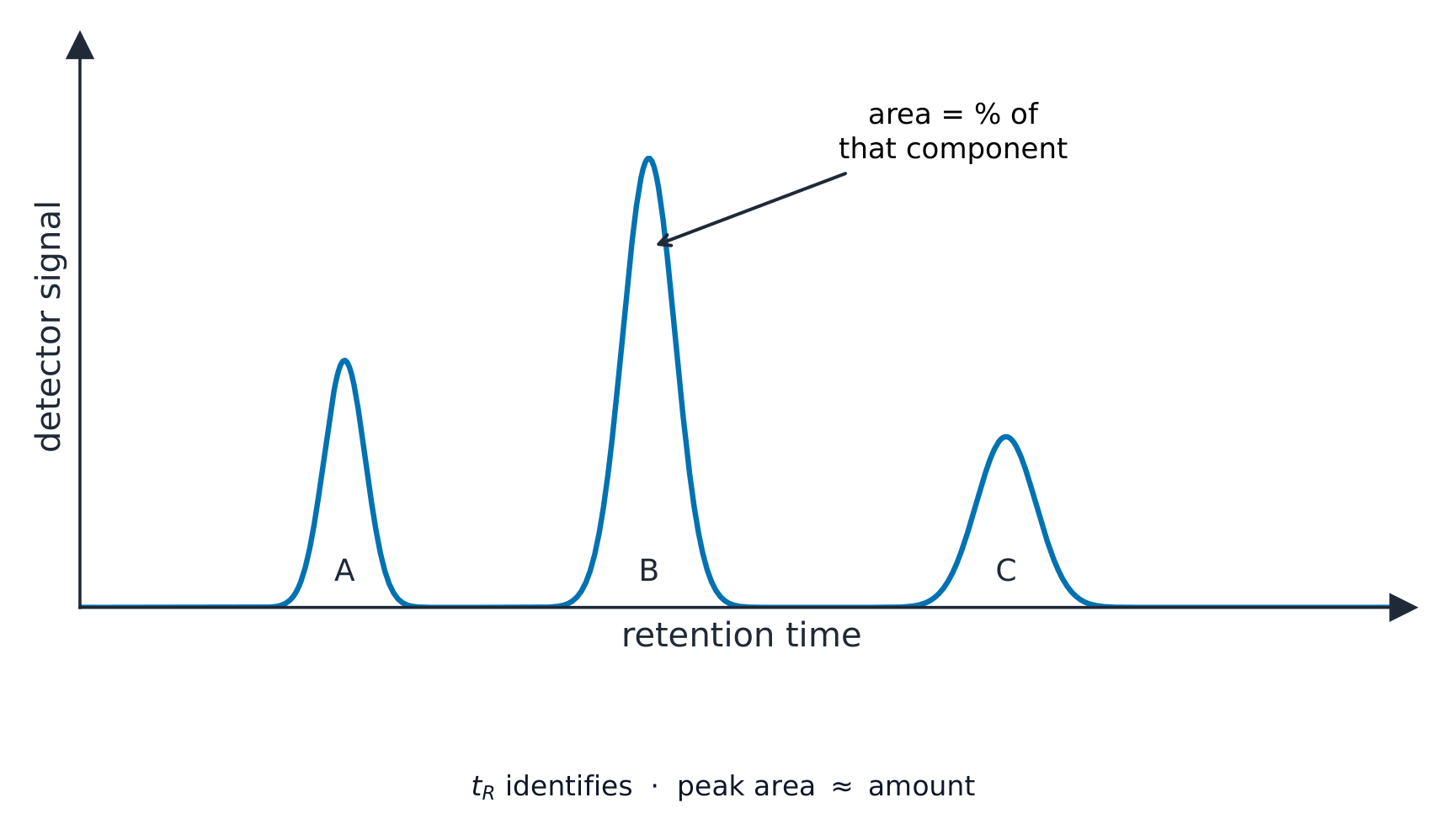
    Explore · ⁨สำรวจ⁩

    TLC route

    Follow a spot up a plate and use Rf to identify substances. · ⁨ติดตามจุดขึ้นบนแผ่น板和ใช้ Rf เพื่อระบุสาร⁩

    Vocabulary · ⁨คำศัพท์⁩ Train · ⁨ฝึกฝน⁩
    English ไทย
    chromatography/krəʊməˈtɒɡrəfi/ ครอมาโทกราฟ
    thin-layer chromatography/θɪn ˈleɪə krəʊməˈtɒɡrəfi/ โครมาโทกราฟแบบชั้นบาง (TLC)
    stationary phase/ˈsteɪʃənəri feɪz/ ระยะคงที่
    mobile phase/ˈməʊbaɪl feɪz/ เฟสเคลื่อนที่
    baseline/ˈbeɪslaɪn/ baseline
    solvent front/ˈsɒlvənt frʌnt/ หน้าผาตัวทำละลาย
    gas/liquid chromatography/ɡæs ˈlɪkwɪd krəʊməˈtɒɡrəfi/ โครมาโตกราฟีแก๊ส/ของเหลว
    retention time/rɪˈtenʃn taɪm/ เวลาตกค้าง
    37.2

    Gas/liquid chromatography · ⁨โครมาโตกราฟีแก๊ส/ของเหลว⁩

    Syllabus · ⁨หลักสูตร⁩
    English
    1. describe and understand the terms (a) stationary phase; a high boiling point non-polar liquid (on a solid support) (b) mobile phase; an unreactive gas (c) retention time
    2. interpret gas/liquid chromatograms in terms of the percentage composition of a mixture
    3. explain retention times in terms of interaction with the stationary phase
    ไทย
    1. อธิบายและเข้าใจศัพท์ดังนี้ (a) เฟสคงที่; ของเหลวไม่มีขั้วที่มีจุดเดือดสูง (บนตัวรองรับที่เป็นของแข็ง) (b) เฟสเคลื่อนที่; ก๊าซที่ไม่ทำปฏิกิริยา (c) เวลาคง留 (retention time)
    2. ตีความโครมาโตแกรมแก๊ส/ของเหลวในแง่ขององค์ประกอบเป็นเปอร์เซ็นต์ของส่วนผสม
    3. อธิบายเวลาคง留ในแง่ของการเกิดปฏิสัมพันธ์กับเฟสคงที่

    Source: Cambridge International syllabus · ⁨แหล่งที่มา: หลักสูตร Cambridge International⁩

    English

    In gas/liquid chromatography 气液色谱 (GLC):

    • the stationary phase is a high-boiling-point non-polar liquid on a solid support.
    • the mobile phase is an unreactive carrier gas.
    • the retention time 保留时间 is how long a component takes to pass through.

    The area of each peak gives the percentage of that component in the mixture. A component that interacts more with the stationary phase has a longer retention time.

    ไทย

    ใน โครมาโตกราฟีแก๊ส/ของเหลว (GLC):

    • เฟสนิ่งคือของเหลวไม่ขั้วที่มีจุดเดือดสูงบนตัวรองรับของแข็ง
    • เฟสเคลื่อนที่คือแก๊สพาที่ไม่ทำปฏิกิริยา
    • เวลาเก็บรักษา คือระยะเวลาที่องค์ประกอบหนึ่งใช้ในการผ่านระบบ

    พื้นที่ของแต่ละพีคให้เปอร์เซ็นต์ขององค์ประกอบนั้นในส่วนผสม องค์ประกอบที่ปฏิสัมพันธ์กับเฟสนิ่งมากกว่าจะมีเวลาตกค้างยาวนานกว่า

    กราฟโครมาโตกราฟีนที่มีสามพีคที่เวลาตกค้างต่างกัน พื้นที่พีคให้เปอร์เซ็นต์ของแต่ละองค์ประกอบ *กราฟโครมาโตกราฟีแก๊ส-ของเหลว: แต่ละองค์ประกอบให้พีคที่เวลาตกค้างของมันเอง และพื้นที่พีคคือเปอร์เซ็นต์ของมันในส่วนผสม

    Explore · ⁨สำรวจ⁩

    Gas/liquid chromatography route · ⁨เส้นทางโครมาโทกราฟแก๊ส/ของเหลว⁩

    Follow a volatile sample through column separation to a chromatogram. · ⁨ติดตามตัวอย่างระเหยผ่านคอลัมน์แยกเพื่อสร้างกราฟโครมาโทแกรม⁩

    37.3

    Carbon-13 NMR spectroscopy · ⁨สเปกโทรสโกปี NMR คาร์บอน-13⁩

    Syllabus · ⁨หลักสูตร⁩
    English
    1. analyse and interpret a carbon-13 NMR spectrum of a simple molecule to deduce: (a) the different environments of the carbon atoms present (b) the possible structures for the molecule
    2. predict or explain the number of peaks in a carbon-13 NMR spectrum for a given molecule
    ไทย
    1. วิเคราะห์และตีความสเปกตรัม คาร์บอน-13 NMR ของโมเลกุลอย่างง่าย เพื่อดัดแปลงข้อมูล: (a) สภาพแวดล้อมที่แตกต่างกันของอะตอมคาร์บอนที่มีอยู่ (b) โครงสร้างที่เป็นไปได้ของโมเลกุลนั้น
    2. ทำนายหรืออธิบายจำนวนพีคในสเปกตรัมคาร์บอน-13 NMR สำหรับโมเลกุลที่กำหนดให้

    Source: Cambridge International syllabus · ⁨แหล่งที่มา: หลักสูตร Cambridge International⁩

    English

    NMR 核磁共振 (nuclear magnetic resonance) studies how certain nuclei behave in a strong magnetic field.

    In carbon-13 NMR, each different chemical environment 化学环境 of carbon gives one peak. So:

    • the number of peaks tells you how many different carbon environments there are (equivalent carbons share a peak).
    • the position of each peak (its chemical shift) suggests the type of carbon, which helps you deduce possible structures.
    ไทย

    NMR (เรโซแนนซ์แม่เหล็กนิวเคลียร์) ศึกษาพฤติกรรมของนิวเคลียส์บางชนิดในสนามแม่เหล็กที่แรง

    เครื่องสเปกโทรสโกปี NMR ทรงกระบอกสูงตั้งอยู่ในห้องปฏิบัติการ มีเครื่องหมายเตือนสนามแม่เหล็กแรง *เครื่องสเปกโทรสโกปี NMR: กระบอกใหญ่เก็บแม่เหล็กซูเปอร์คอนดักติงที่ทำให้เกิดสนามแม่เหล็กที่แรงมากซึ่งเทคนิคนี้ต้องการ

    ใน NMR คาร์บอน-13 แต่ละ สภาพแวดล้อมทางเคมี ของคาร์บอนให้พีคหนึ่ง ดังนั้น:

    • จำนวนพีค บอกว่าคุณมีสภาพแวดล้อมของคาร์บอนกี่แบบ (คาร์บอนที่เท่าเทียมกันแบ่งปันพีคเดียวกัน)
    • ตำแหน่งของแต่ละพีค (chemical shift ของมัน) ชี้บอกรูปแบบของคาร์บอน ซึ่งช่วยให้คุณอนุมานโครงสร้างที่เป็นไปได้
    Explore · ⁨สำรวจ⁩

    Carbon-13 NMR lab · ⁨ห้องปฏิบัติการ NMR คาร์บอน-13⁩

    Match carbon environments to C-13 NMR evidence. · ⁨จับคู่สภาพแวดล้อมคาร์บอนกับหลักฐาน C-13 NMR⁩

    Vocabulary · ⁨คำศัพท์⁩ Train · ⁨ฝึกฝน⁩
    English ไทย
    NMR/ˌen em ˈɑː/ เอ็นเอ็มอาร์
    chemical environment/ˈkemɪkl enˈvaɪrənmənt/ สภาพแวดล้อมทางเคมี
    chemical shift/ˈkemɪkl ʃɪft/ การเลื่อนทางเคมี
    37.4

    Proton (¹H) NMR spectroscopy · ⁨สเปกโทรสโกปีโปรตอน (¹H) NMR⁩

    Syllabus · ⁨หลักสูตร⁩
    English
    1. analyse and interpret a proton ($^1\text{H}$) NMR spectrum of a simple molecule to deduce: (a) the different environments of proton present using chemical shift values (b) the relative numbers of each type of proton present from relative peak areas (c) the number of equivalent protons on the carbon atom adjacent to the one to which the given proton is attached from the splitting pattern, using the $n + 1$ rule (limited to singlet, doublet, triplet, quartet and multiplet) (d) the possible structures for the molecule
    2. predict the chemical shifts and splitting patterns of the protons in a given molecule
    3. describe the use of tetramethylsilane, TMS, as the standard for chemical shift measurements
    4. state the need for deuterated solvents, e.g. $\text{CDCl}_3$, when obtaining a proton NMR spectrum
    5. describe the identification of O–H and N–H protons by proton exchange using $\text{D}_2\text{O}$
    ไทย
    1. วิเคราะห์และตีความสเปกตรัมโปรตอน ($^1\text{H}$) NMR ของโมเลกุลอย่างง่าย เพื่อดัดแปลงข้อมูล: (a) สภาพแวดล้อมที่แตกต่างกันของโปรตอนโดยใช้ค่า chemical shift (b) จำนวนสัมพัทธ์ของแต่ละประเภทของโปรตอนที่มีอยู่จากพื้นที่พีคสัมพัทธ์ (c) จำนวนโปรตอนที่สมมูลกันบนอะตอมคาร์บอนที่อยู่ติดกับคาร์บอนที่โปรตอนที่กำหนดติดอยู่ จาก รูปแบบการแตกหัก (splitting pattern) โดยใช้ $n + 1$ rule (จำกัดเฉพาะ singlet, doublet, triplet, quartet และ multiplet) (d) โครงสร้างที่เป็นไปได้ของโมเลกุลนั้น
    2. ทำนาย chemical shift และรูปแบบการแตกหักของโปรตอนในโมเลกุลที่กำหนดให้
    3. อธิบายการใช้ tetramethylsilane, TMS, เป็นมาตรฐานสำหรับการวัด chemical shift
    4. ระบุถึงความจำเป็นของตัวทำละลายที่มีดิวเทอเรียม เช่น $\text{CDCl}_3$, เมื่อได้รับสเปกตรัมโปรตอน NMR
    5. อธิบายการระบุโปรตอน O–H และ N–H โดยการแลกเปลี่ยนโปรตอนโดยใช้ $\text{D}_2\text{O}$

    Source: Cambridge International syllabus · ⁨แหล่งที่มา: หลักสูตร Cambridge International⁩

    English

    Proton NMR looks at the hydrogen atoms (proton 质子 nuclei). From the spectrum you read off:

    • chemical environments: protons in different environments appear at different chemical shift 化学位移 values.
    • relative numbers: the relative peak areas give the ratio of each type of proton.
    • splitting 裂分: a peak is split by the protons on the neighbouring carbon, following the $n+1$ rule — $n$ equivalent neighbours split a peak into $n+1$ lines:
    Neighbours ($n$) Pattern
    0 singlet 单峰
    1 doublet 双峰
    2 triplet 三峰
    3 quartet 四峰
    many multiplet 多重峰

    Practical points

    • tetramethylsilane 四甲基硅烷 (TMS) is the standard, set at a chemical shift of $0$.
    • a deuterated solvent 氘代溶剂 (such as $\text{CDCl}_3$) is used so that the solvent itself gives no proton signal.
    • shaking the sample with $\text{D}_2\text{O}$ makes the O–H and N–H peaks disappear (their hydrogen is swapped for deuterium), which identifies those protons.

    Worked example. A compound $\text{C}_4\text{H}_8\text{O}_2$ gives three proton NMR peaks: a triplet at $\delta\ 1.2$ (area 3), a quartet at $\delta\ 4.1$ (area 2), and a singlet at $\delta\ 2.0$ (area 3). Deduce the structure. Read the areas first, then the splitting. Areas $3:2:3$ give three proton environments holding 3, 2 and 3 hydrogens. Apply the $n+1$ rule in reverse: a triplet (area 3) is a $\text{CH}_3$ with 2 neighbours, and a quartet (area 2) is a $\text{CH}_2$ with 3 neighbours - each splitting the other, which is the classic ethyl group, $\text{CH}_3\text{CH}_2-$. That $\text{CH}_2$ lies far downfield at $\delta\ 4.1$, so it is attached to an oxygen. The remaining singlet (area 3) is a $\text{CH}_3$ with no neighbours at $\delta\ 2.0$, so it sits next to the C=O. Together: $\text{CH}_3\text{COOCH}_2\text{CH}_3$, ethyl ethanoate. A triplet-and-quartet pair is almost always an ethyl group - spot it first and the rest follows.

    ไทย

    Proton NMR พิจารณาอะตอมไฮโดรเจน (นิวเคลียส โปรตอน) จากสเปกตรัมที่คุณอ่าน-info出的:

    • สภาพแวดล้อมทางเคมี: โปรตอนในสภาพแวดล้อมที่ต่าง nhau ปรากฏที่ค่า chemical shift ที่ต่างกัน
    • จำนวนสัมพัทธ์: พื้นที่พีคสัมพัทธ์ให้สัดส่วนของแต่ละประเภทของโปรตอน
    • การแตกตัว: พีคถูกแตกโดยโปรตอนบนคาร์บอนเพื่อนบ้าน ตาม $n+1$ rule — $n$ เพื่อนบ้านที่เท่าเทียมกันแตกพีคออกเป็น $n+1$ เส้น:
    数目 ($n$) รูปแบบ
    0 ซิงเกเลท
    1 ดับเบเลท
    2 ไตรเปเลท
    3 ควอเตท
    หลาย มัลติเพลท
    รูปแบบพีค NMR สี่แบบ: เส้นเดียว สองเส้น สามเส้น และสี่เส้น ติดป้ายว่า ซิงเกเลท ดับเบเลท ไตรเปเลท และควอเตท
    กฎ $n+1$: $n$ โปรตอนเพื่อนบ้านที่เทียบเท่ากันจะแบ่งพีคให้เป็น $n+1$ เส้น (ซิงเกต, ดับเบต, ไตรเพลต, ควอร์เตต)
    สเปกตรัม NMR ของโปรตอนของเอทานอลที่มีสามกลุ่มของพีค: Triplet ของ CH3, Quartet ของ CH2 และ Singlet ของ OH รวมถึง TMS ที่จุดศูนย์
    NMR ของโปรตอนในเอทานอล: สามสภาพแวดล้อมให้ Triplet ของ CH$_3$, Quartet ของ CH$_2$ และ Singlet ของ OH โดยพื้นที่มีอัตราส่วน $3:2:1$

    ข้อควรระวังในการปฏิบัติ

    • เททราเมทิลซิลาน (TMS) เป็นมาตรฐาน ตั้งค่าไว้ที่ Chemical shift ที่ $0$
    • ใช้ ตัวทำละลายที่มีดิวเทอเรียม (เช่น $\text{CDCl}_3$) เพื่อให้ตัวทำละลายเองไม่เกิดสัญญาณโปรตอน
    • การเขย่าตัวอย่างกับ $\text{D}_2\text{O}$ ทำให้พีค O–H และ N–H หายไป (ไฮโดรเจนถูกแลกเปลี่ยนเป็นดิวเทอเรียม) ซึ่งช่วยระบุตำแหน่งโปรตอนเหล่านั้น

    ตัวอย่างวิธีทำ. สารประกอบ $\text{C}_4\text{H}_8\text{O}_2$ ให้พีค NMR ของโปรตอนสามเส้น: Triplet ที่ $\delta\ 1.2$ (พื้นที่ 3), Quartet ที่ $\delta\ 4.1$ (พื้นที่ 2) และ Singlet ที่ $\delta\ 2.0$ (พื้นที่ 3) จงหาโครงสร้าง อ่านจากพื้นที่ก่อน แล้วจึงดูการแยกสเปกตรัม พื้นที่ $3:2:3$ บ่งบอกถึงสามสภาพแวดล้อมของโปรตอนที่มีไฮโดรเจน 3, 2 และ 3 อะตอม ใช้กฎ $n+1$ ย้อนกลับ: Triplet (พื้นที่ 3) คือ $\text{CH}_3$ ที่มี 2 เพื่อนบ้าน และ Quartet (พื้นที่ 2) คือ $\text{CH}_2$ ที่มี 3 เพื่อนบ้าน - แต่ละกลุ่มแยกสเปกตรัมอีกกลุ่มหนึ่ง ซึ่งเป็น หมู่เอทิล แบบคลาสสิก $\text{CH}_3\text{CH}_2-$. ส่วน That $\text{CH}_2$ อยู่ทางขวาสุดที่ $\delta\ 4.1$ แสดงว่าเชื่อมกับ ออกซิเจน. ส่วน Singlet เหลืออยู่ (พื้นที่ 3) คือ $\text{CH}_3$ ที่มี ไม่มี เพื่อนบ้านที่ $\delta\ 2.0$ จึงอยู่ติดกับ C=O. รวมกันแล้วได้: $\text{CH}_3\text{COOCH}_2\text{CH}_3$, เอทิลเอทานอยเอ斯特. คู่ Triplet และ Quartate มักจะเป็นหมู่เอทิลเสมอ - มองเห็นมันก่อน ส่วนที่เหลือก็ตาม afterwards.

    Explore · ⁨สำรวจ⁩

    Proton NMR lab · ⁨ห้องปฏิบัติการ Proton NMR⁩

    Match proton evidence to chemical environment and neighbours. · ⁨จับคู่หลักฐานโปรตอนกับสภาพแวดล้อมและเพื่อนบ้าน⁩

    Vocabulary · ⁨คำศัพท์⁩ Train · ⁨ฝึกฝน⁩
    English ไทย
    proton/ˈprəʊtɒn/ โปรตอน
    splitting/ˈsplɪtɪŋ/ การแยกสัญญาณ
    singlet/ˈsɪŋɡlɪt/ singlet
    doublet/ˈdʌblət/ doublet
    triplet/ˈtrɪplɪt/ triplet
    quartet/kwɔːˈtet/ quartet
    multiplet/ˈmʌltɪplɪt/ มัลติเพลต
    tetramethylsilane/ˈtetrəmiːθɪlsɪleɪn/ เททราเมทิลซิลาน
    deuterated solvent/ˈdjuːtəreɪtɪd ˈsɒlvənt/ ตัวทำละลายที่มีดิวเทอเรียม
    37.4

    Exam tips · ⁨ข้อแนะนำสำหรับการสอบ⁩

    English
    • In $^{13}\text{C}$ NMR the number of peaks equals the number of carbon environments — use symmetry to count them.
    • In $^1\text{H}$ NMR use chemical shift (data booklet), integration (ratio of H's) and splitting (the $n+1$ rule): a triplet + quartet means an ethyl group.
    • TMS is the reference ($\delta = 0$); a $\text{D}_2\text{O}$ shake removes O-H and N-H peaks.
    • Combine IR, mass spectrum and NMR to deduce a structure, stating which evidence gives which feature.
    ไทย
    • ใน $^{13}\text{C}$ NMR จำนวนพีคเท่ากับจำนวน สภาพแวดล้อมของคาร์บอน — ใช้สมมาตรในการนับ
    • ใน $^1\text{H}$ NMR ใช้ Chemical shift (คู่มือข้อมูล), Integration (อัตราส่วนของ H) และ Splitting (กฎ $n+1$): Triplet + Quartet หมายถึงหมู่เอทิล
    • TMS เป็นค่าอ้างอิง ($\delta = 0$); การ $\text{D}_2\text{O}$ shake จะลบพีค O-H และ N-H ออก
    • รวม IR, สเปกตรัมมวลและ NMR เพื่อหาโครงสร้าง โดยระบุว่าหลักฐานแต่ละอย่างบ่งชี้ถึงคุณลักษณะใด

Log in or create account · ⁨เข้าสู่ระบบหรือสร้างบัญชี⁩

IGCSE, A-Level & AP