A-Level Kimia (9701) sebenarnya adalah tiga mata pelajaran yang harus saling berinteraksi: fisika (energi, kesetimbangan, laju reaksi, elektrokimia), anorganik (periodisitas, Kelompok 2, Kelompok 17, unsur transisi) dan organik, yang berkembang dari alkana menjadi rantai panjang mekanisme dan berakhir dengan NMR dan spektrometri massa.
Sebagian besar nilai yang hilang di sini bukan karena kimia yang sulit. Mereka berasal dari syarat yang terlewat, persamaan tidak setara, tidak ada simbol keadaan, dan jawaban organik yang memberikan produk tetapi tidak panah mekanisme yang dihargai dalam pedoman skor.
Organik memerlukan jenis belajar ulang yang berbeda: gambar satu peta reaksi secara tangan dan terus menambahkannya. Ujian meminta Anda berpindah dari satu gugus fungsi ke yang lain, bukan menghafal satu reaksi tunggal.
What an atom is made of · Apa yang membentuk sebuah atom
Syllabus · Silabus
English
understand that atoms are mostly empty space surrounding a very small, dense nucleus that contains protons and neutrons; electrons are found in shells in the empty space around the nucleus
identify and describe protons, neutrons and electrons in terms of their relative charges and relative masses
understand the terms atomic and proton number; mass and nucleon number
describe the distribution of mass and charge within an atom
describe the behaviour of beams of protons, neutrons and electrons moving at the same velocity in an electric field
determine the numbers of protons, neutrons and electrons present in both atoms and ions given atomic or proton number, mass or nucleon number and charge
state and explain qualitatively the variations in atomic radius and ionic radius across a period and down a group
Bahasa Indonesia
pahami bahwa atom sebagian besar merupakan ruang hampa di sekitar inti yang sangat kecil dan padat yang mengandung proton dan neutron; elektron ditemukan pada kulit di ruang hampa di sekitar inti
identifikasi dan deskripsikan proton, neutron, dan elektron berdasarkan muatan relatif dan massa relatifnya
pahami istilah nomor atom dan nomor proton; massa dan nomor nukleon
deskripsikan distribusi massa dan muatan di dalam atom
deskripsikan perilaku berkas proton, neutron, dan elektron yang bergerak dengan kecepatan sama dalam medan listrik
tentukan jumlah proton, neutron, dan elektron yang terdapat dalam atom dan ion berdasarkan nomor atom atau nomor proton, massa atau nomor nukleon, serta muatan
nyatakan dan jelaskan secara kualitatif variasi jari-jari atom dan jari-jari ion melintasi periode dan menurun sepanjang golongan
Source: Cambridge International syllabus · Sumber: Silabus Cambridge International
English
Everything is made of atoms 原子. An atom is mostly empty space. At its centre is a tiny, heavy nucleus 原子核. The nucleus holds two kinds of particle: protons 质子 and neutrons 中子. Around the nucleus, in the empty space, move the electrons 电子. The electrons stay in shells 壳层 — layers at set distances from the nucleus.
The nucleus is very small but holds almost all the mass. The electrons take up almost all the space but have almost no mass.
Relative charge and relative mass
We compare the three particles using relative charge 相对电荷 and relative mass 相对质量. These are simple numbers, not real units.
Particle
Relative charge
Relative mass
proton
$+1$
$1$
neutron
$0$
$1$
electron
$-1$
$\tfrac{1}{1836}$ (about $0$)
A proton and a neutron have almost the same mass. An electron is about 1836 times lighter. The proton is positive, the electron is negative, and the neutron has no charge — it is neutral 中性.
Proton number and nucleon number
Two numbers describe the nucleus:
the proton number 质子数 (also called the atomic number 原子序数), symbol $Z$ — the number of protons.
the nucleon number 核子数 (also called the mass number 质量数), symbol $A$ — the total number of protons and neutrons. Protons and neutrons are both nucleons 核子.
So the number of neutrons is $A - Z$.
Counting particles in an atom or ion
For a neutral atom, the number of electrons equals the number of protons, which equals $Z$.
An ion 离子 is an atom that has lost or gained electrons, so it has a charge:
a positive ion has fewer electrons than protons.
a negative ion has more electrons than protons.
Example: $^{27}_{13}\text{Al}^{3+}$ has $13$ protons, $27 - 13 = 14$ neutrons, and $13 - 3 = 10$ electrons (it lost 3 electrons to become $3+$).
How mass and charge are spread out
Almost all the mass sits in the nucleus, because protons and neutrons are heavy and electrons are very light. All the positive charge is in the nucleus (the protons). The negative charge is spread out in the shells (the electrons).
Beams of particles in an electric field
Imagine beams of protons, neutrons and electrons moving at the same speed into an electric field 电场 between two charged plates:
the proton beam bends towards the negative plate (protons are positive).
the electron beam bends the other way, towards the positive plate. It bends much more, because the electron is far lighter — the same force gives a bigger deflection 偏转 to a smaller mass.
the neutron beam goes straight through. It has no charge, so the field gives it no force.
Atomic radius and ionic radius
The atomic radius 原子半径 is the size of an atom. The ionic radius 离子半径 is the size of an ion.
Across a period 周期 (left to right), the atomic radius gets smaller. The nuclear charge 核电荷 (the pull from the protons) rises, but the electrons go into the same outer shell, so the shielding 屏蔽 by inner shells stays about the same. The stronger pull draws the outer shell inwards.
Down a group 族 (top to bottom), the atomic radius gets larger. Each step down adds a new shell, so the outer electrons are further out and feel more shielding from the nucleus.
For ions:
a positive ion (cation 阳离子) is smaller than its atom. It has lost its outer shell, and the electrons that remain feel a stronger pull each.
a negative ion (anion 阴离子) is larger than its atom. It has gained electrons, so there is more repulsion 排斥 between the electrons.
among ions that have the same number of electrons, the one with more protons is smaller.
Bahasa Indonesia
Mikroskop pemindai tunneling dapat menggambar atom individual.
Semuanya terbuat dari atom. Atom sebagian besar adalah ruang hampa. Di pusatnya terdapat inti yang kecil dan berat. Inti memegang dua jenis partikel: proton dan neutron. Di sekitar inti, di ruang hampa, bergeraklah elektron. Elektron berada dalam kulit elektron — lapisan pada jarak tertentu dari inti.
Inti sangat kecil namun menyimpan hampir seluruh massa. Elektron menempati hampir seluruh ruang namun memiliki hampir nol massa.
Atom sebagian besar adalah ruang hampa: proton dan neutron berada di inti kecil pusat, sementara elektron bergerak dalam kulit di sekitarnya
Muatan relatif dan massa relatif
Kita membandingkan ketiga partikel menggunakan muatan relatif dan massa relatif. Ini adalah angka sederhana, bukan satuan nyata.
Partikel
Muatan relatif
Massa relatif
proton
$+1$
$1$
neutron
$0$
$1$
elektron
$-1$
$\tfrac{1}{1836}$ (sekitar $0$)
Proton dan neutron memiliki massa yang hampir sama. Elektron sekitar 1836 kali lebih ringan. Proton bermuatan positif, elektron bermuatan negatif, dan neutron tidak bermuatan — ia netral.
Nomor proton dan nomor nukleon
Dua angka menggambarkan inti:
nomor proton (juga disebut nomor atom), simbol $Z$ — jumlah proton.
nomor nukleon (juga disebut nomor massa), simbol $A$ — total jumlah proton dan neutron. Proton dan neutron keduanya adalah nukleon.
Jadi jumlah neutron adalah $A - Z$.
Menghitung partikel dalam atom atau ion
Untuk atom netral, jumlah elektron sama dengan jumlah proton, yaitu $Z$.
Sebuah ion adalah atom yang telah kehilangan atau mendapatkan elektron, sehingga memiliki muatan:
ion positif memiliki lebih sedikit elektron daripada proton.
ion negatif memiliki lebih banyak elektron daripada proton.
Contoh: $^{27}_{13}\text{Al}^{3+}$ memiliki $13$ proton, $27 - 13 = 14$ neutron, dan $13 - 3 = 10$ elektron (ia kehilangan 3 elektron untuk menjadi $3+$).
Bagaimana massa dan muatan tersebar
Hampir seluruh massa berada di inti, karena proton dan neutron berat sedangkan elektron sangat ringan. Semua muatan positif berada di inti (proton). Muatan negatif tersebar di kulit (elektron).
Sinar partikel dalam medan listrik
Bayangkan sinar proton, neutron, dan elektron bergerak dengan kecepatan sama memasuki medan listrik antara dua pelat bermuatan:
sinar proton membengkok menuju pelat negatif (proton bermuatan positif).
sinar elektron membengkok ke arah sebaliknya, menuju pelat positif. Ia membengkok jauh lebih tajam, karena elektron jauh lebih ringan — gaya yang sama memberikan pembelokan yang lebih besar pada massa yang lebih kecil.
sinar neutron melaju lurus. Ia tidak bermuatan, sehingga medan tidak memberikan gaya apa pun padanya.
Dalam medan listrik proton membengkok menuju pelat $-$ dan elektron membengkok ke arah berlawanan dan jauh lebih tajam (karena jauh lebih ringan); neutron melaju lurus
Jari-jari atom dan jari-jari ion
Jari-jari atom adalah ukuran atom. Jari-jari ion adalah ukuran ion.
Sepanjang satu periode (kiri ke kanan), jari-jari atom menjadi lebih kecil. Muatan inti (tarikan dari proton) meningkat, namun elektron masuk ke kulit luar yang sama, sehingga perlindungan oleh kulit dalam tetap kira-kira sama. Tarikan yang lebih kuat menarik kulit luar ke dalam.
Turut golongan (atas ke bawah), jejari atom menjadi lebih besar. Setiap langkah turun menambah satu kulit baharu, jadi elektron terluar berada lebih jauh dan mengalami lebih banyak penyahjaran daripada nukleus.
Merentasi satu tempoh atom mengecil (tarikan nukleus yang lebih kuat pada kulit luar yang sama); turun sepanjang satu golongan mereka membesar (setiap langkah menambah satu kulit)
Bagi ion:
ion positif (kation) adalah lebih kecil daripada atomnya. Ia telah kehilangan kulit luarnya, dan elektron yang tinggal masing-masing merasakan tarikan yang lebih kuat.
ion negatif (anion) adalah lebih besar daripada atomnya. Ia telah mendapat elektron, jadi terdapat lebih banyak tolakan antara elektron-elektron tersebut.
di antara ion yang mempunyai bilangan elektron yang sama, ion yang mempunyai lebih banyak proton adalah lebih kecil.
Explore · Jelajahi
Explore the atom · Jelajahi atom
Tap each part. A tiny dense nucleus of protons and neutrons holds the mass; light electrons orbit it in shells. · Ketuk setiap bagian. Nukleus kecil yang padat berisi proton dan neutron memegang massa; elektron ringan mengelilinginya dalam kulit.
Explore · Jelajahi
Atomic and ionic radius trends · Tren jari-jari atom dan ion
Atomic radius falls across a period (rising nuclear charge pulls the same shell in) and rises down a group (an extra shell each time). Step across Period 3 to see it. · Jari-jari atom menurun sepanjang periode (karena muatan inti yang meningkat menarik kulit yang sama ke dalam) dan meningkat turun dalam golongan (menambah satu kulit setiap kali). Lompat ke Period 3 untuk melihatnya.
define the term isotope in terms of numbers of protons and neutrons
understand the notation $_y^x\text{A}$ for isotopes, where $x$ is the mass or nucleon number and $y$ is the atomic or proton number
state that and explain why isotopes of the same element have the same chemical properties
state that and explain why isotopes of the same element have different physical properties, limited to mass and density
Bahasa Indonesia
definisikan istilah isotop berdasarkan jumlah proton dan neutron
pahami notasi $_y^x\text{A}$ untuk isotop, di mana $x$ adalah massa atau nomor nukleon dan $y$ adalah nomor atom atau nomor proton
nyatakan dan jelaskan mengapa isotop dari unsur yang sama memiliki sifat kimia yang sama
nyatakan dan jelaskan mengapa isotop dari unsur yang sama memiliki sifat fisika yang berbeda, terbatas pada massa dan densitas
Source: Cambridge International syllabus · Sumber: Silabus Cambridge International
English
Isotopes 同位素 are atoms of the same element with the same number of protons but a different number of neutrons. So isotopes have the same proton number $Z$ but a different nucleon number $A$.
We write an isotope as $^{A}_{Z}\text{X}$: the nucleon number $A$ on top, the proton number $Z$ below. For example, chlorine has two main isotopes, $^{35}_{17}\text{Cl}$ and $^{37}_{17}\text{Cl}$.
Same chemical properties
Chemical properties 化学性质 depend on the electrons, especially the outer electrons. Isotopes of one element have the same number of electrons arranged in the same way. So they react in exactly the same way — they have the same chemical properties.
Different physical properties
Some physical properties 物理性质 depend on mass, so they differ between isotopes. A heavier isotope has more neutrons, so more mass, and therefore a higher density 密度. (The syllabus limits this difference to mass and density.)
Bahasa Indonesia
Isotop ialah atom bagi unsur yang sama dengan bilangan proton yang sama tetapi bilangan neutron yang berbeza. Jadi isotop mempunyai nombor proton yang sama $Z$ tetapi nombor nukleon yang berbeza $A$.
Dua isotop klorin: proton sama, neutron berbeda
Kita menulis isotop sebagai $^{A}_{Z}\text{X}$: nomor nukleon $A$ di atas, nomor proton $Z$ di bawah. Sebagai contoh, klorin memiliki dua isotop utama, yaitu $^{35}_{17}\text{Cl}$ dan $^{37}_{17}\text{Cl}$.
Sifat kimia yang sama
Sifat kimia bergantung kepada elektron, terutamanya elektron terluar. Isotop bagi satu unsur mempunyai bilangan elektron yang sama yang tersusun dengan cara yang sama. Oleh itu, mereka bereaksi dengan cara yang sama sekali — mereka mempunyai sifat kimia yang sama.
Sifat fizikal yang berbeza
Beberapa sifat fizikal bergantung kepada jisim, jadi ia berbeza antara isotop. Isotop yang lebih berat mempunyai lebih banyak neutron, jadi lebih banyak jisim, dan oleh itu ketumpatan yang lebih tinggi. (Syllabus membataskan perbezaan ini kepada jisim dan ketumpatan.)
Explore · Jelajahi
Isotope lab · Laboratorium isotop
Classify isotope facts by what changes and what stays the same. · Klasifikasikan fakta tentang isotop berdasarkan apa yang berubah dan apa yang tetap sama.
Electrons, energy levels and orbitals · Elektron, tahap tenaga dan orbital
Syllabus · Silabus
English
understand the terms: shells, sub-shells and orbitals; principal quantum number (n); ground state, limited to electronic configuration
describe the number of orbitals making up s, p and d sub-shells, and the number of electrons that can fill s, p and d sub-shells
describe the order of increasing energy of the sub-shells within the first three shells and the 4s and 4p sub-shells
describe the electronic configurations to include the number of electrons in each shell, sub-shell and orbital
explain the electronic configurations in terms of energy of the electrons and inter-electron repulsion
determine the electronic configuration of atoms and ions given the atomic or proton number and charge, using either of the following conventions: e.g. for Fe: $1\text{s}^2 2\text{s}^2 2\text{p}^6 3\text{s}^2 3\text{p}^6 3\text{d}^6 4\text{s}^2$ (full electronic configuration) or [Ar] $3\text{d}^6 4\text{s}^2$ (shorthand electronic configuration)
understand and use the electrons in boxes notation
describe and sketch the shapes of s and p orbitals
describe a free radical as a species with one or more unpaired electrons
Bahasa Indonesia
pahami istilah: kulit elektron, subkulit dan orbital; bilangan kuantum utama (n); keadaan dasar, dibatasi pada konfigurasi elektron
jelaskan jumlah orbital yang membentuk subkulit s, p dan d, serta jumlah elektron yang dapat mengisi subkulit s, p dan d
jelaskan urutan kenaikan energi subkulit dalam tiga kulit pertama dan subkulit 4s dan 4p
jelaskan konfigurasi elektron yang mencakup jumlah elektron di setiap kulit, subkulit, dan orbital
jelaskan konfigurasi elektron berdasarkan energi elektron dan tolakan antar-elektron
tentukan konfigurasi elektron atom dan ion dengan menggunakan nomor atom atau nomor proton dan muatan, melalui salah satu konvensi berikut: mis. untuk Fe: $1\text{s}^2 2\text{s}^2 2\text{p}^6 3\text{s}^2 3\text{p}^6 3\text{d}^6 4\text{s}^2$ (konfigurasi elektron lengkap) atau [Ar] $3\text{d}^6 4\text{s}^2$ (konfigurasi elektron ringkas)
pahami dan gunakan notasi elektron dalam kotak
deskripsikan dan gambarlah bentuk orbital s dan p
deskripsikan radikal bebas sebagai spesies dengan satu atau lebih elektron tak berpasangan
Source: Cambridge International syllabus · Sumber: Silabus Cambridge International
English
Electrons are arranged in shells, sub-shells and orbitals.
Shells and the principal quantum number
Each shell is labelled by the principal quantum number 主量子数$n = 1, 2, 3, \dots$ A larger $n$ means a shell that is further from the nucleus and higher in energy.
Sub-shells and orbitals
Each shell is split into sub-shells 亚层, named s, p and d. Each sub-shell is built from orbitals 轨道. An orbital is a small region that can hold up to two electrons.
Sub-shell
Number of orbitals
Maximum electrons
s
1
2
p
3
6
d
5
10
So an s sub-shell holds 2 electrons, a p sub-shell holds 6, and a d sub-shell holds 10.
Order of increasing energy
Electrons fill the lowest-energy sub-shell first. For the first three shells, plus 4s and 4p, the order of rising energy is:
You can write a shorthand using the nearest noble gas 稀有气体 in square brackets:
$$[\text{Ar}]\,3\text{d}^6\,4\text{s}^2$$
Here $[\text{Ar}]$ stands for the full configuration of argon.
For ions, you add or remove electrons. One key rule: when a transition metal forms a positive ion, it loses its 4s electrons before its 3d electrons. So $\text{Fe}^{3+}$ is $[\text{Ar}]\,3\text{d}^5$.
Electrons in boxes
The electrons in boxes notation draws each orbital as a box and each electron as an arrow. Two electrons in the same orbital must point opposite ways, because each electron has a property called spin 自旋, and a shared orbital needs opposite spins.
Within a sub-shell, electrons fill empty orbitals one at a time, with parallel arrows, before any orbital gets a second electron. Spreading out like this keeps the electrons apart and lowers the repulsion between them.
Why the configuration takes this shape
Electrons fill from low energy to high energy because that gives the most stable (lowest-energy) atom. Within a sub-shell they spread out singly first to reduce the repulsion between the negative electrons.
Shapes of s and p orbitals
an s orbital is a sphere 球形 centred on the nucleus.
a p orbital has two lobes, like a dumbbell, pointing along one axis. The three p orbitals point along three directions at right angles (the $x$, $y$ and $z$ axes).
Free radicals
A free radical 自由基 is a species with one or more unpaired electrons 未成对电子. Free radicals are very reactive.
Bahasa Indonesia
Hidrogen memancarkan cahaya hanya pada panjang gelombang diskrit yang berkarakteristik — spektrum pemancarannya.
Elektron tersusun dalam kulit, subkulit dan orbital.
Kulit dan nombor kuantum utama
Setiap kulit diberi label oleh nombor kuantum utama$n = 1, 2, 3, \dots$. Nombor $n$ yang lebih besar bermaksud kulit yang lebih jauh dari nukleus dan mempunyai tenaga yang lebih tinggi.
Subkulit dan orbital
Setiap kulit dibahagikan kepada subkulit, dinamakan s, p dan d. Setiap subkulit terdiri daripada orbital. Orbital ialah kawasan kecil yang boleh menampung sehingga dua elektron.
Subkulit
Bilangan orbital
Maksimum elektron
s
1
2
p
3
6
d
5
10
Jadi subkulit s menampung 2 elektron, subkulit p menampung 6, dan subkulit d menampung 10.
Urutan tenaga meningkat
Elektron mengisi subkulit berenergi rendah terlebih dahulu. Untuk tiga kulit pertama, ditambah 4s dan 4p, urutan kenaikan tenaga adalah:
Anda boleh menulis singkatan menggunakan gas mulia terdekat dalam kurungan:
$$[\text{Ar}]\,3\text{d}^6\,4\text{s}^2$$
Di sini $[\text{Ar}]$ mewakili konfigurasi penuh argon.
Bagi ion, anda menambah atau menolak elektron. Satu peraturan penting: apabila logam peralihan membentuk ion positif, ia kehilangan elektron 4snya sebelum elektron 3d-nya. Jadi $\text{Fe}^{3+}$ menjadi $[\text{Ar}]\,3\text{d}^5$.
Elektron dalam kotak
Notasi elektron dalam kotak menggambarkan setiap orbital sebagai kotak dan setiap elektron sebagai anak panah. Dua elektron dalam orbital yang sama mesti mengarah ke arah bertentangan, kerana setiap elektron mempunyai sifat yang dipanggil spin, dan orbital bersama memerlukan spin yang bertentangan.
Dalam satu subkulit, elektron mengisi orbital kosong satu demi satu, dengan anak panah selari, sebelum mana-mana orbital mendapat elektron kedua. Menyebarkan diri seperti ini menjauhkan elektron dan menurunkan tolakan di antara mereka.
Elektron dalam kotak untuk nitrogen ($1\text{s}^2\,2\text{s}^2\,2\text{p}^3$): elektron berpasangan mengarah ke arah bertentangan, dan orbital 2p diisi secara tunggal dengan spin selari
Mengapa konfigurasi mengambil bentuk ini
Elektron mengisi dari tenaga rendah ke tenaga tinggi kerana itu memberikan atom yang paling stabil (tenaga terendah). Dalam satu subkulit, mereka menyebar secara tunggal terlebih dahulu untuk mengurangkan tolakan antara elektron negatif.
Bentuk orbital s dan p
orbital s ialah sfera yang berpusat pada nukleus.
orbital p mempunyai dua lobus, seperti dumbel, menghala sepanjang satu paksi. Tiga orbital p menghala sepanjang tiga arah bersudut tegak (paksi $x$, $y$ dan $z$).
Orbital s ialah sfera; setiap orbital p adalah dumbel, dan tiga orbital p menghala sepanjang paksi $x$, $y$ dan $z$
Radikal bebas
Radikal bebas ialah spesies yang mempunyai satu atau lebih elektron tidak berpasangan. Radikal bebas sangat reaktif.
Explore · Jelajahi
Filling the electron shells · Mengisi kulit elektron
Change the atomic number Z and watch the electrons fill the shells (2, 8, 8, …) — the pattern that builds the Periodic Table. · Ubah nomor atom Z dan saksikan elektron mengisi kulit (2, 8, 8, …) — pola yang membangun Tabel Periodik.
define and use the term first ionisation energy, IE
construct equations to represent first, second and subsequent ionisation energies
identify and explain the trends in ionisation energies across a period and down a group of the Periodic Table
identify and explain the variation in successive ionisation energies of an element
understand that ionisation energies are due to the attraction between the nucleus and the outer electron
explain the factors influencing the ionisation energies of elements in terms of nuclear charge, atomic/ionic radius, shielding by inner shells and sub-shells and spin-pair repulsion
deduce the electronic configurations of elements using successive ionisation energy data
deduce the position of an element in the Periodic Table using successive ionisation energy data
Bahasa Indonesia
definisikan dan gunakan istilah energi ionisasi pertama, IE
susun persamaan untuk mewakili energi ionisasi pertama, kedua, dan berikutnya
identifikasi dan jelaskan tren dalam energi ionisasi melintasi satu periode dan ke bawah satu golongan dalam Tabel Periodik
identifikasi dan jelaskan variasi energi ionisasi berturut-turut dari suatu unsur
pahami bahwa energi ionisasi disebabkan oleh tarik-menarik antara inti dan elektron terluar
jelaskan faktor-faktor yang memengaruhi energi ionisasi unsur-unsur dalam hal muatan inti, jari-jari atom/ion, perisai oleh kulit dan subkulit dalam, serta tolakan pasangan spin
deduksikan konfigurasi elektron unsur menggunakan data energi ionisasi berturut-turut
deduksikan posisi unsur dalam Tabel Periodik menggunakan data energi ionisasi berturut-turut
Source: Cambridge International syllabus · Sumber: Silabus Cambridge International
English
First ionisation energy
The first ionisation energy 第一电离能 (IE) is the energy needed to remove one electron from each atom in one mole of gaseous atoms, forming one mole of gaseous $+1$ ions.
We use gaseous atoms so there are no forces between the particles. The unit is $\text{kJ mol}^{-1}$. As an equation, for an element X:
You can keep going. These are the successive ionisation energies 逐级电离能. Each is larger than the one before, because every electron is pulled away from a more positive ion.
What ionisation energy depends on
Ionisation energy comes from the attraction between the positive nucleus and the outer electron. Three main factors set how strong that attraction is:
nuclear charge: more protons pull the electrons more strongly, so the ionisation energy is higher.
atomic radius: the further the outer electron sits from the nucleus, the weaker the pull, so the ionisation energy is lower.
shielding: inner shells block some of the pull on the outer electron. More inner shells mean more shielding and a lower ionisation energy.
There is a smaller effect too — spin-pair repulsion 自旋成对排斥. When two electrons share one orbital, they push each other a little, so one is easier to remove.
Trends in first ionisation energy
Across a period, the first ionisation energy generally rises. The nuclear charge grows while shielding stays about the same, so the outer electrons are held more tightly.
Down a group, the first ionisation energy falls. Lower elements have more shells, so more shielding and a larger radius, and the outer electron is easier to remove.
The dips are evidence for sub-shells
The rise across a period is not smooth. Two small dips appear, and you should be able to explain both:
Group 2 to Group 13 (for example Mg to Al): the electron removed from Al comes from a 3p sub-shell, which is higher in energy than the full 3s sub-shell in Mg. A 3p electron is easier to remove, so the value dips.
Group 15 to Group 16 (for example P to S): in S, one 3p orbital now holds a pair of electrons. Spin-pair repulsion makes one of them easier to remove, so the value dips.
These dips are evidence that sub-shells exist.
Successive ionisation energies are evidence for shells
If you plot the successive ionisation energies of one element, the values rise, with big jumps at certain points. A big jump happens when the next electron must come from a shell closer to the nucleus.
Count how many electrons come off easily before the first big jump — that is the number of electrons in the outer shell, which tells you the group the element is in. You can also use the pattern to work out the electronic configuration and the position of the element in the Periodic Table.
Electrons removed before the first big jump
Group
1
Group 1
2
Group 2
3
Group 13
Worked example. The first five successive ionisation energies of an element are $590$, $1150$, $4940$, $6480$ and $8120\ \text{kJ}\,\text{mol}^{-1}$. Which group is it in? Look for the big jump, not the biggest number. From the 1st to the 2nd the value roughly doubles, which is a normal rise. From the 2nd ($1150$) to the 3rd ($4940$) it more than quadruples: that is the jump. So two electrons come off easily before it, the outer shell holds 2 electrons, and the element is in Group 2. Count the electrons removed before the jump, and explain the jump properly: the next electron is being pulled from a shell closer to the nucleus, not from a different element.
Bahasa Indonesia
Tenaga pengionan pertama
Tenaga pengionan pertama (IE) ialah tenaga yang diperlukan untuk menyingkirkan satu elektron daripada setiap atom dalam satu mol atom gas, membentuk satu mol ion gas $+1$.
Kami menggunakan atom gas sehingga tidak ada gaya antar partikel. Satuannya adalah $\text{kJ mol}^{-1}$. Sebagai persamaan, untuk unsur X:
Anda bisa terus melanjutkan. Ini disebut energi ionisasi berturut-turut. Masing-masing nilainya lebih besar dari sebelumnya, karena setiap elektron ditarik menjauh dari ion yang semakin positif.
Faktor-faktor yang mempengaruhi energi ionisasi
Energi ionisasi berasal dari tarikan antara inti positif dan elektron terluar. Tiga faktor utama menentukan seberapa kuat tarikan tersebut:
muatan inti: semakin banyak proton, tarikan terhadap elektron semakin kuat, sehingga energi ionisasi lebih tinggi.
jari-jari atom: semakin jauh posisi elektron terluar dari inti, tarikan semakin lemah, sehingga energi ionisasi lebih rendah.
pelindung (shielding): kulit dalam memblokir sebagian tarikan pada elektron terluar. Semakin banyak kulit dalam, semakin besar efek pelindung dan semakin rendah energi ionisasinya.
Terdapat juga efek yang lebih kecil—tolakan pasangan spin. Ketika dua elektron menempati satu orbital, mereka saling mendorong sedikit, sehingga salah satunya lebih mudah dilepaskan.
Tren energi ionisasi pertama
Menyusuri suatu periode, energi ionisasi pertama umumnya naik. Muatan inti bertambah sementara efek pelindung tetap hampir sama, sehingga elektron terluar terikat lebih kuat.
Menurun dalam suatu golongan, energi ionisasi pertama turun. Unsur yang lebih bawah memiliki lebih banyak kulit, sehingga efek pelindung lebih besar dan jari-jari lebih lebar, membuat elektron terluar lebih mudah dilepaskan.
Lengkungan turun sebagai bukti subkulit
Kenaikan menyusuri periode tidak mulus. Dua lengkungan kecil muncul, dan Anda harus mampu menjelaskan keduanya:
Golongan 2 ke Golongan 13 (contoh Mg ke Al): elektron yang dilepas dari Al berasal dari subkulit 3p, yang energinya lebih tinggi daripada subkulit 3s penuh di Mg. Elektron 3p lebih mudah dilepas, sehingga nilainya menurun.
Golongan 15 ke Golongan 16 (contoh P ke S): di S, sebuah orbital 3p kini berisi pasangan elektron. Tolakan pasangan spin membuat salah satu elektronnya lebih mudah dilepas, sehingga nilainya menurun.
Lengkungan turun ini merupakan bukti bahwa subkulit itu ada.
Energi ionisasi pertama meningkat sepanjang Periode 3 namun turun di Al dan S — bukti adanya subkulit
Energi ionisasi berturut-turut sebagai bukti kulit
Jika Anda memplot energi ionisasi berturut-turut dari satu unsur, nilainya akan naik dengan loncatan besar pada titik tertentu. Loncatan besar terjadi ketika elektron berikutnya harus diambil dari kulit yang lebih dekat dengan inti.
Hitung berapa banyak elektron yang terlepas dengan mudah sebelum loncatan besar pertama—itu adalah jumlah elektron di kulit terluar, yang memberi tahu Anda golongan unsur tersebut. Anda juga dapat menggunakan pola ini untuk menentukan konfigurasi elektron dan posisi unsur dalam Tabel Periodik.
Energi ionisasi berturut-turut natrium (skala log): loncatan besar mengungkap struktur $2,8,1$ kulit
Elektron dilepas sebelum loncatan besar
Golongan
1
Golongan 1
2
Golongan 2
3
Golongan 13
Contoh dikerjakan. Lima energi ionisasi berturut-turut dari suatu unsur adalah $590$, $1150$, $4940$, $6480$, dan $8120\ \text{kJ}\,\text{mol}^{-1}$. Unsur ini berada di golongan mana? Cari lonjakan besar, bukan angka terbesar. Dari ke-1 ke ke-2 nilainya kira-kira berlipat ganda, yang merupakan kenaikan normal. Dari yang ke-2 ($1150$) ke ke-3 ($4940$) nilainya lebih dari empat kali lipat: itulah lonjakannya. Jadi dua elektron keluar dengan mudah sebelumnya, kulit luar memegang 2 elektron, dan unsur tersebut berada di Golongan 2. Hitung elektron yang dilepas sebelum lonjakan, dan jelaskan lonjakan tersebut dengan benar: elektron berikutnya ditarik dari kulit yang lebih dekat ke inti, bukan dari unsur yang berbeda.
Explore · Jelajahi
The ionisation-energy trend — and its dips · Tren energi ionisasi — dan lembahnya
First ionisation energy generally rises across a period, but DIPS where a new p sub-shell starts and where a p-orbital pair first forms. Step across to find the two tell-tale dips. · Energi ionisasi pertama umumnya meningkat melintasi periode, tetapi LEMBAH terjadi ketika subkulit p baru dimulai dan ketika pasangan orbital p pertama kali terbentuk. Beralihlah untuk menemukan dua tanda khas tersebut.
Define isotopes in full: atoms of the same element with the same number of protons but a different number of neutrons — the mark scheme wants both halves.
4s fills before 3d, but electrons are removed from 4s first when forming ions, so $\text{Fe}^{3+}$ is $[\text{Ar}]3\text{d}^5$ (not $[\text{Ar}]3\text{d}^3 4\text{s}^2$).
In successive ionisation energies, a big jump marks the start of a new (inner) shell — use the jumps to place the element in its group.
Explain every ionisation-energy trend with the same three factors: nuclear charge, distance and shielding, plus sub-shell effects for the small dips.
Learn the exact reason first ionisation energy of oxygen is below nitrogen: oxygen's paired 2p electrons repel, so one is easier to remove.
Bahasa Indonesia
Definisikan isotop secara lengkap: atom dari unsur yang sama dengan jumlah proton yang sama tetapi jumlah neutron yang berbeda—kunci jawaban memerlukan kedua bagian tersebut.
4s terisi sebelum 3d, tetapi elektron dilepas dari 4s terlebih dahulu saat membentuk ion, sehingga $\text{Fe}^{3+}$ adalah $[\text{Ar}]3\text{d}^5$ (bukan $[\text{Ar}]3\text{d}^3 4\text{s}^2$).
Dalam energi ionisasi berturut-turut, loncatan besar menandai dimulunya kulit baru (dalam)—gunakan loncatan tersebut untuk menempatkan unsur dalam golongannya.
Jelaskan setiap tren energi ionisasi dengan tiga faktor yang sama: muatan inti, jarak, dan efek pelindung, ditambah efek subkulit untuk lengkungan kecil.
Hafalkan alasan pasti mengapa energi ionisasi pertama oksigen di bawah nitrogen: elektron 2p yang berpasangan pada oksigen saling tolak, sehingga salah satunya lebih mudah dilepas.
2
Atoms, molecules and stoichiometry · Atom, molekul, dan stoikiometri
define the unified atomic mass unit as one twelfth of the mass of a carbon-12 atom
define relative atomic mass, $A_r$, relative isotopic mass, relative molecular mass, $M_r$, and relative formula mass in terms of the unified atomic mass unit
Bahasa Indonesia
definisikan satuan massa atom terpadu sebagai satu per dua belas dari massa atom karbon-12
definisikan massa atom relatif, $A_r$, massa isotop relatif, massa molekul relatif, $M_r$, dan massa rumus relatif dalam satuan massa atom terpadu
Source: Cambridge International syllabus · Sumber: Silabus Cambridge International
Atoms 原子 are far too light to weigh in grams, so we compare every mass to one standard. The standard is the unified atomic mass unit 统一原子质量单位 (symbol u), defined as exactly one twelfth of the mass of one carbon-12 atom.
Using this unit, we state masses as simple numbers:
the relative atomic mass 相对原子质量$A_r$ of an element is the average mass of its atoms compared with $\tfrac{1}{12}$ of a carbon-12 atom. It is an average over all the isotopes 同位素, weighted by how common each one is.
the relative isotopic mass 相对同位素质量 is the mass of one atom of a single isotope, compared with $\tfrac{1}{12}$ of a carbon-12 atom.
the relative molecular mass 相对分子质量$M_r$ of a molecule 分子 is the sum of the relative atomic masses of all its atoms.
the relative formula mass 相对式量 is the same idea for a substance that is not made of molecules (such as an ionic compound). Add up the relative atomic masses shown in the formula.
Relative atomic mass is a weighted average: chlorine's two isotopes (75% ³⁵Cl, 25% ³⁷Cl) average to Aᵣ = 35.5
To find $A_r$ from isotope data, multiply each isotope mass by its percentage, add these up, and divide by 100.
Worked example. Chlorine is $75\%$${}^{35}\text{Cl}$ and $25\%$${}^{37}\text{Cl}$. Find its relative atomic mass.
unified atomic mass unit/ˈjuːnɪfaɪd əˈtɒmɪk mæs ˈjuːnɪt/
satuan massa atom terpadu
relative atomic mass/ˈrelətɪv əˈtɒmɪk mæs/
jisim atom relatif
isotope/ˈaɪsətəʊp/
isotop
relative isotopic mass/ˈrelətɪv ˌaɪsəˈtɒpɪk mæs/
jisim isotop relatif
relative molecular mass/ˈrelətɪv məˈlekjʊlə mæs/
jisim molekul relatif
molecule/ˈmɒlɪkjuːl/
molekul
relative formula mass/ˈrelətɪv ˈfɔːmjʊlə mæs/
mass formula relatif
2.2
The mole and the Avogadro constant
Syllabus · Silabus
English
define and use the term mole in terms of the Avogadro constant
Bahasa Indonesia
definisikan dan gunakan istilah mol dalam konteks konstanta Avogadro
Source: Cambridge International syllabus · Sumber: Silabus Cambridge International
A modern electronic balance measures mass — the basis of mole calculations.
Chemists count particles in groups called moles, just as we count eggs in dozens.
One mole 摩尔 (symbol mol) is the amount of substance that contains the same number of particles as there are atoms in exactly 12 g of carbon-12. That number is the Avogadro constant 阿伏伽德罗常量:
$$N_A = 6.02 \times 10^{23}\ \text{mol}^{-1}$$
So one mole of anything contains $6.02 \times 10^{23}$ particles. The particles may be atoms, molecules or ions 离子 — always say which.
The mass of one mole in grams equals the relative mass ($A_r$ or $M_r$). This is the molar mass 摩尔质量, with units $\text{g mol}^{-1}$. The key equation is:
$$n = \frac{m}{M}$$
where $n$ is the amount in moles, $m$ is the mass in grams, and $M$ is the molar mass.
Worked example. How many moles are in $8.0\ \text{g}$ of methane, $\text{CH}_4$? ($A_r$: C $= 12$, H $= 1$.)
The molar mass is $M = 12 + 4(1) = 16\ \text{g mol}^{-1}$, so
write formulas of ionic compounds from ionic charges and oxidation numbers (shown by a Roman numeral), including: (a) the prediction of ionic charge from the position of an element in the Periodic Table (b) recall of the names and formulas for the following ions: $\text{NO}_3^-$, $\text{CO}_3^{2-}$, $\text{SO}_4^{2-}$, $\text{OH}^-$, $\text{NH}_4^+$, $\text{Zn}^{2+}$, $\text{Ag}^+$, $\text{HCO}_3^-$, $\text{PO}_4^{3-}$
(a) write and construct equations (which should be balanced), including ionic equations (which should not include spectator ions) (b) use appropriate state symbols in equations
define and use the terms empirical and molecular formula
understand and use the terms anhydrous, hydrated and water of crystallisation
calculate empirical and molecular formulas, using given data
Bahasa Indonesia
tulis rumus senyawa ionik dari muatan ion dan bilangan oksidasi (ditunjukkan dengan angka Romawi), termasuk: (a) prediksi muatan ion berdasarkan posisi unsur dalam Tabel Periodik (b) hafalan nama dan rumus untuk ion-ion berikut: $\text{NO}_3^-$, $\text{CO}_3^{2-}$, $\text{SO}_4^{2-}$, $\text{OH}^-$, $\text{NH}_4^+$, $\text{Zn}^{2+}$, $\text{Ag}^+$, $\text{HCO}_3^-$, $\text{PO}_4^{3-}$
(a) tulis dan susun persamaan (yang harus setara), termasuk persamaan ionik (yang tidak boleh menyertakan ion penonton) (b) gunakan simbol keadaan yang sesuai dalam persamaan
definisikan dan gunakan istilah rumus empiris dan rumus molekul
pahami dan gunakan istilah anhydrous, terhidrasi dan air kristalisasi
hitung rumus empiris dan rumus molekul menggunakan data yang diberikan
Source: Cambridge International syllabus · Sumber: Silabus Cambridge International
A compound 化合物 is a substance made of two or more elements chemically joined.
Charges and formulas of ionic compounds
In an ionic compound 离子化合物 the total positive charge balances the total negative charge, so the compound is neutral overall.
You can predict the charge of many ions from the element's position in the Periodic Table:
Group
1
2
13
15
16
17
Usual ion charge
$+1$
$+2$
$+3$
$-3$
$-2$
$-1$
Hydrogen forms $\text{H}^+$, and the Group 18 noble gases do not normally form ions.
Some ions you must know by name and formula:
Name
Formula
nitrate
$\text{NO}_3^{-}$
carbonate
$\text{CO}_3^{2-}$
sulfate
$\text{SO}_4^{2-}$
hydroxide
$\text{OH}^{-}$
ammonium
$\text{NH}_4^{+}$
zinc
$\text{Zn}^{2+}$
silver
$\text{Ag}^{+}$
hydrogencarbonate
$\text{HCO}_3^{-}$
phosphate
$\text{PO}_4^{3-}$
For a metal that can have more than one charge, a Roman numeral shows the oxidation number 氧化数. For example, iron(II) is $\text{Fe}^{2+}$ and iron(III) is $\text{Fe}^{3+}$. To write a formula, balance the charges: iron(III) oxide is $\text{Fe}_2\text{O}_3$, because two $\text{Fe}^{3+}$ balance three $\text{O}^{2-}$.
Equations and state symbols
A chemical equation must be balanced 配平 — the same number of each kind of atom on both sides. Add state symbols 状态符号 to show the state of each species: (s) solid, (l) liquid, (g) gas, and (aq) aqueous 水溶液 (dissolved in water).
An ionic equation 离子方程式 shows only the ions and molecules that actually change. The ions that do not change are spectator ions 旁观离子, and you leave them out. For example, the reaction that forms silver chloride is:
The empirical formula 实验式 is the simplest whole-number ratio of the atoms of each element in a compound. The molecular formula 分子式 shows the actual number of atoms of each element in one molecule.
For example, ethane has empirical formula $\text{CH}_3$ but molecular formula $\text{C}_2\text{H}_6$.
Hydrated and anhydrous solids
Some solids hold water inside their crystals. This water is the water of crystallisation 结晶水. A solid that contains it is hydrated 水合的; the same solid with the water removed is anhydrous 无水的.
For example, hydrated copper(II) sulfate is $\text{CuSO}_4 \cdot 5\text{H}_2\text{O}$. Heating it drives off the water to leave anhydrous $\text{CuSO}_4$.
Calculating empirical and molecular formulas
To find the empirical formula from masses (or percentages by mass):
divide each element's mass by its $A_r$ to get the moles.
divide all the mole values by the smallest one.
round to the nearest whole numbers — that ratio is the empirical formula.
To get the molecular formula, you also need $M_r$. Find how many times the empirical formula mass fits into $M_r$, then multiply the formula by that number.
Worked example. A compound is $40.0\%$ carbon, $6.7\%$ hydrogen and $53.3\%$ oxygen by mass. Find its empirical formula. ($A_r$: C $= 12$, H $= 1$, O $= 16$.)
Take $100\ \text{g}$ and divide each mass by its $A_r$ to get moles: C $= 40.0/12 = 3.33$, H $= 6.7/1 = 6.7$, O $= 53.3/16 = 3.33$. Dividing through by the smallest ($3.33$) gives a ratio C : H : O $= 1 : 2 : 1$, so the empirical formula is $\text{CH}_2\text{O}$.
The empirical-formula recipe: divide by Ar, divide by the smallest, read off the ratio
perform calculations including use of the mole concept, involving: (a) reacting masses (from formulas and equations) including percentage yield calculations (b) volumes of gases (e.g. in the burning of hydrocarbons) (c) volumes and concentrations of solutions (d) limiting reagent and excess reagent (When performing calculations, candidates’ answers should reflect the number of significant figures given or asked for in the question. When rounding up or down, candidates should ensure that significant figures are neither lost unnecessarily nor used beyond what is justified (see also Mathematical requirements section).) (e) deduce stoichiometric relationships from calculations such as those in 2.4.1(a)–(d)
Bahasa Indonesia
lakukan perhitungan termasuk penggunaan konsep mol, yang meliputi: (a) massa bereaksi (dari rumus dan persamaan) termasuk perhitungan persentase hasil (b) volume gas (misalnya dalam pembakaran hidrokarbon) (c) volume dan konsentrasi larutan (d) pereaksi pembatas dan pereaksi berlebih (Saat melakukan perhitungan, jawaban peserta ujian harus mencerminkan jumlah angka penting yang diberikan atau diminta dalam soal. Saat membulatkan ke atas atau ke bawah, peserta ujian harus memastikan bahwa angka penting tidak hilang secara tidak perlu maupun digunakan melebihi yang dibenarkan (lihat juga bagian Persyaratan Matematika).) (e) turunkan hubungan stoikiometri dari perhitungan seperti yang disebutkan dalam 2.4.1(a)–(d)
Source: Cambridge International syllabus · Sumber: Silabus Cambridge International
A titration finds reacting volumes precisely.
Reacting masses and percentage yield
The numbers in front of each species in a balanced equation give the mole ratio — this is the stoichiometry 化学计量. To find a reacting mass: change the known mass to moles, use the mole ratio to find the moles you want, then change back to mass.
Worked example. What mass of magnesium oxide forms when $4.8\ \text{g}$ of magnesium burns completely? $2\text{Mg} + \text{O}_2 \rightarrow 2\text{MgO}$. ($A_r$: Mg $= 24$, O $= 16$.)
Moles of Mg $= 4.8/24 = 0.20\ \text{mol}$. The ratio Mg : MgO is $1 : 1$, so $0.20\ \text{mol}$ of MgO forms. Its molar mass is $24 + 16 = 40\ \text{g mol}^{-1}$, so
$$m = nM = 0.20 \times 40 = 8.0\ \text{g}.$$
The mole bridge: mass to moles, ratio, then back to mass
In real reactions you usually get less product than the maximum. The percentage yield 产率 compares the amount you actually made with the most you could make:
$$\text{percentage yield} = \frac{\text{actual amount of product}}{\text{maximum possible amount}} \times 100\%$$
Limiting and excess reagent
When two reactants are mixed, one usually runs out first. The limiting reagent 限量试剂 is the one that runs out — it decides how much product forms. The other is the excess reagent 过量试剂, because there is more than enough of it. Always base the calculation on the limiting reagent.
To find it: work out the moles of each reactant, divide each by its number in the equation, and the smallest result is the limiting reagent.
The limiting reagent runs out first and decides how much product forms; the leftover reactant is in excess
Volumes of gases
At the same temperature and pressure, equal volumes of any gases contain equal numbers of molecules. At room temperature and pressure (r.t.p.), one mole of any gas takes up $24.0\ \text{dm}^3$, so:
$$n = \frac{V}{24.0}\qquad (V \text{ in } \text{dm}^3 \text{ at r.t.p.})$$
Equal volumes of gases at the same temperature and pressure hold equal numbers of molecules, whatever the gas
This is used when burning hydrocarbons 碳氢化合物 (compounds of only carbon and hydrogen), where you compare gas volumes.
Volumes and concentrations of solutions
The concentration 浓度 of a solution is the amount of solute 溶质 in each cubic decimetre of solution 溶液, measured in $\text{mol dm}^{-3}$:
$$n = c \times V$$
where $c$ is the concentration and $V$ is the volume in $\text{dm}^3$. Remember that $1000\ \text{cm}^3 = 1\ \text{dm}^3$.
Worked example. In a titration, $25.0\ \text{cm}^3$ of sodium hydroxide solution is exactly neutralised by $20.0\ \text{cm}^3$ of $0.100\ \text{mol dm}^{-3}$ hydrochloric acid: $\text{NaOH} + \text{HCl} \rightarrow \text{NaCl} + \text{H}_2\text{O}$. Find the concentration of the sodium hydroxide.
Moles of HCl $= cV = 0.100 \times \dfrac{20.0}{1000} = 2.00 \times 10^{-3}\ \text{mol}$. The ratio is $1 : 1$, so there are $2.00 \times 10^{-3}\ \text{mol}$ of NaOH in $25.0\ \text{cm}^3$:
This is the basis of a titration 滴定, where you find an unknown concentration by reacting it with a solution whose concentration you already know.
In a titration a burette adds a solution of known concentration to the unknown in the conical flask, until the indicator changes
Significant figures
Give your answer to a sensible number of significant figures 有效数字 — usually match the data in the question. Do not write more digits than the data supports, and do not round so early that you lose accuracy.
Explore · Jelajahi
Reacting mass route · Rute massa bereaksi
Follow a balanced equation from known mass to predicted product mass. · Ikuti persamaan setimbang dari massa yang diketahui ke massa produk yang diprediksi.
Explore · Jelajahi
Gas volume lab · Lab volume gas
n = V / 24 dm3
Change gas volume and see moles scale at room conditions. · Ubah volume gas dan lihat skala mol pada kondisi ruang.
Convert volumes to $\text{dm}^3$before using concentration ($25.0\ \text{cm}^3 = 0.0250\ \text{dm}^3$); the missing $\div 1000$ is the most common titration error.
Use the balancing numbers as the mole ratio between species — never the $M_r$ values.
Empirical formula: divide each mass/percentage by $A_r$, then by the smallest, then scale to whole numbers; use $M_r$ to reach the molecular formula.
For gases at r.t.p. use $\text{volume} = \text{moles} \times 24\ \text{dm}^3$; quote the equation you use every time.
Give the answer to the same significant figures as the data (usually 3) and always include units.
define electronegativity as the power of an atom to attract electrons to itself
explain the factors influencing the electronegativities of the elements in terms of nuclear charge, atomic radius and shielding by inner shells and sub-shells
state and explain the trends in electronegativity across a period and down a group of the Periodic Table
use the differences in Pauling electronegativity values to predict the formation of ionic and covalent bonds (the presence of covalent character in some ionic compounds will not be assessed) (Pauling electronegativity values will be given where necessary)
Bahasa Indonesia
definisikan elektronegativitas sebagai kemampuan atom untuk menarik elektron ke dirinya sendiri
jelaskan faktor-faktor yang memengaruhi elektronegativitas elemen-elemen berdasarkan muatan inti, jari-jari atom, dan pelindung oleh kulit dalam dan subkulit
nyatakan dan jelaskan tren elektronegativitas melintasi periode dan turun sepanjang golongan dalam Tabel Periodik
gunakan perbedaan nilai elektronegativitas Pauling untuk memprediksi pembentukan ikatan ionik dan ikatan kovalen (kehadiran karakter kovalen dalam beberapa senyawa ionik tidak akan diuji) (Nilai elektronegativitas Pauling akan diberikan jika diperlukan)
Source: Cambridge International syllabus · Sumber: Silabus Cambridge International
English
Electronegativity 电负性 is the power of an atom to attract the electrons 电子 in a bond towards itself.
Three factors decide how electronegative an atom is:
nuclear charge 核电荷: more protons pull the bonding electrons more strongly.
atomic radius 原子半径: the closer the bond is to the nucleus, the stronger the pull.
shielding 屏蔽 by inner shells and sub-shells: more inner electrons weaken the pull on the bonding electrons.
So electronegativity rises across a period (more nuclear charge, smaller radius) and falls down a group (larger radius, more shielding). Fluorine is the most electronegative element.
You can use the difference in Pauling electronegativity 鲍林电负性 values to predict the bond type. A large difference gives an ionic bond; a small difference gives a covalent bond.
Bahasa Indonesia
Elektronegativitas adalah kekuatan atom untuk menarik elektron dalam ikatan menuju dirinya sendiri.
Tiga faktor menentukan seberapa elektronegatif sebuah atom:
muatan inti: lebih banyak proton menarik elektron pengikat lebih kuat.
jari-jari atom: semakin dekat ikatan ke inti, semakin kuat tarikannya.
perlindungan oleh kulit dalam dan subkulit: lebih banyak elektron dalam melemahkan tarikan pada elektron pengikat.
Jadi elektronegativitas naik melintasi periode (muatan inti lebih besar, jari-jari lebih kecil) dan turun sepanjang golongan (jari-jari lebih besar, perlindungan lebih banyak). Fluorin adalah unsur paling elektronegatif.
Elektronegativitas naik melintasi periode dan turun sepanjang golongan, sehingga fluorin adalah unsur paling elektronegatif
Anda dapat menggunakan perbedaan nilai elektronegativitas Pauling untuk memprediksi jenis ikatan. Perbedaan besar menghasilkan ikatan ionik; perbedaan kecil menghasilkan ikatan kovalen.
define ionic bonding as the electrostatic attraction between oppositely charged ions (positively charged cations and negatively charged anions)
describe ionic bonding including the examples of sodium chloride, magnesium oxide and calcium fluoride
Bahasa Indonesia
definisikan ikatan ionik sebagai atraksi elektrostatik antara ion bermuatan berlawanan (kation bermuatan positif dan anion bermuatan negatif)
deskripsikan ikatan ionik termasuk contoh natrium klorida, magnesium oksida, dan kalsium fluorida
Source: Cambridge International syllabus · Sumber: Silabus Cambridge International
English
Ionic bonding: electron transfer
Ionic bonding 离子键 is the electrostatic attraction 静电引力 between oppositely charged ions 离子 — positive cations 阳离子 and negative anions 阴离子.
It forms when a metal gives electrons to a non-metal. Good examples are sodium chloride ($\text{NaCl}$), magnesium oxide ($\text{MgO}$) and calcium fluoride ($\text{CaF}_2$). The ions pack into a regular giant lattice 晶格, held together by the attraction in every direction.
Bahasa Indonesia
Ikatan ionik: transfer elektron
Ikatan ionik adalah tarikan elektrostatik antara ion bermuatan berlawanan — kation positif dan anion negatif.
Terbentuk ketika logam memberikan elektron ke non-logam. Contoh bagus adalah natrium klorida ($\text{NaCl}$), magnesium oksida ($\text{MgO}$) dan kalsium fluorida ($\text{CaF}_2$). Ion-ion tersebut packing membentuk kisi raksasa teratur, diikat bersama oleh tarikan dari segala arah.
Ikatan ionik dalam NaCl: natrium mentransfer elektron terluarnya ke klorin, menghasilkan Na$^+$ dan Cl$^-$ yang memiliki oktet penuhKristal asli garam dapur (halit, NaCl); bentuk kubusnya mencerminkan kisi ionik raksasa di dalamnya
Explore · Jelajahi
Forming an ionic bond (NaCl) · Pembentukan ikatan ionik (NaCl)
Step through it. A metal hands its outer electron to a non-metal; the oppositely charged ions then attract in a giant lattice. · Langkah demi langkah. Logam menyerahkan elektron valensinya kepada non-logam; kemudian ion bermuatan berlawanan saling tarik-menarik dalam kisi raksasa.
London dispersion forces/ˈlʌndn dɪˈspɜːʃn ˈfɔːsɪz/
gaya dispersi London
instantaneous dipole/ˌɪnstənˈteɪnɪəs ˈdaɪpəʊl/
dipol sesaat
induced dipole/ɪnˈdjuːst ˈdaɪpəʊl/
dipol induksi
permanent dipole/ˈpɜːmənənt ˈdaɪpəʊl/
dipol permanen
3.3
Metallic bonding · Ikatan Logam
Syllabus · Silabus
English
define metallic bonding as the electrostatic attraction between positive metal ions and delocalised electrons
Bahasa Indonesia
definisikan ikatan logam sebagai atraksi elektrostatik antara ion logam positif dan elektron terdelokalisasi
Source: Cambridge International syllabus · Sumber: Silabus Cambridge International
English
Metallic bonding 金属键 is the electrostatic attraction between positive metal ions and a "sea" of delocalised electrons 离域电子.
The outer electrons are free to move through the whole metal. This explains why metals conduct electricity and are strong.
Bahasa Indonesia
Ikatan logam adalah gaya tarik elektrostatik antara ion logam positif dan "laut" elektron terdelokalisasi.
Elektron terluar bebas bergerak melalui seluruh logam. Ini menjelaskan mengapa logam dapat menghantarkan listrik dan kuat.
Ikatan logam: ion logam positif berada di dalam laut elektron terdelokalisasi yang bebas bergerak
Explore · Jelajahi
Inside a metal — and why it behaves that way · Di dalam logam — dan mengapa ia berperilaku demikian
Step through it. Positive ions sit in a shared sea of delocalised electrons. That one picture explains conduction, malleability, and strength. · Langkah demi langkah. Ion positif berada di dalam laut elektron terdelokalisasi yang dibagikan. Satu gambar ini menjelaskan konduktivitas, keluwesan, dan kekuatan.
Covalent and coordinate bonding · Ikatan Kovalen dan Koordinasi
Syllabus · Silabus
English
define covalent bonding as electrostatic attraction between the nuclei of two atoms and a shared pair of electrons (a) describe covalent bonding in molecules including: • hydrogen, $\text{H}_2$ • oxygen, $\text{O}_2$ • nitrogen, $\text{N}_2$ • chlorine, $\text{Cl}_2$ • hydrogen chloride, $\text{HCl}$ • carbon dioxide, $\text{CO}_2$ • ammonia, $\text{NH}_3$ • methane, $\text{CH}_4$ • ethane, $\text{C}_2\text{H}_6$ • ethene, $\text{C}_2\text{H}_4$ (b) understand that elements in period 3 can expand their octet including in the compounds sulfur dioxide, $\text{SO}_2$, phosphorus pentachloride, $\text{PCl}_5$, and sulfur hexafluoride, $\text{SF}_6$ (c) describe coordinate (dative covalent) bonding, including in the reaction between ammonia and hydrogen chloride gases to form the ammonium ion, $\text{NH}_4^+$, and in the $\text{Al}_2\text{Cl}_6$ molecule
(a) describe covalent bonds in terms of orbital overlap giving $\sigma$ and $\pi$ bonds: • $\sigma$ bonds are formed by direct overlap of orbitals between the bonding atoms • $\pi$ bonds are formed by the sideways overlap of adjacent p orbitals above and below the $\sigma$ bond (b) describe how the $\sigma$ and $\pi$ bonds form in molecules including $\text{H}_2$, $\text{C}_2\text{H}_6$, $\text{C}_2\text{H}_4$, $\text{HCN}$ and $\text{N}_2$ (c) use the concept of hybridisation to describe $\text{sp}$, $\text{sp}^2$ and $\text{sp}^3$ orbitals
(a) define the terms: • bond energy as the energy required to break one mole of a particular covalent bond in the gaseous state • bond length as the internuclear distance of two covalently bonded atoms (b) use bond energy values and the concept of bond length to compare the reactivity of covalent molecules
Bahasa Indonesia
mendefinisikan ikatan kovalen sebagai tarik-menarik elektrostatik antara inti dua atom dan sepasang elektron yang terbagi (a) deskripsikan ikatan kovalen dalam molekul termasuk: • hidrogen, $\text{H}_2$ • oksigen, $\text{O}_2$ • nitrogen, $\text{N}_2$ • klorin, $\text{Cl}_2$ • hidrogen klorida, $\text{HCl}$ • karbon dioksida, $\text{CO}_2$ • amonia, $\text{NH}_3$ • metana, $\text{CH}_4$ • etana, $\text{C}_2\text{H}_6$ • etena, $\text{C}_2\text{H}_4$ (b) pahami bahwa unsur pada periode 3 dapat memperluas oktetnya termasuk dalam senyawa sulfur dioksida, $\text{SO}_2$, fosfor pentaklorida, $\text{PCl}_5$, dan sulfur heksafluorida, $\text{SF}_6$ (c) deskripsikan ikatan koordinatif (kovalen datif), termasuk dalam reaksi antara gas amonia dan hidrogen klorida untuk membentuk ion amonium, $\text{NH}_4^+$, dan dalam molekul $\text{Al}_2\text{Cl}_6$
(a) deskripsikan ikatan kovalen berdasarkan tumpang tindih orbital dengan memberikan ikatan $\sigma$ dan ikatan $\pi$: • Ikatan $\sigma$ terbentuk dari tumpang tindih langsung orbital antara atom pengikat • Ikatan $\pi$ terbentuk dari tumpang tindih samping orbital p yang bersebelahan di atas dan di bawah ikatan $\sigma$ (b) jelaskan bagaimana ikatan $\sigma$ dan ikatan $\pi$ terbentuk dalam molekul termasuk $\text{H}_2$, $\text{C}_2\text{H}_6$, $\text{C}_2\text{H}_4$, $\text{HCN}$ dan $\text{N}_2$ (c) gunakan konsep hibridisasi untuk mendeskripsikan orbital $\text{sp}$, $\text{sp}^2$ dan $\text{sp}^3$
(a) definisikan istilah-istilah berikut: • energi ikatan sebagai energi yang diperlukan untuk memutus satu mol ikatan kovalen tertentu dalam keadaan gas • panjang ikatan sebagai jarak antarreaktur dua atom yang terikat secara kovalen (b) gunakan nilai energi ikatan dan konsep panjang ikatan untuk membandingkan reaktivitas molekul kovalen
Source: Cambridge International syllabus · Sumber: Silabus Cambridge International
English
Covalent bonding: a shared pair
Covalent bonding 共价键 is the electrostatic attraction between the nuclei of two atoms and a shared pair of electrons.
Simple molecules with covalent bonds include $\text{H}_2$, $\text{O}_2$, $\text{N}_2$, $\text{Cl}_2$, $\text{HCl}$, $\text{CO}_2$, $\text{NH}_3$, $\text{CH}_4$, $\text{C}_2\text{H}_6$ and $\text{C}_2\text{H}_4$. A double bond shares two pairs; a triple bond (as in $\text{N}_2$) shares three pairs.
Atoms in Period 3 and below can expand the octet 扩展八隅体 — hold more than eight electrons in their outer shell. Examples are $\text{SO}_2$, $\text{PCl}_5$ and $\text{SF}_6$.
A coordinate bond 配位键 (also called a dative covalent bond) is a covalent bond where both shared electrons come from the same atom. For example, when ammonia and hydrogen chloride gases meet, the lone pair on the nitrogen forms a coordinate bond to $\text{H}^+$, making the ammonium ion $\text{NH}_4^+$. Coordinate bonds also join the two halves of the $\text{Al}_2\text{Cl}_6$ molecule.
Sigma and pi bonds
Covalent bonds form when orbitals 轨道 overlap:
a sigma bond σ键 forms by the direct, head-on overlap 重叠 of orbitals between the two atoms.
a pi bond π键 forms by the sideways overlap of two p orbitals, above and below the sigma bond.
A single bond is one sigma bond. A double bond (as in $\text{C}_2\text{H}_4$) is one sigma plus one pi bond. A triple bond (as in $\text{N}_2$ and $\text{HCN}$) is one sigma plus two pi bonds.
Hybridisation
Hybridisation 杂化 mixes orbitals in the same shell to make new, equal orbitals for bonding:
$\text{sp}$: two equal orbitals, used in a linear molecule.
$\text{sp}^2$: three equal orbitals, used in a flat molecule like $\text{C}_2\text{H}_4$.
$\text{sp}^3$: four equal orbitals, used in $\text{CH}_4$.
Bond energy and bond length
bond energy 键能 is the energy needed to break one mole of a particular covalent bond in the gas state.
bond length 键长 is the distance between the centres of the two bonded atoms.
A shorter bond is usually stronger (higher bond energy). Triple bonds are shorter and stronger than double bonds, which are shorter and stronger than single bonds. Stronger bonds make a molecule harder to react.
Bahasa Indonesia
Ikatan kovalen: pasangan terbagi
Ikatan kovalen adalah gaya tarik elektrostatik antara inti dua atom dan pasangan elektron yang terbagi.
Molekul sederhana dengan ikatan kovalen mencakup $\text{H}_2$, $\text{O}_2$, $\text{N}_2$, $\text{Cl}_2$, $\text{HCl}$, $\text{CO}_2$, $\text{NH}_3$, $\text{CH}_4$, $\text{C}_2\text{H}_6$, dan $\text{C}_2\text{H}_4$. Ikatan ganda berbagi dua pasang; ikatan tiga (seperti pada $\text{N}_2$) berbagi tiga pasang.
Atom di Periode 3 dan seterusnya dapat memperluas oktet—menahan lebih dari delapan elektron di kulit terluarnya. Contohnya adalah $\text{SO}_2$, $\text{PCl}_5$, dan $\text{SF}_6$.
Ikatan koordinasi (juga disebut ikatan kovalen datif) adalah ikatan kovalen di mana kedua elektron yang terbagi berasal dari atom yang sama. Misalnya, ketika gas amonia dan hidrogen klorida bertemu, pasangan elektron bebas pada nitrogen membentuk ikatan koordinasi ke $\text{H}^+$, menghasilkan ion amonium $\text{NH}_4^+$. Ikatan koordinasi juga menghubungkan dua bagian molekul $\text{Al}_2\text{Cl}_6$.
Ikatan koordinasi (datif): pasangan elektron bebas nitrogen membentuk ikatan N–H keempat, keduanya berasal dari N
Ikatan Sigma dan Pi
Ikatan kovalen terbentuk ketika orbital tumpang tindih:
ikatan sigma σ terbentuk melalui tumpang tindih langsung ujung-ke-ujung orbital antara kedua atom.
ikatan pi π terbentuk melalui tumpang tindih samping dua orbital p, di atas dan di bawah ikatan sigma.
Ikatan tunggal adalah satu ikatan sigma. Ikatan ganda (seperti pada $\text{C}_2\text{H}_4$) adalah satu sigma ditambah satu pi. Ikatan tiga (seperti pada $\text{N}_2$ dan $\text{HCN}$) adalah satu sigma ditambah dua pi.
Ikatan $\sigma$ terbentuk melalui tumpang tindih langsung ujung-ke-ujung; ikatan $\pi$ terbentuk melalui tumpang tindih samping dua orbital p, di atas dan di bawah
Hibridisasi
Hibridisasi menggabungkan orbital dalam cangkang yang sama untuk membuat orbital baru yang setara untuk berikatan:
$\text{sp}$: dua orbital setara, digunakan dalam molekul linear.
$\text{sp}^2$: tiga orbital setara, digunakan dalam molekul datar seperti $\text{C}_2\text{H}_4$.
$\text{sp}^3$: empat orbital setara, digunakan dalam $\text{CH}_4$.
Energi ikatan dan Panjang ikatan
energi ikatan adalah energi yang dibutuhkan untuk memecah satu mol ikatan kovalen tertentu dalam keadaan gas.
panjang ikatan adalah jarak antara pusat dua atom yang berikatan.
Ikatan yang lebih pendek biasanya lebih kuat (energi ikatan lebih tinggi). Ikatan tiga lebih pendek dan lebih kuat daripada ikatan ganda, yang lebih pendek dan lebih kuat daripada ikatan tunggal. Ikatan yang lebih kuat membuat molekul lebih sulit bereaksi.
Explore · Jelajahi
Sharing a pair of electrons · Berbagi sepasang elektron
Step through a covalent bond: two atoms overlap and share a pair so each reaches a full shell — when the two pull equally the bond is non-polar. · Langkah demi langkah ikatan kovalen: dua atom tumpang tindih dan berbagi sepasang elektron sehingga masing-masing mencapai kulit penuh — ketika keduanya menarik dengan kekuatan sama, ikatannya bersifat non-polar.
Two non-metal atoms overlap and share a pair of electrons — counted for both — so each reaches a full outer shell. O₂ shares two pairs (a double bond). · Dua atom non-logam tumpang tindih dan berbagi sepasang elektron — dihitung untuk keduanya — sehingga masing-masing mencapai kulit luar penuh. O₂ berbagi dua pasangan (ikatan rangkap).
state and explain the shapes of, and bond angles in, molecules by using VSEPR theory, including as simple examples: • $\text{BF}_3$ (trigonal planar, 120°) • $\text{CO}_2$ (linear, 180°) • $\text{CH}_4$ (tetrahedral, 109.5°) • $\text{NH}_3$ (pyramidal, 107°) • $\text{H}_2\text{O}$ (non-linear, 104.5°) • $\text{SF}_6$ (octahedral, 90°) • $\text{PF}_5$ (trigonal bipyramidal, 120° and 90°)
predict the shapes of, and bond angles in, molecules and ions analogous to those specified in 3.5.1
Bahasa Indonesia
menyatakan dan menjelaskan bentuk serta sudut ikatan dalam molekul dengan menggunakan teori VSEPR, termasuk sebagai contoh sederhana: • $\text{BF}_3$ (trigonal planar, 120°) • $\text{CO}_2$ (linear, 180°) • $\text{CH}_4$ (tetrahedral, 109.5°) • $\text{NH}_3$ (piramidal, 107°) • $\text{H}_2\text{O}$ (tidak linear, 104.5°) • $\text{SF}_6$ (oktahedral, 90°) • $\text{PF}_5$ (bipiramidal trigonal, 120° dan 90°)
ramalkan bentuk dan sudut ikatan pada molekul dan ion yang analog dengan yang ditentukan dalam 3.5.1
Source: Cambridge International syllabus · Sumber: Silabus Cambridge International
English
To work out a shape, use VSEPR theory 价层电子对互斥理论: the pairs of electrons around the central atom push apart as far as possible, because like charges repel.
A lone pair 孤对电子 (not in a bond) pushes more strongly than a bonding pair 成键电子对. Each lone pair squeezes the bond angle 键角 by about $2.5°$.
Molecule
Shape
Bond angle
$\text{CO}_2$
linear 直线形
$180°$
$\text{BF}_3$
trigonal planar 平面三角形
$120°$
$\text{CH}_4$
tetrahedral 四面体形
$109.5°$
$\text{NH}_3$
pyramidal 三角锥形
$107°$
$\text{H}_2\text{O}$
bent 角形
$104.5°$
$\text{PF}_5$
trigonal bipyramidal 三角双锥形
$120°$ and $90°$
$\text{SF}_6$
octahedral 八面体形
$90°$
$\text{NH}_3$ has one lone pair and $\text{H}_2\text{O}$ has two, which is why their angles drop below the $109.5°$ of $\text{CH}_4$. You can predict the shapes of similar molecules and ions in the same way.
Worked example. Predict the shape and bond angle of $\text{NH}_3$ and of $\text{H}_2\text{O}$. Nitrogen has 5 outer electrons and forms 3 bonds, leaving 3 bonding pairs and 1 lone pair - four pairs in total, so they start from the tetrahedral $109.5°$. The lone pair repels more strongly and squeezes the angle by about $2.5°$, giving a pyramidal shape at about $107°$. Oxygen forms 2 bonds and keeps 2 lone pairs: still four pairs, but now two squeezes, so the shape is bent at about $104.5°$. Count all the pairs to fix the basic geometry, subtract $2.5°$ for each lone pair, and name the shape from the atoms - $\text{NH}_3$ has four pairs but is pyramidal, not tetrahedral.
Bahasa Indonesia
Model molekul menunjukkan bentuk tiga dimensi dari molekul kovalen.
Untuk menentukan bentuk, gunakan teori VSEPR: pasangan elektron di sekitar atom pusat saling tolak semaksimal mungkin karena muatan sejenis tolak-menolak.
Pasangan elektron bebas (tidak dalam ikatan) menolak lebih kuat daripada pasangan pengikat. Setiap pasangan elektron bebas menekan sudut ikatan sebesar kurang lebih $2.5°$.
Molekul
Bentuk
Sudut ikatan
$\text{CO}_2$
linear
$180°$
$\text{BF}_3$
trigonal planar
$120°$
$\text{CH}_4$
tetrahedral
$109.5°$
$\text{NH}_3$
piramidal
$107°$
$\text{H}_2\text{O}$
bengkok
$104.5°$
$\text{PF}_5$
trigonal bipiramidal
$120°$ dan $90°$
$\text{SF}_6$
oktahedral
$90°$
$\text{NH}_3$ memiliki satu pasangan elektron bebas dan $\text{H}_2\text{O}$ memiliki dua, sehingga sudutnya turun di bawah $109.5°$ dari $\text{CH}_4$. Anda dapat memprediksi bentuk molekul dan ion serupa dengan cara yang sama.
Tujuh bentuk dari teori VSEPR; pasangan elektron bebas pada NH$_3$ dan H$_2$O menolak lebih keras, menekan sudut ikatan di bawah $109.5°$
Contoh terpecahkan. Prediksikan bentuk dan sudut ikatan dari $\text{NH}_3$ dan $\text{H}_2\text{O}$. Nitrogen memiliki 5 elektron terluar dan membentuk 3 ikatan, menyisakan 3 pasangan pengikat dan 1 pasangan elektron bebas—total empat pasang, jadi dimulai dari geometri dasar tetrahedral $109.5°$. Pasangan elektron bebas menolak lebih kuat dan menekan sudut sebesar kurang lebih $2.5°$, menghasilkan bentuk piramidal pada kurang lebih $107°$. Oksigen membentuk 2 ikatan dan mempertahankan 2 pasangan elektron bebas: masih empat pasang, tetapi sekarang ada dua tekanan, sehingga bentuknya bengkok pada kurang lebih $104.5°$. Hitung semua pasangan untuk menetapkan geometri dasar, kurangi $2.5°$ untuk setiap pasangan elektron bebas, dan beri nama bentuk berdasarkan atom—$\text{NH}_3$ memiliki empat pasang tetapi bentuknya piramidal, bukan tetrahedral.
Explore · Jelajahi
Shape from bonding and lone pairs · Bentuk dari ikatan dan pasangan elektron bebas
Count the bonding pairs and lone pairs around the central atom; they repel into the shape with least strain. Three bonds and one lone pair give a pyramid, like ammonia (NH3). · Hitung pasangan ikatan dan pasangan elektron bebas di sekitar atom pusat; mereka tolak-menolak membentuk bentuk dengan tegangan terkecil. Tiga ikatan dan satu pasangan elektron bebas menghasilkan piramida, seperti amonia (NH3).
Explore · Jelajahi
Predicting molecular shape · Memprediksi bentuk molekul
Set the bonding and lone pairs. Electron pairs repel and spread out as far apart as possible — that fixes the shape and bond angle. · Atur pasangan ikatan dan pasangan bebas. Pasangan elektron tolak-menolak dan tersebar sejauh mungkin — itu menetapkan bentuk dan sudut ikatan.
(a) describe hydrogen bonding, limited to molecules containing N–H and O–H groups, including ammonia and water as simple examples (b) use the concept of hydrogen bonding to explain the anomalous properties of $\text{H}_2\text{O}$ (ice and water): • its relatively high melting and boiling points • its relatively high surface tension • the density of the solid ice compared with the liquid water
use the concept of electronegativity to explain bond polarity and dipole moments of molecules
(a) describe van der Waals’ forces as the intermolecular forces between molecular entities other than those due to bond formation, and use the term van der Waals’ forces as a generic term to describe all intermolecular forces (b) describe the types of van der Waals’ forces: • instantaneous dipole–induced dipole (id-id) forces, also called London dispersion forces • permanent dipole–permanent dipole (pd-pd) forces, including hydrogen bonding (c) describe hydrogen bonding and understand that hydrogen bonding is a special case of permanent dipole–permanent dipole forces between molecules where hydrogen is bonded to a highly electronegative atom
state that, in general, ionic, covalent and metallic bonding are stronger than intermolecular forces
Bahasa Indonesia
(a) deskripsikan ikatan hidrogen, terbatas pada molekul yang mengandung gugus N–H dan O–H, termasuk amonia dan air sebagai contoh sederhana (b) gunakan konsep ikatan hidrogen untuk menjelaskan sifat anomali $\text{H}_2\text{O}$ (es dan air): • titik lebur dan titik didihnya yang relatif tinggi • tegangan permukaannya yang relatif tinggi • densitas es padat dibandingkan dengan air cair
gunakan konsep elektronegativitas untuk menjelaskan kepolaran ikatan dan momen dipol pada molekul
(a) deskripsikan gaya van der Waals sebagai gaya antarmolekul antara entitas molekuler selain yang disebabkan oleh pembentukan ikatan, dan gunakan istilah gaya van der Waals sebagai istilah umum untuk menggambarkan semua gaya antarmolekul (b) deskripsikan jenis-jenis gaya van der Waals: • gaya dipol sesaat–dipol terinduksi (id-id), juga disebut gaya dispersi London • gaya dipol permanen–dipol permanen (pd-pd), termasuk ikatan hidrogen (c) deskripsikan ikatan hidrogen dan pahami bahwa ikatan hidrogen adalah kasus khusus dari gaya dipol permanen–dipol permanen antara molekul di mana hidrogen terikat pada atom yang sangat elektronegatif
nyatakan bahwa secara umum, ikatan ion, kovalen, dan logam lebih kuat daripada gaya antarmolekul
Source: Cambridge International syllabus · Sumber: Silabus Cambridge International
English
Intermolecular forces 分子间作用力 are the forces betweenmolecules 分子. They are much weaker than the ionic, covalent and metallic bonding inside substances.
Bond polarity and dipoles
When two atoms with different electronegativity share a bond, the electrons sit closer to the more electronegative atom. The bond then has a polarity 极性: one end is slightly negative ($\delta-$) and the other slightly positive ($\delta+$). This separation of charge is a dipole 偶极.
If the dipoles in a molecule do not cancel, the whole molecule has a dipole moment 偶极矩 and is polar. If they cancel by symmetry (as in $\text{CO}_2$), the molecule is non-polar.
Van der Waals' forces
Van der Waals' forces 范德华力 is the general name for all intermolecular forces. There are two main types.
The first type is the instantaneous dipole–induced dipole force, also called the London dispersion force 伦敦色散力. Moving electrons make a brief instantaneous dipole 瞬时偶极, which then creates a matching induced dipole 诱导偶极 in a nearby molecule. These forces act between all molecules and get stronger when there are more electrons.
The second type is the permanent dipole–permanent dipole force. It acts between molecules that are always polar, because each one has a permanent dipole 永久偶极.
Hydrogen bonding
Hydrogen bonding 氢键 is a strong, special case of permanent dipole forces. It forms when hydrogen is bonded to a very electronegative atom — nitrogen, oxygen or fluorine — and is attracted to a lone pair on an N, O or F atom in a neighbour. Look for N–H and O–H groups, as in ammonia and water.
Hydrogen bonding explains the strange behaviour of water:
its high melting and boiling point 沸点, because many hydrogen bonds must be broken.
its high surface tension 表面张力.
ice is less dense than liquid water, because hydrogen bonds hold the molecules in an open, spread-out structure, so ice floats.
Bahasa Indonesia
Gaya antarmolekul adalah gaya antarmolekul. Gaya ini jauh lebih lemah daripada ikatan ionik, kovalen, dan logam di dalam zat.
Polarisasi ikatan dan dipol
Ketika dua atom dengan elektronegativitas berbeda berbagi ikatan, elektron berada lebih dekat ke atom yang lebih elektronegatif. Ikatan tersebut memiliki polaritas: satu ujung sedikit negatif ($\delta-$) dan ujung lainnya sedikit positif ($\delta+$). Pemisahan muatan ini disebut dipol.
Jika dipol dalam suatu molekul tidak saling meniadakan, seluruh molekul memiliki momen dipol dan bersifat polar. Jika dipol saling meniadakan secara simetris (seperti pada $\text{CO}_2$), molekul tersebut non-polar.
Gaya Van der Waals
Gaya Van der Waals adalah nama umum untuk semua gaya antarmolekul. Ada dua jenis utama.
Jenis pertama adalah gaya dipol sesaat–dipol terinduksi, juga disebut gaya dispersi London. Elektron yang bergerak menciptakan dipol sesaat, yang kemudian menciptakan dipol terinduksi yang serupa pada molekul tetangga. Gaya ini bekerja di antara semua molekul dan menjadi lebih kuat ketika jumlah elektron bertambah.
Gaya London: dipol sementara pada satu molekul menginduksi dipol pada tetangganya, sehingga mereka saling tarik-menarik — ini bekerja di antara semua molekul
Jenis kedua adalah gaya dipol permanen–dipol permanen. Gaya ini bekerja di antara molekul yang selalu polar, karena masing-masing memiliki dipol permanen.
Ikatan hidrogen
Ikatan hidrogen adalah kasus khusus yang kuat dari gaya dipol permanen. Ikatan ini terbentuk ketika hidrogen terikat pada atom yang sangat elektronegatif — nitrogen, oksigen, atau fluor — dan tertarik pada pasangan bebas pada atom N, O, atau F di molekul tetangga. Carilah gugus N–H dan O–H, seperti pada amonia dan air.
Ikatan hidrogen dalam air: $\delta+$ hidrogen tertarik pada pasangan bebas pada $\delta-$ oksigen molekul tetangga
Ikatan hidrogen menjelaskan perilaku unik air:
titik leleh dan titik didihnya yang tinggi, karena banyak ikatan hidrogen harus diputuskan.
tegangan permukaannya yang tinggi.
es kurang padat daripada air cair, karena ikatan hidrogen menahan molekul dalam struktur terbuka dan menyebar, sehingga es mengapung.
Explore · Jelajahi
Polarity and intermolecular forces lab · Praktikum kutub dan gaya antarmolekul
Classify molecules by the feature that controls attractions. · Klasifikasikan molekul berdasarkan fitur yang mengontrol daya tarik.
Explore · Jelajahi
Why hydrogen bonds make water special · Mengapa ikatan hidrogen membuat air istimewa
Step through it. One weak-but-strong force — the hydrogen bond — explains water's high boiling point, why ice floats, and why it dissolves so much. · Ikuti langkah-langkahnya. Satu gaya lemah-tetapi-kuat — ikatan hidrogen — menjelaskan titik didih tinggi air, mengapa es mengapung, dan mengapa ia melarutkan begitu banyak zat.
Dot-and-cross diagrams · Diagram titik dan silang
Syllabus · Silabus
English
use dot-and-cross diagrams to illustrate ionic, covalent and coordinate bonding including the representation of any compounds stated in 3.4 and 3.5 (dot-and-cross diagrams may include species with atoms which have an expanded octet or species with an odd number of electrons)
Bahasa Indonesia
gunakan diagram titik-silang untuk mengilustrasikan ikatan ion, kovalen, dan koordinat termasuk representasi senyawa apa pun yang disebutkan dalam 3.4 dan 3.5 (diagram titik-silang dapat mencakup spesies dengan atom yang memiliki oktet meluas atau spesies dengan jumlah elektron ganjil)
Source: Cambridge International syllabus · Sumber: Silabus Cambridge International
English
A dot-and-cross diagram 点叉图 shows the outer electrons of each atom, using dots for one atom and crosses for the other. This makes it clear where each bonding electron came from. You can draw them for ionic, covalent and coordinate bonding, including molecules with an expanded octet or an odd number of electrons.
Bahasa Indonesia
Diagram titik dan silang menunjukkan elektron valensi setiap atom, menggunakan titik untuk satu atom dan silang untuk atom lain. Hal ini memperjelas dari mana setiap elektron pengikat berasal. Anda dapat menggambarnya untuk ikatan ionik, kovalen, dan koordinat, termasuk molekul dengan oktet yang meluas atau jumlah elektron ganjil.
Titik dan silang kovalen: setiap pasangan bersama terdiri dari satu elektron dari setiap atom. Air memiliki dua pasangan ikatan dan dua pasangan bebas; nitrogen berbagi tiga pasangan (ikatan rangkap tiga)
3.7
Exam tips · Tips ujian
English
For shapes, count bonding pairs and lone pairs, name the shape, then give the exact bond angle (e.g. $\text{NH}_3$: pyramidal, $107^\circ$) — each lone pair lowers the angle by about $2.5^\circ$.
A dative (coordinate) bond has both electrons from one atom (e.g. $\text{NH}_4^+$, $\text{H}_3\text{O}^+$); draw the arrow from the lone pair.
Name the intermolecular force precisely: hydrogen bonding needs H bonded to N, O or F; otherwise it is permanent-dipole or induced-dipole (van der Waals). Never call van der Waals forces "bonds".
Explain a physical property by stating which forces are broken, not just "strong bonds".
Bahasa Indonesia
Untuk bentuk, hitung pasangan ikatan dan pasangan bebas, sebutkan bentuknya, lalu berikan sudut ikatan yang tepat (mis. $\text{NH}_3$: piramidal, $107^\circ$) — setiap pasangan bebas menurunkan sudut sekitar $2.5^\circ$.
Ikatan dativ (koordinat) memiliki kedua elektron dari satu atom (mis. $\text{NH}_4^+$, $\text{H}_3\text{O}^+$); gambar panah dari pasangan bebas.
Sebutkan gaya antarmolekul secara spesifik: ikatan hidrogen memerlukan H terikat pada N, O, atau F; jika tidak, itu adalah dipol-permanen atau dipol-induksi (Van der Waals). Jangan pernah menyebut gaya Van der Waals sebagai "ikatan".
Jelaskan sifat fisik dengan menyatakan gaya apa yang diputus, bukan hanya "ikatan kuat".
explain the origin of pressure in a gas in terms of collisions between gas molecules and the wall of the container
understand that ideal gases have zero particle volume and no intermolecular forces of attraction
state and use the ideal gas equation$pV = nRT$ in calculations, including in the determination of $M_r$
Bahasa Indonesia
menjelaskan asal tekanan dalam gas berdasarkan tumbukan antara molekul gas dan dinding wadah
memahami bahwa gas ideal memiliki volume partikel nol dan tidak ada gaya antarmolekul tarik-menarik
menyatakan dan menggunakan persamaan gas ideal$pV = nRT$ dalam perhitungan, termasuk dalam penentuan $M_r$
Source: Cambridge International syllabus · Sumber: Silabus Cambridge International
English
Where gas pressure comes from
Gas molecules move fast in all directions. They keep hitting — colliding 碰撞 with — the walls of their container. Each hit gives the wall a tiny push. The pressure 压强 of the gas is the overall result of these many collisions on the walls.
Ideal gases
An ideal gas 理想气体 is a simple model. We assume two things:
the particles themselves take up zero volume.
there are no intermolecular forces 分子间作用力 of attraction between the particles.
A real gas 实际气体 follows this model closely at low pressure and high temperature. It behaves least like an ideal gas at high pressure and low temperature, when the particles are squeezed close together and the forces between them start to matter.
The ideal gas equation
The ideal gas equation 理想气体方程 links pressure, volume, amount and temperature:
$$pV = nRT$$
where $p$ is the pressure in Pa, $V$ is the volume in $\text{m}^3$, $n$ is the amount in moles, $T$ is the temperature in kelvin 开尔文 (K), and $R$ is the gas constant 气体常量 ($8.31\ \text{J K}^{-1}\,\text{mol}^{-1}$).
Always change the units first: °C to K (add 273), and $\text{cm}^3$ or $\text{dm}^3$ to $\text{m}^3$.
Worked example. Find the volume of $0.50\ \text{mol}$ of an ideal gas at $27\ ^{\circ}\text{C}$ and $100\ \text{kPa}$. ($R = 8.31\ \text{J K}^{-1}\,\text{mol}^{-1}$.)
You can also use the equation to find a molar mass 摩尔质量. Since $n = m/M$:
$$pV = \frac{m}{M}RT \qquad\Rightarrow\qquad M = \frac{mRT}{pV}$$
This lets you work out $M_r$ from the mass (or the density) of a gas.
Worked example. A flask holds $0.96\ \text{g}$ of a gas in $600\ \text{cm}^3$ at $100\ \text{kPa}$ and $27\ ^{\circ}\text{C}$. Find the molar mass of the gas. ($R = 8.31\ \text{J K}^{-1}\,\text{mol}^{-1}$.)
Mendidih mengubah air cair menjadi uap — perubahan antar keadaan materi.
Asal-usul tekanan gas
Molekul gas bergerak cepat ke segala arah. Mereka terus memantul—bertumbukan—dengan dinding wadahnya. Setiap tumbukan memberikan dorongan kecil pada dinding. Tekanan gas adalah hasil keseluruhan dari banyak tumbukan pada dinding tersebut.
Tekanan gas: molekul bergerak cepat ke segala arah dan bertumbukan dengan dinding; banyak dorongan kecil ini menjumlahkan diri menjadi tekanan
Gas ideal
Gas ideal adalah model sederhana. Kita membuat dua asumsi:
partikel itu sendiri menempati volume nol.
tidak ada gaya antarmolekul atraksi di antara partikel-partikel tersebut.
Gas nyata mengikuti model ini secara ketat pada tekanan rendah dan suhu tinggi. Gas ini berperilaku paling tidak mirip dengan gas ideal pada tekanan tinggi dan suhu rendah, ketika partikel tertekan berdekatan dan gaya di antara mereka mulai berpengaruh.
Gas ideal adalah model: partikel titik tanpa gaya di antaranya. Gas nyata berperilaku paling tidak mirip dengan ini pada tekanan tinggi dan suhu rendah, ketika partikel berdesakan dan ukuran serta tarikan sebenarnya mereka mulai berpengaruh
Persamaan gas ideal
Persamaan gas ideal menghubungkan tekanan, volume, jumlah zat, dan suhu:
$$pV = nRT$$
di mana $p$ adalah tekanan dalam Pa, $V$ adalah volume dalam $\text{m}^3$, $n$ adalah jumlah zat dalam mol, $T$ adalah suhu dalam kelvin (K), dan $R$ adalah konstanta gas ($8.31\ \text{J K}^{-1}\,\text{mol}^{-1}$).
Selalu ubah satuan terlebih dahulu: °C ke K (tambah 273), dan $\text{cm}^3$ atau $\text{dm}^3$ ke $\text{m}^3$.
Contoh kerja. Tentukan volume $0.50\ \text{mol}$ gas ideal pada $27\ ^{\circ}\text{C}$ dan $100\ \text{kPa}$. ($R = 8.31\ \text{J K}^{-1}\,\text{mol}^{-1}$.)
Anda juga dapat menggunakan persamaan ini untuk mencari massa molar. Karena $n = m/M$:
$$pV = \frac{m}{M}RT \qquad\Rightarrow\qquad M = \frac{mRT}{pV}$$
Hal ini memungkinkan Anda menghitung $M_r$ dari massa (atau densitas) suatu gas.
Contoh kerja. Sebuah labu berisi $0.96\ \text{g}$ gas dalam $600\ \text{cm}^3$ pada $100\ \text{kPa}$ dan $27\ ^{\circ}\text{C}$. Tentukan massa molar gas tersebut. ($R = 8.31\ \text{J K}^{-1}\,\text{mol}^{-1}$.)
Bonding and structure · Ikatan kimia dan struktur
Syllabus · Silabus
English
describe, in simple terms, the lattice structure of a crystalline solid which is: (a) giant ionic, including sodium chloride and magnesium oxide (b) simple molecular, including iodine, buckminsterfullerene $\text{C}_{60}$ and ice (c) giant molecular, including silicon(IV) oxide, graphite and diamond (d) giant metallic, including copper
describe, interpret and predict the effect of different types of structure and bonding on the physical properties of substances, including melting point, boiling point, electrical conductivity and solubility
deduce the type of structure and bonding present in a substance from given information
Bahasa Indonesia
mendeskripsikan, dengan bahasa sederhana, struktur kisi dari padat kristalin yang: (a) ionik raksasa, termasuk natrium klorida dan magnesium oksida (b) molekuler sederhana, termasuk yodium, buckminsterfullerene $\text{C}_{60}$ dan es (c) molekuler raksasa, termasuk silikon(IV) oksida, grafit dan berlian (d) logamik raksasa, termasuk tembaga
mendeskripsikan, menginterpretasikan, dan memprediksi efek berbagai jenis struktur dan ikatan terhadap sifat fisik zat, termasuk titik lebur, titik didih, konduktivitas listrik dan kelarutan
menyimpulkan jenis struktur dan ikatan yang ada dalam suatu zat berdasarkan informasi yang diberikan
Source: Cambridge International syllabus · Sumber: Silabus Cambridge International
English
How a substance behaves depends on how its particles are joined. There are four main structures of a crystalline solid 晶体.
Giant ionic
A giant ionic 离子晶体 structure is a huge regular lattice 晶格 of positive and negative ions 离子, held together by strong attraction in every direction. Examples are sodium chloride and magnesium oxide.
Simple molecular
A simple molecular 分子晶体 structure is made of small molecules 分子. The bonds inside each molecule are strong, but the intermolecular forces between the molecules are weak. Examples are iodine ($\text{I}_2$), fullerene 富勒烯 ($\text{C}_{60}$) and ice.
Giant molecular
A giant molecular 原子晶体 structure (also called giant covalent) is a huge network of atoms joined by strong covalent bonds 共价键. Examples are silicon(IV) oxide 二氧化硅, graphite 石墨 and diamond 金刚石.
Giant metallic
A giant metallic 金属晶体 structure is a lattice of positive metal ions in a "sea" of delocalised electrons 离域电子. An example is copper.
Physical properties
The structure decides the physical properties:
Structure
Melting/boiling point
Conducts electricity?
Solubility in water
giant ionic
high
only when molten or dissolved
usually soluble
simple molecular
low
no
usually low
giant molecular
very high
no (except graphite)
insoluble
giant metallic
high
yes (solid and molten)
insoluble
melting point 熔点 and boiling point 沸点 are high when strong forces (ionic, covalent or metallic) must be broken, and low when only weak intermolecular forces break.
electrical conductivity 导电性 needs charged particles that can move — ions that are free (when molten or dissolved) or delocalised electrons. Graphite conducts because some of its electrons are delocalised.
solubility 溶解度 in water is usually high for ionic solids and low for molecular and giant covalent solids.
You can work backwards too: from the melting point, conductivity and solubility of an unknown substance, deduce the type of structure and bonding it has.
Bahasa Indonesia
Quarsa adalah struktur kovalen raksasa yang terdiri dari silikon dan oksigen.
Perilaku suatu zat bergantung pada bagaimana partikel-partikelnya terikat. Ada empat jenis utama struktur padat kristalin.
Empat struktur padat kristalin — struktur menentukan titik leleh, konduktivitas, dan kelarutan
Ionik raksasa
Struktur ionik raksasa adalah jaring besar dan teratur dari ion positif dan negatif, yang diikat oleh gaya tarik kuat ke segala arah. Contohnya adalah natrium klorida dan magnesium oksida.
Molekul sederhana
Struktur molekul sederhana terdiri dari molekul-molekul kecil. Ikatan di dalam setiap molekul bersifat kuat, tetapi gaya antarmolekul antar molekul bersifat lemah. Contohnya adalah yodium ($\text{I}_2$), fullerene ($\text{C}_{60}$), dan es.
Molekul raksasa
Struktur molekul raksasa (juga disebut kovalen raksasa) adalah jaringan atom yang sangat luas yang diikat oleh ikatan kovalen yang kuat. Contohnya adalah silikon(IV) oksida, grafit, dan berlian.
Dua bentuk kovalen raksasa karbon: berlian adalah jaringan 3D yang kaku (sangat keras); grafit memiliki lapisan yang bisa meluncur dan elektron bebas yang menghantarkan listrikBerlian asli di dalam batuan tempat ia tumbuh. Seluruh kristal itu adalah satu molekul raksasa — jaringan karbon tak terputus, di mana setiap atom terikat pada empat atom lain. Memecahnya berarti mematahkan jutaan ikatan kovalen yang kuat, itulah sebabnya berlian adalah material alami paling keras
Logam raksasa
Struktur logam raksasa adalah jaring ion logam positif dalam "lautan" elektron terdelokalisasi. Contohnya adalah tembaga.
Potong logam tembaga murni. Kilau, serta cara logam menghantarkan listrik dan dapat dibentuk, semuanya berasal dari jaring ion tembaga yang berada dalam lautan bersama elektron terdelokalisasi
Sifat fisika
Struktur menentukan sifat fisik:
Struktur
Titik leleh/mendidih
Menghantarkan listrik?
Kelarutan dalam air
ionik raksasa
tinggi
hanya saat cair atau terlarut
biasanya larut
molekul sederhana
rendah
tidak
biasanya rendah
molekul raksasa
sangat tinggi
tidak (kecuali grafit)
tidak larut
logam raksasa
tinggi
ya (padat dan cair)
tidak larut
titik leleh dan titik didih tinggi ketika gaya kuat (ionik, kovalen, atau logam) harus dipatahkan, dan rendah ketika hanya gaya antarmolekul yang lemah yang terurai.
konduktivitas listrik memerlukan partikel bermuatan yang dapat bergerak — ion yang bebas (saat cair atau terlarut) atau elektron terdelokalisasi. Grafit menghantarkan listrik karena sebagian elektronnya terdelokalisasi.
kelarutan dalam air biasanya tinggi untuk padatan ionik dan rendah untuk padatan molekuler dan kovalen raksasa.
Anda juga dapat bekerja secara mundur: dari titik leleh, konduktivitas, dan kelarutan suatu zat yang tidak diketahui, tentukan jenis struktur dan ikatan yang dimilikinya.
Explore · Jelajahi
Giant structure lab · Lab struktur raksasa
Compare giant structures by particles and bonding. · Bandingkan struktur raksasa berdasarkan zarah dan ikatan.
Use SI units in $pV = nRT$: pressure in Pa, volume in $\text{m}^3$ ($\text{cm}^3 \times 10^{-6}$), temperature in K ($^\circ\text{C} + 273$).
State the ideal-gas assumptions (negligible molecular volume, no intermolecular forces) and when real gases deviate (high pressure, low temperature).
Link each property to structure: giant ionic (high m.p., conducts molten), giant covalent (very high m.p.), simple molecular (low m.p.), giant metallic (conducts, malleable).
Graphite conducts because each carbon has a delocalised electron; diamond does not — a favourite comparison.
Bahasa Indonesia
Gunakan satuan SI dalam $pV = nRT$: tekanan dalam Pa, volume dalam $\text{m}^3$ ($\text{cm}^3 \times 10^{-6}$), suhu dalam K ($^\circ\text{C} + 273$).
Nyatakan asumsi gas ideal (volume molekul dapat diabaikan, tidak ada gaya antarmolekul) dan kapan gas nyata menyimpang (tekanan tinggi, suhu rendah).
Hubungkan setiap sifat dengan struktur: ionik raksasa (titik leleh tinggi, menghantarkan saat cair), kovalen raksasa (titik leleh sangat tinggi), molekul sederhana (titik leleh rendah), logam raksasa (menghantarkan, ulet).
Grafit menghantarkan listrik karena setiap karbon memiliki elektron terdelokalisasi; berlian tidak — perbandingan favorit.
understand that chemical reactions are accompanied by enthalpy changes and these changes can be exothermic ($\Delta H$ is negative) or endothermic ($\Delta H$ is positive)
construct and interpret a reaction pathway diagram, in terms of the enthalpy change of the reaction and of the activation energy
define and use the terms: (a) standard conditions (this syllabus assumes that these are $298\text{ K}$ and $101\text{ kPa}$) shown by $^{\ominus}$. (b) enthalpy change with particular reference to: reaction, $\Delta H_r$, formation, $\Delta H_f$, combustion, $\Delta H_c$, neutralisation, $\Delta H_{\text{neut}}$
understand that energy transfers occur during chemical reactions because of the breaking and making of chemical bonds
use bond energies ($\Delta H$ positive, i.e. bond breaking) to calculate enthalpy change of reaction, $\Delta H_r$
understand that some bond energies are exact and some bond energies are averages
calculate enthalpy changes from appropriate experimental results, including the use of the relationships $q = mc\Delta T$ and $\Delta H = -mc\Delta T/n$
Bahasa Indonesia
memahami bahwa reaksi kimia disertai dengan perubahan entalpi dan perubahan ini dapat eksoterm ($\Delta H$ negatif) atau endoterm ($\Delta H$ positif)
membuat dan menginterpretasikan diagram jalur reaksi, berdasarkan perubahan entalpi reaksi dan energi aktivasi
mendefinisikan dan menggunakan istilah: (a) kondisi standar (silabus ini mengasumsikan bahwa kondisi tersebut adalah $298\text{ K}$ dan $101\text{ kPa}$) yang ditunjukkan oleh $^{\ominus}$. (b) perubahan entalpi dengan merujuk secara khusus pada: reaksi, $\Delta H_r$, pembentukan, $\Delta H_f$, pembakaran, $\Delta H_c$, netralisasi, $\Delta H_{\text{neut}}$
memahami bahwa perpindahan energi terjadi selama reaksi kimia karena pemutusan dan pembentukan ikatan kimia
menggunakan energi ikatan ($\Delta H$ positif, yaitu pemutusan ikatan) untuk menghitung perubahan entalpi reaksi, $\Delta H_r$
memahami bahwa beberapa energi ikatan adalah nilai pasti dan beberapa energi ikatan adalah rata-rata
menghitung perubahan entalpi dari hasil eksperimen yang sesuai, termasuk penggunaan hubungan $q = mc\Delta T$ dan $\Delta H = -mc\Delta T/n$
Source: Cambridge International syllabus · Sumber: Silabus Cambridge International
English
Reaction profile: activation energy and ΔH
Every chemical reaction takes in or gives out energy. This energy change, measured at constant pressure, is the enthalpy change 焓变, with symbol $\Delta H$.
in an exothermic 放热 reaction the system gives out heat, so the products have less energy than the reactants and $\Delta H$ is negative.
in an endothermic 吸热 reaction the system takes in heat, so the products have more energy than the reactants and $\Delta H$ is positive.
Reaction pathway diagrams
A reaction pathway diagram 反应路径图 shows the energy of the reactants and products, and the energy "hill" between them. The height of the hill is the activation energy 活化能 — the least energy the particles need before they can react.
exothermic: products sit lower than reactants ($\Delta H < 0$).
endothermic: products sit higher than reactants ($\Delta H > 0$).
Standard conditions and types of enthalpy change
Energy values are compared under standard conditions 标准条件: $298\ \text{K}$ and $101\ \text{kPa}$, shown by the symbol $^{\ominus}$. Each substance is in its normal physical state at those conditions.
Symbol
Name
Definition (per mole, under standard conditions)
$\Delta H_r^{\ominus}$
enthalpy change of reaction 反应焓变
for the amounts shown in the equation
$\Delta H_f^{\ominus}$
enthalpy change of formation 生成焓变
one mole of a compound forms from its elements
$\Delta H_c^{\ominus}$
enthalpy change of combustion 燃烧焓变
one mole of a substance burns completely in oxygen
$\Delta H_{\text{neut}}^{\ominus}$
enthalpy change of neutralisation 中和焓变
one mole of water forms from an acid and an alkali
Energy from breaking and making bonds
During a reaction, old bonds break and new bonds form. Breaking a bond needs energy (endothermic); making a bond releases energy (exothermic). The enthalpy change of the reaction is the difference between the two:
The bond energy 键能 is the energy needed to break one mole of a particular bond in the gas state, so it is always positive. Some bond energies are exact (for one specific molecule); others are averages taken over many different molecules, so calculations using them are only approximate.
Worked example. Use bond energies to find $\Delta H$ for $\text{H}_2 + \text{Cl}_2 \rightarrow 2\text{HCl}$. Bond energies (kJ mol⁻¹): H–H $= 436$, Cl–Cl $= 242$, H–Cl $= 431$.
When a reaction heats up (or cools down) a known mass of water or solution, the heat transferred is:
$$q = mc\Delta T$$
where $m$ is the mass, $c$ is the specific heat capacity 比热容 (how much energy raises 1 g by 1 K), and $\Delta T$ is the temperature change. The enthalpy change per mole is then:
$$\Delta H = -\frac{mc\Delta T}{n}$$
The minus sign makes $\Delta H$ negative when the temperature rises (an exothermic reaction).
Worked example. Burning $0.50\ \text{g}$ of methanol ($M_r = 32$) raises the temperature of $100\ \text{g}$ of water by $18\ ^{\circ}\text{C}$. Find the enthalpy change of combustion per mole. ($c = 4.18\ \text{J g}^{-1}\,\text{K}^{-1}$.)
The heat released is $q = mc\Delta T = 100 \times 4.18 \times 18 = 7520\ \text{J}$. The amount burnt is $n = 0.50/32 = 0.0156\ \text{mol}$, so
Profil reaksi: energi aktivasi dan ΔHPembakaran bahan bakar bersifat eksotermik, melepaskan energi ke lingkungan.Paket dingin instan menggunakan reaksi endotermik yang menyerap panas.
Setiap reaksi kimia menyerap atau melepaskan energi. Perubahan energi ini, yang diukur pada tekanan konstan, adalah perubahan entalpi, dengan simbol $\Delta H$.
dalam reaksi eksotermik sistem melepaskan panas, sehingga produk memiliki energi lebih sedikit daripada reaktan dan $\Delta H$ bernilai negatif.
dalam reaksi endotermik sistem menyerap panas, sehingga produk memiliki energi lebih banyak daripada reaktan dan $\Delta H$ bernilai positif.
Diagram jalur reaksi
Diagram jalur reaksi menunjukkan energi reaktan dan produk, serta "bukit" energi di antara keduanya. Tinggi bukit tersebut adalah energi aktivasi—jumlah energi minimum yang diperlukan partikel sebelum mereka dapat bereaksi.
eksoterm: produk berada lebih rendah daripada reaktan ($\Delta H < 0$).
endoterm: produk berada lebih tinggi daripada reaktan ($\Delta H > 0$).
Reaksi eksoterm berakhir lebih rendah dari awal ($\Delta H<0$); reaksi endoterm berakhir lebih tinggi ($\Delta H>0$)
Kondisi standar dan jenis perubahan entalpi
Nilai energi dibandingkan di bawah kondisi standar: $298\ \text{K}$ dan $101\ \text{kPa}$, ditunjukkan oleh simbol $^{\ominus}$. Setiap zat berada dalam wujud fisiknya yang normal pada kondisi tersebut.
Simbol
Nama
Definisi (per mol, di bawah kondisi standar)
$\Delta H_r^{\ominus}$
perubahan entalpi reaksi
untuk jumlah yang ditunjukkan dalam persamaan
$\Delta H_f^{\ominus}$
perubahan entalpi pembentukan
satu mol senyawa terbentuk dari unsur-unsurnya
$\Delta H_c^{\ominus}$
perubahan entalpi pembakaran
satu mol zat terbakar sepenuhnya dalam oksigen
$\Delta H_{\text{neut}}^{\ominus}$
perubahan entalpi netralisasi
satu mol air terbentuk dari asam dan basa
Jangan keliru: pembentukan membangun 1 mol senyawa dari unsurnya; pembakaran membakar 1 mol zat dalam oksigen
Energi dari pemutusan dan pembentukan ikatan
Selama reaksi, ikatan lama putus dan ikatan baru terbentuk. Memutus ikatan memerlukan energi (endoterm); membentuk ikatan melepaskan energi (eksoterm). Perubahan entalpi reaksi adalah selisih antara keduanya:
Energi ikatan adalah energi yang dibutuhkan untuk memutus satu mol ikatan tertentu dalam keadaan gas, sehingga nilainya selalu positif. Beberapa energi ikatan bersifat pasti (untuk satu molekul spesifik); yang lain merupakan rata-rata yang diambil dari banyak molekul berbeda, sehingga perhitungan menggunakan nilai-nilai ini hanya perkiraan.
Contoh terpecahkan. Gunakan energi ikatan untuk mencari $\Delta H$ untuk $\text{H}_2 + \text{Cl}_2 \rightarrow 2\text{HCl}$. Energi ikatan (kJ mol⁻¹): H–H $= 436$, Cl–Cl $= 242$, H–Cl $= 431$.
Memutus ikatan membutuhkan energi masuk; membentuk ikatan melepaskan energi keluar. $\Delta H$ adalah selisih antara keduanya
Mengukur perubahan entalpi di laboratorium
Ketika suatu reaksi memanaskan (atau mendinginkan) massa air atau larutan yang diketahui, panas yang ditransfer adalah:
$$q = mc\Delta T$$
di mana $m$ adalah massa, $c$ adalah kapasitas kalor jenis (berapa banyak energi yang menaikkan suhu 1 g sebesar 1 K), dan $\Delta T$ adalah perubahan suhu. Perubahan entalpi per mol kemudian adalah:
$$\Delta H = -\frac{mc\Delta T}{n}$$
Tanda minus membuat $\Delta H$ negatif ketika suhu naik (reaksi eksoterm).
Contoh terpecahkan. Membakar $0.50\ \text{g}$ metanol ($M_r = 32$) menaikkan suhu $100\ \text{g}$ air sebesar $18\ ^{\circ}\text{C}$. Temukan perubahan entalpi pembakaran per mol. ($c = 4.18\ \text{J g}^{-1}\,\text{K}^{-1}$.)
Panas yang dilepaskan adalah $q = mc\Delta T = 100 \times 4.18 \times 18 = 7520\ \text{J}$. Jumlah yang dibakar adalah $n = 0.50/32 = 0.0156\ \text{mol}$, sehingga
Gelas isolasi dan termometer mengukur perubahan suhu dari massa larutan yang diketahui
Explore · Jelajahi
Exothermic and endothermic reactions · Reaksi eksotermik dan endotermik
Drag ΔH. An exothermic reaction releases energy (products lower); an endothermic one takes it in (products higher). · Seret ΔH. Reaksi eksotermik melepaskan energi (produk lebih rendah); reaksi endotermik menyerapnya (produk lebih tinggi).
enthalpy change of reaction/enˈθælpi tʃeɪndʒ ɒv rɪˈækʃn/
perubahan entalpi reaksi
enthalpy change of formation/enˈθælpi tʃeɪndʒ ɒv fɔːˈmeɪʃn/
perubahan entalpi pembentukan
enthalpy change of combustion/enˈθælpi tʃeɪndʒ ɒv kəmˈbʌstʃn/
perubahan entalpi pembakaran
enthalpy change of neutralisation/enˈθælpi tʃeɪndʒ ɒv ˌnjuːtrəlaɪˈzeɪʃn/
perubahan entalpi netralisasi
bond energy/bɒnd ˈenədʒi/
tenaga ikatan
specific heat capacity/spəˈsɪfɪk hiːt kəˈpæsɪti/
kapasitas panas spesifik
Hess's law/ˈhesɪz lɔː/
Hukum Hess
energy cycle/ˈenədʒi ˈsaɪkl/
kitaran tenaga
5.2
Hess's law · Hukum Hess
Syllabus · Silabus
English
apply Hess’s law to construct simple energy cycles
carry out calculations using cycles and relevant energy terms, including: (a) determining enthalpy changes that cannot be found by direct experiment (b) use of bond energy data
Bahasa Indonesia
menerapkan hukum Hess untuk membuat siklus energi sederhana
melakukan perhitungan menggunakan siklus dan istilah energi relevan, termasuk: (a) menentukan perubahan entalpi yang tidak dapat ditemukan melalui eksperimen langsung (b) penggunaan data energi ikatan
Source: Cambridge International syllabus · Sumber: Silabus Cambridge International
English
Hess's law 盖斯定律 says that the total enthalpy change for a reaction is the same, no matter which route you take from reactants to products. This is because energy is conserved.
This lets you draw an energy cycle 能量循环: link the reactants and products by a direct step and by an indirect route, then add the steps so that both routes give the same total.
Hess's law is useful in two ways:
it lets you find an enthalpy change that you cannot measure directly (for example, the formation of a compound that forms slowly or with side reactions).
it lets you calculate $\Delta H_r$ from bond energy data, or from formation or combustion data given in the question.
Bahasa Indonesia
Hukum Hess menyatakan bahwa total perubahan entalpi untuk suatu reaksi adalah sama, tidak peduli rute mana yang Anda ambil dari reaktan hingga produk. Hal ini karena energi kekal.
Ini memungkinkan Anda menggambar siklus energi: hubungkan reaktan dan produk melalui langkah langsung dan melalui rute tidak langsung, lalu tambahkan langkah-langkahnya sehingga kedua rute memberikan total yang sama.
Rute langsung sama dengan rute tidak langsung, sehingga $\Delta H_r = \Delta H_1 + \Delta H_2$
Hukum Hess berguna dalam dua hal:
memungkinkan Anda menemukan perubahan entalpi yang tidak dapat diukur secara langsung (misalnya, pembentukan senyawa yang terbentuk lambat atau memiliki reaksi samping).
memungkinkan Anda menghitung $\Delta H_r$ dari data energi ikatan, atau dari data pembentukan atau pembakaran yang diberikan dalam soal.
Explore · Jelajahi
Hess's law cycle · Siklus Hukum Hess
Enthalpy change is the same whichever route you take — so an unknown ΔH can be found by an alternative path. · Perubahan entalpi sama tanpa peduli rute mana yang diambil — sehingga ΔH yang tidak diketahui dapat ditemukan melalui jalur alternatif.
5.2
Exam tips · Tips ujian
English
Define each enthalpy change with its exact standard conditions (e.g. combustion = one mole burned completely in excess oxygen).
Use $\Delta H = \sum(\text{bonds broken}) - \sum(\text{bonds made})$; breaking is endothermic ($+$), making is exothermic ($-$) — getting the sign the wrong way round is the classic error.
In $q = mc\Delta T$ use the mass of the water/solution, then divide by moles and add the minus sign for an exothermic reaction.
Draw Hess cycles with arrows the same way round, follow the alternative route, and always give $\Delta H$ a sign and units ($\text{kJ mol}^{-1}$).
Bahasa Indonesia
Definisikan setiap perubahan entalpi dengan kondisi standar yang tepat (mis. pembakaran = satu mol terbakar sepenuhnya dalam kelebihan oksigen).
Gunakan $\Delta H = \sum(\text{bonds broken}) - \sum(\text{bonds made})$; pemutusan bersifat endoterm ($+$), pembentukan bersifat eksoterm ($-$)—mencampur tanda adalah kesalahan klasik.
Dalam $q = mc\Delta T$ gunakan massa air/larutan, lalu bagi dengan mol dan tambahkan tanda minus untuk reaksi eksoterm.
Gambar siklus Hess dengan panah searah, ikuti rute alternatif, dan berikan $\Delta H$ tanda serta satuan ($\text{kJ mol}^{-1}$).
calculate oxidation numbers of elements in compounds and ions
use changes in oxidation numbers to help balance chemical equations
explain and use the terms redox, oxidation, reduction and disproportionation in terms of electron transfer and changes in oxidation number
explain and use the terms oxidising agent and reducing agent
use a Roman numeral to indicate the magnitude of the oxidation number of an element
Bahasa Indonesia
menghitung bilangan oksidasi unsur dalam senyawa dan ion
menggunakan perubahan bilangan oksidasi untuk membantu menyetarakan persamaan kimia
menjelaskan dan menggunakan istilah redoks, oksidasi, reduksi dan disproporsionasi berdasarkan transfer elektron dan perubahan bilangan oksidasi
menjelaskan dan menggunakan istilah agen pengoksidasi dan agen pereduksi
menggunakan angka Romawi untuk menunjukkan besaran bilangan oksidasi suatu unsur
Source: Cambridge International syllabus · Sumber: Silabus Cambridge International
English
The oxidation number 氧化数 (also called the oxidation state) shows how many electrons 电子 an atom has lost or gained compared with the free element. You work it out using simple rules:
an uncombined element has an oxidation number of $0$.
a simple ion has an oxidation number equal to its charge (so $\text{Mg}^{2+}$ is $+2$).
Group 1 is always $+1$, Group 2 is always $+2$.
hydrogen is $+1$ (but $-1$ in metal hydrides).
oxygen is $-2$ (but $-1$ in peroxides).
fluorine is always $-1$.
the oxidation numbers in a neutral compound add up to $0$; in an ion they add up to the charge.
A Roman numeral shows the size of the oxidation number of an element, for example iron(II) means $+2$ and manganese(VII) in $\text{KMnO}_4$ means $+7$.
Worked example. Find the oxidation number of sulfur in the sulfate ion, $\text{SO}_4^{2-}$.
Each oxygen is $-2$, so the four oxygens give $4 \times (-2) = -8$. In an ion the numbers add up to the charge, here $-2$. If sulfur is $x$:
$$x + (-8) = -2 \quad\Rightarrow\quad x = +6.$$
Worked example. Find the oxidation number of nitrogen in the nitrate ion, $\text{NO}_3^-$.
$$x + 3 \times (-2) = -1 \quad\Rightarrow\quad x - 6 = -1 \quad\Rightarrow\quad x = +5.$$
Bahasa Indonesia
Bilangan oksidasi (juga disebut keadaan oksidasi) menunjukkan berapa banyak elektron yang telah hilang atau dimiliki oleh suatu atom dibandingkan dengan unsur bebasnya. Anda menghitungnya menggunakan aturan sederhana:
unsur yang tidak bergabung memiliki bilangan oksidasi $0$.
ion sederhana memiliki bilangan oksidasi sama dengan muatannya (sehingga $\text{Mg}^{2+}$ adalah $+2$).
Golongan 1 selalu $+1$, Golongan 2 selalu $+2$.
hidrogen adalah $+1$ (tetapi $-1$ dalam hidrida logam).
oksigen adalah $-2$ (tetapi $-1$ dalam peroksida).
fluorin selalu $-1$.
bilangan oksidasi dalam senyawa netral berjumlah $0$; dalam ion, jumlahnya sama dengan muatannya.
Angka Romawi menunjukkan besar bilangan oksidasi suatu unsur, misalnya besi(II) berarti $+2$ dan mangan(VII) dalam $\text{KMnO}_4$ berarti $+7$.
Menetapkan bilangan oksidasi: tetapkan atom yang diketahui (K = +1, O = −2 masing-masing), lalu gunakan "jumlahnya nol" untuk menemukan yang tidak diketahui (Mn = +7)
Contoh terpecahkan. Temukan bilangan oksidasi sulfur dalam ion sulfat, $\text{SO}_4^{2-}$.
Setiap oksigen adalah $-2$, jadi empat oksigen memberikan $4 \times (-2) = -8$. Dalam sebuah ion, angka-angkanya menjumlahkan muatan, di sini $-2$. Jika sulfur adalah $x$:
$$x + (-8) = -2 \quad\Rightarrow\quad x = +6.$$
Contoh terpecahkan. Temukan bilangan oksidasi nitrogen dalam ion nitrat, $\text{NO}_3^-$.
$$x + 3 \times (-2) = -1 \quad\Rightarrow\quad x - 6 = -1 \quad\Rightarrow\quad x = +5.$$
Redox in terms of electrons · Redoks dalam istilah elektron
English
A redox 氧化还原 reaction is one where electrons move from one species to another.
oxidation 氧化 is the loss of electrons. The oxidation number goes up.
reduction 还原 is the gain of electrons. The oxidation number goes down.
A useful memory aid is OIL RIG: Oxidation Is Loss, Reduction Is Gain.
Oxidation and reduction always happen together, because the electrons lost by one species are gained by another. This electron transfer 电子转移 is why we call it a redox reaction.
Bahasa Indonesia
Baterai menggunakan reaksi redoks untuk mendorong elektron mengelilingi sirkuit.
Reaksi redoks adalah reaksi di mana elektron berpindah dari satu spesies ke spesies lain.
oksidasi adalah kehilangan elektron. Bilangan oksidasinya naik.
reduksi adalah penerimaan elektron. Bilangan oksidasinya turun.
Pembantu hafalan yang berguna adalah OIL RIG: Oxidation Is Loss, Reduction Is Gain.
Oksidasi dan reduksi selalu terjadi bersamaan, karena elektron yang hilang oleh satu spesies diterima oleh spesies lain. Transfer elektron inilah yang disebut reaksi redoks.
Redoks adalah transfer elektron: agen pereduksi kehilangan elektron (teroksidasi, angka naik); agen pengoksidasi menerimanya (tereduksi, angka turun)
Explore · Jelajahi
Redox is electron transfer · Redoks adalah transfer elektron
Step through it: the metal loses (is oxidised) and the non-metal gains (is reduced) — oxidation number rises for one, falls for the other. · Langkah demi langkah: logam kehilangan (teroksidasi) dan non-logam memperoleh (tereduksi) — bilangan oksidasi naik untuk satu, turun untuk yang lain.
Using oxidation numbers to balance equations · Menggunakan bilangan oksidasi untuk menyetarakan persamaan
English
Changes in oxidation number help you balance a redox equation:
find the element whose oxidation number rises (it is oxidised) and the one whose number falls (it is reduced).
the total rise must equal the total fall, because every electron lost is gained somewhere.
choose the ratio of the two species so the rise and fall match, then balance the rest of the equation.
Worked example. Balance the reaction of manganate(VII) with iron(II) in acid: $\text{MnO}_4^- + \text{Fe}^{2+} + \text{H}^+ \rightarrow \text{Mn}^{2+} + \text{Fe}^{3+} + \text{H}_2\text{O}$.
Manganese falls from $+7$ to $+2$ (a fall of $5$); iron rises from $+2$ to $+3$ (a rise of $1$). To make the total fall equal the total rise, take $5$ iron ions for every $1$ manganate ion. Then balance oxygen with water ($4\,\text{H}_2\text{O}$) and hydrogen with $\text{H}^+$ ($8\,\text{H}^+$):
Perubahan bilangan oksidasi membantu Anda menyetarakan persamaan redoks:
temukan unsur yang bilangan oksidasinya naik (teroksidasi) dan yang angkanya turun (tereduksi).
total kenaikan harus sama dengan total penurunan, karena setiap elektron yang hilang diterima di tempat lain.
pilih rasio kedua spesies agar kenaikan dan penurunan sesuai, lalu setarakan sisa persamaan.
Menyetarakan persamaan redoks: total kenaikan bilangan oksidasi harus sama dengan total penurunan, yang menetapkan rasio
Contoh terpecahkan. Setarakan reaksi manganat(VII) dengan besi(II) dalam asam: $\text{MnO}_4^- + \text{Fe}^{2+} + \text{H}^+ \rightarrow \text{Mn}^{2+} + \text{Fe}^{3+} + \text{H}_2\text{O}$.
Mangan turun dari $+7$ ke $+2$ (penurunan $5$); besi naik dari $+2$ ke $+3$ (kenaikan $1$). Agar total penurunan sama dengan total kenaikan, ambil $5$ ion besi untuk setiap $1$ ion manganat. Kemudian setarakan oksigen dengan air ($4\,\text{H}_2\text{O}$) dan hidrogen dengan $\text{H}^+$ ($8\,\text{H}^+$):
Disproportionation 歧化 is a special redox reaction in which the same element is both oxidised and reduced at the same time. For example, when chlorine reacts with cold water, some chlorine atoms are reduced (to $\text{Cl}^-$) and others are oxidised (to $\text{ClO}^-$).
Bahasa Indonesia
Disproporsionasi adalah reaksi redoks khusus di mana unsur yang sama teroksidasi dan tereduksi secara bersamaan. Misalnya, ketika klorin bereaksi dengan air dingin, beberapa atom klorin tereduksi (menjadi $\text{Cl}^-$) dan yang lain teroksidasi (menjadi $\text{ClO}^-$).
Disproporsionasi: klorin ($0$) teroksidasi menjadi ClO$^-$ ($+1$) dan tereduksi menjadi Cl$^-$ ($-1$) sekaligus
Oxidising and reducing agents · Agen pengoksidasi dan agen pereduksi
English
an oxidising agent 氧化剂 takes electrons away from another species. In doing so, it is itself reduced.
a reducing agent 还原剂 gives electrons to another species. In doing so, it is itself oxidised.
So in any redox reaction, the oxidising agent causes the oxidation of the other species, while the reducing agent causes the reduction.
Bahasa Indonesia
Karat adalah oksidasi besi oleh oksigen.
agen pengoksidasi mengambil elektron dari spesies lain. Dengan demikian, ia sendiri tereduksi.
agen pereduksi memberikan elektron ke spesies lain. Dengan demikian, ia sendiri teroksidasi.
Jadi dalam setiap reaksi redoks, agen pengoksidasi menyebabkan oksidasi spesies lain, sementara agen pereduksi menyebabkan reduksi.
6.1
Exam tips · Tips ujian
English
Apply the oxidation-number rules in order: O is $-2$except in peroxides ($-1$); H is $+1$except in metal hydrides ($-1$).
In a redox equation the total increase equals the total decrease in oxidation number — use this to fix the ratio, then balance O with $\text{H}_2\text{O}$ and H with $\text{H}^+$.
An oxidising agent is itself reduced; name both what is oxidised/reduced and the agent for full marks.
Disproportionation is the same element both oxidised and reduced — show both oxidation-number changes.
Bahasa Indonesia
Terapkan aturan bilangan oksidasi secara berurutan: O adalah $-2$kecuali dalam peroksida ($-1$); H adalah $+1$kecuali dalam hidrida logam ($-1$).
Dalam persamaan redoks, total kenaikan sama dengan total penurunan bilangan oksidasi — gunakan ini untuk menetapkan rasio, lalu setarakan O dengan $\text{H}_2\text{O}$ dan H dengan $\text{H}^+$.
Agen pengoksidasi sendiri tereduksi; sebutkan apa yang teroksidasi/tereduksi dan agennya untuk nilai penuh.
Disproporsionasi adalah unsur yang sama teroksidasi dan tereduksi — tunjukkan kedua perubahan bilangan oksidasi.
Reversible reactions and dynamic equilibrium · Reaksi reversibel dan kesetimbangan dinamis
Syllabus · Silabus
English
(a) understand what is meant by a reversible reaction (b) understand what is meant by dynamic equilibrium in terms of the rate of forward and reverse reactions being equal and the concentration of reactants and products remaining constant (c) understand the need for a closed system in order to establish dynamic equilibrium
define Le Chatelier’s principle as: if a change is made to a system at dynamic equilibrium, the position of equilibrium moves to minimise this change
use Le Chatelier’s principle to deduce qualitatively (from appropriate information) the effects of changes in temperature, concentration, pressure or presence of a catalyst on a system at equilibrium
deduce expressions for equilibrium constants in terms of concentrations, $K_c$
use the terms mole fraction and partial pressure
deduce expressions for equilibrium constants in terms of partial pressures, $K_p$ (use of the relationship between $K_p$ and $K_c$ is not required)
use the $K_c$ and $K_p$ expressions to carry out calculations (such calculations will not require the solving of quadratic equations)
calculate the quantities present at equilibrium, given appropriate data
state whether changes in temperature, concentration or pressure or the presence of a catalyst affect the value of the equilibrium constant for a reaction
describe and explain the conditions used in the Haber process and the Contact process, as examples of the importance of an understanding of dynamic equilibrium in the chemical industry and the application of Le Chatelier’s principle
Bahasa Indonesia
(a) pahami apa yang dimaksud dengan reaksi reversibel (b) pahami apa yang dimaksud dengan keseimbangan dinamis dalam hal laju reaksi maju dan mundur yang sama serta konsentrasi reaktan dan produk tetap konstan (c) pahami perlunya sistem tertutup untuk mencapai keseimbangan dinamis
definisikan prinsip Le Chatelier sebagai: jika perubahan dilakukan pada sistem pada keseimbangan dinamis, posisi kesetimbangan bergeser untuk meminimalkan perubahan tersebut
gunakan prinsip Le Chatelier untuk menyimpulkan secara kualitatif (dari informasi yang sesuai) efek dari perubahan suhu, konsentrasi, tekanan atau kehadiran katalis terhadap sistem pada kesetimbangan
turunkan ekspresi untuk konstanta kesetimbangan dalam bentuk konsentrasi, $K_c$
gunakan istilah fraksi mol dan tekanan parsial
turunkan ekspresi untuk konstanta kesetimbangan dalam bentuk tekanan parsial, $K_p$ (penggunaan hubungan antara $K_p$ dan $K_c$ tidak diperlukan)
gunakan ekspresi $K_c$ dan $K_p$ untuk melakukan perhitungan (perhitungan semacam itu tidak akan memerlukan penyelesaian persamaan kuadrat)
hitung jumlah zat yang ada pada kesetimbangan, diberikan data yang sesuai
nyatakan apakah perubahan suhu, konsentrasi atau tekanan atau kehadiran katalis memengaruhi nilai konstanta kesetimbangan untuk suatu reaksi
deskripsikan dan jelaskan kondisi yang digunakan dalam proses Haber dan proses Contact, sebagai contoh pentingnya pemahaman tentang keseimbangan dinamis dalam industri kimia dan penerapan prinsip Le Chatelier
Source: Cambridge International syllabus · Sumber: Silabus Cambridge International
English
Le Chatelier's principleDynamic equilibrium: the rates converge
A reversible reaction 可逆反应 can go both ways. The forward reaction 正反应 makes products; the reverse reaction 逆反应 turns products back into reactants. We show this with the sign $\rightleftharpoons$.
In a closed system 封闭系统 (nothing enters or leaves), the reaction reaches a dynamic equilibrium 动态平衡 when:
the rate of the forward reaction equals the rate of the reverse reaction.
the concentrations of reactants and products stay constant.
It is called dynamic because both reactions are still happening — they just cancel out. A closed system is needed, or products would escape and equilibrium could never be reached.
Bahasa Indonesia
Prinsip Le ChatelierKesetimbangan dinamis: lajunya konvergenKobalt klorida berubah warna saat kesetimbangannya bergeser.
Reaksi reversibel dapat berjalan dua arah. Reaksi maju menghasilkan produk; reaksi balik mengubah produk kembali menjadi reaktan. Kita tunjukkan ini dengan tanda $\rightleftharpoons$.
Dalam sistem tertutup (tidak ada yang masuk atau keluar), reaksi mencapai kesetimbangan dinamis ketika:
laju reaksi maju sama dengan laju reaksi balik.
konsentrasi reaktan dan produk tetap konstan.
Disebut dinamis karena kedua reaksi masih berlangsung — hanya saja saling meniadakan. Sistem tertutup diperlukan, atau produk akan lolos dan kesetimbangan tidak pernah tercapai.
Pada kesetimbangan dinamis laju maju dan balik telah menjadi sama, sehingga konsentrasi tetap konstan
Explore · Jelajahi
Dynamic equilibrium · Kesetimbangan dinamis
forward rate = reverse rate · laju maju = laju mundur
At equilibrium the position can sit anywhere — change a condition and watch it shift. · Pada kesetimbangan, posisi bisa berada di mana pun — ubah suatu kondisi dan saksikan kesetimbangannya bergeser.
Le Chatelier's principle 勒夏特列原理 says: if you change a system at equilibrium, the position of equilibrium 平衡 moves to oppose (reduce) that change.
Change you make
Which way the equilibrium moves
increase concentration of a reactant
towards the products
increase pressure
towards the side with fewer gas molecules
increase temperature
towards the endothermic direction
add a catalyst 催化剂
no shift (it speeds up both ways equally)
A catalyst lets equilibrium be reached faster, but it does not change the position of equilibrium.
Bahasa Indonesia
Prinsip Le Chatelier menyatakan: jika Anda mengubah sistem pada kesetimbangan, posisi kesetimbangan bergeser untuk melawan (mengurangi) perubahan tersebut.
Perubahan yang Anda buat
Ke arah mana kesetimbangan bergerak
meningkatkan konsentrasi reaktan
ke arah produk
meningkatkan tekanan
ke sisi dengan jumlah molekul gas lebih sedikit
meningkatkan suhu
ke arah endoterm
menambahkan katalisator
tidak ada pergeseran (mempercepat kedua arah secara sama)
Katalisator memungkinkan kesetimbangan tercapai lebih cepat, tetapi tidak mengubah posisi kesetimbangan.
Prinsip Le Chatelier: kesetimbangan selalu bergeser untuk melawan perubahan yang Anda buat
Explore · Jelajahi
Shifting an equilibrium · Menggeser kesetimbangan
Change the temperature, pressure or concentration and watch the equilibrium shift to oppose your change — Le Chatelier's principle in action. · Ubah suhu, tekanan, atau konsentrasi dan saksikan kesetimbangan bergeser untuk melawan perubahan Anda — prinsip Le Chatelier yang sedang bekerja.
7.1
Equilibrium constants · Konstanta kesetimbangan
English
For a reaction at equilibrium, the equilibrium constant 平衡常数 links the amounts of products and reactants. For the reaction $a\text{A} + b\text{B} \rightleftharpoons c\text{C} + d\text{D}$:
(no units here, because the concentration powers cancel top and bottom).
Worked example (ICE table).$1.00\ \text{mol}$ each of $\text{H}_2$ and $\text{I}_2$ are sealed in a $1.00\ \text{dm}^3$ flask; at equilibrium $0.20\ \text{mol}$ of $\text{H}_2$ remains. Set out an ICE table (Initial, Change, Equilibrium):
$\text{H}_2$
$\text{I}_2$
$2\text{HI}$
Initial
1.00
1.00
0
Change
$-0.80$
$-0.80$
$+1.60$
Equilibrium
0.20
0.20
1.60
$0.80\ \text{mol}$ of $\text{H}_2$ reacted, so $2\times0.80 = 1.60\ \text{mol}$ HI formed. In the $1.00\ \text{dm}^3$ flask the concentrations equal the moles, so $K_c = \dfrac{1.60^2}{0.20\times0.20} = 64$.
For reactions of gases, we use partial pressure 分压 instead of concentration. The partial pressure of a gas is the share of the total pressure that it provides. It is found from the mole fraction 摩尔分数 (the fraction of all the moles that are that gas):
The constant written with partial pressures is $K_p$.
Worked example. A gas mixture holds $2.0\ \text{mol}$ of $\text{N}_2$ and $6.0\ \text{mol}$ of $\text{H}_2$ at a total pressure of $200\ \text{kPa}$. Find the partial pressure of each gas.
Worked example (a numeric $K_p$). For $\text{N}_2 + 3\text{H}_2 \rightleftharpoons 2\text{NH}_3$ the equilibrium partial pressures are $p(\text{N}_2)=20$, $p(\text{H}_2)=40$ and $p(\text{NH}_3)=10\ \text{kPa}$. Then
the units coming from $\dfrac{\text{kPa}^2}{\text{kPa}\times\text{kPa}^3}=\text{kPa}^{-2}$.
Only temperature changes the value of $K_c$ or $K_p$. Changing concentration or pressure shifts the position of equilibrium but leaves the constant unchanged; adding a catalyst changes neither the constant nor the position — it only makes equilibrium arrive faster.
Bahasa Indonesia
Untuk reaksi pada kesetimbangan, konstanta kesetimbangan menghubungkan jumlah produk dan reaktan. Untuk reaksi $a\text{A} + b\text{B} \rightleftharpoons c\text{C} + d\text{D}$:
(tidak ada satuan di sini, karena pangkat konsentrasi saling menghilangkan atas dan bawah).
Contoh terpecahkan (tabel ICE).$1.00\ \text{mol}$ dari $\text{H}_2$ dan $\text{I}_2$ disegel dalam labu $1.00\ \text{dm}^3$; pada kesetimbangan $0.20\ \text{mol}$ dari $\text{H}_2$ tersisa. Susun tabel ICE (Awal, Perubahan, Kesetimbangan):
$\text{H}_2$
$\text{I}_2$
$2\text{HI}$
Awal
1.00
1.00
0
Perubahan
$-0.80$
$-0.80$
$+1.60$
Kesetimbangan
0.20
0.20
1.60
$0.80\ \text{mol}$ dari $\text{H}_2$ bereaksi, sehingga $2\times0.80 = 1.60\ \text{mol}$ HI terbentuk. Dalam labu $1.00\ \text{dm}^3$, konsentrasi sama dengan mol, jadi $K_c = \dfrac{1.60^2}{0.20\times0.20} = 64$.
Untuk reaksi gas, kita menggunakan tekanan parsial alih-alih konsentrasi. Tekanan parsial suatu gas adalah bagian dari tekanan total yang disumbangkannya. Hal ini ditemukan dari fraksi mol (bagian dari semua mol yang merupakan gas tersebut):
Konstanta yang ditulis dengan tekanan parsial adalah $K_p$.
Contoh terpecahkan. Campuran gas berisi $2.0\ \text{mol}$ dari $\text{N}_2$ dan $6.0\ \text{mol}$ dari $\text{H}_2$ pada tekanan total $200\ \text{kPa}$. Temukan tekanan parsial setiap gas.
Contoh terpecahkan ($K_p$ numerik). Untuk $\text{N}_2 + 3\text{H}_2 \rightleftharpoons 2\text{NH}_3$, tekanan parsial kesetimbangannya adalah $p(\text{N}_2)=20$, $p(\text{H}_2)=40$ dan $p(\text{NH}_3)=10\ \text{kPa}$. Maka
satuan yang berasal dari $\dfrac{\text{kPa}^2}{\text{kPa}\times\text{kPa}^3}=\text{kPa}^{-2}$.
Hanya suhu yang mengubah nilai $K_c$ atau $K_p$. Mengubah konsentrasi atau tekanan menggeser posisi kesetimbangan tetapi meninggalkan konstanta tak berubah; menambahkan katalisator mengubah keduanya — baik konstanta maupun posisi — hanya membuat kesetimbangan tercapai lebih cepat.
Explore · Jelajahi
Le Chatelier and Kc · Le Chatelier dan Kc
Change temperature, pressure or concentration and watch the equilibrium shift to oppose it — Kc itself only changes with temperature. · Ubah suhu, tekanan, atau konsentrasi dan saksikan kesetimbangan bergeser untuk menentangnya — Kc sendiri hanya berubah karena suhu.
The Haber and Contact processes · Proses Haber dan Contact
English
These two industrial processes are chosen by balancing yield, rate and cost using Le Chatelier's principle.
the Haber process 哈伯法 makes ammonia: $\text{N}_2 + 3\text{H}_2 \rightleftharpoons 2\text{NH}_3$ (exothermic). It uses about $450\,°\text{C}$, $200\ \text{atm}$ and an iron catalyst. A low temperature would give more ammonia but too slowly, so a moderate temperature is a compromise.
the Contact process 接触法 makes sulfur trioxide: $2\text{SO}_2 + \text{O}_2 \rightleftharpoons 2\text{SO}_3$ (exothermic). It uses about $450\,°\text{C}$, near $1$–$2\ \text{atm}$ and a vanadium(V) oxide catalyst.
Bahasa Indonesia
Amonia untuk pupuk dibuat oleh proses Haber di pabrik industri besar seperti ini.
Dua proses industri ini dipilih dengan menyeimbangkan hasil, laju, dan biaya menggunakan prinsip Le Chatelier.
Proses Haber menghasilkan amonia: $\text{N}_2 + 3\text{H}_2 \rightleftharpoons 2\text{NH}_3$ (eksoterm). Menggunakan sekitar $450\,°\text{C}$, $200\ \text{atm}$ dan katalisator besi. Suhu rendah akan memberikan lebih banyak amonia tetapi terlalu lambat, sehingga suhu sedang merupakan kompromi.
Proses Contact menghasilkan sulfur trioksida: $2\text{SO}_2 + \text{O}_2 \rightleftharpoons 2\text{SO}_3$ (eksoterm). Menggunakan sekitar $450\,°\text{C}$, mendekati $1$–$2\ \text{atm}$ dan katalisator vanadium(V) oksida.
Kesetimbangan Haber menghasilkan lebih banyak amonia pada suhu lebih rendah dan tekanan lebih tinggi; sekitar $450\,°$°C dan $200$ atm adalah kompromi operasional
Explore · Jelajahi
The Haber & Contact processes · Proses Haber & Proses Contact
compromise: yield vs rate · kompromi: hasil vs laju
High pressure boosts yield; high temperature speeds it up but lowers yield — a compromise. · Tekanan tinggi meningkatkan hasil; suhu tinggi mempercepatnya tetapi menurunkan hasil — sebuah kompromi.
7.2
Acids and bases: the Brønsted–Lowry theory · Asam dan basa: teori Brønsted–Lowry
Syllabus · Silabus
English
state the names and formulas of the common acids, limited to hydrochloric acid, $\text{HCl}$, sulfuric acid, $\text{H}_2\text{SO}_4$, nitric acid, $\text{HNO}_3$, ethanoic acid, $\text{CH}_3\text{COOH}$
state the names and formulas of the common alkalis, limited to sodium hydroxide, $\text{NaOH}$, potassium hydroxide, $\text{KOH}$, ammonia, $\text{NH}_3$
describe the Brønsted–Lowry theory of acids and bases
describe strong acids and strong bases as fully dissociated in aqueous solution and weak acids and weak bases as partially dissociated in aqueous solution
appreciate that water has pH of 7, acid solutions pH of below 7 and alkaline solutions pH of above 7
explain qualitatively the differences in behaviour between strong and weak acids including the reaction with a reactive metal and difference in pH values by use of a pH meter, universal indicator or conductivity
understand that neutralisation reactions occur when $\text{H}^+(\text{aq})$ and $\text{OH}^-(\text{aq})$ form $\text{H}_2\text{O}(\text{l})$
understand that salts are formed in neutralisation reactions
sketch the pH titration curves of titrations using combinations of strong and weak acids with strong and weak alkalis
select suitable indicators for acid-alkali titrations, given appropriate data ($\text{p}K_a$ values will not be used)
Bahasa Indonesia
nyatakan nama dan rumus asam-asam umum, terbatas pada asam hidroklorik, $\text{HCl}$, asam sulfat, $\text{H}_2\text{SO}_4$, asam nitrat, $\text{HNO}_3$, asam etanoat, $\text{CH}_3\text{COOH}$
nyatakan nama dan rumus alkali-alkali umum, terbatas pada natrium hidroksida, $\text{NaOH}$, kalium hidroksida, $\text{KOH}$, amonia, $\text{NH}_3$
deskripsikan teori Brønsted–Lowry tentang asam dan basa
deskripsikan asam kuat dan basa kuat sebagai terdisosiasi penuh dalam larutan akuatik dan asam lemah serta basa lemah sebagai terdisosiasi sebagian dalam larutan akuatik
pahami bahwa air memiliki pH 7, larutan asam pH di bawah 7 dan larutan basa pH di atas 7
jelaskan secara kualitatif perbedaan perilaku antara asam kuat dan lemah termasuk reaksi dengan logam reaktif dan perbedaan nilai pH menggunakan pH meter, indikator universal atau konduktivitas
pahami bahwa reaksi netralisasi terjadi ketika $\text{H}^+(\text{aq})$ dan $\text{OH}^-(\text{aq})$ membentuk $\text{H}_2\text{O}(\text{l})$
pahami bahwa garam terbentuk dalam reaksi netralisasi
sketsa kurva titrasi pH dari titrasi menggunakan kombinasi asam kuat dan lemah dengan alkali kuat dan lemah
pilih indikator yang sesuai untuk titrasi asam-alkali, diberikan data yang sesuai (nilai $\text{p}K_a$ tidak akan digunakan)
Source: Cambridge International syllabus · Sumber: Silabus Cambridge International
English
A proton 质子 is simply an $\text{H}^+$ ion. The Brønsted–Lowry theory defines acids and bases by what they do with protons:
an acid 酸 is a proton donor 质子供体 (it gives away $\text{H}^+$).
a base 碱 is a proton acceptor 质子受体 (it takes $\text{H}^+$). A base that dissolves in water is called an alkali.
Common acids you must know: hydrochloric acid ($\text{HCl}$), sulfuric acid ($\text{H}_2\text{SO}_4$), nitric acid ($\text{HNO}_3$) and ethanoic acid ($\text{CH}_3\text{COOH}$). Common alkalis: sodium hydroxide ($\text{NaOH}$), potassium hydroxide ($\text{KOH}$) and ammonia ($\text{NH}_3$).
Bahasa Indonesia
Proton hanyalah ion $\text{H}^+$. Teori Brønsted–Lowry mendefinisikan asam dan basa berdasarkan apa yang mereka lakukan dengan proton:
asam adalah donor proton (memberikan $\text{H}^+$).
basa adalah penerima proton (menerima $\text{H}^+$). Basa yang larut dalam air disebut alkali.
Brønsted–Lowry: asam mendonorkan proton ($\text{H}^+$) ke basa, membentuk dua pasangan asam-basa konjugat
Asam umum yang harus Anda ketahui: asam klorida ($\text{HCl}$), asam sulfat ($\text{H}_2\text{SO}_4$), asam nitrat ($\text{HNO}_3$) dan asam etanoat ($\text{CH}_3\text{COOH}$). Alkali umum: natrium hidroksida ($\text{NaOH}$), kalium hidroksida ($\text{KOH}$) dan amonia ($\text{NH}_3$).
Explore · Jelajahi
The pH scale · Skala pH
Slide the pH or tap a substance — each step down in pH means ten times more H⁺ ions; acids are below 7, alkalis above. · Geser pH atau ketuk zat — setiap langkah turun dalam pH berarti sepuluh kali lebih banyak ion H⁺; asam berada di bawah 7, alkali di atasnya.
Strong and weak acids and bases · Asam dan basa kuat serta lemah
English
This is about how fully an acid or base splits up in water — not how concentrated it is.
a strong acid 强酸 or strong base 强碱 is fully dissociated 解离 in water (almost every molecule splits into ions).
a weak acid 弱酸 or weak base 弱碱 is only partly dissociated (most molecules stay whole).
The pH scale measures how acidic a solution is: pure water is pH 7, acids are below 7, and alkalis are above 7. A strong acid has a lower pH than a weak acid of the same concentration.
You can tell strong and weak acids apart by:
reaction with a reactive metal: a strong acid fizzes faster.
pH: measured with a pH meter or universal indicator 通用指示剂.
electrical conductivity: a strong acid conducts better, because it has more ions.
Bahasa Indonesia
Ini berkaitan dengan seberapa lengkap asam atau basa terurai dalam air — bukan berapa konsentrasinya.
asam kuat atau basa kuat sepenuhnya terdisosiasi dalam air (hampir setiap molekul terurai menjadi ion).
asam lemah atau basa lemah hanya sebagian terdisosiasi (sebagian besar molekul tetap utuh).
Konsentrasi sama, ionisasi berbeda: asam kuat terdisosiasi sepenuhnya menjadi ion; asam lemah tetap sebagian besar sebagai molekul utuh
Skala pH mengukur seberapa asam sebuah larutan: air murni adalah pH 7, asam di bawah 7, dan alkali di atas 7. Asam kuat memiliki pH lebih rendah daripada asam lemah dengan konsentrasi yang sama.
Anda dapat membedakan asam kuat dan lemah melalui:
reaksi dengan logam reaktif: asam kuat berbusa lebih cepat.
pH: diukur dengan meter pH atau indikator universal.
konduktivitas listrik: asam kuat menghantarkan lebih baik, karena memiliki lebih banyak ion.
Explore · Jelajahi
Strong vs weak acids · Asam kuat vs asam lemah
A strong acid fully ionises (low pH); a weak acid only partly ionises, so at the same concentration its pH is higher. Slide to compare. · Asam kuat terionisasi sepenuhnya (pH rendah); asam lemah hanya terionisasi sebagian, sehingga pada konsentrasi yang sama pH-nya lebih tinggi. Geser untuk membandingkan.
A salt 盐 is also formed, from the rest of the acid and base.
In a titration 滴定 you add one solution to another and follow the pH. The titration curve 滴定曲线 has a steep, almost vertical jump near the end point. The exact shape depends on whether each reactant is strong or weak.
To pick an indicator 指示剂, choose one whose colour change falls inside that steep jump. For a strong acid with a strong base most indicators work; for a weak acid with a strong base you need one that changes in the higher pH range.
Bahasa Indonesia
Penetralan terjadi ketika ion hidrogen dari asam bereaksi dengan ion hidroksida dari basa:
Dalam titrasi, Anda menambahkan satu larutan ke larutan lain dan memantau pH. Kurva titrasi memiliki lonjakan tajam, hampir vertikal di dekat titik akhir. Bentuk pastinya bergantung pada apakah setiap reaktan adalah kuat atau lemah.
Untuk memilih indikator, pilihlah yang perubahan warnanya berada dalam rentang lonjakan tajam tersebut. Untuk asam kuat dengan basa kuat, sebagian besar indikator dapat digunakan; untuk asam lemah dengan basa kuat, Anda memerlukan indikator yang berubah warna pada rentang pH yang lebih tinggi.
Kurva titrasi masing-masing memiliki lonjakan pH yang tajam di titik akhir. Lonjakan asam-lemah berada lebih tinggi, sehingga indikator harus berubah warna pada rentang tersebut
Explore · Jelajahi
A titration curve · Kurva titrasi
Add alkali to acid and watch the pH climb. The steep jump is the equivalence point, where the acid is just neutralised. · Tambahkan alkali ke asam dan saksikan pH naik. Lonjakan curam adalah titik ekuivalensi, di mana asam baru saja dinetralkan.
Define dynamic equilibrium with all three points: forward and reverse rates equal, concentrations constant, closed system.
Answer Le Chatelier questions by stating the change, the direction of shift, and the reason; a catalyst does not shift the position (it speeds both rates).
Write $K_c$ as products over reactants, each raised to its balancing number; include state symbols to decide what appears.
Justify Haber/Contact conditions as a compromise between yield, rate and cost — do not just quote them.
Brønsted: acid = proton donor, base = proton acceptor; conjugate pairs differ by one $\text{H}^+$.
Bahasa Indonesia
Definisikan keseimbangan dinamis dengan ketiga poin: laju maju dan mundur sama, konsentrasi konstan, sistem tertutup.
Jawab pertanyaan Le Chatelier dengan menyatakan perubahan, arah pergeseran, dan alasannya; katalisator tidak menggeser posisi (katalisator mempercepat kedua laju).
Tulis $K_c$ sebagai produk di atas reaktan, masing-masing dipangkatkan dengan koefisien penyetara; sertakan simbol keadaan untuk menentukan apa yang masuk.
Justifikasikan kondisi Haber/Kontak sebagai kompromi antara hasil, laju, dan biaya — jangan hanya menghafalnya.
Brønsted: asam = donor proton, basa = penerima proton; pasangan konjugat berbeda oleh satu $\text{H}^+$.
explain and use the term rate of reaction, frequency of collisions, effective collisions and non-effective collisions
explain qualitatively, in terms of frequency of effective collisions, the effect of concentration and pressure changes on the rate of a reaction
use experimental data to calculate the rate of a reaction
Bahasa Indonesia
jelaskan dan gunakan istilah laju reaksi, frekuensi tumbukan, tumbukan efektif dan tumbukan tidak efektif
jelaskan secara kualitatif, dalam hal frekuensi tumbukan efektif, efek dari perubahan konsentrasi dan tekanan terhadap laju reaksi
gunakan data eksperimen untuk menghitung laju reaksi
Source: Cambridge International syllabus · Sumber: Silabus Cambridge International
English
Collision theory: energy and orientation
The rate of reaction 反应速率 is how fast reactants turn into products. We measure it as the change in concentration (or amount) in each unit of time.
To react, particles must collide 碰撞. The collision frequency 碰撞频率 is how often the particles hit each other. But not every collision leads to a reaction:
an effective collision 有效碰撞 has enough energy and the correct direction, so a reaction happens.
a non-effective collision 无效碰撞 does not have enough energy, or the particles hit at the wrong angle, so nothing happens.
So the rate depends on the frequency of effective collisions — how many useful collisions happen each second.
Concentration and pressure
If you increase the concentration of a solution (or the pressure of a gas), the particles are packed closer together. They collide more often, so there are more effective collisions each second, and the rate goes up.
You can calculate a rate from experimental data — for example, the volume of gas made divided by the time taken.
Worked example. A reaction gives off carbon dioxide. In the first $30\ \text{s}$, $48\ \text{cm}^3$ of gas is collected. Find the average rate of reaction over this time.
The rate is fastest at the start (the graph is steepest there) because the reactants are most concentrated, then it slows as they are used up.
Bahasa Indonesia
Teori tumbukan: energi dan orientasi
Laju reaksi adalah seberapa cepat reaktan berubah menjadi produk. Kita mengukurnya sebagai perubahan konsentrasi (atau jumlah) dalam setiap satuan waktu.
Agar bereaksi, partikel harus bertumbukan. Frekuensi tumbukan adalah seberapa sering particles saling menabrak. Namun, tidak setiap tumbukan menghasilkan reaksi:
tumbukan efektif memiliki cukup energi dan arah yang benar, sehingga reaksi terjadi.
tumbukan tidak efektif tidak memiliki cukup energi, atau partikel menabrak pada sudut yang salah, sehingga tidak ada yang terjadi.
Jadi laju bergantung pada frekuensi tumbukan efektif — berapa banyak tumbukan bermanfaat yang terjadi setiap detik.
Tumbukan hanya bereaksi dengan orientasi yang benar dan energi yang cukup (ujung berwarna = bagian reaktif)
Konsentrasi dan tekanan
Jika Anda meningkatkan konsentrasi larutan (atau tekanan gas), partikel terkumpul lebih rapat. Mereka bertumbukan lebih sering, sehingga ada lebih banyak tumbukan efektif setiap detik, dan laju meningkat.
Lebih banyak partikel dalam volume yang sama bertumbukan lebih sering, sehingga laju meningkat
Anda dapat menghitung laju dari data eksperimen — misalnya, volume gas yang dihasilkan dibagi dengan waktu yang dibutuhkan.
Contoh terarah. Reaksi menghasilkan karbon dioksida. Dalam $30\ \text{s}$ pertama, $48\ \text{cm}^3$ gas dikumpulkan. Temukan rata-rata laju reaksi selama waktu ini.
Temperature and activation energy · Suhu dan energi aktivasi
Syllabus · Silabus
English
define activation energy, $E_A$, as the minimum energy required for a collision to be effective
sketch and use the Boltzmann distribution to explain the significance of activation energy
explain qualitatively, in terms both of the Boltzmann distribution and of frequency of effective collisions, the effect of temperature change on the rate of a reaction
Bahasa Indonesia
definisikan energi aktivasi, $E_A$, sebagai energi minimum yang diperlukan agar tumbukan menjadi efektif
sketsa dan gunakan distribusi Boltzmann untuk menjelaskan signifikansi energi aktivasi
jelaskan secara kualitatif, dalam hal distribusi Boltzmann dan frekuensi tumbukan efektif, efek dari perubahan suhu terhadap laju reaksi
Source: Cambridge International syllabus · Sumber: Silabus Cambridge International
English
Maxwell-Boltzmann distribution
The activation energy 活化能 ($E_A$) is the minimum energy a collision needs in order to be effective.
The Boltzmann distribution 玻尔兹曼分布 is a graph showing how the energies of the molecules are spread out at one temperature. The curve starts at the origin, rises to a peak, then falls away in a long tail. The total area under the curve is the total number of molecules. Only the molecules to the right of $E_A$ have enough energy to react.
When you raise the temperature:
the curve flattens and spreads to the right, so a much larger fraction of molecules now have energy greater than $E_A$.
the molecules also move faster and collide more often.
The first effect is the bigger one. This is why a small rise in temperature gives a large rise in rate.
Bahasa Indonesia
Distribusi Maxwell-Boltzmann
Energi aktivasi ($E_A$) adalah energi minimum yang dibutuhkan sebuah tumbukan agar efektif.
Distribusi Boltzmann adalah grafik yang menunjukkan bagaimana energi molekul tersebar pada satu suhu. Kurva dimulai dari titik asal, naik ke puncak, lalu turun membentuk ekor panjang. Total area di bawah kurva adalah total jumlah molekul. Hanya molekul di sebelah kanan $E_A$ yang memiliki cukup energi untuk bereaksi.
Ketika Anda menaikkan suhu:
kurva meratakan diri dan melebar ke kanan, sehingga fraksi jauh lebih besar molekul kini memiliki energi lebih besar dari $E_A$.
molekul juga bergerak lebih cepat dan bertumbukan lebih sering.
Efek pertama adalah yang lebih besar. Ini sebabnya kenaikan kecil suhu memberikan peningkatan besar pada laju.
Suhu lebih tinggi membuat kurva melebar ke kanan, sehingga fraksi molekul yang dapat bereaksi lebih besar
Explore · Jelajahi
Why heat speeds up reactions · Mengapa panas mempercepat reaksi
Raise the temperature: the curve spreads right, so more molecules have at least the activation energy and can react. · Naikkan suhu: kurva menyebar ke kanan, sehingga lebih banyak molekul memiliki setidaknya energi aktivasi dan dapat bereaksi.
explain and use the terms catalyst and catalysis: (a) explain that, in the presence of a catalyst, a reaction has a different mechanism, i.e. one of lower activation energy (b) explain this catalytic effect in terms of the Boltzmann distribution (c) construct and interpret a reaction pathway diagram, for a reaction in the presence and absence of an effective catalyst
Bahasa Indonesia
jelaskan dan gunakan istilah katalis dan katalisis: (a) jelaskan bahwa, dengan kehadiran katalis, reaksi memiliki mekanisme yang berbeda, yaitu yang memiliki energi aktivasi lebih rendah (b) jelaskan efek katalitik ini dalam hal distribusi Boltzmann (c) susun dan interpretasikan diagram jalur reaksi, untuk reaksi dengan dan tanpa katalis efektif
Source: Cambridge International syllabus · Sumber: Silabus Cambridge International
English
Reaction profile: a catalyst's lower-energy route
A catalyst 催化剂 speeds up a reaction but is not used up itself. Catalysis 催化作用 is the name for this action.
A catalyst works by giving the reaction a different reaction mechanism 反应机理 — a new route with a lower activation energy. On the Boltzmann distribution, lowering $E_A$ moves the line to the left, so more molecules now have enough energy. This means more effective collisions each second, and a faster rate.
On a reaction pathway diagram 反应路径图, the catalysed route has a lower energy "hill". The enthalpy change of the reaction, $\Delta H$, is not changed by the catalyst.
There are two types:
a homogeneous catalyst 均相催化剂 is in the same physical state as the reactants — for example, an acid catalyst dissolved in a solution of liquids.
a heterogeneous catalyst 多相催化剂 is in a different state from the reactants — for example, solid iron speeding up the reaction of gases in the Haber process.
Bahasa Indonesia
Profil reaksi: rute berenergi lebih rendah oleh katalisator
Katalisator mempercepat reaksi tetapi tidak habis sendiri. Katalisis adalah nama untuk tindakan ini.
Katalisator bekerja dengan memberikan reaksi mekanisme reaksi yang berbeda — rute baru dengan energi aktivasi lebih rendah. Pada distribusi Boltzmann, menurunkan $E_A$ memindahkan garis ke kiri, sehingga lebih banyak molekul kini memiliki cukup energi. Ini berarti lebih banyak tumbukan efektif setiap detik, dan laju lebih cepat.
Pada diagram jalur reaksi, rute yang dikatalisis memiliki "bukit" energi yang lebih rendah. Perubahan entalpi reaksi, $\Delta H$, tidak diubah oleh katalisator.
Katalis menyediakan jalur dengan energi aktivasi lebih rendah; perubahan entalpi tetap tidak berubah
Ada dua jenis:
katalisator homogen berada dalam keadaan fisik yang sama dengan reaktan — misalnya, katalisator asam yang dilarutkan dalam larutan cairan.
katalis heterogen berada dalam keadaan berbeda dari reaktan — misalnya, besi padat yang mempercepat reaksi gas dalam proses Haber.
Katalis homogen dicampur dengan reaktan (keadaan sama); katalis heterogen adalah permukaan terpisah (keadaan berbeda), tempat reaktan bertemu dan bereaksiKonverter katalitik mobil adalah katalis heterogen; sarang lebahnya memberikan luas permukaan yang sangat besar
Explore · Jelajahi
Catalysts · Katalisator
a catalyst lowers Ea · katalisator menurunkan Ea
A catalyst lowers Ea, so a bigger fraction of molecules can react — without heating. · Katalisator menurunkan Ea, sehingga fraksi yang lebih besar molekul dapat bereaksi — tanpa pemanasan.
Explore · Jelajahi
How a catalyst works · Bagaimana katalis bekerja
Add a catalyst and watch the activation-energy barrier drop — it gives an easier route, without changing ΔH. · Tambahkan katalis dan saksikan penghalang energi aktivasi turun — ini memberikan jalur yang lebih mudah, tanpa mengubah ΔH.
Explain rate changes with collision theory — more frequent and/or more energetic effective collisions.
On a Boltzmann distribution mark $E_A$, shade to its right, and show the curve flatten and shift right at higher temperature; it starts at the origin and never touches the axis.
A catalyst gives an alternative route with lower $E_A$ and does not change $\Delta H$.
Say why a small temperature rise gives a large rate rise: a much greater proportion of molecules now exceed $E_A$ (the main effect).
Bahasa Indonesia
Jelaskan perubahan laju dengan teori tumbukan — lebih sering dan/atau lebih energik tumbukan efektif.
Pada distribusi Boltzmann, tandai $E_A$, arsir ke kanannya, dan tunjukkan kurva memipih dan bergeser ke kanan pada suhu lebih tinggi; kurva dimulai dari titik asal dan tidak pernah menyentuh sumbu.
Katalis menyediakan jalur alternatif dengan $E_A$ yang lebih rendah dan tidak mengubah $\Delta H$.
Jelaskan mengapa kenaikan suhu kecil menyebabkan kenaikan laju besar: proporsi molekul yang jauh lebih besar kini melebihi $E_A$ (efek utama).
9
The Periodic Table: chemical periodicity · Tabel Periodik: periodisitas kimia
Physical properties across Period 3 · Sifat fisik melintasi Periode 3
Syllabus · Silabus
English
describe qualitatively (and indicate the periodicity in) the variations in atomic radius, ionic radius, melting point and electrical conductivity of the elements
explain the variation in melting point and electrical conductivity in terms of the structure and bonding of the elements
Bahasa Indonesia
deskripsikan secara kualitatif (dan tunjukkan periodisitasnya) variasi jari-jari atom, jari-jari ion, titik lebur dan konduktivitas listrik dari unsur-unsur tersebut
jelaskan variasi titik lebur dan konduktivitas listrik berdasarkan struktur dan ikatan unsur-unsur tersebut
Source: Cambridge International syllabus · Sumber: Silabus Cambridge International
English
Periodicity 周期性 means that properties repeat in a regular pattern as you go across each period 周期 of the Periodic Table. Period 3 (Na to Ar) is the standard example.
Property
Trend across Period 3
atomic radius 原子半径
gets smaller (more nuclear charge pulls the same shell in)
ionic radius 离子半径
positive ions are small; from $\text{P}^{3-}$ onwards the negative ions are larger
melting point 熔点
rises to a peak at silicon, then falls sharply
electrical conductivity 导电性
high for Na, Mg, Al; almost zero from Si onwards
The melting point and conductivity follow from the structure and bonding:
Na, Mg, Al are giant metallic 金属晶体. Melting points rise (Na → Al) because each atom gives more delocalised electrons and the ions get smaller, so the bonding is stronger. They conduct well.
Si is giant molecular 原子晶体 (giant covalent). It has the highest melting point, because strong covalent bonds must be broken. It barely conducts.
P, S, Cl, Ar are simple molecular 分子晶体 (or single atoms). Their melting points are low, because the only forces that break are the weak van der Waals' forces 范德华力between the molecules - the strong covalent bonds inside each molecule are never broken at all. They do not conduct.
Name van der Waals' forces when you explain that drop: it is the marking point, and "the covalent bonds are weak" is the error that loses it. Melting $\text{S}_8$ pulls whole molecules apart from each other; it does not touch a single $\text{S–S}$ bond. Their sizes still follow the molecule: $\text{S}_8$ melts higher than $\text{P}_4$ because it is bigger, with more electrons and so stronger van der Waals' forces, while $\text{Ar}$ (a single atom) is lowest of all.
Bahasa Indonesia
Sifat-sifat berulang dalam pola teratur melintasi setiap periode tabel.
Periodisitas berarti sifat-sifat berulang dalam pola teratur saat Anda bergerak melintasi setiap periode Tabel Periodik. Periode 3 (Na hingga Ar) adalah contoh standar.
Radius atom menurun melintasi Periode 3: peningkatan muatan inti menarik kulit luar yang sama ke dalam
Sifat
Tren melintasi Periode 3
radius atom
menjadi lebih kecil (muatan inti lebih besar menarik kulit yang sama masuk)
radius ion
ion positif kecil; mulai dari $\text{P}^{3-}$ ke bawah, ion negatif lebih besar
titik lebur
naik mencapai puncak pada silikon, lalu turun tajam
konduktivitas listrik
tinggi untuk Na, Mg, Al; hampir nol mulai dari Si ke bawah
Titik lebur dan konduktivitas bersumber dari struktur dan ikatannya:
Na, Mg, Al bersifat logam raksasa. Titik lebur naik (Na → Al) karena setiap atom menyumbang lebih banyak elektron terdelokalisasi dan ionnya menjadi lebih kecil, sehingga ikatannya lebih kuat. Mereka menghantarkan listrik dengan baik.
Si bersifat molekul raksasa (kovalen raksasa). Memiliki titik lebur tertinggi, karena ikatan kovalen yang kuat harus dipatahkan. Hampir tidak menghantarkan listrik.
P, S, Cl, Ar bersifat molekul sederhana (atau atom tunggal). Titik leburnya rendah, karena gaya yang terputus hanyalah gaya van der Waals yang lemah antara molekul-molekul tersebut - ikatan kovalen kuat di dalam setiap molekul sama sekali tidak terputus. Mereka tidak menghantarkan listrik.
Sebutkan gaya van der Waals ketika Anda menjelaskan penurunan ini: itu adalah poin penilaian, dan "ikatan kovalennya lemah" adalah kesalahan yang membuatnya kehilangan poin. Pelelehan $\text{S}_8$ memisahkan seluruh molekul satu sama lain; ia tidak menyentuh ikatan $\text{S–S}$ tunggal. Ukurannya masih mengikuti molekul: $\text{S}_8$ meleleh lebih tinggi daripada $\text{P}_4$ karena lebih besar, memiliki lebih banyak elektron sehingga gaya van der Waals lebih kuat, sementara $\text{Ar}$ (atom tunggal) yang terendah di antara semua.
Titik lebur melintasi Periode 3 mencapai puncaknya pada silikon (kovalen raksasa); tinggi untuk logam dan rendah untuk elemen molekuler sederhana
Explore · Jelajahi
Trends across Period 3 · Tren melintasi Periode 3
Switch between atomic radius, ionisation energy and melting point, and step across Period 3 to see each periodic trend. · Beralih antara jari-jari atom, energi ionisasi, dan titik leleh, dan melangkah melintasi Periode 3 untuk melihat setiap tren periodik.
Chemical properties across Period 3 · Sifat kimia melintasi Periode 3
Syllabus · Silabus
English
describe, and write equations for, the reactions of the elements with oxygen (to give $\text{Na}_2\text{O}$, $\text{MgO}$, $\text{Al}_2\text{O}_3$, $\text{P}_4\text{O}_{10}$, $\text{SO}_2$), chlorine (to give $\text{NaCl}$, $\text{MgCl}_2$, $\text{AlCl}_3$, $\text{SiCl}_4$, $\text{PCl}_5$) and water ($\text{Na}$ and $\text{Mg}$ only)
state and explain the variation in the oxidation number of the oxides ($\text{Na}_2\text{O}$, $\text{MgO}$, $\text{Al}_2\text{O}_3$, $\text{P}_4\text{O}_{10}$, $\text{SO}_2$ and $\text{SO}_3$ only) and chlorides ($\text{NaCl}$, $\text{MgCl}_2$, $\text{AlCl}_3$, $\text{SiCl}_4$, $\text{PCl}_5$ only) in terms of their outer shell (valence shell) electrons
describe, and write equations for, the reactions, if any, of the oxides $\text{Na}_2\text{O}$, $\text{MgO}$, $\text{Al}_2\text{O}_3$, $\text{SiO}_2$, $\text{P}_4\text{O}_{10}$, $\text{SO}_2$ and $\text{SO}_3$ with water including the likely pHs of the solutions obtained
describe, explain, and write equations for, the acid/base behaviour of the oxides $\text{Na}_2\text{O}$, $\text{MgO}$, $\text{Al}_2\text{O}_3$, $\text{P}_4\text{O}_{10}$, $\text{SO}_2$ and $\text{SO}_3$ and the hydroxides $\text{NaOH}$, $\text{Mg(OH)}_2$ and $\text{Al(OH)}_3$ including, where relevant, amphoteric behaviour in reactions with acids and bases (sodium hydroxide only)
describe, explain, and write equations for, the reactions of the chlorides $\text{NaCl}$, $\text{MgCl}_2$, $\text{AlCl}_3$, $\text{SiCl}_4$, $\text{PCl}_5$ with water including the likely pHs of the solutions obtained
explain the variations and trends in 9.2.2, 9.2.3, 9.2.4 and 9.2.5 in terms of bonding and electronegativity
suggest the types of chemical bonding present in the chlorides and oxides from observations of their chemical and physical properties
Bahasa Indonesia
deskripsikan, dan tuliskan persamaan untuk, reaksi unsur-unsur dengan oksigen (untuk menghasilkan $\text{Na}_2\text{O}$, $\text{MgO}$, $\text{Al}_2\text{O}_3$, $\text{P}_4\text{O}_{10}$, $\text{SO}_2$), klorin (untuk menghasilkan $\text{NaCl}$, $\text{MgCl}_2$, $\text{AlCl}_3$, $\text{SiCl}_4$, $\text{PCl}_5$) dan air (hanya $\text{Na}$ dan $\text{Mg}$)
menyatakan dan menjelaskan variasi bilangan oksidasi dari oksida ($\text{Na}_2\text{O}$, $\text{MgO}$, $\text{Al}_2\text{O}_3$, $\text{P}_4\text{O}_{10}$, $\text{SO}_2$ dan $\text{SO}_3$ saja) dan klorida ($\text{NaCl}$, $\text{MgCl}_2$, $\text{AlCl}_3$, $\text{SiCl}_4$, $\text{PCl}_5$ saja) berdasarkan elektron kulit luar (kulit valensi) mereka
menggambarkan, dan menuliskan persamaan untuk, reaksi (jika ada) dari oksida $\text{Na}_2\text{O}$, $\text{MgO}$, $\text{Al}_2\text{O}_3$, $\text{SiO}_2$, $\text{P}_4\text{O}_{10}$, $\text{SO}_2$ dan $\text{SO}_3$ dengan air termasuk kemungkinan pH larutan yang diperoleh
deskripsikan, jelaskan, dan tuliskan persamaan untuk, perilaku asam/basa dari oksida $\text{Na}_2\text{O}$, $\text{MgO}$, $\text{Al}_2\text{O}_3$, $\text{P}_4\text{O}_{10}$, $\text{SO}_2$ dan $\text{SO}_3$ serta hidroksida $\text{NaOH}$, $\text{Mg(OH)}_2$ dan $\text{Al(OH)}_3$ termasuk, jika relevan, perilaku amfoterik dalam reaksi dengan asam dan basa (hanya natrium hidroksida)
deskripsikan, jelaskan, dan tuliskan persamaan untuk reaksi $\text{NaCl}$, $\text{MgCl}_2$, $\text{AlCl}_3$, $\text{SiCl}_4$, $\text{PCl}_5$ klorida dengan air termasuk perkiraan pH larutan yang dihasilkan
jelaskan variasi dan tren dalam 9.2.2, 9.2.3, 9.2.4 dan 9.2.5 berdasarkan ikatan dan keelektronegatifan
usulkan jenis ikatan kimia yang terdapat pada klorida dan oksida berdasarkan pengamatan sifat kimia dan fisiknya
Source: Cambridge International syllabus · Sumber: Silabus Cambridge International
Sodium reacts fast; magnesium reacts only very slowly with cold water.
Oxidation number of the oxides and chlorides
The oxidation number 氧化数 of the Period 3 element in its oxide or chloride rises across the period, because it equals the number of outer-shell (valence shell 价层) electrons 电子 the atom uses in bonding:
Oxides
$\text{Na}_2\text{O}$
$\text{MgO}$
$\text{Al}_2\text{O}_3$
$\text{P}_4\text{O}_{10}$
$\text{SO}_2$ / $\text{SO}_3$
oxidation number
$+1$
$+2$
$+3$
$+5$
$+4$ / $+6$
The chlorides $\text{NaCl}$, $\text{MgCl}_2$, $\text{AlCl}_3$, $\text{SiCl}_4$, $\text{PCl}_5$ show oxidation numbers $+1$ to $+5$ in the same way.
Oxides with water, and acid–base behaviour
Across the period the oxides 氧化物 change from basic to acidic:
Metal oxides (left) are basic; non-metal oxides (right) are acidic. $\text{Al}_2\text{O}_3$ and its hydroxide 氢氧化物$\text{Al(OH)}_3$ are amphoteric — they react with both acids and bases:
These trends follow from the change in bonding and electronegativity 电负性. On the left, the elements are metals with low electronegativity, so their oxides and chlorides are ionic and basic (or neutral). On the right, the elements are non-metals with high electronegativity, so their oxides and chlorides are covalent and acidic. You can use a chloride's or oxide's properties (melting point, conductivity, effect on water) to suggest whether its bonding is ionic or covalent.
Worked example. Predict the pH when $\text{Na}_2\text{O}$, $\text{Al}_2\text{O}_3$ and $\text{SO}_3$ are each added to water. Acid-base character follows the metal to non-metal change across Period 3. $\text{Na}_2\text{O}$ is ionic and basic: it dissolves to give $\text{NaOH}$, so the pH is about 13. $\text{SO}_3$ is covalent and acidic: it reacts to give $\text{H}_2\text{SO}_4$, so the pH is about 1. $\text{Al}_2\text{O}_3$ sits at the changeover - it is amphoteric and essentially insoluble in water, so the pH stays about 7. The trap is that last one: amphoteric does not mean neutral, it means the oxide reacts with acids and with alkalis - it simply does not react with water.
Natrium bereaksi cepat; magnesium hanya bereaksi sangat lambat dengan air dingin.
Bilangan oksidasi oksida dan klorida
Bilangan oksidasi unsur Periode 3 dalam oksida atau kloridanya meningkat melintasi periode, karena sama dengan jumlah elektron kulit luar (kulit valensi) yang digunakan atom dalam pengikatan:
Oksida
$\text{Na}_2\text{O}$
$\text{MgO}$
$\text{Al}_2\text{O}_3$
$\text{P}_4\text{O}_{10}$
$\text{SO}_2$ / $\text{SO}_3$
bilangan oksidasi
$+1$
$+2$
$+3$
$+5$
$+4$ / $+6$
Klorida $\text{NaCl}$, $\text{MgCl}_2$, $\text{AlCl}_3$, $\text{SiCl}_4$, $\text{PCl}_5$ menunjukkan bilangan oksidasi $+1$ hingga $+5$ dengan cara yang sama.
Oksida dengan air, dan perilaku asam-basa
Melintasi periode, oksida berubah dari basa menjadi asam:
Oksida Periode 3 berubah dari basa (logam) melalui amfoterik (Al$_2$O$_3$) menjadi asam (non-logam)
Oksida logam (kiri) bersifat basa; oksida non-logam (kanan) bersifat asam. $\text{Al}_2\text{O}_3$ dan hidroksida$\text{Al(OH)}_3$-nya bersifat amfoterik — mereka bereaksi dengan keduanya asam dan basa:
Aluminium oksida bersifat amfoterik — bereaksi dengan asam (berperilaku sebagai basa) dan dengan basa (berperilaku sebagai asam)
Klorida dengan air
$\text{NaCl}$ dan $\text{MgCl}_2$ bersifat ionik. Mereka hanya melarut, memberikan larutan yang mendekati netral.
$\text{SiCl}_4$ dan $\text{PCl}_5$ bersifat kovalen. Mereka mengalami hidrolisis (bereaksi dengan air) untuk menghasilkan larutan asam dan uap $\text{HCl}$:
Klorida ionik hanya melarut (netral); klorida kovalen bereaksi dengan air (terhidrolisis) untuk menghasilkan larutan asam dan uap HCl
Menjelaskan tren
Tren ini muncul dari perubahan ikatan dan elektronegativitas. Di sebelah kiri, unsur-unsur adalah logam dengan elektronegativitas rendah, sehingga oksida dan kloridanya bersifat ionik dan basa (atau netral). Di sebelah kanan, unsur-unsur adalah non-logam dengan elektronegativitas tinggi, sehingga oksida dan kloridanya bersifat kovalen dan asam. Anda dapat menggunakan sifat klorida atau oksida (titik lebur, konduktivitas, efek terhadap air) untuk menyimpulkan apakah ikatannya bersifat ionik atau kovalen.
Contoh kerja. Prediksikan pH ketika $\text{Na}_2\text{O}$, $\text{Al}_2\text{O}_3$, dan $\text{SO}_3$ masing-masing ditambahkan ke dalam air. Sifat asam-basa mengikuti perubahan logam ke non-logam di sepanjang Periode 3. $\text{Na}_2\text{O}$ bersifat ionik dan basa: ia melarut menghasilkan $\text{NaOH}$, sehingga pH sekitar 13. $\text{SO}_3$ bersifat kovalen dan asam: ia bereaksi menghasilkan $\text{H}_2\text{SO}_4$, sehingga pH sekitar 1. $\text{Al}_2\text{O}_3$ berada pada titik transisi - ia bersifat amfoter dan hampir tidak larut dalam air, sehingga pH tetap sekitar 7. Jebakan ada pada poin terakhir: amfoter bukan berarti netral, artinya oksidanya bereaksi dengan asam dan dengan alkali - hanya saja tidak bereaksi dengan air.
Explore · Jelajahi
Period 3 reaction lab · Laboratorium reaksi Periode 3
Classify Period 3 reactions by what they reveal about bonding and acidity. · Klasifikasikan reaksi Periode 3 berdasarkan apa yang ditunjukkan mengenai ikatan dan keasaman.
Explore · Jelajahi
Oxide and chloride hydrolysis route · Jalur hidrolisis oksida dan klorida
Follow how Period 3 oxides and chlorides change pH in water. · Ikuti bagaimana oksida dan klorida Periode 3 mengubah pH dalam air.
Periodicity of other elements · Periodisitas unsur lainnya
Syllabus · Silabus
English
predict the characteristic properties of an element in a given group by using knowledge of chemical periodicity
deduce the nature, possible position in the Periodic Table and identity of unknown elements from given information about physical and chemical properties
Bahasa Indonesia
ramalkan sifat khas suatu elemen dalam kelompok tertentu menggunakan pengetahuan tentang periodisitas kimia
deduksikan sifat, kemungkinan posisi dalam Tabel Periodik, dan identitas elemen tidak diketahui dari informasi yang diberikan mengenai sifat fisik dan kimia
Source: Cambridge International syllabus · Sumber: Silabus Cambridge International
English
The same idea works for any group. If you know the pattern down a group and across a period, you can:
predict the properties of an element from its position (for example, a Group 1 element will be a reactive metal forming a $+1$ ion).
deduce the likely position and identity of an unknown element from its physical and chemical properties.
Bahasa Indonesia
Ide yang sama berlaku untuk kelompok mana pun. Jika Anda mengetahui pola menurun dalam satu kelompok dan melintasi periode, Anda dapat:
memprediksi sifat suatu unsur berdasarkan posisinya (misalnya, unsur Kelompok 1 akan menjadi logam reaktif yang membentuk ion $+1$).
menyimpulkan kemungkinan posisi dan identitas unsur tak dikenal dari sifat fisika dan kimianya.
Explore · Jelajahi
Periodic trends · Tren periodik
Step across Period 3 to see a property rise or fall, then repeat in the next period — that recurring pattern is periodicity. · Langkah melintasi Periode 3 untuk melihat sifat naik atau turun, lalu ulangi di periode berikutnya — pola berulang itu adalah periodisitas.
Always pair the trend with its reason: atomic radius falls across Period 3 (rising nuclear charge, similar shielding).
Explain the melting-point pattern by structure: giant metallic (Na→Al), giant covalent (Si, highest), then simple molecular ($\text{P}_4$, $\text{S}_8$, $\text{Cl}_2$) and monatomic (Ar).
Oxides go basic → amphoteric ($\text{Al}_2\text{O}_3$) → acidic across the period; link to ionic-to-covalent bonding.
For reactions of oxides/chlorides with water, give the products and the resulting pH.
Bahasa Indonesia
Selalu pasangkan tren dengan alasannya: jari-jari atom mengecil melintasi Periode 3 (peningkatan muatan inti, pelindung serupa).
Jelaskan pola titik lebur berdasarkan struktur: logam raksasa (Na→Al), kovalen raksasa (Si, tertinggi), kemudian molekul sederhana ($\text{P}_4$, $\text{S}_8$, $\text{Cl}_2$) dan monatomik (Ar).
Oksida berubah dari basa → amfoter ($\text{Al}_2\text{O}_3$) → asam melintasi periode; hubungkan dengan ikatan ionik-ke-kovalen.
Untuk reaksi oksida/klorida dengan air, berikan produk dan pH yang dihasilkan.
describe, and write equations for, the reactions of the elements with oxygen, water and dilute hydrochloric and sulfuric acids
describe, and write equations for, the reactions of the oxides, hydroxides and carbonates with water and dilute hydrochloric and sulfuric acids
describe, and write equations for, the thermal decomposition of the nitrates and carbonates, to include the trend in thermal stabilities
describe, and make predictions from, the trends in physical and chemical properties of the elements involved in the reactions in 10.1.1 and the compounds involved in 10.1.2, 10.1.3 and 10.1.5
state the variation in the solubilities of the hydroxides and sulfates
Bahasa Indonesia
deskripsikan, dan tuliskan persamaan untuk, reaksi unsur dengan oksigen, air, serta asam hidroklorida dan sulfat encer
deskripsikan, dan tuliskan persamaan untuk, reaksi oksida, hidroksida, dan karbonat dengan air, serta asam hidroklorida dan sulfat encer
deskripsikan, dan tuliskan persamaan untuk, dekomposisi termal nitrat dan karbonat, termasuk stabilitas termal
deskripsikan, dan buat prediksi dari, tren dalam sifat fisik dan kimia unsur yang terlibat dalam reaksi 10.1.1 dan senyawa yang terlibat dalam 10.1.2, 10.1.3, dan 10.1.5
nyatakan variasi kelarutan hidroksida dan sulfat
Source: Cambridge International syllabus · Sumber: Silabus Cambridge International
English
Group 族 2 holds the metals magnesium, calcium, strontium and barium. They all have two outer electrons, which they lose to form $2+$ ions. Going down the group, the atoms get larger and the outer electrons are easier to lose, so the metals get more reactive — their reactivity 反应活性 increases down the group.
The thermal stability 热稳定性 of both the carbonates and the nitrates increases down the group. A larger metal ion pulls less on the carbonate or nitrate ion, so the compound is harder to break apart — it needs a higher temperature. So magnesium carbonate decomposes most easily, and barium carbonate is the hardest.
Trends in solubility
Compound
Trend in solubility 溶解度 down the group
hydroxides
increase (Mg(OH)$_2$ almost insoluble; Ba(OH)$_2$ soluble)
sulfates
decrease (MgSO$_4$ soluble; BaSO$_4$ insoluble)
From these trends you can predict the properties of the next element down, radium, and of its compounds.
Worked example.$\text{MgCO}_3$ decomposes at about $540\ °\text{C}$ and $\text{BaCO}_3$ at about $1360\ °\text{C}$. Explain the trend and predict where $\text{CaCO}_3$ sits. Going down Group 2 the cation gets larger, so its charge is spread over a bigger surface and its polarising power falls. A less polarising cation distorts the carbonate ion less, so the $\text{C-O}$ bond is weakened less and more heat is needed to break it. Thermal stability therefore increases down the group, and $\text{CaCO}_3$, lying between Mg and Ba, decomposes at an intermediate temperature of about $900\ °\text{C}$. Argue the whole chain - cation size, then polarising power, then distortion of the anion; "it is more reactive" explains nothing here.
Bahasa Indonesia
Kapur adalah kalsium karbonat — senyawa logam Kelompok 2 yaitu kalsium.
Golongan 2 mencakup logam magnesium, kalsium, stronsium, dan barium. Semua logam memiliki dua elektron terluar yang dilepaskan untuk membentuk ion $2+$. Menurun menuju bawah golongan, atom menjadi lebih besar dan elektron terluar lebih mudah dilepas, sehingga logam menjadi lebih reaktif—reaktivitas mereka meningkat ke arah bawah golongan.
Reaktivitas meningkat dari atas ke bawah Kelompok 2: atom yang lebih besar menahan dua elektron valensinya kurang kuat, sehingga lebih mudah dilepas
Stabilitas termal baik karbonat maupun nitrat meningkat dari atas ke bawah. Ion logam yang lebih besar menarik lebih lemah pada ion karbonat atau nitrat, sehingga senyawa lebih sulit dipecah — membutuhkan suhu lebih tinggi. Jadi magnesium karbonat paling mudah terurai, dan barium karbonat paling sulit.
Stabilitas termal naik dari atas ke bawah: kation kecil memolarisasi (mendistorsi) ion karbonat lebih banyak, melemahkannya sehingga lebih mudah terurai
Tren kelarutan
Senyawa
Tren kelarutan dari atas ke bawah
hidroksida
meningkat (Mg(OH)$_2$ hampir tidak larut; Ba(OH)$_2$ larut)
sulfat
menurun (MgSO$_4$ larut; BaSO$_4$ tidak larut)
Dari atas ke bawah Kelompok 2, hidroksida menjadi lebih larut sementara sulfat menjadi kurang larut (perhatikan skala log)
Dari tren-tren ini Anda dapat memprediksi sifat elemen berikutnya dari atas, radium, dan senyawa-senyawanya.
Contoh terpecahkan.$\text{MgCO}_3$ terurai pada sekitar $540\ °\text{C}$ dan $\text{BaCO}_3$ pada sekitar $1360\ °\text{C}$. Jelaskan tren ini dan ramalkan posisi $\text{CaCO}_3$. Turun Group 2, kation menjadi lebih besar, sehingga muatannya tersebar di permukaan yang lebih luas dan daya polarisasinya menurun. Kation dengan daya polarisasi lebih rendah mendistorsi ion karbonat lebih sedikit, sehingga ikatan $\text{C-O}$ melemah lebih sedikit dan membutuhkan lebih banyak panas untuk memutusnya. Oleh karena itu, stabilitas termal menurun ke bawah grup, dan $\text{CaCO}_3$, yang terletak antara Mg dan Ba, terurai pada suhu perantara sekitar $900\ °\text{C}$. Argumenkan seluruh rantai - ukuran kation, kemudian daya polarisasi, kemudian distorsi anion; "lebih reaktif" tidak menjelaskan apa-apa di sini.
Explore · Jelajahi
Group 2 reactivity ladder · Tangga reaktivitas Golongan 2
Move down Group 2 and see why reactions become more vigorous. · Gerak turun Golongan 2 dan lihat mengapa reaksi menjadi lebih vigorous.
Explore · Jelajahi
Group 2 trend lab · Lab tren Golongan 2
Compare thermal stability and solubility trends down Group 2. · Bandingkan tren stabilitas termal dan kelarutan ke bawah Golongan 2.
Physical properties of the halogens · Sifat fisika halogen
Syllabus · Silabus
English
describe the colours and the trend in volatility of chlorine, bromine and iodine
describe and explain the trend in the bond strength of the halogen molecules
interpret the volatility of the elements in terms of instantaneous dipole–induced dipole forces
Bahasa Indonesia
deskripsikan warna dan tren volatilitas klorin, bromin, dan iodin
deskripsikan dan jelaskan tren dalam kekuatan ikatan molekul halogen
interpretasikan volatilitas unsur dalam hal gaya dipol sesaat–dipol terinduksi
Source: Cambridge International syllabus · Sumber: Silabus Cambridge International
English
The halogens 卤素 are the Group 族 17 elements. They exist as diatomic molecules ($\text{Cl}_2$, $\text{Br}_2$, $\text{I}_2$). Going down the group:
Element
Colour and state at room temperature
chlorine
pale green gas
bromine
red-brown liquid
iodine
grey-black solid (purple vapour)
The volatility 挥发性 (how easily a substance turns to vapour) decreases down the group: chlorine is a gas, but iodine is a solid. This is because the molecules get larger and have more electrons, so the instantaneous dipole 瞬时偶极 and induced dipole 诱导偶极 forces between them get stronger. Stronger forces are harder to break, so the boiling point rises and volatility falls.
The bond energy 键能 (bond strength) of the $\text{X}\text{–}\text{X}$ molecules generally falls from $\text{Cl}_2$ to $\text{I}_2$, because the shared electrons are further from the nuclei in the larger atoms.
Bahasa Indonesia
Bromin adalah halogen Group 17 — cairan gelap yang menghasilkan uap oranye.
Halogen adalah elemen Group 17. Mereka ada sebagai molekul diatomik ($\text{Cl}_2$, $\text{Br}_2$, $\text{I}_2$). Turun ke bawah grup:
Elemen
Warna dan keadaan pada suhu ruang
klorin
gas hijau pucat
bromin
cair merah-cokelat
yodium
padat abu-abu-hitam (uap ungu)
Volatilitas (seberapa mudah suatu zat berubah menjadi uap) menurun ke bawah grup: klorin adalah gas, tetapi yodium adalah padat. Hal ini karena molekulnya semakin besar dan memiliki lebih banyak elektron, sehingga gaya dipol sesaat dan dipol terinduksi di antaranya menjadi lebih kuat. Gaya yang lebih sulit dipatahkan, sehingga titik didih naik dan volatilitas turun.
Turun Group 17, halogen berubah dari gas hijau pucat menjadi cairan merah-cokelat menjadi padat abu-abu-hitam seiring volatilitas turun
Energi ikatan (kekuatan ikatan) dari molekul $\text{X}\text{–}\text{X}$ umumnya menurun dari $\text{Cl}_2$ ke $\text{I}_2$, karena elektron yang dibagikan berada lebih jauh dari inti pada atom yang lebih besar.
Explore · Jelajahi
Halogen physical trend lab · Lab tren fisik halogen
Follow halogens down the group and link state, colour and volatility. · Ikuti halogen ke bawah grup dan hubungkan keadaan, warna, dan volatilitas.
Chemical properties of the halogens and hydrogen halides · Sifat kimia halogen dan hidrogen halida
Syllabus · Silabus
English
describe the relative reactivity of the elements as oxidising agents
describe the reactions of the elements with hydrogen and explain their relative reactivity in these reactions
describe the relative thermal stabilities of the hydrogen halides and explain these in terms of bond strengths
Bahasa Indonesia
deskripsikan reaktivitas relatif unsur sebagai agen pengoksidasi
deskripsikan reaksi unsur dengan hidrogen dan jelaskan reaktivitas relatifnya dalam reaksi tersebut
deskripsikan stabilitas termal relatif hidrogen halida dan jelaskan berdasarkan kekuatan ikatan
Source: Cambridge International syllabus · Sumber: Silabus Cambridge International
English
Halogens as oxidising agents
Each halogen reacts by gaining one electron to form a $1-$ ion, so it acts as an oxidising agent 氧化剂. This power decreases down the group, because the larger atoms attract an extra electron less strongly. A more reactive halogen can push out a less reactive one from its salt:
The reaction gets less vigorous down the group: chlorine reacts explosively in light, bromine needs heat, and iodine reacts slowly and only partly.
Thermal stability of the hydrogen halides
The thermal stability 热稳定性 of the hydrogen halides decreases down the group. The H–X bond gets weaker as the halogen atom gets larger, so HI breaks apart on gentle heating while HCl is very stable.
Bahasa Indonesia
Halogen sebagai agen pengoksidasi
Setiap halogen bereaksi dengan menerima satu elektron untuk membentuk ion $1-$, sehingga bertindak sebagai agen pengoksidasi. Kekuatan ini menurun ke bawah grup, karena atom yang lebih besar menarik elektron tambahan kurang kuat. Halogen yang lebih reaktif dapat mendorong keluar halogen yang kurang reaktif dari garamnya:
Klorin menggantikan bromin: larutan berubah menjadi oranye
Reaksi menjadi kurang bertenaga ke bawah grup: klorin bereaksi eksplosif dalam cahaya, bromin memerlukan panas, dan yodium bereaksi lambat dan hanya sebagian.
Stabilitas termal hidrogen halida
Stabilitas termal hidrogen halida menurun ke bawah grup. Ikatan H–X menjadi lebih lemah saat atom halogen membesar, sehingga HI terurai dengan pemanasan ringan sementara HCl sangat stabil.
Explore · Jelajahi
Halogen and hydrogen halide lab · Lab halogen dan hidrogen halida
Classify halogen chemistry by oxidising and reducing strength. · Klasifikasikan kimia halogen berdasarkan kekuatan pengoksidasi dan pereduksi.
11.3
Reactions of the halide ions · Reaksi ion halida
Syllabus · Silabus
English
describe the relative reactivity of halide ions as reducing agents
describe and explain the reactions of halide ions with: (a) aqueous silver ions followed by aqueous ammonia (the formation and formula of the $[\text{Ag}(\text{NH}_3)_2]^+$ complex is not required) (b) concentrated sulfuric acid, to include balanced chemical equations
Bahasa Indonesia
deskripsikan reaktivitas relatif ion halida sebagai agen pereduksi
deskripsikan dan jelaskan reaksi ion halida dengan: (a) ion perak dalam air diikuti amonia dalam air (pembentukan dan rumus kompleks $[\text{Ag}(\text{NH}_3)_2]^+$ tidak diperlukan) (b) asam sulfat pekat, termasuk persamaan kimia setara
Source: Cambridge International syllabus · Sumber: Silabus Cambridge International
English
Halide ions as reducing agents
A halide ion 卤离子 (such as $\text{Cl}^-$) can give away an electron, acting as a reducing agent 还原剂. This power increases down the group, because a larger ion holds its outer electron less tightly.
Reaction with aqueous silver ions
Add aqueous silver nitrate, then aqueous ammonia 氨, to identify the halide from the colour of the silver halide precipitate 沉淀:
Halide
Precipitate with $\text{Ag}^+$
Solubility in ammonia
$\text{Cl}^-$
white
dissolves in dilute ammonia
$\text{Br}^-$
cream
dissolves only in concentrated ammonia
$\text{I}^-$
yellow
insoluble in ammonia
Reaction with concentrated sulfuric acid
All the halides first give the hydrogen halide. The lower halides are then oxidised by the acid, because they are stronger reducing agents:
bromide also gives some brown $\text{Br}_2$ and $\text{SO}_2$.
iodide gives $\text{I}_2$ and the smelly gases $\text{H}_2\text{S}$ and $\text{SO}_2$, because $\text{I}^-$ is the strongest reducing agent.
Bahasa Indonesia
Ion halida sebagai agen pereduksi
Sebuah ion halida (seperti $\text{Cl}^-$) dapat melepaskan elektron, bertindak sebagai agen pereduksi. Kekuatan ini meningkat ke bawah grup, karena ion yang lebih besar memegang elektron luarnya kurang erat.
Dua tren berlawanan: kekuatan oksidasi halogen turun ke bawah grup, sedangkan kekuatan reduksi ion halida meningkat
Reaksi dengan ion perak akuatik
Tambahkan perak nitrat akuatik, lalu amonia akuatik, untuk mengidentifikasi halida dari warna endapan perak halida:
Halida
Endapan dengan $\text{Ag}^+$
Kelarutan dalam amonia
$\text{Cl}^-$
putih
melarut dalam amonia encer
$\text{Br}^-$
krim
melarut hanya dalam amonia pekat
$\text{I}^-$
kuning
tidak larut dalam amonia
Endapan perak halida: AgCl berwarna putih, AgBr krem dan AgI kuning — dan kelarutannya dalam amonia mengonfirmasi jenis halida mana yang hadirUji perak halida: AgCl berwarna putih, AgBr krim dan AgI kuning
Reaksi dengan asam sulfat pekat
Semua halida pertama-tama menghasilkan hidrogen halida. Halida yang lebih rendah kemudian teroksidasi oleh asam, karena mereka adalah agen pereduksi yang lebih kuat:
describe and interpret, in terms of changes in oxidation number, the reaction of chlorine with cold and with hot aqueous sodium hydroxide and recognise these as disproportionation reactions
explain, including by use of an equation, the use of chlorine in water purification to include the production of the active species $\text{HOCl}$ and $\text{ClO}^-$ which kill bacteria
Bahasa Indonesia
deskripsikan dan interpretasikan, berdasarkan perubahan bilangan oksidasi, reaksi klorin dengan natrium hidroksida dingin dan panas dalam air, dan kenali sebagai reaksi disproporsionasi
jelaskan, termasuk penggunaan persamaan, penggunaan klorin dalam pemurnian air termasuk pembentukan spesies aktif $\text{HOCl}$ dan $\text{ClO}^-$ yang membunuh bakteri
Source: Cambridge International syllabus · Sumber: Silabus Cambridge International
English
With sodium hydroxide
With cold, dilute sodium hydroxide, chlorine reacts to form chloride and chlorate(I):
The active species $\text{HOCl}$ and $\text{ClO}^-$ kill bacteria 细菌, making the water safe to drink.
Worked example. Solid $\text{NaCl}$, $\text{NaBr}$ and $\text{NaI}$ are each warmed with concentrated $\text{H}_2\text{SO}_4$. Predict the products. Reducing power increases down the group, so how far each halide reduces the sulfuric acid differs. $\text{Cl}^{-}$ is too weak to reduce it at all, so you get only steamy $\text{HCl}$ - an acid-base reaction. $\text{Br}^{-}$ reduces it a little: $\text{HBr}$ plus brown $\text{Br}_2$ and $\text{SO}_2$. $\text{I}^{-}$ is the strongest reducing agent: $\text{HI}$ plus $\text{I}_2$, and it drives the sulfur all the way down to $\text{H}_2\text{S}$, with its bad-egg smell. Every halide gives the hydrogen halide first; the extra products appear only where the halide is a strong enough reducing agent to attack the sulfur.
Bahasa Indonesia
Klorin ditambahkan ke air kolam untuk membunuh mikroba.
Dengan natrium hidroksida
Dengan natrium hidroksida dingin dan encer, klorin bereaksi membentuk klorida dan klorat(I):
Spesies aktif $\text{HOCl}$ dan $\text{ClO}^-$ membunuh bakteri, membuat air aman untuk diminum.
Contoh soal. Padatan $\text{NaCl}$, $\text{NaBr}$, dan $\text{NaI}$ dipanaskan masing-masing dengan $\text{H}_2\text{SO}_4$ pekat. Ramalkan produknya. Daya reduksi meningkat ke bawah golongan, sehingga sejauh mana setiap halogenida mereduksi asam sulfat berbeda. $\text{Cl}^{-}$ terlalu lemah untuk mereduksinya sama sekali, jadi Anda hanya mendapatkan uap $\text{HCl}$—reaksi asam-basa. $\text{Br}^{-}$ mereduksinya sedikit: $\text{HBr}$ ditambah coklat $\text{Br}_2$ dan $\text{SO}_2$. $\text{I}^{-}$ adalah agen pereduksi terkuat: $\text{HI}$ ditambah $\text{I}_2$, dan ia mendorong seluruh sulfur hingga turun ke $\text{H}_2\text{S}$, dengan bau telur busuknya. Setiap halogenida menghasilkan hidrogen halida terlebih dahulu; produk tambahan muncul hanya di mana halogenida adalah agen pereduksi yang cukup kuat untuk menyerang sulfur.
Explore · Jelajahi
Chlorine reaction route · Rute reaksi klorin
Follow chlorine from water treatment to redox reactions. · Ikuti klorin dari perlakuan air hingga reaksi redoks.
11.4
Exam tips · Tips ujian
English
Halogens get less reactive down the group (harder to gain an electron); oxidising power decreases.
Displacement: a more reactive halogen displaces a less reactive halide — state the colour change.
Test halide ions with $\text{AgNO}_3$: white ($\text{Cl}^-$), cream ($\text{Br}^-$), yellow ($\text{I}^-$), then confirm with dilute/concentrated ammonia.
Chlorine with water and with cold $\text{NaOH}$ are disproportionation — show the oxidation-number changes.
Bahasa Indonesia
Halogen menjadi kurang reaktif ke bawah grup (sulit menerima elektron); daya oksidasi menurun.
Penggantian: halogen yang lebih reaktif menggantikan halida yang kurang reaktif — nyatakan perubahan warnanya.
Uji ion halida dengan $\text{AgNO}_3$: putih ($\text{Cl}^-$), krim ($\text{Br}^-$), kuning ($\text{I}^-$), lalu konfirmasi dengan amonia encer/pekat.
Klorin dengan air dan dengan $\text{NaOH}$ dingin adalah disproporsionasi — tunjukkan perubahan bilangan oksidasi.
Why nitrogen is unreactive · Mengapa nitrogen tidak reaktif
Syllabus · Silabus
English
explain the lack of reactivity of nitrogen, with reference to triple bond strength and lack of polarity
describe and explain: (a) the basicity of ammonia, using the Brønsted–Lowry theory (b) the structure of the ammonium ion and its formation by an acid–base reaction (c) the displacement of ammonia from ammonium salts by an acid–base reaction
state and explain the natural and man-made occurrences of oxides of nitrogen and their catalytic removal from the exhaust gases of internal combustion engines
understand that atmospheric oxides of nitrogen ($\text{NO}$ and $\text{NO}_2$) can react with unburned hydrocarbons to form peroxyacetyl nitrate, PAN, which is a component of photochemical smog
describe the role of $\text{NO}$ and $\text{NO}_2$ in the formation of acid rain both directly and in their catalytic role in the oxidation of atmospheric sulfur dioxide
Bahasa Indonesia
jelaskan ketidakterreaktifan nitrogen, merujuk pada kekuatan ikatan rangkap tiga dan ketiadaan polaritas
deskripsikan dan jelaskan: (a) karakter basa amonia, menggunakan teori Brønsted–Lowry (b) struktur ion amonium dan pembentukannya melalui reaksi asam-basa (c) pembebasan amonia dari garam amonium melalui reaksi asam-basa
nyatakan dan jelaskan kemunculan alami dan buatan manusia oksida nitrogen serta penghilangan katalitik mereka dari gas buang mesin pembakaran dalam
pahami bahwa oksida nitrogen atmosfer ($\text{NO}$ dan $\text{NO}_2$) dapat bereaksi dengan hidrokarbon yang belum terbakar untuk membentuk peroksiasetil nitrat, PAN, yang merupakan komponen smog foto-kimia
deskripsikan peran $\text{NO}$ dan $\text{NO}_2$ dalam pembentukan hujan asam baik secara langsung maupun dalam peran katalitik mereka dalam oksidasi sulfur dioksida atmosfer
Source: Cambridge International syllabus · Sumber: Silabus Cambridge International
English
Nitrogen gas, $\text{N}_2$, makes up most of the air but reacts with very little. There are two reasons:
the two nitrogen atoms are joined by a triple bond 三键, which has a very high bond energy 键能. A lot of energy is needed to break it.
the molecule has no polarity 极性 — it is perfectly symmetrical, so nothing pulls other molecules towards it.
Bahasa Indonesia
Gas nitrogen, $\text{N}_2$, menyusun sebagian besar udara tetapi bereaksi sangat sedikit. Ada dua alasan:
dua atom nitrogen terhubung oleh ikatan rangkap tiga, yang memiliki energi ikatan sangat tinggi. Diperlukan banyak energi untuk memutusnya.
molekulnya tidak memiliki polaritas — bentuknya simetris sempurna, sehingga tidak ada yang menarik molekul lain menuju dirinya.
Nitrogen tidak reaktif karena dua alasan: ikatan rangkap tiga yang sangat kuat, dan molekul simetris non-polar
Explore · Jelajahi
The shape of ammonia · Bentuk amonia
Ammonia has three bonding pairs and one lone pair — the lone pair pushes the bonds down into a pyramidal shape (about 107°). · Amonia memiliki tiga pasangan ikatan dan satu pasangan bebas — pasangan bebas mendorong ikatan ke bawah menjadi bentuk piramidal (sekitar 107°).
12.1
Ammonia and the ammonium ion · Amonia dan ion amonium
English
Basicity of ammonia
The basicity 碱性 of ammonia (its ability to act as a base) comes from the lone pair 孤对电子 of electrons on the nitrogen atom. Using the Brønsted–Lowry theory, ammonia is a base because this lone pair can accept a proton 质子 ($\text{H}^+$):
When the lone pair forms a bond to $\text{H}^+$, it makes the ammonium ion 铵离子, $\text{NH}_4^+$. Because both shared electrons came from the nitrogen, this new bond is a coordinate bond 配位键. The ion has four identical N–H bonds and a tetrahedral shape.
Displacement of ammonia from its salts
If you warm an ammonium salt with a base (such as sodium hydroxide), you push out ammonia gas. This is an acid–base displacement 置换:
The sharp smell of ammonia, and damp red litmus turning blue, is a test for an ammonium salt.
Bahasa Indonesia
Amonia dikonversi menjadi pupuk nitrogen di pabrik industri dalam skala besar.
Kebasan amonia
Kebasan amonia (kemampuannya bertindak sebagai basa) berasal dari pasangan elektron bebas pada atom nitrogen. Menggunakan teori Brønsted–Lowry, amonia adalah basa karena pasangan elektron bebas ini dapat menerima proton ($\text{H}^+$):
Amonia bertindak sebagai basa karena pasangan elektron bebas pada nitrogennya menerima proton, membentuk ion amonium
Ion amonium
Ketika pasangan elektron bebas membentuk ikatan dengan $\text{H}^+$, ia membentuk ion amonium, $\text{NH}_4^+$. Karena kedua elektron yang berikatan berasal dari nitrogen, ikatan baru ini adalah ikatan koordinat. Ion ini memiliki empat ikatan N–H yang identik dan bentuk tetrahedral.
Penggantian amonia dari garamnya
Jika Anda memanaskan garam amonium dengan basa (seperti natrium hidroksida), gas amonia akan terlepas. Ini adalah penggantian asam-basa:
In sunlight, $\text{NO}$ and $\text{NO}_2$ react with unburned hydrocarbons to form peroxyacetyl nitrate (PAN). PAN is a harmful part of photochemical smog 光化学烟雾, the brown haze seen over busy cities.
Acid rain
The oxides of nitrogen also help make acid rain 酸雨 in two ways:
directly: $\text{NO}_2$ dissolves in rain to form nitric acid.
as a catalyst: $\text{NO}_2$ speeds up the oxidation of atmospheric sulfur dioxide 二氧化硫 ($\text{SO}_2$) into $\text{SO}_3$, which then forms sulfuric acid in the rain.
Worked example. A white solid is warmed with aqueous $\text{NaOH}$, and a gas is released that turns damp red litmus blue. Identify the gas and the ion in the solid, and explain the reaction. The only common gas that turns damp red litmus blue is ammonia, $\text{NH}_3$, so the solid contains the ammonium ion, $\text{NH}_4^{+}$. The hydroxide ion is the stronger base, so it takes the proton back from the ammonium ion:
This is the standard test for $\text{NH}_4^{+}$. Always say the litmus is damp: the ammonia must dissolve in the water before it can show its basicity, so dry litmus would give no colour change at all.
Bahasa Indonesia
Sumbernya
Oksida nitrogen ($\text{NO}$ dan $\text{NO}_2$, bersama-sama disebut $\text{NO}_x$) berasal dari dua sumber:
alamiah: kilat memberikan cukup energi agar nitrogen dan oksigen di udara bergabung.
buatan manusia: suhu tinggi di dalam mesin pembakaran dalam membuat nitrogen dan oksigen bereaksi:
Dalam konverter katalitik, gas berbahaya NO dan CO bereaksi di atas katalisator untuk membentuk N$_2$ dan CO$_2$ yang tidak berbahaya
Asap foto-kimia
Di bawah sinar matahari, $\text{NO}$ dan $\text{NO}_2$ bereaksi dengan hidrokarbon yang belum terbakar sempurna untuk membentuk peroasetil nitrat (PAN). PAN adalah bagian berbahaya dari asap foto-kimia, kabut cokelat yang terlihat di kota-kota sibuk.
Asap foto-kimia di atas kota besar. Lapisan cokelat terperangkap rendah, tepat di tempat knalpot kendaraan berada — sinar matahari mengubah oksida nitrogen dan hidrokarbon yang belum terbakar sempurna menjadi kabut yang terlihat
Hujan asam
Oksida nitrogen juga membantu menciptakan hujan asam melalui dua cara:
secara langsung: $\text{NO}_2$ larut dalam air hujan membentuk asam nitrat.
sebagai katalisator: $\text{NO}_2$ mempercepat oksidasi sulfur dioksida atmosfer ($\text{SO}_2$) menjadi $\text{SO}_3$, yang kemudian membentuk asam sulfat dalam hujan.
Oksida nitrogen dan sulfur menyebabkan hujan asam: NO$_2$ membentuk asam nitrat secara langsung dan juga mengkatalisis oksidasi SO$_2$ menjadi asam sulfat
Contoh terpecahkan. Padatan putih dipanaskan dengan $\text{NaOH}$ berair, dan sebuah gas dilepaskan yang mengubah kertas lakmus merah lembap menjadi biru. Identifikasi gas dan ion dalam padatan tersebut, serta jelaskan reaksinya. Satu-satunya gas umum yang mengubah kertas lakmus merah lembap biru adalah amonia, $\text{NH}_3$, sehingga padatan tersebut mengandung ion amonium, $\text{NH}_4^{+}$. Ion hidroksida adalah basa yang lebih kuat, sehingga ia mengambil kembali proton dari ion amonium:
Ini adalah uji standar untuk $\text{NH}_4^{+}$. Selalu sebutkan bahwa lakmus lembap: amonia harus melarut dalam air terlebih dahulu sebelum dapat menunjukkan kebasanya, sehingga lakmus kering tidak akan memberikan perubahan warna sama sekali.
Explore · Jelajahi
NOx pollution route · Rute polusi NOx
Trace nitrogen oxides from hot engines to environmental harm. · Jejak oksida nitrogen dari mesin panas hingga kerusakan lingkungan.
Formulas, functional groups and naming · Rumus, gugus fungsi, dan penamaan
Syllabus · Silabus
English
define the term hydrocarbon as a compound made up of C and H atoms only
understand that alkanes are simple hydrocarbons with no functional group
understand that the compounds in the table on pages 29 and 30 contain a functional group which dictates their physical and chemical properties
interpret and use the general, structural, displayed and skeletal formulas of the classes of compound stated in the table on pages 29 and 30
understand and use systematic nomenclature of simple aliphatic organic molecules with functional groups detailed in the table on pages 29 and 30, up to six carbon atoms (six plus six for esters, straight chains only for esters and nitriles)
deduce the molecular and/or empirical formula of a compound, given its structural, displayed or skeletal formula
Bahasa Indonesia
definisikan istilah hidrokarbon sebagai senyawa yang hanya terdiri dari atom C dan H
pahami bahwa alkana adalah hidrokarbon sederhana tanpa gugus fungsi
pahami bahwa senyawa dalam tabel di halaman 29 dan 30 mengandung gugus fungsi yang menentukan sifat fisik dan kimia mereka
menginterpretasikan dan menggunakan rumus umum, struktural, ditampilkan, dan kerangka dari kelas senyawa yang tercantum dalam tabel di halaman 29 dan 30
memahami dan menggunakan nomenklatur sistematis molekul organik alifatik sederhana dengan gugus fungsi yang dijelaskan dalam tabel di halaman 29 dan 30, hingga enam atom karbon (enam plus enam untuk ester, rantai lurus hanya untuk ester dan nitril)
menurunkan rumus molekular dan/atau empiris suatu senyawa, diberikan rumus struktural, ditampilkan, atau kerangkanya
Source: Cambridge International syllabus · Sumber: Silabus Cambridge International
English
A hydrocarbon 碳氢化合物 is a compound of only carbon and hydrogen. Alkanes 烷烃 are the simplest hydrocarbons and have no functional group.
A functional group 官能团 is the reactive part of a molecule. It decides the physical and chemical properties of the compound, so molecules with the same functional group behave alike (for example the $\text{–OH}$ group in alcohols).
Types of formula
Formula
What it shows
general formula 通式
the pattern for a whole family, e.g. alkanes are $\text{C}_n\text{H}_{2n+2}$
molecular formula 分子式
the actual number of each atom, e.g. $\text{C}_4\text{H}_{10}$
structural formula 结构式
the groups in order, e.g. $\text{CH}_3\text{CH}_2\text{CH}_2\text{CH}_3$
displayed formula 展开式
every atom and every bond drawn out
skeletal formula 骨架式
lines for bonds; carbons at corners, hydrogens on carbon not shown
You can read off the empirical formula 实验式 (simplest ratio) from any of these.
Naming
Use systematic nomenclature 命名法: a stem for the number of carbons (meth-, eth-, prop-, but-, pent-, hex- for 1 to 6), an ending for the functional group, and numbers to show where groups are.
Bahasa Indonesia
Minyak mentah adalah campuran kompleks hidrokarbon — bahan baku kimia organik.
Hidrokarbon adalah senyawa yang hanya terdiri dari karbon dan hidrogen. Alkana adalah hidrokarbon paling sederhana dan tidak memiliki gugus fungsi.
Gugus fungsi adalah bagian reaktif dari molekul. Gugus ini menentukan sifat fisika dan kimia senyawa, sehingga molekul dengan gugus fungsi yang sama berperilaku serupa (misalnya gugus $\text{–OH}$ pada alkohol).
Jenis rumus
Rumus
Apa yang ditunjukkan
rumus umum
pola untuk seluruh keluarga, mis. alkana adalah $\text{C}_n\text{H}_{2n+2}$
rumus molekul
jumlah aktual setiap atom, mis. $\text{C}_4\text{H}_{10}$
rumus struktural
kelompok atom tersusun sesuai urutan, mis. $\text{CH}_3\text{CH}_2\text{CH}_2\text{CH}_3$
rumus tampilan
setiap atom dan setiap ikatan digambar lengkap
rumus kerangka
garis untuk ikatan; karbon di sudut, hidrogen pada karbon tidak ditampilkan
Molekul yang sama (butana) ditampilkan empat cara — molekuler, struktural, tampilan, dan kerangka — masing-masing menyembunyikan lebih banyak detail daripada sebelumnya
Anda dapat membaca rumus empiris (perbandingan paling sederhana) dari salah satu dari ini.
Penamaan
Gunakan nomenklatur sistematis: akar kata untuk jumlah karbon (met-, et-, prop-, but-, pent-, heks- untuk 1 sampai 6), akhiran untuk gugus fungsi, dan angka untuk menunjukkan posisi gugus.
Explore · Jelajahi
Functional group lab · Laboratorium gugus fungsi
Sort organic molecules by the group that controls their reactions. · Urutkan molekul organik berdasarkan gugus yang mengontrol reaksinya.
Characteristic organic reactions · Reaksi organik karakteristik
Syllabus · Silabus
English
interpret and use the following terminology associated with types of organic compounds and reactions: (a) homologous series (b) saturated and unsaturated (c) homolytic and heterolytic fission (d) free radical, initiation, propagation, termination (e) nucleophile, electrophile, nucleophilic, electrophilic (f) addition, substitution, elimination, hydrolysis, condensation (g) oxidation and reduction (in equations for organic redox reactions, the symbol [O] can be used to represent one atom of oxygen from an oxidising agent and the symbol [H] to represent one atom of hydrogen from a reducing agent)
understand and use the following terminology associated with types of organic mechanisms: (a) free-radical substitution (b) electrophilic addition (c) nucleophilic substitution (d) nucleophilic addition (in organic reaction mechanisms, the use of curly arrows to represent movement of electron pairs is expected; the arrow should begin at a bond or a lone pair of electrons)
Bahasa Indonesia
menginterpretasikan dan menggunakan terminologi berikut yang berkaitan dengan jenis senyawa dan reaksi organik: (a) seri homolog (b) jenuh dan tidak jenuh (c) fisi homolitik dan heterolitik (d) radikal bebas, inisiasi, propagasi, terminasi (e) nukleofil, elektrofil, nukleofilik, elektrofilik (f) penambahan, substitusi, eliminasi, hidrolisis, kondensasi (g) oksidasi dan reduksi (dalam persamaan reaksi redoks organik, simbol [O] dapat digunakan untuk mewakili satu atom oksigen dari agen pengoksidasi dan simbol [H] untuk mewakili satu atom hidrogen dari agen pereduksi)
memahami dan menggunakan terminologi berikut yang berkaitan dengan jenis mekanisme organik: (a) substitusi radikal bebas (b) penambahan elektrofilik (c) substitusi nukleofilik (d) penambahan nukleofilik (dalam mekanisme reaksi organik, penggunaan panah melengkung untuk mewakili pergerakan pasangan elektron diharapkan; panah harus dimulai dari ikatan atau pasangan elektron bebas)
Source: Cambridge International syllabus · Sumber: Silabus Cambridge International
English
Some key terms
a homologous series 同系列 is a family of compounds with the same functional group and general formula, where each member differs by $\text{CH}_2$.
a saturated 饱和 compound has only single C–C bonds; an unsaturated 不饱和 compound has a C=C double bond (or a triple bond).
Breaking bonds
A covalent bond can break in two ways:
homolytic fission 均裂: the bond splits evenly, one electron to each atom. This makes two free radicals 自由基 (species with an unpaired electron).
heterolytic fission 异裂: the bond splits unevenly, both electrons going to one atom. This makes two ions.
Attacking species
a nucleophile 亲核试剂 is a species with a lone pair that is attracted to a positive (electron-poor) centre.
an electrophile 亲电试剂 is a species attracted to a negative (electron-rich) centre, such as a C=C double bond.
Types of reaction
Reaction
What happens
addition 加成
two molecules join to make one
substitution 取代
one atom or group is swapped for another
elimination 消去
a small molecule is removed, making a double bond
hydrolysis 水解
a molecule is split apart by water
condensation 缩合
two molecules join and a small molecule (such as water) is lost
For organic redox, the symbol $[\text{O}]$ stands for one oxygen atom from an oxidising agent, and $[\text{H}]$ for one hydrogen atom from a reducing agent.
Types of mechanism
A free-radical reaction happens in three steps: initiation 引发 (radicals are made), propagation 增长 (radicals react and make new radicals), and termination 终止 (two radicals join and stop the chain).
The main mechanisms you meet are free-radical substitution 自由基取代 (alkanes), electrophilic addition 亲电加成 (alkenes), nucleophilic substitution 亲核取代 (halogenoalkanes) and nucleophilic addition 亲核加成 (carbonyls). In mechanisms, a curly arrow 弯箭头 shows a pair of electrons moving; it starts at a bond or a lone pair 孤对电子.
Bahasa Indonesia
Beberapa istilah kunci
seri homolog adalah keluarga senyawa dengan gugus fungsi dan rumus umum yang sama, di mana setiap anggotanya berbeda oleh $\text{CH}_2$.
senyawa jenuh hanya memiliki ikatan tunggal C–C; senyawa tidak jenuh memiliki ikatan rangkap C=C (atau ikatan tripel).
Pemutusan ikatan
Ikatan kovalen dapat putus dengan dua cara:
fisis homolitik: ikatan terbelah merata, satu elektron ke setiap atom. Ini menghasilkan dua radikal bebas (spesies dengan elektron tak berpasangan).
fisis heterolitik: ikatan terbelah tidak merata, kedua elektron pergi ke satu atom. Ini menghasilkan dua ion.
Fisis homolitik memberi satu elektron ke setiap atom (dua radikal); fisis heterolitik memberi kedua elektron ke satu atom (dua ion)
Spesies penyerang
nukleofil adalah spesies dengan pasangan elektron bebas yang tertarik ke pusat positif (kurang elektron).
elektrofil adalah spesies yang tertarik ke pusat negatif (kaya elektron), seperti ikatan rangkap C=C.
Nukleofil menggunakan pasangan elektron bebasnya untuk menyerang pusat yang kurang elektron; elektrofil tertarik ke pusat kaya elektron seperti ikatan C=C
Jenis reaksi
Tindak Balas
Apa Yang Berlaku
penambahan
dua molekul bergabung membentuk satu
substitusi
satu atom atau gugus diganti dengan yang lain
penyingkiran
molekul kecil dikeluarkan, membentuk ikatan berkembar
hidrolisis
molekul dipecahkan oleh air
** kondensasi**
dua molekul bergabung dan sebuah molekul kecil (seperti air) terlepas
Untuk redoks organik, simbol $[\text{O}]$ melambangkan satu atom oksigen dari agen pengoksidasi, dan $[\text{H}]$ untuk satu atom hidrogen dari agen pereduksi.
Jenis mekanisme
Reaksi radikal bebas terjadi dalam tiga langkah: inisiasi (radikal dibuat), propagasi (radikal bereaksi dan membuat radikal baru), dan terminasi (dua radikal bergabung dan menghentikan rantai).
Mekanisme utama yang Anda temui adalah substitusi radikal bebas (alkana), penambahan elektrofilik (alkena), substitusi nukleofilik (haloalkana) dan penambahan nukleofilik (karbonil). Dalam mekanisme, panah melengkung menunjukkan pergerakan sepasang elektron; panah dimulai dari ikatan atau pasangan elektron bebas.
Explore · Jelajahi
Bond fission and attack route · Pemutusan ikatan dan jalur serangan
Watch a polar bond lead to electrophiles, nucleophiles and radicals. · Perhatikan bagaimana ikatan polar mengarah pada elektrofils, nukleofil, dan radikal.
Explore · Jelajahi
Organic reaction type lab · Laboratorium jenis reaksi organik
Classify reaction examples by the pattern of bonds changing. · Klasifikasikan contoh reaksi berdasarkan pola perubahan ikatan.
Shapes of organic molecules · Bentuk molekul organik
Syllabus · Silabus
English
describe organic molecules as either straight-chained, branched or cyclic
describe and explain the shape of, and bond angles in, molecules containing $\text{sp}$, $\text{sp}^2$ and $\text{sp}^3$ hybridised atoms
describe the arrangement of $\sigma$ and $\pi$ bonds in molecules containing $\text{sp}$, $\text{sp}^2$ and $\text{sp}^3$ hybridised atoms
understand and use the term planar when describing the arrangement of atoms in organic molecules, for example ethene
Bahasa Indonesia
mendeskripsikan molekul organik sebagai rantai lurus, bercabang atau siklik
mendeskripsikan dan menjelaskan bentuk serta sudut ikatan dalam molekul yang mengandung atom berhibridisasi $\text{sp}$, $\text{sp}^2$ dan $\text{sp}^3$
mendeskripsikan susunan ikatan $\sigma$ dan $\pi$ dalam molekul yang mengandung atom berhibridisasi $\text{sp}$, $\text{sp}^2$ dan $\text{sp}^3$
memahami dan menggunakan istilah bidang datar ketika mendeskripsikan susunan atom dalam molekul organik, misalnya etena
Source: Cambridge International syllabus · Sumber: Silabus Cambridge International
English
Organic molecules can be straight-chained, branched or cyclic 环状 (in a ring).
The shape around a carbon depends on its hybridisation 杂化:
Hybridisation
Bonds
Shape
Angle
$\text{sp}^3$
4 single
tetrahedral
$109.5°$
$\text{sp}^2$
1 double + 2 single
planar 平面 (flat)
$120°$
$\text{sp}$
1 triple (or 2 doubles)
linear
$180°$
Every single bond is a sigma bond σ键, made by direct overlap. A double bond is one sigma bond plus one pi bond π键, made by sideways overlap of p orbitals. Ethene is planar because of its $\text{sp}^2$ carbons.
Bahasa Indonesia
Molekul organik memiliki bentuk tiga dimensi tertentu.
Molekul organik bisa berupa rantai lurus, bercabang atau siklik (dalam cincin).
Bentuk di sekitar karbon bergantung pada hibridisasinya:
Hibridisasi
Ikatan
Bentuk
Sudut
$\text{sp}^3$
4 tunggal
tetrahedral
$109.5°$
$\text{sp}^2$
1 rangkap + 2 tunggal
planar (datar)
$120°$
$\text{sp}$
1 tiga (atau 2 ganda)
linear
$180°$
Setiap ikatan tunggal adalah ikatan sigma σ, dibuat oleh tumpang tindih langsung. Ikatan rangkap adalah satu ikatan sigma ditambah satu ikatan pi π, dibuat oleh tumpang tindih samping orbital p. Etena bersifat planar karena karbonya $\text{sp}^2$.
Bentuk pada karbon mengikuti hibridisasinya: sp$^3$ adalah tetrahedral ($109.5°$), sp$^2$ adalah planar ($120°$), sp adalah linear ($180°$)
Explore · Jelajahi
Shapes of organic molecules · Bentuk molekul organik
VSEPR around each carbon · VSEPR di sekitar setiap karbon
Around a single-bonded carbon the four pairs are tetrahedral (109.5°). · Di sekitar karbon yang berikatan tunggal, keempat pasangannya bersifat tetrahedral (109.5°).
describe structural isomerism and its division into chain, positional and functional group isomerism
describe stereoisomerism and its division into geometrical (cis/trans) and optical isomerism (use of E/Z nomenclature is acceptable but is not required)
describe geometrical (cis/trans) isomerism in alkenes, and explain its origin in terms of restricted rotation due to the presence of $\pi$ bonds
explain what is meant by a chiral centre and that such a centre gives rise to two optical isomers (enantiomers) (Candidates should appreciate that compounds can contain more than one chiral centre, but knowledge of meso compounds, or nomenclature such as diastereoisomers is not required.)
identify chiral centres and geometrical (cis/trans) isomerism in a molecule of given structural formula including cyclic compounds
deduce the possible isomers for an organic molecule of known molecular formula
Bahasa Indonesia
mendeskripsikan isomerisme struktural dan pembagiannya menjadi isomerisme rantai, posisional dan gugus fungsi
mendeskripsikan stereoisomerisme dan pembagiannya menjadi isomerisme geometris (cis/trans) dan isomerisme optik (penggunaan nomenklatur E/Z diperbolehkan tetapi tidak diperlukan)
mendeskripsikan isomerisme geometris (cis/trans) pada alkena, dan menjelaskan asal-usulnya dalam hal rotasi terbatas karena keberadaan ikatan $\pi$
menjelaskan apa yang dimaksud dengan pusat kiral dan bahwa pusat seperti itu menghasilkan dua isomer optik (enantiomera) (Kandidat harus menyadari bahwa senyawa dapat memiliki lebih dari satu pusat kiral, tetapi pengetahuan tentang senyawa meso, atau nomenklatur seperti diastereomer tidak diperlukan.)
mengidentifikasi pusat kiral dan isomerisme geometris (cis/trans) dalam molekul dengan rumus struktural yang diberikan termasuk senyawa siklik
menurunkan kemungkinan isomer untuk molekul organik dengan rumus molekular yang diketahui
Source: Cambridge International syllabus · Sumber: Silabus Cambridge International
English
Isomers are compounds with the same molecular formula but a different arrangement of atoms. This is called isomerism 异构.
Structural isomerism
In structural isomerism 结构异构 the atoms are joined in a different order. There are three kinds:
chain isomerism 链异构: the carbon chain is branched in different ways.
positional isomerism 位置异构: the functional group is on a different carbon.
functional group isomerism 官能团异构: the atoms form a different functional group (for example an alcohol and an ether).
Stereoisomerism
In stereoisomerism 立体异构 the atoms are joined in the same order but point in different directions in space.
geometrical isomerism 几何异构 (cis/trans) happens at a C=C double bond. The pi bond stops the two carbons rotating (restricted rotation 受限旋转), so groups are fixed on the same side (cis 顺式) or opposite sides (trans 反式).
optical isomerism 旋光异构 happens at a chiral 手性 carbon — a chiral centre 手性中心 is a carbon with four different groups attached. Such a carbon gives two mirror-image forms called enantiomers 对映体. A molecule may have more than one chiral centre.
From a molecular formula you can deduce the possible isomers by trying different chains, positions and functional groups.
Worked example. Explain why but-2-ene shows cis-trans (E/Z) isomerism but but-1-ene does not. Stereoisomerism at a C=C needs two things: restricted rotation about the double bond (both alkenes have that), and two different groups on each of the two double-bond carbons. In but-2-ene, $\text{CH}_3\text{CH=CHCH}_3$, each double-bond carbon carries an $\text{H}$ and a $\text{CH}_3$ - different, so the methyl groups can sit on the same side (cis / Z) or on opposite sides (trans / E). In but-1-ene, $\text{CH}_2\text{=CHCH}_2\text{CH}_3$, the first carbon carries two hydrogens - identical, so swapping them changes nothing and only one form exists. Test each double-bond carbon separately: two identical groups on either carbon kills the isomerism, however different the other carbon may be.
Bahasa Indonesia
Isomer adalah senyawa dengan rumus molekul yang sama tetapi susunan atom yang berbeda. Hal ini disebut isomerisme.
Isomerisme struktural
Dalam isomerisme struktural, atom-atom terikat dalam urutan yang berbeda. Ada tiga jenis:
isomerisme rantai: rantai karbon bercabang dengan cara yang berbeda.
isomerisme posisi: gugus fungsi berada pada karbon yang berbeda.
isomerisme gugus fungsi: atom-atom membentuk gugus fungsi yang berbeda (misalnya alkohol dan eter).
Tiga jenis isomerisme struktural — rantai, posisi, dan gugus fungsi — masing-masing pasangan memiliki rumus molekul yang sama
Stereoisomerisme
Dalam stereoisomerisme, atom-atom terikat dalam urutan yang sama tetapi mengarah ke arah yang berbeda di ruang.
isomerisme geometris (cis/trans) terjadi pada ikatan rangkap C=C. Ikatan pi menghambat rotasi dua karbon (rotasi terbatas), sehingga gugug terikat pada sisi yang sama (cis) atau sisi berlawanan (trans).
Isomerisme cis–trans pada ikatan C=C: gugus metil terikat pada sisi yang sama (cis) atau sisi berlawanan (trans) karena ikatan tidak dapat berotasi
isomerisme optik terjadi pada karbon kiral — pusat kiral adalah karbon dengan empat gugus berbeda yang terikat. Karbon semacam itu menghasilkan dua bentuk cermin yang disebut enantiomer. Sebuah molekul mungkin memiliki lebih dari satu pusat kiral.
Isomerisme optik: karbon dengan empat gugus berbeda menghasilkan dua bentuk cermin (enantiomer) yang tidak dapat ditumpangkan
Dari sebuah rumus molekul Anda dapat menyimpulkan isomer yang mungkin dengan mencoba berbagai rantai, posisi, dan gugus fungsi.
Contoh terpecahkan. Jelaskan mengapa but-2-ene menunjukkan isomerisme cis-trans (E/Z) tetapi but-1-ene tidak. Stereoisomerisme pada C=C memerlukan dua hal: rotasi terbatas tentang ikatan rangkap (kedua alkena memilikinya), dan dua gugus berbeda pada masing-masing dari dua karbon ikatan rangkap. Dalam but-2-ene, $\text{CH}_3\text{CH=CHCH}_3$, setiap karbon ikatan rangkap membawa satu $\text{H}$ dan satu $\text{CH}_3$ - berbeda, sehingga gugus metil dapat berada pada sisi yang sama (cis / Z) atau sisi berlawanan (trans / E). Dalam but-1-ene, $\text{CH}_2\text{=CHCH}_2\text{CH}_3$, karbon pertama membawa dua hidrogen - identik, sehingga menukarnya tidak mengubah apa-apa dan hanya ada satu bentuk. Uji setiap karbon ikatan rangkap secara terpisah: dua gugus identik pada salah satu karbon membubarkan isomerisme, terlepas dari seberapa berbeda karbon lainnya mungkin.
recall the reactions (reagents and conditions) by which alkanes can be produced: (a) addition of hydrogen to an alkene in a hydrogenation reaction, $\text{H}_2\text{(g)}$ and $\text{Pt/Ni}$ catalyst and heat (b) cracking of a longer chain alkane, heat with $\text{Al}_2\text{O}_3$
describe: (a) the complete and incomplete combustion of alkanes (b) the free-radical substitution of alkanes by $\text{Cl}_2$ or $\text{Br}_2$ in the presence of ultraviolet light, as exemplified by the reactions of ethane
describe the mechanism of free-radical substitution with reference to the initiation, propagation and termination steps
suggest how cracking can be used to obtain more useful alkanes and alkenes of lower $M_r$ from heavier crude oil fractions
understand the general unreactivity of alkanes, including towards polar reagents in terms of the strength of the $\text{C–H}$ bonds and their relative lack of polarity
recognise the environmental consequences of carbon monoxide, oxides of nitrogen and unburnt hydrocarbons arising from the combustion of alkanes in the internal combustion engine and of their catalytic removal
Bahasa Indonesia
mengingat reaksi (reagen dan kondisi) melalui mana alkana dapat diproduksi: (a) penambahan hidrogen ke alkena dalam reaksi hidrogenasi, $\text{H}_2\text{(g)}$ dan $\text{Pt/Ni}$ katalis dan panas (b) perataian alkana berantai lebih panjang, panas dengan $\text{Al}_2\text{O}_3$
mendeskripsikan: (a) pembakaran lengkap dan tidak lengkap alkana (b) substitusi radikal bebas alkana oleh $\text{Cl}_2$ atau $\text{Br}_2$ dalam kehadiran cahaya ultraviolet, sebagaimana ditunjukkan oleh reaksi etana
mendeskripsikan mekanisme substitusi radikal bebas dengan merujuk pada langkah-langkah inisiasi, propagasi dan terminasi
menyarankan bagaimana perataian dapat digunakan untuk mendapatkan alkana dan alkena yang lebih berguna dengan $M_r$ lebih rendah dari fraksi minyak bumi yang lebih berat
memahami ketidakreaktifan umum alkana, termasuk terhadap reagen polar dalam hal kekuatan ikatan $\text{C–H}$ dan kurangnya polaritas relatifnya
mengenali konsekuensi lingkungan dari karbon monoksida, oksida nitrogen, dan hidrokarbon yang tidak terbakar yang timbul dari pembakaran alkana dalam mesin pembakaran dalam dan penghilangan katalitiknya
Source: Cambridge International syllabus · Sumber: Silabus Cambridge International
English
Alkanes 烷烃 are saturated hydrocarbons (general formula $\text{C}_n\text{H}_{2n+2}$).
Making alkanes
hydrogenation 氢化: add hydrogen to an alkene 烯烃, using a $\text{Pt}$ or $\text{Ni}$ catalyst and heat.
cracking 裂化: break a long-chain alkane into shorter ones by heating with $\text{Al}_2\text{O}_3$.
Combustion
In combustion 燃烧 an alkane burns in oxygen:
complete combustion 完全燃烧 (plenty of oxygen) gives carbon dioxide and water.
incomplete combustion 不完全燃烧 (not enough oxygen) gives water plus toxic carbon monoxide 一氧化碳 ($\text{CO}$) and soot (carbon).
You are often asked to write the balanced equation. Balance it in a fixed order - carbon first, then hydrogen, and oxygen last - because oxygen is the only element left on just one side:
The 6 carbons fix $6\,\text{CO}_2$; the 14 hydrogens fix $7\,\text{H}_2\text{O}$; counting the oxygens on the right gives $12 + 7 = 19$, so the left needs $19 \div 2 = 9\tfrac{1}{2}$. A half of $\text{O}_2$ is perfectly acceptable in this equation - and if the question asks for whole numbers, simply double everything ($2\,\text{C}_6\text{H}_{14} + 19\,\text{O}_2 \rightarrow 12\,\text{CO}_2 + 14\,\text{H}_2\text{O}$).
Free-radical substitution
Alkanes react with chlorine or bromine by free-radical substitution 自由基取代, in ultraviolet light 紫外线. For ethane and chlorine the mechanism has three steps:
initiation 引发 — UV light splits the halogen into two free radicals 自由基: $\;\text{Cl}_2 \rightarrow 2\,\text{Cl}\cdot$
This kind of break is homolytic fission 均裂: the bond splits evenly, one electron going to each atom, which is what makes two radicals. (The opposite, heterolytic fission 异裂, sends both electrons to one atom and makes a pair of ions - that is what happens in the polar mechanisms such as electrophilic addition.) Examiners ask for this word by name, so use it.
propagation 增长 — radicals react and make new radicals:
termination 终止 — two radicals join, ending the chain: $\;\text{Cl}\cdot + \text{C}_2\text{H}_5\cdot \rightarrow \text{C}_2\text{H}_5\text{Cl}$
Why cracking is useful, and why alkanes are unreactive
Cracking turns heavy fractions of crude oil 原油 into more useful, lower-$M_r$ alkanes and alkenes. (A fraction 馏分 is a group of molecules with a similar boiling-point range.)
Alkanes are generally unreactive, especially towards polar reagents. This is because the C–H and C–C bonds are strong and have little polarity 极性, so there is no charge to attract an attacking species.
Environmental effects
Burning alkanes in an internal combustion engine gives off carbon monoxide, oxides of nitrogen and unburnt hydrocarbons. A catalytic converter removes these by turning them into harmless gases.
Bahasa Indonesia
Gas alam — utamanya metana, alkana paling sederhana — terbakar di atas kompor.
Alkana adalah hidrokarbon jenuh (rumus umum $\text{C}_n\text{H}_{2n+2}$).
Pembuatan alkana
hidrogenasi: tambahkan hidrogen ke alkena, menggunakan katalis $\text{Pt}$ atau $\text{Ni}$ dan panas.
pirisisan: pecahkan alkana rantai panjang menjadi yang lebih pendek dengan pemanasan bersama $\text{Al}_2\text{O}_3$.
Pembakaran
Dalam pembakaran, alkana terbakar dalam oksigen:
Pembakaran lengkap menghasilkan CO2 dan air; tidak lengkap juga menghasilkan CO dan jelaga
pembakaran sempurna (oksigen melimpah) menghasilkan karbon dioksida dan air.
pembakaran tidak sempurna (oksigen kurang) menghasilkan air plus karbon monoksida yang beracun ($\text{CO}$) dan arang (karbon).
Anda sering diminta untuk menuliskan persamaan setara. Setarakan dengan urutan tetap - karbon terlebih dahulu, kemudian hidrogen, dan oksigen terakhir - karena oksigen adalah satu-satunya unsur yang tersisa di hanya satu sisi:
Karbon 6 mengunci $6\,\text{CO}_2$; hidrogen 14 mengunci $7\,\text{H}_2\text{O}$; menghitung oksigen di sebelah kanan memberikan $12 + 7 = 19$, sehingga sisi kiri membutuhkan $19 \div 2 = 9\tfrac{1}{2}$. Setengah dari $\text{O}_2$ sangat dapat diterima dalam persamaan ini—dan jika pertanyaan meminta bilangan bulat, tinggal kalikan semua dengan dua ($2\,\text{C}_6\text{H}_{14} + 19\,\text{O}_2 \rightarrow 12\,\text{CO}_2 + 14\,\text{H}_2\text{O}$).
Substitusi radikal bebas
Alkana bereaksi dengan klorin atau bromin melalui substitusi radikal bebas, dalam cahaya ultraviolet. Untuk etana dan klorin, mekanismenya memiliki tiga langkah:
inisiasi — cahaya UV memecah halogen menjadi dua radikal bebas: $\;\text{Cl}_2 \rightarrow 2\,\text{Cl}\cdot$
Jenis pemecahan ini adalah fisi homolitik: ikatan terbelah secara merata, satu elektron pergi ke setiap atom, itulah yang membuat dua radikal. (Lawannya, fisi heterolitik, mengirim kedua elektron ke satu atom dan menghasilkan pasangan ion - itulah yang terjadi dalam mekanisme polar seperti penambahan elektrofilik). Penguji meminta kata ini dengan namanya, jadi gunakanlah.
propagasi — radikal bereaksi dan membuat radikal baru:
Substitusi radikal bebas dalam tiga langkah: inisiasi menghasilkan radikal, propagasi melanjutkan rantai, dan terminasi mengakhirinya
Mengapa perombakan itu berguna, dan mengapa alkana tidak reaktif
Perombakan mengubah fraksi berat dari minyak bumi menjadi alkana dan alkena yang lebih berguna dengan titik didih lebih $M_r$. (Sebuah fraksi adalah kelompok molekul dengan kisaran titik didih yang mirip.)
Alkana umumnya tidak reaktif, terutama terhadap pereaksi polar. Hal ini karena ikatan C–H dan C–C kuat dan memiliki sedikit polaritas, sehingga tidak ada muatan untuk menarik spesies penyerang.
Dampak lingkungan
Pembakaran alkana dalam mesin pembakaran dalam memancarkan karbon monoksida, oksida nitrogen, dan hidrokarbon yang tidak terbakar. Konverter katalitik menghilangkan zat-zat ini dengan mengubahnya menjadi gas yang tidak berbahaya.
Explore · Jelajahi
The tetrahedral carbon · Karbon tetrahedral
Each carbon in an alkane has four bonding pairs and no lone pairs — they spread as far apart as possible into a tetrahedron (109.5°). · Setiap karbon dalam alkana memiliki empat pasangan ikatan dan tidak ada pasangan elektron bebas—mereka menyebar sejauh mungkin ke dalam tetrahedron (109.5°).
Methane reacts with chlorine in UV light by a chain of radical steps. · Metana bereaksi dengan klorin dalam cahaya UV melalui serangkaian langkah radikal.
recall the reactions (including reagents and conditions) by which alkenes can be produced: (a) elimination of $\text{HX}$ from a halogenoalkane by ethanolic $\text{NaOH}$ and heat (b) dehydration of an alcohol, by using a heated catalyst (e.g. $\text{Al}_2\text{O}_3$) or a concentrated acid (e.g. concentrated $\text{H}_2\text{SO}_4$) (c) cracking of a longer chain alkane
describe the following reactions of alkenes: (a) the electrophilic addition of (i) hydrogen in a hydrogenation reaction, $\text{H}_2\text{(g)}$ and $\text{Pt/Ni}$ catalyst and heat (ii) steam, $\text{H}_2\text{O(g)}$ and $\text{H}_3\text{PO}_4$ catalyst (iii) a hydrogen halide, $\text{HX(g)}$, at room temperature (iv) a halogen, $\text{X}_2$ (b) the oxidation by cold dilute acidified $\text{KMnO}_4$ to form the diol (c) the oxidation by hot concentrated acidified $\text{KMnO}_4$ leading to the rupture of the carbon–carbon double bond and the identities of the subsequent products to determine the position of alkene linkages in larger molecules (d) addition polymerisation exemplified by the reactions of ethene and propene
describe the use of aqueous bromine to show the presence of a C=C bond
describe the mechanism of electrophilic addition in alkenes, using bromine/ethene and hydrogen bromide/propene as examples
describe and explain the inductive effects of alkyl groups on the stability of primary, secondary and tertiary cations formed during electrophilic addition (this should be used to explain Markovnikov addition)
Bahasa Indonesia
mengingat reaksi (termasuk reagen dan kondisi) melalui mana alkena dapat diproduksi: (a) eliminasi $\text{HX}$ dari halogenoalkana oleh $\text{NaOH}$ etanolik dan panas (b) dehidrasi alkohol, dengan menggunakan katalis yang dipanaskan (mis. $\text{Al}_2\text{O}_3$) atau asam pekat (mis. pekat $\text{H}_2\text{SO}_4$) (c) perataian alkana berantai lebih panjang
mendeskripsikan reaksi berikut dari alkena: (a) penambahan elektrofilik dari (i) hidrogen dalam reaksi hidrogenasi, $\text{H}_2\text{(g)}$ dan $\text{Pt/Ni}$ katalis dan panas (ii) uap air, $\text{H}_2\text{O(g)}$ dan $\text{H}_3\text{PO}_4$ katalis (iii) hidrogen halida, $\text{HX(g)}$, pada suhu ruang (iv) halogen, $\text{X}_2$ (b) oksidasi oleh larutan encer dingin berasam $\text{KMnO}_4$ untuk membentuk diol (c) oksidasi oleh larutan panas konsentrat berasam $\text{KMnO}_4$ yang menyebabkan pemutusan ikatan rangkap karbon–karbon dan identitas produk berikutnya untuk menentukan posisi tautan alkena dalam molekul yang lebih besar (d) polimerisasi penambahan yang diilustrasikan oleh reaksi etena dan propena
mendeskripsikan penggunaan bromin akuatik untuk menunjukkan keberadaan ikatan C=C
mendeskripsikan mekanisme penambahan elektrofilik pada alkena, menggunakan bromin/etena dan hidrogen bromida/propena sebagai contoh
mendeskripsikan dan menjelaskan efek induktif dari gugus alkil terhadap stabilitas kation primer, sekunder dan tertier yang terbentuk selama penambahan elektrofilik (hal ini harus digunakan untuk menjelaskan penambahan Markovnikov)
Source: Cambridge International syllabus · Sumber: Silabus Cambridge International
English
Alkenes have a C=C double bond (general formula $\text{C}_n\text{H}_{2n}$). The double bond is the functional group, so alkenes are reactive.
Making alkenes
elimination 消去 of $\text{HX}$ from a halogenoalkane 卤代烷, using $\text{NaOH}$ dissolved in ethanol, with heat.
dehydration 脱水 of an alcohol 醇, using a hot $\text{Al}_2\text{O}_3$ catalyst or concentrated sulfuric acid.
cracking of a longer-chain alkane.
Reactions of alkenes
Most reactions are electrophilic addition 亲电加成 across the double bond:
a hydrogen halide 卤化氢 ($\text{HX}$), room temperature
halogenoalkane
a halogen $\text{X}_2$
a di-substituted alkane
There are also two oxidation reactions with acidified $\text{KMnO}_4$:
cold, dilute$\text{KMnO}_4$ adds two $\text{–OH}$ groups to give a diol 二醇.
hot, concentrated$\text{KMnO}_4$ breaks the C=C bond right apart, and what each half turns into tells you exactly where the double bond used to be.
That second reaction is worth learning properly, because it is how the exam asks you to locate a double bond in a large molecule. Oxidation is written with $[\text{O}]$, meaning "an oxygen atom from the oxidising agent". Cut the molecule at the C=C, then look at what each of the two carbons was carrying:
The C=C carbon carries
It becomes
two alkyl groups ($\text{=CR}_2$)
a ketone 酮, $\text{R}_2\text{C=O}$
one alkyl and one $\text{H}$ ($\text{=CHR}$)
a carboxylic acid 羧酸, $\text{RCOOH}$
two hydrogens ($\text{=CH}_2$)
$\text{CO}_2$ and water
The pattern is simply how many hydrogens that carbon had: none stops at a ketone, one is pushed on to an acid, and two are oxidised all the way to $\text{CO}_2$.
Worked example. Give the products when $(\text{CH}_3)_2\text{C=CHCH}_3$ is heated with hot concentrated acidified $\text{KMnO}_4$. Cut at the C=C and take each carbon separately. The left carbon carries two methyl groups and no hydrogen, so it stops at a ketone: $(\text{CH}_3)_2\text{C=O}$, which is propanone. The right carbon carries one methyl and one H, so it goes on to a carboxylic acid: $\text{CH}_3\text{COOH}$, ethanoic acid. So:
Now run it backwards, which is the way the question is usually set. Given the products, rebuild the alkene by putting the two carbonyl carbons back together as a C=C: a ketone means that carbon had two alkyl groups, an acid means one alkyl and one H, and $\text{CO}_2$ means the chain ended in $\text{=CH}_2$. Getting $\text{CO}_2$ is the strongest clue of all - it can only come from a terminal double bond.
Test for a C=C bond
Shake the compound with orange bromine water 溴水. An alkene decolourises it (turns it colourless) by electrophilic addition. An alkane does not.
Addition polymerisation
In addition polymerisation 加成聚合, many alkene molecules join into one long chain, with no other product. Ethene gives poly(ethene). The long-chain product is a polymer 聚合物.
The mechanism and Markovnikov's rule
In electrophilic addition (for example bromine with ethene), the electron-rich C=C attracts the electrophile. This forms a positive intermediate called a carbocation 碳正离子, which the negative part then attacks.
Alkyl groups push electrons towards the positive carbon — this is the inductive effect 诱导效应. So a carbocation with more alkyl groups is more stable: tertiary is more stable than secondary, which is more stable than primary. When $\text{HBr}$ adds to propene, the more stable carbocation forms, so hydrogen adds to the carbon that already has more hydrogens. This pattern is Markovnikov's rule 马氏规则.
Worked example. Predict the major product when $\text{HBr}$ adds to propene, $\text{CH}_3\text{CH=CH}_2$. The $\text{H}^{+}$ adds first, and it adds in whichever way makes the more stable carbocation. Adding the $\text{H}$ to the end carbon puts the positive charge on the middle carbon, giving a secondary carbocation, which is stabilised by electron-releasing alkyl groups on two sides. Adding it to the middle carbon would leave a less stable primary carbocation. The bromide ion then attacks the secondary carbocation, so the major product is 2-bromopropane. That is Markovnikov's rule - but quote the reason (carbocation stability: tertiary > secondary > primary), because the rule on its own is not the explanation.
Bahasa Indonesia
Perombakan fraksi berat di kilang menghasilkan alkena untuk plastik dan bahan bakar.
Alkena memiliki ikatan rangkap C=C (rumus umum $\text{C}_n\text{H}_{2n}$). Ikatan rangkap merupakan gugus fungsi, sehingga alkena bersifat reaktif.
Pembuatan alkena
eliminasi$\text{HX}$ dari halogenoalkana, menggunakan $\text{NaOH}$ yang dilarutkan dalam etanol, dengan pemanasan.
dehidrasi sebuah alkohol, menggunakan katalis $\text{Al}_2\text{O}_3$ yang panas atau asam sulfat pekat.
perombakan alkana berantai lebih panjang.
Reaksi alkena
Sebagian besar reaksi adalah penambahan elektrofilik melintasi ikatan rangkap:
Pereaksi dan kondisi
Produk
$\text{H}_2$, katalis $\text{Pt/Ni}$, panas
alkana
uap air ($\text{H}_2\text{O}$), katalis $\text{H}_3\text{PO}_4$
alkohol
halogenoasam ($\text{HX}$), suhu ruang
halogenoalkana
a halogen $\text{X}_2$
a di-substituted alkane
Ada juga dua reaksi oksidasi dengan $\text{KMnO}_4$ yang diasamkan:
dingin, encer$\text{KMnO}_4$ menambahkan dua gugus $\text{–OH}$ untuk menghasilkan diol.
panas, pekat$\text{KMnO}_4$ memutus ikatan C=C sepenuhnya, dan produk setiap bagian menunjukkan secara pasti di mana ikatan rangkap sebelumnya berada.
Reaksi kedua layak dipelajari dengan baik, karena inilah cara soal ujian meminta Anda untuk menentukan posisi ikatan rangkap dalam molekul besar. Oksidasi ditulis dengan $[\text{O}]$, yang berarti "sebuah atom oksigen dari agen pengoksidasi". Potong molekul pada C=C, lalu lihat apa yang dibawa oleh masing-masing dari dua karbon tersebut:
Karbon C=C membawa
Menjadi
dua gugus alkil ($\text{=CR}_2$)
keton, $\text{R}_2\text{C=O}$
satu alkil dan satu $\text{H}$ ($\text{=CHR}$)
asam karboksilat, $\text{RCOOH}$
dua hidrogen ($\text{=CH}_2$)
$\text{CO}_2$ dan air
Polanya sederhana: berapa banyak hidrogen yang dimiliki karbon tersebut; tanpa hidrogen berhenti di keton, satu hidrogen mendorongnya ke asam, dan dua hidrogen teroksidasi sepenuhnya menjadi $\text{CO}_2$.
Contoh terpecahkan. Berikan produk ketika $(\text{CH}_3)_2\text{C=CHCH}_3$ dipanaskan dengan $\text{KMnO}_4$ yang diasamkan, panas, dan pekat. Potong pada C=C dan ambil setiap karbon secara terpisah. Karbon kiri membawa dua gugus metil dan tidak ada hidrogen, sehingga berhenti di keton: $(\text{CH}_3)_2\text{C=O}$, yaitu propanon. Karbon kanan membawa satu metil dan satu H, sehingga berlanjut ke asam karboksilat: $\text{CH}_3\text{COOH}$, asam etanoat. Jadi:
Sekarang jalankan mundur, yang merupakan cara pertanyaan biasanya disusun. Dengan mengetahui produknya, bangun kembali alkena dengan menyatukan kembali dua karbon karbonil sebagai C=C: keton berarti karbon itu memiliki dua gugus alkil, asam berarti satu alkil dan satu H, dan $\text{CO}_2$ berarti rantai berakhir di $\text{=CH}_2$. Mendapatkan $\text{CO}_2$ adalah petunjuk terkuat dari semua - hal itu hanya bisa berasal dari ikatan rangkap terminal.
Tes untuk ikatan C=C
Kocok senyawa dengan air bromina berwarna oranye. Alkena memudarkan warnanya (menjadikannya bening) melalui penambahan elektrofilik. Alkana tidak melakukannya.
Tes air bromina: alkena memudarkan air bromina oranye, sementara alkana menyisakannya tetap oranye
Polimerisasi penambahan
Dalam polimerisasi penambahan, banyak molekul alkena bergabung menjadi satu rantai panjang, tanpa produk lain. Etena menghasilkan poli(etena). Produk rantai panjang adalah polimer.
Polimerisasi penambahan: banyak molekul etena membuka ikatan rangkap mereka dan bergabung menjadi rantai panjang poli(etena)
Mekanisme dan aturan Markovnikov
Dalam penambahan elektrofilik (misalnya bromin dengan etena), C=C yang kaya elektron menarik elektrofil. Ini membentuk intermediet bermuatan positif yang disebut karbokation, yang kemudian diserang oleh bagian negatifnya.
Penambahan elektrofilik bromin ke etena: C=C menyerang Br$^{\delta+}$, karbokation terbentuk, kemudian Br$^-$ menyerangnya
Gugus alkil mendorong elektron menuju karbon bermuatan positif — ini adalah efek induktif. Jadi karbokation dengan lebih banyak gugus alkil lebih stabil: tersier lebih stabil daripada sekunder, yang lebih stabil daripada primer. Ketika $\text{HBr}$ menambahkan propena, karbokation yang lebih stabil terbentuk, sehingga hidrogen menambah ke karbon yang sudah memiliki lebih banyak hidrogen. Pola ini adalah aturan Markovnikov.
Stabilitas karbokation meningkat dari primer ke tersier karena semakin banyak gugus alkil yang mendorong elektron masuk — ini menjadi dasar aturan Markovnikov
Contoh terarah. Prediksikan produk utama ketika $\text{HBr}$ bereaksi dengan propena, $\text{CH}_3\text{CH=CH}_2$. $\text{H}^{+}$ akan berikatan terlebih dahulu, dan berikatan pada posisi yang menghasilkan karbokation yang lebih stabil. Menambahkan $\text{H}$ ke karbon ujung menempatkan muatan positif pada karbon tengah, membentuk karbokation sekunder, yang distabilkan oleh gugus alkil donor elektron di dua sisi. Jika ditambahkan ke karbon tengah, akan terbentuk karbokation primer yang kurang stabil. Ion bromida kemudian menyerang karbokation sekunder, sehingga produk utamanya adalah 2-bromopropana. Inilah aturan Markovnikov — namun cantumkan alasannya (stabilitas karbokation: tersier > sekunder > primer), karena aturan itu sendiri bukanlah penjelasannya.
Explore · Jelajahi
Alkene addition route · Jalur penambahan alkena
Follow how the C=C bond opens and new atoms add. · Ikuti bagaimana ikatan C=C terbuka dan atom baru bertambah.
recall the reactions (reagents and conditions) by which halogenoalkanes can be produced: (a) the free-radical substitution of alkanes by $\text{Cl}_2$ or $\text{Br}_2$ in the presence of ultraviolet light, as exemplified by the reactions of ethane (b) electrophilic addition of an alkene with a halogen, $\text{X}_2$, or hydrogen halide, $\text{HX(g)}$, at room temperature (c) substitution of an alcohol, e.g. by reaction with $\text{HX(g)}$; or with $\text{KCl}$ and concentrated $\text{H}_2\text{SO}_4$ or concentrated $\text{H}_3\text{PO}_4$; or with $\text{PCl}_3$ and heat; or with $\text{PCl}_5$; or with $\text{SOCl}_2$
classify halogenoalkanes into primary, secondary and tertiary
describe the following nucleophilic substitution reactions: (a) the reaction with $\text{NaOH(aq)}$ and heat to produce an alcohol (b) the reaction with $\text{KCN}$ in ethanol and heat to produce a nitrile (c) the reaction with $\text{NH}_3$ in ethanol heated under pressure to produce an amine (d) the reaction with aqueous silver nitrate in ethanol as a method of identifying the halogen present as exemplified by bromoethane
describe the elimination reaction with $\text{NaOH}$ in ethanol and heat to produce an alkene as exemplified by bromoethane
describe the $\text{S}_\text{N}1$ and $\text{S}_\text{N}2$ mechanisms of nucleophilic substitution in halogenoalkanes including the inductive effects of alkyl groups
recall that primary halogenoalkanes tend to react via the $\text{S}_\text{N}2$ mechanism; tertiary halogenoalkanes via the $\text{S}_\text{N}1$ mechanism; and secondary halogenoalkanes by a mixture of the two, depending on structure
describe and explain the different reactivities of halogenoalkanes (with particular reference to the relative strengths of the C–X bonds as exemplified by the reactions of halogenoalkanes with aqueous silver nitrates)
Bahasa Indonesia
ingat kembali reaksi (reagen dan kondisi) melalui mana halogenoalkana dapat diproduksi: (a) substitusi radikal bebas alkana oleh $\text{Cl}_2$ atau $\text{Br}_2$ dalam kehadiran cahaya ultraviolet, seperti yang ditunjukkan oleh reaksi etana (b) penambahan elektrofilik alkena dengan halogen, $\text{X}_2$, atau hidrogen halida, $\text{HX(g)}$ pada suhu ruang (c) substitusi alkohol, misalnya dengan reaksi terhadap $\text{HX(g)}$; atau dengan $\text{KCl}$ dan $\text{H}_2\text{SO}_4$ pekat atau $\text{H}_3\text{PO}_4$ pekat; atau dengan $\text{PCl}_3$ dan panas; atau dengan $\text{PCl}_5$; atau dengan $\text{SOCl}_2$
klasifikasikan halogenoalkana ke dalam primer, sekunder dan tertier
deskripsikan reaksi substitusi nukleofilik berikut: (a) reaksi dengan $\text{NaOH(aq)}$ dan panas untuk menghasilkan alkohol (b) reaksi dengan $\text{KCN}$ dalam etanol dan panas untuk menghasilkan nitril (c) reaksi dengan $\text{NH}_3$ dalam etanol dipanaskan di bawah tekanan untuk menghasilkan amina (d) reaksi dengan silver nitrat berair dalam etanol sebagai metode identifikasi halogen yang ada sebagai contoh bromoetana
deskripsikan reaksi eliminasi dengan $\text{NaOH}$ dalam etanol dan panas untuk menghasilkan alkena sebagai contoh bromoetana
deskripsikan mekanisme $\text{S}_\text{N}1$ dan $\text{S}_\text{N}2$ dari substitusi nukleofilik pada halogenoalkana termasuk efek induktif gugus alkil
ingat kembali bahwa halogenoalkana primer cenderung bereaksi melalui mekanisme $\text{S}_\text{N}2$; halogenoalkana tersier melalui mekanisme $\text{S}_\text{N}1$; dan halogenoalkana sekunder melalui campuran keduanya, tergantung struktur
deskripsikan dan jelaskan reaktivitas yang berbeda dari halogenoalkana (dengan merujuk khusus pada kekuatan relatif ikatan C–X seperti yang ditunjukkan oleh reaksi halogenoalkana dengan silver nitrat berair)
Source: Cambridge International syllabus · Sumber: Silabus Cambridge International
English
A halogenoalkane 卤代烷 is an alkane with one or more halogen atoms in place of hydrogen (a C–X bond, where X is a halogen).
Making halogenoalkanes
free-radical substitution 自由基取代 of an alkane with $\text{Cl}_2$ or $\text{Br}_2$ in ultraviolet light.
electrophilic addition 亲电加成 of an alkene with a halogen $\text{X}_2$ or a hydrogen halide $\text{HX}$.
substitution of an alcohol 醇, for example by $\text{HX}$, by $\text{PCl}_5$, by $\text{PCl}_3$ with heat, or by $\text{SOCl}_2$.
Three classes
A halogenoalkane is primary 伯, secondary 仲 or tertiary 叔, depending on how many carbon atoms are joined to the carbon that holds the halogen (one, two or three).
Bahasa Indonesia
Halogenoalkana adalah alkana dengan satu atau lebih atom halogen menggantikan hidrogen (ikatan C–X, di mana X adalah halogen).
Halogenoalkana volatil pernah banyak digunakan sebagai refrigeran dan pendorong aerosol
Pembuatan halogenoalkana
substitusi radikal bebas alkana dengan $\text{Cl}_2$ atau $\text{Br}_2$ dalam cahaya ultraviolet.
adisi elektrofilik alkena dengan halogen $\text{X}_2$ atau hidrogen halida $\text{HX}$.
substitusi alkohol, misalnya dengan $\text{HX}$, dengan $\text{PCl}_5$, dengan $\text{PCl}_3$ dipanaskan, atau dengan $\text{SOCl}_2$.
Tiga kelas
Halogenoalkana dikategorikan sebagai primer, sekunder, atau tersier, tergantung berapa banyak atom karbon yang terikat pada karbon yang membawa halogen (satu, dua, atau tiga).
Halogenoalkana primer, sekunder, dan tersier, ditentukan oleh jumlah karbon yang terikat pada karbon yang membawa halogen
The C–X bond is polar, so the carbon is slightly positive. A nucleophilic substitution 亲核取代 happens when a nucleophile 亲核试剂 (a lone-pair species) attacks that carbon and replaces the halogen.
Reagent and conditions
Product
$\text{NaOH(aq)}$, heat
an alcohol
$\text{KCN}$ in ethanol, heat
a nitrile 腈 (adds one carbon to the chain)
$\text{NH}_3$ in ethanol, heated under pressure
an amine 胺
To identify the halogen, warm the halogenoalkane with silver nitrate 硝酸银 in ethanol. A silver halide precipitate 沉淀 forms, and its colour shows which halogen is present (white $\text{AgCl}$, cream $\text{AgBr}$, yellow $\text{AgI}$).
Bahasa Indonesia
Ikatan C–X bersifat polar, sehingga karbon sedikit bermuatan positif. Terjadi substitusi nukleofilik ketika nukleofil (spesies pasangan elektron bebas) menyerang karbon tersebut dan menggantikan halogen.
Banyak reaksi halogenoalkana dilakukan dengan memanaskan campuran di bawah回流 (reflux)
Pereaksi dan kondisi
Produk
$\text{NaOH(aq)}$, panas
alkohol
$\text{KCN}$ dalam etanol, dipanaskan
nitril (menambah satu karbon ke rantai)
$\text{NH}_3$ dalam etanol, dipanaskan di bawah tekanan
amina
Evaporator putar menghilangkan pelarut di bawah tekanan reduksi — langkah setelah reaksi
Untuk mengidentifikasi halogen, hangatkan halogenoalkana dengan perak nitrat dalam etanol. Terbentuk endapan perak halida, dan warnanya menunjukkan jenis halogen yang ada (putih $\text{AgCl}$, krim $\text{AgBr}$, kuning $\text{AgI}$).
Halogenoalkana yang sama: NaOH dalam air melakukan substitusi menjadi alkohol, sedangkan NaOH dalam etanol (dengan pemanasan) melakukan eliminasi menjadi alkena
The S$_\text{N}$1 and S$_\text{N}$2 mechanisms · Mekanisme S$_\text{N}$1 dan S$_\text{N}$2
English
Nucleophilic substitution can follow two routes:
S$_\text{N}$2: one step. The nucleophile attacks at the same time as the halogen leaves, passing through a crowded transition state 过渡态 where both are half-bonded. The rate depends on both the halogenoalkane and the nucleophile.
S$_\text{N}$1: two steps. First the C–X bond breaks to give a carbocation 碳正离子; then the nucleophile attacks it. The rate depends only on the halogenoalkane.
Alkyl groups push electrons towards the positive carbon (the inductive effect 诱导效应), so they stabilise the carbocation. This is why:
primary halogenoalkanes mostly react by S$_\text{N}$2.
tertiary halogenoalkanes mostly react by S$_\text{N}$1 (their carbocation is well stabilised).
secondary halogenoalkanes use a mixture of the two.
Bahasa Indonesia
Substitusi nukleofilik dapat mengikuti dua jalur:
S$_\text{N}$2: satu langkah. Nukleofil menyerang saat halogen meninggalkan, melewati keadaan transisi yang padat di mana keduanya terikat separuh. Laju reaksi bergantung pada kedua halogenoalkana dan nukleofil.
S$_\text{N}$1: dua langkah. Pertama ikatan C–X putus membentuk karbokation; kemudian nukleofil menyerangnya. Laju reaksi hanya bergantung pada halogenoalkana.
S$_\text{N}$2 adalah satu langkah melalui keadaan transisi yang padat; S$_\text{N}$1 adalah dua langkah melalui karbokation
Gugus alkil mendorong elektron menuju karbon positif (efek induktif), sehingga menstabilkan karbokation. Inilah sebabnya:
Halogenoalkana primer sebagian besar bereaksi melalui S$_\text{N}$2.
Halogenoalkana tersier sebagian besar bereaksi melalui S$_\text{N}$1 (karbokasinya sangat stabil).
Halogenoalkana sekunder menggunakan campuran keduanya.
Explore · Jelajahi
The SN2 mechanism, step by step · Mekanisme SN2, langkah demi langkah
Step through nucleophilic substitution. The nucleophile attacks from behind as the halide leaves — all in one smooth step, flipping the molecule inside-out. · Lalui substitusi nukleofilik. Nukleofil menyerang dari belakang saat halogenida pergi — semuanya dalam satu langkah mulus, membalikkan molekul secara internal.
15.1
Different reactivities · Reaktivitas berbeda
English
How fast a halogenoalkane reacts depends on the strength of the C–X bond, measured by its bond energy 键能. The C–I bond is the weakest, so iodoalkanes react fastest; the C–Cl bond is the strongest of the three, so chloroalkanes react slowest. So when tested with silver nitrate, an iodoalkane gives its precipitate first — its higher reactivity 反应活性 comes from the weaker C–X bond.
Worked example. Predict the mechanism for the hydrolysis of 1-bromobutane and of 2-bromo-2-methylpropane. Classify the halogenoalkane first. 1-bromobutane is primary: the carbon carrying the $\text{Br}$ is barely shielded, so the nucleophile can attack the back of it and the mechanism is $\text{S}_\text{N}2$ - one step, with the rate depending on both the halogenoalkane and the nucleophile. 2-bromo-2-methylpropane is tertiary: three bulky methyl groups block that attack, but they also stabilise the carbocation formed once the $\text{Br}$ leaves, so it goes $\text{S}_\text{N}1$ - two steps, with the rate depending on the halogenoalkane only. Decide from the class (primary → $\text{S}_\text{N}2$, tertiary → $\text{S}_\text{N}1$), and note that the tertiary one hydrolyses faster despite being the more crowded.
Bahasa Indonesia
Kecepatan reaksi halogenoalkana bergantung pada kekuatan ikatan C–X, diukur dari energi ikatan-nya. Ikatan C–I adalah yang terlemah, sehingga iodoalkana bereaksi paling cepat; ikatan C–Cl adalah yang terkuat dari ketiga ikatan tersebut, sehingga kloroalkana bereaksi paling lambat. Oleh karena itu, saat diuji dengan perak nitrat, iodoalkana menghasilkan endapan pertama — reaktivitas-nya yang lebih tinggi berasal dari ikatan C–X yang lebih lemah.
Semakin lemah ikatan C–X, semakin cepat halogenoalkana bereaksi — sehingga iodoalkana bereaksi paling cepat dan kloroalkana paling lambat
Contoh terpecahkan. Prediksikan mekanisme untuk hidrolisis 1-bromobutana dan 2-bromo-2-metilpropana. Klasifikasikan halogenoalkananya terlebih dahulu. 1-bromobutana adalah primer: karbon yang mengikat $\text{Br}$ hampir tidak terlindungi, sehingga nukleofil dapat menyerang bagian belakangnya dan mekanismenya adalah $\text{S}_\text{N}2$ — satu langkah, dengan laju bergantung pada keduanya halogenoalkana dan nukleofil. 2-bromo-2-metilpropana adalah ** tersier**: tiga gugus metil yang besar memblokir serangan tersebut, tetapi juga menstabilkan karbokation yang terbentuk setelah $\text{Br}$ pergi, sehingga melalui $\text{S}_\text{N}1$ — dua langkah, dengan laju hanya bergantung pada halogenoalkana. Tentukan berdasarkan kelas (primer → $\text{S}_\text{N}2$, tersier → $\text{S}_\text{N}1$), dan perhatikan bahwa yang tersier terhidrolisis lebih cepat meskipun lebih banyak ruang.
Draw nucleophilic substitution with a curly arrow from the nucleophile's lone pair to the $\delta+$ carbon and one from the $\text{C-X}$ bond.
Match mechanism to class: $S_\text{N}1$ (tertiary, carbocation, two steps) vs $S_\text{N}2$ (primary, one step, transition state).
Reactivity is set by bond enthalpy: $\text{C-I}$ is weakest, so iodoalkanes react fastest (not electronegativity).
Elimination (hot, ethanolic KOH) vs substitution (warm, aqueous KOH) — the conditions decide the product; state them.
Bahasa Indonesia
Gambar substitusi nukleofilik dengan anak panah lengkung dari pasangan elektron bebas nukleofil ke karbon $\delta+$ dan satu lagi dari ikatan $\text{C-X}$.
Cocokkan mekanisme dengan kelas: $S_\text{N}1$ (tersier, karbokation, dua langkah) vs $S_\text{N}2$ (primer, satu langkah, keadaan transisi).
Reaktivitas ditentukan oleh entalpi ikatan: $\text{C-I}$ adalah yang terlemah, sehingga iodoalkana bereaksi paling cepat (bukan elektronegativitas).
Eliminasi (panas, KOH etanolik) vs substitusi (hangat, KOH akuatik) — kondisi menentukan produk; nyatakan kondisinya.
recall the reactions (reagents and conditions) by which alcohols can be produced: (a) electrophilic addition of steam to an alkene, $\text{H}_2\text{O(g)}$ and $\text{H}_3\text{PO}_4$ catalyst (b) reaction of alkenes with cold dilute acidified potassium manganate(VII) to form a diol (c) substitution of a halogenoalkane using $\text{NaOH(aq)}$ and heat (d) reduction of an aldehyde or ketone using $\text{NaBH}_4$ or $\text{LiAlH}_4$ (e) reduction of a carboxylic acid using $\text{LiAlH}_4$ (f) hydrolysis of an ester using dilute acid or dilute alkali and heat
describe: (a) the reaction with oxygen (combustion) (b) substitution to form halogenoalkanes, e.g. by reaction with $\text{HX(g)}$; or with $\text{KCl}$ and concentrated $\text{H}_2\text{SO}_4$ or concentrated $\text{H}_3\text{PO}_4$; or with $\text{PCl}_3$ and heat; or with $\text{PCl}_5$; or with $\text{SOCl}_2$ (c) the reaction with $\text{Na(s)}$ (d) oxidation with acidified $\text{K}_2\text{Cr}_2\text{O}_7$ or acidified $\text{KMnO}_4$ to: (i) carbonyl compounds by distillation (ii) carboxylic acids by refluxing (primary alcohols give aldehydes which can be further oxidised to carboxylic acids, secondary alcohols give ketones, tertiary alcohols cannot be oxidised) (e) dehydration to an alkene, by using a heated catalyst, e.g. $\text{Al}_2\text{O}_3$ or a concentrated acid (f) formation of esters by reaction with carboxylic acids and concentrated $\text{H}_2\text{SO}_4$ as catalyst as exemplified by ethanol
(a) classify alcohols as primary, secondary and tertiary alcohols, to include examples with more than one alcohol group (b) state characteristic distinguishing reactions, e.g. mild oxidation with acidified $\text{K}_2\text{Cr}_2\text{O}_7$, colour change from orange to green
deduce the presence of a $\text{CH}_3\text{CH(OH)}-$ group in an alcohol, $\text{CH}_3\text{CH(OH)}-\text{R}$, from its reaction with alkaline $\text{I}_2\text{(aq)}$ to form a yellow precipitate of tri-iodomethane and an ion, $\text{RCO}_2^-$
explain the acidity of alcohols compared with water
Bahasa Indonesia
ingat kembali reaksi (reagen dan kondisi) melalui mana alkohol dapat diproduksi: (a) penambahan elektrofilik uap air pada alkena, $\text{H}_2\text{O(g)}$ dan katalis $\text{H}_3\text{PO}_4$ (b) reaksi alkena dengan kalium manganat(VII) encer dingin yang diasamkan untuk membentuk diol (c) substitusi halogenoalkana menggunakan $\text{NaOH(aq)}$ dan panas (d) reduksi aldehida atau keton menggunakan $\text{NaBH}_4$ atau $\text{LiAlH}_4$ (e) reduksi asam karboksilat menggunakan $\text{LiAlH}_4$ (f) hidrolisis ester menggunakan asam encer atau basa encer dan panas
deskripsikan: (a) reaksi dengan oksigen (pembakaran) (b) substitusi untuk membentuk halogenoalkana, misalnya dengan reaksi terhadap $\text{HX(g)}$; atau dengan $\text{KCl}$ dan $\text{H}_2\text{SO}_4$ pekat atau $\text{H}_3\text{PO}_4$ pekat; atau dengan $\text{PCl}_3$ dan panas; atau dengan $\text{PCl}_5$; atau dengan $\text{SOCl}_2$ (c) reaksi dengan $\text{Na(s)}$ (d) oksidasi dengan $\text{K}_2\text{Cr}_2\text{O}_7$ yang diasamkan atau $\text{KMnO}_4$ yang diasamkan untuk: (i) senyawa karbonil dengan destilasi (ii) asam karboksilat dengan merefluks (alkohol primer menghasilkan aldehida yang dapat teroksidasi lebih lanjut menjadi asam karboksilat, alkohol sekunder menghasilkan keton, alkohol tersier tidak dapat teroksidasi) (e) dehidrasi menjadi alkena, dengan menggunakan katalis yang dipanaskan, mis. $\text{Al}_2\text{O}_3$ atau asam pekat (f) pembentukan ester dengan reaksi terhadap asam karboksilat dan $\text{H}_2\text{SO}_4$ pekat sebagai katalis seperti yang ditunjukkan oleh etanol
(a) klasifikasikan alkohol sebagai alkohol primer, sekunder dan tersier, termasuk contoh dengan lebih dari satu gugus alkohol (b) nyatakan reaksi pembeda karakteristik, mis. oksidasi ringan dengan $\text{K}_2\text{Cr}_2\text{O}_7$ yang diasamkan, perubahan warna dari oranye menjadi hijau
deduksikan keberadaan gugus $\text{CH}_3\text{CH(OH)}-$ dalam sebuah alkohol, $\text{CH}_3\text{CH(OH)}-\text{R}$, dari reaksinya dengan $\text{I}_2\text{(aq)}$ beralkali untuk menghasilkan endapan kuning triiodometana dan ion, $\text{RCO}_2^-$
jelaskan keasaman alkohol dibandingkan dengan air
Source: Cambridge International syllabus · Sumber: Silabus Cambridge International
English
An alcohol 醇 has the $\text{–OH}$ (hydroxyl) functional group.
combustion: alcohols burn in oxygen to give carbon dioxide and water.
substitution to a halogenoalkane, for example with $\text{HX}$, $\text{PCl}_5$, $\text{PCl}_3$ and heat, or $\text{SOCl}_2$.
with sodium: alcohols react with sodium metal to give hydrogen and a sodium alkoxide — like water, but more slowly.
oxidation 氧化 with acidified $\text{K}_2\text{Cr}_2\text{O}_7$ (or $\text{KMnO}_4$). The product depends on the class of alcohol (see below).
dehydration 脱水 to an alkene, using a hot $\text{Al}_2\text{O}_3$ catalyst or concentrated acid.
ester formation: an alcohol reacts with a carboxylic acid (with concentrated $\text{H}_2\text{SO}_4$ catalyst) to make an ester.
Three classes and how oxidation tells them apart
An alcohol is primary 伯, secondary 仲 or tertiary 叔, depending on how many carbons are joined to the carbon holding the $\text{–OH}$. Some molecules have more than one $\text{–OH}$ group.
Class
Oxidation product
primary
aldehyde (by distillation 蒸馏), then carboxylic acid (by reflux 回流)
secondary
a ketone
tertiary
not oxidised
In a quick test, acidified $\text{K}_2\text{Cr}_2\text{O}_7$ turns from orange to green with a primary or secondary alcohol, but stays orange with a tertiary alcohol.
distillation removes the aldehyde as it forms, before it can be oxidised further.
reflux keeps boiling the mixture and returning the vapour, so the alcohol is fully oxidised to the carboxylic acid.
The iodoform test
If you warm an alcohol that contains the $\text{CH}_3\text{CH(OH)}-$ group with alkaline aqueous iodine, you get a pale yellow precipitate of tri-iodomethane 三碘甲烷 ($\text{CHI}_3$) and the ion $\text{RCO}_2^-$. This is a useful test for that group.
Acidity of alcohols
The $\text{–OH}$ group makes alcohols very weakly acidic: they can lose the $\text{H}^+$ to form an $\text{RO}^-$ ion. But their acidity 酸性 is lower than that of water. This is because the alkyl group pushes electron density onto the oxygen, which makes the $\text{RO}^-$ ion less stable, so the alcohol holds onto its $\text{H}^+$ more tightly.
Worked example. Three unlabelled bottles hold butan-1-ol, butan-2-ol and 2-methylpropan-2-ol. How does warming each with acidified $\text{K}_2\text{Cr}_2\text{O}_7$ tell them apart? What matters is how many hydrogens sit on the carbon carrying the $\text{OH}$. Butan-1-ol is primary (two such hydrogens): the orange dichromate turns green, and by distilling you collect an aldehyde (butanal), or by refluxing you get the carboxylic acid (butanoic acid). Butan-2-ol is secondary (one such hydrogen): also green, but the product is a ketone (butanone), which will not oxidise further. 2-methylpropan-2-ol is tertiary (no such hydrogen): there is nothing to remove, so the dichromate stays orange. The colour only separates the tertiary from the other two - to split primary from secondary you must identify the product (an aldehyde gives a silver mirror with Tollens', a ketone does not).
Bahasa Indonesia
Sebuah alkohol memiliki gugus fungsi $\text{–OH}$ (hidroksil).
Etanol, alkohol dalam pembersih tangan, membunuh mikroba
Secara industri, etanol juga dibuat dengan fermentasi gula; kemudian destilasi fraksional memisahkannya dari air
Reaksi alkohol
pembakaran: alkohol terbakar dalam oksigen menghasilkan karbon dioksida dan air.
substitusi menjadi halogenoalkana, misalnya dengan $\text{HX}$, $\text{PCl}_5$, $\text{PCl}_3$ dan panas, atau $\text{SOCl}_2$.
dengan natrium: alkohol bereaksi dengan logam natrium menghasilkan hidrogen dan alkoksida natrium — seperti air, tetapi lebih lambat.
oksidasi dengan $\text{K}_2\text{Cr}_2\text{O}_7$ yang diasamkan (atau $\text{KMnO}_4$). Produknya bergantung pada kelas alkohol (lihat di bawah).
dehidrasi menjadi alkena, menggunakan katalis $\text{Al}_2\text{O}_3$ panas atau asam pekat.
pembentukan ester: alkohol bereaksi dengan asam karboksilat (dengan katalis $\text{H}_2\text{SO}_4$ pekat) untuk membuat ester.
Alkohol dapat terbakar, terdehidrasi, mengesterifikasi, atau teroksidasi
Tiga kelas dan bagaimana oksidasi membedakan mereka
Sebuah alkohol adalah primer, sekunder atau tersier, tergantung pada berapa banyak karbon yang terhubung ke karbon yang memegang $\text{–OH}$. Beberapa molekul memiliki lebih dari satu gugus $\text{–OH}$.
Kelas ditentukan oleh karbon yang memegang –OH: satu gugus R membuatnya primer, dua sekunder, tiga tersier — yang menentukan bagaimana ia teroksidasi
Kelas
Produk oksidasi
primer
aldehida (oleh destilasi), lalu asam karboksilat (oleh refluks)
sekunder
sebuah keton
tersier
tidak teroksidasi
Oksidasi berdasarkan kelas: alkohol primer menghasilkan aldehida kemudian asam karboksilat, sekunder menghasilkan keton, tersier tidak teroksidasi
Dalam tes cepat, $\text{K}_2\text{Cr}_2\text{O}_7$ yang diasamkan berubah dari oranye menjadi hijau dengan alkohol primer atau sekunder, tetapi tetap oranye dengan alkohol tersier.
Dikromat yang diasamkan berubah oranye menjadi hijau dengan alkohol primer atau sekunder, tetapi tetap oranye dengan alkohol tersier
destilasi menghilangkan aldehida saat terbentuk, sebelum dapat teroksidasi lebih lanjut.
refluks terus merebus campuran dan mengembalikan uapnya, sehingga alkohol teroksidasi sepenuhnya menjadi asam karboksilat.
Destilasi menghilangkan aldehida saat terbentuk; refluks terus merebus dan mengembalikan uap, mengoksidasi sepenuhnya menjadi asamSet-up destilasi nyata: uap mendidih, didinginkan dalam kondensor dan dikumpulkan — ide yang sama memisahkan etanol dari campuran yang difermentasi
Tes iodoform
Jika Anda memanaskan alkohol yang mengandung gugus $\text{CH}_3\text{CH(OH)}-$ dengan yodium akuatik beralkali, Anda akan mendapatkan endapan kuning pucat dari triiodometana ($\text{CHI}_3$) dan ion $\text{RCO}_2^-$. Ini adalah tes berguna untuk gugus tersebut.
Keasaman alkohol
Gugus $\text{–OH}$ membuat alkohol sangat lemah asam: mereka dapat melepaskan $\text{H}^+$ untuk membentuk ion $\text{RO}^-$. Namun keasaman mereka lebih rendah daripada air. Hal ini karena gugus alkil mendorong kerapatan elektron ke oksigen, yang membuat ion $\text{RO}^-$ kurang stabil, sehingga alkohol memegang $\text{H}^+$ lebih erat.
Contoh terpecahkan. Tiga botol tanpa label berisi butan-1-ol, butan-2-ol, dan 2-metilpropan-2-ol. Bagaimana cara memanaskan masing-masing dengan $\text{K}_2\text{Cr}_2\text{O}_7$ yang diasamkan untuk memisahkannya? Yang penting adalah berapa banyak hidrogen yang berada pada karbon yang membawa $\text{OH}$. Butan-1-ol bersifat primer (dua hidrogen seperti itu): dikromat oranye berubah menjadi hijau, dan melalui destilasi Anda mengumpulkan aldehid (butanal), atau melalui refluks Anda mendapatkan asam karboksilat (butanoat). Butan-2-ol bersifat sekunder (satu hidrogen seperti itu): juga hijau, tetapi produknya adalah keton (butanon), yang tidak akan teroksidasi lebih lanjut. 2-metilpropan-2-ol bersifat tersier (tidak ada hidrogen seperti itu): tidak ada yang dapat dilepas, sehingga dikromat tetap oranye. Perubahan warna hanya membedakan tersier dari dua lainnya - untuk membedakan primer dari sekunder Anda harus mengidentifikasi produk (aldehid memberikan cermin perak dengan pereaksi Tollens', keton tidak).
Explore · Jelajahi
Alcohol reaction map · Peta reaksi alkohol
Choose what happens to alcohols under different reagents. · Pilih apa yang terjadi pada alkohol di bawah berbagai pereaksi.
Explore · Jelajahi
Alcohol oxidation test lab · Lab uji oksidasi alkohol
Classify alcohols by oxidation product and observation. · Klasifikasikan alkohol berdasarkan produk oksidasi dan pengamatan.
Distinguish the conditions for aldehyde vs acid from a primary alcohol (distillation vs reflux).
Name esters correctly (the acid part comes second, ending "-oate").
Bahasa Indonesia
Klasifikasikan alkohol sebagai primer, sekunder atau tersier terlebih dahulu — hal ini menentukan produk oksidasi.
Oksidasi dengan $\text{K}_2\text{Cr}_2\text{O}_7$ yang diasamkan (oranye → hijau): primer → aldehid (distilasi) → asam (refluks); sekunder → keton; tersier → tidak ada reaksi.
Bedakan kondisi untuk aldehid vs asam dari alkohol primer (distilasi vs refluks).
Sebutkan ester dengan benar (bagian asam berada di urutan kedua, berakhiran "-oat").
recall the reactions (reagents and conditions) by which aldehydes and ketones can be produced: (a) the oxidation of primary alcohols using acidified $\text{K}_2\text{Cr}_2\text{O}_7$ or acidified $\text{KMnO}_4$ and distillation to produce aldehydes (b) the oxidation of secondary alcohols using acidified $\text{K}_2\text{Cr}_2\text{O}_7$ or acidified $\text{KMnO}_4$ and distillation to produce ketones
describe: (a) the reduction of aldehydes and ketones using $\text{NaBH}_4$ or $\text{LiAlH}_4$ to produce alcohols (b) the reaction of aldehydes and ketones with $\text{HCN}$, $\text{KCN}$ as catalyst, and heat to produce hydroxynitriles as exemplified by ethanal and propanone
describe the mechanism of the nucleophilic addition reactions of hydrogen cyanide with aldehydes and ketones in 17.1.2(b)
describe the use of 2,4-dinitrophenylhydrazine (2,4-DNPH reagent) to detect the presence of carbonyl compounds
deduce the nature (aldehyde or ketone) of an unknown carbonyl compound from the results of simple tests (Fehling's and Tollens' reagents; ease of oxidation)
deduce the presence of a $\text{CH}_3\text{CO}-$ group in an aldehyde or ketone, $\text{CH}_3\text{CO}-\text{R}$, from its reaction with alkaline $\text{I}_2(\text{aq})$ to form a yellow precipitate of tri-iodomethane and an ion, $\text{RCO}_2^-$
Bahasa Indonesia
ingat kembali reaksi (reagen dan kondisi) melalui mana aldehida dan keton dapat diproduksi: (a) oksidasi alkohol primer menggunakan $\text{K}_2\text{Cr}_2\text{O}_7$ yang diasamkan atau $\text{KMnO}_4$ yang diasamkan dan destilasi untuk menghasilkan aldehida (b) oksidasi alkohol sekunder menggunakan $\text{K}_2\text{Cr}_2\text{O}_7$ yang diasamkan atau $\text{KMnO}_4$ yang diasamkan dan destilasi untuk menghasilkan keton
deskripsikan: (a) reduksi aldehida dan keton menggunakan $\text{NaBH}_4$ atau $\text{LiAlH}_4$ untuk menghasilkan alkohol (b) reaksi aldehida dan keton dengan $\text{HCN}$, $\text{KCN}$ sebagai katalis, dan panas untuk menghasilkan hidroksinitril seperti yang ditunjukkan oleh etanal dan propanon
deskripsikan mekanisme reaksi penambahan nukleofilik hidrogen sianida dengan aldehida dan keton dalam 17.1.2(b)
deskripsikan penggunaan 2,4-dinitrofenilhidrazin (reagen 2,4-DNPH) untuk mendeteksi keberadaan senyawa karbonil
deduksikan sifat (aldehida atau keton) dari senyawa karbonil tak dikenal berdasarkan hasil uji sederhana (Reagen Fehling dan Reagen Tollens; kemudahan oksidasi)
deduksikan keberadaan gugus $\text{CH}_3\text{CO}-$ dalam sebuah aldehida atau keton, $\text{CH}_3\text{CO}-\text{R}$, dari reaksinya dengan $\text{I}_2(\text{aq})$ beralkali untuk menghasilkan endapan kuning triiodometana dan ion, $\text{RCO}_2^-$
Source: Cambridge International syllabus · Sumber: Silabus Cambridge International
English
Aldehydes and ketones are carbonyl compounds 羰基化合物 — they contain the C=O carbonyl 羰基 group.
in an aldehyde 醛 the carbonyl carbon is on the end of the chain (it also carries an H), written $\text{–CHO}$.
in a ketone 酮 the carbonyl carbon is in the middle, between two other carbons.
Making aldehydes and ketones
Both are made by the oxidation 氧化 of an alcohol 醇 with acidified $\text{K}_2\text{Cr}_2\text{O}_7$ or $\text{KMnO}_4$:
a primary alcohol, with distillation 蒸馏, gives an aldehyde.
a secondary alcohol gives a ketone.
Reactions
reduction 还原 with $\text{NaBH}_4$ or $\text{LiAlH}_4$ turns a carbonyl compound back into an alcohol (an aldehyde gives a primary alcohol; a ketone gives a secondary alcohol).
reaction with hydrogen cyanide 氰化氢 ($\text{HCN}$), with $\text{KCN}$ as catalyst and heat, adds $\text{H}$ and $\text{CN}$ across the C=O to make a hydroxynitrile 羟基腈. This adds one carbon to the chain.
The mechanism: nucleophilic addition
The reaction with $\text{HCN}$ is a nucleophilic addition 亲核加成. The carbonyl carbon is slightly positive (oxygen pulls the electrons away). So:
the $\text{CN}^-$ ion (a nucleophile) attacks the slightly positive carbon.
this breaks the C=O double bond, leaving a negative oxygen ($\text{O}^-$).
the $\text{O}^-$ takes an $\text{H}^+$ (from $\text{HCN}$) to finish the hydroxynitrile.
Bahasa Indonesia
Aldehid dan keton adalah senyawa karbonil — mereka mengandung gugus C=O karbonil.
dalam aldehid karbon karbonil berada di ujung rantai (juga membawa H), ditulis $\text{–CHO}$.
dalam keton karbon karbonil berada di tengah, di antara dua karbon lainnya.
Propanon (aseton), keton paling sederhana, adalah pelarut dalam penghapus cat kukuKeduanya memiliki gugus karbonil C=O: dalam aldehid berada di ujung rantai (–CHO), dalam keton berada di tengah
Membuat aldehid dan keton
Keduanya dibuat melalui oksidasialkohol dengan $\text{K}_2\text{Cr}_2\text{O}_7$ atau $\text{KMnO}_4$ yang diasamkan:
alkohol primer, dengan distilasi, menghasilkan aldehid.
alkohol sekunder menghasilkan keton.
Reaksi
reduksi dengan $\text{NaBH}_4$ atau $\text{LiAlH}_4$ mengubah senyawa karbonil kembali menjadi alkohol (aldehid memberikan alkohol primer; keton memberikan alkohol sekunder).
reaksi dengan hidrogen sianida ($\text{HCN}$), dengan $\text{KCN}$ sebagai katalis dan panas, menambahkan $\text{H}$ dan $\text{CN}$ melintasi C=O untuk membuat hidroksinitril. Ini menambah satu karbon ke rantai.
Mekanisme: penambahan nukleofilik
Reaksi dengan $\text{HCN}$ adalah penambahan nukleofilik. Karbon karbonil sedikit positif (oksigen menarik elektron menjauh). Jadi:
ion $\text{CN}^-$ (nukleofil) menyerang karbon yang sedikit positif.
ini memutus ikatan rangkap C=O, meninggalkan oksigen negatif ($\text{O}^-$).
$\text{O}^-$ mengambil $\text{H}^+$ (dari $\text{HCN}$) untuk menyelesaikan hidroksinitril.
Penambahan nukleofilik HCN: CN$^-$ menyerang $\delta+$ karbon karbonil, C=O putus menjadi O$^-$, lalu O$^-$ mengambil H$^+$
Explore · Jelajahi
Carbonyl compound lab · Lab senyawa karbonil
Sort carbonyl reactions by what they reveal. · Urutkan reaksi karbonil berdasarkan apa yang ditunjukkan.
Tests for carbonyl compounds · Tes untuk senyawa karbonil
English
Detecting any carbonyl
Add 2,4-DNPH reagent (2,4-dinitrophenylhydrazine). An orange precipitate confirms that the compound is an aldehyde or a ketone.
Telling an aldehyde from a ketone
Aldehydes are easily oxidised to carboxylic acids, but ketones are not. Two tests use this difference:
Test
Aldehyde
Ketone
Fehling's reagent 斐林试剂 (blue solution)
turns to a brick-red precipitate
no change
Tollens' reagent 托伦试剂 (colourless)
gives a silver mirror
no change
The iodoform test
If the compound has the $\text{CH}_3\text{CO}-$ group, warming it with alkaline aqueous iodine gives a pale yellow precipitate of tri-iodomethane 三碘甲烷 ($\text{CHI}_3$) and the ion $\text{RCO}_2^-$.
Worked example. A liquid gives an orange precipitate with 2,4-DNPH, gives no silver mirror with Tollens' reagent, and gives a yellow precipitate with alkaline aqueous iodine. Identify it. Take the tests one at a time, using each for exactly what it proves. The orange precipitate with 2,4-DNPH proves a carbonyl group is present - an aldehyde or a ketone, nothing else. No silver mirror with Tollens' rules out an aldehyde, so it must be a ketone. The yellow precipitate in the iodoform test proves a $\text{CH}_3\text{CO}-$ group next to the carbonyl. The simplest compound satisfying all three is propanone, $\text{CH}_3\text{COCH}_3$. Keep the roles straight: 2,4-DNPH finds any carbonyl, Tollens' separates aldehyde from ketone, and iodoform detects the methyl group beside the C=O.
Bahasa Indonesia
Mendeteksi semua karbonil
Tambahkan reagen 2,4-DNPH (2,4-dinitrofenilhidrazina). Endapan oranye mengonfirmasi bahwa senyawa tersebut adalah aldehid atau keton.
Membedakan aldehid dari keton
Aldehid mudah teroksidasi menjadi asam karboksilat, tetapi keton tidak. Dua tes menggunakan perbedaan ini:
Uji
Aldehid
Keton
Reagen Fehling (larutan biru)
berubah menjadi endapan merah bata
tidak ada perubahan
Reagen Tollens (tak berwarna)
memberikan cermin perak
tidak ada perubahan
Membedakan aldehid dari keton: aldehid menghasilkan endapan merah bata dengan Fehling dan cermin perak dengan Tollens; keton tidak menghasilkan perubahanHasil positif tes Tollens: aldehid melapisi tabung dengan cermin perak mengkilap
Tes iodoform
Jika senyawa memiliki gugus $\text{CH}_3\text{CO}-$, memanaskannya dengan yodium akuatik basa menghasilkan endapan kuning pucat dari tri-yodometana ($\text{CHI}_3$) dan ion $\text{RCO}_2^-$.
Contoh kerja. Sebuah cecair memberikan endapan jingga dengan 2,4-DNPH, tidak memberikan cermin perak dengan reagen Tollens, dan memberikan endapan kuning dengan iodin berair alkali. Kenal pasti ia. Ambil ujian satu demi satu, gunakan setiap satu untuk apa yang dibuktikannya. Endapan jingga dengan 2,4-DNPH membuktikan kumpulan karbonil hadir — aldehid atau keton, tiada yang lain. Tiada cermin perak dengan Tollens menyingkirkan aldehid, jadi ia mesti keton. Endapan kuning dalam ujian iodoform membuktikan kumpulan $\text{CH}_3\text{CO}-$ bersebelahan dengan karbonil. Sebatian paling mudah yang memenuhi ketiga-tiga syarat ialah propanon, $\text{CH}_3\text{COCH}_3$. Pastikan peranan jelas: 2,4-DNPH mengesan apa-apa karbonil, Tollens membezakan aldehid daripada keton, dan iodoform mengesan kumpulan metil di sebelah C=O.
Explore · Jelajahi
Carbonyl test lab · Laboratorium uji karbonil
Match observations to aldehydes and ketones. · Pasangkan pengamatan dengan aldehida dan keton.
recall the reactions by which carboxylic acids can be produced: (a) oxidation of primary alcohols and aldehydes with acidified $\text{K}_2\text{Cr}_2\text{O}_7$ or acidified $\text{KMnO}_4$ and refluxing (b) hydrolysis of nitriles with dilute acid or dilute alkali followed by acidification (c) hydrolysis of esters with dilute acid or dilute alkali and heat followed by acidification
describe: (a) the redox reaction with reactive metals to produce a salt and $\text{H}_2(\text{g})$ (b) the neutralisation reaction with alkalis to produce a salt and $\text{H}_2\text{O}(\text{l})$ (c) the acid–base reaction with carbonates to produce a salt and $\text{H}_2\text{O}(\text{l})$ and $\text{CO}_2(\text{g})$ (d) esterification with alcohols with concentrated $\text{H}_2\text{SO}_4$ as catalyst (e) reduction by $\text{LiAlH}_4$ to form a primary alcohol
Bahasa Indonesia
ingat kembali reaksi melalui mana asam karboksilat dapat diproduksi: (a) oksidasi alkohol primer dan aldehida dengan $\text{K}_2\text{Cr}_2\text{O}_7$ yang diasamkan atau $\text{KMnO}_4$ yang diasamkan dan merefluks (b) hidrolisis nitril dengan asam encer atau basa encer diikuti dengan pengasaman (c) hidrolisis ester dengan asam encer atau basa encer dan panas diikuti dengan pengasaman
deskripsikan: (a) reaksi redoks dengan logam reaktif untuk menghasilkan garam dan $\text{H}_2(\text{g})$ (b) reaksi netralisasi dengan basa untuk menghasilkan garam dan $\text{H}_2\text{O}(\text{l})$ (c) reaksi asam-basa dengan karbonat untuk menghasilkan garam dan $\text{H}_2\text{O}(\text{l})$ serta $\text{CO}_2(\text{g})$ (d) esterifikasi dengan alkohol dengan $\text{H}_2\text{SO}_4$ pekat sebagai katalis (e) reduksi oleh $\text{LiAlH}_4$ untuk membentuk alkohol primer
Source: Cambridge International syllabus · Sumber: Silabus Cambridge International
English
A carboxylic acid 羧酸 has the $\text{–COOH}$ (carboxyl) functional group. It is a weak acid.
Making carboxylic acids
oxidation 氧化 of a primary alcohol 醇 or an aldehyde 醛 with acidified $\text{K}_2\text{Cr}_2\text{O}_7$ or $\text{KMnO}_4$, with reflux 回流 (so it is fully oxidised).
hydrolysis 水解 of a nitrile 腈 with dilute acid or alkali, then acidifying.
hydrolysis of an ester 酯 with dilute acid or alkali and heat, then acidifying.
Reactions of carboxylic acids
These reactions all show that carboxylic acids are acids:
with a reactive metal (a redox 氧化还原 reaction): gives a salt 盐 and hydrogen.
esterification 酯化 with an alcohol (concentrated $\text{H}_2\text{SO}_4$ catalyst) gives an ester.
reduction 还原 by $\text{LiAlH}_4$ gives a primary alcohol.
Bahasa Indonesia
Sebuah asid karboksilik mempunyai kumpulan fungsi $\text{–COOH}$ (karboksil). Ia adalah asid lemah.
Cuka adalah larutan cair asid etanoik, sebuah asid karboksilik
Membuat asid karboksilik
pengoksidaan sebuah alkohol primer atau aldehid dengan $\text{K}_2\text{Cr}_2\text{O}_7$ atau $\text{KMnO}_4$ yang diasamkan, dengan penyulingan balik (supaya pengoksidaan penuh berlaku).
hidrolisis sebuah nitril dengan asid cair atau alkali, kemudian pengasidan semula.
hidrolisis sebuah ester dengan asid cair atau alkali dan haba, kemudian pengasidan semula.
Tindakan asid karboksilik
Tindakan ini semua menunjukkan bahawa asid karboksilik adalah asid:
dengan logam reaktif (tindakan redoks): menghasilkan garam dan hidrogen.
Asid karboksilik bertingkah sebagai asid: garam dengan logam (+ H$_2$), dengan alkali (+ air), atau dengan karbonat (+ air + CO$_2$ — gelembung adalah ujian)
Dua tindakan mengubah kumpulan fungsi:
penamesteran dengan alkohol (katalis $\text{H}_2\text{SO}_4$ pekat) menghasilkan ester.
pengurangan oleh $\text{LiAlH}_4$ menghasilkan alkohol primer.
Explore · Jelajahi
Carboxylic acid reaction map · Peta reaksi asam karboksilat
Follow carboxylic acids through neutralisation, esterification and reduction. · Ikuti asam karboksilat melalui netralisasi, esterifikasi, dan reduksi.
recall the reaction (reagents and conditions) by which esters can be produced: (a) the condensation reaction between an alcohol and a carboxylic acid with concentrated $\text{H}_2\text{SO}_4$ as catalyst
describe the hydrolysis of esters by dilute acid and by dilute alkali and heat
Bahasa Indonesia
ingat kembali reaksi (reagen dan kondisi) melalui mana ester dapat diproduksi: (a) reaksi kondensasi antara alkohol dan asam karboksilat dengan $\text{H}_2\text{SO}_4$ pekat sebagai katalis
jelaskan hidrolisis ester oleh asam encer dan alkali encer dengan pemanasan
Source: Cambridge International syllabus · Sumber: Silabus Cambridge International
English
An ester has the $\text{–COO–}$ group. It often smells sweet or fruity.
Making esters
An ester forms in a condensation 缩合 reaction between an alcohol and a carboxylic acid, with concentrated $\text{H}_2\text{SO}_4$ as catalyst. A water molecule is lost, and the reaction is reversible:
Hydrolysis splits the ester back apart. The conditions change the products:
dilute acid and heat: reversible. Gives back the carboxylic acid and the alcohol.
dilute alkali and heat: not reversible. Gives the alcohol and the salt of the carboxylic acid (the carboxylate ion).
Worked example. Name the ester made from ethanol and propanoic acid, and say which part comes from which. In an ester name the alcohol gives the first word (the alkyl part) and the acid gives the second (the -oate part). Ethanol supplies $\text{C}_2\text{H}_5-$ and propanoic acid supplies $\text{CH}_3\text{CH}_2\text{COO}-$, so the ester is ethyl propanoate, $\text{CH}_3\text{CH}_2\text{COOC}_2\text{H}_5$. It is made by refluxing the two with a concentrated $\text{H}_2\text{SO}_4$ catalyst, and the reaction is reversible, so the yield is never complete. The trap is naming it backwards: propyl ethanoate is a completely different ester (made from propan-1-ol and ethanoic acid). Alcohol first, acid second.
Bahasa Indonesia
Sebuah ester mempunyai kumpulan $\text{–COO–}$. Ia sering berbau manis atau beraroma buah-buahan.
Ester memberikan banyak buah-buahan dan wangian bau manisnya
Membuat ester
Sebuah ester terbentuk dalam tindak balas penumpuan antara alkohol dan asid karboksilik, dengan $\text{H}_2\text{SO}_4$ pekat sebagai katalis. Satu molekul air hilang, dan tindak balas boleh balik:
Penamesteran adalah penumpuan: –OH dari asid dan –H dari alkohol keluar sebagai air, membentuk pautan ester C–O–C
Hidrolisis ester
Hidrolisis memecahkan ester kembali. Keadaan berubah hasil:
asid cair dan haba: boleh balik. Menghasilkan semula asid karboksilik dan alkohol.
alkali cair dan haba: tidak boleh balik. Menghasilkan alkohol dan garam asid karboksilik (ion karboksilat).
Menguai ester: asid cair (boleh balik) menghasilkan asid karboksilik dan alkohol; alkali cair (tidak boleh balik) menghasilkan garam karboksilat dan alkohol
Contoh kerja. Namakan ester yang dibuat daripada etanol dan asid propanoik, dan nyatakan bahagian mana datang dari mana. Dalam nama ester, alkohol memberi perkataan pertama (bahagian alkil) dan asid memberi perkataan kedua (bahagian -oate). Etanol menyediakan $\text{C}_2\text{H}_5-$ dan asid propanoik menyediakan $\text{CH}_3\text{CH}_2\text{COO}-$, jadi ester itu ialah etil propanoat, $\text{CH}_3\text{CH}_2\text{COOC}_2\text{H}_5$. Ia dibuat dengan menyuling balik dua bahan tersebut dengan katalis $\text{H}_2\text{SO}_4$ pekat, dan tindak balas itu boleh balik, jadi hasil tidak pernah lengkap. Perangkapnya ialah menamakannya secara terbalik: propil etanoat adalah ester yang sama sekali berbeza (dibuat daripada propan-1-ol dan asid etanoik). Alkohol dahulu, asid kedua.
Explore · Jelajahi
Ester route lab · Laboratori rute ester
Follow ester formation and hydrolysis as reversible paths. · Ikuti pembentukan dan hidrolisis ester sebagai jalur reversibel.
recall the reactions by which amines can be produced: (a) reaction of a halogenoalkane with $\text{NH}_3$ in ethanol heated under pressure Classification of amines will not be tested at AS Level.
Bahasa Indonesia
ingat reaksi-reaksi melalui mana amina dapat dihasilkan: (a) reaksi halogenoalkana dengan $\text{NH}_3$ dalam etanol yang dipanaskan di bawah tekanan Penggolongan amina tidak akan diujikan pada AS Level.
Source: Cambridge International syllabus · Sumber: Silabus Cambridge International
English
An amine 胺 has an $\text{–NH}_2$ group (the nitrogen replaces a hydrogen of ammonia).
Making a primary amine
Heat a halogenoalkane 卤代烷 with ammonia dissolved in ethanol, under pressure:
This is a nucleophilic substitution 亲核取代: the lone pair on the nitrogen of ammonia attacks the slightly positive carbon and pushes out the halogen. You use an excess of ammonia, or the amine made can react again.
Bahasa Indonesia
Pewarnaan fabrik: kimia azo dan amin adalah apa yang memberikan warna cepat dan terang kepada gentian
Sebuah amina mempunyai kumpulan $\text{–NH}_2$ (nitrogen menggantikan hidrogen amonia).
Membuat amin primer
Panaskan halogenoalkana dengan amonia yang dilarutkan dalam etanol, di bawah tekanan:
Ini adalah substitusi nukleofilik: pasangan elektron bebas pada nitrogen amonia menyerang karbon yang sedikit positif dan mendorong halogen keluar. Anda menggunakan kelebihan amonia, atau amina yang terbentuk dapat bereaksi lagi.
*Membentuk amina primer: pasangan elektron bebas amonia menyerang karbon δ+ dan mendorong halogen keluar — substitusi nukleofilik
Explore · Jelajahi
Amine reaction lab · Lab reaksi amin
Classify amine examples by basicity and nucleophilic behaviour. · Klasifikasikan contoh amin berdasarkan kebasian dan tingkah laku nukleofilik.
Nitriles and hydroxynitriles · Nitril dan hidroksinitril
Syllabus · Silabus
English
recall the reactions by which nitriles can be produced: (a) reaction of a halogenoalkane with $\text{KCN}$ in ethanol and heat
recall the reactions by which hydroxynitriles can be produced: (a) the reaction of aldehydes and ketones with $\text{HCN}$, $\text{KCN}$ as catalyst, and heat
describe the hydrolysis of nitriles with dilute acid or dilute alkali followed by acidification to produce a carboxylic acid
Bahasa Indonesia
ingat reaksi-reaksi melalui mana nitril dapat dihasilkan: (a) reaksi halogenoalkana dengan $\text{KCN}$ dalam etanol dan panas
ingat reaksi-reaksi melalui mana hidroksinitril dapat dihasilkan: (a) reaksi aldehida dan keton dengan $\text{HCN}$, $\text{KCN}$ sebagai katalis, dan panas
jelaskan hidrolisis nitril dengan asam encer atau alkali encer diikuti dengan pengasaman untuk menghasilkan asam karboksilat
Source: Cambridge International syllabus · Sumber: Silabus Cambridge International
English
Making a nitrile
Heat a halogenoalkane with potassium cyanide ($\text{KCN}$) in ethanol:
This is also a nucleophilic substitution, with the $\text{CN}^-$ ion as the nucleophile. It is useful because it adds one carbon to the chain. The product is a nitrile 腈.
Making a hydroxynitrile
Add $\text{HCN}$ (with $\text{KCN}$ as catalyst, and heat) to an aldehyde 醛 or ketone 酮. The $\text{H}$ and $\text{CN}$ add across the C=O bond to give a hydroxynitrile 羟基腈. The reagent is hydrogen cyanide 氰化氢, and the mechanism is nucleophilic addition 亲核加成.
Hydrolysis of nitriles
Warm a nitrile with dilute acid (or dilute alkali, then acidify). This hydrolysis 水解 turns the $\text{–CN}$ group into a $\text{–COOH}$ group, giving a carboxylic acid 羧酸:
A nitrile can also be reduced by hydrogen and a catalyst to form an amine, which is the reduction 还原 route to a longer-chain amine.
Worked example. Starting from bromoethane, make propanoic acid. Compare the carbons first: bromoethane has 2, propanoic acid has 3, so a carbon must be added - and the $\text{KCN}$ step is the reaction that does it. Step 1: warm bromoethane with ethanolic $\text{KCN}$; nucleophilic substitution gives propanenitrile, $\text{CH}_3\text{CH}_2\text{CN}$, which now has 3 carbons because the $\text{CN}$ carbon joins the chain. Step 2: reflux the nitrile with dilute $\text{HCl}$; hydrolysis gives propanoic acid. Count the carbons before you plan: whenever the target has exactly one more than the starting material, the nitrile route is almost always the intended answer, and remember the $\text{CN}$ carbon is part of the new chain.
Bahasa Indonesia
Membuat nitril
Panaskan alkil halida dengan kalium sianida ($\text{KCN}$) dalam etanol:
Ini juga merupakan substitusi nukleofilik, dengan ion $\text{CN}^-$ sebagai nukleofil. Ini berguna karena menambahkan satu karbon ke rantai. Produknya adalah nitril.
Membuat hidroksinitril
Tambahkan $\text{HCN}$ (dengan $\text{KCN}$ sebagai katalis, dan panas) ke aldehida atau keton. Ion $\text{H}$ dan $\text{CN}$ berpenambahan melintasi ikatan C=O untuk menghasilkan hidroksinitril. Reagen ini adalah asam sianida, dan mekanismenya adalah penambahan nukleofilik.
*Dua cara sianida menambahkan karbon: KCN dengan alkil halida melakukan substitusi menjadi nitril; HCN dengan karbonil berpenambahan menjadi hidroksinitril
Hidrolisis nitril
Hangatkan nitril dengan asam encer (atau basa encer, lalu asamkan). Hidrolisis ini mengubah gugus $\text{–CN}$ menjadi gugus $\text{–COOH}$, menghasilkan asam karboksilat:
Nitril juga dapat direduksi oleh hidrogen dan katalis untuk membentuk amina, yang merupakan jalur reduksi menuju amina rantai lebih panjang.
*Nitril adalah pusat yang berguna: KCN menambahkan karbon untuk membuat nitril, yang kemudian terhidrolisis menjadi asam karboksilat atau direduksi menjadi amina
*Reduksi nitril menghasilkan amina; amina dan asam diasat saling terhubung untuk membentuk poliamida seperti nilon — serat yang pertama kali terkenal dalam stoking
Contoh dikerjakan. Dimulai dari bromoetana, buat asam propanoat. Bandingkan jumlah karbon terlebih dahulu: bromoetana memiliki 2, asam propanoat memiliki 3, sehingga karbon harus ditambahkan — dan langkah $\text{KCN}$ adalah reaksi yang melakukannya. Langkah 1: hangatkan bromoetana dengan $\text{KCN}$ etanolik; substitusi nukleofilik menghasilkan propanenitril, $\text{CH}_3\text{CH}_2\text{CN}$, yang sekarang memiliki 3 karbon karena karbon $\text{CN}$ bergabung dengan rantai. Langkah 2: refluks nitril dengan $\text{HCl}$ encer; hidrolisis menghasilkan asam propanoat. Hitung jumlah karbon sebelum Anda merencanakan: setiap kali target memiliki tepat satu lebih banyak daripada bahan awal, rute nitril hampir selalu menjadi jawaban yang dimaksud, dan ingatlah bahwa karbon $\text{CN}$ merupakan bagian dari rantai baru.
Explore · Jelajahi
Nitrile synthesis route · Jalur sintesis nitril
Follow nitriles and hydroxynitriles as carbon-chain extension tools. · Ikuti nitril dan hidroksinitril sebagai alat perpanjangan rantai karbon.
describe addition polymerisation as exemplified by poly(ethene) and poly(chloroethene), PVC
deduce the repeat unit of an addition polymer obtained from a given monomer
identify the monomer(s) present in a given section of an addition polymer molecule
recognise the difficulty of the disposal of poly(alkene)s, i.e. non-biodegradability and harmful combustion products
Bahasa Indonesia
jelaskan polimerisasi adisi yang diteladankan oleh polietena dan polikloroetena, PVC
turunkan unit ulang polimer adisi yang diperoleh dari monomer tertentu
identifikasi monomer yang ada dalam sebagian molekul polimer adisi tertentu
kenali kesulitan pembuangan polialkena, yaitu ketidakbiodegradabelan dan produk pembakaran berbahaya
Source: Cambridge International syllabus · Sumber: Silabus Cambridge International
English
In addition polymerisation 加成聚合, many small molecules join into one very long chain, with no other product made.
Each small molecule is a monomer 单体. It must be unsaturated — it has a C=C double bond. The double bond opens up so that the monomers can link together. The long chain that forms is the polymer 聚合物.
Repeat units
The repeat unit 重复单元 is the small part that is copied again and again along the chain. To find it, take the monomer, change the C=C to a single C–C, and draw bonds going out at each end.
To go the other way, look at one repeat unit of the polymer, and put the C=C double bond back in. That gives you the monomer.
Worked example. A polymer has the repeat unit $-(\text{CH}_2{-}\text{CH}(\text{CH}_3))_n-$. Identify the monomer and name the polymer. Reverse the rule you used to build it: rub out the bonds sticking out at each end, and turn the single C-C in the backbone back into a C=C. That gives $\text{CH}_2{=}\text{CH}(\text{CH}_3)$, which is propene - so the polymer is poly(propene). Two checks catch most errors: the monomer must have the same molecular formula as the repeat unit (addition polymerisation adds nothing and loses nothing), and the double bond goes back into the backbone, never into the side group.
Bahasa Indonesia
Dalam polimerisasi penjumlahan, banyak molekul kecil bergabung menjadi satu rantai yang sangat panjang, tanpa produk lain yang dihasilkan.
Setiap molekul kecil adalah monomer. Monomer harus tidak jenuh — ia memiliki ikatan rangkap C=C. Ikatan rangkap terbuka agar monomer dapat saling terhubung. Rantai panjang yang terbentuk adalah polimer.
*Ikatan rangkap setiap monomer terbuka, dan monomer menyambung ujung ke ujung menjadi satu rantai panjang — tanpa produk lain yang dihasilkan
*Poly(etena), polimer penjumlahan umum, disuplai sebagai butiran kecil berukuran beberapa milimeter; butiran ini kemudian dilelehkan dan dicetak menjadi botol, kantong, dan produk lainnya
Unit ulang
Unit ulang adalah bagian kecil yang disalin berulang-ulang sepanjang rantai. Untuk menemukannya, ambil monomer, ubah C=C menjadi ikatan tunggal C–C, dan gambar ikatan yang menjorok ke luar di setiap ujung.
*Menemukan unit ulang: ubah C=C monomer menjadi ikatan tunggal dan gambar ikatan keluar di setiap ujung; balikkan untuk menemukan monomer
Menemukan monomer
Untuk membalikkan arah, lihat satu unit ulang dari polimer, dan masukkan kembali ikatan rangkap C=C. Itu akan memberikan monomer Anda.
Contoh dikerjakan. Sebuah polimer memiliki unit ulang $-(\text{CH}_2{-}\text{CH}(\text{CH}_3))_n-$. Identifikasi monomer dan beri nama polimer. Balik aturan yang Anda gunakan untuk membangunnya: hapus ikatan yang menjorok di setiap ujung, dan ubah ikatan tunggal C-C di tulang punggung kembali menjadi C=C. Itu memberikan $\text{CH}_2{=}\text{CH}(\text{CH}_3)$, yaitu propena — jadi polimernya adalah poly(propena). Dua pengecekan dapat menangkap sebagian besar kesalahan: monomer harus memiliki rumus molekul yang sama dengan unit ulang (polimerisasi penjumlahan tidak menambah atau mengurangi apa pun), dan ikatan rangkap masuk kembali ke tulang punggung, bukan ke gugus samping.
they are non-biodegradable 不可生物降解 — microbes cannot break them down, so they stay in the ground for a very long time.
their combustion 燃烧 (burning) can release harmful gases. For example, burning PVC gives off toxic hydrogen chloride.
Bahasa Indonesia
Poly(alkena) sangat sulit dibuang:
mereka tidak dapat terurai secara hayati — mikroba tidak dapat menguraikannya, sehingga tetap berada di tanah dalam waktu yang sangat lama.
pembakaran (pemanasan) mereka dapat melepaskan gas berbahaya. Sebagai contoh, membakar PVC menghasilkan hidrogen klorida beracun.
Sebagian besar polimer adisi tidak dapat terurai secara hayati, sehingga menumpuk sebagai limbah di lingkunganLimbah poly(alkena) sulit dibuang: tidak dapat terurai secara hayati, dan pembakaran PVC melepaskan hidrogen klorida beracun
20.1
Exam tips · Tips ujian
English
Draw the repeat unit in brackets with the two bonds crossing them and $n$ outside; keep the backbone carbons.
Deduce the monomer from a polymer (and vice versa) — a very common question.
Addition polymers are inert and non-biodegradable — link to landfill, recycling and incineration issues.
Do not confuse with condensation (no small molecule is lost in addition polymerisation).
Bahasa Indonesia
Gambarlah unit pengulangan dalam kurung dengan dua ikatan yang melintasinya dan $n$ di luar; pertahankan rantai karbon utama.
Turunkan monomer dari sebuah polimer (dan sebaliknya) — pertanyaan yang sangat umum.
Polimer adisi bersifat inert dan tidak dapat terurai secara hayati — terkait dengan masalah tempat pembuangan akhir, daur ulang, dan insinerasi.
Jangan bingung dengan kondensasi (tidak ada molekul kecil yang hilang dalam polimerisasi adisi).
for an organic molecule containing several functional groups: (a) identify organic functional groups using the reactions in the syllabus (b) predict properties and reactions
devise multi-step synthetic routes for preparing organic molecules using the reactions in the syllabus
analyse a given synthetic route in terms of type of reaction and reagents used for each step of it, and possible by-products
Bahasa Indonesia
untuk molekul organik yang mengandung beberapa gugus fungsi: (a) identifikasi gugus fungsi organik menggunakan reaksi dalam silabus (b) prediksi sifat dan reaksi
rancang jalur sintesis bertahap untuk mempersiapkan molekul organik menggunakan reaksi dalam silabus
analisis jalur sintesis yang diberikan berdasarkan jenis reaksi dan pereaksi yang digunakan untuk setiap langkahnya, serta produk samping yang mungkin terbentuk
Source: Cambridge International syllabus · Sumber: Silabus Cambridge International
English
This topic does not add new reactions. Instead it asks you to join up the reactions you already know, so you can build a target molecule in several steps.
Identifying functional groups
A molecule may have more than one functional group 官能团. Use the test reactions from the syllabus to identify each one, and then predict how the molecule will behave. For example:
decolourises bromine water → a C=C double bond (an alkene 烯烃).
gives a precipitate with silver nitrate → a halogenoalkane 卤代烷.
orange $\text{K}_2\text{Cr}_2\text{O}_7$ turns green → a primary or secondary alcohol 醇.
orange precipitate with 2,4-DNPH → an aldehyde 醛 or ketone 酮.
fizzes with a carbonate → a carboxylic acid 羧酸.
A map of the AS reactions
Each row turns one functional group into another. Learn it as a map you can travel around:
compare the target with the starting material — what has changed (the functional group, the number of carbons)?
work backwards from the target: which single reaction could make it, and from what?
repeat until you reach the starting material.
write each step with its reagent 试剂 and conditions.
If you need to add a carbon, the $\text{KCN}$ step is the key — it is the only AS reaction that lengthens the chain.
Analysing a route
When you are given a route, for each step state the type of reaction (such as oxidation 氧化, reduction 还原, substitution, addition or elimination) and the reagent used. Also think about possible by-products 副产物 — for example, making an amine from a halogenoalkane also gives a mixture of further-substituted amines, so the yield of the simple amine is low.
Worked example. Devise a route from propene to propanone, $\text{CH}_3\text{COCH}_3$. Work backwards from the target. A ketone comes from oxidising a secondary alcohol, so the step before propanone is propan-2-ol with acidified $\text{K}_2\text{Cr}_2\text{O}_7$ under reflux. Propan-2-ol comes from propene by adding steam over an $\text{H}_3\text{PO}_4$ catalyst - and Markovnikov's rule conveniently puts the $\text{OH}$ on the middle carbon, which is exactly the secondary alcohol needed. So the route is: propene, then steam with $\text{H}_3\text{PO}_4$, giving propan-2-ol; then acidified $\text{K}_2\text{Cr}_2\text{O}_7$ under reflux, giving propanone. Give a reagent and its conditions on every arrow: a route with the right intermediates but no reagents scores very little.
Bahasa Indonesia
Topik ini tidak menambah reaksi baru. Sebaliknya, topik ini meminta Anda untuk menghubungkan reaksi yang sudah Anda ketahui, sehingga Anda dapat membangun molekul target melalui beberapa langkah.
Obat-obatan dibangun dari bahan awal sederhana melalui sintesis organik bertahap
Mengidentifikasi gugus fungsi
Sebuah molekul mungkin memiliki lebih dari satu gugus fungsi. Gunakan reaksi uji dari silabus untuk mengidentifikasi masing-masingnya, lalu prediksikan bagaimana perilaku molekul tersebut. Sebagai contoh:
memudarkan air brom → ikatan rangkap C=C (sebuah alkena).
memberikan endapan dengan perak nitrat → haloalkana.
oranye $\text{K}_2\text{Cr}_2\text{O}_7$ berubah menjadi hijau → alkohol primer atau sekunder.
endapan oranye dengan 2,4-DNPH → aldehida atau keton.
berbuih dengan karbonat → asam karboksilat.
Uji identifikasi standar: setiap reagen menghasilkan pengamatan khas yang mengarah pada satu gugus fungsi
Peta reaksi AS
Setiap baris mengubah satu gugus fungsi menjadi yang lain. Pelajari peta ini sebagai panduan yang dapat Anda jelajahi:
Peta reaksi AS: setiap panah mengubah satu gugus fungsi menjadi yang lain. Kerjakan mundur dari target Anda untuk merencanakan rute
Merencanakan rute bertingkat
Untuk menyusun rute sintesis:
bandingkan target dengan bahan awal — apa yang telah berubah (gugus fungsi, jumlah karbon)?
kerjakan mundur dari target: reaksi tunggal mana yang dapat membuatnya, dan dari bahan apa?
ulangi hingga Anda mencapai bahan awal.
tulis setiap langkah beserta reagen dan kondisinya.
Jika Anda perlu menambahkan karbon, langkah $\text{KCN}$ adalah kunci — ini adalah satu-satunya reaksi AS yang memperpanjang rantai.
Rencanakan rute dengan bekerja mundur dari target, satu reaksi pada satu waktu, hingga Anda mencapai bahan awal
Menganalisis suatu rute
Ketika Anda diberikan suatu rute, untuk setiap langkah nyatakan jenis reaksi (seperti oksidasi, reduksi, substitusi, adisi, atau eliminasi) serta reagen yang digunakan. Juga pikirkan kemungkinan produk sampingan — misalnya, membuat amina dari haloalkana juga menghasilkan campuran amina tersubstitusi lebih lanjut, sehingga hasil amina sederhana rendah.
Corong pemisah memisahkan dua lapisan yang tidak larut — bagaimana produk organik dipulihkan dari campuran reaksiUntuk setiap langkah dalam rute yang diberikan, tanyakan jenis reaksi, reagen, dan produk sampingannyaSebutkan jenis reaksi pada setiap langkah: oksidasi, reduksi, substitusi, adisi, atau eliminasi
Contoh terpecah. Susun rute dari propena ke propanon, $\text{CH}_3\text{COCH}_3$. Bekerjalah mundur dari target. Keton berasal dari pengoksidasian alkohol sekunder, sehingga langkah sebelum propanon adalah propan-2-ol dengan $\text{K}_2\text{Cr}_2\text{O}_7$ yang diasamkan di bawah kondensasi balik. Propan-2-ol berasal dari propena melalui penambahan uap air di atas katalis $\text{H}_3\text{PO}_4$ — dan aturan Markovnikov secara menguntungkan menempatkan gugus $\text{OH}$ pada karbon tengah, yang merupakan tepat alkohol sekunder yang dibutuhkan. Jadi rutenya adalah: propena, kemudian uap air dengan $\text{H}_3\text{PO}_4$, menghasilkan propan-2-ol; lalu $\text{K}_2\text{Cr}_2\text{O}_7$ yang diasamkan di bawah kondensasi balik, menghasilkan propanon. Berikan reagen dan kondisinya pada setiap anak panah: rute dengan intermediat yang benar tetapi tanpa reagen hanya mendapat skor sangat rendah.
Explore · Jelajahi
Reaction map lab · Lab peta reaksi
Classify clues that identify functional groups and reaction pathways. · Klasifikasikan petunjuk yang mengidentifikasi gugus fungsi dan jalur reaksi.
analyse an infrared spectrum of a simple molecule to identify functional groups (see the Data section for the functional groups required)
Bahasa Indonesia
analisis spektrum inframerah molekul sederhana untuk mengidentifikasi gugus fungsi (lihat Bagian Data untuk gugus fungsi yang diperlukan)
Source: Cambridge International syllabus · Sumber: Silabus Cambridge International
English
Infrared spectroscopy 红外光谱 helps you find the functional group 官能团 in a molecule. Each kind of bond soaks up (absorbs) infrared radiation at its own range of frequencies. Where the bond shows strong absorption 吸收, the spectrum has a dip.
The position is measured in wavenumber 波数 (in $\text{cm}^{-1}$). You are given a data table, so you do not memorise the numbers. You just match the dips to bonds:
a broad dip around $3200$–$3650\ \text{cm}^{-1}$ → an O–H bond in an alcohol.
a dip around $1700\ \text{cm}^{-1}$ → a C=O bond (aldehyde, ketone, acid or ester).
a broad dip $2500$–$3000\ \text{cm}^{-1}$ together with a C=O dip → a carboxylic acid.
This is useful for checking a reaction. For example, if propene has been turned into propan-2-ol, the C=C dip should be gone and an O–H dip should appear.
Bahasa Indonesia
Spektroskopi inframerah membantu Anda menemukan gugus fungsi dalam molekul. Setiap jenis ikatan menyerap (menyerap) radiasi inframerah pada rentang frekuensinya sendiri. Di mana ikatan menunjukkan penyerapan kuat, spektrum memiliki lembah.
Spectrometer inframerah memancarkan inframerah melalui sampel dan mencatat bilangan gelombang mana yang diserap oleh ikatannya
Posisi diukur dalam bilangan gelombang (dalam $\text{cm}^{-1}$). Anda diberikan tabel data, jadi Anda tidak menghafal angka-angkanya. Anda hanya mencocokkan lembah dengan ikatan:
lembah lebar di sekitar $3200$–$3650\ \text{cm}^{-1}$ → ikatan O–H dalam alkohol.
lembah di sekitar $1700\ \text{cm}^{-1}$ → ikatan C=O (aldehid, keton, asam atau ester).
lembah lebar $2500$–$3000\ \text{cm}^{-1}$ bersama dengan lembah C=O → asam karboksilat.
Ini berguna untuk memeriksa reaksi. Misalnya, jika propena telah diubah menjadi propan-2-ol, lembah C=C seharusnya hilang dan lembah O–H seharusnya muncul.
Spektrum inframerah: setiap ikatan memberikan lembah pada bilangan gelombangnya sendiri. Lembah O–H lebar bersama dengan lembah C=O mengidentifikasi asam karboksilat
Explore · Jelajahi
IR spectroscopy lab · Lab spektroskopi IR
Match an absorption to the bond or functional group it reveals. · Cocokkan serapan dengan ikatan atau gugus fungsi yang diungkapkannya.
analyse mass spectra in terms of $m/e$ values and isotopic abundances (knowledge of the working of the mass spectrometer is not required)
calculate the relative atomic mass of an element given the relative abundances of its isotopes, or its mass spectrum
deduce the molecular mass of an organic molecule from the molecular ion peak in a mass spectrum
suggest the identity of molecules formed by simple fragmentation in a given mass spectrum
deduce the number of carbon atoms, $n$, in a compound using the $[M + 1]^+$ peak and the formula
$$n = \frac{100 \times \text{abundance of } [M + 1]^+ \text{ ion}}{1.1 \times \text{abundance of } M^+ \text{ ion}}$$
deduce the presence of bromine and chlorine atoms in a compound using the $[M + 2]^+$ peak
Bahasa Indonesia
analisis spektrum massa berdasarkan nilai $m/e$ dan kelimpahan isotop (pengetahuan tentang cara kerja spektrometer massa tidak diperlukan)
hitung massa atom relatif suatu unsur jika diketahui kelimpahan relatif isotopnya, atau spektrum massanya
turunkan massa molekul dari puncak ion molekul dalam spektrum massa
usulkan identitas molekul yang terbentuk melalui fragmentasi sederhana dalam spektrum massa tertentu
turunkan jumlah atom karbon, $n$, dalam suatu senyawa menggunakan puncak $[M + 1]^+$ dan rumus
$$n = \frac{100 \times \text{abundance of } [M + 1]^+ \text{ ion}}{1.1 \times \text{abundance of } M^+ \text{ ion}}$$
turunkan keberadaan atom bromin dan klorin dalam suatu senyawa menggunakan puncak $[M + 2]^+$
Source: Cambridge International syllabus · Sumber: Silabus Cambridge International
English
In mass spectrometry 质谱, a molecule is turned into ions and sorted by its mass-to-charge ratio 质荷比 ($m/e$). The spectrum is a set of peaks at different $m/e$ values.
Relative atomic mass from isotopes
An element's isotope 同位素 mixture gives several peaks. From the isotopic abundance 同位素丰度 (how common each isotope is) you can find the relative atomic mass 相对原子质量 — a weighted average:
For example, chlorine is 75% $^{35}\text{Cl}$ and 25% $^{37}\text{Cl}$, giving $A_r = \dfrac{35 \times 75 + 37 \times 25}{100} = 35.5$.
The molecular ion and fragmentation
The peak at the highest $m/e$ (the molecular ion 分子离子 peak, or molecular ion peak 分子离子峰, $M^+$) gives the relative molecular mass of the whole molecule.
The molecule also breaks into smaller pieces — this is fragmentation 碎裂. The gap between two peaks tells you the mass of the lost piece, so you can suggest each fragment 碎片. For example, a loss of 15 means a $\text{CH}_3$ group was lost, and a loss of 29 means $\text{CHO}$ or $\text{C}_2\text{H}_5$.
The [M + 1] and [M + 2] peaks
a small [M + 1] peak comes from the $^{13}\text{C}$ isotope. The number of carbon atoms $n$ is:
$$n = \frac{100 \times \text{abundance of } [M + 1]^+}{1.1 \times \text{abundance of } M^+}$$
an [M + 2] peak shows chlorine or bromine. One chlorine gives an $[M + 2]$ peak about one third the height of $M^+$ (from $^{37}\text{Cl}$); one bromine gives an $[M + 2]$ peak about the same height as $M^+$ (from $^{81}\text{Br}$).
Worked example. A compound shows a molecular ion at $m/e = 108$ and a peak of almost equal height at $m/e = 110$. Its infrared spectrum shows no broad absorption near $3300\ \text{cm}^{-1}$. Deduce its identity. Two peaks two units apart with roughly equal heights are the $1:1$ signature of one bromine atom (from $^{79}\text{Br}$ and $^{81}\text{Br}$); one chlorine would have given a $3:1$ ratio instead. Take the bromine away from the molecular ion: $108 - 79 = 29$, which fits a $\text{C}_2\text{H}_5$ fragment. The absence of a broad peak near $3300\ \text{cm}^{-1}$ rules out an $\text{O-H}$, so there is no alcohol group. The compound is bromoethane, $\text{C}_2\text{H}_5\text{Br}$. Read the $[M+2]$ratio rather than merely noting the peak: $1:1$ means bromine, $3:1$ means chlorine.
Bahasa Indonesia
Dalam spektrometri massa, sebuah molekul diubah menjadi ion dan diurutkan berdasarkan rasio massa-terhadap-muatan ($m/e$). Spektrumnya adalah sekumpulan puncak pada nilai $m/e$ yang berbeda.
Spektrometer massa modern: sampel dimuat di bagian depan, lalu mesin mengionisasinya dan mengurutkan ion berdasarkan rasio massa-terhadap-muatannya untuk menghasilkan spektrum
Massa atom relatif dari isotop
Campuran isotop suatu elemen memberikan beberapa puncak. Dari kelimpahan isotop (seberapa umum setiap isotop) Anda dapat menemukan massa atom relatif — rata-rata tertimbang:
Sebagai contoh, klorin adalah 75% $^{35}\text{Cl}$ dan 25% $^{37}\text{Cl}$, menghasilkan $A_r = \dfrac{35 \times 75 + 37 \times 25}{100} = 35.5$.
Ion molekuler dan fragmentasi
Puncak pada $m/e$ tertinggi (puncak ion molekuler, atau puncak ion molekuler, $M^+$) memberikan massa molekul relatif dari seluruh molekul.
Molekul juga pecah menjadi potongan lebih kecil — ini adalah fragmentasi. Jarak antara dua puncak memberi tahu Anda massa potongan yang hilang, sehingga Anda dapat menyarankan setiap fragment. Sebagai contoh, hilangnya 15 berarti gugus $\text{CH}_3$ hilang, dan hilangnya 29 berarti $\text{CHO}$ atau $\text{C}_2\text{H}_5$.
Spektrum massa: puncak $m/e$ tertinggi adalah ion molekuler ($M^+$, yaitu $M_r$); jarak antar puncak memberikan massa fragmen yang hilang
Puncak [M + 1] dan [M + 2]
puncak [M + 1] kecil berasal dari isotop $^{13}\text{C}$. Jumlah atom karbon $n$ adalah:
$$n = \frac{100 \times \text{abundance of } [M + 1]^+}{1.1 \times \text{abundance of } M^+}$$
puncak [M + 2] menunjukkan klorin atau bromin. Satu klorin menghasilkan puncak $[M + 2]$ sekitar sepertiga tinggi dari $M^+$ (dari $^{37}\text{Cl}$); satu bromin menghasilkan puncak $[M + 2]$ sekitar tinggi yang sama dengan $M^+$ (dari $^{81}\text{Br}$).
Puncak $[M+2]$ yang berada dua satuan massa di atas $M^+$ menunjukkan halogen: satu klorin memberikan rasio $3:1$, satu bromin memberikan rasio $1:1$
Contoh terpecahkan. Senyawa menunjukkan ion molekuler pada $m/e = 108$ dan puncak dengan tinggi hampir sama pada $m/e = 110$. Spektrum inframerahnya menunjukkan tidak ada serapan lebar di sekitar $3300\ \text{cm}^{-1}$. Tentukan identitasnya. Dua puncak terpisah dua satuan dengan ketinggian kira-kira sama adalah tanda khas $1:1$ dari satu atom bromin (dari $^{79}\text{Br}$ dan $^{81}\text{Br}$); satu klorin akan memberikan rasio $3:1$ sebaliknya. Angkat bromin dari ion molekuler: $108 - 79 = 29$, yang sesuai dengan fragmen $\text{C}_2\text{H}_5$. Tidak adanya puncak lebar di sekitar $3300\ \text{cm}^{-1}$ menyingkirkan kemungkinan $\text{O-H}$, sehingga tidak ada gugus alkohol. Senyawanya adalah bromoetana, $\text{C}_2\text{H}_5\text{Br}$. Bacalah rasio $[M+2]$secara spesifik daripada sekadar mencatat puncak: $1:1$ berarti bromin, $3:1$ berarti klorin.
Explore · Jelajahi
Mass spectrometry route · Rute spektrometri massa
Follow a molecule through ionisation, separation and detection. · Ikuti sebuah molekul melalui ionisasi, pemisahan, dan deteksi.
Lattice energy and Born–Haber cycles · Energi kisi dan siklus Born–Haber
Syllabus · Silabus
English
define and use the terms: (a) enthalpy change of atomisation, $\Delta H_{\text{at}}$ (b) lattice energy, $\Delta H_{\text{latt}}$ (the change from gas phase ions to solid lattice)
(a) define and use the term first electron affinity, EA (b) explain the factors affecting the electron affinities of elements (c) describe and explain the trends in the electron affinities of the Group 16 and Group 17 elements
construct and use Born–Haber cycles for ionic solids (limited to +1 and +2 cations, –1 and –2 anions)
carry out calculations involving Born–Haber cycles
explain, in qualitative terms, the effect of ionic charge and of ionic radius on the numerical magnitude of a lattice energy
Bahasa Indonesia
definisikan dan gunakan istilah: (a) perubahan entalpi atomisasi, $\Delta H_{\text{at}}$ (b) energi kisi, $\Delta H_{\text{latt}}$ (perubahan dari ion fase gas menjadi kisi padat)
(a) definisikan dan gunakan istilah afinitas elektron pertama, EA (b) jelaskan faktor-faktor yang mempengaruhi afinitas elektron unsur (c) deskripsikan dan jelaskan tren afinitas elektron unsur Golongan 16 dan Golongan 17
susun dan gunakan Siklus Born–Haber untuk padatan ionik (dibatasi pada kation +1 dan +2, anion –1 dan –2)
lakukan perhitungan yang melibatkan Siklus Born–Haber
jelaskan, secara kualitatif, pengaruh muatan ion dan jari-jari ion terhadap besaran numerik energi kisi
Source: Cambridge International syllabus · Sumber: Silabus Cambridge International
English
These cycles use several enthalpy changes 焓变 ($\Delta H$). Two new ones are:
the enthalpy change of atomisation 原子化焓变, $\Delta H_{\text{at}}$ — the energy to make one mole of gaseous atoms from an element. It is always positive (bonds must break).
the lattice energy 晶格能, $\Delta H_{\text{latt}}$ — the energy change when one mole of a solid ionic lattice forms from its gaseous ions. It is always negative (strong bonds form).
Electron affinity
The first electron affinity 电子亲和能 (EA) is the energy change when one mole of gaseous atoms each gain one electron to form one mole of $1-$ ions. The first EA is usually negative.
The same factors as ionisation energy apply (nuclear charge, atomic radius, shielding). Going down Group 16 or 17, the EA becomes less exothermic, because the atom is larger and pulls the extra electron in less strongly. (The very top element is an exception: its atom is so small that electron repulsion makes its EA less exothermic than the one below it.)
Born–Haber cycles
A Born–Haber cycle 玻恩哈伯循环 is an energy cycle that links the enthalpy change of formation of an ionic solid with its atomisation, ionisation energy, electron affinity and lattice energy. Using Hess's law, you go round the cycle to find any one unknown step. (You only need $+1$ and $+2$ cations and $-1$ and $-2$ anions.)
Worked example. Find the lattice energy of sodium chloride from these data (kJ mol⁻¹): enthalpy of formation $\Delta H_f = -411$; atomisation $\Delta H_{\text{at}}(\text{Na}) = +107$ and $\Delta H_{\text{at}}(\text{Cl}) = +122$; first ionisation energy of Na $= +496$; electron affinity of Cl $= -349$.
By Hess's law the direct formation route equals the route up and round the cycle:
The lattice energy is more negative (stronger) when:
the ionic charge is higher (e.g. $\text{Mg}^{2+}$ beats $\text{Na}^+$).
the ionic radius is smaller.
Both make the attraction between the ions stronger.
Bahasa Indonesia
Siklus ini menggunakan beberapa perubahan entalpi ($\Delta H$). Dua perubahan baru adalah:
perubahan entalpi atomisasi, $\Delta H_{\text{at}}$ — energi untuk membuat satu mol atom gas dari suatu unsur. Nilainya selalu positif (ikatan harus putus).
energi kisi, $\Delta H_{\text{latt}}$ — perubahan energi ketika satu mol kisi ion padat terbentuk dari ion-ionnya dalam bentuk gas. Nilainya selalu negatif (ikatan kuat terbentuk).
Zat padat ion seperti natrium klorida adalah kisi ion raksasa yang teratur — energi kisi dilepaskan saat terbentuk
Afinitas elektron
Afinitas elektron pertama (EA) adalah perubahan energi ketika satu mol atom gas masing-masing menerima satu elektron untuk membentuk satu mol ion $1-$. EA pertama biasanya bernilai negatif.
Atom gas menerima elektron, biasanya membebaskan energi
Faktor-faktor yang sama dengan energi ionisasi berlaku (muatan inti, jari-jari atom, efek pelindung). Turun ke Grup 16 atau 17, EA menjadi kurang eksotermik, karena atom lebih besar dan menarik elektron tambahan kurang kuat. (Unsur paling atas merupakan pengecualian: atomnya sangat kecil sehingga tolakan elektron membuatnya EA kurang eksotermik daripada unsur di bawahnya.)
Siklus Born–Haber
Siklus Born–Haber adalah siklus energi yang menghubungkan perubahan entalpi pembentukan zat padat ion dengan atomisasinya, energi ionisasi, afinitas elektron, dan energi kisi. Menggunakan hukum Hess, Anda mengelilingi siklus untuk menemukan satu langkah yang tidak diketahui. (Anda hanya perlu $+1$ dan $+2$ kation serta $-1$ dan $-2$ anion.)
Siklus Born–Haber untuk NaCl: naik membutuhkan energi (atomisasi, ionisasi); turun melepaskannya (afinitas elektron, dan energi kisi yang besar)
Contoh terpecahkan. Temukan energi kisi natrium klorida dari data berikut (kJ mol⁻¹): entalpi pembentukan $\Delta H_f = -411$; atomisasi $\Delta H_{\text{at}}(\text{Na}) = +107$ dan $\Delta H_{\text{at}}(\text{Cl}) = +122$; energi ionisasi pertama Na $= +496$; afinitas elektron Cl $= -349$.
Menurut hukum Hess, jalur pembentukan langsung sama dengan jalur naik dan mengelilingi siklus:
Ion yang lebih kecil dan muatan yang lebih tinggi memberikan energi kisi yang lebih kuat
muatan ion lebih tinggi (mis. $\text{Mg}^{2+}$ mengalahkan $\text{Na}^+$).
jari-jari ion lebih kecil.
Keduanya membuat atraksi antar ion lebih kuat.
Explore · Jelajahi
The Born–Haber cycle · Siklus Born–Haber
Lattice energy can't be measured directly, so it is found from a cycle of measurable steps. · Energi kisi tidak dapat diukur secara langsung, sehingga ditemukan dari siklus langkah-langkah yang terukur.
Enthalpies of solution and hydration · Entalpi larutan dan hidrasi
Syllabus · Silabus
English
define and use the term enthalpy change with reference to hydration, $\Delta H_{\text{hyd}}$, and solution, $\Delta H_{\text{sol}}$
construct and use an energy cycle involving enthalpy change of solution, lattice energy and enthalpy change of hydration
carry out calculations involving the energy cycles in 23.2.2
explain, in qualitative terms, the effect of ionic charge and of ionic radius on the numerical magnitude of an enthalpy change of hydration
Bahasa Indonesia
definisikan dan gunakan istilah perubahan entalpi terkait dengan hidrasi, $\Delta H_{\text{hyd}}$, dan pelarutan, $\Delta H_{\text{sol}}$
susun dan gunakan siklus energi yang melibatkan perubahan entalpi pelarutan, energi kisi dan perubahan entalpi hidrasi
melakukan perhitungan yang melibatkan siklus energi dalam 23.2.2
menjelaskan, secara kualitatif, pengaruh muatan ion dan jari-jari ion terhadap besaran numerik perubahan entalpi hidrasi
Source: Cambridge International syllabus · Sumber: Silabus Cambridge International
English
the enthalpy change of hydration 水合焓变, $\Delta H_{\text{hyd}}$ — the energy change when one mole of gaseous ions is surrounded by water to form aqueous ions. It is exothermic.
the enthalpy change of solution 溶解焓变, $\Delta H_{\text{sol}}$ — the energy change when one mole of solute dissolves fully in water.
(To dissolve, you first pull the lattice apart, then hydrate the ions.) Like lattice energy, $\Delta H_{\text{hyd}}$ is more exothermic for ions with a higher charge and a smaller radius.
Bahasa Indonesia
perubahan entalpi hidrasi, $\Delta H_{\text{hyd}}$ — perubahan energi ketika satu mol ion gas dikelilingi air untuk membentuk ion terlarut. Proses ini eksotermik.
perubahan entalpi larutan, $\Delta H_{\text{sol}}$ — perubahan energi ketika satu mol zat terlarut larut sepenuhnya dalam air.
Tas dingin instan terasa dingin karena garamnya melarut secara endotermik ($\Delta H_\text{sol}$ positif), didorong oleh kenaikan entropi
(Untuk melarut, Anda terlebih dahulu memisahkan kisi, lalu menghidrasi ion-ionnya.) Sama seperti energi kisi, $\Delta H_{\text{hyd}}$ lebih eksotermik untuk ion dengan muatan lebih tinggi dan jari-jari lebih kecil.
Siklus energi pelarutan: pisahkan kisi (kebalikan energi kisi), lalu hidrasi ion gas, sehingga $\Delta H_\text{sol} = -\Delta H_\text{latt} + \Delta H_\text{hyd}$
Explore · Jelajahi
Enthalpy of solution lab · Lab entalpi pelarutan
define the term entropy, $S$, as the number of possible arrangements of the particles and their energy in a given system
predict and explain the sign of the entropy changes that occur: (a) during a change in state, e.g. melting, boiling and dissolving (and their reverse) (b) during a temperature change (c) during a reaction in which there is a change in the number of gaseous molecules
calculate the entropy change for a reaction, $\Delta S$, given the standard entropies, $S^\ominus$, of the reactants and products, $\Delta S^\ominus = \Sigma S^\ominus \text{(products)} - \Sigma S^\ominus \text{(reactants)}$ (use of $\Delta S^\ominus = \Delta S^\ominus_{\text{surr}} + \Delta S^\ominus_{\text{sys}}$ is not required)
Bahasa Indonesia
mendefinisikan istilah entropi, $S$, sebagai jumlah susunan partikel dan energi mereka dalam suatu sistem tertentu
memprediksi dan menjelaskan tanda perubahan entropi yang terjadi: (a) selama perubahan keadaan, misalnya lebur, didih, dan pelarutan (serta kebalikannya) (b) selama perubahan suhu (c) selama reaksi di mana terdapat perubahan jumlah molekul gas
menghitung perubahan entropi untuk suatu reaksi, $\Delta S$, diberikan entropi standar, $S^\ominus$, dari reaktan dan produk, $\Delta S^\ominus = \Sigma S^\ominus \text{(products)} - \Sigma S^\ominus \text{(reactants)}$ (penggunaan $\Delta S^\ominus = \Delta S^\ominus_{\text{surr}} + \Delta S^\ominus_{\text{sys}}$ tidak diperlukan)
Source: Cambridge International syllabus · Sumber: Silabus Cambridge International
English
Entropy 熵 ($S$) measures the number of ways the particles and their energy can be arranged in a system. More ways means more "disorder".
The entropy change 熵变 ($\Delta S$) is positive when disorder increases, and negative when it falls:
Change
Sign of $\Delta S$
solid → liquid → gas (melting, boiling), or dissolving
Entropi ($S$) mengukur jumlah cara partikel dan energinya dapat tersusun dalam suatu sistem. Lebih banyak cara berarti lebih banyak "ketidakteraturan".
Entropi meningkat dari padat ke cair ke gas seiring partikel menyebar ke lebih banyak susunan, sehingga $\Delta S$ bernilai positif
Perubahan entropi ($\Delta S$) bernilai positif ketika ketidakteraturan meningkat, dan negatif ketika menurun:
Perubahan
Tanda $\Delta S$
padat → cair → gas (meleleh, mendidih), atau melarut
positif
kenaikan suhu
positif
reaksi yang menghasilkan lebih banyak molekul gas
positif
reaksi yang menghasilkan lebih sedikit molekul gas
Here $T$ is the temperature in kelvin. A reaction is feasible (it can happen) when $\Delta G$ is negative or zero. The feasibility 可行性 therefore depends on temperature:
$\Delta H$
$\Delta S$
When feasible
negative
positive
at all temperatures
positive
positive
only at high temperature
negative
negative
only at low temperature
positive
negative
never
To find the changeover temperature, set $\Delta G = 0$, which gives $T = \Delta H / \Delta S$.
Worked example. A reaction has $\Delta H = +120\ \text{kJ mol}^{-1}$ and $\Delta S = +200\ \text{J K}^{-1}\,\text{mol}^{-1}$. Find $\Delta G$ at $298\ \text{K}$, and the temperature above which the reaction becomes feasible.
First match the units: $\Delta S = +0.200\ \text{kJ K}^{-1}\,\text{mol}^{-1}$. Then
$$\Delta G = \Delta H - T\Delta S = 120 - 298 \times 0.200 = +60\ \text{kJ mol}^{-1}\quad(\text{positive, so not yet feasible}).$$
Setting $\Delta G = 0$ gives $T = \Delta H/\Delta S = 120/0.200 = 600\ \text{K}$, so the reaction is feasible above $600\ \text{K}$.
Bahasa Indonesia
Perubahan energi bebas Gibbs menentukan apakah suatu reaksi dapat terjadi secara mandiri:
Di sini $T$ adalah suhu dalam kelvin. Suatu reaksi layak (dapat terjadi) ketika $\Delta G$ bernilai negatif atau nol. Oleh karena itu, kelayakan bergantung pada suhu:
$\Delta H$
$\Delta S$
Kapan layak
negatif
positif
pada semua suhu
positif
positif
hanya pada suhu tinggi
negatif
negatif
hanya pada suhu rendah
positif
negatif
tidak pernah
Apakah suatu reaksi layak ($\Delta G \leq 0$) bergantung pada tanda $\Delta H$ dan $\Delta S$, dan terkadang pada suhu
Untuk menemukan suhu transisi, tetapkan $\Delta G = 0$, yang menghasilkan $T = \Delta H / \Delta S$.
Contoh terpecahkan. Suatu reaksi memiliki $\Delta H = +120\ \text{kJ mol}^{-1}$ dan $\Delta S = +200\ \text{J K}^{-1}\,\text{mol}^{-1}$. Temukan $\Delta G$ pada $298\ \text{K}$, dan suhu di atas mana reaksi menjadi layak.
Pertama sesuaikan satuannya: $\Delta S = +0.200\ \text{kJ K}^{-1}\,\text{mol}^{-1}$. Kemudian
$$\Delta G = \Delta H - T\Delta S = 120 - 298 \times 0.200 = +60\ \text{kJ mol}^{-1}\quad(\text{positive, so not yet feasible}).$$
Menetapkan $\Delta G = 0$ menghasilkan $T = \Delta H/\Delta S = 120/0.200 = 600\ \text{K}$, sehingga reaksi layak di atas $600\ \text{K}$.
Explore · Jelajahi
Gibbs free energy lab · Laboratorium energi bebas Gibbs
deltaG = deltaH - T deltaS
Move temperature and see when deltaG becomes negative. · Pindahkan suhu dan lihat kapan deltaG menjadi negatif.
In a Born-Haber cycle get each step's direction and sign right (atomisation, ionisation $+$; electron affinity, lattice formation $-$) and apply Hess's law around it.
Lattice energy is more exothermic for smaller, more highly charged ions (higher charge density).
Predict the sign of $\Delta S$ from the state changes (more gas moles = more disorder).
Use $\Delta G = \Delta H - T\Delta S$; feasible when $\Delta G \le 0$ — convert $\Delta S$ from $\text{J K}^{-1}\,\text{mol}^{-1}$ ($\div 1000$).
Bahasa Indonesia
Dalam siklus Born–Haber, pastikan arah dan tanda setiap langkah benar (atomisasi, ionisasi $+$; afinitas elektron, pembentukan kisi $-$) dan terapkan hukum Hess di sekitarnya.
Energi kisi lebih eksotermik untuk ion yang lebih kecil dan bermuatan lebih tinggi (kerapatan muatan lebih besar).
Prediksi tanda $\Delta S$ dari perubahan wujud (mol gas lebih banyak = ketidakteraturan lebih besar).
Gunakan $\Delta G = \Delta H - T\Delta S$; layak jika $\Delta G \le 0$ — konversi $\Delta S$ dari $\text{J K}^{-1}\,\text{mol}^{-1}$ ($\div 1000$).
predict the identities of substances liberated during electrolysis from the state of electrolyte (molten or aqueous), position in the redox series (electrode potential) and concentration
state and apply the relationship $F = Le$ between the Faraday constant, $F$, the Avogadro constant, $L$, and the charge on the electron, $e$
calculate: (a) the quantity of charge passed during electrolysis, using $Q = It$ (b) the mass and/or volume of substance liberated during electrolysis
describe the determination of a value of the Avogadro constant by an electrolytic method
Bahasa Indonesia
mengidentifikasi identitas zat yang terbebaskan selama elektrolisis berdasarkan keadaan elektrolit (lelehan atau larutan), posisi dalam seri redoks (potensi elektroda), dan konsentrasi
menyatakan dan menerapkan hubungan $F = Le$ antara konstanta Faraday, $F$, konstanta Avogadro, $L$, dan muatan elektron, $e$
menghitung: (a) jumlah muatan yang dialirkan selama elektrolisis, menggunakan $Q = It$ (b) massa dan/atau volume zat yang terbebaskan selama elektrolisis
menggambarkan penentuan nilai konstanta Avogadro melalui metode elektrolitik
Source: Cambridge International syllabus · Sumber: Silabus Cambridge International
English
Electrolysis: ions discharge at the electrodes
Electrolysis 电解 uses electricity to break down a molten or aqueous electrolyte 电解质. Positive ions move to the negative electrode and negative ions move to the positive electrode.
At each electrode 电极 a half-reaction happens:
at the cathode 阴极 (negative): positive ions gain electrons (reduction).
at the anode 阳极 (positive): negative ions lose electrons (oxidation).
Predicting the products
a molten electrolyte gives the metal at the cathode and the non-metal at the anode.
an aqueous electrolyte also contains water. At the cathode, a less reactive metal is released, but for a reactive metal you get hydrogen instead. At the anode you usually get oxygen, but a concentrated halide solution gives the halogen.
Calculations
The charge on one mole of electrons is the Faraday constant 法拉第常量, linked to the Avogadro constant 阿伏伽德罗常量 ($L$) and the charge on one electron ($e$) by $F = Le$.
The charge passed is $Q = It$ (current $\times$ time). Then:
moles of electrons $= Q / F$.
use the half-equation to find moles of product.
find the mass ($\times M_r$) or the gas volume.
Measuring the mass deposited for a known charge lets you work back to a value of the Avogadro constant.
Worked example. A current of $2.0\ \text{A}$ flows for $30$ minutes through copper(II) sulfate solution, depositing copper at the cathode: $\text{Cu}^{2+} + 2\text{e}^- \rightarrow \text{Cu}$. Find the mass of copper deposited. ($F = 96\,500\ \text{C mol}^{-1}$, $A_r$ Cu $= 64$.)
Charge passed: $Q = It = 2.0 \times (30 \times 60) = 3600\ \text{C}$. Moles of electrons $= Q/F = 3600/96\,500 = 0.0373\ \text{mol}$. From the half-equation, $2\ \text{mol}$ of electrons give $1\ \text{mol}$ of Cu, so $n(\text{Cu}) = 0.0187\ \text{mol}$ and
Elektrolisis menggunakan listrik untuk menguraikan elektrolit cair atau berair. Ion positif bergerak ke elektroda negatif dan ion negatif bergerak ke elektroda positif.
Di setiap elektroda terjadi reaksi separuh:
di katoda (negatif): ion positif menerima elektron (reduksi).
di anoda (positif): ion negatif melepaskan elektron (oksidasi).
Elektrolisis: sumber DC mendorong ion positif ke katoda (reduksi) dan ion negatif ke anoda (oksidasi)Voltameter Hofmann untuk elektrolisis air: sumber daya mengalirkan arus melalui dua elektroda, dan gas yang terbentuk di masing-masing terkumpul di tabungnya masing-masing
Memprediksi produk
elektrolit cair menghasilkan logam di katoda dan non-logam di anoda.
elektrolit berair juga mengandung air. Di katoda, logam yang kurang reaktif akan terbebas, tetapi untuk logam reaktif Anda mendapatkan hidrogen sebagai gantinya. Di anoda biasanya Anda mendapatkan oksigen, tetapi larutan halida pekat menghasilkan halogen.
Elektrolit lebur menghasilkan logam dan non-logam; berair juga memiliki air
Perhitungan
Muatan pada satu mol elektron adalah konstanta Faraday, yang terkait dengan konstanta Avogadro ($L$) dan muatan satu elektron ($e$) melalui $F = Le$.
Muatan yang dilalui adalah $Q = It$ (arus $\times$ waktu). Maka:
mol elektron $= Q / F$.
gunakan persamaan separuh untuk menemukan mol produk.
temukan massa ($\times M_r$) atau volume gas.
Mengukur massa yang diendapkan untuk muatan yang diketahui memungkinkan Anda menghitung kembali nilai konstanta Avogadro.
Contoh soal. Arus $2.0\ \text{A}$ mengalir selama $30$ menit melalui larutan tembaga(II) sulfat, mengendapkan tembaga di katoda: $\text{Cu}^{2+} + 2\text{e}^- \rightarrow \text{Cu}$. Temukan massa tembaga yang diendapkan. ($F = 96\,500\ \text{C mol}^{-1}$, $A_r$ Cu $= 64$.)
Muatan yang dilalui: $Q = It = 2.0 \times (30 \times 60) = 3600\ \text{C}$. Mol elektron $= Q/F = 3600/96\,500 = 0.0373\ \text{mol}$. Dari persamaan separuh, $2\ \text{mol}$ elektron memberikan $1\ \text{mol}$ Cu, sehingga $n(\text{Cu}) = 0.0187\ \text{mol}$ dan
Elektrolisis digunakan untuk melapisi suatu benda dengan lapisan tipis dan mengkilap dari logam seperti kromium
Explore · Jelajahi
Faraday's first law · Hukum Faraday pertama
m = k·Q
Mass deposited is proportional to the charge passed (Faraday's law). · Massa yang diendapkan berbanding lurus dengan muatan yang dialirkan (Hukum Faraday).
Explore · Jelajahi
Inside an electrolysis cell · Di dalam sel elektrolisis
Choose an electrolyte and watch the ions move: cations to the cathode, anions to the anode, where they are discharged. · Pilih elektrolit dan saksikan ion bergerak: kation ke katode, anion ke anode, tempat mereka dilepaskan muatannya.
Standard electrode potentials and cell potentials · Potensial elektroda standar dan potensial sel
Syllabus · Silabus
English
define the terms: (a) standard electrode (reduction) potential (b) standard cell potential
describe the standard hydrogen electrode
describe methods used to measure the standard electrode potentials of: (a) metals or non-metals in contact with their ions in aqueous solution (b) ions of the same element in different oxidation states
calculate a standard cell potential by combining two standard electrode potentials
use standard cell potentials to: (a) deduce the polarity of each electrode and hence explain/deduce the direction of electron flow in the external circuit of a simple cell (b) predict the feasibility of a reaction
deduce from $E^{\ominus}$ values the relative reactivity of elements, compounds and ions as oxidising agents or as reducing agents
construct redox equations using the relevant half-equations
predict qualitatively how the value of an electrode potential, $E$, varies with the concentrations of the aqueous ions
use the Nernst equation, e.g. $E = E^{\ominus} + (0.059/z) \log \frac{[\text{oxidised species}]}{[\text{reduced species}]}$, to predict quantitatively how the value of an electrode potential varies with the concentrations of the aqueous ions; examples include $\text{Cu}^{2+}(\text{aq}) + 2\text{e}^- \rightleftharpoons \text{Cu}(\text{s})$, $\text{Fe}^{3+}(\text{aq}) + \text{e}^- \rightleftharpoons \text{Fe}^{2+}(\text{aq})$
understand and use the equation $\Delta G^{\ominus} = -n E^{\ominus}_{\text{cell}} F$
Bahasa Indonesia
mendefinisikan istilah: (a) potensial elektroda (reduksi) standar (b) potensial sel standar
menggambarkan elektroda hidrogen standar
menggambarkan metode yang digunakan untuk mengukur potensial elektroda standar dari: (a) logam atau non-logam yang bersentuhan dengan ionnya dalam larutan air (b) ion dari unsur yang sama dalam bilangan oksidasi berbeda
menghitung potensial sel standar dengan menggabungkan dua potensial elektroda standar
menggunakan potensial sel standar untuk: (a) menyimpulkan polaritas setiap elektroda dan karenanya menjelaskan/menyimpulkan arah aliran elektron dalam rangkaian luar sel sederhana (b) memprediksi kelayakan suatu reaksi
menyimpulkan dari nilai $E^{\ominus}$ reaktivitas relatif unsur, senyawa, dan ion sebagai agen pengoksidasi atau agen pereduksi
menyusun persamaan redoks menggunakan setengah persamaan yang relevan
memprediksi secara kualitatif bagaimana nilai potensial elektroda, $E$, bervariasi dengan konsentrasi ion dalam larutan
menggunakan persamaan Nernst, mis. $E = E^{\ominus} + (0.059/z) \log \frac{[\text{oxidised species}]}{[\text{reduced species}]}$, untuk memprediksi secara kuantitatif bagaimana nilai potensial elektroda bervariasi dengan konsentrasi ion dalam larutan; contohnya meliputi $\text{Cu}^{2+}(\text{aq}) + 2\text{e}^- \rightleftharpoons \text{Cu}(\text{s})$, $\text{Fe}^{3+}(\text{aq}) + \text{e}^- \rightleftharpoons \text{Fe}^{2+}(\text{aq})$
memahami dan menggunakan persamaan $\Delta G^{\ominus} = -n E^{\ominus}_{\text{cell}} F$
Source: Cambridge International syllabus · Sumber: Silabus Cambridge International
English
The electrode potential 电极电势 ($E$) of a half-cell shows how easily it is reduced. We measure it against a reference, under standard conditions, to get the standard electrode potential 标准电极电势 ($E^{\ominus}$), always written as a reduction.
The reference is the standard hydrogen electrode 标准氢电极: hydrogen gas at $1\ \text{atm}$ over platinum in $1\ \text{mol dm}^{-3}$$\text{H}^+$, defined as exactly $0.00\ \text{V}$.
To measure an $E^{\ominus}$, connect the half-cell to the standard hydrogen electrode and read the voltage. A metal sits in a solution of its ions; for two ions of the same element (such as $\text{Fe}^{3+}/\text{Fe}^{2+}$), a platinum electrode dips into a solution containing both.
Combining half-cells
The standard cell potential 标准电池电势 is the difference between the two standard electrode potentials:
Worked example. Find the standard cell potential of a cell built from the $\text{Zn}^{2+}/\text{Zn}$ half-cell ($E^{\ominus} = -0.76\ \text{V}$) and the $\text{Cu}^{2+}/\text{Cu}$ half-cell ($E^{\ominus} = +0.34\ \text{V}$).
find the polarity: the more negative electrode is the negative terminal, and electrons flow from it through the external circuit to the positive electrode.
judge reactivity: a more positive $E^{\ominus}$ means a better oxidising agent 氧化剂 (easily reduced); a more negative $E^{\ominus}$ means a better reducing agent 还原剂.
Feasibility and redox equations
A reaction is feasible when $E^{\ominus}_{\text{cell}}$ is positive. To build the full equation, take the two half-equations 半反应方程式, reverse the one that is oxidised, and add them so the electrons cancel. This $E^{\ominus}$ test tells you the feasibility 可行性 of the reaction.
You can also link it to free energy: $\Delta G^{\ominus} = -n E^{\ominus}_{\text{cell}} F$, where $n$ is the moles of electrons.
The Nernst equation
If the concentrations are not standard, the electrode potential changes. Raising the concentration of the oxidised species makes $E$ more positive. The Nernst equation 能斯特方程 gives the exact value:
where $z$ is the number of electrons in the half-equation.
Bahasa Indonesia
Potensial elektroda ($E$) dari setengah sel menunjukkan seberapa mudah ia direduksi. Kami mengukurnya terhadap referensi, di bawah kondisi standar, untuk mendapatkan potensial elektroda standar ($E^{\ominus}$), selalu ditulis sebagai reduksi.
Referensinya adalah elektroda hidrogen standar: gas hidrogen pada $1\ \text{atm}$ di atas platinum dalam $1\ \text{mol dm}^{-3}$$\text{H}^+$, didefinisikan tepat sebesar $0.00\ \text{V}$.
Elektroda hidrogen standar: H$_2$ pada 1 atm di atas platinum dalam 1 mol dm$^{-3}$ H$^+$, referensi $0.00$ V untuk setiap potensial elektroda
Untuk mengukur $E^{\ominus}$, hubungkan setengah sel ke elektroda hidrogen standar dan bacalah tegangan. Logam berada dalam larutan ionnya; untuk dua ion dari unsur yang sama (seperti $\text{Fe}^{3+}/\text{Fe}^{2+}$), elektroda platinum dicelupkan ke dalam larutan yang mengandung keduanya.
Menggabungkan setengah sel
Potensial sel standar adalah perbedaan antara dua potensial elektroda standar:
Sel sederhana: dua setengah sel yang dihubungkan oleh jembatan garam, dengan voltmeter. Elektron mengalir dari elektroda negatif (Zn) ke elektroda positif (Cu)
Contoh soal. Temukan potensial sel standar dari sel yang dibangun dari setengah sel $\text{Zn}^{2+}/\text{Zn}$ ($E^{\ominus} = -0.76\ \text{V}$) dan setengah sel $\text{Cu}^{2+}/\text{Cu}$ ($E^{\ominus} = +0.34\ \text{V}$).
menemukan kutub: elektroda yang lebih negatif adalah terminal negatif, dan elektron mengalir darinya melalui sirkuit eksternal ke elektroda positif.
menilai reaktivitas: $E^{\ominus}$ yang lebih positif berarti agen pengoksidasi yang lebih baik (mudah direduksi); $E^{\ominus}$ yang lebih negatif berarti agen pereduksi yang lebih baik.
Seri elektrokimia: $E^{\ominus}$ yang lebih positif (atas) adalah agen pengoksidasi yang lebih kuat; $E^{\ominus}$ yang lebih negatif (bawah) adalah agen pereduksi yang lebih kuat
Kelayakan dan persamaan redoks
Reaksi layak ketika $E^{\ominus}_{\text{cell}}$ bernilai positif. Untuk menyusun persamaan penuh, ambil dua persamaan separuh, balik persamaan yang mengalami oksidasi, dan tambahkan keduanya agar elektron saling menghilangkan. Uji $E^{\ominus}$ ini memberi tahu Anda kelayakan reaksi.
Anda juga dapat menghubungkannya dengan energi bebas: $\Delta G^{\ominus} = -n E^{\ominus}_{\text{cell}} F$, di mana $n$ adalah mol elektron.
Persamaan Nernst
Jika konsentrasi tidak standar, potensial elektroda berubah. Meningkatkan konsentrasi spesies teroksidasi membuat $E$ lebih positif. Persamaan Nernst memberikan nilai yang tepat:
$E^{\ominus}_{\text{cell}} = E^{\ominus}(\text{more positive}) - E^{\ominus}(\text{less positive})$; a positive$E^{\ominus}_{\text{cell}}$ means the reaction is feasible.
Standard conditions for $E^{\ominus}$: 298 K, $1\ \text{mol dm}^{-3}$, 100 kPa, platinum electrode — state them if asked.
A more negative electrode potential means a stronger reducing agent; use the series to predict the direction.
For electrolysis quantities use $Q = It$ and moles of electrons $= Q/F$.
Bahasa Indonesia
$E^{\ominus}_{\text{cell}} = E^{\ominus}(\text{more positive}) - E^{\ominus}(\text{less positive})$; sebuah $E^{\ominus}_{\text{cell}}$positif berarti reaksi tersebut memungkinkan.
Kondisi standar untuk $E^{\ominus}$: 298 K, $1\ \text{mol dm}^{-3}$, 100 kPa, elektroda platinum — sebutkan jika ditanyakan.
Potensial elektroda yang lebih negatif berarti agen pereduksi yang lebih kuat; gunakan seri untuk memprediksi arah.
Untuk jumlah zat elektrolisis gunakan $Q = It$ dan mol elektron $= Q/F$.
Conjugate acids and bases · Asam dan basa konjugat
Syllabus · Silabus
English
understand and use the terms conjugate acid and conjugate base
define conjugate acid–base pairs, identifying such pairs in reactions
define mathematically the terms pH, $K_a$, $\text{p}K_a$ and $K_w$ and use them in calculations ($K_b$ and the equation $K_w = K_a \times K_b$ will not be tested)
(a) define a buffer solution (b) explain how a buffer solution can be made (c) explain how buffer solutions control pH; use chemical equations in these explanations (d) describe and explain the uses of buffer solutions, including the role of $\text{HCO}_3^-$ in controlling pH in blood
calculate the pH of buffer solutions, given appropriate data
understand and use the term solubility product, $K_{\text{sp}}$
write an expression for $K_{\text{sp}}$
calculate $K_{\text{sp}}$ from concentrations and vice versa
(a) understand and use the common ion effect to explain the different solubility of a compound in a solution containing a common ion (b) perform calculations using $K_{\text{sp}}$ values and concentration of a common ion
Bahasa Indonesia
memahami dan menggunakan istilah asam konjugat dan basa konjugat
mendefinisikan pasangan asam-basa konjugat, mengidentifikasi pasangan tersebut dalam reaksi
mendefinisikan secara matematis istilah pH, $K_a$, $\text{p}K_a$ dan $K_w$ dan menggunakannya dalam perhitungan ($K_b$ dan persamaan $K_w = K_a \times K_b$ tidak akan diujikan)
menghitung $[\text{H}^+(\text{aq})]$ dan nilai pH untuk: (a) asam kuat (b) basa kuat (c) asam lemah
(a) mendefinisikan larutan penyangga (b) menjelaskan bagaimana larutan penyangga dapat dibuat (c) menjelaskan bagaimana larutan penyangga mengontrol pH; gunakan persamaan kimia dalam penjelasan ini (d) menggambarkan dan menjelaskan penggunaan larutan penyangga, termasuk peran $\text{HCO}_3^-$ dalam mengontrol pH dalam darah
menghitung pH larutan penyangga, diberikan data yang sesuai
memahami dan menggunakan istilah hasil kali kelarutan, $K_{\text{sp}}$
menulis ekspresi untuk $K_{\text{sp}}$
menghitung $K_{\text{sp}}$ dari konsentrasi dan sebaliknya
(a) memahami dan menggunakan efek ion bersama untuk menjelaskan kelarutan berbeda suatu senyawa dalam larutan yang mengandung ion bersama (b) melakukan perhitungan menggunakan nilai $K_{\text{sp}}$ dan konsentrasi ion bersama
Source: Cambridge International syllabus · Sumber: Silabus Cambridge International
English
Titration curve and equivalence point
When a Brønsted acid loses an $\text{H}^+$, what is left is its conjugate base 共轭碱. When a base gains an $\text{H}^+$, it becomes its conjugate acid 共轭酸. The two species that differ by just one $\text{H}^+$ form a conjugate acid–base pair 共轭酸碱对.
For example, in $\text{CH}_3\text{COOH} \rightleftharpoons \text{CH}_3\text{COO}^- + \text{H}^+$, the pair is $\text{CH}_3\text{COOH}$ (acid) and $\text{CH}_3\text{COO}^-$ (its conjugate base).
Bahasa Indonesia
Kurva titrasi dan titik ekuivalensi
Ketika asam Brønsted melepaskan sebuah $\text{H}^+$, yang tersisa adalah basa konjugatnya. Ketika basa menerima sebuah $\text{H}^+$, ia menjadi asam konjugatnya. Dua spesies yang berbeda hanya oleh satu $\text{H}^+$ membentuk pasangan asam-basa konjugat.
Sebagai contoh, dalam $\text{CH}_3\text{COOH} \rightleftharpoons \text{CH}_3\text{COO}^- + \text{H}^+$, pasangannya adalah $\text{CH}_3\text{COOH}$ (asam) dan $\text{CH}_3\text{COO}^-$ (basa konjugatnya).
Pasangan konjugat berbeda oleh satu proton: asam melepaskan H$^+$ untuk menghasilkan basa konjugatnya; basa menerima H$^+$ untuk menghasilkan asam konjugatnya
Explore · Jelajahi
pH and H⁺ concentration · pH dan konsentrasi H⁺
pH = −log[H⁺]: slide it and watch [H⁺] change tenfold per unit. A conjugate acid–base pair differ by a single proton. · pH = −log[H⁺]: geser dan perhatikan [H⁺] berubah sepuluh kali lipat per satuan. Pasangan asam-basa konjugat berbeda oleh satu proton.
25.1
pH and the equilibrium constants · pH dan konstanta kesetimbangan
English
pH measures acidity: $\text{pH} = -\log[\text{H}^+]$, so $[\text{H}^+] = 10^{-\text{pH}}$.
the acid dissociation constant 酸解离常数 of a weak acid $\text{HA}$ is $K_a = \dfrac{[\text{H}^+][\text{A}^-]}{[\text{HA}]}$, and $\text{p}K_a = -\log K_a$. A larger $K_a$ (smaller $\text{p}K_a$) means a stronger acid.
the ionic product of water 水的离子积 is $K_w = [\text{H}^+][\text{OH}^-] = 1.0 \times 10^{-14}$ at $298\ \text{K}$.
Calculating pH
strong acid 强酸: fully ionised, so $[\text{H}^+]$ equals the acid concentration; then take $-\log$.
strong alkali 强碱: find $[\text{OH}^-]$ from the concentration, then use $[\text{H}^+] = K_w / [\text{OH}^-]$.
weak acid 弱酸: only partly ionised, so use $[\text{H}^+] = \sqrt{K_a \times [\text{HA}]}$.
Worked example. Find the pH of $0.050\ \text{mol dm}^{-3}$ hydrochloric acid (a strong acid).
It is fully ionised, so $[\text{H}^+] = 0.050\ \text{mol dm}^{-3}$, giving $\text{pH} = -\log(0.050) = 1.30$.
Worked example. Find the pH of $0.10\ \text{mol dm}^{-3}$ sodium hydroxide (a strong base). ($K_w = 1.0 \times 10^{-14}$.)
pH mengukur keasaman: $\text{pH} = -\log[\text{H}^+]$, sehingga $[\text{H}^+] = 10^{-\text{pH}}$.
konstanta disosiasi asam dari asam lemah $\text{HA}$ adalah $K_a = \dfrac{[\text{H}^+][\text{A}^-]}{[\text{HA}]}$, dan $\text{p}K_a = -\log K_a$. Nilai $K_a$ yang lebih besar ($\text{p}K_a$ yang lebih kecil) berarti asam yang lebih kuat.
hasil kali ion air adalah $K_w = [\text{H}^+][\text{OH}^-] = 1.0 \times 10^{-14}$ pada $298\ \text{K}$.
Skala pH: pH = -log dari konsentrasi ion hidrogenKertas indikator memperkirakan pH larutan berdasarkan warnanya
Menghitung pH
asam kuat: terionisasi sepenuhnya, sehingga $[\text{H}^+]$ sama dengan konsentrasi asam; kemudian ambil $-\log$.
basa kuat: cari $[\text{OH}^-]$ dari konsentrasi, lalu gunakan $[\text{H}^+] = K_w / [\text{OH}^-]$.
asam lemah: hanya terionisasi sebagian, sehingga gunakan $[\text{H}^+] = \sqrt{K_a \times [\text{HA}]}$.
A buffer solution 缓冲溶液 resists a change in pH when a small amount of acid or alkali is added. You make one from a weak acid and its conjugate base (for example ethanoic acid and sodium ethanoate).
It works because the mixture holds a store of both partners:
added $\text{H}^+$ is removed by the conjugate base: $\text{CH}_3\text{COO}^- + \text{H}^+ \rightarrow \text{CH}_3\text{COOH}$.
added $\text{OH}^-$ is removed by the weak acid: $\text{CH}_3\text{COOH} + \text{OH}^- \rightarrow \text{CH}_3\text{COO}^- + \text{H}_2\text{O}$.
To find the pH, put the concentrations of the acid and its salt into the $K_a$ expression. Buffers are important in living things — for example, $\text{HCO}_3^-$ keeps the pH of blood close to $7.4$.
Bahasa Indonesia
Sebuah larutan penyangga menahan perubahan pH ketika sejumlah kecil asam atau basa ditambahkan. Anda membuatnya dari asam lemah dan basa konjugatnya (contohnya asam etanoat dan natrium etanoat).
Hal ini bekerja karena campuran menyimpan kedua pasangannya:
$\text{H}^+$ yang ditambahkan dihilangkan oleh basa konjugat: $\text{CH}_3\text{COO}^- + \text{H}^+ \rightarrow \text{CH}_3\text{COOH}$.
$\text{OH}^-$ yang ditambahkan dihilangkan oleh asam lemah: $\text{CH}_3\text{COOH} + \text{OH}^- \rightarrow \text{CH}_3\text{COO}^- + \text{H}_2\text{O}$.
Penyangga menyimpan toko asam lemah dan basa konjugatnya: H$^+$ yang ditambahkan diserap oleh A$^-$ dan OH$^-$ yang ditambahkan oleh HA, sehingga pH hampir tidak berubah
Untuk mencari pH, masukkan konsentrasi asam dan garamnya ke dalam ekspresi $K_a$. Penyangga penting dalam makhluk hidup — misalnya, $\text{HCO}_3^-$ menjaga pH darah tetap dekat dengan $7.4$.
Explore · Jelajahi
Buffers and the titration curve · Buffer dan kurva titrasi
Add alkali to acid: the flat part is where a buffer resists pH change, and the steep jump is the equivalence point. · Tambahkan alkali ke asam: bagian datar adalah tempat buffer menahan perubahan pH, dan lonjakan curam adalah titik ekuivalensi.
25.1
Solubility product · Hasil kali kelarutan
English
For a salt that barely dissolves, the solubility product 溶度积 ($K_{\text{sp}}$) is the product of the ion concentrations in a saturated solution, each raised to the power of its number in the formula:
You can find $K_{\text{sp}}$ from the solubility, or the solubility from $K_{\text{sp}}$.
The common ion effect
The common ion effect 同离子效应 is the way a salt becomes less soluble in a solution that already contains one of its ions. The extra ion pushes the dissolving equilibrium back (Le Chatelier), so less salt dissolves. You can calculate the new solubility using $K_{\text{sp}}$ and the concentration of the common ion.
Bahasa Indonesia
Untuk garam yang sukar larut, hasil kali kelarutan ($K_{\text{sp}}$) adalah hasil kali konsentrasi ion dalam larutan jenuh, masing-masing dipangkatkan dengan jumlah atomnya dalam rumus kimia:
Anda dapat menemukan $K_{\text{sp}}$ dari kelarutan, atau kelarutan dari $K_{\text{sp}}$.
Stalaktit tumbuh saat kalsium karbonat yang terlarut perlahan keluar kembali dari larutan — kesetimbangan kelarutan nyata
Efek ion senama
Efek ion senama adalah cara suatu garam menjadi kurang larut dalam larutan yang sudah mengandung salah satu ionnya. Ion tambahan mendorong kesetimbangan pelarutan kembali (Le Chatelier), sehingga kurang garam yang larut. Anda dapat menghitung kelarutan baru menggunakan $K_{\text{sp}}$ dan konsentrasi ion senama.
Explore · Jelajahi
Solubility product lab · Laboratorium produk kelarutan
ionic product compared with Ksp · produk ionik dibandingkan dengan Ksp
Increase ion concentration and see when precipitation becomes likely. · Tingkatkan konsentrasi ion dan lihat kapan pengendapan menjadi mungkin.
25.2
Partition coefficients · Koefisien partisi
Syllabus · Silabus
English
state what is meant by the term partition coefficient, $K_{\text{pc}}$
calculate and use a partition coefficient for a system in which the solute is in the same physical state in the two solvents
understand the factors affecting the numerical value of a partition coefficient in terms of the polarities of the solute and the solvents used
Bahasa Indonesia
menyatakan apa yang dimaksud dengan istilah koefisien partisi, $K_{\text{pc}}$
menghitung dan menggunakan koefisien partisi untuk sistem di mana zat terlarut berada dalam wujud fisik yang sama dalam kedua pelarut
memahami faktor-faktor yang mempengaruhi nilai numerik koefisien partisi berdasarkan kepolaran zat terlarut dan pelarut yang digunakan
Source: Cambridge International syllabus · Sumber: Silabus Cambridge International
English
When a solute is shaken with two solvents that do not mix, it spreads between them. The partition coefficient 分配系数 ($K_{\text{pc}}$) is the ratio of its concentrations in the two layers (at constant temperature):
$$K_{\text{pc}} = \frac{[\text{solute in solvent 1}]}{[\text{solute in solvent 2}]}$$
This works when the solute 溶质 is in the same physical state in both solvents. The value depends on the polarity 极性 of the solute and of each solvent 溶剂: a non-polar solute dissolves more in the non-polar solvent, while a polar solute prefers the polar solvent.
Bahasa Indonesia
Ketika zat terlarut diaduk dengan dua pelarut yang tidak bercampur, ia menyebar di antara keduanya. Koefisien partisi ($K_{\text{pc}}$) adalah rasio konsentrasinya di kedua lapisan (pada suhu konstan):
$$K_{\text{pc}} = \frac{[\text{solute in solvent 1}]}{[\text{solute in solvent 2}]}$$
Ini berlaku ketika zat terlarut berada dalam keadaan fisik yang sama di kedua pelarut. Nilainya bergantung pada kekutuban zat terlarut dan setiap pelarut: zat terlarut non-polar lebih larut dalam pelarut non-polar, sedangkan zat terlarut polar lebih menyukai pelarut polar.
Zat terlarut yang diaduk dengan dua pelarut yang tidak bercampur menyebar di antaranya; koefisien partisi adalah rasio konsentrasinya di kedua lapisan
ionic product of water/aɪˈɒnɪk ˈprɒdʌkt ɒv ˈwɔːtə/
produk ion air
strong acid/strɒŋ ˈæsɪd/
asam kuat
strong alkali/strɒŋ ˈælkəlaɪ/
alkali kuat
weak acid/wiːk ˈæsɪd/
asam lemah
buffer solution/ˈbʌfə səˈluːʃn/
larutan pen neutralan
solubility product/ˌsɒljuːˈbɪlɪti ˈprɒdʌkt/
hasil darab kebolehlarutan
common ion effect/ˈkɒmən ˈaɪɒn ɪˈfekt/
kesan ion biasa
partition coefficient/pɑːˈtɪʃn ˌkəʊɪˈfɪʃənt/
pekali pembahagian
solute/ˈsɒljuːt/
zat terlarut
polarity/pəʊˈlærɪti/
polariitas
solvent/ˈsɒlvənt/
pelarut
25.2
Exam tips · Tips ujian
English
$\text{pH} = -\log[\text{H}^+]$; for a strong acid$[\text{H}^+]$ = concentration, for a weak acid use $[\text{H}^+] = \sqrt{K_a[\text{HA}]}$.
For a base, get $[\text{H}^+]$ from $K_w = [\text{H}^+][\text{OH}^-] = 1.0 \times 10^{-14}$.
For a buffer use $[\text{H}^+] = K_a \times [\text{acid}]/[\text{salt}]$ and explain how it removes added $\text{H}^+$/$\text{OH}^-$.
Write the $K_{sp}$ expression with the correct powers; the number of decimal places in a pH equals the significant figures of $[\text{H}^+]$.
Bahasa Indonesia
$\text{pH} = -\log[\text{H}^+]$; untuk asam kuat$[\text{H}^+]$ = konsentrasi, untuk asam lemah gunakan $[\text{H}^+] = \sqrt{K_a[\text{HA}]}$.
Untuk basa, dapatkan $[\text{H}^+]$ dari $K_w = [\text{H}^+][\text{OH}^-] = 1.0 \times 10^{-14}$.
Untuk penyangga gunakan $[\text{H}^+] = K_a \times [\text{acid}]/[\text{salt}]$ dan jelaskan bagaimana itu menghilangkan $\text{H}^+$/$\text{OH}^-$ yang ditambahkan.
Tulis ekspresi $K_{sp}$ dengan pangkat yang benar; jumlah angka desimal dalam pH sama dengan angka penting dari $[\text{H}^+]$.
Rate equations and orders · Persamaan laju dan orde
Syllabus · Silabus
English
explain and use the terms rate equation, order of reaction, overall order of reaction, rate constant, half-life, rate-determining step and intermediate
(a) understand and use rate equations of the form $\text{rate} = k [\text{A}]^m[\text{B}]^n$ (for which $m$ and $n$ are 0, 1 or 2) (b) deduce the order of a reaction from concentration–time graphs or from experimental data relating to the initial rates method and half-life method (c) interpret experimental data in graphical form, including concentration–time and rate–concentration graphs (d) calculate an initial rate using concentration data (e) construct a rate equation
(a) show understanding that the half-life of a first-order reaction is independent of concentration (b) use the half-life of a first-order reaction in calculations
calculate the numerical value of a rate constant, for example by: (a) using the initial rates and the rate equation (b) using the half-life, $t_{\frac{1}{2}}$, and the equation $k = 0.693/t_{\frac{1}{2}}$
for a multi-step reaction: (a) suggest a reaction mechanism that is consistent with the rate equation and the equation for the overall reaction (b) predict the order that would result from a given reaction mechanism and rate-determining step (c) deduce a rate equation using a given reaction mechanism and rate-determining step for a given reaction (d) identify an intermediate or catalyst from a given reaction mechanism (e) identify the rate determining step from a rate equation and a given reaction mechanism
describe qualitatively the effect of temperature change on the rate constant and hence the rate of a reaction
Bahasa Indonesia
menjelaskan dan menggunakan istilah persamaan laju, orde reaksi, orde reaksi total, konstanta laju, waktu paruh, langkah penentu laju dan intermediet
(a) memahami dan menggunakan persamaan laju berbentuk $\text{rate} = k [\text{A}]^m[\text{B}]^n$ (di mana $m$ dan $n$ bernilai 0, 1, atau 2) (b) menyimpulkan orde reaksi dari grafik konsentrasi–waktu atau dari data eksperimen yang berkaitan dengan metode laju awal dan metode waktu paruh (c) menafsirkan data eksperimen dalam bentuk grafik, termasuk grafik konsentrasi–waktu dan laju–konsentrasi (d) menghitung laju awal menggunakan data konsentrasi (e) menyusun persamaan laju
(a) menunjukkan pemahaman bahwa waktu paruh reaksi orde satu tidak bergantung pada konsentrasi (b) menggunakan waktu paruh reaksi orde satu dalam perhitungan
hitung nilai numerik konstanta laju, misalnya dengan: (a) menggunakan laju awal dan persamaan laju (b) menggunakan waktu paruh, $t_{\frac{1}{2}}$, dan persamaan $k = 0.693/t_{\frac{1}{2}}$
untuk reaksi bertahap: (a) usulkan mekanisme reaksi yang konsisten dengan persamaan laju dan persamaan reaksi keseluruhan (b) prediksi urutan yang akan dihasilkan dari mekanisme reaksi dan langkah penentu laju tertentu (c) turunkan persamaan laju menggunakan mekanisme reaksi dan langkah penentu laju tertentu untuk suatu reaksi (d) identifikasi intermediet atau katalis dari mekanisme reaksi tertentu (e) identifikasi langkah penentu laju dari persamaan laju dan mekanisme reaksi tertentu
deskripsikan secara kualitatif pengaruh perubahan suhu terhadap konstanta laju dan karenanya laju reaksi
Source: Cambridge International syllabus · Sumber: Silabus Cambridge International
English
A rate equation 速率方程 shows how the rate depends on the concentrations of the reactants:
$$\text{rate} = k\,[\text{A}]^m[\text{B}]^n$$
$m$ is the order of reaction 反应级数 with respect to A, and $n$ the order with respect to B. Each is $0$, $1$ or $2$.
the overall order of reaction 总反应级数 is $m + n$.
$k$ is the rate constant 速率常数. The rate equation can only be found by experiment, not from the balanced equation.
Finding the order
initial rates method: change one concentration at a time and see how the starting rate changes. If doubling $[\text{A}]$ doubles the rate, the order in A is 1; if it quadruples the rate, the order is 2; if the rate is unchanged, the order is 0.
Worked example. In experiments on $\text{A} + \text{B} \rightarrow$ products, doubling $[\text{A}]$ (with $[\text{B}]$ fixed) doubles the rate, and doubling $[\text{B}]$ (with $[\text{A}]$ fixed) quadruples the rate. Write the rate equation and give the overall order.
Doubling $[\text{A}]$ doubles the rate, so first order in A. Doubling $[\text{B}]$ quadruples ($2^2$) the rate, so second order in B. Hence
graphs: a concentration–time graph for a first-order reaction has a constant half-life 半衰期 (the time for the concentration to halve). A rate–concentration graph is a straight line through the origin for first order, and a curve for second order.
Half-life and the rate constant
For a first-order reaction the half-life is constant — it does not depend on the concentration. You can find the rate constant from it:
$$k = \frac{0.693}{t_{\frac{1}{2}}}$$
Worked example. A first-order reaction has a half-life of $120\ \text{s}$. Find its rate constant.
You can also find $k$ by putting initial-rate data into the rate equation.
Bahasa Indonesia
Sebuah persamaan laju menunjukkan bagaimana laju bergantung pada konsentrasi reaktan:
$$\text{rate} = k\,[\text{A}]^m[\text{B}]^n$$
$m$ adalah orde reaksi terhadap A, dan $n$ orde terhadap B. Masing-masing adalah $0$, $1$ atau $2$.
orde reaksi keseluruhan adalah $m + n$.
$k$ adalah konstanta laju. Persamaan laju hanya dapat ditemukan melalui eksperimen, bukan dari persamaan yang setara.
Jarum suntik gas mengukur volume gas yang dihasilkan seiring waktu, yang memberikan laju reaksi
Menentukan orde
metode laju awal: ubah satu konsentrasi sekaligus dan lihat bagaimana laju awal berubah. Jika menggandakan $[\text{A}]$ menggandakan laju, orde terhadap A adalah 1; jika melipatgandakan laju empat kali, ordernya 2; jika laju tidak berubah, ordernya 0.
Contoh terpecahkan. Dalam eksperimen pada $\text{A} + \text{B} \rightarrow$ produk, menggandakan $[\text{A}]$ (dengan $[\text{B}]$ tetap) menggandakan laju, dan menggandakan $[\text{B}]$ (dengan $[\text{A}]$ tetap) melipatgandakan laju empat kali. Tuliskan persamaan laju dan berikan orde keseluruhan.
Menggandakan $[\text{A}]$ menggandakan laju, sehingga orde pertama terhadap A. Menggandakan $[\text{B}]$ melipatgandakan ($2^2$) laju, sehingga orde kedua terhadap B. Oleh karena itu
grafik: grafik konsentrasi–waktu untuk reaksi orde pertama memiliki waktu paruh yang konstan (waktu yang dibutuhkan agar konsentrasi menjadi setengah). Grafik laju–konsentrasi berupa garis lurus melalui titik asal untuk orde pertama, dan kurva untuk orde kedua.
Laju terhadap konsentrasi: orde nol adalah garis datar, orde pertama adalah garis lurus melalui titik asal, orde kedua adalah kurva naik
Waktu paruh dan konstanta laju
Untuk reaksi orde pertama, waktu paruhnya konstan — tidak bergantung pada konsentrasi. Anda dapat menemukan konstanta laju darinya:
$$k = \frac{0.693}{t_{\frac{1}{2}}}$$
Reaksi orde pertama memiliki waktu paruh yang konstan: konsentrasi menjadi setengah dalam waktu yang sama $t_{1/2}$ lagi dan lagi, apa pun nilai awalnya
Contoh terpecahkan. Reaksi orde pertama memiliki waktu paruh $120\ \text{s}$. Temukan konstanta lajunya.
Most reactions happen in several steps. The slowest step is the rate-determining step 决速步骤, and it controls the overall rate. Only the species involved up to and including this step appear in the rate equation.
an intermediate 中间体 is a species made in one step and then used up in a later step. It is not in the overall equation.
you can suggest a mechanism that fits both the rate equation and the overall equation, predict the order from a given mechanism, or pick out the rate-determining step.
If you compare the initial rate 初始速率 of different mixtures, you can deduce the rate equation, and from that work out the mechanism.
Effect of temperature
Raising the temperature increases the rate constant $k$ (more molecules pass the activation energy), so the rate goes up.
Bahasa Indonesia
Kebanyakan reaksi terjadi dalam beberapa langkah. Langkah paling lambat adalah langkah penentu laju, dan ia mengontrol laju keseluruhan. Hanya spesies yang terlibat hingga dan termasuk langkah ini yang muncul dalam persamaan laju.
Profil dua langkah: langkah yang lebih lambat memiliki penghalang yang lebih besar dan merupakan penentu laju; lembah di antara dua penghalang adalah intermediat
intermediat adalah spesies yang terbentuk dalam satu langkah dan kemudian habis digunakan dalam langkah berikutnya. Ia tidak ada dalam persamaan keseluruhan.
Anda dapat mengusulkan mekanisme yang sesuai dengan persamaan laju dan persamaan keseluruhan, memprediksi orde dari mekanisme yang diberikan, atau mengidentifikasi langkah penentu laju.
Jika Anda membandingkan laju awal dari campuran yang berbeda, Anda dapat menyimpulkan persamaan laju, dan dari sana menentukan mekanismenya.
Pengaruh suhu
Menaikkan suhu meningkatkan konstanta laju $k$ (lebih banyak molekul melewati energi aktivasi), sehingga laju meningkat.
explain that catalysts can be homogeneous or heterogeneous
describe the mode of action of a heterogeneous catalyst to include adsorption of reactants, bond weakening and desorption of products, for example: (a) iron in the Haber process (b) palladium, platinum and rhodium in the catalytic removal of oxides of nitrogen from the exhaust gases of car engines
describe the mode of action of a homogeneous catalyst by being used in one step and reformed in a later step, for example: (a) atmospheric oxides of nitrogen in the oxidation of atmospheric sulfur dioxide (b) $\text{Fe}^{2+}$ or $\text{Fe}^{3+}$ in the $\text{I}^- / \text{S}_2\text{O}_8^{2-}$ reaction
Bahasa Indonesia
jelaskan bahwa katalis dapat bersifat homogen atau heterogen
deskripsikan cara kerja katalis heterogen yang mencakup adsorpsi reaktan, melemahnya ikatan dan desorpsi produk, misalnya: (a) besi dalam proses Haber (b) palladium, platinum dan rhodium dalam penghilangan oksida nitrogen dari gas knalpot mesin mobil melalui katalitik
deskripsikan cara kerja katalis homogen dengan digunakan dalam satu tahap dan terbentuk kembali pada tahap kemudian, misalnya: (a) oksida nitrogen atmosfer dalam oksidasi sulfur dioksida atmosfer (b) $\text{Fe}^{2+}$ atau $\text{Fe}^{3+}$ dalam reaksi $\text{I}^- / \text{S}_2\text{O}_8^{2-}$
Source: Cambridge International syllabus · Sumber: Silabus Cambridge International
English
Catalysts 催化剂 can be homogeneous or heterogeneous.
Heterogeneous catalysts
A heterogeneous catalyst 多相催化剂 is in a different physical state from the reactants (usually a solid with gases). It works in three stages:
adsorption 吸附: reactant molecules stick to the catalyst surface.
the bonds in the reactants are weakened, so they react more easily.
desorption 脱附: the product molecules leave the surface.
Examples are iron in the Haber process, and platinum, palladium and rhodium in a catalytic converter.
Homogeneous catalysts
A homogeneous catalyst 均相催化剂 is in the same physical state as the reactants. It is used up in one step and then reformed in a later step, so it comes back unchanged. Examples are oxides of nitrogen helping to oxidise atmospheric sulfur dioxide, and $\text{Fe}^{2+}$ or $\text{Fe}^{3+}$ speeding up the reaction between $\text{I}^-$ and $\text{S}_2\text{O}_8^{2-}$.
Bahasa Indonesia
Katalis bisa bersifat homogen atau heterogen.
Katalis heterogen
Katalis heterogen berada dalam wujud fisik yang berbeda dari reaktan (biasanya padat dengan gas). Ia bekerja dalam tiga tahap:
adsorpsi: molekul reaktan menempel pada permukaan katalis.
ikatan dalam reaktan melemah, sehingga mereka bereaksi lebih mudah.
desorpsi: molekul produk meninggalkan permukaan.
Katalis heterogen bekerja dalam tiga tahap: reaktan beradsorpsi ke permukaan, ikatan yang melemah memungkinkan mereka bereaksi, kemudian produk berdesorpsiKatalis heterogen nyata dibuat sebagai pelet berbentuk kecil, cincin, dan cakram berlubang, yang memberikan luas permukaan besar agar reaktan dapat menempel
Contohnya adalah besi dalam proses Haber, serta platinum, palladium, dan rhodium dalam konverter katalitik.
Katalis homogen
Katalis homogen berada dalam wujud fisik yang sama dengan reaktan. Ia dikonsumsi dalam satu langkah dan kemudian dibentuk kembali dalam langkah berikutnya, sehingga kembali tidak berubah. Contohnya adalah oksida nitrogen membantu mengoksidasi sulfur dioksida atmosfer, dan $\text{Fe}^{2+}$ atau $\text{Fe}^{3+}$ mempercepat reaksi antara $\text{I}^-$ dan $\text{S}_2\text{O}_8^{2-}$.
Explore · Jelajahi
How a catalyst speeds a reaction · Bagaimana pemangkin mempercepatkan tindak balas
Turn the catalyst on and watch the rate jump — it gives more successful collisions per second by offering a lower-energy path. · Hidupkan pemangkin dan lihat lonjakan kadar — ia memberikan lebih banyak perlanggaran berjaya setiap saat dengan menyediakan laluan berenergi rendah.
Find orders from initial-rate data: doubling a concentration that doubles the rate is first order, quadruples it is second order, no change is zero order.
Write $\text{rate} = k[\text{A}]^m[\text{B}]^n$ and work out the units of $k$ from it.
The rate-determining step contains the species (and orders) in the rate equation — use this to test a mechanism.
A constant half-life means first order.
Bahasa Indonesia
Temukan orde dari data laju awal: menggandakan konsentrasi yang menggandakan laju adalah orde pertama, melipatgandakan empat kali adalah orde kedua, tidak ada perubahan adalah orde nol.
Tulis $\text{rate} = k[\text{A}]^m[\text{B}]^n$ dan tentukan unit bagi $k$ daripadanya.
Langkah penentu laju mengandung spesies (dan orde) dalam persamaan laju — gunakan ini untuk menguji mekanisme.
Thermal stability of the nitrates and carbonates · Stabilitas termal nitrat dan karbonat
Syllabus · Silabus
English
describe and explain qualitatively the trend in the thermal stability of the nitrates and carbonates including the effect of ionic radius on the polarisation of the large anion
describe and explain qualitatively the variation in solubility and of enthalpy change of solution, $\Delta H^{\ominus}_{\text{sol}}$, of the hydroxides and sulfates in terms of relative magnitudes of the enthalpy change of hydration and the lattice energy
Bahasa Indonesia
deskripsikan dan jelaskan secara kualitatif tren stabilitas termal nitrat dan karbonat termasuk efek jari-jari ion terhadap polarisasi anion besar
deskripsikan dan jelaskan secara kualitatif variasi kelarutan dan entalpi pelarutan, $\Delta H^{\ominus}_{\text{sol}}$, hidroksida dan sulfat berdasarkan besaran relatif entalpi hidrasi dan energi kisi
Source: Cambridge International syllabus · Sumber: Silabus Cambridge International
English
The thermal stability 热稳定性 of the Group 2 nitrates 硝酸盐 and carbonates 碳酸盐increases down the group. Here is the reason, in terms of how the ions affect each other.
A small cation 阳离子 with a small ionic radius 离子半径 has a high charge density. It pulls on the electrons of the nearby anion and distorts its shape — this is polarisation 极化. Distorting the large anion 阴离子 (the carbonate or nitrate ion) weakens a bond inside it, so the compound breaks down more easily.
Going down the group, the cation gets larger. Its charge density drops, so it polarises the anion less. The anion is less distorted, so the compound is harder to break down — it is more thermally stable and needs a higher temperature to decompose.
Worked example. Down Group 2 the hydroxides become more soluble while the sulfates become less soluble. Explain why the two trends run in opposite directions. Solubility is a contest between the lattice energy holding the solid together and the hydration energy rewarding the ions for dissolving. Both get less exothermic as the cation grows, so whichever falls faster decides the trend. With the small hydroxide ion, the lattice energy depends strongly on the cation's size, so it falls faster than the hydration energy: the lattice gets relatively easier to break and solubility rises. With the large sulfate ion, the lattice energy is already dominated by that big anion and barely changes down the group, while the cation's hydration energy still falls - so solubility falls. Name both energies and say which one falls faster; simply restating the trends earns no explanation marks.
Bahasa Indonesia
Stabilitas termal Group 2 nitrat dan karbonatmeningkat ke bawah grup. Berikut alasannya, dalam hal bagaimana ion-ion mempengaruhi satu sama lain.
Pemanangan batu kapur (kalsium karbonat) dalam kiln menguraikannya menjadi kalsium oksida — sebuah dekomposisi termal
Kation kecil dengan jari-jari ionik kecil memiliki kerapatan muatan tinggi. Ia menarik elektron anion tetangga dan mendistorsi bentuknya — ini adalah polarisasi. Mendistorsi anion besar (ion karbonat atau nitrat) melemahkan ikatan di dalamnya, sehingga senyawa lebih mudah terurai.
Turun ke bawah dalam golongan, kation menjadi lebih besar. Kerapatan muatannya turun, sehingga ia memolarisasi anion lebih sedikit. Anion kurang terdistorsi, sehingga senyawa lebih sulit diuraikan — lebih stabil secara termal dan memerlukan suhu lebih tinggi untuk terdekomposisi.
Kation kecil memiliki kerapatan muatan tinggi, sehingga mendistorsi (memolarisasi) anion besar lebih banyak — melemahkannya, sehingga senyawa kurang stabil
Contoh terpecahkan. Turun Group 2, hidroksida menjadi lebih larut sementara sulfat menjadi kurang larut. Jelaskan mengapa dua tren berjalan berlawanan arah. Kelarutan adalah persaingan antara energi kisi yang mengikat padatan dan energi hidrasi yang memberikan imbalan bagi ion untuk melarut. Keduanya menjadi kurang eksotermis saat kation membesar, jadi mana yang turun lebih cepat menentukan tren. Dengan ion hidroksida kecil, energi kisi sangat bergantung pada ukuran kation, sehingga turun lebih cepat daripada energi hidrasi: kisi relatif lebih mudah dipecah dan kelarutan naik. Dengan ion sulfat besar, energi kisi sudah didominasi oleh anion besar tersebut dan hampir tidak berubah turun golongan, sementara energi hidrasi kation tetap turun — sehingga kelarutan turun. Sebutkan kedua energi dan katakan mana yang turun lebih cepat; sekadar mengulang tren tidak mendapat nilai penjelasan.
Explore · Jelajahi
Group 2 thermal stability ladder · Tangga kestabilan haba Kumpulan 2
Move down Group 2 and see why carbonates become harder to decompose. · Turun ke bawah Kumpulan 2 dan lihat mengapa karbonat menjadi lebih sukar untuk terurai.
Explore · Jelajahi
Group 2 solubility lab · Makmal kelarutan Kumpulan 2
Classify Group 2 compounds by solubility trend. · Klasifikasikan sebatian Kumpulan 2 mengikut trend kelarutan.
you must first pull the lattice apart (this needs the lattice energy 晶格能).
then water surrounds the ions (this releases the enthalpy change of hydration 水合焓变).
If the energy released on hydration roughly matches (or beats) the energy needed to break the lattice, the solid dissolves easily.
Going down the group, both the lattice energy and the hydration enthalpy get smaller (less negative), because the cation is larger. But they shrink at different rates, and this explains the opposite trends:
Compound
Trend in solubility 溶解度 down the group
Why
hydroxides 氢氧化物
increases
the $\text{OH}^-$ ion is small, so the lattice energy falls a lot down the group; this change outweighs the fall in hydration energy
sulfates 硫酸盐
decreases
the $\text{SO}_4^{2-}$ ion is large, so the lattice energy stays almost the same; the fall in hydration energy then dominates, so dissolving becomes less favourable
Bahasa Indonesia
Ketika padatan ionik melarut, terjadi dua perubahan energi. Perubahan entalpi pelarutan adalah jumlah keduanya:
Turun Golongan 2 hidroksida semakin larut tetapi sulfat semakin tidak larut
Anda harus terlebih dahulu memecah kisi (ini membutuhkan energi kisi).
kemudian air mengelilingi ion (ini melepaskan perubahan entalpi hidrasi).
Jika energi yang dilepas pada hidrasi kira-kira sesuai (atau melebihi) energi yang dibutuhkan untuk memecah kisi, padatan akan mudah melarut.
Hidroksida logam yang tidak larut terbentuk sebagai presipitat gelatinosa ketika energi kisinya terlalu besar untuk dikompensasi oleh hidrasi
Turun golongan, baik energi kisi maupun entalpi hidrasi menjadi lebih kecil (kurang negatif), karena kation lebih besar. Namun mereka menyusut dengan laju berbeda, dan ini menjelaskan tren yang berlawanan:
Mengapa trennya berlawanan: energi kisi OH$^-$ yang kecil turun drastis sepanjang golongan (hidroksida semakin larut), tetapi energi kisi SO$_4^{2-}$ yang besar hampir tidak berubah (sulfat semakin sukar larut)
Senyawa
Tren kelarutan turun golongan
Mengapa
hidroksida
meningkat
ion $\text{OH}^-$ kecil, sehingga energi kisi turun drastis sepanjang golongan; perubahan ini melebihi penurunan energi hidrasi
sulfat
menurun
ion $\text{SO}_4^{2-}$ besar, sehingga energi kisi hampir tetap; penurunan energi hidrasi kemudian mendominasi, sehingga pelarutan menjadi kurang menguntungkan
define a transition element as a d-block element which forms one or more stable ions with incomplete d orbitals
sketch the shape of a $3\text{d}_{xy}$ orbital and $3\text{d}_{z^2}$ orbital
understand that transition elements have the following properties: (a) they have variable oxidation states (b) they behave as catalysts (c) they form complex ions (d) they form coloured compounds
explain why transition elements have variable oxidation states in terms of the similarity in energy of the 3d and the 4s sub-shells
explain why transition elements behave as catalysts in terms of having more than one stable oxidation state, and vacant d orbitals that are energetically accessible and can form dative bonds with ligands
explain why transition elements form complex ions in terms of vacant d orbitals that are energetically accessible
Bahasa Indonesia
definisikan unsur transisi sebagai elemen d-blok yang membentuk satu atau lebih ion stabil dengan orbital d tidak penuh
sketsakan bentuk orbital $3\text{d}_{xy}$ dan orbital $3\text{d}_{z^2}$
pahami bahwa unsur transisi memiliki sifat-sifat berikut: (a) mereka memiliki bilangan oksidasi variabel (b) mereka berperilaku sebagai katalis (c) mereka membentuk ion kompleks (d) mereka membentuk senyawa berwarna
jelaskan mengapa unsur transisi memiliki bilangan oksidasi variabel berdasarkan kesamaan energi subkulit 3d dan 4s
jelaskan mengapa unsur transisi berperilaku sebagai katalis berdasarkan memiliki lebih dari satu bilangan oksidasi stabil, dan orbital d kosong yang dapat diakses secara energetik serta dapat membentuk ikatan kovalen koordinasi dengan ligand
jelaskan mengapa unsur transisi membentuk ion kompleks berdasarkan orbital d kosong yang dapat diakses secara energetik
Source: Cambridge International syllabus · Sumber: Silabus Cambridge International
English
A transition element 过渡元素 is a d-block element that forms one or more stable ions with incomplete d orbitals. (Scandium and zinc are in the d-block but are not transition elements, because their stable ions have empty or full d orbitals.)
The 3d orbitals 轨道 have set shapes: the $3\text{d}_{xy}$ orbital has four lobes pointing between the axes, and the $3\text{d}_{z^2}$ orbital has two lobes along the $z$-axis with a ring around the middle.
Four key properties (and why)
Property
Reason
variable oxidation state 氧化态
the 3d and 4s sub-shells are close in energy, so similar small amounts of energy remove different numbers of electrons
act as a catalyst 催化剂
they have more than one stable oxidation state, and vacant d orbitals that can form dative bonds
form complex ions
vacant d orbitals can accept lone pairs
form coloured compounds
electrons move between split d orbitals (see below)
Bahasa Indonesia
Unsur transisi adalah unsur blok-d yang membentuk satu atau lebih ion stabil dengan orbital d tidak lengkap. (Skandium dan seng berada di blok-d tetapi bukan unsur transisi, karena ion stabilnya memiliki orbital d kosong atau penuh.)
Orbital 3d memiliki bentuk yang pasti: orbital $3\text{d}_{xy}$ memiliki empat lobus yang mengarah di antara sumbu-sumbu, dan orbital $3\text{d}_{z^2}$ memiliki dua lobus sepanjang sumbu $z$ dengan cincin di bagian tengah.
Empat sifat utama (dan alasannya)
Sifat
Alasan
variabel bilangan oksidasi
sub-cangkang 3d dan 4s berdekatan energinya, sehingga jumlah energi kecil yang mirip dapat melepaskan jumlah elektron yang berbeda
bertindak sebagai katalisator
mereka memiliki lebih dari satu bilangan oksidasi stabil, dan orbital d kosong yang dapat membentuk ikatan kovalen datif
membentuk ion kompleks
orbital d kosong dapat menerima pasangan elektron bebas
membentuk senyawa berwarna
elektron berpindah antar orbital d yang terpisah (lihat di bawah)
Empat sifat utama unsur transisiRuby berwarna merah karena adanya ion logam transisi (kromium) yang terkunci dalam kisi kristalnya
Explore · Jelajahi
Transition element property lab · Laboratorium sifat elemen transisi
Sort transition-metal evidence by the property it shows. · Urutkan bukti logam transisi berdasarkan sifat yang ditunjukkan.
describe and explain the reactions of transition elements with ligands to form complexes, including the complexes of copper(II) and cobalt(II) ions with water and ammonia molecules and hydroxide and chloride ions
define the term ligand as a species that contains a lone pair of electrons that forms a dative covalent bond to a central metal atom/ion
understand and use the terms: (a) monodentate ligand including as examples $\text{H}_2\text{O}$, $\text{NH}_3$, $\text{Cl}^-$ and $\text{CN}^-$ (b) bidentate ligand including as examples 1,2-diaminoethane, en, $\text{H}_2\text{NCH}_2\text{CH}_2\text{NH}_2$ and the ethanedioate ion, $\text{C}_2\text{O}_4^{2-}$ (c) polydentate ligand including as an example $\text{EDTA}^{4-}$
define the term complex as a molecule or ion formed by a central metal atom/ion surrounded by one or more ligands
describe the geometry (shape and bond angles) of transition element complexes which are linear, square planar, tetrahedral or octahedral
(a) state what is meant by coordination number (b) predict the formula and charge of a complex ion, given the metal ion, its charge or oxidation state, the ligand and its coordination number or geometry
explain qualitatively that ligand exchange can occur, including the complexes of copper(II) ions and cobalt(II) ions with water and ammonia molecules and hydroxide and chloride ions
predict, using $E^\ominus$ values, the feasibility of redox reactions involving transition elements and their ions
describe the reactions of, and perform calculations involving: (a) $\text{MnO}_4^- / \text{C}_2\text{O}_4^{2-}$ in acid solution given suitable data (b) $\text{MnO}_4^- / \text{Fe}^{2+}$ in acid solution given suitable data (c) $\text{Cu}^{2+} / \text{I}^-$ given suitable data
perform calculations involving other redox systems given suitable data
Bahasa Indonesia
deskripsikan dan jelaskan reaksi unsur transisi dengan ligand untuk membentuk kompleks, termasuk kompleks ion tembaga(II) dan kobalt(II) dengan molekul air dan amonia serta ion hidroksida dan klorida
definisikan istilah ligand sebagai spesies yang mengandung pasangan elektron bebas yang membentuk ikatan kovalen koordinasi ke atom/ion logam pusat
pahami dan gunakan istilah-istilah berikut: (a) ligand monodentat termasuk sebagai contoh $\text{H}_2\text{O}$, $\text{NH}_3$, $\text{Cl}^-$ dan $\text{CN}^-$ (b) ligand bidentat termasuk sebagai contoh 1,2-diaminoetana, en, $\text{H}_2\text{NCH}_2\text{CH}_2\text{NH}_2$ dan ion etanidioat, $\text{C}_2\text{O}_4^{2-}$ (c) ligand polidentat termasuk sebagai contoh $\text{EDTA}^{4-}$
definisikan istilah kompleks sebagai molekul atau ion yang terbentuk dari atom/ion logam pusat yang dikelilingi oleh satu atau lebih ligand
deskripsikan geometri (bentuk dan sudut ikatan) kompleks unsur transisi yang linear, bidang persegi, tetrahedral atau oktahedral
(a) nyatakan apa yang dimaksud dengan nomor koordinasi (b) ramalkan rumus dan muatan ion kompleks, diberikan ion logam, muatannya atau bilangan oksidasinya, ligand dan nomor koordinasinya atau geometrinya
jelaskan secara kualitatif bahwa pertukaran ligand dapat terjadi, termasuk kompleks ion tembaga(II) dan kobalt(II) dengan molekul air dan amonia serta ion hidroksida dan klorida
ramalkan, menggunakan nilai $E^\ominus$, kelayakan reaksi redoks yang melibatkan unsur transisi dan ion-ionnya
deskripsikan reaksi, dan lakukan perhitungan yang berkaitan dengan: (a) $\text{MnO}_4^- / \text{C}_2\text{O}_4^{2-}$ dalam larutan asam given data yang sesuai (b) $\text{MnO}_4^- / \text{Fe}^{2+}$ dalam larutan asam given data yang sesuai (c) $\text{Cu}^{2+} / \text{I}^-$ given data yang sesuai
lakukan perhitungan yang berkaitan dengan sistem redoks lainnya given data yang sesuai
Source: Cambridge International syllabus · Sumber: Silabus Cambridge International
English
A transition metal ion can be surrounded by complex ions 配离子. The species attached are ligands.
A ligand 配体 is a species with a lone pair of electrons that forms a dative covalent bond 配位键 to the central metal ion. (The lone pair 孤对电子 is what it donates.) Ligands are grouped by how many such bonds they can form:
monodentate 单齿: one bond ($\text{H}_2\text{O}$, $\text{NH}_3$, $\text{Cl}^-$, $\text{CN}^-$).
bidentate 双齿: two bonds (1,2-diaminoethane "en", and the ethanedioate ion $\text{C}_2\text{O}_4^{2-}$).
polydentate 多齿: many bonds ($\text{EDTA}^{4-}$, which uses six).
A complex 配合物 is a central metal atom or ion surrounded by one or more ligands. Its shape can be linear 直线形, square planar 平面正方形, tetrahedral 四面体形 or octahedral 八面体形.
The coordination number 配位数 is the number of dative bonds from the ligands to the central ion (6 → octahedral, 4 → tetrahedral or square planar, 2 → linear). To predict the charge of a complex, add the metal's charge and all the ligand charges.
Ligand exchange
In ligand exchange 配体交换 one ligand replaces another, often with a colour change. For copper(II):
With concentrated $\text{HCl}$ it becomes yellow $[\text{CuCl}_4]^{2-}$; cobalt(II) behaves in a similar way.
Redox reactions of transition ions
Use $E^{\ominus}$ values to predict whether a redox reaction is feasible. Common titrations you should be able to calculate include $\text{MnO}_4^-/\text{C}_2\text{O}_4^{2-}$ and $\text{MnO}_4^-/\text{Fe}^{2+}$ in acid (purple to colourless), and $\text{Cu}^{2+}/\text{I}^-$ (which makes iodine, then titrated with thiosulfate).
Worked example. In acid, $\text{MnO}_4^-$ reacts with $\text{Fe}^{2+}$ in the ratio $1:5$ (see the balanced equation above). A $25.0\ \text{cm}^3$ sample of $\text{Fe}^{2+}$ solution needs $22.0\ \text{cm}^3$ of $0.0200\ \text{mol dm}^{-3}$$\text{KMnO}_4$ to reach the end point. Find the concentration of the $\text{Fe}^{2+}$.
Moles of $\text{MnO}_4^-$ used $= 0.0200 \times \dfrac{22.0}{1000} = 4.40 \times 10^{-4}\ \text{mol}$. Each mole of $\text{MnO}_4^-$ reacts with $5$ moles of $\text{Fe}^{2+}$, so moles of $\text{Fe}^{2+} = 5 \times 4.40 \times 10^{-4} = 2.20 \times 10^{-3}\ \text{mol}$. This was in $25.0\ \text{cm}^3$, so
Ion logam transisi dapat dikelilingi oleh ion kompleks. Spesies yang melekat adalah ligan.
Ligan adalah spesies dengan pasangan elektron bebas yang membentuk ikatan kovalen datif dengan ion logam pusat. (Pasangan elektron bebas adalah apa yang disumbangkannya.) Ligan dikelompokkan berdasarkan berapa banyak ikatan seperti itu yang dapat mereka bentuk:
monodentat: satu ikatan ($\text{H}_2\text{O}$, $\text{NH}_3$, $\text{Cl}^-$, $\text{CN}^-$).
bidentat: dua ikatan (1,2-diaminoetana "en", dan ion etandioat $\text{C}_2\text{O}_4^{2-}$).
polydentat: banyak ikatan ($\text{EDTA}^{4-}$, yang menggunakan enam).
Ligan dikelompokkan berdasarkan jumlah ikatan kovalen koordinasi yang mereka bentuk: monodentat (satu), bidentat (dua) atau polydentat (banyak, seperti enam EDTA)
Sebuah kompleks adalah atom atau ion logam pusat yang dikelilingi oleh satu atau lebih ligan. Bentuknya bisa linear, persegi planar, tetrahedral atau oktahedral.
Angka koordinasi adalah jumlah ikatan kovalen koordinasi dari ligan ke ion pusat (6 → oktahedral, 4 → tetrahedral atau persegi planar, 2 → linear). Untuk memprediksi muatan kompleks, tambahkan muatan logam dan semua muatan ligan.
Bentuk kompleks mengikuti angka koordinasi: 2 adalah linear, 4 adalah tetrahedral atau persegi planar, 6 adalah oktahedral
Pertukaran ligan
Dalam pertukaran ligan satu ligan menggantikan yang lain, sering kali disertai perubahan warna. Untuk tembaga(II):
Dengan $\text{HCl}$ pekat menjadi kuning $[\text{CuCl}_4]^{2-}$; kobalt(II) berperilaku serupa.
Pertukaran ligan mengubah warna tembaga(II): biru pucat dengan air, biru tua dengan amonia, kuning dengan HCl pekat
Reaksi redoks ion transisi
Gunakan nilai $E^{\ominus}$ untuk memprediksi apakah reaksi redoks layak terjadi. Titrasi umum yang harus Anda hitung termasuk $\text{MnO}_4^-/\text{C}_2\text{O}_4^{2-}$ dan $\text{MnO}_4^-/\text{Fe}^{2+}$ dalam asam (ungu menjadi tidak berwarna), dan $\text{Cu}^{2+}/\text{I}^-$ (yang menghasilkan yodium, lalu dititrasi dengan tiosulfat).
Contoh terpecahkan. Dalam asam, $\text{MnO}_4^-$ bereaksi dengan $\text{Fe}^{2+}$ dalam rasio $1:5$ (lihat persamaan setimbang di atas). Sampel $25.0\ \text{cm}^3$ larutan $\text{Fe}^{2+}$ membutuhkan $22.0\ \text{cm}^3$ dari $0.0200\ \text{mol dm}^{-3}$$\text{KMnO}_4$ untuk mencapai titik akhir. Temukan konsentrasi $\text{Fe}^{2+}$.
Mol $\text{MnO}_4^-$ digunakan $= 0.0200 \times \dfrac{22.0}{1000} = 4.40 \times 10^{-4}\ \text{mol}$. Setiap mol $\text{MnO}_4^-$ bereaksi dengan $5$ mol $\text{Fe}^{2+}$, sehingga mol $\text{Fe}^{2+} = 5 \times 4.40 \times 10^{-4} = 2.20 \times 10^{-3}\ \text{mol}$. Ini berada dalam $25.0\ \text{cm}^3$, sehingga
Why complexes are coloured · Mengapa kompleks berwarna
Syllabus · Silabus
English
define and use the terms degenerate and non-degenerate d orbitals
describe the splitting of degenerate d orbitals into two non-degenerate sets of d orbitals of higher energy, and use of $\Delta E$ in: (a) octahedral complexes, two higher and three lower d orbitals (b) tetrahedral complexes, three higher and two lower d orbitals
explain why transition elements form coloured compounds in terms of the frequency of light absorbed as an electron is promoted between two non-degenerate d orbitals
describe, in qualitative terms, the effects of different ligands on $\Delta E$, frequency of light absorbed, and hence the complementary colour that is observed
use the complexes of copper(II) ions and cobalt(II) ions with water and ammonia molecules and hydroxide and chloride ions as examples of ligand exchange affecting the colour observed
Bahasa Indonesia
definisikan dan gunakan istilah degenerate dan non-degenerate orbital d
deskripsikan pembelahan orbital d degenerate menjadi dua set orbital d non-degenerate berenergi lebih tinggi, dan penggunaan $\Delta E$ dalam: (a) kompleks oktahedral, dua orbital d lebih tinggi dan tiga orbital d lebih rendah (b) kompleks tetrahedral, tiga orbital d lebih tinggi dan dua orbital d lebih rendah
jelaskan mengapa unsur transisi membentuk senyawa berwarna berdasarkan frekuensi cahaya yang diserap ketika elektron dipromosikan antara dua orbital d non-degenerate
deskripsikan, dalam istilah kualitatif, efek berbagai ligand terhadap $\Delta E$, frekuensi cahaya yang diserap, dan karenanya warna komplementer yang diamati
gunakan kompleks ion tembaga(II) dan ion kobalt(II) dengan molekul air dan amonia serta ion hidroksida dan klorida sebagai contoh pertukaran ligan yang memengaruhi warna yang teramati
Source: Cambridge International syllabus · Sumber: Silabus Cambridge International
English
In a free ion the five d orbitals are degenerate 简并 — they have the same energy. When ligands come close, they split the d orbitals into two non-degenerate 非简并 sets, separated by an energy gap $\Delta E$:
octahedral: three lower and two higher orbitals.
tetrahedral: two lower and three higher orbitals.
A complex absorbs light whose frequency matches $\Delta E$, promoting an electron from a lower to a higher d orbital. The colour you see is the complementary colour 互补色 of the light absorbed. Different ligands give a different $\Delta E$, so they change the frequency absorbed and hence the colour — which is why ligand exchange changes the colour.
Bahasa Indonesia
Pada ion bebas, lima orbital d degenerate — memiliki energi yang sama. Ketika ligan mendekat, mereka memecah orbital d menjadi dua himpunan non-degenerate, dipisahkan oleh celah energi $\Delta E$:
oktahedral: tiga orbital bawah dan dua orbital atas.
tetrahedral: dua orbital bawah dan tiga orbital atas.
Kompleks menyerap cahaya whose frekuensinya sesuai dengan $\Delta E$, mempromosikan elektron dari orbital d bawah ke orbital d atas. Warna yang Anda lihat adalah warna komplementer dari cahaya yang diserap. Ligan berbeda memberikan $\Delta E$ yang berbeda, sehingga mengubah frekuensi yang diserap dan karenanya warna — itulah sebabnya pertukaran ligan mengubah warna.
Ligan memecah lima orbital d menjadi dua himpunan yang dipisahkan oleh celah $\Delta E$; kompleks menyerap cahaya dengan energi tersebut, sehingga kita melihat warna komplementerLogam dan tingkat oksidasi berbeda memberikan warna berbeda: kobalt(II) (merah), dikromat (oranye), kromat (kuning), nikel(II) (hijau), tembaga(II) (biru) dan permanganat (ungu)
Explore · Jelajahi
Complex colour route · Rute warna kompleks
Follow light absorption from d-orbital splitting to observed colour. · Ikuti penyerapan cahaya dari pembelahan orbital d hingga warna yang terlihat.
Stereoisomerism in complexes · Stereoisomerisme dalam kompleks
Syllabus · Silabus
English
describe the types of stereoisomerism shown by complexes, including those associated with bidentate ligands: (a) geometrical (cis/trans) isomerism, e.g. square planar such as $[\text{Pt}(\text{NH}_3)_2\text{Cl}_2]$ and octahedral such as $[\text{Co}(\text{NH}_3)_4(\text{H}_2\text{O})_2]^{2+}$ and $[\text{Ni}(\text{H}_2\text{NCH}_2\text{CH}_2\text{NH}_2)_2(\text{H}_2\text{O})_2]^{2+}$ (b) optical isomerism, e.g. $[\text{Ni}(\text{H}_2\text{NCH}_2\text{CH}_2\text{NH}_2)_3]^{2+}$ and $[\text{Ni}(\text{H}_2\text{NCH}_2\text{CH}_2\text{NH}_2)_2(\text{H}_2\text{O})_2]^{2+}$
deduce the overall polarity of complexes such as those described in 28.4.1(a) and 28.4.1(b)
Bahasa Indonesia
deskripsikan jenis-jenis stereoisomerisme yang ditunjukkan oleh kompleks, termasuk yang terkait dengan ligan bidentat: (a) isomerisme geometris (cis/trans), mis. bidang persegi seperti $[\text{Pt}(\text{NH}_3)_2\text{Cl}_2]$ dan oktahedral seperti $[\text{Co}(\text{NH}_3)_4(\text{H}_2\text{O})_2]^{2+}$ dan $[\text{Ni}(\text{H}_2\text{NCH}_2\text{CH}_2\text{NH}_2)_2(\text{H}_2\text{O})_2]^{2+}$ (b) isomerisme optik, mis. $[\text{Ni}(\text{H}_2\text{NCH}_2\text{CH}_2\text{NH}_2)_3]^{2+}$ dan $[\text{Ni}(\text{H}_2\text{NCH}_2\text{CH}_2\text{NH}_2)_2(\text{H}_2\text{O})_2]^{2+}$
tentukan polaritas keseluruhan dari kompleks seperti yang dijelaskan dalam 28.4.1(a) dan 28.4.1(b)
Source: Cambridge International syllabus · Sumber: Silabus Cambridge International
English
geometrical isomerism 几何异构 (cis 顺式 / trans 反式) appears in square planar complexes such as $[\text{Pt}(\text{NH}_3)_2\text{Cl}_2]$, and in octahedral complexes such as $[\text{Co}(\text{NH}_3)_4(\text{H}_2\text{O})_2]^{2+}$.
optical isomerism 旋光异构 appears in octahedral complexes with bidentate ligands, such as $[\text{Ni}(\text{en})_3]^{2+}$, which has two non-superimposable mirror images.
You can also deduce the polarity of a complex: a cis form may be polar, while the matching trans form is often non-polar because its dipoles cancel.
Bahasa Indonesia
isomerisme geometri (cis / trans) muncul pada kompleks persegi planar seperti $[\text{Pt}(\text{NH}_3)_2\text{Cl}_2]$, dan pada kompleks oktahedral seperti $[\text{Co}(\text{NH}_3)_4(\text{H}_2\text{O})_2]^{2+}$.
Isomerisme geometri pada kompleks persegi planar: dua ligan identik berdampingan (cis) atau berlawanan (trans)
isomerisme optik muncul pada kompleks oktahedral dengan ligan bidentat, seperti $[\text{Ni}(\text{en})_3]^{2+}$, yang memiliki dua bayangan cermin yang tidak dapat ditumpangkan.
Anda juga dapat menyimpulkan polaritas kompleks: bentuk cis mungkin polar, sementara bentuk trans yang sesuai sering kali non-polar karena dipolnya saling meniadakan.
define the stability constant, $K_{\text{stab}}$, of a complex as the equilibrium constant for the formation of the complex ion in a solvent (from its constituent ions or molecules)
write an expression for a $K_{\text{stab}}$ of a complex ($[\text{H}_2\text{O}]$ should not be included)
use $K_{\text{stab}}$ expressions to perform calculations
describe and explain ligand exchanges in terms of $K_{\text{stab}}$ values and understand that a large $K_{\text{stab}}$ is due to the formation of a stable complex ion
Bahasa Indonesia
definisikan konstanta stabilitas, $K_{\text{stab}}$, dari sebuah kompleks sebagai konstanta kesetimbangan untuk pembentukan ion kompleks dalam pelarut (dari ion-ion penyusunnya atau molekul-molekulnya)
tulis ekspresi untuk $K_{\text{stab}}$ dari sebuah kompleks ($[\text{H}_2\text{O}]$ tidak perlu disertakan)
gunakan ekspresi $K_{\text{stab}}$ untuk melakukan perhitungan
menggambarkan dan menjelaskan pertukaran ligan berdasarkan nilai $K_{\text{stab}}$ dan memahami bahwa $K_{\text{stab}}$ yang besar disebabkan oleh pembentukan ion kompleks yang stabil
Source: Cambridge International syllabus · Sumber: Silabus Cambridge International
English
The stability constant 稳定常数 ($K_{\text{stab}}$) is the equilibrium constant for forming a complex ion from the metal ion and its ligands in solution (water is left out of the expression).
A large$K_{\text{stab}}$ means a very stable complex. In a ligand exchange, the position moves towards the complex with the larger $K_{\text{stab}}$ — that is why a ligand that forms a more stable complex can push out a weaker one.
Bahasa Indonesia
Konstanta stabilitas ($K_{\text{stab}}$) adalah konstanta kesetimbangan untuk pembentukan ion kompleks dari ion logam dan ligannya dalam larutan (air dikeluarkan dari ekspresi).
Nilai $K_{\text{stab}}$ yang besar berarti kompleks sangat stabil. Dalam pertukaran ligan, posisi bergerak menuju kompleks dengan $K_{\text{stab}}$ yang lebih besar — itu sebabnya ligan yang membentuk kompleks lebih stabil dapat mendorong keluar yang lebih lemah.
larger Kstab favours complex · Kstab yang lebih besar menguntungkan kompleks
Increase ligand binding strength and see complex formation become more complete. · Tingkatkan kekuatan pengikatan ligan dan lihat pembentukan kompleks menjadi lebih lengkap.
28.5
Exam tips · Tips ujian
English
Define a transition element: it forms at least one ion with a partially filled d sub-shell — so Sc and Zn are excluded.
Colour comes from d-d transitions (ligands split the d orbitals); the colour seen is the complement of the light absorbed.
State the ligand and coordination number and predict the shape (6 = octahedral, 4 = tetrahedral or square planar).
Ligand exchange can change colour and coordination number; a larger stability constant = a more stable complex.
Bahasa Indonesia
Definisikan elemen transisi: ia membentuk setidaknya satu ion dengan subkulit d terisi sebagian — sehingga Sc dan Zn dikecualikan.
Warna berasal dari transisi d-d (ligan memecah orbital d); warna yang terlihat adalah komplemen dari cahaya yang diserap.
Nyatakan ligan dan angka koordinasi dan prediksi bentuk (6 = oktahedral, 4 = tetrahedral atau persegi planar).
Pertukaran ligan dapat mengubah warna dan angka koordinasi; konstanta stabilitas yang lebih besar = kompleks yang lebih stabil.
29
An introduction to A Level organic chemistry · Pengantar kimia organik A Level
New functional groups and naming · Gugus fungsi baru dan penamaan
Syllabus · Silabus
English
understand that the compounds in the table on page 47 contain a functional group which dictates their physical and chemical properties
interpret and use the general, structural, displayed and skeletal formulas of the classes of compound stated in the table on page 47
understand and use systematic nomenclature of simple aliphatic organic molecules (including cyclic compounds containing a single ring of up to six carbon atoms) with functional groups detailed in the table on page 47, up to six carbon atoms (six plus six for esters and amides, straight chains only for esters and nitriles)
understand and use systematic nomenclature of simple aromatic molecules with one benzene ring and one or more simple substituents, for example 3-nitrobenzoic acid or 2,4,6-tribromophenol
Bahasa Indonesia
pahami bahwa senyawa-senyawa dalam tabel di halaman 47 mengandung gugus fungsi yang menentukan sifat fisika dan kimianya
interpretasikan dan gunakan rumus umum, struktural, ditampilkan, dan kerangka dari kelas-kelas senyawa yang disebutkan dalam tabel di halaman 47
pahami dan gunakan nomenklatur sistematis molekul organik alifatik sederhana (termasuk senyawa siklik yang mengandung satu cincin hingga enam atom karbon) dengan gugus fungsi yang terinci dalam tabel di halaman 47, hingga enam atom karbon (enam ditambah enam untuk ester dan amida, rantai lurus saja untuk ester dan nitril)
pahami dan gunakan nomenklatur sistematis molekul aromatik sederhana dengan satu cincin benzena dan satu atau lebih substituen sederhana, misalnya asam 3-nitrobenzoat atau 2,4,6-tribromofenol
Source: Cambridge International syllabus · Sumber: Silabus Cambridge International
English
At A Level you meet more functional group 官能团 families, including the amide 酰胺 group and aromatic 芳香 compounds (those built on a benzene ring). As before, the functional group decides the properties, and you read it from the general, structural, displayed or skeletal formula.
Naming aromatic compounds
A benzene 苯 molecule is a ring of six carbons. When you name an aromatic compound, use the benzene ring 苯环 as the parent and number the positions of the substituents. For example, 3-nitrobenzoic acid has a $\text{–NO}_2$ group on carbon 3, and 2,4,6-tribromophenol has three bromine atoms on a phenol ring. You can also name cyclic compounds with a single ring of up to six carbons.
Bahasa Indonesia
Di A Level Anda bertemu lebih banyak keluarga gugus fungsi, termasuk gugus amida dan senyawa aromatik (yang dibangun di atas cincin benzena). Seperti sebelumnya, gugus fungsi menentukan sifat, dan Anda membacanya dari rumus umum, struktural, ditampilkan atau kerangka.
Penamaan senyawa aromatik
Molekul benzena adalah cincin enam karbon. Saat Anda menamai senyawa aromatik, gunakan cincin benzena sebagai induk dan nomorkan posisi substituen. Misalnya, asam 3-nitrobenzoat memiliki gugus $\text{–NO}_2$ pada karbon 3, dan 2,4,6-tribromofenol memiliki tiga atom bromin pada cincin fenol. Anda juga dapat menamai senyawa siklik dengan satu cincin hingga enam karbon.
Nomorakan cincin dari gugus utama (karbon 1); posisi substituen kemudian memberikan nama
Two new types of mechanism · Dua jenis mekanisme baru
Syllabus · Silabus
English
understand and use the following terminology associated with types of organic mechanisms: (a) electrophilic substitution (b) addition–elimination
Bahasa Indonesia
pahami dan gunakan terminologi berikut yang berkaitan dengan jenis mekanisme organik: (a) substitusi elektrofilik (b) adisi–eliminasi
Source: Cambridge International syllabus · Sumber: Silabus Cambridge International
English
electrophilic substitution 亲电取代: an electrophile replaces a hydrogen atom on a benzene ring (this is how benzene reacts).
addition–elimination 加成消去: a molecule first adds on, then a small molecule is removed (seen with 2,4-DNPH and with acyl chlorides).
Bahasa Indonesia
substitusi elektrofilik: elektrofil menggantikan atom hidrogen pada cincin benzena (begitu cara benzena bereaksi).
penambahan–eliminasi: suatu molekul terlebih dahulu beraddisi, kemudian molekul kecil dilepaskan (terlihat pada reaksi dengan 2,4-DNPH dan klorida asil).
Dua mekanisme aromatik: substitusi elektrofilik dan adisi-eliminasi
Explore · Jelajahi
Electrophilic substitution on benzene · Substitusi elektrofilik pada benzena
Step through how benzene reacts. An electrophile swaps for a hydrogen — keeping the stable ring — instead of adding across it. · Ikuti langkah bagaimana benzena bereaksi. Elektrofilah menggantikan hidrogen — mempertahankan cincin yang stabil — alih-alih menambahkannya di sepanjang ikatan ganda.
29.3
The shape of benzene · Bentuk benzena
Syllabus · Silabus
English
describe and explain the shape of benzene and other aromatic molecules, including $\text{sp}^2$ hybridisation, in terms of $\sigma$ bonds and a delocalised$\pi$ system
Bahasa Indonesia
deskripsikan dan jelaskan bentuk benzena dan molekul aromatik lainnya, termasuk hibridisasi $\text{sp}^2$, berdasarkan ikatan $\sigma$ dan sistem $\pi$terdelokalisasi
Source: Cambridge International syllabus · Sumber: Silabus Cambridge International
English
Benzene is a flat, regular hexagon. Each carbon is sp² hybridised, using its three hybridisation 杂化 orbitals to make sigma bonds σ键 to two neighbouring carbons and one hydrogen. This gives the ring of σ bonds.
Each carbon also has one electron left in a p orbital, standing up at right angles to the ring. These p orbitals overlap sideways all the way round, making a single delocalised 离域pi bond π键 system — a ring of electrons above and below the plane. Because the electrons are shared evenly, all six C–C bonds are the same length, and benzene is very stable.
How do we know benzene really is delocalised? One strong piece of evidence is its enthalpy change of hydrogenation 氢化焓变. Adding hydrogen to one C=C double bond (as in cyclohexene) releases about $120\ \text{kJ}\,\text{mol}^{-1}$, so a Kekulé ring of three separate double bonds should release about $3 \times 120 = 360\ \text{kJ}\,\text{mol}^{-1}$. Real benzene releases only $208\ \text{kJ}\,\text{mol}^{-1}$ — it is about $152\ \text{kJ}\,\text{mol}^{-1}$more stable than the model predicts.
Bahasa Indonesia
Benzena berbentuk heksagon datar dan beraturan. Setiap karbon terhibridisasi sp², menggunakan tiga orbital hibridisasi-nya untuk membentuk ikatan sigma σ ke dua karbon tetangga dan satu hidrogen. Hal ini menghasilkan cincin ikatan σ.
Setiap karbon juga memiliki satu elektron tersisa dalam orbital p, yang tegak lurus terhadap bidang cincin. Orbital-orbital p ini saling tumpang tindih secara lateral mengelilingi seluruh cincin, membentuk sistem ikatan pi delokalisasi π tunggal — sebuah cincin elektron di atas dan di bawah bidang. Karena elektron tersebar merata, keenam ikatan C–C memiliki panjang yang sama, dan benzena sangat stabil.
Ikatan benzena: kerangka sp$^2$$\sigma$ membentuk heksagon datar, sementara orbital p saling tumpang tindih menjadi satu sistem delokalisasi $\pi$ di atas dan di bawah cincin
Bagaimana kita tahu benzena benar-benar terdelokalisasi? Salah satu bukti kuatnya adalah perubahan entalpi hidrogenasinya. Menambahkan hidrogen ke satu ikatan rangkap C=C (seperti pada sikloheksena) melepaskan sekitar $120\ \text{kJ}\,\text{mol}^{-1}$, sehingga cincin Kekulé dengan tiga ikatan rangkap terpisah seharusnya melepaskan sekitar $3 \times 120 = 360\ \text{kJ}\,\text{mol}^{-1}$. Benzena sebenarnya hanya melepaskan $208\ \text{kJ}\,\text{mol}^{-1}$ — ia sekitar $152\ \text{kJ}\,\text{mol}^{-1}$lebih stabil daripada yang diprediksi model.
Bukti delokalisasi: benzena sejati melepaskan jauh lebih sedikit saat hidrogenasi ($-208\ \text{kJ}\,\text{mol}^{-1}$) dibandingkan prediksi model Kekulé ($-360 = 3\times$ sikloheksena), sehingga ia sekitar $152\ \text{kJ}\,\text{mol}^{-1}$ lebih stabil dari yang diharapkan
Explore · Jelajahi
Benzene bonding lab · Lab pengikatan benzena
Follow the evidence for a planar delocalised benzene ring. · Ikuti bukti untuk cincin benzena terdelokalisasi planar.
enthalpy change of hydrogenation/enˈθælpi tʃeɪndʒ ɒv haɪˈdrɒdʒəneɪʃn/
perubahan entalpi hidrogenasi
enantiomers/eˈnæntɪəməz/
enantiomers
plane polarised light/pleɪn ˈpəʊləraɪzd laɪt/
cahaya terpolarisasi bidang
optically active/ˈɒptɪkli ˈæktɪv/
aktif secara optik
racemic mixture/rəˈsiːmɪk ˈmɪkstʃə/
campuran rasemik
chirality/kaɪˈrælɪti/
kiralitas
chiral centre/ˈkaɪrəl ˈsentə/
pusat kiral
chiral catalyst/ˈkaɪrəl ˈkætəlɪst/
katalis kiral
29.4
Optical isomerism · Isomerisme optik
Syllabus · Silabus
English
understand that enantiomers have identical physical and chemical properties apart from their ability to rotate plane polarised light and their potential biological activity
understand and use the terms optically active and racemic mixture
describe the effect on plane polarised light of the two optical isomers of a single substance
explain the relevance of chirality to the synthetic preparation of drug molecules including: (a) the potential different biological activity of the two enantiomers (b) the need to separate a racemic mixture into two pure enantiomers (c) the use of chiral catalysts to produce a single pure optical isomer (Candidates should appreciate that compounds can contain more than one chiral centre, but knowledge of meso compounds and nomenclature such as diastereoisomers is not required.)
Bahasa Indonesia
pahami bahwa enantiomera memiliki sifat fisika dan kimia yang identik kecuali kemampuannya untuk memutar cahaya terpolarisasi bidang dan potensi aktivitas biologisnya
pahami dan gunakan istilah aktif optik dan campuran rasemik
deskripsikan efek terhadap cahaya terpolarisasi bidang dari kedua isomer optik dari suatu zat tunggal
jelaskan relevansi kiralitas terhadap persiapan sintesis molekul obat termasuk: (a) potensi aktivitas biologis yang berbeda dari dua enantiomer (b) kebutuhan untuk memisahkan campuran rasemik menjadi dua enantiomer murni (c) penggunaan katalis kiral untuk menghasilkan satu isomer optik murni (Calon peserta harus memahami bahwa senyawa dapat memiliki lebih dari satu pusat kiral, tetapi pengetahuan tentang senyawa meso dan nomenklatur seperti stereoisomer diastereomer tidak diperlukan.)
Source: Cambridge International syllabus · Sumber: Silabus Cambridge International
English
Two enantiomers 对映体 (mirror-image isomers) have identical physical and chemical properties, with two exceptions:
they rotate plane polarised light 平面偏振光 in opposite directions. A substance that does this is optically active 旋光活性.
they may have different effects in living things (biological activity).
A racemic mixture 外消旋混合物 is a 50:50 mix of the two enantiomers. It does not rotate plane polarised light, because the two opposite rotations cancel out.
Why chirality matters for drugs
Chirality 手性 is important when making medicines. A molecule with a chiral centre 手性中心 has two enantiomers, and they can behave very differently in the body — one may cure while the other does harm. So drug makers either:
separate a racemic mixture into the two pure enantiomers, or
use a chiral catalyst 手性催化剂 to make just the single enantiomer they want.
Worked example. Which of butan-1-ol, butan-2-ol and 2-methylpropan-2-ol is chiral? A molecule is chiral if it has a carbon carrying four different groups. Take the carbons one at a time. In butan-2-ol, $\text{CH}_3\text{CH(OH)CH}_2\text{CH}_3$, carbon 2 carries $\text{OH}$, $\text{H}$, $\text{CH}_3$ and $\text{C}_2\text{H}_5$ - four different groups, so it is a chiral centre and butan-2-ol exists as two optical isomers. Butan-1-ol's carbon 1 carries two hydrogens, and the central carbon of 2-methylpropan-2-ol carries two identical methyl groups, so neither is chiral. It takes only one repeated group on a carbon to destroy the chirality there - and compare groups properly: $\text{CH}_3$ and $\text{C}_2\text{H}_5$ differ, but only once you look past the first atom.
Bahasa Indonesia
Dua enantiomera (isomer bayangan cermin) memiliki sifat fisik dan kimia identik, dengan dua pengecualian:
mereka memutar cahaya terpolarisasi bidang ke arah yang berlawanan. Zat yang melakukan hal ini disebut aktif optik.
mereka mungkin memiliki efek berbeda dalam makhluk hidup (aktivitas biologis).
Campuran rasemik adalah campuran 50:50 dari kedua enantiomer. Campuran ini tidak memutar cahaya terpolarisasi bidang, karena kedua rotasi yang berlawanan saling meniadakan.
Kedua enantiomer memutar cahaya terpolarisasi bidang ke arah berlawanan; campuran rasemik 50:50 tidak menghasilkan rotasi bersih
Mengapa kiralitas penting untuk obat-obatan
Kiralitas penting saat membuat obat. Molekul dengan pusat kiral memiliki dua enantiomer, dan keduanya dapat berperilaku sangat berbeda dalam tubuh — satu mungkin menyembuhkan sementara yang lain membahayakan. Oleh karena itu, produsen obat baik:
memisahkan campuran rasemik menjadi dua enantiomer murni, atau
menggunakan katalis kiral untuk menghasilkan hanya satu enantiomer yang diinginkan.
Contoh soal. Manakah antara butan-1-ol, butan-2-ol, dan 2-metilpropan-2-ol yang kiral? Suatu molekul bersifat kiral jika memiliki karbon yang mengikat empat gugus berbeda. Tinjau karbonsatu per satu. Pada butan-2-ol, $\text{CH}_3\text{CH(OH)CH}_2\text{CH}_3$, karbon 2 mengikat $\text{OH}$, $\text{H}$, $\text{CH}_3$, dan $\text{C}_2\text{H}_5$ — empat gugus berbeda, sehingga merupakan pusat kiral dan butan-2-ol ada sebagai dua isomer optik. Karbon 1 pada butan-1-ol mengikat dua hidrogen, dan karbon pusat pada 2-metilpropan-2-ol mengikat dua gugus metil identik, sehingga keduanya tidak kiral. Hanya diperlukan satu pengulangan gugus pada karbon untuk menghancurkan kiralitas di sana — dan bandingkan gugus dengan tepat: $\text{CH}_3$ dan $\text{C}_2\text{H}_5$ berbeda, tetapi hanya setelah Anda melihat melampaui atom pertama.
Explore · Jelajahi
Optical isomerism lab · Lab isomerisme optik
Identify when a molecule can have non-superimposable mirror images. · Identifikasi kapan suatu molekul dapat memiliki bayangan cermin yang tidak dapat tumpang tindih.
29.4
Exam tips · Tips ujian
English
Optical isomers need a chiral carbon (four different groups); they are non-superimposable mirror images that rotate plane-polarised light oppositely.
A racemic mixture forms when a planar intermediate (carbocation or $\text{C}=\text{O}$) is attacked equally from both sides.
Benzene's delocalised ring (equal bond lengths, planar) explains its stability versus the Kekulé model.
Learn the two new mechanisms — electrophilic substitution of arenes, and nucleophilic addition-elimination.
Bahasa Indonesia
Isomer optik memerlukan karbon kiral (empat gugus berbeda); mereka adalah bayangan cermin yang tak bisa ditumpangkan yang memutar cahaya terpolarisasi bidang berlawanan arah.
Campuran rasemik terbentuk ketika intermedier planar (karbokation atau $\text{C}=\text{O}$) diserang secara setara dari kedua sisi.
Cincin delokalisasi benzena (panjang ikatan sama, planar) menjelaskan stabilitasnya dibandingkan model Kekulé.
Pelajari dua mekanisme baru — substitusi elektrofilik arena, dan penambahan-eliminasi nukleofilik.
describe the chemistry of arenes as exemplified by the following reactions of benzene and methylbenzene: (a) substitution reactions with $\text{Cl}_2$ and with $\text{Br}_2$ in the presence of a catalyst, $\text{AlCl}_3$ or $\text{AlBr}_3$, to form halogenoarenes (aryl halides) (b) nitration with a mixture of concentrated $\text{HNO}_3$ and concentrated $\text{H}_2\text{SO}_4$ at a temperature between $25\text{ }^{\circ}\text{C}$ and $60\text{ }^{\circ}\text{C}$ (c) Friedel–Crafts alkylation by $\text{CH}_3\text{Cl}$ and $\text{AlCl}_3$ and heat (d) Friedel–Crafts acylation by $\text{CH}_3\text{COCl}$ and $\text{AlCl}_3$ and heat (e) complete oxidation of the side-chain using hot alkaline $\text{KMnO}_4$ and then dilute acid to give a benzoic acid (f) hydrogenation of the benzene ring using $\text{H}_2$ and $\text{Pt/Ni}$ catalyst and heat to form a cyclohexane ring
describe the mechanism of electrophilic substitution in arenes: (a) as exemplified by the formation of nitrobenzene and bromobenzene (b) with regards to the effect of delocalisation (aromatic stabilisation) of electrons in arenes to explain the predomination of substitution over addition
predict whether halogenation will occur in the side-chain or in the aromatic ring in arenes depending on reaction conditions
describe that in the electrophilic substitution of arenes, different substituents direct to different ring positions (limited to the directing effects of $-\text{NH}_2$, $-\text{OH}$, $-\text{R}$, $-\text{NO}_2$, $-\text{COOH}$ and $-\text{COR}$)
Bahasa Indonesia
deskripsikan kimia senyawa aren seperti yang ditunjukkan oleh reaksi-reaksi berikut benzena dan metilbenzena: (a) reaksi substitusi dengan $\text{Cl}_2$ dan dengan $\text{Br}_2$ dalam kehadiran katalis, $\text{AlCl}_3$ atau $\text{AlBr}_3$, untuk membentuk halogenaren (halida aril) (b) nitrasia dengan campuran pekat $\text{HNO}_3$ dan pekat $\text{H}_2\text{SO}_4$ pada suhu antara $25\text{ }^{\circ}\text{C}$ dan $60\text{ }^{\circ}\text{C}$ (c) alkilasi Friedel–Crafts oleh $\text{CH}_3\text{Cl}$ dan $\text{AlCl}_3$ dan panas (d) asilasi Friedel–Crafts oleh $\text{CH}_3\text{COCl}$ dan $\text{AlCl}_3$ dan panas (e) oksidasi lengkap rantai samping menggunakan alkali panas $\text{KMnO}_4$ kemudian asam encer untuk menghasilkan asam benzoat (f) hidrogenasi cincin benzena menggunakan $\text{H}_2$ dan katalis $\text{Pt/Ni}$ dan panas untuk membentuk cincin sikloheksana
deskripsikan mekanisme substitusi elektrofilik dalam aren: (a) seperti yang ditunjukkan oleh pembentukan nitrobenzena dan bromobenzena (b) terkait dengan efek delokalisasi (stabilisasi aromatik) elektron dalam aren untuk menjelaskan dominasi substitusi terhadap penambahan
ramalkan apakah halogenasi akan terjadi pada rantai samping atau pada cincin aromatik dalam senyawa aren tergantung pada kondisi reaksi
deskripsikan bahwa dalam substitusi elektrofilik pada aren, substituen berbeda mengarah ke posisi cincin yang berbeda (terbatas pada efek pengarahan dari $-\text{NH}_2$, $-\text{OH}$, $-\text{R}$, $-\text{NO}_2$, $-\text{COOH}$ dan $-\text{COR}$)
Source: Cambridge International syllabus · Sumber: Silabus Cambridge International
English
Arenes 芳烃 are aromatic hydrocarbons, built on the benzene 苯 ring. The delocalised ring of electrons is stable and electron-rich, so benzene mostly reacts by electrophilic substitution 亲电取代 — keeping the ring — rather than by addition.
Reactions of benzene and methylbenzene
Reaction
Reagents and conditions
Product
halogenation
$\text{Cl}_2$ or $\text{Br}_2$, with $\text{AlCl}_3$ or $\text{AlBr}_3$ as a catalyst 催化剂
In the side-chain oxidation, the whole side-chain 侧链 (such as the $\text{–CH}_3$ on methylbenzene) is turned into a $\text{–COOH}$ group, giving benzoic acid. In the hydrogenation, three molecules of $\text{H}_2$ add to the benzene ring 苯环 to make a saturated cyclohexane ring.
The mechanism: electrophilic substitution
Take nitration as the example. The acid mix makes the electrophile $\text{NO}_2^+$. Then:
the delocalised electrons of the ring form a bond to the electrophile, giving an unstable intermediate.
an $\text{H}^+$ is lost from that carbon, which restores the stable ring.
Substitution wins over addition because the delocalisation 离域 (aromatic stabilisation) of the ring is kept. Addition would destroy this stable system, so it is not favoured.
Side-chain or ring?
Where a halogen reacts depends on the conditions:
with a halogen-carrier catalyst (such as $\text{AlCl}_3$) and no UV light → substitution in the ring.
with UV light and no catalyst → free-radical substitution in the side-chain.
Directing effects
A group already on the ring decides where the next group goes — its directing effect 定位效应:
Group already present
Directs the new group to
$\text{–NH}_2$, $\text{–OH}$, $\text{–R}$
positions 2 and 4
$\text{–NO}_2$, $\text{–COOH}$, $\text{–COR}$
position 3
Worked example. Methylbenzene and nitrobenzene are each nitrated. Predict where the new $\text{NO}_2$ group goes, and which compound reacts faster. Look at the group already on the ring. In methylbenzene the $\text{–CH}_3$ is an alkyl group: it directs the new group to positions 2 and 4, and it releases electrons into the ring, making the ring more attractive to an electrophile - so methylbenzene nitrates faster than benzene. In nitrobenzene the $\text{–NO}_2$ directs to position 3, and it withdraws electrons from the ring - so nitrobenzene nitrates more slowly than benzene. The group already present controls both the position and the rate, and the two always travel together: 2,4-directors activate the ring, 3-directors deactivate it.
Bahasa Indonesia
Arena adalah hidrokarbon aromatik, dibangun di atas cincin benzena. Cincin elektron yang terdelokalisasi stabil dan kaya elektron, sehingga benzena sebagian besar bereaksi melalui substitusi elektrofilik — mempertahankan cincin — alih-alih melalui reaksi adisi.
Naftalen, yang digunakan dalam bola kapur, adalah arena sederhana — dua cincin benzena yang menyatu
Reaksi benzena dan metilbenzena
Reaksi
Reagen dan kondisi
Produk
halogenasi
$\text{Cl}_2$ atau $\text{Br}_2$, dengan $\text{AlCl}_3$ atau $\text{AlBr}_3$ sebagai katalis
Friedel-Crafts: alkilasi menambahkan gugus alkil, asilasi menambahkan gugus asilBenzena mempertahankan cincin stabilnya, bereaksi sebagian besar melalui substitusi elektrofilik (dan melalui adisi hanya dengan hidrogen)
Dalam oksidasi rantai samping, seluruh rantai samping (seperti $\text{–CH}_3$ pada metilbenzena) diubah menjadi gugus $\text{–COOH}$, menghasilkan asam benzoat. Dalam hidrogenasi, tiga molekul $\text{H}_2$ beradisi ke cincin benzena untuk membentuk cincin sikloheksana yang jenuh.
Mekanisme: substitusi elektrofilik
Ambil nitrasion sebagai contoh. Campuran asam menghasilkan elektrofil $\text{NO}_2^+$. Kemudian:
elektron terdelokalisasi dari cincin membentuk ikatan dengan elektrofil, memberikan intermediat tidak stabil.
sebuah $\text{H}^+$ hilang dari karbon tersebut, yang memulihkan cincin yang stabil.
Substitusi menang atas adisi karena delokalisasi (stabilisasi aromatik) dari cincin tetap terjaga. Adisi akan menghancurkan sistem stabil ini, sehingga tidak disukai.
Substitusi elektrofilik (nitrasion): cincin menyerang elektrofil NO$_2^+$ untuk menghasilkan intermediat tidak stabil, kemudian melepaskan H$^+$ untuk memulihkan cincin
Rantai samping atau cincin?
Di mana halogen bereaksi bergantung pada kondisinya:
dengan katalis pembawa halogen (seperti $\text{AlCl}_3$) dan tanpa cahaya UV → substitusi di cincin.
dengan cahaya UV dan tanpa katalis → substitusi radikal bebas di rantai samping.
Kondisi yang menentukan: pembawa halogen (AlCl₃) mensubstitusi cincin; cahaya UV mensubstitusi rantai samping
Efek pengarah
Gugus yang sudah ada di cincin menentukan ke mana gugus berikutnya pergi — efek pengarah-nya:
Gugus yang sudah ada di cincin mengarahkan gugus berikutnya: –NH$_2$/–OH/–R mengirimnya ke posisi 2 dan 4; –NO$_2$/–COOH/–COR mengirimnya ke posisi 3
Gugus yang sudah ada
Mengarahkan gugus baru ke
$\text{–NH}_2$, $\text{–OH}$, $\text{–R}$
posisi 2 dan 4
$\text{–NO}_2$, $\text{–COOH}$, $\text{–COR}$
posisi 3
Contoh terpecahkan. Metilbenzena dan nitrobenzena masing-masing dinitrasi. Prediksikan ke mana gugus $\text{NO}_2$ baru pergi, dan senyawa mana yang bereaksi lebih cepat. Lihatlah gugus yang sudah ada di cincin. Dalam metilbenzena $\text{–CH}_3$ adalah gugus alkil: ia mengarahkan gugus baru ke posisi 2 dan 4, dan ia melepaskan elektron ke dalam cincin, membuat cincin lebih menarik bagi elektrofil - sehingga metilbenzena nitrasi lebih cepat daripada benzena. Dalam nitrobenzena $\text{–NO}_2$ mengarah ke posisi 3, dan ia menarik elektron dari cincin - sehingga nitrobenzena nitrasi lebih lambat daripada benzena. Gugus yang sudah hadir mengontrol keduanya posisi dan laju, dan keduanya selalu berjalan bersama: pengarah 2,4 mengaktifkan cincin, pengarah 3 menonaktifkannya.
Explore · Jelajahi
Arene substitution route · Rute substitusi aren
Follow electrophilic substitution on benzene. · Ikuti substitusi elektrofilik pada benzena.
Explore · Jelajahi
Directing effects lab · Lab efek pengarahan
Classify substituents by how they affect the benzene ring. · Klasifikasikan substituen berdasarkan bagaimana mereka mempengaruhi cincin benzena.
Benzene undergoes electrophilic substitution, not addition, because addition would destroy the stable delocalised ring.
Learn nitration (concentrated $\text{HNO}_3$/$\text{H}_2\text{SO}_4$, $50-60\ ^\circ\text{C}$) and halogenation (halogen + $\text{AlCl}_3$) with the electrophile-generating step.
Compare reactivity: benzene resists addition far more than an alkene because of delocalisation.
Bahasa Indonesia
Benzena mengalami substitusi elektrofilik, bukan adisi, karena adisi akan menghancurkan cincin terdelokalisasi yang stabil.
Pelajari nitrasion ($\text{HNO}_3$/$\text{H}_2\text{SO}_4$ pekat, $50-60\ ^\circ\text{C}$) dan halogenasi (halogen + $\text{AlCl}_3$) dengan langkah pembentukan elektrofil.
Bandingkan reaktivitas: benzena menolak adisi jauh lebih kuat daripada alkena karena delokalisasi.
recall the reactions by which halogenoarenes can be produced: substitution of an arene with $\text{Cl}_2$ or $\text{Br}_2$ in the presence of a catalyst, $\text{AlCl}_3$ or $\text{AlBr}_3$ to form a halogenoarene, exemplified by benzene to form chlorobenzene and methylbenzene to form 2-chloromethylbenzene and 4-chloromethylbenzene
explain the difference in reactivity between a halogenoalkane and a halogenoarene as exemplified by chloroethane and chlorobenzene
Bahasa Indonesia
ingat kembali reaksi-reaksi melalui mana halogenaren dapat diproduksi: substitusi aren dengan $\text{Cl}_2$ atau $\text{Br}_2$ dalam kehadiran katalis, $\text{AlCl}_3$ atau $\text{AlBr}_3$ untuk membentuk halogenaren, digambarkan oleh benzena menjadi klorobenzena dan metilbenzena menjadi 2-klorometilbenzena dan 4-klorometilbenzena
jelaskan perbedaan reaktivitas antara haloalkana dan halogenaren seperti yang digambarkan oleh kloroetana dan klorobenzena
Source: Cambridge International syllabus · Sumber: Silabus Cambridge International
English
A halogenoarene 卤代芳烃 (also called an aryl halide) is formed when an arene 芳烃 reacts with $\text{Cl}_2$ or $\text{Br}_2$, using $\text{AlCl}_3$ or $\text{AlBr}_3$ as a catalyst 催化剂. This is the electrophilic substitution from the arenes topic — the halogen replaces a hydrogen on the ring.
benzene gives chlorobenzene.
methylbenzene gives 1-chloro-2-methylbenzene and 1-chloro-4-methylbenzene (the methyl group directs the chlorine to positions 2 and 4).
Bahasa Indonesia
Halogenoarene (juga disebut halida aril) terbentuk ketika arena bereaksi dengan $\text{Cl}_2$ atau $\text{Br}_2$, menggunakan $\text{AlCl}_3$ atau $\text{AlBr}_3$ sebagai katalis. Ini adalah substitusi elektrofilik dari topik arena — halogen menggantikan hidrogen pada cincin.
benzena menghasilkan klorobenzena.
metilbenzena menghasilkan 1-kloro-2-metilbenzena dan 1-kloro-4-metilbenzena (gugus metil mengarahkan klorin ke posisi 2 dan 4).
Membuat halogenoarena melalui substitusi elektrofilik: dengan katalis AlCl₃, klorin menggantikan hidrogen di cincin (menghasilkan HCl)Banyak pestisida dan herbisida adalah halogenoarena - atom klorin terikat pada cincin benzena
Explore · Jelajahi
Halogenoarene lab · Lab halogenoarene
Compare halogenoarenes with halogenoalkanes. · Bandingkan halogenoarene dengan halogenoalkana.
Why a halogenoarene is less reactive than a halogenoalkane · Mengapa halogenoarena kurang reaktif daripada halogenoalkana
English
Compare chloroethane (a halogenoalkane 卤代烷) with chlorobenzene (a halogenoarene).
A halogenoalkane reacts easily by nucleophilic substitution 亲核取代: its C–Cl bond is polar, so a nucleophile can attack the slightly positive carbon and push the halogen out.
A halogenoarene is very unreactive towards nucleophilic substitution. There are two reasons:
a lone pair 孤对电子 on the chlorine overlaps sideways with the delocalised 离域 ring of electrons. This gives the C–Cl bond partial double-bond character, making it shorter and stronger, so it is much harder to break.
the electron-rich ring repels an approaching nucleophile 亲核试剂.
So chlorobenzene does not react with nucleophiles such as $\text{OH}^-$ under normal conditions, while chloroethane does.
Bahasa Indonesia
Bandingkan kloroetana (sebuah halogenoalkana) dengan klorobenzena (halogenoarena).
Halogenoalkana bereaksi mudah melalui substitusi nukleofilik: ikatan C–Clnya polar, sehingga nukleofil dapat menyerang karbon yang sedikit positif dan mendorong halogen keluar.
Halogenoarena sangat tidak reaktif terhadap substitusi nukleofilik. Ada dua alasan:
sepasang elektron bebas pada klorin tumpang tindih secara samping dengan cincin elektron terdelokalisasi. Hal ini memberikan ikatan C–Cl karakteristik ikatan rangkap parsial, sehingga menjadi lebih pendek dan kuat, sehingga jauh lebih sulit untuk diputuskan.
cincin kaya elektron menolak nukleofil yang mendekat.
Oleh karena itu, klorobenzena tidak bereaksi dengan nukleofil seperti $\text{OH}^-$ dalam kondisi normal, sementara kloroetana bereaksi.
Kloroetana bereaksi (nukleofil menyerang karbon $\delta+$), tetapi klorobenzena tidak: pasangan elektron bebas Cl memperkuat ikatan C–Cl dan cincin menolak nukleofil
31.1
Exam tips · Tips ujian
English
A halogenoarene is less reactive than a halogenoalkane: the lone pair delocalises into the ring, giving the $\text{C-X}$ bond partial double-bond character.
Distinguish a halogen on the ring (needs a catalyst, unreactive to substitution) from one on a side chain (reacts like a halogenoalkane).
Bahasa Indonesia
Halogenoarenekurang reaktif daripada halogenoalkana: pasangan elektron bebas terdelokalisasi ke dalam cincin, memberikan ikatan $\text{C-X}$ karakteristik ikatan rangkap parsial.
Bedakan halogen pada cincin (memerlukan katalis, tidak reaktif terhadap substitusi) dari satu pada rantai samping (bereaksi seperti halogenoalkana).
Alcohols with acyl chlorides · Alkohol dengan asil klorida
Syllabus · Silabus
English
describe the reaction with acyl chlorides to form esters using ethyl ethanoate
Bahasa Indonesia
deskripsikan reaksi dengan aklora untuk membentuk ester menggunakan etil etanoat
Source: Cambridge International syllabus · Sumber: Silabus Cambridge International
English
At A Level you meet one more reaction of an alcohol 醇: it reacts with an acyl chloride 酰氯 to make an ester 酯. This works faster and more completely than using a carboxylic acid. For example, ethanol and ethanoyl chloride give ethyl ethanoate, plus fumes of $\text{HCl}$.
Bahasa Indonesia
Pada A Level Anda akan menemukan satu reaksi lagi dari alkohol: ia bereaksi dengan asil klorida untuk menghasilkan ester. Ini bekerja lebih cepat dan lebih lengkap dibandingkan menggunakan asam karboksilat. Sebagai contoh, etanol dan etanoyl klorida menghasilkan etil etanoat, serta asap $\text{HCl}$.
Asil klorida bereaksi dengan alkohol lebih cepat dan lebih lengkap daripada asam karboksilat, menghasilkan ester dan asap HCl
Explore · Jelajahi
Acyl chloride with alcohol route · Rute asil klorida dengan alkohol
Follow nucleophilic acyl substitution to an ester. · Ikuti substitusi asil nukleofilik hingga menjadi ester.
recall the reactions (reagents and conditions) by which phenol can be produced: (a) reaction of phenylamine with $\text{HNO}_2$ or $\text{NaNO}_2$ and dilute acid below $10\text{ }^\circ\text{C}$ to produce the diazonium salt; further warming of the diazonium salt with $\text{H}_2\text{O}$ to give phenol
recall the chemistry of phenol, as exemplified by the following reactions: (a) with bases, for example $\text{NaOH(aq)}$ to produce sodium phenoxide (b) with $\text{Na(s)}$ to produce sodium phenoxide and $\text{H}_2\text{(g)}$ (c) in $\text{NaOH(aq)}$ with diazonium salts, to give azo compounds (d) nitration of the aromatic ring with dilute $\text{HNO}_3\text{(aq)}$ at room temperature to give a mixture of 2-nitrophenol and 4-nitrophenol (e) bromination of the aromatic ring with $\text{Br}_2\text{(aq)}$ to form 2,4,6-tribromophenol
explain the acidity of phenol
describe and explain the relative acidities of water, phenol and ethanol
explain why the reagents and conditions for the nitration and bromination of phenol are different from those for benzene
recall that the hydroxyl group of a phenol directs to the 2-, 4- and 6-positions
apply knowledge of the reactions of phenol to those of other phenolic compounds, e.g. naphthol
Bahasa Indonesia
ingat kembali reaksi-reaksi (reagen dan kondisi) melalui mana fenol dapat diproduksi: (a) reaksi fenilamina dengan $\text{HNO}_2$ atau $\text{NaNO}_2$ dan asam encer di bawah $10\text{ }^\circ\text{C}$ untuk menghasilkan garam diazonium; pemanasan lebih lanjut garam diazonium dengan $\text{H}_2\text{O}$ untuk menghasilkan fenol
ingat kembali kimia fenol, seperti yang ditunjukkan oleh reaksi-reaksi berikut: (a) dengan basa, misalnya $\text{NaOH(aq)}$ untuk menghasilkan natrium fenoksida (b) dengan $\text{Na(s)}$ untuk menghasilkan natrium fenoksida dan $\text{H}_2\text{(g)}$ (c) dalam $\text{NaOH(aq)}$ dengan garam diazonium, untuk menghasilkan senyawa azo (d) nitrasia cincin aromatik dengan $\text{HNO}_3\text{(aq)}$ encer pada suhu ruang untuk menghasilkan campuran 2-nitrofenol dan 4-nitrofenol (e) brominasi cincin aromatik dengan $\text{Br}_2\text{(aq)}$ untuk membentuk 2,4,6-tribromofenol
jelaskan asamitas fenol
deskripsikan dan jelaskan keasaman relatif air, fenol, dan etanol
jelaskan mengapa reagen dan kondisi untuk nitratasi dan brominasi fenol berbeda dari yang untuk benzena
ingat bahwa gugus hidroksil pada fenol mengarahkan substitusi ke posisi 2-, 4-, dan 6-
terapkan pengetahuan tentang reaksi fenol terhadap senyawa fenolik lainnya, mis. naftol
Source: Cambridge International syllabus · Sumber: Silabus Cambridge International
English
Phenol 苯酚 has an $\text{–OH}$ group joined directly to a benzene 苯 ring. This changes the chemistry of both the $\text{–OH}$ group and the ring.
Making phenol
Cool phenylamine 苯胺 with $\text{NaNO}_2$ and dilute acid below $10\,°\text{C}$ to make a diazonium salt 重氮盐. Warming this salt with water then gives phenol (and nitrogen gas).
Reactions of phenol
with a base such as $\text{NaOH(aq)}$: phenol reacts to give sodium phenoxide and water. (Ordinary alcohols do not react with $\text{NaOH}$ — this shows phenol is more acidic.)
with sodium metal: gives sodium phenoxide and hydrogen.
with a diazonium salt in $\text{NaOH(aq)}$: forms a coloured azo compound 偶氮化合物 (used in dyes).
nitration 硝化 with dilute$\text{HNO}_3$ at room temperature: gives a mixture of 2-nitrophenol and 4-nitrophenol.
bromination 溴化 with bromine water at room temperature (no catalyst): gives a white precipitate of 2,4,6-tribromophenol.
Acidity of phenol
Phenol loses its $\text{H}^+$ to form a phenoxide ion. This ion is stabilised because its negative charge is spread (delocalised) into the ring. So phenol's acidity 酸性 is higher than that of water or ethanol:
$$\text{ethanol} < \text{water} < \text{phenol}$$
(Phenol is still a weak acid — weaker than a carboxylic acid.)
Why the conditions are milder than for benzene
A lone pair on the phenol oxygen is partly delocalised 离域 into the ring. This makes the ring more electron-rich, so it attracts electrophiles more strongly. Phenol therefore reacts faster and under much milder conditions than benzene — no catalyst is needed, and dilute reagents work at room temperature.
The $\text{–OH}$ group directs new substituents to the 2-, 4- and 6-positions. The same ideas apply to other phenolic compounds, such as naphthol.
Worked example. Phenol, ethanol and ethanoic acid are each shaken with aqueous $\text{NaOH}$ and then with aqueous $\text{Na}_2\text{CO}_3$. Predict what happens, and order the three by acidity. Acidity depends on how well the anion left behind is stabilised. Ethanol's ethoxide keeps its charge stuck on one oxygen, so ethanol is weakest and reacts with neither. Phenol's phenoxide spreads the charge into the ring, making phenol acidic enough to react with the strong base $\text{NaOH}$ but not with the weaker $\text{Na}_2\text{CO}_3$ - so no fizzing. Ethanoate spreads the charge over two oxygens, the most effective of the three, so ethanoic acid reacts with both and fizzes with the carbonate. Order: ethanol < phenol < ethanoic acid. The carbonate is the discriminating test - only a carboxylic acid fizzes, which is exactly how you tell phenol from an acid.
Bahasa Indonesia
Fenol memiliki gugus $\text{–OH}$ yang terhubung langsung ke cincin benzena. Hal ini mengubah kimia baik dari gugus $\text{–OH}$ maupun cincinnya.
*Fenol adalah paduan titik leleh rendah; perlahan berubah menjadi merah muda saat teroksidasi di udara
Pembuatan fenol
Dinginkan fenilamina dengan $\text{NaNO}_2$ dan asam encer di bawah $10\,°\text{C}$ untuk membuat garam diazonium. Pemanasan garam ini dengan air kemudian menghasilkan fenol (dan gas nitrogen).
Reaksi fenol
dengan basa seperti $\text{NaOH(aq)}$: fenol bereaksi menghasilkan natrium fenoksida dan air. (Alkohol biasa tidak bereaksi dengan $\text{NaOH}$ — ini menunjukkan fenol lebih asam.)
dengan logam natrium: menghasilkan natrium fenoksida dan hidrogen.
dengan garam diazonium dalam $\text{NaOH(aq)}$: membentuk senyawa azo berwarna (digunakan dalam pewarna).
nitrat dengan encer$\text{HNO}_3$ pada suhu ruang: menghasilkan campuran 2-nitrofenol dan 4-nitrofenol.
brominasi dengan air bromin pada suhu ruang (tanpa katalis): menghasilkan endapan putih 2,4,6-tribromofenol.
Keasaman fenol
Fenol melepaskan $\text{H}^+$-nya untuk membentuk ion fenoksida. Ion ini distabilkan karena muatan negatifnya tersebar (terdelokalisasi) ke dalam cincin. Jadi keasaman fenol lebih tinggi daripada air atau etanol:
$$\text{ethanol} < \text{water} < \text{phenol}$$
*Fenol lebih asam daripada air atau alkohol: kehilangan H$^+$ menghasilkan ion fenoksida yang muatan negatifnya menyebar ke dalam cincin, menstabilkannya
(Fenol tetap merupakan asam lemah — lebih lemah daripada asam karboksilat.)
Mengapa kondisinya lebih ringan daripada untuk benzena
Sepasang elektron bebas pada oksigen fenol sebagian terdelokalisasi ke dalam cincin. Hal ini membuat cincin lebih kaya elektron, sehingga menarik elektrofil lebih kuat. Oleh karena itu fenol bereaksi lebih cepat dan dalam kondisi yang jauh lebih ringan daripada benzena — tidak perlu katalis, dan reagen encer bekerja pada suhu ruang.
*Cincin fenol teraktivasi, sehingga air bromin mem-brominasi posisi 2, 4, dan 6 pada suhu ruang tanpa katalis, menghasilkan endapan putih
Gugus $\text{–OH}$ mengarahkan substituen baru ke posisi 2-, 4-, dan 6-. Ide yang sama berlaku untuk senyawa fenolik lainnya, seperti naftol.
*Sabun karbolik mengandung fenol, yang merupakan salah satu antiseptik pertama
Contoh terpecahkan. Fenol, etanol, dan asam etanoat masing-masing digoyangkan dengan larutan $\text{NaOH}$, kemudian dengan larutan $\text{Na}_2\text{CO}_3$. Prediksikan apa yang terjadi, dan urutkan ketiga senyawa berdasarkan keasamannya. Keasaman bergantung pada seberapa baik anion yang tertinggal distabilkan. Etoksida dari etanol mempertahankan muatannya pada satu oksigen, sehingga etanol paling lemah dan bereaksi dengan keduanya. Fenoksida dari fenol menyebarkan muatan ke dalam cincin, membuat fenol cukup asam untuk bereaksi dengan basa kuat $\text{NaOH}$ tetapi tidak dengan basa lemah $\text{Na}_2\text{CO}_3$ - sehingga tidak ada gelembung. Etnoat menyebarkan muatan ke dua oksigen, cara paling efektif dari ketiganya, sehingga asam etanoat bereaksi dengan keduanya dan bergelembung dengan karbonat. Urutan: etanol < fenol < asam etanoat. Ujian karbonat adalah pembeda - hanya asam karboksilat yang bergelembung, yang merupakan cara tepat untuk membedakan fenol dari asam.
Explore · Jelajahi
Phenol reaction lab · Laboratorium reaksi fenol
Classify phenol reactions by the role of the aromatic OH group. · Klasifikasikan reaksi fenol berdasarkan peran gugus OH aromatik.
Phenol is a stronger acid than alcohols (its anion is stabilised by delocalisation) but weaker than carboxylic acids — it does not react with carbonates.
Phenol decolourises bromine water and gives a white precipitate without a catalyst (the ring is activated by oxygen).
Acyl chlorides react with alcohols/phenols to give esters readily (better than the reversible acid route); misty HCl fumes are the observation.
Bahasa Indonesia
Fenol adalah asam yang lebih kuat daripada alkohol (anionnya distabilkan oleh delokalisasi) tetapi lebih lemah daripada asam karboksilat — ia tidak bereaksi dengan karbonat.
Fenol memudarkan air bromin dan menghasilkan endapan putih tanpa katalis (cincin teraktivasi oleh oksigen).
Asil klorida bereaksi dengan alkohol/fenol untuk menghasilkan ester dengan mudah (lebih baik daripada jalur asam yang reversibel); asap HCl berkabut adalah pengamatan yang dilakukan.
33
Carboxylic acids and derivatives · Asam karboksilat dan turunan-turunannya
recall the reaction by which benzoic acid can be produced: (a) reaction of an alkylbenzene with hot alkaline $\text{KMnO}_4$ and then dilute acid, exemplified by methylbenzene
describe the reaction of carboxylic acids with $\text{PCl}_3$ and heat, $\text{PCl}_5$ or $\text{SOCl}_2$ to form acyl chlorides
recognise that some carboxylic acids can be further oxidised: (a) the oxidation of methanoic acid, $\text{HCOOH}$, with Fehling’s reagent or Tollens’ reagent or acidified $\text{KMnO}_4$ or acidified $\text{K}_2\text{Cr}_2\text{O}_7$ to carbon dioxide and water (b) the oxidation of ethanedioic acid, $\text{HOOCCOOH}$, with warm acidified $\text{KMnO}_4$ to carbon dioxide
describe and explain the relative acidities of carboxylic acids, phenols and alcohols
describe and explain the relative acidities of chlorine-substituted carboxylic acids
Bahasa Indonesia
ingat reaksi melalui mana asam benzoat dapat dihasilkan: (a) reaksi alkilbenzena dengan $\text{KMnO}_4$ basa panas kemudian diikuti oleh asam encer, diilustrasikan dengan metilbenzena
deskripsikan reaksi asam karboksilat dengan $\text{PCl}_3$ dan panas, $\text{PCl}_5$ atau $\text{SOCl}_2$ untuk membentuk klorida asil
Kenali bahwa beberapa asam karboksilat dapat teroksidasi lebih lanjut: (a) oksidasi asam metanoat, $\text{HCOOH}$, dengan reagen Fehling atau reagen Tollens atau $\text{KMnO}_4$ yang diasamkan atau $\text{K}_2\text{Cr}_2\text{O}_7$ yang diasamkan menjadi karbon dioksida dan air (b) oksidasi asam etandioat, $\text{HOOCCOOH}$, dengan $\text{KMnO}_4$ yang diasamkan hangat menjadi karbon dioksida
deskripsikan dan jelaskan keasaman relatif asam karboksilat, fenol, dan alkohol
deskripsikan dan jelaskan keasaman relatif asam karboksilat yang disubstitusi klorin
Source: Cambridge International syllabus · Sumber: Silabus Cambridge International
English
Making and reacting
an alkylbenzene 烷基苯 (such as methylbenzene) is oxidised by hot alkaline $\text{KMnO}_4$, then dilute acid, to give benzoic acid 苯甲酸. The whole side-chain becomes a $\text{–COOH}$ group.
a carboxylic acid reacts with $\text{PCl}_3$ and heat, $\text{PCl}_5$, or $\text{SOCl}_2$ to form an acyl chloride 酰氯.
Acids that can be oxidised further
Two carboxylic acids 羧酸 are special because they can still be oxidised:
methanoic acid ($\text{HCOOH}$) is oxidised by Fehling's or Tollens' reagent, or acidified $\text{KMnO}_4$ / $\text{K}_2\text{Cr}_2\text{O}_7$, to carbon dioxide and water.
ethanedioic acid ($\text{HOOCCOOH}$) is oxidised by warm acidified $\text{KMnO}_4$ to carbon dioxide.
A carboxylic acid is the strongest because, when it loses $\text{H}^+$, the negative charge is spread over two oxygen atoms, making the ion very stable. In a phenol 苯酚 the charge spreads only into the ring, and in an alcohol 醇 (giving $\text{RO}^-$) it is not spread at all.
Chlorine atoms make a carboxylic acid more acidic. Chlorine is electron-withdrawing 吸电子: through the inductive effect 诱导效应 it pulls electron density away, helping to spread the negative charge and stabilise the ion. So more chlorine atoms (closer to the $\text{–COOH}$) give a stronger acid.
Bahasa Indonesia
*Buah sitrus terasa asam karena mengandung asam sitrat, sebuah asam karboksilat
Pembuatan dan reaksi
sebuah alkilbenzena (seperti metilbenzena) dioksidasi oleh $\text{KMnO}_4$ alkali panas, kemudian dengan asam encer, untuk menghasilkan asam benzoat. Seluruh rantai samping berubah menjadi gugus $\text{–COOH}$.
asam karboksilat bereaksi dengan $\text{PCl}_3$ dan panas, $\text{PCl}_5$, atau $\text{SOCl}_2$ untuk membentuk asil klorida.
KMnO4 panas mengoksidasi rantai samping metil menjadi gugus COOH
Asam yang dapat teroksidasi lebih lanjut
Dua asam karboksilat bersifat khusus karena masih dapat teroksidasi:
asam metanoat ($\text{HCOOH}$) dioksidasi oleh reagen Fehling atau Tollens, atau $\text{KMnO}_4$ / $\text{K}_2\text{Cr}_2\text{O}_7$ yang diasamkan, menjadi karbon dioksida dan air.
asam etandioat ($\text{HOOCCOOH}$) dioksidasi oleh $\text{KMnO}_4$ yang diasamkan dan hangat menjadi karbon dioksida.
Asam karboksilat adalah yang terkuat karena, ketika melepaskan $\text{H}^+$, muatan negatif tersebar ke dua atom oksigen, membuat ion tersebut sangat stabil. Pada fenol, muatan hanya menyebar ke dalam cincin, dan pada alkohol (menghasilkan $\text{RO}^-$), muatan tidak tersebar sama sekali.
Keasaman meningkat dari alkohol ke fenol ke asam karboksilat: semakin besar penyebaran muatan negatif pada basa konjugasinya, semakin stabil ion tersebut dan semakin kuat asamnya
Atom klorin membuat asam karboksilat lebih asam. Klorin bersifat penarik elektron: melalui efek induktif ia menarik kerapatan elektron menjauh, membantu menyebarkan muatan negatif dan menstabilkan ion. Jadi, semakin banyak atom klorin (semakin dekat ke $\text{–COOH}$) menghasilkan asam yang lebih kuat.
Explore · Jelajahi
Carboxylic acid A2 map · Peta Asam Karboksilat A2
Follow carboxylic acids through acyl derivatives and salts. · Ikuti asam karboksilat melalui turunan asil dan garam.
recall the reaction by which esters can be produced: (a) reaction of alcohols with acyl chlorides using the formation of ethyl ethanoate and phenyl benzoate as examples
Bahasa Indonesia
ingat reaksi melalui mana ester dapat dihasilkan: (a) reaksi alkohol dengan klorida asil menggunakan pembentukan etil etanoat dan fenil benzoat sebagai contoh
Source: Cambridge International syllabus · Sumber: Silabus Cambridge International
English
An alcohol (or phenol) reacts with an acyl chloride at room temperature to give an ester 酯 and $\text{HCl}$. Examples are ethyl ethanoate (from ethanol) and phenyl benzoate (from phenol).
Bahasa Indonesia
Alkohol (atau fenol) bereaksi dengan asil klorida pada suhu ruang untuk menghasilkan ester dan $\text{HCl}$. Contohnya adalah etil etanoat (dari etanol) dan fenil benzoat (dari fenol).
Aspirin adalah ester, dibuat dari asam salisilat
Explore · Jelajahi
Ester A2 reaction map · Peta reaksi Ester A2
Compare ester formation, hydrolysis and transesterification routes. · Bandingkan jalur pembentukan ester, hidrolisis, dan transesterifikasi.
recall the reactions (reagents and conditions) by which acyl chlorides can be produced: (a) reaction of carboxylic acids with $\text{PCl}_3$ and heat, $\text{PCl}_5$ or $\text{SOCl}_2$
describe the following reactions of acyl chlorides: (a) hydrolysis on addition of water at room temperature to give the carboxylic acid and $\text{HCl}$ (b) reaction with an alcohol at room temperature to produce an ester and $\text{HCl}$ (c) reaction with phenol at room temperature to produce an ester and $\text{HCl}$ (d) reaction with ammonia at room temperature to produce an amide and $\text{HCl}$ (e) reaction with a primary or secondary amine at room temperature to produce an amide and $\text{HCl}$
describe the addition–elimination mechanism of acyl chlorides in reactions in 33.3.2(a)–(e)
explain the relative ease of hydrolysis of acyl chlorides, alkyl chlorides and halogenoarenes (aryl chlorides)
Bahasa Indonesia
ingat reaksi (reagen dan kondisi) melalui mana klorida asil dapat dihasilkan: (a) reaksi asam karboksilat dengan $\text{PCl}_3$ dan panas, $\text{PCl}_5$ atau $\text{SOCl}_2$
deskripsikan reaksi berikut dari klorida asil: (a) hidrolisis dengan penambahan air pada suhu ruang menghasilkan asam karboksilat dan $\text{HCl}$ (b) reaksi dengan alkohol pada suhu ruang menghasilkan ester dan $\text{HCl}$ (c) reaksi dengan fenol pada suhu ruang menghasilkan ester dan $\text{HCl}$ (d) reaksi dengan amonia pada suhu ruang menghasilkan amida dan $\text{HCl}$ (e) reaksi dengan amina primer atau sekunder pada suhu ruang menghasilkan amida dan $\text{HCl}$
deskripsikan mekanisme penambahan–eliminasi klorida asil dalam reaksi 33.3.2(a)–(e)
Source: Cambridge International syllabus · Sumber: Silabus Cambridge International
English
Acyl chlorides are made from carboxylic acids (with $\text{PCl}_3$, $\text{PCl}_5$ or $\text{SOCl}_2$). They are very reactive. At room temperature they react with:
Reactant
Product (plus $\text{HCl}$)
water
the carboxylic acid
an alcohol
an ester
phenol
an ester
ammonia 氨
an amide 酰胺
a primary or secondary amine 胺
an amide
The addition–elimination mechanism
All these reactions follow an addition–elimination 加成消去 mechanism: a nucleophile first adds to the slightly positive carbonyl carbon, then $\text{HCl}$ is eliminated.
Ease of hydrolysis
Compare how easily three chlorides react with water (hydrolysis 水解):
An acyl chloride reacts violently with cold water; an alkyl chloride reacts slowly; an aryl chloride (halogenoarene) does not react, because its C–Cl bond is strengthened by the ring.
Worked example. Ethanoyl chloride reacts violently with cold water, while ethyl ethanoate needs prolonged reflux with acid or alkali. Explain the difference. Both are attacked at the carbonyl carbon, so compare how open that carbon is to attack and how good the leaving group is. In ethanoyl chloride the chlorine is strongly electronegative and withdraws electrons, making the carbonyl carbon much more $\delta+$ and so far more open to a nucleophile; and $\text{Cl}^{-}$, the anion of a strong acid, is a good leaving group. In the ester the $\text{–OR}$ oxygen donates a lone pair into the carbonyl, reducing that $\delta+$ charge, and $\text{RO}^{-}$ is a poor leaving group. So the acyl chloride hydrolyses far more easily. Argue from both the $\delta+$ on the carbon and the leaving group: either one alone is usually only half the marks.
Bahasa Indonesia
Asil klorida dibuat dari asam karboksilat (dengan $\text{PCl}_3$, $\text{PCl}_5$ atau $\text{SOCl}_2$). Mereka sangat reaktif. Pada suhu ruang mereka bereaksi dengan:
Reaktan
Produk (ditambah $\text{HCl}$)
air
asam karboksilat
alkohol
ester
fenol
ester
amonia
amida
amina primer atau sekunder
amida
Asil klorida sangat reaktif: dengan air, alkohol, fenol, amonia, atau amina mereka menghasilkan produk berlabel ditambah HCl
Mekanisme penambahan-eliminasi
Semua reaksi ini mengikuti mekanisme penambahan-eliminasi: nukleofil terlebih dahulu menambahkan diri ke karbon karbonil yang sedikit positif, lalu $\text{HCl}$dieleminasikan.
Penambahan-eliminasi: nukleofil menambahkan diri ke $\delta+$ karbon karbonil, kemudian C=O terbentuk kembali dan Cl$^-$ keluar sebagai HCl
Kemudahan hidrolisis
Bandingkan seberapa mudah tiga jenis klorida bereaksi dengan air (hidrolisis):
Asil klorida bereaksi secara violent dengan air dingin; alkil klorida bereaksi lambat; aril klorida (halogenoarene) tidak bereaksi, karena ikatan C–Cl-nya diperkuat oleh cincin.
Contoh terpecahkan. Ethanoyl klorida bereaksi violently dengan air dingin, sementara etil etanoat memerlukan pemanasan reflux lama dengan asam atau basa. Jelaskan perbedaannya. Keduanya diserang pada karbon karbonil, jadi bandingkan seberapa terbuka karbon itu terhadap serangan dan seberapa baik grup lepasnya. Dalam ethanoyl klorida, klorin sangat elektronegatif dan menarik elektron, membuat karbon karbonil jauh lebih $\delta+$ dan sehingga jauh lebih terbuka terhadap nukleofil; dan $\text{Cl}^{-}$, anion dari asam kuat, adalah grup lepas yang baik. Dalam ester, $\text{–OR}$ oksigen memberikan pasangan elektron bebas ke karbonil, mengurangi muatan $\delta+$ tersebut, dan $\text{RO}^{-}$ adalah grup lepas yang buruk. Jadi asil klorida mengalami hidrolisis jauh lebih mudah. Argumen dari kedua sisi $\delta+$ pada karbon dan grup lepas: salah satu saja biasanya hanya mendapat setengah nilai soal.
Primary and secondary amines · Amina primer dan sekunder
Syllabus · Silabus
English
recall the reactions (reagents and conditions) by which primary and secondary amines are produced: (a) reaction of halogenoalkanes with $\text{NH}_3$ in ethanol heated under pressure (b) reaction of halogenoalkanes with primary amines in ethanol, heated in a sealed tube/under pressure (c) the reduction of amides with $\text{LiAlH}_4$ (d) the reduction of nitriles with $\text{LiAlH}_4$ or $\text{H}_2/\text{Ni}$
describe the condensation reaction of ammonia or an amine with an acyl chloride at room temperature to give an amide
describe and explain the basicity of aqueous solutions of amines
Bahasa Indonesia
ingat reaksi (reagen dan kondisi) melalui mana amina primer dan sekunder dihasilkan: (a) reaksi halogenoalkana dengan $\text{NH}_3$ dalam etanol dipanaskan di bawah tekanan (b) reaksi halogenoalkana dengan amina primer dalam etanol, dipanaskan dalam tabung tertutup/di bawah tekanan (c) reduksi amida dengan $\text{LiAlH}_4$ (d) reduksi nitril dengan $\text{LiAlH}_4$ atau $\text{H}_2/\text{Ni}$
deskripsikan reaksi kondensasi amonia atau amina dengan klorida asil pada suhu ruang menghasilkan amida
deskripsikan dan jelaskan sifat basa larutan amina berair
Source: Cambridge International syllabus · Sumber: Silabus Cambridge International
English
An amine 胺 has an $\text{–NH}_2$ (primary) or $\text{–NH}$ (secondary) group.
Making amines
a halogenoalkane 卤代烷 with $\text{NH}_3$ in ethanol, heated under pressure → a primary amine.
a halogenoalkane with a primary amine, heated under pressure → a secondary amine.
reduction 还原 of an amide 酰胺 with $\text{LiAlH}_4$.
reduction of a nitrile 腈 with $\text{LiAlH}_4$ or $\text{H}_2/\text{Ni}$.
An amine (or ammonia 氨) reacts with an acyl chloride in a condensation 缩合 reaction to give an amide. The reagent is an acyl chloride 酰氯.
Basicity of amines
The basicity 碱性 of an amine comes from the lone pair on its nitrogen, which can accept an $\text{H}^+$ from water.
Bahasa Indonesia
Sebuah amina memiliki gugus $\text{–NH}_2$ (primer) atau $\text{–NH}$ (sekunder).
Amina primer memiliki -NH2; amina sekunder memiliki -NH-
Pembuatan amina
halogenoalkana dengan $\text{NH}_3$ dalam etanol, dipanaskan di bawah tekanan → amina primer.
halogenoalkana dengan amina primer, dipanaskan di bawah tekanan → amina sekunder.
reduksi dari amida dengan $\text{LiAlH}_4$.
reduksi dari nitril dengan $\text{LiAlH}_4$ atau $\text{H}_2/\text{Ni}$.
Dua jalur menuju amina: dari halogenoalkana, atau dengan mereduksi nitril
Sebuah amina (atau amonia) bereaksi dengan asil klorida dalam reaksi kondensasi untuk menghasilkan amida. Reagentnya adalah asil klorida.
Kebasaan amina
Kebasaan amina berasal dari pasangan elektron bebas pada nitrogennya, yang dapat menerima $\text{H}^+$ dari air.
Explore · Jelajahi
Amine type lab · Lab jenis amina
Classify amines by substitution at nitrogen and basic behaviour. · Klasifikasikan amina berdasarkan substitusi pada nitrogen dan perilaku kebasanya.
34.2
Phenylamine and azo compounds · Fenilamina dan senyawa azo
Syllabus · Silabus
English
describe the preparation of phenylamine via the nitration of benzene to form nitrobenzene followed by reduction with hot Sn/concentrated $\text{HCl}$ followed by $\text{NaOH(aq)}$
describe: (a) the reaction of phenylamine with $\text{Br}_2\text{(aq)}$ at room temperature (b) the reaction of phenylamine with $\text{HNO}_2$ or $\text{NaNO}_2$ and dilute acid below $10\text{ }^\circ\text{C}$ to produce the diazonium salt; further warming of the diazonium salt with $\text{H}_2\text{O}$ to give phenol
describe and explain the relative basicities of aqueous ammonia, ethylamine and phenylamine
recall the following about azo compounds: (a) describe the coupling of benzenediazonium chloride with phenol in $\text{NaOH(aq)}$ to form an azo compound (b) identify the azo group (c) state that azo compounds are often used as dyes (d) that other azo dyes can be formed via a similar route
Bahasa Indonesia
deskripsikan preparasi fenilamina melalui nitratasi benzena membentuk nitrobenzena diikuti reduksi dengan Sn panas/konsentrasi $\text{HCl}$ diikuti oleh $\text{NaOH(aq)}$
deskripsikan: (a) reaksi fenilamina dengan $\text{Br}_2\text{(aq)}$ pada suhu ruang (b) reaksi fenilamina dengan $\text{HNO}_2$ atau $\text{NaNO}_2$ dan asam encer di bawah $10\text{ }^\circ\text{C}$ untuk menghasilkan garam diazonium; pemanasan lebih lanjut garam diazonium dengan $\text{H}_2\text{O}$ menghasilkan fenol
deskripsikan dan jelaskan sifat basa relatif amonia berair, etilamina, dan fenilamina
ingat hal-hal berikut tentang senyawa azo: (a) deskripsikan kopling benzenediazonium klorida dengan fenol dalam $\text{NaOH(aq)}$ untuk membentuk senyawa azo (b) identifikasi gugus azo (c) nyatakan bahwa senyawa azo sering digunakan sebagai pewarna (d) pewarna azo lain dapat terbentuk melalui jalur serupa
Source: Cambridge International syllabus · Sumber: Silabus Cambridge International
English
Making phenylamine
Make phenylamine 苯胺 from benzene in two steps: nitrate benzene to nitrobenzene, then reduce it with hot $\text{Sn}$ and concentrated $\text{HCl}$, followed by $\text{NaOH(aq)}$.
Reactions
with bromine water at room temperature → 2,4,6-tribromophenylamine (a white precipitate). The ring is activated, like phenol.
with $\text{HNO}_2$ (from $\text{NaNO}_2$ and dilute acid) below $10\,°\text{C}$ → a diazonium salt; warming this with water gives phenol.
Ethylamine is the strongest base: its alkyl group pushes electron density onto the nitrogen, making the lone pair more available. Phenylamine is the weakest, because its lone pair is delocalised 离域 into the benzene ring, so it is less available to accept an $\text{H}^+$.
Azo compounds
A diazonium salt 重氮盐 (benzenediazonium chloride) couples with phenol 苯酚 in $\text{NaOH(aq)}$ to form an azo compound 偶氮化合物. The azo group is $\text{–N=N–}$. Azo compounds are brightly coloured and are often used as dye 染料s; many other azo dyes are made the same way.
Worked example. An amino acid has an isoelectric point of pH 6.0. Give its charge, and the electrode it moves towards in electrophoresis, at pH 2, at pH 6.0 and at pH 11. Compare the solution's pH with the isoelectric point each time. At pH 2, well below it, the solution is acidic, so the $\text{–NH}_2$ gains an $\text{H}^{+}$: the amino acid is positive and moves to the cathode (negative electrode). At pH 6.0, exactly its isoelectric point, it is the zwitterion with no net charge, so it does not move. At pH 11, well above it, the $\text{–COOH}$ loses its $\text{H}^{+}$: the amino acid is negative and moves to the anode. Compare the pH with the isoelectric point, never with 7 - and note the zwitterion still carries both charges, it simply has no net charge.
Bahasa Indonesia
Pembuatan fenilamina
Buat fenilamina dari benzena dalam dua langkah: nitrasi benzena menjadi nitrobenzena, lalu reduksinya dengan $\text{Sn}$ panas dan konsentrasi $\text{HCl}$, diikuti oleh $\text{NaOH(aq)}$.
Reaksi
dengan air bromin pada suhu ruang → 2,4,6-tribromofenilamina (endapan putih). Cincin teraktivasi, seperti fenol.
dengan $\text{HNO}_2$ (dari $\text{NaNO}_2$ dan asam encer) di bawah $10\,°\text{C}$ → garam diazonium; memanaskannya dengan air menghasilkan fenol.
Etilamina adalah basa terkuat: gugus alkilnya mendorong kerapatan elektron ke nitrogen, membuat pasangan elektron bebas lebih tersedia. Fenilamina yang terlemah, karena pasangan elektron bebasnya terdelokalisasi ke cincin benzena, sehingga kurang tersedia untuk menerima $\text{H}^+$.
Basisitas bergantung pada pasangan elektron bebas nitrogen: gugus alkil membuatnya lebih tersedia (etilamina terkuat), cincin benzena menariknya menjauh (fenilamina terlemah)
Senyawa azo
Garam diazonium (klorida benzenediazonium) berpasangan dengan fenol dalam $\text{NaOH(aq)}$ untuk membentuk senyawa azo. Gugus azo adalah $\text{–N=N–}$. Senyawa azo berwarna cerah dan sering digunakan sebagai pewarna; banyak pewarna azo lain dibuat dengan cara yang sama.
Methyl orange, pewarna azo berwarna oranye terang; warna kuat berasal dari $\text{–N=N–}$ gugus azo, itulah sebabnya senyawa azo sangat banyak digunakan sebagai pewarna
Contoh terpecahkan. Asam amino memiliki titik isoelektrik pH 6.0. Berikan muatannya, dan elektroda tempat ia bergerak dalam elektrophoresis, pada pH 2, pada pH 6.0, dan pada pH 11. Bandingkan pH larutan dengan titik isoelektrik setiap saat. Pada pH 2, jauh di bawahnya, larutan bersifat asam, sehingga $\text{–NH}_2$ menerima $\text{H}^{+}$: asam amino positif dan bergerak ke katode (elektroda negatif). Pada pH 6.0, tepat pada titik isoelektriknya, ia adalah zwitterion tanpa muatan bersih, sehingga ia tidak bergerak. Pada pH 11, jauh di atasnya, $\text{–COOH}$ kehilangan $\text{H}^{+}$-nya: asam amino negatif dan bergerak ke anode. Bandingkan pH dengan titik isoelektrik, bukan dengan 7 - dan perhatikan bahwa zwitterion masih membawa kedua muatan, ia hanya tidak memiliki muatan bersih.
Explore · Jelajahi
Phenylamine to azo dye route · Jalur fenilamina ke pewarna azo
Follow phenylamine from diazotisation to coloured azo compound. · Ikuti fenilamina dari diazotisasi hingga senyawa azo berwarna.
recall the reactions (reagents and conditions) by which amides are produced: (a) the reaction between ammonia and an acyl chloride at room temperature (b) the reaction between a primary amine and an acyl chloride at room temperature
describe the reactions of amides: (a) hydrolysis with aqueous alkali or aqueous acid (b) the reduction of the CO group in amides with $\text{LiAlH}_4$ to form an amine
state and explain why amides are much weaker bases than amines
Bahasa Indonesia
ingat reaksi (reagen dan kondisi) melalui mana amida dihasilkan: (a) reaksi antara amonia dan klorida asil pada suhu ruang (b) reaksi antara amina primer dan klorida asil pada suhu ruang
deskripsikan reaksi amida: (a) hidrolisis dengan alkali berair atau asam berair (b) reduksi gugus CO dalam amida dengan $\text{LiAlH}_4$ menghasilkan amina
nyatakan dan jelaskan mengapa amida jauh lebih lemah basa-nya dibandingkan amina
Source: Cambridge International syllabus · Sumber: Silabus Cambridge International
English
An amide is made from ammonia or a primary amine with an acyl chloride at room temperature.
Its reactions:
hydrolysis with aqueous acid or alkali, giving the carboxylic acid (or its salt) and the amine (or ammonium).
reduction of the C=O group with $\text{LiAlH}_4$ to give an amine.
An amide is a much weaker base than an amine, because the nitrogen lone pair is delocalised onto the neighbouring C=O group, so it is not available to accept an $\text{H}^+$.
Bahasa Indonesia
Amida dibuat dari amonia atau amina primer dengan asil klorida pada suhu ruang.
Parasetamol adalah obat pereda nyeri umum yang mengandung gugus amida (–CONH–)
Reaksinya:
hidrolisis dengan asam atau basa akuatik, menghasilkan asam karboksilat (atau garamnya) dan amina (atau amonium).
reduksi gugus C=O dengan $\text{LiAlH}_4$ untuk menghasilkan amina.
Amida adalah basa yang jauh lebih lemah daripada amina, karena pasangan elektron bebas nitrogen terdelokalisasi ke gugus C=O tetangga, sehingga tidak tersedia untuk menerima $\text{H}^+$.
Explore · Jelajahi
Amide formation route · Jalur pembentukan amida
Follow acyl chloride or acid derivative to an amide. · Ikuti dari asetilklorida atau turunan asam menuju amida.
34.4
Amino acids · Asam amino
Syllabus · Silabus
English
describe the acid/base properties of amino acids and the formation of zwitterions, to include the isoelectric point
describe the formation of amide (peptide) bonds between amino acids to give di- and tripeptides
interpret and predict the results of electrophoresis on mixtures of amino acids and dipeptides at varying pHs (the assembling of the apparatus will not be tested)
Bahasa Indonesia
deskripsikan sifat asam/basa asam amino dan pembentukan zwitterion, termasuk titik isoelektrik
deskripsikan pembentukan ikatan amida (peptida) antar asam amino menghasilkan dipeptida dan tripeptida
tafsirkan dan prediksikan hasil elektroforesis pada campuran asam amino dan dipeptida pada berbagai pH (perakitan alat tidak akan diujikan)
Source: Cambridge International syllabus · Sumber: Silabus Cambridge International
English
An amino acid 氨基酸 has both a basic $\text{–NH}_2$ group and an acidic $\text{–COOH}$ group.
Zwitterions and the isoelectric point
The $\text{–COOH}$ can give its $\text{H}^+$ to the $\text{–NH}_2$ in the same molecule, forming a zwitterion 两性离子 ($\text{H}_3\text{N}^+\text{–CHR–COO}^-$) — an ion with both a positive and a negative end but no overall charge.
in acid (low pH), the amino acid gains $\text{H}^+$ and becomes positive.
in alkali (high pH), it loses $\text{H}^+$ and becomes negative.
at one special pH, the isoelectric point 等电点, it is mostly the zwitterion with no net charge.
Peptide bonds
Two amino acids join in a condensation reaction: the $\text{–COOH}$ of one and the $\text{–NH}_2$ of the other react, losing water and forming a peptide bond 肽键 (an amide link). Two amino acids give a dipeptide 二肽, three give a tripeptide.
Electrophoresis
In electrophoresis 电泳, a mixture is placed in an electric field at a chosen pH:
above its isoelectric point, an amino acid is negative and moves to the positive electrode.
below its isoelectric point, it is positive and moves to the negative electrode.
at its isoelectric point, it does not move. So different amino acids separate.
Bahasa Indonesia
Sebuah asam amino memiliki baik gugus basiska $\text{–NH}_2$ maupun gugus asidika $\text{–COOH}$.
Zwitterion dan titik isoelektrik
$\text{–COOH}$ dapat memberikan $\text{H}^+$-nya kepada $\text{–NH}_2$ dalam molekul yang sama, membentuk zwitterion ($\text{H}_3\text{N}^+\text{–CHR–COO}^-$) — ion yang memiliki ujung positif dan negatif tetapi tidak memiliki muatan keseluruhan.
dalam asam (pH rendah), asam amino menerima $\text{H}^+$ dan menjadi positif.
dalam basa (pH tinggi), ia melepaskan $\text{H}^+$ dan menjadi negatif.
pada satu pH khusus, yaitu titik isoelektrik, sebagian besar berupa zwitterion tanpa muatan bersih.
Muatan asam amino bergantung pada pH: positif dalam asam, zwitterion netral pada titik isoelektrik, negatif dalam basa
Ikatan peptida
Dua asam amino bergabung dalam reaksi kondensasi: $\text{–COOH}$ dari salah satu dan $\text{–NH}_2$ dari yang lainnya bereaksi, melepaskan air dan membentuk ikatan peptida (tautan amida). Dua asam amino menghasilkan dipeptida, tiga menghasilkan tripeptida.
Dua asam amino berkondensasi: –OH dari –COOH yang satu dan –H dari –NH$_2$ yang lainnya keluar sebagai air, membentuk ikatan peptida (amida)
Elektrofisis
Dalam elektrofisis, campuran diletakkan dalam medan listrik pada pH yang dipilih:
di atas titik isoelektriknya, asam amino bermuatan negatif dan bergerak ke elektroda positif.
di bawah titik isoelektriknya, ia bermuatan positif dan bergerak ke elektroda negatif.
pada titik isoelektriknya, ia tidak bergerak. Jadi asam amino berbeda terpisah.
Elektrofisis pada pH yang dipilih: asam amino positif bergerak ke elektroda negatif, yang negatif ke elektroda positif, dan yang netral diam — sehingga mereka terpisah
Explore · Jelajahi
Amino acid lab · Laboratorium asam amino
Classify amino acid behaviour by the group that reacts. · Klasifikasikan perilaku asam amino berdasarkan gugus yang bereaksi.
Phenylamine is a weaker base than aliphatic amines because the N lone pair delocalises into the ring.
Diazotisation ($\text{NaNO}_2$/HCl, below $10\ ^\circ\text{C}$) then coupling gives azo dyes — learn the conditions and the coloured product.
Amino acids are zwitterions (both $-\text{NH}_2$ and $-\text{COOH}$), so they are amphoteric; describe behaviour either side of the isoelectric point.
Bahasa Indonesia
Fenilamina adalah basa yang lebih lemah daripada amina alifatik karena pasangan elektron bebas N terdelokalisasi ke dalam cincin.
Diazoisasi ($\text{NaNO}_2$/HCl, di bawah $10\ ^\circ\text{C}$) kemudian penggabungan menghasilkan pewarna azo — pelajari kondisinya dan produk berwarna yang dihasilkan.
Asam amino adalah zwitterion (memiliki $-\text{NH}_2$ dan $-\text{COOH}$), sehingga bersifat amfoter; jelaskan perilaku di kedua sisi titik isoelektrik.
describe the formation of polyesters: (a) the reaction between a diol and a dicarboxylic acid or dioyl chloride (b) the reaction of a hydroxycarboxylic acid
describe the formation of polyamides: (a) the reaction between a diamine and a dicarboxylic acid or dioyl chloride (b) the reaction of an aminocarboxylic acid (c) the reaction between amino acids
deduce the repeat unit of a condensation polymer obtained from a given monomer or pair of monomers
identify the monomer(s) present in a given section of a condensation polymer molecule
Bahasa Indonesia
deskripsikan pembentukan poliester: (a) reaksi antara diol dan asam dikarboksilat atau diklorida asil (b) reaksi asam hidroksikarboksilat
deskripsikan pembentukan poliamida: (a) reaksi antara diamina dan asam dikarboksilat atau diklorida asil (b) reaksi asam aminokarboksilat (c) reaksi antar asam amino
turunkan unit ulang dari polimer kondensasi yang diperoleh dari monomer tertentu atau pasangan monomer
identifikasi monomer yang ada dalam bagian molekul polimer kondensasi tertentu
Source: Cambridge International syllabus · Sumber: Silabus Cambridge International
English
In condensation polymerisation 缩合聚合, monomers join into a long chain and a small molecule (such as water or $\text{HCl}$) is lost each time a new bond forms. Each monomer needs two reactive groups, so the chain can grow at both ends.
Polyesters
A polyester 聚酯 has many ester links along its chain. You can make one from:
a diol 二醇 (two $\text{–OH}$ groups) and a dicarboxylic acid 二羧酸 (two $\text{–COOH}$ groups), or a dioyl chloride.
a single hydroxycarboxylic acid, which has both an $\text{–OH}$ and a $\text{–COOH}$.
Polyamides
A polyamide 聚酰胺 has many amide links. You can make one from:
a diamine 二胺 (two $\text{–NH}_2$ groups) and a dicarboxylic acid or a dioyl chloride.
a single aminocarboxylic acid, or from amino acids 氨基酸 joining together (proteins are natural polyamides).
Repeat units and monomers
The repeat unit 重复单元 of a condensation polymer contains parts of both monomers, minus the atoms lost as the small molecule. To find the monomers 单体 from a section of polymer, break the chain at each ester or amide link, then add back $\text{–OH}$ and $\text{–H}$ (or $\text{–Cl}$).
Worked example. A polymer chain contains repeating $\text{–CONH–}$ links. Name the type of polymer, identify the monomers, and give the small molecule lost. A $\text{–CONH–}$ link is an amide, so this is a polyamide made by condensation polymerisation. To find the monomers, break the chain at each amide link and give the cut ends their atoms back: the carbon side takes $\text{–OH}$, making a dicarboxylic acid, and the nitrogen side takes $\text{–H}$, making a diamine. The small molecule lost at each link is water (or $\text{HCl}$, if an acyl dichloride was used in place of the acid). Each monomer must have two functional groups, or the chain could never keep growing - if the monomer you propose has only one, you have broken the chain in the wrong place.
Bahasa Indonesia
Dalam polimerisasi kondensasi, monomer bergabung menjadi rantai panjang dan molekul kecil (seperti air atau $\text{HCl}$) hilang setiap kali ikatan baru terbentuk. Setiap monomer membutuhkan dua gugus reaktif, sehingga rantai dapat tumbuh di kedua ujungnya.
Ikatan kondensasi: poliester membentuk ikatan ester dan poliamida membentuk ikatan amida; setiap ikatan baru melepaskan molekul kecil (dalam hal ini air)
Poliester
Poliester memiliki banyak ikatan ester sepanjang rantai. Anda dapat membuat salah satunya dari:
diol (dua gugus $\text{–OH}$) dan asam dikarboksilat (dua gugus $\text{–COOH}$), atau diasil klorida.
asam hidroksikarboksilat tunggal, yang memiliki baik $\text{–OH}$ maupun $\text{–COOH}$.
Botol minuman PET terbuat dari poliester — sebuah polimer kondensasi, dikumpulkan di sini untuk daur ulang
Poliamida
Poliamida memiliki banyak ikatan amida. Anda dapat membuat salah satunya dari:
diamina (dua $\text{–NH}_2$) dan asam dikarboksilat atau diasil klorida.
asam aminokarboksilat tunggal, atau dari asam amino yang bergabung bersama (protein adalah poliamida alami).
"Trik tali nilon": nilon (poliamida) terbentuk ketika dua larutan reaktan bertemu, sehingga satu benang panjang dapat ditarik keluar (merah muda di sini karena indikator ditambahkan)
Unit pengulang dan monomer
Unit pengulang polimer kondensasi berisi bagian dari kedua monomer, dikurangi atom yang hilang sebagai molekul kecil. Untuk menemukan monomer dari sebagian polimer, putuskan rantai pada setiap ikatan ester atau amida, lalu tambahkan kembali $\text{–OH}$ dan $\text{–H}$ (atau $\text{–Cl}$).
Untuk menemukan monomer, putus rantai pada setiap ikatan dan tambahkan kembali –OH dan –H ke ujung potongan — di sini memberikan diol dan asam dikarboksilat
Contoh terpecahkan. Rantai polimer mengandung ikatan $\text{–CONH–}$ berulang. Sebutkan jenis polimer, identifikasi monomernya, dan sebutkan molekul kecil yang hilang. Ikatan $\text{–CONH–}$ adalah amida, jadi ini adalah poliamida yang dibuat melalui kondensasi polimerisasi. Untuk menemukan monomernya, putus rantai pada setiap ikatan amida dan kembalikan atom pada ujung potongan: sisi karbon mengambil $\text{–OH}$, membentuk asam dikarboksilat, dan sisi nitrogen mengambil $\text{–H}$, membentuk diamina. Molekul kecil yang hilang pada setiap ikatan adalah air (atau $\text{HCl}$, jika asil diklorida digunakan menggantikan asam). Setiap monomer harus memiliki dua gugus fungsi, atau rantai tidak akan pernah terus tumbuh - jika monomer yang Anda usulkan hanya memiliki satu, Anda telah memutus rantai di tempat yang salah.
Predicting the type of polymerisation · Memprediksi jenis polimerisasi
Syllabus · Silabus
English
predict the type of polymerisation reaction for a given monomer or pair of monomers
deduce the type of polymerisation reaction which produces a given section of a polymer molecule
Bahasa Indonesia
prediksi jenis polimerisasi reaksi untuk monomer tertentu atau pasangan monomer
turunkan jenis reaksi polimerisasi yang menghasilkan bagian molekul polimer tertentu
Source: Cambridge International syllabus · Sumber: Silabus Cambridge International
English
Clue
Type
the monomer has a C=C double bond, and nothing else is lost
addition polymerisation 加成聚合
each monomer has two functional groups, and a small molecule is lost; the chain has ester or amide links
condensation polymerisation
Bahasa Indonesia
Petunjuk
Jenis
monomer memiliki ikatan rangkap C=C, dan tidak ada yang lain hilang
polimerisasi adisi
setiap monomer memiliki dua gugus fungsi, dan molekul kecil hilang; rantai memiliki ikatan ester atau amida
polimerisasi kondensasi
Dua jenis polimerisasi: adisi membuka C=C dan kehilangan apa-apa; kondensasi menggabungkan monomer dua gugus dan kehilangan molekul kecil
Explore · Jelajahi
Polymerisation type lab · Lab polimerisasi tipe
Classify monomers by whether they form addition or condensation polymers. · Klasifikasikan monomer berdasarkan apakah mereka membentuk polimer adisi atau kondensasi.
Degradable polymers · Polimer yang dapat terdegradasi
Syllabus · Silabus
English
recognise that poly(alkenes) are chemically inert and can therefore be difficult to biodegrade
recognise that some polymers can be degraded by the action of light
recognise that polyesters and polyamides are biodegradable by acidic and alkaline hydrolysis
Bahasa Indonesia
mengenali bahwa polialkena bersifat inert secara kimia dan oleh karena itu sulit untuk terurai secara hayati
mengenali bahwa beberapa polimer dapat terurai oleh aksi cahaya
mengenali bahwa poliester dan poliamida terurai secara hayati melalui hidrolisis asam dan basa
Source: Cambridge International syllabus · Sumber: Silabus Cambridge International
English
poly(alkene)s 聚烯烃 are chemically inert — they have only strong, non-polar C–C and C–H bonds, so they are hard to biodegrade 可生物降解 and last a long time.
some polymers are made so that light can break them down (they are photodegradable).
polyesters and polyamides are biodegradable, because their ester and amide links can be broken by acidic or alkaline hydrolysis 水解.
Bahasa Indonesia
poli(alkena) bersifat inert secara kimia — mereka hanya memiliki ikatan C–C dan C–H yang kuat dan non-polar, sehingga sulit untuk terurai secara hayati dan bertahan lama.
beberapa polimer dibuat agar cahaya dapat menguraikannya (mereka fotodegradable).
poliester dan poliamida dapat terurai secara hayati, karena ikatan ester dan amida mereka dapat dipecah oleh hidrolisis asam atau basa.
Explore · Jelajahi
Degradable polymer route · Rute polimer dapat terurai
Follow how polymer structure controls breakdown. · Ikuti bagaimana struktur polimer mengontrol pembongkaran.
Condensation polymers (polyesters, polyamides) form with loss of a small molecule ($\text{H}_2\text{O}$ or HCl) — draw the repeat unit and the lost molecule.
Identify the monomers from the polymer by breaking the ester or amide link — a common question.
Predict the type from the monomers: a $\text{C}=\text{C}$ gives addition; two functional groups give condensation.
Polyesters and polyamides are hydrolysable (more degradable); addition polymers are not.
Bahasa Indonesia
Polimer kondensasi (poliester, poliamida) terbentuk dengan hilangnya molekul kecil ($\text{H}_2\text{O}$ atau HCl) — gambar unit pengulang dan molekul yang hilang.
Identifikasi monomer dari polimer dengan memutus ikatan ester atau amida — pertanyaan umum.
Prediksi jenisnya dari monomer: $\text{C}=\text{C}$ memberikan adisi; dua gugus fungsi memberikan kondensasi.
Poliester dan poliamida dapat terhidrolisis (lebih mudah terurai); polimer adisi tidak.
for an organic molecule containing several functional groups: (a) identify organic functional groups using the reactions in the syllabus (b) predict properties and reactions
devise multi-step synthetic routes for preparing organic molecules using the reactions in the syllabus
analyse a given synthetic route in terms of type of reaction and reagents used for each step of it, and possible by-products
Bahasa Indonesia
untuk molekul organik yang mengandung beberapa gugus fungsi: (a) identifikasi gugus fungsi organik menggunakan reaksi dalam silabus (b) prediksi sifat dan reaksi
rancang jalur sintesis bertahap untuk mempersiapkan molekul organik menggunakan reaksi dalam silabus
analisis jalur sintesis yang diberikan berdasarkan jenis reaksi dan pereaksi yang digunakan untuk setiap langkahnya, serta produk samping yang mungkin terbentuk
Source: Cambridge International syllabus · Sumber: Silabus Cambridge International
English
Like the AS synthesis topic, this asks you to join up known reactions to build a target molecule. Now you also have the A Level reactions of arenes, phenol, amines, amides and acyl chlorides.
Identifying functional groups
A molecule may carry several functional group 官能团 types. Use the test reactions to spot each one, then predict its behaviour. For example:
decolourises bromine water with no catalyst, giving a white precipitate → a phenol or a phenylamine (the ring is activated).
reacts violently with cold water, giving fumes of $\text{HCl}$ → an acyl chloride 酰氯.
gives a purple colour with neutral $\text{FeCl}_3$ → a phenol 苯酚.
$\text{Sn}$ / conc $\text{HCl}$, then $\text{NaOH}$ (reduction 还原)
phenylamine
phenylamine
$\text{HNO}_2$, below $10\,°\text{C}$
a diazonium salt
diazonium salt
warm water
phenol; or couple with phenol → azo dye
methylbenzene
hot $\text{KMnO}_4$ (oxidation 氧化)
benzoic acid
carboxylic acid 羧酸
$\text{SOCl}_2$ or $\text{PCl}_5$
acyl chloride
acyl chloride
alcohol / phenol
an ester 酯
acyl chloride
ammonia / amine 胺
an amide 酰胺
amide or nitrile 腈
$\text{LiAlH}_4$
an amine
halogenoalkane
$\text{KCN}$
a nitrile (adds one carbon)
Planning and analysing a route
To devise a synthetic route 合成路线, work backwards from the target: which single reaction makes it, and from what? Repeat until you reach the starting material, then write each step with its reagent 试剂 and conditions.
When you analyse a route, state the type of reaction for each step (for example electrophilic substitution, addition–elimination 加成消去, oxidation or reduction) and watch for likely by-products 副产物 — for example, making an amine from a halogenoalkane also gives over-substituted amines, lowering the yield.
Worked example. Devise a route from benzene to phenylamine, $\text{C}_6\text{H}_5\text{NH}_2$. Work backwards: phenylamine comes from reducing nitrobenzene, and nitrobenzene comes from nitrating benzene - so the route is two steps. Step 1: benzene with concentrated $\text{HNO}_3$ and concentrated $\text{H}_2\text{SO}_4$ at $55\ °\text{C}$; electrophilic substitution gives nitrobenzene (keep below $55\ °\text{C}$, or further substitution follows). Step 2: reduce the nitrobenzene with tin and concentrated $\text{HCl}$, then add $\text{NaOH}$ to free the amine from its salt. There is no direct route - you cannot put an $\text{–NH}_2$ straight onto a ring, which is exactly why this nitrate-then-reduce pair is worth knowing by heart.
Bahasa Indonesia
Seperti topik sintesis AS, ini meminta Anda untuk menghubungkan reaksi yang diketahui untuk membangun molekul target. Sekarang Anda juga memiliki reaksi A Level untuk arena, fenol, amina, amida, dan asil klorida.
Mengidentifikasi gugus fungsi
Suatu molekul mungkin membawa beberapa jenis gugus fungsi. Gunakan reaksi uji untuk mendeteksi masing-masing, lalu prediksikan perilakunya. Sebagai contoh:
memudarkan air bromin dengan tanpa katalis, menghasilkan endapan putih → fenol atau fenilamina (cincin teraktivasi).
bereaksi keras dengan air dingin, menghasilkan asap $\text{HCl}$ → asil klorida.
memberikan warna ungu dengan $\text{FeCl}_3$ netral → fenol.
Uji identifikasi yang ditambahkan di A Level: setiap reagen memberikan hasil karakteristik yang menunjukkan gugus fungsi
$\text{Sn}$ / pekat $\text{HCl}$, kemudian $\text{NaOH}$ (reduksi)
fenilamina
fenilamina
$\text{HNO}_2$, di bawah $10\,°\text{C}$
garam diazonium
garam diazonium
air hangat
fenol; atau berpasangan dengan fenol → pewarna azo
metilbenzena
panas $\text{KMnO}_4$ (oksidasi)
asam benzoat
asam karboksilat
$\text{SOCl}_2$ atau $\text{PCl}_5$
asil klorida
asil klorida
alkohol / fenol
ester
asil klorida
amonia / amina
amida
amida atau nitril
$\text{LiAlH}_4$
amina
halogenoalkana
$\text{KCN}$
nitril (menambah satu karbon)
Peta reaksi A Level: rantai aromatik (atas) dan rantai asil-klorida (bawah), dengan bahan masuknya. Bekerja mundur dari target Anda
Merencanakan dan menganalisis jalur
Untuk menyusun jalur sintesis, bekerja mundur dari target: reaksi tunggal apa yang menghasilkannya, dan dari apa? Ulangi hingga mencapai bahan awal, lalu tuliskan setiap langkah dengan reagen dan kondisinya.
Rencanakan rute dengan bekerja mundur dari target, satu reaksi pada satu waktu, hingga Anda mencapai bahan awal
Ketika Anda menganalisis sebuah jalur, nyatakan jenis reaksi untuk setiap langkah (misalnya substitusi elektrofilik, penambahan–eliminasi, oksidasi atau reduksi) dan waspadai kemungkinan produk sampingan — misalnya, membuat amina dari halogenoalkana juga menghasilkan amina yang ter-substitusi berlebih, menurunkan hasil.
Contoh dikerjakan. Susun jalur dari benzena ke fenilamina, $\text{C}_6\text{H}_5\text{NH}_2$. Bekerja mundur: fenilamina berasal dari mengurangi nitrobenzena, dan nitrobenzena berasal dari menitratkan benzena - sehingga jalurnya adalah dua langkah. Langkah 1: benzena dengan $\text{HNO}_3$ pekat dan $\text{H}_2\text{SO}_4$ pekat pada suhu $55\ °\text{C}$; substitusi elektrofilik menghasilkan nitrobenzena (jaga di bawah $55\ °\text{C}$, atau substitusi lebih lanjut akan terjadi). Langkah 2: kurangi nitrobenzena dengan timah dan $\text{HCl}$ pekat, kemudian tambahkan $\text{NaOH}$ untuk membebaskan amina dari garamnya. Tidak ada jalur langsung - Anda tidak bisa memasukkan $\text{–NH}_2$ langsung ke cincin, itulah sebabnya pasangan nitrat-lalu-reduksi ini harus hafal sepenuhnya.
describe and understand the terms (a) stationary phase, for example aluminium oxide (on a solid support) (b) mobile phase; a polar or non-polar solvent (c) $R_{\text{f}}$ value (d) solvent front and baseline
interpret $R_{\text{f}}$ values
explain the differences in $R_{\text{f}}$ values in terms of interaction with the stationary phase and of relative solubility in the mobile phase
Bahasa Indonesia
mendeskripsikan dan memahami istilah (a) fase diam, misalnya aluminium oksida (pada penyangga padat) (b) fase gerak; pelarut polar atau non-polar (c) nilai $R_{\text{f}}$ (d) muka pelarut dan garis dasar
menginterpretasikan nilai $R_{\text{f}}$
menjelaskan perbedaan dalam nilai $R_{\text{f}}$ berdasarkan interaksi dengan fase diam dan kelarutan relatif dalam fase gerak
Source: Cambridge International syllabus · Sumber: Silabus Cambridge International
English
Chromatography 色谱 separates a mixture using two "phases" — one that stays still and one that moves. In thin-layer chromatography 薄层色谱 (TLC):
the stationary phase 固定相 stays still (for example aluminium oxide on a plate).
the mobile phase 流动相 moves (a polar or non-polar solvent that travels up the plate).
the baseline 基线 is the starting line where the spots are placed; the solvent front 溶剂前沿 is the highest level the solvent reaches.
The $R_{\text{f}}$ value compares how far a spot moves with how far the solvent moves:
$$R_{\text{f}} = \frac{\text{distance moved by the spot}}{\text{distance moved by the solvent front}}$$
It is always between 0 and 1. A substance that sticks more strongly to the stationary phase, or is less soluble in the mobile phase, moves less and has a smaller$R_{\text{f}}$.
Bahasa Indonesia
Kromatografi memisahkan campuran menggunakan dua "fase" — satu yang diam dan satu yang bergerak. Dalam kromatografi lapisan tipis (TLC):
fase diam tetap diam (misalnya aluminium oksida pada pelat).
fase gerak bergerak (pelarut polar atau non-polar yang merambat naik di pelat).
garis dasar adalah garis awal tempat bercak diletakkan; batas pelarut adalah tingkat tertinggi yang dicapai pelarut.
Nilai $R_{\text{f}}$ membandingkan seberapa jauh sebuah bercak bergerak dibandingkan seberapa jauh pelarut bergerak:
$$R_{\text{f}} = \frac{\text{distance moved by the spot}}{\text{distance moved by the solvent front}}$$
Nilainya selalu antara 0 dan 1. Zat yang menempel lebih kuat pada fase diam, atau kurang larut dalam fase gerak, bergerak lebih sedikit dan memiliki nilai $R_{\text{f}}$ yang lebih kecil.
*Kromatografi lapisan tipis: nilai $R_\text{f}$ adalah seberapa jauh bercak bergerak dibagi dengan seberapa jauh batas pelarut bergerak
*Pelat TLC nyata di bawah cahaya UV: setiap bercak bersinar adalah komponen terpisah dari campuran
Explore · Jelajahi
TLC route · Rute TLC
Follow a spot up a plate and use Rf to identify substances. · Ikuti titik naik pelat dan gunakan Rf untuk mengidentifikasi zat.
describe and understand the terms (a) stationary phase; a high boiling point non-polar liquid (on a solid support) (b) mobile phase; an unreactive gas (c) retention time
interpret gas/liquid chromatograms in terms of the percentage composition of a mixture
explain retention times in terms of interaction with the stationary phase
Bahasa Indonesia
mendeskripsikan dan memahami istilah (a) fase diam; cairan non-polar titik didih tinggi (pada penyangga padat) (b) fase gerak; gas tidak reaktif (c) waktu retensi
menginterpretasikan kromatogram gas/cair berdasarkan persentase komposisi campuran
menjelaskan waktu retensi berdasarkan interaksi dengan fase diam
Source: Cambridge International syllabus · Sumber: Silabus Cambridge International
English
In gas/liquid chromatography 气液色谱 (GLC):
the stationary phase is a high-boiling-point non-polar liquid on a solid support.
the mobile phase is an unreactive carrier gas.
the retention time 保留时间 is how long a component takes to pass through.
The area of each peak gives the percentage of that component in the mixture. A component that interacts more with the stationary phase has a longer retention time.
Bahasa Indonesia
Dalam kromatografi gas/cairan (GLC):
fase diam adalah cairan non-polar titik didih tinggi pada penyangga padat.
fase gerak adalah gas pembawa yang tidak bereaksi.
Waktu retensi adalah durasi yang dibutuhkan suatu komponen untuk melewati kolom.
Luas setiap puncak memberikan persentase komponen tersebut dalam campuran. Komponen yang berinteraksi lebih banyak dengan fase diam memiliki waktu retensi yang lebih lama.
*Kromatogram gas–cairan: setiap komponen memberikan puncak pada waktu retensinya sendiri, dan luas puncak adalah persentasenya dalam campuran
analyse and interpret a carbon-13 NMR spectrum of a simple molecule to deduce: (a) the different environments of the carbon atoms present (b) the possible structures for the molecule
predict or explain the number of peaks in a carbon-13 NMR spectrum for a given molecule
Bahasa Indonesia
menganalisis dan menginterpretasikan spektrum NMR karbon-13 dari molekul sederhana untuk menyimpulkan: (a) lingkungan berbeda dari atom karbon yang ada (b) kemungkinan struktur molekul tersebut
memprediksi atau menjelaskan jumlah puncak dalam spektrum NMR karbon-13 untuk suatu molekul tertentu
Source: Cambridge International syllabus · Sumber: Silabus Cambridge International
English
NMR 核磁共振 (nuclear magnetic resonance) studies how certain nuclei behave in a strong magnetic field.
In carbon-13 NMR, each different chemical environment 化学环境 of carbon gives one peak. So:
the number of peaks tells you how many different carbon environments there are (equivalent carbons share a peak).
the position of each peak (its chemical shift) suggests the type of carbon, which helps you deduce possible structures.
Bahasa Indonesia
NMR (resonansi magnetik inti) mempelajari bagaimana inti tertentu berperilaku dalam medan magnet kuat.
*Spektrometer NMR: silinder besar memegang magnet superkonduktor yang menciptakan medan magnet sangat kuat yang dibutuhkan teknik ini
Dalam NMR karbon-13, setiap lingkungan kimia karbon yang berbeda memberikan satu puncak. Jadi:
jumlah puncak memberi tahu Anda berapa banyak lingkungan karbon yang berbeda (karbon ekuivalen berbagi satu puncak).
posisi setiap puncak (geseran kimianya) menunjukkan jenis karbon, yang membantu Anda menyimpulkan struktur yang mungkin.
Explore · Jelajahi
Carbon-13 NMR lab · Lab Carbon-13 NMR
Match carbon environments to C-13 NMR evidence. · Sesuaikan lingkungan karbon dengan bukti C-13 NMR.
analyse and interpret a proton ($^1\text{H}$) NMR spectrum of a simple molecule to deduce: (a) the different environments of proton present using chemical shift values (b) the relative numbers of each type of proton present from relative peak areas (c) the number of equivalent protons on the carbon atom adjacent to the one to which the given proton is attached from the splitting pattern, using the $n + 1$ rule (limited to singlet, doublet, triplet, quartet and multiplet) (d) the possible structures for the molecule
predict the chemical shifts and splitting patterns of the protons in a given molecule
describe the use of tetramethylsilane, TMS, as the standard for chemical shift measurements
state the need for deuterated solvents, e.g. $\text{CDCl}_3$, when obtaining a proton NMR spectrum
describe the identification of O–H and N–H protons by proton exchange using $\text{D}_2\text{O}$
Bahasa Indonesia
menganalisis dan menginterpretasikan spektrum proton ($^1\text{H}$) NMR dari molekul sederhana untuk menyimpulkan: (a) lingkungan berbeda dari proton yang ada menggunakan nilai pergeseran kimia (b) jumlah relatif setiap jenis proton yang ada dari luas puncak relatif (c) jumlah proton ekuivalen pada atom karbon bersebelahan dengan yang mengikat proton yang diberikan dari pola belahan, menggunakan aturan $n + 1$ (dibatasi pada singlet, doublet, triplet, kuartet, dan multiplet) (d) kemungkinan struktur molekul tersebut
memprediksi pergeseran kimia dan pola belahan proton dalam molekul tertentu
mendeskripsikan penggunaan tetrametilsilan, TMS, sebagai standar untuk pengukuran pergeseran kimia
menyatakan kebutuhan akan pelarut deuterium, mis. $\text{CDCl}_3$, saat mendapatkan spektrum NMR proton
mendeskripsikan identifikasi proton O–H dan N–H melalui pertukaran proton menggunakan $\text{D}_2\text{O}$
Source: Cambridge International syllabus · Sumber: Silabus Cambridge International
English
Proton NMR looks at the hydrogen atoms (proton 质子 nuclei). From the spectrum you read off:
chemical environments: protons in different environments appear at different chemical shift 化学位移 values.
relative numbers: the relative peak areas give the ratio of each type of proton.
splitting 裂分: a peak is split by the protons on the neighbouring carbon, following the $n+1$ rule — $n$ equivalent neighbours split a peak into $n+1$ lines:
Neighbours ($n$)
Pattern
0
singlet 单峰
1
doublet 双峰
2
triplet 三峰
3
quartet 四峰
many
multiplet 多重峰
Practical points
tetramethylsilane 四甲基硅烷 (TMS) is the standard, set at a chemical shift of $0$.
a deuterated solvent 氘代溶剂 (such as $\text{CDCl}_3$) is used so that the solvent itself gives no proton signal.
shaking the sample with $\text{D}_2\text{O}$ makes the O–H and N–H peaks disappear (their hydrogen is swapped for deuterium), which identifies those protons.
Worked example. A compound $\text{C}_4\text{H}_8\text{O}_2$ gives three proton NMR peaks: a triplet at $\delta\ 1.2$ (area 3), a quartet at $\delta\ 4.1$ (area 2), and a singlet at $\delta\ 2.0$ (area 3). Deduce the structure. Read the areas first, then the splitting. Areas $3:2:3$ give three proton environments holding 3, 2 and 3 hydrogens. Apply the $n+1$ rule in reverse: a triplet (area 3) is a $\text{CH}_3$ with 2 neighbours, and a quartet (area 2) is a $\text{CH}_2$ with 3 neighbours - each splitting the other, which is the classic ethyl group, $\text{CH}_3\text{CH}_2-$. That $\text{CH}_2$ lies far downfield at $\delta\ 4.1$, so it is attached to an oxygen. The remaining singlet (area 3) is a $\text{CH}_3$ with no neighbours at $\delta\ 2.0$, so it sits next to the C=O. Together: $\text{CH}_3\text{COOCH}_2\text{CH}_3$, ethyl ethanoate. A triplet-and-quartet pair is almost always an ethyl group - spot it first and the rest follows.
Bahasa Indonesia
NMR proton melihat atom hidrogen (inti proton). Dari spektrum Anda membaca:
lingkungan kimia: proton dalam lingkungan berbeda muncul pada nilai geseran kimia yang berbeda.
angka relatif: luas puncak relatif memberikan rasio setiap jenis proton.
pembelahan: sebuah puncak terbelah oleh proton pada karbon tetangga, mengikuti aturan $n+1$ — $n$ tetangga ekuivalen membelah sebuah puncak menjadi $n+1$ garis:
Tetangga ($n$)
Pola
0
singlet
1
doublet
2
triplet
3
quartet
banyak
multiplet
Aturan $n+1$: $n$ proton tetangga yang setara memecah puncak menjadi $n+1$ garis (singlet, doublet, triplet, quartet)NMR proton etanol: tiga lingkungan menghasilkan triplet CH$_3$, quartet CH$_2$ dan singlet OH, dengan luas area dalam rasio $3:2:1$
Poin praktis
tetramethylsilane (TMS) adalah standar, ditetapkan pada geseran kimia $0$.
pelarut deuterated (seperti $\text{CDCl}_3$) digunakan agar pelarut itu sendiri tidak memberikan sinyal proton.
mengocok sampel dengan $\text{D}_2\text{O}$ membuat puncak O–H dan N–H menghilang (hidrogen mereka ditukar dengan deuterium), yang mengidentifikasi proton-proton tersebut.
Contoh terpecahkan. Senyawa $\text{C}_4\text{H}_8\text{O}_2$ menghasilkan tiga puncak NMR proton: triplet pada $\delta\ 1.2$ (luas 3), quartet pada $\delta\ 4.1$ (luas 2), dan singlet pada $\delta\ 2.0$ (luas 3). Tentukan strukturnya. Baca luasnya terlebih dahulu, lalu pemisahan sinyal. Luas $3:2:3$ menunjukkan tiga lingkungan proton yang mengandung 3, 2, dan 3 atom hidrogen. Terapkan aturan $n+1$ secara terbalik: sebuah triplet (luas 3) adalah $\text{CH}_3$ dengan 2 tetangga, dan sebuah quartet (luas 2) adalah $\text{CH}_2$ dengan 3 tetangga - masing-masing memisahkan sinyal satu sama lain, yang merupakan kelompok etil klasik, $\text{CH}_3\text{CH}_2-$. Kelompok $\text{CH}_2$ ini terletak jauh ke arah bawah medan pada $\delta\ 4.1$, sehingga terikat pada oksigen. Singlet sisa (luas 3) adalah $\text{CH}_3$ dengan tidak ada tetangga pada $\delta\ 2.0$, sehingga berada di samping C=O. Secara keseluruhan: $\text{CH}_3\text{COOCH}_2\text{CH}_3$, etil asetat. Pasangan triplet dan quartet hampir selalu merupakan kelompok etil - identifikasi lebih dulu agar sisanya mudah diketahui.
Explore · Jelajahi
Proton NMR lab · Lab Proton NMR
Match proton evidence to chemical environment and neighbours. · Sesuaikan bukti proton dengan lingkungan kimia dan tetangga.
In $^{13}\text{C}$ NMR the number of peaks equals the number of carbon environments — use symmetry to count them.
In $^1\text{H}$ NMR use chemical shift (data booklet), integration (ratio of H's) and splitting (the $n+1$ rule): a triplet + quartet means an ethyl group.
TMS is the reference ($\delta = 0$); a $\text{D}_2\text{O}$ shake removes O-H and N-H peaks.
Combine IR, mass spectrum and NMR to deduce a structure, stating which evidence gives which feature.
Bahasa Indonesia
Dalam NMR $^{13}\text{C}$ jumlah puncak sama dengan jumlah lingkungan karbon — gunakan simetri untuk menghitungnya.
Dalam NMR $^1\text{H}$ gunakan geseran kimia (buku data), integrasi (rasio H) dan pemecahan (aturan $n+1$): triplet + quartet berarti kelompok etil.
TMS adalah referensi ($\delta = 0$); $\text{D}_2\text{O}$ shake menghilangkan puncak O-H dan N-H.
Gabungkan IR, spektrum massa dan NMR untuk menyimpulkan struktur, menyatakan bukti mana yang memberikan fitur mana.
Pick one and the site follows you — notes, papers, videos and practice all open on it. · Pilih satu dan situs mengikuti Anda — catatan, kertas, video, dan latihan semua terbuka di sana.
Type to search notes, lessons, code, vocabulary and past-paper questions across every subject. · Ketik untuk mencari catatan, pelajaran, kode, kosakata, dan pertanyaan soal lama di setiap mata pelajaran.


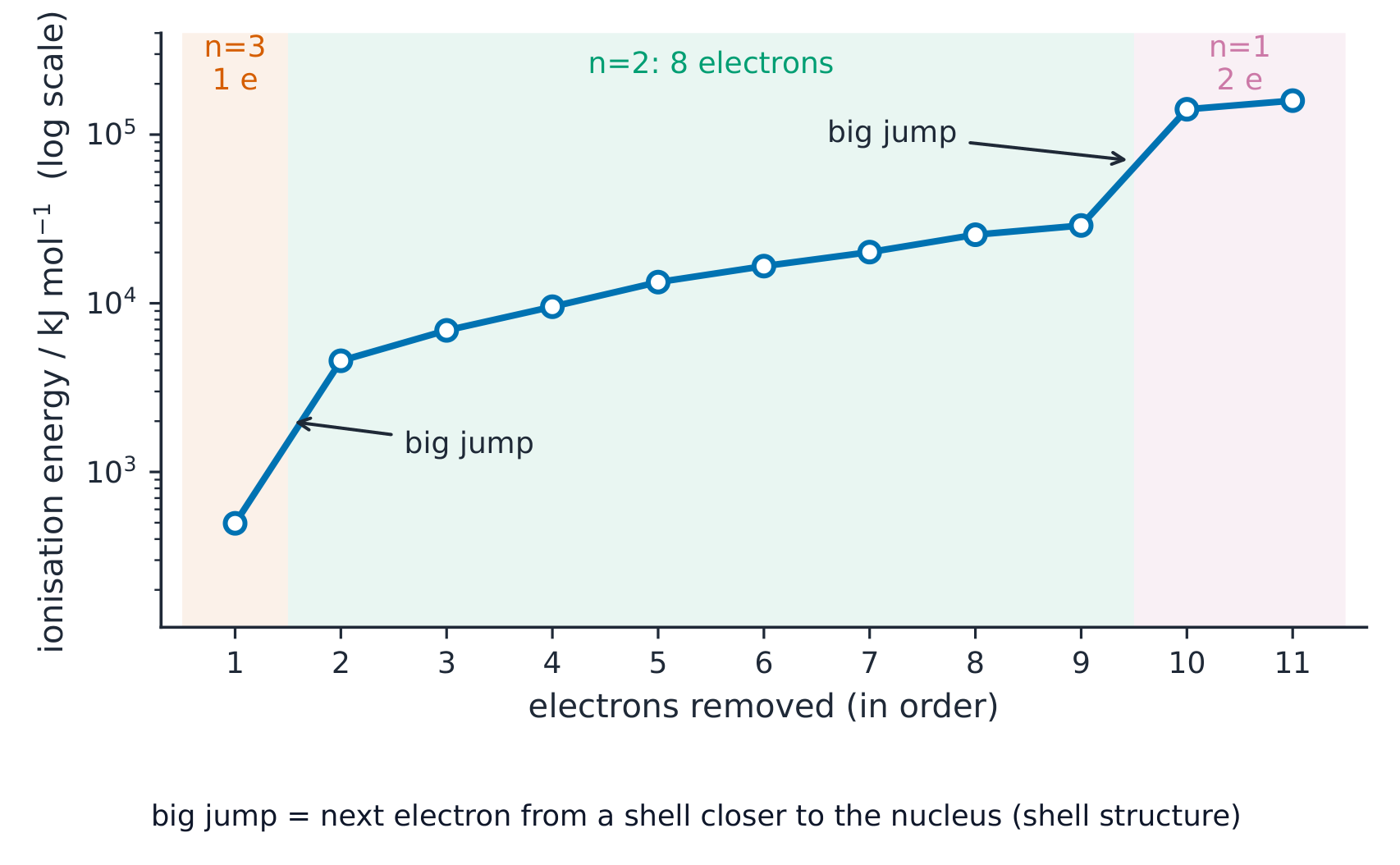

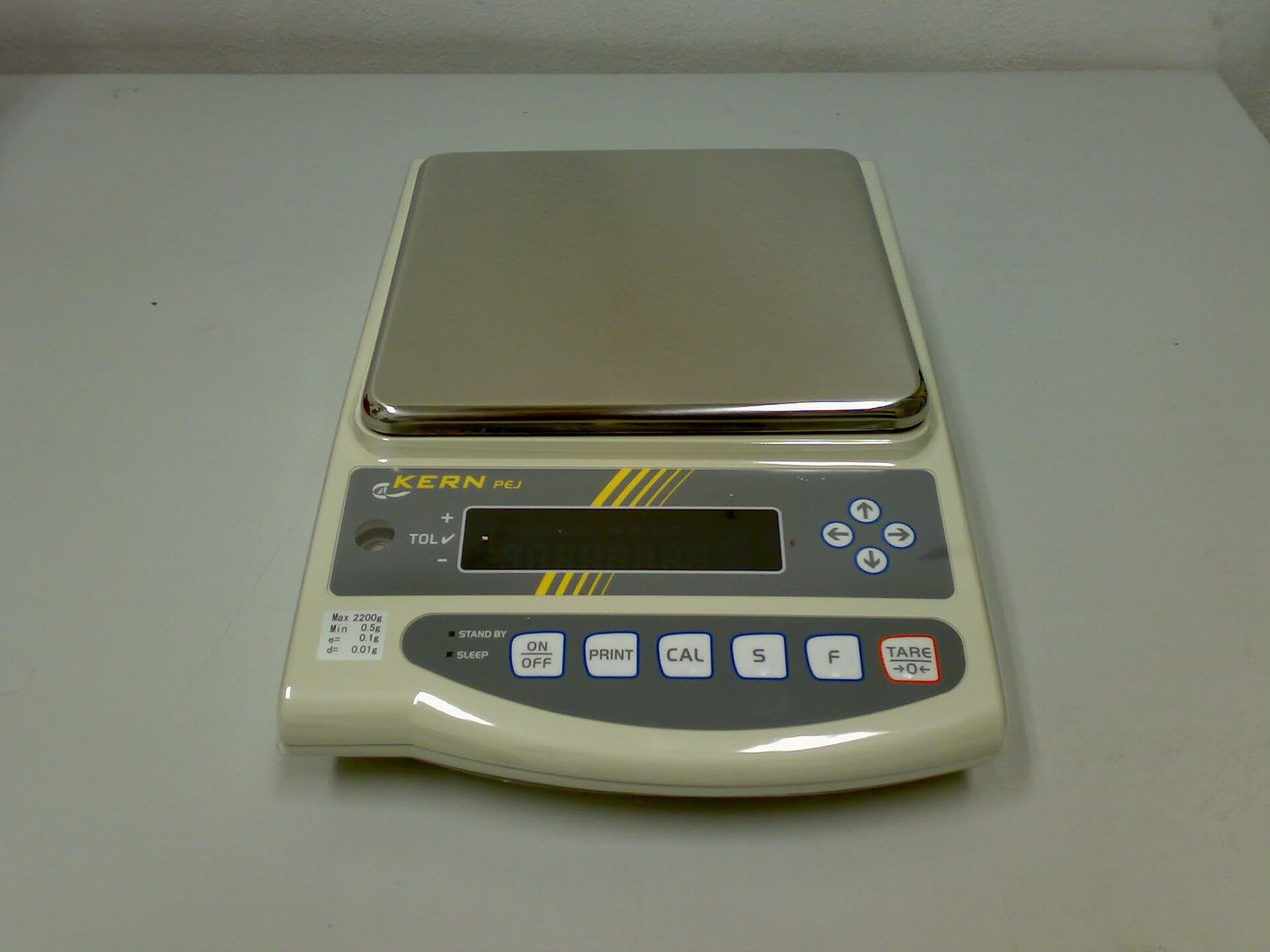


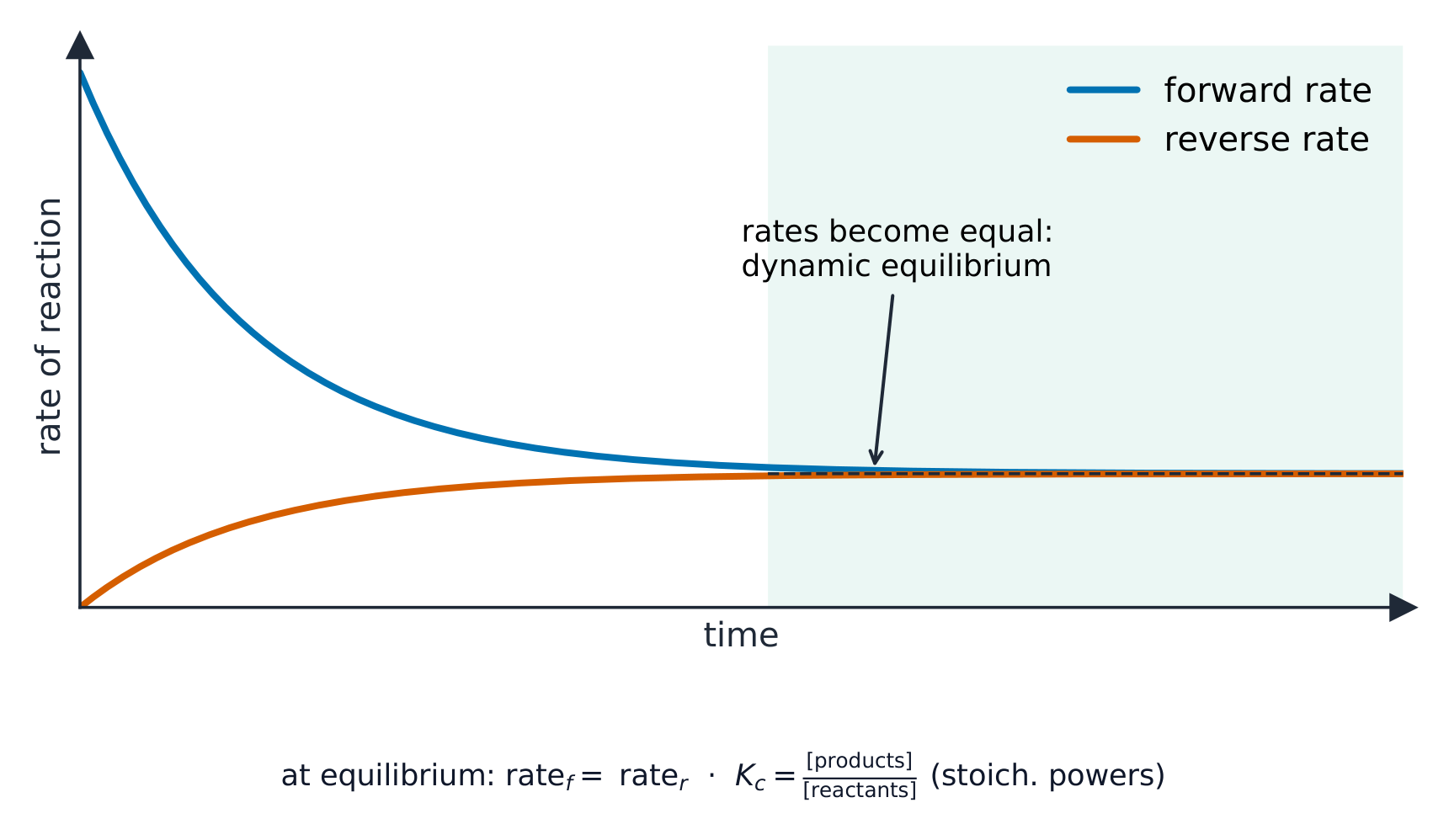


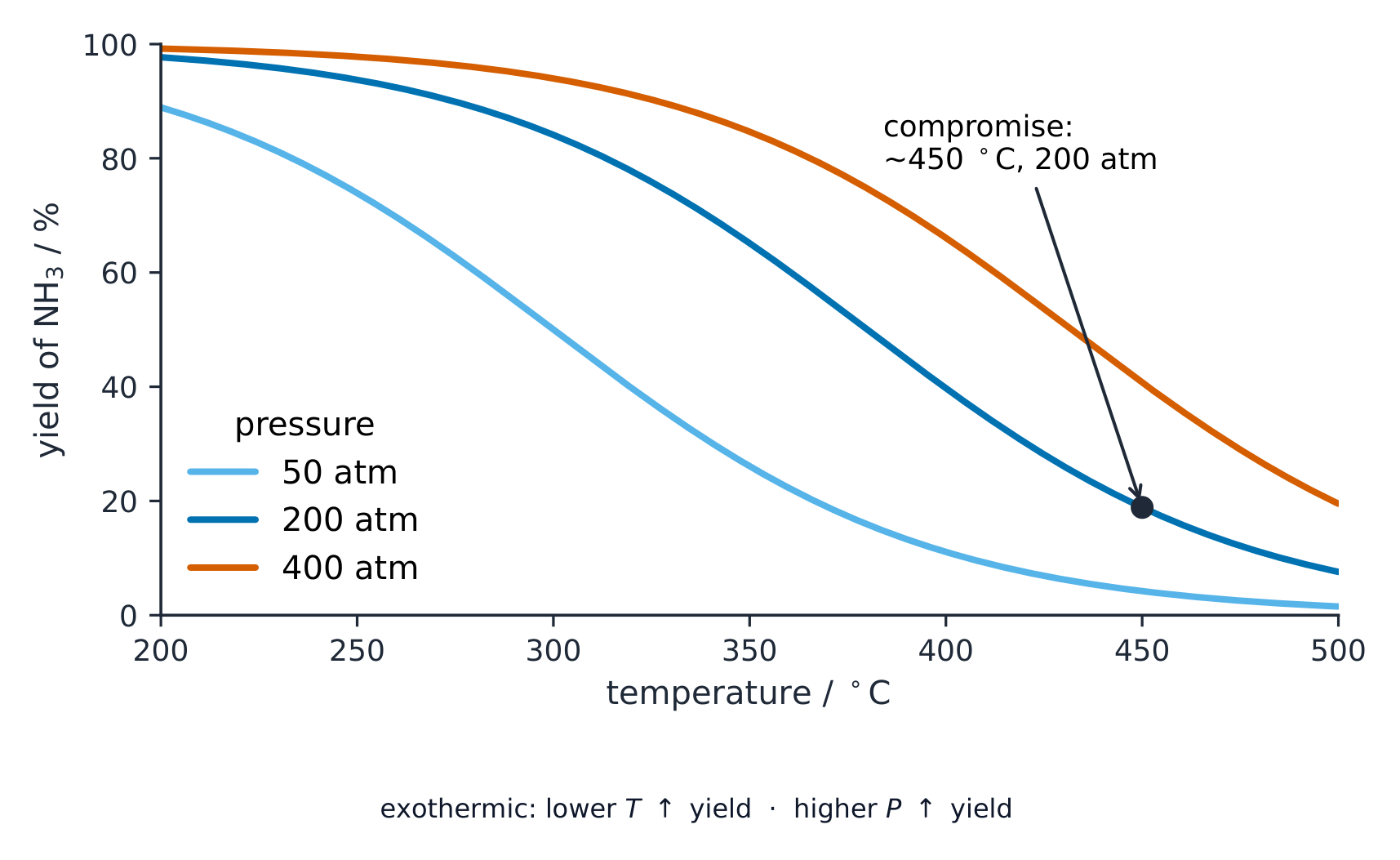


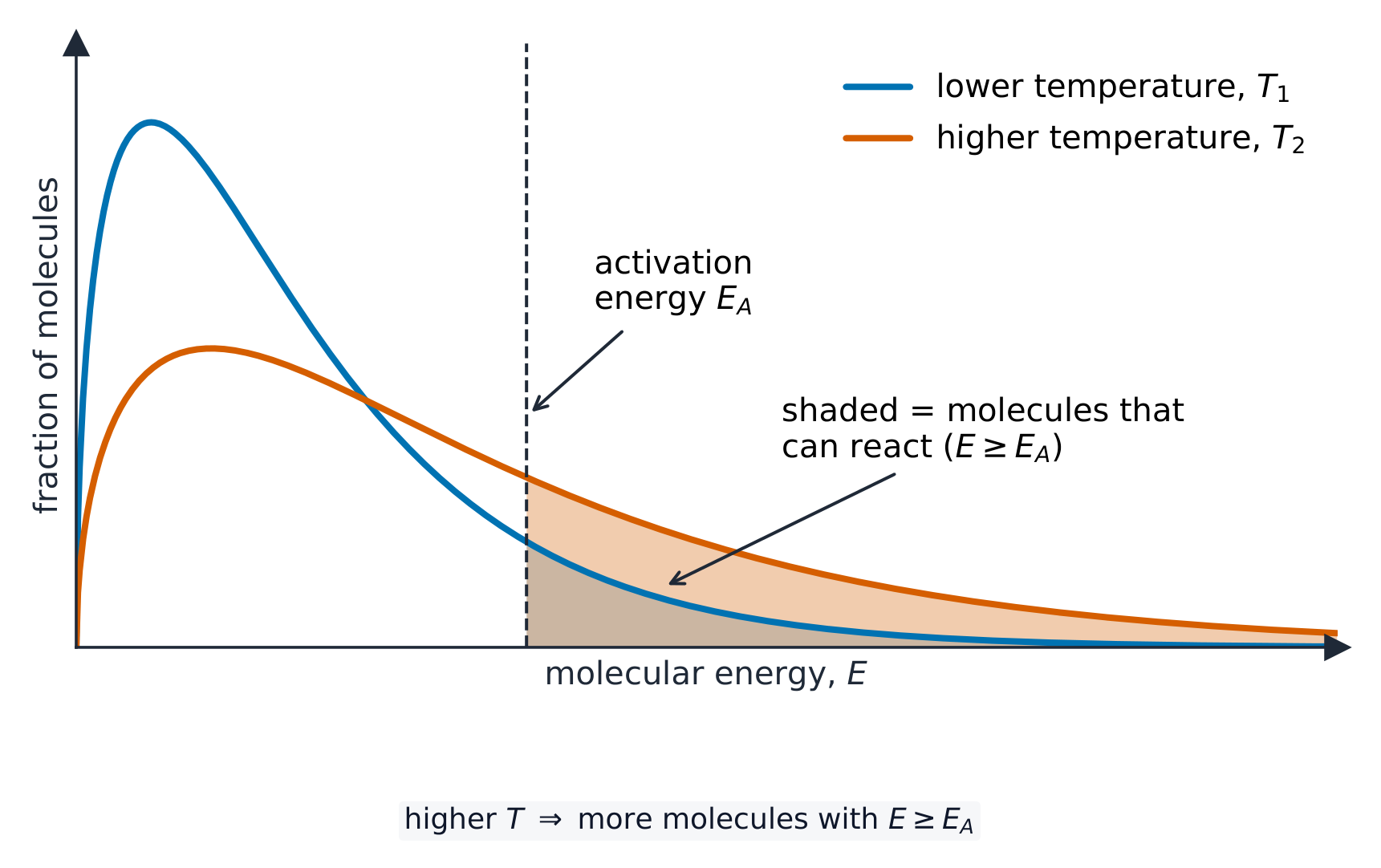

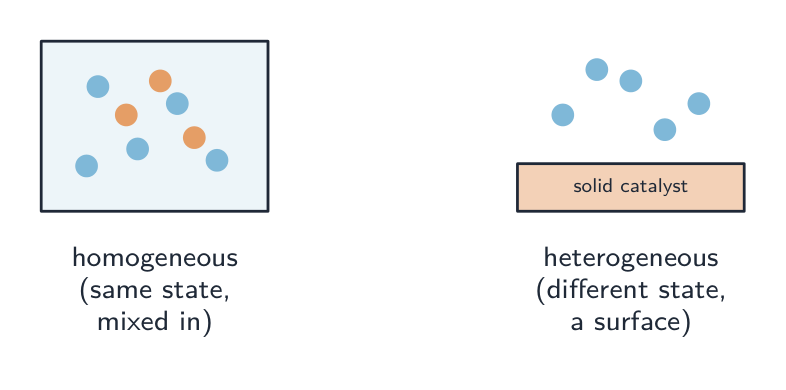


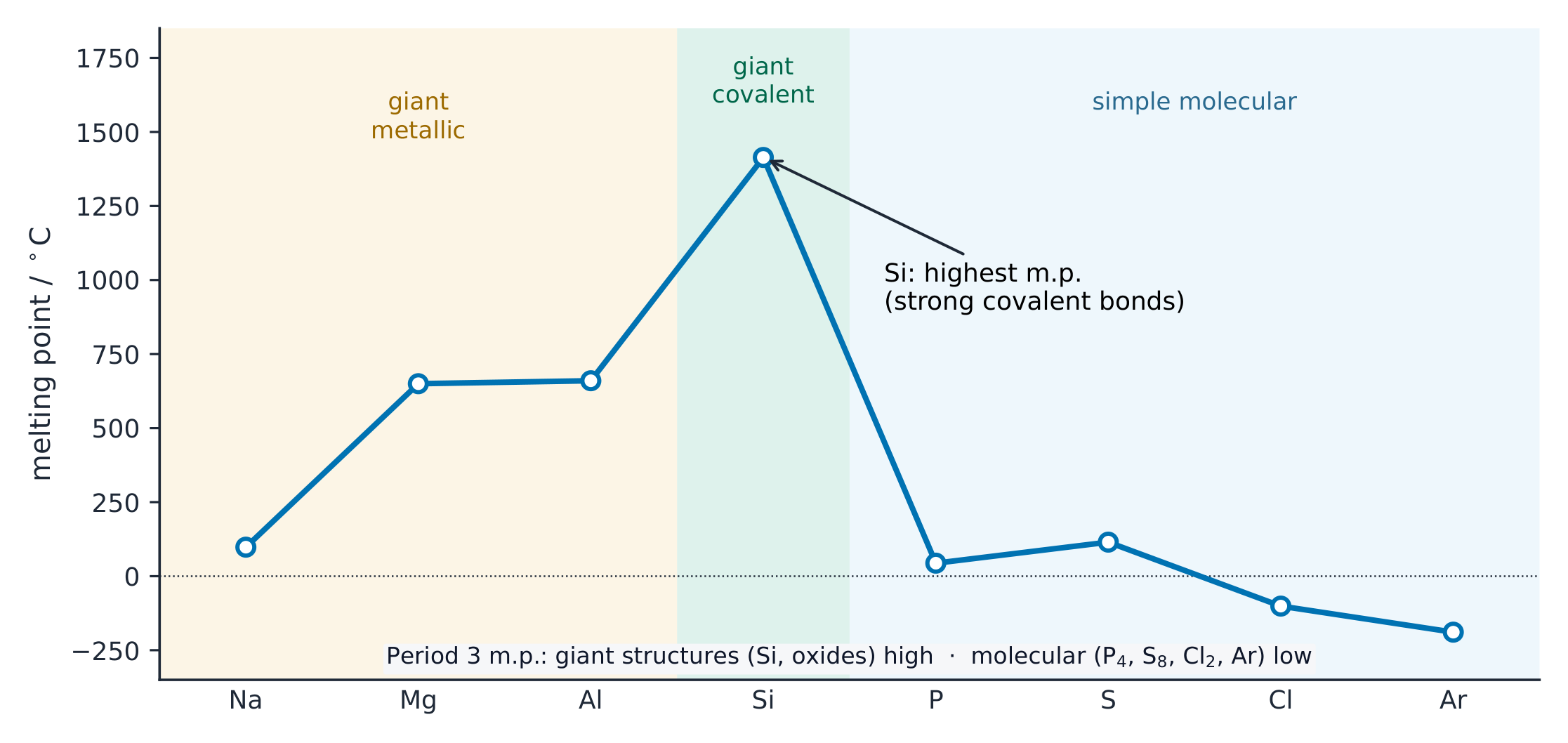


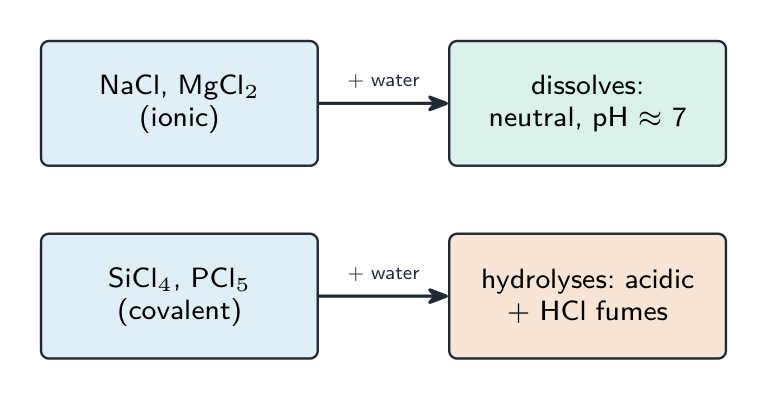


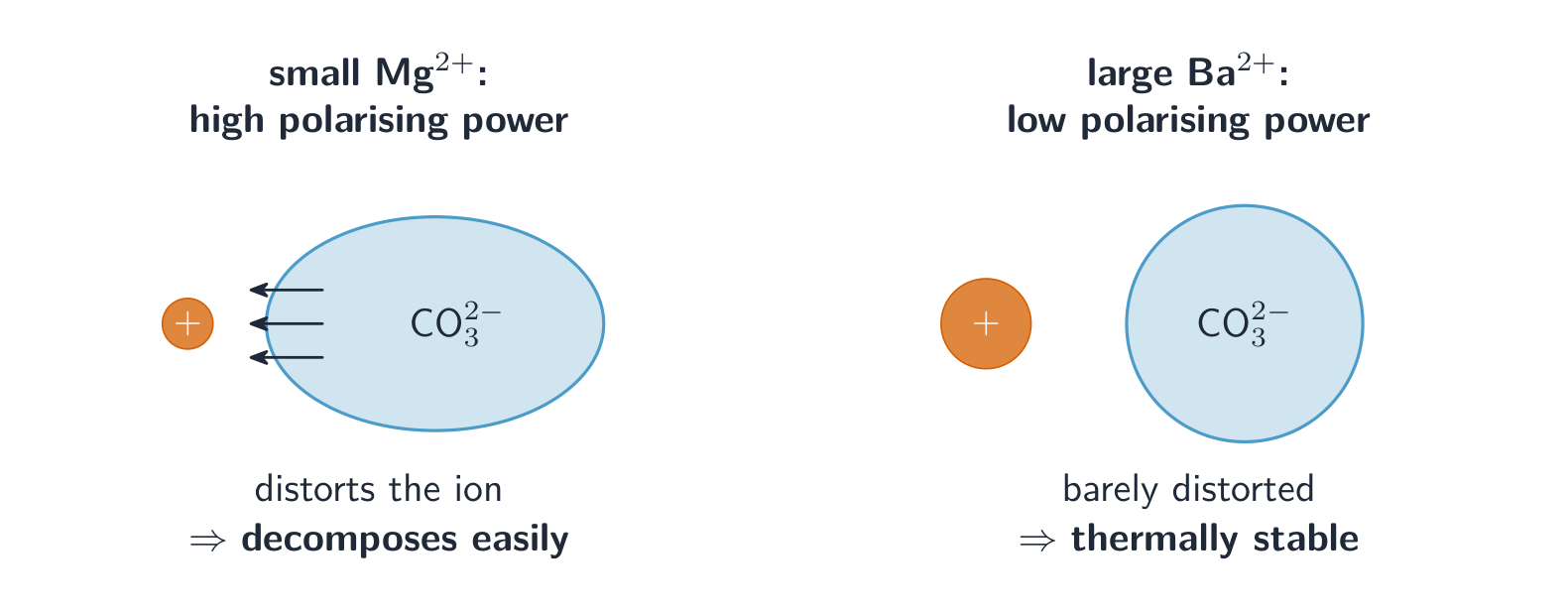
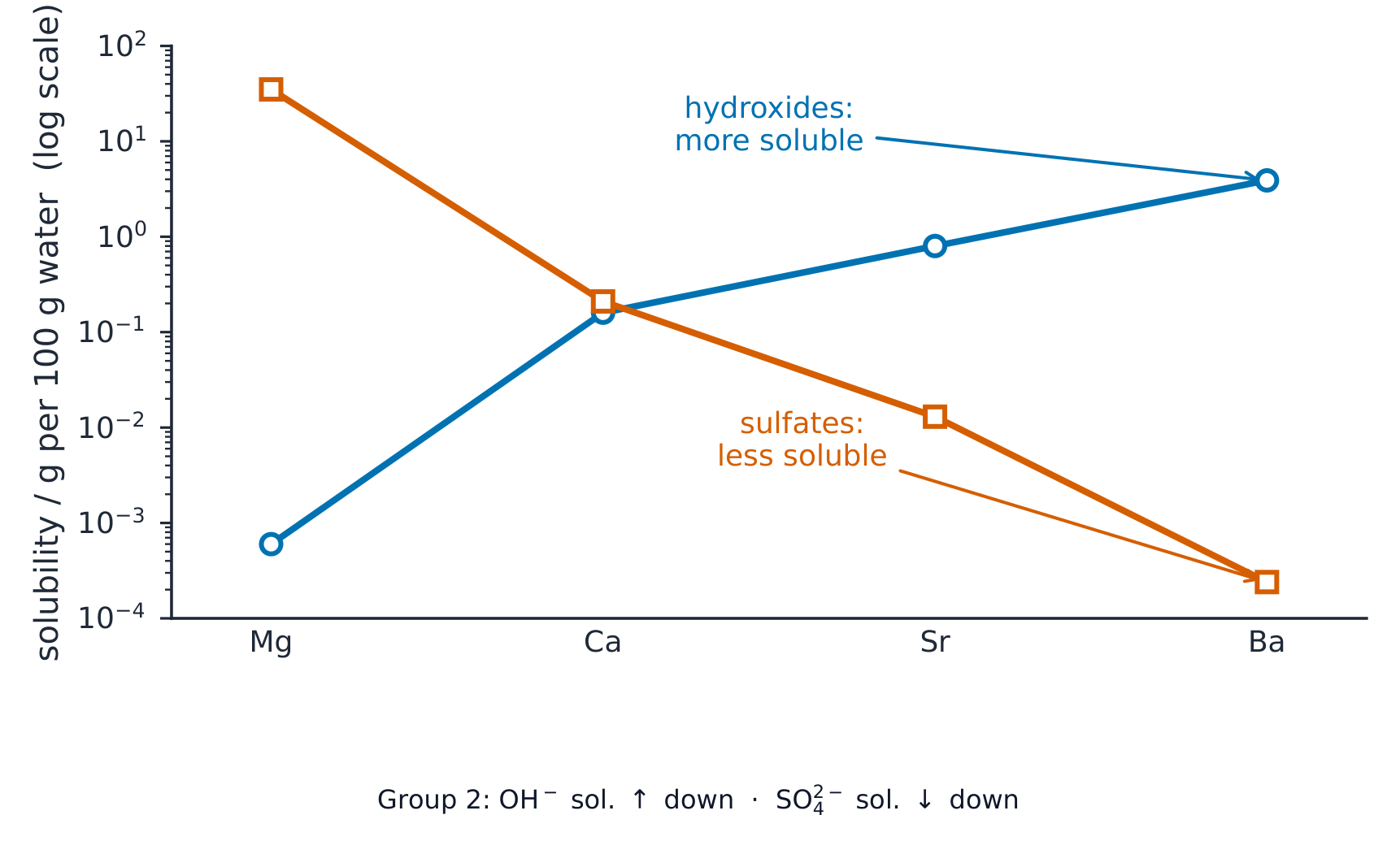


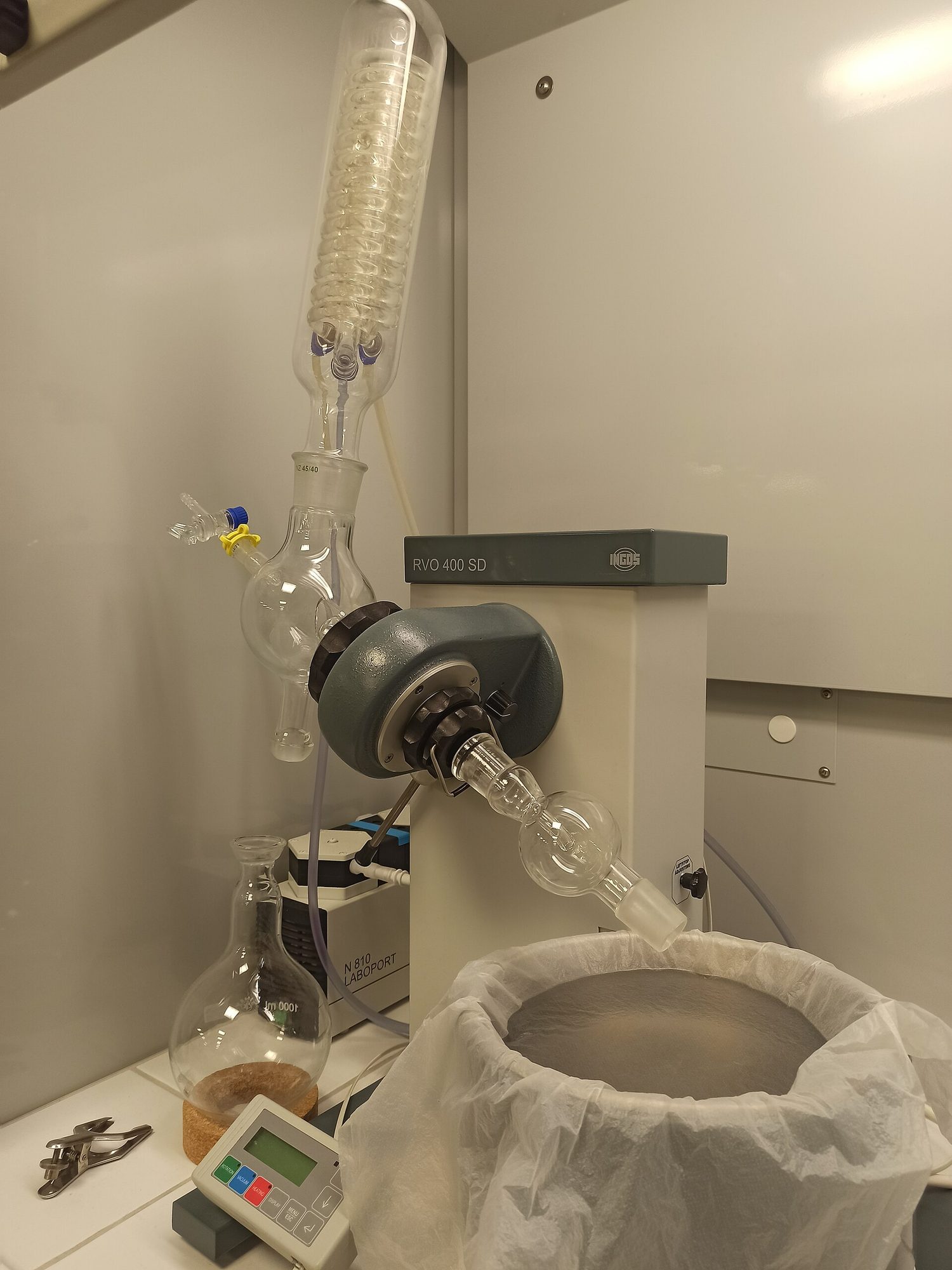


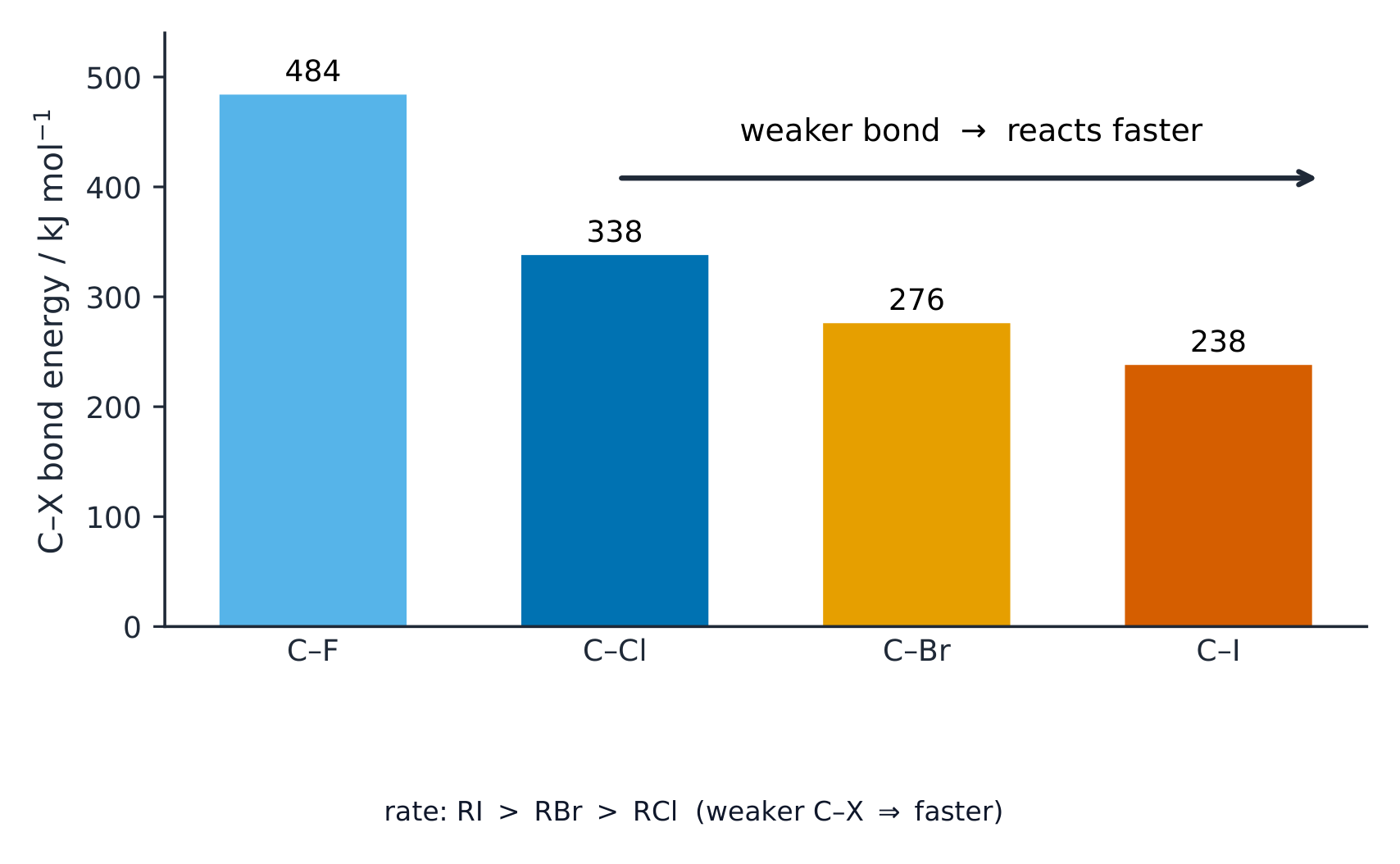



 *Membentuk amina primer: pasangan elektron bebas amonia menyerang karbon δ+ dan mendorong halogen keluar — substitusi nukleofilik
 *Nitril adalah pusat yang berguna: KCN menambahkan karbon untuk membuat nitril, yang kemudian terhidrolisis menjadi asam karboksilat atau direduksi menjadi amina
 *Reduksi nitril menghasilkan amina; amina dan asam diasat saling terhubung untuk membentuk poliamida seperti nilon — serat yang pertama kali terkenal dalam stoking
 *Poly(etena), polimer penjumlahan umum, disuplai sebagai butiran kecil berukuran beberapa milimeter; butiran ini kemudian dilelehkan dan dicetak menjadi botol, kantong, dan produk lainnya
 *Menemukan unit ulang: ubah C=C monomer menjadi ikatan tunggal dan gambar ikatan keluar di setiap ujung; balikkan untuk menemukan monomer


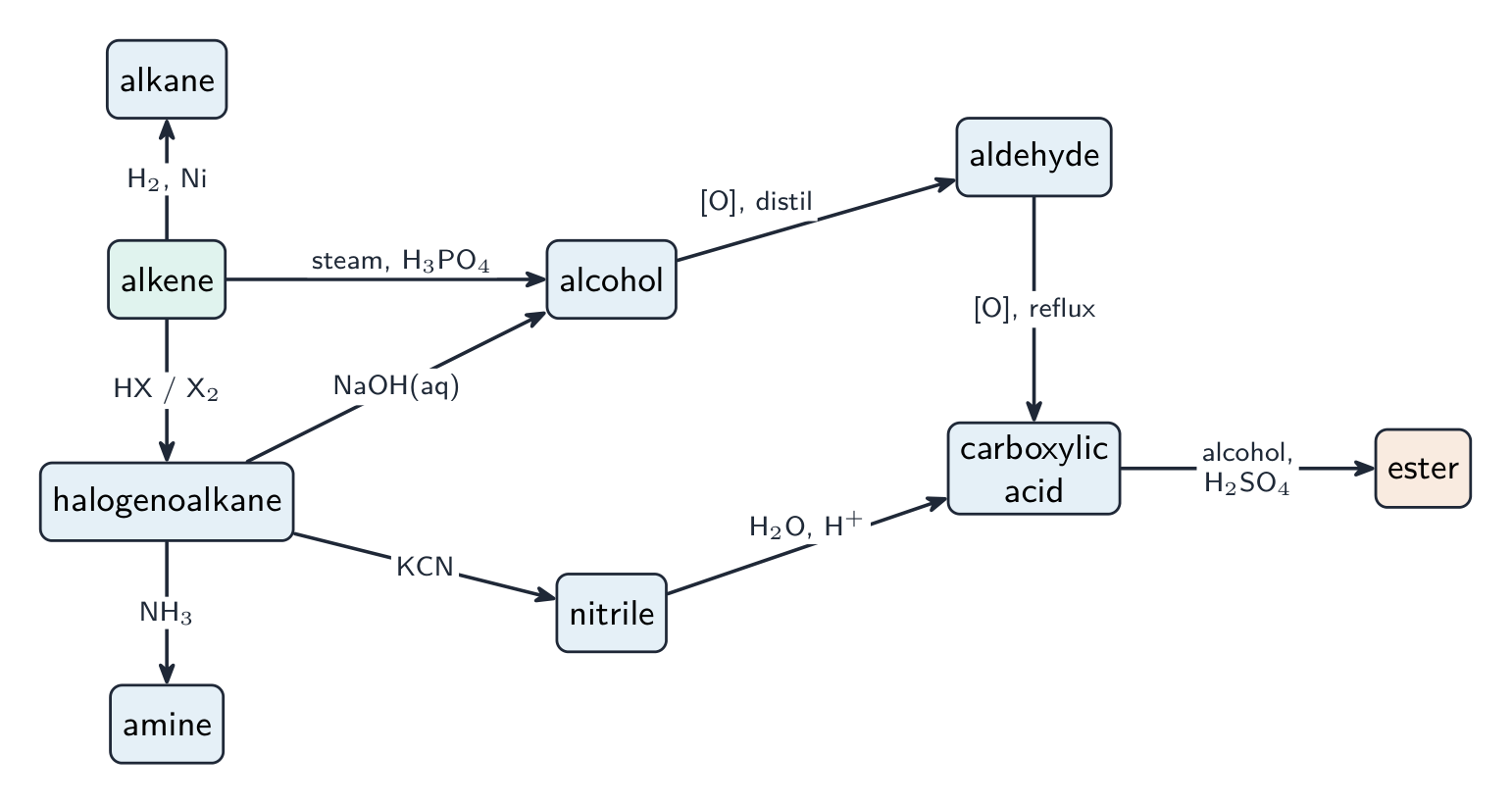
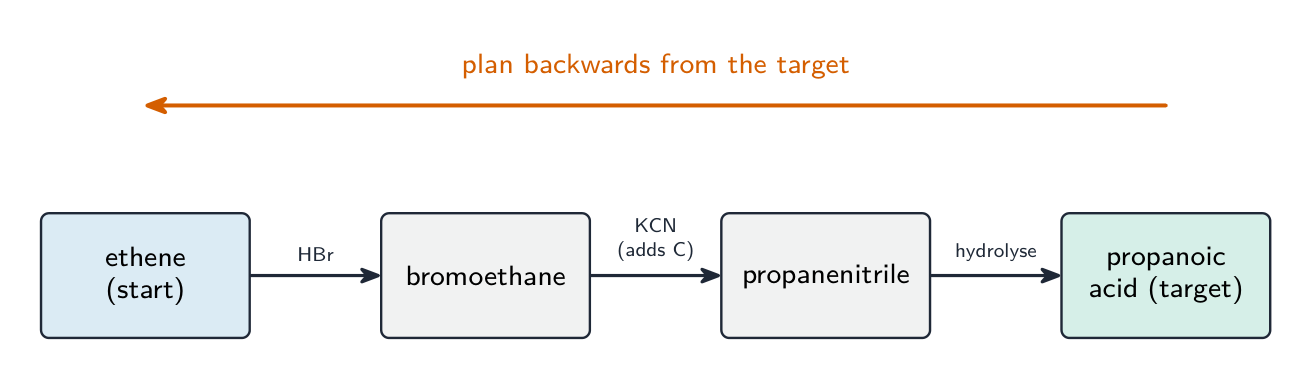
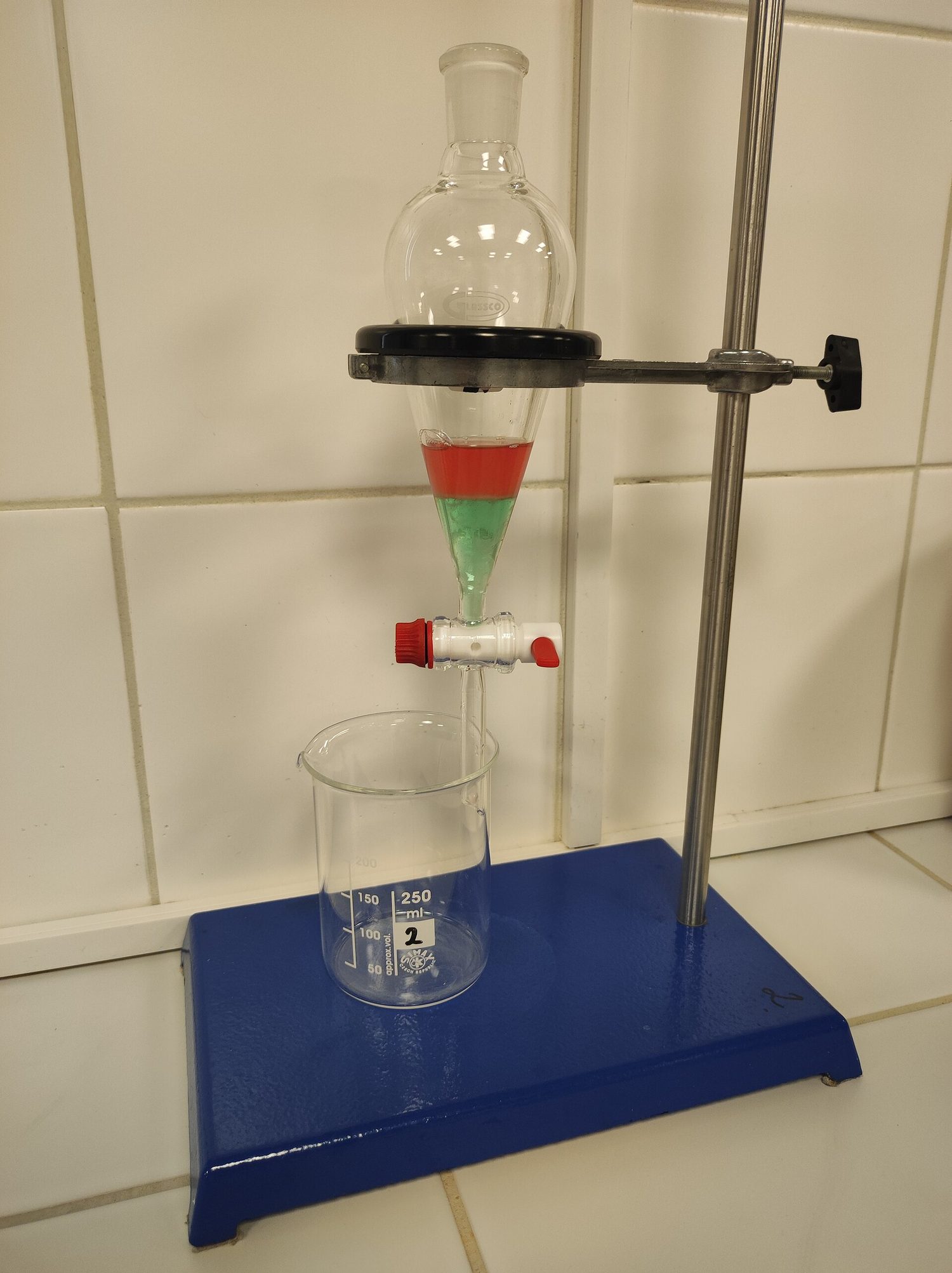


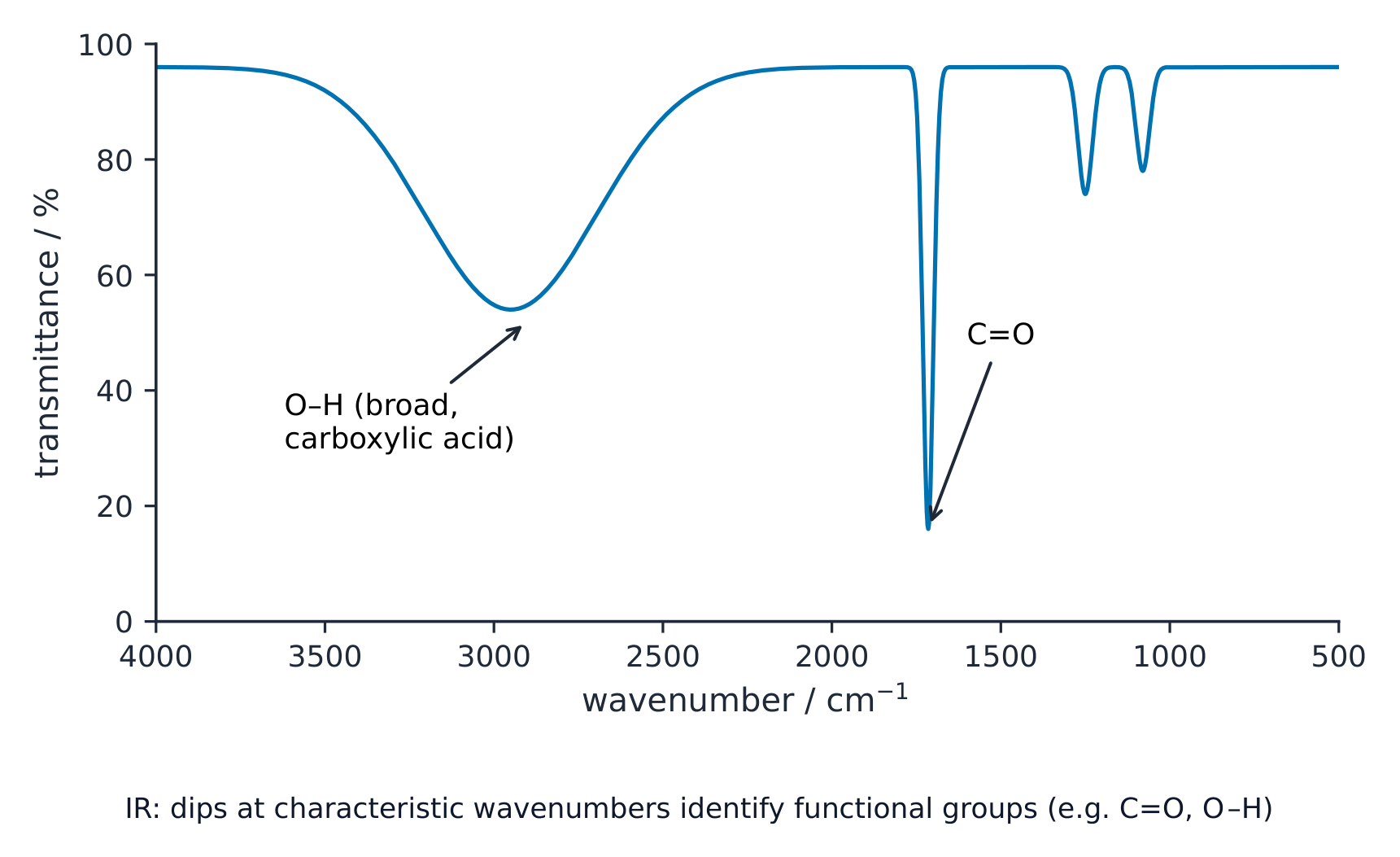

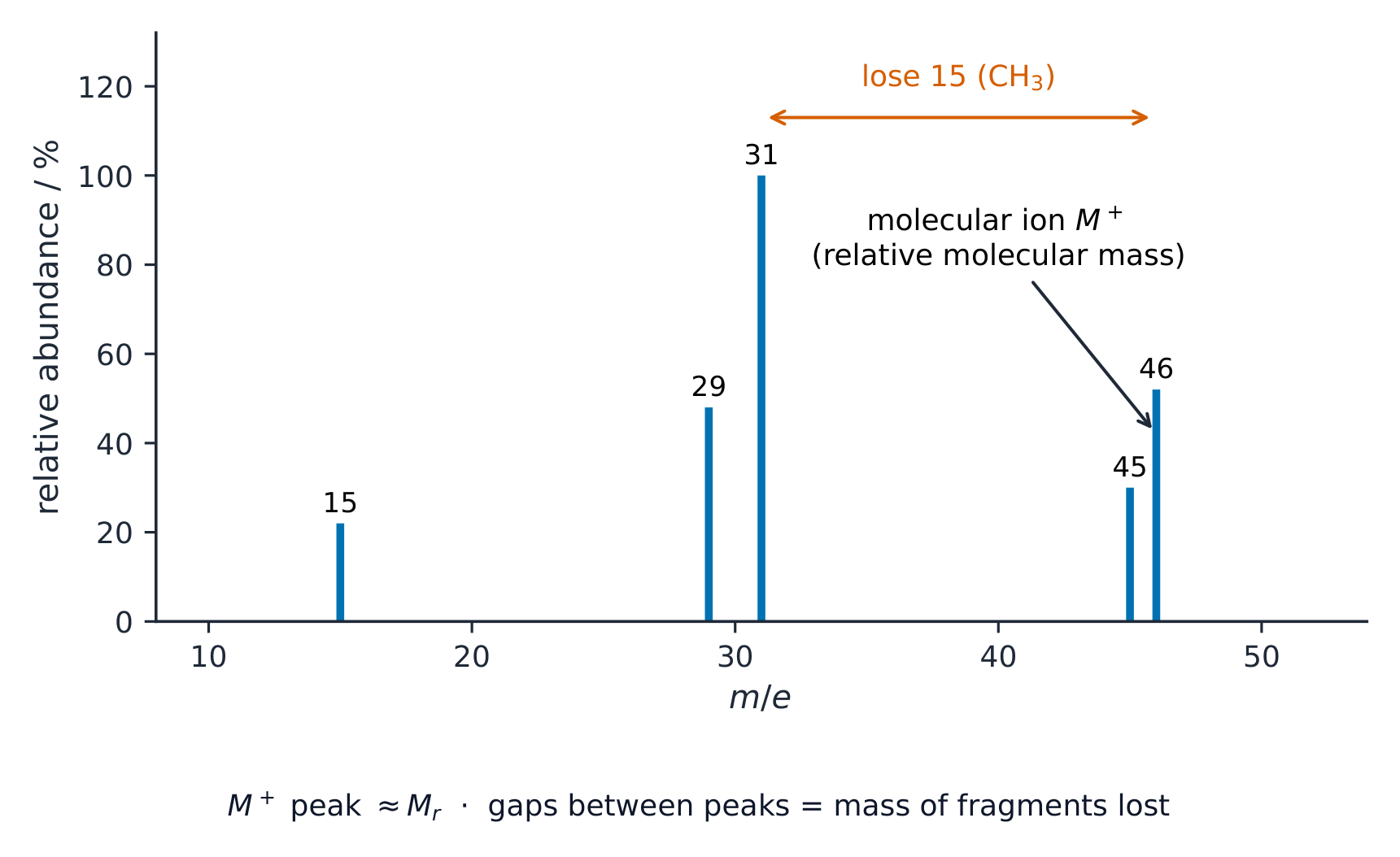
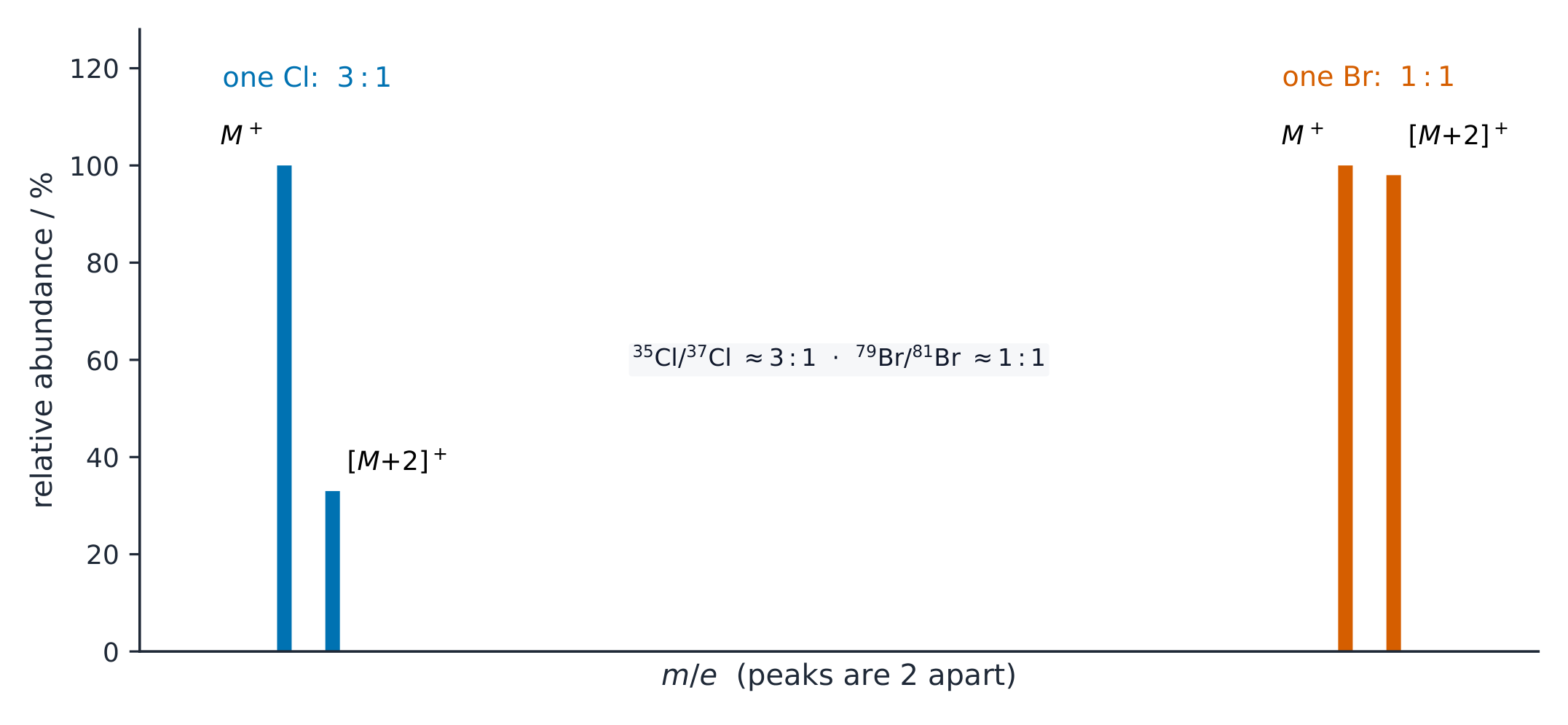


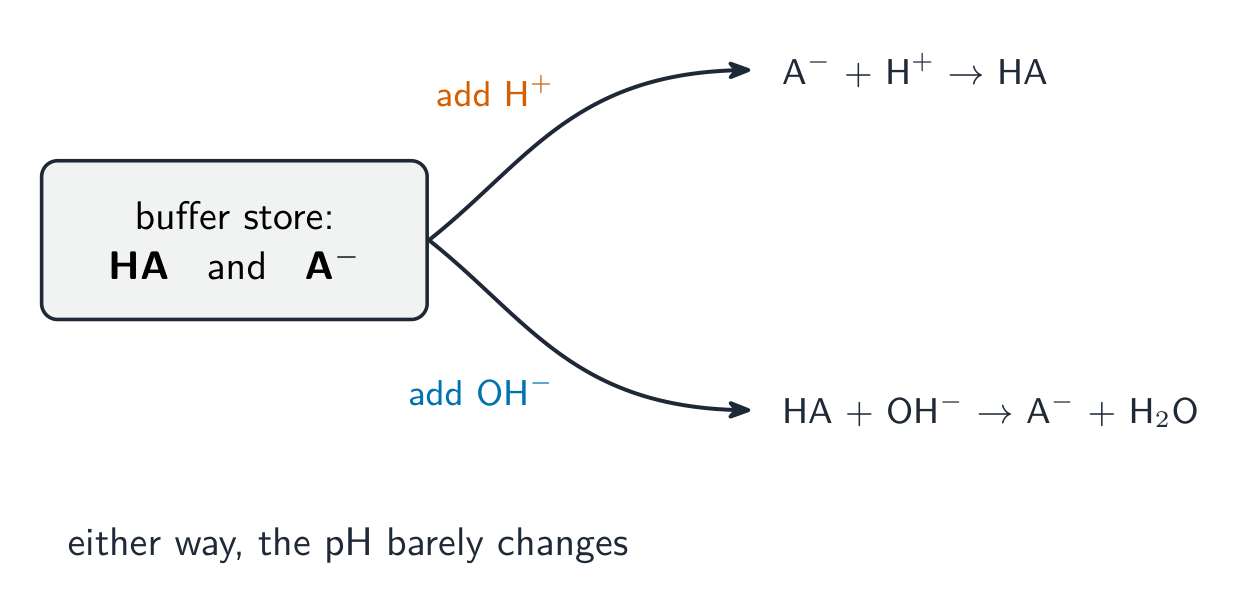


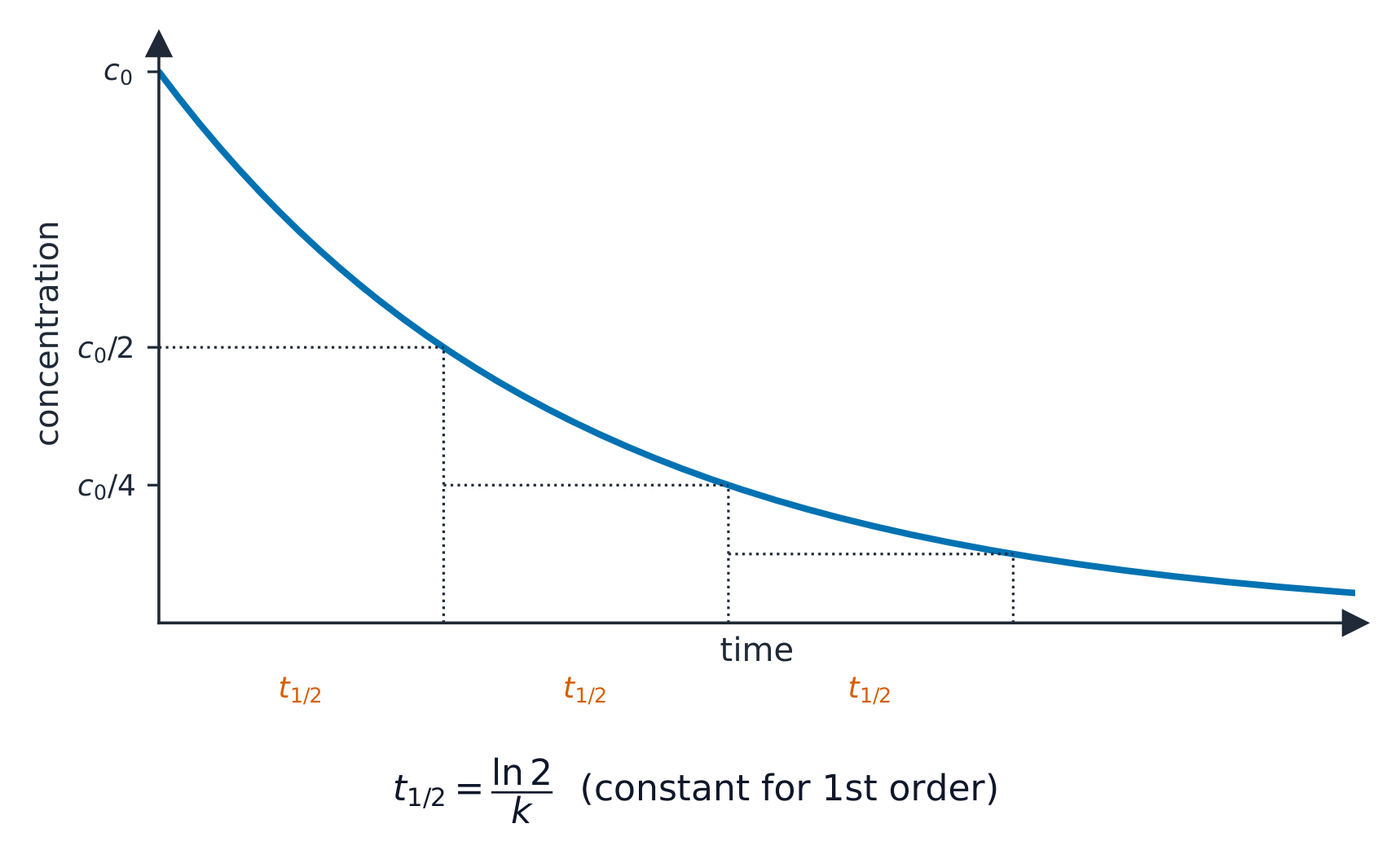
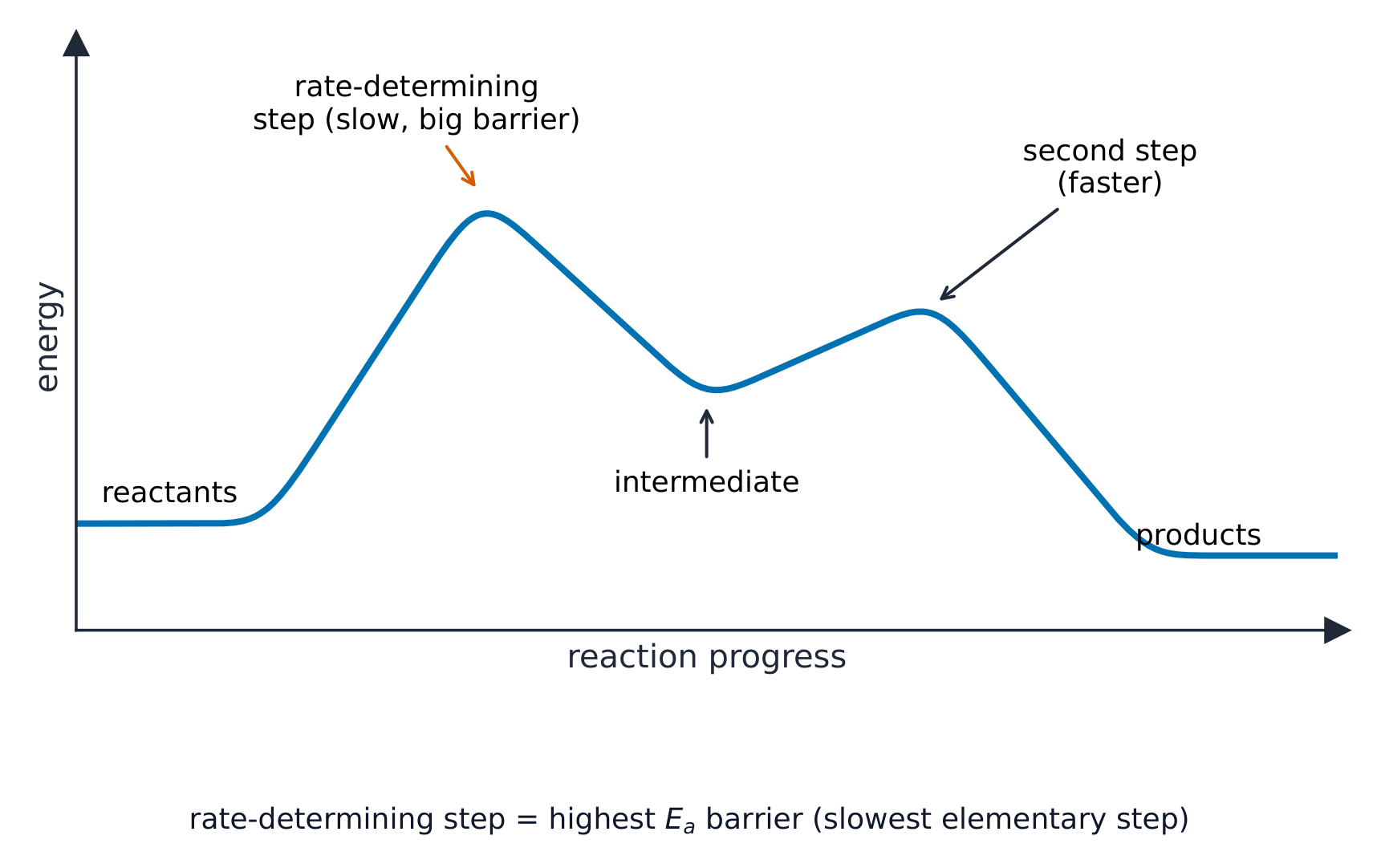




 *Fenol lebih asam daripada air atau alkohol: kehilangan H
 *Cincin fenol teraktivasi, sehingga air bromin mem-brominasi posisi 2, 4, dan 6 pada suhu ruang tanpa katalis, menghasilkan endapan putih
 *Sabun karbolik mengandung fenol, yang merupakan salah satu antiseptik pertama


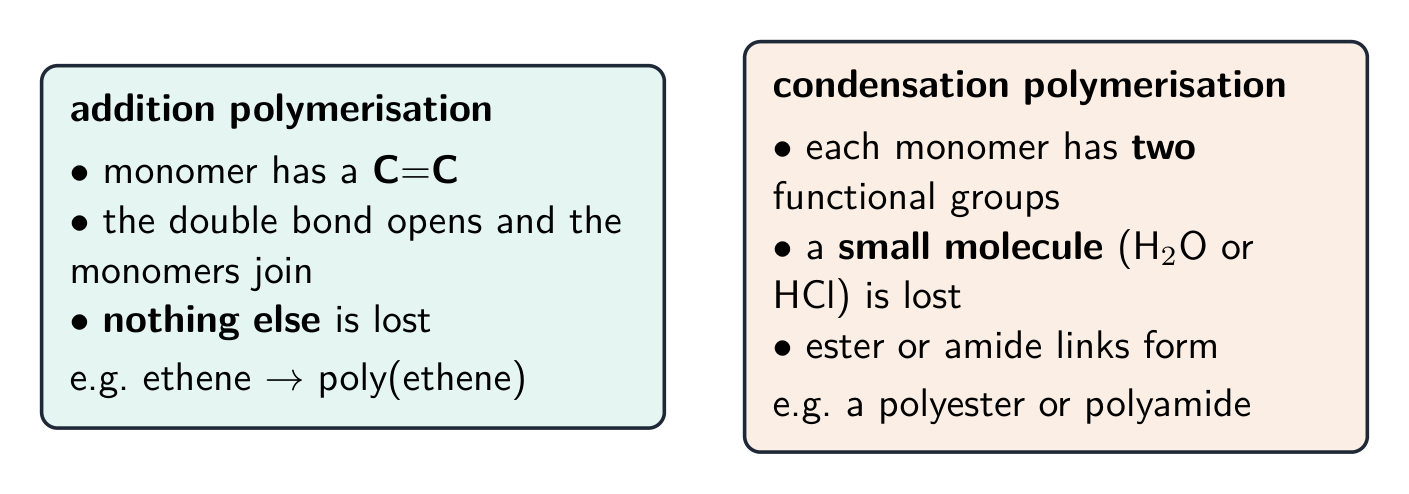


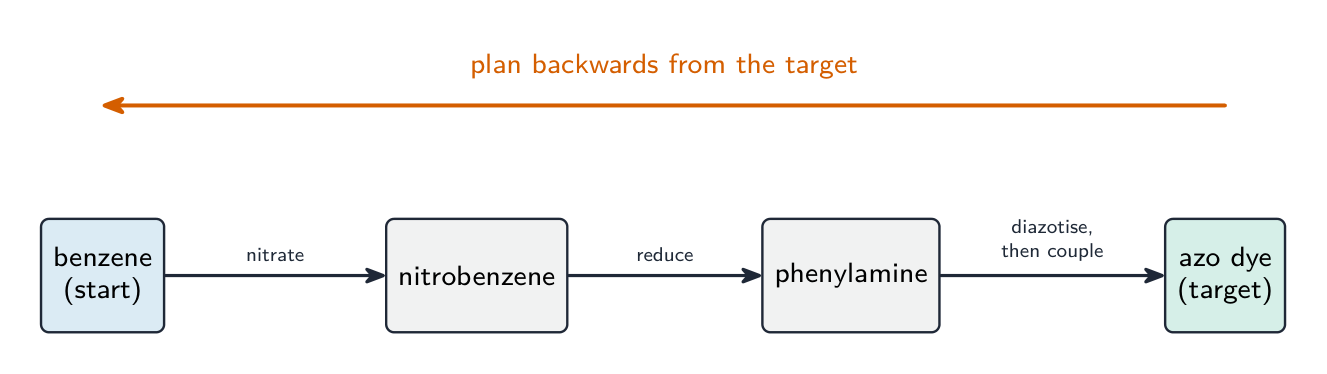

 *Pelat TLC nyata di bawah cahaya UV: setiap bercak bersinar adalah komponen terpisah dari campuran