منهج أ-ليفل في الكيمياء (9701) هو في الواقع ثلاثة مواد يجب أن تتواصل مع بعضها: الفيزيائية (الطاقة، التوازن، معدلات التفاعل، الكيمياء الكهربائية)، غير العضوية (التناوب الدوري، المجموعة 2، المجموعة 17، العناصر الانتقالية) والعضوية، التي تنمو من الألكانات لتشكل سلسلة طويلة من الآليات وتنتهي بـ NMR ومطيافية الكتلة.
معظم الدرجات المفقودة هنا ليست بسبب صعوبة الكيمياء. بل تأتي من غياب الشروط، المعادلات غير الموزونة، عدم وجود رموز الحالات، وإجابات الكيمياء العضوية التي تعطي ناتجاً ولكن دون أسهم الآلية التي تدفع لها خطة التصحيح.
الكيمياء العضوية تحتاج إلى نوع مختلف من المراجعة: ارسم خريطة تفاعلية واحدة بخط اليد واستمر في إضافتها. يسألك الامتحان الانتقال من مجموعة وظيفية إلى أخرى، وليس التكرار الحرفي لتفاعل واحد.
understand that atoms are mostly empty space surrounding a very small, dense nucleus that contains protons and neutrons; electrons are found in shells in the empty space around the nucleus
identify and describe protons, neutrons and electrons in terms of their relative charges and relative masses
understand the terms atomic and proton number; mass and nucleon number
describe the distribution of mass and charge within an atom
describe the behaviour of beams of protons, neutrons and electrons moving at the same velocity in an electric field
determine the numbers of protons, neutrons and electrons present in both atoms and ions given atomic or proton number, mass or nucleon number and charge
state and explain qualitatively the variations in atomic radius and ionic radius across a period and down a group
العربية
افهم أن الذرات عبارة عن فراغ كبير يحيط بـنواة صغيرة وكثيفة جداً تحتوي على بروتونات ونيوترونات؛ توجد الإلكترونات في مستويات طاقة داخل الفراغ حول النواة ⟦number⟧
حدد وصف البروتونات والنيوترونات والإلكترونات من حيث شحونها النسبية وكتلها النسبية number⟧
افهم مصطلحات العدد الذوي والعدد البروتوني؛ الكتلة وعدد النوكليونات ⟦number⟧
صف توزيع الكتلة والشحنة داخل الذرة ⟦number⟧
صف سلوك حزم من البروتونات والنيوترونات والإلكترونات التي تتحرك بنفس السرعة في مجال كهربائي ⟦number⟧
حدد أعداد البروتونات والنيوترونات والإلكترونات الموجودة في كل من الذرات والأيونات عند إعطاء العدد الذوي أو البروتوني، أو الكتلة أو عدد النوكليونات والشحنة ⟦number⟧
استنتج واشرح نوعياً التغيرات في نصف القطر الذوي ونصف القطر الأيوني عبر الدورة ومن أسفل إلى أعلى المجموعة ⟦number⟧
Source: Cambridge International syllabus · المصدر: منهج كامبريدج الدولي
A scanning tunnelling microscope can image individual atoms.
Everything is made of atoms 原子. An atom is mostly empty space. At its centre is a tiny, heavy nucleus 原子核. The nucleus holds two kinds of particle: protons 质子 and neutrons 中子. Around the nucleus, in the empty space, move the electrons 电子. The electrons stay in shells 壳层 — layers at set distances from the nucleus.
The nucleus is very small but holds almost all the mass. The electrons take up almost all the space but have almost no mass.
An atom is mostly empty space: protons and neutrons sit in the tiny central nucleus, while electrons move in shells around it
Relative charge and relative mass
We compare the three particles using relative charge 相对电荷 and relative mass 相对质量. These are simple numbers, not real units.
Particle
Relative charge
Relative mass
proton
$+1$
$1$
neutron
$0$
$1$
electron
$-1$
$\tfrac{1}{1836}$ (about $0$)
A proton and a neutron have almost the same mass. An electron is about 1836 times lighter. The proton is positive, the electron is negative, and the neutron has no charge — it is neutral 中性.
Proton number and nucleon number
Two numbers describe the nucleus:
the proton number 质子数 (also called the atomic number 原子序数), symbol $Z$ — the number of protons.
the nucleon number 核子数 (also called the mass number 质量数), symbol $A$ — the total number of protons and neutrons. Protons and neutrons are both nucleons 核子.
So the number of neutrons is $A - Z$.
Counting particles in an atom or ion
For a neutral atom, the number of electrons equals the number of protons, which equals $Z$.
An ion 离子 is an atom that has lost or gained electrons, so it has a charge:
a positive ion has fewer electrons than protons.
a negative ion has more electrons than protons.
Example: $^{27}_{13}\text{Al}^{3+}$ has $13$ protons, $27 - 13 = 14$ neutrons, and $13 - 3 = 10$ electrons (it lost 3 electrons to become $3+$).
How mass and charge are spread out
Almost all the mass sits in the nucleus, because protons and neutrons are heavy and electrons are very light. All the positive charge is in the nucleus (the protons). The negative charge is spread out in the shells (the electrons).
Beams of particles in an electric field
Imagine beams of protons, neutrons and electrons moving at the same speed into an electric field 电场 between two charged plates:
the proton beam bends towards the negative plate (protons are positive).
the electron beam bends the other way, towards the positive plate. It bends much more, because the electron is far lighter — the same force gives a bigger deflection 偏转 to a smaller mass.
the neutron beam goes straight through. It has no charge, so the field gives it no force.
In an electric field the proton bends towards the $-$ plate and the electron bends the opposite way and far more (it is much lighter); the neutron passes straight through
Atomic radius and ionic radius
The atomic radius 原子半径 is the size of an atom. The ionic radius 离子半径 is the size of an ion.
Across a period 周期 (left to right), the atomic radius gets smaller. The nuclear charge 核电荷 (the pull from the protons) rises, but the electrons go into the same outer shell, so the shielding 屏蔽 by inner shells stays about the same. The stronger pull draws the outer shell inwards.
Down a group 族 (top to bottom), the atomic radius gets larger. Each step down adds a new shell, so the outer electrons are further out and feel more shielding from the nucleus.
Across a period the atoms shrink (stronger nuclear pull on the same outer shell); down a group they grow (each step adds a shell)
For ions:
a positive ion (cation 阳离子) is smaller than its atom. It has lost its outer shell, and the electrons that remain feel a stronger pull each.
a negative ion (anion 阴离子) is larger than its atom. It has gained electrons, so there is more repulsion 排斥 between the electrons.
among ions that have the same number of electrons, the one with more protons is smaller.
Explore · استكشف
Explore the atom · استكشف الذرة
Tap each part. A tiny dense nucleus of protons and neutrons holds the mass; light electrons orbit it in shells. · اضغط على كل جزء. نواة صغيرة كثيفة من البروتونات والنيوترونات تحمل الكتلة؛ تدور الإلكترونات الخفيفة حولها في مدارات.
Explore · استكشف
Atomic and ionic radius trends · اتجاهات نصف القطر الذري والأيوني
Atomic radius falls across a period (rising nuclear charge pulls the same shell in) and rises down a group (an extra shell each time). Step across Period 3 to see it. · ينقص نصف القطر الذري عبر الدورة (بسبب ارتفاع الشحنة النووية الذي يسحب نفس المستوى للداخل) ويزداد نزولاً في المجموعة (بسبب إضافة مستوى جديد في كل مرة). انتقل عبر الدورة 3 لترى ذلك.
define the term isotope in terms of numbers of protons and neutrons
understand the notation $_y^x\text{A}$ for isotopes, where $x$ is the mass or nucleon number and $y$ is the atomic or proton number
state that and explain why isotopes of the same element have the same chemical properties
state that and explain why isotopes of the same element have different physical properties, limited to mass and density
العربية
عرّف مصطلح النظير من حيث أعداد البروتونات والنيوترونات ⟦number⟧
افهمرمز $_y^x\text{A}$ للنظائر، حيث $x$ هو العدد الكتلي أو عدد النوكليونات و$y$ هو العدد الذوي أو البروتوني ⟦number⟧
استنتج واشرح لماذا تمتلك نظائر العنصر الواحد نفس الخصائص الكيميائية ⟦number⟧
استنتج واشرح لماذا تمتلك نظائر العنصر الواحد خصائص فيزيائية مختلفة، مقتصرة على الكتلة والكثافة ⟦number⟧
Source: Cambridge International syllabus · المصدر: منهج كامبريدج الدولي
Isotopes 同位素 are atoms of the same element with the same number of protons but a different number of neutrons. So isotopes have the same proton number $Z$ but a different nucleon number $A$.
Two chlorine isotopes: same protons, different neutrons
We write an isotope as $^{A}_{Z}\text{X}$: the nucleon number $A$ on top, the proton number $Z$ below. For example, chlorine has two main isotopes, $^{35}_{17}\text{Cl}$ and $^{37}_{17}\text{Cl}$.
Same chemical properties
Chemical properties 化学性质 depend on the electrons, especially the outer electrons. Isotopes of one element have the same number of electrons arranged in the same way. So they react in exactly the same way — they have the same chemical properties.
Different physical properties
Some physical properties 物理性质 depend on mass, so they differ between isotopes. A heavier isotope has more neutrons, so more mass, and therefore a higher density 密度. (The syllabus limits this difference to mass and density.)
Explore · استكشف
Isotope lab · مختبر النظائر
Classify isotope facts by what changes and what stays the same. · صنّف حقائق النظائر حسب ما يتغير وما يبقى ثابتاً.
understand the terms: shells, sub-shells and orbitals; principal quantum number (n); ground state, limited to electronic configuration
describe the number of orbitals making up s, p and d sub-shells, and the number of electrons that can fill s, p and d sub-shells
describe the order of increasing energy of the sub-shells within the first three shells and the 4s and 4p sub-shells
describe the electronic configurations to include the number of electrons in each shell, sub-shell and orbital
explain the electronic configurations in terms of energy of the electrons and inter-electron repulsion
determine the electronic configuration of atoms and ions given the atomic or proton number and charge, using either of the following conventions: e.g. for Fe: $1\text{s}^2 2\text{s}^2 2\text{p}^6 3\text{s}^2 3\text{p}^6 3\text{d}^6 4\text{s}^2$ (full electronic configuration) or [Ar] $3\text{d}^6 4\text{s}^2$ (shorthand electronic configuration)
understand and use the electrons in boxes notation
describe and sketch the shapes of s and p orbitals
describe a free radical as a species with one or more unpaired electrons
العربية
فهم المصطلحات: المستويات الفرعية، المستويات الفرعية الفرعية والمسارات؛ العدد الكمي الرئيسي (n)؛ الحالة الأرضية، مقتصراً على التوزيع الإلكتروني
وصف عدد المسارات المكونة للمستويات الفرعية s و p و d، وعدد الإلكترونات التي يمكن أن تمتلئ بها المستويات الفرعية s و p و d
وصف ترتيب زيادة طاقة المستويات الفرعية داخل أول ثلاثة مستويات ومستويات فرعية 4s و 4p
وصف التوزيعات الإلكترونية بما في ذلك عدد الإلكترونات في كل مستوى فرعي ومستوى فرعي ومسار
شرح التوزيعات الإلكترونية من حيث طاقة الإلكترونات وتنافر الإلكترونات مع بعضها البعض
تحديد التوزيع الإلكتروني للذرات والأيونات عند إعطاء العدد الذري أو عدد البروتونات والشحنة، باستخدام أحد الأسلوبين التاليين: مثلاً بالنسبة للحديد Fe: $1\text{s}^2 2\text{s}^2 2\text{p}^6 3\text{s}^2 3\text{p}^6 3\text{d}^6 4\text{s}^2$ (التوزيع الإلكتروني الكامل) أو [Ar] $3\text{d}^6 4\text{s}^2$ (التوزيع الإلكتروني المختصر)
فهم واستخدام طريقة تمثيل الإلكترونات بالمربعات
وصف ورسم أشكال المسارات s و p
وصف الجذر الحر بأنه نوع يحتوي على إلكترون واحد أو أكثر غير مزدوج
Source: Cambridge International syllabus · المصدر: منهج كامبريدج الدولي
Hydrogen emits light only at discrete, characteristic wavelengths — its line emission spectrum.
Electrons are arranged in shells, sub-shells and orbitals.
Shells and the principal quantum number
Each shell is labelled by the principal quantum number 主量子数$n = 1, 2, 3, \dots$ A larger $n$ means a shell that is further from the nucleus and higher in energy.
Sub-shells and orbitals
Each shell is split into sub-shells 亚层, named s, p and d. Each sub-shell is built from orbitals 轨道. An orbital is a small region that can hold up to two electrons.
Sub-shell
Number of orbitals
Maximum electrons
s
1
2
p
3
6
d
5
10
So an s sub-shell holds 2 electrons, a p sub-shell holds 6, and a d sub-shell holds 10.
Order of increasing energy
Electrons fill the lowest-energy sub-shell first. For the first three shells, plus 4s and 4p, the order of rising energy is:
You can write a shorthand using the nearest noble gas 稀有气体 in square brackets:
$$[\text{Ar}]\,3\text{d}^6\,4\text{s}^2$$
Here $[\text{Ar}]$ stands for the full configuration of argon.
For ions, you add or remove electrons. One key rule: when a transition metal forms a positive ion, it loses its 4s electrons before its 3d electrons. So $\text{Fe}^{3+}$ is $[\text{Ar}]\,3\text{d}^5$.
Electrons in boxes
The electrons in boxes notation draws each orbital as a box and each electron as an arrow. Two electrons in the same orbital must point opposite ways, because each electron has a property called spin 自旋, and a shared orbital needs opposite spins.
Within a sub-shell, electrons fill empty orbitals one at a time, with parallel arrows, before any orbital gets a second electron. Spreading out like this keeps the electrons apart and lowers the repulsion between them.
Electrons in boxes for nitrogen ($1\text{s}^2\,2\text{s}^2\,2\text{p}^3$): paired electrons point opposite ways, and the 2p orbitals fill singly with parallel spins
Why the configuration takes this shape
Electrons fill from low energy to high energy because that gives the most stable (lowest-energy) atom. Within a sub-shell they spread out singly first to reduce the repulsion between the negative electrons.
Shapes of s and p orbitals
an s orbital is a sphere 球形 centred on the nucleus.
a p orbital has two lobes, like a dumbbell, pointing along one axis. The three p orbitals point along three directions at right angles (the $x$, $y$ and $z$ axes).
An s orbital is a sphere; each p orbital is a dumbbell, and the three p orbitals point along the $x$, $y$ and $z$ axes
Free radicals
A free radical 自由基 is a species with one or more unpaired electrons 未成对电子. Free radicals are very reactive.
Explore · استكشف
Filling the electron shells · ملء غلافات الإلكترون
Change the atomic number Z and watch the electrons fill the shells (2, 8, 8, …) — the pattern that builds the Periodic Table. · غيّر العدد الذري Z وراقب كيف تمتلئ الغلافات (2, 8, 8, …) — النمط الذي يُكوّن الجدول الدوري.
define and use the term first ionisation energy, IE
construct equations to represent first, second and subsequent ionisation energies
identify and explain the trends in ionisation energies across a period and down a group of the Periodic Table
identify and explain the variation in successive ionisation energies of an element
understand that ionisation energies are due to the attraction between the nucleus and the outer electron
explain the factors influencing the ionisation energies of elements in terms of nuclear charge, atomic/ionic radius, shielding by inner shells and sub-shells and spin-pair repulsion
deduce the electronic configurations of elements using successive ionisation energy data
deduce the position of an element in the Periodic Table using successive ionisation energy data
العربية
تعريف واستخدام مصطلح طاقة التأين الأولى، IE
صياغة معادلات تمثل طاقة التأين الأولى والثانية وما يليها
تحديد وشرح اتجاهات طاقات التأين عبر فترة وفي مجموعة من الجدول الدوري
تحديد وشرح التغير في طاقات التأين المتتالية لعنصر ما
فهم أن طاقات التأين ناتجة عن التجاذب بين النواة والإلكترون الخارجي
شرح العوامل المؤثرة على طاقات التأين للعناصر من حيث الشحنة النووية، نصف القطر الذري/الأيوني، الحجب بواسطة المستويات الفرعية الداخلية والمستويات الفرعية وتنافر أزواج السبين
استنتاج التوزيعات الإلكترونية للعناصر باستخدام بيانات طاقات التأين المتتالية
استنتاج موضع العنصر في الجدول الدوري باستخدام بيانات طاقات التأين المتتالية
Source: Cambridge International syllabus · المصدر: منهج كامبريدج الدولي
First ionisation energy
The first ionisation energy 第一电离能 (IE) is the energy needed to remove one electron from each atom in one mole of gaseous atoms, forming one mole of gaseous $+1$ ions.
We use gaseous atoms so there are no forces between the particles. The unit is $\text{kJ mol}^{-1}$. As an equation, for an element X:
You can keep going. These are the successive ionisation energies 逐级电离能. Each is larger than the one before, because every electron is pulled away from a more positive ion.
What ionisation energy depends on
Ionisation energy comes from the attraction between the positive nucleus and the outer electron. Three main factors set how strong that attraction is:
nuclear charge: more protons pull the electrons more strongly, so the ionisation energy is higher.
atomic radius: the further the outer electron sits from the nucleus, the weaker the pull, so the ionisation energy is lower.
shielding: inner shells block some of the pull on the outer electron. More inner shells mean more shielding and a lower ionisation energy.
There is a smaller effect too — spin-pair repulsion 自旋成对排斥. When two electrons share one orbital, they push each other a little, so one is easier to remove.
Trends in first ionisation energy
Across a period, the first ionisation energy generally rises. The nuclear charge grows while shielding stays about the same, so the outer electrons are held more tightly.
Down a group, the first ionisation energy falls. Lower elements have more shells, so more shielding and a larger radius, and the outer electron is easier to remove.
The dips are evidence for sub-shells
The rise across a period is not smooth. Two small dips appear, and you should be able to explain both:
Group 2 to Group 13 (for example Mg to Al): the electron removed from Al comes from a 3p sub-shell, which is higher in energy than the full 3s sub-shell in Mg. A 3p electron is easier to remove, so the value dips.
Group 15 to Group 16 (for example P to S): in S, one 3p orbital now holds a pair of electrons. Spin-pair repulsion makes one of them easier to remove, so the value dips.
These dips are evidence that sub-shells exist.
First ionisation energy rises across Period 3 but dips at Al and at S — evidence that sub-shells exist
Successive ionisation energies are evidence for shells
If you plot the successive ionisation energies of one element, the values rise, with big jumps at certain points. A big jump happens when the next electron must come from a shell closer to the nucleus.
Count how many electrons come off easily before the first big jump — that is the number of electrons in the outer shell, which tells you the group the element is in. You can also use the pattern to work out the electronic configuration and the position of the element in the Periodic Table.
Successive ionisation energies of sodium (log scale): the big jumps reveal the $2,8,1$ shell structure
Electrons removed before the first big jump
Group
1
Group 1
2
Group 2
3
Group 13
Worked example. The first five successive ionisation energies of an element are $590$, $1150$, $4940$, $6480$ and $8120\ \text{kJ}\,\text{mol}^{-1}$. Which group is it in? Look for the big jump, not the biggest number. From the 1st to the 2nd the value roughly doubles, which is a normal rise. From the 2nd ($1150$) to the 3rd ($4940$) it more than quadruples: that is the jump. So two electrons come off easily before it, the outer shell holds 2 electrons, and the element is in Group 2. Count the electrons removed before the jump, and explain the jump properly: the next electron is being pulled from a shell closer to the nucleus, not from a different element.
Explore · استكشف
The ionisation-energy trend — and its dips · اتجاه طاقة التأين — وهبوطاتها
First ionisation energy generally rises across a period, but DIPS where a new p sub-shell starts and where a p-orbital pair first forms. Step across to find the two tell-tale dips. · طاقة التأين الأولى ترتفع عموماً عبر الدورة، لكن هناك هبوطات عند بدء مستوى فرعي p جديد وعند تكون أول زوج في مدار p. انتقل للخطوة لإيجاد الهبوطتين الدليليتين.
Define isotopes in full: atoms of the same element with the same number of protons but a different number of neutrons — the mark scheme wants both halves.
4s fills before 3d, but electrons are removed from 4s first when forming ions, so $\text{Fe}^{3+}$ is $[\text{Ar}]3\text{d}^5$ (not $[\text{Ar}]3\text{d}^3 4\text{s}^2$).
In successive ionisation energies, a big jump marks the start of a new (inner) shell — use the jumps to place the element in its group.
Explain every ionisation-energy trend with the same three factors: nuclear charge, distance and shielding, plus sub-shell effects for the small dips.
Learn the exact reason first ionisation energy of oxygen is below nitrogen: oxygen's paired 2p electrons repel, so one is easier to remove.
2
Atoms, molecules and stoichiometry · الذرات والجزيئات والقياس الكيميائي
Relative masses of atoms and molecules · الكتل النسبية للذرات والجزيئات
Syllabus · المنهج
English
define the unified atomic mass unit as one twelfth of the mass of a carbon-12 atom
define relative atomic mass, $A_r$, relative isotopic mass, relative molecular mass, $M_r$, and relative formula mass in terms of the unified atomic mass unit
العربية
عرّف وحدة الكتلة الذوية الموحدة بأنها ثلث عشر كتلة ذرة الكربون-12
Source: Cambridge International syllabus · المصدر: منهج كامبريدج الدولي
English
Atoms 原子 are far too light to weigh in grams, so we compare every mass to one standard. The standard is the unified atomic mass unit 统一原子质量单位 (symbol u), defined as exactly one twelfth of the mass of one carbon-12 atom.
Using this unit, we state masses as simple numbers:
the relative atomic mass 相对原子质量$A_r$ of an element is the average mass of its atoms compared with $\tfrac{1}{12}$ of a carbon-12 atom. It is an average over all the isotopes 同位素, weighted by how common each one is.
the relative isotopic mass 相对同位素质量 is the mass of one atom of a single isotope, compared with $\tfrac{1}{12}$ of a carbon-12 atom.
the relative molecular mass 相对分子质量$M_r$ of a molecule 分子 is the sum of the relative atomic masses of all its atoms.
the relative formula mass 相对式量 is the same idea for a substance that is not made of molecules (such as an ionic compound). Add up the relative atomic masses shown in the formula.
To find $A_r$ from isotope data, multiply each isotope mass by its percentage, add these up, and divide by 100.
Worked example. Chlorine is $75\%$${}^{35}\text{Cl}$ and $25\%$${}^{37}\text{Cl}$. Find its relative atomic mass.
الذرات خفيفة جداً بحيث لا يمكن وزنها بالجيرومات، لذا نقارن كل كتلة بمعايير واحد. المعيار هو وحدة الكتلة الذرية الموحدة (رمزها u)، والمعرفة بأنها بالضبط أحد عشر جزء من كتلة ذرة واحدة من الكربون-12.
باستخدام هذه الوحدة، نصيغ الكتل كأرقام بسيطة:
الكتلة الذرية النسبية$A_r$ للعنصر هي متوسط كتلة ذراته مقارنة بـ $\tfrac{1}{12}$ من ذرة كربون-12. إنه متوسط لجميع النظائر، موزون حسب انتشار كل منها.
الكتلة النظيرية النسبية هي كتلة ذرة واحدة من نظير محدد، مقارنة بـ $\tfrac{1}{12}$ من ذرة كربون-12.
الكتلة الجزيئية النسبية$M_r$ لـ الجزيء هي مجموع الكتل الذرية النسبية لكل ذراته.
الكتلة الصيغية النسبية هي نفس المفهوم بالنسبة لمادة لا تتكون من جزيئات (مثل المركب الأيوني). اجمع الكتل الذرية النسبية الموضحة في الصيغة.
الكتلة الذرية النسبية هي متوسط مرجح: نظائر الكلور الاثنين (75% ³⁵Cl، 25% ³⁷Cl) تعطي متوسطاً قدره Aᵣ = 35.5
لإيجاد $A_r$ من بيانات النظائر، اضرب كتلة كل نظير في نسبته المئوية، اجمع النتائج، واقسم على 100.
مثال محلول. الكلور هو $75\%$${}^{35}\text{Cl}$ و$25\%$${}^{37}\text{Cl}$. أوجد كتلته الذرية النسبية.
unified atomic mass unit/ˈjuːnɪfaɪd əˈtɒmɪk mæs ˈjuːnɪt/
وحدة الكتلة الذرية الموحدة
relative atomic mass/ˈrelətɪv əˈtɒmɪk mæs/
الكتلة الذرية النسبية
isotope/ˈaɪsətəʊp/
النظائر
relative isotopic mass/ˈrelətɪv ˌaɪsəˈtɒpɪk mæs/
الكتلة النظيرية النسبية
relative molecular mass/ˈrelətɪv məˈlekjʊlə mæs/
الكتلة الجزيئية النسبية
molecule/ˈmɒlɪkjuːl/
جزيء
relative formula mass/ˈrelətɪv ˈfɔːmjʊlə mæs/
الكتلة الصيغةية النسبية
2.2
The mole and the Avogadro constant · المول وثابت أفوجادرو
Syllabus · المنهج
English
define and use the term mole in terms of the Avogadro constant
العربية
عرّف واستخدم مصطلح المول بدلالة ثابت أفوجادرو
Source: Cambridge International syllabus · المصدر: منهج كامبريدج الدولي
English
Chemists count particles in groups called moles, just as we count eggs in dozens.
One mole 摩尔 (symbol mol) is the amount of substance that contains the same number of particles as there are atoms in exactly 12 g of carbon-12. That number is the Avogadro constant 阿伏伽德罗常量:
$$N_A = 6.02 \times 10^{23}\ \text{mol}^{-1}$$
So one mole of anything contains $6.02 \times 10^{23}$ particles. The particles may be atoms, molecules or ions 离子 — always say which.
The mass of one mole in grams equals the relative mass ($A_r$ or $M_r$). This is the molar mass 摩尔质量, with units $\text{g mol}^{-1}$. The key equation is:
$$n = \frac{m}{M}$$
where $n$ is the amount in moles, $m$ is the mass in grams, and $M$ is the molar mass.
Worked example. How many moles are in $8.0\ \text{g}$ of methane, $\text{CH}_4$? ($A_r$: C $= 12$, H $= 1$.)
The molar mass is $M = 12 + 4(1) = 16\ \text{g mol}^{-1}$, so
write formulas of ionic compounds from ionic charges and oxidation numbers (shown by a Roman numeral), including: (a) the prediction of ionic charge from the position of an element in the Periodic Table (b) recall of the names and formulas for the following ions: $\text{NO}_3^-$, $\text{CO}_3^{2-}$, $\text{SO}_4^{2-}$, $\text{OH}^-$, $\text{NH}_4^+$, $\text{Zn}^{2+}$, $\text{Ag}^+$, $\text{HCO}_3^-$, $\text{PO}_4^{3-}$
(a) write and construct equations (which should be balanced), including ionic equations (which should not include spectator ions) (b) use appropriate state symbols in equations
define and use the terms empirical and molecular formula
understand and use the terms anhydrous, hydrated and water of crystallisation
calculate empirical and molecular formulas, using given data
العربية
اكتب صيغ المركبات الأيونية من الشحنات الأيونية وأعداد الأكسدة (الموضحة برقم روماني)، بما في ذلك: (أ) توقع الشحنة الأيونية من موضع العنصر في الجدول الدوري (ب) استرجاع أسماء وصيغ الأيونات التالية: $\text{NO}_3^-$، $\text{CO}_3^{2-}$، $\text{SO}_4^{2-}$، $\text{OH}^-$، $\text{NH}_4^+$، $\text{Zn}^{2+}$، $\text{Ag}^+$، $\text{HCO}_3^-$، $\text{PO}_4^{3-}$
(أ) اكتب وحقق المعادلات (والتي يجب أن تكون موزونة)، بما في ذلك المعادلات الأيونية (التي لا يجب أن تتضمن أيونات المتفرج) (ب) استخدم رموز الحالة المناسبة في المعادلات
عرّف واستخدم مصطلحي الصيغة الأولية والصيغة الجزيئية
افهم واستخدم مصطلحات غير مائية وهيدراتية وماء التبلور
احسب الصيغ الأولية والجزيئية باستخدام البيانات المعطاة
Source: Cambridge International syllabus · المصدر: منهج كامبريدج الدولي
English
A compound 化合物 is a substance made of two or more elements chemically joined.
Charges and formulas of ionic compounds
In an ionic compound 离子化合物 the total positive charge balances the total negative charge, so the compound is neutral overall.
You can predict the charge of many ions from the element's position in the Periodic Table:
Group
1
2
13
15
16
17
Usual ion charge
$+1$
$+2$
$+3$
$-3$
$-2$
$-1$
Hydrogen forms $\text{H}^+$, and the Group 18 noble gases do not normally form ions.
Some ions you must know by name and formula:
Name
Formula
nitrate
$\text{NO}_3^{-}$
carbonate
$\text{CO}_3^{2-}$
sulfate
$\text{SO}_4^{2-}$
hydroxide
$\text{OH}^{-}$
ammonium
$\text{NH}_4^{+}$
zinc
$\text{Zn}^{2+}$
silver
$\text{Ag}^{+}$
hydrogencarbonate
$\text{HCO}_3^{-}$
phosphate
$\text{PO}_4^{3-}$
For a metal that can have more than one charge, a Roman numeral shows the oxidation number 氧化数. For example, iron(II) is $\text{Fe}^{2+}$ and iron(III) is $\text{Fe}^{3+}$. To write a formula, balance the charges: iron(III) oxide is $\text{Fe}_2\text{O}_3$, because two $\text{Fe}^{3+}$ balance three $\text{O}^{2-}$.
Equations and state symbols
A chemical equation must be balanced 配平 — the same number of each kind of atom on both sides. Add state symbols 状态符号 to show the state of each species: (s) solid, (l) liquid, (g) gas, and (aq) aqueous 水溶液 (dissolved in water).
An ionic equation 离子方程式 shows only the ions and molecules that actually change. The ions that do not change are spectator ions 旁观离子, and you leave them out. For example, the reaction that forms silver chloride is:
The empirical formula 实验式 is the simplest whole-number ratio of the atoms of each element in a compound. The molecular formula 分子式 shows the actual number of atoms of each element in one molecule.
For example, ethane has empirical formula $\text{CH}_3$ but molecular formula $\text{C}_2\text{H}_6$.
Hydrated and anhydrous solids
Some solids hold water inside their crystals. This water is the water of crystallisation 结晶水. A solid that contains it is hydrated 水合的; the same solid with the water removed is anhydrous 无水的.
For example, hydrated copper(II) sulfate is $\text{CuSO}_4 \cdot 5\text{H}_2\text{O}$. Heating it drives off the water to leave anhydrous $\text{CuSO}_4$.
Calculating empirical and molecular formulas
To find the empirical formula from masses (or percentages by mass):
divide each element's mass by its $A_r$ to get the moles.
divide all the mole values by the smallest one.
round to the nearest whole numbers — that ratio is the empirical formula.
To get the molecular formula, you also need $M_r$. Find how many times the empirical formula mass fits into $M_r$, then multiply the formula by that number.
Worked example. A compound is $40.0\%$ carbon, $6.7\%$ hydrogen and $53.3\%$ oxygen by mass. Find its empirical formula. ($A_r$: C $= 12$, H $= 1$, O $= 16$.)
Take $100\ \text{g}$ and divide each mass by its $A_r$ to get moles: C $= 40.0/12 = 3.33$, H $= 6.7/1 = 6.7$, O $= 53.3/16 = 3.33$. Dividing through by the smallest ($3.33$) gives a ratio C : H : O $= 1 : 2 : 1$, so the empirical formula is $\text{CH}_2\text{O}$.
العربية
المركب هو مادة تتكون من عنصرين أو أكثر مرتبطة كيميائياً.
الشحنات وصيغ المركبات الأيونية
في المركب الأيوني، تتوازن الشحنة الكلية الموجبة مع الشحنة الكلية السالبة، ليكون المركب متعادلاً بشكل عام.
يمكنك توقع شحنة العديد من الأيونات من موقع العنصر في الجدول الدوري:
المجموعة
1
2
13
15
16
17
شحنة الأيون المعتادة
$+1$
$+2$
$+3$
$-3$
$-2$
$-1$
يتكون الهيدروجين من $\text{H}^+$، ولا تشكل غازات المجموعة 18 النبيلة أيونات عادةً.
بعض الأيونات يجب أن تعرفها باسمها وصيغتها:
الاسم
الصيغة
نترات
$\text{NO}_3^{-}$
كربونات
$\text{CO}_3^{2-}$
كبريتات
$\text{SO}_4^{2-}$
هيدروكسيد
$\text{OH}^{-}$
أمونيوم
$\text{NH}_4^{+}$
زنك
$\text{Zn}^{2+}$
فضة
$\text{Ag}^{+}$
بيكربونات
$\text{HCO}_3^{-}$
فوسفات
$\text{PO}_4^{3-}$
بالنسبة للمعدن الذي يمكن أن يكون له أكثر من شحنة، يشير الرقم الروماني إلى عدد الأكسدة. على سبيل المثال، الحديد(II) هو $\text{Fe}^{2+}$ والحديد(III) هو $\text{Fe}^{3+}$. لكتابة صيغة، توازن الشحنات: أكسيد الحديد(III) هو $\text{Fe}_2\text{O}_3$، لأن اثني $\text{Fe}^{3+}$ يوازن ثلاثة $\text{O}^{2-}$.
المعادلات ورموز الحالة
يجب أن تكون المعادلة الكيميائية موزونة — نفس عدد كل نوع من الذرات على كلا الجانبين. أضف رموز الحالة لإظهار حالة كل نوع: (s) صلب، (l) سائل، (g) غاز، و(aq) محلول مائي (مذاب في الماء).
المعادلة الأيونية تُظهر فقط الأيونات والجزيئات التي تتغير فعلياً. الأيونات التي لا تتغير تسمى أيونات المشاهد، وتتركها جانباً. على سبيل المثال، التفاعل الذي يشكل كلوريد الفضة هو:
الصيغة الأولية هي أبسط نسبة أعداد صحيحة لذرات كل عنصر في مركب ما. الصيغة الجزيئية تظهر العدد الفعلي لذرات كل عنصر في جزيء واحد.
على سبيل المثال، الإيثان له صيغة أولية $\text{CH}_3$ وصيغة جزيئية $\text{C}_2\text{H}_6$.
المواد الصلبة المائية واللا المائية
بعض المواد الصلبة تحتفظ بالماء داخل بلوراتها. هذا الماء هو ماء التبلور. المادة الصلبة التي تحتوي عليه تكون مائية؛ نفس المادة الصلبة بعد إزالة الماء تكون لا مائية.
على سبيل المثال، كبريتات النحاس(II) المائية هي $\text{CuSO}_4 \cdot 5\text{H}_2\text{O}$. عند تسخينها يطرد الماء لتترك كبريتات النحاس(II) اللامائية $\text{CuSO}_4$.
حساب الصيغ الأولية والجزيئية
لإيجاد الصيغة الأولية من الكتل (أو النسب المئوية بالكتلة):
قسّم كتلة كل عنصر على كتلته الذرية النسبية $A_r$ للحصول على عدد المولات.
قسّم جميع قيم المولات على أصغر قيمة.
قم بالتقريب إلى أقرب أعداد صحيحة — هذه النسبة هي الصيغة الأولية.
للحصول على الصيغة الجزيئية، تحتاج أيضاً إلى $M_r$. أوجد كم مرة تكرر صيغة الكتلة الأولية في $M_r$، ثم اضرب الصيغة في هذا العدد.
مثال محلول. مركب يحتوي على $40.0\%$ كربون، $6.7\%$ هيدروجين و$53.3\%$ أكسجين بالكتلة. أوجد صيغته الأولية. ($A_r$: C $= 12$، H $= 1$، O $= 16$.)
خذ $100\ \text{g}$ واقسم كل كتلة على كتلتها الذرية $A_r$ للحصول على عدد المولات: C $= 40.0/12 = 3.33$، H $= 6.7/1 = 6.7$، O $= 53.3/16 = 3.33$. بالقسمة جميع القيم على أصغر قيمة ($3.33$) نحصل على نسبة C : H : O $= 1 : 2 : 1$، لذا الصيغة الأولية هي $\text{CH}_2\text{O}$.
وصفة الصيغة الأولية: قسّم على Ar، قسّم على الأصغر، استنتج النسبة
Explore · استكشف
Equation balancing route · مسار موازنة المعادلة
Follow atoms through a chemical equation so both sides match. · تابع الذرات عبر المعادلة الكيميائية حتى تتساوى كلا الجانبين.
Reacting masses and volumes · الكتل والحجوم المتفاعلة
Syllabus · المنهج
English
perform calculations including use of the mole concept, involving: (a) reacting masses (from formulas and equations) including percentage yield calculations (b) volumes of gases (e.g. in the burning of hydrocarbons) (c) volumes and concentrations of solutions (d) limiting reagent and excess reagent (When performing calculations, candidates’ answers should reflect the number of significant figures given or asked for in the question. When rounding up or down, candidates should ensure that significant figures are neither lost unnecessarily nor used beyond what is justified (see also Mathematical requirements section).) (e) deduce stoichiometric relationships from calculations such as those in 2.4.1(a)–(d)
العربية
قم بالحسابات بما في ذلك استخدام مفهوم المول، وتشمل: (أ) الكتل المتفاعلة (من الصيغ والمعادلات) بما في ذلك حسابات نسبة الاسترداد (ب) أحجام الغازات (مثل احتراق الهيدروكربونات) (ج) أحجام وتركيزات المحاليل (د) العامل المحدد والعامل الزائد (عند إجراء الحسابات، يجب أن تعكس إجابات المرشحين عدد الأرقام المعنوية المعطاة أو المطلوبة في السؤال. عند التقريب لأعلى أو لأسفل، يجب على المرشحين التأكد من عدم ضياع الأرقام المعنوية بشكل غير ضروري أو استخدامها ما وراء ما يبرره (انظر أيضاً قسم المتطلبات الرياضية).) (هـ) استنتج العلاقات الستوكيومترية من الحسابات مثل تلك الواردة في 2.4.1(أ)–(د)
Source: Cambridge International syllabus · المصدر: منهج كامبريدج الدولي
English
Reacting masses and percentage yield
The numbers in front of each species in a balanced equation give the mole ratio — this is the stoichiometry 化学计量. To find a reacting mass: change the known mass to moles, use the mole ratio to find the moles you want, then change back to mass.
Worked example. What mass of magnesium oxide forms when $4.8\ \text{g}$ of magnesium burns completely? $2\text{Mg} + \text{O}_2 \rightarrow 2\text{MgO}$. ($A_r$: Mg $= 24$, O $= 16$.)
Moles of Mg $= 4.8/24 = 0.20\ \text{mol}$. The ratio Mg : MgO is $1 : 1$, so $0.20\ \text{mol}$ of MgO forms. Its molar mass is $24 + 16 = 40\ \text{g mol}^{-1}$, so
$$m = nM = 0.20 \times 40 = 8.0\ \text{g}.$$
In real reactions you usually get less product than the maximum. The percentage yield 产率 compares the amount you actually made with the most you could make:
$$\text{percentage yield} = \frac{\text{actual amount of product}}{\text{maximum possible amount}} \times 100\%$$
Limiting and excess reagent
When two reactants are mixed, one usually runs out first. The limiting reagent 限量试剂 is the one that runs out — it decides how much product forms. The other is the excess reagent 过量试剂, because there is more than enough of it. Always base the calculation on the limiting reagent.
To find it: work out the moles of each reactant, divide each by its number in the equation, and the smallest result is the limiting reagent.
Volumes of gases
At the same temperature and pressure, equal volumes of any gases contain equal numbers of molecules. At room temperature and pressure (r.t.p.), one mole of any gas takes up $24.0\ \text{dm}^3$, so:
$$n = \frac{V}{24.0}\qquad (V \text{ in } \text{dm}^3 \text{ at r.t.p.})$$
This is used when burning hydrocarbons 碳氢化合物 (compounds of only carbon and hydrogen), where you compare gas volumes.
Volumes and concentrations of solutions
The concentration 浓度 of a solution is the amount of solute 溶质 in each cubic decimetre of solution 溶液, measured in $\text{mol dm}^{-3}$:
$$n = c \times V$$
where $c$ is the concentration and $V$ is the volume in $\text{dm}^3$. Remember that $1000\ \text{cm}^3 = 1\ \text{dm}^3$.
Worked example. In a titration, $25.0\ \text{cm}^3$ of sodium hydroxide solution is exactly neutralised by $20.0\ \text{cm}^3$ of $0.100\ \text{mol dm}^{-3}$ hydrochloric acid: $\text{NaOH} + \text{HCl} \rightarrow \text{NaCl} + \text{H}_2\text{O}$. Find the concentration of the sodium hydroxide.
Moles of HCl $= cV = 0.100 \times \dfrac{20.0}{1000} = 2.00 \times 10^{-3}\ \text{mol}$. The ratio is $1 : 1$, so there are $2.00 \times 10^{-3}\ \text{mol}$ of NaOH in $25.0\ \text{cm}^3$:
This is the basis of a titration 滴定, where you find an unknown concentration by reacting it with a solution whose concentration you already know.
Significant figures
Give your answer to a sensible number of significant figures 有效数字 — usually match the data in the question. Do not write more digits than the data supports, and do not round so early that you lose accuracy.
العربية
تجد المعايرة الحجوم المتفاعلة بدقة.
الكتل المتفاعلة ونسبة العائد المئوية
الأرقام التي تسبق كل نوع في المعادلة الموزونة تعطي نسبة المولات — وهذا هو الحساب الستوكيومتري. لإيجاد كتلة متفاعلة: حول الكتلة المعلومة إلى مولات، استخدم نسبة المولات لإيجاد عدد المولات المطلوبة، ثم حوّل مرة أخرى إلى كتلة.
مثال محلول. ما كتلة أكسيد المغنيسيوم التي تتكون عندما يحترق $4.8\ \text{g}$ من المغنيسيوم كلياً؟ $2\text{Mg} + \text{O}_2 \rightarrow 2\text{MgO}$. ($A_r$: Mg $= 24$، O $= 16$.)
مولات Mg $= 4.8/24 = 0.20\ \text{mol}$. النسبة Mg : MgO هي $1 : 1$، لذا $0.20\ \text{mol}$ من MgO تتكون. كتلتها المولية هي $24 + 16 = 40\ \text{g mol}^{-1}$، لذا
$$m = nM = 0.20 \times 40 = 8.0\ \text{g}.$$
جسر المول: من الكتلة إلى المولات، ثم النسبة، ثم العودة إلى الكتلة
في التفاعلات الحقيقية عادةً ما تحصل على منتج أقل من الحد الأقصى. نسبة العائد المئوية تقارن الكمية التي صنعت فعلياً بأكثر ما يمكن أن تصنعه:
$$\text{percentage yield} = \frac{\text{actual amount of product}}{\text{maximum possible amount}} \times 100\%$$
المادة المحددة والتفاعلات الزائدة
عند خلط مادتين متفاعلتين، عادةً ما تنفد إحداهما أولاً. المادة المحددة هي التي تنفد — وهي التي تحدد كمية المنتج المتشكلة. أما الأخرى فهي المادة الزائدة، لأن الكافية منها أكبر مما هو مطلوب. استند دائماً في الحسابات إلى المادة المحددة.
لإيجادها: احسب مولات كل متفاعل، واقسم كل منها على عددها في المعادلة، والنتيجة الأصغر هي المادة المحددة.
المادة المحددة تنفد أولاً وتحدد كمية المنتج المتشكلة؛ المتفاعل المتبقي يكون زائداً
أحجام الغازات
عند نفس درجة الحرارة والضغط، تحتوي الأحجام المتساوية من أي غازات على أعداد متساوية من الجزيئات. عند درجة حرارة الغرفة وضغطها (r.t.p.)، يشغل مول واحد من أي غاز $24.0\ \text{dm}^3$، لذا:
$$n = \frac{V}{24.0}\qquad (V \text{ in } \text{dm}^3 \text{ at r.t.p.})$$
أحجام الغازات المتساوية عند نفس درجة الحرارة والضغط تحمل أعداداً متساوية من الجزيئات، بغض النظر عن نوع الغاز
يُستخدم هذا عند احتراق الهيدروكربونات (مركبات تتكون من كربون وهيدروجين فقط)، حيث تقارن أحجام الغازات.
أحجام وحلول التركيز
التركيز للمحلول هو كمية المذاب في كل ديسيمتر مكعب من المحلول، ويقاس بـ $\text{mol dm}^{-3}$:
$$n = c \times V$$
حيث $c$ هو التركيز و$V$ هو الحجم بـ $\text{dm}^3$. تذكر أن $1000\ \text{cm}^3 = 1\ \text{dm}^3$.
مثال محلول. في المعايرة، $25.0\ \text{cm}^3$ من محلول هيدروكسيد الصوديوم يُعاد تماماً بواسطة $20.0\ \text{cm}^3$ من حمض الهيدروكلوريك بتركيز $0.100\ \text{mol dm}^{-3}$: $\text{NaOH} + \text{HCl} \rightarrow \text{NaCl} + \text{H}_2\text{O}$. أوجد تركيز هيدروكسيد الصوديوم.
مولات HCl $= cV = 0.100 \times \dfrac{20.0}{1000} = 2.00 \times 10^{-3}\ \text{mol}$. النسبة هي $1 : 1$، لذا يوجد $2.00 \times 10^{-3}\ \text{mol}$ من NaOH في $25.0\ \text{cm}^3$:
هذا هو أساس المعايرة، حيث تجد تركيزاً مجهولاً بتفاعله مع محلول تركيزه معلوم بالفعل.
في المعايرة يضيف البيربت محلاً ذا تركيز معلوم إلى المجهول في الدورق المخروطي حتى يتغير المؤشر
الأرقام المعنوية
قدم إجابتك بعدد مناسب من الأرقام المعنوية — عادةً طابق البيانات في السؤال. لا تكتب المزيد من الأرقام مما تدعمه البيانات، ولا تقرب مبكراً جداً لدرجة تفقد فيها الدقة.
Explore · استكشف
Reacting mass route · مسار كتل المتفاعلات
Follow a balanced equation from known mass to predicted product mass. · اتبع معادلة موزونة من كتلة معلومة إلى كتلة ناتج متوقعة.
Explore · استكشف
Gas volume lab · مختبر حجم الغاز
n = V / 24 dm3
Change gas volume and see moles scale at room conditions. · غيّر حجم الغاز وانظر كيف تتناسب المولات في ظروف الغرفة.
Convert volumes to $\text{dm}^3$before using concentration ($25.0\ \text{cm}^3 = 0.0250\ \text{dm}^3$); the missing $\div 1000$ is the most common titration error.
Use the balancing numbers as the mole ratio between species — never the $M_r$ values.
Empirical formula: divide each mass/percentage by $A_r$, then by the smallest, then scale to whole numbers; use $M_r$ to reach the molecular formula.
For gases at r.t.p. use $\text{volume} = \text{moles} \times 24\ \text{dm}^3$; quote the equation you use every time.
Give the answer to the same significant figures as the data (usually 3) and always include units.
العربية
حول الأحجام إلى $\text{dm}^3$قبل استخدام التركيز ($25.0\ \text{cm}^3 = 0.0250\ \text{dm}^3$)؛ النسيان لـ $\div 1000$ هو خطأ المعايرة الأكثر شيوعاً.
استخدم الأرقام الموازنة كنسبة مولات بين الأنواع — لا تستخدم قيم $M_r$ أبداً.
الصيغة الأولية: قسّم كل كتلة/نسبة مئوية على $A_r$، ثم على الأصغر، ثم اضرب لتصل إلى أعداد صحيحة؛ استخدم $M_r$ للوصول إلى الصيغة الجزيئية.
للغازات عند r.t.p. استخدم $\text{volume} = \text{moles} \times 24\ \text{dm}^3$؛ اذكر المعادلة التي تستخدمها في كل مرة.
قدم الإجابة بنفس الأرقام المعنوية للبيانات (عادةً 3) وادخل الوحدات دائماً.
define electronegativity as the power of an atom to attract electrons to itself
explain the factors influencing the electronegativities of the elements in terms of nuclear charge, atomic radius and shielding by inner shells and sub-shells
state and explain the trends in electronegativity across a period and down a group of the Periodic Table
use the differences in Pauling electronegativity values to predict the formation of ionic and covalent bonds (the presence of covalent character in some ionic compounds will not be assessed) (Pauling electronegativity values will be given where necessary)
العربية
عرّف الكهروسالبية بأنها قدرة الذرة على جذب الإلكترونات نحو نفسها
اشرح العوامل المؤثرة في كهروسالبية العناصر من حيث الشحنة النووية ونصف قطر الذرة والحجب بواسطة الغلاف الداخلي وشبه الغلاف
صِف واشرح الاتجاهات في الكهروسالبية عبر الدورة وفي اتجاه المجموعة في الجدول الدوري
استخدم فروقات قيم كهروسالبية بولينغ للتنبؤ بتكوين روابط أيونية وروابط تساهمية (لم يتم تقييم وجود الطابع التساهمي في بعض المركبات الأيونية) (سيتم تقديم قيم كهروسالبية بولينغ عند الحاجة)
Source: Cambridge International syllabus · المصدر: منهج كامبريدج الدولي
Electronegativity 电负性 is the power of an atom to attract the electrons 电子 in a bond towards itself.
Three factors decide how electronegative an atom is:
nuclear charge 核电荷: more protons pull the bonding electrons more strongly.
atomic radius 原子半径: the closer the bond is to the nucleus, the stronger the pull.
shielding 屏蔽 by inner shells and sub-shells: more inner electrons weaken the pull on the bonding electrons.
So electronegativity rises across a period (more nuclear charge, smaller radius) and falls down a group (larger radius, more shielding). Fluorine is the most electronegative element.
Electronegativity rises across a period and falls down a group, so fluorine is the most electronegative element
You can use the difference in Pauling electronegativity 鲍林电负性 values to predict the bond type. A large difference gives an ionic bond; a small difference gives a covalent bond.
define ionic bonding as the electrostatic attraction between oppositely charged ions (positively charged cations and negatively charged anions)
describe ionic bonding including the examples of sodium chloride, magnesium oxide and calcium fluoride
العربية
عرّف الرابطة الأيونية بأنها تجاذب كهربائي بين أيونات شحنتها متعاكسة (أيونات موجبة الشحنة تسمى كاتيونات وأيونات سالبة الشحنة تسمى أنيونات)
صف الرابطة الأيونية بما في ذلك أمثلة كلوريد الصوديوم وأكسيد المغنيسيوم وفلوريد الكالسيوم
Source: Cambridge International syllabus · المصدر: منهج كامبريدج الدولي
Ionic bonding: electron transfer
Ionic bonding 离子键 is the electrostatic attraction 静电引力 between oppositely charged ions 离子 — positive cations 阳离子 and negative anions 阴离子.
It forms when a metal gives electrons to a non-metal. Good examples are sodium chloride ($\text{NaCl}$), magnesium oxide ($\text{MgO}$) and calcium fluoride ($\text{CaF}_2$). The ions pack into a regular giant lattice 晶格, held together by the attraction in every direction.
Ionic bonding in NaCl: sodium transfers its single outer electron to chlorine, giving Na$^+$ and a full-octet Cl$^-$A real crystal of rock salt (halite, NaCl); the cubic shapes mirror the giant ionic lattice inside
Explore · استكشف
Forming an ionic bond (NaCl) · تكوين الرابطة الأيونية (NaCl)
Step through it. A metal hands its outer electron to a non-metal; the oppositely charged ions then attract in a giant lattice. · خطوات التكوين. يعطي فلز إلكترونه الخارجي لغير فلز؛ ثم تتجاذب الأيونات ذات الشحنات المتعاكسة في شبكة عملاقة.
define metallic bonding as the electrostatic attraction between positive metal ions and delocalised electrons
العربية
عرّف الرابطة الفلزية بأنها تجاذب كهربائي بين أيونات الفلز الموجبة والإلكترونات المشعبة
Source: Cambridge International syllabus · المصدر: منهج كامبريدج الدولي
Metallic bonding 金属键 is the electrostatic attraction between positive metal ions and a "sea" of delocalised electrons 离域电子.
The outer electrons are free to move through the whole metal. This explains why metals conduct electricity and are strong.
Metallic bonding: positive metal ions sit in a sea of delocalised electrons that are free to move
Explore · استكشف
Inside a metal — and why it behaves that way · داخل الفلز — ولماذا يتصرف بهذا الشكل
Step through it. Positive ions sit in a shared sea of delocalised electrons. That one picture explains conduction, malleability, and strength. · خطوات التكوين. توجد أيونات موجبة في بحر مشترك من الإلكترونات غير الموضحة. هذه الصورة الواحدة تفسر التوصيل والمطيلية والقوة.
define covalent bonding as electrostatic attraction between the nuclei of two atoms and a shared pair of electrons (a) describe covalent bonding in molecules including: • hydrogen, $\text{H}_2$ • oxygen, $\text{O}_2$ • nitrogen, $\text{N}_2$ • chlorine, $\text{Cl}_2$ • hydrogen chloride, $\text{HCl}$ • carbon dioxide, $\text{CO}_2$ • ammonia, $\text{NH}_3$ • methane, $\text{CH}_4$ • ethane, $\text{C}_2\text{H}_6$ • ethene, $\text{C}_2\text{H}_4$ (b) understand that elements in period 3 can expand their octet including in the compounds sulfur dioxide, $\text{SO}_2$, phosphorus pentachloride, $\text{PCl}_5$, and sulfur hexafluoride, $\text{SF}_6$ (c) describe coordinate (dative covalent) bonding, including in the reaction between ammonia and hydrogen chloride gases to form the ammonium ion, $\text{NH}_4^+$, and in the $\text{Al}_2\text{Cl}_6$ molecule
(a) describe covalent bonds in terms of orbital overlap giving $\sigma$ and $\pi$ bonds: • $\sigma$ bonds are formed by direct overlap of orbitals between the bonding atoms • $\pi$ bonds are formed by the sideways overlap of adjacent p orbitals above and below the $\sigma$ bond (b) describe how the $\sigma$ and $\pi$ bonds form in molecules including $\text{H}_2$, $\text{C}_2\text{H}_6$, $\text{C}_2\text{H}_4$, $\text{HCN}$ and $\text{N}_2$ (c) use the concept of hybridisation to describe $\text{sp}$, $\text{sp}^2$ and $\text{sp}^3$ orbitals
(a) define the terms: • bond energy as the energy required to break one mole of a particular covalent bond in the gaseous state • bond length as the internuclear distance of two covalently bonded atoms (b) use bond energy values and the concept of bond length to compare the reactivity of covalent molecules
العربية
عرّف الرابط التساهمي بأنه تجاذب كهروستاتيكي بين أنوية ذرتين وزوج إلكترونات مشتركة (أ) صف الروابط التساهمية في الجزيئات بما في ذلك: • الهيدروجين، $\text{H}_2$ • الأكسجين، $\text{O}_2$ • النيتروجين، $\text{N}_2$ • الكلور، $\text{Cl}_2$ • كلوريد الهيدروجين، $\text{HCl}$ • ثاني أكسيد الكربون، $\text{CO}_2$ • الأمونيا، $\text{NH}_3$ • الميثان، $\text{CH}_4$ • الإيثان، $\text{C}_2\text{H}_6$ • الإيثين، $\text{C}_2\text{H}_4$ (ب) افهم أن عناصر الدورة 3 يمكنها توسيع ثمانياتها بما في ذلك في مركبات ثاني أكسيد الكبريت، $\text{SO}_2$، وخامس كلوريد الفوسفور، $\text{PCl}_5$، وسداسي فلوريد الكبريت، $\text{SF}_6$ (ج) صف الرابطة التناسقية (التساهمية الدونية)، بما في ذلك في التفاعل بين غازي الأمونيا وكلوريد الهيدروجين لتكوين أيون الأمونيوم، $\text{NH}_4^+$، وجزيء $\text{Al}_2\text{Cl}_6$
(أ) صف الروابط التساهمية من حيث تداخل المدارات لإنتاج روابط $\sigma$ و$\pi$: • تتشكل روابط $\sigma$ عن طريق التداخل المباشر للمدارات بين ذرات الرابطة • تتشكل روابط $\pi$ عن طريق التداخل الجانبي للمدارات p المجاورة فوق وتحت رابطة $\sigma$ (ب) صف كيفية تشكل روابط $\sigma$ و$\pi$ في جزيئات بما في ذلك $\text{H}_2$، $\text{C}_2\text{H}_6$، $\text{C}_2\text{H}_4$، $\text{HCN}$ و$\text{N}_2$ (ج) استخدم مفهوم الهجينة لوصف مدارات $\text{sp}$، $\text{sp}^2$ و$\text{sp}^3$
(أ) عرّف المصطلحات: • طاقة الرابطة على أنها الطاقة اللازمة لكسر مول واحد من رابطة تساهمية معينة في الحالة الغازية • طول الرابطة على أنه المسافة بين نواتي ذرتين رابطتين تساهمياً (ب) استخدم قيم طاقة الرابطة ومفهوم طول الرابطة لمقارنة تفاعل الجزيئات التساهمية
Source: Cambridge International syllabus · المصدر: منهج كامبريدج الدولي
Covalent bonding: a shared pair
Covalent bonding 共价键 is the electrostatic attraction between the nuclei of two atoms and a shared pair of electrons.
Simple molecules with covalent bonds include $\text{H}_2$, $\text{O}_2$, $\text{N}_2$, $\text{Cl}_2$, $\text{HCl}$, $\text{CO}_2$, $\text{NH}_3$, $\text{CH}_4$, $\text{C}_2\text{H}_6$ and $\text{C}_2\text{H}_4$. A double bond shares two pairs; a triple bond (as in $\text{N}_2$) shares three pairs.
Atoms in Period 3 and below can expand the octet 扩展八隅体 — hold more than eight electrons in their outer shell. Examples are $\text{SO}_2$, $\text{PCl}_5$ and $\text{SF}_6$.
A coordinate bond 配位键 (also called a dative covalent bond) is a covalent bond where both shared electrons come from the same atom. For example, when ammonia and hydrogen chloride gases meet, the lone pair on the nitrogen forms a coordinate bond to $\text{H}^+$, making the ammonium ion $\text{NH}_4^+$. Coordinate bonds also join the two halves of the $\text{Al}_2\text{Cl}_6$ molecule.
A coordinate (dative) bond: nitrogen's lone pair forms the fourth N–H bond, both electrons coming from N
Sigma and pi bonds
Covalent bonds form when orbitals 轨道 overlap:
a sigma bond σ键 forms by the direct, head-on overlap 重叠 of orbitals between the two atoms.
a pi bond π键 forms by the sideways overlap of two p orbitals, above and below the sigma bond.
A single bond is one sigma bond. A double bond (as in $\text{C}_2\text{H}_4$) is one sigma plus one pi bond. A triple bond (as in $\text{N}_2$ and $\text{HCN}$) is one sigma plus two pi bonds.
A $\sigma$ bond forms by direct head-on overlap; a $\pi$ bond forms by the sideways overlap of two p orbitals, above and below
Hybridisation
Hybridisation 杂化 mixes orbitals in the same shell to make new, equal orbitals for bonding:
$\text{sp}$: two equal orbitals, used in a linear molecule.
$\text{sp}^2$: three equal orbitals, used in a flat molecule like $\text{C}_2\text{H}_4$.
$\text{sp}^3$: four equal orbitals, used in $\text{CH}_4$.
Bond energy and bond length
bond energy 键能 is the energy needed to break one mole of a particular covalent bond in the gas state.
bond length 键长 is the distance between the centres of the two bonded atoms.
A shorter bond is usually stronger (higher bond energy). Triple bonds are shorter and stronger than double bonds, which are shorter and stronger than single bonds. Stronger bonds make a molecule harder to react.
Explore · استكشف
Sharing a pair of electrons · مشاركة زوج من الإلكترونات
Step through a covalent bond: two atoms overlap and share a pair so each reaches a full shell — when the two pull equally the bond is non-polar. · خطوات تكوين الرابطة التساهمية: يتداخل ذرتان وتشاركان زوجًا من الإلكترونات ليصل كل منهما إلى غلاف خارجي ممتلئ — وعندما يسحبان الإلكترونات بالتساوي تكون الرابطة غير قطبية.
Two non-metal atoms overlap and share a pair of electrons — counted for both — so each reaches a full outer shell. O₂ shares two pairs (a double bond). · ذرتان من اللافلز يتداخلان ويشاركان زوجاً من الإلكترونات — يُحسب لكلا الذرتين — ليصل كل منهما إلى غلاف خارجي ممتلئ. O₂ يشارك زوجين (رابطة مزدوجة).
state and explain the shapes of, and bond angles in, molecules by using VSEPR theory, including as simple examples: • $\text{BF}_3$ (trigonal planar, 120°) • $\text{CO}_2$ (linear, 180°) • $\text{CH}_4$ (tetrahedral, 109.5°) • $\text{NH}_3$ (pyramidal, 107°) • $\text{H}_2\text{O}$ (non-linear, 104.5°) • $\text{SF}_6$ (octahedral, 90°) • $\text{PF}_5$ (trigonal bipyramidal, 120° and 90°)
predict the shapes of, and bond angles in, molecules and ions analogous to those specified in 3.5.1
العربية
بيّن واشرح الأشكال وزوايا الرابطة في الجزيئات باستخدام نظرية VSEPR، بما في ذلك أمثلة بسيطة: • $\text{BF}_3$ (مثلث مسطح، 120°) • $\text{CO}_2$ (خطي، 180°) • $\text{CH}_4$ (رباعي السطوح، 109.5°) • $\text{NH}_3$ (هرمي، 107°) • $\text{H}_2\text{O}$ (غير خطي، 104.5°) • $\text{SF}_6$ (ثماني الأسطح، 90°) • $\text{PF}_5$ (ثنائي مثلث قمي، 120° و 90°)
تنبأ بأشكال الجزيئات والأيونات وزوايا الرابطة فيها، وهي مماثلة لتلك المحددة في 3.5.1
Source: Cambridge International syllabus · المصدر: منهج كامبريدج الدولي
A molecular model shows the three-dimensional shape of a covalent molecule.
To work out a shape, use VSEPR theory 价层电子对互斥理论: the pairs of electrons around the central atom push apart as far as possible, because like charges repel.
A lone pair 孤对电子 (not in a bond) pushes more strongly than a bonding pair 成键电子对. Each lone pair squeezes the bond angle 键角 by about $2.5°$.
Molecule
Shape
Bond angle
$\text{CO}_2$
linear 直线形
$180°$
$\text{BF}_3$
trigonal planar 平面三角形
$120°$
$\text{CH}_4$
tetrahedral 四面体形
$109.5°$
$\text{NH}_3$
pyramidal 三角锥形
$107°$
$\text{H}_2\text{O}$
bent 角形
$104.5°$
$\text{PF}_5$
trigonal bipyramidal 三角双锥形
$120°$ and $90°$
$\text{SF}_6$
octahedral 八面体形
$90°$
$\text{NH}_3$ has one lone pair and $\text{H}_2\text{O}$ has two, which is why their angles drop below the $109.5°$ of $\text{CH}_4$. You can predict the shapes of similar molecules and ions in the same way.
The seven shapes from VSEPR theory; the lone pairs on NH$_3$ and H$_2$O push harder, squeezing the bond angle below $109.5°$
Worked example. Predict the shape and bond angle of $\text{NH}_3$ and of $\text{H}_2\text{O}$. Nitrogen has 5 outer electrons and forms 3 bonds, leaving 3 bonding pairs and 1 lone pair - four pairs in total, so they start from the tetrahedral $109.5°$. The lone pair repels more strongly and squeezes the angle by about $2.5°$, giving a pyramidal shape at about $107°$. Oxygen forms 2 bonds and keeps 2 lone pairs: still four pairs, but now two squeezes, so the shape is bent at about $104.5°$. Count all the pairs to fix the basic geometry, subtract $2.5°$ for each lone pair, and name the shape from the atoms - $\text{NH}_3$ has four pairs but is pyramidal, not tetrahedral.
Explore · استكشف
Shape from bonding and lone pairs · الشكل من الأزواج الرابطة والحرة
Count the bonding pairs and lone pairs around the central atom; they repel into the shape with least strain. Three bonds and one lone pair give a pyramid, like ammonia (NH3). · عد الأزواج الرابطة والأزواج الحرة حول الذرة المركزية؛ تتنافر لتشكل الشكل الأقل إجهادًا. ثلاث روابط وزوج حر يعطي هرميًا، مثل الأمونيا (NH3).
Explore · استكشف
Predicting molecular shape · توقع الشكل الجزيئي
Set the bonding and lone pairs. Electron pairs repel and spread out as far apart as possible — that fixes the shape and bond angle. · حدد الروابط والأزواج الحرة. تتنافر أزواج الإلكترونات وتتوزع بأقصى بعد ممكن — مما يثبت الشكل وزاوية الرابطة.
(a) describe hydrogen bonding, limited to molecules containing N–H and O–H groups, including ammonia and water as simple examples (b) use the concept of hydrogen bonding to explain the anomalous properties of $\text{H}_2\text{O}$ (ice and water): • its relatively high melting and boiling points • its relatively high surface tension • the density of the solid ice compared with the liquid water
use the concept of electronegativity to explain bond polarity and dipole moments of molecules
(a) describe van der Waals’ forces as the intermolecular forces between molecular entities other than those due to bond formation, and use the term van der Waals’ forces as a generic term to describe all intermolecular forces (b) describe the types of van der Waals’ forces: • instantaneous dipole–induced dipole (id-id) forces, also called London dispersion forces • permanent dipole–permanent dipole (pd-pd) forces, including hydrogen bonding (c) describe hydrogen bonding and understand that hydrogen bonding is a special case of permanent dipole–permanent dipole forces between molecules where hydrogen is bonded to a highly electronegative atom
state that, in general, ionic, covalent and metallic bonding are stronger than intermolecular forces
العربية
(أ) صف الروابط الهيدروجينية، مقتصرة على الجزيئات التي تحتوي على مجموعات N–H و O–H، بما في ذلك الأمونيا والماء كأمثلة بسيطة (ب) استخدم مفهوم الروابط الهيدروجينية لتفسير الخصائص الشاذة لـ $\text{H}_2\text{O}$ (الجليد والماء): • انصهارها وغليانها المرتفعين نسبياً • سطحها المتين المرتفع نسبياً • كثافة الجليد الصلب مقارنة بالماء السائل
استخدم مفهوم الكهروسالبية لتفسير قطبية الرابطة وعزوم ثنائية القطب للجزيئات
(أ) صف قوى فان دير فالس على أنها قوى بين جزيئية بين الكيانات الجزيئية غير تلك الناتجة عن تكون الروابط، واستخدم مصطلح قوى فان دير فالس كمصطلح عام لوصف جميع القوى بين الجزيئية (ب) صف أنواع قوى فان دير فالس: • لحظات ثنائية قطب فورية – ثنائية قطب مستحثة (id-id)، تُعرف أيضاً بـ قوى لندن للتشتت • لحظات ثنائية قطب دائمة – ثنائية قطب دائمة (pd-pd)، بما في ذلك الروابط الهيدروجينية (ج) صف الروابط الهيدروجينية وافهم أنها حالة خاصة من لحظات ثنائية القطب الدائمة – ثنائية القطب الدائمة بين الجزيئات حيث يرتبط الهيدروجين بذرة ذات كهروسالبية عالية
بيّن أن الربط الأيوني والتساهمي والفلزي بشكل عام أقوى من القوى بين الجزيئية
Source: Cambridge International syllabus · المصدر: منهج كامبريدج الدولي
Intermolecular forces 分子间作用力 are the forces betweenmolecules 分子. They are much weaker than the ionic, covalent and metallic bonding inside substances.
Bond polarity and dipoles
When two atoms with different electronegativity share a bond, the electrons sit closer to the more electronegative atom. The bond then has a polarity 极性: one end is slightly negative ($\delta-$) and the other slightly positive ($\delta+$). This separation of charge is a dipole 偶极.
If the dipoles in a molecule do not cancel, the whole molecule has a dipole moment 偶极矩 and is polar. If they cancel by symmetry (as in $\text{CO}_2$), the molecule is non-polar.
Van der Waals' forces
Van der Waals' forces 范德华力 is the general name for all intermolecular forces. There are two main types.
The first type is the instantaneous dipole–induced dipole force, also called the London dispersion force 伦敦色散力. Moving electrons make a brief instantaneous dipole 瞬时偶极, which then creates a matching induced dipole 诱导偶极 in a nearby molecule. These forces act between all molecules and get stronger when there are more electrons.
A London force: a momentary dipole in one molecule induces a dipole in its neighbour, so they attract — this acts between all molecules
The second type is the permanent dipole–permanent dipole force. It acts between molecules that are always polar, because each one has a permanent dipole 永久偶极.
Hydrogen bonding
Hydrogen bonding 氢键 is a strong, special case of permanent dipole forces. It forms when hydrogen is bonded to a very electronegative atom — nitrogen, oxygen or fluorine — and is attracted to a lone pair on an N, O or F atom in a neighbour. Look for N–H and O–H groups, as in ammonia and water.
Hydrogen bonding in water: a $\delta+$ hydrogen is attracted to a lone pair on the $\delta-$ oxygen of a neighbouring molecule
Hydrogen bonding explains the strange behaviour of water:
its high melting and boiling point 沸点, because many hydrogen bonds must be broken.
its high surface tension 表面张力.
ice is less dense than liquid water, because hydrogen bonds hold the molecules in an open, spread-out structure, so ice floats.
Explore · استكشف
Polarity and intermolecular forces lab · مختبر القطبية وقوى التفاعل بين الجزيئات
Classify molecules by the feature that controls attractions. · صنّف الجزيئات حسب السمة التي تحكم التجاذبات.
Explore · استكشف
Why hydrogen bonds make water special · لماذا تجعل الروابط الهيدروجينية الماء مميزًا
Step through it. One weak-but-strong force — the hydrogen bond — explains water's high boiling point, why ice floats, and why it dissolves so much. · مرّ عبر ذلك. قوة واحدة ضعيفة لكن قوية — وهي الرابطة الهيدروجينية — تفسر درجة غليان الماء العالية، why يطفو الجليد، ولماذا يحل كميات كبيرة.
London dispersion forces/ˈlʌndn dɪˈspɜːʃn ˈfɔːsɪz/
قوى لندن للتشتت
instantaneous dipole/ˌɪnstənˈteɪnɪəs ˈdaɪpəʊl/
ثنائي قطب لحظي
induced dipole/ɪnˈdjuːst ˈdaɪpəʊl/
ثنائي قطب مستحث
permanent dipole/ˈpɜːmənənt ˈdaɪpəʊl/
ثنائي قطب دائم
hydrogen bonding/ˈhaɪdrədʒn ˈbɒndɪŋ/
الرابطة الهيدروجينية
boiling point/ˈbɔɪlɪŋ pɔɪnt/
درجة الغليان
surface tension/ˈsɜːfɪs ˈtenʃn/
شدّة السطح
3.7
Dot-and-cross diagrams
Syllabus · المنهج
English
use dot-and-cross diagrams to illustrate ionic, covalent and coordinate bonding including the representation of any compounds stated in 3.4 and 3.5 (dot-and-cross diagrams may include species with atoms which have an expanded octet or species with an odd number of electrons)
العربية
استخدم مخططات النقاط والعلامة X لتوضيح الربط الأيوني والتساهمي والتناسقي بما في ذلك تمثيل أي مركبات مذكورة في 3.4 و 3.5 (قد تتضمن مخططات النقاط والعلامة X أنواعاً ذات ذرات بحل متسع أو أنواع ذات عدد فردي من الإلكترونات)
Source: Cambridge International syllabus · المصدر: منهج كامبريدج الدولي
A dot-and-cross diagram 点叉图 shows the outer electrons of each atom, using dots for one atom and crosses for the other. This makes it clear where each bonding electron came from. You can draw them for ionic, covalent and coordinate bonding, including molecules with an expanded octet or an odd number of electrons.
Covalent dot-and-cross: each shared pair is one electron from each atom. Water has two bonding pairs and two lone pairs; nitrogen shares three pairs (a triple bond)
For shapes, count bonding pairs and lone pairs, name the shape, then give the exact bond angle (e.g. $\text{NH}_3$: pyramidal, $107^\circ$) — each lone pair lowers the angle by about $2.5^\circ$.
A dative (coordinate) bond has both electrons from one atom (e.g. $\text{NH}_4^+$, $\text{H}_3\text{O}^+$); draw the arrow from the lone pair.
Name the intermolecular force precisely: hydrogen bonding needs H bonded to N, O or F; otherwise it is permanent-dipole or induced-dipole (van der Waals). Never call van der Waals forces "bonds".
Explain a physical property by stating which forces are broken, not just "strong bonds".
explain the origin of pressure in a gas in terms of collisions between gas molecules and the wall of the container
understand that ideal gases have zero particle volume and no intermolecular forces of attraction
state and use the ideal gas equation$pV = nRT$ in calculations, including in the determination of $M_r$
العربية
شرح أصل الضغط في الغاز من خلال التصادمات بين جزيئات الغاز وجدار الوعاء
فهم أن الغازات المثالية حجم جسيماتها يساوي صفراً ولا توجد لها قوى بين جزيئية تجاذب
نص واستخدام معادلة الغاز المثالي$pV = nRT$ في الحسابات، بما في ذلك تحديد $M_r$
Source: Cambridge International syllabus · المصدر: منهج كامبريدج الدولي
English
Where gas pressure comes from
Gas molecules move fast in all directions. They keep hitting — colliding 碰撞 with — the walls of their container. Each hit gives the wall a tiny push. The pressure 压强 of the gas is the overall result of these many collisions on the walls.
Ideal gases
An ideal gas 理想气体 is a simple model. We assume two things:
the particles themselves take up zero volume.
there are no intermolecular forces 分子间作用力 of attraction between the particles.
A real gas 实际气体 follows this model closely at low pressure and high temperature. It behaves least like an ideal gas at high pressure and low temperature, when the particles are squeezed close together and the forces between them start to matter.
The ideal gas equation
The ideal gas equation 理想气体方程 links pressure, volume, amount and temperature:
$$pV = nRT$$
where $p$ is the pressure in Pa, $V$ is the volume in $\text{m}^3$, $n$ is the amount in moles, $T$ is the temperature in kelvin 开尔文 (K), and $R$ is the gas constant 气体常量 ($8.31\ \text{J K}^{-1}\,\text{mol}^{-1}$).
Always change the units first: °C to K (add 273), and $\text{cm}^3$ or $\text{dm}^3$ to $\text{m}^3$.
Worked example. Find the volume of $0.50\ \text{mol}$ of an ideal gas at $27\ ^{\circ}\text{C}$ and $100\ \text{kPa}$. ($R = 8.31\ \text{J K}^{-1}\,\text{mol}^{-1}$.)
You can also use the equation to find a molar mass 摩尔质量. Since $n = m/M$:
$$pV = \frac{m}{M}RT \qquad\Rightarrow\qquad M = \frac{mRT}{pV}$$
This lets you work out $M_r$ from the mass (or the density) of a gas.
Worked example. A flask holds $0.96\ \text{g}$ of a gas in $600\ \text{cm}^3$ at $100\ \text{kPa}$ and $27\ ^{\circ}\text{C}$. Find the molar mass of the gas. ($R = 8.31\ \text{J K}^{-1}\,\text{mol}^{-1}$.)
الغليان يحول الماء السائل إلى بخار — وهو تغير بين حالات المادة.
مصدر ضغط الغاز
جزيئات الغاز تتحرك بسرعة في جميع الاتجاهات. تستمر في الاصطدام — التصادم مع — جدران وعائها. كل اصطدام يمنح الجدار دفعة صغيرة. ضغط الغاز هو النتيجة الإجمالية لهذه التصادمات الكثيرة على الجدران.
ضغط الغاز: الجزيئات السريعة تتحرك في جميع الاتجاهات وتصطدم بالجدران؛ جمع الدفعات الصغيرة الكثيرة ينتج الضغط
الغاز المثالي
الغاز المثالي نموذج بسيط. نفترض شيئين:
الجسيمات نفسها لا تشغل حجماً صفرياً.
لا توجد قوى بين جزيئية تجاذب بين الجسيمات.
الغاز الحقيقي يتبع هذا النموذج بشكل مقارب عند الضغط المنخفض ودرجة الحرارة العالية. يتصرف بأقل شبيه بالغاز المثالي عند الضغط العالي ودرجة الحرارة المنخفضة، عندما تُضغط الجسيمات قريباً من بعضها وتبدأ القوى بينها في أن تكون مهمة.
الغاز المثالي هو نموذج: جسيمات نقطية لا قوى بينها. الغاز الحقيقي يتصرف بأقل شبيه بهذا عند الضغط العالي ودرجة الحرارة المنخفضة، عندما تكون الجسيمات مزدحمة وتبدأ حجمها الحقيقي وجاذباتها في أن تكون مهمة
معادلة الغاز المثالي
معادلة الغاز المثالي تربط الضغط والحجم والكمية ودرجة الحرارة:
$$pV = nRT$$
حيث $p$ هو الضغط بالباسكال (Pa)، و$V$ هو الحجم بـ$\text{m}^3$، و$n$ هو الكمية بالمول، و$T$ هي درجة الحرارة بالكلفن (kelvin) (K)، و$R$ هو ثابت الغازات ($8.31\ \text{J K}^{-1}\,\text{mol}^{-1}$).
غيّر الوحدات دائماً أولاً: °C إلى كلفن (أضف 273)، و$\text{cm}^3$ أو $\text{dm}^3$ إلى $\text{m}^3$.
مثال محلول. أوجد حجم $0.50\ \text{mol}$ من غاز مثالي عند $27\ ^{\circ}\text{C}$ و$100\ \text{kPa}$. ($R = 8.31\ \text{J K}^{-1}\,\text{mol}^{-1}$.)
يمكنك أيضاً استخدام المعادلة لإيجاد الكتلة المولية. بما أن $n = m/M$:
$$pV = \frac{m}{M}RT \qquad\Rightarrow\qquad M = \frac{mRT}{pV}$$
هذا يسمح لك بحساب $M_r$ من الكتلة (أو الكثافة) لغاز ما.
مثال محلول. يحتوي قارورة على $0.96\ \text{g}$ من غاز في $600\ \text{cm}^3$ عند $100\ \text{kPa}$ و$27\ ^{\circ}\text{C}$. أوجد الكتلة المولية للغاز. ($R = 8.31\ \text{J K}^{-1}\,\text{mol}^{-1}$.)
حول الوحدات: $V = 6.00 \times 10^{-4}\ \text{m}^3$، $T = 300\ \text{K}$. ثم
describe, in simple terms, the lattice structure of a crystalline solid which is: (a) giant ionic, including sodium chloride and magnesium oxide (b) simple molecular, including iodine, buckminsterfullerene $\text{C}_{60}$ and ice (c) giant molecular, including silicon(IV) oxide, graphite and diamond (d) giant metallic, including copper
describe, interpret and predict the effect of different types of structure and bonding on the physical properties of substances, including melting point, boiling point, electrical conductivity and solubility
deduce the type of structure and bonding present in a substance from given information
العربية
وصف، بأسلوب مبسط، البنية الشبكية للصلب البلوري الذي يكون: (أ) أيوني ضخم، بما في ذلك كلوريد الصوديوم وأكسيد المغنيسيوم (ب) جزيئي بسيط، بما في ذلك اليود، باكنمينستر فوليرين $\text{C}_{60}$ والجليد (ج) جزيئي ضخم، بما في ذلك ثاني أكسيد السيليكون (IV)، الجرافيت والماس (د) فلزي ضخم، بما في ذلك النحاس
وصف وتفسير والتنبؤ بتأثير أنواع مختلفة من البنية والترابط على الخصائص الفيزيائية للمواد، بما في ذلك درجة الانصهار، درجة الغليان، التوصيل الكهربائي والذوبانية
استنتاج نوع البنية والترابط الموجود في مادة من المعلومات المعطاة
Source: Cambridge International syllabus · المصدر: منهج كامبريدج الدولي
English
How a substance behaves depends on how its particles are joined. There are four main structures of a crystalline solid 晶体.
Giant ionic
A giant ionic 离子晶体 structure is a huge regular lattice 晶格 of positive and negative ions 离子, held together by strong attraction in every direction. Examples are sodium chloride and magnesium oxide.
Simple molecular
A simple molecular 分子晶体 structure is made of small molecules 分子. The bonds inside each molecule are strong, but the intermolecular forces between the molecules are weak. Examples are iodine ($\text{I}_2$), fullerene 富勒烯 ($\text{C}_{60}$) and ice.
Giant molecular
A giant molecular 原子晶体 structure (also called giant covalent) is a huge network of atoms joined by strong covalent bonds 共价键. Examples are silicon(IV) oxide 二氧化硅, graphite 石墨 and diamond 金刚石.
Giant metallic
A giant metallic 金属晶体 structure is a lattice of positive metal ions in a "sea" of delocalised electrons 离域电子. An example is copper.
Physical properties
The structure decides the physical properties:
Structure
Melting/boiling point
Conducts electricity?
Solubility in water
giant ionic
high
only when molten or dissolved
usually soluble
simple molecular
low
no
usually low
giant molecular
very high
no (except graphite)
insoluble
giant metallic
high
yes (solid and molten)
insoluble
melting point 熔点 and boiling point 沸点 are high when strong forces (ionic, covalent or metallic) must be broken, and low when only weak intermolecular forces break.
electrical conductivity 导电性 needs charged particles that can move — ions that are free (when molten or dissolved) or delocalised electrons. Graphite conducts because some of its electrons are delocalised.
solubility 溶解度 in water is usually high for ionic solids and low for molecular and giant covalent solids.
You can work backwards too: from the melting point, conductivity and solubility of an unknown substance, deduce the type of structure and bonding it has.
العربية
الكوارتز عبارة عن بنية تساهمية عملاقة من السيليكون والأكسجين.
يعتمد سلوك المادة على كيفية ارتباط جسيماتها. هناك أربعة أنواع رئيسية من المواد الصلبة البلورية.
الأنواع الأربعة للمواد الصلبة البلورية — البنية تحدد نقطة الانصهار والتوصيل الذوبانية
الأيونية العملاقة
البنية الأيونية العملاقة هي شبكة شبيكية منتظمة ضخمة من الأيونات الموجبة والسالبة، متماسكة بقوة جذب قوية في جميع الاتجاهات. أمثلة عليها كلوريد الصوديوم وأكسيد المغنيسيوم.
الجزيئية البسيطة
البنية الجزيئية البسيطة تتكون من جزيئات صغيرة. الروابط داخل كل جزيء قوية، لكن قوى التماسك بين الجزيئات ضعيفة. أمثلة عليها اليود ($\text{I}_2$)، الفولرين ($\text{C}_{60}$) والجليد.
الجزيئية العملاقة
البنية الجزيئية العملاقة (وتسمى أيضاً التساهمية العملاقة) هي شبكة ضخمة من الذرات المترابطة بـ روابط تساهمية قوية. أمثلة عليها أكسيد السيليكون(IV)، الجرافيت والألماس.
شكلان ضخمان تساهميان للكربون: الألماس شبكة 3D صلبة (صلب جداً)؛ الجرافيت له طبقات تنزلق وإلكترونات حرة توصل الكهرباءألماس طبيعي في صخره الذي نشأ فيه. هذه البلورة بأكملها جزيء عملاق واحد — شبكة واحدة غير مقطوعة من ذرات الكربون، كل ذرة مرتبطة بأربع ذرات أخرى. كسرها يتطلب كسر عدد لا يحصى من الروابط التساهمية القوية، ولهذا السبب يُعدّ الألماس voted hardest natural material
المعدنية العملاقة
البنية المعدنية العملاقة هي شبكة من أيونات الفلزات الموجبة في "بحر" من الإلكترونات اللامركزة. مثال عليها النحاس.
قطعة من فلز النحاس النقي. اللمعان، وكيفية توصيل الفلزات للكهرباء وانثناءها، كلها نابعة من تلك الشبكة العملاقة لأيونات النحاس التي تجلس في بحر مشترك من الإلكترونات اللامركزة
الخصائص الفيزيائية
تحدد البنية الخصائص الفيزيائية:
البنية
نقطة الانصهار/الغليان
هل توصل الكهرباء؟
الذوبانية في الماء
أيونية عملاقة
عالية
فقط عند الانصهار أو الإذابة
عادةً قابلة للذوبان
جزيئية بسيطة
منخفضة
لا
عادةً منخفضة
جزيئية عملاقة
عالية جداً
لا (باستثناء الغرافيت)
غير قابلة للذوبان
معدنية عملاقة
عالية
نعم (صلبة وسائلة)
غير قابلة للذوبان
نقطة الانصهار ونقطة الغليان تكون عالية عندما يجب كسر قوى قوية (أيونية أو تساهمية أو معدنية)، وتكون منخفضة عندما تنكسر فقط قوى تماسك بين الجزيئات الضعيفة.
التوصيل الكهربائي يحتاج إلى جسيمات مشحونة قادرة على الحركة — أيونات حرة (عند الانصهار أو الإذابة) أو إلكترونات لامركزة. يوصل الغرافيت لأن بعض إلكتروناته لامركزة.
الذوبانية في الماء عادةً ما تكون عالية للمواد الصلبة الأيونية ومنخفضة للمواد الصلبة الجزيئية والتساهمية العملاقة.
يمكنك أيضاً العمل عكسياً: من خلال نقطة الانصهار والتوصيل والذوبانية لمادة مجهولة، استنتج نوع البنية والروابط التي تمتلكها.
Explore · استكشف
Giant structure lab · مختبر الهياكل العملاقة
Compare giant structures by particles and bonding. · قارن الهياكل العملاقة من حيث الجسيمات والترابط.
Use SI units in $pV = nRT$: pressure in Pa, volume in $\text{m}^3$ ($\text{cm}^3 \times 10^{-6}$), temperature in K ($^\circ\text{C} + 273$).
State the ideal-gas assumptions (negligible molecular volume, no intermolecular forces) and when real gases deviate (high pressure, low temperature).
Link each property to structure: giant ionic (high m.p., conducts molten), giant covalent (very high m.p.), simple molecular (low m.p.), giant metallic (conducts, malleable).
Graphite conducts because each carbon has a delocalised electron; diamond does not — a favourite comparison.
العربية
استخدم وحدات SI في $pV = nRT$: الضغط بالباسكال (Pa)، والحجم بـ$\text{m}^3$ ($\text{cm}^3 \times 10^{-6}$)، ودرجة الحرارة بالكلفن (K) ($^\circ\text{C} + 273$).
اذكر افتراضات الغاز المثالي (حجم الجزيئات مهمل، لا توجد قوى بين جزيئية) ومتى تنحرف الغازات الحقيقية (ضغط عالٍ، درجة حرارة منخفضة).
اربط كل خاصية بالبنية: أيونية عملاقة (نقطة انصهار عالية، توصل في الحالة السائلة)، تساهمية عملاقة (نقطة انصهار عالية جداً)، جزيئية بسيطة (نقطة انصهار منخفضة)، معدنية عملاقة (توصل، مطاطية).
يوصل الغرافيت لأن كل ذرة كربون تحتوي على إلكترون لامركز؛ الألماس لا يفعل ذلك — وهو مقارنة مفضلة.
5
Chemical energetics · الديناميكا الحرارية الكيميائية
understand that chemical reactions are accompanied by enthalpy changes and these changes can be exothermic ($\Delta H$ is negative) or endothermic ($\Delta H$ is positive)
construct and interpret a reaction pathway diagram, in terms of the enthalpy change of the reaction and of the activation energy
define and use the terms: (a) standard conditions (this syllabus assumes that these are $298\text{ K}$ and $101\text{ kPa}$) shown by $^{\ominus}$. (b) enthalpy change with particular reference to: reaction, $\Delta H_r$, formation, $\Delta H_f$, combustion, $\Delta H_c$, neutralisation, $\Delta H_{\text{neut}}$
understand that energy transfers occur during chemical reactions because of the breaking and making of chemical bonds
use bond energies ($\Delta H$ positive, i.e. bond breaking) to calculate enthalpy change of reaction, $\Delta H_r$
understand that some bond energies are exact and some bond energies are averages
calculate enthalpy changes from appropriate experimental results, including the use of the relationships $q = mc\Delta T$ and $\Delta H = -mc\Delta T/n$
العربية
فهم أن التفاعلات الكيميائية يرافقها تغيرات في الإنثالبي وهذه التغيرات يمكن أن تكون طاردة للحرارة ($\Delta H$ سالبة) أو ماصة للحرارة ($\Delta H$ موجبة)
بناء وتفسير مخطط مسار التفاعل، من حيث تغير الإنثالبي للتفاعل وطاقة التنشيط
تعريف واستخدام المصطلحات التالية: (أ) الظروف القياسية (يعتقد هذا المنهج أن هذه هي $298\text{ K}$ و $101\text{ kPa}$) موضحة بـ $^{\ominus}$. (ب) تغير الإنثالبي مع الإشارة تحديداً إلى: التفاعل، $\Delta H_r$، التكوين، $\Delta H_f$، الاحتراق، $\Delta H_c$، التعادل، $\Delta H_{\text{neut}}$
فهم أن انتقال الطاقة يحدث أثناء التفاعلات الكيميائية بسبب كسر وتكوين الروابط الكيميائية
استخدام طاقات الروابط ($\Delta H$ موجبة، أي كسر الرابطة) لحساب تغير إنثالبي التفاعل، $\Delta H_r$
فهم أن بعض طاقات الروابط دقيقة وبعضها متوسط
حساب تغيرات الإنثالبي من نتائج تجريبية مناسبة، بما في ذلك استخدام العلاقات $q = mc\Delta T$ و $\Delta H = -mc\Delta T/n$
Source: Cambridge International syllabus · المصدر: منهج كامبريدج الدولي
English
Reaction profile: activation energy and ΔH
Every chemical reaction takes in or gives out energy. This energy change, measured at constant pressure, is the enthalpy change 焓变, with symbol $\Delta H$.
in an exothermic 放热 reaction the system gives out heat, so the products have less energy than the reactants and $\Delta H$ is negative.
in an endothermic 吸热 reaction the system takes in heat, so the products have more energy than the reactants and $\Delta H$ is positive.
Reaction pathway diagrams
A reaction pathway diagram 反应路径图 shows the energy of the reactants and products, and the energy "hill" between them. The height of the hill is the activation energy 活化能 — the least energy the particles need before they can react.
exothermic: products sit lower than reactants ($\Delta H < 0$).
endothermic: products sit higher than reactants ($\Delta H > 0$).
Standard conditions and types of enthalpy change
Energy values are compared under standard conditions 标准条件: $298\ \text{K}$ and $101\ \text{kPa}$, shown by the symbol $^{\ominus}$. Each substance is in its normal physical state at those conditions.
Symbol
Name
Definition (per mole, under standard conditions)
$\Delta H_r^{\ominus}$
enthalpy change of reaction 反应焓变
for the amounts shown in the equation
$\Delta H_f^{\ominus}$
enthalpy change of formation 生成焓变
one mole of a compound forms from its elements
$\Delta H_c^{\ominus}$
enthalpy change of combustion 燃烧焓变
one mole of a substance burns completely in oxygen
$\Delta H_{\text{neut}}^{\ominus}$
enthalpy change of neutralisation 中和焓变
one mole of water forms from an acid and an alkali
Energy from breaking and making bonds
During a reaction, old bonds break and new bonds form. Breaking a bond needs energy (endothermic); making a bond releases energy (exothermic). The enthalpy change of the reaction is the difference between the two:
The bond energy 键能 is the energy needed to break one mole of a particular bond in the gas state, so it is always positive. Some bond energies are exact (for one specific molecule); others are averages taken over many different molecules, so calculations using them are only approximate.
Worked example. Use bond energies to find $\Delta H$ for $\text{H}_2 + \text{Cl}_2 \rightarrow 2\text{HCl}$. Bond energies (kJ mol⁻¹): H–H $= 436$, Cl–Cl $= 242$, H–Cl $= 431$.
When a reaction heats up (or cools down) a known mass of water or solution, the heat transferred is:
$$q = mc\Delta T$$
where $m$ is the mass, $c$ is the specific heat capacity 比热容 (how much energy raises 1 g by 1 K), and $\Delta T$ is the temperature change. The enthalpy change per mole is then:
$$\Delta H = -\frac{mc\Delta T}{n}$$
The minus sign makes $\Delta H$ negative when the temperature rises (an exothermic reaction).
Worked example. Burning $0.50\ \text{g}$ of methanol ($M_r = 32$) raises the temperature of $100\ \text{g}$ of water by $18\ ^{\circ}\text{C}$. Find the enthalpy change of combustion per mole. ($c = 4.18\ \text{J g}^{-1}\,\text{K}^{-1}$.)
The heat released is $q = mc\Delta T = 100 \times 4.18 \times 18 = 7520\ \text{J}$. The amount burnt is $n = 0.50/32 = 0.0156\ \text{mol}$, so
منحنى تفاعل: طاقة التنشيط وΔHاحتراق الوقود عملية طاردة للحرارة، تطلق الطاقة إلى المحيط.تستخدم الحزمة الباردة الفورية تفاعلاً ممتصاً للحرارة يأخذ الحرارة.
كل تفاعل كيميائي يأخذ أو يطلق الطاقة. هذا التغير في الطاقة، المقاس عند ضغط ثابت، هو التغير في الإنثالبي، رمزه $\Delta H$.
في التفاعل الطارد للحرارة يعطي النظام الحرارة، لذا يكون للمنتجات طاقة أقل من المتفاعلات و$\Delta H$ يكون سالباً.
في التفاعل الممتص للحرارة يأخذ النظام الحرارة، لذا يكون للمنتجات طاقة أكبر من المتفاعلات و$\Delta H$ يكون إيجابياً.
مخططات مسار التفاعل
يُظهر مخطط مسار التفاعل طاقة المتفاعلات والنواتج، و"التل" الطاقةي بينهما. ارتفاع هذا التل هو طاقة التنشيط — أقل طاقة تحتاجها الجسيمات قبل أن تتمكن من التفاعل.
تفاعل طارد للحرارة: النواتج تقع أسفل المتفاعلات ($\Delta H < 0$).
تفاعل ماص للحرارة: النواتج تقع أعلى المتفاعلات ($\Delta H > 0$).
تنتهي التفاعلات الطاردة للحرارة أدنى مما بدأت ($\Delta H<0$)؛ وتنتهي التفاعلات الماصة للحرارة أعلى ($\Delta H>0$)
الظروف القياسية وأنواع تغير الإنثالبي
تُقارن قيم الطاقة تحت ظروف قياسية: $298\ \text{K}$ و$101\ \text{kPa}$، ويُشار إليها بالرمز $^{\ominus}$. تكون كل مادة في حالتها الفيزيائية الطبيعية عند تلك الظروف.
الرمز
الاسم
التعريف (لكل مول، تحت الظروف القياسية)
$\Delta H_r^{\ominus}$
تغير إنثالبي التفاعل
للكميات الموضحة في المعادلة
$\Delta H_f^{\ominus}$
التغير في الإنثالبي للتكوين
تكوّن مول واحد من مركب من عناصره
$\Delta H_c^{\ominus}$
تغير إنثالبي الاحتراق
يحترق مول واحد من المادة كليًا في الأكسجين
$\Delta H_{\text{neut}}^{\ominus}$
تغير إنثالبي التعادل
يتكون مول واحد من الماء من حمض وقاعدة
لا تخلط بينهما: الـكوين يبني 1 مول من مركب من عناصره؛ والاحتراق يحرق 1 مول من مادة في الأكسجين
الطاقة من كسر وتشكيل الروابط
أثناء التفاعل، تنكسر روابط قديمة وتتكون روابط جديدة. كسر الرابطة يحتاج طاقة (ماص للحرارة)؛ تشكيل الرابطة يطلق طاقة (طارد للحرارة). تغير الإنثالبي للتفاعل هو الفرق بين الاثنين:
طاقة الرابطة هي الطاقة اللازمة لكسر مول واحد من رابطة معينة في الحالة الغازية، لذا فهي دائمًا موجبة. بعض طاقات الروابط دقيقة (لمركب محدد واحد)؛ وأخرى متوسطات مأخوذة عبر جزيئات مختلفة متعددة، لذا فإن الحسابات باستخدامها تقريبية فقط.
مثال محلل. استخدم طاقات الروابط لإيجاد $\Delta H$ لـ $\text{H}_2 + \text{Cl}_2 \rightarrow 2\text{HCl}$. طاقات الروابط (kJ mol⁻¹): H–H $= 436$، Cl–Cl $= 242$، H–Cl $= 431$.
كسر الروابط يأخذ طاقة للداخل؛ وتشكيل الروابط يعطي طاقة للخارج. $\Delta H$ هو الفرق بين الاثنين
قياس تغير الإنثالبي في المختبر
عندما يسخن (أو يبرد) تفاعل كتلة معروفة من الماء أو المحلول، يكون الحرارة المنتقلة هي:
$$q = mc\Delta T$$
حيث $m$ هي الكتلة، و$c$ هي السعة الحرارية النوعية (كمية الطاقة التي ترفع درجة حرارة 1 غرام بمقدار 1 كلفن)، و$\Delta T$ هو تغير درجة الحرارة. بعد ذلك يكون تغير الإنثالبي لكل مول هو:
$$\Delta H = -\frac{mc\Delta T}{n}$$
الإشارة السالبة تجعل $\Delta H$ سالبة عندما ترتفع درجة الحرارة (تفاعل طارد للحرارة).
مثال محلول. احتراق $0.50\ \text{g}$ من الميثانول ($M_r = 32$) رفع درجة حرارة $100\ \text{g}$ من الماء بمقدار $18\ ^{\circ}\text{C}$. أوجد التغير في الإنثالبي للاحتراق لكل مول. ($c = 4.18\ \text{J g}^{-1}\,\text{K}^{-1}$.)
الحرارة المنطلقة هي $q = mc\Delta T = 100 \times 4.18 \times 18 = 7520\ \text{J}$. الكمية المحروقة هي $n = 0.50/32 = 0.0156\ \text{mol}$، لذا
الكوب المعزول ومقياس الحرارة يقيسان تغير درجة حرارة كتلة معروفة من المحلول
Explore · استكشف
Exothermic and endothermic reactions · تفاعلات طاردة وامتصاصية للحرارة
Drag ΔH. An exothermic reaction releases energy (products lower); an endothermic one takes it in (products higher). · اسحب ΔH. التفاعل المطلوق للحرارة يطلق الطاقة (النواتج أدنى)؛ أما الممتص للحرارة فيمتصها (النواتج أعلى).
apply Hess’s law to construct simple energy cycles
carry out calculations using cycles and relevant energy terms, including: (a) determining enthalpy changes that cannot be found by direct experiment (b) use of bond energy data
العربية
تطبيق قانون هس لبناء دورات طاقة بسيطة
إجراء الحسابات باستخدام الدورات ومصطلحات الطاقة ذات الصلة، بما في ذلك: (أ) تحديد تغيرات الإنثالبي التي لا يمكن العثور عليها بالتجربة المباشرة (ب) استخدام بيانات طاقة الرابطة
Source: Cambridge International syllabus · المصدر: منهج كامبريدج الدولي
English
Hess's law 盖斯定律 says that the total enthalpy change for a reaction is the same, no matter which route you take from reactants to products. This is because energy is conserved.
This lets you draw an energy cycle 能量循环: link the reactants and products by a direct step and by an indirect route, then add the steps so that both routes give the same total.
Hess's law is useful in two ways:
it lets you find an enthalpy change that you cannot measure directly (for example, the formation of a compound that forms slowly or with side reactions).
it lets you calculate $\Delta H_r$ from bond energy data, or from formation or combustion data given in the question.
العربية
قانون هس ينص على أن إجمالي تغير الإنثالبي للتفاعل هو نفسه، بغض النظر عن المسار الذي تتخذه من المتفاعلات إلى النواتج. وذلك لأن الطاقة محفوظة.
هذا يسمح لك برسم دورة طاقة: اربط المتفاعلات والنواتج بخط مباشر وطريق غير مباشر، ثم اجمع الخطوات بحيث تعطي كلا الطريقين نفس المجموع الكلي.
المسار المباشر يساوي المسار غير المباشر، لذا $\Delta H_r = \Delta H_1 + \Delta H_2$
قانون هس مفيد بطريقتين:
أنه lets you find an enthalpy change that you cannot measure directly (for example, the formation of a compound that forms slowly or with side reactions).
أنه lets you calculate $\Delta H_r$ from bond energy data, or from formation or combustion data given in the question.
Explore · استكشف
Hess's law cycle · دورة قانون هس
Enthalpy change is the same whichever route you take — so an unknown ΔH can be found by an alternative path. · تغير الإنثالبي هو نفسه بغض النظر عن المسار الذي تتبعه — لذا يمكن إيجاد ΔH المجهول عبر مسار بديل.
Define each enthalpy change with its exact standard conditions (e.g. combustion = one mole burned completely in excess oxygen).
Use $\Delta H = \sum(\text{bonds broken}) - \sum(\text{bonds made})$; breaking is endothermic ($+$), making is exothermic ($-$) — getting the sign the wrong way round is the classic error.
In $q = mc\Delta T$ use the mass of the water/solution, then divide by moles and add the minus sign for an exothermic reaction.
Draw Hess cycles with arrows the same way round, follow the alternative route, and always give $\Delta H$ a sign and units ($\text{kJ mol}^{-1}$).
calculate oxidation numbers of elements in compounds and ions
use changes in oxidation numbers to help balance chemical equations
explain and use the terms redox, oxidation, reduction and disproportionation in terms of electron transfer and changes in oxidation number
explain and use the terms oxidising agent and reducing agent
use a Roman numeral to indicate the magnitude of the oxidation number of an element
العربية
حساب أرقام الأكسدة للعناصر في المركبات والأيونات
استخدام تغييرات أرقام الأكسدة لمساعدة في موازنة المعادلات الكيميائية
شرح واستخدام مصطلحات الأكسدة والاختزال، الأكسدة، الاختزال والتفريق الذاتي من حيث نقل الإلكترون وتغييرات رقم الأكسدة
شرح واستخدام مصطلحات عامل مؤكسد وعامل مختزل
استخدام الرمز الروماني للإشارة إلى مقدار رقم الأكسدة لعنصر ما
Source: Cambridge International syllabus · المصدر: منهج كامبريدج الدولي
English
The oxidation number 氧化数 (also called the oxidation state) shows how many electrons 电子 an atom has lost or gained compared with the free element. You work it out using simple rules:
an uncombined element has an oxidation number of $0$.
a simple ion has an oxidation number equal to its charge (so $\text{Mg}^{2+}$ is $+2$).
Group 1 is always $+1$, Group 2 is always $+2$.
hydrogen is $+1$ (but $-1$ in metal hydrides).
oxygen is $-2$ (but $-1$ in peroxides).
fluorine is always $-1$.
the oxidation numbers in a neutral compound add up to $0$; in an ion they add up to the charge.
A Roman numeral shows the size of the oxidation number of an element, for example iron(II) means $+2$ and manganese(VII) in $\text{KMnO}_4$ means $+7$.
Worked example. Find the oxidation number of sulfur in the sulfate ion, $\text{SO}_4^{2-}$.
Each oxygen is $-2$, so the four oxygens give $4 \times (-2) = -8$. In an ion the numbers add up to the charge, here $-2$. If sulfur is $x$:
$$x + (-8) = -2 \quad\Rightarrow\quad x = +6.$$
Worked example. Find the oxidation number of nitrogen in the nitrate ion, $\text{NO}_3^-$.
$$x + 3 \times (-2) = -1 \quad\Rightarrow\quad x - 6 = -1 \quad\Rightarrow\quad x = +5.$$
العربية
عدد الأكسدة (المسمى أيضًا حالة الأكسدة) يظهر كم عدد الإلكترونات فقدتها الذرة أو اكتسبتها مقارنة بالعنصر الحر. تحسبه باستخدام قواعد بسيطة:
العنصر غير المدمج له عدد أكسدة قدره $0$.
الأيون البسيط له عدد أكسدة مساوٍ لشحنته (لذا $\text{Mg}^{2+}$ هو $+2$).
المجموعة 1 دائمًا $+1$، المجموعة 2 دائمًا $+2$.
الهيدروجين هو $+1$ (لكن $-1$ في هيدريدات المعادن).
الأكسجين هو $-2$ (لكن $-1$ في البيروكسيدات).
الفلور دائمًا $-1$.
مجموع أعداد الأكسدة في المركب المتعادل يساوي $0$؛ وفي الأيون يساوي الشحنة.
يُظهر الرمز الروماني حجم عدد تأكسد العنصر، على سبيل المثال، حديد(II) يعني $+2$ ومنغنيز(VII) في $\text{KMnO}_4$ يعني $+7$.
تعيين عدد التأكسد: حدد الذرات المعروفة (K = +1، O = −2 لكل منها)، ثم استخدم "المجموع يساوي صفراً" لإيجاد المجهول (Mn = +7)
مثال محلول. أوجد عدد تأكسد الكبريت في أيون الكبريتات، $\text{SO}_4^{2-}$.
كل أكسجين هو $-2$، لذا فإن الأربعة أكسجين تعطي $4 \times (-2) = -8$. في الأيون تتجمع الأرقام لتساوي الشحنة، وهنا $-2$. إذا كان الكبريت $x$:
$$x + (-8) = -2 \quad\Rightarrow\quad x = +6.$$
مثال محلول. أوجد عدد تأكسد النيتروجين في أيون النترات، $\text{NO}_3^-$.
$$x + 3 \times (-2) = -1 \quad\Rightarrow\quad x - 6 = -1 \quad\Rightarrow\quad x = +5.$$
Redox in terms of electrons · الأكسدة والاختزال بدلالة الإلكترونات
English
A redox 氧化还原 reaction is one where electrons move from one species to another.
oxidation 氧化 is the loss of electrons. The oxidation number goes up.
reduction 还原 is the gain of electrons. The oxidation number goes down.
A useful memory aid is OIL RIG: Oxidation Is Loss, Reduction Is Gain.
Oxidation and reduction always happen together, because the electrons lost by one species are gained by another. This electron transfer 电子转移 is why we call it a redox reaction.
العربية
تستخدم البطارية تفاعلات الأكسدة والاختزال لدفع الإلكترونات حول الدائرة الكهربائية.
تفاعل أكسدة واختزال هو تفاعل تتحرك فيه الإلكترونات من نوع كيميائي إلى آخر.
الأكسدة هي فقدان الإلكترونات. يرتفع عدد التأكسد.
الاختزال هو اكتساب الإلكترونات. ينخفض عدد التأكسد.
أداة ذاكرة مفيدة هي OIL RIG: الأكسدة فقدان، الاختزال اكتساب.
تحدث الأكسدة والاختزال دائماً معاً، لأن الإلكترونات التي تفقدها أحد الأنواع يتم اكتسابها من قبل الآخر. هذا انتقال الإلكترونات هو السبب الذي يجعلنا نسميه تفاعل أكسدة واختزال.
الأكسدة والاختزال هي انتقال للإلكترونات: العامل المختزل يفقد الإلكترونات (يتم أكسدته، الرقم يرتفع)؛ والعامل المؤكسد يكتسبها (يتم اختزاله، الرقم ينخفض)
Explore · استكشف
Redox is electron transfer · الأكسدة والإختزال هي نقل للإلكترونات
Step through it: the metal loses (is oxidised) and the non-metal gains (is reduced) — oxidation number rises for one, falls for the other. · مرر عبرها: يفقد المعدن (يتأكسد) ويكتسب اللافلز (يتاختزل) — يرتفع رقم الأكسدة لأحدهما وينخفض للآخر.
Using oxidation numbers to balance equations · استخدام أعداد التأكسد لموازنة المعادلات
English
Changes in oxidation number help you balance a redox equation:
find the element whose oxidation number rises (it is oxidised) and the one whose number falls (it is reduced).
the total rise must equal the total fall, because every electron lost is gained somewhere.
choose the ratio of the two species so the rise and fall match, then balance the rest of the equation.
Worked example. Balance the reaction of manganate(VII) with iron(II) in acid: $\text{MnO}_4^- + \text{Fe}^{2+} + \text{H}^+ \rightarrow \text{Mn}^{2+} + \text{Fe}^{3+} + \text{H}_2\text{O}$.
Manganese falls from $+7$ to $+2$ (a fall of $5$); iron rises from $+2$ to $+3$ (a rise of $1$). To make the total fall equal the total rise, take $5$ iron ions for every $1$ manganate ion. Then balance oxygen with water ($4\,\text{H}_2\text{O}$) and hydrogen with $\text{H}^+$ ($8\,\text{H}^+$):
Disproportionation 歧化 is a special redox reaction in which the same element is both oxidised and reduced at the same time. For example, when chlorine reacts with cold water, some chlorine atoms are reduced (to $\text{Cl}^-$) and others are oxidised (to $\text{ClO}^-$).
العربية
التفكك الذاتي هو تفاعل خاص من الأكسدة والاختزال يكون فيه نفس العنصر مؤكسداً ومختزلاً في نفس الوقت. على سبيل المثال، عند تفاعل الكلور مع الماء البارد، يتم اختزال بعض ذرات الكلور (إلى $\text{Cl}^-$) وأكسدة أخرى (إلى $\text{ClO}^-$).
التفكك الذاتي: الكلور ($0$) يتم أكسدته إلى ClO$^-$ ($+1$) ويختزل إلى Cl$^-$ ($-1$) في آنٍ واحد
Oxidising and reducing agents · العوامل المؤكسدة والمختزلة
English
an oxidising agent 氧化剂 takes electrons away from another species. In doing so, it is itself reduced.
a reducing agent 还原剂 gives electrons to another species. In doing so, it is itself oxidised.
So in any redox reaction, the oxidising agent causes the oxidation of the other species, while the reducing agent causes the reduction.
العربية
الصدأ هو أكسدة الحديد بواسطة الأكسجين.
العامل المؤكسد يسحب الإلكترونات من نوع كيميائي آخر. وفي عملية ذلك، يتم اختزاله بنفسه.
العامل المختزل يعطي الإلكترونات لنوع كيميائي آخر. وفي عملية ذلك، يتم أكسدته بنفسه.
لذا، في أي تفاعل أكسدة واختزال، يسبب العامل المؤكسد أكسدة النوع الآخر، بينما يسبب العامل المختزل اختزاله.
6.1
Exam tips · نصائح للامتحان
English
Apply the oxidation-number rules in order: O is $-2$except in peroxides ($-1$); H is $+1$except in metal hydrides ($-1$).
In a redox equation the total increase equals the total decrease in oxidation number — use this to fix the ratio, then balance O with $\text{H}_2\text{O}$ and H with $\text{H}^+$.
An oxidising agent is itself reduced; name both what is oxidised/reduced and the agent for full marks.
Disproportionation is the same element both oxidised and reduced — show both oxidation-number changes.
العربية
طبق قواعد عدد التأكسد بالترتيب: الأكسجين هو $-2$باستثناء البيروكسيدات ($-1$)؛ الهيدروجين هو $+1$باستثناء هيدريدات الفلزات ($-1$).
في معادلة الأكسدة والاختزال الزيادة الكلية تساوي النقصان الكلي في عدد التأكسد — استخدم هذا لتحديد النسبة، ثموازن الأكسجين بـ $\text{H}_2\text{O}$ والهيدروجين بـ $\text{H}^+$.
العامل المؤكسد يتم اختزاله بنفسه؛ سمِّ ما يتم أكسدته/اختزاله وكذلك العامل للحصول على الدرجة الكاملة.
التفكك الذاتي هو نفس العنصر يتم أكسدته واختزاله معاً — أظهر كلا التغيرين في أعداد التأكسد.
Reversible reactions and dynamic equilibrium · التفاعلات العكسية والتوازن الديناميكي
Syllabus · المنهج
English
(a) understand what is meant by a reversible reaction (b) understand what is meant by dynamic equilibrium in terms of the rate of forward and reverse reactions being equal and the concentration of reactants and products remaining constant (c) understand the need for a closed system in order to establish dynamic equilibrium
define Le Chatelier’s principle as: if a change is made to a system at dynamic equilibrium, the position of equilibrium moves to minimise this change
use Le Chatelier’s principle to deduce qualitatively (from appropriate information) the effects of changes in temperature, concentration, pressure or presence of a catalyst on a system at equilibrium
deduce expressions for equilibrium constants in terms of concentrations, $K_c$
use the terms mole fraction and partial pressure
deduce expressions for equilibrium constants in terms of partial pressures, $K_p$ (use of the relationship between $K_p$ and $K_c$ is not required)
use the $K_c$ and $K_p$ expressions to carry out calculations (such calculations will not require the solving of quadratic equations)
calculate the quantities present at equilibrium, given appropriate data
state whether changes in temperature, concentration or pressure or the presence of a catalyst affect the value of the equilibrium constant for a reaction
describe and explain the conditions used in the Haber process and the Contact process, as examples of the importance of an understanding of dynamic equilibrium in the chemical industry and the application of Le Chatelier’s principle
العربية
(أ) فهم المقصود بـالتفاعل العكوس (ب) فهم المقصود بـالاتزان الديناميكي من حيث تساوي معدل التفاعلات الأمامية والعكسية وثبات تركيز المتفاعلات والنواتج (ج) فهم ضرورة وجود نظام مغلق لإقامة الاتزان الديناميكي
تعريف مبدأ لوشاتلييه على النحو التالي: إذا تم إحداث تغيير في نظام عند الاتزان الديناميكي، فإن موضع الاتزان يتحرك لتقليل هذا التغيير
استخدام مبدأ لوشاتلييه لاستنتاج تأثيرات تغيرات درجة الحرارة والتركيز والضغط أو وجود عامل حفاز بشكل نوعي (من المعلومات المناسبة) على نظام عند الاتزان
استنتاج تعابير لثوابت الاتزان بدلالة الضغوط الجزئية، $K_p$ (لا يُشترط استخدام العلاقة بين $K_p$ و$K_c$)
استخدام تعابير $K_c$ و$K_p$ لإجراء العمليات الحسابية (لن تتطلب هذه الحسابات حل المعادلات التربيعية)
حساب الكميات الموجودة عند الاتزان، بناءً على بيانات مناسبة
تحديد ما إذا كانت تغيرات درجة الحرارة أو التركيز أو الضغط أو وجود عامل حفاز تؤثر على قيمة ثابت الاتزان للتفاعل
وصف وشرح الظروف المستخدمة في عملية هابر وعملية التلامس، كمثالين على أهمية فهم الاتزان الديناميكي في الصناعة الكيميائية وتطبيق مبدأ لوشاتلييه
Source: Cambridge International syllabus · المصدر: منهج كامبريدج الدولي
English
Le Chatelier's principleDynamic equilibrium: the rates converge
A reversible reaction 可逆反应 can go both ways. The forward reaction 正反应 makes products; the reverse reaction 逆反应 turns products back into reactants. We show this with the sign $\rightleftharpoons$.
In a closed system 封闭系统 (nothing enters or leaves), the reaction reaches a dynamic equilibrium 动态平衡 when:
the rate of the forward reaction equals the rate of the reverse reaction.
the concentrations of reactants and products stay constant.
It is called dynamic because both reactions are still happening — they just cancel out. A closed system is needed, or products would escape and equilibrium could never be reached.
العربية
مبدأ لوشاتلييهالتوازن الديناميكي: تتقارب السرعاتيتغير لون كلوريد الكوبالت أثناء تحرك التوازن.
التفاعل العكسي يمكن أن يسير في الاتجاهين. التفاعل الأمامي ينتج النواتج؛ والتفاعل العكسي يحول النواتج مرة أخرى إلى المتفاعلات. نشير لذلك باستخدام الرمز $\rightleftharpoons$.
في النظام المغلق (لا يدخل شيء ولا يخرج منه)، يصل التفاعل إلى توازن ديناميكي عندما:
سرعة التفاعل الأمامي تساوي سرعة التفاعل العكسي.
تركيزات المتفاعلات والنواتج تبقى ثابتة.
يسمى ديناميكياً لأن كلا التفاعلين لا يزال يحدثان — بل إنهما يلغيان بعضهما البعض. النظام المغلق ضروري، وإلا ستهرب النواتج ولن يُحقق التوازن أبداً.
عند التوازن الديناميكي تصبح السرعات الأمامية والعكسية متساوية، وبالتالي تظل التركيز ثابتة
At equilibrium the position can sit anywhere — change a condition and watch it shift. · عند الاتزان يمكن أن يستقر الموقع في أي مكان — غيّر شرطاً وشاهد كيف ينزاح.
Le Chatelier's principle 勒夏特列原理 says: if you change a system at equilibrium, the position of equilibrium 平衡 moves to oppose (reduce) that change.
Change you make
Which way the equilibrium moves
increase concentration of a reactant
towards the products
increase pressure
towards the side with fewer gas molecules
increase temperature
towards the endothermic direction
add a catalyst 催化剂
no shift (it speeds up both ways equally)
A catalyst lets equilibrium be reached faster, but it does not change the position of equilibrium.
العربية
ينص مبدأ لوشاتلييه على: إذا قمت بتغيير نظام في حالة توازن، فإن موضع التوازن يتحرك لمعارضة (تقليل) هذا التغيير.
التغيير الذي تقوم به
اتجاه حركة التوازن
زيادة تركيز أحد المتفاعلات
نحو النواتج
زيادة الضغط
نحو الجانب ذي عدد أقل من جزيئات الغاز
رفع درجة الحرارة
نحو الاتجاه الممتص للحرارة
إضافة عامل حفاز
لا يحدث إزاحة (حيث يسرع كلا الاتجاهين بنفس المعدل)
يسمح العامل الحفاز بالوصول إلى التوازن بشكل أسرع، لكنه لا يغير موضع التوازن.
مبدأ لوشاتلييه: يتحرك التوازن دائمًا لمعارضة التغيير الذي تقوم به
Explore · استكشف
Shifting an equilibrium · إزاحة التوازن
Change the temperature, pressure or concentration and watch the equilibrium shift to oppose your change — Le Chatelier's principle in action. · غيّر درجة الحرارة أو الضغط أو التركيز وراقب كيف يتحرك التوازن لمعارضة تغييرك — مبدأ لوشاتلييه في العمل.
7.1
Equilibrium constants · ثوابت التوازن
English
For a reaction at equilibrium, the equilibrium constant 平衡常数 links the amounts of products and reactants. For the reaction $a\text{A} + b\text{B} \rightleftharpoons c\text{C} + d\text{D}$:
(no units here, because the concentration powers cancel top and bottom).
Worked example (ICE table).$1.00\ \text{mol}$ each of $\text{H}_2$ and $\text{I}_2$ are sealed in a $1.00\ \text{dm}^3$ flask; at equilibrium $0.20\ \text{mol}$ of $\text{H}_2$ remains. Set out an ICE table (Initial, Change, Equilibrium):
$\text{H}_2$
$\text{I}_2$
$2\text{HI}$
Initial
1.00
1.00
0
Change
$-0.80$
$-0.80$
$+1.60$
Equilibrium
0.20
0.20
1.60
$0.80\ \text{mol}$ of $\text{H}_2$ reacted, so $2\times0.80 = 1.60\ \text{mol}$ HI formed. In the $1.00\ \text{dm}^3$ flask the concentrations equal the moles, so $K_c = \dfrac{1.60^2}{0.20\times0.20} = 64$.
For reactions of gases, we use partial pressure 分压 instead of concentration. The partial pressure of a gas is the share of the total pressure that it provides. It is found from the mole fraction 摩尔分数 (the fraction of all the moles that are that gas):
The constant written with partial pressures is $K_p$.
Worked example. A gas mixture holds $2.0\ \text{mol}$ of $\text{N}_2$ and $6.0\ \text{mol}$ of $\text{H}_2$ at a total pressure of $200\ \text{kPa}$. Find the partial pressure of each gas.
Worked example (a numeric $K_p$). For $\text{N}_2 + 3\text{H}_2 \rightleftharpoons 2\text{NH}_3$ the equilibrium partial pressures are $p(\text{N}_2)=20$, $p(\text{H}_2)=40$ and $p(\text{NH}_3)=10\ \text{kPa}$. Then
the units coming from $\dfrac{\text{kPa}^2}{\text{kPa}\times\text{kPa}^3}=\text{kPa}^{-2}$.
Only temperature changes the value of $K_c$ or $K_p$. Changing concentration or pressure shifts the position of equilibrium but leaves the constant unchanged; adding a catalyst changes neither the constant nor the position — it only makes equilibrium arrive faster.
العربية
بالنسبة لتفاعل في حالة توازن، تربط ثابت التوازن بين كميات النواتج والمتفاعلات. للتفاعل $a\text{A} + b\text{B} \rightleftharpoons c\text{C} + d\text{D}$:
(لا توجد وحدات هنا، لأن أسس التركيزات تلغي بعضها في البسط والمقام).
مثال محلول (جدول ICE). تم إغلاق $1.00\ \text{mol}$ من $\text{H}_2$ و$\text{I}_2$ في دورق حجمه $1.00\ \text{dm}^3$؛ عند التوازن بقي $0.20\ \text{mol}$ من $\text{H}_2$. رتب جدول ICE (الأولي، التغير، التوازن):
$\text{H}_2$
$\text{I}_2$
$2\text{HI}$
الأولي
1.00
1.00
0
التغير
$-0.80$
$-0.80$
$+1.60$
التوازن
0.20
0.20
1.60
تفاعل $0.80\ \text{mol}$ من $\text{H}_2$، مما نتج عنه تكون $2\times0.80 = 1.60\ \text{mol}$ من HI. في الدورق حجمه $1.00\ \text{dm}^3$، تساوي التركيزات عدد المولات، لذا $K_c = \dfrac{1.60^2}{0.20\times0.20} = 64$.
بالنسبة لتفاعلات الغازات، نستخدم الضغط الجزئي بدلاً من التركيز. الضغط الجزئي للغاز هو حصة الضغط الكلي التي يساهم بها. يُحسب من خلال الكسر المولي (وهو كسر عدد مولات ذلك الغاز من إجمالي المولات):
مثال محلول. خليط غازي يحتوي على $2.0\ \text{mol}$ من $\text{N}_2$ و$6.0\ \text{mol}$ من $\text{H}_2$ عند ضغط كلي قدره $200\ \text{kPa}$. أوجد الضغط الجزئي لكل غاز.
الوحدات الناتجة عن $\dfrac{\text{kPa}^2}{\text{kPa}\times\text{kPa}^3}=\text{kPa}^{-2}$.
فقط درجة الحرارة تغير قيمة $K_c$ أو $K_p$. إن تغيير التركيز أو الضغط يغير موضع التوازن لكن يترك الثابت دون تغيير؛ وإضافة عامل حفاز لا يغير أيًا منهما (لا الثابت ولا الموضع) — بل يسرع فقط الوصول إلى التوازن.
Explore · استكشف
Le Chatelier and Kc · لوشاتلييه وKc
Change temperature, pressure or concentration and watch the equilibrium shift to oppose it — Kc itself only changes with temperature. · غيّر درجة الحرارة أو الضغط أو التركيز وشاهد الاتزان يزيح لمعارضته — لا تتغير Kc نفسها إلا بتغير درجة الحرارة.
The Haber and Contact processes · عمليتا هابر وتاكت
English
These two industrial processes are chosen by balancing yield, rate and cost using Le Chatelier's principle.
the Haber process 哈伯法 makes ammonia: $\text{N}_2 + 3\text{H}_2 \rightleftharpoons 2\text{NH}_3$ (exothermic). It uses about $450\,°\text{C}$, $200\ \text{atm}$ and an iron catalyst. A low temperature would give more ammonia but too slowly, so a moderate temperature is a compromise.
the Contact process 接触法 makes sulfur trioxide: $2\text{SO}_2 + \text{O}_2 \rightleftharpoons 2\text{SO}_3$ (exothermic). It uses about $450\,°\text{C}$, near $1$–$2\ \text{atm}$ and a vanadium(V) oxide catalyst.
العربية
يتم تصنيع الأمونيا للأسمدة بواسطة عملية هابر في مصانع صناعية كبيرة مثل هذه.
تُختار هاتان العمليتان الصناعيتان بعد موازنة العائد ومعدل التكلفة باستخدام مبدأ لوشاتلييه.
عملية هابر تصنع الأمونيا: $\text{N}_2 + 3\text{H}_2 \rightleftharpoons 2\text{NH}_3$ (طارد للحرارة). تستخدم حوالي $450\,°\text{C}$ و$200\ \text{atm}$ وعامل حفاز من الحديد. ستعطي درجة حرارة منخفضة المزيد من الأمونيا لكنها ستكون بطيئة جدًا، لذا تُعدّ درجة حرارة معتدلة حلًا وسطًا.
عملية تاكت تصنع أكسيد الكبريت الثلاثي: $2\text{SO}_2 + \text{O}_2 \rightleftharpoons 2\text{SO}_3$ (طارد للحرارة). تستخدم حوالي $450\,°\text{C}$ ودرجة حرارة تقارب $1$–$2\ \text{atm}$ وعامل حفاز من أكسيد الفاناديوم(V).
يعطي توازن هابر المزيد من الأمونيا عند درجات حرارة أقل وضغط أعلى؛ حوالي $450\,°$°C وضغط $200$ atm هو الحل الوسط العملي
Explore · استكشف
The Haber & Contact processes · عمليتا هابر وكونتاكت
compromise: yield vs rate · حل وسط: الإنتاجية مقابل المعدل
High pressure boosts yield; high temperature speeds it up but lowers yield — a compromise. · الضغط العالي يعزز الإنتاجية؛ والدرجة العالية تسرع التفاعل لكنها تقلل الإنتاجية — وهو حل وسط.
7.2
Acids and bases: the Brønsted–Lowry theory · الأحماض والقواعد: نظرية برونستيد-لووري
Syllabus · المنهج
English
state the names and formulas of the common acids, limited to hydrochloric acid, $\text{HCl}$, sulfuric acid, $\text{H}_2\text{SO}_4$, nitric acid, $\text{HNO}_3$, ethanoic acid, $\text{CH}_3\text{COOH}$
state the names and formulas of the common alkalis, limited to sodium hydroxide, $\text{NaOH}$, potassium hydroxide, $\text{KOH}$, ammonia, $\text{NH}_3$
describe the Brønsted–Lowry theory of acids and bases
describe strong acids and strong bases as fully dissociated in aqueous solution and weak acids and weak bases as partially dissociated in aqueous solution
appreciate that water has pH of 7, acid solutions pH of below 7 and alkaline solutions pH of above 7
explain qualitatively the differences in behaviour between strong and weak acids including the reaction with a reactive metal and difference in pH values by use of a pH meter, universal indicator or conductivity
understand that neutralisation reactions occur when $\text{H}^+(\text{aq})$ and $\text{OH}^-(\text{aq})$ form $\text{H}_2\text{O}(\text{l})$
understand that salts are formed in neutralisation reactions
sketch the pH titration curves of titrations using combinations of strong and weak acids with strong and weak alkalis
select suitable indicators for acid-alkali titrations, given appropriate data ($\text{p}K_a$ values will not be used)
العربية
ذكر أسماء وصيغ الأحماض الشائعة، مقيدة بـحمض الهيدروكلوريك، $\text{HCl}$، حمض الكبريتيك، $\text{H}_2\text{SO}_4$، حمض النيتريك، $\text{HNO}_3$، حمض الإيثانويك، $\text{CH}_3\text{COOH}$
ذكر أسماء وصيغ القواعد الشائعة، مقيدة بـهيدروكسيد الصوديوم، $\text{NaOH}$، هيدروكسيد البوتاسيوم، $\text{KOH}$، الأمونيا، $\text{NH}_3$
وصف نظرية برنستد-لووري للأحماض والقواعد
وصف الأحماض القوية والقواعد القوية بأنها متفككة كلياً في المحلول المائي، والأحماض الضعيفة والقواعد الضعيفة بأنها متفككة جزئياً في المحلول المائي
إدراك أن للماء pH يساوي 7، ومحاليل الأحماض pH أقل من 7، ومحاليل القواعد pH أعلى من 7
شرح الفرق النوعي في السلوك بين الأحماض القوية والضعيفة بما في ذلك التفاعل مع فلز نشط واختلاف قيم pH باستخدام مقياس pH أو كاشف عام أو موصلية كهربائية
فهم أن تفاعلات التعادل تحدث عندما $\text{H}^+(\text{aq})$ و$\text{OH}^-(\text{aq})$ ينتجان $\text{H}_2\text{O}(\text{l})$
فهم أن الأملاح تتكون في تفاعلات التعادل
رسم منحنيات معايرة pH للمعايرات التي تستخدم مزيجاً من الأحماض القوية والضعيفة مع القواعد القوية والضعيفة
اختيار الكواشف المناسبة لمعايرات الحمض والقاعدة، بناءً على بيانات مناسبة (لن تُستخدم قيم $\text{p}K_a$)
Source: Cambridge International syllabus · المصدر: منهج كامبريدج الدولي
English
A proton 质子 is simply an $\text{H}^+$ ion. The Brønsted–Lowry theory defines acids and bases by what they do with protons:
an acid 酸 is a proton donor 质子供体 (it gives away $\text{H}^+$).
a base 碱 is a proton acceptor 质子受体 (it takes $\text{H}^+$). A base that dissolves in water is called an alkali.
Common acids you must know: hydrochloric acid ($\text{HCl}$), sulfuric acid ($\text{H}_2\text{SO}_4$), nitric acid ($\text{HNO}_3$) and ethanoic acid ($\text{CH}_3\text{COOH}$). Common alkalis: sodium hydroxide ($\text{NaOH}$), potassium hydroxide ($\text{KOH}$) and ammonia ($\text{NH}_3$).
العربية
البروتون هو ببساطة أيون $\text{H}^+$. تُعرّف نظرية برونستيد-لووري الأحماض والقواعد بناءً على ما تفعله تجاه البروتونات:
الحمض هو متبرع بالبروتونات (يعطي $\text{H}^+$).
القاعدة هي مستقبل للبروتونات (تأخذ $\text{H}^+$). القاعدة التي تذوب في الماء تسمى قاعدة قلوية (alkali).
برونستيد-لووري: يتبرع الحمض ببروتون ($\text{H}^+$) للقاعدة، مما يكون زوجين مترافقين من الحمض والقاعدة
من الأحماض الشائعة التي يجب أن تعرفها: حمض الهيدروكلوريك ($\text{HCl}$)، حمض الكبريتيك ($\text{H}_2\text{SO}_4$)، حمض النتريك ($\text{HNO}_3$) وحمض الإيثانويك ($\text{CH}_3\text{COOH}$). ومن القواعد القلوية الشائعة: هيدروكسيد الصوديوم ($\text{NaOH}$)، هيدروكسيد البوتاسيوم ($\text{KOH}$) والأمونيا ($\text{NH}_3$).
Explore · استكشف
The pH scale · مقياس الرقم الهيدروجيني
Slide the pH or tap a substance — each step down in pH means ten times more H⁺ ions; acids are below 7, alkalis above. · أزل شريط الرقم الهيدروجيني أو اضغط على مادة — كل خطوة لأسفل في الرقم الهيدروجيني تعني عشرة أضعاف أيونات H⁺؛ الأحماض تحت 7، والقواعد فوقه.
Strong and weak acids and bases · الأحماض والق bases القوية والضعيفة
English
This is about how fully an acid or base splits up in water — not how concentrated it is.
a strong acid 强酸 or strong base 强碱 is fully dissociated 解离 in water (almost every molecule splits into ions).
a weak acid 弱酸 or weak base 弱碱 is only partly dissociated (most molecules stay whole).
The pH scale measures how acidic a solution is: pure water is pH 7, acids are below 7, and alkalis are above 7. A strong acid has a lower pH than a weak acid of the same concentration.
You can tell strong and weak acids apart by:
reaction with a reactive metal: a strong acid fizzes faster.
pH: measured with a pH meter or universal indicator 通用指示剂.
electrical conductivity: a strong acid conducts better, because it has more ions.
العربية
هذا يتعلق بمدى تأين الحمض أو القاعدة تمامًا في الماء — وليس بمدى تركيزها.
الحمض القوي أو القاعدة القوية تتأين كاملًا في الماء (تنفصل تقريبًا كل الجزيئات إلى أيونات).
الحمض الضعيف أو القاعدة الضعيفة تتأين جزئيًا فقط (يبقى معظم الجزيئات كاملة).
نفس التركيز، ولكن تأين مختلف: الحمض القوي يتأين كليًا إلى أيونات؛ بينما يبقى الحمض الضعيف في الغالب كجزيئات كاملة
مقياس pH يقيمدى مدى حمضية المحلول: الماء النقي له pH 7، والأحماض أقل من 7، والقواعد القلوية أكثر من 7. يمتلك الحمض القوي pH أقل من الحمض الضعيف عند نفس التركيز.
يمكنك التمييز بين الأحماض القوية والضعيفة من خلال:
التفاعل مع معدن نشط: الحمض القوي يفرز الفقاعات بسرعة أكبر.
pH: يُقاس باستخدام جهاز قياس pH أو المؤشر العام. electrical conductivity: يوصل الحمض الق الكهرباء بشكل أفضل، لأنه يحتوي على أيونات أكثر.
التوصيل الكهربائي: يوصل الحمض الق الكهربائي بشكل أفضل، لأنه يحتوي على أيونات أكثر.
Explore · استكشف
Strong vs weak acids · الأحماض القوية مقابل الأحماض الضعيفة
A strong acid fully ionises (low pH); a weak acid only partly ionises, so at the same concentration its pH is higher. Slide to compare. · الحامض القوي يتأين كلياً (pH منخفض)؛ الحامض الضعيف يتأين جزئياً فقط، لذا عند نفس التركيز يكون pH أعلى. اسحب للمقارنة.
A salt 盐 is also formed, from the rest of the acid and base.
In a titration 滴定 you add one solution to another and follow the pH. The titration curve 滴定曲线 has a steep, almost vertical jump near the end point. The exact shape depends on whether each reactant is strong or weak.
To pick an indicator 指示剂, choose one whose colour change falls inside that steep jump. For a strong acid with a strong base most indicators work; for a weak acid with a strong base you need one that changes in the higher pH range.
العربية
التعادل يحدث عندما تتفاعل أيونات الهيدروجين من الحمض مع أيونات الهيدروكسيد من القاعدة:
في الترتيب الحجمي، تضيف محلولاً إلى آخر وتتبع الرقم الهيدروجيني (pH). يحتوي منحنى الترتيب الحجمي على قفزة حادة شبه عمودية عند نقطة النهاية. يعتمد الشكل الدقيق على ما إذا كان كل متفاعل قوياً أم ضعيفاً.
لاختيار الكاشف، اختر واحداً يكون تغير لونه داخل تلك القفزة الحادة. بالنسبة للحمض القوي مع القاعدة القوية، تعمل معظم الكواشف؛ أما الحمض الضعيف مع القاعدة القوية، فتحتاج إلى واحد يتغير في نطاق الرقم الهيدروجيني الأعلى.
تحتوي منحنيات الترتيب الحجمي على قفزة حادة للرقم الهيدروجيني عند نقطة النهاية. تقع قفزة الحمض الضعيف في مستوى أعلى، لذا يجب أن يتغير لون الكاشف في ذلك النطاق
Explore · استكشف
A titration curve · منحنى المعايرة
Add alkali to acid and watch the pH climb. The steep jump is the equivalence point, where the acid is just neutralised. · أضف القلوي إلى الحمض وراقب ارتفاع الـ pH. القفز الحاد هو نقطة التكافؤ، حيث يتم تعادل الحمض تمامًا.
Define dynamic equilibrium with all three points: forward and reverse rates equal, concentrations constant, closed system.
Answer Le Chatelier questions by stating the change, the direction of shift, and the reason; a catalyst does not shift the position (it speeds both rates).
Write $K_c$ as products over reactants, each raised to its balancing number; include state symbols to decide what appears.
Justify Haber/Contact conditions as a compromise between yield, rate and cost — do not just quote them.
Brønsted: acid = proton donor, base = proton acceptor; conjugate pairs differ by one $\text{H}^+$.
العربية
عرّف التوازن الديناميكي مع ذكر النقاط الثلاث: تساوي معدلات الاتجاه الأمامي والعكسي، ثبات التركيزات، نظام مغلق.
أجب عن أسئلة لوشاتيليه بذكر التغيير واتجاه الإزاحة والسبب؛ المحفز لا يزيح الموضع (بل يسرع المعدلين معاً).
اكتب $K_c$ كـ نواتج مقسومة على متفاعلات، مرفوعة لأس عددها عدد ذرات التوازن؛ تضمّن رموز الحالة لتحديد ما يظهر فيها.
برر شروط هابر/كونتاكت باعتبارها حل وسط بين العائد والمعدل والتكلفة — لا تقصدها فقط.
بروستيد: الحمض = مانح بروتون، القاعدة = مستقبل بروتون؛ الأزواج المترافقة تختلف بمقدار $\text{H}^+$ واحد.
explain and use the term rate of reaction, frequency of collisions, effective collisions and non-effective collisions
explain qualitatively, in terms of frequency of effective collisions, the effect of concentration and pressure changes on the rate of a reaction
use experimental data to calculate the rate of a reaction
العربية
شرح واستخدام مصطلح معدل التفاعل، تردد التصادمات، التصادمات الفعالة والتصادمات غير الفعالة
شرح تأثير تغيرات التركيز والضغط على معدل التفاعل بشكل نوعي، بدلالة تردد التصادمات الفعالة
استخدام البيانات التجريبية لحساب معدل التفاعل
Source: Cambridge International syllabus · المصدر: منهج كامبريدج الدولي
Collision theory: energy and orientation
The rate of reaction 反应速率 is how fast reactants turn into products. We measure it as the change in concentration (or amount) in each unit of time.
To react, particles must collide 碰撞. The collision frequency 碰撞频率 is how often the particles hit each other. But not every collision leads to a reaction:
an effective collision 有效碰撞 has enough energy and the correct direction, so a reaction happens.
a non-effective collision 无效碰撞 does not have enough energy, or the particles hit at the wrong angle, so nothing happens.
So the rate depends on the frequency of effective collisions — how many useful collisions happen each second.
A collision only reacts with the right orientation and enough energy (coloured ends = the reactive part)
Concentration and pressure
If you increase the concentration of a solution (or the pressure of a gas), the particles are packed closer together. They collide more often, so there are more effective collisions each second, and the rate goes up.
More particles in the same volume collide more often, so the rate rises
You can calculate a rate from experimental data — for example, the volume of gas made divided by the time taken.
Worked example. A reaction gives off carbon dioxide. In the first $30\ \text{s}$, $48\ \text{cm}^3$ of gas is collected. Find the average rate of reaction over this time.
define activation energy, $E_A$, as the minimum energy required for a collision to be effective
sketch and use the Boltzmann distribution to explain the significance of activation energy
explain qualitatively, in terms both of the Boltzmann distribution and of frequency of effective collisions, the effect of temperature change on the rate of a reaction
العربية
تعريف طاقة التنشيط، $E_A$، على أنها الحد الأدنى من الطاقة المطلوبة لتكون التصادمة فعالة
رسم واستخدام توزيع بولتزمان لشرح أهمية طاقة التنشيط
شرح تأثير تغير درجة الحرارة على معدل التفاعل بشكل نوعي، بدلالة توزيع بولتزمان وتردد التصادمات الفعالة
Source: Cambridge International syllabus · المصدر: منهج كامبريدج الدولي
Maxwell-Boltzmann distribution
The activation energy 活化能 ($E_A$) is the minimum energy a collision needs in order to be effective.
The Boltzmann distribution 玻尔兹曼分布 is a graph showing how the energies of the molecules are spread out at one temperature. The curve starts at the origin, rises to a peak, then falls away in a long tail. The total area under the curve is the total number of molecules. Only the molecules to the right of $E_A$ have enough energy to react.
When you raise the temperature:
the curve flattens and spreads to the right, so a much larger fraction of molecules now have energy greater than $E_A$.
the molecules also move faster and collide more often.
The first effect is the bigger one. This is why a small rise in temperature gives a large rise in rate.
At higher temperature the curve spreads to the right, so a larger fraction of molecules can react
Explore · استكشف
Why heat speeds up reactions · لماذا يسرع الحرارة التفاعلات
Raise the temperature: the curve spreads right, so more molecules have at least the activation energy and can react. · ارفع درجة الحرارة: تمتد المنحنية لليمين، sehingga عدد أكبر من الجزيئات يمتلك طاقة تنشيط على الأقل ويمكنه التفاعل.
explain and use the terms catalyst and catalysis: (a) explain that, in the presence of a catalyst, a reaction has a different mechanism, i.e. one of lower activation energy (b) explain this catalytic effect in terms of the Boltzmann distribution (c) construct and interpret a reaction pathway diagram, for a reaction in the presence and absence of an effective catalyst
العربية
شرح واستخدام مصطلحي المحفز والحفزية: (أ) شرح أنه في وجود محفز، يكون للتفاعل آلية مختلفة، أي ذات طاقة تنشيط أقل (ب) شرح هذا التأثير الحفاز بدلالة توزيع بولتزمان (ج) رسم وتفسير مخطط مسار التفاعل، للتفاعل في وجود غياب محفز فعال
Source: Cambridge International syllabus · المصدر: منهج كامبريدج الدولي
Reaction profile: a catalyst's lower-energy route
A catalyst 催化剂 speeds up a reaction but is not used up itself. Catalysis 催化作用 is the name for this action.
A catalyst works by giving the reaction a different reaction mechanism 反应机理 — a new route with a lower activation energy. On the Boltzmann distribution, lowering $E_A$ moves the line to the left, so more molecules now have enough energy. This means more effective collisions each second, and a faster rate.
On a reaction pathway diagram 反应路径图, the catalysed route has a lower energy "hill". The enthalpy change of the reaction, $\Delta H$, is not changed by the catalyst.
A catalyst gives a route with lower activation energy; the enthalpy change is unchanged
There are two types:
a homogeneous catalyst 均相催化剂 is in the same physical state as the reactants — for example, an acid catalyst dissolved in a solution of liquids.
a heterogeneous catalyst 多相催化剂 is in a different state from the reactants — for example, solid iron speeding up the reaction of gases in the Haber process.
A homogeneous catalyst is mixed in with the reactants (same state); a heterogeneous catalyst is a separate surface (different state), where reactants meet and reactA car's catalytic converter is a heterogeneous catalyst; its honeycomb gives a huge surface area
Explore · استكشف
Catalysts · المحفزات
a catalyst lowers Ea · المحفز يقلل Ea
A catalyst lowers Ea, so a bigger fraction of molecules can react — without heating. · المحفز يقلل Ea، لذا يكبر الكسر من الجزيئات القادرة على التفاعل — دون تسخين.
Explore · استكشف
How a catalyst works · كيف يعمل المحفز
Add a catalyst and watch the activation-energy barrier drop — it gives an easier route, without changing ΔH. · أضف محفز وراقب انخفاض حاجز طاقة التنشيط — فهو يوفر مسارًا أسهل، دون تغيير ΔH.
Explain rate changes with collision theory — more frequent and/or more energetic effective collisions.
On a Boltzmann distribution mark $E_A$, shade to its right, and show the curve flatten and shift right at higher temperature; it starts at the origin and never touches the axis.
A catalyst gives an alternative route with lower $E_A$ and does not change $\Delta H$.
Say why a small temperature rise gives a large rate rise: a much greater proportion of molecules now exceed $E_A$ (the main effect).
9
The Periodic Table: chemical periodicity · الجدول الدوري: الدورية الكيميائية
Physical properties across Period 3 · الخصائص الفيزيائية عبر الدورت 3
Syllabus · المنهج
English
describe qualitatively (and indicate the periodicity in) the variations in atomic radius, ionic radius, melting point and electrical conductivity of the elements
explain the variation in melting point and electrical conductivity in terms of the structure and bonding of the elements
العربية
وصف (وإشارة إلى الدورية فيها) التغيرات في نصف القطر الذري، نصف القطر الأيوني، درجة الانصهار والموصلية الكهربائية للعناصر
شرح التغير في درجة الانصهار والموصلية الكهربائية بدلالة البنية والروابط في العناصر
Source: Cambridge International syllabus · المصدر: منهج كامبريدج الدولي
English
Periodicity 周期性 means that properties repeat in a regular pattern as you go across each period 周期 of the Periodic Table. Period 3 (Na to Ar) is the standard example.
Property
Trend across Period 3
atomic radius 原子半径
gets smaller (more nuclear charge pulls the same shell in)
ionic radius 离子半径
positive ions are small; from $\text{P}^{3-}$ onwards the negative ions are larger
melting point 熔点
rises to a peak at silicon, then falls sharply
electrical conductivity 导电性
high for Na, Mg, Al; almost zero from Si onwards
The melting point and conductivity follow from the structure and bonding:
Na, Mg, Al are giant metallic 金属晶体. Melting points rise (Na → Al) because each atom gives more delocalised electrons and the ions get smaller, so the bonding is stronger. They conduct well.
Si is giant molecular 原子晶体 (giant covalent). It has the highest melting point, because strong covalent bonds must be broken. It barely conducts.
P, S, Cl, Ar are simple molecular 分子晶体 (or single atoms). Their melting points are low, because the only forces that break are the weak van der Waals' forces 范德华力between the molecules - the strong covalent bonds inside each molecule are never broken at all. They do not conduct.
Name van der Waals' forces when you explain that drop: it is the marking point, and "the covalent bonds are weak" is the error that loses it. Melting $\text{S}_8$ pulls whole molecules apart from each other; it does not touch a single $\text{S–S}$ bond. Their sizes still follow the molecule: $\text{S}_8$ melts higher than $\text{P}_4$ because it is bigger, with more electrons and so stronger van der Waals' forces, while $\text{Ar}$ (a single atom) is lowest of all.
العربية
تتكرر الخصائص بنمط منتظم عبر كل دورة في الجدول.
الدورية تعني تكرار الخصائص بنمط منتظم عند الانتقال عبر كل دورة في الجدول الدوري. الدورة 3 (من الصوديوم إلى الأرجون) هي المثال القياسي.
يقل نصف القطر الذري عبر الدورة 3: لأن زيادة الشحنة النووية تسحب نفس الغلاف الخارجي إلى الداخل
الخاصية
الاتجاه عبر الدورة 3
نصف القطر الذري
يصغر (الشحنة النووية الأكثر تسحب نفس الغلاف للداخل)
نصف القطر الأيوني
أيونات الموجب صغيرة؛ من $\text{P}^{3-}$ فابداً تكون أيونات السالب أكبر
درجة الانصهار
ترتفع لتصل إلى ذروة عند السيليكون، ثم تنخفض بشدة
التوصيل الكهربائي
عالي بالنسبة لـ Na و Mg و Al؛ يكاد يكون صفراً من Si فابداً
تنبثق درجة الانصهار والتوصيل من البنية والروابط:
Na و Mg و Al لها بنية فلزية عملاقة. ترتفع درجات انصهارها (من Na إلى Al) لأن كل ذرة تعطي إلكترونات لا محلية أكثر والأيونات تصبح أصغر، مما يجعل الرابطة أقوى. وهي توصل الكهرباء جيداً.
Si له بنية جزيئية عملاقة (ترابط تساهمي عملاق). له أعلى درجة انصهار، لأنه يجب كسر روابط تساهمية قوية. وهو barely يوصل الكهرباء.
P و S و Cl و Ar لها بنية جزيئية بسيطة (أو ذرات فردية). درجات انصهارها منخفضة، لأن القوى الوحيدة التي تُكسَر هي قوى فاندرفالس الضعيفة بين الجزيئات - الروابط التساهمية القوية داخل كل جزيء لا تُكسَر أبداً. لا توصل الكهرباء.
سمّ قوى فان دير فال عند شرح هذا الانخفاض: فهي النقطة الممنوحة، و"الروابط التساهمية ضعيفة" هي الخطأ الذي يُحرم منها. انصهار $\text{S}_8$ يفصل جزيئات كاملة عن بعضها؛ ولا يلمس رابطة $\text{S–S}$ فردية. ما زالت أحجامها تتبع الجزيء: $\text{S}_8$ ينصهر بدرجة أعلى من $\text{P}_4$ لأنه أكبر، يحتوي على إلكترونات أكثر وبالتالي قوى فان دير فال أقوى، بينما $\text{Ar}$ (ذرة مفردة) هو الأدنى على الإطلاق.
تصل نقطة الانصهار عبر الدورة 3 إلى ذروتها عند السيليكون (شبكة تساهمية ضخمة); وهي مرتفعة للمعادن ومنخفضة للعناصر الجزيئية البسيطة
Explore · استكشف
Trends across Period 3 · الاتجاهات عبر الدورة 3
Switch between atomic radius, ionisation energy and melting point, and step across Period 3 to see each periodic trend. · التبديل بين نصف القطر الذري وطاقة التأين ونقطة الانصهار، والانتقال عبر الدورة 3 لرؤية كل اتجاه دوري.
Chemical properties across Period 3 · الخصائص الكيميائية عبر الدورة 3
Syllabus · المنهج
English
describe, and write equations for, the reactions of the elements with oxygen (to give $\text{Na}_2\text{O}$, $\text{MgO}$, $\text{Al}_2\text{O}_3$, $\text{P}_4\text{O}_{10}$, $\text{SO}_2$), chlorine (to give $\text{NaCl}$, $\text{MgCl}_2$, $\text{AlCl}_3$, $\text{SiCl}_4$, $\text{PCl}_5$) and water ($\text{Na}$ and $\text{Mg}$ only)
state and explain the variation in the oxidation number of the oxides ($\text{Na}_2\text{O}$, $\text{MgO}$, $\text{Al}_2\text{O}_3$, $\text{P}_4\text{O}_{10}$, $\text{SO}_2$ and $\text{SO}_3$ only) and chlorides ($\text{NaCl}$, $\text{MgCl}_2$, $\text{AlCl}_3$, $\text{SiCl}_4$, $\text{PCl}_5$ only) in terms of their outer shell (valence shell) electrons
describe, and write equations for, the reactions, if any, of the oxides $\text{Na}_2\text{O}$, $\text{MgO}$, $\text{Al}_2\text{O}_3$, $\text{SiO}_2$, $\text{P}_4\text{O}_{10}$, $\text{SO}_2$ and $\text{SO}_3$ with water including the likely pHs of the solutions obtained
describe, explain, and write equations for, the acid/base behaviour of the oxides $\text{Na}_2\text{O}$, $\text{MgO}$, $\text{Al}_2\text{O}_3$, $\text{P}_4\text{O}_{10}$, $\text{SO}_2$ and $\text{SO}_3$ and the hydroxides $\text{NaOH}$, $\text{Mg(OH)}_2$ and $\text{Al(OH)}_3$ including, where relevant, amphoteric behaviour in reactions with acids and bases (sodium hydroxide only)
describe, explain, and write equations for, the reactions of the chlorides $\text{NaCl}$, $\text{MgCl}_2$, $\text{AlCl}_3$, $\text{SiCl}_4$, $\text{PCl}_5$ with water including the likely pHs of the solutions obtained
explain the variations and trends in 9.2.2, 9.2.3, 9.2.4 and 9.2.5 in terms of bonding and electronegativity
suggest the types of chemical bonding present in the chlorides and oxides from observations of their chemical and physical properties
العربية
وصف وكتابة معادلات تفاعل العناصر مع الأكسجين (لتكوين $\text{Na}_2\text{O}$، $\text{MgO}$، $\text{Al}_2\text{O}_3$، $\text{P}_4\text{O}_{10}$، $\text{SO}_2$)، والكلور (لتكوين $\text{NaCl}$، $\text{MgCl}_2$، $\text{AlCl}_3$، $\text{SiCl}_4$، $\text{PCl}_5$) والماء ($\text{Na}$ و$\text{Mg}$ فقط)
ذكر وشرح التغير في رقم التأكسد للأكاسيد ($\text{Na}_2\text{O}$، $\text{MgO}$، $\text{Al}_2\text{O}_3$، $\text{P}_4\text{O}_{10}$، $\text{SO}_2$ و$\text{SO}_3$ فقط) والكلوريدات ($\text{NaCl}$، $\text{MgCl}_2$، $\text{AlCl}_3$، $\text{SiCl}_4$ و$\text{PCl}_5$ فقط) بدلالة إلكترونات الغلاف الخارجي (المدار التكافؤي)
وصف وكتابة معادلات تفاعل، إن وجدت، الأكاسيد $\text{Na}_2\text{O}$، $\text{MgO}$، $\text{Al}_2\text{O}_3$، $\text{SiO}_2$، $\text{P}_4\text{O}_{10}$، $\text{SO}_2$ و$\text{SO}_3$ مع الماء بما في ذلك قيم الـpH المحتملة للمحاليل الناتجة
وصف وشرح وكتابة معادلات للسلوك الحمضي/القاعدي للأكاسيد $\text{Na}_2\text{O}$، $\text{MgO}$، $\text{Al}_2\text{O}_3$، $\text{P}_4\text{O}_{10}$، $\text{SO}_2$ و$\text{SO}_3$ والهيدروكسيدات $\text{NaOH}$، $\text{Mg(OH)}_2$ و$\text{Al(OH)}_3$ بما في ذلك، حيثما ينطبق، السلوك المتصاعد في التفاعلات مع الأحماض والقواعد (هيدروكسيد الصوديوم فقط)
وصف وشرح وكتابة معادلات لتفاعلات كلوريدات $\text{NaCl}$، $\text{MgCl}_2$، $\text{AlCl}_3$، $\text{SiCl}_4$، $\text{PCl}_5$ مع الماء بما في ذلك قيم الأس الهيدروجيني المتوقعة للمحاصيل الناتجة
شرح الاختلافات والاتجاهات في 9.2.2، 9.2.3، 9.2.4 و 9.2.5 من حيث الروابط الكيميائية والكهروسالبية
اقتراح أنواع الروابط الكيميائية الموجودة في الكلوريدات والأكاسيد بناءً على ملاحظات خصائصها الفيزيائية والكيميائية
Source: Cambridge International syllabus · المصدر: منهج كامبريدج الدولي
Sodium reacts fast; magnesium reacts only very slowly with cold water.
Oxidation number of the oxides and chlorides
The oxidation number 氧化数 of the Period 3 element in its oxide or chloride rises across the period, because it equals the number of outer-shell (valence shell 价层) electrons 电子 the atom uses in bonding:
Oxides
$\text{Na}_2\text{O}$
$\text{MgO}$
$\text{Al}_2\text{O}_3$
$\text{P}_4\text{O}_{10}$
$\text{SO}_2$ / $\text{SO}_3$
oxidation number
$+1$
$+2$
$+3$
$+5$
$+4$ / $+6$
The chlorides $\text{NaCl}$, $\text{MgCl}_2$, $\text{AlCl}_3$, $\text{SiCl}_4$, $\text{PCl}_5$ show oxidation numbers $+1$ to $+5$ in the same way.
Oxides with water, and acid–base behaviour
Across the period the oxides 氧化物 change from basic to acidic:
Metal oxides (left) are basic; non-metal oxides (right) are acidic. $\text{Al}_2\text{O}_3$ and its hydroxide 氢氧化物$\text{Al(OH)}_3$ are amphoteric — they react with both acids and bases:
These trends follow from the change in bonding and electronegativity 电负性. On the left, the elements are metals with low electronegativity, so their oxides and chlorides are ionic and basic (or neutral). On the right, the elements are non-metals with high electronegativity, so their oxides and chlorides are covalent and acidic. You can use a chloride's or oxide's properties (melting point, conductivity, effect on water) to suggest whether its bonding is ionic or covalent.
Worked example. Predict the pH when $\text{Na}_2\text{O}$, $\text{Al}_2\text{O}_3$ and $\text{SO}_3$ are each added to water. Acid-base character follows the metal to non-metal change across Period 3. $\text{Na}_2\text{O}$ is ionic and basic: it dissolves to give $\text{NaOH}$, so the pH is about 13. $\text{SO}_3$ is covalent and acidic: it reacts to give $\text{H}_2\text{SO}_4$, so the pH is about 1. $\text{Al}_2\text{O}_3$ sits at the changeover - it is amphoteric and essentially insoluble in water, so the pH stays about 7. The trap is that last one: amphoteric does not mean neutral, it means the oxide reacts with acids and with alkalis - it simply does not react with water.
يتفاعل الصوديوم بسرعة؛ يتفاعل المغنيسيوم ببطء شديد جداً مع الماء البارد.
عدد التأكسد في أكاسيد وكلوريدات الدورة الثالثة
يرتفع عدد التأكسد لعنصر الدورة 3 في أكسيد أو كلوريد عبر الدورة، لأنه يساوي عدد الإلكترونات في الغلاف الخارجي (غلاف التكافؤ) التي يستخدمها الذرة في الروابط:
الأكاسيد
$\text{Na}_2\text{O}$
$\text{MgO}$
$\text{Al}_2\text{O}_3$
$\text{P}_4\text{O}_{10}$
$\text{SO}_2$ / $\text{SO}_3$
عدد التأكسد
$+1$
$+2$
$+3$
$+5$
$+4$ / $+6$
تُظهر الكلوريدات $\text{NaCl}$، $\text{MgCl}_2$، $\text{AlCl}_3$، $\text{SiCl}_4$، $\text{PCl}_5$ أعداد تأكسد من $+1$ إلى $+5$ بنفس الطريقة.
الأكاسيد مع الماء، والسلوك الحمضي-القاعدي
عبر الدورة، تتغير الأكاسيد من قاعدية إلى حمضية:
تتحول أكاسيد الدورة 3 من القاعدية (المعادن) عبر المترددة (Al$_2$O$_3$) إلى الحمضية (لا فلزات)
تذوب الكلوريدات الأيونية فقط (متعادل)؛ تتفاعل الكلوريدات التساهمية مع الماء (تحلل مائي) لتعطي محلولاً حمسياً ودخان HCl
شرح الاتجاهات
تنبع هذه الاتجاهات من التغير في الروابط والكهروسالبية. على اليسار، العناصر فلزات ذات كهروسالبية منخفضة، لذا فإن أكاسيدها وكلوريداتها أيونية وقاعدية (أو متعادلة). على اليمين، عناصر غير فلزية ذات كهروسالبية عالية، لذا فإن أكاسيدها وكلوريداتها تساهمية وحامضية. يمكنك استخدام خصائص كلوريد أو أكسيد (درجة الانصهار، التوصيل، التأثير على الماء) لاقتراح ما إذا كانت روابطه أيونية أم تساهمية.
مثال محلول. تنبأ بـpH عند إضافة $\text{Na}_2\text{O}$ و$\text{Al}_2\text{O}_3$ و$\text{SO}_3$ لكل على حدة إلى الماء. يتبع السلوك الحمضي-القاعدي التحول من معدن إلى لا فلز عبر الدورة 3. $\text{Na}_2\text{O}$ أيوني وقاعدي: يذوب ليعطي $\text{NaOH}$، لذا يكون الـpH حوالي 13. $\text{SO}_3$ تساهمي وحامضي: يتفاعل ليعطي $\text{H}_2\text{SO}_4$، لذا يكون الـpH حوالي 1. $\text{Al}_2\text{O}_3$ يقع عند نقطة التحول - فهو متردد وغير قابل للذوبان عملياً في الماء، لذا يبقى الـpH حوالي 7. الفخ يكمن في هذه الأخيرة: متردد لا يعني متعادل، بل يعني أن الأكسيد يتفاعل مع الأحماض ومع القواعد - فقط لا يتفاعل مع الماء.
Explore · استكشف
Period 3 reaction lab · مختبر تفاعلات الدورة 3
Classify Period 3 reactions by what they reveal about bonding and acidity. · صنّف تفاعلات الدورة 3 بناءً على ما تكشفه عن الروابط والحموضة.
Periodicity of other elements · الدورية لعناصر أخرى
Syllabus · المنهج
English
predict the characteristic properties of an element in a given group by using knowledge of chemical periodicity
deduce the nature, possible position in the Periodic Table and identity of unknown elements from given information about physical and chemical properties
العربية
التنبؤ بالخصائص المميزة لعنصر في مجموعة معينة باستخدام معرفة الدورية الكيميائية
استنتاج طبيعة وموقع محتمل في الجدول الدوري وهوية عناصر مجهولة من معلومات معطاة حول الخصائص الفيزيائية والكيميائية
Source: Cambridge International syllabus · المصدر: منهج كامبريدج الدولي
English
The same idea works for any group. If you know the pattern down a group and across a period, you can:
predict the properties of an element from its position (for example, a Group 1 element will be a reactive metal forming a $+1$ ion).
deduce the likely position and identity of an unknown element from its physical and chemical properties.
العربية
ينطبق نفس المفهوم على أي مجموعة. إذا عرفت النمط في اتجاه المجموعة وعبر الدورة، يمكنك:
التنبؤ بخصائص عنصر من موقعه (على سبيل المثال، عنصر من المجموعة 1 سيكون فلزًا نشطًاكوين أيون $+1$).
استنتاج الموقع والهوية المحتملة لعنصر مجهول من خصائصه الفيزيائية والكيميائية.
Explore · استكشف
Periodic trends · الاتجاهات الدورية
Step across Period 3 to see a property rise or fall, then repeat in the next period — that recurring pattern is periodicity. · خطوة عبر دورة 3 لرؤية خاصية ترتفع أو تنخفض، ثم تكرار ذلك في الدورة التالية — هذا النمط المتكرر هو الدورية.
describe, and write equations for, the reactions of the elements with oxygen, water and dilute hydrochloric and sulfuric acids
describe, and write equations for, the reactions of the oxides, hydroxides and carbonates with water and dilute hydrochloric and sulfuric acids
describe, and write equations for, the thermal decomposition of the nitrates and carbonates, to include the trend in thermal stabilities
describe, and make predictions from, the trends in physical and chemical properties of the elements involved in the reactions in 10.1.1 and the compounds involved in 10.1.2, 10.1.3 and 10.1.5
state the variation in the solubilities of the hydroxides and sulfates
العربية
وصف وكتابة معادلات تفاعل العناصر مع الأكسجين والماء وأحماض الهيدروكلوريك والكبريتيك المخففة
وصف وكتابة معادلات تفاعل أكاسيد الهيدروكسيدات والكربونات مع الماء وأحماض الهيدروكلوريك والكبريتيك المخففة
وصف وكتابة معادلات التحلل الحراري للنترات والكربونات، بما في ذلك اتجاه الثبات الحراري
وصف والتنبؤ من خلال اتجاهات الخواص الفيزيائية والكيميائية للعناصر المشاركة في التفاعلات في 10.1.1 والمركبات المشاركة في 10.1.2 و10.1.3 و10.1.5
بيان التغير في ذوبانية الهيدروكسيدات والكبريتات
Source: Cambridge International syllabus · المصدر: منهج كامبريدج الدولي
English
Group 族 2 holds the metals magnesium, calcium, strontium and barium. They all have two outer electrons, which they lose to form $2+$ ions. Going down the group, the atoms get larger and the outer electrons are easier to lose, so the metals get more reactive — their reactivity 反应活性 increases down the group.
The thermal stability 热稳定性 of both the carbonates and the nitrates increases down the group. A larger metal ion pulls less on the carbonate or nitrate ion, so the compound is harder to break apart — it needs a higher temperature. So magnesium carbonate decomposes most easily, and barium carbonate is the hardest.
Trends in solubility
Compound
Trend in solubility 溶解度 down the group
hydroxides
increase (Mg(OH)$_2$ almost insoluble; Ba(OH)$_2$ soluble)
sulfates
decrease (MgSO$_4$ soluble; BaSO$_4$ insoluble)
From these trends you can predict the properties of the next element down, radium, and of its compounds.
Worked example.$\text{MgCO}_3$ decomposes at about $540\ °\text{C}$ and $\text{BaCO}_3$ at about $1360\ °\text{C}$. Explain the trend and predict where $\text{CaCO}_3$ sits. Going down Group 2 the cation gets larger, so its charge is spread over a bigger surface and its polarising power falls. A less polarising cation distorts the carbonate ion less, so the $\text{C-O}$ bond is weakened less and more heat is needed to break it. Thermal stability therefore increases down the group, and $\text{CaCO}_3$, lying between Mg and Ba, decomposes at an intermediate temperature of about $900\ °\text{C}$. Argue the whole chain - cation size, then polarising power, then distortion of the anion; "it is more reactive" explains nothing here.
العربية
الجير هو كربونات الكالسيوم — مركب من فلز المجموعة 2 الكالسيوم.
المجموعة 2 تحتوي على الفلزات المغنيسيوم والكالسيوم والسترونشيوم والباريوم. جميعها possesses two outer electrons، تفقدها لتكوين أيونات $2+$. عند النزول أسفل المجموعة، تصبح الذرات أكبر وتكون الإلكترونات الخارجية أسهل في الفقدان، لذلك تصبح الفلزات أكثر نشاطًا — تزداد نشاطها كلما نزلنا في المجموعة.
يزداد النشاط نزولاً في المجموعة 2: الذرات الأكبر تمسك بإلكتروناتها الخارجية الثنائية بشكل أقل قوة، لذا تفقد بسهولة أكبر
الثبات الحراري لكل من الكربونات والنترات يزداد نزولاً في المجموعة. أيون الفلز الأكبر يسحب أقل على أيون الكربونات أو النترات، لذا يكون المركب أصعب في التكسير — يحتاج إلى درجة حرارة أعلى. لذا تتحلل كربونات المغنيسيوم بسهولة أكبر، وكربونات الباريوم هي الأصعب.
يزداد الثبات الحراري نزولاً في المجموعة: الكاتيون الصغير يستقطب (يشوه) أيون الكربونات أكثر، مما يضعفه ليتحلل بسهولة أكبر
اتجاهات الذوبانية
مركب
اتجاه الذوبانية نزولاً في المجموعة
هيدروكسيدات
تزيد (Mg(OH)$_2$ شبه غير قابل للذوبان؛ Ba(OH)$_2$ قابل للذوبان)
كبريتات
تتناقص (MgSO$_4$ قابل للذوبان؛ BaSO$_4$ غير قابل للذوبان)
نزولاً في المجموعة 2 تصبح الهيدروكسيدات أكثر ذوبانية بينما تصبح الكبريتات أقل ذوبانية (لاحظ المقياس اللوغاريتمي)
من هذه الاتجاهات يمكن التنبؤ بخصائص العنصر التالي نزولاً، الراديوم، ومركباته.
مثال محلول.$\text{MgCO}_3$ يتحلل عند حوالي $540\ °\text{C}$ و$\text{BaCO}_3$ عند حوالي $1360\ °\text{C}$. اشرح الاتجاه وتنبأ بموقع $\text{CaCO}_3$. نزولاً في المجموعة 2 يصبح الكاتيون أكبر، فتنتشر شحنته على مساحة أكبر ويقل قوة الاستقطاب. الكاتيون الأقل استقطاباً يشوه أيون الكربونات أقل، لذا يُضعف الرابطة $\text{C-O}$ بشكل أقل وتُحتاج حرارة أكبر لكسرها. لذلك تزداد الثبات الحراري نزولاً في المجموعة، و$\text{CaCO}_3$، الواقع بين المغنيسيوم والباريوم، يتحلل عند درجة حرارة وسطى تبلغ حوالي $900\ °\text{C}$. برهن على السلسلة كاملة - حجم الكاتيون، ثم قوة الاستقطاب، ثم تشوه الأنيون؛ "إنه أكثر نشاطاً" لا يفسر شيئاً هنا.
Explore · استكشف
Group 2 reactivity ladder · سلم نشاط المجموعة 2
Move down Group 2 and see why reactions become more vigorous. · انزل في المجموعة 2 لترى لماذا تصبح التفاعلات أكثر عنفاً.
Explore · استكشف
Group 2 trend lab · مختبر اتجاهات المجموعة 2
Compare thermal stability and solubility trends down Group 2. · قارن اتجاهات الثبات الحراري والذوبانية عبر المجموعة 2.
Physical properties of the halogens · الخصائص الفيزيائية للهالوجينات
Syllabus · المنهج
English
describe the colours and the trend in volatility of chlorine, bromine and iodine
describe and explain the trend in the bond strength of the halogen molecules
interpret the volatility of the elements in terms of instantaneous dipole–induced dipole forces
العربية
وصف ألوان واتجاه التطاير للكلور والبروم واليود
وصف وشرح اتجاه قوة الرابطة في جزيئات الهالوجينات
تفسير تطاير العناصر من حيث قوى ثنائي القطع اللحظي-المُستحث
Source: Cambridge International syllabus · المصدر: منهج كامبريدج الدولي
English
The halogens 卤素 are the Group 族 17 elements. They exist as diatomic molecules ($\text{Cl}_2$, $\text{Br}_2$, $\text{I}_2$). Going down the group:
Element
Colour and state at room temperature
chlorine
pale green gas
bromine
red-brown liquid
iodine
grey-black solid (purple vapour)
The volatility 挥发性 (how easily a substance turns to vapour) decreases down the group: chlorine is a gas, but iodine is a solid. This is because the molecules get larger and have more electrons, so the instantaneous dipole 瞬时偶极 and induced dipole 诱导偶极 forces between them get stronger. Stronger forces are harder to break, so the boiling point rises and volatility falls.
The bond energy 键能 (bond strength) of the $\text{X}\text{–}\text{X}$ molecules generally falls from $\text{Cl}_2$ to $\text{I}_2$, because the shared electrons are further from the nuclei in the larger atoms.
العربية
البروم هو هالوجين من المجموعة 17 — سائل داكن يصدر بخاراً برتقالياً.
اله_hookgens هي عناصر المجموعة 17. توجد كجزيئات ثنائية الذرة ($\text{Cl}_2$، $\text{Br}_2$، $\text{I}_2$). نزولاً في المجموعة:
العنصر
اللون والحالة في درجة حرارة الغرفة
الكلور
غاز أخضر فاتح
البروم
سائل أحمر بني
اليود
صلب رمادي أسود (بخار بنفسجي)
تقل التطاير (سهولة تحول المادة إلى بخار) بالانتقال أسفل المجموعة: الكلور غاز، بينما اليود صلب. والسبب أن الجزيئات تكبر وتحتوي على إلكترونات أكثر، فتصبح قوى ثنائي القطب اللحظي وثنائي القطب المستحث بينها أقوى. القوى الأقوى أصعب في الكسر، فترتفع نقطة الغليان ويقل التطاير.
بالانتقال أسفل المجموعة 17، تتحول الهالوجينات من غاز أخضر فاتح إلى سائل أحمر بني إلى صلب رمادي أسود مع انخفاض التطاير
تقل طاقة الرابطة (قوة الرابطة) لجزيئات $\text{X}\text{–}\text{X}$ عموماً من $\text{Cl}_2$ إلى $\text{I}_2$، لأن الإلكترونات المشتركة تبعد عن الأنوية في الذرات الأكبر حجماً.
Chemical properties of the halogens and hydrogen halides · الخواص الكيميائية للهالوجينات وهاليدات الهيدروجين
Syllabus · المنهج
English
describe the relative reactivity of the elements as oxidising agents
describe the reactions of the elements with hydrogen and explain their relative reactivity in these reactions
describe the relative thermal stabilities of the hydrogen halides and explain these in terms of bond strengths
العربية
وصف التفاعلية النسبية للعناصر كـ عوامل مؤكسدة
وصف تفاعل العناصر مع الهيدروجين وشرح تفاعليتها النسبية في هذه التفاعلات
وصف الثبات الحراري النسبي لـ هاليدات الهيدروجين وشرح ذلك من حيث قوى الروابط
Source: Cambridge International syllabus · المصدر: منهج كامبريدج الدولي
English
Halogens as oxidising agents
Each halogen reacts by gaining one electron to form a $1-$ ion, so it acts as an oxidising agent 氧化剂. This power decreases down the group, because the larger atoms attract an extra electron less strongly. A more reactive halogen can push out a less reactive one from its salt:
The reaction gets less vigorous down the group: chlorine reacts explosively in light, bromine needs heat, and iodine reacts slowly and only partly.
Thermal stability of the hydrogen halides
The thermal stability 热稳定性 of the hydrogen halides decreases down the group. The H–X bond gets weaker as the halogen atom gets larger, so HI breaks apart on gentle heating while HCl is very stable.
العربية
الهالوجينات كعوامل مؤكسدة
يتفاعل كل ه_hookgen باكتساب إلكترون واحد لتكوين أيون $1-$، لذا يعمل كعامل ** مؤكسد**. تتناقص هذه القوة نزولاً في المجموعة، لأن الذرات الأكبر تجذب إلكتروناً إضافياً بقوة أقل. يمكن لله_hookgen الأكثر نشاطاً طرد ه_hookgen أقل نشاطاً من ملحها:
يصبح التفاعل أقل حدة بالانتقال أسفل المجموعة: يتفاعل الكلور انفجاراً في الضوء، والبروم يحتاج حرارة، ويود يتفاعل ببطء وبشكل جزئي فقط.
الثرمي稳定性 لهاليدات الهيدروجين
تقل الثرمي稳定性 لهاليدات الهيدروجين بالانتقال أسفل المجموعة. تضعف رابطة H–X كلما كبرت ذرة الهالوجين، لذا ينهار HI بالتسخين الخفيف بينما يكون HCl مستقراً جداً.
Explore · استكشف
Halogen and hydrogen halide lab · مختبر الهالوجينات وهاليدات الهيدروجين
Classify halogen chemistry by oxidising and reducing strength. · صنّف كيمياء الهالوجين حسب قوة الأكسدة والتخفيض.
11.3
Reactions of the halide ions · تفاعلات أيونات الهاليد
Syllabus · المنهج
English
describe the relative reactivity of halide ions as reducing agents
describe and explain the reactions of halide ions with: (a) aqueous silver ions followed by aqueous ammonia (the formation and formula of the $[\text{Ag}(\text{NH}_3)_2]^+$ complex is not required) (b) concentrated sulfuric acid, to include balanced chemical equations
العربية
وصف التفاعلية النسبية لأيونات الهاليد كـ عوامل مختزلة
وصف وشرح تفاعلات أيونات الهاليد مع: (أ) أيونات الفضة المائية ثم الأمونيا المائية (تشكيل الصيغة المعقدة للـ $[\text{Ag}(\text{NH}_3)_2]^+$ غير مطلوب) (ب) حمض الكبريتيك المركز، بما في ذلك المعادلات الكيميائية الموزونة
Source: Cambridge International syllabus · المصدر: منهج كامبريدج الدولي
English
Halide ions as reducing agents
A halide ion 卤离子 (such as $\text{Cl}^-$) can give away an electron, acting as a reducing agent 还原剂. This power increases down the group, because a larger ion holds its outer electron less tightly.
Reaction with aqueous silver ions
Add aqueous silver nitrate, then aqueous ammonia 氨, to identify the halide from the colour of the silver halide precipitate 沉淀:
Halide
Precipitate with $\text{Ag}^+$
Solubility in ammonia
$\text{Cl}^-$
white
dissolves in dilute ammonia
$\text{Br}^-$
cream
dissolves only in concentrated ammonia
$\text{I}^-$
yellow
insoluble in ammonia
Reaction with concentrated sulfuric acid
All the halides first give the hydrogen halide. The lower halides are then oxidised by the acid, because they are stronger reducing agents:
bromide also gives some brown $\text{Br}_2$ and $\text{SO}_2$.
iodide gives $\text{I}_2$ and the smelly gases $\text{H}_2\text{S}$ and $\text{SO}_2$, because $\text{I}^-$ is the strongest reducing agent.
العربية
أيونات الهاليد كعوامل مختزلة
أيون هاليد (مثل $\text{Cl}^-$) يمكن أن يتخلى عن إلكترون، ليعمل كـ عامل مختزل. هذه القوة تزداد بالاتجاه للأسفل في المجموعة، لأن الأيون الأكبر حجمًا يمسك بإلكتروناته الخارجية بقوة أقل.
اتجاهان متعاكسان: تقل قدرة أكسدة الهالوجين أسفل المجموعة، بينما تزداد قدرة اختزال أيونات الهاليد
التفاعل مع أيونات الفضة المائية
أضف نترات الفضة المائية ثم الأمونيا المائية لتحديد الهاليد من لون راسب هاليد الفضة:
describe and interpret, in terms of changes in oxidation number, the reaction of chlorine with cold and with hot aqueous sodium hydroxide and recognise these as disproportionation reactions
explain, including by use of an equation, the use of chlorine in water purification to include the production of the active species $\text{HOCl}$ and $\text{ClO}^-$ which kill bacteria
العربية
وصف وتفسير، من حيث تغيرات عدد الأكسدة، تفاعل الكلور مع هيدروكسيد الصوديوم المائي البارد والساخن والتعرف عليها كتفاعلات تحلل ذاتي
شرح، بما في ذلك باستخدام معادلة، استخدام الكلور في تنقية المياه بما في ذلك إنتاج الأنواع النشطة $\text{HOCl}$ و$\text{ClO}^-$ التي تقتل البكتيريا
Source: Cambridge International syllabus · المصدر: منهج كامبريدج الدولي
English
With sodium hydroxide
With cold, dilute sodium hydroxide, chlorine reacts to form chloride and chlorate(I):
The active species $\text{HOCl}$ and $\text{ClO}^-$ kill bacteria 细菌, making the water safe to drink.
Worked example. Solid $\text{NaCl}$, $\text{NaBr}$ and $\text{NaI}$ are each warmed with concentrated $\text{H}_2\text{SO}_4$. Predict the products. Reducing power increases down the group, so how far each halide reduces the sulfuric acid differs. $\text{Cl}^{-}$ is too weak to reduce it at all, so you get only steamy $\text{HCl}$ - an acid-base reaction. $\text{Br}^{-}$ reduces it a little: $\text{HBr}$ plus brown $\text{Br}_2$ and $\text{SO}_2$. $\text{I}^{-}$ is the strongest reducing agent: $\text{HI}$ plus $\text{I}_2$, and it drives the sulfur all the way down to $\text{H}_2\text{S}$, with its bad-egg smell. Every halide gives the hydrogen halide first; the extra products appear only where the halide is a strong enough reducing agent to attack the sulfur.
النوع النشط $\text{HOCl}$ و $\text{ClO}^-$ يقتلان البكتيريا، مما يجعل الماء آمراً للشرب.
مثال محلول. يتم تسخين الصلبة $\text{NaCl}$، $\text{NaBr}$ و $\text{NaI}$ على حدة مع تركيز $\text{H}_2\text{SO}_4$ المركز. تنبأ بالنواتج. قوة الاختزال تزداد نزولاً في المجموعة، لذلك differs مدى اختزال كل هاليد لحمض الكبريتيك. $\text{Cl}^{-}$ ضعيف جداً بحيث لا يمكنه اختزاله على الإطلاق، لذا تحصل فقط على بخار $\text{HCl}$ - وهو تفاعل حمض-قاعدة. $\text{Br}^{-}$ يختزله قليلاً: $\text{HBr}$ بالإضافة إلى $\text{Br}_2$ بني و $\text{SO}_2$. $\text{I}^{-}$ هو أقوى عامل اختزال: $\text{HI}$ بالإضافة إلى $\text{I}_2$، ويدفع الكبريت بالكامل إلى $\text{H}_2\text{S}$، برائحة البيض الفاسد. يعطي كل هاليد هاليد الهيدروجين أولاً؛ النواتج الإضافية تظهر فقط حيث يكون الهاليد عاملاً اختزالاً قوياً بما يكفي لهجوم الكبريت.
Explore · استكشف
Chlorine reaction route · مسار تفاعل الكلور
Follow chlorine from water treatment to redox reactions. · تابع الكلور من معالجة المياه إلى تفاعلات الأكسدة والاختزال.
11.4
Exam tips · نصائح للامتحان
English
Halogens get less reactive down the group (harder to gain an electron); oxidising power decreases.
Displacement: a more reactive halogen displaces a less reactive halide — state the colour change.
Test halide ions with $\text{AgNO}_3$: white ($\text{Cl}^-$), cream ($\text{Br}^-$), yellow ($\text{I}^-$), then confirm with dilute/concentrated ammonia.
Chlorine with water and with cold $\text{NaOH}$ are disproportionation — show the oxidation-number changes.
العربية
الهالوجينات تصبح أقل تفاعلية نزولاً في المجموعة (صعوبة أكبر في اكتساب إلكترون)؛ تتناقص قوة الأكسدة.
الإزاحة: هالوجين أكثر تفاعلية يحل محل هاليد أقل تفاعلية - أذكر تغير اللون.
اختبار أيونات الهاليد بـ $\text{AgNO}_3$: أبيض ($\text{Cl}^-$)، كريمي ($\text{Br}^-$)، أصفر ($\text{I}^-$)، ثم يؤكد باستخدام الأمونيا المخففة/المركزة.
الكلور مع الماء ومع $\text{NaOH}$ الباردة هي تفاعلات تأكسد واختزال ذاتي - اظهر تغيرات رقم التأكسد.
Why nitrogen is unreactive · لماذا النيتروجين غير متفاعل
Syllabus · المنهج
English
explain the lack of reactivity of nitrogen, with reference to triple bond strength and lack of polarity
describe and explain: (a) the basicity of ammonia, using the Brønsted–Lowry theory (b) the structure of the ammonium ion and its formation by an acid–base reaction (c) the displacement of ammonia from ammonium salts by an acid–base reaction
state and explain the natural and man-made occurrences of oxides of nitrogen and their catalytic removal from the exhaust gases of internal combustion engines
understand that atmospheric oxides of nitrogen ($\text{NO}$ and $\text{NO}_2$) can react with unburned hydrocarbons to form peroxyacetyl nitrate, PAN, which is a component of photochemical smog
describe the role of $\text{NO}$ and $\text{NO}_2$ in the formation of acid rain both directly and in their catalytic role in the oxidation of atmospheric sulfur dioxide
العربية
تعريف مصطلح الهيدروكربون بأنه مركب يتكون فقط من ذرات C و H
فهم أن الألكانات هي هيدروكربونات بسيطة لا تحتوي على مجموعة وظيفية
نص وشرح الظواهر الطبيعية والبشرية لأكاسيد النيتروجين وإزالتها التحفيزية من غازات العادم لمحرك الاحتراق الداخلي
فهم أن أكاسيد النيتروجين في الغلاف الجوي ($\text{NO}$ و$\text{NO}_2$) يمكن أن تتفاعل مع الهيدروكربونات غير المحترقة لتكوين بيروسي أسيتيل نترات، PAN، وهو مكون من مكونات الدخان الكيميائي الضوئي
وصف دور $\text{NO}$ و$\text{NO}_2$ في تكوين المطر الحمضي بشكل مباشر وفي دورها التحفيزي في أكسدة ثاني أكسيد الكبريت في الغلاف الجوي
Source: Cambridge International syllabus · المصدر: منهج كامبريدج الدولي
English
Nitrogen gas, $\text{N}_2$, makes up most of the air but reacts with very little. There are two reasons:
the two nitrogen atoms are joined by a triple bond 三键, which has a very high bond energy 键能. A lot of energy is needed to break it.
the molecule has no polarity 极性 — it is perfectly symmetrical, so nothing pulls other molecules towards it.
العربية
غاز النيتروجين، $\text{N}_2$، يشكل معظم الهواء لكنه يتفاعل مع القليل منه. هناك سببان:
ذرتا النيتروجين مترابطتان بـ رابطة ثلاثية، لها طاقة رابطة عالية جداً. يتطلب كسرها الكثير من الطاقة.
الجزيء ليس له قطبية - فهو متماثل تماماً، لذا لا يوجد ما يسحب جزيئات أخرى نحوه.
النيتروجين غير متفاعل لسببين: رابطة ثلاثية قوية جداً، وجزيء متماثل وغير قطبي
Explore · استكشف
The shape of ammonia · شكل الأمونيا
Ammonia has three bonding pairs and one lone pair — the lone pair pushes the bonds down into a pyramidal shape (about 107°). · تحتوي الأمونيا على ثلاث أزواج ترابط وزوج حر — يدفع الزوج الحر الروابط للأسفل ليأخذ شكل هرمي (حوالي 107°).
12.1
Ammonia and the ammonium ion · الأمونيا وأيون الأمونيوم
English
Basicity of ammonia
The basicity 碱性 of ammonia (its ability to act as a base) comes from the lone pair 孤对电子 of electrons on the nitrogen atom. Using the Brønsted–Lowry theory, ammonia is a base because this lone pair can accept a proton 质子 ($\text{H}^+$):
When the lone pair forms a bond to $\text{H}^+$, it makes the ammonium ion 铵离子, $\text{NH}_4^+$. Because both shared electrons came from the nitrogen, this new bond is a coordinate bond 配位键. The ion has four identical N–H bonds and a tetrahedral shape.
Displacement of ammonia from its salts
If you warm an ammonium salt with a base (such as sodium hydroxide), you push out ammonia gas. This is an acid–base displacement 置换:
The sharp smell of ammonia, and damp red litmus turning blue, is a test for an ammonium salt.
العربية
تُحول الأمونيا إلى أسمدة نيتروجينية في المصانع الصناعية على نطاق ضخم.
قاعدية الأمونيا
القاعدية للأمونيا (قدرتها على العمل كقاعدة) تأتي من الزوج الحر من الإلكترونات على ذرة النيتروجين. باستخدام نظرية برونستيد-لووري، الأمونيا قاعدة لأن هذا الزوج الحر يمكنه قبول بروتون ($\text{H}^+$):
تعمل الأمونيا كقاعدة لأن الزوج الحر على نيتروجينها يقبل بروتوناً، مما يكون أيون الأمونيوم
أيون الأمونيوم
عندما يشكل الزوج الحر رابطة مع $\text{H}^+$، فإنه يكون أيون الأمونيوم، $\text{NH}_4^+$. بما أن كلا الإلكترونات المشتركة جاءت من النيتروجين، فهذه الرابطة الجديدة هي رابطة إحداثية. الأيون لديه أربع روابط N–H متطابقة وشكل رباعي الأوجه.
إزاحة الأمونيا من أملاحها
إذا قمت بتسخين ملح أمونيوم مع قاعدة (مثل هيدروكسيد الصوديوم)، فإنك تطرد غاز الأمونيا. هذا إزاحة حمض-قاعدة:
In sunlight, $\text{NO}$ and $\text{NO}_2$ react with unburned hydrocarbons to form peroxyacetyl nitrate (PAN). PAN is a harmful part of photochemical smog 光化学烟雾, the brown haze seen over busy cities.
Acid rain
The oxides of nitrogen also help make acid rain 酸雨 in two ways:
directly: $\text{NO}_2$ dissolves in rain to form nitric acid.
as a catalyst: $\text{NO}_2$ speeds up the oxidation of atmospheric sulfur dioxide 二氧化硫 ($\text{SO}_2$) into $\text{SO}_3$, which then forms sulfuric acid in the rain.
Worked example. A white solid is warmed with aqueous $\text{NaOH}$, and a gas is released that turns damp red litmus blue. Identify the gas and the ion in the solid, and explain the reaction. The only common gas that turns damp red litmus blue is ammonia, $\text{NH}_3$, so the solid contains the ammonium ion, $\text{NH}_4^{+}$. The hydroxide ion is the stronger base, so it takes the proton back from the ammonium ion:
This is the standard test for $\text{NH}_4^{+}$. Always say the litmus is damp: the ammonia must dissolve in the water before it can show its basicity, so dry litmus would give no colour change at all.
العربية
مصدرها
أكاسيد النيتروجين ($\text{NO}$ و $\text{NO}_2$، تُعرف مجتمعة باسم $\text{NO}_x$) تأتي من مصدرين:
طبيعي: البرق يوفر طاقة كافية لنيتروجين وأكسجين الهواء للتحدث.
بشري: درجة الحرارة العالية داخل محرك الاحتراق الداخلي تجعل النيتروجين والأكسجين يتفاعلان:
في المحول الحفاز، تتفاعل الغازات الضارة NO و CO فوق المحفز لتكوين N$_2$ و CO$_2$ غير ضارة
الدخان الضوئي
في ضوء الشمس، $\text{NO}$ و $\text{NO}_2$ يتفاعلان مع الهيدروكربونات غير المحترقة لتكوين بيروكسي أسيتيل نترات (PAN). PAN هو جزء ضار من الدخان الضوئي، الضباب البني المرئي فوق المدن المزدحمة.
الدخان الضوئي فوق مدينة كبيرة. الطبقة البنية محتجزة منخفضة، تماماً حيث انبعاثات المرور - sunlight turns those nitrogen oxides and unburned hydrocarbons into the haze you can see
الأمطار الحمضية
أكاسيد النيتروجين تساعد أيضاً في تكوين الأمطار الحمضية بطريقتين:
مباشرة: $\text{NO}_2$ يذوب في المطر لتكوين حمض النتريك.
كعامل حفاز: $\text{NO}_2$ يسرع أكسدة ثاني أكسيد الكبريت الجوي ($\text{SO}_2$) إلى $\text{SO}_3$، والذي يتكون بدوره حمض الكبريتيك في المطر.
أكاسيد النيتروجين والكبريت تصنع الأمطار الحمضية: NO$_2$ يُكوّن حمض النتريك مباشرة ويحفز أيضاً أكسدة SO$_2$ إلى حمض الكبريتيك
مثال محلول. يُسخّن صلب أبيض مع $\text{NaOH}$ مائي، ويتصاعد غاز يحوّل ورقة ليتmus حمراء رطبة إلى اللون الأزرق. حدد الغاز والأيون في الصلب، واشرح التفاعل. الغاز الشائع الوحيد الذي يحوّل ورقة ليتmus حمراء رطبة إلى أزرق هو الأمونيا، $\text{NH}_3$، لذا يحتوي الصلب على أيون الأمونيوم، $\text{NH}_4^{+}$. أيون الهيدروكسيد قاعدة أقوى، لذا يستعيد البروتون من أيون الأمونيوم:
هذا هو الاختبار القياسي لـ $\text{NH}_4^{+}$. يجب دائماً أن تقول إن ورقة الليتmus رطبة: إذ يجب أن تذوب الأمونيا في الماء قبل أن تُظهر قاعدتها، لذا لن تُعطي ورقة ليتmus جافة أي تغير في اللون على الإطلاق.
Explore · استكشف
NOx pollution route · مسار تلوث NOx
Trace nitrogen oxides from hot engines to environmental harm. · آثار أكاسيد النيتروجين من المحركات الساخنة إلى الضرر البيئي.
Formulas, functional groups and naming · الصيغ والمجموعات الوظيفية والتسمية
Syllabus · المنهج
English
define the term hydrocarbon as a compound made up of C and H atoms only
understand that alkanes are simple hydrocarbons with no functional group
understand that the compounds in the table on pages 29 and 30 contain a functional group which dictates their physical and chemical properties
interpret and use the general, structural, displayed and skeletal formulas of the classes of compound stated in the table on pages 29 and 30
understand and use systematic nomenclature of simple aliphatic organic molecules with functional groups detailed in the table on pages 29 and 30, up to six carbon atoms (six plus six for esters, straight chains only for esters and nitriles)
deduce the molecular and/or empirical formula of a compound, given its structural, displayed or skeletal formula
العربية
عرّف مصطلح الهيدروكربون بأنه مركب يتكون من ذرات C وH فقط
افهم أن الألكانات هي هيدروكربونات بسيطة لا تحتوي على مجموعة وظيفية
فهم أن المركبات الواردة في الجدول في الصفحات 29 و30 تحتوي على مجموعة وظيفية تحدد خصائصها الفيزيائية والكيميائية
تفسير واستخدام الصيغ العامة والهيكلية والموضعية والسkeletal لفئات المركبات المذكورة في الجدول في الصفحتين 29 و30
فهم واستخدام التسمية النظامية للجزيئات العضوية الأليفية البسيطة ذات المجموعات الوظيفية الموضحة في الجدول في الصفحتين 29 و30، حتى ستة ذرات كربون (ستة زائد ستة للأستر، وسلاسل مستقيمة فقط للأستر والنتريل)
استنتاج الصيغة الجزيئية و/أو الصيغة الأولية لمركب، معطى صيغته الهيكلية أو الموضعية أو Skeletal
Source: Cambridge International syllabus · المصدر: منهج كامبريدج الدولي
English
A hydrocarbon 碳氢化合物 is a compound of only carbon and hydrogen. Alkanes 烷烃 are the simplest hydrocarbons and have no functional group.
A functional group 官能团 is the reactive part of a molecule. It decides the physical and chemical properties of the compound, so molecules with the same functional group behave alike (for example the $\text{–OH}$ group in alcohols).
Types of formula
Formula
What it shows
general formula 通式
the pattern for a whole family, e.g. alkanes are $\text{C}_n\text{H}_{2n+2}$
molecular formula 分子式
the actual number of each atom, e.g. $\text{C}_4\text{H}_{10}$
structural formula 结构式
the groups in order, e.g. $\text{CH}_3\text{CH}_2\text{CH}_2\text{CH}_3$
displayed formula 展开式
every atom and every bond drawn out
skeletal formula 骨架式
lines for bonds; carbons at corners, hydrogens on carbon not shown
You can read off the empirical formula 实验式 (simplest ratio) from any of these.
Naming
Use systematic nomenclature 命名法: a stem for the number of carbons (meth-, eth-, prop-, but-, pent-, hex- for 1 to 6), an ending for the functional group, and numbers to show where groups are.
العربية
النفط الخام مزيج معقد من الهيدروكربونات — وهو المادة الخام للكيمياء العضوية.
الهيدروكربون مركب يتكون من الكربون والهيدروجين فقط. الألكانات أبسط الهيدروكربونات ولا تحتوي على مجموعة وظيفية.
المجموعة الوظيفية هي الجزء المتفاعل من الجزيء. فهي تحدد الخصائص الفيزيائية والكيميائية للمركب، لذا تتصرف الجزيئات التي تحمل نفس المجموعة الوظيفية بشكل متشابه (على سبيل المثال مجموعة $\text{–OH}$ في الكحولات).
أنواع الصيغة
الصيغة
ما تظهره
الصيغة العامة
النمط لعائلة كاملة، مثلاً الألكانات هي $\text{C}_n\text{H}_{2n+2}$
الصيغة الجزيئية
العدد الفعلي لكل ذرة، مثلاً $\text{C}_4\text{H}_{10}$
الصيغة البنائية
المجموعات مرتبة، مثلاً $\text{CH}_3\text{CH}_2\text{CH}_2\text{CH}_3$
الصيغة المعروضة
كل ذرة وكل رابطة مرسومة بالتفصيل
الصيغة الهيكلية (العظمية)
خطوط للروابط؛ الكربونات عند الزوايا، الهيدروجينات المرتبطة بالكربون غير موضحة
نفس الجزيء (البوتان) موضح بأربع طرق — جزيئية، بنائية، معروضة وهيكلية — كل طريقة تخفي تفاصيل أكثر من السابقة
يمكنك استنتاج الصيغة الأولية (أسهل نسبة) من أي منها.
التسمية
استخدم التسمية المنهجية: جذر لعدد ذرات الكربون (ميث-، إيث-، بروب-، بوت-، بنت-، هكس- للأعداد 1 إلى 6)، ولها نهاية للمجموعة الوظيفية، وأرقام لتوضيح أماكن المجموعات.
Explore · استكشف
Functional group lab · مختبر المجموعة الوظيفية
Sort organic molecules by the group that controls their reactions. · صنّف الجزيئات العضوية حسب المجموعة التي تحكم تفاعلاتها.
interpret and use the following terminology associated with types of organic compounds and reactions: (a) homologous series (b) saturated and unsaturated (c) homolytic and heterolytic fission (d) free radical, initiation, propagation, termination (e) nucleophile, electrophile, nucleophilic, electrophilic (f) addition, substitution, elimination, hydrolysis, condensation (g) oxidation and reduction (in equations for organic redox reactions, the symbol [O] can be used to represent one atom of oxygen from an oxidising agent and the symbol [H] to represent one atom of hydrogen from a reducing agent)
understand and use the following terminology associated with types of organic mechanisms: (a) free-radical substitution (b) electrophilic addition (c) nucleophilic substitution (d) nucleophilic addition (in organic reaction mechanisms, the use of curly arrows to represent movement of electron pairs is expected; the arrow should begin at a bond or a lone pair of electrons)
العربية
تفسير واستخدام المصطلحات التالية المرتبطة بأنواع المركبات والتفاعلات العضوية: (أ) السلسلة المتجانسة (ب) المشبعة وغير المشبعة (ج) الانشطار المتجانس وغير المتجانس (د) الجذر الحر، البدء، الانتشار، الإنهاء (هـ) النويفيل، الإليكتروفيل، نويفيلي، إليكتروفيلي (و) الإضافة، الاستبدال، الإزالة، التحلل المائي، التكثف (ز) الأكسدة والاختزال (في المعادلات لتفاعلات أكسدة واختزال عضوية، يمكن استخدام الرمز [O] لتمثيل ذرة واحدة من الأكسجين من عامل مؤكسد، والرمز [H] لتمثيل ذرة واحدة من الهيدروجين من عامل مختزل)
فهم واستخدام المصطلحات التالية المرتبطة بأنواع الآليات العضوية: (أ) استبدال الجذور الحرة (ب) إضافة إليكتروفيلي (ج) استبدال نويفيلي (د) إضافة نويفيلي (في آليات التفاعل العضوي، يُتوقع استخدام الأسهم المنحنية لتمثيل حركة أزواج الإلكترونات؛ يجب أن يبدأ السهم من رابطة أو زوج إلكترونات حر)
Source: Cambridge International syllabus · المصدر: منهج كامبريدج الدولي
English
Some key terms
a homologous series 同系列 is a family of compounds with the same functional group and general formula, where each member differs by $\text{CH}_2$.
a saturated 饱和 compound has only single C–C bonds; an unsaturated 不饱和 compound has a C=C double bond (or a triple bond).
Breaking bonds
A covalent bond can break in two ways:
homolytic fission 均裂: the bond splits evenly, one electron to each atom. This makes two free radicals 自由基 (species with an unpaired electron).
heterolytic fission 异裂: the bond splits unevenly, both electrons going to one atom. This makes two ions.
Attacking species
a nucleophile 亲核试剂 is a species with a lone pair that is attracted to a positive (electron-poor) centre.
an electrophile 亲电试剂 is a species attracted to a negative (electron-rich) centre, such as a C=C double bond.
Types of reaction
Reaction
What happens
addition 加成
two molecules join to make one
substitution 取代
one atom or group is swapped for another
elimination 消去
a small molecule is removed, making a double bond
hydrolysis 水解
a molecule is split apart by water
condensation 缩合
two molecules join and a small molecule (such as water) is lost
For organic redox, the symbol $[\text{O}]$ stands for one oxygen atom from an oxidising agent, and $[\text{H}]$ for one hydrogen atom from a reducing agent.
Types of mechanism
A free-radical reaction happens in three steps: initiation 引发 (radicals are made), propagation 增长 (radicals react and make new radicals), and termination 终止 (two radicals join and stop the chain).
The main mechanisms you meet are free-radical substitution 自由基取代 (alkanes), electrophilic addition 亲电加成 (alkenes), nucleophilic substitution 亲核取代 (halogenoalkanes) and nucleophilic addition 亲核加成 (carbonyls). In mechanisms, a curly arrow 弯箭头 shows a pair of electrons moving; it starts at a bond or a lone pair 孤对电子.
العربية
بعض المصطلحات الأساسية
السلسلة المتجانسة هي عائلة من المركبات تحمل نفس المجموعة الوظيفية والصيغة العامة، حيث يختلف كل عضو عن الآخر بمقدار $\text{CH}_2$.
المركب المشبوع يحتوي على روابط أحادية C–C فقط؛ بينما المركب غير المشبع يحتوي على رابطة مزدوجة C=C (أو رابطة ثلاثية).
كسر الروابط
يمكن لكسر الرابطة التساهمية بطريقتين:
الانشقاق المتجانس: تنقسم الرابطة بالتساوي، إلكترون واحد لكل ذرة. هذا ينتج جذور حرة (أنواع ذات إلكترون مفرد).
الانشقاق اللامتناهي: تنقسم الرابطة عدم تساوي، كلا الإلكترونين يذهبان لذرة واحدة. هذا ينتج أيونين.
الانشقاق المتجانس يعطي إلكتروناً واحداً لكل ذرة (جذران حران)؛ الانشقاق اللامتناهي يعطي كلا الإلكترونين لذرة واحدة (أيونان)
الأنواع المهاجمة
النيوكليوفيل هو نوع يحمل زوج إلكترونات حر يجتذب نحو مركز موجب (فقير بالإلكترونات).
الإلكتروفيل هو نوع يجتذب نحو مركز سالب (غني بالإلكترونات)، مثل رابطة C=C المزدوجة.
النيوكليوفيل يستخدم زوج الإلكترونات الحر لمهاجمة مركز فقير بالإلكترونات؛ والإلكتروفيل يُجذب نحو مركز غني بالإلكترونات مثل رابطة C=C
أنواع التفاعل
تفاعل
ما يحدث
الإضافة
يرتبط جزيئان لتكوين جزيء واحد
الاستبدال
يتم استبدال ذرة أو مجموعة بأخرى
إزالة
يُزال جزيء صغير، مما يؤدي لتكوين رابطة ثنائية
تحلل مائي
يُشق جزيء بواسطة الماء
التكاثف
يرتبط جزيئان ويضيع جزيء صغير (مثل الماء)
بالنسبة للتأكسد والاختزال العضوي، يرمز $[\text{O}]$ لذرة أكسجين واحدة من عامل مؤكسد، و$[\text{H}]$ لذرة هيدروجين واحدة من عامل مختزل.
أنواع الآلية
تحدث تفاعل الجذر الحر في ثلاث مراحل: البداية (تكوين الجذور)، النشر (تفاعل الجذور وتكوين جذور جديدة)، والنهاية (ارتباط جذرين وتوقف السلسلة).
آليات الآليات الرئيسية التي ستلتقي بها هي استبدال الجذر الحر (الألكانات)، الإضافة الإلكتروفيلية (الألكينات)، الاستبدال النيوكليوفيلي (هالوجينو ألكانات) والإضافة النيوكليوفيلية (الكربونيلات). في الآليات، يشير السهم المجعد إلى حركة زوج من الإلكترونات؛ يبدأ من رابطة أو زوج إلكترونات حر.
Explore · استكشف
Bond fission and attack route · انقطاع الرابطة ومسار الهجوم
Watch a polar bond lead to electrophiles, nucleophiles and radicals. · شاهد كيف يؤدي الرابطة القطبية إلى تكوين الإلكتروفيلات والنوكليوفيلات والجذور الحرة.
Explore · استكشف
Organic reaction type lab · مختبر أنواع التفاعل العضوي
Classify reaction examples by the pattern of bonds changing. · صنّف أمثلة التفاعل حسب نمط تغير الروابط.
Shapes of organic molecules · أشكال الجزيئات العضوية
Syllabus · المنهج
describe organic molecules as either straight-chained, branched or cyclic
describe and explain the shape of, and bond angles in, molecules containing $\text{sp}$, $\text{sp}^2$ and $\text{sp}^3$ hybridised atoms
describe the arrangement of $\sigma$ and $\pi$ bonds in molecules containing $\text{sp}$, $\text{sp}^2$ and $\text{sp}^3$ hybridised atoms
understand and use the term planar when describing the arrangement of atoms in organic molecules, for example ethene
Source: Cambridge International syllabus · المصدر: منهج كامبريدج الدولي
English
Organic molecules can be straight-chained, branched or cyclic 环状 (in a ring).
The shape around a carbon depends on its hybridisation 杂化:
Hybridisation
Bonds
Shape
Angle
$\text{sp}^3$
4 single
tetrahedral
$109.5°$
$\text{sp}^2$
1 double + 2 single
planar 平面 (flat)
$120°$
$\text{sp}$
1 triple (or 2 doubles)
linear
$180°$
Every single bond is a sigma bond σ键, made by direct overlap. A double bond is one sigma bond plus one pi bond π键, made by sideways overlap of p orbitals. Ethene is planar because of its $\text{sp}^2$ carbons.
العربية
الجزيئات العضوية لها أشكال ثلاثية الأبعاد محددة.
يمكن للجزيئات العضوية أن تكون مستقيمة السلسلة، متفرعة أو حلزونية (في حلقة).
يعتمد الشكل حول الكربون على تهجينه:
التهجين
الروابط
الشكل
الزاوية
$\text{sp}^3$
4 أحادي
رباعي الأوجه
$109.5°$
$\text{sp}^2$
1 مزدوجة + 2 مفردة
مستوية (مسطحة)
$120°$
$\text{sp}$
1 ثلاثية (أو 2 مزدوجة)
خطية
$180°$
كل رابطة أحادية هي رابطة سيجما σ، تتكون من تداخل مباشر. الرابطة المزدوجة هي رابطة سيجما واحدة بالإضافة إلى رابطة باي π، تتكون من تداخل جانبي لأوربيتالات p. الإيثين مستوٍ بسبب ذرات $\text{sp}^2$ الكربون فيه.
يتبع الشكل عند الكربون من تهجينه: sp$^3$ رباعي السطوح ($109.5°$)، وsp$^2$ مسطح ($120°$)، وsp خطي ($180°$)
Explore · استكشف
Shapes of organic molecules · أشكال الجزيئات العضوية
VSEPR around each carbon · VSEPR حول كل كربون
Around a single-bonded carbon the four pairs are tetrahedral (109.5°). · حول كربون مربوط برابطة أحادية، تكون المجموعات الأربعة رباعية الأسطح (109.5°).
describe structural isomerism and its division into chain, positional and functional group isomerism
describe stereoisomerism and its division into geometrical (cis/trans) and optical isomerism (use of E/Z nomenclature is acceptable but is not required)
describe geometrical (cis/trans) isomerism in alkenes, and explain its origin in terms of restricted rotation due to the presence of $\pi$ bonds
explain what is meant by a chiral centre and that such a centre gives rise to two optical isomers (enantiomers) (Candidates should appreciate that compounds can contain more than one chiral centre, but knowledge of meso compounds, or nomenclature such as diastereoisomers is not required.)
identify chiral centres and geometrical (cis/trans) isomerism in a molecule of given structural formula including cyclic compounds
deduce the possible isomers for an organic molecule of known molecular formula
العربية
وصف التمايز البنائي وتقسيماته إلى تمايز السلسلة، تمايز الموضع و تمايز المجموعة الوظيفية
وصف التمايز الفراغي وتقسيماته إلى تمايز هندسي (cis/trans) و تمايز بصري (استخدام تسمية E/Z مقبول ولكنه غير مطلوب)
وصف التمايز الهندسي (cis/trans) في الألكينات، وشرح نشأته بدلالة الدوران المقيد بسبب وجود $\pi$ روابط
شرح ما يقصده بـ مركز كيرالي وأن مثل هذا المركز يؤدي إلى تكاثر متمايزين بصريين (متenantomers) (يجب على المرشحين إدراك أن المركبات قد تحتوي على أكثر من مركز كيرالي، لكن معرفة مركبات meso أو التسميات مثل diastereoisomers غير مطلوبة.)
تحديد المراكز الكيرالية والتمايز الهندسي (cis/trans) في جزيء بصيغة بنائية معطاة بما في ذلك المركبات الحلقيّة
استنتاج المتمايزات الممكنة لجزيء عضوي بصيغة جزيئية معروفة
Source: Cambridge International syllabus · المصدر: منهج كامبريدج الدولي
English
Isomers are compounds with the same molecular formula but a different arrangement of atoms. This is called isomerism 异构.
Structural isomerism
In structural isomerism 结构异构 the atoms are joined in a different order. There are three kinds:
chain isomerism 链异构: the carbon chain is branched in different ways.
positional isomerism 位置异构: the functional group is on a different carbon.
functional group isomerism 官能团异构: the atoms form a different functional group (for example an alcohol and an ether).
Stereoisomerism
In stereoisomerism 立体异构 the atoms are joined in the same order but point in different directions in space.
geometrical isomerism 几何异构 (cis/trans) happens at a C=C double bond. The pi bond stops the two carbons rotating (restricted rotation 受限旋转), so groups are fixed on the same side (cis 顺式) or opposite sides (trans 反式).
optical isomerism 旋光异构 happens at a chiral 手性 carbon — a chiral centre 手性中心 is a carbon with four different groups attached. Such a carbon gives two mirror-image forms called enantiomers 对映体. A molecule may have more than one chiral centre.
From a molecular formula you can deduce the possible isomers by trying different chains, positions and functional groups.
Worked example. Explain why but-2-ene shows cis-trans (E/Z) isomerism but but-1-ene does not. Stereoisomerism at a C=C needs two things: restricted rotation about the double bond (both alkenes have that), and two different groups on each of the two double-bond carbons. In but-2-ene, $\text{CH}_3\text{CH=CHCH}_3$, each double-bond carbon carries an $\text{H}$ and a $\text{CH}_3$ - different, so the methyl groups can sit on the same side (cis / Z) or on opposite sides (trans / E). In but-1-ene, $\text{CH}_2\text{=CHCH}_2\text{CH}_3$, the first carbon carries two hydrogens - identical, so swapping them changes nothing and only one form exists. Test each double-bond carbon separately: two identical groups on either carbon kills the isomerism, however different the other carbon may be.
العربية
المتصاوغات هي مركبات لها نفس الصيغة الجزيئية لكن ترتيب مختلف للذرات. يُسمى هذا التصاوغ.
التصاوغ البنائي
في التصاوغ البنائي، ترتبط الذرات بترتيب مختلف. هناك ثلاثة أنواع:
تصاوغ السلسلة: تتفرع سلسلة الكربون بطرق مختلفة.
تصاوغ الموقع: تكون المجموعة الوظيفية على ذرة كربون مختلفة.
تصاوغ المجموعة الوظيفية: تشكل الذرات مجموعة وظيفية مختلفة (على سبيل المثال كحول وإيثر).
الأنواع الثلاثة للتصاوغ البنائي — السلسلة، والموقع، والمجموعة الوظيفية — حيث تشترك كل زوج في نفس الصيغة الجزيئية
التصاوغ الفراغي
في التصاوغ الفراغي، ترتبط الذرات بنفس الترتيب لكنها تتجه نحو اتجاهات مختلفة في الفضاء.
التصاوغ الهندسي (cis/trans) يحدث عند الرابطة المزدوجة C=C. تمنح الرابطة باي دوران ذرتي الكربون (دوران مقيد)، لذا تكون المجموعات ثابتة على نفس الجانب (cis) أو على جوانب متقابلة (trans).
تصاوغ cis–trans عند رابطة C=C: تكون مجموعات الميثيل ثابتة على نفس الجانب (cis) أو جوانب متقابلة (trans) لأن الرابطة لا يمكن أن تدور
التصاوغ البصري يحدث عند كربون كيرالي — مركز الكيرالية هو ذرة كربون ترتبط بها أربع مجموعات مختلفة. يعطي مثل هذا الكربون شكلين مرآيين يُسميان متصاوغات عاكسة. قد يحتوي الجزيء على أكثر من مركز كيرالي واحد.
التصاوغ البصري: ذرة كربون ذات أربع مجموعات مختلفة تعطي شكلين مرآيين (متصاوغات عاكسة) لا يمكن تطابقهما
من خلال الصيغة الجزيئية يمكنك استنتاج المتصاوغات المحتملة بتجربة سلاسل ومواقع ومجموعات وظيفية مختلفة.
مثال محلول. اشرح لماذا يُظهر إيثين-2 تصاوغ cis-trans (E/Z) بينما إيثين-1 لا يفعل ذلك. يتطلب التصاوغ الفراغي عند R=C ركنين: دوران مقيد حول الرابطة المزدوجة (لديهما كلاهما)، و وجود مجموعتان مختلفتان على كل من ذرتي كربون الرابطة المزدوجة. في إيثين-2، $\text{CH}_3\text{CH=CHCH}_3$، تحمل كل ذرة كربون في الرابطة المزدوجة مجموعة $\text{H}$ ومجموعة $\text{CH}_3$ - مختلفة، لذا يمكن لمجموعتي الميثيل أن تكون على نفس الجانب (cis / Z) أو على جوانب متقابلة (trans / E). في إيثين-1، $\text{CH}_2\text{=CHCH}_2\text{CH}_3$، تحمل الذرة الأولى ذرتي هيدروجين - متطابقتان، لذا فإن تبديلهما لا يغير شيئاً ويوجد شكل واحد فقط. اختبر كل ذرة كربون في الرابطة المزدوجة بشكل منفصل: وجود مجموعتين متطابقتين على أي ذرة كربون يلغي التصاوغ، بغض النظر عن مدى اختلاف الذرة الأخرى.
Explore · استكشف
Structural isomerism lab · معهد التماكب البنيوي
Compare molecules with the same formula but different structures. · قارن جزيئات لها نفس الصيغة ولكن هياكل مختلفة.
recall the reactions (reagents and conditions) by which alkanes can be produced: (a) addition of hydrogen to an alkene in a hydrogenation reaction, $\text{H}_2\text{(g)}$ and $\text{Pt/Ni}$ catalyst and heat (b) cracking of a longer chain alkane, heat with $\text{Al}_2\text{O}_3$
describe: (a) the complete and incomplete combustion of alkanes (b) the free-radical substitution of alkanes by $\text{Cl}_2$ or $\text{Br}_2$ in the presence of ultraviolet light, as exemplified by the reactions of ethane
describe the mechanism of free-radical substitution with reference to the initiation, propagation and termination steps
suggest how cracking can be used to obtain more useful alkanes and alkenes of lower $M_r$ from heavier crude oil fractions
understand the general unreactivity of alkanes, including towards polar reagents in terms of the strength of the $\text{C–H}$ bonds and their relative lack of polarity
recognise the environmental consequences of carbon monoxide, oxides of nitrogen and unburnt hydrocarbons arising from the combustion of alkanes in the internal combustion engine and of their catalytic removal
العربية
استذكار التفاعلات (الكواشف والشروط) التي يمكن بها إنتاج الألكانات: (أ) إضافة الهيدروجين إلى ألكين في تفاعل هدرجة، $\text{H}_2\text{(g)}$ و $\text{Pt/Ni}$ محفز وحرارة (ب) تفكيك ألكان أطول سلسلة، حرارة مع $\text{Al}_2\text{O}_3$
وصف: (أ) الاحتراق الكامل وغير الكامل للألكانات (ب) استبدال الجذور الحرة للألكانات بواسطة $\text{Cl}_2$ أو $\text{Br}_2$ في وجود الضوء فوق البنفسجي، كما هو موضح بتفاعلات الإيثان
وصف آلية استبدال الجذور الحرة بالرجوع إلى مراحل البدء، الانتشار و الإنهاء
اقتراح كيفية استخدام التفكيك للحصول على المزيد من الألكانات والألكينات الأكثر فائدة ذات $M_r$ أقل من الكسور البترولية الثقيلة
فهم الخمول العام للألكانات، بما في ذلك تجاه الكواشف القطبية، بدلالة قوة $\text{C–H}$ روابط ونقصها النسبي للقطبية
التعرف على العواقب البيئية لـ أكسيد الكربون، وأكاسيد النيتروجين والهيدروكربونات المحترقة جزئياً الناتجة عن احتراق الألكانات في المحركات الداخلية وإزالتها التحفيزية
Source: Cambridge International syllabus · المصدر: منهج كامبريدج الدولي
English
Alkanes 烷烃 are saturated hydrocarbons (general formula $\text{C}_n\text{H}_{2n+2}$).
Making alkanes
hydrogenation 氢化: add hydrogen to an alkene 烯烃, using a $\text{Pt}$ or $\text{Ni}$ catalyst and heat.
cracking 裂化: break a long-chain alkane into shorter ones by heating with $\text{Al}_2\text{O}_3$.
Combustion
In combustion 燃烧 an alkane burns in oxygen:
complete combustion 完全燃烧 (plenty of oxygen) gives carbon dioxide and water.
incomplete combustion 不完全燃烧 (not enough oxygen) gives water plus toxic carbon monoxide 一氧化碳 ($\text{CO}$) and soot (carbon).
You are often asked to write the balanced equation. Balance it in a fixed order - carbon first, then hydrogen, and oxygen last - because oxygen is the only element left on just one side:
The 6 carbons fix $6\,\text{CO}_2$; the 14 hydrogens fix $7\,\text{H}_2\text{O}$; counting the oxygens on the right gives $12 + 7 = 19$, so the left needs $19 \div 2 = 9\tfrac{1}{2}$. A half of $\text{O}_2$ is perfectly acceptable in this equation - and if the question asks for whole numbers, simply double everything ($2\,\text{C}_6\text{H}_{14} + 19\,\text{O}_2 \rightarrow 12\,\text{CO}_2 + 14\,\text{H}_2\text{O}$).
Free-radical substitution
Alkanes react with chlorine or bromine by free-radical substitution 自由基取代, in ultraviolet light 紫外线. For ethane and chlorine the mechanism has three steps:
initiation 引发 — UV light splits the halogen into two free radicals 自由基: $\;\text{Cl}_2 \rightarrow 2\,\text{Cl}\cdot$
This kind of break is homolytic fission 均裂: the bond splits evenly, one electron going to each atom, which is what makes two radicals. (The opposite, heterolytic fission 异裂, sends both electrons to one atom and makes a pair of ions - that is what happens in the polar mechanisms such as electrophilic addition.) Examiners ask for this word by name, so use it.
propagation 增长 — radicals react and make new radicals:
termination 终止 — two radicals join, ending the chain: $\;\text{Cl}\cdot + \text{C}_2\text{H}_5\cdot \rightarrow \text{C}_2\text{H}_5\text{Cl}$
Why cracking is useful, and why alkanes are unreactive
Cracking turns heavy fractions of crude oil 原油 into more useful, lower-$M_r$ alkanes and alkenes. (A fraction 馏分 is a group of molecules with a similar boiling-point range.)
Alkanes are generally unreactive, especially towards polar reagents. This is because the C–H and C–C bonds are strong and have little polarity 极性, so there is no charge to attract an attacking species.
Environmental effects
Burning alkanes in an internal combustion engine gives off carbon monoxide, oxides of nitrogen and unburnt hydrocarbons. A catalytic converter removes these by turning them into harmless gases.
العربية
الغاز الطبيعي — الذي يتكون أساساً من الميثان، أبسط الألكانات — يحترق على الموقد.
الألكانات هي هيدروكربونات مشبعة (الصيغة العامة $\text{C}_n\text{H}_{2n+2}$).
تحضير الألكانات
الإضافية بالهيدروجين: أضف هيدروجين إلى ألكين، باستخدام محفز $\text{Pt}$ أو $\text{Ni}$ وحرارة.
التكسير: كسر ألكان طويل السلسلة إلى أقصر عنه بالتسخين مع $\text{Al}_2\text{O}_3$.
الاحتراق
في الاحتراق يحترق الألكان في الأكسجين:
الاحتراق التام يعطي CO2 وماء; غير التام يعطي أيضاً CO وفحم أسود
الاحتراق الكامل (وفرة الأكسجين) يعطي ثاني أكسيد الكربون والماء.
الاحتراق غير الكامل (عدم كفاية الأكسجين) يعطي الماء بالإضافة إلى أول أكسيد الكربون السام ($\text{CO}$) والهبوب (كربون).
غالباً ما يُطلب منك كتابة المعادلة الموزونة. وزنها بترتيب ثابت - الكربون أولاً، ثم الهيدروجين، وأخيراً الأكسجين - لأن الأكسجين هو العنصر الوحيد المتبقي على جانب واحد فقط:
ثوابت 6 ترتبط بـ $6\,\text{CO}_2$؛ ثوابت 14 ترتبط بـ $7\,\text{H}_2\text{O}$؛ بعد عدّ ذرات الأكسجين على اليمين نحصل على $12 + 7 = 19$، لذا يحتاج الجانب الأيسر إلى $19 \div 2 = 9\tfrac{1}{2}$. نصف $\text{O}_2$ مقبول تمامًا في هذه المعادلة - وإذا طُلب في السؤال أعداد صحيحة، ببساطة ضاعف كل شيء ($2\,\text{C}_6\text{H}_{14} + 19\,\text{O}_2 \rightarrow 12\,\text{CO}_2 + 14\,\text{H}_2\text{O}$).
الاستبدال بالجذر الحر
تتفاعل الألكانات مع الكلور أو البروم عبر استبدال بالجذر الحر في الأشعة فوق البنفسجية. بالنسبة للإيثان والكلور، الآلية有三 steps:
البدء — الأشعة فوق البنفسجية تكسر الهالوجين إلى جذرين أحرار: $\;\text{Cl}_2 \rightarrow 2\,\text{Cl}\cdot$
هذا النوع من الكسر هو انشقاق متجانس: تنقسم الرابطة بالكامل، ينتقل إلكترون واحد لكل ذرة، وهو ما يخلق الجذور الحرة. (العكس، الانشقاق غير المتجانس، يرسل كلا الإلكترونات لذرة واحدة ويكوّن زوجاً من الأيونات - وهذا ما يحدث في الآليات القطبية مثل الإضافة الإلكتروفيلية.) يطلب الفاحصون هذا الكلمة باسمها، لذا استخدمها.
استبدال الجذور الحرة في ثلاث خطوات: البدء يُنتج جذوراً، والانتشار ينقل السلسلة، والإنهاء ينهيها
لماذا الكسر مفيد ولماذا الألكانات غير متفاعلة
يحوّل كسر النفط الخام الكسور الثقيلة إلى ألكانات وألكينات أكثر فائدة ذات سلاسل أقصر (أقل $M_r$). (الكسر هو مجموعة من الجزيئات ذات نطاق غليان مشابه.)
الألكانات غير متفاعلة بشكل عام، خاصة تجاه الكواشف القطبية. ويرجع ذلك إلى أن روابط C–H وC–C قوية ولديها القليل من القطبية، لذا لا يوجد شحنة لجذب النوع المهاجم.
التأثيرات البيئية
يحرق حرق الألكانات في محرك الاحتراق الداخلي أول أكسيد الكربون وأكاسيد النيتروجين والهيدروكربونات غير المحترقة. يزيل المحول الحفاز هذه عن طريق تحويلها إلى غازات ضارة.
Explore · استكشف
The tetrahedral carbon · الكربون رباعي السطوح
Each carbon in an alkane has four bonding pairs and no lone pairs — they spread as far apart as possible into a tetrahedron (109.5°). · يملك كل كربون في الألكان أربع أزواج رابطة ولا يوجد له أزواج حرة — حيث تتباعد لأقصى حد لتكوين رباعي السطوح (109.5°).
Methane reacts with chlorine in UV light by a chain of radical steps. · يتفاعل الميثان مع الكلور في ضوء الأشعة فوق البنفسجية عبر سلسلة من خطوات الجذر الحر.
recall the reactions (including reagents and conditions) by which alkenes can be produced: (a) elimination of $\text{HX}$ from a halogenoalkane by ethanolic $\text{NaOH}$ and heat (b) dehydration of an alcohol, by using a heated catalyst (e.g. $\text{Al}_2\text{O}_3$) or a concentrated acid (e.g. concentrated $\text{H}_2\text{SO}_4$) (c) cracking of a longer chain alkane
describe the following reactions of alkenes: (a) the electrophilic addition of (i) hydrogen in a hydrogenation reaction, $\text{H}_2\text{(g)}$ and $\text{Pt/Ni}$ catalyst and heat (ii) steam, $\text{H}_2\text{O(g)}$ and $\text{H}_3\text{PO}_4$ catalyst (iii) a hydrogen halide, $\text{HX(g)}$, at room temperature (iv) a halogen, $\text{X}_2$ (b) the oxidation by cold dilute acidified $\text{KMnO}_4$ to form the diol (c) the oxidation by hot concentrated acidified $\text{KMnO}_4$ leading to the rupture of the carbon–carbon double bond and the identities of the subsequent products to determine the position of alkene linkages in larger molecules (d) addition polymerisation exemplified by the reactions of ethene and propene
describe the use of aqueous bromine to show the presence of a C=C bond
describe the mechanism of electrophilic addition in alkenes, using bromine/ethene and hydrogen bromide/propene as examples
describe and explain the inductive effects of alkyl groups on the stability of primary, secondary and tertiary cations formed during electrophilic addition (this should be used to explain Markovnikov addition)
العربية
استذكار التفاعلات (بما في ذلك الكواشف والشروط) التي يمكن بها إنتاج الألكينات: (أ) إزالة $\text{HX}$ من هالوجينو ألكان بواسطة ethanolic $\text{NaOH}$ وحرارة (ب) تجفيف الكحول، باستخدام محفز ساخن (مثل $\text{Al}_2\text{O}_3$) أو حمض مركز (مثل مركز $\text{H}_2\text{SO}_4$) (ج) تفكيك ألكان أطول سلسلة
وصف التفاعلات التالية للألكينات: (أ) الإضافة إليكتروفيلي لـ (i) الهيدروجين في تفاعل هجرة، $\text{H}_2\text{(g)}$ و $\text{Pt/Ni}$ محفز وحرارة (ii) البخار، $\text{H}_2\text{O(g)}$ و $\text{H}_3\text{PO}_4$ محفز (iii) هاليد الهيدروجين، $\text{HX(g)}$، في درجة حرارة الغرفة (iv) هالوجين، $\text{X}_2$ (ب) الأكسدة بواسطة cold dilute acidified $\text{KMnO}_4$ لتكوين ديول (ج) الأكسدة بواسطة hot concentrated acidified $\text{KMnO}_4$ مما يؤدي إلى انقطاع الرابطة المزدوجة بين الكربون-كربون وهويات المنتجات اللاحقة لتحديد مواقع روابط الألكين في الجزيئات الأكبر (د) بلمرة الإضافة ممثلة بتفاعلات الإيثين والبروبين
وصف استخدام البروم المائي لإثبات وجود رابطة C=C
وصف آلية الإضافة إليكتروفيلي في الألكينات، باستخدام البروم/الإيثين وهيدروجين بروميد/بروبين كمثال
وصف وشرح التأثيرات التحريضية للمجموعات الألكيلية على استقرار الكاتيونات الأولية، الثانوية و الثلاثية المتكونة أثناء الإضافة إليكتروفيلي (يجب استخدامها لتفسير إضافة ماركوفنيكوف)
Source: Cambridge International syllabus · المصدر: منهج كامبريدج الدولي
English
Alkenes have a C=C double bond (general formula $\text{C}_n\text{H}_{2n}$). The double bond is the functional group, so alkenes are reactive.
Making alkenes
elimination 消去 of $\text{HX}$ from a halogenoalkane 卤代烷, using $\text{NaOH}$ dissolved in ethanol, with heat.
dehydration 脱水 of an alcohol 醇, using a hot $\text{Al}_2\text{O}_3$ catalyst or concentrated sulfuric acid.
cracking of a longer-chain alkane.
Reactions of alkenes
Most reactions are electrophilic addition 亲电加成 across the double bond:
a hydrogen halide 卤化氢 ($\text{HX}$), room temperature
halogenoalkane
a halogen $\text{X}_2$
a di-substituted alkane
There are also two oxidation reactions with acidified $\text{KMnO}_4$:
cold, dilute$\text{KMnO}_4$ adds two $\text{–OH}$ groups to give a diol 二醇.
hot, concentrated$\text{KMnO}_4$ breaks the C=C bond right apart, and what each half turns into tells you exactly where the double bond used to be.
That second reaction is worth learning properly, because it is how the exam asks you to locate a double bond in a large molecule. Oxidation is written with $[\text{O}]$, meaning "an oxygen atom from the oxidising agent". Cut the molecule at the C=C, then look at what each of the two carbons was carrying:
The C=C carbon carries
It becomes
two alkyl groups ($\text{=CR}_2$)
a ketone 酮, $\text{R}_2\text{C=O}$
one alkyl and one $\text{H}$ ($\text{=CHR}$)
a carboxylic acid 羧酸, $\text{RCOOH}$
two hydrogens ($\text{=CH}_2$)
$\text{CO}_2$ and water
The pattern is simply how many hydrogens that carbon had: none stops at a ketone, one is pushed on to an acid, and two are oxidised all the way to $\text{CO}_2$.
Worked example. Give the products when $(\text{CH}_3)_2\text{C=CHCH}_3$ is heated with hot concentrated acidified $\text{KMnO}_4$. Cut at the C=C and take each carbon separately. The left carbon carries two methyl groups and no hydrogen, so it stops at a ketone: $(\text{CH}_3)_2\text{C=O}$, which is propanone. The right carbon carries one methyl and one H, so it goes on to a carboxylic acid: $\text{CH}_3\text{COOH}$, ethanoic acid. So:
Now run it backwards, which is the way the question is usually set. Given the products, rebuild the alkene by putting the two carbonyl carbons back together as a C=C: a ketone means that carbon had two alkyl groups, an acid means one alkyl and one H, and $\text{CO}_2$ means the chain ended in $\text{=CH}_2$. Getting $\text{CO}_2$ is the strongest clue of all - it can only come from a terminal double bond.
Test for a C=C bond
Shake the compound with orange bromine water 溴水. An alkene decolourises it (turns it colourless) by electrophilic addition. An alkane does not.
Addition polymerisation
In addition polymerisation 加成聚合, many alkene molecules join into one long chain, with no other product. Ethene gives poly(ethene). The long-chain product is a polymer 聚合物.
The mechanism and Markovnikov's rule
In electrophilic addition (for example bromine with ethene), the electron-rich C=C attracts the electrophile. This forms a positive intermediate called a carbocation 碳正离子, which the negative part then attacks.
Alkyl groups push electrons towards the positive carbon — this is the inductive effect 诱导效应. So a carbocation with more alkyl groups is more stable: tertiary is more stable than secondary, which is more stable than primary. When $\text{HBr}$ adds to propene, the more stable carbocation forms, so hydrogen adds to the carbon that already has more hydrogens. This pattern is Markovnikov's rule 马氏规则.
Worked example. Predict the major product when $\text{HBr}$ adds to propene, $\text{CH}_3\text{CH=CH}_2$. The $\text{H}^{+}$ adds first, and it adds in whichever way makes the more stable carbocation. Adding the $\text{H}$ to the end carbon puts the positive charge on the middle carbon, giving a secondary carbocation, which is stabilised by electron-releasing alkyl groups on two sides. Adding it to the middle carbon would leave a less stable primary carbocation. The bromide ion then attacks the secondary carbocation, so the major product is 2-bromopropane. That is Markovnikov's rule - but quote the reason (carbocation stability: tertiary > secondary > primary), because the rule on its own is not the explanation.
العربية
إنتاج الألكينات لكسر الكسور الثقيلة في المصفاة لتستخدم في البلاستيك والوقود.
الألكينات تحتوي على رابطة ثنائية C=C (الصيغة العامة $\text{C}_n\text{H}_{2n}$). الرابطة الثنائية هي المجموعة الوظيفية، لذا فهي متفاعلة.
تحضير الألكينات
الإزالة لـ $\text{HX}$ من هالو ألكان، باستخدام $\text{NaOH}$ مذابة في الإيثانول، مع الحرارة.
إزالة الماء من كحول، باستخدام عامل حفاز ساخن $\text{Al}_2\text{O}_3$ أو حمض الكبريتيك المركز.
كسر ألكان ذو سلسلة أطول.
تفاعلات الألكينات
معظم التفاعلات هي إضافة إلكتروفيلية عبر الرابطة الثنائية:
ساخن ومركز$\text{KMnO}_4$ يكسر الرابطة C=C تمامًا، وما يتحول إليه كل نصف يخبرك بالضبط أين كانت الرابطة الثنائية سابقًا.
هذا التفاعل الثاني يستحق التعلم الجيد، لأنه الطريقة التي يسأل بها الامتحان عن تحديد موقع الرابطة الثنائية في جزيء كبير. تُكتب الأكسدة بـ $[\text{O}]$، وتعني "ذرة أكسجين من عامل الأكسدة". قطّع الجزيء عند C=C، ثم انظر إلى ما كان يحملته كل ذرة كربون:
تحمل ذرة C=C
تصبح
مجموعتي ألكيل ($\text{=CR}_2$)
كيتون، $\text{R}_2\text{C=O}$
ألكيل واحد و$\text{H}$ واحد ($\text{=CHR}$)
حمض كربوكسيلي، $\text{RCOOH}$
هيدروجينان ($\text{=CH}_2$)
$\text{CO}_2$ وماء
النمط بسيط قدر عدد الهيدروجين الذي كانت تلك الذرة possesses: الصفر يوقف عند الكيتون، واحد يدفع نحو الحمض، واثنان يُأكسدان كليًا إلى $\text{CO}_2$.
مثال محلول. حدد النواتج عند تسخين $(\text{CH}_3)_2\text{C=CHCH}_3$ مع حمض مركز ساخن ومحمض بـ $\text{KMnO}_4$. قطع الرابطة C=C وأخذ كل ذرة كربون على حدة. تحمل ذرة الكربون اليسرىمجموعتي ميثيل ولا氢وجين، لذا تتوقف عند كيتون: $(\text{CH}_3)_2\text{C=O}$، وهو البروبانون. أما ذرة الكربون اليمنى فتحمل ميثيل واحد وهيدروجين، لذا تستمر لتكون حمض كربوكسيل: $\text{CH}_3\text{COOH}$، حمض الأسيتيك. إذن:
الآن عُد به عكسيًا، وهي الطريقة المعتادة لطرح السؤال. بناءً على المنتجات، أعد بناء الألكين بجمع ذرتي الكربون الكربونيل معًا كرابطة C=C: الكيتون يعني أن تلك الذرة كانت تحمل مجموعتي ألكيل، والحمض يعني ألكيلًا واحدًا وهيدروجينًا واحدًا، و$\text{CO}_2$ يعني أن السلسلة انتهت بـ $\text{=CH}_2$. الحصول على $\text{CO}_2$ هو أقوى دليل على الإطلاق - لأنه لا يمكن أن يأتي إلا من رابطة ثنائية طرفية.
اختبار الرابطة C=C
رجّ المركب مع ماء البروم البرتقالي. يقوم الألكين بـ تبييضه (تحويله إلى عديم اللون) بالإضافة الإلكتروفيلية. أما الألكان فلا يفعل ذلك.
اختبار ماء البروم: يبيض الألكين ماء البروم البرتقالي، بينما يترك الألكانه برتقاليًا
البلمرة بالإضافة
في البلمرة بالإضافة، ترتبط جزيئات عديدة من الألكين بسلسلة واحدة طويلة، دون منتجات أخرى. الإيثين يعطي بولي(إيثين). المنتج طويل السلسلة هو بوليمر.
بلمرة الإضافة: تفتح جزيئات متعددة من الإيثين روابطها الثنائية وترتبط لتكوين سلسلة طويلة من بولي(إيثين)
الآلية وقاعدة ماركوفنيكوف
في الإضافة الإلكتروفيلية (على سبيل المثال البروم مع الإيثين)، تجذب الرابطة الثرية بالإلكترونات C=C الإلكتروفيل. هذا يُكوّن وسيطًا موجبًا يسمى كربونيونيوم، الذي تهاجمه الجزء السلبي بعد ذلك.
الإضافة الإلكتروفيلية للبروم إلى الإيثين: C=C تهاجم Br$^{\delta+}$، يتكون كربونيونيوم، ثم يهاجمه Br$^-$
مجموعات الألكيل تدفع الإلكترونات نحو ذرة الكربون الموجبة — وهذا هو التأثير الحثي. لذا فإن الكربونيونيوم الذي يحتوي على مجموعات ألكيل أكثر يكون أكثر استقرارًا: الثالثي أكثر استقرارًا من الثانوي، والذي بدورهِ أكثر استقرارًا من الأولي. عندما يضاف $\text{HBr}$ إلى البروبين، يتكون الكربونيونيوم الأكثر استقرارًا، لذلك يضاف الهيدروجين إلى ذرة الكربون التي تمتلك بالفعل المزيد من الهيدروجين. هذا النمط هو قاعدة ماركوفنيكوف.
يزداد استقرار الكربوكاتيون من الأولي إلى الثانوي ثم الثالثي كلما زاد عدد مجموعات الألكيل التي تدفع الإلكترونات — وهو أساس قاعدة ماركوفنيكوف
مثال محلول. تنبأ بالمنتج الرئيسي عند إضافة $\text{HBr}$ إلى البروبين، $\text{CH}_3\text{CH=CH}_2$. يضاف $\text{H}^{+}$ أولاً، ويضاف بالطريقة التي تُنتج كربوكاتيون أكثر استقراراً. إضافة $\text{H}$ إلى ذرة الكربون الطرفية تضع الشحنة الموجبة على الكربون الأوسط، مما يُعطي كربوكاتيون ثانوي، وهو مستقر بسبب مجموعات الألكيل الدافعة للإلكترونات من جانبين. أما إضافته للكربون الأوسط فستترك كربوكاتيون أولي أقل استقراراً. بعد ذلك تهاجم أيون البروميد الكربوكاتيون الثانوي، ليكون المنتج الرئيسي هو 2-بروموبروبان. هذه هي قاعدة ماركوفنيكوف - لكن يجب ذكر السبب (استقرار الكربوكاتيون: ثالثي > ثانوي > أولي)، لأن القاعدة وحدها ليست التفسير.
Explore · استكشف
Alkene addition route · مسار إضافة الألكينات
Follow how the C=C bond opens and new atoms add. · تابع كيف تنفتح رابطة C=C وتضاف ذرات جديدة.
recall the reactions (reagents and conditions) by which halogenoalkanes can be produced: (a) the free-radical substitution of alkanes by $\text{Cl}_2$ or $\text{Br}_2$ in the presence of ultraviolet light, as exemplified by the reactions of ethane (b) electrophilic addition of an alkene with a halogen, $\text{X}_2$, or hydrogen halide, $\text{HX(g)}$, at room temperature (c) substitution of an alcohol, e.g. by reaction with $\text{HX(g)}$; or with $\text{KCl}$ and concentrated $\text{H}_2\text{SO}_4$ or concentrated $\text{H}_3\text{PO}_4$; or with $\text{PCl}_3$ and heat; or with $\text{PCl}_5$; or with $\text{SOCl}_2$
classify halogenoalkanes into primary, secondary and tertiary
describe the following nucleophilic substitution reactions: (a) the reaction with $\text{NaOH(aq)}$ and heat to produce an alcohol (b) the reaction with $\text{KCN}$ in ethanol and heat to produce a nitrile (c) the reaction with $\text{NH}_3$ in ethanol heated under pressure to produce an amine (d) the reaction with aqueous silver nitrate in ethanol as a method of identifying the halogen present as exemplified by bromoethane
describe the elimination reaction with $\text{NaOH}$ in ethanol and heat to produce an alkene as exemplified by bromoethane
describe the $\text{S}_\text{N}1$ and $\text{S}_\text{N}2$ mechanisms of nucleophilic substitution in halogenoalkanes including the inductive effects of alkyl groups
recall that primary halogenoalkanes tend to react via the $\text{S}_\text{N}2$ mechanism; tertiary halogenoalkanes via the $\text{S}_\text{N}1$ mechanism; and secondary halogenoalkanes by a mixture of the two, depending on structure
describe and explain the different reactivities of halogenoalkanes (with particular reference to the relative strengths of the C–X bonds as exemplified by the reactions of halogenoalkanes with aqueous silver nitrates)
العربية
استذكر التفاعلات (الكواشف والشروط) التي يمكن من خلالها إنتاج هالوجينوألكانات: (أ) الاستبدال الجذري الحر للألكانات بواسطة $\text{Cl}_2$ أو $\text{Br}_2$ في وجود الضوء فوق البنفسجي، كما هو موضح بتفاعلات الإيثان (ب) الإضافة الكهربية لألكين مع هالوجين، $\text{X}_2$، أو هاليد الهيدروجين، $\text{HX(g)}$، عند درجة حرارة الغرفة (ج) استبدال كحول، على سبيل المثال عن طريق تفاعله مع $\text{HX(g)}$؛ أو مع $\text{KCl}$ وحمض concentré $\text{H}_2\text{SO}_4$ أو حمض concentré $\text{H}_3\text{PO}_4$؛ أو مع $\text{PCl}_3$ وحرارة؛ أو مع $\text{PCl}_5$؛ أو مع $\text{SOCl}_2$
صنف هالوجينوألكانات إلى أولية، ثانوية وثلاثية
صف التفاعلات التالية لـالاستبدال النوكليوفيلي: (أ) التفاعل مع $\text{NaOH(aq)}$ والحرارة لإنتاج كحول (ب) التفاعل مع $\text{KCN}$ في الإيثانول والحرارة لإنتاج نتريل (ج) التفاعل مع $\text{NH}_3$ في الإيثانول المُسخّن تحت الضغط لإنتاج أمين (د) التفاعل مع نترات الفضة المائية في الإيثانول كطريقة لتحديد نوع الهالوجين الموجود كمثال على ذلك بروموإيثان
صف تفاعل الإزالة مع $\text{NaOH}$ في الإيثانول والحرارة لإنتاج ألكين كمثال على ذلك بروموإيثان
صف آليات $\text{S}_\text{N}1$ و$\text{S}_\text{N}2$ للاستبدال النوكليوفيلي في هالوجينوألكانات بما في ذلك التأثيرات التحريضية للمجموعات الألكيلية
استذكر أن هالوجينوألكانات أولية تميل للتفاعل عبر آلية $\text{S}_\text{N}2$؛ وهالوجينوألكانات ثلاثية عبر آلية $\text{S}_\text{N}1$؛ وهالوجينوألكانات ثانوية عبر مزيج من الاثنين، اعتماداً على البنية
صف واشرح الاختلافات في النشاط الكيميائي لهالوجينوألكانات (مع الإشارة بشكل خاص إلى قوة الروابط C–X النسبية كما هو موضح بتفاعلات هالوجينوألكانات مع نترات الفضة المائية)
Source: Cambridge International syllabus · المصدر: منهج كامبريدج الدولي
English
A halogenoalkane 卤代烷 is an alkane with one or more halogen atoms in place of hydrogen (a C–X bond, where X is a halogen).
Making halogenoalkanes
free-radical substitution 自由基取代 of an alkane with $\text{Cl}_2$ or $\text{Br}_2$ in ultraviolet light.
electrophilic addition 亲电加成 of an alkene with a halogen $\text{X}_2$ or a hydrogen halide $\text{HX}$.
substitution of an alcohol 醇, for example by $\text{HX}$, by $\text{PCl}_5$, by $\text{PCl}_3$ with heat, or by $\text{SOCl}_2$.
Three classes
A halogenoalkane is primary 伯, secondary 仲 or tertiary 叔, depending on how many carbon atoms are joined to the carbon that holds the halogen (one, two or three).
العربية
الهالوجينو ألكان هو ألكان يحتوي على ذرة واحدة أو أكثر من الهالوجين بدلاً من الهيدروجين (رابطة C–X، حيث X هو الهالوجين).
استُخدمت الهالوجينو ألكانات المتطايرة سابقاً على نطاق واسع كمبردات ومواد دفع للأيروسول
تحضير الهالوجينو ألكانات
استبدال الجذر الحر للألكان مع $\text{Cl}_2$ أو $\text{Br}_2$ في ضوء الأشعة فوق البنفسجية.
الإضافة الإلكتروفيلية للألكين مع هالوجين $\text{X}_2$ أو هاليد هيدروجين $\text{HX}$.
استبدال الكحول، على سبيل المثال بواسطة $\text{HX}$، بواسطة $\text{PCl}_5$، بواسطة $\text{PCl}_3$ مع التسخين، أو بواسطة $\text{SOCl}_2$.
ثلاث فئات
الهالوجينو ألكان يكون أولياً أو ثانياً أو ثالثياً، اعتماداً على عدد ذرات الكربون المرتبطة بالكربون الحامل للهالوجين (واحد، اثنان، أو ثلاثة).
هالوجينو ألكانات أولية وثانية وثالثة، تصنف حسب عدد ذرات الكربون المرتبطة بالكربون الحامل للهالوجين
The C–X bond is polar, so the carbon is slightly positive. A nucleophilic substitution 亲核取代 happens when a nucleophile 亲核试剂 (a lone-pair species) attacks that carbon and replaces the halogen.
Reagent and conditions
Product
$\text{NaOH(aq)}$, heat
an alcohol
$\text{KCN}$ in ethanol, heat
a nitrile 腈 (adds one carbon to the chain)
$\text{NH}_3$ in ethanol, heated under pressure
an amine 胺
To identify the halogen, warm the halogenoalkane with silver nitrate 硝酸银 in ethanol. A silver halide precipitate 沉淀 forms, and its colour shows which halogen is present (white $\text{AgCl}$, cream $\text{AgBr}$, yellow $\text{AgI}$).
العربية
رابطة C–X قطبية، لذا يكون الكربون موجباً جزئياً. يحدث استبدال نووي عندما يهاجم نواة (نوع يحمل زوجاً حراً من الإلكترونات) هذا الكربون ويستبدل الهالوجين.
تُجرى العديد من تفاعلات الهالوجينو ألكانات بتسخين الخليط تحت التقطير العكسي
الكاشف والشروط
المنتج
$\text{NaOH(aq)}$، حرارة
كحول
$\text{KCN}$ في الإيثانول، تسخين
نايترايل (يضيف ذرة كربون للسلسلة)
$\text{NH}_3$ في الإيثانول، تسخين تحت الضغط
أمين
المبخّر الدوراني يزيل المذيب تحت ضغط منخفض — وهو الخطوة التالية بعد التفاعل
لتحديد الهالوجين، سخّن الهالوجينو ألكان مع نترات الفضة في الإيثانول. يتكون راسب من هاليد الفضة، ولونه يدل على نوع الهالوجين الموجود (أبيض $\text{AgCl}$، كريمي $\text{AgBr}$، أصفر $\text{AgI}$).
The S$_\text{N}$1 and S$_\text{N}$2 mechanisms · آليات S$_\text{N}$1 وS$_\text{N}$2
English
Nucleophilic substitution can follow two routes:
S$_\text{N}$2: one step. The nucleophile attacks at the same time as the halogen leaves, passing through a crowded transition state 过渡态 where both are half-bonded. The rate depends on both the halogenoalkane and the nucleophile.
S$_\text{N}$1: two steps. First the C–X bond breaks to give a carbocation 碳正离子; then the nucleophile attacks it. The rate depends only on the halogenoalkane.
Alkyl groups push electrons towards the positive carbon (the inductive effect 诱导效应), so they stabilise the carbocation. This is why:
primary halogenoalkanes mostly react by S$_\text{N}$2.
tertiary halogenoalkanes mostly react by S$_\text{N}$1 (their carbocation is well stabilised).
secondary halogenoalkanes use a mixture of the two.
العربية
يمكن للاستبدال النووي أن يسلك طريقين:
S$_\text{N}$2: خطوة واحدة. تهاجم النواة في نفس الوقت الذي يغادر فيه الهالوجين، مرتحباً بحالة انتقالية مزدحمة تكون فيها الرابطة بينهما نصفية. تعتمد السرعة على كل من الهالوجينو ألكان والنواة.
S$_\text{N}$1: خطوتان. أولاً تنكسر رابطة C–X لتكوين كربوكاتيون؛ ثم تهاجم النواة الكربوكاتيون. تعتمد السرعة فقط على الهالوجينو ألكان.
S$_\text{N}$2 هي خطوة واحدة عبر حالة انتقالية مزدحمة؛ S$_\text{N}$1 هي خطوتان عبر كربوكاتيون
مجموعات الألكيل تدفع الإلكترونات نحو الكربون الموجب (التأثير الحثي)، مما يُثبت الكربوكاتيون. ولهذا السبب:
هالوجينو ألكانات أولية تتفاعل في الغالب عبر S$_\text{N}$2.
هالوجينو ألكانات ثالثية تتفاعل في الغالب عبر S$_\text{N}$1 (كربوكاتيوناتها مستقرة جيداً).
هالوجينو ألكانات ثانوية تستخدم مزيجاً من الاثنين.
Explore · استكشف
The SN2 mechanism, step by step · ميكانيكية SN2، خطوة بخطوة
Step through nucleophilic substitution. The nucleophile attacks from behind as the halide leaves — all in one smooth step, flipping the molecule inside-out. · مرور بالاستبدال النيوكليوفيلي. يهاجم النيوكليوفيل من الخلف أثناء مغادرة الهاليد — كل ذلك في خطوة واحدة سلسة، مما يقلب الجزيء من الداخل إلى الخارج.
15.1
Different reactivities · اختلالات التفاعلية المختلفة
English
How fast a halogenoalkane reacts depends on the strength of the C–X bond, measured by its bond energy 键能. The C–I bond is the weakest, so iodoalkanes react fastest; the C–Cl bond is the strongest of the three, so chloroalkanes react slowest. So when tested with silver nitrate, an iodoalkane gives its precipitate first — its higher reactivity 反应活性 comes from the weaker C–X bond.
Worked example. Predict the mechanism for the hydrolysis of 1-bromobutane and of 2-bromo-2-methylpropane. Classify the halogenoalkane first. 1-bromobutane is primary: the carbon carrying the $\text{Br}$ is barely shielded, so the nucleophile can attack the back of it and the mechanism is $\text{S}_\text{N}2$ - one step, with the rate depending on both the halogenoalkane and the nucleophile. 2-bromo-2-methylpropane is tertiary: three bulky methyl groups block that attack, but they also stabilise the carbocation formed once the $\text{Br}$ leaves, so it goes $\text{S}_\text{N}1$ - two steps, with the rate depending on the halogenoalkane only. Decide from the class (primary → $\text{S}_\text{N}2$, tertiary → $\text{S}_\text{N}1$), and note that the tertiary one hydrolyses faster despite being the more crowded.
العربية
تعتمد سرعة تفاعل الهالوجينو ألكان على قوة رابطة C–X، المقاسة بـ طاقة الرابطة. رابطة C–I هي الأضعف، لذا تتفاعل اليودو ألكانات أسرع؛ رابطة C–Cl هي الأقوى بين الثلاث، لذا تتفاعل الكلورو ألكانات أبطأ. لذلك عند الاختبار بنترات الفضة، يعطي اليودو ألكان راسبه أولاً — وعالي تفاعليته ناتجة عن ضعف رابطة C–X.
كلما كانت رابطة C–X أضعف، كان التفاعل أسرع — لذا فإن اليودوألكنات تتفاعل بأسرع ما يمكن والكلوروألكنات ببطء
مثال محلول. توقّع آلية تحلل مائي لـ 1-بروموبيوتان و2-برومو-2-ميثيلبروبان. صنّف الهالوجينوألكنة أولاً. 1-بروموبيوتان أولي: الكربون الحامل للـ $\text{Br}$ محمي بشكل طفيف جداً، مما يسمح للنوكليوفيل بمهاجمته من الخلف، وآلية التفاعل هي $\text{S}_\text{N}2$ - خطوة واحدة، تعتمد السرعة على كلا الهالوجينوألكنة والنوكليوفيل. أما 2-برومو-2-ميثيلبروبان فهو ثالثي: ثلاث مجموعات ميثيل ضخمة تمنع هذا الهجوم، لكنها أيضاً تستقر الكاربونيوم المتكون بمجرد مغادرة $\text{Br}$، لذلك يسير عبر $\text{S}_\text{N}1$ - خطوتين، تعتمد السرعة على الهالوجينوألكنة فقط. حدد ذلك بناءً على التصنيف (أولي → $\text{S}_\text{N}2$، ثالثي → $\text{S}_\text{N}1$)، ولاحظ أن الثالثي يتحلل مائياً أسرع رغم كونه الأكثر ازدحاماً.
recall the reactions (reagents and conditions) by which alcohols can be produced: (a) electrophilic addition of steam to an alkene, $\text{H}_2\text{O(g)}$ and $\text{H}_3\text{PO}_4$ catalyst (b) reaction of alkenes with cold dilute acidified potassium manganate(VII) to form a diol (c) substitution of a halogenoalkane using $\text{NaOH(aq)}$ and heat (d) reduction of an aldehyde or ketone using $\text{NaBH}_4$ or $\text{LiAlH}_4$ (e) reduction of a carboxylic acid using $\text{LiAlH}_4$ (f) hydrolysis of an ester using dilute acid or dilute alkali and heat
describe: (a) the reaction with oxygen (combustion) (b) substitution to form halogenoalkanes, e.g. by reaction with $\text{HX(g)}$; or with $\text{KCl}$ and concentrated $\text{H}_2\text{SO}_4$ or concentrated $\text{H}_3\text{PO}_4$; or with $\text{PCl}_3$ and heat; or with $\text{PCl}_5$; or with $\text{SOCl}_2$ (c) the reaction with $\text{Na(s)}$ (d) oxidation with acidified $\text{K}_2\text{Cr}_2\text{O}_7$ or acidified $\text{KMnO}_4$ to: (i) carbonyl compounds by distillation (ii) carboxylic acids by refluxing (primary alcohols give aldehydes which can be further oxidised to carboxylic acids, secondary alcohols give ketones, tertiary alcohols cannot be oxidised) (e) dehydration to an alkene, by using a heated catalyst, e.g. $\text{Al}_2\text{O}_3$ or a concentrated acid (f) formation of esters by reaction with carboxylic acids and concentrated $\text{H}_2\text{SO}_4$ as catalyst as exemplified by ethanol
(a) classify alcohols as primary, secondary and tertiary alcohols, to include examples with more than one alcohol group (b) state characteristic distinguishing reactions, e.g. mild oxidation with acidified $\text{K}_2\text{Cr}_2\text{O}_7$, colour change from orange to green
deduce the presence of a $\text{CH}_3\text{CH(OH)}-$ group in an alcohol, $\text{CH}_3\text{CH(OH)}-\text{R}$, from its reaction with alkaline $\text{I}_2\text{(aq)}$ to form a yellow precipitate of tri-iodomethane and an ion, $\text{RCO}_2^-$
explain the acidity of alcohols compared with water
العربية
استذكر التفاعلات (الكواشف والشروط) التي يمكن من خلالها إنتاج الكحولات: (أ) الإضافة الكهربية لبخار الماء إلى ألكين، $\text{H}_2\text{O(g)}$ ومحفز $\text{H}_3\text{PO}_4$ (ب) تفاعل الألكينات مع برمنغنات البوتاسيوم المخففة الباردة والمحمضة لتكوين ثنائيول (ج) استبدال هالوجينوألكان باستخدام $\text{NaOH(aq)}$ والحرارة (د) اختزال ألدهيد أو كيتون باستخدام $\text{NaBH}_4$ أو $\text{LiAlH}_4$ (هـ) اختزال حمض كربوكسيلي باستخدام $\text{LiAlH}_4$ (و) تحلل إستر باستخدام حمض مخفف أو قاعدة مخففة والحرارة
صف: (أ) التفاعل مع الأكسجين (الاحتراق) (ب) الاستبدال لتكوين هالوجينوألكانات، على سبيل المثال عن طريق تفاعله مع $\text{HX(g)}$؛ أو مع $\text{KCl}$ وحمض concentré $\text{H}_2\text{SO}_4$ أو حمض concentré $\text{H}_3\text{PO}_4$؛ أو مع $\text{PCl}_3$ والحرارة؛ أو مع $\text{PCl}_5$؛ أو مع $\text{SOCl}_2$ (ج) التفاعل مع $\text{Na(s)}$ (د) الأكسدة باستخدام $\text{K}_2\text{Cr}_2\text{O}_7$ محمض أو $\text{KMnO}_4$ محمض إلى: (i) مركبات الكربونيل بالتقطير (ii) الأحماض الكربوكسيلية بالتحلل بالماء الساخن (الكحولات الأولية تعطي ألدهيدات يمكن أكسدتها أكثر إلى أحماض كربوكسيلية، الكحولات الثانوية تعطي كيتونات، الكحولات الثلاثية لا يمكن أكسدتها) (هـ) الإزالة المائية لتكوين ألكين، باستخدام محفز ساخن، على سبيل المثال $\text{Al}_2\text{O}_3$ أو حمض مركز (و) تكوين الإسترات عن طريق تفاعلها مع الأحماض الكربوكسيلية وحمض concentré $\text{H}_2\text{SO}_4$ كمحفز كمثال على ذلك الإيثانول
(أ) صنف الكحولات على أنها كحولات أولية، ثانوية وثلاثية، بما في ذلك أمثلة تحتوي على أكثر من مجموعة كحول (ب) اذكر التفاعلات المميزة المميزة، على سبيل المثال الأكسدة الخفيفة باستخدام $\text{K}_2\text{Cr}_2\text{O}_7$ محمض، تغير اللون من البرتقالي إلى الأخضر
استنتج وجود مجموعة $\text{CH}_3\text{CH(OH)}-$ في كحول، $\text{CH}_3\text{CH(OH)}-\text{R}$، من خلال تفاعله مع $\text{I}_2\text{(aq)}$ القلوي لتكوين راسب أصفر من ثلاثي يودوميثان وأيون، $\text{RCO}_2^-$
اشرح حموضة الكحولات مقارنة بالماء
Source: Cambridge International syllabus · المصدر: منهج كامبريدج الدولي
English
An alcohol 醇 has the $\text{–OH}$ (hydroxyl) functional group.
combustion: alcohols burn in oxygen to give carbon dioxide and water.
substitution to a halogenoalkane, for example with $\text{HX}$, $\text{PCl}_5$, $\text{PCl}_3$ and heat, or $\text{SOCl}_2$.
with sodium: alcohols react with sodium metal to give hydrogen and a sodium alkoxide — like water, but more slowly.
oxidation 氧化 with acidified $\text{K}_2\text{Cr}_2\text{O}_7$ (or $\text{KMnO}_4$). The product depends on the class of alcohol (see below).
dehydration 脱水 to an alkene, using a hot $\text{Al}_2\text{O}_3$ catalyst or concentrated acid.
ester formation: an alcohol reacts with a carboxylic acid (with concentrated $\text{H}_2\text{SO}_4$ catalyst) to make an ester.
Three classes and how oxidation tells them apart
An alcohol is primary 伯, secondary 仲 or tertiary 叔, depending on how many carbons are joined to the carbon holding the $\text{–OH}$. Some molecules have more than one $\text{–OH}$ group.
Class
Oxidation product
primary
aldehyde (by distillation 蒸馏), then carboxylic acid (by reflux 回流)
secondary
a ketone
tertiary
not oxidised
In a quick test, acidified $\text{K}_2\text{Cr}_2\text{O}_7$ turns from orange to green with a primary or secondary alcohol, but stays orange with a tertiary alcohol.
distillation removes the aldehyde as it forms, before it can be oxidised further.
reflux keeps boiling the mixture and returning the vapour, so the alcohol is fully oxidised to the carboxylic acid.
The iodoform test
If you warm an alcohol that contains the $\text{CH}_3\text{CH(OH)}-$ group with alkaline aqueous iodine, you get a pale yellow precipitate of tri-iodomethane 三碘甲烷 ($\text{CHI}_3$) and the ion $\text{RCO}_2^-$. This is a useful test for that group.
Acidity of alcohols
The $\text{–OH}$ group makes alcohols very weakly acidic: they can lose the $\text{H}^+$ to form an $\text{RO}^-$ ion. But their acidity 酸性 is lower than that of water. This is because the alkyl group pushes electron density onto the oxygen, which makes the $\text{RO}^-$ ion less stable, so the alcohol holds onto its $\text{H}^+$ more tightly.
Worked example. Three unlabelled bottles hold butan-1-ol, butan-2-ol and 2-methylpropan-2-ol. How does warming each with acidified $\text{K}_2\text{Cr}_2\text{O}_7$ tell them apart? What matters is how many hydrogens sit on the carbon carrying the $\text{OH}$. Butan-1-ol is primary (two such hydrogens): the orange dichromate turns green, and by distilling you collect an aldehyde (butanal), or by refluxing you get the carboxylic acid (butanoic acid). Butan-2-ol is secondary (one such hydrogen): also green, but the product is a ketone (butanone), which will not oxidise further. 2-methylpropan-2-ol is tertiary (no such hydrogen): there is nothing to remove, so the dichromate stays orange. The colour only separates the tertiary from the other two - to split primary from secondary you must identify the product (an aldehyde gives a silver mirror with Tollens', a ketone does not).
العربية
تحتوي الكحولية على المجموعة الوظيفية $\text{–OH}$ (هيدروكسيل).
الإيثانول، وهو الكحول في معقمات اليدين، يقتل الميكروبات
تحضير الكحوليات
الطريقة
الكواشف والظروف
إضافة بخار الماء إلى ألكين
$\text{H}_2\text{O(g)}$، $\text{H}_3\text{PO}_4$ عامل حفاز (إضافة إلكتروفيلي)
ألكين مع $\text{KMnO}_4$ مخفف وبارد
يعطي ثنائي كحول (مجموعتان $\text{–OH}$)
استبدال هالوجينوألكنة
$\text{NaOH(aq)}$، حرارة
اختزالألدهيد أو كيتون
$\text{NaBH}_4$ أو $\text{LiAlH}_4$
اختزال حمض كربوكسيل
$\text{LiAlH}_4$
تحلل مائيإستر
حمض مخفف أو قاع، حرارة
صناعياً، يُصنع الإيثانول أيضاً عن طريق تخمير السكر؛ ثم يتم فصله عن الماء بالتقطير التجزيئي
تفاعلات الكحوليات
احتراق: تحترق الكحوليات في الأكسجين لتعطي ثاني أكسيد الكربون والماء.
استبدال إلى هالوجينوألكنة، مثلاً مع $\text{HX}$، $\text{PCl}_5$، $\text{PCl}_3$ وحرارة، أو $\text{SOCl}_2$.
مع الصوديوم: تتفاعل الكحوليات مع صوديوم معدني لتعطي هيدروجين وألكوكسيد صوديوم — مثل الماء ولكن ببطء أكبر.
أكسدة باستخدام $\text{K}_2\text{Cr}_2\text{O}_7$ محمض (أو $\text{KMnO}_4$). يعتمد الناتج على فئة الكحول (انظر أدناه).
إزالة الماء للحصول على ألكين، باستخدام $\text{Al}_2\text{O}_3$ عامل حفاز ساخن أو حمض مركز.
تكوين إستر: يتفاعل الكحول مع حمض كربوكسيلي (مع $\text{H}_2\text{SO}_4$ عامل حفاز مركز) لإنتاج إستر.
يمكن للكحول أن يحترق، ويخضع للتجفيف، أو التستريفة، أو الأكسدة
ثلاث تصنفات وكيفية التمييز بينها عبر الأكسدة
تُصنف الكحولية أولية، ثانوية أو ثالثية، اعتماداً على عدد ذرات الكربون المرتبطة بالكربون الحامل للـ $\text{–OH}$. قد تحتوي بعض الجزيئات على أكثر من مجموعة $\text{–OH}$.
يحدد التصنيف الكربون الحامل لـ –OH: مجموعة R واحدة تجعله أولياً، اثنتان ثانوياً، ثلاث ثالثياً — مما يحدد كيفية أكسدته
الفئة
ناتج الأكسدة
أولية
ألدهيد (عن طريق التقطير)، ثم حمض كربوكسيلي (عن طريق الارتداد)
ثانوية
كيتون
ثالثية
لا تُؤكسد
الأكسدة حسب التصنيف: الكحول الأولي يعطي ألدهيد ثم حمض كربوكسيلي، والثانوي يعطي كيتون، والثالثي لا يتأكسد
في اختبار سريع، يتحول $\text{K}_2\text{Cr}_2\text{O}_7$ المحمضي من برتقالي إلى أخضر مع كحول أولي أو ثانوي، ويبقى برتقالياً مع كحول ثالثي.
يثبت ثنائي الكرومات المحمضي لوناً برتقالياً إلى أخضر مع كحول أولي أو ثانوي، ويبقى برتقالياً مع كحول ثالثي
التقطير يزيل الألدهيد فور تكوّنه قبل أن يتأكسد أكثر.
الارتداد يحافظ على غليان الخليط وإرجاع البخار، ليتم أكسدة الكحول بالكامل إلى الحمض الكربوكسيلي.
يقوم التقطير بإزالة الألدهيد فور تكوّنه؛ بينما يحافظ الارتداد على الغليان وإعادة البخار، ليتم الأكسدة الكاملة إلى الحمضتجهيز تقطير حقيقي: يتبخر البخار، يبرد في المكثف ويجمع — نفس الفكرة لفصل الإيثانول عن الخليط المخمر
اختبار اليودوفورم
إذا سخّنت كحولاً يحتوي على مجموعة $\text{CH}_3\text{CH(OH)}-$ مع يود مائي قلوي، تحصل على راسب أصفر فاتح من ثلاثي يودوميثان ($\text{CHI}_3$) والأيون $\text{RCO}_2^-$. هذا اختبار مفيد لهذه المجموعة.
حمضية الكحولات
مجموعة $\text{–OH}$ تجعل الكحولات ضعيفة الحموضة جداً: يمكنها فقدان $\text{H}^+$ لتكوين أيون $\text{RO}^-$. لكن حمضيتهاأقل من حموضة الماء. وذلك لأن مجموعة الألكيل تدفع كثافة الإلكترونات نحو الأكسجين، مما يجعل أيون $\text{RO}^-$ أقل استقراراً، لذلك تمسك الكحول بـ $\text{H}^+$ بشكل أكثر تماسكاً.
مثال محلول. ثلاث زجاجات غير معلّمة تحتوي على بيوتان-1-ول، وبيوتان-2-ول، و2-ميثيلبروبان-2-ول. كيف يُمكّن تسخين كل منها مع $\text{K}_2\text{Cr}_2\text{O}_7$ المحمض تمييزها عن بعضها؟ الأمر يتعلق بعدد الهيدروجينات الملتصقة بـ الكربون الحامل لـ $\text{OH}$. بيوتان-1-ول هو أولي (يحتوي هذين الهيدروجين): يتحول الديكرومات البرتقالي إلى الأخضر، وبالتقطير يتم الحصول على ألدهيد (بيوتانال)، أو بال的回流 (reflux) يتم الحصول على حمض كربوكسيلي (بيوتانويك). بيوتان-2-ول هو ثانوي (يحتوي هيدروجين واحداً): يتحول أيضاً إلى الأخضر، ولكن المنتج هو كيتون (بيوتانون)، والذي لن يتأكسد أكثر. 2-ميثيلبروبان-2-ول هو ثالثي (لا يوجد مثل هذا الهيدروجين): لا يوجد شيء لإزالته، لذا يبقى الديكرومات برتقالياً. اللون يفصل فقط الثالثي عن الاثنين الآخرين - لفصل الأولي عن الثانوي يجب تحديد المنتج (يعطي الألدهيد مرآة فضية مع_quizens'، ولا يفعل الكيتون ذلك).
Explore · استكشف
Alcohol reaction map · خريطة تفاعلات الكحول
Choose what happens to alcohols under different reagents. · اختر ما يحدث للكحوليات تحت تأثير كواشف مختلفة.
Explore · استكشف
Alcohol oxidation test lab · مختبر اختبار أكسدة الكحول
Classify alcohols by oxidation product and observation. · صنّف الكحوليات حسب ناتج الأكسدة والملاحظة.
recall the reactions (reagents and conditions) by which aldehydes and ketones can be produced: (a) the oxidation of primary alcohols using acidified $\text{K}_2\text{Cr}_2\text{O}_7$ or acidified $\text{KMnO}_4$ and distillation to produce aldehydes (b) the oxidation of secondary alcohols using acidified $\text{K}_2\text{Cr}_2\text{O}_7$ or acidified $\text{KMnO}_4$ and distillation to produce ketones
describe: (a) the reduction of aldehydes and ketones using $\text{NaBH}_4$ or $\text{LiAlH}_4$ to produce alcohols (b) the reaction of aldehydes and ketones with $\text{HCN}$, $\text{KCN}$ as catalyst, and heat to produce hydroxynitriles as exemplified by ethanal and propanone
describe the mechanism of the nucleophilic addition reactions of hydrogen cyanide with aldehydes and ketones in 17.1.2(b)
describe the use of 2,4-dinitrophenylhydrazine (2,4-DNPH reagent) to detect the presence of carbonyl compounds
deduce the nature (aldehyde or ketone) of an unknown carbonyl compound from the results of simple tests (Fehling's and Tollens' reagents; ease of oxidation)
deduce the presence of a $\text{CH}_3\text{CO}-$ group in an aldehyde or ketone, $\text{CH}_3\text{CO}-\text{R}$, from its reaction with alkaline $\text{I}_2(\text{aq})$ to form a yellow precipitate of tri-iodomethane and an ion, $\text{RCO}_2^-$
العربية
استذكر التفاعلات (الكواشف والشروط) التي يمكن من خلالها إنتاج الألدهيدات والكيتونات: (أ) أكسدة الكحولات الأولية باستخدام $\text{K}_2\text{Cr}_2\text{O}_7$ محمض أو $\text{KMnO}_4$ محمض والتقطير لإنتاج ألدهيدات (ب) أكسدة الكحولات الثانوية باستخدام $\text{K}_2\text{Cr}_2\text{O}_7$ محمض أو $\text{KMnO}_4$ محمض والتقطير لإنتاج كيتونات
صف: (أ) اختزال الألدهيدات والكيتونات باستخدام $\text{NaBH}_4$ أو $\text{LiAlH}_4$ لإنتاج كحولات (ب) تفاعل الألدهيدات والكيتونات مع $\text{HCN}$، $\text{KCN}$ كمحفز، والحرارة لإنتاج هيدروكسينتريلات كمثال على ذلك إيثانال وبروبانون
صف آلية الإضافة النوكليوفيلية للهيدروجين سيانيد مع الألدهيدات والكيتونات في 17.1.2(ب)
صف استخدام 2,4-ثنائي نيتروفينيل هيدرازين (كاشف 2,4-DNPH) للكشف عن وجود مركبات الكربونيل
استنتج طبيعة (ألدهيد أو كيتون) لمركب كربونيل مجهول من نتائج اختبارات بسيطة (كاشف فيلنغ وتولينز؛ سهولة الأكسدة)
استنتج وجود مجموعة $\text{CH}_3\text{CO}-$ في ألدهيد أو كيتون، $\text{CH}_3\text{CO}-\text{R}$، من خلال تفاعله مع $\text{I}_2(\text{aq})$ القلوي لتكوين راسب أصفر من ثلاثي يودوميثان وأيون، $\text{RCO}_2^-$
Source: Cambridge International syllabus · المصدر: منهج كامبريدج الدولي
English
Aldehydes and ketones are carbonyl compounds 羰基化合物 — they contain the C=O carbonyl 羰基 group.
in an aldehyde 醛 the carbonyl carbon is on the end of the chain (it also carries an H), written $\text{–CHO}$.
in a ketone 酮 the carbonyl carbon is in the middle, between two other carbons.
Making aldehydes and ketones
Both are made by the oxidation 氧化 of an alcohol 醇 with acidified $\text{K}_2\text{Cr}_2\text{O}_7$ or $\text{KMnO}_4$:
a primary alcohol, with distillation 蒸馏, gives an aldehyde.
a secondary alcohol gives a ketone.
Reactions
reduction 还原 with $\text{NaBH}_4$ or $\text{LiAlH}_4$ turns a carbonyl compound back into an alcohol (an aldehyde gives a primary alcohol; a ketone gives a secondary alcohol).
reaction with hydrogen cyanide 氰化氢 ($\text{HCN}$), with $\text{KCN}$ as catalyst and heat, adds $\text{H}$ and $\text{CN}$ across the C=O to make a hydroxynitrile 羟基腈. This adds one carbon to the chain.
The mechanism: nucleophilic addition
The reaction with $\text{HCN}$ is a nucleophilic addition 亲核加成. The carbonyl carbon is slightly positive (oxygen pulls the electrons away). So:
the $\text{CN}^-$ ion (a nucleophile) attacks the slightly positive carbon.
this breaks the C=O double bond, leaving a negative oxygen ($\text{O}^-$).
the $\text{O}^-$ takes an $\text{H}^+$ (from $\text{HCN}$) to finish the hydroxynitrile.
العربية
الألدهيدات والكيتونات هي مركبات كربونيل — تحتوي على مجموعة كربونيل C=O.
في الألدهيد يكون كربون الكربونيل في نهاية السلسلة (وأيضاً يحمل H)، يُكتب $\text{–CHO}$.
في الكيتون يكون كربون الكربونيل في المنتصف، بين كربونين آخرين.
بروبانون (أسيتون)، أبسط كيتون، هو المذيب المستخدم في سائل إزالة طلاء الأظافر
*كلاهما يحتوي على مجموعة C=O الكربونيل: في الألدهيد تكون في نهاية السلسلة (–CHO)، وفي الكيتون تكون في المنتصف
تحضير الألدهيدات والكيتونات
كلاهما يُصنع بواسطة الأكسدة لكحول باستخدام $\text{K}_2\text{Cr}_2\text{O}_7$ المحمض أو $\text{KMnO}_4$:
كحول أولي، مع التقطير، يعطي ألدهيداً.
كحول ثانوي يعطي كيتوناً.
التفاعلات
الاختزال باستخدام $\text{NaBH}_4$ أو $\text{LiAlH}_4$ يعيد تحويل مركب الكربونيل إلى كحول (يعطي الألدهيد كحولاً أولياً؛ ويعطي الكيتون كحولاً ثانوياً).
تفاعل مع هيدرو Cianide ($\text{HCN}$)، مع $\text{KCN}$ كعامل حفاز وحرارة، يضيف $\text{H}$ و$\text{CN}$ عبر R=C=O لتشكيل هيدروكسينايترايل. هذا يضيف ذرة كربون واحدة للسلسلة.
الآلية: الإضافة النوكليوفيلية
تفاعل $\text{HCN}$ هو إضافة نوكليوفيلية. كربون الكربونيل موجب قليلاً (الأكسجين يسحب الإلكترونات away). لذا:
أيون $\text{CN}^-$ (نوكليوفيل) يهاجم الكربون الموجب قليلاً.
هذا يكسر الرابطة المزدوجة C=O، تاركا أكسجيناً سالباً ($\text{O}^-$).
يأخذ $\text{O}^-$$\text{H}^+$ (من $\text{HCN}$) لإنهاء الهيدروكسينايترايل.
الإضافة النوكليوفيلية HCN: CN$^-$ يهاجم $\delta+$ كربون الكربونيل، تنكسر R=C=O إلى O$^-$، ثم يأخذ O$^-$ H$^+$
Tests for carbonyl compounds · اختبارات مركبات الكربونيل
English
Detecting any carbonyl
Add 2,4-DNPH reagent (2,4-dinitrophenylhydrazine). An orange precipitate confirms that the compound is an aldehyde or a ketone.
Telling an aldehyde from a ketone
Aldehydes are easily oxidised to carboxylic acids, but ketones are not. Two tests use this difference:
Test
Aldehyde
Ketone
Fehling's reagent 斐林试剂 (blue solution)
turns to a brick-red precipitate
no change
Tollens' reagent 托伦试剂 (colourless)
gives a silver mirror
no change
The iodoform test
If the compound has the $\text{CH}_3\text{CO}-$ group, warming it with alkaline aqueous iodine gives a pale yellow precipitate of tri-iodomethane 三碘甲烷 ($\text{CHI}_3$) and the ion $\text{RCO}_2^-$.
Worked example. A liquid gives an orange precipitate with 2,4-DNPH, gives no silver mirror with Tollens' reagent, and gives a yellow precipitate with alkaline aqueous iodine. Identify it. Take the tests one at a time, using each for exactly what it proves. The orange precipitate with 2,4-DNPH proves a carbonyl group is present - an aldehyde or a ketone, nothing else. No silver mirror with Tollens' rules out an aldehyde, so it must be a ketone. The yellow precipitate in the iodoform test proves a $\text{CH}_3\text{CO}-$ group next to the carbonyl. The simplest compound satisfying all three is propanone, $\text{CH}_3\text{COCH}_3$. Keep the roles straight: 2,4-DNPH finds any carbonyl, Tollens' separates aldehyde from ketone, and iodoform detects the methyl group beside the C=O.
العربية
الكشف عن أي كربونيل
أضف كاشف 2,4-DNPH (2,4-dinitrophenylhydrazine). راسب برتقالي يؤكد أن المركب ألدهيد أو كيتون.
تمييز الألدهيد عن الكيتون
الألدهيدات تُ مؤكسد بسهولة إلى أحماض كربوكسيلية، بينما الكيتونات لا. اختباران يستخدمان هذا الفرق:
الاختبار
الألدهيد
الكيتون
كاشف Fehling (محلول أزرق)
يتحول إلى راسب أحمر آجري
لا تغيير
كاشف Tollens' (عديم اللون)
يعطي مرآة فضية
لا تغيير
تمييز الألدهيد عن الكيتون: يعطي الألدهيد راسباً أحمر آجري مع Fehling ومرآة فضية مع Tollens'; الكيتون لا يعطي تغييراًاختبار Tollens' إيجابي: ألدهيد يغطي الأنبوب بمرآة فضية لامعة
اختبار اليودوفورم
إذا كان المركب يحتوي على مجموعة $\text{CH}_3\text{CO}-$، فإن تسخينه مع يوديد قلوي مائي يعطي راسباً أصفر فاتح من ثلاثي يودوميثان ($\text{CHI}_3$) وأيون $\text{RCO}_2^-$.
مثال محلول. سائل يعطي راسباً برتقالياً مع 2,4-DNPH، ويعطي لا مرآة فضية مع كاشف تولنز، ويعطي راسباً أصفر مع اليود المائي القلوي. حدد المادة. خذ الاختبارات واحداً تلو الآخر، واستخدم كل منها لما يثبت بالضبط. الراسب البرتقالي مع 2,4-DNPH يثبت وجود مجموعة كاربونيل - ألدهيد أو كيتون، لا شيء آخر. لا مرآة فضية مع تولنز تستبعد الألدهيد، لذا يجب أن يكون كيتون. الراسب الأصفر في اختبار اليودو فورم يثبت وجود مجموعة $\text{CH}_3\text{CO}-$ بجانب الكربونيل. أبسط مركب يحقق الشروط الثلاثة هو البروبانون، $\text{CH}_3\text{COCH}_3$. حافظ على الأدوار صحيحة: 2,4-DNPH يبحث عن أي كربونيل، وتولنز يفصل بين الألدهيد والكيتون، ويودو فورم يكشف عن مجموعة الميثيل المجاورة لـ C=O.
Explore · استكشف
Carbonyl test lab · مختبر اختبار الكربونيل
Match observations to aldehydes and ketones. · صل الملاحظات بالألدهيدات والكيتونات.
recall the reactions by which carboxylic acids can be produced: (a) oxidation of primary alcohols and aldehydes with acidified $\text{K}_2\text{Cr}_2\text{O}_7$ or acidified $\text{KMnO}_4$ and refluxing (b) hydrolysis of nitriles with dilute acid or dilute alkali followed by acidification (c) hydrolysis of esters with dilute acid or dilute alkali and heat followed by acidification
describe: (a) the redox reaction with reactive metals to produce a salt and $\text{H}_2(\text{g})$ (b) the neutralisation reaction with alkalis to produce a salt and $\text{H}_2\text{O}(\text{l})$ (c) the acid–base reaction with carbonates to produce a salt and $\text{H}_2\text{O}(\text{l})$ and $\text{CO}_2(\text{g})$ (d) esterification with alcohols with concentrated $\text{H}_2\text{SO}_4$ as catalyst (e) reduction by $\text{LiAlH}_4$ to form a primary alcohol
العربية
استذكر التفاعلات التي يمكن من خلالها إنتاج الأحماض الكربوكسيلية: (أ) أكسدة الكحولات الأولية والألدهيدات مع $\text{K}_2\text{Cr}_2\text{O}_7$ محمض أو $\text{KMnO}_4$ محمض والتحليل بالماء الساخن (ب) تحلل النتريلات مع حمض مخفف أو قاعدة مخففة متبوعاً بالحموضة (ج) تحلل الإسترات مع حمض مخفف أو قاعدة مخففة والحرارة متبوعاً بالحموضة
صف: (أ) تفاعل الأكسدة والاختزال مع المعادن النشطة لإنتاج ملح و$\text{H}_2(\text{g})$ (ب) تفاعل التعادل مع القواعد لإنتاج ملح و$\text{H}_2\text{O}(\text{l})$ (ج) تفاعل الحمض والقاعدة مع الكربونات لإنتاج ملح و$\text{H}_2\text{O}(\text{l})$ و$\text{CO}_2(\text{g})$ (د) التسترة مع الكحولات باستخدام $\text{H}_2\text{SO}_4$ مركز كمحفز (هـ) الاختزال بواسطة $\text{LiAlH}_4$ لتكوين كحول أولي
Source: Cambridge International syllabus · المصدر: منهج كامبريدج الدولي
English
A carboxylic acid 羧酸 has the $\text{–COOH}$ (carboxyl) functional group. It is a weak acid.
Making carboxylic acids
oxidation 氧化 of a primary alcohol 醇 or an aldehyde 醛 with acidified $\text{K}_2\text{Cr}_2\text{O}_7$ or $\text{KMnO}_4$, with reflux 回流 (so it is fully oxidised).
hydrolysis 水解 of a nitrile 腈 with dilute acid or alkali, then acidifying.
hydrolysis of an ester 酯 with dilute acid or alkali and heat, then acidifying.
Reactions of carboxylic acids
These reactions all show that carboxylic acids are acids:
with a reactive metal (a redox 氧化还原 reaction): gives a salt 盐 and hydrogen.
recall the reaction (reagents and conditions) by which esters can be produced: (a) the condensation reaction between an alcohol and a carboxylic acid with concentrated $\text{H}_2\text{SO}_4$ as catalyst
describe the hydrolysis of esters by dilute acid and by dilute alkali and heat
العربية
استذكر التفاعل (الكواشف والشروط) الذي يمكن من خلاله إنتاج الإسترات: (أ) تفاعل التكاثف بين كحول وحامض كربوكسيلي باستخدام $\text{H}_2\text{SO}_4$ مركز كمحفز
صف التحلل المائي للسترات بواسطة الحمض المخفف والقاعدة المخففة والحرارة
Source: Cambridge International syllabus · المصدر: منهج كامبريدج الدولي
English
An ester has the $\text{–COO–}$ group. It often smells sweet or fruity.
Making esters
An ester forms in a condensation 缩合 reaction between an alcohol and a carboxylic acid, with concentrated $\text{H}_2\text{SO}_4$ as catalyst. A water molecule is lost, and the reaction is reversible:
Hydrolysis splits the ester back apart. The conditions change the products:
dilute acid and heat: reversible. Gives back the carboxylic acid and the alcohol.
dilute alkali and heat: not reversible. Gives the alcohol and the salt of the carboxylic acid (the carboxylate ion).
Worked example. Name the ester made from ethanol and propanoic acid, and say which part comes from which. In an ester name the alcohol gives the first word (the alkyl part) and the acid gives the second (the -oate part). Ethanol supplies $\text{C}_2\text{H}_5-$ and propanoic acid supplies $\text{CH}_3\text{CH}_2\text{COO}-$, so the ester is ethyl propanoate, $\text{CH}_3\text{CH}_2\text{COOC}_2\text{H}_5$. It is made by refluxing the two with a concentrated $\text{H}_2\text{SO}_4$ catalyst, and the reaction is reversible, so the yield is never complete. The trap is naming it backwards: propyl ethanoate is a completely different ester (made from propan-1-ol and ethanoic acid). Alcohol first, acid second.
العربية
الإستر يحتوي على مجموعة $\text{–COO–}$. وغالباً ما تكون رائحته حلوة أو فاكهية.
تُعطي الإسترات الكثير من الفواكه والعطور رائحتها الحلوة
تحضير الإسترات
يتكون الإستر في تفاعل تكاثف بين كحول وحامض كربوكسيلي، باستخدام concentrated $\text{H}_2\text{SO}_4$ كمحفز. تُفقَد جزيء ماء، والتفاعل عكسي:
الاسترة عملية تكاثف: –OH من الحمض و–H من الكحول يغادران كماء، مكونين رابط C–O–C للإستر
التحلل المائي للإسترات
التحلل المائي يكسر الإستر إلى أجزائه. تتغير الظروف المنتجات:
حمض مخفف والحرارة: عكسي. يعيد إنتاج الحامض الكربوكسيلي والكحول.
قاعدة مخففة والحرارة: غير عكسي. يعطي الكحول وملح الحامض الكربوكسيلي (أيون الكربوكسيلات).
تحليل مائي لإستر: حمض مخفف (عكسي) يعطي الحامض الكربوكسيلي والكحول؛ قاعدة مخففة (غير عكسي) تعطي ملح الكربوكسيلات والكحول
مثال محلول. سمِّ الإستر المصنوع من الإيثانول والبروبانويك، وقول أي جزء يأتي من أي. في اسم الإستر، يعطي الكحول الكلمة الأولى (جزء الألكيل) ويعطي الحمض الثانية (جزء -oate). الإيثانول يوفر $\text{C}_2\text{H}_5-$ والبروبانويك يوفر $\text{CH}_3\text{CH}_2\text{COO}-$، لذا الإستر هو بروبانوات الإيثيل، $\text{CH}_3\text{CH}_2\text{COOC}_2\text{H}_5$. يُصنع بإعادة التسخين للمادة معاً باستخدام عامل حفاز مركز $\text{H}_2\text{SO}_4$، والتفاعل قابل للعكس، لذا لا تكون المحصول كاملاً. الفخ يكمن في تسميته بالعكس: إيثانوات البروبيل هو إستر مختلف تماماً (مصنوع من بروبان-1-ول والإيثانويك). الكحول أولاً، الحمض ثانياً.
Explore · استكشف
Ester route lab · مختبر مسار الإسترات
Follow ester formation and hydrolysis as reversible paths. · تابع تكوين الإسترات وتحللها كمسارات عكوسة.
recall the reactions by which amines can be produced: (a) reaction of a halogenoalkane with $\text{NH}_3$ in ethanol heated under pressure Classification of amines will not be tested at AS Level.
العربية
استرجع التفاعلات التي يمكن من خلالها إنتاج الأمينات: (أ) تفاعل هالوجينو ألكان مع $\text{NH}_3$ في الإيثانول تحت الضغط والحرارة لن يتم اختبار تصنيف الأمينات في مستوى AS.
Source: Cambridge International syllabus · المصدر: منهج كامبريدج الدولي
English
An amine 胺 has an $\text{–NH}_2$ group (the nitrogen replaces a hydrogen of ammonia).
Making a primary amine
Heat a halogenoalkane 卤代烷 with ammonia dissolved in ethanol, under pressure:
This is a nucleophilic substitution 亲核取代: the lone pair on the nitrogen of ammonia attacks the slightly positive carbon and pushes out the halogen. You use an excess of ammonia, or the amine made can react again.
العربية
صبغ النسيج: كيمياءAzوأمينات هي ما يضع لوناً ثابتاً وساطعاً في الألياف
الـ أمين يحتوي على مجموعة $\text{–NH}_2$ (النيتروجين يحل محل هيدروجين الأمونيا).
تحضير أمين أولي
سخّن هالوجينو ألكان مع أمونيا مذابة في الإيثانول، تحت ضغط:
هذه استبدال نوويفيلي: هاجم الزوج الحر على نيتروجين الأمونيا الكربون الموجب جزئياً ودفع الهالوجين للخارج. تستخدم فائض من الأمونيا، أو يمكن أن يتفاعل الأمين الناتج مرة أخرى.
*تكوين أمين أولي: يهاجم الزوج الحر للأمونيا الكربون δ+ ويدفع الهالوجين للخارج — استبدال نوويفيلي
Explore · استكشف
Amine reaction lab · مختبر تفاعلات الأمينات
Classify amine examples by basicity and nucleophilic behaviour. · صنّف أمثلة الأمينات حسب قاعدتها وسلوكها كنوكلوفيل.
Nitriles and hydroxynitriles · النتريلات والهيدروكسي نتريلات
Syllabus · المنهج
English
recall the reactions by which nitriles can be produced: (a) reaction of a halogenoalkane with $\text{KCN}$ in ethanol and heat
recall the reactions by which hydroxynitriles can be produced: (a) the reaction of aldehydes and ketones with $\text{HCN}$, $\text{KCN}$ as catalyst, and heat
describe the hydrolysis of nitriles with dilute acid or dilute alkali followed by acidification to produce a carboxylic acid
العربية
استرجع التفاعلات التي يمكن من خلالها إنتاج النتريلات: (أ) تفاعل هالوجينو ألكان مع $\text{KCN}$ في الإيثانول والحرارة
استرجع التفاعلات التي يمكن من خلالها إنتاج الهيدروكسونتريلات: (أ) تفاعل الألدهيدات والكيتونات مع $\text{HCN}$، $\text{KCN}$ كمحفز، والحرارة
صف التحلل المائي للنتريلات باستخدام حمض مخفف أو قاعدة مخففة متبوعاً بالتحميض لإنتاج حمض كربوكسيلي
Source: Cambridge International syllabus · المصدر: منهج كامبريدج الدولي
English
Making a nitrile
Heat a halogenoalkane with potassium cyanide ($\text{KCN}$) in ethanol:
This is also a nucleophilic substitution, with the $\text{CN}^-$ ion as the nucleophile. It is useful because it adds one carbon to the chain. The product is a nitrile 腈.
Making a hydroxynitrile
Add $\text{HCN}$ (with $\text{KCN}$ as catalyst, and heat) to an aldehyde 醛 or ketone 酮. The $\text{H}$ and $\text{CN}$ add across the C=O bond to give a hydroxynitrile 羟基腈. The reagent is hydrogen cyanide 氰化氢, and the mechanism is nucleophilic addition 亲核加成.
Hydrolysis of nitriles
Warm a nitrile with dilute acid (or dilute alkali, then acidify). This hydrolysis 水解 turns the $\text{–CN}$ group into a $\text{–COOH}$ group, giving a carboxylic acid 羧酸:
A nitrile can also be reduced by hydrogen and a catalyst to form an amine, which is the reduction 还原 route to a longer-chain amine.
Worked example. Starting from bromoethane, make propanoic acid. Compare the carbons first: bromoethane has 2, propanoic acid has 3, so a carbon must be added - and the $\text{KCN}$ step is the reaction that does it. Step 1: warm bromoethane with ethanolic $\text{KCN}$; nucleophilic substitution gives propanenitrile, $\text{CH}_3\text{CH}_2\text{CN}$, which now has 3 carbons because the $\text{CN}$ carbon joins the chain. Step 2: reflux the nitrile with dilute $\text{HCl}$; hydrolysis gives propanoic acid. Count the carbons before you plan: whenever the target has exactly one more than the starting material, the nitrile route is almost always the intended answer, and remember the $\text{CN}$ carbon is part of the new chain.
العربية
تحضير النتريل
سخن هالوجينو ألكان مع سيانيد البوتاسيوم ($\text{KCN}$) في الإيثانول:
هذا أيضاً استبدال نوويفيلي، حيث أيون $\text{CN}^-$ هو النووفيل. وهو مفيد لأنه يضيف ذرة كربون واحدة إلى السلسلة. المنتج هو نتريل.
تحضير الهيدروكسي نتريل
أضف $\text{HCN}$ (مع $\text{KCN}$ كعامل حفاز، وتسخين) إلى ألدهيد أو كيتون. يضاف $\text{H}$ و$\text{CN}$ عبر رابطة C=O لتكوين هيدروكسي نتريل. الكاشف هو حمض الهيدروسيانيك، والآلية هي إضافة نوويفيلي.
*طريقتان لإضافة السيانات لكربون: KCN مع هالوجينو ألكان يحل محله ليعطي نتريل؛ HCN مع مجموعة كربونيل يضيف ليعطي هيدروكسي نتريل
التحلل المائي للنتريلات
دفّئ نتريلاً مع حمض مخفف (أو قاعدة مخففة ثم حمض). هذا التحلل المائي يحول مجموعة $\text{–CN}$ إلى مجموعة $\text{–COOH}$، ويعطي حمض كربوكسيلي:
يمكن أيضاً اختزال النتريل بواسطة الهيدروجين وعامل حفاز لتكوين أمين، وهو طريق الاختزال للحصول على أمين بسلسلة أطول.
*النتريلات نقطة وصل مفيدة: يضيف KCN ذرة كربون لتكوين النتريل، الذي يتحلل مائياً ليعطي حمض كربوكسيلي أو يُختزل ليعطي أمين
*اختزال النتريل يعطي أمينا؛ ترتبط الأمينات والأحماض ثنائية الكربوكسيل لتكوين بولي أميدات مثل النايلون — الألياف التي أصبحت مشهورة لأول مرة في الجوارب
مثال محلول. انطلاقاً من برومو إيثان، اصنع حمض البروبانويك. قارن عدد ذرات الكربون أولاً: برومو إيثان يحتوي على 2، وحمض البروبانويك يحتوي على 3، لذا يجب إضافة ذرة كربون — والخطوة $\text{KCN}$ هي التفاعل الذي يقوم بذلك. الخطوة 1: دَفِّئ برومو إيثان مع $\text{KCN}$ كحولي؛ الاستبدال النوويفيلي يعطي بروبانونتريل، $\text{CH}_3\text{CH}_2\text{CN}$، والذي يحتوي الآن على 3 ذرات كربون لأن ذرة $\text{CN}$ تتصل بالسلسلة. الخطوة 2: ارجع الغليان للنتريل مع $\text{HCl}$ مخفف؛ التحلل المائي يعطي حمض البروبانويك. احسب عدد ذرات الكربون قبل التخطيط: عندما يكون الهدف يحتوي على ذرة كربون واحدة أكثر من المادة الابتدائية، يكون طريق النتريل هو الإجابة المقصودة في معظم الحالات، وتذكر أن ذرة $\text{CN}$ جزء من السلسلة الجديدة.
Explore · استكشف
Nitrile synthesis route · مسار تحضير النتريلات
Follow nitriles and hydroxynitriles as carbon-chain extension tools. · تابع النتريلات وهيدروكسي نتريلات كأدوات لتمديد السلسلة الكربونية.
describe addition polymerisation as exemplified by poly(ethene) and poly(chloroethene), PVC
deduce the repeat unit of an addition polymer obtained from a given monomer
identify the monomer(s) present in a given section of an addition polymer molecule
recognise the difficulty of the disposal of poly(alkene)s, i.e. non-biodegradability and harmful combustion products
العربية
صف بلمرة الإضافة كما هو موضح في بولي(إيثين) وبولي(كلوروإيثين)، بي في سي
استنتج وحدة التكرار لبوليمر إضافة تم الحصول عليه من مونومر معين
حدد المونومر(ات) الموجودة في جزء معين من جزيء بوليمر إضافة
ادرك صعوبة التخلص من بولي(ألكينات)، أي عدم قابلية التحلل الحيوي ومنتجات الاحتراق الضارة
Source: Cambridge International syllabus · المصدر: منهج كامبريدج الدولي
English
In addition polymerisation 加成聚合, many small molecules join into one very long chain, with no other product made.
Each small molecule is a monomer 单体. It must be unsaturated — it has a C=C double bond. The double bond opens up so that the monomers can link together. The long chain that forms is the polymer 聚合物.
Repeat units
The repeat unit 重复单元 is the small part that is copied again and again along the chain. To find it, take the monomer, change the C=C to a single C–C, and draw bonds going out at each end.
To go the other way, look at one repeat unit of the polymer, and put the C=C double bond back in. That gives you the monomer.
Worked example. A polymer has the repeat unit $-(\text{CH}_2{-}\text{CH}(\text{CH}_3))_n-$. Identify the monomer and name the polymer. Reverse the rule you used to build it: rub out the bonds sticking out at each end, and turn the single C-C in the backbone back into a C=C. That gives $\text{CH}_2{=}\text{CH}(\text{CH}_3)$, which is propene - so the polymer is poly(propene). Two checks catch most errors: the monomer must have the same molecular formula as the repeat unit (addition polymerisation adds nothing and loses nothing), and the double bond goes back into the backbone, never into the side group.
العربية
في بلمرة الإضافة، ترتبط العديد من الجزيئات الصغيرة في سلسلة واحدة طويلة جداً، دون نتاج منتجات أخرى.
كل جزيء صغير هو مونومر. يجب أن يكون غير مشبع — لديه رابطة مزدوجة C=C. تنفتح الرابطة المزدوجة حتى تتمكن المونومرات من الارتباط معاً. السلسلة الطويلة المتشكلة هي البوليمر.
*تفتح رابطة المونومر المزدوجة، وترتبط المونومرات طرفاً بطرف في سلسلة واحدة طويلة — دون نتاج منتجات أخرى
*بولي(إيثين)، وهو بوليمر إضافة شائع، يُقدم على شكل حبيبات صغيرة بحجم بضعة ملليمترات؛ يتم صهر هذه الحبيبات لاحقاً وتشكيلها في زجاجات وأكياس ومنتجات أخرى
الوحدات المكررة
الوحدة المكررة هي الجزء الصغير الذي يتم نسخه مراراً وتكراراً على طول السلسلة. لإيجاده، خذ المونومر، غيّر R=C إلى رابطة أحادية C–C، وارسم روابط متجهة للخارج عند كل طرف.
*إيجاد الوحدة المكررة: غيّر R=C للمونومر إلى رابطة أحادية وارسم روابط للخارج عند كل طرف؛ عكس العملية لإيجاد المونومر
إيجاد المونومر
للذهاب في الاتجاه المعاكس، انظر إلى وحدة مكررة واحدة من البوليمر، وأعد الرابطة المزدوجة R=C إليها. سيعطيك ذلك المونومر.
مثال محلول. بوليمر له الوحدة المكررة $-(\text{CH}_2{-}\text{CH}(\text{CH}_3))_n-$. حدد المونومر وسمّ البوليمر. عكس القاعدة التي استخدمتها لبنائه: امسح الروابط البارزة عند كل طرف، وحوّلاً الرابطة الأحادية C-C في الهيكل العظمي إلى R=C. سيعطيك ذلك $\text{CH}_2{=}\text{CH}(\text{CH}_3)$، وهو بروبين — إذن البوليمر هو بولي(بروبين). تحققان يقومان بمعظم الأخطاء: يجب أن يكون للمونومر نفس الصيغة الجزيئية للوحدة المكررة (بلمرة الإضافة لا تضيف ولا تفقد شيئاً)، وأن تعود الرابطة المزدوجة إلى الهيكل العظمي، وليس إلى المجموعة الجانبية.
they are non-biodegradable 不可生物降解 — microbes cannot break them down, so they stay in the ground for a very long time.
their combustion 燃烧 (burning) can release harmful gases. For example, burning PVC gives off toxic hydrogen chloride.
العربية
بولي(ألكين) يصعب التخلص منها جداً:
فهي غير قابلة للتحلل الحيوي — لا تستطيع الميكروبات تكسيرها، لذا تبقى في التربة لفترة طويلة جدًا.
يمكن أن يحرر احتراقها (حرقها) غازات ضارة. على سبيل المثال، عند حرق PVC يتصاعد غاز كلوريد الهيدروجين السام.
معظم البوليمرات الإضافة غير قابلة للتحلل الحيوي، لذا تتراكم كنفايات في البيئةنفايات بولي(ألكين) يصعب التخلص منها: فهي غير قابلة للتحلل الحيوي، وحرق PVC يحرر كلوريد الهيدروجين السام
20.1
Exam tips · نصائح للامتحان
English
Draw the repeat unit in brackets with the two bonds crossing them and $n$ outside; keep the backbone carbons.
Deduce the monomer from a polymer (and vice versa) — a very common question.
Addition polymers are inert and non-biodegradable — link to landfill, recycling and incineration issues.
Do not confuse with condensation (no small molecule is lost in addition polymerisation).
العربية
ارسم الوحدة المكررة بين قوسين مع الرابطة المزدوجة التي تخترقهما و $n$ خارج القوسين؛ احتفظ بذرات الكربون في السلسلة الرئيسية.
for an organic molecule containing several functional groups: (a) identify organic functional groups using the reactions in the syllabus (b) predict properties and reactions
devise multi-step synthetic routes for preparing organic molecules using the reactions in the syllabus
analyse a given synthetic route in terms of type of reaction and reagents used for each step of it, and possible by-products
العربية
لجزيء عضوي يحتوي على عدة مجموعات وظيفية: (أ) حدد المجموعات الوظيفية العضوية باستخدام التفاعلات في المنهج (ب) تنبؤ الخصائص والتفاعلات
صمم مسارات تركيب متعددة الخطوات لتحضير الجزيئات العضوية باستخدام التفاعلات في المنهج
حلل مسار تركيب معطى من حيث نوع التفاعل والكواشف المستخدمة في كل خطوة له، والنواتج الثانوية المحتملة
Source: Cambridge International syllabus · المصدر: منهج كامبريدج الدولي
English
This topic does not add new reactions. Instead it asks you to join up the reactions you already know, so you can build a target molecule in several steps.
Identifying functional groups
A molecule may have more than one functional group 官能团. Use the test reactions from the syllabus to identify each one, and then predict how the molecule will behave. For example:
decolourises bromine water → a C=C double bond (an alkene 烯烃).
gives a precipitate with silver nitrate → a halogenoalkane 卤代烷.
orange $\text{K}_2\text{Cr}_2\text{O}_7$ turns green → a primary or secondary alcohol 醇.
orange precipitate with 2,4-DNPH → an aldehyde 醛 or ketone 酮.
fizzes with a carbonate → a carboxylic acid 羧酸.
A map of the AS reactions
Each row turns one functional group into another. Learn it as a map you can travel around:
compare the target with the starting material — what has changed (the functional group, the number of carbons)?
work backwards from the target: which single reaction could make it, and from what?
repeat until you reach the starting material.
write each step with its reagent 试剂 and conditions.
If you need to add a carbon, the $\text{KCN}$ step is the key — it is the only AS reaction that lengthens the chain.
Analysing a route
When you are given a route, for each step state the type of reaction (such as oxidation 氧化, reduction 还原, substitution, addition or elimination) and the reagent used. Also think about possible by-products 副产物 — for example, making an amine from a halogenoalkane also gives a mixture of further-substituted amines, so the yield of the simple amine is low.
Worked example. Devise a route from propene to propanone, $\text{CH}_3\text{COCH}_3$. Work backwards from the target. A ketone comes from oxidising a secondary alcohol, so the step before propanone is propan-2-ol with acidified $\text{K}_2\text{Cr}_2\text{O}_7$ under reflux. Propan-2-ol comes from propene by adding steam over an $\text{H}_3\text{PO}_4$ catalyst - and Markovnikov's rule conveniently puts the $\text{OH}$ on the middle carbon, which is exactly the secondary alcohol needed. So the route is: propene, then steam with $\text{H}_3\text{PO}_4$, giving propan-2-ol; then acidified $\text{K}_2\text{Cr}_2\text{O}_7$ under reflux, giving propanone. Give a reagent and its conditions on every arrow: a route with the right intermediates but no reagents scores very little.
العربية
هذا الموضوع لا يضيف تفاعلات جديدة. بدلاً من ذلك يطلب منك ربط التفاعلات التي تعرفها بالفعل، حتى تتمكن من بناء جزيء مستهدف عبر عدة خطوات.
تُبنى الأدوية من مواد أولية بسيطة عبر تركيب عضوي متعدد الخطوات
تحديد المجموعات الوظيفية
قد يحتوي الجزيء على أكثر من مجموعة وظيفية. استخدم تفاعلات الاختبار الواردة في المنهج لتحديد كل مجموعة، ثم تنبأ بكيفية تصرف الجزيء. على سبيل المثال:
يُزهر ماء البروم ← رابطة ثنائية C=C (ألكين).
يعطي ترسبًا مع نترات الفضة → هالوجينو ألكان.
برتقالي $\text{K}_2\text{Cr}_2\text{O}_7$ يتحول إلى أخضر → كحول أولي أو ثانوي.
راسب برتقالي مع 2,4-DNPH → ألدهيد أو كيتون.
تفور مع الكربونات → حمض كربوكسيلي.
اختبارات التحديد القياسية: كل كاشف يعطي ملاحظة مميزة تشير إلى مجموعة وظيفية واحدة
خريطة تفاعلات AS
كل صف يحول مجموعة وظيفية واحدة إلى أخرى. احفظها كخريطة يمكنك التنقل فيها:
خريطة تفاعلات AS: كل سهم يحول مجموعة وظيفية واحدة إلى أخرى. اعمل عكسياً من هدفك لتخطيط المسار
التخطيط لمسار متعدد الخطوات
لتصميم مسار تركيبي:
قارن المستهدف بالمواد الأولية — ماذا تغير (المجموعة الوظيفية، عدد ذرات الكربون)؟
اعمل عكسياً من المستهدف: أي تفاعل فردي يمكن أن ينتجه، ومن ماذا؟
كرر العملية حتى تصل إلى المادة الأولية.
اكتب كل خطوة مع الكاشف والشروط.
إذا كنت بحاجة لإضافة ذرة كربون، فإن خطوة $\text{KCN}$ هي المحرك الأساسي — فهي التفاعل الوحيد في AS الذي يطيل السلسلة.
خطط المسار بالعمل عكسياً من المستهدف، تفاعلاً تفاعلاً، حتى تصل إلى المادة الأولية
تحليل مسار
عندما يُعطى لك مسار، لكل خطوة حدد نوع التفاعل (مثل الأكسدة، الاختزال، الاستبدال، الإضافة أو الإزالة) والكاشف المستخدم. كما فكر في المنتجات الثانوية المحتملة — على سبيل المثال، إنتاج الأمين من هالوجينو ألكان ينتج أيضًا خليطًا من الأمينات متعددة الاستبدال، مما يجعل العائد من الأمين البسيط منخفضًا.
قمع الفصل يفصل بين طبقتين غير قابلتين للامتزاج — كيف يتم استرداد المنتج العضوي من مزيج التفاعللكل خطوة في مسار مُعطى، اسأل عن نوع تفاعله، وكاشفه، والمنتجات الثانويةسمِّ نوع التفاعل في كل خطوة: أكسدة، اختزال، استبدال، إضافة أو إزالة
مثال محلول. صمم مساراً من البروبين إلى البروبانون، $\text{CH}_3\text{COCH}_3$. اعمل عكسياً من الهدف النهائي. الكيتون يأتي من أكسدة كحول ثانوي، لذا الخطوة السابقة للبروبانون هي بروبان-2-ول مع $\text{K}_2\text{Cr}_2\text{O}_7$ محمض تحت إعادة التسخين. بروبان-2-ول يأتي من البروبين بإضافة بخار الماء فوق عامل حفاز $\text{H}_3\text{PO}_4$ - وقاعدة ماركوفنيك تضع $\text{OH}$ بشكل مريح على الذرة الوسطى، وهي بالضبط الكحول الثانوي المطلوب. إذن المسار هو: بروبن، ثم بخار الماء مع $\text{H}_3\text{PO}_4$، يعطي بروبان-2-ول؛ ثم $\text{K}_2\text{Cr}_2\text{O}_7$ محمض تحت إعادة التسخين، يعطي البروبانون. أعطِ الكاشف وشروطه على كل سهم: المسار الذي يحتوي على الوسيط الصحيح لكن بدون كواشف يحصل على درجات قليلة جداً.
Explore · استكشف
Reaction map lab · مختبر مخطط التفاعل
Classify clues that identify functional groups and reaction pathways. · صنّف الأدلة التي تحدد المجموعات الوظيفية ومسارات التفاعل.
Infrared spectroscopy · مطيافية الأشعة تحت الحمراء
Syllabus · المنهج
English
analyse an infrared spectrum of a simple molecule to identify functional groups (see the Data section for the functional groups required)
العربية
حلل طيف الأشعة تحت الحمراء لجزيء بسيط لتحديد المجموعات الوظيفية (راجع قسم البيانات للمجموعات الوظيفية المطلوبة)
Source: Cambridge International syllabus · المصدر: منهج كامبريدج الدولي
English
Infrared spectroscopy 红外光谱 helps you find the functional group 官能团 in a molecule. Each kind of bond soaks up (absorbs) infrared radiation at its own range of frequencies. Where the bond shows strong absorption 吸收, the spectrum has a dip.
The position is measured in wavenumber 波数 (in $\text{cm}^{-1}$). You are given a data table, so you do not memorise the numbers. You just match the dips to bonds:
a broad dip around $3200$–$3650\ \text{cm}^{-1}$ → an O–H bond in an alcohol.
a dip around $1700\ \text{cm}^{-1}$ → a C=O bond (aldehyde, ketone, acid or ester).
a broad dip $2500$–$3000\ \text{cm}^{-1}$ together with a C=O dip → a carboxylic acid.
This is useful for checking a reaction. For example, if propene has been turned into propan-2-ol, the C=C dip should be gone and an O–H dip should appear.
العربية
مطيافية الأشعة تحت الحمراء تساعدك في إيجاد المجموعة الوظيفية في الجزيء. كل نوع من الروابط يمتص (يستهلك) إشعاع الأشعة تحت الحمراء عند نطاق ترددي خاص به. حيث يظهر الرابطة امتصاصاً قوياً، يكون الطيف به انخفاض (ذروة سلبية).
يعمل جهاز مطياف الأشعة تحت الحمراء بإشعال الأشعة عبر عينة ويسجل أي الأرقام الموجية تمتصها روابطه
يُقاس الموقع بـ الرقم الموجي (في $\text{cm}^{-1}$). معطى لك جدول بيانات، لذا لا تحفظ الأرقام. فقط طابق الانخفاضات مع الروابط:
انخفاض واسع حول $3200$–$3650\ \text{cm}^{-1}$ → رابطة O–H في كحول.
انخفاض حول $1700\ \text{cm}^{-1}$ → رابطة C=O (ألدهيد، كيتون، حمض أو إستر).
انحدار عريض $2500$–$3000\ \text{cm}^{-1}$ جنبًا إلى جنب مع انحدار C=O → حمض كربوكسيلي.
هذا مفيد للتحقق من التفاعل. على سبيل المثال، إذا تم تحويل البروبين إلى بروبان-2-ول، يجب أن يختفي انخفاض C=C ويظهر انخفاض O–H.
طيف الأشعة تحت الحمراء: كل رابطة تعطي انخفاضاً عند رقم موجي خاص بها. انخفاض O–H واسع مع انخفاض C=O يحدد الحمض الكربوكسيلي
Explore · استكشف
IR spectroscopy lab · مختبر مطيافية الأشعة تحت الحمراء
Match an absorption to the bond or functional group it reveals. · طابق الامتصاص مع الرابطة أو المجموعة الوظيفية التي تكشف عنها.
استنتج الكتلة الجزيئية لجزيء عضوي من قمة أيون الجزيء في طيف كتلته
اقترح هوية الجزيئات المتكونة عن طريق التفتت البسيط في طيف كتلة معطى
استنتج عدد ذرات الكربون، $n$، في مركب باستخدام $[M + 1]^+$ القمة والصيغة
$$n = \frac{100 \times \text{abundance of } [M + 1]^+ \text{ ion}}{1.1 \times \text{abundance of } M^+ \text{ ion}}$$
استنتج وجود ذرات البروم والكلور في مركب باستخدام $[M + 2]^+$ القمة
Source: Cambridge International syllabus · المصدر: منهج كامبريدج الدولي
English
In mass spectrometry 质谱, a molecule is turned into ions and sorted by its mass-to-charge ratio 质荷比 ($m/e$). The spectrum is a set of peaks at different $m/e$ values.
Relative atomic mass from isotopes
An element's isotope 同位素 mixture gives several peaks. From the isotopic abundance 同位素丰度 (how common each isotope is) you can find the relative atomic mass 相对原子质量 — a weighted average:
For example, chlorine is 75% $^{35}\text{Cl}$ and 25% $^{37}\text{Cl}$, giving $A_r = \dfrac{35 \times 75 + 37 \times 25}{100} = 35.5$.
The molecular ion and fragmentation
The peak at the highest $m/e$ (the molecular ion 分子离子 peak, or molecular ion peak 分子离子峰, $M^+$) gives the relative molecular mass of the whole molecule.
The molecule also breaks into smaller pieces — this is fragmentation 碎裂. The gap between two peaks tells you the mass of the lost piece, so you can suggest each fragment 碎片. For example, a loss of 15 means a $\text{CH}_3$ group was lost, and a loss of 29 means $\text{CHO}$ or $\text{C}_2\text{H}_5$.
The [M + 1] and [M + 2] peaks
a small [M + 1] peak comes from the $^{13}\text{C}$ isotope. The number of carbon atoms $n$ is:
$$n = \frac{100 \times \text{abundance of } [M + 1]^+}{1.1 \times \text{abundance of } M^+}$$
an [M + 2] peak shows chlorine or bromine. One chlorine gives an $[M + 2]$ peak about one third the height of $M^+$ (from $^{37}\text{Cl}$); one bromine gives an $[M + 2]$ peak about the same height as $M^+$ (from $^{81}\text{Br}$).
Worked example. A compound shows a molecular ion at $m/e = 108$ and a peak of almost equal height at $m/e = 110$. Its infrared spectrum shows no broad absorption near $3300\ \text{cm}^{-1}$. Deduce its identity. Two peaks two units apart with roughly equal heights are the $1:1$ signature of one bromine atom (from $^{79}\text{Br}$ and $^{81}\text{Br}$); one chlorine would have given a $3:1$ ratio instead. Take the bromine away from the molecular ion: $108 - 79 = 29$, which fits a $\text{C}_2\text{H}_5$ fragment. The absence of a broad peak near $3300\ \text{cm}^{-1}$ rules out an $\text{O-H}$, so there is no alcohol group. The compound is bromoethane, $\text{C}_2\text{H}_5\text{Br}$. Read the $[M+2]$ratio rather than merely noting the peak: $1:1$ means bromine, $3:1$ means chlorine.
العربية
في مطيافية الكتلة، يُحوّل الجزيء إلى أيونات ويُصنّف حسب نسبة الكتلة إلى الشحنة ($m/e$). الطيف عبارة عن مجموعة من القمم عند قيم $m/e$ مختلفة.
جهاز مطياف كتلة حديث: تُحمّل العينة من الأمام، ثم تقوم الآلة بتأيينها وتصنيف الأيونات حسب نسبتها للكتلة إلى الشحنة لإعطاء الطيف
الكتلة الذرية النسبية من النظائر
خليط نظائر العنصر يعطي عدة قمم. من التوافر النظيري (مدى شيوع كل نظير) يمكنك إيجاد الكتلة الذرية النسبية — وهي متوسط مرجح:
على سبيل المثال، الكلور هو 75% $^{35}\text{Cl}$ و 25% $^{37}\text{Cl}$، مما يعطي $A_r = \dfrac{35 \times 75 + 37 \times 25}{100} = 35.5$.
أيون الجزيء والتجزؤ
القمة عند أعلى $m/e$ (قمة أيون الجزيء، أو قمة أيون الجزيء، $M^+$) تعطي الكتلة الجزيئية النسبية للجزيء بأكمله.
الجزيء ينقسم أيضاً إلى أجزاء أصغر — هذا هو التجزؤ. الفارق بين قمتين يخبرك بكتلة الجزء المفقود، لذا يمكنك اقتراح كل جزء متجزئ. على سبيل المثال، فقدان 15 يعني فقدان مجموعة $\text{CH}_3$، وفقدان 29 يعني $\text{CHO}$ أو $\text{C}_2\text{H}_5$.
طيف كتلة: قمة أعلى $m/e$ هي أيون الجزيء ($M^+$، الـ $M_r$)؛ الفوارق بين القمم تعطي كتل الجزئات المفقودة
قمم [M + 1] و[M + 2]
قمة [M + 1] صغيرة تأتي من نظير $^{13}\text{C}$. عدد ذرات الكربون $n$ هو:
$$n = \frac{100 \times \text{abundance of } [M + 1]^+}{1.1 \times \text{abundance of } M^+}$$
قمة [M + 2] تشير إلى الكلور أو البروم. كلور واحد يعطي قمة $[M + 2]$ ارتفاعها حوالي ثلث ارتفاع $M^+$ (من $^{37}\text{Cl}$)؛ بروم واحد يعطي قمة $[M + 2]$ ارتفاعها تقريباً نفس ارتفاع $M^+$ (من $^{81}\text{Br}$).
قمة $[M+2]$ على بُعد وحدة كتلية واحدة فوق $M^+$ تظهر هالوجين: كلور واحد يعطي نسبة $3:1$، بروم واحد نسبة $1:1$
مثال محلول. يُظهر مركب أيون جزيئي عند $m/e = 108$ وقمة بنفس الارتفاع تقريبًا عند $m/e = 110$. يظهر طيفه تحت الأحمر عدم وجود امتصاص عريض قرب $3300\ \text{cm}^{-1}$. استنتج هويته. قمتان تباعدهما وحدتان وارتفاعاهما متساويان تقريبًا هما $1:1$ لـ ذرة برومين واحدة (من $^{79}\text{Br}$ و$^{81}\text{Br}$)؛ كان الكلور سينتج نسبة $3:1$ بدلاً من ذلك. أزل البرومين من الأيون الجزيئي: $108 - 79 = 29$، وهو ما يتوافق مع片段$\text{C}_2\text{H}_5$. يستبعد غياب القمة العريضة قرب $3300\ \text{cm}^{-1}$ وجود $\text{O-H}$، لذا لا يوجد مجموعة كحول. المركب هو بروموإيثان، $\text{C}_2\text{H}_5\text{Br}$. اقرأ $[M+2]$النسبة بدلاً من مجرد ملاحظة القمم: $1:1$ يعني برومين، و$3:1$ يعني كلور.
Explore · استكشف
Mass spectrometry route · مسار مطيافية الكتلة
Follow a molecule through ionisation, separation and detection. · تابع جزيءًا خلال التأين، والفصل، والكشف.
Lattice energy and Born–Haber cycles · طاقة الشبكة البلورية ودورات بورن-هابر
Syllabus · المنهج
English
define and use the terms: (a) enthalpy change of atomisation, $\Delta H_{\text{at}}$ (b) lattice energy, $\Delta H_{\text{latt}}$ (the change from gas phase ions to solid lattice)
(a) define and use the term first electron affinity, EA (b) explain the factors affecting the electron affinities of elements (c) describe and explain the trends in the electron affinities of the Group 16 and Group 17 elements
construct and use Born–Haber cycles for ionic solids (limited to +1 and +2 cations, –1 and –2 anions)
carry out calculations involving Born–Haber cycles
explain, in qualitative terms, the effect of ionic charge and of ionic radius on the numerical magnitude of a lattice energy
العربية
عرّف واستخدم المصطلحات: (أ) تغير إنثالبي التذرر، $\Delta H_{\text{at}}$ (ب) طاقة الشبكة البلورية، $\Delta H_{\text{latt}}$ (التغير من الأيونات الغازية إلى الشبكة الصلبة)
(أ) عرّف واستخدم مصطلح الألفة الإلكترونية الأولى، EA (ب) اشرح العوامل المؤثرة على الألفة الإلكترونية للعناصر (ج) صف واشرح اتجاهات الألفة الإلكترونية لعناصر المجموعة 16 والمجموعة 17
اشرح، بأساليب نوعية، تأثير شحنة الأيون ونصف قطر الأيون على القيمة العددية لطاقة الشبكة البلورية
Source: Cambridge International syllabus · المصدر: منهج كامبريدج الدولي
English
These cycles use several enthalpy changes 焓变 ($\Delta H$). Two new ones are:
the enthalpy change of atomisation 原子化焓变, $\Delta H_{\text{at}}$ — the energy to make one mole of gaseous atoms from an element. It is always positive (bonds must break).
the lattice energy 晶格能, $\Delta H_{\text{latt}}$ — the energy change when one mole of a solid ionic lattice forms from its gaseous ions. It is always negative (strong bonds form).
Electron affinity
The first electron affinity 电子亲和能 (EA) is the energy change when one mole of gaseous atoms each gain one electron to form one mole of $1-$ ions. The first EA is usually negative.
The same factors as ionisation energy apply (nuclear charge, atomic radius, shielding). Going down Group 16 or 17, the EA becomes less exothermic, because the atom is larger and pulls the extra electron in less strongly. (The very top element is an exception: its atom is so small that electron repulsion makes its EA less exothermic than the one below it.)
Born–Haber cycles
A Born–Haber cycle 玻恩哈伯循环 is an energy cycle that links the enthalpy change of formation of an ionic solid with its atomisation, ionisation energy, electron affinity and lattice energy. Using Hess's law, you go round the cycle to find any one unknown step. (You only need $+1$ and $+2$ cations and $-1$ and $-2$ anions.)
Worked example. Find the lattice energy of sodium chloride from these data (kJ mol⁻¹): enthalpy of formation $\Delta H_f = -411$; atomisation $\Delta H_{\text{at}}(\text{Na}) = +107$ and $\Delta H_{\text{at}}(\text{Cl}) = +122$; first ionisation energy of Na $= +496$; electron affinity of Cl $= -349$.
By Hess's law the direct formation route equals the route up and round the cycle:
The lattice energy is more negative (stronger) when:
the ionic charge is higher (e.g. $\text{Mg}^{2+}$ beats $\text{Na}^+$).
the ionic radius is smaller.
Both make the attraction between the ions stronger.
العربية
تستخدم هذه الدورات عدة تغيرات في الإنثالبي ($\Delta H$). اثنان جديدان هما:
تغير إنثالبي التأين الذري، $\Delta H_{\text{at}}$ — الطاقة اللازمة لتكوين مول واحد من الذرات الغازية من العنصر. يكون دائماً موجباً (يجب كسر الروابط).
طاقة الشبكة البلورية، $\Delta H_{\text{latt}}$ — تغير الطاقة عند تكوين مول واحد من الشبكة البلورية الصلبة الأيونية من أيوناتها الغازية. يكون دائماً سالباً (تتشكل روابط قوية).
المادة الصلبة الأيونية مثل كلوريد الصوديوم هي شبكة بلورية عملاقة ومنتظمة من الأيونات — تُطلق طاقة الشبكة عند تكونها
إلكترونية الألفة
أول إلكترونية ألفة (EA) هي تغير الطاقة عندما تكتسب ذرة غازية واحدة إلكترونًا لتكوين مول واحد من أيونات $1-$. عادةً ما تكون أول إلكترونية ألفة سالبة.
ذرة غازية تكتسب إلكتروناً، وعادة ما تطلق طاقة
تنطبق نفس العوامل الخاصة بطاقة التأين (الشحنة النووية، نصف القطر الذري، الحجب). بالتحرك لأسفل في المجموعة 16 أو 17، تصبح EA أقل تطايراً للحرارة، لأن الذرة أكبر وتسحب الإلكترون الإضافي بقوة أقل. (العنصر في الأعلى جداً استثناء: ذرته صغيرة لدرجة أن تنافر الإلكترونات يجعل EA الخاص به أقل تطايراً للحرارة مما هو عليه في الأسفل منه.)
دورات بورن–هابر
دورة بورن–هابر هي دورة طاقة تربط بين تغير إنثالبي التكوين للمادة الصلبة الأيونية والتأين الذري، وطاقة التأين، وإلكترونية الألفة، وطاقة الشبكة. باستخدام قانون هيس، يمكنك المرور حول الدورة لإيجاد أي خطوة مجهولة. (تحتاج فقط إلى أيونات $+1$ و$+2$ وأنيونات $-1$ و$-2$.)
دورة بورن–هابر لـ NaCl: الصعود يتطلب طاقة (التأين الذري، التأين)؛ والنزول يُطلقها (إلكترونية الألفة، وطاقة الشبكة الكبيرة)
مثال محلول. أوجد طاقة الشبكة البلورية لكلوريد الصوديوم من هذه البيانات (kJ mol⁻¹): إنثالبي التكوين $\Delta H_f = -411$؛ التحول الذري $\Delta H_{\text{at}}(\text{Na}) = +107$ و$\Delta H_{\text{at}}(\text{Cl}) = +122$؛ أول طاقة تأين للصوديوم $= +496$؛ إلكترونية الإلكترون للكلور $= -349$.
وفقاً لقانون هيس، فإن طريق التكوين المباشر يساوي طريق الصعود والدوران حول الدورة:
الأيونات الأصغر والشحنات الأعلى تمنح طاقة شبكة أقوى
شحنة الأيون أعلى (مثل $\text{Mg}^{2+}$ تتفوق على $\text{Na}^+$).
يكون نصف قطر الأيون أصغر.
كلاهما يجعل التجاذب بين الأيونات أقوى.
Explore · استكشف
The Born–Haber cycle · دورة بورن–هابر
Lattice energy can't be measured directly, so it is found from a cycle of measurable steps. · لا يمكن قياس طاقة الشبكة مباشرة، لذا تُستنتج من دورة خطوات قابلة للقياس.
Enthalpies of solution and hydration · إنثالبيات المحلول والإماهة
Syllabus · المنهج
English
define and use the term enthalpy change with reference to hydration, $\Delta H_{\text{hyd}}$, and solution, $\Delta H_{\text{sol}}$
construct and use an energy cycle involving enthalpy change of solution, lattice energy and enthalpy change of hydration
carry out calculations involving the energy cycles in 23.2.2
explain, in qualitative terms, the effect of ionic charge and of ionic radius on the numerical magnitude of an enthalpy change of hydration
العربية
عرّف واستخدم مصطلح تغير الإنثالبي فيما يتعلق بالتميه، $\Delta H_{\text{hyd}}$، والذوبان، $\Delta H_{\text{sol}}$
بنِ واستخدم دورة طاقة تتضمن تغير إنثالبي الذوبان وطاقة الشبكة البلورية وتغير إنثالبي التميه
إجراء حسابات تتعلق بدورات الطاقة في ⟦23.2.2⟟
شرح، بأسلوب نوعي، تأثير شحنة الأيون ونصف القطر الأيوني على القيمة العددية لتغير الإنثالبي للترطيب
Source: Cambridge International syllabus · المصدر: منهج كامبريدج الدولي
English
the enthalpy change of hydration 水合焓变, $\Delta H_{\text{hyd}}$ — the energy change when one mole of gaseous ions is surrounded by water to form aqueous ions. It is exothermic.
the enthalpy change of solution 溶解焓变, $\Delta H_{\text{sol}}$ — the energy change when one mole of solute dissolves fully in water.
(To dissolve, you first pull the lattice apart, then hydrate the ions.) Like lattice energy, $\Delta H_{\text{hyd}}$ is more exothermic for ions with a higher charge and a smaller radius.
العربية
تغير إنثالبي الإماهة، $\Delta H_{\text{hyd}}$ — تغير الطاقة عندما يحاط مول واحد من الأيونات الغازية بالماء لتكوين أيونات مذابة. وهو طارد للحرارة.
تغير إنثالبي المحلول، $\Delta H_{\text{sol}}$ — تغير الطاقة عندما يذوب مول واحد من المذاب بالكامل في الماء.
(للذوبان، يجب أولاً تفكيك الشبكة ثم إماهة الأيونات.) مثل طاقة الشبكة، تكون $\Delta H_{\text{hyd}}$ أكثر تطايراً للحرارة للأيونات ذات الشحنة الأعلى ونصف القطر الأصغر.
دورة طاقة الذوبان: افصل الشبكة (عكس طاقة الشبكة)، ثم أمه الأيونات الغازية، لذا $\Delta H_\text{sol} = -\Delta H_\text{latt} + \Delta H_\text{hyd}$
Explore · استكشف
Enthalpy of solution lab · مختبر إنثالبي المحلول
deltaHsol = lattice + hydration terms · deltaHsol = طاقة الشبكة + حدود الإذابة المائية
Change hydration strength and see solution enthalpy shift. · غيّر قوة الإذابة المائية وشاهد تحرك إنثالبي المحلول.
define the term entropy, $S$, as the number of possible arrangements of the particles and their energy in a given system
predict and explain the sign of the entropy changes that occur: (a) during a change in state, e.g. melting, boiling and dissolving (and their reverse) (b) during a temperature change (c) during a reaction in which there is a change in the number of gaseous molecules
calculate the entropy change for a reaction, $\Delta S$, given the standard entropies, $S^\ominus$, of the reactants and products, $\Delta S^\ominus = \Sigma S^\ominus \text{(products)} - \Sigma S^\ominus \text{(reactants)}$ (use of $\Delta S^\ominus = \Delta S^\ominus_{\text{surr}} + \Delta S^\ominus_{\text{sys}}$ is not required)
العربية
تعريف مصطلح الإنتروبيا، $S$، بأنه عدد الترتيبات الممكنة للجسيمات وطاقتها في نظام معين
التنبؤ وتفسير إشارة تغيرات الإنتروبي التي تحدث: (أ) أثناء تغير الحالة، مثل الذوبان والغليان والذوبان (ومعاكساتها) (ب) أثناء تغير درجة الحرارة (ج) أثناء تفاعل يحدث فيه تغيير في عدد الجزيئات الغازية
حساب التغير في الإنتروبيا لتفاعل، $\Delta S$، بناءً على الإنتروبيات القياسية، $S^\ominus$، للمتفاعلات والنواتج، $\Delta S^\ominus = \Sigma S^\ominus \text{(products)} - \Sigma S^\ominus \text{(reactants)}$ (لا يُطلب استخدام $\Delta S^\ominus = \Delta S^\ominus_{\text{surr}} + \Delta S^\ominus_{\text{sys}}$)
Source: Cambridge International syllabus · المصدر: منهج كامبريدج الدولي
English
Entropy 熵 ($S$) measures the number of ways the particles and their energy can be arranged in a system. More ways means more "disorder".
The entropy change 熵变 ($\Delta S$) is positive when disorder increases, and negative when it falls:
Change
Sign of $\Delta S$
solid → liquid → gas (melting, boiling), or dissolving
Here $T$ is the temperature in kelvin. A reaction is feasible (it can happen) when $\Delta G$ is negative or zero. The feasibility 可行性 therefore depends on temperature:
$\Delta H$
$\Delta S$
When feasible
negative
positive
at all temperatures
positive
positive
only at high temperature
negative
negative
only at low temperature
positive
negative
never
To find the changeover temperature, set $\Delta G = 0$, which gives $T = \Delta H / \Delta S$.
Worked example. A reaction has $\Delta H = +120\ \text{kJ mol}^{-1}$ and $\Delta S = +200\ \text{J K}^{-1}\,\text{mol}^{-1}$. Find $\Delta G$ at $298\ \text{K}$, and the temperature above which the reaction becomes feasible.
First match the units: $\Delta S = +0.200\ \text{kJ K}^{-1}\,\text{mol}^{-1}$. Then
$$\Delta G = \Delta H - T\Delta S = 120 - 298 \times 0.200 = +60\ \text{kJ mol}^{-1}\quad(\text{positive, so not yet feasible}).$$
Setting $\Delta G = 0$ gives $T = \Delta H/\Delta S = 120/0.200 = 600\ \text{K}$, so the reaction is feasible above $600\ \text{K}$.
العربية
يحدد تغير طاقة جيبس الحرة ما إذا كان التفاعل يمكن أن يحدث تلقائياً:
هنا $T$ هي درجة الحرارة بالكلفن. يكون التفاعل ممكناً (يمكن أن يحدث) عندما تكون $\Delta G$ سالبة أو صفراً. يعتمد الإمكانية بالتالي على درجة الحرارة:
$\Delta H$
$\Delta S$
متى يكون ممكناً
سالب
موجب
عند جميع درجات الحرارة
موجب
موجب
فقط عند درجة حرارة عالية
سالب
سالب
فقط عند درجة حرارة منخفضة
موجب
سالب
أبداً
مدى جدوى التفاعل ($\Delta G \leq 0$) تعتمد على إشارات $\Delta H$ و$\Delta S$، وأحياناً على درجة الحرارة
لإيجاد درجة حرارة التحول، ضع $\Delta G = 0$، مما يعطي $T = \Delta H / \Delta S$.
مثال محلول. تفاعل له $\Delta H = +120\ \text{kJ mol}^{-1}$ و$\Delta S = +200\ \text{J K}^{-1}\,\text{mol}^{-1}$. أوجد $\Delta G$ عند $298\ \text{K}$، ودرجة الحرارة التي تصبح فوقها التفاعلات مجدية.
أولاً طابق الوحدات: $\Delta S = +0.200\ \text{kJ K}^{-1}\,\text{mol}^{-1}$. ثم
$$\Delta G = \Delta H - T\Delta S = 120 - 298 \times 0.200 = +60\ \text{kJ mol}^{-1}\quad(\text{positive, so not yet feasible}).$$
وضع $\Delta G = 0$ يعطي $T = \Delta H/\Delta S = 120/0.200 = 600\ \text{K}$، لذا التفاعل مجيد فوق $600\ \text{K}$.
Explore · استكشف
Gibbs free energy lab · مختبر طاقة جيبس الحرة
deltaG = deltaH - T deltaS
Move temperature and see when deltaG becomes negative. · غيّر درجة الحرارة ولاحظ متى يصبح deltaG سالباً.
In a Born-Haber cycle get each step's direction and sign right (atomisation, ionisation $+$; electron affinity, lattice formation $-$) and apply Hess's law around it.
Lattice energy is more exothermic for smaller, more highly charged ions (higher charge density).
Predict the sign of $\Delta S$ from the state changes (more gas moles = more disorder).
Use $\Delta G = \Delta H - T\Delta S$; feasible when $\Delta G \le 0$ — convert $\Delta S$ from $\text{J K}^{-1}\,\text{mol}^{-1}$ ($\div 1000$).
العربية
في دورة بورن–هابر حدد اتجاه وإشارة كل خطوة بشكل صحيح (التأين الذري، التأين $+$؛ إلكترونية الألفة، تكوين الشبكة $-$) وطبق قانون هيس حولها.
طاقة الشبكة البلورية تكون أكثر انبعاثاً للحرارة لـ الأيونات الأصغر حجماً وأكثر شحنةً (كثافة شحنة أعلى).
تنبأ بـ إشارة $\Delta S$ من تغيرات الحالة (زيادة عدد مولات الغاز = زيادة العشوائية).
استخدم $\Delta G = \Delta H - T\Delta S$؛ يكون التفاعل ممكناً عندما $\Delta G \le 0$ — حول $\Delta S$ من $\text{J K}^{-1}\,\text{mol}^{-1}$ ($\div 1000$).
predict the identities of substances liberated during electrolysis from the state of electrolyte (molten or aqueous), position in the redox series (electrode potential) and concentration
state and apply the relationship $F = Le$ between the Faraday constant, $F$, the Avogadro constant, $L$, and the charge on the electron, $e$
calculate: (a) the quantity of charge passed during electrolysis, using $Q = It$ (b) the mass and/or volume of substance liberated during electrolysis
describe the determination of a value of the Avogadro constant by an electrolytic method
العربية
التنبؤ بهوية المواد المنفصلة أثناء التحليل الكهربائي بناءً على حالة المحلول الكهربي (صلب أو مائي)، وموقعه في سلسلة الأكسدة والاختزال (الجهد الكهربائي للقطب) والتركيز
اذكر وطبق العلاقة $F = Le$ بين ثابت فاراداي، $F$، وثابت أفوجادرو، $L$، وشحنة الإلكترون، $e$
احسب: (أ) كمية الشحنة المارة أثناء التحليل الكهربائي، باستخدام $Q = It$ (ب) كتلة و/أو حجم المادة المنفصلة أثناء التحليل الكهربائي
وصف طريقة تحديد قيمة ثابت أفوجادرو بطريقة تحليل كهربائي
Source: Cambridge International syllabus · المصدر: منهج كامبريدج الدولي
English
Electrolysis: ions discharge at the electrodes
Electrolysis 电解 uses electricity to break down a molten or aqueous electrolyte 电解质. Positive ions move to the negative electrode and negative ions move to the positive electrode.
At each electrode 电极 a half-reaction happens:
at the cathode 阴极 (negative): positive ions gain electrons (reduction).
at the anode 阳极 (positive): negative ions lose electrons (oxidation).
Predicting the products
a molten electrolyte gives the metal at the cathode and the non-metal at the anode.
an aqueous electrolyte also contains water. At the cathode, a less reactive metal is released, but for a reactive metal you get hydrogen instead. At the anode you usually get oxygen, but a concentrated halide solution gives the halogen.
Calculations
The charge on one mole of electrons is the Faraday constant 法拉第常量, linked to the Avogadro constant 阿伏伽德罗常量 ($L$) and the charge on one electron ($e$) by $F = Le$.
The charge passed is $Q = It$ (current $\times$ time). Then:
moles of electrons $= Q / F$.
use the half-equation to find moles of product.
find the mass ($\times M_r$) or the gas volume.
Measuring the mass deposited for a known charge lets you work back to a value of the Avogadro constant.
Worked example. A current of $2.0\ \text{A}$ flows for $30$ minutes through copper(II) sulfate solution, depositing copper at the cathode: $\text{Cu}^{2+} + 2\text{e}^- \rightarrow \text{Cu}$. Find the mass of copper deposited. ($F = 96\,500\ \text{C mol}^{-1}$, $A_r$ Cu $= 64$.)
Charge passed: $Q = It = 2.0 \times (30 \times 60) = 3600\ \text{C}$. Moles of electrons $= Q/F = 3600/96\,500 = 0.0373\ \text{mol}$. From the half-equation, $2\ \text{mol}$ of electrons give $1\ \text{mol}$ of Cu, so $n(\text{Cu}) = 0.0187\ \text{mol}$ and
التحليل الكهربائي يستخدم الكهرباء لتفكيك محلل كهربائي سائل أو محلول. تتحرك الأيونات الموجبة نحو القطب السالب وتتحرك الأيونات السالبة نحو القطب الموجب.
عند كل قطب تحدث تفاعل نصفي:
عند الكاثود (السالب): تكتسب الأيونات الموجبة إلكترونات (اختزال).
عند الأنود (الموجب): تفقد الأيونات السالبة إلكترونات (أكسدة).
التحليل الكهربائي: يدفع مصدر التيار المستمر الأيونات الموجبة نحو الكاثود (اختزال) والأيونات السالبة نحو الأنود (أكسدة)هوفمان فولتامتر لتحليل الماء: يدفع مصدر الطاقة التيار عبر قطبين، ويتجمع الغاز الناتج عند كل واحد منهما في أنبوب جانبه
التنبؤ بالنواتج
يعطي المحلل الكهربائي السائل المعدن عند الكاثود واللافلز عند الأنود.
يحتوي المحلل الكهربائي المائي أيضاً على الماء. عند الكاثود، يُحرر فلز أقل نشاطاً، ولكن بالنسبة للمعدن النشط تحصل على الهيدروجين بدلاً منه. عند الأنود عادة ما تحصل على الأكسجين، لكن المحلول المركز للهاليدات يعطي الهالوجين.
إلكتروليت صهر يعطي الفلز واللافلز؛ المحلول المائي يحتوي أيضاً على الماء
الحسابات
شحنة مول واحد من الإلكترونات هي ثابت فاراداي، المرتبط بـ ثابت أفوجادرو ($L$) وشحنة إلكترون واحد ($e$) بواسطة $F = Le$.
قياس كتلة الترسيب لشحنة معلومة يسمح لك بالرجوع إلى قيمة ثابت أفوجادرو.
مثال محلول. يمر تيار قدره $2.0\ \text{A}$ لمدة $30$ دقيقة عبر محلول كبريتات النحاس(II)، ترسب النحاس عند الكاثود: $\text{Cu}^{2+} + 2\text{e}^- \rightarrow \text{Cu}$. أوجد كتلة النحاس المترسبة. ($F = 96\,500\ \text{C mol}^{-1}$، $A_r$ Cu $= 64$.)
الشحنة المارة: $Q = It = 2.0 \times (30 \times 60) = 3600\ \text{C}$. مولات الإلكترونات $= Q/F = 3600/96\,500 = 0.0373\ \text{mol}$. من المعادلة النصافية، $2\ \text{mol}$ من الإلكترونات تعطي $1\ \text{mol}$ من Cu، لذا $n(\text{Cu}) = 0.0187\ \text{mol}$ و
يُستخدم التحليل الكهربائي لطلاء جسم بطبقة رقيقة ولامعة من معدن مثل الكروم
Explore · استكشف
Faraday's first law · قانون فاراداي الأول
m = k·Q
Mass deposited is proportional to the charge passed (Faraday's law). · الكتلة المترسبة متناسبة طردياً مع الشحنة المارة (قانون فاراداي).
Explore · استكشف
Inside an electrolysis cell · داخل خلية التحليل الكهربائي
Choose an electrolyte and watch the ions move: cations to the cathode, anions to the anode, where they are discharged. · اختر إلكتروليت وراقب حركة الأيونات: الكاتيونات نحو الكاثود، والأنيونات نحو الأنود، حيث يتم تفريغها.
Standard electrode potentials and cell potentials · جهود الأقطاب القياسية وجهود الخلية
Syllabus · المنهج
English
define the terms: (a) standard electrode (reduction) potential (b) standard cell potential
describe the standard hydrogen electrode
describe methods used to measure the standard electrode potentials of: (a) metals or non-metals in contact with their ions in aqueous solution (b) ions of the same element in different oxidation states
calculate a standard cell potential by combining two standard electrode potentials
use standard cell potentials to: (a) deduce the polarity of each electrode and hence explain/deduce the direction of electron flow in the external circuit of a simple cell (b) predict the feasibility of a reaction
deduce from $E^{\ominus}$ values the relative reactivity of elements, compounds and ions as oxidising agents or as reducing agents
construct redox equations using the relevant half-equations
predict qualitatively how the value of an electrode potential, $E$, varies with the concentrations of the aqueous ions
use the Nernst equation, e.g. $E = E^{\ominus} + (0.059/z) \log \frac{[\text{oxidised species}]}{[\text{reduced species}]}$, to predict quantitatively how the value of an electrode potential varies with the concentrations of the aqueous ions; examples include $\text{Cu}^{2+}(\text{aq}) + 2\text{e}^- \rightleftharpoons \text{Cu}(\text{s})$, $\text{Fe}^{3+}(\text{aq}) + \text{e}^- \rightleftharpoons \text{Fe}^{2+}(\text{aq})$
understand and use the equation $\Delta G^{\ominus} = -n E^{\ominus}_{\text{cell}} F$
وصف الطرق المستخدمة لقياس جهود الأقطاب القياسية لـ: (أ) الفلزات أو اللافلزات المتصلة بأيونها في محلول مائي (ب) أيونات العنصر نفسه في حالات تأكسد مختلفة
حساب جهد خلية قياسي بجمع جهدي قطبين قياسيين
استخدام جهود الخلايا القياسية لـ: (أ) استنتاج قطبية كل قطب ومن ثم شرح/استنتاج اتجاه تدفق الإلكترونات في الدائرة الخارجية لخلية بسيطة (ب) التنبؤ بإمكانية التفاعل
استنتج من $E^{\ominus}$ قيم التفاعلية النسبية للعناصر والمركبات والأيونات كعوامل مؤكسدة أو كعوامل مختزلة
كتابة معادلات الأكسدة والاختزال باستخدام معادلات النصف ذات الصلة
تنبأ نوعياً كيف تتغير قيمة جهد القطب $E$ مع تراكيز الأيونات المائية
استخدم معادلة نرنست، مثل $E = E^{\ominus} + (0.059/z) \log \frac{[\text{oxidised species}]}{[\text{reduced species}]}$، للتنبؤ كمياً بكيفية تغير قيمة جهد قطب مع تركيزات الأيونات المائية؛ تشمل الأمثلة $\text{Cu}^{2+}(\text{aq}) + 2\text{e}^- \rightleftharpoons \text{Cu}(\text{s})$، $\text{Fe}^{3+}(\text{aq}) + \text{e}^- \rightleftharpoons \text{Fe}^{2+}(\text{aq})$
Source: Cambridge International syllabus · المصدر: منهج كامبريدج الدولي
English
The electrode potential 电极电势 ($E$) of a half-cell shows how easily it is reduced. We measure it against a reference, under standard conditions, to get the standard electrode potential 标准电极电势 ($E^{\ominus}$), always written as a reduction.
The reference is the standard hydrogen electrode 标准氢电极: hydrogen gas at $1\ \text{atm}$ over platinum in $1\ \text{mol dm}^{-3}$$\text{H}^+$, defined as exactly $0.00\ \text{V}$.
To measure an $E^{\ominus}$, connect the half-cell to the standard hydrogen electrode and read the voltage. A metal sits in a solution of its ions; for two ions of the same element (such as $\text{Fe}^{3+}/\text{Fe}^{2+}$), a platinum electrode dips into a solution containing both.
Combining half-cells
The standard cell potential 标准电池电势 is the difference between the two standard electrode potentials:
Worked example. Find the standard cell potential of a cell built from the $\text{Zn}^{2+}/\text{Zn}$ half-cell ($E^{\ominus} = -0.76\ \text{V}$) and the $\text{Cu}^{2+}/\text{Cu}$ half-cell ($E^{\ominus} = +0.34\ \text{V}$).
find the polarity: the more negative electrode is the negative terminal, and electrons flow from it through the external circuit to the positive electrode.
judge reactivity: a more positive $E^{\ominus}$ means a better oxidising agent 氧化剂 (easily reduced); a more negative $E^{\ominus}$ means a better reducing agent 还原剂.
Feasibility and redox equations
A reaction is feasible when $E^{\ominus}_{\text{cell}}$ is positive. To build the full equation, take the two half-equations 半反应方程式, reverse the one that is oxidised, and add them so the electrons cancel. This $E^{\ominus}$ test tells you the feasibility 可行性 of the reaction.
You can also link it to free energy: $\Delta G^{\ominus} = -n E^{\ominus}_{\text{cell}} F$, where $n$ is the moles of electrons.
The Nernst equation
If the concentrations are not standard, the electrode potential changes. Raising the concentration of the oxidised species makes $E$ more positive. The Nernst equation 能斯特方程 gives the exact value:
where $z$ is the number of electrons in the half-equation.
العربية
الجهد الكهربائي للقطب ($E$) يوضح مدى سهولة اختزاله. نقيسه مقابل مرجع، تحت الظروف القياسية، للحصول على الجهد الكهربائي للقطب القياسي ($E^{\ominus}$)، تُكتب دائماً كاختزال.
المرجع هو القطب الهيدروجيني القياسي: غاز الهيدروجين عند $1\ \text{atm}$ فوق البلاتين في محلول $1\ \text{mol dm}^{-3}$$\text{H}^+$، مُعرّف تماماً بأنه $0.00\ \text{V}$.
القطب الهيدروجيني القياسي: H$_2$ عند 1 atm فوق البلاتين في محلول 1 mol dm$^{-3}$ H$^+$، وهو المرجع $0.00$ V لكل جهد قطبي
لقياس $E^{\ominus}$، صل نصف الخلية بالقطب الهيدروجيني القياسي واقرأ الجهد. يوجد فلز في محلول أيوناته؛ بالنسبة لأيونين لنفس العنصر (مثل $\text{Fe}^{3+}/\text{Fe}^{2+}$)، يُغمس قطب بلاتيني في محلول يحتوي على كليهما.
دمج نصف الخلايا
جهد الخلية القياسي هو الفرق بين جهدي القطبين القياسيين:
خلية بسيطة: نصفان خلايا متصلان بجسر ملحي، مع فولتميتر. تتدفق الإلكترونات من القطب السالب (Zn) إلى القطب الموجب (Cu)
مثال محلول. أوجد جهد الخلية القياسي لخلية مبنية من نصف الخلية $\text{Zn}^{2+}/\text{Zn}$ ($E^{\ominus} = -0.76\ \text{V}$) ونصف الخلية $\text{Cu}^{2+}/\text{Cu}$ ($E^{\ominus} = +0.34\ \text{V}$).
تحديد القطبية: القطب الأكثر سلبية هو الطرف السالب، وتتدفق الإلكترونات منه عبر الدائرة الخارجية إلى القطب الموجب.
تقييم النشاط الكيميائي: جهد $E^{\ominus}$ أكثر إيجابية يعني عامل مؤكسد أفضل (سهل الاختزال)؛ وجهد $E^{\ominus}$ أكثر سلبية يعني عامل مختزل أفضل.
السلسلة الكهروكيميائية: جهد $E^{\ominus}$ أكثر إيجابية (الأعلى) هو عامل مؤكسد أقوى؛ وجهد $E^{\ominus}$ أكثر سلبية (الأسفل) هو عامل مختزل أقوى
الإمكانية ومعادلات الأكسدة والاختزال
يكون التفاعل ممكناً عندما تكون $E^{\ominus}_{\text{cell}}$موجبة. لبناء المعادلة الكاملة، خذ المعادلتين النصفتين، عكس تلك التي يتم أكسدتها، واجمعها بحيث تلغي الإلكترونات بعضها البعض. هذا اختبار $E^{\ominus}$ يخبرك بـ إمكانية التفاعل.
يمكنك أيضاً ربطه بالطاقة الحرة: $\Delta G^{\ominus} = -n E^{\ominus}_{\text{cell}} F$، حيث $n$ هو عدد مولات الإلكترونات.
معادلة نرنست
إذا لم تكن التراكيز قياسية، يتغير جهد القطب. رفع تركيز النوع المؤكسد يجعل $E$ أكثر إيجابية. تعطي معادلة نيرنست القيمة الدقيقة:
$E^{\ominus}_{\text{cell}} = E^{\ominus}(\text{more positive}) - E^{\ominus}(\text{less positive})$; a positive$E^{\ominus}_{\text{cell}}$ means the reaction is feasible.
Standard conditions for $E^{\ominus}$: 298 K, $1\ \text{mol dm}^{-3}$, 100 kPa, platinum electrode — state them if asked.
A more negative electrode potential means a stronger reducing agent; use the series to predict the direction.
For electrolysis quantities use $Q = It$ and moles of electrons $= Q/F$.
العربية
$E^{\ominus}_{\text{cell}} = E^{\ominus}(\text{more positive}) - E^{\ominus}(\text{less positive})$؛ يعني $E^{\ominus}_{\text{cell}}$إيجابي أن التفاعل ممكن.
الظروف القياسية لـ $E^{\ominus}$: 298 كلفن، $1\ \text{mol dm}^{-3}$، 100 كيلو باسكال، قطب البلاتين — أدرجها إذا طُلب ذلك.
يعني جهد القطب الأكثر سلبية أنه عامل مختزل أقوى؛ استخدم السلسلة للتنبؤ بالاتجاه.
كميات التحليل الكهربائي تستخدم $Q = It$ ومولات الإلكترونات $= Q/F$.
Conjugate acids and bases · الأحماض والقواعد المرافقة
Syllabus · المنهج
English
understand and use the terms conjugate acid and conjugate base
define conjugate acid–base pairs, identifying such pairs in reactions
define mathematically the terms pH, $K_a$, $\text{p}K_a$ and $K_w$ and use them in calculations ($K_b$ and the equation $K_w = K_a \times K_b$ will not be tested)
(a) define a buffer solution (b) explain how a buffer solution can be made (c) explain how buffer solutions control pH; use chemical equations in these explanations (d) describe and explain the uses of buffer solutions, including the role of $\text{HCO}_3^-$ in controlling pH in blood
calculate the pH of buffer solutions, given appropriate data
understand and use the term solubility product, $K_{\text{sp}}$
write an expression for $K_{\text{sp}}$
calculate $K_{\text{sp}}$ from concentrations and vice versa
(a) understand and use the common ion effect to explain the different solubility of a compound in a solution containing a common ion (b) perform calculations using $K_{\text{sp}}$ values and concentration of a common ion
العربية
فهم واستخدام مصطلحي الحامض المرافق والقاعدة المرافقة
تعريف أزواج الحمض والقاعدة المرافقة، وتحديد مثل هذه الأزواج في التفاعلات
(أ) عرّف المحلول المنظم (ب) اشرح كيفية تحضير محلول منظم (ج) اشرح كيف تتحكم المحاليل المنظمة في الأس الهيدروجيني pH؛ استخدم المعادلات الكيميائية في هذه الشروحات (د) صف واشرح استخدامات المحاليل المنظمة، بما في ذلك دور $\text{HCO}_3^-$ في التحكم في الأس الهيدروجيني pH في الدم
حساب الـpH للمحاليل المنظمة، عند توفر البيانات المناسبة
افهم واستخدم مصطلح حاصل الذوبانية، $K_{\text{sp}}$
اكتب تعبيراً لـ $K_{\text{sp}}$
احسب $K_{\text{sp}}$ من التراكيز والعكس صحيح
(أ) افهم واستخدم تأثير الأيون المشترك لتفسير الاختلاف في ذوبانية مركب في محلول يحتوي على أيون مشترك (ب) قم بالحسابات باستخدام قيم $K_{\text{sp}}$ وتركيز أيون مشترك
Source: Cambridge International syllabus · المصدر: منهج كامبريدج الدولي
English
Titration curve and equivalence point
When a Brønsted acid loses an $\text{H}^+$, what is left is its conjugate base 共轭碱. When a base gains an $\text{H}^+$, it becomes its conjugate acid 共轭酸. The two species that differ by just one $\text{H}^+$ form a conjugate acid–base pair 共轭酸碱对.
For example, in $\text{CH}_3\text{COOH} \rightleftharpoons \text{CH}_3\text{COO}^- + \text{H}^+$, the pair is $\text{CH}_3\text{COOH}$ (acid) and $\text{CH}_3\text{COO}^-$ (its conjugate base).
العربية
منحنى المعايرة ونقطة التكافؤ
عندما يفقد حمض برونستد $\text{H}^+$، ما يتبقى هو قاعدته المرافقة. وعندما تكتسب قاعدة $\text{H}^+$، تصبح حمضها المرافق. النوعان اللذان differs فقط بمقدار واحد $\text{H}^+$ يشكلان زوج حمض-قاعدة مرافق.
على سبيل المثال، في $\text{CH}_3\text{COOH} \rightleftharpoons \text{CH}_3\text{COO}^- + \text{H}^+$، الزوج هو $\text{CH}_3\text{COOH}$ (حمض) و$\text{CH}_3\text{COO}^-$ (قاعدته المرافقة).
تختلف الأزواج المرافقة ببروتون واحد: يفقد الحمض H$^+$ ليعطي قاعدته المرافقة؛ تكتسب القاعدة H$^+$ لتعطي حمضها المرافق
Explore · استكشف
pH and H⁺ concentration · درجة الحموضة وتركيز H⁺
pH = −log[H⁺]: slide it and watch [H⁺] change tenfold per unit. A conjugate acid–base pair differ by a single proton. · pH = −log[H⁺]: حركه الشريحة ولاحظ تغير [H⁺] بعشر مرات لكل وحدة. الزوج الحمضي-القاعدي المترافق يختلفان ببروتون واحد.
25.1
pH and the equilibrium constants · الأس الهيدروجيني وثوابت الاتزان
English
pH measures acidity: $\text{pH} = -\log[\text{H}^+]$, so $[\text{H}^+] = 10^{-\text{pH}}$.
the acid dissociation constant 酸解离常数 of a weak acid $\text{HA}$ is $K_a = \dfrac{[\text{H}^+][\text{A}^-]}{[\text{HA}]}$, and $\text{p}K_a = -\log K_a$. A larger $K_a$ (smaller $\text{p}K_a$) means a stronger acid.
the ionic product of water 水的离子积 is $K_w = [\text{H}^+][\text{OH}^-] = 1.0 \times 10^{-14}$ at $298\ \text{K}$.
Calculating pH
strong acid 强酸: fully ionised, so $[\text{H}^+]$ equals the acid concentration; then take $-\log$.
strong alkali 强碱: find $[\text{OH}^-]$ from the concentration, then use $[\text{H}^+] = K_w / [\text{OH}^-]$.
weak acid 弱酸: only partly ionised, so use $[\text{H}^+] = \sqrt{K_a \times [\text{HA}]}$.
Worked example. Find the pH of $0.050\ \text{mol dm}^{-3}$ hydrochloric acid (a strong acid).
It is fully ionised, so $[\text{H}^+] = 0.050\ \text{mol dm}^{-3}$, giving $\text{pH} = -\log(0.050) = 1.30$.
Worked example. Find the pH of $0.10\ \text{mol dm}^{-3}$ sodium hydroxide (a strong base). ($K_w = 1.0 \times 10^{-14}$.)
ثابت تفكك الحمض لحمض ضعيف $\text{HA}$ هو $K_a = \dfrac{[\text{H}^+][\text{A}^-]}{[\text{HA}]}$، و$\text{p}K_a = -\log K_a$. قيمة أكبر لـ $K_a$ (أصغر لـ $\text{p}K_a$) تعني حمضاً أقوى.
الحاصل الأيوني للماء هو $K_w = [\text{H}^+][\text{OH}^-] = 1.0 \times 10^{-14}$ عند $298\ \text{K}$.
مقياس الأس الهيدروجيني: الأس الهيدروجيني = لوغاريتم سالب لتركيز أيونات الهيدروجينورق الأس الهيدروجيني يقدر الأس الهيدروجيني لمحلول من اللون الذي يتحول إليه
حساب الأس الهيدروجيني
حمض قوي: متأين كلياً، لذا $[\text{H}^+]$ يساوي تركيز الحمض؛ ثم خذ $-\log$.
قاعدة قوية: أوجد $[\text{OH}^-]$ من التركيز، ثم استخدم $[\text{H}^+] = K_w / [\text{OH}^-]$.
حمض ضعيف: متأين جزئياً، لذا استخدم $[\text{H}^+] = \sqrt{K_a \times [\text{HA}]}$.
A buffer solution 缓冲溶液 resists a change in pH when a small amount of acid or alkali is added. You make one from a weak acid and its conjugate base (for example ethanoic acid and sodium ethanoate).
It works because the mixture holds a store of both partners:
added $\text{H}^+$ is removed by the conjugate base: $\text{CH}_3\text{COO}^- + \text{H}^+ \rightarrow \text{CH}_3\text{COOH}$.
added $\text{OH}^-$ is removed by the weak acid: $\text{CH}_3\text{COOH} + \text{OH}^- \rightarrow \text{CH}_3\text{COO}^- + \text{H}_2\text{O}$.
To find the pH, put the concentrations of the acid and its salt into the $K_a$ expression. Buffers are important in living things — for example, $\text{HCO}_3^-$ keeps the pH of blood close to $7.4$.
العربية
المحلول المنظوم يقاوم تغير الأس الهيدروجيني عند إضافة كمية صغيرة من الحمض أو القاعدة. تصنع واحداً من حمض ضعيف وقاعدته المرافقة (على سبيل المثال حمض الإيثانويك وإيثانات الصوديوم).
يعمل لأن الخليط يحتفظ بمخزون من كلا الشريكين:
أي هيدروجين مضاف $\text{H}^+$ يُزال بواسطة القاعدة المترافقة: $\text{CH}_3\text{COO}^- + \text{H}^+ \rightarrow \text{CH}_3\text{COOH}$.
أي هيدروكسيد مضاف $\text{OH}^-$ يُزال بواسطة الحمض الضعيف: $\text{CH}_3\text{COOH} + \text{OH}^- \rightarrow \text{CH}_3\text{COO}^- + \text{H}_2\text{O}$.
يحافظ المحلول المنظوم على مخزون من حمض ضعيف وقاعدته المرافقة: يُمتص H$^+$ المضاف بواسطة A$^-$ وOH$^-$ المضاف بواسطة HA، لذا لا يتغير الأس الهيدروجيني تقريباً
لإيجاد الأس الهيدروجيني، ضع تراكيز الحمض وملحه في تعبير $K_a$. المحاليل المنظومة مهمة في الكائنات الحية — على سبيل المثال، $\text{HCO}_3^-$ يحافظ على الأس الهيدروجيني للدم قريباً من $7.4$.
Explore · استكشف
Buffers and the titration curve · المحاليل المنقّحة ومنحنى المعايرة
Add alkali to acid: the flat part is where a buffer resists pH change, and the steep jump is the equivalence point. · أضف القلوي إلى الحمض: الجزء المسطح هو المكان الذي يقاوم فيه المحلول المنقح تغير الـ pH، والقفز الحاد هو نقطة التكافؤ.
25.1
Solubility product · حاصل الذوبانية
English
For a salt that barely dissolves, the solubility product 溶度积 ($K_{\text{sp}}$) is the product of the ion concentrations in a saturated solution, each raised to the power of its number in the formula:
You can find $K_{\text{sp}}$ from the solubility, or the solubility from $K_{\text{sp}}$.
The common ion effect
The common ion effect 同离子效应 is the way a salt becomes less soluble in a solution that already contains one of its ions. The extra ion pushes the dissolving equilibrium back (Le Chatelier), so less salt dissolves. You can calculate the new solubility using $K_{\text{sp}}$ and the concentration of the common ion.
العربية
بالنسبة لمحل盐几乎不溶解的盐,** حاصل الذوبانية **($K_{\text{sp}}$) هو حاصل ضرب تراكيز الأيونات في محلول مشبع، مرفوعة لكل منها إلى قوة عددها في الصيغة:
يمكنك إيجاد $K_{\text{sp}}$ من الذوبانية، أو الذوبانية من $K_{\text{sp}}$.
تنمو العتيبات عندما يعود كربونات الكالسيوم المذابة ببطء إلى الخارج من المحلول — هذا اتزان ذوبانية حقيقي
تأثير الأيون المشترك
تأثير الأيون المشترك هو الطريقة التي يصبح بها المحلول أقل ذوبانية في محلول يحتوي بالفعل على أحد أيونه. يدفع الأيون الإضافي اتزان الذوبان للخلف (لي شاتليه)، لذا يذوب قدر أقل من الملح. يمكنك حساب الذوبانية الجديدة باستخدام $K_{\text{sp}}$ وتركيز الأيون المشترك.
Explore · استكشف
Solubility product lab · مختبر حاصل الضرب في التشبع
ionic product compared with Ksp · مقارنة المنتج الأيوني مع حاصل الضرب في التشبع (Ksp)
Increase ion concentration and see when precipitation becomes likely. · زيادة تركيز الأيونات وملاحظة متى تصبح عملية الترسيب محتملة.
25.2
Partition coefficients · معاملات التقسيم
Syllabus · المنهج
English
state what is meant by the term partition coefficient, $K_{\text{pc}}$
calculate and use a partition coefficient for a system in which the solute is in the same physical state in the two solvents
understand the factors affecting the numerical value of a partition coefficient in terms of the polarities of the solute and the solvents used
العربية
بيّن ما يعنيه مصطلح ثابت التقسيم، $K_{\text{pc}}$
حساب واستخدام معامل تقسيم لنظام يكون فيه المذاب في نفس الحالة الفيزيائية في المذيبين
فهم العوامل المؤثرة على القيمة العددية لمعامل التقسيم من حيث قطبية المذيب والمذيبات المستخدمة
Source: Cambridge International syllabus · المصدر: منهج كامبريدج الدولي
English
When a solute is shaken with two solvents that do not mix, it spreads between them. The partition coefficient 分配系数 ($K_{\text{pc}}$) is the ratio of its concentrations in the two layers (at constant temperature):
$$K_{\text{pc}} = \frac{[\text{solute in solvent 1}]}{[\text{solute in solvent 2}]}$$
This works when the solute 溶质 is in the same physical state in both solvents. The value depends on the polarity 极性 of the solute and of each solvent 溶剂: a non-polar solute dissolves more in the non-polar solvent, while a polar solute prefers the polar solvent.
العربية
عند رج مذاب مع مذابين لا يختلطان، ينتشر بينهما. معامل التقسيم ($K_{\text{pc}}$) هو نسبة تراكيزه في الطبقتين (عند درجة حرارة ثابتة):
$$K_{\text{pc}} = \frac{[\text{solute in solvent 1}]}{[\text{solute in solvent 2}]}$$
هذا يعمل عندما يكون المذاب في نفس الحالة الفيزيائية في كلا المذيبين. تعتمد القيمة على قطبية المذاب وكل مذيب: يذوب المذاب غير القطبي أكثر في المذيب غير القطبي، بينما يفضل المذاب القطبي المذيب القطبي.
ينتشر المذاب المختلط مع مذابين لا يختلطان بينهما؛ معامل التقسيم هو نسبة تراكيزه في الطبقتين
Rate equations and orders · معادلات السرعة والرتب
Syllabus · المنهج
English
explain and use the terms rate equation, order of reaction, overall order of reaction, rate constant, half-life, rate-determining step and intermediate
(a) understand and use rate equations of the form $\text{rate} = k [\text{A}]^m[\text{B}]^n$ (for which $m$ and $n$ are 0, 1 or 2) (b) deduce the order of a reaction from concentration–time graphs or from experimental data relating to the initial rates method and half-life method (c) interpret experimental data in graphical form, including concentration–time and rate–concentration graphs (d) calculate an initial rate using concentration data (e) construct a rate equation
(a) show understanding that the half-life of a first-order reaction is independent of concentration (b) use the half-life of a first-order reaction in calculations
calculate the numerical value of a rate constant, for example by: (a) using the initial rates and the rate equation (b) using the half-life, $t_{\frac{1}{2}}$, and the equation $k = 0.693/t_{\frac{1}{2}}$
for a multi-step reaction: (a) suggest a reaction mechanism that is consistent with the rate equation and the equation for the overall reaction (b) predict the order that would result from a given reaction mechanism and rate-determining step (c) deduce a rate equation using a given reaction mechanism and rate-determining step for a given reaction (d) identify an intermediate or catalyst from a given reaction mechanism (e) identify the rate determining step from a rate equation and a given reaction mechanism
describe qualitatively the effect of temperature change on the rate constant and hence the rate of a reaction
العربية
شرح واستخدام مصطلحات معادلة السرعة، رتبة التفاعل، الرتبة الكلية للتفاعل، ثابت السرعة، العمر النصفي، الخطوة المحددة للسرعة والوسط
(أ) افهم واستخدم معادلات السرعة على شكل $\text{rate} = k [\text{A}]^m[\text{B}]^n$ (حيث تكون $m$ و$n$ 0، 1 أو 2) (ب) استنتج رتبة التفاعل من منحنيات التركيز-الزمن أو من البيانات التجريبية المتعلقة بطريقة السرعات الابتدائية وطريقة نصف العمر (ج) فسّر البيانات التجريبية بصيغة بيانية، بما في ذلك منحنيات التركيز-الزمن ومنحنيات السرعة-التركيز (د) احسب سرعة ابتدائية باستخدام بيانات التركيز (هـ) بِنِ معادلة السرعة
(أ) 表明对一级反应半衰期与浓度无关的理解 (b) 在一阶反应的计算中使用半衰期
احسب القيمة العددية لمعامل السرعة، على سبيل المثال عن طريق: (أ) استخدام السرعات الابتدائية ومعادلة السرعة (ب) استخدام نصف العمر، $t_{\frac{1}{2}}$، ومعادلة $k = 0.693/t_{\frac{1}{2}}$
لتفاعل متعدد الخطوات: (أ) اقترح آلية تفاعل متوافقة مع معادلة السرعة ومعادلة التفاعل الكلي (ب) تنبأ بالرتبة التي ستنتج عن آلية تفاعل محددة وخطوة تحديد السرعة (ج) استنتج معادلة السرعة باستخدام آلية تفاعل محددة وخطوة تحديد السرعة لتفاعل معين (د) حدد وسطاً تفاعلياً أو محفزاً من آلية تفاعل معينة (هـ) حدد خطوة تحديد السرعة من معادلة السرعة وآلية تفاعل معينة
صف بشكل نوعي تأثير تغير درجة الحرارة على معامل السرعة وبالتالي سرعة التفاعل
Source: Cambridge International syllabus · المصدر: منهج كامبريدج الدولي
English
A rate equation 速率方程 shows how the rate depends on the concentrations of the reactants:
$$\text{rate} = k\,[\text{A}]^m[\text{B}]^n$$
$m$ is the order of reaction 反应级数 with respect to A, and $n$ the order with respect to B. Each is $0$, $1$ or $2$.
the overall order of reaction 总反应级数 is $m + n$.
$k$ is the rate constant 速率常数. The rate equation can only be found by experiment, not from the balanced equation.
Finding the order
initial rates method: change one concentration at a time and see how the starting rate changes. If doubling $[\text{A}]$ doubles the rate, the order in A is 1; if it quadruples the rate, the order is 2; if the rate is unchanged, the order is 0.
Worked example. In experiments on $\text{A} + \text{B} \rightarrow$ products, doubling $[\text{A}]$ (with $[\text{B}]$ fixed) doubles the rate, and doubling $[\text{B}]$ (with $[\text{A}]$ fixed) quadruples the rate. Write the rate equation and give the overall order.
Doubling $[\text{A}]$ doubles the rate, so first order in A. Doubling $[\text{B}]$ quadruples ($2^2$) the rate, so second order in B. Hence
graphs: a concentration–time graph for a first-order reaction has a constant half-life 半衰期 (the time for the concentration to halve). A rate–concentration graph is a straight line through the origin for first order, and a curve for second order.
Half-life and the rate constant
For a first-order reaction the half-life is constant — it does not depend on the concentration. You can find the rate constant from it:
$$k = \frac{0.693}{t_{\frac{1}{2}}}$$
Worked example. A first-order reaction has a half-life of $120\ \text{s}$. Find its rate constant.
You can also find $k$ by putting initial-rate data into the rate equation.
العربية
معادلة السرعة توضح كيف تعتمد السرعة على تراكيز المتفاعلات:
$$\text{rate} = k\,[\text{A}]^m[\text{B}]^n$$
$m$ هو رتب التفاعل بالنسبة لـ A، و$n$ هو الرتبة بالنسبة لـ B. كل منهما هو $0$، $1$ أو $2$.
الرتب الكلي للتفاعل هو $m + n$.
$k$ هو ثابت السرعة. يمكن تحديد معادلة السرعة فقط من خلال التجربة، وليس من المعادلة الموزونة.
تقيس إبرة الغاز حجم الغاز الناتج بمرور الوقت، مما يعطي سرعة التفاعل
إيجاد الرتبة
طريقة السرعات الابتدائية: غيّر تركيزاً واحداً في كل مرة ولاحظ كيف تتغير السرعة الابتدائية. إذا مضاعفة $[\text{A}]$ ضاعفت السرعة، فإن الرتبة بالنسبة لـ A تساوي 1؛ إذا ربّعت السرعة، فالرتبة هي 2؛ إذا بقيت السرعة دون تغيير، فالرتبة هي 0.
مثال محلول. في تجارب على $\text{A} + \text{B} \rightarrow$ منتجات، يؤدي مضاعفة $[\text{A}]$ (مع ثبات $[\text{B}]$) إلى مضاعفة السرعة، ومضاعفة $[\text{B}]$ (مع ثبات $[\text{A}]$) إلى مضاعفة السرعة أربع مرات. اكتب معادلة السرعة وأعطِ الرتبة الكلية.
مضاعفة $[\text{A}]$ تضاعف السرعة، إذن رتبة أولى في A. مضاعفة $[\text{B}]$ تربّع $2^2$ السرعة، إذن رتبة ثانية في B. وبالتالي
الرسوم البيانية: رسم التركيز-الزمن لتفاعل من الرتبة الأولى له عمر نصف ثابت (الوقت اللازم ليصبح التركيز نصف قيمته). رسم السرعة-التركيز هو خط مستقيم يمر بنقطة الأصل للرتبة الأولى، ومنحنى للرتبة الثانية.
السرعة مقابل التركيز: الرتبة الصفرية خط أفقي، والرتبة الأولى خط مستقيم يمر بنقطة الأصل، والرتبة الثانية منحنى متصاعد
عمر نصف وثابت السرعة
بالنسبة للتفاعل من الرتبة الأولى، يكون عمر نصف ثابت — لا يعتمد على التركيز. يمكنك إيجاد ثابت السرعة منه:
$$k = \frac{0.693}{t_{\frac{1}{2}}}$$
التفاعل من الرتبة الأولى له عمر نصف ثابت: ينخفض التركيز لنصفه في نفس الوقت $t_{1/2}$ مراراً وتكراراً، بغض النظر عن القيمة الابتدائية
مثال محلول. تفاعل من الرتبة الأولى له عمر نصف قدره $120\ \text{s}$. أوجد ثابت سرعته.
Most reactions happen in several steps. The slowest step is the rate-determining step 决速步骤, and it controls the overall rate. Only the species involved up to and including this step appear in the rate equation.
an intermediate 中间体 is a species made in one step and then used up in a later step. It is not in the overall equation.
you can suggest a mechanism that fits both the rate equation and the overall equation, predict the order from a given mechanism, or pick out the rate-determining step.
If you compare the initial rate 初始速率 of different mixtures, you can deduce the rate equation, and from that work out the mechanism.
Effect of temperature
Raising the temperature increases the rate constant $k$ (more molecules pass the activation energy), so the rate goes up.
العربية
تحدث معظم التفاعلات عبر عدة خطوات. الخطوة الأبطأ هي الخطوة المحددة للسرعة، وهي التي تحدد السرعة الكلية. تظهر في معادلة السرعة فقط الأنواع المشاركة حتى هذه الخطوة بما فيها.
ملف خطوتين: الخطوة الأبطأ لها الحاجز الأكبر وهي المحددة للسرعة؛ الانهيار بين الحاجزين هو ناتج وسيط
الناتج الوسيط هو نوع يتكون في خطوة ثم يُستهلك في خطوة لاحقة. لا يظهر في المعادلة الكلية.
يمكنك اقتراح آلية تتوافق مع كل من معادلة السرعة والمعادلة الكلية، أو التنبؤ بالرتبة من آلية معطاة، أو تحديد الخطوة المحددة للسرعة.
إذا قمت بمقارنة السرعة الابتدائية لمختلطات مختلفة، يمكنك استنتاج معادلة السرعة، ومن خلالها تحديد الآلية.
تأثير درجة الحرارة
رفع درجة الحرارة يزيد من ثابت السرعة $k$ (بسبب مرور عدد أكبر من الجزيئات عبر طاقة التنشيط)، لذا تزداد السرعة.
Explore · استكشف
Organic mechanism route · مسار آلية عضوية
Trace electron-pair movement from reagent to product. · تتبع حركة أزواج الإلكترونات من الكاشف إلى المنتج.
explain that catalysts can be homogeneous or heterogeneous
describe the mode of action of a heterogeneous catalyst to include adsorption of reactants, bond weakening and desorption of products, for example: (a) iron in the Haber process (b) palladium, platinum and rhodium in the catalytic removal of oxides of nitrogen from the exhaust gases of car engines
describe the mode of action of a homogeneous catalyst by being used in one step and reformed in a later step, for example: (a) atmospheric oxides of nitrogen in the oxidation of atmospheric sulfur dioxide (b) $\text{Fe}^{2+}$ or $\text{Fe}^{3+}$ in the $\text{I}^- / \text{S}_2\text{O}_8^{2-}$ reaction
العربية
اشرح أن المحفّزات يمكن أن تكون متجانسة أو غير متجانسة
صف طريقة عمل المحفّز غير المتجانس لتشمل الامتزاز للمواد المتفاعلة وضعف الروابط وإزالة الامتزاز للمنتجات، على سبيل المثال: (أ) الحديد في عملية هابر (ب) البلاديوم والبلاتين والروديوم في إزالة أكاسيد النيتروجين من غازات العادم لمحركات السيارات
صف طريقة عمل المحفّز المتجانس من خلال استخدامه في خطوة واحدة وإعادة تكوينه في خطوة لاحقة، على سبيل المثال: (أ) أكاسيد النيتروجين في الغلاف الجوي في أكسدة ثاني أكسيد الكبرون في الغلاف الجوي (ب) $\text{Fe}^{2+}$ أو $\text{Fe}^{3+}$ في تفاعل $\text{I}^- / \text{S}_2\text{O}_8^{2-}$
Source: Cambridge International syllabus · المصدر: منهج كامبريدج الدولي
English
Catalysts 催化剂 can be homogeneous or heterogeneous.
Heterogeneous catalysts
A heterogeneous catalyst 多相催化剂 is in a different physical state from the reactants (usually a solid with gases). It works in three stages:
adsorption 吸附: reactant molecules stick to the catalyst surface.
the bonds in the reactants are weakened, so they react more easily.
desorption 脱附: the product molecules leave the surface.
Examples are iron in the Haber process, and platinum, palladium and rhodium in a catalytic converter.
Homogeneous catalysts
A homogeneous catalyst 均相催化剂 is in the same physical state as the reactants. It is used up in one step and then reformed in a later step, so it comes back unchanged. Examples are oxides of nitrogen helping to oxidise atmospheric sulfur dioxide, and $\text{Fe}^{2+}$ or $\text{Fe}^{3+}$ speeding up the reaction between $\text{I}^-$ and $\text{S}_2\text{O}_8^{2-}$.
العربية
المحفزات يمكن أن تكون متجانسة أو غير متجانسة.
المحفزات غير المتجانسة
المحفز غير المتجانس يكون في حالة فيزيائية مختلفة عن المتفاعلات (عادة صلب مع غازات). يعمل في ثلاث مراحل:
الامتزاز: تلتصق جزيئات المتفاعلات بسطح المحفز.
تُضعف الروابط في المتفاعلات، مما يسهل تفاعلها.
الانحياز: تغادر جزيئات النواتج السطح.
المحفز غير المتجانس يعمل في ثلاث مراحل: تمتص المتفاعلات السطح، وتسمح روابطها المضعفة بالتفاعل، ثم تنحاز النواتجالمحفزات غير المتجانسة الحقيقية مصنوعة كحبوب مشكّلة صغيرة وحلقات وأقراص مثقوبة، مما يوفر مساحة سطح كبيرة لالتصاق المتفاعلات بها
من الأمثلة الحديد في عملية هابر، والبلاتين والبلاديوم والروديوم في المحول الحفاز.
المحفزات المتجانسة
المحفز المتجانس يكون في نفس الحالة الفيزيائية للمتفاعلات. يُستهلك في خطوة ثم يُعاد تكوينه في خطوة لاحقة، فيعود كما هو دون تغيير. من الأمثلة أكاسيد النيتروجين التي تساعد في أكسدة ثاني أكسيد الكبريت الجوي، و$\text{Fe}^{2+}$ أو $\text{Fe}^{3+}$ اللذان يسرعان تفاعل $\text{I}^-$ مع $\text{S}_2\text{O}_8^{2-}$.
Explore · استكشف
How a catalyst speeds a reaction · كيف يسرع المحفز التفاعل
Turn the catalyst on and watch the rate jump — it gives more successful collisions per second by offering a lower-energy path. · فعّل المحفز وشاهد قفزة في المعدل — فهو يوفر المزيد من التصادمات الناجحة لكل ثانية عن طريق تقديم مسار أقل طاقة.
Find orders from initial-rate data: doubling a concentration that doubles the rate is first order, quadruples it is second order, no change is zero order.
Write $\text{rate} = k[\text{A}]^m[\text{B}]^n$ and work out the units of $k$ from it.
The rate-determining step contains the species (and orders) in the rate equation — use this to test a mechanism.
A constant half-life means first order.
العربية
أوجد الرتب من بيانات السرعة الابتدائية: مضاعفة تركيز يضاعف السرعة هي رتبة أولى، ويربّع السرعة هي رتبة ثانية، ولا تغير السرعة هي رتبة صفرية.
اكتب $\text{rate} = k[\text{A}]^m[\text{B}]^n$ وأوجد وحدات $k$ منها.
الخطوة المحددة للسرعة تحتوي على الأنواع (والرتب) الموجودة في معادلة السرعة — استخدم هذا لاختبار الآلية.
Thermal stability of the nitrates and carbonates · الثبات الحراري للنترات والكربونات
Syllabus · المنهج
English
describe and explain qualitatively the trend in the thermal stability of the nitrates and carbonates including the effect of ionic radius on the polarisation of the large anion
describe and explain qualitatively the variation in solubility and of enthalpy change of solution, $\Delta H^{\ominus}_{\text{sol}}$, of the hydroxides and sulfates in terms of relative magnitudes of the enthalpy change of hydration and the lattice energy
العربية
صف واشرح بشكل نوعي الاتجاه في الثبات الحراري للنترات والكربونات بما في ذلك تأثير القطر الأيوني على استقطاب الأيون السالب الكبير
صف واشرح بشكل نوعي التغير في الذوبانية وتغير إنثالبي المحلول، $\Delta H^{\ominus}_{\text{sol}}$، للهيدروكسيدات والكبريتات بدلالة المقادير النسبية لـتغير إنثالبي الإماهة وطاقة الشبكة البلورية
Source: Cambridge International syllabus · المصدر: منهج كامبريدج الدولي
English
The thermal stability 热稳定性 of the Group 2 nitrates 硝酸盐 and carbonates 碳酸盐increases down the group. Here is the reason, in terms of how the ions affect each other.
A small cation 阳离子 with a small ionic radius 离子半径 has a high charge density. It pulls on the electrons of the nearby anion and distorts its shape — this is polarisation 极化. Distorting the large anion 阴离子 (the carbonate or nitrate ion) weakens a bond inside it, so the compound breaks down more easily.
Going down the group, the cation gets larger. Its charge density drops, so it polarises the anion less. The anion is less distorted, so the compound is harder to break down — it is more thermally stable and needs a higher temperature to decompose.
Worked example. Down Group 2 the hydroxides become more soluble while the sulfates become less soluble. Explain why the two trends run in opposite directions. Solubility is a contest between the lattice energy holding the solid together and the hydration energy rewarding the ions for dissolving. Both get less exothermic as the cation grows, so whichever falls faster decides the trend. With the small hydroxide ion, the lattice energy depends strongly on the cation's size, so it falls faster than the hydration energy: the lattice gets relatively easier to break and solubility rises. With the large sulfate ion, the lattice energy is already dominated by that big anion and barely changes down the group, while the cation's hydration energy still falls - so solubility falls. Name both energies and say which one falls faster; simply restating the trends earns no explanation marks.
العربية
الثبات الحراري لـ نترات وكربونات المجموعة 2 يزداد نحو أسفل المجموعة. إليك السبب، من حيث تأثير الأيونات على بعضها البعض.
تسخين الحجر الجيري (كربونات الكالسيوم) في الفرن يحلل حرارياً إلى أكسيد الكالسيوم — وهو تحلل حراري
الكاتيون الصغير ذو نصف القطر الأيوني الصغير يمتلك كثافة شحنة عالية. يسحب إلكترونات الأنيون المجاور ويشوه شكله — وهذا هو الاستقطاب. تشوه الأنيون الكبير (أيون الكربونات أو النترات) يُضعف رابطة داخله، مما يجعل المركب يتحلل بسهولة أكبر.
نزولاً في المجموعة، يصبح الكاتيون أكبر. تنخفض كثافة شحنته، لذا يستقطب الأنيون أقل. يكون الأنيون أقل تشوهاً، لذا يصعب تحلل المركب — فهو أكثر استقراراً حرارياً ويحتاج إلى درجة حرارة أعلى للتحلل.
الكاتيون الصغير له كثافة شحنة عالية، لذا يشوه (يستقطب) الأنيون الكبير أكثر — مما يضعفه، ليصبح المركب أقل استقراراً
مثال محلول. نزولاً في المجموعة 2 تصبح الهيدروكسيداتأكثر ذوبانية بينما تصبح الكبريتاتأقل ذوبانية. اشرح لماذا يسير هذان الاتجاهان في اتجاهين متعاكسين. الذوبانية هي صراع بين طاقة الشبكة البلورية التي تمسك المادة الصلبة معاً وطاقة الإماهة التي تكافئ الأيونات على الذوبان. كلاهما يصبح أقل تطابقاً (exothermic) كلما كبر الكاتيون، لذا فإن أيهما ينخفض أسرع يحدد الاتجاه. مع أيون الهيدروكسيد الصغير، تعتمد طاقة الشبكة البلورية بقوة على حجم الكاتيون، لذلك تنخفض أسرع من طاقة الإماهة: تصبح الشبكة أسهل نسبياً في التكسر وتزداد الذوبانية. أما مع أيون الكبريتات الكبير، فقد تكون طاقة الشبكة البلورية مسيطرة بالفعل على هذا الأنيون الكبير ولا تتغير كثيراً نزولاً في المجموعة، بينما لا تزال طاقة إماهة الكاتيون تنخفض - لذا تقل الذوبانية. سمّ كلا الطاقين واذكر أيهما ينخفض أسرع؛ مجرد إعادة نص الاتجاهات لا يمنح علامات الشرح.
you must first pull the lattice apart (this needs the lattice energy 晶格能).
then water surrounds the ions (this releases the enthalpy change of hydration 水合焓变).
If the energy released on hydration roughly matches (or beats) the energy needed to break the lattice, the solid dissolves easily.
Going down the group, both the lattice energy and the hydration enthalpy get smaller (less negative), because the cation is larger. But they shrink at different rates, and this explains the opposite trends:
Compound
Trend in solubility 溶解度 down the group
Why
hydroxides 氢氧化物
increases
the $\text{OH}^-$ ion is small, so the lattice energy falls a lot down the group; this change outweighs the fall in hydration energy
sulfates 硫酸盐
decreases
the $\text{SO}_4^{2-}$ ion is large, so the lattice energy stays almost the same; the fall in hydration energy then dominates, so dissolving becomes less favourable
العربية
عند ذوبان صلب أيوني، تتنافس تغيران في الطاقة. التغير في إنثالبي المحلول هو مجموعهما:
النزول في مجموعة 2: الهيدروكسيدات تصبح أكثر ذوبانية بينما الكبريتات أقل ذوبانية
ثم يحيط الماء بالأيونات (وهذا يحرر تغير إنثالبي الإماهة) .
إذا كانت الطاقة المحررة عند الإماهة تقارب (أو تفوق) الطاقة اللازمة لكسر الشبكة، يذوب الصلب بسهولة.
يتكون هيدروكسيد معدني غير قابل للذوبان كراسب جلدي عندما تكون طاقة شبكته كبيرة جداً مقارنة بطاقة الإماهة
نزولاً في المجموعة، كل من طاقة الشبكة وإنثالبي الإماهة يصبح أصغر (أقل سلبية)، لأن الكاتيون أكبر. لكنهما يتناقصان بمعدلات مختلفة، وهذا يفسر الاتجاهات المتعارضة:
لماذا الاتجاهات متعارضة: طاقة شبكة OH$^-$ الصغيرة تنخفض كثيراً نزولاً في المجموعة (تذوب الهيدروكسيدات أكثر)، لكن طاقة شبكة SO$_4^{2-}$ الكبيرة لا تتغير تقريباً (تذوب الكبريتات أقل)
المركب
اتجاه الذوبانية نزولاً في المجموعة
السبب
الهيدروكسيدات
تزداد
أيون $\text{OH}^-$ صغير، لذا تنخفض طاقة الشبكة كثيراً نزولاً في المجموعة؛ هذا التغير يفوق انخفاض طاقة الإماهة
الكبريتات
تقل
أيون $\text{SO}_4^{2-}$ كبير، لذا تبقى طاقة الشبكة شبه ثابتة؛ بعدها تهيمن انخفاض طاقة الإماهة، فتصبح الذوبانية أقل ملاءمة
define a transition element as a d-block element which forms one or more stable ions with incomplete d orbitals
sketch the shape of a $3\text{d}_{xy}$ orbital and $3\text{d}_{z^2}$ orbital
understand that transition elements have the following properties: (a) they have variable oxidation states (b) they behave as catalysts (c) they form complex ions (d) they form coloured compounds
explain why transition elements have variable oxidation states in terms of the similarity in energy of the 3d and the 4s sub-shells
explain why transition elements behave as catalysts in terms of having more than one stable oxidation state, and vacant d orbitals that are energetically accessible and can form dative bonds with ligands
explain why transition elements form complex ions in terms of vacant d orbitals that are energetically accessible
العربية
عرّف العنصر الانتقالي بأنه عنصر من كتلة d يكون أيوناً واحداً أو أكثر مستقلاً ذات مدارات d غير مكتملة
ارسم شكل مدار $3\text{d}_{xy}$ ومدار $3\text{d}_{z^2}$
افهم أن العناصر الانتقالية تمتلك الخصائص التالية: (أ) لها حالات تأكسد متعددة (ب) تعمل كـمحفّزات (ج) تكون أيونات معقدة (د) تكون مركبات ملونة
اشرح لماذا تمتلك العناصر الانتقالية حالات تأكسد متعددة بدلالة التشابه في طاقة المستويين الفرعيين 3d و 4s
اشرح لماذا تعمل العناصر الانتقالية كمحفّزات بدلالة امتلاكها أكثر من حالة تأكسد مستقرة، ومدارات d فارغة قابلة للوصول طاقياً والتي يمكنها تكوين روابط تساهمية إحداثية مع الليغاندات
اشرح لماذا تكون العناصر الانتقالية أيونات معقدة بدلالة وجود مدارات d فارغة قابلة للوصول طاقياً
Source: Cambridge International syllabus · المصدر: منهج كامبريدج الدولي
English
A transition element 过渡元素 is a d-block element that forms one or more stable ions with incomplete d orbitals. (Scandium and zinc are in the d-block but are not transition elements, because their stable ions have empty or full d orbitals.)
The 3d orbitals 轨道 have set shapes: the $3\text{d}_{xy}$ orbital has four lobes pointing between the axes, and the $3\text{d}_{z^2}$ orbital has two lobes along the $z$-axis with a ring around the middle.
Four key properties (and why)
Property
Reason
variable oxidation state 氧化态
the 3d and 4s sub-shells are close in energy, so similar small amounts of energy remove different numbers of electrons
act as a catalyst 催化剂
they have more than one stable oxidation state, and vacant d orbitals that can form dative bonds
form complex ions
vacant d orbitals can accept lone pairs
form coloured compounds
electrons move between split d orbitals (see below)
العربية
العنصر الانتقالي هو عنصر في كتلة d يُكوّن أيوناً واحداً أو أكثر مستقرة ذات مدارات d غير مكتملة. (السكان والزنك في كتلة d ولكنهما ليسا عناصر انتقالية، لأن أيونهما المستقرة تمتلك مدارات d فارغة أو ممتلئة.)
لمدارات 3d أشكال محددة: مدار $3\text{d}_{xy}$ له أربعة فصوص تشير بين المحاور، ومدار $3\text{d}_{z^2}$ له فصان على طول محور $z$ مع حلقة حول المنتصف.
أربع خصائص رئيسية (ولماذا)
الخاصية
السبب
متغير حالة التأكسد
تحت المستوى الفرعي 3d و 4s قريبان في الطاقة، لذا كميات صغيرة متشابهة من الطاقة تُزيل أعداداً مختلفة من الإلكترونات
تعمل كـ عامل حفاز
لديها أكثر من حالة تأكسد مستقرة، ومدارات d شاغلة يمكنها تكوين روابط تساهمية تناسقية
تُكوّن أيونات معقدة
مدارات d شاغلة يمكنها قبول أزواج حرة
تُكوّن مركبات ملونة
تنتقل الإلكترونات بين مدارات d مُقسَّمة (انظر أدناه)
الخصائص الأربع الرئيسية للعناصر الانتقاليةالقرمزية حمراء بسبب أيونات المعادن الانتقالية (الكروم) المحتضنة في شبكتها البلورية
Explore · استكشف
Transition element property lab · مختبر خصائص العناصر الانتقالية
Sort transition-metal evidence by the property it shows. · رتب أدلة المعادن الانتقالية حسب الخاصية التي تظهرها.
28.2
Ligands and complexes · الليغاندات والمعقدات
Syllabus · المنهج
English
describe and explain the reactions of transition elements with ligands to form complexes, including the complexes of copper(II) and cobalt(II) ions with water and ammonia molecules and hydroxide and chloride ions
define the term ligand as a species that contains a lone pair of electrons that forms a dative covalent bond to a central metal atom/ion
understand and use the terms: (a) monodentate ligand including as examples $\text{H}_2\text{O}$, $\text{NH}_3$, $\text{Cl}^-$ and $\text{CN}^-$ (b) bidentate ligand including as examples 1,2-diaminoethane, en, $\text{H}_2\text{NCH}_2\text{CH}_2\text{NH}_2$ and the ethanedioate ion, $\text{C}_2\text{O}_4^{2-}$ (c) polydentate ligand including as an example $\text{EDTA}^{4-}$
define the term complex as a molecule or ion formed by a central metal atom/ion surrounded by one or more ligands
describe the geometry (shape and bond angles) of transition element complexes which are linear, square planar, tetrahedral or octahedral
(a) state what is meant by coordination number (b) predict the formula and charge of a complex ion, given the metal ion, its charge or oxidation state, the ligand and its coordination number or geometry
explain qualitatively that ligand exchange can occur, including the complexes of copper(II) ions and cobalt(II) ions with water and ammonia molecules and hydroxide and chloride ions
predict, using $E^\ominus$ values, the feasibility of redox reactions involving transition elements and their ions
describe the reactions of, and perform calculations involving: (a) $\text{MnO}_4^- / \text{C}_2\text{O}_4^{2-}$ in acid solution given suitable data (b) $\text{MnO}_4^- / \text{Fe}^{2+}$ in acid solution given suitable data (c) $\text{Cu}^{2+} / \text{I}^-$ given suitable data
perform calculations involving other redox systems given suitable data
العربية
صف واشرح تفاعلات العناصر الانتقالية مع الليغاندات لتكوين معقدات، بما في ذلك معقدات أيونات النحاس(II) والكوبالت(II) مع جزيئات الماء والأمونيا وأيونات الهيدروكسيد والكلوريد
عرّف مصطلح الليغاند بأنه نوع يحتوي على زوج إلكتروني حر ويشكل رابطة تساهمية إحداثية مع ذرة/أيون معدني مركزي
افهم واستخدم المصطلحات: (أ) ليغاند أحادي السن بما في ذلك أمثلة مثل $\text{H}_2\text{O}$، $\text{NH}_3$، $\text{Cl}^-$ و $\text{CN}^-$ (ب) ليغاند ثنائي السن بما في ذلك أمثلة مثل 1,2-diaminoethane، en، $\text{H}_2\text{NCH}_2\text{CH}_2\text{NH}_2$ وأيون الإيثانديوات، $\text{C}_2\text{O}_4^{2-}$ (ج) ليغاند متعدد الأسنان بما في ذلك مثال مثل $\text{EDTA}^{4-}$
عرّف مصطلح المعقد بأنه جزيء أو أيون يتكون من ذرة/أيون معدني مركزي محاط بواحد أو أكثر من الليغاندات
صف الهندسة (الشكل وزوايا الرابطة) لمعقدات العناصر الانتقالية التي تكون خطية، مربعة مسطحة، رباعية الأسطح أو ثمانية الأسطح
(أ) ما المقصود بـرقم التنسيق (ب) تنبأ بالصيغة وشحنة أيون معقد، بناءً على أيون المعدن وشحنته أو حالة تأكسده، والليغاند ورقم التنسيق أو هندسته
اشرح بشكل نوعي أن استبدال الليغاندات يمكن أن يحدث، بما في ذلك معقدات أيونات النحاس(II) والكوبالت(II) مع جزيئات الماء والأمونيا وأيونات الهيدروكسيد والكلوريد
تنبأ، باستخدام قيم $E^\ominus$، بمدى إمكانية حدوث تفاعلات الأكسدة والاختزال التي تتضمن العناصر الانتقالية وأيوناتها
صف التفاعلات وأجرِ الحسابات المتعلقة بـ: (أ) $\text{MnO}_4^- / \text{C}_2\text{O}_4^{2-}$ في المحلول الحمري عند توفر بيانات مناسبة (ب) $\text{MnO}_4^- / \text{Fe}^{2+}$ في المحلول الحمري عند توفر بيانات مناسبة (ج) $\text{Cu}^{2+} / \text{I}^-$ عند توفر بيانات مناسبة
أجرِ حسابات تتعلق بأنظمة الأكسدة والاختزال الأخرى عند توفر بيانات مناسبة
Source: Cambridge International syllabus · المصدر: منهج كامبريدج الدولي
English
A transition metal ion can be surrounded by complex ions 配离子. The species attached are ligands.
A ligand 配体 is a species with a lone pair of electrons that forms a dative covalent bond 配位键 to the central metal ion. (The lone pair 孤对电子 is what it donates.) Ligands are grouped by how many such bonds they can form:
monodentate 单齿: one bond ($\text{H}_2\text{O}$, $\text{NH}_3$, $\text{Cl}^-$, $\text{CN}^-$).
bidentate 双齿: two bonds (1,2-diaminoethane "en", and the ethanedioate ion $\text{C}_2\text{O}_4^{2-}$).
polydentate 多齿: many bonds ($\text{EDTA}^{4-}$, which uses six).
A complex 配合物 is a central metal atom or ion surrounded by one or more ligands. Its shape can be linear 直线形, square planar 平面正方形, tetrahedral 四面体形 or octahedral 八面体形.
The coordination number 配位数 is the number of dative bonds from the ligands to the central ion (6 → octahedral, 4 → tetrahedral or square planar, 2 → linear). To predict the charge of a complex, add the metal's charge and all the ligand charges.
Ligand exchange
In ligand exchange 配体交换 one ligand replaces another, often with a colour change. For copper(II):
With concentrated $\text{HCl}$ it becomes yellow $[\text{CuCl}_4]^{2-}$; cobalt(II) behaves in a similar way.
Redox reactions of transition ions
Use $E^{\ominus}$ values to predict whether a redox reaction is feasible. Common titrations you should be able to calculate include $\text{MnO}_4^-/\text{C}_2\text{O}_4^{2-}$ and $\text{MnO}_4^-/\text{Fe}^{2+}$ in acid (purple to colourless), and $\text{Cu}^{2+}/\text{I}^-$ (which makes iodine, then titrated with thiosulfate).
Worked example. In acid, $\text{MnO}_4^-$ reacts with $\text{Fe}^{2+}$ in the ratio $1:5$ (see the balanced equation above). A $25.0\ \text{cm}^3$ sample of $\text{Fe}^{2+}$ solution needs $22.0\ \text{cm}^3$ of $0.0200\ \text{mol dm}^{-3}$$\text{KMnO}_4$ to reach the end point. Find the concentration of the $\text{Fe}^{2+}$.
Moles of $\text{MnO}_4^-$ used $= 0.0200 \times \dfrac{22.0}{1000} = 4.40 \times 10^{-4}\ \text{mol}$. Each mole of $\text{MnO}_4^-$ reacts with $5$ moles of $\text{Fe}^{2+}$, so moles of $\text{Fe}^{2+} = 5 \times 4.40 \times 10^{-4} = 2.20 \times 10^{-3}\ \text{mol}$. This was in $25.0\ \text{cm}^3$, so
يمكن أن يحاط أيون فلز انتقالي بـ أيونات معقدة. الأنواع المرتبطة به هي الليغاندات.
الليغاند هو نوع يحتوي على زوج إلكتروني حركوين رابطة تساهمية تناسقية مع أيون الفلز المركزي. (الزوج الحر هو ما يتبرع به.) تُصنف الليغاندات حسب عدد الروابط التناسقية التي يمكنها تكوينها:
أحادية السن: رابطة واحدة ($\text{H}_2\text{O}$، $\text{NH}_3$، $\text{Cl}^-$، $\text{CN}^-$).
متعدد الأسنان: العديد من الروابط ($\text{EDTA}^{4-}$، الذي يستخدم ستة).
تُصنّف الروابط حسب عدد الروابط التناسلية التي تُكوّنها: أحادية السنية (واحد)، ثنائية السنية (اثنان) أو متعددة الأسنان (العديد، مثل ستة روابط في EDTA)
المعقد هو ذرة أو أيون فلزي مركزي محاط برباط واحد أو أكثر. يمكن أن تكون شكله خطيًا، مربع مستوٍ، رباعي الأوجه أو ثماني الأوجه.
رقم التنسيق هو عدد الروابط التناسلية من الروابط إلى الأيون المركزي (6 → ثماني الأوجه، 4 → رباعي الأوجه أو مربع مستوٍ، 2 → خطي). للتنبؤ بشحنة المعقد، اجمع شحنة الفلز وشحنات جميع الروابط.
أشكال المعقدات تتبع رقم التنسيق: 2 هو خطي، 4 هو رباعي أوجه أو مربع مستوٍ، 6 هو ثماني الأوجه
استبدال الروابط
في استبدال الروابط يحل رابط محل آخر، غالبًا مع تغير اللون. بالنسبة لنحاس(II):
مع $\text{HCl}$ المركزة يصبح أصفر $[\text{CuCl}_4]^{2-}$؛ يتصرف كوبالت(II) بطريقة مماثلة.
يغير استبدال الروابط لون نحاس(II): أزرق فاتح مع الماء، أزرق داكن مع الأمونيا، أصفر مع HCl المركزة
تفاعلات الأكسدة والاختزال للأيونات الانتقالية
استخدم قيم $E^{\ominus}$ للتنبؤ بما إذا كان تفاعل الأكسدة والاختزال ممكنًا. من التيتراتions الشائعة التي يجب أن تتمكن من حسابها $\text{MnO}_4^-/\text{C}_2\text{O}_4^{2-}$ و$\text{MnO}_4^-/\text{Fe}^{2+}$ في وسط حمضي (بنفسجي إلى عديم اللون)، و$\text{Cu}^{2+}/\text{I}^-$ (الذي ينتج اليود، ثم يُتيترات مع الثيوكبريتات).
مثال محلول. في وسط حمضي، يتفاعل $\text{MnO}_4^-$ مع $\text{Fe}^{2+}$ بنسبة $1:5$ (راجع المعادلة الموزونة أعلاه). تحتاج عينة $25.0\ \text{cm}^3$ من محلول $\text{Fe}^{2+}$ إلى $22.0\ \text{cm}^3$ من $0.0200\ \text{mol dm}^{-3}$$\text{KMnO}_4$ للوصول إلى نقطة النهاية. أوجد تركيز $\text{Fe}^{2+}$.
عدد مولات $\text{MnO}_4^-$ المستخدمة $= 0.0200 \times \dfrac{22.0}{1000} = 4.40 \times 10^{-4}\ \text{mol}$. كل مول من $\text{MnO}_4^-$ يتفاعل مع $5$ مول من $\text{Fe}^{2+}$، إذن عدد مولات $\text{Fe}^{2+} = 5 \times 4.40 \times 10^{-4} = 2.20 \times 10^{-3}\ \text{mol}$. كان هذا في $25.0\ \text{cm}^3$، لذا
Why complexes are coloured · لماذا المعقدات ملونة
Syllabus · المنهج
English
define and use the terms degenerate and non-degenerate d orbitals
describe the splitting of degenerate d orbitals into two non-degenerate sets of d orbitals of higher energy, and use of $\Delta E$ in: (a) octahedral complexes, two higher and three lower d orbitals (b) tetrahedral complexes, three higher and two lower d orbitals
explain why transition elements form coloured compounds in terms of the frequency of light absorbed as an electron is promoted between two non-degenerate d orbitals
describe, in qualitative terms, the effects of different ligands on $\Delta E$, frequency of light absorbed, and hence the complementary colour that is observed
use the complexes of copper(II) ions and cobalt(II) ions with water and ammonia molecules and hydroxide and chloride ions as examples of ligand exchange affecting the colour observed
العربية
عرّف واستخدم مصطلحي مدارات d متكافئة ومدارات d غير متكافئة
صف انقسام مدارات d المتكافئة إلى مجموعتين من مدارات d غير متكافئة ذات طاقة أعلى، واستخدام $\Delta E$ في: (أ) المعقدات الثمانية الأسطح، مدارات d أعلى اثنان وثلاثة أدنى (ب) المعقدات رباعية الأسطح، مدارات d أعلى ثلاثة واثنان أدنى
اشرح لماذا تكون العناصر الانتقالية مركبات ملونة بدلالة تردد الضوء الممتص عندما يُثار إلكترون بين مدارين من مدارات d غير متكافئة
صف، بشكل نوعي، تأثيرات الليغاندات المختلفة على $\Delta E$، وتردد الضوء الممتص، وبالتالي اللون المكمل الذي يُشاهد
استخدم معقدات أيونات النحاس(II) وأيونات الكوبالت(II) مع جزيئات الماء والأمونيا والأيونات الهيدروكسيد والكلوريد كمثال على استبدال الليغاند المؤثر في اللون الملاحظ
Source: Cambridge International syllabus · المصدر: منهج كامبريدج الدولي
English
In a free ion the five d orbitals are degenerate 简并 — they have the same energy. When ligands come close, they split the d orbitals into two non-degenerate 非简并 sets, separated by an energy gap $\Delta E$:
octahedral: three lower and two higher orbitals.
tetrahedral: two lower and three higher orbitals.
A complex absorbs light whose frequency matches $\Delta E$, promoting an electron from a lower to a higher d orbital. The colour you see is the complementary colour 互补色 of the light absorbed. Different ligands give a different $\Delta E$, so they change the frequency absorbed and hence the colour — which is why ligand exchange changes the colour.
العربية
في الأيون الحر، مدارات d الخمسة متساوية الطاقة — لها نفس الطاقة. عندما تقترب الروابط، تنقسم مدارات d إلى مجموعتين غير متساويتين في الطاقة، مفصولتين بفجوة طاقة $\Delta E$:
ثماني الأوجه: ثلاثة مدارات أدنى واثنان أعلى.
رباعي الأوجه: مداران أدنى وثلاثة أعلى.
يمتص المعقد ضوءًا تردده يطابق $\Delta E$، مما يعزز إلكترونًا من مدار d أدنى إلى مدار d أعلى. اللون الذي ترى هو اللون التكميلي للضوء الممتص. تعطي الروابط المختلفة $\Delta E$ مختلفة، لذا فهي تغير التردد الممتص وبالتالي اللون — ولهذا السبب يغير استبدال الروابط اللون.
تجزئ الروابط مدارات d الخمسة إلى مجموعتين مفصولتين بفجوة $\Delta E$؛ يمتص المعقد ضوءًا بهذه الطاقة، لذا نرى اللون التكميليتعطي الفلزات وحالات التأكسد المختلفة ألوانًا مختلفة: كوبالت(II) (أحمر)، ثنائي كرومات (برتقالي)، كرومات (أصفر)، نيكل(II) (أخضر)، نحاس(II) (أزرق) وبرمنغنات (بنفسجي)
Explore · استكشف
Complex colour route · مسار لون المعقد
Follow light absorption from d-orbital splitting to observed colour. · تابع امتصاص الضوء من انقسام مدارات d إلى اللون الملاحظ.
Stereoisomerism in complexes · المتماكبات الفراغية في المعقدات
Syllabus · المنهج
English
describe the types of stereoisomerism shown by complexes, including those associated with bidentate ligands: (a) geometrical (cis/trans) isomerism, e.g. square planar such as $[\text{Pt}(\text{NH}_3)_2\text{Cl}_2]$ and octahedral such as $[\text{Co}(\text{NH}_3)_4(\text{H}_2\text{O})_2]^{2+}$ and $[\text{Ni}(\text{H}_2\text{NCH}_2\text{CH}_2\text{NH}_2)_2(\text{H}_2\text{O})_2]^{2+}$ (b) optical isomerism, e.g. $[\text{Ni}(\text{H}_2\text{NCH}_2\text{CH}_2\text{NH}_2)_3]^{2+}$ and $[\text{Ni}(\text{H}_2\text{NCH}_2\text{CH}_2\text{NH}_2)_2(\text{H}_2\text{O})_2]^{2+}$
deduce the overall polarity of complexes such as those described in 28.4.1(a) and 28.4.1(b)
العربية
صف أنواع التشاكل الفراغي المعروضة في المعقدات، بما في ذلك تلك المرتبطة بالليقندات ثنائية السن: (أ) التشاكل الهندسي (cis/trans)، على سبيل المثال المستوي المربع مثل $[\text{Pt}(\text{NH}_3)_2\text{Cl}_2]$ والمثماني السطوح مثل $[\text{Co}(\text{NH}_3)_4(\text{H}_2\text{O})_2]^{2+}$ و$[\text{Ni}(\text{H}_2\text{NCH}_2\text{CH}_2\text{NH}_2)_2(\text{H}_2\text{O})_2]^{2+}$ (ب) التشاكل البصري، على سبيل المثال $[\text{Ni}(\text{H}_2\text{NCH}_2\text{CH}_2\text{NH}_2)_3]^{2+}$ و$[\text{Ni}(\text{H}_2\text{NCH}_2\text{CH}_2\text{NH}_2)_2(\text{H}_2\text{O})_2]^{2+}$
استنتج القطبية الإجمالية للمعقدات مثل تلك الموصوفة في 28.4.1(أ) و28.4.1(ب)
Source: Cambridge International syllabus · المصدر: منهج كامبريدج الدولي
English
geometrical isomerism 几何异构 (cis 顺式 / trans 反式) appears in square planar complexes such as $[\text{Pt}(\text{NH}_3)_2\text{Cl}_2]$, and in octahedral complexes such as $[\text{Co}(\text{NH}_3)_4(\text{H}_2\text{O})_2]^{2+}$.
optical isomerism 旋光异构 appears in octahedral complexes with bidentate ligands, such as $[\text{Ni}(\text{en})_3]^{2+}$, which has two non-superimposable mirror images.
You can also deduce the polarity of a complex: a cis form may be polar, while the matching trans form is often non-polar because its dipoles cancel.
العربية
التماكب الهندسي (cis / trans) يظهر في معقدات مربع مستوٍ مثل $[\text{Pt}(\text{NH}_3)_2\text{Cl}_2]$، ومعقدات ثمانية الأوجه مثل $[\text{Co}(\text{NH}_3)_4(\text{H}_2\text{O})_2]^{2+}$.
التماكب الهندسي في معقد مربع مستوٍ: رابطان متطابقان مجاوران (cis) أو opposite (trans)
التماكب الضوئي يظهر في معقدات ثمانية الأوجه ذات روابط ثنائية السنية، مثل $[\text{Ni}(\text{en})_3]^{2+}$، والذي له صورتان مرآتيتان غير قابلتان للتطابق.
يمكنك أيضًا استنتاج قطبية المعقد: قد يكون الشكل cis قطبيًا، بينما الشكل trans المقابل غالبًا غير قطبي لأن عزمه ثنائي القطب يلغي بعضه البعض.
define the stability constant, $K_{\text{stab}}$, of a complex as the equilibrium constant for the formation of the complex ion in a solvent (from its constituent ions or molecules)
write an expression for a $K_{\text{stab}}$ of a complex ($[\text{H}_2\text{O}]$ should not be included)
use $K_{\text{stab}}$ expressions to perform calculations
describe and explain ligand exchanges in terms of $K_{\text{stab}}$ values and understand that a large $K_{\text{stab}}$ is due to the formation of a stable complex ion
العربية
عرّف ثابت الاستقرار، $K_{\text{stab}}$، لمعقد ما بأنه ثابت التوازن لتكوين أيون المعقد في مذيب (من أيونه أو جزيئاته المكونة)
اكتب تعبيراً لـ $K_{\text{stab}}$ لمعقد ما (لا يجب تضمين $[\text{H}_2\text{O}]$)
استخدم تعابير $K_{\text{stab}}$ لإجراء الحسابات
صف واشرح استبدالات الليغاند من حيث قيم $K_{\text{stab}}$ وافهم أن قيمة $K_{\text{stab}}$ الكبيرة ترجع إلى تكوين أيون معقد مستقر
Source: Cambridge International syllabus · المصدر: منهج كامبريدج الدولي
English
The stability constant 稳定常数 ($K_{\text{stab}}$) is the equilibrium constant for forming a complex ion from the metal ion and its ligands in solution (water is left out of the expression).
A large$K_{\text{stab}}$ means a very stable complex. In a ligand exchange, the position moves towards the complex with the larger $K_{\text{stab}}$ — that is why a ligand that forms a more stable complex can push out a weaker one.
العربية
ثابت الاستقرار ($K_{\text{stab}}$) هو ثابت الاتزان لتكوين أيون معقد من أيون الفلز وروابطه في المحلول (يُستبعد الماء من التعبير).
ثابت$K_{\text{stab}}$ كبير يعني معقدًا مستقرًا جدًا. في استبدال الروابط، يتحرك التوازن نحو المعقد ذو $K_{\text{stab}}$ أكبر — وهذا هو سبب قدرة الرابط الذي يُكوّن معقدًا أكثر استقرارًا على طرد رابط أضعف.
Explore · استكشف
Stability constant lab · معمل ثابت الاستقرار
larger Kstab favours complex · Kstab الأكبر يفضل المعقد
Increase ligand binding strength and see complex formation become more complete. · زيادة قوة ارتباط الليغاند ورؤية تكوين المعقد يصبح أكثر اكتمالاً.
28.5
Exam tips · نصائح للامتحان
English
Define a transition element: it forms at least one ion with a partially filled d sub-shell — so Sc and Zn are excluded.
Colour comes from d-d transitions (ligands split the d orbitals); the colour seen is the complement of the light absorbed.
State the ligand and coordination number and predict the shape (6 = octahedral, 4 = tetrahedral or square planar).
Ligand exchange can change colour and coordination number; a larger stability constant = a more stable complex.
العربية
عرّف عنصر انتقالي: يُكوّن أيونًا واحدًا على الأقل بـ تحت مستوى d مملأ جزئيًا — لذا يتم استبعاد Sc وZn.
يأتي اللون من انتقالات d-d (تجزئة الروابط لمدارات d)؛ اللون المرئي هو مكمل الضوء الممتص.
حدد الرابطة ورقم التنسيق وتنبأ بالشكل (6 = ثماني الأوجه، 4 = رباعي الأوجه أو مربع مستوٍ).
استبدال الروابط يمكن أن يغير اللون ورقم التنسيق؛ ثابت استقرار أكبر = معقد أكثر استقرارًا.
29
An introduction to A Level organic chemistry · مقدمة في كيمياء المركبات العضوية لمستوى A
New functional groups and naming · مجموعات وظيفية جديدة والتسمية
Syllabus · المنهج
English
understand that the compounds in the table on page 47 contain a functional group which dictates their physical and chemical properties
interpret and use the general, structural, displayed and skeletal formulas of the classes of compound stated in the table on page 47
understand and use systematic nomenclature of simple aliphatic organic molecules (including cyclic compounds containing a single ring of up to six carbon atoms) with functional groups detailed in the table on page 47, up to six carbon atoms (six plus six for esters and amides, straight chains only for esters and nitriles)
understand and use systematic nomenclature of simple aromatic molecules with one benzene ring and one or more simple substituents, for example 3-nitrobenzoic acid or 2,4,6-tribromophenol
العربية
افهم أن المركبات الواردة في الجدول في صفحة 47 تحتوي على مجموعة وظيفية تحدد خصائصها الفيزيائية والكيميائية
فسّر واستخدم الصيغ العامة والهيكلية والمُعرضة والعظمية لفئات المركبات المذكورة في الجدول في صفحة 47
افهم واستخدم التسمية المنهجية للجزيئات العضوية الأليفية البسيطة (بما في ذلك المركبات الحلقية التي تحتوي على حلقة واحدة تتكون من ستة ذرات كربون كحد أقصى) ذات المجموعات الوظيفية المفصلة في الجدول في صفحة 47، حتى ستة ذرات كربون (ستة زائد ستة للستييرات والأميدات، سلاسل مستقيمة فقط للستييرات والنتريلات)
افهم واستخدم التسمية النظامية للجزيئات العطرية البسيطة ذات حلقة بنزين واحدة ومشتقات بسيطة واحدة أو أكثر، على سبيل المثال حمض 3-نتروبينزويك أو 2,4,6-ثلاثي بروموفينول
Source: Cambridge International syllabus · المصدر: منهج كامبريدج الدولي
English
At A Level you meet more functional group 官能团 families, including the amide 酰胺 group and aromatic 芳香 compounds (those built on a benzene ring). As before, the functional group decides the properties, and you read it from the general, structural, displayed or skeletal formula.
Naming aromatic compounds
A benzene 苯 molecule is a ring of six carbons. When you name an aromatic compound, use the benzene ring 苯环 as the parent and number the positions of the substituents. For example, 3-nitrobenzoic acid has a $\text{–NO}_2$ group on carbon 3, and 2,4,6-tribromophenol has three bromine atoms on a phenol ring. You can also name cyclic compounds with a single ring of up to six carbons.
العربية
في مستوى A ستلتقي بعائلات مجموعات وظيفية أكثر، بما في ذلك مجموعة الأميد والمركبات الأروماتية (تلك المبنية على حلقة بنزين). كما السابق، المجموعة الوظيفية تحدد الخصائص، وتقرأها من الصيغة العامة أو الهيكلية أو المعروضة أو الهيكلية.
تسمية المركبات العطرية
جزيء البنزين عبارة عن حلقة تتكون من ستة ذرات كربون. عند تسمية مركب عطري، استخدم حلقة البنزين كسلسلة رئيسية ورقم مواقع المستبدلات. على سبيل المثال، حمض 3-نتروبنزويك يحتوي على مجموعة $\text{–NO}_2$ عند الكربون رقم 3، و2,4,6-ثلاثي برومو فينول يحتوي على ثلاث ذرات برومين على حلقة فينول. يمكنك أيضًا تسمية المركبات الحلقية التي تحتوي على حلقة واحدة تتكون من حتى ستة ذرات كربون.
رقّم الحلقة بدءًا من المجموعة الرئيسية (الكربون 1)؛ ثم تعطي مواقع المستبدلات الاسم
Explore · استكشف
Aromatic naming lab · معمل تسمية المركبات العطرية
Classify aromatic substituents by how they are named. · صنّف المستبدلات العطرية حسب طريقة تسميتها.
Electrophilic substitution on benzene · استبدال إلكتروفيلي على البنزين
Step through how benzene reacts. An electrophile swaps for a hydrogen — keeping the stable ring — instead of adding across it. · مرر عبر كيفية تفاعل البنزين. يستبدل الإلكتروفيل هيدروجينًا — مع الحفاظ على الحلقة المستقرة — بدلاً من الإضافة عبرها.
29.3
The shape of benzene · شكل البنزين
Syllabus · المنهج
English
describe and explain the shape of benzene and other aromatic molecules, including $\text{sp}^2$ hybridisation, in terms of $\sigma$ bonds and a delocalised$\pi$ system
العربية
صف واشرح شكل البنزين والجزيئات العطرية الأخرى، بما في ذلك تهجين $\text{sp}^2$، من حيث روابط $\sigma$ ونظام متشعب$\pi$
Source: Cambridge International syllabus · المصدر: منهج كامبريدج الدولي
English
Benzene is a flat, regular hexagon. Each carbon is sp² hybridised, using its three hybridisation 杂化 orbitals to make sigma bonds σ键 to two neighbouring carbons and one hydrogen. This gives the ring of σ bonds.
Each carbon also has one electron left in a p orbital, standing up at right angles to the ring. These p orbitals overlap sideways all the way round, making a single delocalised 离域pi bond π键 system — a ring of electrons above and below the plane. Because the electrons are shared evenly, all six C–C bonds are the same length, and benzene is very stable.
How do we know benzene really is delocalised? One strong piece of evidence is its enthalpy change of hydrogenation 氢化焓变. Adding hydrogen to one C=C double bond (as in cyclohexene) releases about $120\ \text{kJ}\,\text{mol}^{-1}$, so a Kekulé ring of three separate double bonds should release about $3 \times 120 = 360\ \text{kJ}\,\text{mol}^{-1}$. Real benzene releases only $208\ \text{kJ}\,\text{mol}^{-1}$ — it is about $152\ \text{kJ}\,\text{mol}^{-1}$more stable than the model predicts.
العربية
البنزين سداسي منتظم مسطح. كل ذرة كربون مهجنة بـ sp²، وتستخدم مداراتها الثلاث لـ الهجين لتكوين روابط سيجما σ مع ذرتي كربون مجاورتين وذرة هيدروجين واحدة. هذا يكوّن حلقة الروابط σ.
كل ذرة كربون تمتلك أيضًا إلكترونًا واحدًا متبقيًا في مدار p، واقفًا بزاوية قائمة على الحلقة. تتداخل هذه المدارات p جنبًا إلى جنب حول الحلقة بالكامل، مما يشكل نظام رابطة بايمجهرد π واحد — وهو حلقة من الإلكترونات فوق وتحت المستوى. نظرًا لأن الإلكترونات تُشارك بالتساوي، فإن جميع روابط C–C لها نفس الطول، والبنزين مستقر للغاية.
ترابط البنزين: إطار sp$^2$$\sigma$ يُكوّن السداسي المسطح، بينما تتداخل مدارات p لتكون نظام $\pi$ مجهرد واحد فوق وتحت الحلقة
كيف نعرف أن البنزين حقًا مجهرد؟ أحد الأدلة القوية هو التغير في الإنثالبي للهدرجة. إضافة الهيدروجين إلى رابطة مزدوجة C=C واحدة (كما في سيكلوهكسين) تطلق حوالي $120\ \text{kJ}\,\text{mol}^{-1}$، لذا يجب أن تطلق حلقة كيكوليه المكونة من ثلاثة روابط مزدوجة منفصلة حوالي $3 \times 120 = 360\ \text{kJ}\,\text{mol}^{-1}$. لكن البنزين الحقيقي يطلق فقط $208\ \text{kJ}\,\text{mol}^{-1}$ — فهو أكثر استقرارًا بحوالي $152\ \text{kJ}\,\text{mol}^{-1}$ مما تتنبأ به النموذج.
دليل على المجهرد: البنزين الحقيقي يطلق قدرًا أقل بكثير عند الهدرجة ($-208\ \text{kJ}\,\text{mol}^{-1}$) مما يتنبأ به نموذج كيكوليه ($-360 = 3\times$ سيكلوهكسين)، لذا فهو أكثر استقرارًا بحوالي $152\ \text{kJ}\,\text{mol}^{-1}$ مما هو متوقع
Explore · استكشف
Benzene bonding lab · معمل روابط البنزين
Follow the evidence for a planar delocalised benzene ring. · تابع الأدلة على حلقة بنزين مسطحة موضعية.
enthalpy change of hydrogenation/enˈθælpi tʃeɪndʒ ɒv haɪˈdrɒdʒəneɪʃn/
تغير إنثالبي الهدرجة
enantiomers/eˈnæntɪəməz/
المتصاوغات الضوئية
plane polarised light/pleɪn ˈpəʊləraɪzd laɪt/
ضوء مستقطب مسطح
optically active/ˈɒptɪkli ˈæktɪv/
نشط ضوئياً
racemic mixture/rəˈsiːmɪk ˈmɪkstʃə/
خليط راسيمي
chirality/kaɪˈrælɪti/
اليدوية (الكيرالية)
chiral centre/ˈkaɪrəl ˈsentə/
مركز كيرالي
chiral catalyst/ˈkaɪrəl ˈkætəlɪst/
عامل تحفيز كيرالي
29.4
Optical isomerism · المتصاوغات البصرية
Syllabus · المنهج
English
understand that enantiomers have identical physical and chemical properties apart from their ability to rotate plane polarised light and their potential biological activity
understand and use the terms optically active and racemic mixture
describe the effect on plane polarised light of the two optical isomers of a single substance
explain the relevance of chirality to the synthetic preparation of drug molecules including: (a) the potential different biological activity of the two enantiomers (b) the need to separate a racemic mixture into two pure enantiomers (c) the use of chiral catalysts to produce a single pure optical isomer (Candidates should appreciate that compounds can contain more than one chiral centre, but knowledge of meso compounds and nomenclature such as diastereoisomers is not required.)
العربية
افهم أن المتصاوغات العاكسة لها نفس الخصائص الفيزيائية والكيميائية باستثناء قدرتها على تدوير ضوء مستقطب مستوياً ونشاطها البيولوجي المحتمل
افهم واستخدم مصطلحي النشاط البصري والخليط الكسولي
صف تأثير المتصاوغين البصرين لمادة واحدة على الضوء المستقطب مستوياً
اشرح أهمية الكiralية في التحضير التلقيني لجزيئات الأدوية بما في ذلك: (أ) النشاط البيولوجي المختلف المحتمل للمتصاوغين العاكسين (ب) الحاجة إلى فصل الخليط الكسولي إلى متصاوغين عاكسين نقيين (ج) استخدام المحفزات الكيرالية لإنتاج متصاوغ بصري نقي واحد (يجب على المترشحين إدراك أن المركبات يمكن أن تحتوي على أكثر من مركز كيرالي، لكن معرفة مركبات meso والتسمية مثل diastereoisomers غير مطلوبة.)
Source: Cambridge International syllabus · المصدر: منهج كامبريدج الدولي
English
Two enantiomers 对映体 (mirror-image isomers) have identical physical and chemical properties, with two exceptions:
they rotate plane polarised light 平面偏振光 in opposite directions. A substance that does this is optically active 旋光活性.
they may have different effects in living things (biological activity).
A racemic mixture 外消旋混合物 is a 50:50 mix of the two enantiomers. It does not rotate plane polarised light, because the two opposite rotations cancel out.
Why chirality matters for drugs
Chirality 手性 is important when making medicines. A molecule with a chiral centre 手性中心 has two enantiomers, and they can behave very differently in the body — one may cure while the other does harm. So drug makers either:
separate a racemic mixture into the two pure enantiomers, or
use a chiral catalyst 手性催化剂 to make just the single enantiomer they want.
Worked example. Which of butan-1-ol, butan-2-ol and 2-methylpropan-2-ol is chiral? A molecule is chiral if it has a carbon carrying four different groups. Take the carbons one at a time. In butan-2-ol, $\text{CH}_3\text{CH(OH)CH}_2\text{CH}_3$, carbon 2 carries $\text{OH}$, $\text{H}$, $\text{CH}_3$ and $\text{C}_2\text{H}_5$ - four different groups, so it is a chiral centre and butan-2-ol exists as two optical isomers. Butan-1-ol's carbon 1 carries two hydrogens, and the central carbon of 2-methylpropan-2-ol carries two identical methyl groups, so neither is chiral. It takes only one repeated group on a carbon to destroy the chirality there - and compare groups properly: $\text{CH}_3$ and $\text{C}_2\text{H}_5$ differ, but only once you look past the first atom.
العربية
لدى متصاوغات مرآية (متصاوغات صورة المرآة) خصائص فيزيائية وكيميائية متطابقة، باستثناء استثناءين:
تدور ضوء مستقطب مستويًا في اتجاهين متعاكسين. المادة التي تفعل ذلك تكون نشطة بصريًا.
قد يكون لها تأثيرات مختلفة في الكائنات الحية (النشاط البيولوجي).
الخليط المرسبي هو مزيج بنسبة 50:50 من المتصاوغين المرآيين. لا يدور ضوء مستقطب مستويًا، لأن الدورانين المتعاكسين يلغي بعضهما البعض.
المتصاوغان المرآيان يدوران الضوء المستقطب مستويًا في اتجاهين متعاكسين؛ الخليط المرسبي بنسبة 50:50 لا ينتج أي دوران صافي
لماذا تهم الكيرالية للأدوية
الكيرالية مهمة عند تصنيع الأدوية. الجزيء الذي يحتوي على مركز كيرالي يمتلك متصاوغين مرآيين، ويمكن أن يتصرفان بشكل مختلف تمامًا في الجسم — قد يعالج أحدهما بينما يضر الآخر. لذلك يقوم مصنعي الأدوية إما بـ:
فصل الخليط المرسبي إلى المتصاوغين المرآيين النقيين، أو
استخدام عامل حفاز كيرالي لتصنيع المتصاوغ المرآي المفرد المطلوب.
مثال محلول. أي من بيوتان-1-ول، وبيوتان-2-ول و2-ميثيلبروبان-2-ول يعتبر كيراليًا؟ الجزيء يكون كيراليًا إذا كان يحتوي على كربون يحمل أربع مجموعات مختلفة. خذ الكربونات واحدًا تلو الآخر. في بيوتان-2-ول، $\text{CH}_3\text{CH(OH)CH}_2\text{CH}_3$، يحمل الكربون رقم 2 $\text{OH}$، $\text{H}$، $\text{CH}_3$ و$\text{C}_2\text{H}_5$ - أربع مجموعات مختلفة، لذا فهو مركز كيرالي ويوجد بيوتان-2-ول كمتصاوغين بصريين. أما الكربون رقم 1 في بيوتان-1-ول فيحمل ذرتي هيدروجين، والكربون المركزي في 2-ميثيلبروبان-2-ول يحمل مجموعتي ميثيل متطابقتين، لذا فلا منهما كيرالي. يكفي وجود مجموعة واحدة مكررة على الكربون لإلغاء الكيرالية هناك - وقارن المجموعات بشكل صحيح: $\text{CH}_3$ و$\text{C}_2\text{H}_5$ تختلف، ولكن فقط بعد النظر إلى الذرة الأولى.
Explore · استكشف
Optical isomerism lab · مختبر التماثل البصري
Identify when a molecule can have non-superimposable mirror images. · حدد متى يمكن لجزيء أن يكون له صور مرآة غير قابلة للتركيب على بعضها.
29.4
Exam tips · نصائح للامتحان
English
Optical isomers need a chiral carbon (four different groups); they are non-superimposable mirror images that rotate plane-polarised light oppositely.
A racemic mixture forms when a planar intermediate (carbocation or $\text{C}=\text{O}$) is attacked equally from both sides.
Benzene's delocalised ring (equal bond lengths, planar) explains its stability versus the Kekulé model.
Learn the two new mechanisms — electrophilic substitution of arenes, and nucleophilic addition-elimination.
العربية
المتصاوغات البصرية تحتاج إلى كربون كيرالي (أربع مجموعات مختلفة); وهي صور مرآية غير قابلة للطبقات تدور الضوء المستقطب مستويًا في اتجاهين متعاكسين.
يتشكل الخليط المرسبي عندما يتم الهجوم على وسيط مسطح (أيون كربوني أو $\text{C}=\text{O}$) من كلا الجانبين بالتساوي.
تفسر حلقة البنزين المجهردة (طول الروابط المتساوية، مسطحة) استقرارها مقابل نموذج كيكوليه.
describe the chemistry of arenes as exemplified by the following reactions of benzene and methylbenzene: (a) substitution reactions with $\text{Cl}_2$ and with $\text{Br}_2$ in the presence of a catalyst, $\text{AlCl}_3$ or $\text{AlBr}_3$, to form halogenoarenes (aryl halides) (b) nitration with a mixture of concentrated $\text{HNO}_3$ and concentrated $\text{H}_2\text{SO}_4$ at a temperature between $25\text{ }^{\circ}\text{C}$ and $60\text{ }^{\circ}\text{C}$ (c) Friedel–Crafts alkylation by $\text{CH}_3\text{Cl}$ and $\text{AlCl}_3$ and heat (d) Friedel–Crafts acylation by $\text{CH}_3\text{COCl}$ and $\text{AlCl}_3$ and heat (e) complete oxidation of the side-chain using hot alkaline $\text{KMnO}_4$ and then dilute acid to give a benzoic acid (f) hydrogenation of the benzene ring using $\text{H}_2$ and $\text{Pt/Ni}$ catalyst and heat to form a cyclohexane ring
describe the mechanism of electrophilic substitution in arenes: (a) as exemplified by the formation of nitrobenzene and bromobenzene (b) with regards to the effect of delocalisation (aromatic stabilisation) of electrons in arenes to explain the predomination of substitution over addition
predict whether halogenation will occur in the side-chain or in the aromatic ring in arenes depending on reaction conditions
describe that in the electrophilic substitution of arenes, different substituents direct to different ring positions (limited to the directing effects of $-\text{NH}_2$, $-\text{OH}$, $-\text{R}$, $-\text{NO}_2$, $-\text{COOH}$ and $-\text{COR}$)
العربية
صف كيمياء المركبات العطرية كما تجلى في تفاعلات البنزين وتولوينيلي التالية: (أ) تفاعلات الاستبدال مع $\text{Cl}_2$ ومع $\text{Br}_2$ في وجود عامل حفاز، $\text{AlCl}_3$ أو $\text{AlBr}_3$، لتكوين هالوجين عطري (هاليد أريل) (ب) النترسة بمزيج من $\text{HNO}_3$ مركز و$\text{H}_2\text{SO}_4$ مركز عند درجة حرارة بين $25\text{ }^{\circ}\text{C}$ و$60\text{ }^{\circ}\text{C}$ (ج) ألكلة فريدل-كرافتس بواسطة $\text{CH}_3\text{Cl}$ و$\text{AlCl}_3$ والحرارة (د) أسيلة فريدل-كرافتس بواسطة $\text{CH}_3\text{COCl}$ و$\text{AlCl}_3$ والحرارة (هـ) الأكسدة الكاملة للسلسلة الجانبية باستخدام $\text{KMnO}_4$ القلوي الساخن ثم حميد مخفف للحصول على حمض البنزويك (و) الهدرجة لحلقة البنزين باستخدام $\text{H}_2$ و$\text{Pt/Ni}$ المحفز والحرارة لتكوين حلقة سيكلوهكسان
صف آلية الاستبدال الإلكتروفي في المركبات العطرية: (أ) كما تجلى في تكوين نيتروبنزين وبروموبنزين (ب) فيما يتعلق بتأثير اللامركزية (التثبيت العطري) للإلكترونات في المركبات العطرية لتفسير سيطرة الاستبدال على الإضافة
تنبأ بما إذا كان会发生 الهلجنة في السلسلة الجانبية أو في الحلقة العطرية في المركبات العطرية اعتماداً على ظروف التفاعل
صف أنه في الاستبدال الإلكتروفي للمركبات العطرية، توجه المستبدلات المختلفة إلى مواقع مختلفة في الحلقة (مقتصر على تأثيرات التوجيه لـ $-\text{NH}_2$، $-\text{OH}$، $-\text{R}$، $-\text{NO}_2$، $-\text{COOH}$ و$-\text{COR}$)
Source: Cambridge International syllabus · المصدر: منهج كامبريدج الدولي
English
Arenes 芳烃 are aromatic hydrocarbons, built on the benzene 苯 ring. The delocalised ring of electrons is stable and electron-rich, so benzene mostly reacts by electrophilic substitution 亲电取代 — keeping the ring — rather than by addition.
Reactions of benzene and methylbenzene
Reaction
Reagents and conditions
Product
halogenation
$\text{Cl}_2$ or $\text{Br}_2$, with $\text{AlCl}_3$ or $\text{AlBr}_3$ as a catalyst 催化剂
In the side-chain oxidation, the whole side-chain 侧链 (such as the $\text{–CH}_3$ on methylbenzene) is turned into a $\text{–COOH}$ group, giving benzoic acid. In the hydrogenation, three molecules of $\text{H}_2$ add to the benzene ring 苯环 to make a saturated cyclohexane ring.
The mechanism: electrophilic substitution
Take nitration as the example. The acid mix makes the electrophile $\text{NO}_2^+$. Then:
the delocalised electrons of the ring form a bond to the electrophile, giving an unstable intermediate.
an $\text{H}^+$ is lost from that carbon, which restores the stable ring.
Substitution wins over addition because the delocalisation 离域 (aromatic stabilisation) of the ring is kept. Addition would destroy this stable system, so it is not favoured.
Side-chain or ring?
Where a halogen reacts depends on the conditions:
with a halogen-carrier catalyst (such as $\text{AlCl}_3$) and no UV light → substitution in the ring.
with UV light and no catalyst → free-radical substitution in the side-chain.
Directing effects
A group already on the ring decides where the next group goes — its directing effect 定位效应:
Group already present
Directs the new group to
$\text{–NH}_2$, $\text{–OH}$, $\text{–R}$
positions 2 and 4
$\text{–NO}_2$, $\text{–COOH}$, $\text{–COR}$
position 3
Worked example. Methylbenzene and nitrobenzene are each nitrated. Predict where the new $\text{NO}_2$ group goes, and which compound reacts faster. Look at the group already on the ring. In methylbenzene the $\text{–CH}_3$ is an alkyl group: it directs the new group to positions 2 and 4, and it releases electrons into the ring, making the ring more attractive to an electrophile - so methylbenzene nitrates faster than benzene. In nitrobenzene the $\text{–NO}_2$ directs to position 3, and it withdraws electrons from the ring - so nitrobenzene nitrates more slowly than benzene. The group already present controls both the position and the rate, and the two always travel together: 2,4-directors activate the ring, 3-directors deactivate it.
العربية
المركبات العطرية هي هيدروكربونات عطرية، مبنية على حلقة البنزين. الحلقة المجهردة للإلكترونات مستقرة وغنية بالإلكترونات، لذا يتفاعل البنزين في الغالب عبر الاستبدال الإلكتروني — مع الحفاظ على الحلقة — بدلاً من الإضافة.
النافتالين، المستخدم في حبوب طاردات العث، هو مركب عطري بسيط — حلقتا بنزين ملتصقتان معًا
تفاعلات البنزين وثنائي ميثيل البنزين
التفاعل
الكواشف والشروط
الناتج
الهلجنة
$\text{Cl}_2$ أو $\text{Br}_2$، مع $\text{AlCl}_3$ أو $\text{AlBr}_3$ كـ عامل حفاز
فريدل-كرافتس: الألكيلة تضيف مجموعة ألكيل، والأسيل تضيف مجموعة أسيليحافظ بنزين على حلقاته المستقرة، ويتفاعل معظم التفاعلات عن طريق الاستبدال الإلكتروفيلي (وعن طريق الإضافة فقط مع الهيدروجين)
في أكسدة السلسلة الجانبية، تتحول السلسلة الجانبية بأكملها (مثل $\text{–CH}_3$ في ميثيل بينزين) إلى مجموعة $\text{–COOH}$، مما يعطي حمض البنزويك. وفي الإهدار، تضاف ثلاثة جزيئات من $\text{H}_2$ إلى حلقة بنزين لتكوين حلقة مشبعة من حلقي الهكسان.
الآلية: الاستبدال الإلكتروفيلي
خذ النترتة كمثال. خليط الحمض ينتج الإليكتروفيل $\text{NO}_2^+$. بعد ذلك:
تُكوّن إلكترونات الحلقة المجهولة رابطة مع الإلكتروفيل، مما يعطي وسطاً غير مستقر.
يُفقد $\text{H}^+$ من ذلك الكربون، مما يستعيد الحلقة المستقرة.
يفوز الاستبدال بالإضافة لأن التجهيز (استقرار الأروماتيات) للحلقة يبقى محفوظاً. الإضافة ستدمر هذا النظام المستقر، لذلك لا تُفضّل.
الاستبدال الإلكتروفيلي (النترتة): تهاجم الحلقة الإلكتروفيل NO$_2^+$ لتعطي وسيطاً غير مستقر، ثم تفقد H$^+$ لاستعادة الحلقة
سلسلة جانبية أم حلقة؟
حيث يتفاعل الهالوجين يعتمد على الظروف:
مع عامل حمل هالوجين (مثل $\text{AlCl}_3$) وبدون ضوء UV → استبدال في الحلقة.
مع ضوء UV وبدون عامل حفاز → استبدال الجذر الحر في السلسلة الجانبية.
الظروف تحدد: عامل حمل الهالوجين (AlCl₃) يستبدل الحلقة؛ ضوء UV يستبدل السلسلة الجانبية
التأثيرات التوجيهية
المجموعة الموجودة بالفعل على الحلقة تحدد أين ستذهب المجموعة التالية — تأثيرها التوجيهي:
المجموعة الموجودة بالفعل على الحلقة توجه المجموعة التالية: –NH$_2$/–OH/–R ترسلها إلى الموضعين 2 و4؛ –NO$_2$/–COOH/–COR ترسلها إلى الموضع 3
المجموعة الموجودة بالفعل
توجه المجموعة الجديدة إلى
$\text{–NH}_2$، $\text{–OH}$، $\text{–R}$
الموضعين 2 و4
$\text{–NO}_2$، $\text{–COOH}$، $\text{–COR}$
الموضع 3
مثال محلول. يتم نترات الميثيل بنزين والنيTROبنزين على حدة. تنبأ أين سيذهب مجموعة $\text{NO}_2$ الجديدة، وأي مركبين يتفاعل بسرعة أكبر. انظر إلى المجموعة الموجودة بالفعل على الحلقة. في الميثيل بنزين، مجموعة $\text{–CH}_3$ هي مجموعة ألكيل: توجه المجموعة الجديدة إلى المواضع 2 و4، وتقوم بـإطلاق الإلكترونات إلى الحلقة، مما يجعلها أكثر جاذبية للإليكتروفيل - لذا نترات الميثيل بنزين أسرع من البنزين. في النيTROبنزين، مجموعة $\text{–NO}_2$ توجه إلى الموضع 3، وتقوم بـسحب الإلكترونات من الحلقة - لذا نترات النيTROبنزين ببطء أكثر من البنزين. المجموعة الموجودة مسبقاً تحكم كلا الموضع والسرعة، وهذان العاملان يسيران دائماً معاً: موجهات 2,4 تُفعّل الحلقة، وموجهات 3 تُثبّطها.
Benzene undergoes electrophilic substitution, not addition, because addition would destroy the stable delocalised ring.
Learn nitration (concentrated $\text{HNO}_3$/$\text{H}_2\text{SO}_4$, $50-60\ ^\circ\text{C}$) and halogenation (halogen + $\text{AlCl}_3$) with the electrophile-generating step.
Compare reactivity: benzene resists addition far more than an alkene because of delocalisation.
العربية
يخضع بنزين لـ استبدال إلكتروفيلي، وليس إضافة، لأن الإضافة ستدمر الحلقة المجهولة المستقرة.
recall the reactions by which halogenoarenes can be produced: substitution of an arene with $\text{Cl}_2$ or $\text{Br}_2$ in the presence of a catalyst, $\text{AlCl}_3$ or $\text{AlBr}_3$ to form a halogenoarene, exemplified by benzene to form chlorobenzene and methylbenzene to form 2-chloromethylbenzene and 4-chloromethylbenzene
explain the difference in reactivity between a halogenoalkane and a halogenoarene as exemplified by chloroethane and chlorobenzene
العربية
استذكار التفاعلات التي يمكن بها إنتاج هالوجين عطري: استبدال مركب عطري مع $\text{Cl}_2$ أو $\text{Br}_2$ في وجود عامل حفاز، $\text{AlCl}_3$ أو $\text{AlBr}_3$ لتكوين هالوجين عطري، مجسداً بالتحويل البنزين إلى كلوروبنزين وتولوينيلي إلى 2-كلوروتولوين و4-كلوروتولوين
اشرح الفرق في التفاعل بين هالوجينو ألكان وهالوجين عطري كما تجلى في كلوروإيثان وكلوروبنزين
Source: Cambridge International syllabus · المصدر: منهج كامبريدج الدولي
English
A halogenoarene 卤代芳烃 (also called an aryl halide) is formed when an arene 芳烃 reacts with $\text{Cl}_2$ or $\text{Br}_2$, using $\text{AlCl}_3$ or $\text{AlBr}_3$ as a catalyst 催化剂. This is the electrophilic substitution from the arenes topic — the halogen replaces a hydrogen on the ring.
benzene gives chlorobenzene.
methylbenzene gives 1-chloro-2-methylbenzene and 1-chloro-4-methylbenzene (the methyl group directs the chlorine to positions 2 and 4).
العربية
يتم تكوين هالوجين أرين (يسمى أيضاً هاليد أريل) عندما يتفاعل أرين مع $\text{Cl}_2$ أو $\text{Br}_2$، باستخدام $\text{AlCl}_3$ أو $\text{AlBr}_3$ كـ عامل حفاز. هذا هو الاستبدال الإلكتروفيلي من موضوع الأرينات — حيث يحل الهالوجين محل هيدروجين في الحلقة.
يعطي بنزين كلوروبينزين.
يعطي ميثيل بينزين 1-كلورو-2-ميثيل بينزين و1-كلورو-4-ميثيل بينزين (توجه مجموعة الميثيل الكلور إلى الموضعين 2 و4).
ت制备 هالوجين أرين بالاستبدال الإلكتروفيلي: مع محفز AlCl₃، يحل كلور محل هيدروجين في الحلقة (مما يعطي HCl)العديد من المبيدات الحشرية والعشبية هي هالوجين أرينات — ذرات كلور مرتبطة بحلقة بنزين
Explore · استكشف
Halogenoarene lab · مختبر هالوجين الأرينات
Compare halogenoarenes with halogenoalkanes. · قارن هالوجين الأرينات بهالوجين الألكانات.
Why a halogenoarene is less reactive than a halogenoalkane · لماذا يكون الهالوجين أرين أقل نشاطاً من الهالوجين ألكان
English
Compare chloroethane (a halogenoalkane 卤代烷) with chlorobenzene (a halogenoarene).
A halogenoalkane reacts easily by nucleophilic substitution 亲核取代: its C–Cl bond is polar, so a nucleophile can attack the slightly positive carbon and push the halogen out.
A halogenoarene is very unreactive towards nucleophilic substitution. There are two reasons:
a lone pair 孤对电子 on the chlorine overlaps sideways with the delocalised 离域 ring of electrons. This gives the C–Cl bond partial double-bond character, making it shorter and stronger, so it is much harder to break.
the electron-rich ring repels an approaching nucleophile 亲核试剂.
So chlorobenzene does not react with nucleophiles such as $\text{OH}^-$ under normal conditions, while chloroethane does.
العربية
قارن بين كلوروإيثان (هالوجين ألكان) وكلوروبينزين (هالوجين أرين).
يتفاعل الهالوجين ألكان بسهولة عن طريق الاستبدال النيوكليوفيلي: رابطة C–Cl قطبية، لذا يمكن للنيوكليوفيل مهاجمة الكربون الموجب قليلاً ودفع الهالوجين للخارج.
الهالوجين أرين غير متفاعل جداً تجاه الاستبدال النيوكليوفيلي. هناك سببان:
زوج من الإلكترونات الحرة على الكلور يتداخل جانبيًا مع الحلقة المجهدة للإلكترونات. وهذا يمنح رابطة C–Cl خصائص الرابطة المزدوجة الجزئية، مما يجعلها أقصر وأقوى، وبالتالي يصعب كسرها بكثير.
الحلقة الغنية بالإلكترونات تتنافر مع النويفيل القريب.
لذلك، لا يتفاعل كلوروبنزين مع النويفيلات مثل $\text{OH}^-$ في الظروف العادية، بينما يتفاعل كلوروإيثان.
كلوروإيثان يتفاعل (يهاجم نويفيل ذرة $\delta+$ الكربون)، لكن كلوروبنزين لا يفعل: زوج الإلكترونات الحرة لـ Cl يعزز رابطة C–Cl وتتنافر الحلقة مع النويفيلات
31.1
Exam tips · نصائح للامتحان
English
A halogenoarene is less reactive than a halogenoalkane: the lone pair delocalises into the ring, giving the $\text{C-X}$ bond partial double-bond character.
Distinguish a halogen on the ring (needs a catalyst, unreactive to substitution) from one on a side chain (reacts like a halogenoalkane).
العربية
الهالوجين أرينأقل نشاطاً من الهالوجين ألكان: الزوج الحر يتشعب داخل الحلقة، مما يمنح رابطة $\text{C-X}$ خصائص الرابطة المزدوجة الجزئية.
تمييز الهالوجين على الحلقة (يحتاج محفزاً، غير نشط تجاه الاستبدال) عن الهالوجين على السلسلة الجانبية (يتفاعل كمركب هالوجين ألكان).
Alcohols with acyl chlorides · الكحوليات مع كلوريدات الأسيل
Syllabus · المنهج
English
describe the reaction with acyl chlorides to form esters using ethyl ethanoate
العربية
صف التفاعل مع كلوريدات الأسيل لتكوين إسترات باستخدام إيثيل أسيتات
Source: Cambridge International syllabus · المصدر: منهج كامبريدج الدولي
English
At A Level you meet one more reaction of an alcohol 醇: it reacts with an acyl chloride 酰氯 to make an ester 酯. This works faster and more completely than using a carboxylic acid. For example, ethanol and ethanoyl chloride give ethyl ethanoate, plus fumes of $\text{HCl}$.
العربية
في مستوى A-Level، ستلتقي بتفاعل واحد آخر للكحول: يتفاعل مع كلوريد الأسيل لتكوين إستر. هذا التفاعل أسرع وأكثر اكتمالاً منه باستخدام حمض الكربوكسيل. على سبيل المثال، الإيثانول وكلوريد إيثانويل ينتج إيثيل إيثانوات، بالإضافة إلى أبخرة $\text{HCl}$.
يتفاعل كلوريد الأسيل مع الكحول أسرع وأكثر اكتمالاً من الحمض الكربوكسيل، منتجاً الإستر وأبخرة HCl
Explore · استكشف
Acyl chloride with alcohol route · مسار كلوريد الأسيل مع الكحول
Follow nucleophilic acyl substitution to an ester. · اتبع استبدال أسيل نوكليوفيلي للحصول على إستر.
recall the reactions (reagents and conditions) by which phenol can be produced: (a) reaction of phenylamine with $\text{HNO}_2$ or $\text{NaNO}_2$ and dilute acid below $10\text{ }^\circ\text{C}$ to produce the diazonium salt; further warming of the diazonium salt with $\text{H}_2\text{O}$ to give phenol
recall the chemistry of phenol, as exemplified by the following reactions: (a) with bases, for example $\text{NaOH(aq)}$ to produce sodium phenoxide (b) with $\text{Na(s)}$ to produce sodium phenoxide and $\text{H}_2\text{(g)}$ (c) in $\text{NaOH(aq)}$ with diazonium salts, to give azo compounds (d) nitration of the aromatic ring with dilute $\text{HNO}_3\text{(aq)}$ at room temperature to give a mixture of 2-nitrophenol and 4-nitrophenol (e) bromination of the aromatic ring with $\text{Br}_2\text{(aq)}$ to form 2,4,6-tribromophenol
explain the acidity of phenol
describe and explain the relative acidities of water, phenol and ethanol
explain why the reagents and conditions for the nitration and bromination of phenol are different from those for benzene
recall that the hydroxyl group of a phenol directs to the 2-, 4- and 6-positions
apply knowledge of the reactions of phenol to those of other phenolic compounds, e.g. naphthol
العربية
استذكار التفاعلات (الكواشف والظروف) التي يمكن بها إنتاج الفينول: (أ) تفاعل أنيلين مع $\text{HNO}_2$ أو $\text{NaNO}_2$ وحميد مخفف أقل من $10\text{ }^\circ\text{C}$ لإنتاج ملح الديازونيوم؛ تدفئة ملح الديازونيوم إضافية مع $\text{H}_2\text{O}$ للحصول على الفينول
استذكري كيمياء الفينول، كما يوضحه التفاعلات التالية: (أ) مع القواعد، على سبيل المثال $\text{NaOH(aq)}$ لإنتاج فينوكسيد الصوديوم (ب) مع $\text{Na(s)}$ لإنتاج فينوكسيد الصوديوم و$\text{H}_2\text{(g)}$ (ج) في $\text{NaOH(aq)}$ مع أملاح الديازونيوم، للحصول على مركبات آزو (د) نترجة الحلقة العطرية باستخدام $\text{HNO}_3\text{(aq)}$ مخفف عند درجة حرارة الغرفة لإعطاء خليط من 2-نتروفينول و4-نتروفينول (هـ) برومة الحلقة العطرية باستخدام $\text{Br}_2\text{(aq)}$ لتكوين 2,4,6-ثلاثي بروموفينول
اشرح حمضية الفينول
صف وشرح الأحماض النسبية للماء والفينول والإيثانول
اشرح لماذا تختلف الكواشف والشروط المستخدمة في نترتة وبرومة الفينول عن تلك المستخدمة في النترتة والبرومة للبنزين
تذكر أن مجموعة الهيدروكسيل في الفينول توجه التفاعل إلى الموضعين 2- و 4- و 6-
طبق معرفة تفاعلات الفينول على مركبات فينولية أخرى، مثل النافتول
Source: Cambridge International syllabus · المصدر: منهج كامبريدج الدولي
English
Phenol 苯酚 has an $\text{–OH}$ group joined directly to a benzene 苯 ring. This changes the chemistry of both the $\text{–OH}$ group and the ring.
Making phenol
Cool phenylamine 苯胺 with $\text{NaNO}_2$ and dilute acid below $10\,°\text{C}$ to make a diazonium salt 重氮盐. Warming this salt with water then gives phenol (and nitrogen gas).
Reactions of phenol
with a base such as $\text{NaOH(aq)}$: phenol reacts to give sodium phenoxide and water. (Ordinary alcohols do not react with $\text{NaOH}$ — this shows phenol is more acidic.)
with sodium metal: gives sodium phenoxide and hydrogen.
with a diazonium salt in $\text{NaOH(aq)}$: forms a coloured azo compound 偶氮化合物 (used in dyes).
nitration 硝化 with dilute$\text{HNO}_3$ at room temperature: gives a mixture of 2-nitrophenol and 4-nitrophenol.
bromination 溴化 with bromine water at room temperature (no catalyst): gives a white precipitate of 2,4,6-tribromophenol.
Acidity of phenol
Phenol loses its $\text{H}^+$ to form a phenoxide ion. This ion is stabilised because its negative charge is spread (delocalised) into the ring. So phenol's acidity 酸性 is higher than that of water or ethanol:
$$\text{ethanol} < \text{water} < \text{phenol}$$
(Phenol is still a weak acid — weaker than a carboxylic acid.)
Why the conditions are milder than for benzene
A lone pair on the phenol oxygen is partly delocalised 离域 into the ring. This makes the ring more electron-rich, so it attracts electrophiles more strongly. Phenol therefore reacts faster and under much milder conditions than benzene — no catalyst is needed, and dilute reagents work at room temperature.
The $\text{–OH}$ group directs new substituents to the 2-, 4- and 6-positions. The same ideas apply to other phenolic compounds, such as naphthol.
Worked example. Phenol, ethanol and ethanoic acid are each shaken with aqueous $\text{NaOH}$ and then with aqueous $\text{Na}_2\text{CO}_3$. Predict what happens, and order the three by acidity. Acidity depends on how well the anion left behind is stabilised. Ethanol's ethoxide keeps its charge stuck on one oxygen, so ethanol is weakest and reacts with neither. Phenol's phenoxide spreads the charge into the ring, making phenol acidic enough to react with the strong base $\text{NaOH}$ but not with the weaker $\text{Na}_2\text{CO}_3$ - so no fizzing. Ethanoate spreads the charge over two oxygens, the most effective of the three, so ethanoic acid reacts with both and fizzes with the carbonate. Order: ethanol < phenol < ethanoic acid. The carbonate is the discriminating test - only a carboxylic acid fizzes, which is exactly how you tell phenol from an acid.
العربية
الفينول يحتوي على مجموعة $\text{–OH}$ متصلة مباشرة بحلقة بنزين. هذا يغير كيمياء كل من مجموعة $\text{–OH}$ والحلقة.
الفينول صلب منخفض الانصهار؛ يتحول ببطء إلى اللون الوردي عند تأكسده في الهواء
تحضير الفينول
برّد فينيل أمين مع $\text{NaNO}_2$ وحمض مخفف تحت $10\,°\text{C}$ لتحصل على ملح الديازونيوم. عند تدفئة هذا الملح بالماء نحصل على الفينول (وغاز النيتروجين).
تفاعلات الفينول
مع قاعدة مثل $\text{NaOH(aq)}$: يتفاعل الفينول لتكوين فенокسيد الصوديوم والماء. (الكحوليات العادية لا تتفاعل مع $\text{NaOH}$ — وهذا يظهر أن الفينول أكثر حموضة.)
مع صوديوم معدني: يعطي فенокسيد الصوديوم والهيدروجين.
مع ملح ديازونيوم في $\text{NaOH(aq)}$: يشكل مركب أزو ملون (يستخدم في الأصباغ).
نترتة مع حمض$\text{HNO}_3$المخفف في درجة حرارة الغرفة: يعطي مزيجاً من 2-نيتروفينول و4-نيتروفينول.
برومة مع ماء البروم في درجة حرارة الغرفة (بدون محفز): يعطي راسباً أبيض من 2,4,6-ثلاثي بروموفينول.
حمضية الفينول
يفقد الفينول $\text{H}^+$ ليكوّن أيون فенокسيد. يُستقر هذا الأيون لأن شحنته السالبة تنتشر (تُجهَّد) داخل الحلقة. لذلك تكون حمضية الفينول أعلى من الماء أو الإيثانول:
$$\text{ethanol} < \text{water} < \text{phenol}$$
الفينول أكثر حمضية من الماء أو الكحول: فقدان H$^+$ يعطي أيون فенокسيد تنتشر فيه الشحنة السالبة داخل الحلقة، مستقراً إياه
(الفينول لا يزال حمضاً ضعيفاً — أقل حمضية من حمض الكربوكسيل.)
لماذا الشروط أخف من البنزين
زوج من الإلكترونات الحرة على أكسجين الفينول يتجه جزئياً إلى الحلقة. هذا يجعل الحلقة أكثر غنىً بالإلكترونات، لذا تجذب الإلكتروفيلات بقوة أكبر. لذلك يتفاعل الفينول أسرع وفي ظروف أخف بكثير من البنزين — لا حاجة لمحفز، وتعمل الكواشف المخففة في درجة حرارة الغرفة.
حلقة الفينول مفعّلة، لذا يقوم ماء البروم بالبرومة في المواقع 2 و4 و6 في درجة حرارة الغرفة بدون محفز، منتجاً راسباً أبيض
توجه مجموعة $\text{–OH}$ المستبدلات الجديدة إلى المواضع 2- و4- و6-. تنطبق نفس الأفكار على المركبات الفينولية الأخرى، مثل النافتول.
صابون الكاربولي يحتوي على الفينول، الذي كان أحد أول المطهرات
مثال محلل. تم رج الفينول والإيثانول وحمض الإيثانويك كلٌ على حدة مع محلول مائي لـ $\text{NaOH}$ ثم مع محلول مائي لـ $\text{Na}_2\text{CO}_3$. تنبأ بما سيحدث، ورتب المواد الثلاث حسب الحمضية. تعتمد الحمضية على مدى استقرار الأنيون المتروك. إيثوكسيد الإيثانول يبقي شحنته مقيدة على الأكسجين الواحد، لذا الإيثانول هو الأقل حمضية ولا يتفاعل مع أي منهما. فенокسيد الفينول ينشر الشحنة داخل الحلقة، مما يجعل الفينول حامياً بما يكفي للتفاعل مع القاعدة القوية $\text{NaOH}$ ولكن ليس مع الـ $\text{Na}_2\text{CO}_3$ الأضعف — لذا لا فقاعات. إيثانوات ينشر الشحنة على أكسجينين، وهو الأكثر فعالية بين الثلاثة، لذا يتفاعل حمض الإيثانويك مع كلاهما ويفور مع الكربونات. الترتيب: إيثانول < فينول < حمض الإيثانويك. الاختبار التمييزي هو الكربونات — فقط حمض الكربوكسيل يفور، وهو بالضبط كيف تميز بين الفينول والحمض.
Explore · استكشف
Phenol reaction lab · مختبر تفاعلات الفينول
Classify phenol reactions by the role of the aromatic OH group. · صنف تفاعلات الفينول حسب دور مجموعة OH العطرية.
Phenol is a stronger acid than alcohols (its anion is stabilised by delocalisation) but weaker than carboxylic acids — it does not react with carbonates.
Phenol decolourises bromine water and gives a white precipitate without a catalyst (the ring is activated by oxygen).
Acyl chlorides react with alcohols/phenols to give esters readily (better than the reversible acid route); misty HCl fumes are the observation.
العربية
الفينول حمض أقوى من الكحوليات (يُستقر أنونه بالتجهيد) لكنه أضعف من أحماض الكربوكسيل —所以他 لا يتفاعل مع الكربونات.
يحول الفينول لون ماء البروم ويكوّن راسباً أبيض بدون محفز (الحلقة مفعّلة بواسطة الأكسجين).
كلوريدات الأسيل تتفاعل مع الكحوليات/الفينولات لتكوين إستر بسهولة (أفضل من طريق الحمض العكسي)؛ البخار الضبابية لـ HCl هي الملاحظة.
33
Carboxylic acids and derivatives · الأحماض الكربوكسيلية ومشتقاتها
recall the reaction by which benzoic acid can be produced: (a) reaction of an alkylbenzene with hot alkaline $\text{KMnO}_4$ and then dilute acid, exemplified by methylbenzene
describe the reaction of carboxylic acids with $\text{PCl}_3$ and heat, $\text{PCl}_5$ or $\text{SOCl}_2$ to form acyl chlorides
recognise that some carboxylic acids can be further oxidised: (a) the oxidation of methanoic acid, $\text{HCOOH}$, with Fehling’s reagent or Tollens’ reagent or acidified $\text{KMnO}_4$ or acidified $\text{K}_2\text{Cr}_2\text{O}_7$ to carbon dioxide and water (b) the oxidation of ethanedioic acid, $\text{HOOCCOOH}$, with warm acidified $\text{KMnO}_4$ to carbon dioxide
describe and explain the relative acidities of carboxylic acids, phenols and alcohols
describe and explain the relative acidities of chlorine-substituted carboxylic acids
العربية
استذكري التفاعل الذي يمكن من خلاله إنتاج حمض البنزويك: (أ) تفاعل ألكيل بنزين مع $\text{KMnO}_4$ قاعدي ساخن ثم حمض مخفف، كمثال على ذلك ميثيل بنزين
صف تفاعل الأحماض الكربوكسيلية مع $\text{PCl}_3$ والحرارة، أو $\text{PCl}_5$ أو $\text{SOCl}_2$ لتكوين كلوريدات الأسيل
أدرك أن بعض الأحماض الكربوكسيلية يمكن أكسدتها أكثر: (أ) أكسدة حمض الميثانويك، $\text{HCOOH}$، بكاشف فيهلنج أو كاشف تولنز أو $\text{KMnO}_4$ محمض أو $\text{K}_2\text{Cr}_2\text{O}_7$ محمض إلى ثاني أكسيد الكربون والماء (ب) أكسدة حمض الإيثانديويك، $\text{HOOCCOOH}$، مع $\text{KMnO}_4$ محمض دافئ إلى ثاني أكسيد الكربون
Source: Cambridge International syllabus · المصدر: منهج كامبريدج الدولي
English
Making and reacting
an alkylbenzene 烷基苯 (such as methylbenzene) is oxidised by hot alkaline $\text{KMnO}_4$, then dilute acid, to give benzoic acid 苯甲酸. The whole side-chain becomes a $\text{–COOH}$ group.
a carboxylic acid reacts with $\text{PCl}_3$ and heat, $\text{PCl}_5$, or $\text{SOCl}_2$ to form an acyl chloride 酰氯.
Acids that can be oxidised further
Two carboxylic acids 羧酸 are special because they can still be oxidised:
methanoic acid ($\text{HCOOH}$) is oxidised by Fehling's or Tollens' reagent, or acidified $\text{KMnO}_4$ / $\text{K}_2\text{Cr}_2\text{O}_7$, to carbon dioxide and water.
ethanedioic acid ($\text{HOOCCOOH}$) is oxidised by warm acidified $\text{KMnO}_4$ to carbon dioxide.
A carboxylic acid is the strongest because, when it loses $\text{H}^+$, the negative charge is spread over two oxygen atoms, making the ion very stable. In a phenol 苯酚 the charge spreads only into the ring, and in an alcohol 醇 (giving $\text{RO}^-$) it is not spread at all.
Chlorine atoms make a carboxylic acid more acidic. Chlorine is electron-withdrawing 吸电子: through the inductive effect 诱导效应 it pulls electron density away, helping to spread the negative charge and stabilise the ion. So more chlorine atoms (closer to the $\text{–COOH}$) give a stronger acid.
العربية
الفواكه الحمضية طعمها حامض لأنها تحتوي على حمض الستريك، وهو حمض كربوكسيل
التحضير والتفاعل
ألكيل بنزين (مثل ميثيل بنزين) يتأكسد بواسطة $\text{KMnO}_4$ القلوي الساخن، ثم حميد مخفف، ليعطي حمض البنزويك. يصبح السلسلة الجانبية بأكملها مجموعة $\text{–COOH}$.
يتفاعل حمض كربوكسيلي مع $\text{PCl}_3$ وحرارة، أو $\text{PCl}_5$، أو $\text{SOCl}_2$ لتكوين كلوريد الأسيل.
KMnO4 الساخن يؤكسد سلسلة ميثيل جانبية إلى مجموعة COOH
أحماض يمكن أكسدتها أكثر
اثنان من الأحماض الكربوكسيلية مميزان لأنه لا يزال بإمكانهما الأكسدة:
حمض الميثانويك ($\text{HCOOH}$) يُأكسد بواسطة كاشف فيلنغ أو تولنز، أو $\text{KMnO}_4$ / $\text{K}_2\text{Cr}_2\text{O}_7$ المحمض، إلى ثاني أكسيد الكربون والماء.
حمض الإيثانديويك ($\text{HOOCCOOH}$) يتأكسد بواسطة $\text{KMnO}_4$ المحمض الدافئ إلى ثاني أكسيد الكربون.
حمض الكربوكسيلي هو الأقوى لأنه عند فقدانه $\text{H}^+$، تنتشر الشحنة السالبة على ذرتين من الأكسجين، مما يجعل الأيون مستقراً جداً. في الفينول، تنتشر الشحنة فقط داخل الحلقة، وفي الكحول (مكوناً $\text{RO}^-$) لا تنتشر على الإطلاق.
تزداد الحامضية من الكحول إلى الفينول إلى حمض الكربوكسيل: كلما انتشرت الشحنة السالبة على القاعدة المرافقة، زادت استقرار الأيون وقوت الحمض
تجعل ذرات الكلور حمض الكربوكسيلي أكثر حامضية. الكلور ساحب للإلكترونات: عبر التأثير التحريضي يسحب كثافة الإلكترونات، مما يساعد على توزيع الشحنة السالبة واستقرار الأيون. لذا تعطي المزيد من ذرات الكلور (الأقرب إلى $\text{–COOH}$) حمضاً أقوى.
recall the reaction by which esters can be produced: (a) reaction of alcohols with acyl chlorides using the formation of ethyl ethanoate and phenyl benzoate as examples
العربية
تذكر التفاعل الذي يمكن من خلاله إنتاج الاسترات: (أ) تفاعل الكحوليات مع كلوريدات الأسيل باستخدام تكوين إيثيل أسيتات وفينيل بنزوات كمثال
Source: Cambridge International syllabus · المصدر: منهج كامبريدج الدولي
English
An alcohol (or phenol) reacts with an acyl chloride at room temperature to give an ester 酯 and $\text{HCl}$. Examples are ethyl ethanoate (from ethanol) and phenyl benzoate (from phenol).
العربية
يتفاعل كحول (أو فينول) مع كلوريد الأسيل في درجة حرارة الغرفة ليعطي إستر و$\text{HCl}$. الأمثلة هي إيثيل إيثانوات (من إيثانول) وفينيل بنزوات (من فينول).
الأسبرين هو إستر، مصنوع من حمض ساليسيليك
Explore · استكشف
Ester A2 reaction map · خريطة تفاعلات الإستر A2
Compare ester formation, hydrolysis and transesterification routes. · قارن طرق تكوين الإستر، التحلل المائي، وتفاعل الاستبدال الإستري.
33.3
Acyl chlorides · كلوريدات الأسيل
Syllabus · المنهج
English
recall the reactions (reagents and conditions) by which acyl chlorides can be produced: (a) reaction of carboxylic acids with $\text{PCl}_3$ and heat, $\text{PCl}_5$ or $\text{SOCl}_2$
describe the following reactions of acyl chlorides: (a) hydrolysis on addition of water at room temperature to give the carboxylic acid and $\text{HCl}$ (b) reaction with an alcohol at room temperature to produce an ester and $\text{HCl}$ (c) reaction with phenol at room temperature to produce an ester and $\text{HCl}$ (d) reaction with ammonia at room temperature to produce an amide and $\text{HCl}$ (e) reaction with a primary or secondary amine at room temperature to produce an amide and $\text{HCl}$
describe the addition–elimination mechanism of acyl chlorides in reactions in 33.3.2(a)–(e)
explain the relative ease of hydrolysis of acyl chlorides, alkyl chlorides and halogenoarenes (aryl chlorides)
العربية
تذكر التفاعلات (الكواشف والشروط) التي يمكن من خلالها إنتاج كلوريدات الأسيل: (أ) تفاعل الأحماض الكربوكسيلية مع $\text{PCl}_3$ والحرارة، أو $\text{PCl}_5$ أو $\text{SOCl}_2$
صف التفاعلات التالية لكلوريدات الأسيل: (أ) التحلل المائي عند إضافة الماء في درجة حرارة الغرفة لإعطاء الحمض الكربوكسيلي و$\text{HCl}$ (ب) التفاعل مع كحول في درجة حرارة لإنتاج استر و$\text{HCl}$ (ج) التفاعل مع الفينول في درجة حرارة لإنتاج استر و$\text{HCl}$ (د) التفاعل مع الأمونيا في درجة حرارة لإنتاج أميد و$\text{HCl}$ (هـ) التفاعل مع أمين أولي أو ثانوي في درجة حرارة لإنتاج أميد و$\text{HCl}$
صف آلية الإضافة–الإزالة لكلوريدات الأسيل في التفاعلات المذكورة في 33.3.2(أ)–(هـ)
Source: Cambridge International syllabus · المصدر: منهج كامبريدج الدولي
English
Acyl chlorides are made from carboxylic acids (with $\text{PCl}_3$, $\text{PCl}_5$ or $\text{SOCl}_2$). They are very reactive. At room temperature they react with:
Reactant
Product (plus $\text{HCl}$)
water
the carboxylic acid
an alcohol
an ester
phenol
an ester
ammonia 氨
an amide 酰胺
a primary or secondary amine 胺
an amide
The addition–elimination mechanism
All these reactions follow an addition–elimination 加成消去 mechanism: a nucleophile first adds to the slightly positive carbonyl carbon, then $\text{HCl}$ is eliminated.
Ease of hydrolysis
Compare how easily three chlorides react with water (hydrolysis 水解):
An acyl chloride reacts violently with cold water; an alkyl chloride reacts slowly; an aryl chloride (halogenoarene) does not react, because its C–Cl bond is strengthened by the ring.
Worked example. Ethanoyl chloride reacts violently with cold water, while ethyl ethanoate needs prolonged reflux with acid or alkali. Explain the difference. Both are attacked at the carbonyl carbon, so compare how open that carbon is to attack and how good the leaving group is. In ethanoyl chloride the chlorine is strongly electronegative and withdraws electrons, making the carbonyl carbon much more $\delta+$ and so far more open to a nucleophile; and $\text{Cl}^{-}$, the anion of a strong acid, is a good leaving group. In the ester the $\text{–OR}$ oxygen donates a lone pair into the carbonyl, reducing that $\delta+$ charge, and $\text{RO}^{-}$ is a poor leaving group. So the acyl chloride hydrolyses far more easily. Argue from both the $\delta+$ on the carbon and the leaving group: either one alone is usually only half the marks.
العربية
تُصنع كلوريدات الأسيل من الأحماض الكربوكسيلية (مع $\text{PCl}_3$، $\text{PCl}_5$ أو $\text{SOCl}_2$). وهي شديدة التفاعل. في درجة حرارة الغرفة تتفاعل مع:
المتفاعل
النواتج (بإضافة $\text{HCl}$)
ماء
حمض الكربوكسيل
كحول
إستر
فينول
إستر
أمونيا
أميد
أمين أولي أو ثانوي
أميد
كلوريدات الأسيل شديدة التفاعل: مع الماء أو الكحول أو الفينول أو الأمونيا أو الأمين تعطي النواتج المشار إليها بالإضافة إلى HCl
آلية الإضافة-الإزالة
تتبع جميع هذه التفاعلات آلية إضافة-إزالة: يضيف نيوكليوفيل أولاً إلى ذرة الكربون في مجموعة الكربونيل ذات الشحنة الموجبة الخفيفة، ثم يتم إزالة$\text{HCl}$.
الإضافة-الإزالة: يضيف النيوكليوفيل إلى ذرة الكربون في $\delta+$ مجموعة الكربونيل، ثم تتشكل C=O مرة أخرى ويغادر Cl$^-$ كـ HCl
سهولة التحلل المائي
قارن مدى سهولة تفاعل ثلاثة كلوريدات مع الماء (تحلل مائي):
يتفاعل كلوريد الأسيل بعنف مع الماء البارد؛ يتفاعل ألكيل كلوريد ببطء؛ ولا يتفاعل أريل كلوريد (هالوجينوأرين)، لأن رابطة C–Cl تقوى بسبب الحلقة.
مثال محلول. يتفاعل كلوريد الإيثانويل بعنف مع الماء البارد، بينما يحتاج إيثيل إيثانوات إلى غليان مطول مع حمض أو قاعدة. اشرح الفرق. كلاهما يُهاجم عند ذرة الكربون في مجموعة الكربونيل، لذا قارن مدى انفتاح هذا الكربون للهجوم وجودة مجموعة المغادرة. في كلوريد الإيثانويل يكون الكلور كهروسالباً بشدة ويسحب الإلكترونات، مما يجعل ذرة الكربون في مجموعة الكربونيل أكثر $\delta+$ بكثير وأفتح للعنف للنوكليوفيل؛ و$\text{Cl}^{-}$، أيون حمض قوي، هو مجموعة مغادرة جيدة. في الإستر، يقوم الأكسجين $\text{–OR}$بتبرع بزوج حر من الإلكترونات إلى مجموعة الكربونيل، مما يقلل تلك الشحنة $\delta+$، و$\text{RO}^{-}$ هو مجموعة مغادرة سيئة. لذلك يتحلل كلوريد الأسيل بشكل أسهل بكثير. حُجج من كلا$\delta+$ على الكربون و مجموعة المغادرة: عادة ما يكفي واحد منهما وحده للحصول على نصف الدرجات فقط.
Primary and secondary amines · الأمينات الأولية والثانوية
Syllabus · المنهج
English
recall the reactions (reagents and conditions) by which primary and secondary amines are produced: (a) reaction of halogenoalkanes with $\text{NH}_3$ in ethanol heated under pressure (b) reaction of halogenoalkanes with primary amines in ethanol, heated in a sealed tube/under pressure (c) the reduction of amides with $\text{LiAlH}_4$ (d) the reduction of nitriles with $\text{LiAlH}_4$ or $\text{H}_2/\text{Ni}$
describe the condensation reaction of ammonia or an amine with an acyl chloride at room temperature to give an amide
describe and explain the basicity of aqueous solutions of amines
العربية
تذكر التفاعلات (الكواشف والشروط) التي يمكن من خلالها إنتاج الأمينات الأولية والثانوية: (أ) تفاعل هالوجينو ألكانات مع $\text{NH}_3$ في الإيثانول مُسخّن تحت ضغط (ب) تفاعل هالوجينو ألكانات مع أمين أولي في الإيثانول، مُسخّن في أنبوب مغلق/تحت الضغط (ج) اختزال الأميدات مع $\text{LiAlH}_4$ (د) اختزال النشاترات مع $\text{LiAlH}_4$ أو $\text{H}_2/\text{Ni}$
صف تفاعل التكثيف للأمونيا أو الأمين مع كلوريد الأسيل في درجة حرارة لإنتاج أميد
صف واشرح القاعدية لمحلول المائية للأمينات
Source: Cambridge International syllabus · المصدر: منهج كامبريدج الدولي
English
An amine 胺 has an $\text{–NH}_2$ (primary) or $\text{–NH}$ (secondary) group.
Making amines
a halogenoalkane 卤代烷 with $\text{NH}_3$ in ethanol, heated under pressure → a primary amine.
a halogenoalkane with a primary amine, heated under pressure → a secondary amine.
reduction 还原 of an amide 酰胺 with $\text{LiAlH}_4$.
reduction of a nitrile 腈 with $\text{LiAlH}_4$ or $\text{H}_2/\text{Ni}$.
An amine (or ammonia 氨) reacts with an acyl chloride in a condensation 缩合 reaction to give an amide. The reagent is an acyl chloride 酰氯.
Basicity of amines
The basicity 碱性 of an amine comes from the lone pair on its nitrogen, which can accept an $\text{H}^+$ from water.
العربية
يحتوي الأمين على مجموعة $\text{–NH}_2$ (أولي) أو $\text{–NH}$ (ثانوي).
الأمين الأولي له -NH2؛ الأمين الثانوي له -NH-
تحضير الأمينات
هالوجينوألكان مع $\text{NH}_3$ في الإيثانول، ساخن تحت الضغط → أمين أولي.
هالوجينوألكان مع أمين أولي، ساخن تحت الضغط → أمين ثانوي.
اختزالأميد بواسطة $\text{LiAlH}_4$.
اختزال نايترايل بواسطة $\text{LiAlH}_4$ أو $\text{H}_2/\text{Ni}$.
طريقان للحصول على أمين: من هالوجينو ألكان، أو عن طريق اختزال سايانيد
يتفاعل أمين (أو أمونيا) مع كلوريد الأسيل في تفاعل تكاثف ليعطي أميد. الكاشف هو كلوريد الأسيل.
قاعدية الأمينات
تأتي قاعدية الأمين من الزوج الحر على نيتروجينه، الذي يمكنه قبول $\text{H}^+$ من الماء.
Explore · استكشف
Amine type lab · معمل نوع الأمين
Classify amines by substitution at nitrogen and basic behaviour. · صنّف الأمينات حسب الاستبدال عند النيتروجين والسلوك القاعدي.
34.2
Phenylamine and azo compounds · فينيل أمين ومركبات الأزو
Syllabus · المنهج
English
describe the preparation of phenylamine via the nitration of benzene to form nitrobenzene followed by reduction with hot Sn/concentrated $\text{HCl}$ followed by $\text{NaOH(aq)}$
describe: (a) the reaction of phenylamine with $\text{Br}_2\text{(aq)}$ at room temperature (b) the reaction of phenylamine with $\text{HNO}_2$ or $\text{NaNO}_2$ and dilute acid below $10\text{ }^\circ\text{C}$ to produce the diazonium salt; further warming of the diazonium salt with $\text{H}_2\text{O}$ to give phenol
describe and explain the relative basicities of aqueous ammonia, ethylamine and phenylamine
recall the following about azo compounds: (a) describe the coupling of benzenediazonium chloride with phenol in $\text{NaOH(aq)}$ to form an azo compound (b) identify the azo group (c) state that azo compounds are often used as dyes (d) that other azo dyes can be formed via a similar route
العربية
صف تحضير الفينيل أمين عبر نيترة البنزين لتكوين النيترو بنزين ثم اختزاله باستخدام القصدير الساخن/تركيز $\text{HCl}$ يليه $\text{NaOH(aq)}$
صف: (أ) تفاعل الفينيل أمين مع $\text{Br}_2\text{(aq)}$ في درجة حرارة (ب) تفاعل الفينيل أمين مع $\text{HNO}_2$ أو $\text{NaNO}_2$ والحميد المخفف دون $10\text{ }^\circ\text{C}$ لإنتاج ملح الديازونيوم؛ والتسخين الإضافي لملح الديازونيوم مع $\text{H}_2\text{O}$ للحصول على الفينول
صف واشرح القواعد النسبية للأمونيا المائية وإيثيل أمين وفينيل أمين
تذكر ما يلي عن المركبات الأزوية: (أ) صف الاقتران بين كلوريد بنزين ثنائي الأمين مع الفينول في $\text{NaOH(aq)}$ لتكوين مركب أزوي (ب) حدد المجموعة الأزوية (ج) أذكر أن المركبات الأزوية تُستخدم غالباً كصبغات (د) يمكن تكوين صبغات آزوية أخرى عبر مسار مشابه
Source: Cambridge International syllabus · المصدر: منهج كامبريدج الدولي
English
Making phenylamine
Make phenylamine 苯胺 from benzene in two steps: nitrate benzene to nitrobenzene, then reduce it with hot $\text{Sn}$ and concentrated $\text{HCl}$, followed by $\text{NaOH(aq)}$.
Reactions
with bromine water at room temperature → 2,4,6-tribromophenylamine (a white precipitate). The ring is activated, like phenol.
with $\text{HNO}_2$ (from $\text{NaNO}_2$ and dilute acid) below $10\,°\text{C}$ → a diazonium salt; warming this with water gives phenol.
Ethylamine is the strongest base: its alkyl group pushes electron density onto the nitrogen, making the lone pair more available. Phenylamine is the weakest, because its lone pair is delocalised 离域 into the benzene ring, so it is less available to accept an $\text{H}^+$.
Azo compounds
A diazonium salt 重氮盐 (benzenediazonium chloride) couples with phenol 苯酚 in $\text{NaOH(aq)}$ to form an azo compound 偶氮化合物. The azo group is $\text{–N=N–}$. Azo compounds are brightly coloured and are often used as dye 染料s; many other azo dyes are made the same way.
Worked example. An amino acid has an isoelectric point of pH 6.0. Give its charge, and the electrode it moves towards in electrophoresis, at pH 2, at pH 6.0 and at pH 11. Compare the solution's pH with the isoelectric point each time. At pH 2, well below it, the solution is acidic, so the $\text{–NH}_2$ gains an $\text{H}^{+}$: the amino acid is positive and moves to the cathode (negative electrode). At pH 6.0, exactly its isoelectric point, it is the zwitterion with no net charge, so it does not move. At pH 11, well above it, the $\text{–COOH}$ loses its $\text{H}^{+}$: the amino acid is negative and moves to the anode. Compare the pH with the isoelectric point, never with 7 - and note the zwitterion still carries both charges, it simply has no net charge.
العربية
تحضير الفينيل أمين
حضّر فينيل أمين من البنزين في خطوتين: نترات البنزين إلى نيتروبنزين، ثم اختزله بواسطة $\text{Sn}$ الساخن و$\text{HCl}$ المركزة، يليه $\text{NaOH(aq)}$.
التفاعلات
مع ماء البروم في درجة حرارة الغرفة → 2,4,6-ثلاثي برومو فينيل أمين (راسب أبيض). الحلقة مفعّلة، مثل الفينول.
مع $\text{HNO}_2$ (من $\text{NaNO}_2$ وحامض مخفف) تحت $10\,°\text{C}$ → ملح ديازونيوم؛ تسخينه مع الماء يعطي الفينول.
إيثيل أمين هو أقوى قاعدة: مجموعة الألكيل تدفع كثافة إلكترونية نحو النيتروجين، مما يجعل الزوج الحر أكثر توفراً. الفينيل أمين هو الأضعف، لأنزوجته الحرة متفرقة داخل حلقة البنزين، لذا فهي أقل توفراً لاستقبال $\text{H}^+$.
تعتمد القاعدية على زوج النيتروجين الحر: المجموعة الألكيلية تجعله أكثر توفراً (أقوى قاعدة: إيثيل أمين)، بينما سحب الحلقة البنزينيه للزوج يجعله أضعف (أضعف قاعدة: فينيل أمين)
مركبات الأزو
يرتبط ملح الديازونيوم (كلوريد بنزينifferentونيوم) بـالفينول في $\text{NaOH(aq)}$ لتكوين مركب أزو. مجموعة الأزو هي $\text{–N=N–}$. مركبات الأزو ذات ألوان زاهية وتُستخدم غالباً كـأصباغ؛ تُصنع العديد من أصباغ الأزو الأخرى بنفس الطريقة.
بروتان الأحمر، صبغة أزو برتقالية ساطعة؛ يعود اللون القوي إلى $\text{–N=N–}$ مجموعة الأزو، ولهذا السبب تُستخدم مركبات الأزو على نطاق واسع كأصباغ
مثال محلول. حمض أميني له نقطة تعادل كهربائي عند pH 6.0. حدد شحنته، والقطب الذي يتحرك نحوه في الكهروفوز، عند pH 2، وعند pH 6.0، وعند pH 11. قارن pH المحلول مع نقطة التعادل الكهربائي في كل مرة. عند pH 2، وهو أقل بكثير منها، يكون المحلول حامضياً، لذا يكتسب الـ $\text{–NH}_2$$\text{H}^{+}$: الحمض الأميني موجب ويتحرك نحو الكاثود (القطب السالب). عند pH 6.0، أي عند نقطة تعادله الكهربائي بالضبط، يكون زويتريون بلا شحنة صافية، لذا فهو لا يتحرك. عند pH 11، وهو أعلى بكثير منها، يفقد الـ $\text{–COOH}$$\text{H}^{+}$: الحمض الأميني سالب ويتحرك نحو الأنود. قارن pH مع نقطة التعادل الكهربائي، ولا تقارنه أبداً مع 7 - ولاحظ أن الزويتريون يحمل كلا الشحنتين، بل إن الشحنة الصافية فقط هي التي تساوي صفراً.
Explore · استكشف
Phenylamine to azo dye route · طريق فينيل أمين إلى صبغة أزو
Follow phenylamine from diazotisation to coloured azo compound. · تابع فينيل أمين من التفاعلDiazo إلى مركب azo ملون.
recall the reactions (reagents and conditions) by which amides are produced: (a) the reaction between ammonia and an acyl chloride at room temperature (b) the reaction between a primary amine and an acyl chloride at room temperature
describe the reactions of amides: (a) hydrolysis with aqueous alkali or aqueous acid (b) the reduction of the CO group in amides with $\text{LiAlH}_4$ to form an amine
state and explain why amides are much weaker bases than amines
العربية
تذكر التفاعلات (الكواشف والشروط) التي يمكن من خلالها إنتاج الأميدات: (أ) التفاعل بين الأمونيا وكلوريد الأسيل في درجة حرارة (ب) التفاعل بين أمين أولي وكلوريد الأسيل في درجة حرارة
صف تفاعلات الأميدات: (أ) التحلل المائي مع القلوي المائي أو الحميد المائي (ب) اختزال مجموعة CO في الأميدات مع $\text{LiAlH}_4$ لتكوين أمين
قُل واشرح لماذا تكون الأميدات قواعد أضعف بكثير من الأمينات
Source: Cambridge International syllabus · المصدر: منهج كامبريدج الدولي
English
An amide is made from ammonia or a primary amine with an acyl chloride at room temperature.
Its reactions:
hydrolysis with aqueous acid or alkali, giving the carboxylic acid (or its salt) and the amine (or ammonium).
reduction of the C=O group with $\text{LiAlH}_4$ to give an amine.
An amide is a much weaker base than an amine, because the nitrogen lone pair is delocalised onto the neighbouring C=O group, so it is not available to accept an $\text{H}^+$.
العربية
تُصنع الأميد من الأمونيا أو الأمين الأولي مع كلوريد الأسيل عند درجة حرارة الغرفة.
باراسيتامول مسكن للألم شائع يحتوي على مجموعة الأميد (–CONH–)
تفاعلاته:
تحلل مائي مع حمض أو قاعدة مائية، إعطاء حمض الكربوكسيل (أو ملحه) والأمين (أو الأمونيوم).
اختزال مجموعة C=O مع $\text{LiAlH}_4$ لإنتاج أمين.
الأميد قاعدة أضعف بكثير من الأمين، لأن زوج النيتروجين الحر متفرق نحو مجموعة C=O المجاورة، لذا فهو غير متاح لاستقبال $\text{H}^+$.
Explore · استكشف
Amide formation route · مسار تكوين الأميد
Follow acyl chloride or acid derivative to an amide. · اتباع كلوريد الأسيل أو مشتق الحمض لتكوين أميد.
34.4
Amino acids · أحماض أمينية
Syllabus · المنهج
English
describe the acid/base properties of amino acids and the formation of zwitterions, to include the isoelectric point
describe the formation of amide (peptide) bonds between amino acids to give di- and tripeptides
interpret and predict the results of electrophoresis on mixtures of amino acids and dipeptides at varying pHs (the assembling of the apparatus will not be tested)
العربية
صف الخصائص الحمضية/القاعدية لـ الأحماض الأمينية وتكوين الأيونات الثنائية القطب، بما في ذلك النقطة المتكافئة
صف تكوين روابط الأميد (الببتيد) بين الأحماض الأمينية للحصول على ثنائي和三肽 (di- و tripeptides)
فسّر وتنبأ بنتائج الكهربائية على مخاليط الأحماض الأمينية وثنائي الببتيد عندDifferent pHs (سيتم اختبار تجميع المعدات)
Source: Cambridge International syllabus · المصدر: منهج كامبريدج الدولي
English
An amino acid 氨基酸 has both a basic $\text{–NH}_2$ group and an acidic $\text{–COOH}$ group.
Zwitterions and the isoelectric point
The $\text{–COOH}$ can give its $\text{H}^+$ to the $\text{–NH}_2$ in the same molecule, forming a zwitterion 两性离子 ($\text{H}_3\text{N}^+\text{–CHR–COO}^-$) — an ion with both a positive and a negative end but no overall charge.
in acid (low pH), the amino acid gains $\text{H}^+$ and becomes positive.
in alkali (high pH), it loses $\text{H}^+$ and becomes negative.
at one special pH, the isoelectric point 等电点, it is mostly the zwitterion with no net charge.
Peptide bonds
Two amino acids join in a condensation reaction: the $\text{–COOH}$ of one and the $\text{–NH}_2$ of the other react, losing water and forming a peptide bond 肽键 (an amide link). Two amino acids give a dipeptide 二肽, three give a tripeptide.
Electrophoresis
In electrophoresis 电泳, a mixture is placed in an electric field at a chosen pH:
above its isoelectric point, an amino acid is negative and moves to the positive electrode.
below its isoelectric point, it is positive and moves to the negative electrode.
at its isoelectric point, it does not move. So different amino acids separate.
العربية
الـحمض الأميني يحتوي على كل من مجموعة $\text{–NH}_2$ قاعدية ومجموعة $\text{–COOH}$ حامضية.
الزويتريون ونقطة التعادل الكهربائي
يمكن للـ $\text{–COOH}$ أن يعطي $\text{H}^+$ الخاص به للـ $\text{–NH}_2$ في نفس الجزيء، مشكلاً زويتريون ($\text{H}_3\text{N}^+\text{–CHR–COO}^-$) — أيون له طرف موجب وطرف سالب لكن بدون شحنة كلية.
في وسط حامضي (pH منخفض)، يكتسب الحمض الأميني $\text{H}^+$ ويصبح موجباً.
في وسط قاعدي (pH مرتفع)، يفقد $\text{H}^+$ ويصبح سالباً.
عند pH واحد خاص يُسمى نقطة التعادل الكهربائي، يكون بشكل رئيسي زويتريون بلا شحنة صافية.
شحنة الحمض الأميني تعتمد على pH: موجبة في الوسط الحامضي، زويتريون متعادل عند نقطة التعادل الكهربائي، وسالبة في الوسط القاعدي
روابط الببتيد
يرتبط حمضان أمينيان في تفاعل تكاثف: تتفاعل $\text{–COOH}$ أحدهما و$\text{–NH}_2$ الآخر، مع فقدان جزيء ماء وتشكيل رابط ببتيد (رابطة أميد). حمضان أمينيان يُنتجان ثنائي ببتيد، وثلاثة يُنتجون ثلاثي ببتيد.
تكاثف حمضين أمينيين: مغادرة –OH من –COOH واحدة و–H من –NH$_2$ الأخرى على شكل ماء، لتشكيل رابط الببتيد (الأميد)
الكهروفوز
في الكهروفوز، تُوضع خليط في مجال كهربائي عند pH مختار:
فوق نقطة تعادله الكهربائي، يكون الحمض الأميني سالباً ويتحرك نحو القطب الموجب.
تحت نقطة تعادله الكهربائي، يكون موجباً ويتحرك نحو القطب السالب.
عند نقطة تعادله الكهربائي، لا يتحرك. hence تنفصل الأحماض الأمينية المختلفة.
الكهروفوز عند pH مختار: حمض أميني موجب يتحرك نحو القطب السالب، وسالب نحو القطب الموجب، ومتعادل يبقى في مكانه — لذلك تنفصل
Explore · استكشف
Amino acid lab · معمل الأحماض الأمينية
Classify amino acid behaviour by the group that reacts. · صنّف سلوك الحمض الأميني حسب المجموعة المتفاعلة.
describe the formation of polyesters: (a) the reaction between a diol and a dicarboxylic acid or dioyl chloride (b) the reaction of a hydroxycarboxylic acid
describe the formation of polyamides: (a) the reaction between a diamine and a dicarboxylic acid or dioyl chloride (b) the reaction of an aminocarboxylic acid (c) the reaction between amino acids
deduce the repeat unit of a condensation polymer obtained from a given monomer or pair of monomers
identify the monomer(s) present in a given section of a condensation polymer molecule
العربية
صف تكوين بولي إستر: (أ) التفاعل بين ديول وحمض كربوكسيلي ثنائي أو كلوريد أسيل ثنائي (ب) تفاعل حمض هيدروكسي كربوكسيلي
صف تكوين بولي أميد: (أ) التفاعل بين ديامين وحمض كربوكسيلي ثنائي أو كلوريد أسيل ثنائي (ب) تفاعل حمض أمينو كربوكسيلي (ج) التفاعل بين الأحماض الأمينية
استنتج وحدة التكرار لـ بوليمر تكثيف حاصل من مونومر معين أو زوج من المونومرات
حدد المونومر(ات) الموجودة في جزء معين من جزيء بوليمر تكثيف
Source: Cambridge International syllabus · المصدر: منهج كامبريدج الدولي
English
In condensation polymerisation 缩合聚合, monomers join into a long chain and a small molecule (such as water or $\text{HCl}$) is lost each time a new bond forms. Each monomer needs two reactive groups, so the chain can grow at both ends.
Polyesters
A polyester 聚酯 has many ester links along its chain. You can make one from:
a diol 二醇 (two $\text{–OH}$ groups) and a dicarboxylic acid 二羧酸 (two $\text{–COOH}$ groups), or a dioyl chloride.
a single hydroxycarboxylic acid, which has both an $\text{–OH}$ and a $\text{–COOH}$.
Polyamides
A polyamide 聚酰胺 has many amide links. You can make one from:
a diamine 二胺 (two $\text{–NH}_2$ groups) and a dicarboxylic acid or a dioyl chloride.
a single aminocarboxylic acid, or from amino acids 氨基酸 joining together (proteins are natural polyamides).
Repeat units and monomers
The repeat unit 重复单元 of a condensation polymer contains parts of both monomers, minus the atoms lost as the small molecule. To find the monomers 单体 from a section of polymer, break the chain at each ester or amide link, then add back $\text{–OH}$ and $\text{–H}$ (or $\text{–Cl}$).
Worked example. A polymer chain contains repeating $\text{–CONH–}$ links. Name the type of polymer, identify the monomers, and give the small molecule lost. A $\text{–CONH–}$ link is an amide, so this is a polyamide made by condensation polymerisation. To find the monomers, break the chain at each amide link and give the cut ends their atoms back: the carbon side takes $\text{–OH}$, making a dicarboxylic acid, and the nitrogen side takes $\text{–H}$, making a diamine. The small molecule lost at each link is water (or $\text{HCl}$, if an acyl dichloride was used in place of the acid). Each monomer must have two functional groups, or the chain could never keep growing - if the monomer you propose has only one, you have broken the chain in the wrong place.
العربية
في البلمرة بالتكاثف، ترتبط المونومرات في سلسلة طويلة و يُفقد جزيء صغير (مثل الماء أو $\text{HCl}$) في كل مرة يتشكل فيها رابط جديد. تحتاج كل مونومر إلى مجموعتين تفاعليتين، حتى يمكن للسلسلة النمو من كلا الطرفين.
روابط التكثيف: يتكون البولي إستر بروابط إستر، والبولي أميد بروابط أميد؛ تطلق كل رابطة جديدة جزيئاً صغيراً (هنا الماء)
البولي إستر
البولي إستر يحتوي على العديد من روابط الإستر في سلسلته. يمكن制备 واحد منه من:
حمض هيدروكسي كربوكيلي واحد، يحتوي على كل من $\text{–OH}$ و$\text{–COOH}$.
زجاجات مشروبات PET مصنوعة من بولي إستر — وهو بوليمر تكاثفي، تم جمعها هنا لإعادة تدويرها
البولي أميد
البولي أميد يحتوي على العديد من روابط الأميد. يمكن制备 واحد منه من:
داي أمين (مجموعتان $\text{–NH}_2$) وحمض ثنائي الكربوكسيل أو كلوريد ثنائي الأيل.
حمض أمينو كربوكيلي واحد، أو من أحماض أمينية ترتبط معاً (البروتينات هي بولي أميدات طبيعية).
"فخ النايلون": يتشكل النايلون (بولي أميد) حيث يلتقي محلولان متفاعلان، لذا يمكن سحب خيط طويل واحد (يظهر وردياً هنا بسبب إضافة مؤشر)
وحدات التكرار والمونومرات
تحتوي وحدة التكرار للبوليمر التكاثفي على أجزاء من كلا المونومرات، ناقص الذرات المفقودة كجزيء صغير. لإيجاد المونومرات من جزء من البوليمر، قم بكسر السلسلة عند كل رابطة إستر أو أميد، ثم أعد $\text{–OH}$ و$\text{–H}$ (أو $\text{–Cl}$).
لإيجاد المونومرات، قم بكسر السلسلة عند كل رابطة وأعد –OH و–H إلى الأطراف المقطعة — مما يعطي هنا الديول وحمض ثنائي الكربوكسيل
مثال محلول. تحتوي سلسلة بوليمر على روابط $\text{–CONH–}$ متكررة. اذكر نوع البوليمر، حدد المونومرات، وأعطِ الجزيء الصغير المفقود. رابطة $\text{–CONH–}$ هي أميد، لذا هذا بولي أميد يتكون عن طريق تكاثف البوليمرات. لإيجاد المونومرات، قم بكسر السلسلة عند كل رابطة أميد وأعد ذرات أطراف القطع: تأخذ طرف الكربون $\text{–OH}$، مما يُكوّن حمض ثنائي الكربوكسيل، ويأخذ طرف النيتروجين $\text{–H}$، مما يُكوّن داي أمين. الجزيء الصغير المفقود عند كل رابطة هو الماء (أو $\text{HCl}$، إذا تم استخدام كلوريد الأيل بدلاً من الحمض). يجب أن تحتوي كل مونومر على مجموعتين وظيفيتين، وإلا فلن تستمر السلسلة في النمو - إذا كان المونومر الذي تقترحه يحتوي على مجموعة واحدة فقط، فقد قمت بكسر السلسلة في المكان الخطأ.
recognise that poly(alkenes) are chemically inert and can therefore be difficult to biodegrade
recognise that some polymers can be degraded by the action of light
recognise that polyesters and polyamides are biodegradable by acidic and alkaline hydrolysis
العربية
أن تدرك أن بوليمرات الألكينات (poly(alkenes)) خاملة كيميائياً وبالتالي قد يصعب تحللها حيوياً
أن تدرك أن بعض البوليمرات يمكن تحللها بفعل الضوء
أن تدرك أن البوليستر والبولي أميد تتحلل حيوياً بواسطة التحلل المائي الحمضي والقاعدي
Source: Cambridge International syllabus · المصدر: منهج كامبريدج الدولي
English
poly(alkene)s 聚烯烃 are chemically inert — they have only strong, non-polar C–C and C–H bonds, so they are hard to biodegrade 可生物降解 and last a long time.
some polymers are made so that light can break them down (they are photodegradable).
polyesters and polyamides are biodegradable, because their ester and amide links can be broken by acidic or alkaline hydrolysis 水解.
العربية
بولي(ألكينات) خاملة كيميائياً — لديها فقط روابط قوية غير قطبية C–C وC–H، لذا يصعب تحللها حيوياً وتبقى لفترة طويلة.
بعض البوليمرات مصممة بحيث يمكن الضوء تكسيرها (هي قابلة للتحلل الضوئي).
البولي إستر والبولي أميد قابلة للتحلل الحيوي، لأن روابطها الإستر والأميد يمكن تكسيرها بواسطة التحلل المائي الحمضي أو القلوي.
Condensation polymers (polyesters, polyamides) form with loss of a small molecule ($\text{H}_2\text{O}$ or HCl) — draw the repeat unit and the lost molecule.
Identify the monomers from the polymer by breaking the ester or amide link — a common question.
Predict the type from the monomers: a $\text{C}=\text{C}$ gives addition; two functional groups give condensation.
Polyesters and polyamides are hydrolysable (more degradable); addition polymers are not.
العربية
بوليمرات التكثيف (بولي إستر، بولي أميد) تتكون مع فقدان جزيء صغير ($\text{H}_2\text{O}$ أو HCl) — ارسم وحدة التكرار والجزيء المفقود.
حدد المونومرات من البوليمر عن طريق كسر الرابطة الإستر أو الأميد — سؤال شائع.
تنبأ بالنوع من المونومرات: يعطي $\text{C}=\text{C}$ إضافة؛ المجموعتان الوظيفيتان تعطانا تكثيفاً.
for an organic molecule containing several functional groups: (a) identify organic functional groups using the reactions in the syllabus (b) predict properties and reactions
devise multi-step synthetic routes for preparing organic molecules using the reactions in the syllabus
analyse a given synthetic route in terms of type of reaction and reagents used for each step of it, and possible by-products
العربية
لجزيء عضوي يحتوي على عدة مجموعات وظيفية: (أ) حدد المجموعات الوظيفية العضوية باستخدام التفاعلات في المنهج (ب) تنبؤ الخصائص والتفاعلات
صمم مسارات تركيب متعددة الخطوات لتحضير الجزيئات العضوية باستخدام التفاعلات في المنهج
حلل مسار تركيب معطى من حيث نوع التفاعل والكواشف المستخدمة في كل خطوة له، والنواتج الثانوية المحتملة
Source: Cambridge International syllabus · المصدر: منهج كامبريدج الدولي
English
Like the AS synthesis topic, this asks you to join up known reactions to build a target molecule. Now you also have the A Level reactions of arenes, phenol, amines, amides and acyl chlorides.
Identifying functional groups
A molecule may carry several functional group 官能团 types. Use the test reactions to spot each one, then predict its behaviour. For example:
decolourises bromine water with no catalyst, giving a white precipitate → a phenol or a phenylamine (the ring is activated).
reacts violently with cold water, giving fumes of $\text{HCl}$ → an acyl chloride 酰氯.
gives a purple colour with neutral $\text{FeCl}_3$ → a phenol 苯酚.
$\text{Sn}$ / conc $\text{HCl}$, then $\text{NaOH}$ (reduction 还原)
phenylamine
phenylamine
$\text{HNO}_2$, below $10\,°\text{C}$
a diazonium salt
diazonium salt
warm water
phenol; or couple with phenol → azo dye
methylbenzene
hot $\text{KMnO}_4$ (oxidation 氧化)
benzoic acid
carboxylic acid 羧酸
$\text{SOCl}_2$ or $\text{PCl}_5$
acyl chloride
acyl chloride
alcohol / phenol
an ester 酯
acyl chloride
ammonia / amine 胺
an amide 酰胺
amide or nitrile 腈
$\text{LiAlH}_4$
an amine
halogenoalkane
$\text{KCN}$
a nitrile (adds one carbon)
Planning and analysing a route
To devise a synthetic route 合成路线, work backwards from the target: which single reaction makes it, and from what? Repeat until you reach the starting material, then write each step with its reagent 试剂 and conditions.
When you analyse a route, state the type of reaction for each step (for example electrophilic substitution, addition–elimination 加成消去, oxidation or reduction) and watch for likely by-products 副产物 — for example, making an amine from a halogenoalkane also gives over-substituted amines, lowering the yield.
Worked example. Devise a route from benzene to phenylamine, $\text{C}_6\text{H}_5\text{NH}_2$. Work backwards: phenylamine comes from reducing nitrobenzene, and nitrobenzene comes from nitrating benzene - so the route is two steps. Step 1: benzene with concentrated $\text{HNO}_3$ and concentrated $\text{H}_2\text{SO}_4$ at $55\ °\text{C}$; electrophilic substitution gives nitrobenzene (keep below $55\ °\text{C}$, or further substitution follows). Step 2: reduce the nitrobenzene with tin and concentrated $\text{HCl}$, then add $\text{NaOH}$ to free the amine from its salt. There is no direct route - you cannot put an $\text{–NH}_2$ straight onto a ring, which is exactly why this nitrate-then-reduce pair is worth knowing by heart.
العربية
مثل موضوع تركيب AS، يطلب منك هذا السؤال ربط التفاعلات المعروفة لبناء جزيء هدف. الآن لديك أيضاً تفاعلات A Level للأرينات والفينول والأamines والأميدات وكلوريدات الأيل.
تحديد المجموعات الوظيفية
قد يحمل الجزيء عدة أنواع من المجموعات الوظيفية. استخدم التفاعلات الاختبارية لاكتشاف كل منها، ثم تنبأ بسلوكه. على سبيل المثال:
يُبيض ماء البروم بدون أي عامل حفاز، مكوّناً راسباً أبيض → فينول أو فينيل أمين (الحلقة مُفعّلة).
يتفاعل بعنف مع الماء البارد، مكوّناً أبخرة $\text{HCl}$ → كلوريد الأيل.
يعطي لوناً بنفسجياً مع $\text{FeCl}_3$ متعادلاً → فينول.
اختبارات التعريف المضافة في A Level: كل كاشف يعطي نتيجة مميزة تشير إلى مجموعة وظيفية
$\text{Sn}$ / concentr $\text{HCl}$، ثم $\text{NaOH}$ (اختزال)
فينيل أمين
فينيل أمين
$\text{HNO}_2$، تحت درجة حرارة $10\,°\text{C}$
ملح ديازونيوم
ملح ديازونيوم
ماء دافئ
فينول؛ أو اقترانه مع فينول → صبغة آزو
ميثيل بنزين
ساخن $\text{KMnO}_4$ (أكسدة)
حمض البنزويك
حمض كربوكسيلي
$\text{SOCl}_2$ أو $\text{PCl}_5$
كلوريد الأسيل
كلوريد الأسيل
كحول / فينول
إستر
كلوريد الأسيل
أمونيا / أمين
أميد
أميد أو سايانيد
$\text{LiAlH}_4$
أمين
هالوجينو ألكان
$\text{KCN}$
سايانيد (يضيف ذرة كربون واحدة)
خريطة تفاعلات مستوى A: السلسلة العطرية (أعلى) وسلسلة كلوريد الأسيل (أسفل)، مع مدخلاتها. اعمل عكسياً من هدفك
تخطيط وتحليل المسار
لتصميم مسار اصطناعي، اعمل عكسياً من الهدف: ما هو التفاعل الواحد الذي ينتجه، ومن ماذا؟ كرر العملية حتى تصل إلى المادة الأولية، ثم اكتب كل خطوة مع الكاشف والظروف.
خطط المسار بالعمل عكسياً من المستهدف، تفاعلاً تفاعلاً، حتى تصل إلى المادة الأولية
عندما تحلل مساراً، حدد نوع التفاعل لكل خطوة (على سبيل المثال استبدال إلكتروفيلي، إضافة-استبعاد، أكسدة أو اختزال) وانتبه للـ نواتج الثانوية المحتملة — على سبيل المثال، إنتاج أمين من هالوجينو ألكان يعطي أيضاً أمينات متعددة الاستبدال، مما يقلل المحصول.
مثال محلل. صمم مساراً من البنزين إلى فينيل أمين، $\text{C}_6\text{H}_5\text{NH}_2$. اعمل عكسياً: الفينيل أمين يأتي من اختزال نيترو بنزين، ونيترو بنزين يأتي من نترجة البنزين - لذا فإن المسار يتكون من خطوتين. الخطوة 1: البنزين مع $\text{HNO}_3$ المركز و$\text{H}_2\text{SO}_4$ المركز عند $55\ °\text{C}$؛ الاستبدال الإلكتروفيلي يعطي نيترو بنزين (احتفظ بدرجة الحرارة تحت $55\ °\text{C}$، أو سيحدث استبدال إضافي). الخطوة 2: اختزل النيترو بنزين باستخدام القصدير و$\text{HCl}$ المركز، ثم أضف $\text{NaOH}$ لتحرير الأمين من ملحه. لا يوجد مسار مباشر - لا يمكنك وضع مجموعة $\text{–NH}_2$ مباشرة على الحلقة، وهذا بالضبط سبب أهمية حفظ زوج النترجة ثم الاختزال عن ظهر قلب.
Explore · استكشف
A-Level synthesis planner · مخطط تركيب A-Level
Build a route by matching functional-group changes to reagents. · بنِ مسارًا بمطابقة تغيرات المجموعات الوظيفية مع الكواشف.
describe and understand the terms (a) stationary phase, for example aluminium oxide (on a solid support) (b) mobile phase; a polar or non-polar solvent (c) $R_{\text{f}}$ value (d) solvent front and baseline
interpret $R_{\text{f}}$ values
explain the differences in $R_{\text{f}}$ values in terms of interaction with the stationary phase and of relative solubility in the mobile phase
العربية
وصف وفهم المصطلحات التالية: (أ) الطور الثابت، على سبيل المثال أكسيد الألمنيوم (على دعامة صلبة) (ب) الطور المتحرك: مذيب قطبي أو غير قطبي (ج) قيمة $R_{\text{f}}$ (د) مقدمة المذيب وخط الأساس
تفسير قيم $R_{\text{f}}$
شرح الفروق في قيم $R_{\text{f}}$ من حيث التفاعل مع الطور الثابت وقابلية الذوبان النسبية في الطور المتحرك
Source: Cambridge International syllabus · المصدر: منهج كامبريدج الدولي
English
Chromatography 色谱 separates a mixture using two "phases" — one that stays still and one that moves. In thin-layer chromatography 薄层色谱 (TLC):
the stationary phase 固定相 stays still (for example aluminium oxide on a plate).
the mobile phase 流动相 moves (a polar or non-polar solvent that travels up the plate).
the baseline 基线 is the starting line where the spots are placed; the solvent front 溶剂前沿 is the highest level the solvent reaches.
The $R_{\text{f}}$ value compares how far a spot moves with how far the solvent moves:
$$R_{\text{f}} = \frac{\text{distance moved by the spot}}{\text{distance moved by the solvent front}}$$
It is always between 0 and 1. A substance that sticks more strongly to the stationary phase, or is less soluble in the mobile phase, moves less and has a smaller$R_{\text{f}}$.
العربية
الكروماتوغرافيا تفصل الخليط باستخدام "مرحلتين" — واحدة ثابتة وأخرى متحركة. في الكروماتوغرافيا الطبقي الرقيق (TLC):
الطور الثابت يبقى ساكناً (على سبيل المثال أكسيد الألومنيوم على لوحة).
الطور المتحرك يتحرك (مذيب قطبي أو غير قطبي يتسلق اللوحة).
الخط الأساسي هو نقطة البداية حيث تُوضع البقع؛ جبهة المذيب هي أعلى مستوى يصل إليه المذيب.
قيمة $R_{\text{f}}$ تقارن مدى تحرك البعة مع مدى تحرك المذيب:
$$R_{\text{f}} = \frac{\text{distance moved by the spot}}{\text{distance moved by the solvent front}}$$
دائماً ما تكون بين 0 و1. المادة التي ترتبط بشكل أقوى بالطور الثابت، أو تكون أقل ذوبانية في الطور المتحرك، تتحرك مسافة أقل ولها قيمة $R_{\text{f}}$أصغر.
الكروماتوغرافيا الطبقي الرقيق: قيمة $R_\text{f}$ هي المسافة التي تحركتها البعة مقسومة على المسافة التي تحركتها جبهة المذيب
*لوحة TLC حقيقية تحت الضوء الأشعة فوق البنفسجية: كل بقعة مضيئة هي مكون مفصول من الخليط
Explore · استكشف
TLC route · مسار TLC
Follow a spot up a plate and use Rf to identify substances. · تتبع بقعة لأعلى لوحة واستخدام Rf لتحديد المواد.
describe and understand the terms (a) stationary phase; a high boiling point non-polar liquid (on a solid support) (b) mobile phase; an unreactive gas (c) retention time
interpret gas/liquid chromatograms in terms of the percentage composition of a mixture
explain retention times in terms of interaction with the stationary phase
العربية
وصف وفهم المصطلحات التالية: (أ) الطور الثابت: سائل غير قطبي عالي الغليان (على دعامة صلبة) (ب) الطور المتحرك: غاز غير متفاعل (ج) زمن الاحتفاظ
تفسير مخططات الكروماتوغرافيا الغازية/السائلة من حيث التركيب المئوي للمخلوط
شرح أوقات الاحتفاظ من حيث التفاعل مع الطور الثابت
Source: Cambridge International syllabus · المصدر: منهج كامبريدج الدولي
English
In gas/liquid chromatography 气液色谱 (GLC):
the stationary phase is a high-boiling-point non-polar liquid on a solid support.
the mobile phase is an unreactive carrier gas.
the retention time 保留时间 is how long a component takes to pass through.
The area of each peak gives the percentage of that component in the mixture. A component that interacts more with the stationary phase has a longer retention time.
العربية
في الكروماتوغرافيا الغازية/السائلة (GLC):
الطور الثابت هو سائل غير قطبي عالي درجة الغليان على دعامة صلبة.
الطور المتحرك هو غاز حامل غير متفاعل.
زمن الاحتفاظ هو الوقت الذي يستغرقه المكون للمرور عبر العمود.
تعطي مساحة كل ذروة النسبة المئوية لذلك المكون في الخليط. المكون الذي يتفاعل أكثر مع الطور الثابت يكون له وقت احتجاز أطول.
رسم بياني للكروماتوغرافيا الغازية-السائلة: كل مكون يعطي ذروة عند وقت احتجاز خاص به، ومساحة الذروة هي نسبته المئوية في الخليط
Follow a volatile sample through column separation to a chromatogram. · تتبع عينة متطايرة عبر فصل العمود للحصول على مخطط كروماتوغرافي.
37.3
Carbon-13 NMR spectroscopy · طيف الرنين المغناطيسي النووي للكربون-13
Syllabus · المنهج
English
analyse and interpret a carbon-13 NMR spectrum of a simple molecule to deduce: (a) the different environments of the carbon atoms present (b) the possible structures for the molecule
predict or explain the number of peaks in a carbon-13 NMR spectrum for a given molecule
العربية
تحليل وتفسير طيف الرنين المغناطيسي النووي للكربون-13 لجزيء بسيط لاستنتاج: (أ) البيئات المختلفة لذرات الكربون الموجودة (ب) الهياكل المحتملة للجزيء
التنبؤ أو解释 عدد القمم في طيف الرنين المغناطيسي النووي للكربون-13 لجزيء محدد
Source: Cambridge International syllabus · المصدر: منهج كامبريدج الدولي
English
NMR 核磁共振 (nuclear magnetic resonance) studies how certain nuclei behave in a strong magnetic field.
In carbon-13 NMR, each different chemical environment 化学环境 of carbon gives one peak. So:
the number of peaks tells you how many different carbon environments there are (equivalent carbons share a peak).
the position of each peak (its chemical shift) suggests the type of carbon, which helps you deduce possible structures.
العربية
NMR (الرنين المغناطيسي النووي) يدرس سلوك بعض الأنوية في مجال مغناطيسي قوي.
جهاز NMR: الأسطوانة الكبيرة تحتوي على مغناطيس فائق التوصيل يُنتج المجال المغناطيسي القوي جداً الذي تحتاجه التقنية
في طيف R-NMR للكربون-13، كل بيئة كيميائية مختلفة للكربون تعطي ذروة واحدة. لذا:
عدد الذروات يخبرك بعدد البيئات الكيميائية المختلفة للكربون (الكربونات المتساوية تشترك في ذروة).
موقع كل ذروة (انزياحها الكيميائي) يشير إلى نوع الكربون، مما يساعدك على استنتاج الهياكل المحتملة.
Explore · استكشف
Carbon-13 NMR lab · مختبر الرنين المغناطيسي النووي للكربون-13
Match carbon environments to C-13 NMR evidence. · طابق بيئات الكربون مع أدلة C-13 NMR.
analyse and interpret a proton ($^1\text{H}$) NMR spectrum of a simple molecule to deduce: (a) the different environments of proton present using chemical shift values (b) the relative numbers of each type of proton present from relative peak areas (c) the number of equivalent protons on the carbon atom adjacent to the one to which the given proton is attached from the splitting pattern, using the $n + 1$ rule (limited to singlet, doublet, triplet, quartet and multiplet) (d) the possible structures for the molecule
predict the chemical shifts and splitting patterns of the protons in a given molecule
describe the use of tetramethylsilane, TMS, as the standard for chemical shift measurements
state the need for deuterated solvents, e.g. $\text{CDCl}_3$, when obtaining a proton NMR spectrum
describe the identification of O–H and N–H protons by proton exchange using $\text{D}_2\text{O}$
العربية
تحليل وتفسير طيف الرنين المغناطيسي النووي للبروتون ($^1\text{H}$) لجزيء بسيط لاستنتاج: (أ) البيئات المختلفة للبروتونات الموجودة باستخدام قيم الإزاحة الكيميائية (ب) الأعداد النسبية لكل نوع من البروتونات الموجودة من خلال مساحات القمم النسبية (ج) عدد البروتونات المكافئة على ذرة الكربون المجاورة لذرة الكربون المرتبط بها البروتون المعطى من خلال نمط الانقسام، باستخدام قاعدة $n + 1$ (مقتصر على مفرد، مزدوج، ثلاثي، رباعي ومتعدد) (د) الهياكل المحتملة للجزيء
التنبؤ بالإزاحات الكيميائية ونماط انقسام البروتونات في جزيء محدد
وصف استخدام التيتراميثيل سيلان، TMS، كمعيار لقياسات الإزاحة الكيميائية
بيان الحاجة إلى المذيبات المدهونة (deuterated solvents)، مثل $\text{CDCl}_3$، عند الحصول على طيف الرنين المغناطيسي النووي للبروتون
وصف تحديد بروتونات O–H و N–H عن طريق تبادل البروتونات باستخدام $\text{D}_2\text{O}$
Source: Cambridge International syllabus · المصدر: منهج كامبريدج الدولي
English
Proton NMR looks at the hydrogen atoms (proton 质子 nuclei). From the spectrum you read off:
chemical environments: protons in different environments appear at different chemical shift 化学位移 values.
relative numbers: the relative peak areas give the ratio of each type of proton.
splitting 裂分: a peak is split by the protons on the neighbouring carbon, following the $n+1$ rule — $n$ equivalent neighbours split a peak into $n+1$ lines:
Neighbours ($n$)
Pattern
0
singlet 单峰
1
doublet 双峰
2
triplet 三峰
3
quartet 四峰
many
multiplet 多重峰
Practical points
tetramethylsilane 四甲基硅烷 (TMS) is the standard, set at a chemical shift of $0$.
a deuterated solvent 氘代溶剂 (such as $\text{CDCl}_3$) is used so that the solvent itself gives no proton signal.
shaking the sample with $\text{D}_2\text{O}$ makes the O–H and N–H peaks disappear (their hydrogen is swapped for deuterium), which identifies those protons.
Worked example. A compound $\text{C}_4\text{H}_8\text{O}_2$ gives three proton NMR peaks: a triplet at $\delta\ 1.2$ (area 3), a quartet at $\delta\ 4.1$ (area 2), and a singlet at $\delta\ 2.0$ (area 3). Deduce the structure. Read the areas first, then the splitting. Areas $3:2:3$ give three proton environments holding 3, 2 and 3 hydrogens. Apply the $n+1$ rule in reverse: a triplet (area 3) is a $\text{CH}_3$ with 2 neighbours, and a quartet (area 2) is a $\text{CH}_2$ with 3 neighbours - each splitting the other, which is the classic ethyl group, $\text{CH}_3\text{CH}_2-$. That $\text{CH}_2$ lies far downfield at $\delta\ 4.1$, so it is attached to an oxygen. The remaining singlet (area 3) is a $\text{CH}_3$ with no neighbours at $\delta\ 2.0$, so it sits next to the C=O. Together: $\text{CH}_3\text{COOCH}_2\text{CH}_3$, ethyl ethanoate. A triplet-and-quartet pair is almost always an ethyl group - spot it first and the rest follows.
البيئات الكيميائية: البروتونات في بيئات مختلفة تظهر عند قيم انزياح كيميائي مختلفة.
الأعداد النسبية: مساحات الذروات النسبية تعطي نسبة كل نوع من البروتونات.
التشعب: يتم تشعب الذروة بواسطة البروتونات الموجودة على الكربون المجاور، وفقاً لـ قاعدة $n+1$ — $n$ جيران مكافئين يشعبون الذروة إلى $n+1$ خطوط:
مجاورون ($n$)
النمط
0
فردي
1
ثنائي
2
ثلاثي
3
رباعي
العديد
متعدد
قاعدة $n+1$: $n$ بروتون مجاور مكافئ يقسم الذروة إلى $n+1$ خطوط (ذروة مفردة، مزدوجة، ثلاثية، رباعية)الرنين المغناطيسي النووي للبروتونات للإيثانول: ثلاثة بيئات تعطي ثلاثية CH$_3$، وربعية CH$_2$، ومفردة OH، مع مساحات بنسبة $3:2:1$
نقاط عملية
تيتراميثيل سيلان (TMS) هو المعيار، مضبوط عند إزاحة كيميائية قدرها $0$.
يُستخدم مذيب متماثل نظيرياً (مثل $\text{CDCl}_3$) بحيث لا يعطي المذيب نفسه أي إشارة بروتونية.
هز العينة مع $\text{D}_2\text{O}$ يجعل قمم O–H و N–H تختفي (يتم استبدال هيدروجينها بالديوتيريوم)، مما يحدد تلك البروتونات.
مثال محلول. مركب $\text{C}_4\text{H}_8\text{O}_2$ يعطي ثلاثة قمم في طيف الرنين النووي المغناطيسي للبروتون: ثلاثية عند $\delta\ 1.2$ (مساحة 3)، ورباعية عند $\delta\ 4.1$ (مساحة 2)، وفردية عند $\delta\ 2.0$ (مساحة 3). استنتج البنية. اقرأ المساحات أولاً، ثم التشتت. تعطي المساحات $3:2:3$ ثلاثة بيئات بروتونية تحمل 3، 2، و3 ذرات هيدروجين. طبق قاعدة $n+1$عكسياً: الثلاثية (مساحة 3) تمثل مجموعة $\text{CH}_3$ مع 2 جيران، والرباعية (مساحة 2) تمثل مجموعة $\text{CH}_2$ مع 3 جيران — كل منهما يشتت الآخر، وهو ما يمثل المجموعة الإيثيلية الكلاسيكية، $\text{CH}_3\text{CH}_2-$. تقع هذه المجموعة $\text{CH}_2$ بعيداً عن الحقل عند $\delta\ 4.1$، لذا فهي مرتبطة بـأكسجين. أما الـالفردية المتبقية (مساحة 3) فهي مجموعة $\text{CH}_3$بدون جيران عند $\delta\ 2.0$، لذا فهي مجاورة لـ C=O. معاً: $\text{CH}_3\text{COOCH}_2\text{CH}_3$، إيثيل إيثانوات. الزوج الثلاثي-الرباعي هو تقريباً دائماً مجموعة إيثيلية — حددها أولاً وسيكون الباقي واضحاً.
Explore · استكشف
Proton NMR lab · مختبر الرنين المغناطيسي النووي للهيدروجين (Proton)
Match proton evidence to chemical environment and neighbours. · طابق أدلة الهيدروجين مع البيئة الكيميائية والجيران.
In $^{13}\text{C}$ NMR the number of peaks equals the number of carbon environments — use symmetry to count them.
In $^1\text{H}$ NMR use chemical shift (data booklet), integration (ratio of H's) and splitting (the $n+1$ rule): a triplet + quartet means an ethyl group.
TMS is the reference ($\delta = 0$); a $\text{D}_2\text{O}$ shake removes O-H and N-H peaks.
Combine IR, mass spectrum and NMR to deduce a structure, stating which evidence gives which feature.
العربية
في طيف $^{13}\text{C}$ NMR عدد القمم يساوي عدد البيئات الكربونية — استخدم التماثل لحسابها.
في طيف $^1\text{H}$ NMR استخدم الإزاحة الكيميائية (كتاب البيانات)، والتكامل (نسبة H)، والتشتت (قاعدة $n+1$): الثنائية + الرباعية تعني مجموعة إيثيلية.
TMS هو المرجع ($\delta = 0$)؛ هزة $\text{D}_2\text{O}$ تزيل قمم O-H و N-H.
اجمع بين الأشعة تحت الحمراء، طيف الكتلة، والرنين المغناطيسي النووي لاستنتاج بنية، موضحاً أي دليل يعطي أي ميزة.
Pick one and the site follows you — notes, papers, videos and practice all open on it. · اختر واحدًا وسيتبعك الموقع — الملاحظات، الأوراق، الفيديوهات والتدريب جميعها تفتح عليه.
Type to search notes, lessons, code, vocabulary and past-paper questions across every subject. · اكتب للبحث عن ملاحظات، دروس، أكواد، مفردات وأسئلة امتحانات سابقة عبر جميع المواد.


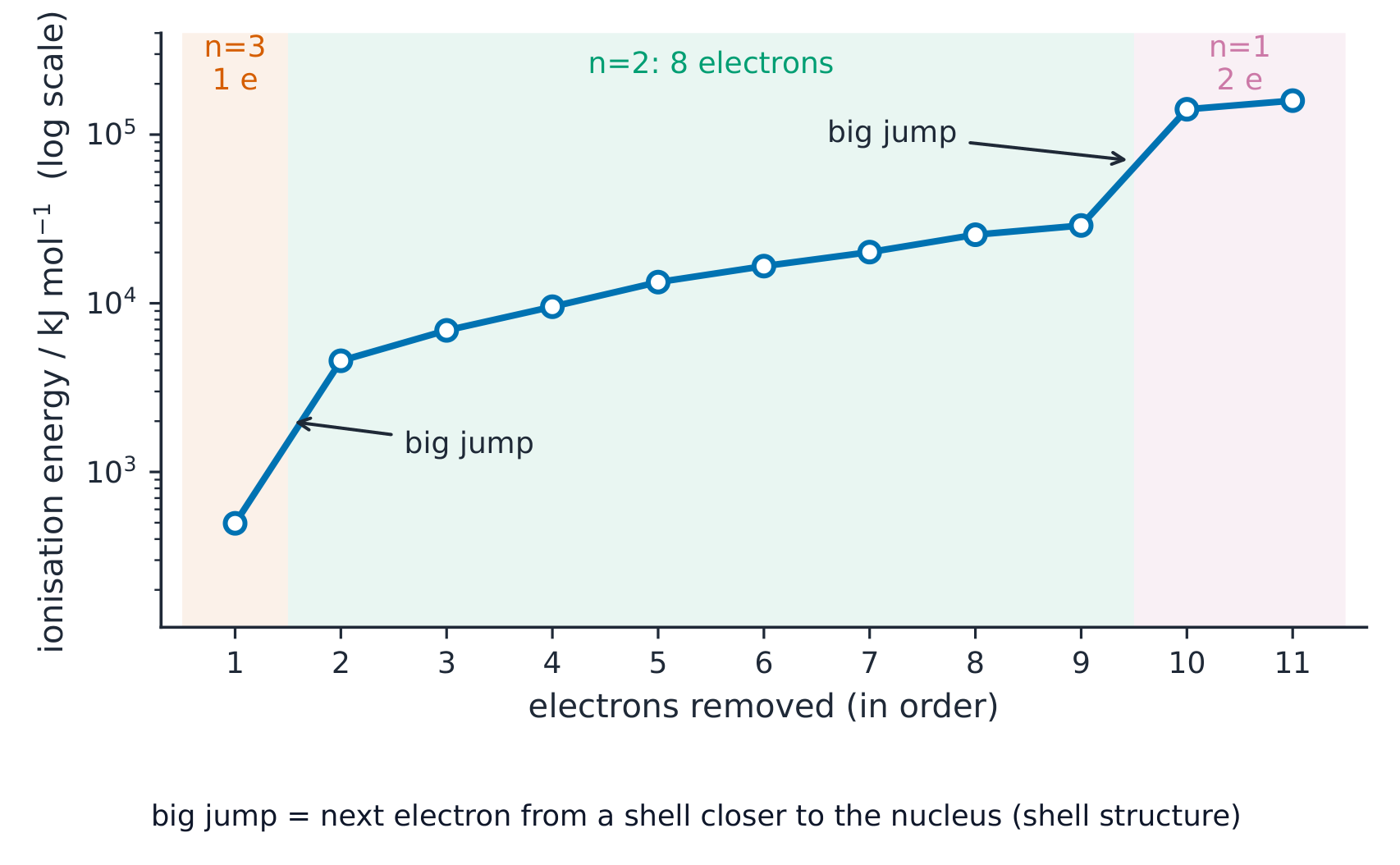



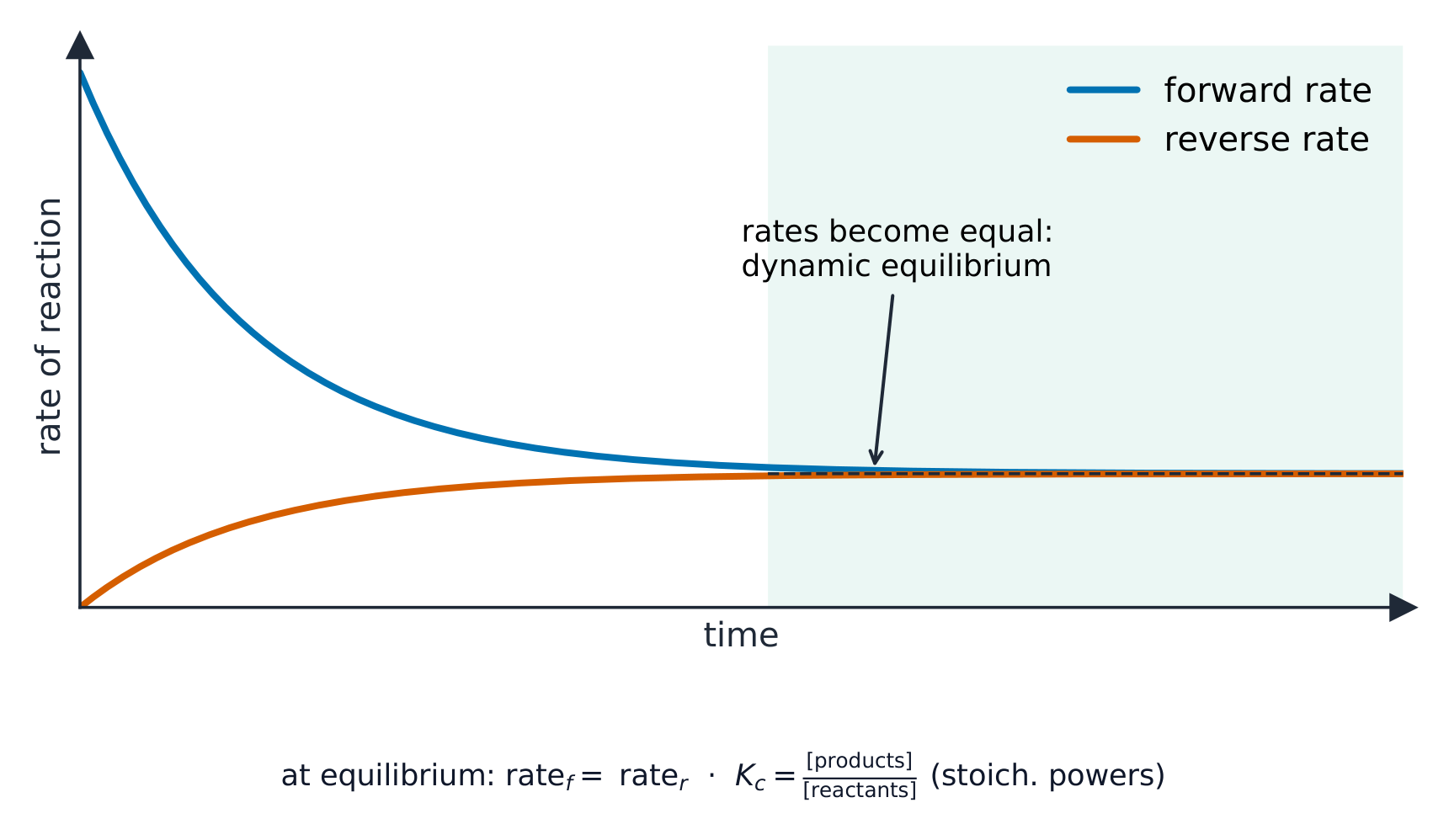


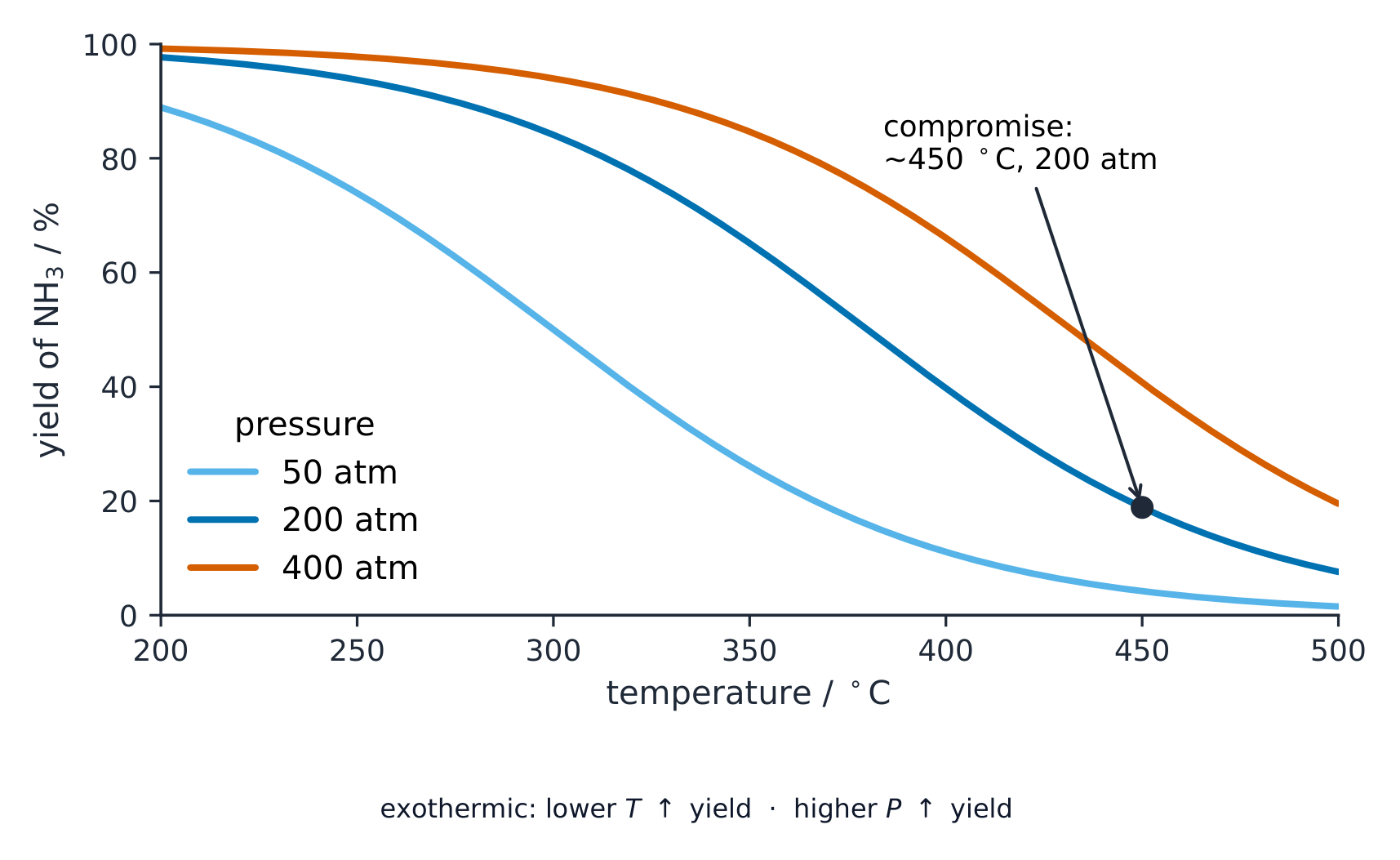


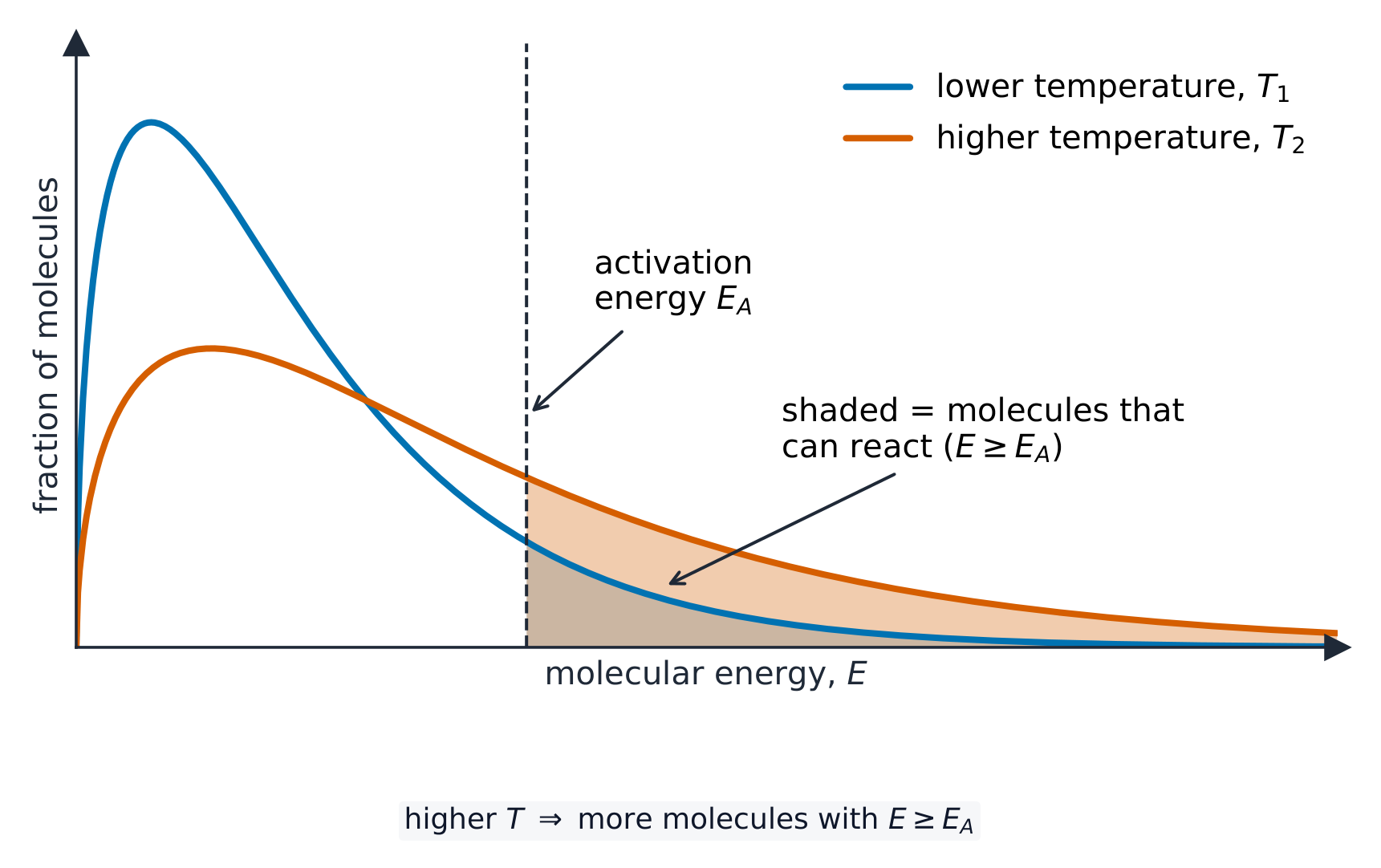

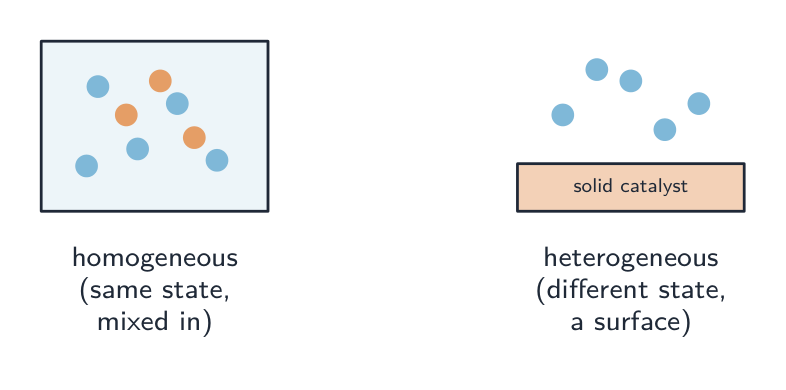


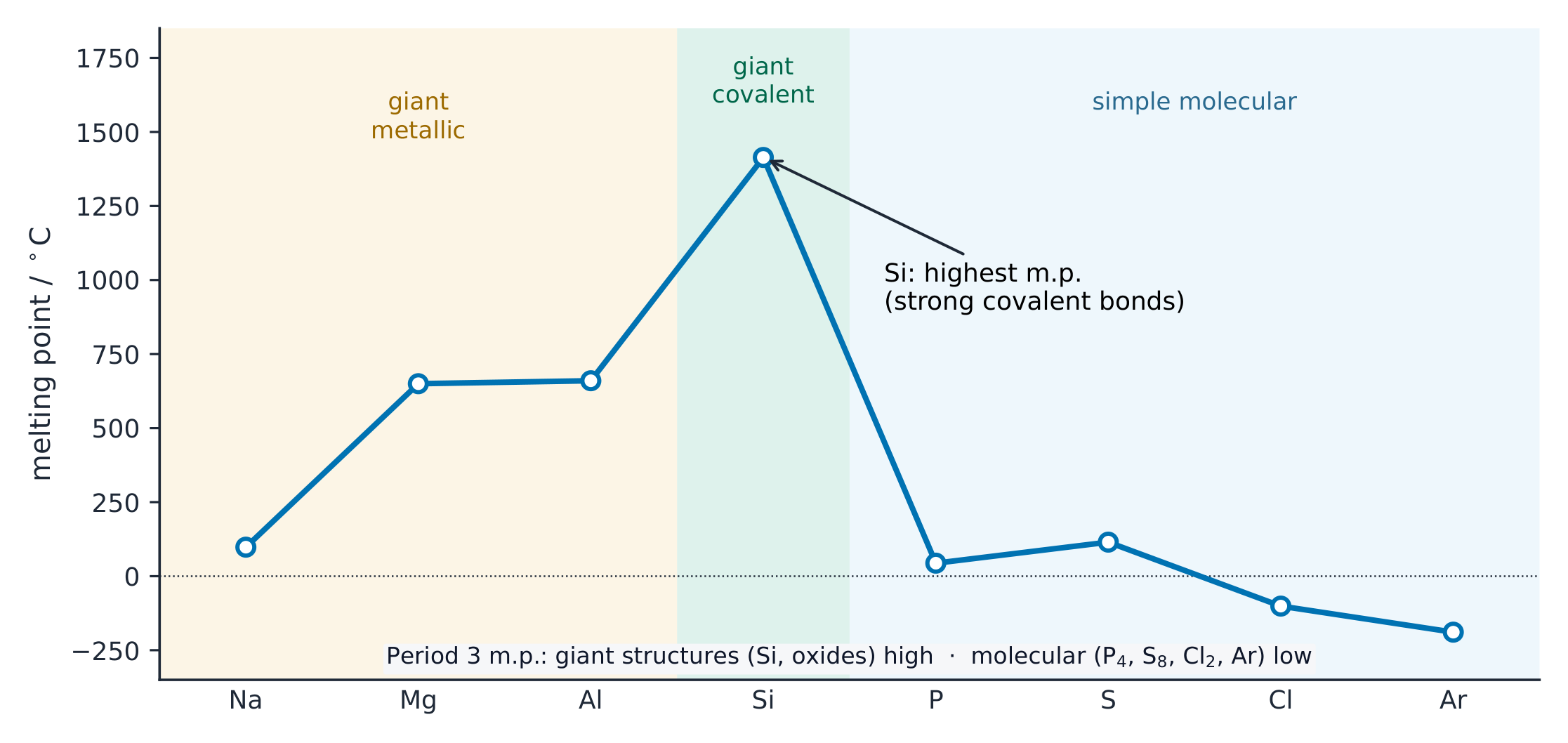


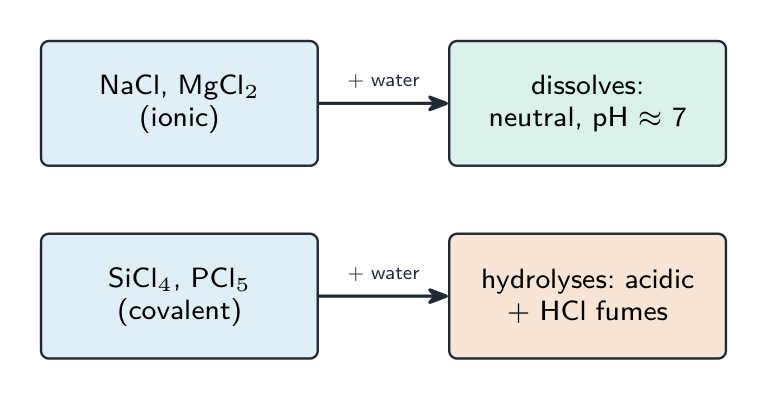


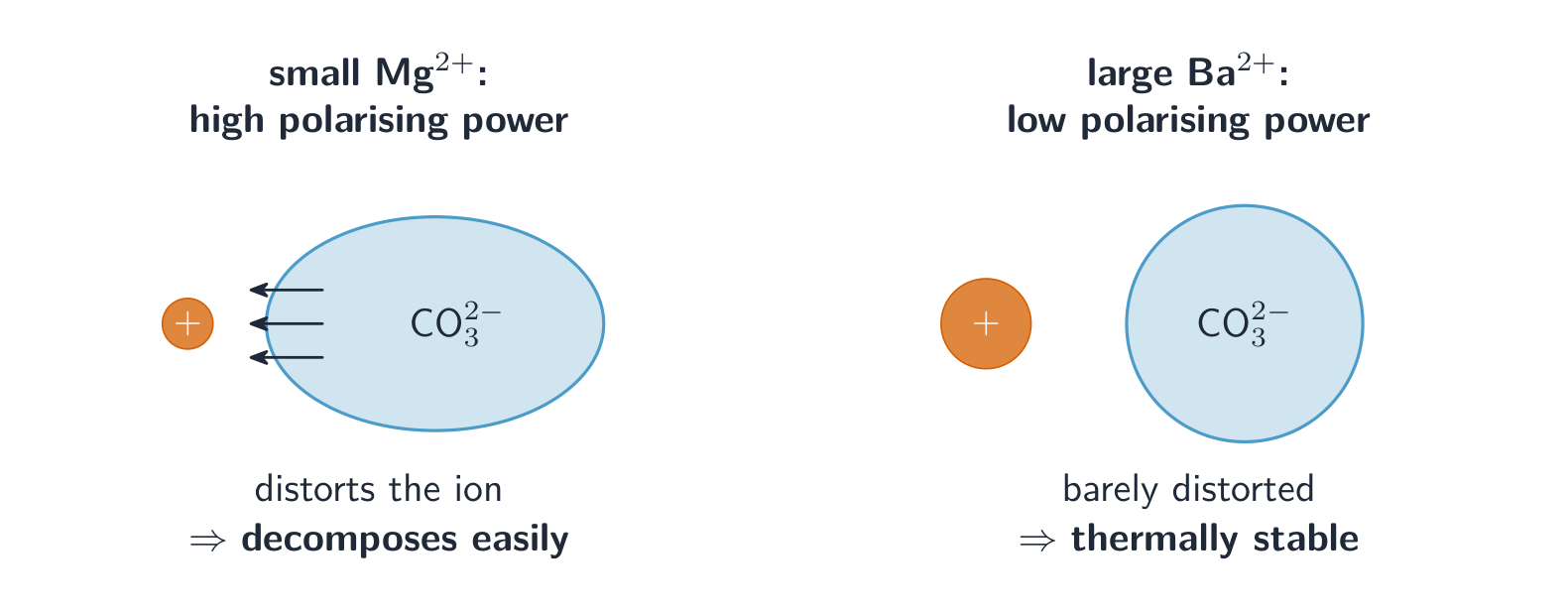
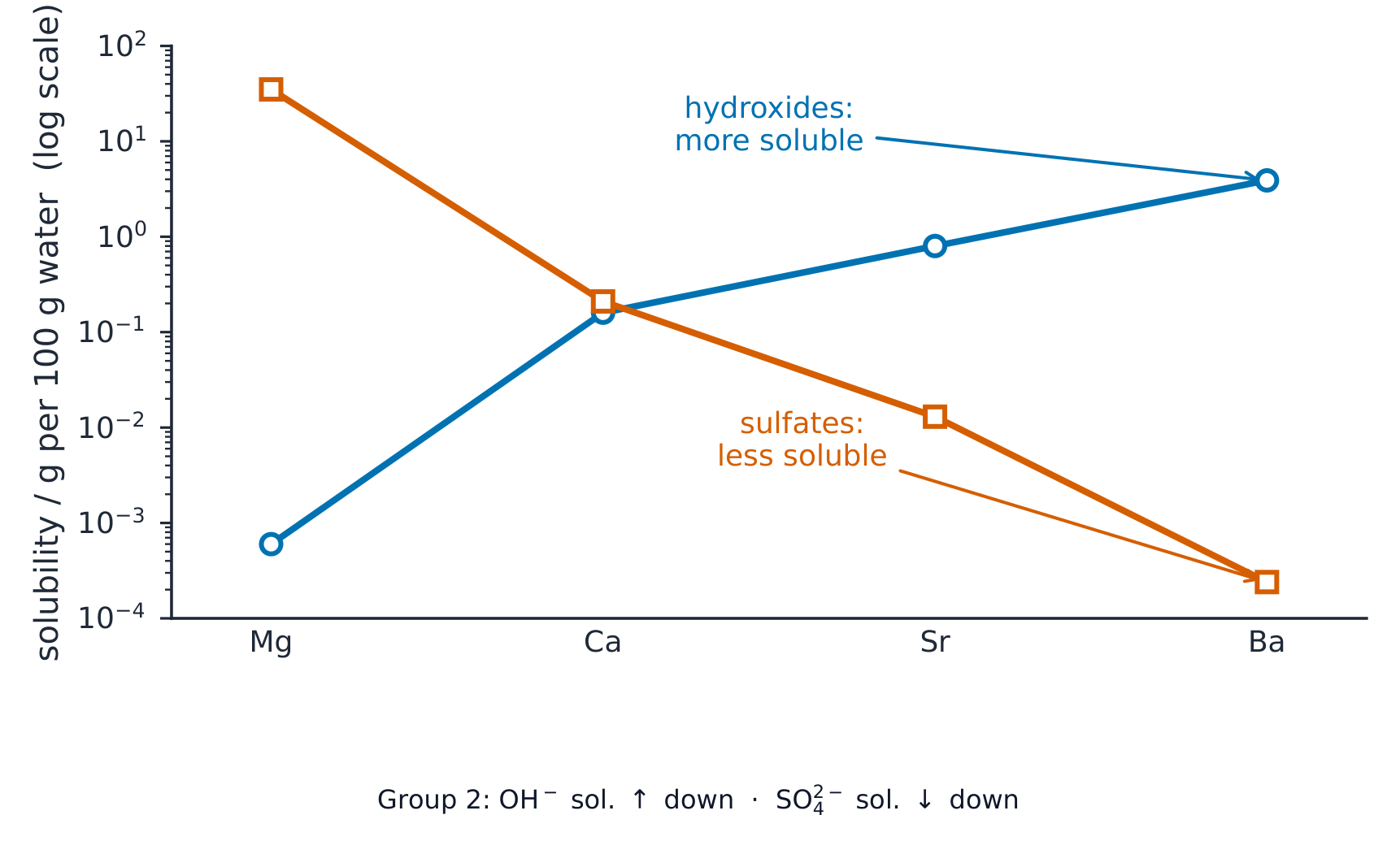




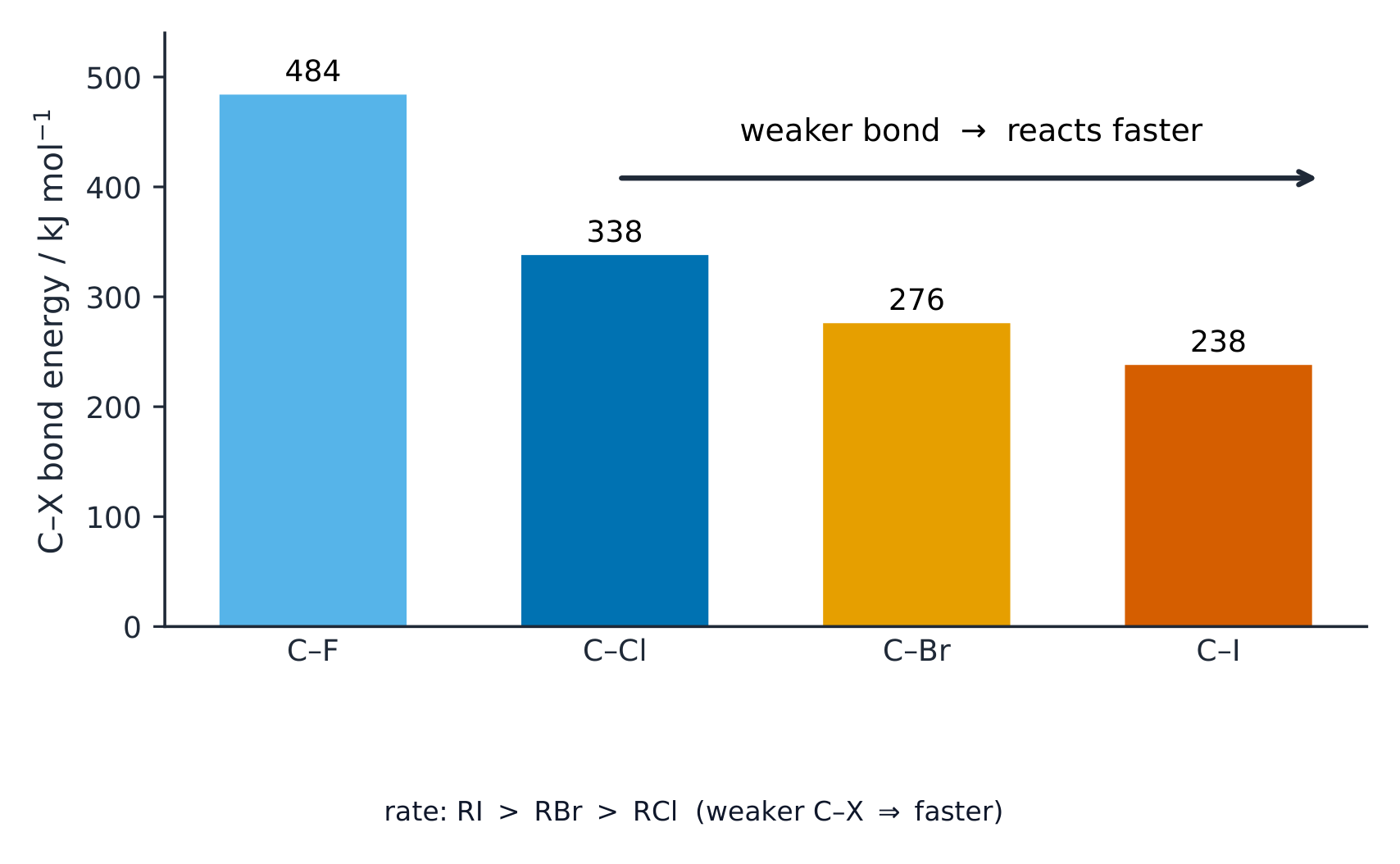



 *كلاهما يحتوي على مجموعة C=O الكربونيل: في الألدهيد تكون في نهاية السلسلة (–CHO)، وفي الكيتون تكون في المنتصف


 *تكوين أمين أولي: يهاجم الزوج الحر للأمونيا الكربون δ+ ويدفع الهالوجين للخارج — استبدال نوويفيلي
 *النتريلات نقطة وصل مفيدة: يضيف KCN ذرة كربون لتكوين النتريل، الذي يتحلل مائياً ليعطي حمض كربوكسيلي أو يُختزل ليعطي أمين
 *اختزال النتريل يعطي أمينا؛ ترتبط الأمينات والأحماض ثنائية الكربوكسيل لتكوين بولي أميدات مثل النايلون — الألياف التي أصبحت مشهورة لأول مرة في الجوارب
 *بولي(إيثين)، وهو بوليمر إضافة شائع، يُقدم على شكل حبيبات صغيرة بحجم بضعة ملليمترات؛ يتم صهر هذه الحبيبات لاحقاً وتشكيلها في زجاجات وأكياس ومنتجات أخرى
 *إيجاد الوحدة المكررة: غيّر R=C للمونومر إلى رابطة أحادية وارسم روابط للخارج عند كل طرف؛ عكس العملية لإيجاد المونومر


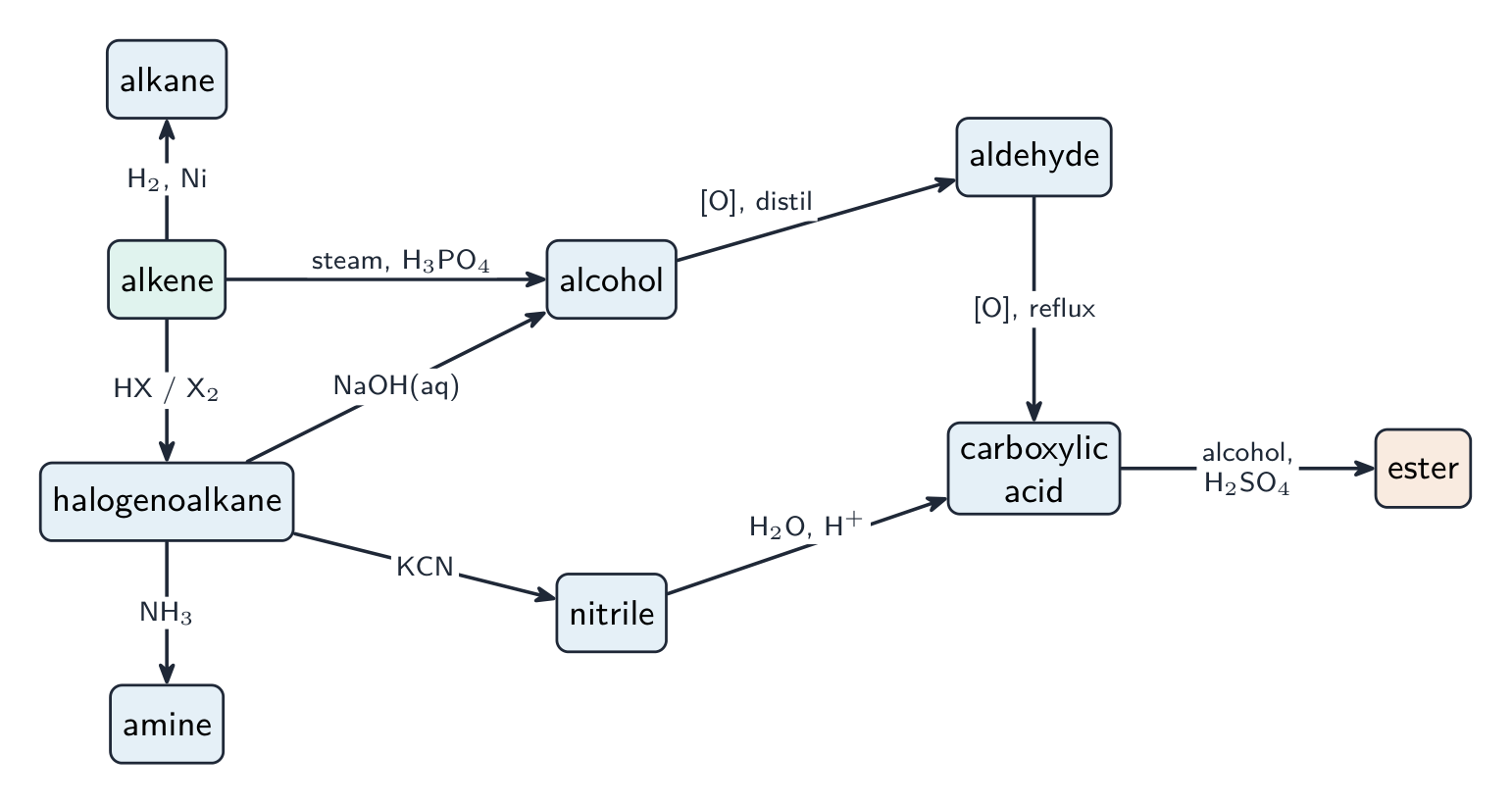
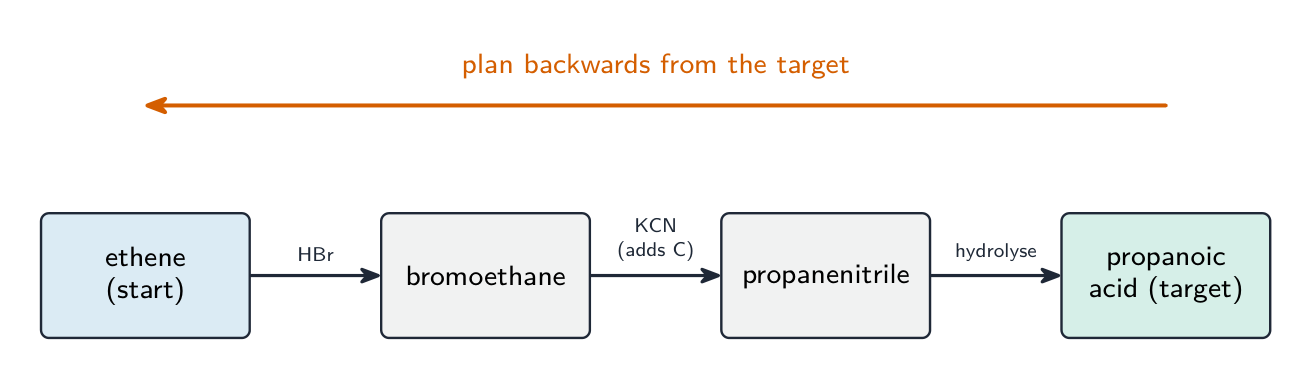
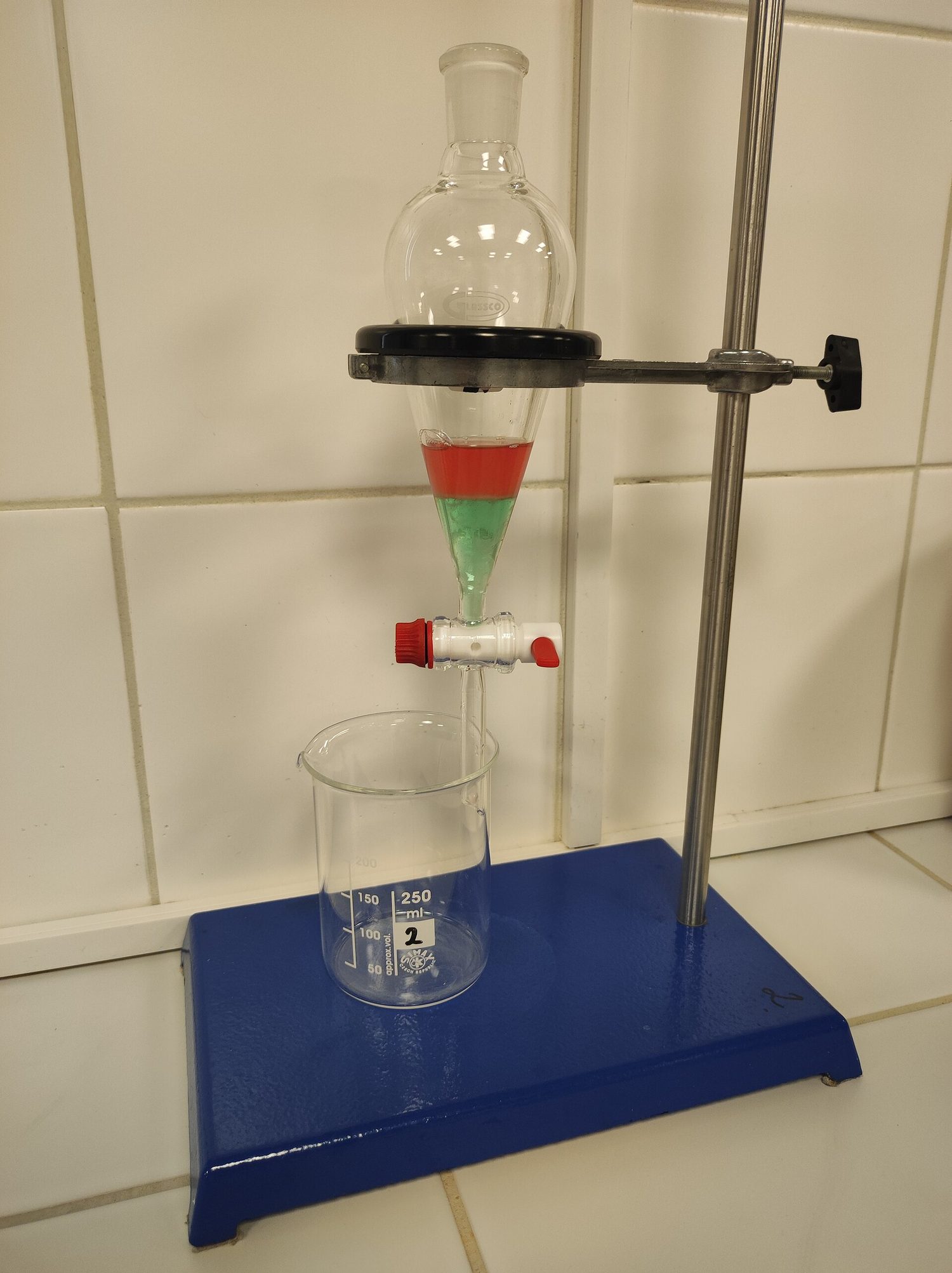


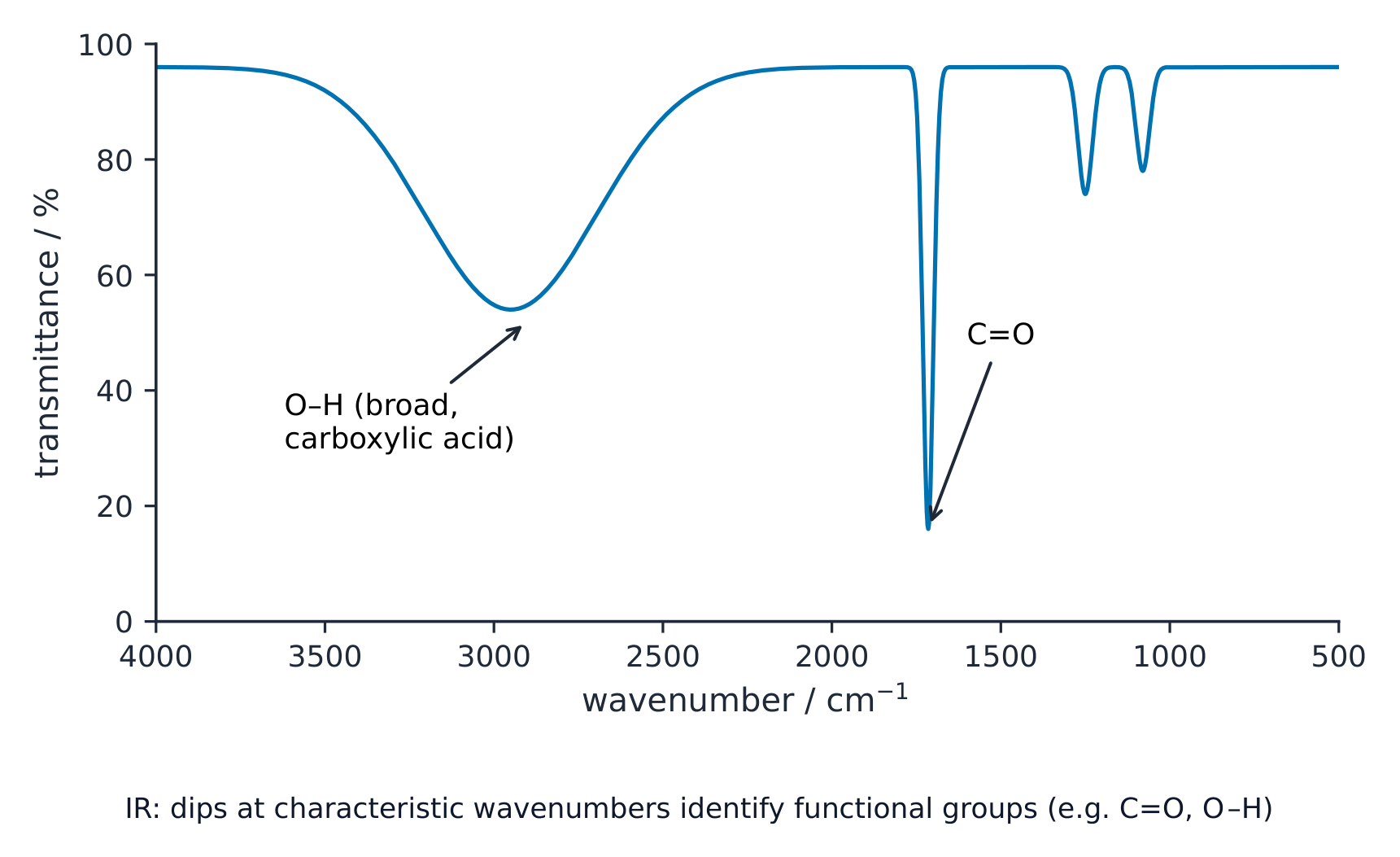

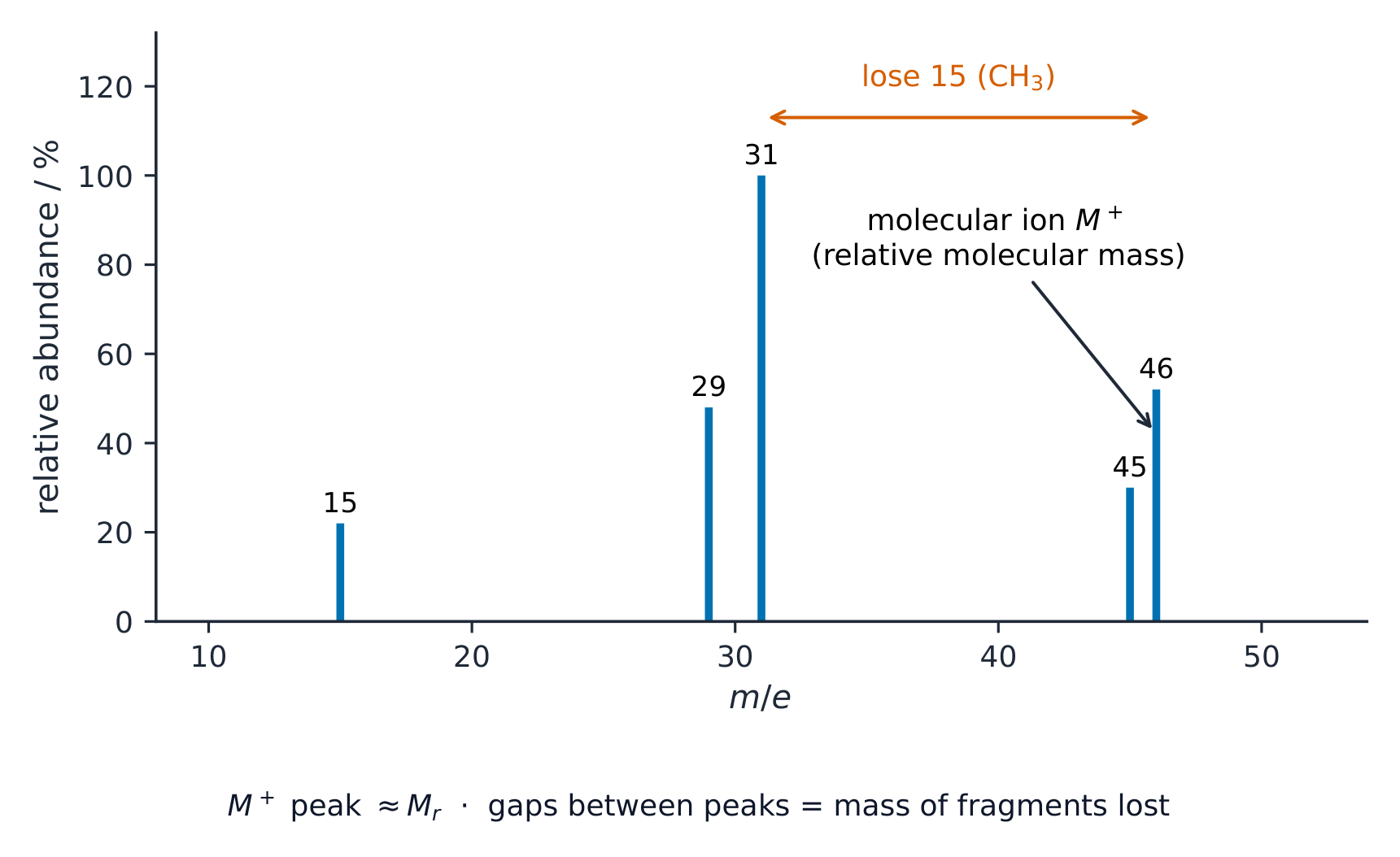
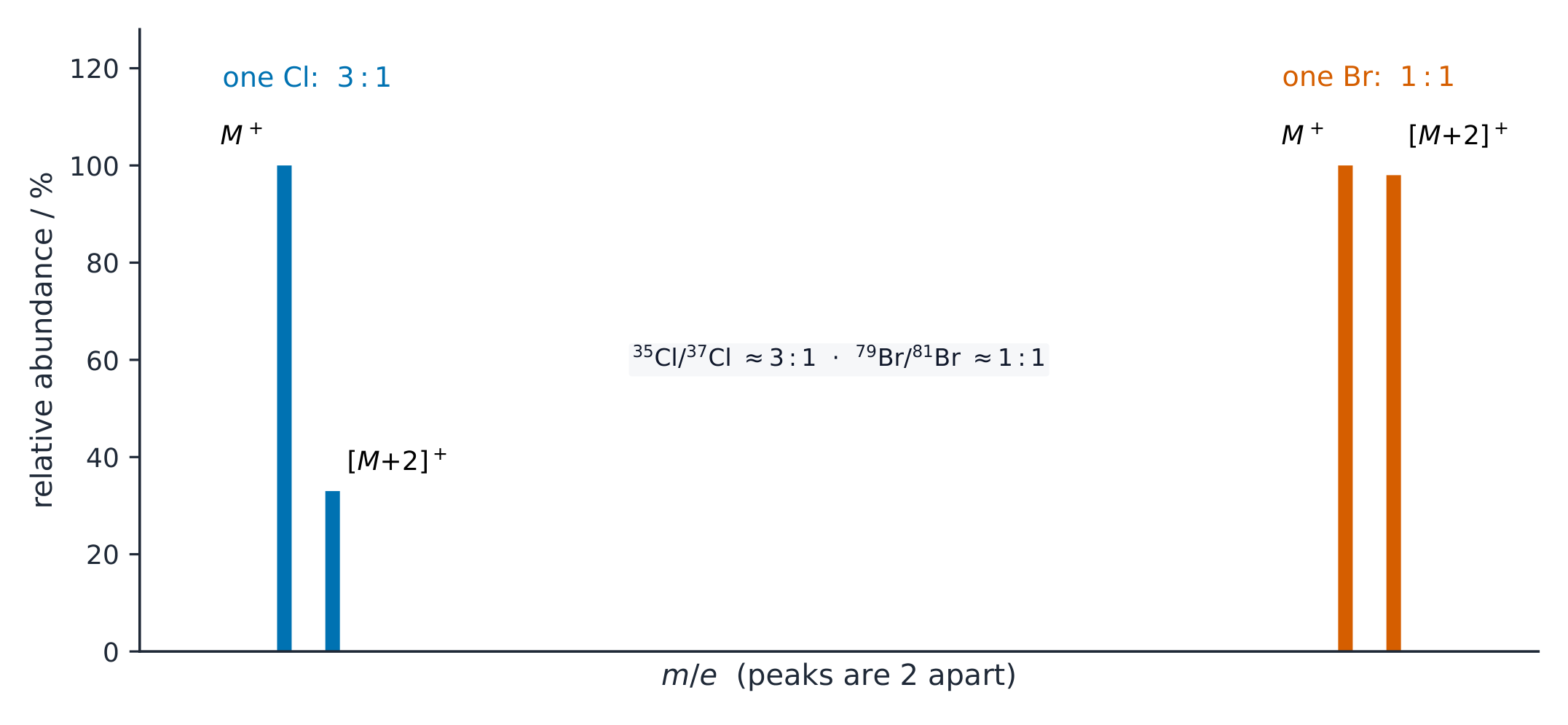


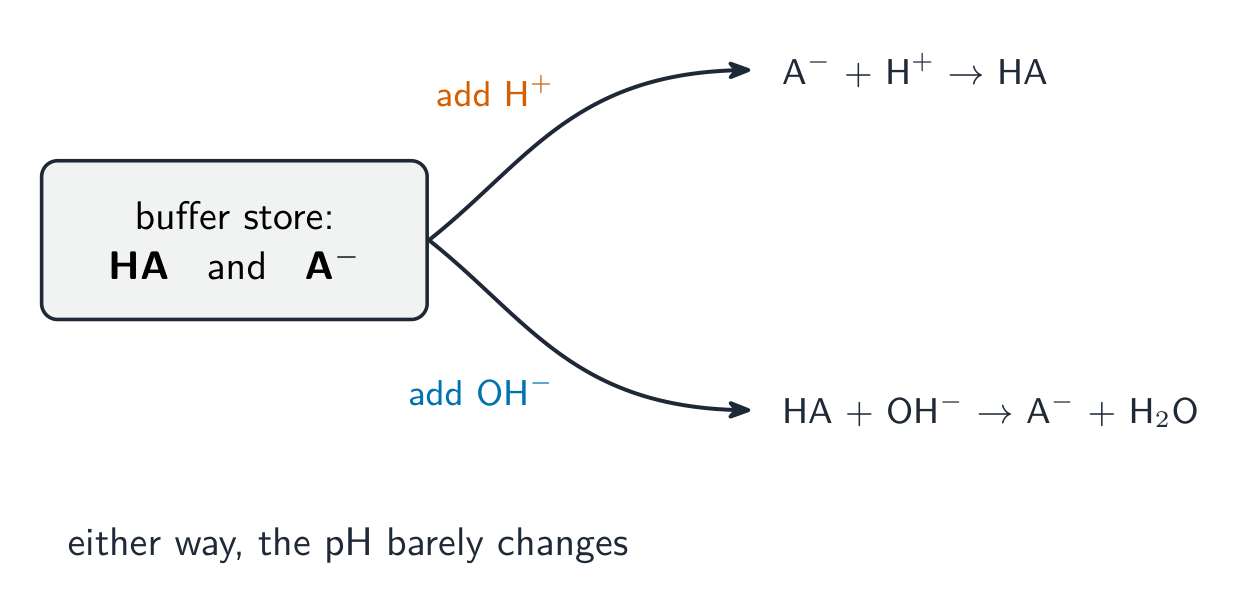


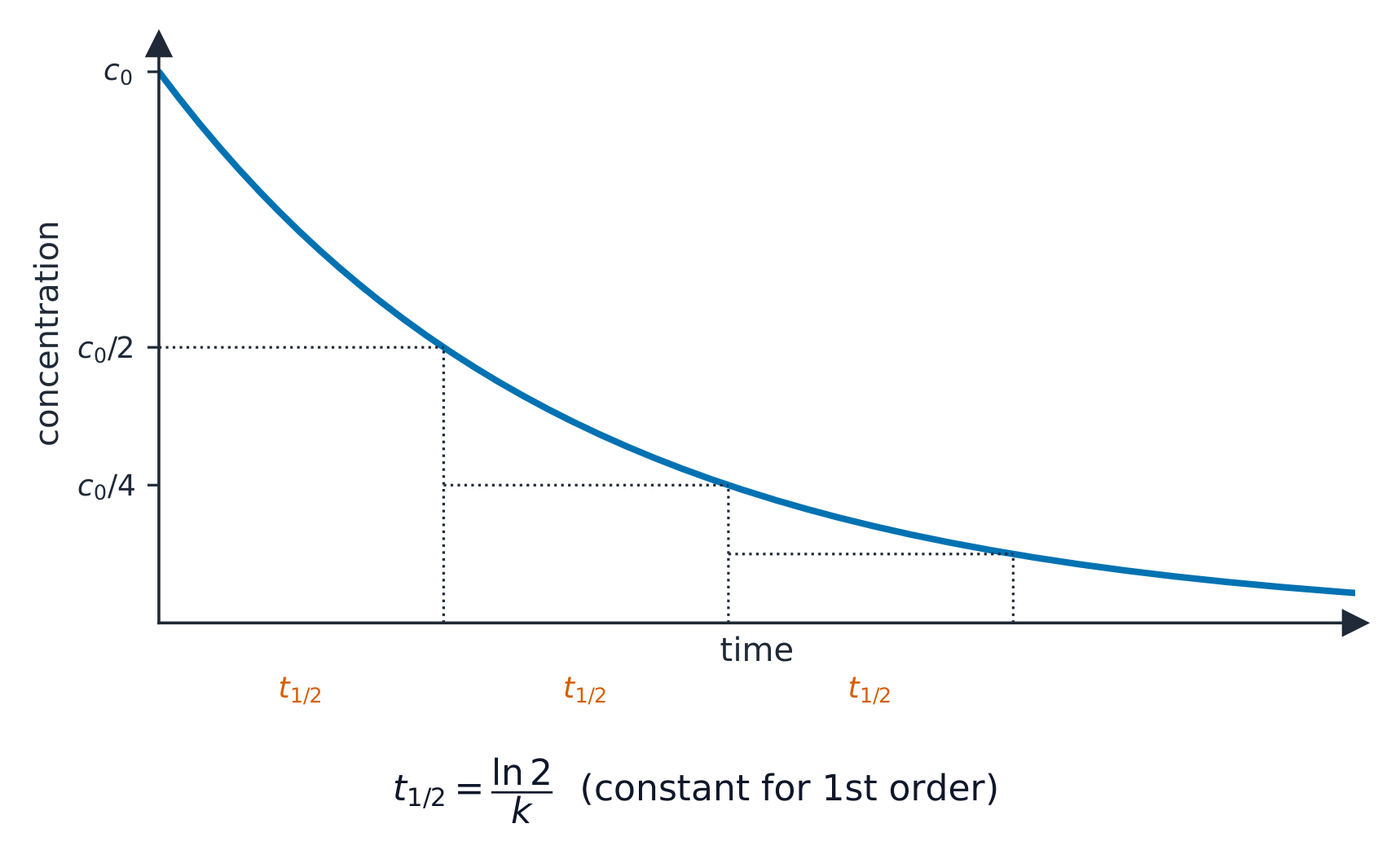
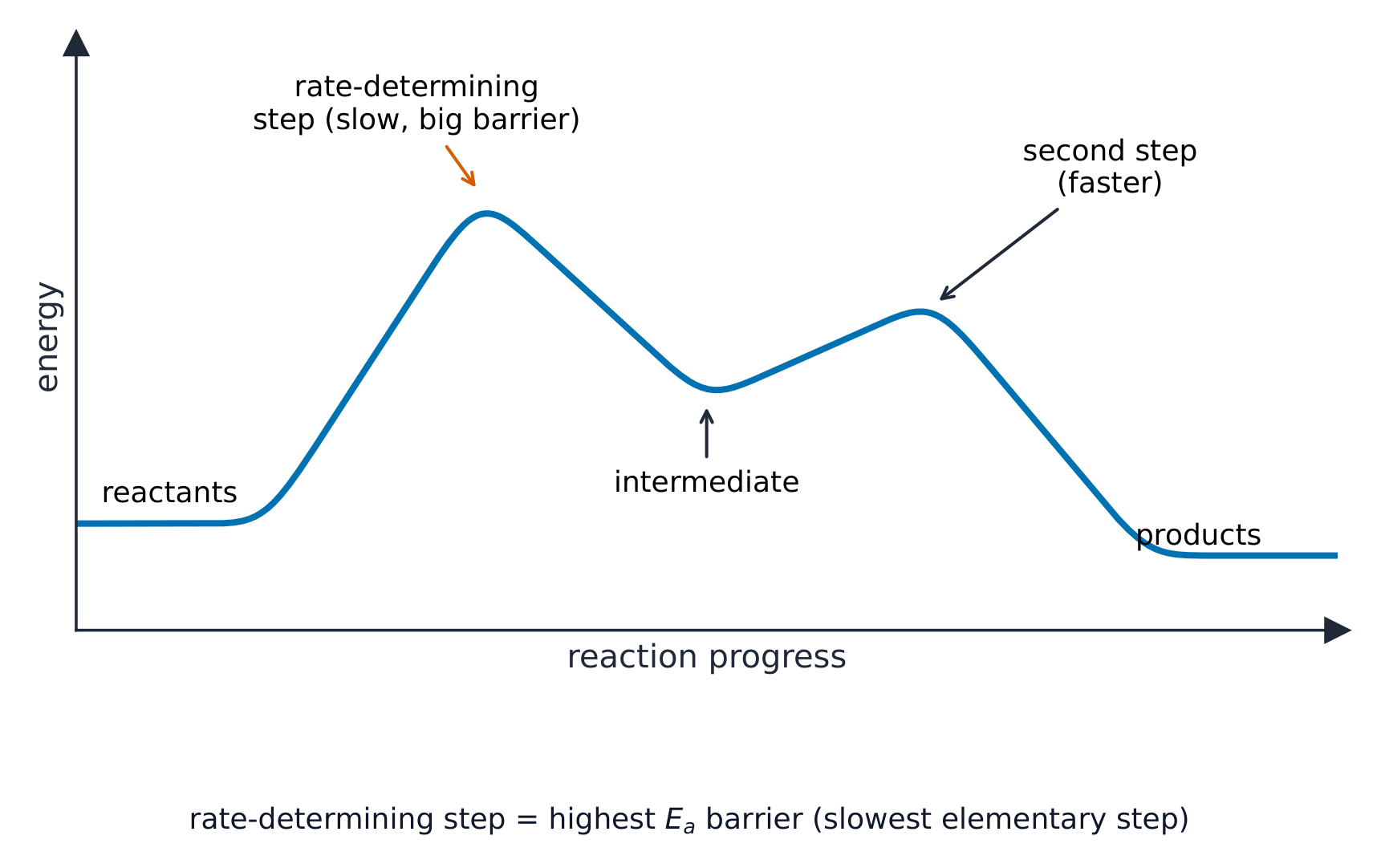




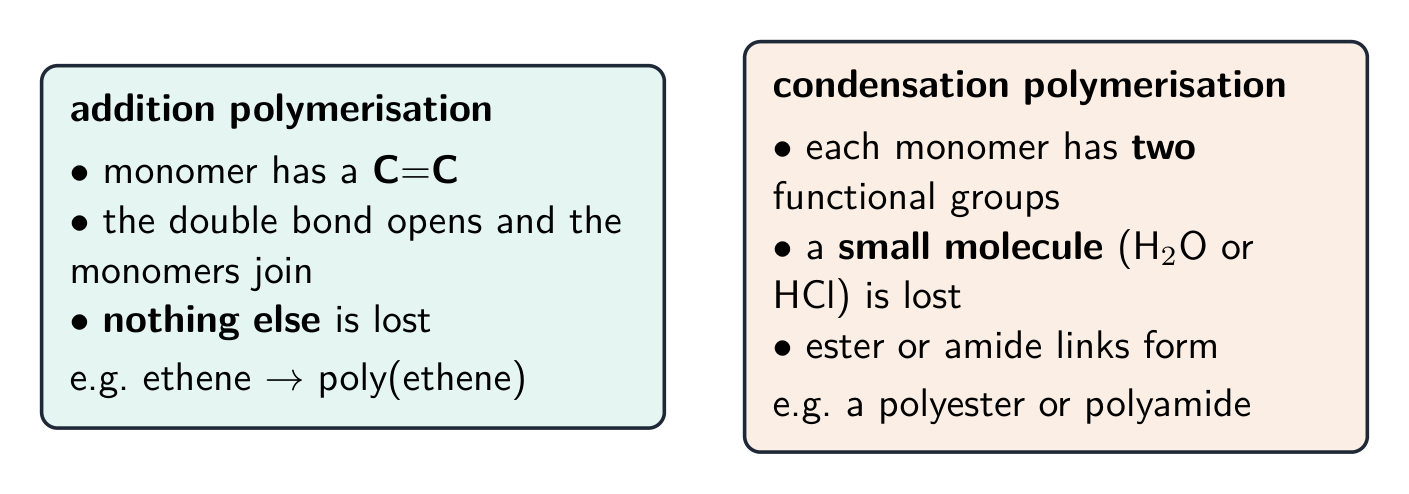


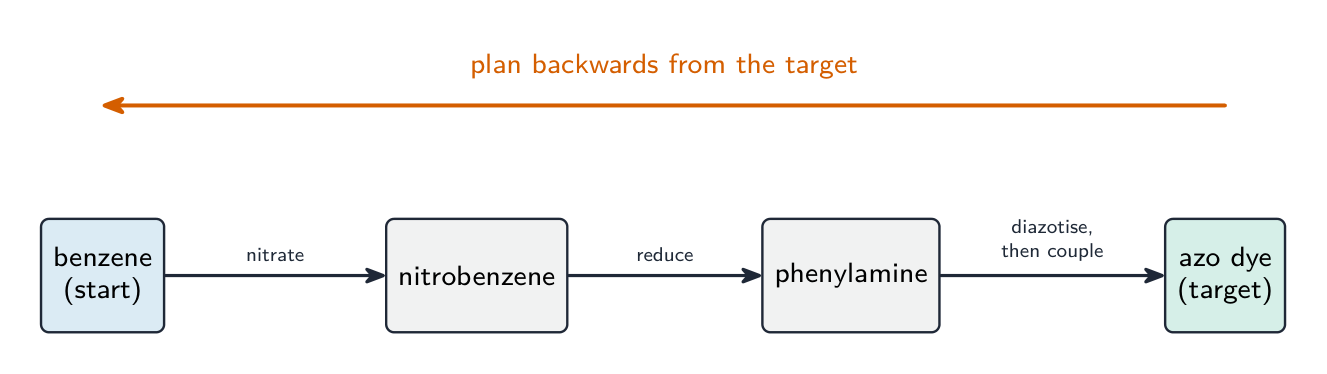

 *لوحة TLC حقيقية تحت الضوء الأشعة فوق البنفسجية: كل بقعة مضيئة هي مكون مفصول من الخليط