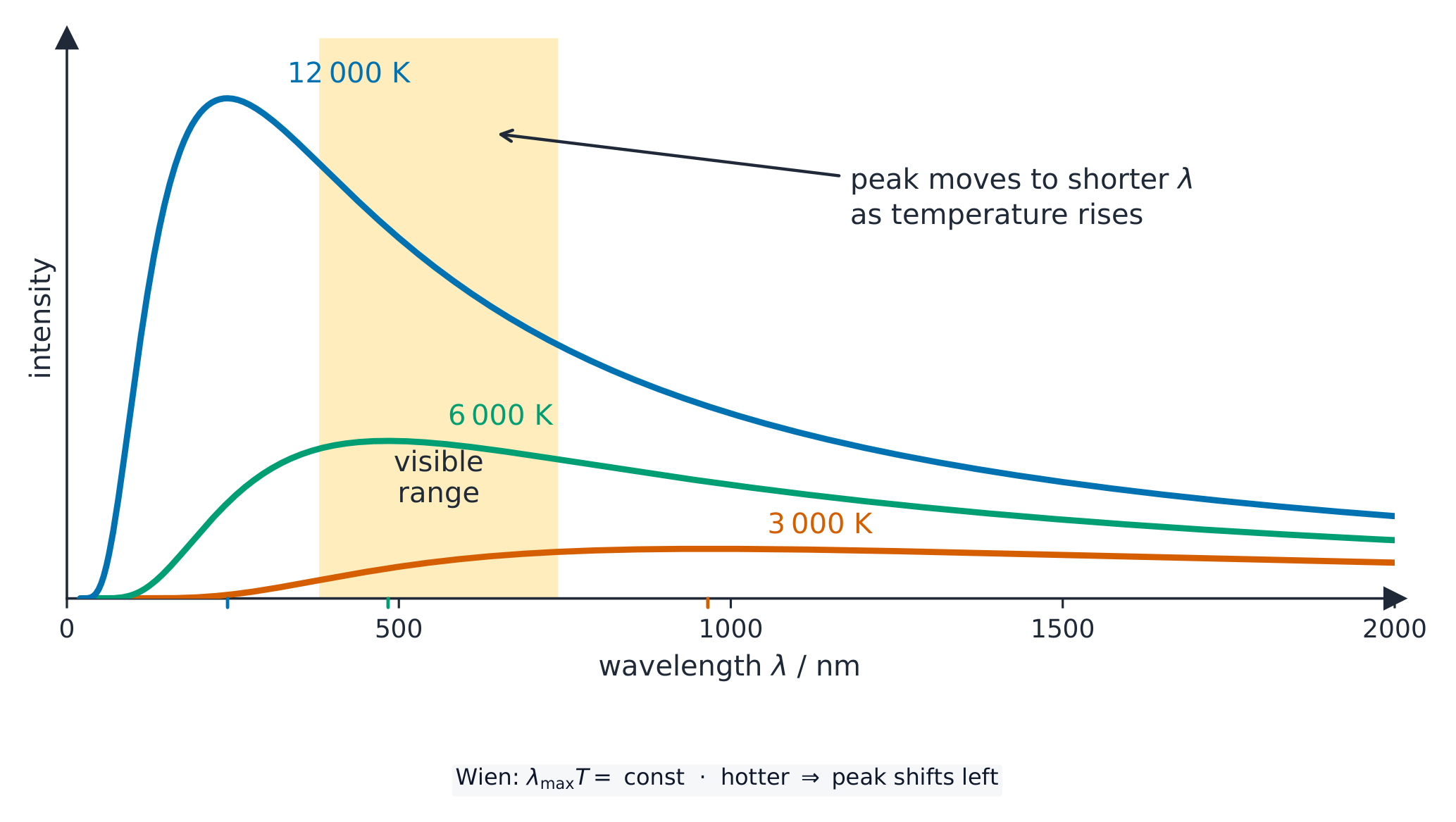
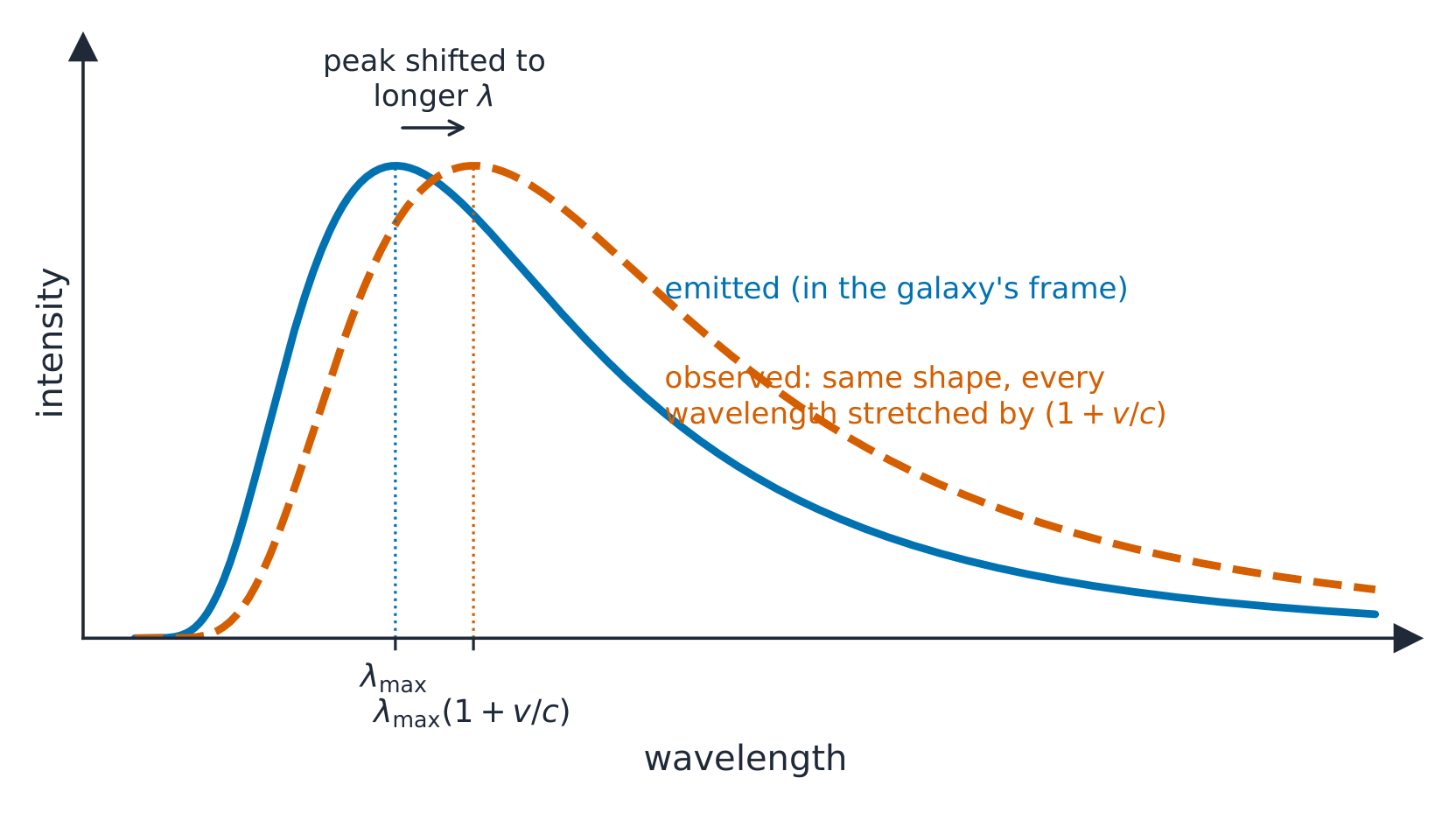
فيزياء A-Level (9702) تمتد من القياس والحركة وصولاً إلى الفيزياء الكمية. أكبر قفزة من IGCSE هي الجبر: يجب عليك إعادة ترتيب المعادلات ودمجها، ليس فقط حفظها.
عام AS: الميكانيكا، الموجات، الكهرباء، وبداية فيزياء الجسيمات. عام A2: الحركة الدائرية، المجاذل الجاذبية، الكهربائية والمغناطيسية، التذبذبات، الديناميكا الحرارية والفيزياء النووية.
اقرأ موضوعاً واحداً، ثم حل أسئلة حوله فوراً. الفيزياء لا تثبت بال قراءة. عندما تكون الإجابة خاطئة، اسأل نفسك: هل كان الفيزياء أم الجبر؟ يحتاج كلاهما إلى إصلاح مختلف.
understand that all physical quantities consist of a numerical magnitude and a unit
make reasonable estimates of physical quantities included within the syllabus
العربية
فهم أن جميع الكميات الفيزيائية تتكون من قيمة عددية ووحدة
تقدير الكميات الفيزيائية المدرجة في المنهج بشكل معقول
Source: Cambridge International syllabus · المصدر: منهج كامبريدج الدولي
A physical quantity 物理量 has two parts: a number (its magnitude 大小) and a unit 单位. The number on its own tells you nothing. You must also say what is measured and in which unit.
Example: "the length is 1.5" is not complete. "The length is 1.5 m" is a physical quantity.
Making estimates
You should be able to estimate 估算 the size of the physical quantities in this syllabus. Paper 1 usually opens with a question like this. Learn these rough values:
mass 质量 of an adult human: $\sim 70\ \text{kg}$; of a car: $\sim 1000\ \text{kg}$; of an apple: $\sim 0.1\ \text{kg}$
weight 重力 of an adult human: $\sim 700\ \text{N}$; of an apple: $\sim 1\ \text{N}$
height of an adult human: $\sim 1.7\ \text{m}$; height of a room: $\sim 3\ \text{m}$
walking speed: $\sim 1.5\ \text{m s}^{-1}$; a car on a fast road: $\sim 30\ \text{m s}^{-1}$
speed of sound in air: $\sim 340\ \text{m s}^{-1}$; speed of light in a vacuum 真空: $3.0 \times 10^{8}\ \text{m s}^{-1}$
acceleration 加速度 of free fall 自由落体: $g \approx 9.81\ \text{m s}^{-2}$
density 密度 of water: $1000\ \text{kg m}^{-3}$; of air: $\sim 1.2\ \text{kg m}^{-3}$; of steel: $\sim 8000\ \text{kg m}^{-3}$
power of a kettle: $\sim 2\ \text{kW}$; of a person climbing stairs: $\sim 300\ \text{W}$
wavelength of visible light: $\sim 5 \times 10^{-7}\ \text{m}$; diameter of an atom: $\sim 10^{-10}\ \text{m}$; of a nucleus: $\sim 10^{-15}\ \text{m}$
A good estimate has the right order of magnitude 数量级 (the right power of ten). For a human, 70 kg is a good guess; 7 kg is not.
To estimate a quantity that is not in the list, build it from ones that are. The kinetic energy of a moving car is $\tfrac{1}{2}mv^{2} \approx \tfrac{1}{2} \times 1000 \times 30^{2} \approx 5 \times 10^{5}\ \text{J}$. The pressure under a standing person is $700\ \text{N} / 0.02\ \text{m}^{2} \approx 4 \times 10^{4}\ \text{Pa}$. Always check that the power of ten looks sensible before you move on.
recall the following SI base quantities and their units: mass (kg), length (m), time (s), current (A), temperature (K)
express derived units as products or quotients of the SI base units and use the derived units for quantities listed in this syllabus as appropriate
use SI base units to check the homogeneity of physical equations
recall and use the following prefixes and their symbols to indicate decimal submultiples or multiples of both base and derived units: pico (p), nano (n), micro (\mu), milli (m), centi (c), deci (d), kilo (k), mega (M), giga (G), tera (T)
العربية
استرجاع الكميات الأساسية التالية لوحدات SI ووحدها: الكتلة (kg)، الطول (m)، الزمن (s)، شدة التيار (A)، درجة الحرارة (K)
التعبير عن الوحدات المشتقة كحاصل ضرب أو قسمة لوحدات SI الأساسية، واستخدام الوحدات المشتقة للكميات المدرجة في هذا المنهج حسبما يناسب
استخدام وحدات SI الأساسية للتحقق من تجانس المعادلات الفيزيائية
استرجاع الرموز prefixes التالية واستخدامها للإشارة إلى الكسور العشرية أو المضاعفات لكل من الوحدات الأساسية والمشتقة: بيكو (p)، نانو (n)، ميكرو (\mu)، ملي (m)، سنتي (c)، ديسي (d)، كيلو (k)، ميجا (M)، غيغا (G)، تيرا (T)
Source: Cambridge International syllabus · المصدر: منهج كامبريدج الدولي
Base units
The SI system has seven base quantities 基本量; five of them are used in this topic. You must know these five and their units:
mass — kilogram, $\text{kg}$
length 长度 — metre, $\text{m}$
time — second, $\text{s}$
current 电流 — ampere 安培, $\text{A}$
temperature 温度 — kelvin 开尔文, $\text{K}$
Every other unit in this syllabus is built from these five.
Derived units
A derived unit 导出单位 is made by multiplying or dividing base units. You should be able to write any quantity in this syllabus in base units.
Build a derived unit from the equation that defines it:
speed 速率 = distance / time, so its unit is $\text{m s}^{-1}$
acceleration = change in velocity 速度 / time, so its unit is $\text{m s}^{-2}$
force 力 = mass × acceleration, so its unit is $\text{kg m s}^{-2}$. The newton 牛顿 is $1\ \text{N} = 1\ \text{kg m s}^{-2}$.
work 功 and energy 能量 = force × distance, so the unit is $\text{kg m}^{2}\ \text{s}^{-2}$. The joule 焦耳 is $1\ \text{J} = 1\ \text{kg m}^{2}\ \text{s}^{-2}$.
power 功率 = energy / time, so the unit is $\text{kg m}^{2}\ \text{s}^{-3}$. The watt 瓦特 is $1\ \text{W} = 1\ \text{kg m}^{2}\ \text{s}^{-3}$.
pressure 压强 and stress 应力 = force / area, so the unit is $\text{kg m}^{-1}\ \text{s}^{-2}$. The pascal 帕斯卡 is $1\ \text{Pa} = 1\ \text{kg m}^{-1}\ \text{s}^{-2}$.
When a question asks for the SI base units of a quantity, replace each named unit with its base units, then simplify. Example: the SI base units of the watt are $\text{kg m}^{2}\ \text{s}^{-3}$.
Checking that the units match
An equation is homogeneous 量纲一致 when both sides have the same base units. In plain words: the units on both sides match.
Write each side in base units and compare. Take the equation $v^{2} = u^{2} + 2as$:
left side: $(\text{m s}^{-1})^{2} = \text{m}^{2}\ \text{s}^{-2}$
right side, first term: $(\text{m s}^{-1})^{2} = \text{m}^{2}\ \text{s}^{-2}$
right side, second term: $\text{m s}^{-2} \cdot \text{m} = \text{m}^{2}\ \text{s}^{-2}$
Both sides give $\text{m}^{2}\ \text{s}^{-2}$, so the units match.
Be careful: matching units do not prove the whole equation is correct. It could still have a wrong number, or a missing factor of 2. But if the units do not match, the equation is wrong for sure.
Worked example. The drag force on a falling ball is given by $F = kv^{2}$, where $v$ is the speed. Find the SI base units of the constant $k$.
Rearrange: $k = F / v^{2}$. In base units, $F$ is $\text{kg m s}^{-2}$ and $v^{2}$ is $\text{m}^{2}\ \text{s}^{-2}$, so
$$k:\ \frac{\text{kg m s}^{-2}}{\text{m}^{2}\ \text{s}^{-2}} = \text{kg m}^{-1}.$$
A multiple-choice question often asks "which equation could be correct?". Check the base units of each option; only a homogeneous equation can be correct. A pure number (like 2, $\pi$ or $\tfrac{1}{2}$) has no unit, so it never changes the check.
Prefixes
A prefix 词头 is a letter put in front of a unit to make it bigger or smaller by powers of ten. You must know these:
The SI prefixes climb in steps of a thousand, from pico to giga
Prefix
Symbol
Factor
tera
T
$10^{12}$
giga
G
$10^{9}$
mega
M
$10^{6}$
kilo
k
$10^{3}$
deci
d
$10^{-1}$
centi
c
$10^{-2}$
milli
m
$10^{-3}$
micro
$\mu$
$10^{-6}$
nano
n
$10^{-9}$
pico
p
$10^{-12}$
To change a prefixed unit into base units, replace the prefix with its factor, then simplify. Example: change $0.25\ \text{kN mm}^{-2}$ into $\text{N m}^{-2}$:
Take special care with squared units like $\text{mm}^{2}$: you must square the factor too.
Explore · استكشف
Base or derived? · أساسية أم مستنتجة؟
Only seven quantities are base quantities. Everything else is built from them, and its unit can be written in base units. · سبعة كميات فقط هي كميات أساسية. كل شيء آخر مُبنى عليها، ويمكن كتابة وحدتها بوحدات أساسية.
understand and explain the effects of systematic errors (including zero errors) and random errors in measurements
understand the distinction between precision and accuracy
assess the uncertainty in a derived quantity by simple addition of absolute or percentage uncertainties
العربية
فهم وتفسير تأثيرات الأخطاء النظامية (بما في ذلك أخطاء الصفر) والأخطاء العشوائية في القياسات
التمييز بين الدقة والدقة العالية
تقييم الشكوك في كمية مشتقة عن طريق الجمع البسيط للشكوك المطلقة أو النسبية
Source: Cambridge International syllabus · المصدر: منهج كامبريدج الدولي
A vernier caliper measures length precisely, with a small uncertainty.
Every measurement 测量 has some uncertainty 不确定度 — we are never fully sure of the value. A good experimenter knows where the uncertainty comes from, makes a fair estimate of it, and carries it through to the final answer.
The main parts of a real micrometer screw gauge, which measures to the nearest 0.01 mmReading a micrometer: add the main scale reading to the thimble readingReading a real micrometer: read the mm and half-mm on the sleeve, then add the thimble scaleVernier calipers measure to the nearest 0.1 mm — the sliding scale gives the extra digitReading a vernier caliper: whole millimetres from the main scale, plus the tenths from the vernier line that lines up
Systematic and random errors
A systematic error 系统误差 changes every reading by the same amount, in the same direction. You cannot find it by repeating the measurement. Common causes:
a zero error 零点误差 (the scale does not read zero when the true value is zero)
a calibration 校准 error (the scale itself is wrong)
parallax 视差 (your eye is always to one side of the scale)
An ammeter with a zero error: the needle reads below zero before any current flowsParallax error: different viewing angles give different scale readings
A systematic error makes the accuracy 准确度 worse, but it does not change the precision 精密度.
A random error 随机误差 makes readings jump above and below the true value, with no pattern. Causes include how carefully you read the scale, changing conditions, and the smallest step the instrument 仪器 can show. If you repeat the measurement many times and take the mean 平均值 (the average), random errors partly cancel out.
A random error makes the precision worse. But with enough repeats, the mean can still be accurate.
On a graph the two errors look different. A systematic error moves every point by the same amount, so the line of best fit keeps its gradient but no longer passes through the origin: the intercept 截距 changes. Random errors scatter the points above and below the line; a best-fit line drawn through the middle of the scatter still gives a reliable gradient.
A systematic error shifts the whole line, so the intercept moves; random errors scatter the points about the line
Error
How to reduce it
systematic
check for a zero error and subtract it; calibrate the instrument against a known standard; read the scale from directly in front
random
repeat the reading and take the mean; use an instrument with smaller divisions; time many oscillations instead of one
Precision and accuracy
Precision is how close repeated readings are to each other. Precise readings are grouped very close together.
Accuracy is how close a reading (or the mean of several readings) is to the true value.
Precision: how narrow the distribution is around the true value T
A set of readings can be:
precise and accurate — close together and near the true value
precise but not accurate — close together, but away from the true value (a systematic error)
accurate but not precise — spread out, but the mean is near the true value
neither — spread out and away from the true value
Accuracy: whether the peak of the distribution is centred on the true value T
When a question gives a table of repeated readings, look at the spread (precision) and the mean (accuracy) separately.
Estimating the uncertainty in a reading
Before you combine uncertainties, you need a sensible uncertainty for each raw reading:
A single reading on an analogue scale: half the smallest division 分度 (a metre rule reads to $1\ \text{mm}$, so one reading is $\pm 0.5\ \text{mm}$). A length needs two readings, one at each end, so its uncertainty is $\pm 1\ \text{mm}$.
A digital meter: $\pm 1$ in the last digit shown (a stopwatch showing $2.47\ \text{s}$ is $\pm 0.01\ \text{s}$).
A hand-timed measurement: your reaction time 反应时间 matters more than the display. Allow about $\pm 0.1$ to $0.2\ \text{s}$, and time many oscillations instead of one, so the same uncertainty is shared between all of them.
Repeated readings: the uncertainty is half the range 极差的一半. Three timings of $2.42$, $2.48$ and $2.45\ \text{s}$ have a mean of $2.45\ \text{s}$ and a range of $0.06\ \text{s}$, so $t = (2.45 \pm 0.03)\ \text{s}$.
Be honest. If the edge of a shadow is hard to see, the uncertainty in its position is several millimetres, however fine the scale. Examiners do not accept "the smallest division" as the uncertainty of a difficult reading.
Uncertainty in a derived quantity
A measurement is often written as $x \pm \Delta x$. Here $\Delta x$ is the absolute uncertainty 绝对不确定度. The percentage uncertainty 百分比不确定度 is
$$\text{percentage uncertainty in } x = \frac{\Delta x}{|x|} \times 100\%.$$
A derived quantity 导出量 is one you calculate from measured values. Its uncertainty is found by simple rules:
Adding or subtracting — add the absolute uncertainties. If $y = a + b$ or $y = a - b$, then $\Delta y = \Delta a + \Delta b$.
Multiplying or dividing — add the percentage uncertainties. If $y = \dfrac{a \cdot b}{c}$, then
Powers — multiply the percentage uncertainty by the power. If $y = a^{n}$, then $\dfrac{\Delta y}{|y|} = |n| \cdot \dfrac{\Delta a}{|a|}$.
Worked example. A ball's diameter 直径 is measured as $d = (5.26 \pm 0.02)\ \text{cm}$. The volume 体积 of a sphere is $V = \tfrac{4}{3}\pi r^{3} = \tfrac{4}{3}\pi (d/2)^{3}$, so $V \propto d^{3}$ ($V$ depends on $d$ cubed).
Because $V \propto d^{3}$, the percentage uncertainty in $V$ is three times this, about $1.14\%$. The volume is $\tfrac{4}{3}\pi(2.63)^{3} \approx 76.2\ \text{cm}^{3}$. So the absolute uncertainty is $0.0114 \times 76.2 \approx 0.87\ \text{cm}^{3}$. The final answer is $V = (76.2 \pm 0.9)\ \text{cm}^{3}$.
Do two values agree? Practical questions often ask whether two calculated values of a constant support a suggested relationship. Do not just say "they are close". Work out the percentage difference 百分比差异 between them,
$$\text{percentage difference} = \frac{|k_{1} - k_{2}|}{\text{mean of } k_{1} \text{ and } k_{2}} \times 100\%,$$
and compare it with the percentage uncertainty in $k$ (or with the criterion the question gives, often 10%). If the difference is smaller, the two values agree within the uncertainty and the relationship is supported. If it is larger, they do not.
Significant figures
When you write a calculated quantity, give it the same number of significant figures 有效数字 as the least precise measurement you used — usually two or three in this syllabus. Too many significant figures makes the answer look more exact than it really is. Too few loses useful information.
Practical papers ask you to justify the number you chose. Name the raw readings: "$a$ is given to 2 significant figures because $L$ and $t$ were each measured to 2 significant figures." The phrase "because of the raw data" on its own does not earn the mark. In a table of results, judge each row from the least precise raw reading in that row; do not force every row to the same number of figures.
Uncertainties on a graph
Paper 5 asks you to carry uncertainties through a graph:
Plot each point with an error bar 误差棒 whose length shows the absolute uncertainty in that value.
Draw the line of best fit 最佳拟合直线 through the points, then the worst acceptable line 最差可接受直线: the steepest (or shallowest) straight line that still passes through every error bar.
The uncertainty in the gradient is the difference between the two gradients, $\Delta m = |m_{\text{best}} - m_{\text{worst}}|$. The uncertainty in the intercept is found the same way.
When you plot a logarithm, the absolute uncertainty in $\ln x$ is $\Delta x / x$ (and in $\lg x$ it is $0.434\,\Delta x / x$). Work it out for the largest and smallest values of $x$ separately.
The worst acceptable line still passes through every error bar; the gradient uncertainty is the difference between the two gradients
A percentage uncertainty in the gradient then flows into any quantity you calculate from it, using the rules above.
Explore · استكشف
Systematic or random? · نظامي أم عشوائي؟
A systematic error shifts every reading the same way and survives repetition; a random error scatters the readings and shrinks when you average. · يُزيح الخطأ المنهجي كل قراءة بنفس الطريقة ويبقى رغم التكرار؛ بينما يُشتت الخطأ العشوائي القراءات ويقل عند حساب المتوسط.
understand the difference between scalar and vector quantities and give examples of scalar and vector quantities included in the syllabus
add and subtract coplanar vectors
represent a vector as two perpendicular components
العربية
فهم الفرق بين الكميات القياسية والمتجهية وإعطاء أمثلة على الكميات المدرجة في هذا المنهج
جمع وطرح المتجهات المستوية
تمثيل متجه كمكونين متعامدين
Source: Cambridge International syllabus · المصدر: منهج كامبريدج الدولي
Resolving a force into components
A scalar 标量 has size only. A vector 矢量 has both size and direction.
Examples from the syllabus:
scalars: mass, time, temperature, energy, work, power, distance, speed, pressure, density, electric charge 电荷
vectors: displacement 位移, velocity, acceleration, force (including weight), momentum 动量
Quick test: if it makes sense to ask "in which direction?", the quantity is a vector. You cannot ask "in which direction is the temperature?", so temperature is a scalar. You can ask "in which direction is the velocity?", so velocity is a vector.
Adding and subtracting vectors
A vector is drawn as an arrow: the direction of the arrow gives the direction of the quantity, and the length of the arrow (drawn to scale) gives the magnitude.
Vectors represented as arrows drawn to scale
To add two coplanar 共面 vectors (vectors in the same flat plane), draw them tip to tail. The resultant 合矢量 goes from the tail of the first arrow to the tip of the second.
To find $\vec{X} - \vec{Y}$, add the reverse of $\vec{Y}$: $\vec{X} + (-\vec{Y})$. The reverse of $\vec{Y}$ has the same size as $\vec{Y}$ but points the opposite way.
Adding and subtracting parallel vectors
If the two vectors are at right angles (90°), the size of the resultant is
$$|\vec{R}| = \sqrt{X^{2} + Y^{2}},$$
and its direction comes from $\tan\theta = Y / X$.
Worked example. A swimmer heads north at $1.2\ \text{m s}^{-1}$ across a river that flows east at $0.5\ \text{m s}^{-1}$. Find the size and direction of the resultant velocity.
at an angle $\tan\theta = 0.5/1.2$, giving $\theta \approx 23°$ east of north.
Two perpendicular vectors add to a resultant of size $\sqrt{X^2+Y^2}$ at angle $\theta$
If two vectors have the same size $F$ with an angle $2\alpha$ between them, the resultant has size $2F\cos\alpha$ and lies along the line that cuts the angle in half.
Worked example. Two forces of $6.0\ \text{N}$ act on an object with $60°$ between them. Find the resultant.
Here $2\alpha = 60°$, so $\alpha = 30°$ and $R = 2 \times 6.0 \times \cos 30° = 10.4\ \text{N}$, along the line halfway between the two forces. Resolving gives the same answer: each force has a component $6.0\cos 30°$ along that line, and their components at right angles to it cancel.
For two vectors at any other angle, either make a scale drawing 按比例作图 of the vector triangle and measure the resultant, or resolve both vectors into perpendicular components, add the components, and recombine with $\sqrt{X^{2} + Y^{2}}$.
Worked example. A ball moving east at $5.0\ \text{m s}^{-1}$ is hit so that it moves north at $5.0\ \text{m s}^{-1}$. Find its change in velocity.
A change in velocity is a vector subtraction: $\Delta\vec{v} = \vec{v}_{\text{final}} - \vec{v}_{\text{initial}}$. Draw $5.0\ \text{m s}^{-1}$ north, then add the reverse of the initial velocity, $5.0\ \text{m s}^{-1}$ west. The two are perpendicular, so $|\Delta\vec{v}| = \sqrt{5.0^{2} + 5.0^{2}} = 7.1\ \text{m s}^{-1}$, pointing north-west. The speed did not change, but the velocity did. That is why a force must have acted on the ball (topic 3).
Splitting a vector into perpendicular parts
Any vector can be split into two perpendicular 垂直 (at right angles) components 分量. Usually these are horizontal 水平 and vertical 竖直, or along and across a surface. For a vector $\vec{v}$ at angle $\theta$ to the horizontal:
Resolving a vector into horizontal and vertical components
Choose the directions that make the problem easiest. On a slope (an inclined plane 斜面), split the weight into one part along the slope and one part at right angles to it:
where $\theta$ is the angle of the slope to the horizontal.
On a slope the weight splits into $W\sin\theta$ down the slope and $W\cos\theta$ into the slope; the angle between $W$ and the perpendicular is the slope angle $\theta$
You split a vector into components whenever you need to know how much of it acts in one direction. For example: the part of a force that acts along a slope, or the horizontal and vertical parts of a ball's velocity after it is thrown.
Explore · استكشف
Adding two vectors · جمع متجهين
resultant = a + b · القوة المحصلة = a + b
Vectors add tip to tail. The resultant runs from the start of the first arrow to the tip of the second, and its length is found from a scale drawing or by Pythagoras, never by adding the two magnitudes. · تُضاف المتجهات رأساً إلى ذيل. يمتد المحصلة من بداية السهم الأول إلى رأس السهم الثاني، ويُحسب طولها من رسم مقياس أو باستخدام نظرية فيثاغورس، ولا تُجمع أبداً المقداران.
A definition question is marked against fixed wording. Learn these exactly, and give one answer only.
Term
Definition
physical quantity
a numerical magnitude together with a unit
homogeneous equation
an equation in which every term has the same base units
systematic error
an error that shifts every reading in the same direction by the same amount; not reduced by repeating
random error
an error that scatters readings above and below the true value; reduced by repeating and averaging
zero error
the reading an instrument shows when the true value is zero
precision
how close repeated readings are to each other
accuracy
how close a reading, or the mean of several readings, is to the true value
absolute uncertainty
the range within which the true value is expected to lie, in the units of the quantity
percentage uncertainty
the absolute uncertainty divided by the value, multiplied by 100%
scalar
a quantity with magnitude only
vector
a quantity with magnitude and direction
1.4
Exam tips
Give every answer a unit, and check homogeneity — both sides of an equation must have the same base units.
Distinguish random error (reduce by repeating and averaging) from systematic error (a zero or calibration error that repeats do not remove).
Combine uncertainties: add absolute uncertainties when adding/subtracting, add percentage uncertainties when multiplying/dividing (and multiply the % by any power).
Distinguish precision (small spread) from accuracy (close to the true value).
Resolve a vector into perpendicular components ($F\cos\theta$, $F\sin\theta$); add vectors tip-to-tail or by components.
Common mistakes
Substituting 5 cm as 5, or 20 g as 20. Convert the prefix first: 0.05 m, 0.020 kg.
Giving the percentage uncertainty in $T^{2}$ as the same as in $T$. Squaring doubles it; a square root halves it.
Treating the percentage uncertainty and the absolute uncertainty as the same number.
Quoting "the smallest division" as the uncertainty of a reading that was hard to take.
Offering two answers to a definition. Commit to one.
define and use distance, displacement, speed, velocity and acceleration
use graphical methods to represent distance, displacement, speed, velocity and acceleration
determine displacement from the area under a velocity–time graph
determine velocity using the gradient of a displacement–time graph
determine acceleration using the gradient of a velocity–time graph
derive, from the definitions of velocity and acceleration, equations that represent uniformly accelerated motion in a straight line
solve problems using equations that represent uniformly accelerated motion in a straight line, including the motion of bodies falling in a uniform gravitational field without air resistance
describe an experiment to determine the acceleration of free fall using a falling object
describe and explain motion due to a uniform velocity in one direction and a uniform acceleration in a perpendicular direction
استخدم الطرق البيانية لتمثيل المسافة والإزاحة والسرعة القياسية والسرعة المتجهة والتسارع
حدد الإزاحة من خلال المساحة تحت منحنى السرعة–الزمن
حدد السرعة المتجهة باستخدام ميل منحنى الإزاحة–الزمن
حدد التسارع باستخدام ميل منحنى السرعة–الزمن
اشتق، من تعريفات السرعة والتسارع، معادلات تمثل الحركة بتسارع منتظم في خط مستقيم
حل مسائل باستخدام المعادلات التي تمثل الحركة بتسارع منتظم في خط مستقيم، بما في ذلك حركة الأجسام الساقطة في مجال جاذبية منتظم بدون مقاومة هوائية
صف تجربة لتحديد تسارع السقوط الحر باستخدام جسم ساقط
صف واشرح الحركة الناتجة عن سرعة منتظمة في اتجاه واحد وتسارع منتظم في اتجاه عمودي
Source: Cambridge International syllabus · المصدر: منهج كامبريدج الدولي
Dropped vs thrown: falling togetherA speedometer shows speed: the distance travelled per unit time.
These five quantities come up in almost every kinematics 运动学 question. Learn the exact words — the examiner gives marks for precise wording.
distance 距离 — the total length of the path travelled. A scalar 标量.
displacement 位移 — the straight-line distance from the start to the end, with a direction. A vector 矢量.
speed 速率 — the rate of change of distance with time. A scalar.
velocity 速度 — the rate of change of displacement with time. A vector.
acceleration 加速度 — the rate of change of velocity with time. A vector.
The unit of speed and velocity is $\text{m s}^{-1}$; the unit of acceleration is $\text{m s}^{-2}$.
Two more phrases the examiner uses: uniform acceleration 匀加速 means constant acceleration (a straight line on a velocity–time graph), and the acceleration of free fall 自由落体加速度$g$ is the acceleration of an object falling freely in a uniform gravitational field 匀强重力场 when air resistance is negligible 可忽略的 (small enough to ignore).
A common mistake: deceleration 减速度 just means acceleration in the opposite direction to the velocity. It is not a separate quantity.
Speeds are sometimes given in $\text{km h}^{-1}$. Convert before you calculate: $85\ \text{km h}^{-1} = 85 \times 1000 / 3600 = 23.6\ \text{m s}^{-1}$.
A speed camera measures average speed over a known distance — displacement over time, made into a fine
Explore · استكشف
The velocity–time graph · الرسم البياني للسرعة والزمن
v = u + at
On a speed–time graph the gradient is the acceleration and the area underneath is the distance travelled. · في الرسم البياني للسرعة والزمن، الميل يمثل التسارع والمساحة تحته تمثل المسافة المقطوعة.
Many marks come from reading or drawing motion graphs, the graphical methods 图像法 the syllabus names. Two graphs matter.
Displacement–time graph
The gradient 斜率 (steepness) of a displacement–time graph at a point gives the velocity at that moment.
flat line → the object is at rest.
straight sloping line → constant velocity (gradient = velocity).
curved line → changing velocity. Draw a tangent 切线 at the point and find its gradient.
Displacement–time graph of a car on a test track
Velocity–time graph
The gradient of a velocity–time graph gives the acceleration at that moment.
The area between the line and the time axis gives the displacement in that time.
flat line → constant velocity (zero acceleration).
straight sloping line → uniform acceleration (constant acceleration).
curved line → changing acceleration.
area above the time axis is positive displacement; area below is negative (the object moved backwards).
Velocity–time graph — gradient gives acceleration, area gives displacementAcceleration–time graph derived from the same motion
To find the displacement, split the area into triangles and rectangles, or count grid squares. Area of a triangle is $\tfrac{1}{2} \times \text{base} \times \text{height}$; area of a rectangle is $\text{base} \times \text{height}$.
Worked example. The graph shows the velocity of a lift. Find the acceleration in each stage and the total distance travelled.
Velocity–time graph of a lift: gradient gives each acceleration, the shaded area gives the distance
Stage B: the line is flat, so the acceleration is zero.
Stage C: gradient $= \dfrac{0 - 3.0}{2.0} = -1.5\ \text{m s}^{-2}$ (a deceleration of $1.5\ \text{m s}^{-2}$).
Distance: triangle A $= \tfrac{1}{2} \times 4.0 \times 3.0 = 6.0\ \text{m}$, rectangle B $= 6.0 \times 3.0 = 18\ \text{m}$, triangle C $= \tfrac{1}{2} \times 2.0 \times 3.0 = 3.0\ \text{m}$; total $27\ \text{m}$.
When the graph is a curve, the area is still the displacement: count the squares under the curve (half a square or more counts as one) and multiply by the value of one square.
Explore · استكشف
Reading a velocity–time graph · قراءة منحنى السرعة–الزمن
Change the start velocity u and the acceleration a. The gradient of the line is the acceleration; the area under it is the displacement. · غيّر السرعة الابتدائية u والتسارع a. الميل للخط هو التسارع؛ والمساحة تحته هي الإزاحة.
For motion in a straight line with uniform acceleration, we use five symbols: starting velocity $u$, final velocity $v$, acceleration $a$, displacement $s$, and time $t$. Four equations link them:
$$v = u + at$$
$$s = ut + \tfrac{1}{2} a t^{2}$$
$$s = \tfrac{1}{2}(u + v)t$$
$$v^{2} = u^{2} + 2as$$
Each equation uses four of the five symbols. To pick the right one: write down what you know and what you want, then choose the equation with exactly those four.
Worked example. A car accelerates uniformly from $8\ \text{m s}^{-1}$ to $20\ \text{m s}^{-1}$ over a distance of $56\ \text{m}$. Find its acceleration.
We know $u$, $v$ and $s$ and want $a$, so use $v^{2} = u^{2} + 2as$:
You should be able to get these from the definitions of velocity and acceleration. Think of the velocity–time graph of the motion: a straight line from $u$ at $t = 0$ to $v$ at time $t$.
$v = u + at$: acceleration is the gradient, $a = (v - u)/t$, so $v = u + at$.
$s = \tfrac{1}{2}(u + v) t$: displacement is the area under the line, a trapezium 梯形 with parallel sides $u$ and $v$ and width $t$, so $s = \tfrac{1}{2}(u + v)t$.
$s = ut + \tfrac{1}{2}at^{2}$: put $v = u + at$ into the area: $s = \tfrac{1}{2}(u + u + at)t = ut + \tfrac{1}{2}at^{2}$.
$v^{2} = u^{2} + 2as$: from the first equation $t = (v - u)/a$; put this into $s = \tfrac{1}{2}(u + v)t$ to get $2as = (v + u)(v - u) = v^{2} - u^{2}$.
A "derive" question wants exactly these steps, each starting from a definition or an equation already established, with no numbers.
Displacement–time graph for uniform acceleration — the slope at any point equals the instantaneous velocity
If a question asks "which equation can be found using only the gradient of a velocity–time graph?", the answer is $v = u + at$ (the gradient is the acceleration).
"Show that" questions. When the question gives the answer ("show that the height is 3.2 km"), the marks are for the method. State the equation, substitute every value with its unit, and give the result to one more significant figure than the value quoted ($3.24\ \text{km}$, which rounds to $3.2\ \text{km}$). Reaching the quoted value proves nothing on its own.
Choosing a positive direction
Pick a positive direction at the start and keep it. Anything pointing the other way gets a minus sign. For a ball thrown straight up, if "up" is positive: $u$ is positive, $a = -g$ (gravity 重力 pulls down), and at the highest point the displacement is positive but the velocity is zero.
When air resistance 空气阻力 can be ignored, an object in free fall 自由落体 has a constant acceleration $g \approx 9.81\ \text{m s}^{-2}$ downwards. This is the same for every mass.
For a ball dropped from rest and falling a distance $h$:
The equations above assume the only force is the weight. With air resistance, the resultant force on a falling object is smaller than its weight, so the acceleration is less than $g$; and because air resistance grows with speed, the acceleration keeps decreasing as the object speeds up. On a velocity–time graph the line curves, its gradient falling towards zero as the object approaches terminal velocity 收尾速度 (topic 3). For a projectile, air resistance shortens the range and lowers the maximum height, and the path is no longer a symmetrical parabola 抛物线: the object comes down more steeply than it went up. A "state and explain" question wants the force first, then its effect on the acceleration, then the effect on the motion.
Experiment to find $g$
A common method: drop an object from rest, then measure the distance $h$ it falls and the time $t$ it takes. Then
$$g = \frac{2h}{t^{2}}.$$
Repeat for several heights and plot $h$ against $t^{2}$. The gradient of the best straight line is $g/2$, so $g$ is twice the gradient. Repeating reduces random error 随机误差. An electronic timer — using light gates 光电门, or a switch the ball hits — removes reaction-time 反应时间 error.
Experimental set-up for measuring the acceleration due to free fall
Water jets from a sprinkler trace parabola paths — a real example of projectile motion
When an object moves at constant velocity in one direction (say horizontal 水平) and speeds up in a direction at right angles to it (say vertical 竖直, under gravity), the two motions do not affect each other. Treat each direction on its own, with its own SUVAT equation.
Horizontal throw
An object thrown horizontally with speed $u_{\text{H}}$ from height $h$, with air resistance ignored:
horizontal: constant velocity $u_{\text{H}}$. After time $t$, the horizontal distance is $x = u_{\text{H}} t$.
vertical: starts from rest and speeds up downwards at $g$. After time $t$, it has fallen $y = \tfrac{1}{2} g t^{2}$ and has vertical velocity $v_{\text{V}} = g t$.
The time to reach the ground depends only on the height $h$, not on $u_{\text{H}}$. Solve $h = \tfrac{1}{2} g t^{2}$ for $t$; then the horizontal range 射程 is $u_{\text{H}} t$.
Worked example. A ball is thrown horizontally at $15\ \text{m s}^{-1}$ from the top of a cliff $20\ \text{m}$ high. Find the time it takes to land and how far from the base it lands (take $g = 9.81\ \text{m s}^{-2}$).
Vertical motion gives the time: from $h = \tfrac{1}{2}g t^{2}$,
Horizontal motion then gives the range: $x = u_{\text{H}} t = 15 \times 2.0 \approx 30\ \text{m}.$
The horizontal-velocity graph is a flat line at $u_{\text{H}}$. The vertical-velocity graph is a straight line from the origin with gradient $g$.
Comparing two objects. If object A is dropped and object B is thrown horizontally from the same height at the same moment, both reach the ground at the same time: their vertical motions are identical. If instead B is thrown with an upward component, it takes longer, because it must first rise and come back to the start height before it falls the same distance. Its speed on landing is still found from energy: the kinetic energy gained equals the potential energy lost, whatever the direction of the throw, so a ball launched at any angle with the same speed from the same height lands at the same speed (topic 5).
Projectile at an angle
A projectile 抛体 thrown at speed $u$ at angle $\theta$ above the horizontal:
Projectile launched at angle $\theta$ — horizontal and vertical motions are independent
horizontal component 分量 of the starting velocity: $u_{\text{H}} = u \cos\theta$ (stays constant during the flight).
vertical component of the starting velocity: $u_{\text{V}} = u \sin\theta$ (gets smaller, becomes zero at the top, then grows downwards).
At the highest point, $v_{\text{V}} = 0$, but $v_{\text{H}}$ is still $u\cos\theta$. The time to the top is $t_{\text{up}} = u\sin\theta / g$; the total flight time (back to the start height) is $2t_{\text{up}}$.
Sketching the velocity graphs. Examiners often ask you to sketch $v_{\text{H}}$ and $v_{\text{V}}$ against time on the same axes, taking upwards as positive. The horizontal component is a flat line at $u\cos\theta$ for the whole flight. The vertical component is a straight line of gradient $-g$: it starts at $+u\sin\theta$, crosses zero at the top of the flight, and reaches $-u\sin\theta$ on landing at the start height. Label each line, mark the times where the lines start and stop, and make the crossing sit exactly at $t_{\text{up}}$.
Velocity–time sketches for a projectile: the horizontal component stays constant; the vertical component falls in a straight line through zero at the top
Worked example. A ball leaves the ground at $18\ \text{m s}^{-1}$ at $60°$ to the horizontal. Show that it reaches its maximum height at $t = 1.6\ \text{s}$.
$u_{\text{V}} = 18 \sin 60° = 15.6\ \text{m s}^{-1}$. At the top $v_{\text{V}} = 0$, so from $v = u + at$ with $a = -9.81\ \text{m s}^{-2}$: $t = 15.6 / 9.81 = 1.59\ \text{s} \approx 1.6\ \text{s}$.
Range $R$ of a projectile launched from and landing on level ground
Bouncing ball
When a ball bounces, its velocity–time graph is a set of straight sloping lines (constant $g$) with a sudden jump at each bounce (the velocity flips direction, and gets smaller if some energy 能量 is lost). Add up the times and the distances across the bounces.
A bouncing ball: every sloping line has gradient $g$; the velocity flips sign and shrinks at each bounce
Read such a graph carefully: the gradient of every sloping line is the same $g$; the ball is at its highest point wherever the line crosses the time axis; and the height of each bounce comes from the area of the triangle above (or below) the axis for that flight.
Explore · استكشف
Launch a projectile · إطلاق مقذوف
Fire the ball, then change the angle and speed. The horizontal motion is steady while gravity pulls it down — together they trace a parabola. Find the angle for the longest range, and try the Moon. · أطلق الكرة، ثم غيّر الزاوية والسرعة. الحركة الأفقية منتظمة بينما تجرها الجاذبية لأسفل — معاً يرسمان قطعاً مكافئاً. جد الزاوية لأبعد مدى، وحاول على القمر.
When two objects move along the same line in different ways, write a displacement equation for each. Use the same start time and the same positive direction. Then set the two displacements equal (or set their difference to a given gap).
For a goods train at constant velocity $u_{\text{G}}$ and an express train starting from rest with acceleration $a$, both passing the same point at $t = 0$:
$$s_{\text{G}} = u_{\text{G}} t, \qquad s_{\text{E}} = \tfrac{1}{2} a t^{2}.$$
They are level again when $s_{\text{G}} = s_{\text{E}}$, giving $t = 2 u_{\text{G}} / a$.
Meet where the displacement–time graphs cross (same s at same t)
2.1
Tips for solving problems
Draw a diagram and mark the positive direction.
List the SUVAT symbols with their known and unknown values, including signs.
Choose the SUVAT equation with exactly the four symbols you have, plus the one you want.
For projectile motion, split into horizontal and vertical SUVAT problems, linked only by the time $t$.
Always check the units of your answer, and that its size is sensible.
2.1
Definitions the examiner accepts
A definition question is marked against fixed wording. Learn these exactly, and give one answer only.
Term
Definition
distance
the total length of the path travelled (a scalar)
displacement
the distance moved in a stated direction, from start to finish (a vector)
speed
the rate of change of distance with time
velocity
the rate of change of displacement with time
acceleration
the rate of change of velocity with time
uniform acceleration
acceleration that is constant in magnitude and direction
acceleration of free fall
the acceleration of an object falling freely under gravity alone, with air resistance negligible
2.1
Exam tips
Use the SUVAT equations only for constant acceleration; list $s, u, v, a, t$ and pick the equation missing your unknown.
Choose one direction as positive and keep signs consistent (usually $g = -9.81\ \text{m s}^{-2}$).
On a velocity-time graph, gradient $=$ acceleration and area $=$ displacement.
For projectiles, treat horizontal (constant velocity) and vertical ($a = g$) motion separately, linked by the same time.
Common mistakes
Saying the heavier ball hits the ground first, or faster, when air resistance is ignored. Both fall with the same acceleration and land at the same speed.
Taking the gradient of a $v$–$t$ graph when the question wants the area, or the area when it wants the gradient. Gradient is acceleration; area is displacement.
Drawing a curve on a $v$–$t$ graph for a body under constant acceleration. Constant acceleration is a straight line; only the sign of $v$ changes at a bounce.
Using $g = +9.81$ for a ball thrown upwards with "up" as positive. Once up is positive, $a = -9.81\ \text{m s}^{-2}$ for the whole flight, on the way down too.
Using a SUVAT equation when the acceleration is changing (air resistance, a curved graph). Then only the graph methods work.
understand that mass is the property of an object that resists change in motion
recall $F = ma$ and solve problems using it, understanding that acceleration and resultant force are always in the same direction
define and use linear momentum as the product of mass and velocity
define and use force as rate of change of momentum
state and apply each of Newton’s laws of motion
describe and use the concept of weight as the effect of a gravitational field on a mass and recall that the weight of an object is equal to the product of its mass and the acceleration of free fall
العربية
فهم أن الكتلة هي خاصية الجسم التي تقاوم التغير في الحركة
تذكر $F = ma$ وحل المسائل باستخدامها، مع فهم أن التسارع والقوة المحصلة يكونان دائمًا في نفس الاتجاه
تعريف واستخدام الزخم الخطي كحاصل ضرب الكتلة في السرعة
تعريف واستخدام القوة كمعدل تغير الزخم
نص وتطبيق كل من قوانين نيوتن للحركة
وصف واستخدام مفهوم الوزن كتأثير المجال الجاذبي على كتلة، وتذكر أن وزن الجسم يساوي حاصل ضرب كتلته في تسارع السقوط الحر
Source: Cambridge International syllabus · المصدر: منهج كامبريدج الدولي
Mass
Mass 质量 tells you how hard it is to change an object's motion. The larger the mass, the larger the force 力 needed to give it a certain acceleration 加速度. Mass is measured in kilograms ($\text{kg}$) and is a scalar 标量.
Momentum
Linear momentum 动量 is the product of mass and velocity:
$$p = mv.$$
Momentum is a vector 矢量 — it points the same way as the velocity 速度. Its unit is $\text{kg m s}^{-1}$, which is the same as $\text{N s}$.
Force as the rate of change of momentum
Newton's second law, in its general form: the resultant force 合力 on an object equals the rate of change of its momentum.
Impulse is the area under a force-time graph, equal to the change in momentum
$$F = \frac{\Delta p}{\Delta t}.$$
When the mass is constant this becomes $F = ma$, because $\Delta p = m\,\Delta v$ and $\Delta v / \Delta t = a$. Cambridge questions often want you to use $F = \Delta p / \Delta t$ directly for a collision 碰撞 or an impulse 冲量: the average force equals the change in momentum divided by the contact time.
A ball hits a wall with momentum $p_{1}$ and bounces back with momentum $p_{2}$ in the opposite direction. The change in momentum is $\Delta p = p_{2} - p_{1}$ (give each direction the correct sign). The average force is $\Delta p / \Delta t$, where $\Delta t$ is the contact time.
Worked example. A $0.20\ \text{kg}$ ball hits a wall at $8.0\ \text{m s}^{-1}$ and bounces straight back at $6.0\ \text{m s}^{-1}$. The contact lasts $0.050\ \text{s}$. Find the average force on the ball.
Take the rebound direction as positive, so $u = -8.0\ \text{m s}^{-1}$ and $v = +6.0\ \text{m s}^{-1}$:
$$\Delta p = m(v - u) = 0.20 \times \big(6.0 - (-8.0)\big) = 2.8\ \text{kg m s}^{-1},$$
This comes from $E_{\text{k}} = \tfrac{1}{2} m v^{2} = p^{2} / (2m)$.
Momentum–time graphs
Because $F = \Delta p / \Delta t$, the gradient of a momentum–time graph is the resultant force, just as the gradient of a velocity–time graph is the acceleration. A straight line means a constant resultant force; a horizontal line means zero resultant force; a line sloping down means a force acting against the motion.
The gradient of a momentum–time graph is the resultant force: 500 N while accelerating, zero while the momentum is constant, negative while braking
Worked example. The graph shows the momentum of a motorcycle. Find the resultant force on it during the first $10\ \text{s}$.
Gradient $= \Delta p / \Delta t = 5000 / 10 = 500\ \text{N}$. Between $10\ \text{s}$ and $16\ \text{s}$ the momentum is constant, so the resultant force is zero: the driving force just balances the resistive forces. From $16\ \text{s}$ to $20\ \text{s}$ the momentum falls by $2000\ \text{kg m s}^{-1}$, so the resultant force is $-500\ \text{N}$, acting backwards.
If a question tells you the speed is changing while the resultant force stays constant, that force cannot be air resistance: drag depends on speed, so it would change as the speed changes, and drag always acts against the motion.
A rocket pushes gas down; by Newton's third law the gas pushes the rocket up.
First law
An object stays at rest, or keeps moving at constant velocity in a straight line, unless a resultant external force 外力 acts on it. In short: zero resultant force means zero acceleration.
Second law
The resultant force on an object equals its rate of change of momentum, and acts in the same direction as that change. In SI units,
$$F = \frac{\Delta p}{\Delta t} = ma \quad\text{(for constant mass)}.$$
Acceleration and resultant force always point the same way.
Free-body diagram showing all forces on a block being pulled at an angleWeight and normal contact force on a book resting on a table
Third law
When body A pushes on body B, body B pushes back on body A with an equal and opposite force. The two forces:
act on different objects,
are of the same type (both gravitational, both contact, both electrostatic 静电, and so on),
have the same size and opposite direction.
A common trap: the weight 重力 of a block on a table and the normal contact force 支持力 from the table are not a third-law pair (they act on the same object and are different types). The third-law partner of the block's weight is the pull the block makes on the Earth. The third-law partner of the table's contact force is the push the block makes on the table.
To name a third-law partner, swap the two bodies in the sentence. "The back wheel of a bicycle pushes backwards on the road" pairs with "the road pushes forwards on the back wheel", and that forward push is what drives the bicycle. "The Earth pulls the Moon" pairs with "the Moon pulls the Earth", with the same size of force.
For a rocket: the thrust 推力 on the rocket and the force on the gases are a third-law pair (the engine pushes the gas down, the gas pushes the engine up). Weight and air resistance are not part of this pair.
Newton's third-law pair: R on the book (up) and R′ on the table (down)
Weight is the force on an object from a gravitational field 重力场. Near the Earth's surface,
$$W = mg,$$
where $g \approx 9.81\ \text{m s}^{-2}$ is the acceleration of free fall. Weight is a vector that points towards the centre of the Earth. Do not mix it up with mass: mass is the same everywhere, but weight changes with place.
On the Moon $g$ is about $1.6\ \text{m s}^{-2}$, so an astronaut's mass is unchanged but their weight is about one sixth of its value on Earth. When a multiple-choice question asks which statement describes weight, the answer is the one that says "the force on the object due to a gravitational field", not "mass times acceleration" and not "the resultant force".
Non-uniform motion: friction, drag and terminal velocity
Syllabus · المنهج
English
show a qualitative understanding of frictional forces and viscous/drag forces including air resistance (no treatment of the coefficients of friction and viscosity is required, and a simple model of drag force increasing as speed increases is sufficient)
describe and explain qualitatively the motion of objects in a uniform gravitational field with air resistance
understand that objects moving against a resistive force may reach a terminal (constant) velocity
العربية
إظهار فهم نوعي لـقوى الاحتكاك وقوى اللزوجة/السحب بما في ذلك مقاومة الهواء (لا يُشترط معالجة معاملات الاحتكاك واللزوجة، ويكفي نموذج بسيط لقوة السحب تزداد مع زيادة السرعة)
وصف وشرح نوعي حركة الأجسام في مجال جاذبي منتظم مع وجود مقاومة الهواء
فهم أن الأجسام المتحركة ضد قوة مقاومة قد تصل إلى سرعة نهائية (ثابتة)
Source: Cambridge International syllabus · المصدر: منهج كامبريدج الدولي
Friction and drag forces
A friction 摩擦力 force between two solid surfaces acts along the surface and opposes the sliding. A viscous 黏性 or drag 阻力 force is the resistive force from a fluid 流体 (a liquid or gas) on an object moving through it; air resistance is the case for air. You do not need to use any coefficient 系数 of friction or viscosity.
A simple model: the drag gets bigger as the speed gets bigger. At zero speed, the drag is zero. Drag also grows with the cross-sectional area 横截面积 of the object and with the density of the fluid; a parachute works by making the area, and so the drag, much larger. These frictional forces and drag forces are all resistive forces: they act against the direction of motion and transfer kinetic energy to thermal energy.
Free-body diagram of a book being pulled on a table
An object falling through air
For an object dropped from rest and falling through air:
At first, only weight acts, so the object speeds up downwards at $g$.
As the speed grows, the upward drag grows. The resultant force gets smaller, so the acceleration gets smaller.
In the end, the drag equals the weight. The resultant force is zero, the acceleration is zero, and the speed stays constant — the terminal velocity 收尾速度.
On a velocity–time graph, the line starts straight with gradient $g$, then bends and flattens at the terminal velocity. This shape (fast start, then slowing acceleration, then constant speed) is how "falling with air resistance" differs from "free fall in a vacuum" in a uniform gravitational field 匀强重力场. On an acceleration–time graph the acceleration starts at $g$ and decreases, curving down to zero.
Two spheres of the same size but different density have different terminal velocities: the denser sphere has the larger weight, so it needs a larger drag to balance it, and drag only reaches that value at a higher speed. That is also why a parachute changes everything: when it opens, the drag suddenly exceeds the weight, the resultant force is upwards, and the skydiver decelerates (the acceleration is upwards while the velocity is still downwards) until the drag has fallen back to equal the weight at a new, much lower terminal velocity.
A skydiver's velocity–time graph: the acceleration falls from $g$ to zero at the first terminal velocity; opening the parachute makes the drag exceed the weight, so the velocity falls to a new, lower terminal velocityVelocity–time graph for an object falling through airForces on a falling object in a fluid
Falling through a liquid: three forces
A ball falling through a liquid has three forces on it: its weight downwards, the upthrust 浮力 upwards, and the viscous drag upwards. The upthrust comes from hydrostatic pressure 流体静压强: the pressure in a liquid increases with depth, so the liquid pushes harder on the bottom of the ball than on the top, and the resultant of these pushes is upwards. Its size is the weight of the liquid the ball displaces, $U = \rho_{\text{liquid}} V g$ (topic 4). The drag grows with speed. When weight $=$ upthrust $+$ drag, the resultant force is zero and the ball falls at its terminal speed. A "draw labelled arrows" question wants exactly these three, with the upthrust and drag both up and the weight down.
Worked example. A steel ball of radius $2.0\ \text{mm}$ and weight $2.56 \times 10^{-3}\ \text{N}$ falls through oil of density $850\ \text{kg m}^{-3}$. The viscous drag on it is $F = 6\pi \eta r v$, where $\eta$ is the viscosity 黏度 of the oil and $v$ the speed. (a) Find the SI base units of $\eta$. (b) Show that the upthrust on the ball is $2.8 \times 10^{-4}\ \text{N}$. (c) Taking $\eta = 0.20$ in SI units, find the terminal speed.
(a) $\eta = F / (6\pi r v)$, so its units are $\text{N} / (\text{m} \cdot \text{m s}^{-1}) = \text{kg m s}^{-2} / (\text{m}^{2}\ \text{s}^{-1}) = \text{kg m}^{-1}\ \text{s}^{-1}$.
(c) At the terminal speed, drag $= W - U = 2.56 \times 10^{-3} - 2.8 \times 10^{-4} = 2.28 \times 10^{-3}\ \text{N}$. So $v = F / (6\pi \eta r) = 2.28 \times 10^{-3} / (6\pi \times 0.20 \times 2.0 \times 10^{-3}) = 0.30\ \text{m s}^{-1}$.
Why the spread-eagle pose? Spreading out gives the largest area, so the most drag. The bigger the drag, the sooner drag balances weight — and the lower the steady terminal velocity they fall at
Energy during a terminal-velocity fall
At terminal velocity, a parachutist 跳伞者 has constant kinetic energy. But the gravitational potential energy 重力势能 keeps falling as they go down. Where does it go? Almost all of it turns into thermal energy 热能 of the air around them. It does not become kinetic energy of the parachutist — that stays constant.
Cyclist or car at constant speed
A vehicle at constant speed on a flat road has zero resultant force. The forward driving force 驱动力 is equal and opposite to the total resistive force (friction, air resistance, and rolling resistance). At higher speed the drag is larger, so the driving force must be larger too — and so the power 功率 must be larger.
On a slope the weight has a component along the road. Going up at constant speed, the driving force must balance the resistive force and the part of the weight that pulls down the slope, $W\sin\theta$; going down, that same component helps the motion.
A car climbing a slope at constant speed: along the slope the driving force balances the resistive force plus the weight's component $W\sin\theta$
Worked example. A car of mass $1500\ \text{kg}$ climbs a road inclined at $12°$ to the horizontal at a constant $30\ \text{m s}^{-1}$. The total resistive force is $1600\ \text{N}$. Find the driving force and the useful output power of the engine.
Constant speed means zero resultant force along the slope: $D = 1600 + 1500 \times 9.81 \times \sin 12° = 1600 + 3060 = 4660\ \text{N} \approx 4700\ \text{N}$. Power is force times velocity (topic 5): $P = Dv = 4660 \times 30 = 1.4 \times 10^{5}\ \text{W}$.
Explore · استكشف
Stopping a car · إيقاف سيارة
Friction is what brakes a car. Set a speed and brake — the car keeps moving while the driver reacts, then friction slows it. Double the speed and watch the braking distance quadruple. · الاحتكاك هو ما يوقف السيارة. حدد سرعة وقم بالفرامل — تستمر السيارة في التحرك بينما يستجيب السائق، ثم يقلل الاحتكاك سرعتها.ضاعف السرعة وشاهد مسافة الفرملة تتضاعف أربع مرات.
Explore · استكشف
Reach terminal velocity · الوصول إلى السرعة النهائية
Jump and watch the air-resistance arrow grow until it balances the weight — then the speed is constant. Open the parachute and the much bigger drag drops the diver to a slow, safe terminal velocity. · قف وانظر سهم مقاومة الهواء يكبر حتى يوازن الوزن — حينئذٍ تصبح السرعة ثابتة. افتح المظلة وسيتساقط الغواص بسرعة نهائية بطيئة وآمنة بسبب المقاومة الأكبر بكثير.
apply the principle of conservation of momentum to solve simple problems, including elastic and inelastic interactions between objects in both one and two dimensions (knowledge of the concept of coefficient of restitution is not required)
recall that, for an elastic collision, total kinetic energy is conserved and the relative speed of approach is equal to the relative speed of separation
understand that, while momentum of a system is always conserved in interactions between objects, some change in kinetic energy may take place
العربية
نص مبدأ حفظ الزخم
تطبيق مبدأ حفظ الزخم لحل مسائل بسيطة، بما في ذلك التفاعلات المرنة وغير المرنة بين الأجسام في أبعاد واحدة ومعدلتين (لا يُشترط معرفة مفهوم معامل الارتداد)
تذكر أنه بالنسبة لـالتصادم المرن، يتم حفظ الطاقة الحركية الكلية وتكون سرقة الاقتراب النسبية مساوية لـسرعة التباعد النسبية
فهم أنه بينما يُحفظ زخم النظام دائمًا في التفاعلات بين الأجسام، قد يحدث بعض التغيير في الطاقة الحركية
Source: Cambridge International syllabus · المصدر: منهج كامبريدج الدولي
Conservation of momentum in a collisionIn a crash, a large force acts over a very short time to change momentum.
The principle
For a system with no resultant external force, the total momentum stays constant. This is conservation of momentum 动量守恒. Stated for the two marks the examiner gives: the total momentum of a system of objects remains constant provided no resultant external force acts on the system. Both halves are needed: "total momentum is constant" alone scores one.
It always holds when there is no outside resultant force — in collisions, explosions 爆炸, and recoil 反冲. In two dimensions, momentum is conserved along each direction on its own.
Worked example. A $2.0\ \text{kg}$ trolley and a $3.0\ \text{kg}$ trolley are held together against a compressed spring, then released from rest. The $2.0\ \text{kg}$ trolley flies off at $6.0\ \text{m s}^{-1}$. Find the speed of the other trolley.
The total momentum stays zero (it started at rest), so
Newton's third law in an isolated two-particle system: equal and opposite forces
Elastic and inelastic collisions
In every collision, momentum is conserved (if there is no outside resultant force).
An elastic collision 弹性碰撞 is one where the total kinetic energy is also conserved. A quick test: in an elastic collision, the relative speed 相对速率 of approach equals the relative speed of separation.
In an inelastic collision 非弹性碰撞, momentum is conserved but kinetic energy goes down — some becomes thermal, sound, or deformation 形变 energy. If the two objects stick together, the collision is perfectly inelastic.
Solving collision problems (one dimension)
Head-on collision: velocities before and after
For two objects with masses $m_{1}, m_{2}$ and starting velocities $u_{1}, u_{2}$ that hit head-on 正面, write
Use signed velocities (positive in one chosen direction). If the collision is elastic, add the relative-speed equation
$$u_{1} - u_{2} = -(v_{1} - v_{2}),$$
or, the same thing, $\tfrac{1}{2} m_{1} u_{1}^{2} + \tfrac{1}{2} m_{2} u_{2}^{2} = \tfrac{1}{2} m_{1} v_{1}^{2} + \tfrac{1}{2} m_{2} v_{2}^{2}$. That gives two equations for two unknowns.
Worked example. A $1500\ \text{kg}$ car moving at $12\ \text{m s}^{-1}$ runs into a stationary $1000\ \text{kg}$ car and they lock together. Find their common velocity just after the collision.
Momentum is conserved (the cars stick, so $v_{1} = v_{2} = v$):
Questions often go on to ask what fraction of the kinetic energy is transferred to other forms. Before: $E_{\text{k}} = \tfrac{1}{2} \times 1500 \times 12^{2} = 1.08 \times 10^{5}\ \text{J}$. After: $\tfrac{1}{2} \times 2500 \times 7.2^{2} = 6.48 \times 10^{4}\ \text{J}$. So $4.3 \times 10^{4}\ \text{J}$, which is $40\%$ of the original kinetic energy, becomes thermal energy, sound and deformation of the cars. Momentum is conserved; kinetic energy is not.
Worked example. A stationary nucleus of mass $222\,u$ decays by emitting an alpha particle α粒子 of mass $4\,u$ at $1.6 \times 10^{7}\ \text{m s}^{-1}$. Find the speed of the remaining nucleus.
Before the decay the total momentum is zero, so afterwards the two momenta are equal and opposite: $218\,u \times v = 4\,u \times 1.6 \times 10^{7}$, giving $v = 2.9 \times 10^{5}\ \text{m s}^{-1}$ in the opposite direction to the alpha particle. The unit $u$ cancels, so its value is never needed. In a decay the momentum, the charge (proton number), the nucleon number and the total mass–energy are all conserved (topic 11).
A useful result for a head-on elastic collision of mass $m$ with a stationary 静止 mass $M$:
If the objects move in two dimensions, split the velocities into perpendicular 垂直components 分量 and apply conservation of momentum along each direction on its own. For a collision where the objects hit at an angle, choose one axis along the first object's motion and one across it. The total momentum is conserved along each axis.
Worked example. On a frictionless surface, ball A has momentum $4.0\ \text{N s}$ due east and ball B has momentum $3.0\ \text{N s}$ due north. They collide and stick together. Find the momentum of the combined object.
Momentum is conserved along each axis: $4.0\ \text{N s}$ east and $3.0\ \text{N s}$ north after the collision, exactly as before. The total momentum is the vector sum, $\sqrt{4.0^{2} + 3.0^{2}} = 5.0\ \text{N s}$ at $\tan^{-1}(3.0 / 4.0) = 37°$ north of east; the combined object moves that way at $5.0\ \text{N s}$ divided by the total mass. A multiple-choice diagram of two momentum arrows is asking exactly this: add the arrows tip to tail.
A glancing collision resolved along two perpendicular axes
Rocket / pushing out mass
A rocket pushes out gas at velocity $u$ (relative to itself) at a mass-flow rate 质量流率$\dot m$ (kg per second). It feels a thrust
$$F = \dot m \cdot u,$$
which comes from $F = \Delta p / \Delta t$. The momentum given to the gas each second equals the thrust on the rocket (Newton's third law: the rocket pushes the gas one way, the gas pushes the rocket the other way). An engine ejecting $90\ \text{kg}$ of gas per second at $190\ \text{m s}^{-1}$ produces a thrust of $90 \times 190 = 1.7 \times 10^{4}\ \text{N}$.
Worked example. A rocket of weight $W$ leaves the ground with an initial acceleration $a$. What thrust does its engine produce?
Take upwards as positive. The resultant force is thrust minus weight, so $T - W = ma$. With $m = W / g$, $T = W + Wa / g = W(1 + a / g)$. A rocket of weight $2.0 \times 10^{6}\ \text{N}$ accelerating at $4.0\ \text{m s}^{-2}$ needs a thrust of $2.0 \times 10^{6} \times (1 + 4.0 / 9.81) = 2.8 \times 10^{6}\ \text{N}$. The thrust must exceed the weight before the rocket moves at all.
Explore · استكشف
A collision · تصادم
Set the masses and speeds, then collide them. Total momentum is conserved — the total before equals the total after. · ضع الكتل والسرعات، ثم قم بالتصادم. كمية التحرك الكلية محفوظة — ما قبل التصادم يساوي ما بعده.
understand that the weight of an object may be taken as acting at a single point known as its centre of gravity
define and apply the moment of a force
understand that a couple is a pair of forces that acts to produce rotation only
define and apply the torque of a couple
العربية
فهم أن وزن الجسم يمكن اعتباره مؤثرًا عند نقطة واحدة تُعرف بـمركز الثقل
تعريف وتطبيق عزم القوة
فهم أن العزم هو زوج من القوى يعمل لإحداث دوران فقط
تعريف وتطبيق عزم عزم القوة
Source: Cambridge International syllabus · المصدر: منهج كامبريدج الدولي
The principle of moments
Centre of gravity
The weight 重力 of a large object can be treated as acting at one single point, called the centre of gravity 重心 (the same as the centre of mass 质心 in a uniform gravitational field). For a uniform, regular shape — a rectangle, a sphere, a uniform rod — the centre of gravity is at the middle.
When you draw a free-body diagram 受力图, always put the weight arrow at the centre of gravity.
For an irregular shape, find the centre of gravity by experiment. Hang the object freely from a pin: in equilibrium it settles with its centre of gravity vertically below the pin, because only then does the weight have no moment about the pin. A plumb line 铅垂线 hung from the same pin marks that vertical. Hang the object from a second point and draw the second line; the centre of gravity is where the two lines cross. The same fact answers the exam's "explain why the sheet hangs like this": its centre of gravity is directly below the support, so the weight's line of action passes through the pivot and there is no resultant torque.
Finding a centre of gravity: hung freely, an object settles with its centre of gravity vertically below the pin, so two plumb lines from two pins cross at it
For a non-uniform 非均匀 bar, the centre of gravity is not at the middle. Find it by balancing the bar on a pivot, or by taking moments: if the bar's weight $W$ balances a known weight, the distance of its centre of gravity from the pivot is the one moment that makes the two sides equal.
Moment of a force
The moment 力矩 of a force about a point is
$$M = F \cdot d,$$
where $F$ is the size of the force 力 and $d$ is the perpendicular distance 垂直距离 from the point to the line of action 作用线 of the force. Unit: $\text{N m}$.
If the force acts at angle $\theta$ to a lever arm 力臂 of length $r$ from the pivot 支点, then $d = r\sin\theta$, so $M = F r\sin\theta$. Only the part of the force perpendicular 垂直 to the lever arm makes it turn.
Worked example. A force of $50\ \text{N}$ is applied to the end of a spanner $0.40\ \text{m}$ long, at $30°$ to the spanner. Find the moment of the force about the nut.
The moment depends on the perpendicular distance $d$ from the pivot to the line of action of the force
A moment is either clockwise 顺时针 or anticlockwise 逆时针 about the chosen point.
Couple and torque
A couple 力偶 is a pair of forces that are:
equal in size,
opposite in direction,
with their lines of action a perpendicular distance apart.
A couple makes the body turn only — its resultant force is zero, so it gives no straight-line acceleration.
The torque 力偶矩 of a couple is the turning effect it makes:
$$\tau = F \cdot d,$$
where $F$ is the size of one force and $d$ is the perpendicular distance between the two lines of action. Unit: $\text{N m}$. The torque is the same about any point — a special property of couples.
A couple: two equal and opposite forces, a distance apart, producing a torque
A common multiple-choice trap: two equal forces in the same direction are not a couple (they have a resultant force and cause translation 平动). A couple needs equal size and opposite direction.
Watch the distance in the formula. For a couple of two forces $F$ each acting a distance $d$ from a central pivot, on opposite sides, the perpendicular distance between the two lines of action is $2d$, so the torque is $F \times 2d = 2Fd$. Taking moments about the pivot gives the same answer, $Fd + Fd$. The two-mark definition wants both parts: the product of one of the forces and the perpendicular distance between the lines of action of the forces.
Explore · استكشف
Balance the see-saw · وازن المنطقة
Put a weight on each side and slide it in or out. A small weight far from the pivot can balance a big weight close in — the beam is level when force × distance matches on both sides. · ضع وزناً على كل جانب وأزحه للداخل أو الخارج. الوزن الصغير البعيد عن نقطة الارتكاز يمكن أن يوازن الوزن الكبير القريب — يكون الجسر أفقياً عندما تتساوى القوة × المسافة من الجانبين.
understand that, when there is no resultant force and no resultant torque, a system is in equilibrium
use a vector triangle to represent coplanar forces in equilibrium
العربية
نص وتطبيق مبدأ العزوم
فهم أنه عندما لا توجد قوة محصلة ولا يوجد عزم محصل، يكون النظام في حالة توازن
استخدام مثلث متجهي لتمثيل قوى مستوية في حالة توازن
Source: Cambridge International syllabus · المصدر: منهج كامبريدج الدولي
Conditions for equilibrium
A body is in equilibrium 平衡 when:
the resultant force 合力 is zero (no straight-line acceleration), AND
the resultant moment about any point is zero (no angular acceleration 角加速度).
Both must hold. A body with no resultant force can still be turning; a body with no resultant moment can still be moving in a straight line.
The classic multiple-choice case: four forces, two equal pairs pointing in opposite directions but not along the same lines. The resultant force is zero, so the centre of mass does not accelerate, but the pairs form couples with a resultant torque, so the object spins faster and faster while its centre of mass moves at constant velocity. Only when both conditions hold is the body in equilibrium.
Principle of moments
For a body that is not turning, the total clockwise moment about any point equals the total anticlockwise moment about the same point. This is the principle of moments 力矩原理.
To solve a balance problem:
Choose a pivot — usually where an unknown force acts, so that force drops out (its distance is zero).
List every force and its perpendicular distance from the pivot.
Set $\sum M_{\text{clockwise}} = \sum M_{\text{anticlockwise}}$.
Use $\sum F = 0$ if you need a second equation.
A ruler balanced on a pivot with masses on each side is solved this way. For a heavy uniform rod, remember to include its weight acting at its centre of gravity. Stated for the marks: for a body in equilibrium, the sum of the clockwise moments about any point equals the sum of the anticlockwise moments about that same point.
Worked example. A uniform beam of length $4.0\ \text{m}$ is pivoted at its centre. A $40\ \text{N}$ weight hangs $1.5\ \text{m}$ from the pivot on one side. How far from the pivot, on the other side, must a $30\ \text{N}$ weight hang to balance the beam?
The beam's own weight acts at the centre (the pivot), so it has no moment. Setting clockwise $=$ anticlockwise moments:
$$40 \times 1.5 = 30 \times d \quad\Rightarrow\quad d = \frac{60}{30} = 2.0\ \text{m}.$$
Weights on a rule balanced at a pivot — used to test the principle of momentsA tower crane is a moments problem: the counterweight's moment about the mast balances the moment of the load
Worked example. A uniform rod of length $L$ and weight $W = 28\ \text{N}$ is hinged to a wall at one end and held horizontal by a wire from its other end. The wire makes $40°$ with the rod. Find the tension $T$ in the wire.
A hinged rod held by a wire: taking moments about the hinge removes the unknown hinge force
Take moments about the hinge, so the unknown hinge force drops out. The weight acts at the centre, a distance $L/2$ from the hinge: its moment is $W \times L/2$, clockwise. The tension acts at the end, but not at right angles to the rod, so its moment is $T\sin 40° \times L$, anticlockwise (only the component of $T$ perpendicular to the rod turns it). Equate them:
$$T \sin 40° \times L = W \times \frac{L}{2} \quad\Rightarrow\quad T = \frac{28}{2 \sin 40°} = 22\ \text{N}.$$
The length $L$ cancels, which is why the question need not give it. If a load hangs from the rod as well, add its moment on the clockwise side. This is the shape of almost every moments question: choose the pivot where the unknown force acts, use the perpendicular component of any angled force, and let unknown lengths cancel.
Worked example. A uniform beam of weight $200\ \text{N}$ and length $9.0\ \text{m}$ rests on two supports, X at $1.0\ \text{m}$ from the left end and Y at $6.5\ \text{m}$. A person of weight $700\ \text{N}$ stands $1.7\ \text{m}$ from Y, beyond it. Find the force from each support.
A beam on two supports: moments about one support give the other support's force; the sum of forces then gives the first
Two unknown forces, $R_{\text{X}}$ and $R_{\text{Y}}$, so take moments about X to remove $R_{\text{X}}$. The beam's weight acts at its centre, $3.5\ \text{m}$ from X; Y is $5.5\ \text{m}$ from X; the person is $7.2\ \text{m}$ from X:
Then the resultant force is zero: $R_{\text{X}} + R_{\text{Y}} = 200 + 700$, so $R_{\text{X}} = 900 - 1040 = -140\ \text{N}$. A negative answer means the beam would lift off X: with the person that far past Y, X must hold the beam down, not up. Questions often ask where a person can stand before the beam tips; that is the position at which $R_{\text{X}}$ becomes zero.
Vector triangle
Three forces in the same plane that are in equilibrium can be drawn as a closed vector triangle 矢量三角形 — drawn tip-to-tail, the three arrows come back to the start. This is a drawing method instead of splitting into components 分量.
Three forces in equilibrium form a closed vector triangle
Use the sine rule 正弦定理 or the cosine rule 余弦定理 on the triangle to find unknown sizes or directions, or draw the triangle to scale on graph paper.
You can also split each force into horizontal 水平 and vertical 竖直 components and set $\sum F_{x} = 0$ and $\sum F_{y} = 0$.
To draw the triangle for the marks: draw the weight first (vertical, to scale), then add the other two forces tip to tail in their real directions, so the third arrow closes the triangle; label every side with its force and mark the angles. For a block resting on a slope the three forces are the weight (vertical), the normal contact force (perpendicular to the slope) and friction (along the slope), so the triangle is right-angled with the weight as the hypotenuse. For a picture hanging from a string over a pin, the two equal tensions make an isosceles triangle with the weight. The test of any answer is that the triangle closes; if it does not, the object is not in equilibrium.
Worked example. A pulley of negligible weight is held by a spring. A single cable passes under the pulley, and each side of the cable makes $30°$ with the vertical. The tension in the cable is $T = 60\ \text{N}$. Find the force from the spring and the extension of the spring, given its spring constant is $2000\ \text{N m}^{-1}$.
A pulley held by a spring: the two tensions in the one cable are equal, and the spring force balances their vertical components
Because it is one continuous cable, the tension is the same on both sides. The two tensions pull down and outwards; their horizontal components cancel and their vertical components add, so the spring must pull up with $F = 2T\cos 30° = 2 \times 60 \times 0.866 = 104\ \text{N}$. From Hooke's law (topic 6), $x = F / k = 104 / 2000 = 0.052\ \text{m}$. If the angle to the vertical grows, $\cos\theta$ falls, so the spring force and extension fall: the cable is pulling more sideways and less upwards.
Explore · استكشف
Forces in equilibrium · القوى في حالة توازن
When forces are balanced the resultant is zero — the vectors form a closed loop. Drag the arrows to keep them cancelling. · عندما تتوازن القوى تكون المحصلة صفرًا — وتشكل المتجهات حلقة مغلقة. اسحب الأسهم للحفاظ على إلغائها لبعضها البعض.
derive, from the definitions of pressure and density, the equation for hydrostatic pressure$\Delta p = \rho g \Delta h$
use the equation $\Delta p = \rho g \Delta h$
understand that the upthrust acting on an object in a fluid is due to a difference in hydrostatic pressure
calculate the upthrust acting on an object in a fluid using the equation $F = \rho g V$ (Archimedes' principle)
العربية
تعريف واستخدام الكثافة
تعريف واستخدام الضغط
اشتقاق، من تعريفات الضغط والكثافة، المعادلة الخاصة بـالضغط الهيدروستاتيكي$\Delta p = \rho g \Delta h$
استخدام المعادلة $\Delta p = \rho g \Delta h$
فهم أن الطفو المؤثر على جسم في سائل ناتج عن فرق في الضغط الهيدروستاتيكي
حساب قوة الطفو المؤثرة على جسم في سائل باستخدام المعادلة $F = \rho g V$ (مبدأ أرخميدس)،
Source: Cambridge International syllabus · المصدر: منهج كامبريدج الدولي
An iceberg floats with most of its volume hidden: ice is slightly less dense than water.
Density 密度 is the mass per unit volume:
$$\rho = \frac{m}{V}.$$
Unit: $\text{kg m}^{-3}$ (or $\text{g cm}^{-3}$; $1\ \text{g cm}^{-3} = 1000\ \text{kg m}^{-3}$). Density is a scalar 标量.
Some useful densities to know:
water: $1000\ \text{kg m}^{-3}$
air at room conditions: $\sim 1.2\ \text{kg m}^{-3}$
iron / steel: $\sim 7800\ \text{kg m}^{-3}$
Measuring density is a practical question in disguise. For a cuboid, measure the mass on a balance and the three side lengths with a rule or calipers, then $\rho = m / (xyz)$. Because density is a product and quotient, the percentage uncertainty in $\rho$ is the sum of the percentage uncertainties in $m$, $x$, $y$ and $z$ (topic 1). A zero error on the balance, or a rule whose end is worn, is a systematic error; repeating the readings does not remove it, but subtracting the zero reading does.
Worked example. A block has mass $(120 \pm 1)\ \text{g}$ and sides $(4.0 \pm 0.1)\ \text{cm}$, $(3.0 \pm 0.1)\ \text{cm}$ and $(2.0 \pm 0.1)\ \text{cm}$. Find its density and the percentage uncertainty.
$\rho = 120 / (4.0 \times 3.0 \times 2.0) = 5.0\ \text{g cm}^{-3} = 5000\ \text{kg m}^{-3}$. The percentage uncertainties are $0.8\%$, $2.5\%$, $3.3\%$ and $5.0\%$, so the density is uncertain by $12\%$, about $\pm 600\ \text{kg m}^{-3}$. The shortest side contributes most, which is why a question asks which measurement to improve first.
Pressure 压强 is the force per unit area, where the force acts at right angles to the surface:
$$p = \frac{F}{A}.$$
Unit: $\text{Pa} = \text{N m}^{-2}$. Pressure is a scalar.
The force is the one pressing at right angles to the surface, and the area is the area of contact. A tree trunk of weight $9.0\ \text{kN}$ standing on a post of diameter $0.28\ \text{m}$ presses with $p = F / A = 9000 / (\pi \times 0.14^{2}) = 1.5 \times 10^{5}\ \text{Pa}$; the same weight on a wider post gives a smaller pressure. Convert diameters to radii, and centimetres to metres, before squaring.
A precision aneroid barometer measures atmospheric pressure
Hydrostatic pressure
Take a column of fluid 流体 with density $\rho$, cross-sectional area 横截面积$A$ and height $\Delta h$. Its weight is
$$W = m g = (\rho \cdot A \cdot \Delta h) \cdot g.$$
This weight presses down on the area $A$ at the bottom, so the extra pressure at the bottom compared with the top is
$$\Delta p = \frac{W}{A} = \rho g \Delta h.$$
This is the hydrostatic pressure 流体静压强 equation. It depends only on the density of the fluid and the depth 深度 — the shape of the container does not matter.
Worked example. Find the extra pressure due to the water at the bottom of a swimming pool $2.5\ \text{m}$ deep. (Water density $1000\ \text{kg m}^{-3}$, $g = 9.81\ \text{m s}^{-2}$.)
$$\Delta p = \rho g \Delta h = 1000 \times 9.81 \times 2.5 \approx 2.5 \times 10^{4}\ \text{Pa}.$$
A column of liquid of area $A$: its weight sets the extra pressure at the depth below
For a submarine at depth $h$ below the surface, the pressure from the water is $\rho_{\text{seawater}}\, g\, h$. For the total pressure, add the atmospheric pressure 大气压强 at the surface (about $1.0 \times 10^{5}\ \text{Pa}$).
Upthrust and Archimedes' principle
When an object is submerged 浸没 in a fluid, the pressure at the bottom of the object is greater than the pressure at the top (by $\rho g \Delta h$, where $\Delta h$ is the object's height). This difference gives a net upward force called the upthrust 浮力.
Upthrust arises because the pressure on the bottom of the object is greater than on the top
For an object of volume $V$ (the volume of fluid displaced 排开), the upthrust is
This is Archimedes' principle 阿基米德原理: the upthrust on a body in a fluid equals the weight of the fluid it pushes aside.
Worked example. A metal block of volume $2.0 \times 10^{-3}\ \text{m}^{3}$ is fully submerged in water. Find the upthrust on it. (Water density $1000\ \text{kg m}^{-3}$, $g = 9.81\ \text{m s}^{-2}$.)
For a fully submerged object, $V$ is its full volume. For a floating 漂浮 object, $V$ is only the volume below the surface — the object floats when the upthrust on the part below the surface equals its weight.
Whether an object floats at all depends on densities: for a fully submerged object the ratio of upthrust to weight is $\rho_{\text{fluid}} V g / \rho_{\text{object}} V g = \rho_{\text{fluid}} / \rho_{\text{object}}$, so it floats if it is less dense than the fluid and sinks if it is denser. Halving the object's density doubles that ratio; changing its volume or the depth changes nothing.
Worked example. A cylinder of mass $11\ \text{kg}$ and diameter $0.78\ \text{m}$ floats upright in water of density $990\ \text{kg m}^{-3}$. Find the depth $y$ of its base below the surface.
Floating means upthrust $=$ weight. The submerged volume is the base area times the depth, $A y$, with $A = \pi \times 0.39^{2} = 0.478\ \text{m}^{2}$:
$$\rho g A y = m g \quad\Rightarrow\quad y = \frac{m}{\rho A} = \frac{11}{990 \times 0.478} = 0.023\ \text{m}.$$
Each extra newton of load on the cylinder needs an extra $1 / (\rho g A)$ of depth, so the depth rises in a straight line with the added weight, wherever on the cylinder it is placed.
A floating object sinks until the upthrust on the submerged part equals its weight
Force balance with upthrust
A block held under water by a string tied to the bottom of the container is in equilibrium under three vertical forces: weight (down), tension 张力 (down), upthrust (up). Set $F_{\text{upthrust}} = W + T$ to find the tension.
A submerged block hanging from a newton meter 弹簧测力计 reads less than its weight in air, because of the upthrust: reading $= W - F_{\text{upthrust}}$.
Worked example. A cylinder of weight $25.0\ \text{N}$ hangs from a newton meter fully submerged in water, and the meter reads $10.0\ \text{N}$. Find the volume of the cylinder.
The upthrust is the missing $15.0\ \text{N}$, and upthrust $= \rho g V$, so $V = 15.0 / (1000 \times 9.81) = 1.53 \times 10^{-3}\ \text{m}^{3}$. The same method finds the density of the cylinder: $25.0 / (9.81 \times 1.53 \times 10^{-3}) = 1670\ \text{kg m}^{-3}$.
The upthrust depends on the fluid density and the displaced volume, not on the object's material or depth (for an incompressible 不可压缩 fluid). On a planet with smaller $g$, the upthrust is smaller in the same ratio as the weight, so a floating object still floats with the same fraction below the surface.
Explore · استكشف
Pressure with depth · الضغط مع العمق
p = ρg·h
Pressure is proportional to depth — the gradient is ρg. · الضغط يتناسب طردياً مع العمق — ميل المنحنى هو ρg.
A definition question is marked against fixed wording. Learn these exactly, and give one answer only.
Term
Definition
centre of gravity
the point at which the whole weight of an object may be considered to act
moment of a force
the product of the force and the perpendicular distance from the point to the line of action of the force
couple
a pair of equal and opposite forces whose lines of action do not coincide, which produces rotation only
torque of a couple
the product of one of the forces and the perpendicular distance between the lines of action of the forces
principle of moments
for a body in equilibrium, the sum of the clockwise moments about any point equals the sum of the anticlockwise moments about that point
equilibrium
the state of a body on which the resultant force and the resultant torque are both zero
density
mass per unit volume
pressure
force per unit area, where the force acts at right angles to the surface
upthrust
the upward force on a body in a fluid caused by the pressure being greater on its lower surface than on its upper surface
Archimedes' principle
the upthrust on a body in a fluid is equal to the weight of the fluid displaced by the body
4.3
Exam tips
Take moments about a chosen pivot; for equilibrium, total clockwise $=$ total anticlockwise moments and the resultant force is zero.
A body in equilibrium under three forces gives a closed triangle of forces.
Fluid pressure $= \rho g h$; upthrust $=$ weight of fluid displaced (Archimedes).
Distinguish mass, weight and density, and give the base unit each time.
Common mistakes
Resolving with $\cos\theta$ where the geometry needs $\sin\theta$. Draw the triangle and check which side the angle is next to before choosing.
Substituting the weight of the object where the question is about the upthrust on it. Upthrust is the weight of the fluid displaced, $\rho_{\text{fluid}} V g$.
Leaving out the weight of a uniform beam. It acts at the centre, and it has a moment about any pivot that is not at the centre.
Using the distance along the rod for an angled force. The moment needs the perpendicular distance, or the perpendicular component of the force.
Taking the torque of a couple as $Fd$ with $d$ measured from the pivot. The distance is between the two lines of action, so a symmetric couple gives $2Fd$.
understand the concept of work, and recall and use $\text{work done} = \text{force} \times \text{displacement in the direction of the force}$
recall and apply the principle of conservation of energy
recall and understand that the efficiency of a system is the ratio of useful energy output from the system to the total energy input
use the concept of efficiency to solve problems
define power as work done per unit time
solve problems using $P = W/t$
derive $P = Fv$ and use it to solve problems
العربية
فهم مفهوم الشغل، وتذكر واستخدام $\text{work done} = \text{force} \times \text{displacement in the direction of the force}$
تذكر وتطبيق مبدأ حفظ الطاقة
تذكر وفهم أن الكفاءة لنظام ما هي نسبة الطاقة المفيدة الناتجة من النظام إلى إجمالي الطاقة الداخلة إليه
استخدام مفهوم الكفاءة لحل المسائل
تعريف القدرة كشغل مقوم لكل وحدة زمن
حل المسائل باستخدام $P = W/t$
اشتقاق $P = Fv$ واستخدامه لحل المسائل
Source: Cambridge International syllabus · المصدر: منهج كامبريدج الدولي
English
Work done by a force
Work 功 is done when a force moves its point of contact along the line of the force. For the one-mark definition write: work done is the product of the force and the distance moved in the direction of the force. The work done by a constant force $F$ that causes a displacement 位移$s$ is
$$W = F \cdot s \cdot \cos\theta,$$
where $\theta$ is the angle between the force and the displacement. Only the component 分量 of the force along the displacement does work.
Worked example. A child pulls a sledge $5.0\ \text{m}$ across the snow with a rope, using a force of $20\ \text{N}$ at $60°$ to the ground. Find the work done by the rope.
Unit: $\text{J} = \text{N m}$. Work is a scalar 标量.
Special cases:
force in the same direction as the motion ($\theta = 0$): $W = Fs$, positive work, energy 能量 given to the object.
force at right angles to the motion ($\theta = 90°$): $W = 0$. The normal contact force 支持力 on a car on a flat road does no work.
force opposite to the motion ($\theta = 180°$): $W = -Fs$, negative work, energy taken from the object (for example friction 摩擦力).
For an object moving up a slope at angle $\alpha$ to the horizontal 水平, the work done against gravity in rising a height $h$ is $mgh$, while the work done by a horizontal push over the slope length $L$ uses $\cos\alpha$.
Two multiple-choice tests of the definition: no work is done on an object that slides at constant velocity along a frictionless surface (no force along the motion), or on one that is simply held still (no distance moved); work is done when a force lifts it. And when a box is pushed at constant velocity across a rough floor, the work done by the push is $F \times d$ for the whole distance, however the path is split into stages.
Worked example. A block of mass $4.9\ \text{kg}$ is pushed at constant velocity up a rough slope of length $8.0\ \text{m}$ that rises $1.5\ \text{m}$, by a force of $12\ \text{N}$ acting along the slope. Find the work done against friction.
Constant velocity means no change in kinetic energy, so the work done by the push is shared between the gain in gravitational potential energy and the work done against friction. Work by the push: $12 \times 8.0 = 96\ \text{J}$. Gain in GPE, using the vertical rise: $4.9 \times 9.81 \times 1.5 = 72\ \text{J}$. So the work done against friction is $96 - 72 = 24\ \text{J}$, and the friction force is $24 / 8.0 = 3.0\ \text{N}$. Using the slope length in $mgh$ is the commonest error on this question.
Conservation of energy
Energy is never made or destroyed — it only changes from one form to another, or moves from one object to another. In a closed system 封闭系统, the total energy stays constant. This is conservation of energy 能量守恒, stated for the marks as: energy cannot be created or destroyed; it can only be transferred from one form to another (so the total energy of a closed system is constant).
When you write an energy equation, list every form the energy starts as and ends as. Common forms in this syllabus: kinetic, gravitational potential, elastic potential energy 弹性势能, electrical 电能, thermal, sound, chemical energy 化学能.
A ball rolling down a frictionless 无摩擦ramp 斜坡 turns gravitational potential energy 重力势能 into kinetic energy 动能: $mgh = \tfrac{1}{2} m v^{2}$, so $v = \sqrt{2gh}$. With friction, some of this energy becomes thermal energy 热能 of the ramp and the air.
Worked example. A ball is released from rest at the top of a smooth ramp $1.2\ \text{m}$ high. Find its speed at the bottom (take $g = 9.81\ \text{m s}^{-2}$).
All the gravitational potential energy becomes kinetic energy, so $v = \sqrt{2gh}$ (the mass cancels):
The same idea reads a graph. For a ball falling from height $H$ with air resistance negligible, the GPE falls in a straight line with height ($mgh$), the KE rises in a straight line ($mg(H - h)$), and the two add to the constant $mgH$ at every height.
The energy chain can pass through a spring. A block that hits a spring with kinetic energy $110\ \text{J}$ while sliding a little downhill, so that its GPE falls by a further $20\ \text{J}$ before the spring stops it, stores $110 + 20 = 130\ \text{J}$ of elastic potential energy at the greatest compression, if nothing is lost to friction. The spring's force–compression graph then gives the compression: the energy stored is the area under the line, $\tfrac{1}{2} F_{0} x_{0}$ for a spring that obeys Hooke's law (topic 6), so a maximum force of $2600\ \text{N}$ means $x_{0} = 2 \times 130 / 2600 = 0.10\ \text{m}$. At that instant the resultant force on the block is the spring force minus the component of the weight down the slope, and its acceleration follows from $F = ma$ (topic 3).
Efficiency
The efficiency 效率 of a system is
$$\text{efficiency} = \frac{\text{useful energy output}}{\text{total energy input}} \times 100\%.$$
The same idea with power:
$$\text{efficiency} = \frac{\text{useful power output}}{\text{total power input}} \times 100\%.$$
Efficiency is always less than 100% in a real system, because some input energy becomes "useless" forms — usually thermal energy. If a total energy $E$ is supplied and an amount $Q$ is wasted, the useful output is $E - Q$ and the efficiency is $(E - Q) / E$; a motor rated at $1.7\ \text{kW}$ input with efficiency $53\%$ delivers $0.53 \times 1.7 = 0.90\ \text{kW}$ of useful output.
For an electric motor lifting a load with efficiency $\eta$ at voltage 电压$V$ and current 电流$I$, the useful output power is $\eta V I$. From this you can find a force, a lifting speed, or a tension 张力.
Worked example. An electric motor lifts a $50\ \text{kg}$ load at a steady $0.40\ \text{m s}^{-1}$ while drawing $250\ \text{W}$ of electrical power. Find its efficiency (take $g = 9.81\ \text{m s}^{-2}$).
The useful output power is $P = mgv = 50 \times 9.81 \times 0.40 = 196\ \text{W}$, so
Worked example. A motor raises a block with a force of $240\ \text{N}$ through a vertical distance of $12\ \text{m}$ in $60\ \text{s}$. The input power to the motor is $900\ \text{W}$. Find the useful output power and the efficiency.
Work done on the block: $W = Fd = 240 \times 12 = 2880\ \text{J}$. Useful output power: $P = W / t = 2880 / 60 = 48\ \text{W}$. Efficiency: $48 / 900 \times 100\% = 5.3\%$. Most of the input goes into thermal energy in the motor and its cable. Turned round, a lift motor of useful output $20\ \text{kW}$ raising $1500\ \text{kg}$ through $20\ \text{m}$ takes $t = mgh / P = 1500 \times 9.81 \times 20 / 20\,000 = 15\ \text{s}$.
العربية
تحوّل توربينات الرياح الطاقة الحركية للرياح إلى طاقة كهربائية.
الشغل المبذول بواسطة قوة
الشغل يُنجز عندما تحرك قوة نقطة تلامسها على طول خط عملها. لتعريف الدرجة الواحدة اكتب: الشغل المنجز هو حاصل ضرب القوة والمسافة المقطوعة في اتجاه القوة. الشغل المنجز بواسطة قوة ثابتة $F$ تسبب إزاحة$s$ هو
$$W = F \cdot s \cdot \cos\theta,$$
حيث $\theta$ هي الزاوية بين القوة والإزاحة. فقط مركبة القوة على طول الإزاحة تنجز شغلاً.
فقط مركبة القوة على طول الإزاحة ($F\cos\theta$) تنجز شغلاً
مثال محلول. يسحب طفل عربة ثلجية $5.0\ \text{m}$ عبر الثلج بحبل، باستخدام قوة مقدارها $20\ \text{N}$ عند زاوية $60°$ مع الأرض. أوجد الشغل المنجز بواسطة الحبل.
الوحدة: $\text{J} = \text{N m}$. الشغل كمية قياسية.
حالات خاصة:
قوة في نفس اتجاه الحركة ($\theta = 0$): $W = Fs$، شغل موجب، طاقة تُمنَح إلى الجسم.
قوة عمودية على الحركة ($\theta = 90°$): $W = 0$. لا تقوم قوة التماس العمودية المؤثرة على سيارة في طريق مستوٍ بإنجاز شغل.
قوة في عكس اتجاه الحركة ($\theta = 180°$): $W = -Fs$، شغل سالب، طاقة تُسحب من الجسم (على سبيل المثال احتكاك).
شغل موجب ($W = +Fs$): قوة على طول الحركة (الأعلى). شغل سالب ($W = -Fs$): قوة عكس الحركة، مثل الاحتكاك (الأسفل)
بالنسبة لجسم يتحرك صعوداً على منحدر بزاوية $\alpha$ مع الأفقي، يكون الشغل المبذول ضد الجاذبية عند ارتفاع ارتفاع $h$ هو $mgh$، بينما الشغل المبذول بواسطة دفع أفقي على طول طول المنحدر $L$ يستخدم $\cos\alpha$.
اختباران متعدد الخيارات لتعريف الشغل: لا يُنجز شغل على جسم ينزلق بسرعة ثابتة على سطح أملس (لا توجد قوة على طول الحركة)، أو على جسم ممسوك بسكون (لم تُقطع مسافة)؛ يُنجز شغل عندما ترفعه قوة. وعندما يُدفع صندوق بسرعة ثابتة عبر أرضية خشنة، يكون الشغل المنجز بواسطة الدفع $F \times d$ لكامل المسافة، بغض النظر عن تقسيم المسار إلى مراحل.
مثال محلول. كتلة كتلتها $4.9\ \text{kg}$ تُدفع بسرعة ثابتة صعوداً على منحدر خشن طوله $8.0\ \text{m}$ يرتفع ارتفاع $1.5\ \text{m}$، بواسطة قوة مقدارها $12\ \text{N}$ تعمل على طول المنحدر. أوجد الشغل المنجز ضد الاحتكاك.
صندوق يُدفع صعوداً على منحدر خشن بسرعة ثابتة: الشغل المنجز بواسطة الدفع يغطي زيادة الطاقة الكامنة الثقالية، والتي تحتاج فقط الارتفاع الرأسي $h$، والشغل المبذول ضد الاحتكاك على طول الطول الكلي $L$
الحركة بسرعة ثابتة تعني عدم تغير الطاقة الحركية، لذا فإن الشغل المنجز بواسطة الدفع يتوزع بين زيادة الطاقة الكامنة الثقالية والشغل المبذول ضد الاحتكاك. الشغل من الدفع: $12 \times 8.0 = 96\ \text{J}$. الزيادة في الطاقة الكامنة الثقالية، باستخدام الارتفاع الرأسي: $4.9 \times 9.81 \times 1.5 = 72\ \text{J}$. إذن الشغل المنجز ضد الاحتكاك هو $96 - 72 = 24\ \text{J}$، وقوة الاحتكاك هي $24 / 8.0 = 3.0\ \text{N}$. استخدام طول المنحدر في $mgh$ هو الخطأ الأكثر شيوعاً في هذا السؤال.
حفظ الطاقة
الطاقة لا تُنتَج ولا تُدمَر — بل تتحول فقط من شكل إلى آخر، أو تنتقل من جسم إلى آخر. في نظام مغلق، تبقى الطاقة الكلية ثابتة. هذا هو حفظ الطاقة، المصاغ للدرجات كالتالي: لا يمكن إنشاء الطاقة أو تدميرها؛ بل يمكن نقلها فقط من شكل إلى آخر (وبذلك تكون الطاقة الكلية لنظام مغلق ثابتة).
عند كتابة معادلة الطاقة، اذكر كل شكل تبدأ به الطاقة وتنتهي به. الأشكال الشائعة في هذا المنهج: الطاقة الحركية، الطاقة الكامنة الثقالية، الطاقة الكامنة المرنة، الكهربائية، الحرارية، الصوتية، الطاقة الكيميائية.
كرة تتدحرج لأسفل منحدرأملس تحول الطاقة الكامنة الثقالية إلى الطاقة الحركية: $mgh = \tfrac{1}{2} m v^{2}$، لذا $v = \sqrt{2gh}$. مع وجود الاحتكاك، تتحول بعض هذه الطاقة إلى طاقة حرارية للمنحدر والهواء.
على منحدر أملس، تتحول GPE إلى KE بينما تظل الطاقة الكلية ثابتة
مثال محلول. تُطلق كرة من السكون في أعلى منح أملس ارتفاعه $1.2\ \text{m}$. أوجد سرعتها في الأسفل (باستخدام $g = 9.81\ \text{m s}^{-2}$).
تتحول كل الطاقة الكامنة الثقالية إلى طاقة حركية، لذا $v = \sqrt{2gh}$ (تختصر الكتلة):
ينطبق نفس المبدأ على قراءة الرسم البياني. لكرة تسقط من ارتفاع $H$ مع إهمال مقاومة الهواء، تنخفض GPE في خط مستقيم مع الارتفاع ($mgh$)، ترتفع KE في خط مستقيم ($mg(H - h)$)، ويجمعهما الثابت $mgH$ عند كل ارتفاع.
كرة تسقط: GPE وKE كلاهما يتغيران في خط مستقيم مع الارتفاع، ومجموعهما ثابت
يمكن أن تمر سلسلة الطاقة عبر نابض. كتلة تصطدم بنابض بطاقة حركية $110\ \text{J}$ وهي تنزلق قليلاً إلى الأسفل، بحيث تنخفض طاقتها الكامنة الجاذبية بمقدار $20\ \text{J}$ إضافي قبل أن يوقفها النابض، وتخزن $110 + 20 = 130\ \text{J}$ من الطاقة الكامنة المرنة عند أقصى انضغاط، إذا لم تفقد شيئاً بسبب الاحتكاك. يعطي رسم القوة–الانضغاط للنابض بعد ذلك الانضغاط: الطاقة المخزنة هي المساحة تحت الخط، $\tfrac{1}{2} F_{0} x_{0}$ لنابض يخضع لقانون هوك (موضوع 6)، لذا فإن قوة قصوى مقدارها $2600\ \text{N}$ تعني $x_{0} = 2 \times 130 / 2600 = 0.10\ \text{m}$. في تلك اللحظة تكون محصلة القوى المؤثرة على الكتلة هي قوة النابض ناقص مركبة الوزن على طول المنحدر، وتتبع تسارعها من $F = ma$ (موضوع 3).
الطاقة المخزنة في نابض تساوي المساحة تحت رسم قوته–انضغاطه: $\tfrac{1}{2} F_{0} x_{0}$، والتي تساوي $\tfrac{1}{2} k x_{0}^{2}$
الكفاءة
الكفاءة للنظام هي
$$\text{efficiency} = \frac{\text{useful energy output}}{\text{total energy input}} × 100\%.$$
نفس الفكرة مع القدرة:
$$\text{efficiency} = \frac{\text{useful power output}}{\text{total power input}} × 100\%.$$
تكون الكفاءة دائماً أقل من 100% في النظام الحقيقي، لأن جزءاً من الطاقة الداخلة يتحول إلى أشكال "عديمة الفائدة" — عادةً طاقة حرارية. إذا تم تزويد طاقة كلية $E$ وهدرت كمية $Q$، فإن المخرج المفيد هو $E - Q$ والكفاءة هي $(E - Q) / E$؛ محرك مُصنف بقدرة دخل $1.7\ \text{kW}$ وكفاءة $53\%$ يُنتج $0.53 \times 1.7 = 0.90\ \text{kW}$ من المخرج المفيد.
الكفاءة: جزء فقط من الطاقة الداخلة يخرج كمخرج مفيد؛ والباقي يُهدر، عادةً كحرارة
لمحرك كهربائي يرفع حملاً بكفاءة $\eta$ عند جهد$V$ وتيار$I$، تكون قدرة الخرج المفيدة $\eta V I$. ومن هذا يمكنك إيجاد قوة، أو سرعة رفع، أو شدّة.
مثال محلول. يرفع محرك كهربائي حملاً قدره $50\ \text{kg}$ بسرعة ثابتة قدرها $0.40\ \text{m s}^{-1}$ بينما يسحب قدرة كهربائية قدرها $250\ \text{W}$. أوجد كفاءته (اعتبر $g = 9.81\ \text{m s}^{-2}$).
قدرة الخرج المفيدة هي $P = mgv = 50 \times 9.81 \times 0.40 = 196\ \text{W}$، لذا
مثال محلول. يرفع محرك كتلة بقوة قدرها $240\ \text{N}$ مسافة رأسية قدرها $12\ \text{m}$ خلال زمن $60\ \text{s}$. قدرة الدخل للمحرك هي $900\ \text{W}$. أوجد قدرة الخرج المفيدة والكفاءة.
الشغل المبذول على الكتلة: $W = Fd = 240 \times 12 = 2880\ \text{J}$. قدرة الخرج المفيدة: $P = W / t = 2880 / 60 = 48\ \text{W}$. الكفاءة: $48 / 900 \times 100\% = 5.3\%$. يذهب معظم الدخل إلى طاقة حرارية في المحourgse its cable. مقلوباً، فإن محرك مصعد بقوة خرج مفيدة $20\ \text{kW}$ يرفع $1500\ \text{kg}$ مسافة $20\ \text{m}$ يستهلك $t = mgh / P = 1500 \times 9.81 \times 20 / 20\,000 = 15\ \text{s}$.
Explore · استكشف
Energy flow & efficiency · تدفق الطاقة والكفاءة
The input energy divides into useful work and wasted energy; efficiency = useful ÷ input, and useful + wasted always equals the input. · ينقسم الطاقة الداخلة إلى شغل مفيد وطاقة ضائعة؛ الكفاءة = المفيد ÷ الداخل، والمفيد + الضائع يساوي دائماً الداخل.
Explore · استكشف
Work, energy & power · الشغل والطاقة والقدرة
PE + KE = constant · PE + KE = ثابت
Work transfers energy; as it falls, PE becomes KE with the total fixed. · الشغل ينقل الطاقة؛ أثناء السقوط، يتحول PE إلى KE مع ثبات المجموع الكلي.
Power 功率 is the rate of doing work, or the rate of transferring energy:
$$P = \frac{W}{t} = \frac{\Delta E}{\Delta t}.$$
Unit: $\text{W} = \text{J s}^{-1}$. Power is a scalar.
Power, force and velocity
For an object moving at velocity 速度$v$ with a force $F$ along the direction of motion, in a short time $\Delta t$ the displacement is $v\,\Delta t$ and the work done is $F v\,\Delta t$. Dividing by $\Delta t$:
$$P = F v.$$
This is one of the most useful results in mechanics. A "derive $P = Fv$" answer needs exactly those three lines: $P = W / t$, $W = Fs$ for a force along the motion, and $s / t = v$; then use it to solve problems in which a vehicle or a load moves at constant speed.
Worked example. A car travels at a steady $25\ \text{m s}^{-1}$ against a total resistive force of $600\ \text{N}$. Find the output power of its engine.
At constant speed the driving force equals the resistive force, so
For a car at constant velocity $v$ on a flat road, the engine power must balance the total resistive force: $P = F_{\text{resist}} \cdot v$. If the drag 阻力 grows with $v^{2}$, doubling the speed roughly quadruples the power needed.
For lifting a weight 重力$mg$ straight up at constant speed $v$, the useful output power is $P = mg \cdot v$.
For an aircraft hovering at a fixed height, the lift force equals the weight, and a large power is needed because air must be pushed downwards all the time.
A crane raising $600\ \text{kg}$ at a steady $12\ \text{m}$ per minute lifts at $v = 0.20\ \text{m s}^{-1}$, so its useful output power is $mgv = 600 \times 9.81 \times 0.20 = 1.2\ \text{kW}$. Convert the speed to $\text{m s}^{-1}$ first.
A sailboat pushed by a constant wind force at constant velocity must also feel an equal resistive force from the water: constant velocity means zero resultant force, so the wind's power $Fv$ is all going into work against the water.
العربية
القدرة هي معدل انجام الشغل، أو معدل نقل الطاقة:
إنجاز نفس الشغل في وقت أقل يعني قدرة أكثر
$$P = \frac{W}{t} = \frac{\Delta E}{\Delta t}.$$
الوحدة: $\text{W} = \text{J s}^{-1}$. القدرة كمية قياسية.
القدرة والقوة والسرعة
لجسم يتحرك بـسرعة$v$ وقوة $F$ في اتجاه الحركة، خلال زمن قصير $\Delta t$ يكون الإزاحة $v\,\Delta t$ والشغل المبذول هو $F v\,\Delta t$. بالقسمة على $\Delta t$:
$$P = F v.$$
هذا أحد أكثر النتائج فائدة في الميكانيكا. إجابة "استنتج $P = Fv$" تحتاج بالضبط إلى هذه الأسطر الثلاثة: $P = W / t$، $W = Fs$ لقوة في اتجاه الحركة، و$s / t = v$؛ ثم استخدمها لحل مسائل يتحرك فيها مركبة أو حمل بسرعة ثابتة.
مثال محلول. سيارة تسير بسرعة ثابتة قدرها $25\ \text{m s}^{-1}$ ضد مجمل قوة مقاومة قدرها $600\ \text{N}$. أوجد قدرة خرج محركها.
عند السرعة الثابتة، تكون قوة الدفع مساوية لقوة المقاومة، لذا
لسيارة تتحرك بسرعة ثابتة $v$ على طريق مستوٍ، يجب أن توازن قدرة المحرك مجمل قوة المقاومة: $P = F_{\text{resist}} \cdot v$. إذا كان السحب الهوائي يزداد مع $v^{2}$، فإن مضاعفة السرعة تقريباً تضاعف أربع مرات القدرة المطلوبة.
لرفع وزن قدره $mg$ رأسياً بسرعة ثابتة قدرها $v$، تكون قدرة الخرج المفيدة $P = mg \cdot v$.
لطائرة تحلق عند ارتفاع ثابت، تكون قوة الرفع مساوية للوزن، وتُطلَق قدرة كبيرة لأن الهواء يجب دفعه للأسفل باستمرار.
رافعة ترفع $600\ \text{kg}$ بسرعة ثابتة $12\ \text{m}$ في الدقيقة ترفع عند $v = 0.20\ \text{m s}^{-1}$، لذا فإن طاقتها المفيدة الناتجة هي $mgv = 600 \times 9.81 \times 0.20 = 1.2\ \text{kW}$. حول السرعة إلى $\text{m s}^{-1}$ أولاً.
قارب شراعي يُدفع بقوة رياح ثابتة بسرعة ثابتة يجب أن يشعر أيضاً بقوة مقاومة مساوية من الماء: السرعة الثابتة تعني صفر محصلة القوى، لذا فإن قدرة الرياح $Fv$ تذهب بالكامل لأداء الشغل ضد الماء.
تُصنف محطة كهرومائية بالميغاواط: طاقة الماء المخزون مقسومة على الوقت المستغرق لإطلاقه
5.2
Gravitational potential energy · الطاقة الكامنة الجاذبية
Syllabus · المنهج
English
derive, using $W = Fs$, the formula $\Delta E_{\text{P}} = mg\Delta h$ for gravitational potential energy changes in a uniform gravitational field
recall and use the formula $\Delta E_{\text{P}} = mg\Delta h$ for gravitational potential energy changes in a uniform gravitational field
derive, using the equations of motion, the formula for kinetic energy$E_{\text{K}} = \frac{1}{2}mv^2$
recall and use $E_{\text{K}} = \frac{1}{2}mv^2$
العربية
اشتقاق، باستخدام $W = Fs$، الصيغة $\Delta E_{\text{P}} = mg\Delta h$ لـالتغيرات في الطاقة الكامنة الجاذبية في مجال جاذبي منتظم
تذكر واستخدام الصيغة $\Delta E_{\text{P}} = mg\Delta h$ للتغيرات في الطاقة الكامنة الجاذبية في مجال جاذبي منتظم
اشتقاق، باستخدام معادلات الحركة، الصيغة الخاصة بـالطاقة الحركية$E_{\text{K}} = \frac{1}{2}mv^2$
التذكر واستخدام $E_{\text{K}} = \frac{1}{2}mv^2$
Source: Cambridge International syllabus · المصدر: منهج كامبريدج الدولي
English
Energy exchange in a pendulum
In a uniform gravitational field (close to a planet's surface), the change in gravitational potential energy of mass 质量$m$ rising or falling through a height $\Delta h$ is
$$\Delta E_{\text{P}} = m g \Delta h.$$
Where it comes from
The work done against gravity to raise a mass $m$ slowly (no change in kinetic energy) through height $\Delta h$ equals the gravitational potential energy gained:
the gravitational force on the mass is $mg$ downwards,
the force needed to lift it slowly is $mg$ upwards,
the work done by this force is $W = F \cdot s = mg \cdot \Delta h$,
this work becomes $\Delta E_{\text{P}}$.
So $\Delta E_{\text{P}} = mg \Delta h$. To use it you need $m$ and $\Delta h$ (and $g$). You do not need speed or time. The two-mark derivation wants the same four lines, with the condition stated: the block is raised at constant speed, so the lifting force equals the weight $mg$, and the work done by that force over the vertical distance $\Delta h$ is $mg\Delta h$, which is the gain in gravitational potential energy. A $100\ \text{g}$ object falling $10\ \text{m}$ loses $0.100 \times 9.81 \times 10 = 9.8\ \text{J}$, about $10\ \text{J}$; the mass must be in kilograms.
العربية
تبادل الطاقة في البندول
في مجال جاذبي متجانس (قريباً من سطح كوكب)، يكون التغير في الطاقة الكامنة الجاذبية لـكتلة$m$ ترتفع أو تهبط عبر ارتفاع $\Delta h$ هو
$$\Delta E_{\text{P}} = m g \Delta h.$$
مصدرها
الشغل المبذول ضد الجاذبية لرفع كتلة $m$ ببطء (بدون تغير في الطاقة الحركية) عبر ارتفاع $\Delta h$ يساوي الطاقة الكامنة الجاذبية المكتسبة:
القوة الجاذبية المؤثرة على الكتلة هي $mg$ لأسفل،
القوة اللازمة لرفعها ببطء هي $mg$ لأعلى،
الشغل المبذول بواسطة هذه القوة هو $W = F \cdot s = mg \cdot \Delta h$،
يتحول هذا الشغل إلى $\Delta E_{\text{P}}$.
إذن $\Delta E_{\text{P}} = mg \Delta h$. لاستخدامها، تحتاج إلى $m$ و$\Delta h$ (و$g$). لا تحتاج إلى السرعة أو الزمن. اشتقاق الدرجتين يتطلب نفس الخطوط الأربعة، مع ذكر الشرط: يتم رفع الكتلة بسرعة ثابتة، لذا فإن قوة الرفع تساوي الوزن $mg$، والعمل المبذول بواسطة تلك القوة على المسافة الرأسية $\Delta h$ هو $mg\Delta h$، وهو مقدار الكسب في الطاقة الكامنة الثقالية. جسم $100\ \text{g}$ يسقط مسافة $10\ \text{m}$ يفقد $0.100 \times 9.81 \times 10 = 9.8\ \text{J}$، حوالي $10\ \text{J}$؛ يجب أن تكون الكتلة بالكيلوجرام.
تعتمد الطاقة الكامنة الثقالية فقط على الارتفاع المتصاعد، وليس المسار المتبعقطار ترفيهي يُسحب عبر التل المرتفع: العمل المبذول ضد الجاذبية يُخزن كطاقة كامنة ثقالية
5.2
Kinetic energy · الطاقة الحركية
English
The kinetic energy of an object of mass $m$ moving at speed $v$ is
$$E_{\text{K}} = \tfrac{1}{2} m v^{2}.$$
Where it comes from
Apply a resultant force $F$ to a mass $m$ that starts at rest. It speeds up evenly from $0$ to $v$ over a displacement $s$. From $v^{2} = u^{2} + 2as$ with $u = 0$,
$$s = \frac{v^{2}}{2a}.$$
The work done on the mass is
$$W = F \cdot s = m a \cdot \frac{v^{2}}{2a} = \tfrac{1}{2} m v^{2}.$$
All this work becomes kinetic energy, so $E_{\text{K}} = \tfrac{1}{2} m v^{2}$. In the exam, state the assumptions as you go: the object starts from rest, the force is constant, so the acceleration is uniform, and $F = ma$ is Newton's second law.
Because $E_{\text{K}} \propto v^{2}$, quadrupling the speed multiplies the kinetic energy by sixteen: an object with $1500\ \text{J}$ at $10\ \text{m s}^{-1}$ has $24\,000\ \text{J}$ at $40\ \text{m s}^{-1}$. The same square is why a stopping force is found from energy: a ball of mass $1.2\ \text{kg}$ moving at $3.0\ \text{m s}^{-1}$ that is stopped by a cushion over $0.020\ \text{m}$ loses $\tfrac{1}{2} \times 1.2 \times 3.0^{2} = 5.4\ \text{J}$, so the average force on it is $5.4 / 0.020 = 270\ \text{N}$: the work done by the cushion equals the kinetic energy lost.
Kinetic energy and momentum
Combining $p = mv$ and $E_{\text{K}} = \tfrac{1}{2} m v^{2}$:
$$E_{\text{K}} = \frac{p^{2}}{2m}.$$
This is handy when the momentum 动量 is given but not the velocity. For a momentum change from $p_{1}$ to $p_{2}$ at constant mass, the change in kinetic energy is $(p_{2}^{2} - p_{1}^{2}) / (2m)$.
العربية
الطاقة الحركية لجسم كتلته $m$ يتحرك بسرعة $v$ هي
$$E_{\text{K}} = \tfrac{1}{2} m v^{2}.$$
مصدرها
طبق قوة محصلة $F$ على كتلة $m$ تبدأ من السكون. تتسارع بانتظام من $0$ إلى $v$ خلال إزاحة $s$. من $v^{2} = u^{2} + 2as$ مع $u = 0$،
$$s = \frac{v^{2}}{2a}.$$
العمل المبذول على الكتلة هو
$$W = F \cdot s = m a \cdot \frac{v^{2}}{2a} = \tfrac{1}{2} m v^{2}.$$
كل هذا العمل يتحول إلى طاقة حركية، إذن $E_{\text{K}} = \tfrac{1}{2} m v^{2}$. في الامتحان، اذكر الافتراضات أثناء الحل: الجسم يبدأ من السكون، والقوة ثابتة، لذا التسارع منتظم، و$F = ma$ هو قانون نيوتن الثاني.
لأن $E_{\text{K}} \propto v^{2}$، فإن مضاعفة السرعة بأربعة أضعاف تضرب الطاقة الحركية في ستة عشر: جسم كتلته $1500\ \text{J}$ بسرعة $10\ \text{m s}^{-1}$ يمتلك طاقة $24\,000\ \text{J}$ عند سرعة $40\ \text{m s}^{-1}$. نفس المربع هو السبب في إيجاد قوة الفرملة من الطاقة: كرة كتلتها $1.2\ \text{kg}$ تتحرك بسرعة $3.0\ \text{m s}^{-1}$ تتوقف بواسطة وسادة على مسافة $0.020\ \text{m}$ تفقد طاقة $\tfrac{1}{2} \times 1.2 \times 3.0^{2} = 5.4\ \text{J}$، لذا فإن متوسط القوة المؤثرة عليها هو $5.4 / 0.020 = 270\ \text{N}$: الشغل الذي تقوم به الوسادة يساوي الطاقة الحركية المفقودة.
الطاقة الحركية والزخم
دمج $p = mv$ و$E_{\text{K}} = \tfrac{1}{2} m v^{2}$:
$$E_{\text{K}} = \frac{p^{2}}{2m}.$$
هذا مفيد عندما يكون الزخم معطى لكن ليس السرعة. لتغير زخم من $p_{1}$ إلى $p_{2}$ عند كتلة ثابتة، يكون التغير في الطاقة الحركية هو $(p_{2}^{2} - p_{1}^{2}) / (2m)$.
متسلق بالعمود: الطاقة الحركية من الركض تُخزن في العمود المنثني، ثم تُعاد كارتفاع
Explore · استكشف
Kinetic & potential energy · الطاقة الحركية والطاقة الكامنة
PE + KE = constant · PE + KE = ثابت
Potential energy turns into kinetic energy — the total never changes. · الطاقة الكامنة تتحول إلى طاقة حركية — ولا يتغير المجموع الكلي أبداً.
5.2
Using energy methods · استخدام طرق الطاقة
English
A useful plan for problems that mix forces and energy:
Find the start and end states. Write the kinetic and potential energies in each.
List any work done by outside forces (friction, a push). Friction usually takes energy out; a push can add it.
Conservation of energy: $E_{\text{start}} + W_{\text{in}} = E_{\text{end}} + W_{\text{lost as heat etc.}}$.
Examples:
A box pushed at constant velocity up a ramp of length $L$ rising by $h$: $E_{\text{K}}$ does not change, so the work done by the push goes into $\Delta E_{\text{P}}$ plus the work done against friction.
A block sliding into a spring 弹簧 with kinetic energy $E_{\text{K}}$ on a frictionless surface: at greatest compression 压缩$x$, all the kinetic energy has become elastic potential energy $\tfrac{1}{2} k x^{2}$ (where $k$ is the spring constant 劲度系数).
A ball dropped from height $h_{1}$ that bounces to height $h_{2}$: the ratio $h_{2}/h_{1}$ is the fraction of mechanical energy kept, $h_{2}/h_{1} = (v_{\text{up}}/v_{\text{down}})^{2}$.
A projectile 抛体 thrown to the same height at different angles: the final speed is the same (only the height matters); use components to get its direction.
A bungee jumper 蹦极者: from the platform to the point where the cord goes taut, GPE becomes KE; from there the cord stretches and takes energy as elastic potential energy, so the KE reaches its maximum where the cord's pull first equals the weight, then falls to zero at the lowest point, where GPE lost $=$ elastic PE stored (plus any thermal energy).
العربية
خطة مفيدة لمسائل力量的混合力和能量:
حدد الحالات الابتدائية والنهائية. اكتب الطاقات الحركية والكامنة في كل حالة.
عدد أي عمل مبذول بواسطة قوى خارجية (احتكاك، دفع). الاحتكاك عادة يزيل الطاقة؛ الدفع يمكن أن يضيفها.
حفظ الطاقة: $E_{\text{start}} + W_{\text{in}} = E_{\text{end}} + W_{\text{lost as heat etc.}}$.
أمثلة:
صندوق يُدفع بـ سرعة ثابتة صعود منحدر طوله $L$ يرتفع بمقدار $h$: $E_{\text{K}}$ لا يتغير، لذا العمل المبذول بالدفع يذهب إلى $\Delta E_{\text{P}}$ بالإضافة للعمل المبذول ضد الاحتكاك.
كتلة تنزلق داخل زنبرك بطاقة حركية $E_{\text{K}}$ على سطح عديم الاحتكاك: عند أقصى انضغاط$x$، كل الطاقة الحركية تحولت إلى طاقة كامنة مرنة $\tfrac{1}{2} k x^{2}$ (حيث $k$ هو ثابت الزنبرك).
كرة تُسقط من ارتفاع $h_{1}$ وترتد إلى ارتفاع $h_{2}$: النسبة $h_{2}/h_{1}$ تمثل الكسر من الطاقة الميكانيكية المتبقية، $h_{2}/h_{1} = (v_{\text{up}}/v_{\text{down}})^{2}$.
قذيفة تُطلق إلى نفس الارتفاع بزوايا مختلفة: السرعة النهائية متساوية (الارتفاع فقط مهم)؛ استخدم المركبات للحصول على اتجاهها.
قافز بالمطاط: من المنصة إلى النقطة التي يصبح فيها الحبل مشدوداً، تتحول الطاقة الكامنة الثقالية إلى حركية؛ من هناك يتمدد الحبل ويأخذ الطاقة كطاقة كامنة مرنة، لذا تصل الطاقة الحركية إلى قيمتها القصوى حيث يساوي سحب الحبل الوزن لأول مرة، ثم تنخفض إلى الصفر عند أدنى نقطة، حيث الطاقة الكامنة الثقالية المفقودة $=$ الطاقة الكامنة المرنة المخزنة (بالإضافة لأي طاقة حرارية).
طاقة كتلة حركية تتحول إلى طاقة كامنة مرنة أثناء انضغاطها للزنبرك
Explore · استكشف
Conservation of energy · حفظ الطاقة
Drop the mass and watch GPE turn into KE. With no friction the total energy stays the same — that's the energy method. · أفلل الكتلة وشاهد تحول طاقة الوضع الجاذبية (GPE) إلى طاقة حركية (KE). بدون احتكاك، تبقى الطاقة الكلية ثابتة — هذه هي طريقة الطاقة.
5.2
Definitions the examiner accepts · التعريفات التي يقبلها المصحح
English
A definition question is marked against fixed wording. Learn these exactly, and give one answer only.
Term
Definition
work done by a force
the product of the force and the distance moved in the direction of the force
principle of conservation of energy
energy cannot be created or destroyed, only transferred from one form to another, so the total energy of a closed system is constant
efficiency
the ratio of useful energy (or power) output from a system to the total energy (or power) input, usually as a percentage
power
the work done per unit time, or the rate at which energy is transferred
gravitational potential energy
the energy an object has because of its position in a gravitational field
kinetic energy
the energy an object has because of its motion
elastic potential energy
the energy stored in an object that has been stretched or compressed
العربية
تُصنّف أسئلة التعريف بناءً على صياغة ثابتة. احفظ هذه التعريفات بدقة، وقدم إجابة واحدة فقط.
مصطلح
تعريف
العمل المبذول بواسطة قوة
حاصل ضرب القوة والمسافة المقطوعة في اتجاه القوة
مبدأ حفظ الطاقة
الطاقة لا تُخلق ولا تُستحدث، بل تنتقل من شكل لآخر، لذا فإن إجمالي الطاقة للنظام المغلق ثابت
الكفاءة
نسبة الطاقة المفيدة (أو القدرة) الناتجة من نظام ما إلى إجمالي الطاقة (أو القدرة) الداخلة، عادة كنسبة مئوية
القدرة
العمل المبذول لكل وحدة زمن، أو معدل انتقال الطاقة
الطاقة الكامنة الثقالية
الطاقة التي يمتلكها الجسم بسبب موقعه في مجال جاذبي
الطاقة الحركية
الطاقة التي يمتلكها الجسم بسبب حركته
الطاقة الكامنة المرنة
الطاقة المخزنة في جسم تم مدّه أو ضغطه
5.2
Exam tips · نصائح للامتحان
English
Work $=$ force $\times$ distance moved in the direction of the force — use $Fs\cos\theta$ when they are at an angle.
Use conservation of energy: loss in GPE $=$ gain in KE ($+$ work done against resistance).
Power $=$ work $/$ time $= Fv$; efficiency $=$ useful output $\div$ total input.
GPE uses the vertical height gained, not the distance along a slope.
Common mistakes
Giving the change in height as the answer to a change-in-energy question. Finish the calculation: $\Delta E_{\text{P}} = mg\Delta h$.
Using the distance along a slope as the height in $mg\Delta h$, or using mass where weight is needed. Use the vertical height gained, and check whether the quantity wanted is $m$ in kg or $W$ in N.
Putting the resistive force into $P = Fv$ for a car that is accelerating. $F$ is the driving force; only at constant speed does it equal the resistive force.
Efficiency above 100%, or efficiency as output divided by wasted. It is useful output divided by total input, and the total input is always the larger number.
Reading a force–extension graph's gradient when the question wants the energy. Energy stored is the area under the line, not its slope.
العربية
العمل $=$ القوة $\times$ المسافة المقطوعة في اتجاه القوة — استخدم $Fs\cos\theta$ عندما تكون بزاوية.
استخدم حفظ الطاقة: النقص في الطاقة الكامنة الثقالية $=$ الزيادة في الطاقة الحركية ($+$ العمل المبذول ضد المقاومة).
القدرة $=$ العمل $/$ الزمن $= Fv$؛ الكفاءة $=$ المخرجات المفيدة $\div$ المدخلات الكلية.
تستخدم الطاقة الكامنة الثقالية الارتفاع الرأسي المتصاعد، وليس المسافة على المنحدر.
أخطاء شائعة
إعطاء التغير في الارتفاع كإجابة لسؤال عن تغير الطاقة. أكمل الحساب: $\Delta E_{\text{P}} = mg\Delta h$.
استخدام المسافة على طول ميل كارتفاع في $mg\Delta h$، أو استخدام الكتلة حيث يُطلَب الوزن. استخدم الارتفاع الرأسي المكتسب، وتحقق مما إذا كانت الكمية المطلوبة هي $m$ بوحدة kg أم $W$ بوحدة N.
وضع القوة المقاومة في $P = Fv$ لمركبة تتسارع. $F$ هو قوة الدفع؛ وتساوي فقط القوة المقاومة عند السرعة الثابتة.
كفاءة تفوق 100%، أو حساب الكفاءة بقسمة المخرجات على الطاقة المهدرة. الكفاءة هي الطاقة المفيدة مقسومة على إجمالي المدخلات، وإجمالي المدخلات دائماً العدد الأكبر.
قراءة ميل منحنى القوة-الاستطالة عندما تطلب السؤال الطاقة. الطاقة المخزنة هي المساحة تحت المنحنى، وليست ميله.
Forces that cause deformation · القوى التي تسبب التشوه
Syllabus · المنهج
English
understand that deformation is caused by tensile or compressive forces (forces and deformations will be assumed to be in one dimension only)
understand and use the terms load, extension, compression and limit of proportionality
recall and use Hooke's law
recall and use the formula for the spring constant$k = F/x$
define and use the terms stress, strain and the Young modulus
describe an experiment to determine the Young modulus of a metal in the form of a wire
العربية
فهم أن التشوه ناتج عن قوى شد أو ضغط (سيُفترض أن القوى والتشوهات تكون في بُعد واحد فقط)
فهم واستخدام مصطلحات الحمل، التمدد، الانضغاط وحد التناسب
تذكر واستخدام قانون هوك
تذكر和使用 formula for the spring constant$k = F/x$
تعريف واستخدام مصطلحات الإجهاد، الانفعال ومعامل يونغ
وصف تجربة لتحديد معامل يونغ لمعدن على شكل سلك
Source: Cambridge International syllabus · المصدر: منهج كامبريدج الدولي
English
Hooke's law & the elastic limit
When a force acts on a solid along its length, the object changes shape (deformation 形变). Two cases (treated as one-dimensional here):
a tensile 拉伸 force stretches the object — it makes an extension 伸长量$x$,
a compressive force squeezes the object — it makes a compression 压缩, treated as a negative extension.
The applied force is the load 负载. The change from the natural length is the extension (or compression).
Both are measured from the natural, unstretched length, never from the loaded length: on a diagram of a spring under a box, the distance the spring has shortened is its compression. A spring's own mass is usually said to be negligible 可忽略的, so the only forces on it are the load and the tension it provides.
العربية
قانون هوك والحد المرن
عندما تؤثر قوة على جسم صلب على طوله، يتغير شكل الجسم (تشوه). حالتان (تُعامل هنا كمسألة ذات بُعد واحد):
قوة شد تمدد الجسم — مما يسبب استطالة$x$،
قوة ضغط تضغط الجسم — مما يسبب انضغاطاً، يُعامل كاستطالة سالبة.
القوة المطبقة تُسمى الحمل. التغير عن الطول الطبيعي هو الاستطالة (أو الانضغاط).
يُقاس كلاهما من الطول الطبيعي غير المشدود، وليس من الطول المحمل: في مخطط لزنبرك يحمل صندوقاً، المسافة التي قصرها الزنبرك هي انضغاطه. كتلة الزنبرك نفسها تُعتبر عادةً مهملة، لذا فإن القوى المؤثرة عليها هي الحمل والتوتر الذي يوفره.
Explore · استكشف
Hooke's law spring · زنبرك يخضع لقانون هوك
Hang a load on the real spring: up to the elastic limit the extension is proportional to the force; beyond it the spring is stretched for good. · علق حملاً على الزنبرك الحقيقي: حتى الحد المرن يكون الاستطالة متناسبة مع القوة؛ وما بعده يتمدد الزنبرك بشكل دائم.
Hooke's law and the spring constant · قانون هوث والثابت المرن للزنبرك
English
For many materials at small extensions, the extension is proportional to the load — this is Hooke's law 胡克定律. The constant that links them is the spring constant 劲度系数$k$:
$$F = kx \qquad\Longleftrightarrow\qquad k = \frac{F}{x}.$$
Unit of $k$: $\text{N m}^{-1}$.
Worked example. A spring stretches by $4.0\ \text{cm}$ when a $2.0\ \text{N}$ load is hung from it. Find its spring constant.
Converting the extension to metres ($4.0\ \text{cm} = 0.040\ \text{m}$):
For the one-mark "state Hooke's law", write it in words: the extension is directly proportional to the applied force (load), provided the limit of proportionality is not exceeded. The spring constant is the force per unit extension; the multiple-choice distractors are "extension per unit force" (that is $1/k$) and $\tfrac{1}{2}Fx$ (the energy stored).
Reading a graph:
A force–extension ($F$ against $x$) graph has gradient $k$ in the Hooke's-law region.
An extension–force ($x$ against $F$) graph has gradient $1/k$ in the Hooke's-law region.
A common trap: if a graph plots length$L$ against force, you can still find the spring constant from the gradient (since $L = L_{0} + F/k$, the gradient is $1/k$ — read it off carefully).
Worked example. A spring has length $90\ \text{mm}$ under a force of $0.80\ \text{N}$ and $115\ \text{mm}$ under $1.30\ \text{N}$. Find the spring constant and the unstretched length.
The extra force $0.50\ \text{N}$ produces the extra extension $25\ \text{mm} = 0.025\ \text{m}$, so $k = 0.50 / 0.025 = 20\ \text{N m}^{-1}$. At $0.80\ \text{N}$ the extension is $x = F/k = 0.80 / 20 = 0.040\ \text{m}$, so the unstretched length is $90 - 40 = 50\ \text{mm}$. On a graph of length against force the intercept on the length axis is $L_{0}$, the gradient is $1/k$, and the work done in stretching the spring is the triangle between the line and the level $L = L_{0}$, not the whole area down to the force axis: the rectangle below $L_{0}$ is the unstretched length multiplied by the force, which means nothing.
Limit of proportionality
Hooke's law only holds up to the limit of proportionality 比例极限. Past this point the $F$ against $x$ line curves and is no longer straight. The material may still be elastic 弹性 (it returns to its first length when you remove the load) a little further, then it becomes plastic 塑性.
Springs in series and parallel
You may need to combine spring constants:
Series 串联 (one spring hangs from another): the same load passes through both, the total extension is the sum, so $\dfrac{1}{k_{\text{total}}} = \dfrac{1}{k_{1}} + \dfrac{1}{k_{2}}$.
Parallel 并联 (two springs side by side holding the same load): each takes half the load (if they are identical), the extensions are equal, so $k_{\text{total}} = k_{1} + k_{2}$.
Worked example. Springs of spring constant $6.0\ \text{N cm}^{-1}$ and $4.0\ \text{N cm}^{-1}$ are joined end to end and a load of $80\ \text{N}$ hangs from them. Find the total extension.
Each spring carries the full $80\ \text{N}$, so the extensions are $80/6.0 = 13.3\ \text{cm}$ and $80/4.0 = 20\ \text{cm}$: a total of $33\ \text{cm}$ (the same as $k = 2.4\ \text{N cm}^{-1}$ from $1/k = 1/6.0 + 1/4.0$). Three identical springs give the largest combined constant when all three are in parallel ($3k$) and the smallest when all are in series ($k/3$). When a load is shared by two identical springs in parallel, each carries half the force and so stores a quarter of the energy of one spring holding the whole load; the pair together stores half as much as the single spring did. A spring constant in $\text{N cm}^{-1}$ is $100$ times smaller than the same constant in $\text{N m}^{-1}$; give the unit the question asks for.
العربية
الزنبرك يخضع لقانون هوث: الاستطالة متناسبة مع القوة المطبقة.
لعدة مواد عند استطالات صغيرة، الاستطالة متناسبة مع الحمل — وهذا هو قانون هوث. الثابت الذي يربط بينهما هو ثابت الزنبرك$k$:
$$F = kx \qquad\Longleftrightarrow\qquad k = \frac{F}{x}.$$
وحدة $k$: $\text{N m}^{-1}$.
مثال محلول. يتمدد زنبرك بمقدار $4.0\ \text{cm}$ عندما يُعلق منه حمل قيمته $2.0\ \text{N}$. أوجد ثابت الزنبرك الخاص به.
بتحويل الاستطالة إلى أمتار ($4.0\ \text{cm} = 0.040\ \text{m}$):
بالنسبة للسؤال "اذكر قانون هوث" ذو العلامة الواحدة، اكتبه بالكلمات: الاستطالة متناسبة طردياً مع القوة المطبقة (الحمل)، شريطة ألا يتجاوز الحد المرن. ثابت الزنبرك هو القوة لكل وحدة استطالة؛ والخيارات الخادعة في أسئلة الاختيار من متعدد هي "الاستطالة لكل وحدة قوة" (أي $1/k$) و$\tfrac{1}{2}Fx$ (الطاقة المخزنة).
رسم الحمل–الاستطالة: خط مستقيم حتى الحد المرن $P$، ثم ينحني
قراءة الرسم البياني:
رسم القوة–الاستطالة ($F$ مقابل $x$) له ميل $k$ في منطقة قانون هوث.
رسم الاستطالة–القوة ($x$ مقابل $F$) له ميل $1/k$ في منطقة قانون هوث.
فخ شائع: إذا كان الرسم يوضح الطول$L$ مقابل القوة، ما زلت تستطيع إيجاد ثابت الزنبرك من الميل (بما أن $L = L_{0} + F/k$، فإن الميل هو $1/k$ — اقرأه بعناية).
مثال محلول. زنبرك طوله $90\ \text{mm}$ تحت قوة قدرها $0.80\ \text{N}$، وطوله $115\ \text{mm}$ تحت قوة قدرها $1.30\ \text{N}$. أوجد ثابت الزنبرك والطول غير المشدود.
القوة الإضافية $0.50\ \text{N}$ تنتج استطالة إضافية $25\ \text{mm} = 0.025\ \text{m}$، إذن $k = 0.50 / 0.025 = 20\ \text{N m}^{-1}$. عند $0.80\ \text{N}$ تكون الاستطالة $x = F/k = 0.80 / 20 = 0.040\ \text{m}$، إذن الطول غير المشدود هو $90 - 40 = 50\ \text{mm}$. في رسم للطول مقابل القوة، المقطع على محور الطول هو $L_{0}$، والميل هو $1/k$، والعمل المبذول في مد الزنبرك هو المثلث بين الخط ومستوى $L = L_{0}$، وليس المساحة الكلية حتى محور القوة: المستطيل أسفل $L_{0}$ يمثل الطول غير المشدود مضروباً في القوة، وهو لا قيمة له.
الطول مقابل القوة: المقطع هو $L_{0}$، والميل هو $1/k$، والمثلث فوق $L_{0}$ هو العمل المبذول فقط
الحد المرن
قانون هوث ساري فقط حتى الحد المرن. بعد هذه النقطة، يصبح المنحنى ($F$ مقابل $x$) منحنيًا不再 مستقيماً. قد يبقى المادة مرناً (يعود لطوله الأول عند إزالة الحمل) مسافة قصيرة، ثم يصبح لدناً.
الزنابير على التوالي والتوازي
قد تحتاج إلى دمج ثوابت الزنابير:
على التوالي (زنبرك يتدلى من آخر): نفس الحمل يمر عبر كليهما، والاستطالة الكلية هي المجموع، لذا $\dfrac{1}{k_{\text{total}}} = \dfrac{1}{k_{1}} + \dfrac{1}{k_{2}}$.
على التوازي (زنبران جنباً إلى جنب يحملان نفس الحمل): كل منهما يتحمل نصف الحمل (إذا كانا متطابقين)، والاستطالات متساوية، لذا $k_{\text{total}} = k_{1} + k_{2}$.
دمج ثوابت الزنابير: التوالي يعطي زنبركاً أكثر ليونة، والتوازي يعطي زنبركاً أكثر صلابة
مثال محلول. زنابير ثابتيها $6.0\ \text{N cm}^{-1}$ و$4.0\ \text{N cm}^{-1}$ مُوصَّلا طرفاً بطرف، ويُعلق منهما حمل قيمته $80\ \text{N}$. أوجد الاستطالة الكلية.
يحمل كل ربيع $80\ \text{N}$ الكامل، لذا فإن الامتدادات هي $80/6.0 = 13.3\ \text{cm}$ و$80/4.0 = 20\ \text{cm}$: المجموع $33\ \text{cm}$ (نفس $k = 2.4\ \text{N cm}^{-1}$ من $1/k = 1/6.0 + 1/4.0$). تعطي ثلاثة روابع متطابقة أكبر ثابت مجامع عندما تكون جميعها على التوازي ($3k$) وأصغر ثابت عند توصيلها على التوالي ($k/3$). عندما يُوزع الحمل على ربيعين متطابقين على التوازي، يحمل كل منهما نصف القوة ويخزن ربع الطاقة لربيع واحد يحمل الحمل الكامل؛ معًا يخزن الزوج نصف ما يخزنه الربيع المفرد. ثابت الربيع في $\text{N cm}^{-1}$ هو $100$ مرة أصغر من نفس الثابت في $\text{N m}^{-1}$؛ أجب بوحدة القياس المطلوبة في السؤال.
Explore · استكشف
Hooke's law · قانون هوك
F = k·x
Force is proportional to extension — the gradient is the spring constant k. · القوة متناسبة طردياً مع الاستطالة — الميل هو ثابت الزنبرك k.
Explore · استكشف
Hooke's law · قانون هوك
F = kx
Up to the limit, extension is proportional to force — the gradient is the spring constant k. · حتى حد التناسب، الاستطالة متناسبة مع القوة — الميل هو ثابت الزنبرك k.
Explore · استكشف
Hooke's law: F = kx · قانون هوك: F = kx
F = ax
Drag the spring constant. Force is proportional to extension — a straight line through the origin whose gradient is the spring constant. · اسحب ثابت المرونة. القوة تناسب الامتداد — خط مستقيم يمر بنقطة الأصل ميله هو ثابت المرونة.
limit of proportionality/ˈlɪmɪt ɒv prəˌpɔːʃəˈnælɪti/
حد التناسب
6.1
Stress, strain and the Young modulus · الإجهاد، الانفعال ومعامل يونغ
English
For a wire of uniform cross-section under a tensile load:
Stress 应力$\sigma = \dfrac{F}{A}$, where $F$ is the load and $A$ is the cross-sectional area 横截面积. Unit: $\text{Pa}$.
Strain 应变$\varepsilon = \dfrac{x}{L_{0}}$, where $x$ is the extension and $L_{0}$ is the original length. Strain has no unit (it is a ratio of lengths).
For the one-mark definitions: stress is the force per unit cross-sectional area (the force acting normally to the area); strain is the extension per unit original length. The unit of stress, $\text{Pa} = \text{N m}^{-2}$, is $\text{kg m}^{-1}\ \text{s}^{-2}$ in base units. The area of a round wire comes from its diameter $d$: $A = \pi d^{2}/4 = \pi r^{2}$, and using $d$ in place of $r$ makes the area four times too big. Convert $\text{mm}^{2}$ to $\text{m}^{2}$ with $10^{-6}$.
Worked example. A tensile force of $18\ \text{N}$ acts on a wire of cross-sectional area $3.2\ \text{mm}^{2}$. Find the stress.
$\sigma = F/A = 18 / (3.2 \times 10^{-6}) = 5.6 \times 10^{6}\ \text{Pa}$. The same force acts along the whole wire, so a bolt whose diameter is $2d$ at one end and $d$ at the other has four times the stress at the narrow end ($\sigma \propto 1/d^{2}$), and a wire of three times the radius carries one ninth of the stress.
The Young modulus 杨氏模量 is the ratio of stress to strain in the Hooke's-law region:
Unit: $\text{Pa}$ (about $10^{11}$ for metals; e.g. steel $\approx 2.0 \times 10^{11}$ Pa).
Worked example. A steel wire of length $2.0\ \text{m}$ and cross-sectional area $1.5 \times 10^{-7}\ \text{m}^{2}$ stretches by $1.0\ \text{mm}$ under a load of $15\ \text{N}$. Find the Young modulus.
The Young modulus is a property of the material — it does not depend on the wire's shape or size. The spring constant $k$ depends on both the material and the size: $k = EA/L_{0}$.
For the one-mark definition: the Young modulus is the ratio of stress to strain (for a material deformed within its limit of proportionality). Because it belongs to the material, a thicker wire of the same metal has the same Young modulus: it stretches less under the same load because its area is larger, not because the metal is stiffer. A "show that $k = EA/L_{0}$" question wants two lines: $k = F/x$ and $E = FL_{0}/(Ax)$, so $E = kL_{0}/A$. Two things follow: a wire's spring constant stays constant while Hooke's law holds, whatever the force, and a wire of the same metal with twice the diameter has four times the spring constant.
Worked example. A copper wire of length $1.7\ \text{m}$ and diameter $0.64\ \text{mm}$ has Young modulus $1.2 \times 10^{11}\ \text{Pa}$. Find its spring constant.
On a stress–strain graph the gradient of the straight part is $E$, so of two materials drawn on the same axes the steeper line is the stiffer material, and a wire with double the Young modulus is drawn as a line through the origin with twice the gradient. On a force–extension graph the gradient is $EA/L_{0}$ and the Young modulus is the gradient multiplied by $L_{0}/A$; only a stress–strain graph has a gradient equal to $E$ itself.
Experiment to find the Young modulus of a metal wire
A standard setup:
Clamp one end of a long, thin wire to a fixed support. Pass the wire over a pulley 滑轮 at the edge of the bench so it hangs straight down.
Measure the original length $L_{0}$ between the clamp and a marker near the pulley, using a metre rule.
Measure the diameter 直径$d$ of the wire at several places with a micrometer 螺旋测微器 and take the average. Work out $A = \pi d^{2}/4$.
Hang weights one at a time. Record the load $F$ and the extension $x$ (how far the marker moves against a fixed scale).
Plot $F$ against $x$. In the straight region the gradient is $EA/L_{0}$, so $E = \text{gradient} \times L_{0}/A$.
Why a long, thin wire? To make the extension big enough to measure well. Why repeat readings and measure $d$ at several places? To reduce random error 随机误差 and check the wire is uniform.
A "describe an experiment" answer earns its marks for the quantities measured and how ($L_{0}$ with a metre rule; $d$ with a micrometer at several points; the load from the masses or a newton meter; the extension from a marker read against a fixed scale, or a vernier scale), the graph ($F$ against $x$, gradient $EA/L_{0}$, or stress against strain, gradient $E$) and the precautions: safety goggles in case the wire snaps, a small load first to straighten kinks, and readings taken on unloading as well as loading to check the wire stayed elastic.
العربية
لسلك له مقطع عرضي منتظم تحت حمل شد:
الإجهاد$\sigma = \dfrac{F}{A}$، حيث $F$ هو الحمل و$A$ هو المقطع العرضي. الوحدة: $\text{Pa}$.
الانفعال$\varepsilon = \dfrac{x}{L_{0}}$، حيث $x$ هو الامتداد و$L_{0}$ هو الطول الأصلي. لا وحدة للانفعال (لأنه نسبة أطوال).
لتعريفات العلامة الواحدة: الإجهاد هو القوة لكل وحدة مساحة مقطع عرضي (القوة المؤثرة عمودياً على المساحة)؛ الانفعال هو الامتداد لكل وحدة طول أصلي. وحدة الإجهاد، $\text{Pa} = \text{N m}^{-2}$، هي $\text{kg m}^{-1}\ \text{s}^{-2}$ بالوحدات الأساسية. مساحة سلك دائري تُحسب من قطره $d$: $A = \pi d^{2}/4 = \pi r^{2}$، واستخدام $d$ بدلاً من $r$ يجعل المساحة أربعة أضعاف ما يجب أن تكون عليه. حول $\text{mm}^{2}$ إلى $\text{m}^{2}$ باستخدام $10^{-6}$.
مثال محلول. قوة شد مقدارها $18\ \text{N}$ تؤثر على سلك مساحته المقطعية $3.2\ \text{mm}^{2}$. أوجد الإجهاد.
$\sigma = F/A = 18 / (3.2 \times 10^{-6}) = 5.6 \times 10^{6}\ \text{Pa}$. نفس القوة تعمل على طول السلك بالكامل، لذا فإن مسمار قطره $2d$ في طرف و$d$ في الطرف الآخر يكون لديه إجهاد أربعة أضعاف عند الطرف الضيق ($\sigma \propto 1/d^{2}$)، وسلك نصف قطره ثلاث مرات يحوي تسعة أضعاف الإجهاد.
الإجهاد هو الحمل مقسوماً على المساحة المقطعية؛ الانفعال هو الامتداد مقسوماً على الطول الأصلي
معامل يونغ هو نسبة الإجهاد إلى الانفعال في منطقة قانون هوك:
رسم بياني للإجهاد-الانفعال، مستقيم حتى حد التناسب $P$
معامل يونغ هو خاصية للـ مادة — ولا يعتمد على شكل أو حجم السلك. ثابت الربيع $k$ يعتمد على المادة والحجم معاً: $k = EA/L_{0}$.
لتعريف علامة واحدة: معامل يونغ هو نسبة الإجهاد إلى الانفعال (لمادة مشوهة ضمن حد تناسبتها). بما أنه يملكه المادة، فإن سلكاً أكثر سماكة من نفس المعدن له نفس معامل يونغ: يتمدد أقل تحت نفس الحمل لأن مساحته أكبر، وليس لأن المعدن أكثر صلابة. سؤال "أثبت أن $k = EA/L_{0}$" يتطلب سطرين: $k = F/x$ و$E = FL_{0}/(Ax)$، لذا $E = kL_{0}/A$. ينتج عن ذلك شيئان: ثابت ربيع السلك يبقى ثابتاً طالما قانون هوك ساري بغض النظر عن القوة، وأن سلكاً من نفس المعدن وقطره ضعف القطر له ثابت ربيع بأربعة أضعاف.
مثال محلول. سلك نحاسي طوله $1.7\ \text{m}$ وقطره $0.64\ \text{mm}$ له معامل يونغ $1.2 \times 10^{11}\ \text{Pa}$. أوجد ثابت ربيعه.
في رسم بياني للإجهاد-الانفعال، ميل الجزء المستقيم هو $E$، لذا من بين مادتين مرسوميتين على نفس المحاور، الخط الأكثر انحداراً يمثل المادة الأكثر صلابة، والسلك الذي له ضعف معامل يونغ ترسمه كخط يمر بنقطة الأصل بميل مضاعف. في رسم بياني للقوة-الامتداد، الميل هو $EA/L_{0}$ ومعامل يونغ هو الميل مضروباً في $L_{0}/A$؛ فقط رسم الإجهاد-الانفعال له ميل يساوي $E$ نفسه.
*مادتان معدنيتان في رسم بياني واحد للإجهاد-الانفعال: الخط الأكثر انحداراً له معامل يونغ أكبر
تجربة لإيجاد معامل يونغ لسلك معدني
إعداد قياسي:
ثبت أحد طرفي سلك طويل ورقيق في دعامة ثابتة. مرر السلك عبر بكرة على حافة الطاولة ليحلّق بشكل مستقيم لأسفل.
قِس الطول الأصلي $L_{0}$ بين المثبت وعلامة قريبة من البكرة باستخدام مسطرة مترية.
قِس القطر$d$ للسلك في عدة مواقع باستخدام الميكرومتر وحسب المتوسط. احسب $A = \pi d^{2}/4$.
علق الأوزان واحداً تلو الآخر. سجّل الحمل $F$ والامتداد $x$ (كم تحركت العلامة مقابل مقياس ثابت).
ارسم $F$ مقابل $x$. في المنطقة المستقيمة، الميل هو $EA/L_{0}$، إذن $E = \text{gradient} \times L_{0}/A$.
لماذا سلك طويل ورقيق؟ لجعل الامتداد كبيراً بما يكفي لقياسه بدقة. لماذا نكرر القراءات ونقِس $d$ في عدة أماكن؟ لتقليل الخطأ العشوائي والتحقق من انتظام السلك.
تُكتسب الإجابة في سؤال "وصف تجربة" درجاتها من خلال الكميات المقاسة وكيفية قياسها ($L_{0}$ باستخدام مسطرة مترية؛ $d$ باستخدام الميكرومتر عند نقاط متعددة؛ الحمل من الكتل أو عداد القوة؛ الامتداد من قراءة مؤشر مقابل مقياس ثابت، أو مقياس فانييه)، والرسم البياني ($F$ مقابل $x$، والميل $EA/L_{0}$، أو الإجهاد مقابل الانفعال، والميل $E$) والتدابير الوقائية: نظارات واقية إذا انقطع السلك، حمل صغير أولاً لتنعيم التعرجات، وأخذ قراءات أثناء إزالة الحمل بالإضافة إلى إضافة الحمل للتحقق من بقاء السلك مرناً.
Elastic and plastic behaviour · السلوك المرن والبلاستيكي
Syllabus · المنهج
English
understand and use the terms elastic deformation, plastic deformation and elastic limit
understand that the area under the force–extension graph represents the work done
determine the elastic potential energy of a material deformed within its limit of proportionality from the area under the force–extension graph
recall and use $E_p = \frac{1}{2}Fx = \frac{1}{2}kx^2$ for a material deformed within its limit of proportionality
العربية
فهم واستخدام مصطلحات التشوه المرن، التشوه اللدن والحد المرن
فهم أن المساحة تحت منحنى القوة–التمدد تمثل الشغل المنجز
تحديد الطاقة الكامنة المرنة لمادة مشوهة ضمن حد التناسب من خلال المساحة تحت منحنى القوة–التمدد
تذكر واستخدام $E_p = \frac{1}{2}Fx = \frac{1}{2}kx^2$ لمادة مشوهة ضمن حد التناسب
Source: Cambridge International syllabus · المصدر: منهج كامبريدج الدولي
English
As the load grows:
Elastic and straight (Hooke obeyed) — up to the limit of proportionality. Removing the load returns the object to its first length.
Elastic but curved — between the limit of proportionality and the elastic limit 弹性极限. The extension is no longer straight in the load, but on unloading the object still returns to its first length.
Plastic — past the elastic limit. On unloading, the object does not return to its first length; a permanent extension stays.
Hooke's law only holds in the straight, elastic region.
In words: elastic deformation means the object returns to its original length (or shape) when the load is removed; plastic deformation means it does not, and a permanent extension remains; the elastic limit is the maximum load (or extension) for which the deformation is still elastic; the limit of proportionality is the point beyond which the extension is no longer proportional to the load. On a graph the limit of proportionality is where the line stops being straight. The elastic limit lies a little beyond it and cannot be read from a loading line alone. So in a "which statement must be correct" item, the end of the straight part is the limit of proportionality, but whether a later point is the elastic limit or the breaking point cannot be told from the shape of the loading line.
On a force–extension graph for a material taken into the plastic region and then unloaded, the loading line and the unloading line are different. The unloading line is parallel to the first Hooke line but shifted to the right (the permanent extension left when the load reaches zero). The area between the loading and unloading lines is the energy turned into thermal energy 热能 in the material.
A rubber band 橡皮筋 also has different loading and unloading curves, but it returns to its original length: its deformation is elastic. The area between the two curves is again energy dissipated as thermal energy (elastic hysteresis 弹性滞后), and the energy recovered on unloading is the area under the lower curve. The two-mark "explain why the work done in stretching the wire is not equal to the energy recovered when the force is removed" answer says that the wire was taken past its elastic limit, so part of the deformation is plastic and a permanent extension remains, and that part of the work done became thermal energy in the wire.
العربية
مع زيادة الحمل:
مرن ومستقيم (يخضع لقانون هوك) — حتى حد التناسب. عند إزالة الحمل، يعود الجسم إلى طوله الأصلي.
مرن ولكن منحني — بين حد التناسب والحد المرن. لم يعد الامتداد مستقيماً بالنسبة للحمل، ولكن عند إزالة الحمل، لا يزال الجسم يعود إلى طوله الأصلي.
بلاستيكي — بعد الحد المرن. عند إزالة الحمل، لا يعود الجسم إلى طوله الأصلي؛ ويبقى امتداد دائم.
قانون هوك ساري فقط في المنطقة المستقيمة المرنة.
بالكلمات: التشوه المرن يعني أن الجسم يعود إلى طوله (أو شكله) الأصلي عند إزالة الحمل؛ التشوه البلاستيكي يعني أنه لا يفعل ذلك، ويظل امتداد دائم؛ الحد المرن هو أقصى حمل (أو امتداد) يكون عنده التشوه لا يزال مرناً؛ حد التناسب هو النقطة التي يتجاوزها الامتداد لم يعد متناسباً مع الحمل. في الرسم البياني، حد التناسب هو المكان الذي تتوقف فيه الخطوط عن أن تكون مستقيمة. يقع الحد المرن قليلاً وراءه ولا يمكن قراءته من خط الإضافة وحده. لذلك، في سؤال "أي عبارة يجب أن تكون صحيحة"، نهاية الجزء المستقيم هي حد التناسب، لكن ما إذا كانت نقطة لاحقة هي الحد المرن أو نقطة الكسر لا يمكن تحديدها من شكل خط الإضافة.
القوة–الامتداد بعد الحد المرن: $P$ و$E$ محددة، مع وجود امتداد دائم $B$ متبقي بعد إزالة الحملآلة اختبار الشد العام الحديثة تمدد العينة وتسجل القوة والامتداد
في رسم بياني للقوة–الامتداد لمادة تم سحبها إلى المنطقة البلاستيكية ثم إزالتها منها، يكون خط الإضافة وخط الإزالة مختلفين. خط الإزالة موازٍ للخط الأول الخاص بقانون هوك ولكنه مزاح إلى اليمين (الامتداد الدائم المتبقي عندما يصل الحمل إلى الصفر). المساحة بين خطي الإضافة والإزالة هي الطاقة المحولة إلى طاقة حرارية في المادة.
الشريط المطاطي أيضاً له منحنيات إضافة وإزالة مختلفة، لكنه يعود إلى طوله الأصلي: تشوهه مرن. المساحة بين المنحنيين هي مرة أخرى طاقة مشتتة كطاقة حرارية (التخلف المرن)، والطاقة المستعادة عند الإزالة هي المساحة تحت المنحنى السفلي. الإجابة ذات الدرجتين "اشرح لماذا الشغل المبذول في شد السلك لا يساوي الطاقة المستعادة عند إزالة القوة" تقول إن السلك سُحب تجاوز حدّه المرن، لذا جزء من التشوه بلاستيكي ويبقى امتداد دائم، وأن جزءاً من الشغل المبذول تحول إلى طاقة حرارية في السلك.
الشريط المطاطي يعود إلى طوله الأصلي، لكن المساحة بين الإضافة والإزالة تمثل طاقة ضائعة كطاقة حرارية
Energy stored in a stretched material · الطاقة المخزنة في مادة مشدودة
English
The work done in stretching a material from $0$ to extension $x$, as the load grows from $0$ to $F$, is the area under the force–extension graph.
Why the area: work done is force multiplied by the distance moved, but here the force grows as the material stretches, so the work is the sum of $F\,\Delta x$ over many small extensions, which is the area under the line. Within the limit of proportionality the force rises uniformly from $0$ to $F$, so the average force is $\tfrac{1}{2}F$ and the work is $\tfrac{1}{2}Fx$. On a force–extension graph the gradient is the spring constant.
Hooke's-law material
When Hooke's law holds, the $F$ against $x$ graph is a straight line through the origin. The area under it from $0$ to $x$ is a triangle:
$$E_{\text{P}} = \tfrac{1}{2} F x = \tfrac{1}{2} k x^{2}.$$
This is the elastic potential energy 弹性势能 stored in a spring or wire stretched within its limit of proportionality. An equal form:
$$E_{\text{P}} = \frac{F^{2}}{2k}.$$
Worked example. A spring of spring constant $50\ \text{N m}^{-1}$ is stretched by $0.20\ \text{m}$, within its limit of proportionality. Find the elastic potential energy stored.
Worked example. A wire of spring constant $2.0 \times 10^{4}\ \text{N m}^{-1}$ is already extended by $2.0\ \text{mm}$. Find the work done to increase its extension to $3.0\ \text{mm}$.
The stored energy rises from $\tfrac{1}{2} k x_{1}^{2}$ to $\tfrac{1}{2} k x_{2}^{2}$: $W = \tfrac{1}{2} \times 2.0 \times 10^{4} \times \left[(3.0 \times 10^{-3})^{2} - (2.0 \times 10^{-3})^{2}\right] = 0.050\ \text{J}$. This is the trapezium under the line between the two extensions, not $\tfrac{1}{2} k (x_{2} - x_{1})^{2}$. Because $E_{\text{P}} \propto x^{2}$ at fixed $k$, doubling the extension of a wire stores four times the energy ($0.65\ \text{J}$ becomes $2.6\ \text{J}$), and a stored energy gives the extension as $x = \sqrt{2E_{\text{P}}/k}$: a spring of $k = 400\ \text{N m}^{-1}$ storing $0.32\ \text{J}$ is compressed by $\sqrt{2 \times 0.32 / 400} = 0.040\ \text{m}$. For two wires joined end to end the tension is the same in both, so the total energy stored is $\tfrac{1}{2}F x_{1} + \tfrac{1}{2}F x_{2}$ with each wire's own extension.
Non-Hooke material
For a graph that is not a straight line (a stretched rubber band, or a spring past its limit of proportionality), find the area by counting grid squares or by using trapezia 梯形. The same idea holds: the area under the force–extension graph is the work done on the material. To estimate the work done up to the breaking point, count the squares under the whole curve (part squares as halves) and multiply by the energy one square represents, the force step multiplied by the extension step; saying that the area was found by counting squares is the "explain your reasoning" mark.
Comparing stored energy
A common multiple-choice case: two materials are stretched by the same force, or by the same extension. Using $E_{\text{P}} = \tfrac{1}{2} F x$:
same $F$, smaller $k$ (less stiff) → larger $x$ → more energy stored.
same $x$, larger $k$ (stiffer) → larger $F$ → more energy stored.
A sketch of $E_{\text{P}}$ against extension or compression is a curve through the origin that gets steeper ($E_{\text{P}} \propto x^{2}$), not a straight line. Of two wires of the same length and area under the same load, the one with the smaller Young modulus extends more and so stores more energy.
When a stretched spring is released onto a mass, the elastic potential energy becomes kinetic energy 动能 (and gravitational potential energy if the mass rises). Set $\tfrac{1}{2} k x^{2}$ equal to $\tfrac{1}{2} m v^{2}$ (plus any $mgh$) to find the speed or height.
العربية
الشغل المبذول في تمديد مادة من $0$ إلى استطالة $x$، بينما تتزايد الحمل من $0$ إلى $F$، هو المسطح تحت منحنى القوة–الاستطالة.
الشغل المبذول في مدّ المادة هو المساحة تحت رسم بياني القوة–الامتداد
لماذا المساحة: الشغل المبذول هو القوة مضروبة في المسافة المقطوعة، ولكن هنا القوة تزداد بينما تمتد المادة، لذا الشغل هو مجموع $F\,\Delta x$ على امتدادات صغيرة عديدة، وهو ما يمثل المساحة تحت الخط. ضمن حد التناسب، ترتفع القوة بانتظام من $0$ إلى $F$، لذا متوسط القوة هو $\tfrac{1}{2}F$ والشغل هو $\tfrac{1}{2}Fx$. في رسم بياني القوة–الامتداد، الميل هو ثابت الزنبرك.
مادة تخضع لقانون هوك
عندما ينطبق قانون هوك، يكون رسم بياني $F$ مقابل $x$ خطاً مستقيماً يمر بنقطة الأصل. المساحة تحته من $0$ إلى $x$ تشكل مثلثاً:
$$E_{\text{P}} = \tfrac{1}{2} F x = \tfrac{1}{2} k x^{2}.$$
هذه هي الطاقة الكامنة المرنة المخزنة في زنبرك أو سلك ممدود ضمن حد تناسبه. صيغة مساوية:
$$E_{\text{P}} = \frac{F^{2}}{2k}.$$
مثال محلول. زنبرك ثابت زنبرك $50\ \text{N m}^{-1}$ مُدد بمقدار $0.20\ \text{m}$، ضمن حد تناسبه. أوجد الطاقة الكامنة المرنة المخزنة.
مثال محلول. سلك ثابت مرونته $2.0 \times 10^{4}\ \text{N m}^{-1}$ ممدد بالفعل بمقدار $2.0\ \text{mm}$. أوجد الشغل المبذول لزيادة مدده إلى $3.0\ \text{mm}$.
تزداد الطاقة المخزنة من $\tfrac{1}{2} k x_{1}^{2}$ إلى $\tfrac{1}{2} k x_{2}^{2}$: $W = \tfrac{1}{2} \times 2.0 \times 10^{4} \times \left[(3.0 \times 10^{-3})^{2} - (2.0 \times 10^{-3})^{2}\right] = 0.050\ \text{J}$. هذا هو مساحة شبه المنحرف تحت الخط بين الامتدادين، وليس $\tfrac{1}{2} k (x_{2} - x_{1})^{2}$. بما أن $E_{\text{P}} \propto x^{2}$ عند $k$ ثابتة، فإن مضاعفة امتداد السلك تخزن أربعة أضعاف الطاقة (يصبح $0.65\ \text{J}$$2.6\ \text{J}$)، وتعطي الطاقة المخزنة قيمة الامتداد كما في $x = \sqrt{2E_{\text{P}}/k}$: نابض ثابت مرونته $k = 400\ \text{N m}^{-1}$ يخزن طاقة $0.32\ \text{J}$ يتم ضغطه بمقدار $\sqrt{2 \times 0.32 / 400} = 0.040\ \text{m}$. بالنسبة لسلكين متصلين طرفاً بطرف، يكون الشد متساويًا في كليهما، لذا تكون الطاقة الكلية المخزنة $\tfrac{1}{2}F x_{1} + \tfrac{1}{2}F x_{2}$ مع امتداد كل سلك خاص به.
مواد غير هوكية
لرسم بياني ليس خطًا مستقيمًا (شريط مطاطي مشدود، أو نابض تجاوز حد التناسب)، أوجد المساحة عن طريق عد مربعات الشبكة أو باستخدام شبه المنحرف. نفس الفكرة تنطبق: المساحة تحت منحنى القوة–الامتداد هي الشغل المبذول على المادة. لتقدير الشغل المبذول حتى نقطة الكسر، عد المربعات تحت المنحنى بالكامل (المربعات الجزئية تُحسب كنصف) واضرب في الطاقة التي تمثلها مربع واحد، أي خطوة القوة مضروبة في خطوة الامتداد؛ يُعد ذكر أن المساحة أُوجدت بعدد المربعات علامة "اشرح استنتاجك".
مقارنة الطاقة المخزنة
حالة شائعة في أسئلة الاختيار من متعدد: مادتان مشددتان بنفس القوة، أو بنفس الامتداد. باستخدام $E_{\text{P}} = \tfrac{1}{2} F x$:
نفس $F$، أصغر $k$ (أقل صلابة) → أكبر $x$ → طاقة مخزنة أكثر.
نفس $x$، أكبر $k$ (أكثر صلابة) → أكبر $F$ → طاقة مخزنة أكثر.
رسم تخطيطي لـ $E_{\text{P}}$ مقابل الامتداد أو الانضغاط هو منحنى يمر بنقطة الأصل ويصبح أكثر انحدارًا ($E_{\text{P}} \propto x^{2}$)، وليس خطًا مستقيمًا. بالنسبة لسلكين من نفس الطول ونفس المقطع العرضي تحتهما نفس الحمل، فإن الذي له معامل يونغ الأصغر يمتد أكثر وبالتالي يخزن طاقة أكثر.
عند إفلات نابض مشدود نحو كتلة، تتحول الطاقة الكامنة المرنة إلى طاقة حركية (وطاقة كامنة جاذبية إذا ارتفعت الكتلة). اجعل $\tfrac{1}{2} k x^{2}$ مساويًا لـ $\tfrac{1}{2} m v^{2}$ (زائد أي $mgh$) لإيجاد السرعة أو الارتفاع.
6.2
Definitions the examiner accepts · التعريفات التي يقبلها المصحح
English
A definition question is marked against fixed wording. Learn these exactly, and give one answer only.
Term
Definition
Hooke's law
the extension is directly proportional to the applied force, provided the limit of proportionality is not exceeded
spring constant
the force per unit extension
limit of proportionality
the point beyond which the extension is no longer proportional to the applied force
elastic limit
the maximum force (or extension) for which the material returns to its original length when the force is removed
elastic deformation
the material returns to its original length (shape) when the force is removed
plastic deformation
the material does not return to its original length when the force is removed; a permanent extension remains
stress
the force per unit cross-sectional area
strain
the extension per unit original length
Young modulus
the ratio of stress to strain (within the limit of proportionality)
elastic potential energy
the energy stored in an object because it has been stretched or compressed
العربية
تُصنّف أسئلة التعريف بناءً على صياغة ثابتة. احفظ هذه التعريفات بدقة، وقدم إجابة واحدة فقط.
مصطلح
تعريف
قانون هوك
الامتداد يتناسب طرديًا مع القوة المطبقة، بشرط عدم تجاوز حد التناسب
ثابت المرونة
القوة لكل وحدة امتداد
حد التناسب
النقطة التي يتجاوز بعدها الامتداد عدم تناسبه مع القوة المطبقة
الحد المرن
أقصى قوة (أو امتداد) تعود عنده المادة إلى طولها الأصلي عند إزالة القوة
التشوه المرن
تعود فيه المادة إلى طولها الأصلي (شكلها) عند إزالة القوة
التشوه اللدن
لا تعود فيه المادة إلى طولها الأصلي عند إزالة القوة؛ يبقى امتداد دائم
الإجهاد
القوة لكل وحدة مساحة مقطع عرضي
الانفعال
الامتداد لكل وحدة طول أولي
معامل يونغ
نسبة الإجهاد إلى الانفعال (ضمن حد التناسب)
الطاقة الكامنة المرنة
الطاقة المخزنة في جسم بسبب تمدده أو انضغاده
6.2
Exam tips · نصائح للامتحان
English
Hooke's law ($F = kx$) holds only up to the limit of proportionality.
Stress $= F/A$, strain $= x/L$, Young modulus $=$ stress$/$strain (gradient of the straight part of the stress-strain graph) — watch the units (Pa).
Energy stored $=$area under the force-extension graph$= \frac{1}{2}Fx$ in the elastic region.
Distinguish elastic (returns to shape) from plastic (permanent) deformation.
Common mistakes
Using the diameter as the radius in $A = \pi r^{2}$, or leaving an area in $\text{mm}^{2}$. Halve the diameter first; $1\ \text{mm}^{2} = 10^{-6}\ \text{m}^{2}$.
Reading the work done off a length–force graph as the whole area down to the axis. Only the triangle above $L_{0}$ is work.
Treating stored energy as proportional to extension. It goes as $x^{2}$: double the extension, four times the energy; and the work done between two extensions is the difference of two $\tfrac{1}{2}kx^{2}$ values.
Stating Hooke's law without its condition. "Provided the limit of proportionality is not exceeded" is part of the law.
Swapping the limit of proportionality (the end of the straight line) and the elastic limit (the end of elastic behaviour, a little beyond it).
Saying a thicker wire has a larger Young modulus. The modulus is the material's; the thicker wire has a larger spring constant.
العربية
قانون هوك ($F = kx$) صالح فقط حتى حد التناسب.
الإجهاد $= F/A$، الانفعال $= x/L$، معامل يونغ $=$ stress$/$strain (ميل الجزء المستقيم من رسم الإجهاد-الانفعال) — انتبه للوحدات (Pa).
الطاقة المخزنة $=$ = مساحة تحت منحنى القوة–الامتداد$= \frac{1}{2}Fx$ في المنطقة المرنة.
فرّق بين المرن (يعود للشكل) واللدن (دائم) للتشوهات.
أخطاء شائعة
استخدام القطر كـ نصف قطر في $A = \pi r^{2}$، أو ترك مساحة في $\text{mm}^{2}$. نقص القطر أولاً؛ $1\ \text{mm}^{2} = 10^{-6}\ \text{m}^{2}$.
قراءة الشغل من منحنى الطول–القوة كمساحة كاملة حتى المحور. فقط المثلث فوق $L_{0}$ يمثل شغلًا.
اعتبار الطاقة المخزنة متناسبة مع الامتداد. فهي تتناسب مع $x^{2}$: مضاعفة الامتداد تعني أربعة أضعاف الطاقة؛ والشغل المبذول بين امتدادين هو الفرق بين قيمتين لـ $\tfrac{1}{2}kx^{2}$.
ذكر قانون هوك بدون شرطه. "شرط عدم تجاوز حد التناسب" جزء من القانون.
تبديل حد التناسب (نهاية الخط المستقيم) بالحد المرن (نهاية السلوك المرن، وهو أبعد قليلاً منه).
قول إن السلك الأكثر سماكة له معامل يونغ أكبر. المعامل خاص بالمادة؛ السلك الأكثر سماكة له ثابت مرونة أكبر.
Source: Cambridge International syllabus · المصدر: منهج كامبريدج الدولي
English
A wave 波 carries energy 能量 from one place to another without moving matter overall. The particles of the medium 介质oscillate 振动 about fixed rest positions; only the disturbance (and its energy) propagates 传播. Examples: a transverse wave 横波 on a rope, a longitudinal wave 纵波 on a slinky spring, ripples on water, and sound in air. A wave that travels and carries energy is a progressive wave 行波.
Wave motion 波动 is a series of oscillations of the particles of a medium, each passing the disturbance on to the next: shake one end of a rope, push one end of a spring, or touch the surface of the water in a ripple tank 水波槽, and the oscillation travels away from where it started. For the one-mark definition, a progressive wave transfers energy from one place to another without transferring matter; the particles only oscillate about their rest positions.
Key terms
displacement 位移$y$ — how far a particle has moved from its rest position at a moment. A vector 矢量.
amplitude 振幅$A$ — the largest displacement from the rest position.
wavelength 波长$\lambda$ — the shortest distance along the wave between two points that move in phase 同相 (for example, two next-door crests 波峰).
period 周期$T$ — the time for one full oscillation of a particle.
frequency 频率$f$ — the number of full oscillations per second; $f = 1/T$. Unit: hertz 赫兹, $\text{Hz}$.
speed 速率$v$ — how fast a crest travels along the medium.
phase difference 相位差 — the fraction of a cycle by which one oscillation leads or lags another. Given in radians 弧度 (a full cycle is $2\pi$) or degrees (a full cycle is $360°$).
Two points one wavelength apart are in phase (phase difference 0 or $2\pi$). Two points half a wavelength apart are exactly out of phase (phase difference $\pi$).
To find the phase difference between two points from a displacement–distance graph, divide their separation by the wavelength and multiply by $360°$ (or $2\pi$): two points $0.50\ \text{m}$ apart on a wave of wavelength $2.0\ \text{m}$ ($v = 600\ \text{m s}^{-1}$, $f = 300\ \text{Hz}$) differ in phase by $0.25 \times 360° = 90°$. Only the fraction of a cycle matters, so $450°$ is the same as $90°$. From two displacement–time graphs, read the time shift between the peaks as a fraction of the period. Which way is a point moving at the instant a graph shows? The whole profile moves along, so each point takes up the displacement that its neighbour on the side the wave comes from has now; a point at a crest or a trough is momentarily at rest.
Worked example. Points R and T on a string are $0.62\ \text{cm}$ apart and a quarter of a cycle out of phase. The wave speed is $0.27\ \text{m s}^{-1}$. Find the frequency.
A quarter of a cycle is a quarter of a wavelength, so $\lambda = 4 \times 0.62 = 2.5\ \text{cm}$ and $f = v / \lambda = 0.27 / 0.025 = 11\ \text{Hz}$.
The wave equation
In one period $T$, the wave moves forward by one wavelength $\lambda$. So speed $= \text{distance} / \text{time} = \lambda / T = \lambda f$:
$$v = f \lambda.$$
This comes straight from the definitions of speed, frequency and wavelength, and works for every progressive wave. For the two-mark derivation write both steps: in one period $T$ the wave travels one wavelength $\lambda$, so $v = \lambda / T$; and $f = 1/T$, so $v = f\lambda$. Because $v$ is fixed by the medium, a higher frequency means a shorter wavelength. A period question is the same equation the other way round: light of wavelength $460\ \text{nm}$ has $f = c / \lambda = 6.5 \times 10^{14}\ \text{Hz}$ and $T = 1/f = 1.5 \times 10^{-15}\ \text{s}$.
Reading a CRO trace
A cathode-ray oscilloscope 示波器 (CRO) draws a voltage signal — for sound, the output of a microphone — against time. Two controls matter:
time-base 时基 (seconds per division across): turns horizontal distance on the screen into time. Read the period $T$ as the distance between two next-door peaks, then $f = 1/T$.
y-gain 垂直增益 (volts per division up): turns vertical distance into voltage. The amplitude in volts is the peak height from the centre line.
If the time-base is $5\ \text{ms}/\text{div}$ and one full cycle takes $4$ divisions, then $T = 4 \times 5\ \text{ms} = 20\ \text{ms}$ and $f = 50\ \text{Hz}$.
The time-base is the time represented by one division (or one centimetre) across the screen, in $\text{s}\ \text{div}^{-1}$. To set it for a given signal, work backwards: a $2000\ \text{Hz}$ sound has $T = 0.50\ \text{ms}$, so for one cycle to span $2.5\ \text{cm}$ the time-base must be $0.50 / 2.5 = 0.20\ \text{ms cm}^{-1}$. For the amplitude, multiply the peak height in divisions by the y-gain: $2.0$ divisions at $3.5\ \text{mV cm}^{-1}$ is $7.0\ \text{mV}$. When the intensity of the sound is reduced to a quarter at the same frequency, the trace keeps its period and its peaks halve in height, because $I \propto A^{2}$.
Intensity of a wave
A wave carries energy. The intensity 强度 at a point is the power 功率 passing through unit area at right angles to the direction of travel:
$$I = \frac{P}{A}.$$
Unit: $\text{W m}^{-2}$.
Intensity is proportional to the square of the amplitude:
$$I \propto A^{2}.$$
For a point source 点源 sending out energy equally in all directions, the wavefronts 波前 are spheres; the surface area at distance $r$ is $4\pi r^{2}$, so
$$I = \frac{P}{4\pi r^{2}}, \qquad I \propto \frac{1}{r^{2}}.$$
Doubling the distance cuts the intensity to a quarter, which means the amplitude is halved (since $I \propto A^{2}$).
Worked example. A lamp emits $60\ \text{W}$ of light equally in all directions. Find the intensity of the light $2.0\ \text{m}$ away.
Worked example. Light of power $750\ \text{W}$ falls at right angles on a square solar panel of side $1.2\ \text{m}$. Find the intensity.
$I = P/A = 750 / 1.2^{2} = 520\ \text{W m}^{-2}$. A smaller panel in the same light receives the same intensity but less power, in proportion to its area. The other way round, a magnifying glass of radius $r$ collects a power $I \times \pi r^{2}$ and concentrates it on a small spot.
Two rules the multiple-choice questions turn on. Because $I \propto A^{2}$, the ratio of two intensities is the square of the ratio of the amplitudes: waves of amplitude $3.0\ \text{cm}$ and $2.0\ \text{cm}$ have intensities in the ratio $2.25$, and when an amplitude falls to a half the intensity falls to a quarter. For a point source, $I \propto 1/r^{2}$ means $A \propto 1/r$, so a sketch of $A/A_{0}$ against $d/x_{0}$ is a curve falling as $1/d$, not a straight line. The one-line statement the scheme wants: intensity is proportional to the amplitude squared.
العربية
تموجات الماء هي موجات تقدمية تحمل الطاقة للخارج.موجة ذات تردد مماثل مزاحة بفرق طور
تحمل الموجةطاقة من مكان إلى آخر دون نقل مادة بشكل عام. جزيئات الوسطتهتز حول مواقع سكون ثابتة؛ فقط الاضطراب (وطاقته) ينتشر. أمثلة: موجة عرضية على حبل، موجة طولية على نابض ملول، تموجات الماء، والصوت في الهواء. الموجة التي تنتقل وتحمل الطاقة هي موجة تقدمية.
الحركة الموجية سلسلة من اهتزازات جزيئات وسط، كل منها ينقل الاضطراب إلى التالي: هز طرف الحبل، ادفع طرف النابض، أو لمس سطح الماء في حوض التموجات، وسيتحرك الاهتزاز بعيدًا عن نقطة البداية. للتعريف ذي العلامة الواحدة، الموجة التقدمية تنقل الطاقة من مكان إلى آخر دون نقل مادة؛ الجزيئات تهتز فقط حول مواقع سكونها.
مصطلحات رئيسية
الإزاحة$y$ — مدى حركة الجزيء عن موقع سكونه في لحظة معينة. متجه.
amplitude$A$ — أكبر إزاحة عن وضع التوازن.
wavelength$\lambda$ — أقصر مسافة على طول الموجة بين نقطتين تتحركان بنفس الطور (على سبيل المثال، قمتان متجاورتان).
period$T$ — الزمن اللازم لاهتزاز كامل لجسيم واحد.
frequency$f$ — عدد الاهتزازات الكاملة في الثانية؛ $f = 1/T$. الوحدة: hertz، $\text{Hz}$.
speed$v$ — سرعة انتقال قمة على طول الوسط.
phase difference — الكسر من الدورة الذي تسبق به أو تتأخر به اهتزازة واحدة عن أخرى. يُعطى بـ radians (الدورة الكاملة تساوي $2\pi$) أو درجات (الدورة الكاملة تساوي $360°$).
نقطتان تبعدان عن بعضهما موجة كاملة تكونان بنفس الطور (فرق طور 0 أو $2\pi$). نقطتان تبعدان نصف موجة تكونان تماماً عكس الطور (فرق طور $\pi$).
لإيجاد الفرق الطوري بين نقطتين من رسم إزاحة–مسافة، قسّم تباعدهما بالطول الموجي واضرب في $360°$ (أو $2\pi$): نقطتان $0.50\ \text{m}$ مبتعدتان في موجة طولها الموجي $2.0\ \text{m}$ ($v = 600\ \text{m s}^{-1}$، $f = 300\ \text{Hz}$) differs in phase by $0.25 \times 360° = 90°$. فقط كسر الدورة مهم، لذا $450°$ يساوي $90°$. من رسمين للإزاحة–الزمن، اقرأ الإزاحة الزمنية بين القمم ككسر من الدور. أي اتجاه تتحرك نقطة اللحظة التي يظهر فيها الرسم البياني؟ يتحرك الملف الكامل للأمام، لذا كل نقطة تأخذ الإزاحة التي تملكها الآن جارتها من الجهة التي يأتي منها الموج؛ النقطة في الذروة أو الترام تكون ساكنة لحظياً.
Which way each point moves: towards the displacement its neighbour on the incoming side has now; a crest or trough is momentarily at rest
Worked example. Points R and T on a string are $0.62\ \text{cm}$ apart and a quarter of a cycle out of phase. The wave speed is $0.27\ \text{m s}^{-1}$. Find the frequency.
A quarter of a cycle is a quarter of a wavelength, so $\lambda = 4 \times 0.62 = 2.5\ \text{cm}$ and $f = v / \lambda = 0.27 / 0.025 = 11\ \text{Hz}$.
المعادلة الموجية
في دورة واحدة $T$، تتقدم الموجة بمقدار طول موجي واحد $\lambda$. إذن السرعة $= \text{distance} / \text{time} = \lambda / T = \lambda f$:
$$v = f \lambda.$$
This comes straight from the definitions of speed, frequency and wavelength, and works for every progressive wave. For the two-mark derivation write both steps: in one period $T$ the wave travels one wavelength $\lambda$, so $v = \lambda / T$; and $f = 1/T$, so $v = f\lambda$. Because $v$ is fixed by the medium, a higher frequency means a shorter wavelength. A period question is the same equation the other way round: light of wavelength $460\ \text{nm}$ has $f = c / \lambda = 6.5 \times 10^{14}\ \text{Hz}$ and $T = 1/f = 1.5 \times 10^{-15}\ \text{s}$.
قراءة أثر راسم الأشعة الكاثودية
A cathode-ray oscilloscope (CRO) draws a voltage signal — for sound, the output of a microphone — against time. Two controls matter:
time-base (seconds per division across): turns horizontal distance on the screen into time. Read the period $T$ as the distance between two next-door peaks, then $f = 1/T$.
y-gain (volts per division up): turns vertical distance into voltage. The amplitude in volts is the peak height from the centre line.
If the time-base is $5\ \text{ms}/\text{div}$ and one full cycle takes $4$ divisions, then $T = 4 \times 5\ \text{ms} = 20\ \text{ms}$ and $f = 50\ \text{Hz}$.
The time-base is the time represented by one division (or one centimetre) across the screen, in $\text{s}\ \text{div}^{-1}$. To set it for a given signal, work backwards: a $2000\ \text{Hz}$ sound has $T = 0.50\ \text{ms}$, so for one cycle to span $2.5\ \text{cm}$ the time-base must be $0.50 / 2.5 = 0.20\ \text{ms cm}^{-1}$. For the amplitude, multiply the peak height in divisions by the y-gain: $2.0$ divisions at $3.5\ \text{mV cm}^{-1}$ is $7.0\ \text{mV}$. When the intensity of the sound is reduced to a quarter at the same frequency, the trace keeps its period and its peaks halve in height, because $I \propto A^{2}$.
Reading the period T from a CRO trace using the grid and time-baseA real oscilloscope: the grid lets you read off the period and the amplitude
شدة الموجة
A wave carries energy. The intensity at a point is the power passing through unit area at right angles to the direction of travel:
$$I = \frac{P}{A}.$$
Unit: $\text{W m}^{-2}$.
Intensity is proportional to the square of the amplitude:
$$I \propto A^{2}.$$
For a point source sending out energy equally in all directions, the wavefronts are spheres; the surface area at distance $r$ is $4\pi r^{2}$, so
$$I = \frac{P}{4\pi r^{2}}, \qquad I \propto \frac{1}{r^{2}}.$$
Doubling the distance cuts the intensity to a quarter, which means the amplitude is halved (since $I \propto A^{2}$).
Worked example. A lamp emits $60\ \text{W}$ of light equally in all directions. Find the intensity of the light $2.0\ \text{m}$ away.
Worked example. Light of power $750\ \text{W}$ falls at right angles on a square solar panel of side $1.2\ \text{m}$. Find the intensity.
$I = P/A = 750 / 1.2^{2} = 520\ \text{W m}^{-2}$. A smaller panel in the same light receives the same intensity but less power, in proportion to its area. The other way round, a magnifying glass of radius $r$ collects a power $I \times \pi r^{2}$ and concentrates it on a small spot.
قاعدتان أساسيتان تستند إليهما أسئلة الاختيار من متعدد. نظرًا لـ $I \propto A^{2}$، فإن نسبة الشدتين تساوي مربع نسبة السعات: الموجات ذات السعتين $3.0\ \text{cm}$ و$2.0\ \text{cm}$ يكون لها شدتان بنسبة $2.25$، وعندما تنخفض السعة إلى النصف تنخفض الشدة إلى الربع. بالنسبة لمصدر نقطي، $I \propto 1/r^{2}$ تعني $A \propto 1/r$، لذا فإن رسمًا بيانيًا لـ $A/A_{0}$ مقابل $d/x_{0}$ يكون منحنى يتناقص كـ $1/d$، وليس خطًا مستقيمًا. العبارة المختصرة التي يطلبها المنهج هي: الشدة تتناسب طرديًا مع مربع السعة.
Explore · استكشف
Progressive waves · الموجات الانتشارية
y = a sin(bx + c)
A wave: a is amplitude, b sets the wavelength, c the phase. · في موجة: a هي السعة، b تحدد الطول الموجي، c الطور.
Source: Cambridge International syllabus · المصدر: منهج كامبريدج الدولي
English
Transverse vs longitudinal waves
Transverse waves
The particles oscillate perpendicular 垂直 to the direction the energy travels. A wave on a rope, all electromagnetic waves, and S-waves in the Earth are transverse.
Longitudinal waves
The particles oscillate parallel to the direction the energy travels. Sound in any medium, P-waves in the Earth, and the squashes on a slinky are longitudinal. The wave is made of compressions 压缩 (higher pressure, particles close together) and rarefactions 稀疏 (lower pressure, particles spread out).
Graphs of waves
A graph of particle displacement against position at one moment looks like a sine curve 正弦曲线 for both kinds of wave. The difference: for a transverse wave the displacement axis is the real sideways displacement; for a longitudinal wave it is the small back-and-forth displacement along the direction of travel (positive one way, negative the other).
For a longitudinal wave take displacement to the right as positive. Where the graph crosses zero going from positive to negative, the particles on either side have moved towards that point, so it is a compression; where it crosses from negative to positive they have moved apart, a rarefaction. Two neighbouring compressions are one wavelength apart, and a compression and the next rarefaction are half a wavelength apart. The direction of motion of a particle follows the same rule as for a transverse wave: it moves towards the displacement of its neighbour on the side the wave comes from.
A graph of particle displacement against time at one point in space is also a sine curve for both kinds. Read the period $T$ from this graph.
The two-mark comparison, with reference to the direction of energy transfer: in a transverse wave the oscillations are perpendicular to the direction of energy transfer; in a longitudinal wave they are parallel to it. Both kinds transfer energy without transferring matter, both can be reflected, refracted and diffracted, and both can form stationary waves (topic 8). Only transverse waves can be polarised, and only electromagnetic waves, which are all transverse, can travel through a vacuum; sound needs a medium. Reading the two graphs together: the displacement–distance graph gives $\lambda$, the displacement–time graph gives $T$, and $v = \lambda / T$.
العربية
موجات مستعرضة مقابل موجات طولية
الموجات المستعرضة
تتهز الجزيئات عموديًا على اتجاه انتقال الطاقة. موجة الحبل، جميع الموجات الكهرومغناطيسية، وموجات S في الأرض هي موجات مستعرضة.
موجة عرضية على حبل
الموجات الطولية
تتهز الجزيئات متوازية مع اتجاه انتقال الطاقة. الصوت في أي وسط، وموجات P في الأرض، والضغطات على الزنبرك الحلزوني هي موجات طولية. تتكون الموجة من ضغطات (ضغط أعلى، جزيئات متقاربة) وتمددات (ضغط أقل، جزيئات متباعدة).
موجة طولية على زنبرك "سليكي"
الرسوم البيانية للموجات
الرسم البياني لـ إزاحة الجزيء مقابل الموضع عند لحظة واحدة يبدو كـ منحنى جيب لكلا النوعين من الموجات. الفرق: بالنسبة للموجة المستعرضة يكون محور الإزاحة هو الإزاحة الجانبية الحقيقية؛ أما بالنسبة للموجة الطولية فهو الإزاحة الصغيرة ذهابًا وإيابًا على طول اتجاه الحركة (موجبة في اتجاه وسالبة في الاتجاه الآخر).
للموجة الطولية نعتبر الإزاحة نحو اليمين موجبة. حيث يعبر الرسم البياني الصفر من الموجب إلى السالب، تكون الجزيئات على جانبي تلك النقطة قد تحركت نحو تلك النقطة، لذا فهي منطقة ضغط؛ حيث يعبر من السالب إلى الموجب تكون قد تباعدت، مما يشكل تمددًا. المسافة بين ضغطتين متجاورتين تساوي طول موجي واحد، والمسافة بين الضغطة والتمدد الذي يليها تساوي نصف طول موجي. يتبع اتجاه حركة الجزيء نفس القاعدة الخاصة بالموجة المستعرضة: يتحرك نحو إزاحة جاريه من الجهة التي تأتي منها الموجة.
نفس الموجة الطولية كجزيئات وكرسم بياني: ضغطة عندما تتغير الإزاحة من الموجب إلى السالب، وتمدد عندما تتغير من السالب إلى الموجبالرسم البياني للإزاحة–المسافة يظهر سعة الموجة وطولها الموجي
الرسم البياني لـ إزاحة الجزيء مقابل الزمن عند نقطة معينة في الفضاء هو أيضًا منحنى جيب لكلا النوعين. استخرج الدورة $T$ من هذا الرسم البياني.
الرسم البياني للإزاحة–الزمن يظهر سعة الموجة ودورتها
مقارنة قيمتها علامتان، مع الإشارة إلى اتجاه نقل الطاقة: في الموجة المستعرضة تكون الاهتزازات عمودية على اتجاه نقل الطاقة؛ وفي الموجة الطولية تكون متوازية معه. كلا النوعين ينقلان الطاقة دون نقل المادة، وكلاهما يمكن أن يُعكس وينكسر ويتشتت، وكلاهما يمكن أن يكوّن موجات ثابتة (الموضوع 8). فقط الموجات المستعرضة يمكن قطبيتها، وفقط الموجات الكهرومغناطيسية، وهي جميعها مستعرضة، يمكنها السفر عبر الفراغ؛ يحتاج الصوت إلى وسط. قراءة الرسمين البيانيين معًا: الرسم البياني للإزاحة–المسافة يعطي $\lambda$، والرسم البياني للإزاحة–الزمن يعطي $T$، و$v = \lambda / T$.
Explore · استكشف
Transverse waves · موجات مستعرضة
y = a sin(bx + c)
Change the amplitude and wavelength of the wave. · غيّر السعة وطول الموجة للموجة.
understand that when a source of sound waves moves relative to a stationary observer, the observed frequency is different from the source frequency (understanding of the Doppler effect for a stationary source and a moving observer is not required)
use the expression $f_{\text{o}} = f_{\text{s}} v / (v \pm v_{\text{s}})$ for the observed frequency when a source of sound waves moves relative to a stationary observer
العربية
افهم أنه عندما يتحرك مصدر موجات الصوت بالنسبة لمراقب ثابت، فإن التردد المرصود يختلف عن تردد المصدر (لا يُشترط فهم تأثير دوبلر لمصدر ثابت ومراقب متحرك)
استخدم التعبير $f_{\text{o}} = f_{\text{s}} v / (v \pm v_{\text{s}})$ للتردد المرصود عندما يتحرك مصدر موجات الصوت بالنسبة لمراقب ثابت
Source: Cambridge International syllabus · المصدر: منهج كامبريدج الدولي
English
When the source 波源 of a sound moves relative to a stationary 静止observer 观察者, the heard frequency is different from the source frequency. This is the Doppler effect 多普勒效应.
source moving towards the observer: the wavefronts in front are squashed, so the wavelength is shorter and the heard frequency is higher.
source moving away from the observer: the wavefronts behind are spread out, so the wavelength is longer and the heard frequency is lower.
The formula (source moving at speed $v_{\text{s}}$ along the line to the observer; wave speed $v$, source frequency $f_{\text{s}}$, heard frequency $f_{\text{o}}$):
minus sign on the bottom when the source moves towards the observer ($f_{\text{o}} > f_{\text{s}}$),
plus sign when the source moves away ($f_{\text{o}} < f_{\text{s}}$).
You only need the case of a stationary observer.
Worked example. A car horn at $f_{\text{s}} = 800\ \text{Hz}$ moves at $30\ \text{m s}^{-1}$ towards a still listener. Speed of sound $v = 340\ \text{m s}^{-1}$:
Moving away at the same speed, the listener hears $340 \times 800 / (340 + 30) = 735\ \text{Hz}$: the frequency is constant while the car approaches, drops as it passes, and is constant again, lower, as it recedes. A sketch of observed frequency against time for a source passing at constant speed is two level lines joined by a fall. Working backwards, a source of $1200\ \text{Hz}$ heard as $960\ \text{Hz}$ is moving away ($f_{\text{o}} < f_{\text{s}}$): $960 = 1200 \times 340 / (340 + v_{\text{s}})$ gives $v_{\text{s}} = 85\ \text{m s}^{-1}$. A buzzer swung in a horizontal circle at $25\ \text{m s}^{-1}$ while emitting $846\ \text{Hz}$ is heard between $846 \times 330 / 355 = 786\ \text{Hz}$ (moving directly away) and $846 \times 330 / 305 = 915\ \text{Hz}$ (moving directly towards), once each per revolution. If the period of a CRO trace of the sound rises continuously, the observed frequency is falling: the source is moving away with increasing speed. The Doppler effect happens for all waves, light included (topic 25); only the sound formula is examined here.
العربية
عندما يتحرك مصدر الصوت نسبيًا لـ مراقبثابت، فإن التردد المسموع يختلف عن تردد المصدر. هذا هو تأثير دوبلر.
مصدر يتحرك نحو المراقب: تتكدس الأماميات الموجية أمامه، لذا يكون طول الموجة أقصر ويكون التردد المسموع أعلى.
مصدر يتحرك مبتعدًا عن المراقب: تتباعد الأماميات الموجية خلفه، لذا يكون طول الموجة أطول ويكون التردد المسموع أقل.
مصدر متحرك يضغط موجات أمامه، مما يرفع التردد الملاحظ
الصيغة (المصدر يتحرك بسرعة $v_{\text{s}}$ على الخط نحو المراقب؛ سرعة الموجة $v$، تردد المصدر $f_{\text{s}}$، التردد المسموع $f_{\text{o}}$):
يتحرك مبتعداً بنفس السرعة، يسمع المستمع $340 \times 800 / (340 + 30) = 735\ \text{Hz}$: التردد ثابت أثناء اقتراب السيارة، ينخفض عند مرورها، ثم يصبح ثابتاً مرة أخرى، وأقل، أثناء ابتعاده. رسم تخطيطي للتردد الملاحظ مقابل الزمن لمصدر يمر بسرعة ثابتة هو خطان أفقيان متصلان بانخفاض. بالرجوع للخلف، مصدر $1200\ \text{Hz}$ يُسمَع $960\ \text{Hz}$ يتحرك مبتعداً ($f_{\text{o}} < f_{\text{s}}$): $960 = 1200 \times 340 / (340 + v_{\text{s}})$ يعطي $v_{\text{s}} = 85\ \text{m s}^{-1}$. زازية تُدور في دائرة أفقية بسرعة $25\ \text{m s}^{-1}$ بينما تصدر تردد $846\ \text{Hz}$ تُسمع بين $846 \times 330 / 355 = 786\ \text{Hz}$ (تتحرك مباشرة مبتعدة) و$846 \times 330 / 305 = 915\ \text{Hz}$ (تتحرك مباشرة مقتربة)، مرة واحدة لكل دورة. إذا زاد الدور period لآلة تتبع الموجات الكهرومغناطيسية بشكل مستمر، فإن التردد الملاحظة يتناقص: المصدر يبتعد بسرعة متزايدة. يحدث تأثير دوبلر لجميع الأمواج، بما في ذلك الضوء (الموضوع 25); يتم اختبار صيغة الصوت فقط هنا.
Explore · استكشف
Doppler effect · تأثير دوبلر
Send the source moving and watch the wavefronts bunch up ahead (higher pitch) and stretch out behind — the siren effect, controlled by the source's speed. · اجعل المصدر يتحرك ولاحظ كيف تتراكم واجهات الموجة أمامه (نبرة أعلى) وتمتد خلفه — تأثير الجرس الإنذاري، المُتحكم بواسطة سرعة المصدر.
state that all electromagnetic waves are transverse waves that travel with the same speed $c$ in free space
recall the approximate range of wavelengths in free space of the principal regions of the electromagnetic spectrum from radio waves to $\gamma$-rays
recall that wavelengths in the range 400–700 nm in free space are visible to the human eye
العربية
أذكر أن جميع الموجات الكهرومغناطيسية هي موجات مستعرضة تسير بنفس السرعة $c$ في الفراغ
تذكر النطاق التقريبي للأطوال الموجية في الفراغ للمناطق الرئيسية من الطيف الكهرومغناطيسي بدءًا من موجات الراديو إلى أشعة$\gamma$
تذكر أن الأطوال الموجية في نطاق 400–700 نانومتر في الفراغ تكون مرئية للعين البشرية
Source: Cambridge International syllabus · المصدر: منهج كامبريدج الدولي
English
All electromagnetic waves 电磁波 (EM waves) are transverse and travel in a vacuum 真空 at the same speed:
$$c = 3.00 \times 10^{8}\ \text{m s}^{-1}.$$
The electromagnetic spectrum 电磁波谱 includes radio waves, microwaves 微波, infrared 红外线, visible light, ultraviolet 紫外线, X-rays X射线 and $\gamma$-rays γ射线.
Approximate wavelength ranges in free space (learn the orders of magnitude):
radio waves: $> 10^{-1}\ \text{m}$ (up to many km).
microwaves: $10^{-3}\ \text{m}$ to $10^{-1}\ \text{m}$.
infrared: $\sim 7 \times 10^{-7}\ \text{m}$ to $10^{-3}\ \text{m}$.
visible light: $400\ \text{nm}$ (violet) to $700\ \text{nm}$ (red), i.e. $4 \times 10^{-7}\ \text{m}$ to $7 \times 10^{-7}\ \text{m}$.
ultraviolet: $\sim 10^{-8}\ \text{m}$ to $4 \times 10^{-7}\ \text{m}$.
X-rays: $\sim 10^{-11}\ \text{m}$ to $10^{-8}\ \text{m}$.
$\gamma$-rays: $< 10^{-11}\ \text{m}$.
The boundaries between regions are not sharp. Use $c = f\lambda$ to change between wavelength and frequency. Only light with wavelengths $400$–$700\ \text{nm}$ can be seen.
To identify a region, convert to a wavelength with $\lambda = c / f$ and compare with the ranges: $2.1\ \text{cm}$ is a microwave; $138\ \text{pm} = 1.4 \times 10^{-10}\ \text{m}$ is an X-ray; $30\ \text{THz}$ gives $\lambda = 1.0 \times 10^{-5}\ \text{m}$, infrared; $3.0 \times 10^{16}\ \text{Hz}$ gives $1.0 \times 10^{-8}\ \text{m}$, ultraviolet. Visible light spans frequencies of about $4.3 \times 10^{14}$ to $7.5 \times 10^{14}\ \text{Hz}$, so a wave of $5.0 \times 10^{14}\ \text{Hz}$ can be seen and one of wavelength $5.0 \times 10^{-6}\ \text{m}$ (infrared) cannot. Red light has a longer wavelength and a lower frequency than green. A list "in order of increasing wavelength" runs $\gamma$-rays, X-rays, ultraviolet, visible, infrared, microwaves, radio waves. A pulse of light reflected from a wall $150\ \text{m}$ away returns after $2 \times 150 / (3.00 \times 10^{8}) = 1.0\ \mu\text{s}$.
العربية
جميع الأمواج الكهرومغناطيسية (أمواج EM) هي مستعرضة وتنتقل في الفراغ بنفس السرعة:
$$c = 3.00 \times 10^{8}\ \text{m s}^{-1}.$$
يشمل الطيف الكهرومغناطيسي موجات الراديو، الموجات الدقيقة، الأشعة تحت الحمراء، الضوء المرئي، الأشعة فوق البنفسجية، أشعة إكس X و**$\gamma$-أشعة** γ.
الطيف الكهرومغناطيسي
نطاقات الطول الموجي التقريبية في الفراغ (احفظ أorders of magnitude):
الموجات الدقيقة: $10^{-3}\ \text{m}$ إلى $10^{-1}\ \text{m}$.
الأشعة تحت الحمراء: $\sim 7 \times 10^{-7}\ \text{m}$ إلى $10^{-3}\ \text{m}$.
الضوء المرئي: $400\ \text{nm}$ (بنفسجي) إلى $700\ \text{nm}$ (أحمر)، أي $4 \times 10^{-7}\ \text{m}$ إلى $7 \times 10^{-7}\ \text{m}$.
الأشعة فوق البنفسجية: $\sim 10^{-8}\ \text{m}$ إلى $4 \times 10^{-7}\ \text{m}$.
أشعة إكس: $\sim 10^{-11}\ \text{m}$ إلى $10^{-8}\ \text{m}$.
$\gamma$-أشعة: $< 10^{-11}\ \text{m}$.
الحدود بين المناطق ليست حادة. استخدم $c = f\lambda$ للتبديل بين الطول الموجي والتردد. يمكن رؤية الضوء الذي أطواله الموجية $400$–$700\ \text{nm}$ فقط.
لتحديد region، حول إلى wavelength بـ$\lambda = c / f$ وقارن مع النطاقات: $2.1\ \text{cm}$ هو موجة ميكروية؛ $138\ \text{pm} = 1.4 \times 10^{-10}\ \text{m}$ هو أشعة إكس؛ $30\ \text{THz}$ يعطي $\lambda = 1.0 \times 10^{-5}\ \text{m}$، الأشعة تحت الحمراء؛ $3.0 \times 10^{16}\ \text{Hz}$ يعطي $1.0 \times 10^{-8}\ \text{m}$، الأشعة فوق البنفسجية. يمتد الضوء المرئي عبر frequencies حوالي $4.3 \times 10^{14}$ إلى $7.5 \times 10^{14}\ \text{Hz}$، لذا يمكن رؤية موجة بتردد $5.0 \times 10^{14}\ \text{Hz}$ ولا يمكن رؤية موجة بطول موجي $5.0 \times 10^{-6}\ \text{m}$ (الأشعة تحت الحمراء). ضوء الأحمر له wavelength أطول وfrequency أقل من الأخضر. قائمة "按照 increasing wavelength" تبدأ بـ$\gamma$-أشعة، X-rays، فوق بنفسجية، مرئية، تحت حمراء، ميكروية، موجات راديو. نبضة ضوء منعكسة من جدار على مسافة $150\ \text{m}$ تعود بعد $2 \times 150 / (3.00 \times 10^{8}) = 1.0\ \mu\text{s}$.
Explore · استكشف
Slide across the spectrum · مرر عبر الطيف
Radio waves, visible light and gamma rays are all the same wave — only the wavelength changes, and with it the frequency, photon energy and everyday use. · الموجات الراديوية والضوء المرئي وأشعة غاما كلها نفس الموجة — يتغير فقط الطول الموجي، ومع ذلك يتغير التردد وطاقة الفوتون والاستخدام اليومي.
understand that polarisation is a phenomenon associated with transverse waves
recall and use Malus’s law ($I = I_0 \cos^2\theta$) to calculate the intensity of a plane-polarised electromagnetic wave after transmission through a polarising filter or a series of polarising filters (calculation of the effect of a polarising filter on the intensity of an unpolarised wave is not required)
العربية
افهم أن الاستقطاب ظاهرة ترتبط بـالموجات المستعرضة
تذكر واستخدم قانون مالوس ($I = I_0 \cos^2\theta$) لحساب الشدة لـموجة كهرومغناطيسية مستقطبة مسطحاً بعد مرورها عبر فلتر استقطاب أو سلسلة من الفلاتر (لا يُشترط حساب تأثير فلتر الاستقطاب على شدة موجة غير مستقطبة)
Source: Cambridge International syllabus · المصدر: منهج كامبريدج الدولي
English
Polarisation 偏振 means making a transverse wave oscillate in one plane only.
Only transverse waves can be polarised — the oscillation is perpendicular to the direction of travel, so different perpendicular planes are real choices.
Longitudinal waves (sound) cannot be polarised — the oscillation is along the direction of travel, so there is no other plane.
So polarisation is a test: if a wave can be polarised, it must be transverse.
Malus's law
Plane-polarised 平面偏振 light of intensity $I_{0}$ passes through a polarising filter 偏振片 whose transmission axis 透光轴 is at angle $\theta$ to the plane of polarisation. The transmitted intensity is given by Malus's law 马吕斯定律:
$$I = I_{0} \cos^{2}\theta.$$
$\theta = 0°$: filter lined up with the polarisation, $I = I_{0}$, all passes through.
$\theta = 90°$: filter at right angles, $I = 0$, all blocked.
Worked example. Plane-polarised light of intensity $12\ \text{W m}^{-2}$ meets a polarising filter whose axis is at $30°$ to the plane of polarisation. Find the transmitted intensity.
For two filters in a row, use Malus's law twice with the angle between each pair. Be careful with the angle each time — after the first filter the polarisation is along that filter's axis, and the second filter's angle is measured from there.
(You do not need to work out the effect of a polarising filter on an unpolarised wave.)
When a filter is rotated through $360°$ in front of plane-polarised light, the transmitted intensity varies as $\cos^{2}\theta$: it is a maximum when the transmission axis is parallel to the plane of polarisation ($0°$ and $180°$), zero when perpendicular ($90°$ and $270°$), and never negative. Because $I \propto A^{2}$, the transmitted amplitude is $A_{0}\cos\theta$: at $45°$ the intensity halves and the amplitude falls to $0.71$ of its value. For two filters, the first sets the plane of polarisation along its own axis, so the second filter's angle is measured from that: vertically polarised light through filters at $50°$ and then $80°$ to the vertical keeps $\cos^{2} 50° \times \cos^{2} 30° = 0.31$ of its intensity. The one-mark definitions: polarisation is the oscillation of a transverse wave in a single plane, which contains the direction of travel; sound cannot be polarised because its oscillations are along the direction of travel, so there is no plane to select.
العربية
الاستقطاب يعني جعل موجة مستعرضة تتذبذب في مستوى واحد فقط.
فقط الموجات المستعرضة يمكن استقطابها — التذبذب عمودي على اتجاه الحركة، لذا فإن مستويات العمود المختلفة هي خيارات حقيقية.
الموجات الطولية (الصوت) لا يمكن استقطابها — التذبذب على طول اتجاه الحركة، لذا لا يوجد مستوى آخر.
لذا الاستقطاب هو اختبار: إذا كانت الموجة قابلة للاستقطاب، يجب أن تكون مستعرضة.
موجات غير مستقطبة ترتج في مستويات متعددة؛ موجة مستقطبة ترتج في مستوى واحد
*منقلة بلاستيكية شفافة موضوعة بين فلترين مستقطبين متقاطعين. يصل الضوء إلى عينك فقط لأن البلاستيك المضغوط يدور مستوى استقطابه — الألوان تمثل أين تم ضغط البلاستيك أكثر. مع الضوء العادي سيبدو شفافاً فقط
قانون مالوس
ضوء مستقطب مستوياً شدته $I_{0}$ يمر عبر فلتر مستقطب يكون محور النقل الخاص به بزاوية $\theta$ بالنسبة لمستوى الاستقطاب. تُعطى الشدة المنقولة بـ قانون مالوس:
$$I = I_{0} \cos^{2}\theta.$$
$\theta = 0°$: الفلتر مصطف مع الاستقطاب، $I = I_{0}$، كل شيء يمر.
مرشحات متقاطعة (a) تحجب الضوء؛ مرشحات متوازية (b) تسمح بمروره
بالنسبة لفلترين متتاليين، استخدم قانون مالوس مرتين مع الزاوية بين كل زوج. كن حذراً مع الزاوية في كل مرة — بعد الفلتر الأول يكون الاستقطاب على طول محور ذلك الفلتر، وزاوية الفلتر الثاني تقاس من هناك.
(لا تحتاج إلى حساب تأثير الفلتر المستقطب على موجة غير مستقطبة.)
عند تدوير فلتر بزاوية $360°$ أمام ضوء مستقطب مسطحاً، تتغير الشدة المنقولة كما يلي $\cos^{2}\theta$: تكون في أقصى قيمة عندما يكون محور النفاذ موازياً لمستوى الاستقطاب ($0°$ و$180°$)، وصفرًا عند التعامد ($90°$ و$270°$)، ولا تكون سلبية أبدًا. وبما أن $I \propto A^{2}$، فإن السعة المنقولة هي $A_{0}\cos\theta$: عند $45°$ تنخفض الشدة إلى النصف وتنخفض السعة إلى $0.71$ من قيمتها. بالنسبة لفلترين، يحدد الفلتر الأول مستوى الاستقطاب على طول محوره الخاص، لذا تُقاس زاوية الفلتر الثاني من هذا المحور: الضوء المستقطب عموديًا المار عبر فلاتر بزاويتين $50°$ ثم $80°$ مع العمودي يحافظ على $\cos^{2} 50° \times \cos^{2} 30° = 0.31$ من شدته. تعريفات الدرجة الواحدة: الاستقطاب هو تذبذب موجة عرضية في مستوى واحد يحتوي اتجاه الحركة؛ لا يمكن استقطاب الصوت لأن تذبذباته تكون موازية لاتجاه الحركة، لذا لا يوجد مستوى للاختيار.
Explore · استكشف
Polarisation intensity lab · مختبر كثافة الاستقطاب
intensity changes with polariser angle · تتغير الكثافة مع زاوية المستقطر
Rotate a polariser and see why only transverse waves can be polarised. · أدر مستقطراً واشرح لماذا يمكن استقطاب الموجات المستعرضة فقط.
7.5
Definitions the examiner accepts · التعريفات التي يقبلها المصحح
English
A definition question is marked against fixed wording. Learn these exactly, and give one answer only.
Term
Definition
progressive wave
a wave that transfers energy from one place to another without transferring matter
transverse wave
a wave whose oscillations are perpendicular to the direction of energy transfer
longitudinal wave
a wave whose oscillations are parallel to the direction of energy transfer
displacement
the distance of a particle from its equilibrium (rest) position, in a stated direction
amplitude
the maximum displacement of a particle from its equilibrium position
wavelength
the minimum distance between two points on the wave that are in phase (for example, adjacent crests)
period
the time for one complete oscillation of a particle (or for the wave to travel one wavelength)
frequency
the number of oscillations per unit time (or the number of wavefronts passing a point per unit time)
phase difference
the fraction of a cycle, as an angle, by which one oscillation leads or lags another
intensity
the power per unit area, at right angles to the direction of travel
Doppler effect
the change in the observed frequency of a wave when the source moves relative to the observer
polarisation
the oscillations of a transverse wave are in one plane only, containing the direction of travel
time-base
the time represented by one division across the screen of a CRO
العربية
تُصنّف أسئلة التعريف بناءً على صياغة ثابتة. احفظ هذه التعريفات بدقة، وقدم إجابة واحدة فقط.
مصطلح
تعريف
موجة متقدمة
موجة تنقل الطاقة من مكان إلى آخر دون نقل المادة
موجة عرضية
موجة تكون فيها التذبذبات عمودية على اتجاه نقل الطاقة
موجة طولية
موجة تكون فيها التذبذبات موازية لاتجاه نقل الطاقة
الإزاحة
المسافة التي تبعدها جزيء عن موضعه الاتزاني (السكوني)، في اتجاه محدد
السعة
أقصى إزاحة لجزيء عن موضعه الاتزاني
الطول الموجي
أقصر مسافة بين نقطتين على الموجة تكونان في نفس الطور (على سبيل المثال، القمتان المتجاورتان)
الدور
الوقت اللازم لتذبذب كامل لجزيء واحد (أو لقطع الموجة طولًا موجيًا واحدًا)
التردد
عدد التذبذبات لكل وحدة زمن (أو عدد واجهات الموجات المارة بنقطة واحدة لكل وحدة زمن)
فرق الطور
كسر من الدورة، كمقياس زوايا، يتقدم أو يتأخر به تذبذب واحد عن الآخر
الشدة
القدرة لكل وحدة مساحة، عمودية على اتجاه الحركة
تأثير دوبلر
التغير في التردد المرصود للموجة عندما يتحرك المصدر بالنسبة للمرصد
الاستقطاب
تذبذبات الموجة العرضية تكون في مستوى واحد فقط، يحتوي اتجاه الحركة
قاعدة الزمن
الوقت الذي تمثله كل تدريجة أفقية على شاشة جهاز示波器 (CRO)
7.5
Exam tips · نصائح للامتحان
English
Define terms precisely (displacement, amplitude, wavelength, period, frequency) and use $v = f\lambda$.
Distinguish transverse (vibration perpendicular to travel) from longitudinal (parallel); only transverse waves can be polarised.
For the Doppler effect, the observed frequency rises as the source approaches and falls as it recedes.
Learn the electromagnetic spectrum order; all its waves travel at $c$ in a vacuum.
Common mistakes
A phase difference bigger than one cycle, or degrees where radians were asked. Only the fraction of a cycle matters: $450°$ is $90°$, and $90°$ is $\pi/2$.
Reading the wavelength from a displacement–time graph. That graph gives the period; the wavelength comes from the displacement–distance graph.
Doubling the amplitude and "doubling" the intensity. Intensity goes as the amplitude squared: four times.
Choosing the Doppler sign by feel. Towards means minus on the bottom (frequency up); away means plus (frequency down). Check that the answer lies on the right side of $f_{\text{s}}$.
Using the first filter's angle for the second. After a filter the light is polarised along that filter's axis, and the next angle is measured from there.
Saying that sound can be polarised. Only transverse waves can.
ميّز بين الموجات العرضية (اهتزاز عمودي على الحركة) والطولية (موازية للحركة)؛ لا يمكن استقطاب إلا الموجات العرضية.
بالنسبة لـتأثير دوبلر، يرتفع التردد المرصود عندما يقترب المصدر ويقل عندما يبتعد.
احفظ ترتيب المجال الكهرومغناطيسي؛ تنتقل جميع موجاته بسرعة $c$ في الفراغ.
أخطاء شائعة
فرق طور أكبر من دورة كاملة، أو درجات حيث طُلب الراديان. يهم فقط كسر الدورة: $450°$ هو $90°$، و$90°$ هو $\pi/2$.
قراءة الطول الموجي من رسم الإزاحة–الزمن. يعطي ذلك الرسم الدور؛ يأتي الطول الموجي من رسم الإزاحة–المسافة.
مضاعفة السعة و"مضاعفة" الشدة. الشدة تتناسب مع مربع السعة: أربع مرات.
اختيار إشارة دوبلر بالحدس. التقارب يعني سالبًا في المقام (التردد يرتفع)؛ الابتعاد يعني موجبًا (التردد ينخفض). تأكد من أن الإجابة تقع على الجانب الصحيح من $f_{\text{s}}$.
استخدام زاوية الفلتر الأول للفلتر الثاني. بعد الفلتر، يصبح الضوء مستقطبًا على طول محور ذلك الفلتر، وتُقاس الزاوية التالية منه.
القول بأن الصوت يمكن استقطابه. لا يمكن استقطاب إلا الموجات العرضية.
show an understanding of experiments that demonstrate stationary waves using microwaves, stretched strings and air columns (it will be assumed that end corrections are negligible; knowledge of the concept of end corrections is not required)
explain the formation of a stationary wave using a graphical method, and identify nodes and antinodes
understand how wavelength may be determined from the positions of nodes or antinodes of a stationary wave
العربية
اشرح واستخدم مبدأ التراكب
أظهر فهماً للتجارب التي تبرز الموجات الراكدة باستخدام الموجات الميكروية والأوتار المشدودة وأعمدة الهواء (سيُفترض أن تصحيحات النهاية مهملة؛ لا يُشترط معرفة مفهوم تصحيحات النهاية)
اشرح تكوين الموجة الراكدة باستخدام طريقة بيانية، وحدد العقد والعقد المضادة
افهم كيفية تحديد الطول الموجي من مواقع العقد أو العقد المضادة للموجة الراكدة
Source: Cambridge International syllabus · المصدر: منهج كامبريدج الدولي
English
Two waves make a standing wave
When two or more waves 波 overlap at a point, the displacement 位移 there is the vector sum 矢量和 of the displacements each wave would make on its own. This is the principle of superposition 叠加.
The waves pass through each other and come out unchanged. Superposition is the base of everything in this topic.
For the two-mark statement: when two or more waves meet at a point, the resultant displacement is the sum of the displacements of the individual waves. It is the displacements that add, not the amplitudes or the intensities, and the principle applies whenever waves of the same type overlap; the waves do not have to be coherent or of equal amplitude.
If two waves of amplitude 振幅$A_{1}$ and $A_{2}$ meet:
in phase 同相 (crest 波峰 meets crest): the amplitude is $A_{1} + A_{2}$ (constructive interference 相长干涉).
exactly out of phase (crest meets trough 波谷, phase difference 相位差$\pi$): the amplitude is $|A_{1} - A_{2}|$ (destructive interference 相消干涉).
any other phase difference $\phi$: the amplitude is somewhere between these two.
For intensity 强度, $I \propto A^{2}$. Two equal waves meeting in phase give intensity $(2A)^{2} = 4A^{2}$ — four times the intensity of one wave alone.
Because $I \propto A^{2}$, work in amplitudes first. Two waves of intensities $I$ and $4I$ have amplitudes $A$ and $2A$: superposing in phase gives amplitude $3A$ and intensity $9I$, in antiphase amplitude $A$ and intensity $I$. So two coherent waves of different intensities never cancel completely: the minima have intensity $(A_{2} - A_{1})^{2}$, not zero. A wave of amplitude $2A$ meeting one of amplitude $A/2$ travelling the opposite way gives a resultant that varies between $2.5A$ and $1.5A$, a stationary pattern with no true nodes. Doubling the amplitude of one of two equal waves that meet in phase takes the resultant from $2A$ to $3A$, so the intensity rises from $4A^{2}$ to $9A^{2}$: $2.25$ times.
العربية
موجتان تصنعان موجة واقفة
عند تداخل موجتين أو أكثر عند نقطة ما، تكون الإزاحة هناك هي المجموع الاتجاهي للإزاحات التي ستحدثها كل موجة لو كانت وحدها. هذا هو مبدأ التراكب.
تتجاوز الموجات بعضها البعض وتخرج دون تغيير. التراكب هو أساس كل شيء في هذا الموضوع.
بالنسبة للعبارة ذات الدرجتين: عند اجتماع موجتين أو أكثر عند نقطة ما، تكون الإزاحة المحصلة هي مجموع إزاحات الموجات الفردية. ما يُجمع هو الإزاحات، وليس السعات أو الشدات، وينطبق المبدأ.annotations تتداخل موجات من نفس النوع؛ لا يشترط أن تكون الموجات متناسقة الطور أو متساوية السعة.
إذا التقت موجتان سعتهما$A_{1}$ و$A_{2}$:
في نفس الطور (قمة تقابل قمة): السعة هي $A_{1} + A_{2}$ (تداخل بناء).
خارج الطور تمامًا (قمة تقابل قاع، فرق الطور$\pi$): السعة هي $|A_{1} - A_{2}|$ (تهدم).
أي فرق طور آخر $\phi$: السعة تكون.msg介于 هذين الحدين.
موجتان تصلان في طور واحد تتراكبان لتعطي ضعف السعة (بناء)موجتان تصلان بالضبط خارج طور واحد تلغيان الصفر (هدم)
بالنسبة لـالشدة، $I \propto A^{2}$. موجتان متساويتان تتقابلان في نفس الطور تعطان شدة $(2A)^{2} = 4A^{2}$ — أربع مرات شدة موجة واحدة وحدها.
لأن $I \propto A^{2}$، نعمل أولاً على السعات. موجتان شدة كل منهما $I$ و$4I$ لهما سعتان $A$ و$2A$: عند التراكب في طور واحد تعطي سعة $3A$ وشدة $9I$، وفي عكس الطور سعة $A$ وشدة $I$. لذا فإن موجتين مترابطتين بشدات مختلفة لا تلغيان بعضهما البعض كلياً: الشدة عند النقاط الصغرى هي $(A_{2} - A_{1})^{2}$ وليست صفراً. موجة ذات سعة $2A$ تلتقي بموجة ذات سعة $A/2$ تسير في الاتجاه المعاكس فتنتج موجة محصلة تتراوح بين $2.5A$ و$1.5A$، وهو نمط ثابت بدون عقد حقيقية. مضاعفة سعة واحدة من موجتين متساويتين يلتقيان في طور واحد يرفع المحصلة من $2A$ إلى $3A$، فترتفع الشدة من $4A^{2}$ إلى $9A^{2}$: أي $2.25$ مرة.
Explore · استكشف
Adding two waves · جمع موجتين
Two waves overlap and add. Line them up for constructive interference, or oppose them for destructive — change the phase to see both. · تتداخل موجتان وتجمعان. رصّهما للتداخل البناء، أو عارضهما للتداخل الهدام — غيّر الطور لرؤية الحالتين.
When two identical progressive waves 行波 travel in opposite directions and overlap, they make a stationary wave 驻波. Examples: a wave on a string reflected 反射 from a fixed end overlapping the incoming wave; sound in an air column reflected from a closed end; microwaves between an emitter and a metal sheet.
Explain how the stationary wave is formed (three or four marks, asked for a string, an air column and microwaves alike): the wave from the source travels to the far end (the wall, the closed end, the metal plate) and is reflected; the incident and reflected waves have the same frequency, wavelength and speed and travel in opposite directions; they superpose where they overlap; at the points where they always meet in phase the displacements add to give the maximum amplitude, an antinode, and at the points where they always meet in antiphase they cancel, a node. For "state the conditions": two waves of the same type, with the same frequency (and wavelength) and speed, travelling in opposite directions along the same line; equal amplitudes are needed only for the nodes to have zero amplitude. The metal plate in the microwave experiment is there to reflect the waves back along their own path.
Nodes and antinodes
In a stationary wave:
node 波节 — a point that is always at zero displacement (the two waves always cancel). The distance between next-door nodes is $\lambda/2$.
antinode 波腹 — a point of largest amplitude (the two waves always add). The distance between next-door antinodes is $\lambda/2$.
a node and the next antinode are $\lambda/4$ apart.
Particles between two nodes oscillate in phase with each other, but with different amplitudes (largest at the antinode, zero at the nodes). Particles on opposite sides of a node oscillate in antiphase 反相 (phase difference $\pi$).
So the phase difference between two points on the same loop (between adjacent nodes) is $0°$; between points on neighbouring loops it is $180°$; and between points on loops separated by one whole loop it is $0°$ again. Every point reaches its maximum displacement at the same instant and passes through zero at the same instant. A sketch of the string a quarter of a cycle after the instant of maximum displacement is a straight line along the rest position; half a cycle later it is the mirror image of the first sketch. In one period a particle at an antinode travels four amplitudes, so a particle that moves $72\ \text{mm}$ in one and a half periods has an amplitude of $12\ \text{mm}$.
Worked example. A string of length $0.80\ \text{m}$ is fixed at both ends and vibrates in its fundamental mode, where the wave speed is $240\ \text{m s}^{-1}$. Find the fundamental frequency.
One loop fits the string, so $\lambda = 2L = 1.60\ \text{m}$. Then
How a stationary wave differs from a progressive wave: it does not carry energy 能量 along its length, the pattern does not move along, and the nodes stay fixed; a progressive wave has the same amplitude everywhere and carries energy. The three differences the scheme lists: a progressive wave transfers energy and a stationary wave does not; in a progressive wave every point has the same amplitude, in a stationary wave the amplitude varies from zero at a node to a maximum at an antinode; in a progressive wave neighbouring points differ in phase, in a stationary wave all the points between two nodes are in phase.
Measuring wavelength from node spacing
Drive a string with a vibrator at frequency $f$ until a stationary pattern appears. Measure the distance between two well-separated nodes and divide by the number of half-wavelengths 波长 between them. Then $\lambda$ is known, and $v = f\lambda$ gives the wave speed.
For a tube closed at one end and open at the other (a resonance tube 共鸣管), the closed end is a displacement node and the open end is a displacement antinode. The fundamental 基频 has $L = \lambda/4$; the next resonance is at $L = 3\lambda/4$; and so on. For a tube open at both ends, both ends are antinodes; the fundamental is at $L = \lambda/2$.
The general rule: a closed end is a node and an open end an antinode, and a string fixed at both ends has a node at each end. So a closed pipe fits an odd number of quarter-wavelengths ($L = \lambda/4, 3\lambda/4, 5\lambda/4, \ldots$), while an open pipe and a fixed string fit whole half-wavelengths ($L = \lambda/2, \lambda, 3\lambda/2, \ldots$); a pipe open at both ends with $n$ nodes has $n + 1$ antinodes. Frequencies follow from $f = v/\lambda$: a closed pipe whose lowest note is $820\ \text{Hz}$ has $\lambda = 4L$, and a corridor $13.2\ \text{m}$ long with a reflecting door at each end resonates lowest at $f = v/2L = 330/26.4 = 12.5\ \text{Hz}$.
Worked example. A loudspeaker at the open end of a tube $0.51\ \text{m}$ long, closed at the other end, sets up a stationary wave with two nodes and two antinodes. Find the wavelength and, with $v = 340\ \text{m s}^{-1}$, the frequency.
Two nodes and two antinodes is the second mode of a closed pipe, $L = 3\lambda/4$, so $\lambda = 4 \times 0.51 / 3 = 0.68\ \text{m}$ and $f = 340 / 0.68 = 500\ \text{Hz}$. The longest wavelength that can resonate in this tube is $4L = 2.0\ \text{m}$.
The experiments the syllabus names all measure $\lambda$ from node or antinode spacing. In the resonance tube, a tube is raised out of water while a loudspeaker or tuning fork sounds at its open end; the sound is suddenly loud at the first resonance, when the air column is $\lambda/4$ long, and again at $3\lambda/4$, so the tube moves $\lambda/2$ between the two (a student needs no equipment to detect the resonance: the note becomes loud). In a dust tube, fine powder settles into heaps at the displacement nodes, $\lambda/2$ apart. With microwaves, a receiver moved along the line between the transmitter and a metal reflecting plate reads a minimum every $\lambda/2$: a receiver that starts at a minimum and passes six more minima in $1.05\ \text{m}$ has crossed $3\lambda$, so $\lambda = 0.35\ \text{m}$ and, with $v = 340\ \text{m s}^{-1}$ for the equivalent sound experiment, $f = 970\ \text{Hz}$. A stationary wave in a microwave oven melts chocolate at the antinodes, $\lambda/2$ apart, so the spot spacing and the oven's frequency ($2.45\ \text{GHz}$) give the speed of light from $c = f\lambda$.
العربية
عما تنتشر موجتان موجية تقدمية متطابقتان في اتجاهين متعاكسين وتتداخلان، يتكون موجة موقوفة. أمثلة: موجة على وتر منعكسة من طرف ثابت تتداخل مع الموجة الواردة؛ صوت في عمود هوائي منعكس من طرف مغلق؛ موجات ميكروية بين مُشِعّ وصفيحة معدنية.
اشرح كيف تتشكل الموجة الموقوفة (ثلاث أو أربع علامات، تُطلب للوتر وعمود الهواء والميكرويات على حد سواء): تنتقل الموجة من المصدر إلى الطرف البعيد (الجدار، الطرف المغلق، الصفيحة المعدنية) وتتنعكس؛ للموجات الواردة والمنعكسة نفس التردد والطول الموجي والسرعة وتسير في اتجاهين متعاكسين؛ تتراكب حيثما تتداخلان؛ عند النقاط التي تلتقي فيها دائماً في طور واحد تتجمع الإزاحات لتعطي أقصى سعة، وهي عقدة عكسية، وعند النقاط التي تلتقي فيها دائماً في عكس الطور تلغي بعضها البعض، وهي عقدة. أما بالنسبة لـ "اذكر الشروط": موجتان من نفس النوع، لهما نفس التردد (والطول الموجي) والسرعة، تسيران في اتجاهين متعاكسين على طول خط واحد؛ السعات المتساوية مطلوبة فقط لتكون العقد ذات سعة صفر. توجد الصفيحة المعدنية في تجربة الميكرويات لانعكاس الموجات عائدةً على مسارها الخاص.
تتشكل موجة موقوفة حيث تتقاطع موجتان متعاكستان (N تمثل عقدة، A تمثل عقدة عكسية)
العقد والعقد العكسية
في الموجة الموقوفة:
العقدة — نقطة تكون دائماً عند إزاحة صفر (تلغي الموجتان بعضهما البعض دائماً). المسافة بين العقد المجاورة هي $\lambda/2$.
العقدة العكسية — نقطة ذات أكبر سعة (تتضاف الموجتان دائماً). المسافة بين العقد العكسية المجاورة هي $\lambda/2$.
العقدة والعقدة العكسية التالية تبعدان عن بعضها $\lambda/4$.
الجزيئات بين عقدتين تتذبذبان في طور واحد مع بعضها البعض، ولكن بسعات مختلفة (أكبرها عند العقدة العكسية، وصفار عند العقد). الجزيئات على جانبي العقدة تتذبذبان في عكس الطور (فارق الطور $\pi$).
لذلك فإن فارق الطور بين نقطتين على نفس الحلقة (بين عقدتين مجاورتين) هو $0°$؛ وبين نقطتين على حلقات مجاورة هو $180°$؛ وبين نقطتين على حلقات يفصل بينهما حلقة كاملة كاملة هو $0°$ مرة أخرى. تصل كل نقطة إلى أقصى إزاحة لها في نفس اللحظة وتمرص بالصفر في نفس اللحظة. رسم توضيحي للوتر بعد ربع دورة من لحظة أقصى إزاحة يكون خطاً مستقيماً على وضع السكون؛ وبعد نصف دورة يصبح صورة مرآة للرسم الأول. في دورة واحدة يسافر جزيء عند عقدة عكسية مسافة تساوي أربعة أضعاف السعة، لذا فإن جزيء يتحرك $72\ \text{mm}$ في سنة ونصف له سعة قدرها $12\ \text{mm}$.
وضع أساسي على وتر مشدود — حلقة واحدة، حيث L يساوي نصف طول موجي
مثال محلل. وتر طوله $0.80\ \text{m}$ مثبت من الطرفين ويهتز في وضعه الأساسي، حيث سرعة الموجة هي $240\ \text{m s}^{-1}$. أوجد التردد الأساسي.
حلقة واحدة تناسب الوتر، لذا $\lambda = 2L = 1.60\ \text{m}$. ثم
كيف تختلف الموجة الموقوفة عن الموجة التقدمية: فهي لا تنقل طاقة على طول طولها، والنمط لا يتحرك للأمام، والعقد تظل ثابتة؛ الموجة التقدمية لها نفس السعة في كل مكان وتنقل الطاقة. الفروق الثلاثة التي يذكرها المنهج: الموجة التقدمية تنقل الطاقة والموجة الموقوفة لا تفعل ذلك؛ في الموجة التقدمية لكل نقطة نفس السعة، في الموقوفة تتغير السعة من الصفر عند العقدة إلى الحد الأقصى عند العقدة العكسية؛ في الموجة التقدمية تختلف النقاط المجاورة في الطور، في الموقوفة جميع النقاط بين عقدتين تكون في طور واحد.
قياس الطول الموجي من تباعد العقد
قم بتأثير وتر بوساطة جهاز اهتزاز بتردد $f$ حتى يظهر نمط موقوف. قِس المسافة بين عقدتين مبتعدتين جيداً واقسمها على عدد أنصاف الأطوال الموجية بينهما. حينئذٍ تكون $\lambda$ معلومة، وستعطيك $v = f\lambda$ سرعة الموجة.
بالنسبة لأنبوب مغلق من طرف وفتح من طرف آخر (أنبوب رنين)، فإن الطرف المغلق يمثل عقدة إزاحة والطرف المفتوح يمثل عقدة عكسية لإزاحة. الأساسي يحتوي على $L = \lambda/4$؛ الرنين التالي يكون عند $L = 3\lambda/4$؛ وهكذا. بالنسبة لأنبوب مفتوح من الطرفين، كلا الطرفين عقدتان عكسيتان؛ الأساسي يكون عند $L = \lambda/2$.
القاعدة العامة: النهاية المغلقة عقدة والنهاية المفتوحة قمة، والوتر المثبت من كلا الطرفين له عقدة عند كل نهاية. لذا يتناسب الأنبوب المغلق مع عدد فردي من أرباع الأطوال الموجية ($L = \lambda/4, 3\lambda/4, 5\lambda/4, \ldots$)، بينما يتناسب الأنبوب المفتوح والوتر المثبت مع نصف أطوال موجية كاملة ($L = \lambda/2, \lambda, 3\lambda/2, \ldots$)؛ الأنبوب المفتوح من كلا الطرفين الذي يحتوي على $n$ عقد يحتوي على $n + 1$ قمم. تتحدد الترددات بناءً على $f = v/\lambda$: أنبوب مغلق يكون أدنى نغمة فيه $820\ \text{Hz}$ لديه $\lambda = 4L$، وممر طوله $13.2\ \text{m}$ وباب عاكس في كل طرف يهتز بأدنى تردد عند $f = v/2L = 330/26.4 = 12.5\ \text{Hz}$.
وضعيات عمود الهواء: النهاية المغلقة عقدة، والنهاية المفتوحة قمة
مثال محلول. مكبر صوت عند الطرف المفتوح لأنبوب طوله $0.51\ \text{m}$، مغلق من الطرف الآخر، يُنشئ موجة ثابتة بعقدتين وقمتين. أوجد الطول الموجي، ومع $v = 340\ \text{m s}^{-1}$، التردد.
عقدتان وقمتان هما الوضع الثاني لأنبوب مغلق، $L = 3\lambda/4$، لذا $\lambda = 4 \times 0.51 / 3 = 0.68\ \text{m}$ و$f = 340 / 0.68 = 500\ \text{Hz}$. أطول طول موجي يمكن أن يهتز في هذا الأنبوب هو $4L = 2.0\ \text{m}$.
التجارب التي يذكرها المنهج جميعها تقيس $\lambda$ من مسافة العقدة أو القمة. في أنبوب الرنين، يتم رفع أنبوب من الماء بينما يصدر مكبر صوت أو شوكة رنانة عند فوهته؛ يصبح الصوت مرتفعًا فجأة عند أول رنين، عندما يكون عمود الهواء بطول $\lambda/4$، مرة أخرى عند $3\lambda/4$، لذا يتحرك الأنبوب مسافة $\lambda/2$ بين الاثنين (لا يحتاج الطالب إلى معدات للكشف عن الرنين: تصبح النغمة مرتفعة). في أنبوب الغبار، تستقر المسحوق الدقيق في كومة عند عقد الإزاحة، وهي $\lambda/2$ متباعدة. مع الموجات الميكروية، يعطي مستقبل مُتحرك على طول الخط بين المُرسِل وصفيحة معدنية عاكسة قيمة دنيا كل $\lambda/2$: مستقبلاً يبدأ من قيمة دنى ويمر بستة قيم دنيا إضافية في $1.05\ \text{m}$ قد عبر $3\lambda$، لذا $\lambda = 0.35\ \text{m}$، ومع $v = 340\ \text{m s}^{-1}$ للتجربة الصوتية المكافئة، $f = 970\ \text{Hz}$. موجة ثابتة في فرن الميكروويف تُذوب الشوكولاتة عند القمم، وهي $\lambda/2$ متباعدة، لذا تعطي مسافة البقع وتردد الفرن ($2.45\ \text{GHz}$) سرعة الضوء من $c = f\lambda$.
الوضع الأساسي في الأنبوب المغلق — عقدة عند الطرف المغلق، وقمة عند الطرف المفتوح
A string fixed at both ends only resonates at its harmonics. Drag n to see the nodes, antinodes and how the wavelength changes. · وتر مثبت من الطرفين يتناغم فقط عند توافياته. اسحب n لرؤية العقد والantinodes وكيفية تغير الطول الموجي.
Explore · استكشف
Stationary waves · موجات موقوفة
y = y₁ + y₂
Two waves superpose: where they reinforce you get antinodes, where they cancel, nodes. · يتراكب موجتان: حيث يتعاوضان تحصل على antinodes، حيث تتكافئ، عقد.
show an understanding of experiments that demonstrate diffraction including the qualitative effect of the gap width relative to the wavelength of the wave; for example diffraction of water waves in a ripple tank
العربية
اشرح معنى مصطلح الانحراف
أظهر فهماً للتجارب التي تبرز الانحراف بما في ذلك التأثير النوعي لـعرض الشق نسبةً إلى الطول الموجي للموجة؛ على سبيل المثال انحراف موجات الماء في حوض الأمواج
Source: Cambridge International syllabus · المصدر: منهج كامبريدج الدولي
English
Diffraction 衍射 is the spreading of a wave after it passes through a gap or around an obstacle 障碍物. All waves diffract — water, sound, light, microwaves.
For the two-mark "state what is meant by diffraction": the spreading of a wave as it passes through a gap (an aperture) or around the edge of an obstacle, into the region behind it. Diffraction changes the direction the wave travels in, but not its speed, frequency or wavelength.
The amount of spreading depends on the ratio of wavelength to gap width:
gap much wider than $\lambda$: very little spreading; the wave goes nearly straight through.
gap about the size of$\lambda$: a lot of spreading; the wave fans out.
gap smaller than$\lambda$: very strong spreading; the gap acts almost like a point source.
Show this with water waves in a ripple tank 水波槽: straight waves meet a barrier with a gap, and the waves curve more as the gap is made narrower. The same idea is why you can hear someone around a corner (speech has $\lambda$ near 1 m, close to the gap size) but cannot see them (visible light has $\lambda \sim 500\ \text{nm}$, far smaller than the gap).
For the strongest spreading the gap should be about one wavelength wide. So to increase the diffraction of a given wave, make the gap narrower; for a given gap, use a longer wavelength, which means a lower frequency. Radio waves of wavelength $1.5\ \text{km}$ diffract around a mountain and reach an aerial behind it; microwaves of $1.5\ \text{cm}$ do not. Sound of $0.44\ \text{kHz}$ in air has $\lambda = 330 / 440 = 0.75\ \text{m}$, so features of about $0.75\ \text{m}$ diffract it most, and of the sounds passing through a doorway $0.80\ \text{m}$ wide the low frequencies spread out most. Making the gap many wavelengths wide, or raising the frequency, reduces the spreading.
العربية
الانحراف هو انتشار الموجة بعد مرورها عبر فتحة أو حول عائق. جميع الموجات تنحرف — الماء، الصوت، الضوء، الموجات الميكروية.
للسؤال ذو العلامتين "اذكر ما يُقصد بالانحراف": انتشار الموجة أثناء مرورها عبر فتحة (ثقب) أو حول حافة عائق، إلى المنطقة الواقعة خلفه. يغير الانحراف الاتجاه الذي تسير فيه الموجة، لكن ليس سرعتها أو ترددها أو طولها الموجي.
تعتمد كمية الانتشار على نسبة الطول الموجي إلى عرض الفتحة:
فتحة أوسع بكثير من $\lambda$: انتشار ضئيل جدًا؛ تمر الموجة تقريبًا بشكل مستقيم.
فتحة بحجم تقريبي لـ$\lambda$: الكثير من الانتشار؛ تنتشر الموجة.
فتحة أصغر من$\lambda$: انتشار قوي جدًا؛ تعمل الفتحة تقريبًا كمصدر نقطي.
أظهر ذلك بموجات الماء في حوض الأمواج: موجات مستقيمة تلتقي بحاجز به فتحة، وتنحني الموجات أكثر كلما صُغرت الفتحة. نفس الفكرة هي السبب في أنك تستطيع سماع شخص حول زاوية (لغة بشرة لها $\lambda$ قريبة من 1 م، قريب من حجم الفتحة) لكن لا يمكنك رؤيته (الضوء المرئي له $\lambda \sim 500\ \text{nm}$، أصغر بكثير من الفتحة).
لأقصى انتشار، يجب أن يكون الفجوة بحجم طول موجي واحد تقريباً. لذا لزيادة حيود موجة معينة، اجعل الفجوة أضيق؛ ول فجوة معينة، استخدم طول موجية أطول، مما يعني ترددًا أقل. موجات الراديو بطول موجي $1.5\ \text{km}$ تنحني حول جبل وتصل إلى هوائي خلفه؛ بينما الموجات الميكروية بطول $1.5\ \text{cm}$ لا تفعل ذلك. صوت بتردد $0.44\ \text{kHz}$ في الهواء له طول موجي $\lambda = 330 / 440 = 0.75\ \text{m}$، لذا فإن الملامح بحجم $0.75\ \text{m}$ تحده بشكل أكبر، ومن الأصوات التي تمر عبر باب عرضه $0.80\ \text{m}$، تتوزع الترددات المنخفضة أكثر. جعل الفجوة بعرض عدة أطوال موجية أو رفع التردد يقلل من الانتشار.
الانحراف في خزان الأمواج — فجوة واسعة (أ) تنشر الأمواج قليلاً، وفجوة ضيقة (ب) تنشرها كثيراً
Explore · استكشف
Waves adding and cancelling · موجات تتضافر وتتكافئ
Two overlapping waves add where they are in phase and cancel where out of phase — change the phase to see the result. This is what makes diffraction patterns. · موجتان متداخلتان تتضافران حيث تكونان في طور وتتكافنان حيث تكونان خارج الطور — غيّر الطور لترى النتيجة. هذا ما يُكوّن أنماط الحيود.
show an understanding of experiments that demonstrate two-source interference using water waves in a ripple tank, sound, light and microwaves
understand the conditions required if two-source interference fringes are to be observed
recall and use $\lambda = ax / D$ for double-slit interference using light
العربية
افهم مصطلحي التداخل والاتساق
أظهر فهماً للتجارب التي تبرز تداخل المصدرين باستخدام موجات الماء في حوض الأمواج والصوت والضوء والموجات الميكروية
افهم الشروط اللازمة إذا كانت أشرطة التداخل للمصدرين المرصودة
تذكر واستخدم $\lambda = ax / D$ لـتداخل الشقين باستخدام الضوء
Source: Cambridge International syllabus · المصدر: منهج كامبريدج الدولي
English
Two-slit interference
Interference 干涉 is the superposition of two coherent 相干 waves to give a steady pattern of high-amplitude regions (constructive) and low-amplitude regions (destructive).
Coherence
Two sources are coherent when they emit waves with a constant phase difference (which also needs the same frequency). Two separate lamps are not coherent — their phase changes randomly, so any pattern flickers too fast to see and you get only an average.
The one-mark definition: coherent waves have a constant phase difference, which requires the same frequency. They need not be in phase with each other: two coherent sources emitting $180°$ apart give a pattern whose central line is a minimum. Two separate lasers, or a lamp and a laser, are not coherent even when their frequencies happen to match, so no steady pattern forms.
To make coherent light from one source, pass it through two slits 狭缝 in a double-slit 双缝 setup. Both slits are lit by the same wavefront, so the two beams keep a fixed phase relationship.
Conditions for a clear pattern
To see two-source fringes you need:
two coherent sources (constant phase difference).
roughly equal amplitudes (or the dark regions are not very dark).
the waves overlap where you look.
for light (a transverse wave), the same plane of polarisation 偏振.
In practice, for light: a single slit (or a laser) makes the two slits coherent; the slits are narrow, so each diffracts the light into the region where the two beams overlap; and the slits are close together with the screen far away, so that the fringes are wide enough to see.
Path difference
For two coherent sources, what happens at a point depends on the path difference 路程差$\Delta x$ between the two waves arriving there:
destructive: $\Delta x = (n + \tfrac{1}{2})\lambda$.
The path difference fixes the phase difference: one wavelength of path is $360°$. Waves that have travelled $100\ \text{cm}$ and $80\ \text{cm}$ from two in-phase sources of wavelength $8.0\ \text{cm}$ arrive with a path difference of $2.5\lambda$, a phase difference of $180°$, and cancel; microwaves of wavelength $4\ \text{cm}$ whose paths differ by $6\ \text{cm}$ ($1.5\lambda$) give a minimum, of zero intensity only if the two amplitudes are equal. Lowering both source frequencies equally lengthens the wavelength, so the same path difference is a smaller number of wavelengths and the point is no longer a minimum.
Double-slit (Young's) experiment
For two slits a distance $a$ apart, with a screen a distance $D$ away (assume $D \gg a$), light of wavelength $\lambda$ makes fringes on the screen.
The fringe spacing 条纹间距$x$ (one fringe 条纹 to the next) is
$$\lambda = \frac{a x}{D}, \qquad x = \frac{\lambda D}{a}.$$
Bright fringes (maximum 极大) are where the path difference is a whole number of $\lambda$; dark fringes (minimum 极小) where it is $(n + \tfrac{1}{2})\lambda$. The fringes are equally spaced.
To make the fringe spacing smaller: increase $a$ (slits further apart), reduce $D$ (screen closer), or use a shorter $\lambda$ (bluer light).
Explain how the pattern of bright and dark fringes is formed (three marks): the light diffracts at each slit; the two diffracted beams overlap and superpose; where the path difference from the two slits is a whole number of wavelengths the waves arrive in phase and interfere constructively, giving a bright fringe, and where it is an odd number of half-wavelengths they arrive in antiphase and interfere destructively, giving a dark fringe. A brighter source makes the bright fringes brighter but does not change their spacing; changing to blue light makes the spacing smaller, so to keep the same spacing the slits must be moved closer together; making each slit narrower increases the diffraction, so fringes appear across a wider region, with the spacing unchanged.
Worked example. In a double-slit experiment the slits are $0.50\ \text{mm}$ apart and lit by light of wavelength $600\ \text{nm}$. The screen is $2.0\ \text{m}$ away. Find the fringe spacing.
Worked example. Red light of wavelength $680\ \text{nm}$ falls on slits $0.16\ \text{mm}$ apart. The distance between the centres of the first and ninth dark fringes is $3.2\ \text{cm}$. Find the distance $D$ to the screen.
Eight fringe spacings make $3.2\ \text{cm}$, so $x = 4.0\ \text{mm}$ and $D = ax / \lambda = (0.16 \times 10^{-3})(4.0 \times 10^{-3}) / (680 \times 10^{-9}) = 0.94\ \text{m}$. On a screen $5.0\ \text{cm}$ wide centred on the pattern, with $x = 2.4\ \text{mm}$, ten bright fringes fit on each side of the central one: $21$ in all. A graph of $x$ against $a$ is a curve falling as $1/a$; a graph of $x$ against $\lambda$ (or against $D$) is a straight line through the origin with gradient $D/a$ (or $\lambda/a$), from which $a$ can be found.
العربية
تداخل شقينتأتي الألوان المتغيرة على فقاعة الصابون من تداخل الضوء.
التداخل هو تراكب موجتين متناطقتين لإعطاء نمط ثابت لمناطق ذات سعة عالية (بناء) ومناطق ذات سعة منخفضة (هدم).
مصدران متماكانان يعطان خطوط إزاحة قصوى حيث تتقابل القمم مع القممنفس التأثير في حوض أمواج حقيقي — مصدران متناطقان يعطيان نمط تداخل ثابت
التناسق
يكون المصدران متناطقين عندما يشعان موجات بفارق طور ثابت (وهذا يتطلب أيضًا نفس التردد). مصباحان منفصلان ليسا متناطقين — يتغير طورهما عشوائيًا، لذا أي نمط يتوهج بسرعة كبيرة لدرجة لا تُرى ويحصل فقط على متوسط.
تعريف الدرجة الواحدة: الموجات المترابطة تمتلك فرق طور ثابت، مما يتطلب نفس التردد. لا يشترط أن تكون في الطور مع بعضها البعض: مصدران مترابطان يبعثان $180°$ بينهما يعطي نمطاً يكون فيه الخط المركزي حدًا أدنى. ليزران منفصلان، أو مصباح وليزر، ليسا مترابطين حتى لو تطابقت تردداتهما بالصدفة، لذلك لا يتشكل نمط مستقر.
لإنتاج ضوء مترابط من مصدر واحد، مرره عبر شقين في إعدادية الشق المزدوج. كلا الشقين مضاءان بنفس الجبهة الموجية، لذا يحافظ شعاعا الضوء على علاقة طور ثابتة.
شروط ظهور نمط واضح
لملاحظة أهداب المصدرين، تحتاج إلى:
مصدرين مترابطين (فرق طور ثابت).
سعات متقاربة تقريباً (وإلا لن تكون المناطق الداكنة داكنة للغاية).
تتداخل الموجات عند نقطة الرصد.
بالنسبة للضوء (وهو موجة عرضية)، نفس مستوى الاستقطاب.
في الواقع، بالنسبة للضوء: شق واحد (أو ليزر) يجعل الشقين مترابطين؛ الشقوق ضيقة، لذا كل منها يحني الضوء نحو المنطقة التي يتداخل فيها الشعاعان؛ والشقوق متقاربة مع وجود الشاشة بعيداً، بحيث تكون الأهداب واسعة بما يكفي للرؤية.
الفرق في المسار
بالنسبة لمصدرين مترابطين، ما يحدث عند نقطة معينة يعتمد على الفرق في المسار$\Delta x$ بين الموجتين arriving there:
يحدد الفرق في المسار فرق الطور: طول موجي واحد من المسار يساوي $360°$. موجات قطرت مسافات $100\ \text{cm}$ و$80\ \text{cm}$ من مصدرين في الطور بطول موجي $8.0\ \text{cm}$ تصلان بفرق مسار $2.5\lambda$، وفرق طور $180°$، وتلغي بعضهما؛ موجات ميكروية بطول موجي $4\ \text{cm}$ whose paths differ by $6\ \text{cm}$ ($1.5\lambda$) تعطي حدًا أدنى، وكثافة صفر فقط إذا كانت السعات متساوية. lowering both source frequencies equally lengthens the wavelength, so the same path difference is a smaller number of wavelengths and the point is no longer a minimum.
ما يحدث عند Z يعتمد على الفرق في المسار XZ − YZ، مقاساً بالأطوال الموجية
تجربة الشق المزدوج (تجربة يونغ)
بالنسبة لشقين تبعدان مسافة $a$، مع وجود شاشة على مسافة $D$ (افترض $D \gg a$)، ضوء بطول موجي $\lambda$ يشكل أهداباً على الشاشة.
تجربة الشق المزدوج لياونغ — الشق الفردي يجعل الشقين مصدرين متماكنين
تباعد الأهداب$x$ (من هدب إلى الهدب التالي) هو
$$\lambda = \frac{a x}{D}, \qquad x = \frac{\lambda D}{a}.$$
الأهداب المضيئة (حد أقصى) هي حيث الفرق في المسار عدد صحيح من $\lambda$؛ الأهداب الداكنة (حد أدنى) حيث يكون $(n + \tfrac{1}{2})\lambda$. الأهداب متساوية التباعد.
لجعل fringe spacing أصغر: زِد $a$ (الشقوق أبعد عن بعضها)، قلّل $D$ (الشاشة أقرب)، أو استخدم shorter $\lambda$ (ضوء أزرق).
اشرح كيفية تشكل نمط الأهداب المضيئة والداكنة (ثلاث درجات): الضوء ينحني عند كل شق؛ الشعاعان المنحنيان يتداخلان ويتراكبان؛ حيث الفرق في المسار من الشقين عدداً صحيحاً من الأطوال الموجية، تصل الموجات في الطور وتتداخل بناءً، مما يعطي هدباً مضيئاً، وحيث يكون عدداً فردياً من نصف الأطوال الموجية، تصل في عكس الطور وتتداخل هداماً، مما يعطي هدباً داكناً. مصدر أكثر سطوعاً يجعل الأهداب المضيئة أكثر سطوعاً لكن لا يغير تباعدها؛ التحول إلى الضوء الأزرق يصغر التباعد، لذا للحفاظ على نفس التباعد يجب تحريك الشقوق لتصبح أقرب لبعضها؛ جعل كل شق أضيق يزيد الانحراف، فتظهر الأهداب عبر منطقة أوسع، مع ثبات التباعد.
مثال محلول. في تجربة الشق المزدوج تبعد الشقوق $0.50\ \text{mm}$ عن بعضها ومضاءة بضوء بطول موجي $600\ \text{nm}$. الشاشة تبعد $2.0\ \text{m}$. أوجد تباعد الأهداب.
مثال محلول. يسقط ضوء أحمر بطول موجي $680\ \text{nm}$ على شقوق تبعد $0.16\ \text{mm}$ عن بعضها. المسافة بين مركزي الهدب الأول والتاسع الداكنين هي $3.2\ \text{cm}$. أوجد المسافة $D$ إلى الشاشة.
ثمانية فواصل أهداب تساوي $3.2\ \text{cm}$، لذا $x = 4.0\ \text{mm}$ و$D = ax / \lambda = (0.16 \times 10^{-3})(4.0 \times 10^{-3}) / (680 \times 10^{-9}) = 0.94\ \text{m}$. على شاشة بعرض $5.0\ \text{cm}$ مركزية على النمط، مع $x = 2.4\ \text{mm}$، توضع عشرة أهداب مضيئة على كل جانب من الهدب المركزي: $21$ إجمالاً. رسم بياني لـ $x$ مقابل $a$ هو منحنٍ ينخفض كلما زادت $1/a$؛ رسم بياني لـ $x$ مقابل $\lambda$ (أو مقابل $D$) هو خط مستقيم يمر بنقطة الأصل بميل $D/a$ (أو $\lambda/a$)، ومنه يمكن إيجاد $a$.
Explore · استكشف
Interference · التداخل
y = y₁ + y₂
In phase → constructive (bright/loud); antiphase → destructive (dark/quiet). · متطابق الطور → بناء (ساطع/مرتفع); متعاكس الطور → هدمي (داكن/منخفض).
describe the use of a diffraction grating to determine the wavelength of light (the structure and use of the spectrometer are not included)
العربية
تذكر واستخدم $d \sin \theta = n\lambda$
صف استخدام محزز الانحراف لتحديد الطول الموجي للضوء (لا يُدرج تركيب وميكانيكية عمل جهاز المطيافية)
Source: Cambridge International syllabus · المصدر: منهج كامبريدج الدولي
English
A diffraction grating 衍射光栅 has many equally spaced slits — often hundreds or thousands per millimetre. Each slit is a coherent source. A maximum is seen at angle $\theta$ from the normal 法线 to the grating when
$$d \sin\theta = n \lambda,$$
where $d$ is the slit spacing 缝间距 (centre to centre), $n = 0, \pm 1, \pm 2, \ldots$ is the order 级次, and $\lambda$ is the wavelength.
Worked example. A diffraction grating has $500$ lines per mm. Light of wavelength $600\ \text{nm}$ is shone normally on it. Find the angle of the first-order ($n = 1$) maximum.
The slit spacing is $d = \dfrac{1}{500}\ \text{mm} = 2.0 \times 10^{-6}\ \text{m}$, so
Compared with the double slit, a grating gives much sharper maxima, because more slits add together — every other direction is cancelled by many slits.
To describe the diffraction at the grating: the light spreads out (diffracts) at every slit, and the waves from all the slits superpose; in the directions where the path difference between neighbouring slits is a whole number of wavelengths they are all in phase, so sharp maxima form there and almost nothing in between. A graph of intensity against angle is a set of narrow peaks at $\theta = 0$ and at $\pm\theta_{1}, \pm\theta_{2}, \ldots$, where $\sin\theta_{n} = n\lambda/d$: equally spaced in $\sin\theta$, so slightly further apart in $\theta$ at the higher orders.
Worked example. Light of wavelength $680\ \text{nm}$ is incident normally on a grating with $450$ lines per mm. Find the angle between the two second-order maxima.
$d = 1/450\ \text{mm} = 2.22 \times 10^{-6}\ \text{m}$, so $\sin\theta_{2} = 2 \times 680 \times 10^{-9} / (2.22 \times 10^{-6}) = 0.612$ and $\theta_{2} = 37.7°$; the two second-order beams are $2\theta_{2} = 75°$ apart.
Slit spacing from "lines per mm"
If a grating has $N$ lines per millimetre, then $d = 1/N$ millimetres $= 10^{-3}/N$ metres. For $450$ lines per mm, $d = 1/450\ \text{mm} \approx 2.22\ \mu\text{m}$.
Highest order
For a given grating and wavelength, $\sin\theta = n\lambda/d$ cannot be more than $1$, so the highest order seen is
If $d/\lambda = 3.27$, orders up to $n = 3$ exist; $n = 4$ would need $\sin\theta > 1$ and is not seen.
So the total number of maxima on a wide screen is $2n_{\text{max}} + 1$: for $700\ \text{nm}$ light and $400$ lines per mm, $d/\lambda = 3.57$, so $n_{\text{max}} = 3$ and seven beams are seen. A shorter wavelength gives more orders at smaller angles. With white light every order except the zero order is a spectrum, violet nearest the centre and red furthest out, because $\theta$ grows with $\lambda$; the zero order stays white. Two wavelengths give a maximum at the same angle when $n_{1}\lambda_{1} = n_{2}\lambda_{2}$: the third order of $400\ \text{nm}$ coincides with the second order of $600\ \text{nm}$.
Finding $\lambda$ with a grating
Shine parallel light of unknown wavelength straight at the grating. Measure the angle $\theta_{1}$ of the first-order maximum from the centre. Then $\lambda = d \sin\theta_{1}$. Repeating for higher orders and averaging reduces error.
Measure the angle between the first-order maxima on the two sides and halve it, which cancels any error in setting the zero; higher orders give larger angles and so a smaller percentage uncertainty; and plotting $\sin\theta$ against $n$ for several orders gives a straight line through the origin of gradient $\lambda/d$, so $\lambda = Gd$ (or, for a known wavelength, $d = \lambda/G$). Two things must be right: $\theta$ is measured from the normal to the grating, not from its surface, and $d$ is the distance between adjacent lines, so $400$ lines per mm means $d = 2.5\ \mu\text{m}$, never $400$.
العربية
شبكة الانحراف تحتوي على العديد من الشقوق المتساوية التباعد — غالباً مئات أو آلاف في المليمتر الواحد. كل شق هو مصدر مترابط. يظهر حد أقصى عند زاوية $\theta$ من العمودي على الشبكة عندما
$$d \sin\theta = n \lambda,$$
حيث $d$ هو تباعد الشقوق (المركز إلى المركز)، $n = 0, \pm 1, \pm 2, \ldots$ هو الرتبة، و$\lambda$ هو الطول الموجي.
مثال محلول. شبكة انحراف بها $500$ خط في المليمتر الواحد. يسقط عليها ضوء بطول موجي $600\ \text{nm}$ بشكل عمودي. أوجد زاوية الحد الأقصى من الرتبة الأولى ($n = 1$).
تباعد الشقوق هو $d = \dfrac{1}{500}\ \text{mm} = 2.0 \times 10^{-6}\ \text{m}$، لذا
مقارنة بالشق المزدوج، تعطي الشبكة حدوداً قصوى أكثر حدة، لأن زيادة عدد الشقوق تجمع تأثيراتها — كل اتجاه آخر يتم إلغاؤه بواسطة العديد من الشقوق.
لوصف انتشار الموجات عبر الشبكة: ينتشر الضوء (يتشذ) عند كل شق، وتتراكب موجات جميع الشقوق؛ وفي الاتجاهات التي يكون فيها الفرق في المسار بين الشقوق المجاورة عدداً صحيحاً من الأطوال الموجية، تكون جميعها في طور واحد، فتتشكل قمم حادة هناك تقريباً ولا يوجد شيء تقريباً بينها. يمثل الرسم البياني للشدة مقابل الزاوية مجموعة من القمم الضيقة عند $\theta = 0$ وعند $\pm\theta_{1}, \pm\theta_{2}, \ldots$، حيث $\sin\theta_{n} = n\lambda/d$: متساوية التباعد في $\sin\theta$، لذا تبعد قليلاً عن بعضها في $\theta$ عند الرتب الأعلى.
الشدة مقابل الزاوية لشبكة: قمم حادة حيث $d\sin\theta = n\lambda$
مثال محلول. ضوء بطول موجي $680\ \text{nm}$ يسقط عمودياً على شبكة بتشتيت $450$ خط في مميليمتر. أوجد الزاوية بين ذرتي الرتبة الثانية.
محزز الحيود يفصل الضوء أحادي اللون إلى قمم حادة على شاشة
تباعد الشقوق من "الخطوط لكل مم"
إذا كانت الشبكة تحتوي على $N$ خطوط لكل مليمتر، فإن $d = 1/N$ مليمتر يساوي $= 10^{-3}/N$ متر. بالنسبة لـ $450$ خطوط لكل مم، فإن $d = 1/450\ \text{mm} \approx 2.22\ \mu\text{m}$.
أعلى رتبة
بالنسبة لشبكة وطول موجي معين، لا يمكن أن يكون $\sin\theta = n\lambda/d$ أكبر من $1$، لذا فإن أعلى رتبة مرئية هي
إذا كان $d/\lambda = 3.27$، توجد رتب تصل إلى $n = 3$؛ أما $n = 4$ فستحتاج إلى $\sin\theta > 1$ ولن تُرى.
لذا العدد الكلي للذروات على شاشة واسعة هو $2n_{\text{max}} + 1$: لضوء بتردد $700\ \text{nm}$ وشبكة بها $400$ خط في مميليمتر، نحصل على $d/\lambda = 3.57$، وبالتالي $n_{\text{max}} = 3$ وسبعة حزم مرئية. يعطي طول موجي أقصر رتباً أكثر عند زوايا أصغر. مع الضوء الأبيض، كل رتبة ما عدا الرتبة صفر تكون طيفاً، حيث البنفسجي الأقرب للمركز والأبعد الأحمر، لأن $\theta$ يزداد مع $\lambda$؛ تظل الرتبة صفر بيضاء. يعطي طولان موجيان ذروة عند نفس الزاوية عندما $n_{1}\lambda_{1} = n_{2}\lambda_{2}$: الرتبة الثالثة لـ $400\ \text{nm}$ تتطابق مع الرتبة الثانية لـ $600\ \text{nm}$.
إيجاد $\lambda$ باستخدام شبكة
أضئ light متوازي بطول موجي مجهول مباشرة نحو grating. قِس الزاوية $\theta_{1}$ لـ first-order maximum من Centre. ثم $\lambda = d \sin\theta_{1}$. تكرار ذلك للأمر higher orders وتوسط النتائج يقلل error.
قِس الزاوية بين قمم الرتبة الأولى من الجانبين وقسّمها على النصف، مما يلغي أي خطأ في ضبط الصفر؛ تعطي الرتب الأعلى زوايا أكبر وبالتالي نسبة عدم يقين أقل؛ ورسم $\sin\theta$ مقابل $n$ لعدة رتب يعطي خطاً مستقيماً يمر بنقطة الأصل بميل $\lambda/d$، إذن $\lambda = Gd$ (أو، لطول موجي معلوم، $d = \lambda/G$). يجب أن يكون شيئان صحيحين: $\theta$ يُقاس من العمود على الشبكة، وليس من سطحها، و$d$ هو المسافة بين الخطوط المتجاورة، لذا $400$ خطوط لكل مم تعني $d = 2.5\ \mu\text{m}$، ولا تعني أبداً $400$.
Explore · استكشف
Why the grating gives sharp maxima · لماذا يعطي المحزز ذروات حادة
Two waves add when in phase and cancel when out of phase — change the phase and watch the resultant. A grating's many slits make the bright fringes razor-sharp. · تتضاف موجتان عند تطابق الطور وتُلغيان عند عدم التطابق — غيّر الطور ولاحظ النتيجة. العديد من الشقوق في المحزز يجعل الأشرطة الساطعة حادة كالشفرة.
Definitions the examiner accepts · التعريفات التي يقبلها المصحح
English
A definition question is marked against fixed wording. Learn these exactly, and give one answer only.
Term
Definition
principle of superposition
when two or more waves meet at a point, the resultant displacement is the sum of the displacements of the individual waves
stationary wave
the pattern formed when two progressive waves of the same frequency and speed travel in opposite directions and superpose, with nodes and antinodes that do not move
node
a point on a stationary wave where the displacement is always zero
antinode
a point on a stationary wave where the amplitude is a maximum
diffraction
the spreading of a wave as it passes through a gap or around the edge of an obstacle
interference
the superposition of waves from coherent sources, giving a steady pattern of maxima and minima
coherence
waves that have a constant phase difference (and so the same frequency)
path difference
the difference between the distances travelled by two waves from their sources to a point
fringe spacing
the distance between the centres of two adjacent bright (or dark) fringes
order of a maximum
the whole number $n$ in $d\sin\theta = n\lambda$, the number of wavelengths of path difference between adjacent slits
العربية
تُصنّف أسئلة التعريف بناءً على صياغة ثابتة. احفظ هذه التعريفات بدقة، وقدم إجابة واحدة فقط.
مصطلح
تعريف
مبدأ التراكب
عندما يلتقي موجتان أو أكثر عند نقطة ما، فإن الإزاحة المحصلة تساوي مجموع إزاحات الموجات الفردية
موجة واقفة
النمط الذي يتشكل عندما تسير موجتان تقدميتان لهما نفس التردد والسرعة في اتجاهين متعاكسين وتتراكبان، مع عقد وكتف لا يتحركان
عقدة
نقطة على موجة واقفة تكون فيها الإزاحة دائماً صفراً
كتف
نقطة على موجة واقفة يكون فيها السعة حدًا أقصى
انتشار الموجات
تمدد الموجة أثناء مرورها عبر فتحة أو حول حافة عائق
تداخل
تراكب موجات من مصادر متماسكة، مما يعطي نمطاً ثابتاً من القمم والقمع
تماسك
موجات لها فرق طور ثابت (وبالتالي نفس التردد)
الفرق في المسار
الفرق بين المسافات التي قطعتها موجتان من مصدريهما إلى نقطة ما
تباعد الأشرطة
المسافة بين مركزين لشريطين مشرقين (أو مظلمين) متجاورين
رتبة القمة
العدد الصحيح $n$ في $d\sin\theta = n\lambda$، وهو عدد الأطوال الموجية للفرق في المسار بين الشقوق المتجاورة
8.4
Exam tips · نصائح للامتحان
English
Two-source interference: constructive when path difference $= n\lambda$, destructive when $= (n + \tfrac{1}{2})\lambda$; the sources must be coherent.
On a stationary wave mark nodes and antinodes; adjacent nodes are $\lambda/2$ apart; it stores energy but does not transfer it.
A stationary wave needs two waves of the same frequency travelling in opposite directions.
Common mistakes
Adding amplitudes or intensities in the principle of superposition. Displacements add; the intensity then follows from the resultant amplitude squared.
"Adjacent nodes are one wavelength apart." Half a wavelength; a node to the next antinode is a quarter.
Using $d =$ lines per millimetre in $d\sin\theta = n\lambda$. Invert: $d = 10^{-3}/N$ metres.
Measuring $\theta$ from the grating surface, or forgetting that the angle between the two first-order beams is $2\theta_{1}$.
Writing "in phase" for coherent. Coherent means a constant phase difference; the sources may be permanently out of step.
Saying the fringe spacing changes when the source is made brighter, or that narrower slits change the spacing. Brightness and slit width change the contrast and the number of visible fringes, not $x = \lambda D/a$.
العربية
تداخل المصدرين: بناء عندما يكون الفرق في المسار $= n\lambda$، هدام عندما $= (n + \tfrac{1}{2})\lambda$؛ يجب أن تكون المصادر متماسكة.
الشق المزدوج: $\lambda = ax/D$؛ شبكة الانتشار: $d\sin\theta = n\lambda$ — احفظ كل رمز.
على الموجة الواقفة، عيّن العقد والكتاف؛ العقد المتجاورة تبعد عن بعضها $\lambda/2$؛ تخزن الطاقة لكنها لا تنقلها.
تحتاج الموجة الواقفة إلى موجتين لهما نفس التردد تسيران في اتجاهين متعاكسين.
أخطاء شائعة
جمع السعات أو الشدة في مبدأ التراكب. تتجمع الإزاحات؛ ثم تتبع الشدة من مربع السعة المحصلة.
"العقد المتجاورة تبعد عن بعضها طول موجي واحد." نصف طول موجي؛ العقدة إلى الكتف التالي هي ربع.
استخدام $d =$ خطوط لكل مليمتر في $d\sin\theta = n\lambda$. اقلب: $d = 10^{-3}/N$ متر.
قياس $\theta$ من سطح الشبكة، أو نسيان أن الزاوية بين شعاعي الرتبة الأولى الأولين هي $2\theta_{1}$.
كتابة "في طور" بدلاً من متماسك. التماسك يعني فرق طور ثابت؛ قد تكون المصادر دائماً خارج الطور.
القول بأن تباعد الأشرطة يتغير عندما يتم جعل المصدر أكثر سطوعاً، أو أن الشقوق narrower تغير التباعد. السطوع وعرض الشق يغيران التباين وعدد الأشرطة المرئية، وليس $x = \lambda D/a$.
understand that an electric current is a flow of charge carriers
understand that the charge on charge carriers is quantised
recall and use $Q = It$
use, for a current-carrying conductor, the expression $I = Anvq$, where $n$ is the number density of charge carriers
العربية
افهم أن التيار الكهربائي هو تدفق حاملات الشحنة
افهم أن الشحنة على حاملات الشحنة تكون كمّية
استذكر واستخدم $Q = It$
استخدم، الموصل الذي يمر به تيار، التعبير $I = Anvq$، حيث $n$ هو الكثافة العددية لحاملي الشحنة
Source: Cambridge International syllabus · المصدر: منهج كامبريدج الدولي
An electric current 电流 is a flow of charge carriers 载流子. In a metal the carriers are negative conduction electrons 电子; in an electrolyte 电解质 they are positive and negative ions 离子; in a semiconductor 半导体 they may be electrons or "holes" 空穴. The conventional current 常规电流 direction is the way positive charge would flow — opposite to the real flow of electrons in a wire.
Charge
Charge is quantised 量子化: the smallest free unit of charge is the elementary charge 基本电荷
$$e = 1.60 \times 10^{-19}\ \text{C}.$$
Every free charge in this syllabus is a whole-number multiple of $e$. The unit of charge is the coulomb 库仑, $\text{C}$.
So a particle can carry $4.8 \times 10^{-19}\ \text{C}$ (three electrons' worth) or $-2.4 \times 10^{-18}\ \text{C}$ (fifteen), but never $1.1 \times 10^{-19}\ \text{C}$ or $6.4 \times 10^{-20}\ \text{C}$; a set of measurements that gives a charge carrier $2.5 \times 10^{-19}\ \text{C}$ cannot be right, because that is not a multiple of $e$. For the one-mark definitions: an electric current is a flow of charge carriers; the coulomb is the charge that passes a point in one second when the current is one ampere (an ampere multiplied by a second); a charge carrier can be an electron, a proton, an ion or an $\alpha$-particle, but never a neutron.
Current as the rate of flow of charge
If charge $Q$ passes a point in time $t$, the current is
$$I = \frac{Q}{t}, \qquad Q = It.$$
Unit of current: ampere, $\text{A}$ ($= \text{C s}^{-1}$). For a changing current, the charge that has flowed in a time is the area under an $I$–$t$ graph.
Worked example. A current of $0.50\ \text{A}$ flows for $2.0$ minutes. Find the charge that passes, and how many electrons this represents. ($e = 1.60 \times 10^{-19}\ \text{C}$.)
The same two lines answer "how many electrons pass in $10$ hours at $4.0\ \text{mA}$" (convert the time to seconds: $N = It/e = 4.0 \times 10^{-3} \times 36\,000 / (1.60 \times 10^{-19}) = 9.0 \times 10^{20}$) and, the other way round, "the average current when $6.0 \times 10^{23}$ electrons pass in $24$ hours" ($I = Ne/t = 1.1\ \text{A}$). A beam of $\alpha$-particles carries a current too: each carries $2e$, so a beam current of $6.9 \times 10^{-9}\ \text{A}$ is $6.9 \times 10^{-9} / (2 \times 1.60 \times 10^{-19}) = 2.2 \times 10^{10}$ particles per second. A lightning strike that transfers $1 \times 10^{20}$ electrons in $30\ \mu\text{s}$ is a current of $Ne/t = 5.3 \times 10^{5}\ \text{A}$.
Drift velocity equation
For a uniform conductor of cross-section area $A$, with $n$ charge carriers per unit volume (the number density 数密度), each carrying charge $q$, moving with average drift velocity 漂移速度$v$:
$$I = A n v q.$$
Charge carriers drifting inside a conductor: positive carriers drift with $I$, electrons against it
Worked example. A copper wire of cross-sectional area $1.0 \times 10^{-6}\ \text{m}^{2}$ carries a current of $5.0\ \text{A}$. Copper has $n = 8.5 \times 10^{28}$ free electrons per $\text{m}^{3}$. Find the drift velocity. ($e = 1.60 \times 10^{-19}\ \text{C}$.)
The electrons drift very slowly — less than a millimetre per second.
Two "show that" steps that often precede this calculation. The number density of a metal with one free electron per atom is $n = \dfrac{\text{density} \times N_{\text{A}}}{\text{molar mass}}$: for copper, $8.9 \times 10^{3} \times 6.02 \times 10^{23} / 0.0635 = 8.5 \times 10^{28}\ \text{m}^{-3}$. And the time for an electron to drift the length of a wire is $t = L / v$: at $3.7 \times 10^{-4}\ \text{m s}^{-1}$ a $2.0\ \text{m}$ wire takes $5\,400\ \text{s}$, an hour and a half, even though the current is established almost instantly. Between them, the equation $I = Anvq$ is used as a ratio far more often than as a calculation:
two wires in series carry the same current; if wire Y has twice the diameter of X (four times the area) and the same metal, its electrons drift at a quarter of the speed. Two wires of the same length and diameter but different metals have drift speeds in the inverse ratio of their number densities.
a wire that narrows (a wedge, a tapered rod, a cable of thick and thin strands) carries the same current at every cross-section, so the drift speed rises where the area falls: $v \propto 1/A \propto 1/r^{2}$. A sketch of $v$ against distance along a tapering wire is a curve that rises more and more steeply towards the narrow end, not a straight line.
the p.d. across a uniform wire is proportional to its length at fixed current, because $V = IR = I\rho L / A$ with $I$, $\rho$ and $A$ constant.
The same current everywhere, so the electrons drift faster where the wire is thinner
Use this to compare currents:
a thinner wire (smaller $A$) at the same $I$ needs a faster drift $v$.
a semiconductor has far fewer free carriers than a metal (smaller $n$), so for the same $I$ the drift velocity is much larger.
in series 串联 components, $I$ is the same everywhere, so if $A$ stays the same but the material changes, $nv$ changes the other way.
Explore · استكشف
Current, voltage and resistance · التيار والجهد والمقاومة
Current is the rate of flow of charge. Raise the voltage and current rises; raise the resistance and it falls — I = V / R. · التيار هو معدل تدفق الشحنة. إذا زاد الجهد يزيد التيار؛ وإذا زادت المقاومة ينخفض — I = V / R.
define the potential difference across a component as the energy transferred per unit charge
recall and use $V = W/Q$
recall and use $P = VI$, $P = I^2R$ and $P = V^2/R$
العربية
عرّف فرق الجهد عبر مكون على أنه الطاقة المنقولة لكل وحدة شحنة
استرجاع واستخدام $V = W/Q$
تذكر واستخدم $P = VI$، $P = I^2R$ و$P = V^2/R$
Source: Cambridge International syllabus · المصدر: منهج كامبريدج الدولي
The potential difference 电势差 (p.d.) across a component is the energy 能量 transferred per unit charge as that charge passes through it:
$$V = \frac{W}{Q}.$$
Unit: volt 伏特, $\text{V}$ ($= \text{J C}^{-1}$).
If $1\ \text{J}$ of electrical energy changes into other forms (thermal, light, kinetic, …) when $1\ \text{C}$ of charge passes through a component, the p.d. across it is $1\ \text{V}$.
The electromotive force 电动势 (e.m.f.) of a source is the energy given per unit charge by the source. The formula is the same as for p.d.; the difference is direction: e.m.f. is energy given to the charge by the change; p.d. is energy given up by the charge to the component.
The definitions the examiner accepts: the potential difference across a component is the energy transferred (from electrical to other forms) per unit charge passing through it; the e.m.f. of a source is the energy transferred from other forms (chemical, in a cell) to electrical energy per unit charge in driving the charge round a complete circuit; one volt is one joule per coulomb. A battery "marked $9.0\ \text{V}$" therefore gives each coulomb $9.0\ \text{J}$ of electrical energy for the whole circuit, and the product of charge and p.d. is the energy transferred.
High-voltage power lines carry electrical energy across the country.
Combining $V = W/Q$ and $I = Q/t$:
$$P = \frac{W}{t} = V I.$$
Using Ohm's law $V = IR$:
$$P = V I = I^{2} R = \frac{V^{2}}{R}.$$
Pick the form with the quantities you know. Examples:
two heaters of equal resistance — the one with the larger current gives more power 功率 ($P = I^{2}R$).
two resistors in parallel 并联 across the same voltage 电压 — the one with smaller $R$ gives more power ($P = V^{2}/R$).
a kettle marked "$2.4\ \text{kW}, 240\ \text{V}$" draws $I = P/V = 10\ \text{A}$ and has resistance $R = V^{2}/P = 24\ \Omega$.
Energy transferred in time $t$ is $E = P t$.
Worked example. Two lamps, P rated $250\ \text{V}$, $50\ \text{W}$ and Q rated $250\ \text{V}$, $200\ \text{W}$, are connected in series to a $250\ \text{V}$ supply. Which is brighter?
Their resistances at the rated p.d. are $R = V^{2}/P$: $1250\ \Omega$ for P and $313\ \Omega$ for Q. In series they carry the same current, so $P = I^{2}R$ makes the larger resistance, lamp P, dissipate more power: the "weaker" lamp is the brighter one. In parallel the p.d. is the same across both and $P = V^{2}/R$ favours the smaller resistance: Q. "State and explain which resistor dissipates more power" is answered by naming the quantity the two share (current in series, p.d. in parallel) and the form of the power equation that uses it.
Worked example. A supply delivers $2.4\ \text{kW}$ at $240\ \text{V}$ to a kettle through two cables of resistance $0.10\ \Omega$ each. Find the power lost in the cables.
The current is $I = P/V = 10\ \text{A}$, so the cables dissipate $I^{2}R = 10^{2} \times 0.20 = 20\ \text{W}$, and the kettle receives $2380\ \text{W}$. The efficiency of a circuit that exists to power one component is that component's power divided by the total power from the supply: with $6.0\ \text{V}$ across a $0.86\ \Omega$ series resistor and $4.5\ \text{V}$ across the component at the same current, the efficiency is $4.5 / (6.0 + 4.5) = 43\%$. A thermistor across a fixed p.d. dissipates $P = V^{2}/R$, so as its temperature rises and $R$ falls, the power rises. A kettle draws about $10\ \text{A}$ from a $250\ \text{V}$ supply; a mobile phone charger a fraction of an ampere.
Explore · استكشف
Electrical power · القدرة الكهربائية
P = VI
At a fixed voltage, power is proportional to the current it drives. · عند جهد ثابت، تكون القدرة متناسبة مع التيار الذي تقوده.
sketch the $I\text{--}V$ characteristics of a metallic conductor at constant temperature, a semiconductor diode and a filament lamp
explain that the resistance of a filament lamp increases as current increases because its temperature increases
state Ohm's law
recall and use $R = \rho L/A$
understand that the resistance of a light-dependent resistor (LDR) decreases as the light intensity increases
understand that the resistance of a thermistor decreases as the temperature increases (it will be assumed that thermistors have a negative temperature coefficient)
العربية
عرّف المقاومة
استرجاع واستخدام $V = IR$
ارسم رسمًا تخطيطيًا لخصائص$I\text{--}V$ لـموصل معدني عند درجة حرارة ثابتة وثنائي نصف موصل ومصباح خيطي
اشرح أن مقاومة المصباح الخيطي تزداد مع زيادة التيار لأن درجة حرارته ترتفع
صغ قانون أوم
تذكر واستخدم $R = \rho L/A$
افهم أن مقاومة المقاومة المعتمدة على الضوء (LDR) تقل مع زيادة شدة الضوء
افهم أن مقاومة المقاومة الحرارية تقل مع ارتفاع درجة الحرارة (سيُفترض أن المقاومات الحرارية لها معامل درجة حرارة سالب)
Source: Cambridge International syllabus · المصدر: منهج كامبريدج الدولي
The resistance 电阻$R$ of a component is
$$R = \frac{V}{I}.$$
Unit: ohm 欧姆, $\Omega$ ($= \text{V A}^{-1}$). Resistance depends on the conditions (such as temperature) when it is measured.
Real fixed resistors — the coloured bands code the resistance in ohms
Ohm's law
A conductor obeys Ohm's law 欧姆定律 when the current through it is proportional to the p.d. across it, as long as the conditions (especially temperature) stay constant. For such a conductor $R$ is constant and the $I$–$V$ graph is a straight line through the origin.
Ohm's law is an experimental result, not a definition. The definition $R = V/I$ works for any component; only ohmic ones have constant $R$.
For the marks: resistance is the ratio of the potential difference across a component to the current in it; the ohm is the resistance of a component in which a p.d. of one volt produces a current of one ampere (a volt per ampere); Ohm's law states that the current in a metallic conductor is directly proportional to the potential difference across it, provided that its temperature (and other physical conditions) remains constant. Of several $I$–$V$ graphs, only a straight line through the origin obeys Ohm's law; a straight line that misses the origin, or any curve, does not.
$I$–$V$ characteristics
You should be able to sketch these:
metal wire at constant temperature — a straight line through the origin (constant $R$). Reversing the p.d. drives the current the other way, giving a straight line in both directions.
filament lamp 灯丝灯泡 — through the origin, steep at first, then flatter as $V$ (and $I$) grow. Reason: more current heats the filament, so its resistance rises and the gradient $1/R$ falls.
semiconductor diode 二极管 — almost no current for negative $V$ or small positive $V$. Above a "switch-on" voltage (about $0.7\ \text{V}$ for silicon), the current rises sharply.
Explain the shape of the filament lamp's line (three marks): as the current increases the filament's temperature rises; the lattice ions vibrate with larger amplitude, so the free electrons collide with them more often; each collision takes energy from the electrons, so the resistance increases; on the graph the ratio $V/I$ grows and the gradient falls. Run backwards for "the current decreases": the temperature falls, so the resistance falls. Two things to read off any characteristic. The resistance at a point is $V/I$ for that point, never the gradient of a curve, so a diode's resistance is very large (infinite, in practice) up to the switch-on p.d. and then falls steeply as $V$ rises further, and of four components at the same p.d. the one with the smallest current has the greatest resistance. And when a lamp (or a diode) is in series with a resistor, the two carry the same current and their p.d.s add: read the current from the component's curve at its own p.d., then use $V = IR$ for the resistor, and the supply p.d. is the sum.
$I$–$V$ characteristic of an ohmic conductor (metal wire at constant temperature)$I$–$V$ characteristic of a filament lamp$I$–$V$ characteristic of a semiconductor diode
Resistivity
For a uniform conductor of length $L$ and cross-section area $A$,
$$R = \frac{\rho L}{A}.$$
$\rho$ is the resistivity 电阻率, a property of the material, with unit $\Omega\ \text{m}$. Doubling the length doubles $R$; doubling the area halves it; halving the diameter quarters the area and so makes $R$ four times bigger.
Worked example. A copper wire of length $2.0\ \text{m}$ and cross-sectional area $1.7 \times 10^{-7}\ \text{m}^{2}$ has resistivity $1.7 \times 10^{-8}\ \Omega\ \text{m}$. Find its resistance.
Typical values: copper at room temperature $\rho \sim 1.7 \times 10^{-8}\ \Omega\ \text{m}$; an insulator 绝缘体$\rho \sim 10^{15}\ \Omega\ \text{m}$ or more.
A longer conductor has more resistance — doubling $L$ doubles $R$A wider conductor has less resistance — doubling $A$ halves $R$
The resistivity of a metal rises with temperature (more lattice vibration 晶格振动scatters 散射 the electrons), which is why the filament lamp's $I$–$V$ line curves.
Most resistivity questions are ratios. Stretching a wire keeps its volume ($A \times L$) constant, so if the length becomes $k$ times longer the area becomes $k$ times smaller and $R = \rho L / A$ becomes $k^{2}$ times larger: a wire three times as long (same mass, same metal) has nine times the resistance, and a wire whose diameter falls to $0.940$ of its value has its area multiplied by $0.884$, its length divided by $0.884$, and its resistance multiplied by $1/0.884^{2} = 1.28$.
Stretched at constant volume: twice the length, half the area, four times the resistance
Worked example. A copper lightning rod of resistance $9.6\ \Omega$ and length $20\ \text{m}$ has resistivity $1.7 \times 10^{-8}\ \Omega\ \text{m}$. Find its radius.
$A = \rho L / R = 1.7 \times 10^{-8} \times 20 / 9.6 = 3.5 \times 10^{-8}\ \text{m}^{2}$, and $r = \sqrt{A / \pi} = 1.1 \times 10^{-4}\ \text{m}$. Doubling the radius (same length) quarters the resistance. The other standard ratios: strands in parallel — seven identical strands share the current, so the cable's resistance is one seventh of one strand's; two wires of the same resistance where one metal has twice the resistivity need the second wire to have twice the area (a diameter $\sqrt{2}$ times larger) for the same length; a wire's resistance per unit length, $0.92\ \Omega\ \text{m}^{-1}$, multiplied by its area, $5.3 \times 10^{-7}\ \text{m}^{2}$, is its resistivity, $4.9 \times 10^{-7}\ \Omega\ \text{m}$; and a cylinder of conducting putty $60\ \text{mm}$ long and $20\ \text{mm}$ across, or a cube of side $a$ ($R = \rho a / a^{2} = \rho / a$), uses the same $R = \rho L / A$ with the shape's own length and end area. When the wire is held under tension, $R_{0} = \rho L / A$ still gives its resistance, and a stretch that lengthens it and thins it raises $R$ for both reasons. Because $\rho = RA/L = R\pi d^{2}/(4L)$, the percentage uncertainty in a measured resistivity is the sum of the percentage uncertainties in $R$ and $L$ plus twice that in $d$.
Explore · استكشف
What resistance depends on: R = ρL/A · على ماذا تعتمد المقاومة: R = ρL/A
A longer wire has more resistance; a thicker one (bigger area) has less. Change the length, area and metal. · السلك الأطول له مقاومة أكبر؛ والسلك السميك (أكبر مساحة) له مقاومة أقل. غيّر الطول والمساحة والمعدن.
Explore · استكشف
Resistance (Ohm's law) · المقاومة (قانون أوم)
V = R·I
Ohm's law: voltage is proportional to current — the gradient is the resistance R. · قانون أوم: الجهد متناسب طردياً مع التيار — الميل هو المقاومة R.
Explore · استكشف
Ohm's law: V = IR · قانون أوم: V = IR
V = aI
Drag the resistance. For an ohmic conductor voltage is proportional to current — a straight line whose gradient is the resistance. · اسحب المقاومة. للموصل الأومي، الجهد يناسب شدة التيار — خط مستقيم ميله هو المقاومة.
A light-dependent resistor 光敏电阻 (LDR) is a semiconductor whose resistance falls as the light intensity rises. In bright light $R$ may be a few hundred $\Omega$; in the dark it can be in the megaohms. LDRs are used in light-sensing circuits (street lamps, camera light meters). Here the light intensity 光强 controls the resistance.
Resistance of an LDR decreases as light intensity increases
In this syllabus a thermistor 热敏电阻 has a negative temperature coefficient 负温度系数: its resistance falls as its temperature rises. This is useful for sensing temperature — put it in a potential divider 分压器 and the output voltage changes with temperature.
Resistance of a thermistor falls as temperature rises
This is the opposite of a metal: in a semiconductor, more thermal energy frees more charge carriers, and this matters more than the extra scattering.
A sketch of a thermistor's resistance against temperature starts at $R_{0}$ at $0\ °\text{C}$ and falls along a curve that flattens: the fall is not linear, which is the disadvantage of a thermistor as a thermometer (its scale is not uniform, so it needs calibrating). When the light on an LDR is increased, or a thermistor is warmed, its resistance falls, the current in its circuit rises, and the p.d. across it (in series with a fixed resistor) falls while the p.d. across the resistor rises; a fixed resistor and a metal wire at constant temperature keep their resistance, and a filament lamp's rises with current.
negative temperature coefficient/ˈneɡətɪv ˈtemprɪtʃə ˌkəʊɪˈfɪʃənt/
معامل درجة حرارة سالب
potential divider/pəˈtenʃl dɪˈvaɪdə/
مقسم جهد
9.3
Definitions the examiner accepts
A definition question is marked against fixed wording. Learn these exactly, and give one answer only.
Term
Definition
electric current
a flow of charge carriers
coulomb
the charge passing a point in one second when the current is one ampere
potential difference
the energy transferred from electrical to other forms per unit charge passing through a component
electromotive force (e.m.f.)
the energy transferred from other forms to electrical energy per unit charge, by a source driving charge round a complete circuit
volt
one joule per coulomb
resistance
the ratio of the potential difference across a component to the current in it
ohm
the resistance of a component in which a potential difference of one volt produces a current of one ampere
Ohm's law
the current in a metallic conductor is directly proportional to the potential difference across it, provided its temperature remains constant
resistivity
the constant $\rho$ in $R = \rho L / A$, a property of the material with unit $\Omega\ \text{m}$
number density
the number of charge carriers per unit volume of the conductor
9.3
Exam tips
Use $I = Q/t$, $V = W/Q$ (energy per unit charge) and $P = VI = I^2 R = V^2/R$.
Ohm's law ($V = IR$) applies only to an ohmic conductor at constant temperature — a filament lamp is non-ohmic.
Sketch and interpret the $I$-$V$ characteristics of a resistor, filament lamp and diode.
An LDR's resistance falls with light; a thermistor's falls as temperature rises.
Common mistakes
Taking the resistance from the gradient of a curved $I$–$V$ graph. Resistance is $V/I$ at the point; only for a straight line through the origin is it the reciprocal of the gradient.
Leaving a time in minutes or hours in $Q = It$. Convert to seconds first.
Saying the filament lamp's resistance rises "because of the voltage". The chain is current, temperature, ion vibration, more collisions, more resistance.
Forgetting that a stretched wire changes in two ways. At constant volume the area falls as the length rises, so $R \propto L^{2}$.
Using the diameter as the radius in $A = \pi r^{2}$, or leaving $\text{mm}^{2}$ unconverted.
Comparing powers with the wrong form. Series components share the current, so use $I^{2}R$; parallel components share the p.d., so use $V^{2}/R$.
recall and use the circuit symbols shown in section 6 of this syllabus
draw and interpret circuit diagrams containing the circuit symbols shown in section 6 of this syllabus
define and use the electromotive force (e.m.f.) of a source as energy transferred per unit charge in driving charge around a complete circuit
distinguish between e.m.f. and potential difference (p.d.) in terms of energy considerations
understand the effects of the internal resistance of a source of e.m.f. on the terminal potential difference
العربية
استرجع واستخدم رموز الدوائر الموضحة في القسم 6 من هذا المنهج
رسم وتفسير مخططات الدوائر التي تحتوي على رموز الدوائر الموضحة في القسم 6 من هذا المنهج
تعريف القوة الدافعة الكهربائية (e.m.f.) لمصدر ما بأنها الطاقة المنتقلة لكل وحدة شحنة عند دفع الشحنة حول دائرة كاملة واستخدام هذا المفهوم
التمييز بين القوة الدافعة الكهربائية وفرق الجهد (p.d.) من حيث اعتبارات الطاقة
فهم تأثير المقاومة الداخلية لمصدر القوة الدافعة الكهربائية على فرق الجهد الطرفي
Source: Cambridge International syllabus · المصدر: منهج كامبريدج الدولي
e.m.f. and p.d.
The electromotive force 电动势 (e.m.f.) $\varepsilon$ of a source is the energy 能量 given to each unit of charge by the source as it drives the charge around a full circuit. Unit: volt.
The potential difference 电势差 (p.d.) across a component is the energy changed from electrical to other forms by each unit of charge as it passes through that component.
Both are in volts; they differ in energy direction:
e.m.f. — energy put into the circuit by the source (chemical → electrical in a battery, mechanical → electrical in a generator).
p.d. — energy taken out of the electrical form (electrical → thermal in a resistor, → light in a lamp, → kinetic in a motor).
The examiner's wording is fixed. e.m.f. is "the energy transferred per unit charge by the source in driving charge round a complete circuit"; p.d. is "the energy transferred per unit charge from electrical to other forms". Both are energy per charge, so the volt is a joule per coulomb ($1\ \text{V} = 1\ \text{J C}^{-1}$). Statements that are always true of a source: the e.m.f. is the terminal p.d. when no current flows; the total energy it gives to a charge $Q$ is $\varepsilon Q$. The name is a trap: an electromotive "force" is not a force and is not measured in newtons.
Worked example. A cell of e.m.f. $\varepsilon$ and internal resistance $r$ drives a charge $Q$ round a circuit whose terminal p.d. is $V$. Compare the energy transferred by the cell with the energy dissipated outside it.
The cell transfers $\varepsilon Q$ in total; the external circuit receives $VQ$. Since $V = \varepsilon - Ir < \varepsilon$ whenever a current flows, $VQ < \varepsilon Q$ — the difference $(\varepsilon - V)Q = IrQ$ is the energy turned to heat inside the cell.
In the lab you often build a circuit on a breadboard 面包板 (a board with rows of holes that connect components without soldering) and measure currents and p.d.s with a multimeter 万用表.
The bare board: the two long rails carry power, and each short row of holes is joined underneathA real circuit on a breadboard, being measured with a multimeter
Internal resistance
A real source has some internal resistance 内阻$r$ — usually the resistance of the electrolyte 电解质 in a cell 电池, or the wire windings in a generator. When current $I$ flows, an internal p.d. of $Ir$ is "lost" inside the source, so the terminal p.d. 端电压 across the outside circuit is
$$V_{\text{terminal}} = \varepsilon - I r.$$
So:
no current (open circuit 开路, $I = 0$): the terminal p.d. equals the e.m.f.
larger current: the terminal p.d. falls.
short circuit 短路 ($R_{\text{external}} \to 0$): $I = \varepsilon / r$, a large current, with all the energy turned to heat inside the source.
To measure $r$, change the outside resistance and plot $V_{\text{terminal}}$ against $I$: the line has $y$-intercept $\varepsilon$ and gradient $-r$.
Worked example. A cell of e.m.f. $1.5\ \text{V}$ and internal resistance $0.50\ \Omega$ is connected to a $2.5\ \Omega$ resistor. Find the current and the terminal p.d.
The e.m.f. drives the current through both resistances: $I = \dfrac{\varepsilon}{R + r} = \dfrac{1.5}{2.5 + 0.50} = 0.50\ \text{A}$. Then
Circuit for measuring the e.m.f. and internal resistance of a cellTerminal p.d. against current — the intercept is the e.m.f. and the gradient is minus the internal resistance
The power 功率 given to the outside load is $P_{\text{ext}} = (\varepsilon - Ir) I$; the power lost inside is $P_{\text{int}} = I^{2} r$; the total power from the source is $\varepsilon I$.
The efficiency 效率 of the source is $\dfrac{P_{\text{ext}}}{\varepsilon I} = \dfrac{VI}{\varepsilon I} = \dfrac{V}{\varepsilon} = \dfrac{R}{R + r}$: a large load resistance wastes little energy inside the source.
Worked example. A cell of e.m.f. $2.0\ \text{V}$ and internal resistance $0.40\ \Omega$ drives a current of $1.5\ \text{A}$ through a wire. Show that the terminal p.d. is $1.4\ \text{V}$ and find the percentage efficiency with which the cell supplies power to the wire.
$V = \varepsilon - Ir = 2.0 - 1.5 \times 0.40 = 2.0 - 0.60 = 1.40\ \text{V}$. Power to the wire $= VI = 1.4 \times 1.5 = 2.1\ \text{W}$; total power from the cell $= \varepsilon I = 2.0 \times 1.5 = 3.0\ \text{W}$. Efficiency $= 2.1 / 3.0 = 0.70$, i.e. $70\%$. In a "show that" question, write every step and the unrounded value ($1.40\ \text{V}$) before the value you were given.
When the outside circuit changes, argue through the current. Closing a switch that adds a second resistor in parallel lowers the total external resistance, so the current in the cell rises, the internal "lost volts" $Ir$ rise, and the terminal p.d. $\varepsilon - Ir$ falls; the p.d. across the original resistor (which is the terminal p.d.) therefore falls, and so does its current, even though the cell's current rose. This chain — resistance → current in the cell → $Ir$ → terminal p.d. — is the model answer for almost every "state and explain the effect" question in this topic.
Closing S adds a parallel branch: the current in the cell rises, so Ir rises and the terminal p.d. read by the voltmeter falls
Cells joined together. In series, e.m.f.s add and internal resistances add: three cells of e.m.f. $\varepsilon$ and internal resistance $r$ give $3\varepsilon$ and $3r$. A cell connected the wrong way round subtracts its e.m.f. (ten $1.5\ \text{V}$ cells with one reversed give $8 \times 1.5 = 12\ \text{V}$). Identical cells in parallel give the same e.m.f. $\varepsilon$ with a smaller internal resistance $r/N$, so they can supply a larger current.
Circuit symbols
You must recognise and draw the standard symbols in the syllabus: cell, battery, switch, resistor, variable resistor, ammeter 电流表, voltmeter 电压表, lamp, diode (and LED 发光二极管), capacitor 电容器, inductor, thermistor, light-dependent resistor, fuse 保险丝, earth, junction. An ideal ammeter has zero resistance 电阻 and goes in series 串联. An ideal voltmeter has infinite resistance and goes in parallel 并联.
The standard circuit symbols you need to recognise and draw
Drawing a circuit diagram. Marks are lost for symbols, not physics. Use ruler-straight lines and the standard symbols; an ammeter goes in series with the component whose current it measures and a voltmeter in parallel with (across) the component whose p.d. it measures; a cell with internal resistance is drawn as an ideal cell in series with a resistor $r$; and a variable resistor may be used in two ways, shown below. A "complete the circuit diagram" question usually wants exactly this measuring arrangement: source, ammeter and variable resistor in one series loop, voltmeter across the component under test.
A digital multimeter across a resistor bank: the voltmeter goes in parallel, the ammeter in seriesA variable resistor as a rheostat (two connections, sets the current) and as a potential divider (three connections, sets a p.d. from 0 to E)
Explore · استكشف
Internal resistance · المقاومة الداخلية
V = ε − I·r
Terminal p.d. falls with current: it starts at the e.m.f. ε and drops by I·r. · جهد الطرف ينخفض مع التيار: يبدأ من القوة الدافعة ε وينخفض بمقدار I·r.
recall Kirchhoff's first law and understand that it is a consequence of conservation of charge
recall Kirchhoff's second law and understand that it is a consequence of conservation of energy
derive, using Kirchhoff's laws, a formula for the combined resistance of two or more resistors in series
use the formula for the combined resistance of two or more resistors in series
derive, using Kirchhoff's laws, a formula for the combined resistance of two or more resistors in parallel
use the formula for the combined resistance of two or more resistors in parallel
use Kirchhoff's laws to solve simple circuit problems
العربية
استذكار قانون كيرشوف الأول وفهم أنه نتيجة لـ حفظ الشحنة
استذكار قانون كيرشوف الثاني وفهم أنه نتيجة لـ حفظ الطاقة
اشتقاق، باستخدام قوانين كيرشوف، صيغة لـ المقاومة المكافئة لمقاومتين أو أكثر متصلة على التوالي
استخدام الصيغة الخاصة بالمقاومة المكافئة لمقاومتين أو أكثر متصلة على التوالي
اشتقاق، باستخدام قوانين كيرشوف، صيغة لـ المقاومة المكافئة لمقاومتين أو أكثر متصلة على التوازي
استخدم الصيغة لمقاومة التجميع لمقاومتين أو أكثر على التوازي
استخدام قوانين كيرشوف لحل مسائل الدوائر الكهربائية البسيطة
Source: Cambridge International syllabus · المصدر: منهج كامبريدج الدولي
First law (junction rule)
At any junction 节点, the total current flowing in equals the total current flowing out. This follows from conservation of charge 电荷守恒 — charge cannot build up at a point in a steady circuit, so charge in per second equals charge out per second.
For a junction with three wires: $I_{1} = I_{2} + I_{3}$ if currents 2 and 3 flow out and current 1 flows in.
Current divides at a junction in a parallel circuit (3 A in equals 2 A plus 1 A)
Two ways the examiner asks it: "state the law" (one mark: the sum of the currents into a junction equals the sum of the currents out of it) and "state the conservation law behind it" (charge). Do not answer "energy" for the first law or "charge" for the second — the pairing is tested in almost every Paper 1.
Second law (loop rule)
Around any closed loop 回路, the total e.m.f. equals the total p.d. across the components in that loop. This follows from conservation of energy 能量守恒: as a unit of charge goes once round a loop, the energy it gains from sources equals the energy it gives up to components.
Pick a direction round the loop. Take an e.m.f. as positive when the loop direction goes from − to + of the source, and a p.d. as positive when the loop direction is the conventional current direction through the resistor.
In symbols, round any closed loop $\sum \varepsilon = \sum IR$. A source you pass from $+$ to $-$ counts as a negative e.m.f. (it is being charged, or opposes the other source), and a resistor you pass against its current counts as a negative p.d.
Worked example. Two batteries are in one loop with their e.m.f.s opposed: $12.0\ \text{V}$ with internal resistance $1.0\ \Omega$, and $8.0\ \text{V}$ with internal resistance $0.50\ \Omega$. Find the current.
Going round the loop, the net e.m.f. is $12.0 - 8.0 = 4.0\ \text{V}$ and the total resistance is $1.0 + 0.50 = 1.5\ \Omega$ (the internal resistances are in series), so $I = 4.0 / 1.5 = 2.7\ \text{A}$. The current flows in the direction driven by the larger e.m.f.
Combining resistors
Resistors in series.Derivation using Kirchhoff's laws: there is no junction between the resistors, so by the first law the same current $I$ passes through each. By the second law the e.m.f. round the loop equals the sum of the p.d.s:
$$\varepsilon = I R_{1} + I R_{2} + \ldots = I (R_{1} + R_{2} + \ldots),$$
so $R_{\text{series}} = R_{1} + R_{2} + \ldots$.
Two resistors in series and their single equivalent resistor
Resistors in parallel.Derivation: by the second law, each resistor forms its own loop with the source, so each has the same p.d. $V$ across it. By the first law the current entering the junction equals the sum of the branch currents:
so $\dfrac{1}{R_{\text{parallel}}} = \dfrac{1}{R_{1}} + \dfrac{1}{R_{2}} + \ldots$.
Two resistors in parallel and their single equivalent resistor
Two equal resistors $R$ in parallel give $R/2$; $N$ equal ones give $R/N$. A parallel combination is always smaller than any of its resistors; a series combination is always larger.
Worked example. A $4.0\ \Omega$ resistor and a $12\ \Omega$ resistor are connected in parallel. Find their combined resistance.
Reduce a mixed network one step at a time: replace each series chain by its sum and each parallel pair by $\dfrac{R_{1}R_{2}}{R_{1} + R_{2}}$ (the "product over sum" form, valid for two resistors only), redraw, and repeat until one resistor is left. Two rules decide which resistor dissipates the most power without any arithmetic: components carrying the same current dissipate more in the larger resistance ($P = I^{2}R$); components with the same p.d. dissipate more in the smaller resistance ($P = V^{2}/R$). In a series–parallel mix the single resistor that carries the whole current usually dissipates the most, because a parallel branch carries only a share of it.
Worked example. Three resistors, each of resistance $R$, are connected with two in series and that pair in parallel with the third. The total resistance between the ends is $8.0\ \Omega$. Find $R$.
The series pair is $2R$; in parallel with $R$: $R_{\text{T}} = \dfrac{2R \times R}{2R + R} = \dfrac{2R}{3}$. So $\dfrac{2R}{3} = 8.0$, giving $R = 12\ \Omega$. Check: the single resistor $R$ carries twice the current of the pair (same p.d., half the resistance), so it dissipates the most power.
Solving a circuit
Label every current with a symbol and a chosen direction.
Use Kirchhoff's first law 基尔霍夫第一定律 at each junction to link the currents.
Use Kirchhoff's second law 基尔霍夫第二定律 around each loop to get equations in the p.d.s.
Use $V = IR$ for each resistor.
Solve the equations together.
For symmetric resistor networks, use the symmetry to spot branches with equal currents — the branch with the most current gives the most power ($P = I^{2}R$).
The standard two-loop circuit: one junction equation and two loop equations fix all three currents
Worked example. In the circuit above $\varepsilon = 12\ \text{V}$ (negligible internal resistance), $R_{1} = 2.0\ \Omega$, $R_{2} = 6.0\ \Omega$ and $R_{3} = 3.0\ \Omega$. Find the three currents.
Reduction check.$6.0\ \Omega$ and $3.0\ \Omega$ in parallel give $2.0\ \Omega$; with $R_{1}$ the total is $4.0\ \Omega$, so $I_{1} = 12 / 4.0 = 3.0\ \text{A}$ and the p.d. across the parallel pair is $3.0 \times 2.0 = 6.0\ \text{V}$, giving $I_{2} = 6.0/6.0 = 1.0\ \text{A}$ and $I_{3} = 6.0/3.0 = 2.0\ \text{A}$. Both methods must agree; a negative answer for a current simply means you guessed its direction the wrong way.
Explore · استكشف
Series & parallel circuits · دوائر التوالي والتوازي
Switch between series and parallel and add bulbs. In series they share the voltage and one break kills them all; in parallel each gets the full voltage and a break only loses its branch. · التبديل بين التوالي والتوازي وإضافة مصابيح. في التوالي يشاركون الجهد وقطع واحد يطفئهم جميعاً؛ في التوازي يحصل كل مصباح على الجهد الكامل وقطع واحد يفقد فقط فرعته.
understand the principle of a potential divider circuit
recall and use the principle of the potentiometer as a means of comparing potential differences
understand the use of a galvanometer in null methods
explain the use of thermistors and light-dependent resistors in potential dividers to provide a potential difference that is dependent on temperature and light intensity
العربية
فهم مبدأ دائرة مقسم الجهد
استرجاع واستخدام مبدأ المقياس الكهروستاتيكي كوسيلة لمقارنة فروقات الجهد
فهم استخدام الجلفانومتر في الطرق الصفرية
شرح استخدام المقاومات الحرارية (الثرمستور) والمقاومات الضوئية في مقسّمات الجهد لتوفير فرق جهد يعتمد على درجة الحرارة وشدة الإضاءة
Source: Cambridge International syllabus · المصدر: منهج كامبريدج الدولي
A potential divider 分压器 is two (or more) resistors in series across a source. The p.d. across each resistor is in direct proportion to its resistance:
The output (tapped between $R_{1}$ and $R_{2}$) can be set to any voltage 电压 between $0$ and $V_{\text{in}}$ by choosing the resistances. A potentiometer 电位差计 used with all three of its connections (a slider on a uniform-resistance track) gives a smoothly variable divider; the same component with only two connections is a rheostat 变阻器, which just changes the current.
Worked example. A $6.0\ \text{V}$ supply is connected across a $2.0\ \text{k}\Omega$ resistor in series with a $4.0\ \text{k}\Omega$ resistor. Find the output voltage tapped across the $4.0\ \text{k}\Omega$ resistor.
The same answer comes from the current-first route the mark scheme often lays out: $I = V_{\text{in}} / (R_{1} + R_{2}) = 6.0 / 6000 = 1.0\ \text{mA}$, then $V_{2} = I R_{2} = 1.0 \times 10^{-3} \times 4000 = 4.0\ \text{V}$. Two consequences worth remembering: the larger resistance takes the larger share of the p.d.; and the ratio formula holds only while no current is drawn from the output — a load (or a low-resistance voltmeter) in parallel with $R_{2}$ lowers the effective resistance of $R_{2}$ and so lowers $V_{2}$.
A potential divider — the p.d. splits between R1 and R2 in proportion to their resistances
Sensor circuits
Replace one fixed resistor with a sensor 传感器 whose resistance changes with a physical quantity:
thermistor 热敏电阻 (NTC): $R$ falls as temperature rises. In a divider, the output voltage changes with temperature in a fixed direction.
light-dependent resistor 光敏电阻 (LDR): $R$ falls as light intensity 光强 rises, giving a brightness-dependent output.
Connect the output to a transistor 晶体管 base or a comparator 比较器 to switch a load on or off when the temperature or light passes a threshold 阈值.
A thermistor in a potential divider gives an output voltage that changes with temperature
Which way does the output go? The output can be taken across the sensor or across the fixed resistor, and the two choices respond in opposite directions. Argue through the current, in this order, and you have the full three-mark answer:
the light gets brighter (or the temperature rises), so the resistance of the LDR (or thermistor) falls;
the total resistance of the series circuit falls, so the current rises ($I = \varepsilon / R_{\text{total}}$);
the p.d. across the fixed resistor$= IR$rises, so the p.d. across the sensor$= \varepsilon - IR$falls.
So an output across the fixed resistor rises with light or temperature; an output across the sensor falls. If the source has internal resistance, add one more link: the larger current also increases $Ir$, so the terminal p.d. falls slightly.
Where you take the output decides the direction of the change: across the fixed resistor it rises with light, across the LDR it falls
Worked example. A battery of e.m.f. $9.0\ \text{V}$ and negligible internal resistance is connected in series with an LDR and a $1200\ \Omega$ resistor. In the light the LDR has a resistance of $1800\ \Omega$. Calculate the p.d. across the LDR, and state and explain what happens to it when the light intensity decreases.
$V_{\text{LDR}} = 9.0 \times \dfrac{1800}{1800 + 1200} = 5.4\ \text{V}$. Less light → the resistance of the LDR increases → the total resistance increases and the current decreases → the p.d. across the $1200\ \Omega$ resistor ($IR$) decreases → the p.d. across the LDR ($9.0 - IR$) increases.
Worked example. A thermistor in series with a $5800\ \Omega$ resistor across a $6.0\ \text{V}$ supply gives a p.d. of $2.9\ \text{V}$ across the resistor. Find the resistance of the thermistor.
Current $= 2.9 / 5800 = 5.0 \times 10^{-4}\ \text{A}$. The thermistor takes the remaining $6.0 - 2.9 = 3.1\ \text{V}$, so $R = 3.1 / (5.0 \times 10^{-4}) = 6200\ \Omega$ (or, by ratio, $R = 5800 \times 3.1/2.9$).
Potentiometer and the null method
A potentiometer is a uniform resistance wire of length $L_{0}$ with a sliding contact (jockey 滑动触头). The resistance per unit length is uniform, so the p.d. from one end to the jockey is proportional to the length:
To compare two e.m.f.s (an unknown cell against a standard cell), connect each in turn with the jockey through a galvanometer 检流计. Slide the jockey until the galvanometer reads zero (a null — no current flows through the cell being measured, because the potentiometer's voltage there exactly opposes the cell's e.m.f.). The balance length 平衡长度 — the wire length from the end to the jockey at balance — is proportional to the e.m.f. being measured, so the two lengths are in the ratio of the e.m.f.s:
This is a null method 零点法: you find the balance (zero current) instead of measuring a current's value. Its advantage is that at balance the unknown cell gives no current, so its internal resistance does not affect the result.
A potentiometer comparing two cell e.m.f.s by the null method
Why the null method is better than a voltmeter. At balance no current is drawn from the cell being measured, so there is no $Ir$ drop inside it: the balance point measures the e.m.f., not the terminal p.d. A voltmeter always draws some current, so it reads slightly less than the e.m.f.
Reading the balance point. The p.d. per unit length of the wire is fixed by the driver cell 驱动电池 and the resistance of the wire. Anything that makes the p.d. being balanced larger moves the balance point further along the wire; anything that makes the p.d. per unit length larger (a driver cell of larger e.m.f., or a wire that takes a larger share of the driver's p.d.) makes the balance length shorter. Replacing the wire by one of the same length but greater diameter lowers its resistance ($R = \rho L / A$): if the driver cell has negligible internal resistance and nothing else is in series, the p.d. across the wire is still the full e.m.f. and the balance length does not move; if the driver has internal resistance or a series resistor, the wire's share of the e.m.f. falls, the p.d. per metre falls, and the balance length grows. Say which case you are in.
Worked example. A potentiometer wire XY of length $2.0\ \text{m}$ carries a p.d. of $1.50\ \text{V}$. A cell of e.m.f. $E$ is balanced when the jockey is $1.6\ \text{m}$ from X. Find $E$, and state what happens to the balance length if the driver cell is replaced by one of larger e.m.f.
$E = 1.50 \times \dfrac{1.6}{2.0} = 1.2\ \text{V}$. A larger driver e.m.f. gives a larger p.d. per metre, so the same $1.2\ \text{V}$ is reached at a shorter length: the jockey must move towards X.
Explore · استكشف
Sharing voltage in series · مشاركة الجهد في التوالي
In a series loop the same current flows everywhere and the cell's voltage splits across the components — that split is how a potential divider works. · في حلقة التوالي يتدفق نفس التيار في كل مكان وينقسم جهد الخلية عبر المكونات — هذا التقسيم هو كيفية عمل مجزئ الجهد.
A definition question is marked against fixed wording. Learn these exactly, and give one answer only.
Term
Definition
electromotive force (e.m.f.)
the energy transferred per unit charge by a source in driving charge round a complete circuit
potential difference (p.d.)
the energy transferred per unit charge from electrical energy to other forms of energy
internal resistance
the resistance to current inside a source of e.m.f., which causes a p.d. $Ir$ across the source when a current flows
terminal p.d.
the p.d. across the terminals of a source, equal to e.m.f. $- Ir$
Kirchhoff's first law
the sum of the currents into a junction is equal to the sum of the currents out of the junction (conservation of charge)
Kirchhoff's second law
the sum of the e.m.f.s round a closed loop is equal to the sum of the p.d.s round the loop (conservation of energy)
potential divider
two or more resistors in series across a supply, giving a p.d. across one of them that is a fraction of the supply p.d.
potentiometer
a uniform resistance wire with a sliding contact, used to compare p.d.s by finding the length at which a galvanometer reads zero
null method
a measurement made by adjusting a circuit until a meter reads zero, so no current is drawn from the component being measured
balance length
the length of potentiometer wire between one end and the sliding contact when the galvanometer reads zero
10.3
Exam tips
Apply Kirchhoff's laws: current into a junction $=$ current out (charge conserved); $\sum \text{e.m.f.} = \sum \text{p.d.}$ round a loop (energy conserved). Name the law you are using when a question says "use Kirchhoff's laws".
Combine resistors: series $R = R_1 + R_2$; parallel $1/R = 1/R_1 + 1/R_2$. A parallel combination is always smaller than its smallest resistor.
A potential divider splits voltage in the ratio of the resistances; the larger resistance takes the larger p.d.
Include internal resistance: $\text{e.m.f.} = I(R + r)$ — the "lost volts" are $Ir$. When a circuit changes, argue resistance → current in the cell → $Ir$ → terminal p.d.
"Negligible internal resistance" means the terminal p.d. is the e.m.f., whatever the current. Look for the phrase before you start.
Read a $V$–$I$ graph of a source as $V = \varepsilon - Ir$: intercept $\varepsilon$, gradient $-r$, and the current at $V = 0$ is the maximum (short-circuit) current $\varepsilon / r$.
In Paper 5, rearrange the circuit relation into $y = mx + c$ before plotting: a cell of e.m.f. $\varepsilon$ and internal resistance $r$ feeding $n$ equal resistors $R$ in parallel obeys $\varepsilon = I\left(\dfrac{R}{n} + r\right)$, so $\dfrac{1}{I} = \dfrac{R}{\varepsilon} \cdot \dfrac{1}{n} + \dfrac{r}{\varepsilon}$ — a graph of $1/I$ against $1/n$ has gradient $R/\varepsilon$ and intercept $r/\varepsilon$.
Common mistakes
Writing $V = IR$ with the e.m.f. and the external resistance only, forgetting $r$. Use $\varepsilon = I(R + r)$.
Saying e.m.f. is "the force that pushes the charge". It is energy per unit charge; the volt is a joule per coulomb.
Pairing the laws with the wrong conservation law. First law — charge; second law — energy.
Using "product over sum" for three parallel resistors. It works for two only; otherwise add the reciprocals.
Explaining a sensor circuit by "the resistance changes so the voltage changes". The marks are for the chain: resistance → total resistance → current → $IR$ across the fixed resistor → the rest across the sensor.
Claiming a potentiometer at balance "draws no current from the driver cell". It draws none from the cell being measured; the driver cell always supplies the wire current.
Rounding a "show that" value before the last line — write $1.40\ \text{V}$, then say it is $1.4\ \text{V}$.
infer from the results of the $\alpha$-particle scattering experiment the existence and small size of the nucleus
describe a simple model for the nuclear atom to include protons, neutrons and orbital electrons
distinguish between nucleon number and proton number
understand that isotopes are forms of the same element with different numbers of neutrons in their nuclei
understand and use the notation $_Z^A\text{X}$ for the representation of nuclides
understand that nucleon number and charge are conserved in nuclear processes
describe the composition, mass and charge of $\alpha$-, $\beta$- and $\gamma$-radiations (both $\beta^-$ (electrons) and $\beta^+$ (positrons) are included)
understand that an antiparticle has the same mass but opposite charge to the corresponding particle, and that a positron is the antiparticle of an electron
state that (electron) antineutrinos are produced during $\beta^-$ decay and (electron) neutrinos are produced during $\beta^+$ decay
understand that $\alpha$-particles have discrete energies but that $\beta$-particles have a continuous range of energies because (anti)neutrinos are emitted in $\beta$-decay
represent $\alpha$- and $\beta$-decay by a radioactive decay equation of the form $^{238}_{92}\text{U} \rightarrow ^{234}_{90}\text{Th} + ^4_2\alpha$
use the unified atomic mass unit (u) as a unit of mass
العربية
الاستنتاج من نتائج تجربة تناثر $\alpha$-جسيمات وجود النواة وصغر حجمها
وصف نموذج بسيط للذرة النووية يتضمن بروتونات، نيوترونات وإلكترونات مدارية
التمييز بين عدد النوكليونات وعدد البروتونات
فهم أن النظائر هي أشكال للعنصر نفسه ذات أعداد مختلفة من النيوترونات في نواتها
فهم واستخدام الرمز $_Z^A\text{X}$ لتمثيل النويدات
فهم أن عدد النوكليونات والشحنة محفوظان في العمليات النووية
وصف التركيب والكتلة والشحنة لإشعاعات $\alpha$-، و$\beta$-، وإشعاع $\gamma$- (يتم تضمين كلا النوعين من $\beta^-$ (الإلكترونات) و$\beta^+$ (البوزيترونات))
فهم أن الجسيم المضاد له نفس الكتلة ولكن شحنة معاكسة للجسيم المقابل، وأن البوزيترون هو الجسيم المضاد للإلكترون
ذكر أن (الإلكترون) الأنترينو يُنتج أثناء اضمحلال $\beta^-$ و(الإلكترون) النترينو يُنتج أثناء اضمحلال $\beta^+$
فهم أن $\alpha$-جسيمات لها طاقات منفصلة بينما $\beta$-جسيمات لها نطاق مستمر من الطاقات لأن (أنتي)نترينوات تُشعَّ خلال اضمحلال $\beta$
تمثيل اضمحلال $\alpha$- و$\beta$-بـ معادلة اضمحلال مشع من الشكل $^{238}_{92}\text{U} \rightarrow ^{234}_{90}\text{Th} + ^4_2\alpha$
استخدام وحدة الكتلة الذرية الموحدة (u) كوحدة للكتلة
Source: Cambridge International syllabus · المصدر: منهج كامبريدج الدولي
Geiger–Marsden α-particle scattering
Alpha particles α粒子 fired at a thin gold foil were seen to:
mostly pass straight through, with very little deflection 偏转,
sometimes deflect through small angles,
rarely (about $1$ in $8000$) deflect through angles greater than $90°$.
From this Rutherford worked out:
the atom is mostly empty space (most α-particles pass straight through),
there is a tiny, dense, positively charged nucleus 原子核 at the centre (the rare large deflections need a concentrated charge to push the α away),
almost all of the atom's mass is in this nucleus.
Order of magnitude: atom diameter $\sim 10^{-10}\ \text{m}$, nucleus diameter $\sim 10^{-15}\ \text{m}$ — the nucleus is about $10^{5}$ times smaller than the atom.
The three results and what each proves — the mark scheme pairs them exactly like this:
Observation
Conclusion
the vast majority pass straight through with little or no deflection
most of the atom is empty space
a small number are deflected through small angles
there is a concentrated positive charge (the nucleus) that repels the positive α-particles
a very small minority (about 1 in 8000) are deflected through more than 90°, some straight back
the nucleus is very small compared with the atom, and contains almost all of the atom's mass
Three details of the experiment are also asked: the foil is thin so that each α-particle meets at most one nucleus (and is not absorbed); the chamber is a vacuum so the α-particles are not stopped or scattered by air; gold is used because it can be beaten into a very thin sheet and has a heavy, highly charged nucleus.
Worked example. Explain why a very small minority of the α-particles are scattered through angles greater than 90°.
Only an α-particle that approaches a nucleus almost head-on is turned back. The nucleus and the α-particle are both positive, so the electrostatic 静电 repulsion is very large at small separation, and the nucleus is much more massive than the α-particle, so it is the α-particle that is turned round. Because the nucleus is tiny, very few α-particles get that close — hence the small minority. As the α-particle approaches, its kinetic energy is converted to electric potential energy; at the point of closest approach it is momentarily at rest and all of its kinetic energy has become potential energy.
The deflection depends on how close the path passes to the nucleus: the smaller the distance, the larger the angle, and the paths are symmetrical about the line through the nucleus.
The $\alpha$-scattering experiment — $\alpha$-particles strike a thin gold foil in a vacuumMost $\alpha$-particles pass nearly straight through; a few are deflected sharply by the tiny nucleus
Simple nuclear model
An atom has:
a central nucleus of protons 质子 (positive, charge $+e$) and neutrons 中子 (no charge),
electrons 电子 (charge $-e$) around the nucleus.
The proton and neutron have almost the same mass ($\approx 1\ \text{u}$); the electron is about $\tfrac{1}{1836}$ of the proton's mass.
Simple models of a helium atom and a lithium atom (not to scale)
Worked example. Describe the structure of an atom of uranium-238, $^{238}_{92}\text{U}$.
A nucleus containing 92 protons and $238 - 92 = 146$ neutrons, with 92 electrons in orbit around it. "Orbital electrons" is the syllabus phrase — the electrons are outside the nucleus, and the neutral atom has as many electrons as protons.
Notation and key numbers
For a nuclide 核素 written $^{A}_{Z}\text{X}$:
Nuclide notation: nucleon number on top, proton number below
proton number 质子数$Z$ (also the atomic number): the number of protons. It fixes the element.
nucleon number 核子数$A$ (also the mass number): the total number of nucleons 核子 (protons + neutrons).
number of neutrons $N = A - Z$.
A neutral atom has the same number of electrons as protons.
Isotopes
Isotopes 同位素 are atoms of the same element (same $Z$) with different numbers of neutrons (different $A$). They behave the same chemically but differently in the nucleus. Example: $^{12}_{6}\text{C}$ and $^{14}_{6}\text{C}$ are isotopes of carbon.
The examiner's wording: isotopes are nuclei (or atoms) with the same number of protons but different numbers of neutrons — equivalently the same proton number $Z$ and different nucleon numbers $A$. Hydrogen has three:
The three isotopes of hydrogen: the same one proton, different numbers of neutrons
Worked example. Tritium, $^{3}_{1}\text{H}$, is an isotope of hydrogen. State the numbers of protons, neutrons and electrons in a neutral tritium atom, and give the quark composition of its nucleus.
$Z = 1$ proton; $A - Z = 3 - 1 = 2$ neutrons; 1 electron (neutral, so electrons $=$ protons). The nucleus is one proton (uud) and two neutrons (udd, udd): 4 up quarks and 5 down quarks. Charge check: $4 \times \tfrac{2}{3} - 5 \times \tfrac{1}{3} = +1$, the proton number. A "labelled diagram" of the atom is the nucleus (1 p, 2 n) with one electron orbiting outside it.
Conservation laws in nuclear processes
In any nuclear process:
nucleon number $A$ is conserved (total $A$ before $=$ total $A$ after),
charge is conserved (this is conservation of charge 电荷守恒).
These two rules let you balance decay and reaction equations.
Unified atomic mass unit
The unified atomic mass unit 统一原子质量单位, symbol $\text{u}$, is set so that an atom of $^{12}_{6}\text{C}$ has mass exactly $12\ \text{u}$. Numerically,
A proton has mass $\approx 1.007\ \text{u}$; a neutron $\approx 1.009\ \text{u}$; an electron $\approx 5.5 \times 10^{-4}\ \text{u}$.
Worked example. A nucleus X has 14 nucleons and $p$ protons. Its charge-to-mass ratio is $4.1 \times 10^{7}\ \text{C kg}^{-1}$. Find $p$ and identify X.
Charge $= pe$; mass $\approx 14\ \text{u}$. So $\dfrac{pe}{14\text{u}} = 4.1 \times 10^{7}$, giving $p = \dfrac{4.1 \times 10^{7} \times 14 \times 1.66 \times 10^{-27}}{1.60 \times 10^{-19}} = 5.96 \approx 6$. Six protons and 14 nucleons: X is carbon-14, $^{14}_{6}\text{C}$. Keep every figure until the end, then round to the nearest whole number of protons.
Explore · استكشف
Nuclear atom evidence lab · مختبر دليل الذرة النووية
Connect observations to the nuclear model of the atom. · ربط الملاحظات بالنموذج النووي للذرة.
Explore · استكشف
Radioactive decay · التحلل الإشعاعي
A = A₀·bᵗ
Activity decays exponentially — set the base b below 1. · النشاط يتناقص بشكل أسي — حدد الأساس b بحيث يكون أقل من 1.
unified atomic mass unit/ˈjuːnɪfaɪd əˈtɒmɪk mæs ˈjuːnɪt/
وحدة الكتلة الذرية الموحدة
11.1
Radioactive emissions
An unstable nucleus rearranges itself and gives out one of three kinds of radiation 辐射. This is radioactive 放射性 decay. Each kind has its own properties.
α-radiation
Made of: a helium-4 nucleus, $^{4}_{2}\alpha$ (two protons + two neutrons).
Mass: $\approx 4\ \text{u}$.
Charge: $+2e$.
Range in air: a few cm. Stopped by a sheet of paper.
Ionising power: strong — it is good at ionising 电离.
Energy spectrum: discrete 分立 (one decay gives α-particles at one or a few sharp energies).
A cloud chamber 云室 makes the tracks visible: each α-particle leaves a short, straight, thick trail of tiny droplets as it ionises the air. The short equal lengths show the α-particles all carry about the same energy.
Alpha-particle tracks in a cloud chamber, fanning out from an americium-241 source
β-radiation
Two types of beta particle β粒子:
$\beta^{-}$: a fast electron, given out when a neutron turns into a proton.
$\beta^{+}$: a positron 正电子 (the electron's antiparticle), given out when a proton in a proton-rich nucleus turns into a neutron.
Properties (both types):
Mass: $\approx 1/1836\ \text{u}$ (much less than α).
Charge: $-e$ for $\beta^{-}$, $+e$ for $\beta^{+}$.
Range in air: about $1\ \text{m}$. Stopped by a few mm of aluminium.
Energy spectrum: continuous 连续 up to a maximum (see below).
γ-radiation
Made of: a high-energy photon 光子 — part of the electromagnetic spectrum 电磁波谱.
Mass: zero (rest mass).
Charge: zero.
Range in air: large (follows the inverse-square law). Strongly attenuated 衰减 by several cm of lead or about a metre of concrete.
Ionising power: weakest.
Energy spectrum: discrete (a gamma ray γ射线 is given out as the nucleus drops between two nuclear energy levels).
A nucleus often gives out a γ-photon as a "tidy-up" step after an α or β decay leaves the daughter nucleus 子核 in an excited state 激发态.
Penetrating power: $\alpha$ is stopped by paper, $\beta$ by aluminium, $\gamma$ only attenuated by lead
Mass and charge, side by side — a table question asks for exactly these, in units of $\text{u}$ and $e$:
Worked example. Compare an α-particle with a $\beta^{+}$ particle in terms of their masses and charges (3 marks).
Both are positively charged, but the α-particle's charge ($+2e$) is twice that of the $\beta^{+}$ ($+e$). The α-particle's mass ($4\ \text{u}$) is about $7300$ times the mass of the $\beta^{+}$ ($5.5 \times 10^{-4}\ \text{u}$). Give a ratio, not just "heavier": twice the charge and about 7000 times the mass are the marking points.
Because they carry charge, α- and β-particles are deflected by electric and magnetic fields — in opposite directions for opposite signs, the light β far more than the heavy α — while γ-rays, being uncharged, pass straight through.
Antiparticles, neutrinos and antineutrinos
Every particle has an antiparticle 反粒子 with the same mass but opposite charge. The positron is the antiparticle of the electron.
In β-decay, a third particle is always given out as well:
$\beta^{-}$ decay: an antineutrino 反中微子$\bar{\nu}_{\text{e}}$.
$\beta^{+}$ decay: a neutrino 中微子$\nu_{\text{e}}$.
Neutrinos and antineutrinos have zero charge, very small mass, and barely interact — they are very hard to detect, but they must be there to balance energy, momentum 动量 and other conserved quantities in β-decay.
Why β has a continuous spectrum (and α does not)
In α-decay the energy 能量 released is shared between just two particles (the daughter nucleus and the α). Conservation of momentum and energy then fixes the α's energy to one value (discrete).
In β-decay the energy is shared between three particles (the daughter nucleus, the β, and the (anti)neutrino). The β can take any share from zero up to a maximum, so its energy spectrum is continuous.
α-particles from one decay have fixed (discrete) energies; β-particles share the energy with an (anti)neutrino, so their spectrum is continuous up to a maximum
Worked example. The energy spectrum of the $\beta^{-}$ particles from a source is continuous, from zero up to a maximum. Explain why (3 marks).
Each decay releases a fixed amount of energy. That energy is shared between the $\beta^{-}$ particle, the antineutrino and the recoiling daughter nucleus. The antineutrino can take any share, so the $\beta^{-}$ particle is left with any energy from zero up to the maximum — the maximum being when the antineutrino carries away almost none. (For an α-particle there are only two bodies, so momentum conservation fixes the share and the energy is discrete.)
Worked example. Uranium-238, $^{238}_{92}\text{U}$, decays by α-emission; carbon-14, $^{14}_{6}\text{C}$, decays by $\beta^{-}$-emission. Find each daughter nuclide.
α-decay lowers $A$ by 4 and $Z$ by 2; $\beta^{-}$-decay leaves $A$ unchanged and raises $Z$ by 1:
Determine quantitatively the changes. α-emission: $A$ decreases by 4, $Z$ decreases by 2. $\beta^{-}$-emission: $A$ unchanged, $Z$ increases by 1. $\beta^{+}$-emission: $A$ unchanged, $Z$ decreases by 1. γ-emission: no change in either. A decay chain that ends at a known nuclide is solved from these: the number of α-decays is $(A_{\text{start}} - A_{\text{end}})/4$, and then the number of $\beta^{-}$-decays makes $Z$ come out right.
Worked example. Thorium-230, $^{230}_{90}\text{Th}$, decays in stages, by α- and $\beta^{-}$-emission, to lead-206, $^{206}_{82}\text{Pb}$. Find the number of each kind of decay.
α-decays: $(230 - 206)/4 = 6$. Six α-decays alone would lower $Z$ by 12, to 78; the final $Z$ is 82, so there are $82 - 78 = 4$$\beta^{-}$-decays.
A nucleus at rest recoils. When a stationary nucleus emits an α-particle, momentum is conserved: the daughter nucleus and the α-particle move off in opposite directions with momenta of equal magnitude. Since $p = mv$, the lighter α-particle moves much faster, and since $E_{\text{k}} = p^{2}/2m$ it also takes most of the kinetic energy — the shares are in inverse proportion to the masses.
A nucleus at rest decays: the daughter recoils with momentum equal and opposite to the α-particle's
Worked example. A stationary nucleus P of mass $243\ \text{u}$ emits an α-particle of mass $4\ \text{u}$ at $1.5 \times 10^{7}\ \text{m s}^{-1}$. Find the speed of the daughter nucleus Q and the ratio of the kinetic energy of the α-particle to that of Q.
Q has mass $243 - 4 = 239\ \text{u}$. Momentum: $239 v_{\text{Q}} = 4 \times 1.5 \times 10^{7}$, so $v_{\text{Q}} = 2.5 \times 10^{5}\ \text{m s}^{-1}$, in the opposite direction to the α-particle. Kinetic energies: $\dfrac{E_{\alpha}}{E_{\text{Q}}} = \dfrac{p^{2}/2m_{\alpha}}{p^{2}/2m_{\text{Q}}} = \dfrac{m_{\text{Q}}}{m_{\alpha}} = \dfrac{239}{4} \approx 60$. The α-particle takes about 98% of the energy released.
understand that a quark is a fundamental particle and that there are six flavours (types) of quark: up, down, strange, charm, top and bottom
recall and use the charge of each flavour of quark and understand that its respective antiquark has the opposite charge (no knowledge of any other properties of quarks is required)
recall that protons and neutrons are not fundamental particles and describe protons and neutrons in terms of their quark composition
understand that a hadron may be either a baryon (consisting of three quarks) or a meson (consisting of one quark and one antiquark)
describe the changes to quark composition that take place during $\beta^-$ and $\beta^+$ decay
recall that electrons and neutrinos are fundamental particles called leptons
العربية
فهم أن الكوارك هو جسيم أساسي bahwa هناك ستة أنواع (نكهات) للكوارك: علوي، سفلي، غريب، لطيف، عالٍ وأسفل
استرجاع واستخدام شحنة كل نوع من الكوارك وفهم أن مضاده المقابل له شحنة معاكسة (لا يلزم معرفة أي خصائص أخرى للكواركات)
استرجاع أن البروتونات والنيوترونات ليست جسيمات أساسية ووصف البروتونات والنيوترونات بدلالة تركيبها الكواركي
فهم أن الهادرون قد يكون إما باريوناً (يتكون من ثلاثة كواركات) أو ميزوناً (يتكون من كوارك واحد ومضاد كوارك واحد)
وصف التغيرات التي تحدث في التركيب الكواركي أثناء اضمحلال $\beta^-$ و$\beta^+$
استرجاع أن الإلكترونات والنترينوات هي جسيمات أساسية تسمى ليبتونات
Source: Cambridge International syllabus · المصدر: منهج كامبريدج الدولي
A bubble chamber reveals the curved tracks of charged particles.Where the particles come from: a linear accelerator uses electric fields to drive charged particles fast enough to probe the nucleus
Some particles are fundamental particles 基本粒子 (point-like, with no smaller parts as far as we know); others are built from fundamental ones.
The one-mark definition: a fundamental particle is one that cannot be broken down into smaller particles (it has no internal structure). Electrons, neutrinos and quarks are fundamental; protons and neutrons are not.
Quarks
A quark 夸克 is a fundamental particle. There are six flavours 味:
up (u), charge $+\tfrac{2}{3}e$,
down (d), charge $-\tfrac{1}{3}e$,
charm (c), charge $+\tfrac{2}{3}e$,
strange (s), charge $-\tfrac{1}{3}e$,
top (t), charge $+\tfrac{2}{3}e$,
bottom (b), charge $-\tfrac{1}{3}e$.
Each quark has an antiquark 反夸克 with the same size of charge but the opposite sign: $\bar{u}$ (charge $-\tfrac{2}{3}e$), $\bar{d}$ (charge $+\tfrac{1}{3}e$). No other quark property is tested.
The six quarks: up/charm/top carry $+\tfrac23 e$, down/strange/bottom carry $-\tfrac13 e$
Written as the table a question asks you to complete:
Worked example. By reference to quark composition, show that the charge of a proton is $+1.6 \times 10^{-19}\ \text{C}$.
A proton is uud: charge $= \tfrac{2}{3}e + \tfrac{2}{3}e - \tfrac{1}{3}e = +e = +1.6 \times 10^{-19}\ \text{C}$. Write the three fractions and their sum — the mark is for the arithmetic, not the answer.
Hadrons: baryons and mesons
Particles built from quarks are hadrons 强子. Two types:
baryons 重子 — three quarks. Examples: proton (u u d), neutron (u d d). Charge check: $\tfrac{2}{3} + \tfrac{2}{3} - \tfrac{1}{3} = +1$ for the proton; $\tfrac{2}{3} - \tfrac{1}{3} - \tfrac{1}{3} = 0$ for the neutron.
mesons 介子 — one quark and one antiquark (for example $\pi^{+}$ is u$\bar{\text{d}}$).
Protons and neutrons are not fundamental — they are baryons made of quarks.
"Compare baryons and mesons in terms of their constituent particles" (2 marks): both are hadrons made of quarks; a baryon is three quarks (or three antiquarks, for an antibaryon), a meson is one quark and one antiquark. Any charge you are given must come out of the quark charges:
Worked example. (a) A meson has charge $-1e$. Give a possible quark composition. (b) A meson Q has charge 0. Give a possible composition. (c) A baryon is made of three quarks of different flavours, u, d and s. Find its charge. (d) Give the quark composition of an antineutron and its charge.
(a) d$\bar{\text{u}}$: $-\tfrac{1}{3} - \tfrac{2}{3} = -1$ (s$\bar{\text{u}}$ also works). (b) u$\bar{\text{u}}$: $+\tfrac{2}{3} - \tfrac{2}{3} = 0$ (or d$\bar{\text{d}}$). (c) uds: $\tfrac{2}{3} - \tfrac{1}{3} - \tfrac{1}{3} = 0$. (d) The antineutron is the antiparticle of udd, so it is $\bar{\text{u}}\bar{\text{d}}\bar{\text{d}}$: $-\tfrac{2}{3} + \tfrac{1}{3} + \tfrac{1}{3} = 0$ — the same mass and charge as the neutron, since both have charge zero.
Quark changes in β-decay
In $\beta^{-}$ decay a neutron turns into a proton; in quark terms, one down quark turns into an up quark:
Beta-minus decay: one down quark becomes an up quark, turning a neutron into a proton
"Describe $\beta^{+}$ decay in terms of the fundamental particles involved" (2 marks): an up quark in a proton changes into a down quark, so the proton becomes a neutron, and a positron and an electron neutrino are emitted — $\text{u} \to \text{d} + \beta^{+} + \nu_{\text{e}}$. For $\beta^{-}$ decay swap the roles: a down quark becomes an up quark, emitting an electron and an electron antineutrino. Name the (anti)neutrino: it is the "other lepton" the question asks for, and it is what makes the β energy continuous.
Leptons
Leptons 轻子 are fundamental particles that are not made of quarks. The leptons you need are the electron and the electron neutrino, with their antiparticles the positron and the electron antineutrino. (Heavier leptons — the muon and tau — exist but are not tested.) Asked for "two different leptons", give electron and neutrino.
Classifying particles
To answer "which are fundamental?": quarks and leptons (electrons, positrons, neutrinos, antineutrinos) are fundamental; protons, neutrons, baryons, mesons and hadrons are not — they are built from quarks.
Fundamental particles (quarks, leptons) versus hadrons (baryons, mesons)
Worked example. In the list — antineutrino, $\beta^{+}$ particle, neutron, positron, proton — underline the hadrons.
Neutron and proton (three quarks each). The antineutrino and the positron are leptons; the $\beta^{+}$ particle is a positron. The same list asked as "which are not fundamental?" has the same answer: neutron and proton.
Antimatter. Every particle has an antiparticle of the same mass and opposite charge; a positron and an electron are alike in mass (and in the size of their charge) and differ in the sign of their charge. An antihydrogen atom is an antiproton (charge $-e$, made of $\bar{\text{u}}\bar{\text{u}}\bar{\text{d}}$) with a positron in orbit.
Explore · استكشف
Fundamental particle lab · مختبر الجسيمات الأساسية
Sort particles by the family or interaction that defines them. · رتب الجسيمات حسب العائلة أو التفاعل الذي يحددها.
A definition question is marked against fixed wording. Learn these exactly, and give one answer only.
Term
Definition
proton number $Z$
the number of protons in a nucleus
nucleon number $A$
the total number of protons and neutrons in a nucleus
isotopes
nuclei of the same element (same number of protons) with different numbers of neutrons
nuclide
a nucleus with a particular number of protons and a particular number of neutrons
unified atomic mass unit
one twelfth of the mass of an atom of carbon-12
antiparticle
a particle with the same mass as the corresponding particle but the opposite charge
fundamental particle
a particle that cannot be broken down into smaller particles
hadron
a particle made of quarks: a baryon (three quarks) or a meson (a quark and an antiquark)
lepton
a fundamental particle that is not made of quarks, such as the electron or the neutrino
α-particle
a helium-4 nucleus: two protons and two neutrons, charge $+2e$, mass $4\ \text{u}$
$\beta^{-}$ / $\beta^{+}$ particle
an electron / a positron emitted from a nucleus when a neutron becomes a proton / a proton becomes a neutron
11.2
Exam tips
Describe the nuclear atom (a small, dense, positive nucleus) using the alpha-scattering evidence — pair each observation with its conclusion.
Compare $\alpha$, $\beta$ and $\gamma$ by charge, mass, ionising power and penetration; when asked to compare two particles, give the ratio ("twice the charge", "about 7000 times the mass").
Use quark composition (proton $uud$, neutron $udd$) and check that charge and nucleon number balance in every equation you write.
In $\beta^-$ decay a neutron becomes a proton, an electron and an antineutrino; in $\beta^{+}$ decay a proton becomes a neutron, a positron and a neutrino. Name the (anti)neutrino every time.
A nucleus at rest that decays gives its two products equal and opposite momentum, so the lighter one is faster and carries most of the kinetic energy.
For a decay chain, count the α-decays from the change in $A$ first, then fix $Z$ with $\beta$-decays.
Common mistakes
Concluding "the nucleus is positive" from the straight-through result. That result shows empty space; the large-angle deflections show the concentrated positive charge.
Defining isotopes by "different mass" only. The mark needs same number of protons, different number of neutrons.
Writing $^{0}_{-1}\beta$ for $\beta^{+}$ decay. A positron is $^{0}_{+1}\beta$, and $Z$ goes down by one.
Forgetting the (anti)neutrino in a β-decay equation, or putting a neutrino with $\beta^{-}$. $\beta^{-}$ goes with the antineutrino, $\beta^{+}$ with the neutrino.
Saying protons or neutrons are fundamental. Only quarks and leptons are.
Giving a meson as "two quarks". It is a quark and an antiquark.
Treating an antiquark's charge as the same sign as the quark's. $\bar{\text{u}}$ is $-\tfrac{2}{3}e$, $\bar{\text{d}}$ is $+\tfrac{1}{3}e$.
Source: Cambridge International syllabus · المصدر: منهج كامبريدج الدولي
Uniform circular motion: velocity & acceleration
The radian 弧度 is the angle made at the centre of a circle by an arc 弧 whose length equals the radius. For an arc of length $s$ on a circle of radius $r$, the angle in radians is
$$\theta = \frac{s}{r}.$$
Radians have no unit (a ratio of lengths). A full circle has $s = 2\pi r$, so $\theta = 2\pi\ \text{rad}$. A half-circle is $\pi\ \text{rad}$; a quarter is $\pi/2\ \text{rad}$.
One radian is the angle whose arc length equals the radius
To convert: $1\ \text{rad} = 180°/\pi \approx 57.3°$. Set your calculator to radians for this topic; "degree" mode will give wrong answers.
The one-mark definition.The radian is the angle subtended at the centre of a circle by an arc equal in length to the radius of the circle. Give it in words — $\theta = s/r$ on its own is not a definition — and keep $s = r\theta$ ready for turning a distance along the arc into an angle, or back.
A spinning fairground ride: every rider turns through the same angle each second.
An object moves in a circle of radius $r$ at constant speed $v$. Define:
angular displacement 角位移$\theta$ — the angle (in radians) turned through by the radius from a chosen start line.
angular speed 角速度$\omega$ — the rate of change of angular displacement.
For uniform motion $\omega$ is constant and
$$\omega = \frac{\theta}{t}.$$
Unit: $\text{rad s}^{-1}$.
What stays constant and what varies. In uniform circular motion the speed, the angular speed, the period and the magnitude of the acceleration are constant; the velocity, the displacement from the centre and the acceleration all change continuously, because their direction changes. Asked to "state two quantities that vary", give two of velocity, acceleration, displacement and momentum — and say it is the direction that varies.
Period and frequency
If the object goes once round ($2\pi\ \text{rad}$, one revolution 圈) in time $T$ (the period 周期), then
$$\omega = \frac{2\pi}{T} = 2\pi f,$$
where $f = 1/T$ is the frequency 频率 of turning (Hz).
Linear and angular speed
In one period $T$ the object travels a distance $2\pi r$ (the circumference 周长) at constant speed, so
$$v = \frac{2\pi r}{T} = r \omega.$$
This links the linear (tangential 切向) speed $v$ with the angular speed $\omega$. At a larger radius (for the same angular speed) the linear speed is larger — a child on the edge of a merry-go-round moves faster than one near the centre, even though both go round once in the same time.
Same angular speed, but the rider at the larger radius has the larger linear speed ($v = r\omega$)
Worked example. A fairground ride of radius $4.0\ \text{m}$ completes one turn every $8.0\ \text{s}$. Find its angular speed and the linear speed of a rider on the edge.
Worked example. The minute hand of a clock turns once every hour. A piece of modelling clay on the hand moves a total distance of $0.44\ \text{m}$ in $1400\ \text{s}$. Find the angular speed of the hand, the angle the clay turns through in that time, and its distance from the centre of the clock.
$\omega = 2\pi/T = 2\pi/3600 = 1.75 \times 10^{-3}\ \text{rad s}^{-1}$. Angular displacement $\theta = \omega t = 1.75 \times 10^{-3} \times 1400 = 2.44\ \text{rad}$. Distance along the arc $s = r\theta$, so $r = s/\theta = 0.44/2.44 = 0.18\ \text{m}$. Check: $v = s/t = 3.1 \times 10^{-4}\ \text{m s}^{-1}$ and $r\omega = 0.18 \times 1.75 \times 10^{-3} = 3.1 \times 10^{-4}\ \text{m s}^{-1}$ — the same. A common trap in these questions is a radius measured from the rim: a lump $1.2\ \text{cm}$ in from the edge of a $9.3\ \text{cm}$ disc moves in a circle of radius $8.1\ \text{cm}$.
Two cogs joined by a chain share the chain's speed, not its angular speed: $v = r_{1}\omega_{1} = r_{2}\omega_{2}$
Worked example. A bicycle chain passes round a pedal cog of radius $0.095\ \text{m}$ and a rear-wheel cog of radius $0.038\ \text{m}$. The pedals turn at $1.2$ revolutions per second. Find the speed of the chain and the angular speed of the rear cog. The chain is then moved to a smaller rear cog while the bicycle's speed stays the same; explain, without calculation, what happens to the angular speed of the pedals.
Pedal angular speed $\omega_{1} = 2\pi \times 1.2 = 7.5\ \text{rad s}^{-1}$. Every link of the chain moves at the speed of the rim of the pedal cog: $v = r_{1}\omega_{1} = 0.095 \times 7.5 = 0.72\ \text{m s}^{-1}$. The rear cog's rim moves at the same speed, so $\omega_{2} = v/r_{2} = 0.72/0.038 = 19\ \text{rad s}^{-1}$. With the bicycle's speed unchanged, the rear wheel keeps the same angular speed; the smaller cog's rim therefore moves more slowly ($v = r\omega$ with a smaller $r$), so the chain moves more slowly, and the pedal cog, driven by the same chain, turns at a lower angular speed.
As the radius turns through $\Delta\theta$ the object moves an arc $\Delta s$ at speed $v$
Explore · استكشف
Angular speed · السرعة الزاوية
s = rθ
Angular speed turns angle per time; arc length s = rθ. · السرعة الزاوية تحوّل زاوية لكل وحدة زمن؛ طول القوس s = rθ.
understand that a force of constant magnitude that is always perpendicular to the direction of motion causes centripetal acceleration
understand that centripetal acceleration causes circular motion with a constant angular speed
recall and use $a = r\omega^2$ and $a = v^2 / r$
recall and use $F = mr\omega^2$ and $F = mv^2 / r$
العربية
فهم أن قوة ذات مقدار ثابت تكون دائماً عمودية على اتجاه الحركة تسبب تسارعاً مركزياً
فهم أن التسارع المركزي يسبب حركة دائرية بسرعة زاوية ثابتة
استرجاع واستخدام $a = r\omega^2$ و$a = v^2 / r$
استرجاع واستخدام $F = mr\omega^2$ و$F = mv^2 / r$
Source: Cambridge International syllabus · المصدر: منهج كامبريدج الدولي
An object moving in a circle at constant speed still has a changing velocity 速度 — its direction keeps changing, even though its size stays the same. A changing velocity needs an acceleration 加速度. This acceleration points towards the centre and is the centripetal acceleration 向心加速度.
The two-mark description.In uniform circular motion the speed is constant but the velocity is continuously changing, because its direction changes; the acceleration is constant in magnitude and is always directed towards the centre of the circle, perpendicular to the velocity. "State what is meant by centripetal acceleration": the acceleration of an object moving along a circular path, directed towards the centre of the circle.
Size
$$a = \frac{v^{2}}{r} = r\omega^{2}.$$
The two forms are equal because $v = r\omega$. Pick the one with the quantities you have.
The centripetal acceleration is perpendicular 垂直 to the velocity at every instant — never along the direction of motion. (If part of it were along the motion, the speed would change.) Unit: $\text{m s}^{-2}$.
The velocity points along the tangent; the force and acceleration point to the centre
Why the speed does not change. The centripetal force is perpendicular to the displacement at every instant, so it does no work on the object; its kinetic energy, and so its speed, stays constant. Only the direction of the velocity changes — which is exactly what an acceleration perpendicular to the velocity does.
A point on the rotating Earth moves in a circle about the axis, of radius $R\cos\lambda$, not about the Earth's centre
Worked example. The Earth is a sphere of radius $6.37 \times 10^{6}\ \text{m}$ rotating once in $24$ hours. Cambridge is at latitude 纬度$52.2°$ north. Find the radius of the circle in which Cambridge moves, its speed, and its centripetal acceleration. A student of mass $58.6\ \text{kg}$ stands on bathroom scales there; state and explain the effect of the rotation on the reading.
The circle is about the axis, so $r = R\cos\lambda = 6.37 \times 10^{6} \times \cos 52.2° = 3.90 \times 10^{6}\ \text{m}$. $\omega = 2\pi/(24 \times 3600) = 7.27 \times 10^{-5}\ \text{rad s}^{-1}$, so $v = r\omega = 284\ \text{m s}^{-1}$ and $a = r\omega^{2} = 3.90 \times 10^{6} \times (7.27 \times 10^{-5})^{2} = 2.1 \times 10^{-2}\ \text{m s}^{-2}$. The student needs a resultant force $ma = 1.2\ \text{N}$ towards the axis, which can only come from the weight exceeding the upward contact force; so the scales read less than the weight $mg = 575\ \text{N}$ — by about one newton (the acceleration has a component $a\cos\lambda = 0.013\ \text{m s}^{-2}$ along the vertical, i.e. $0.7\ \text{N}$ of the $1.2\ \text{N}$). Small, but the sign and the reason are the marks.
A Ferris wheel: a centripetal force toward the centre keeps each car moving in a circle.
By Newton's second law, the resultant force 力 on a body in circular motion at constant speed is
$$F = m a = \frac{m v^{2}}{r} = m r \omega^{2}.$$
This is the centripetal force 向心力. It always points towards the centre — perpendicular to the velocity.
The centripetal force is not a new kind of force — it is the net result of the real forces acting (tension, gravity, friction, electric attraction, normal contact force, …). In a problem, work out which real force(s) provide it.
Worked example. A $0.20\ \text{kg}$ ball on a string is whirled in a horizontal circle of radius $0.50\ \text{m}$ at $3.0\ \text{m s}^{-1}$. Find the centripetal force (the tension in the string).
Ball on a string in a horizontal circle: the tension 张力 in the string.
Car turning a flat corner: the friction 摩擦力 between tyres and road ($F = m v^{2}/r$). If the car goes too fast, friction is not enough and it skids outwards.
Banked corner 倾斜 (no friction): the horizontal part of the normal contact force 支持力; $\tan\theta = v^{2}/(rg)$ for the angle that needs no friction.
A planet or satellite 卫星 in orbit 轨道: the gravitational attraction 引力, $G M m / r^{2} = m v^{2}/r$.
Electron 电子 in a circular orbit (Bohr-style model): the electrostatic 静电 attraction between the electron and the positive nucleus 原子核:
where $k = 1/(4\pi\varepsilon_{0})$ and $Z$ is the nuclear charge. Solve for $v$ to get the orbital speed; then $T = 2\pi r/v$.
On a banked track the horizontal part of the road's force provides the centripetal force
The tilted force: conical pendulum, cone and swing-ride
A ball on a string swung in a horizontal circle (a conical pendulum 圆锥摆), a ball rolling round the inside of a smooth cone, a chair on a fairground swing-ride and a car on a banked track are all the same problem: one force (the tension or the normal contact force) is tilted at an angle $\theta$ to the vertical. Resolve it. Its vertical component balances the weight; its horizontal component is the whole centripetal force:
Never add a separate "centripetal force" to the diagram: the two real forces are the weight and the tilted force, and their resultant is horizontal, towards the centre.
Worked example. A steel ball moves in a horizontal circle of radius $0.12\ \text{m}$ on the smooth inside surface of a cone whose surface makes $52°$ with the horizontal. Name the two forces on the ball, state the direction of their resultant, and find the speed of the ball and the period of its motion.
The forces are the weight (vertically down) and the normal contact force from the cone's surface (perpendicular to the surface, so at $52°$ to the vertical); their resultant is horizontal, towards the centre of the circle. Vertically $N\cos 52° = mg$; horizontally $N\sin 52° = mv^{2}/r$. Dividing: $v^{2} = rg\tan 52° = 0.12 \times 9.81 \times 1.28 = 1.51$, so $v = 1.2\ \text{m s}^{-1}$, and $T = 2\pi r/v = 2\pi \times 0.12/1.23 = 0.61\ \text{s}$. The mass cancels — the speed does not depend on it.
Worked example. A sphere of mass $0.29\ \text{kg}$ hangs from a spring of spring constant $40\ \text{N m}^{-1}$ and unstretched length $6.0\ \text{cm}$. It is set moving in a horizontal circle so that the spring makes $30°$ with the vertical. Find the tension, the radius of the circle and the speed.
Vertically $T\cos 30° = mg$, so $T = 0.29 \times 9.81/0.866 = 3.3\ \text{N}$. The extension is $x = T/k = 3.28/40 = 0.082\ \text{m}$, so the spring's length is $0.060 + 0.082 = 0.142\ \text{m}$ and $r = 0.142\sin 30° = 0.071\ \text{m}$. Horizontally $T\sin 30° = mv^{2}/r$: $v^{2} = 3.28 \times 0.5 \times 0.071/0.29 = 0.40$, $v = 0.63\ \text{m s}^{-1}$. Hooke's law supplies the length; the circle supplies the rest.
Vertical circles
When the circle is upright, the speed is not constant (gravity does work) — but at each instant the net force towards the centre still equals $m v^{2}/r$:
at the bottom of a loop: tension up, weight 重力 down, so $T - mg = m v^{2}/r$ — the tension is largest here.
at the top of a loop: tension and weight both point down (towards the centre), so $T + mg = m v^{2}/r$ — the tension is smallest. For the slowest speed at the top with the string just tight, set $T = 0$: $mg = m v_{\text{min}}^{2}/r$, giving $v_{\text{min}} = \sqrt{gr}$.
Forces on a person at the top and bottom of a vertical circle
Worked example. A car goes round a vertical loop of radius $2.0\ \text{m}$. Find the minimum speed at the top for the car to keep contact with the track (take $g = 9.81\ \text{m s}^{-2}$).
At the slowest speed the track force is zero, so gravity alone provides the centripetal force: $mg = m v_{\text{min}}^{2}/r$, giving $v_{\text{min}} = \sqrt{gr}$:
The constant-speed result ($v = r\omega$, $\omega$ constant) holds for horizontal circles, or where the force only bends the path (orbits in gravity, charges in a magnetic field 磁场).
Circles in fields
Worked example. A helium atom is modelled as a nucleus of charge $+2e$ with two electrons in the same circular orbit of radius $170\ \text{pm}$, always on opposite sides of the nucleus. Find the resultant electric force on one electron and its speed.
Each electron is attracted by the nucleus, distance $r$ away, and repelled by the other electron, distance $2r$ away, along the same line: $F = \dfrac{1}{4\pi\varepsilon_{0}}\left(\dfrac{2e^{2}}{r^{2}} - \dfrac{e^{2}}{(2r)^{2}}\right) = \dfrac{e^{2}}{4\pi\varepsilon_{0}r^{2}} \times 1.75 = \dfrac{2.31 \times 10^{-28}}{(1.7 \times 10^{-10})^{2}} \times 1.75 = 1.4 \times 10^{-8}\ \text{N}$. This is the centripetal force: $v = \sqrt{Fr/m} = \sqrt{1.40 \times 10^{-8} \times 1.7 \times 10^{-10}/(9.11 \times 10^{-31})} = 1.6 \times 10^{6}\ \text{m s}^{-1}$.
Worked example. A proton (mass $1.67 \times 10^{-27}\ \text{kg}$) moving at $2.0 \times 10^{6}\ \text{m s}^{-1}$ enters a uniform magnetic field of flux density $0.50\ \text{T}$ at right angles to the field. Find the radius of its path and the time for one revolution.
The magnetic force $Bqv$ is always perpendicular to the velocity, so it is a centripetal force and the speed is constant: $Bqv = mv^{2}/r$ gives $r = \dfrac{mv}{Bq} = \dfrac{1.67 \times 10^{-27} \times 2.0 \times 10^{6}}{0.50 \times 1.60 \times 10^{-19}} = 4.2 \times 10^{-2}\ \text{m}$, and $T = \dfrac{2\pi r}{v} = \dfrac{2\pi m}{Bq} = 1.3 \times 10^{-7}\ \text{s}$ — independent of the speed, which is why a faster proton makes a larger circle in the same time. For a satellite the gravitational force plays the same part: $\dfrac{GMm}{r^{2}} = mr\omega^{2}$, and the orbital speed and period follow from $r$ alone.
Explore · استكشف
Centripetal force and speed · القوة الجاذبة للمركز والسرعة
F = mv²/r
For circular motion the force needed grows with the square of the speed — double v, four times the force. · للمotion الدائري، القوة اللازمة تنمو مع مربع السرعة — ضعف v، أربعة أضعاف القوة.
Find the radius$r$ and choose $v$ or $\omega$. Use $v = r\omega$ to switch between them.
Find the centripetal acceleration with $a = v^{2}/r$ or $r\omega^{2}$.
List the real forces and write Newton's second law in the radial 径向 direction (towards the centre is positive). Set the net inward force equal to $m v^{2}/r$.
For period or frequency: use $\omega = 2\pi/T$, or $T = 2\pi r / v$.
Check the directions: centripetal force and acceleration point to the centre; the velocity is along the tangent.
A definition question is marked against fixed wording. Learn these exactly, and give one answer only.
Term
Definition
radian
the angle subtended at the centre of a circle by an arc equal in length to the radius
angular displacement
the angle, in radians, through which the radius has turned from its starting position
angular speed
the angle swept out by the radius per unit time (the rate of change of angular displacement)
period
the time taken for one complete revolution
uniform circular motion
motion in a circle at constant speed, with a velocity that changes continuously in direction and an acceleration of constant magnitude directed towards the centre
centripetal acceleration
the acceleration of an object moving in a circular path, directed towards the centre of the circle and perpendicular to the velocity
centripetal force
the resultant force on an object in circular motion, directed towards the centre, of magnitude $mv^{2}/r$
12.2
Exam tips
Work in radians; angular speed $\omega = 2\pi/T = v/r$, and arc length $s = r\theta$ turns a distance along the circle into an angle.
Centripetal acceleration $a = v^2/r = \omega^2 r$; the net force acts towards the centre — it is provided by tension/gravity/friction/a contact force, not an extra force.
Always state what provides the centripetal force in the situation given, and for a tilted force resolve it: vertical component $= mg$, horizontal component $= mv^{2}/r$.
Read the radius carefully: a point measured from the rim moves in a smaller circle; a point on the rotating Earth moves in a circle about the axis, radius $R\cos\lambda$.
Two cogs on one chain share the chain's speed; two points on one rigid wheel share its angular speed.
Common mistakes
Defining the radian as "$180/\pi$ degrees" or as $\theta = s/r$. The mark needs the arc equal in length to the radius.
Saying the velocity is constant in uniform circular motion. The speed is constant; the velocity changes direction, which is why there is an acceleration.
Drawing a "centripetal force" arrow as an extra force alongside the tension or contact force. It is their resultant, not a third force.
Using degrees in $\omega t$ or $v = r\omega$. Every formula in this topic assumes radians.
Forgetting that the force does no work: a force perpendicular to the motion changes direction, not speed, so kinetic energy is constant.
Taking $r$ as the Earth's radius for a point at latitude $\lambda$. The circle is about the axis, so $r = R\cos\lambda$.
understand that a gravitational field is an example of a field of force and define gravitational field as force per unit mass
represent a gravitational field by means of field lines
العربية
فهم أن الحقل الجاذبي مثال على حقل القوى وتعريف الحقل الجاذبي بأنه القوة لكل وحدة كتلة
تمثيل الحقل الجاذبي بواسطة خطوط الحقل
Source: Cambridge International syllabus · المصدر: منهج كامبريدج الدولي
Definition
A gravitational field 重力场 is a region where a mass 质量 feels a force 力 from other masses. The gravitational field strength 重力场强度$g$ at a point is the gravitational force per unit mass on a small test mass 检验质量 placed there:
$$g = \frac{F}{m}.$$
Unit: $\text{N kg}^{-1}$ (the same as $\text{m s}^{-2}$ — the acceleration of free fall in the field). $g$ is a vector 矢量, pointing the way the force acts — towards the source mass.
The examiner's wording. A gravitational field is a region of space in which a mass experiences a force. Gravitational field strength at a point is the gravitational force per unit mass acting on a small test mass placed at the point. The direction of a field line at a point is the direction of the force on a (small test) mass placed there. All three are one-mark definitions; "force per unit mass" is the phrase that scores, "the force on 1 kg" is not.
Field lines
A gravitational field is drawn with field lines 场线 that point the way the force acts on a test mass:
around a point mass 质点 or a uniform sphere (treated as a point mass from outside), the field lines are radial 径向, pointing inwards.
near the Earth's surface over a small area, the field lines are nearly parallel and equally spaced, pointing straight down — a uniform field 匀强场.
Closer lines mean a stronger field.
Field-line spacing shows the field strength — closer lines mean a stronger field
Why $g$ is constant near the surface, in terms of field lines (a two-mark explanation): over a region whose size is small compared with the Earth's radius, the radial field lines are almost parallel and their spacing hardly changes with height, so the field strength — which the spacing represents — is almost the same at the top of the region as at the bottom. Over the whole planet the lines spread out with distance and the field falls.
Worked example. A point P represents a point mass. Draw lines to represent the gravitational field around P, and state what the direction of a line shows.
Straight radial lines, evenly spaced around P, with arrows pointing inwards towards P. The direction of a line is the direction of the force on a small test mass placed there — always towards the mass that produces the field, because gravity only attracts.
Explore · استكشف
A radial field · مجال شعاعي
Change the mass. The field lines point inward and get denser close in, where the field is stronger — a radial field around a point mass. · غيّر الكتلة. تتجه خطوط المجال نحو الداخل وتصبح أكثر كثافة靠近中心 حيث يكون المجال أقوى — مجال شعاعي حول كتلة نقطية.
gravitational field strength/ˌɡrævɪˈteɪʃənl fiːld streŋθ/
شدة المجال الجاذبي
test mass/test mæs/
كتلة اختبار
vector/ˈvektə/
شعاعية
field line/fiːld laɪn/
خط المجال
point mass/pɔɪnt mæs/
كتلة نقطية
radial/ˈreɪdɪəl/
شعاعي
uniform field/ˈjuːnɪfɔːm fiːld/
مجال منتظم
13.2 13.3
Newton's law of gravitation
Syllabus · المنهج
English
understand that, for a point outside a uniform sphere, the mass of the sphere may be considered to be a point mass at its centre
recall and use Newton's law of gravitation$F = Gm_1m_2 / r^2$ for the force between two point masses
analyse circular orbits in gravitational fields by relating the gravitational force to the centripetal acceleration it causes
understand that a satellite in a geostationary orbit remains at the same point above the Earth's surface, with an orbital period of 24 hours, orbiting from west to east, directly above the Equator
العربية
فهم أنه بالنسبة لنقطة خارج كرة متجانسة، يمكن اعتبار كتلة الكرة كتلة نقطية عند مركزها
استرجاع واستخدام قانون نيوتن للجاذبية$F = Gm_1m_2 / r^2$ للقوة بين كتلتين نقطيتين
تحليل المدارات الدائرية في الحقول الجاذبية بربط القوة الجاذبية بـالتسارع المركزي الذي تسببه
فهم أن الأقمار الصناعية في مدار جيومستقار تبقى في نفس النقطة فوق سطح الأرض، بـدور مداري قدره 24 ساعة، تدور من الغرب إلى الشرق، مباشرة فوق خط الاستواء
English
derive, from Newton's law of gravitation and the definition of gravitational field, the equation $g = GM/r^2$ for the gravitational field strength due to a point mass
recall and use $g = GM/r^2$
understand why $g$ is approximately constant for small changes in height near the Earth's surface
العربية
اشتقاق، من قانون نيوتن للجاذبية وتعريف الحقل الجاذبي، المعادلة $g = GM/r^2$ لـشدة الحقل الجاذبي الناتجة عن كتلة نقطية
استرجاع واستخدام $g = GM/r^2$
فهم سبب كون $g$ ثابتة تقريباً للتغيرات الصغيرة في الارتفاع بالقرب من سطح الأرض
Source: Cambridge International syllabus · المصدر: منهج كامبريدج الدولي
For two point masses $m_{1}, m_{2}$ a distance $r$ apart, the force on each is
Two masses attract along the line joining them
$$F = \frac{G m_{1} m_{2}}{r^{2}},$$
pulling them together along the line joining them. This is Newton's law of gravitation 万有引力定律. The constant $G = 6.67 \times 10^{-11}\ \text{N m}^{2}\ \text{kg}^{-2}$ is the universal gravitational constant 万有引力常量.
In words, as the mark scheme wants it:the gravitational force between two point masses is proportional to the product of their masses and inversely proportional to the square of their separation — both proportionalities, and "point masses". Asked to "state the equation and the meaning of any other symbols", give $F = Gm_{1}m_{2}/r^{2}$ with $G$ the gravitational constant and $r$ the distance between the centres.
Worked example. Two isolated uniform spheres, each of mass $1.0 \times 10^{3}\ \text{kg}$, have their centres $2.0\ \text{m}$ apart. Find the gravitational force between them and comment on its size.
$F = \dfrac{6.67 \times 10^{-11} \times 1.0 \times 10^{3} \times 1.0 \times 10^{3}}{2.0^{2}} = 1.7 \times 10^{-5}\ \text{N}$. This is about $10^{-9}$ of each sphere's weight ($9.8 \times 10^{3}\ \text{N}$): gravity between everyday objects is negligible, and only a planet-sized mass produces a noticeable field. "Isolated" in a question means that no other masses need be considered.
Spheres treated as point masses
For a uniform sphere (such as a planet or star), the field at any point outside is the same as that of a point mass equal to the total mass at the centre. So from above the surface, you can treat the Earth as a point mass at its centre. (Points inside a sphere are different, and are not in the syllabus.)
Outside a uniform sphere the field is radial, exactly like a point mass at the centre
Between two masses the fields subtract and the potentials add. Field strength is a vector: on the line joining two spheres the two fields point in opposite directions, so there is a point where they cancel and the resultant field is zero. Potential is a scalar: the two potentials simply add, and both are negative, so the potential is least negative (a maximum) at the point where the field is zero.
Along the line between two equal masses the field strength passes through zero at the midpoint, where the potential has its maximum
Worked example. Two identical isolated uniform spheres X and Y, each of mass $M$ and radius $R$, have their centres a distance $L$ apart. Point P lies on the line joining the centres. State where on the line the resultant field strength is zero, and find the gravitational potential there.
By symmetry the fields of X and Y are equal and opposite at the midpoint, $L/2$ from each centre, so the resultant field is zero there. The potential at P is the sum $\phi = -\dfrac{GM}{L/2} - \dfrac{GM}{L/2} = -\dfrac{4GM}{L}$. A mass released at P would stay there; a mass released anywhere else on the line falls towards the nearer sphere.
Field strength from a point mass
Put the gravitational force on a test mass $m$ at distance $r$ from a point mass $M$ into $g = F/m$:
$$F = \frac{G M m}{r^{2}}, \qquad g = \frac{G M}{r^{2}}.$$
So $g$ falls off as $1/r^{2}$ as you move away from the source.
The two-mark derivation. The force on a test mass $m$ at distance $r$ from a point mass $M$ is $F = GMm/r^{2}$ (Newton's law). Field strength is force per unit mass, $g = F/m$, so $g = GM/r^{2}$. Write both lines: the law and the definition are the two marks. Because $g \propto 1/r^{2}$, halving the distance makes the field four times stronger: at distance $x/2$ the field is $4g$, in the same direction, towards $M$.
Field strength falls off as $1/r^2$ with distance from a point mass
Worked example. Find the gravitational field strength at the Earth's surface. (Earth's mass $M = 6.0 \times 10^{24}\ \text{kg}$, radius $R = 6.4 \times 10^{6}\ \text{m}$, $G = 6.67 \times 10^{-11}\ \text{N m}^{2}\ \text{kg}^{-2}$.)
Why $g$ is nearly constant near the Earth's surface
The Earth's radius is $R \approx 6.4 \times 10^{6}\ \text{m}$. Rising to height $h$ changes the distance from the centre from $R$ to $R + h$. For $h \ll R$ (any building or mountain), $(R + h)/R \approx 1$, so $g$ barely changes — going from $5\ \text{m}$ to $10\ \text{m}$ high changes $r$ by about one part in a million. In the laboratory, $g$ is effectively constant.
Explore · استكشف
Newton's law of gravitation · قانون نيوتن للجاذبية
F ∝ Mm / r²
Gravity pulls inward and weakens with the square of the distance. · الجاذبية تسحب للداخل وضعفها يتناسب مع مربع المسافة.
The International Space Station orbits Earth, held in its path by gravity.Gravity provides the centripetal force that keeps a planet in a circular orbitSaturn, its rings (countless small orbiting pieces) and its moons are all held in orbit by gravity
For a satellite 卫星 of mass $m$ in a circular orbit 轨道 of radius $r$ around a body of mass $M$, gravity provides the centripetal force 向心力:
$$\frac{G M m}{r^{2}} = \frac{m v^{2}}{r}.$$
Cancel $m$ (the orbital speed does not depend on the satellite's mass):
$$v = \sqrt{\frac{G M}{r}}.$$
Worked example. A satellite orbits the Earth in a circular orbit of radius $r = 7.0 \times 10^{6}\ \text{m}$. Find its orbital speed. (For the Earth, $GM = 4.0 \times 10^{14}\ \text{m}^{3}\ \text{s}^{-2}$.)
This is Kepler's third law 开普勒第三定律 for circular orbits: $T^{2} \propto r^{3}$. A plot of $T^{2}$ against $r^{3}$ is a straight line through the origin with gradient $4\pi^{2}/(GM)$, so orbital data gives the central mass.
Kepler's third law: $T^2 \propto r^3$, a straight line through the origin
The two-mark derivation, as the exam sets it. For a satellite of mass $m$ in a circular orbit of radius $R$ and period $T$ around a planet of mass $M$: the gravitational force provides the centripetal force, $\dfrac{GMm}{R^{2}} = mR\omega^{2}$, and $\omega = 2\pi/T$; so $\dfrac{GM}{R^{2}} = \dfrac{4\pi^{2}R}{T^{2}}$, giving $T^{2} = \dfrac{4\pi^{2}R^{3}}{GM}$. For an orbit at height $h$ above a planet of radius $R_{\text{p}}$ the orbital radius is $R_{\text{p}} + h$, so $T^{2} = 4\pi^{2}(R_{\text{p}} + h)^{3}/GM$: a graph of $T^{2}$ against $(R_{\text{p}} + h)^{3}$ is a straight line through the origin whose gradient gives $M$.
Worked example. Satellite X, of mass $M_{\text{s}}$, orbits a planet at a distance $4R$ from its centre; satellite Y, of mass $2M_{\text{s}}$, orbits at $3R$. Compare their speeds, periods and kinetic energies.
From $v = \sqrt{GM/r}$, $\dfrac{v_{\text{Y}}}{v_{\text{X}}} = \sqrt{\dfrac{4R}{3R}} = 1.15$: Y moves faster, and the satellite masses do not enter. From $T \propto r^{3/2}$, $\dfrac{T_{\text{Y}}}{T_{\text{X}}} = \left(\dfrac{3}{4}\right)^{3/2} = 0.65$. Kinetic energy $= \tfrac{1}{2}mv^{2} = \dfrac{GMm}{2r}$, so $\dfrac{E_{\text{Y}}}{E_{\text{X}}} = \dfrac{2M_{\text{s}}/3R}{M_{\text{s}}/4R} = \dfrac{8}{3}$. In ratio questions cancel $G$, $M$ and the satellite mass first; only the radii and masses that differ survive.
Binary stars. Two stars of masses $M_{\text{A}}$ and $M_{\text{B}}$ a distance $d$ apart orbit their common centre of mass 质心, always on opposite sides of it, with the same period. The centre of mass divides $d$ in the inverse ratio of the masses, $M_{\text{A}}r_{\text{A}} = M_{\text{B}}r_{\text{B}}$ with $r_{\text{A}} + r_{\text{B}} = d$, and the same gravitational force $GM_{\text{A}}M_{\text{B}}/d^{2}$ is the centripetal force on each star.
A binary star: both stars circle the centre of mass with the same period, the heavier one on the smaller circle
Worked example. A binary star consists of star A, mass $4.0 \times 10^{30}\ \text{kg}$, and star B, mass $2.0 \times 10^{30}\ \text{kg}$, with centres $3.3 \times 10^{11}\ \text{m}$ apart. Find the distance of A from the centre of mass and the period of the orbit.
$M_{\text{A}}r_{\text{A}} = M_{\text{B}}r_{\text{B}}$ with $r_{\text{A}} + r_{\text{B}} = 3.3 \times 10^{11}$ gives $r_{\text{A}} = \dfrac{2.0}{6.0} \times 3.3 \times 10^{11} = 1.1 \times 10^{11}\ \text{m}$ (and $r_{\text{B}} = 2.2 \times 10^{11}\ \text{m}$). For star A: $\dfrac{GM_{\text{A}}M_{\text{B}}}{d^{2}} = M_{\text{A}}r_{\text{A}}\omega^{2}$, so $\omega^{2} = \dfrac{GM_{\text{B}}}{d^{2}r_{\text{A}}} = \dfrac{6.67 \times 10^{-11} \times 2.0 \times 10^{30}}{(3.3 \times 10^{11})^{2} \times 1.1 \times 10^{11}} = 1.1 \times 10^{-14}\ \text{s}^{-2}$, $\omega = 1.06 \times 10^{-7}\ \text{rad s}^{-1}$ and $T = 2\pi/\omega = 6.0 \times 10^{7}\ \text{s}$, about $1.9$ years. Using $d$ in the force but $r_{\text{A}}$ in the centripetal term is the whole point of the question.
Geostationary orbit
A geostationary 地球同步 satellite:
stays directly above the same point on the Earth (so a fixed dish always points at it),
has a period of 24 hours (the same as the Earth's rotation),
orbits west to east (the same way the Earth turns),
must be directly above the equator 赤道.
It must have the same angular speed 角速度 as the Earth, in the same direction, in the equatorial plane (or it would drift north–south during the day). From $T = 24\ \text{h}$ and $T^{2} = 4\pi^{2} r^{3}/(GM)$, the radius is $r \approx 4.2 \times 10^{7}\ \text{m}$ (about $3.6 \times 10^{7}\ \text{m}$ above the surface).
Worked example. Calculate the radius of a geostationary orbit around the Earth ($M = 5.98 \times 10^{24}\ \text{kg}$), and explain why a satellite with the same orbital radius and period may still not be geostationary.
$T = 24 \times 3600 = 8.64 \times 10^{4}\ \text{s}$; $r^{3} = \dfrac{GMT^{2}}{4\pi^{2}} = \dfrac{6.67 \times 10^{-11} \times 5.98 \times 10^{24} \times (8.64 \times 10^{4})^{2}}{4\pi^{2}} = 7.5 \times 10^{22}\ \text{m}^{3}$, so $r = 4.2 \times 10^{7}\ \text{m}$ — a height of about $3.6 \times 10^{7}\ \text{m}$ above the surface. A satellite with this period is geostationary only if its orbit is in the plane of the equator and it travels from west to east; with the same period in a tilted orbit (over the poles, say) it returns to the same point each day but is not always above it. Mars turns once in about $25$ hours, so a satellite that stays above one point on Mars has a $25$-hour period and the same two other features.
define gravitational potential at a point as the work done per unit mass in bringing a small test mass from infinity to the point
use $\phi = -GM/r$ for the gravitational potential in the field due to a point mass
understand how the concept of gravitational potential leads to the gravitational potential energy of two point masses and use $E_P = -GMm/r$
العربية
تعريف الجهد الجاذبي عند نقطة ما بأنه الشغل المبذول لكل وحدة كتلة في إحضار كتلة اختبار صغيرة من اللانهائية إلى تلك النقطة
استخدام $\phi = -GM/r$ للجهد الجاذبي في الحقل الناتج عن كتلة نقطية
فهم كيف يؤدي مفهوم الجهد الجاذبي إلى طاقة الجهد الجاذبية لكتلتين نقطيتين واستخدام $E_P = -GMm/r$
Source: Cambridge International syllabus · المصدر: منهج كامبريدج الدولي
Gravitational potential 引力势$\phi$ at a point is the work done per unit mass in bringing a small test mass from infinity 无穷远 to that point:
$$\phi = \frac{W}{m}.$$
Unit: $\text{J kg}^{-1}$.
The potential is taken as zero at infinity. As the test mass falls in towards the source, gravity does the work for you, so $\phi$ is negative everywhere except at infinity. For a point mass $M$ at distance $r$:
$$\phi = -\frac{G M}{r}.$$
$\phi$ is a scalar 标量. For several masses, add the potentials.
The gravitational potential well: $\phi = -GM/r$ is negative, rising to zero at infinity
The two-mark definition, and why it is negative.Gravitational potential at a point is the work done per unit mass in bringing a small test mass from infinity to the point. Potential is defined as zero at infinity; gravity is attractive, so as the test mass comes in from infinity the field does work on it and the mass gives out energy — the work that an external agent must do is negative. Hence the potential at every finite distance is below zero. (Electric potential near a positive charge is positive for the opposite reason: that field repels, so work must be done to bring a positive test charge in.)
Similarities and differences with electric potential. Both are defined as work done per unit mass or per unit positive charge from infinity, both are scalars, both vary as $1/r$ from a point source and both are zero at infinity. The difference: gravitational potential is always negative, because gravity only attracts, whereas electric potential can be positive or negative depending on the sign of the charge.
Reading a potential graph. Two graphs appear in questions. On $\phi$ against $r$ the curve is $-GM/r$: the surface value $\phi_{\text{s}} = -GM/R$ gives the mass of the planet, and the gradient at any point gives the field strength there, since $g = -\dfrac{\Delta\phi}{\Delta r}$ — field strength is the negative of the potential gradient (this is the "relationship between potential and field strength" a question may ask for). On $\phi$ against $1/r$ the graph is a straight line through the origin with gradient $-GM$, which is the neater way to extract $M$.
Worked example. The Moon is an isolated uniform sphere of mass $7.3 \times 10^{22}\ \text{kg}$ and radius $1.7 \times 10^{6}\ \text{m}$. Calculate the gravitational potential at its surface, and the minimum speed with which a particle must leave the surface to escape.
$\phi = -\dfrac{GM}{R} = -\dfrac{6.67 \times 10^{-11} \times 7.3 \times 10^{22}}{1.7 \times 10^{6}} = -2.9 \times 10^{6}\ \text{J kg}^{-1}$. To escape, the particle's kinetic energy per unit mass must equal the depth of the potential well: $\tfrac{1}{2}v^{2} = 2.9 \times 10^{6}$, so $v = \sqrt{2 \times 2.9 \times 10^{6}} = 2.4 \times 10^{3}\ \text{m s}^{-1}$. The minus sign carries the meaning: energy of $2.9\ \text{MJ}$ per kilogram must be supplied to lift the particle out.
Gravitational potential energy of two point masses
If a test mass $m$ sits where the potential is $\phi$, the gravitational potential energy 重力势能 of the pair is
$$E_{\text{P}} = m \phi = -\frac{G M m}{r}.$$
Like the potential, $E_{\text{P}}$ is negative and reaches zero only at infinite separation. Closer masses have more negative potential energy (more tightly bound).
Link with $\Delta E_{\text{P}} = mg\Delta h$
For small height changes near the surface, $r$ barely changes, so $\Delta E_{\text{P}} \approx mg\Delta h$. For large changes (a satellite moving to a higher orbit) use $-GMm/r$ at each radius and take the difference:
which is positive (energy must be supplied to raise the satellite).
Worked example. A satellite of mass $1200\ \text{kg}$ is moved from a circular orbit of radius $7.0 \times 10^{6}\ \text{m}$ to one of radius $8.0 \times 10^{6}\ \text{m}$ around the Earth ($GM = 4.0 \times 10^{14}\ \text{m}^{3}\ \text{s}^{-2}$). Find the changes in its gravitational potential energy, its kinetic energy and its total energy.
$\Delta E_{\text{P}} = GMm\left(\dfrac{1}{r_{1}} - \dfrac{1}{r_{2}}\right) = 4.0 \times 10^{14} \times 1200 \times \left(\dfrac{1}{7.0 \times 10^{6}} - \dfrac{1}{8.0 \times 10^{6}}\right) = +8.6 \times 10^{9}\ \text{J}$. In a circular orbit $E_{\text{K}} = \tfrac{1}{2}mv^{2} = \dfrac{GMm}{2r}$, so $\Delta E_{\text{K}} = \dfrac{GMm}{2}\left(\dfrac{1}{r_{2}} - \dfrac{1}{r_{1}}\right) = -4.3 \times 10^{9}\ \text{J}$: the higher satellite moves more slowly. The total energy $E_{\text{K}} + E_{\text{P}} = -\dfrac{GMm}{2r}$ rises by $+4.3 \times 10^{9}\ \text{J}$, which is the energy the rocket motor must supply. A satellite's total energy is negative — it is bound — and it becomes less negative as the orbit widens.
Escape velocity (from conservation of energy)
To escape from radius $r$ to infinity, an object's kinetic energy 动能 must equal the size of its gravitational potential energy:
$$\tfrac{1}{2} m v_{\text{esc}}^{2} = \frac{G M m}{r}, \qquad v_{\text{esc}} = \sqrt{\frac{2 G M}{r}}.$$
At the Earth's surface, the escape velocity 逃逸速度 is $\approx 11\ \text{km s}^{-1}$. It does not depend on the object's mass.
Worked example. Find the escape velocity from the Earth's surface. (For the Earth, $GM = 4.0 \times 10^{14}\ \text{m}^{3}\ \text{s}^{-2}$, $R = 6.4 \times 10^{6}\ \text{m}$.)
Worked example. A particle is projected vertically upwards from the surface of an isolated planet of radius $R$, where the gravitational potential is $\phi_{\text{s}}$. Show that it just reaches a distance $r$ from the centre if its launch speed $v$ satisfies $\tfrac{1}{2}v^{2} = -\phi_{\text{s}}\left(1 - \dfrac{R}{r}\right)$, and deduce the escape speed.
Potential varies as $1/r$, so at distance $r$ it is $\phi_{\text{s}}R/r$. When the particle stops, its kinetic energy per unit mass has all become potential energy per unit mass: $\tfrac{1}{2}v^{2} = \phi(r) - \phi_{\text{s}} = \phi_{\text{s}}\dfrac{R}{r} - \phi_{\text{s}} = -\phi_{\text{s}}\left(1 - \dfrac{R}{r}\right)$, which is positive because $\phi_{\text{s}}$ is negative. Letting $r \to \infty$ gives $\tfrac{1}{2}v_{\text{esc}}^{2} = -\phi_{\text{s}} = GM/R$ — the escape-speed result again, now read straight off the potential.
Explore · استكشف
Gravitational potential · الجهد الجاذبي
V = −GM / r
Potential ∝ −1/r — deep near the mass, flattening with distance. · الجهد ∝ −1/r — عميق بالقرب من الكتلة، ويصبح مسطحاً مع زيادة المسافة.
A definition question is marked against fixed wording. Learn these exactly, and give one answer only.
Term
Definition
gravitational field
a region of space in which a mass experiences a force
gravitational field strength
the gravitational force per unit mass acting on a small test mass placed at the point
field line (direction)
the direction of the force on a small test mass placed at that point
Newton's law of gravitation
the gravitational force between two point masses is proportional to the product of their masses and inversely proportional to the square of their separation
gravitational potential
the work done per unit mass in bringing a small test mass from infinity to the point
gravitational potential energy (two point masses)
the work done in bringing the two masses from infinity to their separation, $E_{\text{P}} = -GMm/r$
geostationary orbit
an orbit with a period of 24 hours, from west to east, directly above the equator, so the satellite stays above the same point on the surface
escape speed
the minimum speed at which an object must leave the surface to reach infinity with zero kinetic energy
centre of mass (binary star)
the point about which both stars orbit, dividing their separation in the inverse ratio of their masses
13.4
Exam tips
Newton's law of gravitation $F = GMm/r^2$ (inverse-square); field strength $g = GM/r^2$ — and quote the derivation as two lines, the law and the definition of $g$.
Distinguish gravitational potential ($\phi = -GM/r$, always negative, zero at infinity) from field strength; $g$ is the negative gradient of the $\phi$–$r$ graph.
For an orbit set gravity $=$ centripetal force to get $T^2 \propto r^3$; a geostationary orbit has $T = 24\ \text{h}$ plus two more features: above the equator, west to east.
Use the orbital radius (centre to centre, $R_{\text{p}} + h$), never the height, and for a binary star the separation $d$ in the force but the orbit radius $r_{\text{A}}$ in the centripetal term.
Energy changes come from $-GMm/r$ at each radius; for a circular orbit $E_{\text{K}} = GMm/2r$ and the total energy is $-GMm/2r$.
Common mistakes
Defining potential as "force per unit mass" or field strength as "work done per unit mass". Swap them and both marks go.
Saying the potential is negative "because gravity attracts" and stopping there. The mark needs the work argument: zero at infinity, and the field does the work as the mass comes in.
Using the height above the surface as $r$ in $GM/r^{2}$ or $T^{2} \propto r^{3}$. Add the planet's radius first.
Writing Kepler's law as $T \propto r$ or $T^{2} \propto r^{2}$. It is $T^{2} \propto r^{3}$: a straight line only on $T^{2}$ against $r^{3}$.
Making "geostationary" mean only "24-hour period". Without the equatorial plane and the west-to-east direction it is not geostationary.
Forgetting that a satellite's kinetic energy falls when it is raised to a higher orbit, even though energy had to be supplied.
understand that (thermal) energy is transferred from a region of higher temperature to a region of lower temperature
understand that regions of equal temperature are in thermal equilibrium
العربية
فهم انتقال الطاقة (الحرارية) من منطقة ذات درجة حرارة أعلى إلى منطقة ذات درجة حرارة أقل
فهم أن المناطق المتساوية في درجة الحرارة تكون في اتزان حراري
Source: Cambridge International syllabus · المصدر: منهج كامبريدج الدولي
English
Heat 热量 (thermal energy) flows from a higher temperature to a lower temperature. When two bodies touch, energy moves until their temperatures are equal — they reach thermal equilibrium 热平衡. At equilibrium there is no net flow of energy.
Two regions at the same temperature 温度 are in thermal equilibrium with each other — no net energy flows, even though particles still exchange energy.
Temperature decides the direction of heat flow. It is not a measure of how much thermal energy 热能 a body holds. A small cup of boiling water (100 °C) holds far less energy than a swimming pool at 25 °C, but a piece of metal put in the cup gains energy while one put in the pool loses it.
The examiner's wording.Two objects are in thermal equilibrium when there is no net transfer of thermal energy between them; that happens when they are at the same temperature. Asked for "the reason why two objects at the same temperature are in thermal equilibrium", the one mark is: there is no net flow of thermal energy between them — energy still passes both ways, but equally. Thermal energy is the energy transferred because of a temperature difference; temperature is what decides the direction.
Worked example. Two metal cuboids P and Q are in thermal contact and in thermal equilibrium. State what this means, and describe what happens when a hotter cuboid is placed against them.
No net thermal energy passes between P and Q, because they are at the same temperature. A hotter cuboid transfers thermal energy to them (from higher to lower temperature) until all three reach one common temperature; then, and only then, is the whole group in thermal equilibrium.
العربية
الحرارة (الطاقة الحرارية) تتدفق من درجة حرارة أعلى إلى درجة حرارة أقل. عندما يلمس جسمان بعضهما، تنتقل الطاقة حتى تتساوى درجات حرارتهما — يصلان إلى التوازن الحراري. عند التوازن لا يوجد تدفق صافي للطاقة.
منطقتان لهما نفس درجة الحرارة تكونان في توازن حراري مع بعضهما البعض — لا يوجد تدفق صافي للطاقة، حتى لو كانت الجسيمات لا تزال تتبادل الطاقة.
تحدد درجة الحرارة اتجاه تدفق الحرارة. إنها ليست مقياساً لكمية الطاقة الحرارية التي يحتويها جسم ما. كوب صغير من الماء المغلي (100 °C) يحتوي على طاقة أقل بكثير من مسبح عند 25 °C، لكن قطعة معدن وضعت في الكوب تكتسب طاقة بينما تفقد طاقة إذا وُضعت في المسبح.
تتدفق الحرارة من الساخن إلى البارد حتى يصل كلاهما إلى نفس درجة الحرارة — التوازن الحراري
صياغة المصحح.يكون جسمان في توازن حراري عندما لا يكون هناك انتقال صافٍ للطاقة الحرارية بينهما؛ ويحدث ذلك عندما يكونا في نفس درجة الحرارة. عند الطلب "السبب الذي يجعل جسمين في نفس درجة الحرارة في توازن حراري"، الإجابة بعلامة واحدة هي: لا يوجد تدفق صافي للطاقة الحرارية بينهما — فالطاقة لا تزال تنتقل في كلا الاتجاهين، ولكن بالتساوي. الطاقة الحرارية هي الطاقة المنقولة بسبب فرق درجات الحرارة؛ ودرجة الحرارة هي ما يحدد الاتجاه.
مثال محلول. مكعبان فلزيان P وQ في تلامس حراري وفي توازن حراري. اشرح ماذا يعني ذلك، واصف ما يحدث عند وضع مكعب آخر أكثر سخونة عليهما.
لا تمر طاقة حرارية صافية بين P وQ، لأنهما في نفس درجة الحرارة. ينقل المكعب الساخن طاقة حرارية إليهما (من درجة حرارة أعلى إلى أدنى) حتى تصل الثلاثة جميعاً إلى درجة حرارة مشتركة واحدة؛ حينئذٍ، فقط حينئذٍ، يصبح المجموع بأكمله في حالة توازن حراري.
understand that a physical property that varies with temperature may be used for the measurement of temperature and state examples of such properties, including the density of a liquid, volume of a gas at constant pressure, resistance of a metal, e.m.f. of a thermocouple
understand that the scale of thermodynamic temperature does not depend on the property of any particular substance
convert temperatures between kelvin and degrees Celsius and recall that $T/\text{K} = \theta/\text{ }^{\circ}\text{C} + 273.15$
understand that the lowest possible temperature is zero kelvin on the thermodynamic temperature scale and that this is known as absolute zero
العربية
فهم أن خاصية فيزيائية تتغير مع درجة الحرارة يمكن استخدامها لقياس درجة الحرارة وذكر أمثلة على مثل هذه الخصائص، بما في ذلك كثافة سائل، حجم غاز عند ضغط ثابت، مقاومة معدن، القوة الدافعة الكهربائية لـزوج حراري
فهم أن مقياس درجة الحرارة الديناميكية الحرارية لا يعتمد على خاصية أي مادة معينة
تحويل درجات الحرارة بين الكلفن ودرجة مئوية والتذكر أن $T/\text{K} = \theta/\text{ }^{\circ}\text{C} + 273.15$
فهم أن أدنى درجة حرارة ممكنة هي صفر كلفن على مقياس درجة الحرارة الديناميكية الحرارية وأن هذا يُعرف بـالصفر المطلق
Source: Cambridge International syllabus · المصدر: منهج كامبريدج الدولي
English
Any physical property that changes in a repeatable way with temperature can make a thermometer 温度计. Examples:
volume of a liquid — a liquid-in-glass thermometer (mercury or alcohol). As the temperature rises, the liquid expands and rises up a narrow capillary 毛细管.
volume of a gas at constant pressure — a gas thermometer. The gas volume rises in step with the absolute temperature.
resistance of a metal — a resistance thermometer. A metal's resistance 电阻 rises nearly in step with temperature over a wide range.
e.m.f. of a thermocouple — a thermocouple 热电偶 is two different metals joined at two points; the electromotive force 电动势 it makes depends on the temperature difference between the joins.
Different thermometers can read slightly differently if the property does not change in a straight line; they agree only at the calibration 校准 points.
Fixed points and calibration. A thermometer is calibrated at two fixed points 固定点 that are easy to reproduce — the ice point ($0\ ^{\circ}\text{C}$, pure melting ice) and the steam point ($100\ ^{\circ}\text{C}$, steam above boiling water at standard pressure). The value of the property is measured at each, and the scale between them is drawn assuming the property changes linearly with temperature. That assumption is the weakness: mercury's expansion, a metal's resistance and a thermocouple's e.m.f. all vary slightly differently between the fixed points, so two thermometers that agree at $0$ and $100\ ^{\circ}\text{C}$ can disagree at $50\ ^{\circ}\text{C}$.
Why a liquid-in-glass thermometer does not measure thermodynamic temperature (the one-mark reason): its reading depends on the property of a particular substance — the expansion of mercury or alcohol — and on the assumption that this expansion is linear between the fixed points. The thermodynamic scale depends on no substance at all.
Why water is a poor thermometric liquid. Its density does not change steadily with temperature: it is greatest at $4\ ^{\circ}\text{C}$, so between $0$ and $8\ ^{\circ}\text{C}$ two different temperatures give the same density and the reading is ambiguous, and the change per degree is small, so the thermometer is insensitive. Mercury's density falls steadily and almost linearly over the whole range, which is why it was chosen.
Worked example. A platinum resistance thermometer is a coil of platinum wire in a glass tube, connected to a circuit that measures its resistance. Explain how it measures temperature, and give one disadvantage compared with a thermocouple.
The resistance of the platinum increases with temperature in a known, almost linear way; the resistance is measured at the ice point and the steam point, and any other temperature is read from where the measured resistance falls on the linear scale between them (or from a calibration graph). Disadvantage: the coil, tube and the fluid around them have a large thermal capacity, so the thermometer responds slowly and cannot follow a rapidly changing temperature; it is also bulky and needs a circuit to read it. (Its advantages: accurate, stable and usable over a very wide range.)
Worked example. In a constant-volume gas thermometer the pressure of the gas is $1.05 \times 10^{5}\ \text{Pa}$ when the bulb is in melting ice and $1.19 \times 10^{5}\ \text{Pa}$ when it is in a warm room. Find the thermodynamic temperature of the room, and explain why this thermometer, unlike a liquid-in-glass one, gives thermodynamic temperature directly.
For a fixed mass of gas at constant volume the pressure is proportional to the thermodynamic temperature, so $\dfrac{T}{273.15} = \dfrac{1.19 \times 10^{5}}{1.05 \times 10^{5}}$, giving $T = 310\ \text{K}$ ($36\ ^{\circ}\text{C}$). The pressure of a (nearly) ideal gas depends only on its temperature, not on which gas it is, so the reading does not rely on the property of a particular substance — the defining feature of the thermodynamic scale.
العربية
المقياس الحراري يقيس درجة الحرارة على مقياس معرّف.
أي خاصية فيزيائية تتغير بطريقة قابلة للتكرار مع درجة الحرارة يمكن أن تُستخدم كـ مقياس حراري. أمثلة:
حجم سائل — مقياس حرارة زجاجي بالسوائل (زئبق أو كحول). مع ارتفاع درجة الحرارة، يتمدد السائل ويرتفع داخل أنبوب شعري ضيق.
حجم غاز عند ضغط ثابت — مقياس حرارة غازي. يرتفع حجم الغاز بنفس خطى درجة الحرارة المطلقة.
مقاومة المعدن — مقياس حرارة مقاوم. ترتفع مقاومة المعدن بشكل شبه متناسب مع درجة الحرارة عبر نطاق واسع.
القوة الدافعة الكهربائية لمزدوجة حرارية — المزدوجة الحرارية عبارة عن معدنين مختلفين ملحقين عند نقطتين؛ تعتمد القوة الكهروموتورية التي تولدهما على فرق درجات الحرارة بين الوصلات.
قد تعطي مقاييس الحرارة قراءات مختلفة قليلاً إذا لم تتغير الخاصية بخط مستقيم؛ وتتفق فقط عند نقاط الـ ** المعايرة**.
النقاط الثابتة والمعايرة. يُعاير المقياس الحراري عند نقطتين ثابتتين سهل إعادة إنتاجهما — نقطة الجليد ($0\ ^{\circ}\text{C}$، جليد نقي ذائب) ونقطة البخار ($100\ ^{\circ}\text{C}$، بخار فوق ماء مغلي عند الضغط القياسي). يُقاس قيمة الخاصية عند كل منهما، ويتم رسم المقياس بينهما بافتراض أن الخاصية تتغير خطياً مع درجة الحرارة. هذا الافتراض هو نقطة الضعف: فإن تمدد الزئبق، ومقاومة المعدن، والقوة الكهروموتورية للمزدوجة الحرارية تتغير جميعها بشكل مختلف قليلاً بين النقاط الثابتة، لذا قد يتفق مقياسا حرارة عند $0$ و$100\ ^{\circ}\text{C}$ ويتعارضان عند $50\ ^{\circ}\text{C}$.
معاير على نقطتين ثابتين ومفروض أنه خطي بينهما، يعرض المقياس الحراري درجة حرارة تعتمد على كيفية تغير خاصيته الفعلية حقاً
لماذا لا يقيس المقياس الحراري بالسوائل درجة الحرارة الديناميكية الحرارية (السبب بعلامة واحدة): تعتمد قراءته على خاصية مادة معينة — تمدد الزئبق أو الكحول — وعلى افتراض أن هذا التمدد خطي بين النقاط الثابتة. يعتمد المقياس الديناميكي الحراري على أي مادة على الإطلاق.
لماذا يعد الماء سائلاً سيئاً للمقاييس الحرارية. كثافته لا تتغير بانتظام مع درجة الحرارة: فهي العظمى عند $4\ ^{\circ}\text{C}$، لذا بين $0$ و$8\ ^{\circ}\text{C}$ تعطى درجتا حرارة مختلفتان نفس الكثافة وتصبح القراءة غير واضحة، والتغير لكل درجة صغيرة، مما يجعل المقياس غير حساس. كثافة الزئبق تنخفض بانتظام وشبه خطي عبر النطاق بأكمله، ولهذا السبب تم اختياره.
مثال محلول. مقياس حرارة مقاوم بالبلاتينيوم هو ملف من سلك البلاتينيوم في أنبوب زجاجي، متصل بدائرة تقيس مقاومته. اشرح كيف يقيس درجة الحرارة، وأعط عيباً واحداً مقارنة بالمزدوجة الحرارية.
تزداد مقاومة البلاتينيوم مع درجة الحرارة بطريقة معروفة وشبه خطية؛ تُقاس المقاومة عند نقطة الجليد ونقطة البخار، وتُقرأ أي درجة حرارة أخرى من موقع سقوط المقاومة المقاسة على المقياس الخطي بينهما (أو من رسم معايرة). عيب: الملف والأنبوب والسائل المحيط بهما له سعرة حرارية كبيرة، لذا يستجيب المقياس ببطء ولا يستطيع متابعة تغير سريع في درجة الحرارة؛ كما أنه ضخم ويحتاج إلى دائرة لقراءته. (مزاياه: دقيق، مستقر، وقابل للاستخدام عبر نطاق واسع جداً.)
مقياس حرارة غازي بحجم ثابت — يُستنتج ضغط الغاز من فرق الارتفاع h
مثال محلول. في مقياس حرارة الغاز بحجم ثابت، يكون ضغط $1.05 \times 10^{5}\ \text{Pa}$ عندما يكون المصباح في الثلج المنصهر و$1.19 \times 10^{5}\ \text{Pa}$ عندما يكون في غرفة دافئة. أوجد درجة الحرارة الديناميكية للغرفة، واشرح لماذا يعطي هذا المقياس (على عكس مقياس السائل في الزجاج) درجة الحرارة الديناميكية مباشرةً.
بالنسبة لكتلة ثابتة من الغاز عند حجم ثابت، يكون الضغط متناسبًا مع درجة الحرارة الديناميكية، لذا $\dfrac{T}{273.15} = \dfrac{1.19 \times 10^{5}}{1.05 \times 10^{5}}$، مما يعطي $T = 310\ \text{K}$ ($36\ ^{\circ}\text{C}$). يعتمد ضغط الغاز (المثالي تقريبًا) فقط على درجة حرارته، وليس على نوع الغاز، لذا لا يعتمد القراءة على خاصية مادة معينة — وهو ما يميز المقياس الديناميكي.
تقوم الكاميرا الحرارية (تحت الحمراء) برسم خريطة للتemperature إلى اللون: البطاطس الساخنة تلمع البرتقالي الفاتح، بينما يبقى المشروب البارد داكنًا
Explore · استكشف
Temperature scale lab · مختبر مقياس درجة الحرارة
Kelvin index = Celsius index + 2.73 · مؤشر كلفن = مؤشر السيلسيوس + 2.73
Slide Celsius temperature and see the Kelvin scale shift by 273. · حرك مؤشر درجة الحرارة بالسيلزيوس لترى كيف يتغير مقياس كلفن بمقدار 273.
Thermodynamic temperature scale · مقياس درجة الحرارة الديناميكية
English
The thermodynamic temperature 热力学温度 (or absolute temperature 绝对温度) scale does not depend on any one substance — only on the laws of thermodynamics. Its unit is the kelvin 开尔文 (K).
Absolute zero
The lowest possible temperature is zero kelvin ($0\ \text{K}$), called absolute zero 绝对零度. There a system has its least possible internal energy 内能 — particles have no random motion to speak of. Nothing can be cooled below this.
As the exam asks it. "State the magnitude and unit of absolute zero on the thermodynamic scale": $0\ \text{K}$ (the unit is the kelvin). "State the temperature of absolute zero on the Celsius scale": $-273.15\ ^{\circ}\text{C}$ (accept $-273\ ^{\circ}\text{C}$). "What is absolute zero?": the temperature at which a system has its minimum internal energy — the particles have the least kinetic and potential energy they can have — and below which it is impossible to go. The thermodynamic scale is fixed by absolute zero and by the triple point 三相点 of water, defined as $273.16\ \text{K}$; it does not depend on the property of any particular substance.
Celsius scale
The Celsius 摄氏度 scale $\theta$ is shifted from the thermodynamic scale by a fixed amount:
So $0\ ^{\circ}\text{C} = 273.15\ \text{K}$ and $100\ ^{\circ}\text{C} = 373.15\ \text{K}$. A kelvin and a degree Celsius are the same size, so a temperature difference of $1\ \text{K}$ equals $1\ ^{\circ}\text{C}$ — but the absolute values differ by $273.15$.
In gas-law calculations you must always use absolute temperatures in kelvin. Using °C gives wrong answers.
العربية
لا يعتمد مقياس درجة الحرارة الديناميكية (أو درجة الحرارة المطلقة) على أي مادة واحدة — بل فقط على قوانين الديناميكا الحرارية. وحدته هي الكلفن (K).
الصفر المطلق
أدنى درجة حرارة ممكنة هي صفر كلفن ($0\ \text{K}$)، وتسمى الصفر المطلق. عندها يكون للنظام أقل طاقة داخلية ممكنة — حيث لا توجد حركة عشوائية للجسيمات تقريبًا. لا يمكن تبريد أي شيء دون هذه الدرجة.
كما يُطلب في الامتحان. "اذكر المقدار والوحدة للصفر المطلق على المقياس الديناميكي": $0\ \text{K}$ (الوحدة هي الكلفن). "اذكر درجة حرارة الصفر المطلق على مقياس سيلزيوس": $-273.15\ ^{\circ}\text{C}$ (يقبل $-273\ ^{\circ}\text{C}$). "ما هو الصفر المطلق؟": درجة الحرارة التي يكون فيها للنظام أقل طاقة داخلية ممكنة — حيث تمتلك الجسيمات أقل طاقة حركية وطاقة وضع يمكنها امتلاكها — ولا يمكن النزول دونها. يتم تثبيت المقياس الديناميكي بواسطة الصفر المطلق والنقطة الثلاثية للماء، المُعرفة بأنها $273.16\ \text{K}$؛ ولا تعتمد على خاصية أي مادة معينة.
تمديد خط الضغط-درجة الحرارة للخلف نحو صفر الضغط يعطي الصفر المطلق، حوالي -273 °C
مقياس سيلزيوس
يُزاح مقياس سيلزيوس$\theta$ عن المقياس الديناميكي بمقدار ثابت:
إذن $0\ ^{\circ}\text{C} = 273.15\ \text{K}$ و$100\ ^{\circ}\text{C} = 373.15\ \text{K}$. الكلفن والدرجة المئوية لـ سيلزيوس لهما نفس الحجم، لذا فإن فارق درجة حرارة قدره $1\ \text{K}$ يساوي $1\ ^{\circ}\text{C}$ — لكن القيم المطلقة تختلف بمقدار $273.15$.
في حسابات قانون الغازات يجب دائمًا استخدام درجات الحرارة المطلقة بالكلفن. استخدام الدرجات المئوية يعطي إجابات خاطئة.
specific latent heat of fusion/spəˈsɪfɪk ˈleɪtənt hiːt ɒv ˈfjuːʒn/
حرارة التميؤ النوعية
specific latent heat of vaporisation/spəˈsɪfɪk ˈleɪtənt hiːt ɒv ˌveɪpəraɪˈzeɪʃn/
حرارة التبخر النوعية
atmospheric pressure/ˌætməsˈferɪk ˈpreʃə/
الضغط الجوي
phase change/feɪz tʃeɪndʒ/
التغير الطوري
intermolecular/ˌɪntəməˈlekjʊlə/
بين جزيئي
14.3
Specific heat capacity · السعة الحرارية النوعية
Syllabus · المنهج
English
define and use specific heat capacity
define and use specific latent heat and distinguish between specific latent heat of fusion and specific latent heat of vaporisation
العربية
تعريف واستخدام السعة الحرارية النوعية
تعريف واستخدام الحرارة الكامنة النوعية والتمييز بين الحرارة الكامنة للانصهار النوعية والحرارة الكامنة للتبخر النوعية
Source: Cambridge International syllabus · المصدر: منهج كامبريدج الدولي
English
The specific heat capacity 比热容$c$ of a substance is the energy 能量 needed to raise the temperature of unit mass by one kelvin:
$$c = \frac{Q}{m \Delta T} \qquad\Longleftrightarrow\qquad Q = m c \Delta T.$$
Unit: $\text{J kg}^{-1}\ \text{K}^{-1}$.
The two-mark definition:specific heat capacity is the energy required per unit mass of the substance to raise its temperature by one kelvin (or by one degree). Both "per unit mass" and "per unit temperature rise" are needed; "the energy to heat 1 kg by 1 K" scores, "the energy to heat the substance" does not.
Examples:
water: $c \approx 4200\ \text{J kg}^{-1}\ \text{K}^{-1}$ (high — why water is a good coolant and why oceans steady the climate).
To find an unknown $c$ by experiment: supply known energy $Q$ electrically ($Q = VIt$, from the power 功率), then measure the temperature rise $\Delta T$ of a known mass 质量$m$. Then $c = Q/(m\Delta T)$. Reduce heat loss with insulation 隔热 and use a rise of about 10 K (big enough to measure well, small enough to limit losses).
Worked example. How much energy is needed to heat $0.50\ \text{kg}$ of water from $20\ ^{\circ}\text{C}$ to $100\ ^{\circ}\text{C}$? (Specific heat capacity of water $c = 4200\ \text{J kg}^{-1}\ \text{K}^{-1}$.)
A temperature difference is the same in K and °C, so $\Delta T = 80$:
When two bodies reach thermal equilibrium with no heat lost to the surroundings, the energy gained by the colder one equals the energy lost by the hotter one:
Worked example.$0.20\ \text{kg}$ of water at $80\ ^{\circ}\text{C}$ is mixed with $0.30\ \text{kg}$ of water at $20\ ^{\circ}\text{C}$, with no heat lost. Find the final temperature.
The heat lost by the hot water equals the heat gained by the cold water (the $c$ of water cancels):
Worked example. A beaker of mass $42\ \text{g}$ and specific heat capacity $840\ \text{J kg}^{-1}\ \text{K}^{-1}$ contains $120\ \text{g}$ of a liquid. A heater supplies energy at $810\ \text{W}$ and the temperature of the beaker and liquid rises from $19\ ^{\circ}\text{C}$ to $47\ ^{\circ}\text{C}$ in $15\ \text{s}$. Find the specific heat capacity of the liquid. The experiment is then repeated with water in place of the liquid; state and explain how the temperature rise differs.
Energy supplied $Q = Pt = 810 \times 15 = 1.22 \times 10^{4}\ \text{J}$, $\Delta T = 28\ \text{K}$. It heats both the beaker and the liquid: $Q = m_{\text{b}}c_{\text{b}}\Delta T + m_{\text{l}}c_{\text{l}}\Delta T$, so $1.215 \times 10^{4} = 0.042 \times 840 \times 28 + 0.120 \times c_{\text{l}} \times 28$, i.e. $1.215 \times 10^{4} = 988 + 3.36c_{\text{l}}$, giving $c_{\text{l}} = 3.3 \times 10^{3}\ \text{J kg}^{-1}\ \text{K}^{-1}$. Forgetting the beaker is the usual lost mark. With water ($c = 4200$, higher) the same energy in the same time produces a smaller temperature rise, since $\Delta T = Q/(mc)$ and $mc$ is larger. If energy is lost to the surroundings the true $Q$ absorbed is less than $Pt$, so a value of $c$ found this way is an overestimate.
Worked example. Two metal blocks X and Y are placed in contact and insulated from the surroundings. X (mass $0.50\ \text{kg}$, initially $80\ ^{\circ}\text{C}$, $c = 390\ \text{J kg}^{-1}\ \text{K}^{-1}$) and Y (mass $0.50\ \text{kg}$, initially $20\ ^{\circ}\text{C}$, $c = 900\ \text{J kg}^{-1}\ \text{K}^{-1}$) reach a common final temperature. Explain, in terms of energy, why the final temperature is nearer to Y's starting temperature, and find it.
Thermal energy flows from X (hotter) to Y until they are in thermal equilibrium; the energy lost by X equals the energy gained by Y. Because Y has the larger specific heat capacity, a given amount of energy changes its temperature less than it changes X's, so Y warms by fewer degrees than X cools and the final temperature lies nearer to $20\ ^{\circ}\text{C}$. Numerically: $0.50 \times 390 \times (80 - T) = 0.50 \times 900 \times (T - 20)$, so $390(80 - T) = 900(T - 20)$, $31200 + 18000 = 1290T$, $T = 38\ ^{\circ}\text{C}$.
Worked example. An aluminium block has volume $3.612 \times 10^{-3}\ \text{m}^{3}$ and density $2.70 \times 10^{3}\ \text{kg m}^{-3}$. Find the energy needed to raise its temperature by $40\ \text{K}$ ($c = 900\ \text{J kg}^{-1}\ \text{K}^{-1}$).
Mass $= \rho V = 2.70 \times 10^{3} \times 3.612 \times 10^{-3} = 9.75\ \text{kg}$, so $Q = mc\Delta T = 9.75 \times 900 \times 40 = 3.5 \times 10^{5}\ \text{J}$. A mass hidden behind a density and a volume is a common first step.
العربية
السعة الحرارية النوعية$c$ لمادة ما هي الطاقة اللازمة لرفع درجة حرارة وحدة الكتلة بمقدار كلفن واحد:
$$c = \frac{Q}{m \Delta T} \qquad\Longleftrightarrow\qquad Q = m c \Delta T.$$
Unit: $\text{J kg}^{-1}\ \text{K}^{-1}$.
تعريف markين:السعة الحرارية النوعية هي الطاقة المطلوبة لكل وحدة كتلة من المادة لرفع درجة حرارتها بكلفن واحد (أو بدرجة واحدة). كلتا العبارتين "لكل وحدة كتلة" و"لكل ارتفاع في درجة الحرارة" ضروريتان؛ جملة "الطاقة لتسخين 1 كجم بمقدار 1 K" تحظى بالدرجات، أما "الطاقة لتسخين المادة" فلا.
أمثلة:
الماء: $c \approx 4200\ \text{J kg}^{-1}\ \text{K}^{-1}$ (مرتفع — لماذا يعتبر الماء مبردًا جيدًا ولماذا تضبط المحيطات المناخ).
السعة الحرارية النوعية للماء أعلى بكثير من المواد الصلبة الشائعة — لماذا يعتبر مبردًا ممتازًا
لعلم كتلة مجهولة $c$ بالتجربة: زوّد طاقة معروفة $Q$ كهربائيًا ($Q = VIt$، من الطاقة)، ثم قِس ارتفاع درجة الحرارة $\Delta T$ لكتلة معروفة $m$. afterward $c = Q/(m\Delta T)$. قلل فقدان الحرارة باستخدام العزل واستخدم ارتفاعًا حوالي 10 كلفن (كبير بما يكفي للقياس بدقة، وصغير بما يكفي لتقليل الفواقد).
مثال محلول. كم الطاقة اللازمة لتسخين $0.50\ \text{kg}$ من الماء من $20\ ^{\circ}\text{C}$ إلى $100\ ^{\circ}\text{C}$؟ (السعة الحرارية النوعية للماء $c = 4200\ \text{J kg}^{-1}\ \text{K}^{-1}$.)
فارق درجة الحرارة واحد في K و°C، لذا $\Delta T = 80$:
مثال محلول. تم خلط $0.20\ \text{kg}$ من الماء عند $80\ ^{\circ}\text{C}$ مع $0.30\ \text{kg}$ من الماء عند $20\ ^{\circ}\text{C}$، بدون فقدان حرارة. أوجد درجة الحرارة النهائية.
الحرارة المفقودة من الماء الساخن تساوي الحرارة المكتسبة من الماء البارد (تختصر $c$ من الماء):
مثال محلول. كأس كتلته $42\ \text{g}$ وسعته الحرارية النوعية $840\ \text{J kg}^{-1}\ \text{K}^{-1}$ يحتوي على $120\ \text{g}$ من سائل. مزود طاقة يمد الطاقة بمعدل $810\ \text{W}$ وترتفع درجة حرارة الكأس والسائل من $19\ ^{\circ}\text{C}$ إلى $47\ ^{\circ}\text{C}$ خلال $15\ \text{s}$. أوجد السعة الحرارية النوعية للسائل. تُعاد التجربة ثم باستخدام الماء بدلاً من السائل؛ اذكر واشرح كيف يختلف ارتفاع درجة الحرارة.
الطاقة المزودة $Q = Pt = 810 \times 15 = 1.22 \times 10^{4}\ \text{J}$، $\Delta T = 28\ \text{K}$. تسخن كل من الكأس والسائل: $Q = m_{\text{b}}c_{\text{b}}\Delta T + m_{\text{l}}c_{\text{l}}\Delta T$، لذا $1.215 \times 10^{4} = 0.042 \times 840 \times 28 + 0.120 \times c_{\text{l}} \times 28$، أي $1.215 \times 10^{4} = 988 + 3.36c_{\text{l}}$، مما يعطي $c_{\text{l}} = 3.3 \times 10^{3}\ \text{J kg}^{-1}\ \text{K}^{-1}$. نسيان الكأس هو العلامة المفقودة المعتادة. مع الماء ($c = 4200$، أعلى) نفس الطاقة في نفس الوقت تنتج ارتفاعاً أصغر في درجة الحرارة، لأن $\Delta T = Q/(mc)$ و$mc$ أكبر. إذا فقدت الطاقة إلى المحيط، فإن القيمة الحقيقية $Q$ الممتصة تكون أقل من $Pt$، لذا فإن القيمة $c$ التي تم العثور عليها بهذه الطريقة هي تقدير مبالغ فيه.
مثال محلول. صلبان معدنيان X و Y موضوعان في تلامس ومعزولان عن المحيط. X (كتلته $0.50\ \text{kg}$، في البداية $80\ ^{\circ}\text{C}$، $c = 390\ \text{J kg}^{-1}\ \text{K}^{-1}$) وY (كتلته $0.50\ \text{kg}$، في البداية $20\ ^{\circ}\text{C}$، $c = 900\ \text{J kg}^{-1}\ \text{K}^{-1}$) يصلان إلى درجة حرارة نهائية مشتركة. اشرح، بدلالة الطاقة، لماذا تكون درجة الحرارة النهائية أقرب إلى درجة حرارة بداية Y، وأوجدها.
تتدفق الطاقة الحرارية من X (الأكثر سخونة) إلى Y حتى يتساويا في التوازن الحراري؛ الطاقة المفقودة من X تساوي الطاقة المكتسبة من Y. وبما أن Y لديه سعة حرارية نوعية أكبر، فإن كمية معينة من الطاقة تُغير درجة حرارته أقل مما تُغير درجة حرارة X، لذا ترتفع درجة حرارة Y بمقدار درجات أقل مما تنخفض فيه درجة حرارة X، وتقع درجة الحرارة النهائية أقرب إلى $20\ ^{\circ}\text{C}$. حسابياً: $0.50 \times 390 \times (80 - T) = 0.50 \times 900 \times (T - 20)$، إذن $390(80 - T) = 900(T - 20)$، $31200 + 18000 = 1290T$، $T = 38\ ^{\circ}\text{C}$.
مثال محلول. كتلة من الألومنيوم حجمها $3.612 \times 10^{-3}\ \text{m}^{3}$ وكثافتها $2.70 \times 10^{3}\ \text{kg m}^{-3}$. أوجد الطاقة اللازمة لرفع درجة حرارتها بمقدار $40\ \text{K}$ ($c = 900\ \text{J kg}^{-1}\ \text{K}^{-1}$).
الكتلة $= \rho V = 2.70 \times 10^{3} \times 3.612 \times 10^{-3} = 9.75\ \text{kg}$، إذن $Q = mc\Delta T = 9.75 \times 900 \times 40 = 3.5 \times 10^{5}\ \text{J}$. استنتاج الكتلة من الكثافة والحجم هو خطوة أولى شائعة.
Explore · استكشف
Energy to heat it: E = mcΔT · الطاقة لتسخينه: E = mcΔT
Pick a material, set the mass and the temperature rise, and read the energy. Water needs far more energy than the metals. · اختر مادة، حدد الكتلة وارتفاع درجة الحرارة، واقرأ الطاقة. الماء يحتاج طاقة أكبر بكثير من المعادن.
Explore · استكشف
Specific heat capacity · السعة الحرارية النوعية
Q = mcΔT
The heat needed is proportional to the temperature rise — the gradient depends on mass and the material's specific heat capacity. · الحرارة اللازمة تناسب طردياً مع ارتفاع درجة الحرارة — الميل يعتمد على الكتلة والسعة الحرارية النوعية للمادة.
14.3
Specific latent heat · الحرارة الكامنة النوعية
English
When a substance changes state (solid ↔ liquid, or liquid ↔ gas) at constant temperature, energy must be supplied (or removed) with no temperature change. This energy is the latent heat 潜热.
The specific latent heat 比潜热$L$ is the energy to change the state of unit mass at constant temperature:
$$L = \frac{Q}{m} \qquad\Longleftrightarrow\qquad Q = m L.$$
Unit: $\text{J kg}^{-1}$.
The two-mark definition:specific latent heat is the energy required per unit mass to change the state of a substance without a change of temperature. "Without a change in temperature" (or "at constant temperature") is the second mark and the one most often missed. Add "from solid to liquid" for fusion or "from liquid to gas" for vaporisation when a particular one is asked for.
Two kinds:
specific latent heat of fusion 熔化$L_{\text{f}}$ — for melting or freezing (solid ↔ liquid).
specific latent heat of vaporisation 汽化$L_{\text{v}}$ — for boiling or condensing (liquid ↔ gas).
For water at atmospheric pressure: $L_{\text{f}} \approx 3.34 \times 10^{5}\ \text{J kg}^{-1}$ (at $0\ ^{\circ}\text{C}$); $L_{\text{v}} \approx 2.26 \times 10^{6}\ \text{J kg}^{-1}$ (at $100\ ^{\circ}\text{C}$). So $L_{\text{v}}$ is about 7 times $L_{\text{f}}$.
Worked example. A $2.0\ \text{kW}$ heater boils water already at $100\ ^{\circ}\text{C}$. How long does it take to turn $0.10\ \text{kg}$ of this water into steam? ($L_{\text{v}} = 2.26 \times 10^{6}\ \text{J kg}^{-1}$, no heat lost.)
The energy needed is $Q = mL_{\text{v}} = 0.10 \times 2.26 \times 10^{6} = 2.26 \times 10^{5}\ \text{J}$. From $Q = Pt$,
Worked example. Water in a kettle stays at $100\ ^{\circ}\text{C}$ while it boils, even though the element keeps heating it. Explain this with reference to molecular energies (3 marks).
Temperature is a measure of the mean kinetic energy of the molecules. During boiling the energy supplied is used to separate the molecules — to do work against the attractive forces between them and against the atmosphere as the vapour expands — so it increases the potential energy of the molecules, not their kinetic energy. With the mean kinetic energy unchanged, the temperature stays constant until all the water has become steam.
Why $L_{\text{v}} > L_{\text{f}}$
Two reasons, both from the particle picture of matter:
Bonds: in melting, only some of the intermolecular 分子间 bonds break; the particles stay close as a liquid. In boiling, all the bonds must break so the particles can separate. Breaking all of them needs more energy.
Work against the atmosphere: when a liquid turns to gas it expands hugely (vapour has about $10^{3}$ times the liquid's volume 体积), so it does work pushing back the surrounding atmospheric pressure 大气压强. That work comes from the energy supplied.
Write both reasons and name the energies: the marks are for bonds broken (potential energy increased) — some in melting, all in boiling, and work done against the atmosphere in the large expansion. "Boiling needs more energy" restates the question.
Worked example. A dish holds $7.2 \times 10^{-5}\ \text{m}^{3}$ of a liquid of density $710\ \text{kg m}^{-3}$ and specific latent heat of vaporisation $3.6 \times 10^{5}\ \text{J kg}^{-1}$. It evaporates completely. Find the energy absorbed, and suggest, with a reason, whether the substance's specific latent heat of fusion is likely to be smaller or larger than this.
Mass $= \rho V = 710 \times 7.2 \times 10^{-5} = 5.1 \times 10^{-2}\ \text{kg}$, so the energy absorbed is $Q = mL_{\text{v}} = 5.1 \times 10^{-2} \times 3.6 \times 10^{5} = 1.8 \times 10^{4}\ \text{J}$. Its $L_{\text{f}}$ is likely to be smaller: melting breaks only some of the intermolecular bonds and the volume barely changes, whereas vaporising breaks them all and does work against the atmosphere — for water $L_{\text{f}}$ is about a seventh of $L_{\text{v}}$.
Multi-step problems
If a problem mixes temperature change and a phase change 相变 (e.g. ice at $-5\ ^{\circ}\text{C}$ warming to water at $30\ ^{\circ}\text{C}$):
heat the solid from $-5\ ^{\circ}\text{C}$ to $0\ ^{\circ}\text{C}$: $Q_{1} = m c_{\text{ice}} \times 5$.
melt at $0\ ^{\circ}\text{C}$: $Q_{2} = m L_{\text{f}}$.
heat the water from $0\ ^{\circ}\text{C}$ to $30\ ^{\circ}\text{C}$: $Q_{3} = m c_{\text{water}} \times 30$.
Total: $Q_{1} + Q_{2} + Q_{3}$. A phase change is at constant temperature, so use $mL$ there, not $mc\Delta T$.
When a question gives heater power $P$ and asks for the time, use $Q = Pt$ (assuming no heat loss). Insulating (lagging) the container and using a small mass are common ways to improve the experiment.
Worked example. An ice cube of mass $37.0\ \text{g}$ at $0.0\ ^{\circ}\text{C}$ is dropped into $208\ \text{g}$ of water at $26.4\ ^{\circ}\text{C}$ in an insulated beaker. Find the final temperature when all the ice has melted. ($c_{\text{water}} = 4.20\ \text{kJ kg}^{-1}\ \text{K}^{-1}$, $L_{\text{f}} = 334\ \text{kJ kg}^{-1}$.)
The ice gains energy twice — to melt, then to warm from $0$ to $T$ — and the water loses energy cooling from $26.4$ to $T$. Working in grams and kilojoules: $37.0 \times 0.334 + 37.0 \times 4.20 \times 10^{-3}\,T = 208 \times 4.20 \times 10^{-3}\,(26.4 - T)$, i.e. $12.4 + 0.155T = 23.1 - 0.874T$, so $1.03T = 10.7$ and $T = 10\ ^{\circ}\text{C}$. Three energy terms, one equation; the commonest error is to forget that the melted ice must also be warmed.
العربية
عند تغير حالة المادة (صلب ↔ سائل، أو سائل ↔ غاز) عند درجة حرارة ثابتة، يجب تزويد الطاقة (أو إزالتها) بدون تغيير في درجة الحرارة. هذه الطاقة هي الحرارة الكامنة.
الحرارة الكامنة النوعية$L$ هي الطاقة اللازمة لتغيير حالة وحدة الكتلة عند درجة حرارة ثابتة:
$$L = \frac{Q}{m} \qquad\Longleftrightarrow\qquad Q = m L.$$
Unit: $\text{J kg}^{-1}$.
تعريف mark two:الحرارة الكامنة النوعية هي الطاقة المطلوبة لكل وحدة كتلة لتغيير حالة مادة دون تغيير درجة حرارتها. عبارة "بدون تغيير في درجة الحرارة" (أو "عند درجة حرارة ثابتة") هي العلامة الثانية والأكثر شيوعاً التي يتم نسيانها. أضف "من الصلب إلى السائل" للاندماج أو "من السائل إلى الغاز" للتبخير عندما يُطلب نوع محدد.
نوعان:
الحرارة الكامنة النوعية للانصهار$L_{\text{f}}$ — للانصهار أو التجمد (صلب ↔ سائل).
الحرارة الكامنة النوعية للتبخر$L_{\text{v}}$ — للغليان أو التكثف (سائل ↔ غاز).
بالنسبة للماء عند الضغط الجوي: $L_{\text{f}} \approx 3.34 \times 10^{5}\ \text{J kg}^{-1}$ (عند $0\ ^{\circ}\text{C}$)؛ $L_{\text{v}} \approx 2.26 \times 10^{6}\ \text{J kg}^{-1}$ (عند $100\ ^{\circ}\text{C}$). إذن $L_{\text{v}}$ أكبر بحوالي 7 مرات من $L_{\text{f}}$.
منحنى التسخين: الأجزاء المائلة تُسخّن المادة ($mc\Delta T$)؛ المستويات الأفقية تمثل تحولات الطور ($mL$)
مثال محلول. سخّان قوته $2.0\ \text{kW}$ يغلي ماءً موجوداً بالفعل عند $100\ ^{\circ}\text{C}$. كم تستغرق من الوقت لتحويل $0.10\ \text{kg}$ من هذا الماء إلى بخار؟ ($L_{\text{v}} = 2.26 \times 10^{6}\ \text{J kg}^{-1}$، بدون فقدان حرارة.)
الطاقة اللازمة هي $Q = mL_{\text{v}} = 0.10 \times 2.26 \times 10^{6} = 2.26 \times 10^{5}\ \text{J}$. من $Q = Pt$،
مثال محلول. يبقى الماء في الغلاية عند $100\ ^{\circ}\text{C}$ أثناء غليانه، رغم أن العنصر المسخّن يستمر في تسخينه. اشرح ذلك بالإشارة إلى طاقات الجزيئات (3 علامات).
درجة الحرارة مقياس لمتوسط الطاقة الحركية للجزيئات. أثناء الغليان، تُستخدم الطاقة المزودة لفصل الجزيئات — للقيام بعمل ضد قوى التجاذب بينها وضد الضغط الجوي أثناء تمدد البخار — مما يزيد من الطاقة الكامنة للجزيئات، لا طاقتها الحركية. وبما أن متوسط الطاقة الحركية لم يتغير، تظل درجة الحرارة ثابتة حتى يتحول كل الماء إلى بخار.
لماذا $L_{\text{v}} > L_{\text{f}}$
سببان، كلاهما من الصورة الجسيمية للمادة:
الروابط: في الانصهار، تنكسر فقط بعض الروابط بين الجزيئات؛ تبقى الجسيمات متقاربة كسائل. أما في الغليان، فيجب كسر كل الروابط حتى تتمكن الجسيمات من الانفصال. كسر جميعها يتطلب طاقة أكثر.
العمل ضد الغلاف الجوي: عندما يتحول السائل إلى غاز يتمدد بشكل كبير (البخار له حجم يقارب $10^{3}$ مرة من حجم السائل)، لذا يقوم بعمل دافعاً ضغط الغلاف الجوي المحيط. يأتي هذا العمل من الطاقة المزودة.
اكتب السببَين وسمِّ الطاقات: العلامات مخصصة لـ روابط مكسورة (زيادة الطاقة الكامنة) — بعضها في الانصهار، وكلها في الغليان، و العمل المنجز ضد الضغط الجوي في التمدد الكبير. عبارة "الغليان يحتاج طاقة أكثر" هي إعادة صياغة للسؤال.
مثال محلول. طبق يحتوي على $7.2 \times 10^{-5}\ \text{m}^{3}$ من سائل كثافته $710\ \text{kg m}^{-3}$ وحرارته الكامنة النوعية للتبخر $3.6 \times 10^{5}\ \text{J kg}^{-1}$. تبخر بالكامل. أوجد الطاقة الممتصة، واقترح، مع سبب، ما إذا كانت الحرارة الكامنة النوعية لانصهار المادة من المرجح أن تكون أصغر أم أكبر من هذه القيمة.
الكتلة $= \rho V = 710 \times 7.2 \times 10^{-5} = 5.1 \times 10^{-2}\ \text{kg}$، لذا الطاقة الممتصة هي $Q = mL_{\text{v}} = 5.1 \times 10^{-2} \times 3.6 \times 10^{5} = 1.8 \times 10^{4}\ \text{J}$. إن $L_{\text{f}}$ الخاص به من المرجح أن يكون أصغر: الذوبان يكسر فقط بعض الروابط بين الجزيئات ولا يتغير الحجم تقريباً، بينما التبخر يكسرها جميعاً ويقوم بعمل ضد الغلاف الجوي — بالنسبة للماء $L_{\text{f}}$ تساوي تقريباً سابع $L_{\text{v}}$.
مسائل متعددة الخطوات
إذا مزجت مسألة بين تغير درجة الحرارة و تحول طور (مثل ثلج عند $-5\ ^{\circ}\text{C}$ يسخن ليصبح ماءً عند $30\ ^{\circ}\text{C}$):
سخن الصلب من $-5\ ^{\circ}\text{C}$ إلى $0\ ^{\circ}\text{C}$: $Q_{1} = m c_{\text{ice}} \times 5$.
انصهر عند $0\ ^{\circ}\text{C}$: $Q_{2} = m L_{\text{f}}$.
سخن الماء من $0\ ^{\circ}\text{C}$ إلى $30\ ^{\circ}\text{C}$: $Q_{3} = m c_{\text{water}} \times 30$.
المجموع: $Q_{1} + Q_{2} + Q_{3}$. تحول الطور يكون عند درجة حرارة ثابتة، لذا استخدم $mL$ هنا، لا $mc\Delta T$.
قسّم المسألة المختلطة إلى مراحل — تسخين، تحول طور، تسخين — ثم اجمع الطاقات
عندما تعطي المسألة قوة السخّان $P$ وتطلب الزمن، استخدم $Q = Pt$ (بافتراض عدم وجود فقدان حرارة). عزل (تغليف) الوعاء واستخدام كتلة صغيرة هما طريقتان شائعتان لتحسين التجربة.
مثال محلول. مكعب ثلج كتلته $37.0\ \text{g}$ عند درجة حرارة $0.0\ ^{\circ}\text{C}$ يُسقط في $208\ \text{g}$ من الماء عند درجة حرارة $26.4\ ^{\circ}\text{C}$ في كأس معزول. أوجد درجة الحرارة النهائية بعد ذوبان الثلج تماماً. ($c_{\text{water}} = 4.20\ \text{kJ kg}^{-1}\ \text{K}^{-1}$، $L_{\text{f}} = 334\ \text{kJ kg}^{-1}$.)
يكتسب الثلج الطاقة مرتين — ليذوب ثم ليسخن من $0$ إلى $T$ — بينما يفقد الماء طاقة أثناء تبريده من $26.4$ إلى $T$. بالحساب بوحدة الجرام والملي جول: $37.0 \times 0.334 + 37.0 \times 4.20 \times 10^{-3}\,T = 208 \times 4.20 \times 10^{-3}\,(26.4 - T)$، أي $12.4 + 0.155T = 23.1 - 0.874T$، لذا $1.03T = 10.7$ و$T = 10\ ^{\circ}\text{C}$. ثلاثة حدود للطاقة ومعادلة واحدة؛ الخطأ الأكثر شيوعاً هو نسيان أن الثلج المذاب يجب أن يُسخن أيضاً.
Definitions the examiner accepts · التعريفات التي يقبلها المصحح
English
A definition question is marked against fixed wording. Learn these exactly, and give one answer only.
Term
Definition
thermal equilibrium
the state of two objects between which there is no net transfer of thermal energy; they are at the same temperature
thermal energy
energy transferred from one object to another because of a temperature difference
thermodynamic temperature scale
a temperature scale that does not depend on the property of any particular substance, fixed by absolute zero and the triple point of water
absolute zero
the lowest possible temperature, $0\ \text{K}$ ($-273.15\ ^{\circ}\text{C}$), at which a system has its minimum internal energy
kelvin and Celsius
$T/\text{K} = \theta/^{\circ}\text{C} + 273.15$; a temperature difference is the same number in both
specific heat capacity
the energy required per unit mass of a substance to raise its temperature by one kelvin
specific latent heat
the energy required per unit mass to change the state of a substance without a change of temperature
specific latent heat of fusion
the specific latent heat for the change from solid to liquid
specific latent heat of vaporisation
the specific latent heat for the change from liquid to gas
العربية
تُصنّف أسئلة التعريف بناءً على صياغة ثابتة. احفظ هذه التعريفات بدقة، وقدم إجابة واحدة فقط.
مصطلح
تعريف
التوازن الحراري
حالة يوجد بين جسمين لا يتم فيها انتقال صافي للطاقة الحرارية؛ فهما على نفس درجة الحرارة
الطاقة الحرارية
الطاقة المنقولة من جسم إلى آخر نتيجة لاختلاف في درجة الحرارة
مقياس درجة الحرارة الديناميكية
مقياس درجة حرارة لا يعتمد على خاصية أي مادة معينة، تم تحديده بواسطة الصفر المطلق ونقطة الثلاثي للماء
الصفر المطلق
أدنى درجة حرارة ممكنة، وهي $0\ \text{K}$ ($-273.15\ ^{\circ}\text{C}$)، يكون عندها النظام في أقل طاقة داخلية له
الكلفن والسيلزيوس
$T/\text{K} = \theta/^{\circ}\text{C} + 273.15$؛ فإن فرق درجات الحرارة يمثل نفس الرقم في كلا المقياسين
السعة الحرارية النوعية
الطاقة المطلوبة لكل وحدة كتلة من المادة لرفع درجة حرارتها بمقدار كلفن واحد
الحرارة الكامنة النوعية
الطاقة المطلوبة لكل وحدة كتلة لتغيير حالة المادة دون تغيير درجة حرارتها
الحرارة الكامنة للاندماج النوعية
الحرارة الكامنة النوعية للتغير من الحالة الصلبة إلى السائلة
الحرارة الكامنة للتبخير النوعية
الحرارة الكامنة النوعية للتغير من الحالة السائلة إلى الغازية
14.3
Exam tips · نصائح للامتحان
English
Thermal equilibrium means no net flow of thermal energy (equal temperature); the thermodynamic scale does not depend on any particular substance and is fixed by absolute zero and the triple point.
Convert temperatures with $T/\text{K} = \theta/^\circ\text{C} + 273.15$ and use kelvin in energy and gas equations; a temperature difference is the same in K and °C.
Use $Q = mc\Delta T$ for heating and $Q = mL$ for a change of state (no temperature change) — never mix the two, and in a mixing problem write one equation: energy lost $=$ energy gained, with every term.
A container heated with the liquid takes its share of the energy: include $m_{\text{beaker}}c_{\text{beaker}}\Delta T$.
For a "why" about latent heat, name the energies: potential energy of the molecules rises (bonds broken, work against the atmosphere), kinetic energy and hence temperature do not.
Common mistakes
Defining specific heat capacity without "per unit mass" or without "per kelvin". Both are needed; the unit $\text{J kg}^{-1}\ \text{K}^{-1}$ is the reminder.
Leaving "at constant temperature" out of the latent-heat definition. That phrase is what distinguishes latent heat from heating.
Using $mc\Delta T$ across a change of state, or $mL$ for a temperature rise.
Forgetting the beaker, the calorimeter or the melted ice's own warming in an energy equation.
Saying the thermodynamic scale "uses kelvin" as its defining feature. The feature is that it depends on no particular substance.
Adding $273.15$ to a temperature difference. Differences are the same in both scales.
العربية
التوازن الحراري يعني عدم وجود صافي تدفق للطاقة الحرارية (تساوي في درجة الحرارة)؛ والمقياس الديناميكي لا يعتمد على أي مادة معينة ويتم تحديده بالصفر المطلق ونقطة الثلاثي.
حول درجات الحرارة باستخدام $T/\text{K} = \theta/^\circ\text{C} + 273.15$ واستخدم الكلفن في معادلات الطاقة والغازات؛ فإن فرق درجات الحرارة يكون متساوياً في K و°C.
استخدم $Q = mc\Delta T$ للتسخين و$Q = mL$ لتغيير الحالة (بدون تغير في درجة الحرارة) — ولا تخلط بينهما أبداً، وفي مسائل الخلط اكتب معادلة واحدة: الطاقة المفقودة $=$ الطاقة المكتسبة، مع كل حد.
الوعاء الذي يُسخن مع السائل يأخذ نصيبه من الطاقة: قم بإدراج $m_{\text{beaker}}c_{\text{beaker}}\Delta T$.
للإجابة عن سؤال "لماذا" بخصوص الحرارة الكامنة، اذكر الطاقات: تزداد طاقة وضع الجزيئات (تكسر الروابط، الشغل ضد الغلاف الجوي)، أما الطاقة الحركية وبالتالي درجة الحرارة فلا تتغير.
أخطاء شائعة
تعريف السعة الحرارية النوعية بدون عبارة "لكل وحدة كتلة" أو بدون "لكل كلفن". كلاهما مطلوب؛ فالوحدة $\text{J kg}^{-1}\ \text{K}^{-1}$ هي التذكير بذلك.
إبقاء عبارة "عند درجة حرارة ثابتة" خارج تعريف الحرارة الكامنة. تلك العبارة هي ما يميز الحرارة الكامنة عن التسخين.
استخدام $mc\Delta T$ عبر تغير حالة، أو $mL$ لارتفاع درجة الحرارة.
نسيان الكأس، أو الكالوريمتر، أو تسخين الثلج المذاب نفسه في معادلة الطاقة.
القول بأن المقياس الديناميكي "يستخدم الكلفن" كسمة تعريفية له. السمة الحقيقية هي أنه لا يعتمد على أي مادة معينة.
إضافة $273.15$ إلى فرق درجة حرارة. الفروق متساوية في كلا المقياسين.
understand that amount of substance is an SI base quantity with the base unit mol
use molar quantities where one mole of any substance is the amount containing a number of particles of that substance equal to the Avogadro constant$N_{\text{A}}$
العربية
فهم أن كمية المادة هي كمية أساسية في النظام الدولي للوحدات ووحدتها الأساسية هي مول
استخدام الكميات المولية حيث يمثل مول واحد من أي مادة الكمية التي تحتوي على عدد من جسيمات تلك المادة يساوي ثابت أفوجادرو$N_{\text{A}}$
Source: Cambridge International syllabus · المصدر: منهج كامبريدج الدولي
English
Amount of substance 物质的量 is an SI base quantity. Its unit is the mole 摩尔 (mol) — one of the seven SI base units, with the kilogram, metre, second, ampere and kelvin 开尔文 from Topic 1.
One mole of any substance has a number of particles equal to the Avogadro constant 阿伏伽德罗常量:
A "particle" means whatever you are counting — atoms 原子 for a monatomic 单原子 element like helium, molecules 分子 for $\text{O}_{2}$ or $\text{H}_{2}\text{O}$. Always say what you are counting.
For $n$ moles, the number of particles is $N = n N_{\text{A}}$.
The molar mass 摩尔质量$M_{\text{m}}$ is the mass of one mole ($\text{kg mol}^{-1}$ or $\text{g mol}^{-1}$). Mass of $n$ moles is $M = n M_{\text{m}}$. Mass of one particle is $m_{0} = M_{\text{m}} / N_{\text{A}}$.
The examiner's wording.The Avogadro constant is the number of atoms (or molecules) in one mole of a substance — one mark; adding "in $0.012\ \text{kg}$ of carbon-12" is accepted but not needed. Asked for "the relationship between $N_{\text{A}}$, $R$ and $k$", write $k = R/N_{\text{A}}$ (or $R = N_{\text{A}}k$).
Worked example. Oxygen has a molar mass of $32\ \text{g mol}^{-1}$. Find the mass of one oxygen molecule, and the number of molecules in $8.0\ \text{g}$ of oxygen.
$m_{0} = \dfrac{M_{\text{m}}}{N_{\text{A}}} = \dfrac{0.032}{6.02 \times 10^{23}} = 5.3 \times 10^{-26}\ \text{kg}$. $8.0\ \text{g}$ is $n = 8.0/32 = 0.25\ \text{mol}$, so $N = nN_{\text{A}} = 1.5 \times 10^{23}$ molecules. Keep molar masses in $\text{kg mol}^{-1}$ when the answer is in kilograms — the factor of $1000$ is the usual slip.
العربية
كمية المادة هي كمية أساسية في النظام الدولي. وحدتها هي المول (mol) — واحدة من الوحدات الأساسية السبعة في النظام الدولي، مع الكيلوغرام والمتر والثانية والأمبير والكلفن من الموضوع 1.
يحتوي مول واحد على عدد أفوجادرو من الجسيمات
مول واحد من أي مادة يحتوي على عدد من الجسيمات يساوي ثابت أفوجادرو:
كلمة "جسيم" تعني أي شيء تقوم بعدّه — ذرات لعنصر ذري أحادي مثل الهيليوم، أو جزيئات لـ $\text{O}_{2}$ أو $\text{H}_{2}\text{O}$. always اذكر دائماً ما تقوم بعدّه.
بالنسبة لـ $n$ مول، يكون عدد الجسيمات هو $N = n N_{\text{A}}$.
الكتلة المولية$M_{\text{m}}$ هي كتلة مول واحد ($\text{kg mol}^{-1}$ أو $\text{g mol}^{-1}$). كتلة $n$ مول تساوي $M = n M_{\text{m}}$. كتلة الجسيم الواحد تساوي $m_{0} = M_{\text{m}} / N_{\text{A}}$.
صيغة المصحح.ثابت أفوجادرو هو عدد الذرات (أو الجزيئات) في مول واحد من المادة — درجة واحدة؛ إضافة "في $0.012\ \text{kg}$ من الكربون-12" مقبولة لكنها غير ضرورية. عند طلب "العلاقة بين $N_{\text{A}}$ و$R$ و$k$"، اكتب $k = R/N_{\text{A}}$ (أو $R = N_{\text{A}}k$).
مثال محلول. الأكسجين له كتلة مولية قدرها $32\ \text{g mol}^{-1}$. أوجد كتلة جزيء أكسجين واحد، وعدد الجزيئات في $8.0\ \text{g}$ من الأكسجين.
$m_{0} = \dfrac{M_{\text{m}}}{N_{\text{A}}} = \dfrac{0.032}{6.02 \times 10^{23}} = 5.3 \times 10^{-26}\ \text{kg}$. $8.0\ \text{g}$ هي $n = 8.0/32 = 0.25\ \text{mol}$، لذا فإن $N = nN_{\text{A}} = 1.5 \times 10^{23}$ جزيئات. احتفظ بالكتل المولية بـ$\text{kg mol}^{-1}$ عندما يكون الجواب بالكيلوجرام — عامل $1000$ هو الخطأ الشائع.
Explore · استكشف
Mole particle count lab · مختبر عدد جسيمات المول
particles = n x Avogadro constant · الجسيمات = n × ثابت أفوجادرو
Change amount of substance and see particle number scale directly. · غيّر كمية المادة وسترى أن عدد الجسيمات يتناسب طردياً معها.
Equation of state of an ideal gas · معادلة حالة الغاز المثالي
Syllabus · المنهج
English
understand that a gas obeying $pV \propto T$, where $T$ is the thermodynamic temperature, is known as an ideal gas
recall and use the equation of state for an ideal gas expressed as $pV = nRT$, where $n =$ amount of substance (number of moles) and as $pV = NkT$, where $N =$ number of molecules
recall that the Boltzmann constant$k$ is given by $k = R/N_{\text{A}}$
العربية
فهم أن الغاز الذي يخضع لـ $pV \propto T$، حيث $T$ هو درجة الحرارة الديناميكية الحرارية، يُعرف بـالغاز المثالي
التذكر واستخدام معادلة الحالة للغاز المثالي المُعبَّرة عن $pV = nRT$، حيث $n =$ كمية المادة (عدد المولات) و$pV = NkT$، حيث $N =$ عدد الجزيئات
التذكر أن ثابت بولتزمان$k$ يُعطى بالعلاقة $k = R/N_{\text{A}}$
Source: Cambridge International syllabus · المصدر: منهج كامبريدج الدولي
English
An ideal gas 理想气体 obeys $pV \propto T$ exactly, where $T$ is the thermodynamic temperature 热力学温度.
The equation of state 状态方程 can be written two equal ways:
$$p V = n R T \qquad\text{or}\qquad p V = N k T.$$
Here:
$p$ — pressure 压强 (Pa).
$V$ — volume 体积 (m³).
$T$ — thermodynamic temperature in kelvin (never °C).
Since $N = n N_{\text{A}}$, we get $k = R/N_{\text{A}}$: $k$ is the gas constant per molecule, as $R$ is per mole.
The two-mark definition.An ideal gas is one that obeys $pV = nRT$ (or $pV \propto T$, with $T$ the thermodynamic temperature) at all values of pressure, volume and temperature. Both marks need the equation (or the proportionality with $T$ named as thermodynamic) and "at all values" or "for all $p$, $V$ and $T$". Asked to "state the meaning of each symbol in $pV = NkT$": $p$ is the pressure, $V$ the volume, $N$ the number of molecules, $k$ the Boltzmann constant and $T$ the thermodynamic temperature — a real gas is nearly ideal at low pressure and high temperature, where its molecules are far apart.
Using the equation of state
List the variables you have, find the unknown, and choose the form that matches your "amount" (moles → $nRT$; molecules → $NkT$). Always use SI units: Pa, m³, K.
Worked example. A cylinder of volume $0.020\ \text{m}^{3}$ holds gas at $27\ ^{\circ}\text{C}$ and a pressure of $2.0 \times 10^{5}\ \text{Pa}$. How many moles of gas are there? ($R = 8.31\ \text{J mol}^{-1}\ \text{K}^{-1}$.)
Convert to kelvin: $T = 27 + 273 = 300\ \text{K}$. Then from $pV = nRT$,
Worked example. A fixed mass of gas at $300\ \text{K}$ occupies $0.50\ \text{m}^{3}$. It is heated to $450\ \text{K}$ at constant pressure. Find the new volume.
Worked example. A sealed vessel of volume $0.0500\ \text{m}^{3}$ contains $0.0424\ \text{kg}$ of an ideal gas at $227\ ^{\circ}\text{C}$ and $1.37 \times 10^{5}\ \text{Pa}$. Find the amount of gas, the mass of one molecule, and the mean-square speed of its molecules.
$T = 227 + 273 = 500\ \text{K}$. $n = \dfrac{pV}{RT} = \dfrac{1.37 \times 10^{5} \times 0.0500}{8.31 \times 500} = 1.65\ \text{mol}$. The molar mass is $0.0424/1.65 = 0.0257\ \text{kg mol}^{-1}$, so one molecule has mass $0.0257/(6.02 \times 10^{23}) = 4.3 \times 10^{-26}\ \text{kg}$. From $\tfrac{1}{2}m\langle c^{2}\rangle = \tfrac{3}{2}kT$, $\langle c^{2}\rangle = \dfrac{3kT}{m} = \dfrac{3 \times 1.38 \times 10^{-23} \times 500}{4.27 \times 10^{-26}} = 4.8 \times 10^{5}\ \text{m}^{2}\ \text{s}^{-2}$ (an r.m.s. speed of about $700\ \text{m s}^{-1}$).
Worked example. Cylinder X (volume $0.0260\ \text{m}^{3}$, $0.740\ \text{mol}$) and cylinder Y (volume $0.0180\ \text{m}^{3}$, $0.320\ \text{mol}$) contain ideal gas and are in thermal equilibrium with each other at $290\ \text{K}$. Find the pressure in each, and explain what happens to the number of molecules in each cylinder if a tap joining them is opened.
$p_{\text{X}} = \dfrac{nRT}{V} = \dfrac{0.740 \times 8.31 \times 290}{0.0260} = 6.86 \times 10^{4}\ \text{Pa}$ and $p_{\text{Y}} = \dfrac{0.320 \times 8.31 \times 290}{0.0180} = 4.28 \times 10^{4}\ \text{Pa}$. Gas flows from the higher pressure (X) to the lower (Y) until the pressures are equal; the temperature is unchanged, so the final pressure is $p = \dfrac{(n_{\text{X}} + n_{\text{Y}})RT}{V_{\text{X}} + V_{\text{Y}}} = 5.8 \times 10^{4}\ \text{Pa}$, and X ends with $n_{\text{X}} = pV_{\text{X}}/RT = 0.63\ \text{mol}$ — it loses about $0.11\ \text{mol}$ to Y.
Worked example. A fixed amount of ideal gas at temperature $T$ is in state X, with pressure $2p$ and volume $V$. It is cooled at constant volume to state Y, where its pressure is $p$; then heated at constant pressure to state Z, where its volume is $2V$; then returned to X. Find the temperatures at Y and Z, and describe how the internal energy changes round the cycle.
X to Y is at constant volume, so $p/T$ is constant: halving the pressure halves the temperature, $T_{\text{Y}} = T/2$. Y to Z is at constant pressure, so $V/T$ is constant: doubling the volume doubles the temperature, $T_{\text{Z}} = T$. The internal energy of an ideal gas depends only on temperature, so it falls from X to Y (by $\tfrac{3}{2}nR \cdot T/2$), rises by the same amount from Y to Z, and is unchanged from Z back to X. Read each leg off the diagram before writing an equation: vertical means constant $V$, horizontal means constant $p$.
Special cases:
constant temperature (Boyle's law 玻意耳定律): $p_{1} V_{1} = p_{2} V_{2}$.
constant pressure (Charles's law 查理定律): $V / T = \text{constant}$.
constant volume (pressure law 气体压强定律): $p / T = \text{constant}$.
A common mistake is using °C instead of K — $pV \propto T$ only holds with $T$ in kelvin.
العربية
تخزن أسطوانات الغاز المضغوط كتلة ثابتة من الغاز عند ضغط عالٍ.
يتبع الغاز المثالي$pV \propto T$ بدقة، حيث $T$ هي درجة الحرارة الديناميكية.
يمكن كتابة معادلة الحالة بطريقتين متساويتين:
$$p V = n R T \qquad\text{or}\qquad p V = N k T.$$
حيث:
$p$ — الضغط (Pa).
$V$ — الحجم (m³).
$T$ — درجة الحرارة الديناميكية بالكلفن (لا تستخدم °C أبداً).
بما أن $N = n N_{\text{A}}$، نحصل على $k = R/N_{\text{A}}$: $k$ هو ثابت الغاز لكل جزيء، كما أن $R$ هو لكل مول.
تعريف درجتين.الغاز المثالي هو غاز يخضع لـ $pV = nRT$ (أو $pV \propto T$، مع $T$ كدرجة الحرارة الديناميكية الحرارية) عند جميع قيم الضغط والحجم ودرجة الحرارة. يتطلب كل من العلامتين المعادلة (أو التناسب مع $T$ المسمى ديناميكا حرارية) و "عند جميع القيم" أو "لجميع $p$، $V$ و $T$". عند الطلب "اشرح معنى كل رمز في $pV = NkT$": $p$ هو الضغط، $V$ الحجم، $N$ عدد الجزيئات، $k$ ثابت بولتزمان و $T$ درجة الحرارة الديناميكية الحرارية — الغاز الحقيقي يكون مثالياً تقريباً عند ضغط منخفض ودرجة حرارة عالية، حيث تكون جزيئاته متباعدة.
استخدام معادلة الحالة
أدرج المتغيرات التي لديك، حدد المجهول، واختر الصيغة التي تتناسب مع "كمية" المادة (مولات → $nRT$؛ جزيئات → $NkT$). استخدم دائماً الوحدات SI: باسكال، متر مكعب، كلفن.
مثال محلول. أسطوانة حجمها $0.020\ \text{m}^{3}$ تحتوي على غاز عند $27\ ^{\circ}\text{C}$ وضغط قدره $2.0 \times 10^{5}\ \text{Pa}$. كم عدد مولات الغاز؟ ($R = 8.31\ \text{J mol}^{-1}\ \text{K}^{-1}$.)
حول إلى الكلفن: $T = 27 + 273 = 300\ \text{K}$. ثم من $pV = nRT$،
مثال محلول. الأسطوانة X (حجمها $0.0260\ \text{m}^{3}$، $0.740\ \text{mol}$) والأسطوانة Y (حجمها $0.0180\ \text{m}^{3}$، $0.320\ \text{mol}$) تحتويان على غاز مثالي وهما في توازن حراري مع بعضهما البعض عند $290\ \text{K}$. أوجد الضغط في كل منهما، واشرح ما يحدث لعدد الجزيئات في كل أسطوانة إذا تم فتح صنبور يربط بينهما.
$p_{\text{X}} = \dfrac{nRT}{V} = \dfrac{0.740 \times 8.31 \times 290}{0.0260} = 6.86 \times 10^{4}\ \text{Pa}$ و$p_{\text{Y}} = \dfrac{0.320 \times 8.31 \times 290}{0.0180} = 4.28 \times 10^{4}\ \text{Pa}$. يتدفق الغاز من الضغط الأعلى (X) إلى الضغط الأدنى (Y) حتى تتساوى الضغوط؛ وبما أن درجة الحرارة لم تتغير، فإن الضغط النهائي هو $p = \dfrac{(n_{\text{X}} + n_{\text{Y}})RT}{V_{\text{X}} + V_{\text{Y}}} = 5.8 \times 10^{4}\ \text{Pa}$، وتنتهي X بـ$n_{\text{X}} = pV_{\text{X}}/RT = 0.63\ \text{mol}$ — تفقد حوالي $0.11\ \text{mol}$ إلى Y.
دورة على مخطط $p$–$V$: الخط الرأسي يمثل حجماً ثابتاً، والخط الأفقي يمثل ضغطاً ثابتاً، و $pV/T$ ثابت عند كل حالة
مثال محلول. كمية ثابتة من غاز مثالي عند درجة حرارة $T$ تكون في الحالة X، بضغط $2p$ وحجم $V$. تُبرّد عند حجم ثابت إلى الحالة Y، حيث يكون ضغطها $p$؛ ثم تُسخّن عند ضغط ثابت إلى الحالة Z، حيث يكون حجمها $2V$؛ ثم تُعاد إلى X. أوجد درجات الحرارة عند Y و Z، وصف كيف يتغير الطاقة الداخلية حول الدورة.
من X إلى Y عند حجم ثابت، لذا $p/T$ ثابت: ضعف الضغط ينصف درجة الحرارة، $T_{\text{Y}} = T/2$. من Y إلى Z عند ضغط ثابت، لذا $V/T$ ثابت: ضعف الحجم يضاعف درجة الحرارة، $T_{\text{Z}} = T$. تعتمد الطاقة الداخلية للغاز المثالي فقط على درجة الحرارة، لذا تنخفض من X إلى Y (بنسبة $\tfrac{3}{2}nR \cdot T/2$)، وترتفع بنفس المقدار من Y إلى Z، ولا تتغير من Z إلى X. اقرأ كل جزء من الرسم البياني قبل كتابة المعادلة: الرأسي يعني ثبات $V$، والأفقي يعني ثبات $p$.
حالات خاصة:
درجة حرارة ثابتة (قانون بويل): $p_{1} V_{1} = p_{2} V_{2}$.
ضغط ثابت (قانون تشارلز): $V / T = \text{constant}$.
حجم ثابت (قانون الضغط): $p / T = \text{constant}$.
خطأ شائع هو استخدام درجة مئوية بدلاً من كلفن — $pV \propto T$ صالح فقط مع $T$ بالكلفن.
قانون بويل: عند درجة حرارة ثابتة $pV$ ثابت، لذا الرسم البياني لـ $p$–$V$ هو دالة طرديةعند ضغط ثابت يرتفع حجم الغاز خطياً مع درجة الحرارة، ليصل إلى الصفر عند الصفر المطلق (قانون تشارلز)
Explore · استكشف
The ideal gas (Boyle) · الغاز المثالي (بويل)
p = k / V
At constant temperature p ∝ 1/V — squeeze the volume and pressure rises. · عند درجة حرارة ثابتة، p ∝ 1/V — اضغط على الحجم ويزداد الضغط.
Kinetic theory of gases · النظرية الحركية للغازات
Syllabus · المنهج
English
state the basic assumptions of the kinetic theory of gases
explain how molecular movement causes the pressure exerted by a gas and derive and use the relationship $pV = \frac{1}{3}Nm\langle c^2 \rangle$, where $\langle c^2 \rangle$ is the mean-square speed (a simple model considering one-dimensional collisions and then extending to three dimensions using $\frac{1}{3}\langle c^2 \rangle = \langle c_x^2 \rangle$ is sufficient)
understand that the root-mean-square speed$c_{\text{r.m.s.}}$ is given by $\sqrt{\langle c^2 \rangle}$
compare $pV = \frac{1}{3}Nm\langle c^2 \rangle$ with $pV = NkT$ to deduce that the average translational kinetic energy of a molecule is $\frac{3}{2}kT$, and recall and use this expression
العربية
ذكر الافتراضات الأساسية لـالنظرية الحركية للغازات
شرح كيف يسبب الحركة الجزيئية الضغط الذي يمارسه الغاز، واشتقاق وعلاقة $pV = \frac{1}{3}Nm\langle c^2 \rangle$، حيث $\langle c^2 \rangle$ هو متوسط مربع السرعة (نموذج بسيط يراعي الاصطدامات أحادية البعد ثم يتم التوسع في ثلاثة أبعاد باستخدام $\frac{1}{3}\langle c^2 \rangle = \langle c_x^2 \rangle$ يعتبر كافياً)
فهم أن جذر متوسط مربع السرعة$c_{\text{r.m.s.}}$ يُعطى بالعلاقة $\sqrt{\langle c^2 \rangle}$
مقارنة $pV = \frac{1}{3}Nm\langle c^2 \rangle$ بـ $pV = NkT$ لاستنتاج أن متوسط الطاقة الحركية الانتقالية للجزيء هو $\frac{3}{2}kT$، والتذكر واستخدام هذه الصيغة
Source: Cambridge International syllabus · المصدر: منهج كامبريدج الدولي
English
Kinetic theory: gas pressure
The kinetic theory 分子动理论 explains a gas's large-scale behaviour from the random motion 无规则运动 of its molecules.
Assumptions
For an ideal gas:
a large number of identical molecules in continuous random motion.
the molecules' own volume is too small to matter compared with the container.
the time of each collision is too short to matter compared with the time between collisions.
intermolecular 分子间 forces are ignored except during collisions (molecules go in straight lines between them).
collisions (with the walls and with each other) are elastic — an elastic collision 弹性碰撞 loses no kinetic energy, so the gas does not cool down by itself.
Newton's laws apply.
These assumptions become poor at very high pressure (molecular volume matters) or very low temperature (intermolecular forces matter).
As the exam asks it. "State two (or three) basic assumptions of the kinetic theory": choose from the molecules are in continuous random motion; the volume of the molecules is negligible compared with the volume of the gas; there are no forces between the molecules except during collisions; the collisions are perfectly elastic; the time of a collision is negligible compared with the time between collisions. "State what is meant by an elastic collision": one in which the total kinetic energy is conserved (as well as momentum). "Use the assumptions to suggest why the gas at the surface of a star, at very high pressure, is not ideal": the molecules are so close together that their own volume is not negligible compared with the gas volume, and intermolecular forces act between them — the two assumptions that fail when a gas is compressed.
Worked example. A balloon contains $0.40\ \text{mol}$ of hydrogen ($m = 3.34 \times 10^{-27}\ \text{kg}$ per molecule) in $9.8 \times 10^{-3}\ \text{m}^{3}$. Estimate the average separation of the molecules, the gravitational force between neighbouring molecules, and comment on the kinetic-theory assumption this tests.
$N = 0.40 \times 6.02 \times 10^{23} = 2.4 \times 10^{23}$ molecules, so each occupies $V/N = 4.1 \times 10^{-26}\ \text{m}^{3}$ and the average separation is $d = (V/N)^{1/3} = 3.4 \times 10^{-9}\ \text{m}$. The gravitational force between two molecules is $F = \dfrac{Gm^{2}}{d^{2}} = \dfrac{6.67 \times 10^{-11} \times (3.34 \times 10^{-27})^{2}}{(3.4 \times 10^{-9})^{2}} = 6 \times 10^{-47}\ \text{N}$ — some $10^{20}$ times smaller than a molecule's own weight ($mg = 3.3 \times 10^{-26}\ \text{N}$). Forces between molecules really are negligible except during collisions, as the theory assumes.
Pressure of a gas — outline of the derivation
Take a cubic box of side $L$ with $N$ molecules, each of mass $m$. Look at one molecule moving along the $x$-axis with velocity $u_{1}$.
one collision with the right wall: velocity reverses to $-u_{1}$, change in momentum 动量$\Delta p_{x} = -2 m u_{1}$. By Newton's third law the wall gets an impulse 冲量 of $+2 m u_{1}$.
time between hits on that wall: travel $2L$ there and back, so $\Delta t = 2L/u_{1}$.
average force from this molecule: $F_{1} = \Delta p / \Delta t = m u_{1}^{2} / L$.
add over all molecules: $F = (Nm/L)\langle u_{x}^{2} \rangle$, where $\langle u_{x}^{2} \rangle$ is the mean square 均方 of the $x$-velocity.
pressure: $p = F/L^{2} = N m \langle u_{x}^{2} \rangle / V$.
In 3-D, by symmetry $\langle u_{x}^{2} \rangle = \tfrac{1}{3} \langle c^{2} \rangle$, where $\langle c^{2} \rangle$ is the mean-square speed 均方速率. So
$$p V = \tfrac{1}{3} N m \langle c^{2} \rangle.$$
"Explain how molecular movement causes the pressure exerted by a gas" (3 marks). The molecules move randomly and collide with the walls of the container; at each collision a molecule's momentum changes (it rebounds), so by Newton's second law the wall exerts a force on it, and by the third law it exerts an equal force on the wall; the very many collisions each second produce a steady total force on the wall, and the pressure is that force per unit area. The syllabus phrase "a simple model considering one-dimensional collisions" means the derivation above: it is sufficient to follow one molecule bouncing between two opposite faces and then average.
The density form. Since $Nm$ is the total mass of the gas and $Nm/V$ is its density $\rho$, the same result reads $p = \tfrac{1}{3}\rho\langle c^{2}\rangle$ — the version to use when a question gives a density instead of $N$ and $m$.
Worked example. An ideal gas at a pressure of $1.6 \times 10^{5}\ \text{Pa}$ has a density of $1.9\ \text{kg m}^{-3}$. Show that the r.m.s. speed of its molecules is about $500\ \text{m s}^{-1}$.
$\langle c^{2}\rangle = \dfrac{3p}{\rho} = \dfrac{3 \times 1.6 \times 10^{5}}{1.9} = 2.53 \times 10^{5}\ \text{m}^{2}\ \text{s}^{-2}$, so $c_{\text{r.m.s.}} = \sqrt{2.53 \times 10^{5}} = 503\ \text{m s}^{-1} \approx 500\ \text{m s}^{-1}$. In a "show that", keep an extra figure ($503$) before comparing with the value given.
Root-mean-square speed
The square root of $\langle c^{2} \rangle$ is the root-mean-square 均方根 (r.m.s.) speed:
It is a useful single measure of how fast the molecules move, slightly larger than the mean speed (squaring weights fast molecules more).
العربية
النظرية الحركية: ضغط الغازغواص الغوص يتنفس غازاً مضغوطاً؛ ضغطه وحجمه ودرجة حرارته مرتبطة ببعضها.
تشرح النظرية الحركية السلوك العام للغاز من خلال الحركة العشوائية لجزيئاته.
الافتراضات
بالنسبة للغاز المثالي:
عدد كبير من الجزيئات المتطابقة في حركة عشوائية مستمرة.
حجم الجزيئات نفسه صغير جداً مقارنة بالحجم الذي يشغله الحاوية.
وقت كل تصادم قصير جداً مقارنة بالزمن بين التصادمات.
قوى بين الجزيئات مهملة إلا أثناء التصادمات (الجزيئات تنتقل في خطوط مستقيمة بينها).
التصادمات (مع الجدران ومع بعضها البعض) مرنة — التصادم المرن لا يفقد طاقة حركية، لذا لا يبرد الغاز بنفسه.
قوانين نيوتن تطبق.
الافتراضات الرئيسية للنظرية الحركية للغاز المثالي
تصبح هذه الافتراضات غير دقيقة عند ضغوط عالية جداً (حيث يكون حجم الجزيئات مهماً) أو درجات حرارة منخفضة جداً (حيث تكون القوى بين الجزيئات مهمة).
"كما يطلب الامتحان: "اذكر افتراضين (أو ثلاثة) أساسيين لنظرية الحركة": اختر من الجزيئات في حركة عشوائية مستمرة؛ حجم الجزيئات مهملاً مقارنة بحجم الغاز؛ لا توجد قوى بين الجزيئات إلا أثناء التصادمات؛ التصادمات مرنة تماماً؛ زمن التصادم مهملاً مقارنة بالزمن بين التصادمات. "اذكر ما يعنيه بالتصادم المرن": ما هو الذي تتحرر فيه الطاقة الحركية الكلية (بالإضافة إلى الزخم). "استخدم الافتراضات لتقترح لماذا لا يكون الغاز عند سطح نجم، عند ضغط عالٍ جداً، مثالياً": الجزيئات متقاربة لدرجة أن حجمها الخاص ليس مهملاً مقارنة بحجم الغاز، وتعمل قوى بين جزيئية بينها — وهما الافتراضان اللذان يفشلان عند انضغاط الغاز.
مثال محلول. يحتوي البالون على $0.40\ \text{mol}$ من الهيدروجين ($m = 3.34 \times 10^{-27}\ \text{kg}$ لكل جزيء) في $9.8 \times 10^{-3}\ \text{m}^{3}$. قدر المسافة المتوسطة بين الجزيئات، والقوة الجاذبة بين الجزيئات المجاورة، وعلق على افتراض نظرية الحركة الذي يختبره ذلك.
$N = 0.40 \times 6.02 \times 10^{23} = 2.4 \times 10^{23}$ جزيء، لذا يشغل كل منها $V/N = 4.1 \times 10^{-26}\ \text{m}^{3}$ والمسافة المتوسطة هي $d = (V/N)^{1/3} = 3.4 \times 10^{-9}\ \text{m}$. القوة الجاذبة بين جزيئين هي $F = \dfrac{Gm^{2}}{d^{2}} = \dfrac{6.67 \times 10^{-11} \times (3.34 \times 10^{-27})^{2}}{(3.4 \times 10^{-9})^{2}} = 6 \times 10^{-47}\ \text{N}$ — وهي أصغر بمقدار $10^{20}$ مرات تقريباً من وزن الجزيء نفسه ($mg = 3.3 \times 10^{-26}\ \text{N}$). القوى بين الجزيئات حقاً مهملة إلا أثناء التصادمات، كما تفترض النظرية.
ضغط الغاز — مسودة الاستنتاج
خذ صندوقاً مكعباً طول ضلعه $L$ يحتوي على $N$ جزيء، كتلة كل منها $m$. انظر إلى جزيء يتحرك على طول المحور $x$ بسرعة $u_{1}$.
يأخذ استنتاج الضغط بعين الاعتبار المكون $u_x$ من سرعة الجزيء العمودي على وجه لمكعب من الغاز
تصادم واحد مع الجدار الأيمن: تنعكس السرعة لتصبح $-u_{1}$، والتغير في الزخم$\Delta p_{x} = -2 m u_{1}$. وفقاً لقانون نيوتن الثالث، يحصل الجدار على دفع مقداره $+2 m u_{1}$.
الزمن بين ضربات ذلك الجدار: يسافر مسافة $2L$ ذهاباً وإياباً، لذا $\Delta t = 2L/u_{1}$.
متوسط القوة من هذا الجزيء: $F_{1} = \Delta p / \Delta t = m u_{1}^{2} / L$.
جمعها لجميع الجزيئات: $F = (Nm/L)\langle u_{x}^{2} \rangle$، حيث $\langle u_{x}^{2} \rangle$ هو متوسط مربعات سرعة $x$.
الضغط: $p = F/L^{2} = N m \langle u_{x}^{2} \rangle / V$.
في 3-D، بالتناظر $\langle u_{x}^{2} \rangle = \tfrac{1}{3} \langle c^{2} \rangle$، حيث $\langle c^{2} \rangle$ هي متوسط مربع السرعة. لذا
$$p V = \tfrac{1}{3} N m \langle c^{2} \rangle.$$
"اشرح كيف يسبب حركة الجزيئات الضغط الذي يبذله الغاز" (3 علامات). تتحرك الجزيئات بشكل عشوائي وتتصادم مع جدران الوعاء؛ في كل تصادم يتغير زخم الجزيء (يرتد)، لذا according to قانون نيوتن الثاني يبذل الجدار قوة عليه، ووفقاً للقانون الثالث يبذل قوة مساوية على الجدار؛ عدد كبير جداً من التصادمات كل ثانية ينتج عنه قوة كلية ثابتة على الجدار، والضغط هو تلك القوة لكل وحدة مساحة. عبارة المنهج "نموذج بسيط ي考虑 تصادمات أحادية البعد" تعني الاستنتاج أعلاه: يكفي تتبع جزيء يرتد بين وجهين متقابلين ثم أخذ المتوسط.
الصيغة الكثافة. بما أن $Nm$ هي الكتلة الكلية للغاز و$Nm/V$ هي كثافته $\rho$، فإن نفس النتيجة تُقرأ $p = \tfrac{1}{3}\rho\langle c^{2}\rangle$ — الصيغة التي يجب استخدامها عندما تعطيك سؤالاً كثافة بدلاً من $N$ و$m$.
مثال محلول. غاز مثالي عند ضغط $1.6 \times 10^{5}\ \text{Pa}$ له كثافة $1.9\ \text{kg m}^{-3}$. بيّن أن السرعة الجذرية لمتوسط مربعات لجزيئاته تساوي تقريباً $500\ \text{m s}^{-1}$.
$\langle c^{2}\rangle = \dfrac{3p}{\rho} = \dfrac{3 \times 1.6 \times 10^{5}}{1.9} = 2.53 \times 10^{5}\ \text{m}^{2}\ \text{s}^{-2}$، لذا $c_{\text{r.m.s.}} = \sqrt{2.53 \times 10^{5}} = 503\ \text{m s}^{-1} \approx 500\ \text{m s}^{-1}$. في "بيّن أن"، احتفظ برقم إضافي ($503$) قبل المقارنة مع القيمة المعطاة.
السرعة الجذرية لمتوسط مربعات
الجذر التربيعي لـ $\langle c^{2} \rangle$ هو السرعة الجذرية لمتوسط مربعات (r.m.s.):
إنه مقياس مفرد مفيد لكيفية سرعة حركة الجزيئات، أكبر قليلاً من متوسط السرعة (التربيع يُعطى أوزاناً أكبر للجزيئات السريعة).
السرعة الجذرية لمتوسط مربعات: تربّع كل سرعة، خذ المتوسط، ثم الجذر التربيعيانتشار سرعات الجزيئات: درجة حرارة أعلى توسع المنحنى وتحركه نحو سرعات أسرعالرسمان اللذان يطلبهما الامتحان: $\langle c^{2}\rangle \propto T$ هو خط مستقيم يمر بنقطة الأصل، لذا $c_{\text{r.m.s.}}$ ترتفع كـ $\sqrt{T}$
Explore · استكشف
Boyle's law · قانون بويل
p ∝ 1/V
At constant temperature, pressure is inversely proportional to volume — squash the gas and the pressure rises. · عند درجة حرارة ثابتة، الضغط يتناسب عكسياً مع الحجم — اضغط على الغاز ترتفع الضغط.
Average translational kinetic energy · متوسط الطاقة الحركية الانتقالية
English
Compare the two expressions for $pV$:
$$p V = N k T \quad\text{and}\quad p V = \tfrac{1}{3} N m \langle c^{2} \rangle.$$
Set them equal, cancel $N$, and multiply by $\tfrac{3}{2}$:
$$\tfrac{3}{2} k T = \tfrac{1}{2} m \langle c^{2} \rangle.$$
The right side is the average translational kinetic energy 平动动能$\langle E_{\text{k}} \rangle$ of one molecule. So
$$\langle E_{\text{k}} \rangle = \tfrac{1}{2} m \langle c^{2} \rangle = \tfrac{3}{2} k T.$$
This is a key result: the average translational kinetic energy of an ideal-gas molecule depends only on the thermodynamic temperature, not on the type of gas or its pressure.
Worked example. Find the root-mean-square speed of oxygen molecules at $300\ \text{K}$. (Mass of one $\text{O}_{2}$ molecule $= 5.3 \times 10^{-26}\ \text{kg}$, $k = 1.38 \times 10^{-23}\ \text{J K}^{-1}$.)
From $\tfrac{1}{2}m\langle c^{2}\rangle = \tfrac{3}{2}kT$, the mean-square speed is $\langle c^{2}\rangle = 3kT/m$:
Worked example. The surface of the Moon reaches about $400\ \text{K}$ in sunlight. Calculate the r.m.s. speed of hydrogen molecules ($m = 3.34 \times 10^{-27}\ \text{kg}$) at this temperature, and use the Moon's escape speed of $2.4\ \text{km s}^{-1}$ to suggest why the Moon has no hydrogen atmosphere.
$c_{\text{r.m.s.}} = \sqrt{\dfrac{3kT}{m}} = \sqrt{\dfrac{3 \times 1.38 \times 10^{-23} \times 400}{3.34 \times 10^{-27}}} = 2.2 \times 10^{3}\ \text{m s}^{-1}$. This r.m.s. speed is close to the escape speed, and the speeds are spread widely about it, so a large fraction of the molecules move faster than $2.4\ \text{km s}^{-1}$ at any moment and escape; over time the hydrogen is lost.
Worked example. The gas at the surface of a star is mainly hydrogen atoms ($m = 1.67 \times 10^{-27}\ \text{kg}$) with an r.m.s. speed of $9300\ \text{m s}^{-1}$. Find the temperature of the surface.
Worked example. For a fixed sample of gas, a graph of $pV$ against $kT$ is a straight line through the origin of gradient $7.2 \times 10^{22}$. When $pV = 270\ \text{J}$ the r.m.s. speed of the molecules is $1900\ \text{m s}^{-1}$. Find the number of molecules and the mass of one molecule in u.
From $pV = NkT$ the gradient is $N = 7.2 \times 10^{22}$. From $pV = \tfrac{1}{3}Nm\langle c^{2}\rangle$: $m = \dfrac{3pV}{N\langle c^{2}\rangle} = \dfrac{3 \times 270}{7.2 \times 10^{22} \times 1900^{2}} = 3.1 \times 10^{-27}\ \text{kg} = \dfrac{3.1 \times 10^{-27}}{1.66 \times 10^{-27}} = 1.9\ \text{u}$ — hydrogen molecules, within the rounding.
Comparing gases and samples. At the same temperature every gas has the same average kinetic energy per molecule, so $\langle c^{2}\rangle \propto 1/m$: hydrogen ($M_{\text{m}} = 2$) and oxygen ($M_{\text{m}} = 32$) have $\dfrac{c_{\text{H}}}{c_{\text{O}}} = \sqrt{\dfrac{32}{2}} = 4$. Two samples at the same $T$ — X with $N$ molecules of mass $m$ in volume $V$, Y with $2N$ molecules of mass $2m$ in volume $2V$ — have the same pressure ($p = NkT/V$ and both $N$ and $V$ double), the same average kinetic energy per molecule, but Y's molecules have half the mean-square speed ($3kT/2m$) and Y has twice the internal energy (twice as many molecules).
Consequences
doubling the absolute temperature doubles the average KE of each molecule, so $\langle c^{2} \rangle$ doubles and $c_{\text{r.m.s.}}$ grows by $\sqrt{2}$.
for two gases at the same temperature, the lighter gas has a larger $\langle c^{2} \rangle$. Hydrogen molecules move faster on average than oxygen molecules in the same room.
total translational KE of $N$ molecules: $\tfrac{3}{2} N k T = \tfrac{3}{2} n R T$.
Internal energy of an ideal gas
For an ideal gas the molecules are point particles with no intermolecular potential energy and (in this simple model) no rotation or vibration. So the internal energy 内能 is just the total kinetic energy 动能:
$$U = \tfrac{3}{2} N k T = \tfrac{3}{2} n R T.$$
So the internal energy of an ideal gas is proportional to the thermodynamic temperature — doubling $T$ doubles $U$.
As the exam asks it. "Use one of the basic assumptions to explain what can be deduced about the potential energy of the molecules": there are no forces between the molecules (except in collisions), so there is no potential energy associated with their separation — the random-motion energy is entirely kinetic. "Explain why the internal energy of an ideal gas is directly proportional to thermodynamic temperature" (2 marks): the internal energy is the sum of the kinetic and potential energies of the molecules; the potential energy is zero (no intermolecular forces), and the average kinetic energy of a molecule is $\tfrac{3}{2}kT$, proportional to $T$; so the total, $U = \tfrac{3}{2}NkT$, is proportional to $T$. "Derive $\tfrac{3}{2}kT$" (2 marks): equate $pV = NkT$ with $pV = \tfrac{1}{3}Nm\langle c^{2}\rangle$, cancel $N$, and rearrange to $\tfrac{1}{2}m\langle c^{2}\rangle = \tfrac{3}{2}kT$ — show the cancelling and the factor of $\tfrac{3}{2}$.
Worked example. A sample of $0.26\ \text{m}^{3}$ of an ideal gas is at $2.0 \times 10^{5}\ \text{Pa}$ and $290\ \text{K}$. Find the number of molecules, the average translational kinetic energy of a molecule, and the internal energy of the gas.
Doubling $p$ at fixed $T$ (by squeezing the gas to half its volume) does not change $\langle E_{\text{k}} \rangle$ — that depends only on $T$. There are more wall collisions per second, but each molecule has the same average kinetic energy.
العربية
قارن التعبيرين لـ $pV$:
$$p V = N k T \quad\text{and}\quad p V = \tfrac{1}{3} N m \langle c^{2} \rangle.$$
ساوِ بينهما، اختصر $N$، واضرب في $\tfrac{3}{2}$:
$$\tfrac{3}{2} k T = \tfrac{1}{2} m \langle c^{2} \rangle.$$
الجانب الأيمن هو متوسط الطاقة الحركية الانتقالية$\langle E_{\text{k}} \rangle$ لجزيء واحد. لذا
$$\langle E_{\text{k}} \rangle = \tfrac{1}{2} m \langle c^{2} \rangle = \tfrac{3}{2} k T.$$
هذه نتيجة جوهرية: متوسط الطاقة الحركية الانتقالية لجزيء الغاز المثالي يعتمد فقط على درجة الحرارة الديناميكية، وليس على نوع الغاز أو ضغطه.
متوسط الطاقة الحركية للجزيئات يتناسب طردياً مع درجة الحرارة الديناميكية: $\langle E_k \rangle = \tfrac32 kT$
مثال محلول. أوجد السرعة الجذرية لمتوسط المربعات لجزيئات الأكسجين عند $300\ \text{K}$. (كتلة الجزيء الواحد $\text{O}_{2}$$= 5.3 \times 10^{-26}\ \text{kg}$، $k = 1.38 \times 10^{-23}\ \text{J K}^{-1}$.)
من $\tfrac{1}{2}m\langle c^{2}\rangle = \tfrac{3}{2}kT$، فإن متوسط مربع السرعة هو $\langle c^{2}\rangle = 3kT/m$:
مثال محلول. تصل سطح القمر إلى حوالي $400\ \text{K}$ في ضوء الشمس. احسب السرعة الجذرية لمتوسط المربعات لجزيئات الهيدروجين ($m = 3.34 \times 10^{-27}\ \text{kg}$) عند هذه الدرجة الحرارية، واستخدم سرعة الهروب للقمر وهي $2.4\ \text{km s}^{-1}$ لتوضيح سبب عدم وجود غلاف جوي للهيدروجين على القمر.
$c_{\text{r.m.s.}} = \sqrt{\dfrac{3kT}{m}} = \sqrt{\dfrac{3 \times 1.38 \times 10^{-23} \times 400}{3.34 \times 10^{-27}}} = 2.2 \times 10^{3}\ \text{m s}^{-1}$. هذه السرعة الجذرية لمتوسط المربعات قريبة من سرعة الهروب، وتنتشر السرعات بشكل واسع حولها، لذا فإن جزءاً كبيراً من الجزيئات تتحرك بسرعة أكبر من $2.4\ \text{km s}^{-1}$ في أي لحظة وتهرب؛ ومع مرور الوقت يتم فقدان الهيدروجين.
مثال محلول. الغاز عند سطح النجم يتكون أساساً من ذرات الهيدروجين ($m = 1.67 \times 10^{-27}\ \text{kg}$) بسرعة جذرية لمتوسط المربعات تبلغ $9300\ \text{m s}^{-1}$. أوجد درجة حرارة السطح.
مثال محلول. لعينة ثابتة من الغاز، الرسم البياني لـ$pV$ مقابل $kT$ هو خط مستقيم يمر بنقطة الأصل بميل $7.2 \times 10^{22}$. عندما $pV = 270\ \text{J}$ تكون سرعة جذر متوسط مربع للجزيئات $1900\ \text{m s}^{-1}$. أوجد عدد الجزيئات وكتلة الجزيء الواحد بوحدة u.
من $pV = NkT$ الميل هو $N = 7.2 \times 10^{22}$. من $pV = \tfrac{1}{3}Nm\langle c^{2}\rangle$: $m = \dfrac{3pV}{N\langle c^{2}\rangle} = \dfrac{3 \times 270}{7.2 \times 10^{22} \times 1900^{2}} = 3.1 \times 10^{-27}\ \text{kg} = \dfrac{3.1 \times 10^{-27}}{1.66 \times 10^{-27}} = 1.9\ \text{u}$ — جزيئات الهيدروجين، ضمن حدود التقريب.
مقارنة الغازات والعينات. عند نفس درجة الحرارة، لكل غاز نفس متوسط الطاقة الحركية للجزيء الواحد، لذا $\langle c^{2}\rangle \propto 1/m$: الهيدروجين ($M_{\text{m}} = 2$) والأكسجين ($M_{\text{m}} = 32$) لهما $\dfrac{c_{\text{H}}}{c_{\text{O}}} = \sqrt{\dfrac{32}{2}} = 4$. عيتان عند نفس $T$ — X تحتوي على $N$ جزيئات كتلتها $m$ في حجم $V$، Y تحتوي على $2N$ جزيئات كتلتها $2m$ في حجم $2V$ — لهما نفس الضغط ($p = NkT/V$ وكلاهما $N$ ومضاعف $V$)، ونفس متوسط الطاقة الحركية للجزيء الواحد، لكن جزيئات Y لها نصف متوسط مربع السرعة ($3kT/2m$) ولها Y ضعف الطاقة الداخلية (ضعف عدد الجزيئات).
العواقب
تضاعف درجة الحرارة المطلقة يضاعف متوسط الطاقة الحركية لكل جزيء، لذا $\langle c^{2} \rangle$ يتضاعف و$c_{\text{r.m.s.}}$ يزيد بمقدار $\sqrt{2}$.
لغازين عند نفس درجة الحرارة، يكون للغاز الأخف قيمة $\langle c^{2} \rangle$ أكبر. تتحرك جزيئات الهيدروجين بشكل أسرع من جزيئات الأكسجين في نفس الغرفة.
إجمالي الطاقة الحركية الانتقالية لـ $N$ جزيئات: $\tfrac{3}{2} N k T = \tfrac{3}{2} n R T$.
الطاقة الداخلية للغاز المثالي
بالنسبة للغاز المثالي، الجزيئات هي جسيمات نقطية لا توجد بينها طاقة وضع بين جزيئية، وفي هذا النموذج البسيط لا يوجد دوران أو اهتزاز. لذا فإن الطاقة الداخلية هي ببساطة إجمالي الطاقة الحركية:
$$U = \tfrac{3}{2} N k T = \tfrac{3}{2} n R T.$$
لذا فإن الطاقة الداخلية للغاز المثالي تتناسب طردياً مع درجة الحرارة الديناميكية — تضاعف $T$ يؤدي إلى مضاعفة $U$.
كما يطرحها الامتحان. "استخدم أحد الافتراضات الأساسية لتفسير ما يمكن استنتاجه حول الطاقة الكامنة للجزيئات": لا توجد قوى بين الجزيئات (إثناء الاصطدامات)، لذا لا توجد طاقة كامنة مرتبطة بفصلها — طاقة الحركة العشوائية حركية بالكامل. "اشرح لماذا الطاقة الداخلية لغاز مثالي طردية طردياً مع درجة الحرارة الديناميكية" (2 درجات): الطاقة الداخلية هي مجموع الطاقات الحركية والكامنة للجزيئات؛ الطاقة الكامنة تساوي صفراً (لا توجد قوى بين الجزيئات)، ومتوسط الطاقة الحركية للجزيء هو $\tfrac{3}{2}kT$، وهي طردية طردياً مع $T$؛ لذا فإن المجموع الكلي، $U = \tfrac{3}{2}NkT$، هو طرد طردي مع $T$. "استنتج $\tfrac{3}{2}kT$" (2 درجات): مساوِ $pV = NkT$ بـ$pV = \tfrac{1}{3}Nm\langle c^{2}\rangle$، اختصر $N$، وأعد الترتيب للحصول على $\tfrac{1}{2}m\langle c^{2}\rangle = \tfrac{3}{2}kT$ — اعرض عملية الاختصار وعامل $\tfrac{3}{2}$.
مثال محلول. عينة مقدارها $0.26\ \text{m}^{3}$ من غاز مثالي عند درجة حرارة $2.0 \times 10^{5}\ \text{Pa}$ وضغط $290\ \text{K}$. أوجد عدد الجزيئات، ومتوسط الطاقة الحركية الانتقالية للجزيء الواحد، والطاقة الداخلية للغاز.
تضاعف $p$ عند ثبات $T$ (عن طريق ضغط الغاز لنصف حجمه) لا يغير $\langle E_{\text{k}} \rangle$ — ذلك يعتمد فقط على $T$. هناك تصادمات أكثر مع الجدران في الثانية الواحدة، لكن كل جزيء له نفس متوسط الطاقة الحركية.
15.3
Definitions the examiner accepts · التعريفات التي يقبلها المصحح
English
A definition question is marked against fixed wording. Learn these exactly, and give one answer only.
Term
Definition
mole
the amount of substance containing a number of particles equal to the Avogadro constant
Avogadro constant
the number of atoms or molecules in one mole of a substance, $6.02 \times 10^{23}\ \text{mol}^{-1}$
ideal gas
a gas that obeys $pV = nRT$ (equivalently $pV \propto T$, $T$ thermodynamic) at all values of $p$, $V$ and $T$
Boltzmann constant
the gas constant per molecule, $k = R/N_{\text{A}}$
elastic collision
a collision in which the total kinetic energy is conserved
mean-square speed
the mean of the squares of the speeds of the molecules, $\langle c^{2}\rangle$
root-mean-square speed
the square root of the mean-square speed, $c_{\text{r.m.s.}} = \sqrt{\langle c^{2}\rangle}$
average translational kinetic energy of a molecule
$\tfrac{1}{2}m\langle c^{2}\rangle = \tfrac{3}{2}kT$, depending only on thermodynamic temperature
internal energy of an ideal gas
the total kinetic energy of its molecules, $\tfrac{3}{2}NkT$, since there is no potential energy
العربية
تُصنّف أسئلة التعريف بناءً على صياغة ثابتة. احفظ هذه التعريفات بدقة، وقدم إجابة واحدة فقط.
مصطلح
تعريف
مول
كمية المادة التي تحتوي على عدد من الجسيمات يساوي ثابت أفوجادرو
ثابت أفوجادرو
عدد الذرات أو الجزيئات في مول واحد من مادة ما، $6.02 \times 10^{23}\ \text{mol}^{-1}$
غاز مثالي
غاز يخضع لـ $pV = nRT$ (أو مكافئ لـ $pV \propto T$، $T$ الديناميكية الحرارية) عند جميع قيم $p$، $V$ و$T$
ثابت بولتزمان
ثابت الغاز لكل جزيء، $k = R/N_{\text{A}}$
تصادم مرن
تصادم يحافظ فيه إجمالي الطاقة الحركية
متوسط مربع السرعة
متوسط مربعات سرعات الجزيئات، $\langle c^{2}\rangle$
السرعة الجذرية لمتوسط المربعات
الجذر التربيعي لمتوسط مربع السرعة، $c_{\text{r.m.s.}} = \sqrt{\langle c^{2}\rangle}$
متوسط الطاقة الحركية الانتقالية للجزيء
$\tfrac{1}{2}m\langle c^{2}\rangle = \tfrac{3}{2}kT$، تعتمد فقط على درجة الحرارة الديناميكية
الطاقة الداخلية للغاز المثالي
إجمالي الطاقة الحركية لجزيئاته، $\tfrac{3}{2}NkT$، لأنه لا توجد طاقة وضع
15.3
Exam tips · نصائح للامتحان
English
Use $pV = nRT$ ($n$ in mol) or $pV = NkT$ ($N$ molecules), with temperature in kelvin and volume in $\text{m}^{3}$ ($1\ \text{cm}^{3} = 10^{-6}\ \text{m}^{3}$).
Learn the kinetic-theory assumptions word for word (random motion, negligible molecular volume, no intermolecular forces except in collisions, elastic collisions, negligible collision time), and know which two fail at high pressure.
Mean translational KE $= \frac{3}{2}kT$ — it depends only on temperature; at the same $T$ a lighter molecule is faster, $\langle c^{2}\rangle \propto 1/m$.
For a "show that" about pressure, give the chain: collisions with the wall, change of momentum, force (Newton's second and third laws), force per unit area.
$p = \tfrac{1}{3}\rho\langle c^{2}\rangle$ when a density is given; $U = \tfrac{3}{2}NkT = \tfrac{3}{2}pV$ when the internal energy is asked.
Common mistakes
Using °C in $pV = nRT$ or in $\langle E_{\text{k}}\rangle = \tfrac{3}{2}kT$. Convert first; a temperature ratio only works in kelvin.
Defining an ideal gas by "obeys $pV = nRT$" alone. Add "at all values of $p$, $V$ and $T$".
Confusing $n$ (moles) with $N$ (molecules), or $R$ with $k$. $N = nN_{\text{A}}$ and $k = R/N_{\text{A}}$.
Giving "molecules move randomly" as the reason for pressure. The mark is for the change of momentum at the wall and the resulting force per unit area.
Sketching $c_{\text{r.m.s.}}$ against $T$ as a straight line. $\langle c^{2}\rangle$ is linear in $T$; $c_{\text{r.m.s.}}$ rises as $\sqrt{T}$.
Saying a molecule's kinetic energy changes when the pressure is doubled at constant temperature. Only the number of collisions per second changes.
العربية
استخدم $pV = nRT$ ($n$ بالمول) أو $pV = NkT$ ($N$ جزيئات)، مع درجة الحرارة بـ كلفن والحجم بـ $\text{m}^{3}$ ($1\ \text{cm}^{3} = 10^{-6}\ \text{m}^{3}$).
احفظ افتراضات النظرية الحركية حرفياً (الحركة العشوائية، حجم الجزيئات مهملاً، لا قوى بين جزيئية ما عدا في التصادمات، تصادمات مرنة، وقت التصادم مهملاً)، واعرف أي اثنين يفشلان عند الضغط العالي.
متوسط الطاقة الحركية الانتقالية $= \frac{3}{2}kT$ — إنه يعتمد فقط على درجة الحرارة؛ عند نفس $T$، الجزيء الأخف يكون أسرع، $\langle c^{2}\rangle \propto 1/m$.
لإثبات علاقة الضغط، اذكر التسلسل: التصادمات مع الجدار، التغير في الزخم، القوة (قانون نيوتن الثاني والثالث)، القوة لكل وحدة مساحة.
$p = \tfrac{1}{3}\rho\langle c^{2}\rangle$ عند إعطاء الكثافة؛ $U = \tfrac{3}{2}NkT = \tfrac{3}{2}pV$ عند طلب الطاقة الداخلية.
أخطاء شائعة
استخدام درجة مئوية (°C) في $pV = nRT$ أو في $\langle E_{\text{k}}\rangle = \tfrac{3}{2}kT$. قُم بالتحويل أولاً؛ لا يعمل نسبة درجات الحرارة إلا بوحدة كلفن.
تعريف الغاز المثالي بأنه "يخضع لـ $pV = nRT$" وحده. أضف "عند جميع قيم $p$، $V$ و $T$".
الخلط بين $n$ (المول) و $N$ (الجزيئات)، أو بين $R$ و $k$. $N = nN_{\text{A}}$ و $k = R/N_{\text{A}}$.
تقديم "تتحرك الجزيئات عشوائياً" كسبب للضغط. العلامة تُمنح للتغير في الزخم عند الجدار والقوة الناتجة لكل وحدة مساحة.
رسم $c_{\text{r.m.s.}}$ بدلالة $T$ كخط مستقيم. $\langle c^{2}\rangle$ يتناسب طردياً مع $T$؛ يرتفع $c_{\text{r.m.s.}}$ كلما زادت $\sqrt{T}$.
القول بأن الطاقة الحركية للجزيء تتغير عندما يُضاعف الضغط عند ثبوت درجة الحرارة. يتغير فقط عدد التصادمات في الثانية.
understand that internal energy is determined by the state of the system and that it can be expressed as the sum of a random distribution of kinetic and potential energies associated with the molecules of a system
relate a rise in temperature of an object to an increase in its internal energy
العربية
فهم أن الطاقة الداخلية تُحدد بحالة النظام ويمكن التعبير عنها كمجموع توزيع عشوائي للطاقات الحركية والكامنة المرتبطة بجزيئات النظام
ربط ارتفاع درجة حرارة جسم ما بزيادة طاقته الداخلية
Source: Cambridge International syllabus · المصدر: منهج كامبريدج الدولي
English
The internal energy 内能$U$ of a system is the sum of:
the random kinetic energies 动能 of its molecules 分子 — they fly through space (translational 平动 motion), and unless they are single atoms they also spin (rotational 转动) and shake (vibrational 振动), and
the potential energies from the forces between the molecules.
For a real solid, liquid or gas, both parts matter. In the ideal-gas 理想气体 model the intermolecular 分子间 forces are ignored, so the molecular potential energy is zero and the internal energy is purely kinetic.
The two-mark definition.The internal energy of a system is the sum of the random distribution of the kinetic and potential energies of its molecules (or atoms). Both marks need "sum of kinetic and potential energies" and "random" (or "of the molecules") — leaving out "random" describes the energy of a moving object, not its internal energy. For an ideal gas, "with reference to kinetic and potential energy": the internal energy is the total kinetic energy of the molecules only, because there are no intermolecular forces and therefore no potential energy.
Two key points:
$U$ depends only on the state of the system (its temperature 温度, pressure 压强, volume 体积, amount of substance 物质的量) — not on the path taken to get there.
$U$ is a sum over the molecules, not the kinetic energy of the whole object moving. A moving train of gas has bulk kinetic energy, but that is separate from $U$ — $U$ is the energy of the random molecular motion.
Temperature and internal energy
Raising an object's temperature raises the random kinetic energy of its molecules, and so raises its internal energy.
For an ideal gas every molecule has average translational kinetic energy $\tfrac{3}{2} k T$ (Topic 15). With zero intermolecular potential energy, the total internal energy is
$$U = \tfrac{3}{2} N k T = \tfrac{3}{2} n R T.$$
So the internal energy of an ideal gas is directly proportional to the thermodynamic temperature 热力学温度. Doubling $T$ doubles $U$. This is only exact for an ideal gas.
During a phase change 相变 (melting or boiling) of a real substance, $U$ rises because the molecular potential energy rises (bonds breaking), even though the temperature stays constant.
Describing a change in internal energy — always name both energies. A three-mark "describe and explain, with reference to molecular kinetic and potential energies" answer says what happens to each:
a gas heated at constant volume: the kinetic energy of the molecules increases, because temperature is a measure of their mean kinetic energy; the potential energy is unchanged (no work is done, the molecules' separation does not change); so the internal energy increases.
a wire stretched within its elastic limit at constant temperature: the kinetic energy of the atoms is unchanged (same temperature); the potential energy increases, because the atoms are pulled further apart against the interatomic forces; so the internal energy increases.
ice melting at $0\ ^{\circ}\text{C}$: the kinetic energy is unchanged (constant temperature); the potential energy increases as the bonds between molecules are broken and the separation grows; so the internal energy increases by the latent heat supplied.
Worked example. A fixed mass of ideal gas is heated at constant pressure. Sketch the variation of its internal energy $U$ with its volume $V$.
At constant pressure $V \propto T$ (Charles's law) and for an ideal gas $U \propto T$, so $U \propto V$: a straight line through the origin. The origin is on the line because at absolute zero both $V$ (extrapolated) and $U$ are zero.
العربية
الطاقة الداخلية$U$ للنظام هي مجموع:
الطاقات الحركية العشوائية لـجزيئاته — تطير عبر الفضاء (حركة انتقالية)، وفي حال لم تكن ذرات فردية فإنها تدور أيضاً (دورانية) وتهتز (اهتزازية)، و
الطاقات الكامنة الناتجة عن القوى بين الجزيئات.
بالنسبة للمادة الصلبة الحقيقية أو السائلة أو الغازية، كلا الجزأين مهمان. في نموذج الغاز المثالي يتم إهمال القوى بين الجزيئية، لذا تكون الطاقة الكامنة للجزيئات مساوية للصفر وتكون الطاقة الداخلية حركية بحتة.
تعريف العلامتين.الطاقة الداخلية للنظام هي مجموع التوزيع العشوائي للطاقات الحركية والكامنة لجزيئاته (أو ذراته). تحتاج كلتا العلامتين إلى "مجموع الطاقات الحركية والكامنة" و "العشوائية" (أو "لجزيئاته") — فاستبعاد كلمة "العشوائية" يصف طاقة جسم متحرك وليس طاقته الداخلية. بالنسبة للغاز المثالي، "بالإشارة إلى الطاقة الحركية والكامنة": الطاقة الداخلية هي إجمالي الطاقة الحركية للجزيئات فقط، لأنه لا توجد قوى بين جزيئية وبالتالي لا توجد طاقة كامنة.
الطاقة الداخلية هي الطاقة الحركية العشوائية للجزيئات (الأسهم) زائد الطاقة الكامنة للقوى بينها (الأربطة)
نقطتان أساسيتان:
$U$ تعتمد فقط على حالة النظام (درجة حرارته، ضغطه، حجمه، كمية المادة) — ولا تعتمد على المسار المتبع للوصول إليها.
$U$ هي مجموع لطاقة الجزيئات، وليست الطاقة الحركية للجسم بأكمله وهو يتحرك. قطار من الغاز له طاقة حركية جماعية، لكنها منفصلة عن $U$ — $U$ هي طاقة الحركة الجزيئية العشوائية.
درجة الحرارة والطاقة الداخلية
رفع درجة حرارة الجسم يزيد الطاقة الحركية العشوائية لجزيئاته، وبالتالي يرفع طاقته الداخلية.
بالنسبة للغاز المثالي، كل جزيء يمتلك متوسط طاقة حركية انتقالية $\tfrac{3}{2} k T$ (الموضوع 15). وبما أن الطاقة الكامنة بين الجزيئية تساوي صفراً، فإن إجمالي الطاقة الداخلية هو
$$U = \tfrac{3}{2} N k T = \tfrac{3}{2} n R T.$$
لذا فإن الطاقة الداخلية لغاز مثالي طرد طردي مع درجة الحرارة الديناميكية. مضاعفة $T$ تضاعف $U$. هذا صحيح تماماً فقط لغاز مثالي.
أثناء التحول الطوري (الذوبان أو الغليان) لمادة حقيقية، يرتفع $U$ لأن الطاقة الكامنة للجزيئات ترتفع (بسبب كسر الروابط)، حتى لو ظلت درجة الحرارة ثابتة.
وصف التغير في الطاقة الداخلية — دائماً اذكر كلا نوعَي الطاقة. إجابة ثلاث علامات "صِف واشرح بالإشارة إلى الطاقة الحركية والكامنة للجزيئات" توضح ما يحدث لـكلٍ: -
غاز يُسخّن عند ثبوت الحجم: تزداد الطاقة الحركية للجزيئات، لأن درجة الحرارة مقياس لمتوسط طاقتها الحركية؛ الطاقة الكامنة غير متغيرة (لا شغل مبذول، مسافة الجزيئات لا تتغير)؛ إذن الطاقة الداخلية تزداد.
سلك مشدود ضمن حدوده المرنة عند ثبوت درجة الحرارة: الطاقة الحركية للذرات غير متغيرة (نفس درجة الحرارة)؛ الطاقة الكامنة تزداد، لأن الذرات تُسحب لأبعد مما كانت عليه ضد القوى بين الذرية؛ إذن الطاقة الداخلية تزداد.
ذوبان الثلج عند $0\ ^{\circ}\text{C}$: الطاقة الحركية غير متغيرة (درجة حرارة ثابتة)؛ الطاقة الكامنة تزداد مع كسر الروابط بين الجزيئات وزيادة المسافة بينها؛ إذن الطاقة الداخلية تزداد بمقدار الحرارة الكامنة المضافة.
مثال محلول. كتلة ثابتة من غاز مثالي يتم تسخينها عند ضغط ثابت. ارسم تغير طاقته الداخلية $U$ مع حجمه $V$.
عند ضغط ثابت $V \propto T$ (قانون شارل) ولغاز مثالي $U \propto T$، لذا $U \propto V$: خط مستقيم يمر بنقطة الأصل. نقطة الأصل تقع على الخط لأن عند الصفر المطلق كل من $V$ (ممدداً) و $U$ يساويان الصفر.
Explore · استكشف
The spread of molecular energies · انتشار طاقات الجزيئات
Internal energy is the total random kinetic + potential energy of the molecules. Heat the gas and the whole speed distribution shifts to higher energy. · الطاقة الداخلية هي مجموع الطاقة الحركية + الكامنة العشوائية للجزيئات. سخّن الغاز ويتحول توزيع السرعات بالكامل إلى طاقة أعلى.
first law of thermodynamics/fɜːst lɔː ɒv ˌθɜːməʊdaɪˈnæmɪks/
القانون الأول للديناميكا الحرارية
conservation of energy/ˌkɒnsəˈveɪʃn ɒv ˈenədʒi/
حفظ الطاقة
isothermal/ˌaɪsəˈθɜːml/
متساوي الحرارة
adiabatic/ˌædiəˈbætɪk/
أديباتيكي (معزول حراريًا)
heat capacity/hiːt kəˈpæsɪti/
السعة الحرارية
monatomic/ˌmɒnəˈtɒmɪk/
أحادي الذرة
16.2
Work done on or by a gas · الشغل المبذول على غاز أو بواسطة غاز
Syllabus · المنهج
English
recall and use $W = p\Delta V$ for the work done when the volume of a gas changes at constant pressure and understand the difference between the work done by the gas and the work done on the gas
recall and use the first law of thermodynamics$\Delta U = q + W$ expressed in terms of the increase in internal energy, the heating of the system (energy transferred to the system by heating) and the work done on the system
العربية
التذكر واستخدام $W = p\Delta V$ لـالشغل المبذول عندما يتغير حجم غاز عند ضغط ثابت وفهم الفرق بين الشغل المبذول بواسطة الغاز والشغل المبذول على الغاز
التذكر واستخدام القانون الأول للديناميكا الحرارية$\Delta U = q + W$ المُعبَّر عنه بدلالة الزيادة في الطاقة الداخلية، وتسخين النظام (انتقال الطاقة إلى النظام بالتسخين) والشغل المبذول على النظام
Source: Cambridge International syllabus · المصدر: منهج كامبريدج الدولي
English
When a gas changes volume against an outside pressure, mechanical work is done. At constant pressure $p$ with a small volume change $\Delta V$, the size of the work is
$$W = p \Delta V.$$
Worked example. A gas at a constant pressure of $1.0 \times 10^{5}\ \text{Pa}$ expands from $2.0 \times 10^{-3}\ \text{m}^{3}$ to $5.0 \times 10^{-3}\ \text{m}^{3}$. Find the work done by the gas.
Worked example. An ideal gas of mass $0.35\ \text{kg}$ is heated at a constant pressure of $2.0 \times 10^{5}\ \text{Pa}$; its internal energy rises by $7600\ \text{J}$ and its volume increases by $1.2 \times 10^{-2}\ \text{m}^{3}$. Find the work done by the gas and the thermal energy supplied. The gas is then heated at constant volume until its internal energy rises by the same $7600\ \text{J}$; explain why less thermal energy is needed.
Work done by the gas $= p\Delta V = 2.0 \times 10^{5} \times 1.2 \times 10^{-2} = 2400\ \text{J}$, so the work done on it is $W = -2400\ \text{J}$. First law: $q = \Delta U - W = 7600 - (-2400) = 1.0 \times 10^{4}\ \text{J}$. At constant volume no work is done ($\Delta V = 0$, $W = 0$), so the whole of the thermal energy goes into internal energy: $q = \Delta U = 7600\ \text{J}$. The extra $2400\ \text{J}$ at constant pressure was the work the gas did pushing back the surroundings as it expanded.
Worked example. An aluminium block of volume $3.612 \times 10^{-3}\ \text{m}^{3}$ is heated from $0\ ^{\circ}\text{C}$ to $40\ ^{\circ}\text{C}$; its volume increases by $1.0 \times 10^{-5}\ \text{m}^{3}$ against atmospheric pressure ($1.0 \times 10^{5}\ \text{Pa}$). Compare the work it does on the atmosphere with the thermal energy it receives ($m = 9.75\ \text{kg}$, $c = 900\ \text{J kg}^{-1}\ \text{K}^{-1}$).
Work done by the block $= p\Delta V = 1.0 \times 10^{5} \times 1.0 \times 10^{-5} = 1.0\ \text{J}$; thermal energy $q = mc\Delta T = 9.75 \times 900 \times 40 = 3.5 \times 10^{5}\ \text{J}$. The work is about $3 \times 10^{-6}$ of the heating, so for a solid $\Delta U \approx q$: solids and liquids barely expand, and $p\Delta V$ only matters for a gas.
Sign convention in this syllabus
This syllabus writes the first law as $\Delta U = q + W$, where $W$ is the work done on the gas and $q$ is the energy put in by heating.
when the gas is compressed, $\Delta V$ is negative and the work done on the gas is positive — the gas gains energy.
when the gas expands, $\Delta V$ is positive and the work done on the gas is negative — the gas loses energy (it does work on the surroundings).
Watch which form a question wants:
"work done on the gas" — positive when compressing.
"work done by the gas" — the opposite sign, positive when expanding.
At constant volume ($\Delta V = 0$), no work is done.
العربية
يقوم التوربين البخاري بالشغل بينما يدفع البخار المتوسع شفراته.غاز يدفع مكبساً مساحته $A$ لمسافة $\Delta x$ يقوم بشغل $W = p\,\Delta V$ على المحيط (الحجم المنزلق $\Delta V = A\,\Delta x$)
عندما يتغير حجم الغاز مقابل ضغط خارجي، يُبذل شغل ميكانيكي. عند ضغط ثابت $p$ مع تغير حجم صغير $\Delta V$، يكون مقدار الشغل هو
$$W = p \Delta V.$$
مثال محلول. غاز عند ضغط ثابت قدره $1.0 \times 10^{5}\ \text{Pa}$ يتمدد من $2.0 \times 10^{-3}\ \text{m}^{3}$ إلى $5.0 \times 10^{-3}\ \text{m}^{3}$. أوجد الشغل المبذول بواسطة الغاز.
مثال محلول. غاز مثالي كتلته $0.35\ \text{kg}$ تُسخّن عند ضغط ثابت قدره $2.0 \times 10^{5}\ \text{Pa}$؛ ارتفع طاقته الداخلية بمقدار $7600\ \text{J}$ وازداد حجمه بمقدار $1.2 \times 10^{-2}\ \text{m}^{3}$. أوجد الشغل المبذول بواسطة الغاز والحرارة الموردة. ثم يُسخّن الغاز عند حجم ثابت حتى ترتفع طاقته الداخلية بنفس المقدار $7600\ \text{J}$؛ اشرح لماذا تكون الحرارة اللازمة أقل.
الشغل المبذول على الغاز $= p\Delta V = 2.0 \times 10^{5} \times 1.2 \times 10^{-2} = 2400\ \text{J}$، وبالتالي الشغل المبذول ضده هو $W = -2400\ \text{J}$. القانون الأول: $q = \Delta U - W = 7600 - (-2400) = 1.0 \times 10^{4}\ \text{J}$. عند ثبوت الحجم لا يُبذل شغل ($\Delta V = 0$، $W = 0$)، لذا يتحول كل الطاقة الحرارية إلى طاقة داخلية: $q = \Delta U = 7600\ \text{J}$. الجزء الإضافي $2400\ \text{J}$ عند ثبوت الضغط كان الشغل الذي قام به الغاز في دفع الوسط المحيط أثناء تمدده.
مثال محلول. كتلة من الألمنيوم حجمها $3.612 \times 10^{-3}\ \text{m}^{3}$ تُسخّن من $0\ ^{\circ}\text{C}$ إلى $40\ ^{\circ}\text{C}$؛ تزداد حجمها بمقدار $1.0 \times 10^{-5}\ \text{m}^{3}$ ضد ضغط الجو ($1.0 \times 10^{5}\ \text{Pa}$). قارن بين الشغل الذي تبذله على الغلاف الجوي والطاقة الحرارية التي تستقبلها ($m = 9.75\ \text{kg}$، $c = 900\ \text{J kg}^{-1}\ \text{K}^{-1}$).
الشغل المبذول بواسطة الكتلة $= p\Delta V = 1.0 \times 10^{5} \times 1.0 \times 10^{-5} = 1.0\ \text{J}$؛ الطاقة الحرارية $q = mc\Delta T = 9.75 \times 900 \times 40 = 3.5 \times 10^{5}\ \text{J}$. الشغل يساوي تقريبًا $3 \times 10^{-6}$ من التسخين، لذا بالنسبة للمادة الصلبة $\Delta U \approx q$: المواد الصلبة والسائلة تتمدد بشكل ضئيل جدًا، و$p\Delta V$ مهم فقط للغاز.
في الرسم البياني للضغط–الحجم، الشغل المبذول عند الضغط الثابت هو المساحة تحت الخط: $W = p\,\Delta V$
اتفاقية الإشارات في هذا المنهج
يكتب هذا المنهج القانون الأول على شكل $\Delta U = q + W$، حيث $W$ هو الشغل المبذول على الغاز و$q$ هي الطاقة المضافة بالسخّن.
الشغل المبذول على الغاز: موجب عند الانضغاط، وسالب عند التمدد
عندما يتم ضغط الغاز، $\Delta V$ يكون سالبًا والشغل المبذول على الغاز موجب —Gas gains energy.
عندما يتمدد الغاز، $\Delta V$ يكون موجبًا والشغل المبذول على الغاز سالب —Gas loses energy (it does work on the surroundings).
انتبه إلى صيغة السؤال المطلوبة:
"الشغل المبذول على الغاز" — يكون موجبًا عند الانضغاط.
"الشغل المبذول بواسطة الغاز" — العكس تمامًا، يكون موجبًا عند التمدد.
First law of thermodynamics · قانون الديناميكا الحرارية الأول
English
The first law of thermodynamics 热力学第一定律 says that energy is conserved when heat and work pass between a system and its surroundings:
$$\Delta U = q + W,$$
where $\Delta U$ is the rise in internal energy, $q$ is the energy added by heating (positive in, negative out), and $W$ is the work done on the gas (positive when compressed). This is conservation of energy 能量守恒 for a gas.
As the exam asks it. "State the first law of thermodynamics, identifying any symbols" (2 marks): the increase in internal energy of a system, $\Delta U$, is equal to the sum of the thermal energy transferred to the system by heating, $q$, and the work done on the system, $W$: $\Delta U = q + W$. Every symbol must be defined with its direction — "to the system" and "on the system" are what make the signs mean something. "State two ways in which the first law says the internal energy of a system may be changed": by heating (thermal energy transferred into or out of the system) and by doing work on or by the system.
Worked example. A gas absorbs $500\ \text{J}$ of heat while it expands and does $200\ \text{J}$ of work on its surroundings. Find the change in its internal energy.
The gas does work, so the work done on it is $W = -200\ \text{J}$:
$$\Delta U = q + W = 500 + (-200) = 300\ \text{J}.$$
Explaining with the first law. A three-mark "use the first law to explain" answer has three steps: say what $q$ is (and its sign), say what $W$ is (and its sign), then combine them for $\Delta U$ — and, if asked, say what the change in internal energy means for the molecules.
Why a bicycle pump gets hot when used quickly: the air is compressed, so work is done on it ($W > 0$); the compression is fast, so there is no time for thermal energy to leave ($q \approx 0$); therefore $\Delta U = W > 0$ — the internal energy, and so the temperature, of the air rises, and the pump warms up.
A spring stretched at constant temperature within its elastic limit: work is done on the spring by the stretching force ($W > 0$); there is no thermal energy transfer ($q = 0$); so the internal energy increases — stored as the elastic potential energy of the atoms, which are pulled further apart.
Water evaporating from a puddle on a hot day: thermal energy is transferred to the water from the surroundings ($q > 0$); the vapour formed occupies a far larger volume than the liquid, so the system does work on the atmosphere ($W < 0$); the internal energy still increases ($q$ is larger than the work done), and the increase is potential energy — the molecules are separated against the attractive forces between them.
Reading the equation
$\Delta U$ is fixed by the change of state (for an ideal gas, by the change in temperature). The same $\Delta U$ can come from different mixes of $q$ and $W$:
all heat, no work: $\Delta U = q$ (constant-volume heating).
all work, no heat: $\Delta U = W$ (insulated compression or expansion).
Standard processes
For an ideal gas, $\Delta U = \tfrac{3}{2} n R \Delta T$ — it depends only on $\Delta T$.
Process
What stays constant
$\Delta U$
$W$ (on gas)
$q$
Isothermal
$T$
$0$
$W$
$-W$
Constant volume
$V$
$\tfrac{3}{2}n R \Delta T$
$0$
$\Delta U$
Constant pressure
$p$
$\tfrac{3}{2}n R \Delta T$
$-p \Delta V$
$\Delta U - W$
Adiabatic
(no heat)
varies
$W$
$0$
Read each row with the first law $\Delta U = q + W$:
Isothermal 等温 (constant $T$): $\Delta T = 0$, so $\Delta U = 0$. Then $q = -W$ — any heat that goes in comes straight back out as work.
Adiabatic 绝热 (no heat flow): $q = 0$, so $\Delta U = W$. The gas warms up only because work is done on it.
Constant volume (sealed rigid container): no work is done ($\Delta V = 0$), so all the heat goes into internal energy: $q = \Delta U$.
Constant pressure (gas pushing a piston 活塞): the gas does work as it expands, so the heat you supply does two jobs — it raises the internal energy and does the expansion work.
So for the same rise in internal energy, heating at constant pressure needs more thermal energy than heating at constant volume, by exactly the work $p\Delta V$ the gas does while expanding — the constant-volume gas keeps every joule; the constant-pressure gas hands some back to the surroundings.
Worked example: two-step process
A sample of ideal gas at temperature $T$ with internal energy $U$ goes through:
compression to temperature $3T$; work $W$ is done on the gas.
Check: total $\Delta U = 2U - U = U$, taking the gas from $T$ to $2T$ ($U \to 2U$) — consistent.
Worked example: a cycle on a $p$–$V$ diagram
A fixed mass of ideal gas is taken round the cycle ABCDA: A to B at constant volume $V_{1}$ (pressure $p_{1} \to p_{2}$), B to C at constant pressure $p_{2}$ (volume $V_{1} \to V_{2}$), C to D at constant volume, D to A at constant pressure $p_{1}$. Complete a table of the signs of $q$, $W$ and $\Delta U$ for each leg, and explain the internal-energy change from B to C.
Leg
Process
$W$ (on gas)
$\Delta U$
$q$
A → B
constant volume, pressure rises
$0$ (no volume change)
$+$ (temperature rises, $pV$ larger)
$+$ ($q = \Delta U$)
B → C
constant pressure, expands
$-$ (gas does work $p_{2}(V_{2} - V_{1})$)
$+$ ($T \propto V$ at constant $p$)
$+$ (and larger than $\Delta U$)
C → D
constant volume, pressure falls
$0$
$-$
$-$ (thermal energy leaves)
D → A
constant pressure, compressed
$+$ (work done on the gas $p_{1}(V_{2} - V_{1})$)
$-$
$-$ (larger in size than $\Delta U$)
From B to C the gas expands at constant pressure, so its temperature rises ($V/T$ constant) and its internal energy increases; it does work on the surroundings ($W$ negative), so the thermal energy supplied must cover both: $q = \Delta U - W$, larger than the rise in internal energy. Round the whole cycle $\Delta U = 0$ (the gas returns to its starting state), so the net thermal energy in equals the net work done by the gas — the area enclosed by the rectangle, $(p_{2} - p_{1})(V_{2} - V_{1})$.
Heat capacity at constant volume
For constant-volume heating of an ideal gas, $q = \Delta U = \tfrac{3}{2} n R \Delta T$. So the molar heat capacity 热容 at constant volume is $\tfrac{3}{2} R$ for a monatomic 单原子 ideal gas. (You are not required to use the symbol $C_V$, but the result $q = \tfrac{3}{2} n R \Delta T$ for constant-volume heating is.)
Heating without a temperature change
If heat is supplied during a phase change at constant pressure (e.g. boiling water), the temperature stays constant but the internal energy still rises (the latent heat 潜热 separates the molecules), and the gas does expansion work. The first law still holds: $\Delta U = q + W$.
العربية
المحطة الكهربائية محرك حراري: تحول الحرارة إلى شغل مفيد.
يقول قانون الديناميكا الحرارية الأول أن الطاقة محفوظة عندما تنتقل الحرارة والشغل بين نظام ومحيطه:
$$\Delta U = q + W,$$
حيث $\Delta U$ هو الزيادة في الطاقة الداخلية، و$q$ هي الطاقة المضافة عن طريق التسخين (موجبة عند الدخول وسالبة عند الخروج)، و$W$ هو الشغل المبذول على الغاز (موجب عند الانضغاط). هذا يمثل حفظ الطاقة للغاز.
كما يطلب الامتحان: "اذكر القانون الأول للديناميكا الحرارية، مع تحديد الرموز" (2 علامات): زيادة الطاقة الداخلية لنظام ما، $\Delta U$، تساوي مجموع الطاقة الحرارية المنتقلة إلى النظام عن طريق التسخين، $q$، والشغل المبذول على النظام، $W$: $\Delta U = q + W$. يجب تعريف كل رمز مع اتجاهه — "إلى النظام" و"على النظام" هما ما يعطيان للإشارات معناها. "اذكر طريقتين يمكن بهما تغيير الطاقة الداخلية لنظام وفقاً للقانون الأول": عن طريق التسخين (انتقال الطاقة الحرارية إلى النظام أو منه) وعن طريق تبذيل شغل عليه أو بواسطة النظام.
كلا السخّن ($q$) والشغل المبذول على الغاز ($W$) يضيفان طاقة، مما يرفع الطاقة الداخلية بمقدار $\Delta U$
مثال محلول. امتص غاز $500\ \text{J}$ من الحرارة بينما يتمدد وبذل $200\ \text{J}$ من الشغل على محيطه. أوجد التغير في طاقته الداخلية.
الغاز يبذل شغلًا، لذا فإن الشغل المبذول على الغاز هو $W = -200\ \text{J}$:
$$\Delta U = q + W = 500 + (-200) = 300\ \text{J}.$$
الشرح باستخدام القانون الأول. إجابة من ثلاث درجات "استخدم القانون الأول لشرح" تتكون من ثلاث خطوات: قل ما هو $q$ (وعلامته)، قل ما هو $W$ (وعلامته)، ثم جمعهما للحصول على $\Delta U$ — وإذا طُلب ذلك، قل ماذا يعني التغير في الطاقة الداخلية للجزيئات.
التفسيرات الكلاسيكية الثلاثة للقانون الأول: أعطِ $q$ مع علامته، $W$ مع علامته، ثم $\Delta U$
لماذا تسخن مضخة الدراجة عند استخدامها بسرعة: يتم ضغط الهواء، مما يعني أن شغلاً يُبذل عليه ($W > 0$)؛ عملية الضغط سريعة، لذا لا يوجد وقت لانتقال الطاقة الحرارية إلى الخارج ($q \approx 0$)؛ وبالتالي $\Delta U = W > 0$ — تزداد الطاقة الداخلية، وبالتالي درجة الحرارة، للهواء، وتسخن المضخة.
زنبرك ممدود عند درجة حرارة ثابتة ضمن حدوده المرنة: يُبذل شغل على الزنبرك بواسطة قوة الشد ($W > 0$)؛ لا توجد انتقال للطاقة الحرارية ($q = 0$)؛ لذلك تزداد الطاقة الداخلية — مخزنة كطاقة كامنة مرورية للذرات التي تُسحب مبتعدة أكثر عن بعضها.
تبخر الماء من بركة ماء في يوم حار: تنتقل الطاقة الحرارية إلى الماء من المحيطين ($q > 0$)؛ البخار المتكون يشغل حجماً أكبر بكثير من السائل، لذا يقوم النظام بشغل على الغلاف الجوي ($W < 0$)؛ تزداد الطاقة الداخلية مع ذلك ($q$ أكبر من الشغل المبذول)، والزيادة تكون طاقة كامنة — الجزيئات مُبعَدة ضد قوى التجاذب بينها.
قراءة المعادلة
يُحدد $\Delta U$ بتغير الحالة (بالنسبة للغاز المثالي، بالتغير في درجة الحرارة). يمكن أن يأتي نفس $\Delta U$ من مزيج مختلف من $q$ و$W$:
كلهم حرارة، بدون شغل: $\Delta U = q$ (تسخين بحجم ثابت).
كلهم شغل، بدون حرارة: $\Delta U = W$ (انضغاط أو تمدد معزول حرارياً).
العمليات القياسية
بالنسبة للغاز المثالي، $\Delta U = \tfrac{3}{2} n R \Delta T$ — تعتمد فقط على $\Delta T$.
العمليات القياسية الأربع، جميعها تبدأ من نفس الحالة
العملية
ما يبقى ثابتاً
$\Delta U$
$W$ (على الغاز)
$q$
أيزوثيرمي
$T$
$0$
$W$
$-W$
حجم ثابت
$V$
$\tfrac{3}{2}n R \Delta T$
$0$
$\Delta U$
ضغط ثابت
$p$
$\tfrac{3}{2}n R \Delta T$
$-p \Delta V$
$\Delta U - W$
أدياباتي
(بدون حرارة)
يتغير
$W$
$0$
اقرأ كل صف باستخدام القانون الأول $\Delta U = q + W$:
أيزوثيرمي (ثبات $T$): $\Delta T = 0$، لذا $\Delta U = 0$. ثم $q = -W$ — أي حرارة تدخل تخرج مباشرة كشغل.
أدياباتي (بدون تدفق حراري): $q = 0$، لذا $\Delta U = W$. يسخن الغاز فقط لأن شغلاً يُبذل عليه.
حجم ثابت (وعاء محكم صلب): لا يُبذل شغل ($\Delta V = 0$)، لذا تتجه كل الحرارة إلى الطاقة الداخلية: $q = \Delta U$.
ضغط ثابت (غاز يدفع مكبساً): يبذل الغاز شغلاً أثناء تمدده، لذا تقوم الحرارة الموردة بمهمتين — رفع الطاقة الداخلية وقيام شغل التمدد.
لذلك، بالنسبة لـ نفس الارتفاع في الطاقة الداخلية، يحتاج التسخين عند ضغط ثابت إلى طاقة حرارية أكثر من التسخين عند حجم ثابت، بمقدار الشغل $p\Delta V$ الذي يبذله الغاز أثناء التمدد — غاز الحجم الثابت يحتفظ بكل جول؛ أما غاز الضغط الثابت فيعيد جزءاً منه للمحيطين.
مثال محلול: عملية ذات مرحلتين
عينة من غاز مثالي عند درجة حرارة $T$ وطاقة داخلية $U$ تمر بما يلي:
انضغاط إلى درجة حرارة $3T$؛ يُبذل شغل $W$ على الغاز.
تبريد عند حجم ثابت إلى درجة حرارة $2T$.
تتبع الطاقة الداخلية درجة الحرارة: $U \to 3U$ عند الانضغاط إلى $3T$، ثم $3U \to 2U$ عند التبريد إلى $2T$
المرحلة 1 ($T \to 3T$): $U = \tfrac{3}{2}nRT$، لذا $U \to 3U$، مما يعطي $\Delta U_{1} = 2U$. $W_{1} = +W$. إذن $q_{1} = \Delta U_{1} - W_{1} = 2U - W$.
المرحلة 2 ($3T \to 2T$، حجم ثابت): $\Delta U_{2} = -U$. $W_{2} = 0$. إذن $q_{2} = -U$ (تتدفق الحرارة للخارج).
تحقق: المجموع الكلي لـ $\Delta U = 2U - U = U$، بنقل الغاز من $T$ إلى $2T$ ($U \to 2U$) — متوافق.
مثال محلول: دورة على رسم بياني $p$–$V$
دورة: لكل جزء حدد $W$ من تغير الحجم و$\Delta U$ من تغير درجة الحرارة، وسيأتي $q$ تلقائياً من القانون الأول
كتلة ثابتة من غاز مثالية تأخذ حول الدورة ABCDA: من A إلى B عند حجم ثابت $V_{1}$ (ضغط $p_{1} \to p_{2}$)، من B إلى C عند ضغط ثابت $p_{2}$ (حجم $V_{1} \to V_{2}$)، من C إلى D عند حجم ثابت، ومن D إلى A عند ضغط ثابت $p_{1}$. أكمل جدولاً لإشارات $q$ و$W$ و$\Delta U$ لكل جزء، واشرح تغير الطاقة الداخلية من B إلى C.
الجزء
العملية
$W$ (على الغاز)
$\Delta U$
$q$
A → B
حجم ثابت، يرتفع الضغط
$0$ (لا تغير في الحجم)
$+$ (ترتفع درجة الحرارة، $pV$ أكبر)
$+$ ($q = \Delta U$)
B → C
ضغط ثابت، يتمدد
$-$ (الغاز يبذل شغلاً $p_{2}(V_{2} - V_{1})$)
$+$ ($T \propto V$ عند ثبات $p$)
$+$ (أكبر من $\Delta U$)
C → D
حجم ثابت، ينخفض الضغط
$0$
$-$
$-$ (تغادر الطاقة الحرارية)
D → A
ضغط ثابت، يُضغط
$+$ (يُبذل شغل على الغاز $p_{1}(V_{2} - V_{1})$)
$-$
$-$ (أكبر حجماً من $\Delta U$)
من B إلى C يتم تمدد الغاز عند ضغط ثابت، وبالتالي ترتفع حرارته ($V/T$ ثابت) وتزداد طاقته الداخلية؛ ويؤدي شغلاً على المحيط ($W$ سالب)، لذا يجب أن تغطي الطاقة الحرارية الموردة كلاهما: $q = \Delta U - W$، وهي أكبر من الزيادة في الطاقة الداخلية. يُختتم الدورة كاملةً $\Delta U = 0$ (يعود الغاز إلى حالته الأصلية)، لذا فإن صافي الطاقة الحرارية الداخلة يساوي صافي الشغل المبذول بواسطة الغاز — وهو المساحة المحصورة داخل المستطيل، $(p_{2} - p_{1})(V_{2} - V_{1})$.
السعة الحرارية عند حجم ثابت
للتسخين عند حجم ثابت لغاز مثالي، $q = \Delta U = \tfrac{3}{2} n R \Delta T$. إذن السعة الموليةللحرارة عند حجم ثابت هي $\tfrac{3}{2} R$ للغاز المثالي أحادي الذرة. (لا يُشترط عليك استخدام الرمز $C_V$، لكن النتيجة $q = \tfrac{3}{2} n R \Delta T$ للتسخين عند حجم ثابت هي).
عند حجم ثابت ترفع الحرارة كل منها $U$ ($q = \Delta U$)؛ أما عند ضغط ثابت فيقوم الغاز أيضاً ببذل شغل
التسخين دون تغير درجة الحرارة
إذا تم تزويد الطاقة الحرارية أثناء تحول طور عند ضغط ثابت (مثل غليان الماء)، تبقى درجة الحرارة ثابتة لكن الطاقة الداخلية تظل تتزايد (فإن الحرارة الكامنة تفصل الجزيئات)، ويقوم الغاز ببذل شغل تمدد. لا يزال القانون الأول قائماً: $\Delta U = q + W$.
Explore · استكشف
Work done on a gas · الشغل المبذول على غاز
Push the piston in and you do work on the gas (W = pΔV); the first law says that work plus the heat added equals the rise in internal energy. · ادفع المكبس للداخل وتقوم بعمل على الغاز (W = pΔV); القانون الأول يقول إن الشغل بالإضافة إلى الحرارة المضافة يساوي الارتفاع في الطاقة الداخلية.
16.2
Definitions the examiner accepts · التعريفات التي يقبلها المصحح
English
A definition question is marked against fixed wording. Learn these exactly, and give one answer only.
Term
Definition
internal energy
the sum of the random distribution of the kinetic and potential energies of the molecules of a system
internal energy of an ideal gas
the total random kinetic energy of its molecules, since with no intermolecular forces there is no potential energy
first law of thermodynamics
the increase in internal energy of a system equals the thermal energy transferred to the system by heating plus the work done on the system: $\Delta U = q + W$
work done on a gas at constant pressure
$W = p\Delta V$ in size; positive when the gas is compressed, negative when it expands (the gas then does work on its surroundings)
thermal energy transfer (heating)
energy transferred to or from a system because of a temperature difference; $q$ is positive when it enters
isothermal change
a change at constant temperature, so for an ideal gas $\Delta U = 0$ and $q = -W$
adiabatic change
a change with no thermal energy transfer, $q = 0$, so $\Delta U = W$
العربية
تُصنّف أسئلة التعريف بناءً على صياغة ثابتة. احفظ هذه التعريفات بدقة، وقدم إجابة واحدة فقط.
مصطلح
تعريف
الطاقة الداخلية
مجموع التوزيع العشوائي للطاقة الحركية والكامنة لجزيئات النظام
طاقة غاز مثالي داخلية
إجمالي الطاقة الحركية العشوائية لجزيئاته، لأنه بدون قوى بين جزيئية لا توجد طاقة كامنة
القانون الأول الديناميكا الحرارية
مقدار الزيادة في الطاقة الداخلية للنظام يساوي الطاقة الحرارية المنقولة إلى النظام بالتسخين زائد الشغل المبذول على النظام: $\Delta U = q + W$
شغل مبذول على غاز عند ضغط ثابت
$W = p\Delta V$ في المقدار؛ موجب عندما يُضغط الغاز، وسالب عندما يتمدد (حيث يقوم الغاز حينها ببذل شغل على محيطه)
انتقال الطاقة الحرارية (التسخين)
الطاقة المنقولة إلى أو من النظام بسبب فرق درجات الحرارة؛ $q$ تكون موجبة عند دخولها
تغير إيزوثيرمي
تغير عند درجة حرارة ثابتة، لذا بالنسبة لغاز مثالي $\Delta U = 0$ و$q = -W$
تغير أدياباتي
تغير بدون انتقال للطاقة الحرارية، $q = 0$، لذا $\Delta U = W$
16.2
Exam tips · نصائح للامتحان
English
First law: $\Delta U = q + W$ — define every symbol with its direction: $q$ is energy transferred to the system by heating, $W$ is work done on the system.
For an ideal gas, internal energy depends only on temperature ($\Delta U \propto \Delta T$) and is kinetic energy only; for a solid or liquid the potential energy changes too.
Work done by a gas at constant pressure $= p\Delta V$; read the sign from expansion (by) or compression (on), and remember that at constant volume $W = 0$.
A "describe and explain" answer names both kinetic and potential energy and says what happens to each; an "explain using the first law" answer gives $q$, $W$ and then $\Delta U$, each with its sign.
Round a complete cycle $\Delta U = 0$, so net heating equals net work done by the gas — the area enclosed on the $p$–$V$ diagram.
Common mistakes
Defining internal energy as "the total energy of the molecules" or forgetting "random" or "potential". The mark scheme wants the sum of random kinetic and potential energies.
Using $W = p\Delta V$ with the wrong sign. When the gas expands the work done on it is negative.
Saying the internal energy of an ideal gas rises when it is compressed isothermally. At constant temperature $\Delta U = 0$: the work done on it leaves again as heat.
Treating a phase change as $\Delta U = 0$ because the temperature is constant. The potential energy rises; $\Delta U$ is the latent heat minus any expansion work.
Forgetting that a gas heated at constant pressure does work, so it needs more heating than at constant volume for the same $\Delta U$.
Applying $\Delta U = \tfrac{3}{2}nR\Delta T$ to a real gas, a liquid or a solid. It is the ideal-gas result only.
العربية
القانون الأول: $\Delta U = q + W$ — عرّف كل رمز مع اتجاهه: $q$ هو الطاقة المنقولة إلى النظام بالتسخين، و$W$ هو الشغل المبذول على النظام.
بالنسبة لغاز مثالي، تعتمد الطاقة الداخلية فقط على درجة الحرارة ($\Delta U \propto \Delta T$) وهي طاقة حركية فقط؛ أما في الصلب أو السائل فتتغير الطاقة الكامنة أيضاً.
شغل يؤديه غاز عند ضغط ثابت $= p\Delta V$؛ استنتج الإشارة من التمدد (بواسطة) أو الانضغاط (على)، وتذكر أنه عند حجم ثابت $W = 0$.
إجابة "وصف واشرح" تذكر كل من الطاقة الحركية والكامنة وتقول ماذا يحدث لكل منهما؛ أما إجابة "اشرح باستخدام القانون الأول" فتقدم $q$، و$W$ ثم $\Delta U$، كل منها بإشارته.
تُختصر دورة كاملة $\Delta U = 0$، لذا فإن التسخين الصافي يساوي الشغل الصافي المبذول بواسطة الغاز — وهو المساحة المحصورة على مخطط $p$–$V$.
أخطاء شائعة
تعريف الطاقة الداخلية بأنها "إجمالي طاقة الجزيئات" أو نسيان كلمة "عشوائي" أو "كامنة". مخطط الدرجات يطلب مجموع الطاقة الحركية الكامنة والعشوائية للجزيئات.
استخدام $W = p\Delta V$ بإشارة خاطئة. عندما يتمدد الغاز يكون الشغل المبذول عليه سالباً.
القول بأن طاقة غاز مثالي داخلية تزداد عند انضغاطه إيزوثيرمياً. عند درجة حرارة ثابتة $\Delta U = 0$: الشغل المبذول عليه يخرج مجدداً كحرارة.
اعتبار تحول الطور $\Delta U = 0$ لأن درجة الحرارة ثابتة. تزداد الطاقة الكامنة؛ $\Delta U$ هو الحرارة الكامنة ناقص أي شغل تمدد.
نسيان أن الغاز المُسخّن عند ضغط ثابت يؤدي شغلاً، لذا يحتاج لتسخين أكثر عند نفس $\Delta U$ مقارنة بحجم ثابت.
تطبيق $\Delta U = \tfrac{3}{2}nR\Delta T$ على غاز حقيقي أو سائل أو صلب. إنه نتيجة خاصة بالغاز المثالي فقط.
understand and use the terms displacement, amplitude, period, frequency, angular frequency and phase difference in the context of oscillations, and express the period in terms of both frequency and angular frequency
understand that simple harmonic motion occurs when acceleration is proportional to displacement from a fixed point and in the opposite direction
use $a = -\omega^2 x$ and recall and use, as a solution to this equation, $x = x_0 \sin \omega t$
use the equations $v = v_0 \cos \omega t$ and $v = \pm \omega \sqrt{x_0^2 - x^2}$
analyse and interpret graphical representations of the variations of displacement, velocity and acceleration for simple harmonic motion
العربية
فهم واستخدام مصطلحات الإزاحة، السعة، الدورة الزمنية، التردد، التردد الزاوي وفرق الطور في سياق الاهتزازات، والتعبير عن الدورة الزمنية بدلالة كل من التردد والتردد الزاوي
فهم أن الحركة التوافقية البسيطة تحدث عندما تكون العجلة متناسبة طردياً مع الإزاحة من نقطة ثابتة وفي الاتجاه المعاكس لها
استخدام $a = -\omega^2 x$ والتذكر واستخدام $x = x_0 \sin \omega t$ كحل لهذه المعادلة
Source: Cambridge International syllabus · المصدر: منهج كامبريدج الدولي
English
SHM: spring, circle and graph in phase
A particle moves with simple harmonic motion 简谐运动 (SHM) when its acceleration 加速度 is:
proportional to its displacement from a fixed equilibrium 平衡 point, and
directed back towards that point — opposite in sign to the displacement.
The defining equation is
$$a = -\omega^{2} x,$$
where $x$ is the displacement 位移 from equilibrium and $\omega$ is a positive constant, the angular frequency 角频率. The minus sign means "directed back towards equilibrium".
The two-mark definition.Simple harmonic motion is motion in which the acceleration is proportional to the displacement from a fixed point and is always directed towards that point (in the opposite direction to the displacement). Both halves are needed. "The significance of the minus sign": the acceleration is in the opposite direction to the displacement — always towards the equilibrium position. "State what is meant by the frequency of the oscillations": the number of complete oscillations per unit time.
Many systems do this near a stable equilibrium: a mass on a spring 弹簧, a pendulum 单摆 (small swing), a floating block pushed down, the charge on a capacitor 电容器 in an LC circuit, atoms in a solid.
Key terms
displacement$x$ — distance from equilibrium at a moment (a vector along the line of motion).
amplitude 振幅$x_{0}$ — the largest displacement from equilibrium. Always positive.
period 周期$T$ — the time for one full oscillation.
frequency 频率$f$ — the number of oscillations per second; $f = 1/T$. Unit: Hz.
phase difference 相位差 — the fraction of a cycle (in radians) by which one oscillation leads or lags another. A quarter-cycle apart is a phase difference of $\pi/2$.
So $T = 2\pi/\omega$ and $f = \omega/(2\pi)$ — given any one of $\omega$, $f$, $T$ you can find the others.
Worked example. A mass on a spring oscillates with SHM of amplitude $0.050\ \text{m}$ and frequency $2.5\ \text{Hz}$. Find its maximum acceleration.
The angular frequency is $\omega = 2\pi f = 2\pi \times 2.5 = 15.7\ \text{rad s}^{-1}$. The acceleration is largest at the extremes, where $|a| = \omega^{2}x_{0}$:
The exam's favourite four-mark derivation, and the recipe is always the same: (1) displace the object by $x$ from equilibrium; (2) find the resultant restoring force, which comes out as $F = -(\text{constant}) \times x$; (3) apply Newton's second law, $a = F/m = -(\text{constant}/m)\,x$; (4) this has the form $a = -\omega^{2}x$, so the motion is simple harmonic with $\omega^{2} = \text{constant}/m$, and $T = 2\pi/\omega$. Say in words why the force points back towards equilibrium and why it is proportional to $x$ — those are the marks, not the algebra.
Worked example. A mass $m$ hangs from a spring of spring constant $k$. Show that, when displaced and released, it moves with simple harmonic motion, and find the period.
At equilibrium the spring tension balances the weight. Displace the mass a distance $x$ downwards: the tension increases by $kx$ (Hooke's law), so there is a resultant force $kx$upwards, towards equilibrium. Newton's second law: $a = -\dfrac{k}{m}x$. This is $a = -\omega^{2}x$ with $\omega^{2} = k/m$, so the motion is simple harmonic and $T = 2\pi/\omega = 2\pi\sqrt{m/k}$. (A trolley held between two identical springs has both pulling it back, $F = -2kx$, so $\omega^{2} = 2k/m$.)
Worked example. A cuboidal block of cross-sectional area $A$ and mass $m$ floats in a liquid of density $\rho$ with its base a depth $h$ below the surface. It is pushed down a small distance $x$ and released. Show that it oscillates with simple harmonic motion and find the period in terms of $h$ and $g$.
When the block is pushed down by $x$ an extra volume $Ax$ is submerged, so the upthrust 浮力 increases by the weight of that extra liquid, $\rho g A x$; this extra force acts upwards, towards the equilibrium position. Hence $a = -\dfrac{\rho g A}{m}x$: proportional to $x$ and opposite in direction, so the motion is simple harmonic with $\omega^{2} = \rho g A/m$. At equilibrium the upthrust on the submerged volume $Ah$ equals the weight, $\rho g A h = mg$, so $m = \rho A h$ and $\omega^{2} = g/h$: $T = 2\pi\sqrt{h/g}$ — the same form as a pendulum of length $h$.
Worked example. A U-tube of cross-sectional area $A$ contains liquid of density $\rho$; the column in each arm has length $L$. The liquid is displaced so that one surface is $x$ above its equilibrium level and the other $x$ below. Show that the liquid oscillates with simple harmonic motion.
The two surfaces now differ in height by $2x$, so a column of liquid of height $2x$ is unbalanced: the restoring force on the liquid is the weight of that column, $2x\rho g A$, directed so as to level the surfaces. The mass being moved is the whole liquid, $2L\rho A$. So $a = -\dfrac{2x\rho g A}{2L\rho A} = -\dfrac{g}{L}x$: simple harmonic, with $\omega^{2} = g/L$ and $T = 2\pi\sqrt{L/g}$. Note that $\rho$ and $A$ cancel — the period depends on neither the liquid nor the tube.
العربية
HSM: نابض، دائرة ومخطط في الطورتحتفظ الساعة البندولية بالوقت باستخدام الحركة التوافقية البسيطة.
يتحرك جسيم بـ الحركة التوافقية البسيطة (HSM) عندما تكون تسارعه:
متناسباً مع إزاحته من نقطة اتزان ثابتة، و
موجهاً نحو تلك النقطة — معاكساً للإشارة بالنسبة للإزاحة.
المعادلة المحددة هي
$$a = -\omega^{2} x,$$
حيث $x$ هي الإزاحة عن الاتزان و$\omega$ ثابت موجب، هو التردد الزاوي. الإشارة السالبة تعني "موجهة نحو الاتزان".
تعريف درجتين.الحركة التوافقية البسيطة هي حركة يتناسب فيها التسارع مع الإزاحة عن نقطة ثابتة ويكون موجهاً دائماً نحو تلك النقطة (في الاتجاه المعاكس للإزاحة). كلا الجزئين ضروريان. "معنى الإشارة السالبة": التسارع في الاتجاه المعاكس للإزاحة — دائماً نحو وضع الاتزان. "اذكر ما يعنيه تردد الاهتزازات": عدد الاهتزازات الكاملة في وحدة الزمن.
العديد من الأنظمة تقوم بذلك بالقرب من اتزان مستقر: كتلة على نابض، بندول (اهتزاز صغير)، كتلة عائمة تُدفع للأسفل، الشحنة على مكثف في دائرة LC، ذرات في صلب.
يتجه التسارع دائماً نحو التوازن، عكس اتجاه الإزاحة
مصطلحات رئيسية
الإزاحة$x$ — المسافة عن نقطة التوازن عند لحظة معينة (متجه على طول خط الحركة).
السعة$x_{0}$ — أكبر إزاحة من نقطة التوازن. دائماً موجبة.
الزمن الدوري$T$ — الزمن اللازم لإكمال اهتزاز كامل واحد.
التردد$f$ — عدد الاهتزازات في الثانية؛ $f = 1/T$. الوحدة: هرتز (Hz).
المشتق المفضل للامتحان بأربع درجات، والقاعدة دائماً واحدة: (1) أزح الجسم بمقدار $x$ عن التوازن؛ (2) أوجد قوة الاستعادة المحصلة، والتي تكون $F = -(\text{constant}) \times x$؛ (3) طبق قانون نيوتن الثاني، $a = F/m = -(\text{constant}/m)\,x$؛ (4) هذا يأخذ الشكل $a = -\omega^{2}x$، إذن الحركة توافقية بسيطة بـ $\omega^{2} = \text{constant}/m$، و$T = 2\pi/\omega$. اشرح بكلمات لماذا تتجه القوة نحو التوازن ولماذا تتناسب طردياً مع $x$ — هذه هي الدرجات، وليس الجبر.
تنسيقات "أثبت أنها حركة توافقية بسيطة": أوجد القوة الإضافية عندما يُزاح النظام بمقدار $x$، وأثبت أنها تتناسب طردياً مع $x$ وتتجه نحو الخلف
مثال محلول. كتلة $m$ معلّقة بنابرة ثابتها $k$. أثبت أنه عند الإزاحة والإفلات، تتحرك بحركة توافقية بسيطة، وأوجد الزمن الدوري.
عند الاتزان، يوازن شد النابض الوزن. زوّج الكتلة مسافة $x$ لأسفل: يزداد الشد بمقدار $kx$ (قانون هوك)، فيكون هناك قوة محصلة $kx$لأعلى، نحو نقطة الاتزان. قانون نيوتن الثاني: $a = -\dfrac{k}{m}x$. هذا هو $a = -\omega^{2}x$ مع $\omega^{2} = k/m$، لذا الحركة توافقية بسيطة و$T = 2\pi/\omega = 2\pi\sqrt{m/k}$. (عربة ممسوكة بين نابضين متطابقين يسحبها كلاهما للخلف، $F = -2kx$، لذا $\omega^{2} = 2k/m$.)
مثال محلول. مكعب مستطيل مساحة مقطعه $A$ وكتلته $m$ يطفو في سائل كثافته $\rho$ بحيث يكون قاعدته على عمق $h$ تحت السطح. يُدفع لمسافة صغيرة $x$ ويُفلَت. أثبت أنه يهتز بحركة توافقية بسيطة وأوجد الزمن الدوري بدلالة $h$ و$g$.
عند دفع المكعب بمقدار $x$، يُغمور حجم إضافي $Ax$، فتزداد قوة الدفع بوزن ذلك السائل الإضافي، $\rho g A x$؛ تعمل هذه القوة الإضافية لأعلى، نحو موضع التوازن. ومن ثم $a = -\dfrac{\rho g A}{m}x$: متناسبة مع $x$ وعكسية الاتجاه، إذن الحركة توافقية بسيطة بـ $\omega^{2} = \rho g A/m$. عند التوازن، قوة الدفع على الحجم المغمور $Ah$ تساوي الوزن، $\rho g A h = mg$، لذا $m = \rho A h$ و$\omega^{2} = g/h$: $T = 2\pi\sqrt{h/g}$ — نفس شكل البندول بطول $h$.
مثال محلول. أنبوب U مساحة مقطعه $A$ يحتوي سائلاً كثافته $\rho$؛ طول العمود في كل ذراع هو $L$. يُزاح السائل بحيث يرتفع سطح واحد بمقدار $x$ عن مستوى توازنه وينخفض الآخر بمقدار $x$. أثبت أن السائل يهتز بحركة توافقية بسيطة.
الآن differs السطحان في الارتفاع بمقدار $2x$، لذا عمود سائل بطول $2x$ غير متوازن: قوة الاستعادة المؤثرة على السائل هي وزن ذلك العمود، $2x\rho g A$، موجهة لتسوية السطوح. الكتلة المُحرَّكة هي السائل كاملاً، $2L\rho A$. إذن $a = -\dfrac{2x\rho g A}{2L\rho A} = -\dfrac{g}{L}x$: توافقية بسيطة، بـ $\omega^{2} = g/L$ و$T = 2\pi\sqrt{L/g}$. لاحظ أن $\rho$ و$A$ يلغي بعضهما — الزمن الدوري لا يعتمد ни على السائل nor الأنبوب.
Explore · استكشف
Swing a pendulum · أرج نواسًا
Set it swinging, then change the start angle — the time for one swing stays the same (that is what makes it a good clock). Now make the string longer, or move to the Moon, and watch the period change. · اجعله يتأرجح، ثم غيّر زاوية البداية — الوقت لارجاع واحد يبقى كما هو (هذا ما يجعله ساعة جيدة). الآن اجعل الحبل أطول، أو انتقل إلى القمر، وشاهد تغير الدور.
which is the SHM defining equation again. (If the particle instead starts at the extreme position $x = x_{0}$ at $t = 0$, use $x = x_{0} \cos(\omega t)$. Choose the one that fits the start conditions.)
Velocity in terms of displacement
A useful relation that does not use time:
$$v = \pm \omega \sqrt{x_{0}^{2} - x^{2}}.$$
at equilibrium ($x = 0$): $v = \pm \omega x_{0}$ (maximum speed). Both signs, because the particle passes through equilibrium twice each cycle.
at the extremes ($x = \pm x_{0}$): $v = 0$ (at rest for an instant).
Worked example. The same oscillation has amplitude $x_{0} = 0.050\ \text{m}$ and angular frequency $\omega = 15.7\ \text{rad s}^{-1}$. Find the speed when the displacement is $x = 0.030\ \text{m}$.
Reading the $v$–$x$ graph. Its width gives the amplitude ($x = \pm x_{0}$ where $v = 0$) and its height the maximum speed ($v = \pm\omega x_{0}$ at $x = 0$), so $\omega = v_{0}/x_{0}$ and the period follows. Asked to sketch $a$ against $x$ on the same axes, draw the straight line through the origin with negative gradient $-\omega^{2}$, reaching $\mp\omega^{2}x_{0}$ at $x = \pm x_{0}$.
Worked example. The velocity of an oscillating block varies with time as $v = 0.56\sin(5.1t)$, with $v$ in $\text{m s}^{-1}$ and $t$ in seconds. Find the amplitude, the period and the maximum acceleration.
Compare with $v = v_{0}\sin\omega t$: $v_{0} = 0.56\ \text{m s}^{-1}$ and $\omega = 5.1\ \text{rad s}^{-1}$. Since $v_{0} = \omega x_{0}$, the amplitude is $x_{0} = 0.56/5.1 = 0.11\ \text{m}$; $T = 2\pi/\omega = 1.2\ \text{s}$; $a_{\text{max}} = \omega^{2}x_{0} = \omega v_{0} = 5.1 \times 0.56 = 2.9\ \text{m s}^{-2}$. (Because this $v$ is a sine, the block was at an extreme at $t = 0$: its displacement is a cosine.)
SHM as the shadow of circular motion. A ball moving round a circle of radius $R$ at angular speed $\omega$, lit from the side, casts a shadow that moves back and forth with simple harmonic motion of amplitude $R$ and the same $\omega$: the shadow's displacement is $x = R\cos\omega t$ (if it starts at an extreme), its maximum speed is $R\omega$ and its maximum acceleration $R\omega^{2}$. For a circle of diameter $0.46\ \text{m}$ and $\omega = 1.9\ \text{rad s}^{-1}$ the shadow has amplitude $0.23\ \text{m}$, $v_{0} = 0.44\ \text{m s}^{-1}$ and $a_{\text{max}} = 0.83\ \text{m s}^{-2}$ — greatest in size at the two ends of its path and always directed back towards the centre.
Graphs against time
For $x = x_{0}\sin\omega t$:
$x$ vs $t$ — a sine curve, amplitude $x_{0}$, period $T = 2\pi/\omega$.
$v$ vs $t$ — a cosine curve, leading $x$ by $\pi/2$, amplitude $\omega x_{0}$.
$a$ vs $t$ — a negative sine curve, out of phase with $x$ by $\pi$ (180°), amplitude $\omega^{2} x_{0}$.
Graph of $a$ against $x$
A straight line through the origin with negative gradient$-\omega^{2}$. So you can read $\omega$ from the graph: gradient $= -\omega^{2}$, so $\omega = \sqrt{|\text{gradient}|}$, then $T = 2\pi / \omega$. This is a common exam pattern.
Worked example. A graph of the height $h$ of an object of mass $36\ \text{kg}$ undergoing vertical simple harmonic motion shows $h$ varying between $2\ \text{m}$ and $10\ \text{m}$, with one complete oscillation every $4.0\ \text{s}$. Find the amplitude, the angular frequency, the maximum speed, the maximum acceleration and the maximum kinetic energy.
Amplitude $x_{0} = (10 - 2)/2 = 4.0\ \text{m}$ (half the peak-to-peak range; the equilibrium height is $6\ \text{m}$). $\omega = 2\pi/T = 2\pi/4.0 = 1.57\ \text{rad s}^{-1}$. $v_{\text{max}} = \omega x_{0} = 6.3\ \text{m s}^{-1}$; $a_{\text{max}} = \omega^{2}x_{0} = 9.9\ \text{m s}^{-2}$; $E_{\text{K,max}} = \tfrac{1}{2}mv_{\text{max}}^{2} = \tfrac{1}{2} \times 36 \times 6.28^{2} = 7.1 \times 10^{2}\ \text{J}$. Reading the amplitude as the full height range instead of half of it is the commonest slip here.
Worked example. A small object rests on a horizontal platform that oscillates vertically with simple harmonic motion of amplitude $6.0\ \text{mm}$. Find the highest frequency at which the object stays in contact with the platform throughout, and state where in the motion contact is first lost.
The object leaves the platform when the platform's downward acceleration exceeds $g$ — at the top of the oscillation, where the acceleration is greatest and directed downwards: the platform then falls away faster than the object can. The limit is $\omega^{2}x_{0} = g$: $\omega = \sqrt{9.81/0.0060} = 40\ \text{rad s}^{-1}$, so $f = \omega/2\pi = 6.4\ \text{Hz}$. Below this the normal contact force at the top is small but positive; above it, zero.
العربية
إذا بدأت الجسيم عند $x = 0$ متحركاً في الاتجاه الموجب عند $t = 0$، فإن
وهو معادلة تعريف الحركة التوافقية البسيطة مجدداً. (إذا بدأ الجسيم بدلاً من ذلك عند الموضع الأقصى $x = x_{0}$ عند $t = 0$، استخدم $x = x_{0} \cos(\omega t)$. اختر ما يناسب شروط البداية.)
السرعة بدلالة الإزاحة
علاقة مفيدة لا تستخدم الزمن:
$$v = \pm \omega \sqrt{x_{0}^{2} - x^{2}}.$$
عند التوازن ($x = 0$): $v = \pm \omega x_{0}$ (السرعة القصوى). الإشارة المزدوجة، لأن الجسيم يمر عبر التوازن مرتين في كل دورة.
مثال محلول. نفس الاهتزاز له سعة $x_{0} = 0.050\ \text{m}$ وتردد زاوي $\omega = 15.7\ \text{rad s}^{-1}$. أوجد السرعة عندما تكون الإزاحة $x = 0.030\ \text{m}$.
السرعة مقابل الإزاحة هي بيضاوية: $v = 0$ عند الأطراف و$v = \pm\omega x_{0}$ عبر نقطة الاتزان — اقرأ $x_{0}$ و$v_{0}$ من نقاط تقاطعه مع المحاور، ثم $\omega = v_{0}/x_{0}$
قراءة الرسم البياني $v$–$x$. يعطي عرضه السعة ($x = \pm x_{0}$ حيث $v = 0$) ويعلوه السرعة القصوى ($v = \pm\omega x_{0}$ عند $x = 0$)، لذا $\omega = v_{0}/x_{0}$ وتتبع منها الدور. طُلب رسم $a$ مقابل $x$ على نفس المحاور، ارسم الخط المستقيم المار بنقطة الأصل بميل سالب $-\omega^{2}$، ليصل إلى $\mp\omega^{2}x_{0}$ عند $x = \pm x_{0}$.
مثال محلول. تتغير سرعة كتلة تهتز بدلالة الزمن كالتالي $v = 0.56\sin(5.1t)$، مع $v$ بوحدة $\text{m s}^{-1}$ و$t$ بالثواني. أوجد السعة، والدورة، والتسارع الأقصى.
قارن مع $v = v_{0}\sin\omega t$: $v_{0} = 0.56\ \text{m s}^{-1}$ و$\omega = 5.1\ \text{rad s}^{-1}$. بما أن $v_{0} = \omega x_{0}$، فإن السعة هي $x_{0} = 0.56/5.1 = 0.11\ \text{m}$؛ $T = 2\pi/\omega = 1.2\ \text{s}$؛ $a_{\text{max}} = \omega^{2}x_{0} = \omega v_{0} = 5.1 \times 0.56 = 2.9\ \text{m s}^{-2}$. (لأن هذا $v$ هو دالة جايب، كانت الكتلة عند طرفي الاهتزاز عند $t = 0$: إزاحتها هي دالة جيب تمام).
الحركة التوافقية البسيطة كظل الحركة الدائرية. كرة تتحرك حول دائرة نصف قطرها $R$ بسرعة زاوية $\omega$، تُضاء من الجانب، تُسقط ظلًا يتحرك ذهابًا وإيابًا بحركة توافقية بسيطة بسعة $R$ ونفس $\omega$: إزاحة الظل هي $x = R\cos\omega t$ (إذا بدأت من طرف)، وسرعتها القصوى $R\omega$ وتسارعها الأقصى $R\omega^{2}$. لدائرة قطرها $0.46\ \text{m}$ و$\omega = 1.9\ \text{rad s}^{-1}$ يكون للظل سعة $0.23\ \text{m}$، و$v_{0} = 0.44\ \text{m s}^{-1}$، و$a_{\text{max}} = 0.83\ \text{m s}^{-2}$ — أكبر ما يمكن في طرفي مساره دائمًا وموجه نحو المركز.
الرسوم البيانية بدلالة الزمن
لـ $x = x_{0}\sin\omega t$:
$x$ مقابل $t$ — منحنى جايب، سعة $x_{0}$، دورة $T = 2\pi/\omega$.
$a$ مقابل $t$ — منحنى جايب سالب، خارج الطور مع $x$ بمقدار $\pi$ (180°)، السعة $\omega^{2} x_{0}$.
تتغير الإزاحة جيبيًا مع الزمن في الحركة التوافقية البسيطةالسرعة تتقدم الإزاحة بربع دورة؛ التسارع خارج طور تمامًا عن الإزاحة
رسم بياني لـ $a$ بدلالة $x$
خط مستقيم يمر بنقطة الأصل بـميل سالب$-\omega^{2}$. لذا يمكنك قراءة $\omega$ من الرسم: الميل $= -\omega^{2}$، وبالتالي $\omega = \sqrt{|\text{gradient}|}$، ثم $T = 2\pi / \omega$. هذا نمط امتحان شائع.
رسم التسارع-الإزاحة هو خط مستقيم يمر بنقطة الأصل بميل $-\omega^{2}$
مثال محلول. يوضح رسم بياني لارتفاع $h$ لجسم كتلته $36\ \text{kg}$ يخضع لحركة توافقية بسيطة عمودية تغيرات $h$ بين $2\ \text{m}$ و$10\ \text{m}$، مع اهتزاز كامل واحد كل $4.0\ \text{s}$. أوجد السعة، والتردد الزاوي، والسرعة القصوى، والتسارع الأقصى، والطاقة الحركية القصوى.
السعة $x_{0} = (10 - 2)/2 = 4.0\ \text{m}$ (نصف نطاق القمة إلى القمة؛ الارتفاع المتزن هو $6\ \text{m}$). $\omega = 2\pi/T = 2\pi/4.0 = 1.57\ \text{rad s}^{-1}$. $v_{\text{max}} = \omega x_{0} = 6.3\ \text{m s}^{-1}$؛ $a_{\text{max}} = \omega^{2}x_{0} = 9.9\ \text{m s}^{-2}$؛ $E_{\text{K,max}} = \tfrac{1}{2}mv_{\text{max}}^{2} = \tfrac{1}{2} \times 36 \times 6.28^{2} = 7.1 \times 10^{2}\ \text{J}$. قراءة السعة على أنها النطاق الكامل للارتفاع بدلاً من نصفها هو الخطأ الأكثر شيوعًا هنا.
مثال محلول. جسم صغير يستقر على منصة أفقية تهتز عموديًا بحركة توافقية بسيطة بسعة $6.0\ \text{mm}$. أوجد أعلى تردد يبقى فيه الجسم على اتصال بالمنصة طوال الوقت، وأشر إلى أين في الحركة يفقد الاتصال أول مرة.
يغادر الجسم المنصة عندما يتجاوز تسارع المنصة للأسفل $g$ — في القمة للهتزاز، حيث يكون التسارع أعظمًا وموجهًا للأسفل: تسقط المنصة بعد ذلك أسرع مما يستطيع الجسم فعله. الحد الأقصى هو $\omega^{2}x_{0} = g$: $\omega = \sqrt{9.81/0.0060} = 40\ \text{rad s}^{-1}$، وبالتالي $f = \omega/2\pi = 6.4\ \text{Hz}$. أسفله تكون قوة التلامس العمودية في القمة صغيرة ولكنها موجبة؛ فوقه، صفر.
Energy in simple harmonic motion · الطاقة في الحركة التوافقية البسيطة
Syllabus · المنهج
English
describe the interchange between kinetic and potential energy during simple harmonic motion
recall and use $E = \frac{1}{2}m\omega^2x_0^2$ for the total energy of a system undergoing simple harmonic motion
العربية
وصف التبديل بين الطاقة الحركية والطاقة الكامنة أثناء الحركة التوافقية البسيطة
التذكر和使用 $E = \frac{1}{2}m\omega^2x_0^2$ لـالطاقة الكلية لنظام يخضع لحركة توافقية بسيطة
Source: Cambridge International syllabus · المصدر: منهج كامبريدج الدولي
English
A simple harmonic oscillator keeps swapping energy between two forms:
kinetic energy 动能$E_{\text{K}} = \tfrac{1}{2} m v^{2}$.
potential energy$E_{\text{P}}$ (elastic for a spring, gravitational for a pendulum).
With no damping 阻尼, the total energy is constant (this is conservation of energy 能量守恒).
Maximum and minimum
at equilibrium ($x = 0$): $v$ is largest, so $E_{\text{K}}$ is largest and $E_{\text{P}}$ is smallest (zero, by choice).
at the extremes ($x = \pm x_{0}$): $v = 0$, so $E_{\text{K}} = 0$ and $E_{\text{P}}$ is largest.
Total energy
Using $v_{\text{max}} = \omega x_{0}$:
$$E_{\text{total}} = \tfrac{1}{2} m v_{\text{max}}^{2} = \tfrac{1}{2} m \omega^{2} x_{0}^{2}.$$
Two key facts: the total energy is proportional to the square of the amplitude (doubling $x_{0}$ gives four times the energy), and to $\omega^{2}$.
Energy against displacement
Using $v^{2} = \omega^{2}(x_{0}^{2} - x^{2})$:
$$E_{\text{K}} = \tfrac{1}{2} m \omega^{2} (x_{0}^{2} - x^{2}), \qquad E_{\text{P}} = \tfrac{1}{2} m \omega^{2} x^{2}.$$
So $E_{\text{K}}$ is a downward parabola (peak at $x = 0$, zero at $x = \pm x_{0}$) and $E_{\text{P}}$ is an upward parabola (zero at $x = 0$, largest at $x = \pm x_{0}$). Their sum is constant.
Worked example. A $0.20\ \text{kg}$ mass oscillates with amplitude $x_{0} = 0.050\ \text{m}$ and angular frequency $\omega = 15.7\ \text{rad s}^{-1}$. Find the total energy of the oscillation.
The total energy equals the maximum kinetic energy, as the mass passes through $x = 0$ at $v_{\text{max}} = \omega x_{0}$:
This stays constant, swapping between kinetic and potential form twice each cycle.
Describing the interchange without calculation. At an extreme of the motion the oscillator is momentarily at rest: its kinetic energy is zero and its potential energy is a maximum. As it moves towards equilibrium the restoring force does work on it, so potential energy is converted to kinetic energy; at the equilibrium position the kinetic energy is a maximum and the potential energy a minimum. Beyond it the kinetic energy is converted back to potential energy until the other extreme. The total stays constant, and the exchange happens twice per oscillation, so the energy graphs against time have twice the frequency of the displacement graph.
Worked example. A pendulum bob of mass $0.81\ \text{kg}$ swings with small oscillations of amplitude $32\ \text{mm}$ and period $1.9\ \text{s}$. Find the total energy of the oscillation, and state what happens to it if the amplitude falls to $16\ \text{mm}$.
$\omega = 2\pi/1.9 = 3.31\ \text{rad s}^{-1}$; $E = \tfrac{1}{2}m\omega^{2}x_{0}^{2} = \tfrac{1}{2} \times 0.81 \times 3.31^{2} \times 0.032^{2} = 4.5 \times 10^{-3}\ \text{J}$. Halving the amplitude quarters the energy ($E \propto x_{0}^{2}$), to $1.1 \times 10^{-3}\ \text{J}$; the difference has been dissipated as thermal energy by air resistance.
العربية
المهتز التوافقي البسيط يستمر في تبديل الطاقة بين شكلين:
الطاقة الحركية$E_{\text{K}} = \tfrac{1}{2} m v^{2}$.
الطاقة الكامنة$E_{\text{P}}$ (مرنة لنابض، جاذبية لرجل بندول).
بدون تخميد، تكون الطاقة الكلية ثابتة (هذا هو حفظ الطاقة).
القيم العظمى والصغرى
عند التوازن ($x = 0$): $v$ هو الأكبر، لذا $E_{\text{K}}$ هو الأكبر و$E_{\text{P}}$ هو الأصغر (صفر، باختيارنا).
عند الأطراف ($x = \pm x_{0}$): $v = 0$، لذا $E_{\text{K}} = 0$ و$E_{\text{P}}$ هي الأكبر.
الطاقة الكلية
باستخدام $v_{\text{max}} = \omega x_{0}$:
$$E_{\text{total}} = \tfrac{1}{2} m v_{\text{max}}^{2} = \tfrac{1}{2} m \omega^{2} x_{0}^{2}.$$
حقيتان رئيسيتان: الطاقة الكلية متناسبة مع مربع السعة (مضاعفة $x_{0}$ تعطي أربعة أضعاف الطاقة)، ومتناسبة مع $\omega^{2}$.
الطاقة بدلالة الإزاحة
باستخدام $v^{2} = \omega^{2}(x_{0}^{2} - x^{2})$:
$$E_{\text{K}} = \tfrac{1}{2} m \omega^{2} (x_{0}^{2} - x^{2}), \qquad E_{\text{P}} = \tfrac{1}{2} m \omega^{2} x^{2}.$$
لذا $E_{\text{K}}$ هو قطع مكافئ هابط (ذروته عند $x = 0$، صفر عند $x = \pm x_{0}$) و$E_{\text{P}}$ هو قطع مكافئ صاعد (صفر عند $x = 0$، الأكبر عند $x = \pm x_{0}$). مجموعهما ثابت.
تتبادل الطاقة الحركية والكامنة خلال دورة واحدة بينما تظل الطاقة الكلية ثابتة
مثال محلول. كتلة $0.20\ \text{kg}$ تهتز بسعة $x_{0} = 0.050\ \text{m}$ وتردد زاوي $\omega = 15.7\ \text{rad s}^{-1}$. أوجد الطاقة الكلية للاهتزاز.
تساوي الطاقة الكلية أقصى طاقة حركية، عندما تمر الكتلة عبر $x = 0$ عند $v_{\text{max}} = \omega x_{0}$:
تبقى هذه القيمة ثابتة، وتتبادل بين الشكلين الحركي والكامني مرتين في كل دورة.
وصف التبادل دون حساب. عند نقطة قصوى للحركة، يكون المهتز ساكنًا لحظيًا: طاقته الحركية صفر وطاقته الكامنة في أقصى قيمة لها. أثناء تحركه نحو وضع التوازن، يقوم قوة الإرجاع بعمل عليه، فتتحول الطاقة الكامنة إلى طاقة حركية؛ وعند موضع التوازن تكون الطاقة الحركية في أقصى قيمتها والطاقة الكامنة في أدنى قيمتها. وما وراء ذلك تتحول الطاقة الحركية مرة أخرى إلى طاقة كامنة حتى تصل إلى النقطة القصوى الأخرى. تظل الطاقة الكلية ثابتة، ويحدث التبادل مرتين في كل اهتزاز، لذا فإن تردد منحنيات الطاقة بالنسبة للزمن ضعف تردد منحنى الإزاحة.
مثال محلول. ثقل نواس كتلته $0.81\ \text{kg}$ يتأرجح بهزات صغيرة سعتها $32\ \text{mm}$ ودورها $1.9\ \text{s}$. أوجد الطاقة الكلية للاهتزاز، واذكر ما يحدث لها إذا انخفضت السعة لتصبح $16\ \text{mm}$.
$\omega = 2\pi/1.9 = 3.31\ \text{rad s}^{-1}$؛ $E = \tfrac{1}{2}m\omega^{2}x_{0}^{2} = \tfrac{1}{2} \times 0.81 \times 3.31^{2} \times 0.032^{2} = 4.5 \times 10^{-3}\ \text{J}$. نصف السعة يُربّع الطاقة ($E \propto x_{0}^{2}$)، لتصبح $1.1 \times 10^{-3}\ \text{J}$؛ وقد تم تبديد الفرق على شكل طاقة حرارية بفعل مقاومة الهواء.
Explore · استكشف
Energy in SHM · الطاقة في الحركة التوافقية البسيطة
Watch energy swap between kinetic and potential as the oscillator moves — fastest (max KE) at the centre, still (max PE) at the ends. · شاهد تبادل الطاقة بين الحركية والجهدية أثناء حركة المذبذب — الأسرع (أقصى KE) في المنتصف، الساكن (أقصى PE) عند الأطراف.
understand that a resistive force acting on an oscillating system causes damping
understand and use the terms light, critical and heavy damping and sketch displacement–time graphs illustrating these types of damping
understand that resonance involves a maximum amplitude of oscillations and that this occurs when an oscillating system is forced to oscillate at its natural frequency
العربية
فهم أن القوة المقاومة المؤثرة على نظام مهتز تسبب التخميد
فهم واستخدام مصطلحات التخميد الخفيف، الحرج والثقل ورسم منحنيات بيانية للإزاحة–الزمن توضح هذه الأنواع من التخميد
فهم أن الرنين يتضمن سعة اهتزاز قصوى ويحدث عندما يُجبر نظام مهتز على الاهتزاز بـتردده الطبيعي
Source: Cambridge International syllabus · المصدر: منهج كامبريدج الدولي
English
A resistive force (friction 摩擦力, drag 阻力, air resistance 空气阻力) causes damping — the amplitude shrinks over time as energy is lost as heat. Three named cases:
Light damping
The amplitude shrinks slowly over many cycles (a light damping 轻阻尼 case). The system still oscillates near its natural frequency, but each cycle is smaller than the last. A car's suspension is light-to-medium damped, so bumps die away but the ride stays smooth.
Critical damping
The least damping that brings the system back to equilibrium without overshooting and without oscillating — a critical damping 临界阻尼 case. It returns in the shortest time. A galvanometer 检流计 or analogue voltmeter 电压表 is critically damped so the needle settles quickly.
Heavy damping
So much resistance that the system returns slowly, with no oscillation, but more slowly than the critical case — a heavy damping 过阻尼 case. A door with a strong closer is heavily damped.
On a displacement–time graph: light damping is a wave whose size dies away smoothly; critical damping returns quickly with no overshoot; heavy damping returns slowly.
As the exam asks it.Damping is the decrease in the amplitude of an oscillation caused by a resistive force that dissipates the oscillator's energy. In light damping the system oscillates with an amplitude that decreases gradually (exponentially) with time; the period is almost unchanged. In critical damping the system returns to equilibrium in the shortest possible time without oscillating. In heavy damping it returns to equilibrium slowly, without oscillating. Sketching them: the light-damping curve is a sine wave inside a shrinking envelope; the critical and heavy curves both fall to zero without crossing the axis, the heavy one more slowly.
Worked example. A bar magnet hangs from a spring with one pole inside a coil that is connected through a switch to a resistor. The magnet is set oscillating. Explain why the oscillations die away more quickly when the switch is closed.
The moving magnet changes the magnetic flux linking the coil, so an e.m.f. is induced (Faraday's law); with the switch closed a current flows through the resistor and dissipates energy as heat. By Lenz's law the induced current opposes the motion of the magnet — an extra resistive force. That energy comes from the oscillation, so the amplitude decreases faster: the circuit adds damping. With the switch open there is an e.m.f. but no current, so no extra energy loss.
العربية
قوة مقاومة (احتكاك، مقاومة مائع، مقاومة الهواء) تُسبب التخميد — حيث تنكمش السعة مع مرور الوقت بسبب فقدان الطاقة على شكل حرارة. ثلاثة حالات مسماة:
تخميد خفيف
تنكمش السعة ببطء عبر دورات عديدة (حالة تخميد خفيف). لا يزال النظام يهتز بالقرب من تردده الطبيعي، لكن كل دورة أصغر من التي تسبقها. نظام تعليق السيارة يخمد بدرجة خفيفة إلى متوسطة، sehingga تتلاشى الصدمات ويبقى المقعد سلسًا.
في التخميد الخفيف تنعدم السعة ببطء عبر دورات عديدة
التخميد الحرج
أقل قدر من التخميد يُعيد النظام إلى وضع التوازن دون تجاوز دون اهتزاز — حالة تخميد حرج. يعود أقصر وقت ممكن. الـ جالفانومتر أو الفولتميتر التناظري مخمد بحرج حتى تستقر الإبرة بسرعة.
التخميد الثقيل
المقاومة كبيرة جداً لدرجة أن النظام يعود ببطء، دون اهتزاز، لكن أبطأ من الحالة الحرجة — حالة تخميد ثقيل. باب مزود بقابض قوي هو مخمد ثقيل.
على رسم بياني للإزاحة–الزمن: التخميد الخفيف موجة تتلاشى حجمها بنعومة؛ التخميد الحرج يعود بسرعة دون تجاوز؛ التخميد الثقيل يعود ببطء.
التخميد الحرج يعود للتوازن بأسرع وقت دون تجاوز؛ الفائق التخميد يعود ببطء
كما يطرح الامتحان السؤال.التخميد هو انخفاض سعة الاهتزاز الناتج عن قوة مقاومة تبديد طاقة المهتز. في التخميد الخفيف يهتز النظام بسعة تقل تدريجياً (أُسيوياً) مع الزمن؛ والدور يتغير几乎ً. في التخميد الحرج يعود النظام إلى التوازن في أقصر وقت ممكن دون اهتزاز. في التخميد الثقيل يعود ببطء، دون اهتزاز. ترسيمها: منحنى التخميد الخفيف هو موجة جيبية داخل غلاف متناقص؛ كلا المنحنيين الحرج والثقيل ينزلان للصفر دون تقاطع المحور، والثاني أبطأ.
مثال محلول. قضيب مغناطيسي معلّق من زنبرك، أحد قطبيه داخل ملف متصل عبر مفتاح بمقاومة. أُعطيت المغناطيس اهتزازاً. اشرح لماذا تتلاشى الاهتزازات أسرع عند إغلاق المفتاح.
يتغير الماغنطيكي المتصل بالملف بسبب حركة المغناطيس، فيُستحث e.m.f. (قانون فاراداي); مع إغلاق المفتاح يمر تيار عبر المقاومة ويبدي الطاقة كحرارة. وفقاً لقانون لنز، التيار المُستحث يعاكس حركة المغناطيس — قوة مقاومة إضافية. تأتي هذه الطاقة من الاهتزاز، فتقل السعة بشكل أسرع: الدائرة تضيف التخميد. مع فتح المفتاح يوجد e.m.f. لكن لا تيار، فلا فقدان طاقة إضافي.
Forced oscillations and resonance · الاهتزازات المجبرة والرنين
English
A forced oscillation 受迫振动 is driven by an outside periodic force at a frequency $f_{\text{d}}$ chosen by the experimenter. The system then oscillates at this driving frequency 驱动频率$f_{\text{d}}$, not at its own natural frequency. A plot of amplitude against $f_{\text{d}}$ is a resonance curve 共振曲线 with a peak.
Resonance
Resonance 共振 happens when the driving frequency equals the system's natural frequency 固有频率$f_{0}$. At resonance the amplitude is largest and the energy transfer from the driver is most efficient.
Examples:
a swing pushed at the right rate builds up a large amplitude.
a wine glass broken by a sound at its natural ringing frequency.
a building shaken by an earthquake whose frequency matches a natural frequency — engineers design buildings so their natural frequencies avoid the main earthquake range.
The peak's shape depends on damping: lighter damping → a sharper, higher peak; heavier damping → a broader, lower peak, shifted slightly to lower frequency.
The two-mark definition.Resonance is the condition in which a system is forced to oscillate at its natural frequency, and the amplitude of the oscillation is a maximum (the transfer of energy from the driver is greatest). Both parts — driving frequency equal to natural frequency, and maximum amplitude — are needed.
Worked example. A ball on a stretched string has a natural frequency of $4.0\ \text{Hz}$. The string is driven by a vibration generator whose frequency is increased slowly from $0$ to $10\ \text{Hz}$. Sketch the variation of the amplitude of the ball with the driving frequency, and state the effect of adding damping.
The curve starts at a small, non-zero amplitude at low frequency, rises to a sharp peak at $4.0\ \text{Hz}$, and falls away towards zero at high frequency; the peak is at the natural frequency, and only there is the amplitude a maximum. More damping makes the peak lower and broader and shifts it slightly to a lower frequency; the amplitude far from resonance hardly changes.
العربية
وتر جيتار مُصْطَر يهتز بتردداته الرنينية.
الاهتزاز المجبر مدفوع بقوة خارجية دورية بتردد $f_{\text{d}}$ يختاره الباحث. يهتز النظام بعد ذلك بـ تردد القيادة$f_{\text{d}}$، وليس بتردده الطبيعي الخاص به. مخطط السعة مقابل $f_{\text{d}}$ هو منحنى رنين له ذروة.
الرنين
الرنين يحدث عندما يساوي تردد القيادة التردد الطبيعي للنظام $f_{0}$. عند الرنين تكون السعة أكبر وتكون نقل الطاقة من المصدر أكثر كفاءة.
تصل سعة الاهتزاز المجبر إلى ذروتها عند الرنين، عندما يساوي تردد القيادة التردد الطبيعيالرنين قد يكون مدمرًا. في عام 1940، دفع الرياح جسر تاcoma Narrows ليقترب من تردده الطبيعي؛ وبقليل من التخميد، تزايد الالتواء حتى تمزق الجسر. يصفّح المهندسون الآن الجدران والمباني بحيث تتجنب تردداتها الطبيعية تلك القوى المحركة
أمثلة:
التأرجح الذي يُدفع بمعدل مناسب يبني سعة كبيرة.
كاس نبيذ ينكسر بسبب صوت بتردده الرنيني الطبيعي.
مبنى يرتجف بسبب زلزال يتطابق تردده مع تردد طبيعي — يصفّح المهندسون المباني بحيث تتجنب تردداتها الطبيعية النطاق الرئيسي للزلزال.
يعتمد شكل الذروة على التخميد: تخميد أخف → ذروة حادة أعلى؛ تخميد أثقل → ذروة أعرض وأقل، منزاحة قليلاً نحو التردد الأقل.
تعريف علامتين.الرنين هو الحالة التي يُجبر فيها نظام على الاهتزاز بتردده الطبيعي، وتكون سعة الاهتزاز في أقصى حد لها (انتقال الطاقة من المصدر المحرك يكون الأعظم). كلا الجزأين — تردد المحرك يساوي التردد الطبيعي، والسعة القصوى — ضروريان.
مثال محلول. كرة على وتر مشدود لها تردد طبيعي $4.0\ \text{Hz}$. يُدرَّ الوتر بواسطة مولد اهتزازات تُزداد تردده ببطء من $0$ إلى $10\ \text{Hz}$. ارسم تغير سعة الكرة بدلالة تردد المحرك، واذكر تأثير إضافة التخميد.
تبدأ المنحنى بسعة صغيرة غير صفرية عند الترددات المنخفضة، ثم ترتفع إلى ذروة حادة عند $4.0\ \text{Hz}$، وتنخفض نحو الصفر عند الترددات العالية؛ الذروة تقع عند التردد الطبيعي، وهناك فقط تكون السعة قصوى. زيادة التخميد تجعل الذروة أقل وعرضة وتزيحها قليلاً نحو تردد أقل؛ لا تتغير السعة بعيدًا عن الرنين تقريبًا.
Explore · استكشف
Resonance · الرنين
Drive the swing at different frequencies. Far from its natural frequency it barely moves; tune them to match and the amplitude explodes — resonance, the same effect that can shake a bridge apart. · ادفع التأرجح بترددات مختلفة. بعيداً عن تردده الطبيعي لا يتحرك تقريباً؛ ضبط الترددات لتتطابق يجعل السعة تنفجر — الرنين، نفس التأثير الذي يمكن أن يهدم جسراً.
Definitions the examiner accepts · التعريفات التي يقبلها المصحح
English
A definition question is marked against fixed wording. Learn these exactly, and give one answer only.
Term
Definition
simple harmonic motion
motion in which the acceleration is proportional to the displacement from a fixed point and is always directed towards that point
amplitude
the maximum displacement from the equilibrium position
period
the time for one complete oscillation
frequency
the number of complete oscillations per unit time
angular frequency
$\omega = 2\pi f = 2\pi/T$; the rate at which the phase of the oscillation changes
phase difference
the fraction of a cycle, expressed as an angle, by which one oscillation leads or lags another
damping
the reduction in amplitude of an oscillation caused by a resistive force that dissipates its energy
critical damping
the damping that returns a displaced system to equilibrium in the shortest time without oscillation
natural frequency
the frequency at which a system oscillates when displaced and left to oscillate freely
resonance
the forced oscillation of a system at its natural frequency, at which the amplitude is a maximum
العربية
تُصنّف أسئلة التعريف بناءً على صياغة ثابتة. احفظ هذه التعريفات بدقة، وقدم إجابة واحدة فقط.
مصطلح
تعريف
حركة توافقية بسيطة
حركة تكون فيها التسارع متناسبًا مع الإزاحة عن نقطة ثابتة وموجهًا دائمًا نحو تلك النقطة
السعة
أقصى إزاحة عن وضع الاتزان
الدورة
الزمن اللازم لإكمال اهتزاز واحد كامل
التردد
عدد الاهتزازات الكاملة لكل وحدة زمن
التردد الزاوي
$\omega = 2\pi f = 2\pi/T$؛ معدل تغير طور الاهتزاز
فرق الطور
جزء من دورة، يُعبَّر عنه بزاوية، بمقدار ما يسبق أو يتأخر اهتزاز عن آخر
التخميد
انخفاض سعة الاهتزاز الناتج عن قوة مقاومة تبديدها الطاقة
التخميد الحرج
التخميد الذي يعيد النظام المزاح إلى وضع الاتزان في أقصر وقت دون اهتزاز
التردد الطبيعي
التردد الذي يهتز به النظام عند إزاحته وتركه ليهتز بحرية
الرنين
الاهتزاز المجبر لنظام بتردده الطبيعي، حيث تكون السعة في أقصى حد لها
17.3
Exam tips · نصائح للامتحان
English
The SHM condition is $a = -\omega^2 x$ (acceleration proportional to displacement, directed back to equilibrium); to show a motion is SHM, find the restoring force, show it is proportional to $x$ and directed back, and read off $\omega^{2}$.
Learn $x = x_0\sin\omega t$ (or cos), $v_{max} = \omega x_0$, $a_{max} = \omega^2 x_0$ and $v = \pm\omega\sqrt{x_0^2 - x^2}$; KE and PE interchange with the total energy constant, $E = \tfrac{1}{2}m\omega^{2}x_{0}^{2} \propto x_{0}^{2}$.
Velocity is zero at the extremes and maximum at the centre; acceleration is greatest at the extremes and zero at the centre.
The amplitude is half the peak-to-peak range of a displacement graph; $\omega$ comes from the period, or from the gradient of $a$–$x$, or from $v_{0}/x_{0}$.
Resonance occurs when the driving frequency equals the natural frequency; damping lowers and broadens the peak.
Common mistakes
Defining SHM as "oscillation about an equilibrium position". The mark scheme wants acceleration proportional to displacement and directed towards the fixed point.
Saying the minus sign means the acceleration is negative. It means the acceleration is opposite in direction to the displacement.
Sketching $v$ against $x$ as a straight line. It is an ellipse; $a$ against $x$ is the straight line.
Taking the amplitude as the whole range of the displacement. It is half the range.
Defining resonance as "a large amplitude". It is forced oscillation at the natural frequency, giving the maximum amplitude.
Calling critical damping "no damping", or heavy damping "the fastest return". Critical damping is the fastest return without oscillation; heavy damping is slower.
العربية
شرط الحركة التوافقية البسيطة هو $a = -\omega^2 x$ (التسارع متناسب مع الإزاحة، وموجه نحو الاتزان)؛ لإثبات أن حركة ما هي حركة توافقية بسيطة، أوجد القوة الاستعادة، وأثبت أنها متناسبة مع $x$ وموجهة عائدة، واستنتج $\omega^{2}$.
احفظ $x = x_0\sin\omega t$ (أو cos)، $v_{max} = \omega x_0$، $a_{max} = \omega^2 x_0$ و$v = \pm\omega\sqrt{x_0^2 - x^2}$؛ تتبادل الطاقة الحركية والطاقة الكامنة مع ثبات الطاقة الكلية$E = \tfrac{1}{2}m\omega^{2}x_{0}^{2} \propto x_{0}^{2}$.
السرعة صفر عند الأطراف وأقصى قيمة في المركز؛ التسارع أكبر عند الأطراف وصفر في المركز.
السعة هي نصف نطاق القمة إلى القاع في رسم بياني للإزاحة؛ $\omega$ يُستنتج من الدورة، أو من ميل $a$–$x$، أو من $v_{0}/x_{0}$.
يحدث الرنين عندما يساوي تردد المحرك التردد الطبيعي؛ يقلل التخميد ارتفاع الذروة ويجعلها أعرض.
أخطاء شائعة
تعريف الحركة التوافقية البسيطة بأنها "اهتزاز حول وضع اتزان". يركز مفتاح الإجابة على أن التسارع متناسب مع الإزاحة وموجه نحو النقطة الثابتة.
القول بأن الإشارة السالبة تعني أن التسارع سالب. بل تعني أن التسارع معاكس لاتجاه الإزاحة.
رسم $v$ بدلالة $x$ كخط مستقيم. إنه بيضاوي؛ رسم $a$ بدلالة $x$ هو الخط المستقيم.
اعتبار السعة هو النطاق الكامل للإزاحة. بل هي نصف النطاق.
تعريف الرنين بأنه "سعة كبيرة". بل هو اهتزاز مجبر عند التردد الطبيعي، مما يعطي أقصى سعة.
تسمية التخميد الحرج بـ "بدون تخميد"، أو التخميد الثقيل بـ "الأعلى سرعة في العودة". التخميد الحرج هو أعلى سرعة في العودة دون اهتزاز؛ التخميد الثقيل أبطأ.
understand that an electric field is an example of a field of force and define electric field as force per unit positive charge
recall and use $F = qE$ for the force on a charge in an electric field
represent an electric field by means of field lines
العربية
فهم أن المجال الكهربائي مثال على مجال قوة وتعريف المجال الكهربائي بأنه القوة لكل وحدة شحنة موجبة
التذكر واستخدام $F = qE$ لقوة تأثيرها على شحنة في مجال كهربائي
تمثيل المجال الكهربائي بواسطة خطوط المجال
Source: Cambridge International syllabus · المصدر: منهج كامبريدج الدولي
English
An electric field 电场 is a region where a charge feels a force 力 from other charges. The electric field strength 电场强度$E$ at a point is the force per unit positive charge on a small positive test charge 检验电荷 placed there:
$$E = \frac{F}{q}.$$
Unit: $\text{N C}^{-1}$ (the same as $\text{V m}^{-1}$, as we will see). $E$ is a vector 矢量, pointing the way the force acts on a positive charge. The force on a charge $q$ is
$$F = qE,$$
opposite to the field if $q$ is negative.
The two-mark definition.Electric field strength at a point is the force per unit positive charge acting on a small (test) charge placed at that point. Three words carry the marks: force per unit charge (not "force on a charge"), positive (which fixes the direction), and small or test (so the charge does not disturb the field it is measuring). The multiple-choice version offers "force per unit charge acting on a small mass" and "force per unit mass" as distractors: a field is defined by a charge, never by a mass.
Worked example. A proton accelerates at $2.00\ \text{m s}^{-2}$ in an electric field, with no other force acting. Find the field strength. ($m_{\text{p}} = 1.67 \times 10^{-27}\ \text{kg}$, $e = 1.60 \times 10^{-19}\ \text{C}$.)
The same rearrangement the other way round gives the acceleration of an electron in a field of $1500\ \text{V m}^{-1}$: $a = eE/m_{\text{e}} = (1.60 \times 10^{-19})(1500)/(9.11 \times 10^{-31}) = 2.6 \times 10^{14}\ \text{m s}^{-2}$, enormous because the electron's mass is so small. Gravity ($9.81\ \text{m s}^{-2}$) is negligible beside it, which is why exam questions about electrons between plates ignore weight.
Field lines
field lines 场线 point the way the force acts on a positive test charge.
lines start on positive charges and end on negative charges (or go to infinity).
lines never cross; closer lines mean a stronger field.
every line carries an arrow; lines meet the surface of a conductor at right angles.
What a field line represents. Asked "state what is represented by an electric field line", give both halves: its direction shows the direction of the force on a positive charge placed there, and the spacing of the lines shows the strength of the field (closer lines, stronger field). A sketch is marked on exactly these points: arrows drawn, lines not crossing, even spacing where the field is uniform, and radial lines for a point charge or a sphere.
Examples: a positive point charge 点电荷 has radial lines pointing out; a negative one has lines pointing in; two opposite charges (a dipole 偶极子) have lines curving from + to −; two parallel charged plates give a uniform field 匀强场 of equally spaced parallel lines.
A charged conducting sphere
The charge on an isolated 孤立的conductor 导体 sits on its outer surface, spread evenly when the sphere is on its own. Outside the sphere the field lines are radial, evenly spaced and pointing outwards (for positive charge), exactly the pattern of a point charge at the centre. Inside a hollow (or solid) conductor the field is zero: the fields of all the surface charges cancel everywhere inside, so no field line enters. Two graphs follow, and both are exam favourites. The field strength $E$ is zero out to the radius $R$, jumps to its surface value $E_0$ and then falls as $1/r^{2}$; the potential $V$ is constant inside (a zero field means a zero potential gradient) and then falls as $1/r$.
Reading the graphs. Given an $E$–$x$ graph for a charged sphere, the radius is the distance at which $E$ jumps from zero, and the charge comes from any point on the curve: $Q = 4\pi\varepsilon_{0} r^{2} E$. Given "$E_0$ at the surface", the value at $2R$ is $E_0/4$ and at $3R$ is $E_0/9$: sketch the curve through those points, starting at $E_0$ on the surface line, never from the origin.
العربية
البرق هو شرارة عملاقة تقودها مجال كهربائي هائل.
المجال الكهربائي هو منطقة يشعر فيها الشحنة بـ قوة من الشحنات الأخرى. شدة المجال الكهربائي$E$ عند نقطة ما هي القوة لكل وحدة شحنة موجبة لشحنة اختبار موجبة صغيرة موضوعة هناك:
$$E = \frac{F}{q}.$$
الوحدة: $\text{N C}^{-1}$ (نفس $\text{V m}^{-1}$ كما سنرى). $E$ هو متجه، يشير في اتجاه عمل القوة على شحنة موجبة. القوة المؤثرة على شحنة $q$ هي
$$F = qE,$$
معاكسة للمجال إذا كان $q$ سالباً.
تعريف علامتين.شدة المجال الكهربائي عند نقطة هي القوة لكل وحدة شحنة موجبة مؤثرة على شحنة صغيرة (شحنة اختبار) موضوعة عند تلك النقطة. ثلاث كلمات تحمل العلامات: القوة لكل وحدة شحنة (وليس "القوة على شحنة")، موجبة (والتي تحدد الاتجاه)، وصغيرة أو اختبار (لكي لا تشوه الشحنة المجال الذي تقيسه). في النسخة متعددة الخيارات، يتم تقديم "القوة لكل وحدة شحنة مؤثرة على كتلة صغيرة" و"القوة لكل وحدة كتلة" كمشتتات: المجال يُعرَّف بالشحنة، لا بالكتلة أبدًا.
مثال محلول. يتسارع بروتون بمقدار $2.00\ \text{m s}^{-2}$ في مجال كهربائي، دون وجود قوى أخرى مؤثرة. أوجد شدة المجال. ($m_{\text{p}} = 1.67 \times 10^{-27}\ \text{kg}$، $e = 1.60 \times 10^{-19}\ \text{C}$.)
نفس إعادة الترتيب بطريقة عكسية تعطي تسارع الإلكترون في مجال مقدارها $1500\ \text{V m}^{-1}$: $a = eE/m_{\text{e}} = (1.60 \times 10^{-19})(1500)/(9.11 \times 10^{-31}) = 2.6 \times 10^{14}\ \text{m s}^{-2}$، كبير جداً لأن كتلة الإلكترون صغيرة للغاية. الجاذبية ($9.81\ \text{m s}^{-2}$) مهملة مقارنة به، ولهذا تتجاهل أسئلة الامتحانات وزن الإلكترونات بين الصفائح.
خطوط الحقل
خطوط المجال تشير إلى اتجاه القوة المؤثرة على شحنة اختبار موجبة.
تبدأ الخطوط من الشحنات الموجبة وتنتهي عند الشحنات السالبة (أو تمتد إلى ما لا نهاية).
لا تتقاطع الخطوط أبداً؛ الخطوط المتقاربة تعني مجالاً أقوى.
كل خط يحمل سهماً؛ تتقاطع خطوط المجال مع سطح الموصل بزاوية قائمة.
ماذا يمثل خط المجال. عند السؤال "اذكر ما يمثله خط المجال الكهربائي"، قدم كلا الجزأين: اتجاهه يشير إلى اتجاه القوة المؤثرة على شحنة موجبة موضوعة هناك، وتباعد الخطوط يشير إلى شدة المجال (خطوط أقرب، مجال أقوى). يتم تقييم الرسم التخطيطي بناءً على هذه النقاط بالضبط: رسم الأسهم، عدم تقاطع الخطوط، تباعد منتظم حيث يكون المجال متجانساً، وخطوط شعاعية لشحنة نقطية أو كرة.
أمثلة: الشحنة النقطية الموجبة لها خطوط شعاعية تتجه للخارج؛ السالبة لها خطوط تتجه للداخل؛ شحنتان متعاكستان (ثنائي قطب) لهما خطوط منحنية من + إلى −؛ صفائح مشحونة متوازية تعطيان مجالاً متجانساً consisting of lines متساوية التباعد ومتوازية.
أنماط خطوط المجال للصفيحات المتوازية، ثنائي القطب، الشحنة النقطية، والكرة المشحورة فوق صفيحة موصولة بالأرضموصل مجوف مشحور: المجال خارجه هو مجال شحنة نقطية في المركز؛ داخله، المجال صفر والجهد ثابت
كرة موصلة مشحورة
تستقر الشحنة على موصل معزول على سطحه الخارجي، موزعة بانتظام عندما تكون الكرة وحدها. خارج الكرة تكون خطوط المجال شعاعية، متساوية التباعد وتتجه للخارج (للشحنة الموجبة)، تماماً بنمط شحنة نقطية في المركز. داخل موصل مجوف (أو صلب) يكون المجال صفراً: تلغي حقول جميع شحنات السطح بعضها البعض في كل مكان داخله، لذا لا يدخل أي خط مجال. يتبع ذلك بيانهان، وكلاهما مفضلان في الامتحانات. شدة المجال $E$ تساوي صفرًا حتى نصف القطر $R$، تقفز إلى قيمتها السطحية $E_0$ ثم تنخفض كـ $1/r^{2}$؛ الجهد $V$ يكون ثابتاً داخله (المجال الصفري يعني تدرج جهد صفري) ثم ينخفض كـ $1/r$.
قراءة البيانات. مع بيانه $E$–$x$ لكرة مشحورة، نصف القطر هو المسافة التي تقفز عندها $E$ من الصفر، والشحنة تُحسب من أي نقطة على المنحنى: $Q = 4\pi\varepsilon_{0} r^{2} E$. مع "$E_0$ عند السطح"، القيمة عند $2R$ هي $E_0/4$ وعند $3R$ هي $E_0/9$: ارسم المنحنى عبر تلك النقاط، بدءاً من $E_0$ على خط السطح، وليس من نقطة الأصل أبداً.
مولد فان دي غراف يخزن شحنة ساكنة كبيرة على قبته المعدنية، مما يولد مجالاً كهربائياً قوياً حوله
Explore · استكشف
Electric fields · المجالات الكهربائية
E ∝ Q / r²
A charge sets up a radial field — out for +, in for −, obeying the inverse-square law. · الشحنة تُنشئ مجالاً شعاعياً — للخارج لـ +، وللدخل لـ −، ممتثلاً لقانون التربيع العكسي.
Uniform electric fields · المجالات الكهربائية المتجانسة
Syllabus · المنهج
English
recall and use $E = \Delta V / \Delta d$ to calculate the field strength of the uniform field between charged parallel plates
describe the effect of a uniform electric field on the motion of charged particles
العربية
التذكر和使用 $E = \Delta V / \Delta d$ لحساب شدة المجال للمجال الموحود بين ألواح متوازية مشحونة
وصف تأثير المجال الكهربائي الموحد على حركة الجسيمات المشحونة
Source: Cambridge International syllabus · المصدر: منهج كامبريدج الدولي
English
Between two parallel plates a distance $d$ apart with potential difference 电势差$V$ between them, the field is uniform (apart from edge effects) with size
$$E = \frac{V}{d}.$$
It points from the higher-potential plate to the lower one. The unit $\text{V m}^{-1}$ comes straight from this and equals $\text{N C}^{-1}$.
Worked example. Two parallel plates $5.0\ \text{mm}$ apart have a p.d. of $200\ \text{V}$ between them. Find the field strength, and the force on an electron in the gap. ($e = 1.6 \times 10^{-19}\ \text{C}$.)
Which changes the field? Two things only: $E = V/d$ rises if the p.d. is increased or the plates are moved closer. A resistor in series with the supply changes nothing: no current flows once the plates are charged, so there is no p.d. across the resistor and the plates sit at the full supply voltage. Between plates at $+800\ \text{V}$ and $+1300\ \text{V}$ the field points from the higher potential to the lower; two positive potentials change nothing about the direction rule.
A charged particle in a uniform field
A charge $q$ in a uniform field feels a constant force$F = qE$, so a constant acceleration$a = qE/m$ — just like a mass in a uniform gravitational field.
released at rest, it speeds up along the field (positive charge) or against it (negative charge), gaining kinetic energy 动能.
entering at right angles to the field, it follows a parabolic 抛物线 path — like a projectile 抛体 in gravity. This is how a cathode-ray tube 阴极射线管 used to steer its beam.
Two forces, not one. A charged oil drop "held stationary" between horizontal plates is the exam's favourite equilibrium 平衡: both an electric force and its weight act on it (the multiple-choice distractor is "electric force only"), and they are equal and opposite. For a negative drop the electric force is opposite to the field, so the top plate must be positive to hold it up.
Worked example. An oil drop of mass $2.6 \times 10^{-15}\ \text{kg}$ carries a charge of $-4.8 \times 10^{-19}\ \text{C}$ and is held stationary in a vacuum between horizontal plates $2.0\ \text{cm}$ apart. Find the p.d. between the plates, and say which plate is positive.
The drop is negative, so the force on it is against the field; for the force to be upwards the field must point down, so the top plate is positive. Notice that the charge is $3e$, three excess electrons, which is how Millikan showed that charge comes in multiples of $e$.
Worked example. Two parallel plates in a vacuum are $0.041\ \text{m}$ apart with a p.d. of $250\ \text{V}$ between them. An electron is released from rest at the negative plate. Find (a) the field strength, (b) the force on the electron and its acceleration, (c) the time it takes to reach the positive plate, (d) its kinetic energy on arrival. ($m_{\text{e}} = 9.11 \times 10^{-31}\ \text{kg}$.)
Worked example (deflection). An electron travelling horizontally at $2.0 \times 10^{7}\ \text{m s}^{-1}$ enters the field between two horizontal plates $18\ \text{mm}$ apart with a p.d. of $400\ \text{V}$. The plates are $30\ \text{mm}$ long. Find the deflection 偏转 of the electron by the time it leaves the field.
The horizontal motion is unaffected: time in the field $t = 0.030/(2.0 \times 10^{7}) = 1.5 \times 10^{-9}\ \text{s}$. Vertically, $a = eE/m_{\text{e}} = eV/(m_{\text{e}} d) = (1.60 \times 10^{-19})(400)/[(9.11 \times 10^{-31})(0.018)] = 3.9 \times 10^{15}\ \text{m s}^{-2}$, so the deflection is $y = \tfrac{1}{2} a t^{2} = \tfrac{1}{2}(3.9 \times 10^{15})(1.5 \times 10^{-9})^{2} = 4.4 \times 10^{-3}\ \text{m}$, less than the half-gap of $9\ \text{mm}$, so the electron does leave the field. Its vertical velocity on exit is $at = 5.9 \times 10^{6}\ \text{m s}^{-1}$, so it leaves at $\tan\theta = 5.9/20$, about $16°$; the path is a parabola, and after the plates (no field) it travels in a straight line in the direction it had on exit.
العربية
بين صفيحتين متوازيتين على مسافة $d$ بينهما فرق جهد$V$، يكون المجال متجانساً (باستثناء تأثيرات الحواف) ومقداره
بين الصفيحات المتوازية يكون المجال متجانساً، E = V/d
$$E = \frac{V}{d}.$$
يتجه من الصفيحة ذات الجهد الأعلى إلى الأخرى. الوحدة $\text{V m}^{-1}$ مستمدة مباشرة من هذا وتساوي $\text{N C}^{-1}$.
مثال محلول. صفيحتان متوازيتان على مسافة $5.0\ \text{mm}$ بينهما فرق جهد قدره $200\ \text{V}$. أوجد شدة المجال والقوة المؤثرة على إلكترون في الفراغ. ($e = 1.6 \times 10^{-19}\ \text{C}$.)
أي شيء يغير المجال؟ شيئين فقط: $E = V/d$ يرتفع إذا تم زيادة فرق الجهد أو تحريك الصفائح أقرب. المقاومة الموصولة على التوالي مع المصدر لا تغير شيئاً: لا يمر تيار بمجرد شحن الصفائح، لذا لا يوجد فرق جهد عبر المقاومة وتكون الصفائح عند فولتية المصدر الكاملة. بين صفيحتين عند $+800\ \text{V}$ و$+1300\ \text{V}$ يتجه المجال من الجهد الأعلى إلى الأدنى؛ شحنتان موجبتان لا تغيران شيئاً في قاعدة الاتجاه.
جسيم مشحور في مجال متجانس
الشحنة $q$ في مجال متجانس تشعر بـ قوة ثابتة$F = qE$، وبالتالي تسارع ثابت$a = qE/m$ — تماماً مثل الكتلة في مجال جاذبية متجانس.
عند إطلاقها من السكون، تتسارع على طول المجال (الشحنة الموجبة) أو ضده (الشحنة السالبة)، مكتسبة طاقة حركية.
عند دخولها بزاوية قائمة للمجال، تتبع مساراً قطعياً — مثل قذيفة في الجاذبية. هكذا كانت أنبوب الأشعة الكاثودية يُستخدم لتوجيه شعاعه.
شحنة تدخل مجالاً متجانساً بزاوية قائمة تتبع مساراً قطعياً، مثل القذيفةقطرة زيت مشحونة ثابتة في مكانها بين صفائح أفقية: القوة الكهربائية توازن الوزن، لذا q = mgd/V
قوتان، وليست واحدة. قطرة الزيت المشحونة "المثبتة في مكانها" بين الصفائح الأفقية هي التوازن المفضل في الامتحانات: تؤثر عليها كل من قوة كهربائية ووزنها (الخيار الخاطئ الشائع هو "القوة الكهربائية فقط")، وهما متساويتان ومتقابلتان. بالنسبة للقطرة السالبة، تكون القوة الكهربائية معاكسة للمجال، لذا يجب أن تكون الصفيحة العلوية موجبة لتثبيتها.
مثال محلول. قطرة زيت كتلتها $2.6 \times 10^{-15}\ \text{kg}$ تحمل شحنة مقدارها $-4.8 \times 10^{-19}\ \text{C}$ وهي مثبتة في مكانها في فراغ بين صفائح أفقية تبعد $2.0\ \text{cm}$ عن بعضها. أوجد فرق الجهد بين الصفيحتين، وأشر إلى أي الصفيحتين موجبة.
القطرة سالبة، لذا فإن القوة المؤثرة عليها عكس اتجاه المجال؛ ولكي تكون القوة لأعلى، يجب أن يشير المجال لأسفل، مما يعني أن الصفيحة العليا موجبة. لاحظ أن الشحنة تساوي $3e$، وهي ثلاثة إلكترونات فائضة، وهذا هو الدليل الذي استخدمه ميليكمان لإثبات أن الشحنة تأتي مضاعفات لـ $e$.
مثال محلول. صفيحتان متوازيتان في الفراغ تبعدان $0.041\ \text{m}$ عن بعضهما، وفرق الجهد بينهما $250\ \text{V}$. أُطلق إلكترون من السكون عند الصفيحة السالبة. أوجد: (أ) شدة المجال، (ب) القوة المؤثرة على الإلكترون وتسارعه، (ج) الوقت المستغرق للوصول إلى الصفيحة الموجبة، (د) طاقته الحركية عند الوصول. ($m_{\text{e}} = 9.11 \times 10^{-31}\ \text{kg}$.)
مثال محلول (انحراف). إلكترون يتحرك أفقيًا بسرعة $2.0 \times 10^{7}\ \text{m s}^{-1}$ يدخل المجال بين صفيحتين أفقيتين تبعدان $18\ \text{mm}$ عن بعضهما وفرق الجهد بينهما $400\ \text{V}$. طول الصفائح $30\ \text{mm}$. أوجد الانحراف للإلكترون بحلول خروجه من المجال.
الحركة الأفقية غير متأثرة: الزمن في المجال $t = 0.030/(2.0 \times 10^{7}) = 1.5 \times 10^{-9}\ \text{s}$. عموديًا، $a = eE/m_{\text{e}} = eV/(m_{\text{e}} d) = (1.60 \times 10^{-19})(400)/[(9.11 \times 10^{-31})(0.018)] = 3.9 \times 10^{15}\ \text{m s}^{-2}$، لذا الانحراف هو $y = \tfrac{1}{2} a t^{2} = \tfrac{1}{2}(3.9 \times 10^{15})(1.5 \times 10^{-9})^{2} = 4.4 \times 10^{-3}\ \text{m}$، وهو أقل من نصف المسافة الفاصلة $9\ \text{mm}$، لذا يترك الإلكترون المجال. سرعته العمودية عند الخروج هي $at = 5.9 \times 10^{6}\ \text{m s}^{-1}$، لذا يخرج بزاوية $\tan\theta = 5.9/20$، تقدر بـ $16°$؛ المسار عبارة عن قطع مكافئ، وبعد الصفائح (بدون مجال) يسير في خط مستقيم في الاتجاه الذي كان عليه عند الخروج.
Explore · استكشف
Uniform electric field lab · معمل المجال الكهربائي المنتظم
Follow how a charge behaves between parallel plates. · تابع سلوك الشحنة بين الصفيحتين المتوازيتين.
18.3
Coulomb's law · قانون كولوم
Syllabus · المنهج
English
understand that, for a point outside a spherical conductor, the charge on the sphere may be considered to be a point charge at its centre
recall and use Coulomb’s law$F = Q_1Q_2 / (4\pi\varepsilon_0 r^2)$ for the force between two point charges in free space
العربية
فهم أنه بالنسبة لنقطة خارج موصّل كروي، يمكن اعتبار الشحنة الموجودة على الكرة وكأنها شحنة نقطية في مركزه
التذكر واستخدام قانون كولوم$F = Q_1Q_2 / (4\pi\varepsilon_0 r^2)$ للقوة بين شحنتين نقطيتين في الفراغ
Source: Cambridge International syllabus · المصدر: منهج كامبريدج الدولي
English
For two point charges $Q_{1}$ and $Q_{2}$ a distance $r$ apart in free space, each feels a force of size
This is Coulomb's law 库仑定律. Here $\varepsilon_{0} = 8.85 \times 10^{-12}\ \text{F m}^{-1}$ is the permittivity of free space 真空电容率, and $1/(4\pi\varepsilon_{0}) \approx 9.0 \times 10^{9}\ \text{N m}^{2}\ \text{C}^{-2}$. The force is along the line joining the charges: repulsive for like charges, attractive for opposite charges.
Stating the law in words. "State Coulomb's law" wants a sentence, not a formula: the (electric) force between two point charges is directly proportional to the product of the charges and inversely proportional to the square of their separation. Both proportionalities are needed, and the charges must be point charges (or spheres treated as point charges at their centres) in a vacuum.
Worked example. Find the electrostatic force between point charges of $+2.0\ \text{nC}$ and $+3.0\ \text{nC}$ placed $4.0\ \text{cm}$ apart. ($1/(4\pi\varepsilon_{0}) = 9.0 \times 10^{9}\ \text{N m}^{2}\ \text{C}^{-2}$.)
Worked example. In a hydrogen atom the proton and the electron may be treated as point charges $120\ \text{pm}$ apart. Find the electric force between them, and compare it with their gravitational attraction. ($m_{\text{p}} = 1.67 \times 10^{-27}\ \text{kg}$, $m_{\text{e}} = 9.11 \times 10^{-31}\ \text{kg}$, $G = 6.67 \times 10^{-11}\ \text{N m}^{2}\ \text{kg}^{-2}$.)
Gravity: $F_{\text{G}} = G m_{\text{p}} m_{\text{e}}/r^{2} = (6.67 \times 10^{-11})(1.67 \times 10^{-27})(9.11 \times 10^{-31})/(1.20 \times 10^{-10})^{2} = 7.0 \times 10^{-48}\ \text{N}$, about $10^{39}$ times smaller. Inside atoms, gravity is irrelevant.
Worked example. Two identical oil droplets in a vacuum have their centres $3.8 \times 10^{-6}\ \text{m}$ apart. Each carries the same charge, and they repel with a force of $1.0 \times 10^{-15}\ \text{N}$. Find the charge on each droplet, and the number of excess electrons it carries.
that is $1.3 \times 10^{-18}/1.60 \times 10^{-19} \approx 8$ electrons. Identical objects with the same sign of charge always repel; do not write "attract" for the direction.
Worked example. A charged sphere X is fixed on an insulating stand. A second sphere Y, of mass $2.0\ \text{g}$, hangs beside it on an insulating thread and settles in equilibrium with the thread at $12°$ to the vertical, its centre $5.0\ \text{cm}$ from the centre of X on the same horizontal level. Find the electric force on Y and, if the spheres carry equal charges, the charge on each.
Three forces act on Y: its weight $mg$ (down), the tension 张力$T$ (along the thread) and the electric force $F$ (horizontal, away from X because like charges repel). Resolving, $T\cos\theta = mg$ and $T\sin\theta = F$, so
Then $F = Q^{2}/(4\pi\varepsilon_{0} r^{2})$ gives $Q = \sqrt{4\pi\varepsilon_{0} F r^{2}} = \sqrt{(4.2 \times 10^{-3})(0.050)^{2}/(8.99 \times 10^{9})} = 3.4 \times 10^{-8}\ \text{C}$. A closed vector triangle of the three forces is an equally good method; the exam accepts either, but it must show all three forces.
Worked example (helium). A helium atom may be modelled as a nucleus of charge $+2e$ with two electrons in diametrically opposite circular orbits of radius $170\ \text{pm}$. Find the resultant force 合力 on one electron, and hence its orbital speed.
Two forces act on the electron: attraction to the nucleus, at distance $r$, and repulsion from the other electron, at distance $2r$ on the far side:
towards the nucleus. This resultant is the centripetal force, $F = m_{\text{e}} v^{2}/r$, so $v = \sqrt{F r/m_{\text{e}}} = \sqrt{(1.4 \times 10^{-8})(1.70 \times 10^{-10})/(9.11 \times 10^{-31})} = 1.6 \times 10^{6}\ \text{m s}^{-1}$. The trap is to forget the second electron, or to put it at distance $r$ rather than $2r$.
Spheres treated as point charges
A spherical conductor with total charge $Q$ gives, at any point outside, the same field as a point charge $Q$ at its centre (measure $r$ from the centre). Inside a hollow charged conductor the field is zero, so the conductor is an equipotential 等势面.
العربية
بالنسبة لشحنتين نقطيتين $Q_{1}$ و$Q_{2}$ تبعدان مسافة $r$ في الفضاء الحر، تشعر كل منهما بقوة مقدارها
هذا هو قانون كولوم. هنا $\varepsilon_{0} = 8.85 \times 10^{-12}\ \text{F m}^{-1}$ هو السماحية الكهربية للفراغ، و$1/(4\pi\varepsilon_{0}) \approx 9.0 \times 10^{9}\ \text{N m}^{2}\ \text{C}^{-2}$. القوة تكون على امتداد الخط الواصل بين الشحنتين: تنافر للشحنات المتشابهة، تجاذب للشحنات المختلفة.
صياغة القانون بالكلمات. طلب "صغ قانون كولوم" يعني جملة وليس معادلة: القوة (الكهربائية) بين شحنتين نقطيتين تتناسب طرديًا مع حاصل ضرب الشحنتين وتتناسب عكسيًا مع مربع بُعدهما. كلا التناسبين مطلوبان، ويجب أن تكون الشحنات نقاط (أو كرات تُعامل كشحنات نقطية في مراكزها) في الفراغ.
الشحنات المتشابهة تتنافر؛ الشحنات المختلفة تتجاذب — والقوة تكون على امتداد الخط الواصل بينهما
مثال محلول. أوجد القوة الكهروستاتيكية بين شحنتين نقطيتين مقدارهما $+2.0\ \text{nC}$ و$+3.0\ \text{nC}$ موضوعتين على بُعد $4.0\ \text{cm}$ عن بعضهما. ($1/(4\pi\varepsilon_{0}) = 9.0 \times 10^{9}\ \text{N m}^{2}\ \text{C}^{-2}$.)
الجاذبية: $F_{\text{G}} = G m_{\text{p}} m_{\text{e}}/r^{2} = (6.67 \times 10^{-11})(1.67 \times 10^{-27})(9.11 \times 10^{-31})/(1.20 \times 10^{-10})^{2} = 7.0 \times 10^{-48}\ \text{N}$، أصغر بحوالي $10^{39}$ مرة. داخل الذرات، الجاذبية مهملة.
مثال محلول. قطرتا زيت متطابقتان في الفراغ تبعد مراكزهما $3.8 \times 10^{-6}\ \text{m}$ عن بعضهما. تحمل كل منهما نفس الشحنة، وتتنافران بقوة مقدارها $1.0 \times 10^{-15}\ \text{N}$. أوجد الشحنة لكل قطرة وعدد الإلكترونات الفائضة التي تحملها.
أي $1.3 \times 10^{-18}/1.60 \times 10^{-19} \approx 8$ إلكترون. الأجسام المتطابقة ذات نفس نوع الشحنة دائماً تتنافر؛ لا تكتب "تتجاذب" للاتجاه.
مثال محلول. كرة مشحونة X مثبتة على حامل عازل. كرة ثانية Y كتلتها $2.0\ \text{g}$، معلقة بجانبها بخيط عازل وتستقر في حالة توازن بحيث يكون الخيط بزاوية $12°$ مع الرأس، ومركزها على بُعد $5.0\ \text{cm}$ من مركز X على نفس المستوى الأفقي. أوجد القوة الكهربائية المؤثرة على Y، وإذا كانت الكرتان تحملان شحنات متساوية، أوجد شحنة كل منهما.
كرة مشحونة معلقة قرب كرة مشحونة: ثلاث قوى تتوازن، الشد على طول الخيط، والوزن، والتنافر الكهربائي الأفقي، لذا tan θ = F/mg
ثلاث قوى تؤثر على Y: وزنها $mg$ (لأسفل)، الشد$T$ (على طول الخيط) والقوة الكهربائية $F$ (أفقي، مبتعدًا عن X لأن الشحنات المتشابهة تتنافر). بالتحليل، $T\cos\theta = mg$ و$T\sin\theta = F$، لذا
ثم $F = Q^{2}/(4\pi\varepsilon_{0} r^{2})$ تعطي $Q = \sqrt{4\pi\varepsilon_{0} F r^{2}} = \sqrt{(4.2 \times 10^{-3})(0.050)^{2}/(8.99 \times 10^{9})} = 3.4 \times 10^{-8}\ \text{C}$. مثلث مغلق للمتجهات للقوى الثلاث هو طريقة جيدة أيضًا؛ يقبل الامتحان كليهما، لكن يجب إظهار الثلاث قوى.
مثال محلول (الهيليوم). يمكن نمذجة ذرة الهيليوم كنواة شحنتها $+2e$ وإلكترونين في مدارات دائرية متقابلة قطريًا بنصف قطر $170\ \text{pm}$. أوجد القوة المحصلة المؤثرة على أحد الإلكترونات، ومنه سرته المدارية.
قوتان تؤثران على الإلكترون: قوة جذب نحو النواة، على مسافة $r$، وقوة تنافر من الإلكترون الآخر، على مسافة $2r$ في الجهة البعيدة:
نحو النواة. هذا المحصل هو القوة الجاذبة المركزية، $F = m_{\text{e}} v^{2}/r$، إذن $v = \sqrt{F r/m_{\text{e}}} = \sqrt{(1.4 \times 10^{-8})(1.70 \times 10^{-10})/(9.11 \times 10^{-31})} = 1.6 \times 10^{6}\ \text{m s}^{-1}$. الفخ يكمن في نسيان الإلكترون الثاني، أو وضعه على مسافة $r$ بدلاً من $2r$.
كرات معاملة كشحنات نقطية
موصل كروي يحمل شحنة كلية $Q$ يعطي، عند أي نقطة خارجه، نفس المجال الذي يعطيه شحنة نقطية $Q$ في مركزه (القياس $r$ من المركز). داخل موصل كروي مجوف مشحون يكون المجال صفراً، لذا فإن الموصل متساوي الجهد.
Explore · استكشف
Coulomb's law · قانون كولوم
F ∝ Qq / r²
Like charges repel, unlike attract — and the force follows 1/r². · الشحنات المتماثلة تتنافر، والشحنات المختلفة تتجاذب — والقوة تتبع 1/r².
Electric field due to a point charge · مجال كهربائي ناتج عن شحنة نقطية
Syllabus · المنهج
English
recall and use $E = Q / (4\pi\varepsilon_0 r^2)$ for the electric field strength due to a point charge in free space
العربية
التذكر和使用 $E = Q / (4\pi\varepsilon_0 r^2)$ لـشدة المجال الكهربائي الناتجة عن شحنة نقطية في الفراغ
Source: Cambridge International syllabus · المصدر: منهج كامبريدج الدولي
English
Coulomb's law gives the force between two charges. Divide it by the test charge ($E = F/q$) and you are left with the field of the source charge $Q$alone. The field at distance $r$ from a point charge $Q$ is
$$E = \frac{Q}{4\pi\varepsilon_{0} r^{2}}.$$
It points out from a positive $Q$, in towards a negative $Q$, and falls as $1/r^{2}$ — just like gravitational field 重力场 strength, except gravity is always attractive. For several charges, add the fields as a vector sum 矢量和.
Worked example. The Earth may be treated as a uniform conducting sphere of radius $6.37 \times 10^{6}\ \text{m}$ carrying a total charge of $-4.80 \times 10^{5}\ \text{C}$ spread over its surface. Find the electric field strength at the surface, and compare it with the gravitational field strength there. ($M_{\text{E}} = 5.98 \times 10^{24}\ \text{kg}$.)
directed towards the centre (the charge is negative). Gravity: $g = GM/R^{2} = 9.83\ \text{N kg}^{-1}$, so $E/g \approx 11$; in symbols $E/g = Q/(4\pi\varepsilon_{0} G M)$, which shows that the ratio depends only on the charge-to-mass ratio of the sphere. A charged sphere of mass $m$ and charge $q$ would need $qE = mg$ to float in this field: $q/m = g/E = 0.093\ \text{C kg}^{-1}$.
Worked example. Point charges of $+4.0\ \text{nC}$ and $+1.0\ \text{nC}$ are $30\ \text{cm}$ apart. Where on the line joining them is the resultant field zero?
Between the charges the two fields point in opposite directions; call the distance from the $4.0\ \text{nC}$ charge $x$. Zero resultant needs equal magnitudes:
twice as far from the larger charge. For opposite charges the fields between them point the same way and never cancel: the zero lies outside, beyond the smaller charge.
العربية
تعطيك قانون كولوم القوة بين شحنتين. قسّمها على شحنة الاختبار ($E = F/q$) ويتبقى لك مجال الشحنة المصدر $Q$وحدها. المجال على مسافة $r$ من شحنة نقطية $Q$ هو
$$E = \frac{Q}{4\pi\varepsilon_{0} r^{2}}.$$
يتجه للخارج من شحنة موجبة $Q$، وي指向 للداخل نحو شحنة سالبة $Q$، ويتناقص مع $1/r^{2}$ — تماماً مثل مجال الجاذبية، باستثناء أن الجاذبية دائماً جاذبة. لعدة شحنات، اجمع المجالات كـ مجموع متجهي.
مثال محلول. يمكن اعتبار الأرض ككرة موصلة موحدة نصف قطرها $6.37 \times 10^{6}\ \text{m}$ تحمل شحنة كلية قدرها $-4.80 \times 10^{5}\ \text{C}$ موزعة على سطحها. أوجد شدة المجال الكهربائي عند السطح، ومقارنتها بشدة مجال الجاذبية هناك. ($M_{\text{E}} = 5.98 \times 10^{24}\ \text{kg}$.)
موجهة نحو المركز (الشحنة سالبة). الجاذبية: $g = GM/R^{2} = 9.83\ \text{N kg}^{-1}$، لذا $E/g \approx 11$؛ بالرموز $E/g = Q/(4\pi\varepsilon_{0} G M)$، مما يوضح أن النسبة تعتمد فقط على نسبة الشحنة إلى الكتلة للكرة. كرة مشحونة كتلتها $m$ وشحنتها $q$ ستحتاج إلى $qE = mg$ لتطفو في هذا المجال: $q/m = g/E = 0.093\ \text{C kg}^{-1}$.
مثال محلول. الشحنات النقطية مقدارها $+4.0\ \text{nC}$ و$+1.0\ \text{nC}$ تبعد عن بعضها مسافة $30\ \text{cm}$. أين على الخط الواصل بينهما يكون المحصل صفراً؟
بين الشحنتين يتجه المجالان في اتجاهين متعاكسين؛ ليكن المسافة من شحنة $4.0\ \text{nC}$ هي $x$. تحتاج المحصلة للصفر إلى تساوي المقادير:
أبعد مرتين عن الشحنة الأكبر. بالنسبة للشحنات المختلفة في الإشارة، يتجه المجالان بينهما في نفس الاتجاه ولا يلغيان بعضهما أبداً: النقطة التي يساوي فيها المحصل الصفر تقع خارج المنطقة، خلف الشحنة الأصغر.
Explore · استكشف
Field around a point charge · المجال حول شحنة نقطية
Change the charge. Field lines point away from positive and toward negative, and crowd together where the field is strongest. · غيّر الشحنة. تتجه خطوط المجال خارجاً من الموجب وباتجاه السالب، وتتقارب حيث يكون المجال الأقوى.
18.5
Electric potential · الجهد الكهربائي
Syllabus · المنهج
English
define electric potential at a point as the work done per unit positive charge in bringing a small test charge from infinity to the point
recall and use the fact that the electric field at a point is equal to the negative of potential gradient at that point
use $V = Q / (4\pi\varepsilon_0 r)$ for the electric potential in the field due to a point charge
understand how the concept of electric potential leads to the electric potential energy of two point charges and use $E_P = Qq / (4\pi\varepsilon_0 r)$
العربية
تعريف الجهد الكهربائي عند نقطة معينة بأنه الشغل المبذول لكل وحدة شحنة موجبة في إحضار شحنة اختبار صغيرة من اللانهاية إلى تلك النقطة
التذكر وحقيقة أن المجال الكهربائي عند نقطة معينة يساوي سالب تدرج الجهد عند تلك النقطة
استخدام $V = Q / (4\pi\varepsilon_0 r)$ للجهد الكهربائي في المجال الناتج عن شحنة نقطية
فهم كيف يؤدي مفهوم الجهد الكهربائي إلى الطاقة الكامنة الكهربائية لشحنتين نقطيتين واستخدام $E_P = Qq / (4\pi\varepsilon_0 r)$
Source: Cambridge International syllabus · المصدر: منهج كامبريدج الدولي
English
Electric potential 电势$V$ at a point is the work done per unit positive charge in bringing a small positive test charge from infinity 无穷远 to that point:
$$V = \frac{W}{q}.$$
Unit: $\text{V}$. The potential is zero at infinity. For a positive source charge $V > 0$ everywhere outside; for a negative source charge $V < 0$.
The two-mark definition.Electric potential at a point is the work done per unit positive charge in bringing a small test charge from infinity to the point. The marks are for work done per unit (positive) charge and from infinity to the point. The potential of a positive charge is positive because work must be done on a positive test charge to push it in against the repulsion; near a negative charge the field does the work, so the potential is negative. "Explain why the potential near an isolated proton is positive" is answered in exactly those words.
Potential due to a point charge
$$V = \frac{Q}{4\pi\varepsilon_{0} r}.$$
Note the $1/r$ here (compared with $1/r^{2}$ for the field). $V$ is a scalar 标量; for several charges, add the potentials (with sign).
Worked example. Find the electric potential $4.0\ \text{cm}$ from a point charge of $+3.0\ \text{nC}$. ($1/(4\pi\varepsilon_{0}) = 9.0 \times 10^{9}\ \text{N m}^{2}\ \text{C}^{-2}$.)
Because potential is a scalar, the potential from several charges is simply their sum (each with its own sign) — no directions to resolve.
Two charged spheres on a line
The exam's favourite structured question puts two charged spheres X and Y some distance apart and draws the potential $V$ along the line joining their centres (or asks you to reason from it). Everything follows from two facts: potential is a scalar that adds with sign, and the field is the negative gradient of the graph.
Sign of the charges. If $V$ is positive along the whole line, both charges are positive; if $V$ changes sign, the charges are opposite (positive near the positive sphere).
Where the field is zero. Where the curve has a minimum (gradient zero). For like charges this lies between them, closer to the smaller charge: $Q_{\text{X}}/x^{2} = Q_{\text{Y}}/(d - x)^{2}$. For opposite charges there is no such point between them: the curve crosses zero there, but its gradient is not zero, so the field is not.
Ratio of the charges. Where $V = 0$ between opposite charges, $Q_{\text{X}}/x = Q_{\text{Y}}/(d - x)$: the distances give the ratio directly. For like charges use the minimum instead (the square root of the field condition).
Force on a charge placed at P. Read the gradient at P by drawing a tangent 切线; then $E$ is minus the gradient, and $F = qE$.
Worked example. Two isolated charged metal spheres X and Y have their centres $1.2\ \text{m}$ apart in a vacuum. The potential along the line between them is positive everywhere and has a minimum at $x = 0.50\ \text{m}$ from the centre of X. State three conclusions, and then find the force on a proton held at $x = 0.60\ \text{m}$, where the gradient of the graph is $+180\ \text{V m}^{-1}$.
Conclusions: (1) both spheres are positively charged, because the potential is positive everywhere; (2) the electric field is zero at $x = 0.50\ \text{m}$, where the gradient is zero; (3) the charge on Y is larger, because the zero-field point lies closer to X; in fact $Q_{\text{Y}}/Q_{\text{X}} = (0.70/0.50)^{2} = 2.0$. At $x = 0.60\ \text{m}$: $E = -180\ \text{V m}^{-1}$ (pointing towards X, since $V$ rises towards Y), so $F = eE = (1.60 \times 10^{-19})(180) = 2.9 \times 10^{-17}\ \text{N}$ towards X. Released, the proton accelerates towards X, its acceleration increasing as the gradient steepens; it needs an external force to hold it still.
Describing the motion. "A positively charged particle is placed at P and released. Describe and explain its motion." The examiner wants: the direction (towards lower potential, down the slope of the $V$ graph); that the force, and so the acceleration, is not constant (it follows the gradient, which changes along the line); and that the particle speeds up throughout, since the force stays in the direction of motion. If P is the zero-field point the particle stays at rest, in unstable equilibrium: a nudge either way sends it off.
Link between field and potential
The field equals the negative potential gradient 电势梯度:
$$E = -\frac{dV}{dx}.$$
Between parallel plates $V$ changes evenly with position, giving $E = V/d$ as before. The minus sign means the field points towards lower potential. For a point charge, $-\dfrac{dV}{dr} = \dfrac{Q}{4\pi\varepsilon_{0} r^{2}} = E$.
The one-line relationship. "State the relationship between electric field and electric potential": the field strength is equal to the negative of the potential gradient, $E = -\Delta V/\Delta x$. On a $V$–$x$ graph $E$ is minus the gradient of a tangent; on a $V$–$r$ graph for a point charge the gradient is steepest close to the charge, where the field is strongest, and the sign of $E$ is fixed by "the field points towards lower potential". The uniform-field version $E = V/d$ is the same statement with a constant gradient.
Equipotentials. An equipotential surface joins points of equal potential; no work is done moving a charge along it, so the field is always at right angles to it. Around a point charge the equipotentials are concentric spheres, growing further apart as $V$ falls; between parallel plates they are planes parallel to the plates. The surface of a conductor is an equipotential, which is why field lines meet it at right angles.
Electric potential energy
A charge $q$ at a point of potential $V$ has electric potential energy 电势能$E_{\text{P}} = qV$. For two point charges $Q$ and $q$ a distance $r$ apart:
like charges: $E_{\text{P}} > 0$ — stored energy that would be released if they flew apart.
opposite charges: $E_{\text{P}} < 0$ — a bound 束缚 system; energy must be supplied to separate them.
In both cases $E_{\text{P}} \to 0$ as $r \to \infty$.
Worked example. The proton and the electron in a hydrogen atom are $5.3 \times 10^{-11}\ \text{m}$ apart. Find the electric potential energy of the pair.
The negative sign is part of the answer: the charges are opposite, so energy ($4.3 \times 10^{-18}\ \text{J}$) must be supplied to pull them apart to infinity. (The electron also has kinetic energy of half that size, so the energy needed to ionise 电离 the atom is $13.6\ \text{eV}$; the "worked-example pattern" below shows why.)
Charge through a p.d. A charge $q$ moved through a potential difference $V$ changes its potential energy by $qV$, which is why an electron accelerated from rest through $250\ \text{V}$ arrives with $250\ \text{eV}$ of kinetic energy whatever the shape of the field. For an MCQ about "moving P a distance $x$ along the field lines", the work done is $qEx$, and its potential energy falls if it moves the way the force pushes it.
Worked-example pattern
An electron 电子 orbits a nucleus 原子核 of charge $+Ze$ at distance $r$. The Coulomb attraction provides the centripetal force 向心力:
The minus sign in the gravitational potential 引力势 reflects that gravity is always attractive; the electric potential takes the sign of the source charge.
Similarity and difference (a standard two-marker). Both potentials are proportional to $1/r$, both are zero at infinity, and both are scalars; but gravitational potential is always negative (the force is always attractive) whereas electric potential takes the sign of the charge and can be positive. For the fields: both obey an inverse-square law and both are drawn as radial lines around a point source, but gravitational field lines only ever point inwards (attraction), while electric field lines point outwards from a positive charge and inwards to a negative one.
العربية
الجهد الكهربائي$V$ عند نقطة هو الشغل المبذول لكل وحدة شحنة موجبة في إحضار شحنة اختبار موجبة صغيرة من ما لا نهاية إلى تلك النقطة:
$$V = \frac{W}{q}.$$
الوحدة: $\text{V}$. الجهد صفر عند اللانهاية. بالنسبة لشحنة مصدر موجبة $V > 0$ في كل مكان خارجي؛ وبشحنة مصدر سالبة $V < 0$.
تعريف علامتين.الجهد الكهربائي عند نقطة هو الشغل المبذول لكل وحدة شحنة موجبة في إحضار شحنة اختبار صغيرة من ما لا نهاية إلى النقطة. العلامتان مخصصتان لـ الشغل المبذول لكل وحدة (موجبة) شحنة و من ما لا نهاية إلى النقطة. جهد الشحنة الموجبة موجب لأن الشغل يجب أن يُبذل على شحنة اختبار موجبة لدفعها داخلًا ضد التنافر؛ قرب الشحنة السالبة يقوم المجال بالشغل، لذا الجهد سالب. "اشرح لماذا يكون الجهد قريباً من بروتون منعزل موجباً" يُجاب عنه بنفس هذه الكلمات بالضبط.
الجهد الناتج عن شحنة نقطية
$$V = \frac{Q}{4\pi\varepsilon_{0} r}.$$
لاحظ الأس $1/r$ هنا (مقارنة مع $1/r^{2}$ للمجال). $V$ هو كمية قياسية؛ لعدة شحنات، اجمع الجهود (مع الإشارة).
مثال محلول. أوجد الجهد الكهربائي $4.0\ \text{cm}$ الناتج عن شحنة نقطية مقدارها $+3.0\ \text{nC}$. ($1/(4\pi\varepsilon_{0}) = 9.0 \times 10^{9}\ \text{N m}^{2}\ \text{C}^{-2}$.)
بما أن الجهد كمية قياسية، فإن الجهد الناتج عن عدة شحنات هو ببساطة مجموعها (كل منها بإشارته الخاصة) — بدون الحاجة لتحليل الاتجاهات.
الجهد على الخط بين كرتين مشحونتين: الشحنات المتشابهة تعطي حداً أدنى (المجال صفر هناك)؛ الشحنات المختلفة تعطي تقاطعاً مع الصفر
كرتان مشحونتان على خط مستقيم
السؤال الهيكلي المفضل في الامتحانات يضع كرتين مشحونتين X و Y على مسافة معينة ويرسم الجهد $V$ على الخط الواصل بين مركزيهما (أو يطلب منك الاستنتاج منه). كل شيء يتبع من حقيقتين: الجهد هو كمية قياسية تُجمع مع الإشارات، والمجال هو التدرج السالب للرسم البياني.
إشارة الشحنات. إذا كان $V$ موجباً على طول الخط كله، فالشحنتان موجبتان؛ إذا كانت $V$ تتغير إشارتها، فالشحنتان مختلفتان (موجبة靠近 الكرة الموجبة).
حيث يكون المجال صفراً. حيث يكون للمنحنى حد أدنى (تدرج صفر). للشحنات المتشابهة يقع هذا الحد بينهما، أقرب للشحنة الأصغر: $Q_{\text{X}}/x^{2} = Q_{\text{Y}}/(d - x)^{2}$. للشحنات المختلفة لا يوجد مثل هذه النقطة بينهما: المنحنى يعبر الصفر هناك، لكن تدرجه ليس صفراً، لذا المجال ليس صفراً.
نسبة الشحنات. حيث $V = 0$ بين الشحنات المختلفة، $Q_{\text{X}}/x = Q_{\text{Y}}/(d - x)$: المسافات تعطيك النسبة مباشرة. للشحنات المتشابهة استخدم الحد الأدنى بدلاً من ذلك (الجذر التربيعي لحالة المجال).
القوة على شحنة موضوعة عند P. اقرأ التدرج عند P برسم مماس؛ ثم $E$ هو سالب التدرج، و$F = qE$.
مثال محلول. كرتان معدنيتان معزولتان مشحونتان X و Y مركزاهما $1.2\ \text{m}$ متباعدة في فراغ. الجهد على الخط بينهما موجب في كل مكان وله حد أدنى عند $x = 0.50\ \text{m}$ من مركز X. استنتج ثلاث استنتاجات، ثم أوجد القوة المؤثرة على بروتون مثبت عند $x = 0.60\ \text{m}$، حيث تدرج الرسم البياني هو $+180\ \text{V m}^{-1}$.
الاستنتاجات: (1) كلا الكرتين مشحونتان بشحنة موجبة، لأن الجهد موجب في كل مكان؛ (2) المجال الكهربائي يصل إلى الصفر عند $x = 0.50\ \text{m}$، حيث يكون التدرج صفراً؛ (3) الشحنة على Y أكبر، لأن نقطة انعدام المجال تقع أقرب إلى X؛ في الواقع $Q_{\text{Y}}/Q_{\text{X}} = (0.70/0.50)^{2} = 2.0$. عند $x = 0.60\ \text{m}$: $E = -180\ \text{V m}^{-1}$ (متجه نحو X، بما أن $V$ يتزايد نحو Y)، لذا $F = eE = (1.60 \times 10^{-19})(180) = 2.9 \times 10^{-17}\ \text{N}$ نحو X. عند إطلاقه، يسارع البروتون نحو X، ويزداد تسارعه كلما زادت حدة التدرج؛ ويحتاج إلى قوة خارجية لإبقائه ثابتاً.
وصف الحركة. "تم وضع جسيم مشحون بشحنة موجبة عند P وأُطلق سراحه. صِف واشرح حركته." يريد المصحح: الاتجاه (نحو الجهد الأدنى، نزولاً على منحنى $V$)؛ أن القوة، وبالتالي التسارع، ليست ثابتة (تتبع التدرج الذي يتغير على طول الخط)؛ وأن الجسيم يزداد سرعته طوال الوقت، لأن القوة تظل في اتجاه الحركة. إذا كان P هو نقطة انعدام المجال يبقى الجسيم ساكناً، في توازن غير مستقر: أي دفعة لأحد الاتجاهين تدفعه للابتعاد.
يتغير الجهد قرب الشحنة النقطية按比例 مع 1/r — موجب للشحنة الموجبة، وسالب للسالبة
العلاقة بين المجال والجهد
المجال يساوي سالب تدرج الجهد:
$$E = -\frac{dV}{dx}.$$
بين الصفائح المتوازية $V$ تتغير بانتظام مع الموقع، مما يعطي $E = V/d$ كما سبق. الإشارة السالبة تعني أن المجال يتجه نحو الجهد الأدنى. بالنسبة لشحنة نقطية، $-\dfrac{dV}{dr} = \dfrac{Q}{4\pi\varepsilon_{0} r^{2}} = E$.
العلاقة في سطر واحد. "اذكر العلاقة بين المجال الكهربائي والجهد الكهربائي": قوة المجال تساوي سالب تدرج الجهد، $E = -\Delta V/\Delta x$. على منحنى $V$–$x$$E$ هو سالب ميل المماس; على منحنى $V$–$r$ للشحنة النقطية يكون الميل أشد حدة بالقرب من الشحنة، حيث يكون المجال الأقوى، وإشارة $E$ ثابتة بواسطة "المجال يتجه نحو الجهد الأدنى". نسخة المجال المنتظم $E = V/d$ هي نفس العبارة بميل ثابت.
خطوطLEVELs الجهد. سطح مساوٍ للجهد يربط نقاطاً متساوية في الجهد؛ لا يُبذل شغل لنقل شحنة عليه، لذا يكون المجال دائماً عمودياً عليه. حول شحنة نقطية تكون أسطح مساوية للجهد كرات متحدة المركز، وتتباعد كلما انخفض $V$; بين الصفائح المتوازية تكون مستويات موازية للصفائح. سطح الموصل هو سطح مساوٍ للجهد، ولهذا تتقاطع خطوط المجال معه بزاوية قائمة.
في المجال المنتظم ينخفض الجهد بانتظام مع المسافة، لذا فإن قوة المجال $V/d$ تكون ثابتة
الطاقة الكامنة الكهربائية
شحنة $q$ عند نقطة جهد $V$ تمتلك طاقة كامنة كهربائية$E_{\text{P}} = qV$. بالنسبة لشحنتين نقطيتين $Q$ و$q$ على مسافة $r$ بينهما:
الإشارة السالبة جزء من الإجابة: الشحنات متعاكسة، لذا الطاقة ($4.3 \times 10^{-18}\ \text{J}$) يجب أن تُزَوَّد لفصلهما إلى ما لا نهاية. (الإلكترون يمتلك أيضاً طاقة حركية نصف هذه القيمة، لذا الطاقة اللازمة لـ إيونايز الذرة هي $13.6\ \text{eV}$؛ يُظهر النمط أدناه لماذا.)
الشحنة عبر فرق الجهد. شحنة $q$ نُقلت عبر فرق جهد $V$ تتغير طاقتها الكامنة بمقدار $qV$، ولهذا يصل إلكترون مُسرَّع من السكون عبر $250\ \text{V}$ بطاقة حركة $250\ \text{eV}$ بغض النظر عن شكل المجال. في سؤال خيارات متعددة حول "تحريك P مسافة $x$ على طول خطوط المجال"، الشغل المبذول هو $qEx$، وتتناقص طاقته الكامنة إذا تحرك في اتجاه الدفع.
طاقة PE الكهربائية لشحنتين: موجبة للشحنات المتماثلة، وبئر سالب للشحنات المتعاكسة
نمط المثال المحلول
يدور إلكترون حول نواة شحنتها $+Ze$ على مسافة $r$. قوة التجاذب الكولومبية توفر القوة المركزية:
يعكس إشارة السالب في الجهد الكهروستاتيكي أن الجاذبية دائماً تجاذبية؛ بينما يأخذ الجهد الكهربائي إشارة الشحنة المصدر.
التشابه والاختلاف (سؤال قياسي من علامتين). كلا الجهدَين متناسبان مع $1/r$، وكلاهما يساوي صفراً عند اللانهاية، وكلاهما كميات قياسية؛ لكن الجهد الجاذبي يكون سالباً دائماً (لأن القوة دائماً تجاذبية)، بينما يأخذ الجهد الكهربائي إشارة الشحنة ويمكن أن يكون موجباً. أما بالنسبة للمجالات: كلاهما يخضع لقانون التربيع العكسي وكلاهما يُرسم بخطوط شعاعية حول مصدر نقطي، لكن خطوط المجال الجاذبي تتجه دائماً للداخل (تجاذب)، بينما تتجه خطوط المجال الكهربائي للخارج من شحنة موجبة وللداخل نحو شحنة سالبة.
Explore · استكشف
Electric potential · الجهد الكهربائي
V = kQ / r
Potential ∝ 1/r around a charge — steep near it, flattening out. · الجهد ∝ 1/r حول الشحنة — حاد قريباً منها، ثم يساوي.
electric potential energy/ɪˈlektrɪk pəˈtenʃl ˈenədʒi/
طاقة الجهد الكهربائي
bound/baʊnd/
مرتبط
ionise/ˈaɪənaɪz/
تأين
gravitational potential/ˌɡrævɪˈteɪʃənl pəˈtenʃl/
الجهد الجاذبي
18.5
Definitions the examiner accepts · التعريفات التي يقبلها المصحح
English
A definition question is marked against fixed wording. Learn these exactly, and give one answer only.
Term
Definition
electric field
a region in which a charge experiences an (electric) force
electric field strength
the force per unit positive charge acting on a small (test) charge placed at the point
electric field line
a line whose direction shows the direction of the force on a positive charge; the spacing of the lines shows the field strength
Coulomb's law
the force between two point charges is directly proportional to the product of the charges and inversely proportional to the square of their separation
electric potential
the work done per unit positive charge in bringing a small test charge from infinity to the point
field and potential
the electric field strength is equal to the negative of the potential gradient: $E = -\Delta V/\Delta x$
electric potential energy (of two charges)
the work done in bringing the charges from infinity to their separation; $Qq/(4\pi\varepsilon_{0} r)$
equipotential
a surface (or line) on which every point has the same potential; the field is at right angles to it
uniform field
a field with the same strength and direction at every point, shown by parallel, evenly spaced field lines
العربية
تُصنّف أسئلة التعريف بناءً على صياغة ثابتة. احفظ هذه التعريفات بدقة، وقدم إجابة واحدة فقط.
مصطلح
تعريف
المجال الكهربائي
منطقة يخضع فيها شحنة لقوة (كهربائية)
شدة المجال الكهربائي
القوة المؤثرة على وحدة شحنة موجبة واحدة作用于 على شحنة اختبار صغيرة موضوعة عند النقطة
خط المجال الكهربائي
خط يشير اتجاهه إلى اتجاه القوة المؤثرة على شحنة موجبة؛ وتُظهر المسافات بين الخطوط شدة المجال
قانون كولوم
القوة بين شحنتين نقطيتين تتناسب طردياً مع حاصل ضرب الشحنتين وعكسياً مع مربع تباعدهما
الجهد الكهربائي
الشغل المبذول لإحضار شحنة اختبار صغيرة من اللانهاية إلى النقطة لكل وحدة شحنة موجبة
الشغل المبذول في إحضار الشحنتين من اللانهاية إلى تباعدهما الحالي؛ $Qq/(4\pi\varepsilon_{0} r)$
سطح متساوي الجهد
سطح (أو خط) يكون فيه لكل نقطة نفس الجهد؛ ويكون المجال عمودياً عليه
مجال منتظم
مجال له نفس الشدة والاتجاه عند كل نقطة، ويُمثل بخطوط مجال متوازية ومتساوية المسافات
18.5
Exam tips · نصائح للامتحان
English
Four formulae, two with $r^{2}$ and two with $r$: $F = Q_1 Q_2 / 4\pi\varepsilon_0 r^{2}$ and $E = Q/4\pi\varepsilon_0 r^{2}$ (inverse square), $V = Q/4\pi\varepsilon_0 r$ and $E_{\text{P}} = Qq/4\pi\varepsilon_0 r$. Decide which one before you write.
Distinguish a uniform field ($E = V/d$, between plates) from a radial field ($E = Q/4\pi\varepsilon_0 r^{2}$, outside a point charge or a sphere); $r$ for a sphere is measured from the centre, not the surface.
The field points from high to low potential and $E$ is minus the potential gradient: draw a tangent on a $V$–$x$ graph to find it.
Field is a vector (add components, subtract opposing ones); potential is a scalar (add with sign). Between like charges there is a zero-field point; between opposite charges a zero-potential point.
A charged particle in a uniform field: $F = qE$, $a = qE/m$, $E_{\text{k}} = qV$; along the field it is the vertical half of projectile motion, and motion at right angles to the field is unaffected.
The data sheet gives both $\varepsilon_0 = 8.85 \times 10^{-12}\ \text{F m}^{-1}$ and $1/(4\pi\varepsilon_0) = 8.99 \times 10^{9}\ \text{m F}^{-1}$; either works, do not mix them up.
Common mistakes
Defining field strength as "the force on a charge" or "force per unit mass". It is the force per unit positive charge on a small positive charge.
Forgetting to square $r$ in Coulomb's law and in the field, or squaring it in the potential ($V \propto 1/r$).
Using the diameter, or the distance from the surface of a sphere, instead of the centre-to-centre distance.
Sketching $E$ for a sphere from the origin. It is zero inside and starts at $E_0$ on the surface; $V$ is constant inside, not zero.
Field lines without arrows, crossing, or unevenly spaced in a uniform field; lines not at right angles to a conductor.
Dropping the negative sign on the potential energy of opposite charges, or taking the direction of $E$ from the sign of $V$ instead of from its gradient.
Forgetting the second electron in the helium atom, or placing it at distance $r$ rather than $2r$.
Using $E = V/d$ for a point charge, or $E = Q/4\pi\varepsilon_0 r^{2}$ between plates.
Giving an electron weight, or using the proton's mass for an electron; in electrons-between-plates questions the weight is negligible.
Leaving out the weight in an "oil drop held stationary" question, or getting the polarity of the top plate backwards.
العربية
أربعة صيغ، اثنتان تحتويان على $r^{2}$ واثنتان على $r$: $F = Q_1 Q_2 / 4\pi\varepsilon_0 r^{2}$ و$E = Q/4\pi\varepsilon_0 r^{2}$ (تربيع عكسي)، $V = Q/4\pi\varepsilon_0 r$ و$E_{\text{P}} = Qq/4\pi\varepsilon_0 r$. حدد أي الصيغ تستخدم قبل كتابتها.
التمييز بين المجال المنتظم ($E = V/d$، بين الصفيحتين) والمجال الشعاعي ($E = Q/4\pi\varepsilon_0 r^{2}$، خارج شحنة نقطية أو كرة)؛ يُقاس $r$ للكرة من المركز، وليس من السطح.
يتجه المجال من الجهد العالي إلى المنخفض، و$E$ يساوي سالب تدرج الجهد: ارسم مماساً على بيانية $V$–$x$ لإيجاده.
المجال كمية متجهة (جمع المركبات، طرح المتعاكسة)؛ والجهد كمية قياسية (جمع مع الإشارة). بين شحنتين متماثلتين توجد نقطة انعدام المجال؛ وبين شحنتين مختلفتين توجد نقطة انعدام الجهد.
جسيم مشحون في مجال منتظم: $F = qE$، $a = qE/m$، $E_{\text{k}} = qV$؛ على طول المجال يمثل النصف العمودي لحركة المقذوفات، والحركة عمودية على المجال لا تتأثر.
يعطي ورقة البيانات كل من $\varepsilon_0 = 8.85 \times 10^{-12}\ \text{F m}^{-1}$ و$1/(4\pi\varepsilon_0) = 8.99 \times 10^{9}\ \text{m F}^{-1}$؛ أي منهما يعمل، فلا تخلط بينهما.
أخطاء شائعة
تعريف شدة المجال بـ "القوة على شحنة" أو "القوة لكل وحدة كتلة". هي القوة لكل وحدة شحنة موجبة على شحنة اختبار موجبة صغيرة.
نسيان تربيع $r$ في قانون كولوم وفي المجال، أو تربيعه في الجهد ($V \propto 1/r$).
استخدام القطر، أو المسافة من سطح الكرة، بدلاً من مسافة المركز إلى المركز.
رسم $E$ للكرة من نقطة الأصل. يساوي صفراً من الداخل ويبدأ من $E_0$ على السطح؛ $V$ ثابت من الداخل، ليس صفراً.
خطوط مجال بدون أسهم، أو تتقاطع، أو غير متساوية المسافات في مجال منتظم؛ أو خطوط ليست عمودية على موصل.
إنزال إشارة السالب من طاقة كامنة الشحنتين المختلفتين، أو تحديد اتجاه $E$ من إشارة $V$ بدلاً من من ميلانه.
نسيان الإلكترون الثاني في ذرة الهيليوم، أو وضعه على مسافة $r$ بدلاً من $2r$.
استخدام $E = V/d$ لشحنة نقطية، أو $E = Q/4\pi\varepsilon_0 r^{2}$ بين الصفيحتين.
إعطاء الإلكترون وزناً، أو استخدام كتلة البروتون للإلكترون؛ في مسائل الإلكترونات بين الصفيحتين يكون الوزن مهملاً.
إهمال الوزن في مسألة "قطرة زيت معلقة ساكنة"، أو عكس قطبية الصفيحة العلوية.
define capacitance, as applied to both isolated spherical conductors and to parallel plate capacitors
recall and use $C = Q/V$
derive, using $C = Q/V$, formulae for the combined capacitance of capacitors in series and in parallel
use the capacitance formulae for capacitors in series and in parallel
العربية
عرّف السعة الكهربائية، كما تنطبق على الموصلات الكروية المعزولة والمكثفات ذات الصفائح المتوازية
استرجاع واستخدام $C = Q/V$
اشتق، باستخدام $C = Q/V$، الصيغ الرياضية لـالسعة المكافئة للمكثفات الموصلة على التوالي وعلى التوازي
استخدم صيغ السعة الكهربائية للمكثفات الموصلة على التوالي وعلى التوازي
Source: Cambridge International syllabus · المصدر: منهج كامبريدج الدولي
English
A capacitor 电容器 stores charge. The simplest one is two parallel conductor 导体 plates with an insulator 绝缘体 (a dielectric 电介质, or just vacuum 真空 / air) between them. Connected to a battery, charge $+Q$ builds up on one plate and $-Q$ on the other, with a potential difference 电势差$V$ across the gap.
How the plates become charged. Connect the plates to a battery and electrons flow, through the battery, from the plate joined to the positive terminal 接线端 to the plate joined to the negative terminal. One plate is left with charge $+Q$ and the other gains $-Q$: the charges are always equal and opposite, so the capacitor as a whole stays neutral. The flow stops when the p.d. between the plates equals the e.m.f. of the battery. Nothing crosses the gap; the insulator is what keeps the charge separated.
The capacitance 电容$C$ of any capacitor (or any isolated conductor) is
$$C = \frac{Q}{V}.$$
This applies to:
an isolated sphere holding charge $Q$ at potential $V$ (zero at infinity). For radius $r$, $V = Q/(4\pi\varepsilon_{0}r)$, so $C = 4\pi\varepsilon_{0} r$.
a parallel-plate capacitor: charges $\pm Q$ on the plates, p.d. $V$ between them.
Unit: farad 法拉 (F) $= \text{C V}^{-1}$. A farad is huge, so real capacitors run from $\text{pF}$ to $\text{mF}$.
Capacitance is constant for a given capacitor (set by its size and dielectric). Doubling the charge doubles the voltage, so $C = Q/V$ stays the same.
The two-mark definitions. For a parallel-plate capacitor: the charge on one plate per unit potential difference between the plates. For an isolated sphere (or any isolated conductor): the charge on the conductor per unit potential. The examiner looks for "charge per unit p.d." (or "per unit potential") and, for the plates, that the charge is the charge on one plate and the p.d. is that between the plates. "The charge stored" is accepted; "the total charge on both plates" is not, because that total is zero.
What sets the capacitance. For parallel plates the capacitance is proportional to the plate area and inversely proportional to the separation$x$ ($C \propto 1/x$: halve the gap and the capacitance doubles), and it rises when a dielectric replaces the air. A question that states "$C$ is inversely proportional to $x$" and then moves the plates apart at constant charge is asking for $V = Q/C \propto x$: the p.d. rises in proportion. At constant p.d. (still connected to the supply) it is the charge that falls instead.
Worked example. A $100\ \mu\text{F}$ capacitor is charged to $12\ \text{V}$. Find the charge stored.
Worked example. An isolated metal sphere of radius $15\ \text{cm}$ is charged to a potential of $9.0 \times 10^{3}\ \text{V}$. Find its capacitance and its charge. It is then discharged to earth through a $120\ \text{M}\Omega$ resistor: find the time constant of the discharge.
The time constant is $RC = (1.2 \times 10^{8})(1.67 \times 10^{-11}) = 2.0 \times 10^{-3}\ \text{s}$: even through an enormous resistance the sphere loses its charge in milliseconds, because its capacitance is so small. Notice that $4\pi\varepsilon_{0} = 1/(8.99 \times 10^{9})$, so $C = r/(8.99 \times 10^{9})$ with $r$ in metres.
Combining capacitors
Capacitors in parallel share the same p.d. $V$. The total charge is the sum:
$$Q_{\text{total}} = C_{1} V + C_{2} V + \ldots, \qquad\text{so}\qquad C_{\text{parallel}} = C_{1} + C_{2} + \ldots$$
A parallel combination has larger capacitance than any one capacitor.
Capacitors in series carry the same charge$Q$. The total p.d. is the sum:
A series combination has smaller capacitance than any one capacitor.
Note: these rules are the opposite of those for resistors (resistors sum in series; capacitors sum in parallel), because $C = Q/V$ has $V$ on the bottom while $R = V/I$ has $I$ on the bottom.
Deriving the two rules
"Derive an expression for the combined capacitance" is a show that question, and the mark scheme wants the physics stated, not just the algebra.
Series. The capacitors carry the same charge$Q$: the plate joined to the positive terminal loses electrons to the far plate of the next capacitor, so every plate in the chain holds $\pm Q$. The p.d.s add: $V = V_{1} + V_{2}$. With $V_{1} = Q/C_{1}$ and $V_{2} = Q/C_{2}$, and the combination defined by $V = Q/C$, dividing through by $Q$ gives $1/C = 1/C_{1} + 1/C_{2}$.
Parallel. The capacitors have the same p.d.$V$, because each is connected directly across the supply. The charges add: $Q = Q_{1} + Q_{2} = C_{1}V + C_{2}V$, and $Q = CV$ for the combination, so $C = C_{1} + C_{2}$.
Two capacitors in series always give less than the smaller one; two equal capacitors $C$ give $C/2$ in series and $2C$ in parallel.
Worked example. A $6.0\ \mu\text{F}$ capacitor is in series with a parallel pair of $2.0\ \mu\text{F}$ and $4.0\ \mu\text{F}$. Find the total capacitance, and the charge on each capacitor when $12\ \text{V}$ is applied across the network.
Parallel pair: $2.0 + 4.0 = 6.0\ \mu\text{F}$. In series with $6.0\ \mu\text{F}$: $1/C = 1/6.0 + 1/6.0$, so $C = 3.0\ \mu\text{F}$. Total charge $Q = CV = (3.0 \times 10^{-6})(12) = 3.6 \times 10^{-5}\ \text{C}$: this is the charge on the $6.0\ \mu\text{F}$ capacitor (series, same charge), and it is shared by the parallel pair in the ratio of their capacitances (same p.d., $6.0\ \text{V}$ across each): the $2.0\ \mu\text{F}$ holds $1.2 \times 10^{-5}\ \text{C}$ and the $4.0\ \mu\text{F}$ holds $2.4 \times 10^{-5}\ \text{C}$. Check: they add to $3.6 \times 10^{-5}\ \text{C}$.
Worked example. Capacitors X and Y, each of capacitance $C$, are connected in series across a supply of voltage $V$; capacitors P and Q, each $C$, are connected in parallel across an identical supply. Compare the charge drawn from each supply and the energy stored in each arrangement.
Series: $C_{\text{s}} = C/2$, charge $Q_{\text{s}} = CV/2$, energy $\tfrac{1}{2} C_{\text{s}} V^{2} = CV^{2}/4$. Parallel: $C_{\text{p}} = 2C$, charge $2CV$, energy $CV^{2}$. The parallel arrangement draws four times the charge and stores four times the energy, because at the same supply voltage the energy is $\tfrac{1}{2} C V^{2}$ and the capacitance is four times larger. Asked which arrangement stores more energy from a given supply, the answer is always parallel.
العربية
تخزن المكثفات الشحنة الكهربائية في الدائرة.
يخزن الـ مكثف الشحنة. أبسط شكل هو صفيحتان متوازيتان من موصل بينهما عازل (عزل كهربائي، أو فاقد / هواء). عند توصيله ببطارية، تتراكم شحنة $+Q$ على إحدى الصفيحتين وشحنة $-Q$ على الأخرى، مع وجود فرق جهد$V$ عبر الفاصل.
مكثف صفيحتين متوازيتين: شحنات متساوية ومعاكسة على صفيحتين مع فرق جهد $V$ عبر الفاصل
كيف تتشح الصفائح. قم بتوصيل الصفائح بمصدر جهد وتتحرك الإلكترونات، عبر المصدر، من الصصلة الموصولة بالطرف الموجب الموجب إلى الصصلة الموصولة بالطرف السالب. تترك إحداهما بشحنة $+Q$ والأخرى تكتسب $-Q$: الشحنات دائماً متساوية ومعاكسة، لذا يبقى المكثف ككل متعادلاً. يتوقف التدفق عندما يساوي فرق الجهد بين الصفائح القوة الدافعة الكهربائية للمصدر. لا شيء يعبر الفجوة؛ العازل هو ما يحافظ على فصل الشحنات.
السعة الكهربائية $C$ لأي مكثف (أو أي موصل معزول) تُعطى بالعلاقة:
$$C = \frac{Q}{V}.$$
تُطبق هذه العلاقة على:
كرة معزولة تحمل شحنة $Q$ عند جهد $V$ (صفر عند اللانهاية). لنصف قطر $r$، تكون $V = Q/(4\pi\varepsilon_{0}r)$، وبالتالي $C = 4\pi\varepsilon_{0} r$.
مكثف صفيحتين متوازيتين: شحنة $\pm Q$ على الصفيحتين، فرق جهد $V$ بينهما.
الوحدة: فاراد (F) $= \text{C V}^{-1}$. الفاراد كبير جداً، لذا تعمل المكثفات الحقيقية من $\text{pF}$ إلى $\text{mF}$.
السعة ثابتة لمكثف معين (تحدها أبعاده والديLocated). مضاعفة الشحنة تضاعف الجهد، لذا يظل $C = Q/V$ ثابتاً.
تعريفات العلامتين. بالنسبة لـمكثف صفيحتين متوازيتين: الشحنة الموجودة على صفيحة واحدة لكل وحدة فرق جهد بين الصفيحتين. بالنسبة لـكرة معزولة (أو أي موصل معزول): الشحنة الموجودة على الموصل لكل وحدة جهد. يبحث المصحح عن "الشحنة لكل وحدة فرق جهد" (أو "لكل وحدة جهد")، وبالنسبة للصفيحتين يجب أن تكون الشحنة هي شحنة صفيحة واحدة وفرق الجهد هو الذي بين الصفيحتين. يُقبل التعبير "الشحنة المخزنة"؛ أما "إجمالي الشحنة على الصفيحتين معاً" فلا يُقبل، لأن هذا الإجمالي يساوي صفراً.
ما يحدد السعة. بالنسبة للصفيحات المتوازية، تتناسب السعة طردياً مع مساحة الصفيحة وعكسياً مع البعد$x$ ($C \propto 1/x$: نصف المسافة فتتضاعف السعة)، وتزداد عند استبدال الهواء بديLocated. السؤال الذي ينص على أن "$C$ يتناسب عكسياً مع $x$" ثم يتم إبعاد الصفيحتين عند شحنة ثابتة يطلب منك $V = Q/C \propto x$: يرتفع فرق الجهد متناسباً. عند فرق جهد ثابت (لا يزال متصلاً بالمصدر) تنخفض الشحنة بدلاً من ذلك.
مثال محلول. كرة معدنية معزولة نصف قطرها $15\ \text{cm}$ مشحونة بجهد $9.0 \times 10^{3}\ \text{V}$. أوجد سعتها وشحنتها. ثم يتم تفريغها عبر أرضي باستخدام مقاومة $120\ \text{M}\Omega$: أوجد الث الزمني للتفريغ.
الث الزمني هو $RC = (1.2 \times 10^{8})(1.67 \times 10^{-11}) = 2.0 \times 10^{-3}\ \text{s}$: حتى عبر مقاومة هائلة، تفقد الكرة شحنتها في أجزاء من الثانية، لأن سعتها صغيرة جداً. لاحظ أن $4\pi\varepsilon_{0} = 1/(8.99 \times 10^{9})$، لذا $C = r/(8.99 \times 10^{9})$ مع $r$ بالمتر.
تتراوح المكثفات الفعلية من البراميل الكهربائية الكبيرة (ذات السعة العالية) إلى الأنواع الرقيقة والسيراميكية الصغيرة جداً - من بيكوفاراد حتى مليفاراد
دمج المكثفات
المكثافات المتصلة توازياً تشارك نفس فرق الجهد $V$. الشحنة الكلية هي المجموع:
$$Q_{\text{total}} = C_{1} V + C_{2} V + \ldots, \qquad\text{so}\qquad C_{\text{parallel}} = C_{1} + C_{2} + \ldots$$
التوصيل التوازي يعطي سعة أكبر من أي مكثف على حدة.
المكثفات المتصلة توازلاً تشارك نفس فرق الجهد؛ الشحنات تُجمع
المكثافات المتصلة على التوالي تحمل نفس الشحنة$Q$. فرق الجهد الكلي هو المجموع:
التوصيل على التوالي يعطي سعة أصغر من أي مكثف على حدة.
المكثفات المتصلة على التوالي تحمل نفس الشحنة؛ فروقات الجهد تُجمع
ملحوظة: هذه القواعد هي عكس قواعد المقاومات (المقاومات تُجمع على التوالي؛ المكثفات تُجمع توازلاً)، لأن $C = Q/V$ تحتوي على $V$ في المقام بينما يحتوي $R = V/I$ على $I$ في المقام.
اشتقاق القاعدتين
"اشتق تعبيراً للسعة المركبة" هو سؤال أثبت أن، ومخطط الدرجات يريد عرض الفيزياء وليس مجرد الجبر.
على التوالي. المكثفات تحمل نفس الشحنة$Q$: الصفيحة المتصلة بالقطب الموجب تفقد إلكتروناتها للصفيحة البعيدة للمكثف التالي، لذا كل صفيحة في السلسلة تحمل $\pm Q$. فروقات الجهد تُجمع: $V = V_{1} + V_{2}$. مع $V_{1} = Q/C_{1}$ و$V_{2} = Q/C_{2}$، والتركيبة المعرّفة بواسطة $V = Q/C$، بقسمة الطرفين على $Q$ نحصل على $1/C = 1/C_{1} + 1/C_{2}$.
توازياً. المكثفات لها نفس فرق الجهد$V$، لأن كل منها متصل مباشرة عبر المصدر. الشحنات تُجمع: $Q = Q_{1} + Q_{2} = C_{1}V + C_{2}V$، و$Q = CV$ للتركيب، لذا $C = C_{1} + C_{2}$.
مكثفان متصلان على التوالي يعطيان دائماً أقل من الأصغر منهما؛ مكثفان متساويان $C$ يعطيان $C/2$ على التوالي و$2C$ توازلاً.
تُختزل الشبكة خطوة بخطوة: اجمع الزوج التوازي أولاً، ثم الزوج التوالي
مثال محلول. مكثف قيمته $6.0\ \mu\text{F}$ متصل على التوالي مع زوج توازلي قيمتي $2.0\ \mu\text{F}$ و$4.0\ \mu\text{F}$. أوجد السعة الكلية، والشحنة على كل مكثف عندما يُطبق جهد $12\ \text{V}$ على الشبكة.
الزوج التوازي: $2.0 + 4.0 = 6.0\ \mu\text{F}$. على التوالي مع $6.0\ \mu\text{F}$: $1/C = 1/6.0 + 1/6.0$، لذا $C = 3.0\ \mu\text{F}$. الشحنة الكلية $Q = CV = (3.0 \times 10^{-6})(12) = 3.6 \times 10^{-5}\ \text{C}$: هذه هي الشحنة على المكثف $6.0\ \mu\text{F}$ (توالي، نفس الشحنة)، وهي مقسومة على الزوج التوازي بنسبة سعاته (نفس فرق الجهد، $6.0\ \text{V}$ على كل واحد): المكثف $2.0\ \mu\text{F}$ يحمل $1.2 \times 10^{-5}\ \text{C}$ والمكثف $4.0\ \mu\text{F}$ يحمل $2.4 \times 10^{-5}\ \text{C}$. تحقق: مجموعهما يساوي $3.6 \times 10^{-5}\ \text{C}$.
مثال محلول. مكثفان X و Y، سعة كل منهما $C$، متصلان على التوالي عبر مصدر جهد $V$؛ مكثفان P و Q، سعة كل منهما $C$، متصلان توازلاً عبر نفس المصدر. قارن الشحنة المسحوبة من كل مصدر والطاقة المخزنة في كل ترتيب.
السلسلة: $C_{\text{s}} = C/2$، الشحنة $Q_{\text{s}} = CV/2$، الطاقة $\tfrac{1}{2} C_{\text{s}} V^{2} = CV^{2}/4$. التوازي: $C_{\text{p}} = 2C$، الشحنة $2CV$، الطاقة $CV^{2}$. arrangement التوازي يسحب أربع مرات الشحنة ويخزن أربع مرات الطاقة، لأن عند نفس جهد المصدر تكون الطاقة $\tfrac{1}{2} C V^{2}$ والسعة أكبر بأربعة أضعاف. عند السؤال عن أي arrangement يخزن طاقة أكثر من مصدر معين، الإجابة دائمًا هي التوازي.
Explore · استكشف
Capacitance · السعة
Q = C·V
Charge stored is proportional to voltage — the gradient is the capacitance C. · الشحنة المخزنة تناسب طردياً مع الجهد — الميل يمثل السعة C.
Source: Cambridge International syllabus · المصدر: منهج كامبريدج الدولي
English
Charging a capacitor from $0$ to $Q$ needs work, because each extra bit of charge is pushed against the p.d. already there. When the charge is $q$, the p.d. is $V(q) = q/C$, so adding a small charge $dq$ needs work $V\,dq$. The total work is
Worked example. The graph of charge $Q$ against p.d. $V$ for a capacitor is a straight line through the origin passing through $(10\ \text{V},\ 1.2 \times 10^{-3}\ \text{C})$. Find the capacitance and the energy stored at $10\ \text{V}$, and then the extra energy stored when the p.d. is raised to $12\ \text{V}$.
The gradient of $Q$ against $V$ is $C = 1.2 \times 10^{-3}/10 = 1.2 \times 10^{-4}\ \text{F} = 120\ \mu\text{F}$. Energy is the area under the line: $\tfrac{1}{2}QV = \tfrac{1}{2}(1.2 \times 10^{-3})(10) = 6.0 \times 10^{-3}\ \text{J}$. At $12\ \text{V}$: $\tfrac{1}{2}CV^{2} = \tfrac{1}{2}(1.2 \times 10^{-4})(12)^{2} = 8.6 \times 10^{-3}\ \text{J}$, so the extra energy is $2.6 \times 10^{-3}\ \text{J}$. Do not find the extra energy from the extra charge as $\tfrac{1}{2}(\Delta Q)V$: energy is not proportional to charge, so subtract the two areas.
Reading the $Q$–$V$ graph
A plot of $V$ against $Q$ is a straight line through the origin with gradient $1/C$. The energy stored is the area under the line up to a given charge $Q$, which is the triangle $\tfrac{1}{2} Q V$. The factor $\tfrac{1}{2}$ is there because the average p.d. during charging is $V/2$ (it grows from zero to $V$), not $V$.
Why charging is "half efficient"
Connect a capacitor $C$ to an ideal battery of e.m.f. $V$ through a wire. The capacitor stores $\tfrac{1}{2} C V^{2}$, but the battery supplies charge $Q = CV$ at e.m.f. $V$, giving out $QV = CV^{2}$. The other half is lost as heat in the wire — whatever the wire's resistance.
Sharing charge between capacitors
A fully charged capacitor X (capacitance $C$, p.d. $V$, charge $Q = CV$) is disconnected from its supply and connected across an uncharged capacitor Y of capacitance $3C$. Charge flows until the two p.d.s are equal. Two principles settle everything:
Charge is conserved. The total charge is still $Q$, now spread over a parallel pair of total capacitance $4C$, so the common p.d. is $V' = Q/(4C) = V/4$. X keeps $Q/4$ and Y takes $3Q/4$ (charge in the ratio of the capacitances, since the p.d. is the same).
Energy is not conserved. Before: $\tfrac{1}{2} C V^{2}$. After: $\tfrac{1}{2}(4C)(V/4)^{2} = \tfrac{1}{8} C V^{2}$. Three-quarters of the energy has gone: it is dissipated 耗散 as heat in the connecting wires (and as a spark or electromagnetic radiation) while the charge moves, however small the resistance.
Worked example. A $220\ \mu\text{F}$ capacitor charged to $9.0\ \text{V}$ is connected across an uncharged $440\ \mu\text{F}$ capacitor. Find the final p.d. and the energy lost.
$Q = CV = (220 \times 10^{-6})(9.0) = 1.98 \times 10^{-3}\ \text{C}$; total capacitance $660\ \mu\text{F}$, so $V' = 1.98 \times 10^{-3}/(660 \times 10^{-6}) = 3.0\ \text{V}$. Energy before: $\tfrac{1}{2}(220 \times 10^{-6})(9.0)^{2} = 8.9 \times 10^{-3}\ \text{J}$; after: $\tfrac{1}{2}(660 \times 10^{-6})(3.0)^{2} = 3.0 \times 10^{-3}\ \text{J}$; lost: $5.9 \times 10^{-3}\ \text{J}$, two-thirds of the original. A capacitor connected to another of capacitance $kC$ always loses the fraction $k/(k+1)$.
العربية
شحن مكثف من $0$ إلى $Q$ يتطلب شغلًا، لأن كل قطعة إضافية من الشحنة تُدفع ضد فرق الجهد (p.d.) الموجود بالفعل. عندما تكون الشحنة $q$، يكون فرق الجهد $V(q) = q/C$، لذا فإن إضافة شحنة صغيرة $dq$ تتطلب شغلًا $V\,dq$. الشغل الكلي هو
مثال محلول. الرسم البياني للشحنة $Q$ مقابل فرق الجهد $V$ لمكثف هو خط مستقيم يمر بنقطة الأصل ويمر عبر $(10\ \text{V},\ 1.2 \times 10^{-3}\ \text{C})$. أوجد السعة والطاقة المخزنة عند $10\ \text{V}$، ثم الطاقة الإضافية المخزنة عندما يُرفع فرق الجهد إلى $12\ \text{V}$.
الميل لـ $Q$ مقابل $V$ هو $C = 1.2 \times 10^{-3}/10 = 1.2 \times 10^{-4}\ \text{F} = 120\ \mu\text{F}$. الطاقة هي المساحة تحت الخط: $\tfrac{1}{2}QV = \tfrac{1}{2}(1.2 \times 10^{-3})(10) = 6.0 \times 10^{-3}\ \text{J}$. عند $12\ \text{V}$: $\tfrac{1}{2}CV^{2} = \tfrac{1}{2}(1.2 \times 10^{-4})(12)^{2} = 8.6 \times 10^{-3}\ \text{J}$، لذا فإن الطاقة الإضافية هي $2.6 \times 10^{-3}\ \text{J}$. لا تجد الطاقة الإضافية من الشحنة الإضافية كـ $\tfrac{1}{2}(\Delta Q)V$: الطاقة ليست متناسبة مع الشحنة، لذا اطرح المساحتين.
قراءة الرسم البياني $Q$–$V$
رسم بياني لـ $V$ مقابل $Q$ هو خط مستقيم يمر بنقطة الأصل بميل $1/C$. الطاقة المخزنة هي المساحة تحت الخط حتى شحنة معينة $Q$، وهي المثلث $\tfrac{1}{2} Q V$. العامل $\tfrac{1}{2}$ موجود لأن متوسط فرق الجهد أثناء الشحن هو $V/2$ (يتزايد من الصفر إلى $V$)، وليس $V$.
الطاقة المخزنة هي المساحة تحت خط الجهد-الشحنة (المثلث $\tfrac{1}{2}QV$)
لماذا الشحن "نصف فعال"
قم بتوصيل مكثف $C$ ببطارية مثالية ذات قوة دافعة كهربائية e.m.f. $V$ عبر سلك. يخزن المكثف $\tfrac{1}{2} C V^{2}$، لكن البطارية تزود شحنة $Q = CV$ بقوة دافعة كهربائية e.m.f. $V$، مما يعطي ⟨⟩$QV = CV^{2}$. النصف الآخر يتحول إلى حرارة في السلك — بغض النظر عن مقاومة السلك.
مشاركة الشحنة بين المكثفات
توصيل مكثف مشحون بآخر غير مشحون: الشحنة محفوظة، يتساوى فرق الجهد، وتضيع الطاقة
مكثف X مشحون بالكامل (سعة $C$، فرق جهد $V$، شحنة $Q = CV$) مفصول عن مصدره ومتصل عبر مكثف Y غير مشحون بسعة $3C$. تتدفق الشحنة حتى يتساوى كلا فرقَي الجهد. مبدأان يحددان كل شيء:
الشحنة محفوظة. إجمالي الشحنة لا يزال $Q$، موزع الآن على زوج توازي بسعة كلية $4C$، لذا فإن فرق الجهد المشترك هو $V' = Q/(4C) = V/4$. يحتفظ X بـ $Q/4$ ويأخذ Y $3Q/4$ (الشحنة في نسبة السعات، بما أن فرق الجهد متساوٍ).
الطاقة غير محفوظة. قبل: $\tfrac{1}{2} C V^{2}$. بعد: $\tfrac{1}{2}(4C)(V/4)^{2} = \tfrac{1}{8} C V^{2}$. ذهب ثلاثة أرباع الطاقة: وهي متبددة كحرارة في الأسلاك المتصلة (وكبرق أو إشعاع كهرومغناطيسي) أثناء حركة الشحنة، مهما كانت المقاومة صغيرة.
مثال محلول. مكثف سعة $220\ \mu\text{F}$ مشحون بجهد $9.0\ \text{V}$ مُوصل عبر مكثف آخر غير مشحون بسعة $440\ \mu\text{F}$. أوجد فرق الجهد النهائي والطاقة المفقودة.
Capacitor discharging through a resistor · تفريغ المكثف عبر مقاومة
Syllabus · المنهج
English
analyse graphs of the variation with time of potential difference, charge and current for a capacitor discharging through a resistor
recall and use $\tau = RC$ for the time constant for a capacitor discharging through a resistor
use equations of the form $x = x_0 e^{-(t/RC)}$ where $x$ could represent current, charge or potential difference for a capacitor discharging through a resistor
العربية
حلل الرسوم البيانية التي توضح تغير فرق الجهد والشحنة والتيار مع الزمن لمكثف يتم تفريغه عبر مقاومة
استذكر واستخدم $\tau = RC$ لحساب ثابت الزمن لمكثف يتم تفريغه عبر مقاومة
استخدم معادلات من الشكل $x = x_0 e^{-(t/RC)}$ حيث يمكن أن يمثل $x$ التيار أو الشحنة أو فرق الجهد لمكثف يتم تفريغه عبر مقاومة
Source: Cambridge International syllabus · المصدر: منهج كامبريدج الدولي
English
A capacitor $C$ charged to $V_{0}$ is connected through a switch to a resistor 电阻器 of resistance 电阻$R$. When the switch closes at $t = 0$, the capacitor discharges.
Setting up the equation
By Kirchhoff's second law 基尔霍夫第二定律 around the loop, $V_{C} = V_{R}$. Using $V_{C} = Q/C$, $V_{R} = IR$ and $I = -dQ/dt$:
$$\frac{Q}{C} = -R \frac{dQ}{dt}.$$
This is solved by an exponential decay 指数衰减 with time constant $RC$.
Discharge equations
Charge $Q$, p.d. $V$ and current $I$ all decay exponentially with the same time constant:
$$Q = Q_{0} e^{-t / (RC)}, \qquad V = V_{0} e^{-t / (RC)}, \qquad I = I_{0} e^{-t / (RC)},$$
with $I_{0} = V_{0}/R$.
Reading the three graphs. All three curves have the same shape and the same time constant, so one measurement of $\tau$ from any of them gives $RC$. The current is largest the instant the switch closes, $I_{0} = V_{0}/R$, because the full p.d. $V_{0}$ is then across the resistor; it falls as the p.d. falls. The area under the $I$–$t$ graph is the charge that has flowed, so the total area is $Q_{0} = CV_{0}$, and the charge that flows in the first time constant is $Q_{0}(1 - e^{-1}) = 0.63\,Q_{0}$. The gradient of the $Q$–$t$ graph is $-I$: steepest at the start, flattening as the current dies away. (During charging through a resistor the current has the same decaying shape, while $V$ and $Q$ rise as $V_{0}(1 - e^{-t/RC})$, the mirror image of the discharge curve.)
Time constant
$$\tau = RC$$
is the time constant 时间常数 (in seconds: $\Omega \cdot \text{F} = \text{s}$). It is the time for a decaying quantity to fall to $1/e \approx 0.37$ (about 37%) of its starting value. After $2\tau$ it is at about 13.5%; after $5\tau$, below 1%.
Worked example. A $100\ \mu\text{F}$ capacitor charged to $12\ \text{V}$ is discharged through a $47\ \text{k}\Omega$ resistor. Find the time constant and the voltage after one time constant.
After one time constant the voltage falls to $1/e$ of its start: $V = 12 \times 0.37 \approx 4.4\ \text{V}$.
Worked example. A $470\ \mu\text{F}$ capacitor is charged to $24\ \text{V}$ and then discharged through a $5.6\ \text{k}\Omega$ resistor. Find (a) the initial charge and energy, (b) the time constant and the initial current, (c) the p.d. after $4.0\ \text{s}$, (d) the time for the p.d. to fall to $6.0\ \text{V}$.
Keep the time constant unrounded ($2.632\ \text{s}$) inside the calculation and round only the answers. The rearrangement in (d) is the one most often asked and most often botched: $\ln(V/V_{0})$ is negative, so $t$ comes out positive.
Worked example. From a discharge graph, the p.d. across a $2200\ \mu\text{F}$ capacitor falls from $6.0\ \text{V}$ to $2.2\ \text{V}$ in $4.5\ \text{s}$. Find the resistance of the resistor.
$2.2/6.0 = 0.367 \approx 1/e$, so $4.5\ \text{s}$ is one time constant: $R = \tau/C = 4.5/(2200 \times 10^{-6}) = 2.0 \times 10^{3}\ \Omega$. If the fall is not to $1/e$, use $RC = -t/\ln(V/V_{0})$; the answer is the same either way.
To find $\tau$ from a curve: read the time to fall to $1/e$ of the start. Or take logs: $\ln(V/V_{0}) = -t/(RC)$, so a plot of $\ln V$ against $t$ is a straight line with gradient $-1/(RC)$.
Using the logarithmic graph. In an experiment, plot $\ln V$ (or $\ln I$) on the $y$-axis against $t$. The points should lie on a straight line: its gradient is $-1/(RC)$, so $RC = -1/\text{gradient}$, and its intercept 截距 on the $\ln V$ axis is $\ln V_{0}$. A straight line is the test that the decay really is exponential; a curve means it is not. Take the gradient from two points far apart on the best-fit line, not from two data points, and quote $RC$ in seconds.
Reading graphs during discharge
$Q$ against $V_{C}$: since $Q = C V$ always, this is a straight line through the origin with gradient $C$. Discharge moves the point from $(V_{0}, Q_{0})$ down to $(0,0)$.
$I$ against $V_{C}$: since $I = V_{C}/R$, this is a straight line through the origin with gradient $1/R$, so you can find $R$.
Common exam questions
Given a discharge curve $V(t)$ or $Q(t)$:
read the start value $V_{0}$ or $Q_{0}$ at $t = 0$.
read the time to fall to $V_{0}/e$ → time constant $\tau = RC$.
given $R$, find $C = \tau / R$ (or the other way round).
predict a later value with the exponential formula.
A capacitor as a smoothing component
A rectifier 整流器 (Topic 21) turns an alternating voltage into a series of positive humps. A capacitor connected across the load smooths them. Near each peak 峰值 the diodes conduct and the capacitor charges to the peak voltage; as the supply voltage falls away the diodes stop conducting and the capacitor discharges through the load resistor, holding the output up until the next hump rises above it and recharges the capacitor. The output therefore falls only a little between peaks; the rise and fall that remains is the ripple 纹波.
How much it falls depends on the time constant of the discharge, $RC$, compared with the time between peaks. A larger capacitance, or a larger load resistance (a smaller load current), gives a larger $RC$, a slower decay and a smaller ripple; a heavily loaded supply (small $R$) has a larger ripple. Asked to sketch the smoothed output, draw it touching each peak, decaying slightly between them, and never falling to zero.
العربية
مكثف $C$ مشحون بجهد $V_{0}$ مُوصل عبر مفتاح إلى مقاومةمقاومتها$R$. عند إغلاق المفتاح في $t = 0$، يتم تفريغ المكثف.
يشحن المكثف عبر المفتاح A، ثم يفرغ عبر المقاومة عبر المفتاح B
إعداد المعادلة
بواسطة قانون كيرشوف الثاني حول الحلقة، $V_{C} = V_{R}$. باستخدام $V_{C} = Q/C$، $V_{R} = IR$ و$I = -dQ/dt$:
$$Q = Q_{0} e^{-t / (RC)}, \qquad V = V_{0} e^{-t / (RC)}, \qquad I = I_{0} e^{-t / (RC)},$$
مع $I_{0} = V_{0}/R$.
يبدأ تيار التفريغ عند $V_0/R$ وينهار بنفس الثابت الزمني؛ المساحة تحت المنحنى هي الشحنة التي مرّت
قراءة الرسوم البيانية الثلاثة. جميع المنحنيات الثلاث لها نفس الشكل ونفس الثابت الزمني، لذا فإن قياس واحد لـ $\tau$ من أي منها يعطي $RC$. التيار يكون أكبر لحظة إغلاق المفتاح، $I_{0} = V_{0}/R$، لأن فرق الجهد الكامل $V_{0}$ يكون آنذاك عبر المقاومة؛ وينخفض مع انخفاض فرق الجهد. المساحة تحت المنحنى $I$–$t$ هي الشحنة التي مرت، لذا المساحة الكلية هي $Q_{0} = CV_{0}$، والشحنة التي تمر في أول ثابت زمني هي $Q_{0}(1 - e^{-1}) = 0.63\,Q_{0}$. الميل للمنحنى $Q$–$t$ هو $-I$: حاد في البداية ويستوي كلما خفت شدة التيار. (أثناء الشحن عبر مقاومة يكون للتيار نفس الشكل المتناقص، بينما $V$ و$Q$ ترتفع كما $V_{0}(1 - e^{-t/RC})$، وهو انعكاس المرآة لمنحنى التفريغ).
تتناقص الشحنة أسيًا أثناء التفريغ، لتصل إلى $Q_0/e$ بعد ثابت زمني واحد $RC$
الثابت الزمني
$$\tau = RC$$
هو الثابت الزمني (بالثواني: $\Omega \cdot \text{F} = \text{s}$). هو الوقت الذي يستغرقه الكمية المتناقصة لتصل إلى $1/e \approx 0.37$ (حوالي 37%) من قيمتها الأولية. بعد $2\tau$ تكون حوالي 13.5%؛ وبعد $5\tau$، أقل من 1%.
مثال محلول. مكثف سعته $100\ \mu\text{F}$ مشحون بجهد $12\ \text{V}$ يتم تفريغه عبر مقاومة $47\ \text{k}\Omega$. أوجد الثابت الزمني والجهد بعد ثابت زمني واحد.
بعد ثابت زمني واحد، ينخفض الجهد إلى $1/e$ من بدايته: $V = 12 \times 0.37 \approx 4.4\ \text{V}$.
مثال محلول. مكثف سعته $470\ \mu\text{F}$ مشحون بجهد $24\ \text{V}$ ثم يتم تفريغه عبر مقاومة $5.6\ \text{k}\Omega$. أوجد (أ) الشحنة الأولية والطاقة، (ب) الثابت الزمني والتيار الأولي، (ج) فرق الجهد بعد $4.0\ \text{s}$، (د) الوقت اللازم لفرق الجهد ليصل إلى $6.0\ \text{V}$.
احتفظ بالثابت الزمني غير مقرب ($2.632\ \text{s}$) داخل الحساب وقم بالتقريب فقط للإجابات. إعادة الترتيب في (د) هي الأكثر طلبًا والأكثر شيوعًا في الخطأ: $\ln(V/V_{0})$ سالب، لذا فإن $t$ يصبح موجبًا.
مثال محلول. من رسم بياني للتفريغ، انخفض فرق الجهد عبر مكثف سعته $2200\ \mu\text{F}$ من $6.0\ \text{V}$ إلى $2.2\ \text{V}$ في $4.5\ \text{s}$. أوجد مقاومة المقاومة.
$2.2/6.0 = 0.367 \approx 1/e$، لذا $4.5\ \text{s}$ هو ثابت زمني واحد: $R = \tau/C = 4.5/(2200 \times 10^{-6}) = 2.0 \times 10^{3}\ \Omega$. إذا لم يكن الانخفاض إلى $1/e$، استخدم $RC = -t/\ln(V/V_{0})$؛ الإجابة ستكون متساوية في الحالتين.
لإيجاد $\tau$ من منحنى: اقرأ الزمن اللازم للوصول إلى $1/e$ من البداية. أو خذ اللوغاريتمات: $\ln(V/V_{0}) = -t/(RC)$، لذا فإن رسم بياني لـ $\ln V$ مقابل $t$ هو خط مستقيم بميل $-1/(RC)$.
رسم بياني لـ $\ln V$ مقابل الزمن هو خط مستقيم بميل $-1/(RC)$
استخدام الرسم البياني اللوغاريتمي. في تجربة، ارسم $\ln V$ (أو $\ln I$) على المحور $y$ مقابل $t$. يجب أن تقع النقاط على خط مستقيم: ميله هو $-1/(RC)$، لذا $RC = -1/\text{gradient}$، وقاطعه على المحور $\ln V$ هو $\ln V_{0}$. الخط المستقيم هو الاختبار الذي يؤكد أن التناقص فعلاً أسي؛ والمنحنى يعني أنه ليس كذلك. احسب الميل من نقطتين بعيدتين على خط أفضل ملاءمة، وليس من نقطتي بيانات، وأدرج $RC$ بالثواني.
قراءة الرسوم البيانية أثناء التفريغ
$Q$ مقابل $V_{C}$: بما أن $Q = C V$ دائماً، فهذا خط مستقيم يمر بنقطة الأصل بميل $C$. عملية التفريغ تحرك النقطة من $(V_{0}, Q_{0})$ إلى الأسفل نحو $(0,0)$.
$I$ مقابل $V_{C}$: بما أن $I = V_{C}/R$، فهذا خط مستقيم يمر بنقطة الأصل بميل $1/R$، لذا يمكنك إيجاد $R$.
أسئلة الامتحانات الشائعة
بموجب منحنى التفريغ $V(t)$ أو $Q(t)$:
اقرأ القيمة الابتدائية $V_{0}$ أو $Q_{0}$ عند $t = 0$.
اقرأ الزمن اللازم للنزول إلى $V_{0}/e$ → الثابت الزمني $\tau = RC$.
بمعلومية $R$، أوجد $C = \tau / R$ (أو العكس).
تنبأ بقيمة لاحقة باستخدام الصيغة الأسية.
المكثف كعنصر تنعيم
يتشحن المكثف عبر الحمل عند كل قمة ويتفريغ عبر الحمل فيما بينها، مما يحول القمم إلى مخرج شبه ثابت مع تموج صغير
المصحح (الموضوع 21) يحول الجوتر المتردد إلى سلسلة من القمم الموجبة. المكثف المتصل عبر الحمل ينعمها. بالقرب من كل قمة، تتدفق الديودات وتتشحن السعة إلى جهد القمة؛ عندما ينخفض جهد المصدر، تتوقف الديودات عن التدفق ويتم تفريغ المكثف عبر مقاومة الحمل، مما يحافظ على المخرج مرتفعًا حتى ترتفع القمة التالية فوقه وتشحن المكثف مرة أخرى. لذلك ينخفض المخرج قليلاً فقط بين القمم؛ الارتفاع والانخفاض المتبقي هو التموج.
يعتمد مقدار الانخفاض على الثابت الزمني للتفريغ، $RC$، مقارنة بالزمن بين القمم. السعة الأكبر، أو مقاومة الحمل الأكبر (تيار حمل أصغر)، تعطي ثابتًا زمنيًا $RC$ أكبر، وتناقصًا أبطأ وتموجًا أصغر؛ المصدر المحمل بشدة (ثابت زمني $R$ صغير) له تموج أكبر. عند الطلب لرسم المخرج المُنعم، ارسمه يلمس كل قمة، ويتناقص قليلاً بينها، ولا ينخفض أبدًا إلى الصفر.
Explore · استكشف
Charge / discharge curve · منحنى الشحن/التفريغ
The voltage rises (or decays) exponentially with time constant τ = RC. · يرتفع الجهد (أو يتناقص) أسياً مع ثابت زمني τ = RC.
Explore · استكشف
Discharging a capacitor · تفريغ مكثف
Q = Q₀·bᵗ
Charge decays exponentially through the resistor. · الشحنة تنخفض أسياً عبر المقاومة.
Definitions the examiner accepts · التعريفات التي يقبلها المصحح
English
A definition question is marked against fixed wording. Learn these exactly, and give one answer only.
Term
Definition
capacitance (parallel-plate capacitor)
the charge on one plate per unit potential difference between the plates
capacitance (isolated conductor)
the charge on the conductor per unit potential
farad
one coulomb per volt
capacitors in series
the same charge on each; the p.d.s add; $1/C = 1/C_{1} + 1/C_{2}$
capacitors in parallel
the same p.d. across each; the charges add; $C = C_{1} + C_{2}$
energy stored
the work done in charging the capacitor, equal to the area under the potential–charge graph; $W = \tfrac{1}{2}QV = \tfrac{1}{2}CV^{2}$
time constant
the product $RC$; the time for the charge (or p.d., or current) to fall to $1/e$ of its initial value
العربية
تُصنّف أسئلة التعريف بناءً على صياغة ثابتة. احفظ هذه التعريفات بدقة، وقدم إجابة واحدة فقط.
مصطلح
تعريف
السعة (المكثف صفيحي)
الشحنة على لوح واحد لكل وحدة فرق جهد بين اللوحين
السعة (الموصل المعزول)
الشحنة على الموصل لكل وحدة جهد
الفاراد
كولوم واحد لكل فولت
المكثفات على التوالي
نفس الشحنة على كل واحد؛ مجموع فروق الجهد؛ $1/C = 1/C_{1} + 1/C_{2}$
مكثفات على التوازي
نفس فرق الجهد عبر كل منها؛ تتجمع الشحنات؛ $C = C_{1} + C_{2}$
الطاقة المخزنة
الشغل المبذول في شحن المكثف، يساوي المساحة تحت منحنى الجهد–الشحنة؛ $W = \tfrac{1}{2}QV = \tfrac{1}{2}CV^{2}$
الثابت الزمني
حاصل ضرب $RC$؛ الوقت اللازم لتناقص الشحنة (أو فرق الجهد، أو التيار) إلى $1/e$ قيمتها الابتدائية
19.3
Exam tips · نصائح للامتحان
English
$C = Q/V$ defines capacitance; for an isolated sphere $C = 4\pi\varepsilon_{0} r$. Energy stored $W = \tfrac{1}{2}QV = \tfrac{1}{2}CV^{2} = Q^{2}/2C$: pick the form that uses what you know, and remember that energy is not proportional to charge.
Combine capacitors the opposite way to resistors (parallel add, series reciprocal), and reduce a network one step at a time.
Charge sharing: charge is conserved, energy is not. Find the common p.d. from the total charge and the total capacitance first, then the energies.
Discharge: $x = x_{0} e^{-t/RC}$ for $Q$, $V$ and $I$ alike; $t = -RC \ln(x/x_{0})$; $\tau = RC$ is in seconds ($\Omega \cdot \text{F} = \text{s}$) and is the time to fall to $37\%$, not to zero.
Graphs: the initial current is $V_{0}/R$; the area under $I$–$t$ is charge; the gradient of $Q$–$t$ is $-I$; $\ln V$ against $t$ is a straight line of gradient $-1/(RC)$ and intercept $\ln V_{0}$.
Convert $\mu\text{F}$ and $\text{k}\Omega$ before multiplying: $\text{k}\Omega \times \mu\text{F}$ gives milliseconds, not seconds.
Common mistakes
Defining capacitance as "the charge stored" or "the charge on both plates". It is the charge on one plate per unit p.d. between the plates.
Adding capacitors in series as if they were resistors, or forgetting to invert the reciprocal sum at the end.
After charge sharing, using the supply voltage in $\tfrac{1}{2}CV^{2}$ instead of the new common p.d., or claiming the energy is conserved.
Drawing the discharge current starting from zero. It starts at its largest value, $V_{0}/R$.
Treating $\tau$ as the time to discharge completely; after $5\tau$ about $1\%$ remains.
Dropping the minus sign in $t = -RC \ln(V/V_{0})$ and reporting a negative time.
Finding the extra energy on raising the p.d. from the extra charge alone: subtract two areas (or two $\tfrac{1}{2}CV^{2}$ values).
Sketching a smoothed output that falls to zero between peaks, or saying a larger load resistance gives a larger ripple.
العربية
$C = Q/V$ يُعرّف السعة؛ لكرة معزولة $C = 4\pi\varepsilon_{0} r$. الطاقة المخزنة $W = \tfrac{1}{2}QV = \tfrac{1}{2}CV^{2} = Q^{2}/2C$: اختر الصيغة التي تعتمد على ما تعرفه، وتذكر أن الطاقة لا تتناسب طردياً مع الشحنة.
اجمع المكثفات بطريقة عكس المقاومات تماماً (التوازي يجمع، المتسلسل معكوس المجموع)، وقلل الشبكة خطوة بخطوة.
مشاركة الشحنة: الشحنة محفوظة، الطاقة غير محفوظة. أوجد فرق الجهد المشترك من إجمالي الشحنة وإجمالي السعة أولاً، ثم احسب الطاقات.
التفريغ: $x = x_{0} e^{-t/RC}$ لـ $Q$، $V$ و $I$ متشابهة؛ $t = -RC \ln(x/x_{0})$؛ $\tau = RC$ بالثانية ($\Omega \cdot \text{F} = \text{s}$) وهو الوقت للنزول إلى $37\%$، وليس إلى الصفر.
الرسوم البيانية: التيار الابتدائي هو $V_{0}/R$؛ المساحة تحت $I$–$t$ هي الشحنة؛ ميل $Q$–$t$ هو $-I$؛ $\ln V$ مقابل $t$ خط مستقيم بميل $-1/(RC)$ وقطاع $\ln V_{0}$.
حوّل $\mu\text{F}$ و $\text{k}\Omega$ قبل الضرب: $\text{k}\Omega \times \mu\text{F}$ يعطي مللي ثانية، وليس ثوانٍ.
أخطاء شائعة
تعريف السعة بأنها "الشحنة المخزنة" أو "الشحنة على اللوحين معاً". إنها شحنة لوحة واحدة لكل وحدة فرق جهد بين اللوحين.
جمع المكثفات على التوالي وكأنها مقاومات، أو نسيان قلب مجموع المعكوس في النهاية.
بعد مشاركة الشحنة، استخدام جهد المصدر في $\tfrac{1}{2}CV^{2}$ بدلاً من فرق الجهد المشترك الجديد، أو الادعاء بأن الطاقة محفوظة.
رسم تيار التفريغ بدءاً من الصفر. يبدأ من أكبر قيمة له، $V_{0}/R$.
اعتبار $\tau$ وقت التفريغ الكامل؛ بعد $5\tau$ يبقى حوالي $1\%$.
إسقاط إشارة السالب في $t = -RC \ln(V/V_{0})$ والإبلاغ عن زمن سلبي.
إيجاد الطاقة الإضافية عند رفع فرق الجهد من الزيادة في الشحنة وحدها: اطرح مساحتين (أو قيمتي $\tfrac{1}{2}CV^{2}$).
رسم مخطط للإخراج المُمَوَّج ينخفض إلى الصفر بين الذروات، أو القول إن مقاومة حمل أكبر تعطي تموجاً أكبر.
understand that a magnetic field is an example of a field of force produced either by moving charges or by permanent magnets
represent a magnetic field by field lines
العربية
افهم أن المجال المغناطيسي هو مثال على مجال قوى ينتج إما عن شحنات متحركة أو عن مغناطيس دائم
مثّل المجال المغناطيسي بـخطوط المجال
Source: Cambridge International syllabus · المصدر: منهج كامبريدج الدولي
English
A magnetic field 磁场 is a region where a moving charge (or a current 电流) feels a force 力. It is made by:
moving charges (usually a current in a wire), or
permanent magnets 永磁体 (where it comes from tiny atomic currents).
"State what is meant by a magnetic field."A region in which a force acts on a moving charge, a current-carrying conductor or a magnetic material. The mark scheme wants the word force and one of those three objects; "a region around a magnet" on its own scores nothing.
Field lines
field lines 场线 point from N to S outside a magnet, and S to N inside (so they form closed loops).
lines never cross; closer lines mean a stronger field.
Patterns to know:
bar magnet 条形磁铁 — curved lines from N to S outside, strongest near the poles.
long straight wire — circles around the wire; the direction comes from the right-hand grip rule 右手定则 (thumb along the current, fingers curl the way the field points).
flat circular coil — the field through the centre is at right angles to the coil; the coil acts like a small bar magnet.
long solenoid 螺线管 — the field inside is nearly uniform along the axis, like a stretched bar magnet; outside it falls off fast.
Drawing the wire's field. "Draw four field lines" around a straight wire is marked on three things: the lines are concentric circles centred on the wire; their spacing increases with distance (the field weakens with distance from the wire); and every line carries an arrow in the direction given by the right-hand grip rule (current into the page: clockwise; current out of the page: anticlockwise). Draw them as circles, not free-hand ovals.
For a flat circular coil the loops around the two sides of the coil reinforce through the centre, so the field there is at right angles to the plane of the coil and strongest at the centre; seen from one face the coil is a north pole (the field leaves it), from the other a south pole. A long solenoid is many such coils in a row: the field inside is uniform and parallel to the axis, and the lines emerge from one end (its N end) and return outside to the other.
An iron core 铁芯 inside a solenoid greatly increases the field, because the iron's atomic magnets line up and add to it. This is why electromagnets 电磁铁 and transformers 变压器 have iron cores.
The syllabus calls this a ferrous 含铁的 core: iron, steel or another magnetic material. Asked why a core increases the field, say that the core becomes magnetised 被磁化 by the solenoid's field and that its own field adds to the field of the current.
العربية
تتبع نظائر الحديد خطوط المجال حول المغناطيس المستطيل.
المجال المغناطيسي هو منطقة يشعر فيها شحنة متحركة (أو تيار) بـ قوة. يتكون من:
شحنات متحركة (عادة تيار في سلك)، أو
مغناطيس دائم (حيث يأتي من تيارات ذرية صغيرة).
"اذكر ماذا يقصَد بالمجال المغناطيسي." منطقة تُمارس فيها قوة على شحنة متحركة، موصل يحمل تياراً، أو مادة مغناطيسية. تريد خطة الإجابة كلمة قوة وأياً من تلك الأجسام الثلاثة؛ "منطقة حول مغناطيس" وحدها لا تمنح أي درجات.
خطوط الحقل
خطوط المجال تشير من N إلى S خارج المغناطيس، ومن S إلى N داخله (لذلك فهي حلقات مغلقة).
لا تتقاطع الخطوط أبداً؛ الخطوط المتقاربة تعني مجالاً أقوى.
مجال المغناطيس المستطيل: الخطوط تمتد من N إلى S، الأقوى بالقرب من الأقطابنظائر الحديد حول مغناطيس مستطيل تصطف على طول المجال، مما يظهر شكله الحقيقي
أنماط يجب معرفتها:
مغناطيس مستطيل — خطوط منحنية من N إلى S خارجاً، الأقوى بالقرب من الأقطاب.
سلك مستقيم طويل — دوائر حول السلك؛ الاتجاه يأتي من قاعدة قبضة اليد اليمنى (الإبهام على طول التيار، الأصابع تنحني في اتجاه يشير إليه المجال).
ملف دائري مسطح — المجال عبر المركز يكون عمودياً على الملف؛ يعمل الملف كمغناطيس مستطيل صغير.
ملف لولبي طويل — المجال داخله منتظم تقريباً على طول المحور، كمغناطيس مستطيل ممدود؛ خارجه يتناقص بسرعة.
المجال حول سلك مستقيم طويلمجال الملف اللولبي
رسم مجال السلك. "ارسم أربعة خطوط مجال" حول سلك مستقيم تُعطى درجات على ثلاثة أشياء: الخطوط دوائر متحدة المركز مركزها السلك؛ تباعدها يزداد مع المسافة (يضعف المجال مع المسافة عن السلك)؛ وكل خط يحمل سهم في الاتجاه المعطى بقاعدة قبضة اليد اليمنى (التيار إلى داخل الصفحة: عقارب الساعة؛ التيار خارج الصفحة: عكس عقارب الساعة). ارسمها كدوائر، ليس بيضاويات مرسومة يدوياً بحرية.
ملف دائري مسطح يُرى من الجانب: المجال يدور حول كل جانب من الملف ويمر عبر المركز عمودياً على مستوى الملف
بالنسبة لـ ملف دائري مسطح، تعزز الحلقات حول جانبي الملف بعضهما البعض عبر المركز، sehingga يكون المجال هناك عمودياً على مستوى الملف والأقوى في المركز؛ إذا نظرنا من وجه واحد، يكون الملف قطب شمال (يخرج منه المجال)، ومن الوجه الآخر قطب جنوب. الـ ملف اللولبي الطويل هو العديد من هذه الملفات في صف واحد: المجال بداخله منتظم وموازٍ للمحور، وتخرج الخطوط من أحد الطرفين (قطبه N) وتعود خارجه للطرف الآخر.
يؤدي النواة الحديدية داخل الملف اللولبي إلى زيادة المجال بشكل كبير، لأن المغناطيسات الذرية للحديد تتراصف وتضيف قوتها له. ولهذا السبب تحتوي المغناطيسات الكهربية والمحولات على نوى حديدية.
يُطلق المنهج الدراسي على هذا النوع اسم النواة الحديدية: وهي حديد أو فولاذ أو أي مادة مغناطيسية أخرى. عند السؤال عن سبب زيادة النواة للمجال، أجب بأن النواة تصبح مغناطيسية بفعل مجال الملف اللولبي، وأن مجالها الخاص يضاف إلى مجال التيار الكهربائي.
يتكون جهاز الرنين المغناطيسي حول مجال مغناطيسي قوي جداً ومتجانس — وهو ملف لولبي بحجم غرفة
Explore · استكشف
Magnetic field lab · مختبر المجال المغناطيسي
Move between magnetic arrangements and see how field patterns change. · انتقل بين الترتيبات المغناطيسية ولاحظ كيف تتغير أنماط المجال.
Explore · استكشف
Current field rule lab · عملية قاعدة حقل التيار
Connect current direction to the circular magnetic field around a wire. · ربط اتجاه التيار بالمجال المغناطيسي الدائري حول سلك.
Force on a current-carrying conductor · القوة المؤثرة على موصل يمر به تيار كهربائي
Syllabus · المنهج
English
understand that a force might act on a current-carrying conductor placed in a magnetic field
recall and use the equation $F = BIL \sin \theta$, with directions as interpreted by Fleming's left-hand rule
define magnetic flux density as the force acting per unit current per unit length on a wire placed at right-angles to the magnetic field
العربية
افهم أن قوة قد تؤثر على موصل يحمل تياراً موضوع في مجال مغناطيسي
استذكر واستخدم المعادلة $F = BIL \sin \theta$، مع الاتجاهات كما تُفسّر بواسطة قاعدة اليد اليسرى لفلمنج
عرّف الكثافة الفيضية المغناطيسية بأنها القوة المؤثرة لكل وحدة تيار لكل وحدة طول على سلك موضوع بشكل عمودي على المجال المغناطيسي
Source: Cambridge International syllabus · المصدر: منهج كامبريدج الدولي
English
A current $I$ in a wire of length $L$ in a magnetic field of flux density $B$ feels a force
$$F = B I L \sin\theta,$$
where $\theta$ is the angle between the wire and the field. The force is largest when the wire is at right angles to the field ($F = BIL$) and zero when the wire is along the field.
Worked example. A wire of length $0.20\ \text{m}$ carries a current of $3.0\ \text{A}$ at right angles to a magnetic field of flux density $0.50\ \text{T}$. Find the force on it.
Two conditions for a force. A copper wire in a magnetic field feels a force only if (1) it carries a current, and (2) the current is not parallel to the field (some part of the wire is at right angles to $B$). A wire with no current, or one lying along the field lines, feels nothing: $\sin\theta = 0$.
Worked example (the current balance). A horizontal wire of length $5.0\ \text{cm}$ lies at right angles to the field between the poles of a magnet standing on a top-pan balance. With no current the balance reads $102.30\ \text{g}$; with a current of $2.5\ \text{A}$ it reads $102.86\ \text{g}$. Find the flux density.
By Newton's third law the force on the wire is matched by an equal and opposite force on the magnet, so the balance reading changes by the magnetic force: $F = \Delta m\, g = (0.56 \times 10^{-3})(9.81) = 5.5 \times 10^{-3}\ \text{N}$. Then $B = F/(IL) = 5.5 \times 10^{-3}/(2.5 \times 0.050) = 4.4 \times 10^{-2}\ \text{T}$ ($44\ \text{mT}$). The reading rose, so the force on the magnet is downwards and the force on the wire is upwards; reversing the current would make the reading fall by the same amount.
Worked example (forces on a coil). A rectangular coil PQRS with sides PS and QR of length $8.0\ \text{cm}$ carries a current of $1.2\ \text{A}$ in a horizontal field of $0.30\ \text{T}$, with the plane of the coil parallel to the field. Describe the forces on the coil.
Sides PS and QR are at right angles to the field, so each feels $F = BIL = 0.30 \times 1.2 \times 0.080 = 2.9 \times 10^{-2}\ \text{N}$; the currents in them run in opposite directions, so by Fleming's rule the forces are equal and opposite, one up and one down. Sides PQ and SR are parallel to the field and feel no force. The two forces form a couple 力偶 that turns the coil about its axis; as the coil turns the forces stay the same size but their perpendicular separation shrinks, so the turning effect falls to zero when the plane of the coil is at right angles to the field. This is the principle of the electric motor and of the moving-coil meter.
Magnetic flux density
This equation also defines the magnetic flux density 磁通密度$B$:
$$B = \frac{F}{IL} \quad\text{(wire at right angles to the field).}$$
So $B$ is the force per unit current per unit length on a wire at right angles to the field. Unit: tesla 特斯拉, $\text{T} = \text{N A}^{-1}\ \text{m}^{-1}$.
The two-mark definitions.Magnetic flux density is the force per unit current per unit length acting on a (straight) conductor placed at right angles to the field. Both "per unit current" and "per unit length" are needed, and so is "at right angles" (or "perpendicular"): without it the definition is false, because the force also depends on the angle. The tesla is the flux density that produces a force of one newton on one metre of conductor carrying a current of one ampere at right angles to the field: $1\ \text{T} = 1\ \text{N A}^{-1}\ \text{m}^{-1}$.
Direction — Fleming's left-hand rule
Use the left hand (Fleming's left-hand rule 弗莱明左手定则): first finger = Field, second finger = Current, thumb = force (thrust). Hold the three at right angles.
العربية
يمر تيار $I$ في سلك طوله $L$ ضمن مجال مغناطيسي بكثافة تدفق $B$، فيشعر بقوة
$$F = B I L \sin\theta,$$
حيث $\theta$ هو الزاوية بين السلك والمجال. تكون القوة عظمى عندما يكون السلك بزاوية قائمة على المجال ($F = BIL$) وتساوي صفراً عندما يكون السلك موازياً للمجال.
مثال محلول. سلك طوله $0.20\ \text{m}$ يمر فيه تيار مقداره $3.0\ \text{A}$ بزاوية قائمة على مجال مغناطيسي بكثافة تدفق $0.50\ \text{T}$. أوجد القوة المؤثرة عليه.
شرطان للقوة. يشعر سلك نحاسي في مجال مغناطيسي بالقوة فقط إذا (1) كان يمر به تيار، و(2) لم يكن التيار موازياً للمجال (جزء من السلك يكون بزاوية قائمة على $B$). لا يشعر السلك الذي لا يمر به تيار، أو السلك الممدود على طول خطوط المجال بأي قوة: $\sin\theta = 0$.
مثال محلول (ميزان التوازن للتيار). سلك أفقي طوله $5.0\ \text{cm}$ موضوع بزاوية قائمة على المجال بين قطبي مغناطيس واقف على ميزان كفتين. بدون تيار، يُظهر الميزان قراءة $102.30\ \text{g}$؛ مع مرور تيار مقداره $2.5\ \text{A}$، تُصبح القراءة $102.86\ \text{g}$. أوجد كثافة التدفق.
بحسب قانون نيوتن الثالث، القوة المؤثرة على السلك يقابلها قوة مساوية ومعاكسة على المغناطيس، لذا تتغير قراءة الميزان بمقدار القوة المغناطيسية: $F = \Delta m\, g = (0.56 \times 10^{-3})(9.81) = 5.5 \times 10^{-3}\ \text{N}$. إذن $B = F/(IL) = 5.5 \times 10^{-3}/(2.5 \times 0.050) = 4.4 \times 10^{-2}\ \text{T}$ ($44\ \text{mT}$). بما أن القراءة ارتفعت، فإن القوة المؤثرة على المغناطيس نحو الأسفل والقوة المؤثرة على السلك نحو الأعلى؛ وعكس اتجاه التيار سيؤدي إلى انخفاض القراءة بنفس المقدار.
*ملف مستطيل في مجال متجانس، يُرى من الجانب: القوتان المؤثرتان على الجانبين اللذين يعبران المجال تشكلان زوجاً دواراً يكون تأثيره الدوراني أعظماً عندما يكون مستوى الملف موازياً للمجال وصفرًا عندما يكون عمودياً عليه
مثال محلول (القوات المؤثرة على ملف). ملف مستطيل PQRS أطرافه PS وQR طولها $8.0\ \text{cm}$، يمر به تيار مقداره $1.2\ \text{A}$ في مجال أفقي شدته $0.30\ \text{T}$، مع توازي مستوى الملف مع المجال. صف القوات المؤثرة على الملف.
الأطراف PS وQR بزاوية قائمة على المجال، فكل منها يشعر بقوة $F = BIL = 0.30 \times 1.2 \times 0.080 = 2.9 \times 10^{-2}\ \text{N}$؛ وبما أن التيارات فيها تسير في اتجاهين متضادين، فإن according to Fleming's rule تكون القوتان متساويتين ومعاكستين، إحداهما للأعلى والأخرى للأسفل. أما الطرفان PQ وSR فهما موازيان للمجال ولا يشعان أي قوة. يشكل القوتان زوجاً دواراً يدير الملف حول محوره؛ ومع دوران الملف تظل القوى ثابتة المقدار لكن تباعدها العمودي يتقلص، فينخفض التأثير الدوراني حتى يصل إلى الصفر عندما يكون مستوى الملف بزاوية قائمة على المجال. وهذا هو مبدأ المحرك الكهربائي والعداد ذو الملف المتحرك.
كثافة التدفق المغناطيسي
تعطي هذه المعادلة أيضاً تعريفاً لكثافة التدفق المغناطيسي $B$:
$$B = \frac{F}{IL} \quad\text{(السلك بزاوية قائمة على المجال).}$$
إذن $B$ هي القوة لكل وحدة تيار لكل وحدة طول على سلك بزاوية قائمة على المجال. الوحدة: تيسلا، $\text{T} = \text{N A}^{-1}\ \text{m}^{-1}$.
التعريفان ذوا العلامتين.كثافة التدفق المغناطيسي هي القوة لكل وحدة تيار لكل وحدة طول تؤثر على (موصل مستقيم) موضوع بزاوية قائمة على المجال. كلا التعبيرين "لكل وحدة تيار" و"لكل وحدة طول" ضروريان، وكذلك عبارة "بزاوية قائمة" (أو "عمودية"): بدونها يكون التعريف خاطئاً، لأن القوة تعتمد أيضاً على الزاوية. التيسلا هي الكثافة التي تنتج قوة قدرها نيوتن واحد على متر واحد من الموصل يمر به تيار قدره أمبير واحد بزاوية قائمة على المجال: $1\ \text{T} = 1\ \text{N A}^{-1}\ \text{m}^{-1}$.
الاتجاه — قاعدة اليد اليسرى لفلمنج
استخدم اليد اليسرى (قاعدة Fleming لليد اليسرى)؛ الإصبع الأول = Field (المجال)، والإصبع الثاني = Current (التيار)، والإبهام = القوة (الدفع). امسك الثلاثة بزاوية قائمة.
قاعدة اليد اليسرى لفلمنج: الإبهام = القوة، الإصبع الأول = المجال، الإصبع الثاني = التيار
Explore · استكشف
Feel the force on the wire · اشعر بالقوة المؤثرة على السلك
A current in a magnetic field feels a force F = BIL at right angles to both — reverse the current or flip the magnet and the force jumps the other way. · يتعرض تيار في مجال مغناطيسي لقوة F = BIL عمودياً على كلاهما — عكس التيار أو قلب المغناطيس وستعكس القوة اتجاهها.
Force on a moving charge · القوة المؤثرة على شحنة متحركة
Syllabus · المنهج
English
determine the direction of the force on a charge moving in a magnetic field
recall and use $F = BQv \sin \theta$
understand the origin of the Hall voltage and derive and use the expression $V_{\text{H}} = BI / (ntq)$, where $t = \text{thickness}$
understand the use of a Hall probe to measure magnetic flux density
describe the motion of a charged particle moving in a uniform magnetic field perpendicular to the direction of motion of the particle
explain how electric and magnetic fields can be used in velocity selection
العربية
حدد اتجاه القوة المؤثرة على شحنة تتحرك في مجال مغناطيسي
استرجاع واستخدام $F = BQv \sin \theta$
افهم أصل الجهد الهالي واشتق واستخدم التعبير $V_{\text{H}} = BI / (ntq)$، حيث $t = \text{thickness}$
افهم استخدام مجس هالي لقياس الكثافة الفيضية المغناطيسية
صف حركة جسيم مشحون يتحرك في مجال مغناطيسي منتظم عمودي على اتجاه حركة الجسيم
اشرح كيف يمكن استخدام المجالات الكهربائية والمغناطيسية في اختيار السرعة
Source: Cambridge International syllabus · المصدر: منهج كامبريدج الدولي
English
A charge $Q$ moving at velocity 速度$v$ through a field feels
$$F = B Q v \sin\theta,$$
with $\theta$ the angle between $v$ and $B$. Same left-hand rule (the second finger is the motion of a positive charge — reverse it for a negative charge). The force is largest when $v$ is at right angles to $B$, and zero when $v$ is along $B$.
Two situations with no force. A charged particle in a magnetic field feels no force when it is stationary (no $v$) or when it moves parallel or antiparallel to the field ($\sin\theta = 0$). Contrast the electric field, which pushes a stationary charge just as hard: that difference is the whole point of the velocity selector below.
Circular motion in a uniform field
A charge moving at right angles to a uniform field 匀强场 feels a force at right angles to both $v$ and $B$. This force does no work (always at right angles to the motion), so the kinetic energy 动能 and speed stay constant — the particle moves in a circle. Set the magnetic force equal to the centripetal force 向心力:
$$B Q v = \frac{m v^{2}}{r}, \qquad r = \frac{m v}{B Q}.$$
Worked example. A proton (mass $1.7 \times 10^{-27}\ \text{kg}$, charge $1.6 \times 10^{-19}\ \text{C}$) moves at $2.0 \times 10^{6}\ \text{m s}^{-1}$ at right angles to a $0.50\ \text{T}$ field. Find the radius of its circular path.
So the radius depends on the momentum 动量$mv$. The period is
$$T = \frac{2\pi m}{B Q},$$
which does not depend on the speed — a faster particle goes in a bigger circle but takes the same time per turn. If $v$ also has a part along $B$, that part is unchanged, and the path is a helix 螺旋.
"Explain why the path is circular." The magnetic force is always at right angles to the velocity, so it changes the direction of motion but not the speed, and its magnitude $BQv$ is constant because $B$, $Q$ and $v$ are constant. A force of constant size that stays perpendicular to the velocity is exactly a centripetal force, so the path is a circle. Give all three ideas: perpendicular, constant magnitude, speed unchanged.
Worked example. Electrons moving at $1.7 \times 10^{7}\ \text{m s}^{-1}$ enter a uniform field of flux density $4.8\ \text{mT}$ at right angles to it. Find the radius of their path. The electrons are then replaced by positrons 正电子 (same mass, charge $+e$) moving at $3.4 \times 10^{7}\ \text{m s}^{-1}$ along the same initial line: describe how the path changes.
The positrons are deflected the opposite way (positive charge, so Fleming's rule with the second finger along the motion gives a force in the opposite direction), and since $r \propto v$ their radius is twice as large, $4.0\ \text{cm}$. Their period is the same ($T = 2\pi m/BQ$ has no $v$ in it): they go round a bigger circle at twice the speed.
Hall effect
A slab of conductor carrying current $I$, in a field $B$ at right angles to the current, develops a voltage across its faces — the Hall voltage 霍尔电压$V_{\text{H}}$ (the Hall effect 霍尔效应).
The moving charges feel a magnetic force $BQv_{\text{d}}$ ($v_{\text{d}}$ is the drift velocity 漂移速度), so they build up on one face, making an electric field 电场$E$ that opposes more build-up. At steady state $eE = Bev_{\text{d}}$, so $E = B v_{\text{d}}$. With $V_{\text{H}} = E w$ and $I = n e v_{\text{d}} w t$:
$$V_{\text{H}} = \frac{B I}{n t q},$$
where $q$ is the carrier charge. A Hall probe 霍尔探头 uses this to measure $B$: pass a known current through a thin semiconductor 半导体 slab and read $V_{\text{H}}$ (largest when the slab is at right angles to $B$).
Deriving $V_{\text{H}} = BI/(ntq)$ (the exam asks for this in full). Take a slice of width $d$, across which the Hall voltage appears, and thickness $t$ along $B$, so the current passes through a cross-section $A = dt$. (1) At steady state the electric force on a carrier balances the magnetic force: $qE = Bqv$, so $E = Bv$. (2) The Hall field is uniform across the width, so $V_{\text{H}} = Ed = Bvd$. (3) The current is $I = nAvq = n\,dt\,vq$, so $v = I/(n\,dt\,q)$. Substituting: $V_{\text{H}} = Bd \cdot I/(n\,dt\,q) = BI/(ntq)$. Two things to notice: the voltage appears across the faces perpendicular to the magnetic force, not across the ends where the current enters; and it is larger for a semiconductor, whose number density $n$ is millions of times smaller than a metal's, which is why probes use a semiconductor slice.
Using a Hall probe. The reading is proportional to $B$ but also depends on the orientation: it is a maximum when the plane of the slice is at right angles to the field and zero when the field lies in the plane of the slice. So (1) rotate the probe until the reading is largest, and (2) calibrate 校准 it in a known field, since $V_{\text{H}} \propto B$ at fixed current.
Worked example. A Hall probe gives a maximum reading of $24\ \text{mV}$ in a uniform field of $32\ \text{mT}$. In a second field, with the probe again turned for a maximum, the reading is $15\ \text{mV}$. Find the second flux density.
$V_{\text{H}} \propto B$ (same probe, same current): $B = 32 \times 15/24 = 20\ \text{mT}$. If the probe had been left at some other angle the reading would be smaller and $B$ would be underestimated, which is why "rotate for a maximum" is part of the method.
Velocity selector
A velocity selector 速度选择器 uses crossed electric and magnetic fields to let through only one speed. With the electric force $qE$ and magnetic force $qvB$ set to oppose each other, the net force is zero only when
$$qE = qvB \quad\Rightarrow\quad v = \frac{E}{B}.$$
Particles at speed $E/B$ go straight through; faster or slower ones are deflected.
Deriving and explaining the selector. The magnetic force on a positive ion moving through the crossed fields is $BQv$, at right angles to its motion; the electric field is applied so that the electric force $QE$ is in the opposite direction (the plates must be arranged so that the field points against the magnetic force). For the ion to pass straight through, $QE = BQv$, so $v = E/B$, independent of the charge and the mass. A faster ion has a larger magnetic force and bends towards the magnetic-force side; a slower one is pushed the other way by the unchanged electric force. Asked "explain how an electric field can make the particle reach Z", say which direction the electric force must have, that it must equal the magnetic force in size, and give $E = Bv$. This is velocity selection 速度选择.
العربية
شحنة $Q$ تتحرك بسرعة السرعة$v$ خلال مجال تشعر بـ
$$F = B Q v \sin\theta,$$
حيث $\theta$ هي الزاوية بين $v$ و$B$. نفس قاعدة اليد اليسرى (الإصبع الثاني يمثل حركة الشحنة الموجبة — عكسه للشحنة السالبة). تكون القوة عظمى عندما $v$ بزاوية قائمة على $B$، وتساوي صفراً عندما $v$ على طول $B$.
حالتان لا توجد فيهما قوة. لا تشعر جسيم مشحون في مجال مغناطيسي بأي قوة عندما يكون ساكناً (لا يوجد $v$) أو عندما يتحرك موازياً أو مضاداً للمجال ($\sin\theta = 0$). نقارن ذلك بالمجال الكهربائي الذي يدفع الشحنة الساكنة بنفس القوة: هذا الفرق هو جوهر اختيار السرعة أدناه.
الحركة الدائرية في مجال متجانس
الشحنة التي تتحرك بزاوية قائمة على حقل منتظم تشعر بقوة بزاوية قائمة على كل من $v$ و$B$. هذه القوة لا تقوم بأي شغل (دائمًا بزاوية قائمة على الحركة)، لذا تبقى الطاقة الحركية والسرعة ثابتتين — الجسيم يتحرك في دائرة. نساوي القوة المغناطيسية مع القوة المركزية:
$$B Q v = \frac{m v^{2}}{r}, \qquad r = \frac{m v}{B Q}.$$
مثال محلول. بروتون (كتلته $1.7 \times 10^{-27}\ \text{kg}$، شحنته $1.6 \times 10^{-19}\ \text{C}$) يتحرك بسرعة $2.0 \times 10^{6}\ \text{m s}^{-1}$ بزاوية قائمة على حقل شدته $0.50\ \text{T}$. أوجد نصف قطر مساره الدائري.
إذن يعتمد نصف القطر على الزخم$mv$. الزمن الدوري هو
$$T = \frac{2\pi m}{B Q},$$
وهو لا يعتمد على السرعة — فالجسيم الأسرع يسير في دائرة أكبر لكنه يستغرق نفس الوقت لكل دورة. إذا كان $v$ يحتوي أيضًا على مركبة موازية لـ $B$، فإن هذه المركبة تظل دون تغيير، ويكون المسار حلزونيًا.
مسار دائري لجسيم مشحون في حقل مغناطيسي
"اشرح لماذا المسار دائري." القوة المغناطسية تكون دائماً عمودية على السرعة، لذا تغير اتجاه الحركة دون تغيير السرعة، ومقدارها $BQv$ يكون ثابتاً لأن $B$، $Q$ و$v$ ثابتة. والقوة ذات المقدار الثابت الذي يبقى عمودياً على السرعة هي تماماً قوة مركزية، لذا يكون المسار دائرة. قدّم الأفكار الثلاث: العمودية، ثبات المقدار، عدم تغير السرعة.
مثال محلول. إلكترونات تتحرك بسرعة $1.7 \times 10^{7}\ \text{m s}^{-1}$ تدخل حقلًا منتظمًا بكثافة تدفق $4.8\ \text{mT}$ بزاوية قائمة عليه. أوجد نصف قطر مسارها. ثم تُستبدل الإلكترونات بـ البوزيترونات (نفس الكتلة، شحنتها $+e$) تتحرك بسرعة $3.4 \times 10^{7}\ \text{m s}^{-1}$ على نفس الخط الأولي: صف كيف يتغير المسار.
البوزيترونات تنحرف نحو العكس (شحنة موجبة، لذا قاعدة فلمنغ بإصبع الثانية في اتجاه الحركة تعطي قوة في الاتجاه المعاكس)، وبما أن $r \propto v$ فإن نصف قطرها ضعف ما سبق، أي $4.0\ \text{cm}$. زمنها الدوري نفسه ($T = 2\pi m/BQ$ لا تحتوي على $v$ فيها): تدور في دائرة أكبر بسرعة ضعف.
تأثير هال
شريحة موصل يحمل تيارًا $I$، في حقل $B$ بزاوية قائمة على التيار، يطور فرق جهد بين وجهَيها — وهو جهد هال$V_{\text{H}}$ (تأثير هال).
الشحنات المتحركة تشعر بقوة مغناطيسية $BQv_{\text{d}}$ ($v_{\text{d}}$ هي سرعة الانجراف)، فتتراكم على أحد الوجهين، مما يُنشئ حقلًا كهربائيًا$E$ يعيق المزيد من التراكم. عند حالة الاستقرار $eE = Bev_{\text{d}}$، إذن $E = B v_{\text{d}}$. مع $V_{\text{H}} = E w$ و$I = n e v_{\text{d}} w t$:
$$V_{\text{H}} = \frac{B I}{n t q},$$
حيث $q$ هي شحنة حامل. يستخدم كاشف هال ذلك لقياس $B$: يمرر تيارًا معلومًا عبر شريحة نصف موصل رقيقة ويقرأ $V_{\text{H}}$ (أكبر ما يمكن عندما تكون الشريحة بزاوية قائمة على $B$).
تأثير هال
استنتاج $V_{\text{H}} = BI/(ntq)$ (المطلوب في الامتحان بالتفصيل). خذ شريحة بعرض $d$، يظهر عبره جهد هال، وسمك $t$ في اتجاه $B$، بحيث يمر التيار عبر مقطع عرضي $A = dt$. (1) عند حالة الاستقرار، تتوازن القوة الكهربائية على الحامل مع القوة المغناطيسية: $qE = Bqv$، إذن $E = Bv$. (2) حقل هال منتظم عبر العرض، إذن $V_{\text{H}} = Ed = Bvd$. (3) التيار هو $I = nAvq = n\,dt\,vq$، إذن $v = I/(n\,dt\,q)$. بالتعويض: $V_{\text{H}} = Bd \cdot I/(n\,dt\,q) = BI/(ntq)$. ملاحظتان: الجهد يظهر بين الوجهين عموديين على القوة المغناطيسية، وليس بين طرفي الشريحة الذي يدخل منهما التيار؛ وهو أكبر في نصف الموصل، whose كثرة عددية $n$ أصغر بملايين المرات من المعدن، ولهذا تستخدم الكواشف شريحة من نصف الموصل.
استخدام كاشف هال. القراءة متناسبة مع $B$ لكنها تعتمد أيضًا على الاتجاه: تكون عظمى عندما يكون مستوى الشريحة بزاوية قائمة على الحقل وصفرًا عندما يقع الحقل في مستوى الشريحة. لذا (1) أدرّ الكاشف حتى تكون القراءة عظمى، و(2) عايره في حقل معلوم، لأن $V_{\text{H}} \propto B$ ثابتة عند تيار معين.
مثال محلول. يعطي كاشف هال قراءة قصوى قدرها $24\ \text{mV}$ في حقل منتظم شدته $32\ \text{mT}$. في حقل ثانٍ، بعد إعادة تدوير الكاشف للحصول على أقص读数، كانت القراءة $15\ \text{mV}$. أوجد كثافة التدفق للحقل الثاني.
$V_{\text{H}} \propto B$ (نفس الكاشف، نفس التيار): $B = 32 \times 15/24 = 20\ \text{mT}$. لو تُرك الكاشف بزاوية أخرى لما كانت القراءة أقل ولتم تقدير $B$ بشكل ناقص، ولهذا "التدوير للحصول على أقصى قيمة" جزء من الطريقة.
مختار السرعة
مختار السرعة يستخدم حقولًا كهربائية ومغناطيسية متقاطعة لتمرير جسيمات بسرعة واحدة فقط. مع كون القوة الكهربائية $qE$ والقوة المغناطيسية $qvB$ مضادتين لبعضهما، يكون المحصلة صفرًا فقط عندما
$$qE = qvB \quad\Rightarrow\quad v = \frac{E}{B}.$$
الجسيمات بسرعة $E/B$ تمر مستقيمة؛ أما الأسرع أو الأبطأ فتنحرف.
مختار السرعة
استنتاج وتوضيح المصفاة. القوة المغناطيسية المؤثرة على أيون موجب يتحرك عبر المجالات المتقاطعة هي $BQv$، وتكون عمودية على حركته؛ يتم تطبيق المجال الكهربائي بحيث تكون القوة الكهربائية $QE$ في الاتجاه المعاكس (يجب ترتيب الصفائح بحيث يشير المجال عكس اتجاه القوة المغناطيسية). لكي يعبر الأيون بشكل مستقيم، $QE = BQv$، وبالتالي $v = E/B$، وهو مستقل عن شحنة الأيون وكتلته. الأيون الأسرع له قوة مغناطيسية أكبر وينحني نحو جانب القوة المغناطيسية؛ بينما الأيون الأبطأ يُدفع في الاتجاه الآخر بواسطة القوة الكهربائية الثابتة. عند السؤال "اشرح كيف يمكن للمجال الكهربائي أن يجعل الجسيم يصل إلى Z"، حدد اتجاه القوة الكهربائية، وأن تساوي القوة المغناطيسية في المقدار، وقدم $E = Bv$. هذا هو اختيار السرعة.
Explore · استكشف
Force on a moving charge · القوة المؤثرة على شحنة متحركة
F = BQv
The magnetic force on a charge is proportional to its speed (for a fixed field and charge). · القوة المغناطيسية على شحنة تتناسب طردياً مع سرعتها (لمجال وشحنة ثابتين).
Force between parallel currents · القوة بين تيارات متوازية
Syllabus · المنهج
English
sketch magnetic field patterns due to the currents in a long straight wire, a flat circular coil and a long solenoid
understand that the magnetic field due to the current in a solenoid is increased by a ferrous core
explain the origin of the forces between current-carrying conductors and determine the direction of the forces
العربية
ارسم أنماط المجالات المغناطيسية الناتجة عن التيارات في سلك مستقيم طويل، وملف دائري مسطح وملف لولبي طويل
افهم أن المجال المغناطيسي الناتج عن التيار في الملف اللولبي يزداد بوجود نواة حديدية
اشرح أصل القوى بين المواصلين الحاملين للتيار وحدد اتجاه هذه القوى
Source: Cambridge International syllabus · المصدر: منهج كامبريدج الدولي
English
Two long parallel wires each sit in the other's magnetic field. Using Fleming's left-hand rule: parallel currents (same direction) attract; antiparallel currents (opposite directions) repel. This is the basis of the SI definition of the ampere.
Explaining the force (a standard three-marker). (1) The current in P produces a magnetic field around it (circles centred on P). (2) At Q this field is at right angles to the current in Q, so Q, a current-carrying conductor in a magnetic field, feels a force $BIL$. (3) Fleming's left-hand rule gives its direction: towards P for currents in the same direction, away for opposite currents. By Newton's third law the force on P is equal and opposite, so both wires attract (or both repel) with the same force. Doubling the current in one wire doubles the force on both: the force on Q rises because $I_{\text{Q}}$ has doubled, the force on P because the field it sits in has doubled.
العربية
يوجد سلكان طويلان ومتوازيان، يقع كل منهما في المجال المغناطيسي للآخر. باستخدام قاعدة اليد اليسرى لفلمنج: التيارات المتوازية (نفس الاتجاه) تتجاذب؛ التيارات المعاكسة (اتجاهات مختلفة) تتنافر. هذا هو أساس التعريف الدولي للوحدة SI للأمبير.
التيارات المتوازية تتجاذب: كل سلك يقع في مجال الآخر، وتعطي قاعدة اليد اليسرى لفلمنج قوة نحو السلك الآخر
توضيح القوة (سؤال قياسي من ثلاث علامات). (1) التيار في P ينتج مجالاً مغناطيسياً حوله (دوائر مركزها P). (2) عند Q يكون هذا المجال عمودياً على التيار في Q، لذا يشعر Q، كموصل يحمل تياراً في مجال مغناطيسي، بقوة $BIL$. (3) تعطي قاعدة اليد اليسرى لفلمنج اتجاهها: نحو P للتيارات في نفس الاتجاه، وبعيداً للتيارات في اتجاهات معاكسة. وبحسب قانون نيوتن الثالث، القوة المؤثرة على P مساوية ومعاكسة، لذا يتجاذب كلا السلكين (أو يتنافران معاً) بنفس القوة. مضاعفة التيار في إحدى السلكين تضاعف القوة المؤثرة على كلاهما: ترتفع القوة على Q لأن $I_{\text{Q}}$ قد ضُاعفت، وترتفع القوة على P لأن المجال الذي يقع فيه قد ضُاعف.
define magnetic flux as the product of the magnetic flux density and the cross-sectional area perpendicular to the direction of the magnetic flux density
recall and use $\Phi = BA$
understand and use the concept of magnetic flux linkage
understand and explain experiments that demonstrate: • that a changing magnetic flux can induce an e.m.f. in a circuit • that the induced e.m.f. is in such a direction as to oppose the change producing it • the factors affecting the magnitude of the induced e.m.f.
recall and use Faraday's and Lenz's laws of electromagnetic induction
العربية
عرّف الفيض المغناطيسي بأنه حاصل ضرب الكثافة الفيضية المغناطيسية ومساحة المقطع العمودي على اتجاه الكثافة الفيضية المغناطيسية
استرجاع واستخدام $\Phi = BA$
افهم واستخدم مفهوم الربط الفيضي المغناطيسي
افهم واشرح التجارب التي تثبت: • أن تغير الفيض المغناطيسي يمكن أن يحفز قوة دافعة كهربائية (e.m.f.) في دائرة • أن القوة الدافعة المحثوثة تكون في اتجاه يعارض التغيير الذي يسببها • العوامل المؤثرة على مقدار القوة الدافعة المحثوثة
Source: Cambridge International syllabus · المصدر: منهج كامبريدج الدولي
English
The transformer: turns ratioElectromagnetic induction
Magnetic flux
The magnetic flux 磁通量$\Phi$ through a flat area $A$ at right angles to $B$ is
$$\Phi = B A.$$
If the area's normal is at angle $\theta$ to $B$, use $\Phi = B A \cos\theta$. Unit: weber 韦伯, $\text{Wb} = \text{T m}^{2}$. For a coil 线圈 of $N$ turns, the flux linkage 磁链 is $N\Phi = N B A$.
The two-mark definitions.Magnetic flux is the product of the magnetic flux density and the area (of the circuit) perpendicular to the field.Flux linkage is the product of the flux and the number of turns of the coil, $N\Phi$, in weber-turns. Say "perpendicular" (or "normal to the field"): $\Phi = BA$ is only true for the component of the area at right angles to $B$.
Worked example. A small coil of 64 turns and cross-sectional area $0.71\ \text{cm}^{2}$ is placed inside a long solenoid, on its axis, where the flux density is $2.5\ \text{mT}$. Find the flux linkage of the coil.
The flux through the coil uses the coil's own area, not the solenoid's: $\Phi = BA = (2.5 \times 10^{-3})(0.71 \times 10^{-4}) = 1.8 \times 10^{-7}\ \text{Wb}$, so the flux linkage is $N\Phi = 64 \times 1.8 \times 10^{-7} = 1.1 \times 10^{-5}\ \text{Wb}$. When the solenoid's current changes, the e.m.f. induced in the small coil is the rate of change of this linkage.
Faraday's and Lenz's laws
When the flux linkage through a circuit changes, an electromotive force 电动势 (e.m.f.) is induced — this is electromagnetic induction 电磁感应.
Faraday's law 法拉第定律: the induced e.m.f. equals the rate of change of flux linkage:
$$|\varepsilon| = N\frac{d\Phi}{dt}.$$
Worked example. A coil of $200$ turns and area $0.010\ \text{m}^{2}$ sits with its plane at right angles to a $0.50\ \text{T}$ field. The field falls steadily to zero in $0.20\ \text{s}$. Find the average induced e.m.f.
The flux linkage changes from $N\Phi = NBA = 200 \times 0.50 \times 0.010 = 1.0\ \text{Wb}$ to zero, so
Lenz's law 楞次定律: the induced e.m.f. acts to oppose the change that makes it. This is conservation of energy 能量守恒 — if it reinforced the change, energy would come from nothing. Combined:
$$\varepsilon = -\frac{d(N\Phi)}{dt}.$$
What changes the flux?
changing $B$ (moving a magnet near a coil),
changing area$A$ (a rod sliding along rails),
changing orientation (a coil turning in a field — the a.c. generator, next topic).
Reading an e.m.f. off a flux graph. The induced e.m.f. is the gradient of the flux-linkage graph (with a minus sign for Lenz). A steadily rising flux gives a constant e.m.f.; a constant flux gives zero e.m.f. however large the flux is; a faster fall gives a larger e.m.f. of the opposite sign. "Sketch the variation with time of the e.m.f." is answered by differentiating the flux graph by eye, section by section.
Worked example. The 64-turn coil above sits in a solenoid whose flux density rises uniformly from $0$ to $2.5\ \text{mT}$ in $40\ \text{ms}$ and is then held steady. Find the e.m.f. induced in the coil during the rise, and afterwards.
During the rise the flux linkage grows steadily to $1.1 \times 10^{-5}\ \text{Wb}$: $\varepsilon = \Delta(N\Phi)/\Delta t = 1.1 \times 10^{-5}/0.040 = 2.8 \times 10^{-4}\ \text{V}$ ($0.28\ \text{mV}$), constant while the rise lasts. Afterwards the flux linkage is constant, so the e.m.f. is zero, even though the coil is still in a strong field: it is the change that induces.
Worked example (flux cutting). An aircraft with a wingspan 翼展 of $60\ \text{m}$ flies horizontally at $250\ \text{m s}^{-1}$ where the vertical component of the Earth's field is $45\ \mu\text{T}$. Find the e.m.f. between the wingtips.
In time $\Delta t$ the wing sweeps out an area $L v \Delta t$, cutting flux $B L v \Delta t$, so $\varepsilon = BLv = (45 \times 10^{-6})(60)(250) = 0.68\ \text{V}$. Only the component of $B$perpendicular to the swept area counts (here the vertical one). There is a p.d. between the wingtips but no current, because there is no complete circuit; Fleming's rules give which tip is positive.
Demonstrations
moving a bar magnet into a coil deflects a galvanometer 检流计; the deflection reverses when the magnet is pulled out (Lenz's law), and is larger for faster motion (Faraday's law).
a copper disc swinging into a field is quickly slowed — eddy currents 涡流 are induced that oppose the motion.
Electromagnetic braking, explained with Lenz's law. A vehicle's aluminium disc rotates between the poles of an electromagnet. The disc cuts the field lines, so an e.m.f. is induced in it; the disc is a conductor, so eddy currents flow; by Lenz's law these currents produce forces that oppose the motion of the disc, slowing the vehicle. The kinetic energy is converted to thermal energy in the disc. The braking is stronger at high speed (a larger rate of flux cutting, so larger currents) and fades as the vehicle slows; it cannot hold a stationary vehicle, because no motion means no induced current.
A magnet oscillating in a coil. A bar magnet on a spring oscillates in and out of a coil connected to a resistor. The changing flux linkage induces an e.m.f.; with the circuit complete a current flows and, by Lenz's law, the coil's field opposes the magnet's motion, so the oscillation is damped: energy leaves the oscillation as heat in the resistor and the amplitude decays. Open the switch and the e.m.f. is still induced but no current flows, so the coil no longer damps the motion.
What makes the induced e.m.f. larger
From $\varepsilon = N\,d\Phi/dt$ with $\Phi = BA$: more turns $N$, a stronger $B$, a larger area $A$, or a faster change — each gives a larger induced e.m.f.
Finding the direction with Lenz's law. Push the N pole of a magnet towards a coil and the induced current makes the near face of the coil a north pole, to repel the approaching magnet; pull it away and the near face becomes a south pole, to attract it. In each case the person moving the magnet does work against that force, and that work is the source of the electrical energy: Lenz's law is conservation of energy in disguise. Two sentences to learn: the induced e.m.f. acts in such a direction as to produce effects that oppose the change producing it (Lenz), and the induced e.m.f. is proportional to the rate of change of flux linkage (Faraday).
العربية
المحول: نسبة اللفاتالحث الكهرومغناطيسي
التدفق المغناطيسي
التدفق المغناطيسي$\Phi$ خلال مساحة مسطحة $A$ عمودية على $B$ هو
$$\Phi = B A.$$
إذا كان عمود المساحة بزاوية $\theta$ مع $B$، استخدم $\Phi = B A \cos\theta$. الوحدة: ويبر، $\text{Wb} = \text{T m}^{2}$. بالنسبة لـ ملف يحتوي على $N$ لفة، يكون ربط التدفق هو $N\Phi = N B A$.
تعريفات علامتين.التدفق المغناطيسي هو حاصل ضرب كثافة التدفق المغناطيسي والمساحة (لدائرة الدائرة) العمودية على المجال.ربط التدفق هو حاصل ضرب التدفق وعدد لفات الملف، $N\Phi$، بالويبر-لفة. قل "عمودي" (أو "عمود على المجال"): $\Phi = BA$ صحيح فقط لمركبة المساحة التي تكون عمودية على $B$.
مثال محلول. ملف صغير عدد لفاته 64 ولونه المستعرض $0.71\ \text{cm}^{2}$ موضوع داخل حلزون طويل، على محوره، حيث كثافة التدفق هي $2.5\ \text{mT}$. أوجد ربط تدفق الملف.
يتم حساب التدفق عبر الملف باستخدام مساحة الملف نفسه، وليس مساحة الحلزون: $\Phi = BA = (2.5 \times 10^{-3})(0.71 \times 10^{-4}) = 1.8 \times 10^{-7}\ \text{Wb}$، لذا ربط التدفق هو $N\Phi = 64 \times 1.8 \times 10^{-7} = 1.1 \times 10^{-5}\ \text{Wb}$. عندما يتغير تيار الحلزون، فإن القوة الدافعة الكهربائية المحثودة في الملف الصغير هي معدل تغير هذا الربط.
قوانين فاراداي ولينز
عندما يتغير ربط التدفق خلال دائرة، تُولد قوة دافعة كهربائية (c.d.ك): هذا هو الحث الكهرومغناطيسي.
قانون فاراداي: القوة الدافعة الكهربائية المحثودة تساوي معدل تغير ربط التدفق:
$$|\varepsilon| = N\frac{d\Phi}{dt}.$$
مثال محلول. ملف عدد لفاته $200$ ومساحته $0.010\ \text{m}^{2}$ موضوع مستواه عمودياً على مجال $0.50\ \text{T}$. ينخفض المجال بانتظام حتى يصبح صفراً في $0.20\ \text{s}$. أوجد متوسط القوة الدافعة الكهربائية المحثودة.
يتغير ربط التدفق من $N\Phi = NBA = 200 \times 0.50 \times 0.010 = 1.0\ \text{Wb}$ إلى الصفر، لذا
قانون لينز: القوة الدافعة الكهربائية المحثودة تعمل على معارضة التغيير الذي تسببه. هذا هو حفظ الطاقة — لو أنها عززت التغيير، لكانت الطاقة قد جاءت من العدم. مدمجتين معاً:
$$\varepsilon = -\frac{d(N\Phi)}{dt}.$$
ما الذي يغير التدفق؟
تغيير $B$ (تحريك مغناطيس قرب ملف)،
تغيير المساحة$A$ ( قضيب ينزلق على قضبان)،
تغيير التوجه (ملف يدور في مجال — مولد التيار المتردد، الموضوع التالي).
القوة الدافعة الكهربائية المحثودة هي سالب ميل رسم ربط التدفق: ثابتة أثناء تغير التدفق بانتظام، وصفر أثناء ثباته، وأكبر ومعكوسة عندما ينخفض التدفق بسرعة أكبر
قراءة القوة الدافعة الكهربائية من رسم التدفق. القوة الدافعة الكهربائية المحثودة هي ميل رسم ربط التدفق (مع إشارة سالبة لقانون لينز). ارتفاع التدفق بانتظام يعطي قوة دافعة كهربائيةثابتة؛ التدفق الثابت يعطي صفر القوة الدافعة الكهربائية بغض النظر عن حجم التدفق؛ الانخفاض السريع يعطي قوة دافعة كهربائية أكبر بإشارة معاكسة. "ارسم تغير القوة الدافعة الكهربائية مع الزمن" يُجاب عنه بالتفاضل البصري لرسم التدفق، جزءًا تلو الآخر.
مثال محلول. ملف الـ 64 لفة المذكور سابقاً موضوع داخل حلزون يرتفع فيه التدفق المغناطيسي بانتظام من $0$ إلى $2.5\ \text{mT}$ في $40\ \text{ms}$ ثم يبقى ثابتًا. أوجد القوة الدافعة الكهربائية المحثودة في الملف أثناء الارتفاع، وبعدها.
أثناء الارتفاع، يتزايد الربط الفيضي بشكل مستمر ليصل إلى $1.1 \times 10^{-5}\ \text{Wb}$: $\varepsilon = \Delta(N\Phi)/\Delta t = 1.1 \times 10^{-5}/0.040 = 2.8 \times 10^{-4}\ \text{V}$ ($0.28\ \text{mV}$)، ويبقى ثابتًا طوال فترة الارتفاع. وبعدها يصبح الربط الفيضي ثابتًا، لذا تكون القوة الدافعة الكهربائية صفرًا، على الرغم من أن الملف لا يزال في مجال قوي؛ فالحركة وحدها هي التي تُحدث الحث.
مثال محلول (قطع التدفق). طائرة لها جناح بطول $60\ \text{m}$ تحلق أفقياً بسرعة $250\ \text{m s}^{-1}$ حيث يكون المكون الرأسي لمجال الأرض هو $45\ \mu\text{T}$. أوجد القوة الدافعة الكهربائية بين طرفي الجناحين.
في الزمن $\Delta t$، يمسح الجناح مساحة $L v \Delta t$، قاطعًا الفيض $B L v \Delta t$، وبالتالي $\varepsilon = BLv = (45 \times 10^{-6})(60)(250) = 0.68\ \text{V}$. يُحسب فقط المكون من $B$العمودي على المساحة الممسوحة (هنا المكون الرأسي). توجد فرق جهد بين طرفي الجناح ولكن لا يوجد تيار، لأنه لا توجد دائرة كاملة؛ وتحدد قواعد فleming أي الطرف موجب.
تجارب توضيحية
إدخال قضيب مغناطيسي في ملف يسبب انحرافًا في الجلفانومتر; وينعكس الانحراف عند سحب المغناطيس (قانون لنز)، ويكون أكبر للحركة الأسرع (قانون فاراداي).
إظهار الحث الكهرومغناطيسي
قرص نحاسي يتأرجح داخل مجال ينجمد بسرعة — تُحث تيارات دوامية تعاكس الحركة.
تخميد التيارات الدوامية
فرملة كهرومغناطيسية، مفسرة بقانون لنز. يدور قرص ألومنيوم في المركبة بين قطبي مكهرب. يقطع القرص خطوط المجال، فتُحث فيه قوة دافعة كهربائية؛ وبما أنه موصل، فإن تيارات دوامية تتدفق؛ وبحسب قانون لنز، تُنتج هذه التيارات قوى تعاكس حركة القرص، مما يبطئ المركبة. تتحول الطاقة الحركية إلى طاقة حرارية في القرص. تكون الفرملة أقوى عند السرعة العالية (معدل قطع فيض أكبر، لذا تيارات أكبر) وتتلاشى مع بطء المركبة؛ ولا يمكنها إبقاء مركبة ساكنة،因为没有 motion means no induced current.
مغناطيس يتذبذب داخل ملف. مغناطيس قضيب مثبت بنابض يتذبذب داخل وخارج ملف متصل بمقاومة. الربط الفيضي المتغير يحث قوة دافعة كهربائية؛ ومع اكتمال الدائرة يتدفق تيار، وبحسب قانون لنز، يعاكس مجال الملف حركة المغناطيس، لذا تكون التذبذبات مخمدت: تخرج الطاقة كحرارة في المقاومة ويقل السعة. افتح المفتاح وستُحث القوة الدافعة الكهربائية لكن لا يتدفق تيار، فلا يخمد الملف الحركة بعد ذلك.
ما الذي يجعل القوة الدافعة الكهربائية المحثّة أكبر
من $\varepsilon = N\,d\Phi/dt$ مع $\Phi = BA$: عدد لفات أكبر $N$، مجال أقوى $B$، مساحة أكبر $A$، أو تغير أسرع — كل منها يعطي قوة دافعة كهربائية محثّة أكبر.
إيجاد الاتجاه بقانون لنز. ادفع القطب الشمالي للمغناطيس نحو ملف، فيصبح الوجه القريب للملف قطبًا شمالياً لتنافر المغناطيس الوارد; واسحبه للخلف ليصبح الوجه القريب قطبًا جنوبيًا لجذبه. في كل حالة يبذل الشخص الذي يحرك المغناطيس شغلًا ضد هذا القوة، وهذا الشغل هو مصدر الطاقة الكهربائية: قانون لنز هو تحفظ الطاقة بتجلٍّ مخفي. جملتان للحفظ: القوة الدافعة الكهربائية المحثّة تعمل في اتجاه ينتج تأثيرات تعاكس التغيير الذي تسببته (لنز)، و القوة الدافعة الكهربائية المحثّة متناسبة مع معدل تغير الربط الفيضي (فاراداي).
Explore · استكشف
Electromagnetic induction · الحث الكهرومغناطيسي
Move the magnet through the coil — a current is induced only while the field is changing. Faster gives more current; flip the magnet to reverse it. · حرك المغناطيس عبر الملف — يتولد تيار فقط أثناء تغير المجال. السرعة الأعلى تعطي تياراً أكبر؛ قلب المغناطيس لعكسه.
Definitions the examiner accepts · التعريفات التي يقبلها المصحح
English
A definition question is marked against fixed wording. Learn these exactly, and give one answer only.
Term
Definition
magnetic field
a region in which a force acts on a moving charge, a current-carrying conductor or a magnetic material
magnetic flux density
the force per unit current per unit length on a straight conductor placed at right angles to the field
tesla
the flux density producing a force of 1 N on 1 m of conductor carrying 1 A at right angles to the field
magnetic flux
the product of the flux density and the area perpendicular to the field, $\Phi = BA$
flux linkage
the product of the flux through a coil and its number of turns, $N\Phi$
weber
one tesla metre squared
Faraday's law
the induced e.m.f. is proportional to the rate of change of flux linkage
Lenz's law
the induced e.m.f. acts in such a direction as to produce effects that oppose the change producing it
Hall voltage
the p.d. that develops across a current-carrying slice in a magnetic field, $V_{\text{H}} = BI/(ntq)$
العربية
تُصنّف أسئلة التعريف بناءً على صياغة ثابتة. احفظ هذه التعريفات بدقة، وقدم إجابة واحدة فقط.
مصطلح
تعريف
المجال المغناطيسي
منطقة تؤثر فيها قوة على شحنة متحركة، موصل يحمل تيارًا، أو مادة مغناطيسية
كثافة الفيض المغناطيسي
القوة لكل وحدة تيار لكل وحدة طول على موصل مستقيم موضوع عموديًا على المجال
تسلا
كثافة الفيض التي تُنتج قوة مقدارها 1 نيوتن على 1 متر من الموصل يحمل 1 أمبير عموديًا على المجال
الفيض المغناطيسي
حاصل ضرب كثافة الفيض في المساحة العمودية على المجال، $\Phi = BA$
الربط الفيضي
حاصل ضرب الفيض المار في الملف في عدد لفاته، $N\Phi$
ويبر
واحد تسلا متر مربع
قانون فاراداي
القوة الدافعة الكهربائية المحثّة متناسبة مع معدل تغير الربط الفيضي
قانون لنز
القوة الدافعة الكهربائية المحثّة تعمل في اتجاه ينتج تأثيرات تعاكس التغيير الذي تسببته
جهد هول
فرق الجهد الذي يتطور عبر شريحة تحمل تياراً في مجال مغناطيسي، $V_{\text{H}} = BI/(ntq)$
20.5
Exam tips · نصائح للامتحان
English
Force on a current $F = BIL\sin\theta$; on a moving charge $F = BQv\sin\theta$; direction from Fleming's left-hand rule with the second finger along the conventional current (reverse it for an electron).
A charge moving at right angles to $B$ moves in a circle: $BQv = mv^{2}/r$, so $r = mv/(BQ)$ and $T = 2\pi m/(BQ)$, independent of speed. A component of $v$ along $B$ is unchanged: a helix.
Crossed fields: $v = E/B$ passes undeflected. Hall probe: $V_{\text{H}} = BI/(ntq)$, largest with the slice at right angles to $B$; semiconductor because $n$ is small.
Induction: e.m.f. $=$ rate of change of flux linkage$N\Phi$ (Faraday); its direction opposes the change (Lenz). On a flux–time graph the e.m.f. is the gradient: constant change gives a constant e.m.f., no change gives zero.
Flux cutting: $\varepsilon = BLv$ for a conductor of length $L$ moving at $v$ at right angles to $B$ (area swept per second times $B$).
Definitions carry the words "per unit current per unit length", "at right angles", "area perpendicular to the field" and "rate of change of flux linkage": each is a mark.
Common mistakes
Leaving "at right angles to the field" out of the definition of flux density, or defining the tesla without the 1 N, 1 m, 1 A.
Using the right hand for the force on a current (the left-hand rule), or pointing the second finger along the electron's motion instead of the conventional current.
Saying a stationary charge feels a magnetic force, or that a charge moving along the field lines does.
Explaining circular motion without saying the force is perpendicular to the velocity and constant in size; or claiming the magnetic force changes the speed.
Using the solenoid's area instead of the small coil's when finding its flux linkage.
Saying "a large flux induces an e.m.f.": only a changing flux linkage does. A coil at rest in a steady field has no e.m.f.
Quoting Lenz's law as "the current opposes the magnet" without "the change producing it", or Faraday's law without "rate of change" or without "flux linkage".
Drawing straight-wire field lines as evenly spaced circles or without arrows; drawing a solenoid's field lines crossing inside it.
Forgetting that doubling the current in one of two parallel wires doubles the force on both (Newton's third law).
العربية
القوة على تيار $F = BIL\sin\theta$؛ على شحنة متحركة $F = BQv\sin\theta$؛ الاتجاه من قاعدة فleming اليسرى بإصبع الثاني على طول التيار التقليدي (عكسه للإلكترون).
شحنة تتحرك عموديًا على $B$ تتحرك في دائرة: $BQv = mv^{2}/r$، إذن $r = mv/(BQ)$ و$T = 2\pi m/(BQ)$، مستقلة عن السرعة. مركبة من $v$ موازية لـ $B$ لا تتغير: حلزون.
حقول متقاطعة: $v = E/B$ يمر دون انحراف. مجس هال: $V_{\text{H}} = BI/(ntq)$، الأكبر عندما تكون الشريحة عمودية على $B$؛ شبه موصل لأن $n$ صغير.
الحث: القوة الدافعة الكهربائية $=$ معدل تغير الربط الفيضي$N\Phi$ (فاراداي); اتجاهها يعاكس التغيير (لنز). على رسم بياني للفيض-الزمن، القوة الدافعة الكهربائية هي الميل: تغير ثابت يعطي قوة دافعة كهربائية ثابتة، وعدم وجود تغير يعطي صفرًا.
قطع الفيض: $\varepsilon = BLv$ لموصل طوله $L$ يتحرك بسرعة $v$ عموديًا على $B$ (المساحة الممسوحة في الثانية مضروبة في $B$).
التعريفات تحتوي على كلمات "لكل وحدة تيار لكل وحدة طول"، "عموديًا"، "مساحة عمودية على المجال" و"معدل تغير الربط الفيضي": كل واحدة منها درجة.
أخطاء شائعة
حذف "عموديًا على المجال" من تعريف كثافة الفيض، أو تعريف التسلا بدون 1 نيوتن، 1 متر، 1 أمبير.
استخدام اليد اليمنى لقوة التيار (قاعدة اليد اليسرى)، أو توجيه الإصبع الثاني على طول حركة الإلكترون بدلاً من التيار التقليدي.
قول إن شحنة ساكنة تشعر بقوة مغناطيسية، أو أن شحنة تتحرك على طول خطوط المجال تفعل ذلك.
شرح الحركة الدائرية دون ذكر أن القوة عمودية على السرعة وثابتة المقدار؛ أو الادعاء بأن القوة المغناطيسية تغير السرعة.
استخدام مساحة الملف الكهرومغناطيسي (السلينويد) بدلاً من الملف الصغير عند إيجاد ربط التدفق.
قول "تدفق كبير يحفز ق.ك.ه.": فقط ربط التدفق المتغير هو الذي يفعل ذلك. ملف ثابت في مجال مستقر لا يحتوي على ق.ك.ه.
استcitation قانون لنز كـ"يُعاق التيار بالمغناطيس" بدون "التغير الناتج عنه"، أو قانون فاراداي بدون "معدل التغير" أو بدون "ربط التدفق".
رسم خطوط مجال السلك المستقيم بدوائر متساوية المسافات أو بدون أسهم؛ رسم خطوط مجال السلينويد تتقاطع داخله.
نسيان أن مضاعفة التيار في أحد سلكين متوازيين يضاعف القوة المؤثرة على كلاهما (قانون نيوتن الثالث).
Alternating current basics · أساسيات التيار المتردد
Syllabus · المنهج
English
understand and use the terms period, frequency and peak value as applied to an alternating current or voltage
use equations of the form $x = x_0 \sin \omega t$ representing a sinusoidally alternating current or voltage
recall and use the fact that the mean power in a resistive load is half the maximum power for a sinusoidal alternating current
distinguish between root-mean-square (r.m.s.) and peak values and recall and use $I_{\text{r.m.s.}} = I_0 / \sqrt{2}$ and $V_{\text{r.m.s.}} = V_0 / \sqrt{2}$ for a sinusoidal alternating current
العربية
افهم واستخدم مصطلحات الدور، والتردد والقيمة القصوى كما تنطبق على تيار متردد أو جهد متردد
استخدم معادلات من الشكل $x = x_0 \sin \omega t$ تمثل تياراً أو جهداً متردداً جيhoaياً
استذكر واستخدم حقيقة أن المتوسط للطاقة في حمل مقاوم يساوي نصف الطاقة القصوى للتيار المتردد الجيhoa
(For a purely resistive load the voltage 电压 and current 电流 are in phase, which is the case in this syllabus.)
Key terms
period 周期$T$ — the time for one full cycle. Unit: s.
frequency 频率$f$ — cycles per second; $f = 1/T$. Mains is often $50\ \text{Hz}$ or $60\ \text{Hz}$.
angular frequency 角频率$\omega = 2\pi f = 2\pi/T$.
peak value 峰值$I_{0}$ or $V_{0}$ — the largest value in a cycle (also called the amplitude).
peak-to-peak value 峰峰值$2 I_{0}$ — from $+I_{0}$ to $-I_{0}$. Useful when reading an oscilloscope.
The two-mark definitions.The frequency of an alternating current is the number of complete cycles per unit time (say "per second" or "per unit time", and "complete cycles" or "oscillations"). The period is the time for one complete cycle, and the peak value is the maximum value of the current or voltage during a cycle. Note that the mean value of a sinusoidal current over a cycle is zero, which is exactly why the r.m.s. value is needed to describe it.
Reading the equation. In $V = V_{0} \sin(\omega t)$ the number in front is the peak value and the number multiplying $t$ is $\omega = 2\pi f$; the angle $\omega t$ is in radians 弧度, so set the calculator to radians before evaluating. A supply written with $\cos$ instead of $\sin$ is the same wave starting at its peak rather than at zero.
Worked example. The output of a supply is $V = 320 \sin(100\pi t)$ (volts, seconds). Find the peak value, the frequency, the period and the r.m.s. value, and the first time after $t = 0$ at which $V = 160\ \text{V}$.
Peak $V_{0} = 320\ \text{V}$. $\omega = 100\pi\ \text{rad s}^{-1}$, so $f = \omega/2\pi = 50\ \text{Hz}$ and $T = 1/f = 0.020\ \text{s}$. $V_{\text{r.m.s.}} = 320/\sqrt{2} = 226\ \text{V}$. For $V = 160\ \text{V}$: $\sin(100\pi t) = 0.5$, so $100\pi t = \pi/6$ and $t = 1/600 = 1.7 \times 10^{-3}\ \text{s}$. (For $V = 18\cos(40\pi t)$ the same reading gives $V_{0} = 18\ \text{V}$, $f = 20\ \text{Hz}$, $T = 50\ \text{ms}$, and a sketch that starts at $+18\ \text{V}$.)
Reading a CRO trace
Same as for any wave (Topic 7), using a cathode-ray oscilloscope 示波器:
horizontal divisions × time-base 时基 → period $T$, so $f = 1/T$.
vertical divisions × $y$-gain → peak voltage $V_{0}$ (measure centre to peak, or peak-to-peak then halve).
العربية
محولات المحطة الفرعية ترفع أو تخفض الجهد المتردد.
التيار المتردد (a.c.) يعيد الاتجاه باستمرار. إمداد الشبكة هو متردد جيبيا: $I$ أو $V$ يتبع موجة جيبية مع الزمن:
(للمحمل المقاوم النقي يكون الجهد والتيار في الطور، وهو الحال في هذا المنهج.)
تيار مستمر ثابت مقارنة بالتيار المتردد الجيبي بذروة $I_0$ ودورة $T$
مصطلحات رئيسية
الدورة$T$ — الوقت لدورة كاملة واحدة. الوحدة: ثانية (s).
التردد$f$ — دورة لكل ثانية؛ $f = 1/T$. غالباً ما تكون شبكة الكهرباء $50\ \text{Hz}$ أو $60\ \text{Hz}$.
التردد الزاوي$\omega = 2\pi f = 2\pi/T$.
قيمة الذروة$I_{0}$ أو $V_{0}$ — أكبر قيمة في الدورة (تسمى أيضاً السعة).
قيمة الذروة إلى الذروة$2 I_{0}$ — من $+I_{0}$ إلى $-I_{0}$. مفيدة عند قراءة راسم الإشارة.
تعريفات علامتين.تردد التيار المتردد هو عدد الدورات الكاملة لكل وحدة زمنية (قل "لكل ثانية" أو "لكل وحدة زمنية"، و"دورات كاملة" أو "تذبذبات"). الدورة هي الوقت لدورة كاملة واحدة، وقيمة الذروة هي القيمة القصوى للتيار أو الجهد خلال دورة. لاحظ أن المتوسط لتيار جيبي خلال دورة هو صفر، ولهذا السبب بالضبط نحتاج قيمة الجذر التربيعي للمتوسط المربع (r.m.s.) لوصفه.
قراءة المعادلة. في $V = V_{0} \sin(\omega t)$ الرقم الذي أمامها هو قيمة الذروة والرقم المضروب في $t$ هو $\omega = 2\pi f$؛ الزاوية $\omega t$ بـالراديان، لذا اضبط الآلة الحاسبة على الراديان قبل الحساب. إمداد مكتوب بـ $\cos$ بدلاً من $\sin$ هو نفس الموجة التي تبدأ من ذروتها بدلاً من الصفر.
مثال محلول. خرج إمداد هو $V = 320 \sin(100\pi t)$ (فولت، ثانية). أوجد قيمة الذروة، التردد، الدورة وقيمة r.m.s., والوقت الأول بعد $t = 0$ الذي يكون عنده $V = 160\ \text{V}$.
ذروة $V_{0} = 320\ \text{V}$. $\omega = 100\pi\ \text{rad s}^{-1}$، إذن $f = \omega/2\pi = 50\ \text{Hz}$ و$T = 1/f = 0.020\ \text{s}$. $V_{\text{r.m.s.}} = 320/\sqrt{2} = 226\ \text{V}$. بالنسبة لـ $V = 160\ \text{V}$: $\sin(100\pi t) = 0.5$، إذن $100\pi t = \pi/6$ و$t = 1/600 = 1.7 \times 10^{-3}\ \text{s}$. (بالنسبة لـ $V = 18\cos(40\pi t)$ نفس القراءة تعطي $V_{0} = 18\ \text{V}$، $f = 20\ \text{Hz}$، $T = 50\ \text{ms}$، ورسم يبدأ من $+18\ \text{V}$.).
قراءة أثر راسم الأشعة الكاثودية
نفس طريقة أي موجة (الموضوع 7)، باستخدام راسم إشارة الأشعة المهبطية (CRO):
تقاطع أفقية × قاعدة زمن → دورة $T$، إذن $f = 1/T$.
تقاطع عمودية × $y$-الكسب → جهد ذروة $V_{0}$ (قِس من المركز إلى الذروة، أو من ذروة إلى ذروة ثم نصف).
Explore · استكشف
Alternating current · التيار المتردد
I = a sin(bt)
AC is a sine wave — amplitude is the peak, b sets the frequency. · التيار المتردد هو موجة جيبية — السعة هي القيمة العظمى، وb تحدد التردد.
21.1
Power delivered to a resistor · القدرة المرسلة لمقاومة
English
For a resistive load $R$, the instant power 功率 is $P(t) = I(t)^{2} R$. With $I = I_{0}\sin(\omega t)$:
$$P(t) = I_{0}^{2} R \sin^{2}(\omega t).$$
This is always positive, with peak $I_{0}^{2} R$ and minimum zero, oscillating at twice the frequency of $I$. The mean of $\sin^{2}(\omega t)$ over a cycle is $\tfrac{1}{2}$, so the average power is
$$\langle P \rangle = \tfrac{1}{2} I_{0}^{2} R = \tfrac{1}{2} P_{\text{peak}}.$$
Average a.c. power in a resistor is half the peak power.
"Show by calculation that the mean power is half the peak power." A supply of peak value $12\ \text{V}$ drives a $680\ \Omega$ resistor. Peak power: $P_{0} = V_{0}^{2}/R = 12^{2}/680 = 0.212\ \text{W}$, the instantaneous power at the moment the voltage is at its peak. Mean power: use the r.m.s. value, $V_{\text{r.m.s.}} = 12/\sqrt{2} = 8.49\ \text{V}$, so $\langle P \rangle = V_{\text{r.m.s.}}^{2}/R = 8.49^{2}/680 = 0.106\ \text{W}$, exactly half. The two calculations must be shown separately; writing "$\tfrac{1}{2}$ of $0.212$" scores nothing, because that is the thing being shown. The $\tfrac{1}{2}$ is $(1/\sqrt{2})^{2}$: squaring the r.m.s. factor.
العربية
للمحمل المقاوم $R$، اللحظة القدرة هي $P(t) = I(t)^{2} R$. مع $I = I_{0}\sin(\omega t)$:
قدرة المقاومة تتذبذب؛ متوسطها نصف الذروة
$$P(t) = I_{0}^{2} R \sin^{2}(\omega t).$$
هذه دائماً موجبة، بذروة $I_{0}^{2} R$ وصفر أدنى، تتذبذب بمعدل ضعف تردد $I$. متوسط $\sin^{2}(\omega t)$ خلال دورة هو $\tfrac{1}{2}$، لذا متوسط القدرة هو
$$\langle P \rangle = \tfrac{1}{2} I_{0}^{2} R = \tfrac{1}{2} P_{\text{peak}}.$$
متوسط القدرة المتردد في مقاومة هو نصف القدرة الذروية.
"أثبت بالحساب أن متوسط القدرة هو نصف القدرة الذروية." إمداد بقيمة ذروة $12\ \text{V}$ يشغل مقاومة $680\ \Omega$. قدرة الذروة: $P_{0} = V_{0}^{2}/R = 12^{2}/680 = 0.212\ \text{W}$، القدرة اللحظية في اللحظة التي يكون فيها الجهد عند ذروته. متوسط القدرة: استخدم قيمة r.m.s.، $V_{\text{r.m.s.}} = 12/\sqrt{2} = 8.49\ \text{V}$، إذن $\langle P \rangle = V_{\text{r.m.s.}}^{2}/R = 8.49^{2}/680 = 0.106\ \text{W}$، نصف تماماً. يجب عرض الحسابين منفصلين؛ كتابة "$\tfrac{1}{2}$ من $0.212$" لا تحصل على نقاط، لأن هذا هو ما يُطلب إثباته. الـ$\tfrac{1}{2}$ هو $(1/\sqrt{2})^{2}$: تربيع عامل r.m.s.
The r.m.s. current $I_{\text{r.m.s.}}$ is the steady direct current that would give the same average power in the same resistance 电阻$R$. From $\langle P \rangle = I_{\text{r.m.s.}}^{2} R = \tfrac{1}{2} I_{0}^{2} R$:
The $\sqrt{2}$ comes from the name root-mean-square 均方根: $I_{\text{r.m.s.}} = \sqrt{\langle I^{2} \rangle}$ and $\langle \sin^{2}\rangle = \tfrac{1}{2}$. (Only the sinusoidal case is needed.)
The two-mark definition.The r.m.s. value of an alternating current is the value of the direct (steady) current that would dissipate the same (mean) power in the same resistor. "By reference to the heating effect" means exactly this sentence: same resistor, same power (or same heating), direct current. A definition that only says "$I_{0}/\sqrt{2}$" scores nothing, because that formula is true only for a sine wave.
Worked example (non-sinusoidal). A current through a resistor is $+2.0\ \text{A}$ for the first half of each cycle and $-1.0\ \text{A}$ for the second half, a square wave 方波. Find its r.m.s. value and the mean power in a $10\ \Omega$ resistor.
Square the current: $4.0\ \text{A}^{2}$ for half the time and $1.0\ \text{A}^{2}$ for the other half, so the mean square is $(4.0 + 1.0)/2 = 2.5\ \text{A}^{2}$ and $I_{\text{r.m.s.}} = \sqrt{2.5} = 1.6\ \text{A}$. Mean power $= I_{\text{r.m.s.}}^{2} R = 2.5 \times 10 = 25\ \text{W}$. The sign of the current does not matter to the heating (it is squared away), and $I_{0}/\sqrt{2}$ would have given the wrong answer, $1.4\ \text{A}$: that shortcut is for sine waves only.
Why r.m.s. matters
Quoted a.c. values are r.m.s. values. "$230\ \text{V}$ mains" means $V_{\text{r.m.s.}} = 230\ \text{V}$, with peak $V_{0} = 230\sqrt{2} \approx 325\ \text{V}$. Components must be rated for the peak, not the r.m.s. Average power then takes the d.c. form:
$$\langle P \rangle = I_{\text{r.m.s.}}^{2} R = V_{\text{r.m.s.}}^{2} / R = V_{\text{r.m.s.}} I_{\text{r.m.s.}}.$$
Worked example. A heater of resistance $50\ \Omega$ is connected to the $230\ \text{V}$ r.m.s. mains. Find the r.m.s. current and the average power dissipated.
Worked example. A sinusoidal supply of r.m.s. value $4.2\ \text{V}$ and frequency $50\ \text{kHz}$ is connected across a $150\ \Omega$ resistor. Find the peak current, the mean power, and write down an equation for the current.
$V_{0} = 4.2\sqrt{2} = 5.9\ \text{V}$, so $I_{0} = V_{0}/R = 5.9/150 = 0.040\ \text{A}$ (or $I_{\text{r.m.s.}} = 4.2/150 = 0.028\ \text{A}$ and then $\times\sqrt{2}$). Mean power $= V_{\text{r.m.s.}}^{2}/R = 4.2^{2}/150 = 0.12\ \text{W}$. With $\omega = 2\pi f = 2\pi \times 5.0 \times 10^{4} = 3.1 \times 10^{5}\ \text{rad s}^{-1}$: $I = 0.040 \sin(3.1 \times 10^{5} t)$ (amps, seconds). Keep the two families apart: peak values go into the equation and into component ratings; r.m.s. values go into power.
العربية
تيار r.m.s. $I_{\text{r.m.s.}}$ هو التيار المستمر الثابت الذي سيمنح نفس متوسط القدرة في نفس المقاومة$R$. من $\langle P \rangle = I_{\text{r.m.s.}}^{2} R = \tfrac{1}{2} I_{0}^{2} R$:
يأتي $\sqrt{2}$ من اسم الجذر التربيعي للمتوسط الحسابي التربيعي: $I_{\text{r.m.s.}} = \sqrt{\langle I^{2} \rangle}$ و$\langle \sin^{2}\rangle = \tfrac{1}{2}$. (الحالة الجيبية فقط مطلوبة.)
تعريف العلامتين.قيمة تيار متردد الجذر الوسطي التربيعي (r.m.s.) هي قيمة التيار المستمر (الثابت) الذي سيبدد نفس (متوسط) القدرة في نفس المقاومة. "بالإشارة إلى تأثير التسخين" تعني هذه الجملة بالضبط: نفس المقاومة، نفس القدرة (أو نفس التسخين)، تيار مستمر. التعريف الذي يقول فقط "$I_{0}/\sqrt{2}$" لا يحصل على أي درجات، لأن تلك المعادلة صحيحة فقط لموجة جيبية.
الجذر الوسطي التربيعي، حرفياً: مربّع التيار، اجمع المربعات خلال دورة، خذ الجذر التربيعي. بالنسبة لتيار غير جيبي، هذا هو الطريق الوحيد؛ $I_0/\sqrt{2}$ ينطبق فقط على الموجة الجيبية
مثال محلول (غير جيبي). تيار يمر عبر مقاومة قيمته $+2.0\ \text{A}$ لنصف كل دورة و$-1.0\ \text{A}$ للنصف الآخر، وهي موجة مربعة. أوجد قيمتها r.m.s. ومتوسط القدرة في مقاومة $10\ \Omega$.
مربّع التيار: $4.0\ \text{A}^{2}$ لنصف الوقت و$1.0\ \text{A}^{2}$ للنصف الآخر، لذا فإن متوسط المربعات هو $(4.0 + 1.0)/2 = 2.5\ \text{A}^{2}$ و$I_{\text{r.m.s.}} = \sqrt{2.5} = 1.6\ \text{A}$. متوسط القدرة $= I_{\text{r.m.s.}}^{2} R = 2.5 \times 10 = 25\ \text{W}$. إشارة التيار لا تهم للتسخين (لأنها تُربَّع وتختفي)، و$I_{0}/\sqrt{2}$ كان سيعطي إجابة خاطئة، $1.4\ \text{A}$: هذا الاختصار خاص بالموجات الجيبية فقط.
لماذا r.m.s. مهمة
تُذكر قيم a.c. كقيم r.m.s. "$230\ \text{V}$ الكهرباء المنزلية" تعني $V_{\text{r.m.s.}} = 230\ \text{V}$، مع القيمة القصوى $V_{0} = 230\sqrt{2} \approx 325\ \text{V}$. يجب أن تكون المكونات مصممة للقيمة القصوى، وليس r.m.s. متوسط القدرة يأخذ بعد ذلك الشكل d.c.:
$$\langle P \rangle = I_{\text{r.m.s.}}^{2} R = V_{\text{r.m.s.}}^{2} / R = V_{\text{r.m.s.}} I_{\text{r.m.s.}}.$$
مثال محلول. سخان مقاومته $50\ \Omega$ متصل بمصدر كهرباء رئيسي بقيمة $230\ \text{V}$ r.m.s. أوجد تيار الـ r.m.s. والقدرة المتوسطة المستهلكة.
distinguish graphically between half-wave and full-wave rectification
explain the use of a single diode for the half-wave rectification of an alternating current
explain the use of four diodes (bridge rectifier) for the full-wave rectification of an alternating current
analyse the effect of a single capacitor in smoothing, including the effect of the values of capacitance and the load resistance
العربية
فرّق بيانياً بين تقويم نصف الموجة وتقويم كامل الموجة
اشرح استخدام ثنائي ثنائي واحد لتقويم نصف موجة للتيار المتردد
اشرح استخدام أربعة ثنائيات (قنطرة تقويم) لتقويم كامل موجة للتيار المتردد
حلل تأثير مكثف واحد في التنعيم، بما في ذلك تأثير قيم السعة الكهربائية ومقاومة الحمل
Source: Cambridge International syllabus · المصدر: منهج كامبريدج الدولي
English
Rectification 整流 turns an alternating voltage into a one-direction (d.c.-like) voltage, using diodes 二极管 (which conduct in only one direction).
"State what is meant by rectification."The conversion of an alternating current (or voltage) into a direct current (or voltage): one that flows in one direction only, however much it varies. A diode conducts only when it is forward-biased 正向偏置, that is, when its anode (the flat end of the symbol's triangle) is more positive than its cathode (the bar); otherwise it is reverse-biased and behaves like an open switch. Treat it as ideal: zero resistance one way, infinite the other.
Half-wave rectification
A single diode in series with the load passes only the positive half of each cycle; in the negative half the diode is reverse-biased 反向偏置 and no current flows. This is half-wave rectification 半波整流.
Output: positive half-waves with flat zero gaps. The mean output is $V_{0}/\pi \approx 0.32 V_{0}$. Drawback: half the input is wasted and the output is very uneven.
Completing the circuit. "Complete the diagram to produce half-wave rectification" needs one diode in series between the supply and the load, with the triangle pointing the way the output current must flow, and $V_{\text{OUT}}$ taken across the load. If a capacitor is to smooth the output it goes across the load (in parallel); a capacitor in series would block the d.c. altogether.
Full-wave rectification (bridge rectifier)
A bridge rectifier 桥式整流器 uses four diodes arranged so the current through the load always flows the same way, whichever a.c. terminal is positive — full-wave rectification 全波整流. On each half-cycle a different pair of diodes conducts, but the load always sees the same direction.
Explaining the bridge (the standard four-marker). When terminal P is positive, current leaves P, passes through the diode pointing away from P to the top of the load, flows down through the load and returns to Q through the diode pointing towards Q; the other two diodes are reverse-biased and carry nothing. When Q is positive the other pair conducts, but they are arranged so that the current still enters the load at the top: the load current is in the same direction in both half-cycles. Name the diodes in each half-cycle and say which end of the load is positive.
Completing a bridge. Given a bridge with diodes missing, remember the rule for every diode: conventional current flows through it in the direction of the triangle. Both diodes joined to the positive output terminal must point towards it; both joined to the negative output terminal must point away from it. A bridge with a diode the wrong way round either short-circuits the supply on one half-cycle or passes nothing.
Output: a continuous run of positive half-waves (no gaps), at twice the input frequency. The mean output is $2V_{0}/\pi \approx 0.64 V_{0}$ — double the half-wave value. It uses all the input and is smoother and easier to filter.
Drawing the diagrams
half-wave: a.c. source — single diode — load $R$, in series.
full-wave bridge: four diodes as the arms of a "diamond"; the a.c. input goes to one pair of opposite corners, the load $R$ across the other pair. The diode directions make the load terminals keep the same polarity for either input polarity.
"State the difference between half-wave and full-wave rectification." In half-wave rectification only one half of each input cycle appears at the output and the other half is blocked (the output is zero for half the time); in full-wave rectification both halves appear, one of them inverted, so there are no gaps and the output has twice the input frequency. A sketch should show, for half-wave, positive humps separated by flat zero sections of equal length; for full-wave, positive humps joined at the zero line.
العربية
يرسم الأوسيلوسكوب كيف يتغير الجهد مع الزمن.
التقويم يحول جهداً مترادداً إلى جهد أحادي الاتجاه (يشبه d.c.)، باستخدام ثنائيات (التي تتدفق في اتجاه واحد فقط).
"اشرح ما يُقصد بالتقويم."تحويل تيار متردد (أو جهد) إلى تيار مستمر (أو جهد): وهو تيار يتدفق في اتجاه واحد فقط، بغض النظر عن مقدار تغيره. الثنائي يتدفق منه تيار فقط عندما يكون موجه للأمام، أي عندما يكون الأنود (الطرف المسطح من مثلث الرمز) أكثر إيجابية من الكاثود (الخط)؛ وإلا فهو موجه للخلف ويتصرف كمفتاح مفتوح. تعامل معه كمثالي: صفر مقاومة في اتجاه واحد، لا نهائية في الاتجاه الآخر.
تقويم نصف الموجة
ثنائي واحد على التوالي مع الحمل يمر فقط النصف الإيجابي من كل دورة؛ في النصف السالب يكون الثنائي موجهاً عكسياً ولا يمر تيار. هذا هو تقويم نصف الموجة.
المخرج: نصف موجات موجبة مع فراغات صفر مسطحة. المتوسط هو $V_{0}/\pi \approx 0.32 V_{0}$. العيب: نصف المدخلات ضائع والمخرج غير منتظم جداً.
في تقويم نصف الموجة، ثنائي واحد يمر فقط نصف الدورات الموجبةدائرة المقوّم نصف الموجة التي يُطلب منك رسمها في الامتحان: المصدر، الثنائي، الحمل على التوالي، المخرج عبر الحمل؛ مكثف التنعيم، إن أردته، يوضع على التوازي مع الحمل، لا على التوالي أبداً
إكمال الدائرة. "أكمل الرسم لإنتاج تقويم نصف الموجة" يتطلب ثنائياً واحداً على التوالي بين المصدر والحمل، بحيث يشير المثلث إلى الاتجاه الذي يجب أن يتدفق فيه تيار المخرج، مع أخذ $V_{\text{OUT}}$ عبر الحمل. إذا كان المكثف سيقوم بتنعيم المخرج، فيوضع عبر الحمل (على التوازي)؛ أما المكثف على التوالي فسيحجب الـ d.c. تماماً.
تقويم كامل الموجة (مقوّم الجسر)
يستخدم مقوّم الجسرأربعة ثنائيات مرتبة بحيث يتدفق تيار الحمل دائماً في نفس الاتجاه، بغض النظر عن أي طرف a.c. هو موجب — تقويم كامل الموجة. في كل نصف دورة، ثنائيان مختلفان يتدفق منهما تيار، لكن الحمل يرى دائماً نفس الاتجاه.
جسر الرباعي يرسل تيار الحمل في نفس الاتجاه بغض النظر عن أي طرف a.c. هو موجب
شرح الجسر (السؤال القياسي بأربع علامات). عندما يكون الطرف P موجباً، يغادر التيار P، ويمر عبر الثنائي الذي يشير بعيداً عن P إلى أعلى الحمل، ويتدفق أسفل عبر الحمل ويعود إلى Q عبر الثنائي الذي يشير نحو Q؛ الثنائيان الآخران موجهاان عكسياً ولا يمر منهما شيء. عندما يكون Q موجباً، الثنائيان الآخران يتدفق منهما تيار، لكنهما مرتبان بحيث يدخل التيار الحمل من الأعلى دائماً: تيار الحمل يكون في نفس الاتجاه في كلا نصفي الدورة. سمّ الثنائيين في كل نصف دورة وقب أي طرف للحمل هو الموجب.
إكمال قنطرة. عند وجود قنطرة تفتقر إلى بعض ثنائيات الجهد، تذكر القاعدة لكل ثنائي: التيار التقليدي يمر خلاله في اتجاه المثلث. يجب أن يشير كلا الثنائيين المتصلين بـ الطرف الموجب للخرج إلى داخله؛ وكلا الثنائيين المتصلين بـ الطرف السالب للخرج يجب أن يشيرا خارجه. القنطرة التي يكون فيها أحد الثنائيات معكوساً إما أن causing short-circuit للمصدر في نصف دورة أو تمرر شيئاً لا.
الخرج: سلسلة متصلة من نصف الموجات الموجبة (بدون فراغات)، بتردد ضعف تردد الدخل. المتوسط هو $2V_{0}/\pi \approx 0.64 V_{0}$ — ضعف قيمة نصف الموجة. يستخدم كامل الدخل وهو أكثر نعومة وأسهل في التصفية.
في تصحيح الموجة الكاملة، يُستخدم كل نصف دورة، مما يعطي سلسلة متصلة من النتوءات الموجبة
رسم المخططات
نصف الموجة: مصدر تيار متردد — ثنائي واحد — حمل $R$، على التوالي.
قنطرة موجة كاملة: أربعة ثنائيات كأذرع "الماس"؛ يدخل التيار المتردد إلى زوج من الزوايا المتقابلة، والحمل $R$ عبر الزوج الآخر. توجهات الثنائيات تجعل أطراف الحمل تحافظ على نفس الاستقطاب لأي استقطاب للدخل.
"اذكر الفرق بين تصحيح نصف الموجة وتصحيح الموجة الكاملة." في تصحيح نصف الموجة، يظهر فقط نصف واحد من كل دورة دخل في الخرج والنصف الآخر محظور (الخارج صفر لنصف الوقت)؛ في تصحيح الموجة الكاملة، يظهر كلا النصفين، أحدهما مقلوب، لذا لا توجد فراغات ويكون للخرج ضعف تردد الدخل. يجب أن يوضح الرسم التوضيحي، لتصحيح نصف الموجة، نتوءات موجبة مفصولة بفواصل مسطحة صفرية مساوية في الطول؛ ولتصحيح الموجة الكاملة، نتوءات موجبة متصلة عند خط الصفر.
Explore · استكشف
Rectifier and smoothing route · مسار التقويم والتنعيم
Watch alternating input become a smoother direct output. · راقب تحول المدخل المتردد إلى خرج مستمر أكثر نعومة.
A rectifier's output is still bumpy. To smooth it, put a capacitor 电容器$C$in parallel with the load$R$.
How it works
on the rising part of each pulse, the capacitor charges up to near the peak.
on the falling part (and any gap), the diodes are reverse-biased, so the capacitor discharges through the load, keeping current flowing. The voltage falls with time constant 时间常数$RC$ (Topic 19).
at the next peak, the capacitor charges again, and the cycle repeats.
The output now sits near the peak with small dips. The size of the dips is the ripple 纹波 (this whole step is called smoothing 平滑).
Worked example. A half-wave rectifier fed from a $50\ \text{Hz}$ supply has a $470\ \mu\text{F}$ capacitor across its $1.2\ \text{k}\Omega$load 负载. Estimate the fractional fall in the output between peaks, and say how it changes with a bridge rectifier.
The peaks are $T = 1/50 = 20\ \text{ms}$ apart (half-wave: one peak per cycle). The time constant is $RC = (1.2 \times 10^{3})(470 \times 10^{-6}) = 0.56\ \text{s}$. Between peaks the capacitor discharges to $V_{0} e^{-t/RC} = V_{0} e^{-0.020/0.56} = 0.965\,V_{0}$, a fall of about $3.5\%$. With full-wave rectification the peaks are $10\ \text{ms}$ apart, so the fall is only $1.8\%$; doubling the capacitance would halve it again. Because $t \ll RC$ the fall is approximately $V_{0}\, t/(RC)$: the ripple is proportional to the time between peaks and inversely proportional to both $R$ and $C$. (A network of capacitors across the output combines by the rules of Topic 19 before it is used here.)
What reduces the ripple
larger $C$ → more stored charge → smaller dip between peaks → smaller ripple.
higher rectified frequency (full-wave is twice the input) → less time to discharge between peaks → smaller ripple.
In short, a large $RC$ compared with the time between peaks gives a smoother output.
Sketching the smoothed output. Draw the unsmoothed humps faintly first. The smoothed curve touches each peak, then falls along a gentle curve (steepest just after the peak) until the next hump rises to meet it, where it turns sharply upwards and follows the hump to the peak. It never falls to zero, and it never rises above the peak. For half-wave rectification the decay has to last through the missing half-cycle as well, so the ripple is about twice that of full-wave for the same $RC$. If the question changes $C$ or $R$, redraw on the same axes: a larger $RC$ hugs the peak line more closely; a smaller $RC$ sags further.
Purpose in summary
The smoothing capacitor reduces the ripple, giving a steadier d.c. voltage suitable for sensitive electronics.
العربية
خرج مصحح الأمواج لا يزال متذبذباً. لتنعيمة، ضع مكثفاً$C$على التوازي مع الحمل$R$.
كيف يعمل
في الجزء الصاعد من كل نبضة، يتشحن المكثف ليصل تقريباً إلى الذروة.
في الجزء الهابط (وفراغ أي)، تكون الثنائيات عكسية الانحياز، لذا يفرغ المكثف عبر الحمل، مما يحافظ على تدفق التيار. ينخفض الجهد مع ثابت زمني$RC$ (الموضوع 19).
عند الذروة التالية، يتشحن المكثف مرة أخرى، ويتكرر الدورة.
يجلس الخرج الآن بالقرب من الذروة مع انخفاضات صغيرة. حجم الانخفاضات هو التذبذب (تُسمى هذه الخطوة بالكامل التنعيم).
مكثف عبر الحمل ينعم خرج الأمواج المصححة، تاركاً تذبذباً صغيراً فقطنفس المصدر المصحح مع ثابتات زمنية مختلفة: ثابت زمني $RC$ أكبر (سعة أكبر، أو مقاومة حمل أكبر) يتناقص أقل بين القمم، لذا يكون التذبذب أصغر
مثال محلول. مصحح نصف موجة مغذي من مصدر $50\ \text{Hz}$ يحتوي على مكثف $470\ \mu\text{F}$ عبر تحميله $1.2\ \text{k}\Omega$الحمل. قدّر الانخفاض الكسري في الخرج بين القمم، وقل كيف يتغير مع قنطرة تصحيح.
القمم تبعد $T = 1/50 = 20\ \text{ms}$ عن بعضها (نصف موجة: ذروة واحدة لكل دورة). الثابت الزمني هو $RC = (1.2 \times 10^{3})(470 \times 10^{-6}) = 0.56\ \text{s}$. بين القمم يفرغ المكثف إلى $V_{0} e^{-t/RC} = V_{0} e^{-0.020/0.56} = 0.965\,V_{0}$، بانخفاض قدره حوالي $3.5\%$. مع تصحيح الموجة الكاملة، القمم تبعد $10\ \text{ms}$ عن بعضها، لذا الانخفاض هو فقط $1.8\%$؛ مضاعفة السعة سي减半ه مرة أخرى. لأن $t \ll RC$ الانخفاض تقريباً $V_{0}\, t/(RC)$: التذبذب متناسب طردياً مع الزمن بين القمم وعكسياً مع كل من $R$ و $C$. (شبكة من المكثفات عبر الخرج تتجمع وفقاً لقواعد الموضوع 19 قبل استخدامها هنا.)
ما يقلل التذبذب
ثابت زمني $C$ أكبر → شحنة مخزنة أكثر → انخفاض أقل بين القمم → تذبذب أصغر.
ثابت زمني $R$ أكبر → تيار حمل أقل → تفريغ أبطأ → تذبذب أصغر.
تردد المصحح أعلى (موجة كاملة هي ضعف الدخل) → وقت أقل للتفريغ بين القمم → تذبذب أصغر.
باختصار، ثابت زمني $RC$ كبير مقارنة بالزمن بين القمم يعطي خرجاً أكثر نعومة.
رسم الخرج المنعوم. ارسم النتوءات غير المعومة خفيفة أولاً. المنحنى المعوم يلمس كل ذروة، ثم ينخفض على طول منحنى لطيف (الأكثر انحداراً مباشرة بعد الذروة) حتى ترتفع النبضة التالية لتلتقي به، حيث يلتوي حاداً للأعلى ويتبع النبضة إلى الذروة. لا ينخفض أبداً إلى الصفر، ولا يرتفع فوق الذروة. لتصحيح نصف الموجة، يجب أن يستمر التناقص خلال نصف الدورة المفقود أيضاً، لذا التذبذب يساوي تقريباً ضعف تصحيح الموجة الكاملة لنفس $RC$. إذا تغير السؤال $C$ أو $R$، أعد الرسم على نفس المحاور: ثابت زمني $RC$ أكبر يعانق خط الذروة بشكل أقرب؛ ثابت زمني $RC$ أصغر ينخفض أكثر.
Definitions the examiner accepts · التعريفات التي يقبلها المصحح
English
A definition question is marked against fixed wording. Learn these exactly, and give one answer only.
Term
Definition
alternating current
a current that reverses its direction periodically (varies sinusoidally with time about zero)
period
the time for one complete cycle
frequency
the number of complete cycles per unit time
peak value
the maximum value of the current or voltage in a cycle
r.m.s. value
the value of the direct (steady) current that would dissipate the same power in the same resistor
rectification
the conversion of an alternating current into a direct (one-direction) current
half-wave rectification
only one half of each cycle is passed to the output; the other half is blocked
full-wave rectification
both halves of each cycle appear at the output in the same direction
smoothing
using a capacitor across the load to reduce the variation (ripple) of a rectified output
العربية
تُصنّف أسئلة التعريف بناءً على صياغة ثابتة. احفظ هذه التعريفات بدقة، وقدم إجابة واحدة فقط.
مصطلح
تعريف
تيار متردد
تيار يعكس اتجاهه بشكل دوري (يتغير جيبياً مع الزمن حول الصفر)
الدور
الزمن لدورة واحدة كاملة
التردد
عدد الدورات الكاملة في وحدة الزمن
القيمة القصوى
القيمة العظمى للتيار أو الجهد في الدورة
القيمة الفعالة
قيمة التيار المستمر (الثابت) الذي سيستهلك نفس القدرة في نفس المقاومة
التصحيح
تحويل تيار متردد إلى تيار مستمر (ذو اتجاه واحد)
تقويم نصف الموجة
يُمرر نصف واحد فقط من كل دورة إلى المخرج؛ يتم حجب النصف الآخر
تقويم كامل الموجة
يظهر كلا نصفي كل دورة عند المخرج في نفس الاتجاه
التنعيم
استخدام مكثف عبر الحمل لتقليل التذبذب (التموج) في خرج مقوّم
21.2
Exam tips · نصائح للامتحان
English
$V = V_{0} \sin\omega t$ with $\omega = 2\pi f$ in radians per second: read $V_{0}$ and $\omega$ straight off the equation; radian mode for any time calculation.
$I_{\text{r.m.s.}} = I_{0}/\sqrt{2}$ and $V_{\text{r.m.s.}} = V_{0}/\sqrt{2}$ for a sine wave only; otherwise square, average, root. Quoted mains values are r.m.s.; components are rated for the peak.
Mean power in a resistor is $I_{\text{r.m.s.}}^{2}R = V_{\text{r.m.s.}}^{2}/R = \tfrac{1}{2} I_{0}^{2} R$, half the peak power; the mean current is zero, the mean power is not.
One diode in series gives half-wave rectification; a four-diode bridge gives full-wave, with the load current always in the same direction and the output at twice the input frequency.
Smoothing: capacitor across the load; ripple falls with a larger $C$, a larger $R$ (smaller load current) and a higher rectified frequency, because the decay between peaks is $V_{0}e^{-t/RC}$.
Sketches are marked on shape: humps that touch the peak line, a decay that never reaches zero, flat zero gaps for half-wave, none for full-wave.
Common mistakes
Using the peak value in a power calculation, or the r.m.s. value as the amplitude in $V = V_{0}\sin\omega t$.
Writing $\omega = f$ or $\omega = 2\pi/f$; it is $2\pi f = 2\pi/T$.
Defining the r.m.s. value as "the peak divided by $\sqrt{2}$", or leaving out "same power" and "same resistor".
Applying $I_{0}/\sqrt{2}$ to a square or triangular wave.
Drawing a diode backwards, or a bridge in which two diodes joined to the same output terminal point opposite ways.
Putting the smoothing capacitor in series with the load.
A smoothed output sketched falling to zero between peaks, or rising above the peak.
Saying a larger load resistance gives a larger ripple; a larger $R$ means a smaller current, a slower discharge and a smaller ripple.
Stating that full-wave rectification gives a steady d.c.; without a capacitor it is a series of humps with a large ripple.
العربية
$V = V_{0} \sin\omega t$ مع $\omega = 2\pi f$ بالراديان لكل ثانية: اقرأ $V_{0}$ و$\omega$ مباشرة من المعادلة؛ وضع الراديان لأي حساب زمني.
القدرة المتوسطة في مقاومة هي $I_{\text{r.m.s.}}^{2}R = V_{\text{r.m.s.}}^{2}/R = \tfrac{1}{2} I_{0}^{2} R$، أي نصف القدرة القصوى؛ التيار المتوسط يساوي صفراً، لكن القدرة المتوسطة لا تساوي صفراً.
دايود واحد على التوالي يعطي تقويم نصف موجة؛ جسر من أربعة دايودات يعطي تقويم كامل موجة، حيث يكون تيار الحمل دائماً في نفس الاتجاه والخرج بضعف تردد الدخل.
التنعيم: مكثف عبر الحمل؛ يتناقص التموج مع $C$ أكبر، و$R$ أكبر (تيار حمل أصغر)، وتردد مخرجات مقوّمة أعلى، لأن الانحلال بين القمم هو $V_{0}e^{-t/RC}$.
تُرسم الأشكال على الشكل: نتوءات تلمس خط القمة، انحلال لا يصل للصفر، فجوات صفر مسطحة لنصف الموجة، ولا توجد لكامل الموجة.
أخطاء شائعة
استخدام القيمة القصوى في حساب القدرة، أو قيمة r.m.s. كسعة في $V = V_{0}\sin\omega t$.
كتابة $\omega = f$ أو $\omega = 2\pi/f$؛ إنه $2\pi f = 2\pi/T$.
تعريف قيمة r.m.s. بأنها "القيمة القصوى مقسومة على $\sqrt{2}$"، أو حذف "نفس القدرة" و"نفس المقاومة".
تطبيق $I_{0}/\sqrt{2}$ على موجة مربعة أو مثلثة.
رسم دايود بعكس اتجاهه، أو جسر يتجه فيه دايودان متصلان بنفس طرف الخرج في اتجاهين متعاكسين.
وضع مكثف التنعيم على التوالي مع الحمل.
رسم خرج مُنعم ينخفض للصفر بين القمم، أو يرتفع فوق القمة.
القول إن مقاومة حمل أكبر تعطي تموجاً أكبر؛ $R$ أكبر يعني تياراً أصغر، وتفريغاً أبطأ وتموجاً أصغر.
stating أن تقويم كامل الموجة يعطي تيار مستمر ثابت؛ بدون مكثف هو سلسلة من النتوءات مع تموج كبير.
understand that electromagnetic radiation has a particulate nature
understand that a photon is a quantum of electromagnetic energy
recall and use $E = hf$
use the electronvolt (eV) as a unit of energy
understand that a photon has momentum and that the momentum is given by $p = E/c$
العربية
افهم أن الإشعاع الكهرومغناطيسي له طبيعة جسيمية
افهم أن الفوتون هو كمّ من الطاقة الكهرومغناطيسية
استذكر واستخدم $E = hf$
استخدم الإلكترون فولت (eV) كوحدة للطاقة
افهم أن للفوتون زخماً وأن الزخم يُعطى بالعلاقة $p = E/c$
Source: Cambridge International syllabus · المصدر: منهج كامبريدج الدولي
Electromagnetic radiation behaves like particles as well as like a wave. The particles of EM radiation are photons 光子 — small packets ("quanta" 量子) of EM energy that travel at the speed of light.
"State what is meant by a photon" (two marks).A photon is a quantum (a discrete packet) of energy of electromagnetic radiation. Both halves score: quantum or packet (or "discrete amount"), and of electromagnetic radiation (or "of light"). "A particle of light" alone is not enough. That radiation comes in such packets is what the syllabus calls its particulate nature 粒子性: energy is delivered in lumps of $hf$, never in smaller pieces.
A photon is a packet of energy, E = hf
Energy of a photon
A photon of frequency 频率$f$ has energy
$$E = h f,$$
where $h = 6.63 \times 10^{-34}\ \text{J s}$ is the Planck constant 普朗克常量. Using $c = f\lambda$:
$$E = \frac{h c}{\lambda}.$$
Worked example. Find the energy of a photon of green light of wavelength $500\ \text{nm}$. ($h = 6.63 \times 10^{-34}\ \text{J s}$, $c = 3.0 \times 10^{8}\ \text{m s}^{-1}$.)
It is the kinetic energy 动能 an electron 电子 gains moving through a potential difference 电势差 of 1 V. For example, a visible photon ($\lambda \approx 500\ \text{nm}$) has energy $\approx 2.5\ \text{eV}$. To go eV → J multiply by $1.60 \times 10^{-19}$; J → eV divide.
Using the electronvolt. Photon energies, work functions and energy levels are all a few eV, so the exam quotes them that way and expects you to move between units without fuss: a $2.0\ \text{eV}$ work function is $2.0 \times 1.60 \times 10^{-19} = 3.2 \times 10^{-19}\ \text{J}$; a photon of $4.0 \times 10^{-19}\ \text{J}$ is $2.5\ \text{eV}$. A useful shortcut for wavelengths: $hc = 1.99 \times 10^{-25}\ \text{J m} = 1240\ \text{eV nm}$, so a $2.0\ \text{eV}$ photon has $\lambda = 1240/2.0 = 620\ \text{nm}$ (red) and a $400\ \text{nm}$ photon carries $3.1\ \text{eV}$.
Momentum of a photon
A photon also carries momentum 动量:
$$p = \frac{E}{c} = \frac{h}{\lambda}.$$
It has zero rest mass but a non-zero momentum $E/c$. Radiation pressure (photons pushing on a surface) follows from this.
"Show that $p = h/\lambda$." Start from the two photon relations: $E = hf$ and $p = E/c$. Then $p = hf/c$, and since $c = f\lambda$, $f/c = 1/\lambda$, so $p = h/\lambda$. Give both starting equations and the wave equation; the mark is for the chain, not the result.
Worked example. A photon in free space has momentum $9.5 \times 10^{-28}\ \text{N s}$. Show that it is a photon of red light.
$\lambda = h/p = 6.63 \times 10^{-34}/9.5 \times 10^{-28} = 7.0 \times 10^{-7}\ \text{m} = 700\ \text{nm}$, which lies at the red end of the visible spectrum ($400$–$700\ \text{nm}$). The energy is $pc = 2.9 \times 10^{-19}\ \text{J} = 1.8\ \text{eV}$.
Radiation pressure: force equals the number of photons arriving per second times the change in momentum of each; a mirror doubles the change, an absorber does not
Radiation pressure 辐射压. A beam of intensity $I$ (power per unit area) falling on area $A$ delivers $IA/(hf)$ photons per second, each with momentum $h/\lambda$. Force is the rate of change of momentum. On a mirror each photon bounces back, so its momentum changes by $2p$ and the force is $F = 2IA/c$ (pressure $2I/c$); on a black surface each photon is absorbed, the change is $p$, and the pressure is $I/c$. Two things follow, and both are examined: the pressure depends on the intensity, not on the colour, because blue light of the same intensity has fewer photons per second but each carries proportionally more momentum; and even sunlight ($I \approx 1\ \text{kW m}^{-2}$) exerts only a few micropascals.
Worked example. Red light of intensity $160\ \text{W m}^{-2}$ falls normally on a plane mirror; each photon has momentum $9.5 \times 10^{-28}\ \text{N s}$. Find the number of photons hitting $1.0\ \text{m}^{2}$ of the mirror per second, and the pressure on it.
Photon energy $E = pc = (9.5 \times 10^{-28})(3.00 \times 10^{8}) = 2.85 \times 10^{-19}\ \text{J}$. Photons per second on $1.0\ \text{m}^{2}$: $160/2.85 \times 10^{-19} = 5.6 \times 10^{20}\ \text{s}^{-1}$. Each is reflected, so the force is $F = 5.6 \times 10^{20} \times 2 \times 9.5 \times 10^{-28} = 1.1 \times 10^{-6}\ \text{N}$ on $1.0\ \text{m}^{2}$: a pressure of $1.1 \times 10^{-6}\ \text{Pa}$ (check: $2I/c = 320/3.00 \times 10^{8} = 1.1 \times 10^{-6}\ \text{Pa}$). Replace the beam with blue light of the same intensity and the pressure is unchanged.
Worked example. A laser emits $2.0\ \text{mW}$ of light of wavelength $650\ \text{nm}$. Find the number of photons it emits per second, and the force on a surface that absorbs the beam completely.
$E = hc/\lambda = (6.63 \times 10^{-34})(3.00 \times 10^{8})/(650 \times 10^{-9}) = 3.06 \times 10^{-19}\ \text{J}$, so the rate is $P/E = 2.0 \times 10^{-3}/3.06 \times 10^{-19} = 6.5 \times 10^{15}\ \text{s}^{-1}$. The force is the momentum delivered per second: $F = P/c = 2.0 \times 10^{-3}/3.00 \times 10^{8} = 6.7 \times 10^{-12}\ \text{N}$ (or $6.5 \times 10^{15} \times h/\lambda$, the same thing).
Explore · استكشف
Energy of a photon · طاقة الفوتون
E = h·f
Photon energy is proportional to frequency — the gradient is Planck's constant h. · طاقة الفوتون تناسب طردياً مع التردد — الميل هو ثابت بلانك h.
شرح سبب استقلالية الطاقة الحركية القصوى للإلكترونات الضوئية عن الكثافة، بينما يتناسب تيار الكهروضوء طردياً مع الكثافة
Source: Cambridge International syllabus · المصدر: منهج كامبريدج الدولي
The photoelectric effect, photon by photonSolar cells use the photoelectric effect to turn light into electricity.
When EM radiation of high enough frequency hits a metal, electrons are emitted. These are photoelectrons 光电子, and the effect is the photoelectric effect 光电效应.
"State what is meant by the photoelectric effect."The emission of electrons from (the surface of) a metal when electromagnetic radiation of high enough frequency is incident on it. Two marks: emission of electrons and from a metal surface illuminated by electromagnetic radiation (or "when light is shone on it"). It is the syllabus's evidence for the particulate nature of radiation, because a wave could not explain what follows.
One photon gives its energy $hf$ to one electron: part frees it (the work function $\Phi$), the rest is the electron's KEA charged zinc plate loses its charge — the gold leaf falls — when ultraviolet light shines on it
Threshold frequency and work function
Each metal has a lowest photon frequency, the threshold frequency 极限频率$f_{0}$, below which no electrons come out, however bright the light. The work function 逸出功$\Phi$ is the least energy needed to free an electron from the surface:
$$\Phi = h f_{0}.$$
Different metals have different work functions (about $2$–$5\ \text{eV}$).
The two-mark definitions.The work function energy of a metal is the minimum energy needed to remove an electron from the surface of the metal. Both "minimum" and "from the surface" carry marks: an electron deeper in the metal needs more, which is why the equation gives a maximum kinetic energy. The threshold frequency is the minimum frequency of radiation for which photoelectrons are emitted, and the threshold wavelength 极限波长$\lambda_{0} = c/f_{0} = hc/\Phi$ is the corresponding maximum wavelength: longer wavelengths do nothing.
Worked example. Light of wavelength $400\ \text{nm}$ falls on four metals whose work functions are: caesium $2.1\ \text{eV}$, sodium $2.3\ \text{eV}$, zinc $4.3\ \text{eV}$, platinum $5.6\ \text{eV}$. Which emit photoelectrons, and with what maximum kinetic energy?
The photon energy is $hc/\lambda = 1240/400 = 3.1\ \text{eV}$. Emission needs $hf \geq \Phi$, so caesium ($3.1 - 2.1 = 1.0\ \text{eV}$) and sodium ($0.8\ \text{eV}$) emit; zinc and platinum do not, however intense the light. To make zinc emit, the wavelength must fall below $\lambda_{0} = 1240/4.3 = 290\ \text{nm}$, in the ultraviolet, which is why the electroscope demonstration needs a UV lamp on zinc.
Worked example. A polished magnesium sheet in a vacuum emits electrons only when the ultraviolet frequency is at least $8.8 \times 10^{14}\ \text{Hz}$. It is illuminated at $1.2 \times 10^{15}\ \text{Hz}$. Find the work function and the maximum speed of the photoelectrons.
$\Phi = hf_{0} = (6.63 \times 10^{-34})(8.8 \times 10^{14}) = 5.8 \times 10^{-19}\ \text{J}$ ($3.6\ \text{eV}$). Then $\tfrac{1}{2}mv_{\text{max}}^{2} = h(f - f_{0}) = (6.63 \times 10^{-34})(1.2 \times 10^{15} - 8.8 \times 10^{14}) = 2.1 \times 10^{-19}\ \text{J}$, so $v_{\text{max}} = \sqrt{2 \times 2.1 \times 10^{-19}/9.11 \times 10^{-31}} = 6.8 \times 10^{5}\ \text{m s}^{-1}$. Subtract the frequencies before multiplying by $h$; rounding $hf$ and $\Phi$ separately loses a significant figure in the small difference.
Einstein's photoelectric equation
One photon gives all its energy to one electron. If the photon energy $hf$ is more than the work function, the electron escapes with kinetic energy up to a maximum:
$$h f = \Phi + \tfrac{1}{2} m v_{\text{max}}^{2}, \qquad\text{so}\qquad \tfrac{1}{2} m v_{\text{max}}^{2} = h(f - f_{0}).$$
Worked example. A metal has a work function of $2.0\ \text{eV}$. Light made of photons of energy $3.5\ \text{eV}$ shines on it. Find the maximum kinetic energy of the photoelectrons.
So the maximum KE of photoelectrons depends linearly on frequency, not on brightness.
The maximum kinetic energy of photoelectrons rises linearly with frequency, reaching zero at the threshold frequency $f_0$Two metals on one graph: parallel lines (the gradient is the Planck constant for both), each cutting the frequency axis at its own threshold and the energy axis at minus its own work function
Reading the graph. Write the equation as $E_{\text{K,max}} = hf - \Phi$: a straight line of gradient $h$, intercept $-\Phi$ on the energy axis and $f_{0} = \Phi/h$ on the frequency axis. So a graph for two metals shows two parallel lines (same gradient $h$ for every metal), the metal with the larger work function cutting the frequency axis further to the right; the intensity of the light moves neither line. This is how the Planck constant is measured, and "sketch the line for metal Y" is marked on exactly those two features.
Investigating the effect: the current measures the rate of emission, and the reverse p.d. that just stops the fastest electrons measures their maximum kinetic energy
Measuring the maximum kinetic energy. In a photocell the photoelectrons cross a vacuum to a collector and the current is a count of electrons per second. Make the collector negative and the electrons must climb a potential hill; raise the reverse p.d. until the current just reaches zero, the stopping potential 遏止电势$V_{\text{s}}$, and then $eV_{\text{s}} = E_{\text{K,max}}$. Two results, both examined: at fixed frequency, doubling the intensity doubles the current at low reverse p.d. but leaves $V_{\text{s}}$ unchanged; raising the frequency raises $V_{\text{s}}$ but, at fixed intensity, does not raise the current.
Why the wave model fails
A wave model predicts that brightness should set the electrons' kinetic energy, and that emission should happen at any frequency given enough time. But experiments show:
no emission below the threshold frequency, however bright.
immediate emission at or above the threshold, even when dim.
maximum KE depends on frequency, not brightness.
the number of photoelectrons (the current) depends on brightness.
The photon model explains this: light arrives as photons each of energy $hf$. One photon–electron interaction either has enough energy to free the electron ($hf \geq \Phi$) or it does not.
Why max KE is fixed but current grows with brightness
A brighter beam of the same frequency has more photons per second, but each still carries $hf$. So the maximum KE of any electron is $hf - \Phi$ (set by $f$ only), while the rate of emission (the current) grows with the number of photons, i.e. with brightness. Doubling the brightness doubles the current but does not change the maximum KE.
Writing the explanation (a standard three-marker). (1) Each photon interacts with, and gives all its energy to, one electron. (2) The photon energy $hf$ depends only on the frequency, so the maximum energy an electron can leave with, $hf - \Phi$, is fixed by the frequency. (3) Increasing the intensity at the same frequency increases the number of photons per second, so more electrons are emitted per second (a larger current), but each still receives the same energy. A wave, by contrast, would spread its energy over the surface, so a brighter wave should have given faster electrons and a dim one should have needed a delay to accumulate energy; neither happens.
Explore · استكشف
The photoelectric effect · تأثير الكهروضوئي
KEmax = h·f − φ
Max KE is a straight line in frequency, with intercept −φ (the work function). · الطاقة الحركية القصوى خط مستقيم بالنسبة للتردد، مع تقاطع -φ (دالة العمل).
understand that the photoelectric effect provides evidence for a particulate nature of electromagnetic radiation while phenomena such as interference and diffraction provide evidence for a wave nature
describe and interpret qualitatively the evidence provided by electron diffraction for the wave nature of particles
understand the de Broglie wavelength as the wavelength associated with a moving particle
recall and use $\lambda = h/p$
العربية
فهم أن التأثير الكهروضوئي يقدم دليلاً على الطبيعة الجسيمية للإشعاع الكهرومغناطيسي بينما توفر ظواهر مثل التداخل والحيود دليلاً على الطبيعة الموجية
وصف وتفسير نوعياً الأدلة التي تقدمها حيود الإلكترون للطبيعة الموجية للجسيمات
فهم طول موجة دي برولي باعتباره الطول الموجي المرتبط بجسيم متحرك
التذكر واستخدام $\lambda = h/p$
Source: Cambridge International syllabus · المصدر: منهج كامبريدج الدولي
The photoelectric effect is strong evidence for the particle nature of light. But interference 干涉 (Young's double slit, the diffraction grating 衍射光栅) and diffraction 衍射 show its wave nature. So light has both wave and particle sides — this is wave–particle duality 波粒二象性.
"Describe what is meant by wave–particle duality" (two marks).Electromagnetic radiation (and matter) can exhibit both wave properties, such as interference and diffraction, and particle properties, such as the photoelectric effect (or, for matter, discrete collisions). Asked for one piece of evidence for each nature of radiation, give: particulate, the photoelectric effect (the threshold frequency and the immediate emission); wave, diffraction or interference (Young's slits, a diffraction grating). For matter, the wave evidence is electron diffraction.
De Broglie hypothesis
If a wave can act like particles, perhaps particles can act like waves. De Broglie proposed that any moving particle has a de Broglie wavelength 德布罗意波长:
$$\lambda = \frac{h}{p},$$
where $p = mv$. Example: an electron at $v = 4.9 \times 10^{7}\ \text{m s}^{-1}$ has $p = 4.46 \times 10^{-23}\ \text{kg m s}^{-1}$, so $\lambda = 1.49 \times 10^{-11}\ \text{m} \approx 0.015\ \text{nm}$ — close to atomic spacings.
"State what is meant by the de Broglie wavelength."The wavelength associated with a moving particle, or the wavelength of the wave associated with a particle of momentum $p$, given by $\lambda = h/p$ where $h$ is the Planck constant. In "state the formula and the meaning of any other symbol", name $h$ as the Planck constant and $p$ as the momentum of the particle. The wavelength is small because $h$ is small: a $0.10\ \text{kg}$ ball at $10\ \text{m s}^{-1}$ has $\lambda = 6.6 \times 10^{-34}\ \text{m}$, far below any slit or lattice spacing, which is why everyday objects show no diffraction.
Electron diffraction
When electrons are fired at a crystal lattice 晶格 (e.g. thin graphite), they make a diffraction pattern of bright rings on a screen — exactly what waves of wavelength $\lambda = h/p$ would do. This is direct evidence for the wave nature of particles (electron diffraction 电子衍射): only waves diffract, yet electrons do.
A faster electron has more momentum, so a shorter de Broglie wavelength, which diffracts less — the rings move closer together. Slowing the electrons spreads the rings apart. To calculate: $p = \sqrt{2 m E_{\text{K}}}$, and for an electron accelerated through p.d. $V$, $E_{\text{K}} = eV$, so $\lambda = h/\sqrt{2m_{e} e V}$.
Electrons fired at graphite form a ring diffraction pattern — only waves diffract, so electrons behave as waves
Worked example. An electron is accelerated from rest through a p.d. of $2500\ \text{V}$. Find its de Broglie wavelength. ($m_{e} = 9.11 \times 10^{-31}\ \text{kg}$, $e = 1.6 \times 10^{-19}\ \text{C}$, $h = 6.63 \times 10^{-34}\ \text{J s}$.)
Its kinetic energy is $E_{\text{K}} = eV$, so $\lambda = \dfrac{h}{\sqrt{2 m_{e} e V}}$:
This is close to the spacing between atoms in a crystal, which is why the electrons diffract off the graphite.
Deriving $\lambda$ for an accelerated electron. An electron of mass $m$ and charge $q$ accelerated from rest through a p.d. $V$ gains kinetic energy $qV = \tfrac{1}{2}mv^{2}$, so $v = \sqrt{2qV/m}$ and $p = mv = \sqrt{2mqV}$; hence $\lambda = h/\sqrt{2mqV}$. Two consequences the exam asks for: increasing$V$ increases the momentum and shortens the wavelength, so the diffraction rings shrink towards the centre; halving the wavelength needs four times the p.d.
Describing electron diffraction (four marks). (1) Electrons from a heated filament are accelerated through a high p.d. into a beam. (2) The beam meets a thin polycrystalline 多晶的 graphite film; the regular spacing of the carbon atoms, about $10^{-10}\ \text{m}$, acts as a diffraction grating. (3) On a fluorescent screen the electrons produce a bright central spot surrounded by concentric rings. (4) Rings are a diffraction pattern, and diffraction is a wave property, so the electrons are behaving as waves; the ring radii match a wavelength $h/p$, which confirms de Broglie's relation. Sketch the pattern as rings, not spots or a fringe pattern. A faster beam gives rings of smaller radius.
Explore · استكشف
The de Broglie wavelength · طول دي برولي
λ = h/p
A particle's wavelength is inversely proportional to its momentum — faster, heavier particles have shorter waves. · طول موجي للجسيم يتناسب عكسياً مع زخمه — الجسيمات الأسرع والأثقل لها موجات أقصر.
understand that there are discrete electron energy levels in isolated atoms (e.g. atomic hydrogen)
understand the appearance and formation of emission and absorption line spectra
recall and use $hf = E_1 - E_2$
العربية
فهم وجود مستويات طاقة إلكترونية منفصلة في الذرات المعزولة (مثل الهيدروجين الذري)
فهم مظهر وتكوين الأطياف الخطية الانبعاثية والامتصاصية
استذكر واستخدم $hf = E_1 - E_2$
Source: Cambridge International syllabus · المصدر: منهج كامبريدج الدولي
In an isolated atom, electrons can only sit at certain discrete 分立energy levels 能级 — never in between. The lowest is the ground state 基态; the others are excited states 激发态.
By convention, energies are written negative, with $E = 0$ for an electron just free of the atom. For hydrogen the ground state is $E_{1} = -13.6\ \text{eV}$; higher states approach zero.
The electron energy levels of hydrogen are discrete and negative, with the ground state at $-13.6\ \text{eV}$
Emission spectrum
When an electron drops from a higher level $E_{2}$ to a lower level $E_{1}$, it emits one photon of energy
$$h f = E_{2} - E_{1}.$$
(Both energies are negative; their difference is positive.) Because the levels are discrete, only certain photon energies — and so certain wavelengths — come out. The emission spectrum 发射光谱 is a set of sharp bright lines on a dark background, one line per transition 跃迁. The pattern is a "fingerprint" of the element.
Explaining a line spectrum (the standard four-marker). (1) The electrons in an isolated atom can only occupy discrete energy levels. (2) An electron in an excited state falls to a lower level and the energy it loses is emitted as one photon. (3) The photon energy equals the difference between the two levels, $hf = E_{2} - E_{1}$, so only certain frequencies (wavelengths) are emitted. (4) Each possible transition gives one line; the same set of levels gives the same lines every time, which is why a spectrum identifies the element. Asked to match lines to transitions: the largest energy gap gives the line of highest frequency and shortest wavelength.
The emission spectrum of hydrogen is a set of sharp bright lines on a dark backgroundReal emission spectra of the elements: each one is a unique set of bright lines -- a fingerprint of that element
Absorption spectrum
When white light passes through a cool gas, photons whose energy exactly matches an upward transition are absorbed. The light then shows dark lines on a bright background — the absorption spectrum 吸收光谱. The dark lines sit at the same wavelengths as the emission lines of the same gas.
Explaining the dark lines. Photons whose energy equals the difference between two levels are absorbed, raising an electron to the higher level; the excited electron soon falls back and re-emits a photon of the same energy, but in a random direction, so almost none of that light continues along the original path. The rest of the white light, whose photons match no gap, passes through unchanged. Hence dark lines at exactly the wavelengths the same gas would emit: the Sun's spectrum shows the absorption lines of the cooler gases in its outer layers.
Dark absorption lines in the Sun's spectrum mark the wavelengths absorbed by cooler gas
Work in consistent units — convert eV to joules (× $1.60 \times 10^{-19}$) before finding $\lambda$ in metres, or use $hc \approx 1240\ \text{eV nm}$ for a quick estimate.
From levels to lines: each transition down to the ground state produces one line, and the biggest jump lands furthest towards the short-wavelength end
Worked example. The lowest four energy levels of hydrogen are $-13.6$, $-3.40$, $-1.51$ and $-0.85\ \text{eV}$. Find the wavelengths of the three lines produced by transitions to the ground state, and the number of lines these four levels can produce altogether.
Transition $2 \to 1$: $\Delta E = 13.6 - 3.40 = 10.2\ \text{eV}$, so $\lambda = 1240/10.2 = 122\ \text{nm}$. $3 \to 1$: $12.09\ \text{eV}$, $\lambda = 103\ \text{nm}$. $4 \to 1$: $12.75\ \text{eV}$, $\lambda = 97.3\ \text{nm}$: all ultraviolet, the largest jump giving the shortest wavelength. Four levels allow $4 \to 3$, $4 \to 2$, $4 \to 1$, $3 \to 2$, $3 \to 1$ and $2 \to 1$: six lines. The visible red line of hydrogen is $3 \to 2$: $1.89\ \text{eV}$, $656\ \text{nm}$. (Working in joules: $10.2\ \text{eV} = 1.63 \times 10^{-18}\ \text{J}$, $\lambda = hc/E = 1.99 \times 10^{-25}/1.63 \times 10^{-18} = 1.22 \times 10^{-7}\ \text{m}$.)
Worked example. A laser emits red light of wavelength $650\ \text{nm}$ when electrons drop from one level to another. Find the energy gap between the two levels.
$\Delta E = hc/\lambda = 1240/650 = 1.91\ \text{eV} = 3.1 \times 10^{-19}\ \text{J}$. The gap, not either level, fixes the colour: two atoms with different levels but the same gap emit the same line.
Worked example (annihilation). An electron and a positron, each moving slowly, meet and annihilate 湮灭, producing two identical photons. Find the wavelength of each photon. ($m_{\text{e}} = 9.11 \times 10^{-31}\ \text{kg}$.)
The rest energy of each particle is $E = mc^{2} = (9.11 \times 10^{-31})(3.00 \times 10^{8})^{2} = 8.2 \times 10^{-14}\ \text{J}$ ($0.51\ \text{MeV}$), and momentum conservation shares the energy between two photons moving in opposite directions, so each carries $8.2 \times 10^{-14}\ \text{J}$: $\lambda = hc/E = 1.99 \times 10^{-25}/8.2 \times 10^{-14} = 2.4 \times 10^{-12}\ \text{m}$, a gamma ray. (Any kinetic energy the pair had is added to the photon energies.)
Explore · استكشف
Make an element's spectral lines · تكوّن خطوط الطيف لعنصر ما
An electron dropping between fixed energy levels emits a photon of exactly the gap's energy — a fixed wavelength and colour. Each jump is one line of the element's barcode. · عند هبوط الإلكترون بين مستويات طاقة ثابتة، يشع فوتوناً بطاقة مساوية تماماً للفارق — طول موجي ولون ثابت. كل قفزة تمثل خطاً واحداً من "باركود" العنصر.
A definition question is marked against fixed wording. Learn these exactly, and give one answer only.
Term
Definition
photon
a quantum (discrete packet) of energy of electromagnetic radiation
electronvolt
the energy gained by an electron accelerated through a potential difference of one volt; $1.60 \times 10^{-19}\ \text{J}$
photoelectric effect
the emission of electrons from a metal surface when electromagnetic radiation of high enough frequency is incident on it
work function energy
the minimum energy needed to remove an electron from the surface of the metal
threshold frequency
the minimum frequency of radiation that causes photoelectric emission from a metal
threshold wavelength
the maximum wavelength of radiation that causes photoelectric emission, $\lambda_{0} = hc/\Phi$
wave–particle duality
radiation and matter show both wave properties (diffraction, interference) and particle properties (photoelectric effect, discrete collisions)
de Broglie wavelength
the wavelength associated with a moving particle, $\lambda = h/p$
energy level
one of the discrete energies an electron in an isolated atom may have
emission line spectrum
a set of bright lines of definite wavelengths, each from a transition between two energy levels
absorption line spectrum
dark lines on a continuous spectrum at the wavelengths absorbed by transitions to higher levels
22.4
Exam tips
Photon: $E = hf = hc/\lambda$, $p = E/c = h/\lambda$. Use $hc = 1240\ \text{eV nm}$ to move between wavelength and energy in eV, then convert to joules only if the answer demands it.
Photoelectric equation $hf = \Phi + \tfrac{1}{2}mv_{\text{max}}^{2}$: maximum energy, one photon to one electron; the graph of $E_{\text{K,max}}$ against $f$ has gradient $h$ and intercepts $f_{0}$ and $-\Phi$.
Intensity changes the number of photons per second (the current); frequency changes the energy of each (the maximum kinetic energy). Keep those two sentences apart and every explanation writes itself.
Evidence: photoelectric effect for particles, diffraction and interference for waves; electron diffraction for the wave nature of matter, with $\lambda = h/p = h/\sqrt{2mqV}$.
Line spectra: discrete levels, one photon per transition, $hf = E_{2} - E_{1}$; the biggest gap gives the shortest wavelength; absorption lines sit where emission lines would, because the absorbed light is re-emitted in all directions.
Radiation pressure: force $=$ photons per second $\times$ momentum change per photon; $2p$ for a mirror, $p$ for an absorber; pressure depends on intensity, not colour.
Common mistakes
Defining a photon as "a particle of light" without "quantum/packet of energy", or the work function without "minimum" and "from the surface".
Saying brighter light gives faster photoelectrons, or that below the threshold frequency emission happens eventually.
Mixing eV and joules in one equation; forgetting to subtract the work function; using $\tfrac{1}{2}mv^{2}$ with the maximum kinetic energy in eV.
Writing the de Broglie wavelength for an accelerated electron as $h/(mv)$ with $v$ guessed, instead of $h/\sqrt{2mqV}$.
Describing electron diffraction as bright fringes or spots; the pattern is concentric rings, and a higher p.d. makes them smaller.
Getting the direction of a transition wrong: emission is a fall to a lower level, absorption a rise; the photon energy is the difference, never the energy of one level.
Claiming the largest energy gap gives the longest wavelength.
Forgetting that a reflected photon changes momentum by $2p$, or that the pressure of blue light of the same intensity is the same as red.
understand the equivalence between energy and mass as represented by $E = mc^2$ and recall and use this equation
represent simple nuclear reactions by nuclear equations of the form $^{14}_{7}\text{N} + ^{4}_{2}\text{He} \rightarrow ^{17}_{8}\text{O} + ^{1}_{1}\text{H}$
define and use the terms mass defect and binding energy
sketch the variation of binding energy per nucleon with nucleon number
explain what is meant by nuclear fusion and nuclear fission
explain the relevance of binding energy per nucleon to nuclear reactions, including nuclear fusion and nuclear fission
calculate the energy released in nuclear reactions using $E = c^2 \Delta m$
العربية
فهم تكافؤ الطاقة والكتلة كما تمثله $E = mc^2$ والتذكر واستخدام هذه المعادلة
تمثيل التفاعلات النووية البسيطة بـالمعادلات النووية من الصيغة $^{14}_{7}\text{N} + ^{4}_{2}\text{He} \rightarrow ^{17}_{8}\text{O} + ^{1}_{1}\text{H}$
تعريف واستخدام مصطلحي عجز الكتلة وطاقة الربط
رسم تغير طاقة الربط لكل نيوكليون بدلالة عدد النيوكليونات
شرح ما يُقصد بـالاندماج النووي والانشطار النووي
شرح أهمية طاقة الربط لكل نيوكليون بالنسبة للتفاعلات النووية، بما في ذلك الاندماج النووي والانحلال النووي
حساب الطاقة المنطلقة في التفاعلات النووية باستخدام $E = c^2 \Delta m$
Source: Cambridge International syllabus · المصدر: منهج كامبريدج الدولي
Einstein's special relativity gives the famous link (mass-energy equivalence 质能等价):
Mass and energy are equivalent and can change into each other
$$E = m c^{2},$$
where $c = 3.00 \times 10^{8}\ \text{m s}^{-1}$. A mass $m$ matches an energy 能量$E$ — the two can change into each other. For a mass change $\Delta m$:
Worked example. The star Sirius loses mass through nuclear fusion at $1.09 \times 10^{11}\ \text{kg s}^{-1}$. Find the power it radiates.
Every kilogram that disappears leaves as energy: $P = c^{2} \times (\text{mass lost per second}) = (3.00 \times 10^{8})^{2}(1.09 \times 10^{11}) = 9.8 \times 10^{27}\ \text{W}$. This is the star's luminosity 光度 (Topic 25); the Sun's is $3.8 \times 10^{26}\ \text{W}$, so it loses about $4$ million tonnes a second. The same idea in reverse: a power station producing $1\ \text{GW}$ for a year converts $E/c^{2} = 3.2 \times 10^{16}/9.0 \times 10^{16} = 0.35\ \text{kg}$ of mass, which is why the fuel weighs almost the same afterwards.
$$\Delta E = c^{2} \Delta m.$$
In nuclear physics the masses are tiny but $c^{2}$ is huge, so a small mass change means a large energy. A mass change of $1\ \text{u}$ ($1.661 \times 10^{-27}\ \text{kg}$) matches $\Delta E \approx 1.49 \times 10^{-10}\ \text{J}$. This gives a conversion you will use again and again:
with nucleon number 核子数 conserved (top numbers: $14 + 4 = 17 + 1$) and charge conserved (bottom numbers: $7 + 2 = 8 + 1$) — this is conservation of charge 电荷守恒. Use these to fill in an unknown: identify the species, then balance the top and bottom numbers.
The decay equations. Alpha decay removes $^{4}_{2}\text{He}$, so $A$ falls by 4 and $Z$ by 2: $^{211}_{84}\text{Po} \to {}^{207}_{82}\text{Pb} + {}^{4}_{2}\text{He}$. Beta-minus decay turns a neutron into a proton, emitting an electron and an antineutrino: $^{15}_{6}\text{C} \to {}^{15}_{7}\text{N} + {}^{0}_{-1}\text{e} + \bar{\nu}$ ($A$ unchanged, $Z$ up by 1). Beta-plus decay turns a proton into a neutron, emitting a positron 正电子 and a neutrino 中微子: $^{18}_{9}\text{F} \to {}^{18}_{8}\text{O} + {}^{0}_{+1}\text{e} + \nu$ ($Z$ down by 1). Gamma emission changes neither number. In a chain of decays just keep the books: a nucleus W that emits $\beta^{-}$, then $\alpha$, then $\beta^{-}$ ends with $A - 4$ and $Z + 1 - 2 + 1 = Z$, an isotope of W. Check both lines of every equation you complete, and remember the neutrino: the mark scheme includes it.
The mass of a nucleus 原子核 is less than the total mass of its separate protons 质子 and neutrons 中子. The difference is the mass defect 质量亏损$\Delta m$:
$$\Delta m = (Z m_{\text{p}} + N m_{\text{n}}) - m_{\text{nucleus}}.$$
By $E = mc^{2}$, this "missing" mass was released as energy when the nucleus formed. To pull the nucleus fully apart you must put that energy back — the binding energy 结合能$B$:
$$B = \Delta m \cdot c^{2}.$$
The assembled nucleus has less mass than its separate nucleons; the missing mass is released as binding energy
Worked example. A helium-4 nucleus has a mass defect of $\Delta m = 0.0304\ \text{u}$. Find its binding energy. ($1\ \text{u}$ corresponds to $931\ \text{MeV}$.)
A more tightly bound nucleus has a larger mass defect and larger binding energy. The binding energy per nucleon 比结合能 is $B/A$ (usually in MeV per nucleon) — a measure of how tightly each nucleon is held, useful for comparing nuclides.
The two-mark definitions.The mass defect of a nucleus is the difference between the total mass of its separate nucleons and the mass of the nucleus.The binding energy is the minimum energy required to separate the nucleus into its individual nucleons (equivalently, the energy released when the nucleus is formed from separate nucleons). Say "separate nucleons" or "individual protons and neutrons"; "the energy holding the nucleus together" scores nothing. Binding energy is released, not stored: the nucleus has less energy than its parts.
Worked example. The masses are: proton $1.007\,276\ \text{u}$, neutron $1.008\,665\ \text{u}$, polonium-212 nucleus $211.945\,4\ \text{u}$. Find the mass defect and the binding energy per nucleon of $^{212}_{84}\text{Po}$.
$Z = 84$ protons and $N = 212 - 84 = 128$ neutrons: total $84 \times 1.007\,276 + 128 \times 1.008\,665 = 84.611\,2 + 129.109\,1 = 213.720\,3\ \text{u}$. Mass defect $\Delta m = 213.720\,3 - 211.945\,4 = 1.774\,9\ \text{u}$. Binding energy $= 1.774\,9 \times 931.5 = 1653\ \text{MeV}$, so per nucleon $1653/212 = 7.80\ \text{MeV}$, on the falling part of the curve. Keep every decimal place until the subtraction: the defect is a small difference of two large numbers.
Binding energy per nucleon vs nucleon number
A graph of $B/A$ against $A$ has a typical shape:
for light nuclei ($A < 20$), $B/A$ rises quickly (with a spike at the very stable $^{4}_{2}\text{He}$).
around $A \sim 56$ (iron), $B/A$ reaches its maximum of about $8.8\ \text{MeV}$. Iron-56 is the most stable nucleus.
for heavy nuclei ($A > 100$), $B/A$ falls slowly, to about $7.5\ \text{MeV}$ for uranium.
So the curve is dome-shaped, rising to iron then falling.
Sketching the curve. The exam gives blank axes ($A$ from 1 to 250, $B/A$ up to about $9\ \text{MeV}$) and marks: a steep rise from near zero at $A = 1$, a maximum near $A = 56$ at about $8.8\ \text{MeV}$, then a slow, gentle fall to about $7.5\ \text{MeV}$ at $A = 238$. Do not start the curve at the origin exactly (hydrogen-1 has no binding energy but is a single point), do not make the fall as steep as the rise, and do not let the curve reach zero on the right. Asked to mark a nucleus that undergoes alpha decay, put X on the far right, $A > 200$; a nucleus that undergoes fusion goes at the far left, $A < 10$; both are at low $B/A$, moving up the curve when they react.
Binding energy per nucleon peaks near iron ($A \approx 56$); lighter and heavier nuclei are less tightly bound
Explore · استكشف
Mass defect energy lab · مختبر طاقة فقدان الكتلة
E = delta m c^2
Change mass defect and see binding energy rise with E = mc^2. · غيّر فقدان الكتلة وسترى ارتفاع طاقة الربط مع E = mc^2.
The product has greater binding energy per nucleon than the reactants, so energy is released. Fusion powers stars. It needs very high temperatures (millions of kelvin) so the nuclei have enough kinetic energy 动能 to beat their electrostatic 静电 repulsion and get close enough for the strong nuclear force 强核力 to take over.
Nuclear fission
Nuclear fission 核裂变 splits a heavy nucleus into two lighter ones:
The products have higher binding energy per nucleon than $^{235}$U, so energy is released. The extra neutrons can cause more fissions — a chain reaction 链式反应 in a large enough mass of fuel (the critical mass 临界质量). This is the basis of nuclear power and weapons.
"Describe the differences between fission and fusion." Fission: a heavy nucleus (large $A$) splits into two lighter nuclei of roughly similar mass, usually after absorbing a neutron, releasing further neutrons. Fusion: two light nuclei (small $A$) join to form one heavier nucleus; it needs very high temperature and pressure to overcome the electrostatic repulsion between the nuclei. Both release energy, but per kilogram of fuel fusion releases more.
"Explain, with reference to the curve, why energy is released." In both processes the products lie higher on the binding-energy-per-nucleon curve than the reactants: each nucleon ends up more tightly bound, so the total binding energy increases. The extra binding energy is released (as the kinetic energy of the products and as photons), and the total mass of the products is less than that of the reactants by $\Delta E/c^{2}$. A nucleus near the peak (iron) can release energy by neither process, which is why the stars' fusion stops at iron.
In an uncontrolled chain reaction each fission of uranium-235 releases neutrons that cause more fissions
Calculating the energy released
find the total mass of the reactants.
find the total mass of the products.
mass change $\Delta m = m_{\text{reactants}} - m_{\text{products}}$ (positive when energy is released).
energy released $\Delta E = c^{2} \Delta m$.
In kg this gives joules; in atomic mass units use $\Delta E\ (\text{MeV}) = \Delta m\ (\text{u}) \times 931$.
Worked example. In a nuclear reaction the total mass decreases by $0.020\ \text{u}$. Find the energy released.
Worked example (fusion). The mass defect of deuterium $^{2}_{1}\text{H}$ is $0.002\,388\ \text{u}$ and that of helium-4 is $0.030\,377\ \text{u}$. Find the energy released when two deuterium nuclei fuse to form one helium-4 nucleus.
Energy released $=$ (binding energy of the products) $-$ (binding energy of the reactants) $= [0.030\,377 - 2 \times 0.002\,388] \times 931.5 = 0.025\,601 \times 931.5 = 23.8\ \text{MeV}$ ($3.82 \times 10^{-12}\ \text{J}$). Mass defects can be used directly like this because the number of nucleons is the same on both sides; the difference in the defects is the mass converted. Per kilogram of deuterium this is $5.7 \times 10^{14}\ \text{J}$, about a million times a chemical fuel.
Worked example (fission).$^{235}_{92}\text{U} + {}^{1}_{0}\text{n} \to {}^{141}_{56}\text{Ba} + {}^{92}_{36}\text{Kr} + 3\,{}^{1}_{0}\text{n}$. Masses: U-235 $235.043\,9\ \text{u}$, n $1.008\,665\ \text{u}$, Ba-141 $140.914\,4\ \text{u}$, Kr-92 $91.926\,2\ \text{u}$. Find the energy released.
Reactants: $235.043\,9 + 1.008\,665 = 236.052\,6\ \text{u}$. Products: $140.914\,4 + 91.926\,2 + 3 \times 1.008\,665 = 235.866\,6\ \text{u}$. $\Delta m = 0.186\,0\ \text{u}$, so $\Delta E = 0.186\,0 \times 931.5 = 173\ \text{MeV} = 2.8 \times 10^{-11}\ \text{J}$ per fission. Count the three neutrons on the right and the one on the left: forgetting one changes the answer by a whole nucleon mass.
Alpha decay from rest: equal and opposite momenta, so the light alpha particle carries about 98% of the energy released and the heavy nucleus barely recoils
Worked example (alpha decay and momentum). A stationary $^{238}_{92}\text{U}$ nucleus decays to $^{234}_{90}\text{Th}$ by emitting an $\alpha$-particle; the total kinetic energy released is $4.27\ \text{MeV}$. Find the kinetic energy of the $\alpha$-particle.
Momentum is conserved and the parent was at rest, so the $\alpha$ and the thorium nucleus have equal and opposite momenta $p$. With $E_{\text{K}} = p^{2}/2m$, the energies are in the inverse ratio of the masses: $E_{\alpha}/E_{\text{Th}} = m_{\text{Th}}/m_{\alpha} = 234/4$. So $E_{\alpha} = 4.27 \times 234/238 = 4.20\ \text{MeV}$ and the thorium recoil 反冲 takes only $0.07\ \text{MeV}$. The $\alpha$-particles from a given decay are all emitted with this one energy, which is the sign that the energy is shared between just two bodies.
Worked example (a radioactive power source). A space probe is powered by $0.874\ \text{kg}$ of plutonium-238, half-life $87.7$ years, each decay releasing $5.59\ \text{MeV}$. Find the power available at launch.
Number of nuclei: $N = 0.874/(238 \times 1.661 \times 10^{-27}) = 2.21 \times 10^{24}$. Decay constant: $\lambda = 0.693/(87.7 \times 3.156 \times 10^{7}) = 2.50 \times 10^{-10}\ \text{s}^{-1}$. Activity: $A = \lambda N = 5.53 \times 10^{14}\ \text{Bq}$. Power $= A \times E = 5.53 \times 10^{14} \times 5.59 \times 1.60 \times 10^{-13} = 490\ \text{W}$, falling to half after $87.7$ years. A nuclide with a shorter half-life would give more power per kilogram but would not last the mission; polonium-210 ($138$ days) would be far more powerful at first and useless within two years.
A neutron splits a heavy nucleus, releasing energy and more neutrons — which split more nuclei. · يكسر نيوترون核 ثقيلة، محرراً طاقة ونيوترونات إضافية — التي بدورها تكسر المزيد من الأنوية.
understand that fluctuations in count rate provide evidence for the random nature of radioactive decay
understand that radioactive decay is both spontaneous and random
define activity and decay constant, and recall and use $A = \lambda N$
define half-life
use $\lambda = 0.693 / t_{\frac{1}{2}}$
understand the exponential nature of radioactive decay, and sketch and use the relationship $x = x_0 e^{-\lambda t}$, where $x$ could represent activity, number of undecayed nuclei or received count rate
العربية
فهم أن التقلبات في معدل العد تقدم دليلاً على الطبيعة العشوائية لـالتحلل الإشعاعي
فهم أن التحلل الإشعاعي هو عملية تلقائية وعشوائية في آنٍ واحد
تعريف النشاط الإشعاعي وثابت التحلل، والتذكر واستخدام $A = \lambda N$
تعريف نصف العمر
استخدام $\lambda = 0.693 / t_{\frac{1}{2}}$
فهم الطبيعة الأسية للتحلل الإشعاعي، ورسم واستخدام العلاقة $x = x_0 e^{-\lambda t}$، حيث يمكن أن يمثل $x$ النشاط أو عدد الأنوية غير المتحللة أو معدل العد المستقبَل
Source: Cambridge International syllabus · المصدر: منهج كامبريدج الدولي
Radioactive decay & half-life
Random and spontaneous
Radioactive decay is:
spontaneous 自发 — it happens with no outside trigger, and the rate is not changed by temperature, pressure or chemical state; and
random 随机 — you cannot predict when a given nucleus will decay, only the probability that it decays in a time.
Evidence for randomness: the count rate fluctuates. A Geiger counter 盖革计数器 next to a source clicks at uneven intervals — never a steady stream — although the long-run mean rate is well-defined.
Counts in equal time intervals from the same source are never the same twice: the fluctuation is the evidence that decay is random, while the steady mean shows the probability is constant
The two-mark definitions.Radioactive decay is the spontaneous and random emission of a particle ($\alpha$ or $\beta$) or a photon ($\gamma$) from an unstable nucleus.Spontaneous means the decay is not affected by external factors: temperature, pressure, chemical state, or the presence of other nuclei. Random means it is impossible to predict which nucleus will decay next, or when a given nucleus will decay; only a probability can be given. Evidence for randomness: the count rate fluctuates from one interval to the next, even for a source whose activity is not changing over the experiment.
Each beta particle from the source leaves a thin track in a cloud chamber -- direct evidence of separate, random decays
Activity and decay constant
For $N$ undecayed nuclei of a radionuclide 放射性核素, the rate of decay is
$$A = \lambda N.$$
$A$ is the activity 活度 — decays per unit time. Unit: becquerel 贝克勒尔 (Bq) $= \text{s}^{-1}$.
$\lambda$ is the decay constant 衰变常数 — the probability per unit time that a nucleus decays. Unit: $\text{s}^{-1}$.
$\lambda$ is fixed for a nuclide; a larger sample (larger $N$) has proportionally larger activity.
The one-mark definitions.Activity is the number of decays (of nuclei) per unit time, or the rate of decay. The decay constant is the probability per unit time that a (given) nucleus will decay. Not "the rate of decay": that is the activity. Note the units are the same, $\text{s}^{-1}$, but $A$ counts events and $\lambda$ is a probability per second.
Worked example. Fluorine-18 has a half-life of $110$ minutes. Show that its decay constant is $1.05 \times 10^{-4}\ \text{s}^{-1}$, and find the activity of $2.1 \times 10^{-12}\ \text{kg}$ of fluorine-18.
$\lambda = 0.693/(110 \times 60) = 1.05 \times 10^{-4}\ \text{s}^{-1}$. The number of nuclei is the mass divided by the mass of one nucleus: $N = 2.1 \times 10^{-12}/(18 \times 1.661 \times 10^{-27}) = 7.0 \times 10^{13}$. So $A = \lambda N = 1.05 \times 10^{-4} \times 7.0 \times 10^{13} = 7.4 \times 10^{9}\ \text{Bq}$. A tiny mass gives a huge activity because the half-life is short; the same mass of uranium-238 (half-life $4.5 \times 10^{9}$ years) would give about $10^{-5}\ \text{Bq}$.
Exponential decay
Since $\lambda$ is the fractional decay rate, $\dfrac{dN}{dt} = -\lambda N$, whose solution is an exponential decay 指数衰减:
$$N = N_{0} e^{-\lambda t}.$$
Because $A = \lambda N$, the activity (and any count rate 计数率 proportional to it) decays the same way:
$$A = A_{0} e^{-\lambda t}.$$
Why exponential? For each nucleus, $\lambda$ is a fixed probability per unit time, independent of the others and of the nucleus's age. So the same fraction decays in each time interval, which gives exponential decay.
Writing the explanation (three marks). (1) The decay constant is the probability per unit time of decay and is the same for every nucleus of the nuclide, whatever its age. (2) So the rate of decay, the activity, is proportional to the number of undecayed nuclei present: $A = \lambda N$. (3) A rate of change proportional to the quantity itself gives an exponential change; equivalently, the same fraction of the remaining nuclei decays in every equal time interval, so the number never reaches zero but halves in every half-life.
Half-life
The half-life 半衰期$t_{1/2}$ is the time for the number of undecayed nuclei (or the activity, or the count rate) to fall to half. From $N = N_{0} e^{-\lambda t}$ with $N = N_{0}/2$:
A larger decay constant means a shorter half-life. After $n$ half-lives the surviving fraction is $(1/2)^{n}$; after 5 half-lives only about 3% remains.
The definition of half-life.The time taken for the number of undecayed nuclei (or the activity) of a sample to fall to half its initial value. "Half the atoms decay" is accepted; "half the sample disappears" is not, since the decayed nuclei are still there as the daughter product.
A parent decaying into a stable daughter: what X loses, Y gains, so the curves cross after one half-life and the half-life can be read off the crossing
Reading a two-isotope graph. When X decays to a stable Y, $N_{\text{Y}} = N_{0} - N_{\text{X}} = N_{0}(1 - e^{-\lambda t})$. The half-life is the time at which the curves cross ($N_{\text{X}} = N_{\text{Y}} = N_{0}/2$), or the time for $N_{\text{X}}$ to halve. If the graph gives the initial number $N_{0}$ and the initial mass $m$, the nucleon number follows from $m = N_{0} A u$: for $m = 7.3 \times 10^{-4}\ \text{kg}$ and $N_{0} = 2.0 \times 10^{21}$, $A = m/(N_{0} u) = 7.3 \times 10^{-4}/(2.0 \times 10^{21} \times 1.661 \times 10^{-27}) = 220$.
Worked example. A sample of a single radioactive isotope has an activity of $180\ \text{Bq}$ at $t = 0$ and $45\ \text{Bq}$ at $t = 8.4$ minutes. Find the half-life and the decay constant, and the activity after a further $8.4$ minutes.
$45/180 = 1/4 = (1/2)^{2}$: two half-lives in $8.4$ minutes, so $t_{1/2} = 4.2\ \text{min} = 252\ \text{s}$ and $\lambda = 0.693/252 = 2.8 \times 10^{-3}\ \text{s}^{-1}$. After another two half-lives the activity is $45/4 = 11\ \text{Bq}$. When the ratio is not a neat power of two, use $t = \ln(A_{0}/A)/\lambda$: for the activity to fall from $180$ to $50\ \text{Bq}$ takes $\ln(3.6)/2.75 \times 10^{-3} = 466\ \text{s}$. Always convert the half-life to seconds before finding $\lambda$ if the activity is in becquerels.
The number of undecayed nuclei falls by half in each half-life
Taking logs of $A = A_{0} e^{-\lambda t}$ gives $\ln A = \ln A_{0} - \lambda t$, so a plot of $\ln A$ against $t$ is a straight line with gradient $-\lambda$. Use this with several data points.
Count rate is not activity. A detector records only the radiation that reaches it and is absorbed in it: a fraction set by the solid angle it covers, by absorption in the air and in the source itself, and by its efficiency. So the measured count rate is smaller than the activity, but proportional to it, and the half-life obtained from a count-rate graph is correct. Subtract the background radiation 本底辐射 (measured with the source removed) from every reading before taking ratios or logarithms; an unsubtracted background makes the curve flatten and the half-life appear too long.
Tracers in medicine. Fluorine-18 and oxygen-15 are $\beta^{+}$ emitters used as tracers 示踪剂 in PET scanning (Topic 24): the positron annihilates with an electron, giving two gamma photons that leave in opposite directions and reveal where the tracer is. A short half-life ($110$ minutes, $2$ minutes) is chosen so that the activity falls quickly after the scan and the dose to the patient stays small, at the price of having to make the isotope close to the hospital and use it at once.
A graph of $\ln A$ against time is a straight line of gradient $-\lambda$
Choose a decay type; the daughter nuclide is fixed so the nucleon number A and the proton number Z both balance. · اختر نوع تحلل؛ نواة الابن ثابتة لذا يتوازن عدد النيوكليونات A وعدد البروتونات Z معاً.
Explore · استكشف
Half-life — watch the nuclei decay · عمر النصف — راقب تناضح الأنوية
Each nucleus has a fixed chance of decaying, at random. Move time forward: about half the remaining nuclei decay every half-life — so the count halves, then halves again. · لكل نواة فرصة ثابتة للتناضح، بشكل عشوائي. قم بتقدم الوقت: يتناضح حوالي نصف الأنوية المتبقية في كل عمر نصف — لذا يتناقص العد، ثم يتناقص مرة أخرى.
A definition question is marked against fixed wording. Learn these exactly, and give one answer only.
Term
Definition
mass defect
the difference between the total mass of the separate nucleons and the mass of the nucleus
binding energy
the minimum energy needed to separate a nucleus into its individual nucleons (the energy released when it forms from them)
nuclear fusion
two light nuclei combine to form a single heavier nucleus
nuclear fission
a heavy nucleus splits into two lighter nuclei of similar mass (usually after absorbing a neutron)
radioactive decay
the spontaneous and random emission of α, β or γ radiation from an unstable nucleus
spontaneous
not affected by external factors such as temperature, pressure or chemical state
random
it cannot be predicted which nucleus will decay, or when a given nucleus will decay
activity
the number of nuclei decaying per unit time
decay constant
the probability per unit time that a nucleus decays
half-life
the time for the number of undecayed nuclei (or the activity) to fall to half its initial value
23.2
Exam tips
$E = mc^{2}$ with $1\ \text{u} = 931.5\ \text{MeV}$: work in u and MeV for reactions, then convert to joules only if asked ($1\ \text{MeV} = 1.60 \times 10^{-13}\ \text{J}$).
Energy released $=$ (total mass before $-$ total mass after) $\times c^{2}$, or (binding energy after $-$ binding energy before). Mass defects can be subtracted directly when the nucleon count is unchanged.
The curve: steep rise, peak $8.8\ \text{MeV}$ near $A = 56$, gentle fall. Products higher on the curve means energy released; fusion on the left, fission (and α-decay) on the right.
Balance every equation twice: nucleon numbers along the top, proton numbers along the bottom; β decays carry a neutrino or antineutrino.
$A = \lambda N$, $\lambda = 0.693/t_{1/2}$ with $t_{1/2}$ in seconds; $N$ from mass: $N = m/(A u)$. Ratios of $1/2$, $1/4$, $1/8$ mean whole half-lives; otherwise $t = \ln(x_{0}/x)/\lambda$.
Explanations are marked on the words: constant probability, rate proportional to number, same fraction per interval; fluctuating count rate for randomness; unaffected by external conditions for spontaneous.
Common mistakes
Defining binding energy as "the energy holding the nucleus together" or "the energy stored in the nucleus"; it is the energy to separate the nucleons.
Subtracting masses the wrong way round and reporting a negative energy release, or forgetting the neutron(s) on one side of a fission equation.
Drawing the binding-energy curve falling as steeply as it rises, or reaching zero at large $A$.
Using a half-life in minutes or years with an activity in becquerels; convert to seconds first.
Confusing the decay constant (a probability per second) with the activity (decays per second).
Saying "half the sample disappears" for a half-life, or that after two half-lives nothing is left.
Giving "random" as "it happens at any time" without "cannot predict which nucleus or when", or "spontaneous" without "unaffected by external factors".
Treating the count rate as the activity, or forgetting to subtract background.
Assuming the α-particle and the recoil nucleus share the energy equally; they share the momentum equally.
understand that a piezo-electric crystal changes shape when a p.d. is applied across it and that the crystal generates an e.m.f. when its shape changes
understand how ultrasound waves are generated and detected by a piezoelectric transducer
understand how the reflection of pulses of ultrasound at boundaries between tissues can be used to obtain diagnostic information about internal structures
define the specific acoustic impedance of a medium as $Z = \rho c$, where $c$ is the speed of sound in the medium
use $I_{\text{R}} / I_0 = (Z_1 - Z_2)^2 / (Z_1 + Z_2)^2$ for the intensity reflection coefficient of a boundary between two media
recall and use $I = I_0 e^{-\mu x}$ for the attenuation of ultrasound in matter
العربية
فهم أن الكريستال الكهروضغاطي يتغير شكله عند تطبيق فرق جهد عبره وأن الكريستال يولد قوة دافعة كهربائية عند تغير شكله
فهم كيفية توليد وكشف موجات الموجات فوق الصوتية بواسطة محول كهروضغاطي
فهم كيف يمكن استخدام انعكاس نبضات الموجات فوق الصوتية عند الحدود بين الأنسجة للحصول على معلومات تشخيصية حول الهياكل الداخلية
تعريف المعاوقة الصوتية النوعية لوسط ما كـ $Z = \rho c$، حيث $c$ هي سرعة الصوت في الوسط
استخدام $I_{\text{R}} / I_0 = (Z_1 - Z_2)^2 / (Z_1 + Z_2)^2$ لمعامل انعكاس الكثافة لحدود بين وسطين
التذكر واستخدام $I = I_0 e^{-\mu x}$ لـالتوهين للموجات فوق الصوتية في المادة
Source: Cambridge International syllabus · المصدر: منهج كامبريدج الدولي
English
Piezo-electric effect
A piezo-electric 压电 crystal changes shape a little when a p.d. is put across it, and the reverse: it makes an electromotive force 电动势 (e.m.f.) across itself when its shape is changed. Quartz and PZT are common examples. Two linked effects:
apply a p.d. → the crystal changes shape (used to make vibrations).
change the shape (a wave squeezes it) → an e.m.f. appears (used to detect vibrations).
Piezo-electric transducer
A transducer 换能器 uses this effect to both make and detectultrasound 超声波.
an alternating p.d. (a few MHz) makes the crystal vibrate at the same frequency, sending out longitudinal 纵波 waves above $20\ \text{kHz}$ ($1$–$10\ \text{MHz}$ for medical imaging).
the same crystal then detects: returning ultrasound makes it vibrate and produce an e.m.f.
Generating ultrasound (three marks). (1) An alternating p.d. is applied across the crystal. (2) The crystal changes shape, expanding and contracting at the frequency of the p.d., so it vibrates. (3) The p.d. is chosen at the crystal's resonant frequency, so the vibration is large and the crystal's faces push on the tissue, sending out a longitudinal wave of that frequency. Detecting ultrasound (two marks). The returning wave's pressure variations change the shape of the crystal; a changing shape generates an e.m.f. across it, alternating at the frequency of the wave, which is amplified and recorded. The same crystal is used for both, switched between transmitting and receiving.
So one transducer is both emitter and detector, switching between sending and listening.
Pulse-echo imaging
To see inside the body (pulse-echo 脉冲回波 imaging):
the transducer sends a short pulse into the body.
at each tissue boundary, part of the pulse is reflected and part goes on.
the transducer detects each reflected pulse.
the time delay gives the depth: $d = c t / 2$ (there and back). The echo's amplitude gives the strength of the reflection.
Worked example. An ultrasound pulse returns to the transducer $60\ \mu\text{s}$ after it was sent. The speed of sound in the tissue is $1500\ \text{m s}^{-1}$. Find the depth of the reflecting boundary.
The pulse travels there and back, so $d = \dfrac{ct}{2}$:
A coupling gel 耦合剂 is put between the transducer and the skin to push out the air; without it almost all the ultrasound would reflect at the skin–air boundary and never enter the body.
"Outline the use of ultrasound to obtain diagnostic information" (four marks). (1) A pulse of ultrasound is sent into the body by the transducer, which is coupled to the skin with gel. (2) At each boundary between tissues part of the pulse is reflected; the reflected pulse returns to the transducer and is detected. (3) The time delay between emission and echo, with the speed of sound, gives the depth of the boundary ($d = ct/2$). (4) The intensity of the echo, set by the change in acoustic impedance at the boundary, shows what kind of boundary it is. Sweeping the transducer, or using an array, builds up an image.
Why pulses, and why megahertz. The transducer sends a short pulse and then listens: the echo from every boundary must arrive before the next pulse leaves, otherwise echoes from different pulses could not be told apart, and the crystal cannot transmit and receive at the same moment. The frequency is a compromise: a higher frequency means a shorter wavelength and so finer detail (resolution 分辨率), but it is attenuated more strongly, so a deep organ needs a lower frequency than a shallow one. Typical medical scanning uses $1$–$15\ \text{MHz}$, wavelengths of a fraction of a millimetre in tissue.
Specific acoustic impedance
The specific acoustic impedance 声阻抗 of a medium is
$$Z = \rho c,$$
where $\rho$ is the density 密度 and $c$ the speed of sound. Unit: $\text{kg m}^{-2}\ \text{s}^{-1}$. Bone has large $Z$; air has small $Z$; soft tissue is in between.
Worked example. Find the specific acoustic impedance of soft tissue. (Density $1060\ \text{kg m}^{-3}$, speed of sound $1540\ \text{m s}^{-1}$.)
The definition (two marks).The specific acoustic impedance of a medium is the product of its density and the speed of sound in it. Both quantities must be named; "how hard sound finds it to pass" scores nothing. Because $Z$ combines density and speed, two media with very different densities can still have similar $Z$ (water and soft tissue), and it is $Z$, not density alone, that decides how much sound reflects.
Reflection at a boundary
At a boundary between media of impedance $Z_{1}$ and $Z_{2}$, the intensity reflection coefficient 强度反射系数 (fraction reflected) is
very different impedances: almost all is reflected (skin/air — hence the gel).
very similar impedances: almost nothing is reflected, so the boundary cannot be seen.
best for imaging: different enough to give an echo, but not so different that nothing passes on.
Worked example (why gel). Air: density $1.29\ \text{kg m}^{-3}$, speed of sound $343\ \text{m s}^{-1}$. Gel: $Z = 1.50 \times 10^{6}\ \text{kg m}^{-2}\ \text{s}^{-1}$. Soft tissue: $Z = 1.63 \times 10^{6}\ \text{kg m}^{-2}\ \text{s}^{-1}$. Find the intensity reflection coefficient at an air–tissue boundary and at a gel–tissue boundary.
$Z_{\text{air}} = 1.29 \times 343 = 442\ \text{kg m}^{-2}\ \text{s}^{-1}$. Air–tissue: $\left(\dfrac{442 - 1.63 \times 10^{6}}{442 + 1.63 \times 10^{6}}\right)^{2} = 0.9989$: $99.9\%$ of the intensity reflects and only $0.1\%$ enters the body. Gel–tissue: $\left(\dfrac{1.50 - 1.63}{1.50 + 1.63}\right)^{2} = 0.0017$: only $0.2\%$ reflects. So the gel, whose impedance is close to that of skin, replaces the air layer that would otherwise reflect nearly everything, and almost all of the pulse enters the body (and the echoes can get back out again by the same route).
Worked example. Water: density $1000\ \text{kg m}^{-3}$, speed $1480\ \text{m s}^{-1}$. Glass: density $2500\ \text{kg m}^{-3}$, speed $5600\ \text{m s}^{-1}$. What fraction of the intensity is reflected at a water–glass boundary?
$Z_{\text{water}} = 1.48 \times 10^{6}$, $Z_{\text{glass}} = 1.40 \times 10^{7}\ \text{kg m}^{-2}\ \text{s}^{-1}$. Coefficient $= \left(\dfrac{1.48 - 14.0}{1.48 + 14.0}\right)^{2} = 0.65$: two-thirds reflected, one-third transmitted. Working in units of $10^{6}$ keeps the arithmetic clean, since the ratio is what matters. A steel implant in tissue ($Z_{\text{steel}} = 4.7 \times 10^{7}$) gives $0.87$: nearly all the pulse reflects from its surface, so nothing behind it can be imaged, but the implant itself shows up very brightly.
Attenuation
As ultrasound goes through tissue, its intensity falls with distance:
$$I = I_{0} e^{-\mu x},$$
where $\mu$ is the attenuation coefficient 衰减系数 (unit $\text{m}^{-1}$). The same form applies to X-rays.
Worked example (an echo's intensity). A pulse of intensity $I_{0}$ passes through $4.0\ \text{cm}$ of tissue with attenuation coefficient $0.50\ \text{cm}^{-1}$ to a boundary whose intensity reflection coefficient is $0.010$. Find the intensity of the echo returning to the transducer, as a fraction of $I_{0}$.
To the boundary: $e^{-\mu x} = e^{-0.50 \times 4.0} = 0.135$. Reflected: $\times 0.010$. Back through the same $4.0\ \text{cm}$: $\times 0.135$ again. Echo: $I/I_{0} = 0.135 \times 0.010 \times 0.135 = 1.8 \times 10^{-4}$, about $0.02\%$. Two things the examiner checks: the tissue is crossed twice, and the reflection coefficient multiplies the intensity at the boundary, not $I_{0}$. This is why echoes from deep boundaries are amplified more than shallow ones before display.
العربية
التأثير الكهرضوئي
يتغيّر شكل البلورة الكهرضوئية قليلاً عند تطبيق فرق جهد عبرها، والعكس صحيح: حيث تُنتج قوة دافعة كهربائية (e.m.f.) عبر نفسها عند تغيير شكلها. الكوارتز وPZT من الأمثلة الشائعة. تأثيران مرتبطان:
تطبيق فرق الجهد يشوه البلورة؛ ضغطها يُنتج فرقاً في الجهد.
تطبيق فرق جهد. → تتغير شكل البلورة (تُستخدم لإحداث اهتزازات).
تغيير الشكل (موجة تضغط عليها) → تظهر قوة دافعة كهربائية (تُستخدم لاكتشاف الاهتزازات).
المحول الكهرضوئي
يستخدم المحول هذا التأثير لـ إنشاء واكتشاف الموجات فوق الصوتية معاً.
فرق الجهد المتناوب (ببضعة ميجاهرتز) يجعل البلورة تهتز بنفس التردد، مُرسلاً موجات طولية فائق التردد $20\ \text{kHz}$ ($1$–$10\ \text{MHz}$ للتصوير الطبي).
نفس البلورة تكتشف لاحقاً: الموجات فوق الصوتية العائدة تجعلها تهتز وتنتج قوة دافعة كهربائية.
توليد الموجات فوق الصوتية (ثلاث درجات). (1) يُطبق فرق جهد متناوب عبر البلورة. (2) تتغير شكل البلورة، حيث تتمدد وتنكمش بتردد فرق الجهد، مما يجعلها تهتز. (3) يُختار فرق الجهد عند التردد المتردد للبلورة، لتصبح الاهتزازة كبيرة وتدفع وجوه البلورة على النسيج، مبعثة موجة طولية بذلك التردد. كشف الموجات فوق الصوتية (درجتان). تغيّر تذبذبات الضغط للموجة العائدة شكل البلورة؛ والتغير في الشكل يولد قوة دافعة كهربائية عبرها، متناوبة بتردد الموجة، والتي تُكبر وتسجل. نفس البلورة تستخدم كلاهما، يتم تبديلها بين الإرسال والاستقبال.
إذن يكون المحول الواحد مُرسلاً وكاشفاً، يتباعد بين الإرسال والاستماع.
المحول الكهرضوئي يرسل ويكتشف الموجات فوق الصوتية باستخدام بلورة مهتزة
التصوير بالصدى النبضي
لرؤية ما بداخل الجسم (تصوير الصدى النبضي):
يرسل المحول نبضة قصيرة إلى داخل الجسم.
عند كل حد فاصل بين الأنسجة، يُنعكس جزء من النبضة وجزء آخر يستمر في الانتقال.
يكتشف المحول كل نبضة منعكسة.
يعطي تأخر زمني عمق الحد الفاصل: $d = c t / 2$ (ذهاباً وإياباً). أما سعة الصدى فتعطي شدة الانعكاس.
مثال محلول. عادت نبضة فوق صوتية إلى المحول بعد ⟨$60\ \mu\text{s}$⟩ من إرسالها. سرعة الصوت في النسيج هي ⟨$1500\ \text{m s}^{-1}$⟩. أوجد عمق الحد الفاصل المعكس.
النبة تسافر ذهاباً وإياباً، لذا $d = \dfrac{ct}{2}$:
صورة موجات فوق صوتية حقيقية — يأتي الشكل المروحي من المحول وهو يمسح عبر الجسم. كل نقطة مضيئة هي صدى من حد فاصل بين أنسجة، وتم حساب عمقها من تأخر زمن الصدى، تماماً كما في المثال المحلول أعلاه
يوضع جل ترابط بين المحول والجلد لطرد الهواء؛ وبدونه سينعكس تقريباً كل الموجات فوق الصوتية عند الحد الفاصل الجلد–الهواء ولن تدخل الجسم أبداً.
يعرض سجل A-scan النبضة المُرسلة والصدى من كل حد فاصل بين الأنسجة
"اشرح استخدام الموجات فوق الصوتية للحصول على معلومات تشخيصية (أربع درجات)." (1) يرسل المُحوّل نبضة من الموجات فوق الصوتية إلى الجسم، وهي مرتبطة بالبشرة بالجل. (2) عند كل حدود بين الأنسجة يتم انعكاس جزء من النبضة؛ تعود النبضة المنعكسة إلى المُحوّل وتُكتشف. (3) يعطي التأخر الزمني بين الانبثاق والصدى، مع سرعة الصوت، عمق الحدود ($d = ct/2$). (4) شدة الصدى، المحددة بالتغير في المعاوقة الصوتية عند الحدود، تظهر نوع الحدود. مسح المُحوّل، أو استخدام مصفوفة، يبني الصورة تدريجياً.
لماذا نبضات ولماذا ميغاهرتز. يُرسل المُحوّل نبضة قصيرة ثم يستمع: يجب أن يصل الصدى من كل حدود قبل مغادرة النبضة التالية، وإلا لا يمكن التمييز بين صدى من نبضات مختلفة، ولا تستطيع البلورة الإرسال والاستقبال في نفس اللحظة. التردد هو حل وسط: تردد أعلى يعني طول موجة أقصر وبالتالي تفاصيل أدق (دقة)، لكنه يخضع للتخامد بشكل أقوى، لذا يحتاج عضو عميق إلى تردد أقل من سطحه. يستخدم المسح الطبي النموذجي $1$–$15\ \text{MHz}$، أطوال موجية ككسر من المليمتر في النسيج.
المعاوقة الصوتية النوعية
المعاوقة الصوتية النوعية لوسط ما هي
$$Z = \rho c,$$
حيث $\rho$ هي الكثافة و$c$ سرعة الصوت. الوحدة: $\text{kg m}^{-2}\ \text{s}^{-1}$. العظم له معاوقة صوتية نوعية كبيرة $Z$؛ والهواء لها صغيرة $Z$؛ والأنسجة الرخوة تقع بينهما.
مثال محلول. أوجد المعاوقة الصوتية النوعية للنسيج الرخو. (الكثافة $1060\ \text{kg m}^{-3}$، سرعة الصوت $1540\ \text{m s}^{-1}$.)
التعريف (علامتان).المعاوقة الصوتية النوعية للوسط هي حاصل ضرب كثافته في سرعة الصوت فيه. يجب ذكر كلا الكميتين؛ لا تُمنح أي علامة لوصف "صعوبة مرور الصوت". لأن $Z$ يجمع بين الكثافة والسرعة، يمكن لوسطين بكثافات مختلفة جداً أن يكون لهما $Z$ مشابهة (كالماء والأنسجة الرخوة)، والمحدد لكمية الانعكاس هو $Z$، وليس الكثافة وحدها.
الانعكاس عند الحدود
عند حدود بين وسطين بمعاوقة صوتية $Z_{1}$ و$Z_{2}$، يكون معامل انعكاس الشدة (الكسر المنعكس) مساوياً لـ:
معاوقات مختلفة جداً: يتم انعكاس تقريباً كل الموجات (الجلد/الهواء — ولهذا يُستخدم الجل).
معاوقات متشابهة جداً: لا يتم انعكاس شيء تقريباً، لذا لا يمكن رؤية الحد.
الأفضل للتصوير: مختلفة بما يكفي لإعطاء صدى، لكن ليست مختلفة جداً بحيث تمر موجات قليلة.
عند الحدود، تنعكس جزء من النبضة وينتقل جزء آخر — فرط المعاوقات الأكبر يعطي صدىً أكبر
مثال محلول (لماذا الجل). الهواء: الكثافة $1.29\ \text{kg m}^{-3}$، سرعة الصوت $343\ \text{m s}^{-1}$. الجل: $Z = 1.50 \times 10^{6}\ \text{kg m}^{-2}\ \text{s}^{-1}$. النسيج الرخو: $Z = 1.63 \times 10^{6}\ \text{kg m}^{-2}\ \text{s}^{-1}$. أوجد معامل انعكاس الشدة عند حد الهواء-النسيج وعند حد الجل-النسيج.
$Z_{\text{air}} = 1.29 \times 343 = 442\ \text{kg m}^{-2}\ \text{s}^{-1}$. حد الهواء-النسيج: $\left(\dfrac{442 - 1.63 \times 10^{6}}{442 + 1.63 \times 10^{6}}\right)^{2} = 0.9989$: $99.9\%$ من الشدة تنعكس ودخل فقط $0.1\%$ إلى الجسم. حد الجل-النسيج: $\left(\dfrac{1.50 - 1.63}{1.50 + 1.63}\right)^{2} = 0.0017$: تنعكس فقط $0.2\%$. لذا فإن الجل، الذي تكون معاوقته قريبة من معاوقة الجلد، يحل محل طبقة الهواء التي ستعكس تقريباً كل شيء لو بقيت، ويدخل تقريباً كل النبضة إلى الجسم (وتعود الأصداء للخارج عبر نفس المسار).
مثال محلول. الماء: الكثافة $1000\ \text{kg m}^{-3}$، السرعة $1480\ \text{m s}^{-1}$. الزجاج: الكثافة $2500\ \text{kg m}^{-3}$، السرعة $5600\ \text{m s}^{-1}$. ما الكسر المنعكس من الشدة عند حد الماء-الزجاج؟
$Z_{\text{water}} = 1.48 \times 10^{6}$، $Z_{\text{glass}} = 1.40 \times 10^{7}\ \text{kg m}^{-2}\ \text{s}^{-1}$. المعامل $= \left(\dfrac{1.48 - 14.0}{1.48 + 14.0}\right)^{2} = 0.65$: ثلثان منعكسان، وثلث منقول. العمل بوحدات $10^{6}$ يبقي الحسابات بسيطة، لأن النسبة هي المهم. غرس معدني من الفولاذ في نسيج ($Z_{\text{steel}} = 4.7 \times 10^{7}$) يعطي $0.87$: تنعكس تقريباً كل النبضة من سطحه، لذا لا يمكن تصوير ما خلفه، لكن الغرس نفسه يظهر ساطعاً جداً.
التوهين
مع مرور الموجات فوق الصوتية عبر النسيج، تنخفض شدتها مع المسافة:
$$I = I_{0} e^{-\mu x},$$
حيث $\mu$ هو معامل التوهين (وحدة $\text{m}^{-1}$). ينطبق نفس الشكل على الأشعة السينية.
الشدة تنخفض بشكل أسّي مع السمك؛ معامل التوهين الأكبر (العظم) ينخفض أسرعصدى واحد، ثلاثة عوامل: توهين الدخول، انعكاس، توهين الخروج. النسيج يُقطع مرتين، لذا يتضاعف الأس
مثال محلول (شدّة الصدى). نبضة شدتها $I_{0}$ تعبر مسافة $4.0\ \text{cm}$ من النسيج بمعامل توهين $0.50\ \text{cm}^{-1}$ نحو حد معامل انعكاس شدته $0.010$. أوجد شدّة الصدى العائد إلى المحول، كنسبة من $I_{0}$.
نحو الحد: $e^{-\mu x} = e^{-0.50 \times 4.0} = 0.135$. منعكس: $\times 0.010$. عبور النفس $4.0\ \text{cm}$ عوداً: $\times 0.135$ مجدداً. الصدى: $I/I_{0} = 0.135 \times 0.010 \times 0.135 = 1.8 \times 10^{-4}$، حوالي $0.02\%$. شيئان يفحصهما المصحح: النسيج يُقطع مرتين، ومعامل الانعكاس يضرب الشدة عند الحد، وليس $I_{0}$. ولهذا تُضخم الأصداء من الحدود العميقة أكثر من تلك الضحلة قبل العرض.
Explore · استكشف
Ultrasound scan route · مسار فحص الموجات فوق الصوتية
Follow a pulse from transducer to echo image. · اتبع نبضة من المحول إلى صورة الصدى.
explain that X-rays are produced by electron bombardment of a metal target and calculate the minimum wavelength of X-rays produced from the accelerating p.d.
understand the use of X-rays in imaging internal body structures, including an understanding of the term contrast in X-ray imaging
recall and use $I = I_0 e^{-\mu x}$ for the attenuation of X-rays in matter
understand that computed tomography (CT) scanning produces a 3D image of an internal structure by first combining multiple X-ray images taken in the same section from different angles to obtain a 2D image of the section, then repeating this process along an axis and combining 2D images of multiple sections
العربية
شرح أن الأشعة السينية تُنتج بتساقط الإلكترونات على هدف معدني وحساب أقل طول موجي للأشعة السينية المنتجة من فرق الجهد المسرع
فهم استخدام الأشعة السينية في تصوير الهياكل الداخلية للجسم، بما في ذلك فهم مصطلح التباين في التصوير بالأشعة السينية
التذكر واستخدام $I = I_0 e^{-\mu x}$ لتوهين الأشعة السينية في المادة
فهم أن التصوير المقطعي المحوسب (CT) ينتج صورة 3D لبنية داخلية عن طريق دمج أولاً عدة صور أشعة إكس تم التقاطها في نفس القسم من زوايا مختلفة للحصول على صورة 2D للقسم، ثم تكرار هذه العملية على طول محور ما ودمج صور 2D لعدة أقسام
Source: Cambridge International syllabus · المصدر: منهج كامبريدج الدولي
English
Production
X-rays come from an X-ray tube X射线管:
a heated cathode 阴极 emits electrons by thermionic emission 热电子发射.
a high p.d. (tens to hundreds of kV) accelerates the electrons across a vacuum 真空 to a metal target 靶 (the anode 阳极, often tungsten 钨).
the electrons hit the target and slow sharply. Most of their kinetic energy 动能 becomes heat; a small part is emitted as X-ray photons 光子 (Bremsstrahlung 轫致辐射, "braking radiation"). Some electrons knock out inner electrons of the metal atoms, and the refilling emits characteristic 特征 X-ray lines.
"Explain how X-rays are produced" (four marks). (1) Electrons are emitted from a heated filament (cathode) by thermionic emission. (2) They are accelerated through a high potential difference (tens of kV) across an evacuated tube towards a metal target (the anode). (3) They decelerate rapidly when they strike the target, and (4) the kinetic energy lost is emitted as X-ray photons (with most of it becoming heat in the target, which is why the anode is cooled or rotated).
Controlling the beam. The intensity (energy per unit area per second) is set by the number of electrons hitting the target per second, so it is controlled by the filament current (a hotter filament emits more electrons); the hardness 硬度, meaning the penetrating power, is set by the photon energies, so it is controlled by the accelerating p.d.: a larger p.d. gives higher-energy, shorter-wavelength, more penetrating X-rays. A metal filter removes the softest X-rays, which would be absorbed in the patient's skin without reaching the detector.
Worked example (heating of the target). In a tube run at $75\ \text{kV}$ the electron beam current is $30\ \text{mA}$ and $99\%$ of the electrons' energy becomes heat in a tungsten target of mass $15\ \text{g}$ (specific heat capacity $134\ \text{J kg}^{-1}\ \text{K}^{-1}$). Find the rate of temperature rise if no heat were lost.
Power delivered $= IV = 0.030 \times 75\,000 = 2250\ \text{W}$; heating power $= 0.99 \times 2250 = 2230\ \text{W}$. Then $mc\,\Delta\theta/\Delta t = 2230$, so $\Delta\theta/\Delta t = 2230/(0.015 \times 134) = 1.1 \times 10^{3}\ \text{K s}^{-1}$. A target would melt within seconds, which is why exposures are short and anodes rotate to spread the heat.
Minimum wavelength
The most energy one X-ray photon can have is the full kinetic energy of one accelerated electron, lost in a single event. For accelerating p.d. $V$, the KE is $eV$, so
This is the short-wavelength cut-off. The continuous Bremsstrahlung spectrum tails off above $\lambda_{\text{min}}$, with sharp characteristic peaks set by the target metal.
Worked example (minimum wavelength). Electrons are accelerated through $75\ \text{kV}$. Find the maximum photon energy and the minimum wavelength of the X-rays.
Maximum energy $= eV = 75\ \text{keV} = 75\,000 \times 1.60 \times 10^{-19} = 1.2 \times 10^{-14}\ \text{J}$ (or $0.075\ \text{MeV}$). Then $\lambda_{\text{min}} = hc/(eV) = (6.63 \times 10^{-34})(3.00 \times 10^{8})/(1.2 \times 10^{-14}) = 1.7 \times 10^{-11}\ \text{m}$. The maximum photon momentum is $p = E/c = 4.0 \times 10^{-23}\ \text{N s}$. Doubling the p.d. halves the minimum wavelength.
Explaining the shape of the spectrum. The spectrum is continuous because each electron may lose any fraction of its energy in one or several decelerations, so photons of every energy up to the maximum are produced. It has a sharp cut-off at $\lambda_{\text{min}}$ because a photon cannot carry more energy than one electron has, $eV$, and that happens only when an electron loses all its energy in a single event. The peaks are characteristic of the target metal: an incoming electron knocks an inner electron out of a target atom, and an outer electron falls into the vacancy, emitting a photon whose energy is the difference between the two levels (Topic 22).
Imaging with X-rays
X-rays pass through the patient onto a detector. Tissues that attenuate 衰减 more (bone, high $Z$) cast a stronger shadow and look lighter; tissues that attenuate less (soft tissue, lung) look darker.
The contrast 对比度 is the difference in attenuation between tissues. A contrast medium 造影剂 (e.g. a barium meal) can be given to make soft tissues stand out.
Sharpness and contrast.Sharpness 清晰度 is how well defined the edges of structures are in the image: a small X-ray source (a small spot on the target), a stationary patient and a detector close to the patient all improve it. Contrast is the difference in degree of blackening (or brightness) between neighbouring regions of the image, produced by a difference in attenuation. The two are independent: an image can be sharp but have poor contrast, or the reverse.
"Explain why X-ray images of internal structures have good contrast." Bone and soft tissue have very different attenuation coefficients, so equal thicknesses transmit very different intensities and the detector is exposed very differently behind each. Where two soft tissues have similar coefficients (the stomach and its surroundings), a contrast medium with a high attenuation coefficient, such as barium, is swallowed or injected to outline one of them. Using a lower p.d. (softer X-rays) also increases contrast, at the cost of a larger dose.
Worked example. X-rays pass through $3.0\ \text{cm}$ of soft tissue ($\mu = 0.20\ \text{cm}^{-1}$) in one region of the body and $3.0\ \text{cm}$ of bone ($\mu = 0.60\ \text{cm}^{-1}$) in another. Compare the transmitted intensities.
Soft tissue: $I/I_{0} = e^{-0.20 \times 3.0} = e^{-0.60} = 0.55$. Bone: $e^{-0.60 \times 3.0} = e^{-1.80} = 0.17$. The soft-tissue region receives more than three times the exposure of the bone region, so the bone appears white and the tissue dark. The ratio of exposures, $e^{(\mu_{\text{bone}} - \mu_{\text{tissue}})x}$, grows with thickness: contrast improves for thicker structures, but so does the total attenuation.
Attenuation law
$$I = I_{0} e^{-\mu x}.$$
Higher-energy X-rays penetrate further (smaller $\mu$); bone has a much larger $\mu$ than soft tissue. To find the thickness for a given fraction, take logs: $x = \dfrac{1}{\mu} \ln\dfrac{I_{0}}{I}$. The half-value thickness 半值厚度$x_{1/2} = \ln 2 / \mu$ halves the intensity (like half-life in decay).
Worked example. X-rays pass through $3.0\ \text{cm}$ of tissue with attenuation coefficient $\mu = 40\ \text{m}^{-1}$. Find the fraction of the intensity that gets through.
Worked example (percentage absorbed). X-rays pass through $2.8\ \text{cm}$ of a medium with attenuation coefficient $1.4\ \text{cm}^{-1}$. What percentage of the X-ray energy is absorbed?
Transmitted fraction $e^{-1.4 \times 2.8} = e^{-3.92} = 0.020$, so $98\%$ is absorbed. The question asks for what is absorbed, not what gets through: read it twice. The half-value thickness here is $\ln 2/\mu = 0.50\ \text{cm}$, so $2.8\ \text{cm}$ is $5.6$ half-value thicknesses and $(1/2)^{5.6} = 0.02$ checks the answer.
Worked example (two layers). A beam of intensity $I_{0}$ passes through $2.0\ \text{cm}$ of material P ($\mu = 0.35\ \text{cm}^{-1}$) and then $1.5\ \text{cm}$ of material Q ($\mu = 0.90\ \text{cm}^{-1}$). Find the transmitted intensity.
The exponentials multiply: $I = I_{0}\, e^{-0.35 \times 2.0}\, e^{-0.90 \times 1.5} = I_{0}\, e^{-(0.70 + 1.35)} = I_{0}\, e^{-2.05} = 0.13\, I_{0}$. Add the exponents ($\mu_{1}x_{1} + \mu_{2}x_{2}$); never add the thicknesses or the coefficients. The order of the layers makes no difference to the total transmitted intensity.
Computed tomography (CT)
A computed tomography 计算机断层扫描 (CT) scan builds a 3-D image:
the tube and detectors rotate around the patient, taking many images of one thin slice from different angles.
a computer combines these into a 2-D cross-section of the slice.
the patient is moved along, and the next slice is imaged.
the slices are stacked into a 3-D image.
CT shows far more than a single X-ray, because overlapping soft tissues are separated by the many-angle reconstruction.
"Explain how CT scanning produces a three-dimensional image" (five marks). (1) The X-ray tube (and a ring of detectors) rotates around the patient, so that (2) many X-ray images of one slice (section) are taken from different angles. (3) A computer combines them to produce a two-dimensional image of that slice. (4) The patient is moved and the process is repeated for successive slices. (5) The slices are combined to build a 3-D image, which can be rotated and viewed from any angle. Purpose: to image a section of the body without the overlapping of structures that a single X-ray suffers, revealing structures that would be hidden and their positions in depth. The price is a much larger dose than a single X-ray.
العربية
الإنتاج
تُنتج الأشعة السينية من أنبوب أشعة سينية X:
مكثف مُسخّّن يصدر إلكترونات عن طريق الانبعاث الحراري. (thermionic emission).
جهد كهربائي عالي (عشرات لمئات الـ kV) يُسرّع الإلكترونات عبر فاكيوم نحو هدف معدني (المصعد، غالباً تنغستن).
تصطدم الإلكترونات بالهدف وتتشابك بشدة. يتحول معظم طاقة حركتها إلى حرارة؛ جزء صغير يُشع كـ فوتونات أشعة سينية (إشاعة الكبح، "braking radiation"). بعض الإلكترونات تطرد إلكترونات داخلية لذرات المعدن، وإعادة ملئها يُشع خطوط أشعة سينية ميزة. (characteristic)
في أنبوب الأشعة السينية، تُسارع الإلكترونات القادمة من المكثف المُسخّن نحو مصعد هدف معدني
"اشرح كيف تُنتج الأشعة السينية" (أربع علامات). (1) تُصدر الإلكترونات من خيط مُسخّن (مكثف) بالانبعاث الحراري. (2) تُسرع عبر فرق جهد عالٍ (عشرات الـ kV) عبر أنبوب مفرغ نحو هدف معدني (المصعد). (3) تتباطأ بشدة عند اصطدامها بالهدف، و(4) الطاقة الحركية المفقودة تُشع كـ فوتونات أشعة سينية (مع تحول معظمها إلى حرارة في الهدف، ولهذا يُبرّد المصعد أو يدور).
التحكم في الحزمة. تُحدد الشدة (الطاقة لكل وحدة مساحة لكل ثانية) بواسطة عدد الإلكترونات الساقطة على الهدف في الثانية، لذا فهي تتحكم فيها تيار الملف (حيث يبعث الملف الأكثر سخونة إلكترونات أكثر)؛ أما صلابة الأشعة، أي قدرتها على الاختراق، فتُحدد بـ طاقات الفوتونات، لذا فهي تتحكم فيها الجهد المسرّع: يعطي جهد أكبر أشعة سينية ذات طاقة أعلى، وطول موجي أقصر، وقدرة اختراق أعلى. يزيل فلتر معدني الأشعة السينية "الناعمة" التي قد تمتصها جلد المريض دون الوصول إلى الكاشف.
مثال محلول (تسخين الهدف). في أنبوب يعمل بسرعة $75\ \text{kV}$، يكون تيار شعاع الإلكترونات $30\ \text{mA}$ وتتحول $99\%$ من طاقة الإلكترونات إلى حرارة في هدف من التنغستن كتلته $15\ \text{g}$ (السعة الحرارية النوعية $134\ \text{J kg}^{-1}\ \text{K}^{-1}$). أوجد معدل ارتفاع درجة الحرارة إذا لم تفقد أي حرارة.
الطاقة الموصلة $= IV = 0.030 \times 75\,000 = 2250\ \text{W}$؛ طاقة التسخين $= 0.99 \times 2250 = 2230\ \text{W}$. ثم $mc\,\Delta\theta/\Delta t = 2230$، لذا $\Delta\theta/\Delta t = 2230/(0.015 \times 134) = 1.1 \times 10^{3}\ \text{K s}^{-1}$. سيذوب الهدف خلال ثوانٍ، ولهذا تكون التعرضات قصيرة والدوارات تدور لتوزيع الحرارة.
الطول الموجي الأدنى
أقصى طاقة يمكن أن تمتلكها فوتون سيني واحد هي الكلية الحركية لإلكترون واحد مُسرّع، تُفقَد في حدث واحد. بالنسبة للجهد المسرِّع $V$، تكون الكلية الحركية $eV$، لذا
هذا هو قطع الطول الموجي القصير. يتلاشى طيف الإشعاع المتقطع (Bremsstrahlung) فوق $\lambda_{\text{min}}$، مع قمم مميزة حادة تحددها فلز الهدف.
طيف سيني نموذجي — منحنى إشعاع متقطع (Bremsstrahlung) مقطوع عند $\lambda_0$، مع قمم مميزة حادة
مثال محلول (الطول الموجي الأدنى). تُسرع الإلكترونات عبر $75\ \text{kV}$. أوجد أقصى طاقة للفوتون والأقل للطول الموجي للأشعة السينية.
أقصى طاقة $= eV = 75\ \text{keV} = 75\,000 \times 1.60 \times 10^{-19} = 1.2 \times 10^{-14}\ \text{J}$ (أو $0.075\ \text{MeV}$). ثم $\lambda_{\text{min}} = hc/(eV) = (6.63 \times 10^{-34})(3.00 \times 10^{8})/(1.2 \times 10^{-14}) = 1.7 \times 10^{-11}\ \text{m}$. زخم الفوتون الأقصى هو $p = E/c = 4.0 \times 10^{-23}\ \text{N s}$. مضاعفة الجهد المسرِّع تقلص الطول الموجي الأدنى إلى النصف.
شرح شكل الطيف. الطيف متصل لأن كل إلكترون قد يفقد أي جزء من طاقته في واحد أو عدة عمليات تباطؤ، مما ينتج فوتونات بكل طاقة تصل إلى الحد الأقصى. له قطع حاد عند $\lambda_{\text{min}}$ لأن الفوتون لا يمكن أن يحمل طاقة أكثر مما يمتلكه إلكترون واحد، $eV$، وهذا يحدث فقط عندما يفقد إلكترون طاقته بالكامل في حدث واحد. القمم مميزة للفلز الهدف: حيث ي Unsupported إلكترون incoming إلكتروناً داخلياً من ذرة الهدف، وينزل إلكترون خارجي لملء الفراغ، مشعاً فوتوناً تكون طاقته الفرق بين المستويين (الموضوع 22).
التصوير بالأشعة السينية
تعبر الأشعة السينية عبر المريض إلى كاشف. الأنسجة التي تخمد أكثر (العظام، $Z$ عالية) تلقي ظلاً أقوى وتبدو فاتحة؛ الأنسجة التي تخمد أقل (أنسجة رقيقة، رئتين) تبدو داكنة.
التباين هو فرق التضعيف بين الأنسجة. يمكن إعطاء مادة تباين (مثل وجبة الباريوم) لجعل الأنسجة الرخوة بارزة.
*صورة صدر حقيقية: العظم الكثيف يمتص المزيد من الأشعة وينتج لوناً أبيض؛ الرئتان المملوءتان بالهواء تسمحان بمرور الأشعة وتبدوان داكنتين
الحدة والتباين.الحدة هي مدى وضوح الحواف للهياكل في الصورة: مصدر أشعة صغير (بقعة صغيرة على الهدف)، ومريض ثابت، وكاشف قريب من المريض جميعها تحسنه. التباين هو فرق درجة الاسوداد (أو السطوع) بين المناطق المجاورة في الصورة، الناتج عن فرق التضعيف. الاثنان مستقلان: يمكن للصورة أن تكون حادة ولكن بتباين ضعيف، أو العكس.
*التباين هو فرق التضعيف: العظم يضعف بقوة حوالي ثلاثة أضعاف أكثر من النسيج الرخو لكل سنتيمتر، لذا تعطي السماوات المتساوية تعريضات مختلفة جداً
"اشرح لماذا تحتوي صور الأشعة الهيكلة الداخلية على تباين جيد." للعظام والأنسجة الرخوة معاملات تضعف مختلفة جداً، لذا تنقل السماوات المتساوية شدة مختلفة جداً ويتم تعريض الكاشف بشكل مختلف تماماً خلف كل منهما. حيث تتشابه معاملتا التضعيف لنسيجين رخين (المعدة وما يحيط به)، يتم بلع أو حقائن مادة تباين ذات معامل تضعف عالٍ مثل الباريوم لتحديد أحدهما.
مثال محلول. تعبر الأشعة السينية عبر $3.0\ \text{cm}$ من الأنسجة الرقيقة ($\mu = 0.20\ \text{cm}^{-1}$) في منطقة من الجسم و$3.0\ \text{cm}$ من العظم ($\mu = 0.60\ \text{cm}^{-1}$) في منطقة أخرى. قارن الشدة المنقولة.
النسيج الرخو: $I/I_{0} = e^{-0.20 \times 3.0} = e^{-0.60} = 0.55$. العظم: $e^{-0.60 \times 3.0} = e^{-1.80} = 0.17$. المنطقة التي يحتوي على نسيج رخو تتلقى أكثر من ثلاث مرات التعرض الخاص بمنطقة العظم، لذا يبدو العظم أبيض والنسيج داكناً. نسبة التعريضات، $e^{(\mu_{\text{bone}} - \mu_{\text{tissue}})x}$، تزداد مع السماكة: يتحسن التباين للهياكل الأسمك، لكن أيضاً يزيد التضعيف الكلي.
قانون التضعيف
$$I = I_{0} e^{-\mu x}.$$
الأشعة السينية ذات الطاقة الأعلى تخترق مسافات أبعد (قيمة $\mu$ أصغر); العظم له $\mu$ أكبر بكثير من النسيج الرخو. لإيجاد السماكة لكسر معين، خذ اللوغاريتم: $x = \dfrac{1}{\mu} \ln\dfrac{I_{0}}{I}$. سماكة القيمة النصفية$x_{1/2} = \ln 2 / \mu$ تقلص الشدة إلى النصف (مثل عمر النصف في التحلل).
مثال محلول. تمر أشعة إكس عبر $3.0\ \text{cm}$ من النسيج بمعامل توهين $\mu = 40\ \text{m}^{-1}$. أوجد الكسر المار من شدة الأشعة.
مثال محلول (النسبة المئوية الممتصة). تمر أشعة إكس عبر $2.8\ \text{cm}$ من وسط بمعامل توهين $1.4\ \text{cm}^{-1}$. ما هي النسبة المئوية لطاقة أشعة إكس الممتصة؟
الكسر المار $e^{-1.4 \times 2.8} = e^{-3.92} = 0.020$، إذن يتم امتصاص $98\%$. السؤال يطلب ما يتم امتصاصه وليس ما ينجو: اقرأ السؤال مرتين. السمك النصف قيمته هنا هو $\ln 2/\mu = 0.50\ \text{cm}$، لذا فإن $2.8\ \text{cm}$ يمثل $5.6$ سمك نصف قيمة، ويتحقق $(1/2)^{5.6} = 0.02$ الإجابة.
مثال محلول (طبقتان). شعاع شدته $I_{0}$ يمر عبر $2.0\ \text{cm}$ من المادة P (معامل $\mu = 0.35\ \text{cm}^{-1}$) ثم عبر $1.5\ \text{cm}$ من المادة Q (معامل $\mu = 0.90\ \text{cm}^{-1}$). أوجد الشدة المارة.
الدوال الأسية تُضرب: $I = I_{0}\, e^{-0.35 \times 2.0}\, e^{-0.90 \times 1.5} = I_{0}\, e^{-(0.70 + 1.35)} = I_{0}\, e^{-2.05} = 0.13\, I_{0}$. اجمع الأسس ($\mu_{1}x_{1} + \mu_{2}x_{2}$)؛ لا تجمع السماكات أو المعاملات على حدة. ترتيب الطبقات لا يؤثر على إجمالي الشدة المارة.
التصوير المقطعي المحوسب (CT)
تُنتج صورة مقطعية محوسبة (CT) صورة 3-D:
تدور الأنبوب والكواشف حول المريض، وأخذ صور عديدة لشريحة رقيقة واحدة من زوايا مختلفة.
يجمع الحاسوب هذه الصور لإنتاج مقطع عرضي 2-D للشريحة.
يُنقل المريض للأمام، وتُصور الشريحة التالية.
تُركب الشرائح لتكوين صورة 3-D.
يكشف CT عن تفاصيل أكثر بكثير من صورة إكس واحدة، لأن الأنسجة الرخوة المتداخلة تُفصل بواسطة إعادة البناء متعدد الزوايا.
في مسحة CT، يدور أنبوب الأشعة الكهربية والكواشف حول المريض لتصوير شريحة من زوايا متعددة
"اشرح كيف تنتج التصوير المقطعي المحوسب صورة ثلاثية الأبعاد (خمسة درجات)." (1) يدور أنبوب الأشعة السينية (وحلقة من الكواشف) حول المريض، بحيث (2) تُلتقط صور أشعة سينية كثيرة لـ شريحة واحدة (مقطع) من زوايا مختلفة. (3) يقوم الحاسوب بـ دمجها لإنتاج صورة ثنائية الأبعاد لتلك الشريحة. (4) يُنقل المريض ويتم تكرار العملية من أجل شرائح متتالية. (5) تُدمج الشرائح لبناء صورة 3-D، يمكن تدويرها ورؤيتها من أي زاوية. الهدف: تصوير جزء من الجسم دون تراكب الهياكل الذي تعاني منه صورة الأشعة السينية الواحدة، وكشف هياكل كانت ستبقى مخفية ومواقعها في العمق. الثمن هو جرعة أكبر بكثير من صورة الأشعة السينية الواحدة.
Explore · استكشف
X-ray production route · مسار إنتاج الأشعة السينية
Follow electrons from cathode to X-ray photons. · تابع الإلكترونات من الكاثود إلى فوتونات الأشعة السينية.
understand that a tracer is a substance containing radioactive nuclei that can be introduced into the body and is then absorbed by the tissue being studied
recall that a tracer that decays by $\beta^+$ decay is used in positron emission tomography (PET scanning)
understand that annihilation occurs when a particle interacts with its antiparticle and that mass–energy and momentum are conserved in the process
explain that, in PET scanning, positrons emitted by the decay of the tracer annihilate when they interact with electrons in the tissue, producing a pair of gamma-ray photons travelling in opposite directions
calculate the energy of the gamma-ray photons emitted during the annihilation of an electron-positron pair
understand that the gamma-ray photons from an annihilation event travel outside the body and can be detected, and an image of the tracer concentration in the tissue can be created by processing the arrival times of the gamma-ray photons
العربية
فهم أن المُتتبع هو مادة تحتوي على نوى مشعة يمكن إدخالها إلى الجسم ثم تمتصها الأنسجة قيد الدراسة
التذكر أن مُتتبعاً يتحلل عن طريق $\beta^+$ يُستخدم في التصوير بالإصدار البوزيتروني (PET scanning)
فهم أن الاختفاء التام يحدث عندما يتفاعل جسيم مع جسيم مضاد وأنه يتم حفظ الطاقة-الكتلة والزخم في العملية
شرح أنه في التصوير بالرنين المغناطيسي بالإصدار البوزيتروني، تختفي البوزيترونات المنبعثة من تحلل المُتتبع عند تفاعلها مع الإلكترونات في النسيج، مما ينتج زوجاً من فوتونات الأشعة غاما تسافر في اتجاهين متعاكسين
حساب طاقة فوتونات الأشعة غاما المنبعثة أثناء اختفاء تام زوج إلكترون-بوزيترون
فهم أن فوتونات الأشعة غاما من حدث الاختفاء التام تسافر خارج الجسم ويمكن رصدها، ويمكن إنشاء صورة لتراكيز المُتتبع في النسيج عن طريق معالجة أوقات وصول فوتونات الأشعة غاما
Source: Cambridge International syllabus · المصدر: منهج كامبريدج الدولي
English
Tracer
A tracer 示踪剂 is a substance with radioactive nuclei put into the body. It is taken up more by the tissue being studied (e.g. a tumour takes up more glucose-tagged tracer due to its high metabolism 代谢). Its decay is detected from outside.
In positron emission tomography 正电子发射断层扫描 (PET), the tracer is a $\beta^{+}$ emitter — it gives out a positron 正电子. A common one is fluorine-18 on a glucose analogue (FDG).
"Explain what is meant by a tracer and how it is used" (three marks). A tracer is a substance containing radioactive nuclei (for PET, a $\beta^{+}$ emitter such as fluorine-18) that is introduced into the body (injected or swallowed), usually bound to a molecule such as glucose, and is absorbed by the tissue being studied; the radiation it emits leaves the body and is detected, so its distribution shows where that tissue is active. The nuclide is chosen with a short half-life, so the activity is high during the scan and the patient's dose afterwards is small, but not so short that it decays before it reaches the tissue: fluorine-18 ($110$ minutes) and oxygen-15 ($2$ minutes, made and used on the spot) are typical.
Annihilation
When a particle meets its antiparticle 反粒子 they annihilate 湮灭: their mass turns into electromagnetic energy. In PET:
a positron travels a few mm before meeting an electron 电子.
they annihilate. Energy and momentum 动量 are conserved.
since the total momentum is about zero, two photons are produced going in opposite directions, each $511\ \text{keV}$ ($= m_{e} c^{2}$).
Energy of the annihilation photons
By energy conservation, the total photon energy equals the pair's rest energy 能量:
$$2 h f = 2 m_{e} c^{2}, \qquad h f = m_{e} c^{2}.$$
Each photon has $h f = m_{e} c^{2} \approx 8.2 \times 10^{-14}\ \text{J} \approx 0.51\ \text{MeV}$, with $\lambda \approx 2.4 \times 10^{-12}\ \text{m}$.
Explaining the annihilation (four marks). (1) The positron emitted by the tracer travels a short distance and meets an electron in the tissue. (2) The pair annihilates: their mass is converted to energy, (3) emitted as two gamma-ray photons, since (4) momentum must be conserved: the pair had almost no momentum, so the two photons must travel in opposite directions with equal momenta. Each photon carries the rest energy of one particle, $0.51\ \text{MeV}$; a single photon could not conserve momentum.
Worked example. Find the total energy released when a positron and an electron, each moving slowly, annihilate, and the wavelength of each photon.
$E = 2m_{\text{e}}c^{2} = 2 \times 9.11 \times 10^{-31} \times (3.00 \times 10^{8})^{2} = 1.64 \times 10^{-13}\ \text{J}$ ($1.02\ \text{MeV}$), shared equally: $8.2 \times 10^{-14}\ \text{J}$ each. $\lambda = hc/E = (6.63 \times 10^{-34})(3.00 \times 10^{8})/(8.2 \times 10^{-14}) = 2.4 \times 10^{-12}\ \text{m}$, a gamma ray. If instead the electron and positron each move at $4.9 \times 10^{7}\ \text{m s}^{-1}$ in opposite directions, each has kinetic energy $\tfrac{1}{2}mv^{2} = 1.1 \times 10^{-15}\ \text{J}$, about $1\%$ of its rest energy, and the photons carry $8.3 \times 10^{-14}\ \text{J}$ each: the rest energy dominates, which is why the annihilation photons always have very nearly the same energy.
Reconstructing the image
The two photons leave the body in opposite directions and hit detector rings around the patient. Recording the two simultaneous arrivals (a "coincidence") fixes the line the annihilation happened on. Many coincidences from many angles let the computer build a 3-D map of the tracer — showing tissues with high metabolic activity. Comparing the two arrival times can refine the position along that line (time-of-flight PET).
"Explain how the gamma photons are used to form an image" (four marks). (1) The two photons leave the body in opposite directions and are detected by the ring of detectors. (2) Two photons arriving at (almost) the same time are taken to come from one annihilation, which therefore lies on the line joining the two detectors. (3) The small difference in arrival times gives the position along that line ($d = c\,\Delta t/2$ from the midpoint; a $1\ \text{ns}$ difference is $15\ \text{cm}$, so the timing must be very precise). (4) A computer collects many such events and maps the concentration of tracer in the tissue, producing an image; a higher concentration means more active tissue, such as a tumour. Photons that arrive singly (their partner absorbed in the body) are rejected.
العربية
المُتتبع
المُتتبع هو مادة تحتوي على نوى مشعة تُعطى للجسم. تمتصها الأنسجة المراد دراستها بشكل أكبر (على سبيل المثال، يستهلك الورم المزيد من المُتتبع المُشار إليه بالجلوكوز بسبب ارتفاع أيضه). يتم كشف تحلله من الخارج.
في التصوير المقطعي بإصدار البوزيترون (PET)، يكون المُتتبع مُصدراً لـ $\beta^{+}$ — فهو يُطلق بوزيترون. أشهر مثال عليه فلور-18 مرتبط بمشابه للجلوكوز (FDG).
"اشرح ما يعنيه المُتتبع وكيف يُستخدم" (ثلاث درجات). المُتتبع هو مادة تحتوي على نوى مشعة (بالنسبة لـ PET، مُصدر لـ $\beta^{+}$ مثل فلور-18) يتم إدخاله إلى الجسم (حقن أو بلع)، عادةً مرتبطاً بجزيء مثل الجلوكوز، وتمتصه الأنسجة المدروسة؛ الإشعاع المنبعث منها يخرج من الجسم ويكتشف، مما يظهر توزيعه مكان نشاط تلك الأنسجة. يُختار النظير بنصف عمر قصير، ليكون النشاط عالياً أثناء المسحة والجرعة التي يتلقاها المريض بعدها صغيرة، لكن ليس قصيراً جداً حتى يتحلل قبل وصوله للأنسجة: فلور-18 ($110$ دقيقة) وأكسجين-15 ($2$ دقيقة، يُصنع ويُستخدم في الموقع) أمثلة نموذجية.
الاضمحلال (الإزالة)
عندما يلتقي جسيم بـ جسيم مضاد له، يتلاشيا: تتحول كتلتهما إلى طاقة كهرومغناطيسية. في PET:
يسافر البوزيترون بضعة مليمترات قبل أن يلتقي بـ إلكترون.
يتلاشيا. تُحفظ الطاقة والزخم.
بما أن الزخم الكلي يكاد يكون صفراً، يُنتَج فوتونان يسيران في اتجاهين متعاكسين، كل منهما $511\ \text{keV}$ ($= m_{e} c^{2}$).
PET: الاضمحلال يُنتج فوتونين بطاقة 511 keV في اتجاهين متعاكسين؛ التصادف يحدد الخط
طاقة فوتونات الاضمحلال
بحسب حفظ الطاقة، تساوي طاقة الفوتون الكلية طاقة السكون للزوج:
$$2 h f = 2 m_{e} c^{2}, \qquad h f = m_{e} c^{2}.$$
كل فوتون يحمل $h f = m_{e} c^{2} \approx 8.2 \times 10^{-14}\ \text{J} \approx 0.51\ \text{MeV}$، حيث $\lambda \approx 2.4 \times 10^{-12}\ \text{m}$.
"اشرح عملية الاضمحلال" (أربع درجات). (1) يسافر البوزيترون المنبعث من المُتتبع مسافة قصيرة ويلتقي بإلكترون في النسيج. (2) يتلاشيا الزوج: تتحول كتلتهما إلى طاقة، (3) تُشعَّ على شكل فوتونين أشعة غاما، لأن (4) يجب حفظ الـزخم: كان للزوج زخم ضئيل جداً، لذا يجب أن يسافر الفوتونان في اتجاهين متعاكسين بزخم متساوٍ. يحمل كل فوتون طاقة سكون جسيم واحد، $0.51\ \text{MeV}$؛ ولا يمكن لفوتون واحد فقط حفظ الزخم.
مثال محلول. أوجد الطاقة الكلية المنطلقة عند تلاشي بوزيترون وإلكترون، كلاهما يتحركان ببطء، وطول موجة كل فوتون.
$E = 2m_{\text{e}}c^{2} = 2 \times 9.11 \times 10^{-31} \times (3.00 \times 10^{8})^{2} = 1.64 \times 10^{-13}\ \text{J}$ ($1.02\ \text{MeV}$)، مقسومة بالتساوي: $8.2 \times 10^{-14}\ \text{J}$ لكل منهما. $\lambda = hc/E = (6.63 \times 10^{-34})(3.00 \times 10^{8})/(8.2 \times 10^{-14}) = 2.4 \times 10^{-12}\ \text{m}$، أشعة غاما. إذا تحرك الإلكترون والبوزيترون كل منهما بسرعة $4.9 \times 10^{7}\ \text{m s}^{-1}$ في اتجاهين متعاكسين، يكون لكل منهما طاقة حركية $\tfrac{1}{2}mv^{2} = 1.1 \times 10^{-15}\ \text{J}$، تقدر بـ $1\%$ من طاقته السكونية، وتحمل الفوتونات $8.3 \times 10^{-14}\ \text{J}$ كل منها: طاقة السكون هي المهيمنة، ولهذا السبب دائماً ما تكون فوتونات الاضمحلال ذات طاقة متقاربة جداً.
استعادة الصورة
يغادر الفوتونان الجسم في اتجاهين متعاكسين ويصطدان بـ حلقات كواشف حول المريض. تسجيل وصولين متزامنين ( "تزامن" ) يحدد الخط الذي حدث عليه الاضمحلال.许多 من التوافقيات الزمنية من زوايا متعددة تسمح للحاسوب ببناء خريطة 3-D للمُتتبع — تُظهر الأنسجة ذات النشاط الاستقلابي العالي. مقارنة أوقات الوصول يمكن أن تحسن الموقع على طول ذلك الخط (PET بزمن الطيران).
صورة PET مكتملة للدماغ: الألوان الدافئة (الأحمر، الأصفر) تشير إلى أماكن تجمع المُتتبع — أي النسيج الأكثر نشاطاً
*تحديد موقع الاضمحلال: فوتونان يتم كشفهما معاً يحددان الخط، وفرق وصولهما يحدد المكان على هذا الخط
"اشرح كيف تُستخدم فوتونات جاما لتشكيل صورة" (أربع علامات). (1) يغادر الفوتونان الجسم في اتجاهين متعاكسين ويتم اكتشافهما بواسطة حلقة الكواشف. (2) يُعتبر الفوتونان اللذان يصلان في (نحو) الوقت نفسه قادمَين من اضمحلال واحد، وبالتالي يقعان على الخط الواصل بين الكاشفين. (3) يعطي الفرق الصغير في أوقات الوصولالموقع على طول ذلك الخط ($d = c\,\Delta t/2$ من نقطة المنتصف؛ فرق $1\ \text{ns}$ يساوي $15\ \text{cm}$، لذا يجب أن يكون التوقيت دقيقاً جداً). (4) يقوم الكمبيوتر بجمع عدد كبير من هذه الأحداث ورسم تركيز المُتتبع في النسيج لإنتاج صورة؛ حيث يعني التركيز الأعلى نسيجاً أكثر نشاطاً، مثل الورم. يتم استبعاد الفوتونات التي تصل بمفردها (حيتم امتصاص شريكها داخل الجسم).
Explore · استكشف
PET scan route · مسار تصوير PET
Follow positron emission to a ring of detected photons. · تابع انبعاث البوزيترون إلى حلقة من الفوتونات المُكتشفة.
Definitions the examiner accepts · التعريفات التي يقبلها المصحح
English
A definition question is marked against fixed wording. Learn these exactly, and give one answer only.
Term
Definition
piezo-electric effect
a crystal changes shape when a p.d. is applied across it, and generates an e.m.f. when its shape is changed
specific acoustic impedance
the product of the density of a medium and the speed of sound in it, $Z = \rho c$
intensity reflection coefficient
the fraction of the incident intensity reflected at a boundary, $(Z_{1} - Z_{2})^{2}/(Z_{1} + Z_{2})^{2}$
attenuation coefficient
the constant $\mu$ in $I = I_{0}e^{-\mu x}$; the larger it is, the faster the intensity falls with thickness
hardness (of X-rays)
the penetrating power of the beam, set by the photon energies (the accelerating p.d.)
contrast
the difference in degree of blackening between neighbouring regions of an image
sharpness
how well defined the edges of structures are in an image
CT scanning
X-ray images of one section taken from many angles are combined by computer into a 2-D image of the slice; successive slices give a 3-D image
tracer
a substance containing radioactive nuclei that is introduced into the body and absorbed by the tissue under study
annihilation
a particle and its antiparticle interact and their mass is converted to energy (photons), with mass–energy and momentum conserved
العربية
تُصنّف أسئلة التعريف بناءً على صياغة ثابتة. احفظ هذه التعريفات بدقة، وقدم إجابة واحدة فقط.
مصطلح
تعريف
تأثير الكهرباء الانضغاطية
يتغير شكل البلورة عند تطبيق فرق جهد عليها، وتولد قوة دافعة كهربائية عند تغيير شكلها
المعاوقة الصوتية النوعية
حاصل ضرب كثافة الوسط في سرعة الصوت فيه، $Z = \rho c$
معامل انعكاس الشدة
الكسر الممثل للشدة الساقطة المنعكسة عند الحدود، $(Z_{1} - Z_{2})^{2}/(Z_{1} + Z_{2})^{2}$
معامل التوهين
الثابت $\mu$ في $I = I_{0}e^{-\mu x}$؛ كلما كان أكبر، كانت الشدة تنخفض بسرعة أكبر مع زيادة السماكة
صلابة (أشعة إكس)
قدرة الاختراق للحزمة، تحدد بطاقة الفوتونات (فرق الجهد المسرع)
التباين
الفرق في درجة الاسوداد بين المناطق المجاورة في الصورة
الحدة
مدى وضوح حدود الهياكل في الصورة
التصوير المقطعي المحوسب
تُجمع صور الأشعة السينية لمقطع واحد مأخوذة من زوايا متعددة بواسطة الحاسوب لتكوين صورة 2-أبعادي للمقطع؛ وتوفر المقاطع المتتالية صورة 3-أبعادي
المُتتبع
مادة تحتوي على نوى مشعة تُدخل إلى الجسم وتُمتص بواسطة النسيج قيد الدراسة
الاضمحلال
تفاعل جسيم مع مضاده وتتحول كتلتهما إلى طاقة (فوتونات)، مع حفظ الطاقة والكتلة والزخم
24.3
Exam tips · نصائح للامتحان
English
Ultrasound: pulse in, echo back; depth $= ct/2$ (there and back); $Z = \rho c$; reflection coefficient from the two impedances; gel matches impedance to the skin. Attenuation is exponential and an echo crosses the tissue twice.
X-rays: production is heated filament, high p.d., sudden deceleration at the target; intensity by filament current, hardness by p.d.; $\lambda_{\text{min}} = hc/(eV)$; $I = I_{0}e^{-\mu x}$ with exponents added for layers; contrast is a difference in $\mu$.
CT: many angles, one slice, computer, successive slices, 3-D. Say all five.
PET: $\beta^{+}$ tracer, annihilation with an electron, two $0.51\ \text{MeV}$ photons in opposite directions (momentum), coincidence gives the line, timing gives the position.
Know the three "explain" answers word for word: how the crystal generates and detects, how X-rays are produced, how the photons locate the tracer.
Write units with every impedance ($\text{kg m}^{-2}\ \text{s}^{-1}$) and coefficient ($\text{cm}^{-1}$ or $\text{m}^{-1}$), and convert $\text{cm}$ to $\text{m}$ only if $\mu$ is in $\text{m}^{-1}$.
Common mistakes
Forgetting the factor of 2 in the depth of a reflecting boundary, or the second pass through the tissue in an echo's intensity.
Defining acoustic impedance as "the resistance to sound" instead of density times speed of sound.
Quoting the reflection coefficient for gel–skin as "zero"; it is small, and that is the point.
Saying the p.d. controls the intensity of the X-ray beam, or that the filament current controls the hardness; it is the other way round.
Explaining the minimum wavelength without saying that one electron gives all its kinetic energy to a single photon.
Adding thicknesses of different materials before applying $e^{-\mu x}$; add the products $\mu x$ instead.
Describing CT as "an X-ray from several angles" without the computer reconstruction, the slice, or the successive slices.
Giving one photon for annihilation, or two photons in the same direction; momentum conservation demands two in opposite directions.
Confusing the tracer's half-life reasoning: short so that the dose is small, but long enough to reach the tissue and be scanned.
أشعة إكس: الإنتاج عبر خيط مسخن، فرق جهد عالٍ، تسارع مفاجئ عند الهدف؛ الشدة بواسطة تيار الخيط، الصلابية بواسطة فرق الجهد؛ $\lambda_{\text{min}} = hc/(eV)$؛ $I = I_{0}e^{-\mu x}$ بإضافة الأسس للطبقات؛ التباين هو فرق في $\mu$.
التصوير المقطعي المحوسب: زوايا متعددة، مقطع واحد، حاسوب، مقاطع متتالية، 3-أبعاد. اذكر جميع العناصر الخمسة.
PET: $\beta^{+}$ مُتتبع، اضمحلال مع إلكترون، $0.51\ \text{MeV}$ فوتونان في اتجاهين متعاكسين (زخم)، التوافق يعطي الخط، التوقيت يعطي الموقع.
احفظ الإجابات الثلاث "اشرح" كلمة بكلمة: كيف تولد البلورة وتكشف، كيف تُنتج أشعة إكس، كيف定位 الفوتونات المُتتبع.
اكتب الوحدات مع كل معاوقة ($\text{kg m}^{-2}\ \text{s}^{-1}$) ومعامل ($\text{cm}^{-1}$ أو $\text{m}^{-1}$)، وقم بتحويل $\text{cm}$ إلى $\text{m}$ فقط إذا كان $\mu$ موجودًا في $\text{m}^{-1}$.
أخطاء شائعة
نسيان عامل 2 في عمق حد الانعكاس، أو المرور الثاني للنسيج في شدة الصدى.
تعريف المعاوقة الصوتية بأنها "مقاومة الصوت" بدلاً من الكثافة مضروبة في سرعة الصوت.
اقتباس معامل الانعكاس للجل-الجلد بأنه "صفر"؛ بل هو صغير، وهذا هو المقصود.
القول بأن فرق الجهد يتحكم في شدة حزمة أشعة إكس، أو أن تيار الخيط يتحكم في الصلابية؛ الأمر معكوس.
شرح الطول الموجي الأدنى دون ذكر أن إلكتروناً واحداً يمنح كل طاقته الحركية لفوتون واحد.
إضافة سماكات مواد مختلفة قبل تطبيق $e^{-\mu x}$؛ بل أضرب المنتجات $\mu x$ بدلاً من ذلك.
وصف التصوير المقطعي (CT) بأنه "صورة أشعة من عدة زوايا" دون إعادة البناء بالكمبيوتر، أو القطعة، أو القطع المتتالية.
إعطاء فوتون واحد للاضمحلال، أو فوتونين في نفس الاتجاه؛ يتطلب حفظ الزخم فوتونين في اتجاهين متعاكسين.
الخلط في استنتاج عمر النصف للمُتتبع: قصير ليكون الجرعة صغيرة، لكن كافياً للوصول إلى النسيج وإجراء المسح.
25
Astronomy and cosmology · علم الفلك وعلم الكونيات
Luminosity and radiant flux intensity · اللمعان وشدة التدفق الإشعاعي
Syllabus · المنهج
English
understand the term luminosity as the total power of radiation emitted by a star
recall and use the inverse square law for radiant flux intensity$F$ in terms of the luminosity $L$ of the source $F = L / (4\pi d^2)$
understand that an object of known luminosity is called a standard candle
understand the use of standard candles to determine distances to galaxies
العربية
فهم مصطلح اللمعان باعتباره القدرة الكلية للإشعاع المنبعث من نجم
التذكر واستخدام قانون التربيع العكسي لـشدة التدفق الإشعاعي$F$ بدلالة اللمعان $L$ للمصدر $F = L / (4\pi d^2)$
فهم أن الجسم ذو اللمعان المعروف يسمى شمعة قياسية
فهم استخدام الشموع القياسية لتحديد مسافات المجرات
Source: Cambridge International syllabus · المصدر: منهج كامبريدج الدولي
English
The luminosity 光度$L$ of a star is the total power 功率 of radiation it gives out — the energy 能量 radiated per second in all directions. Unit: watt (W).
The one-mark definition.The luminosity of a star is the total power of radiation emitted by the star (or the total energy emitted per unit time). It is a property of the star alone; how bright it looks from the Earth depends also on how far away it is. Asked for two reasons why some stars appear brighter than others, give exactly those two: a greater luminosity, and a smaller distance (the flux falls as $1/d^{2}$).
At distance $d$, this power has spread over a sphere of area $4\pi d^{2}$. The radiant flux intensity 辐射通量密度$F$ (power per unit area) at distance $d$ is
$$F = \frac{L}{4\pi d^{2}}.$$
Worked example. The Sun's luminosity is $L = 3.8 \times 10^{26}\ \text{W}$. Find the radiant flux intensity at the Earth, a distance $d = 1.5 \times 10^{11}\ \text{m}$ away.
Unit: $\text{W m}^{-2}$. This is the inverse-square law 平方反比定律 for flux: doubling the distance cuts the flux to a quarter. A telescope measures $F$; if $L$ is known, the distance follows:
$$d = \sqrt{\frac{L}{4\pi F}}.$$
Reading the graph. A graph of $F$ against $1/d^{2}$ for one star is a straight line through the origin with gradient $L/4\pi$, so $L = 4\pi \times \text{gradient}$; a more luminous star gives a steeper line. A star whose galaxy is receding still obeys the inverse-square law, but the light we receive is redshifted, so the flux at each wavelength is shifted along the spectrum, and a detector sensitive to one band may see a different fraction of it.
Worked example. The Sun has radius $6.96 \times 10^{8}\ \text{m}$ and surface temperature $5780\ \text{K}$. A space probe carrying a $2.0\ \text{m}^{2}$ solar panel is $4.5 \times 10^{10}\ \text{m}$ from the Sun's centre. Find the power falling on the panel when it faces the Sun.
Luminosity: $L = 4\pi\sigma r^{2}T^{4} = 4\pi(5.67 \times 10^{-8})(6.96 \times 10^{8})^{2}(5780)^{4} = 3.85 \times 10^{26}\ \text{W}$. Flux at the probe: $F = L/(4\pi d^{2}) = 3.85 \times 10^{26}/[4\pi(4.5 \times 10^{10})^{2}] = 1.5 \times 10^{4}\ \text{W m}^{-2}$, eleven times the flux at the Earth. Power on the panel: $P = FA = 1.5 \times 10^{4} \times 2.0 = 3.0 \times 10^{4}\ \text{W}$. The flux is power per unit area perpendicular to the radiation; a tilted panel receives $FA\cos\theta$.
العربية
اللمعان$L$ للنجم هو إجمالي الطاقة المشعة التي يشعها — الطاقة المشعة في الثانية في جميع الاتجاهات. الوحدة: واط (W).
تعريف العلامة الواحدة.اللمعان (Luminosity) لنجم هو القدرة الكلية للإشعاع المنبعث من النجم (أو الطاقة الكلية المنبعثة لكل وحدة زمن). إنه خاصية للنجم وحده؛ كيف يبدو مضيئاً من الأرض يعتمد أيضاً على بعده. عند طلب سببين لظهور بعض النجوم أكثر إشراقاً من غيرها، اذكر هذين السببين بدقة: لمعان أكبر، ومسافة أصغر (يقل التدفق حسب $1/d^{2}$).
على مسافة $d$، قد انتشرت هذه القدرة فوق كرة مساحة $4\pi d^{2}$. شدة التدفق الإشعاعي$F$ (القدرة لكل وحدة مساحة) عند مسافة $d$ هي:
$$F = \frac{L}{4\pi d^{2}}.$$
مثال محلول. لمعان الشمس هو $L = 3.8 \times 10^{26}\ \text{W}$. أوجد شدة التدفق الإشعاعي عند الأرض، وهي على مسافة $d = 1.5 \times 10^{11}\ \text{m}$.
الوحدة: $\text{W m}^{-2}$. هذا هو قانون التربيع العكسي للتدفق: مضاعفة المسافة تقلل التدفق إلى الربع. يقيس التلسكوب $F$؛ إذا كان $L$ معروفاً، فإن المسافة تكون:
$$d = \sqrt{\frac{L}{4\pi F}}.$$
أربعة وحدات لتلسكوب Very Large Telescope التابع لـ ESO في تشيلي، تُستخدم لقياس التدفق من النجوم البعيدةتنتشر نفس القدرة على مساحة أكبر كلما زادت المسافة، لذا ينخفض التدفق حسب $1/d^{2}$ارسم $F$ مقابل $1/d^{2}$ ويصبح قانون التربيع العكسي خطاً مستقيماً يمر بنقطة الأصل؛ ميله هو $L/4\pi$
قراءة الرسم البياني. رسم بياني لـ $F$ مقابل $1/d^{2}$ لنجم واحد هو خط مستقيم يمر بنقطة الأصل بميل $L/4\pi$، لذا $L = 4\pi \times \text{gradient}$؛ النجم الأكثر لمعاناً يعطي خطاً أكثر انحداراً. نجم يكون مجلته مبتعداً لا يزال يخضع لقانون التربيع العكسي، لكن الضوء الذي نصلنا منه مُزاح نحو الأحمر، لذا يتحرك التدفق عند كل طول موجي على الطيف، وقد يرى كاشف حساس لنطاق معين جزءاً مختلفاً منه.
مثال محلول. للشمس نصف قطر $6.96 \times 10^{8}\ \text{m}$ ودرجة حرارة سطح $5780\ \text{K}$. مركبة فضائية تحمل لوحة شمسية مساحتها $2.0\ \text{m}^{2}$ تبعد $4.5 \times 10^{10}\ \text{m}$ عن مركز الشمس. أوجد القدرة الساقطة على اللوحة عندما تواجه الشمس.
اللمعان: $L = 4\pi\sigma r^{2}T^{4} = 4\pi(5.67 \times 10^{-8})(6.96 \times 10^{8})^{2}(5780)^{4} = 3.85 \times 10^{26}\ \text{W}$. التدفق عند المركبة: $F = L/(4\pi d^{2}) = 3.85 \times 10^{26}/[4\pi(4.5 \times 10^{10})^{2}] = 1.5 \times 10^{4}\ \text{W m}^{-2}$، وهو eleven times تدفق الأرض. القدرة على اللوحة: $P = FA = 1.5 \times 10^{4} \times 2.0 = 3.0 \times 10^{4}\ \text{W}$. التدفق هو قدرة لكل وحدة مساحة عمودية على الإشعاع؛ اللوحة المائلة تستقبل $FA\cos\theta$.
A standard candle 标准烛光 is an object whose luminosity is known from its type. Once you find one in a distant galaxy and measure the flux $F$ from it, you get its distance from $d = \sqrt{L/(4\pi F)}$.
Examples:
Cepheid variables 造父变星 (pulsating stars) — the pulsation period is tightly linked to the luminosity, so the period gives $L$.
Type Ia supernovae 超新星 — a white dwarf reaching a critical mass and exploding always has about the same peak luminosity.
A standard candle gives $L$ without first knowing the distance, so it reaches galaxies far beyond parallax 视差.
The definition.A standard candle is an object (a star or a supernova) of known luminosity. The luminosity is known because it is fixed by a property that can be measured from any distance: the pulsation period of a Cepheid variable, or the type of a supernova.
"Explain how a standard candle is used to determine the distance of a galaxy" (three marks). (1) A standard candle in the galaxy is identified (a Cepheid variable, whose period gives its luminosity, or a Type Ia supernova) so that its luminosity$L$ is known. (2) The radiant flux intensity$F$ of its light arriving at the Earth is measured. (3) The distance follows from the inverse-square law, $d = \sqrt{L/(4\pi F)}$. The order matters: the luminosity comes from the candle's type, not from the distance, which is the thing being found.
Worked example. A Type Ia supernova, luminosity $1.0 \times 10^{36}\ \text{W}$ at its peak, is observed with a peak flux of $2.0 \times 10^{-14}\ \text{W m}^{-2}$. How far away is its galaxy?
$d = \sqrt{L/(4\pi F)} = \sqrt{1.0 \times 10^{36}/(4\pi \times 2.0 \times 10^{-14})} = 6.3 \times 10^{24}\ \text{m}$, about $670$ million light years 光年 ($1\ \text{ly} = 9.5 \times 10^{15}\ \text{m}$). A Cepheid, with a luminosity of order $10^{30}\ \text{W}$, could not be seen at that distance; supernovae are the candles for the far Universe.
العربية
الشمعة القياسية هي جسم لمعانه معروف من نوعه. بمجرد العثور عليها في مجرة بعيدة وقياس التدفق $F$ منها، تحصل على مسافتها من $d = \sqrt{L/(4\pi F)}$.
أمثلة:
متغيرات سيفيد (نجوم نابضة) — فترة النبض مرتبطة ارتباطاً وثيقاً باللمعان، لذا تعطي الفترة $L$.
المستعرات العظمى من النوع Ia — قزم أبيض يصل إلى كتلة حرجة وينفجر له دائماً تقريباً نفس اللمعان الأقصى.
الشمعة القياسية تعطي $L$ دون الحاجة لمعرفة المسافة مسبقاً، لذا تصل إلى مجرات أبعد من التزيح الزاوي (Parallax).
التعريف.الشمعة القياسية هي جسم (نجمة أو مستعر عظيم) ذو لمعان معروف. يُعرف اللمعان لأنه ثابت بسبب خاصية يمكن قياسها من أي مسافة: فترة نبض متغير سيفيد، أو نوع المستعر العظمى.
وصفتان لهذا الموضوع: مسافة من شمعة قياسية، ونصف قطر من طيف وتدفق. كل حساب في الامتحان هو إحداهما، أو خطوة من إحداهما
"اشرح كيفية استخدام شمعة قياسية لتحديد مسافة مجرة (ثلاث علامات)." (1) يتم تحديد شمعة قياسية في المجرة (متغير سيفيد،whose period gives its luminosity, or a Type Ia supernova) بحيث يكون لمعانه$L$ معروفاً. (2) يتم قياس شدة التدفق الإشعاعي$F$ لضوئه arriving at the Earth. (3) تتبع المسافة من قانون التربيع العكسي، $d = \sqrt{L/(4\pi F)}$. الترتيب مهم: اللمعان يأتي من نوع الشمعة، ليس من المسافة، التي هي الشيء المطلوب إيجادها.
مثال محلول. مستعر عظيم من النوع Ia، لمعانه $1.0 \times 10^{36}\ \text{W}$ عند ذروته، رُصد بتدفق ذروة قدره $2.0 \times 10^{-14}\ \text{W m}^{-2}$. كم تبعد مجرته؟
$d = \sqrt{L/(4\pi F)} = \sqrt{1.0 \times 10^{36}/(4\pi \times 2.0 \times 10^{-14})} = 6.3 \times 10^{24}\ \text{m}$، حوالي $670$ مليون سنة ضوئية ($1\ \text{ly} = 9.5 \times 10^{15}\ \text{m}$). متغير سيفيد، بلمعان من رتبة $10^{30}\ \text{W}$، لم يكن ليُرى على تلك المسافة؛ المستعرات العظمى هي الشموع للكون البعيد.
مجرة أندروميدا، أقرب مجرة كبيرة لنا، على بعد حوالي 2.5 مليون سنة ضوئية — متغيرات سيفيد فيها هي شموع قياسيةللمتغيرات سيفيد، تحدد فترة النبض اللمعان، مما يجعلها شموعاً قياسية
Explore · استكشف
Standard candle distance lab · مختبر مسافة الشمعة القياسية
brightness proportional to 1 / distance^2 · السطوع يتناسب عكسياً مع 1 / المسافة^2
Move distance and see why brightness falls quickly. · غيّر المسافة لترى لماذا تتلاشى السطوع بسرعة.
Stellar surface temperature · درجة حرارة سطح النجوم
Syllabus · المنهج
English
recall and use Wien’s displacement law$\lambda_{\text{max}} \propto 1/T$ to estimate the peak surface temperature of a star
use the Stefan–Boltzmann law$L = 4\pi\sigma r^2 T^4$
use Wien’s displacement law and the Stefan–Boltzmann law to estimate the radius of a star
العربية
التذكر واستخدام قانون ويان للإزاحة$\lambda_{\text{max}} \propto 1/T$ لتقدير درجة حرارة السطح القصوى لنجم
استخدام قانون ستيفان-بولتزمان$L = 4\pi\sigma r^2 T^4$
استخدام قانون إزاحة فين وقانون ستيفان-بولتزمان لتقدير نصف قطر نجم
Source: Cambridge International syllabus · المصدر: منهج كامبريدج الدولي
English
Wien's displacement law
A hot body gives out a continuous (blackbody 黑体) spectrum with a peak at a wavelength 波长$\lambda_{\text{max}}$ set by its temperature 温度. Wien's displacement law 维恩位移定律:
$$\lambda_{\text{max}} T = \text{constant}, \qquad b \approx 2.90 \times 10^{-3}\ \text{m K}.$$
Worked example. A star's blackbody spectrum peaks at $\lambda_{\text{max}} = 500\ \text{nm}$. Find its surface temperature. ($b = 2.90 \times 10^{-3}\ \text{m K}$.)
Hotter stars peak at shorter wavelengths: a cool red star ($\sim 3000\ \text{K}$) peaks in the infrared; the Sun ($\sim 5800\ \text{K}$) peaks near $500\ \text{nm}$; a hot blue-white star ($\sim 20{,}000\ \text{K}$) peaks in the ultraviolet. Measuring $\lambda_{\text{max}}$ gives the surface temperature.
"State Wien's displacement law" (two marks).The wavelength at which the intensity of the radiation from a black body is a maximum is inversely proportional to its thermodynamic temperature: $\lambda_{\text{max}} \propto 1/T$, or $\lambda_{\text{max}} T = \text{constant}$ ($2.90 \times 10^{-3}\ \text{m K}$). Say "wavelength of maximum intensity", not just "the wavelength", and the temperature must be in kelvin. The law describes the peak of the continuous black-body curve, not the spectral lines.
Stefan–Boltzmann law
A star, treated as a blackbody sphere of radius $r$ and surface temperature $T$, has luminosity
$$L = 4\pi \sigma r^{2} T^{4},$$
where $\sigma = 5.67 \times 10^{-8}\ \text{W m}^{-2}\ \text{K}^{-4}$ is the Stefan–Boltzmann constant 斯特藩-玻尔兹曼常量 (the Stefan–Boltzmann law 斯特藩-玻尔兹曼定律). Two strong dependences:
$L \propto r^{2}$ — twice the radius, four times the luminosity (same $T$).
$L \propto T^{4}$ — twice the temperature, sixteen times the luminosity (same $r$).
Worked example. A star has radius $r = 7.0 \times 10^{8}\ \text{m}$ and surface temperature $T = 5800\ \text{K}$. Find its luminosity. ($\sigma = 5.67 \times 10^{-8}\ \text{W m}^{-2}\ \text{K}^{-4}$.)
measure $\lambda_{\text{max}}$ → get $T$ from Wien's law.
find $L$ (e.g. from flux $F$ and distance $d$: $L = 4\pi d^{2} F$).
solve the Stefan–Boltzmann law for $r$: $r = \sqrt{L/(4\pi \sigma T^{4})}$.
This is how astronomers estimate radii of stars they cannot see as a disc.
Worked example (the radius of the Sun). The radiant flux intensity of sunlight at the Earth is $1370\ \text{W m}^{-2}$ at a distance of $1.50 \times 10^{11}\ \text{m}$, and the Sun's spectrum peaks at $500\ \text{nm}$. Estimate the radius of the Sun.
Luminosity: $L = 4\pi d^{2}F = 4\pi(1.50 \times 10^{11})^{2}(1370) = 3.87 \times 10^{26}\ \text{W}$. Temperature: $T = b/\lambda_{\text{max}} = 2.90 \times 10^{-3}/(500 \times 10^{-9}) = 5800\ \text{K}$. Radius: $r = \sqrt{L/(4\pi\sigma T^{4})} = \sqrt{3.87 \times 10^{26}/[4\pi(5.67 \times 10^{-8})(5800)^{4}]} = 6.9 \times 10^{8}\ \text{m}$. Three steps, each a one-line formula; keep the full precision of $L$ and $T$ until the end, because $T$ is raised to the fourth power.
Worked example. A star in a distant galaxy has a radiant flux intensity of $2.52 \times 10^{-8}\ \text{W m}^{-2}$ at the Earth, a distance of $4.16 \times 10^{17}\ \text{m}$ away, and a surface temperature of $9500\ \text{K}$. Find its radius.
$L = 4\pi d^{2}F = 4\pi(4.16 \times 10^{17})^{2}(2.52 \times 10^{-8}) = 5.48 \times 10^{28}\ \text{W}$. Then $r = \sqrt{5.48 \times 10^{28}/[4\pi(5.67 \times 10^{-8})(9500)^{4}]} = 3.1 \times 10^{9}\ \text{m}$, about four times the Sun's radius. Check the sense: a star $140$ times as luminous as the Sun but only $1.6$ times as hot must be considerably bigger, since $L \propto r^{2}T^{4}$.
Why $T^{4}$ matters so much. Two stars of the same radius at $3000\ \text{K}$ and $6000\ \text{K}$ differ in luminosity by $2^{4} = 16$ times; a small error in the temperature is a large error in the luminosity, which is why the peak wavelength must be read carefully and, for a receding galaxy, corrected for redshift (below).
العربية
قانون إزاحة فين
الجسم الساخن يشع طيفاً مستمراً (جسم أسود) بقمّة عند طول موجي$\lambda_{\text{max}}$ تحدد درجة حرارته. قانون إزاحة فين:
$$\lambda_{\text{max}} T = \text{constant}, \qquad b \approx 2.90 \times 10^{-3}\ \text{m K}.$$
مثال محلول. يمتد الطيف الأسود لنجم عند $\lambda_{\text{max}} = 500\ \text{nm}$. أوجد درجة حرارة سطحه. ($b = 2.90 \times 10^{-3}\ \text{m K}$.)
النجوم الأكثر سخونة تمتد عند أطوال موجية أقصر: نجم أحمر بارد ($\sim 3000\ \text{K}$) يمتد في الأشعة تحت الحمراء؛ الشمس ($\sim 5800\ \text{K}$) تمتد قرب $500\ \text{nm}$؛ نجم أزرق-أبيض ساخن ($\sim 20{,}000\ \text{K}$) يمتد في الأشعة فوق البنفسجية. قياس $\lambda_{\text{max}}$ يعطي درجة حرارة السطح.
"اذكر قانون إزاحة فين" (درجتان).الطول الموجي الذي تكون عنده شدة الإشعاع من جسم أسود في أقصى قيمة له يتناسب عكسياً مع درجة حرارته الديناميكية الحرارية: $\lambda_{\text{max}} \propto 1/T$، أو $\lambda_{\text{max}} T = \text{constant}$ ($2.90 \times 10^{-3}\ \text{m K}$). قل "الطول الموجي لـأقصى شدة" وليس فقط "الطول الموجي"، ويجب أن تكون الحرارة بـالكلفن. يصف القانون قمّة المنحنى المستمر للجسم الأسود، وليس خطوط الطيف.
أبراج الخلق في مجرة النسر — سحابات من الغاز والغبار تضيئها نجوم ساخنة刚刚-formedالجسم الأسود الأسخن يشع أكثر، وينزاح طول موجي قمّته نحو الأزرق (قانون فين)
قانون ستيفان-بولتزمان
نجم يُعامل ككرة جسم أسود نصف قطرها $r$ ودرجة حرارة سطحها $T$، يكون لمعانه
$$L = 4\pi \sigma r^{2} T^{4},$$
حيث $\sigma = 5.67 \times 10^{-8}\ \text{W m}^{-2}\ \text{K}^{-4}$ هو ثابت ستيفان-بولتزمان- (قانون ستيفان-بولتزمان-). اعتمادان قويان:
$L \propto r^{2}$ — ضعف نصف القطر يعني أربعة أضعاف المعاناة (نفس $T$).
$L \propto T^{4}$ — ضعف الحرارة يعني ستة عشر ضعف المعاناة (نفس $r$).
مثال محلول. نجم له نصف قطر $r = 7.0 \times 10^{8}\ \text{m}$ ودرجة حرارة سطح $T = 5800\ \text{K}$. أوجد لمعانه. ($\sigma = 5.67 \times 10^{-8}\ \text{W m}^{-2}\ \text{K}^{-4}$.)
حل قانون ستيفان-بولتزمان بالنسبة لـ $r$: $r = \sqrt{L/(4\pi \sigma T^{4})}$.
بهذا الطريقة يقدر الفلكيون أنصاف أقطار النجوم التي لا يمكن رؤيتها كقرص.
مثال محلول (نصف قطر الشمس). شدة تدفق إشعاع ضوء الشمس على الأرض هي $1370\ \text{W m}^{-2}$ على مسافة $1.50 \times 10^{11}\ \text{m}$، والطيف الشمسي يمتد عند $500\ \text{nm}$. قدّر نصف قطر الشمس.
المعاناة: $L = 4\pi d^{2}F = 4\pi(1.50 \times 10^{11})^{2}(1370) = 3.87 \times 10^{26}\ \text{W}$. الحرارة: $T = b/\lambda_{\text{max}} = 2.90 \times 10^{-3}/(500 \times 10^{-9}) = 5800\ \text{K}$. نصف القطر: $r = \sqrt{L/(4\pi\sigma T^{4})} = \sqrt{3.87 \times 10^{26}/[4\pi(5.67 \times 10^{-8})(5800)^{4}]} = 6.9 \times 10^{8}\ \text{m}$. ثلاث خطوات، كل منها معادلة في سطر واحد؛ احتفظ بالدقة الكاملة لـ $L$ و$T$ حتى النهاية، لأن $T$ مرفوعة للأس الرابع.
مثال محلول. نجم في مجرة بعيدة له شدة تدفق إشعاعي قدرها $2.52 \times 10^{-8}\ \text{W m}^{-2}$ على الأرض، على مسافة $4.16 \times 10^{17}\ \text{m}$، ودرجة حرارة سطح $9500\ \text{K}$. أوجد نصف قطره.
$L = 4\pi d^{2}F = 4\pi(4.16 \times 10^{17})^{2}(2.52 \times 10^{-8}) = 5.48 \times 10^{28}\ \text{W}$. ثم $r = \sqrt{5.48 \times 10^{28}/[4\pi(5.67 \times 10^{-8})(9500)^{4}]} = 3.1 \times 10^{9}\ \text{m}$، بحوالي أربعة أضعاف نصف قطر الشمس. تحقق من المعنى: النجم الذي يكون $140$ مرة مشعاً كالمشمس ولكن درجة حرارته فقط $1.6$ مرات حرارة الشمس يجب أن يكون أكبر بكثير، لأن $L \propto r^{2}T^{4}$.
لماذا يُعد $T^{4}$ مهماً للغاية. نجمان لهما نفس نصف القطر عند $3000\ \text{K}$ و$6000\ \text{K}$ differs in luminosity by $2^{4} = 16$ times; a small error in the temperature is a large error in the luminosity, which is why the peak wavelength must be read carefully and, for a receding galaxy, corrected for redshift (below).
Explore · استكشف
A star's luminosity and radius · لمعان ونصف قطر النجم
L ∝ r²
For a given surface temperature, a star's luminosity grows with the SQUARE of its radius (Stefan's law). · لدرجة حرارة سطح معطاة، يزداد لمعان النجم مع مربع نصف قطره (قانون ستيفان).
Redshift, Hubble's law and the Big Bang · الانزياح الأحمر، قانون هابل والانفجار العظيم
Syllabus · المنهج
English
understand that the lines in the emission and absorption spectra from distant objects show an increase in wavelength from their known values
use $\Delta\lambda / \lambda \approx \Delta f / f \approx v / c$ for the redshift of electromagnetic radiation from a source moving relative to an observer
explain why redshift leads to the idea that the Universe is expanding
recall and use Hubble's law$v \approx H_0 d$ and explain how this leads to the Big Bang theory (candidates will only be required to use SI units)
العربية
فهم أن الخطوط في طيفي الانبعاث والامتصاص للأجسام البعيدة تظهر زيادة في الطول الموجي مقارنة بقيمها المعروفة
استخدام $\Delta\lambda / \lambda \approx \Delta f / f \approx v / c$ لحساب الاحمرار (redshift) للإشعاع الكهرومغناطيسي من مصدر يتحرك بالنسبة لمراقب
شرح سبب استنتاج الاحمرار لفكرة توسع الكون
تذكر واستخدام قانون هابل$v \approx H_0 d$ وشرح كيفية استنتاج نظرية الانفجار العظيم (سيُطلب من المرشحين فقط استخدام الوحدات الدولية)
Source: Cambridge International syllabus · المصدر: منهج كامبريدج الدولي
English
Cosmological redshift
The spectral lines 谱线 of light from distant galaxies are seen at longer wavelengths than their known laboratory values — the whole spectrum is stretched towards the red. This is redshift 红移.
Reading it as a Doppler shift, the galaxy is moving away. For $v \ll c$:
where $\Delta\lambda = \lambda_{\text{observed}} - \lambda_{\text{emitted}}$ and $v$ is the speed of recession 退行. Example: light emitted at $4.62 \times 10^{-7}\ \text{m}$ but seen at $4.91 \times 10^{-7}\ \text{m}$ gives $\Delta\lambda = 0.29 \times 10^{-7}\ \text{m}$ and
$$v \approx \frac{\Delta\lambda}{\lambda_{\text{em}}} c \approx 1.9 \times 10^{7}\ \text{m s}^{-1}.$$
Why redshift means an expanding Universe
Almost every distant galaxy is redshifted (a few near ones are blueshifted 蓝移 by local motion). So galaxies are, on average, moving apart — not just from us but from each other. The Universe is expanding, with the space between galaxies stretching. More distant galaxies are redshifted more.
"State what is meant by redshift."The observed wavelength of the radiation (its spectral lines) from a source is longer than the wavelength emitted, because the source is moving away from the observer. It is the Doppler effect 多普勒效应 for light: the fractional change in wavelength equals the fractional change in frequency and, for $v \ll c$, the ratio $v/c$.
Worked example. A hydrogen line measured in the laboratory at $656.3\ \text{nm}$ is observed in the light from a galaxy at $660.9\ \text{nm}$. Find the galaxy's speed of recession and, using $H_{0} = 2.3 \times 10^{-18}\ \text{s}^{-1}$, its distance.
$\Delta\lambda = 660.9 - 656.3 = 4.6\ \text{nm}$, so $v = c\,\Delta\lambda/\lambda = (3.00 \times 10^{8})(4.6/656.3) = 2.1 \times 10^{6}\ \text{m s}^{-1}$. Distance: $d = v/H_{0} = 2.1 \times 10^{6}/2.3 \times 10^{-18} = 9.1 \times 10^{23}\ \text{m}$ (about $100$ million light years). Divide by the emitted (laboratory) wavelength, and keep the nanometres consistent in the ratio.
Worked example (the other way round). A galaxy in Corona Borealis recedes at $21\,400\ \text{km s}^{-1}$. At what wavelength is its $656.3\ \text{nm}$ hydrogen line observed?
$\Delta\lambda = \lambda v/c = 656.3 \times (2.14 \times 10^{7}/3.00 \times 10^{8}) = 46.8\ \text{nm}$, so the line appears at $703\ \text{nm}$, moved from the red almost into the infrared. Every line and the whole continuous spectrum are stretched by the same factor $(1 + v/c) = 1.071$.
A trap the exam sets. If the peak wavelength of a receding galaxy's spectrum is fed straight into Wien's law, the temperature comes out too low, because the observed $\lambda_{\text{max}}$ is longer than the emitted one. Correct the peak first: $\lambda_{\text{emitted}} = \lambda_{\text{observed}}/(1 + v/c)$. Asked to sketch the observed spectrum on the same axes as the emitted one, draw the same shape shifted to longer wavelengths, peak included.
"Explain how redshift leads to the idea that the Universe is expanding" (three marks). (1) The spectral lines from (almost) all distant galaxies are shifted to longer wavelengths, so (2) by the Doppler effect the galaxies are moving away from us, and (3) the further away a galaxy is, the greater its redshift and so its speed: this is what would be seen from any galaxy if the space between all galaxies were expanding, so the Universe as a whole is expanding, not just moving away from the Earth.
Hubble's law
The link between recession speed $v$ and distance $d$ is Hubble's law 哈勃定律:
$$v \approx H_{0} \cdot d,$$
where $H_{0}$ is the Hubble constant 哈勃常数 ($\approx 2.3 \times 10^{-18}\ \text{s}^{-1}$). Always use SI units. Example: a galaxy receding at $1.9 \times 10^{7}\ \text{m s}^{-1}$ is at $d = v/H_{0} \approx 8.3 \times 10^{24}\ \text{m}$.
"State Hubble's law" (two marks).The speed of recession of a galaxy is (directly) proportional to its distance from the Earth (the observer): $v = H_{0}d$, where $v$ is the recession speed, $d$ the distance and $H_{0}$ the Hubble constant. Identify every symbol when asked. The value of $H_{0}$ is quoted in the exam in SI units ($\text{s}^{-1}$), so $v$ must be in $\text{m s}^{-1}$ and $d$ in metres, never kilometres per second per megaparsec.
Worked example. A star in a distant galaxy emits radiation whose intensity peaks at $4.62 \times 10^{-7}\ \text{m}$; the peak in the light received at the Earth is at $4.91 \times 10^{-7}\ \text{m}$. Find the star's surface temperature, the galaxy's recession speed, and its distance ($H_{0} = 2.3 \times 10^{-18}\ \text{s}^{-1}$).
Temperature from the emitted peak: $T = 2.90 \times 10^{-3}/4.62 \times 10^{-7} = 6300\ \text{K}$. Speed: $v = c\,\Delta\lambda/\lambda = (3.00 \times 10^{8})(0.29/4.62) = 1.9 \times 10^{7}\ \text{m s}^{-1}$, about $6\%$ of $c$. Distance: $d = v/H_{0} = 1.9 \times 10^{7}/2.3 \times 10^{-18} = 8.2 \times 10^{24}\ \text{m}$ (about $870$ million light years). Using the observed peak for the temperature would have given $5900\ \text{K}$, $400\ \text{K}$ too low.
From Hubble's law to the Big Bang
Hubble's law means the galaxies were once together. Running the expansion backwards, all distances shrink to zero at $t = -1/H_{0}$ — the Universe was once a tiny, hugely dense, hot point. This is the Big Bang 大爆炸. The age of the Universe (for steady expansion) is about
The expansion, the redshift of galaxies, the cosmic microwave background 宇宙微波背景, and the hydrogen/helium abundances are the main evidence for the Big Bang.
"Explain how Hubble's law leads to the Big Bang theory" (three marks). (1) Galaxies are receding with speeds proportional to their distances, so (2) if time is run backwards, every galaxy, at whatever distance, arrives at the same point at the same time, $t = d/v = 1/H_{0}$ ago; (3) so the Universe must have begun as a single point of enormous density and temperature that has been expanding ever since. The age estimate: $1/H_{0} = 1/(2.3 \times 10^{-18}) = 4.3 \times 10^{17}\ \text{s}$, and dividing by $3.16 \times 10^{7}\ \text{s}$ per year gives $1.4 \times 10^{10}$ years. This assumes the expansion rate has not changed; it is an estimate, not a measurement.
Distance ladder
Astronomers combine methods, each calibrated by the one below:
parallax — for nearby stars.
standard candles (Cepheids, Type Ia supernovae) — for galaxies.
Hubble's law ($d = v/H_{0}$, with $v$ from redshift) — for very distant galaxies.
العربية
الانزياح الكوني
خطوط الطيف للضوء من المجرات البعيدة تُرى عند أطوال موجية أطول من قيم المختبر المعروفة لها — الطيف كله يتمدد نحو الأحمر. هذا هو الانزياح الأحمر.
خطوط امتصاص الهيدروجين لنجم بعيد تنزاح إلى أطوال موجية أطول — انزياح أحمر
بقراءتها كازاحة دوبلر، فإن المجرة تتحرك بعيداً. لـ$v \ll c$:
حيث $\Delta\lambda = \lambda_{\text{observed}} - \lambda_{\text{emitted}}$ و$v$ هي سرعة التباعد. مثال: ضوء أُنتج عند $4.62 \times 10^{-7}\ \text{m}$ لكن رُوي عند $4.91 \times 10^{-7}\ \text{m}$ يعطي $\Delta\lambda = 0.29 \times 10^{-7}\ \text{m}$ و
$$v \approx \frac{\Delta\lambda}{\lambda_{\text{em}}} c \approx 1.9 \times 10^{7}\ \text{m s}^{-1}.$$
لماذا الانزياح الأحمر يعني كوناً متوسعاً
كل مجرة بعيدة تقريباً لها انزياح أحمر (بعض القريبة انزياح أزرق بالحركة المحلية). إذن المجرات، بشكل متوسط، تبتعد عن بعضها — ليس فقط عنا بل عن بعضها البعض. الكون متوسع، مع تمدد الفضاء بين المجرات. المجرات الأبعد لها انزياح أحمر أكبر.
"اذكر ما يُقصد بالانزياح الأحمر."الطول الموجي المراقب للإشعاع (خطوطه الطيفية) من مصدر أطول من الطول الموجي المنبعث، لأن المصدر يبتعد عن المراقب. إنه تأثير دوبلر للضوء: التغير النسبي في الطول الموجي يساوي التغير النسبي في التردد، ولـ$v \ll c$، نسبة $v/c$.
مثال محلول. خط هيدروجين قُيس في المختبر عند $656.3\ \text{nm}$ رُوي في ضوء مجرة عند $660.9\ \text{nm}$. أوجد سرعة تباعد المجرة، وباستخدام $H_{0} = 2.3 \times 10^{-18}\ \text{s}^{-1}$، مسافتها.
مثال محلول (عكس الاتجاه). مجرة في كوكبة التاج الشمالي تبتعد بسرعة $21\,400\ \text{km s}^{-1}$. عند أي طول موجي تُرصد خط هيدروجينها $656.3\ \text{nm}$؟
$\Delta\lambda = \lambda v/c = 656.3 \times (2.14 \times 10^{7}/3.00 \times 10^{8}) = 46.8\ \text{nm}$، لذا يظهر الخط عند $703\ \text{nm}$، مُزاحاً من الأحمر تقريباً نحو الأشعة تحت الحمراء. كل خط وطيف مستمر كامل يتمدد بنفس العامل $(1 + v/c) = 1.071$.
طيف المجرّة المبتعدة المستمر يحافظ على شكله لكن ينزلق نحو الأطوال الموجية الأطول. تطبيق قانون ويين على الذروة المرصودة يعطي درجة حرارة منخفضة جداً
فخ يضعه الامتحان. إذا تم إدخال طول موجي الذروة لطيف مجرة مبتعدة مباشرة في قانون ويين، ستكون النتيجة درجة حرارة منخفضة، لأن الذروة المرصودة $\lambda_{\text{max}}$ أطول من المُبعَثة. صحّح الذروة أولاً: $\lambda_{\text{emitted}} = \lambda_{\text{observed}}/(1 + v/c)$. عند طلب رسم الطيف المرصد على نفس المحاور مع المُبعَث، ارسم نفس الشكل مُزاحاً نحو الأطوال الموجية الأطول بما في ذلك الذروة.
"اشرح كيف يؤدي الانزياح الأحمر إلى فكرة تمدد الكون" (ثلاث علامات). (1) الخطوط الطيفية من (معظم) المجرات البعيدة مزاحة نحو أطوال موجية أطول، لذا (2) بتأثير دوبلر فإن المجرات تتباعد عنا، و(3) كلما كانت المجرة أبعد، كان أكبر انزياحها الأحمر وبالتالي سرعتها: هذا ما يُرى من أي مجرة لو كان الفضاء بين جميع المجرات يتمدد، لذا الكون بأكمله يتمدد، وليس مجرد الابتعاد عن الأرض.
حقل ألترا ديبي هابل —gp almost every point of light is a whole galaxy, most of them redshifted and receding
قانون هابل
العلاقة بين سرعة الابتعاد $v$ والمسافة $d$ هي قانون هابل:
$$v \approx H_{0} \cdot d,$$
حيث $H_{0}$ هو ثابت هابل ($\approx 2.3 \times 10^{-18}\ \text{s}^{-1}$). استخدم دائماً الوحدات SI. مثال: مجرة تبتعد بسرعة $1.9 \times 10^{7}\ \text{m s}^{-1}$ تقع على مسافة $d = v/H_{0} \approx 8.3 \times 10^{24}\ \text{m}$.
"اذكر قانون هابل" (علامتان).سرعة ابتعاد المجرة تتناسب (طردياً) مع مسافتها عن الأرض (المراقب): $v = H_{0}d$، حيث $v$ هي سرعة الابتعاد، $d$ المسافة و$H_{0}$ ثابت هابل. حدد كل رمز عند الطلب. قيمة $H_{0}$ تُذكر في الامتحان بوحدات SI ($\text{s}^{-1}$)، لذا يجب أن تكون $v$ في $\text{m s}^{-1}$ و$d$ بالأمتار، لا بالمتر لكل ثانية لكل ميجابارسك.
مثال محلول. نجم في مجرة بعيدة يشع إشعاعاً تبلغ شدته ذروته $4.62 \times 10^{-7}\ \text{m}$؛ الذروة في الضوء المستلم على الأرض تقع عند $4.91 \times 10^{-7}\ \text{m}$. أوجد درجة حرارة سطح النجم، وسرعة ابتعاد المجرة، ومسافتها ($H_{0} = 2.3 \times 10^{-18}\ \text{s}^{-1}$).
درجة الحرارة من الذروة المُبعَثة: $T = 2.90 \times 10^{-3}/4.62 \times 10^{-7} = 6300\ \text{K}$. السرعة: $v = c\,\Delta\lambda/\lambda = (3.00 \times 10^{8})(0.29/4.62) = 1.9 \times 10^{7}\ \text{m s}^{-1}$، حوالي $6\%$ من $c$. المسافة: $d = v/H_{0} = 1.9 \times 10^{7}/2.3 \times 10^{-18} = 8.2 \times 10^{24}\ \text{m}$ (حوالي $870$ مليون سنة ضوئية). استخدام الذروة المرصودة لحساب درجة الحرارة كان سيعطي $5900\ \text{K}$، وهو $400\ \text{K}$ منخفض جداً.
قانون هابل: سرعة ابتعاد المجرة تتناسب طردياً مع مسافتها، $v = H_0 d$
من قانون هابل إلى الانفجار العظيم
قانون هابل يعني أن المجرات كانت يوماً ما معاً. بتتبع التمدد للخلف، تنكمش جميع المسافات إلى الصفر عند $t = -1/H_{0}$ — كان الكون يوماً نقطة صغيرة شديدة الكثافة والحرارة. هذا هو الانفجار العظيم. عمر الكون (للتمدد المنتظم) هو حوالي
التمدّد، وانزياح أحمر للمجرات، والخلفية الميكروية الكونية، ونسبات الهيدروجين والهيليوم هي الأدلة الرئيسية على الانفجار العظيم.
"اشرح كيف يؤدي قانون هابل إلى نظرية الانفجار العظيم" (ثلاث علامات). (1) المجرات تبتعد بسرعات تتناسب مع مسافاتها، لذا (2) إذا أعادنا الزمن للخلف، تصل كل مجرة، بغض النظر عن مسافتها، إلى نفس النقطة في نفس الوقت، $t = d/v = 1/H_{0}$ مضت؛ (3) لذا يجب أن بدأ الكون كنقطة واحدة ذات كثافة وحرارة هائلة ويتمدد منذ ذلك الحين. تقدير العمر: $1/H_{0} = 1/(2.3 \times 10^{-18}) = 4.3 \times 10^{17}\ \text{s}$، والقسم على $3.16 \times 10^{7}\ \text{s}$ في السنة يعطي $1.4 \times 10^{10}$ سنوات. هذا يفترض أن معدل التمدد لم يتغير؛ إنه تقدير، ليس قياساً.
سلم المسافات
يجمع الفلكيون بين طرق، كل طريقة معيارية بناءً على الطريقة التي تليها:
التزيح — للنجوم القريبة.
الشموع القياسية (القيفونيدات، مستعرات عظمى من النوع Ia) — للمجرات.
قانون هابل ($d = v/H_{0}$، مع $v$ من الانزياح الأحمر) — للمجرات البعيدة جداً.
سلم المسافات: كل طريقة معيارية بناءً على التي تليها وتمتد أبعد
Explore · استكشف
Hubble's law · قانون هابل
v = H₀·d
Recession speed is proportional to distance — the gradient is Hubble's constant. · سرعة الابتعاد تتناسب طرديًا مع المسافة — الميل هو ثابت هابل.
Definitions the examiner accepts · التعريفات التي يقبلها المصحح
English
A definition question is marked against fixed wording. Learn these exactly, and give one answer only.
Term
Definition
luminosity
the total power of radiation emitted by a star
radiant flux intensity
the power of radiation received per unit area (at right angles to the radiation), $F = L/(4\pi d^{2})$
standard candle
an object of known luminosity, from which a distance can be found by measuring the flux received
Wien's displacement law
the wavelength of maximum intensity of a black body is inversely proportional to its thermodynamic temperature, $\lambda_{\text{max}} T = \text{constant}$
Stefan–Boltzmann law
the luminosity of a black body of radius $r$ is $L = 4\pi\sigma r^{2}T^{4}$
redshift
the increase in the observed wavelength of radiation from a source moving away from the observer
Hubble's law
the speed of recession of a galaxy is proportional to its distance from the observer, $v = H_{0}d$
Hubble constant
the constant of proportionality in Hubble's law, in $\text{s}^{-1}$; $1/H_{0}$ estimates the age of the Universe
Big Bang theory
the Universe began from a single point of very high density and temperature and has been expanding since
العربية
تُصنّف أسئلة التعريف بناءً على صياغة ثابتة. احفظ هذه التعريفات بدقة، وقدم إجابة واحدة فقط.
مصطلح
تعريف
اللمعان
القدرة الكلية للإشعاع المنبعث من النجم
الشدة الإشعاعية
قدرة الإشعاع المستلمة لكل وحدة مساحة (عمودياً على اتجاه الإشعاع)، $F = L/(4\pi d^{2})$
شمعة قياسية
جسم ذو لمعان معروف، يمكن من خلاله تحديد المسافة بقياس الشدة المستلمة
قانون انزياح فين
الطول الموجي لشدة الإشعاع القصوى لجسم أسود يتناسب عكسياً مع درجة حرارته الديناميكية الحرارية، $\lambda_{\text{max}} T = \text{constant}$
قانون ستيفان-بولتزمان
إشراق جسم أسود نصف قطره $r$ يساوي $L = 4\pi\sigma r^{2}T^{4}$
الانزياح الأحمر
الزيادة في الطول الموجي المرصود للإشعاع الصادر عن مصدر يبتعد عن المراقب
قانون هابل
سرعة ابتعاد المجرة تتناسب طردياً مع مسافتها من المراقب، $v = H_{0}d$
ثابت هابل
ثابت التناسب في قانون هابل، بوحدة $\text{s}^{-1}$؛ مقلوبه $1/H_{0}$ يُقدّر عمر الكون
نظرية الانفجار العظيم
بدأ الكون من نقطة واحدة ذات كثافة وحرارة عاليتين جداً ويتوسع منذ ذلك الحين
25.3
Exam tips · نصائح للامتحان
English
Two recipes: distance = candle's $L$, measured $F$, $d = \sqrt{L/(4\pi F)}$; radius = $T$ from $\lambda_{\text{max}}$, $L$ from $F$ and $d$, $r$ from $L = 4\pi\sigma r^{2}T^{4}$. Write each step as its own formula.
$F$ is a flux (per square metre), $L$ a power; $L = 4\pi d^{2}F$ links them and $4\pi$ is part of both laws.
Wien: $\lambda_{\text{max}}$ in metres, $T$ in kelvin. Stefan–Boltzmann: $r^{2}$ and $T^{4}$; a $10\%$ error in $T$ is a $46\%$ error in $L$.
Redshift: $\Delta\lambda/\lambda_{\text{emitted}} = v/c$; then $d = v/H_{0}$ in SI units. Correct a receding galaxy's peak wavelength before using Wien's law.
The three "explain" answers (standard candle to distance, redshift to expansion, Hubble's law to the Big Bang) are marked point by point: three statements each, in order.
The age of the Universe is $1/H_{0}$, about $14$ billion years; state the assumption of a constant expansion rate.
Common mistakes
Defining luminosity as brightness, or as power per unit area; that is the flux.
Finding a standard candle's luminosity from its distance, which is circular; the luminosity comes from its type.
Using degrees Celsius in Wien's or Stefan's law, or forgetting the fourth power.
Dividing $\Delta\lambda$ by the observed wavelength instead of the emitted one, or mixing nanometres and metres in one ratio.
Using $H_{0}$ with $v$ in $\text{km s}^{-1}$; convert to $\text{m s}^{-1}$.
Feeding a redshifted peak wavelength into Wien's law and reporting a temperature that is too low.
Stating Hubble's law without "proportional" or without saying what $v$ and $d$ are.
Explaining the Big Bang without the backward-in-time argument that all galaxies were together at $t = 1/H_{0}$ ago.
العربية
وصفتان: المسافة = candle's $L$، مقاسة $F$، $d = \sqrt{L/(4\pi F)}$؛ النصف القطر = $T$ من $\lambda_{\text{max}}$، $L$ من $F$ و$d$، $r$ من $L = 4\pi\sigma r^{2}T^{4}$. اكتب كل خطوة كمعادلة مستقلة.
$F$ هو تدفق (لكل متر مربع)، $L$ قدرة؛ $L = 4\pi d^{2}F$ يربط بينهما و $4\pi$ جزء من كلا القانونين.
فين: $\lambda_{\text{max}}$ بالمتر، $T$ بالكلفن. ستيفان-بولتزمان: $r^{2}$ و $T^{4}$؛ خطأ $10\%$ في $T$ يسبب خطأ $46\%$ في $L$.
الانزياح الأحمر: $\Delta\lambda/\lambda_{\text{emitted}} = v/c$؛ ثم $d = v/H_{0}$ بوحدات SI. صحح الطول الموجي القصومي لمجرة مبتعدة قبل استخدام قانون فين.
إجابات "اشرح" الثلاثة (الشمعة القياسية للمسافة، الانزياح الأحمر للتوسع، قانون هابل للانفجار العظيم) تُصحح نقطة بنقطة: ثلاث عبارات لكل منها، بالترتيب.
عمر الكون هو $1/H_{0}$، حوالي $14$ مليار سنة؛ ذكر افتراض ثبات معدل التوسع.
أخطاء شائعة
تعريف الإشراق على أنه سطوع، أو قدرة لكل وحدة مساحة؛ أي التدفق.
إيجاد إشراق شمعة قياسية من مسافتها، وهو ما يدور حول نفسه؛ الأشراق يأتي من نوعها.
استخدام درجات مئوية في قانون فين أو ستيفان، أو نسيان الأس الرابع.
قسمة $\Delta\lambda$ على الطول الموجي المرصود بدلاً من المنبعث، أو خلط النانومترات والمتر في نفس النسبة.
استخدام $H_{0}$ مع $v$ في $\text{km s}^{-1}$؛ حول إلى $\text{m s}^{-1}$.
إدخال طول موجي قصومي منزاح نحو الأحمر في قانون فين وإبلاغ درجة حرارة منخفضة جداً.
ذكر قانون هابل دون كلمة "يتناسب" أو دون توضيح ما هما $v$ و $d$.
شرح الانفجار العظيم دون حجة العودة للزمن التي تثبت أن جميع المجرات كانت مجتمعة عند $t = 1/H_{0}$ مضت.
Pick one and the site follows you — notes, papers, videos and practice all open on it. · اختر واحدًا وسيتبعك الموقع — الملاحظات، الأوراق، الفيديوهات والتدريب جميعها تفتح عليه.
Type to search notes, lessons, code, vocabulary and past-paper questions across every subject. · اكتب للبحث عن ملاحظات، دروس، أكواد، مفردات وأسئلة امتحانات سابقة عبر جميع المواد.


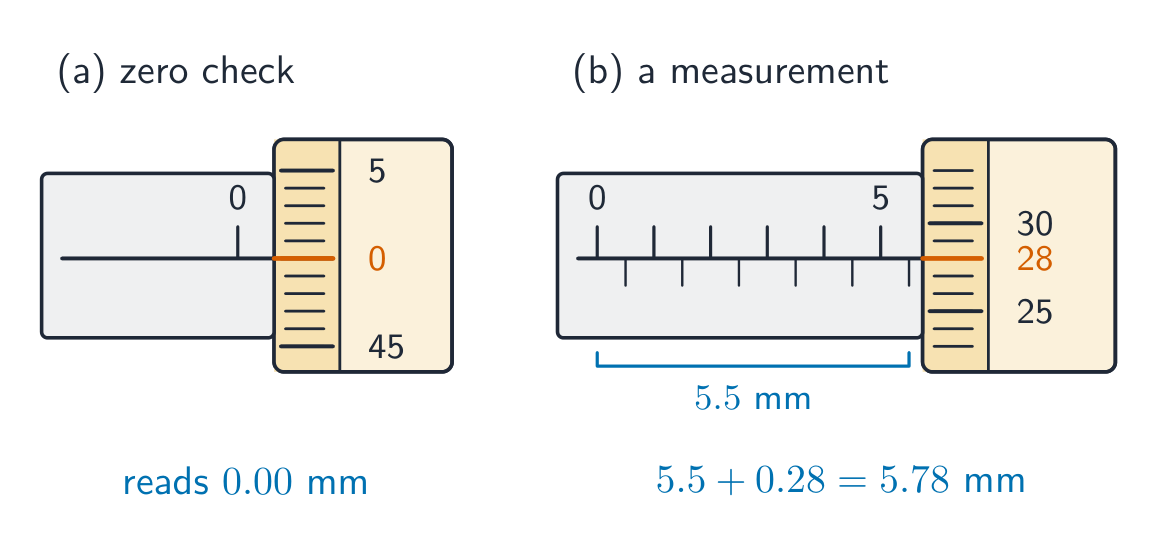


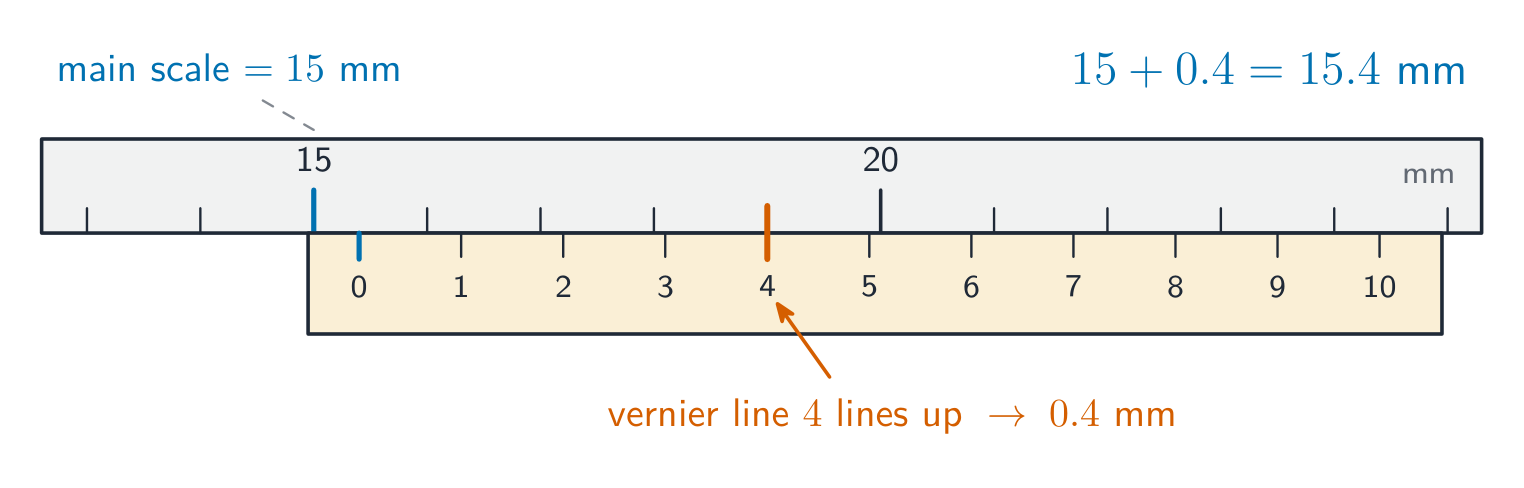
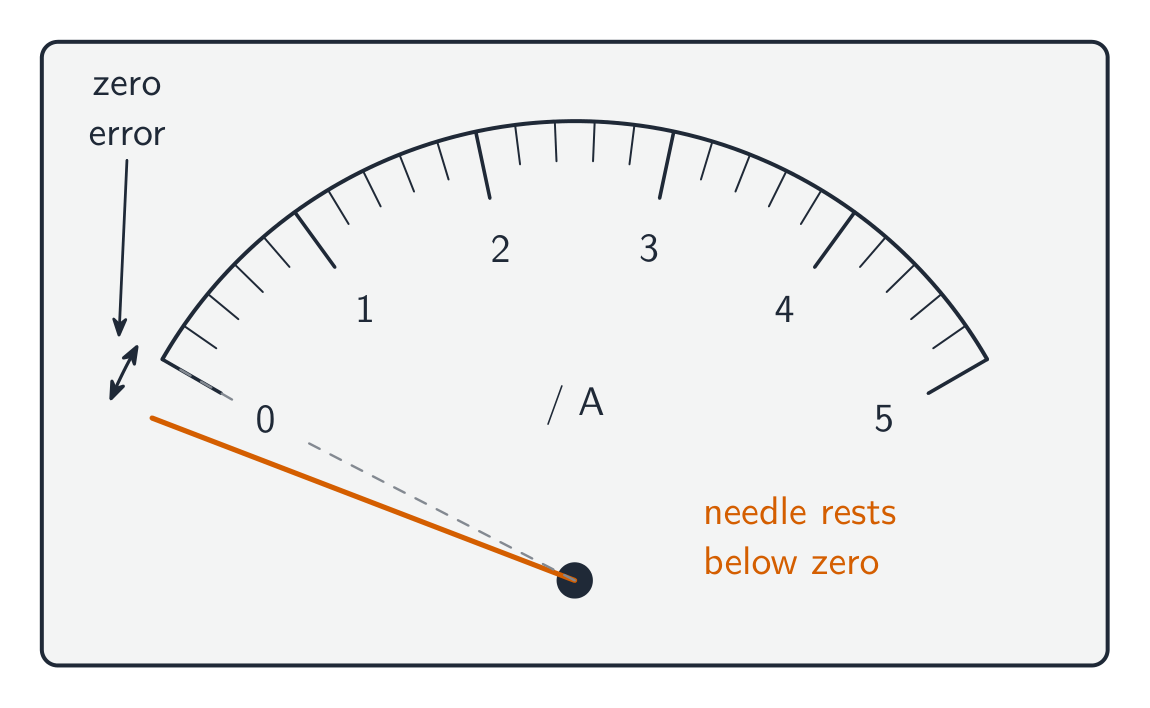
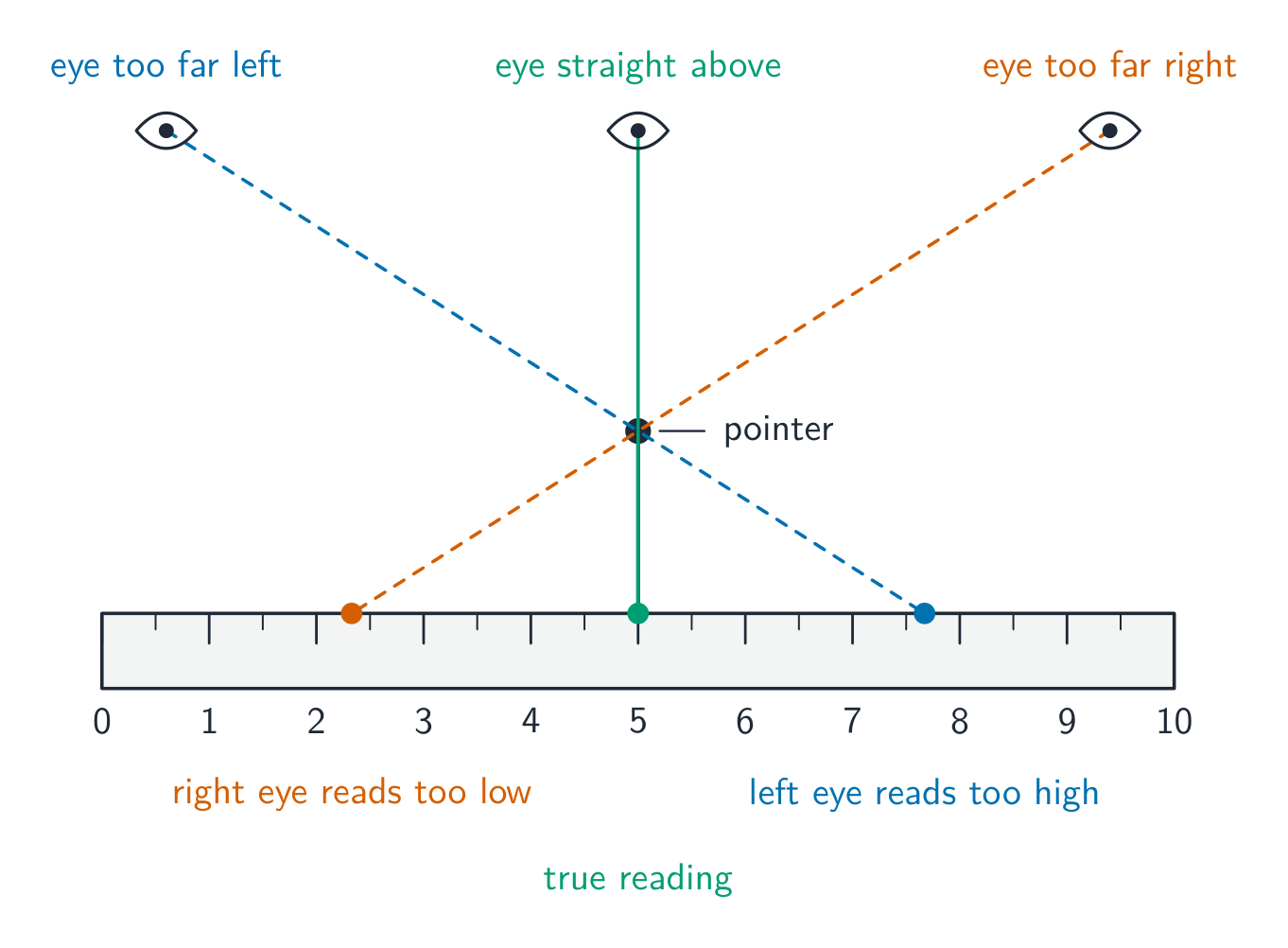
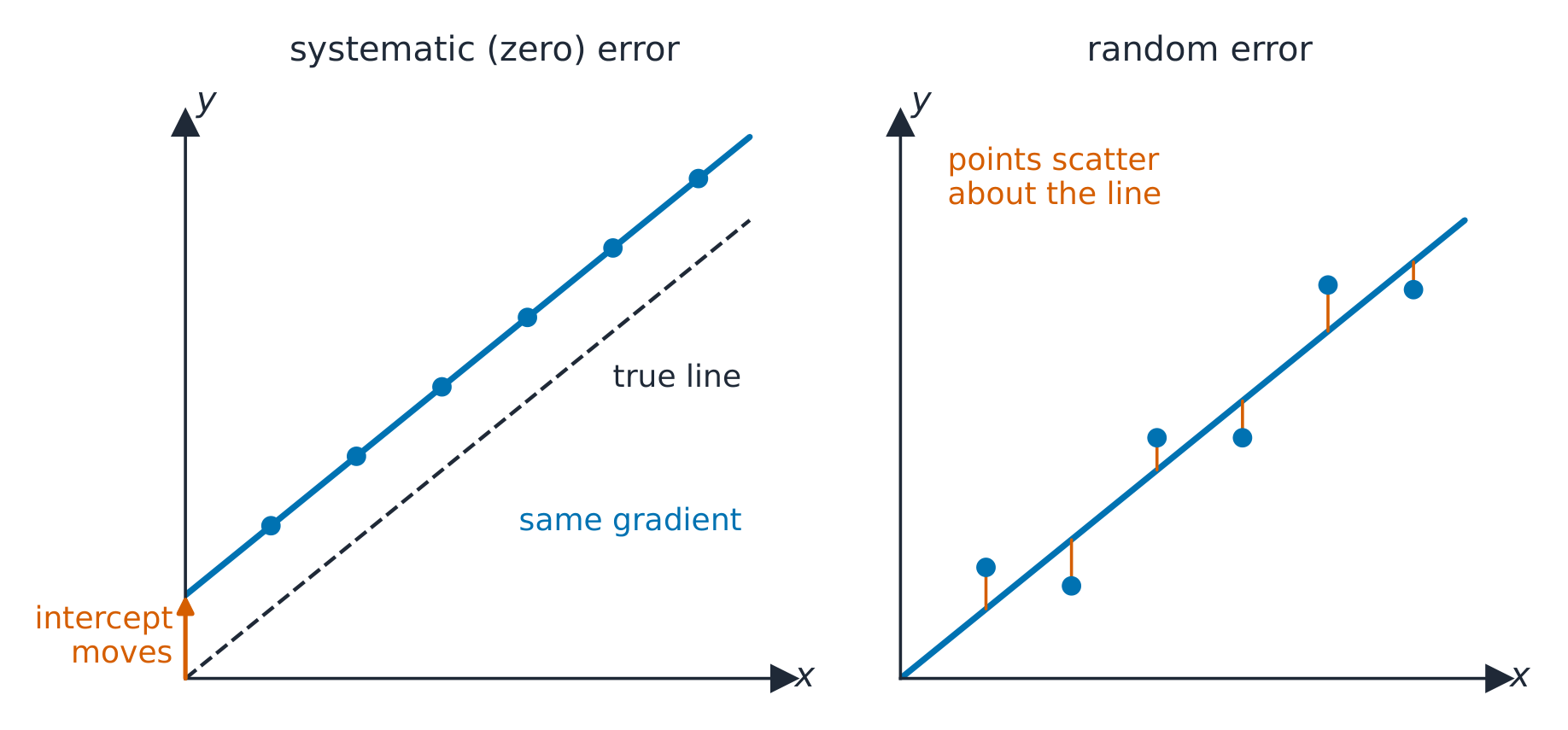
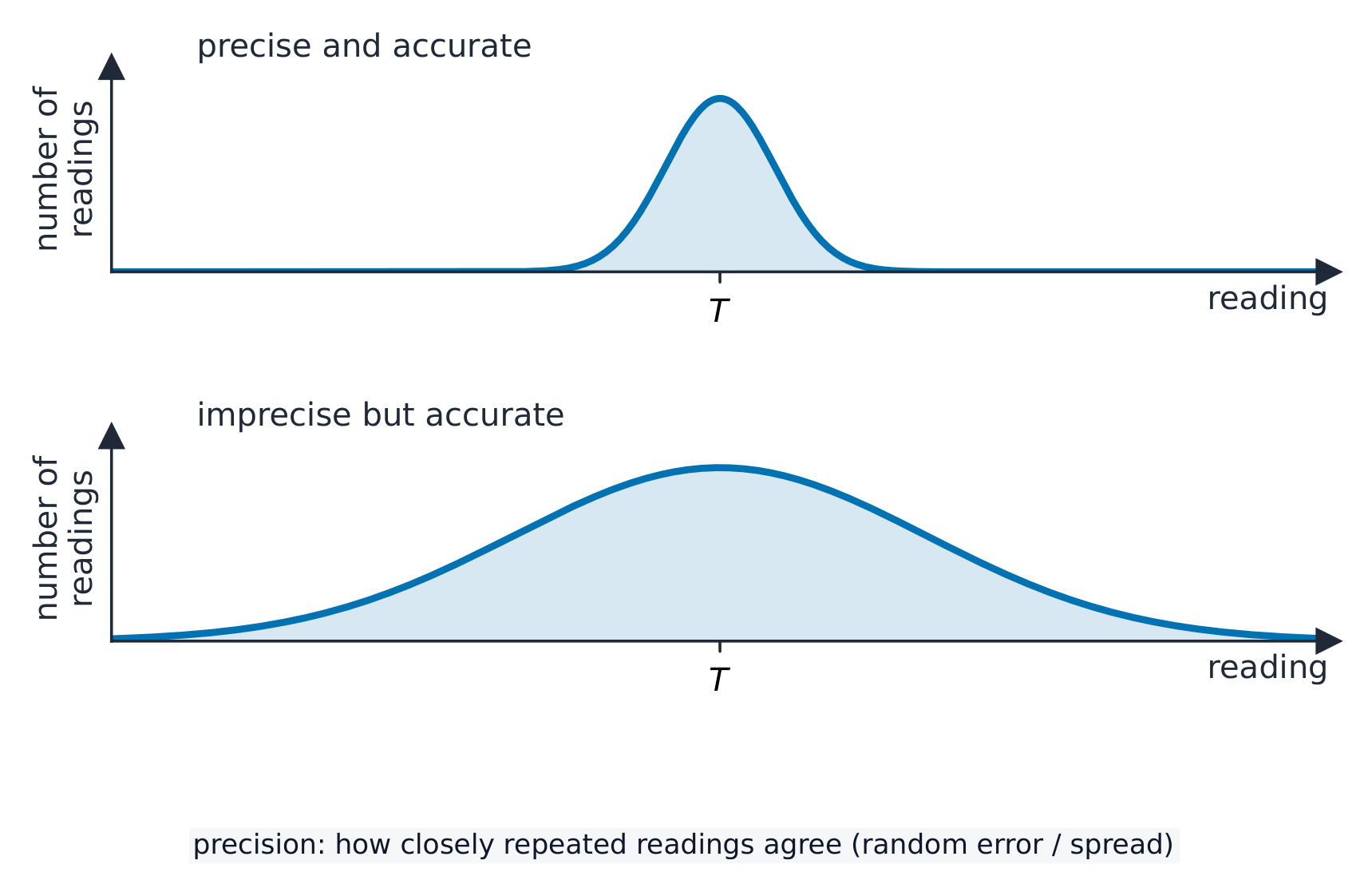
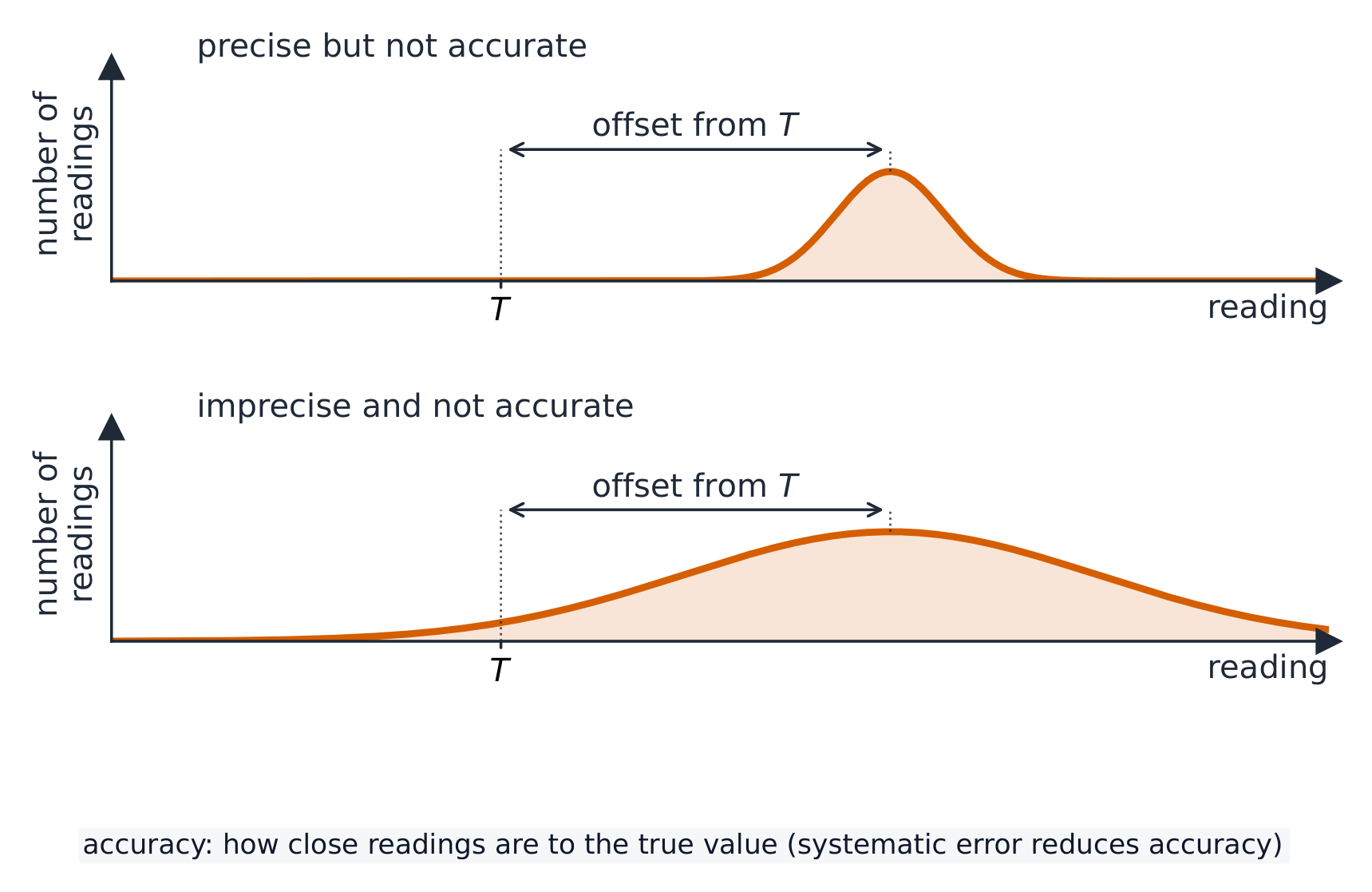
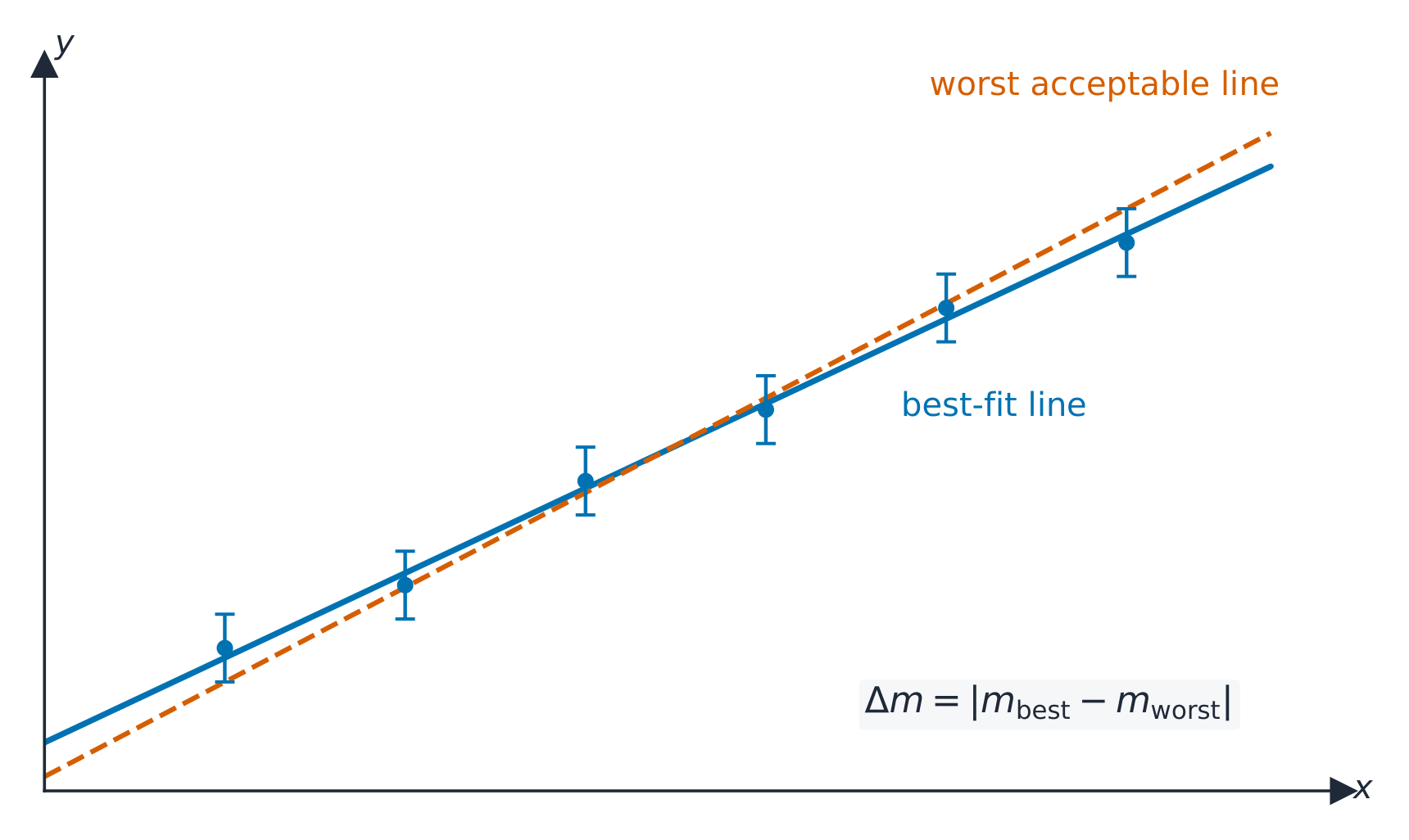

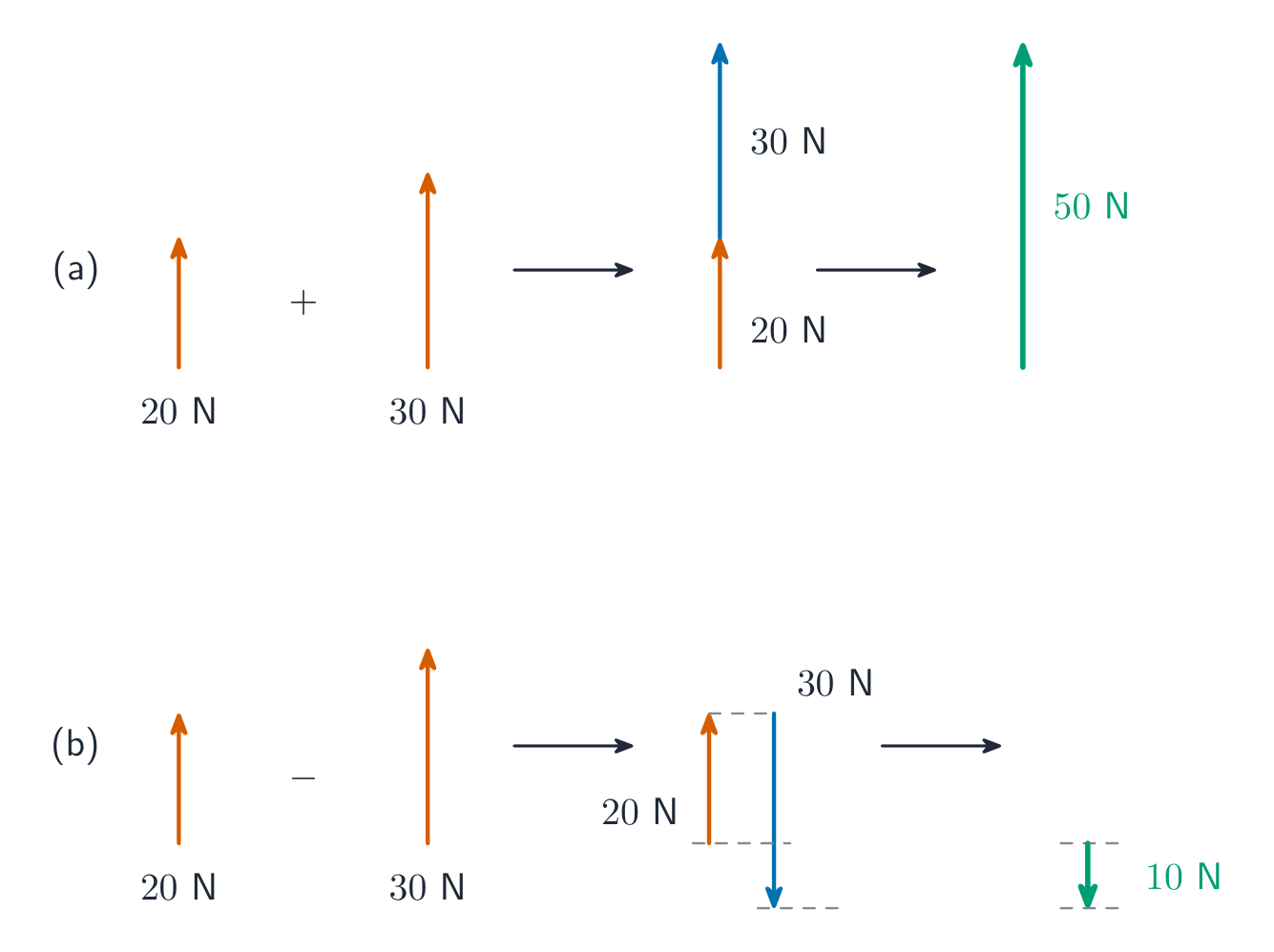
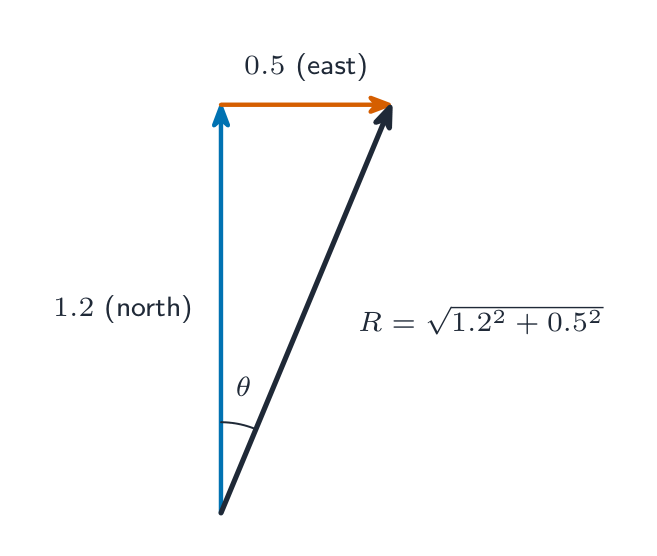
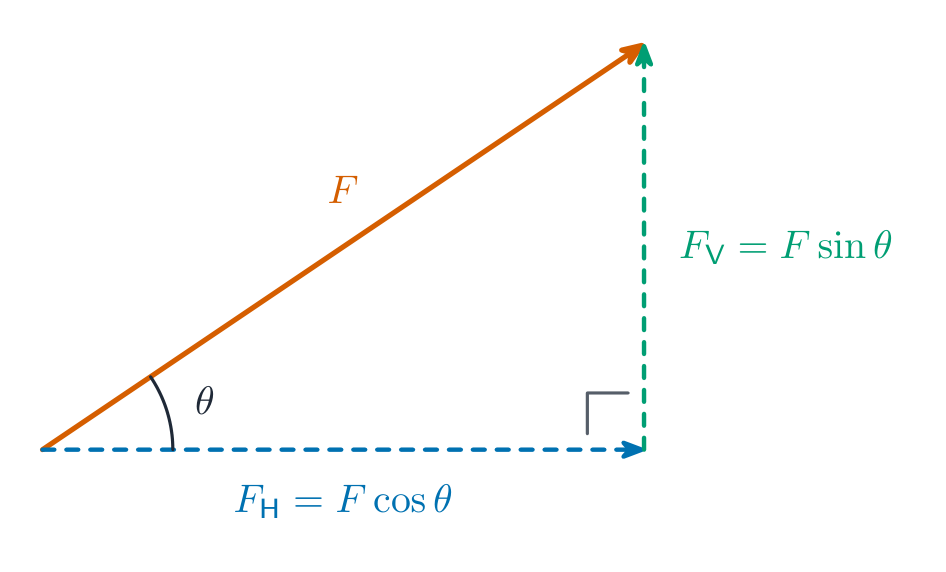
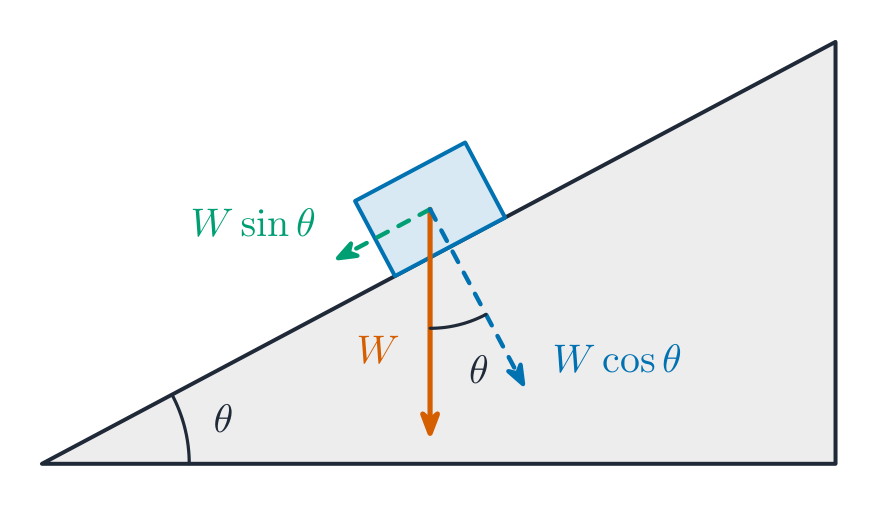

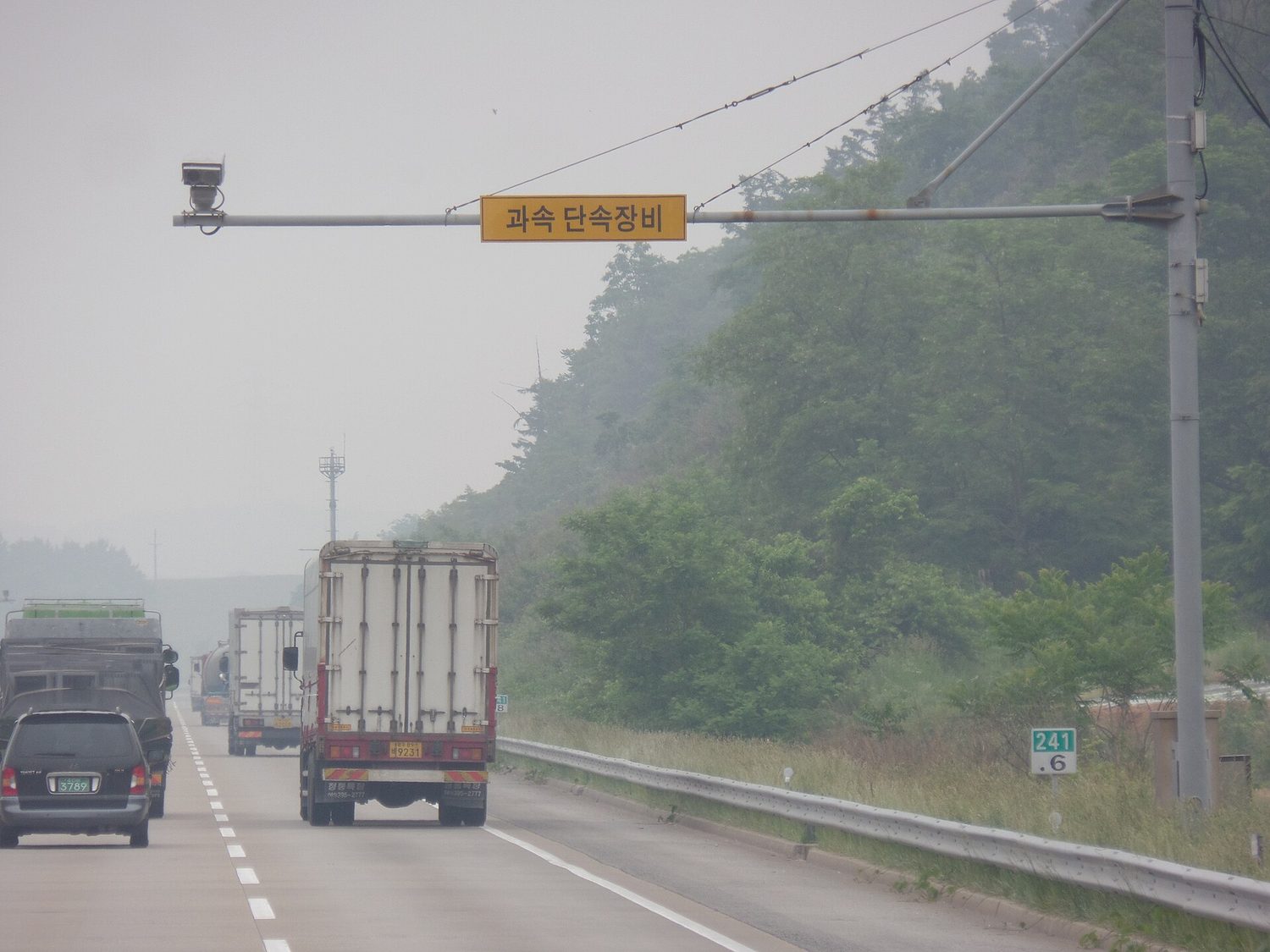

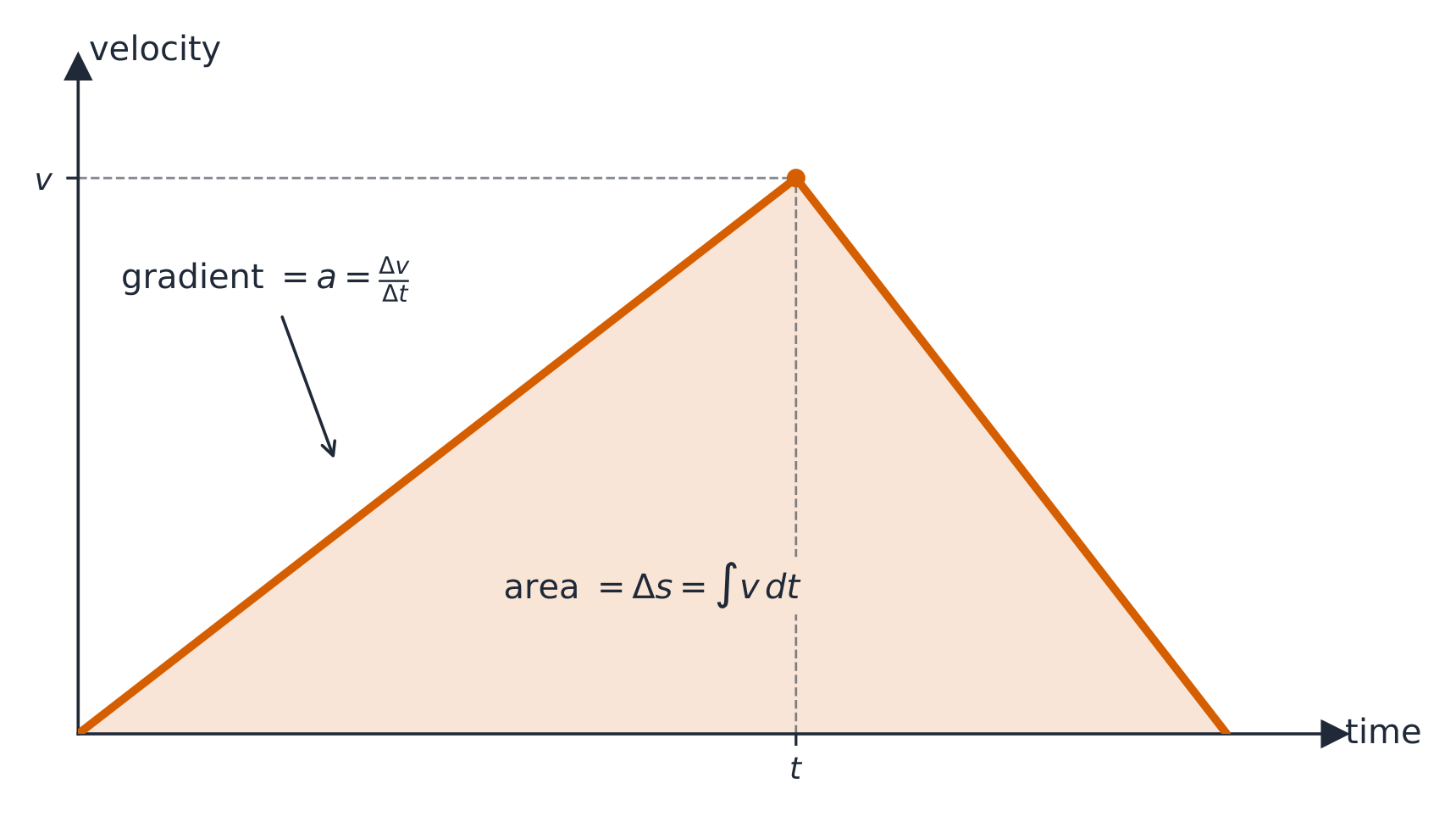
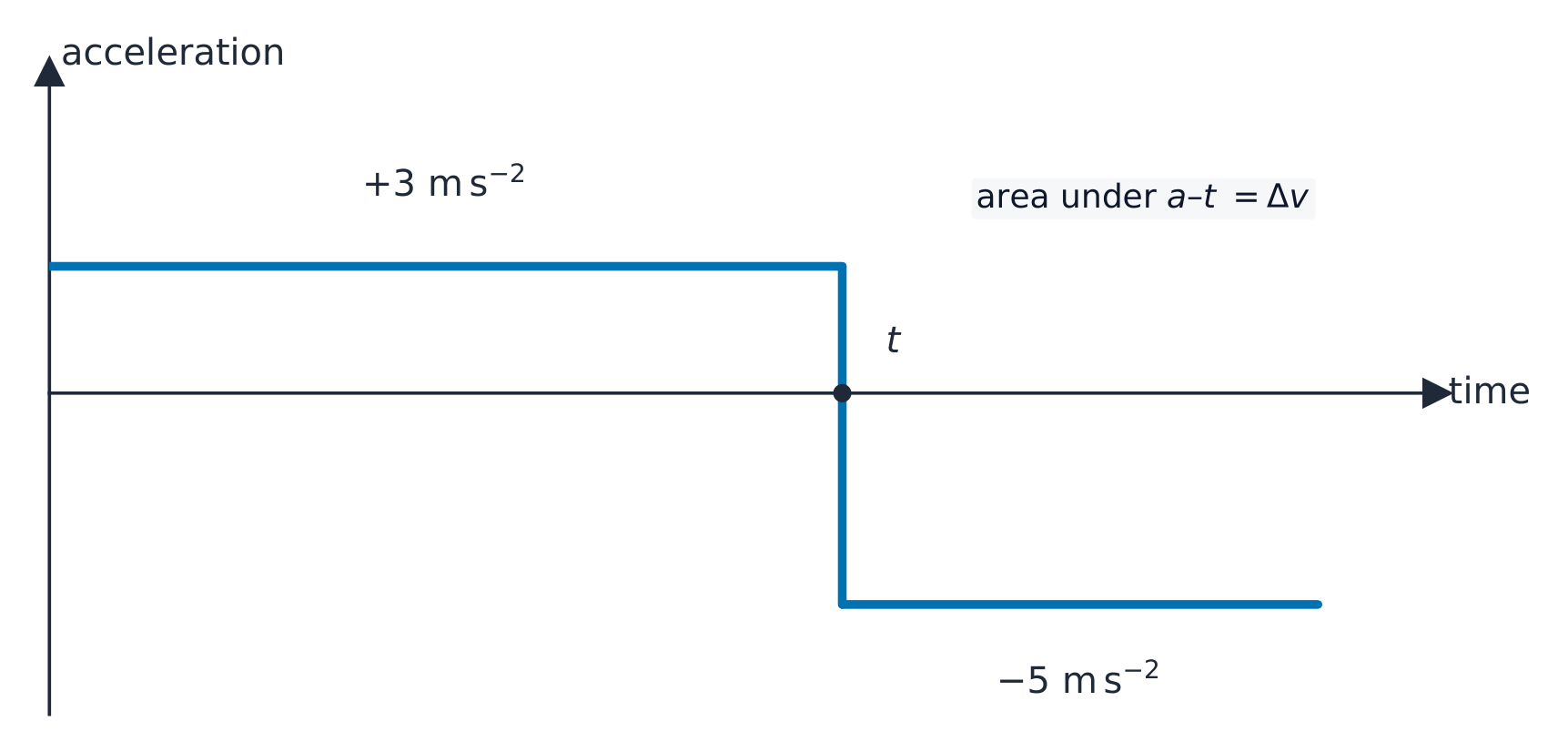
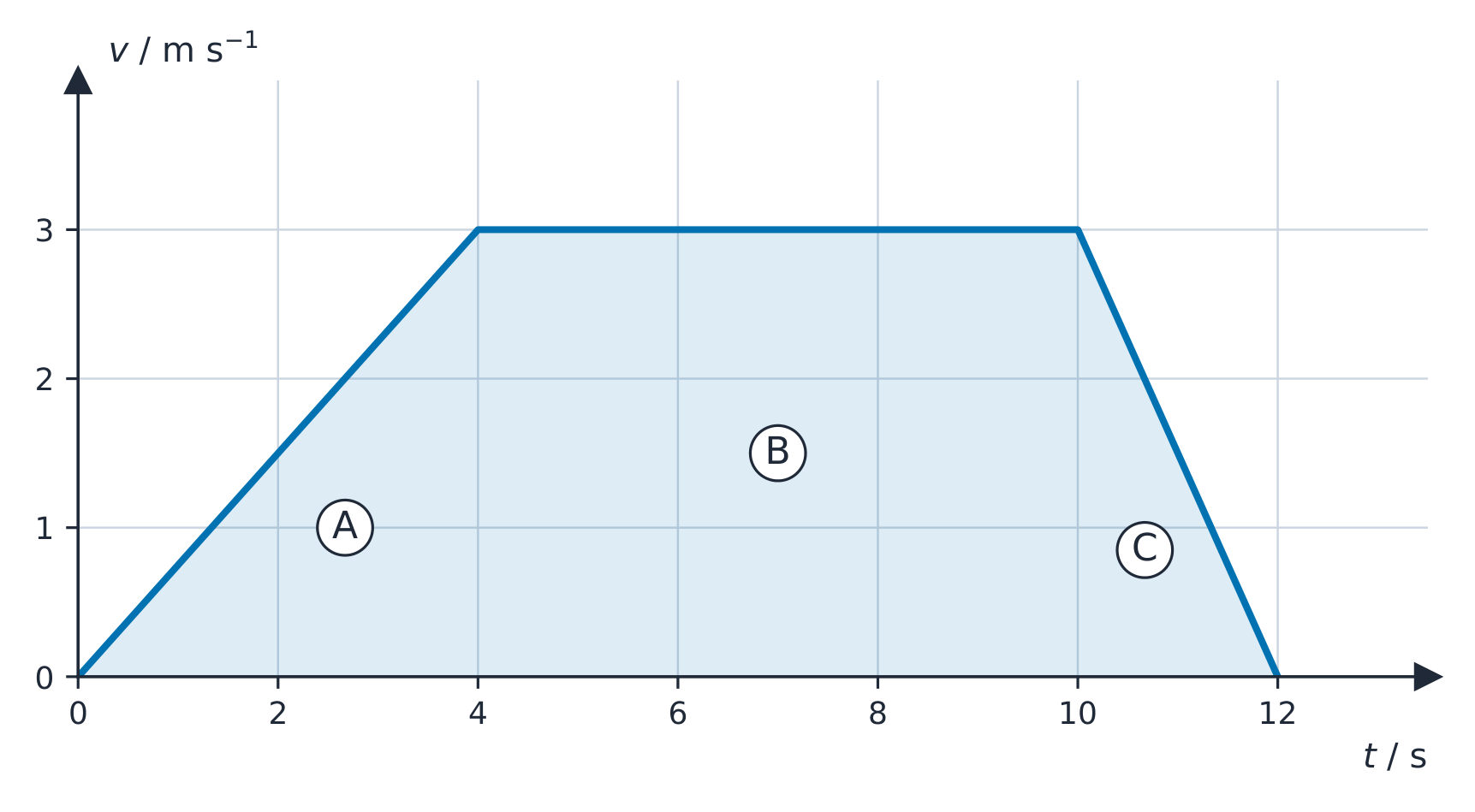
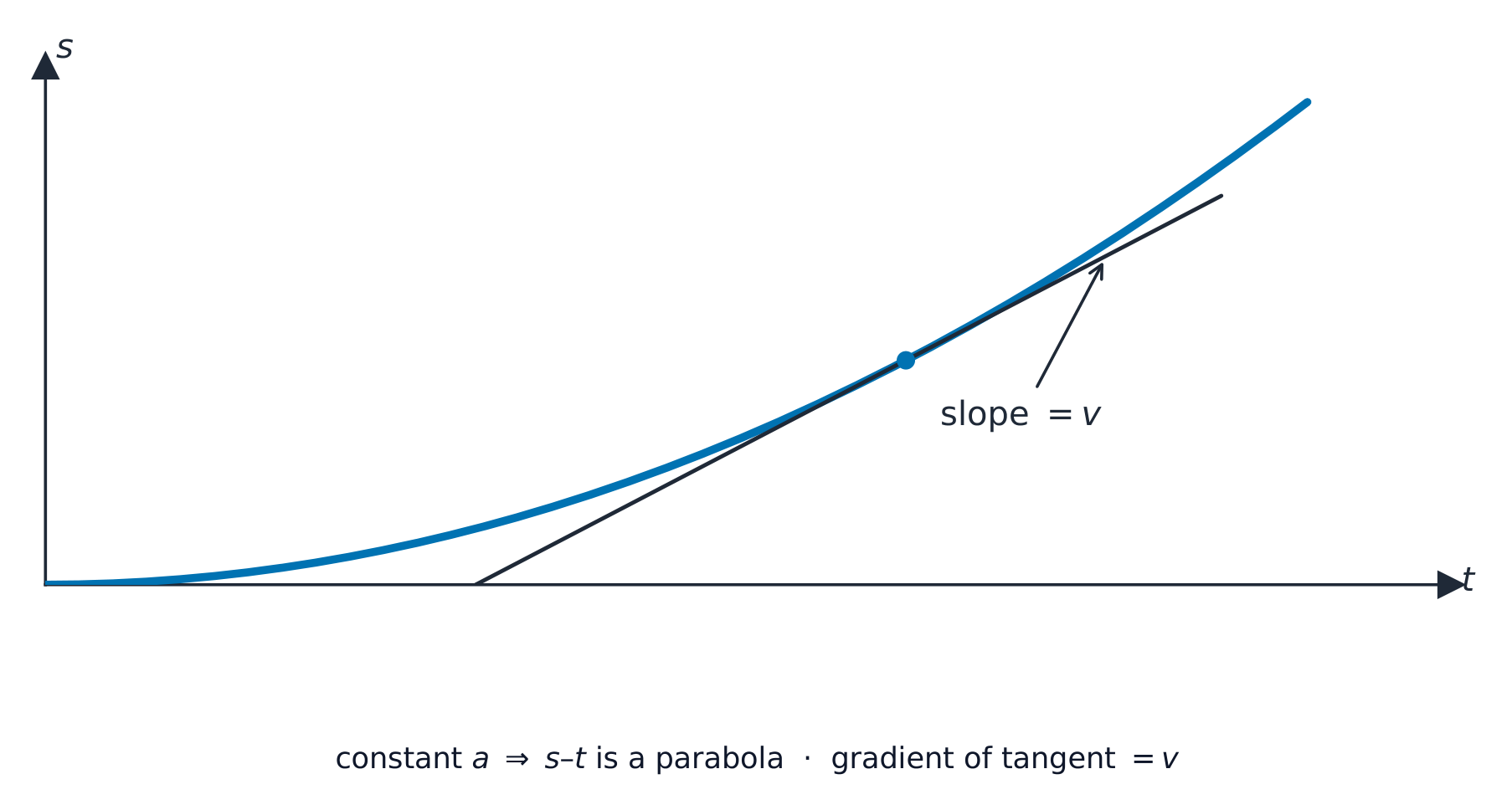


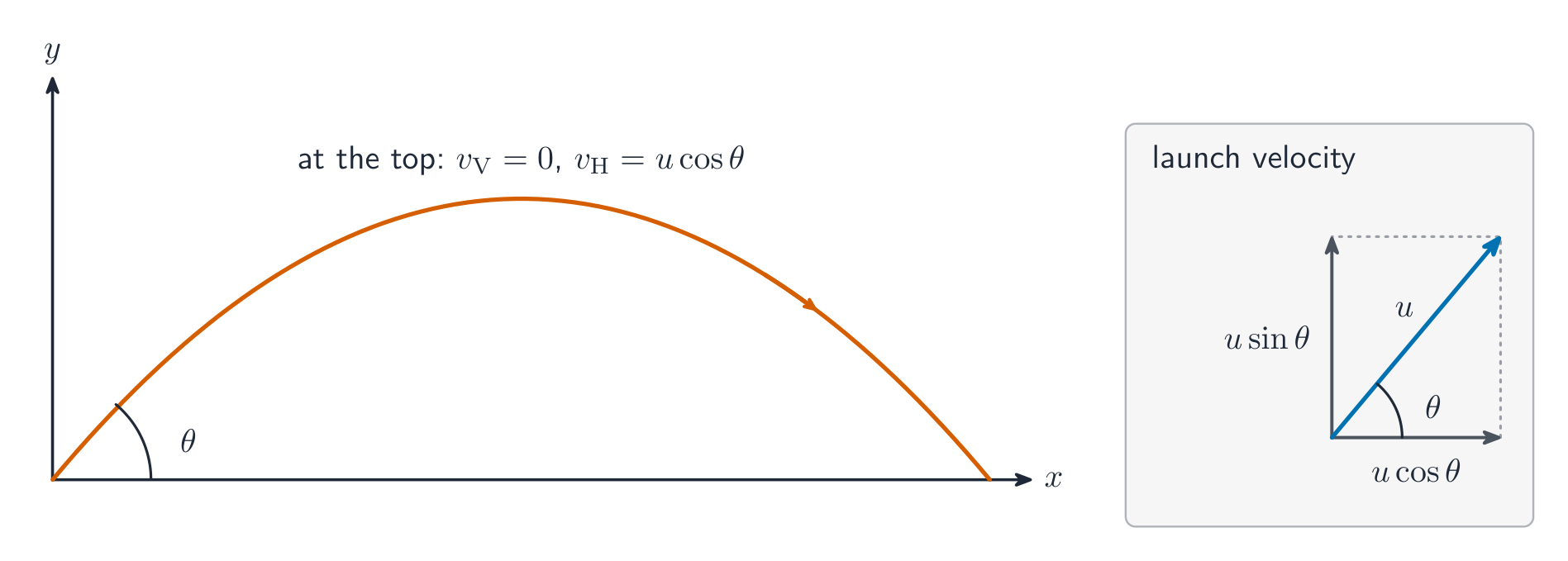
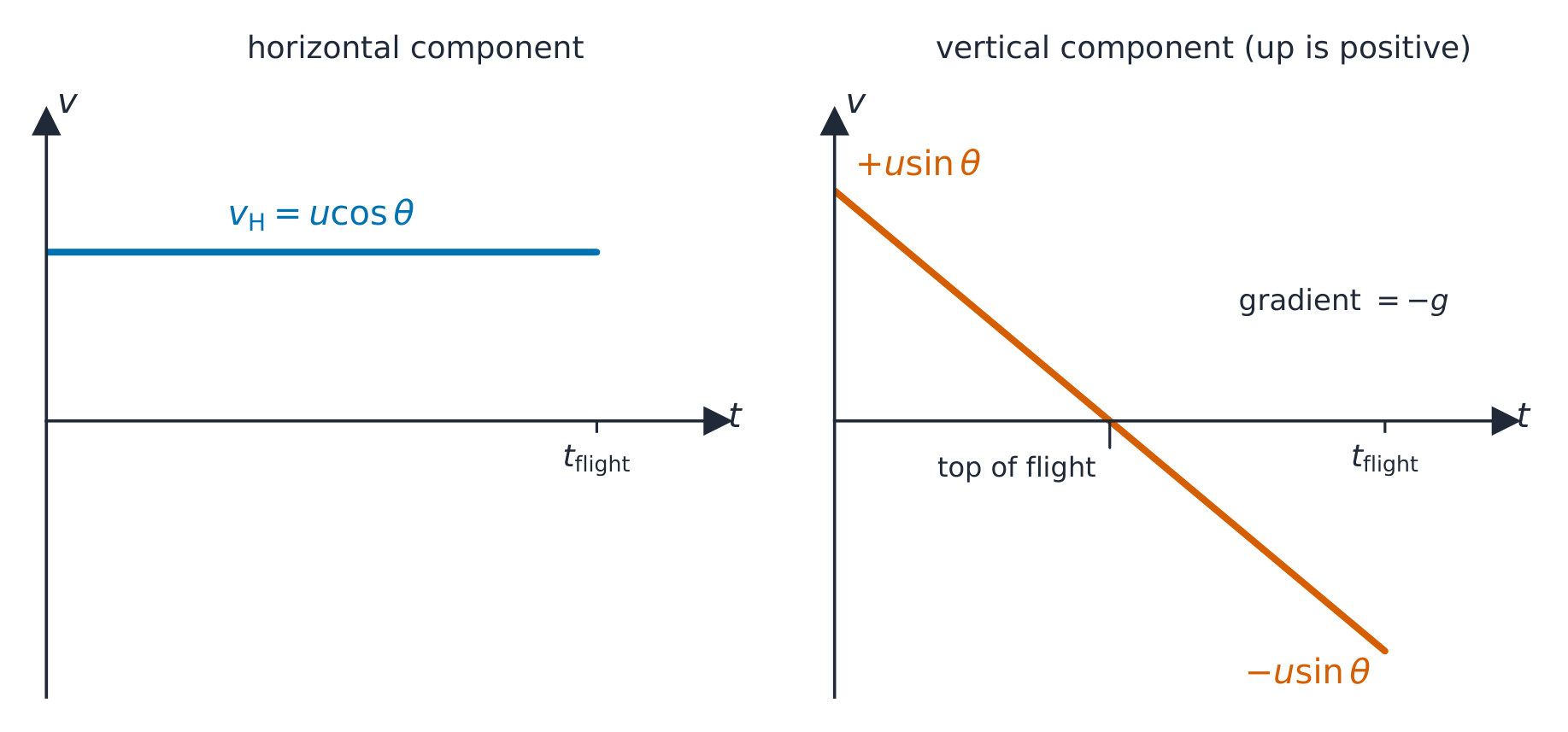

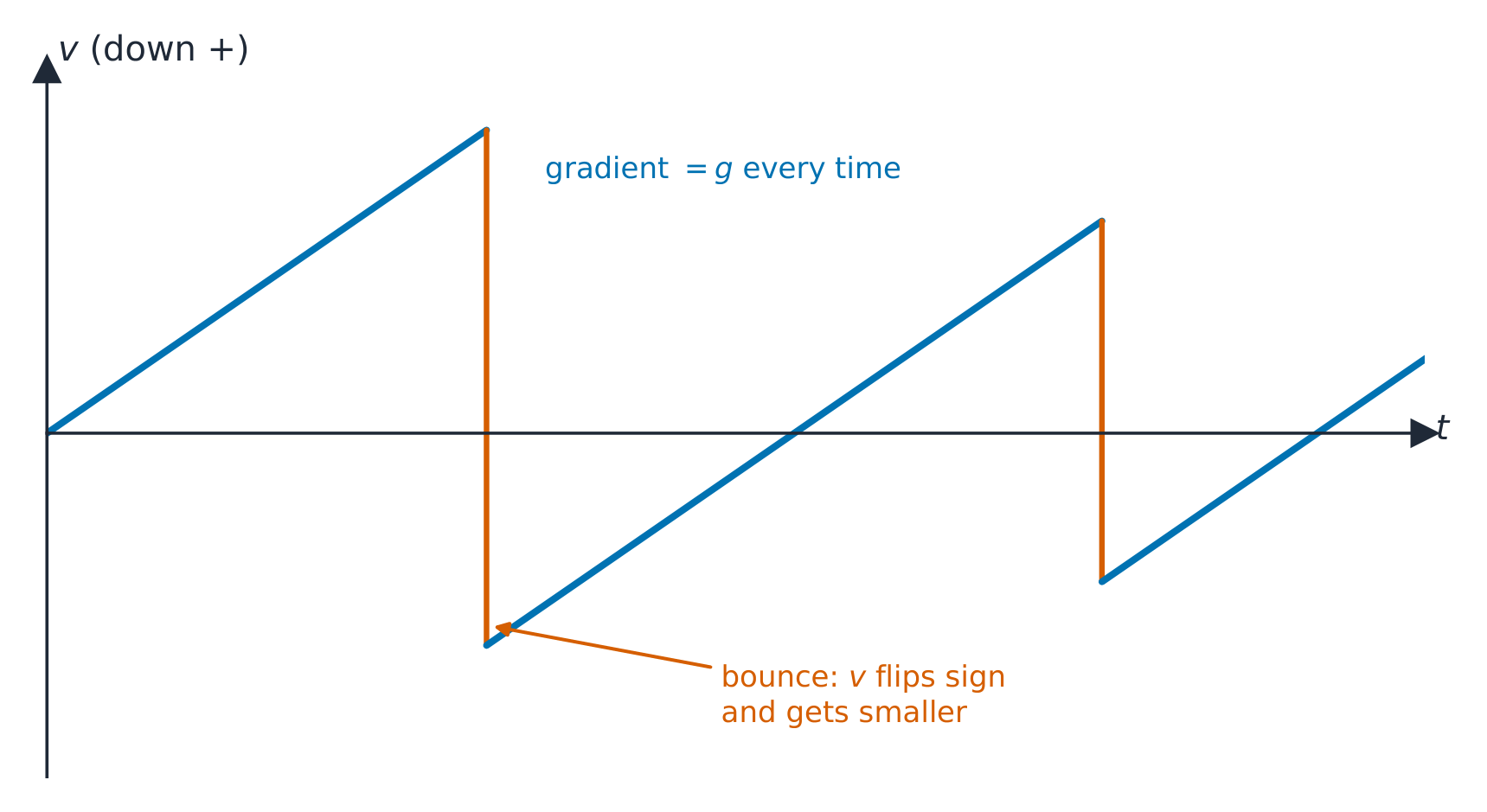
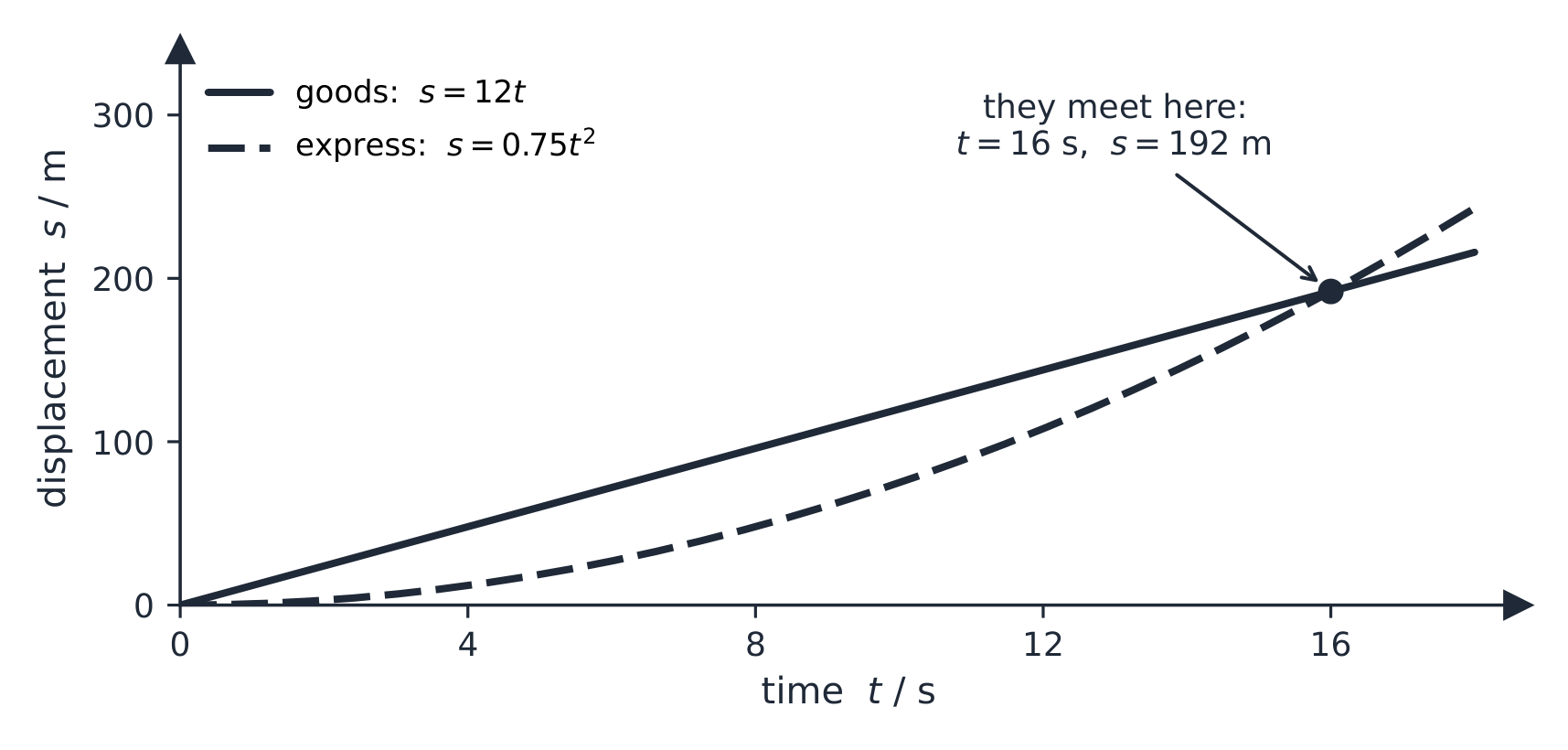

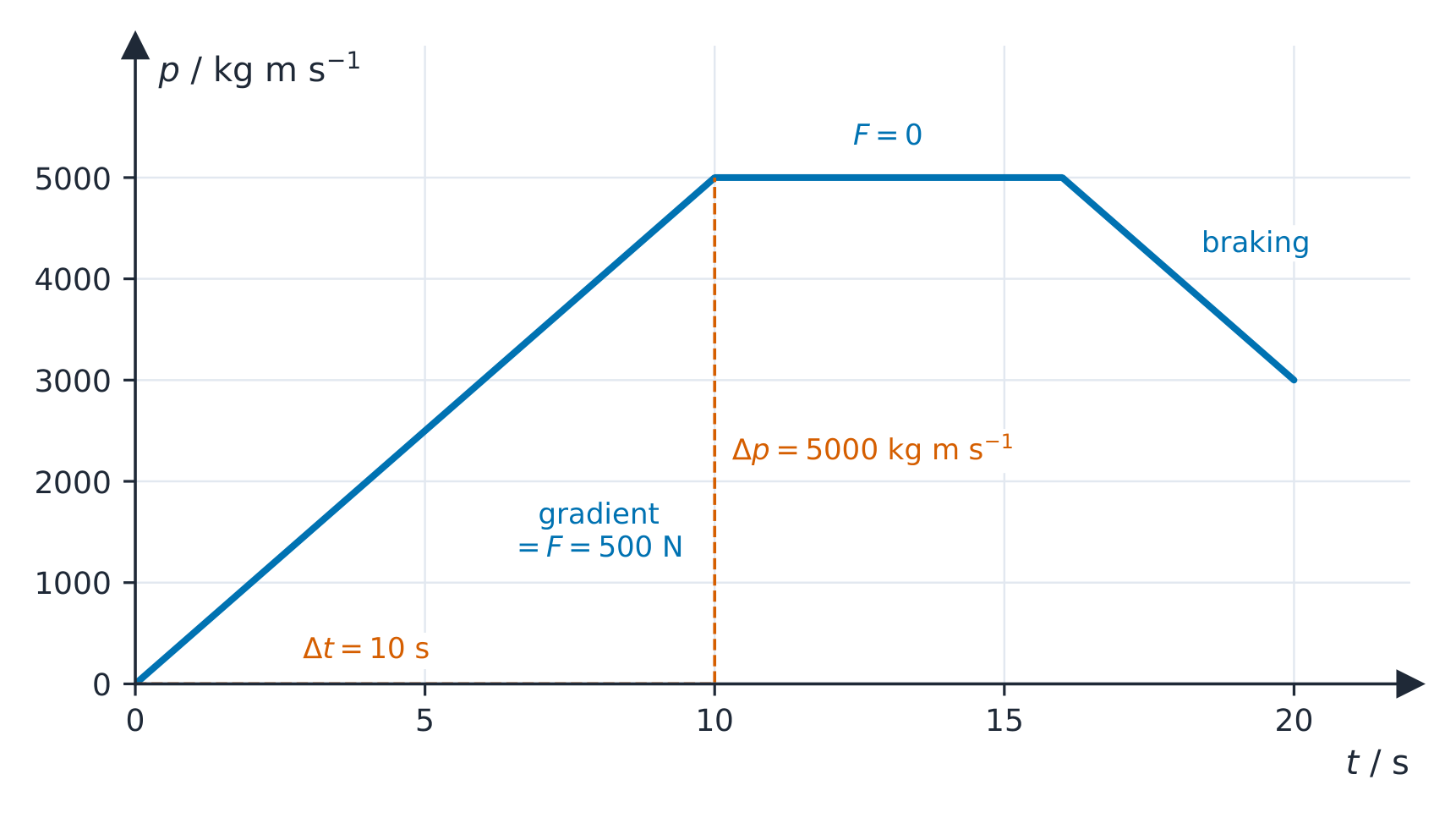


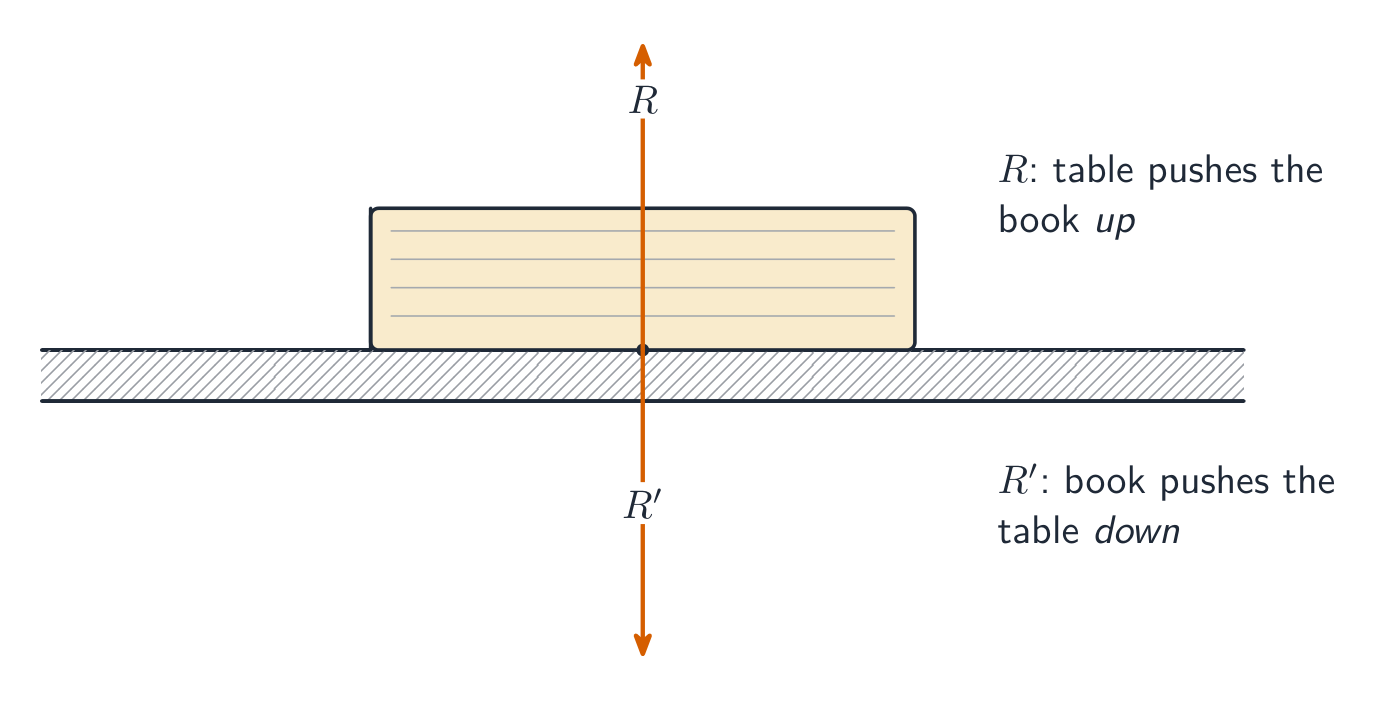

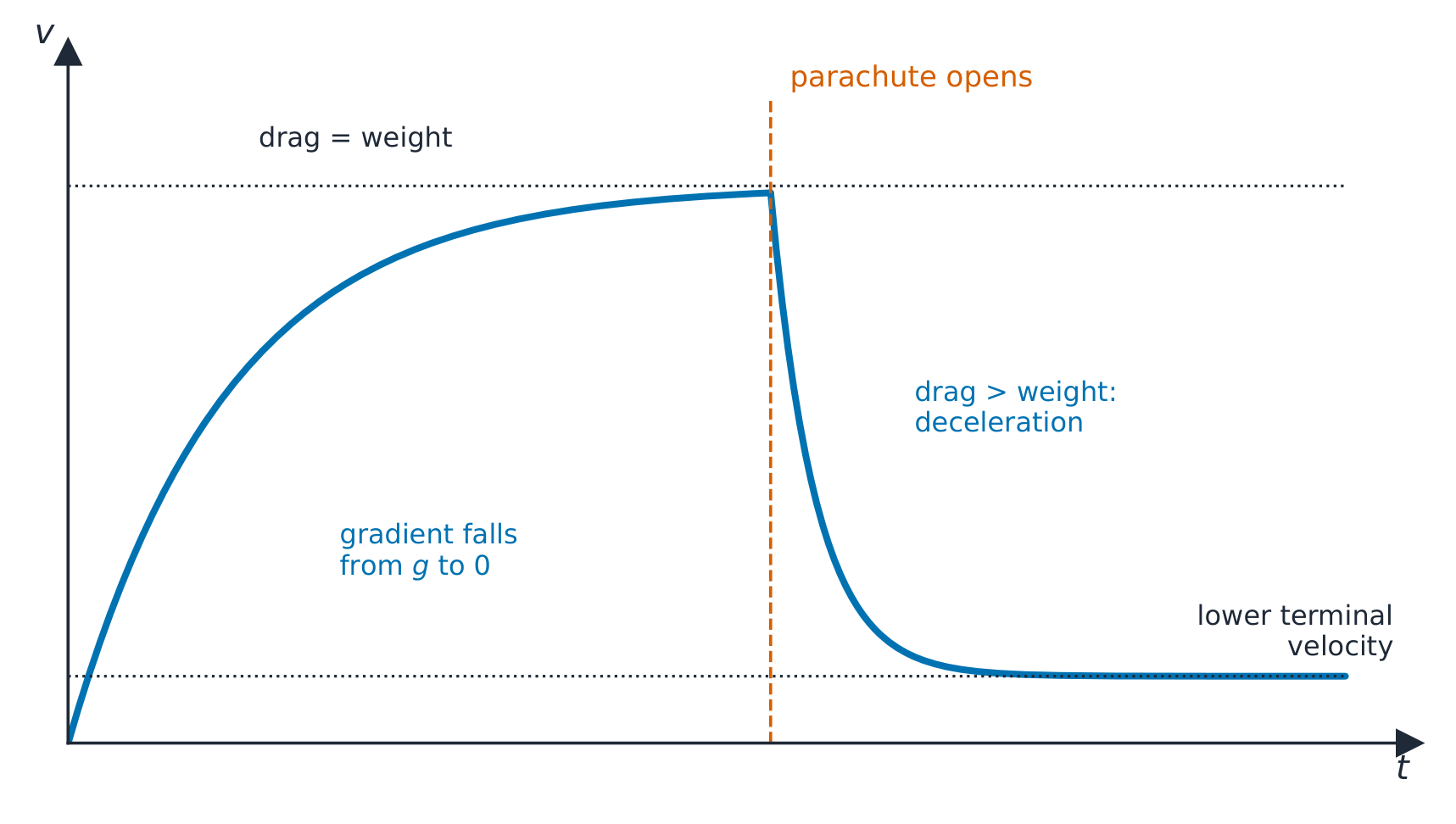
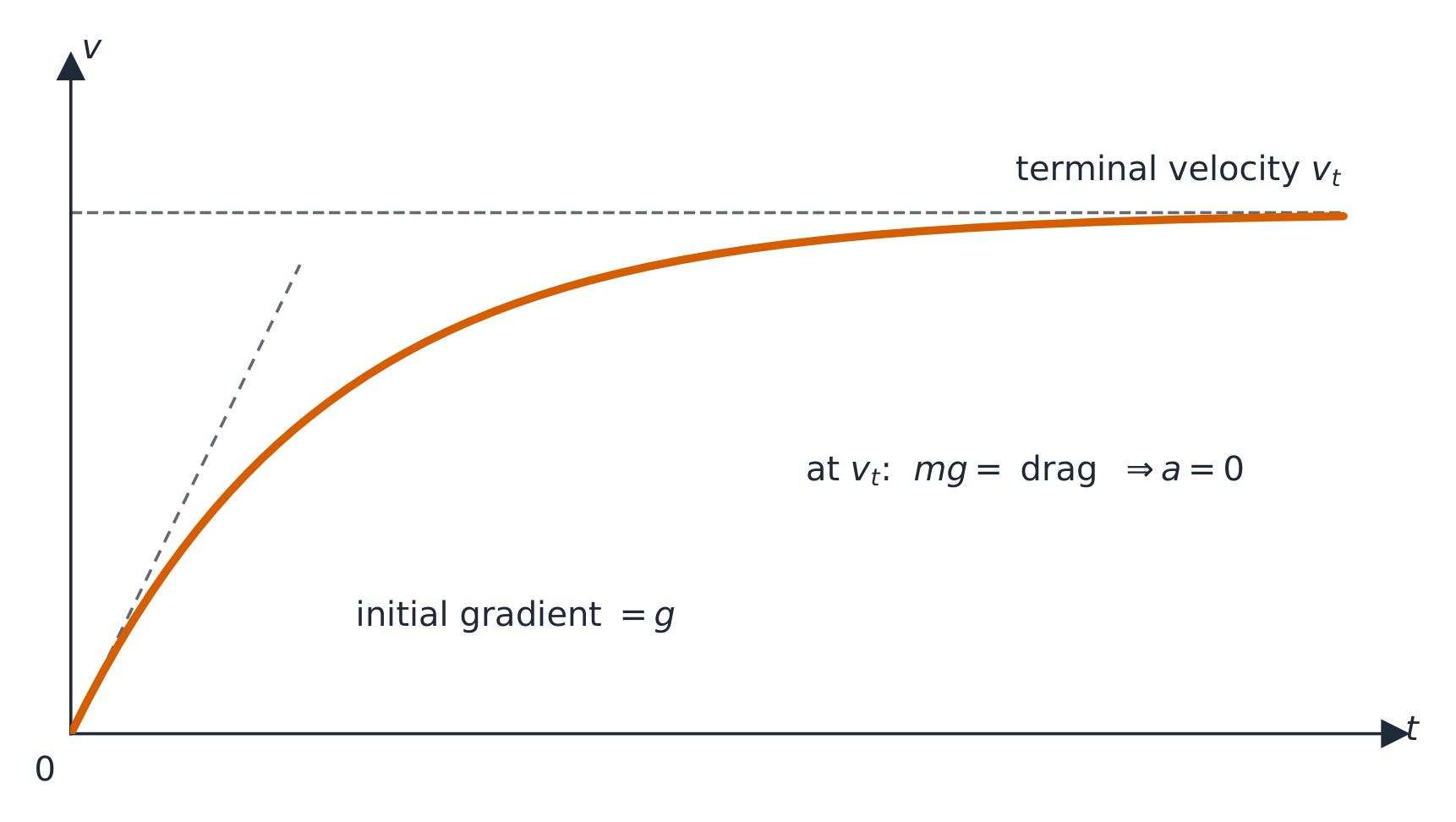


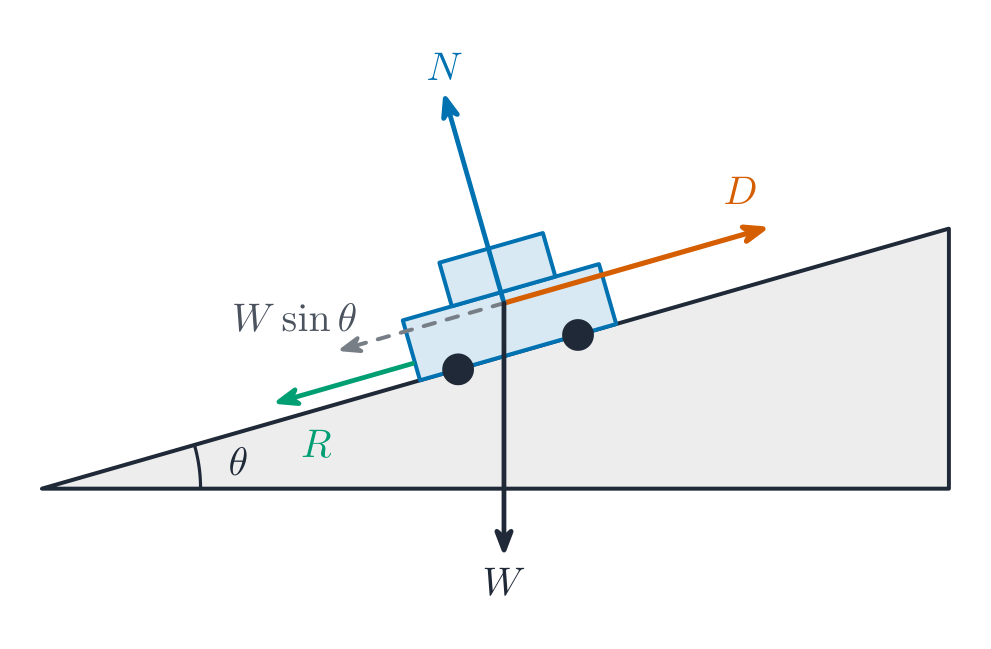


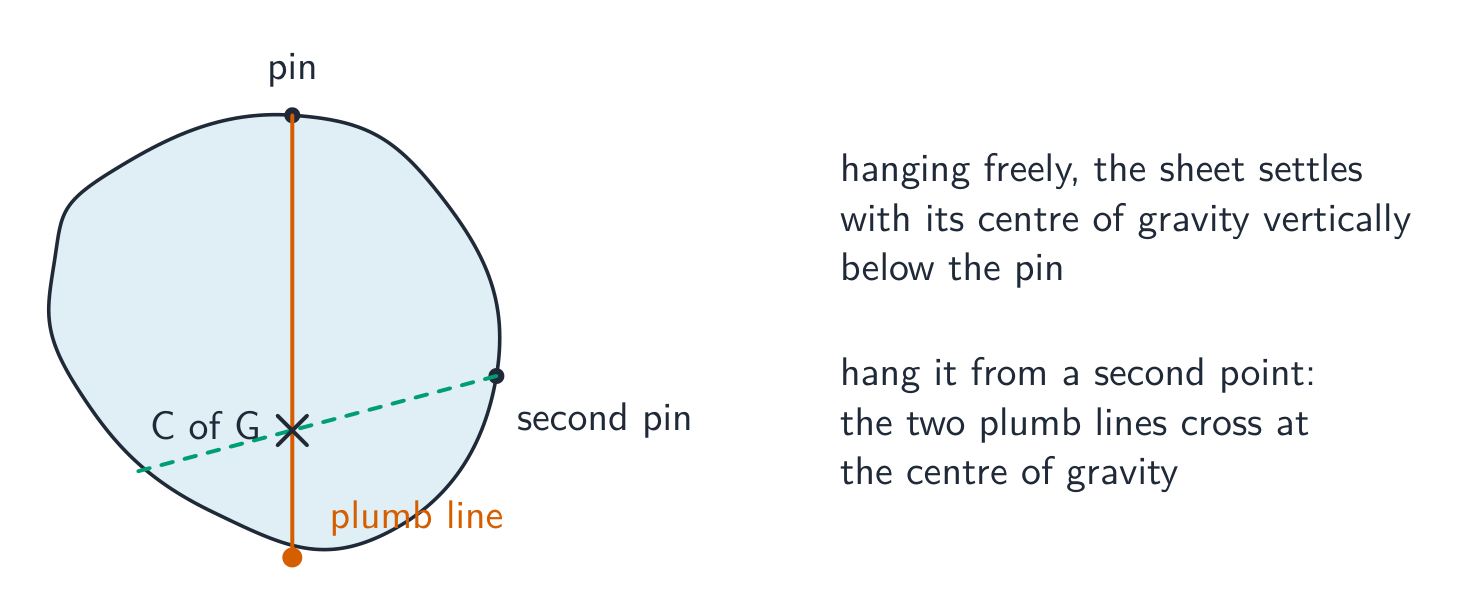


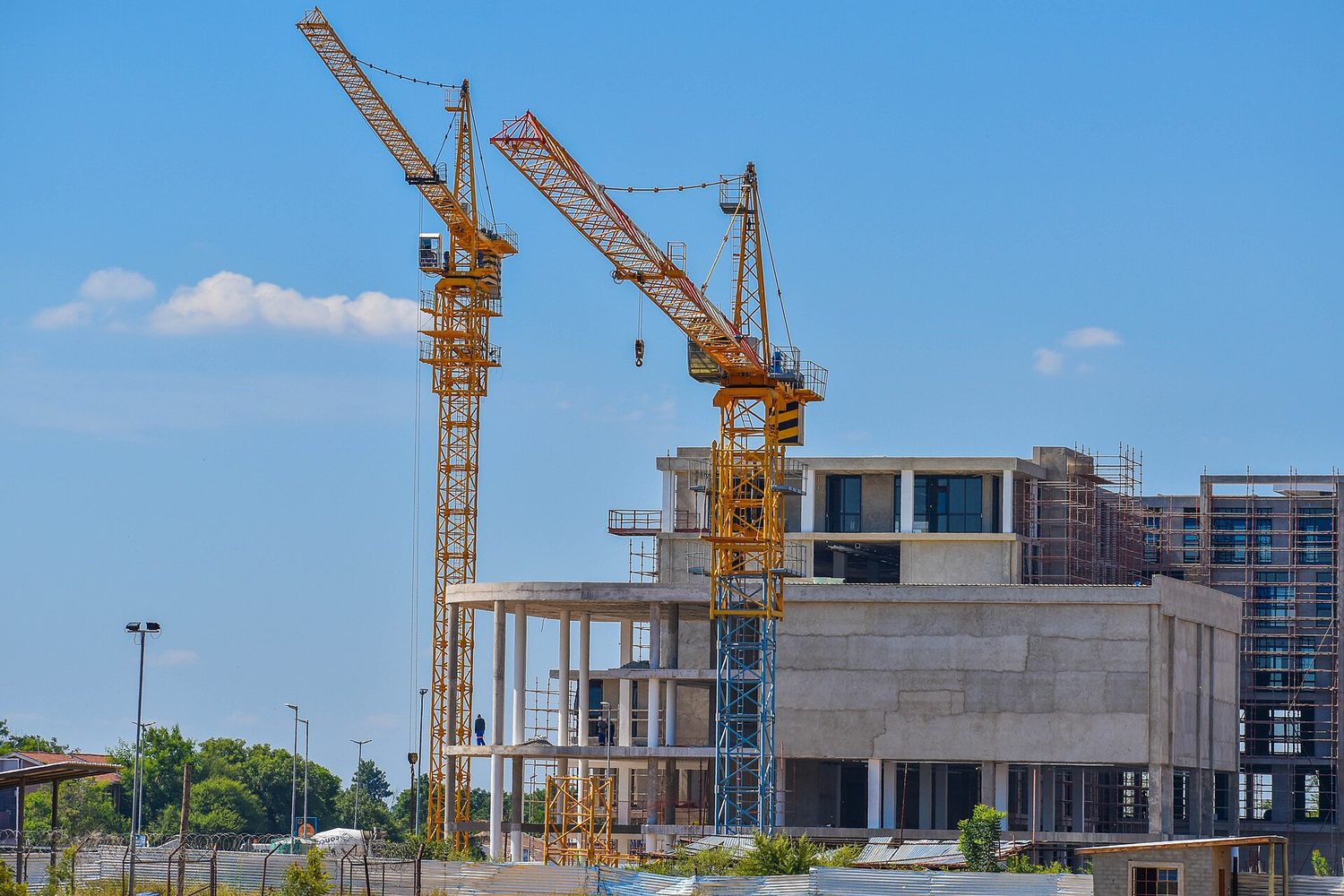
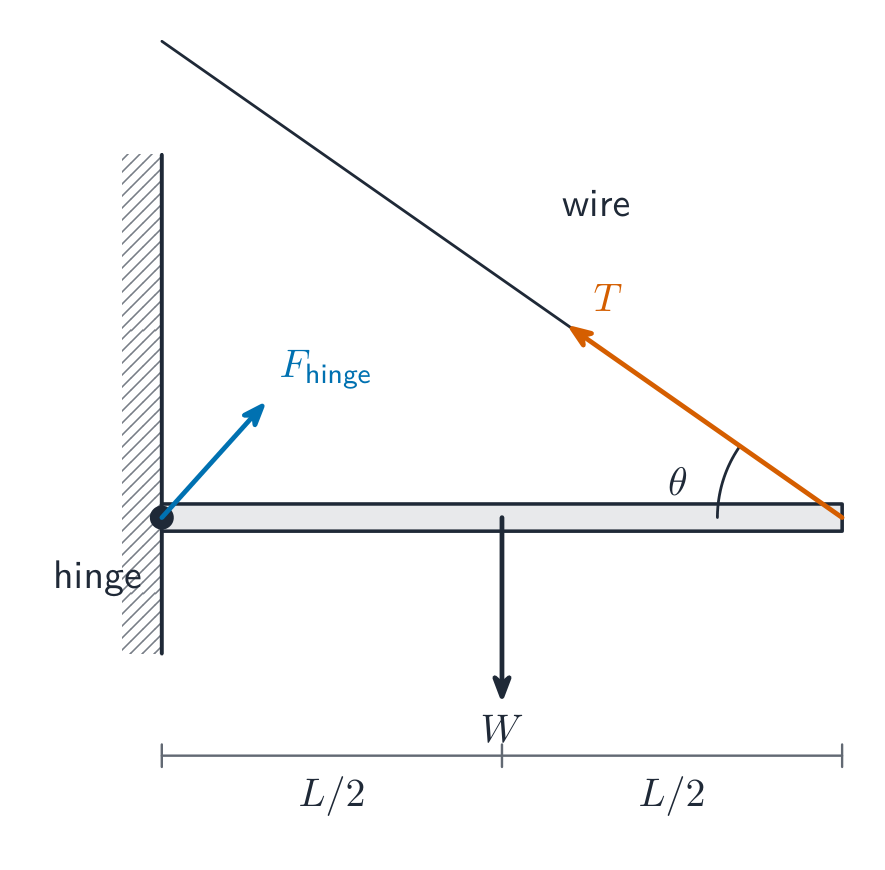
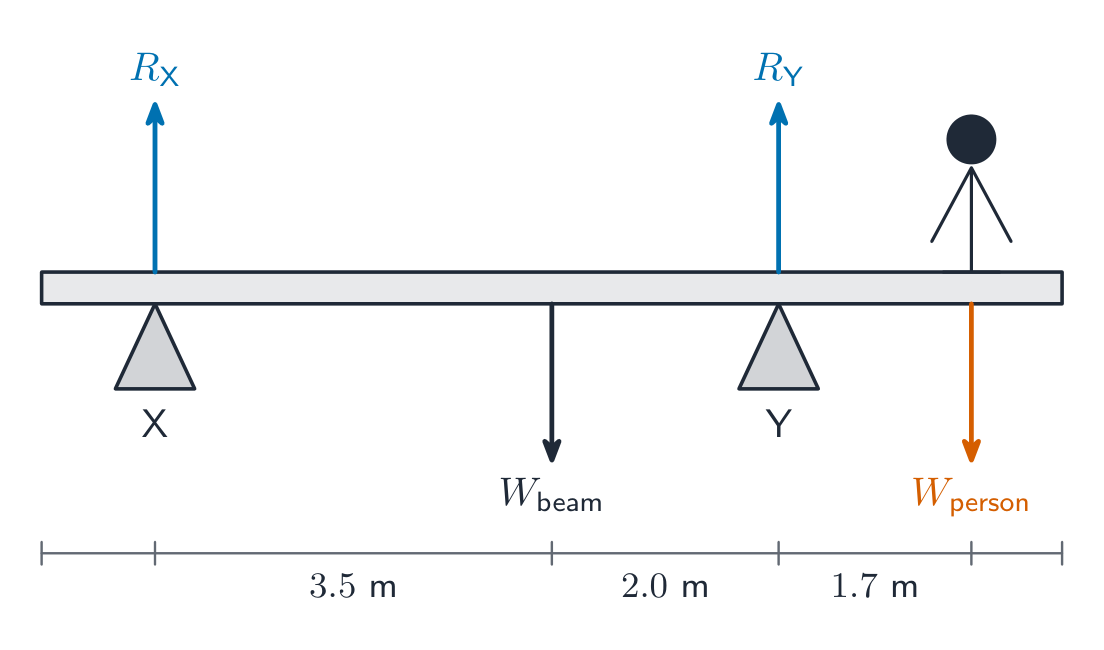

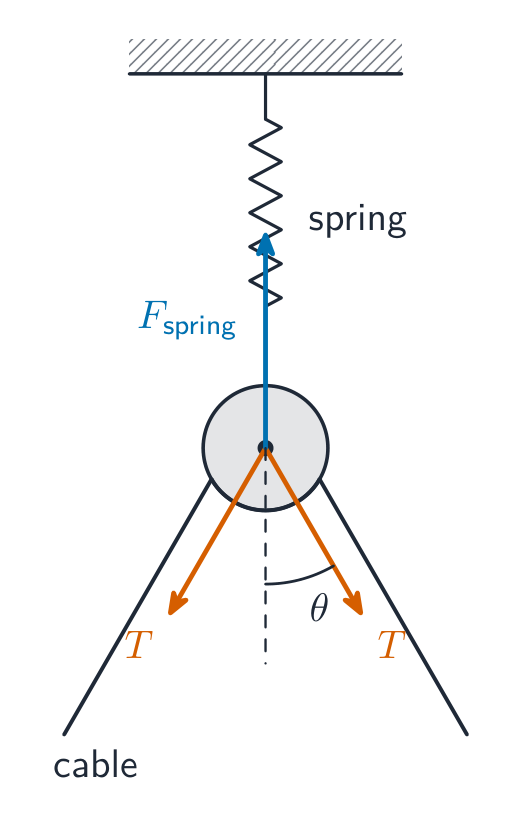



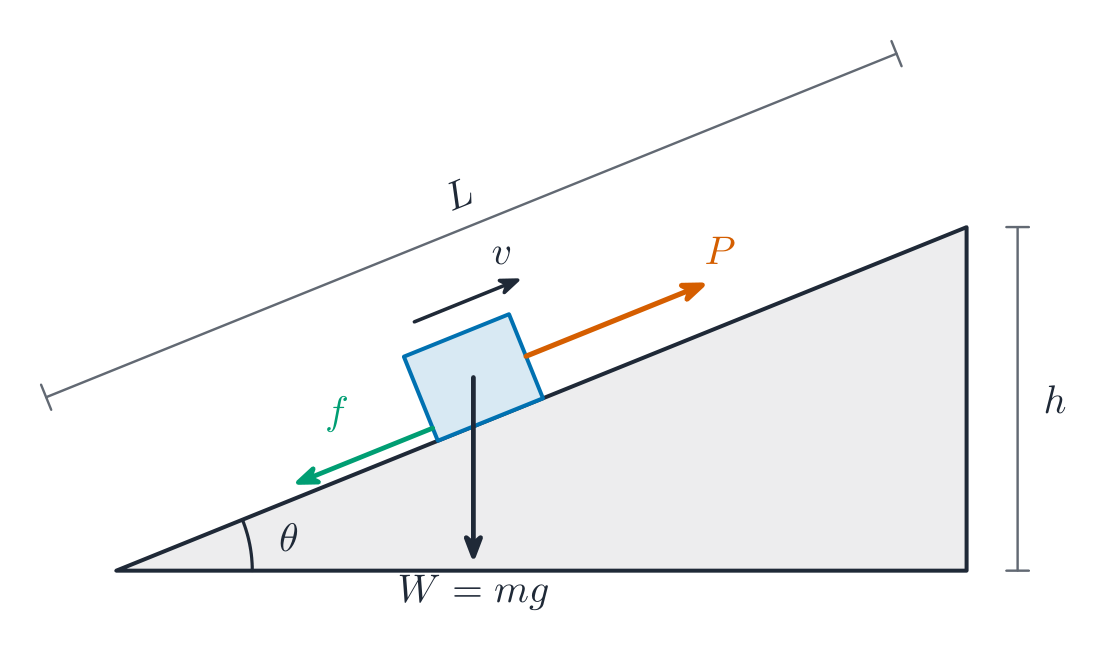

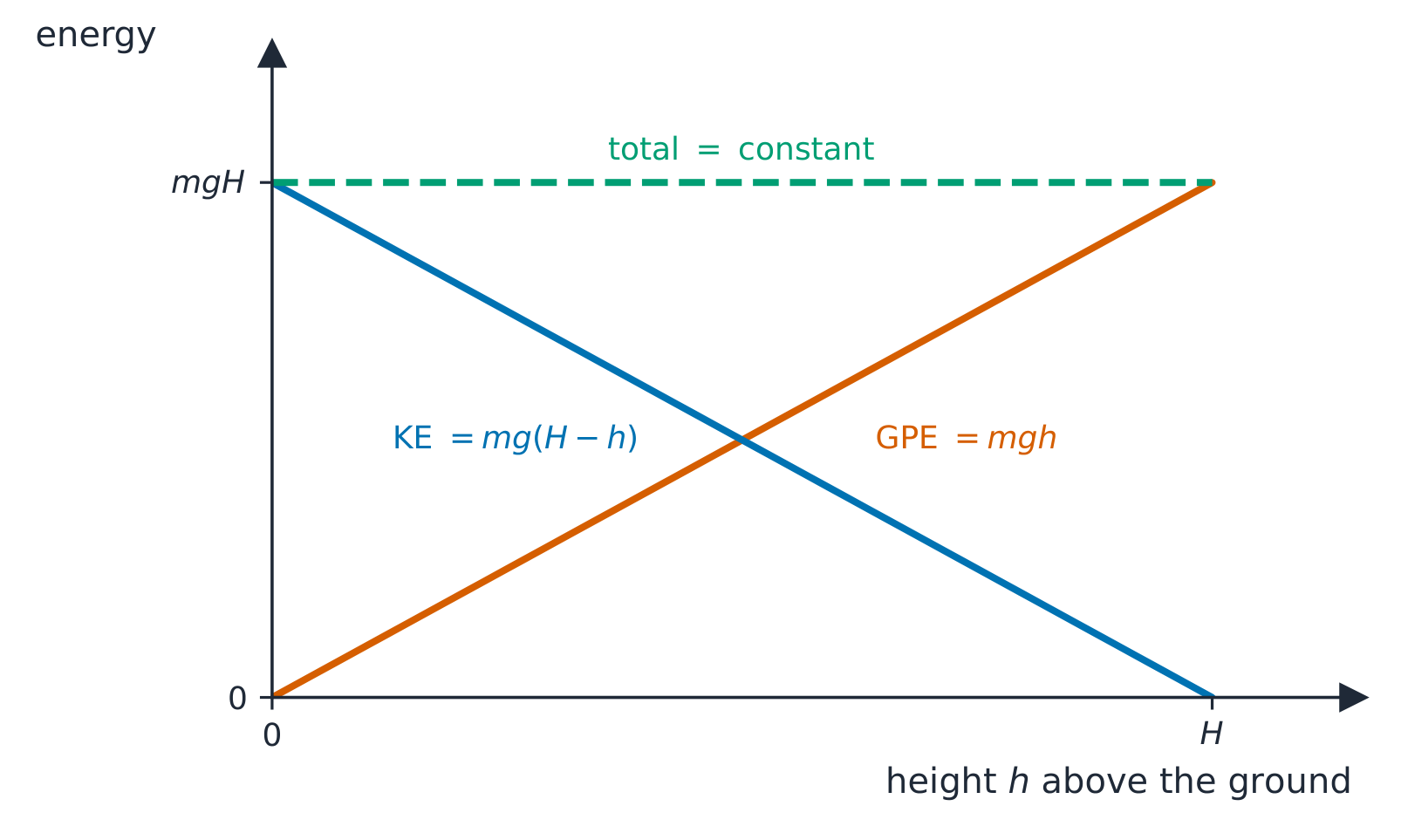
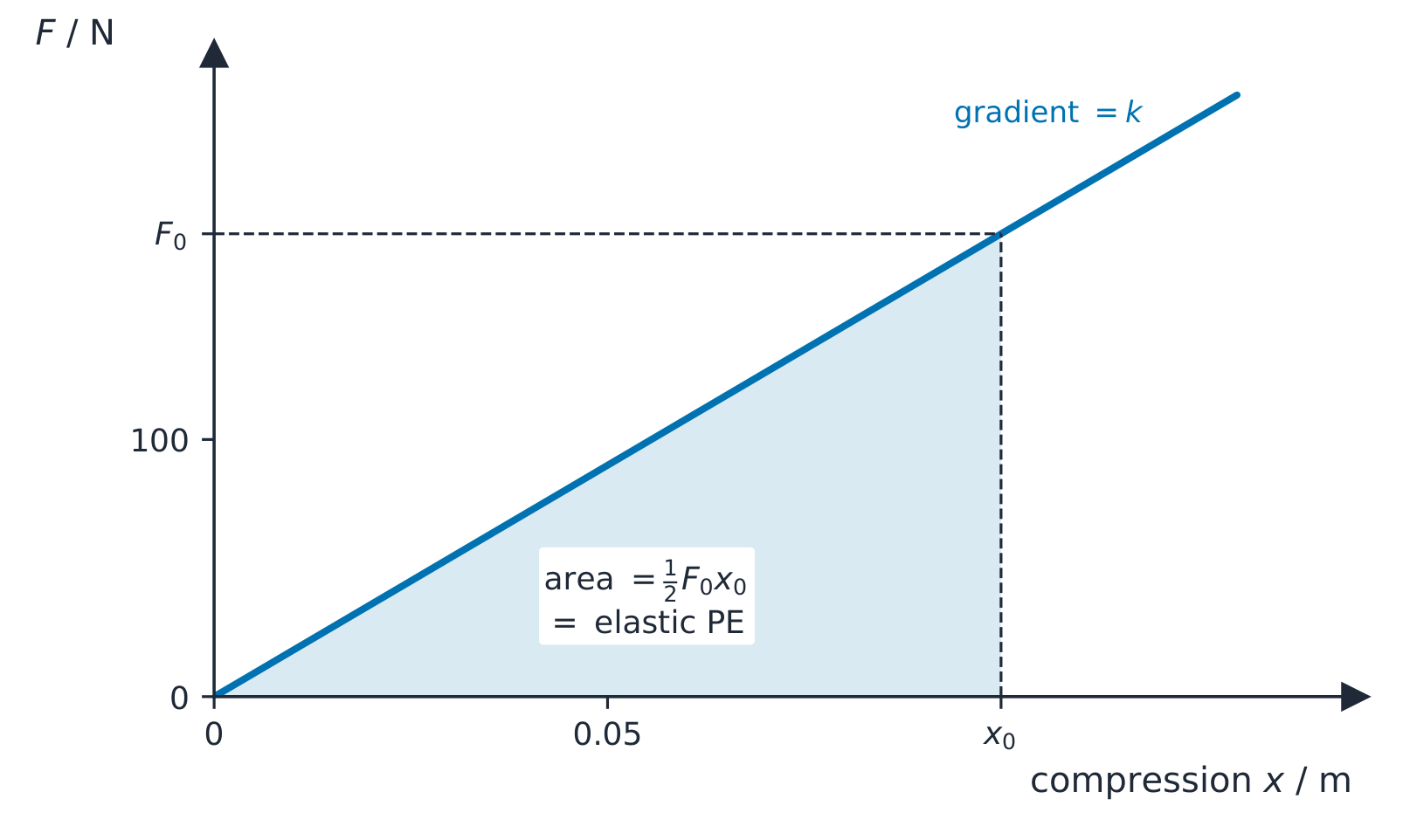


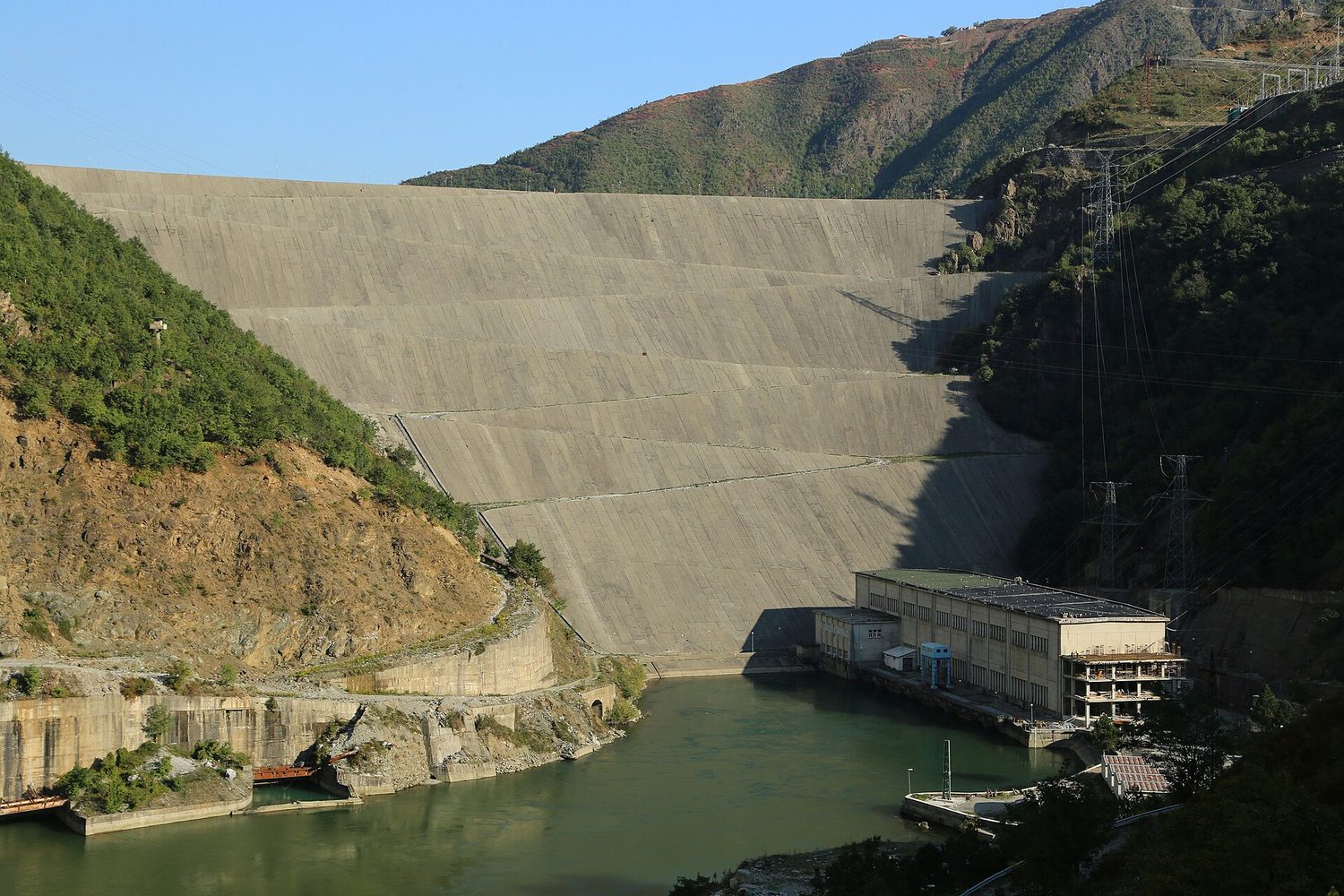

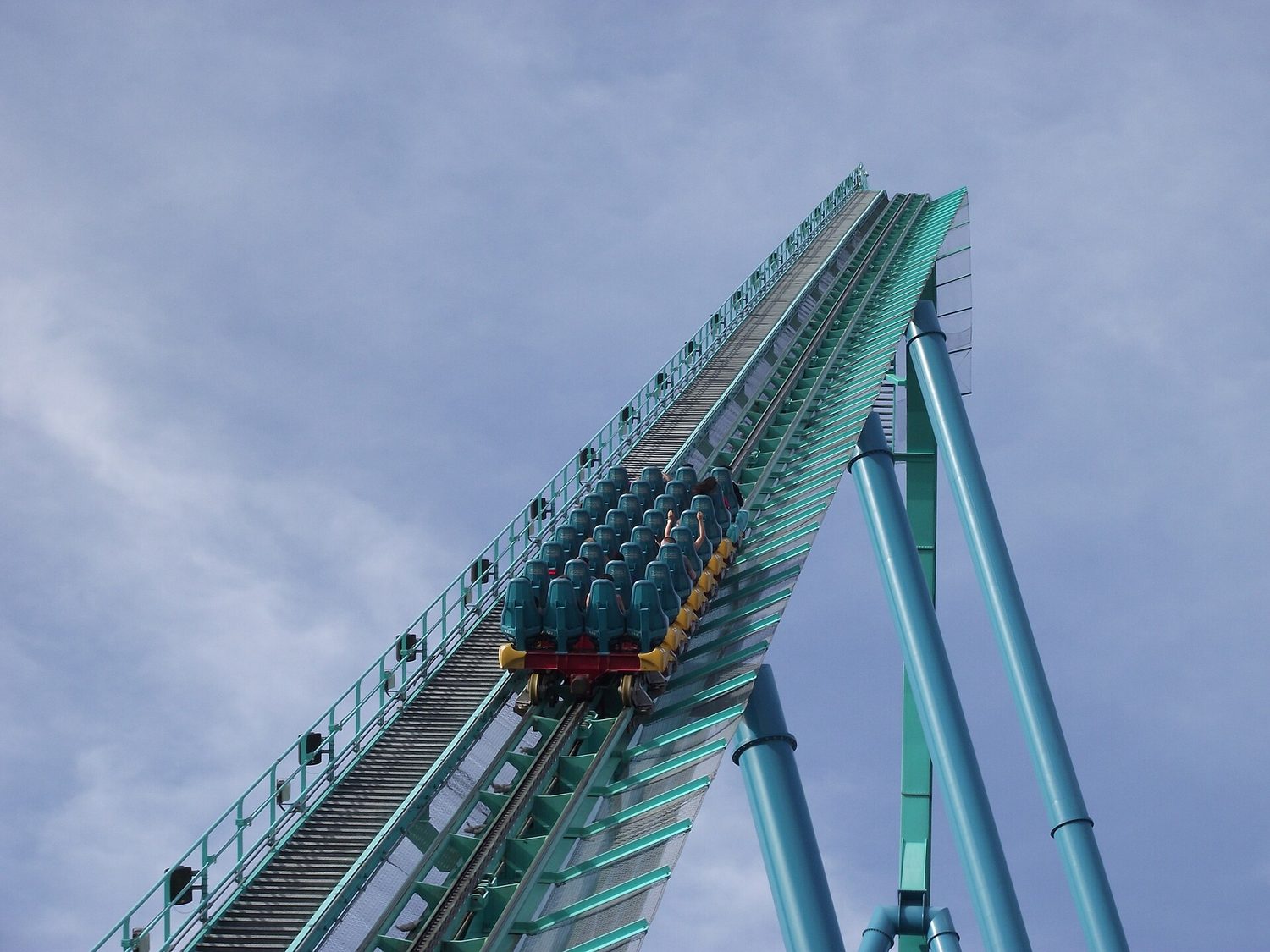
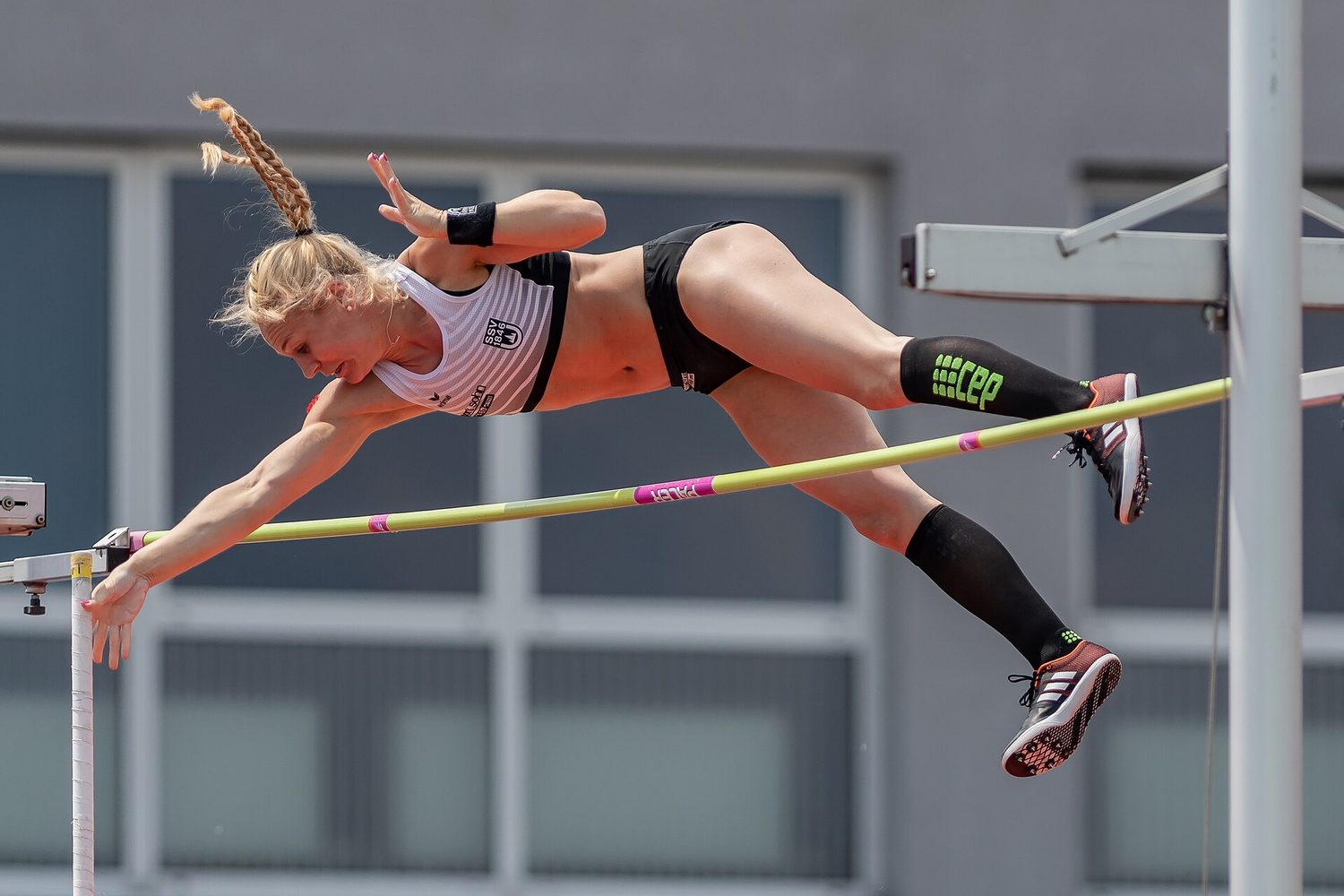


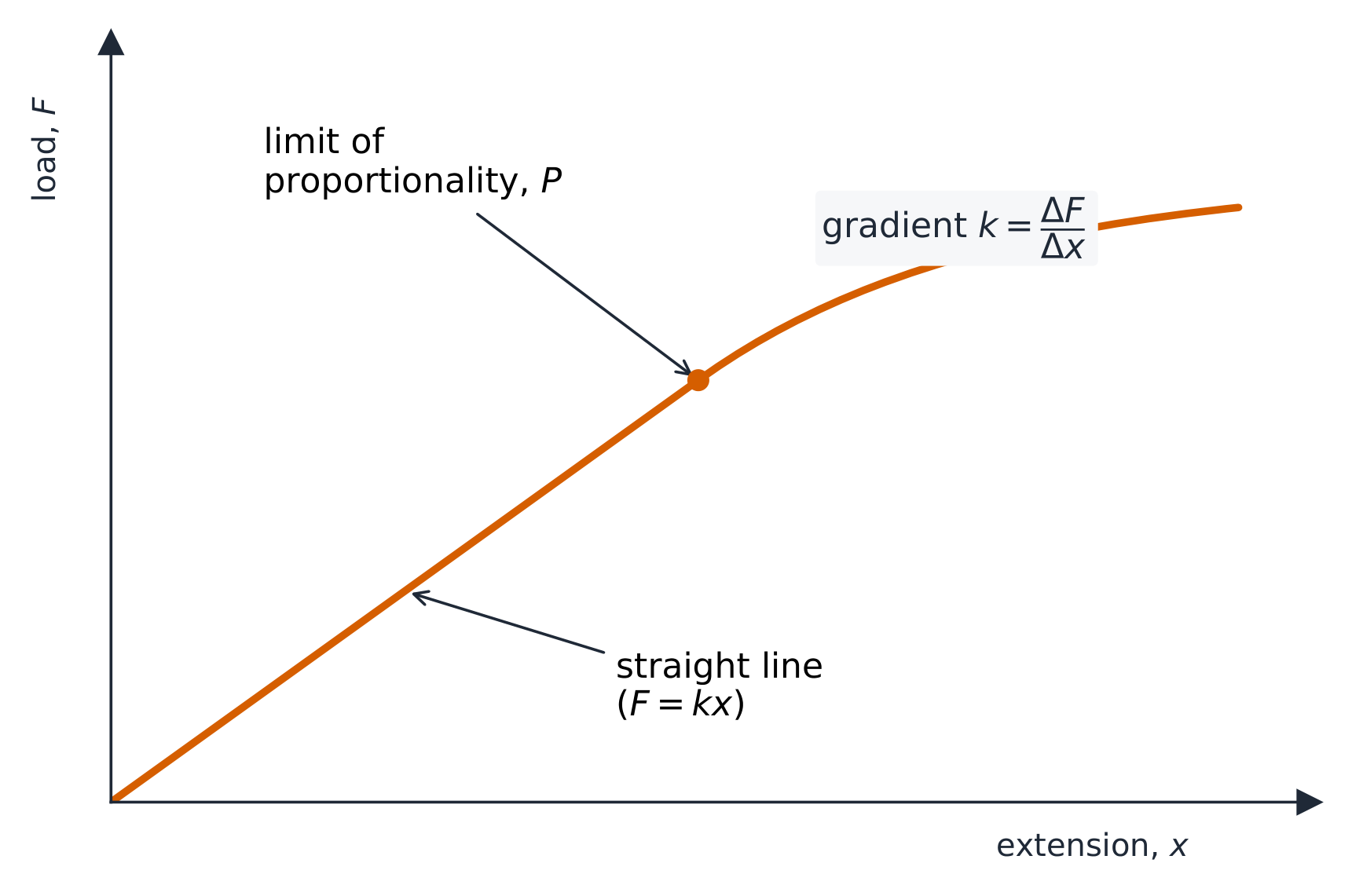
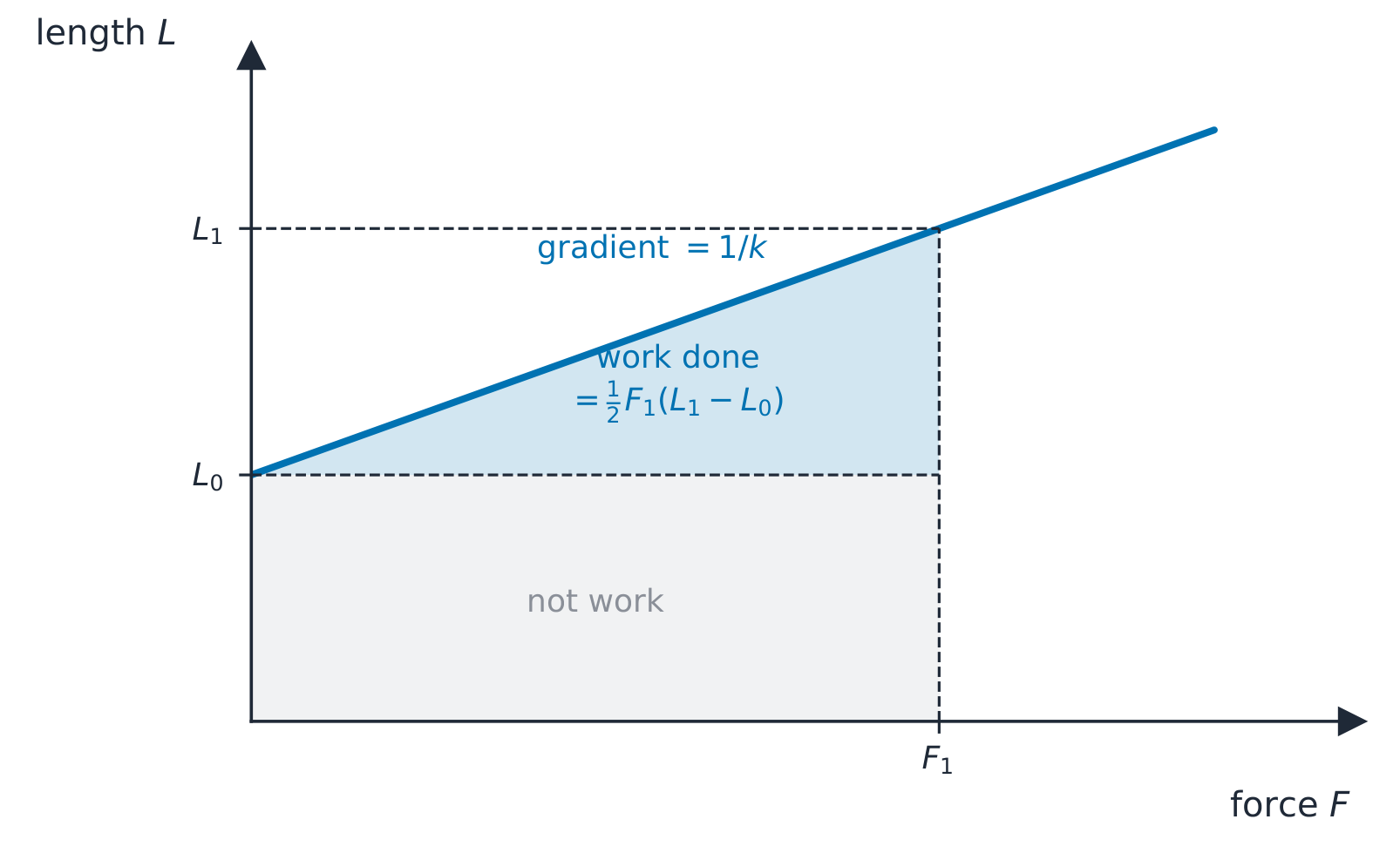
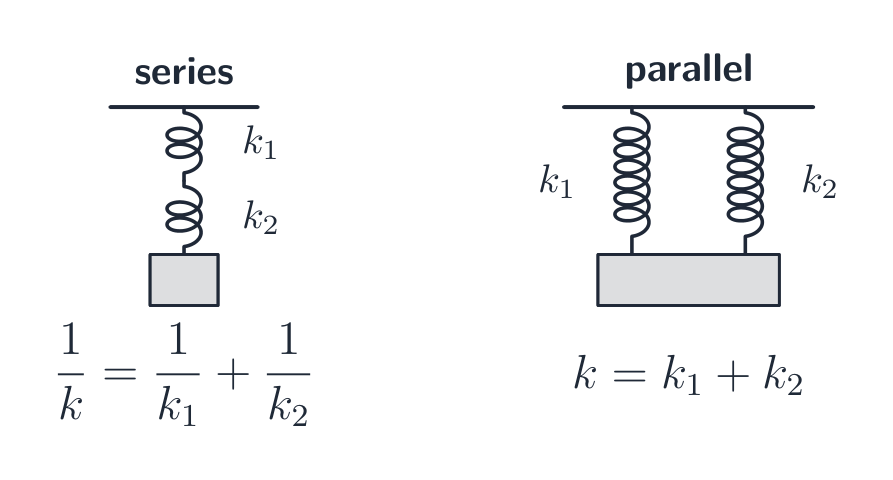

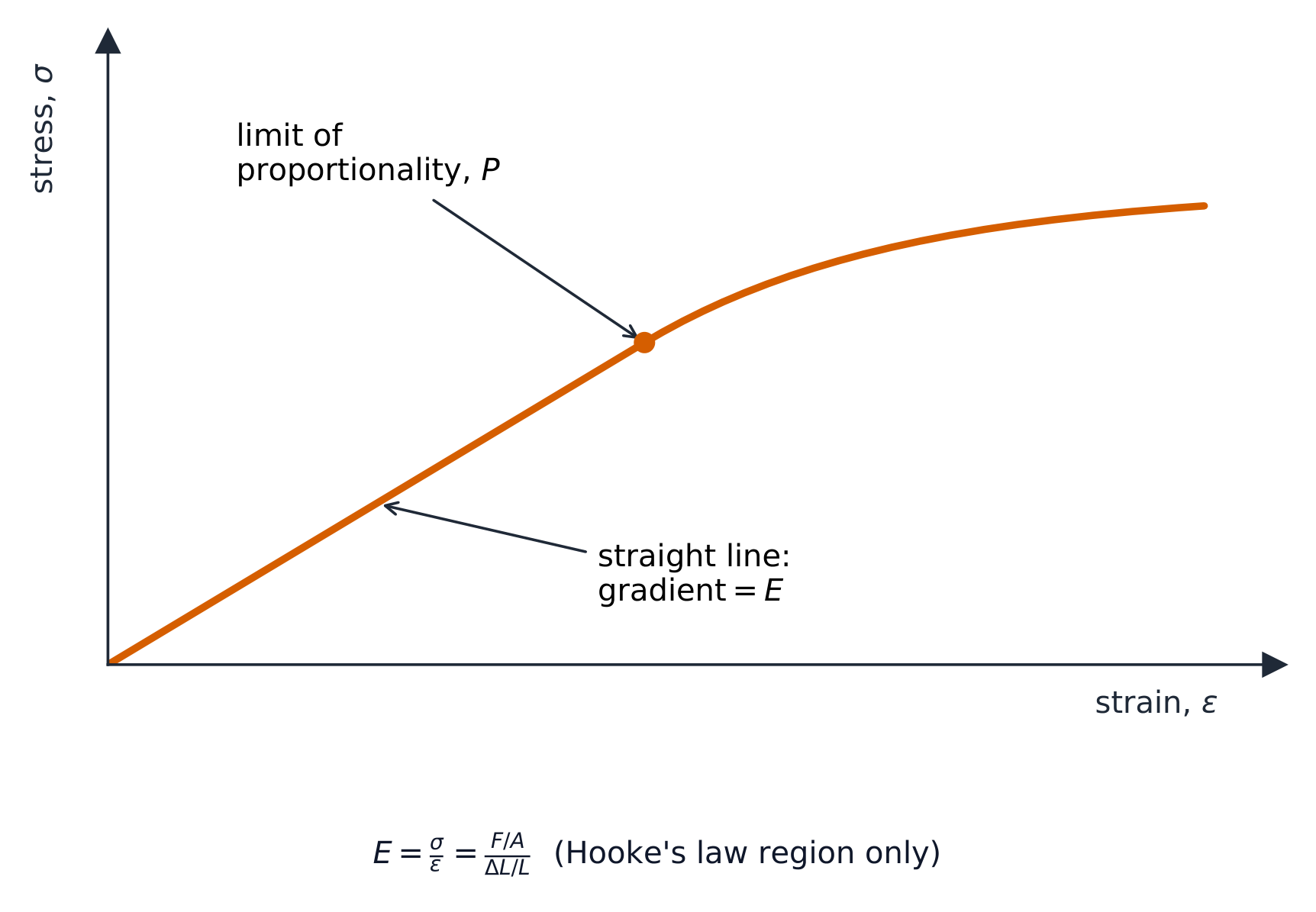
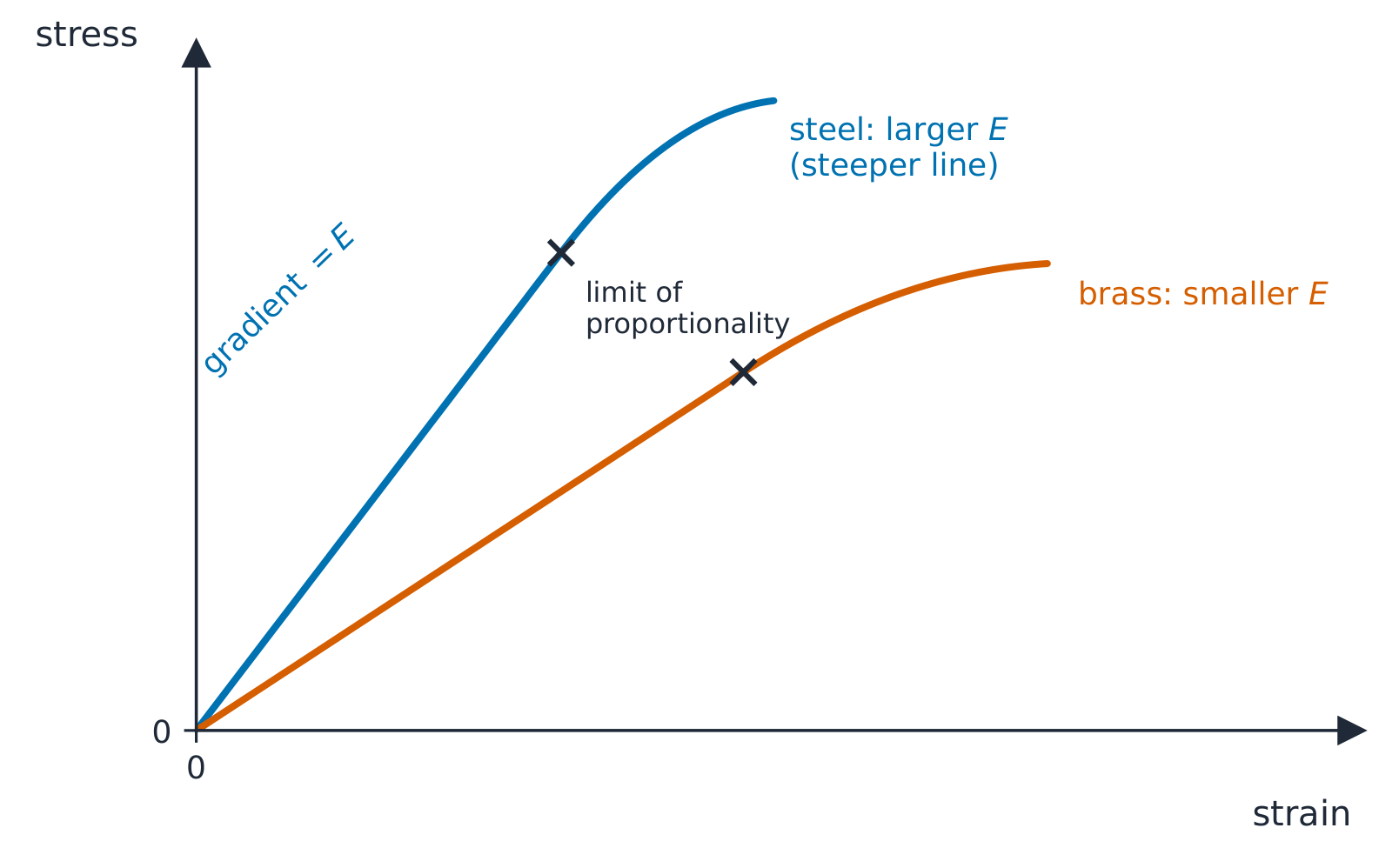 *مادتان معدنيتان في رسم بياني واحد للإجهاد-الانفعال: الخط الأكثر انحداراً له معامل يونغ أكبر
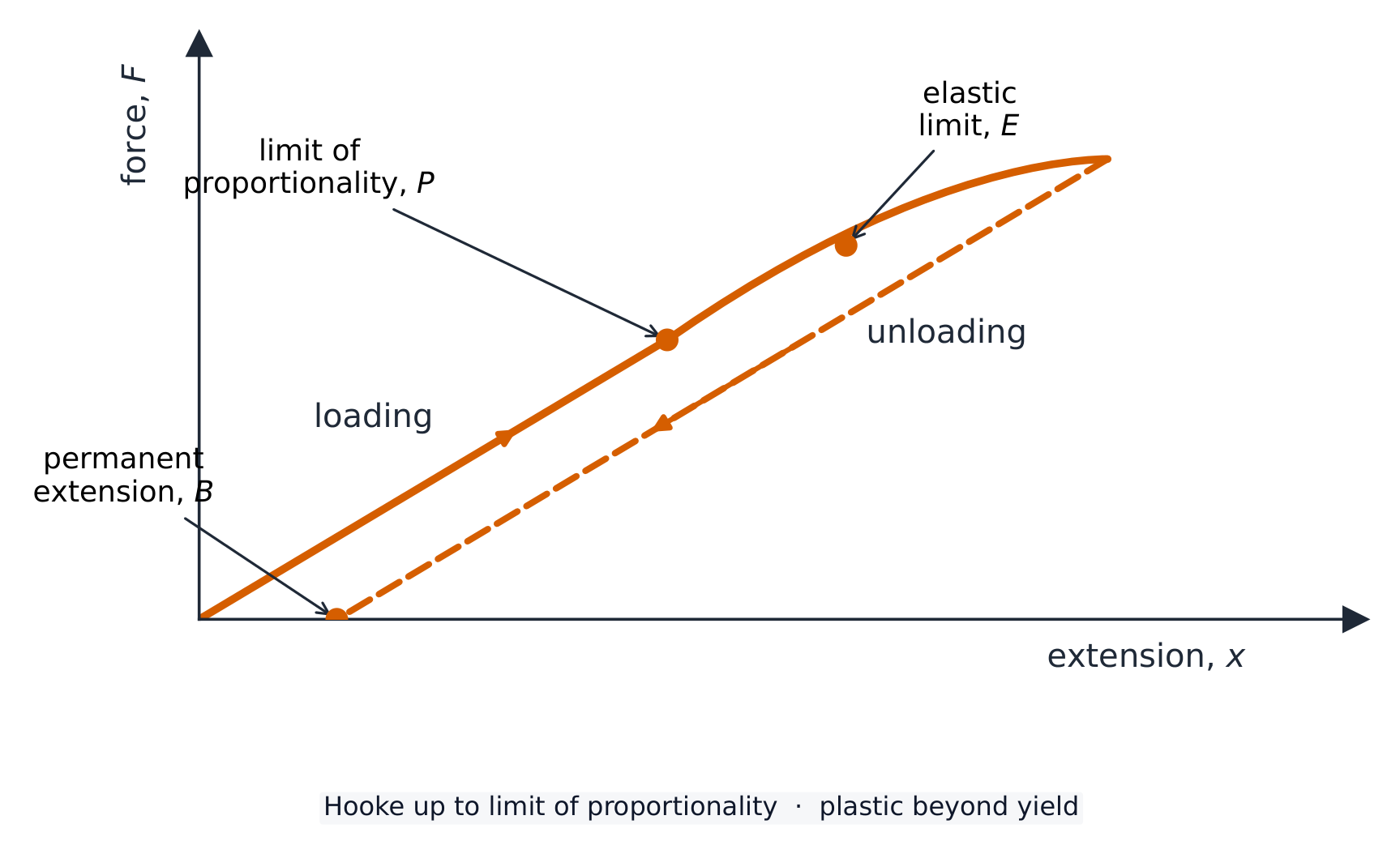

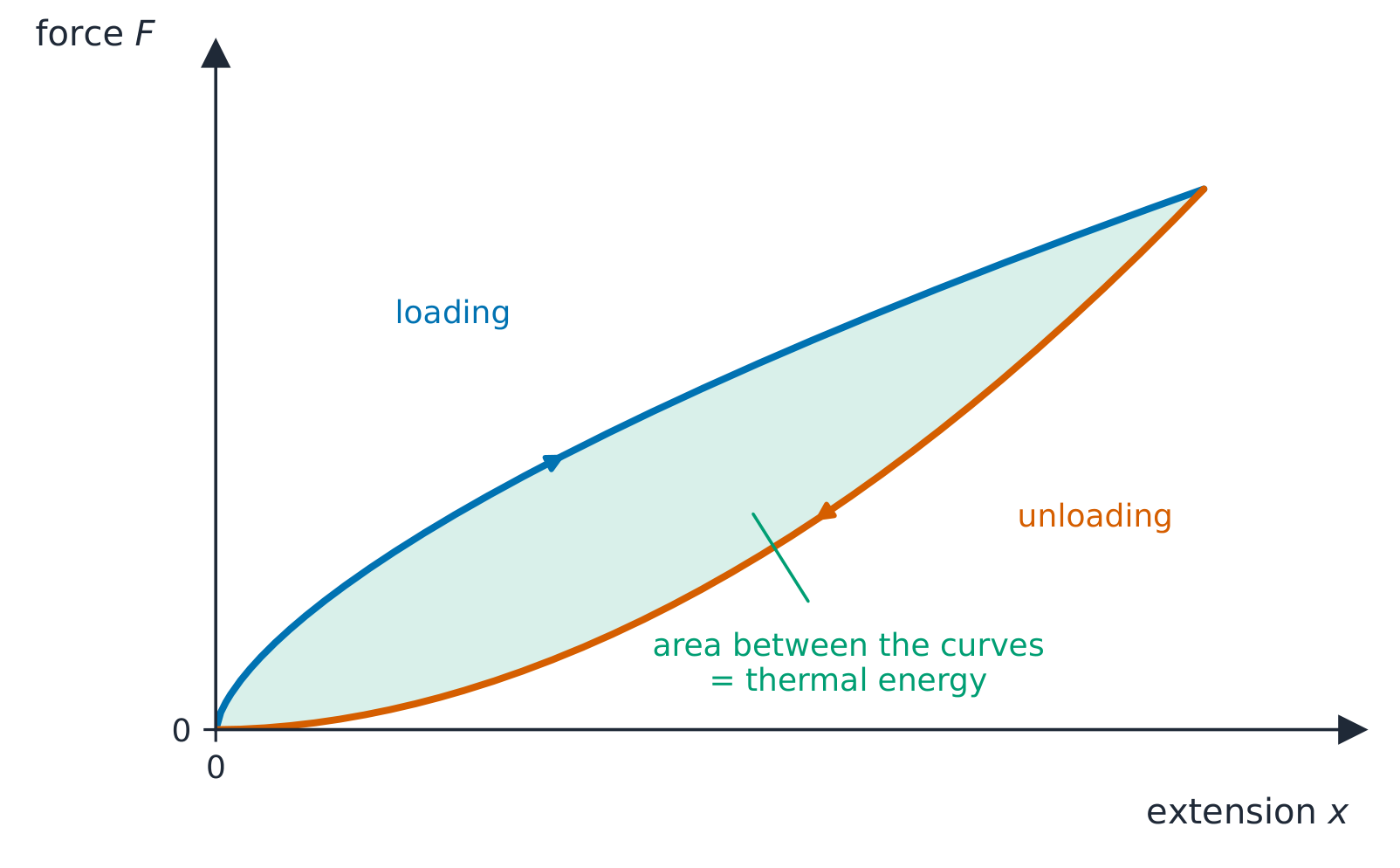
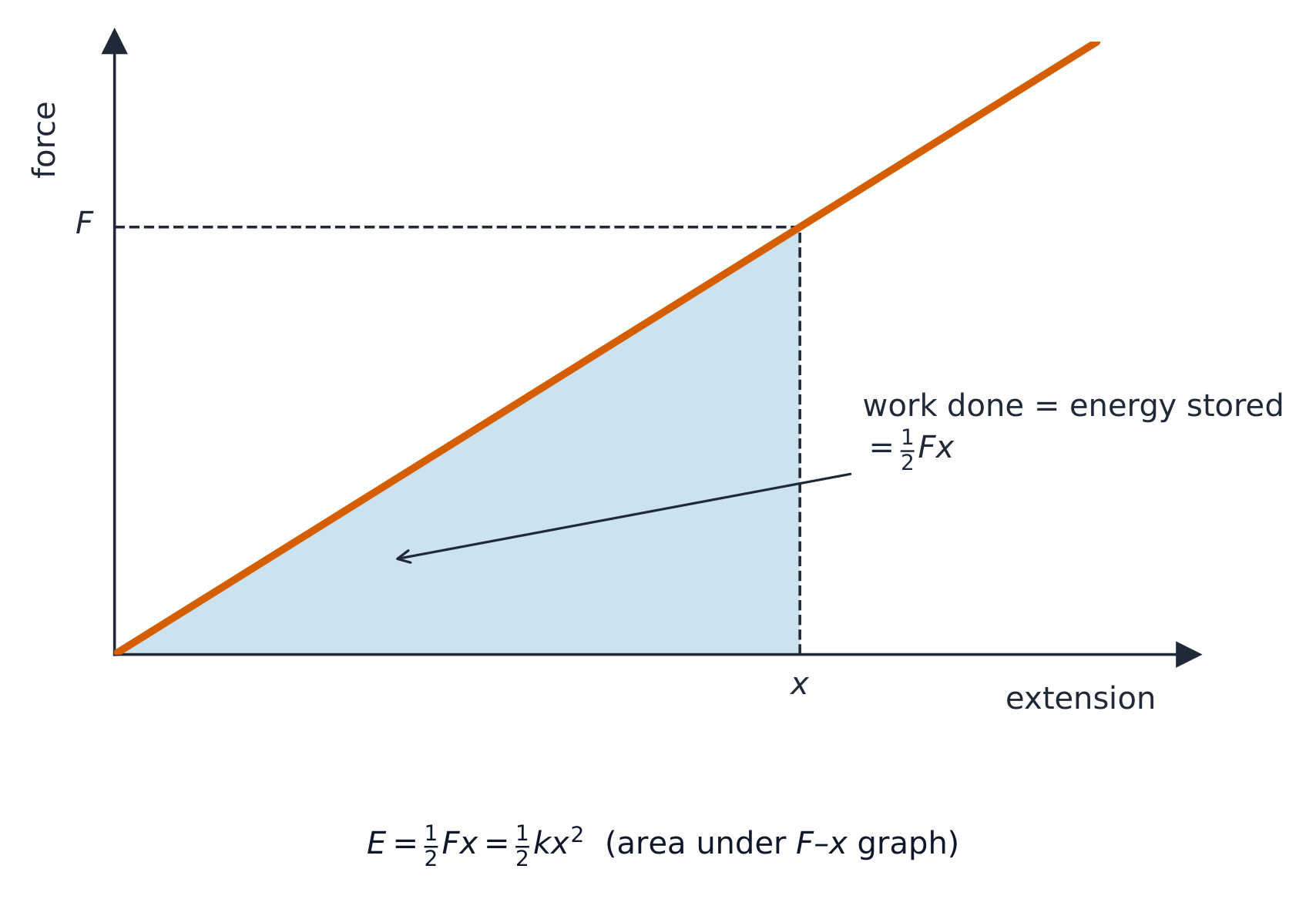


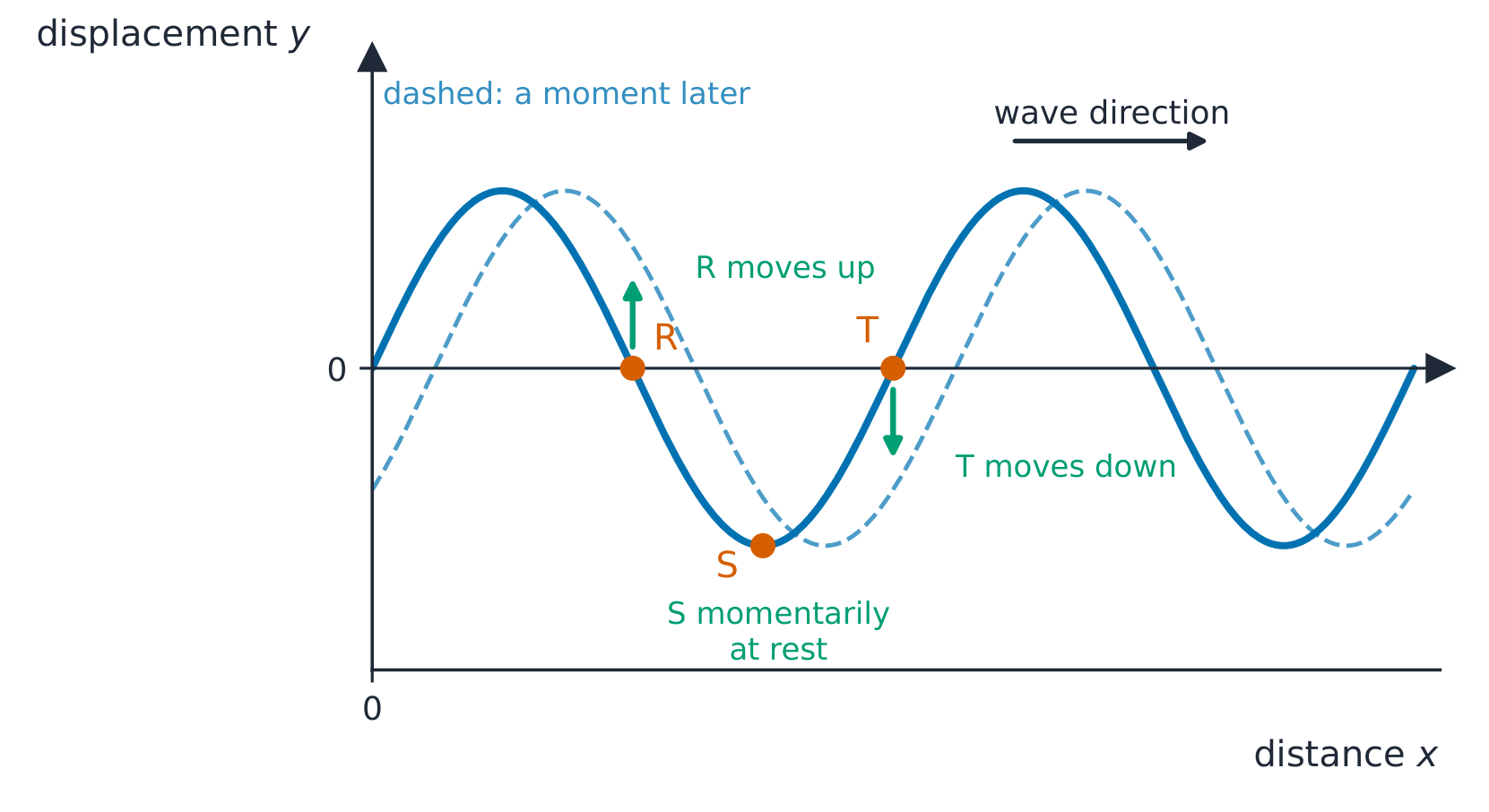
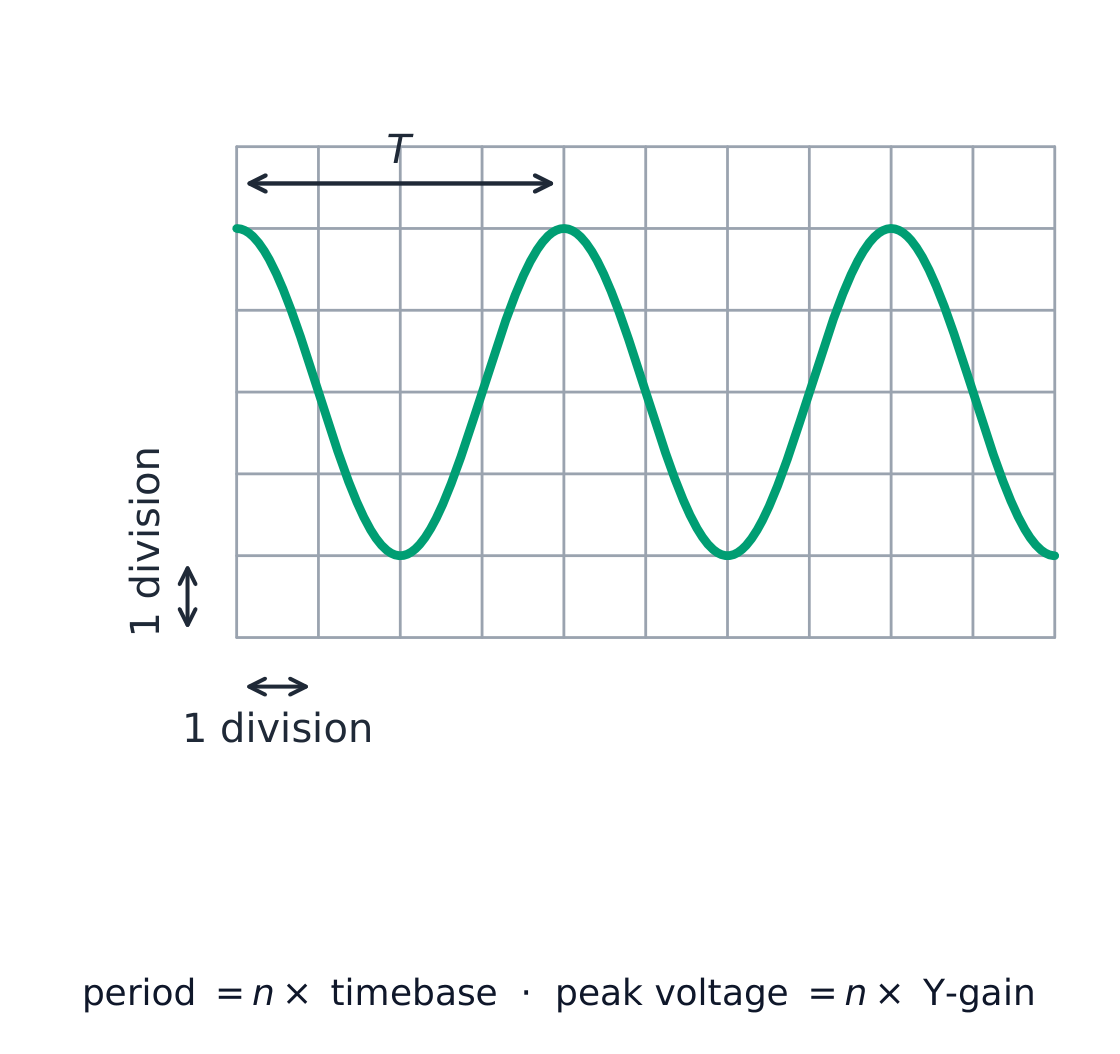


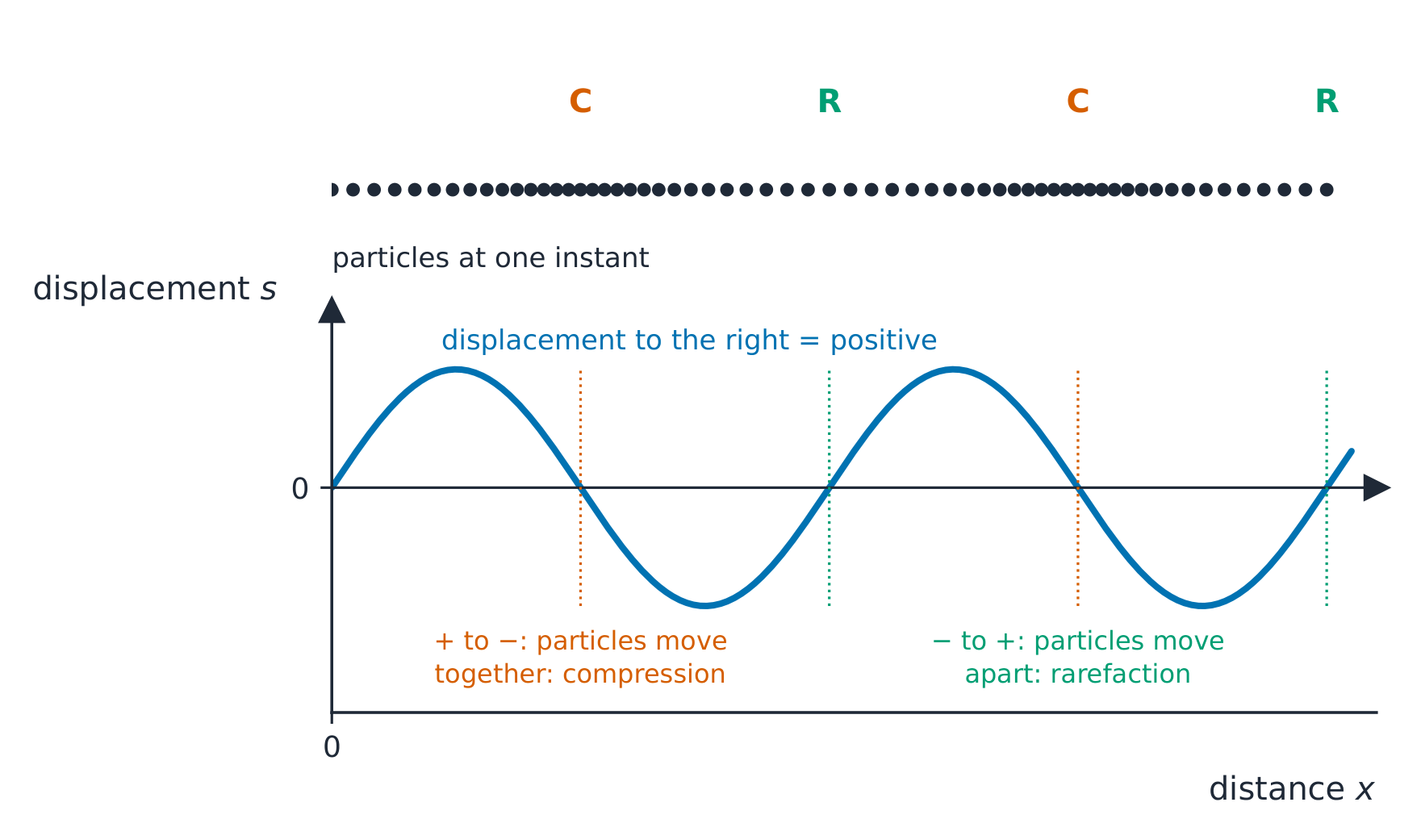

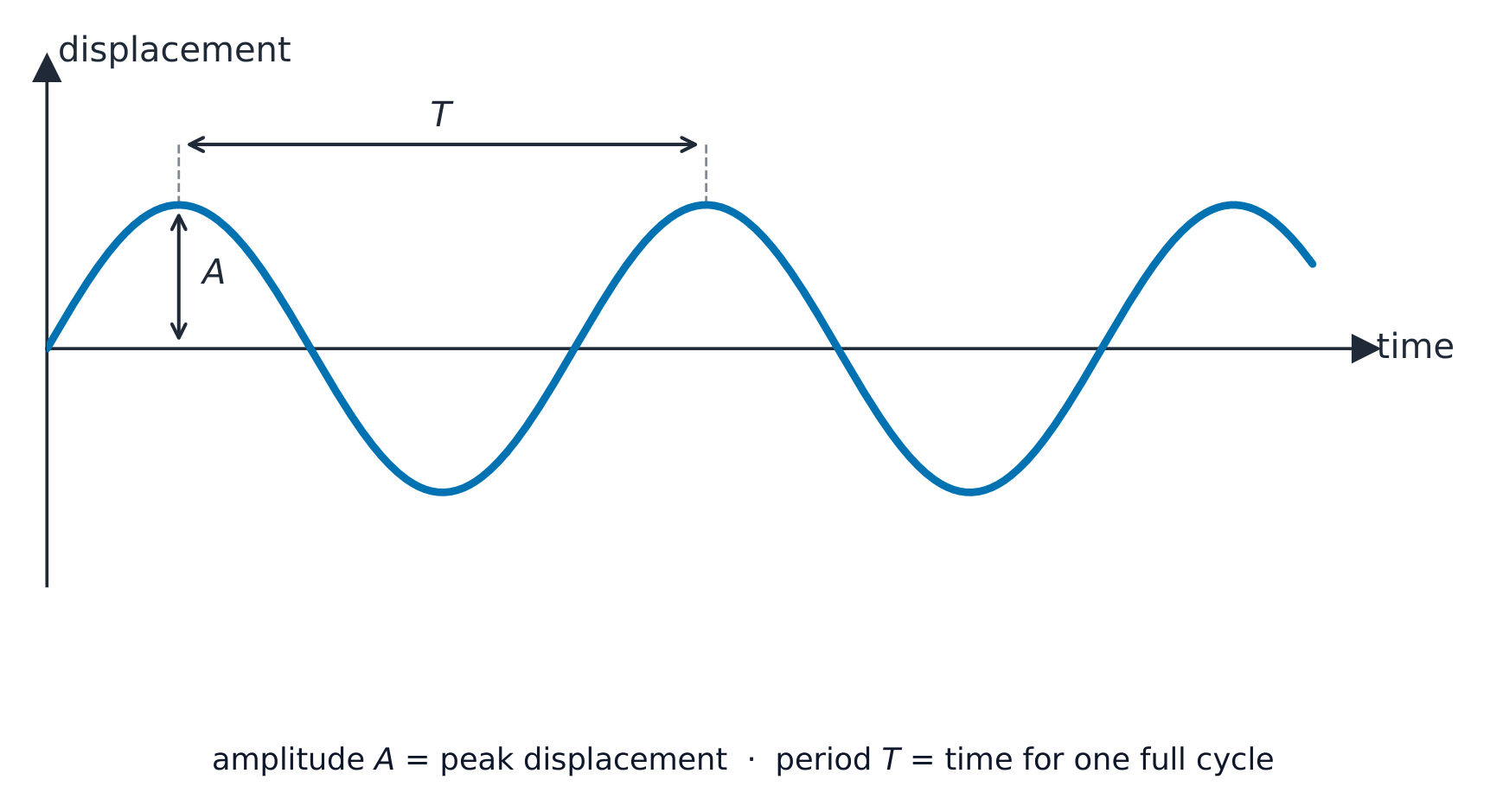

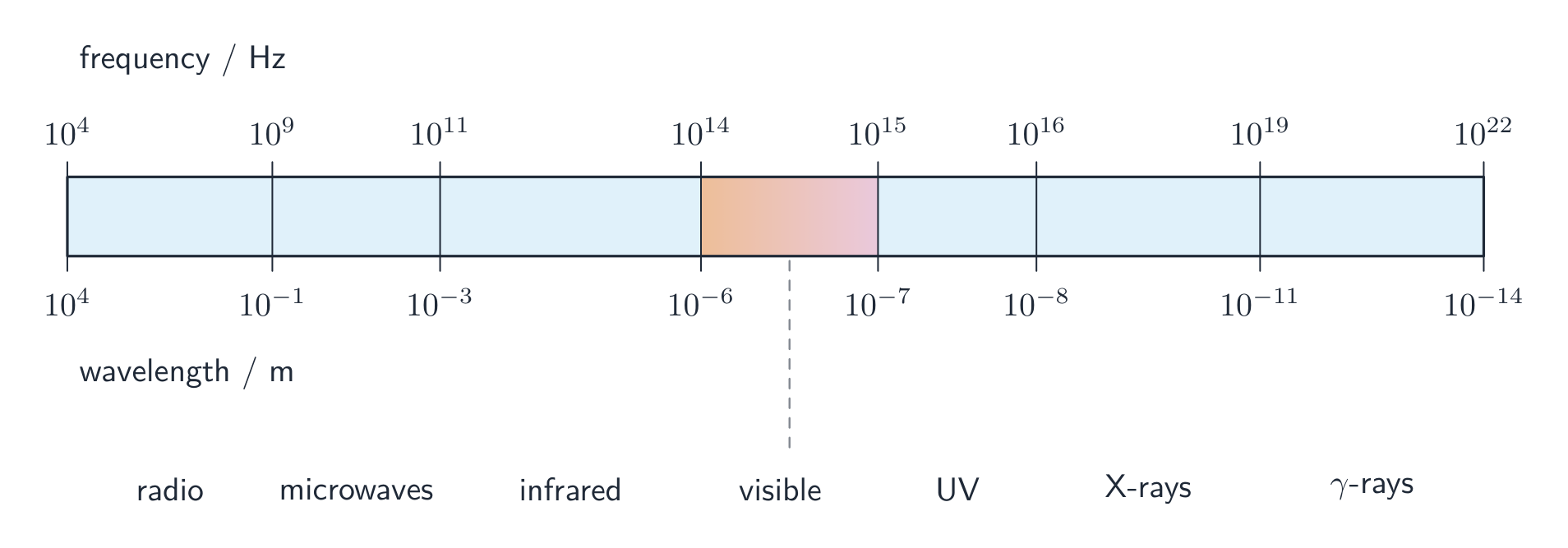

 *منقلة بلاستيكية شفافة موضوعة بين فلترين مستقطبين متقاطعين. يصل الضوء إلى عينك فقط لأن البلاستيك المضغوط يدور مستوى استقطابه — الألوان تمثل أين تم ضغط البلاستيك أكثر. مع الضوء العادي سيبدو شفافاً فقط


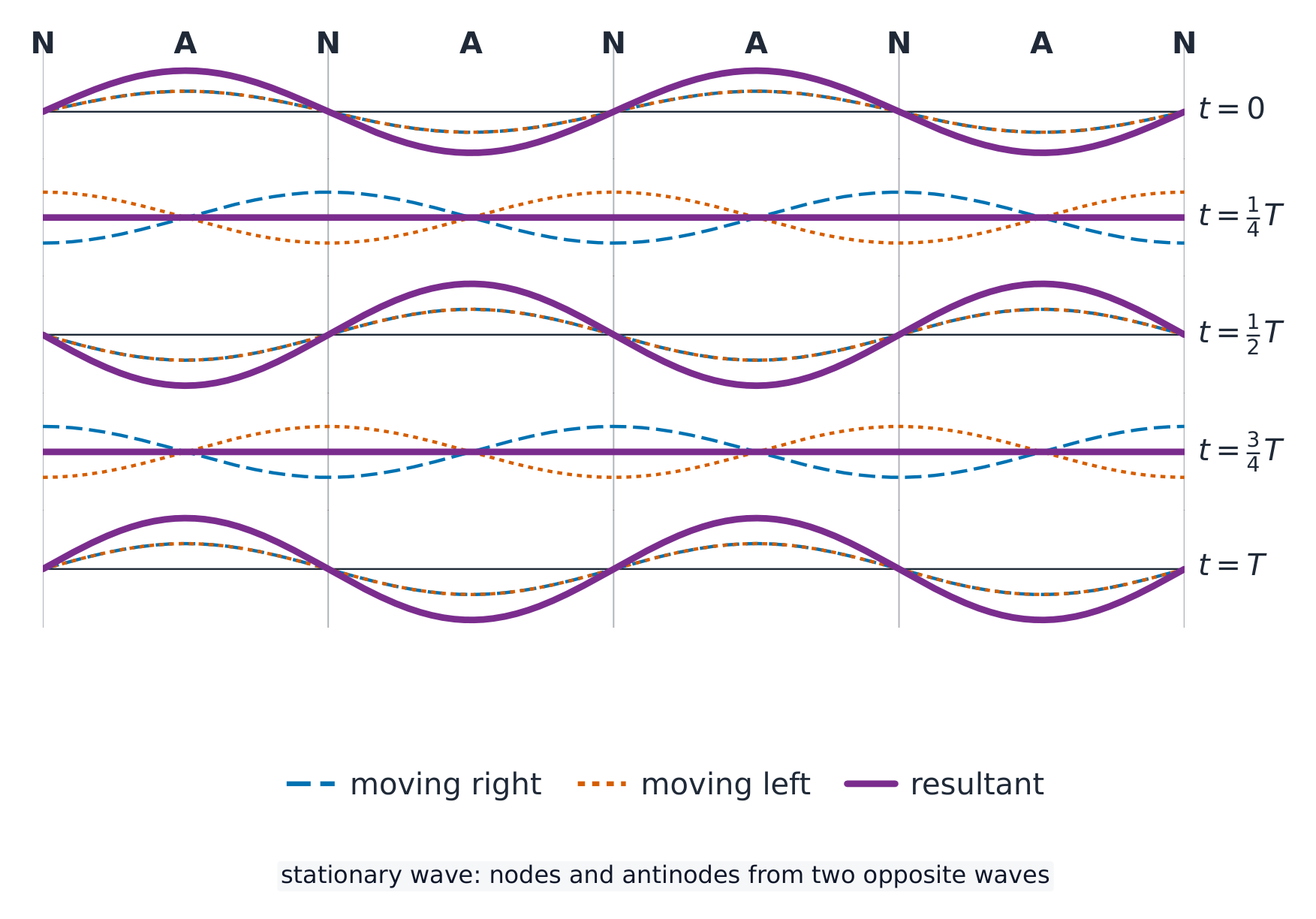

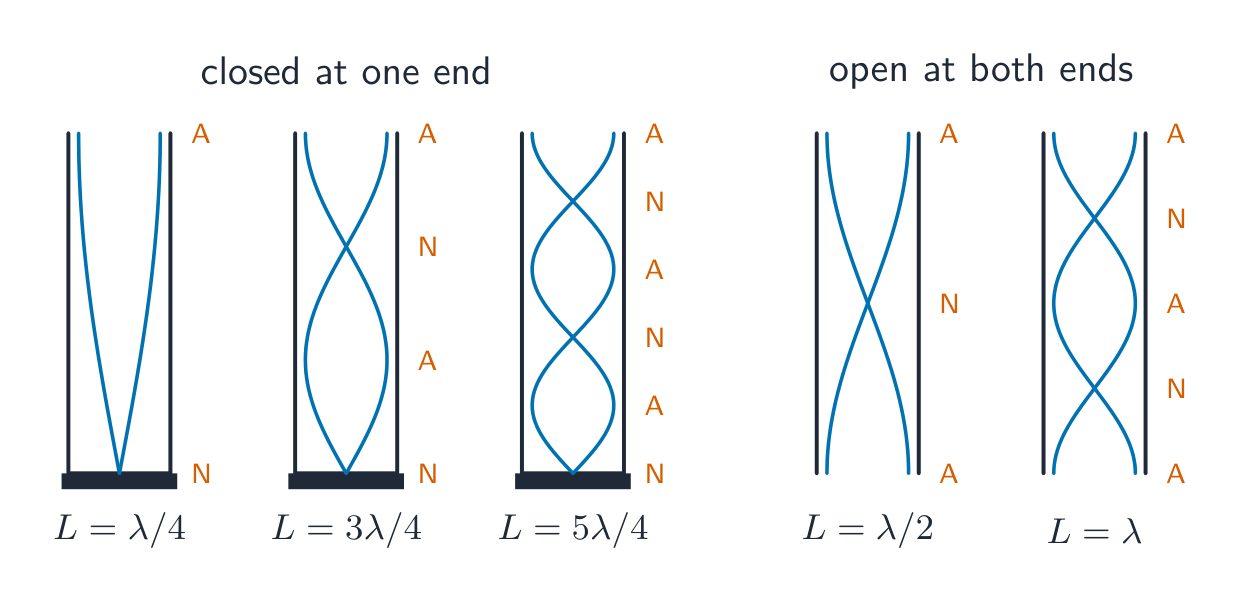


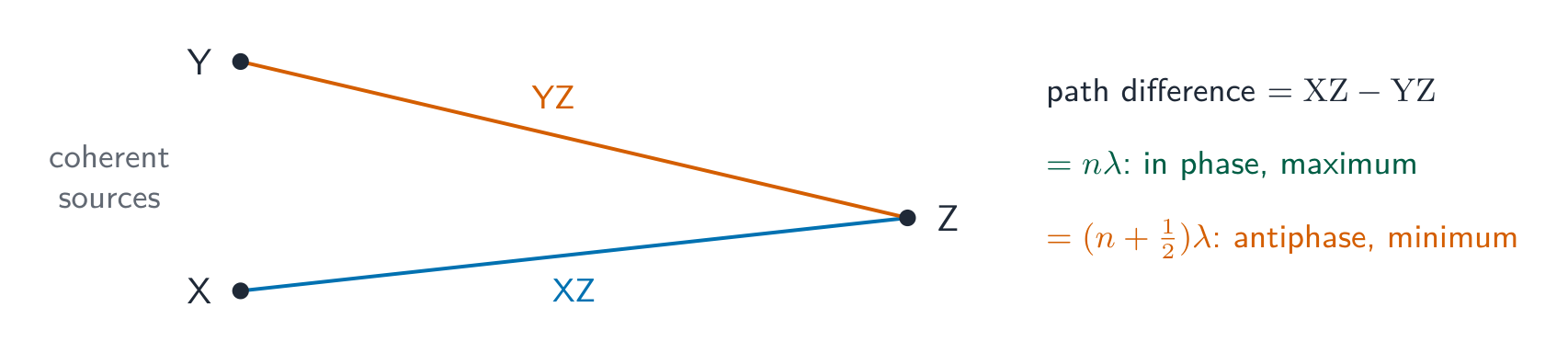

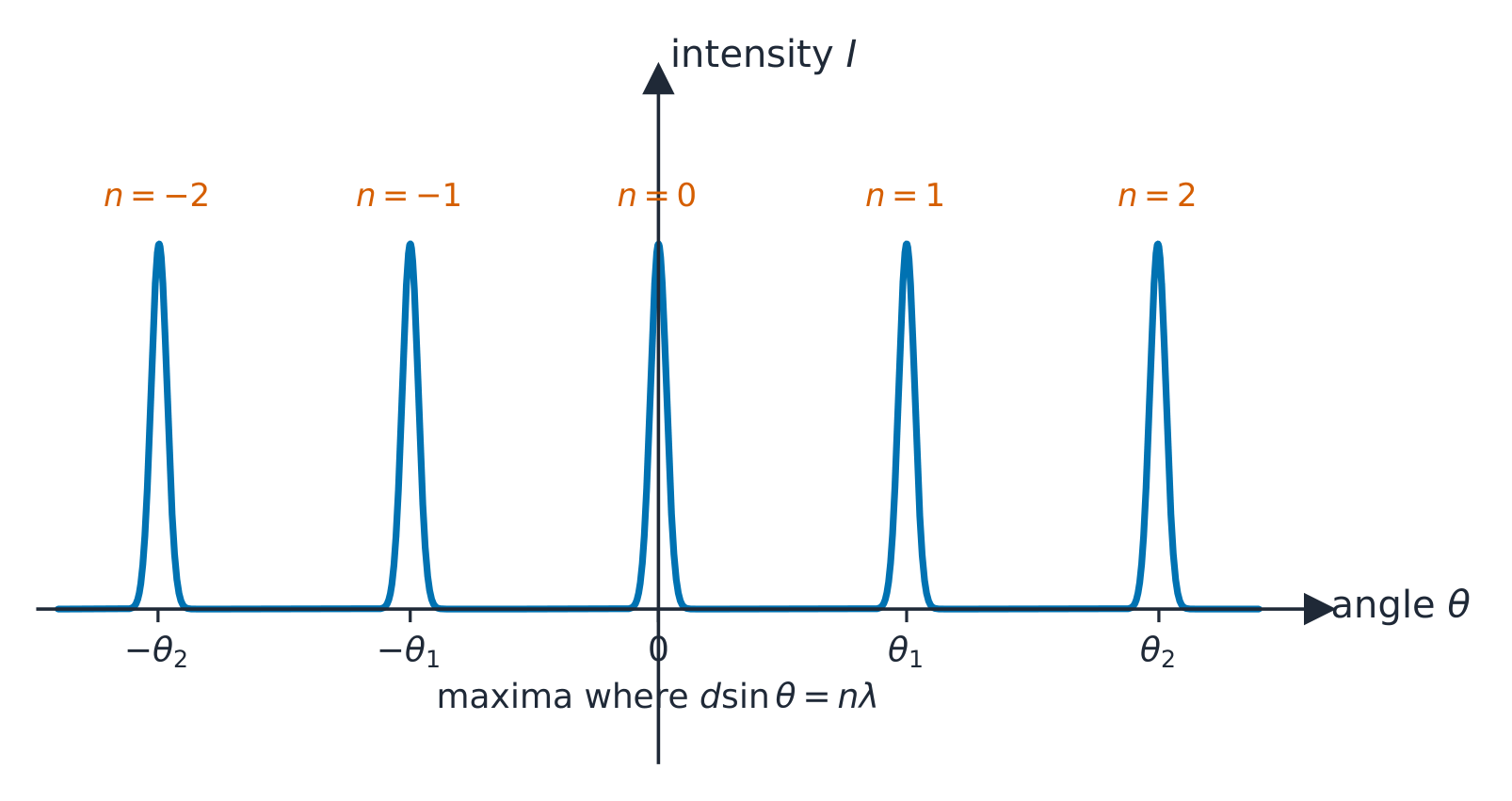


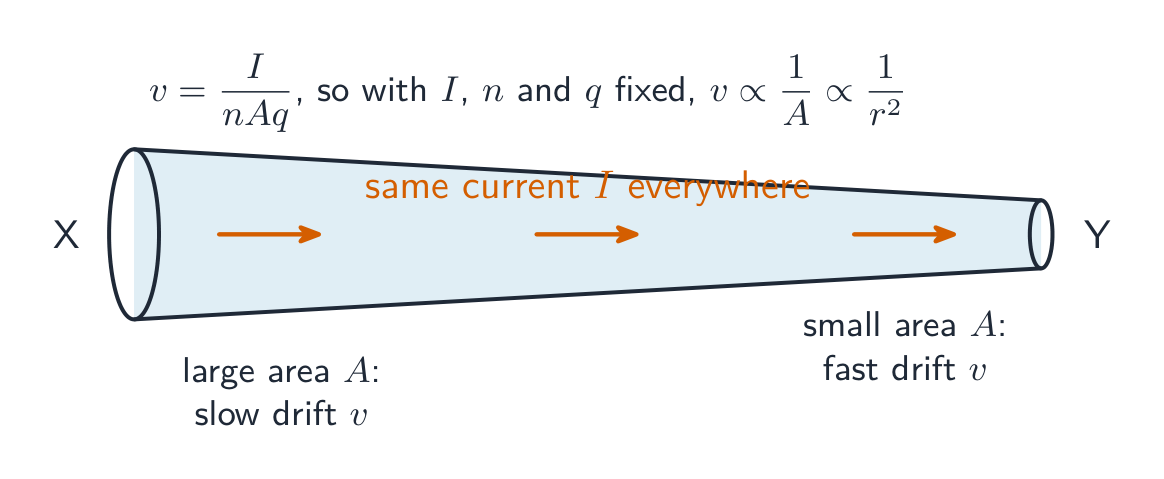


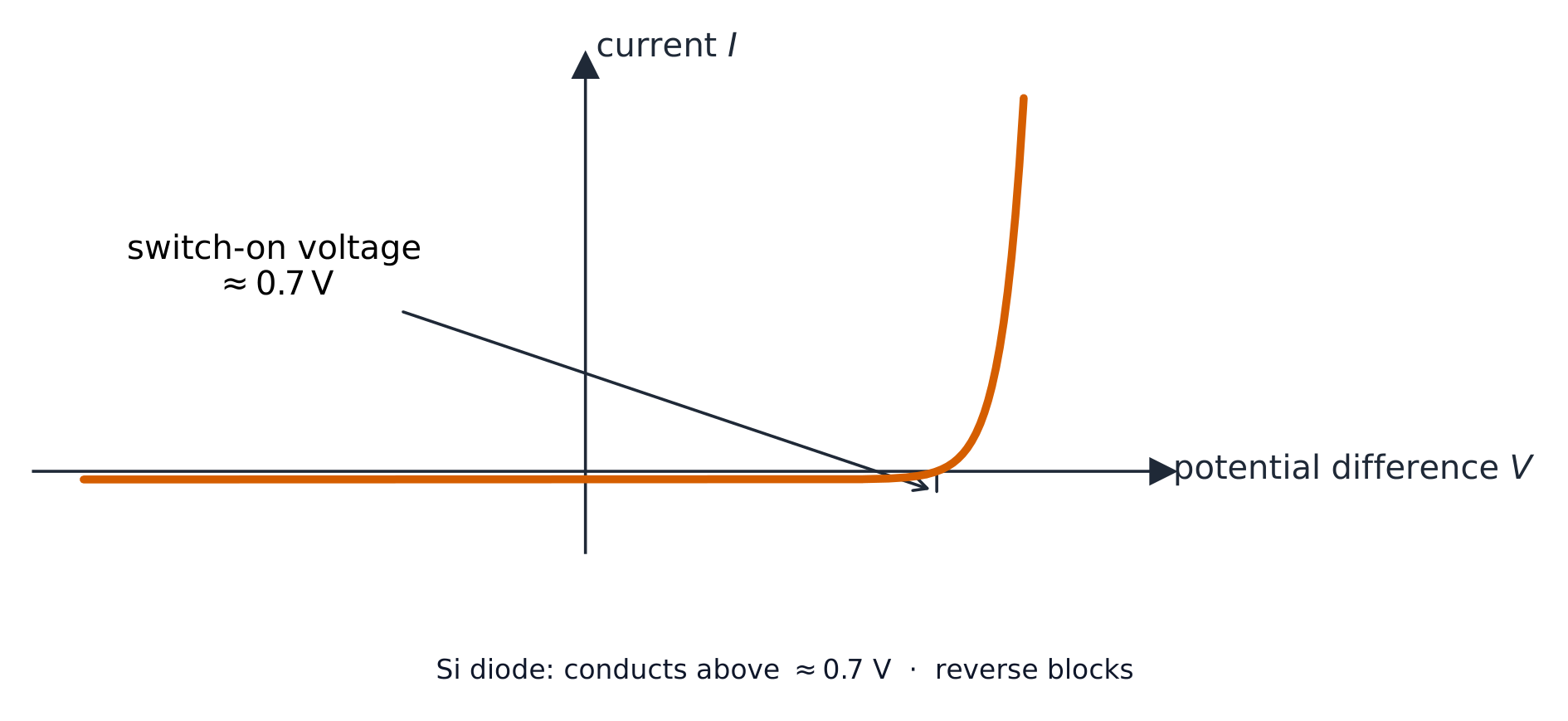


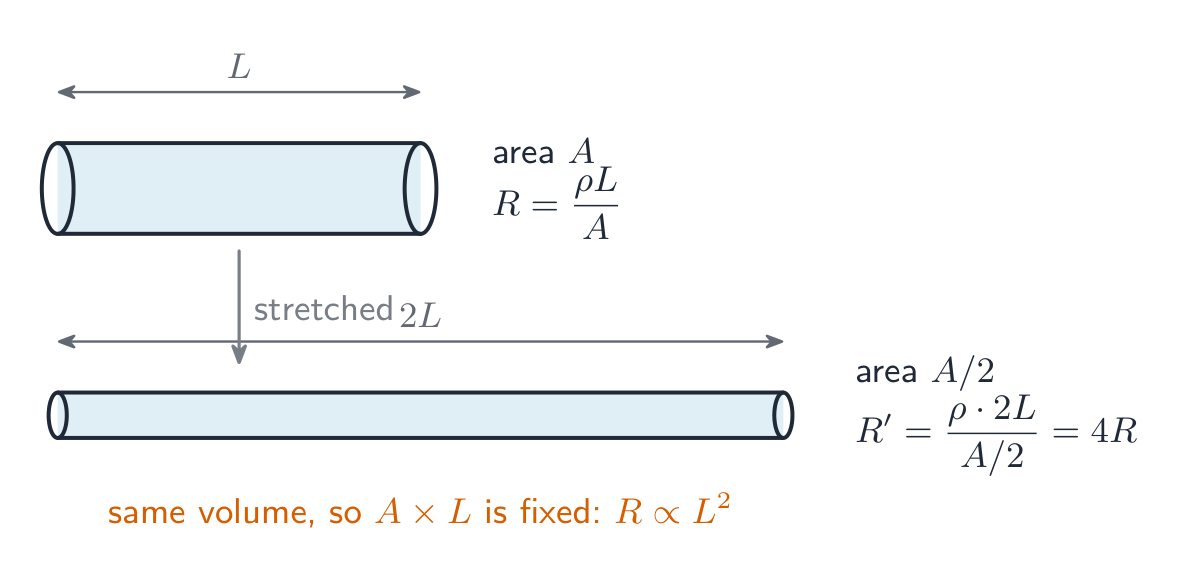



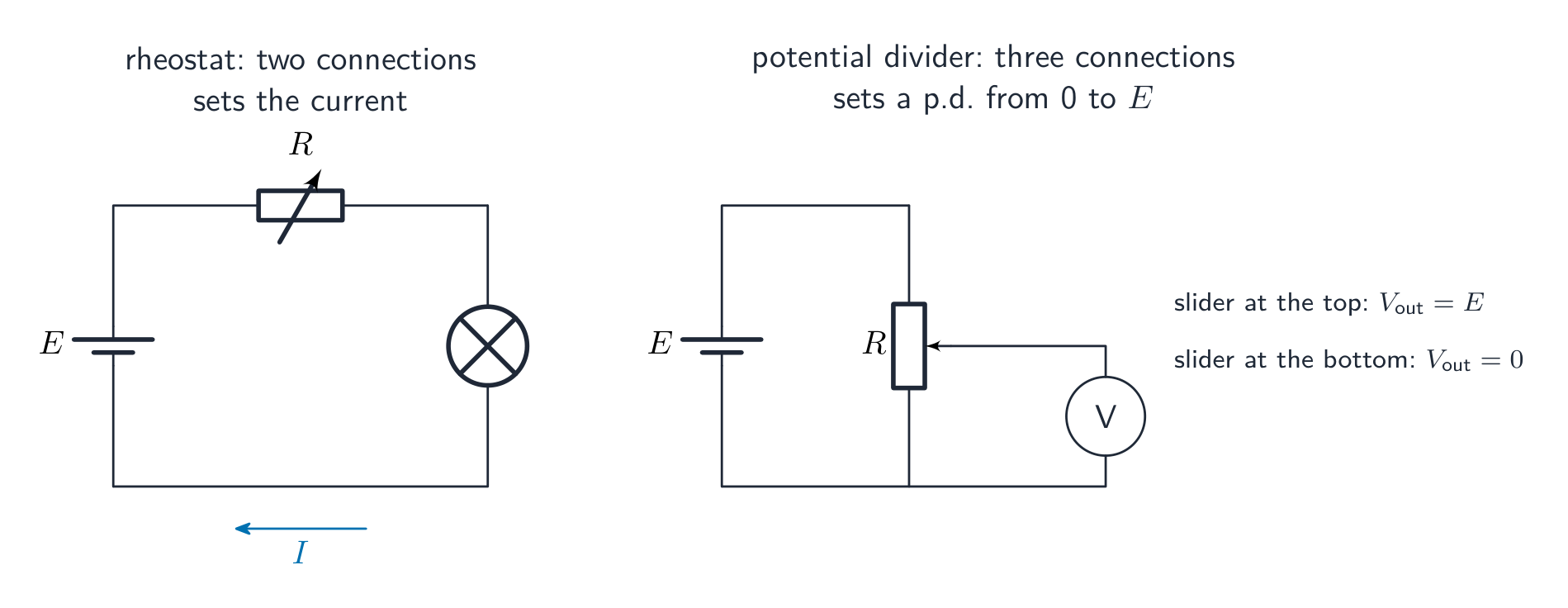


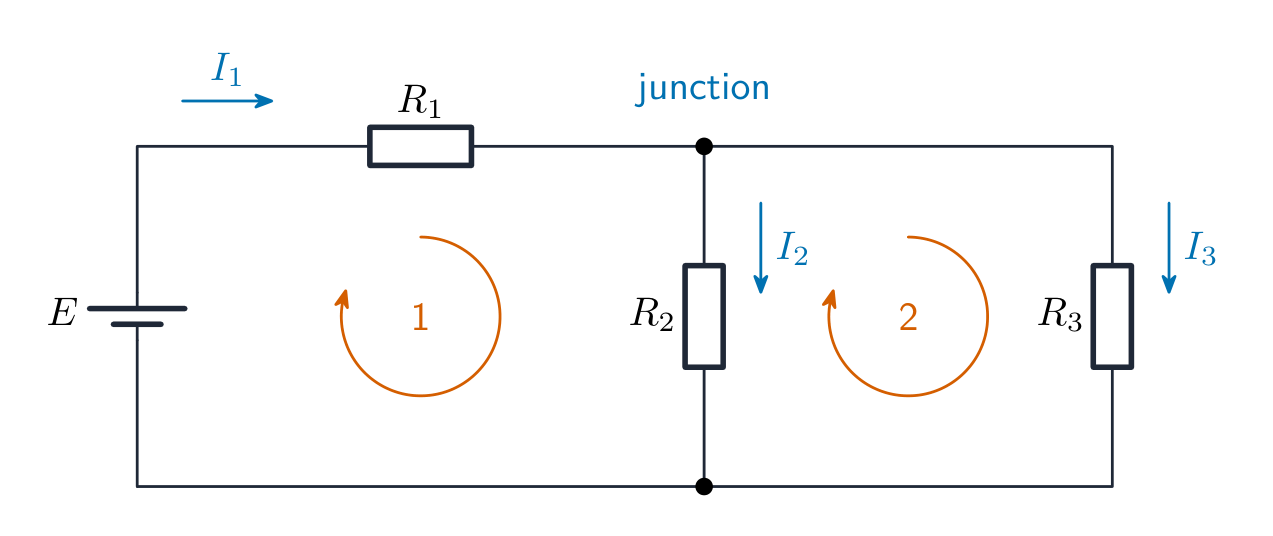


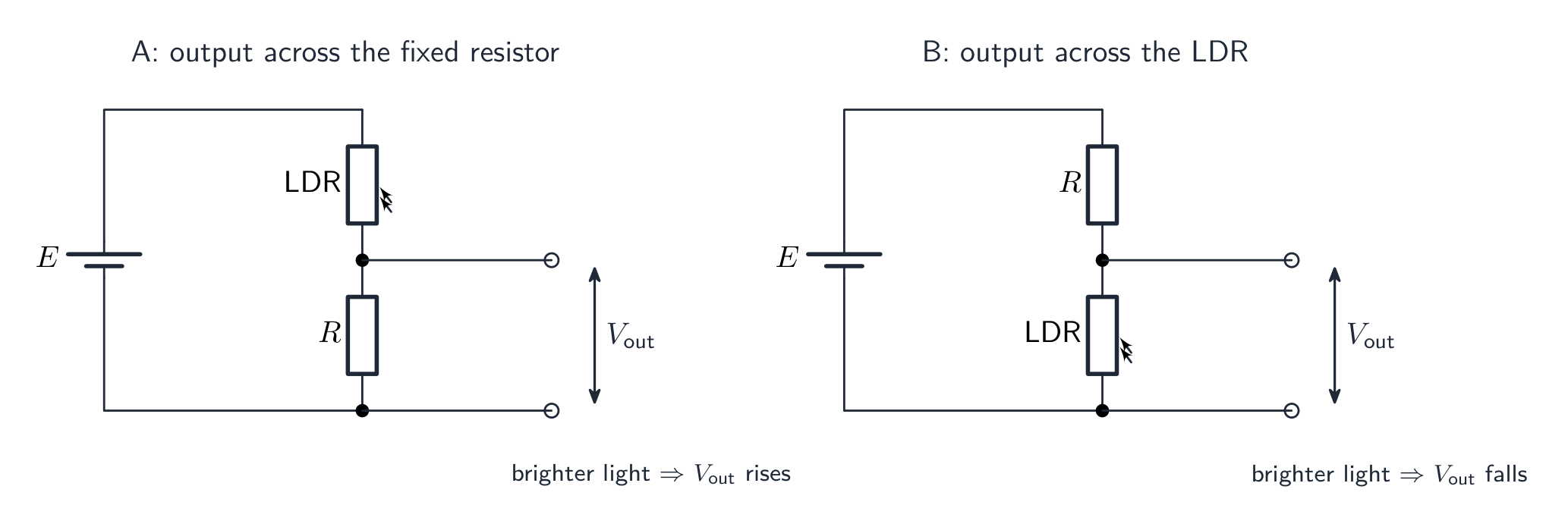


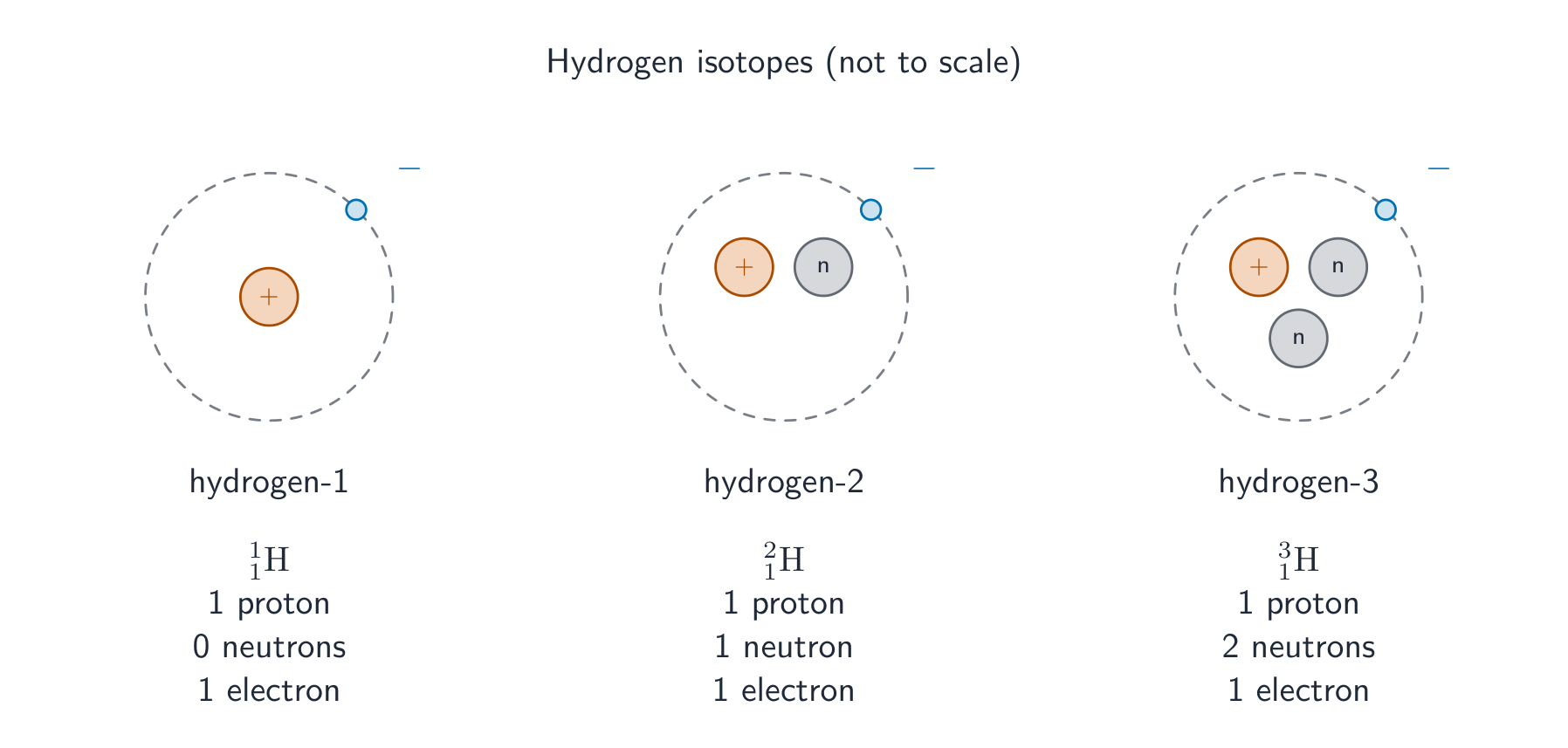


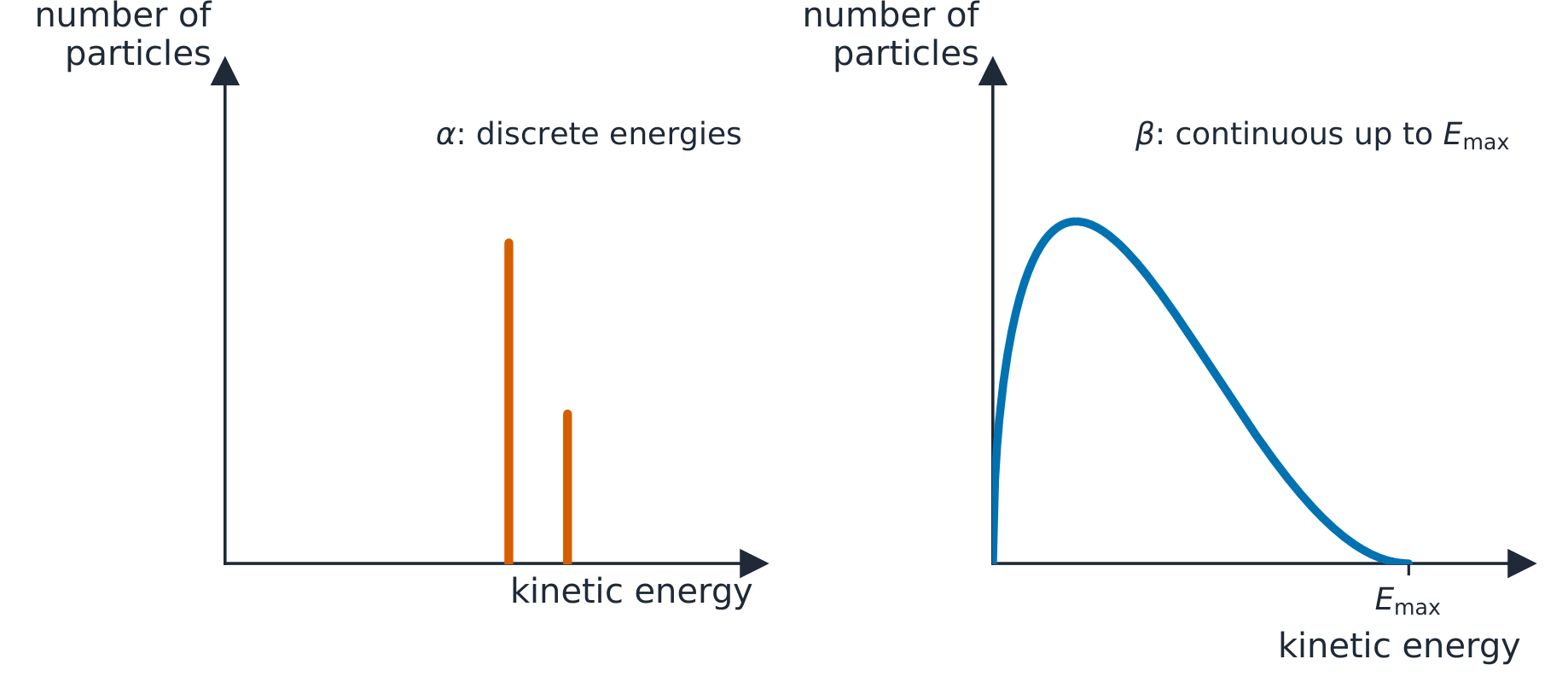
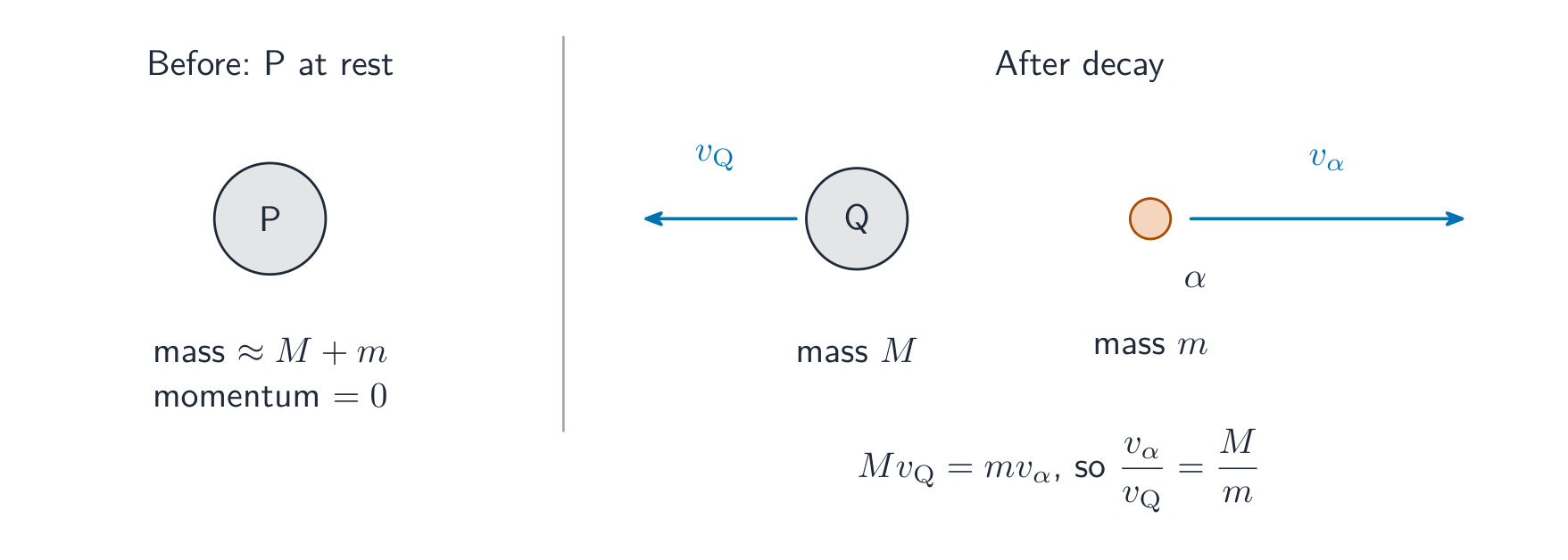



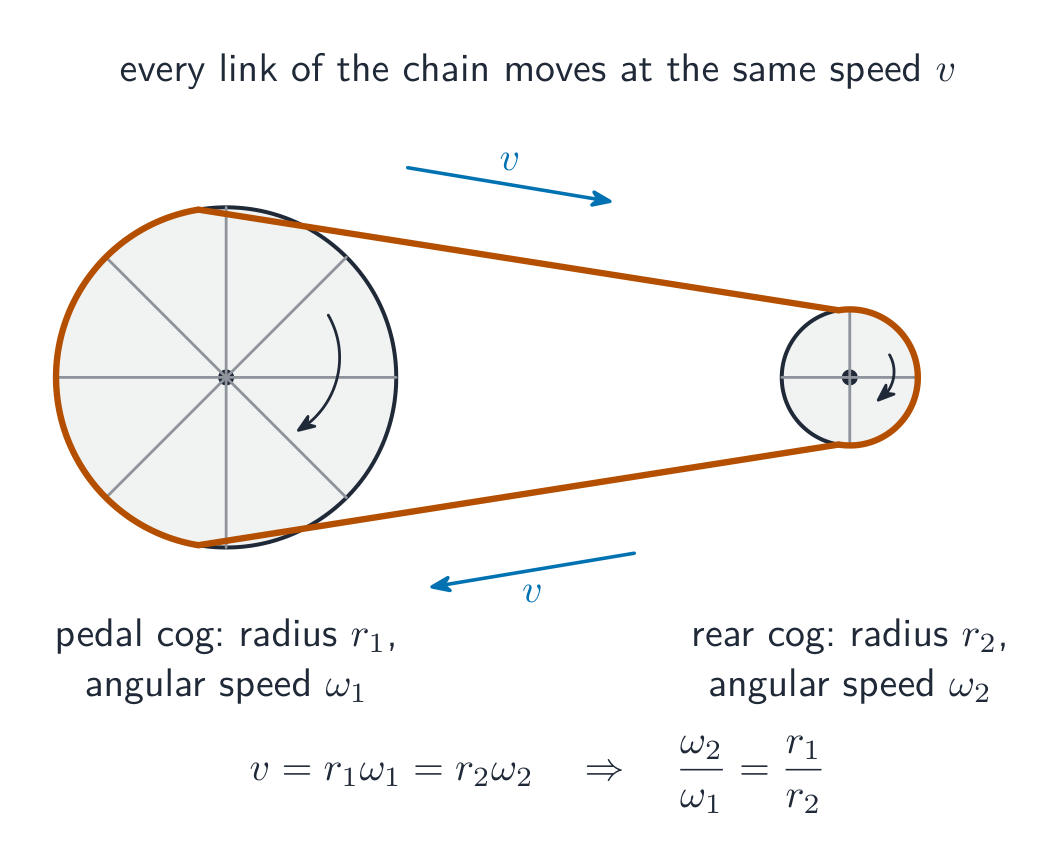


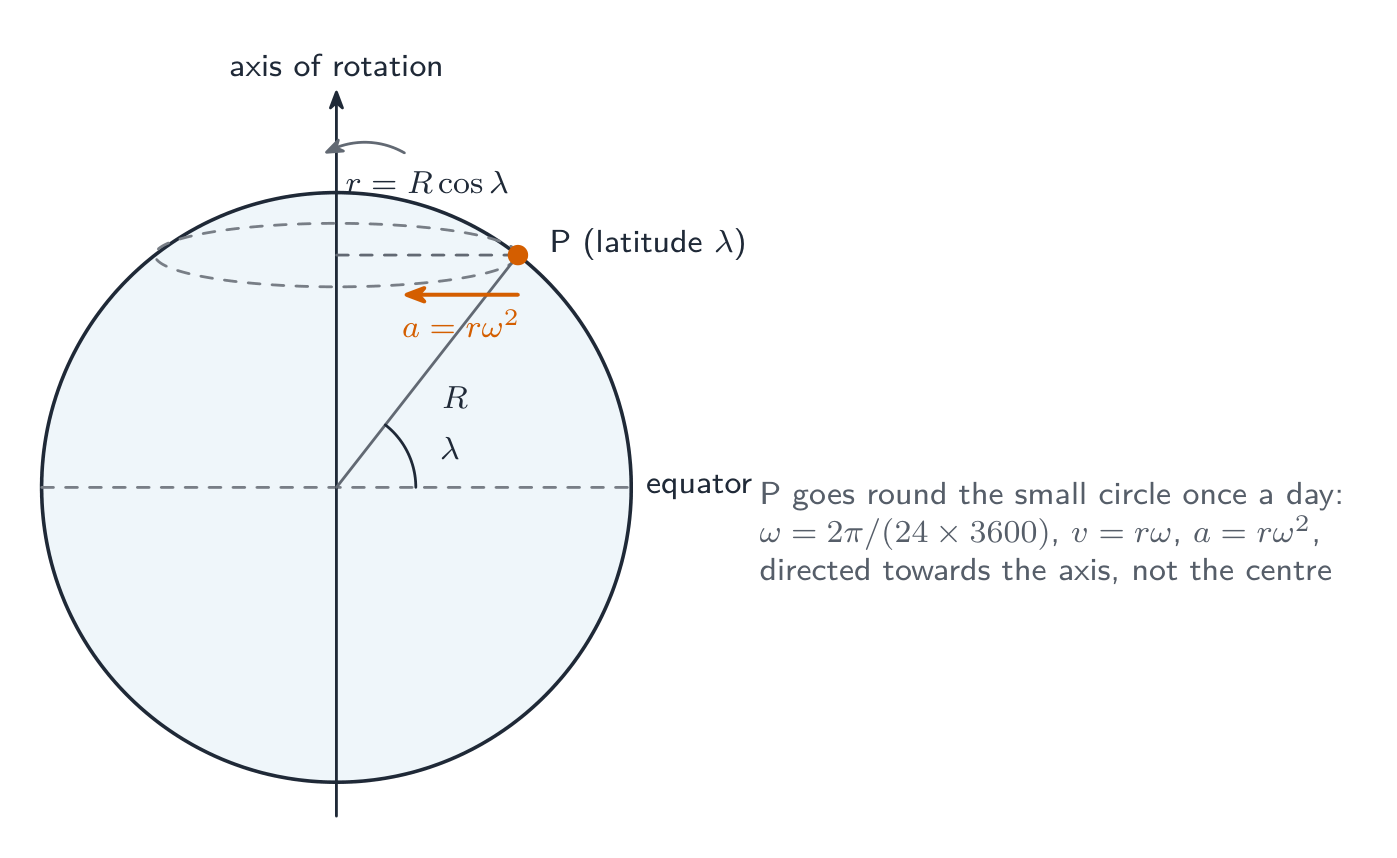


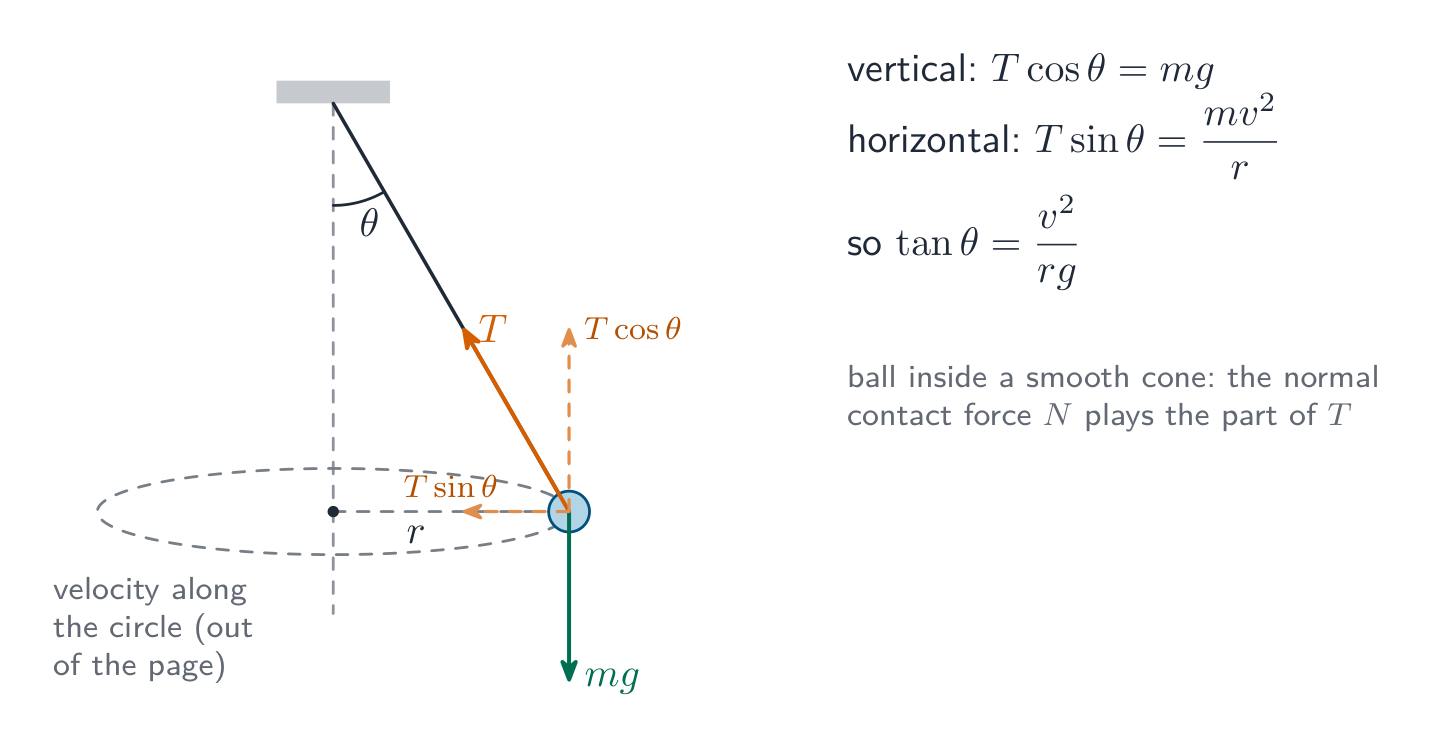


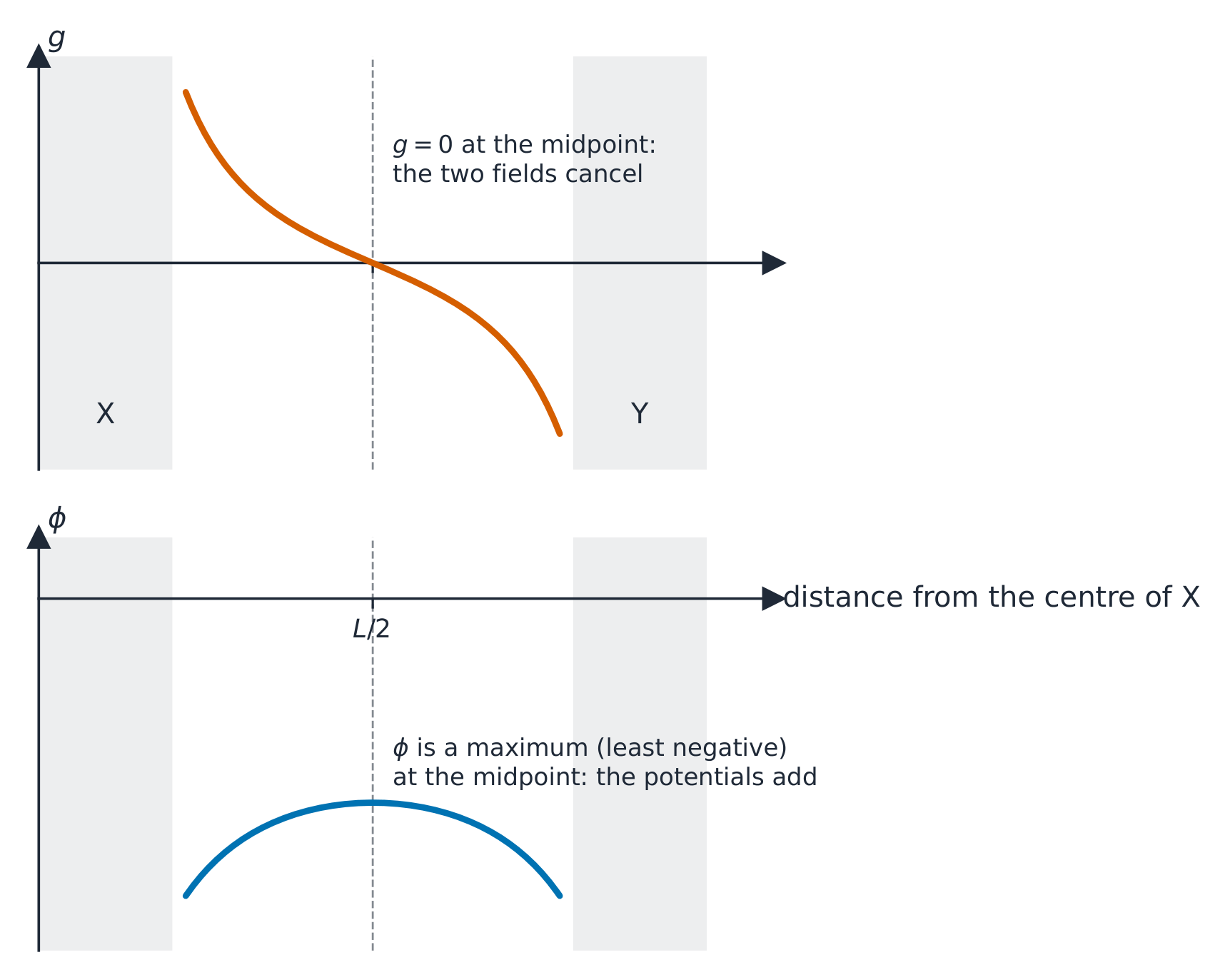


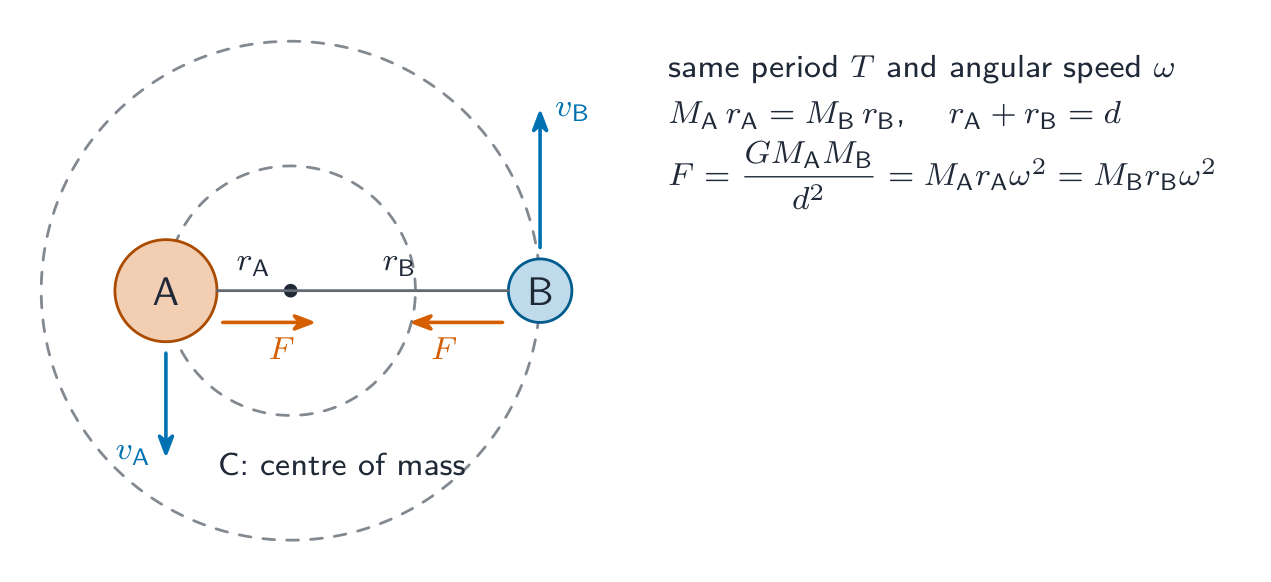


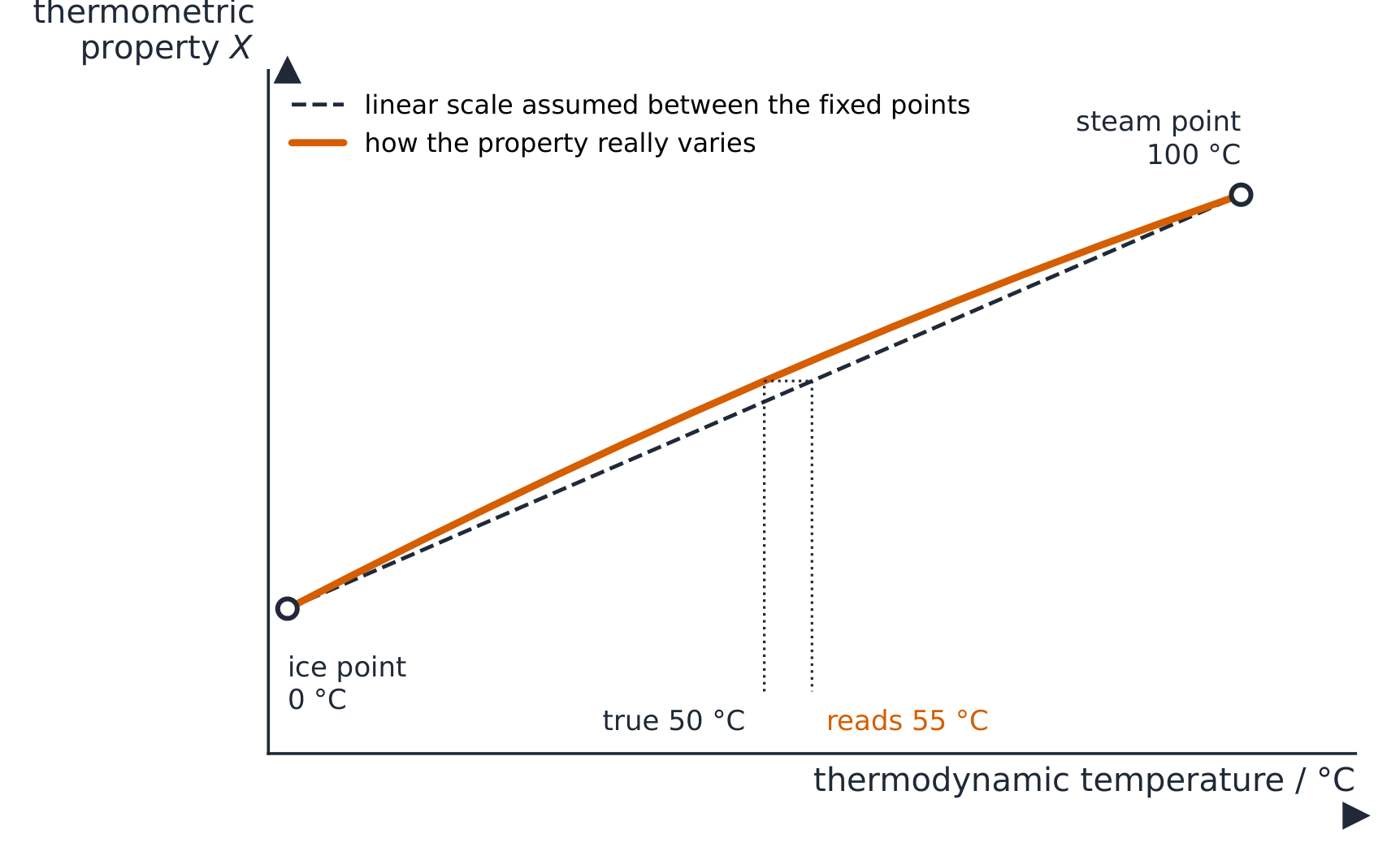


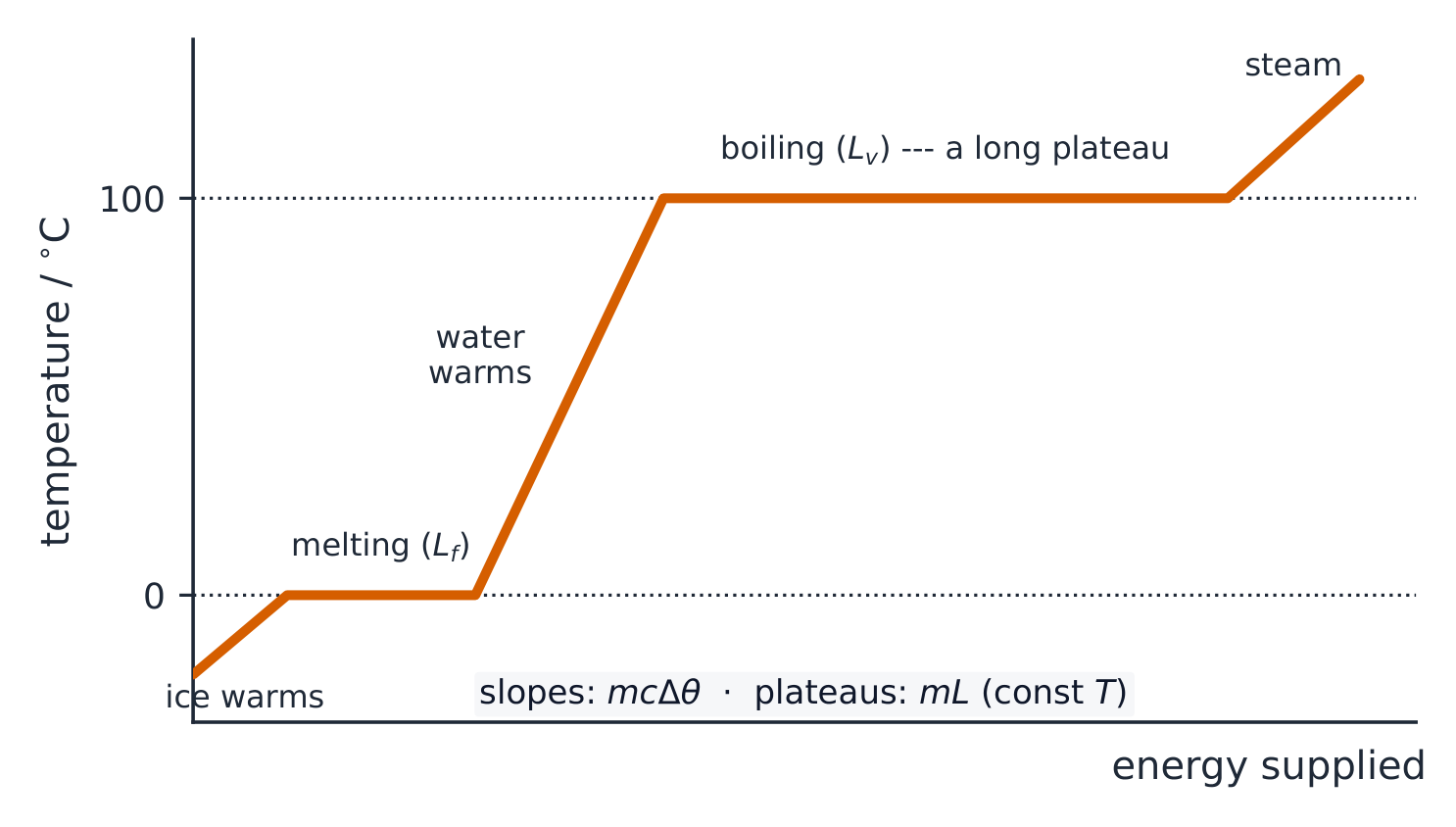


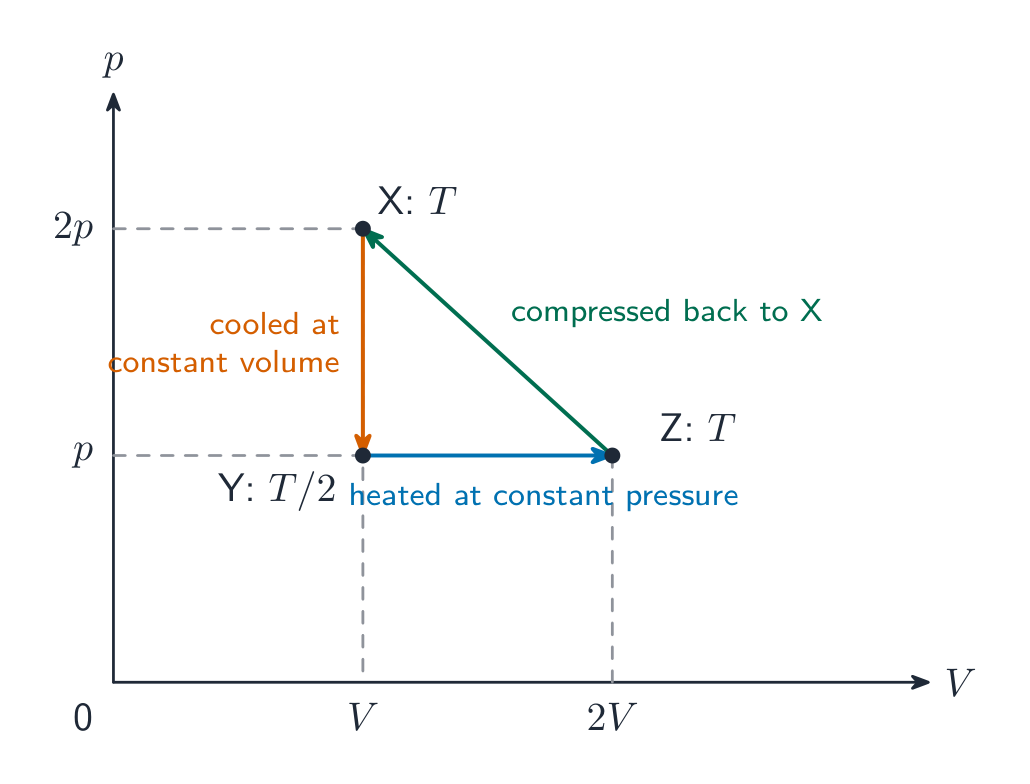

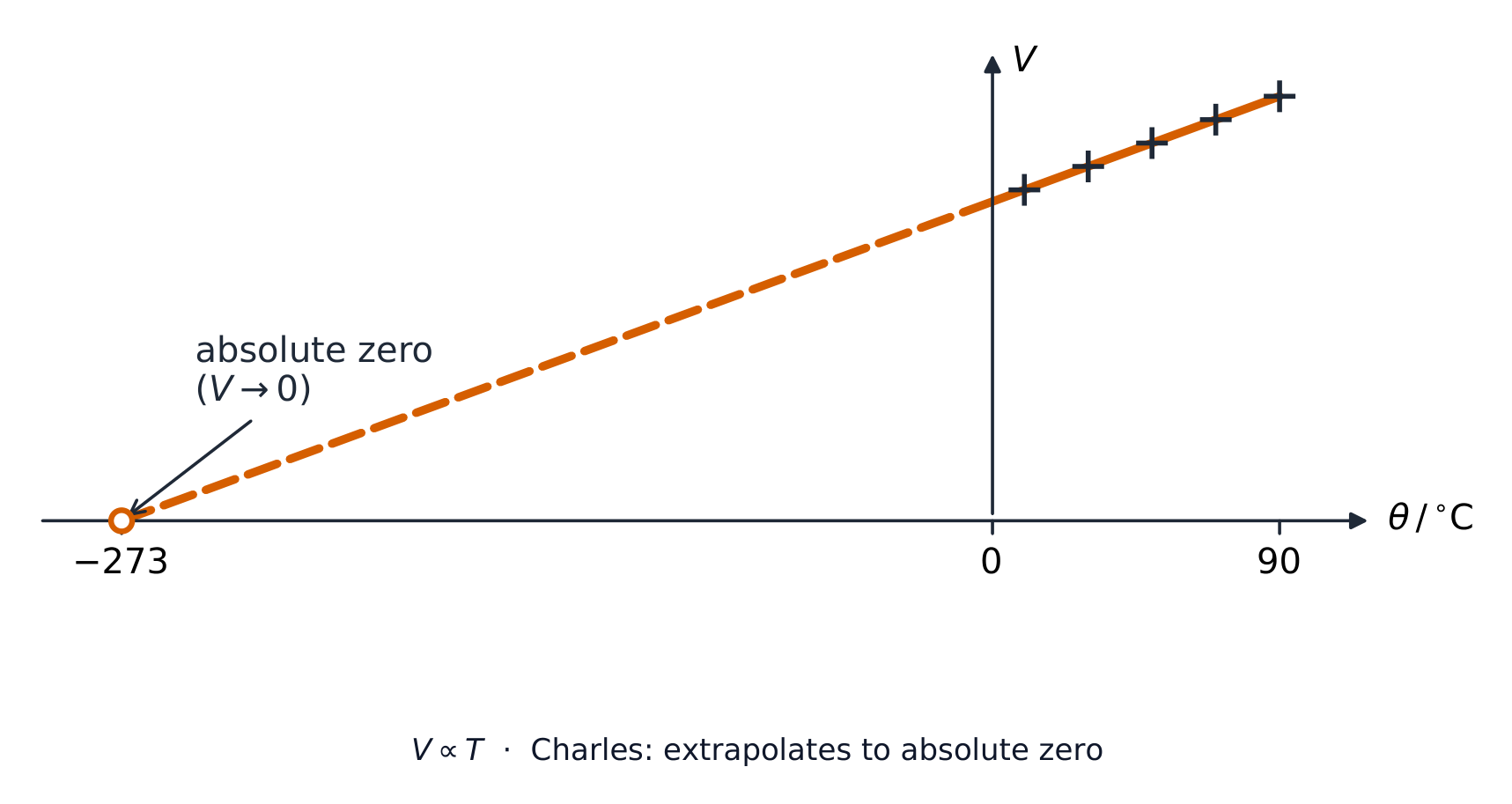


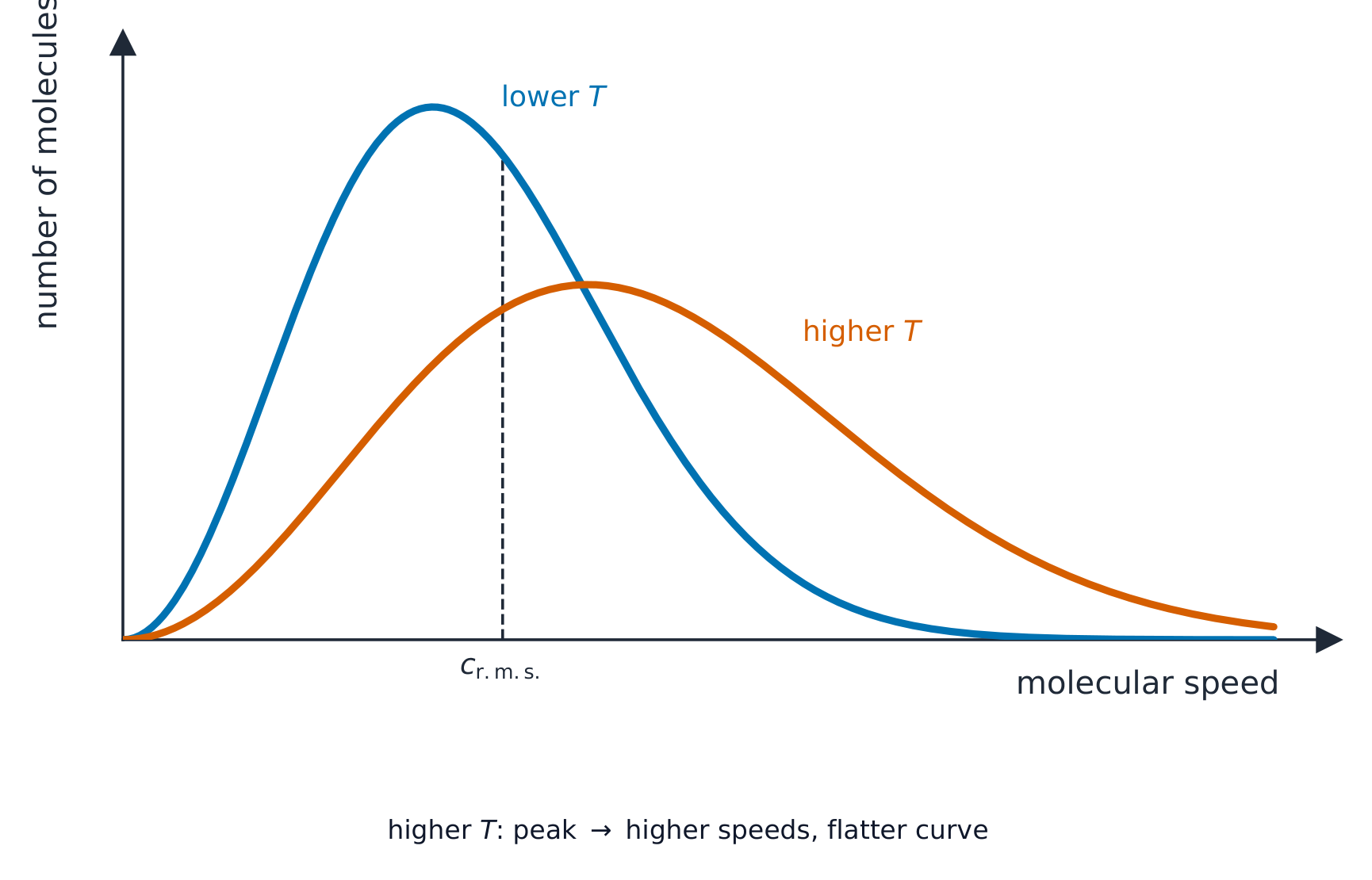
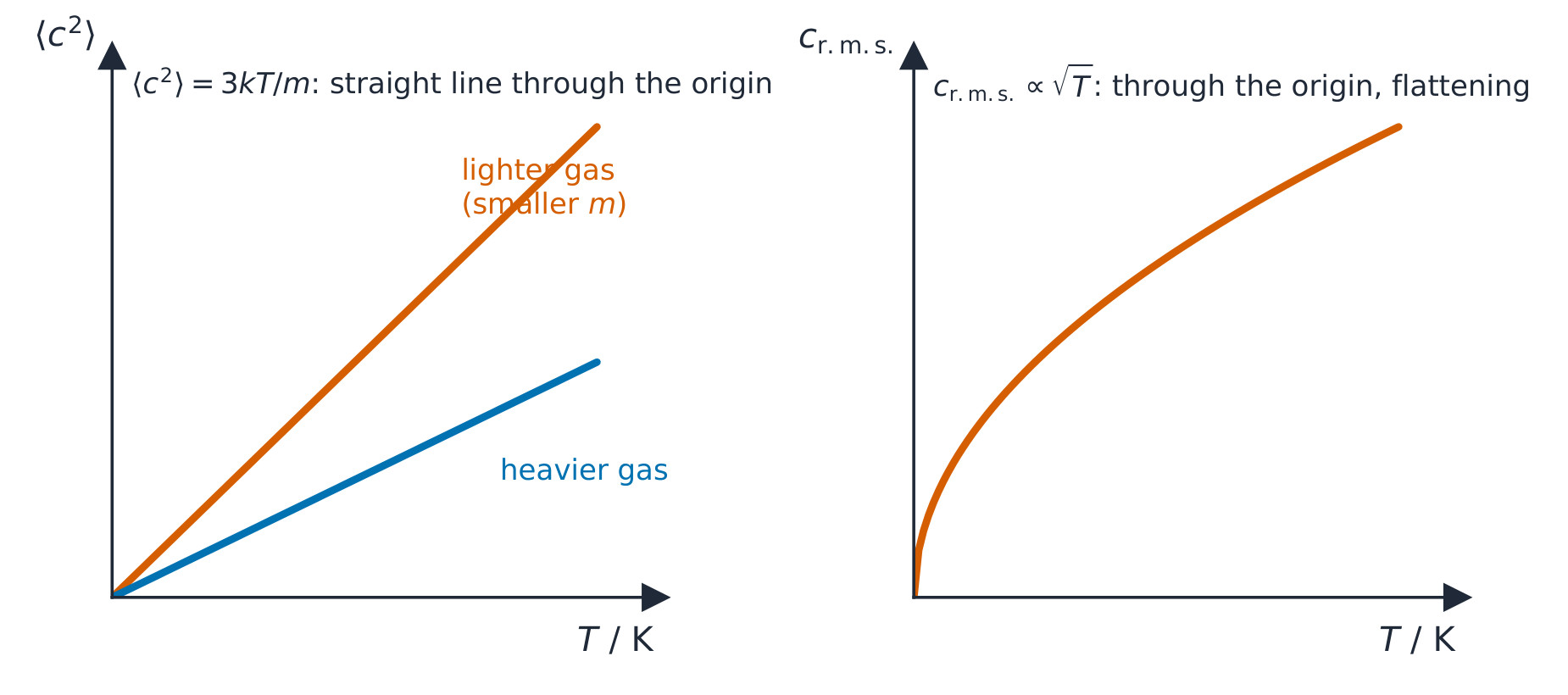


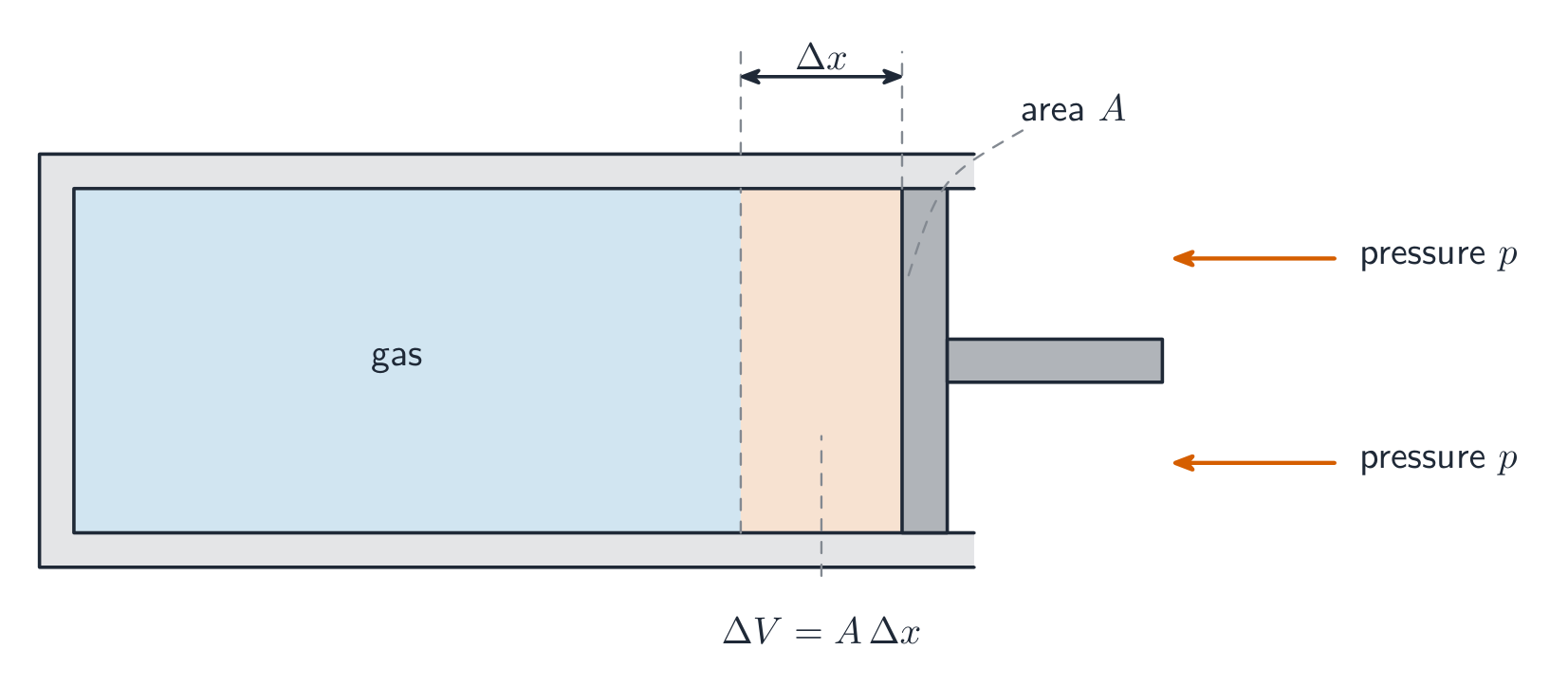
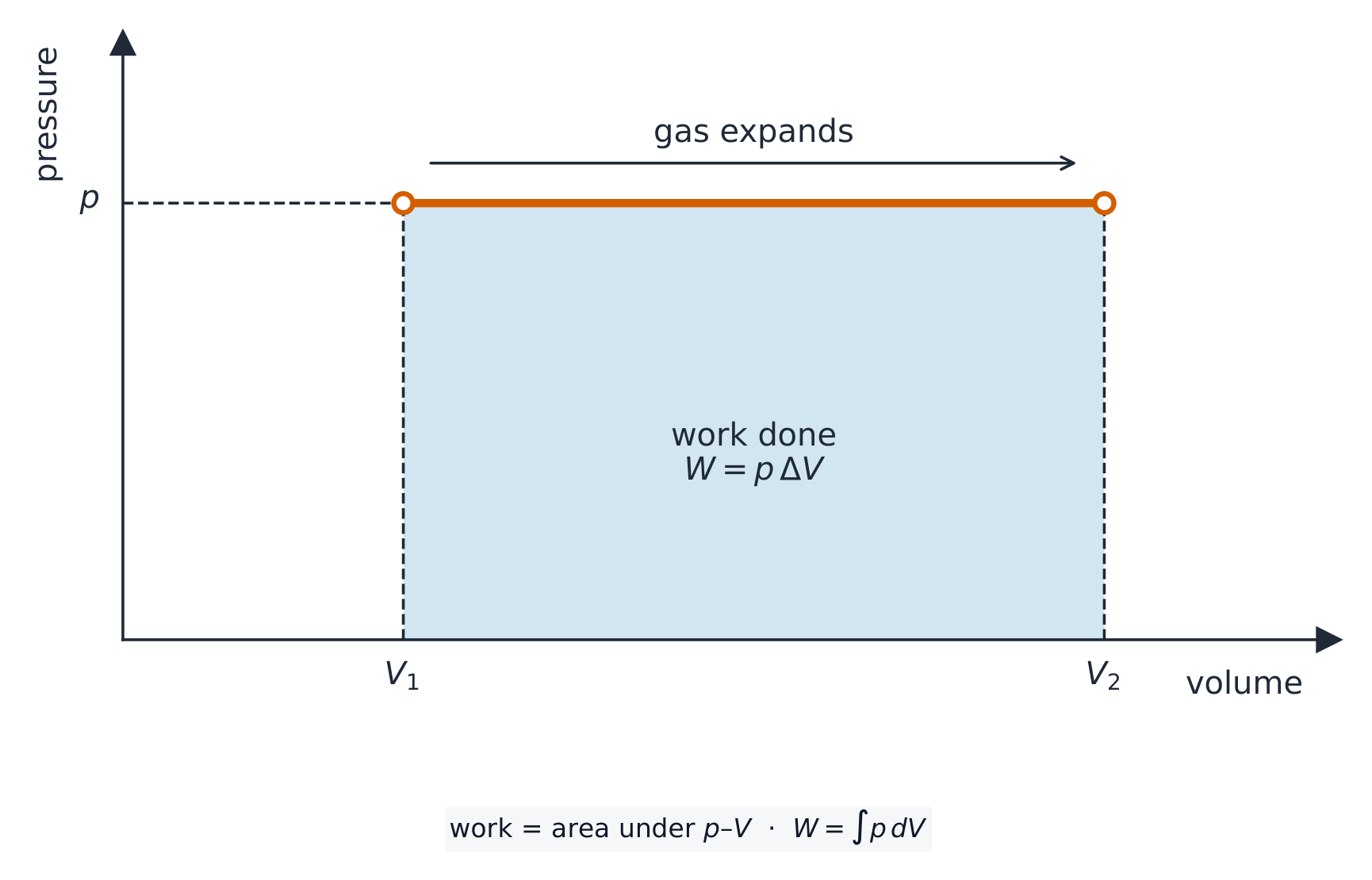


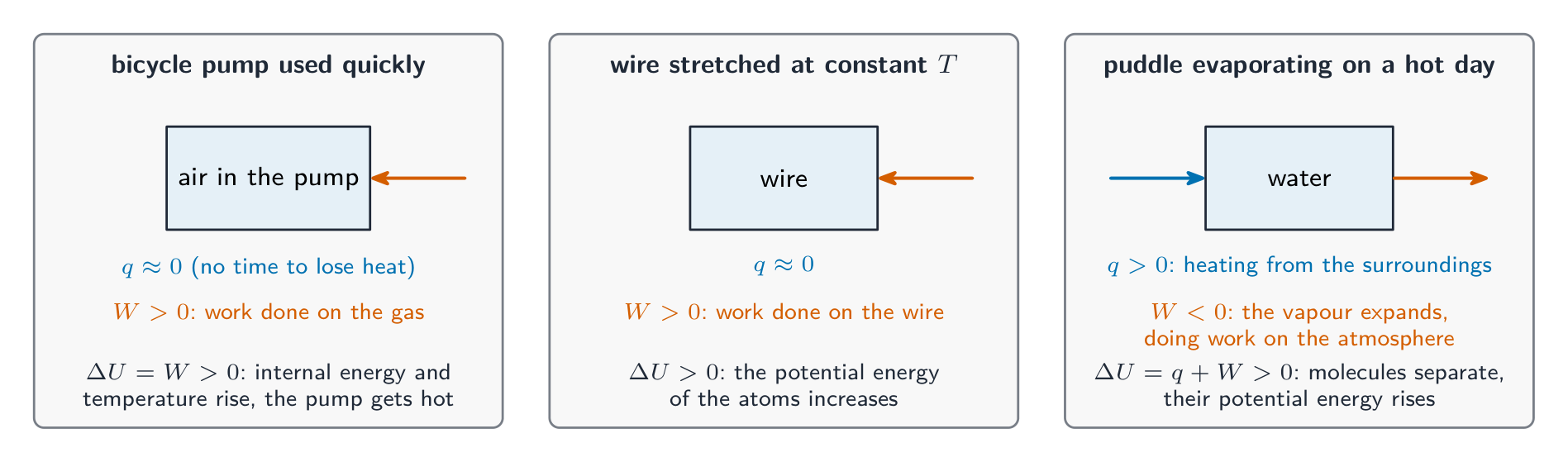
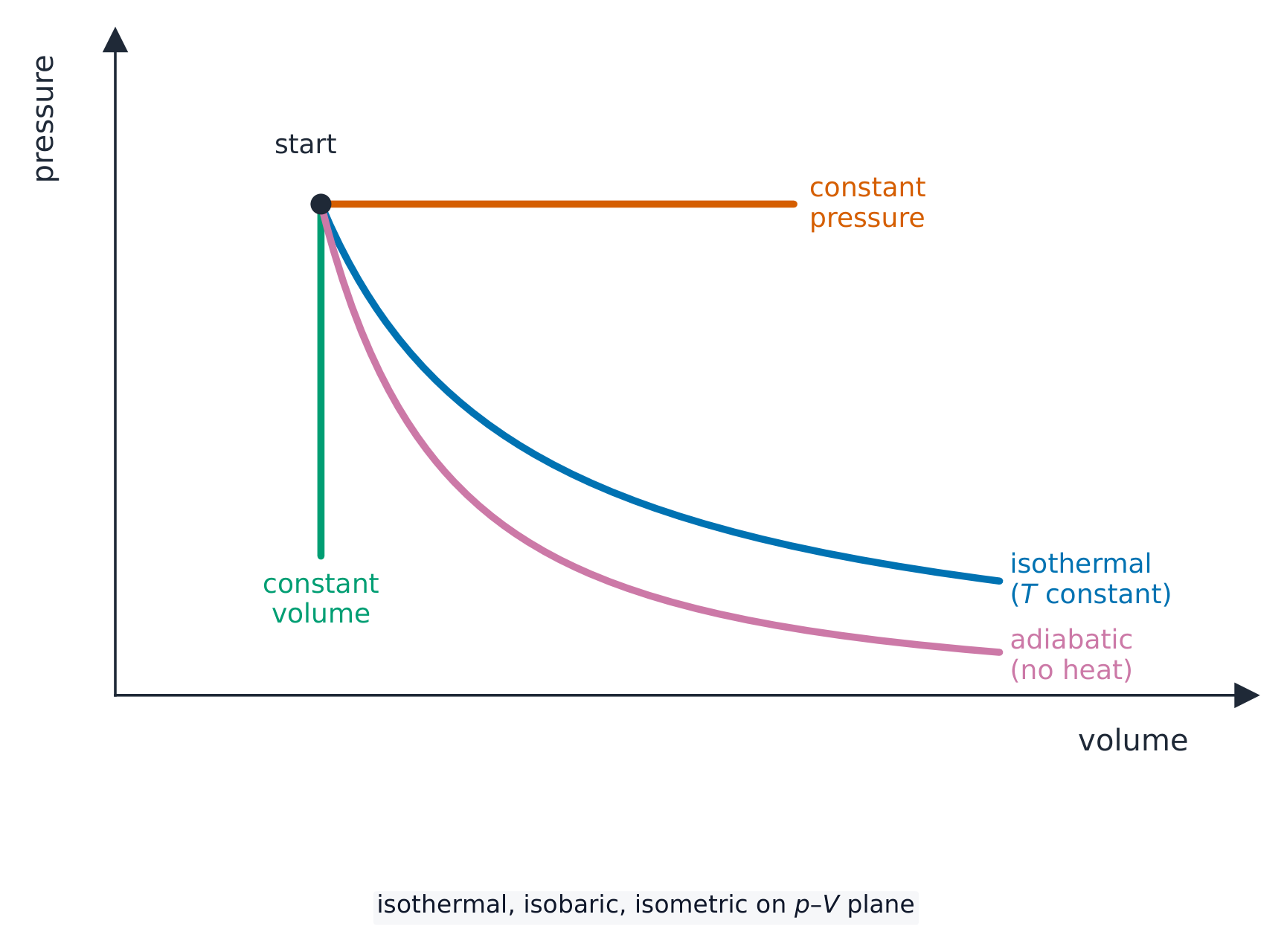
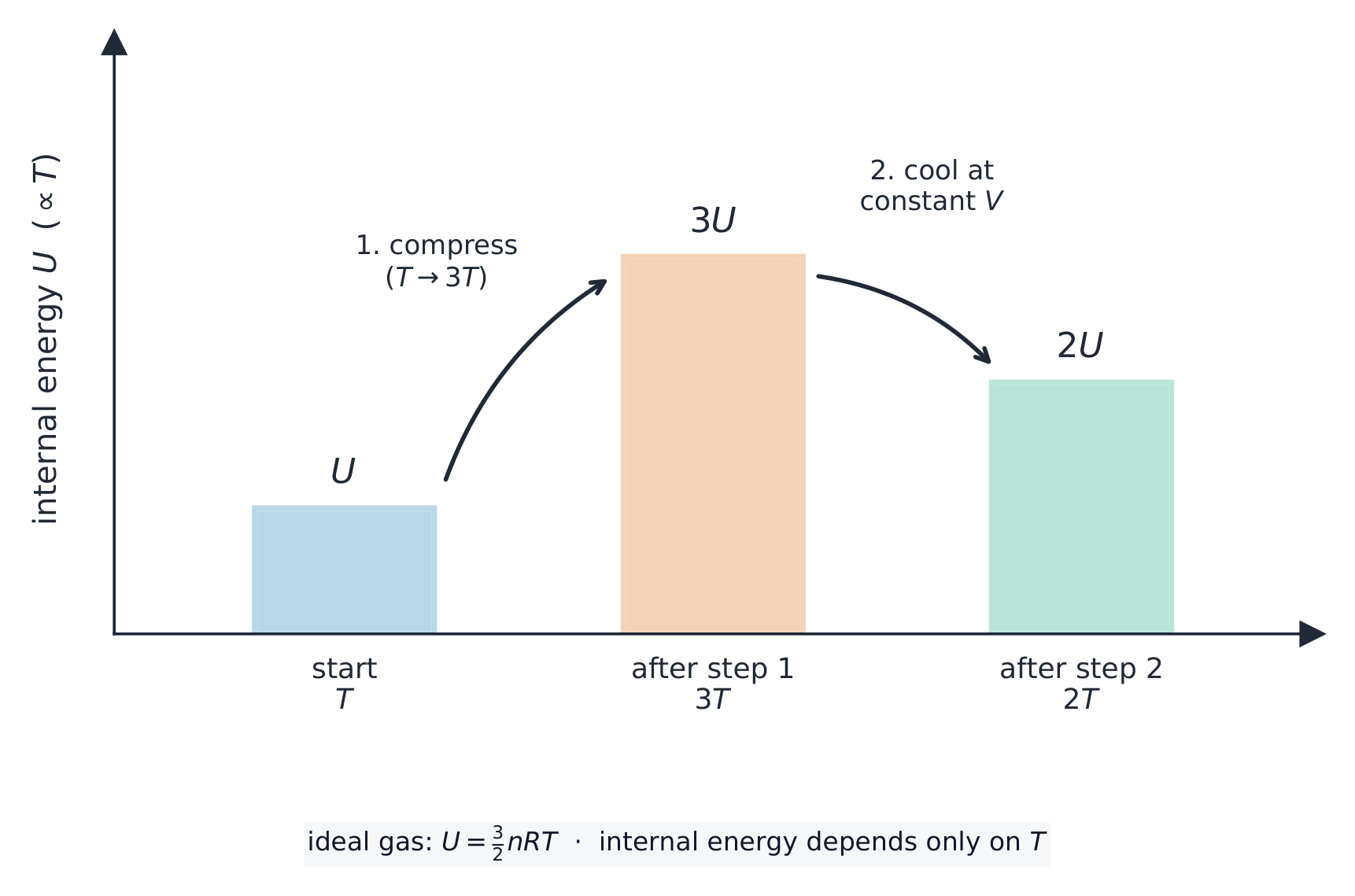
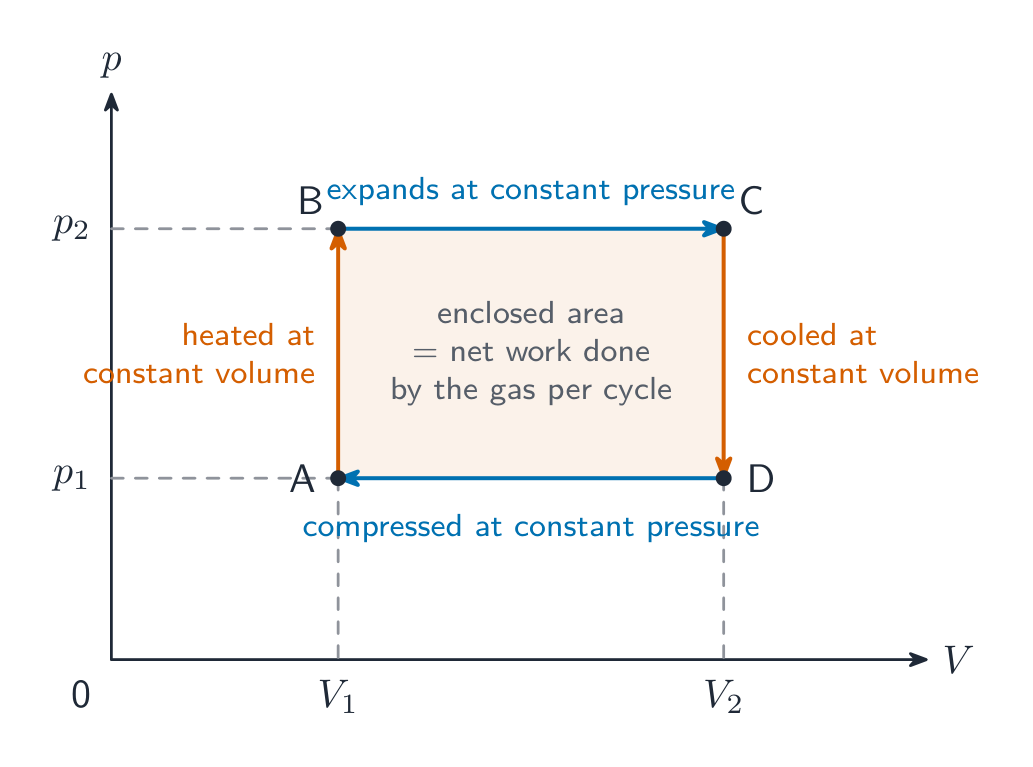


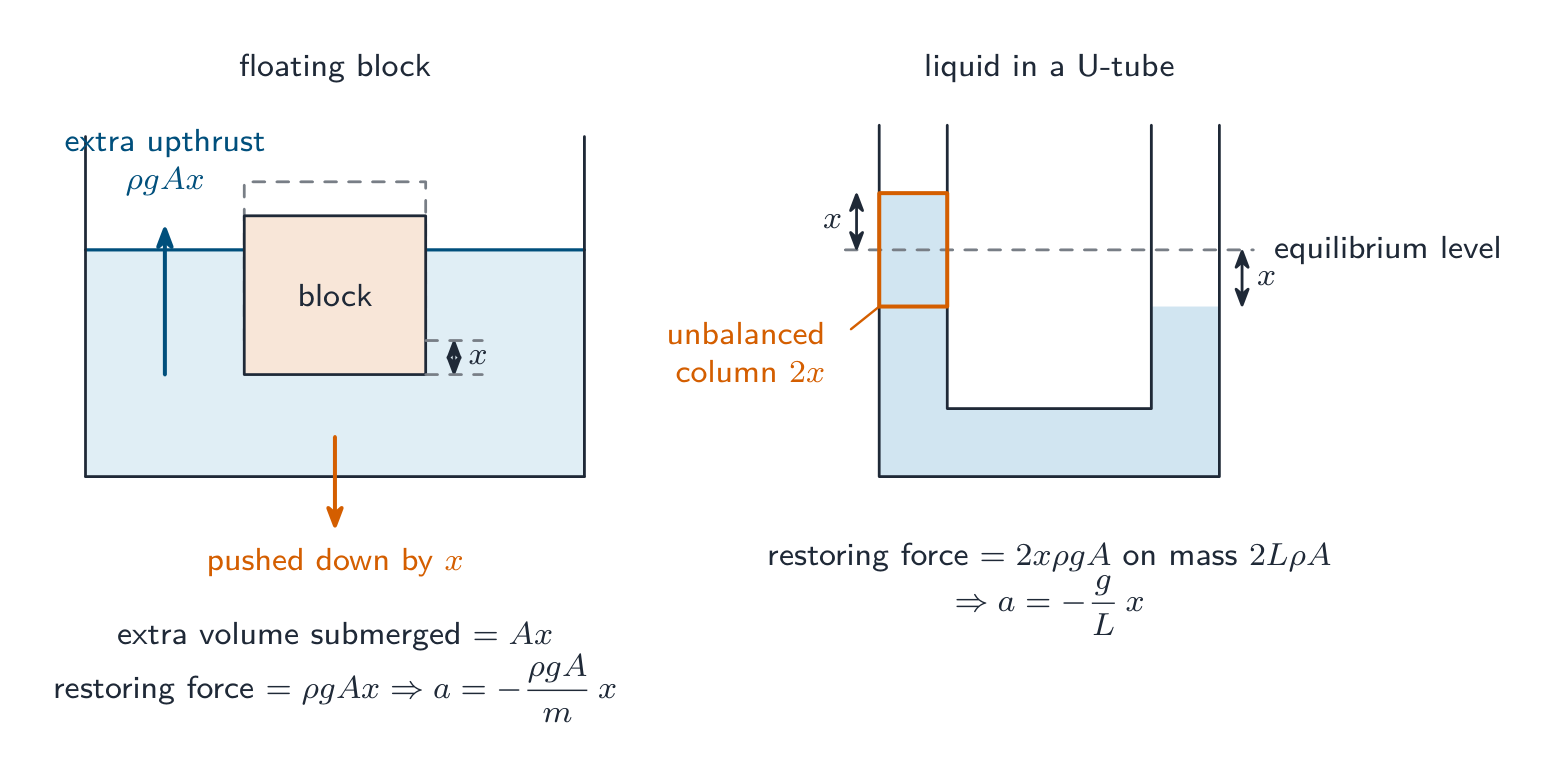
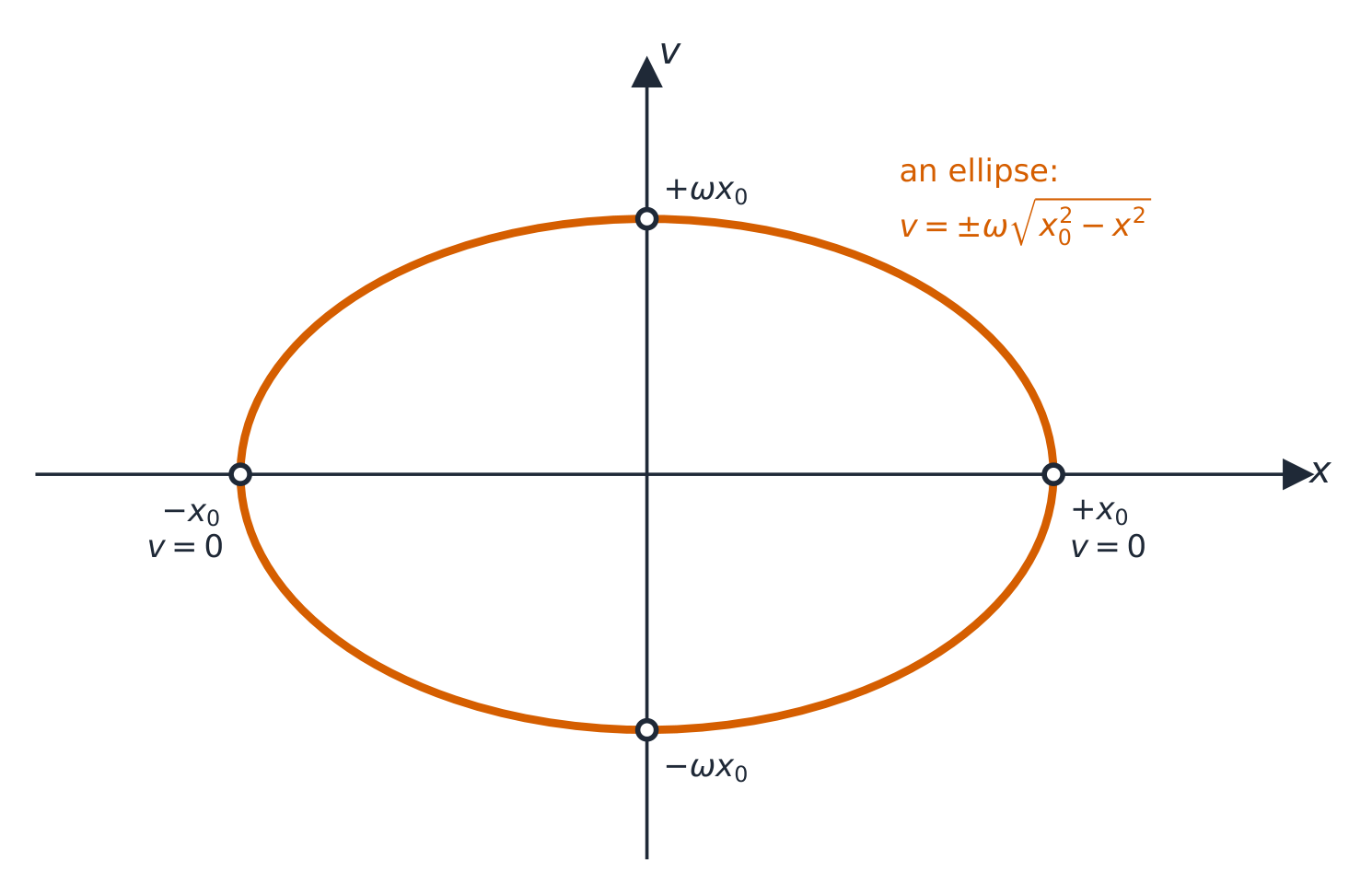


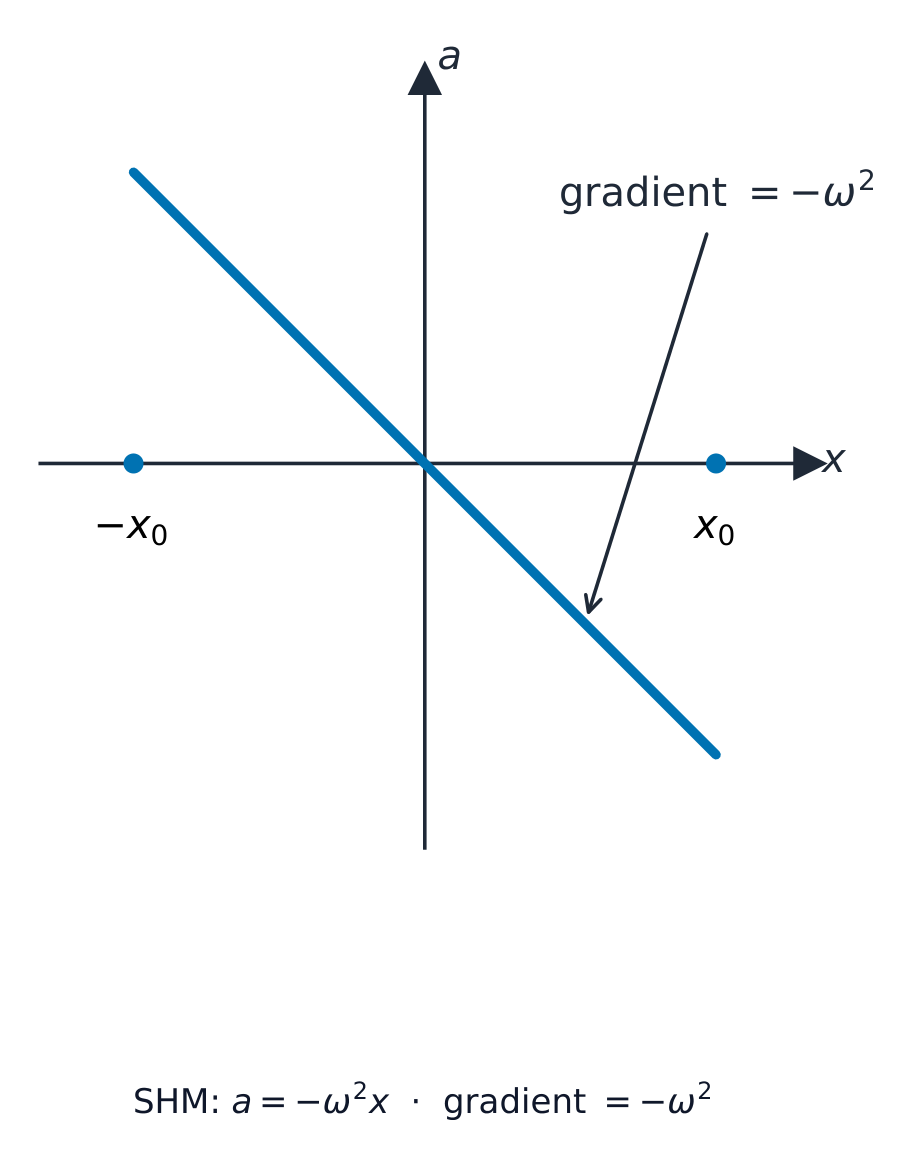
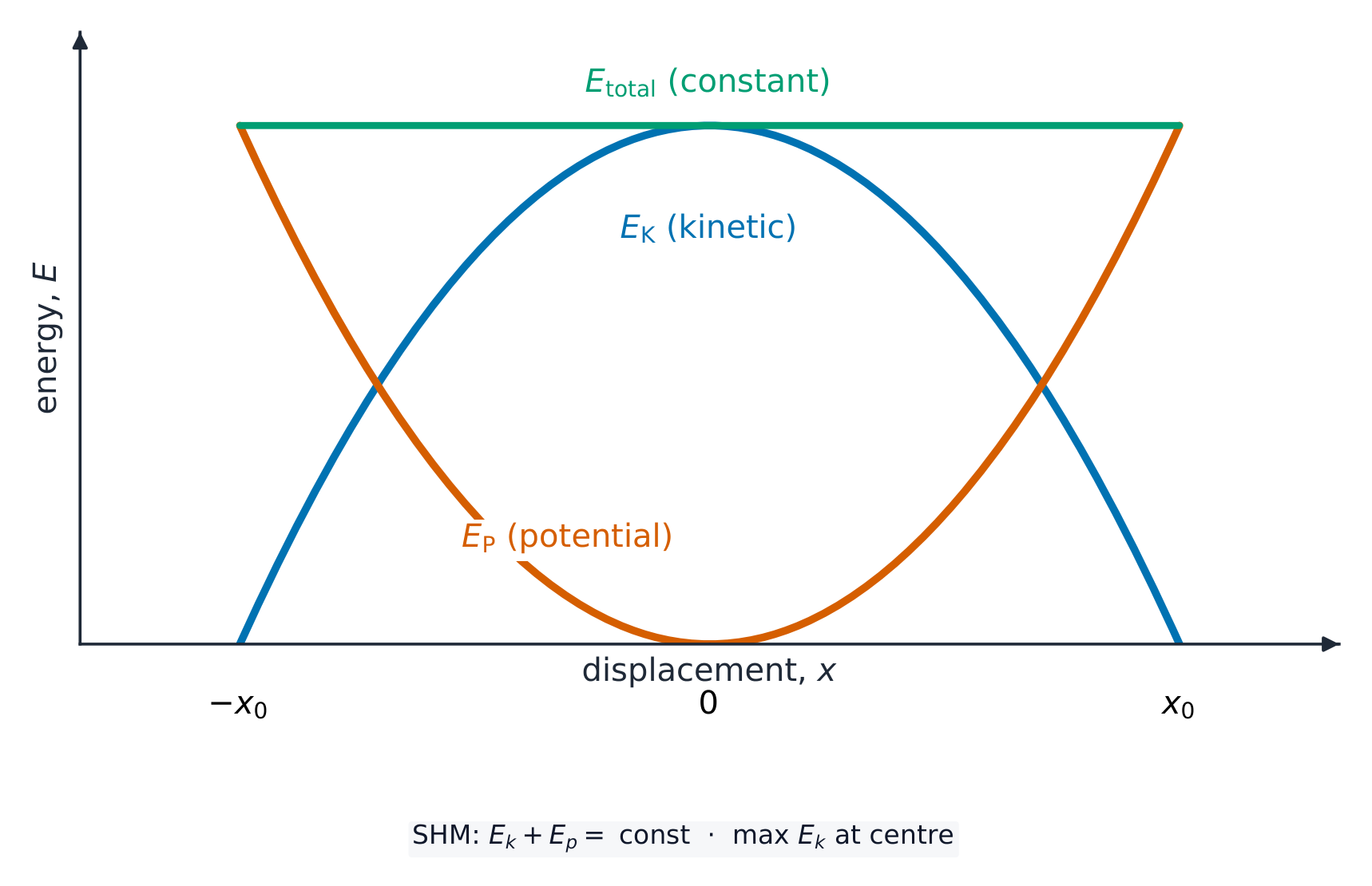

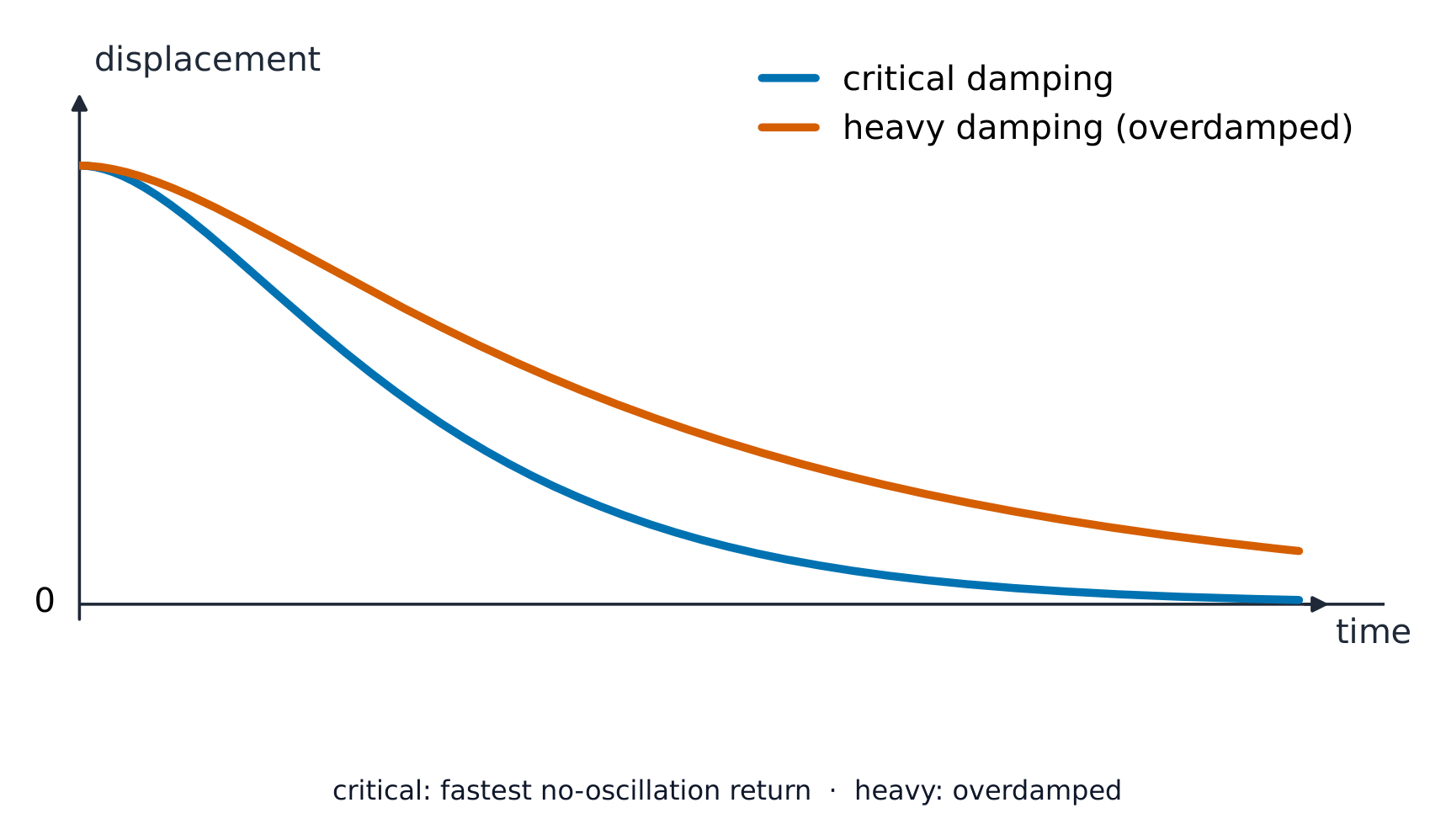
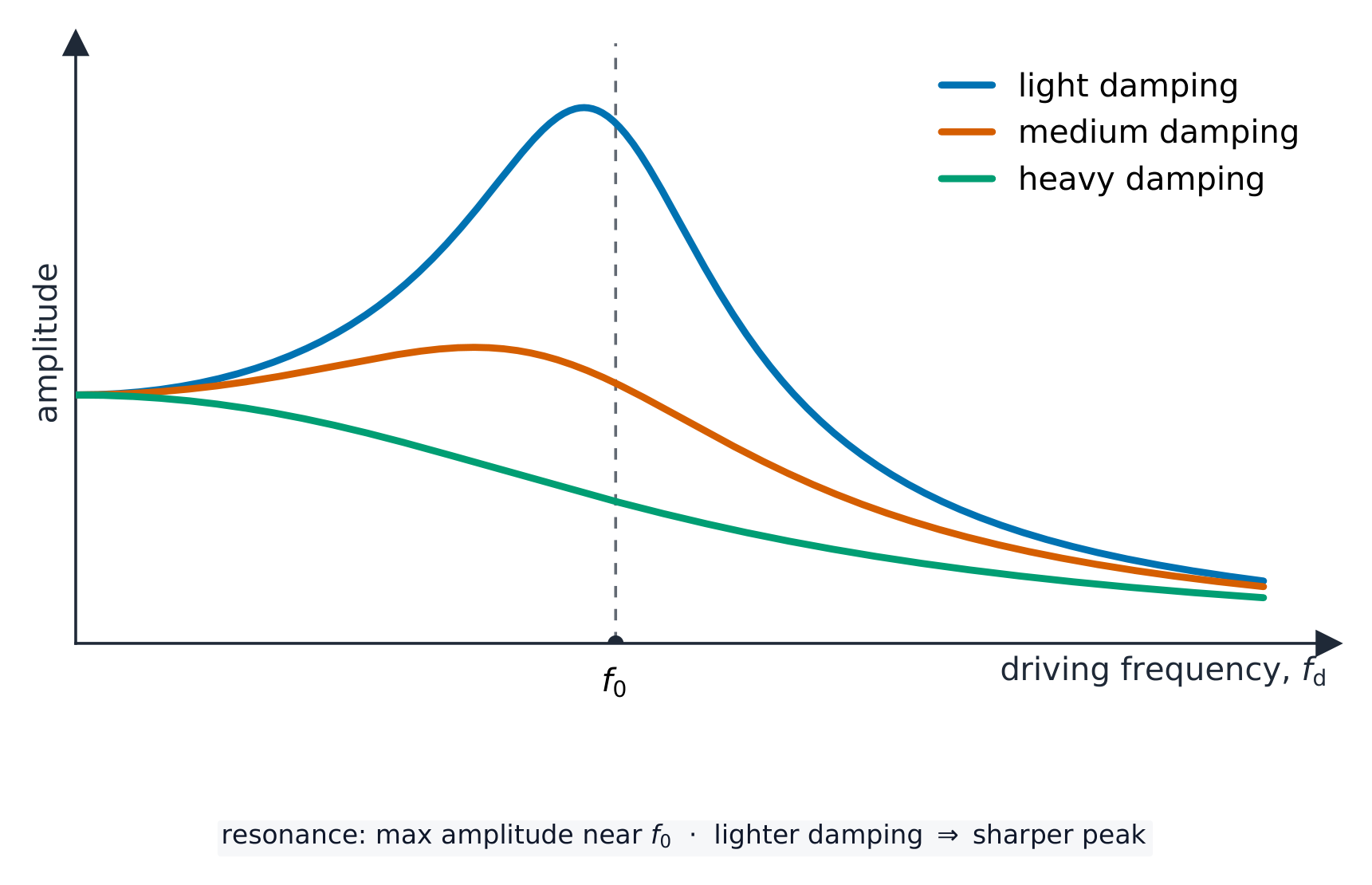


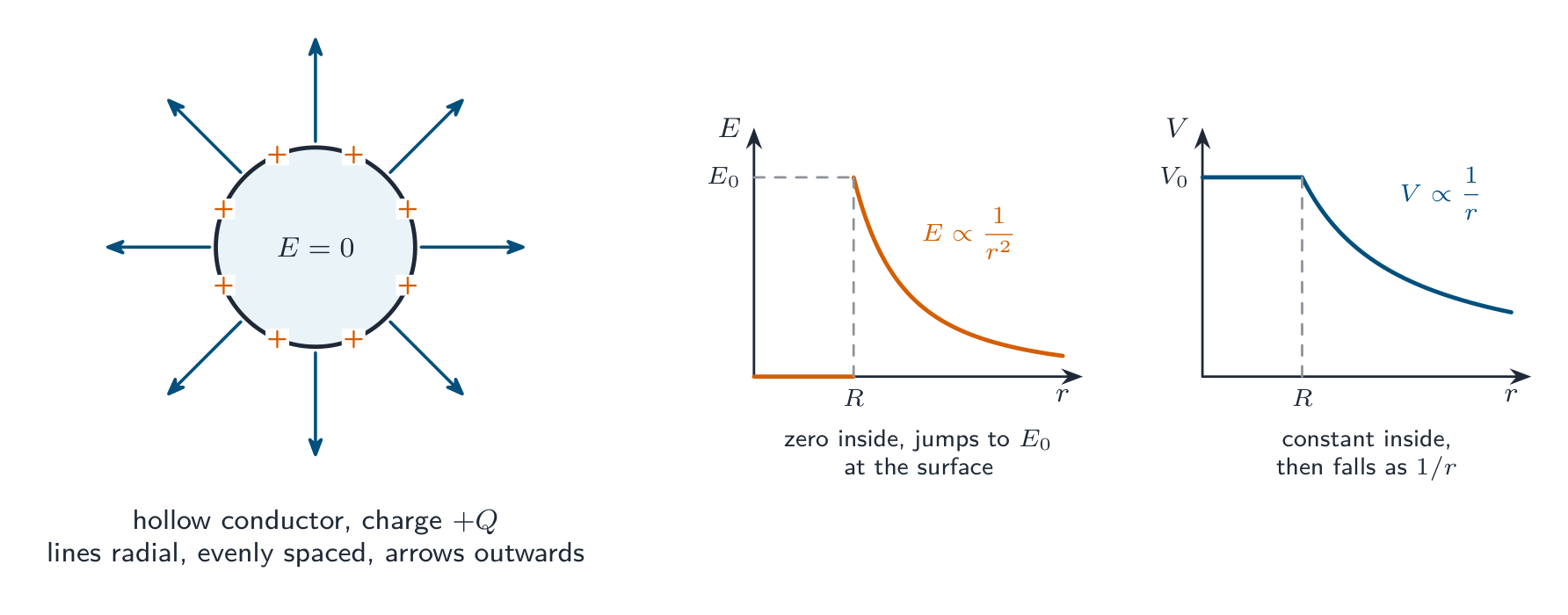


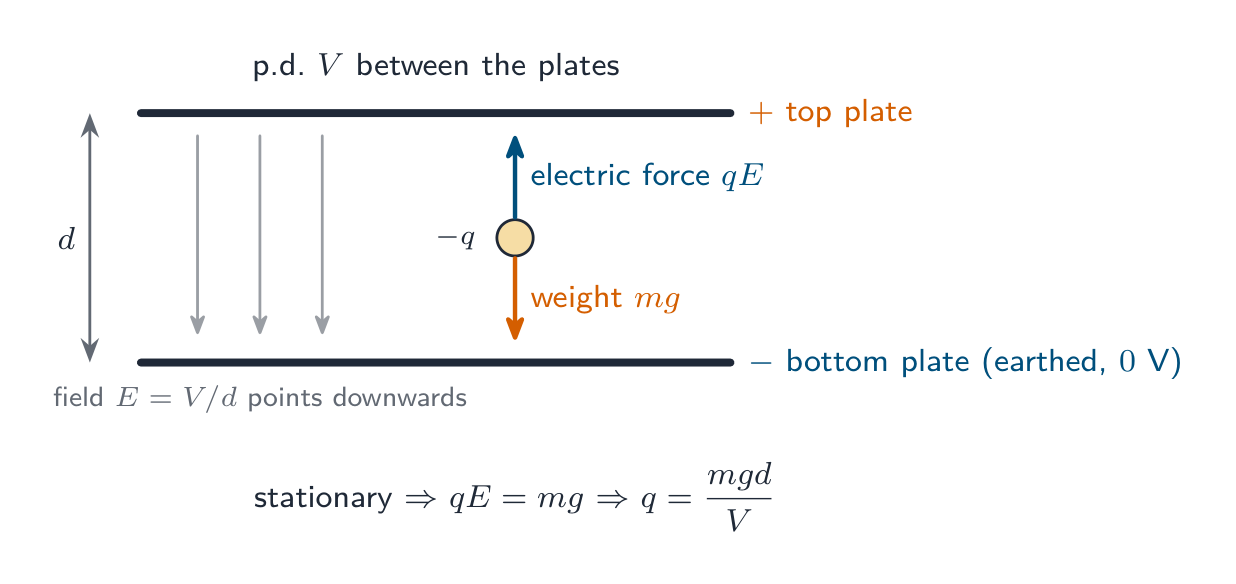

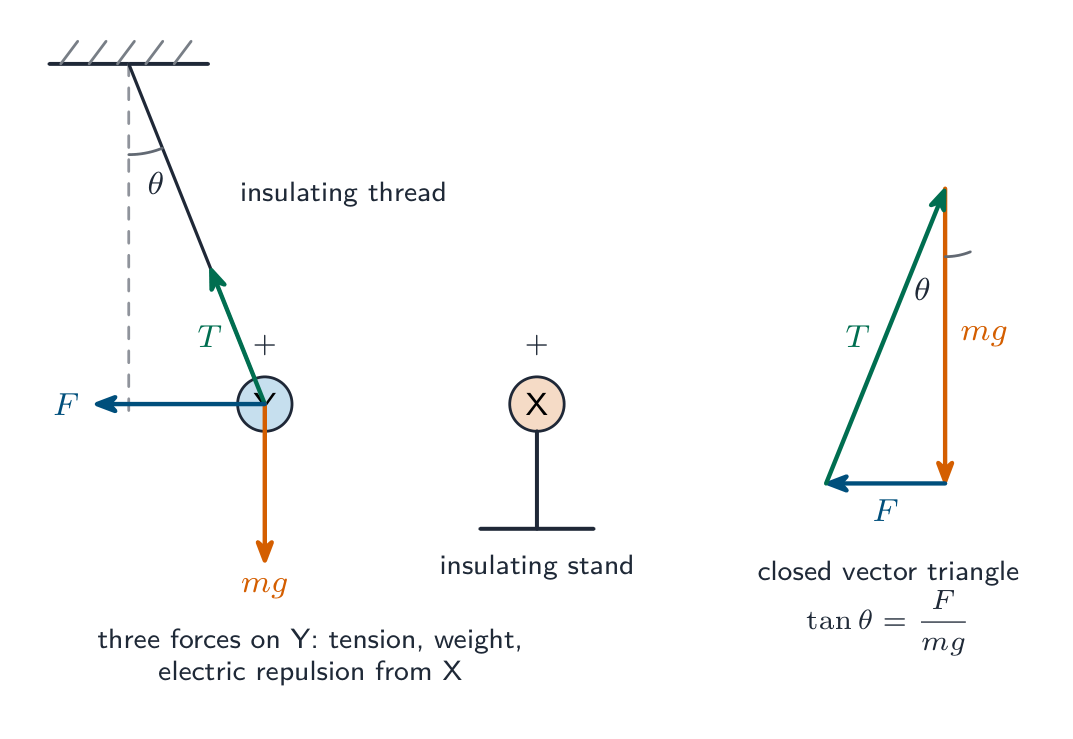
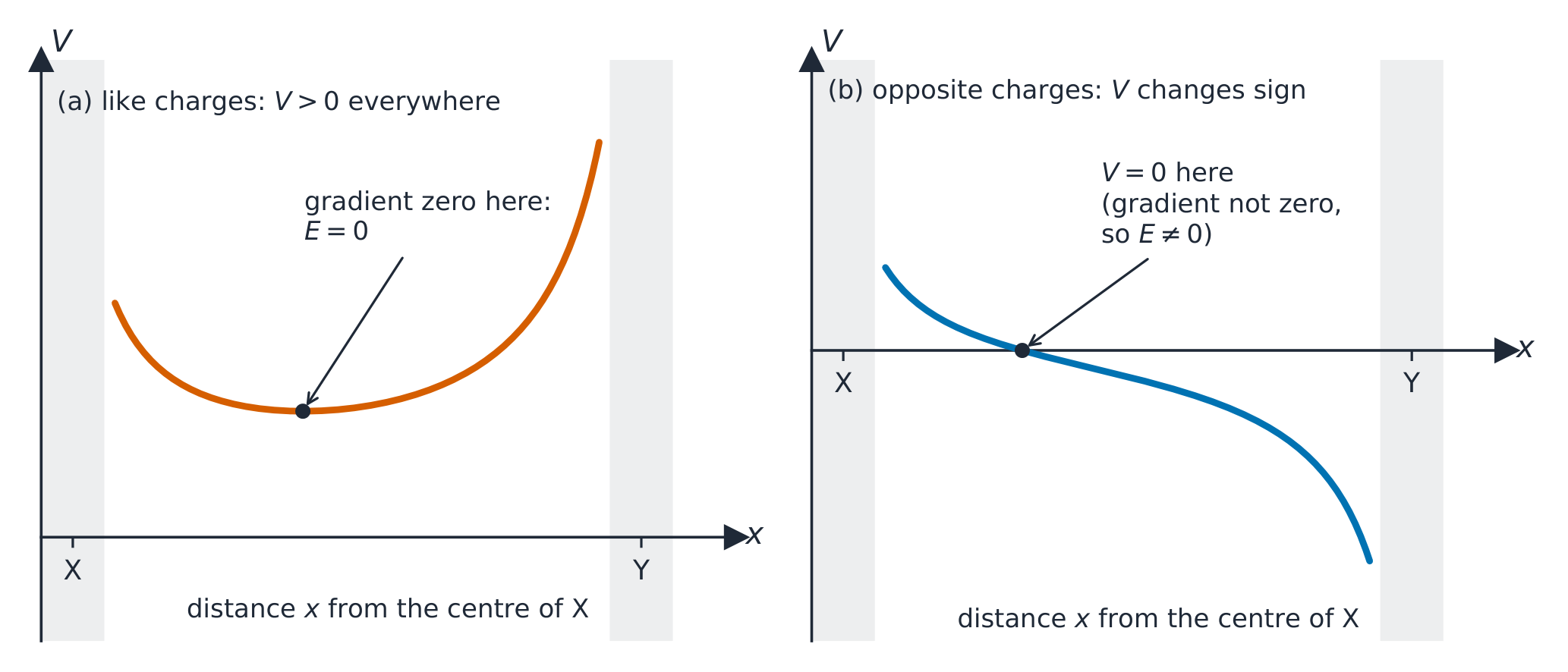
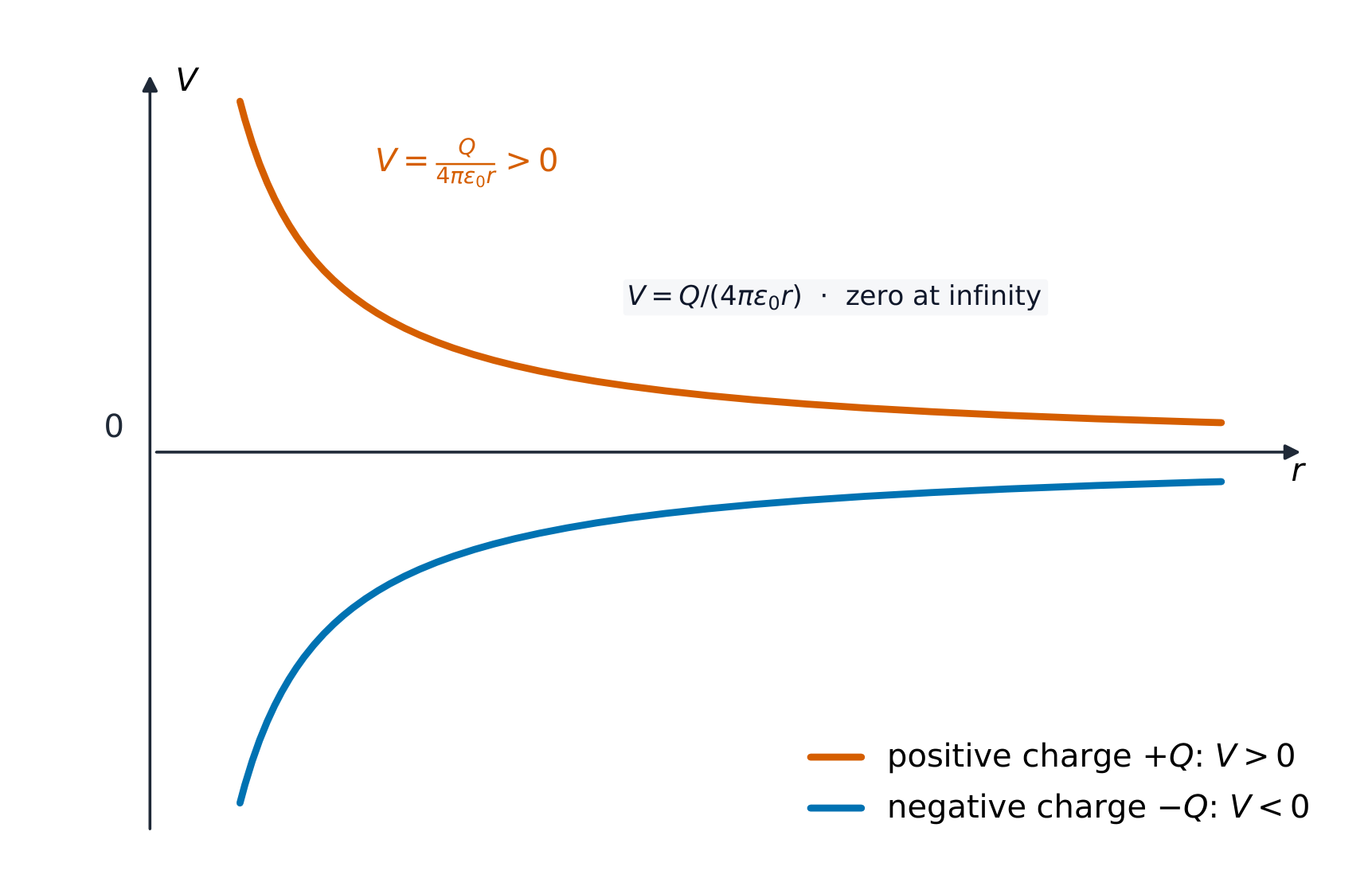
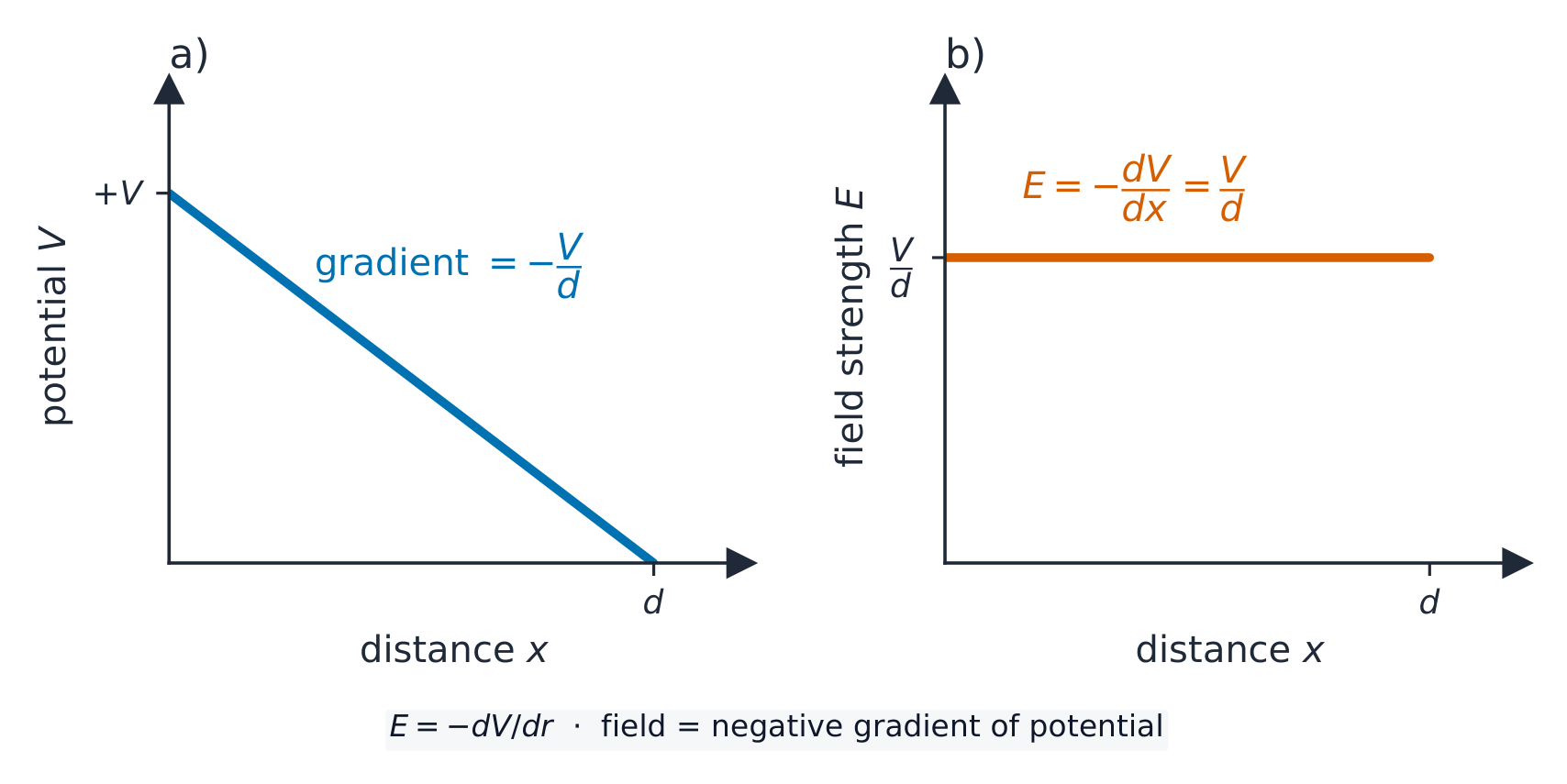
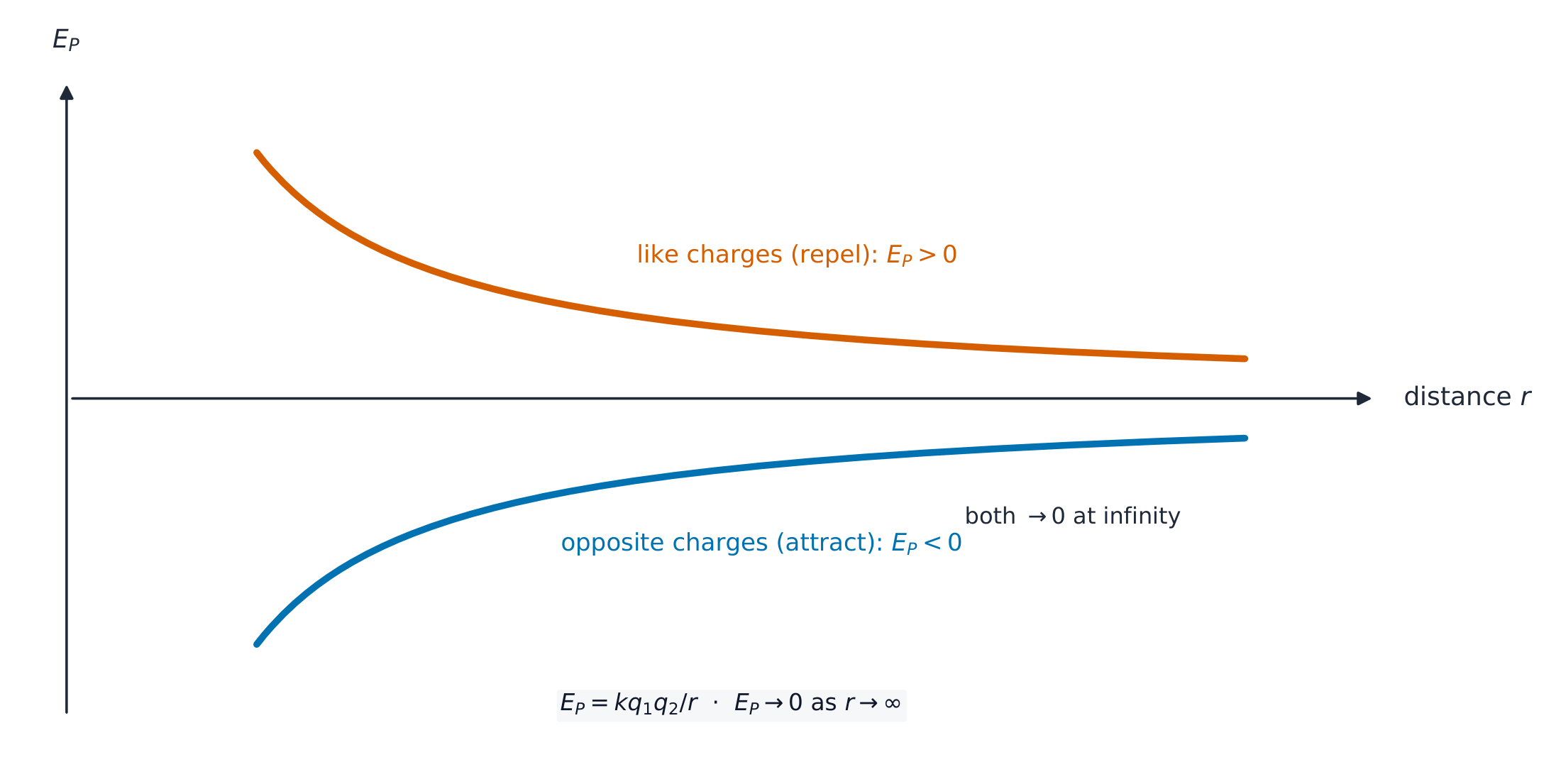


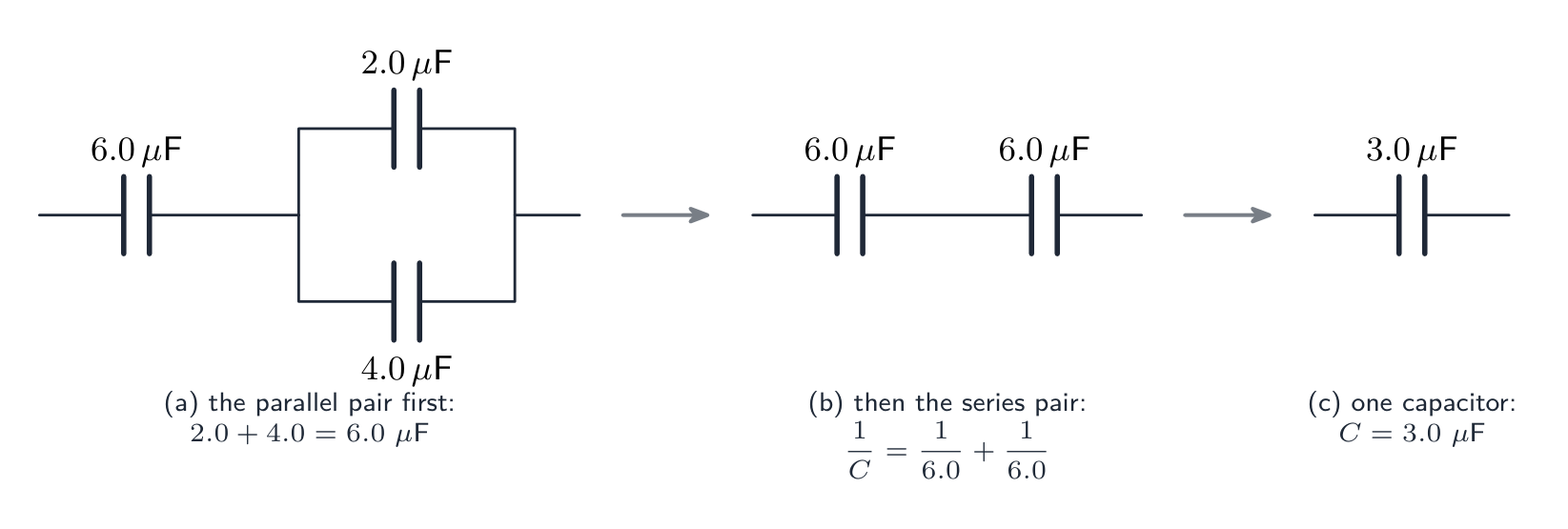

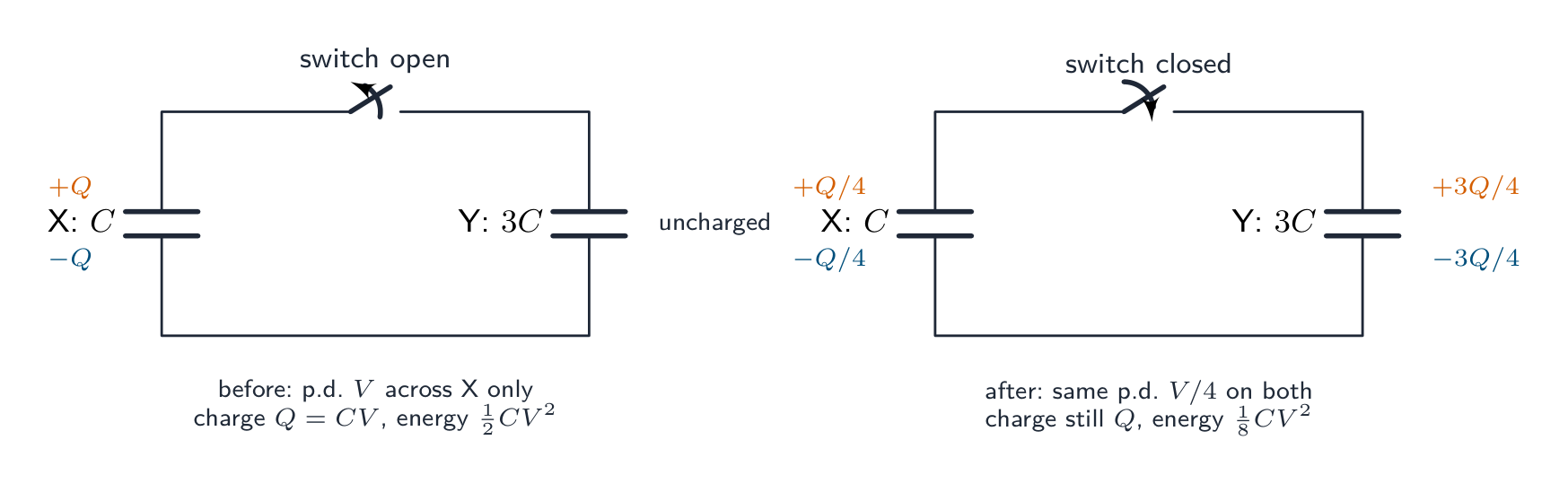

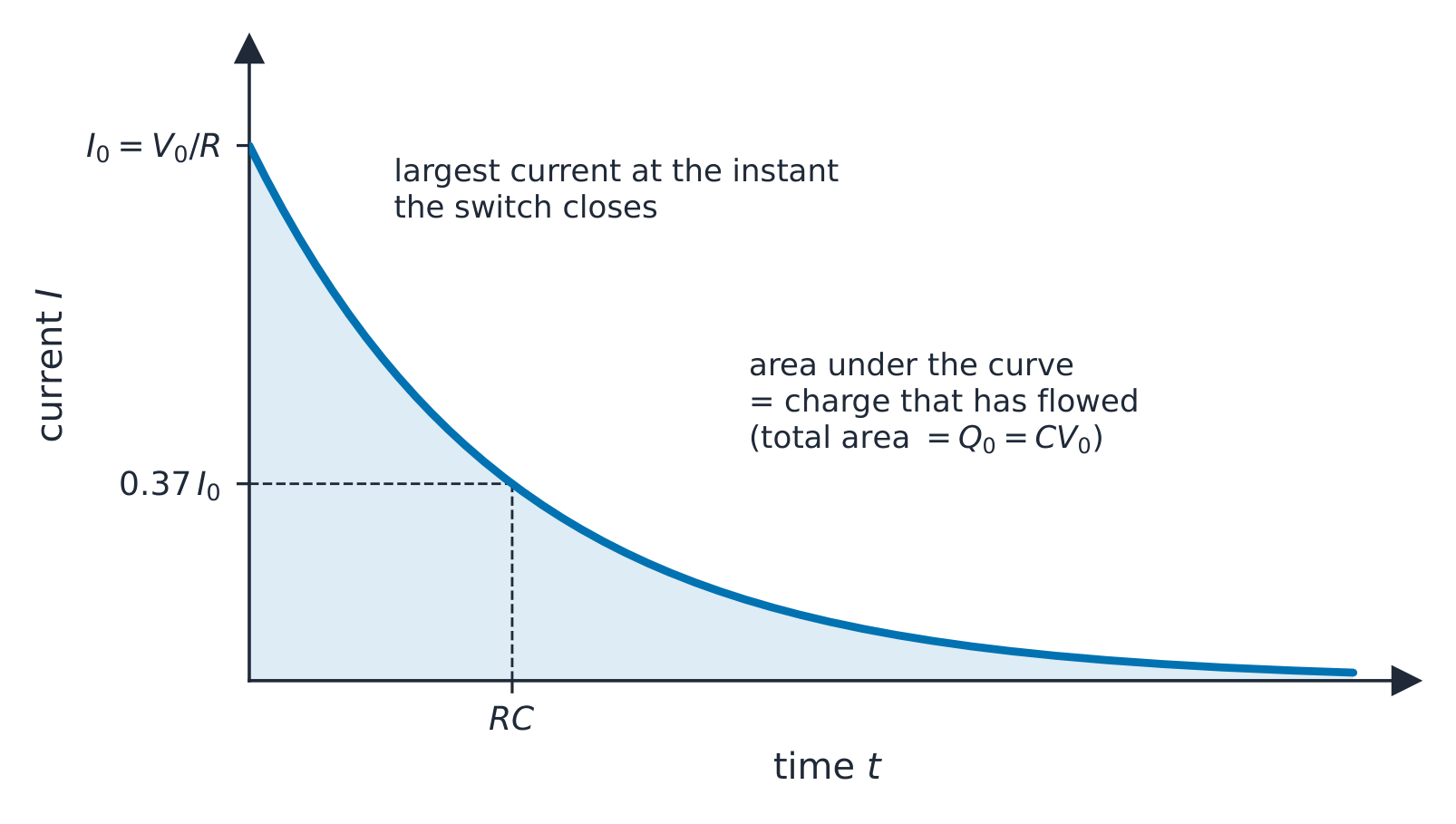


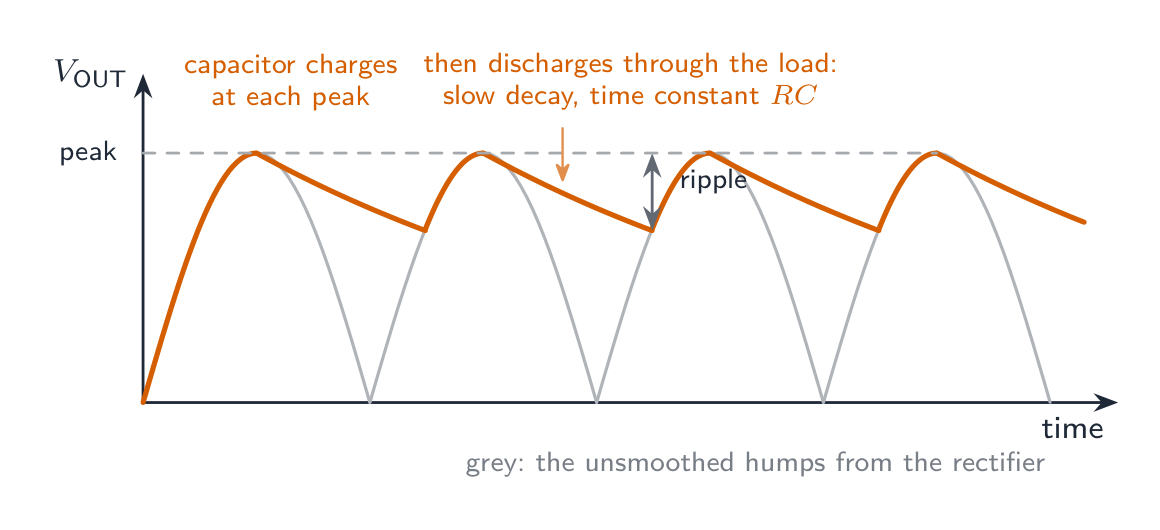


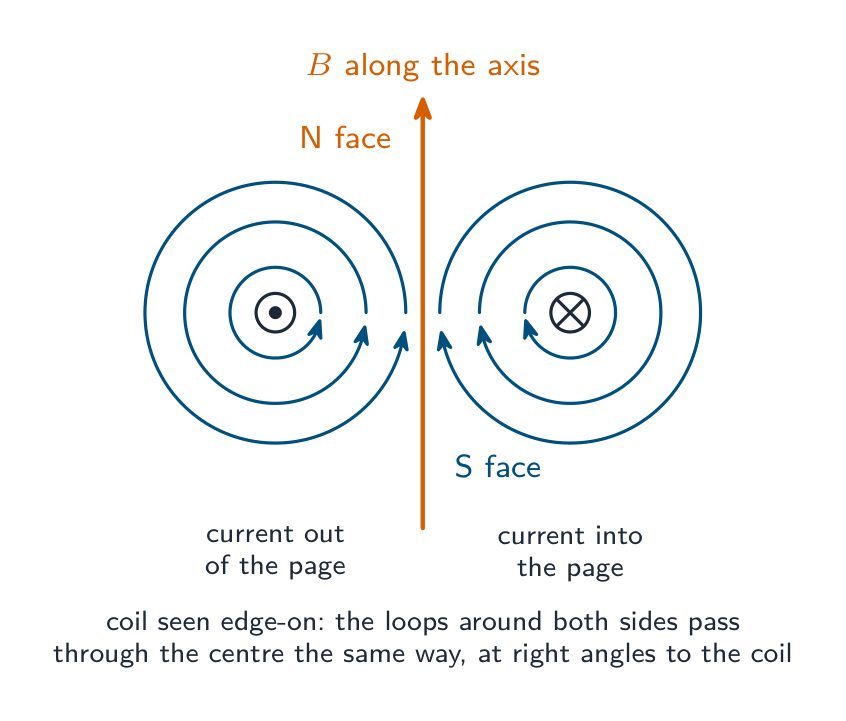
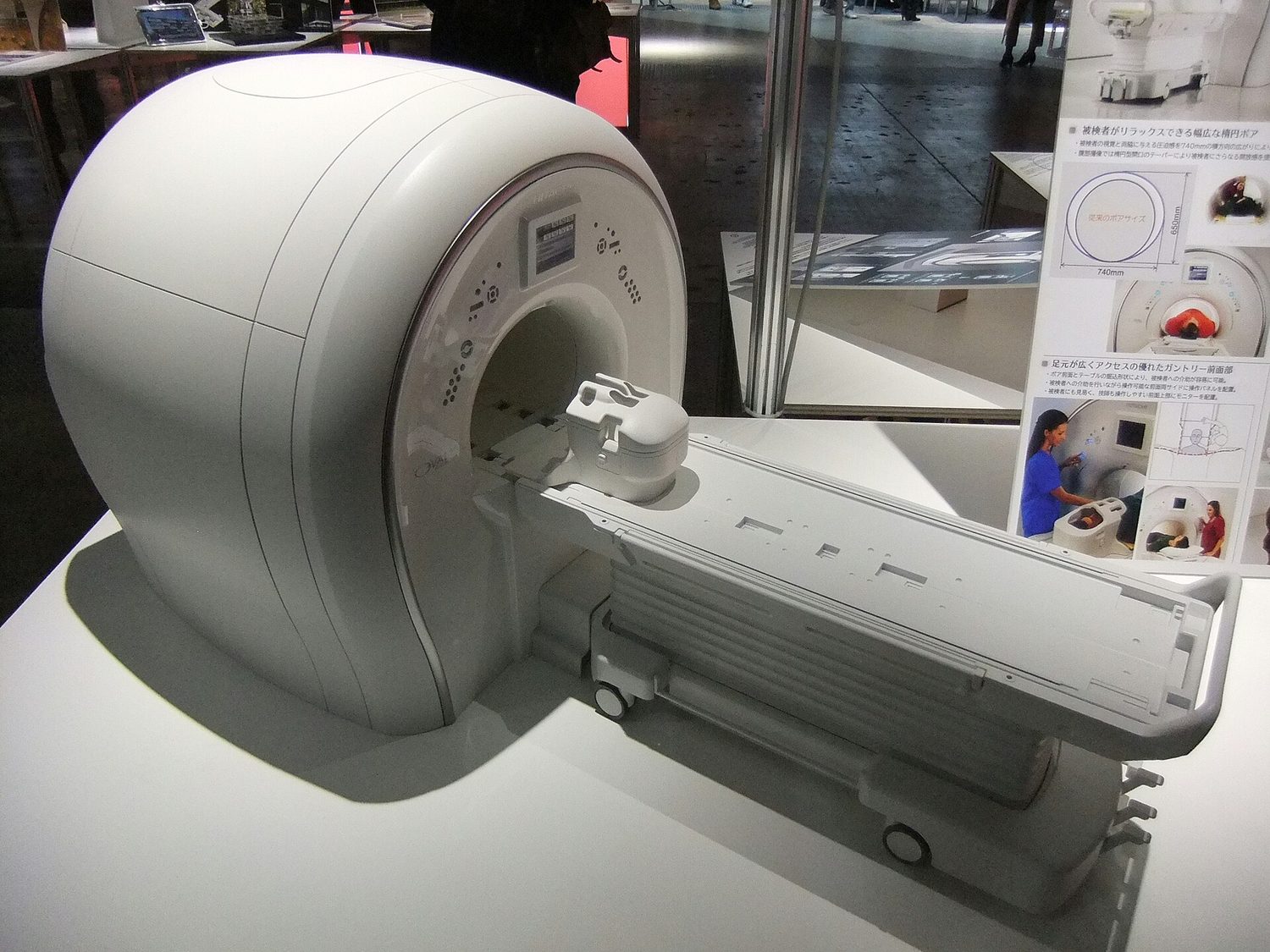
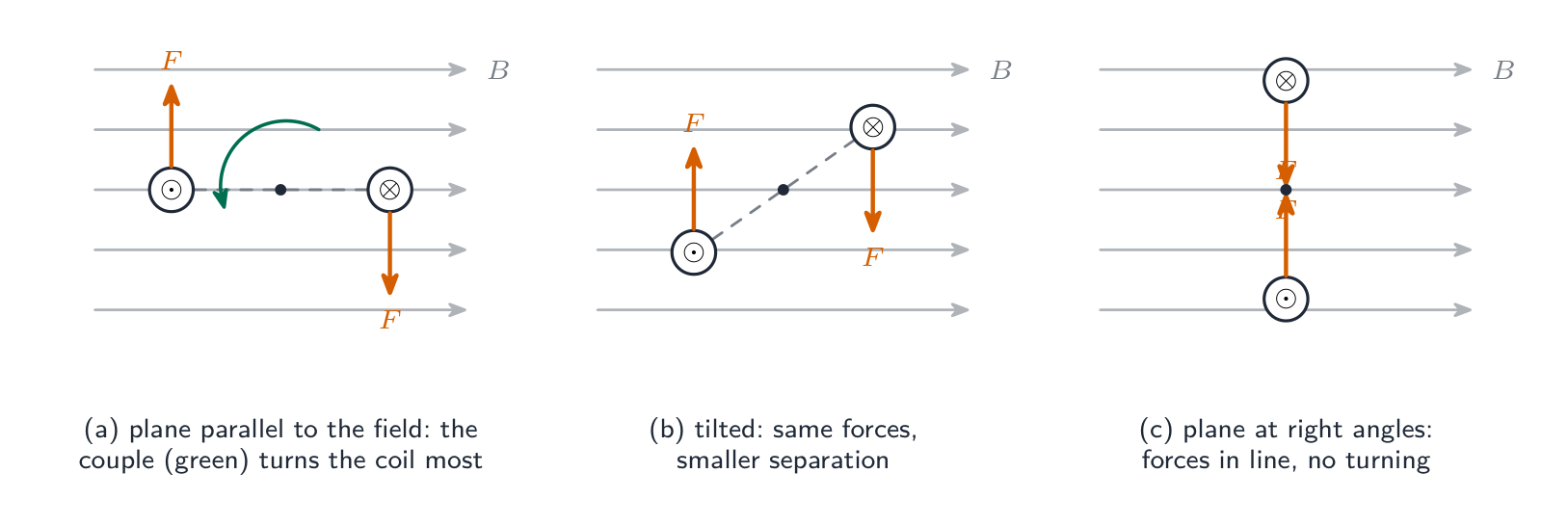


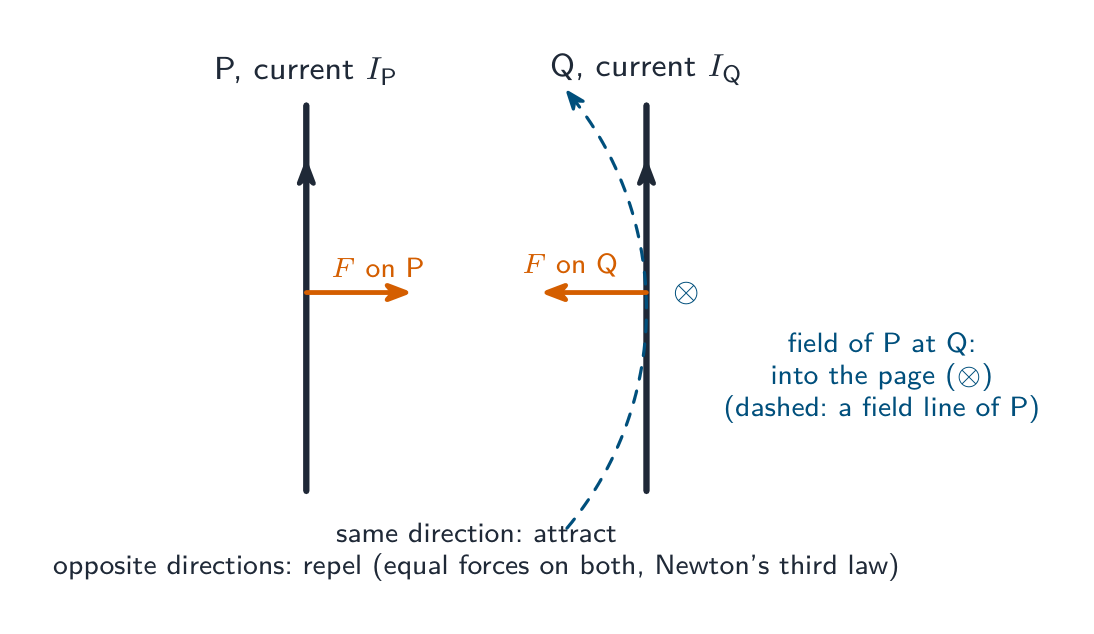
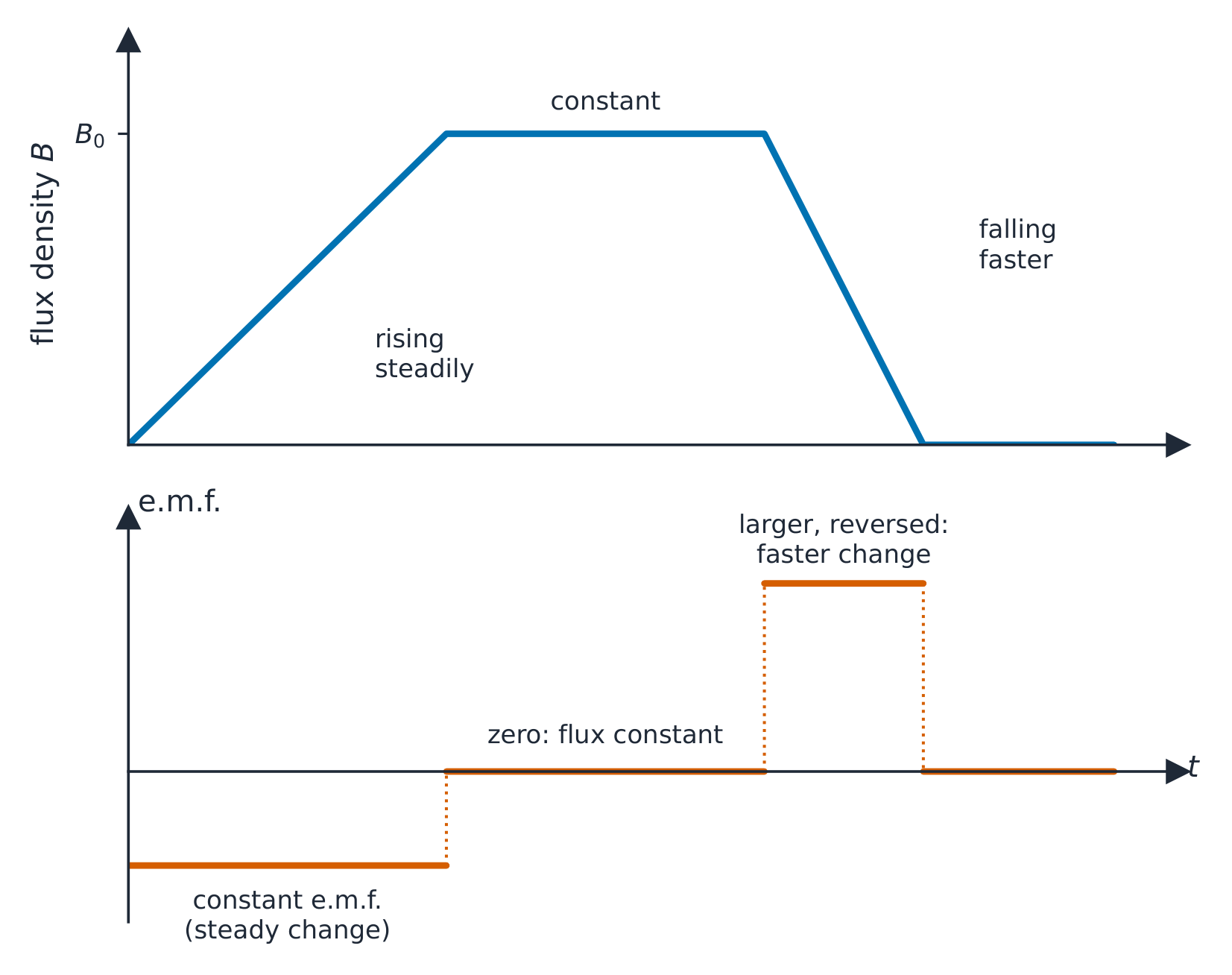


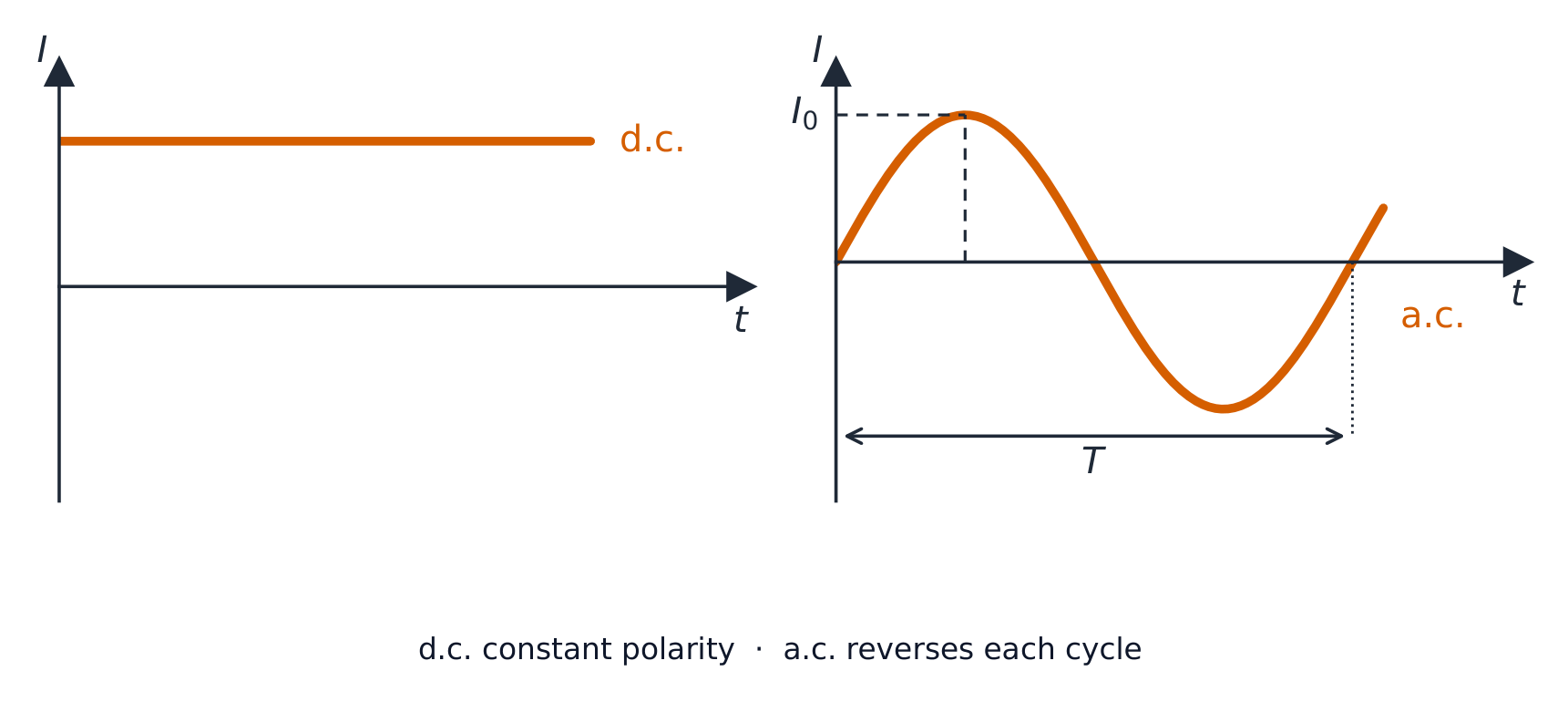


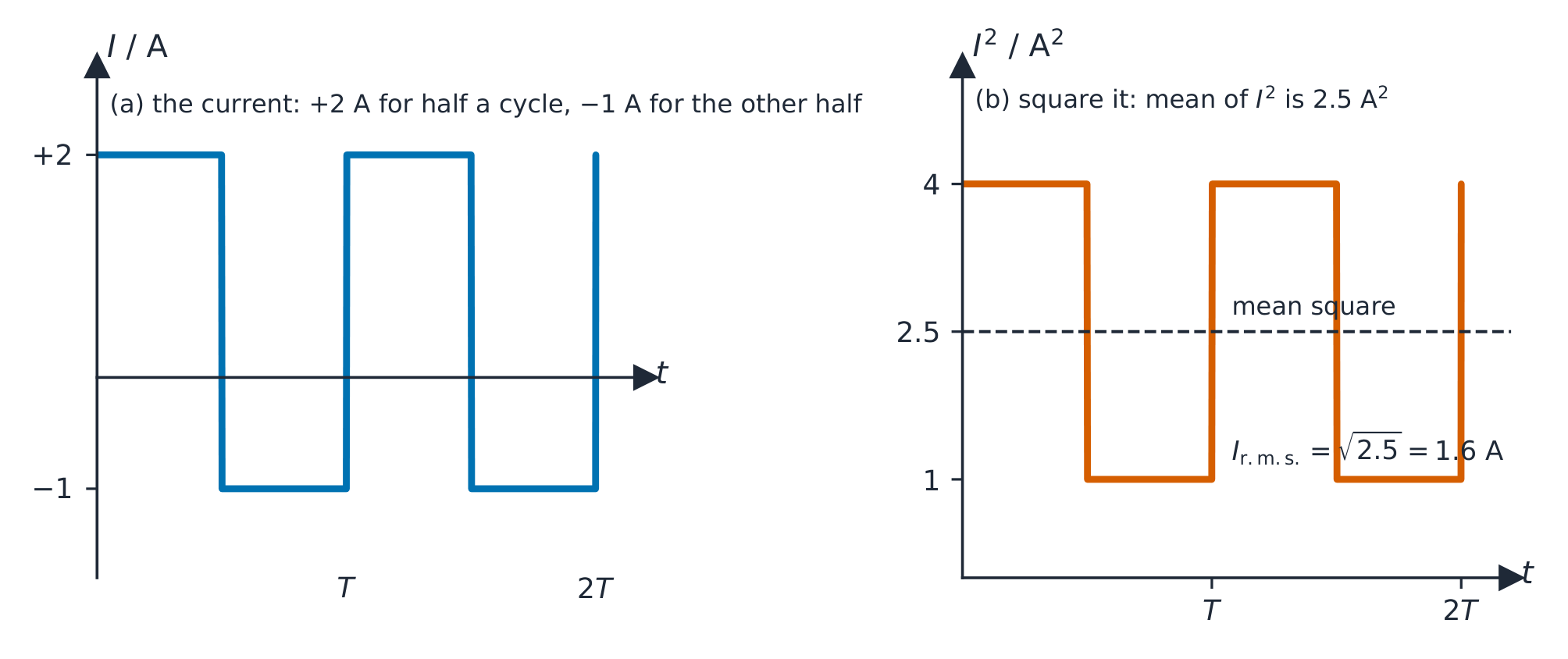




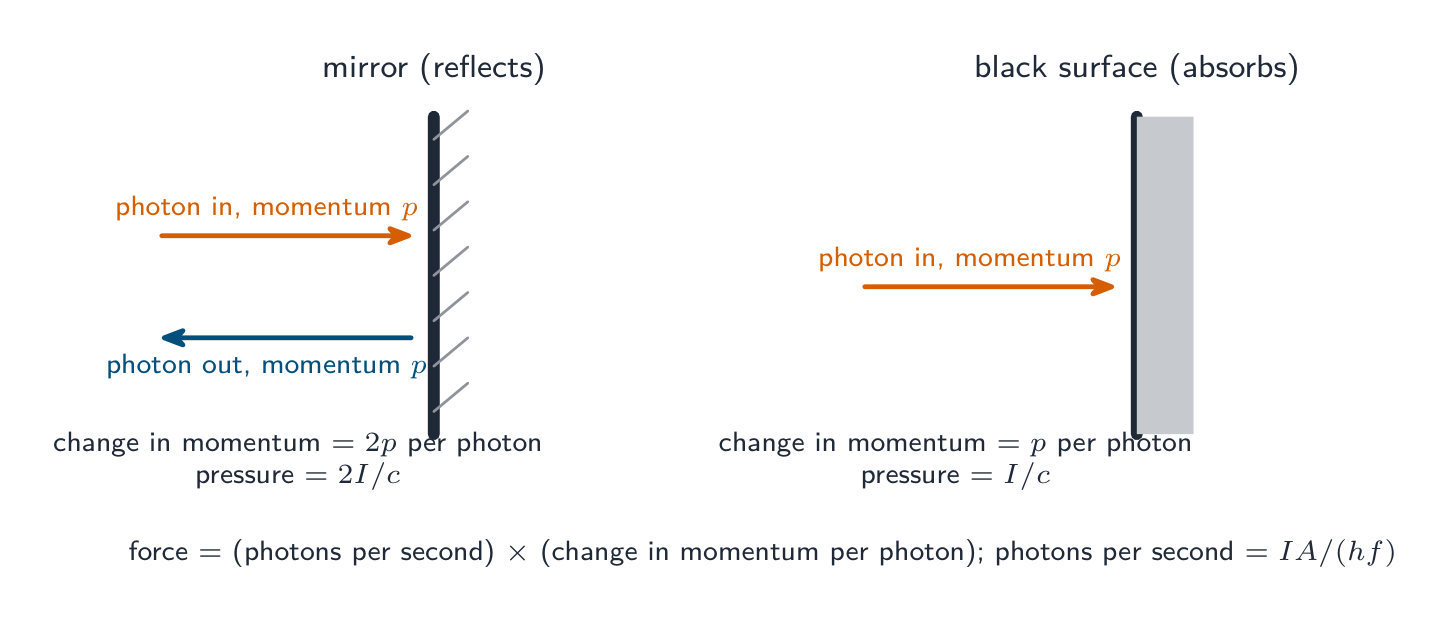


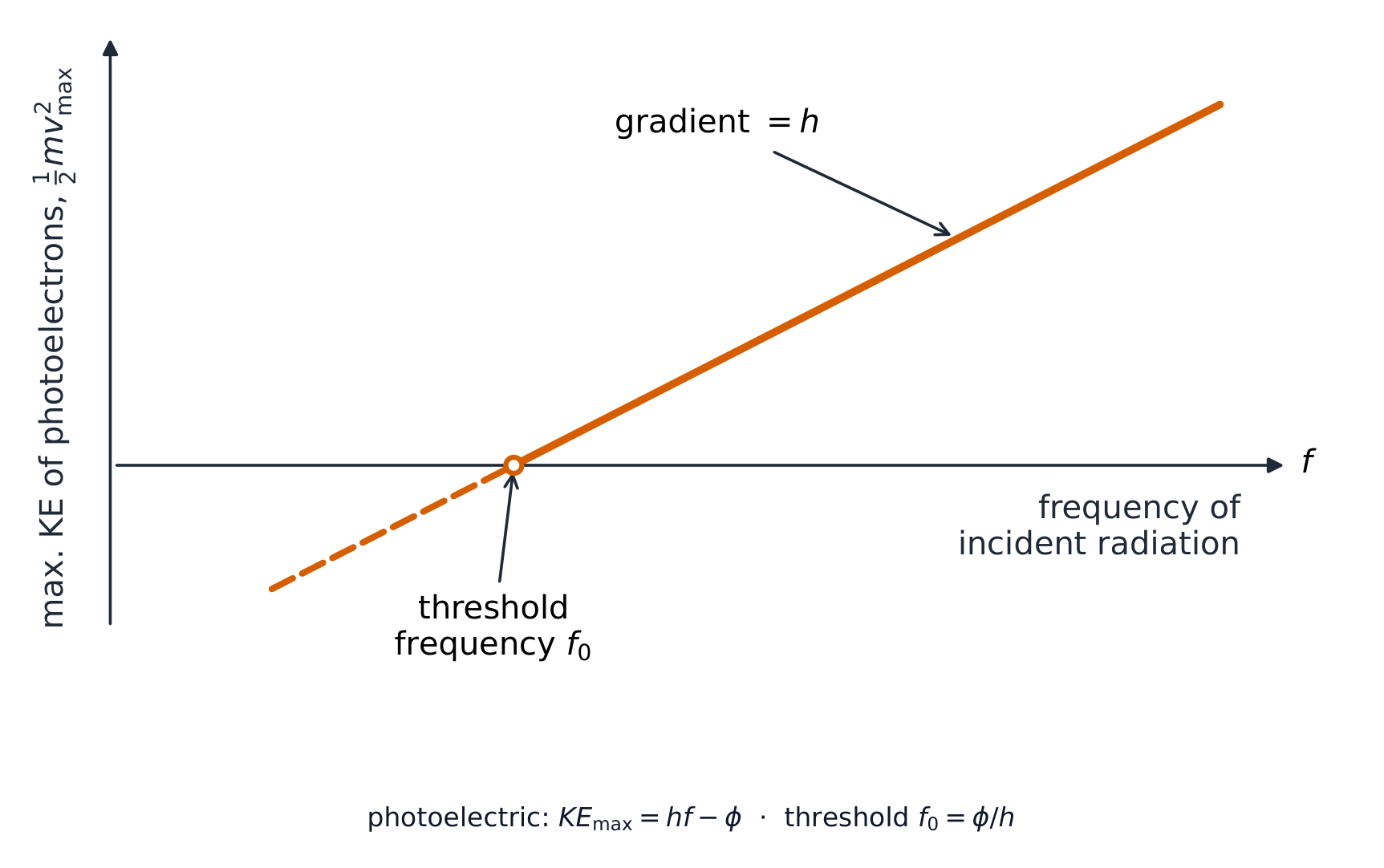
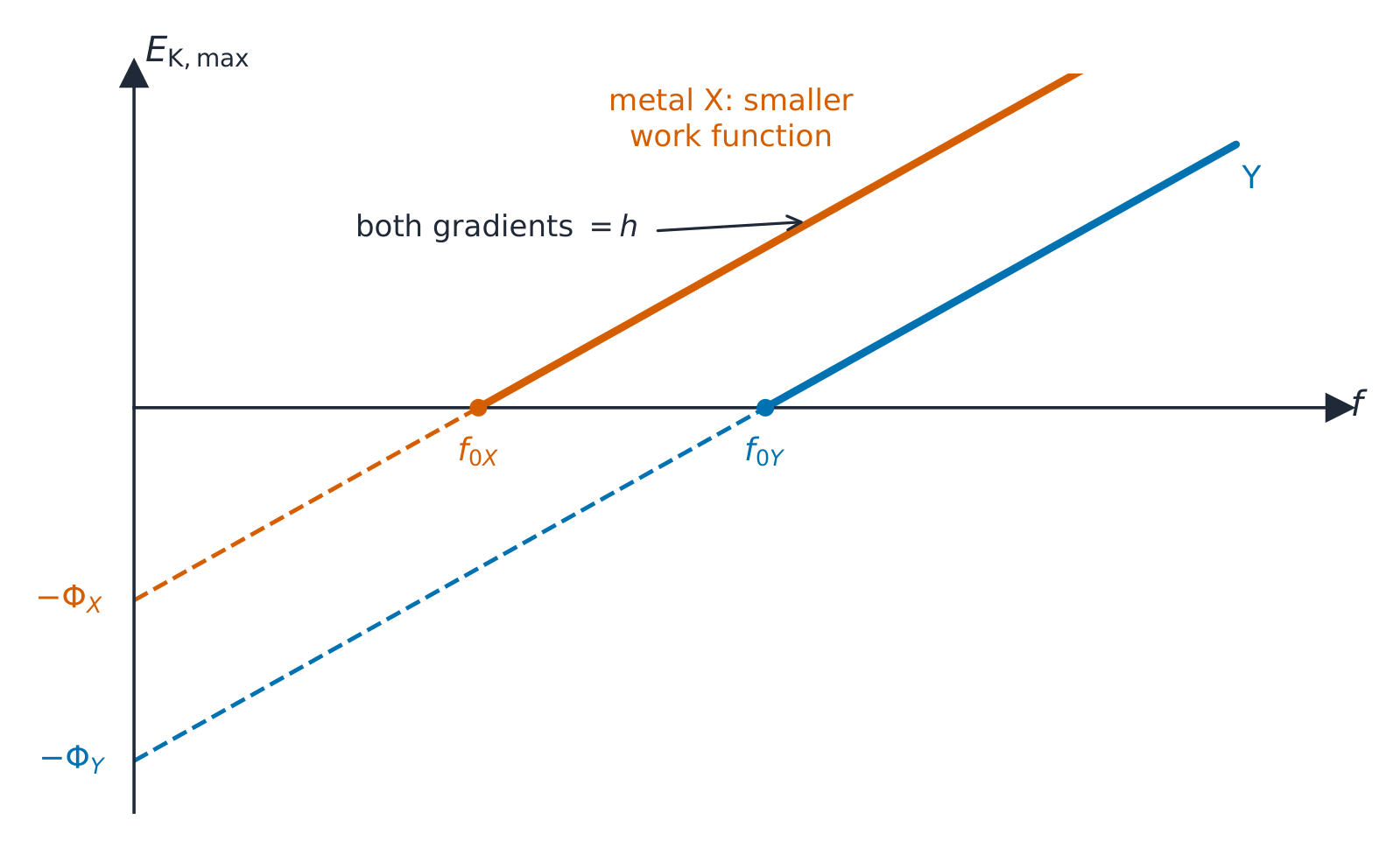
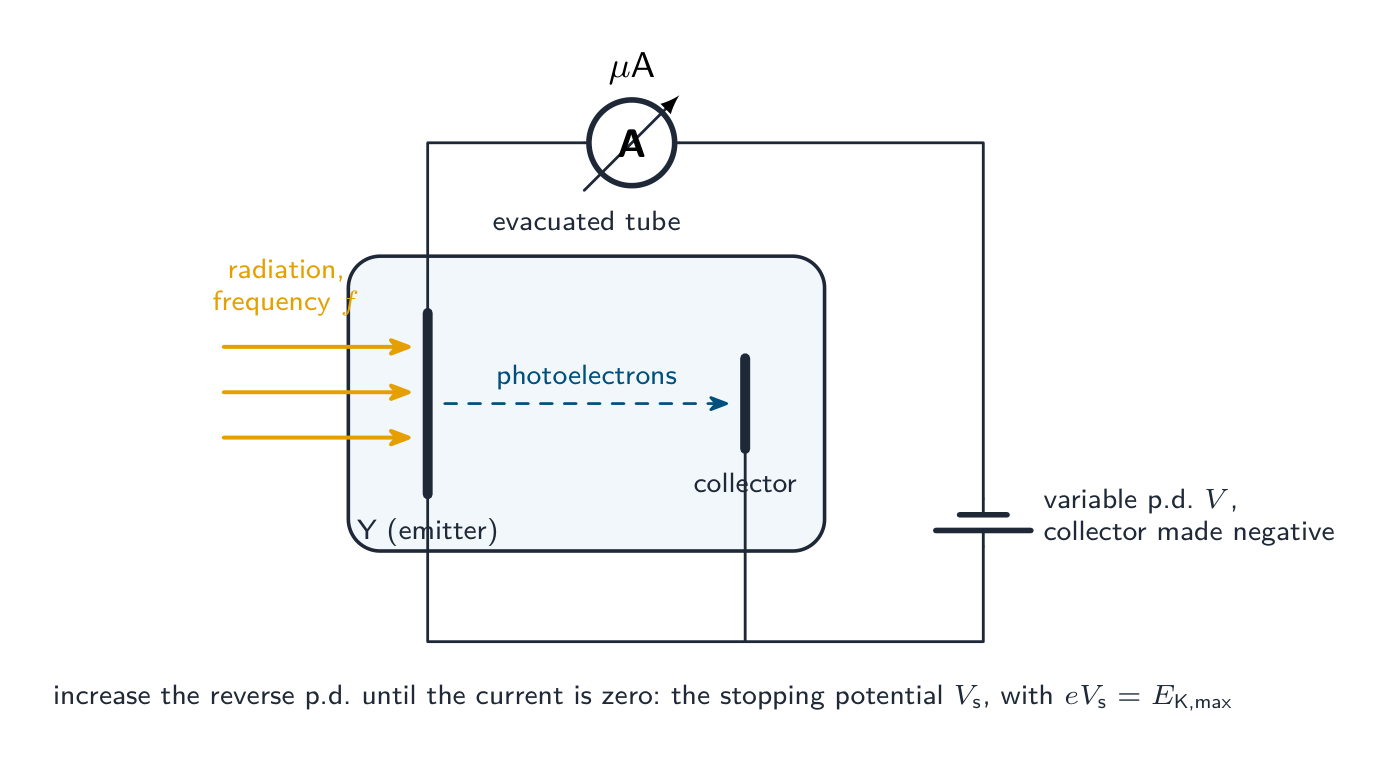






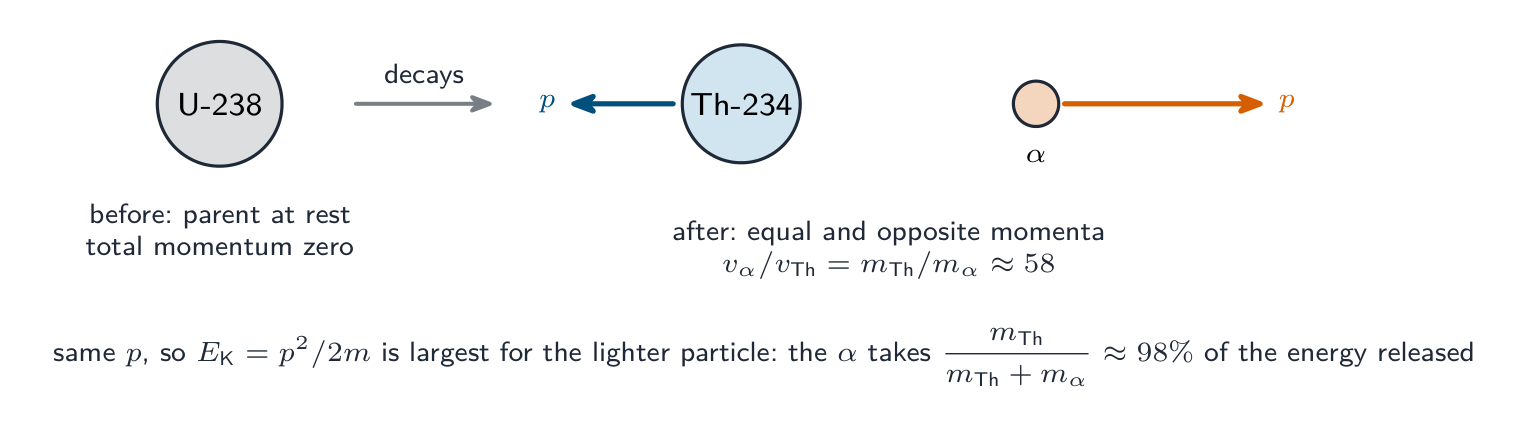

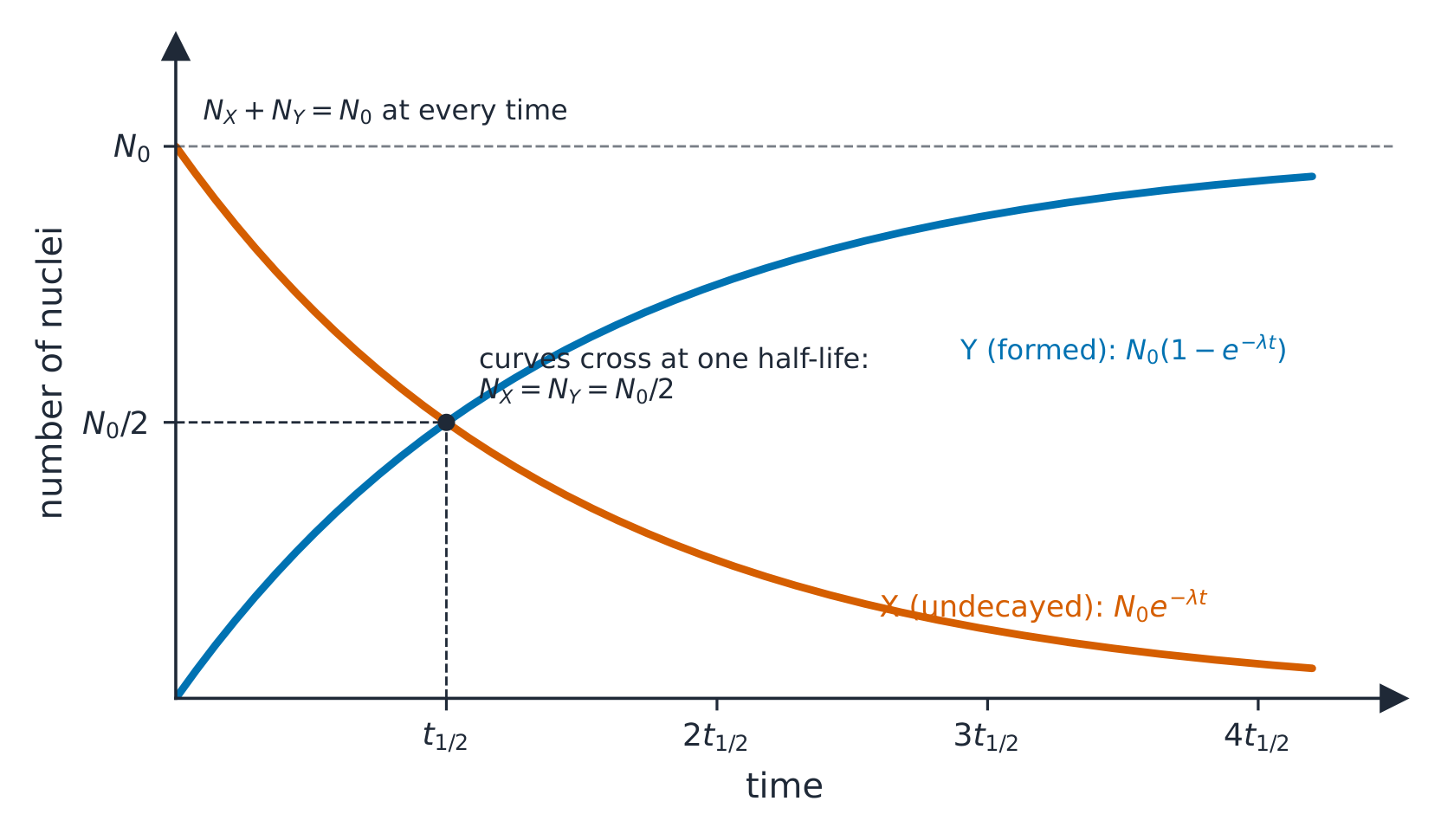
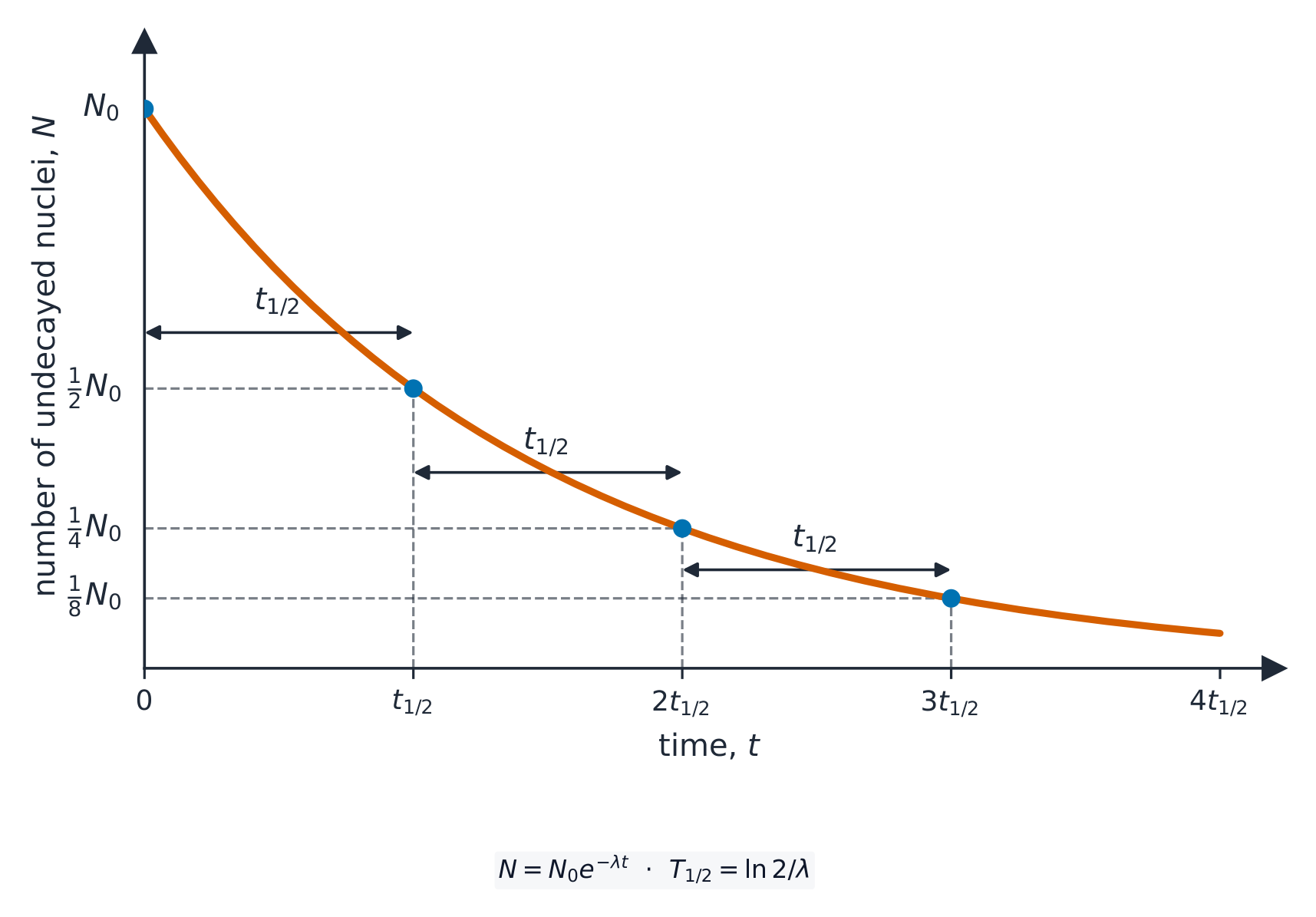





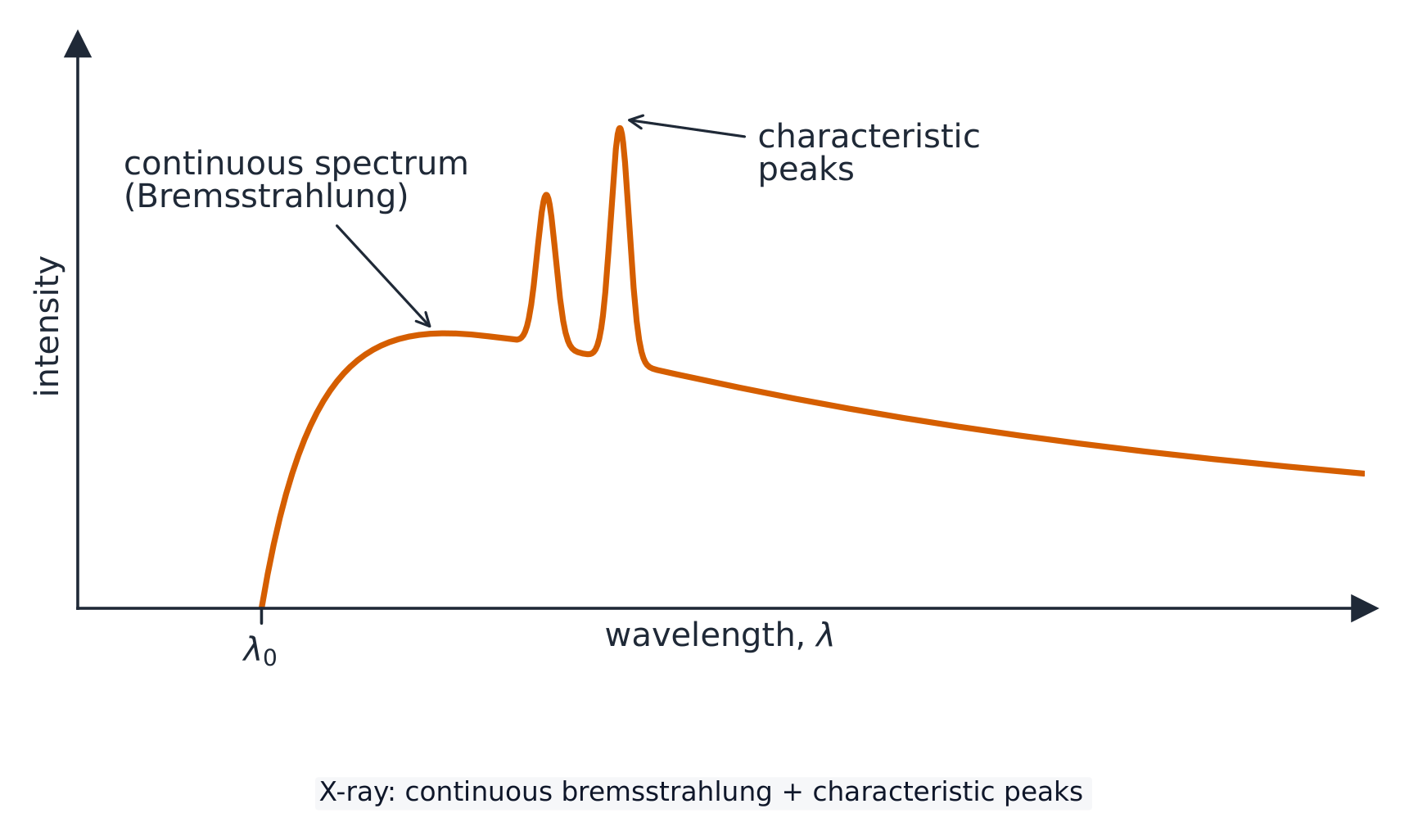
 *صورة صدر حقيقية: العظم الكثيف يمتص المزيد من الأشعة وينتج لوناً أبيض؛ الرئتان المملوءتان بالهواء تسمحان بمرور الأشعة وتبدوان داكنتين
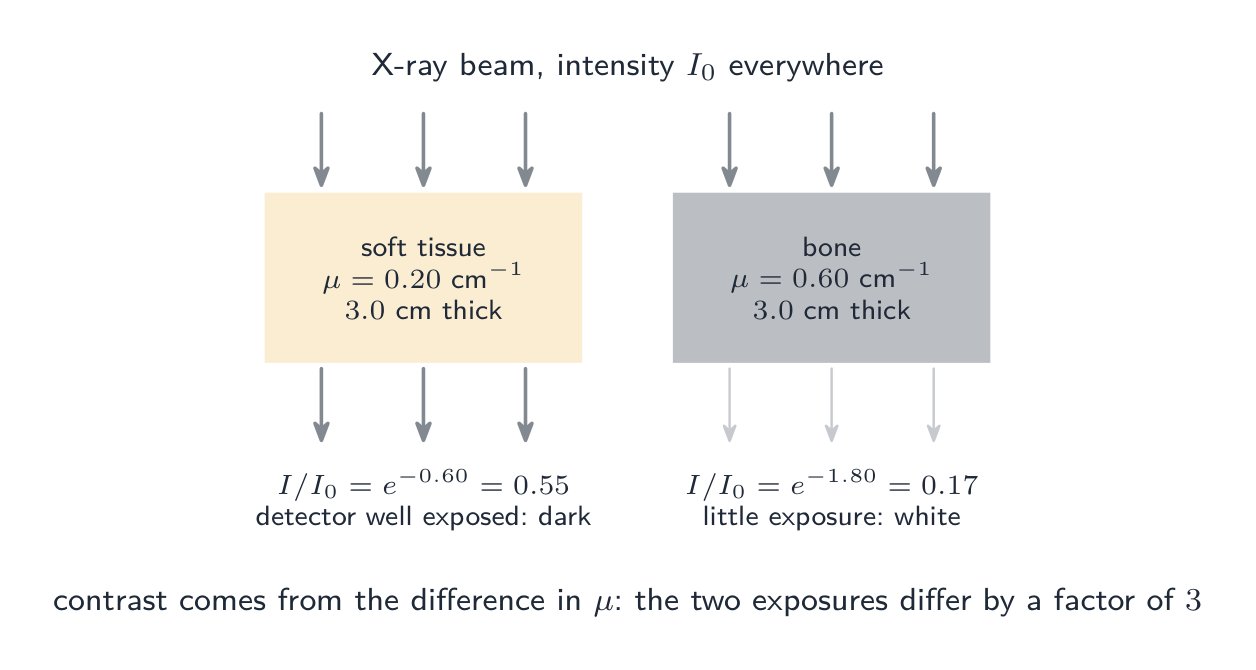 *التباين هو فرق التضعيف: العظم يضعف بقوة حوالي ثلاثة أضعاف أكثر من النسيج الرخو لكل سنتيمتر، لذا تعطي السماوات المتساوية تعريضات مختلفة جداً


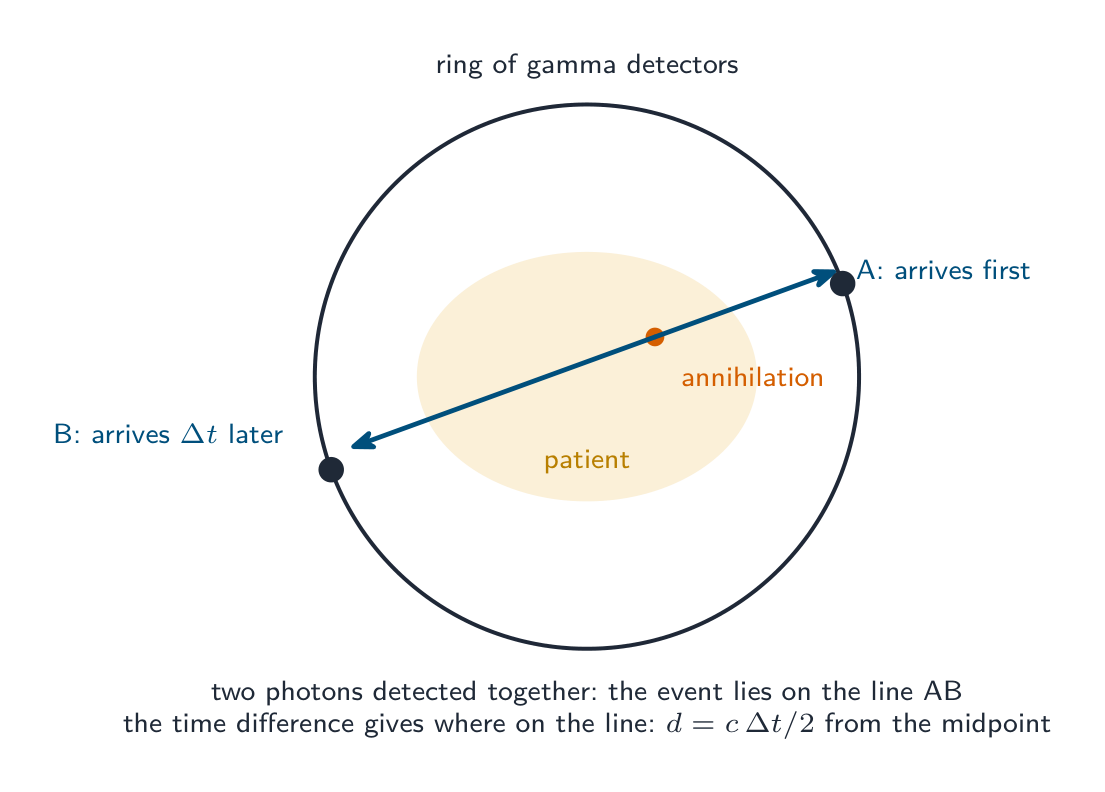 *تحديد موقع الاضمحلال: فوتونان يتم كشفهما معاً يحددان الخط، وفرق وصولهما يحدد المكان على هذا الخط