- understand that internal energy is determined by the state of the system and that it can be expressed as the sum of a random distribution of kinetic and potential energies associated with the molecules of a system
- relate a rise in temperature of an object to an increase in its internal energy
Thermodynamics
A-Level Physics · Topic 16
 15:27
15:27
Internal Energy
Pump up a bicycle tyre, quickly and hard, and something surprising happens: the pump gets hot. Warm enough to feel. You did not heat it with a flame. So where…
English narration · English + 中文 subtitles burned in
16.1
Internal energy

Syllabus
Source: Cambridge International syllabus
The internal energy 内能 $U$ of a system is the sum of:
- the random kinetic energies 动能 of its molecules 分子 — they fly through space (translational 平动 motion), and unless they are single atoms they also spin (rotational 转动) and shake (vibrational 振动), and
- the potential energies from the forces between the molecules.
For a real solid, liquid or gas, both parts matter. In the ideal-gas 理想气体 model the intermolecular 分子间 forces are ignored, so the molecular potential energy is zero and the internal energy is purely kinetic.
The two-mark definition. The internal energy of a system is the sum of the random distribution of the kinetic and potential energies of its molecules (or atoms). Both marks need "sum of kinetic and potential energies" and "random" (or "of the molecules") — leaving out "random" describes the energy of a moving object, not its internal energy. For an ideal gas, "with reference to kinetic and potential energy": the internal energy is the total kinetic energy of the molecules only, because there are no intermolecular forces and therefore no potential energy.
Two key points:
- $U$ depends only on the state of the system (its temperature 温度, pressure 压强, volume 体积, amount of substance 物质的量) — not on the path taken to get there.
- $U$ is a sum over the molecules, not the kinetic energy of the whole object moving. A moving train of gas has bulk kinetic energy, but that is separate from $U$ — $U$ is the energy of the random molecular motion.
Temperature and internal energy
Raising an object's temperature raises the random kinetic energy of its molecules, and so raises its internal energy.
For an ideal gas every molecule has average translational kinetic energy $\tfrac{3}{2} k T$ (Topic 15). With zero intermolecular potential energy, the total internal energy is
$$U = \tfrac{3}{2} N k T = \tfrac{3}{2} n R T.$$
So the internal energy of an ideal gas is directly proportional to the thermodynamic temperature 热力学温度. Doubling $T$ doubles $U$. This is only exact for an ideal gas.
During a phase change 相变 (melting or boiling) of a real substance, $U$ rises because the molecular potential energy rises (bonds breaking), even though the temperature stays constant.
Describing a change in internal energy — always name both energies. A three-mark "describe and explain, with reference to molecular kinetic and potential energies" answer says what happens to each:
- a gas heated at constant volume: the kinetic energy of the molecules increases, because temperature is a measure of their mean kinetic energy; the potential energy is unchanged (no work is done, the molecules' separation does not change); so the internal energy increases.
- a wire stretched within its elastic limit at constant temperature: the kinetic energy of the atoms is unchanged (same temperature); the potential energy increases, because the atoms are pulled further apart against the interatomic forces; so the internal energy increases.
- ice melting at $0\ ^{\circ}\text{C}$: the kinetic energy is unchanged (constant temperature); the potential energy increases as the bonds between molecules are broken and the separation grows; so the internal energy increases by the latent heat supplied.
Worked example. A fixed mass of ideal gas is heated at constant pressure. Sketch the variation of its internal energy $U$ with its volume $V$.
At constant pressure $V \propto T$ (Charles's law) and for an ideal gas $U \propto T$, so $U \propto V$: a straight line through the origin. The origin is on the line because at absolute zero both $V$ (extrapolated) and $U$ are zero.
Explore
The spread of molecular energies
Internal energy is the total random kinetic + potential energy of the molecules. Heat the gas and the whole speed distribution shifts to higher energy.
Vocabulary
Train
| English |
|---|
| internal energy/ɪnˈtɜːnl ˈenədʒi/ |
| kinetic energy/kɪˈnetɪk ˈenədʒi/ |
| molecule/ˈmɒlɪkjuːl/ |
| translational/trænˈsleɪʃənl/ |
| rotational/rəʊˈteɪʃənl/ |
| vibrational/vaɪˈbreɪʃənl/ |
| ideal-gas/aɪˈdɪəl ɡæs/ |
| intermolecular/ˌɪntəməˈlekjʊlə/ |
| ideal gas/aɪˈdɪəl ɡæs/ |
| temperature/ˈtemprɪtʃə/ |
| pressure/ˈpreʃə/ |
| volume/ˈvɒljuːm/ |
| amount of substance/əˈmaʊnt ɒv ˈsʌbstəns/ |
| thermodynamic temperature/ˌθɜːməʊdaɪˈnæmɪk ˈtemprɪtʃə/ |
| phase change/feɪz tʃeɪndʒ/ |
16.2
Work done on or by a gas

Syllabus
- recall and use $W = p\Delta V$ for the work done when the volume of a gas changes at constant pressure and understand the difference between the work done by the gas and the work done on the gas
- recall and use the first law of thermodynamics $\Delta U = q + W$ expressed in terms of the increase in internal energy, the heating of the system (energy transferred to the system by heating) and the work done on the system
Source: Cambridge International syllabus
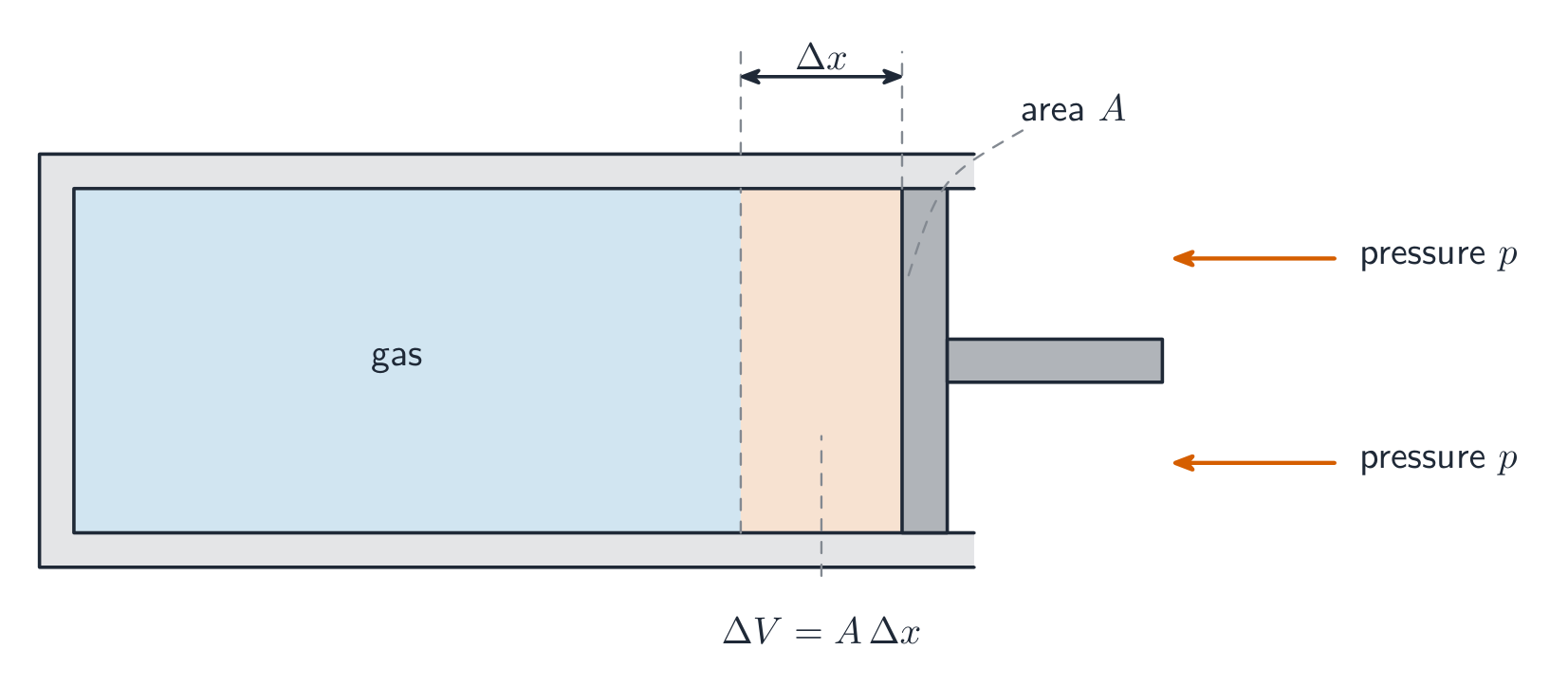
When a gas changes volume against an outside pressure, mechanical work is done. At constant pressure $p$ with a small volume change $\Delta V$, the size of the work is
$$W = p \Delta V.$$
Worked example. A gas at a constant pressure of $1.0 \times 10^{5}\ \text{Pa}$ expands from $2.0 \times 10^{-3}\ \text{m}^{3}$ to $5.0 \times 10^{-3}\ \text{m}^{3}$. Find the work done by the gas.
$$W = p\,\Delta V = (1.0 \times 10^{5})(5.0 \times 10^{-3} - 2.0 \times 10^{-3}) = 300\ \text{J}.$$
Worked example. An ideal gas of mass $0.35\ \text{kg}$ is heated at a constant pressure of $2.0 \times 10^{5}\ \text{Pa}$; its internal energy rises by $7600\ \text{J}$ and its volume increases by $1.2 \times 10^{-2}\ \text{m}^{3}$. Find the work done by the gas and the thermal energy supplied. The gas is then heated at constant volume until its internal energy rises by the same $7600\ \text{J}$; explain why less thermal energy is needed.
Work done by the gas $= p\Delta V = 2.0 \times 10^{5} \times 1.2 \times 10^{-2} = 2400\ \text{J}$, so the work done on it is $W = -2400\ \text{J}$. First law: $q = \Delta U - W = 7600 - (-2400) = 1.0 \times 10^{4}\ \text{J}$. At constant volume no work is done ($\Delta V = 0$, $W = 0$), so the whole of the thermal energy goes into internal energy: $q = \Delta U = 7600\ \text{J}$. The extra $2400\ \text{J}$ at constant pressure was the work the gas did pushing back the surroundings as it expanded.
Worked example. An aluminium block of volume $3.612 \times 10^{-3}\ \text{m}^{3}$ is heated from $0\ ^{\circ}\text{C}$ to $40\ ^{\circ}\text{C}$; its volume increases by $1.0 \times 10^{-5}\ \text{m}^{3}$ against atmospheric pressure ($1.0 \times 10^{5}\ \text{Pa}$). Compare the work it does on the atmosphere with the thermal energy it receives ($m = 9.75\ \text{kg}$, $c = 900\ \text{J kg}^{-1}\ \text{K}^{-1}$).
Work done by the block $= p\Delta V = 1.0 \times 10^{5} \times 1.0 \times 10^{-5} = 1.0\ \text{J}$; thermal energy $q = mc\Delta T = 9.75 \times 900 \times 40 = 3.5 \times 10^{5}\ \text{J}$. The work is about $3 \times 10^{-6}$ of the heating, so for a solid $\Delta U \approx q$: solids and liquids barely expand, and $p\Delta V$ only matters for a gas.
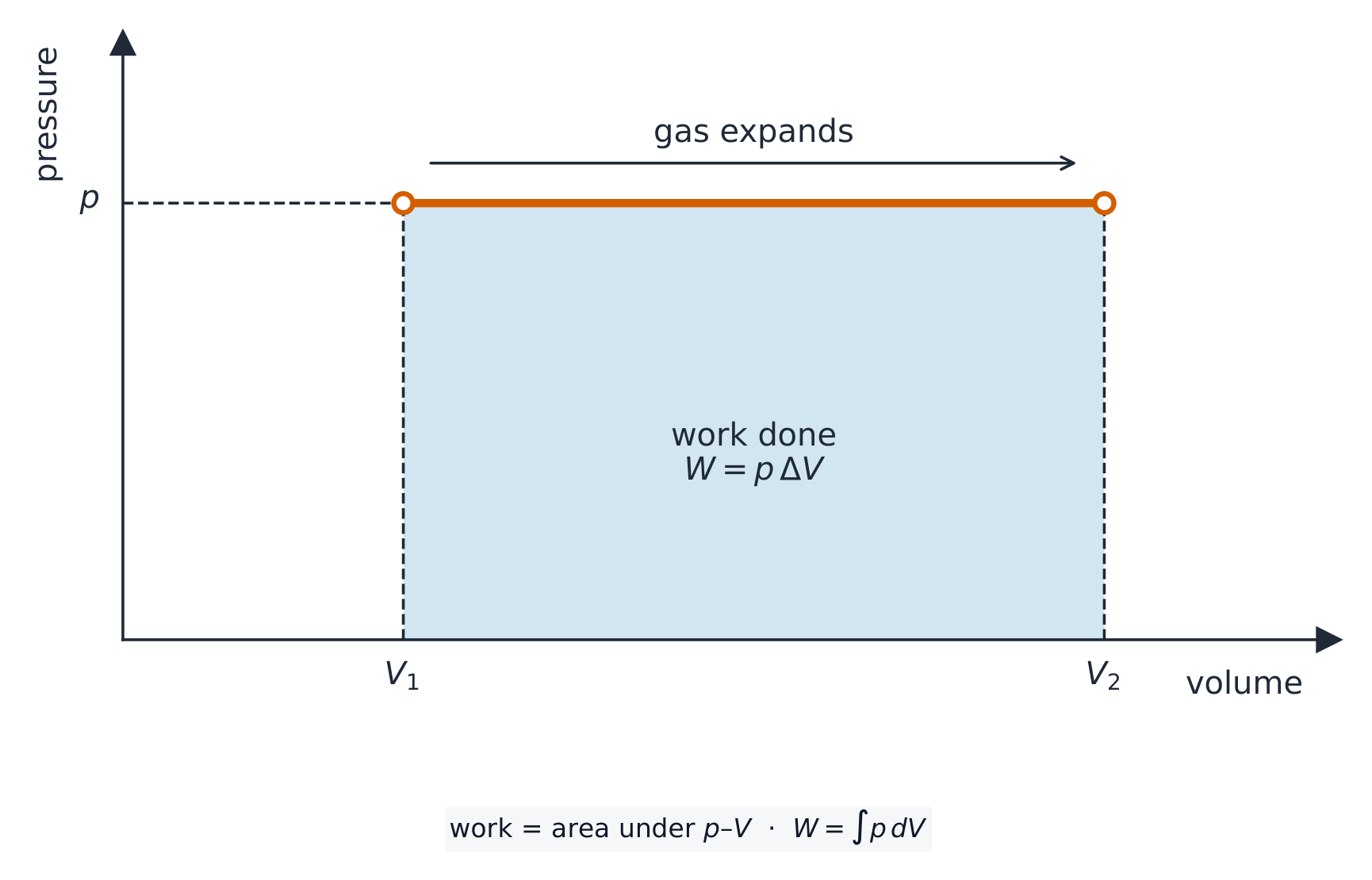
Sign convention in this syllabus
This syllabus writes the first law as $\Delta U = q + W$, where $W$ is the work done on the gas and $q$ is the energy put in by heating.

- when the gas is compressed, $\Delta V$ is negative and the work done on the gas is positive — the gas gains energy.
- when the gas expands, $\Delta V$ is positive and the work done on the gas is negative — the gas loses energy (it does work on the surroundings).
Watch which form a question wants:
- "work done on the gas" — positive when compressing.
- "work done by the gas" — the opposite sign, positive when expanding.
At constant volume ($\Delta V = 0$), no work is done.
16.2
First law of thermodynamics

The first law of thermodynamics 热力学第一定律 says that energy is conserved when heat and work pass between a system and its surroundings:
$$\Delta U = q + W,$$
where $\Delta U$ is the rise in internal energy, $q$ is the energy added by heating (positive in, negative out), and $W$ is the work done on the gas (positive when compressed). This is conservation of energy 能量守恒 for a gas.
As the exam asks it. "State the first law of thermodynamics, identifying any symbols" (2 marks): the increase in internal energy of a system, $\Delta U$, is equal to the sum of the thermal energy transferred to the system by heating, $q$, and the work done on the system, $W$: $\Delta U = q + W$. Every symbol must be defined with its direction — "to the system" and "on the system" are what make the signs mean something. "State two ways in which the first law says the internal energy of a system may be changed": by heating (thermal energy transferred into or out of the system) and by doing work on or by the system.

Worked example. A gas absorbs $500\ \text{J}$ of heat while it expands and does $200\ \text{J}$ of work on its surroundings. Find the change in its internal energy.
The gas does work, so the work done on it is $W = -200\ \text{J}$:
$$\Delta U = q + W = 500 + (-200) = 300\ \text{J}.$$
Explaining with the first law. A three-mark "use the first law to explain" answer has three steps: say what $q$ is (and its sign), say what $W$ is (and its sign), then combine them for $\Delta U$ — and, if asked, say what the change in internal energy means for the molecules.
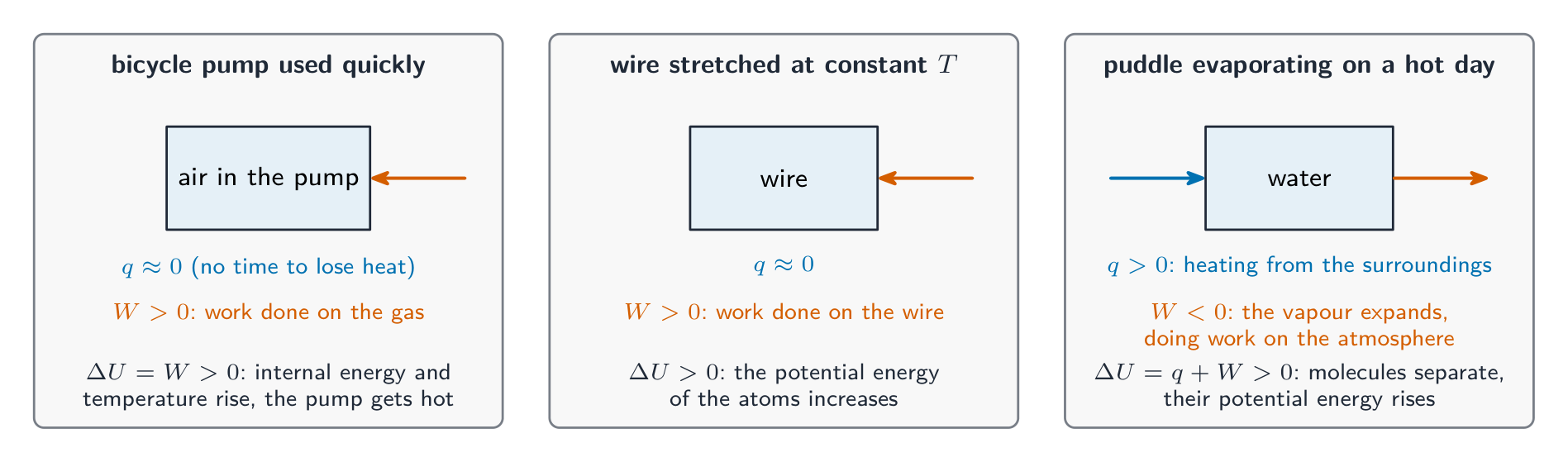
- Why a bicycle pump gets hot when used quickly: the air is compressed, so work is done on it ($W > 0$); the compression is fast, so there is no time for thermal energy to leave ($q \approx 0$); therefore $\Delta U = W > 0$ — the internal energy, and so the temperature, of the air rises, and the pump warms up.
- A spring stretched at constant temperature within its elastic limit: work is done on the spring by the stretching force ($W > 0$); there is no thermal energy transfer ($q = 0$); so the internal energy increases — stored as the elastic potential energy of the atoms, which are pulled further apart.
- Water evaporating from a puddle on a hot day: thermal energy is transferred to the water from the surroundings ($q > 0$); the vapour formed occupies a far larger volume than the liquid, so the system does work on the atmosphere ($W < 0$); the internal energy still increases ($q$ is larger than the work done), and the increase is potential energy — the molecules are separated against the attractive forces between them.
Reading the equation
$\Delta U$ is fixed by the change of state (for an ideal gas, by the change in temperature). The same $\Delta U$ can come from different mixes of $q$ and $W$:
- all heat, no work: $\Delta U = q$ (constant-volume heating).
- all work, no heat: $\Delta U = W$ (insulated compression or expansion).
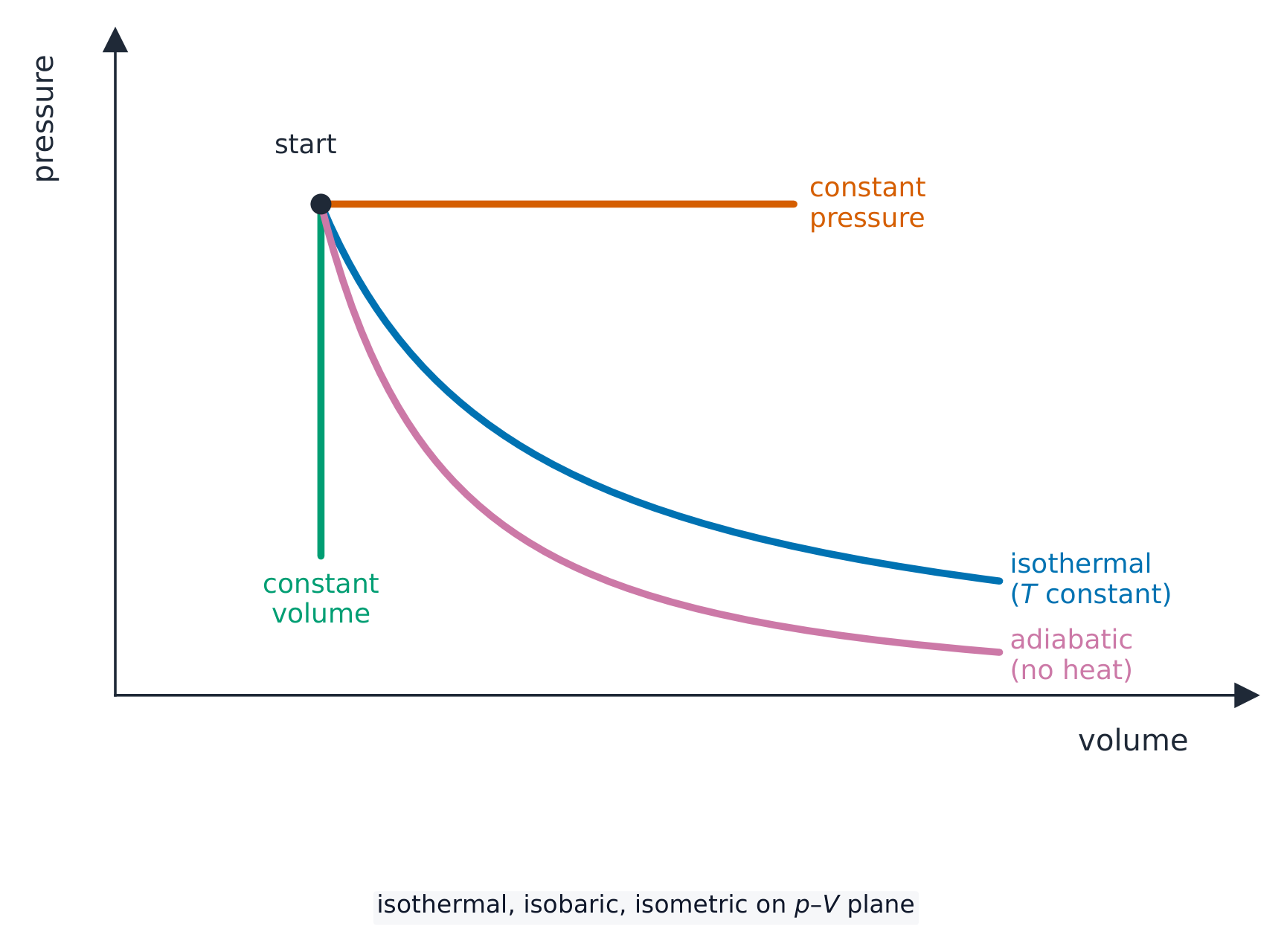
Standard processes
For an ideal gas, $\Delta U = \tfrac{3}{2} n R \Delta T$ — it depends only on $\Delta T$.
| Process | What stays constant | $\Delta U$ | $W$ (on gas) | $q$ |
|---|---|---|---|---|
| Isothermal | $T$ | $0$ | $W$ | $-W$ |
| Constant volume | $V$ | $\tfrac{3}{2}n R \Delta T$ | $0$ | $\Delta U$ |
| Constant pressure | $p$ | $\tfrac{3}{2}n R \Delta T$ | $-p \Delta V$ | $\Delta U - W$ |
| Adiabatic | (no heat) | varies | $W$ | $0$ |
Read each row with the first law $\Delta U = q + W$:
- Isothermal 等温 (constant $T$): $\Delta T = 0$, so $\Delta U = 0$. Then $q = -W$ — any heat that goes in comes straight back out as work.
- Adiabatic 绝热 (no heat flow): $q = 0$, so $\Delta U = W$. The gas warms up only because work is done on it.
- Constant volume (sealed rigid container): no work is done ($\Delta V = 0$), so all the heat goes into internal energy: $q = \Delta U$.
- Constant pressure (gas pushing a piston 活塞): the gas does work as it expands, so the heat you supply does two jobs — it raises the internal energy and does the expansion work.
So for the same rise in internal energy, heating at constant pressure needs more thermal energy than heating at constant volume, by exactly the work $p\Delta V$ the gas does while expanding — the constant-volume gas keeps every joule; the constant-pressure gas hands some back to the surroundings.
Worked example: two-step process
A sample of ideal gas at temperature $T$ with internal energy $U$ goes through:
- compression to temperature $3T$; work $W$ is done on the gas.
- cooling at constant volume to temperature $2T$.
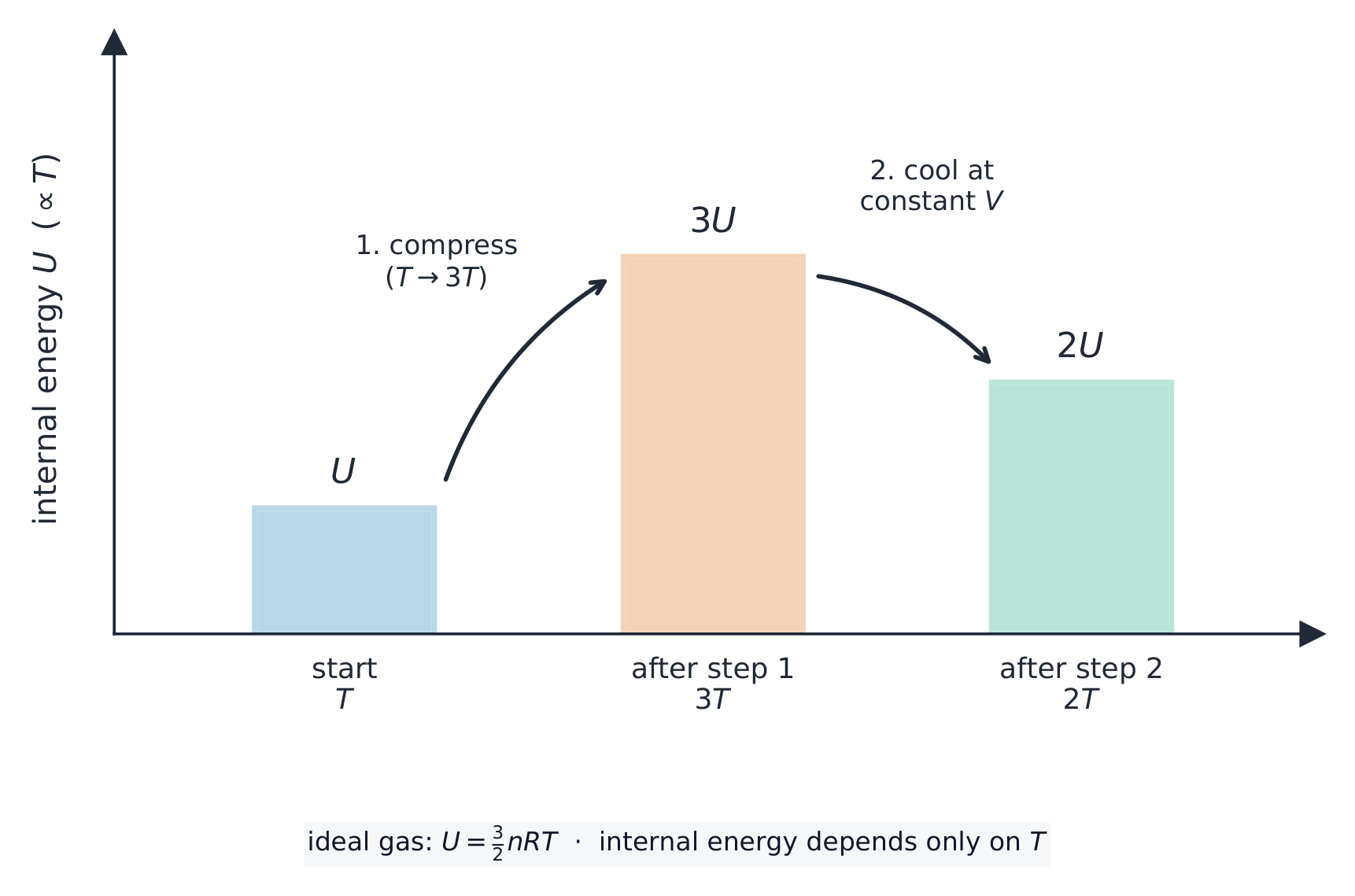
Step 1 ($T \to 3T$): $U = \tfrac{3}{2}nRT$, so $U \to 3U$, giving $\Delta U_{1} = 2U$. $W_{1} = +W$. So $q_{1} = \Delta U_{1} - W_{1} = 2U - W$.
Step 2 ($3T \to 2T$, constant volume): $\Delta U_{2} = -U$. $W_{2} = 0$. So $q_{2} = -U$ (heat flows out).
Check: total $\Delta U = 2U - U = U$, taking the gas from $T$ to $2T$ ($U \to 2U$) — consistent.
Worked example: a cycle on a $p$–$V$ diagram
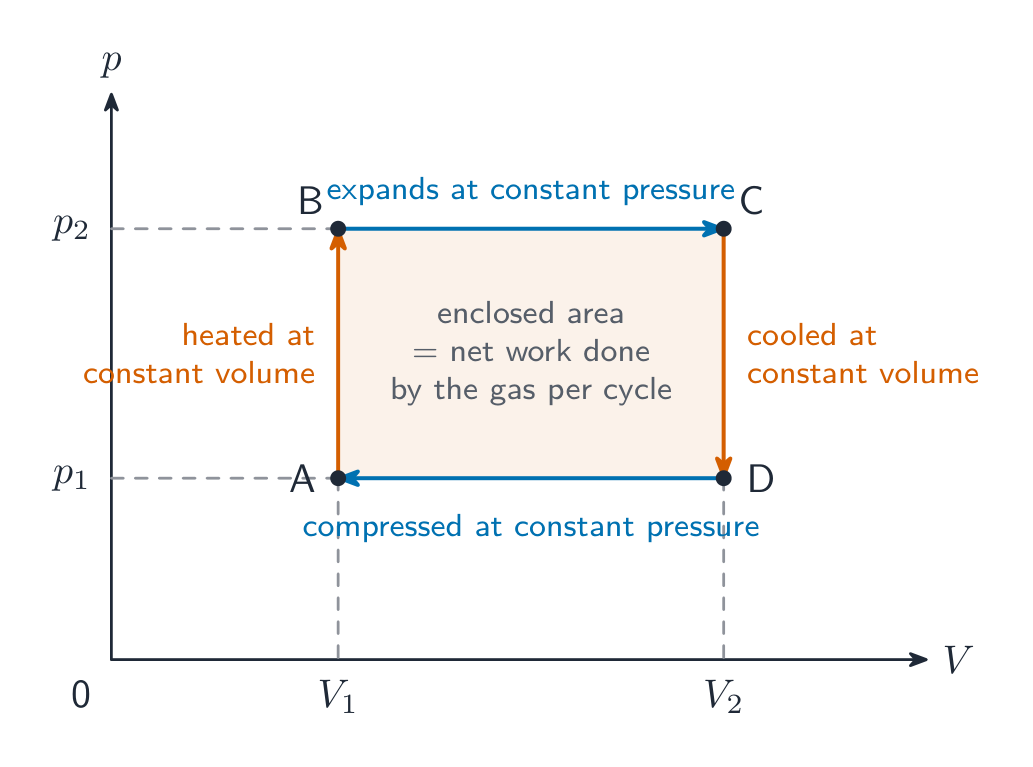
A fixed mass of ideal gas is taken round the cycle ABCDA: A to B at constant volume $V_{1}$ (pressure $p_{1} \to p_{2}$), B to C at constant pressure $p_{2}$ (volume $V_{1} \to V_{2}$), C to D at constant volume, D to A at constant pressure $p_{1}$. Complete a table of the signs of $q$, $W$ and $\Delta U$ for each leg, and explain the internal-energy change from B to C.
| Leg | Process | $W$ (on gas) | $\Delta U$ | $q$ |
|---|---|---|---|---|
| A → B | constant volume, pressure rises | $0$ (no volume change) | $+$ (temperature rises, $pV$ larger) | $+$ ($q = \Delta U$) |
| B → C | constant pressure, expands | $-$ (gas does work $p_{2}(V_{2} - V_{1})$) | $+$ ($T \propto V$ at constant $p$) | $+$ (and larger than $\Delta U$) |
| C → D | constant volume, pressure falls | $0$ | $-$ | $-$ (thermal energy leaves) |
| D → A | constant pressure, compressed | $+$ (work done on the gas $p_{1}(V_{2} - V_{1})$) | $-$ | $-$ (larger in size than $\Delta U$) |
From B to C the gas expands at constant pressure, so its temperature rises ($V/T$ constant) and its internal energy increases; it does work on the surroundings ($W$ negative), so the thermal energy supplied must cover both: $q = \Delta U - W$, larger than the rise in internal energy. Round the whole cycle $\Delta U = 0$ (the gas returns to its starting state), so the net thermal energy in equals the net work done by the gas — the area enclosed by the rectangle, $(p_{2} - p_{1})(V_{2} - V_{1})$.
Heat capacity at constant volume
For constant-volume heating of an ideal gas, $q = \Delta U = \tfrac{3}{2} n R \Delta T$. So the molar heat capacity 热容 at constant volume is $\tfrac{3}{2} R$ for a monatomic 单原子 ideal gas. (You are not required to use the symbol $C_V$, but the result $q = \tfrac{3}{2} n R \Delta T$ for constant-volume heating is.)

Heating without a temperature change
If heat is supplied during a phase change at constant pressure (e.g. boiling water), the temperature stays constant but the internal energy still rises (the latent heat 潜热 separates the molecules), and the gas does expansion work. The first law still holds: $\Delta U = q + W$.
Explore
Work done on a gas
Push the piston in and you do work on the gas (W = pΔV); the first law says that work plus the heat added equals the rise in internal energy.
Vocabulary
Train
| English |
|---|
| latent heat/ˈleɪtənt hiːt/ |
| piston/ˈpɪstn/ |
| first law of thermodynamics/fɜːst lɔː ɒv ˌθɜːməʊdaɪˈnæmɪks/ |
| conservation of energy/ˌkɒnsəˈveɪʃn ɒv ˈenədʒi/ |
| isothermal/ˌaɪsəˈθɜːml/ |
| adiabatic/ˌædiəˈbætɪk/ |
| heat capacity/hiːt kəˈpæsɪti/ |
| monatomic/ˌmɒnəˈtɒmɪk/ |
16.2
Definitions the examiner accepts
A definition question is marked against fixed wording. Learn these exactly, and give one answer only.
| Term | Definition |
|---|---|
| internal energy | the sum of the random distribution of the kinetic and potential energies of the molecules of a system |
| internal energy of an ideal gas | the total random kinetic energy of its molecules, since with no intermolecular forces there is no potential energy |
| first law of thermodynamics | the increase in internal energy of a system equals the thermal energy transferred to the system by heating plus the work done on the system: $\Delta U = q + W$ |
| work done on a gas at constant pressure | $W = p\Delta V$ in size; positive when the gas is compressed, negative when it expands (the gas then does work on its surroundings) |
| thermal energy transfer (heating) | energy transferred to or from a system because of a temperature difference; $q$ is positive when it enters |
| isothermal change | a change at constant temperature, so for an ideal gas $\Delta U = 0$ and $q = -W$ |
| adiabatic change | a change with no thermal energy transfer, $q = 0$, so $\Delta U = W$ |
16.2
Exam tips
- First law: $\Delta U = q + W$ — define every symbol with its direction: $q$ is energy transferred to the system by heating, $W$ is work done on the system.
- For an ideal gas, internal energy depends only on temperature ($\Delta U \propto \Delta T$) and is kinetic energy only; for a solid or liquid the potential energy changes too.
- Work done by a gas at constant pressure $= p\Delta V$; read the sign from expansion (by) or compression (on), and remember that at constant volume $W = 0$.
- A "describe and explain" answer names both kinetic and potential energy and says what happens to each; an "explain using the first law" answer gives $q$, $W$ and then $\Delta U$, each with its sign.
- Round a complete cycle $\Delta U = 0$, so net heating equals net work done by the gas — the area enclosed on the $p$–$V$ diagram.
Common mistakes
- Defining internal energy as "the total energy of the molecules" or forgetting "random" or "potential". The mark scheme wants the sum of random kinetic and potential energies.
- Using $W = p\Delta V$ with the wrong sign. When the gas expands the work done on it is negative.
- Saying the internal energy of an ideal gas rises when it is compressed isothermally. At constant temperature $\Delta U = 0$: the work done on it leaves again as heat.
- Treating a phase change as $\Delta U = 0$ because the temperature is constant. The potential energy rises; $\Delta U$ is the latent heat minus any expansion work.
- Forgetting that a gas heated at constant pressure does work, so it needs more heating than at constant volume for the same $\Delta U$.
- Applying $\Delta U = \tfrac{3}{2}nR\Delta T$ to a real gas, a liquid or a solid. It is the ideal-gas result only.
Interactive lessons on this topic
Work through it step by step, with instant-check exercises.