- understand that amount of substance is an SI base quantity with the base unit mol
- use molar quantities where one mole of any substance is the amount containing a number of particles of that substance equal to the Avogadro constant $N_{\text{A}}$
Ideal gases
A-Level Physics · Topic 15
 13:48
13:48
Ideal Gases
Hold up a single glass of water. It looks simple enough. But inside it are more molecules than you could ever count. One mole of water — just eighteen grams, a…
English narration · English + 中文 subtitles burned in
15.1
The mole

Syllabus
Source: Cambridge International syllabus
Amount of substance 物质的量 is an SI base quantity. Its unit is the mole 摩尔 (mol) — one of the seven SI base units, with the kilogram, metre, second, ampere and kelvin 开尔文 from Topic 1.
One mole of any substance has a number of particles equal to the Avogadro constant 阿伏伽德罗常量:
$$N_{\text{A}} = 6.02 \times 10^{23}\ \text{mol}^{-1}.$$
A "particle" means whatever you are counting — atoms 原子 for a monatomic 单原子 element like helium, molecules 分子 for $\text{O}_{2}$ or $\text{H}_{2}\text{O}$. Always say what you are counting.
For $n$ moles, the number of particles is $N = n N_{\text{A}}$.
The molar mass 摩尔质量 $M_{\text{m}}$ is the mass of one mole ($\text{kg mol}^{-1}$ or $\text{g mol}^{-1}$). Mass of $n$ moles is $M = n M_{\text{m}}$. Mass of one particle is $m_{0} = M_{\text{m}} / N_{\text{A}}$.
The examiner's wording. The Avogadro constant is the number of atoms (or molecules) in one mole of a substance — one mark; adding "in $0.012\ \text{kg}$ of carbon-12" is accepted but not needed. Asked for "the relationship between $N_{\text{A}}$, $R$ and $k$", write $k = R/N_{\text{A}}$ (or $R = N_{\text{A}}k$).
Worked example. Oxygen has a molar mass of $32\ \text{g mol}^{-1}$. Find the mass of one oxygen molecule, and the number of molecules in $8.0\ \text{g}$ of oxygen.
$m_{0} = \dfrac{M_{\text{m}}}{N_{\text{A}}} = \dfrac{0.032}{6.02 \times 10^{23}} = 5.3 \times 10^{-26}\ \text{kg}$. $8.0\ \text{g}$ is $n = 8.0/32 = 0.25\ \text{mol}$, so $N = nN_{\text{A}} = 1.5 \times 10^{23}$ molecules. Keep molar masses in $\text{kg mol}^{-1}$ when the answer is in kilograms — the factor of $1000$ is the usual slip.
Explore
Mole particle count lab
particles = n x Avogadro constant
Change amount of substance and see particle number scale directly.
Vocabulary
Train
| English |
|---|
| mole/məʊl/ |
| amount of substance/əˈmaʊnt ɒv ˈsʌbstəns/ |
| kelvin/ˈkelvɪn/ |
| Avogadro constant/ˌævəˈɡædrəʊ ˈkɒnstənt/ |
| atom/ˈætəm/ |
| monatomic/ˌmɒnəˈtɒmɪk/ |
| molecule/ˈmɒlɪkjuːl/ |
| molar mass/ˈməʊlə mæs/ |
15.2
Equation of state of an ideal gas

Syllabus
- understand that a gas obeying $pV \propto T$, where $T$ is the thermodynamic temperature, is known as an ideal gas
- recall and use the equation of state for an ideal gas expressed as $pV = nRT$, where $n =$ amount of substance (number of moles) and as $pV = NkT$, where $N =$ number of molecules
- recall that the Boltzmann constant $k$ is given by $k = R/N_{\text{A}}$
Source: Cambridge International syllabus
An ideal gas 理想气体 obeys $pV \propto T$ exactly, where $T$ is the thermodynamic temperature 热力学温度.
The equation of state 状态方程 can be written two equal ways:
$$p V = n R T \qquad\text{or}\qquad p V = N k T.$$
Here:
- $p$ — pressure 压强 (Pa).
- $V$ — volume 体积 (m³).
- $T$ — thermodynamic temperature in kelvin (never °C).
- $n$ — number of moles; $N$ — number of molecules.
- $R$ — molar gas constant 摩尔气体常量, $R = 8.31\ \text{J mol}^{-1}\ \text{K}^{-1}$.
- $k$ — Boltzmann constant 玻尔兹曼常量, $k = 1.38 \times 10^{-23}\ \text{J K}^{-1}$.
Since $N = n N_{\text{A}}$, we get $k = R/N_{\text{A}}$: $k$ is the gas constant per molecule, as $R$ is per mole.
The two-mark definition. An ideal gas is one that obeys $pV = nRT$ (or $pV \propto T$, with $T$ the thermodynamic temperature) at all values of pressure, volume and temperature. Both marks need the equation (or the proportionality with $T$ named as thermodynamic) and "at all values" or "for all $p$, $V$ and $T$". Asked to "state the meaning of each symbol in $pV = NkT$": $p$ is the pressure, $V$ the volume, $N$ the number of molecules, $k$ the Boltzmann constant and $T$ the thermodynamic temperature — a real gas is nearly ideal at low pressure and high temperature, where its molecules are far apart.
Using the equation of state
List the variables you have, find the unknown, and choose the form that matches your "amount" (moles → $nRT$; molecules → $NkT$). Always use SI units: Pa, m³, K.
Worked example. A cylinder of volume $0.020\ \text{m}^{3}$ holds gas at $27\ ^{\circ}\text{C}$ and a pressure of $2.0 \times 10^{5}\ \text{Pa}$. How many moles of gas are there? ($R = 8.31\ \text{J mol}^{-1}\ \text{K}^{-1}$.)
Convert to kelvin: $T = 27 + 273 = 300\ \text{K}$. Then from $pV = nRT$,
$$n = \frac{pV}{RT} = \frac{(2.0 \times 10^{5})(0.020)}{8.31 \times 300} \approx 1.6\ \text{mol}.$$
If a fixed amount of gas changes from state 1 to state 2:
$$\frac{p_{1} V_{1}}{T_{1}} = \frac{p_{2} V_{2}}{T_{2}}.$$
Worked example. A fixed mass of gas at $300\ \text{K}$ occupies $0.50\ \text{m}^{3}$. It is heated to $450\ \text{K}$ at constant pressure. Find the new volume.
At constant pressure $V/T$ is constant, so
$$V_{2} = V_{1}\,\frac{T_{2}}{T_{1}} = 0.50 \times \frac{450}{300} = 0.75\ \text{m}^{3}.$$
Worked example. A sealed vessel of volume $0.0500\ \text{m}^{3}$ contains $0.0424\ \text{kg}$ of an ideal gas at $227\ ^{\circ}\text{C}$ and $1.37 \times 10^{5}\ \text{Pa}$. Find the amount of gas, the mass of one molecule, and the mean-square speed of its molecules.
$T = 227 + 273 = 500\ \text{K}$. $n = \dfrac{pV}{RT} = \dfrac{1.37 \times 10^{5} \times 0.0500}{8.31 \times 500} = 1.65\ \text{mol}$. The molar mass is $0.0424/1.65 = 0.0257\ \text{kg mol}^{-1}$, so one molecule has mass $0.0257/(6.02 \times 10^{23}) = 4.3 \times 10^{-26}\ \text{kg}$. From $\tfrac{1}{2}m\langle c^{2}\rangle = \tfrac{3}{2}kT$, $\langle c^{2}\rangle = \dfrac{3kT}{m} = \dfrac{3 \times 1.38 \times 10^{-23} \times 500}{4.27 \times 10^{-26}} = 4.8 \times 10^{5}\ \text{m}^{2}\ \text{s}^{-2}$ (an r.m.s. speed of about $700\ \text{m s}^{-1}$).
Worked example. Cylinder X (volume $0.0260\ \text{m}^{3}$, $0.740\ \text{mol}$) and cylinder Y (volume $0.0180\ \text{m}^{3}$, $0.320\ \text{mol}$) contain ideal gas and are in thermal equilibrium with each other at $290\ \text{K}$. Find the pressure in each, and explain what happens to the number of molecules in each cylinder if a tap joining them is opened.
$p_{\text{X}} = \dfrac{nRT}{V} = \dfrac{0.740 \times 8.31 \times 290}{0.0260} = 6.86 \times 10^{4}\ \text{Pa}$ and $p_{\text{Y}} = \dfrac{0.320 \times 8.31 \times 290}{0.0180} = 4.28 \times 10^{4}\ \text{Pa}$. Gas flows from the higher pressure (X) to the lower (Y) until the pressures are equal; the temperature is unchanged, so the final pressure is $p = \dfrac{(n_{\text{X}} + n_{\text{Y}})RT}{V_{\text{X}} + V_{\text{Y}}} = 5.8 \times 10^{4}\ \text{Pa}$, and X ends with $n_{\text{X}} = pV_{\text{X}}/RT = 0.63\ \text{mol}$ — it loses about $0.11\ \text{mol}$ to Y.
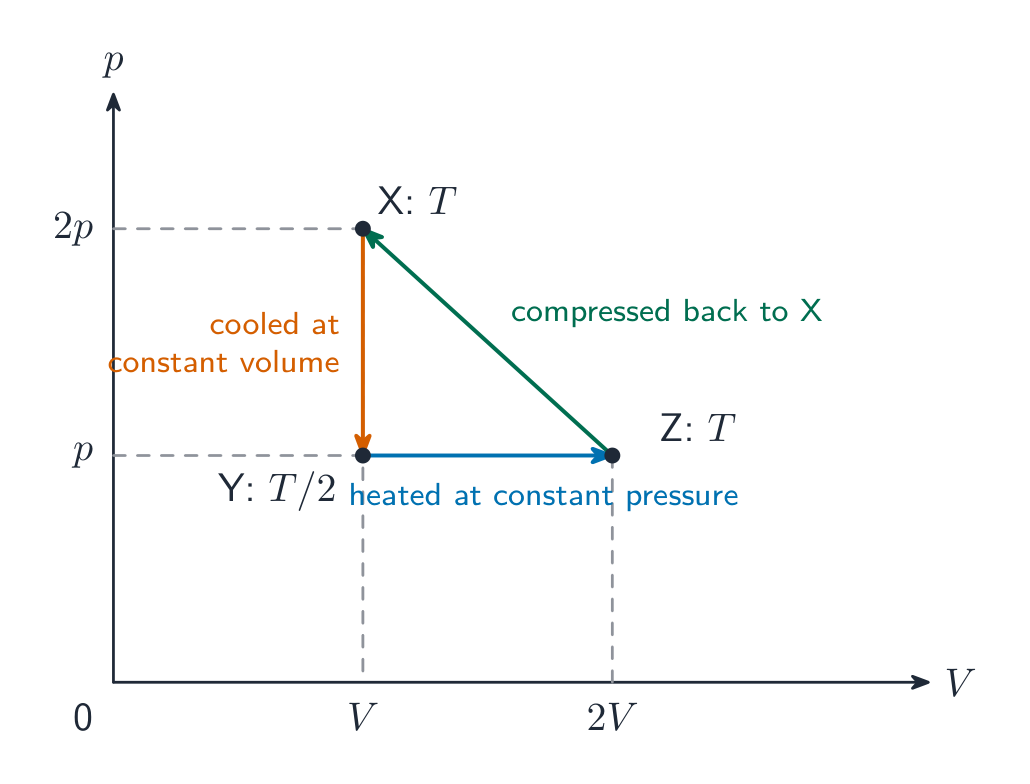
Worked example. A fixed amount of ideal gas at temperature $T$ is in state X, with pressure $2p$ and volume $V$. It is cooled at constant volume to state Y, where its pressure is $p$; then heated at constant pressure to state Z, where its volume is $2V$; then returned to X. Find the temperatures at Y and Z, and describe how the internal energy changes round the cycle.
X to Y is at constant volume, so $p/T$ is constant: halving the pressure halves the temperature, $T_{\text{Y}} = T/2$. Y to Z is at constant pressure, so $V/T$ is constant: doubling the volume doubles the temperature, $T_{\text{Z}} = T$. The internal energy of an ideal gas depends only on temperature, so it falls from X to Y (by $\tfrac{3}{2}nR \cdot T/2$), rises by the same amount from Y to Z, and is unchanged from Z back to X. Read each leg off the diagram before writing an equation: vertical means constant $V$, horizontal means constant $p$.
Special cases:
- constant temperature (Boyle's law 玻意耳定律): $p_{1} V_{1} = p_{2} V_{2}$.
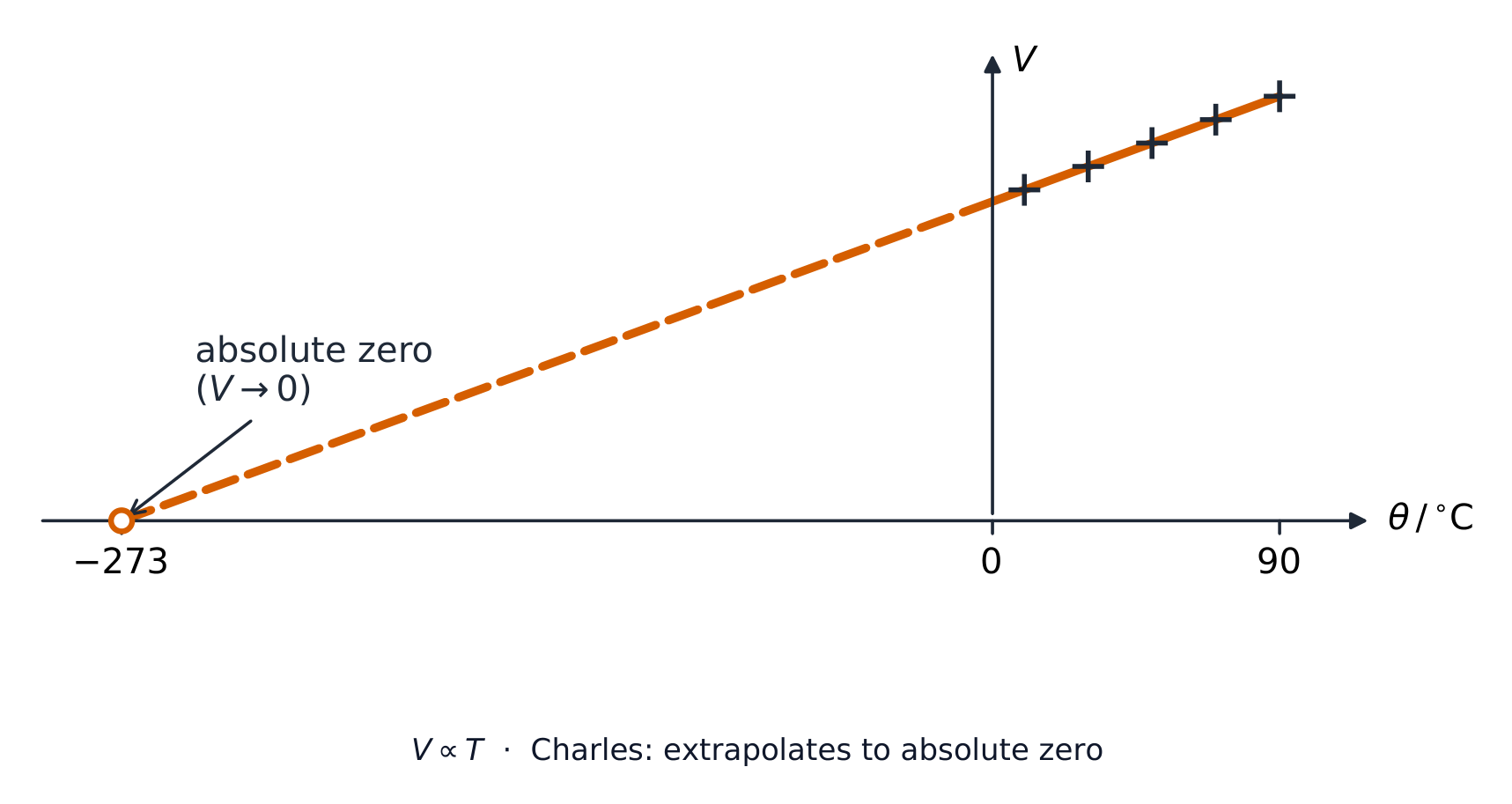
- constant pressure (Charles's law 查理定律): $V / T = \text{constant}$.
- constant volume (pressure law 气体压强定律): $p / T = \text{constant}$.
A common mistake is using °C instead of K — $pV \propto T$ only holds with $T$ in kelvin.

Explore
The ideal gas (Boyle)
p = k / V
At constant temperature p ∝ 1/V — squeeze the volume and pressure rises.
Vocabulary
Train
| English |
|---|
| equation of state/ɪˈkweɪʒn ɒv steɪt/ |
| ideal gas/aɪˈdɪəl ɡæs/ |
| pressure/ˈpreʃə/ |
| thermodynamic temperature/ˌθɜːməʊdaɪˈnæmɪk ˈtemprɪtʃə/ |
| volume/ˈvɒljuːm/ |
| molar gas constant/ˈməʊlə ɡæs ˈkɒnstənt/ |
| Boltzmann constant/ˈbɒltsmən ˈkɒnstənt/ |
| Boyle's law/bɔɪlz lɔː/ |
| Charles's law/ˈtʃɑːlzɪz lɔː/ |
| pressure law/ˈpreʃə lɔː/ |
15.3
Kinetic theory of gases

Syllabus
- state the basic assumptions of the kinetic theory of gases
- explain how molecular movement causes the pressure exerted by a gas and derive and use the relationship $pV = \frac{1}{3}Nm\langle c^2 \rangle$, where $\langle c^2 \rangle$ is the mean-square speed (a simple model considering one-dimensional collisions and then extending to three dimensions using $\frac{1}{3}\langle c^2 \rangle = \langle c_x^2 \rangle$ is sufficient)
- understand that the root-mean-square speed $c_{\text{r.m.s.}}$ is given by $\sqrt{\langle c^2 \rangle}$
- compare $pV = \frac{1}{3}Nm\langle c^2 \rangle$ with $pV = NkT$ to deduce that the average translational kinetic energy of a molecule is $\frac{3}{2}kT$, and recall and use this expression
Source: Cambridge International syllabus
The kinetic theory 分子动理论 explains a gas's large-scale behaviour from the random motion 无规则运动 of its molecules.
Assumptions
For an ideal gas:
- a large number of identical molecules in continuous random motion.
- the molecules' own volume is too small to matter compared with the container.
- the time of each collision is too short to matter compared with the time between collisions.
- intermolecular 分子间 forces are ignored except during collisions (molecules go in straight lines between them).
- collisions (with the walls and with each other) are elastic — an elastic collision 弹性碰撞 loses no kinetic energy, so the gas does not cool down by itself.
- Newton's laws apply.

These assumptions become poor at very high pressure (molecular volume matters) or very low temperature (intermolecular forces matter).
As the exam asks it. "State two (or three) basic assumptions of the kinetic theory": choose from the molecules are in continuous random motion; the volume of the molecules is negligible compared with the volume of the gas; there are no forces between the molecules except during collisions; the collisions are perfectly elastic; the time of a collision is negligible compared with the time between collisions. "State what is meant by an elastic collision": one in which the total kinetic energy is conserved (as well as momentum). "Use the assumptions to suggest why the gas at the surface of a star, at very high pressure, is not ideal": the molecules are so close together that their own volume is not negligible compared with the gas volume, and intermolecular forces act between them — the two assumptions that fail when a gas is compressed.
Worked example. A balloon contains $0.40\ \text{mol}$ of hydrogen ($m = 3.34 \times 10^{-27}\ \text{kg}$ per molecule) in $9.8 \times 10^{-3}\ \text{m}^{3}$. Estimate the average separation of the molecules, the gravitational force between neighbouring molecules, and comment on the kinetic-theory assumption this tests.
$N = 0.40 \times 6.02 \times 10^{23} = 2.4 \times 10^{23}$ molecules, so each occupies $V/N = 4.1 \times 10^{-26}\ \text{m}^{3}$ and the average separation is $d = (V/N)^{1/3} = 3.4 \times 10^{-9}\ \text{m}$. The gravitational force between two molecules is $F = \dfrac{Gm^{2}}{d^{2}} = \dfrac{6.67 \times 10^{-11} \times (3.34 \times 10^{-27})^{2}}{(3.4 \times 10^{-9})^{2}} = 6 \times 10^{-47}\ \text{N}$ — some $10^{20}$ times smaller than a molecule's own weight ($mg = 3.3 \times 10^{-26}\ \text{N}$). Forces between molecules really are negligible except during collisions, as the theory assumes.
Pressure of a gas — outline of the derivation
Take a cubic box of side $L$ with $N$ molecules, each of mass $m$. Look at one molecule moving along the $x$-axis with velocity $u_{1}$.

- one collision with the right wall: velocity reverses to $-u_{1}$, change in momentum 动量 $\Delta p_{x} = -2 m u_{1}$. By Newton's third law the wall gets an impulse 冲量 of $+2 m u_{1}$.
- time between hits on that wall: travel $2L$ there and back, so $\Delta t = 2L/u_{1}$.
- average force from this molecule: $F_{1} = \Delta p / \Delta t = m u_{1}^{2} / L$.
- add over all molecules: $F = (Nm/L)\langle u_{x}^{2} \rangle$, where $\langle u_{x}^{2} \rangle$ is the mean square 均方 of the $x$-velocity.
- pressure: $p = F/L^{2} = N m \langle u_{x}^{2} \rangle / V$.
In 3-D, by symmetry $\langle u_{x}^{2} \rangle = \tfrac{1}{3} \langle c^{2} \rangle$, where $\langle c^{2} \rangle$ is the mean-square speed 均方速率. So
$$p V = \tfrac{1}{3} N m \langle c^{2} \rangle.$$
"Explain how molecular movement causes the pressure exerted by a gas" (3 marks). The molecules move randomly and collide with the walls of the container; at each collision a molecule's momentum changes (it rebounds), so by Newton's second law the wall exerts a force on it, and by the third law it exerts an equal force on the wall; the very many collisions each second produce a steady total force on the wall, and the pressure is that force per unit area. The syllabus phrase "a simple model considering one-dimensional collisions" means the derivation above: it is sufficient to follow one molecule bouncing between two opposite faces and then average.
The density form. Since $Nm$ is the total mass of the gas and $Nm/V$ is its density $\rho$, the same result reads $p = \tfrac{1}{3}\rho\langle c^{2}\rangle$ — the version to use when a question gives a density instead of $N$ and $m$.
Worked example. An ideal gas at a pressure of $1.6 \times 10^{5}\ \text{Pa}$ has a density of $1.9\ \text{kg m}^{-3}$. Show that the r.m.s. speed of its molecules is about $500\ \text{m s}^{-1}$.
$\langle c^{2}\rangle = \dfrac{3p}{\rho} = \dfrac{3 \times 1.6 \times 10^{5}}{1.9} = 2.53 \times 10^{5}\ \text{m}^{2}\ \text{s}^{-2}$, so $c_{\text{r.m.s.}} = \sqrt{2.53 \times 10^{5}} = 503\ \text{m s}^{-1} \approx 500\ \text{m s}^{-1}$. In a "show that", keep an extra figure ($503$) before comparing with the value given.
Root-mean-square speed
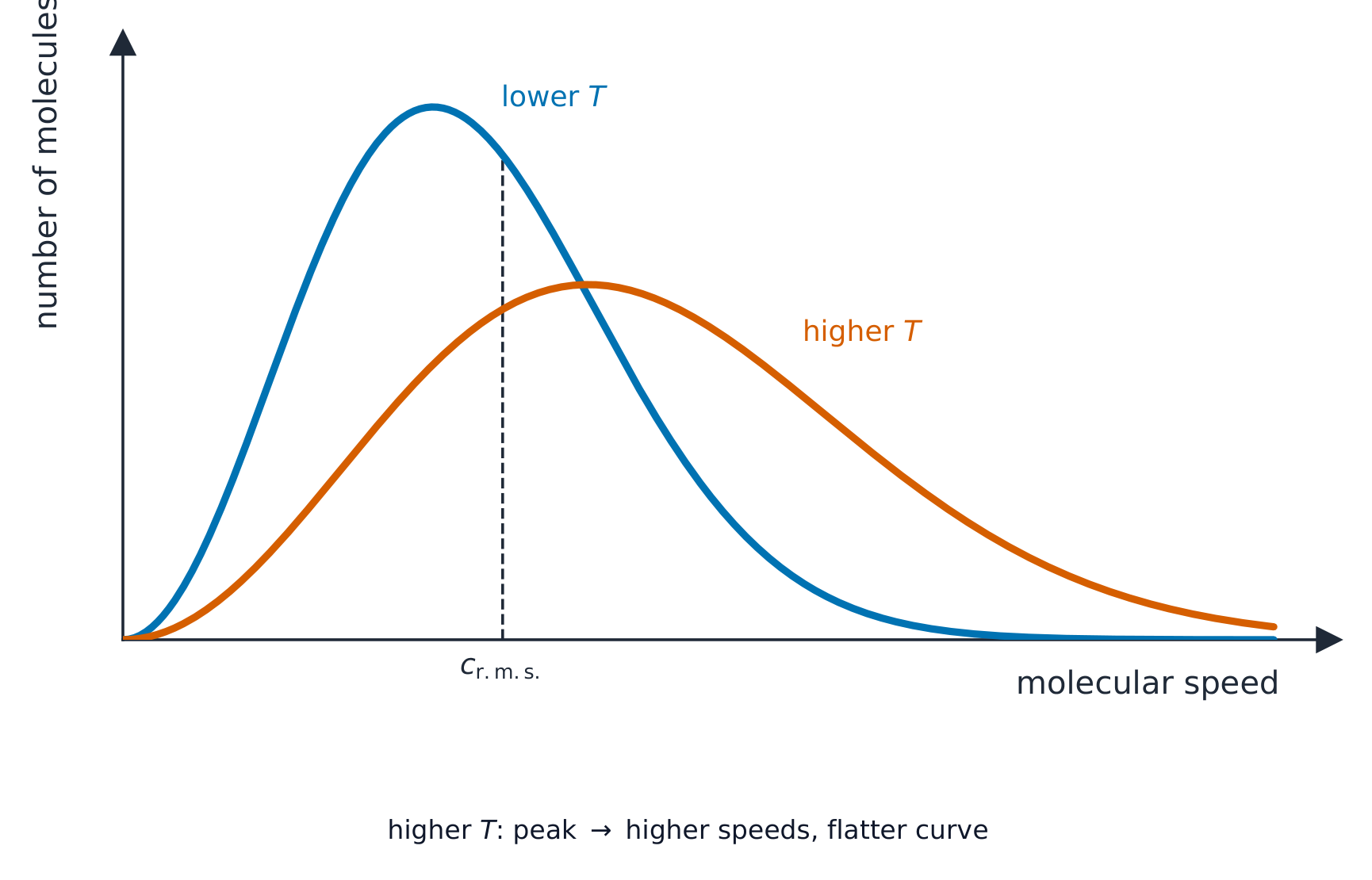
The square root of $\langle c^{2} \rangle$ is the root-mean-square 均方根 (r.m.s.) speed:
$$c_{\text{r.m.s.}} = \sqrt{\langle c^{2} \rangle}.$$
It is a useful single measure of how fast the molecules move, slightly larger than the mean speed (squaring weights fast molecules more).

Explore
Boyle's law
p ∝ 1/V
At constant temperature, pressure is inversely proportional to volume — squash the gas and the pressure rises.
Vocabulary
Train
| English |
|---|
| mean-square speed/miːn skweə spiːd/ |
| kinetic theory/kɪˈnetɪk ˈθɪəri/ |
| random motion/ˈrændəm ˈməʊʃn/ |
| intermolecular/ˌɪntəməˈlekjʊlə/ |
| elastic collision/ɪˈlæstɪk kəˈlɪʒn/ |
| momentum/məʊˈmentəm/ |
| impulse/ˈɪmpʌls/ |
| mean square/miːn skweə/ |
| root-mean-square/ruːt miːn skweə/ |
15.3
Average translational kinetic energy

Compare the two expressions for $pV$:
$$p V = N k T \quad\text{and}\quad p V = \tfrac{1}{3} N m \langle c^{2} \rangle.$$
Set them equal, cancel $N$, and multiply by $\tfrac{3}{2}$:
$$\tfrac{3}{2} k T = \tfrac{1}{2} m \langle c^{2} \rangle.$$
The right side is the average translational kinetic energy 平动动能 $\langle E_{\text{k}} \rangle$ of one molecule. So
$$\langle E_{\text{k}} \rangle = \tfrac{1}{2} m \langle c^{2} \rangle = \tfrac{3}{2} k T.$$
This is a key result: the average translational kinetic energy of an ideal-gas molecule depends only on the thermodynamic temperature, not on the type of gas or its pressure.
Worked example. Find the root-mean-square speed of oxygen molecules at $300\ \text{K}$. (Mass of one $\text{O}_{2}$ molecule $= 5.3 \times 10^{-26}\ \text{kg}$, $k = 1.38 \times 10^{-23}\ \text{J K}^{-1}$.)
From $\tfrac{1}{2}m\langle c^{2}\rangle = \tfrac{3}{2}kT$, the mean-square speed is $\langle c^{2}\rangle = 3kT/m$:
$$c_{\text{r.m.s.}} = \sqrt{\frac{3kT}{m}} = \sqrt{\frac{3 (1.38 \times 10^{-23})(300)}{5.3 \times 10^{-26}}} \approx 480\ \text{m s}^{-1}.$$
Worked example. The surface of the Moon reaches about $400\ \text{K}$ in sunlight. Calculate the r.m.s. speed of hydrogen molecules ($m = 3.34 \times 10^{-27}\ \text{kg}$) at this temperature, and use the Moon's escape speed of $2.4\ \text{km s}^{-1}$ to suggest why the Moon has no hydrogen atmosphere.
$c_{\text{r.m.s.}} = \sqrt{\dfrac{3kT}{m}} = \sqrt{\dfrac{3 \times 1.38 \times 10^{-23} \times 400}{3.34 \times 10^{-27}}} = 2.2 \times 10^{3}\ \text{m s}^{-1}$. This r.m.s. speed is close to the escape speed, and the speeds are spread widely about it, so a large fraction of the molecules move faster than $2.4\ \text{km s}^{-1}$ at any moment and escape; over time the hydrogen is lost.
Worked example. The gas at the surface of a star is mainly hydrogen atoms ($m = 1.67 \times 10^{-27}\ \text{kg}$) with an r.m.s. speed of $9300\ \text{m s}^{-1}$. Find the temperature of the surface.
$T = \dfrac{m\langle c^{2}\rangle}{3k} = \dfrac{1.67 \times 10^{-27} \times 9300^{2}}{3 \times 1.38 \times 10^{-23}} = 3.5 \times 10^{3}\ \text{K}$.
Worked example. For a fixed sample of gas, a graph of $pV$ against $kT$ is a straight line through the origin of gradient $7.2 \times 10^{22}$. When $pV = 270\ \text{J}$ the r.m.s. speed of the molecules is $1900\ \text{m s}^{-1}$. Find the number of molecules and the mass of one molecule in u.
From $pV = NkT$ the gradient is $N = 7.2 \times 10^{22}$. From $pV = \tfrac{1}{3}Nm\langle c^{2}\rangle$: $m = \dfrac{3pV}{N\langle c^{2}\rangle} = \dfrac{3 \times 270}{7.2 \times 10^{22} \times 1900^{2}} = 3.1 \times 10^{-27}\ \text{kg} = \dfrac{3.1 \times 10^{-27}}{1.66 \times 10^{-27}} = 1.9\ \text{u}$ — hydrogen molecules, within the rounding.
Comparing gases and samples. At the same temperature every gas has the same average kinetic energy per molecule, so $\langle c^{2}\rangle \propto 1/m$: hydrogen ($M_{\text{m}} = 2$) and oxygen ($M_{\text{m}} = 32$) have $\dfrac{c_{\text{H}}}{c_{\text{O}}} = \sqrt{\dfrac{32}{2}} = 4$. Two samples at the same $T$ — X with $N$ molecules of mass $m$ in volume $V$, Y with $2N$ molecules of mass $2m$ in volume $2V$ — have the same pressure ($p = NkT/V$ and both $N$ and $V$ double), the same average kinetic energy per molecule, but Y's molecules have half the mean-square speed ($3kT/2m$) and Y has twice the internal energy (twice as many molecules).
Consequences
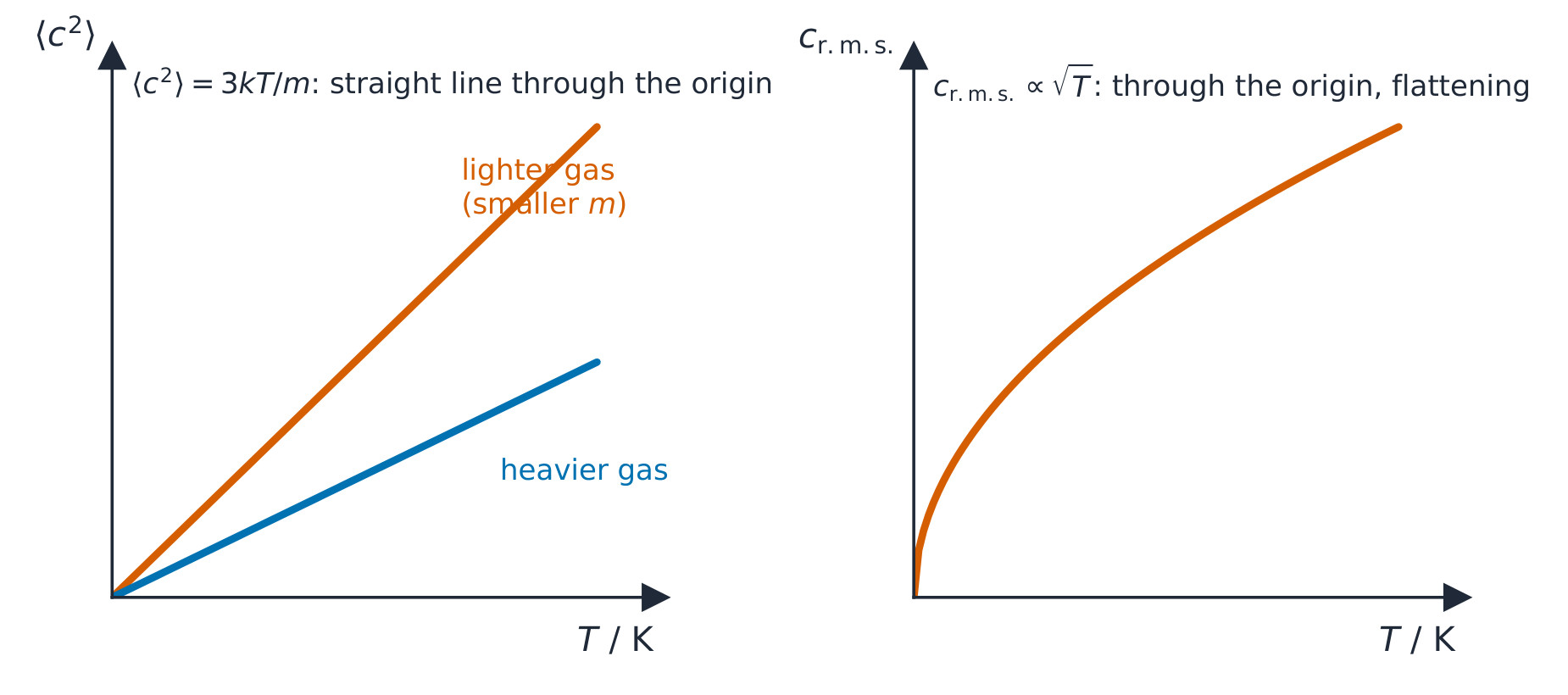
- doubling the absolute temperature doubles the average KE of each molecule, so $\langle c^{2} \rangle$ doubles and $c_{\text{r.m.s.}}$ grows by $\sqrt{2}$.
- for two gases at the same temperature, the lighter gas has a larger $\langle c^{2} \rangle$. Hydrogen molecules move faster on average than oxygen molecules in the same room.
- total translational KE of $N$ molecules: $\tfrac{3}{2} N k T = \tfrac{3}{2} n R T$.
Internal energy of an ideal gas
For an ideal gas the molecules are point particles with no intermolecular potential energy and (in this simple model) no rotation or vibration. So the internal energy 内能 is just the total kinetic energy 动能:
$$U = \tfrac{3}{2} N k T = \tfrac{3}{2} n R T.$$
So the internal energy of an ideal gas is proportional to the thermodynamic temperature — doubling $T$ doubles $U$.
As the exam asks it. "Use one of the basic assumptions to explain what can be deduced about the potential energy of the molecules": there are no forces between the molecules (except in collisions), so there is no potential energy associated with their separation — the random-motion energy is entirely kinetic. "Explain why the internal energy of an ideal gas is directly proportional to thermodynamic temperature" (2 marks): the internal energy is the sum of the kinetic and potential energies of the molecules; the potential energy is zero (no intermolecular forces), and the average kinetic energy of a molecule is $\tfrac{3}{2}kT$, proportional to $T$; so the total, $U = \tfrac{3}{2}NkT$, is proportional to $T$. "Derive $\tfrac{3}{2}kT$" (2 marks): equate $pV = NkT$ with $pV = \tfrac{1}{3}Nm\langle c^{2}\rangle$, cancel $N$, and rearrange to $\tfrac{1}{2}m\langle c^{2}\rangle = \tfrac{3}{2}kT$ — show the cancelling and the factor of $\tfrac{3}{2}$.
Worked example. A sample of $0.26\ \text{m}^{3}$ of an ideal gas is at $2.0 \times 10^{5}\ \text{Pa}$ and $290\ \text{K}$. Find the number of molecules, the average translational kinetic energy of a molecule, and the internal energy of the gas.
$N = \dfrac{pV}{kT} = \dfrac{2.0 \times 10^{5} \times 0.26}{1.38 \times 10^{-23} \times 290} = 1.3 \times 10^{25}$. $\langle E_{\text{k}}\rangle = \tfrac{3}{2}kT = 1.5 \times 1.38 \times 10^{-23} \times 290 = 6.0 \times 10^{-21}\ \text{J}$. $U = N\langle E_{\text{k}}\rangle = 1.3 \times 10^{25} \times 6.0 \times 10^{-21} = 7.8 \times 10^{4}\ \text{J}$ — or directly $U = \tfrac{3}{2}pV = 7.8 \times 10^{4}\ \text{J}$, a neat check.
Changing pressure at fixed temperature
Doubling $p$ at fixed $T$ (by squeezing the gas to half its volume) does not change $\langle E_{\text{k}} \rangle$ — that depends only on $T$. There are more wall collisions per second, but each molecule has the same average kinetic energy.
Vocabulary
Train
| English |
|---|
| internal energy/ɪnˈtɜːnl ˈenədʒi/ |
| kinetic energy/kɪˈnetɪk ˈenədʒi/ |
| average translational kinetic energy/ˈævrɪdʒ trænˈsleɪʃənl kɪˈnetɪk ˈenədʒi/ |
| translational kinetic energy/trænˈsleɪʃənl kɪˈnetɪk ˈenədʒi/ |
15.3
Definitions the examiner accepts
A definition question is marked against fixed wording. Learn these exactly, and give one answer only.
| Term | Definition |
|---|---|
| mole | the amount of substance containing a number of particles equal to the Avogadro constant |
| Avogadro constant | the number of atoms or molecules in one mole of a substance, $6.02 \times 10^{23}\ \text{mol}^{-1}$ |
| ideal gas | a gas that obeys $pV = nRT$ (equivalently $pV \propto T$, $T$ thermodynamic) at all values of $p$, $V$ and $T$ |
| Boltzmann constant | the gas constant per molecule, $k = R/N_{\text{A}}$ |
| elastic collision | a collision in which the total kinetic energy is conserved |
| mean-square speed | the mean of the squares of the speeds of the molecules, $\langle c^{2}\rangle$ |
| root-mean-square speed | the square root of the mean-square speed, $c_{\text{r.m.s.}} = \sqrt{\langle c^{2}\rangle}$ |
| average translational kinetic energy of a molecule | $\tfrac{1}{2}m\langle c^{2}\rangle = \tfrac{3}{2}kT$, depending only on thermodynamic temperature |
| internal energy of an ideal gas | the total kinetic energy of its molecules, $\tfrac{3}{2}NkT$, since there is no potential energy |
15.3
Exam tips
- Use $pV = nRT$ ($n$ in mol) or $pV = NkT$ ($N$ molecules), with temperature in kelvin and volume in $\text{m}^{3}$ ($1\ \text{cm}^{3} = 10^{-6}\ \text{m}^{3}$).
- Learn the kinetic-theory assumptions word for word (random motion, negligible molecular volume, no intermolecular forces except in collisions, elastic collisions, negligible collision time), and know which two fail at high pressure.
- Mean translational KE $= \frac{3}{2}kT$ — it depends only on temperature; at the same $T$ a lighter molecule is faster, $\langle c^{2}\rangle \propto 1/m$.
- For a "show that" about pressure, give the chain: collisions with the wall, change of momentum, force (Newton's second and third laws), force per unit area.
- $p = \tfrac{1}{3}\rho\langle c^{2}\rangle$ when a density is given; $U = \tfrac{3}{2}NkT = \tfrac{3}{2}pV$ when the internal energy is asked.
Common mistakes
- Using °C in $pV = nRT$ or in $\langle E_{\text{k}}\rangle = \tfrac{3}{2}kT$. Convert first; a temperature ratio only works in kelvin.
- Defining an ideal gas by "obeys $pV = nRT$" alone. Add "at all values of $p$, $V$ and $T$".
- Confusing $n$ (moles) with $N$ (molecules), or $R$ with $k$. $N = nN_{\text{A}}$ and $k = R/N_{\text{A}}$.
- Giving "molecules move randomly" as the reason for pressure. The mark is for the change of momentum at the wall and the resulting force per unit area.
- Sketching $c_{\text{r.m.s.}}$ against $T$ as a straight line. $\langle c^{2}\rangle$ is linear in $T$; $c_{\text{r.m.s.}}$ rises as $\sqrt{T}$.
- Saying a molecule's kinetic energy changes when the pressure is doubled at constant temperature. Only the number of collisions per second changes.
Interactive lessons on this topic
Work through it step by step, with instant-check exercises.