- understand that (thermal) energy is transferred from a region of higher temperature to a region of lower temperature
- understand that regions of equal temperature are in thermal equilibrium
Temperature
A-Level Physics · Topic 14
 11:46
11:46
Thermal Physics
Touch a metal spoon, then a wooden table, in the same room. The metal feels much colder. So it must be colder — right? Wrong. Bring a thermometer, and both…
English narration · English + 中文 subtitles burned in
14.1
Thermal equilibrium

Syllabus
Source: Cambridge International syllabus
Heat 热量 (thermal energy) flows from a higher temperature to a lower temperature. When two bodies touch, energy moves until their temperatures are equal — they reach thermal equilibrium 热平衡. At equilibrium there is no net flow of energy.
Two regions at the same temperature 温度 are in thermal equilibrium with each other — no net energy flows, even though particles still exchange energy.
Temperature decides the direction of heat flow. It is not a measure of how much thermal energy 热能 a body holds. A small cup of boiling water (100 °C) holds far less energy than a swimming pool at 25 °C, but a piece of metal put in the cup gains energy while one put in the pool loses it.
The examiner's wording. Two objects are in thermal equilibrium when there is no net transfer of thermal energy between them; that happens when they are at the same temperature. Asked for "the reason why two objects at the same temperature are in thermal equilibrium", the one mark is: there is no net flow of thermal energy between them — energy still passes both ways, but equally. Thermal energy is the energy transferred because of a temperature difference; temperature is what decides the direction.
Worked example. Two metal cuboids P and Q are in thermal contact and in thermal equilibrium. State what this means, and describe what happens when a hotter cuboid is placed against them.
No net thermal energy passes between P and Q, because they are at the same temperature. A hotter cuboid transfers thermal energy to them (from higher to lower temperature) until all three reach one common temperature; then, and only then, is the whole group in thermal equilibrium.
Explore
Thermal equilibrium route
Watch energy transfer until two objects reach the same temperature.
Vocabulary
Train
| English |
|---|
| thermal equilibrium/ˈθɜːml ˌiːkwɪˈlɪbrɪəm/ |
| heat/hiːt/ |
| thermal energy/ˈθɜːml ˈenədʒi/ |
| temperature/ˈtemprɪtʃə/ |
14.2
Measuring temperature

Syllabus
- understand that a physical property that varies with temperature may be used for the measurement of temperature and state examples of such properties, including the density of a liquid, volume of a gas at constant pressure, resistance of a metal, e.m.f. of a thermocouple
- understand that the scale of thermodynamic temperature does not depend on the property of any particular substance
- convert temperatures between kelvin and degrees Celsius and recall that $T/\text{K} = \theta/\text{ }^{\circ}\text{C} + 273.15$
- understand that the lowest possible temperature is zero kelvin on the thermodynamic temperature scale and that this is known as absolute zero
Source: Cambridge International syllabus
Any physical property that changes in a repeatable way with temperature can make a thermometer 温度计. Examples:
- volume of a liquid — a liquid-in-glass thermometer (mercury or alcohol). As the temperature rises, the liquid expands and rises up a narrow capillary 毛细管.
- volume of a gas at constant pressure — a gas thermometer. The gas volume rises in step with the absolute temperature.
- resistance of a metal — a resistance thermometer. A metal's resistance 电阻 rises nearly in step with temperature over a wide range.
- e.m.f. of a thermocouple — a thermocouple 热电偶 is two different metals joined at two points; the electromotive force 电动势 it makes depends on the temperature difference between the joins.
Different thermometers can read slightly differently if the property does not change in a straight line; they agree only at the calibration 校准 points.
Fixed points and calibration. A thermometer is calibrated at two fixed points 固定点 that are easy to reproduce — the ice point ($0\ ^{\circ}\text{C}$, pure melting ice) and the steam point ($100\ ^{\circ}\text{C}$, steam above boiling water at standard pressure). The value of the property is measured at each, and the scale between them is drawn assuming the property changes linearly with temperature. That assumption is the weakness: mercury's expansion, a metal's resistance and a thermocouple's e.m.f. all vary slightly differently between the fixed points, so two thermometers that agree at $0$ and $100\ ^{\circ}\text{C}$ can disagree at $50\ ^{\circ}\text{C}$.
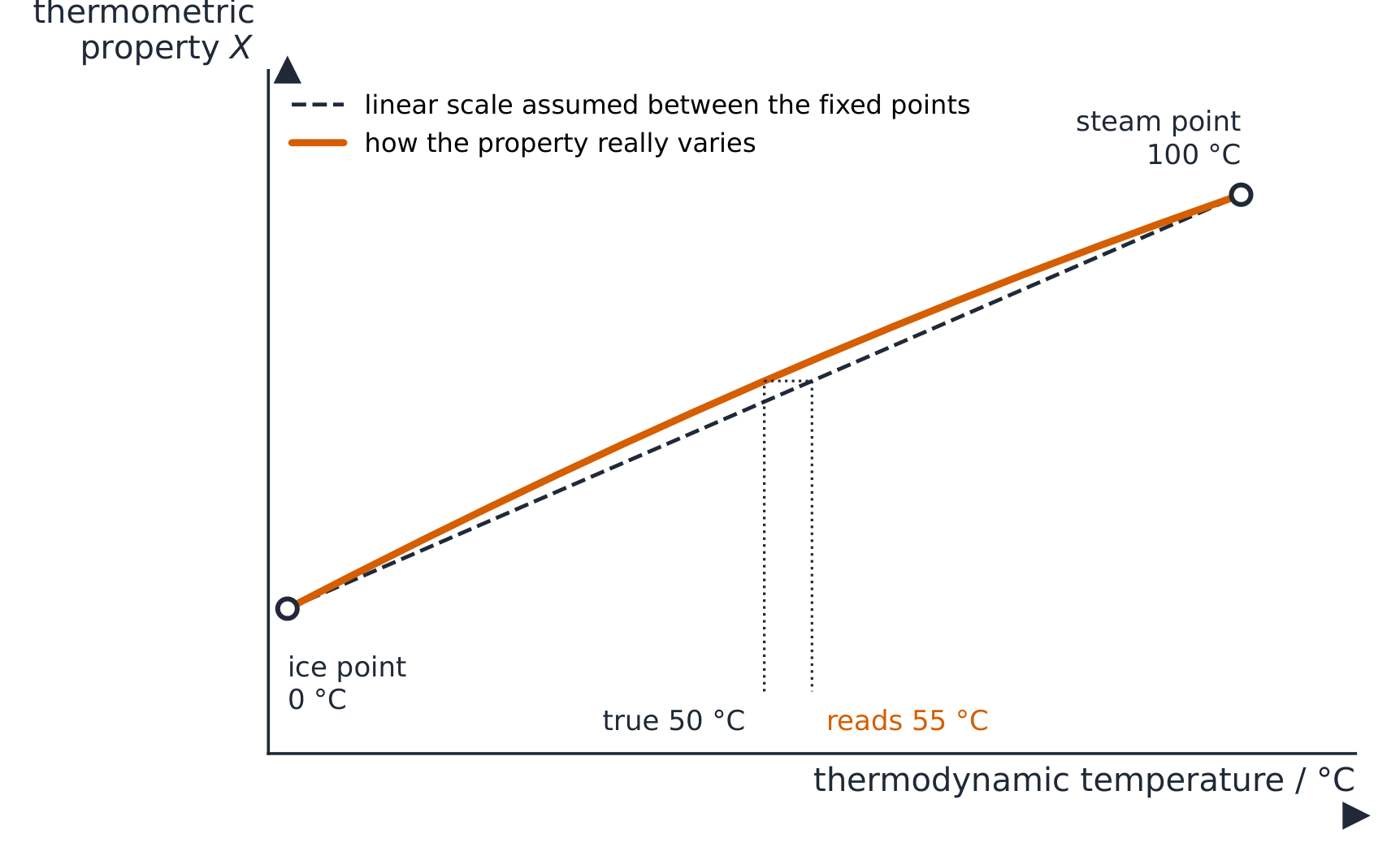
Why a liquid-in-glass thermometer does not measure thermodynamic temperature (the one-mark reason): its reading depends on the property of a particular substance — the expansion of mercury or alcohol — and on the assumption that this expansion is linear between the fixed points. The thermodynamic scale depends on no substance at all.
Why water is a poor thermometric liquid. Its density does not change steadily with temperature: it is greatest at $4\ ^{\circ}\text{C}$, so between $0$ and $8\ ^{\circ}\text{C}$ two different temperatures give the same density and the reading is ambiguous, and the change per degree is small, so the thermometer is insensitive. Mercury's density falls steadily and almost linearly over the whole range, which is why it was chosen.
Worked example. A platinum resistance thermometer is a coil of platinum wire in a glass tube, connected to a circuit that measures its resistance. Explain how it measures temperature, and give one disadvantage compared with a thermocouple.
The resistance of the platinum increases with temperature in a known, almost linear way; the resistance is measured at the ice point and the steam point, and any other temperature is read from where the measured resistance falls on the linear scale between them (or from a calibration graph). Disadvantage: the coil, tube and the fluid around them have a large thermal capacity, so the thermometer responds slowly and cannot follow a rapidly changing temperature; it is also bulky and needs a circuit to read it. (Its advantages: accurate, stable and usable over a very wide range.)

Worked example. In a constant-volume gas thermometer the pressure of the gas is $1.05 \times 10^{5}\ \text{Pa}$ when the bulb is in melting ice and $1.19 \times 10^{5}\ \text{Pa}$ when it is in a warm room. Find the thermodynamic temperature of the room, and explain why this thermometer, unlike a liquid-in-glass one, gives thermodynamic temperature directly.
For a fixed mass of gas at constant volume the pressure is proportional to the thermodynamic temperature, so $\dfrac{T}{273.15} = \dfrac{1.19 \times 10^{5}}{1.05 \times 10^{5}}$, giving $T = 310\ \text{K}$ ($36\ ^{\circ}\text{C}$). The pressure of a (nearly) ideal gas depends only on its temperature, not on which gas it is, so the reading does not rely on the property of a particular substance — the defining feature of the thermodynamic scale.

Explore
Temperature scale lab
Kelvin index = Celsius index + 2.73
Slide Celsius temperature and see the Kelvin scale shift by 273.
Vocabulary
Train
| English |
|---|
| thermometer/θɜːˈmɒmɪtə/ |
| capillary/kəˈpɪləri/ |
| resistance/rɪˈzɪstəns/ |
| thermocouple/ˈθɜːməkʌpl/ |
| electromotive force/ɪˌlektrəʊˈməʊtɪv fɔːs/ |
| calibration/ˌkælɪˈbreɪʃn/ |
| fixed points/fɪkst pɔɪnts/ |
14.2
Thermodynamic temperature scale

The thermodynamic temperature 热力学温度 (or absolute temperature 绝对温度) scale does not depend on any one substance — only on the laws of thermodynamics. Its unit is the kelvin 开尔文 (K).
Absolute zero
The lowest possible temperature is zero kelvin ($0\ \text{K}$), called absolute zero 绝对零度. There a system has its least possible internal energy 内能 — particles have no random motion to speak of. Nothing can be cooled below this.
As the exam asks it. "State the magnitude and unit of absolute zero on the thermodynamic scale": $0\ \text{K}$ (the unit is the kelvin). "State the temperature of absolute zero on the Celsius scale": $-273.15\ ^{\circ}\text{C}$ (accept $-273\ ^{\circ}\text{C}$). "What is absolute zero?": the temperature at which a system has its minimum internal energy — the particles have the least kinetic and potential energy they can have — and below which it is impossible to go. The thermodynamic scale is fixed by absolute zero and by the triple point 三相点 of water, defined as $273.16\ \text{K}$; it does not depend on the property of any particular substance.
Celsius scale
The Celsius 摄氏度 scale $\theta$ is shifted from the thermodynamic scale by a fixed amount:
$$T / \text{K} = \theta / {}^{\circ}\text{C} + 273.15.$$
So $0\ ^{\circ}\text{C} = 273.15\ \text{K}$ and $100\ ^{\circ}\text{C} = 373.15\ \text{K}$. A kelvin and a degree Celsius are the same size, so a temperature difference of $1\ \text{K}$ equals $1\ ^{\circ}\text{C}$ — but the absolute values differ by $273.15$.
In gas-law calculations you must always use absolute temperatures in kelvin. Using °C gives wrong answers.
Vocabulary
Train
| English |
|---|
| absolute temperature/ˈæbsəluːt ˈtemprɪtʃə/ |
| thermodynamic temperature/ˌθɜːməʊdaɪˈnæmɪk ˈtemprɪtʃə/ |
| kelvin/ˈkelvɪn/ |
| absolute zero/ˈæbsəluːt ˈzɪərəʊ/ |
| internal energy/ɪnˈtɜːnl ˈenədʒi/ |
| Celsius/ˈselsɪəs/ |
| triple point/ˈtrɪpl pɔɪnt/ |
14.3
Specific heat capacity

Syllabus
- define and use specific heat capacity
- define and use specific latent heat and distinguish between specific latent heat of fusion and specific latent heat of vaporisation
Source: Cambridge International syllabus
The specific heat capacity 比热容 $c$ of a substance is the energy 能量 needed to raise the temperature of unit mass by one kelvin:
$$c = \frac{Q}{m \Delta T} \qquad\Longleftrightarrow\qquad Q = m c \Delta T.$$
Unit: $\text{J kg}^{-1}\ \text{K}^{-1}$.
The two-mark definition: specific heat capacity is the energy required per unit mass of the substance to raise its temperature by one kelvin (or by one degree). Both "per unit mass" and "per unit temperature rise" are needed; "the energy to heat 1 kg by 1 K" scores, "the energy to heat the substance" does not.
Examples:
- water: $c \approx 4200\ \text{J kg}^{-1}\ \text{K}^{-1}$ (high — why water is a good coolant and why oceans steady the climate).
- aluminium: $c \approx 900\ \text{J kg}^{-1}\ \text{K}^{-1}$.
- copper: $c \approx 385\ \text{J kg}^{-1}\ \text{K}^{-1}$.
To find an unknown $c$ by experiment: supply known energy $Q$ electrically ($Q = VIt$, from the power 功率), then measure the temperature rise $\Delta T$ of a known mass 质量 $m$. Then $c = Q/(m\Delta T)$. Reduce heat loss with insulation 隔热 and use a rise of about 10 K (big enough to measure well, small enough to limit losses).
Worked example. How much energy is needed to heat $0.50\ \text{kg}$ of water from $20\ ^{\circ}\text{C}$ to $100\ ^{\circ}\text{C}$? (Specific heat capacity of water $c = 4200\ \text{J kg}^{-1}\ \text{K}^{-1}$.)
A temperature difference is the same in K and °C, so $\Delta T = 80$:
$$Q = mc\Delta T = 0.50 \times 4200 \times 80 = 1.68 \times 10^{5}\ \text{J}\ (= 168\ \text{kJ}).$$
When two bodies reach thermal equilibrium with no heat lost to the surroundings, the energy gained by the colder one equals the energy lost by the hotter one:
$$m_{1} c_{1} (T_{\text{eq}} - T_{1}) = m_{2} c_{2} (T_{2} - T_{\text{eq}}).$$
Worked example. $0.20\ \text{kg}$ of water at $80\ ^{\circ}\text{C}$ is mixed with $0.30\ \text{kg}$ of water at $20\ ^{\circ}\text{C}$, with no heat lost. Find the final temperature.
The heat lost by the hot water equals the heat gained by the cold water (the $c$ of water cancels):
$$0.20\,(80 - T_{\text{eq}}) = 0.30\,(T_{\text{eq}} - 20) \quad\Rightarrow\quad T_{\text{eq}} = 44\ ^{\circ}\text{C}.$$
Worked example. A beaker of mass $42\ \text{g}$ and specific heat capacity $840\ \text{J kg}^{-1}\ \text{K}^{-1}$ contains $120\ \text{g}$ of a liquid. A heater supplies energy at $810\ \text{W}$ and the temperature of the beaker and liquid rises from $19\ ^{\circ}\text{C}$ to $47\ ^{\circ}\text{C}$ in $15\ \text{s}$. Find the specific heat capacity of the liquid. The experiment is then repeated with water in place of the liquid; state and explain how the temperature rise differs.
Energy supplied $Q = Pt = 810 \times 15 = 1.22 \times 10^{4}\ \text{J}$, $\Delta T = 28\ \text{K}$. It heats both the beaker and the liquid: $Q = m_{\text{b}}c_{\text{b}}\Delta T + m_{\text{l}}c_{\text{l}}\Delta T$, so $1.215 \times 10^{4} = 0.042 \times 840 \times 28 + 0.120 \times c_{\text{l}} \times 28$, i.e. $1.215 \times 10^{4} = 988 + 3.36c_{\text{l}}$, giving $c_{\text{l}} = 3.3 \times 10^{3}\ \text{J kg}^{-1}\ \text{K}^{-1}$. Forgetting the beaker is the usual lost mark. With water ($c = 4200$, higher) the same energy in the same time produces a smaller temperature rise, since $\Delta T = Q/(mc)$ and $mc$ is larger. If energy is lost to the surroundings the true $Q$ absorbed is less than $Pt$, so a value of $c$ found this way is an overestimate.
Worked example. Two metal blocks X and Y are placed in contact and insulated from the surroundings. X (mass $0.50\ \text{kg}$, initially $80\ ^{\circ}\text{C}$, $c = 390\ \text{J kg}^{-1}\ \text{K}^{-1}$) and Y (mass $0.50\ \text{kg}$, initially $20\ ^{\circ}\text{C}$, $c = 900\ \text{J kg}^{-1}\ \text{K}^{-1}$) reach a common final temperature. Explain, in terms of energy, why the final temperature is nearer to Y's starting temperature, and find it.
Thermal energy flows from X (hotter) to Y until they are in thermal equilibrium; the energy lost by X equals the energy gained by Y. Because Y has the larger specific heat capacity, a given amount of energy changes its temperature less than it changes X's, so Y warms by fewer degrees than X cools and the final temperature lies nearer to $20\ ^{\circ}\text{C}$. Numerically: $0.50 \times 390 \times (80 - T) = 0.50 \times 900 \times (T - 20)$, so $390(80 - T) = 900(T - 20)$, $31200 + 18000 = 1290T$, $T = 38\ ^{\circ}\text{C}$.
Worked example. An aluminium block has volume $3.612 \times 10^{-3}\ \text{m}^{3}$ and density $2.70 \times 10^{3}\ \text{kg m}^{-3}$. Find the energy needed to raise its temperature by $40\ \text{K}$ ($c = 900\ \text{J kg}^{-1}\ \text{K}^{-1}$).
Mass $= \rho V = 2.70 \times 10^{3} \times 3.612 \times 10^{-3} = 9.75\ \text{kg}$, so $Q = mc\Delta T = 9.75 \times 900 \times 40 = 3.5 \times 10^{5}\ \text{J}$. A mass hidden behind a density and a volume is a common first step.
Explore
Energy to heat it: E = mcΔT
Pick a material, set the mass and the temperature rise, and read the energy. Water needs far more energy than the metals.
Explore
Specific heat capacity
Q = mcΔT
The heat needed is proportional to the temperature rise — the gradient depends on mass and the material's specific heat capacity.
Vocabulary
Train
| English |
|---|
| energy/ˈenədʒi/ |
| mass/mæs/ |
| specific heat capacity/spəˈsɪfɪk hiːt kəˈpæsɪti/ |
| power/ˈpaʊə/ |
| insulation/ˌɪnsjuːˈleɪʃn/ |
14.3
Specific latent heat
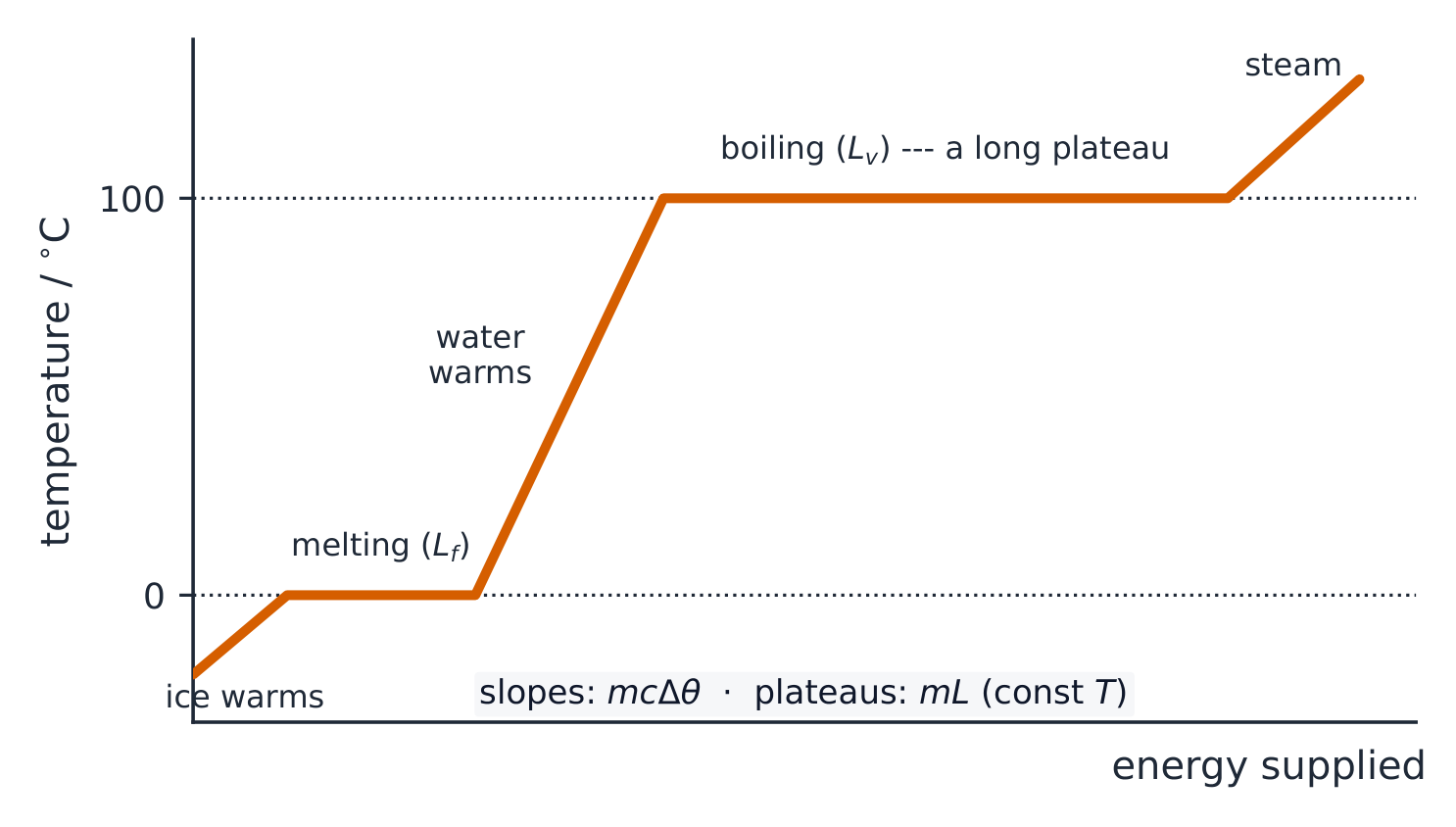
When a substance changes state (solid ↔ liquid, or liquid ↔ gas) at constant temperature, energy must be supplied (or removed) with no temperature change. This energy is the latent heat 潜热.
The specific latent heat 比潜热 $L$ is the energy to change the state of unit mass at constant temperature:
$$L = \frac{Q}{m} \qquad\Longleftrightarrow\qquad Q = m L.$$
Unit: $\text{J kg}^{-1}$.
The two-mark definition: specific latent heat is the energy required per unit mass to change the state of a substance without a change of temperature. "Without a change in temperature" (or "at constant temperature") is the second mark and the one most often missed. Add "from solid to liquid" for fusion or "from liquid to gas" for vaporisation when a particular one is asked for.
Two kinds:
- specific latent heat of fusion 熔化 $L_{\text{f}}$ — for melting or freezing (solid ↔ liquid).
- specific latent heat of vaporisation 汽化 $L_{\text{v}}$ — for boiling or condensing (liquid ↔ gas).
For water at atmospheric pressure: $L_{\text{f}} \approx 3.34 \times 10^{5}\ \text{J kg}^{-1}$ (at $0\ ^{\circ}\text{C}$); $L_{\text{v}} \approx 2.26 \times 10^{6}\ \text{J kg}^{-1}$ (at $100\ ^{\circ}\text{C}$). So $L_{\text{v}}$ is about 7 times $L_{\text{f}}$.
Worked example. A $2.0\ \text{kW}$ heater boils water already at $100\ ^{\circ}\text{C}$. How long does it take to turn $0.10\ \text{kg}$ of this water into steam? ($L_{\text{v}} = 2.26 \times 10^{6}\ \text{J kg}^{-1}$, no heat lost.)
The energy needed is $Q = mL_{\text{v}} = 0.10 \times 2.26 \times 10^{6} = 2.26 \times 10^{5}\ \text{J}$. From $Q = Pt$,
$$t = \frac{Q}{P} = \frac{2.26 \times 10^{5}}{2000} \approx 110\ \text{s}.$$
Worked example. Water in a kettle stays at $100\ ^{\circ}\text{C}$ while it boils, even though the element keeps heating it. Explain this with reference to molecular energies (3 marks).
Temperature is a measure of the mean kinetic energy of the molecules. During boiling the energy supplied is used to separate the molecules — to do work against the attractive forces between them and against the atmosphere as the vapour expands — so it increases the potential energy of the molecules, not their kinetic energy. With the mean kinetic energy unchanged, the temperature stays constant until all the water has become steam.
Why $L_{\text{v}} > L_{\text{f}}$
Two reasons, both from the particle picture of matter:
- Bonds: in melting, only some of the intermolecular 分子间 bonds break; the particles stay close as a liquid. In boiling, all the bonds must break so the particles can separate. Breaking all of them needs more energy.
- Work against the atmosphere: when a liquid turns to gas it expands hugely (vapour has about $10^{3}$ times the liquid's volume 体积), so it does work pushing back the surrounding atmospheric pressure 大气压强. That work comes from the energy supplied.
Write both reasons and name the energies: the marks are for bonds broken (potential energy increased) — some in melting, all in boiling, and work done against the atmosphere in the large expansion. "Boiling needs more energy" restates the question.
Worked example. A dish holds $7.2 \times 10^{-5}\ \text{m}^{3}$ of a liquid of density $710\ \text{kg m}^{-3}$ and specific latent heat of vaporisation $3.6 \times 10^{5}\ \text{J kg}^{-1}$. It evaporates completely. Find the energy absorbed, and suggest, with a reason, whether the substance's specific latent heat of fusion is likely to be smaller or larger than this.
Mass $= \rho V = 710 \times 7.2 \times 10^{-5} = 5.1 \times 10^{-2}\ \text{kg}$, so the energy absorbed is $Q = mL_{\text{v}} = 5.1 \times 10^{-2} \times 3.6 \times 10^{5} = 1.8 \times 10^{4}\ \text{J}$. Its $L_{\text{f}}$ is likely to be smaller: melting breaks only some of the intermolecular bonds and the volume barely changes, whereas vaporising breaks them all and does work against the atmosphere — for water $L_{\text{f}}$ is about a seventh of $L_{\text{v}}$.
Multi-step problems
If a problem mixes temperature change and a phase change 相变 (e.g. ice at $-5\ ^{\circ}\text{C}$ warming to water at $30\ ^{\circ}\text{C}$):
- heat the solid from $-5\ ^{\circ}\text{C}$ to $0\ ^{\circ}\text{C}$: $Q_{1} = m c_{\text{ice}} \times 5$.
- melt at $0\ ^{\circ}\text{C}$: $Q_{2} = m L_{\text{f}}$.
- heat the water from $0\ ^{\circ}\text{C}$ to $30\ ^{\circ}\text{C}$: $Q_{3} = m c_{\text{water}} \times 30$.
Total: $Q_{1} + Q_{2} + Q_{3}$. A phase change is at constant temperature, so use $mL$ there, not $mc\Delta T$.

When a question gives heater power $P$ and asks for the time, use $Q = Pt$ (assuming no heat loss). Insulating (lagging) the container and using a small mass are common ways to improve the experiment.
Worked example. An ice cube of mass $37.0\ \text{g}$ at $0.0\ ^{\circ}\text{C}$ is dropped into $208\ \text{g}$ of water at $26.4\ ^{\circ}\text{C}$ in an insulated beaker. Find the final temperature when all the ice has melted. ($c_{\text{water}} = 4.20\ \text{kJ kg}^{-1}\ \text{K}^{-1}$, $L_{\text{f}} = 334\ \text{kJ kg}^{-1}$.)
The ice gains energy twice — to melt, then to warm from $0$ to $T$ — and the water loses energy cooling from $26.4$ to $T$. Working in grams and kilojoules: $37.0 \times 0.334 + 37.0 \times 4.20 \times 10^{-3}\,T = 208 \times 4.20 \times 10^{-3}\,(26.4 - T)$, i.e. $12.4 + 0.155T = 23.1 - 0.874T$, so $1.03T = 10.7$ and $T = 10\ ^{\circ}\text{C}$. Three energy terms, one equation; the commonest error is to forget that the melted ice must also be warmed.
Vocabulary
Train
| English |
|---|
| volume/ˈvɒljuːm/ |
| specific latent heat/spəˈsɪfɪk ˈleɪtənt hiːt/ |
| latent heat/ˈleɪtənt hiːt/ |
| fusion/ˈfjuːʒn/ |
| vaporisation/ˌveɪpəraɪˈzeɪʃn/ |
| specific latent heat of fusion/spəˈsɪfɪk ˈleɪtənt hiːt ɒv ˈfjuːʒn/ |
| specific latent heat of vaporisation/spəˈsɪfɪk ˈleɪtənt hiːt ɒv ˌveɪpəraɪˈzeɪʃn/ |
| atmospheric pressure/ˌætməsˈferɪk ˈpreʃə/ |
| phase change/feɪz tʃeɪndʒ/ |
| intermolecular/ˌɪntəməˈlekjʊlə/ |
14.3
Definitions the examiner accepts
A definition question is marked against fixed wording. Learn these exactly, and give one answer only.
| Term | Definition |
|---|---|
| thermal equilibrium | the state of two objects between which there is no net transfer of thermal energy; they are at the same temperature |
| thermal energy | energy transferred from one object to another because of a temperature difference |
| thermodynamic temperature scale | a temperature scale that does not depend on the property of any particular substance, fixed by absolute zero and the triple point of water |
| absolute zero | the lowest possible temperature, $0\ \text{K}$ ($-273.15\ ^{\circ}\text{C}$), at which a system has its minimum internal energy |
| kelvin and Celsius | $T/\text{K} = \theta/^{\circ}\text{C} + 273.15$; a temperature difference is the same number in both |
| specific heat capacity | the energy required per unit mass of a substance to raise its temperature by one kelvin |
| specific latent heat | the energy required per unit mass to change the state of a substance without a change of temperature |
| specific latent heat of fusion | the specific latent heat for the change from solid to liquid |
| specific latent heat of vaporisation | the specific latent heat for the change from liquid to gas |
14.3
Exam tips
- Thermal equilibrium means no net flow of thermal energy (equal temperature); the thermodynamic scale does not depend on any particular substance and is fixed by absolute zero and the triple point.
- Convert temperatures with $T/\text{K} = \theta/^\circ\text{C} + 273.15$ and use kelvin in energy and gas equations; a temperature difference is the same in K and °C.
- Use $Q = mc\Delta T$ for heating and $Q = mL$ for a change of state (no temperature change) — never mix the two, and in a mixing problem write one equation: energy lost $=$ energy gained, with every term.
- A container heated with the liquid takes its share of the energy: include $m_{\text{beaker}}c_{\text{beaker}}\Delta T$.
- For a "why" about latent heat, name the energies: potential energy of the molecules rises (bonds broken, work against the atmosphere), kinetic energy and hence temperature do not.
Common mistakes
- Defining specific heat capacity without "per unit mass" or without "per kelvin". Both are needed; the unit $\text{J kg}^{-1}\ \text{K}^{-1}$ is the reminder.
- Leaving "at constant temperature" out of the latent-heat definition. That phrase is what distinguishes latent heat from heating.
- Using $mc\Delta T$ across a change of state, or $mL$ for a temperature rise.
- Forgetting the beaker, the calorimeter or the melted ice's own warming in an energy equation.
- Saying the thermodynamic scale "uses kelvin" as its defining feature. The feature is that it depends on no particular substance.
- Adding $273.15$ to a temperature difference. Differences are the same in both scales.
Interactive lessons on this topic
Work through it step by step, with instant-check exercises.