- define the radian and express angular displacement in radians
- understand and use the concept of angular speed
- recall and use $\omega = 2\pi / T$ and $v = r\omega$
Motion in a circle
A-Level Physics · Topic 12
 13:00
13:00
Circular Motion
Fill a bucket with water, swing it in a fast circle over your head — and not a drop falls out, even when it is completely upside down. Why doesn't the water…
English narration · English + 中文 subtitles burned in
12.1
Angles in radians

Syllabus
Source: Cambridge International syllabus
The radian 弧度 is the angle made at the centre of a circle by an arc 弧 whose length equals the radius. For an arc of length $s$ on a circle of radius $r$, the angle in radians is
$$\theta = \frac{s}{r}.$$
Radians have no unit (a ratio of lengths). A full circle has $s = 2\pi r$, so $\theta = 2\pi\ \text{rad}$. A half-circle is $\pi\ \text{rad}$; a quarter is $\pi/2\ \text{rad}$.
To convert: $1\ \text{rad} = 180°/\pi \approx 57.3°$. Set your calculator to radians for this topic; "degree" mode will give wrong answers.
The one-mark definition. The radian is the angle subtended at the centre of a circle by an arc equal in length to the radius of the circle. Give it in words — $\theta = s/r$ on its own is not a definition — and keep $s = r\theta$ ready for turning a distance along the arc into an angle, or back.
Vocabulary
Train
| English |
|---|
| radian/ˈreɪdɪən/ |
| arc/ɑːk/ |
12.1
Uniform circular motion: angular speed

An object moves in a circle of radius $r$ at constant speed $v$. Define:
- angular displacement 角位移 $\theta$ — the angle (in radians) turned through by the radius from a chosen start line.
- angular speed 角速度 $\omega$ — the rate of change of angular displacement.
For uniform motion $\omega$ is constant and
$$\omega = \frac{\theta}{t}.$$
Unit: $\text{rad s}^{-1}$.
What stays constant and what varies. In uniform circular motion the speed, the angular speed, the period and the magnitude of the acceleration are constant; the velocity, the displacement from the centre and the acceleration all change continuously, because their direction changes. Asked to "state two quantities that vary", give two of velocity, acceleration, displacement and momentum — and say it is the direction that varies.
Period and frequency
If the object goes once round ($2\pi\ \text{rad}$, one revolution 圈) in time $T$ (the period 周期), then
$$\omega = \frac{2\pi}{T} = 2\pi f,$$
where $f = 1/T$ is the frequency 频率 of turning (Hz).
Linear and angular speed
In one period $T$ the object travels a distance $2\pi r$ (the circumference 周长) at constant speed, so
$$v = \frac{2\pi r}{T} = r \omega.$$
This links the linear (tangential 切向) speed $v$ with the angular speed $\omega$. At a larger radius (for the same angular speed) the linear speed is larger — a child on the edge of a merry-go-round moves faster than one near the centre, even though both go round once in the same time.

Worked example. A fairground ride of radius $4.0\ \text{m}$ completes one turn every $8.0\ \text{s}$. Find its angular speed and the linear speed of a rider on the edge.
$$\omega = \frac{2\pi}{T} = \frac{2\pi}{8.0} = 0.79\ \text{rad s}^{-1}, \qquad v = r\omega = 4.0 \times 0.79 = 3.1\ \text{m s}^{-1}.$$
Worked example. The minute hand of a clock turns once every hour. A piece of modelling clay on the hand moves a total distance of $0.44\ \text{m}$ in $1400\ \text{s}$. Find the angular speed of the hand, the angle the clay turns through in that time, and its distance from the centre of the clock.
$\omega = 2\pi/T = 2\pi/3600 = 1.75 \times 10^{-3}\ \text{rad s}^{-1}$. Angular displacement $\theta = \omega t = 1.75 \times 10^{-3} \times 1400 = 2.44\ \text{rad}$. Distance along the arc $s = r\theta$, so $r = s/\theta = 0.44/2.44 = 0.18\ \text{m}$. Check: $v = s/t = 3.1 \times 10^{-4}\ \text{m s}^{-1}$ and $r\omega = 0.18 \times 1.75 \times 10^{-3} = 3.1 \times 10^{-4}\ \text{m s}^{-1}$ — the same. A common trap in these questions is a radius measured from the rim: a lump $1.2\ \text{cm}$ in from the edge of a $9.3\ \text{cm}$ disc moves in a circle of radius $8.1\ \text{cm}$.
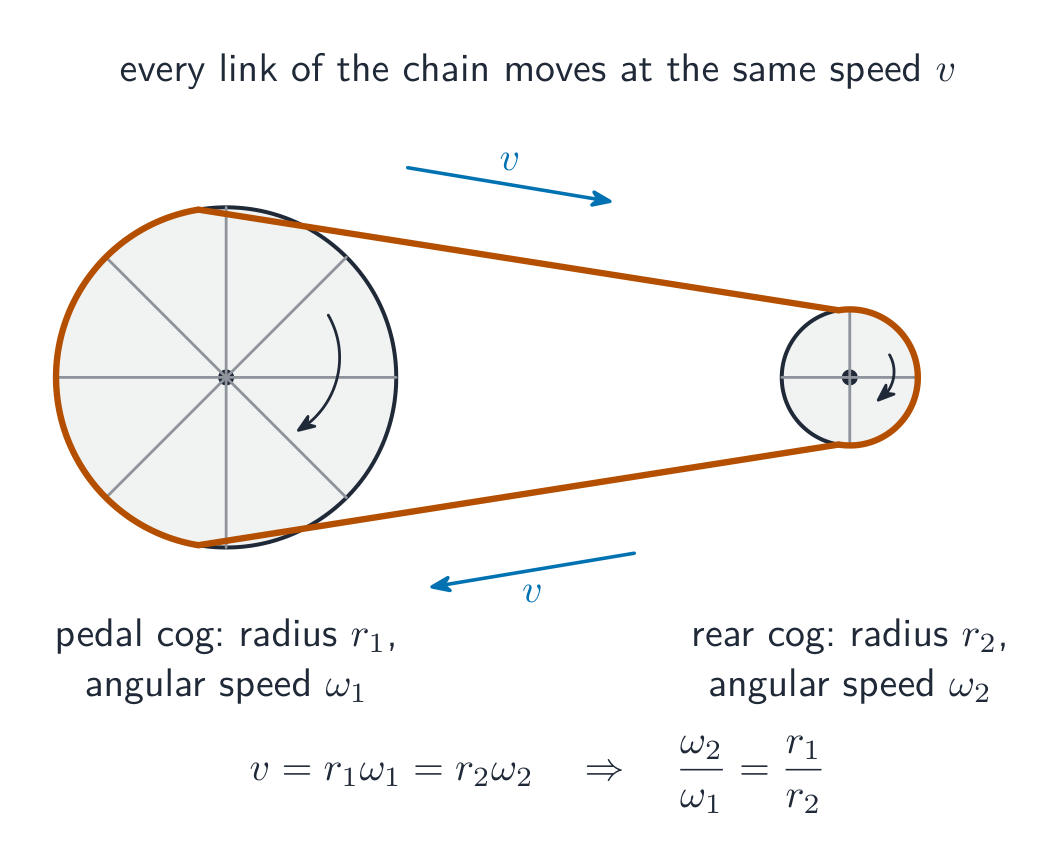
Worked example. A bicycle chain passes round a pedal cog of radius $0.095\ \text{m}$ and a rear-wheel cog of radius $0.038\ \text{m}$. The pedals turn at $1.2$ revolutions per second. Find the speed of the chain and the angular speed of the rear cog. The chain is then moved to a smaller rear cog while the bicycle's speed stays the same; explain, without calculation, what happens to the angular speed of the pedals.
Pedal angular speed $\omega_{1} = 2\pi \times 1.2 = 7.5\ \text{rad s}^{-1}$. Every link of the chain moves at the speed of the rim of the pedal cog: $v = r_{1}\omega_{1} = 0.095 \times 7.5 = 0.72\ \text{m s}^{-1}$. The rear cog's rim moves at the same speed, so $\omega_{2} = v/r_{2} = 0.72/0.038 = 19\ \text{rad s}^{-1}$. With the bicycle's speed unchanged, the rear wheel keeps the same angular speed; the smaller cog's rim therefore moves more slowly ($v = r\omega$ with a smaller $r$), so the chain moves more slowly, and the pedal cog, driven by the same chain, turns at a lower angular speed.

Explore
Angular speed
s = rθ
Angular speed turns angle per time; arc length s = rθ.
Vocabulary
Train
| English |
|---|
| angular speed/ˈæŋɡjʊlə spiːd/ |
| angular displacement/ˈæŋɡjʊlə dɪˈspleɪsmənt/ |
| period/ˈpɪərɪəd/ |
| frequency/ˈfriːkwənsi/ |
| revolution/ˌrevəˈluːʃn/ |
| circumference/sɜːˈkʌmfrəns/ |
| tangential/tænˈdʒenʃl/ |
12.2
Centripetal acceleration

Syllabus
- understand that a force of constant magnitude that is always perpendicular to the direction of motion causes centripetal acceleration
- understand that centripetal acceleration causes circular motion with a constant angular speed
- recall and use $a = r\omega^2$ and $a = v^2 / r$
- recall and use $F = mr\omega^2$ and $F = mv^2 / r$
Source: Cambridge International syllabus
An object moving in a circle at constant speed still has a changing velocity 速度 — its direction keeps changing, even though its size stays the same. A changing velocity needs an acceleration 加速度. This acceleration points towards the centre and is the centripetal acceleration 向心加速度.
The two-mark description. In uniform circular motion the speed is constant but the velocity is continuously changing, because its direction changes; the acceleration is constant in magnitude and is always directed towards the centre of the circle, perpendicular to the velocity. "State what is meant by centripetal acceleration": the acceleration of an object moving along a circular path, directed towards the centre of the circle.
Size
$$a = \frac{v^{2}}{r} = r\omega^{2}.$$
The two forms are equal because $v = r\omega$. Pick the one with the quantities you have.
The centripetal acceleration is perpendicular 垂直 to the velocity at every instant — never along the direction of motion. (If part of it were along the motion, the speed would change.) Unit: $\text{m s}^{-2}$.
Why the speed does not change. The centripetal force is perpendicular to the displacement at every instant, so it does no work on the object; its kinetic energy, and so its speed, stays constant. Only the direction of the velocity changes — which is exactly what an acceleration perpendicular to the velocity does.
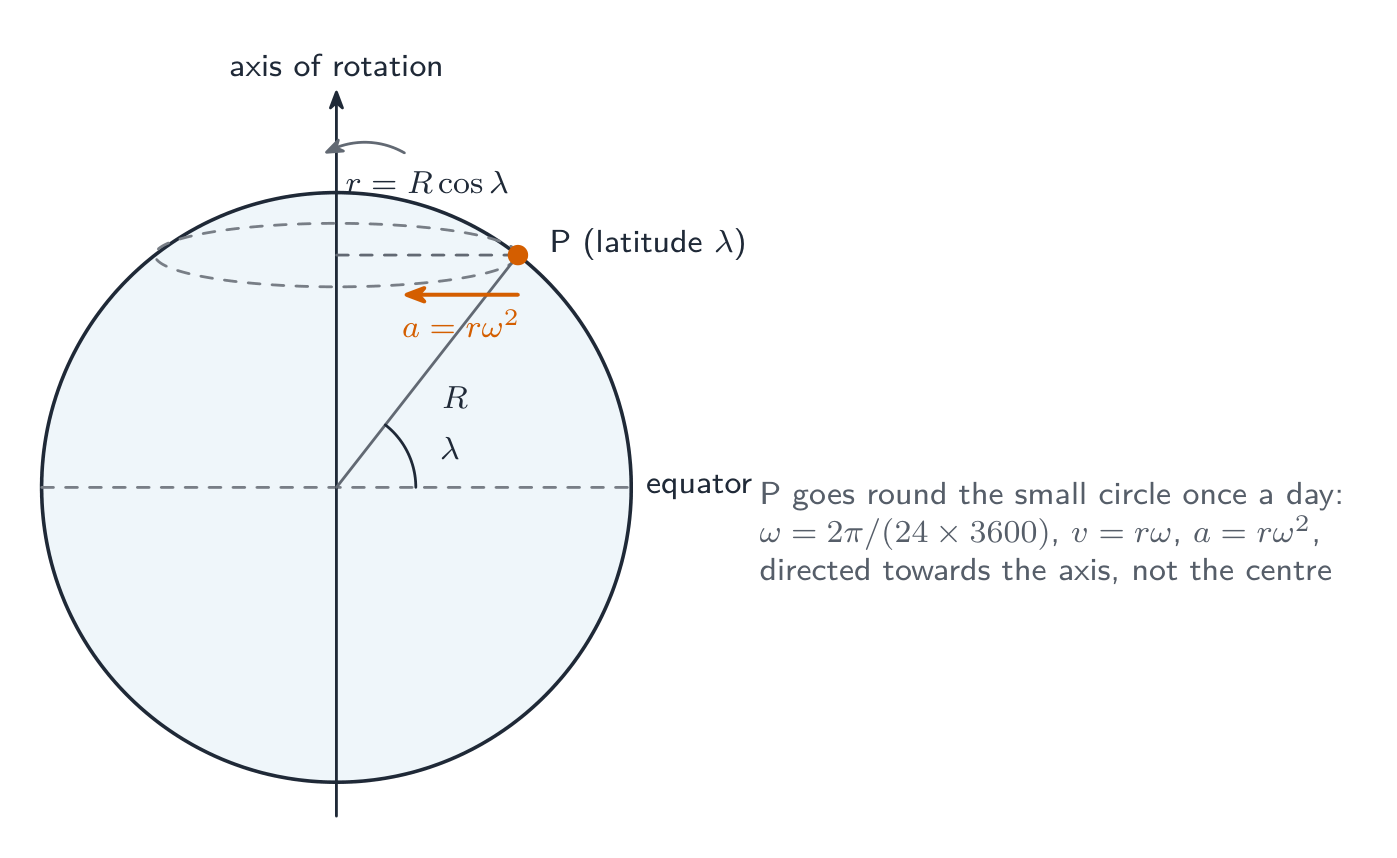
Worked example. The Earth is a sphere of radius $6.37 \times 10^{6}\ \text{m}$ rotating once in $24$ hours. Cambridge is at latitude 纬度 $52.2°$ north. Find the radius of the circle in which Cambridge moves, its speed, and its centripetal acceleration. A student of mass $58.6\ \text{kg}$ stands on bathroom scales there; state and explain the effect of the rotation on the reading.
The circle is about the axis, so $r = R\cos\lambda = 6.37 \times 10^{6} \times \cos 52.2° = 3.90 \times 10^{6}\ \text{m}$. $\omega = 2\pi/(24 \times 3600) = 7.27 \times 10^{-5}\ \text{rad s}^{-1}$, so $v = r\omega = 284\ \text{m s}^{-1}$ and $a = r\omega^{2} = 3.90 \times 10^{6} \times (7.27 \times 10^{-5})^{2} = 2.1 \times 10^{-2}\ \text{m s}^{-2}$. The student needs a resultant force $ma = 1.2\ \text{N}$ towards the axis, which can only come from the weight exceeding the upward contact force; so the scales read less than the weight $mg = 575\ \text{N}$ — by about one newton (the acceleration has a component $a\cos\lambda = 0.013\ \text{m s}^{-2}$ along the vertical, i.e. $0.7\ \text{N}$ of the $1.2\ \text{N}$). Small, but the sign and the reason are the marks.
Vocabulary
Train
| English |
|---|
| velocity/vəˈlɒsɪti/ |
| acceleration/əkˌseləˈreɪʃn/ |
| centripetal acceleration/senˈtrɪpɪtl əkˌseləˈreɪʃn/ |
| perpendicular/ˌpɜːpənˈdɪkjʊlə/ |
| latitude/ˈlætɪtjuːd/ |
12.2
Centripetal force

By Newton's second law, the resultant force 力 on a body in circular motion at constant speed is
$$F = m a = \frac{m v^{2}}{r} = m r \omega^{2}.$$
This is the centripetal force 向心力. It always points towards the centre — perpendicular to the velocity.
The centripetal force is not a new kind of force — it is the net result of the real forces acting (tension, gravity, friction, electric attraction, normal contact force, …). In a problem, work out which real force(s) provide it.
Worked example. A $0.20\ \text{kg}$ ball on a string is whirled in a horizontal circle of radius $0.50\ \text{m}$ at $3.0\ \text{m s}^{-1}$. Find the centripetal force (the tension in the string).
$$F = \frac{mv^{2}}{r} = \frac{0.20 \times 3.0^{2}}{0.50} = 3.6\ \text{N}.$$
Where the centripetal force comes from
- Ball on a string in a horizontal circle: the tension 张力 in the string.
- Car turning a flat corner: the friction 摩擦力 between tyres and road ($F = m v^{2}/r$). If the car goes too fast, friction is not enough and it skids outwards.
- Banked corner 倾斜 (no friction): the horizontal part of the normal contact force 支持力; $\tan\theta = v^{2}/(rg)$ for the angle that needs no friction.
- A planet or satellite 卫星 in orbit 轨道: the gravitational attraction 引力, $G M m / r^{2} = m v^{2}/r$.
- Electron 电子 in a circular orbit (Bohr-style model): the electrostatic 静电 attraction between the electron and the positive nucleus 原子核:
$$\frac{kZe^{2}}{r^{2}} = \frac{m_{e} v^{2}}{r},$$
where $k = 1/(4\pi\varepsilon_{0})$ and $Z$ is the nuclear charge. Solve for $v$ to get the orbital speed; then $T = 2\pi r/v$.

The tilted force: conical pendulum, cone and swing-ride
A ball on a string swung in a horizontal circle (a conical pendulum 圆锥摆), a ball rolling round the inside of a smooth cone, a chair on a fairground swing-ride and a car on a banked track are all the same problem: one force (the tension or the normal contact force) is tilted at an angle $\theta$ to the vertical. Resolve it. Its vertical component balances the weight; its horizontal component is the whole centripetal force:
$$F\cos\theta = mg, \qquad F\sin\theta = \frac{mv^{2}}{r} \qquad\Rightarrow\qquad \tan\theta = \frac{v^{2}}{rg}.$$
Never add a separate "centripetal force" to the diagram: the two real forces are the weight and the tilted force, and their resultant is horizontal, towards the centre.
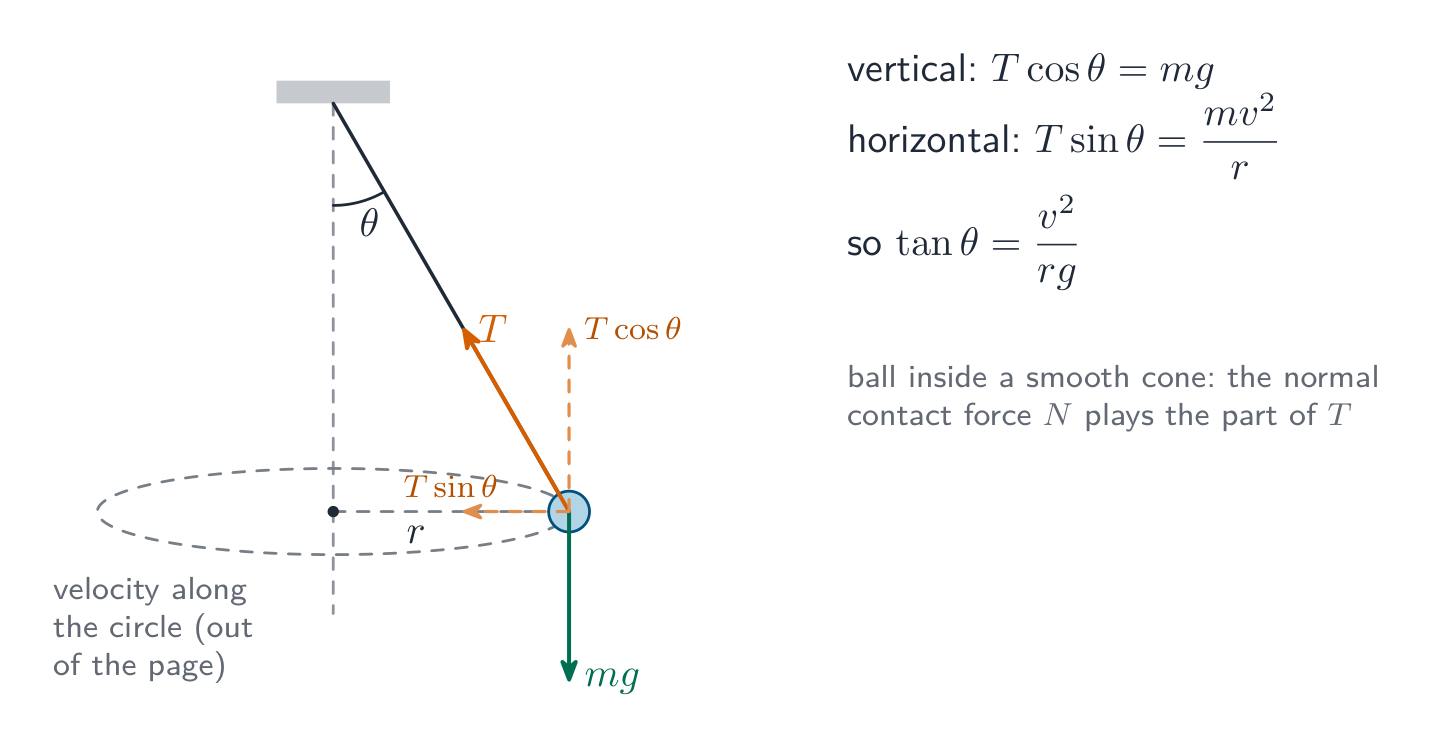
Worked example. A steel ball moves in a horizontal circle of radius $0.12\ \text{m}$ on the smooth inside surface of a cone whose surface makes $52°$ with the horizontal. Name the two forces on the ball, state the direction of their resultant, and find the speed of the ball and the period of its motion.
The forces are the weight (vertically down) and the normal contact force from the cone's surface (perpendicular to the surface, so at $52°$ to the vertical); their resultant is horizontal, towards the centre of the circle. Vertically $N\cos 52° = mg$; horizontally $N\sin 52° = mv^{2}/r$. Dividing: $v^{2} = rg\tan 52° = 0.12 \times 9.81 \times 1.28 = 1.51$, so $v = 1.2\ \text{m s}^{-1}$, and $T = 2\pi r/v = 2\pi \times 0.12/1.23 = 0.61\ \text{s}$. The mass cancels — the speed does not depend on it.
Worked example. A sphere of mass $0.29\ \text{kg}$ hangs from a spring of spring constant $40\ \text{N m}^{-1}$ and unstretched length $6.0\ \text{cm}$. It is set moving in a horizontal circle so that the spring makes $30°$ with the vertical. Find the tension, the radius of the circle and the speed.
Vertically $T\cos 30° = mg$, so $T = 0.29 \times 9.81/0.866 = 3.3\ \text{N}$. The extension is $x = T/k = 3.28/40 = 0.082\ \text{m}$, so the spring's length is $0.060 + 0.082 = 0.142\ \text{m}$ and $r = 0.142\sin 30° = 0.071\ \text{m}$. Horizontally $T\sin 30° = mv^{2}/r$: $v^{2} = 3.28 \times 0.5 \times 0.071/0.29 = 0.40$, $v = 0.63\ \text{m s}^{-1}$. Hooke's law supplies the length; the circle supplies the rest.
Vertical circles
When the circle is upright, the speed is not constant (gravity does work) — but at each instant the net force towards the centre still equals $m v^{2}/r$:
- at the bottom of a loop: tension up, weight 重力 down, so $T - mg = m v^{2}/r$ — the tension is largest here.
- at the top of a loop: tension and weight both point down (towards the centre), so $T + mg = m v^{2}/r$ — the tension is smallest. For the slowest speed at the top with the string just tight, set $T = 0$: $mg = m v_{\text{min}}^{2}/r$, giving $v_{\text{min}} = \sqrt{gr}$.

Worked example. A car goes round a vertical loop of radius $2.0\ \text{m}$. Find the minimum speed at the top for the car to keep contact with the track (take $g = 9.81\ \text{m s}^{-2}$).
At the slowest speed the track force is zero, so gravity alone provides the centripetal force: $mg = m v_{\text{min}}^{2}/r$, giving $v_{\text{min}} = \sqrt{gr}$:
$$v_{\text{min}} = \sqrt{9.81 \times 2.0} \approx 4.4\ \text{m s}^{-1}.$$
The constant-speed result ($v = r\omega$, $\omega$ constant) holds for horizontal circles, or where the force only bends the path (orbits in gravity, charges in a magnetic field 磁场).
Circles in fields
Worked example. A helium atom is modelled as a nucleus of charge $+2e$ with two electrons in the same circular orbit of radius $170\ \text{pm}$, always on opposite sides of the nucleus. Find the resultant electric force on one electron and its speed.
Each electron is attracted by the nucleus, distance $r$ away, and repelled by the other electron, distance $2r$ away, along the same line: $F = \dfrac{1}{4\pi\varepsilon_{0}}\left(\dfrac{2e^{2}}{r^{2}} - \dfrac{e^{2}}{(2r)^{2}}\right) = \dfrac{e^{2}}{4\pi\varepsilon_{0}r^{2}} \times 1.75 = \dfrac{2.31 \times 10^{-28}}{(1.7 \times 10^{-10})^{2}} \times 1.75 = 1.4 \times 10^{-8}\ \text{N}$. This is the centripetal force: $v = \sqrt{Fr/m} = \sqrt{1.40 \times 10^{-8} \times 1.7 \times 10^{-10}/(9.11 \times 10^{-31})} = 1.6 \times 10^{6}\ \text{m s}^{-1}$.
Worked example. A proton (mass $1.67 \times 10^{-27}\ \text{kg}$) moving at $2.0 \times 10^{6}\ \text{m s}^{-1}$ enters a uniform magnetic field of flux density $0.50\ \text{T}$ at right angles to the field. Find the radius of its path and the time for one revolution.
The magnetic force $Bqv$ is always perpendicular to the velocity, so it is a centripetal force and the speed is constant: $Bqv = mv^{2}/r$ gives $r = \dfrac{mv}{Bq} = \dfrac{1.67 \times 10^{-27} \times 2.0 \times 10^{6}}{0.50 \times 1.60 \times 10^{-19}} = 4.2 \times 10^{-2}\ \text{m}$, and $T = \dfrac{2\pi r}{v} = \dfrac{2\pi m}{Bq} = 1.3 \times 10^{-7}\ \text{s}$ — independent of the speed, which is why a faster proton makes a larger circle in the same time. For a satellite the gravitational force plays the same part: $\dfrac{GMm}{r^{2}} = mr\omega^{2}$, and the orbital speed and period follow from $r$ alone.
Explore
Centripetal force and speed
F = mv²/r
For circular motion the force needed grows with the square of the speed — double v, four times the force.
Vocabulary
Train
| English |
|---|
| force/fɔːs/ |
| centripetal force/senˈtrɪpɪtl fɔːs/ |
| weight/weɪt/ |
| tension/ˈtenʃn/ |
| friction/ˈfrɪkʃn/ |
| normal contact force/ˈnɔːml ˈkɒntækt fɔːs/ |
| Banked corner/bæŋkt ˈkɔːnə/ |
| banked/bæŋkt/ |
| satellite/ˈsætəlaɪt/ |
| orbit/ˈɔːbɪt/ |
| gravitational attraction/ˌɡrævɪˈteɪʃənl əˈtrækʃn/ |
| electron/ɪˈlektrɒn/ |
| electrostatic/ɪˌlektrəʊˈstætɪk/ |
| nucleus/ˈnjuːklɪəs/ |
| conical pendulum/ˈkɒnɪkl ˈpendjʊləm/ |
| magnetic field/mæɡˈnetɪk fiːld/ |
12.2
How to structure a circular-motion answer
- Find the radius $r$ and choose $v$ or $\omega$. Use $v = r\omega$ to switch between them.
- Find the centripetal acceleration with $a = v^{2}/r$ or $r\omega^{2}$.
- List the real forces and write Newton's second law in the radial 径向 direction (towards the centre is positive). Set the net inward force equal to $m v^{2}/r$.
- For period or frequency: use $\omega = 2\pi/T$, or $T = 2\pi r / v$.
- Check the directions: centripetal force and acceleration point to the centre; the velocity is along the tangent.
Vocabulary
Train
| English |
|---|
| radial/ˈreɪdɪəl/ |
12.2
Definitions the examiner accepts
A definition question is marked against fixed wording. Learn these exactly, and give one answer only.
| Term | Definition |
|---|---|
| radian | the angle subtended at the centre of a circle by an arc equal in length to the radius |
| angular displacement | the angle, in radians, through which the radius has turned from its starting position |
| angular speed | the angle swept out by the radius per unit time (the rate of change of angular displacement) |
| period | the time taken for one complete revolution |
| uniform circular motion | motion in a circle at constant speed, with a velocity that changes continuously in direction and an acceleration of constant magnitude directed towards the centre |
| centripetal acceleration | the acceleration of an object moving in a circular path, directed towards the centre of the circle and perpendicular to the velocity |
| centripetal force | the resultant force on an object in circular motion, directed towards the centre, of magnitude $mv^{2}/r$ |
12.2
Exam tips
- Work in radians; angular speed $\omega = 2\pi/T = v/r$, and arc length $s = r\theta$ turns a distance along the circle into an angle.
- Centripetal acceleration $a = v^2/r = \omega^2 r$; the net force acts towards the centre — it is provided by tension/gravity/friction/a contact force, not an extra force.
- Always state what provides the centripetal force in the situation given, and for a tilted force resolve it: vertical component $= mg$, horizontal component $= mv^{2}/r$.
- Read the radius carefully: a point measured from the rim moves in a smaller circle; a point on the rotating Earth moves in a circle about the axis, radius $R\cos\lambda$.
- Two cogs on one chain share the chain's speed; two points on one rigid wheel share its angular speed.
Common mistakes
- Defining the radian as "$180/\pi$ degrees" or as $\theta = s/r$. The mark needs the arc equal in length to the radius.
- Saying the velocity is constant in uniform circular motion. The speed is constant; the velocity changes direction, which is why there is an acceleration.
- Drawing a "centripetal force" arrow as an extra force alongside the tension or contact force. It is their resultant, not a third force.
- Using degrees in $\omega t$ or $v = r\omega$. Every formula in this topic assumes radians.
- Forgetting that the force does no work: a force perpendicular to the motion changes direction, not speed, so kinetic energy is constant.
- Taking $r$ as the Earth's radius for a point at latitude $\lambda$. The circle is about the axis, so $r = R\cos\lambda$.
Interactive lessons on this topic
Work through it step by step, with instant-check exercises.