- infer from the results of the $\alpha$-particle scattering experiment the existence and small size of the nucleus
- describe a simple model for the nuclear atom to include protons, neutrons and orbital electrons
- distinguish between nucleon number and proton number
- understand that isotopes are forms of the same element with different numbers of neutrons in their nuclei
- understand and use the notation $_Z^A\text{X}$ for the representation of nuclides
- understand that nucleon number and charge are conserved in nuclear processes
- describe the composition, mass and charge of $\alpha$-, $\beta$- and $\gamma$-radiations (both $\beta^-$ (electrons) and $\beta^+$ (positrons) are included)
- understand that an antiparticle has the same mass but opposite charge to the corresponding particle, and that a positron is the antiparticle of an electron
- state that (electron) antineutrinos are produced during $\beta^-$ decay and (electron) neutrinos are produced during $\beta^+$ decay
- understand that $\alpha$-particles have discrete energies but that $\beta$-particles have a continuous range of energies because (anti)neutrinos are emitted in $\beta$-decay
- represent $\alpha$- and $\beta$-decay by a radioactive decay equation of the form $^{238}_{92}\text{U} \rightarrow ^{234}_{90}\text{Th} + ^4_2\alpha$
- use the unified atomic mass unit (u) as a unit of mass
Particle physics
A-Level Physics · Topic 11
 19:01
19:01
The Nuclear Atom
Over a hundred years ago, physicists fired tiny alpha particles at a sheet of gold foil, thinner than paper. They expected the particles to sail straight…
English narration · English + 中文 subtitles burned in
11.1
The nuclear atom

Syllabus
Source: Cambridge International syllabus
Geiger–Marsden α-particle scattering
Alpha particles α粒子 fired at a thin gold foil were seen to:
- mostly pass straight through, with very little deflection 偏转,
- sometimes deflect through small angles,
- rarely (about $1$ in $8000$) deflect through angles greater than $90°$.
From this Rutherford worked out:
- the atom is mostly empty space (most α-particles pass straight through),
- there is a tiny, dense, positively charged nucleus 原子核 at the centre (the rare large deflections need a concentrated charge to push the α away),
- almost all of the atom's mass is in this nucleus.
Order of magnitude: atom diameter $\sim 10^{-10}\ \text{m}$, nucleus diameter $\sim 10^{-15}\ \text{m}$ — the nucleus is about $10^{5}$ times smaller than the atom.
The three results and what each proves — the mark scheme pairs them exactly like this:
| Observation | Conclusion |
|---|---|
| the vast majority pass straight through with little or no deflection | most of the atom is empty space |
| a small number are deflected through small angles | there is a concentrated positive charge (the nucleus) that repels the positive α-particles |
| a very small minority (about 1 in 8000) are deflected through more than 90°, some straight back | the nucleus is very small compared with the atom, and contains almost all of the atom's mass |
Three details of the experiment are also asked: the foil is thin so that each α-particle meets at most one nucleus (and is not absorbed); the chamber is a vacuum so the α-particles are not stopped or scattered by air; gold is used because it can be beaten into a very thin sheet and has a heavy, highly charged nucleus.
Worked example. Explain why a very small minority of the α-particles are scattered through angles greater than 90°.
Only an α-particle that approaches a nucleus almost head-on is turned back. The nucleus and the α-particle are both positive, so the electrostatic 静电 repulsion is very large at small separation, and the nucleus is much more massive than the α-particle, so it is the α-particle that is turned round. Because the nucleus is tiny, very few α-particles get that close — hence the small minority. As the α-particle approaches, its kinetic energy is converted to electric potential energy; at the point of closest approach it is momentarily at rest and all of its kinetic energy has become potential energy.
The deflection depends on how close the path passes to the nucleus: the smaller the distance, the larger the angle, and the paths are symmetrical about the line through the nucleus.

Simple nuclear model
An atom has:
- a central nucleus of protons 质子 (positive, charge $+e$) and neutrons 中子 (no charge),
- electrons 电子 (charge $-e$) around the nucleus.
The proton and neutron have almost the same mass ($\approx 1\ \text{u}$); the electron is about $\tfrac{1}{1836}$ of the proton's mass.

Worked example. Describe the structure of an atom of uranium-238, $^{238}_{92}\text{U}$.
A nucleus containing 92 protons and $238 - 92 = 146$ neutrons, with 92 electrons in orbit around it. "Orbital electrons" is the syllabus phrase — the electrons are outside the nucleus, and the neutral atom has as many electrons as protons.
Notation and key numbers
For a nuclide 核素 written $^{A}_{Z}\text{X}$:

- proton number 质子数 $Z$ (also the atomic number): the number of protons. It fixes the element.
- nucleon number 核子数 $A$ (also the mass number): the total number of nucleons 核子 (protons + neutrons).
- number of neutrons $N = A - Z$.
A neutral atom has the same number of electrons as protons.
Isotopes
Isotopes 同位素 are atoms of the same element (same $Z$) with different numbers of neutrons (different $A$). They behave the same chemically but differently in the nucleus. Example: $^{12}_{6}\text{C}$ and $^{14}_{6}\text{C}$ are isotopes of carbon.
The examiner's wording: isotopes are nuclei (or atoms) with the same number of protons but different numbers of neutrons — equivalently the same proton number $Z$ and different nucleon numbers $A$. Hydrogen has three:
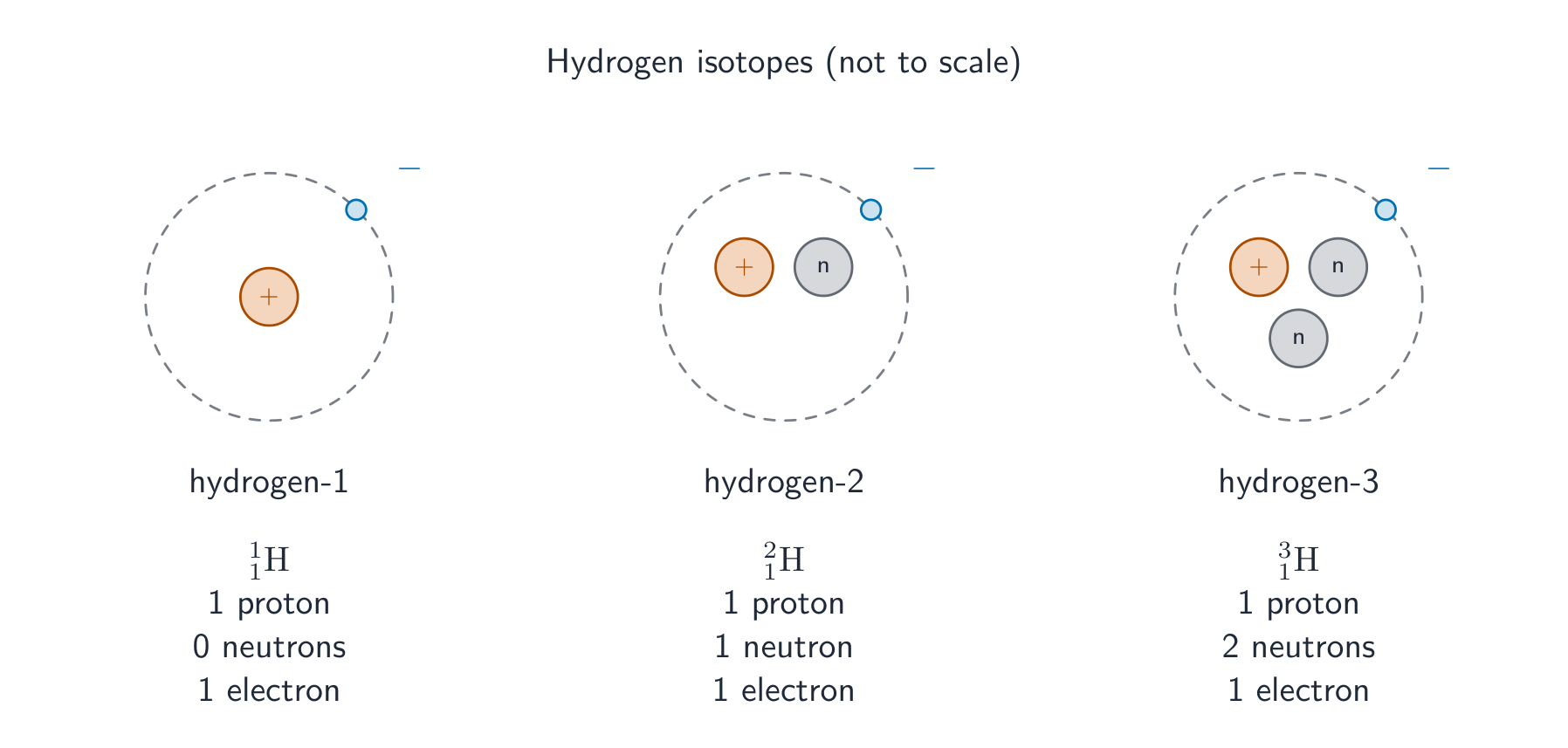
Worked example. Tritium, $^{3}_{1}\text{H}$, is an isotope of hydrogen. State the numbers of protons, neutrons and electrons in a neutral tritium atom, and give the quark composition of its nucleus.
$Z = 1$ proton; $A - Z = 3 - 1 = 2$ neutrons; 1 electron (neutral, so electrons $=$ protons). The nucleus is one proton (uud) and two neutrons (udd, udd): 4 up quarks and 5 down quarks. Charge check: $4 \times \tfrac{2}{3} - 5 \times \tfrac{1}{3} = +1$, the proton number. A "labelled diagram" of the atom is the nucleus (1 p, 2 n) with one electron orbiting outside it.
Conservation laws in nuclear processes
In any nuclear process:
- nucleon number $A$ is conserved (total $A$ before $=$ total $A$ after),
- charge is conserved (this is conservation of charge 电荷守恒).
These two rules let you balance decay and reaction equations.
Unified atomic mass unit
The unified atomic mass unit 统一原子质量单位, symbol $\text{u}$, is set so that an atom of $^{12}_{6}\text{C}$ has mass exactly $12\ \text{u}$. Numerically,
$$1\ \text{u} = 1.661 \times 10^{-27}\ \text{kg}.$$
A proton has mass $\approx 1.007\ \text{u}$; a neutron $\approx 1.009\ \text{u}$; an electron $\approx 5.5 \times 10^{-4}\ \text{u}$.
Worked example. A nucleus X has 14 nucleons and $p$ protons. Its charge-to-mass ratio is $4.1 \times 10^{7}\ \text{C kg}^{-1}$. Find $p$ and identify X.
Charge $= pe$; mass $\approx 14\ \text{u}$. So $\dfrac{pe}{14\text{u}} = 4.1 \times 10^{7}$, giving $p = \dfrac{4.1 \times 10^{7} \times 14 \times 1.66 \times 10^{-27}}{1.60 \times 10^{-19}} = 5.96 \approx 6$. Six protons and 14 nucleons: X is carbon-14, $^{14}_{6}\text{C}$. Keep every figure until the end, then round to the nearest whole number of protons.
Explore
Nuclear atom evidence lab
Connect observations to the nuclear model of the atom.
Explore
Radioactive decay
A = A₀·bᵗ
Activity decays exponentially — set the base b below 1.
Vocabulary
Train
| English |
|---|
| alpha particle/ˈælfə ˈpɑːtɪkl/ |
| deflection/dɪˈflekʃn/ |
| nucleus/ˈnjuːklɪəs/ |
| electrostatic/ɪˌlektrəʊˈstætɪk/ |
| proton/ˈprəʊtɒn/ |
| neutron/ˈnjuːtrɒn/ |
| electron/ɪˈlektrɒn/ |
| nuclide/ˈnjuːklaɪd/ |
| nucleon number/ˈnjuːklɪən ˈnʌmbə/ |
| nucleon/ˈnjuːklɪən/ |
| proton number/ˈprəʊtɒn ˈnʌmbə/ |
| isotope/ˈaɪsətəʊp/ |
| conservation of charge/ˌkɒnsəˈveɪʃn ɒv tʃɑːdʒ/ |
| unified atomic mass unit/ˈjuːnɪfaɪd əˈtɒmɪk mæs ˈjuːnɪt/ |
11.1
Radioactive emissions

An unstable nucleus rearranges itself and gives out one of three kinds of radiation 辐射. This is radioactive 放射性 decay. Each kind has its own properties.
α-radiation
- Made of: a helium-4 nucleus, $^{4}_{2}\alpha$ (two protons + two neutrons).
- Mass: $\approx 4\ \text{u}$.
- Charge: $+2e$.
- Range in air: a few cm. Stopped by a sheet of paper.
- Ionising power: strong — it is good at ionising 电离.
- Energy spectrum: discrete 分立 (one decay gives α-particles at one or a few sharp energies).
A cloud chamber 云室 makes the tracks visible: each α-particle leaves a short, straight, thick trail of tiny droplets as it ionises the air. The short equal lengths show the α-particles all carry about the same energy.
β-radiation
Two types of beta particle β粒子:
- $\beta^{-}$: a fast electron, given out when a neutron turns into a proton.
- $\beta^{+}$: a positron 正电子 (the electron's antiparticle), given out when a proton in a proton-rich nucleus turns into a neutron.
Properties (both types):
- Mass: $\approx 1/1836\ \text{u}$ (much less than α).
- Charge: $-e$ for $\beta^{-}$, $+e$ for $\beta^{+}$.
- Range in air: about $1\ \text{m}$. Stopped by a few mm of aluminium.
- Energy spectrum: continuous 连续 up to a maximum (see below).
γ-radiation
- Made of: a high-energy photon 光子 — part of the electromagnetic spectrum 电磁波谱.
- Mass: zero (rest mass).
- Charge: zero.
- Range in air: large (follows the inverse-square law). Strongly attenuated 衰减 by several cm of lead or about a metre of concrete.
- Ionising power: weakest.
- Energy spectrum: discrete (a gamma ray γ射线 is given out as the nucleus drops between two nuclear energy levels).
A nucleus often gives out a γ-photon as a "tidy-up" step after an α or β decay leaves the daughter nucleus 子核 in an excited state 激发态.

Mass and charge, side by side — a table question asks for exactly these, in units of $\text{u}$ and $e$:
| Particle | Mass | Charge |
|---|---|---|
| proton | $1\ \text{u}$ (1.007 u) | $+e$ |
| neutron | $1\ \text{u}$ (1.009 u) | $0$ |
| electron, $\beta^{-}$ | $\tfrac{1}{1836}\ \text{u}$ ($5.5 \times 10^{-4}\ \text{u}$) | $-e$ |
| positron, $\beta^{+}$ | $\tfrac{1}{1836}\ \text{u}$ | $+e$ |
| $\alpha$-particle | $4\ \text{u}$ | $+2e$ |
| $\gamma$-photon | $0$ | $0$ |
| neutrino, antineutrino | almost zero | $0$ |
Worked example. Compare an α-particle with a $\beta^{+}$ particle in terms of their masses and charges (3 marks).
Both are positively charged, but the α-particle's charge ($+2e$) is twice that of the $\beta^{+}$ ($+e$). The α-particle's mass ($4\ \text{u}$) is about $7300$ times the mass of the $\beta^{+}$ ($5.5 \times 10^{-4}\ \text{u}$). Give a ratio, not just "heavier": twice the charge and about 7000 times the mass are the marking points.
Because they carry charge, α- and β-particles are deflected by electric and magnetic fields — in opposite directions for opposite signs, the light β far more than the heavy α — while γ-rays, being uncharged, pass straight through.
Antiparticles, neutrinos and antineutrinos
Every particle has an antiparticle 反粒子 with the same mass but opposite charge. The positron is the antiparticle of the electron.
In β-decay, a third particle is always given out as well:
- $\beta^{-}$ decay: an antineutrino 反中微子 $\bar{\nu}_{\text{e}}$.
- $\beta^{+}$ decay: a neutrino 中微子 $\nu_{\text{e}}$.
Neutrinos and antineutrinos have zero charge, very small mass, and barely interact — they are very hard to detect, but they must be there to balance energy, momentum 动量 and other conserved quantities in β-decay.
Why β has a continuous spectrum (and α does not)
In α-decay the energy 能量 released is shared between just two particles (the daughter nucleus and the α). Conservation of momentum and energy then fixes the α's energy to one value (discrete).
In β-decay the energy is shared between three particles (the daughter nucleus, the β, and the (anti)neutrino). The β can take any share from zero up to a maximum, so its energy spectrum is continuous.
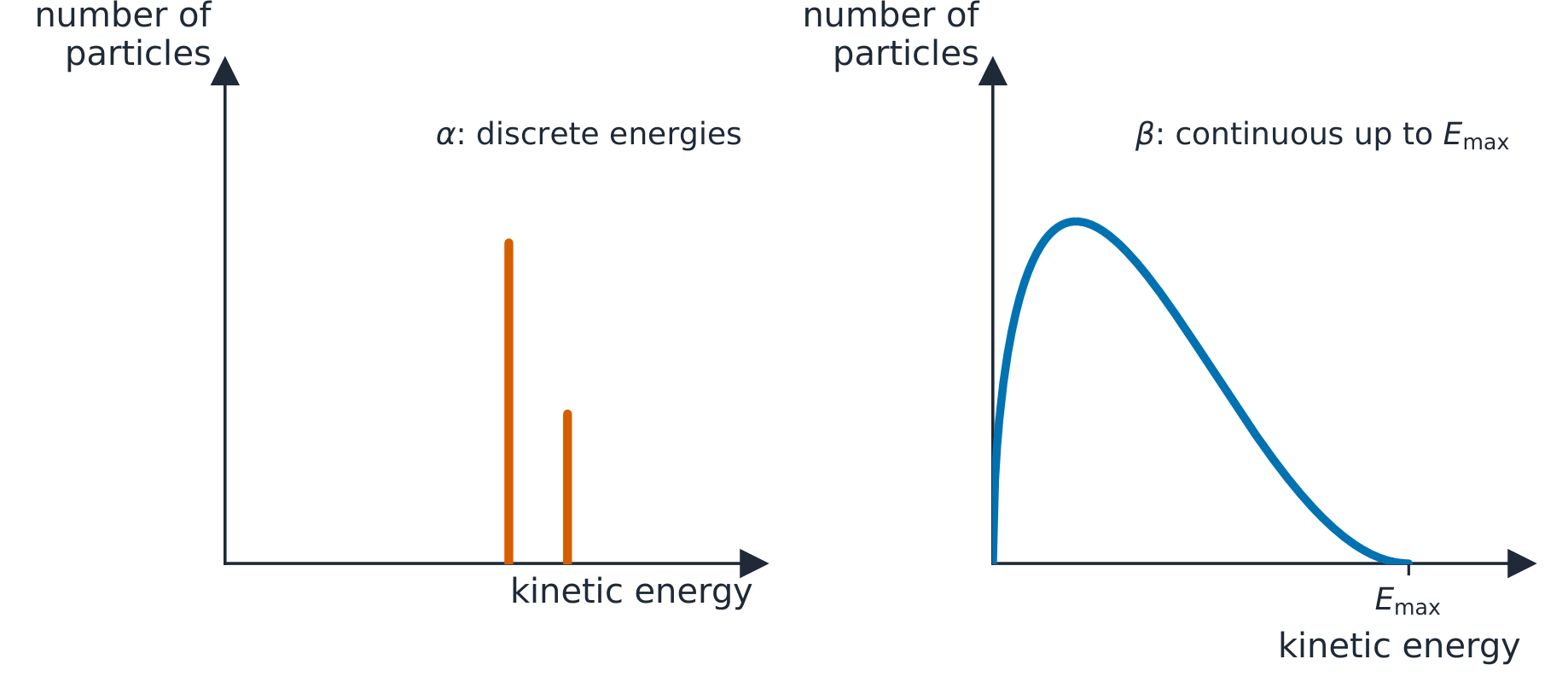
Worked example. The energy spectrum of the $\beta^{-}$ particles from a source is continuous, from zero up to a maximum. Explain why (3 marks).
Each decay releases a fixed amount of energy. That energy is shared between the $\beta^{-}$ particle, the antineutrino and the recoiling daughter nucleus. The antineutrino can take any share, so the $\beta^{-}$ particle is left with any energy from zero up to the maximum — the maximum being when the antineutrino carries away almost none. (For an α-particle there are only two bodies, so momentum conservation fixes the share and the energy is discrete.)
Writing decay equations
A general α-decay:
$$^{A}_{Z}\text{X} \to {}^{A-4}_{Z-2}\text{Y} + {}^{4}_{2}\alpha$$
(check: $A = (A-4) + 4$, $Z = (Z-2) + 2$.)
A general $\beta^{-}$ decay:
$$^{A}_{Z}\text{X} \to {}^{A}_{Z+1}\text{Y} + {}^{0}_{-1}\beta + \bar{\nu}_{\text{e}}.$$
A general $\beta^{+}$ decay:
$$^{A}_{Z}\text{X} \to {}^{A}_{Z-1}\text{Y} + {}^{0}_{+1}\beta + \nu_{\text{e}}.$$
Worked example. Uranium-238, $^{238}_{92}\text{U}$, decays by α-emission; carbon-14, $^{14}_{6}\text{C}$, decays by $\beta^{-}$-emission. Find each daughter nuclide.
α-decay lowers $A$ by 4 and $Z$ by 2; $\beta^{-}$-decay leaves $A$ unchanged and raises $Z$ by 1:
$$^{238}_{92}\text{U} \to {}^{234}_{90}\text{Th} + {}^{4}_{2}\alpha, \qquad {}^{14}_{6}\text{C} \to {}^{14}_{7}\text{N} + {}^{0}_{-1}\beta + \bar{\nu}_{\text{e}}.$$
Determine quantitatively the changes. α-emission: $A$ decreases by 4, $Z$ decreases by 2. $\beta^{-}$-emission: $A$ unchanged, $Z$ increases by 1. $\beta^{+}$-emission: $A$ unchanged, $Z$ decreases by 1. γ-emission: no change in either. A decay chain that ends at a known nuclide is solved from these: the number of α-decays is $(A_{\text{start}} - A_{\text{end}})/4$, and then the number of $\beta^{-}$-decays makes $Z$ come out right.
Worked example. Thorium-230, $^{230}_{90}\text{Th}$, decays in stages, by α- and $\beta^{-}$-emission, to lead-206, $^{206}_{82}\text{Pb}$. Find the number of each kind of decay.
α-decays: $(230 - 206)/4 = 6$. Six α-decays alone would lower $Z$ by 12, to 78; the final $Z$ is 82, so there are $82 - 78 = 4$ $\beta^{-}$-decays.
A nucleus at rest recoils. When a stationary nucleus emits an α-particle, momentum is conserved: the daughter nucleus and the α-particle move off in opposite directions with momenta of equal magnitude. Since $p = mv$, the lighter α-particle moves much faster, and since $E_{\text{k}} = p^{2}/2m$ it also takes most of the kinetic energy — the shares are in inverse proportion to the masses.
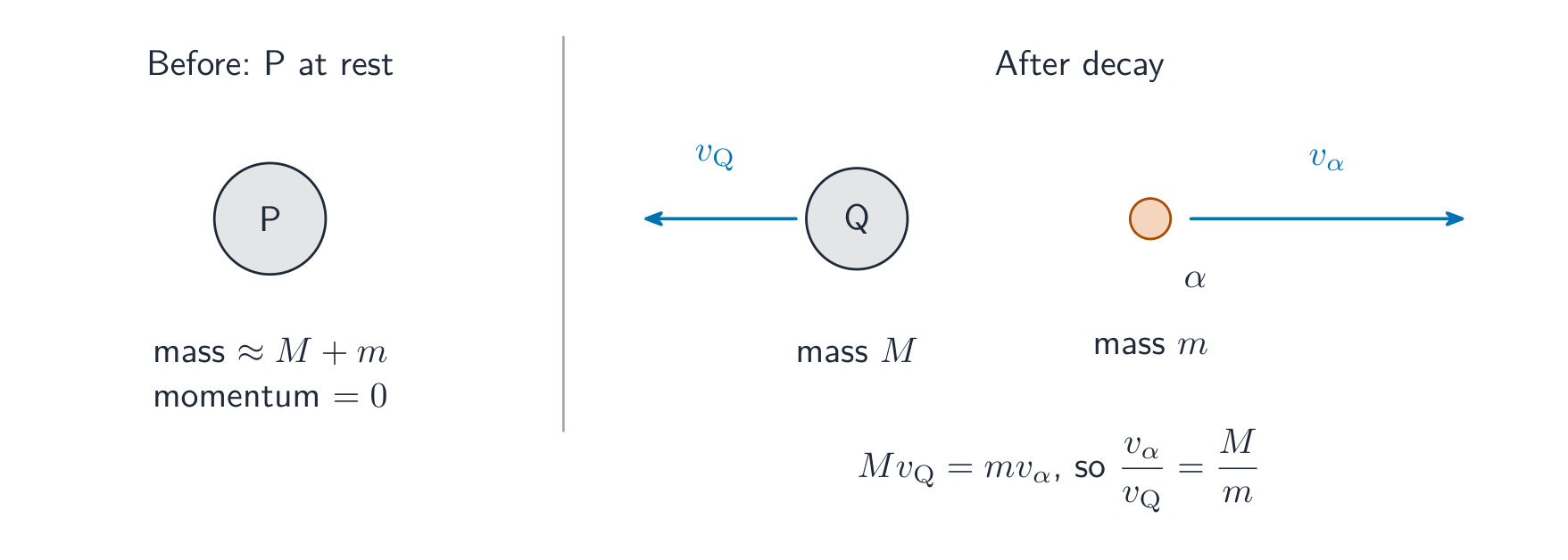
Worked example. A stationary nucleus P of mass $243\ \text{u}$ emits an α-particle of mass $4\ \text{u}$ at $1.5 \times 10^{7}\ \text{m s}^{-1}$. Find the speed of the daughter nucleus Q and the ratio of the kinetic energy of the α-particle to that of Q.
Q has mass $243 - 4 = 239\ \text{u}$. Momentum: $239 v_{\text{Q}} = 4 \times 1.5 \times 10^{7}$, so $v_{\text{Q}} = 2.5 \times 10^{5}\ \text{m s}^{-1}$, in the opposite direction to the α-particle. Kinetic energies: $\dfrac{E_{\alpha}}{E_{\text{Q}}} = \dfrac{p^{2}/2m_{\alpha}}{p^{2}/2m_{\text{Q}}} = \dfrac{m_{\text{Q}}}{m_{\alpha}} = \dfrac{239}{4} \approx 60$. The α-particle takes about 98% of the energy released.
Vocabulary
Train
| English |
|---|
| energy/ˈenədʒi/ |
| radioactive/ˌreɪdɪəʊˈæktɪv/ |
| radiation/ˌreɪdɪˈeɪʃn/ |
| ionising/ˈaɪənaɪzɪŋ/ |
| discrete/dɪˈskriːt/ |
| cloud chamber/klaʊd ˈtʃeɪmbə/ |
| beta particle/ˈbiːtə ˈpɑːtɪkl/ |
| positron/ˈpɒzɪtrɒn/ |
| antiparticle/ˌæntɪˈpɑːtɪkl/ |
| continuous/kənˈtɪnjuːəs/ |
| photon/ˈfəʊtɒn/ |
| electromagnetic spectrum/ɪˌlektrəʊməɡˈnetɪk ˈspektrəm/ |
| attenuated/əˈtenjuːeɪtɪd/ |
| gamma ray/ˈɡæmə reɪ/ |
| daughter nucleus/ˈdɔːtə ˈnjuːklɪəs/ |
| excited state/ekˈsaɪtɪd steɪt/ |
| neutrino/njuːˈtriːnəʊ/ |
| antineutrino/ˌæntɪnjuːˈtriːnəʊ/ |
| momentum/məʊˈmentəm/ |
11.2
Fundamental particles

Syllabus
- understand that a quark is a fundamental particle and that there are six flavours (types) of quark: up, down, strange, charm, top and bottom
- recall and use the charge of each flavour of quark and understand that its respective antiquark has the opposite charge (no knowledge of any other properties of quarks is required)
- recall that protons and neutrons are not fundamental particles and describe protons and neutrons in terms of their quark composition
- understand that a hadron may be either a baryon (consisting of three quarks) or a meson (consisting of one quark and one antiquark)
- describe the changes to quark composition that take place during $\beta^-$ and $\beta^+$ decay
- recall that electrons and neutrinos are fundamental particles called leptons
Source: Cambridge International syllabus
Some particles are fundamental particles 基本粒子 (point-like, with no smaller parts as far as we know); others are built from fundamental ones.
The one-mark definition: a fundamental particle is one that cannot be broken down into smaller particles (it has no internal structure). Electrons, neutrinos and quarks are fundamental; protons and neutrons are not.
Quarks
A quark 夸克 is a fundamental particle. There are six flavours 味:
- up (u), charge $+\tfrac{2}{3}e$,
- down (d), charge $-\tfrac{1}{3}e$,
- charm (c), charge $+\tfrac{2}{3}e$,
- strange (s), charge $-\tfrac{1}{3}e$,
- top (t), charge $+\tfrac{2}{3}e$,
- bottom (b), charge $-\tfrac{1}{3}e$.
Each quark has an antiquark 反夸克 with the same size of charge but the opposite sign: $\bar{u}$ (charge $-\tfrac{2}{3}e$), $\bar{d}$ (charge $+\tfrac{1}{3}e$). No other quark property is tested.

Written as the table a question asks you to complete:
| Quark | Charge | Antiquark | Charge |
|---|---|---|---|
| up (u), charm (c), top (t) | $+\tfrac{2}{3}e$ | $\bar{\text{u}}$, $\bar{\text{c}}$, $\bar{\text{t}}$ | $-\tfrac{2}{3}e$ |
| down (d), strange (s), bottom (b) | $-\tfrac{1}{3}e$ | $\bar{\text{d}}$, $\bar{\text{s}}$, $\bar{\text{b}}$ | $+\tfrac{1}{3}e$ |
Worked example. By reference to quark composition, show that the charge of a proton is $+1.6 \times 10^{-19}\ \text{C}$.
A proton is uud: charge $= \tfrac{2}{3}e + \tfrac{2}{3}e - \tfrac{1}{3}e = +e = +1.6 \times 10^{-19}\ \text{C}$. Write the three fractions and their sum — the mark is for the arithmetic, not the answer.
Hadrons: baryons and mesons
Particles built from quarks are hadrons 强子. Two types:
- baryons 重子 — three quarks. Examples: proton (u u d), neutron (u d d). Charge check: $\tfrac{2}{3} + \tfrac{2}{3} - \tfrac{1}{3} = +1$ for the proton; $\tfrac{2}{3} - \tfrac{1}{3} - \tfrac{1}{3} = 0$ for the neutron.
- mesons 介子 — one quark and one antiquark (for example $\pi^{+}$ is u$\bar{\text{d}}$).
Protons and neutrons are not fundamental — they are baryons made of quarks.
"Compare baryons and mesons in terms of their constituent particles" (2 marks): both are hadrons made of quarks; a baryon is three quarks (or three antiquarks, for an antibaryon), a meson is one quark and one antiquark. Any charge you are given must come out of the quark charges:
Worked example. (a) A meson has charge $-1e$. Give a possible quark composition. (b) A meson Q has charge 0. Give a possible composition. (c) A baryon is made of three quarks of different flavours, u, d and s. Find its charge. (d) Give the quark composition of an antineutron and its charge.
(a) d$\bar{\text{u}}$: $-\tfrac{1}{3} - \tfrac{2}{3} = -1$ (s$\bar{\text{u}}$ also works). (b) u$\bar{\text{u}}$: $+\tfrac{2}{3} - \tfrac{2}{3} = 0$ (or d$\bar{\text{d}}$). (c) uds: $\tfrac{2}{3} - \tfrac{1}{3} - \tfrac{1}{3} = 0$. (d) The antineutron is the antiparticle of udd, so it is $\bar{\text{u}}\bar{\text{d}}\bar{\text{d}}$: $-\tfrac{2}{3} + \tfrac{1}{3} + \tfrac{1}{3} = 0$ — the same mass and charge as the neutron, since both have charge zero.
Quark changes in β-decay
In $\beta^{-}$ decay a neutron turns into a proton; in quark terms, one down quark turns into an up quark:
$$\text{d} \to \text{u} + \beta^{-} + \bar{\nu}_{\text{e}}.$$
In $\beta^{+}$ decay a proton turns into a neutron; one up quark turns into a down quark:
$$\text{u} \to \text{d} + \beta^{+} + \nu_{\text{e}}.$$

"Describe $\beta^{+}$ decay in terms of the fundamental particles involved" (2 marks): an up quark in a proton changes into a down quark, so the proton becomes a neutron, and a positron and an electron neutrino are emitted — $\text{u} \to \text{d} + \beta^{+} + \nu_{\text{e}}$. For $\beta^{-}$ decay swap the roles: a down quark becomes an up quark, emitting an electron and an electron antineutrino. Name the (anti)neutrino: it is the "other lepton" the question asks for, and it is what makes the β energy continuous.
Leptons
Leptons 轻子 are fundamental particles that are not made of quarks. The leptons you need are the electron and the electron neutrino, with their antiparticles the positron and the electron antineutrino. (Heavier leptons — the muon and tau — exist but are not tested.) Asked for "two different leptons", give electron and neutrino.
Classifying particles
To answer "which are fundamental?": quarks and leptons (electrons, positrons, neutrinos, antineutrinos) are fundamental; protons, neutrons, baryons, mesons and hadrons are not — they are built from quarks.

Worked example. In the list — antineutrino, $\beta^{+}$ particle, neutron, positron, proton — underline the hadrons.
Neutron and proton (three quarks each). The antineutrino and the positron are leptons; the $\beta^{+}$ particle is a positron. The same list asked as "which are not fundamental?" has the same answer: neutron and proton.
Antimatter. Every particle has an antiparticle of the same mass and opposite charge; a positron and an electron are alike in mass (and in the size of their charge) and differ in the sign of their charge. An antihydrogen atom is an antiproton (charge $-e$, made of $\bar{\text{u}}\bar{\text{u}}\bar{\text{d}}$) with a positron in orbit.
A moving nucleus decays
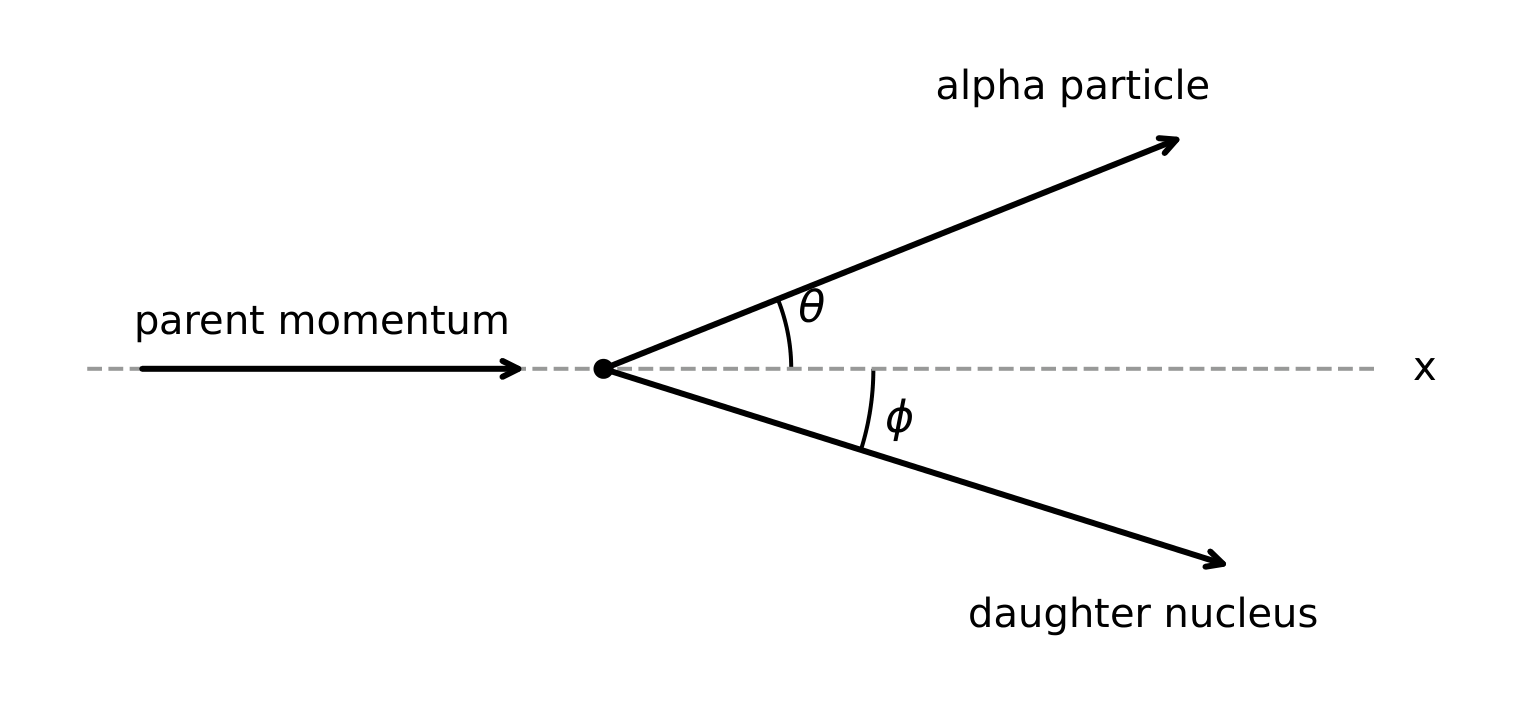
Use conservation of momentum along each axis separately. Choose $x$ along the parent's initial velocity, so the initial transverse momentum is zero. If the products move on opposite sides of $x$, their transverse momenta cancel: $m_\alpha v_\alpha\sin\theta=m_dv_d\sin\phi$. Along $x$, their momenta add to the parent's initial momentum.
Worked example. Products have momenta $2.0\times10^{-20}$ and $1.0\times10^{-20}$ kg m/s. The daughter moves 30° below $x$. Transverse conservation gives $\sin\theta=p_d\sin\phi/p_\alpha=(1.0\times10^{-20}\sin30^\circ)/(2.0\times10^{-20})=0.25$, so the alpha particle moves at 14.5° above $x$. The initial total momentum is not zero; only its transverse component is zero.
count quarks in a whole nucleus
A nucleus $^{A}_{Z}X$ has $Z$ protons (uud) and $A-Z$ neutrons (udd). Thus $N_u=2Z+(A-Z)=A+Z$ and $N_d=Z+2(A-Z)=2A-Z$. Check $N_u+N_d=3A$ and $q=(2N_u-N_d)e/3=Ze$.
Worked example. Carbon-14 has six protons and eight neutrons: $N_u=A+Z=14+6=20$ and $N_d=2A-Z=28-6=22$. In beta-minus decay one down quark becomes up, so the daughter has 21 up and 21 down quarks.
Explore
Fundamental particle lab
Sort particles by the family or interaction that defines them.
Vocabulary
Train
| English |
|---|
| quark/kwɑːk/ |
| fundamental particles/ˌfʌndəˈmentl ˈpɑːtɪklz/ |
| fundamental/ˌfʌndəˈmentl/ |
| flavours/ˈfleɪvəz/ |
| antiquark/ˈæntɪkwɑːk/ |
| hadrons/ˈhædrɒnz/ |
| baryons/ˈbæriɒnz/ |
| mesons/ˈmiːzɒnz/ |
| leptons/ˈleptɒnz/ |
11.2
Definitions the examiner accepts
A definition question is marked against fixed wording. Learn these exactly, and give one answer only.
| Term | Definition |
|---|---|
| proton number $Z$ | the number of protons in a nucleus |
| nucleon number $A$ | the total number of protons and neutrons in a nucleus |
| isotopes | nuclei of the same element (same number of protons) with different numbers of neutrons |
| nuclide | a nucleus with a particular number of protons and a particular number of neutrons |
| unified atomic mass unit | one twelfth of the mass of an atom of carbon-12 |
| antiparticle | a particle with the same mass as the corresponding particle but the opposite charge |
| fundamental particle | a particle that cannot be broken down into smaller particles |
| hadron | a particle made of quarks: a baryon (three quarks) or a meson (a quark and an antiquark) |
| lepton | a fundamental particle that is not made of quarks, such as the electron or the neutrino |
| α-particle | a helium-4 nucleus: two protons and two neutrons, charge $+2e$, mass $4\ \text{u}$ |
| $\beta^{-}$ / $\beta^{+}$ particle | an electron / a positron emitted from a nucleus when a neutron becomes a proton / a proton becomes a neutron |
11.2
Exam tips
- Describe the nuclear atom (a small, dense, positive nucleus) using the alpha-scattering evidence — pair each observation with its conclusion.
- Compare $\alpha$, $\beta$ and $\gamma$ by charge, mass, ionising power and penetration; when asked to compare two particles, give the ratio ("twice the charge", "about 7000 times the mass").
- Use quark composition (proton $uud$, neutron $udd$) and check that charge and nucleon number balance in every equation you write.
- In $\beta^-$ decay a neutron becomes a proton, an electron and an antineutrino; in $\beta^{+}$ decay a proton becomes a neutron, a positron and a neutrino. Name the (anti)neutrino every time.
- A nucleus at rest that decays gives its two products equal and opposite momentum, so the lighter one is faster and carries most of the kinetic energy.
- For a decay chain, count the α-decays from the change in $A$ first, then fix $Z$ with $\beta$-decays.
Common mistakes
- Concluding "the nucleus is positive" from the straight-through result. That result shows empty space; the large-angle deflections show the concentrated positive charge.
- Defining isotopes by "different mass" only. The mark needs same number of protons, different number of neutrons.
- Writing $^{0}_{-1}\beta$ for $\beta^{+}$ decay. A positron is $^{0}_{+1}\beta$, and $Z$ goes down by one.
- Forgetting the (anti)neutrino in a β-decay equation, or putting a neutrino with $\beta^{-}$. $\beta^{-}$ goes with the antineutrino, $\beta^{+}$ with the neutrino.
- Saying protons or neutrons are fundamental. Only quarks and leptons are.
- Giving a meson as "two quarks". It is a quark and an antiquark.
- Treating an antiquark's charge as the same sign as the quark's. $\bar{\text{u}}$ is $-\tfrac{2}{3}e$, $\bar{\text{d}}$ is $+\tfrac{1}{3}e$.
Interactive lessons on this topic
Work through it step by step, with instant-check exercises.