- understand that an electric current is a flow of charge carriers
- understand that the charge on charge carriers is quantised
- recall and use $Q = It$
- use, for a current-carrying conductor, the expression $I = Anvq$, where $n$ is the number density of charge carriers
Electricity
A-Level Physics · Topic 9
 17:50
17:50
Electric Current
Flip a switch, and the light comes on instantly. So the electrons must be racing through the wire at the speed of light — right? Wrong. Inside a copper wire…
English narration · English + 中文 subtitles burned in
9.1
Electric current

Syllabus
Source: Cambridge International syllabus
An electric current 电流 is a flow of charge carriers 载流子. In a metal the carriers are negative conduction electrons 电子; in an electrolyte 电解质 they are positive and negative ions 离子; in a semiconductor 半导体 they may be electrons or "holes" 空穴. The conventional current 常规电流 direction is the way positive charge would flow — opposite to the real flow of electrons in a wire.
Charge
Charge is quantised 量子化: the smallest free unit of charge is the elementary charge 基本电荷
$$e = 1.60 \times 10^{-19}\ \text{C}.$$
Every free charge in this syllabus is a whole-number multiple of $e$. The unit of charge is the coulomb 库仑, $\text{C}$.
So a particle can carry $4.8 \times 10^{-19}\ \text{C}$ (three electrons' worth) or $-2.4 \times 10^{-18}\ \text{C}$ (fifteen), but never $1.1 \times 10^{-19}\ \text{C}$ or $6.4 \times 10^{-20}\ \text{C}$; a set of measurements that gives a charge carrier $2.5 \times 10^{-19}\ \text{C}$ cannot be right, because that is not a multiple of $e$. For the one-mark definitions: an electric current is a flow of charge carriers; the coulomb is the charge that passes a point in one second when the current is one ampere (an ampere multiplied by a second); a charge carrier can be an electron, a proton, an ion or an $\alpha$-particle, but never a neutron.
Current as the rate of flow of charge
If charge $Q$ passes a point in time $t$, the current is
$$I = \frac{Q}{t}, \qquad Q = It.$$
Unit of current: ampere, $\text{A}$ ($= \text{C s}^{-1}$). For a changing current, the charge that has flowed in a time is the area under an $I$–$t$ graph.
Worked example. A current of $0.50\ \text{A}$ flows for $2.0$ minutes. Find the charge that passes, and how many electrons this represents. ($e = 1.60 \times 10^{-19}\ \text{C}$.)
$$Q = It = 0.50 \times 120 = 60\ \text{C}, \qquad N = \frac{Q}{e} = \frac{60}{1.60 \times 10^{-19}} \approx 3.8 \times 10^{20}.$$
The same two lines answer "how many electrons pass in $10$ hours at $4.0\ \text{mA}$" (convert the time to seconds: $N = It/e = 4.0 \times 10^{-3} \times 36\,000 / (1.60 \times 10^{-19}) = 9.0 \times 10^{20}$) and, the other way round, "the average current when $6.0 \times 10^{23}$ electrons pass in $24$ hours" ($I = Ne/t = 1.1\ \text{A}$). A beam of $\alpha$-particles carries a current too: each carries $2e$, so a beam current of $6.9 \times 10^{-9}\ \text{A}$ is $6.9 \times 10^{-9} / (2 \times 1.60 \times 10^{-19}) = 2.2 \times 10^{10}$ particles per second. A lightning strike that transfers $1 \times 10^{20}$ electrons in $30\ \mu\text{s}$ is a current of $Ne/t = 5.3 \times 10^{5}\ \text{A}$.
Drift velocity equation
For a uniform conductor of cross-section area $A$, with $n$ charge carriers per unit volume (the number density 数密度), each carrying charge $q$, moving with average drift velocity 漂移速度 $v$:
$$I = A n v q.$$
Worked example. A copper wire of cross-sectional area $1.0 \times 10^{-6}\ \text{m}^{2}$ carries a current of $5.0\ \text{A}$. Copper has $n = 8.5 \times 10^{28}$ free electrons per $\text{m}^{3}$. Find the drift velocity. ($e = 1.60 \times 10^{-19}\ \text{C}$.)
Rearranging $I = Anvq$ gives $v = \dfrac{I}{Anq}$:
$$v = \frac{5.0}{(1.0 \times 10^{-6})(8.5 \times 10^{28})(1.60 \times 10^{-19})} \approx 3.7 \times 10^{-4}\ \text{m s}^{-1}.$$
The electrons drift very slowly — less than a millimetre per second.
Two "show that" steps that often precede this calculation. The number density of a metal with one free electron per atom is $n = \dfrac{\text{density} \times N_{\text{A}}}{\text{molar mass}}$: for copper, $8.9 \times 10^{3} \times 6.02 \times 10^{23} / 0.0635 = 8.5 \times 10^{28}\ \text{m}^{-3}$. And the time for an electron to drift the length of a wire is $t = L / v$: at $3.7 \times 10^{-4}\ \text{m s}^{-1}$ a $2.0\ \text{m}$ wire takes $5\,400\ \text{s}$, an hour and a half, even though the current is established almost instantly. Between them, the equation $I = Anvq$ is used as a ratio far more often than as a calculation:
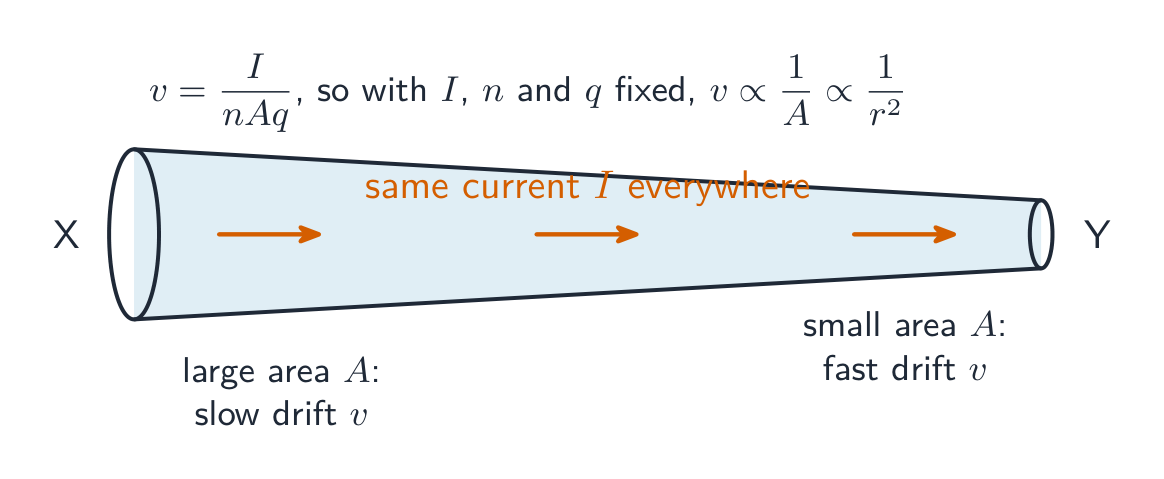
- two wires in series carry the same current; if wire Y has twice the diameter of X (four times the area) and the same metal, its electrons drift at a quarter of the speed. Two wires of the same length and diameter but different metals have drift speeds in the inverse ratio of their number densities.
- a wire that narrows (a wedge, a tapered rod, a cable of thick and thin strands) carries the same current at every cross-section, so the drift speed rises where the area falls: $v \propto 1/A \propto 1/r^{2}$. A sketch of $v$ against distance along a tapering wire is a curve that rises more and more steeply towards the narrow end, not a straight line.
- the p.d. across a uniform wire is proportional to its length at fixed current, because $V = IR = I\rho L / A$ with $I$, $\rho$ and $A$ constant.
Use this to compare currents:
- a thinner wire (smaller $A$) at the same $I$ needs a faster drift $v$.
- a semiconductor has far fewer free carriers than a metal (smaller $n$), so for the same $I$ the drift velocity is much larger.
- in series 串联 components, $I$ is the same everywhere, so if $A$ stays the same but the material changes, $nv$ changes the other way.
Explore
Current, voltage and resistance
Current is the rate of flow of charge. Raise the voltage and current rises; raise the resistance and it falls — I = V / R.
Vocabulary
Train
| English |
|---|
| electric current/ɪˈlektrɪk ˈkʌrənt/ |
| charge carrier/tʃɑːdʒ ˈkærɪə/ |
| electron/ɪˈlektrɒn/ |
| electrolyte/ɪˈlektrəlaɪt/ |
| ion/ˈaɪɒn/ |
| semiconductor/ˌsemɪkənˈdʌktə/ |
| hole/həʊl/ |
| conventional current/kənˈvenʃənl ˈkʌrənt/ |
| quantised/ˈkwɒntaɪzd/ |
| elementary charge/ˌelɪˈmentəri tʃɑːdʒ/ |
| coulomb/ˈkuːlɒm/ |
| drift velocity/drɪft vəˈlɒsɪti/ |
| number density/ˈnʌmbə ˈdensɪti/ |
| series/ˈsɪəriːz/ |
9.2
Potential difference
Syllabus
- define the potential difference across a component as the energy transferred per unit charge
- recall and use $V = W/Q$
- recall and use $P = VI$, $P = I^2R$ and $P = V^2/R$
Source: Cambridge International syllabus
The potential difference 电势差 (p.d.) across a component is the energy 能量 transferred per unit charge as that charge passes through it:
$$V = \frac{W}{Q}.$$
Unit: volt 伏特, $\text{V}$ ($= \text{J C}^{-1}$).
If $1\ \text{J}$ of electrical energy changes into other forms (thermal, light, kinetic, …) when $1\ \text{C}$ of charge passes through a component, the p.d. across it is $1\ \text{V}$.
The electromotive force 电动势 (e.m.f.) of a source is the energy given per unit charge by the source. The formula is the same as for p.d.; the difference is direction: e.m.f. is energy given to the charge by the change; p.d. is energy given up by the charge to the component.
The definitions the examiner accepts: the potential difference across a component is the energy transferred (from electrical to other forms) per unit charge passing through it; the e.m.f. of a source is the energy transferred from other forms (chemical, in a cell) to electrical energy per unit charge in driving the charge round a complete circuit; one volt is one joule per coulomb. A battery "marked $9.0\ \text{V}$" therefore gives each coulomb $9.0\ \text{J}$ of electrical energy for the whole circuit, and the product of charge and p.d. is the energy transferred.
Vocabulary
Train
| English |
|---|
| potential difference/pəˈtenʃl ˈdɪfrəns/ |
| energy/ˈenədʒi/ |
| volt/vəʊlt/ |
| electromotive force/ɪˌlektrəʊˈməʊtɪv fɔːs/ |
9.2
Electrical power

Combining $V = W/Q$ and $I = Q/t$:
$$P = \frac{W}{t} = V I.$$
Using Ohm's law $V = IR$:
$$P = V I = I^{2} R = \frac{V^{2}}{R}.$$
Pick the form with the quantities you know. Examples:
- two heaters of equal resistance — the one with the larger current gives more power 功率 ($P = I^{2}R$).
- two resistors in parallel 并联 across the same voltage 电压 — the one with smaller $R$ gives more power ($P = V^{2}/R$).
- a kettle marked "$2.4\ \text{kW}, 240\ \text{V}$" draws $I = P/V = 10\ \text{A}$ and has resistance $R = V^{2}/P = 24\ \Omega$.
Energy transferred in time $t$ is $E = P t$.
Worked example. Two lamps, P rated $250\ \text{V}$, $50\ \text{W}$ and Q rated $250\ \text{V}$, $200\ \text{W}$, are connected in series to a $250\ \text{V}$ supply. Which is brighter?
Their resistances at the rated p.d. are $R = V^{2}/P$: $1250\ \Omega$ for P and $313\ \Omega$ for Q. In series they carry the same current, so $P = I^{2}R$ makes the larger resistance, lamp P, dissipate more power: the "weaker" lamp is the brighter one. In parallel the p.d. is the same across both and $P = V^{2}/R$ favours the smaller resistance: Q. "State and explain which resistor dissipates more power" is answered by naming the quantity the two share (current in series, p.d. in parallel) and the form of the power equation that uses it.
Worked example. A supply delivers $2.4\ \text{kW}$ at $240\ \text{V}$ to a kettle through two cables of resistance $0.10\ \Omega$ each. Find the power lost in the cables.
The current is $I = P/V = 10\ \text{A}$, so the cables dissipate $I^{2}R = 10^{2} \times 0.20 = 20\ \text{W}$, and the kettle receives $2380\ \text{W}$. The efficiency of a circuit that exists to power one component is that component's power divided by the total power from the supply: with $6.0\ \text{V}$ across a $0.86\ \Omega$ series resistor and $4.5\ \text{V}$ across the component at the same current, the efficiency is $4.5 / (6.0 + 4.5) = 43\%$. A thermistor across a fixed p.d. dissipates $P = V^{2}/R$, so as its temperature rises and $R$ falls, the power rises. A kettle draws about $10\ \text{A}$ from a $250\ \text{V}$ supply; a mobile phone charger a fraction of an ampere.
Explore
Electrical power
P = VI
At a fixed voltage, power is proportional to the current it drives.
Vocabulary
Train
| English |
|---|
| power/ˈpaʊə/ |
| voltage/ˈvəʊltɪdʒ/ |
| parallel/ˈpærəlel/ |
9.3
Resistance and Ohm's law

Syllabus
- define resistance
- recall and use $V = IR$
- sketch the $I\text{--}V$ characteristics of a metallic conductor at constant temperature, a semiconductor diode and a filament lamp
- explain that the resistance of a filament lamp increases as current increases because its temperature increases
- state Ohm's law
- recall and use $R = \rho L/A$
- understand that the resistance of a light-dependent resistor (LDR) decreases as the light intensity increases
- understand that the resistance of a thermistor decreases as the temperature increases (it will be assumed that thermistors have a negative temperature coefficient)
Source: Cambridge International syllabus
The resistance 电阻 $R$ of a component is
$$R = \frac{V}{I}.$$
Unit: ohm 欧姆, $\Omega$ ($= \text{V A}^{-1}$). Resistance depends on the conditions (such as temperature) when it is measured.
Ohm's law
A conductor obeys Ohm's law 欧姆定律 when the current through it is proportional to the p.d. across it, as long as the conditions (especially temperature) stay constant. For such a conductor $R$ is constant and the $I$–$V$ graph is a straight line through the origin.
Ohm's law is an experimental result, not a definition. The definition $R = V/I$ works for any component; only ohmic ones have constant $R$.
For the marks: resistance is the ratio of the potential difference across a component to the current in it; the ohm is the resistance of a component in which a p.d. of one volt produces a current of one ampere (a volt per ampere); Ohm's law states that the current in a metallic conductor is directly proportional to the potential difference across it, provided that its temperature (and other physical conditions) remains constant. Of several $I$–$V$ graphs, only a straight line through the origin obeys Ohm's law; a straight line that misses the origin, or any curve, does not.
$I$–$V$ characteristics
You should be able to sketch these:
- metal wire at constant temperature — a straight line through the origin (constant $R$). Reversing the p.d. drives the current the other way, giving a straight line in both directions.
- filament lamp 灯丝灯泡 — through the origin, steep at first, then flatter as $V$ (and $I$) grow. Reason: more current heats the filament, so its resistance rises and the gradient $1/R$ falls.
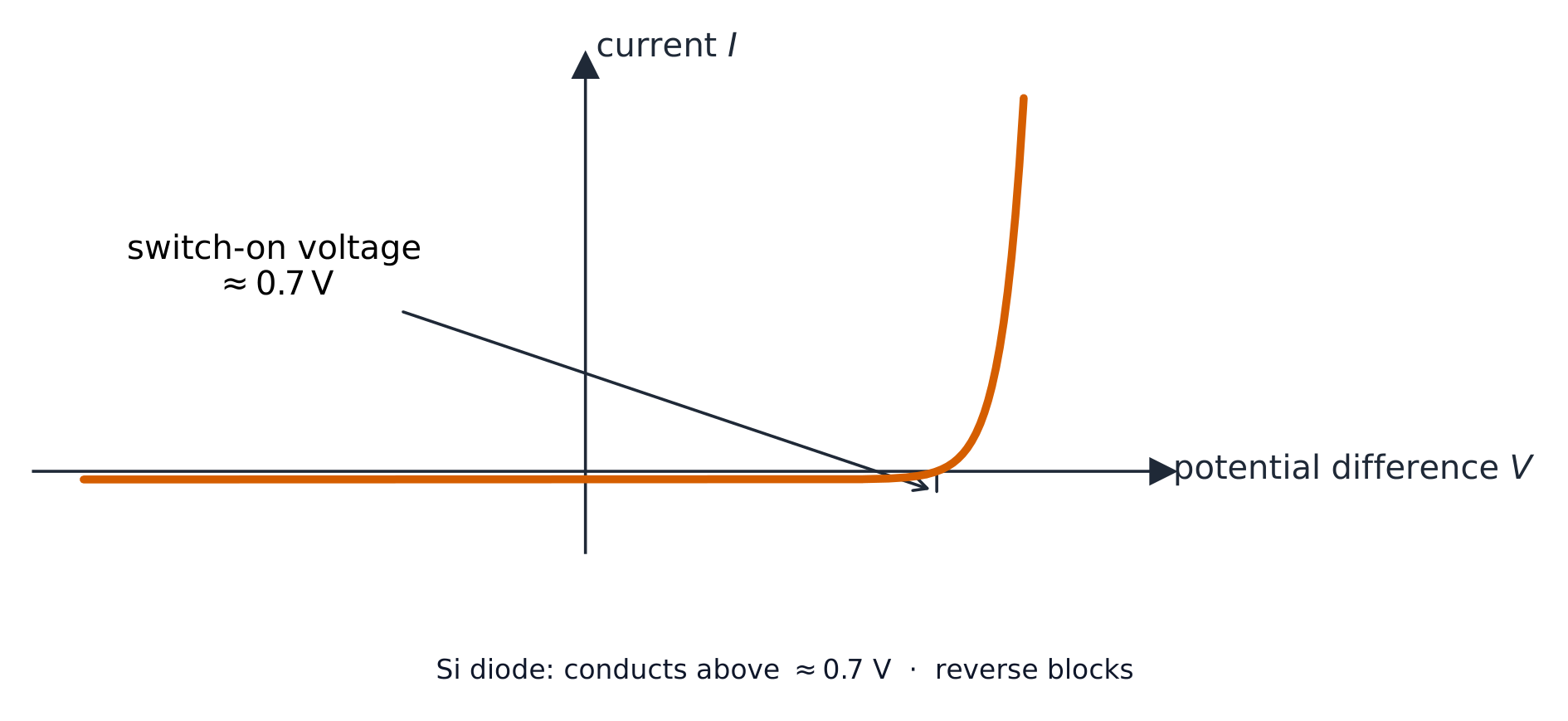
- semiconductor diode 二极管 — almost no current for negative $V$ or small positive $V$. Above a "switch-on" voltage (about $0.7\ \text{V}$ for silicon), the current rises sharply.
Explain the shape of the filament lamp's line (three marks): as the current increases the filament's temperature rises; the lattice ions vibrate with larger amplitude, so the free electrons collide with them more often; each collision takes energy from the electrons, so the resistance increases; on the graph the ratio $V/I$ grows and the gradient falls. Run backwards for "the current decreases": the temperature falls, so the resistance falls. Two things to read off any characteristic. The resistance at a point is $V/I$ for that point, never the gradient of a curve, so a diode's resistance is very large (infinite, in practice) up to the switch-on p.d. and then falls steeply as $V$ rises further, and of four components at the same p.d. the one with the smallest current has the greatest resistance. And when a lamp (or a diode) is in series with a resistor, the two carry the same current and their p.d.s add: read the current from the component's curve at its own p.d., then use $V = IR$ for the resistor, and the supply p.d. is the sum.


Resistivity
For a uniform conductor of length $L$ and cross-section area $A$,
$$R = \frac{\rho L}{A}.$$
$\rho$ is the resistivity 电阻率, a property of the material, with unit $\Omega\ \text{m}$. Doubling the length doubles $R$; doubling the area halves it; halving the diameter quarters the area and so makes $R$ four times bigger.
Worked example. A copper wire of length $2.0\ \text{m}$ and cross-sectional area $1.7 \times 10^{-7}\ \text{m}^{2}$ has resistivity $1.7 \times 10^{-8}\ \Omega\ \text{m}$. Find its resistance.
$$R = \frac{\rho L}{A} = \frac{(1.7 \times 10^{-8})(2.0)}{1.7 \times 10^{-7}} = 0.20\ \Omega.$$
Typical values: copper at room temperature $\rho \sim 1.7 \times 10^{-8}\ \Omega\ \text{m}$; an insulator 绝缘体 $\rho \sim 10^{15}\ \Omega\ \text{m}$ or more.


The resistivity of a metal rises with temperature (more lattice vibration 晶格振动 scatters 散射 the electrons), which is why the filament lamp's $I$–$V$ line curves.
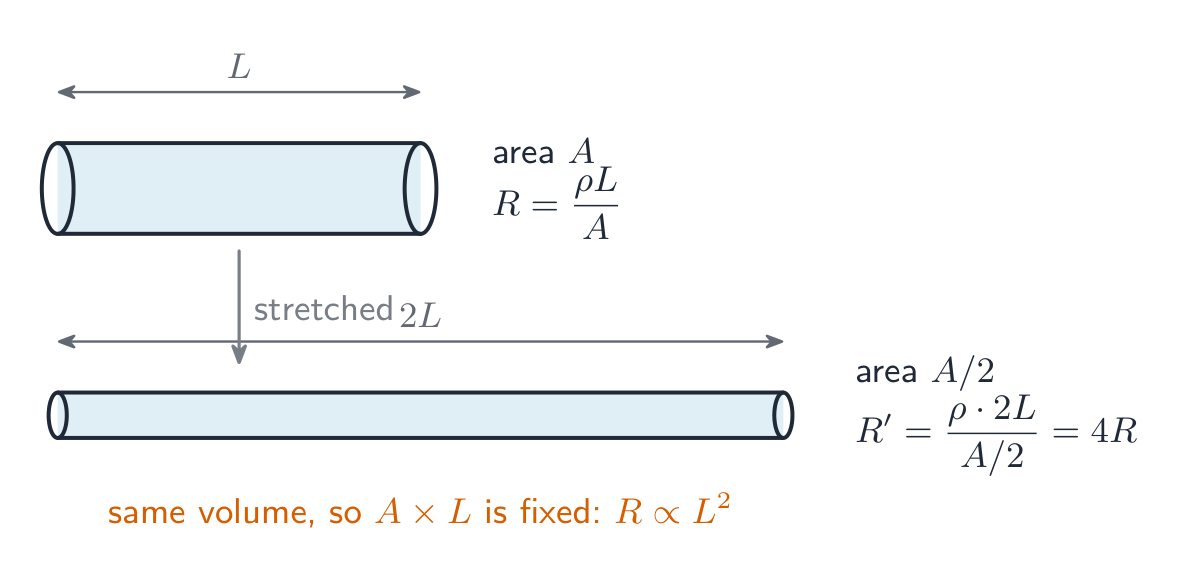
Most resistivity questions are ratios. Stretching a wire keeps its volume ($A \times L$) constant, so if the length becomes $k$ times longer the area becomes $k$ times smaller and $R = \rho L / A$ becomes $k^{2}$ times larger: a wire three times as long (same mass, same metal) has nine times the resistance, and a wire whose diameter falls to $0.940$ of its value has its area multiplied by $0.884$, its length divided by $0.884$, and its resistance multiplied by $1/0.884^{2} = 1.28$.
Worked example. A copper lightning rod of resistance $9.6\ \Omega$ and length $20\ \text{m}$ has resistivity $1.7 \times 10^{-8}\ \Omega\ \text{m}$. Find its radius.
$A = \rho L / R = 1.7 \times 10^{-8} \times 20 / 9.6 = 3.5 \times 10^{-8}\ \text{m}^{2}$, and $r = \sqrt{A / \pi} = 1.1 \times 10^{-4}\ \text{m}$. Doubling the radius (same length) quarters the resistance. The other standard ratios: strands in parallel — seven identical strands share the current, so the cable's resistance is one seventh of one strand's; two wires of the same resistance where one metal has twice the resistivity need the second wire to have twice the area (a diameter $\sqrt{2}$ times larger) for the same length; a wire's resistance per unit length, $0.92\ \Omega\ \text{m}^{-1}$, multiplied by its area, $5.3 \times 10^{-7}\ \text{m}^{2}$, is its resistivity, $4.9 \times 10^{-7}\ \Omega\ \text{m}$; and a cylinder of conducting putty $60\ \text{mm}$ long and $20\ \text{mm}$ across, or a cube of side $a$ ($R = \rho a / a^{2} = \rho / a$), uses the same $R = \rho L / A$ with the shape's own length and end area. When the wire is held under tension, $R_{0} = \rho L / A$ still gives its resistance, and a stretch that lengthens it and thins it raises $R$ for both reasons. Because $\rho = RA/L = R\pi d^{2}/(4L)$, the percentage uncertainty in a measured resistivity is the sum of the percentage uncertainties in $R$ and $L$ plus twice that in $d$.
Explore
What resistance depends on: R = ρL/A
A longer wire has more resistance; a thicker one (bigger area) has less. Change the length, area and metal.
Explore
Resistance (Ohm's law)
V = R·I
Ohm's law: voltage is proportional to current — the gradient is the resistance R.
Explore
Ohm's law: V = IR
V = aI
Drag the resistance. For an ohmic conductor voltage is proportional to current — a straight line whose gradient is the resistance.
Vocabulary
Train
| English |
|---|
| ohm/əʊm/ |
| Ohm's law/əʊmz lɔː/ |
| resistance/rɪˈzɪstəns/ |
| filament lamp/ˈfɪləmənt læmp/ |
| semiconductor diode/ˌsemɪkənˈdʌktə ˈdaɪəʊd/ |
| diode/ˈdaɪəʊd/ |
| resistivity/ˌriːzɪˈstɪvəti/ |
| insulator/ˈɪnsjuːleɪtə/ |
| lattice vibration/ˈlætɪs vaɪˈbreɪʃn/ |
| scatters/ˈskætəz/ |
9.3
Light-dependent resistor (LDR)
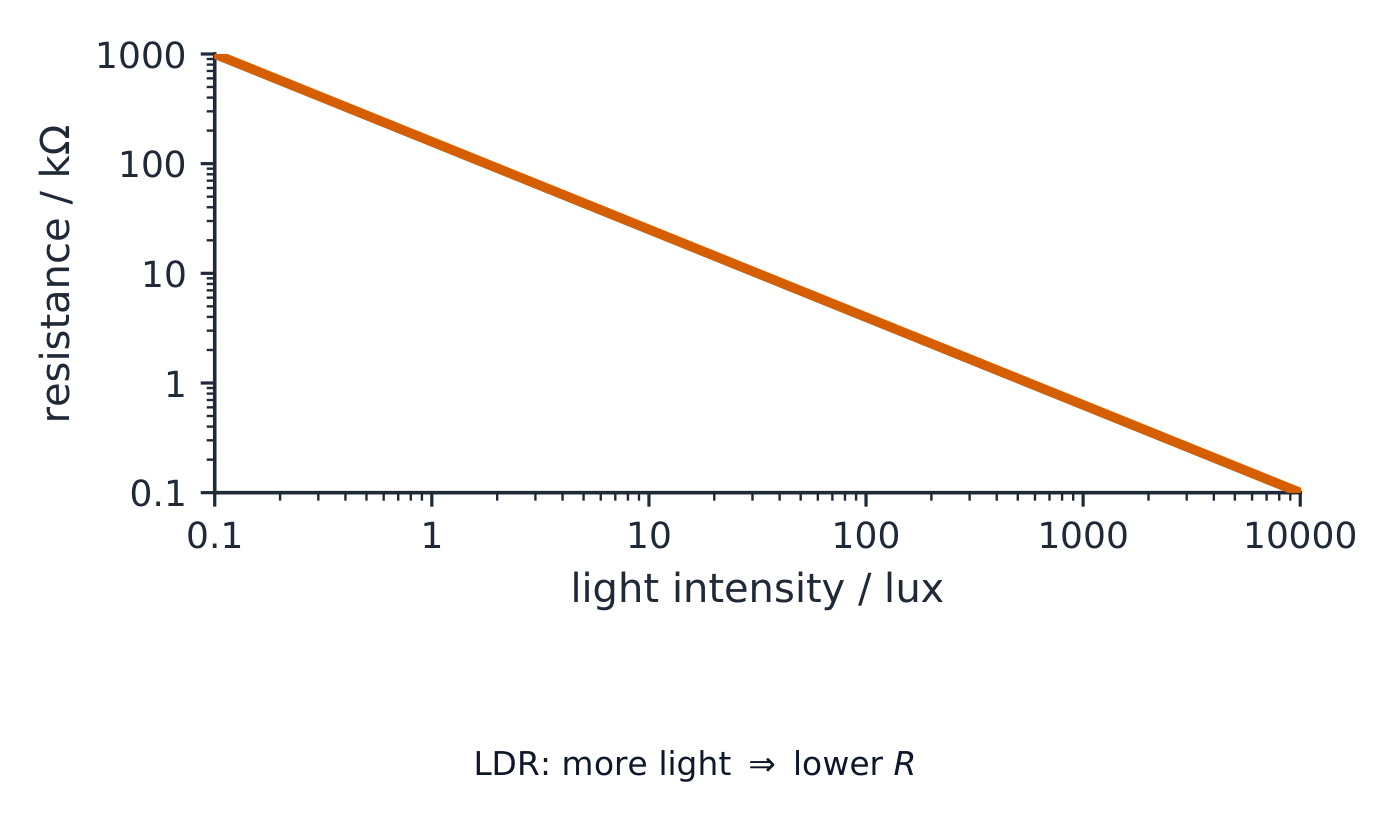
A light-dependent resistor 光敏电阻 (LDR) is a semiconductor whose resistance falls as the light intensity rises. In bright light $R$ may be a few hundred $\Omega$; in the dark it can be in the megaohms. LDRs are used in light-sensing circuits (street lamps, camera light meters). Here the light intensity 光强 controls the resistance.
Vocabulary
Train
| English |
|---|
| light-dependent resistor/laɪt dɪˈpendənt rɪˈzɪstə/ |
| light intensity/laɪt ɪnˈtensɪti/ |
9.3
Thermistor
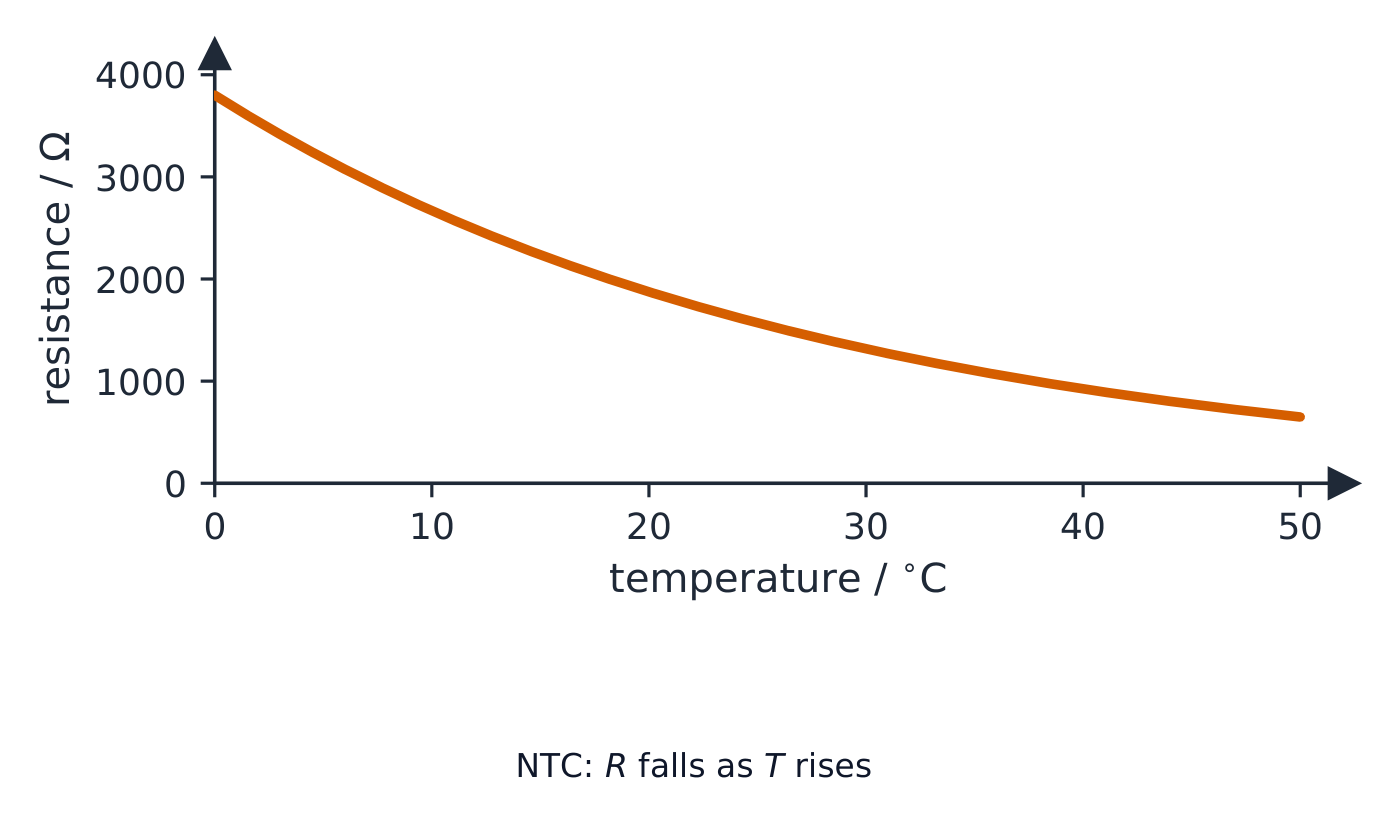
In this syllabus a thermistor 热敏电阻 has a negative temperature coefficient 负温度系数: its resistance falls as its temperature rises. This is useful for sensing temperature — put it in a potential divider 分压器 and the output voltage changes with temperature.
This is the opposite of a metal: in a semiconductor, more thermal energy frees more charge carriers, and this matters more than the extra scattering.
A sketch of a thermistor's resistance against temperature starts at $R_{0}$ at $0\ °\text{C}$ and falls along a curve that flattens: the fall is not linear, which is the disadvantage of a thermistor as a thermometer (its scale is not uniform, so it needs calibrating). When the light on an LDR is increased, or a thermistor is warmed, its resistance falls, the current in its circuit rises, and the p.d. across it (in series with a fixed resistor) falls while the p.d. across the resistor rises; a fixed resistor and a metal wire at constant temperature keep their resistance, and a filament lamp's rises with current.
Vocabulary
Train
| English |
|---|
| thermistor/ˈθɜːmɪstə/ |
| negative temperature coefficient/ˈneɡətɪv ˈtemprɪtʃə ˌkəʊɪˈfɪʃənt/ |
| potential divider/pəˈtenʃl dɪˈvaɪdə/ |
9.3
Definitions the examiner accepts
A definition question is marked against fixed wording. Learn these exactly, and give one answer only.
| Term | Definition |
|---|---|
| electric current | a flow of charge carriers |
| coulomb | the charge passing a point in one second when the current is one ampere |
| potential difference | the energy transferred from electrical to other forms per unit charge passing through a component |
| electromotive force (e.m.f.) | the energy transferred from other forms to electrical energy per unit charge, by a source driving charge round a complete circuit |
| volt | one joule per coulomb |
| resistance | the ratio of the potential difference across a component to the current in it |
| ohm | the resistance of a component in which a potential difference of one volt produces a current of one ampere |
| Ohm's law | the current in a metallic conductor is directly proportional to the potential difference across it, provided its temperature remains constant |
| resistivity | the constant $\rho$ in $R = \rho L / A$, a property of the material with unit $\Omega\ \text{m}$ |
| number density | the number of charge carriers per unit volume of the conductor |
9.3
Exam tips
- Use $I = Q/t$, $V = W/Q$ (energy per unit charge) and $P = VI = I^2 R = V^2/R$.
- Ohm's law ($V = IR$) applies only to an ohmic conductor at constant temperature — a filament lamp is non-ohmic.
- Sketch and interpret the $I$-$V$ characteristics of a resistor, filament lamp and diode.
- An LDR's resistance falls with light; a thermistor's falls as temperature rises.
Common mistakes
- Taking the resistance from the gradient of a curved $I$–$V$ graph. Resistance is $V/I$ at the point; only for a straight line through the origin is it the reciprocal of the gradient.
- Leaving a time in minutes or hours in $Q = It$. Convert to seconds first.
- Saying the filament lamp's resistance rises "because of the voltage". The chain is current, temperature, ion vibration, more collisions, more resistance.
- Forgetting that a stretched wire changes in two ways. At constant volume the area falls as the length rises, so $R \propto L^{2}$.
- Using the diameter as the radius in $A = \pi r^{2}$, or leaving $\text{mm}^{2}$ unconverted.
- Comparing powers with the wrong form. Series components share the current, so use $I^{2}R$; parallel components share the p.d., so use $V^{2}/R$.
Interactive lessons on this topic
Work through it step by step, with instant-check exercises.