- explain and use the principle of superposition
- show an understanding of experiments that demonstrate stationary waves using microwaves, stretched strings and air columns (it will be assumed that end corrections are negligible; knowledge of the concept of end corrections is not required)
- explain the formation of a stationary wave using a graphical method, and identify nodes and antinodes
- understand how wavelength may be determined from the positions of nodes or antinodes of a stationary wave
Superposition
A-Level Physics · Topic 8
 19:48
19:48
Superposition
Put on a pair of noise-cancelling headphones, and the roar of a plane engine fades to silence. But here is the strange part: they do not block the sound — they…
English narration · English + 中文 subtitles burned in
8.1
Principle of superposition

Syllabus
Source: Cambridge International syllabus
When two or more waves 波 overlap at a point, the displacement 位移 there is the vector sum 矢量和 of the displacements each wave would make on its own. This is the principle of superposition 叠加.
The waves pass through each other and come out unchanged. Superposition is the base of everything in this topic.
For the two-mark statement: when two or more waves meet at a point, the resultant displacement is the sum of the displacements of the individual waves. It is the displacements that add, not the amplitudes or the intensities, and the principle applies whenever waves of the same type overlap; the waves do not have to be coherent or of equal amplitude.
If two waves of amplitude 振幅 $A_{1}$ and $A_{2}$ meet:
- in phase 同相 (crest 波峰 meets crest): the amplitude is $A_{1} + A_{2}$ (constructive interference 相长干涉).
- exactly out of phase (crest meets trough 波谷, phase difference 相位差 $\pi$): the amplitude is $|A_{1} - A_{2}|$ (destructive interference 相消干涉).
- any other phase difference $\phi$: the amplitude is somewhere between these two.

For intensity 强度, $I \propto A^{2}$. Two equal waves meeting in phase give intensity $(2A)^{2} = 4A^{2}$ — four times the intensity of one wave alone.
Because $I \propto A^{2}$, work in amplitudes first. Two waves of intensities $I$ and $4I$ have amplitudes $A$ and $2A$: superposing in phase gives amplitude $3A$ and intensity $9I$, in antiphase amplitude $A$ and intensity $I$. So two coherent waves of different intensities never cancel completely: the minima have intensity $(A_{2} - A_{1})^{2}$, not zero. A wave of amplitude $2A$ meeting one of amplitude $A/2$ travelling the opposite way gives a resultant that varies between $2.5A$ and $1.5A$, a stationary pattern with no true nodes. Doubling the amplitude of one of two equal waves that meet in phase takes the resultant from $2A$ to $3A$, so the intensity rises from $4A^{2}$ to $9A^{2}$: $2.25$ times.
Explore
Adding two waves
Two waves overlap and add. Line them up for constructive interference, or oppose them for destructive — change the phase to see both.
Vocabulary
Train
| English |
|---|
| principle of superposition/ˈprɪnsɪpl ɒv ˌsuːpəpəˈzɪʃn/ |
| superposition/ˌsuːpəpəˈzɪʃn/ |
| wave/weɪv/ |
| displacement/dɪˈspleɪsmənt/ |
| vector sum/ˈvektə sʌm/ |
| amplitude/ˈæmplɪtjuːd/ |
| in phase/ɪn feɪz/ |
| crest/krest/ |
| constructive interference/kənˈstrʌktɪv ˌɪntəˈfɪərəns/ |
| trough/trɒf/ |
| phase difference/feɪz ˈdɪfrəns/ |
| destructive interference/dɪˈstrʌktɪv ˌɪntəˈfɪərəns/ |
| intensity/ɪnˈtensɪti/ |
8.1
Stationary (standing) waves
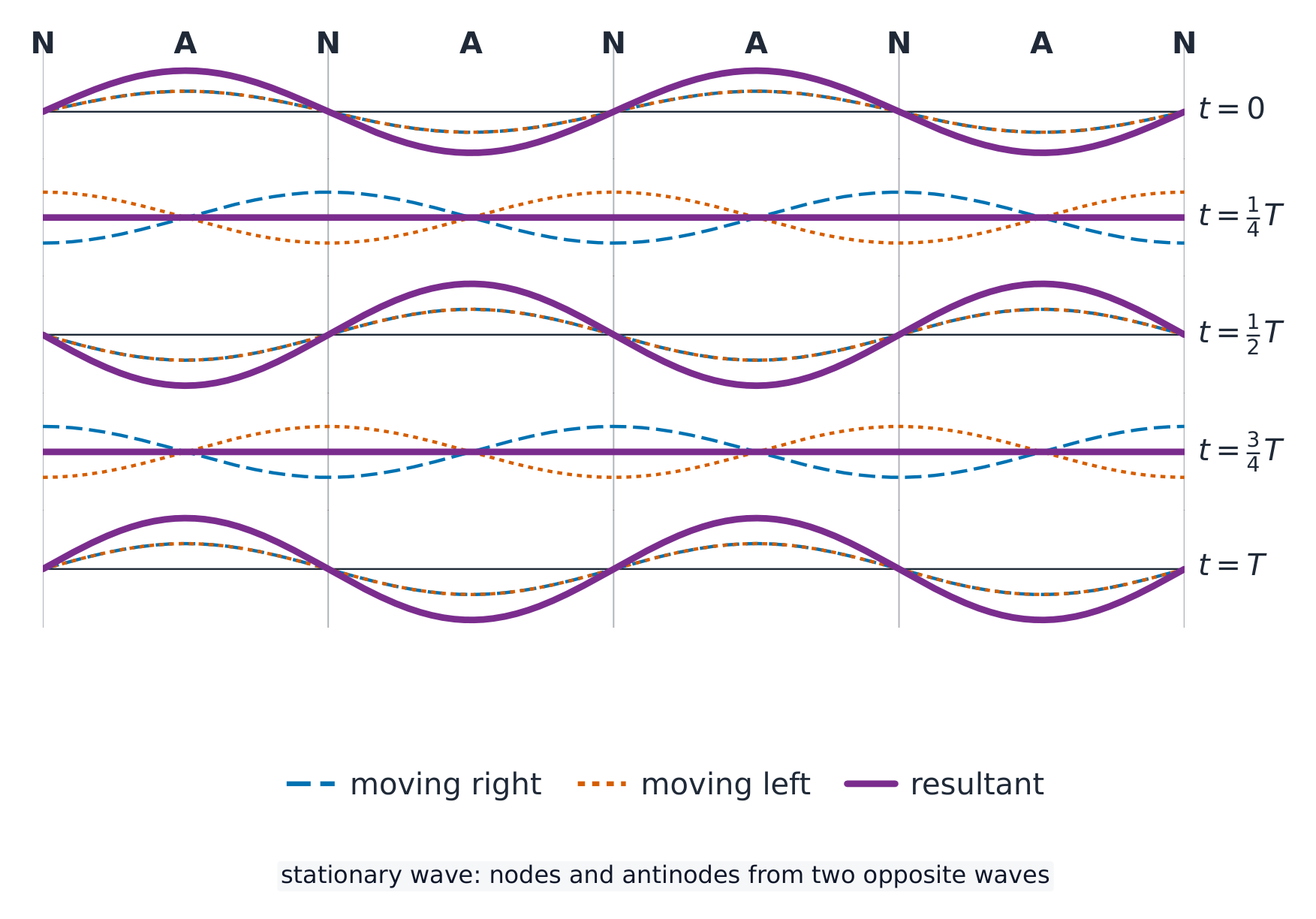
When two identical progressive waves 行波 travel in opposite directions and overlap, they make a stationary wave 驻波. Examples: a wave on a string reflected 反射 from a fixed end overlapping the incoming wave; sound in an air column reflected from a closed end; microwaves between an emitter and a metal sheet.
Explain how the stationary wave is formed (three or four marks, asked for a string, an air column and microwaves alike): the wave from the source travels to the far end (the wall, the closed end, the metal plate) and is reflected; the incident and reflected waves have the same frequency, wavelength and speed and travel in opposite directions; they superpose where they overlap; at the points where they always meet in phase the displacements add to give the maximum amplitude, an antinode, and at the points where they always meet in antiphase they cancel, a node. For "state the conditions": two waves of the same type, with the same frequency (and wavelength) and speed, travelling in opposite directions along the same line; equal amplitudes are needed only for the nodes to have zero amplitude. The metal plate in the microwave experiment is there to reflect the waves back along their own path.
Nodes and antinodes
In a stationary wave:
- node 波节 — a point that is always at zero displacement (the two waves always cancel). The distance between next-door nodes is $\lambda/2$.
- antinode 波腹 — a point of largest amplitude (the two waves always add). The distance between next-door antinodes is $\lambda/2$.
- a node and the next antinode are $\lambda/4$ apart.
Particles between two nodes oscillate in phase with each other, but with different amplitudes (largest at the antinode, zero at the nodes). Particles on opposite sides of a node oscillate in antiphase 反相 (phase difference $\pi$).
So the phase difference between two points on the same loop (between adjacent nodes) is $0°$; between points on neighbouring loops it is $180°$; and between points on loops separated by one whole loop it is $0°$ again. Every point reaches its maximum displacement at the same instant and passes through zero at the same instant. A sketch of the string a quarter of a cycle after the instant of maximum displacement is a straight line along the rest position; half a cycle later it is the mirror image of the first sketch. In one period a particle at an antinode travels four amplitudes, so a particle that moves $72\ \text{mm}$ in one and a half periods has an amplitude of $12\ \text{mm}$.

Worked example. A string of length $0.80\ \text{m}$ is fixed at both ends and vibrates in its fundamental mode, where the wave speed is $240\ \text{m s}^{-1}$. Find the fundamental frequency.
One loop fits the string, so $\lambda = 2L = 1.60\ \text{m}$. Then
$$f = \frac{v}{\lambda} = \frac{240}{1.60} = 150\ \text{Hz}.$$
How a stationary wave differs from a progressive wave: it does not carry energy 能量 along its length, the pattern does not move along, and the nodes stay fixed; a progressive wave has the same amplitude everywhere and carries energy. The three differences the scheme lists: a progressive wave transfers energy and a stationary wave does not; in a progressive wave every point has the same amplitude, in a stationary wave the amplitude varies from zero at a node to a maximum at an antinode; in a progressive wave neighbouring points differ in phase, in a stationary wave all the points between two nodes are in phase.
Measuring wavelength from node spacing
Drive a string with a vibrator at frequency $f$ until a stationary pattern appears. Measure the distance between two well-separated nodes and divide by the number of half-wavelengths 波长 between them. Then $\lambda$ is known, and $v = f\lambda$ gives the wave speed.
For a tube closed at one end and open at the other (a resonance tube 共鸣管), the closed end is a displacement node and the open end is a displacement antinode. The fundamental 基频 has $L = \lambda/4$; the next resonance is at $L = 3\lambda/4$; and so on. For a tube open at both ends, both ends are antinodes; the fundamental is at $L = \lambda/2$.
The general rule: a closed end is a node and an open end an antinode, and a string fixed at both ends has a node at each end. So a closed pipe fits an odd number of quarter-wavelengths ($L = \lambda/4, 3\lambda/4, 5\lambda/4, \ldots$), while an open pipe and a fixed string fit whole half-wavelengths ($L = \lambda/2, \lambda, 3\lambda/2, \ldots$); a pipe open at both ends with $n$ nodes has $n + 1$ antinodes. Frequencies follow from $f = v/\lambda$: a closed pipe whose lowest note is $820\ \text{Hz}$ has $\lambda = 4L$, and a corridor $13.2\ \text{m}$ long with a reflecting door at each end resonates lowest at $f = v/2L = 330/26.4 = 12.5\ \text{Hz}$.
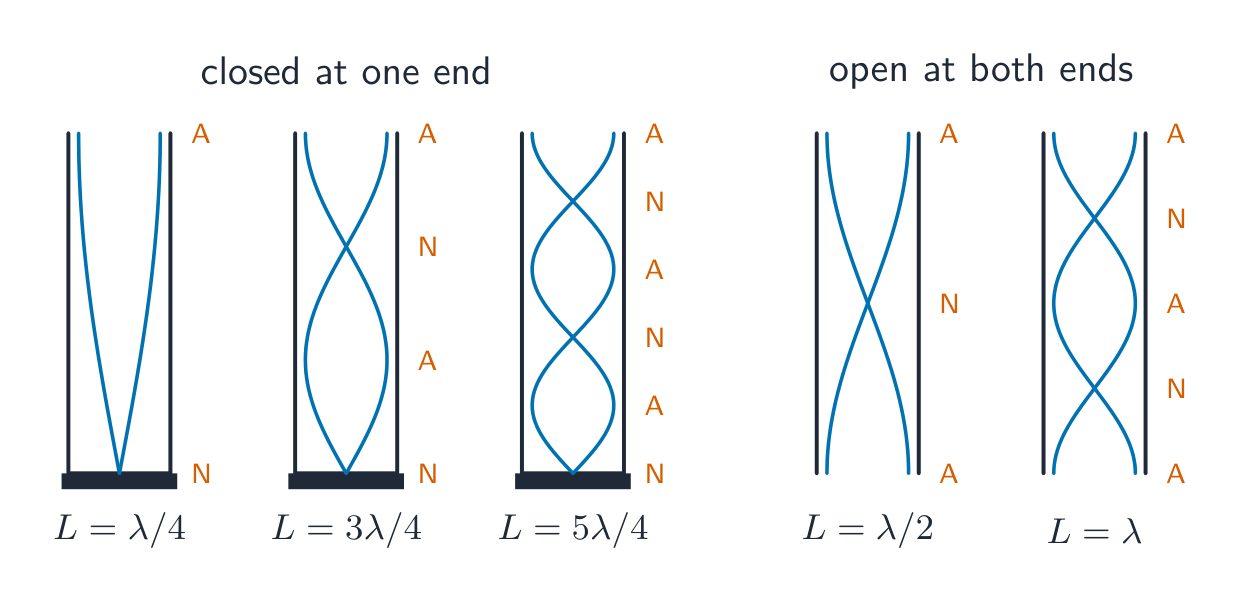
Worked example. A loudspeaker at the open end of a tube $0.51\ \text{m}$ long, closed at the other end, sets up a stationary wave with two nodes and two antinodes. Find the wavelength and, with $v = 340\ \text{m s}^{-1}$, the frequency.
Two nodes and two antinodes is the second mode of a closed pipe, $L = 3\lambda/4$, so $\lambda = 4 \times 0.51 / 3 = 0.68\ \text{m}$ and $f = 340 / 0.68 = 500\ \text{Hz}$. The longest wavelength that can resonate in this tube is $4L = 2.0\ \text{m}$.
The experiments the syllabus names all measure $\lambda$ from node or antinode spacing. In the resonance tube, a tube is raised out of water while a loudspeaker or tuning fork sounds at its open end; the sound is suddenly loud at the first resonance, when the air column is $\lambda/4$ long, and again at $3\lambda/4$, so the tube moves $\lambda/2$ between the two (a student needs no equipment to detect the resonance: the note becomes loud). In a dust tube, fine powder settles into heaps at the displacement nodes, $\lambda/2$ apart. With microwaves, a receiver moved along the line between the transmitter and a metal reflecting plate reads a minimum every $\lambda/2$: a receiver that starts at a minimum and passes six more minima in $1.05\ \text{m}$ has crossed $3\lambda$, so $\lambda = 0.35\ \text{m}$ and, with $v = 340\ \text{m s}^{-1}$ for the equivalent sound experiment, $f = 970\ \text{Hz}$. A stationary wave in a microwave oven melts chocolate at the antinodes, $\lambda/2$ apart, so the spot spacing and the oven's frequency ($2.45\ \text{GHz}$) give the speed of light from $c = f\lambda$.

Explore
Standing waves & harmonics
A string fixed at both ends only resonates at its harmonics. Drag n to see the nodes, antinodes and how the wavelength changes.
Explore
Stationary waves
y = y₁ + y₂
Two waves superpose: where they reinforce you get antinodes, where they cancel, nodes.
Vocabulary
Train
| English |
|---|
| antiphase/ˌæntɪˈfeɪz/ |
| node/nəʊd/ |
| progressive wave/prəˈɡresɪv weɪv/ |
| stationary wave/ˈsteɪʃənəri weɪv/ |
| reflected/rɪˈflektɪd/ |
| wavelength/ˈweɪvleŋθ/ |
| antinode/ˌæntɪˈnəʊd/ |
| fundamental/ˌfʌndəˈmentl/ |
| energy/ˈenədʒi/ |
| resonance tube/ˈrezənəns tjuːb/ |
8.2
Diffraction

Syllabus
- explain the meaning of the term diffraction
- show an understanding of experiments that demonstrate diffraction including the qualitative effect of the gap width relative to the wavelength of the wave; for example diffraction of water waves in a ripple tank
Source: Cambridge International syllabus
Diffraction 衍射 is the spreading of a wave after it passes through a gap or around an obstacle 障碍物. All waves diffract — water, sound, light, microwaves.
For the two-mark "state what is meant by diffraction": the spreading of a wave as it passes through a gap (an aperture) or around the edge of an obstacle, into the region behind it. Diffraction changes the direction the wave travels in, but not its speed, frequency or wavelength.
The amount of spreading depends on the ratio of wavelength to gap width:
- gap much wider than $\lambda$: very little spreading; the wave goes nearly straight through.
- gap about the size of $\lambda$: a lot of spreading; the wave fans out.
- gap smaller than $\lambda$: very strong spreading; the gap acts almost like a point source.
Show this with water waves in a ripple tank 水波槽: straight waves meet a barrier with a gap, and the waves curve more as the gap is made narrower. The same idea is why you can hear someone around a corner (speech has $\lambda$ near 1 m, close to the gap size) but cannot see them (visible light has $\lambda \sim 500\ \text{nm}$, far smaller than the gap).
For the strongest spreading the gap should be about one wavelength wide. So to increase the diffraction of a given wave, make the gap narrower; for a given gap, use a longer wavelength, which means a lower frequency. Radio waves of wavelength $1.5\ \text{km}$ diffract around a mountain and reach an aerial behind it; microwaves of $1.5\ \text{cm}$ do not. Sound of $0.44\ \text{kHz}$ in air has $\lambda = 330 / 440 = 0.75\ \text{m}$, so features of about $0.75\ \text{m}$ diffract it most, and of the sounds passing through a doorway $0.80\ \text{m}$ wide the low frequencies spread out most. Making the gap many wavelengths wide, or raising the frequency, reduces the spreading.
Explore
Waves adding and cancelling
Two overlapping waves add where they are in phase and cancel where out of phase — change the phase to see the result. This is what makes diffraction patterns.
Vocabulary
Train
| English |
|---|
| diffraction/dɪˈfrækʃn/ |
| obstacle/ˈɒbstəkl/ |
| ripple tank/ˈrɪpl tæŋk/ |
8.3
Interference

Syllabus
- understand the terms interference and coherence
- show an understanding of experiments that demonstrate two-source interference using water waves in a ripple tank, sound, light and microwaves
- understand the conditions required if two-source interference fringes are to be observed
- recall and use $\lambda = ax / D$ for double-slit interference using light
Source: Cambridge International syllabus
Interference 干涉 is the superposition of two coherent 相干 waves to give a steady pattern of high-amplitude regions (constructive) and low-amplitude regions (destructive).


Coherence
Two sources are coherent when they emit waves with a constant phase difference (which also needs the same frequency). Two separate lamps are not coherent — their phase changes randomly, so any pattern flickers too fast to see and you get only an average.
The one-mark definition: coherent waves have a constant phase difference, which requires the same frequency. They need not be in phase with each other: two coherent sources emitting $180°$ apart give a pattern whose central line is a minimum. Two separate lasers, or a lamp and a laser, are not coherent even when their frequencies happen to match, so no steady pattern forms.
To make coherent light from one source, pass it through two slits 狭缝 in a double-slit 双缝 setup. Both slits are lit by the same wavefront, so the two beams keep a fixed phase relationship.
Conditions for a clear pattern
To see two-source fringes you need:
- two coherent sources (constant phase difference).
- roughly equal amplitudes (or the dark regions are not very dark).
- the waves overlap where you look.
- for light (a transverse wave), the same plane of polarisation 偏振.
In practice, for light: a single slit (or a laser) makes the two slits coherent; the slits are narrow, so each diffracts the light into the region where the two beams overlap; and the slits are close together with the screen far away, so that the fringes are wide enough to see.
Path difference
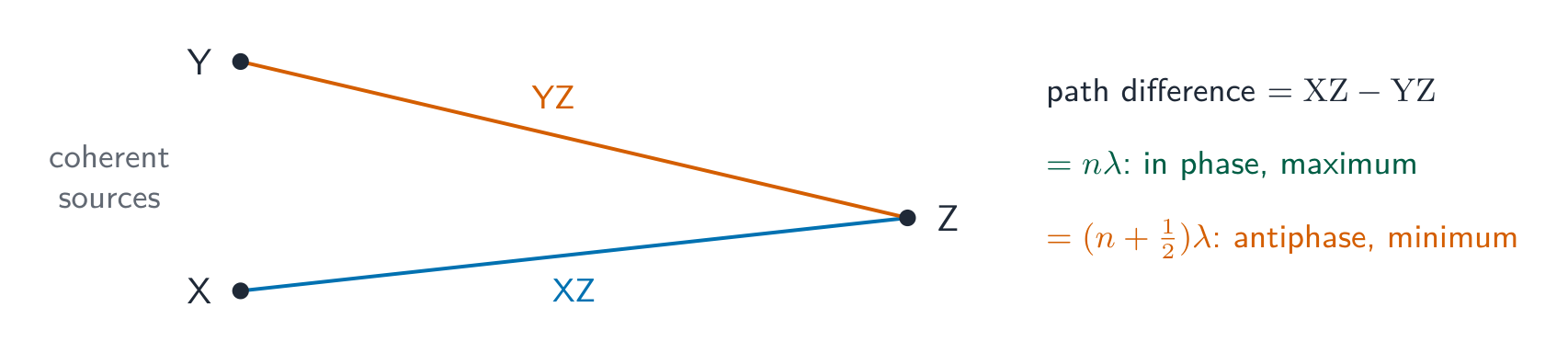
For two coherent sources, what happens at a point depends on the path difference 路程差 $\Delta x$ between the two waves arriving there:
- constructive: $\Delta x = n\lambda$ (for whole numbers $n = 0, 1, 2, \ldots$).
- destructive: $\Delta x = (n + \tfrac{1}{2})\lambda$.
The path difference fixes the phase difference: one wavelength of path is $360°$. Waves that have travelled $100\ \text{cm}$ and $80\ \text{cm}$ from two in-phase sources of wavelength $8.0\ \text{cm}$ arrive with a path difference of $2.5\lambda$, a phase difference of $180°$, and cancel; microwaves of wavelength $4\ \text{cm}$ whose paths differ by $6\ \text{cm}$ ($1.5\lambda$) give a minimum, of zero intensity only if the two amplitudes are equal. Lowering both source frequencies equally lengthens the wavelength, so the same path difference is a smaller number of wavelengths and the point is no longer a minimum.
Double-slit (Young's) experiment
For two slits a distance $a$ apart, with a screen a distance $D$ away (assume $D \gg a$), light of wavelength $\lambda$ makes fringes on the screen.

The fringe spacing 条纹间距 $x$ (one fringe 条纹 to the next) is
$$\lambda = \frac{a x}{D}, \qquad x = \frac{\lambda D}{a}.$$
Bright fringes (maximum 极大) are where the path difference is a whole number of $\lambda$; dark fringes (minimum 极小) where it is $(n + \tfrac{1}{2})\lambda$. The fringes are equally spaced.
To make the fringe spacing smaller: increase $a$ (slits further apart), reduce $D$ (screen closer), or use a shorter $\lambda$ (bluer light).
Explain how the pattern of bright and dark fringes is formed (three marks): the light diffracts at each slit; the two diffracted beams overlap and superpose; where the path difference from the two slits is a whole number of wavelengths the waves arrive in phase and interfere constructively, giving a bright fringe, and where it is an odd number of half-wavelengths they arrive in antiphase and interfere destructively, giving a dark fringe. A brighter source makes the bright fringes brighter but does not change their spacing; changing to blue light makes the spacing smaller, so to keep the same spacing the slits must be moved closer together; making each slit narrower increases the diffraction, so fringes appear across a wider region, with the spacing unchanged.
Worked example. In a double-slit experiment the slits are $0.50\ \text{mm}$ apart and lit by light of wavelength $600\ \text{nm}$. The screen is $2.0\ \text{m}$ away. Find the fringe spacing.
$$x = \frac{\lambda D}{a} = \frac{(600 \times 10^{-9})(2.0)}{0.50 \times 10^{-3}} = 2.4 \times 10^{-3}\ \text{m} = 2.4\ \text{mm}.$$
Worked example. Red light of wavelength $680\ \text{nm}$ falls on slits $0.16\ \text{mm}$ apart. The distance between the centres of the first and ninth dark fringes is $3.2\ \text{cm}$. Find the distance $D$ to the screen.
Eight fringe spacings make $3.2\ \text{cm}$, so $x = 4.0\ \text{mm}$ and $D = ax / \lambda = (0.16 \times 10^{-3})(4.0 \times 10^{-3}) / (680 \times 10^{-9}) = 0.94\ \text{m}$. On a screen $5.0\ \text{cm}$ wide centred on the pattern, with $x = 2.4\ \text{mm}$, ten bright fringes fit on each side of the central one: $21$ in all. A graph of $x$ against $a$ is a curve falling as $1/a$; a graph of $x$ against $\lambda$ (or against $D$) is a straight line through the origin with gradient $D/a$ (or $\lambda/a$), from which $a$ can be found.
Explore
Interference
y = y₁ + y₂
In phase → constructive (bright/loud); antiphase → destructive (dark/quiet).
Vocabulary
Train
| English |
|---|
| coherent/kəʊˈhɪərənt/ |
| interference/ˌɪntəˈfɪərəns/ |
| maximum/ˈmæksɪməm/ |
| minimum/ˈmɪnɪməm/ |
| slit/slɪt/ |
| double-slit/ˈdʌbl slɪt/ |
| fringe/frɪndʒ/ |
| polarisation/ˌpəʊləraɪˈzeɪʃn/ |
| path difference/pæθ ˈdɪfrəns/ |
| fringe spacing/frɪndʒ ˈspeɪsɪŋ/ |
8.4
Diffraction grating
Syllabus
- recall and use $d \sin \theta = n\lambda$
- describe the use of a diffraction grating to determine the wavelength of light (the structure and use of the spectrometer are not included)
Source: Cambridge International syllabus
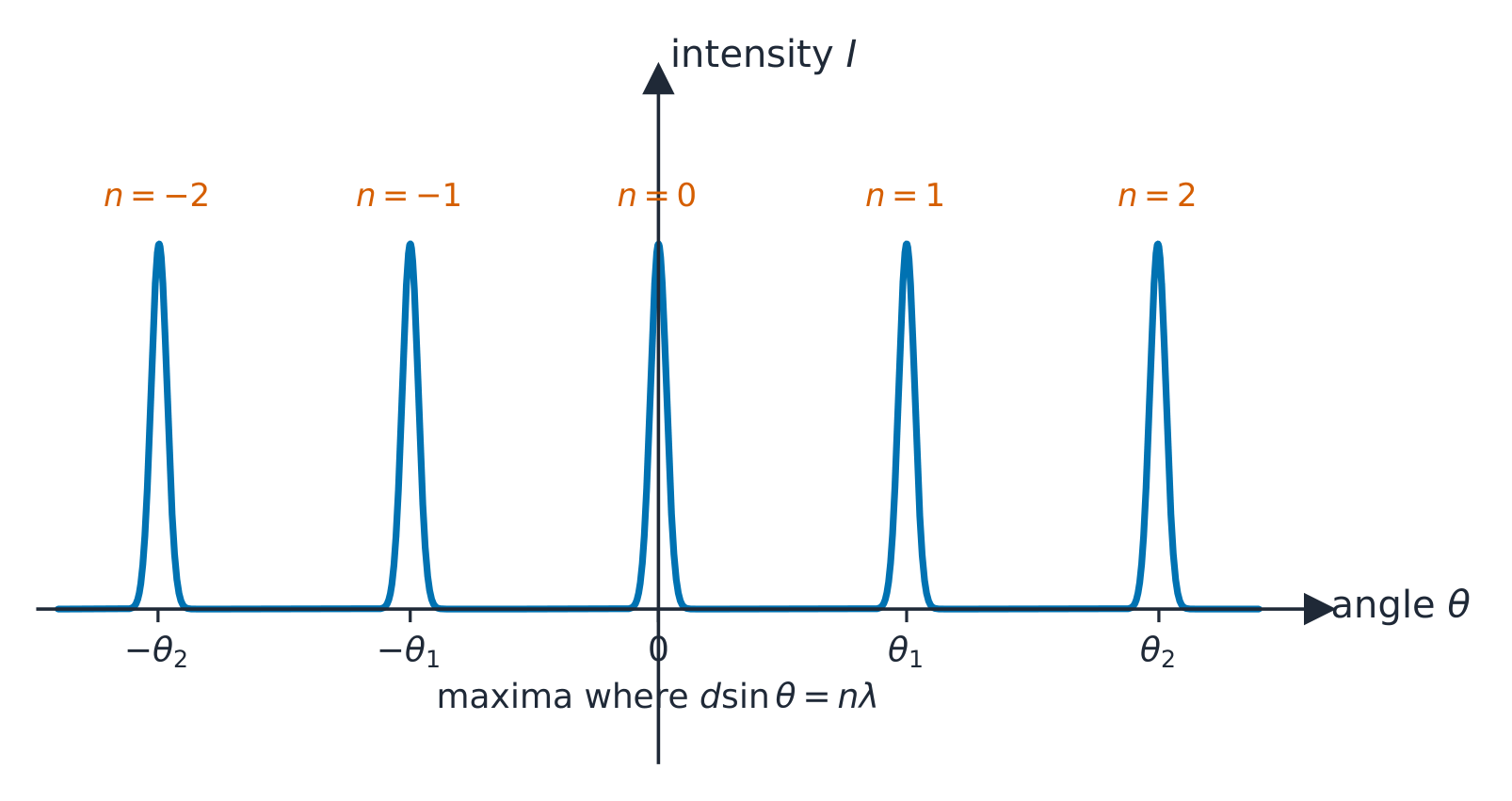
A diffraction grating 衍射光栅 has many equally spaced slits — often hundreds or thousands per millimetre. Each slit is a coherent source. A maximum is seen at angle $\theta$ from the normal 法线 to the grating when
$$d \sin\theta = n \lambda,$$
where $d$ is the slit spacing 缝间距 (centre to centre), $n = 0, \pm 1, \pm 2, \ldots$ is the order 级次, and $\lambda$ is the wavelength.
Worked example. A diffraction grating has $500$ lines per mm. Light of wavelength $600\ \text{nm}$ is shone normally on it. Find the angle of the first-order ($n = 1$) maximum.
The slit spacing is $d = \dfrac{1}{500}\ \text{mm} = 2.0 \times 10^{-6}\ \text{m}$, so
$$\sin\theta = \frac{n\lambda}{d} = \frac{600 \times 10^{-9}}{2.0 \times 10^{-6}} = 0.30 \quad\Rightarrow\quad \theta \approx 17°.$$
Compared with the double slit, a grating gives much sharper maxima, because more slits add together — every other direction is cancelled by many slits.
To describe the diffraction at the grating: the light spreads out (diffracts) at every slit, and the waves from all the slits superpose; in the directions where the path difference between neighbouring slits is a whole number of wavelengths they are all in phase, so sharp maxima form there and almost nothing in between. A graph of intensity against angle is a set of narrow peaks at $\theta = 0$ and at $\pm\theta_{1}, \pm\theta_{2}, \ldots$, where $\sin\theta_{n} = n\lambda/d$: equally spaced in $\sin\theta$, so slightly further apart in $\theta$ at the higher orders.
Worked example. Light of wavelength $680\ \text{nm}$ is incident normally on a grating with $450$ lines per mm. Find the angle between the two second-order maxima.
$d = 1/450\ \text{mm} = 2.22 \times 10^{-6}\ \text{m}$, so $\sin\theta_{2} = 2 \times 680 \times 10^{-9} / (2.22 \times 10^{-6}) = 0.612$ and $\theta_{2} = 37.7°$; the two second-order beams are $2\theta_{2} = 75°$ apart.

Slit spacing from "lines per mm"
If a grating has $N$ lines per millimetre, then $d = 1/N$ millimetres $= 10^{-3}/N$ metres. For $450$ lines per mm, $d = 1/450\ \text{mm} \approx 2.22\ \mu\text{m}$.
Highest order
For a given grating and wavelength, $\sin\theta = n\lambda/d$ cannot be more than $1$, so the highest order seen is
$$n_{\text{max}} = \left\lfloor \frac{d}{\lambda} \right\rfloor.$$
If $d/\lambda = 3.27$, orders up to $n = 3$ exist; $n = 4$ would need $\sin\theta > 1$ and is not seen.
So the total number of maxima on a wide screen is $2n_{\text{max}} + 1$: for $700\ \text{nm}$ light and $400$ lines per mm, $d/\lambda = 3.57$, so $n_{\text{max}} = 3$ and seven beams are seen. A shorter wavelength gives more orders at smaller angles. With white light every order except the zero order is a spectrum, violet nearest the centre and red furthest out, because $\theta$ grows with $\lambda$; the zero order stays white. Two wavelengths give a maximum at the same angle when $n_{1}\lambda_{1} = n_{2}\lambda_{2}$: the third order of $400\ \text{nm}$ coincides with the second order of $600\ \text{nm}$.
Finding $\lambda$ with a grating
Shine parallel light of unknown wavelength straight at the grating. Measure the angle $\theta_{1}$ of the first-order maximum from the centre. Then $\lambda = d \sin\theta_{1}$. Repeating for higher orders and averaging reduces error.
Measure the angle between the first-order maxima on the two sides and halve it, which cancels any error in setting the zero; higher orders give larger angles and so a smaller percentage uncertainty; and plotting $\sin\theta$ against $n$ for several orders gives a straight line through the origin of gradient $\lambda/d$, so $\lambda = Gd$ (or, for a known wavelength, $d = \lambda/G$). Two things must be right: $\theta$ is measured from the normal to the grating, not from its surface, and $d$ is the distance between adjacent lines, so $400$ lines per mm means $d = 2.5\ \mu\text{m}$, never $400$.
source phase and path phase
Coherent sources have a fixed phase difference; they need not emit in phase. The phase difference at an observation point combines the initial source phase with the phase change due to the path difference. Use a consistent sign convention and reduce the result modulo $360^\circ$.
For a lagging second source, $\delta_{\text{arrival}}=\delta_{\text{source}}+360^\circ(r_2-r_1)/\lambda$. A multiple of 360° gives a maximum; 180° modulo 360° gives a minimum (zero only for equal amplitudes).
Worked example. Sources emit 180° apart. An extra path of $\lambda/2$ adds 180°, giving 360° at arrival: a maximum, not a minimum. In a wavefront diagram, a crossing of two crests is a maximum; a crest meeting a trough is a minimum.
Overlapping orders and a screen measurement
Two wavelengths give maxima in the same direction when $n_1\lambda_1=n_2\lambda_2$. For example, second-order 600 nm and third-order 400 nm overlap because $n_1\lambda_1=2\times600=1200\ \text{nm}$ and $n_2\lambda_2=3\times400=1200\ \text{nm}$.
If a grating order is measured on a screen a distance $L$ along the normal, its displacement $y$ gives $\theta=\tan^{-1}(y/L)$. Then apply $d\sin\theta=n\lambda$. This geometry differs from the small-angle double-slit fringe-spacing relation.
Demonstrating sound interference
Drive two loudspeakers from the same signal generator so their waves have the same frequency and a fixed source phase difference. Move a microphone, connected to an oscilloscope or sound-level display, across their overlapping sound field. Alternating large and small signal amplitudes show constructive and destructive interference. At a large-amplitude position the arrival phases match; at a small-amplitude position they oppose. Changing the microphone position changes the path difference. Unrelated speakers at the same nominal frequency need not maintain coherence.
Explore
Why the grating gives sharp maxima
Two waves add when in phase and cancel when out of phase — change the phase and watch the resultant. A grating's many slits make the bright fringes razor-sharp.
Vocabulary
Train
| English |
|---|
| diffraction grating/dɪˈfrækʃn ˈɡreɪtɪŋ/ |
| normal/ˈnɔːml/ |
| slit spacing/slɪt ˈspeɪsɪŋ/ |
| order/ˈɔːdə/ |
8.4
Definitions the examiner accepts
A definition question is marked against fixed wording. Learn these exactly, and give one answer only.
| Term | Definition |
|---|---|
| principle of superposition | when two or more waves meet at a point, the resultant displacement is the sum of the displacements of the individual waves |
| stationary wave | the pattern formed when two progressive waves of the same frequency and speed travel in opposite directions and superpose, with nodes and antinodes that do not move |
| node | a point on a stationary wave where the displacement is always zero |
| antinode | a point on a stationary wave where the amplitude is a maximum |
| diffraction | the spreading of a wave as it passes through a gap or around the edge of an obstacle |
| interference | the superposition of waves from coherent sources, giving a steady pattern of maxima and minima |
| coherence | waves that have a constant phase difference (and so the same frequency) |
| path difference | the difference between the distances travelled by two waves from their sources to a point |
| fringe spacing | the distance between the centres of two adjacent bright (or dark) fringes |
| order of a maximum | the whole number $n$ in $d\sin\theta = n\lambda$, the number of wavelengths of path difference between adjacent slits |
8.4
Exam tips
- Two-source interference: constructive when path difference $= n\lambda$, destructive when $= (n + \tfrac{1}{2})\lambda$; the sources must be coherent.
- Double slit: $\lambda = ax/D$; diffraction grating: $d\sin\theta = n\lambda$ — know every symbol.
- On a stationary wave mark nodes and antinodes; adjacent nodes are $\lambda/2$ apart; it stores energy but does not transfer it.
- A stationary wave needs two waves of the same frequency travelling in opposite directions.
Common mistakes
- Adding amplitudes or intensities in the principle of superposition. Displacements add; the intensity then follows from the resultant amplitude squared.
- "Adjacent nodes are one wavelength apart." Half a wavelength; a node to the next antinode is a quarter.
- Using $d =$ lines per millimetre in $d\sin\theta = n\lambda$. Invert: $d = 10^{-3}/N$ metres.
- Measuring $\theta$ from the grating surface, or forgetting that the angle between the two first-order beams is $2\theta_{1}$.
- Writing "in phase" for coherent. Coherent means a constant phase difference; the sources may be permanently out of step.
- Saying the fringe spacing changes when the source is made brighter, or that narrower slits change the spacing. Brightness and slit width change the contrast and the number of visible fringes, not $x = \lambda D/a$.
Interactive lessons on this topic
Work through it step by step, with instant-check exercises.