- understand that a magnetic field is an example of a field of force produced either by moving charges or by permanent magnets
- represent a magnetic field by field lines
Magnetic fields
A-Level Physics · Topic 20
 13:21
13:21
Magnetic Fields
High above the poles, the sky comes alive — sheets of green light, rippling in the dark. This is the aurora. Its cause? Our planet is a giant magnet. Streams…
English narration · English + 中文 subtitles burned in
20.1
The magnetic field

Syllabus
Source: Cambridge International syllabus
A magnetic field 磁场 is a region where a moving charge (or a current 电流) feels a force 力. It is made by:
- moving charges (usually a current in a wire), or
- permanent magnets 永磁体 (where it comes from tiny atomic currents).
"State what is meant by a magnetic field." A region in which a force acts on a moving charge, a current-carrying conductor or a magnetic material. The mark scheme wants the word force and one of those three objects; "a region around a magnet" on its own scores nothing.
Field lines
- field lines 场线 point from N to S outside a magnet, and S to N inside (so they form closed loops).
- lines never cross; closer lines mean a stronger field.


Patterns to know:
- bar magnet 条形磁铁 — curved lines from N to S outside, strongest near the poles.
- long straight wire — circles around the wire; the direction comes from the right-hand grip rule 右手定则 (thumb along the current, fingers curl the way the field points).
- flat circular coil — the field through the centre is at right angles to the coil; the coil acts like a small bar magnet.
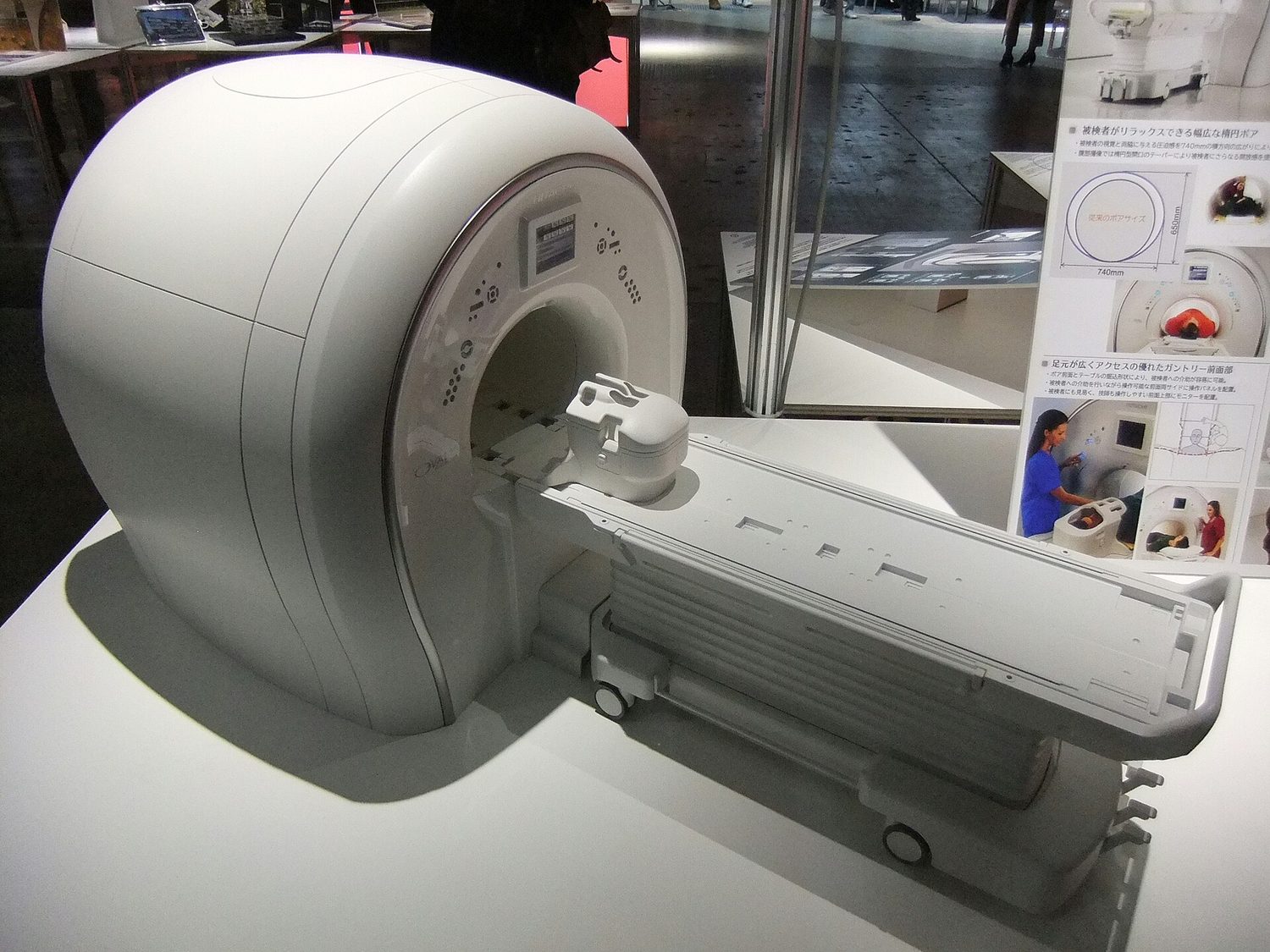
- long solenoid 螺线管 — the field inside is nearly uniform along the axis, like a stretched bar magnet; outside it falls off fast.


Drawing the wire's field. "Draw four field lines" around a straight wire is marked on three things: the lines are concentric circles centred on the wire; their spacing increases with distance (the field weakens with distance from the wire); and every line carries an arrow in the direction given by the right-hand grip rule (current into the page: clockwise; current out of the page: anticlockwise). Draw them as circles, not free-hand ovals.
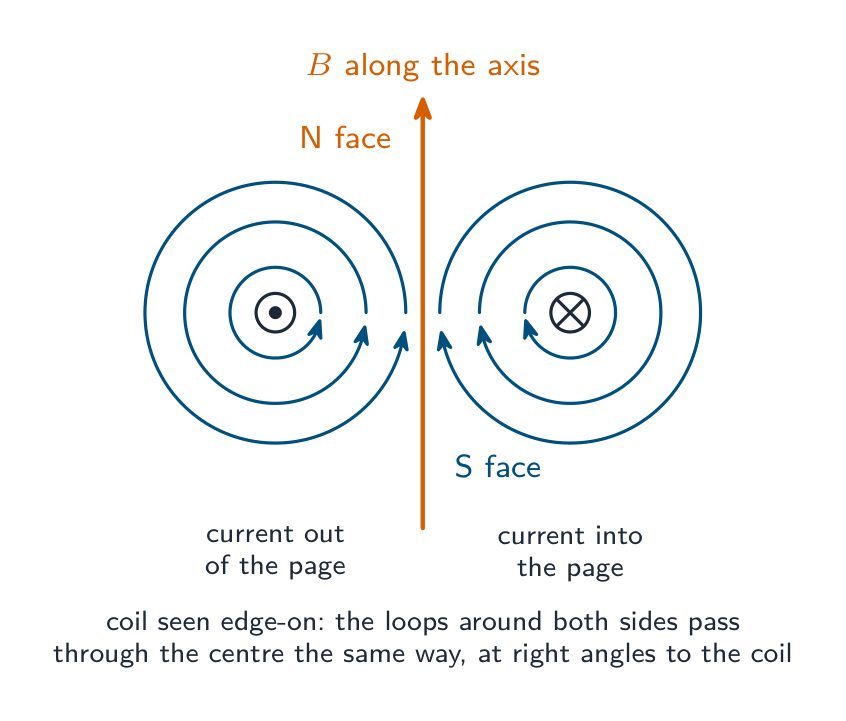
For a flat circular coil the loops around the two sides of the coil reinforce through the centre, so the field there is at right angles to the plane of the coil and strongest at the centre; seen from one face the coil is a north pole (the field leaves it), from the other a south pole. A long solenoid is many such coils in a row: the field inside is uniform and parallel to the axis, and the lines emerge from one end (its N end) and return outside to the other.
An iron core 铁芯 inside a solenoid greatly increases the field, because the iron's atomic magnets line up and add to it. This is why electromagnets 电磁铁 and transformers 变压器 have iron cores.
The syllabus calls this a ferrous 含铁的 core: iron, steel or another magnetic material. Asked why a core increases the field, say that the core becomes magnetised 被磁化 by the solenoid's field and that its own field adds to the field of the current.
Explore
Magnetic field lab
Move between magnetic arrangements and see how field patterns change.
Explore
Current field rule lab
Connect current direction to the circular magnetic field around a wire.
Vocabulary
Train
| English |
|---|
| magnetic field/mæɡˈnetɪk fiːld/ |
| bar magnet/bɑː ˈmæɡnɪt/ |
| field line/fiːld laɪn/ |
| current/ˈkʌrənt/ |
| force/fɔːs/ |
| permanent magnet/ˈpɜːmənənt ˈmæɡnɪt/ |
| right-hand grip rule/raɪt hænd ɡrɪp ruːl/ |
| long solenoid/lɒŋ ˈsəʊlənɔɪd/ |
| solenoid/ˈsəʊlənɔɪd/ |
| iron core/ˈaɪən kɔː/ |
| electromagnet/ɪˌlektrəʊˈmæɡnɪt/ |
| transformer/trænsˈfɔːmə/ |
| ferrous/ˈferəs/ |
| magnetised/ˈmæɡnɪtaɪzd/ |
20.2
Force on a current-carrying conductor
Syllabus
- understand that a force might act on a current-carrying conductor placed in a magnetic field
- recall and use the equation $F = BIL \sin \theta$, with directions as interpreted by Fleming's left-hand rule
- define magnetic flux density as the force acting per unit current per unit length on a wire placed at right-angles to the magnetic field
Source: Cambridge International syllabus
A current $I$ in a wire of length $L$ in a magnetic field of flux density $B$ feels a force
$$F = B I L \sin\theta,$$
where $\theta$ is the angle between the wire and the field. The force is largest when the wire is at right angles to the field ($F = BIL$) and zero when the wire is along the field.
Worked example. A wire of length $0.20\ \text{m}$ carries a current of $3.0\ \text{A}$ at right angles to a magnetic field of flux density $0.50\ \text{T}$. Find the force on it.
$$F = BIL = 0.50 \times 3.0 \times 0.20 = 0.30\ \text{N}.$$
Two conditions for a force. A copper wire in a magnetic field feels a force only if (1) it carries a current, and (2) the current is not parallel to the field (some part of the wire is at right angles to $B$). A wire with no current, or one lying along the field lines, feels nothing: $\sin\theta = 0$.
Worked example (the current balance). A horizontal wire of length $5.0\ \text{cm}$ lies at right angles to the field between the poles of a magnet standing on a top-pan balance. With no current the balance reads $102.30\ \text{g}$; with a current of $2.5\ \text{A}$ it reads $102.86\ \text{g}$. Find the flux density.
By Newton's third law the force on the wire is matched by an equal and opposite force on the magnet, so the balance reading changes by the magnetic force: $F = \Delta m\, g = (0.56 \times 10^{-3})(9.81) = 5.5 \times 10^{-3}\ \text{N}$. Then $B = F/(IL) = 5.5 \times 10^{-3}/(2.5 \times 0.050) = 4.4 \times 10^{-2}\ \text{T}$ ($44\ \text{mT}$). The reading rose, so the force on the magnet is downwards and the force on the wire is upwards; reversing the current would make the reading fall by the same amount.
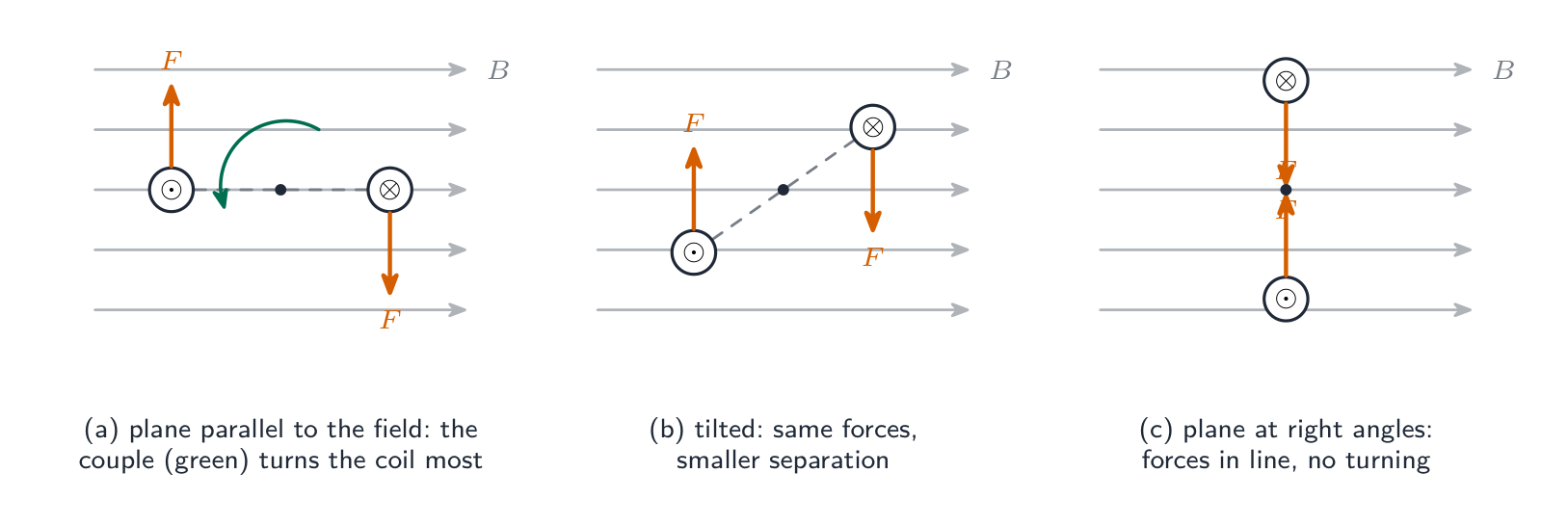
Worked example (forces on a coil). A rectangular coil PQRS with sides PS and QR of length $8.0\ \text{cm}$ carries a current of $1.2\ \text{A}$ in a horizontal field of $0.30\ \text{T}$, with the plane of the coil parallel to the field. Describe the forces on the coil.
Sides PS and QR are at right angles to the field, so each feels $F = BIL = 0.30 \times 1.2 \times 0.080 = 2.9 \times 10^{-2}\ \text{N}$; the currents in them run in opposite directions, so by Fleming's rule the forces are equal and opposite, one up and one down. Sides PQ and SR are parallel to the field and feel no force. The two forces form a couple 力偶 that turns the coil about its axis; as the coil turns the forces stay the same size but their perpendicular separation shrinks, so the turning effect falls to zero when the plane of the coil is at right angles to the field. This is the principle of the electric motor and of the moving-coil meter.
Magnetic flux density
This equation also defines the magnetic flux density 磁通密度 $B$:
$$B = \frac{F}{IL} \quad\text{(wire at right angles to the field).}$$
So $B$ is the force per unit current per unit length on a wire at right angles to the field. Unit: tesla 特斯拉, $\text{T} = \text{N A}^{-1}\ \text{m}^{-1}$.
The two-mark definitions. Magnetic flux density is the force per unit current per unit length acting on a (straight) conductor placed at right angles to the field. Both "per unit current" and "per unit length" are needed, and so is "at right angles" (or "perpendicular"): without it the definition is false, because the force also depends on the angle. The tesla is the flux density that produces a force of one newton on one metre of conductor carrying a current of one ampere at right angles to the field: $1\ \text{T} = 1\ \text{N A}^{-1}\ \text{m}^{-1}$.
Direction — Fleming's left-hand rule
Use the left hand (Fleming's left-hand rule 弗莱明左手定则): first finger = Field, second finger = Current, thumb = force (thrust). Hold the three at right angles.

Explore
Feel the force on the wire
A current in a magnetic field feels a force F = BIL at right angles to both — reverse the current or flip the magnet and the force jumps the other way.
Vocabulary
Train
| English |
|---|
| couple/ˈkʌpl/ |
| magnetic flux density/mæɡˈnetɪk flʌks ˈdensɪti/ |
| tesla/ˈteslə/ |
| Fleming's left-hand rule/ˈflemɪŋz left hænd ruːl/ |
20.3
Force on a moving charge

Syllabus
- determine the direction of the force on a charge moving in a magnetic field
- recall and use $F = BQv \sin \theta$
- understand the origin of the Hall voltage and derive and use the expression $V_{\text{H}} = BI / (ntq)$, where $t = \text{thickness}$
- understand the use of a Hall probe to measure magnetic flux density
- describe the motion of a charged particle moving in a uniform magnetic field perpendicular to the direction of motion of the particle
- explain how electric and magnetic fields can be used in velocity selection
Source: Cambridge International syllabus
A charge $Q$ moving at velocity 速度 $v$ through a field feels
$$F = B Q v \sin\theta,$$
with $\theta$ the angle between $v$ and $B$. Same left-hand rule (the second finger is the motion of a positive charge — reverse it for a negative charge). The force is largest when $v$ is at right angles to $B$, and zero when $v$ is along $B$.
Two situations with no force. A charged particle in a magnetic field feels no force when it is stationary (no $v$) or when it moves parallel or antiparallel to the field ($\sin\theta = 0$). Contrast the electric field, which pushes a stationary charge just as hard: that difference is the whole point of the velocity selector below.
Circular motion in a uniform field
A charge moving at right angles to a uniform field 匀强场 feels a force at right angles to both $v$ and $B$. This force does no work (always at right angles to the motion), so the kinetic energy 动能 and speed stay constant — the particle moves in a circle. Set the magnetic force equal to the centripetal force 向心力:
$$B Q v = \frac{m v^{2}}{r}, \qquad r = \frac{m v}{B Q}.$$
Worked example. A proton (mass $1.7 \times 10^{-27}\ \text{kg}$, charge $1.6 \times 10^{-19}\ \text{C}$) moves at $2.0 \times 10^{6}\ \text{m s}^{-1}$ at right angles to a $0.50\ \text{T}$ field. Find the radius of its circular path.
$$r = \frac{mv}{BQ} = \frac{(1.7 \times 10^{-27})(2.0 \times 10^{6})}{(0.50)(1.6 \times 10^{-19})} \approx 0.043\ \text{m}.$$
So the radius depends on the momentum 动量 $mv$. The period is
$$T = \frac{2\pi m}{B Q},$$
which does not depend on the speed — a faster particle goes in a bigger circle but takes the same time per turn. If $v$ also has a part along $B$, that part is unchanged, and the path is a helix 螺旋.
"Explain why the path is circular." The magnetic force is always at right angles to the velocity, so it changes the direction of motion but not the speed, and its magnitude $BQv$ is constant because $B$, $Q$ and $v$ are constant. A force of constant size that stays perpendicular to the velocity is exactly a centripetal force, so the path is a circle. Give all three ideas: perpendicular, constant magnitude, speed unchanged.
Worked example. Electrons moving at $1.7 \times 10^{7}\ \text{m s}^{-1}$ enter a uniform field of flux density $4.8\ \text{mT}$ at right angles to it. Find the radius of their path. The electrons are then replaced by positrons 正电子 (same mass, charge $+e$) moving at $3.4 \times 10^{7}\ \text{m s}^{-1}$ along the same initial line: describe how the path changes.
$$r = \frac{mv}{BQ} = \frac{(9.11 \times 10^{-31})(1.7 \times 10^{7})}{(4.8 \times 10^{-3})(1.60 \times 10^{-19})} = 2.0 \times 10^{-2}\ \text{m}.$$
The positrons are deflected the opposite way (positive charge, so Fleming's rule with the second finger along the motion gives a force in the opposite direction), and since $r \propto v$ their radius is twice as large, $4.0\ \text{cm}$. Their period is the same ($T = 2\pi m/BQ$ has no $v$ in it): they go round a bigger circle at twice the speed.
Hall effect
A slab of conductor carrying current $I$, in a field $B$ at right angles to the current, develops a voltage across its faces — the Hall voltage 霍尔电压 $V_{\text{H}}$ (the Hall effect 霍尔效应).
The moving charges feel a magnetic force $BQv_{\text{d}}$ ($v_{\text{d}}$ is the drift velocity 漂移速度), so they build up on one face, making an electric field 电场 $E$ that opposes more build-up. At steady state $eE = Bev_{\text{d}}$, so $E = B v_{\text{d}}$. With $V_{\text{H}} = E w$ and $I = n e v_{\text{d}} w t$:
$$V_{\text{H}} = \frac{B I}{n t q},$$
where $q$ is the carrier charge. A Hall probe 霍尔探头 uses this to measure $B$: pass a known current through a thin semiconductor 半导体 slab and read $V_{\text{H}}$ (largest when the slab is at right angles to $B$).

Deriving $V_{\text{H}} = BI/(ntq)$ (the exam asks for this in full). Take a slice of width $d$, across which the Hall voltage appears, and thickness $t$ along $B$, so the current passes through a cross-section $A = dt$. (1) At steady state the electric force on a carrier balances the magnetic force: $qE = Bqv$, so $E = Bv$. (2) The Hall field is uniform across the width, so $V_{\text{H}} = Ed = Bvd$. (3) The current is $I = nAvq = n\,dt\,vq$, so $v = I/(n\,dt\,q)$. Substituting: $V_{\text{H}} = Bd \cdot I/(n\,dt\,q) = BI/(ntq)$. Two things to notice: the voltage appears across the faces perpendicular to the magnetic force, not across the ends where the current enters; and it is larger for a semiconductor, whose number density $n$ is millions of times smaller than a metal's, which is why probes use a semiconductor slice.
Using a Hall probe. The reading is proportional to $B$ but also depends on the orientation: it is a maximum when the plane of the slice is at right angles to the field and zero when the field lies in the plane of the slice. So (1) rotate the probe until the reading is largest, and (2) calibrate 校准 it in a known field, since $V_{\text{H}} \propto B$ at fixed current.
Worked example. A Hall probe gives a maximum reading of $24\ \text{mV}$ in a uniform field of $32\ \text{mT}$. In a second field, with the probe again turned for a maximum, the reading is $15\ \text{mV}$. Find the second flux density.
$V_{\text{H}} \propto B$ (same probe, same current): $B = 32 \times 15/24 = 20\ \text{mT}$. If the probe had been left at some other angle the reading would be smaller and $B$ would be underestimated, which is why "rotate for a maximum" is part of the method.
Velocity selector
A velocity selector 速度选择器 uses crossed electric and magnetic fields to let through only one speed. With the electric force $qE$ and magnetic force $qvB$ set to oppose each other, the net force is zero only when
$$qE = qvB \quad\Rightarrow\quad v = \frac{E}{B}.$$
Particles at speed $E/B$ go straight through; faster or slower ones are deflected.

Deriving and explaining the selector. The magnetic force on a positive ion moving through the crossed fields is $BQv$, at right angles to its motion; the electric field is applied so that the electric force $QE$ is in the opposite direction (the plates must be arranged so that the field points against the magnetic force). For the ion to pass straight through, $QE = BQv$, so $v = E/B$, independent of the charge and the mass. A faster ion has a larger magnetic force and bends towards the magnetic-force side; a slower one is pushed the other way by the unchanged electric force. Asked "explain how an electric field can make the particle reach Z", say which direction the electric force must have, that it must equal the magnetic force in size, and give $E = Bv$. This is velocity selection 速度选择.
Explore
Force on a moving charge
F = BQv
The magnetic force on a charge is proportional to its speed (for a fixed field and charge).
Vocabulary
Train
| English |
|---|
| uniform field/ˈjuːnɪfɔːm fiːld/ |
| velocity/vəˈlɒsɪti/ |
| electric field/ɪˈlektrɪk fiːld/ |
| velocity selector/vəˈlɒsɪti sɪˈlektə/ |
| kinetic energy/kɪˈnetɪk ˈenədʒi/ |
| centripetal force/senˈtrɪpɪtl fɔːs/ |
| momentum/məʊˈmentəm/ |
| helix/ˈhiːlɪks/ |
| positrons/ˈpɒzɪtrɒnz/ |
| Hall effect/hɔːl ɪˈfekt/ |
| Hall voltage/hɔːl ˈvəʊltɪdʒ/ |
| drift velocity/drɪft vəˈlɒsɪti/ |
| Hall probe/hɔːl prəʊb/ |
| semiconductor/ˌsemɪkənˈdʌktə/ |
| calibrate/ˈkælɪbreɪt/ |
| velocity selection/vəˈlɒsɪti sɪˈlekʃn/ |
20.4
Force between parallel currents
Syllabus
- sketch magnetic field patterns due to the currents in a long straight wire, a flat circular coil and a long solenoid
- understand that the magnetic field due to the current in a solenoid is increased by a ferrous core
- explain the origin of the forces between current-carrying conductors and determine the direction of the forces
Source: Cambridge International syllabus
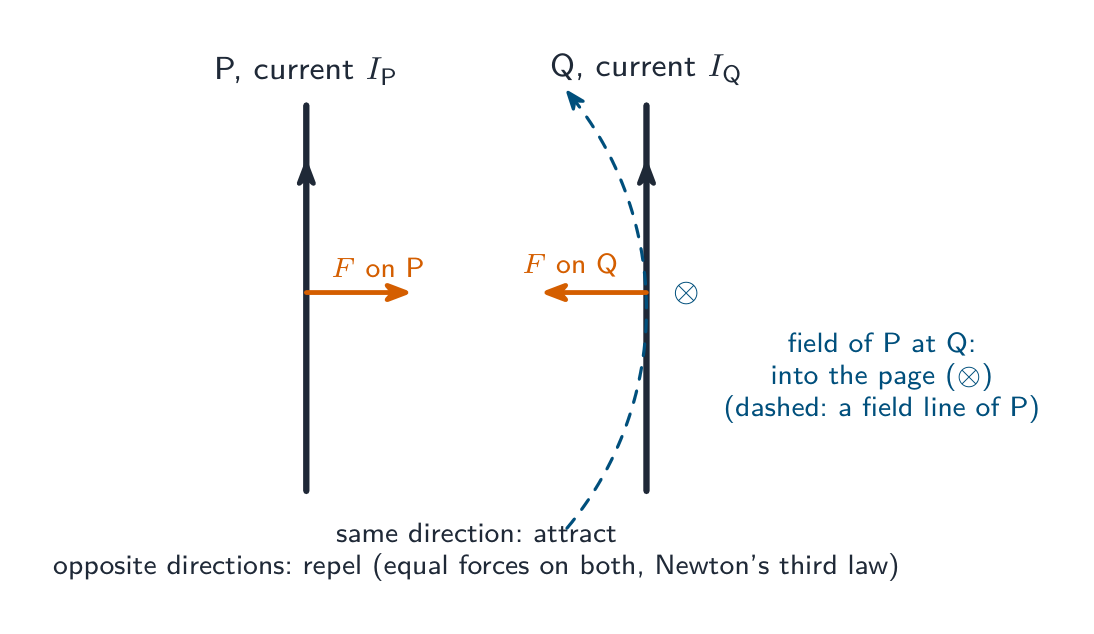
Two long parallel wires each sit in the other's magnetic field. Using Fleming's left-hand rule: parallel currents (same direction) attract; antiparallel currents (opposite directions) repel. This is the basis of the SI definition of the ampere.
Explaining the force (a standard three-marker). (1) The current in P produces a magnetic field around it (circles centred on P). (2) At Q this field is at right angles to the current in Q, so Q, a current-carrying conductor in a magnetic field, feels a force $BIL$. (3) Fleming's left-hand rule gives its direction: towards P for currents in the same direction, away for opposite currents. By Newton's third law the force on P is equal and opposite, so both wires attract (or both repel) with the same force. Doubling the current in one wire doubles the force on both: the force on Q rises because $I_{\text{Q}}$ has doubled, the force on P because the field it sits in has doubled.
20.5
Electromagnetic induction
Syllabus
- define magnetic flux as the product of the magnetic flux density and the cross-sectional area perpendicular to the direction of the magnetic flux density
- recall and use $\Phi = BA$
- understand and use the concept of magnetic flux linkage
- understand and explain experiments that demonstrate: • that a changing magnetic flux can induce an e.m.f. in a circuit • that the induced e.m.f. is in such a direction as to oppose the change producing it • the factors affecting the magnitude of the induced e.m.f.
- recall and use Faraday's and Lenz's laws of electromagnetic induction
Source: Cambridge International syllabus
Magnetic flux
The magnetic flux 磁通量 $\Phi$ through a flat area $A$ at right angles to $B$ is
$$\Phi = B A.$$
If the area's normal is at angle $\theta$ to $B$, use $\Phi = B A \cos\theta$. Unit: weber 韦伯, $\text{Wb} = \text{T m}^{2}$. For a coil 线圈 of $N$ turns, the flux linkage 磁链 is $N\Phi = N B A$.
The two-mark definitions. Magnetic flux is the product of the magnetic flux density and the area (of the circuit) perpendicular to the field. Flux linkage is the product of the flux and the number of turns of the coil, $N\Phi$, in weber-turns. Say "perpendicular" (or "normal to the field"): $\Phi = BA$ is only true for the component of the area at right angles to $B$.
Worked example. A small coil of 64 turns and cross-sectional area $0.71\ \text{cm}^{2}$ is placed inside a long solenoid, on its axis, where the flux density is $2.5\ \text{mT}$. Find the flux linkage of the coil.
The flux through the coil uses the coil's own area, not the solenoid's: $\Phi = BA = (2.5 \times 10^{-3})(0.71 \times 10^{-4}) = 1.8 \times 10^{-7}\ \text{Wb}$, so the flux linkage is $N\Phi = 64 \times 1.8 \times 10^{-7} = 1.1 \times 10^{-5}\ \text{Wb}$. When the solenoid's current changes, the e.m.f. induced in the small coil is the rate of change of this linkage.
Faraday's and Lenz's laws
When the flux linkage through a circuit changes, an electromotive force 电动势 (e.m.f.) is induced — this is electromagnetic induction 电磁感应.
Faraday's law 法拉第定律: the induced e.m.f. equals the rate of change of flux linkage:
$$|\varepsilon| = N\frac{d\Phi}{dt}.$$
Worked example. A coil of $200$ turns and area $0.010\ \text{m}^{2}$ sits with its plane at right angles to a $0.50\ \text{T}$ field. The field falls steadily to zero in $0.20\ \text{s}$. Find the average induced e.m.f.
The flux linkage changes from $N\Phi = NBA = 200 \times 0.50 \times 0.010 = 1.0\ \text{Wb}$ to zero, so
$$|\varepsilon| = \frac{\Delta(N\Phi)}{\Delta t} = \frac{1.0}{0.20} = 5.0\ \text{V}.$$
Lenz's law 楞次定律: the induced e.m.f. acts to oppose the change that makes it. This is conservation of energy 能量守恒 — if it reinforced the change, energy would come from nothing. Combined:
$$\varepsilon = -\frac{d(N\Phi)}{dt}.$$
What changes the flux?
- changing $B$ (moving a magnet near a coil),
- changing area $A$ (a rod sliding along rails),
- changing orientation (a coil turning in a field — the a.c. generator, next topic).
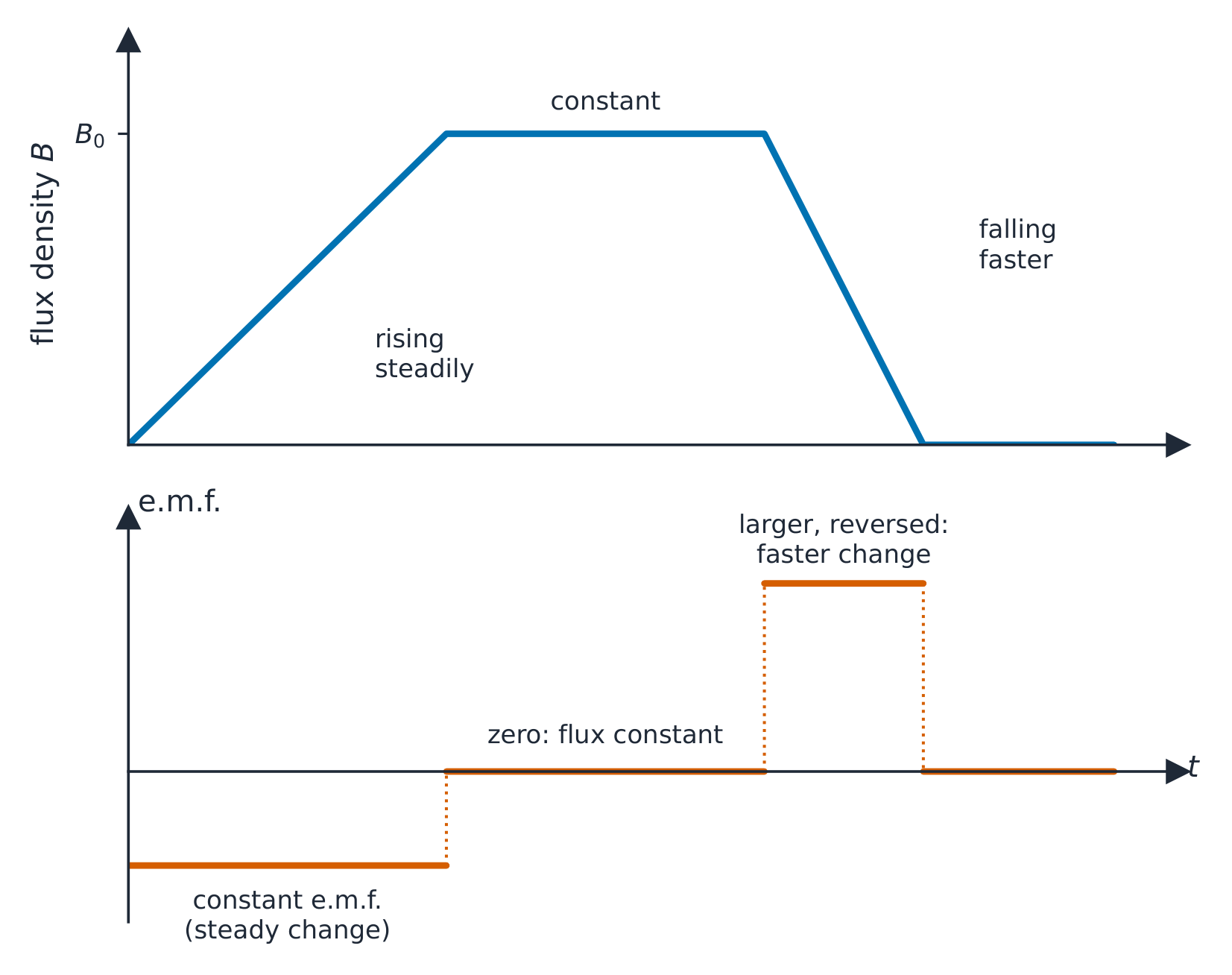
Reading an e.m.f. off a flux graph. The induced e.m.f. is the gradient of the flux-linkage graph (with a minus sign for Lenz). A steadily rising flux gives a constant e.m.f.; a constant flux gives zero e.m.f. however large the flux is; a faster fall gives a larger e.m.f. of the opposite sign. "Sketch the variation with time of the e.m.f." is answered by differentiating the flux graph by eye, section by section.
Worked example. The 64-turn coil above sits in a solenoid whose flux density rises uniformly from $0$ to $2.5\ \text{mT}$ in $40\ \text{ms}$ and is then held steady. Find the e.m.f. induced in the coil during the rise, and afterwards.
During the rise the flux linkage grows steadily to $1.1 \times 10^{-5}\ \text{Wb}$: $\varepsilon = \Delta(N\Phi)/\Delta t = 1.1 \times 10^{-5}/0.040 = 2.8 \times 10^{-4}\ \text{V}$ ($0.28\ \text{mV}$), constant while the rise lasts. Afterwards the flux linkage is constant, so the e.m.f. is zero, even though the coil is still in a strong field: it is the change that induces.
Worked example (flux cutting). An aircraft with a wingspan 翼展 of $60\ \text{m}$ flies horizontally at $250\ \text{m s}^{-1}$ where the vertical component of the Earth's field is $45\ \mu\text{T}$. Find the e.m.f. between the wingtips.
In time $\Delta t$ the wing sweeps out an area $L v \Delta t$, cutting flux $B L v \Delta t$, so $\varepsilon = BLv = (45 \times 10^{-6})(60)(250) = 0.68\ \text{V}$. Only the component of $B$ perpendicular to the swept area counts (here the vertical one). There is a p.d. between the wingtips but no current, because there is no complete circuit; Fleming's rules give which tip is positive.
Demonstrations
- moving a bar magnet into a coil deflects a galvanometer 检流计; the deflection reverses when the magnet is pulled out (Lenz's law), and is larger for faster motion (Faraday's law).

- a copper disc swinging into a field is quickly slowed — eddy currents 涡流 are induced that oppose the motion.

Electromagnetic braking, explained with Lenz's law. A vehicle's aluminium disc rotates between the poles of an electromagnet. The disc cuts the field lines, so an e.m.f. is induced in it; the disc is a conductor, so eddy currents flow; by Lenz's law these currents produce forces that oppose the motion of the disc, slowing the vehicle. The kinetic energy is converted to thermal energy in the disc. The braking is stronger at high speed (a larger rate of flux cutting, so larger currents) and fades as the vehicle slows; it cannot hold a stationary vehicle, because no motion means no induced current.
A magnet oscillating in a coil. A bar magnet on a spring oscillates in and out of a coil connected to a resistor. The changing flux linkage induces an e.m.f.; with the circuit complete a current flows and, by Lenz's law, the coil's field opposes the magnet's motion, so the oscillation is damped: energy leaves the oscillation as heat in the resistor and the amplitude decays. Open the switch and the e.m.f. is still induced but no current flows, so the coil no longer damps the motion.
What makes the induced e.m.f. larger
From $\varepsilon = N\,d\Phi/dt$ with $\Phi = BA$: more turns $N$, a stronger $B$, a larger area $A$, or a faster change — each gives a larger induced e.m.f.
Finding the direction with Lenz's law. Push the N pole of a magnet towards a coil and the induced current makes the near face of the coil a north pole, to repel the approaching magnet; pull it away and the near face becomes a south pole, to attract it. In each case the person moving the magnet does work against that force, and that work is the source of the electrical energy: Lenz's law is conservation of energy in disguise. Two sentences to learn: the induced e.m.f. acts in such a direction as to produce effects that oppose the change producing it (Lenz), and the induced e.m.f. is proportional to the rate of change of flux linkage (Faraday).
Explore
Electromagnetic induction
Move the magnet through the coil — a current is induced only while the field is changing. Faster gives more current; flip the magnet to reverse it.
Vocabulary
Train
| English |
|---|
| coil/kɔɪl/ |
| magnetic flux/mæɡˈnetɪk flʌks/ |
| electromagnetic induction/ɪˌlektrəʊməɡˈnetɪk ɪnˈdʌkʃn/ |
| weber/ˈveɪbə/ |
| flux linkage/flʌks ˈlɪŋkɪdʒ/ |
| Lenz's law/ˈlentsɪz lɔː/ |
| electromotive force/ɪˌlektrəʊˈməʊtɪv fɔːs/ |
| Faraday's law/ˈfærədeɪz lɔː/ |
| conservation of energy/ˌkɒnsəˈveɪʃn ɒv ˈenədʒi/ |
| wingspan/ˈwɪŋspæn/ |
| galvanometer/ˌɡælvəˈnɒmɪtə/ |
| eddy currents/ˈedi ˈkʌrənts/ |
20.5
Definitions the examiner accepts
A definition question is marked against fixed wording. Learn these exactly, and give one answer only.
| Term | Definition |
|---|---|
| magnetic field | a region in which a force acts on a moving charge, a current-carrying conductor or a magnetic material |
| magnetic flux density | the force per unit current per unit length on a straight conductor placed at right angles to the field |
| tesla | the flux density producing a force of 1 N on 1 m of conductor carrying 1 A at right angles to the field |
| magnetic flux | the product of the flux density and the area perpendicular to the field, $\Phi = BA$ |
| flux linkage | the product of the flux through a coil and its number of turns, $N\Phi$ |
| weber | one tesla metre squared |
| Faraday's law | the induced e.m.f. is proportional to the rate of change of flux linkage |
| Lenz's law | the induced e.m.f. acts in such a direction as to produce effects that oppose the change producing it |
| Hall voltage | the p.d. that develops across a current-carrying slice in a magnetic field, $V_{\text{H}} = BI/(ntq)$ |
20.5
Exam tips
- Force on a current $F = BIL\sin\theta$; on a moving charge $F = BQv\sin\theta$; direction from Fleming's left-hand rule with the second finger along the conventional current (reverse it for an electron).
- A charge moving at right angles to $B$ moves in a circle: $BQv = mv^{2}/r$, so $r = mv/(BQ)$ and $T = 2\pi m/(BQ)$, independent of speed. A component of $v$ along $B$ is unchanged: a helix.
- Crossed fields: $v = E/B$ passes undeflected. Hall probe: $V_{\text{H}} = BI/(ntq)$, largest with the slice at right angles to $B$; semiconductor because $n$ is small.
- Induction: e.m.f. $=$ rate of change of flux linkage $N\Phi$ (Faraday); its direction opposes the change (Lenz). On a flux–time graph the e.m.f. is the gradient: constant change gives a constant e.m.f., no change gives zero.
- Flux cutting: $\varepsilon = BLv$ for a conductor of length $L$ moving at $v$ at right angles to $B$ (area swept per second times $B$).
- Definitions carry the words "per unit current per unit length", "at right angles", "area perpendicular to the field" and "rate of change of flux linkage": each is a mark.
Common mistakes
- Leaving "at right angles to the field" out of the definition of flux density, or defining the tesla without the 1 N, 1 m, 1 A.
- Using the right hand for the force on a current (the left-hand rule), or pointing the second finger along the electron's motion instead of the conventional current.
- Saying a stationary charge feels a magnetic force, or that a charge moving along the field lines does.
- Explaining circular motion without saying the force is perpendicular to the velocity and constant in size; or claiming the magnetic force changes the speed.
- Using the solenoid's area instead of the small coil's when finding its flux linkage.
- Saying "a large flux induces an e.m.f.": only a changing flux linkage does. A coil at rest in a steady field has no e.m.f.
- Quoting Lenz's law as "the current opposes the magnet" without "the change producing it", or Faraday's law without "rate of change" or without "flux linkage".
- Drawing straight-wire field lines as evenly spaced circles or without arrows; drawing a solenoid's field lines crossing inside it.
- Forgetting that doubling the current in one of two parallel wires doubles the force on both (Newton's third law).
Interactive lessons on this topic
Work through it step by step, with instant-check exercises.