- define and use distance, displacement, speed, velocity and acceleration
- use graphical methods to represent distance, displacement, speed, velocity and acceleration
- determine displacement from the area under a velocity–time graph
- determine velocity using the gradient of a displacement–time graph
- determine acceleration using the gradient of a velocity–time graph
- derive, from the definitions of velocity and acceleration, equations that represent uniformly accelerated motion in a straight line
- solve problems using equations that represent uniformly accelerated motion in a straight line, including the motion of bodies falling in a uniform gravitational field without air resistance
- describe an experiment to determine the acceleration of free fall using a falling object
- describe and explain motion due to a uniform velocity in one direction and a uniform acceleration in a perpendicular direction
Kinematics
A-Level Physics · Topic 2
 20:32
20:32
Kinematics
In 1971, an astronaut stood on the Moon and held out a hammer and a feather. On Earth, the feather would flutter down slowly, far behind the hammer. But the…
English narration · English + 中文 subtitles burned in
2.1
Key definitions

Syllabus
Source: Cambridge International syllabus
These five quantities come up in almost every kinematics 运动学 question. Learn the exact words — the examiner gives marks for precise wording.
- distance 距离 — the total length of the path travelled. A scalar 标量.
- displacement 位移 — the straight-line distance from the start to the end, with a direction. A vector 矢量.
- speed 速率 — the rate of change of distance with time. A scalar.
- velocity 速度 — the rate of change of displacement with time. A vector.
- acceleration 加速度 — the rate of change of velocity with time. A vector.
The unit of speed and velocity is $\text{m s}^{-1}$; the unit of acceleration is $\text{m s}^{-2}$.
Two more phrases the examiner uses: uniform acceleration 匀加速 means constant acceleration (a straight line on a velocity–time graph), and the acceleration of free fall 自由落体加速度 $g$ is the acceleration of an object falling freely in a uniform gravitational field 匀强重力场 when air resistance is negligible 可忽略的 (small enough to ignore).
A common mistake: deceleration 减速度 just means acceleration in the opposite direction to the velocity. It is not a separate quantity.
Speeds are sometimes given in $\text{km h}^{-1}$. Convert before you calculate: $85\ \text{km h}^{-1} = 85 \times 1000 / 3600 = 23.6\ \text{m s}^{-1}$.
Explore
The velocity–time graph
v = u + at
On a speed–time graph the gradient is the acceleration and the area underneath is the distance travelled.
Vocabulary
Train
| English |
|---|
| speed/spiːd/ |
| distance/ˈdɪstəns/ |
| kinematics/ˌkɪnɪˈmætɪks/ |
| scalar/ˈskeɪlə/ |
| displacement/dɪˈspleɪsmənt/ |
| vector/ˈvektə/ |
| velocity/vəˈlɒsɪti/ |
| acceleration/əkˌseləˈreɪʃn/ |
| uniform acceleration/ˈjuːnɪfɔːm əkˌseləˈreɪʃn/ |
| acceleration of free fall/əkˌseləˈreɪʃn ɒv friː fɔːl/ |
| uniform gravitational field/ˈjuːnɪfɔːm ˌɡrævɪˈteɪʃənl fiːld/ |
| negligible/ˈneɡlɪdʒəbl/ |
| deceleration/dɪˌseləˈreɪʃn/ |
2.1
Motion graphs

Many marks come from reading or drawing motion graphs, the graphical methods 图像法 the syllabus names. Two graphs matter.
Displacement–time graph
The gradient 斜率 (steepness) of a displacement–time graph at a point gives the velocity at that moment.
- flat line → the object is at rest.
- straight sloping line → constant velocity (gradient = velocity).
- curved line → changing velocity. Draw a tangent 切线 at the point and find its gradient.
Velocity–time graph
The gradient of a velocity–time graph gives the acceleration at that moment.
The area between the line and the time axis gives the displacement in that time.
- flat line → constant velocity (zero acceleration).
- straight sloping line → uniform acceleration (constant acceleration).
- curved line → changing acceleration.
- area above the time axis is positive displacement; area below is negative (the object moved backwards).
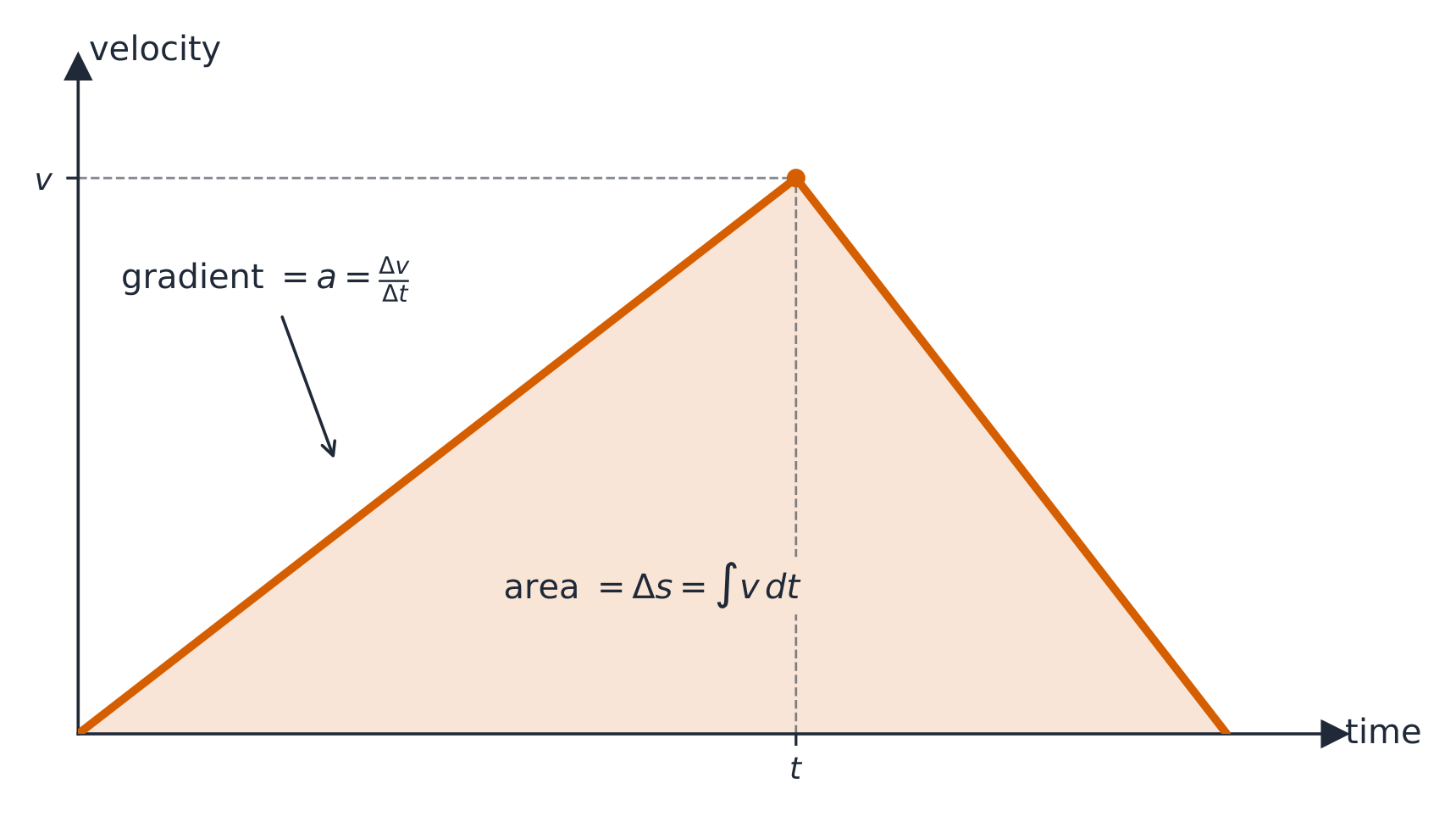
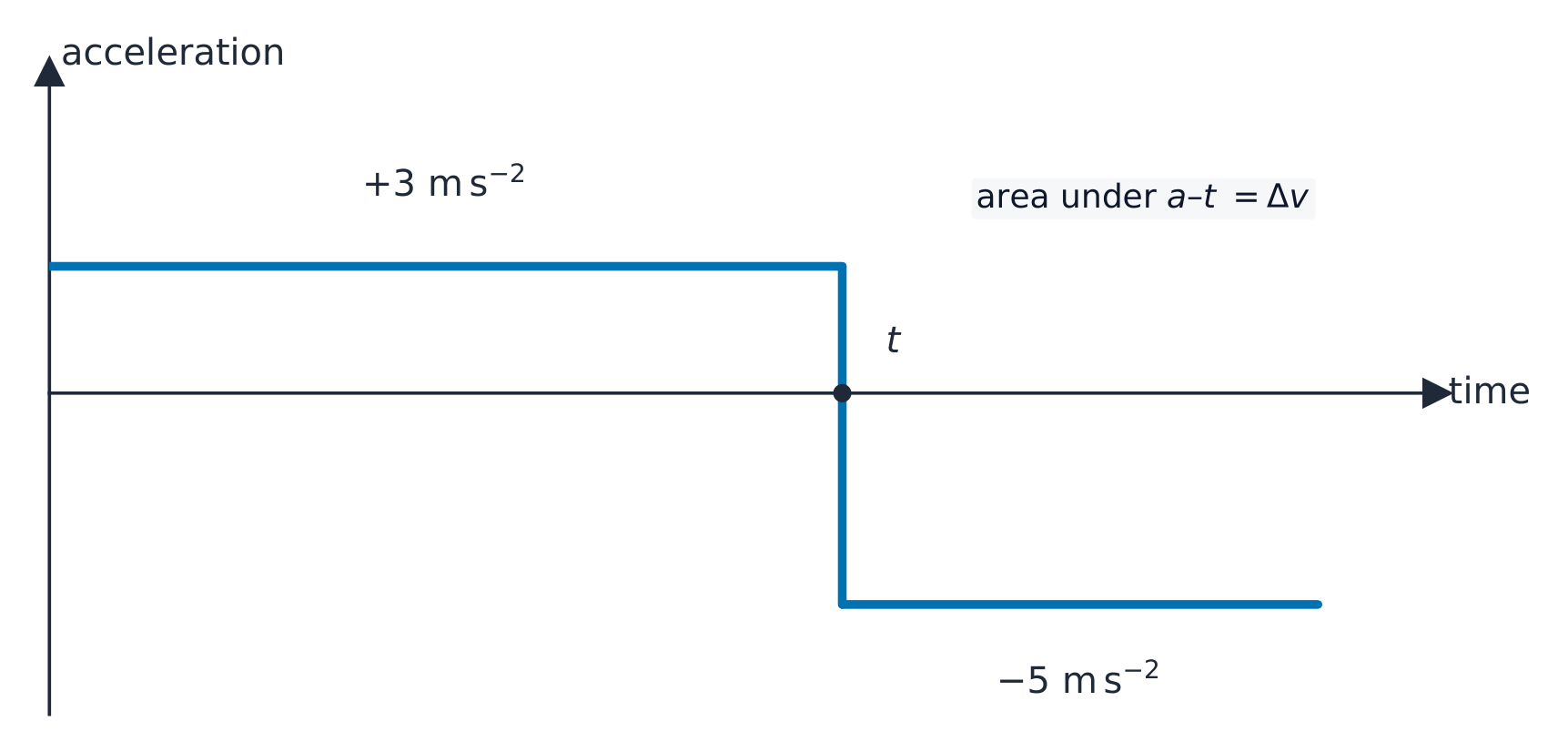
To find the displacement, split the area into triangles and rectangles, or count grid squares. Area of a triangle is $\tfrac{1}{2} \times \text{base} \times \text{height}$; area of a rectangle is $\text{base} \times \text{height}$.
Worked example. The graph shows the velocity of a lift. Find the acceleration in each stage and the total distance travelled.
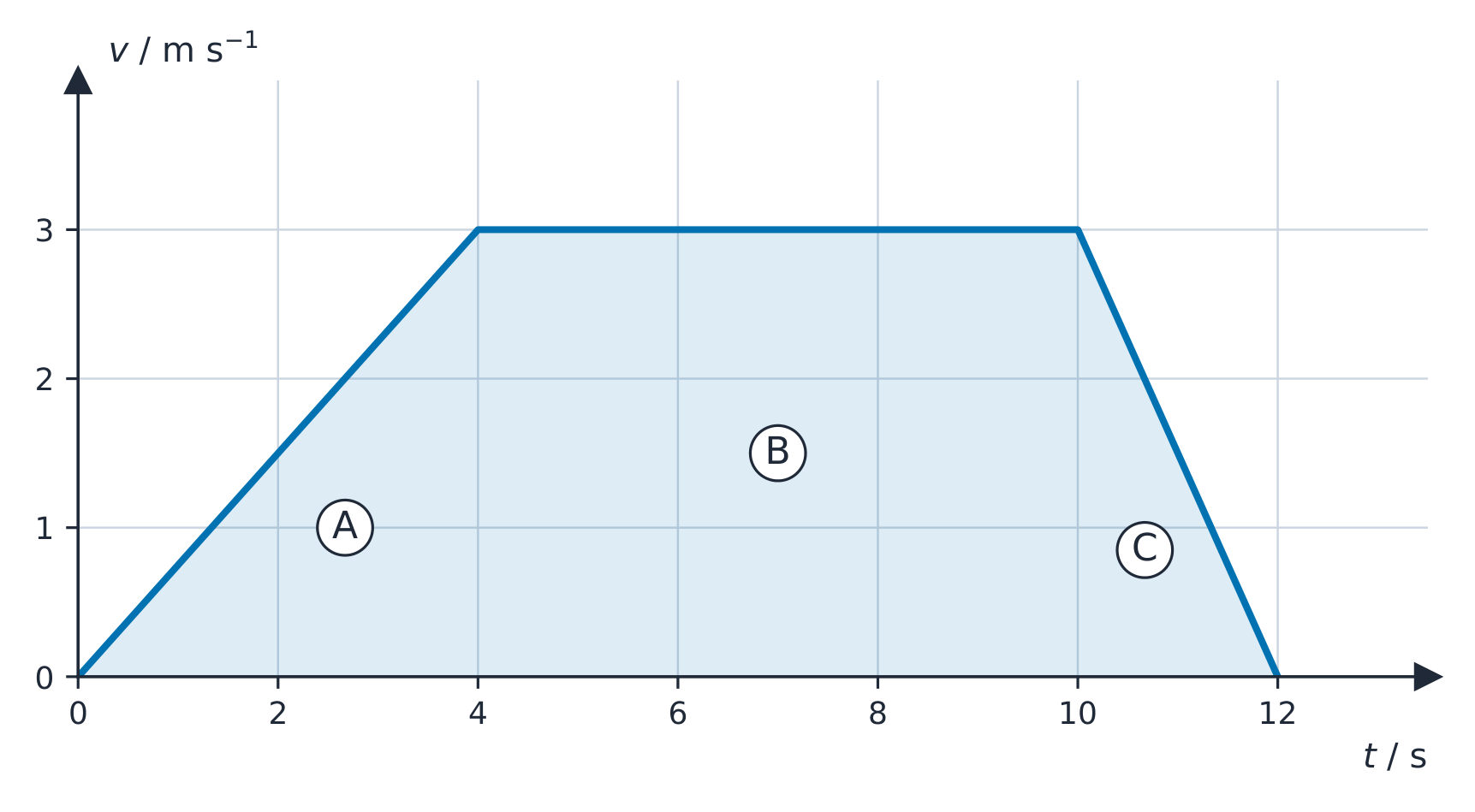
- Stage A: gradient $= \dfrac{3.0 - 0}{4.0} = 0.75\ \text{m s}^{-2}$.
- Stage B: the line is flat, so the acceleration is zero.
- Stage C: gradient $= \dfrac{0 - 3.0}{2.0} = -1.5\ \text{m s}^{-2}$ (a deceleration of $1.5\ \text{m s}^{-2}$).
- Distance: triangle A $= \tfrac{1}{2} \times 4.0 \times 3.0 = 6.0\ \text{m}$, rectangle B $= 6.0 \times 3.0 = 18\ \text{m}$, triangle C $= \tfrac{1}{2} \times 2.0 \times 3.0 = 3.0\ \text{m}$; total $27\ \text{m}$.
When the graph is a curve, the area is still the displacement: count the squares under the curve (half a square or more counts as one) and multiply by the value of one square.
Explore
Reading a velocity–time graph
Change the start velocity u and the acceleration a. The gradient of the line is the acceleration; the area under it is the displacement.
Vocabulary
Train
| English |
|---|
| graphical methods/ˈɡræfɪkl ˈmeθədz/ |
| gradient/ˈɡreɪdɪənt/ |
| tangent/ˈtændʒənt/ |
2.1
The four SUVAT equations
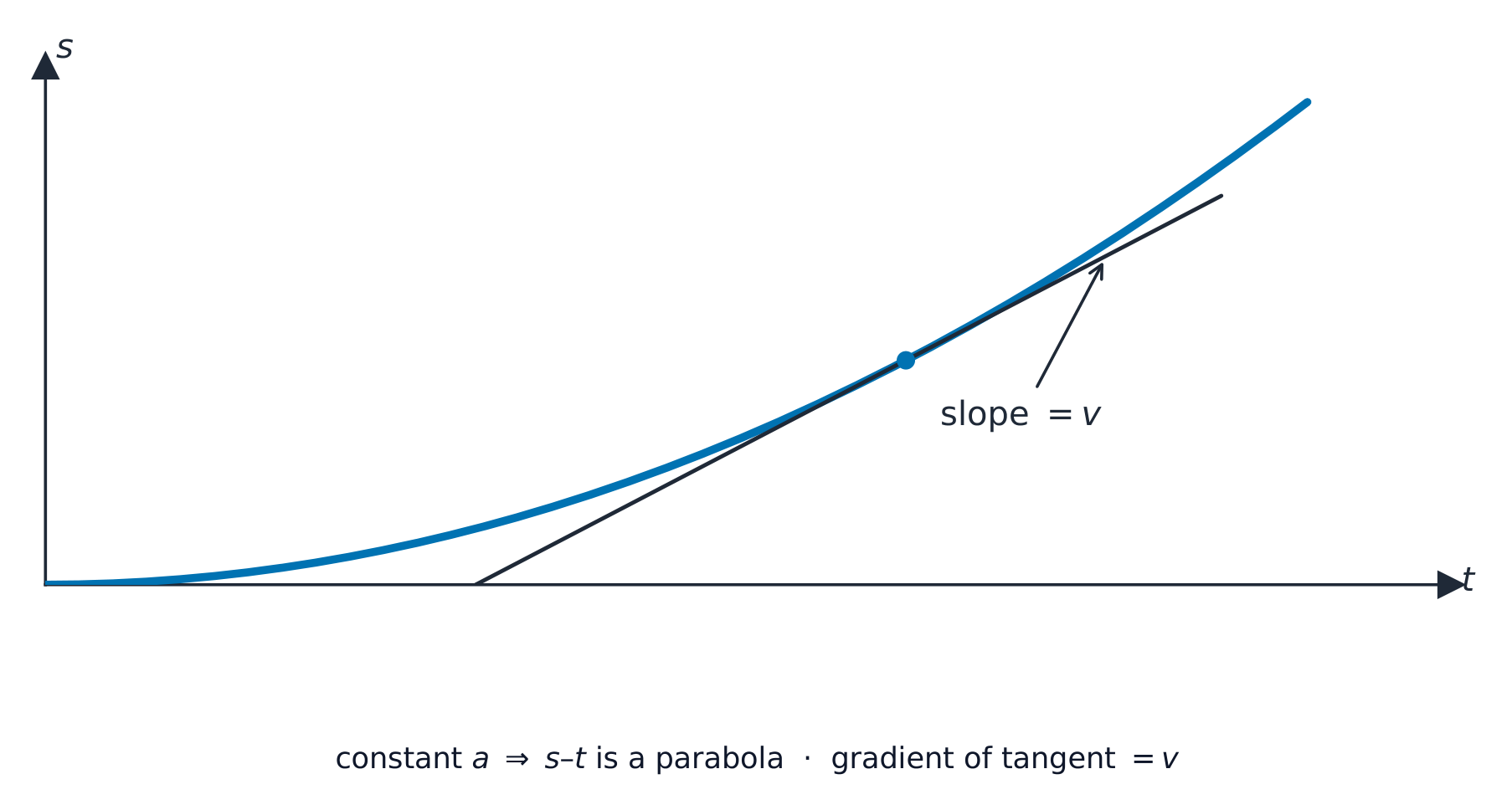
For motion in a straight line with uniform acceleration, we use five symbols: starting velocity $u$, final velocity $v$, acceleration $a$, displacement $s$, and time $t$. Four equations link them:
$$v = u + at$$
$$s = ut + \tfrac{1}{2} a t^{2}$$
$$s = \tfrac{1}{2}(u + v)t$$
$$v^{2} = u^{2} + 2as$$
Each equation uses four of the five symbols. To pick the right one: write down what you know and what you want, then choose the equation with exactly those four.
Worked example. A car accelerates uniformly from $8\ \text{m s}^{-1}$ to $20\ \text{m s}^{-1}$ over a distance of $56\ \text{m}$. Find its acceleration.
We know $u$, $v$ and $s$ and want $a$, so use $v^{2} = u^{2} + 2as$:
$$20^{2} = 8^{2} + 2a(56) \quad\Rightarrow\quad 336 = 112\,a \quad\Rightarrow\quad a = 3.0\ \text{m s}^{-2}.$$
Where the SUVAT equations come from
You should be able to get these from the definitions of velocity and acceleration. Think of the velocity–time graph of the motion: a straight line from $u$ at $t = 0$ to $v$ at time $t$.
- $v = u + at$: acceleration is the gradient, $a = (v - u)/t$, so $v = u + at$.
- $s = \tfrac{1}{2}(u + v) t$: displacement is the area under the line, a trapezium 梯形 with parallel sides $u$ and $v$ and width $t$, so $s = \tfrac{1}{2}(u + v)t$.
- $s = ut + \tfrac{1}{2}at^{2}$: put $v = u + at$ into the area: $s = \tfrac{1}{2}(u + u + at)t = ut + \tfrac{1}{2}at^{2}$.
- $v^{2} = u^{2} + 2as$: from the first equation $t = (v - u)/a$; put this into $s = \tfrac{1}{2}(u + v)t$ to get $2as = (v + u)(v - u) = v^{2} - u^{2}$.
A "derive" question wants exactly these steps, each starting from a definition or an equation already established, with no numbers.
If a question asks "which equation can be found using only the gradient of a velocity–time graph?", the answer is $v = u + at$ (the gradient is the acceleration).
"Show that" questions. When the question gives the answer ("show that the height is 3.2 km"), the marks are for the method. State the equation, substitute every value with its unit, and give the result to one more significant figure than the value quoted ($3.24\ \text{km}$, which rounds to $3.2\ \text{km}$). Reaching the quoted value proves nothing on its own.
Choosing a positive direction
Pick a positive direction at the start and keep it. Anything pointing the other way gets a minus sign. For a ball thrown straight up, if "up" is positive: $u$ is positive, $a = -g$ (gravity 重力 pulls down), and at the highest point the displacement is positive but the velocity is zero.
Vocabulary
Train
| English |
|---|
| trapezium/trəˈpiːzɪəm/ |
| gravity/ˈɡrævɪti/ |
2.1
Free fall under gravity

When air resistance 空气阻力 can be ignored, an object in free fall 自由落体 has a constant acceleration $g \approx 9.81\ \text{m s}^{-2}$ downwards. This is the same for every mass.
For a ball dropped from rest and falling a distance $h$:
$$h = \tfrac{1}{2}gt^{2}, \qquad v = gt, \qquad v^{2} = 2gh.$$
For a ball thrown straight up with speed $u$:
- greatest height: put $v = 0$ in $v^{2} = u^{2} - 2gh$, giving $h = u^{2}/(2g)$.
- time to reach the top: put $v = 0$ in $v = u - gt$, giving $t = u/g$.
- total time to fall back to the start height: $2u/g$ (the motion is symmetric 对称).
Worked example. A ball is thrown straight up at $20\ \text{m s}^{-1}$. Find the greatest height it reaches (take $g = 9.81\ \text{m s}^{-2}$).
At the highest point $v = 0$, so from $h = u^{2}/(2g)$:
$$h = \frac{20^{2}}{2 \times 9.81} = \frac{400}{19.62} \approx 20.4\ \text{m}.$$
When air resistance is not negligible
The equations above assume the only force is the weight. With air resistance, the resultant force on a falling object is smaller than its weight, so the acceleration is less than $g$; and because air resistance grows with speed, the acceleration keeps decreasing as the object speeds up. On a velocity–time graph the line curves, its gradient falling towards zero as the object approaches terminal velocity 收尾速度 (topic 3). For a projectile, air resistance shortens the range and lowers the maximum height, and the path is no longer a symmetrical parabola 抛物线: the object comes down more steeply than it went up. A "state and explain" question wants the force first, then its effect on the acceleration, then the effect on the motion.
Experiment to find $g$
A common method: drop an object from rest, then measure the distance $h$ it falls and the time $t$ it takes. Then
$$g = \frac{2h}{t^{2}}.$$
Repeat for several heights and plot $h$ against $t^{2}$. The gradient of the best straight line is $g/2$, so $g$ is twice the gradient. Repeating reduces random error 随机误差. An electronic timer — using light gates 光电门, or a switch the ball hits — removes reaction-time 反应时间 error.
Vocabulary
Train
| English |
|---|
| free fall/friː fɔːl/ |
| air resistance/eə rɪˈzɪstəns/ |
| parabola/pəˈræbələ/ |
| symmetric/sɪˈmetrɪk/ |
| terminal velocity/ˈtɜːmɪnl vəˈlɒsɪti/ |
| random error/ˈrændəm ˈerə/ |
| light gate/laɪt ɡeɪt/ |
| reaction-time/rɪˈækʃn taɪm/ |
2.1
Motion in two directions

When an object moves at constant velocity in one direction (say horizontal 水平) and speeds up in a direction at right angles to it (say vertical 竖直, under gravity), the two motions do not affect each other. Treat each direction on its own, with its own SUVAT equation.
Horizontal throw
An object thrown horizontally with speed $u_{\text{H}}$ from height $h$, with air resistance ignored:
- horizontal: constant velocity $u_{\text{H}}$. After time $t$, the horizontal distance is $x = u_{\text{H}} t$.
- vertical: starts from rest and speeds up downwards at $g$. After time $t$, it has fallen $y = \tfrac{1}{2} g t^{2}$ and has vertical velocity $v_{\text{V}} = g t$.
The time to reach the ground depends only on the height $h$, not on $u_{\text{H}}$. Solve $h = \tfrac{1}{2} g t^{2}$ for $t$; then the horizontal range 射程 is $u_{\text{H}} t$.
Worked example. A ball is thrown horizontally at $15\ \text{m s}^{-1}$ from the top of a cliff $20\ \text{m}$ high. Find the time it takes to land and how far from the base it lands (take $g = 9.81\ \text{m s}^{-2}$).
Vertical motion gives the time: from $h = \tfrac{1}{2}g t^{2}$,
$$t = \sqrt{\frac{2h}{g}} = \sqrt{\frac{2 \times 20}{9.81}} \approx 2.0\ \text{s}.$$
Horizontal motion then gives the range: $x = u_{\text{H}} t = 15 \times 2.0 \approx 30\ \text{m}.$
The horizontal-velocity graph is a flat line at $u_{\text{H}}$. The vertical-velocity graph is a straight line from the origin with gradient $g$.
Comparing two objects. If object A is dropped and object B is thrown horizontally from the same height at the same moment, both reach the ground at the same time: their vertical motions are identical. If instead B is thrown with an upward component, it takes longer, because it must first rise and come back to the start height before it falls the same distance. Its speed on landing is still found from energy: the kinetic energy gained equals the potential energy lost, whatever the direction of the throw, so a ball launched at any angle with the same speed from the same height lands at the same speed (topic 5).
Projectile at an angle
A projectile 抛体 thrown at speed $u$ at angle $\theta$ above the horizontal:
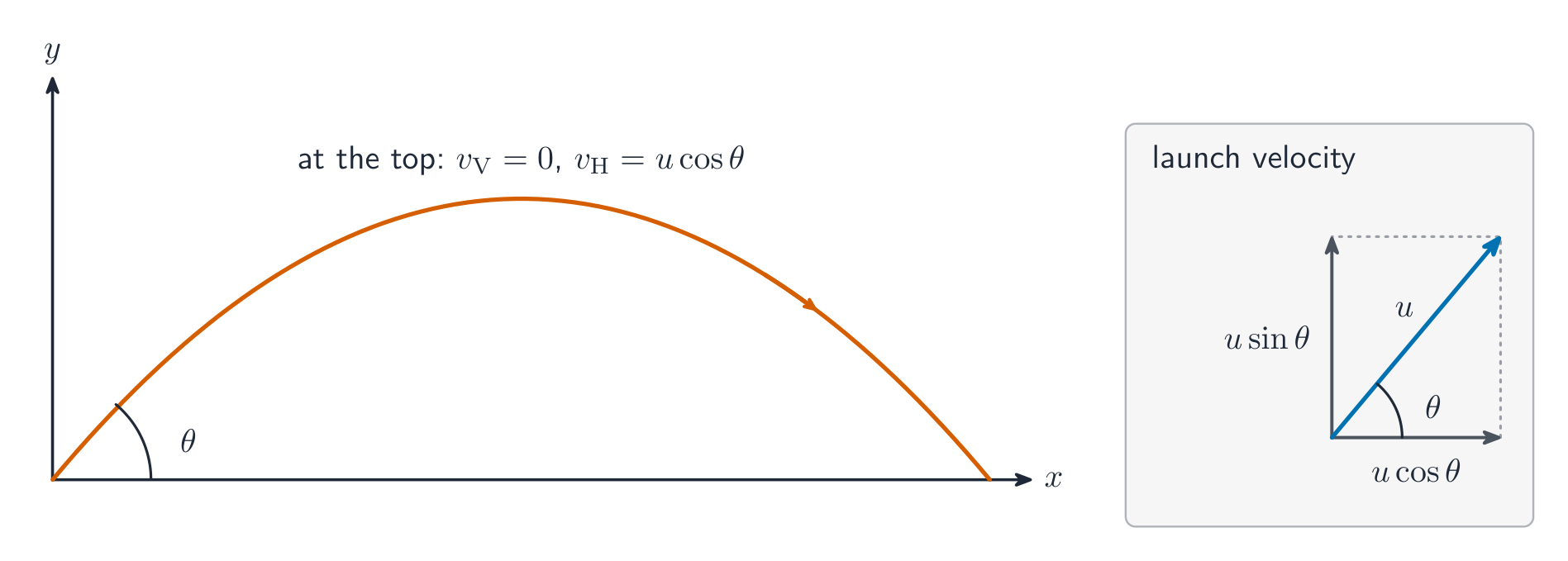
- horizontal component 分量 of the starting velocity: $u_{\text{H}} = u \cos\theta$ (stays constant during the flight).
- vertical component of the starting velocity: $u_{\text{V}} = u \sin\theta$ (gets smaller, becomes zero at the top, then grows downwards).
At the highest point, $v_{\text{V}} = 0$, but $v_{\text{H}}$ is still $u\cos\theta$. The time to the top is $t_{\text{up}} = u\sin\theta / g$; the total flight time (back to the start height) is $2t_{\text{up}}$.
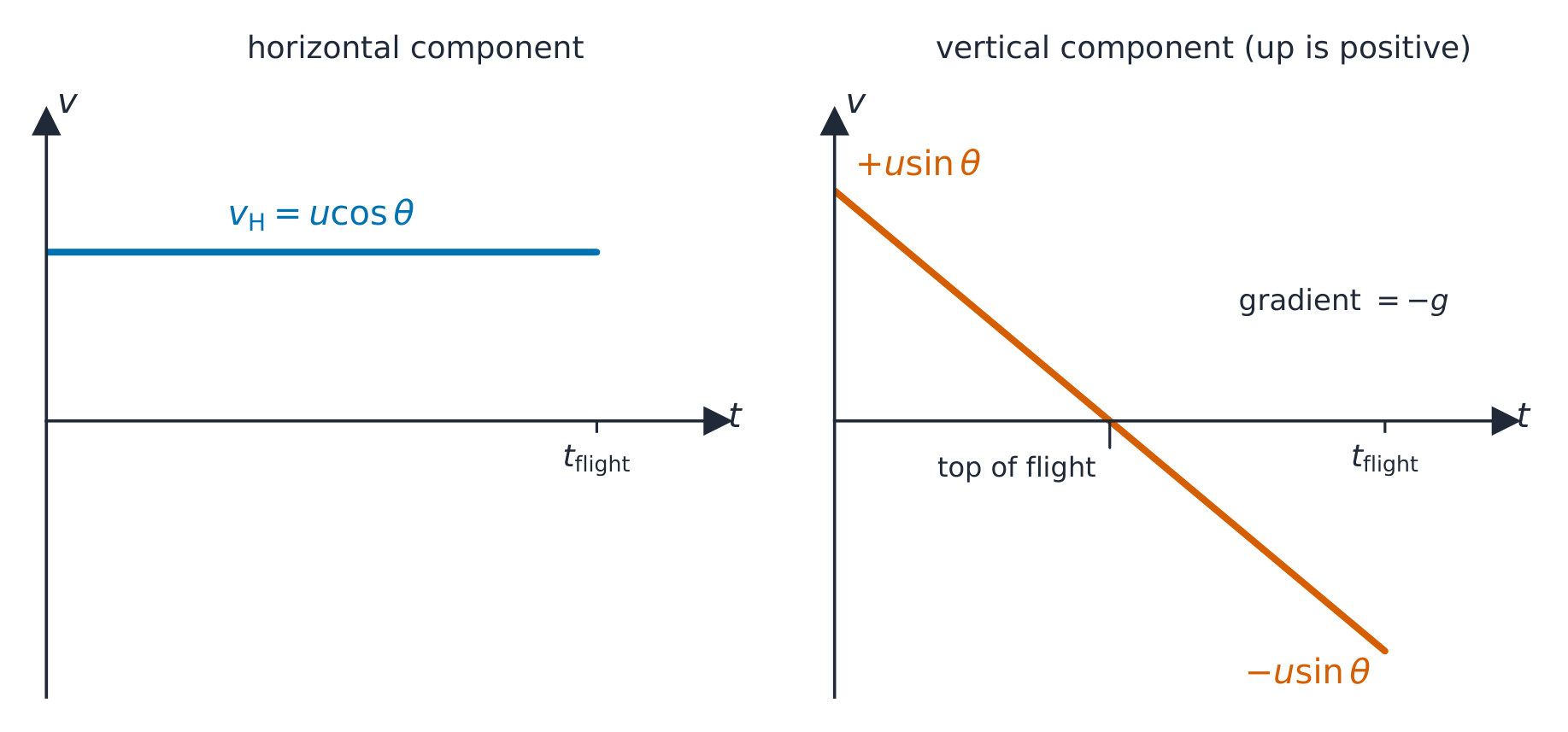
Sketching the velocity graphs. Examiners often ask you to sketch $v_{\text{H}}$ and $v_{\text{V}}$ against time on the same axes, taking upwards as positive. The horizontal component is a flat line at $u\cos\theta$ for the whole flight. The vertical component is a straight line of gradient $-g$: it starts at $+u\sin\theta$, crosses zero at the top of the flight, and reaches $-u\sin\theta$ on landing at the start height. Label each line, mark the times where the lines start and stop, and make the crossing sit exactly at $t_{\text{up}}$.
Worked example. A ball leaves the ground at $18\ \text{m s}^{-1}$ at $60°$ to the horizontal. Show that it reaches its maximum height at $t = 1.6\ \text{s}$.
$u_{\text{V}} = 18 \sin 60° = 15.6\ \text{m s}^{-1}$. At the top $v_{\text{V}} = 0$, so from $v = u + at$ with $a = -9.81\ \text{m s}^{-2}$: $t = 15.6 / 9.81 = 1.59\ \text{s} \approx 1.6\ \text{s}$.

Bouncing ball
When a ball bounces, its velocity–time graph is a set of straight sloping lines (constant $g$) with a sudden jump at each bounce (the velocity flips direction, and gets smaller if some energy 能量 is lost). Add up the times and the distances across the bounces.
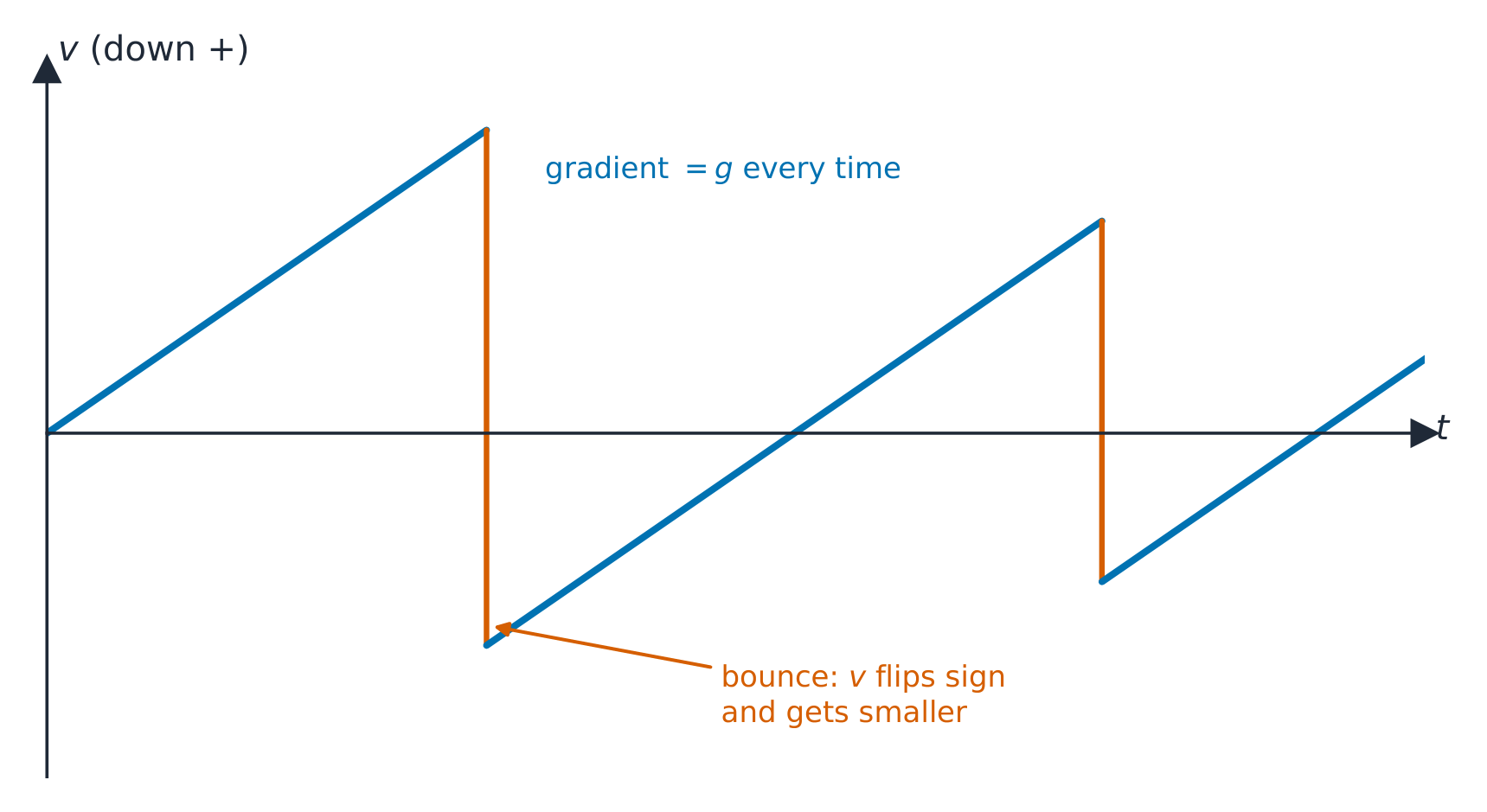
Read such a graph carefully: the gradient of every sloping line is the same $g$; the ball is at its highest point wherever the line crosses the time axis; and the height of each bounce comes from the area of the triangle above (or below) the axis for that flight.
Explore
Launch a projectile
Fire the ball, then change the angle and speed. The horizontal motion is steady while gravity pulls it down — together they trace a parabola. Find the angle for the longest range, and try the Moon.
Vocabulary
Train
| English |
|---|
| projectile/prəˈdʒektaɪl/ |
| range/reɪndʒ/ |
| horizontal/ˌhɒrɪˈzɒntl/ |
| vertical/ˈvɜːtɪkl/ |
| component/kəmˈpəʊnənt/ |
| energy/ˈenədʒi/ |
2.1
Two objects meeting
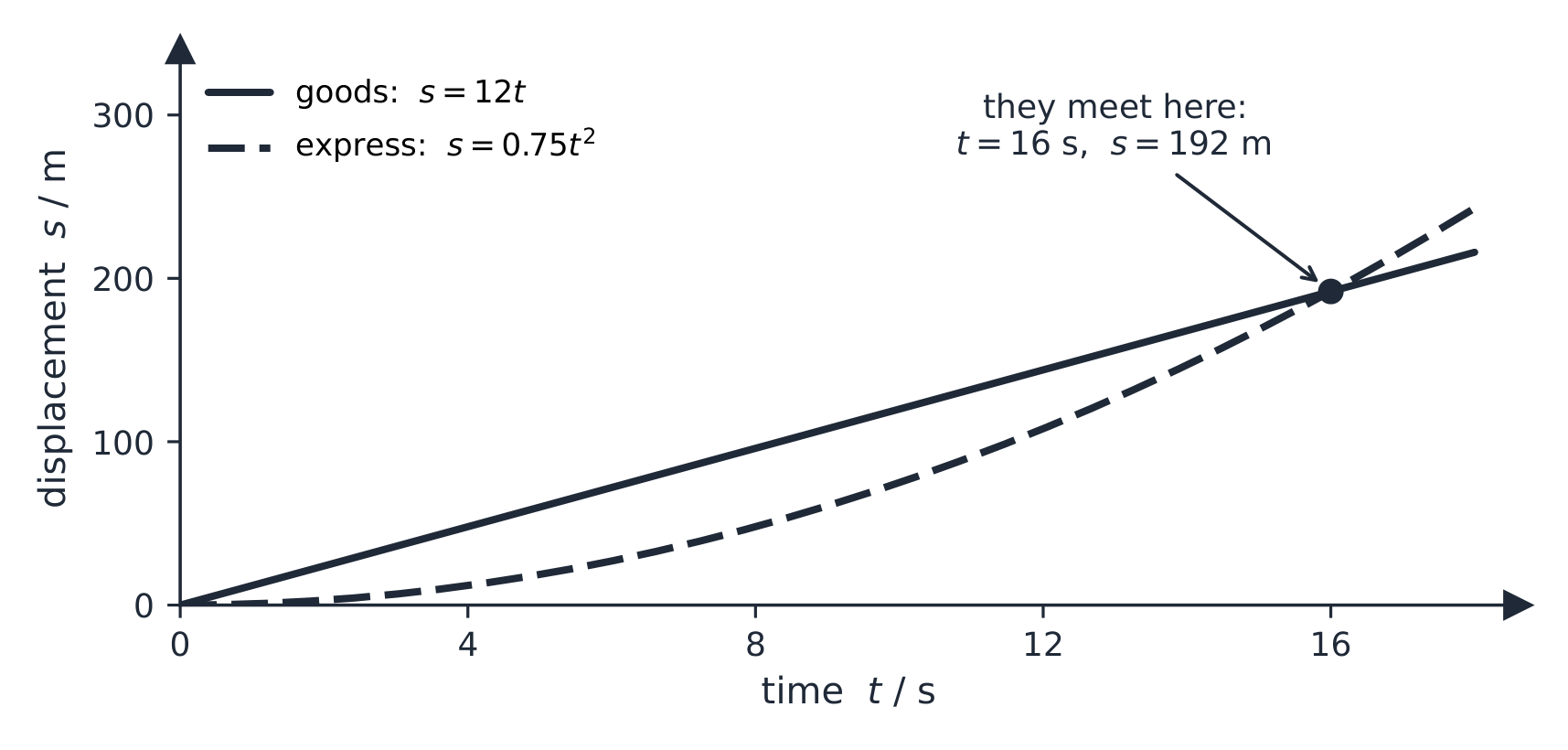
When two objects move along the same line in different ways, write a displacement equation for each. Use the same start time and the same positive direction. Then set the two displacements equal (or set their difference to a given gap).
For a goods train at constant velocity $u_{\text{G}}$ and an express train starting from rest with acceleration $a$, both passing the same point at $t = 0$:
$$s_{\text{G}} = u_{\text{G}} t, \qquad s_{\text{E}} = \tfrac{1}{2} a t^{2}.$$
They are level again when $s_{\text{G}} = s_{\text{E}}$, giving $t = 2 u_{\text{G}} / a$.
2.1
Tips for solving problems
- Draw a diagram and mark the positive direction.
- List the SUVAT symbols with their known and unknown values, including signs.
- Choose the SUVAT equation with exactly the four symbols you have, plus the one you want.
- For projectile motion, split into horizontal and vertical SUVAT problems, linked only by the time $t$.
- Always check the units of your answer, and that its size is sensible.
2.1
Definitions the examiner accepts
A definition question is marked against fixed wording. Learn these exactly, and give one answer only.
| Term | Definition |
|---|---|
| distance | the total length of the path travelled (a scalar) |
| displacement | the distance moved in a stated direction, from start to finish (a vector) |
| speed | the rate of change of distance with time |
| velocity | the rate of change of displacement with time |
| acceleration | the rate of change of velocity with time |
| uniform acceleration | acceleration that is constant in magnitude and direction |
| acceleration of free fall | the acceleration of an object falling freely under gravity alone, with air resistance negligible |
2.1
Exam tips
- Use the SUVAT equations only for constant acceleration; list $s, u, v, a, t$ and pick the equation missing your unknown.
- Choose one direction as positive and keep signs consistent (usually $g = -9.81\ \text{m s}^{-2}$).
- On a velocity-time graph, gradient $=$ acceleration and area $=$ displacement.
- For projectiles, treat horizontal (constant velocity) and vertical ($a = g$) motion separately, linked by the same time.
Common mistakes
- Saying the heavier ball hits the ground first, or faster, when air resistance is ignored. Both fall with the same acceleration and land at the same speed.
- Taking the gradient of a $v$–$t$ graph when the question wants the area, or the area when it wants the gradient. Gradient is acceleration; area is displacement.
- Drawing a curve on a $v$–$t$ graph for a body under constant acceleration. Constant acceleration is a straight line; only the sign of $v$ changes at a bounce.
- Using $g = +9.81$ for a ball thrown upwards with "up" as positive. Once up is positive, $a = -9.81\ \text{m s}^{-2}$ for the whole flight, on the way down too.
- Using a SUVAT equation when the acceleration is changing (air resistance, a curved graph). Then only the graph methods work.
Interactive lessons on this topic
Work through it step by step, with instant-check exercises.