- understand that all physical quantities consist of a numerical magnitude and a unit
- make reasonable estimates of physical quantities included within the syllabus
Physical quantities and units
A-Level Physics · Topic 1
 22:04
22:04
Physical Quantities & Units
In 1999, a spacecraft reached Mars after a journey of ten months. It had cost over three hundred million dollars. But as it arrived, it was lost forever. The…
English narration · English + 中文 subtitles burned in
1.1
Physical quantities
Syllabus
Source: Cambridge International syllabus
A physical quantity 物理量 has two parts: a number (its magnitude 大小) and a unit 单位. The number on its own tells you nothing. You must also say what is measured and in which unit.
Example: "the length is 1.5" is not complete. "The length is 1.5 m" is a physical quantity.
Making estimates
You should be able to estimate 估算 the size of the physical quantities in this syllabus. Paper 1 usually opens with a question like this. Learn these rough values:
- mass 质量 of an adult human: $\sim 70\ \text{kg}$; of a car: $\sim 1000\ \text{kg}$; of an apple: $\sim 0.1\ \text{kg}$
- weight 重力 of an adult human: $\sim 700\ \text{N}$; of an apple: $\sim 1\ \text{N}$
- height of an adult human: $\sim 1.7\ \text{m}$; height of a room: $\sim 3\ \text{m}$
- walking speed: $\sim 1.5\ \text{m s}^{-1}$; a car on a fast road: $\sim 30\ \text{m s}^{-1}$
- speed of sound in air: $\sim 340\ \text{m s}^{-1}$; speed of light in a vacuum 真空: $3.0 \times 10^{8}\ \text{m s}^{-1}$
- acceleration 加速度 of free fall 自由落体: $g \approx 9.81\ \text{m s}^{-2}$
- density 密度 of water: $1000\ \text{kg m}^{-3}$; of air: $\sim 1.2\ \text{kg m}^{-3}$; of steel: $\sim 8000\ \text{kg m}^{-3}$
- atmospheric pressure 大气压强: $\sim 1.0 \times 10^{5}\ \text{Pa}$
- room temperature: $\sim 20\ ^{\circ}\text{C} \approx 293\ \text{K}$
- power of a kettle: $\sim 2\ \text{kW}$; of a person climbing stairs: $\sim 300\ \text{W}$
- wavelength of visible light: $\sim 5 \times 10^{-7}\ \text{m}$; diameter of an atom: $\sim 10^{-10}\ \text{m}$; of a nucleus: $\sim 10^{-15}\ \text{m}$
A good estimate has the right order of magnitude 数量级 (the right power of ten). For a human, 70 kg is a good guess; 7 kg is not.
To estimate a quantity that is not in the list, build it from ones that are. The kinetic energy of a moving car is $\tfrac{1}{2}mv^{2} \approx \tfrac{1}{2} \times 1000 \times 30^{2} \approx 5 \times 10^{5}\ \text{J}$. The pressure under a standing person is $700\ \text{N} / 0.02\ \text{m}^{2} \approx 4 \times 10^{4}\ \text{Pa}$. Always check that the power of ten looks sensible before you move on.
Vocabulary
Train
| English |
|---|
| physical quantity/ˈfɪzɪkl ˈkwɒntɪti/ |
| magnitude/ˈmæɡnɪtjuːd/ |
| unit/ˈjuːnɪt/ |
| estimate/ˈestɪmət/ |
| mass/mæs/ |
| weight/weɪt/ |
| vacuum/ˈvækjuːm/ |
| acceleration/əkˌseləˈreɪʃn/ |
| free fall/friː fɔːl/ |
| density/ˈdensɪti/ |
| atmospheric pressure/ˌætməsˈferɪk ˈpreʃə/ |
| order of magnitude/ˈɔːdə ɒv ˈmæɡnɪtjuːd/ |
1.2
SI units 国际单位制

Syllabus
- recall the following SI base quantities and their units: mass (kg), length (m), time (s), current (A), temperature (K)
- express derived units as products or quotients of the SI base units and use the derived units for quantities listed in this syllabus as appropriate
- use SI base units to check the homogeneity of physical equations
- recall and use the following prefixes and their symbols to indicate decimal submultiples or multiples of both base and derived units: pico (p), nano (n), micro (\mu), milli (m), centi (c), deci (d), kilo (k), mega (M), giga (G), tera (T)
Source: Cambridge International syllabus
Base units
The SI system has seven base quantities 基本量; five of them are used in this topic. You must know these five and their units:
- mass — kilogram, $\text{kg}$
- length 长度 — metre, $\text{m}$
- time — second, $\text{s}$
- current 电流 — ampere 安培, $\text{A}$
- temperature 温度 — kelvin 开尔文, $\text{K}$
Every other unit in this syllabus is built from these five.
Derived units
A derived unit 导出单位 is made by multiplying or dividing base units. You should be able to write any quantity in this syllabus in base units.
Build a derived unit from the equation that defines it:
- speed 速率 = distance / time, so its unit is $\text{m s}^{-1}$
- acceleration = change in velocity 速度 / time, so its unit is $\text{m s}^{-2}$
- force 力 = mass × acceleration, so its unit is $\text{kg m s}^{-2}$. The newton 牛顿 is $1\ \text{N} = 1\ \text{kg m s}^{-2}$.
- work 功 and energy 能量 = force × distance, so the unit is $\text{kg m}^{2}\ \text{s}^{-2}$. The joule 焦耳 is $1\ \text{J} = 1\ \text{kg m}^{2}\ \text{s}^{-2}$.
- power 功率 = energy / time, so the unit is $\text{kg m}^{2}\ \text{s}^{-3}$. The watt 瓦特 is $1\ \text{W} = 1\ \text{kg m}^{2}\ \text{s}^{-3}$.
- pressure 压强 and stress 应力 = force / area, so the unit is $\text{kg m}^{-1}\ \text{s}^{-2}$. The pascal 帕斯卡 is $1\ \text{Pa} = 1\ \text{kg m}^{-1}\ \text{s}^{-2}$.
When a question asks for the SI base units of a quantity, replace each named unit with its base units, then simplify. Example: the SI base units of the watt are $\text{kg m}^{2}\ \text{s}^{-3}$.
Checking that the units match
An equation is homogeneous 量纲一致 when both sides have the same base units. In plain words: the units on both sides match.
Write each side in base units and compare. Take the equation $v^{2} = u^{2} + 2as$:
- left side: $(\text{m s}^{-1})^{2} = \text{m}^{2}\ \text{s}^{-2}$
- right side, first term: $(\text{m s}^{-1})^{2} = \text{m}^{2}\ \text{s}^{-2}$
- right side, second term: $\text{m s}^{-2} \cdot \text{m} = \text{m}^{2}\ \text{s}^{-2}$
Both sides give $\text{m}^{2}\ \text{s}^{-2}$, so the units match.
Be careful: matching units do not prove the whole equation is correct. It could still have a wrong number, or a missing factor of 2. But if the units do not match, the equation is wrong for sure.
Worked example. The drag force on a falling ball is given by $F = kv^{2}$, where $v$ is the speed. Find the SI base units of the constant $k$.
Rearrange: $k = F / v^{2}$. In base units, $F$ is $\text{kg m s}^{-2}$ and $v^{2}$ is $\text{m}^{2}\ \text{s}^{-2}$, so
$$k:\ \frac{\text{kg m s}^{-2}}{\text{m}^{2}\ \text{s}^{-2}} = \text{kg m}^{-1}.$$
A multiple-choice question often asks "which equation could be correct?". Check the base units of each option; only a homogeneous equation can be correct. A pure number (like 2, $\pi$ or $\tfrac{1}{2}$) has no unit, so it never changes the check.
Prefixes
A prefix 词头 is a letter put in front of a unit to make it bigger or smaller by powers of ten. You must know these:
| Prefix | Symbol | Factor |
|---|---|---|
| tera | T | $10^{12}$ |
| giga | G | $10^{9}$ |
| mega | M | $10^{6}$ |
| kilo | k | $10^{3}$ |
| deci | d | $10^{-1}$ |
| centi | c | $10^{-2}$ |
| milli | m | $10^{-3}$ |
| micro | $\mu$ | $10^{-6}$ |
| nano | n | $10^{-9}$ |
| pico | p | $10^{-12}$ |
To change a prefixed unit into base units, replace the prefix with its factor, then simplify. Example: change $0.25\ \text{kN mm}^{-2}$ into $\text{N m}^{-2}$:
$$0.25\ \text{kN mm}^{-2} = 0.25 \times \frac{10^{3}\ \text{N}}{(10^{-3}\ \text{m})^{2}} = 0.25 \times \frac{10^{3}}{10^{-6}}\ \text{N m}^{-2} = 2.5 \times 10^{8}\ \text{N m}^{-2}.$$
Take special care with squared units like $\text{mm}^{2}$: you must square the factor too.
Explore
Base or derived?
Only seven quantities are base quantities. Everything else is built from them, and its unit can be written in base units.
Vocabulary
Train
| English |
|---|
| length/leŋθ/ |
| speed/spiːd/ |
| pressure/ˈpreʃə/ |
| temperature/ˈtemprɪtʃə/ |
| power/ˈpaʊə/ |
| energy/ˈenədʒi/ |
| SI units/ˌes ˈaɪ ˈjuːnɪts/ |
| base quantity/beɪs ˈkwɒntɪti/ |
| current/ˈkʌrənt/ |
| ampere/ˈæmpeə/ |
| kelvin/ˈkelvɪn/ |
| derived unit/dɪˈraɪvd ˈjuːnɪt/ |
| velocity/vəˈlɒsɪti/ |
| force/fɔːs/ |
| newton/ˈnjuːtn/ |
| work/wɜːk/ |
| joule/dʒuːl/ |
| watt/wɒt/ |
| stress/stres/ |
| pascal/ˈpæskl/ |
| homogeneous/ˌhɒməˈdʒiːniəs/ |
| prefix/ˈpriːfɪks/ |
1.3
Errors and uncertainties

Syllabus
- understand and explain the effects of systematic errors (including zero errors) and random errors in measurements
- understand the distinction between precision and accuracy
- assess the uncertainty in a derived quantity by simple addition of absolute or percentage uncertainties
Source: Cambridge International syllabus
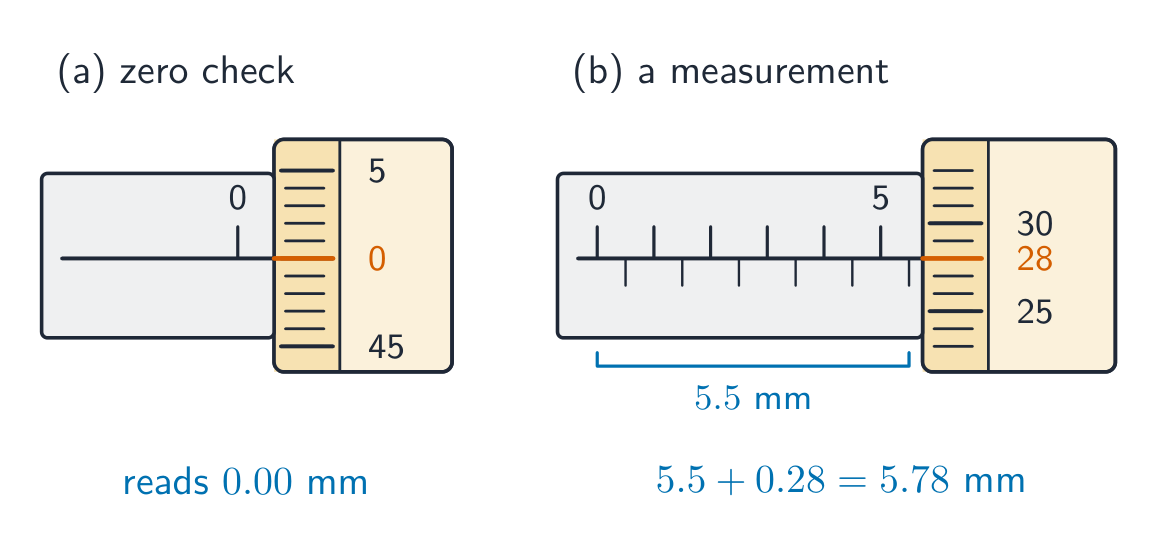
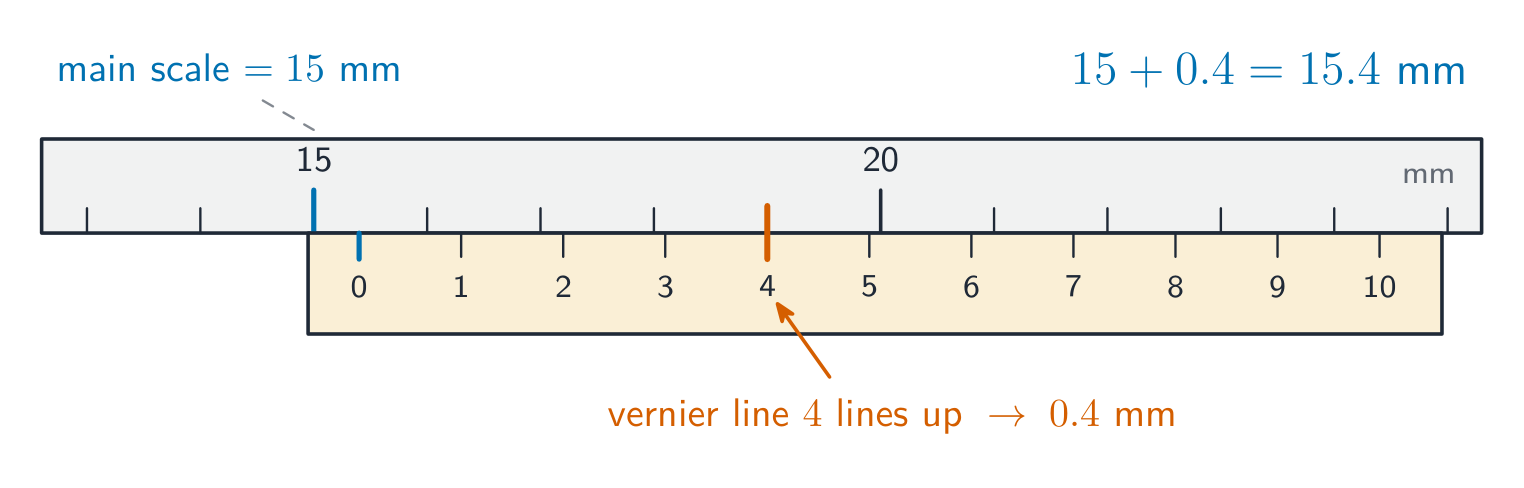
Every measurement 测量 has some uncertainty 不确定度 — we are never fully sure of the value. A good experimenter knows where the uncertainty comes from, makes a fair estimate of it, and carries it through to the final answer.



Systematic and random errors
A systematic error 系统误差 changes every reading by the same amount, in the same direction. You cannot find it by repeating the measurement. Common causes:
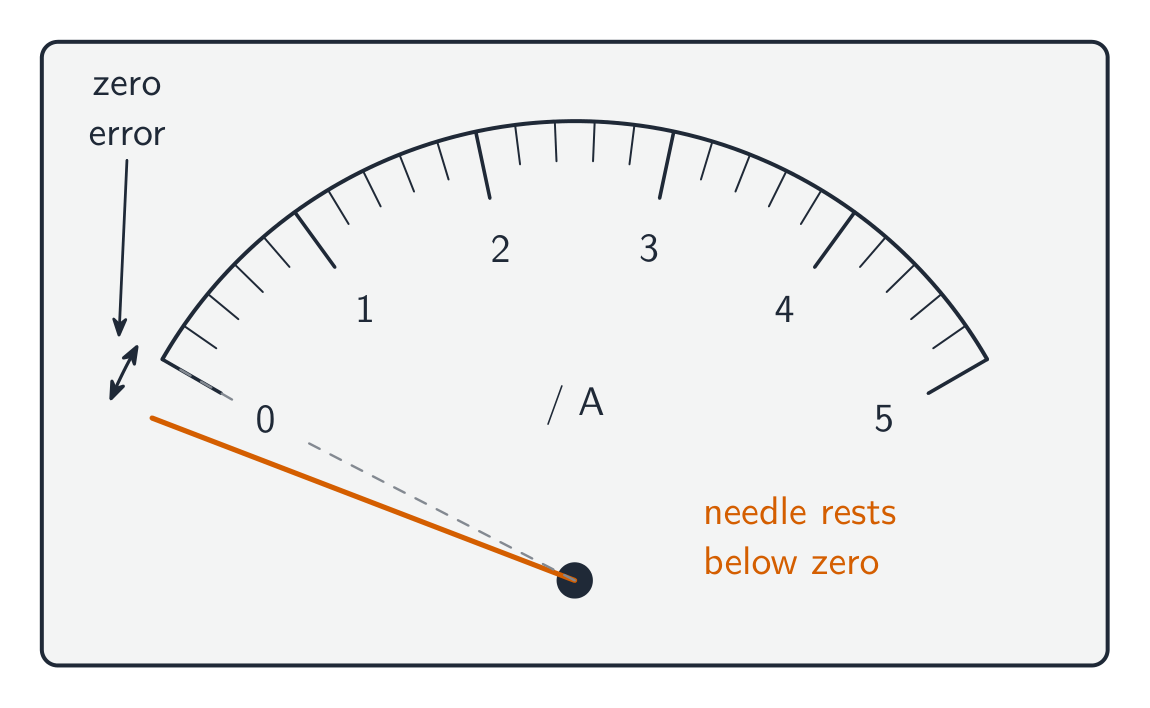
- a zero error 零点误差 (the scale does not read zero when the true value is zero)
- a calibration 校准 error (the scale itself is wrong)
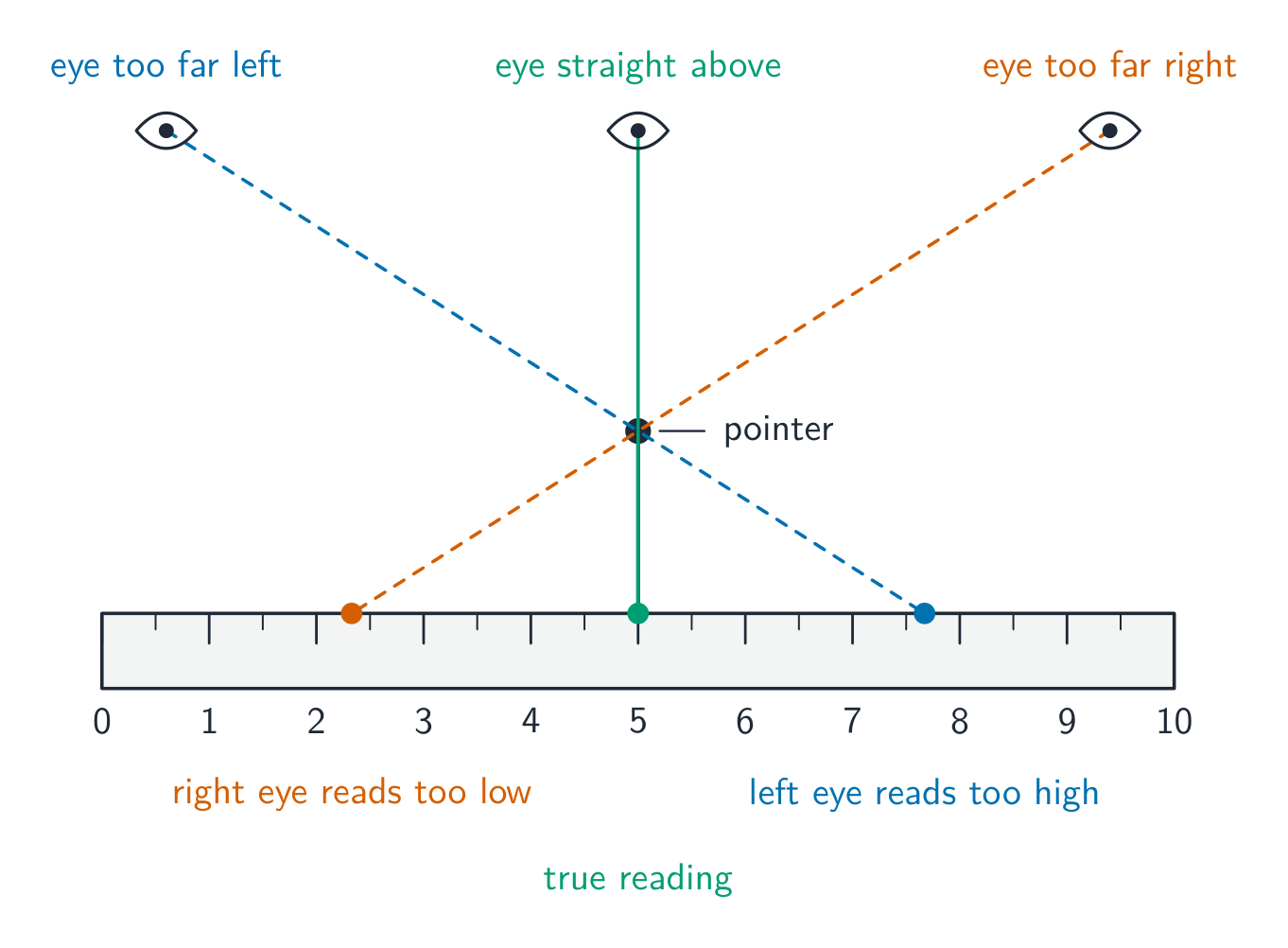
- parallax 视差 (your eye is always to one side of the scale)
A systematic error makes the accuracy 准确度 worse, but it does not change the precision 精密度.
A random error 随机误差 makes readings jump above and below the true value, with no pattern. Causes include how carefully you read the scale, changing conditions, and the smallest step the instrument 仪器 can show. If you repeat the measurement many times and take the mean 平均值 (the average), random errors partly cancel out.
A random error makes the precision worse. But with enough repeats, the mean can still be accurate.
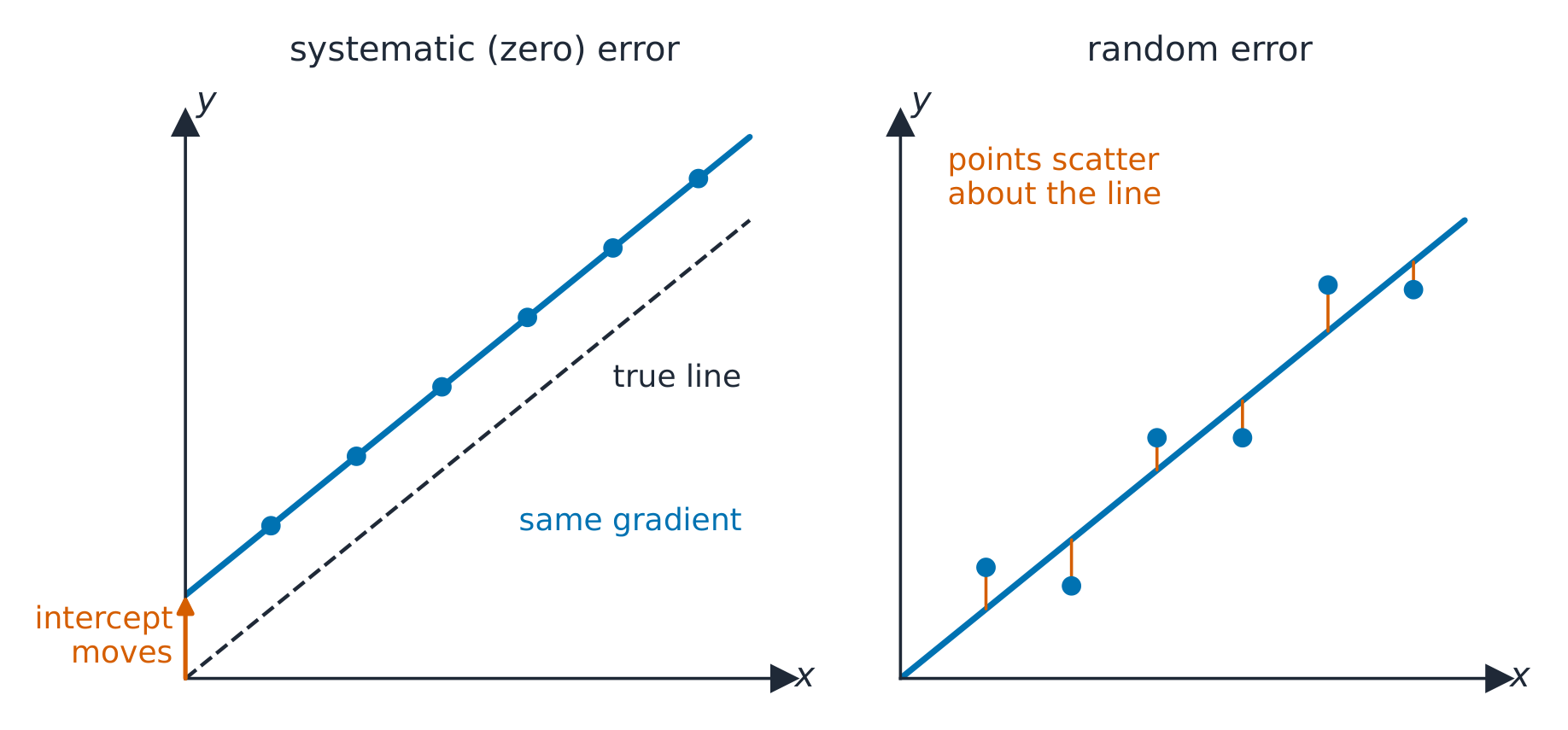
On a graph the two errors look different. A systematic error moves every point by the same amount, so the line of best fit keeps its gradient but no longer passes through the origin: the intercept 截距 changes. Random errors scatter the points above and below the line; a best-fit line drawn through the middle of the scatter still gives a reliable gradient.
| Error | How to reduce it |
|---|---|
| systematic | check for a zero error and subtract it; calibrate the instrument against a known standard; read the scale from directly in front |
| random | repeat the reading and take the mean; use an instrument with smaller divisions; time many oscillations instead of one |
Precision and accuracy
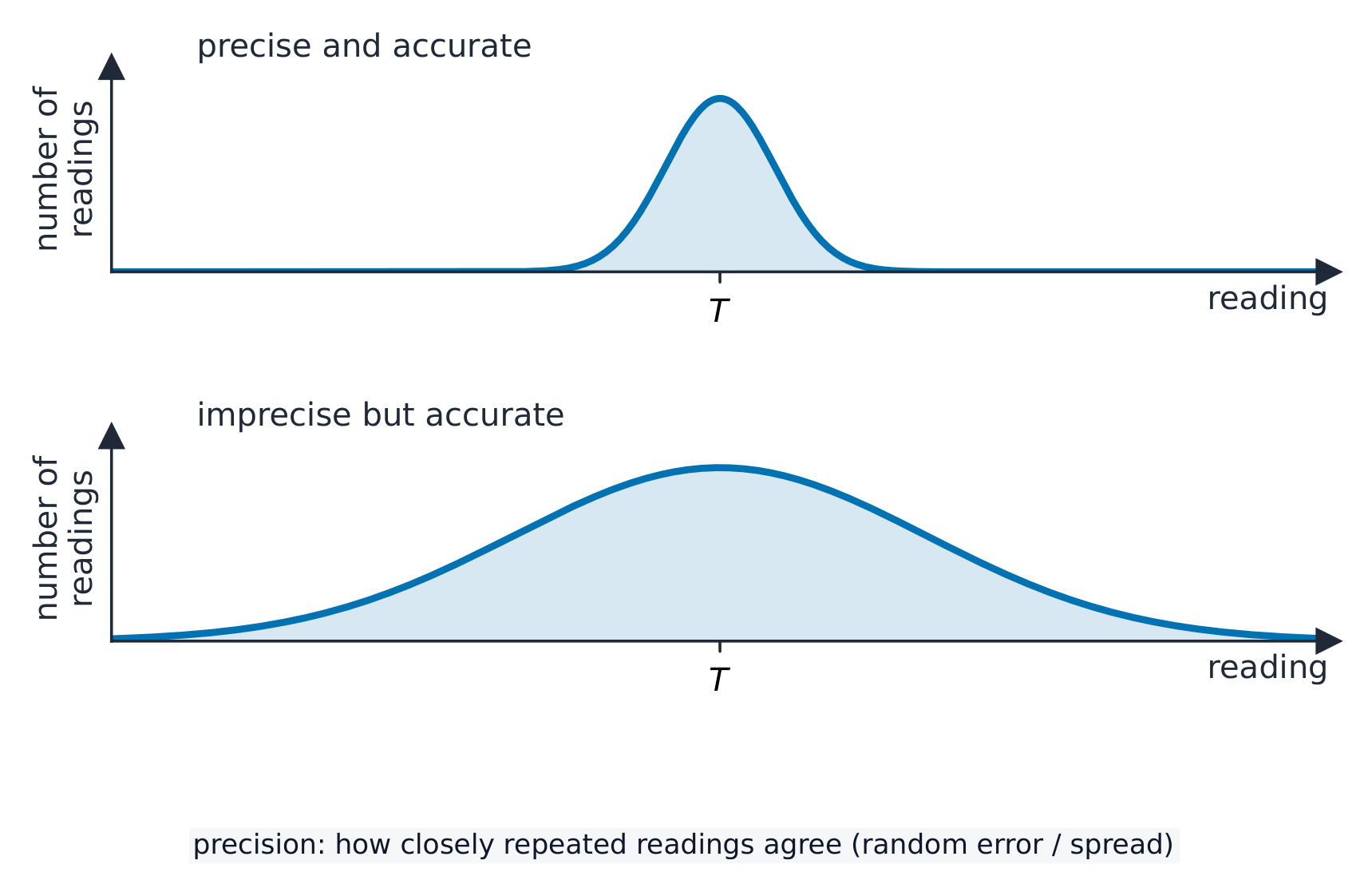
Precision is how close repeated readings are to each other. Precise readings are grouped very close together.
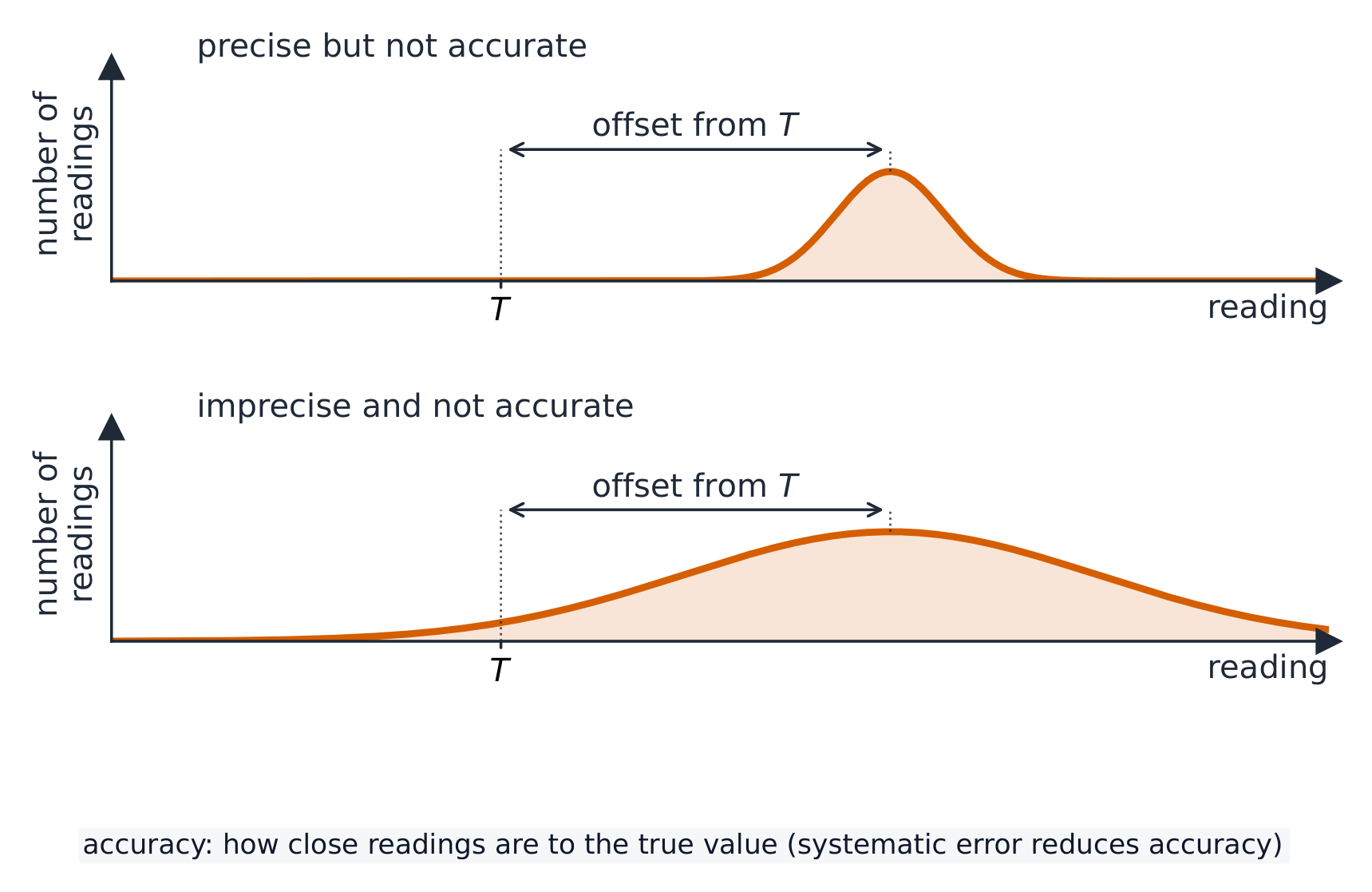
Accuracy is how close a reading (or the mean of several readings) is to the true value.
A set of readings can be:
- precise and accurate — close together and near the true value
- precise but not accurate — close together, but away from the true value (a systematic error)
- accurate but not precise — spread out, but the mean is near the true value
- neither — spread out and away from the true value
When a question gives a table of repeated readings, look at the spread (precision) and the mean (accuracy) separately.
Estimating the uncertainty in a reading
Before you combine uncertainties, you need a sensible uncertainty for each raw reading:
- A single reading on an analogue scale: half the smallest division 分度 (a metre rule reads to $1\ \text{mm}$, so one reading is $\pm 0.5\ \text{mm}$). A length needs two readings, one at each end, so its uncertainty is $\pm 1\ \text{mm}$.
- A digital meter: $\pm 1$ in the last digit shown (a stopwatch showing $2.47\ \text{s}$ is $\pm 0.01\ \text{s}$).
- A hand-timed measurement: your reaction time 反应时间 matters more than the display. Allow about $\pm 0.1$ to $0.2\ \text{s}$, and time many oscillations instead of one, so the same uncertainty is shared between all of them.
- Repeated readings: the uncertainty is half the range 极差的一半. Three timings of $2.42$, $2.48$ and $2.45\ \text{s}$ have a mean of $2.45\ \text{s}$ and a range of $0.06\ \text{s}$, so $t = (2.45 \pm 0.03)\ \text{s}$.
Be honest. If the edge of a shadow is hard to see, the uncertainty in its position is several millimetres, however fine the scale. Examiners do not accept "the smallest division" as the uncertainty of a difficult reading.
Uncertainty in a derived quantity
A measurement is often written as $x \pm \Delta x$. Here $\Delta x$ is the absolute uncertainty 绝对不确定度. The percentage uncertainty 百分比不确定度 is
$$\text{percentage uncertainty in } x = \frac{\Delta x}{|x|} \times 100\%.$$
A derived quantity 导出量 is one you calculate from measured values. Its uncertainty is found by simple rules:
- Adding or subtracting — add the absolute uncertainties. If $y = a + b$ or $y = a - b$, then $\Delta y = \Delta a + \Delta b$.
- Multiplying or dividing — add the percentage uncertainties. If $y = \dfrac{a \cdot b}{c}$, then
$$\frac{\Delta y}{|y|} = \frac{\Delta a}{|a|} + \frac{\Delta b}{|b|} + \frac{\Delta c}{|c|}.$$
- Powers — multiply the percentage uncertainty by the power. If $y = a^{n}$, then $\dfrac{\Delta y}{|y|} = |n| \cdot \dfrac{\Delta a}{|a|}$.
Worked example. A ball's diameter 直径 is measured as $d = (5.26 \pm 0.02)\ \text{cm}$. The volume 体积 of a sphere is $V = \tfrac{4}{3}\pi r^{3} = \tfrac{4}{3}\pi (d/2)^{3}$, so $V \propto d^{3}$ ($V$ depends on $d$ cubed).
The percentage uncertainty in $d$ is
$$\frac{0.02}{5.26} \times 100\% \approx 0.38\%.$$
Because $V \propto d^{3}$, the percentage uncertainty in $V$ is three times this, about $1.14\%$. The volume is $\tfrac{4}{3}\pi(2.63)^{3} \approx 76.2\ \text{cm}^{3}$. So the absolute uncertainty is $0.0114 \times 76.2 \approx 0.87\ \text{cm}^{3}$. The final answer is $V = (76.2 \pm 0.9)\ \text{cm}^{3}$.
Do two values agree? Practical questions often ask whether two calculated values of a constant support a suggested relationship. Do not just say "they are close". Work out the percentage difference 百分比差异 between them,
$$\text{percentage difference} = \frac{|k_{1} - k_{2}|}{\text{mean of } k_{1} \text{ and } k_{2}} \times 100\%,$$
and compare it with the percentage uncertainty in $k$ (or with the criterion the question gives, often 10%). If the difference is smaller, the two values agree within the uncertainty and the relationship is supported. If it is larger, they do not.
Significant figures
When you write a calculated quantity, give it the same number of significant figures 有效数字 as the least precise measurement you used — usually two or three in this syllabus. Too many significant figures makes the answer look more exact than it really is. Too few loses useful information.
Practical papers ask you to justify the number you chose. Name the raw readings: "$a$ is given to 2 significant figures because $L$ and $t$ were each measured to 2 significant figures." The phrase "because of the raw data" on its own does not earn the mark. In a table of results, judge each row from the least precise raw reading in that row; do not force every row to the same number of figures.
Uncertainties on a graph
Paper 5 asks you to carry uncertainties through a graph:
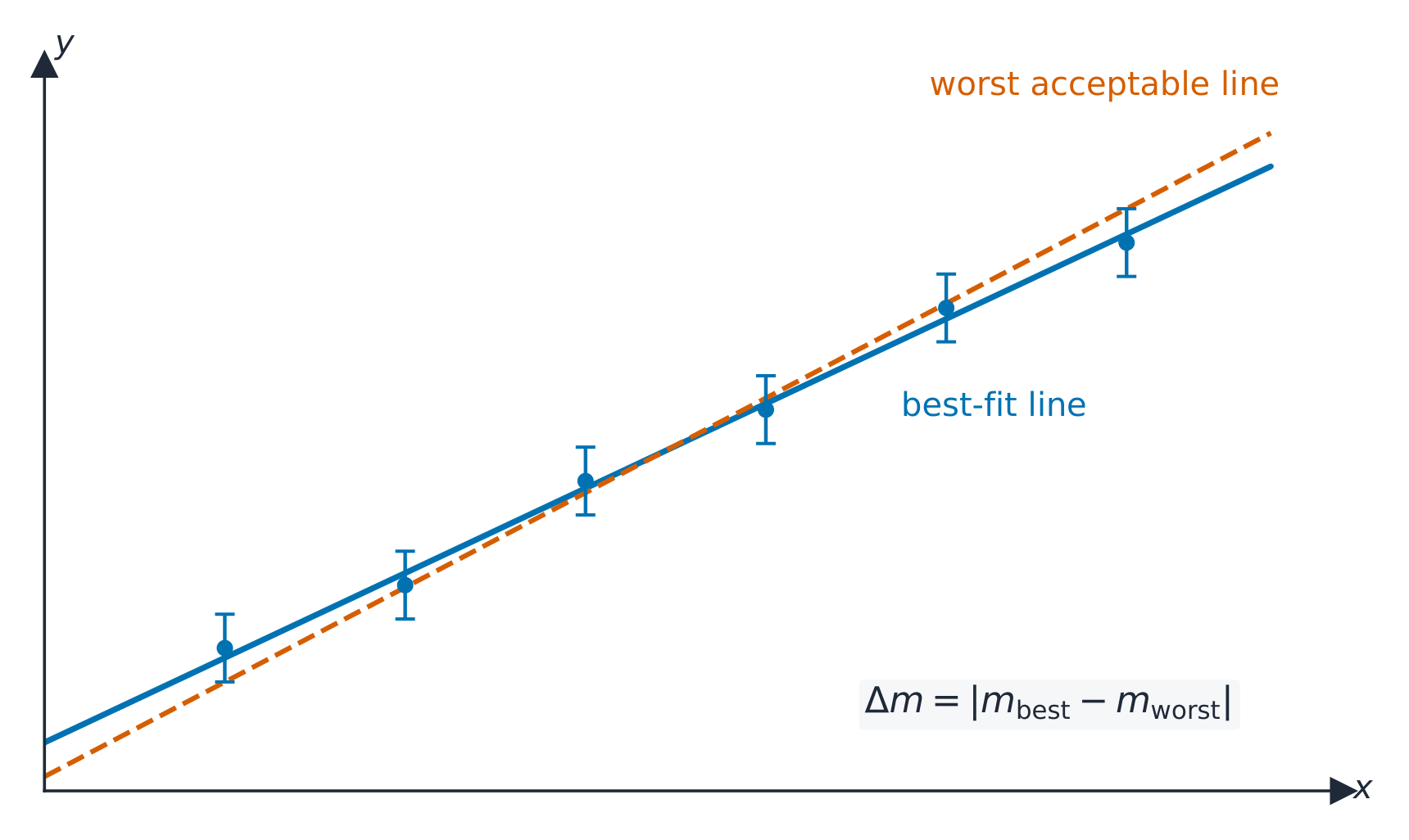
- Plot each point with an error bar 误差棒 whose length shows the absolute uncertainty in that value.
- Draw the line of best fit 最佳拟合直线 through the points, then the worst acceptable line 最差可接受直线: the steepest (or shallowest) straight line that still passes through every error bar.
- The uncertainty in the gradient is the difference between the two gradients, $\Delta m = |m_{\text{best}} - m_{\text{worst}}|$. The uncertainty in the intercept is found the same way.
- When you plot a logarithm, the absolute uncertainty in $\ln x$ is $\Delta x / x$ (and in $\lg x$ it is $0.434\,\Delta x / x$). Work it out for the largest and smallest values of $x$ separately.
A percentage uncertainty in the gradient then flows into any quantity you calculate from it, using the rules above.
Explore
Systematic or random?
A systematic error shifts every reading the same way and survives repetition; a random error scatters the readings and shrinks when you average.
Vocabulary
Train
| English |
|---|
| diameter/daɪˈæmɪtə/ |
| uncertainty/ʌnˈsɜːtənti/ |
| measurement/ˈmeʒəmənt/ |
| random error/ˈrændəm ˈerə/ |
| systematic error/ˌsɪstəˈmætɪk ˈerə/ |
| zero error/ˈzɪərəʊ ˈerə/ |
| calibration/ˌkælɪˈbreɪʃn/ |
| parallax/ˈpærəlæks/ |
| accuracy/ˈækjʊrəsi/ |
| precision/prɪˈsɪʒn/ |
| instrument/ˈɪnstrəmənt/ |
| mean/miːn/ |
| line of best fit/laɪn ɒv best fɪt/ |
| intercept/ˌɪntəˈsept/ |
| division/dɪˈvɪʒn/ |
| reaction time/rɪˈækʃn taɪm/ |
| half the range/hɑːf ðə reɪndʒ/ |
| derived quantity/dɪˈraɪvd ˈkwɒntɪti/ |
| absolute uncertainty/ˈæbsəluːt ʌnˈsɜːtənti/ |
| percentage uncertainty/pəˈsentɪdʒ ʌnˈsɜːtənti/ |
| volume/ˈvɒljuːm/ |
| percentage difference/pəˈsentɪdʒ ˈdɪfrəns/ |
| significant figures/sɪɡˈnɪfɪkənt ˈfɪɡəz/ |
| same number of significant figures/seɪm ˈnʌmbə ɒv sɪɡˈnɪfɪkənt ˈfɪɡəz/ |
| error bar/ˈerə bɑː/ |
| worst acceptable line/wɜːst əkˈseptəbl laɪn/ |
1.4
Scalars and vectors

Syllabus
- understand the difference between scalar and vector quantities and give examples of scalar and vector quantities included in the syllabus
- add and subtract coplanar vectors
- represent a vector as two perpendicular components
Source: Cambridge International syllabus
A scalar 标量 has size only. A vector 矢量 has both size and direction.
Examples from the syllabus:
- scalars: mass, time, temperature, energy, work, power, distance, speed, pressure, density, electric charge 电荷
- vectors: displacement 位移, velocity, acceleration, force (including weight), momentum 动量
Quick test: if it makes sense to ask "in which direction?", the quantity is a vector. You cannot ask "in which direction is the temperature?", so temperature is a scalar. You can ask "in which direction is the velocity?", so velocity is a vector.
Adding and subtracting vectors
A vector is drawn as an arrow: the direction of the arrow gives the direction of the quantity, and the length of the arrow (drawn to scale) gives the magnitude.
To add two coplanar 共面 vectors (vectors in the same flat plane), draw them tip to tail. The resultant 合矢量 goes from the tail of the first arrow to the tip of the second.
To find $\vec{X} - \vec{Y}$, add the reverse of $\vec{Y}$: $\vec{X} + (-\vec{Y})$. The reverse of $\vec{Y}$ has the same size as $\vec{Y}$ but points the opposite way.
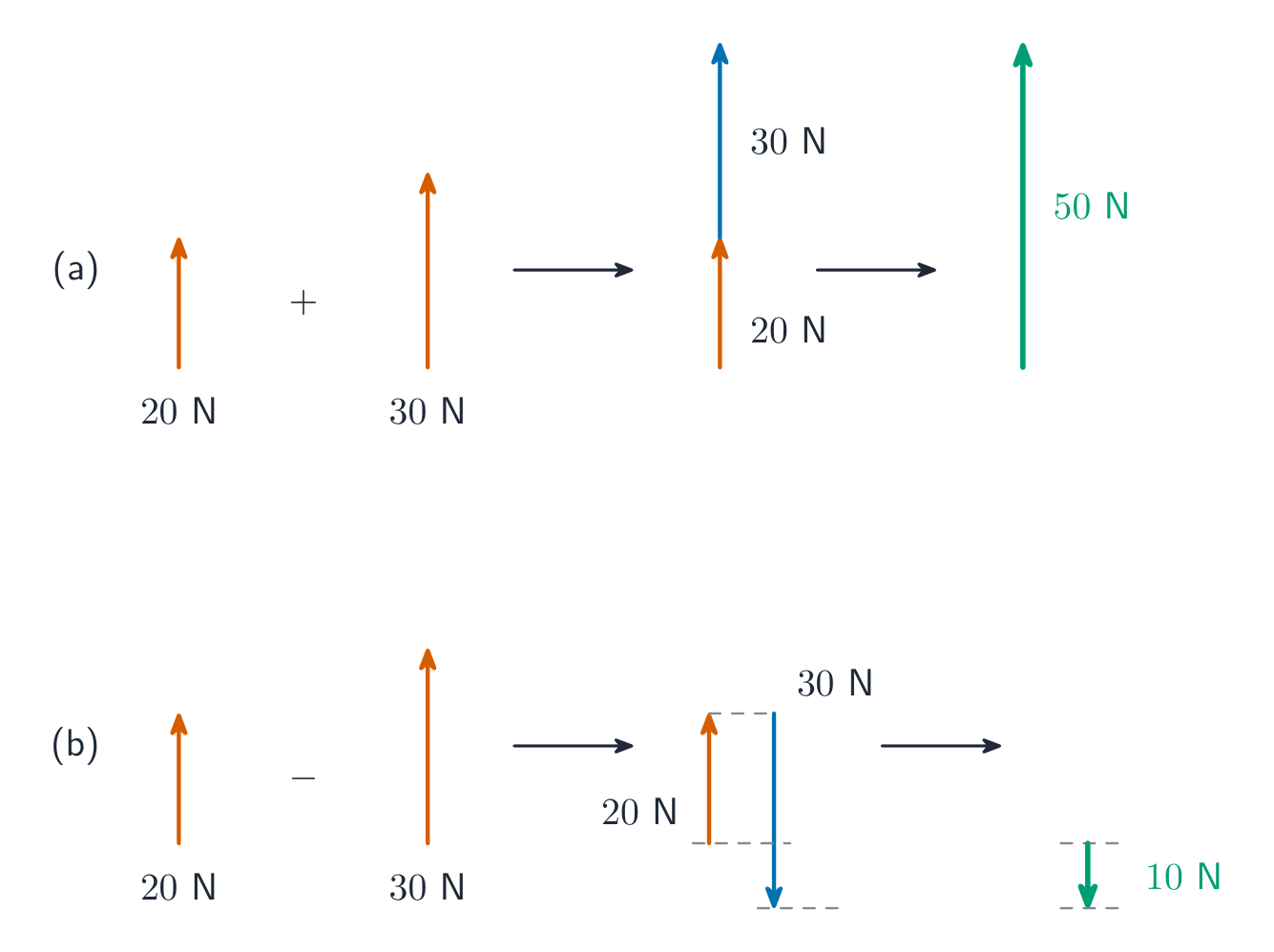
If the two vectors are at right angles (90°), the size of the resultant is
$$|\vec{R}| = \sqrt{X^{2} + Y^{2}},$$
and its direction comes from $\tan\theta = Y / X$.
Worked example. A swimmer heads north at $1.2\ \text{m s}^{-1}$ across a river that flows east at $0.5\ \text{m s}^{-1}$. Find the size and direction of the resultant velocity.
The two velocities are perpendicular, so
$$|\vec{R}| = \sqrt{1.2^{2} + 0.5^{2}} = \sqrt{1.69} = 1.3\ \text{m s}^{-1},$$
at an angle $\tan\theta = 0.5/1.2$, giving $\theta \approx 23°$ east of north.
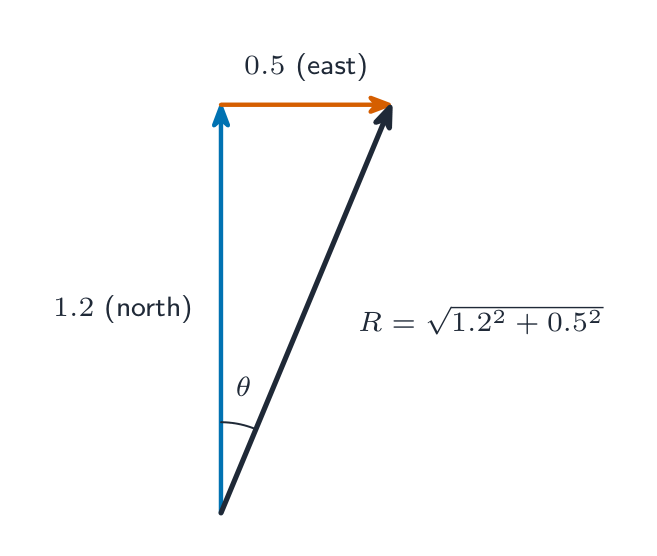
If two vectors have the same size $F$ with an angle $2\alpha$ between them, the resultant has size $2F\cos\alpha$ and lies along the line that cuts the angle in half.
Worked example. Two forces of $6.0\ \text{N}$ act on an object with $60°$ between them. Find the resultant.
Here $2\alpha = 60°$, so $\alpha = 30°$ and $R = 2 \times 6.0 \times \cos 30° = 10.4\ \text{N}$, along the line halfway between the two forces. Resolving gives the same answer: each force has a component $6.0\cos 30°$ along that line, and their components at right angles to it cancel.
For two vectors at any other angle, either make a scale drawing 按比例作图 of the vector triangle and measure the resultant, or resolve both vectors into perpendicular components, add the components, and recombine with $\sqrt{X^{2} + Y^{2}}$.
Worked example. A ball moving east at $5.0\ \text{m s}^{-1}$ is hit so that it moves north at $5.0\ \text{m s}^{-1}$. Find its change in velocity.
A change in velocity is a vector subtraction: $\Delta\vec{v} = \vec{v}_{\text{final}} - \vec{v}_{\text{initial}}$. Draw $5.0\ \text{m s}^{-1}$ north, then add the reverse of the initial velocity, $5.0\ \text{m s}^{-1}$ west. The two are perpendicular, so $|\Delta\vec{v}| = \sqrt{5.0^{2} + 5.0^{2}} = 7.1\ \text{m s}^{-1}$, pointing north-west. The speed did not change, but the velocity did. That is why a force must have acted on the ball (topic 3).
Splitting a vector into perpendicular parts
Any vector can be split into two perpendicular 垂直 (at right angles) components 分量. Usually these are horizontal 水平 and vertical 竖直, or along and across a surface. For a vector $\vec{v}$ at angle $\theta$ to the horizontal:
$$v_{\text{H}} = v\cos\theta, \qquad v_{\text{V}} = v\sin\theta.$$
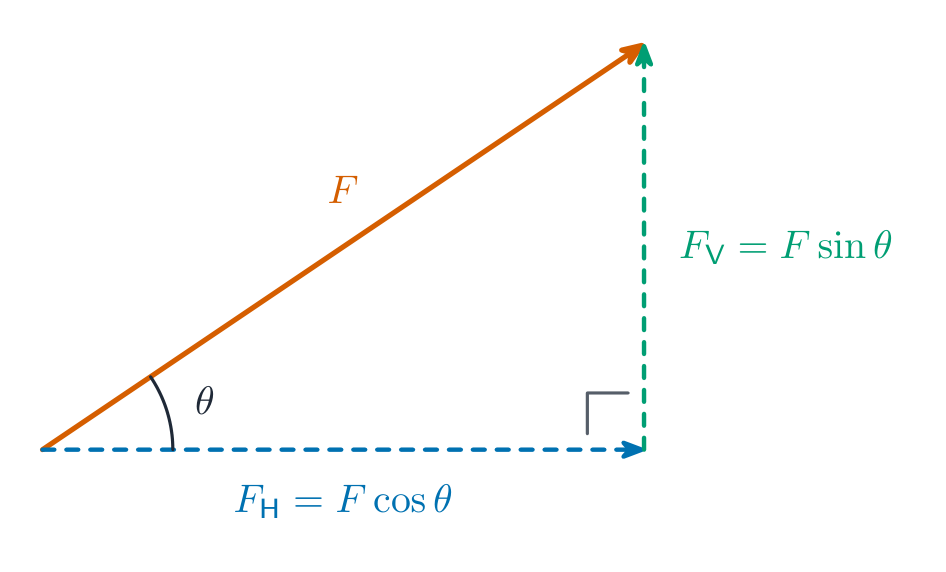
Choose the directions that make the problem easiest. On a slope (an inclined plane 斜面), split the weight into one part along the slope and one part at right angles to it:
$$W_{\parallel} = W\sin\theta, \qquad W_{\perp} = W\cos\theta,$$
where $\theta$ is the angle of the slope to the horizontal.
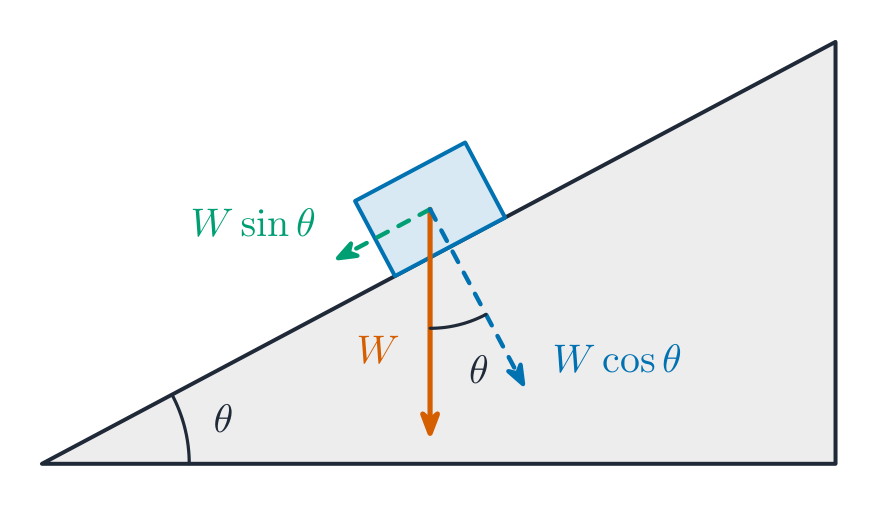
You split a vector into components whenever you need to know how much of it acts in one direction. For example: the part of a force that acts along a slope, or the horizontal and vertical parts of a ball's velocity after it is thrown.
Explore
Adding two vectors
resultant = a + b
Vectors add tip to tail. The resultant runs from the start of the first arrow to the tip of the second, and its length is found from a scale drawing or by Pythagoras, never by adding the two magnitudes.
Vocabulary
Train
| English |
|---|
| vertical/ˈvɜːtɪkl/ |
| scalar/ˈskeɪlə/ |
| vector/ˈvektə/ |
| component/kəmˈpəʊnənt/ |
| electric charge/ɪˈlektrɪk tʃɑːdʒ/ |
| displacement/dɪˈspleɪsmənt/ |
| momentum/məʊˈmentəm/ |
| coplanar/ˌkəʊˈpleɪnə/ |
| resultant/rɪˈzʌltənt/ |
| perpendicular/ˌpɜːpənˈdɪkjʊlə/ |
| scale drawing/skeɪl ˈdrɔːɪŋ/ |
| horizontal/ˌhɒrɪˈzɒntl/ |
| inclined plane/ɪnˈklaɪnd pleɪn/ |
1.4
Definitions the examiner accepts
A definition question is marked against fixed wording. Learn these exactly, and give one answer only.
| Term | Definition |
|---|---|
| physical quantity | a numerical magnitude together with a unit |
| homogeneous equation | an equation in which every term has the same base units |
| systematic error | an error that shifts every reading in the same direction by the same amount; not reduced by repeating |
| random error | an error that scatters readings above and below the true value; reduced by repeating and averaging |
| zero error | the reading an instrument shows when the true value is zero |
| precision | how close repeated readings are to each other |
| accuracy | how close a reading, or the mean of several readings, is to the true value |
| absolute uncertainty | the range within which the true value is expected to lie, in the units of the quantity |
| percentage uncertainty | the absolute uncertainty divided by the value, multiplied by 100% |
| scalar | a quantity with magnitude only |
| vector | a quantity with magnitude and direction |
1.4
Exam tips
- Give every answer a unit, and check homogeneity — both sides of an equation must have the same base units.
- Distinguish random error (reduce by repeating and averaging) from systematic error (a zero or calibration error that repeats do not remove).
- Combine uncertainties: add absolute uncertainties when adding/subtracting, add percentage uncertainties when multiplying/dividing (and multiply the % by any power).
- Distinguish precision (small spread) from accuracy (close to the true value).
- Resolve a vector into perpendicular components ($F\cos\theta$, $F\sin\theta$); add vectors tip-to-tail or by components.
Common mistakes
- Substituting 5 cm as 5, or 20 g as 20. Convert the prefix first: 0.05 m, 0.020 kg.
- Giving the percentage uncertainty in $T^{2}$ as the same as in $T$. Squaring doubles it; a square root halves it.
- Treating the percentage uncertainty and the absolute uncertainty as the same number.
- Quoting "the smallest division" as the uncertainty of a reading that was hard to take.
- Offering two answers to a definition. Commit to one.
Recognising quantities and estimates
Distinguish the quantity from its unit: temperature is measured in kelvin, time in seconds or minutes, potential difference in volts, and spring constant in N/m. A quantity has a measurable numerical magnitude; a unit name or a category alone does not state a quantity. Values may be fractional and units may be non-SI. Visible light has wavelengths roughly 400–700 nm; green is about 540 nm ($1\ \mathrm{nm}=10^{-9}\ \mathrm m$).
Interactive lessons on this topic
Work through it step by step, with instant-check exercises.