- understand that an electric field is an example of a field of force and define electric field as force per unit positive charge
- recall and use $F = qE$ for the force on a charge in an electric field
- represent an electric field by means of field lines
Electric fields
A-Level Physics · Topic 18
 11:03
11:03
Electric Fields
Deep inside a storm cloud, charge is building. Negative charge gathers at the base, positive charge on the ground below. Between them, in the empty air, an…
English narration · English + 中文 subtitles burned in
18.1
Electric fields

Syllabus
Source: Cambridge International syllabus
An electric field 电场 is a region where a charge feels a force 力 from other charges. The electric field strength 电场强度 $E$ at a point is the force per unit positive charge on a small positive test charge 检验电荷 placed there:
$$E = \frac{F}{q}.$$
Unit: $\text{N C}^{-1}$ (the same as $\text{V m}^{-1}$, as we will see). $E$ is a vector 矢量, pointing the way the force acts on a positive charge. The force on a charge $q$ is
$$F = qE,$$
opposite to the field if $q$ is negative.
The two-mark definition. Electric field strength at a point is the force per unit positive charge acting on a small (test) charge placed at that point. Three words carry the marks: force per unit charge (not "force on a charge"), positive (which fixes the direction), and small or test (so the charge does not disturb the field it is measuring). The multiple-choice version offers "force per unit charge acting on a small mass" and "force per unit mass" as distractors: a field is defined by a charge, never by a mass.
Worked example. A proton accelerates at $2.00\ \text{m s}^{-2}$ in an electric field, with no other force acting. Find the field strength. ($m_{\text{p}} = 1.67 \times 10^{-27}\ \text{kg}$, $e = 1.60 \times 10^{-19}\ \text{C}$.)
$qE = ma$, so
$$E = \frac{m a}{q} = \frac{(1.67 \times 10^{-27})(2.00)}{1.60 \times 10^{-19}} = 2.09 \times 10^{-8}\ \text{V m}^{-1} = 20.9\ \text{nV m}^{-1}.$$
The same rearrangement the other way round gives the acceleration of an electron in a field of $1500\ \text{V m}^{-1}$: $a = eE/m_{\text{e}} = (1.60 \times 10^{-19})(1500)/(9.11 \times 10^{-31}) = 2.6 \times 10^{14}\ \text{m s}^{-2}$, enormous because the electron's mass is so small. Gravity ($9.81\ \text{m s}^{-2}$) is negligible beside it, which is why exam questions about electrons between plates ignore weight.
Field lines
-
field lines 场线 point the way the force acts on a positive test charge.
-
lines start on positive charges and end on negative charges (or go to infinity).
-
lines never cross; closer lines mean a stronger field.
-
every line carries an arrow; lines meet the surface of a conductor at right angles.
What a field line represents. Asked "state what is represented by an electric field line", give both halves: its direction shows the direction of the force on a positive charge placed there, and the spacing of the lines shows the strength of the field (closer lines, stronger field). A sketch is marked on exactly these points: arrows drawn, lines not crossing, even spacing where the field is uniform, and radial lines for a point charge or a sphere.
Examples: a positive point charge 点电荷 has radial lines pointing out; a negative one has lines pointing in; two opposite charges (a dipole 偶极子) have lines curving from + to −; two parallel charged plates give a uniform field 匀强场 of equally spaced parallel lines.

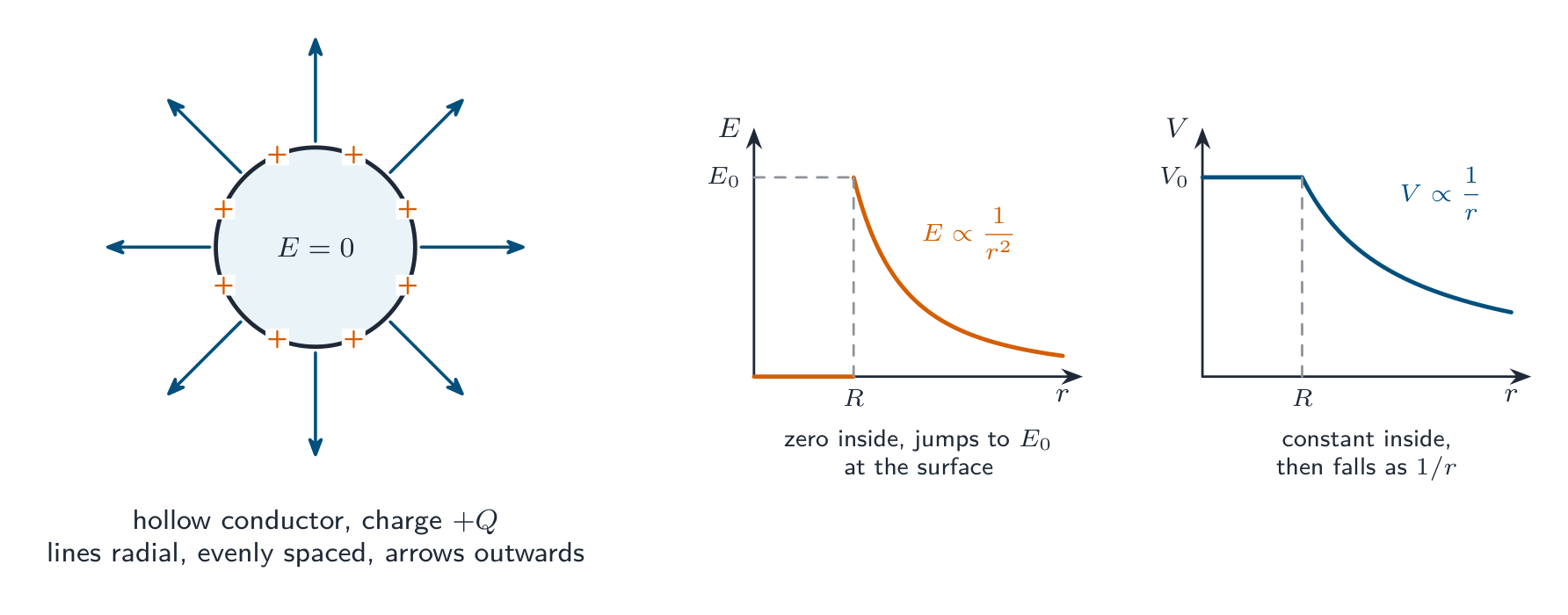
A charged conducting sphere
The charge on an isolated 孤立的 conductor 导体 sits on its outer surface, spread evenly when the sphere is on its own. Outside the sphere the field lines are radial, evenly spaced and pointing outwards (for positive charge), exactly the pattern of a point charge at the centre. Inside a hollow (or solid) conductor the field is zero: the fields of all the surface charges cancel everywhere inside, so no field line enters. Two graphs follow, and both are exam favourites. The field strength $E$ is zero out to the radius $R$, jumps to its surface value $E_0$ and then falls as $1/r^{2}$; the potential $V$ is constant inside (a zero field means a zero potential gradient) and then falls as $1/r$.
Reading the graphs. Given an $E$–$x$ graph for a charged sphere, the radius is the distance at which $E$ jumps from zero, and the charge comes from any point on the curve: $Q = 4\pi\varepsilon_{0} r^{2} E$. Given "$E_0$ at the surface", the value at $2R$ is $E_0/4$ and at $3R$ is $E_0/9$: sketch the curve through those points, starting at $E_0$ on the surface line, never from the origin.

Explore
Electric fields
E ∝ Q / r²
A charge sets up a radial field — out for +, in for −, obeying the inverse-square law.
Vocabulary
Train
| English |
|---|
| electric field/ɪˈlektrɪk fiːld/ |
| force/fɔːs/ |
| electric field strength/ɪˈlektrɪk fiːld streŋθ/ |
| test charge/test tʃɑːdʒ/ |
| vector/ˈvektə/ |
| field line/fiːld laɪn/ |
| conductor/kənˈdʌktə/ |
| point charge/pɔɪnt tʃɑːdʒ/ |
| dipole/ˈdaɪpəʊl/ |
| uniform field/ˈjuːnɪfɔːm fiːld/ |
| isolated/ˈaɪsəleɪtɪd/ |
| potential gradient/pəˈtenʃl ˈɡreɪdɪənt/ |
18.2
Uniform electric fields

Syllabus
- recall and use $E = \Delta V / \Delta d$ to calculate the field strength of the uniform field between charged parallel plates
- describe the effect of a uniform electric field on the motion of charged particles
Source: Cambridge International syllabus
Between two parallel plates a distance $d$ apart with potential difference 电势差 $V$ between them, the field is uniform (apart from edge effects) with size
$$E = \frac{V}{d}.$$
It points from the higher-potential plate to the lower one. The unit $\text{V m}^{-1}$ comes straight from this and equals $\text{N C}^{-1}$.
Worked example. Two parallel plates $5.0\ \text{mm}$ apart have a p.d. of $200\ \text{V}$ between them. Find the field strength, and the force on an electron in the gap. ($e = 1.6 \times 10^{-19}\ \text{C}$.)
$$E = \frac{V}{d} = \frac{200}{5.0 \times 10^{-3}} = 4.0 \times 10^{4}\ \text{V m}^{-1}, \qquad F = qE = (1.6 \times 10^{-19})(4.0 \times 10^{4}) = 6.4 \times 10^{-15}\ \text{N}.$$
Which changes the field? Two things only: $E = V/d$ rises if the p.d. is increased or the plates are moved closer. A resistor in series with the supply changes nothing: no current flows once the plates are charged, so there is no p.d. across the resistor and the plates sit at the full supply voltage. Between plates at $+800\ \text{V}$ and $+1300\ \text{V}$ the field points from the higher potential to the lower; two positive potentials change nothing about the direction rule.
A charged particle in a uniform field
A charge $q$ in a uniform field feels a constant force $F = qE$, so a constant acceleration $a = qE/m$ — just like a mass in a uniform gravitational field.
- released at rest, it speeds up along the field (positive charge) or against it (negative charge), gaining kinetic energy 动能.
- entering at right angles to the field, it follows a parabolic 抛物线 path — like a projectile 抛体 in gravity. This is how a cathode-ray tube 阴极射线管 used to steer its beam.

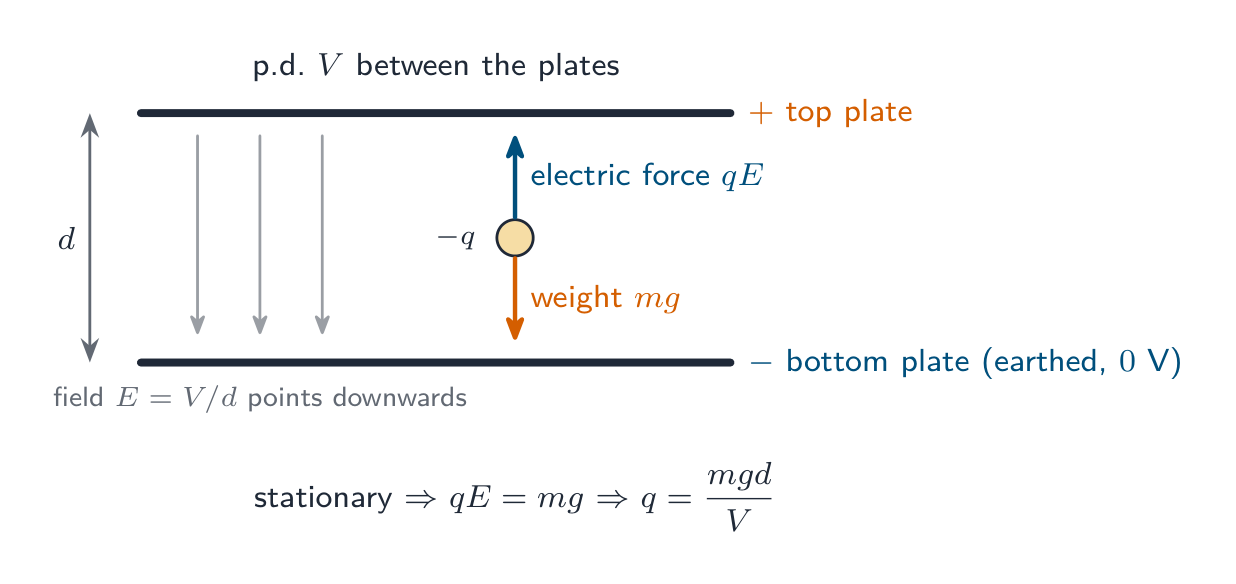
Two forces, not one. A charged oil drop "held stationary" between horizontal plates is the exam's favourite equilibrium 平衡: both an electric force and its weight act on it (the multiple-choice distractor is "electric force only"), and they are equal and opposite. For a negative drop the electric force is opposite to the field, so the top plate must be positive to hold it up.
Worked example. An oil drop of mass $2.6 \times 10^{-15}\ \text{kg}$ carries a charge of $-4.8 \times 10^{-19}\ \text{C}$ and is held stationary in a vacuum between horizontal plates $2.0\ \text{cm}$ apart. Find the p.d. between the plates, and say which plate is positive.
$$qE = mg \;\Rightarrow\; \frac{qV}{d} = mg \;\Rightarrow\; V = \frac{m g d}{q} = \frac{(2.6 \times 10^{-15})(9.81)(0.020)}{4.8 \times 10^{-19}} = 1.1 \times 10^{3}\ \text{V}.$$
The drop is negative, so the force on it is against the field; for the force to be upwards the field must point down, so the top plate is positive. Notice that the charge is $3e$, three excess electrons, which is how Millikan showed that charge comes in multiples of $e$.
Worked example. Two parallel plates in a vacuum are $0.041\ \text{m}$ apart with a p.d. of $250\ \text{V}$ between them. An electron is released from rest at the negative plate. Find (a) the field strength, (b) the force on the electron and its acceleration, (c) the time it takes to reach the positive plate, (d) its kinetic energy on arrival. ($m_{\text{e}} = 9.11 \times 10^{-31}\ \text{kg}$.)
(a) $E = V/d = 250/0.041 = 6.1 \times 10^{3}\ \text{V m}^{-1}$. (b) $F = eE = (1.60 \times 10^{-19})(6.1 \times 10^{3}) = 9.8 \times 10^{-16}\ \text{N}$; $a = F/m_{\text{e}} = 1.07 \times 10^{15}\ \text{m s}^{-2}$, towards the positive plate. (c) From rest with constant acceleration, $d = \tfrac{1}{2} a t^{2}$, so $t = \sqrt{2d/a} = \sqrt{2 \times 0.041 / (1.07 \times 10^{15})} = 8.8 \times 10^{-9}\ \text{s}$. (d) Energy method, no kinematics needed: $E_{\text{k}} = qV = (1.60 \times 10^{-19})(250) = 4.0 \times 10^{-17}\ \text{J}$, so $v = \sqrt{2E_{\text{k}}/m_{\text{e}}} = 9.4 \times 10^{6}\ \text{m s}^{-1}$. (Check: $v = at = (1.07 \times 10^{15})(8.8 \times 10^{-9}) = 9.4 \times 10^{6}\ \text{m s}^{-1}$.)
Worked example (deflection). An electron travelling horizontally at $2.0 \times 10^{7}\ \text{m s}^{-1}$ enters the field between two horizontal plates $18\ \text{mm}$ apart with a p.d. of $400\ \text{V}$. The plates are $30\ \text{mm}$ long. Find the deflection 偏转 of the electron by the time it leaves the field.
The horizontal motion is unaffected: time in the field $t = 0.030/(2.0 \times 10^{7}) = 1.5 \times 10^{-9}\ \text{s}$. Vertically, $a = eE/m_{\text{e}} = eV/(m_{\text{e}} d) = (1.60 \times 10^{-19})(400)/[(9.11 \times 10^{-31})(0.018)] = 3.9 \times 10^{15}\ \text{m s}^{-2}$, so the deflection is $y = \tfrac{1}{2} a t^{2} = \tfrac{1}{2}(3.9 \times 10^{15})(1.5 \times 10^{-9})^{2} = 4.4 \times 10^{-3}\ \text{m}$, less than the half-gap of $9\ \text{mm}$, so the electron does leave the field. Its vertical velocity on exit is $at = 5.9 \times 10^{6}\ \text{m s}^{-1}$, so it leaves at $\tan\theta = 5.9/20$, about $16°$; the path is a parabola, and after the plates (no field) it travels in a straight line in the direction it had on exit.
Explore
Uniform electric field lab
Follow how a charge behaves between parallel plates.
Vocabulary
Train
| English |
|---|
| potential difference/pəˈtenʃl ˈdɪfrəns/ |
| kinetic energy/kɪˈnetɪk ˈenədʒi/ |
| parabolic/ˌpærəˈbɒlɪk/ |
| projectile/prəˈdʒektaɪl/ |
| cathode-ray tube/ˈkæθəʊd reɪ tjuːb/ |
| equilibrium/ˌiːkwɪˈlɪbrɪəm/ |
| deflection/dɪˈflekʃn/ |
18.3
Coulomb's law

Syllabus
- understand that, for a point outside a spherical conductor, the charge on the sphere may be considered to be a point charge at its centre
- recall and use Coulomb’s law $F = Q_1Q_2 / (4\pi\varepsilon_0 r^2)$ for the force between two point charges in free space
Source: Cambridge International syllabus
For two point charges $Q_{1}$ and $Q_{2}$ a distance $r$ apart in free space, each feels a force of size
$$F = \frac{Q_{1} Q_{2}}{4\pi\varepsilon_{0} r^{2}}.$$
This is Coulomb's law 库仑定律. Here $\varepsilon_{0} = 8.85 \times 10^{-12}\ \text{F m}^{-1}$ is the permittivity of free space 真空电容率, and $1/(4\pi\varepsilon_{0}) \approx 9.0 \times 10^{9}\ \text{N m}^{2}\ \text{C}^{-2}$. The force is along the line joining the charges: repulsive for like charges, attractive for opposite charges.
Stating the law in words. "State Coulomb's law" wants a sentence, not a formula: the (electric) force between two point charges is directly proportional to the product of the charges and inversely proportional to the square of their separation. Both proportionalities are needed, and the charges must be point charges (or spheres treated as point charges at their centres) in a vacuum.
Worked example. Find the electrostatic force between point charges of $+2.0\ \text{nC}$ and $+3.0\ \text{nC}$ placed $4.0\ \text{cm}$ apart. ($1/(4\pi\varepsilon_{0}) = 9.0 \times 10^{9}\ \text{N m}^{2}\ \text{C}^{-2}$.)
$$F = \frac{Q_{1}Q_{2}}{4\pi\varepsilon_{0} r^{2}} = \frac{(9.0 \times 10^{9})(2.0 \times 10^{-9})(3.0 \times 10^{-9})}{(0.040)^{2}} \approx 3.4 \times 10^{-5}\ \text{N (repulsive).}$$
Worked example. In a hydrogen atom the proton and the electron may be treated as point charges $120\ \text{pm}$ apart. Find the electric force between them, and compare it with their gravitational attraction. ($m_{\text{p}} = 1.67 \times 10^{-27}\ \text{kg}$, $m_{\text{e}} = 9.11 \times 10^{-31}\ \text{kg}$, $G = 6.67 \times 10^{-11}\ \text{N m}^{2}\ \text{kg}^{-2}$.)
$$F_{\text{E}} = \frac{e^{2}}{4\pi\varepsilon_{0} r^{2}} = \frac{(8.99 \times 10^{9})(1.60 \times 10^{-19})^{2}}{(1.20 \times 10^{-10})^{2}} = 1.6 \times 10^{-8}\ \text{N (attractive).}$$
Gravity: $F_{\text{G}} = G m_{\text{p}} m_{\text{e}}/r^{2} = (6.67 \times 10^{-11})(1.67 \times 10^{-27})(9.11 \times 10^{-31})/(1.20 \times 10^{-10})^{2} = 7.0 \times 10^{-48}\ \text{N}$, about $10^{39}$ times smaller. Inside atoms, gravity is irrelevant.
Worked example. Two identical oil droplets in a vacuum have their centres $3.8 \times 10^{-6}\ \text{m}$ apart. Each carries the same charge, and they repel with a force of $1.0 \times 10^{-15}\ \text{N}$. Find the charge on each droplet, and the number of excess electrons it carries.
$$F = \frac{Q^{2}}{4\pi\varepsilon_{0} r^{2}} \;\Rightarrow\; Q = \sqrt{4\pi\varepsilon_{0} F r^{2}} = \sqrt{\frac{(1.0 \times 10^{-15})(3.8 \times 10^{-6})^{2}}{8.99 \times 10^{9}}} = 1.3 \times 10^{-18}\ \text{C},$$
that is $1.3 \times 10^{-18}/1.60 \times 10^{-19} \approx 8$ electrons. Identical objects with the same sign of charge always repel; do not write "attract" for the direction.
Worked example. A charged sphere X is fixed on an insulating stand. A second sphere Y, of mass $2.0\ \text{g}$, hangs beside it on an insulating thread and settles in equilibrium with the thread at $12°$ to the vertical, its centre $5.0\ \text{cm}$ from the centre of X on the same horizontal level. Find the electric force on Y and, if the spheres carry equal charges, the charge on each.
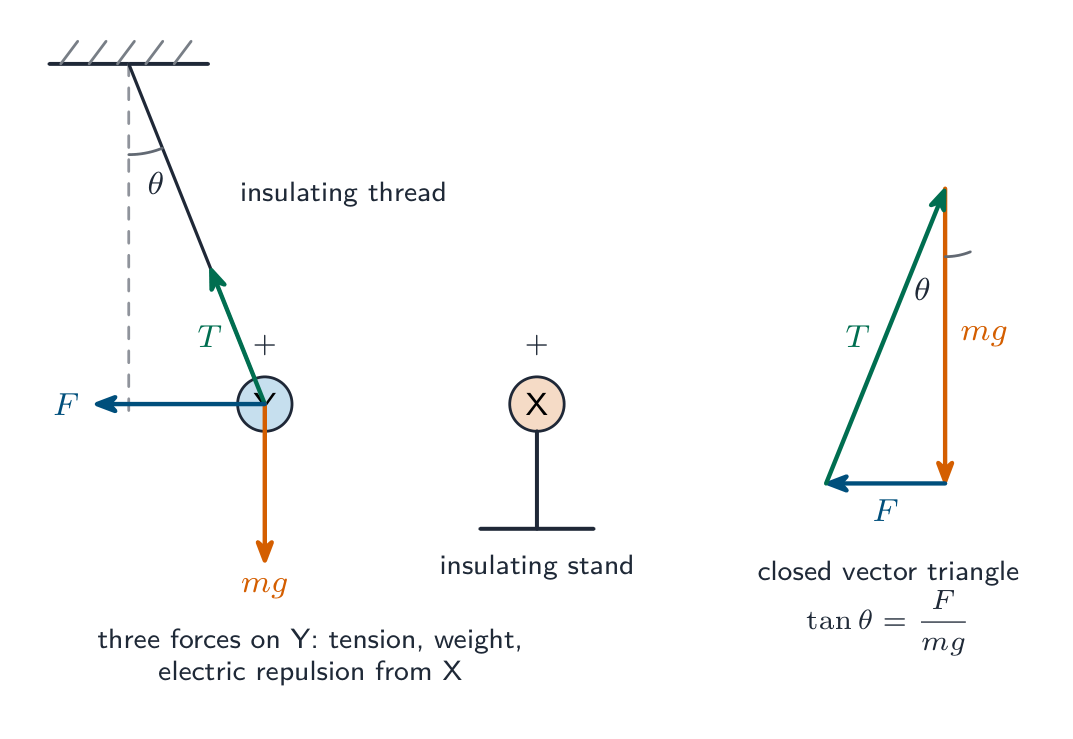
Three forces act on Y: its weight $mg$ (down), the tension 张力 $T$ (along the thread) and the electric force $F$ (horizontal, away from X because like charges repel). Resolving, $T\cos\theta = mg$ and $T\sin\theta = F$, so
$$F = mg\tan\theta = (2.0 \times 10^{-3})(9.81)\tan 12° = 4.2 \times 10^{-3}\ \text{N}.$$
Then $F = Q^{2}/(4\pi\varepsilon_{0} r^{2})$ gives $Q = \sqrt{4\pi\varepsilon_{0} F r^{2}} = \sqrt{(4.2 \times 10^{-3})(0.050)^{2}/(8.99 \times 10^{9})} = 3.4 \times 10^{-8}\ \text{C}$. A closed vector triangle of the three forces is an equally good method; the exam accepts either, but it must show all three forces.
Worked example (helium). A helium atom may be modelled as a nucleus of charge $+2e$ with two electrons in diametrically opposite circular orbits of radius $170\ \text{pm}$. Find the resultant force 合力 on one electron, and hence its orbital speed.
Two forces act on the electron: attraction to the nucleus, at distance $r$, and repulsion from the other electron, at distance $2r$ on the far side:
$$F_{\text{res}} = \frac{2e^{2}}{4\pi\varepsilon_{0} r^{2}} - \frac{e^{2}}{4\pi\varepsilon_{0} (2r)^{2}} = \frac{e^{2}}{4\pi\varepsilon_{0} r^{2}}\left(2 - \tfrac{1}{4}\right) = 1.75 \times \frac{(8.99 \times 10^{9})(1.60 \times 10^{-19})^{2}}{(1.70 \times 10^{-10})^{2}} = 1.4 \times 10^{-8}\ \text{N},$$
towards the nucleus. This resultant is the centripetal force, $F = m_{\text{e}} v^{2}/r$, so $v = \sqrt{F r/m_{\text{e}}} = \sqrt{(1.4 \times 10^{-8})(1.70 \times 10^{-10})/(9.11 \times 10^{-31})} = 1.6 \times 10^{6}\ \text{m s}^{-1}$. The trap is to forget the second electron, or to put it at distance $r$ rather than $2r$.
Spheres treated as point charges
A spherical conductor with total charge $Q$ gives, at any point outside, the same field as a point charge $Q$ at its centre (measure $r$ from the centre). Inside a hollow charged conductor the field is zero, so the conductor is an equipotential 等势面.
Explore
Coulomb's law
F ∝ Qq / r²
Like charges repel, unlike attract — and the force follows 1/r².
Vocabulary
Train
| English |
|---|
| Coulomb's law/ˈkuːlɒmz lɔː/ |
| permittivity of free space/ˌpɜːmɪˈtɪvəti ɒv friː speɪs/ |
| tension/ˈtenʃn/ |
| resultant force/rɪˈzʌltənt fɔːs/ |
| equipotential/ˌiːkwɪpəˈtenʃl/ |
18.4
Electric field due to a point charge
Syllabus
- recall and use $E = Q / (4\pi\varepsilon_0 r^2)$ for the electric field strength due to a point charge in free space
Source: Cambridge International syllabus
Coulomb's law gives the force between two charges. Divide it by the test charge ($E = F/q$) and you are left with the field of the source charge $Q$ alone. The field at distance $r$ from a point charge $Q$ is
$$E = \frac{Q}{4\pi\varepsilon_{0} r^{2}}.$$
It points out from a positive $Q$, in towards a negative $Q$, and falls as $1/r^{2}$ — just like gravitational field 重力场 strength, except gravity is always attractive. For several charges, add the fields as a vector sum 矢量和.
Worked example. The Earth may be treated as a uniform conducting sphere of radius $6.37 \times 10^{6}\ \text{m}$ carrying a total charge of $-4.80 \times 10^{5}\ \text{C}$ spread over its surface. Find the electric field strength at the surface, and compare it with the gravitational field strength there. ($M_{\text{E}} = 5.98 \times 10^{24}\ \text{kg}$.)
$$E = \frac{Q}{4\pi\varepsilon_{0} R^{2}} = \frac{(8.99 \times 10^{9})(4.80 \times 10^{5})}{(6.37 \times 10^{6})^{2}} = 106\ \text{V m}^{-1},$$
directed towards the centre (the charge is negative). Gravity: $g = GM/R^{2} = 9.83\ \text{N kg}^{-1}$, so $E/g \approx 11$; in symbols $E/g = Q/(4\pi\varepsilon_{0} G M)$, which shows that the ratio depends only on the charge-to-mass ratio of the sphere. A charged sphere of mass $m$ and charge $q$ would need $qE = mg$ to float in this field: $q/m = g/E = 0.093\ \text{C kg}^{-1}$.
Worked example. Point charges of $+4.0\ \text{nC}$ and $+1.0\ \text{nC}$ are $30\ \text{cm}$ apart. Where on the line joining them is the resultant field zero?
Between the charges the two fields point in opposite directions; call the distance from the $4.0\ \text{nC}$ charge $x$. Zero resultant needs equal magnitudes:
$$\frac{4.0}{x^{2}} = \frac{1.0}{(0.30 - x)^{2}} \;\Rightarrow\; \frac{0.30 - x}{x} = \frac{1}{2} \;\Rightarrow\; x = 0.20\ \text{m},$$
twice as far from the larger charge. For opposite charges the fields between them point the same way and never cancel: the zero lies outside, beyond the smaller charge.
Explore
Field around a point charge
Change the charge. Field lines point away from positive and toward negative, and crowd together where the field is strongest.
Vocabulary
Train
| English |
|---|
| gravitational field/ˌɡrævɪˈteɪʃənl fiːld/ |
| vector sum/ˈvektə sʌm/ |
18.5
Electric potential
Syllabus
- define electric potential at a point as the work done per unit positive charge in bringing a small test charge from infinity to the point
- recall and use the fact that the electric field at a point is equal to the negative of potential gradient at that point
- use $V = Q / (4\pi\varepsilon_0 r)$ for the electric potential in the field due to a point charge
- understand how the concept of electric potential leads to the electric potential energy of two point charges and use $E_P = Qq / (4\pi\varepsilon_0 r)$
Source: Cambridge International syllabus
Electric potential 电势 $V$ at a point is the work done per unit positive charge in bringing a small positive test charge from infinity 无穷远 to that point:
$$V = \frac{W}{q}.$$
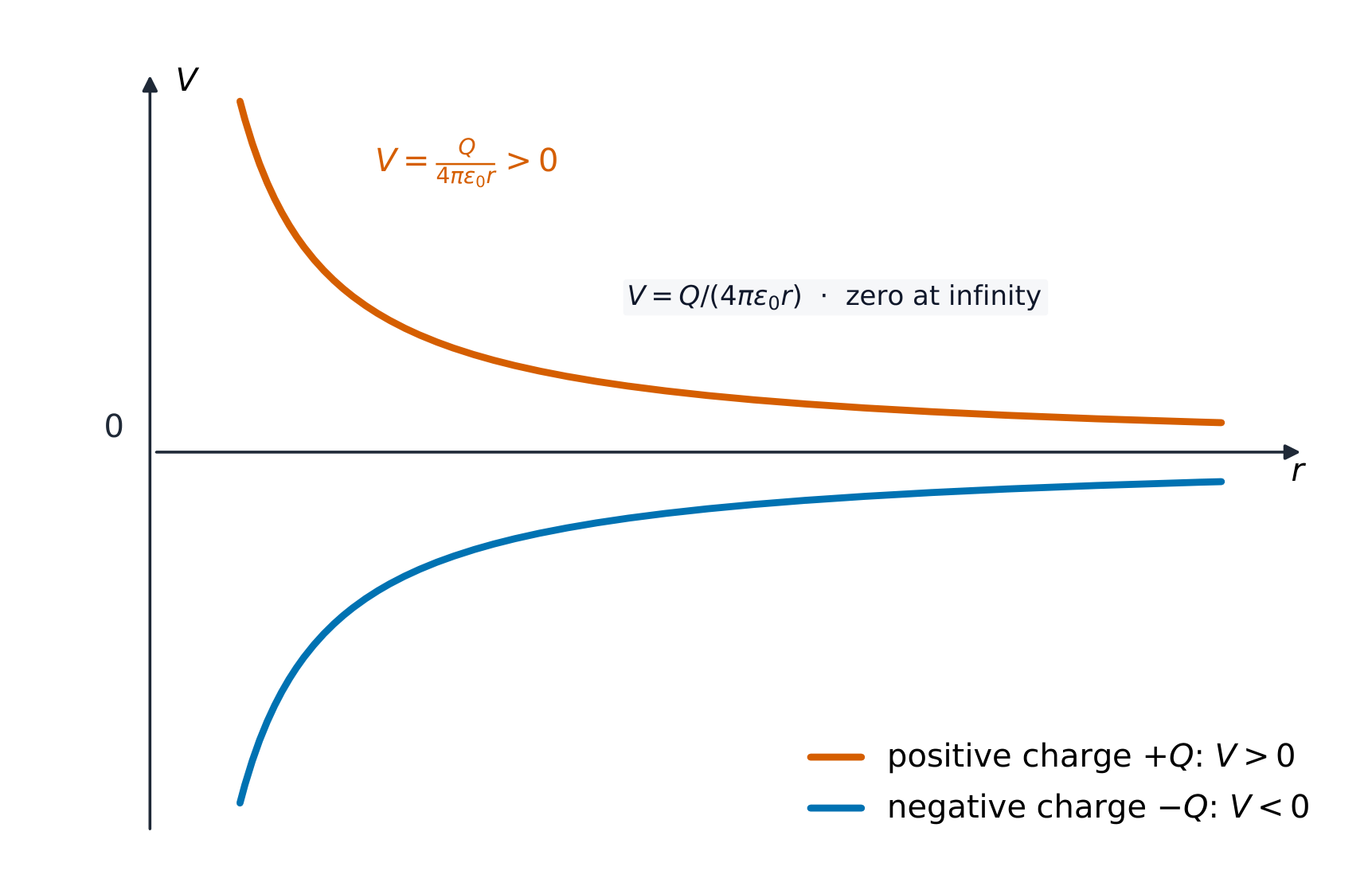
Unit: $\text{V}$. The potential is zero at infinity. For a positive source charge $V > 0$ everywhere outside; for a negative source charge $V < 0$.
The two-mark definition. Electric potential at a point is the work done per unit positive charge in bringing a small test charge from infinity to the point. The marks are for work done per unit (positive) charge and from infinity to the point. The potential of a positive charge is positive because work must be done on a positive test charge to push it in against the repulsion; near a negative charge the field does the work, so the potential is negative. "Explain why the potential near an isolated proton is positive" is answered in exactly those words.
Potential due to a point charge
$$V = \frac{Q}{4\pi\varepsilon_{0} r}.$$
Note the $1/r$ here (compared with $1/r^{2}$ for the field). $V$ is a scalar 标量; for several charges, add the potentials (with sign).
Worked example. Find the electric potential $4.0\ \text{cm}$ from a point charge of $+3.0\ \text{nC}$. ($1/(4\pi\varepsilon_{0}) = 9.0 \times 10^{9}\ \text{N m}^{2}\ \text{C}^{-2}$.)
$$V = \frac{Q}{4\pi\varepsilon_{0} r} = \frac{(9.0 \times 10^{9})(3.0 \times 10^{-9})}{0.040} \approx 6.8 \times 10^{2}\ \text{V}.$$
Because potential is a scalar, the potential from several charges is simply their sum (each with its own sign) — no directions to resolve.
Two charged spheres on a line
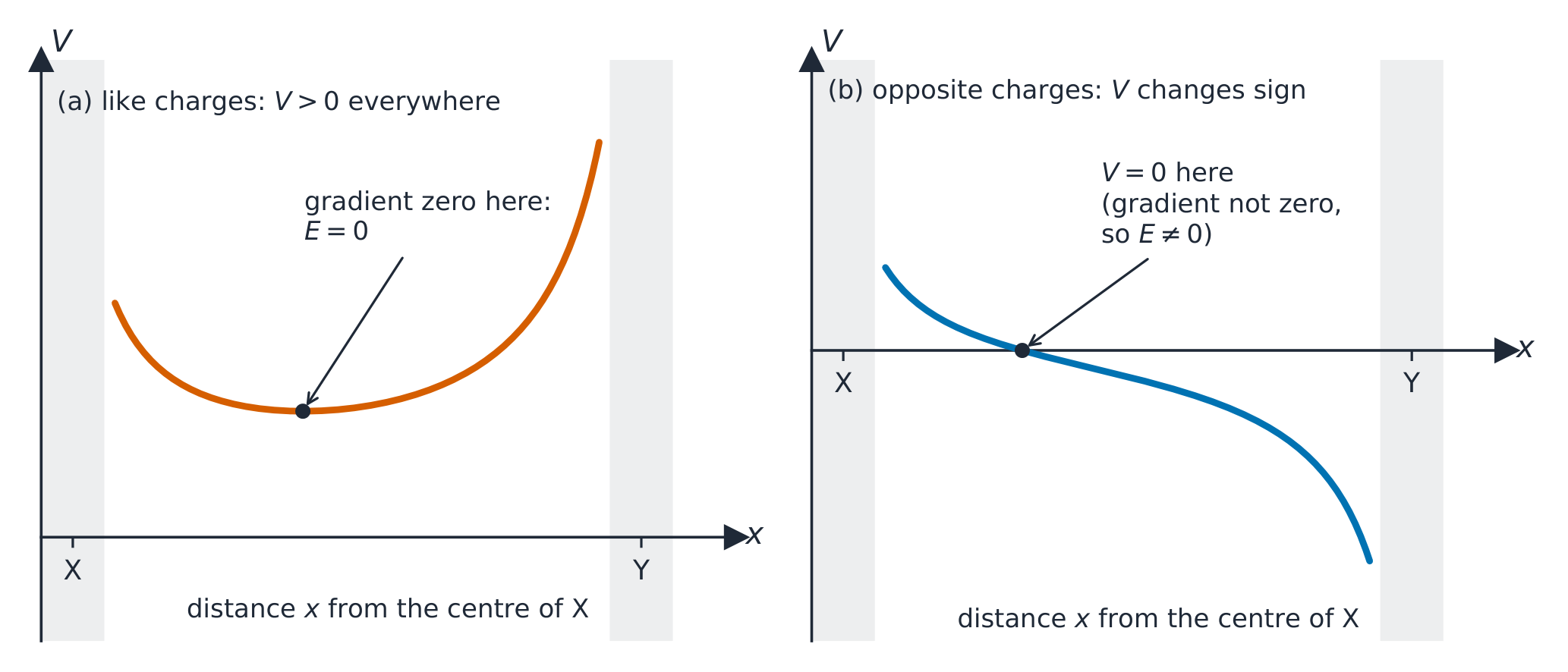
The exam's favourite structured question puts two charged spheres X and Y some distance apart and draws the potential $V$ along the line joining their centres (or asks you to reason from it). Everything follows from two facts: potential is a scalar that adds with sign, and the field is the negative gradient of the graph.
- Sign of the charges. If $V$ is positive along the whole line, both charges are positive; if $V$ changes sign, the charges are opposite (positive near the positive sphere).
- Where the field is zero. Where the curve has a minimum (gradient zero). For like charges this lies between them, closer to the smaller charge: $Q_{\text{X}}/x^{2} = Q_{\text{Y}}/(d - x)^{2}$. For opposite charges there is no such point between them: the curve crosses zero there, but its gradient is not zero, so the field is not.
- Ratio of the charges. Where $V = 0$ between opposite charges, $Q_{\text{X}}/x = Q_{\text{Y}}/(d - x)$: the distances give the ratio directly. For like charges use the minimum instead (the square root of the field condition).
- Force on a charge placed at P. Read the gradient at P by drawing a tangent 切线; then $E$ is minus the gradient, and $F = qE$.
Worked example. Two isolated charged metal spheres X and Y have their centres $1.2\ \text{m}$ apart in a vacuum. The potential along the line between them is positive everywhere and has a minimum at $x = 0.50\ \text{m}$ from the centre of X. State three conclusions, and then find the force on a proton held at $x = 0.60\ \text{m}$, where the gradient of the graph is $+180\ \text{V m}^{-1}$.
Conclusions: (1) both spheres are positively charged, because the potential is positive everywhere; (2) the electric field is zero at $x = 0.50\ \text{m}$, where the gradient is zero; (3) the charge on Y is larger, because the zero-field point lies closer to X; in fact $Q_{\text{Y}}/Q_{\text{X}} = (0.70/0.50)^{2} = 2.0$. At $x = 0.60\ \text{m}$: $E = -180\ \text{V m}^{-1}$ (pointing towards X, since $V$ rises towards Y), so $F = eE = (1.60 \times 10^{-19})(180) = 2.9 \times 10^{-17}\ \text{N}$ towards X. Released, the proton accelerates towards X, its acceleration increasing as the gradient steepens; it needs an external force to hold it still.
Describing the motion. "A positively charged particle is placed at P and released. Describe and explain its motion." The examiner wants: the direction (towards lower potential, down the slope of the $V$ graph); that the force, and so the acceleration, is not constant (it follows the gradient, which changes along the line); and that the particle speeds up throughout, since the force stays in the direction of motion. If P is the zero-field point the particle stays at rest, in unstable equilibrium: a nudge either way sends it off.
Link between field and potential
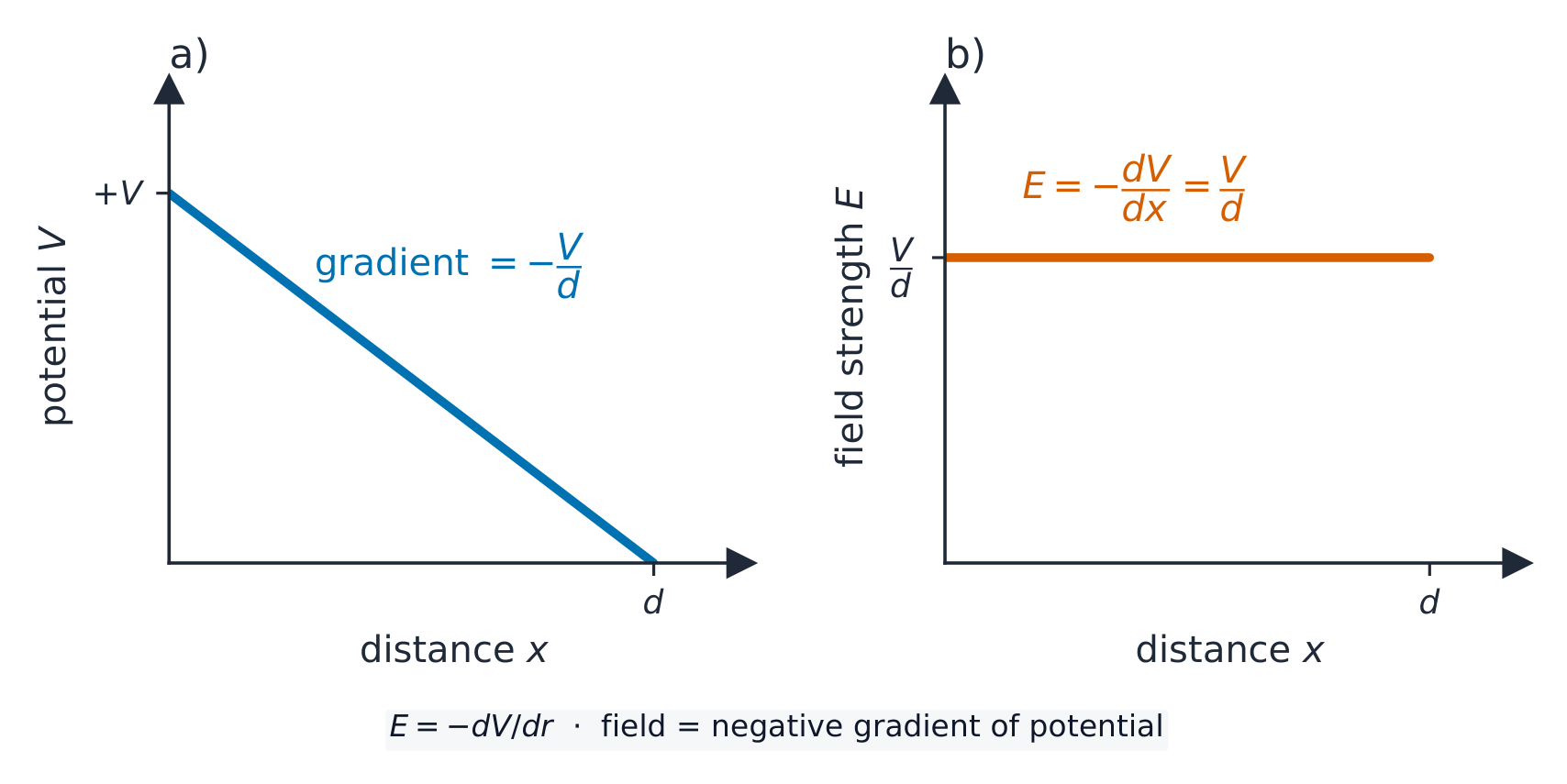
The field equals the negative potential gradient 电势梯度:
$$E = -\frac{dV}{dx}.$$
Between parallel plates $V$ changes evenly with position, giving $E = V/d$ as before. The minus sign means the field points towards lower potential. For a point charge, $-\dfrac{dV}{dr} = \dfrac{Q}{4\pi\varepsilon_{0} r^{2}} = E$.
The one-line relationship. "State the relationship between electric field and electric potential": the field strength is equal to the negative of the potential gradient, $E = -\Delta V/\Delta x$. On a $V$–$x$ graph $E$ is minus the gradient of a tangent; on a $V$–$r$ graph for a point charge the gradient is steepest close to the charge, where the field is strongest, and the sign of $E$ is fixed by "the field points towards lower potential". The uniform-field version $E = V/d$ is the same statement with a constant gradient.
Equipotentials. An equipotential surface joins points of equal potential; no work is done moving a charge along it, so the field is always at right angles to it. Around a point charge the equipotentials are concentric spheres, growing further apart as $V$ falls; between parallel plates they are planes parallel to the plates. The surface of a conductor is an equipotential, which is why field lines meet it at right angles.
Electric potential energy
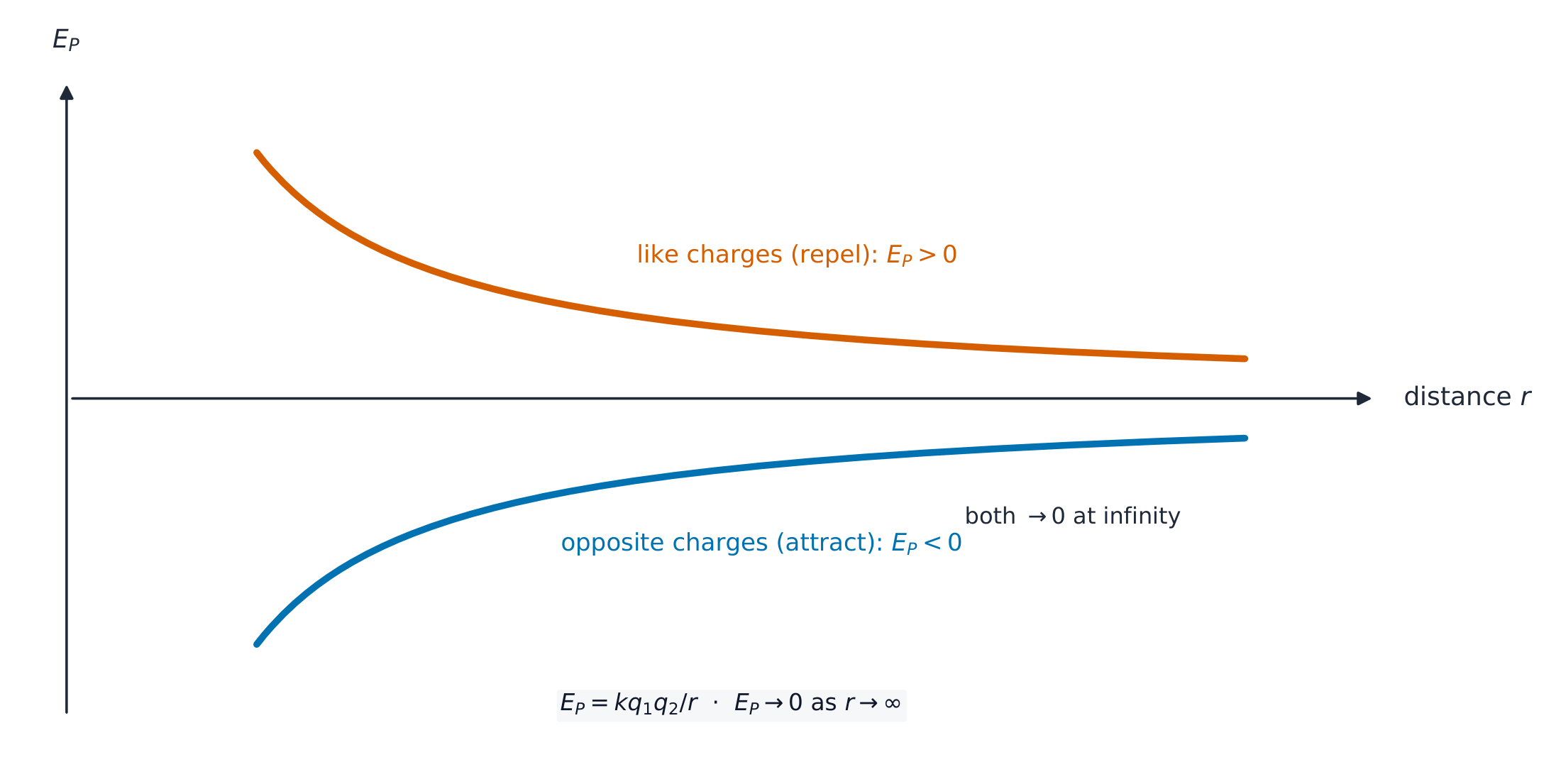
A charge $q$ at a point of potential $V$ has electric potential energy 电势能 $E_{\text{P}} = qV$. For two point charges $Q$ and $q$ a distance $r$ apart:
$$E_{\text{P}} = \frac{Qq}{4\pi\varepsilon_{0} r}.$$
- like charges: $E_{\text{P}} > 0$ — stored energy that would be released if they flew apart.
- opposite charges: $E_{\text{P}} < 0$ — a bound 束缚 system; energy must be supplied to separate them.
In both cases $E_{\text{P}} \to 0$ as $r \to \infty$.
Worked example. The proton and the electron in a hydrogen atom are $5.3 \times 10^{-11}\ \text{m}$ apart. Find the electric potential energy of the pair.
$$E_{\text{P}} = \frac{Qq}{4\pi\varepsilon_{0} r} = \frac{(8.99 \times 10^{9})(+1.60 \times 10^{-19})(-1.60 \times 10^{-19})}{5.3 \times 10^{-11}} = -4.3 \times 10^{-18}\ \text{J} = -27\ \text{eV}.$$
The negative sign is part of the answer: the charges are opposite, so energy ($4.3 \times 10^{-18}\ \text{J}$) must be supplied to pull them apart to infinity. (The electron also has kinetic energy of half that size, so the energy needed to ionise 电离 the atom is $13.6\ \text{eV}$; the "worked-example pattern" below shows why.)
Charge through a p.d. A charge $q$ moved through a potential difference $V$ changes its potential energy by $qV$, which is why an electron accelerated from rest through $250\ \text{V}$ arrives with $250\ \text{eV}$ of kinetic energy whatever the shape of the field. For an MCQ about "moving P a distance $x$ along the field lines", the work done is $qEx$, and its potential energy falls if it moves the way the force pushes it.
Worked-example pattern
An electron 电子 orbits a nucleus 原子核 of charge $+Ze$ at distance $r$. The Coulomb attraction provides the centripetal force 向心力:
$$\frac{Z e^{2}}{4\pi\varepsilon_{0} r^{2}} = \frac{m_{e} v^{2}}{r}, \qquad v = \sqrt{\frac{Z e^{2}}{4\pi\varepsilon_{0} m_{e} r}}.$$
The total energy is kinetic plus potential:
$$E_{\text{total}} = \tfrac{1}{2} m_{e} v^{2} - \frac{Z e^{2}}{4\pi\varepsilon_{0} r} = -\frac{Z e^{2}}{8\pi\varepsilon_{0} r},$$
which is negative (a bound state).
Gravitational versus electric
The two field theories look alike:
| Quantity | Gravitational | Electric |
|---|---|---|
| Source | mass $M$ (always positive) | charge $Q$ (can be ±) |
| Field strength | $g = GM/r^{2}$ | $E = Q/(4\pi\varepsilon_{0} r^{2})$ |
| Force on test object | $F = mg$ | $F = qE$ |
| Potential | $\phi = -GM/r$ | $V = Q/(4\pi\varepsilon_{0} r)$ |
| PE of two | $-GMm/r$ | $Qq/(4\pi\varepsilon_{0} r)$ |
| Nature | always attractive | attractive or repulsive |
The minus sign in the gravitational potential 引力势 reflects that gravity is always attractive; the electric potential takes the sign of the source charge.
Similarity and difference (a standard two-marker). Both potentials are proportional to $1/r$, both are zero at infinity, and both are scalars; but gravitational potential is always negative (the force is always attractive) whereas electric potential takes the sign of the charge and can be positive. For the fields: both obey an inverse-square law and both are drawn as radial lines around a point source, but gravitational field lines only ever point inwards (attraction), while electric field lines point outwards from a positive charge and inwards to a negative one.
Explore
Electric potential
V = kQ / r
Potential ∝ 1/r around a charge — steep near it, flattening out.
Vocabulary
Train
| English |
|---|
| electron/ɪˈlektrɒn/ |
| infinity/ɪnˈfɪnɪti/ |
| nucleus/ˈnjuːklɪəs/ |
| centripetal force/senˈtrɪpɪtl fɔːs/ |
| electric potential/ɪˈlektrɪk pəˈtenʃl/ |
| scalar/ˈskeɪlə/ |
| tangent/ˈtændʒənt/ |
| negative potential gradient/ˈneɡətɪv pəˈtenʃl ˈɡreɪdɪənt/ |
| electric potential energy/ɪˈlektrɪk pəˈtenʃl ˈenədʒi/ |
| bound/baʊnd/ |
| ionise/ˈaɪənaɪz/ |
| gravitational potential/ˌɡrævɪˈteɪʃənl pəˈtenʃl/ |
18.5
Definitions the examiner accepts
A definition question is marked against fixed wording. Learn these exactly, and give one answer only.
| Term | Definition |
|---|---|
| electric field | a region in which a charge experiences an (electric) force |
| electric field strength | the force per unit positive charge acting on a small (test) charge placed at the point |
| electric field line | a line whose direction shows the direction of the force on a positive charge; the spacing of the lines shows the field strength |
| Coulomb's law | the force between two point charges is directly proportional to the product of the charges and inversely proportional to the square of their separation |
| electric potential | the work done per unit positive charge in bringing a small test charge from infinity to the point |
| field and potential | the electric field strength is equal to the negative of the potential gradient: $E = -\Delta V/\Delta x$ |
| electric potential energy (of two charges) | the work done in bringing the charges from infinity to their separation; $Qq/(4\pi\varepsilon_{0} r)$ |
| equipotential | a surface (or line) on which every point has the same potential; the field is at right angles to it |
| uniform field | a field with the same strength and direction at every point, shown by parallel, evenly spaced field lines |
18.5
Exam tips
- Four formulae, two with $r^{2}$ and two with $r$: $F = Q_1 Q_2 / 4\pi\varepsilon_0 r^{2}$ and $E = Q/4\pi\varepsilon_0 r^{2}$ (inverse square), $V = Q/4\pi\varepsilon_0 r$ and $E_{\text{P}} = Qq/4\pi\varepsilon_0 r$. Decide which one before you write.
- Distinguish a uniform field ($E = V/d$, between plates) from a radial field ($E = Q/4\pi\varepsilon_0 r^{2}$, outside a point charge or a sphere); $r$ for a sphere is measured from the centre, not the surface.
- The field points from high to low potential and $E$ is minus the potential gradient: draw a tangent on a $V$–$x$ graph to find it.
- Field is a vector (add components, subtract opposing ones); potential is a scalar (add with sign). Between like charges there is a zero-field point; between opposite charges a zero-potential point.
- A charged particle in a uniform field: $F = qE$, $a = qE/m$, $E_{\text{k}} = qV$; along the field it is the vertical half of projectile motion, and motion at right angles to the field is unaffected.
- The data sheet gives both $\varepsilon_0 = 8.85 \times 10^{-12}\ \text{F m}^{-1}$ and $1/(4\pi\varepsilon_0) = 8.99 \times 10^{9}\ \text{m F}^{-1}$; either works, do not mix them up.
Common mistakes
- Defining field strength as "the force on a charge" or "force per unit mass". It is the force per unit positive charge on a small positive charge.
- Forgetting to square $r$ in Coulomb's law and in the field, or squaring it in the potential ($V \propto 1/r$).
- Using the diameter, or the distance from the surface of a sphere, instead of the centre-to-centre distance.
- Sketching $E$ for a sphere from the origin. It is zero inside and starts at $E_0$ on the surface; $V$ is constant inside, not zero.
- Field lines without arrows, crossing, or unevenly spaced in a uniform field; lines not at right angles to a conductor.
- Dropping the negative sign on the potential energy of opposite charges, or taking the direction of $E$ from the sign of $V$ instead of from its gradient.
- Forgetting the second electron in the helium atom, or placing it at distance $r$ rather than $2r$.
- Using $E = V/d$ for a point charge, or $E = Q/4\pi\varepsilon_0 r^{2}$ between plates.
- Giving an electron weight, or using the proton's mass for an electron; in electrons-between-plates questions the weight is negligible.
- Leaving out the weight in an "oil drop held stationary" question, or getting the polarity of the top plate backwards.
Interactive lessons on this topic
Work through it step by step, with instant-check exercises.