- understand that deformation is caused by tensile or compressive forces (forces and deformations will be assumed to be in one dimension only)
- understand and use the terms load, extension, compression and limit of proportionality
- recall and use Hooke's law
- recall and use the formula for the spring constant $k = F/x$
- define and use the terms stress, strain and the Young modulus
- describe an experiment to determine the Young modulus of a metal in the form of a wire
Deformation of solids
A-Level Physics · Topic 6
 16:50
16:50
Deformation
A bungee jumper steps off a bridge and falls — faster and faster, straight toward the ground. Then, at the last moment, an elastic cord snaps tight and pulls…
English narration · English + 中文 subtitles burned in
6.1
Forces that cause deformation
Syllabus
Source: Cambridge International syllabus
When a force acts on a solid along its length, the object changes shape (deformation 形变). Two cases (treated as one-dimensional here):
- a tensile 拉伸 force stretches the object — it makes an extension 伸长量 $x$,
- a compressive force squeezes the object — it makes a compression 压缩, treated as a negative extension.
The applied force is the load 负载. The change from the natural length is the extension (or compression).
Both are measured from the natural, unstretched length, never from the loaded length: on a diagram of a spring under a box, the distance the spring has shortened is its compression. A spring's own mass is usually said to be negligible 可忽略的, so the only forces on it are the load and the tension it provides.
Explore
Hooke's law spring
Hang a load on the real spring: up to the elastic limit the extension is proportional to the force; beyond it the spring is stretched for good.
Vocabulary
Train
| English |
|---|
| deformation/ˌdiːfɔːˈmeɪʃn/ |
| tensile/ˈtensaɪl/ |
| extension/ekˈstenʃn/ |
| compression/kəmˈpreʃn/ |
| load/ləʊd/ |
| negligible/ˈneɡlɪdʒəbl/ |
6.1
Hooke's law and the spring constant

For many materials at small extensions, the extension is proportional to the load — this is Hooke's law 胡克定律. The constant that links them is the spring constant 劲度系数 $k$:
$$F = kx \qquad\Longleftrightarrow\qquad k = \frac{F}{x}.$$
Unit of $k$: $\text{N m}^{-1}$.
Worked example. A spring stretches by $4.0\ \text{cm}$ when a $2.0\ \text{N}$ load is hung from it. Find its spring constant.
Converting the extension to metres ($4.0\ \text{cm} = 0.040\ \text{m}$):
$$k = \frac{F}{x} = \frac{2.0}{0.040} = 50\ \text{N m}^{-1}.$$
For the one-mark "state Hooke's law", write it in words: the extension is directly proportional to the applied force (load), provided the limit of proportionality is not exceeded. The spring constant is the force per unit extension; the multiple-choice distractors are "extension per unit force" (that is $1/k$) and $\tfrac{1}{2}Fx$ (the energy stored).
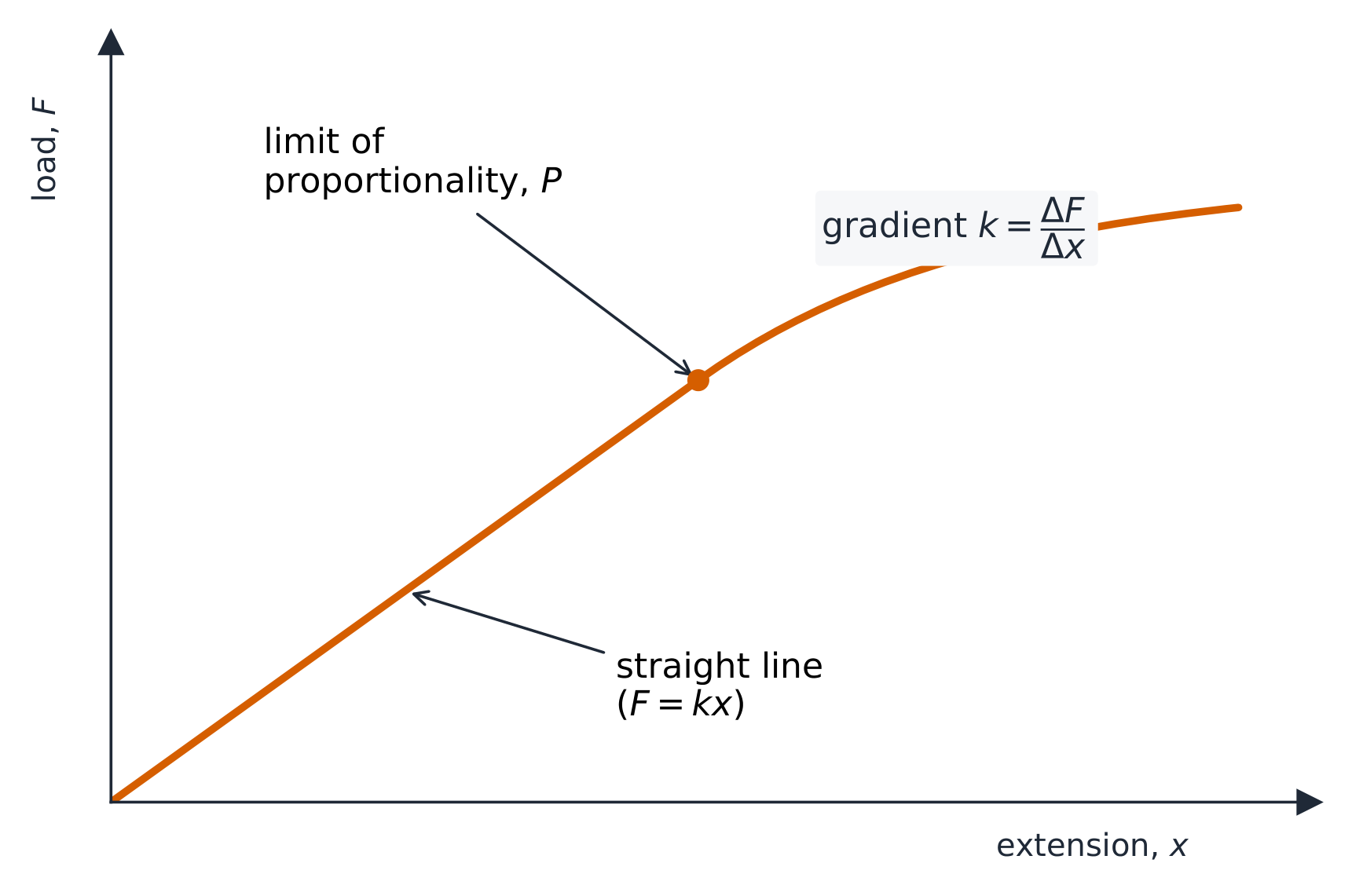
Reading a graph:
- A force–extension ($F$ against $x$) graph has gradient $k$ in the Hooke's-law region.
- An extension–force ($x$ against $F$) graph has gradient $1/k$ in the Hooke's-law region.
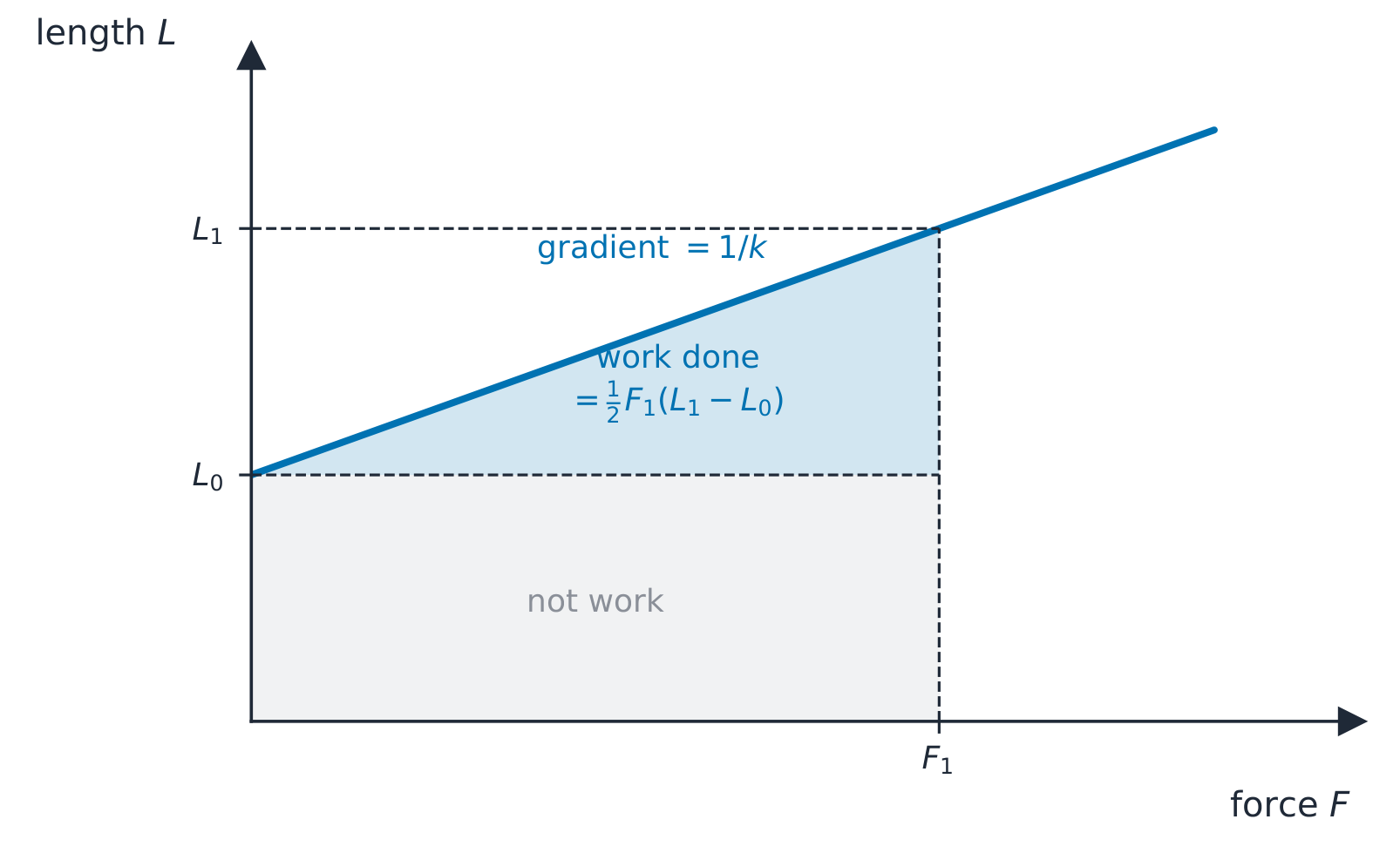
A common trap: if a graph plots length $L$ against force, you can still find the spring constant from the gradient (since $L = L_{0} + F/k$, the gradient is $1/k$ — read it off carefully).
Worked example. A spring has length $90\ \text{mm}$ under a force of $0.80\ \text{N}$ and $115\ \text{mm}$ under $1.30\ \text{N}$. Find the spring constant and the unstretched length.
The extra force $0.50\ \text{N}$ produces the extra extension $25\ \text{mm} = 0.025\ \text{m}$, so $k = 0.50 / 0.025 = 20\ \text{N m}^{-1}$. At $0.80\ \text{N}$ the extension is $x = F/k = 0.80 / 20 = 0.040\ \text{m}$, so the unstretched length is $90 - 40 = 50\ \text{mm}$. On a graph of length against force the intercept on the length axis is $L_{0}$, the gradient is $1/k$, and the work done in stretching the spring is the triangle between the line and the level $L = L_{0}$, not the whole area down to the force axis: the rectangle below $L_{0}$ is the unstretched length multiplied by the force, which means nothing.
Limit of proportionality
Hooke's law only holds up to the limit of proportionality 比例极限. Past this point the $F$ against $x$ line curves and is no longer straight. The material may still be elastic 弹性 (it returns to its first length when you remove the load) a little further, then it becomes plastic 塑性.
Springs in series and parallel
You may need to combine spring constants:
- Series 串联 (one spring hangs from another): the same load passes through both, the total extension is the sum, so $\dfrac{1}{k_{\text{total}}} = \dfrac{1}{k_{1}} + \dfrac{1}{k_{2}}$.
- Parallel 并联 (two springs side by side holding the same load): each takes half the load (if they are identical), the extensions are equal, so $k_{\text{total}} = k_{1} + k_{2}$.
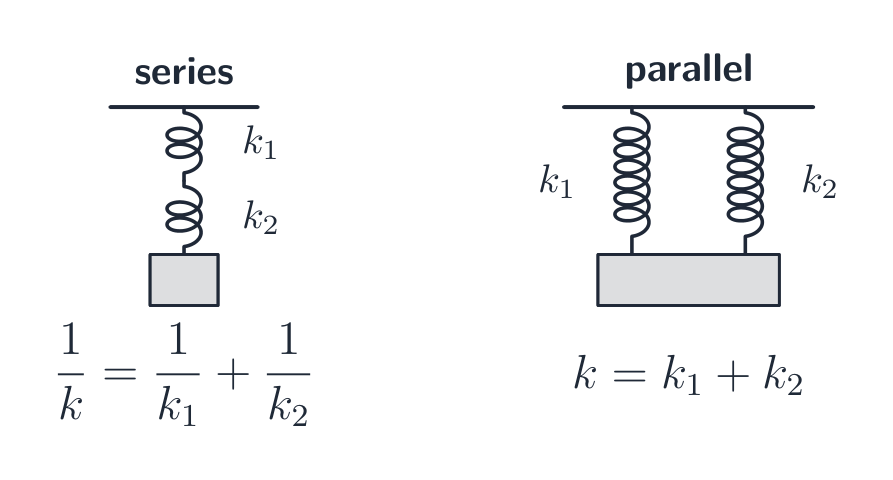
Worked example. Springs of spring constant $6.0\ \text{N cm}^{-1}$ and $4.0\ \text{N cm}^{-1}$ are joined end to end and a load of $80\ \text{N}$ hangs from them. Find the total extension.
Each spring carries the full $80\ \text{N}$, so the extensions are $80/6.0 = 13.3\ \text{cm}$ and $80/4.0 = 20\ \text{cm}$: a total of $33\ \text{cm}$ (the same as $k = 2.4\ \text{N cm}^{-1}$ from $1/k = 1/6.0 + 1/4.0$). Three identical springs give the largest combined constant when all three are in parallel ($3k$) and the smallest when all are in series ($k/3$). When a load is shared by two identical springs in parallel, each carries half the force and so stores a quarter of the energy of one spring holding the whole load; the pair together stores half as much as the single spring did. A spring constant in $\text{N cm}^{-1}$ is $100$ times smaller than the same constant in $\text{N m}^{-1}$; give the unit the question asks for.
Explore
Hooke's law
F = k·x
Force is proportional to extension — the gradient is the spring constant k.
Explore
Hooke's law
F = kx
Up to the limit, extension is proportional to force — the gradient is the spring constant k.
Explore
Hooke's law: F = kx
F = ax
Drag the spring constant. Force is proportional to extension — a straight line through the origin whose gradient is the spring constant.
Vocabulary
Train
| English |
|---|
| Hooke's law/hʊks lɔː/ |
| elastic/ɪˈlæstɪk/ |
| spring constant/sprɪŋ ˈkɒnstənt/ |
| limit of proportionality/ˈlɪmɪt ɒv prəˌpɔːʃəˈnælɪti/ |
| plastic/ˈplæstɪk/ |
| series/ˈsɪəriːz/ |
| parallel/ˈpærəlel/ |
6.1
Stress, strain and the Young modulus

For a wire of uniform cross-section under a tensile load:
- Stress 应力 $\sigma = \dfrac{F}{A}$, where $F$ is the load and $A$ is the cross-sectional area 横截面积. Unit: $\text{Pa}$.
- Strain 应变 $\varepsilon = \dfrac{x}{L_{0}}$, where $x$ is the extension and $L_{0}$ is the original length. Strain has no unit (it is a ratio of lengths).
For the one-mark definitions: stress is the force per unit cross-sectional area (the force acting normally to the area); strain is the extension per unit original length. The unit of stress, $\text{Pa} = \text{N m}^{-2}$, is $\text{kg m}^{-1}\ \text{s}^{-2}$ in base units. The area of a round wire comes from its diameter $d$: $A = \pi d^{2}/4 = \pi r^{2}$, and using $d$ in place of $r$ makes the area four times too big. Convert $\text{mm}^{2}$ to $\text{m}^{2}$ with $10^{-6}$.
Worked example. A tensile force of $18\ \text{N}$ acts on a wire of cross-sectional area $3.2\ \text{mm}^{2}$. Find the stress.
$\sigma = F/A = 18 / (3.2 \times 10^{-6}) = 5.6 \times 10^{6}\ \text{Pa}$. The same force acts along the whole wire, so a bolt whose diameter is $2d$ at one end and $d$ at the other has four times the stress at the narrow end ($\sigma \propto 1/d^{2}$), and a wire of three times the radius carries one ninth of the stress.
The Young modulus 杨氏模量 is the ratio of stress to strain in the Hooke's-law region:
$$E = \frac{\sigma}{\varepsilon} = \frac{F / A}{x / L_{0}} = \frac{F L_{0}}{A x}.$$
Unit: $\text{Pa}$ (about $10^{11}$ for metals; e.g. steel $\approx 2.0 \times 10^{11}$ Pa).
Worked example. A steel wire of length $2.0\ \text{m}$ and cross-sectional area $1.5 \times 10^{-7}\ \text{m}^{2}$ stretches by $1.0\ \text{mm}$ under a load of $15\ \text{N}$. Find the Young modulus.
$$E = \frac{F L_{0}}{A x} = \frac{15 \times 2.0}{(1.5 \times 10^{-7})(1.0 \times 10^{-3})} = 2.0 \times 10^{11}\ \text{Pa}.$$
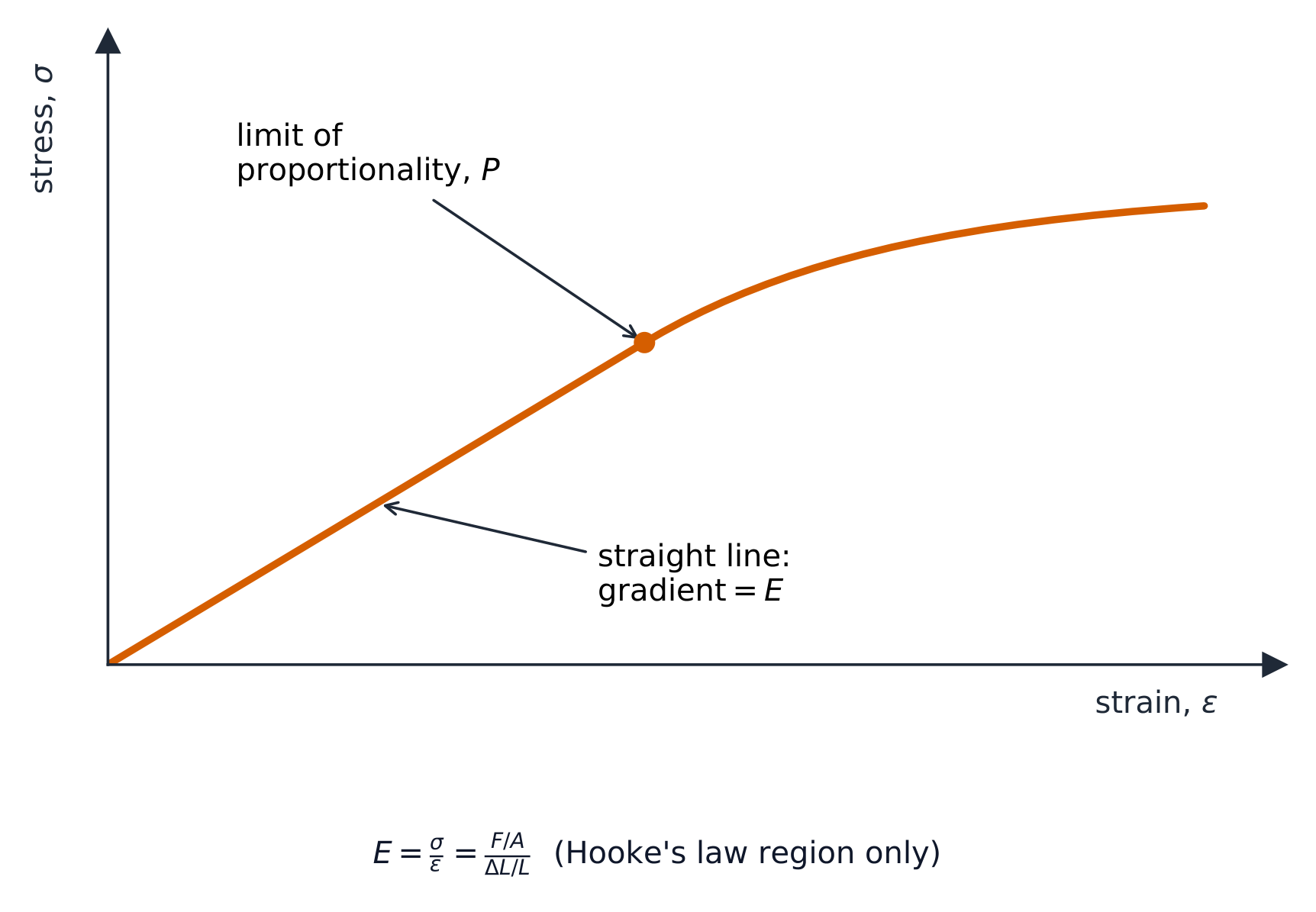
The Young modulus is a property of the material — it does not depend on the wire's shape or size. The spring constant $k$ depends on both the material and the size: $k = EA/L_{0}$.
For the one-mark definition: the Young modulus is the ratio of stress to strain (for a material deformed within its limit of proportionality). Because it belongs to the material, a thicker wire of the same metal has the same Young modulus: it stretches less under the same load because its area is larger, not because the metal is stiffer. A "show that $k = EA/L_{0}$" question wants two lines: $k = F/x$ and $E = FL_{0}/(Ax)$, so $E = kL_{0}/A$. Two things follow: a wire's spring constant stays constant while Hooke's law holds, whatever the force, and a wire of the same metal with twice the diameter has four times the spring constant.
Worked example. A copper wire of length $1.7\ \text{m}$ and diameter $0.64\ \text{mm}$ has Young modulus $1.2 \times 10^{11}\ \text{Pa}$. Find its spring constant.
$A = \pi (0.32 \times 10^{-3})^{2} = 3.2 \times 10^{-7}\ \text{m}^{2}$, so $k = EA/L_{0} = 1.2 \times 10^{11} \times 3.2 \times 10^{-7} / 1.7 = 2.3 \times 10^{4}\ \text{N m}^{-1}$.
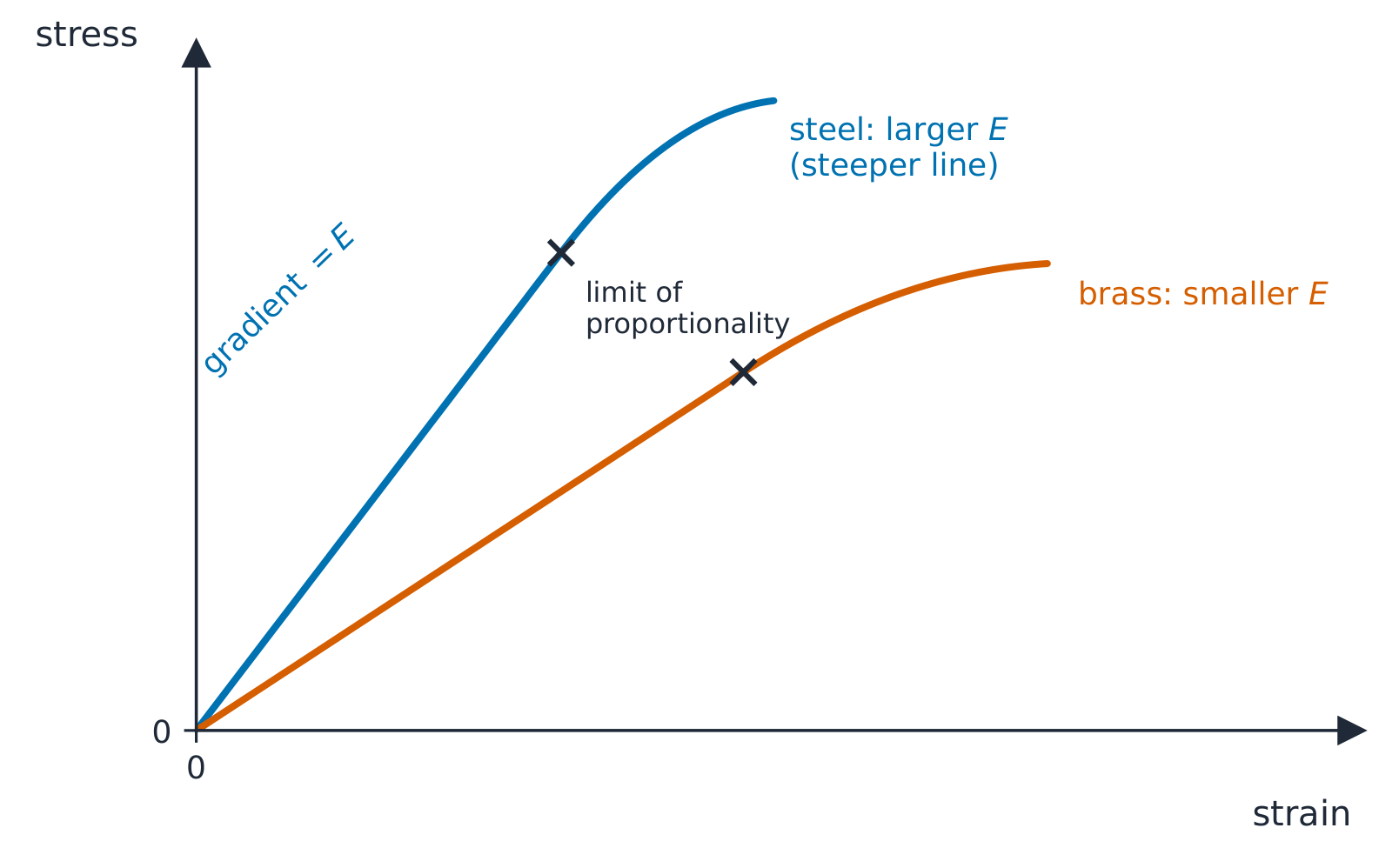
On a stress–strain graph the gradient of the straight part is $E$, so of two materials drawn on the same axes the steeper line is the stiffer material, and a wire with double the Young modulus is drawn as a line through the origin with twice the gradient. On a force–extension graph the gradient is $EA/L_{0}$ and the Young modulus is the gradient multiplied by $L_{0}/A$; only a stress–strain graph has a gradient equal to $E$ itself.
Experiment to find the Young modulus of a metal wire
A standard setup:
- Clamp one end of a long, thin wire to a fixed support. Pass the wire over a pulley 滑轮 at the edge of the bench so it hangs straight down.
- Measure the original length $L_{0}$ between the clamp and a marker near the pulley, using a metre rule.
- Measure the diameter 直径 $d$ of the wire at several places with a micrometer 螺旋测微器 and take the average. Work out $A = \pi d^{2}/4$.
- Hang weights one at a time. Record the load $F$ and the extension $x$ (how far the marker moves against a fixed scale).
- Plot $F$ against $x$. In the straight region the gradient is $EA/L_{0}$, so $E = \text{gradient} \times L_{0}/A$.
Why a long, thin wire? To make the extension big enough to measure well. Why repeat readings and measure $d$ at several places? To reduce random error 随机误差 and check the wire is uniform.
A "describe an experiment" answer earns its marks for the quantities measured and how ($L_{0}$ with a metre rule; $d$ with a micrometer at several points; the load from the masses or a newton meter; the extension from a marker read against a fixed scale, or a vernier scale), the graph ($F$ against $x$, gradient $EA/L_{0}$, or stress against strain, gradient $E$) and the precautions: safety goggles in case the wire snaps, a small load first to straighten kinks, and readings taken on unloading as well as loading to check the wire stayed elastic.

Vocabulary
Train
| English |
|---|
| stress/stres/ |
| strain/streɪn/ |
| Young modulus/jʌŋ ˈmɒdjʊləs/ |
| cross-sectional area/krɒs ˈsekʃənl ˈeərɪə/ |
| diameter/daɪˈæmɪtə/ |
| pulley/ˈpʊli/ |
| micrometer/maɪˈkrɒmɪtə/ |
| random error/ˈrændəm ˈerə/ |
6.2
Elastic and plastic behaviour
Syllabus
- understand and use the terms elastic deformation, plastic deformation and elastic limit
- understand that the area under the force–extension graph represents the work done
- determine the elastic potential energy of a material deformed within its limit of proportionality from the area under the force–extension graph
- recall and use $E_p = \frac{1}{2}Fx = \frac{1}{2}kx^2$ for a material deformed within its limit of proportionality
Source: Cambridge International syllabus
As the load grows:
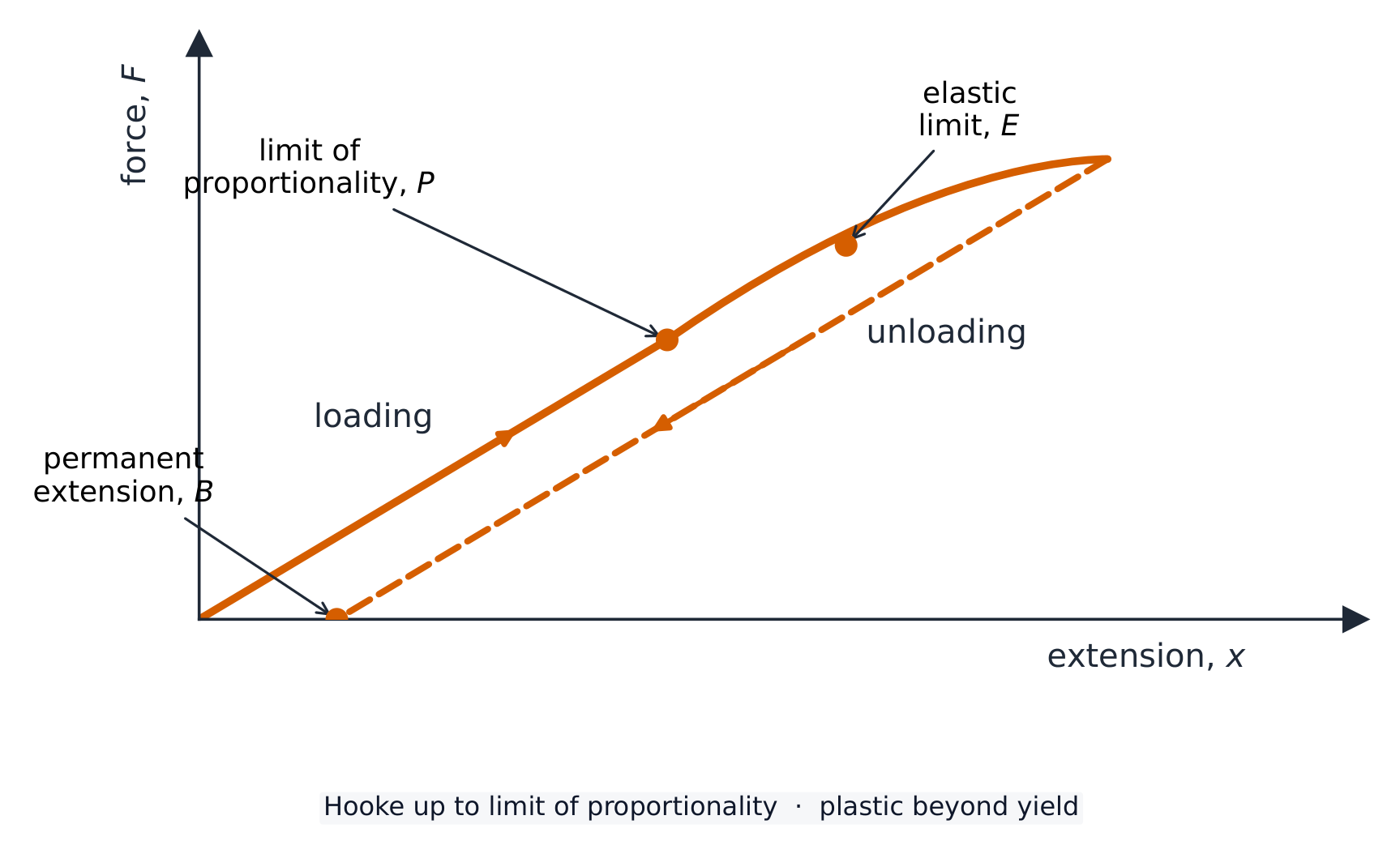
- Elastic and straight (Hooke obeyed) — up to the limit of proportionality. Removing the load returns the object to its first length.
- Elastic but curved — between the limit of proportionality and the elastic limit 弹性极限. The extension is no longer straight in the load, but on unloading the object still returns to its first length.
- Plastic — past the elastic limit. On unloading, the object does not return to its first length; a permanent extension stays.
Hooke's law only holds in the straight, elastic region.
In words: elastic deformation means the object returns to its original length (or shape) when the load is removed; plastic deformation means it does not, and a permanent extension remains; the elastic limit is the maximum load (or extension) for which the deformation is still elastic; the limit of proportionality is the point beyond which the extension is no longer proportional to the load. On a graph the limit of proportionality is where the line stops being straight. The elastic limit lies a little beyond it and cannot be read from a loading line alone. So in a "which statement must be correct" item, the end of the straight part is the limit of proportionality, but whether a later point is the elastic limit or the breaking point cannot be told from the shape of the loading line.

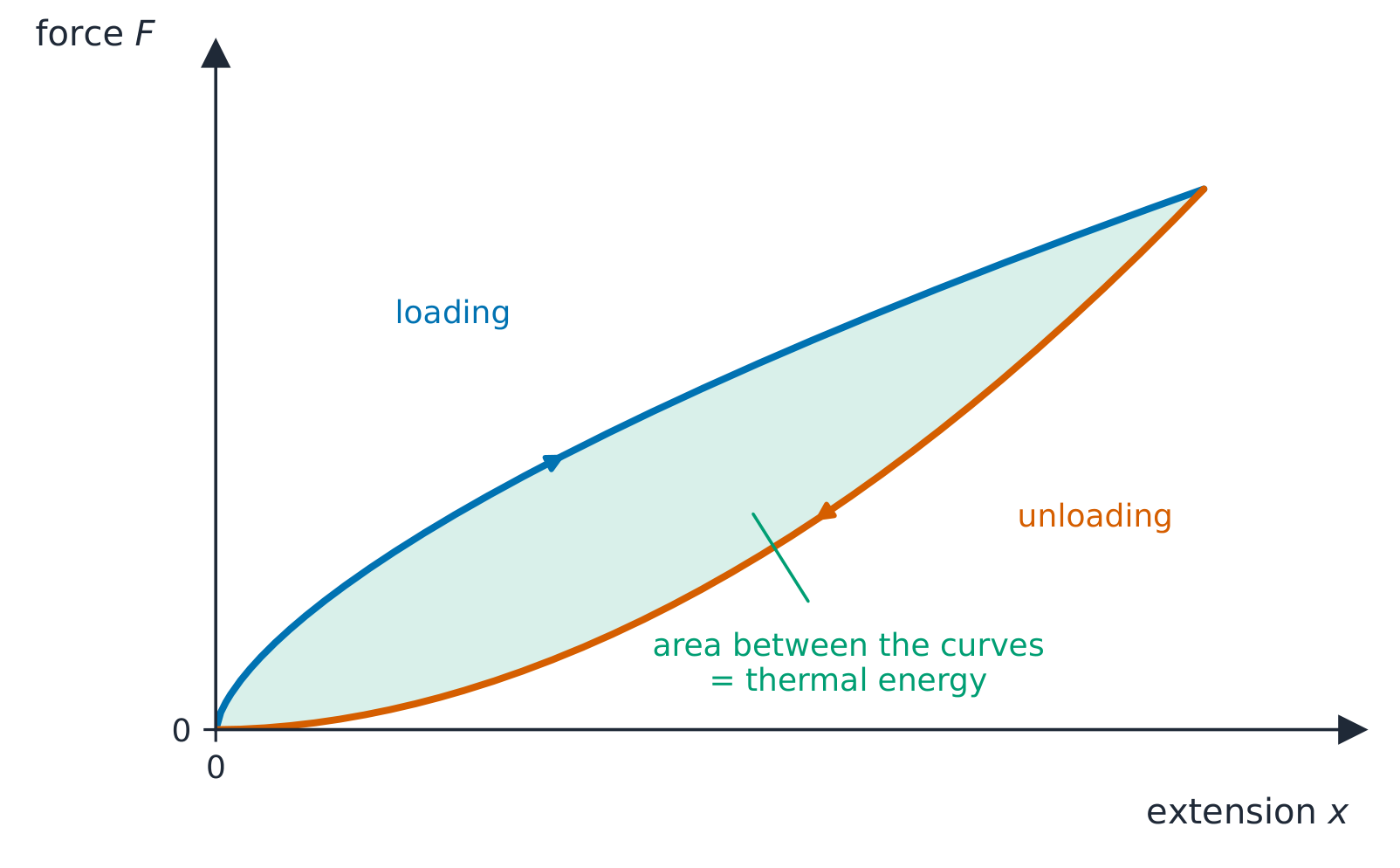
On a force–extension graph for a material taken into the plastic region and then unloaded, the loading line and the unloading line are different. The unloading line is parallel to the first Hooke line but shifted to the right (the permanent extension left when the load reaches zero). The area between the loading and unloading lines is the energy turned into thermal energy 热能 in the material.
A rubber band 橡皮筋 also has different loading and unloading curves, but it returns to its original length: its deformation is elastic. The area between the two curves is again energy dissipated as thermal energy (elastic hysteresis 弹性滞后), and the energy recovered on unloading is the area under the lower curve. The two-mark "explain why the work done in stretching the wire is not equal to the energy recovered when the force is removed" answer says that the wire was taken past its elastic limit, so part of the deformation is plastic and a permanent extension remains, and that part of the work done became thermal energy in the wire.
Vocabulary
Train
| English |
|---|
| elastic limit/ɪˈlæstɪk ˈlɪmɪt/ |
| thermal energy/ˈθɜːml ˈenədʒi/ |
| rubber band/ˈrʌbə bænd/ |
| elastic hysteresis/ɪˈlæstɪk ˌhɪstəˈriːsɪs/ |
6.2
Energy stored in a stretched material
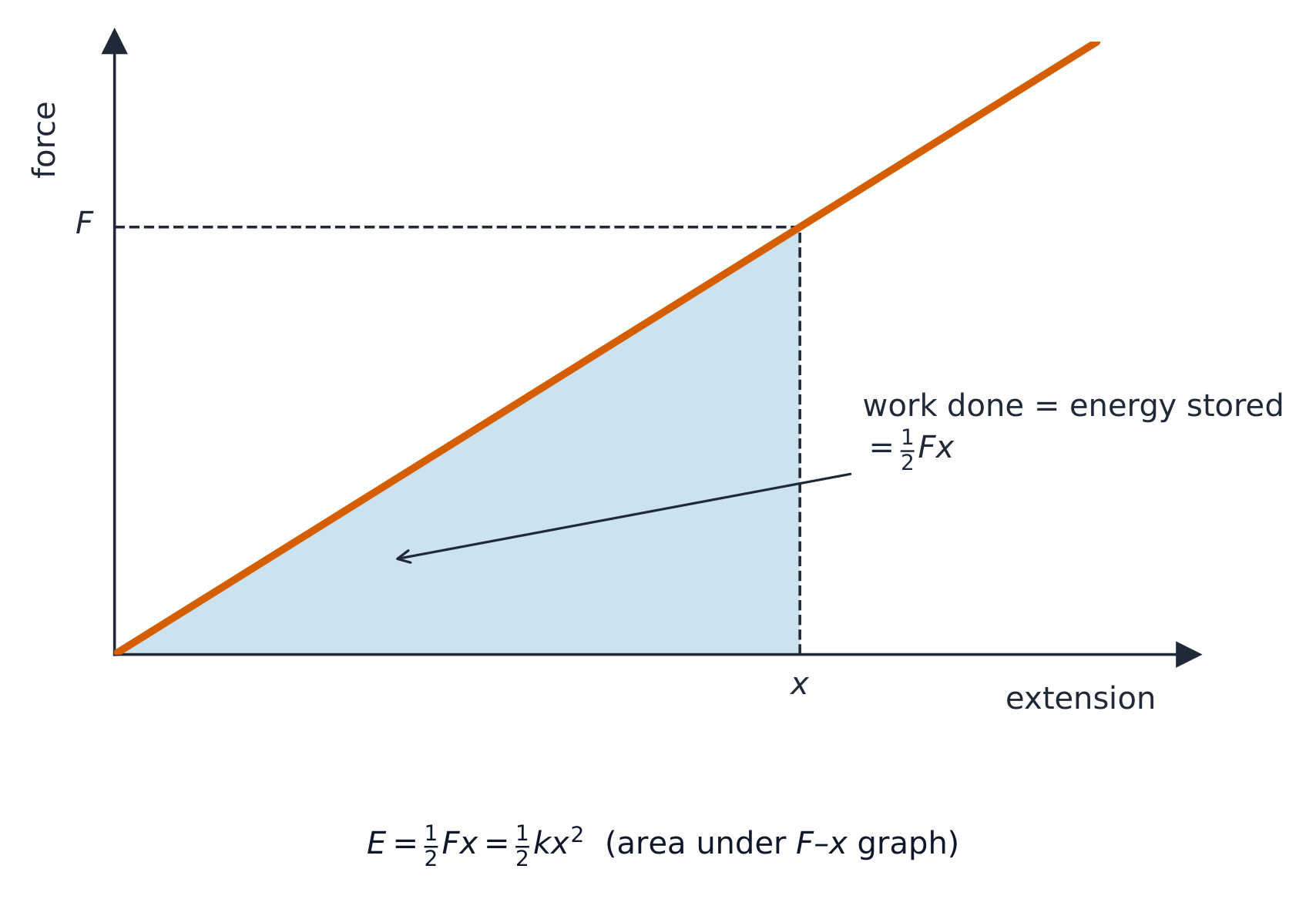
The work done in stretching a material from $0$ to extension $x$, as the load grows from $0$ to $F$, is the area under the force–extension graph.
Why the area: work done is force multiplied by the distance moved, but here the force grows as the material stretches, so the work is the sum of $F\,\Delta x$ over many small extensions, which is the area under the line. Within the limit of proportionality the force rises uniformly from $0$ to $F$, so the average force is $\tfrac{1}{2}F$ and the work is $\tfrac{1}{2}Fx$. On a force–extension graph the gradient is the spring constant.
Hooke's-law material
When Hooke's law holds, the $F$ against $x$ graph is a straight line through the origin. The area under it from $0$ to $x$ is a triangle:
$$E_{\text{P}} = \tfrac{1}{2} F x = \tfrac{1}{2} k x^{2}.$$
This is the elastic potential energy 弹性势能 stored in a spring or wire stretched within its limit of proportionality. An equal form:
$$E_{\text{P}} = \frac{F^{2}}{2k}.$$
Worked example. A spring of spring constant $50\ \text{N m}^{-1}$ is stretched by $0.20\ \text{m}$, within its limit of proportionality. Find the elastic potential energy stored.
$$E_{\text{P}} = \tfrac{1}{2} k x^{2} = \tfrac{1}{2} \times 50 \times 0.20^{2} = 1.0\ \text{J}.$$
Worked example. A wire of spring constant $2.0 \times 10^{4}\ \text{N m}^{-1}$ is already extended by $2.0\ \text{mm}$. Find the work done to increase its extension to $3.0\ \text{mm}$.
The stored energy rises from $\tfrac{1}{2} k x_{1}^{2}$ to $\tfrac{1}{2} k x_{2}^{2}$:
$$\begin{aligned}
W &= \tfrac{1}{2} \times 2.0 \times 10^{4} \\
&\quad \times \left[(3.0 \times 10^{-3})^{2} - (2.0 \times 10^{-3})^{2}\right] \\
&= 0.050\ \text{J}
\end{aligned}$$
This is the trapezium under the line between the two extensions, not $\tfrac{1}{2} k (x_{2} - x_{1})^{2}$. Because $E_{\text{P}} \propto x^{2}$ at fixed $k$, doubling the extension of a wire stores four times the energy ($0.65\ \text{J}$ becomes $2.6\ \text{J}$), and a stored energy gives the extension as $x = \sqrt{2E_{\text{P}}/k}$: a spring of $k = 400\ \text{N m}^{-1}$ storing $0.32\ \text{J}$ is compressed by $\sqrt{2 \times 0.32 / 400} = 0.040\ \text{m}$. For two wires joined end to end the tension is the same in both, so the total energy stored is $\tfrac{1}{2}F x_{1} + \tfrac{1}{2}F x_{2}$ with each wire's own extension.
Non-Hooke material
For a graph that is not a straight line (a stretched rubber band, or a spring past its limit of proportionality), find the area by counting grid squares or by using trapezia 梯形. The same idea holds: the area under the force–extension graph is the work done on the material. To estimate the work done up to the breaking point, count the squares under the whole curve (part squares as halves) and multiply by the energy one square represents, the force step multiplied by the extension step; saying that the area was found by counting squares is the "explain your reasoning" mark.
Comparing stored energy
A common multiple-choice case: two materials are stretched by the same force, or by the same extension. Using $E_{\text{P}} = \tfrac{1}{2} F x$:
- same $F$, smaller $k$ (less stiff) → larger $x$ → more energy stored.
- same $x$, larger $k$ (stiffer) → larger $F$ → more energy stored.
A sketch of $E_{\text{P}}$ against extension or compression is a curve through the origin that gets steeper ($E_{\text{P}} \propto x^{2}$), not a straight line. Of two wires of the same length and area under the same load, the one with the smaller Young modulus extends more and so stores more energy.
When a stretched spring is released onto a mass, the elastic potential energy becomes kinetic energy 动能 (and gravitational potential energy if the mass rises). Set $\tfrac{1}{2} k x^{2}$ equal to $\tfrac{1}{2} m v^{2}$ (plus any $mgh$) to find the speed or height.
Vocabulary
Train
| English |
|---|
| elastic potential energy/ɪˈlæstɪk pəˈtenʃl ˈenədʒi/ |
| trapezia/trəˈpiːzɪə/ |
| kinetic energy/kɪˈnetɪk ˈenədʒi/ |
6.2
Definitions the examiner accepts
A definition question is marked against fixed wording. Learn these exactly, and give one answer only.
| Term | Definition |
|---|---|
| Hooke's law | the extension is directly proportional to the applied force, provided the limit of proportionality is not exceeded |
| spring constant | the force per unit extension |
| limit of proportionality | the point beyond which the extension is no longer proportional to the applied force |
| elastic limit | the maximum force (or extension) for which the material returns to its original length when the force is removed |
| elastic deformation | the material returns to its original length (shape) when the force is removed |
| plastic deformation | the material does not return to its original length when the force is removed; a permanent extension remains |
| stress | the force per unit cross-sectional area |
| strain | the extension per unit original length |
| Young modulus | the ratio of stress to strain (within the limit of proportionality) |
| elastic potential energy | the energy stored in an object because it has been stretched or compressed |
6.2
Exam tips
- Hooke's law ($F = kx$) holds only up to the limit of proportionality.
- Stress $= F/A$, strain $= x/L$, Young modulus $=$ stress$/$strain (gradient of the straight part of the stress-strain graph) — watch the units (Pa).
- Energy stored $=$ area under the force-extension graph $= \frac{1}{2}Fx$ in the elastic region.
- Distinguish elastic (returns to shape) from plastic (permanent) deformation.
Common mistakes
- Using the diameter as the radius in $A = \pi r^{2}$, or leaving an area in $\text{mm}^{2}$. Halve the diameter first; $1\ \text{mm}^{2} = 10^{-6}\ \text{m}^{2}$.
- Reading the work done off a length–force graph as the whole area down to the axis. Only the triangle above $L_{0}$ is work.
- Treating stored energy as proportional to extension. It goes as $x^{2}$: double the extension, four times the energy; and the work done between two extensions is the difference of two $\tfrac{1}{2}kx^{2}$ values.
- Stating Hooke's law without its condition. "Provided the limit of proportionality is not exceeded" is part of the law.
- Swapping the limit of proportionality (the end of the straight line) and the elastic limit (the end of elastic behaviour, a little beyond it).
- Saying a thicker wire has a larger Young modulus. The modulus is the material's; the thicker wire has a larger spring constant.
Interactive lessons on this topic
Work through it step by step, with instant-check exercises.