- understand that electromagnetic radiation has a particulate nature
- understand that a photon is a quantum of electromagnetic energy
- recall and use $E = hf$
- use the electronvolt (eV) as a unit of energy
- understand that a photon has momentum and that the momentum is given by $p = E/c$
Quantum physics
A-Level Physics · Topic 22
 15:44
15:44
Photons
Here is a puzzle that broke classical physics. Shine the brightest red lamp you can find onto a metal plate. Pour on more and more light. And yet — nothing…
English narration · English + 中文 subtitles burned in
22.1
Photons: the particle nature of light

Syllabus
Source: Cambridge International syllabus
Electromagnetic radiation behaves like particles as well as like a wave. The particles of EM radiation are photons 光子 — small packets ("quanta" 量子) of EM energy that travel at the speed of light.
"State what is meant by a photon" (two marks). A photon is a quantum (a discrete packet) of energy of electromagnetic radiation. Both halves score: quantum or packet (or "discrete amount"), and of electromagnetic radiation (or "of light"). "A particle of light" alone is not enough. That radiation comes in such packets is what the syllabus calls its particulate nature 粒子性: energy is delivered in lumps of $hf$, never in smaller pieces.
Energy of a photon
A photon of frequency 频率 $f$ has energy
$$E = h f,$$
where $h = 6.63 \times 10^{-34}\ \text{J s}$ is the Planck constant 普朗克常量. Using $c = f\lambda$:
$$E = \frac{h c}{\lambda}.$$
Worked example. Find the energy of a photon of green light of wavelength $500\ \text{nm}$. ($h = 6.63 \times 10^{-34}\ \text{J s}$, $c = 3.0 \times 10^{8}\ \text{m s}^{-1}$.)
$$E = \frac{hc}{\lambda} = \frac{(6.63 \times 10^{-34})(3.0 \times 10^{8})}{500 \times 10^{-9}} \approx 4.0 \times 10^{-19}\ \text{J}\ (\approx 2.5\ \text{eV}).$$
Higher-frequency (shorter-wavelength 波长) photons carry more energy: one $\gamma$-ray photon carries far more than one radio photon.
The electronvolt
The electronvolt 电子伏特 (eV) is a handy energy unit on the atomic scale:
$$1\ \text{eV} = 1.60 \times 10^{-19}\ \text{J}.$$
It is the kinetic energy 动能 an electron 电子 gains moving through a potential difference 电势差 of 1 V. For example, a visible photon ($\lambda \approx 500\ \text{nm}$) has energy $\approx 2.5\ \text{eV}$. To go eV → J multiply by $1.60 \times 10^{-19}$; J → eV divide.
Using the electronvolt. Photon energies, work functions and energy levels are all a few eV, so the exam quotes them that way and expects you to move between units without fuss: a $2.0\ \text{eV}$ work function is $2.0 \times 1.60 \times 10^{-19} = 3.2 \times 10^{-19}\ \text{J}$; a photon of $4.0 \times 10^{-19}\ \text{J}$ is $2.5\ \text{eV}$. A useful shortcut for wavelengths: $hc = 1.99 \times 10^{-25}\ \text{J m} = 1240\ \text{eV nm}$, so a $2.0\ \text{eV}$ photon has $\lambda = 1240/2.0 = 620\ \text{nm}$ (red) and a $400\ \text{nm}$ photon carries $3.1\ \text{eV}$.
Momentum of a photon
A photon also carries momentum 动量:
$$p = \frac{E}{c} = \frac{h}{\lambda}.$$
It has zero rest mass but a non-zero momentum $E/c$. Radiation pressure (photons pushing on a surface) follows from this.
"Show that $p = h/\lambda$." Start from the two photon relations: $E = hf$ and $p = E/c$. Then $p = hf/c$, and since $c = f\lambda$, $f/c = 1/\lambda$, so $p = h/\lambda$. Give both starting equations and the wave equation; the mark is for the chain, not the result.
Worked example. A photon in free space has momentum $9.5 \times 10^{-28}\ \text{N s}$. Show that it is a photon of red light.
$\lambda = h/p = 6.63 \times 10^{-34}/9.5 \times 10^{-28} = 7.0 \times 10^{-7}\ \text{m} = 700\ \text{nm}$, which lies at the red end of the visible spectrum ($400$–$700\ \text{nm}$). The energy is $pc = 2.9 \times 10^{-19}\ \text{J} = 1.8\ \text{eV}$.
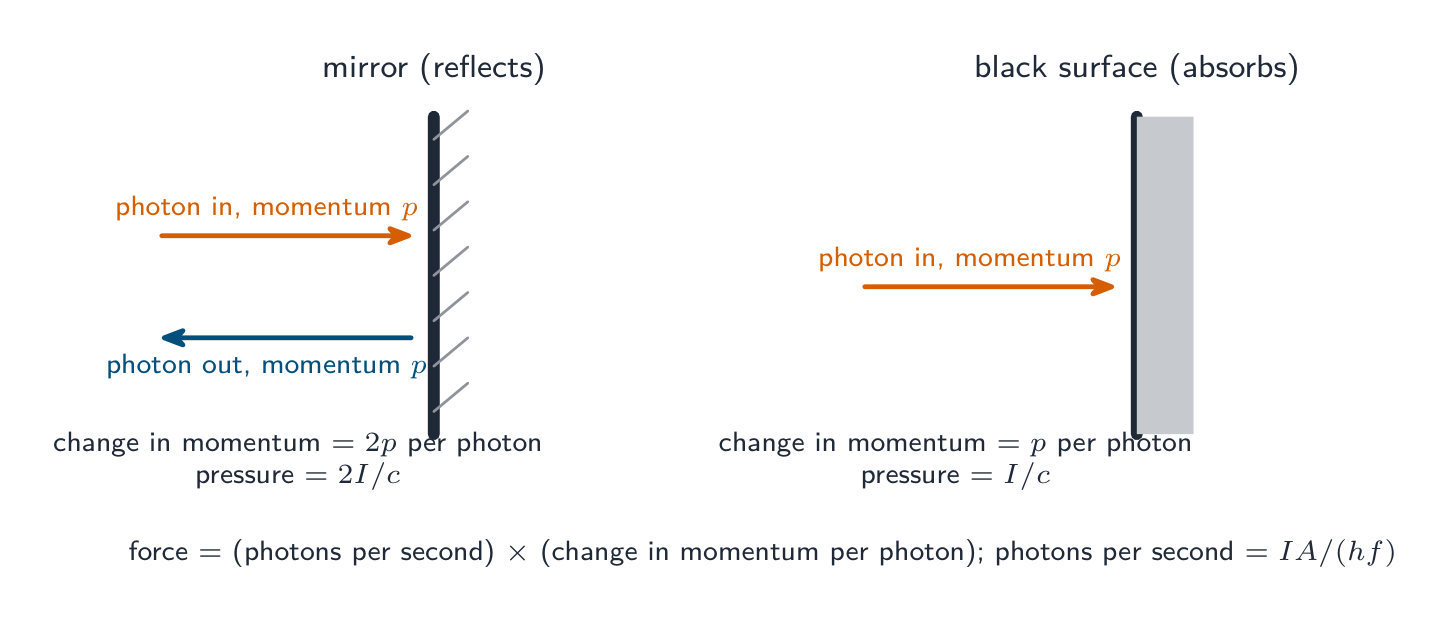
Radiation pressure 辐射压. A beam of intensity $I$ (power per unit area) falling on area $A$ delivers $IA/(hf)$ photons per second, each with momentum $h/\lambda$. Force is the rate of change of momentum. On a mirror each photon bounces back, so its momentum changes by $2p$ and the force is $F = 2IA/c$ (pressure $2I/c$); on a black surface each photon is absorbed, the change is $p$, and the pressure is $I/c$. Two things follow, and both are examined: the pressure depends on the intensity, not on the colour, because blue light of the same intensity has fewer photons per second but each carries proportionally more momentum; and even sunlight ($I \approx 1\ \text{kW m}^{-2}$) exerts only a few micropascals.
Worked example. Red light of intensity $160\ \text{W m}^{-2}$ falls normally on a plane mirror; each photon has momentum $9.5 \times 10^{-28}\ \text{N s}$. Find the number of photons hitting $1.0\ \text{m}^{2}$ of the mirror per second, and the pressure on it.
Photon energy $E = pc = (9.5 \times 10^{-28})(3.00 \times 10^{8}) = 2.85 \times 10^{-19}\ \text{J}$. Photons per second on $1.0\ \text{m}^{2}$: $160/2.85 \times 10^{-19} = 5.6 \times 10^{20}\ \text{s}^{-1}$. Each is reflected, so the force is $F = 5.6 \times 10^{20} \times 2 \times 9.5 \times 10^{-28} = 1.1 \times 10^{-6}\ \text{N}$ on $1.0\ \text{m}^{2}$: a pressure of $1.1 \times 10^{-6}\ \text{Pa}$ (check: $2I/c = 320/3.00 \times 10^{8} = 1.1 \times 10^{-6}\ \text{Pa}$). Replace the beam with blue light of the same intensity and the pressure is unchanged.
Worked example. A laser emits $2.0\ \text{mW}$ of light of wavelength $650\ \text{nm}$. Find the number of photons it emits per second, and the force on a surface that absorbs the beam completely.
$E = hc/\lambda = (6.63 \times 10^{-34})(3.00 \times 10^{8})/(650 \times 10^{-9}) = 3.06 \times 10^{-19}\ \text{J}$, so the rate is $P/E = 2.0 \times 10^{-3}/3.06 \times 10^{-19} = 6.5 \times 10^{15}\ \text{s}^{-1}$. The force is the momentum delivered per second: $F = P/c = 2.0 \times 10^{-3}/3.00 \times 10^{8} = 6.7 \times 10^{-12}\ \text{N}$ (or $6.5 \times 10^{15} \times h/\lambda$, the same thing).
Explore
Energy of a photon
E = h·f
Photon energy is proportional to frequency — the gradient is Planck's constant h.
Vocabulary
Train
| English |
|---|
| photon/ˈfəʊtɒn/ |
| quanta/ˈkwɒntə/ |
| particulate nature/pəˈtɪkjʊleɪt ˈneɪtʃə/ |
| frequency/ˈfriːkwənsi/ |
| Planck constant/plæŋk ˈkɒnstənt/ |
| wavelength/ˈweɪvleŋθ/ |
| electronvolt/ɪˈlektrɒnvəʊlt/ |
| kinetic energy/kɪˈnetɪk ˈenədʒi/ |
| electron/ɪˈlektrɒn/ |
| potential difference/pəˈtenʃl ˈdɪfrəns/ |
| momentum/məʊˈmentəm/ |
| Radiation pressure/ˌreɪdɪˈeɪʃn ˈpreʃə/ |
22.2
Photoelectric effect

Syllabus
- understand that photoelectrons may be emitted from a metal surface when it is illuminated by electromagnetic radiation
- understand and use the terms threshold frequency and threshold wavelength
- explain photoelectric emission in terms of photon energy and work function energy
- recall and use $hf = \Phi + \frac{1}{2}m{v_{\text{max}}}^2$
- explain why the maximum kinetic energy of photoelectrons is independent of intensity, whereas the photoelectric current is proportional to intensity
Source: Cambridge International syllabus
When EM radiation of high enough frequency hits a metal, electrons are emitted. These are photoelectrons 光电子, and the effect is the photoelectric effect 光电效应.
"State what is meant by the photoelectric effect." The emission of electrons from (the surface of) a metal when electromagnetic radiation of high enough frequency is incident on it. Two marks: emission of electrons and from a metal surface illuminated by electromagnetic radiation (or "when light is shone on it"). It is the syllabus's evidence for the particulate nature of radiation, because a wave could not explain what follows.


Threshold frequency and work function
Each metal has a lowest photon frequency, the threshold frequency 极限频率 $f_{0}$, below which no electrons come out, however bright the light. The work function 逸出功 $\Phi$ is the least energy needed to free an electron from the surface:
$$\Phi = h f_{0}.$$
Different metals have different work functions (about $2$–$5\ \text{eV}$).
The two-mark definitions. The work function energy of a metal is the minimum energy needed to remove an electron from the surface of the metal. Both "minimum" and "from the surface" carry marks: an electron deeper in the metal needs more, which is why the equation gives a maximum kinetic energy. The threshold frequency is the minimum frequency of radiation for which photoelectrons are emitted, and the threshold wavelength 极限波长 $\lambda_{0} = c/f_{0} = hc/\Phi$ is the corresponding maximum wavelength: longer wavelengths do nothing.
Worked example. Light of wavelength $400\ \text{nm}$ falls on four metals whose work functions are: caesium $2.1\ \text{eV}$, sodium $2.3\ \text{eV}$, zinc $4.3\ \text{eV}$, platinum $5.6\ \text{eV}$. Which emit photoelectrons, and with what maximum kinetic energy?
The photon energy is $hc/\lambda = 1240/400 = 3.1\ \text{eV}$. Emission needs $hf \geq \Phi$, so caesium ($3.1 - 2.1 = 1.0\ \text{eV}$) and sodium ($0.8\ \text{eV}$) emit; zinc and platinum do not, however intense the light. To make zinc emit, the wavelength must fall below $\lambda_{0} = 1240/4.3 = 290\ \text{nm}$, in the ultraviolet, which is why the electroscope demonstration needs a UV lamp on zinc.
Worked example. A polished magnesium sheet in a vacuum emits electrons only when the ultraviolet frequency is at least $8.8 \times 10^{14}\ \text{Hz}$. It is illuminated at $1.2 \times 10^{15}\ \text{Hz}$. Find the work function and the maximum speed of the photoelectrons.
$\Phi = hf_{0} = (6.63 \times 10^{-34})(8.8 \times 10^{14}) = 5.8 \times 10^{-19}\ \text{J}$ ($3.6\ \text{eV}$). Then $\tfrac{1}{2}mv_{\text{max}}^{2} = h(f - f_{0}) = (6.63 \times 10^{-34})(1.2 \times 10^{15} - 8.8 \times 10^{14}) = 2.1 \times 10^{-19}\ \text{J}$, so $v_{\text{max}} = \sqrt{2 \times 2.1 \times 10^{-19}/9.11 \times 10^{-31}} = 6.8 \times 10^{5}\ \text{m s}^{-1}$. Subtract the frequencies before multiplying by $h$; rounding $hf$ and $\Phi$ separately loses a significant figure in the small difference.
Einstein's photoelectric equation
One photon gives all its energy to one electron. If the photon energy $hf$ is more than the work function, the electron escapes with kinetic energy up to a maximum:
$$h f = \Phi + \tfrac{1}{2} m v_{\text{max}}^{2}, \qquad\text{so}\qquad \tfrac{1}{2} m v_{\text{max}}^{2} = h(f - f_{0}).$$
Worked example. A metal has a work function of $2.0\ \text{eV}$. Light made of photons of energy $3.5\ \text{eV}$ shines on it. Find the maximum kinetic energy of the photoelectrons.
$$\tfrac{1}{2}mv_{\text{max}}^{2} = hf - \Phi = 3.5 - 2.0 = 1.5\ \text{eV}\ (= 2.4 \times 10^{-19}\ \text{J}).$$
So the maximum KE of photoelectrons depends linearly on frequency, not on brightness.
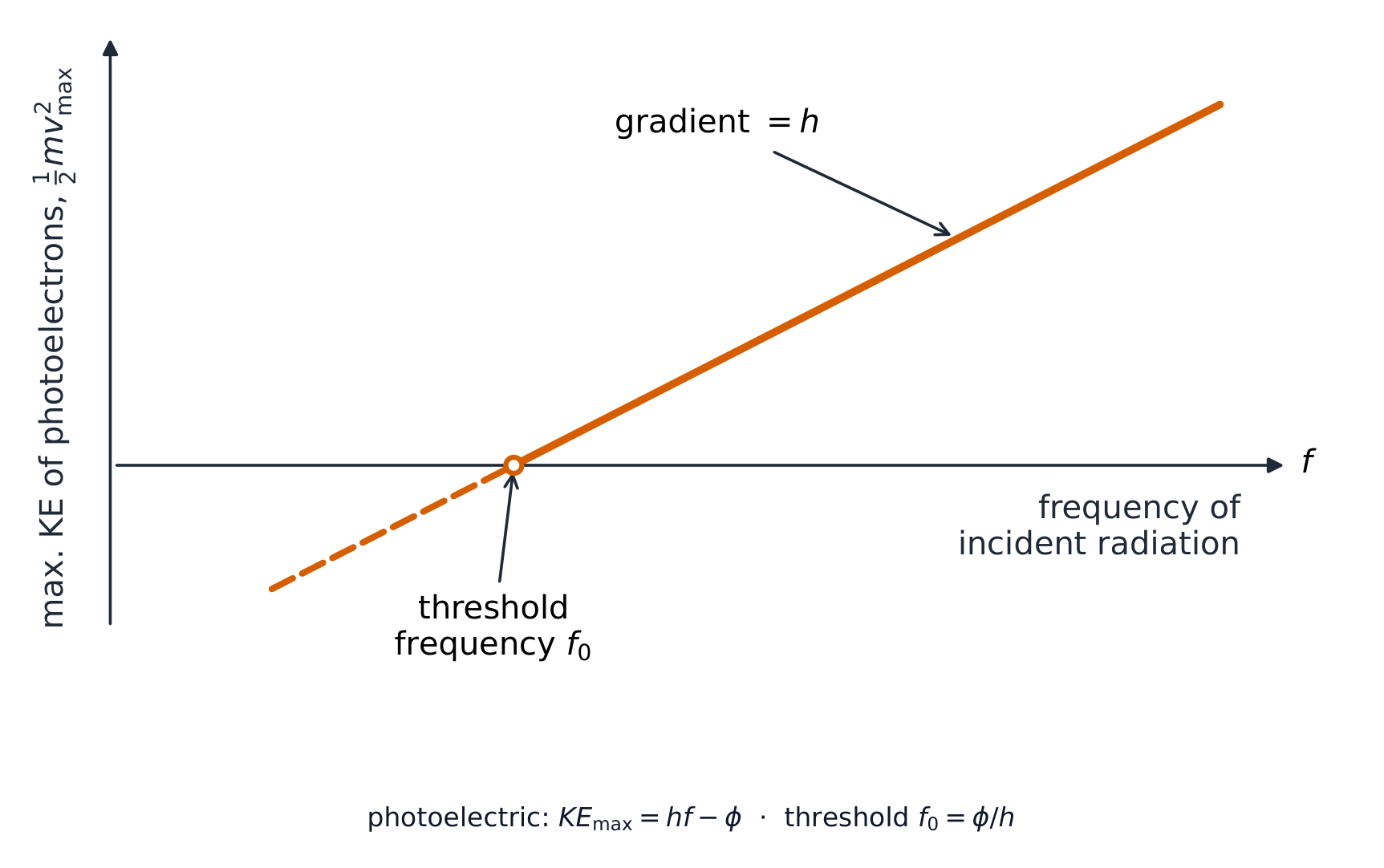
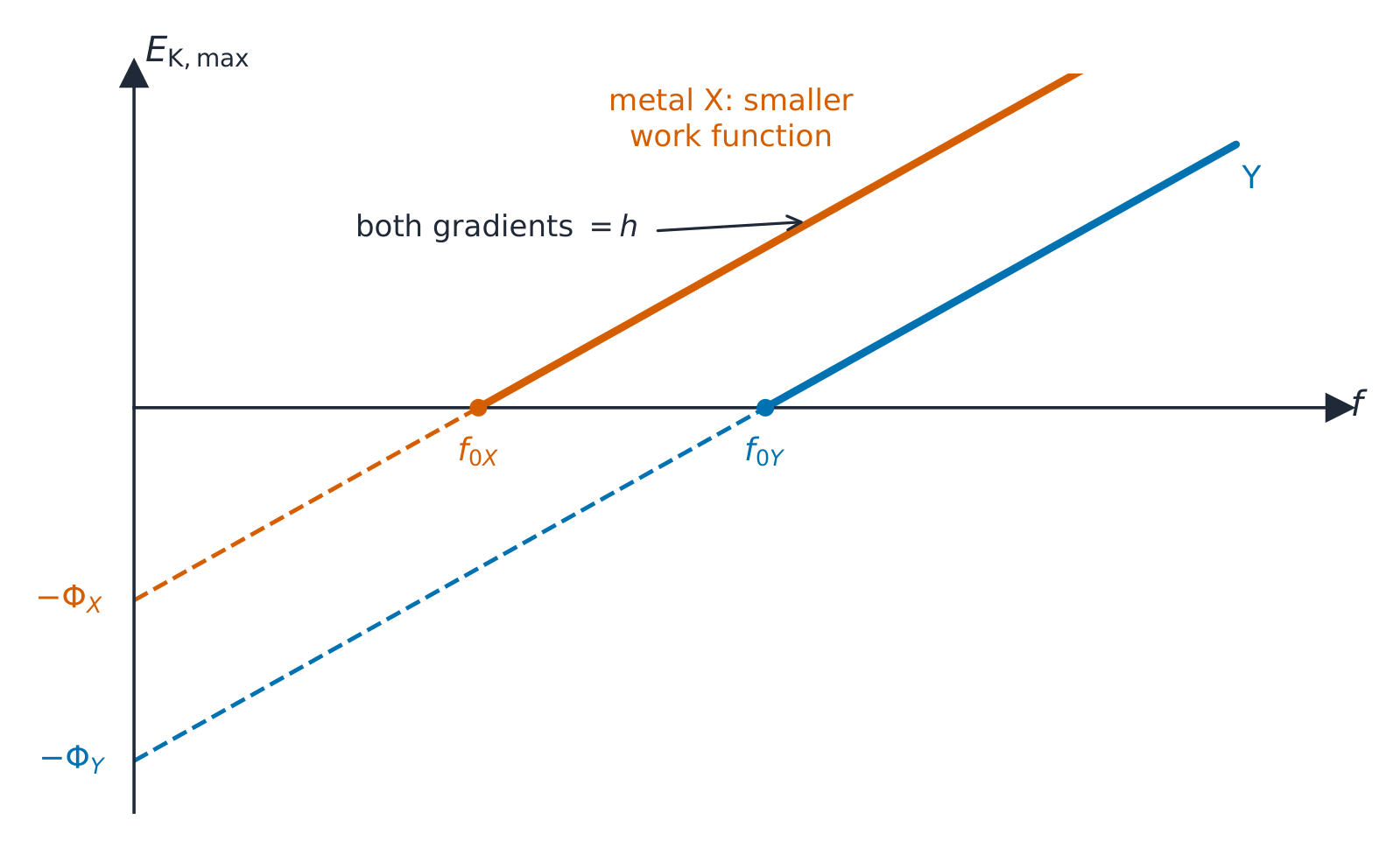
Reading the graph. Write the equation as $E_{\text{K,max}} = hf - \Phi$: a straight line of gradient $h$, intercept $-\Phi$ on the energy axis and $f_{0} = \Phi/h$ on the frequency axis. So a graph for two metals shows two parallel lines (same gradient $h$ for every metal), the metal with the larger work function cutting the frequency axis further to the right; the intensity of the light moves neither line. This is how the Planck constant is measured, and "sketch the line for metal Y" is marked on exactly those two features.
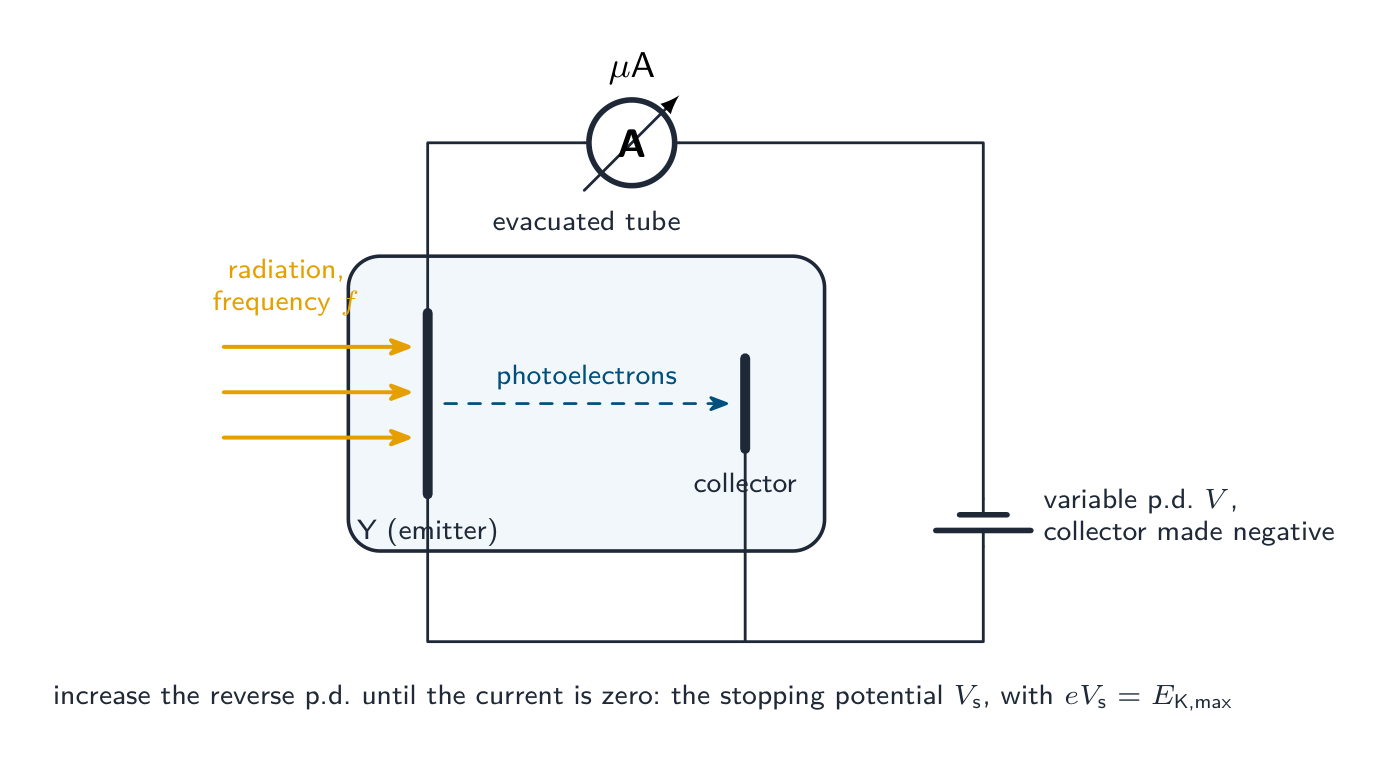
Measuring the maximum kinetic energy. In a photocell the photoelectrons cross a vacuum to a collector and the current is a count of electrons per second. Make the collector negative and the electrons must climb a potential hill; raise the reverse p.d. until the current just reaches zero, the stopping potential 遏止电势 $V_{\text{s}}$, and then $eV_{\text{s}} = E_{\text{K,max}}$. Two results, both examined: at fixed frequency, doubling the intensity doubles the current at low reverse p.d. but leaves $V_{\text{s}}$ unchanged; raising the frequency raises $V_{\text{s}}$ but, at fixed intensity, does not raise the current.
Why the wave model fails
A wave model predicts that brightness should set the electrons' kinetic energy, and that emission should happen at any frequency given enough time. But experiments show:
- no emission below the threshold frequency, however bright.
- immediate emission at or above the threshold, even when dim.
- maximum KE depends on frequency, not brightness.
- the number of photoelectrons (the current) depends on brightness.
The photon model explains this: light arrives as photons each of energy $hf$. One photon–electron interaction either has enough energy to free the electron ($hf \geq \Phi$) or it does not.
Why max KE is fixed but current grows with brightness
A brighter beam of the same frequency has more photons per second, but each still carries $hf$. So the maximum KE of any electron is $hf - \Phi$ (set by $f$ only), while the rate of emission (the current) grows with the number of photons, i.e. with brightness. Doubling the brightness doubles the current but does not change the maximum KE.
Writing the explanation (a standard three-marker). (1) Each photon interacts with, and gives all its energy to, one electron. (2) The photon energy $hf$ depends only on the frequency, so the maximum energy an electron can leave with, $hf - \Phi$, is fixed by the frequency. (3) Increasing the intensity at the same frequency increases the number of photons per second, so more electrons are emitted per second (a larger current), but each still receives the same energy. A wave, by contrast, would spread its energy over the surface, so a brighter wave should have given faster electrons and a dim one should have needed a delay to accumulate energy; neither happens.
Explore
The photoelectric effect
KEmax = h·f − φ
Max KE is a straight line in frequency, with intercept −φ (the work function).
Vocabulary
Train
| English |
|---|
| work function/wɜːk ˈfʌŋkʃn/ |
| photoelectric effect/ˌfəʊtəʊɪˈlektrɪk ɪˈfekt/ |
| photoelectron/ˌfəʊtəʊɪˈlektrɒn/ |
| threshold frequency/ˈθreʃəʊld ˈfriːkwənsi/ |
| threshold wavelength/ˈθreʃəʊld ˈweɪvleŋθ/ |
| stopping potential/ˈstɒpɪŋ pəˈtenʃl/ |
22.3
Wave–particle duality

Syllabus
- understand that the photoelectric effect provides evidence for a particulate nature of electromagnetic radiation while phenomena such as interference and diffraction provide evidence for a wave nature
- describe and interpret qualitatively the evidence provided by electron diffraction for the wave nature of particles
- understand the de Broglie wavelength as the wavelength associated with a moving particle
- recall and use $\lambda = h/p$
Source: Cambridge International syllabus
The photoelectric effect is strong evidence for the particle nature of light. But interference 干涉 (Young's double slit, the diffraction grating 衍射光栅) and diffraction 衍射 show its wave nature. So light has both wave and particle sides — this is wave–particle duality 波粒二象性.
"Describe what is meant by wave–particle duality" (two marks). Electromagnetic radiation (and matter) can exhibit both wave properties, such as interference and diffraction, and particle properties, such as the photoelectric effect (or, for matter, discrete collisions). Asked for one piece of evidence for each nature of radiation, give: particulate, the photoelectric effect (the threshold frequency and the immediate emission); wave, diffraction or interference (Young's slits, a diffraction grating). For matter, the wave evidence is electron diffraction.
De Broglie hypothesis
If a wave can act like particles, perhaps particles can act like waves. De Broglie proposed that any moving particle has a de Broglie wavelength 德布罗意波长:
$$\lambda = \frac{h}{p},$$
where $p = mv$. Example: an electron at $v = 4.9 \times 10^{7}\ \text{m s}^{-1}$ has $p = 4.46 \times 10^{-23}\ \text{kg m s}^{-1}$, so $\lambda = 1.49 \times 10^{-11}\ \text{m} \approx 0.015\ \text{nm}$ — close to atomic spacings.
"State what is meant by the de Broglie wavelength." The wavelength associated with a moving particle, or the wavelength of the wave associated with a particle of momentum $p$, given by $\lambda = h/p$ where $h$ is the Planck constant. In "state the formula and the meaning of any other symbol", name $h$ as the Planck constant and $p$ as the momentum of the particle. The wavelength is small because $h$ is small: a $0.10\ \text{kg}$ ball at $10\ \text{m s}^{-1}$ has $\lambda = 6.6 \times 10^{-34}\ \text{m}$, far below any slit or lattice spacing, which is why everyday objects show no diffraction.
Electron diffraction
When electrons are fired at a crystal lattice 晶格 (e.g. thin graphite), they make a diffraction pattern of bright rings on a screen — exactly what waves of wavelength $\lambda = h/p$ would do. This is direct evidence for the wave nature of particles (electron diffraction 电子衍射): only waves diffract, yet electrons do.
A faster electron has more momentum, so a shorter de Broglie wavelength, which diffracts less — the rings move closer together. Slowing the electrons spreads the rings apart. To calculate: $p = \sqrt{2 m E_{\text{K}}}$, and for an electron accelerated through p.d. $V$, $E_{\text{K}} = eV$, so $\lambda = h/\sqrt{2m_{e} e V}$.
Worked example. An electron is accelerated from rest through a p.d. of $2500\ \text{V}$. Find its de Broglie wavelength. ($m_{e} = 9.11 \times 10^{-31}\ \text{kg}$, $e = 1.6 \times 10^{-19}\ \text{C}$, $h = 6.63 \times 10^{-34}\ \text{J s}$.)
Its kinetic energy is $E_{\text{K}} = eV$, so $\lambda = \dfrac{h}{\sqrt{2 m_{e} e V}}$:
$$\lambda = \frac{6.63 \times 10^{-34}}{\sqrt{2(9.11 \times 10^{-31})(1.6 \times 10^{-19})(2500)}} \approx 2.5 \times 10^{-11}\ \text{m}.$$
This is close to the spacing between atoms in a crystal, which is why the electrons diffract off the graphite.
Deriving $\lambda$ for an accelerated electron. An electron of mass $m$ and charge $q$ accelerated from rest through a p.d. $V$ gains kinetic energy $qV = \tfrac{1}{2}mv^{2}$, so $v = \sqrt{2qV/m}$ and $p = mv = \sqrt{2mqV}$; hence $\lambda = h/\sqrt{2mqV}$. Two consequences the exam asks for: increasing $V$ increases the momentum and shortens the wavelength, so the diffraction rings shrink towards the centre; halving the wavelength needs four times the p.d.
Describing electron diffraction (four marks). (1) Electrons from a heated filament are accelerated through a high p.d. into a beam. (2) The beam meets a thin polycrystalline 多晶的 graphite film; the regular spacing of the carbon atoms, about $10^{-10}\ \text{m}$, acts as a diffraction grating. (3) On a fluorescent screen the electrons produce a bright central spot surrounded by concentric rings. (4) Rings are a diffraction pattern, and diffraction is a wave property, so the electrons are behaving as waves; the ring radii match a wavelength $h/p$, which confirms de Broglie's relation. Sketch the pattern as rings, not spots or a fringe pattern. A faster beam gives rings of smaller radius.
Explore
The de Broglie wavelength
λ = h/p
A particle's wavelength is inversely proportional to its momentum — faster, heavier particles have shorter waves.
Vocabulary
Train
| English |
|---|
| wave–particle duality/weɪv ˈpɑːtɪkl djuːˈælɪti/ |
| interference/ˌɪntəˈfɪərəns/ |
| diffraction grating/dɪˈfrækʃn ˈɡreɪtɪŋ/ |
| diffraction/dɪˈfrækʃn/ |
| electron diffraction/ɪˈlektrɒn dɪˈfrækʃn/ |
| de Broglie wavelength/də ˈbrəʊli ˈweɪvleŋθ/ |
| crystal lattice/ˈkrɪstl ˈlætɪs/ |
| polycrystalline/ˌpɒlɪˈkrɪstəlaɪn/ |
22.4
Energy levels in atoms

Syllabus
- understand that there are discrete electron energy levels in isolated atoms (e.g. atomic hydrogen)
- understand the appearance and formation of emission and absorption line spectra
- recall and use $hf = E_1 - E_2$
Source: Cambridge International syllabus
In an isolated atom, electrons can only sit at certain discrete 分立 energy levels 能级 — never in between. The lowest is the ground state 基态; the others are excited states 激发态.
By convention, energies are written negative, with $E = 0$ for an electron just free of the atom. For hydrogen the ground state is $E_{1} = -13.6\ \text{eV}$; higher states approach zero.
Emission spectrum
When an electron drops from a higher level $E_{2}$ to a lower level $E_{1}$, it emits one photon of energy
$$h f = E_{2} - E_{1}.$$
(Both energies are negative; their difference is positive.) Because the levels are discrete, only certain photon energies — and so certain wavelengths — come out. The emission spectrum 发射光谱 is a set of sharp bright lines on a dark background, one line per transition 跃迁. The pattern is a "fingerprint" of the element.
Explaining a line spectrum (the standard four-marker). (1) The electrons in an isolated atom can only occupy discrete energy levels. (2) An electron in an excited state falls to a lower level and the energy it loses is emitted as one photon. (3) The photon energy equals the difference between the two levels, $hf = E_{2} - E_{1}$, so only certain frequencies (wavelengths) are emitted. (4) Each possible transition gives one line; the same set of levels gives the same lines every time, which is why a spectrum identifies the element. Asked to match lines to transitions: the largest energy gap gives the line of highest frequency and shortest wavelength.


Absorption spectrum
When white light passes through a cool gas, photons whose energy exactly matches an upward transition are absorbed. The light then shows dark lines on a bright background — the absorption spectrum 吸收光谱. The dark lines sit at the same wavelengths as the emission lines of the same gas.
Explaining the dark lines. Photons whose energy equals the difference between two levels are absorbed, raising an electron to the higher level; the excited electron soon falls back and re-emits a photon of the same energy, but in a random direction, so almost none of that light continues along the original path. The rest of the white light, whose photons match no gap, passes through unchanged. Hence dark lines at exactly the wavelengths the same gas would emit: the Sun's spectrum shows the absorption lines of the cooler gases in its outer layers.

Calculations
For a transition between two known levels:
$$hf = E_{2} - E_{1}, \qquad \lambda = \frac{hc}{E_{2} - E_{1}}.$$
Work in consistent units — convert eV to joules (× $1.60 \times 10^{-19}$) before finding $\lambda$ in metres, or use $hc \approx 1240\ \text{eV nm}$ for a quick estimate.
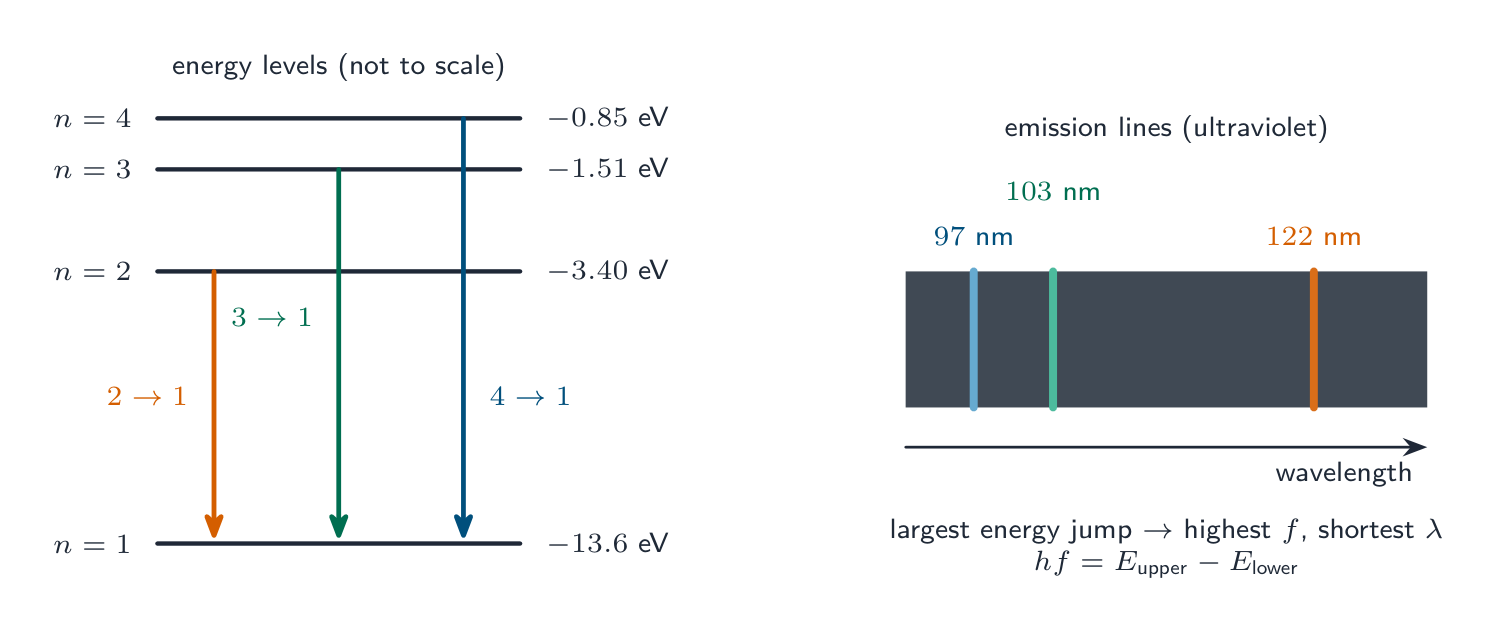
Worked example. The lowest four energy levels of hydrogen are $-13.6$, $-3.40$, $-1.51$ and $-0.85\ \text{eV}$. Find the wavelengths of the three lines produced by transitions to the ground state, and the number of lines these four levels can produce altogether.
Transition $2 \to 1$: $\Delta E = 13.6 - 3.40 = 10.2\ \text{eV}$, so $\lambda = 1240/10.2 = 122\ \text{nm}$. $3 \to 1$: $12.09\ \text{eV}$, $\lambda = 103\ \text{nm}$. $4 \to 1$: $12.75\ \text{eV}$, $\lambda = 97.3\ \text{nm}$: all ultraviolet, the largest jump giving the shortest wavelength. Four levels allow $4 \to 3$, $4 \to 2$, $4 \to 1$, $3 \to 2$, $3 \to 1$ and $2 \to 1$: six lines. The visible red line of hydrogen is $3 \to 2$: $1.89\ \text{eV}$, $656\ \text{nm}$. (Working in joules: $10.2\ \text{eV} = 1.63 \times 10^{-18}\ \text{J}$, $\lambda = hc/E = 1.99 \times 10^{-25}/1.63 \times 10^{-18} = 1.22 \times 10^{-7}\ \text{m}$.)
Worked example. A laser emits red light of wavelength $650\ \text{nm}$ when electrons drop from one level to another. Find the energy gap between the two levels.
$\Delta E = hc/\lambda = 1240/650 = 1.91\ \text{eV} = 3.1 \times 10^{-19}\ \text{J}$. The gap, not either level, fixes the colour: two atoms with different levels but the same gap emit the same line.
Worked example (annihilation). An electron and a positron, each moving slowly, meet and annihilate 湮灭, producing two identical photons. Find the wavelength of each photon. ($m_{\text{e}} = 9.11 \times 10^{-31}\ \text{kg}$.)
The rest energy of each particle is $E = mc^{2} = (9.11 \times 10^{-31})(3.00 \times 10^{8})^{2} = 8.2 \times 10^{-14}\ \text{J}$ ($0.51\ \text{MeV}$), and momentum conservation shares the energy between two photons moving in opposite directions, so each carries $8.2 \times 10^{-14}\ \text{J}$: $\lambda = hc/E = 1.99 \times 10^{-25}/8.2 \times 10^{-14} = 2.4 \times 10^{-12}\ \text{m}$, a gamma ray. (Any kinetic energy the pair had is added to the photon energies.)
Explore
Make an element's spectral lines
An electron dropping between fixed energy levels emits a photon of exactly the gap's energy — a fixed wavelength and colour. Each jump is one line of the element's barcode.
Vocabulary
Train
| English |
|---|
| discrete/dɪˈskriːt/ |
| energy level/ˈenədʒi ˈlevl/ |
| ground state/ɡraʊnd steɪt/ |
| excited state/ekˈsaɪtɪd steɪt/ |
| transition/trænˈsɪʃn/ |
| emission spectrum/ɪˈmɪʃn ˈspektrəm/ |
| absorption spectrum/əbˈsɔːpʃn ˈspektrəm/ |
| annihilate/əˈnaɪəleɪt/ |
22.4
Definitions the examiner accepts
A definition question is marked against fixed wording. Learn these exactly, and give one answer only.
| Term | Definition |
|---|---|
| photon | a quantum (discrete packet) of energy of electromagnetic radiation |
| electronvolt | the energy gained by an electron accelerated through a potential difference of one volt; $1.60 \times 10^{-19}\ \text{J}$ |
| photoelectric effect | the emission of electrons from a metal surface when electromagnetic radiation of high enough frequency is incident on it |
| work function energy | the minimum energy needed to remove an electron from the surface of the metal |
| threshold frequency | the minimum frequency of radiation that causes photoelectric emission from a metal |
| threshold wavelength | the maximum wavelength of radiation that causes photoelectric emission, $\lambda_{0} = hc/\Phi$ |
| wave–particle duality | radiation and matter show both wave properties (diffraction, interference) and particle properties (photoelectric effect, discrete collisions) |
| de Broglie wavelength | the wavelength associated with a moving particle, $\lambda = h/p$ |
| energy level | one of the discrete energies an electron in an isolated atom may have |
| emission line spectrum | a set of bright lines of definite wavelengths, each from a transition between two energy levels |
| absorption line spectrum | dark lines on a continuous spectrum at the wavelengths absorbed by transitions to higher levels |
22.4
Exam tips
- Photon: $E = hf = hc/\lambda$, $p = E/c = h/\lambda$. Use $hc = 1240\ \text{eV nm}$ to move between wavelength and energy in eV, then convert to joules only if the answer demands it.
- Photoelectric equation $hf = \Phi + \tfrac{1}{2}mv_{\text{max}}^{2}$: maximum energy, one photon to one electron; the graph of $E_{\text{K,max}}$ against $f$ has gradient $h$ and intercepts $f_{0}$ and $-\Phi$.
- Intensity changes the number of photons per second (the current); frequency changes the energy of each (the maximum kinetic energy). Keep those two sentences apart and every explanation writes itself.
- Evidence: photoelectric effect for particles, diffraction and interference for waves; electron diffraction for the wave nature of matter, with $\lambda = h/p = h/\sqrt{2mqV}$.
- Line spectra: discrete levels, one photon per transition, $hf = E_{2} - E_{1}$; the biggest gap gives the shortest wavelength; absorption lines sit where emission lines would, because the absorbed light is re-emitted in all directions.
- Radiation pressure: force $=$ photons per second $\times$ momentum change per photon; $2p$ for a mirror, $p$ for an absorber; pressure depends on intensity, not colour.
Common mistakes
- Defining a photon as "a particle of light" without "quantum/packet of energy", or the work function without "minimum" and "from the surface".
- Saying brighter light gives faster photoelectrons, or that below the threshold frequency emission happens eventually.
- Mixing eV and joules in one equation; forgetting to subtract the work function; using $\tfrac{1}{2}mv^{2}$ with the maximum kinetic energy in eV.
- Writing the de Broglie wavelength for an accelerated electron as $h/(mv)$ with $v$ guessed, instead of $h/\sqrt{2mqV}$.
- Describing electron diffraction as bright fringes or spots; the pattern is concentric rings, and a higher p.d. makes them smaller.
- Getting the direction of a transition wrong: emission is a fall to a lower level, absorption a rise; the photon energy is the difference, never the energy of one level.
- Claiming the largest energy gap gives the longest wavelength.
- Forgetting that a reflected photon changes momentum by $2p$, or that the pressure of blue light of the same intensity is the same as red.
Interactive lessons on this topic
Work through it step by step, with instant-check exercises.