- understand the term luminosity as the total power of radiation emitted by a star
- recall and use the inverse square law for radiant flux intensity $F$ in terms of the luminosity $L$ of the source $F = L / (4\pi d^2)$
- understand that an object of known luminosity is called a standard candle
- understand the use of standard candles to determine distances to galaxies
Astronomy and cosmology
A-Level Physics · Topic 25
 12:42
12:42
Luminosity & the Cosmos
That star is a hundred trillion kilometres away. You will never touch it. You will never visit it. And yet, from its faint light alone — just the light that…
English narration · English + 中文 subtitles burned in
25.1
Luminosity and radiant flux intensity

Syllabus
Source: Cambridge International syllabus
The luminosity 光度 $L$ of a star is the total power 功率 of radiation it gives out — the energy 能量 radiated per second in all directions. Unit: watt (W).
The one-mark definition. The luminosity of a star is the total power of radiation emitted by the star (or the total energy emitted per unit time). It is a property of the star alone; how bright it looks from the Earth depends also on how far away it is. Asked for two reasons why some stars appear brighter than others, give exactly those two: a greater luminosity, and a smaller distance (the flux falls as $1/d^{2}$).
At distance $d$, this power has spread over a sphere of area $4\pi d^{2}$. The radiant flux intensity 辐射通量密度 $F$ (power per unit area) at distance $d$ is
$$F = \frac{L}{4\pi d^{2}}.$$
Worked example. The Sun's luminosity is $L = 3.8 \times 10^{26}\ \text{W}$. Find the radiant flux intensity at the Earth, a distance $d = 1.5 \times 10^{11}\ \text{m}$ away.
$$F = \frac{L}{4\pi d^{2}} = \frac{3.8 \times 10^{26}}{4\pi (1.5 \times 10^{11})^{2}} \approx 1.4 \times 10^{3}\ \text{W m}^{-2}.$$
Unit: $\text{W m}^{-2}$. This is the inverse-square law 平方反比定律 for flux: doubling the distance cuts the flux to a quarter. A telescope measures $F$; if $L$ is known, the distance follows:
$$d = \sqrt{\frac{L}{4\pi F}}.$$

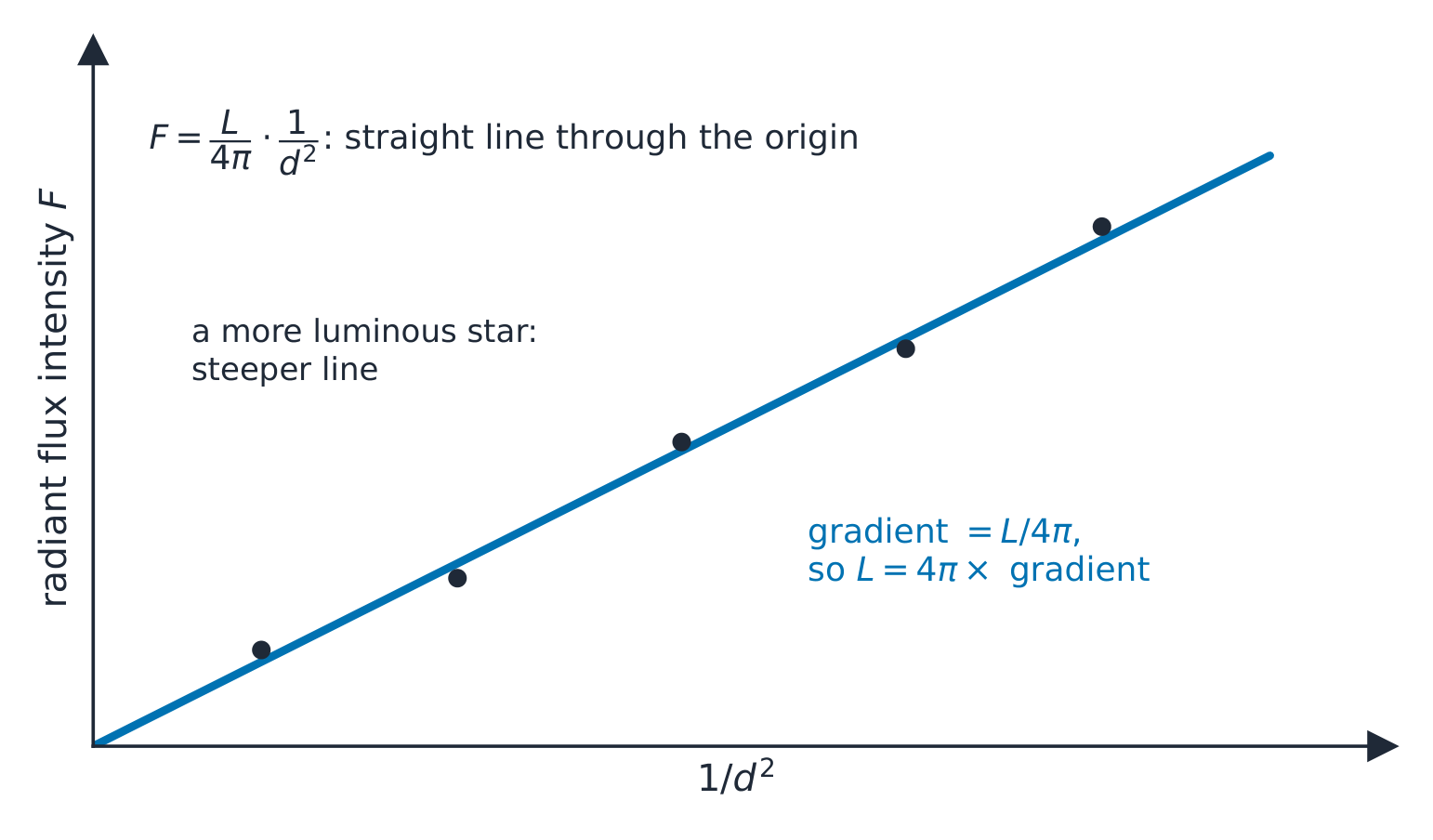
Reading the graph. A graph of $F$ against $1/d^{2}$ for one star is a straight line through the origin with gradient $L/4\pi$, so $L = 4\pi \times \text{gradient}$; a more luminous star gives a steeper line. A star whose galaxy is receding still obeys the inverse-square law, but the light we receive is redshifted, so the flux at each wavelength is shifted along the spectrum, and a detector sensitive to one band may see a different fraction of it.
Worked example. The Sun has radius $6.96 \times 10^{8}\ \text{m}$ and surface temperature $5780\ \text{K}$. A space probe carrying a $2.0\ \text{m}^{2}$ solar panel is $4.5 \times 10^{10}\ \text{m}$ from the Sun's centre. Find the power falling on the panel when it faces the Sun.
Luminosity: $L = 4\pi\sigma r^{2}T^{4} = 4\pi(5.67 \times 10^{-8})(6.96 \times 10^{8})^{2}(5780)^{4} = 3.85 \times 10^{26}\ \text{W}$. Flux at the probe: $F = L/(4\pi d^{2}) = 3.85 \times 10^{26}/[4\pi(4.5 \times 10^{10})^{2}] = 1.5 \times 10^{4}\ \text{W m}^{-2}$, eleven times the flux at the Earth. Power on the panel: $P = FA = 1.5 \times 10^{4} \times 2.0 = 3.0 \times 10^{4}\ \text{W}$. The flux is power per unit area perpendicular to the radiation; a tilted panel receives $FA\cos\theta$.
Vocabulary
Train
| English |
|---|
| luminosity/ˌluːmɪˈnɒsɪti/ |
| power/ˈpaʊə/ |
| energy/ˈenədʒi/ |
| radiant flux intensity/ˈreɪdɪənt flʌks ɪnˈtensɪti/ |
| inverse-square law/ɪnˈvɜːs skweə lɔː/ |
25.1
Standard candles
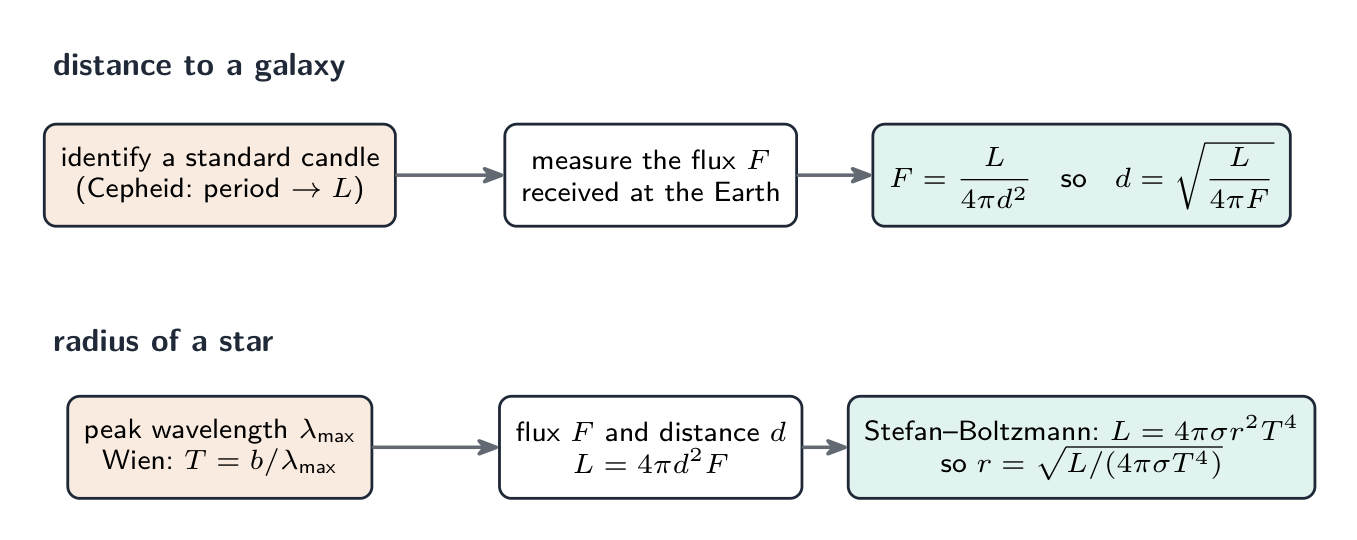
A standard candle 标准烛光 is an object whose luminosity is known from its type. Once you find one in a distant galaxy and measure the flux $F$ from it, you get its distance from $d = \sqrt{L/(4\pi F)}$.
Examples:
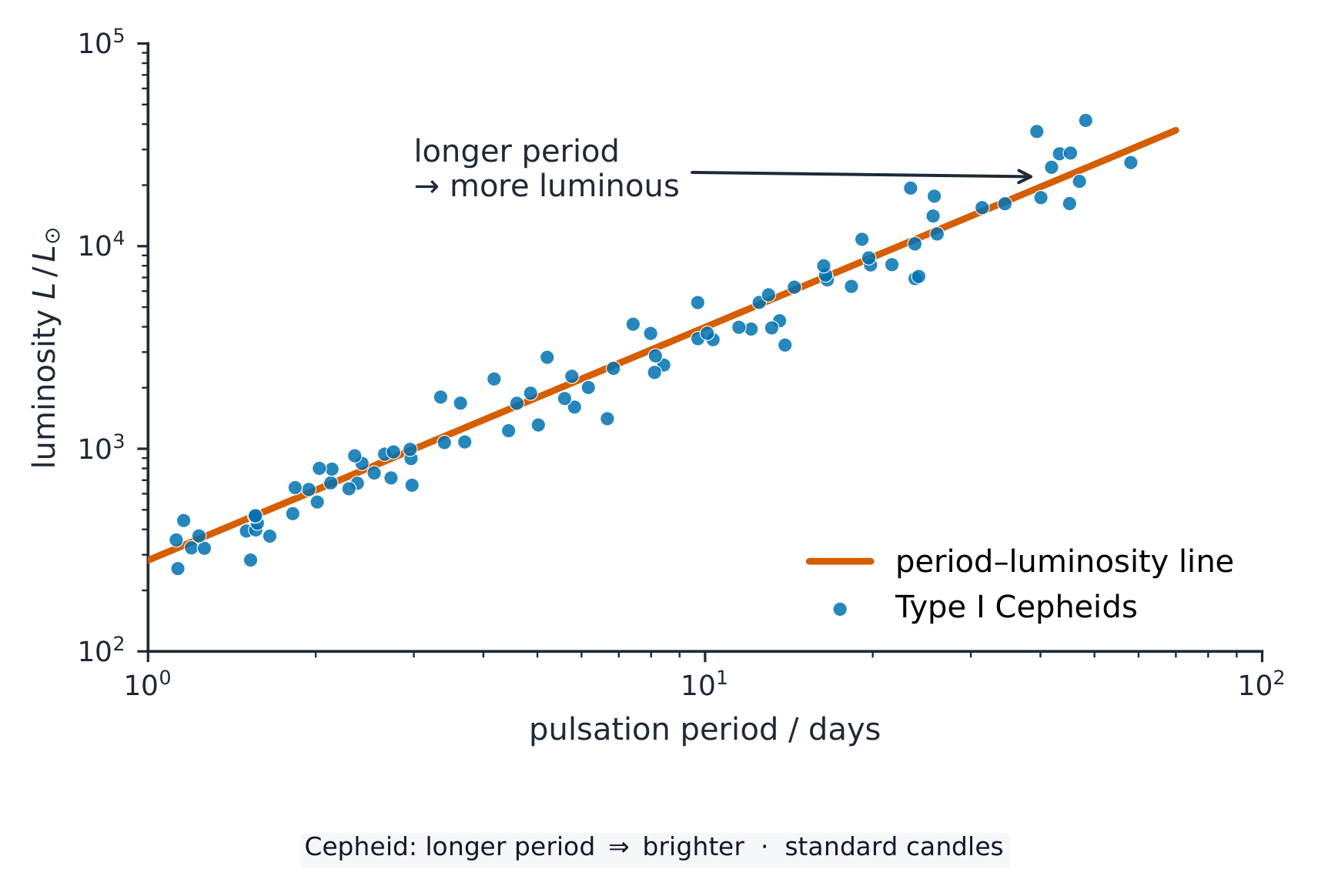
- Cepheid variables 造父变星 (pulsating stars) — the pulsation period is tightly linked to the luminosity, so the period gives $L$.
- Type Ia supernovae 超新星 — a white dwarf reaching a critical mass and exploding always has about the same peak luminosity.
A standard candle gives $L$ without first knowing the distance, so it reaches galaxies far beyond parallax 视差.
The definition. A standard candle is an object (a star or a supernova) of known luminosity. The luminosity is known because it is fixed by a property that can be measured from any distance: the pulsation period of a Cepheid variable, or the type of a supernova.
"Explain how a standard candle is used to determine the distance of a galaxy" (three marks). (1) A standard candle in the galaxy is identified (a Cepheid variable, whose period gives its luminosity, or a Type Ia supernova) so that its luminosity $L$ is known. (2) The radiant flux intensity $F$ of its light arriving at the Earth is measured. (3) The distance follows from the inverse-square law, $d = \sqrt{L/(4\pi F)}$. The order matters: the luminosity comes from the candle's type, not from the distance, which is the thing being found.
Worked example. A Type Ia supernova, luminosity $1.0 \times 10^{36}\ \text{W}$ at its peak, is observed with a peak flux of $2.0 \times 10^{-14}\ \text{W m}^{-2}$. How far away is its galaxy?
$d = \sqrt{L/(4\pi F)} = \sqrt{1.0 \times 10^{36}/(4\pi \times 2.0 \times 10^{-14})} = 6.3 \times 10^{24}\ \text{m}$, about $670$ million light years 光年 ($1\ \text{ly} = 9.5 \times 10^{15}\ \text{m}$). A Cepheid, with a luminosity of order $10^{30}\ \text{W}$, could not be seen at that distance; supernovae are the candles for the far Universe.

Explore
Standard candle distance lab
brightness proportional to 1 / distance^2
Move distance and see why brightness falls quickly.
Vocabulary
Train
| English |
|---|
| standard candle/ˈstændəd ˈkændl/ |
| Cepheid variables/ˈsefiɪd ˈveərɪəblz/ |
| Type Ia supernovae/taɪp wʌn ˈeɪ ˌsuːpəˈnəʊviː/ |
| parallax/ˈpærəlæks/ |
| light years/laɪt jɪəz/ |
| supernovae/ˌsuːpəˈnəʊviː/ |
25.2
Stellar surface temperature
Syllabus
- recall and use Wien’s displacement law $\lambda_{\text{max}} \propto 1/T$ to estimate the peak surface temperature of a star
- use the Stefan–Boltzmann law $L = 4\pi\sigma r^2 T^4$
- use Wien’s displacement law and the Stefan–Boltzmann law to estimate the radius of a star
Source: Cambridge International syllabus
Wien's displacement law
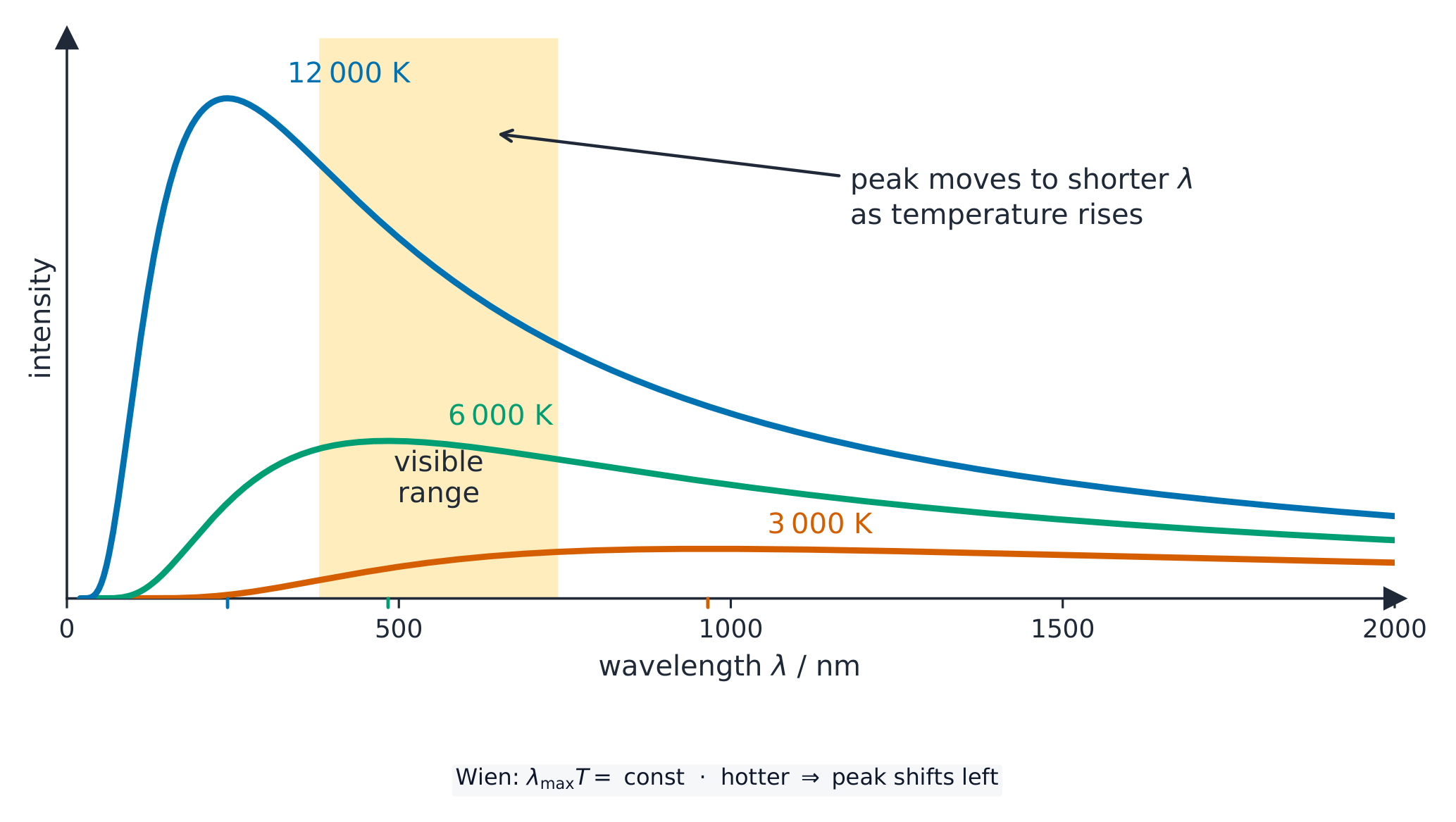
A hot body gives out a continuous (blackbody 黑体) spectrum with a peak at a wavelength 波长 $\lambda_{\text{max}}$ set by its temperature 温度. Wien's displacement law 维恩位移定律:
$$\lambda_{\text{max}} T = \text{constant}, \qquad b \approx 2.90 \times 10^{-3}\ \text{m K}.$$
Worked example. A star's blackbody spectrum peaks at $\lambda_{\text{max}} = 500\ \text{nm}$. Find its surface temperature. ($b = 2.90 \times 10^{-3}\ \text{m K}$.)
$$T = \frac{b}{\lambda_{\text{max}}} = \frac{2.90 \times 10^{-3}}{500 \times 10^{-9}} \approx 5800\ \text{K}.$$
Hotter stars peak at shorter wavelengths: a cool red star ($\sim 3000\ \text{K}$) peaks in the infrared; the Sun ($\sim 5800\ \text{K}$) peaks near $500\ \text{nm}$; a hot blue-white star ($\sim 20{,}000\ \text{K}$) peaks in the ultraviolet. Measuring $\lambda_{\text{max}}$ gives the surface temperature.
"State Wien's displacement law" (two marks). The wavelength at which the intensity of the radiation from a black body is a maximum is inversely proportional to its thermodynamic temperature: $\lambda_{\text{max}} \propto 1/T$, or $\lambda_{\text{max}} T = \text{constant}$ ($2.90 \times 10^{-3}\ \text{m K}$). Say "wavelength of maximum intensity", not just "the wavelength", and the temperature must be in kelvin. The law describes the peak of the continuous black-body curve, not the spectral lines.
Stefan–Boltzmann law
A star, treated as a blackbody sphere of radius $r$ and surface temperature $T$, has luminosity
$$L = 4\pi \sigma r^{2} T^{4},$$
where $\sigma = 5.67 \times 10^{-8}\ \text{W m}^{-2}\ \text{K}^{-4}$ is the Stefan–Boltzmann constant 斯特藩-玻尔兹曼常量 (the Stefan–Boltzmann law 斯特藩-玻尔兹曼定律). Two strong dependences:
- $L \propto r^{2}$ — twice the radius, four times the luminosity (same $T$).
- $L \propto T^{4}$ — twice the temperature, sixteen times the luminosity (same $r$).
Worked example. A star has radius $r = 7.0 \times 10^{8}\ \text{m}$ and surface temperature $T = 5800\ \text{K}$. Find its luminosity. ($\sigma = 5.67 \times 10^{-8}\ \text{W m}^{-2}\ \text{K}^{-4}$.)
$$L = 4\pi\sigma r^{2} T^{4} = 4\pi (5.67 \times 10^{-8})(7.0 \times 10^{8})^{2}(5800)^{4} \approx 3.9 \times 10^{26}\ \text{W}.$$
Estimating a star's radius
Combine the two laws:
- measure $\lambda_{\text{max}}$ → get $T$ from Wien's law.
- find $L$ (e.g. from flux $F$ and distance $d$: $L = 4\pi d^{2} F$).
- solve the Stefan–Boltzmann law for $r$: $r = \sqrt{L/(4\pi \sigma T^{4})}$.
This is how astronomers estimate radii of stars they cannot see as a disc.
Worked example (the radius of the Sun). The radiant flux intensity of sunlight at the Earth is $1370\ \text{W m}^{-2}$ at a distance of $1.50 \times 10^{11}\ \text{m}$, and the Sun's spectrum peaks at $500\ \text{nm}$. Estimate the radius of the Sun.
Luminosity: $L = 4\pi d^{2}F = 4\pi(1.50 \times 10^{11})^{2}(1370) = 3.87 \times 10^{26}\ \text{W}$. Temperature: $T = b/\lambda_{\text{max}} = 2.90 \times 10^{-3}/(500 \times 10^{-9}) = 5800\ \text{K}$. Radius: $r = \sqrt{L/(4\pi\sigma T^{4})} = \sqrt{3.87 \times 10^{26}/[4\pi(5.67 \times 10^{-8})(5800)^{4}]} = 6.9 \times 10^{8}\ \text{m}$. Three steps, each a one-line formula; keep the full precision of $L$ and $T$ until the end, because $T$ is raised to the fourth power.
Worked example. A star in a distant galaxy has a radiant flux intensity of $2.52 \times 10^{-8}\ \text{W m}^{-2}$ at the Earth, a distance of $4.16 \times 10^{17}\ \text{m}$ away, and a surface temperature of $9500\ \text{K}$. Find its radius.
$L = 4\pi d^{2}F = 4\pi(4.16 \times 10^{17})^{2}(2.52 \times 10^{-8}) = 5.48 \times 10^{28}\ \text{W}$. Then $r = \sqrt{5.48 \times 10^{28}/[4\pi(5.67 \times 10^{-8})(9500)^{4}]} = 3.1 \times 10^{9}\ \text{m}$, about four times the Sun's radius. Check the sense: a star $140$ times as luminous as the Sun but only $1.6$ times as hot must be considerably bigger, since $L \propto r^{2}T^{4}$.
Why $T^{4}$ matters so much. Two stars of the same radius at $3000\ \text{K}$ and $6000\ \text{K}$ differ in luminosity by $2^{4} = 16$ times; a small error in the temperature is a large error in the luminosity, which is why the peak wavelength must be read carefully and, for a receding galaxy, corrected for redshift (below).
Explore
A star's luminosity and radius
L ∝ r²
For a given surface temperature, a star's luminosity grows with the SQUARE of its radius (Stefan's law).
Vocabulary
Train
| English |
|---|
| blackbody/ˈblækbɒdi/ |
| wavelength/ˈweɪvleŋθ/ |
| temperature/ˈtemprɪtʃə/ |
| Wien's displacement law/viːnz dɪˈspleɪsmənt lɔː/ |
| Stefan–Boltzmann constant/ˈstefən ˈbɒltsmən ˈkɒnstənt/ |
| Stefan–Boltzmann law/ˈstefən ˈbɒltsmən lɔː/ |
25.3
Redshift, Hubble's law and the Big Bang

Syllabus
- understand that the lines in the emission and absorption spectra from distant objects show an increase in wavelength from their known values
- use $\Delta\lambda / \lambda \approx \Delta f / f \approx v / c$ for the redshift of electromagnetic radiation from a source moving relative to an observer
- explain why redshift leads to the idea that the Universe is expanding
- recall and use Hubble's law $v \approx H_0 d$ and explain how this leads to the Big Bang theory (candidates will only be required to use SI units)
Source: Cambridge International syllabus
Cosmological redshift
The spectral lines 谱线 of light from distant galaxies are seen at longer wavelengths than their known laboratory values — the whole spectrum is stretched towards the red. This is redshift 红移.
Reading it as a Doppler shift, the galaxy is moving away. For $v \ll c$:
$$\frac{\Delta \lambda}{\lambda} \approx \frac{v}{c},$$
where $\Delta\lambda = \lambda_{\text{observed}} - \lambda_{\text{emitted}}$ and $v$ is the speed of recession 退行. Example: light emitted at $4.62 \times 10^{-7}\ \text{m}$ but seen at $4.91 \times 10^{-7}\ \text{m}$ gives $\Delta\lambda = 0.29 \times 10^{-7}\ \text{m}$ and
$$v \approx \frac{\Delta\lambda}{\lambda_{\text{em}}} c \approx 1.9 \times 10^{7}\ \text{m s}^{-1}.$$
Why redshift means an expanding Universe
Almost every distant galaxy is redshifted (a few near ones are blueshifted 蓝移 by local motion). So galaxies are, on average, moving apart — not just from us but from each other. The Universe is expanding, with the space between galaxies stretching. More distant galaxies are redshifted more.
"State what is meant by redshift." The observed wavelength of the radiation (its spectral lines) from a source is longer than the wavelength emitted, because the source is moving away from the observer. It is the Doppler effect 多普勒效应 for light: the fractional change in wavelength equals the fractional change in frequency and, for $v \ll c$, the ratio $v/c$.
Worked example. A hydrogen line measured in the laboratory at $656.3\ \text{nm}$ is observed in the light from a galaxy at $660.9\ \text{nm}$. Find the galaxy's speed of recession and, using $H_{0} = 2.3 \times 10^{-18}\ \text{s}^{-1}$, its distance.
$\Delta\lambda = 660.9 - 656.3 = 4.6\ \text{nm}$, so $v = c\,\Delta\lambda/\lambda = (3.00 \times 10^{8})(4.6/656.3) = 2.1 \times 10^{6}\ \text{m s}^{-1}$. Distance: $d = v/H_{0} = 2.1 \times 10^{6}/2.3 \times 10^{-18} = 9.1 \times 10^{23}\ \text{m}$ (about $100$ million light years). Divide by the emitted (laboratory) wavelength, and keep the nanometres consistent in the ratio.
Worked example (the other way round). A galaxy in Corona Borealis recedes at $21\,400\ \text{km s}^{-1}$. At what wavelength is its $656.3\ \text{nm}$ hydrogen line observed?
$\Delta\lambda = \lambda v/c = 656.3 \times (2.14 \times 10^{7}/3.00 \times 10^{8}) = 46.8\ \text{nm}$, so the line appears at $703\ \text{nm}$, moved from the red almost into the infrared. Every line and the whole continuous spectrum are stretched by the same factor $(1 + v/c) = 1.071$.
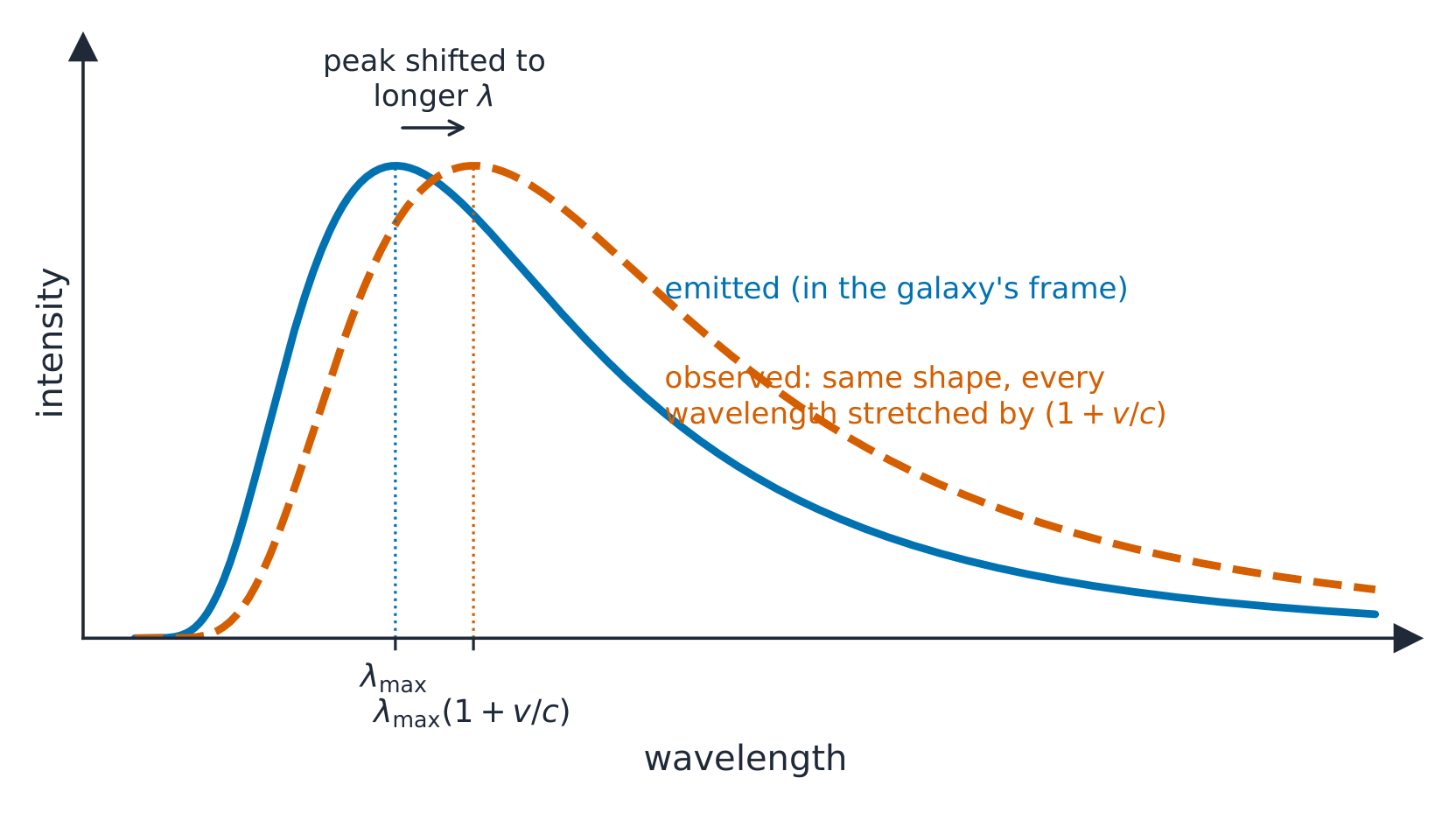
A trap the exam sets. If the peak wavelength of a receding galaxy's spectrum is fed straight into Wien's law, the temperature comes out too low, because the observed $\lambda_{\text{max}}$ is longer than the emitted one. Correct the peak first: $\lambda_{\text{emitted}} = \lambda_{\text{observed}}/(1 + v/c)$. Asked to sketch the observed spectrum on the same axes as the emitted one, draw the same shape shifted to longer wavelengths, peak included.
"Explain how redshift leads to the idea that the Universe is expanding" (three marks). (1) The spectral lines from (almost) all distant galaxies are shifted to longer wavelengths, so (2) by the Doppler effect the galaxies are moving away from us, and (3) the further away a galaxy is, the greater its redshift and so its speed: this is what would be seen from any galaxy if the space between all galaxies were expanding, so the Universe as a whole is expanding, not just moving away from the Earth.

Hubble's law
The link between recession speed $v$ and distance $d$ is Hubble's law 哈勃定律:
$$v \approx H_{0} \cdot d,$$
where $H_{0}$ is the Hubble constant 哈勃常数 ($\approx 2.3 \times 10^{-18}\ \text{s}^{-1}$). Always use SI units. Example: a galaxy receding at $1.9 \times 10^{7}\ \text{m s}^{-1}$ is at $d = v/H_{0} \approx 8.3 \times 10^{24}\ \text{m}$.
"State Hubble's law" (two marks). The speed of recession of a galaxy is (directly) proportional to its distance from the Earth (the observer): $v = H_{0}d$, where $v$ is the recession speed, $d$ the distance and $H_{0}$ the Hubble constant. Identify every symbol when asked. The value of $H_{0}$ is quoted in the exam in SI units ($\text{s}^{-1}$), so $v$ must be in $\text{m s}^{-1}$ and $d$ in metres, never kilometres per second per megaparsec.
Worked example. A star in a distant galaxy emits radiation whose intensity peaks at $4.62 \times 10^{-7}\ \text{m}$; the peak in the light received at the Earth is at $4.91 \times 10^{-7}\ \text{m}$. Find the star's surface temperature, the galaxy's recession speed, and its distance ($H_{0} = 2.3 \times 10^{-18}\ \text{s}^{-1}$).
Temperature from the emitted peak: $T = 2.90 \times 10^{-3}/4.62 \times 10^{-7} = 6300\ \text{K}$. Speed: $v = c\,\Delta\lambda/\lambda = (3.00 \times 10^{8})(0.29/4.62) = 1.9 \times 10^{7}\ \text{m s}^{-1}$, about $6\%$ of $c$. Distance: $d = v/H_{0} = 1.9 \times 10^{7}/2.3 \times 10^{-18} = 8.2 \times 10^{24}\ \text{m}$ (about $870$ million light years). Using the observed peak for the temperature would have given $5900\ \text{K}$, $400\ \text{K}$ too low.

From Hubble's law to the Big Bang
Hubble's law means the galaxies were once together. Running the expansion backwards, all distances shrink to zero at $t = -1/H_{0}$ — the Universe was once a tiny, hugely dense, hot point. This is the Big Bang 大爆炸. The age of the Universe (for steady expansion) is about
$$T_{\text{age}} \approx \frac{1}{H_{0}} \approx 4.3 \times 10^{17}\ \text{s} \approx 14 \text{ billion years}.$$
The expansion, the redshift of galaxies, the cosmic microwave background 宇宙微波背景, and the hydrogen/helium abundances are the main evidence for the Big Bang.
"Explain how Hubble's law leads to the Big Bang theory" (three marks). (1) Galaxies are receding with speeds proportional to their distances, so (2) if time is run backwards, every galaxy, at whatever distance, arrives at the same point at the same time, $t = d/v = 1/H_{0}$ ago; (3) so the Universe must have begun as a single point of enormous density and temperature that has been expanding ever since. The age estimate: $1/H_{0} = 1/(2.3 \times 10^{-18}) = 4.3 \times 10^{17}\ \text{s}$, and dividing by $3.16 \times 10^{7}\ \text{s}$ per year gives $1.4 \times 10^{10}$ years. This assumes the expansion rate has not changed; it is an estimate, not a measurement.
Distance ladder
Astronomers combine methods, each calibrated by the one below:
- parallax — for nearby stars.
- standard candles (Cepheids, Type Ia supernovae) — for galaxies.
- Hubble's law ($d = v/H_{0}$, with $v$ from redshift) — for very distant galaxies.

Explore
Hubble's law
v = H₀·d
Recession speed is proportional to distance — the gradient is Hubble's constant.
Vocabulary
Train
| English |
|---|
| spectral lines/ˈspektrəl laɪnz/ |
| redshift/ˈredʃɪft/ |
| recession/rɪˈseʃn/ |
| blueshifted/ˈbluːʃɪftɪd/ |
| Doppler effect/ˈdɒplə ɪˈfekt/ |
| Hubble's law/ˈhʌblz lɔː/ |
| Hubble constant/ˈhʌbl ˈkɒnstənt/ |
| Big Bang/bɪɡ bæŋ/ |
| cosmic microwave background/ˈkɒzmɪk ˈmaɪkrəʊweɪv ˈbækɡraʊnd/ |
25.3
Definitions the examiner accepts
A definition question is marked against fixed wording. Learn these exactly, and give one answer only.
| Term | Definition |
|---|---|
| luminosity | the total power of radiation emitted by a star |
| radiant flux intensity | the power of radiation received per unit area (at right angles to the radiation), $F = L/(4\pi d^{2})$ |
| standard candle | an object of known luminosity, from which a distance can be found by measuring the flux received |
| Wien's displacement law | the wavelength of maximum intensity of a black body is inversely proportional to its thermodynamic temperature, $\lambda_{\text{max}} T = \text{constant}$ |
| Stefan–Boltzmann law | the luminosity of a black body of radius $r$ is $L = 4\pi\sigma r^{2}T^{4}$ |
| redshift | the increase in the observed wavelength of radiation from a source moving away from the observer |
| Hubble's law | the speed of recession of a galaxy is proportional to its distance from the observer, $v = H_{0}d$ |
| Hubble constant | the constant of proportionality in Hubble's law, in $\text{s}^{-1}$; $1/H_{0}$ estimates the age of the Universe |
| Big Bang theory | the Universe began from a single point of very high density and temperature and has been expanding since |
25.3
Exam tips
- Two recipes: distance = candle's $L$, measured $F$, $d = \sqrt{L/(4\pi F)}$; radius = $T$ from $\lambda_{\text{max}}$, $L$ from $F$ and $d$, $r$ from $L = 4\pi\sigma r^{2}T^{4}$. Write each step as its own formula.
- $F$ is a flux (per square metre), $L$ a power; $L = 4\pi d^{2}F$ links them and $4\pi$ is part of both laws.
- Wien: $\lambda_{\text{max}}$ in metres, $T$ in kelvin. Stefan–Boltzmann: $r^{2}$ and $T^{4}$; a $10\%$ error in $T$ is a $46\%$ error in $L$.
- Redshift: $\Delta\lambda/\lambda_{\text{emitted}} = v/c$; then $d = v/H_{0}$ in SI units. Correct a receding galaxy's peak wavelength before using Wien's law.
- The three "explain" answers (standard candle to distance, redshift to expansion, Hubble's law to the Big Bang) are marked point by point: three statements each, in order.
- The age of the Universe is $1/H_{0}$, about $14$ billion years; state the assumption of a constant expansion rate.
Common mistakes
- Defining luminosity as brightness, or as power per unit area; that is the flux.
- Finding a standard candle's luminosity from its distance, which is circular; the luminosity comes from its type.
- Using degrees Celsius in Wien's or Stefan's law, or forgetting the fourth power.
- Dividing $\Delta\lambda$ by the observed wavelength instead of the emitted one, or mixing nanometres and metres in one ratio.
- Using $H_{0}$ with $v$ in $\text{km s}^{-1}$; convert to $\text{m s}^{-1}$.
- Feeding a redshifted peak wavelength into Wien's law and reporting a temperature that is too low.
- Stating Hubble's law without "proportional" or without saying what $v$ and $d$ are.
- Explaining the Big Bang without the backward-in-time argument that all galaxies were together at $t = 1/H_{0}$ ago.
Interactive lessons on this topic
Work through it step by step, with instant-check exercises.