Period 4 runs from 1800 to 1848. Three things happen at once: democracy widens, the economy transforms, and the country expands - and each one deepens the argument over slavery.
National parties continued to debate the tariff 关税, the national bank 银行, and internal improvements 内部改良 (federally funded roads and canals). These were arguments about how much power the national government should have.
The Supreme Court settled part of that argument. Its decisions established the primacy of the judiciary 司法至上 in determining the meaning of the Constitution - the principle of judicial review 司法审查 - and generally strengthened federal power over the states.
Expansion began early: after the Louisiana Purchase 路易斯安那购地, the government sought influence and control over the West, sending expeditions and negotiating with American Indian nations.
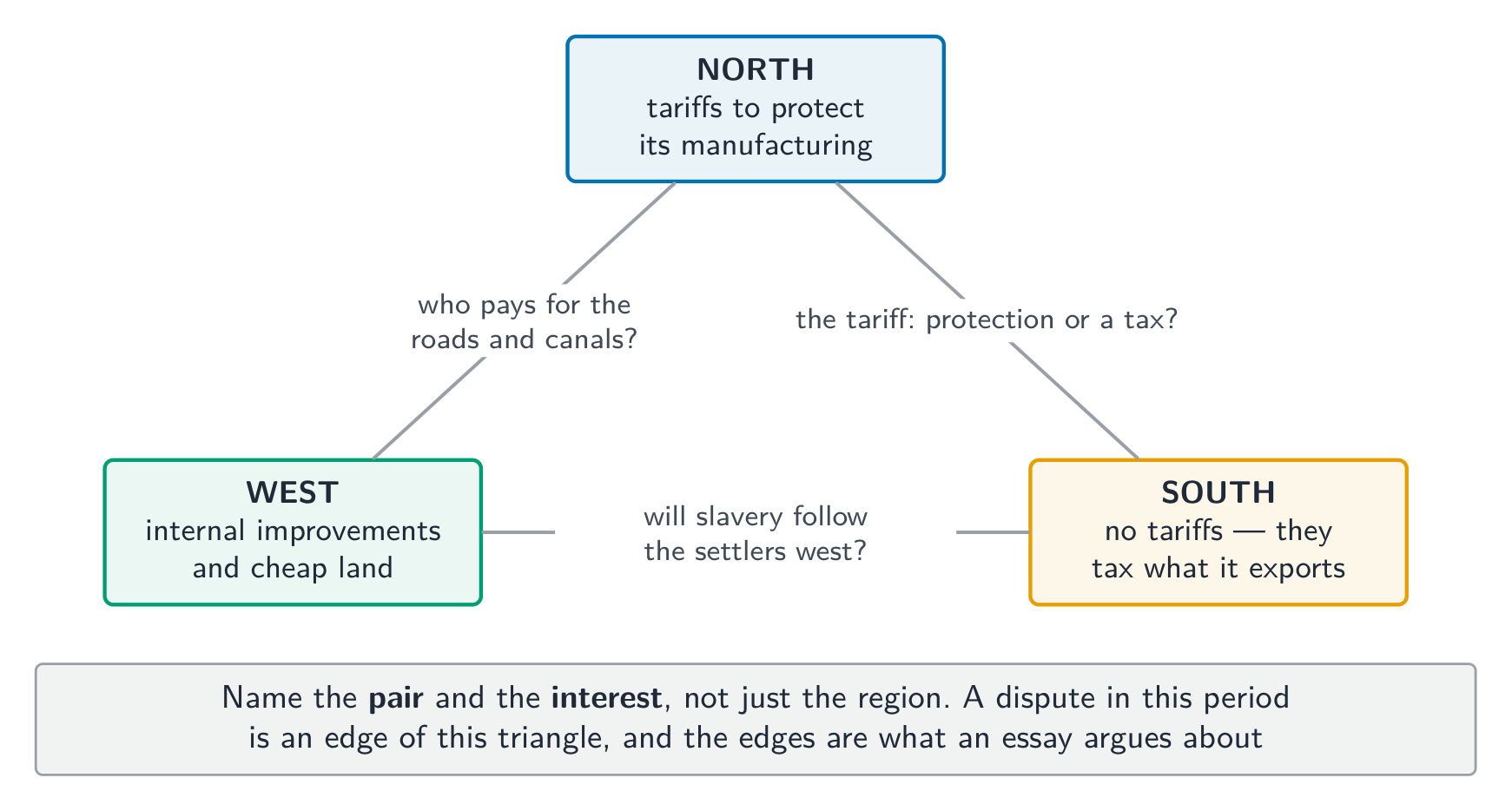
As the country grew, regional interests 区域利益 diverged. The North favoured tariffs to protect manufacturing; the South opposed them as a tax on its exports; the West wanted internal improvements and cheap land. Nearly every political dispute of the period maps onto that triangle.
Abroad, the United States struggled to create an independent global presence 独立的国际地位. It fought the War of 1812 1812年战争, expanded foreign trade, and in the Monroe Doctrine 门罗主义 declared the Western Hemisphere closed to further European colonisation - an assertion of influence well beyond the country's actual power at the time.
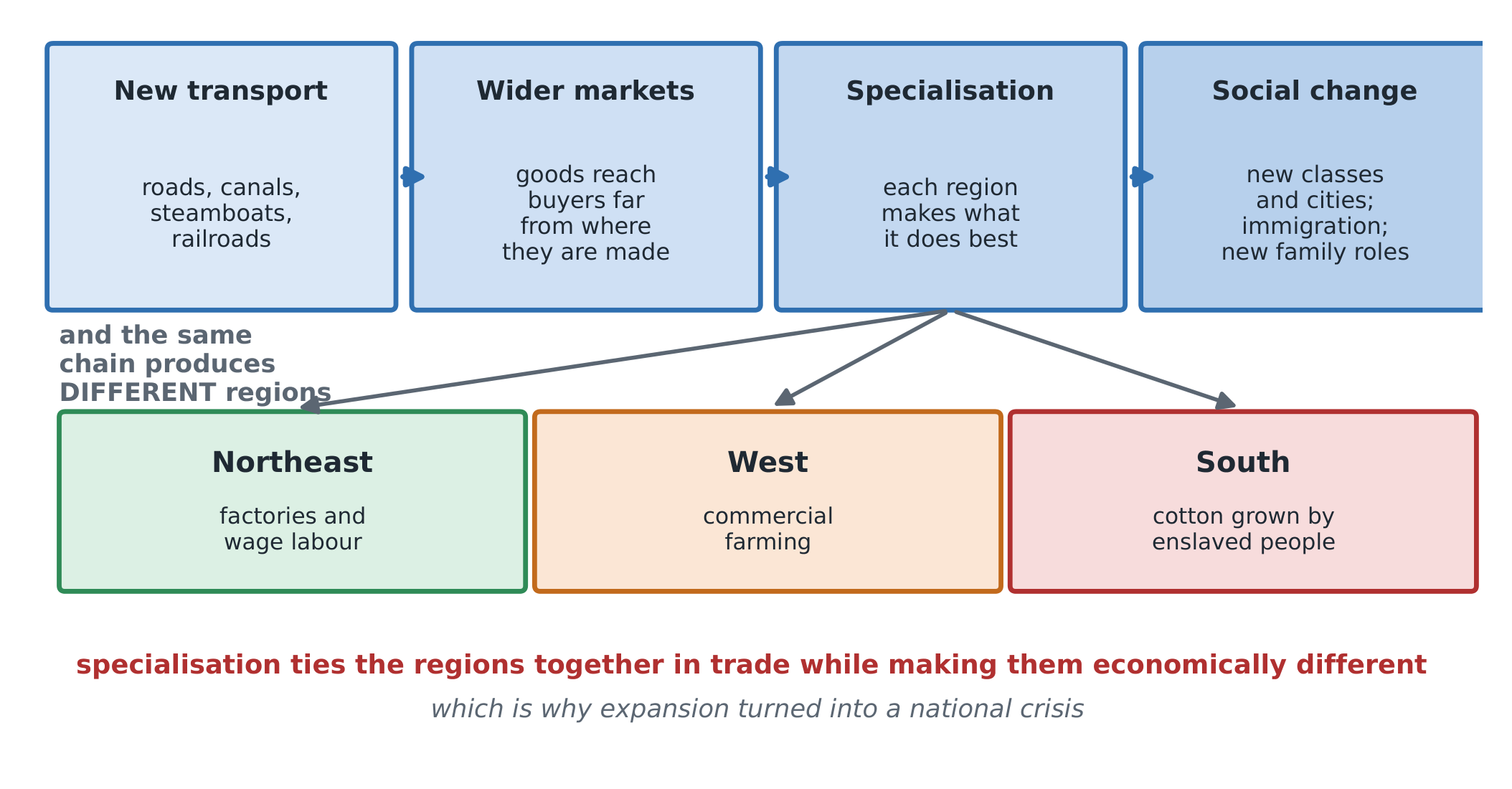
The market revolution is a chain, not a list: each link is what turns the previous one into a change in how people lived
New transportation systems 交通体系 - roads, canals 运河 such as the Erie, steamboats, and then railroads 铁路 - together with new technologies dramatically expanded manufacturing and agricultural output.
The mechanism is what the exam wants. Cheaper transport widened markets 市场; wider markets let regions specialise 专业化 in what they did best; specialisation tied the regions together in trade while making them economically different from one another.
The results by region: factory production 工厂生产 and wage labour in the Northeast, commercial farming 商业化农业 in the West, and in the South an intensified reliance on cotton 棉花 grown by enslaved people.
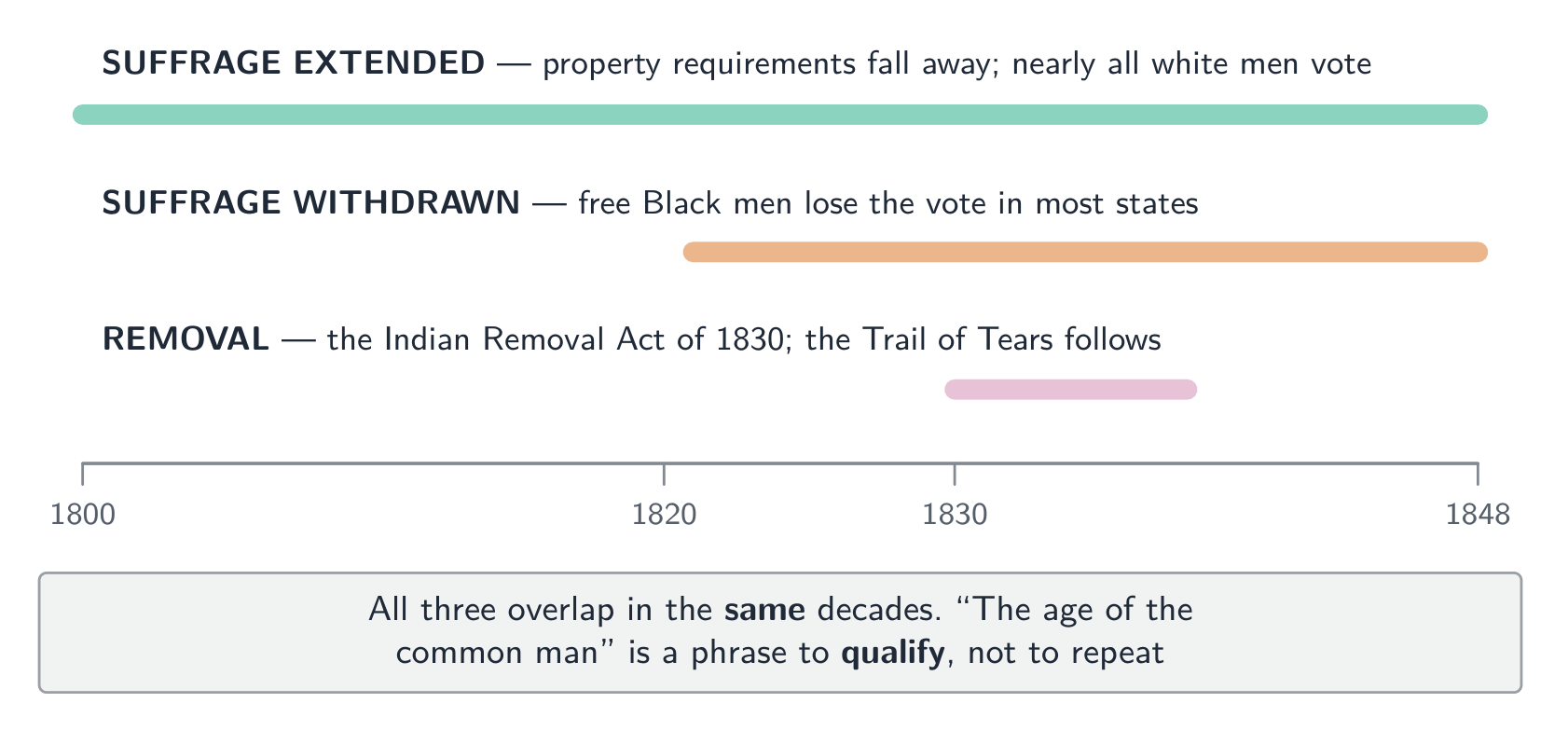
The transition to a more participatory democracy 更具参与性的民主 came through expanding suffrage 选举权 - the removal of property qualifications for white men - along with new campaign styles and mass political parties.
The limits matter as much as the expansion: this widening applied to white men, while free African Americans in several states lost voting rights in the same decades, and women had none.
Andrew Jackson 杰克逊 embodied and tested the new politics. His presidency featured a war on the national bank, the nullification crisis 废止危机 over the tariff, and the Indian Removal Act 印第安人迁移法 - the forced removal of southeastern nations along what became known as the Trail of Tears 血泪之路.
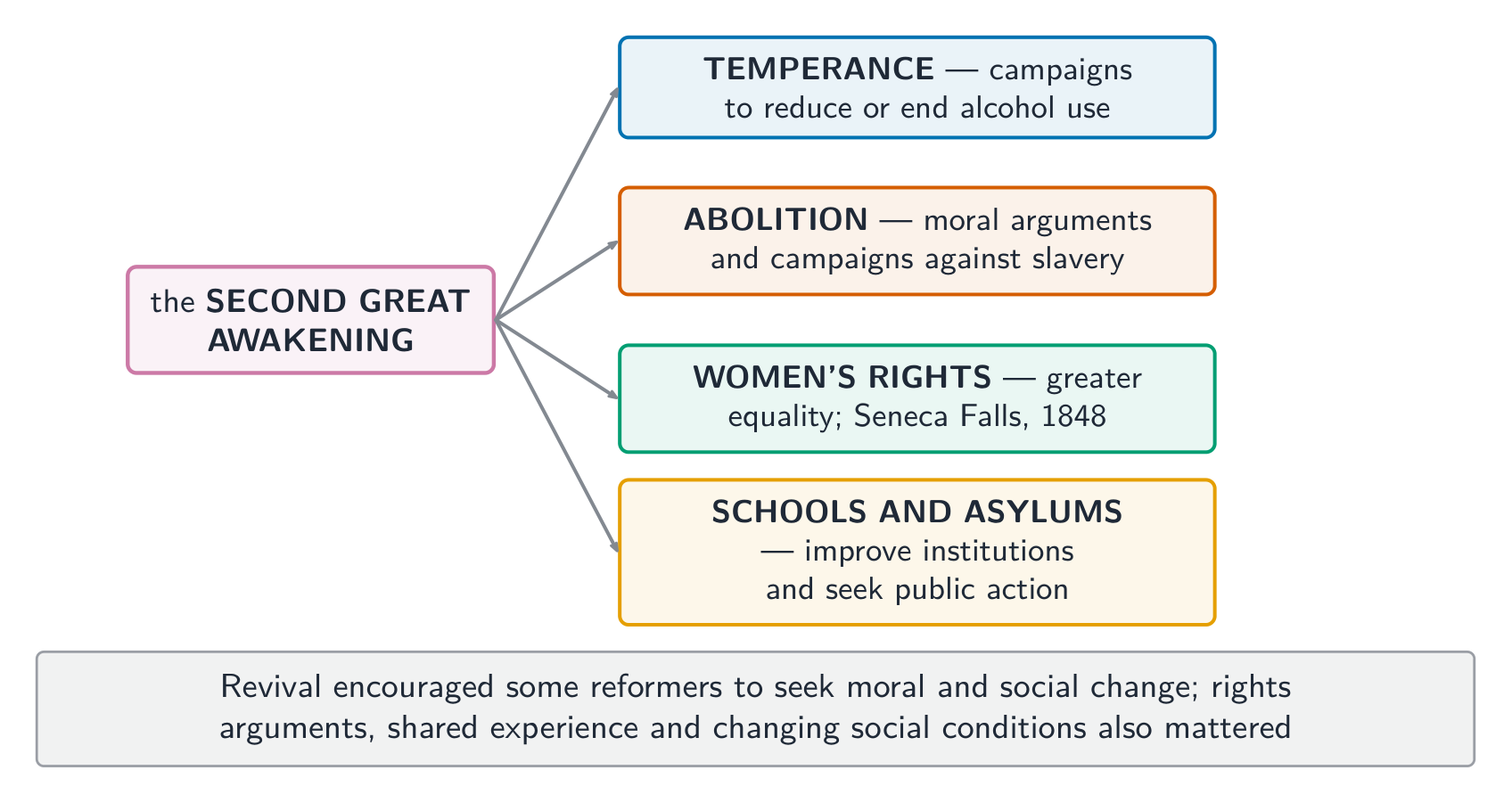
Democratic and individualistic beliefs, responses to rationalism, market changes and greater social and geographical mobility contributed to the Second Great Awakening 第二次大觉醒 among Protestants. Revival emphasised personal salvation and the possibility of moral improvement. Reformers formed voluntary organizations 自愿团体 to change behaviour and improve society.
Try it — link belief to action.Temperance 禁酒运动 sought to reduce or end alcohol use. Explain how belief in moral improvement could encourage a reformer to campaign for temperance. Why is naming the revival and movement not enough to explain a connection?
Worked link. If people can change morally, harmful behaviour need not be accepted as permanent. Some reformers joined voluntary groups to persuade people to change. Temperance campaigns applied this approach to alcohol use and its perceived social harms. Abolitionist and antislavery movements 废奴与反奴隶制运动 challenged slavery, and a women's rights movement 妇女权利运动 sought greater equality and opportunity. Revival was one influence, alongside rights arguments, reform experience and social conditions; the campaigns did not all have one identical cause.
Try it — methods and results. This evidence paraphrases the CED's source descriptions, not the original documents. In 1845, Dorothea Dix addressed Pennsylvania's legislature about conditions in jails and poorhouses while advocating humane treatment and asylum reform. The Seneca Falls Convention 塞内卡福尔斯会议 of 1848 expressed demands for greater equality and opportunities for women. Use Dix to test the claim that voluntary reform meant reform without the state. Why does a convention's demand not prove equality had already been achieved?
Worked distinction. Addressing a legislature sought public action: reformers outside government could try to change state policy or institutions. “Voluntary” did not mean refusing state involvement. Seneca Falls expressed activists' aims, not the removal of all legal and political barriers. Likewise, northern emancipation increased the free African American population while many state governments continued restricting African Americans' rights. Separate aims, methods and outcomes.
Exam transfer — 2024 AP US History, Set 1, Question 1(a), adapted practice. Teaching paraphrases of the exam's interpretations: Melder stresses religious and reform activity bringing women together, giving them experience and encouraging challenges to restrictions. Lerner stresses class differences and middle-class women's frustration with political exclusion. Describe one major difference. Consult the full exam excerpts for the original task; these summaries are not quotations.
Teacher-written model. Melder emphasises how experience in religious and reform movements brought women together and encouraged activism. Lerner emphasises class differences and middle-class women's frustration at exclusion from political power.
Why this fits. The response contrasts causes each historian stresses. The official scheme accepts reform participation versus political-equality motivations, or unity versus class divisions. Saying both discuss women does not identify a difference. The contrast is one of emphasis, not proof that either historian denied every other factor. This is our teaching response, not an official sample or a guarantee of credit.
Ideas about national identity increasingly found expression in art, literature, and architecture 艺术、文学与建筑, while various groups maintained distinctive cultures of their own.
Antislavery effort in the South was largely limited to unsuccessful rebellions 未能成功的起义 by enslaved people, which were met with harsher laws and tighter control.
Enslaved and free African Americans created communities and strategies 社群与策略 to protect themselves: family and kinship networks, religious practice, music, and covert resistance - a continuation of the pattern from Period 2.
In the South, although the majority of southerners owned no enslaved persons, most supported the system. As overcultivation depleted arable land in the Southeast, slaveholders relocated westward 向西迁移, carrying slavery into new territory - which is precisely what made westward expansion a national crisis rather than a regional one.
The period's reasoning skill is causation. The strongest chain to hold: the market revolution and westward expansion were engines of growth, and both drove the sectional conflict that Period 5 resolves by war.
Worked example (a real AP exam question). The 2023 exam set the long essay "Evaluate the extent to which commercial development changed United States society from 1800 to 1855." A high-scoring thesis takes a position on how much, and names the areas of change: "Commercial development transformed United States society to a great extent between 1800 and 1855, creating a wage-earning working class and a distinct middle class in the North and drawing the West into national markets, though in the South it deepened rather than displaced an existing slave-based agricultural order." Notice the shape: Evaluate the extent rewards a qualified position - "to a great extent, though…" - because that structure lets the essay use evidence on both sides. A thesis that merely says commercial development "changed society a lot" cannot be argued.
4.14
考试技巧
Learn the market revolution as a chain: transport → wider markets → specialisation → different regional economies → social change.
Give the regional triangle (North, South, West) when explaining a political dispute; tariff, bank, and internal improvements all fit it.
Democracy expanded for white men while free Black men lost rights in several states. Saying so is what turns a description into an evaluation.
Explain a link from the Second Great Awakening to reform through belief, organisation and action, rather than treating revival as the single cause.
Southern westward migration matters because it carried slavery west, turning expansion into the central national conflict.
On Evaluate the extent prompts, qualify your position. "To a great extent, although…" is the structure the rubric rewards.