跳到主要内容

第八时期:1945—1980

AP 美国历史 · 第 8 主题

训练
讲义 词汇表
8.1 8.2

第八时期的时代背景

大纲

8.1 Contextualizing Period 8

Learning ObjectivePreview: Unit 8 Key Concepts

Unit 8.A
Explain the context for societal change from 1945 to 1980.

  • KC-8.1 The United States responded to an uncertain and unstable postwar world by asserting and working to maintain a position of global leadership, with far-reaching domestic and international consequences.
    • KC-8.1.I United States policymakers engaged in a cold war with the authoritarian Soviet Union, seeking to limit the growth of Communist military power and ideological influence, create a free-market global economy, and build an international security system.
    • KC-8.1.II Cold War policies led to public debates over the power of the federal government and acceptable means for pursuing international and domestic goals while protecting civil liberties.
  • KC-8.2 New movements for civil rights and liberal efforts to expand the role of government generated a range of political and cultural responses.
    • KC-8.2.I Seeking to fulfill Reconstruction-era promises, civil rights activists and political leaders achieved some legal and political successes in ending segregation, although progress toward racial equality was slow.
    • KC-8.2.II Responding to social conditions and the African American civil rights movement, a variety of movements emerged that focused on issues of identity, social justice, and the environment.
    • KC-8.2.III Liberalism influenced postwar politics and court decisions, but it came under increasing attack from the left as well as from a resurgent conservative movement.
  • KC-8.3 Postwar economic and demographic changes had far-reaching consequences for American society, politics, and culture.
    • KC-8.3.I Rapid economic and social changes in American society fostered a sense of optimism in the postwar years.
    • KC-8.3.II New demographic and social developments, along with anxieties over the Cold War, changed U.S. culture and led to significant political and moral debates that sharply divided the nation.

8.2 The Cold War from 1945 to 1980

Thematic FocusLearning ObjectiveHistorical Developments

WOR
America in the World — Diplomatic, economic, cultural, and military interactions between empires, nations, and peoples shape the development of America and America’s increasingly important role in the world.

Unit 8.B
Explain the continuities and changes in Cold War policies from 1945 to 1980.

  • KC-8.1.I United States policymakers engaged in a cold war with the authoritarian Soviet Union, seeking to limit the growth of Communist military power and ideological influence, create a free-market global economy, and build an international security system.
  • KC-8.1.I.A As postwar tensions dissolved the wartime alliance between Western democracies and the Soviet Union, the United States developed a foreign policy based on collective security, international aid, and economic institutions that bolstered non-Communist nations.
  • KC-8.1.I.B.i Concerned by expansionist Communist ideology and Soviet repression, the United States sought to contain communism through a variety of measures, including major military engagements in Korea.
  • KC-8.1.I.C The Cold War fluctuated between periods of direct and indirect military confrontation and periods of mutual coexistence (or détente).

来源:美国大学理事会 AP 课程与考试说明

第八时期从 1945 年到 1980 年。两场争论主导了它:美国在海外应在多大程度上遏制共产主义,以及联邦政府在国内应在多大程度上保障权利与福利。二者相互关联,因为它们都是关于国家权力边界的争论。

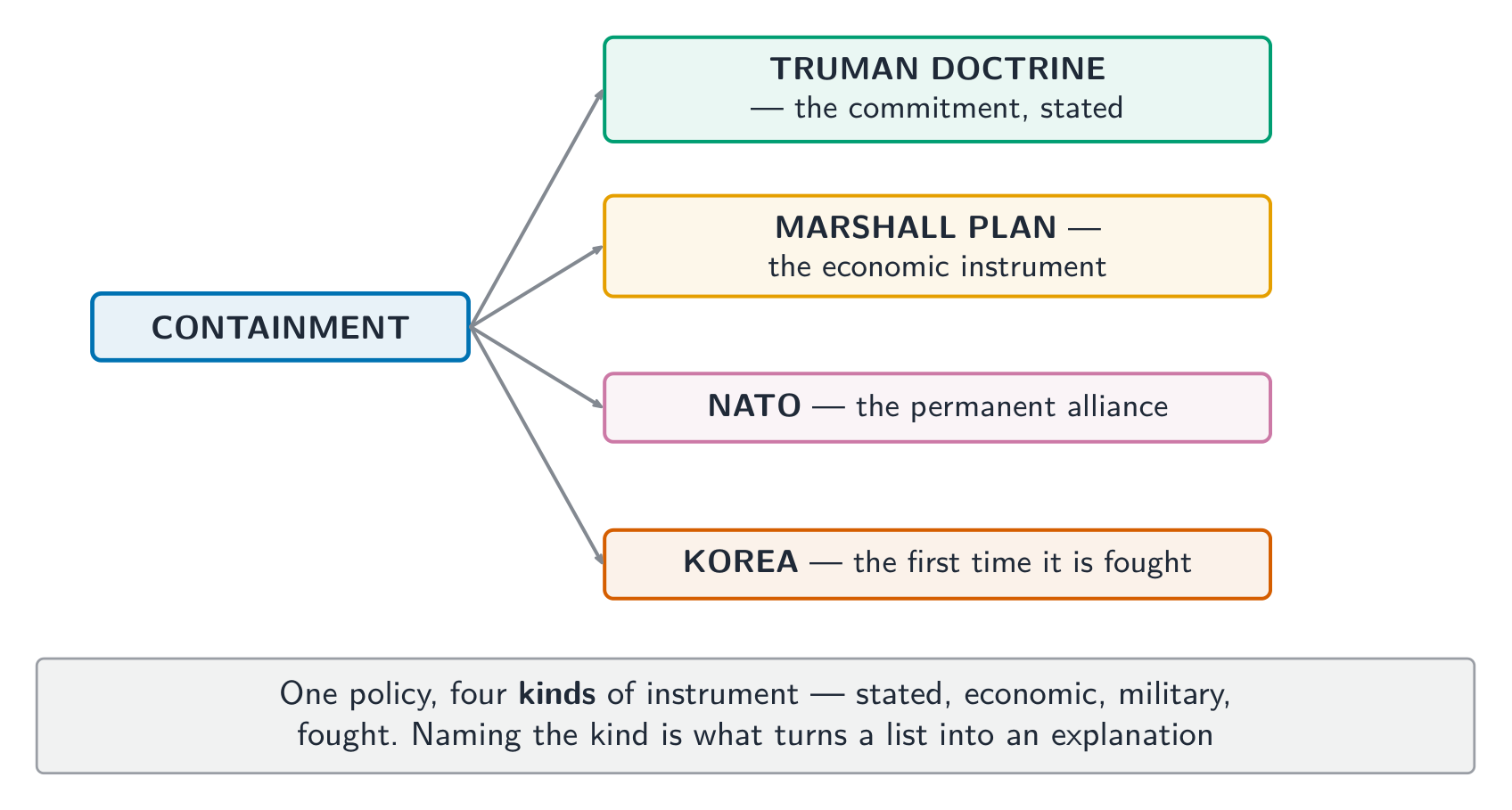
冷战(Cold War)始于战时合作破裂、美苏转为对抗。美国政策最终定为遏制(containment)——阻止共产主义扩散,而非试图将其清除——并通过杜鲁门主义(Truman Doctrine)、马歇尔计划(Marshall Plan)与北约(NATO)加以体现。

遏制随后带来了美国原本没有预料到的承诺:朝鲜战争(Korean War)、常设的和平时期军事体制、军备竞赛(arms race)与太空竞赛(space race)。

词汇表 训练
英文 中文 拼音
Cold War 冷战 lěng zhàn
containment 遏制 è zhì
Truman Doctrine 杜鲁门主义 dù lǔ mén zhǔ yì
Marshall Plan 马歇尔计划 mǎ xiē ěr jì huà
NATO 北约 běi yuē
Korean War 朝鲜战争 cháo xiān zhàn zhēng
arms race 军备竞赛 jūn bèi jìng sài
space race 太空竞赛 tài kōng jìng sài
8.3

红色恐慌

大纲

8.3 The Red Scare

Thematic FocusLearning ObjectiveHistorical Developments

NAT
American and National Identity — The development of and debates about democracy, freedom, citizenship, diversity, and individualism shape American national identity, cultural values, and beliefs about American exceptionalism, and in turn, these ideas shape political institutions and society. Throughout American history, notions of national identity and culture have coexisted with varying degrees of regional and group identities.

Unit 8.C
Explain the causes and effects of the Red Scare after World War II.

  • KC-8.1.II.A Americans debated policies and methods designed to expose suspected communists within the United States even as both parties supported the broader strategy of containing communism.

来源:美国大学理事会 AP 课程与考试说明

对共产主义的恐惧重塑了国内政治。忠诚审查(loyalty programmes)、国会调查与麦卡锡主义(McCarthyism)把矛头指向政府、大学、工会与娱乐业中被怀疑的共产党人。

考点在于公民自由的代价(cost to civil liberties):指控往往被当作证据,而这种恐惧在十余年间收窄了可被接受的政治讨论范围。

词汇表 训练
英文 中文 拼音
Loyalty programmes 忠诚审查 zhōng chéng shěn chá
McCarthyism 麦卡锡主义 mài kǎ xī zhǔ yì
cost to civil liberties 公民自由的代价 gōng mín zì yóu de dài jià
8.4 8.5

1945年后的经济

大纲

8.4 Economy After 1945

Thematic FocusLearning ObjectiveHistorical Developments

WXT
Work, Exchange, and Technology — The interplay between markets, private enterprise, labor, technology, and government policy shape the American economy. In turn, economic activity shapes society and government policy and drives technological innovation.

Unit 8.D
Explain the causes of economic growth in the years after World War II. THEMATIC FOCUS Migration and Settlement MIG Push and pull factors shape immigration to and migration within America, and the demographic change as a result of these moves shapes the migrants, society, and the environment. LEARNING OBJECTIVE

  • KC-8.3.I.A A burgeoning private sector, federal spending, the baby boom, and technological developments helped spur economic growth. HISTORICAL DEVELOPMENTS

Unit 8.E
Explain the causes and effects of the migration of various groups of Americans after 1945.

  • KC-8.3.I.B As higher education opportunities and new technologies rapidly expanded, increasing social mobility encouraged the migration of the middle class to the suburbs and of many Americans to the South and West. The Sun Belt region emerged as a significant political and economic force.

8.5 Culture after 1945

Thematic FocusLearning ObjectiveHistorical Developments

ARC
American and Regional Culture — Creative expression, demographic change, philosophy, religious beliefs, scientific ideas, social mores, and technology shape national, regional, and group cultures in America, and these varying cultures often play a role in shaping government policy and developing economic systems.

Unit 8.F
Explain how mass culture has been maintained or challenged over time.

  • KC-8.3.II.A Mass culture became increasingly homogeneous in the postwar years, inspiring challenges to conformity by artists, intellectuals, and rebellious youth.

来源:美国大学理事会 AP 课程与考试说明

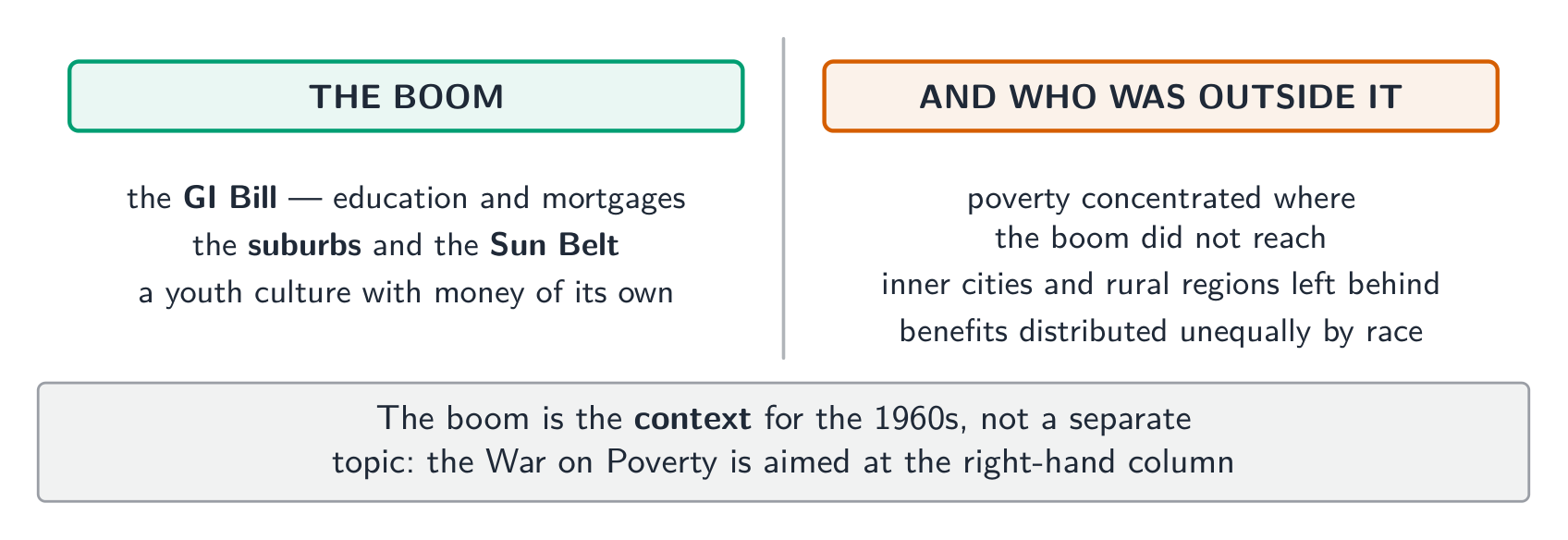
战后经济强劲增长。联邦在国防、公路与退伍军人权利法(GI Bill)上的支出,支撑了住房自有率与高等教育,人口向郊区(suburbs)与阳光地带(Sun Belt)迁移。

文化随之改变:大众消费、电视,以及有自己音乐与市场的独特青年文化(youth culture)。

繁荣并不均衡。郊区扩张在法律与实践上常常把非裔美国人拒之门外,城市失去税基与就业,而贫困(poverty)以被那个年代自我形象所掩盖的方式持续存在——这正是后来改革运动所回应的对象。

词汇表 训练
英文 中文 拼音
GI Bill 退伍军人权利法 tuì wǔ jūn rén quán lì fǎ
suburbs 郊区 jiāo qū
Sun Belt 阳光地带 yáng guāng dì dài
youth culture 青年文化 qīng nián wén huà
poverty 贫困 pín kùn
8.6 8.10 8.11

民权运动的早期步伐(20世纪40与50年代)

大纲

8.6 Early Steps in the Civil Rights Movement (1940s and 1950s)

Thematic FocusLearning ObjectiveHistorical Developments

SOC
Social Structures — Social categories, roles, and practices are created, maintained, challenged, and transformed throughout American history, shaping government policy, economic systems, culture, and the lives of citizens.

Unit 8.G
Explain how and why the civil rights movements developed and expanded from 1945 to 1960.

  • KC-8.2.I Seeking to fulfill Reconstruction-era promises, civil rights activists and political leaders achieved some legal and political successes in ending segregation, although progress toward racial equality was slow.
  • KC-8.2.I.B.i The three branches of the federal government used measures including desegregation of the armed services and Brown v. Board of Education (1954) to promote greater racial equality.

8.10 The African American Civil Rights Movement (1960s)

Thematic FocusLearning ObjectiveHistorical Developments

PCE
Politics and Power — Debates fostered by social and political groups about the role of government in American social, political, and economic life shape government policy, institutions, political parties, and the rights of citizens.

Unit 8.L
Explain how and why various groups responded to calls for the expansion of civil rights from 1960 to 1980.

  • KC-8.2.I.A During and after World War II, civil rights activists and leaders, most notably Martin Luther King Jr., combated racial discrimination utilizing a variety of strategies, including legal challenges, direct action, and nonviolent protest tactics.
  • KC-8.2.I.C Continuing resistance slowed efforts at desegregation, sparking social and political unrest across the nation. Debates among civil rights activists over the efficacy of nonviolence increased after 1965.

Unit 8.M
Explain the various ways in which the federal government responded to the calls for the expansion of civil rights.

  • KC-8.2.I.B.ii The three branches of the federal government used measures including the Civil Rights Act of 1964 to promote greater racial equality.
  • KC-8.2.III.B.ii A series of Supreme Court decisions expanded civil rights and individual liberties.

8.11 The Civil Rights Movement Expands

Thematic FocusLearning ObjectiveHistorical Developments

SOC
Social Structures — Social categories, roles, and practices are created, maintained, challenged, and transformed throughout American history, shaping government policy, economic systems, culture, and the lives of citizens.

Unit 8.L
Explain how and why various groups responded to calls for the expansion of civil rights from 1960 to 1980.

  • KC-8.2.II.B Latino, American Indian, and Asian American movements continued to demand social and economic equality and a redress of past injustices.
  • KC-8.2.II.A Feminist and LGBTQ+ activists mobilized behind claims for legal, economic, and social equality.
  • KC-8.3.II.B.i Feminists who participated in the counterculture of the 1960s rejected many of the social, economic, and political values of their parents’ generation and advocated changes in sexual norms.

来源:美国大学理事会 AP 课程与考试说明

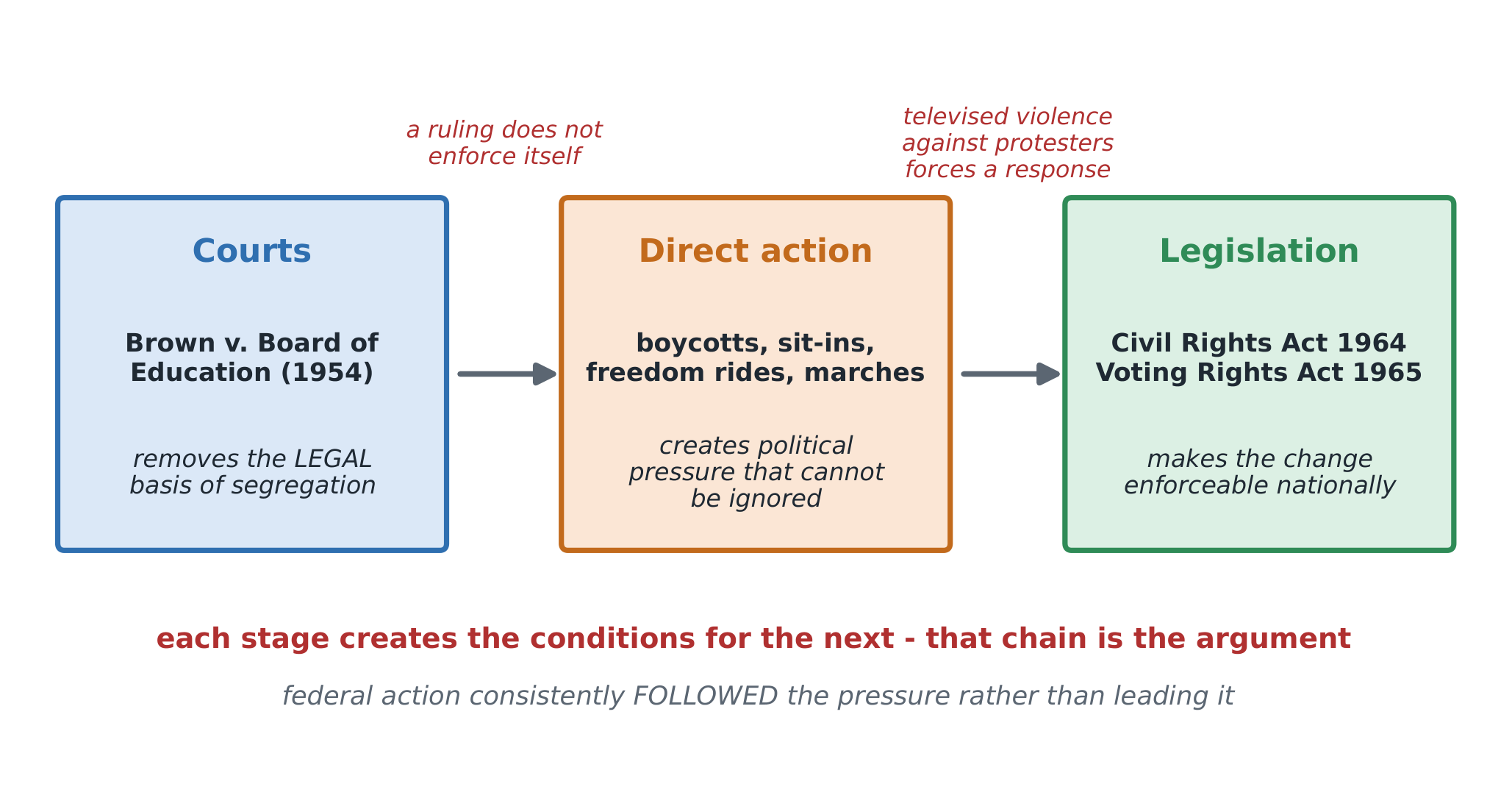
民权运动的三个场域——法院、直接行动、立法——每一环都把压力转化为下一环
诉讼、直接行动与立法并非彼此的替代选项:每一环都为下一环创造了条件

20 世纪 40 与 50 年代的早期努力主要通过法院(courts)展开。法律策略促成了布朗诉教育委员会案(Brown v. Board of Education),该案裁定学校种族隔离违宪,抽掉了种族隔离的法律根基。

法院判决不会自动执行,于是运动转向直接行动(direct action):蒙哥马利公交抵制、静坐、自由乘车与大规模游行,依托教会与学生团体组织,并以非暴力抗议(nonviolent protest)为基础。

持续的压力与电视上针对抗议者的暴力画面,最终促成了立法(legislation):1964年民权法(Civil Rights Act of 1964)与1965年选举权法(Voting Rights Act of 1965)。

运动随后扩展(expanded):后来的活动家提出经济不平等、住房与警务问题,一部分人放弃非暴力与融合路线,转向黑人权力(Black Power)。它的示范作用也影响了妇女、拉美裔、美洲原住民等群体的运动。

词汇表 训练
英文 中文 拼音
courts 法院 fǎ yuàn
Brown v. Board of Education 布朗诉教育委员会案 bù lǎng sù jiào yù wěi yuán huì àn
direct action 直接行动 zhí jiē xíng dòng
nonviolent protest 非暴力抗议 fēi bào lì kàng yì
legislation 立法 lì fǎ
Civil Rights Act of 1964 1964年民权法 1964 nián mín quán fǎ
Voting Rights Act of 1965 1965年选举权法 1965 nián xuǎn jǔ quán fǎ
expanded 扩展 kuò zhǎn
Black Power 黑人权力 hēi rén quán lì
8.7 8.8 8.9

美国成为世界强国

大纲

8.7 America as a World Power

Thematic FocusLearning ObjectiveHistorical Developments

WOR
America in the World — Diplomatic, economic, cultural, and military interactions between empires, nations, and peoples shape the development of America and America’s increasingly important role in the world.

Unit 8.H
Explain the various military and diplomatic responses to international developments over time.

  • KC-8.1.I.E Cold War competition extended to Latin America, where the United States supported non-Communist regimes that had varying levels of commitment to democracy.
  • KC-8.1.II.C.i Americans debated the merits of a large nuclear arsenal and the military–industrial complex.
  • KC-8.1.I.D.i Postwar decolonization and the emergence of powerful nationalist movements in Africa and the Middle East led both sides in the Cold War to seek allies among new nations, many of which remained nonaligned.

8.8 The Vietnam War

Thematic FocusLearning ObjectiveHistorical Developments

WOR
America in the World — Diplomatic, economic, cultural, and military interactions between empires, nations, and peoples shape the development of America and America’s increasingly important role in the world.

Unit 8.I
Explain the causes and effects of the Vietnam War.

  • KC-8.1.I.B.ii Concerned by expansionist Communist ideology and Soviet repression, the United States sought to contain communism through a variety of measures, including major military engagements in Vietnam.
  • KC-8.1.I.D.ii Postwar decolonization and the emergence of powerful nationalist movements in Asia led both sides in the Cold War to seek allies among new nations, many of which remained nonaligned.
  • KC-8.1.II.C.ii Americans debated the appropriate power of the executive branch in conducting foreign and military policy.

8.9 The Great Society

Thematic FocusLearning ObjectiveHistorical Developments

MIG
Migration and Settlement — Push and pull factors shape immigration to and migration within America, and the demographic change as a result of these moves shapes the migrants, society, and the environment.

Unit 8.J
Explain the causes and effects of continuing policy debates about the role of the federal government over time.

  • KC-8.2.II.C Despite an overall affluence in postwar America, advocates raised concerns about the prevalence and persistence of poverty as a national problem.
  • KC-8.2.III.A Liberalism, based on anti-communism abroad and a firm belief in the efficacy of government power to achieve social goals at home, reached a high point of political influence by the mid-1960s.
  • KC-8.2.III.B.i Liberal ideas found expression in Lyndon Johnson’s Great Society, which attempted to use federal legislation and programs to end racial discrimination, eliminate poverty, and address other social issues.

Unit 8.K
Explain the continuities and changes in immigration patterns over time.

  • KC-8.3.I.C Immigrants from around the world sought access to the political, social, and economic opportunities in the United States, especially after the passage of new immigration laws in 1965.

来源:美国大学理事会 AP 课程与考试说明

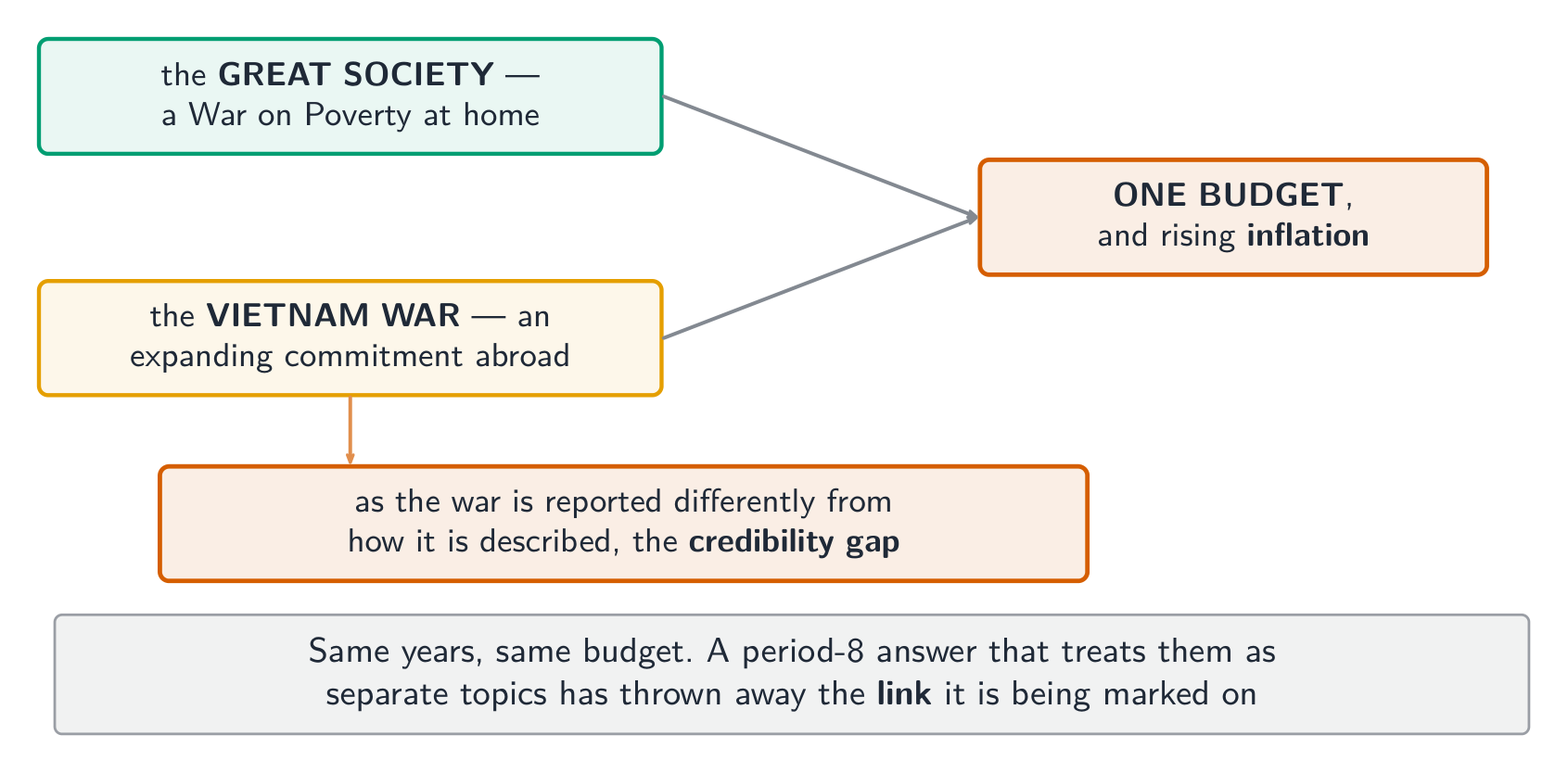
伟大社会(Great Society)把联邦责任扩展到自新政以来的最大范围:医疗保险与医疗补助、对教育的联邦资助,以及向贫困宣战(War on Poverty)。

越南战争(Vietnam War)源于遏制政策,并消耗了同一届政府。不断升级却无决定性结果,催生了规模庞大的反战运动(antiwar movement)、深刻的政治分裂,以及政府表态与报道现实之间的信任鸿沟(credibility gap)。海外的失利与国内的幻灭,恰在联邦国内角色达到顶峰之际削弱了人们对联邦权力的信心。

词汇表 训练
英文 中文 拼音
Great Society 伟大社会 wěi dà shè huì
War on Poverty 向贫困宣战 xiàng pín kùn xuān zhàn
Vietnam War 越南战争 yuè nán zhàn zhēng
antiwar movement 反战运动 fǎn zhàn yùn dòng
credibility gap 信任鸿沟 xìn rèn hóng gōu
8.12 8.13 8.14

20世纪60年代的青年文化

大纲

8.12 Youth Culture of the 1960s

Thematic FocusLearning ObjectiveHistorical Developments

ARC
American and Regional Culture — Creative expression, demographic change, philosophy, religious beliefs, scientific ideas, social mores, and technology shape national, regional, and group cultures in America, and these varying cultures often play a role in shaping government policy and developing economic systems.

Unit 8.N
Explain how and why opposition to existing policies and values developed and changed over the course of the 20th century.

  • KC-8.1.II.B Although anti-communist foreign policy faced little domestic opposition in previous years, the Vietnam War inspired sizable and passionate anti-war protests that became more numerous as the war escalated and sometimes led to violence.
  • KC-8.2.III.D Some groups on the left also rejected liberal policies, arguing that political leaders did too little to transform the racial and economic status quo at home and pursued immoral policies abroad.
  • KC-8.3.II.B.ii Young people who participated in the counterculture of the 1960s rejected many of the social, economic, and political values of their parents’ generation, introduced greater informality into U.S. culture, and advocated changes in sexual norms.

8.13 The Environment and Natural Resources from 1968 to 1980

Thematic FocusLearning ObjectiveHistorical Developments

GEO
Geography and the Environment — Geographic and environmental factors, including competition over and debates about natural resources, shape the development of America and foster regional diversity. The development of America impacts the environment and reshapes geography, which leads to debates about environmental and geographic issues.

Unit 8.O
Explain how and why policies related to the environment developed and changed from 1968 to 1980.

  • KC-8.1.II.D Ideological, military, and economic concerns shaped U.S. involvement in the Middle East, with several oil crises in the region eventually sparking attempts at creating a national energy policy.
  • KC-8.2.II.D Environmental problems and accidents led to a growing environmental movement that aimed to use legislative and public efforts to combat pollution and protect natural resources. The federal government established new environmental programs and regulations.

8.14 Society in Transition

Thematic FocusLearning ObjectiveHistorical Developments

ARC
American and Regional Culture — Creative expression, demographic change, philosophy, religious beliefs, scientific ideas, social mores, and technology shape national, regional, and group cultures in America, and these varying cultures often play a role in shaping government policy and developing economic systems.

Unit 8.J
Explain the causes and effects of continuing policy debates about the role of the federal government over time.

  • KC-8.2.III.C In the 1960s, conservatives challenged liberal laws and court decisions and perceived moral and cultural decline, seeking to limit the role of the federal government and enact more assertive foreign policies.
  • KC-8.2.III.E Public confidence and trust in government’s ability to solve social and economic problems declined in the 1970s in the wake of economic challenges, political scandals, and foreign policy crises.
  • KC-8.2.III.F The 1970s saw growing clashes between conservatives and liberals over social and cultural issues, the power of the federal government, race, and movements for greater individual rights.

Unit 8.P
Explain the effects of the growth of religious movements over the course of the 20th century.

  • KC-8.3.II.C The rapid and substantial growth of evangelical Christian churches and organizations was accompanied by greater political and social activism on the part of religious conservatives.

来源:美国大学理事会 AP 课程与考试说明

这一时期的后半段由各种运动及其限度所界定。

  • 妇女运动(women's movement)争取法律平等与职场机会;平等权利修正案(Equal Rights Amendment)未获批准。
  • 环境保护(environmental)意识在 1968 至 1980 年间发展为联邦在空气、水与濒危物种方面的行动。
  • 1965 年移民法改革改变了新移民的来源构成。
  • 保守主义(conservatism)针对上述一切组织起来,议题包括税收、社会变迁与政府规模——这正是第九时期开篇的那场运动。

经济困境使一切更为尖锐:通货膨胀(inflation)、石油冲击与工业衰退终结了战后繁荣。

词汇表 训练
英文 中文 拼音
women's movement 妇女运动 fù nǚ yùn dòng
Equal Rights Amendment 平等权利修正案 píng děng quán lì xiū zhèng àn
Environmental 环境保护 huán jìng bǎo hù
Conservatism 保守主义 bǎo shǒu zhǔ yì
inflation 通货膨胀 tōng huò péng zhàng
8.15

第八时期的延续与变化

大纲

8.15 Continuity and Change in Period 8

Learning ObjectiveReview: Unit 8 Key Concepts

Unit 8.Q
Explain the extent to which the events of the period from 1945 to1980 reshaped national identity.

  • KC-8.1 The United States responded to an uncertain and unstable postwar world by asserting and working to maintain a position of global leadership, with far-reaching domestic and international consequences.
    • KC-8.1.I United States policymakers engaged in a cold war with the authoritarian Soviet Union, seeking to limit the growth of Communist military power and ideological influence, create a free-market global economy, and build an international security system.
    • KC-8.1.II Cold War policies led to public debates over the power of the federal government and acceptable means for pursuing international and domestic goals while protecting civil liberties.
  • KC-8.2 New movements for civil rights and liberal efforts to expand the role of government generated a range of political and cultural responses.
    • KC-8.2.I Seeking to fulfill Reconstruction-era promises, civil rights activists and political leaders achieved some legal and political successes in ending segregation, although progress toward racial equality was slow.
    • KC-8.2.II Responding to social conditions and the African American civil rights movement, a variety of movements emerged that focused on issues of identity, social justice, and the environment.
    • KC-8.2.III Liberalism influenced postwar politics and court decisions, but it came under increasing attack from the left as well as from a resurgent conservative movement.
  • KC-8.3 Postwar economic and demographic changes had far-reaching consequences for American society, politics, and culture.
    • KC-8.3.I Rapid economic and social changes in American society fostered a sense of optimism in the postwar years.
    • KC-8.3.II New demographic and social developments, along with anxieties over the Cold War, changed U.S. culture and led to significant political and moral debates that sharply divided the nation.

来源:美国大学理事会 AP 课程与考试说明

本时期考查的推理能力是延续与变化。权利在法律上极大扩展,而经济不平等与居住隔离依然存在,有力的答案两者都要写到。

Worked example(一道真实的 AP 考题)。2023 年的长文章题要求「评估民权行动主义的壮大在多大程度上促成了政府行动的改变」*。有力的论点会把行动主义确立为原因*,并点明政府的哪些改变:*「民权行动主义在很大程度上促成了政府行动的改变:诉讼促成了布朗诉教育委员会案,持续的直接行动则形成了 1964 年民权法与 1965 年选举权法背后的政治压力;不过联邦行动始终是在跟随而非引领这股压力。」*注意其结构:题干问的是促成作用,因此文章必须追溯从行动主义到政策的这条链条,而不能只描述运动本身。

8.15

考试技巧

  • 准确定义遏制——阻止扩散而非清除——并用它把朝鲜与越南解释为其后果。
  • 谈红色恐慌时,得分点在公民自由的代价,而不在于把指控过程叙述一遍。
  • 把民权运动呈现为法院 → 直接行动 → 立法,每一环都造就下一环。
  • 写清伟大社会实际做了什么(医疗保险、医疗补助、教育资助),而不是笼统称之为"改革"。
  • 越南战争的国内影响——分裂与信任鸿沟——与军事结局同样重要。
  • 面对"延续与变化"题,把法律上的进展与持续存在的经济与居住不平等配对写出。

AP 美国历史的更多主题

登录或创建账号

IGCSE, A-Level & AP