| English | 释义 | 拼音 |
|---|---|---|
| containment/kənˈteɪnmənt/ | 遏制政策 | è zhì zhèng cè |
| Truman Doctrine/ˈtruːmən ˈdɒktrɪn/ | 杜鲁门主义 | dù lǔ mén zhǔ yì |
| limited war | 有限战争 | yǒu xiàn zhàn zhēng |
| détente | 缓和 | huǎn hé |
An 8000-word telegram, February 1946
- On 22 February 1946, George Kennan, an American diplomat in Moscow, sent Washington a telegram of about 8000 words. Soviet leaders, he argued, believed they could never live in peace with capitalism, but they were cautious and would retreat when faced with strong resistance. The "Long Telegram" was read across the government. Kennan's idea became the basis of American policy for forty years: containment.
- In the Cold War, the US used many instruments to stop the spread of Soviet power and communism.
What did Kennan argue in the Long Telegram?
难度 1/5 · 今日首次完成可获 100 金币及少量额外奖励
The basis of containment.
The aims
- Containment 遏制政策: stop communism from spreading beyond where it already was.
- Defend Western Europe and Japan, keep world trade open, and avoid nuclear war with the Soviet Union.
Three instruments
- Words and aid: the Truman Doctrine 杜鲁门主义 (1947) promised to support "free peoples" resisting communism, with 400 million dollars for Greece and Turkey. The Marshall Plan rebuilt Western Europe.
- Alliances: NATO (1949) committed the US to defend Western Europe — its first peacetime military alliance.
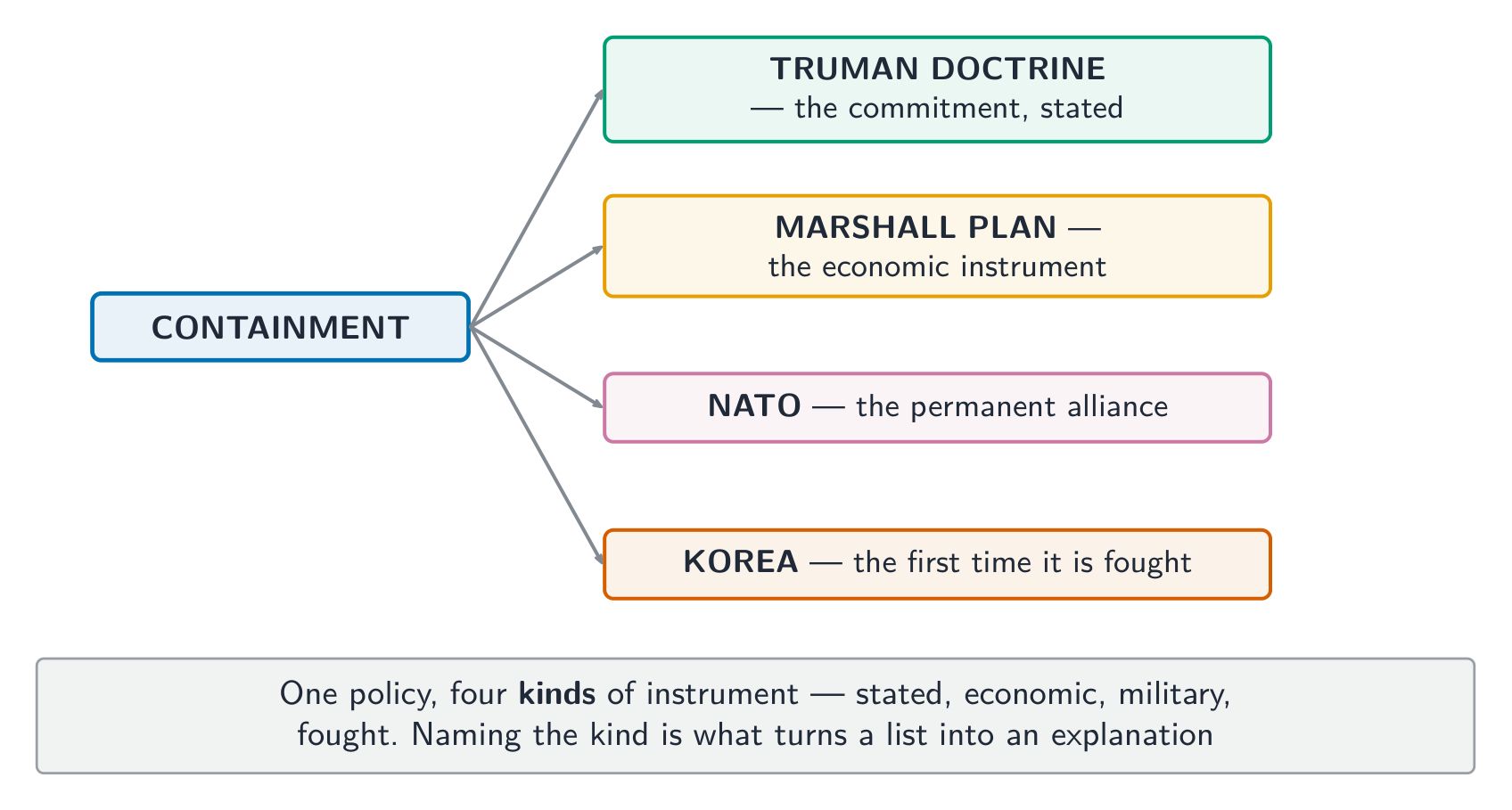
Build containment out of its instruments
Containment is a policy; the Doctrine, the Plan, NATO and Korea are four kinds of instrument.
Match each instrument to its type.
难度 2/5 · 今日首次完成可获 140 金币及少量额外奖励
Three instruments.
How many million dollars did the Truman Doctrine provide for Greece and Turkey?
难度 2/5 · 今日首次完成可获 140 金币及少量额外奖励
1947.0
Worked example: containment in Korea
- The attack: in June 1950, communist North Korea invaded South Korea.
- The response: US-led United Nations forces pushed back; after China entered the war in late 1950, it became a stalemate near the 38th parallel.
- The cost: about 36 000 Americans and perhaps 3 million Koreans died before the 1953 armistice. Korea was a limited war 有限战争 — fought to contain, not to conquer.
Why was Korea called a limited war?
难度 1/5 · 今日首次完成可获 100 金币及少量额外奖励
Contain, not conquer.
Military build-up
- The secret report NSC-68 (1950) called for a huge military build-up; defence spending roughly tripled.
- Under Eisenhower, the US relied on nuclear weapons — "massive retaliation" — to deter Soviet attack.
The Cold War fluctuated
- Tension peaked in crises such as the Cuban Missile Crisis (1962) and eased during détente 缓和 in the 1970s, when Nixon signed the SALT I arms treaty (1972).
- Containment remained the goal throughout.
Put these events in order.
难度 3/5 · 今日首次完成可获 200 金币及少量额外奖励
1946, 1947, 1950, 1972.
Containment did not mean rolling back communism everywhere. It aimed to stop its spread. Korea showed the limits: the US accepted a divided peninsula rather than risk a wider war with China.
Containment aimed to roll back communism everywhere.
难度 1/5 · 今日首次完成可获 100 金币及少量额外奖励
It aimed to stop its spread.
Kennan's idea of containment guided US Cold War policy. The Truman Doctrine, the Marshall Plan, NATO and the build-up after NSC-68 were its instruments, and the Korean War tested it. Tension rose and fell, from crises to détente, but containment stayed the aim.
Explain how the United States carried out containment between 1946 and 1953.
Process.