Period 3 runs from 1754 to 1800. It begins with the fighting in North America that became part of the Seven Years' War. The Revolution is one development to explain; questions may ask about different causes, effects, comparisons or changes.
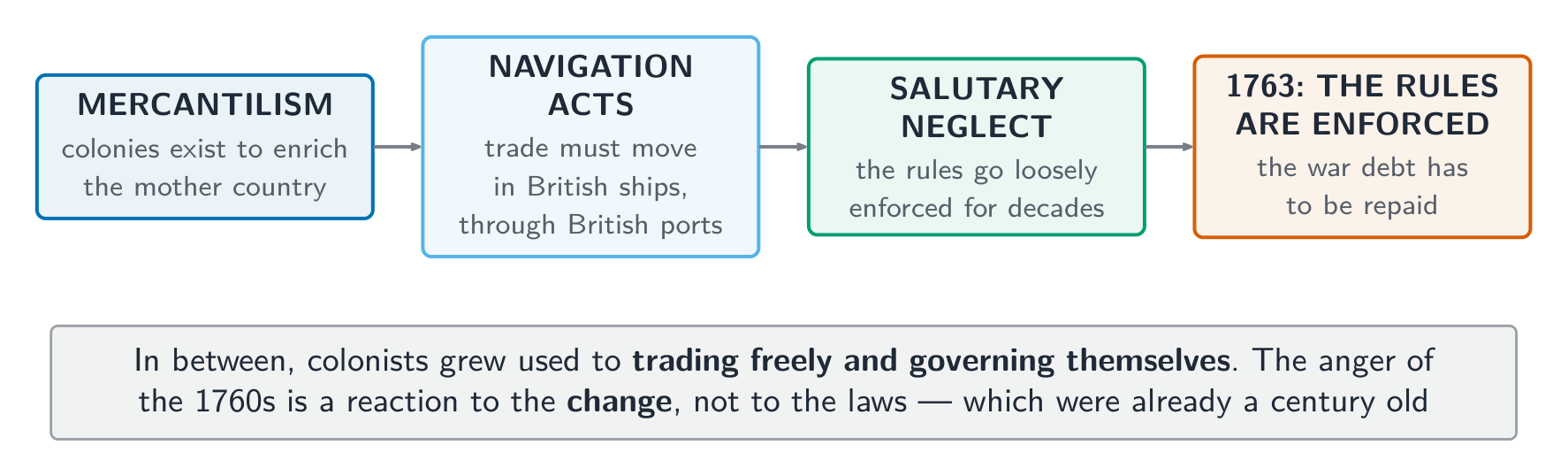
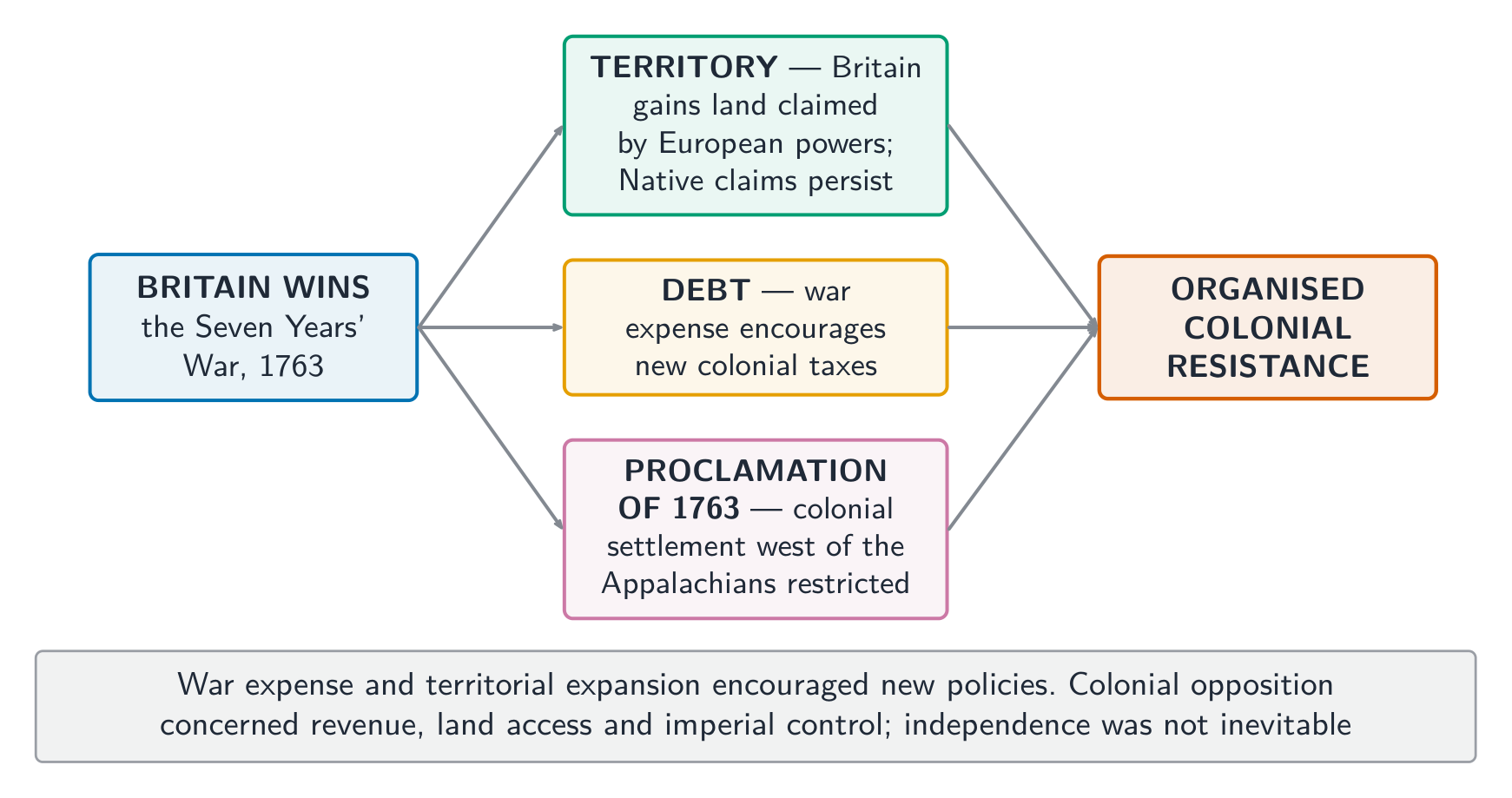
Colonial rivalry between Britain and France intensified as British colonists expanded into the interior. Their expansion threatened French–Indian trade networks and Native autonomy. The Seven Years' War 七年战争, known in North America as the French and Indian War 法印战争, ended with British victory.
Try it — cause and consequence. Before 1763, British colonial expansion threatened trade networks and Native control of land. After 1763, Britain held more territory but faced great war expense. Explain one cause of the war and one problem victory created. Name whose interests were threatened.
Worked reasoning. Inland expansion increased rivalry with France and threatened Native lands and trading relationships. Victory brought Britain a major expansion of territory 领土大扩张 and an enormous war debt 巨额战争债务. Officials sought revenue from the colonies and tighter imperial control. These policies challenged colonial economic interests and traditions of self-government.
Try it — one policy, different interests. The Proclamation of 1763 1763年公告线 restricted colonial settlement west of the Appalachian Mountains. British officials wanted to limit costly frontier conflict and control settlement. Colonists seeking land wanted access to western territory after helping win the war. Native groups sought to defend their lands while continuing European trade. Why could an attempt to reduce conflict produce colonial opposition? Why did imperial claims not mean Native peoples had surrendered their lands?
Worked reasoning. Settlement restrictions frustrated colonists seeking western land. Their opposition concerned land access as well as taxation. Native groups continued trade and resisted colonial encroachment: a European territorial claim did not remove Native communities or their resistance. Victory created problems of revenue and control, but independence was not an inevitable result.
New British efforts to collect taxes 征税 without the consent of colonial assemblies, and to assert imperial authority, provoked organised resistance.
Colonial leaders based their arguments on the rights of British subjects, on the ideals of the Enlightenment 启蒙思想, and on their own long experience of self-government - the assemblies built up during Period 2.
Resistance was not only argument. Facing shortages and, in some regions, British military occupation 军事占领, men and women both took part: boycotts of British goods, home manufacture, crowd action, and committees of correspondence. Leaders such as Benjamin Franklin 富兰克林 energised the movement, and the slogan of the period is "no taxation without representation" 无代表不纳税.
Enlightenment ideas led American political thinkers to emphasise individual talent over hereditary privilege, and to assert the natural rights 天赋权利 of the people and the sovereignty of the people 人民主权.
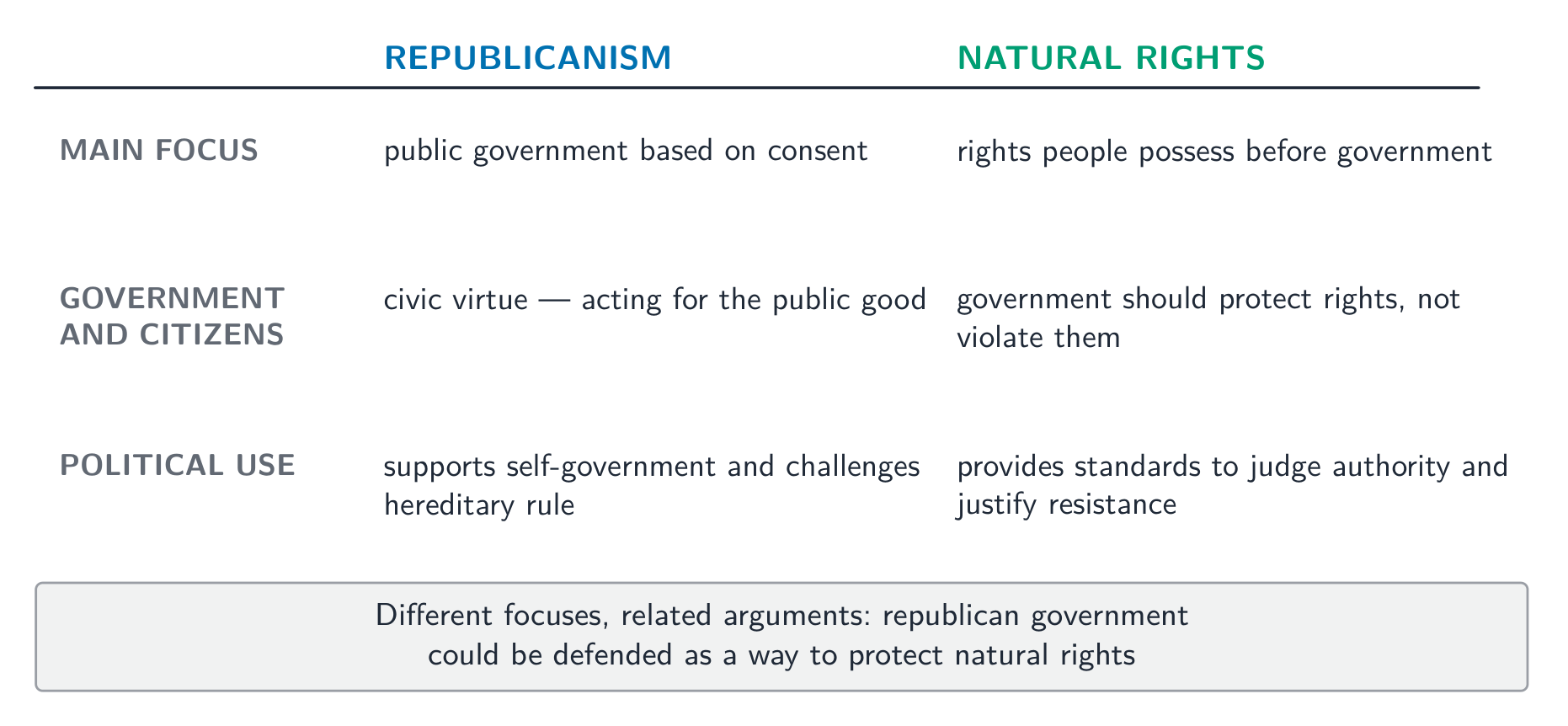
Try it — distinguish two claims. These are teacher-written claims, not historical quotations. A: People possess rights before government exists; violations can justify resistance. B: Public authority should rest on the people's consent, and citizens should place the public good above private gain. Match each to natural rights or republicanism and explain the difference in focus.
Worked distinction. A describes natural rights: government should protect rights that it did not create. B describes republicanism 共和主义: consent-based government and civic virtue, rather than hereditary rule and only private gain. Supporters could link the ideas by arguing that republican government would protect natural rights.
Try it — revise a claim. A student says natural rights mattered only during the break with Britain, and republicanism only afterwards. The CED explains that support for republican government based on natural rights appeared in Common Sense and the Declaration of Independence. Use that evidence to revise the student's claim.
Worked revision. Both ideas helped colonists criticise British rule and imagine a different government during the independence movement. Natural rights supplied standards for judging authority, while republicanism offered government based on the people's consent. The terms have different meanings but do not belong to separate, fixed stages. Naming them without explaining their role is not an argument.
Try it — explain victory. Britain had military and financial advantages, and the Patriot cause faced Loyalist opposition. Patriots had colonial militias, the Continental Army, Washington's leadership, commitment and resilience, and foreign assistance 外国援助 from European allies, including France. Why is “Britain was too weak to win” a poor explanation? Use an obstacle and two Patriot resources to revise it.
Worked explanation. British advantages did not guarantee victory. Militias and the Continental Army fought the war, while Washington's leadership helped sustain the Patriot effort. Commitment and European assistance helped the movement continue despite opposition and hardship. Neither British weakness nor one isolated Patriot advantage explains the whole outcome.
Try it — assess social change. The following evidence is paraphrased from the CED, not quoted from the original documents. In a 1777 freedom petition, Prince Hall and other free Black men used natural-rights and Christian ideas to argue for enslaved people's freedom. Pennsylvania passed an act for gradual abolition in 1780. The ideal of republican motherhood 共和母亲身份 valued women's role teaching republican values within families. Explain one change. Why does the evidence not prove immediate freedom and equal political rights for everyone?
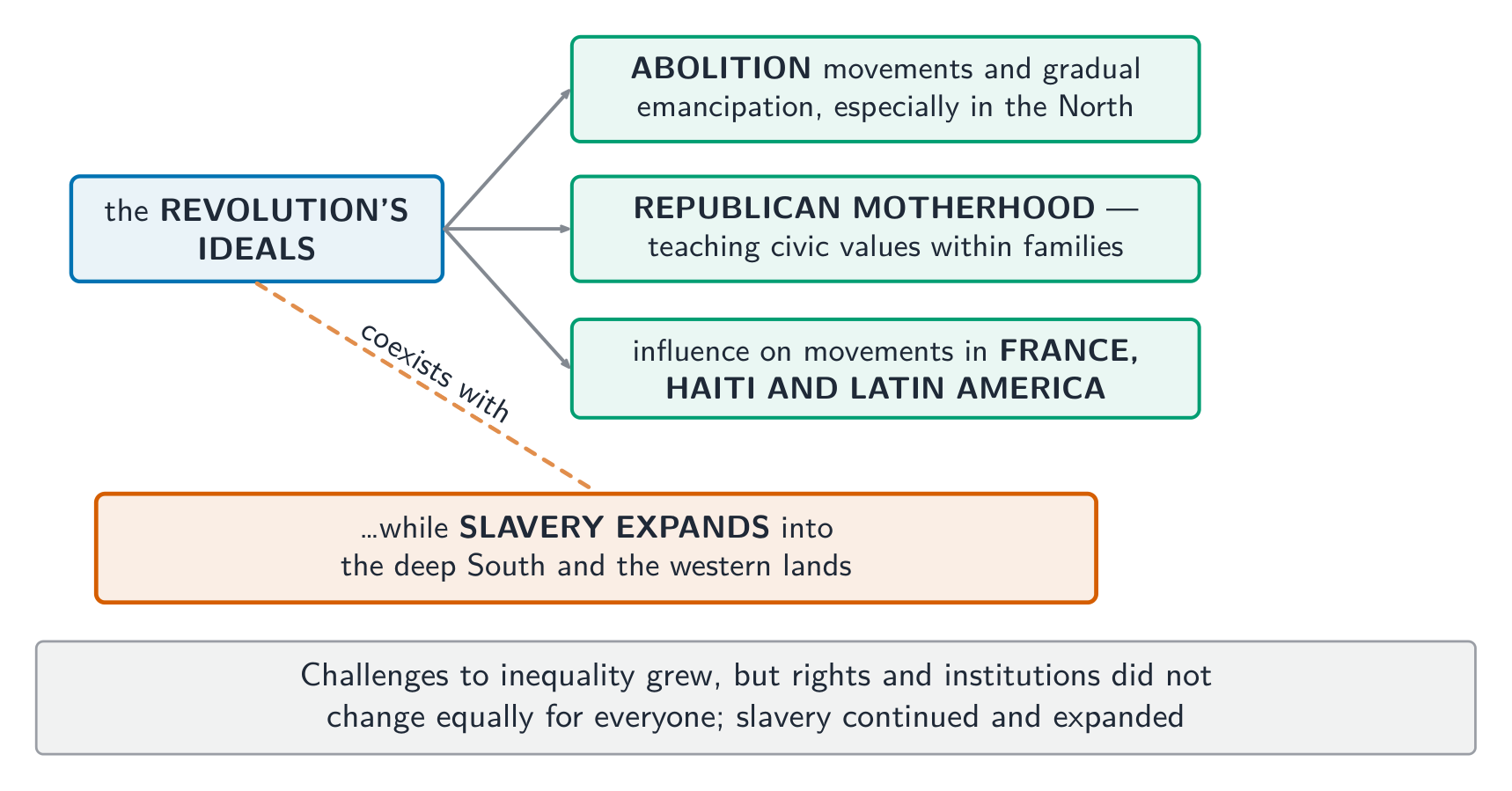
Worked judgment. Rights language supported movements to abolish slavery 废奴运动; Pennsylvania's act shows a change in law, not immediate freedom throughout the country. Slavery continued and expanded into the deep South and adjacent western lands while antislavery 反奴隶制 sentiment grew. Republican motherhood changed ideas about the status of women 妇女地位 by valuing their political education within families, but did not itself establish equal political rights. A petition shows a demand, an act shows a legal change, and an ideal shows a valued role. These are different kinds of evidence with different limits.
Transfer — global influence. The American Revolution and the Declaration's ideals influenced movements in France, Haiti and Latin America. Does that mean these movements had identical aims or only one cause? Write a qualified claim that distinguishes “inspired” from “fully explains”.
Worked transfer. The Revolution and its rights language offered inspiration to movements in France, Haiti and Latin America. That evidence establishes influence, not identical aims or a single cause for each movement. Explaining a particular revolution requires evidence about its own circumstances and participants. Similarly, ideals encouraged challenges to inequality at home without automatically abolishing slavery or creating equal rights.
Exam transfer — 2025 AP US History, Set 1, Question 3(C), paraphrased. Briefly explain how one group responded to debates about British colonists' rights during 1765–1783. Try it: identify a group, its response and the reasoning linking that response to the rights debate. Naming “natural rights” or “the Revolution” alone does not explain a response.
Teacher-written model. Some Patriot colonists argued that British government had violated their natural rights. They therefore supported declaring independence in 1776 as a justified response to a government that failed to protect those rights.
Why this fits. It identifies a group and explains why a rights argument supported a particular response within the dates. The official scheme accepts colonists using natural-rights arguments to justify independence; it also accepts Loyalist defence of the Crown and other relevant responses. This is our model, not an official sample or the response of every colonist.
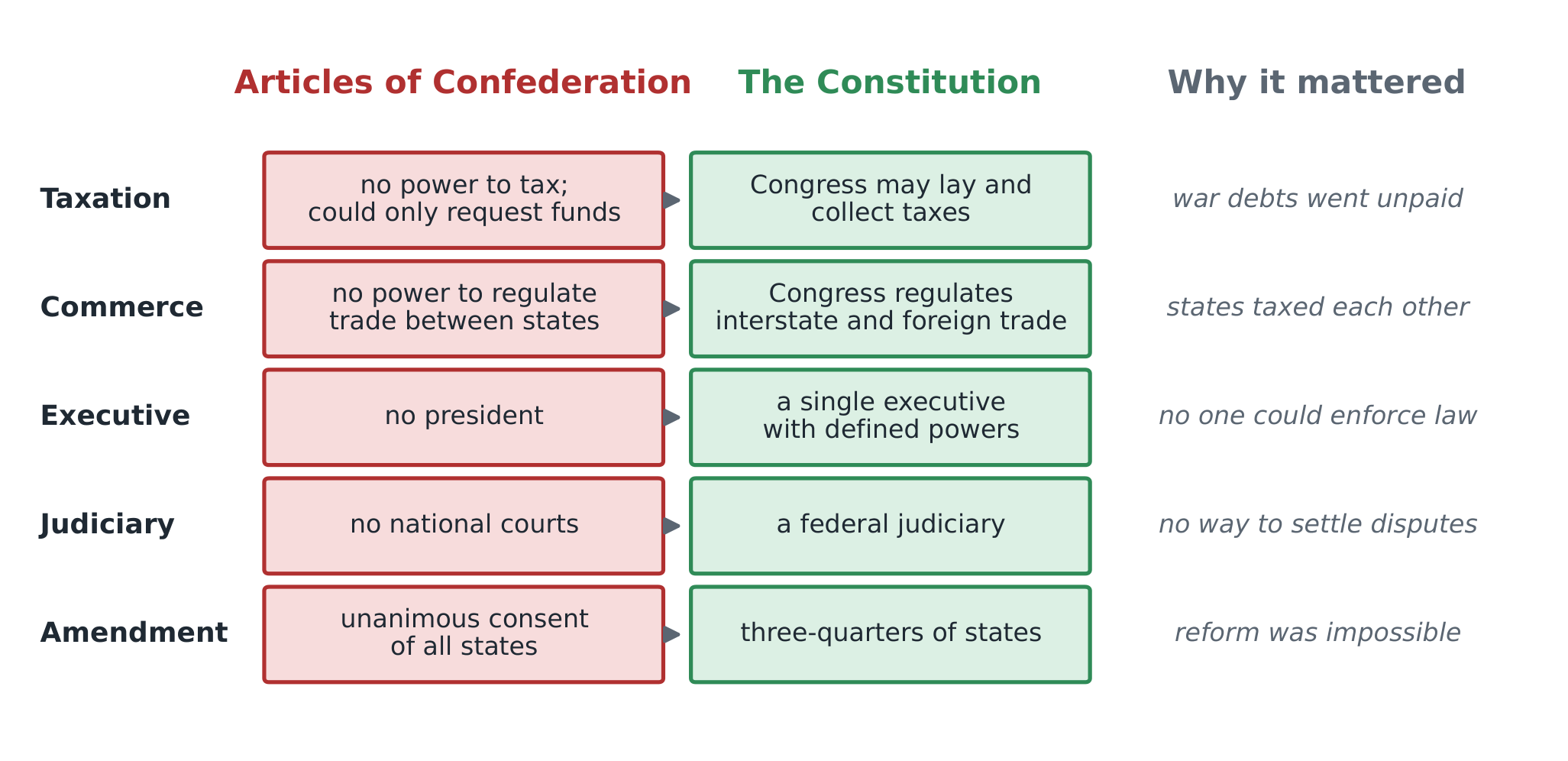
The Constitution was written to fix specific, named weaknesses - each row is one of them
After declaring independence, leaders wrote new constitutions and declarations of rights that reflected republican ideals, generally limiting executive power.
The Articles of Confederation 邦联条例 created a deliberately weak central government: no power to tax, no power to regulate commerce, no executive, and no national judiciary. It succeeded in organising western settlement through the Northwest Ordinance 西北法令, but could not manage debt, trade disputes, or unrest.
The Constitutional Convention 制宪会议 of 1787 produced a stronger national government built on compromise 妥协, including the Great Compromise 大妥协 over representation and compromises over slavery and commerce.
Ratification 批准 was contested. Federalists 联邦党人 argued the new government was strong enough to govern yet checked enough to be safe; Anti-Federalists 反联邦党人 feared centralised power and demanded protection for individual liberties, which produced the Bill of Rights 权利法案.
Under George Washington 华盛顿 and John Adams 亚当斯, political leaders disagreed sharply over the relationship between the national and state governments, economic policy, and foreign policy. Those disagreements hardened into the first party system 第一政党体系.
War between France and Britain after the French Revolution 法国大革命 forced hard choices, and the government pursued diplomatic initiatives to deal with the continued British and Spanish presence in North America. Washington's Farewell Address 华盛顿告别演说 urged national unity and warned against political factions and permanent foreign alliances.
Meanwhile a distinctive national culture 民族文化 developed - in art, literature, and architecture - alongside continued regional variation.
American Indian groups repeatedly evaluated and adjusted their alliances with European powers and the new United States as circumstances changed.
Growing numbers of migrants moved west, intensifying competition over resources, boundaries, and trade 资源、边界与贸易. The relationship between the federal government and American Indian tribes remained ambiguous 含混不清, contributing to recurring conflict. In the Southwest, the Spanish expanded their mission system 传教团体系, supported by the bonded labour of local American Indians.
The period's reasoning skill is continuity and change 延续与变化. The strongest answers hold both: political institutions changed radically, while slavery, westward expansion, and conflict with American Indians continued and intensified.
Exam transfer — 2025 AP US History, Set 1, Question 3(B). The prompt asks students to briefly describe one effect of the Seven Years' War from 1754 to 1765. Try it before reading the model: describe an effect within those dates, with relevant details. Would the Declaration of Independence in 1776 fit?
Teacher-written model. Britain's costly victory encouraged Parliament to raise revenue from its North American colonies. The Stamp Act of 1765 imposed a tax on printed materials in the colonies.
Why this fits. The response describes a postwar tax policy within 1754–1765. The official scheme accepts further British taxation to pay for the war, the end of French colonies, or heightened tensions among colonists, British officials and Native groups. “Describe” requires relevant characteristics beyond an isolated term; it does not require a fixed two-part formula. The Declaration of Independence falls outside the dates of this prompt. This model is our teaching response, not an official sample answer or a guarantee of credit.
Explain how war expense and territorial expansion led to new revenue measures, settlement restrictions and resistance; avoid treating independence as inevitable.
Explain how republicanism and natural rights support an argument, using evidence rather than only naming them.
For the Constitution, argue from the specific weakness it fixed - no power to tax, no power to regulate commerce, no executive.
Keep Federalist and Anti-Federalist positions straight, and remember the Bill of Rights was the price of ratification.
The Revolution's effects on slavery and women are examinable, and both are partial: ideals spread further than rights did.
On continuity-and-change prompts, give one of each. An answer that only lists changes has answered half the question.
Period 4 runs from 1800 to 1848. Three things happen at once: democracy widens, the economy transforms, and the country expands - and each one deepens the argument over slavery.
National parties continued to debate the tariff 关税, the national bank 银行, and internal improvements 内部改良 (federally funded roads and canals). These were arguments about how much power the national government should have.
The Supreme Court settled part of that argument. Its decisions established the primacy of the judiciary 司法至上 in determining the meaning of the Constitution - the principle of judicial review 司法审查 - and generally strengthened federal power over the states.
Expansion began early: after the Louisiana Purchase 路易斯安那购地, the government sought influence and control over the West, sending expeditions and negotiating with American Indian nations.
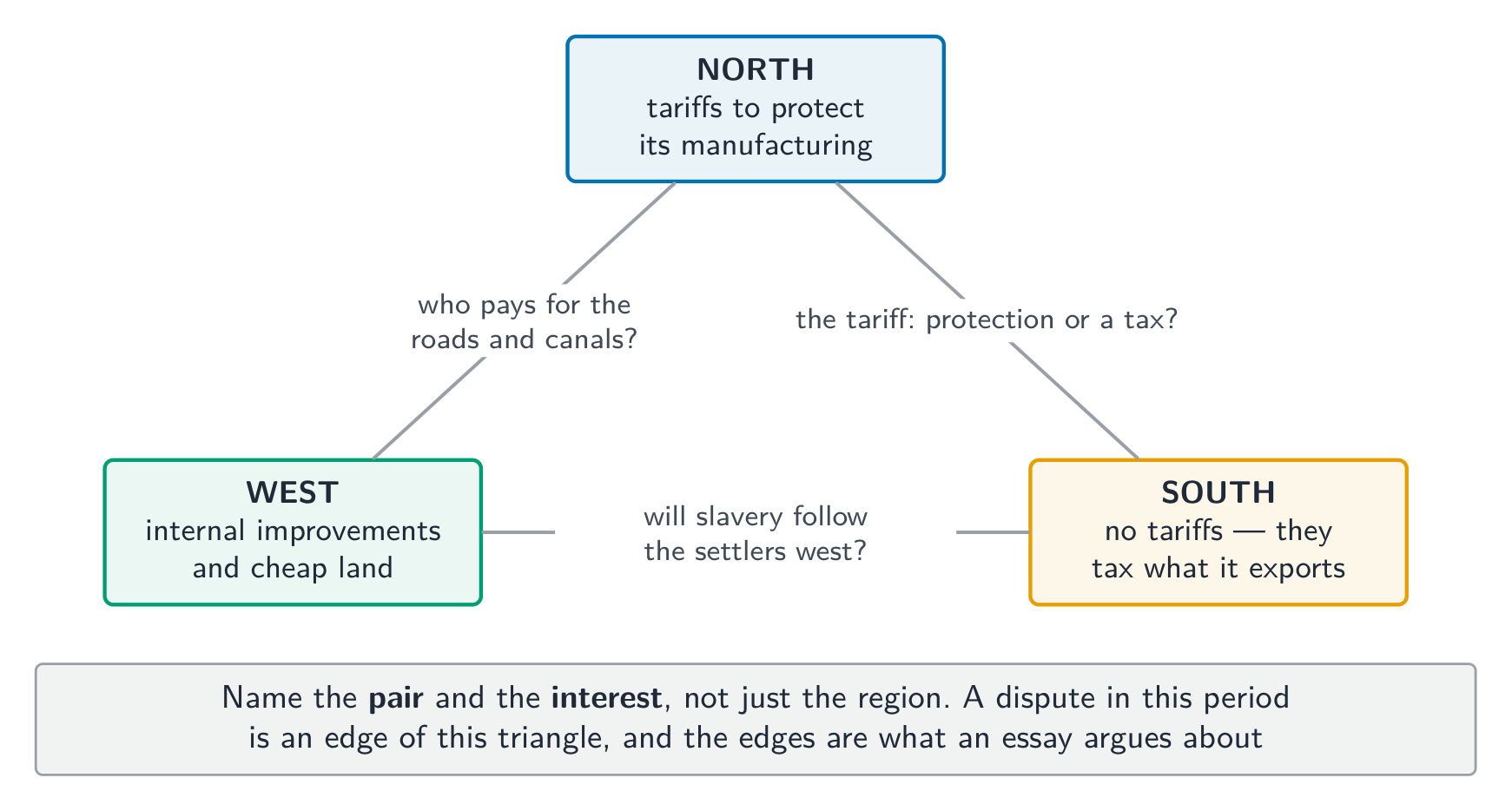
As the country grew, regional interests 区域利益 diverged. The North favoured tariffs to protect manufacturing; the South opposed them as a tax on its exports; the West wanted internal improvements and cheap land. Nearly every political dispute of the period maps onto that triangle.
Abroad, the United States struggled to create an independent global presence 独立的国际地位. It fought the War of 1812 1812年战争, expanded foreign trade, and in the Monroe Doctrine 门罗主义 declared the Western Hemisphere closed to further European colonisation - an assertion of influence well beyond the country's actual power at the time.
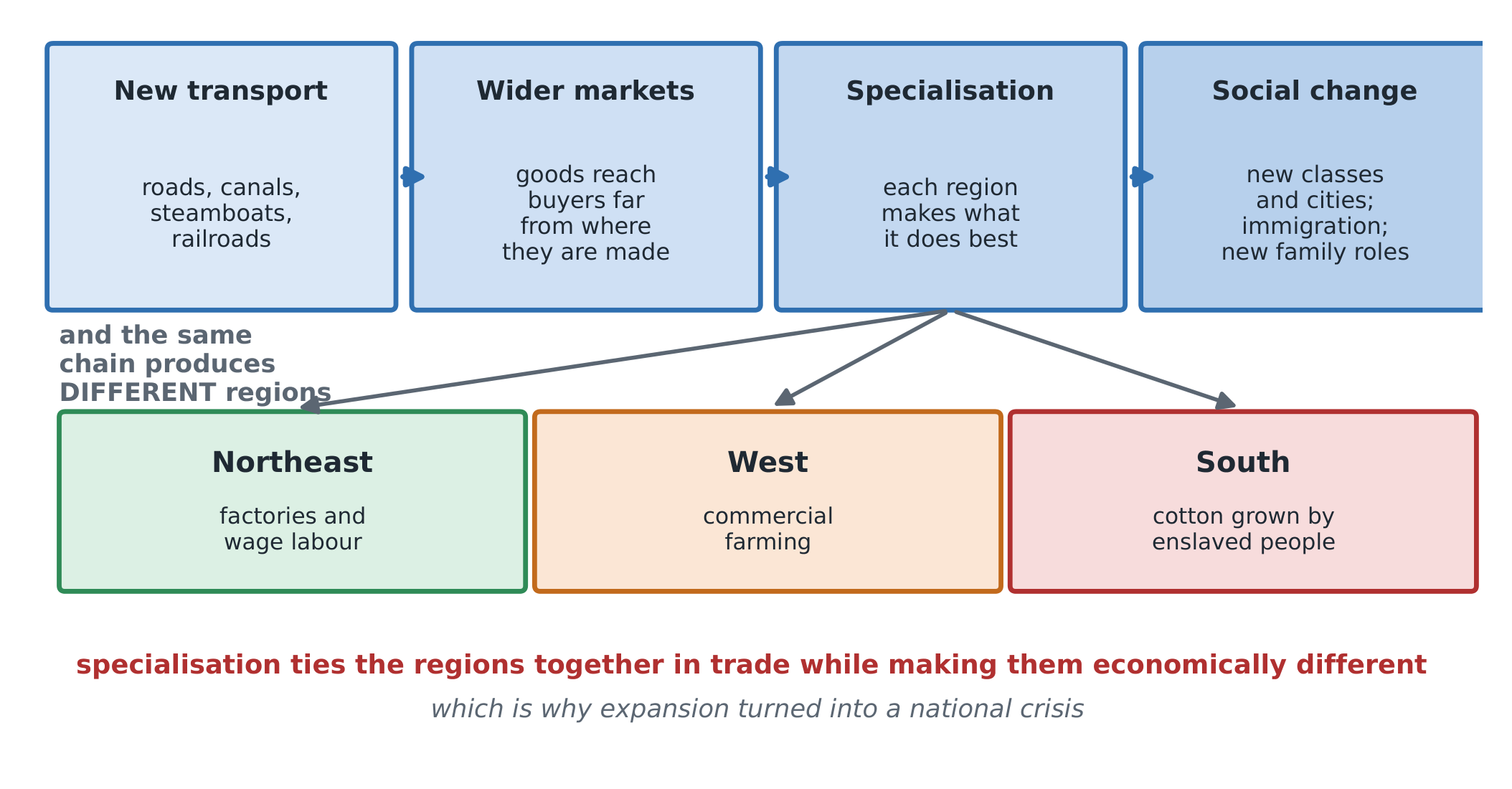
The market revolution is a chain, not a list: each link is what turns the previous one into a change in how people lived
New transportation systems 交通体系 - roads, canals 运河 such as the Erie, steamboats, and then railroads 铁路 - together with new technologies dramatically expanded manufacturing and agricultural output.
The mechanism is what the exam wants. Cheaper transport widened markets 市场; wider markets let regions specialise 专业化 in what they did best; specialisation tied the regions together in trade while making them economically different from one another.
The results by region: factory production 工厂生产 and wage labour in the Northeast, commercial farming 商业化农业 in the West, and in the South an intensified reliance on cotton 棉花 grown by enslaved people.
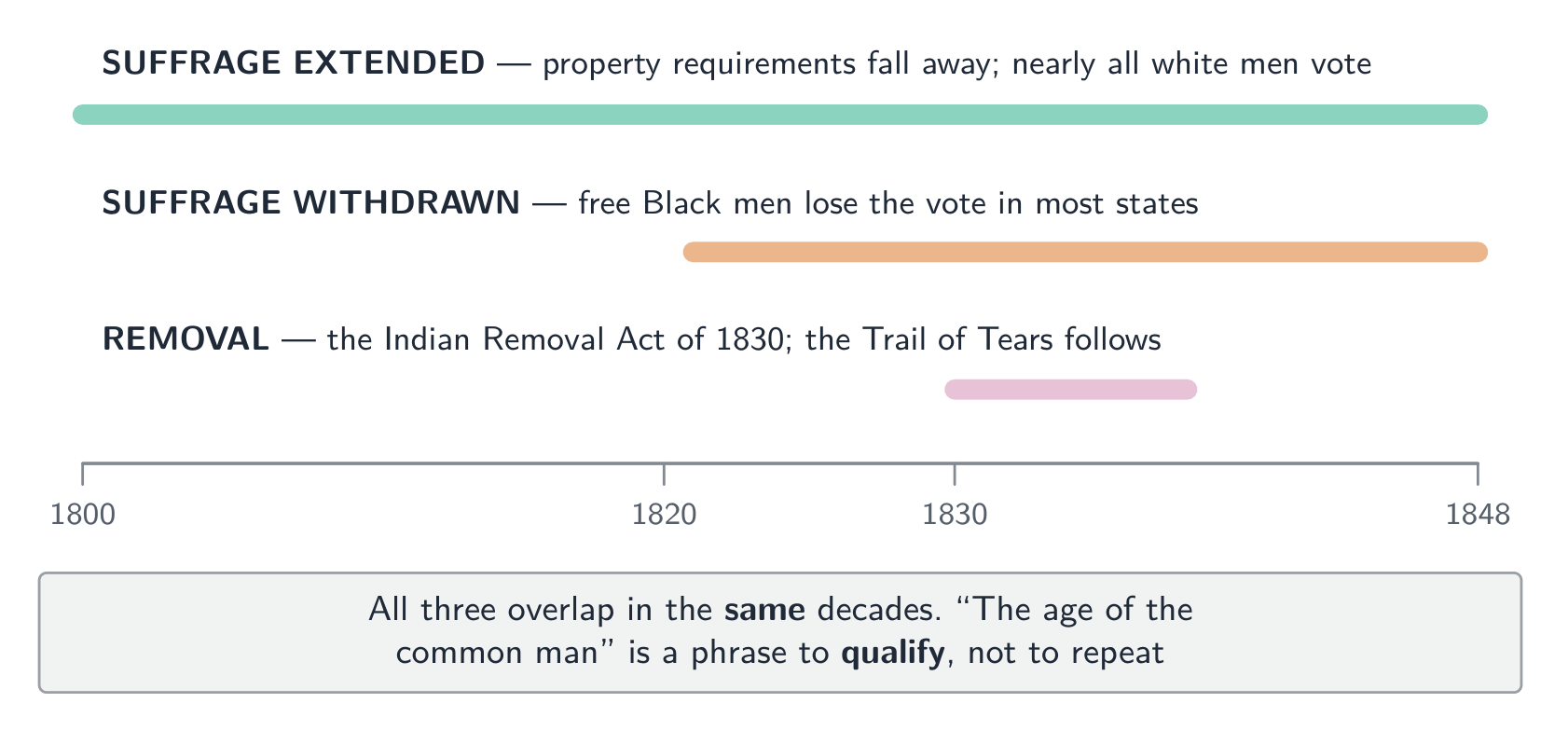
The transition to a more participatory democracy 更具参与性的民主 came through expanding suffrage 选举权 - the removal of property qualifications for white men - along with new campaign styles and mass political parties.
The limits matter as much as the expansion: this widening applied to white men, while free African Americans in several states lost voting rights in the same decades, and women had none.
Andrew Jackson 杰克逊 embodied and tested the new politics. His presidency featured a war on the national bank, the nullification crisis 废止危机 over the tariff, and the Indian Removal Act 印第安人迁移法 - the forced removal of southeastern nations along what became known as the Trail of Tears 血泪之路.
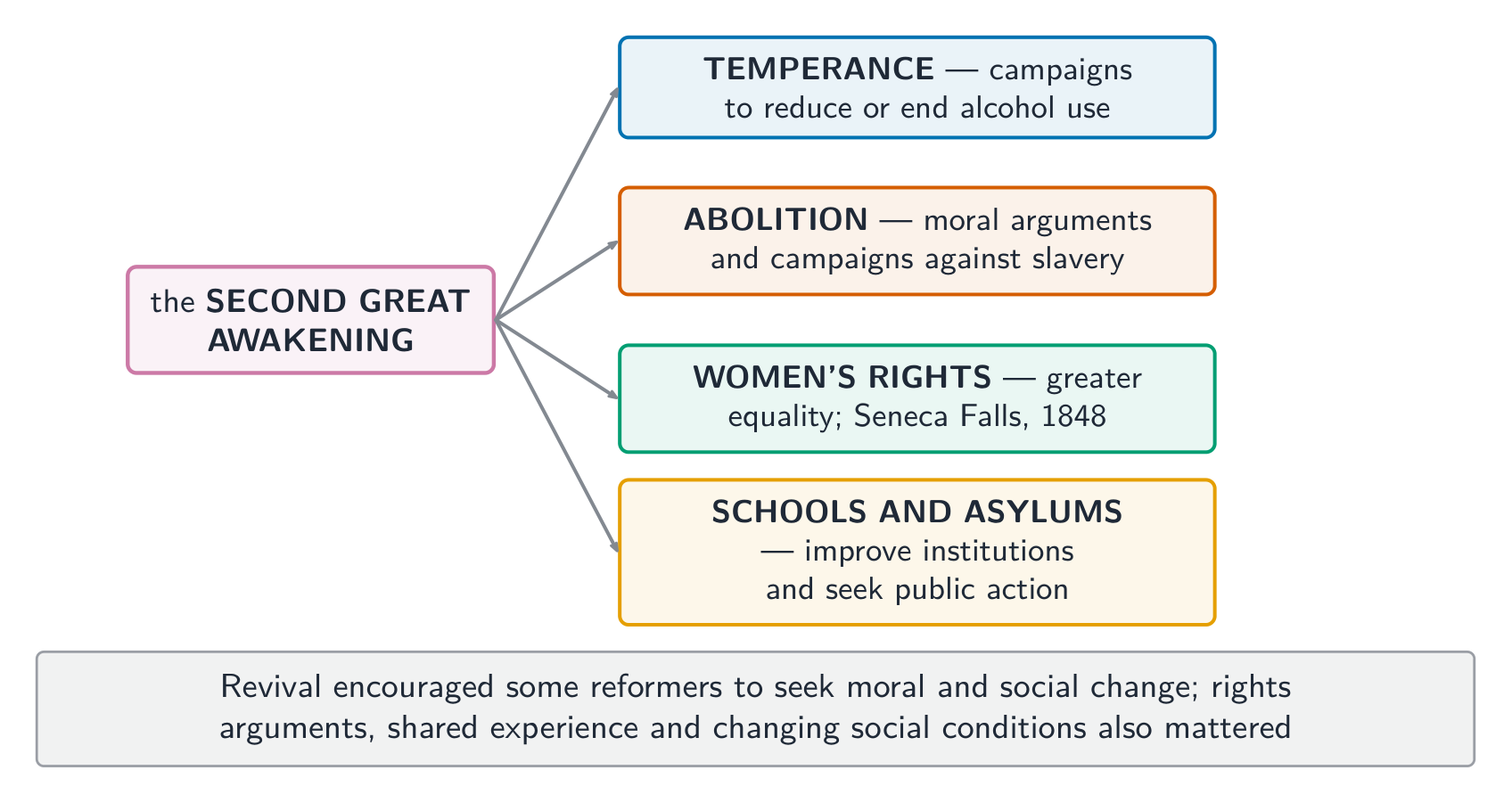
Democratic and individualistic beliefs, responses to rationalism, market changes and greater social and geographical mobility contributed to the Second Great Awakening 第二次大觉醒 among Protestants. Revival emphasised personal salvation and the possibility of moral improvement. Reformers formed voluntary organizations 自愿团体 to change behaviour and improve society.
Try it — link belief to action.Temperance 禁酒运动 sought to reduce or end alcohol use. Explain how belief in moral improvement could encourage a reformer to campaign for temperance. Why is naming the revival and movement not enough to explain a connection?
Worked link. If people can change morally, harmful behaviour need not be accepted as permanent. Some reformers joined voluntary groups to persuade people to change. Temperance campaigns applied this approach to alcohol use and its perceived social harms. Abolitionist and antislavery movements 废奴与反奴隶制运动 challenged slavery, and a women's rights movement 妇女权利运动 sought greater equality and opportunity. Revival was one influence, alongside rights arguments, reform experience and social conditions; the campaigns did not all have one identical cause.
Try it — methods and results. This evidence paraphrases the CED's source descriptions, not the original documents. In 1845, Dorothea Dix addressed Pennsylvania's legislature about conditions in jails and poorhouses while advocating humane treatment and asylum reform. The Seneca Falls Convention 塞内卡福尔斯会议 of 1848 expressed demands for greater equality and opportunities for women. Use Dix to test the claim that voluntary reform meant reform without the state. Why does a convention's demand not prove equality had already been achieved?
Worked distinction. Addressing a legislature sought public action: reformers outside government could try to change state policy or institutions. “Voluntary” did not mean refusing state involvement. Seneca Falls expressed activists' aims, not the removal of all legal and political barriers. Likewise, northern emancipation increased the free African American population while many state governments continued restricting African Americans' rights. Separate aims, methods and outcomes.
Exam transfer — 2024 AP US History, Set 1, Question 1(a), adapted practice. Teaching paraphrases of the exam's interpretations: Melder stresses religious and reform activity bringing women together, giving them experience and encouraging challenges to restrictions. Lerner stresses class differences and middle-class women's frustration with political exclusion. Describe one major difference. Consult the full exam excerpts for the original task; these summaries are not quotations.
Teacher-written model. Melder emphasises how experience in religious and reform movements brought women together and encouraged activism. Lerner emphasises class differences and middle-class women's frustration at exclusion from political power.
Why this fits. The response contrasts causes each historian stresses. The official scheme accepts reform participation versus political-equality motivations, or unity versus class divisions. Saying both discuss women does not identify a difference. The contrast is one of emphasis, not proof that either historian denied every other factor. This is our teaching response, not an official sample or a guarantee of credit.
Ideas about national identity increasingly found expression in art, literature, and architecture 艺术、文学与建筑, while various groups maintained distinctive cultures of their own.
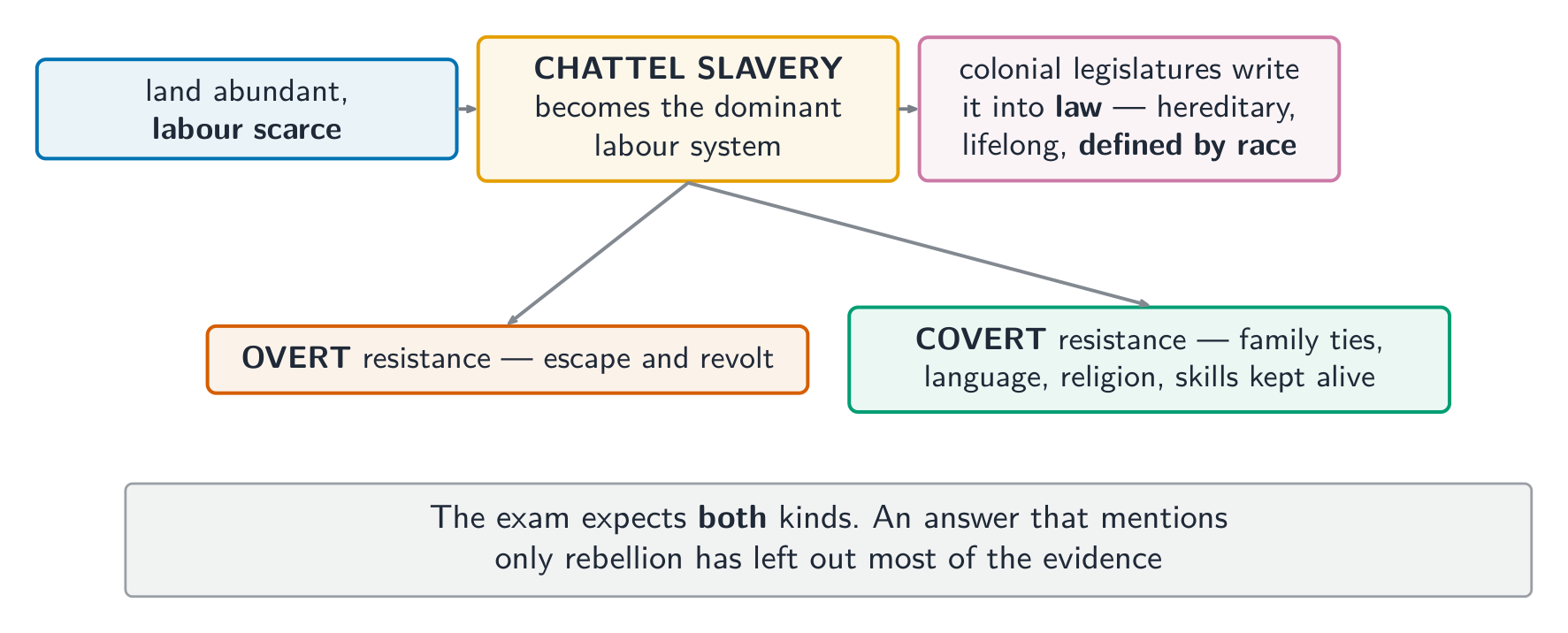
Antislavery effort in the South was largely limited to unsuccessful rebellions 未能成功的起义 by enslaved people, which were met with harsher laws and tighter control.
Enslaved and free African Americans created communities and strategies 社群与策略 to protect themselves: family and kinship networks, religious practice, music, and covert resistance - a continuation of the pattern from Period 2.
In the South, although the majority of southerners owned no enslaved persons, most supported the system. As overcultivation depleted arable land in the Southeast, slaveholders relocated westward 向西迁移, carrying slavery into new territory - which is precisely what made westward expansion a national crisis rather than a regional one.
The period's reasoning skill is causation. The strongest chain to hold: the market revolution and westward expansion were engines of growth, and both drove the sectional conflict that Period 5 resolves by war.
Worked example (a real AP exam question). The 2023 exam set the long essay "Evaluate the extent to which commercial development changed United States society from 1800 to 1855." A high-scoring thesis takes a position on how much, and names the areas of change: "Commercial development transformed United States society to a great extent between 1800 and 1855, creating a wage-earning working class and a distinct middle class in the North and drawing the West into national markets, though in the South it deepened rather than displaced an existing slave-based agricultural order." Notice the shape: Evaluate the extent rewards a qualified position - "to a great extent, though…" - because that structure lets the essay use evidence on both sides. A thesis that merely says commercial development "changed society a lot" cannot be argued.
4.14
考试技巧
Learn the market revolution as a chain: transport → wider markets → specialisation → different regional economies → social change.
Give the regional triangle (North, South, West) when explaining a political dispute; tariff, bank, and internal improvements all fit it.
Democracy expanded for white men while free Black men lost rights in several states. Saying so is what turns a description into an evaluation.
Explain a link from the Second Great Awakening to reform through belief, organisation and action, rather than treating revival as the single cause.
Southern westward migration matters because it carried slavery west, turning expansion into the central national conflict.
On Evaluate the extent prompts, qualify your position. "To a great extent, although…" is the structure the rubric rewards.
Period 5 runs from 1844 to 1877. Disputes over slavery and federal power intensified into civil war and continued during Reconstruction.
Expansion sharpened disputes over slavery. The desire for access to natural and mineral resources 自然与矿产资源, and the hope of settlers for land, pushed Americans west. Advocates justified annexation through Manifest Destiny 天定命运论 - the claim that the United States was destined, and superior enough, to spread across the continent.
The Mexican-American War 美墨战争 added enormous territory in the West. Later, wartime legislation such as the Homestead Act 宅地法 boosted migration further, and interest in expanding trade produced economic and diplomatic initiatives abroad.
Expansion also meant conflict. The government's interaction with Mexican Americans 墨西哥裔美国人 and American Indians produced dispossession, resistance, and new legal disputes over land and citizenship.
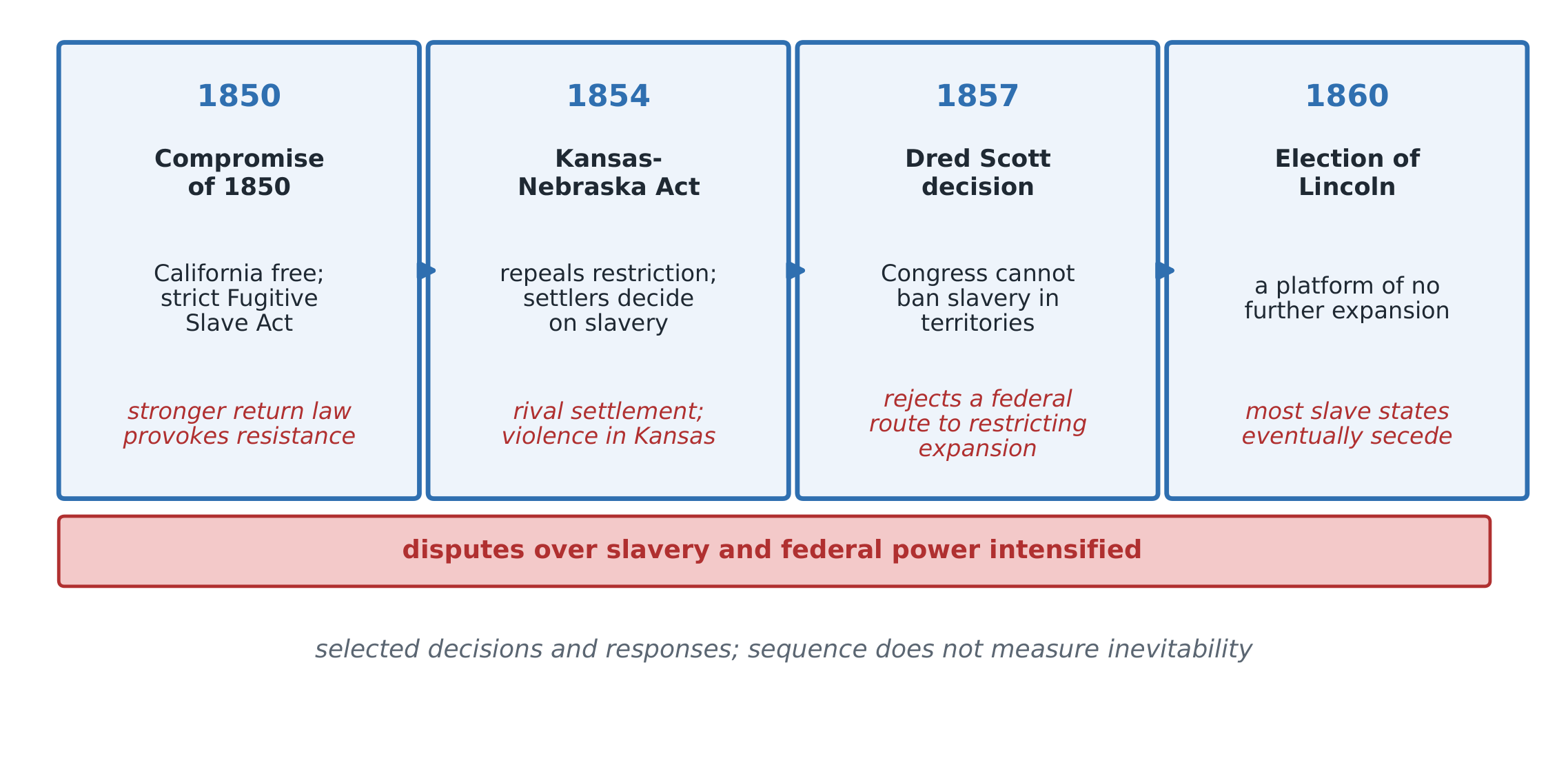
Acquiring land intensified the question of whether slavery would expand and who could decide. Different institutions tried different answers, but these failed to end sectional conflict.
Try it — assess a political bargain. Selected measures in the Compromise of 1850 1850年妥协案 admitted California as a free state, left slavery possible in Utah and New Mexico, ended the slave trade in Washington, D.C., and strengthened the Fugitive Slave Act 逃奴法. Identify a measure welcomed by opponents of slavery's expansion and one welcomed by slaveholders. Why could stronger enforcement of escaped enslaved people's return create opposition in free states?
Worked explanation. Free-state admission limited slavery's expansion in California. The stronger fugitive-slave law helped slaveholders recover people who had escaped, including into free states; opponents of slavery resisted this enforcement. Leaving slavery possible in Utah and New Mexico did not settle its status throughout the West. The bargain addressed competing demands without removing the conflict over slavery.
Try it — explain a rule and a response. The Kansas–Nebraska Act of 1854 repealed the Missouri Compromise restriction for the new territories. Popular sovereignty 人民主权原则 let settlers decide whether to permit slavery. Proslavery and antislavery activists entered Kansas to influence the outcome, and violence followed. Explain how the policy raised the stakes of settlement.
Worked mechanism. A previous restriction was removed, so the territorial decision could permit slavery. Competing groups tried to shape that decision by entering Kansas. The struggle over slavery's future involved violence known as Bleeding Kansas rather than an accepted resolution. This explains a particular conflict; it does not mean every use of popular sovereignty must be violent.
Try it — qualify a claim. The Dred Scott decision 德雷德·斯科特案 in 1857 held that Congress lacked authority to prohibit slavery in federal territories and rejected Scott's claim that residence in free territory had made him free. A student concludes: “The Court removed one route to limiting slavery's expansion, so every possible political compromise became illegal.” Identify the supported part and revise the overstatement.
Worked judgment. The ruling rejected Congress's authority to ban slavery in the territories, challenging a federal legislative route to restricting expansion. It did not outlaw every imaginable political bargain. Distinguish Congress's compromise laws, settlers' decisions under popular sovereignty and the Court's constitutional ruling. These methods failed to end sectional conflict.
Political choices and responses intensified conflict; this sequence does not measure inevitability.
Ideological and economic differences produced diverging responses 分歧的回应 to slavery. The free-soil movement opposed slavery's expansion partly because it threatened free labour; not every supporter opposed slavery on moral grounds. African American and white abolitionists campaigned against slavery itself. Defenders of slavery invoked racist doctrines, states' rights and claims that slavery was a positive good. Slavery disputes and anti-immigrant nativism weakened the old major parties; sectional parties grew, including the northern Republican Party 共和党.
Exam transfer — adapted practice from 2025 AP US History, Set 1, short-answer Q2(C). Stimulus summary, not a quotation: in the question's 1830 speech, Daniel Webster defended using existing federal power for internal improvements benefiting the whole Union and opposed treating states as separate countries. The task asks for a similarity to a political debate from 1848–1865. Try it using the Dred Scott debate. Explain the shared issue in both debates; the full paper contains Webster's original excerpt.
Teacher-written model. Both debates concerned the extent of federal power. Webster defended exercising existing federal authority for improvements serving the Union. Debates over Dred Scott concerned whether Congress could regulate slavery in federal territories; the Court denied its authority to prohibit slavery there.
Why this fits. The official scheme accepts a similarity about federal powers. This model explains that issue in both debates and uses an event within the required dates. The policies differed: internal improvements and slavery. They shared an issue without being identical. This is our model, not an official sample or a guarantee of credit.
The election of 1860 1860年大选 brought Abraham Lincoln 林肯 to power on a platform of preventing slavery's expansion. Southern states responded by seceding 脱离联邦, and the war followed.
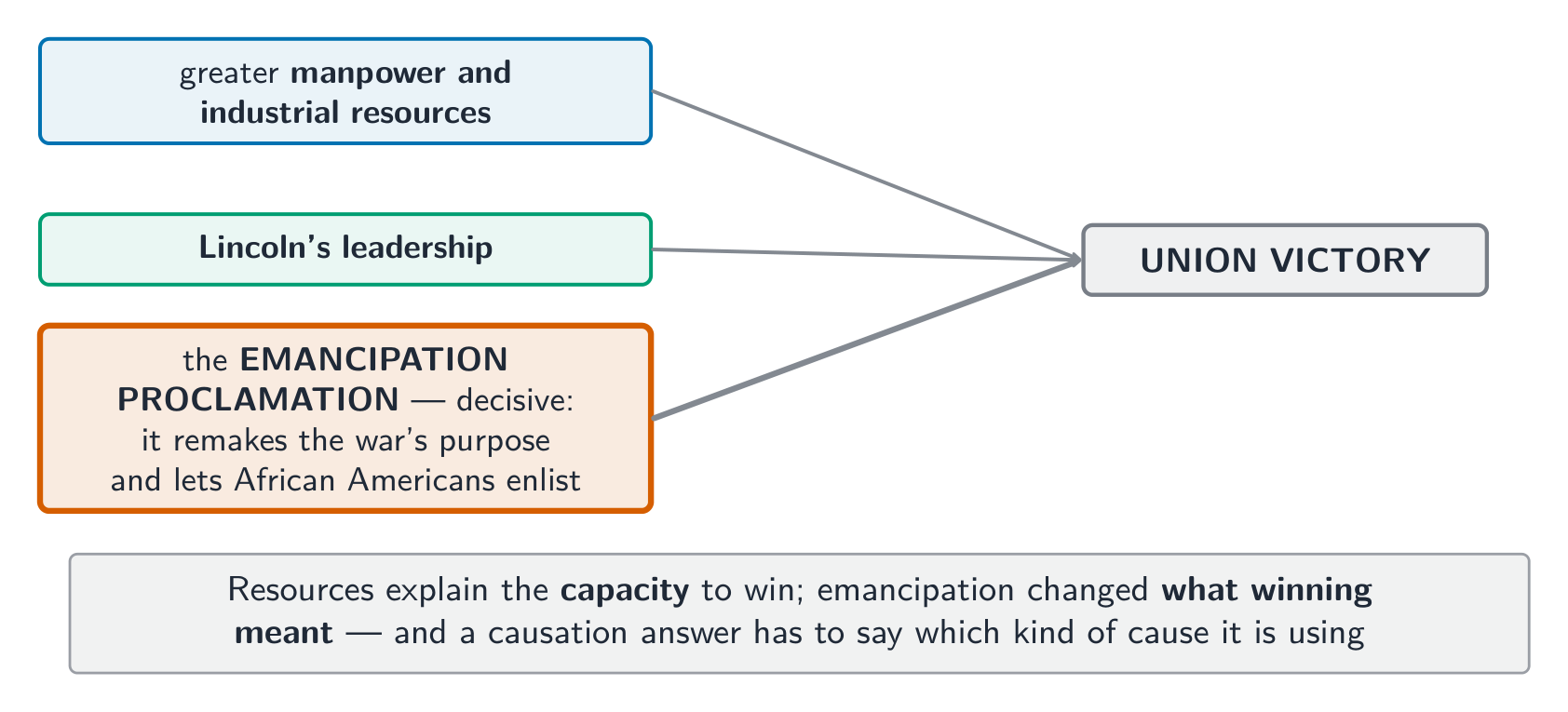
The Union won because of greater manpower and industrial resources, Lincoln's leadership, and, decisively, the Emancipation Proclamation 解放黑奴宣言, which turned the war into a war against slavery and enabled the enlistment of African American soldiers.
Government policy changed on both sides during the war: conscription, taxation, and an expanded federal role in the economy. African Americans' service and the actions of enslaved people who freed themselves by reaching Union lines shaped the outcome as well.
Reconstruction 重建时期 attempted to settle three questions: the status of the freedpeople, the terms of readmission for the southern states, and the balance of power between the states and the federal government.
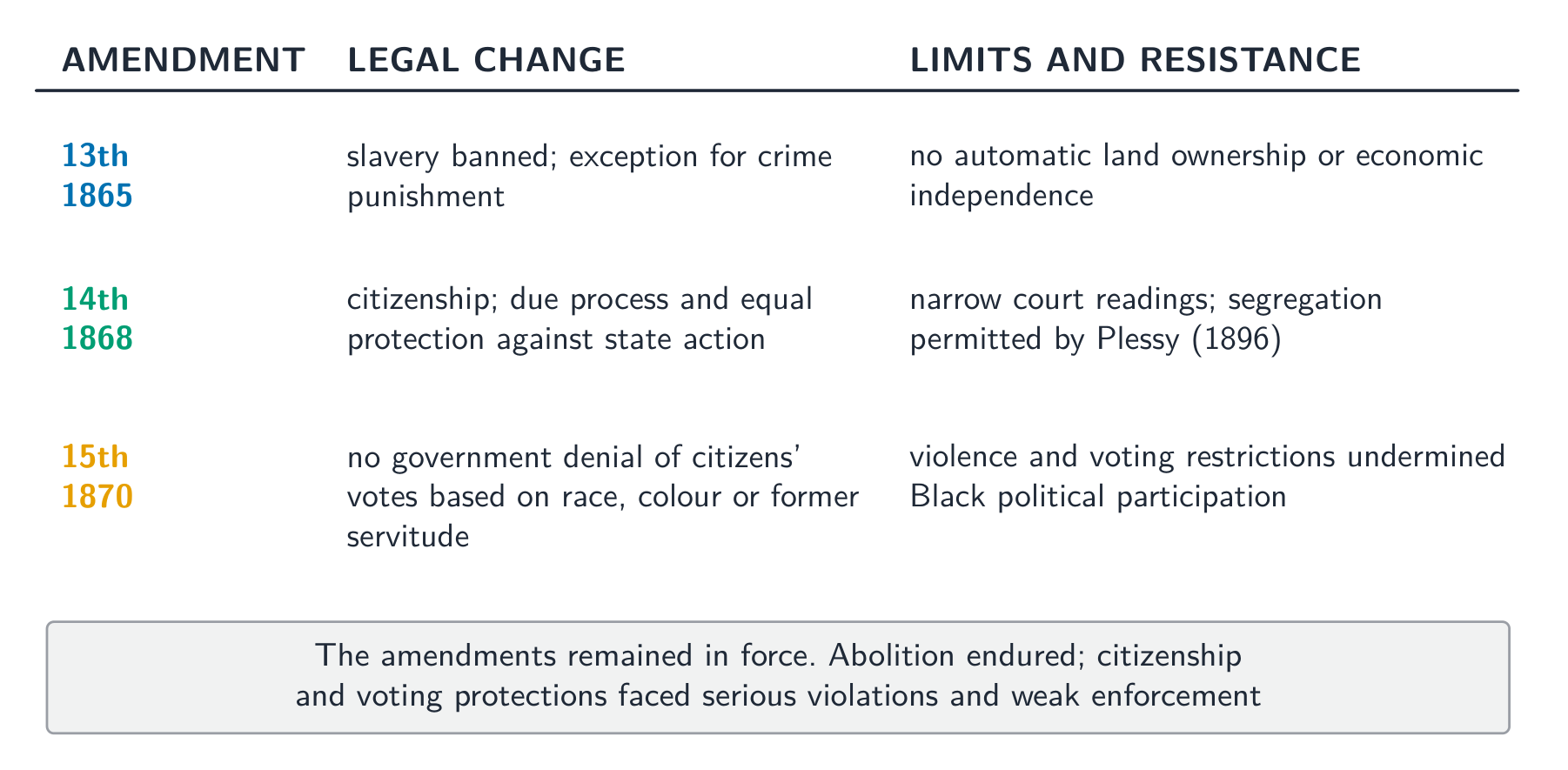
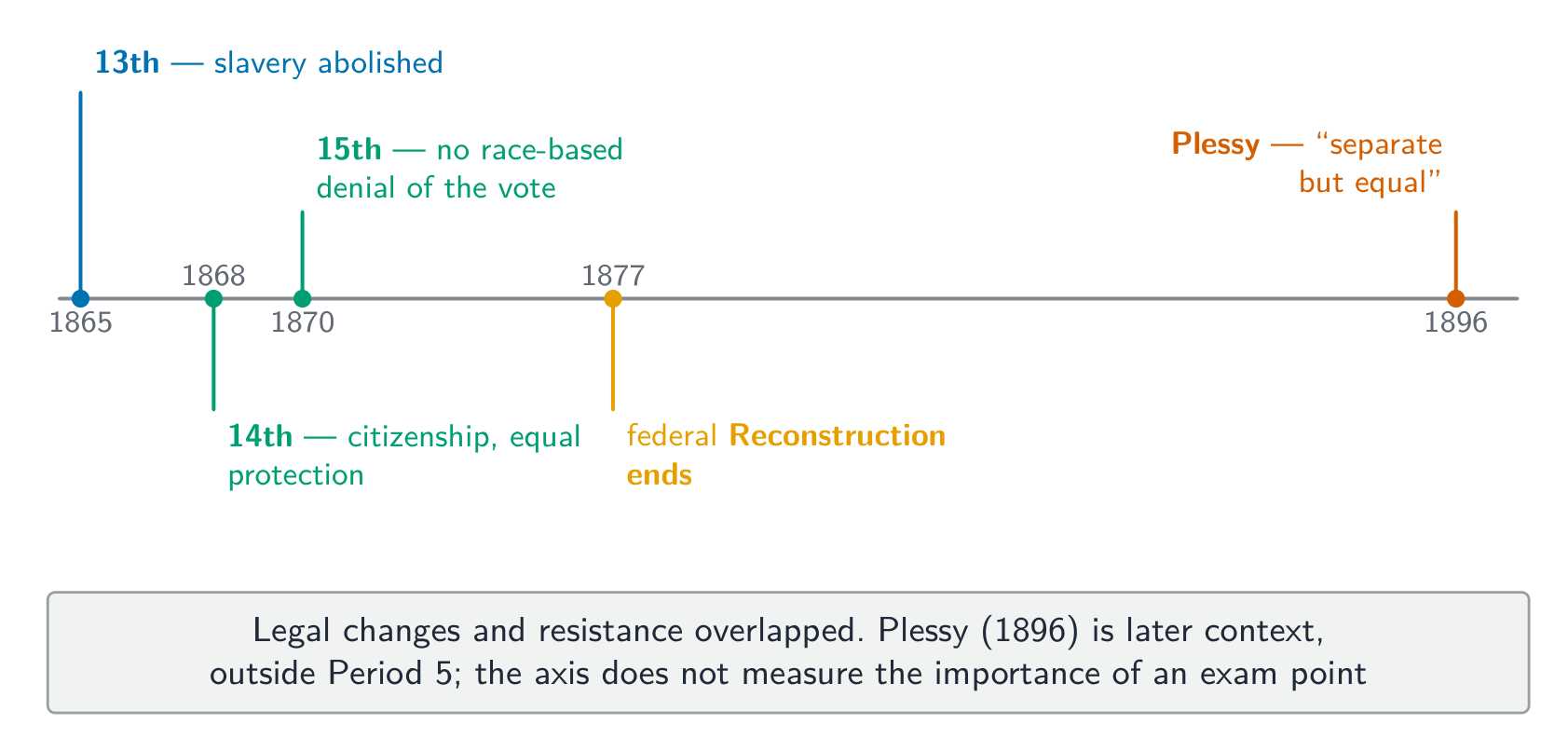
Try it — apply the Reconstruction Amendments. These are teacher-written cases after the relevant ratification. A: In 1865, a formerly enslaved person challenges being held as property. B: In 1868, a U.S.-born person subject to U.S. jurisdiction claims citizenship. C: In 1870, state officials deny an otherwise eligible citizen the vote solely because he is Black. Match each case to an amendment and state the relevant protection.
Worked application. The 13th Amendment 第十三修正案 (1865) banned slavery and involuntary servitude, with an exception for punishment after due conviction for crime. The 14th Amendment 第十四修正案 (1868) established citizenship for U.S.-born or naturalized people subject to U.S. jurisdiction and barred states from denying due process or equal protection to persons. The 15th Amendment 第十五修正案 (1870) prohibited federal or state denial of citizens' voting rights because of race, colour or previous servitude (such as enslavement). Thus A matches the 13th, B the 14th and C the 15th. These Reconstruction Amendments 重建修正案 address different protections: citizenship did not automatically give everyone the vote, land or effective protection against violence.
The women's rights movement was both emboldened and divided 既受鼓舞又出现分裂. Section 2 of the 14th Amendment used “male” in its representation rule; the 15th prohibited race-based voting denial but did not prohibit denial on grounds of sex.
Radical and moderate Republicans 激进派与温和派共和党人 sought to change the balance between Congress and the presidency and reshape southern society through the Freedmen's Bureau, military occupation and new state constitutions. Reconstruction opened political and leadership opportunities to formerly enslaved people. Southern resistance and declining Northern commitment weakened these gains.
Try it — assess the limits. Plantation owners retained most southern land; sharecropping limited freedpeople's economic independence. Segregation, violence, court decisions and political tactics undermined African Americans' rights. Does this mean every right returned to its prewar legal position? Distinguish constitutional change, enforcement and access to land.
Worked judgment. The amendments remained in force: slavery was abolished and formerly enslaved people gained citizenship. Resistance did not repeal those provisions. Violence and discriminatory practices could prevent people from exercising voting and equality protections, while narrow court interpretations limited protection. Abolition did not itself redistribute land, and sharecropping could maintain dependence despite legal freedom. “All three stopped working” erases real changes and differences among the protections.
Reconstruction produced lasting constitutional changes while resistance and weak enforcement undermined political and economic opportunities.
Southern plantation owners continued to own most of the region's land even after emancipation. Many formerly enslaved people entered sharecropping 分成租佃 arrangements that produced dependence and debt rather than economic independence.
Segregation 种族隔离, violence 暴力, unfavourable Supreme Court decisions 最高法院判决 and local political tactics progressively stripped away 逐步剥夺 opportunities to exercise African Americans' rights. The 14th and 15th Amendments nevertheless remained a basis for later civil-rights decisions. Constitutional guarantees and effective protection are different questions.
Comparison is one useful reasoning skill for this period. Compare Reconstruction's legal changes with practical outcomes, identifying both changes and limits rather than treating every gain as erased.
Exam transfer — 2025 AP US History, Set 1, short-answer Question 4(A–B), paraphrased. A asks for one political development during Reconstruction, 1865–1877. B asks for one effect of its end, 1877–1900. Try each part before reading the models. Would the 1896 Plessy decision fit A?
Teacher-written model for A. African American men held political office during Reconstruction, expanding formerly enslaved people's participation in government.
Teacher-written model for B. After Reconstruction ended, southern states enacted segregation laws that separated Black and white people in public facilities.
Why these fit. The official scheme accepts African American officeholding for A and southern segregation laws for B. Each describes a development within the relevant dates rather than only naming a term. The 1896 decision is outside A's dates. B extends beyond Period 5; later context is appropriate because the question explicitly asks for it. These are our models, not official samples or guarantees of credit.
5.12
考试技巧
Explain how expansion sharpened disputes over slavery and federal power, connecting a decision to its consequences.
Use specific evidence such as Dred Scott, explaining its relevance rather than expecting a named event alone to earn credit.
Give the Emancipation Proclamation its strategic role: it redefined the war's purpose and enabled Black enlistment.
Learn the three Reconstruction Amendments by what each one does; questions often turn on the difference between them.
For Reconstruction, distinguish lasting legal changes from sharecropping, segregation, violence and restrictive Court decisions, explaining mechanisms rather than only naming them.
On comparison prompts, develop both sides. Explain the relationship with relevant evidence from each.
Period 6 runs from 1865 to 1898 - the Gilded Age 镀金时代. Industry, migration, and the West transform the country, and every transformation produces a political argument about who benefits.
Improvements in mechanization 机械化 raised agricultural production substantially, while railroads carried crops to national and world markets. But the same forces squeezed farmers: consolidation in agricultural markets 农产品市场集中化 left them facing high freight rates, expensive credit, and falling crop prices.
Westward settlement also meant the final dispossession of American Indians. Federal policy moved from treaties to reservations 保留地 and then to assimilation 同化 through the Dawes Act 道斯法, which divided communal land into individual plots and transferred the surplus to settlers.
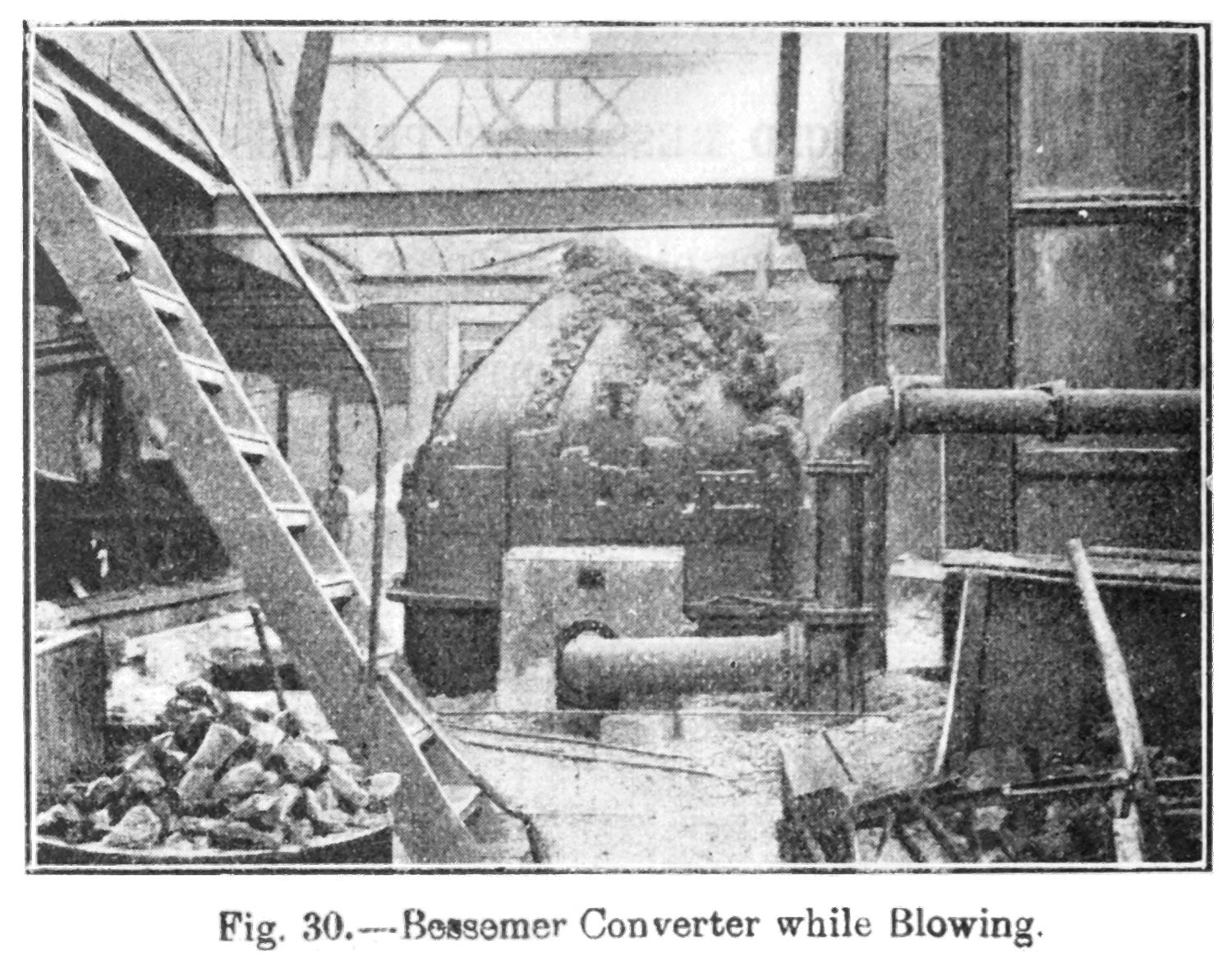
Industrial growth involved technology, management, a growing workforce, wider markets and pro-growth government policies. Businesses used new corporate structures 公司组织形式, including trusts and holding companies, for consolidation 合并: bringing firms under concentrated control.
Try it — distinguish mechanisms. Teacher-written cases: A business adopts new machinery and management methods to produce more goods. Several firms are brought under a large trust or holding company. Better transport and communication connect producers with more distant markets. Explain which changes production, which changes ownership, and which changes market access. Which most directly shows consolidation?
Worked mechanisms. New technology and management could raise output; more goods alone do not prove that fewer owners control an industry. Trusts and holding companies concentrated control over businesses and wealth. Transport and communication connected producers with wider markets. Businesses also sought markets and natural resources outside the United States. These mechanisms could interact; they are not interchangeable labels for growth.
Try it — assess two claims. Teaching evidence paraphrased from CED Topics 6.6–6.7: many goods became cheaper, workers' real wages increased, and many Americans could afford more goods and services. At the same time the gap between rich and poor grew, and consolidation concentrated wealth. Claim A says that if workers could buy more, inequality must have fallen. Claim B says that if inequality grew, no worker's living standard could improve. Assess both, distinguishing purchasing power from the distribution of wealth.
Worked judgment. Lower prices could let wages buy more goods and services. Living standards could improve without workers becoming as wealthy as business owners. Wealth could become more concentrated while many workers' purchasing power improved, so neither claim follows. Improved affordability also did not end disputes over wages and working conditions.
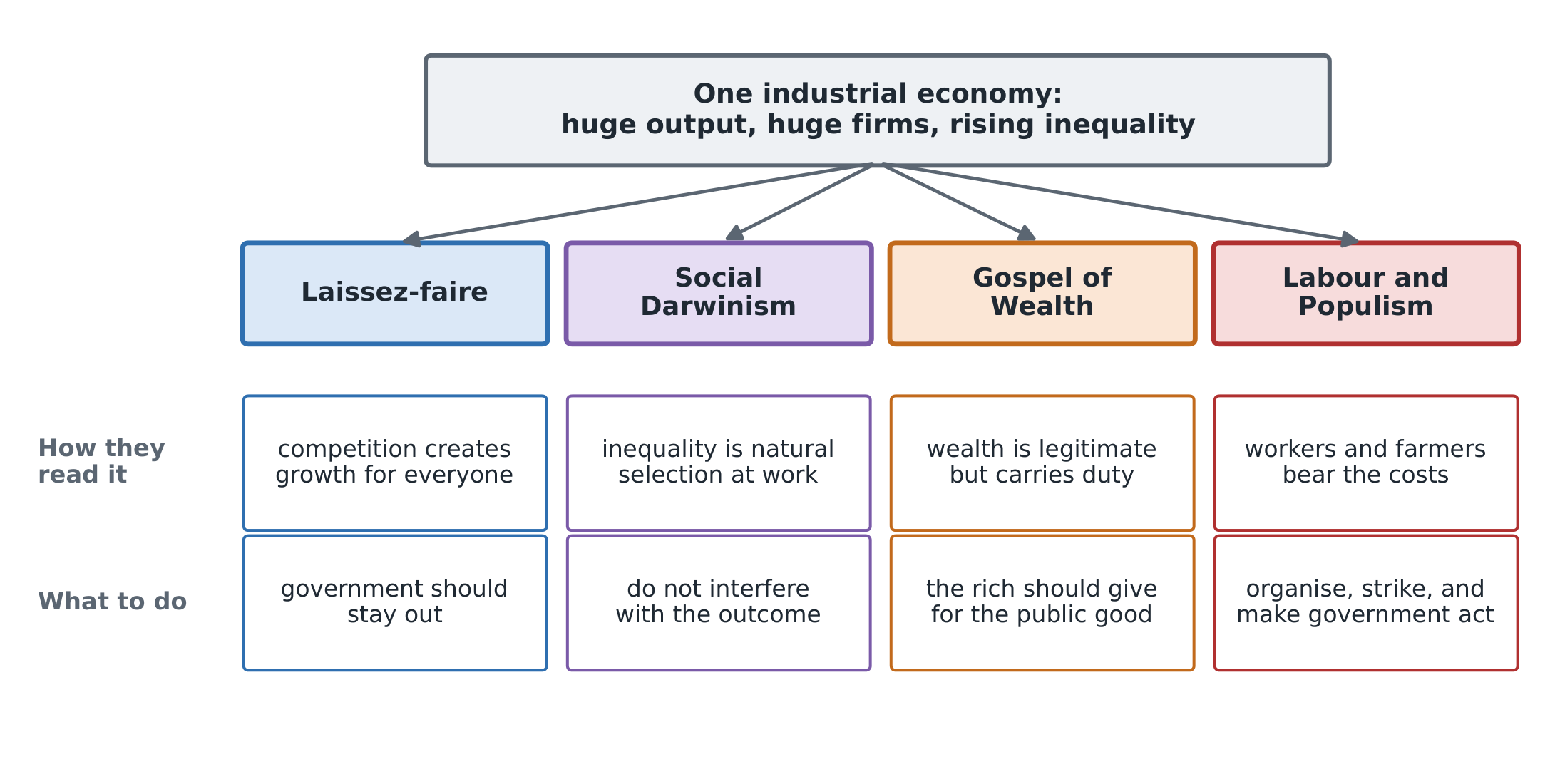
Some defended laissez-faire 自由放任, arguing that competition promoted long-term growth and opposing government intervention during economic downturns. This was a policy argument; it does not mean government was absent from industrial development. Pro-growth government policies also helped industrial growth. Many living standards improved alongside rising inequality 不平等加剧; downturns and labour conflicts prompted debates over policy.
One economy, four responses: each group diagnosed a different problem and proposed a different remedy
A variety of perspectives 各种不同的立场 on the economy and labour developed. Workers faced long hours, dangerous conditions, and wages that fell during downturns.
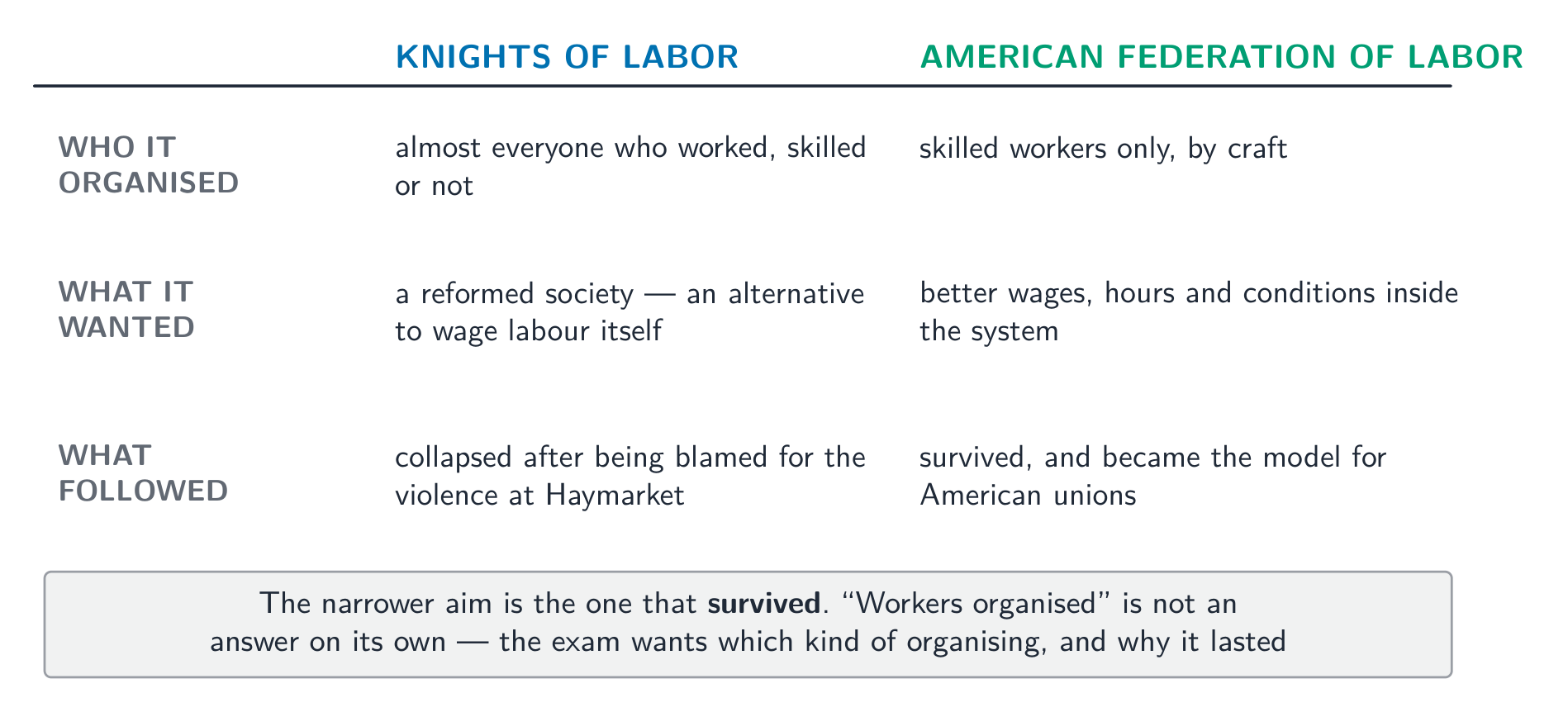
They organised. Unions such as the Knights of Labor 劳工骑士团 and the American Federation of Labor 美国劳工联合会 differed over who to admit and what to demand - the AFL concentrating on skilled workers and practical gains in wages and hours. Strikes 罢工 were frequent, often large, and frequently broken by state or federal force, which itself became an argument about the role of government.
International and internal migration increased urban populations and fostered the growth of cities 城市.
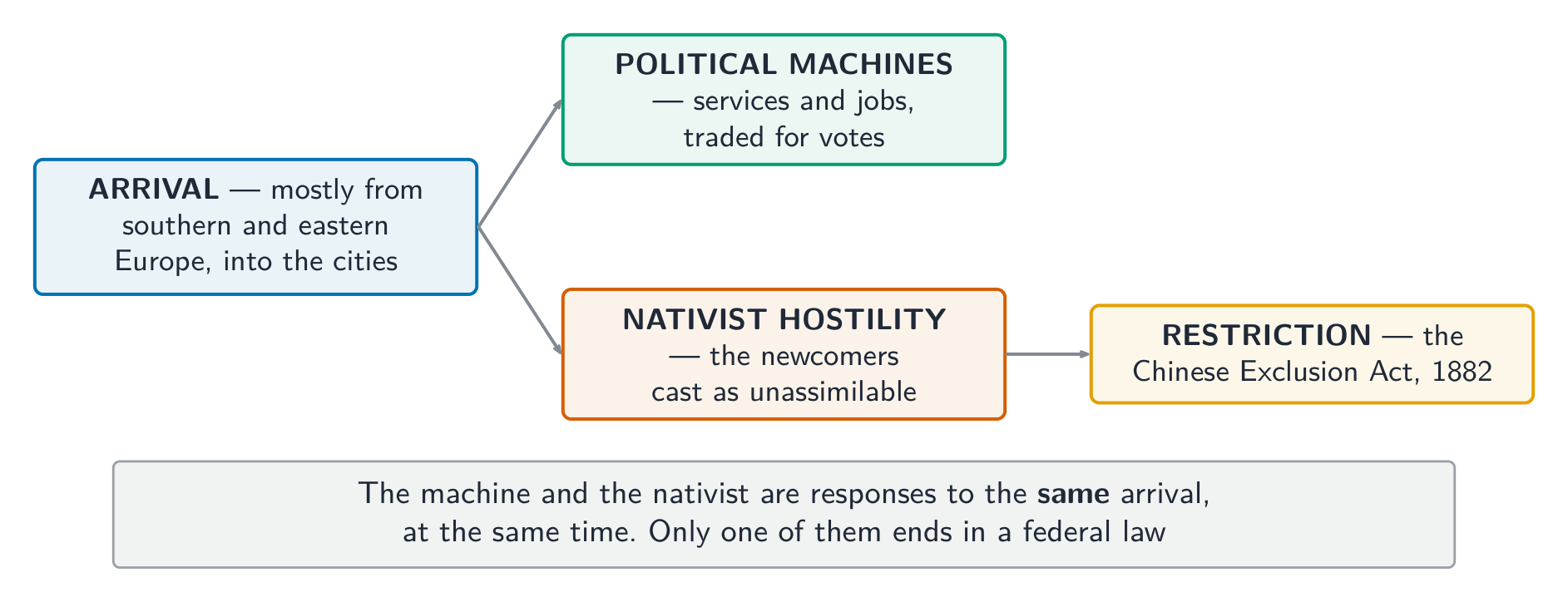
New arrivals came increasingly from southern and eastern Europe 南欧与东欧, alongside Chinese migration to the West - which met the Chinese Exclusion Act 排华法案, the first significant federal restriction on immigration by nationality.
In cities where access to power was unequally distributed, political machines 政治机器 provided jobs, housing help, and services in exchange for votes - corrupt by later standards, and for many migrants the only functioning source of support.
Migration also produced organised hostility. Nativist movements argued that new arrivals threatened wages, culture, or self-government.
Corporations' need for managers 管理人员 and for male and female clerical workers 文职人员 expanded a new middle class 中产阶级, with new patterns of consumption and leisure.
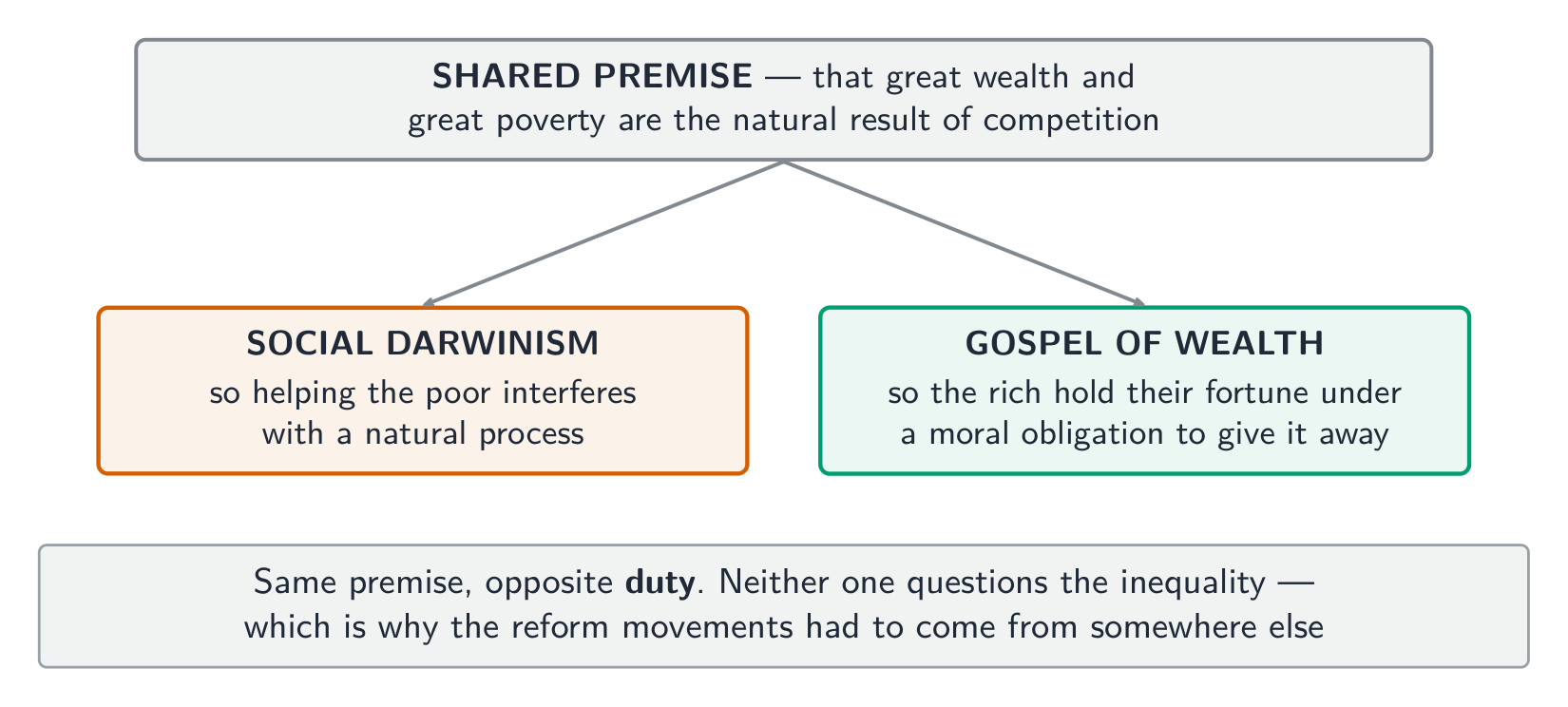
Cultural and intellectual movements both buttressed and challenged 既支持又挑战 the social order:
Social Darwinism 社会达尔文主义 used evolutionary language to justify inequality as natural.
The Gospel of Wealth 财富福音 argued that the wealthy had a moral obligation 道德义务 to use their fortunes for the public good.
Agrarians, utopians, socialists, and artists criticised industrial society from the other direction.
Many women sought greater equality, often through voluntary organizations 自愿团体 - temperance, settlement houses, and suffrage work.
The major parties appealed to lingering divisions from the Civil War and competed over patronage 政治分肥 more than policy, producing close elections and limited legislation.
Economic instability drove agrarian activists to build the People's (Populist) Party 人民党, demanding government action: regulation of railroads, currency reform, and a graduated income tax. Populism failed as a party but placed on the agenda the idea that government should intervene in the economy - the argument Period 7 takes up.
Debates over citizenship 公民身份, race, and the role of government ran through all of this, as the rights promised during Reconstruction continued to be narrowed.
Continuity and change is one useful reasoning skill for this period. Industrialisation changed where people lived and what they did, while inequality, sectional political loyalties, and racial exclusion persisted.
Exam transfer — 2024 AP US History, Set 2, short-answer Q4(a–b), paraphrased. A asks for one economic development from 1865 to 1900. B asks for one similarity or difference in how two groups responded to economic change in those dates. Try A using corporate consolidation, and B comparing supporters of laissez-faire with Populist advocates of railroad regulation. Give relevant characteristics and explain the relationship rather than only naming a term or two groups.
Teacher-written model for A. Corporate trusts emerged as a business structure that brought multiple firms under concentrated control, helping owners consolidate businesses.
Teacher-written model for B. Some business supporters of laissez-faire opposed government intervention, trusting competition to promote growth. Populists called for government regulation of railroads to address farmers' grievances. They differed over whether government should regulate economic activity.
Why these fit. The official scheme accepts corporate trusts for A and contrasting laissez-faire with demands for regulation for B. The models describe a development and explain a difference within the dates. These are our models, not official samples or guarantees of credit. Only parts (a–b) are addressed here; part (c) asks about 1900–1940.
6.14
考试技巧
Explain farmers' anger with mechanisms: freight rates, credit, and falling crop prices - not "farmers struggled".
Keep the four Gilded Age responses distinct: laissez-faire, Social Darwinism, the Gospel of Wealth, and organised labour and Populism.
For immigration, name the shift to southern and eastern Europe and the Chinese Exclusion Act as the first nationality-based federal restriction.
Political machines are examinable as both corruption and social provision. Relate both to the question; this alone does not guarantee a complexity point.
Populism matters less for winning than for putting government intervention on the agenda.
On continuity-and-change prompts, name a specific continuity. Explain how it persisted within the dates in the question.
Period 9 runs from 1980 to the present. It examines continuing debates over government, economic and demographic change, and the United States' role in the world.
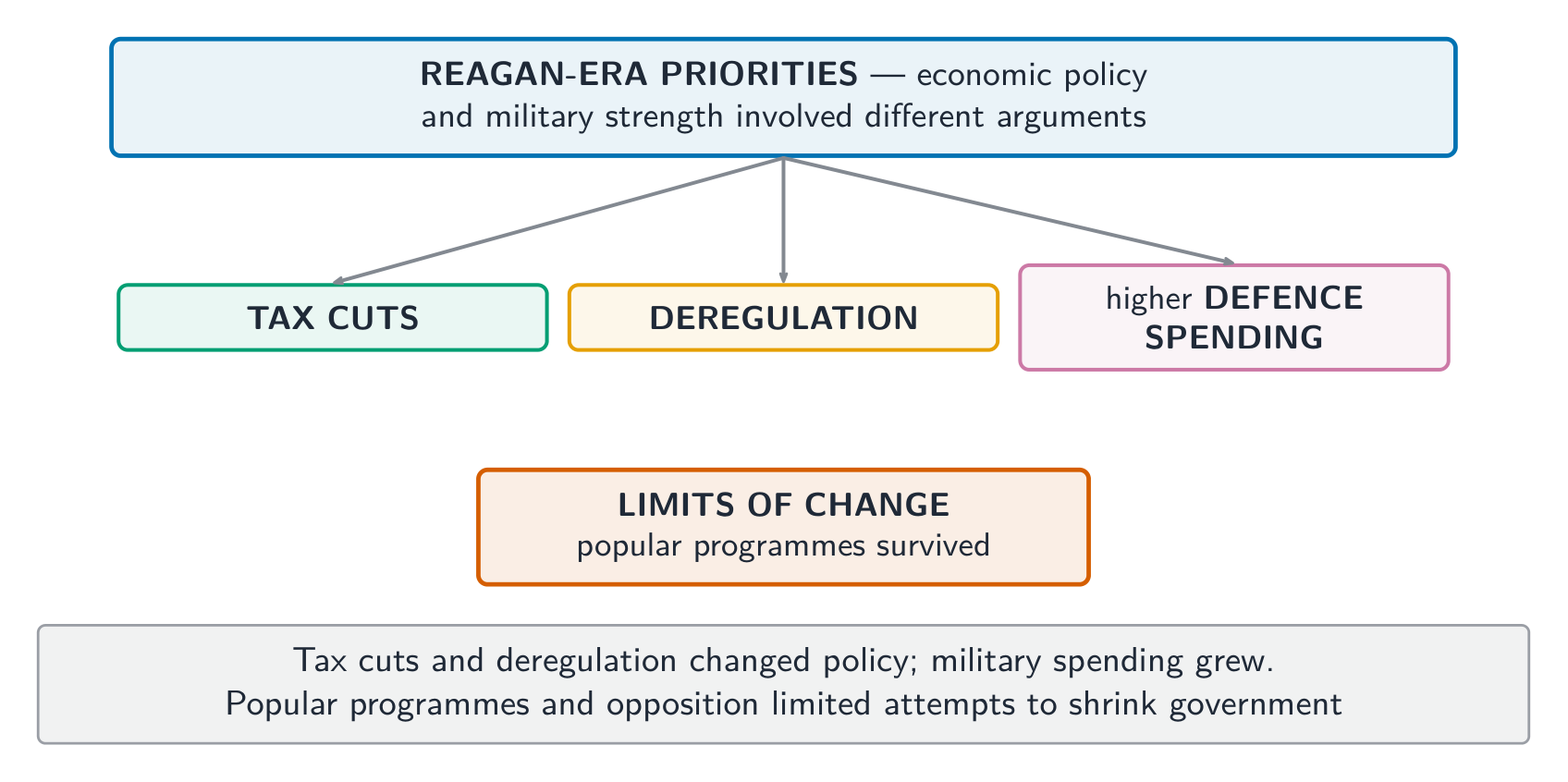
The conservative movement 保守主义运动 that organised in the 1960s and 1970s came to power with Ronald Reagan 里根. Its programme had three strands:
Tax cuts and deregulation 减税与放松管制, on the argument that reducing the burden on business would raise growth - often called supply-side economics 供给学派经济学.
Efforts to reduce domestic government programmes met resistance; defence spending 国防开支 increased as part of the military buildup.
Appeals to social conservatism 社会保守主义, on religion, family, and law and order.
Tax cuts and deregulation changed policy, while opposition and the popularity of many programmes limited attempts to shrink government. Debates over free trade, the social safety net and financial regulation continued.
Try it — identify the goal. Teacher-written cases grounded in CED Topics 9.2 and 9.3: tax cuts and deregulation aimed to encourage private economic activity; the military buildup opposed communism; social conservatives promoted traditional values. Match these to economic, foreign-policy and social goals. Does the military case fit “less government in every field”?
Worked comparison. The coalition combined different goals. Supply-side reasoning stressed incentives for work, saving and investment; military policy used federal resources; social conservatism involved values beyond the economic argument. Reduced regulation did not mean federal power disappeared.
Source practice — Reagan's September 1981 economic-recovery address, paraphrased. Reagan expected tax cuts to stimulate growth and jobs, spending restraint to reduce deficits, and less regulation to ease business burdens. Identify a policy and its intended effect. What further evidence would establish whether the aim was achieved?
Worked reading. A speech establishes the administration's argument, not independent proof of success. Compare implementation, economic performance and budgets. The CED records tax cuts and deregulation alongside resistance to shrinking popular programmes. Do not treat expected growth as a universal rule that tax cuts pay for themselves.
Renewed military build-up, negotiation, and above all internal weakness in the Soviet Union brought the Cold War to an end. The Soviet system collapsed between 1989 and 1991.
The consequences framed the decades that followed: the United States became the sole superpower, with unresolved questions about when and where to intervene, and about what commitments made sense once containment no longer organised policy.
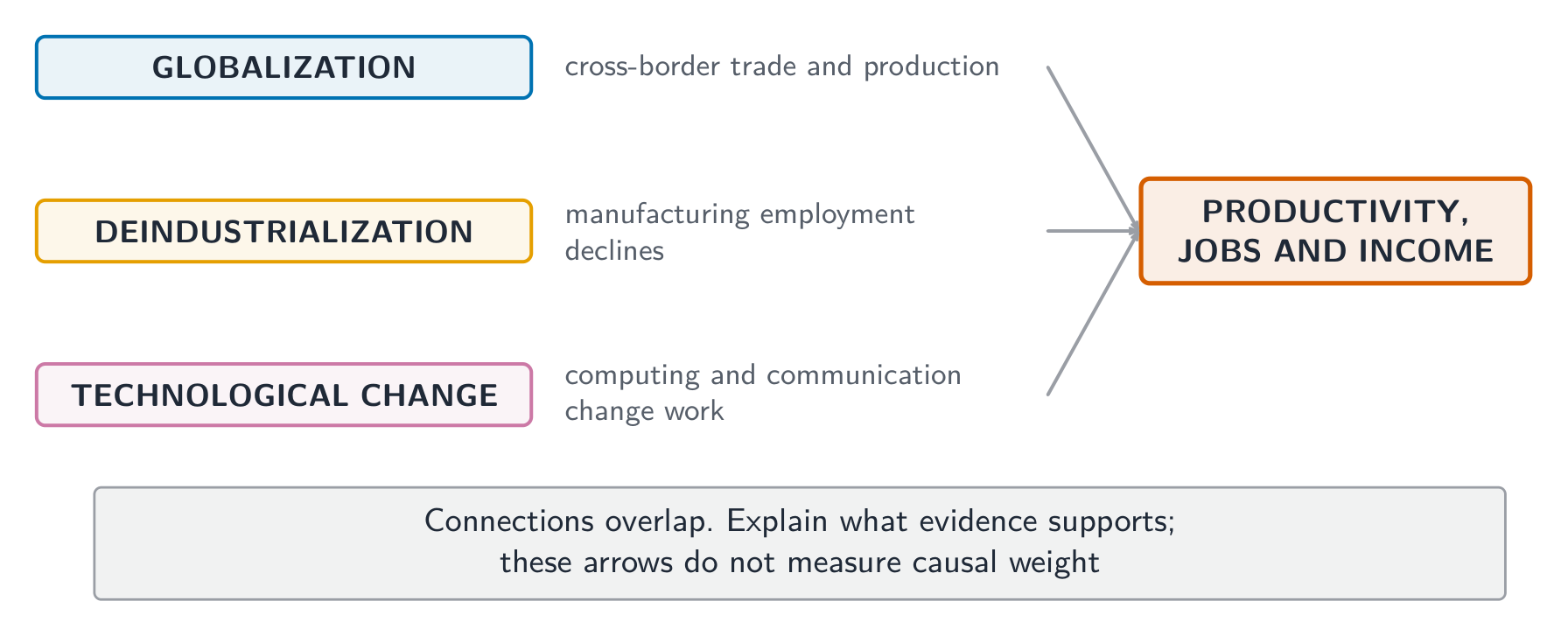
Three developments help describe the economy after 1980:
Globalization 全球化 - cross-border trade, production and economic connections.
Deindustrialization 去工业化 - declining manufacturing employment, alongside growth in service work.
Technological change 技术变革 - computing and then the internet, which transformed productivity, work, and communication.
Digital communication increased productivity and worldwide economic opportunities. These gains coexisted with stagnant working- and middle-class real wages and growing income inequality 收入不平等.
Try it — identify developments and overlap. Teacher-written cases grounded in CED Topic 9.4: A, digital communication helps a business reach customers abroad; B, manufacturing employment falls while service employment rises; C, computing and the internet change work and access to information. Match the cases to globalization, deindustrialization and technological change. Can one case involve more than one development?
Worked classification. A involves global connections and technology. B describes a sectoral employment shift; it does not establish that every job moved abroad or that manufacturing vanished. C concerns technology's wider effects. Identify the pattern before explaining its cause.
Try it — assess distribution. The CED describes increased productivity alongside stagnant working- and middle-class real wages and rising inequality. Does higher productivity prove all workers gained equally?
Worked judgment. Productive capacity and income distribution are different. Growth can coexist with unequal gains. Employment shifts and declining union membership describe the setting, but listing trends does not measure their causal weights. An explanation needs evidence about the group, dates and mechanism.
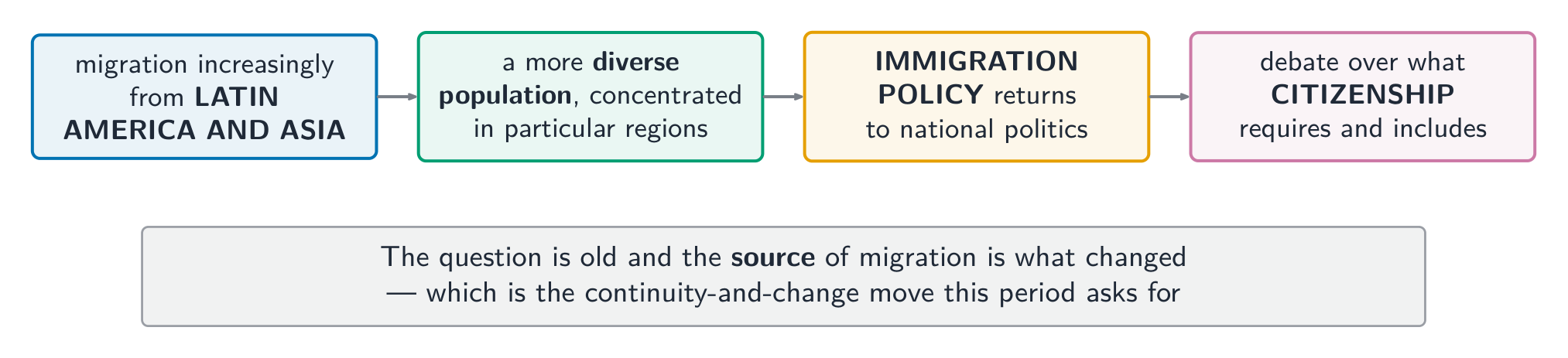
Migration and immigration 人口迁移与移民 in the 1990s and 2000s continued to reshape the population, with growth in arrivals from Latin America and Asia 拉丁美洲与亚洲 following the 1965 reform of immigration law.
The consequences are the examinable part: population growth in the South and West, the growth of multi-ethnic cities, ongoing debate over immigration policy 移民政策 and border enforcement, and continuing arguments about citizenship 公民身份 and national identity - the same argument the course has traced since Reconstruction.
The period's later topics group around a small number of developments:
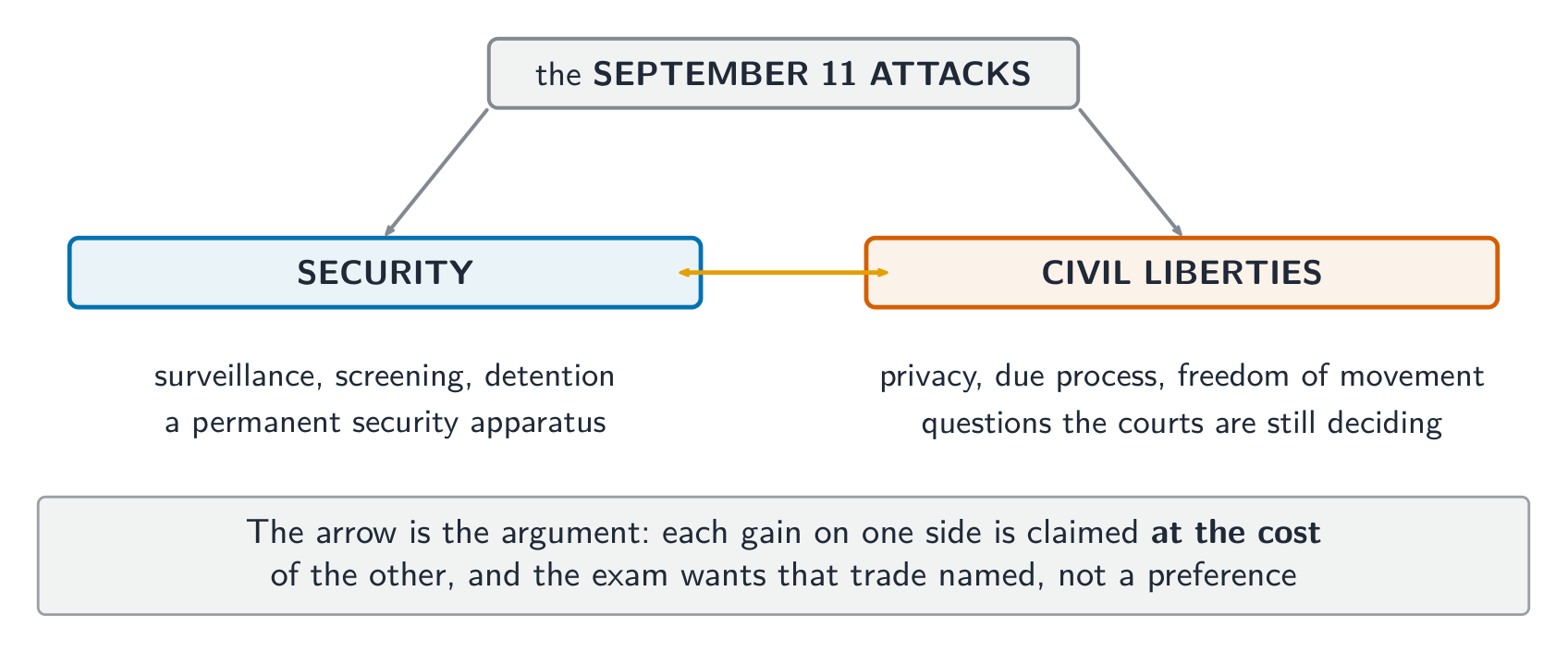
The September 11 attacks 九一一袭击 and the response - military intervention abroad, a new security apparatus, and renewed debate over the balance between security and civil liberties 安全与公民自由.
Economic crisis in 2008 and the argument over government's role in stabilising the economy.
Political polarisation 政治极化, amplified by changes in media and communication.
Practise causation by explaining mechanisms with relevant evidence. Possible connections across periods include deindustrialisation to the market revolution's regional specialisation, immigration debates to the nativism of the 1850s and 1920s, and arguments over federal power to the New Deal.
Exam transfer — 2025 AP US History, Set 2, long essay Q4, paraphrased. Evaluate how United States society responded to economic changes from 1960 to 2000. Explain a response rather than only naming a change. Connect computers to changing employment, then develop another relevant example such as migration toward the Sun Belt or a policy debate. This unit supplies evidence for part of the question's dates.
Teacher-written model passage. As computing became more important to the late-twentieth-century economy, Americans increasingly worked in service and information-related jobs. Computer-based work supported white-collar opportunities, while access to these opportunities was uneven, especially for workers without college education.
Why it fits. The official scheme accepts computers and the service economy as evidence when used to explain jobs and class opportunities. This is one developed passage, not a complete long essay or official sample. A full response needs an argument and further developed examples; a limiting phrase alone does not guarantee complex understanding or credit.
9.7
考试技巧
Distinguish the supply-side economics argument from outcomes. Explain policy changes and the limits of attempts to shrink government.
The Cold War's end matters for what it opened: sole-superpower status and unresolved questions about intervention.
Keep globalization, deindustrialization, and technological change as distinct, sometimes overlapping developments. Explain mechanisms rather than only listing labels.
For immigration after 1965, name the shift in origins and the political argument it produced.
After 2001, the examinable tension is security against civil liberties - the same tension as the Red Scare and the First World War.
Long-span prompts reward connecting periods. Link a recent development to an earlier one and say what continued.