Period 5 runs from 1844 to 1877. Disputes over slavery and federal power intensified into civil war and continued during Reconstruction.
Expansion sharpened disputes over slavery. The desire for access to natural and mineral resources 自然与矿产资源, and the hope of settlers for land, pushed Americans west. Advocates justified annexation through Manifest Destiny 天定命运论 - the claim that the United States was destined, and superior enough, to spread across the continent.
The Mexican-American War 美墨战争 added enormous territory in the West. Later, wartime legislation such as the Homestead Act 宅地法 boosted migration further, and interest in expanding trade produced economic and diplomatic initiatives abroad.
Expansion also meant conflict. The government's interaction with Mexican Americans 墨西哥裔美国人 and American Indians produced dispossession, resistance, and new legal disputes over land and citizenship.
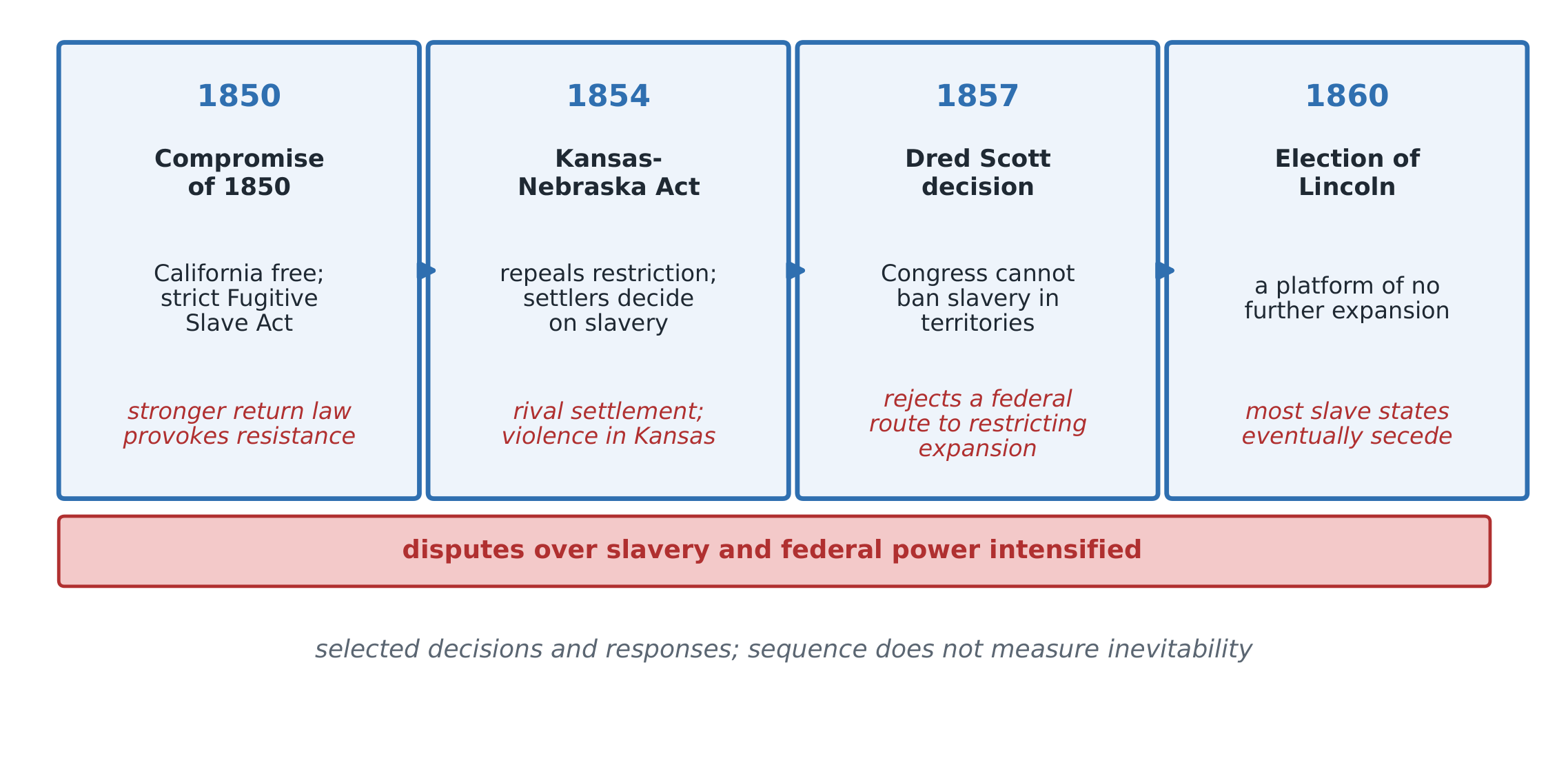
Acquiring land intensified the question of whether slavery would expand and who could decide. Different institutions tried different answers, but these failed to end sectional conflict.
Try it — assess a political bargain. Selected measures in the Compromise of 1850 1850年妥协案 admitted California as a free state, left slavery possible in Utah and New Mexico, ended the slave trade in Washington, D.C., and strengthened the Fugitive Slave Act 逃奴法. Identify a measure welcomed by opponents of slavery's expansion and one welcomed by slaveholders. Why could stronger enforcement of escaped enslaved people's return create opposition in free states?
Worked explanation. Free-state admission limited slavery's expansion in California. The stronger fugitive-slave law helped slaveholders recover people who had escaped, including into free states; opponents of slavery resisted this enforcement. Leaving slavery possible in Utah and New Mexico did not settle its status throughout the West. The bargain addressed competing demands without removing the conflict over slavery.
Try it — explain a rule and a response. The Kansas–Nebraska Act of 1854 repealed the Missouri Compromise restriction for the new territories. Popular sovereignty 人民主权原则 let settlers decide whether to permit slavery. Proslavery and antislavery activists entered Kansas to influence the outcome, and violence followed. Explain how the policy raised the stakes of settlement.
Worked mechanism. A previous restriction was removed, so the territorial decision could permit slavery. Competing groups tried to shape that decision by entering Kansas. The struggle over slavery's future involved violence known as Bleeding Kansas rather than an accepted resolution. This explains a particular conflict; it does not mean every use of popular sovereignty must be violent.
Try it — qualify a claim. The Dred Scott decision 德雷德·斯科特案 in 1857 held that Congress lacked authority to prohibit slavery in federal territories and rejected Scott's claim that residence in free territory had made him free. A student concludes: “The Court removed one route to limiting slavery's expansion, so every possible political compromise became illegal.” Identify the supported part and revise the overstatement.
Worked judgment. The ruling rejected Congress's authority to ban slavery in the territories, challenging a federal legislative route to restricting expansion. It did not outlaw every imaginable political bargain. Distinguish Congress's compromise laws, settlers' decisions under popular sovereignty and the Court's constitutional ruling. These methods failed to end sectional conflict.
Political choices and responses intensified conflict; this sequence does not measure inevitability.
Ideological and economic differences produced diverging responses 分歧的回应 to slavery. The free-soil movement opposed slavery's expansion partly because it threatened free labour; not every supporter opposed slavery on moral grounds. African American and white abolitionists campaigned against slavery itself. Defenders of slavery invoked racist doctrines, states' rights and claims that slavery was a positive good. Slavery disputes and anti-immigrant nativism weakened the old major parties; sectional parties grew, including the northern Republican Party 共和党.
Exam transfer — adapted practice from 2025 AP US History, Set 1, short-answer Q2(C). Stimulus summary, not a quotation: in the question's 1830 speech, Daniel Webster defended using existing federal power for internal improvements benefiting the whole Union and opposed treating states as separate countries. The task asks for a similarity to a political debate from 1848–1865. Try it using the Dred Scott debate. Explain the shared issue in both debates; the full paper contains Webster's original excerpt.
Teacher-written model. Both debates concerned the extent of federal power. Webster defended exercising existing federal authority for improvements serving the Union. Debates over Dred Scott concerned whether Congress could regulate slavery in federal territories; the Court denied its authority to prohibit slavery there.
Why this fits. The official scheme accepts a similarity about federal powers. This model explains that issue in both debates and uses an event within the required dates. The policies differed: internal improvements and slavery. They shared an issue without being identical. This is our model, not an official sample or a guarantee of credit.
The election of 1860 1860年大选 brought Abraham Lincoln 林肯 to power on a platform of preventing slavery's expansion. Southern states responded by seceding 脱离联邦, and the war followed.
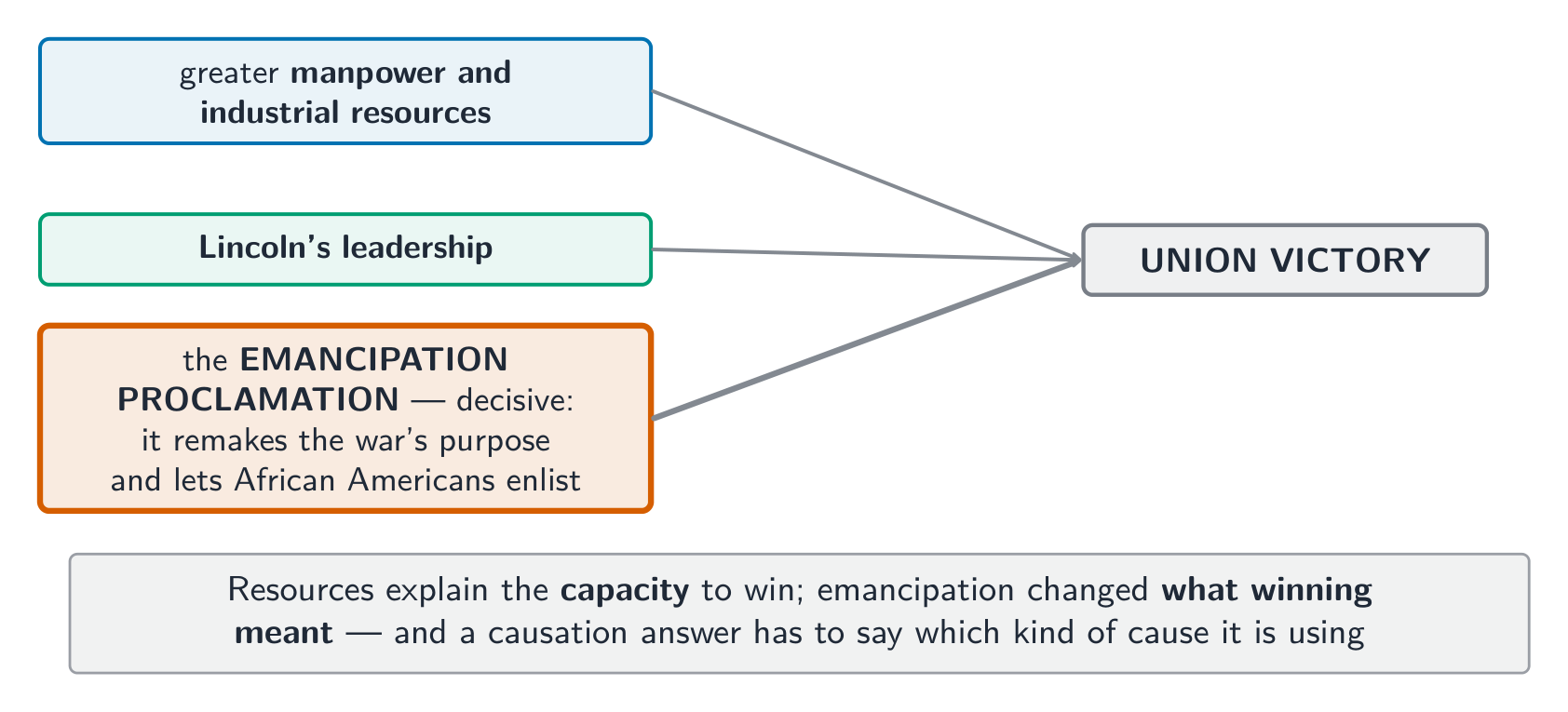
The Union won because of greater manpower and industrial resources, Lincoln's leadership, and, decisively, the Emancipation Proclamation 解放黑奴宣言, which turned the war into a war against slavery and enabled the enlistment of African American soldiers.
Government policy changed on both sides during the war: conscription, taxation, and an expanded federal role in the economy. African Americans' service and the actions of enslaved people who freed themselves by reaching Union lines shaped the outcome as well.
Reconstruction 重建时期 attempted to settle three questions: the status of the freedpeople, the terms of readmission for the southern states, and the balance of power between the states and the federal government.
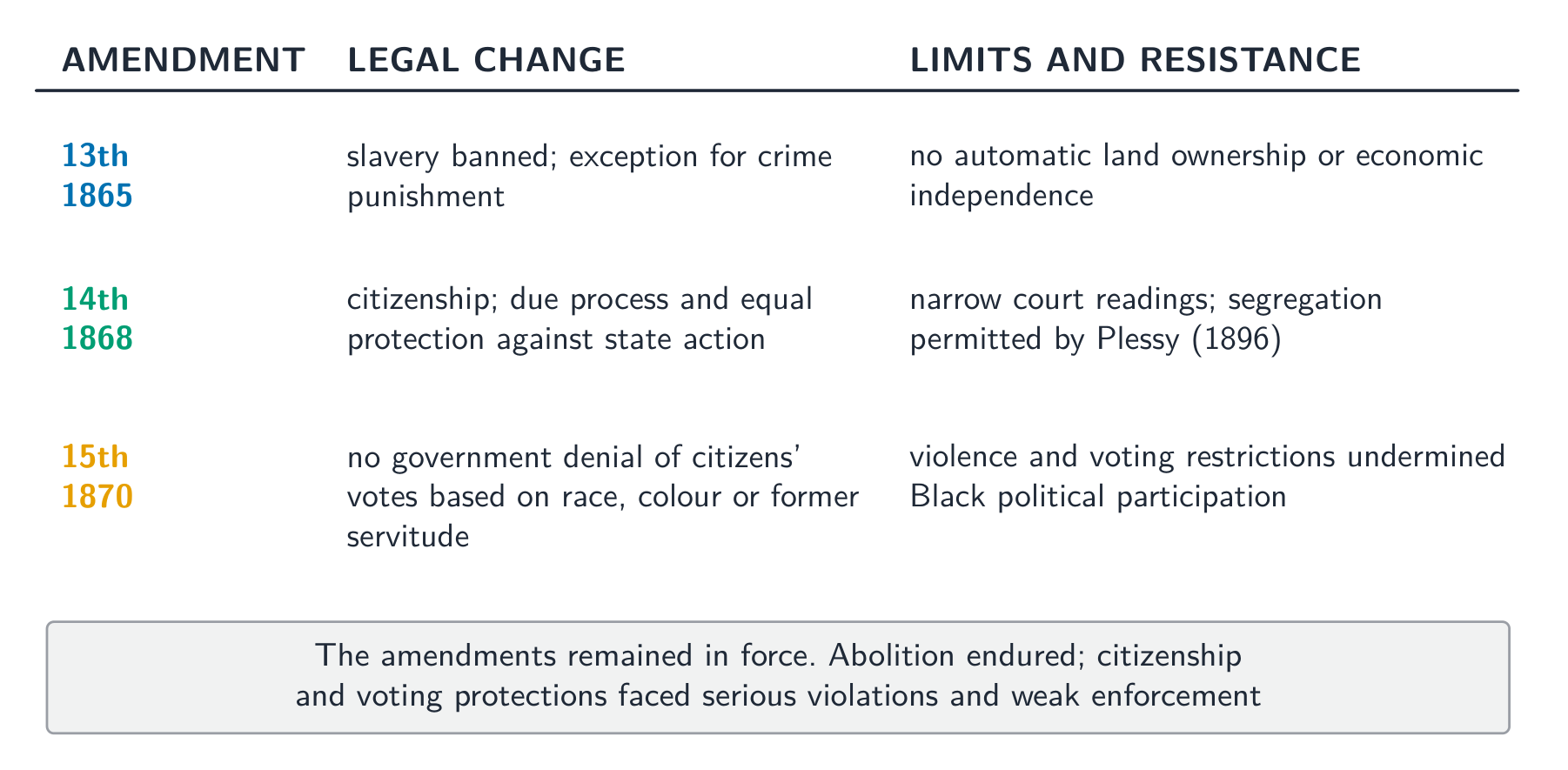
Try it — apply the Reconstruction Amendments. These are teacher-written cases after the relevant ratification. A: In 1865, a formerly enslaved person challenges being held as property. B: In 1868, a U.S.-born person subject to U.S. jurisdiction claims citizenship. C: In 1870, state officials deny an otherwise eligible citizen the vote solely because he is Black. Match each case to an amendment and state the relevant protection.
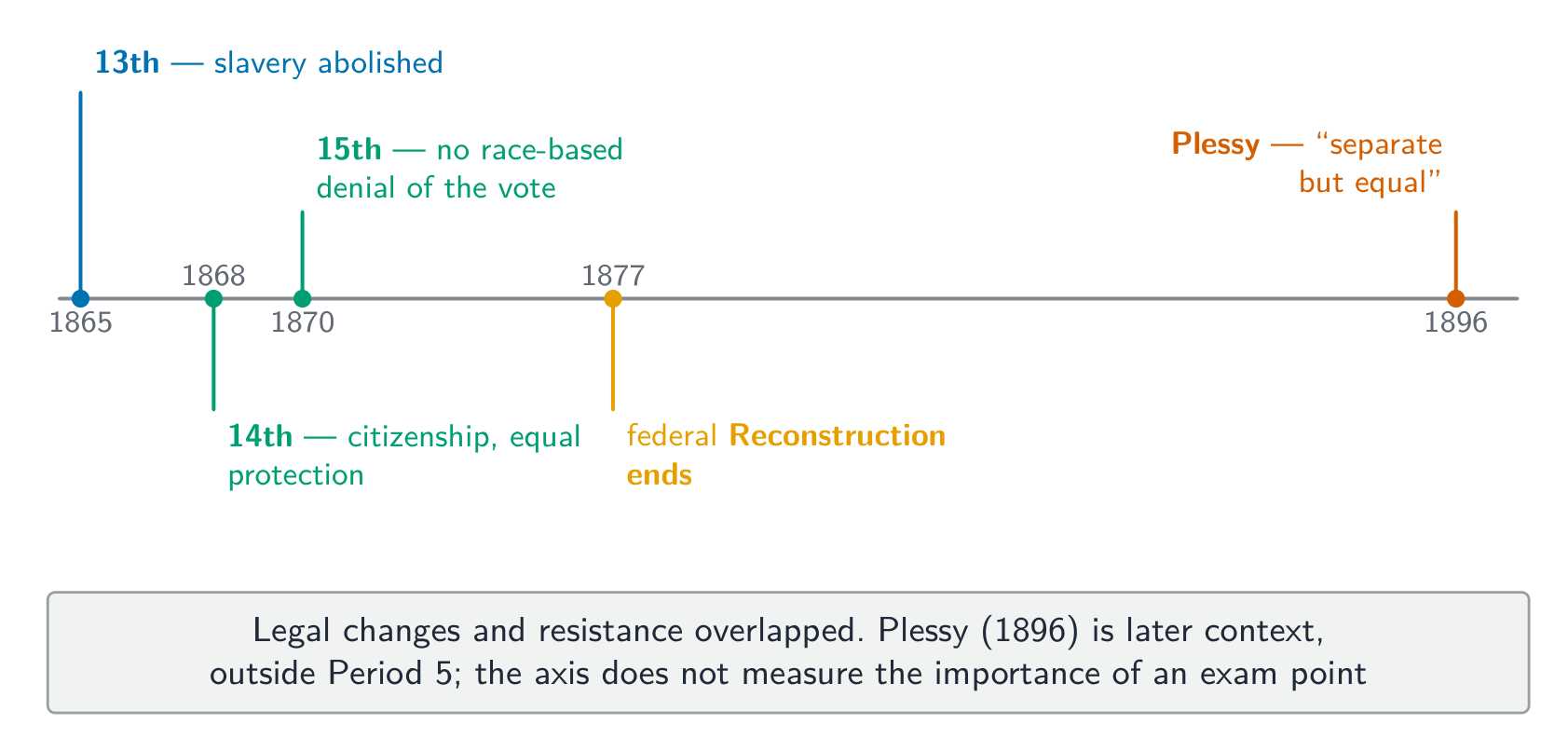
Worked application. The 13th Amendment 第十三修正案 (1865) banned slavery and involuntary servitude, with an exception for punishment after due conviction for crime. The 14th Amendment 第十四修正案 (1868) established citizenship for U.S.-born or naturalized people subject to U.S. jurisdiction and barred states from denying due process or equal protection to persons. The 15th Amendment 第十五修正案 (1870) prohibited federal or state denial of citizens' voting rights because of race, colour or previous servitude (such as enslavement). Thus A matches the 13th, B the 14th and C the 15th. These Reconstruction Amendments 重建修正案 address different protections: citizenship did not automatically give everyone the vote, land or effective protection against violence.
The women's rights movement was both emboldened and divided 既受鼓舞又出现分裂. Section 2 of the 14th Amendment used “male” in its representation rule; the 15th prohibited race-based voting denial but did not prohibit denial on grounds of sex.
Radical and moderate Republicans 激进派与温和派共和党人 sought to change the balance between Congress and the presidency and reshape southern society through the Freedmen's Bureau, military occupation and new state constitutions. Reconstruction opened political and leadership opportunities to formerly enslaved people. Southern resistance and declining Northern commitment weakened these gains.
Try it — assess the limits. Plantation owners retained most southern land; sharecropping limited freedpeople's economic independence. Segregation, violence, court decisions and political tactics undermined African Americans' rights. Does this mean every right returned to its prewar legal position? Distinguish constitutional change, enforcement and access to land.
Worked judgment. The amendments remained in force: slavery was abolished and formerly enslaved people gained citizenship. Resistance did not repeal those provisions. Violence and discriminatory practices could prevent people from exercising voting and equality protections, while narrow court interpretations limited protection. Abolition did not itself redistribute land, and sharecropping could maintain dependence despite legal freedom. “All three stopped working” erases real changes and differences among the protections.
Reconstruction produced lasting constitutional changes while resistance and weak enforcement undermined political and economic opportunities.
Southern plantation owners continued to own most of the region's land even after emancipation. Many formerly enslaved people entered sharecropping 分成租佃 arrangements that produced dependence and debt rather than economic independence.
Segregation 种族隔离, violence 暴力, unfavourable Supreme Court decisions 最高法院判决 and local political tactics progressively stripped away 逐步剥夺 opportunities to exercise African Americans' rights. The 14th and 15th Amendments nevertheless remained a basis for later civil-rights decisions. Constitutional guarantees and effective protection are different questions.
Comparison is one useful reasoning skill for this period. Compare Reconstruction's legal changes with practical outcomes, identifying both changes and limits rather than treating every gain as erased.
Exam transfer — 2025 AP US History, Set 1, short-answer Question 4(A–B), paraphrased. A asks for one political development during Reconstruction, 1865–1877. B asks for one effect of its end, 1877–1900. Try each part before reading the models. Would the 1896 Plessy decision fit A?
Teacher-written model for A. African American men held political office during Reconstruction, expanding formerly enslaved people's participation in government.
Teacher-written model for B. After Reconstruction ended, southern states enacted segregation laws that separated Black and white people in public facilities.
Why these fit. The official scheme accepts African American officeholding for A and southern segregation laws for B. Each describes a development within the relevant dates rather than only naming a term. The 1896 decision is outside A's dates. B extends beyond Period 5; later context is appropriate because the question explicitly asks for it. These are our models, not official samples or guarantees of credit.
5.12
考试技巧
Explain how expansion sharpened disputes over slavery and federal power, connecting a decision to its consequences.
Use specific evidence such as Dred Scott, explaining its relevance rather than expecting a named event alone to earn credit.
Give the Emancipation Proclamation its strategic role: it redefined the war's purpose and enabled Black enlistment.
Learn the three Reconstruction Amendments by what each one does; questions often turn on the difference between them.
For Reconstruction, distinguish lasting legal changes from sharecropping, segregation, violence and restrictive Court decisions, explaining mechanisms rather than only naming them.
On comparison prompts, develop both sides. Explain the relationship with relevant evidence from each.