| English | 释义 | 拼音 |
|---|---|---|
| sharecropper | 佃农 | diàn nóng |
| Jim Crow | 吉姆·克劳 | jí mǔ · kè láo |
Easter Sunday at Colfax, April 1873
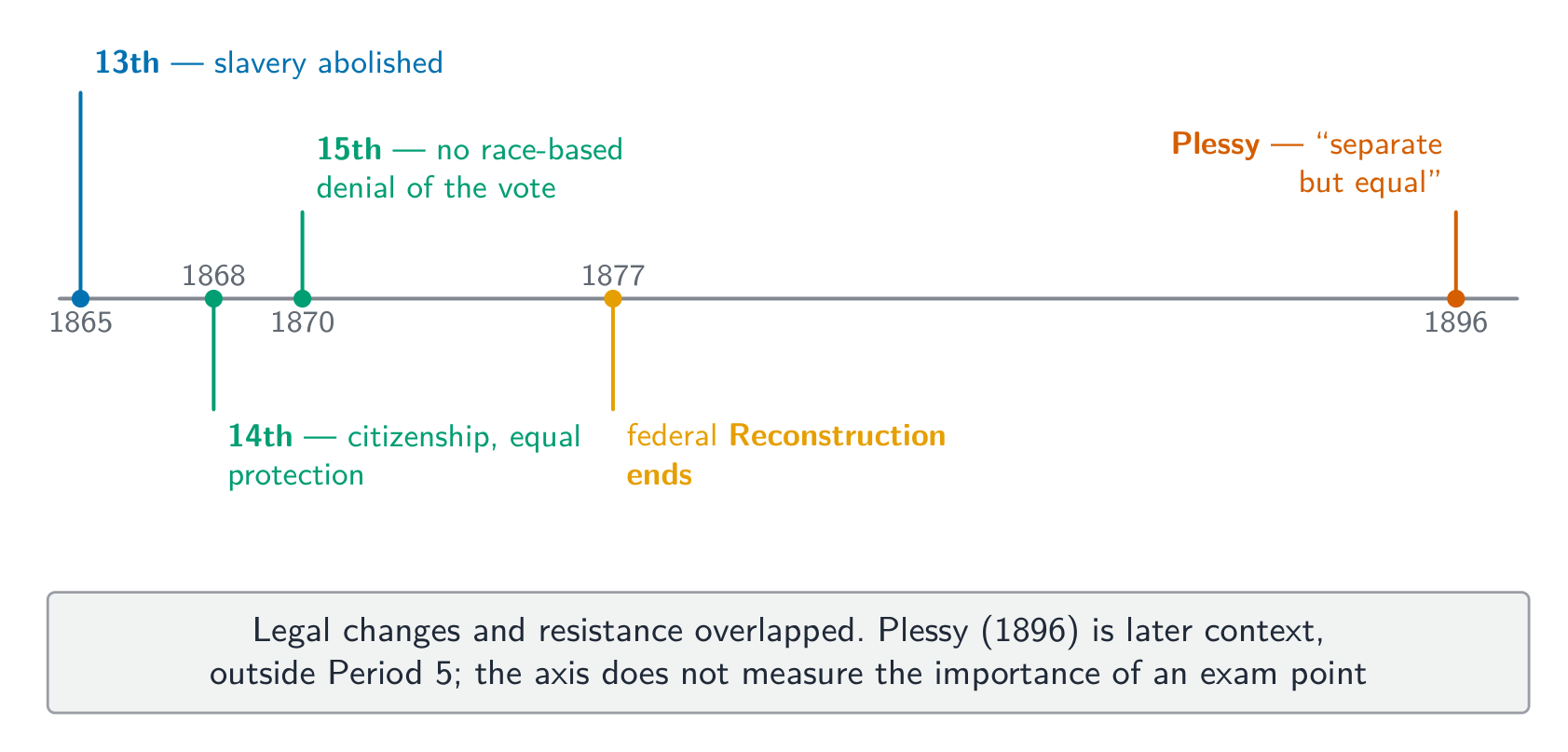
- On 13 April 1873, armed white men attacked Black Republicans defending the courthouse in Colfax, Louisiana, after a disputed election. Somewhere between 60 and 150 Black men were killed, many after they surrendered. Federal prosecutors charged some attackers, but in United States v. Cruikshank (1876) the Supreme Court ruled the federal government could not punish them under the Fourteenth Amendment.
- After Reconstruction, the South kept much of its old order, and Black Americans lost many of the rights they had won.
What did the Supreme Court rule in United States v. Cruikshank (1876)?
难度 1/5 · 今日首次完成可获 100 金币及少量额外奖励
It narrowed the amendment.
Land did not change hands
- Plantation owners still held most land. Freedpeople had no land of their own, so many became sharecroppers 佃农, farming land for a share of the crop.
- Debts to landowners and stores kept many families poor for generations.
Why did many freedpeople become sharecroppers?
难度 1/5 · 今日首次完成可获 100 金币及少量额外奖励
Land did not change hands.
Rights stripped by four means
- Violence: groups such as the Ku Klux Klan and the White League attacked Black voters.
- Laws and tactics: poll taxes and literacy tests kept Black men from voting; Jim Crow 吉姆·克劳 laws enforced segregation; Supreme Court rulings narrowed the amendments.
A continuity, a means of stripping rights, or the long-term effect?
Sort each element of the post-Reconstruction South.
Which were means used to strip Black Americans of rights?
难度 2/5 · 今日首次完成可获 140 金币及少量额外奖励
The amendment protected voting.
Worked example: Louisiana's voters
- Known: about 130 000 Black men were registered to vote in Louisiana in 1896, and about 1300 in 1904, after a new state constitution.
- Method: 1300 ÷ 130 000 = 0.01.
- Result: about 99% of Black voters were removed from the rolls in eight years — through laws, not a change to the Fifteenth Amendment.
Black voters in Louisiana fell from about 130 000 to about 1300. What percentage were removed?
难度 2/5 · 今日首次完成可获 140 金币及少量额外奖励
1300 is 1% of 130 000.
Continuity and change
- Continuity: white landowners kept economic and political power in the South.
- Change: slavery was ended for ever, and Black churches, schools and families grew strong.
Match each to continuity or change.
难度 2/5 · 今日首次完成可获 140 金币及少量额外奖励
Continuity and change.
A long-delayed effect
- The Fourteenth and Fifteenth Amendments stayed in the Constitution even when ignored.
- In the 20th century, civil rights lawyers used them to win cases such as Brown v. Board of Education (1954).
Reconstruction was not a complete failure. Slavery ended, Black Americans built lasting institutions, and the amendments later became the basis of civil rights victories.
Reconstruction achieved nothing lasting.
难度 1/5 · 今日首次完成可获 100 金币及少量额外奖励
Slavery ended and the amendments remained.
After Reconstruction, landowners kept the land, and sharecropping, violence, voting laws, Jim Crow and Supreme Court rulings stripped Black Americans of rights. But slavery was gone, and the amendments stayed in the Constitution to support the civil rights movement decades later.
Explain how Black Americans lost rights after Reconstruction, and what lasted.
Continuity and change.