跳到主要内容

第六时期:1865—1898

AP 美国历史 · 第 6 主题

训练
讲义 词汇表
6.1 6.2 6.3

第六时期的时代背景

大纲

6.1 Contextualizing Period 6

Learning ObjectivePreview: Unit 6 Key Concepts

Unit 6.A
Explain the historical context for the rise of industrial capitalism in the United States.

  • KC-6.1 Technological advances, large-scale production methods, and the opening of new markets encouraged the rise of industrial capitalism in the United States.
    • KC-6.1.I Large-scale industrial production— accompanied by massive technological change, expanding international communication networks, and pro-growth government policies—generated rapid economic development and business consolidation.
    • KC-6.1.II A variety of perspectives on the economy and labor developed during a time of financial panics and downturns.
    • KC-6.1.III New systems of production and transportation enabled consolidation within agriculture, which, along with periods of instability, spurred a variety of responses from farmers.
  • KC-6.2 The migrations that accompanied industrialization transformed both urban and rural areas of the United States and caused dramatic social and cultural change.
    • KC-6.2.I International and internal migration increased urban populations and fostered the growth of a new urban culture.
    • KC-6.2.II Larger numbers of migrants moved to the West in search of land and economic opportunity, frequently provoking competition and violent conflict.
  • KC-6.3 The Gilded Age produced new cultural and intellectual movements, public reform efforts, and political debates over economic and social policies.
    • KC-6.3.I New cultural and intellectual movements both buttressed and challenged the social order of the Gilded Age.
    • KC-6.3.II Dramatic social changes in the period inspired political debates over citizenship, corruption, and the proper relationship between business and government.

6.2 Westward Expansion: Economic Development

Thematic FocusLearning ObjectiveHistorical Developments

MIG
Migration and Settlement — Push and pull factors shape immigration to and migration within America, and the demographic change as a result of these moves shapes the migrants, society, and the environment.

Unit 6.B
Explain the causes and effects of the settlement of the West from 1877 to 1898.

  • KC-6.1.III.A Improvements in mechanization helped agricultural production increase substantially and contributed to declines in food prices.
  • KC-6.1.III.B Many farmers responded to the increasing consolidation in agricultural markets and their dependence on the evolving railroad system by creating local and regional cooperative organizations.
  • KC-6.1.I.A Following the Civil War, government subsidies for transportation and communication systems helped open new markets in North America.
  • KC-6.2.II.A The building of transcontinental railroads, the discovery of mineral resources, and government policies promoted economic growth and created new communities and centers of commercial activity.

6.3 Westward Expansion: Social and Cultural Development

Thematic FocusLearning ObjectiveHistorical Developments

MIG
Migration and Settlement — Push and pull factors shape immigration to and migration within America, and the demographic change as a result of these moves shapes the migrants, society, and the environment.

Unit 6.B
Explain the causes and effects of the settlement of the West from 1877 to 1898.

  • KC-6.2.II.B In hopes of achieving ideals of self-sufficiency and independence, migrants moved to both rural and boomtown areas of the West for opportunities, such as building the railroads, mining, farming, and ranching.
  • KC-6.2.II.C As migrant populations increased in number and the American bison population was decimated, competition for land and resources in the West among white settlers, American Indians, and Mexican Americans led to an increase in violent conflict.
  • KC-6.2.II.D The U.S. government violated treaties with American Indians and responded to resistance with military force, eventually confining American Indians to reservations and denying tribal sovereignty.
  • KC-6.2.II.E Many American Indians preserved their cultures and tribal identities despite government policies promoting assimilation, and they attempted to develop self-sustaining economic practices.

来源:美国大学理事会 AP 课程与考试说明

第六时期从 1865 年到 1898 年,即镀金时代(Gilded Age)。工业、移民与西部改变了这个国家,而每一次改变都引发一场关于谁受益的政治争论。

机械化(mechanization)的改进大幅提高了农业产量,铁路则把农产品运往全国乃至世界市场。但同样的力量也挤压着农民:农产品市场集中化(consolidation in agricultural markets)使他们面对高昂运费、昂贵信贷与不断下跌的农产品价格。

西进定居同时意味着美洲原住民被最终剥夺。联邦政策从条约转向保留地(reservations),再转向通过道斯法(Dawes Act)推行的同化(assimilation)——该法把公有土地分割为个人份地,并把剩余土地转让给定居者。

词汇表 训练
英文 中文 拼音
Gilded Age 镀金时代 dù jīn shí dài
mechanization 机械化 jī xiè huà
consolidation in agricultural markets 农产品市场集中化 nóng chǎn pǐn shì chǎng jí zhōng huà
reservations 保留地 bǎo liú dì
assimilation 同化 tóng huà
Dawes Act 道斯法 dào sī fǎ
consolidation 合并 hé bìng
6.4 6.5 6.6

“新南方”

大纲

6.4 The “New South”

Thematic FocusLearning ObjectiveHistorical Developments

NAT
American and National Identity — The development of and debates about democracy, freedom, citizenship, diversity, and individualism shape American national identity, cultural values, and beliefs about American exceptionalism, and in turn, these ideas shape political institutions and society. Throughout American history, notions of national identity and culture have coexisted with varying degrees of regional and group identities.

Unit 6.C
Explain how various factors contributed to continuity and change in the “New South” from 1877 to 1898.

  • KC-6.1.II.D Despite the industrialization of some segments of the Southern economy—a change promoted by Southern leaders who called for a “New South”—agriculture based on sharecropping and tenant farming continued to be the primary economic activity in the South.
  • KC-6.3.II.C The Supreme Court decision in Plessy v. Ferguson that upheld racial segregation (known as Jim Crow) helped to mark the end of most of the political gains African Americans made during Reconstruction. Facing increased violence, discrimination, and scientific theories of race, African American reformers continued to fight for political and social equality.

6.5 Technological Innovation

Thematic FocusLearning ObjectiveHistorical Developments

WXT
Work, Exchange, and Technology — The interplay between markets, private enterprise, labor, technology, and government policy shape the American economy. In turn, economic activity shapes society and government policy and drives technological innovation.

Unit 6.D
Explain the effects of technological advances in the development of the United States over time.

  • KC-6.1.I.B.i Businesses made use of technological innovations and greater access to natural resources to dramatically increase the production of goods.

6.6 The Rise of Industrial Capitalism

Thematic FocusLearning ObjectiveHistorical Developments

WXT
Work, Exchange, and Technology — The interplay between markets, private enterprise, labor, technology, and government policy shape the American economy. In turn, economic activity shapes society and government policy and drives technological innovation.

Unit 6.E
Explain the socioeconomic continuities and changes associated with the growth of industrial capitalism from 1865 to 1898.

  • KC-6.1.I Large-scale industrial production— accompanied by massive technological change, expanding international communication networks, pro-growth government policies—generated rapid economic development and business consolidation.
  • KC-6.1.I.B.ii Businesses made use of redesigned financial and management structures, advances in marketing, and a growing labor force to dramatically increase the production of goods.
  • KC-6.1.I.D Many business leaders sought increased profits by consolidating corporations into large trusts and holding companies, which further concentrated wealth.
  • KC-6.1.I.E.i Businesses increasingly looked outside U.S. borders in an effort to gain greater influence and control over markets and natural resources in the Pacific Rim, Asia, and Latin America.

来源:美国大学理事会 AP 课程与考试说明

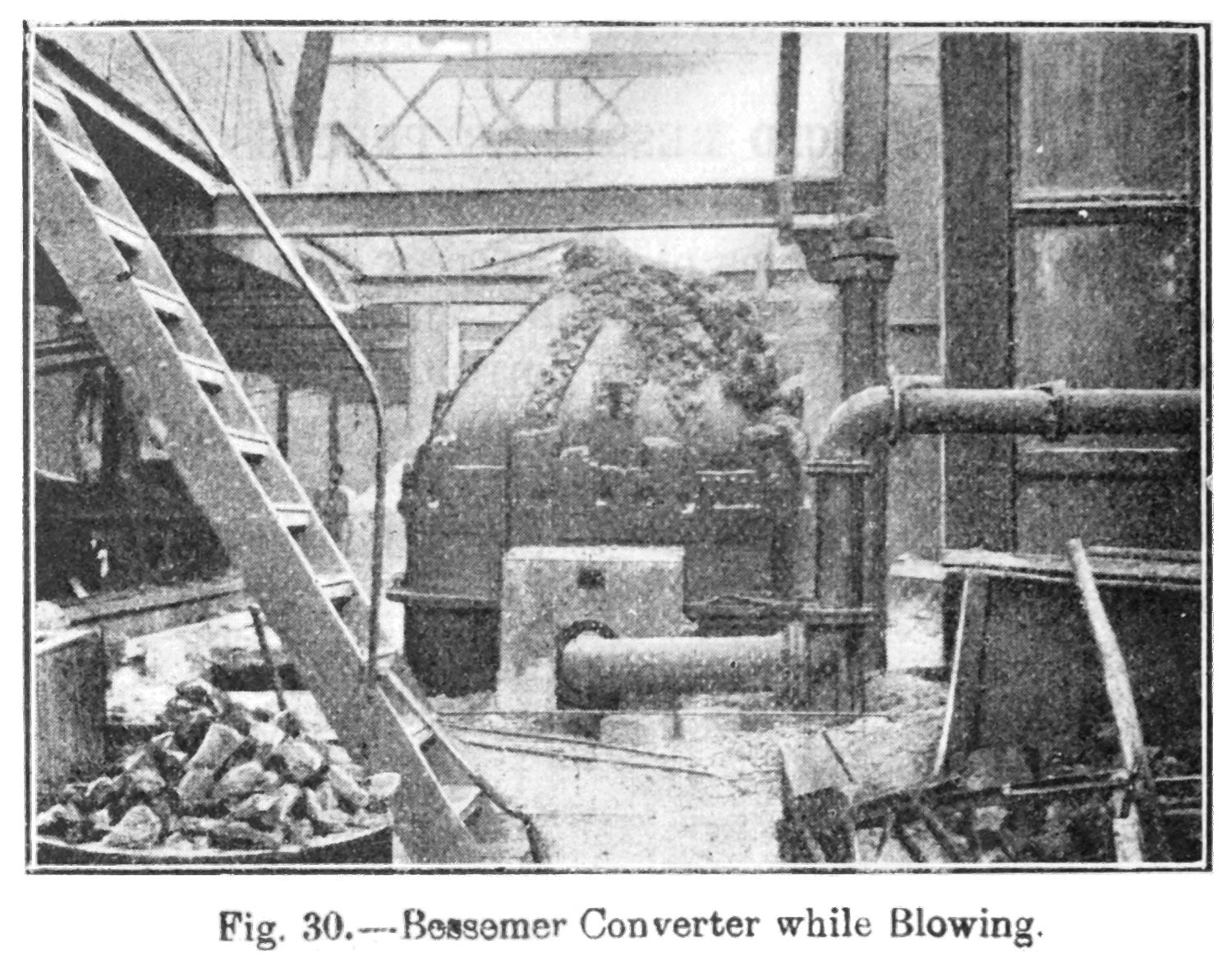
大规模工业生产伴随着巨大的技术变革,创造出惊人的产量,也造就了规模空前的企业。

  • 新的公司组织形式(corporate structures)——托拉斯与控股公司——使合并(consolidation)成为可能,在某些行业接近垄断。
  • 新的交通与通信网络,尤其是铁路,造就了真正意义上的全国市场。
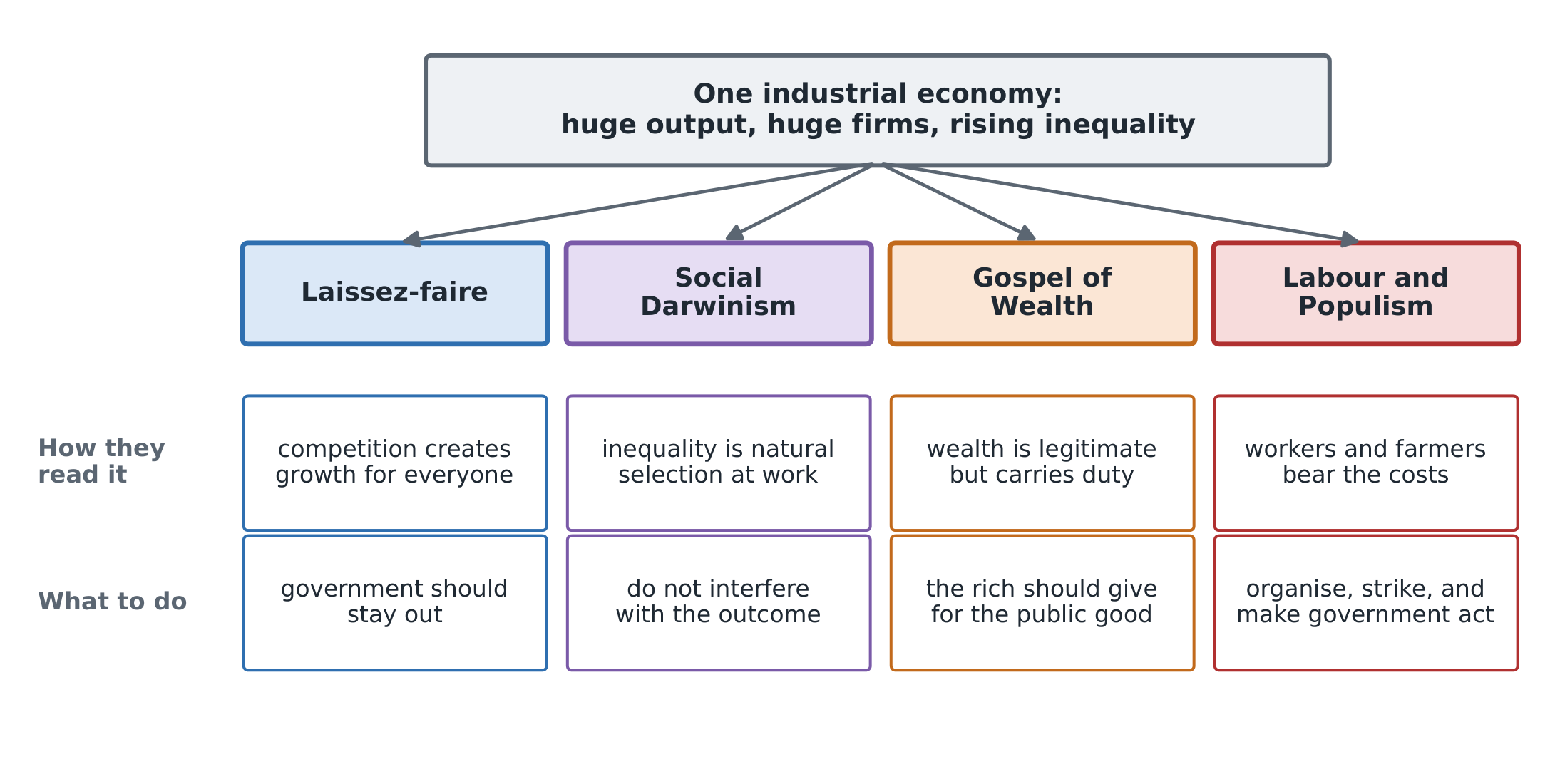
  • 企业领袖以自由放任(laissez-faire)论调为自身地位辩护:竞争促进增长,政府不应干预。

同一时期也带来不平等加剧(rising inequality)与反复出现的金融恐慌,这正是经济本身成为核心政治议题的原因。

词汇表 训练
英文 中文 拼音
corporate structures 公司组织形式 gōng sī zǔ zhī xíng shì
laissez-faire 自由放任 zì yóu fàng rèn
rising inequality 不平等加剧 bù píng děng jiā jù
6.7

镀金时代的劳工

大纲

6.7 Labor in the Gilded Age

Thematic FocusLearning ObjectiveHistorical Developments

WXT
Work, Exchange, and Technology — The interplay between markets, private enterprise, labor, technology, and government policy shape the American economy. In turn, economic activity shapes society and government policy and drives technological innovation.

Unit 6.E
Explain the socioeconomic continuities and changes associated with the growth of industrial capitalism from 1865 to 1898.

  • KC-6.1.I.C As the price of many goods decreased, workers’ real wages increased, providing new access to a variety of goods and services; many Americans’ standards of living improved, while the gap between rich and poor grew.
  • KC-6.1.II.C Labor and management battled over wages and working conditions, with workers organizing local and national unions and/or directly confronting business leaders.
  • KC-6.1.II.B.i The industrial workforce expanded and child labor increased.

来源:美国大学理事会 AP 课程与考试说明

镀金时代的争论:同一个工业经济被读出四种不同含义,各有各的对策
同一个经济,四种回应:每一方对问题的判断不同,给出的对策也不同

围绕经济与劳工出现了各种不同的立场(variety of perspectives)。工人面对超长工时、危险的作业条件,以及在经济下行时下滑的工资。

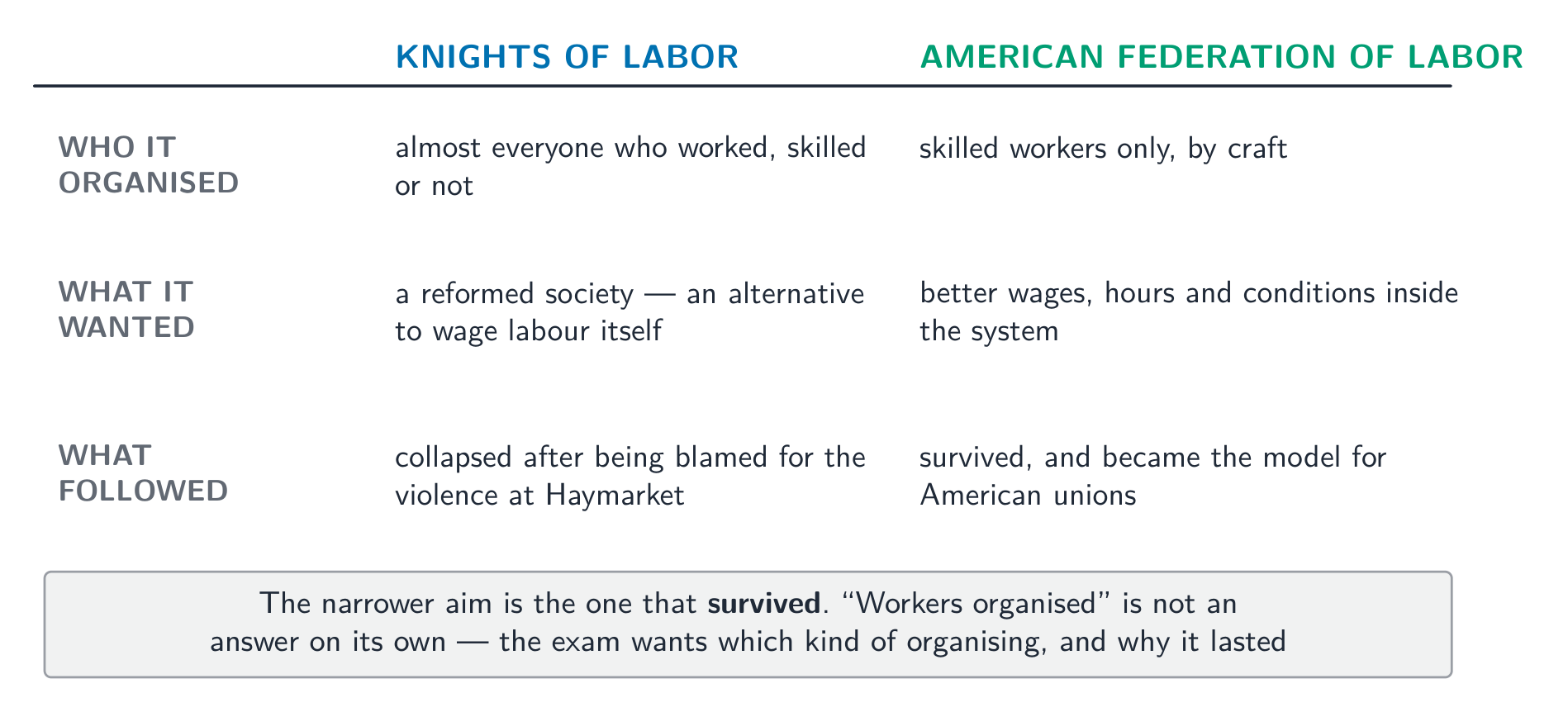
他们组织起来。劳工骑士团(Knights of Labor)与美国劳工联合会(American Federation of Labor)等工会在吸纳哪些人、争取什么目标上存在分歧——劳联专注于熟练工人以及工资与工时上的实际收益。罢工(strikes)频繁而规模庞大,并常被州或联邦武力镇压,而这本身又成为一场关于政府角色的争论。

词汇表 训练
英文 中文 拼音
variety of perspectives 各种不同的立场 gè zhǒng bù tóng de lì chǎng
Knights of Labor 劳工骑士团 láo gōng qí shì tuán
American Federation of Labor 美国劳工联合会 měi guó láo gōng lián hé huì
Strikes 罢工 bà gōng
6.8 6.9

镀金时代的移民与人口迁移

大纲

6.8 Immigration and Migration in the Gilded Age

Thematic FocusLearning ObjectiveHistorical Developments

MIG
Migration and Settlement — Push and pull factors shape immigration to and migration within America, and the demographic change as a result of these moves shapes the migrants, society, and the environment.

Unit 6.F
Explain how cultural and economic factors affected migration patterns over time.

  • KC-6.1.II.B.ii The industrial workforce expanded and became more diverse through internal and international migration.
  • KC-6.2.I.A As cities became areas of economic growth featuring new factories and businesses, they attracted immigrants from Asia and southern and eastern Europe, as well as African American migrants within and out of the South. Many migrants moved to escape poverty, religious persecution, and limited opportunities for social mobility in their home countries or regions.
  • KC-6.2.I.B Urban neighborhoods based on particular ethnicities, races, and classes provided new cultural opportunities for city dwellers.

6.9 Responses to Immigration in the Gilded Age

Thematic FocusLearning ObjectiveHistorical Developments

MIG
Migration and Settlement — Push and pull factors shape immigration to and migration within America, and the demographic change as a result of these moves shapes the migrants, society, and the environment.

Unit 6.G
Explain the various responses to immigration in the period over time.

  • KC-6.2.I.C Increasing public debates over assimilation and Americanization accompanied the growth of international migration. Many immigrants negotiated compromises between the cultures they brought and the culture they found in the United States.
  • KC-6.3.I.A Social commentators advocated theories later described as Social Darwinism to justify the success of those at the top of the socioeconomic structure as both appropriate and inevitable.
  • KC-6.3.II.B.i Many women, like Jane Addams, worked in settlement houses to help immigrants adapt to U.S. language and customs.

来源:美国大学理事会 AP 课程与考试说明

国际与国内的人口迁移使城市人口增加,推动了城市(cities)的成长。

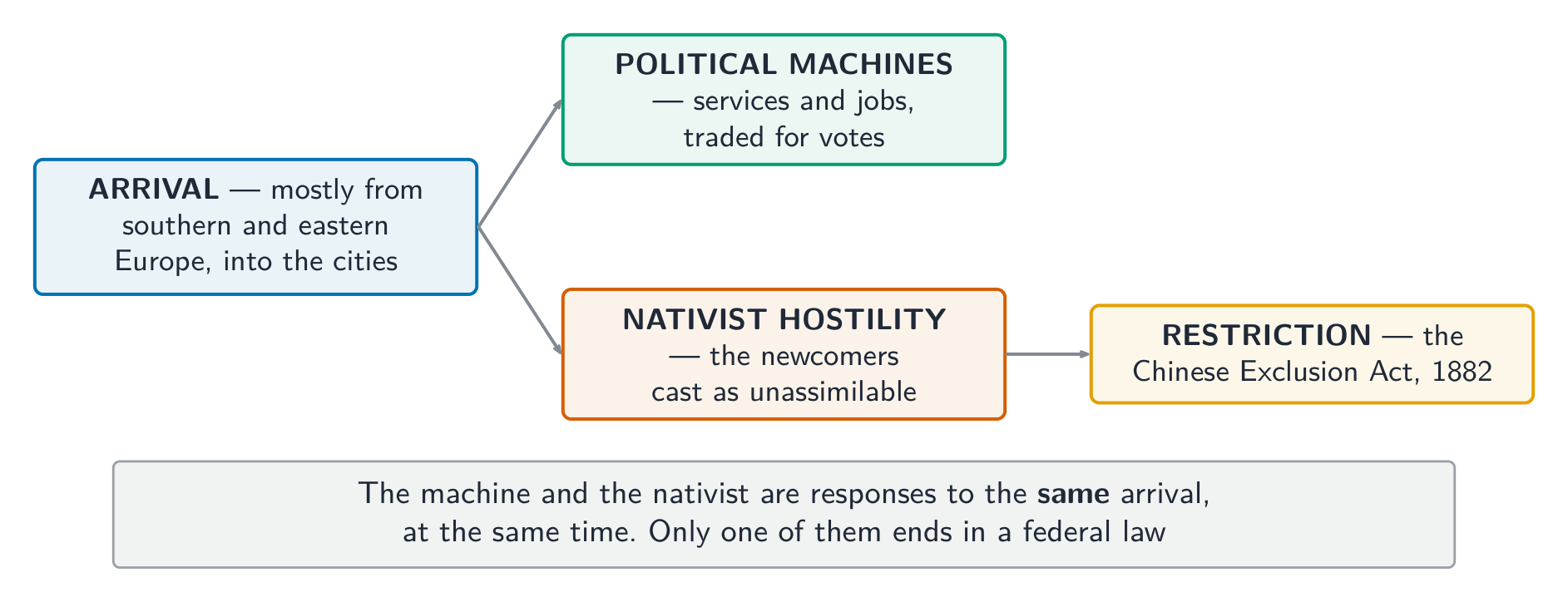
新移民越来越多地来自南欧与东欧(southern and eastern Europe),与此同时华人移民西部,并遭遇排华法案(Chinese Exclusion Act)——这是联邦首次按国籍作出的重大移民限制。

在权力分配极不均衡的城市里,政治机器(political machines)以工作、住房帮助与各种服务换取选票——以后世标准衡量是腐败的,但对许多移民而言,那是唯一实际可用的支持来源。

移民也激起有组织的敌意。排外主义(nativist)运动宣称新移民威胁工资、文化或自治。

词汇表 训练
英文 中文 拼音
cities 城市 chéng shì
southern and eastern Europe 南欧与东欧 nán ōu yǔ dōng ōu
Chinese Exclusion Act 排华法案 pái huá fǎ àn
political machines 政治机器 zhèng zhì jī qì
6.10 6.11

中产阶级的形成

大纲

6.10 Development of the Middle Class

Thematic FocusLearning ObjectiveHistorical Developments

SOC
Social Structures — Social categories, roles, and practices are created, maintained, challenged, and transformed throughout American history, shaping government policy, economic systems, culture, and the lives of citizens.

Unit 6.H
Explain the causes of increased economic opportunity and its effects on society.

  • KC-6.2.I.E Corporations’ need for managers and for male and female clerical workers, as well as increased access to educational institutions, fostered the growth of a distinctive middle class. A growing amount of leisure time also helped expand consumer culture.
  • KC-6.3.I.B Some business leaders argued that the wealthy had a moral obligation to help the less fortunate and improve society, as articulated in the idea known as the Gospel of Wealth, and they made philanthropic contributions that enhanced educational opportunities and urban environments.

6.11 Reform in the Gilded Age

Thematic FocusLearning ObjectiveHistorical Developments

SOC
Social Structures — Social categories, roles, and practices are created, maintained, challenged, and transformed throughout American history, shaping government policy, economic systems, culture, and the lives of citizens.

Unit 6.I
Explain how different reform movements responded to the rise of industrial capitalism in the Gilded Age.

  • KC-6.3.I.C A number of artists and critics, including agrarians, utopians, socialists, and advocates of the Social Gospel, championed alternative visions for the economy and U.S. society.
  • KC-6.3.II.B.ii Many women sought greater equality with men, often joining voluntary organizations, going to college, and promoting social and political reform.

来源:美国大学理事会 AP 课程与考试说明

公司对管理人员(managers)以及男女文职人员(clerical workers)的需求,壮大了一个新的中产阶级(middle class),并带来新的消费与休闲方式。

文化与思想运动既支持又挑战(buttressed and challenged)既有社会秩序:

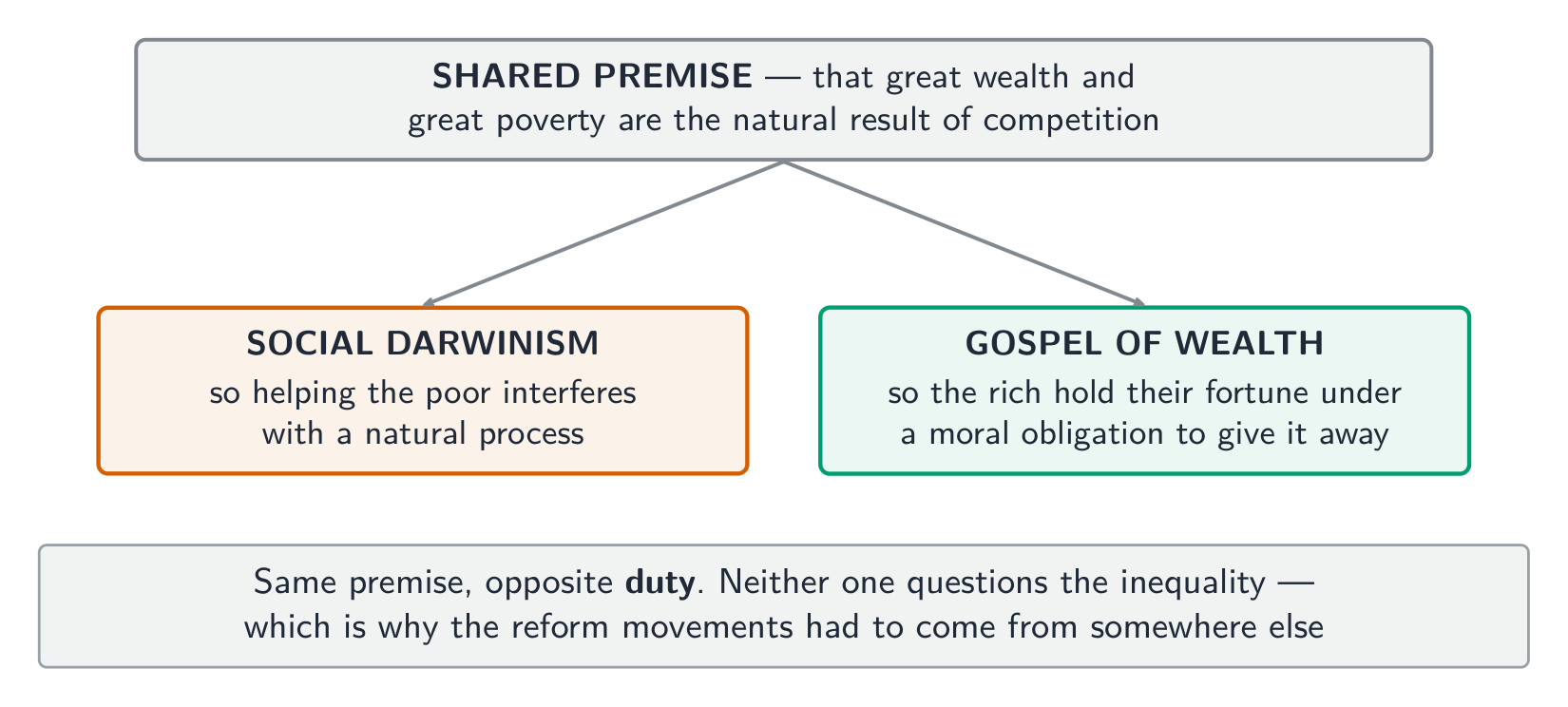
  • 社会达尔文主义(Social Darwinism)借用进化论语言,把不平等说成自然结果。
  • 财富福音(Gospel of Wealth)主张富人负有把财富用于公益的道德义务(moral obligation)。
  • 农本主义者、乌托邦主义者、社会主义者与艺术家则从另一个方向批判工业社会。
  • 许多女性争取更大的平等,常常通过自愿团体(voluntary organizations)——禁酒、睦邻之家与争取选举权的工作。
词汇表 训练
英文 中文 拼音
managers 管理人员 guǎn lǐ rén yuán
clerical workers 文职人员 wén zhí rén yuán
middle class 中产阶级 zhōng chǎn jiē jí
buttressed and challenged 既支持又挑战 jì zhī chí yòu tiǎo zhàn
Social Darwinism 社会达尔文主义 shè huì dá ěr wén zhǔ yì
Gospel of Wealth 财富福音 cái fù fú yīn
moral obligation 道德义务 dào dé yì wù
voluntary organizations 自愿团体 zì yuàn tuán tǐ
6.12 6.13

镀金时代关于政府角色的争论

大纲

6.12 Controversies over the Role of Government in the Gilded Age

Thematic FocusLearning ObjectiveHistorical Developments

PCE
Politics and Power — Debates fostered by social and political groups about the role of government in American social, political, and economic life shape government policy, institutions, political parties, and the rights of citizens.

Unit 6.J
Explain continuities and changes in the role of the government in the U.S. economy.

  • KC-6.1.II.A Some argued that laissez-faire policies and competition promoted economic growth in the long run, and they opposed government intervention during economic downturns.
  • KC-6.1.I.E.ii Foreign policymakers increasingly looked outside U.S. borders in an effort to gain greater influence and control over markets and natural resources in the Pacific Rim, Asia, and Latin America.

6.13 Politics in the Gilded Age

Thematic FocusLearning ObjectiveHistorical Developments

PCE
Politics and Power — Debates fostered by social and political groups about the role of government in American social, political, and economic life shape government policy, institutions, political parties, and the rights of citizens.

Unit 6.K
Explain the similarities and differences between the political parties during the Gilded Age.

  • KC-6.1.III.C Economic instability inspired agrarian activists to create the People’s (Populist) Party, which called for a stronger governmental role in regulating the American economic system.
  • KC-6.3.II.A The major political parties appealed to lingering divisions from the Civil War and contended over tariffs and currency issues, even as reformers argued that economic greed and self-interest had corrupted all levels of government.
  • KC-6.2.I.D In an urban atmosphere where the access to power was unequally distributed, political machines thrived, in part by providing immigrants and the poor with social services.

来源:美国大学理事会 AP 课程与考试说明

两大政党诉诸内战遗留的分歧,并在政治分肥(patronage)上的竞争多于在政策上的竞争,由此形成选情胶着而立法有限的局面。

经济动荡促使农本主义活动家组建人民党(People's (Populist) Party),要求政府采取行动:管制铁路、改革币制、开征累进所得税。民粹主义作为政党失败了,却把"政府应当干预经济"这一主张摆上了议程——这正是第七时期接手的争论。

关于公民身份(citizenship)、种族与政府角色的辩论贯穿其间,而重建时期承诺的权利仍在不断被收窄。

词汇表 训练
英文 中文 拼音
patronage 政治分肥 zhèng zhì fēn féi
People's (Populist) Party 人民党 rén mín dǎng
citizenship 公民身份 gōng mín shēn fèn
6.14

第六时期的延续与变化

大纲

6.14 Continuity and Change Period 6

Learning ObjectiveReview: Unit 6 Key Concepts

Unit 6.L
Explain the extent to which industrialization brought change from 1865 to 1898.

  • KC-6.1 Technological advances, large-scale production methods, and the opening of new markets encouraged the rise of industrial capitalism in the United States.
    • KC-6.1.I Large-scale industrial production— accompanied by massive technological change, expanding international communication networks, and pro-growth government policies—generated rapid economic development and business consolidation.
    • KC-6.1.II A variety of perspectives on the economy and labor developed during a time of financial panics and downturns.
    • KC-6.1.III New systems of production and transportation enabled consolidation within agriculture, which, along with periods of instability, spurred a variety of responses from farmers.
  • KC-6.2 The migrations that accompanied industrialization transformed both urban and rural areas of the United States and caused dramatic social and cultural change.
    • KC-6.2.I International and internal migration increased urban populations and fostered the growth of a new urban culture.
    • KC-6.2.II Larger numbers of migrants moved to the West in search of land and economic opportunity, frequently provoking competition and violent conflict.
  • KC-6.3 The Gilded Age produced new cultural and intellectual movements, public reform efforts, and political debates over economic and social policies.
    • KC-6.3.I New cultural and intellectual movements both buttressed and challenged the social order of the Gilded Age.
    • KC-6.3.II Dramatic social changes in the period inspired political debates over citizenship, corruption, and the proper relationship between business and government.

来源:美国大学理事会 AP 课程与考试说明

本时期考查的推理能力是延续与变化。工业化改变了人们居住的地方与从事的工作,而不平等、内战遗留的党派忠诚与种族排斥则依然延续。

Worked example(一道真实的 AP 考题)。2025 年的长文章题要求「评估 1865 年之后经济变化在多大程度上影响了美国社会」。有力的论点会点明这些变化以及它们对不同群体的不同影响:「1865 年后,经济变化在很大程度上重塑了美国社会,造就了城市工业工人阶级与领薪的中产阶级;但其收益分配极不均衡,以致农民与产业工人组织起来在政治上加以反对。」*注意其结构:点明*受到了不同的影响,才使文章得以就"程度"展开论证,而不只是描述增长。

6.14

考试技巧

  • 解释农民的不满要用机制:运费信贷下跌的农产品价格——而不是"农民日子难过"。
  • 把镀金时代的四种回应区分清楚:自由放任社会达尔文主义财富福音,以及有组织的劳工与民粹主义
  • 谈移民时,要点出移民来源转向南欧与东欧,以及作为首个按国籍限制移民的联邦法律的排华法案
  • 政治机器既是腐败也是社会供给,两者都在考查范围内。两面都写出来,才能体现复杂性。
  • 民粹主义的意义不在于胜选,而在于把政府干预摆上了议程。
  • 面对"延续与变化"题,要点出一项具体的延续。种族排斥与财富不均在此最为稳妥。

AP 美国历史的更多主题

登录或创建账号

IGCSE, A-Level & AP