| English | 释义 | 拼音 |
|---|---|---|
| Homestead Act/ˈhəʊmsted ækt/ | 宅地法 | zhái dì fǎ |
| reservation | 保留地 | bǎo liú dì |
| Dawes Act/dɔːz ækt/ | 道斯法案 | dào sī fǎ àn |
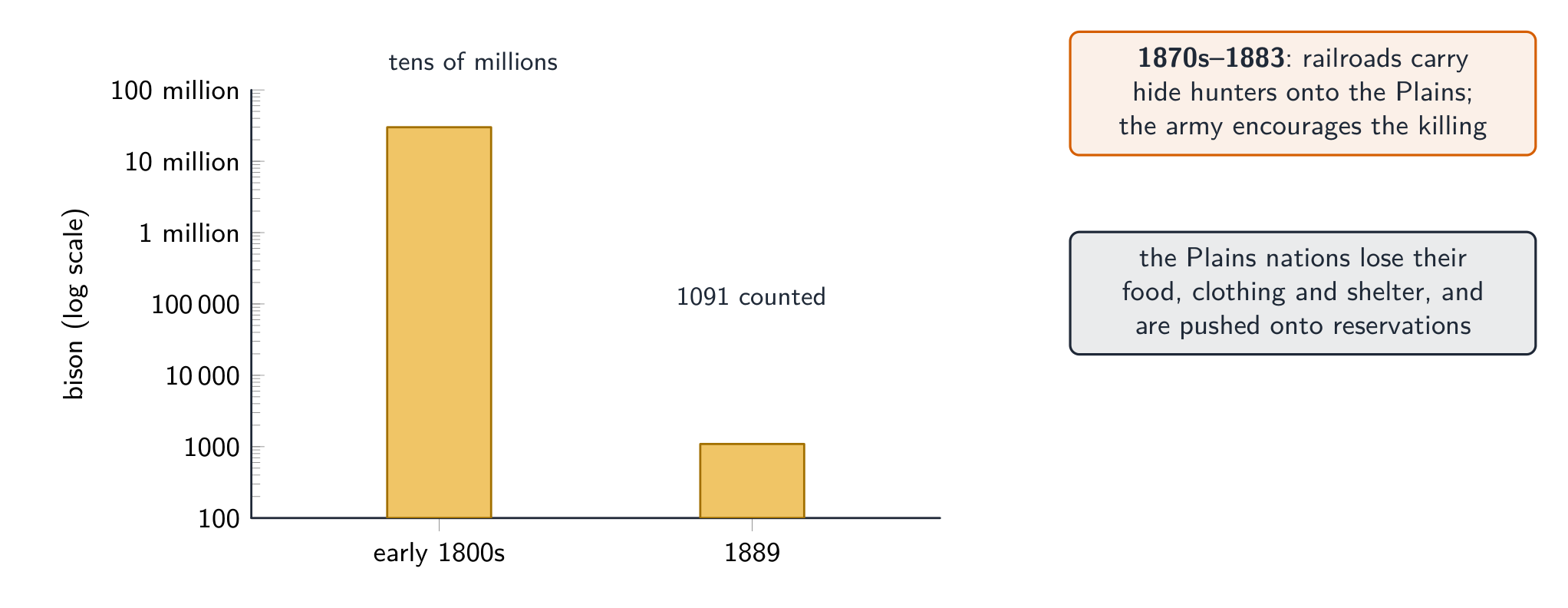
Counting the last bison, 1889
- In 1889, William Hornaday of the Smithsonian Institution tried to count the bison left in the United States. In the early 1800s, there had been tens of millions on the Great Plains. Hornaday found fewer than 1100. Hunters had shot them for hides and sport, and the army encouraged it, knowing that Plains nations depended on the bison for food, clothing and shelter.
- The settlement of the West after 1865 happened in lands where Native nations, Mexican Americans and others already lived.
Why did the army encourage the killing of bison?
难度 1/5 · 今日首次完成可获 100 金币及少量额外奖励
Destroying the base of Plains life.
Why people went west
- The Homestead Act 宅地法 (1862) offered 160 acres of public land to settlers who farmed it for five years. Railroads received huge land grants and sold land to settlers.
- Miners, ranchers and farmers moved west, along with Chinese, Mexican and European immigrants.
How many acres did the Homestead Act offer to settlers?
难度 2/5 · 今日首次完成可获 140 金币及少量额外奖励
For five years of farming.
Competition became violent
- Settlers, miners and the army fought Native nations for land. At Sand Creek, Colorado (1864), militia killed about 150 Cheyenne and Arapaho, mostly women, children and old people.
- In 1876, Lakota and Cheyenne warriors defeated Custer at the Little Bighorn.
A motive, a cause of conflict, or a response?
Sort each element of western settlement's human side.
Worked example: what the government did
- Reservations: the government moved Native nations onto reservations 保留地, often on poor land, and broke treaties when gold or farmland was found.
- Assimilation: the Dawes Act 道斯法案 (1887) divided reservation land into individual farms; Native land fell from about 138 million acres in 1887 to about 48 million by 1934.
- Schools: boarding schools such as Carlisle (1879) took Native children from their families and banned their languages.
Match each policy to its aim.
难度 2/5 · 今日首次完成可获 140 金币及少量额外奖励
Assimilation.
Native land fell from about 138 million acres to about 48 million. By how many million acres did it fall?
难度 2/5 · 今日首次完成可获 140 金币及少量额外奖励
138 − 48.
What Native nations did
- Some fought, some negotiated, and some tried to adapt. The Ghost Dance movement (1889–90) promised the return of the old world.
- In December 1890, the army killed about 250 Lakota at Wounded Knee.
Put these events in order.
难度 3/5 · 今日首次完成可获 200 金币及少量额外奖励
1864, 1876, 1887, 1890.
Others already there
- In the Southwest, Mexican Americans lost land to new settlers and courts, despite the promises of 1848.
- Chinese workers built much of the Central Pacific Railroad, then faced violence and the Chinese Exclusion Act (1882).
The West was not empty land. Any account of settlement must include the Native nations, Mexican Americans and others who lived there and how they were affected.
The American West was empty land before settlers arrived.
难度 1/5 · 今日首次完成可获 100 金币及少量额外奖励
Native nations and others lived there.
The Homestead Act and railroads drew settlers west into lands already occupied. The destruction of the bison, wars from Sand Creek to Wounded Knee, reservations, the Dawes Act and boarding schools took Native land and culture, while Mexican Americans and Chinese workers also faced loss and exclusion.
Explain how federal policy affected Native nations in the West after 1865.
Effects.