| English | 释义 | 拼音 |
|---|---|---|
| People's Party | 人民党 | rén mín dǎng |
| civil service | 文官制度 | wén guān zhì dù |
| political machine | 政治机器 | zhèng zhì jī qì |
A president shot by a job-seeker, 1881
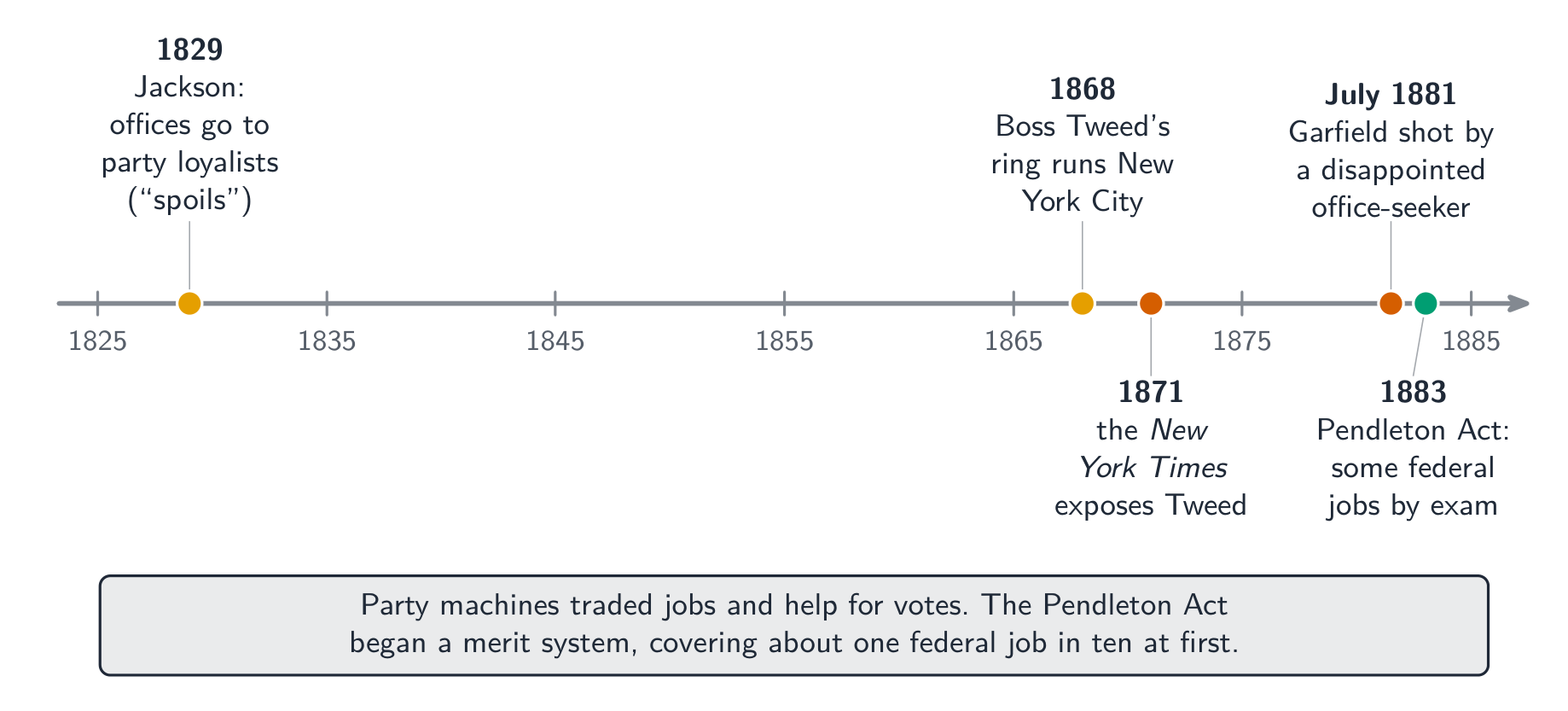
- On 2 July 1881, President James Garfield was shot at a Washington railway station by Charles Guiteau, who believed he deserved a government job for helping Garfield's campaign. Garfield died in September. In 1883, Congress passed the Pendleton Act, which required some federal jobs to be filled by competitive exams instead of party loyalty.
- In the Gilded Age, the two major parties were closely balanced, and party machines traded favours for votes.
What law followed Garfield's assassination?
难度 1/5 · 今日首次完成可获 100 金币及少量额外奖励
Civil service reform, 1883.
A third party from the countryside
- Farmers angry at railroads, banks and falling prices formed the People's Party 人民党 (Populists) in 1892.
- They won over a million votes in 1892, showing that the major parties were not meeting farmers' needs.
The Populists won over a million votes in 1892.
难度 1/5 · 今日首次完成可获 100 金币及少量额外奖励
A farmers' third party.
What the major parties argued about
- Tariffs: Republicans wanted high tariffs; Democrats generally wanted lower ones. Money: gold against silver.
- Jobs: the civil service 文官制度 — whether government jobs should go to party supporters or be won by merit.
The Populists, the major parties, or the machines?
Sort each element of Gilded Age politics.
Match each issue to its debate.
难度 2/5 · 今日首次完成可获 140 金币及少量额外奖励
What the parties argued about.
Worked example: machines
- What they gave: city political machines 政治机器 such as New York's Tammany Hall found immigrants jobs, food and coal in winter, and help with the police.
- What they took: votes on election day — and money. "Boss" William Tweed's ring stole tens of millions of dollars from New York in the 1860s.
- Why it worked: city governments gave almost no welfare, so machines filled the gap.
Why did immigrants support political machines?
难度 1/5 · 今日首次完成可获 100 金币及少量额外奖励
Favours for votes.
Similarities and differences
- Similar: both major parties were friendly to business and avoided radical change.
- Different: Republicans drew Northern Protestants and Union veterans; Democrats drew the white South, immigrants and Catholics.
Match each group to the party it mostly supported.
难度 2/5 · 今日首次完成可获 140 金币及少量额外奖励
Party bases.
Close elections, high turnout
- Presidential elections were very close: in 1876 and 1888, the winner lost the popular vote.
- Turnout was often around 80% of eligible men.
High turnout did not mean the parties solved problems. Elections were close and exciting, but both parties avoided action on farmers' and workers' complaints, which is why the Populists formed.
High turnout meant the major parties solved farmers' problems.
难度 1/5 · 今日首次完成可获 100 金币及少量额外奖励
The Populists formed because they did not.
Closely balanced Republicans and Democrats argued over tariffs, money and the civil service; Garfield's murder led to the Pendleton Act. City machines traded jobs and help for immigrants' votes, and farmers, ignored by both parties, formed the Populist Party in 1892.
Compare the Republican and Democratic parties in the Gilded Age.
Comparison.