| English | 释义 | 拼音 |
|---|---|---|
| Homestead Act/ˈhəʊmsted ækt/ | 宅地法 | zhái dì fǎ |
| free silver | 自由铸造银币 | zì yóu zhù zào yín bì |
| Grange | 格兰其 | gé lán qí |
A Kansas speaker tours the farms, 1890
- In the summer of 1890, Mary Elizabeth Lease travelled across Kansas giving speeches to angry farmers. Wheat that had sold for about a dollar a bushel in 1881 sold for about 50 cents, while railroads and banks charged high rates. She is remembered for telling farmers to "raise less corn and more hell". That November, the new People's Party won control of the Kansas legislature.
- After 1865, settlers, machines and government opened the West — and farmers' troubles grew with their output.
Wheat fell from about 1 dollar to about 50 cents a bushel. By what percentage?
难度 2/5 · 今日首次完成可获 140 金币及少量额外奖励
Half the price.
Mechanisation and falling prices
- Machines such as the steel plough, reaper and combine harvester let one family farm far more land.
- Output rose so much that prices fell: more wheat on the market meant less money per bushel.
Why did mechanisation push prices down?
难度 1/5 · 今日首次完成可获 100 金币及少量额外奖励
Overproduction.
Government opened the West
- The Homestead Act 宅地法 (1862) gave 160 acres to settlers who farmed the land for five years.
- Government gave railroads about 70 million hectares of land and pushed Native nations onto reservations.
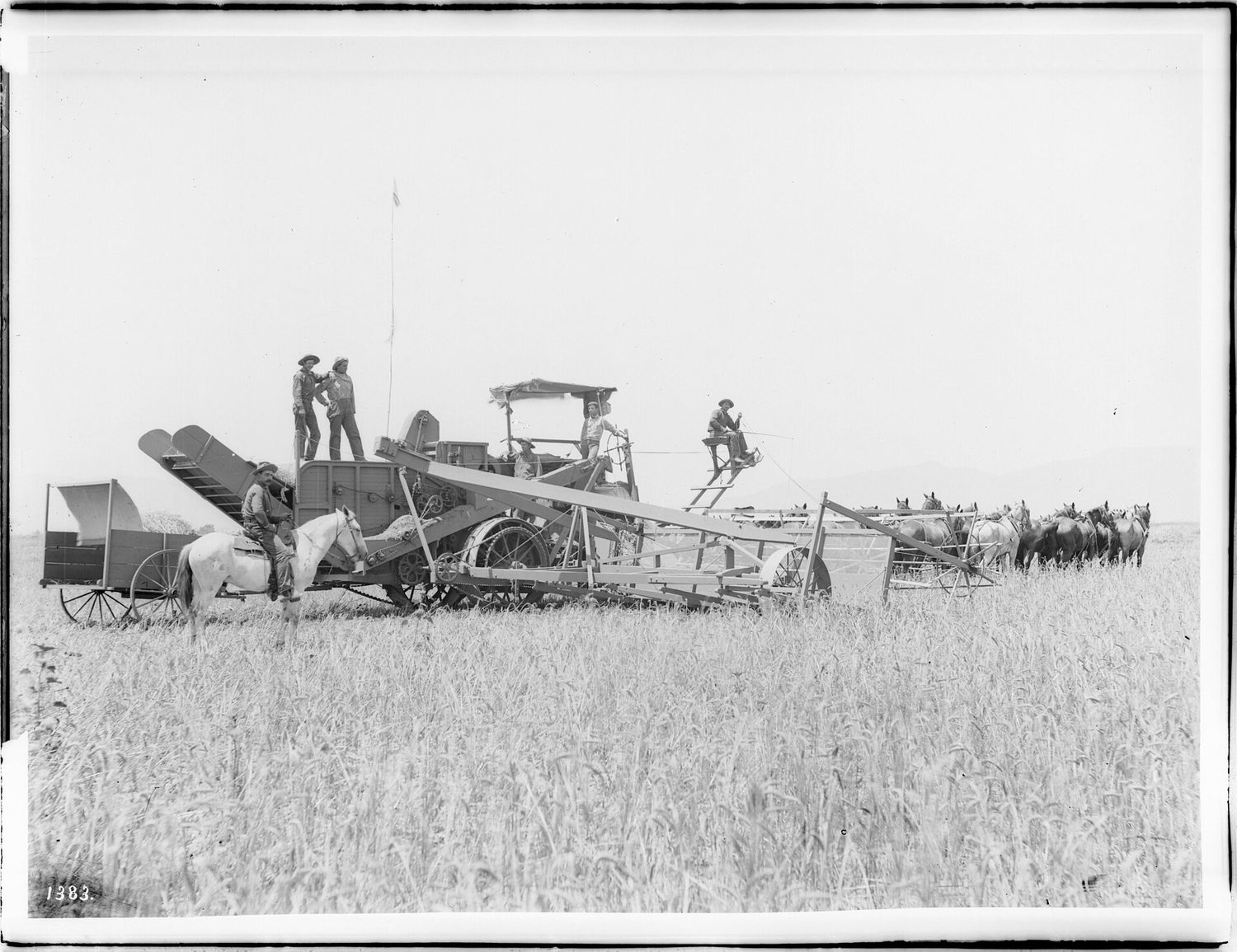
An economic cause, a farmer grievance, or a government contribution?
Sort each element of western settlement.
How many acres did the Homestead Act give each settler?
难度 2/5 · 今日首次完成可获 140 金币及少量额外奖励
For five years of farming.
Worked example: why falling prices hurt
- Known: a farmer had a debt of 1000 dollars. With wheat at 1 dollar a bushel, that is 1000 bushels.
- Method: at 50 cents a bushel, 1000 ÷ 0.5 = 2000 bushels.
- Result: the same debt needed twice the wheat. This is why many farmers wanted more money in circulation — free silver 自由铸造银币 — to raise prices.
A debt of 600 dollars must be repaid with wheat at 50 cents a bushel. How many bushels?
难度 2/5 · 今日首次完成可获 140 金币及少量额外奖励
600 ÷ 0.5.
Farmers organised
- The Grange 格兰其 (from 1867) and the Farmers' Alliances set up cooperatives to buy and sell together.
- The People's (Populist) Party's Omaha Platform (1892) demanded government control of railroads, a graduated income tax and free silver.
Dependence on the railroads
- Farmers depended on one railroad to reach markets, so it could charge high rates.
- Consolidation in grain markets — a few large buyers and elevators — gave farmers little power over prices.
Match each to its type.
难度 2/5 · 今日首次完成可获 140 金币及少量额外奖励
Three kinds.
Farmers' problems were not caused by bad farming. They grew more than ever; overproduction, debt, railroad rates and falling prices caused their troubles.
Farmers' troubles came from growing too little.
难度 1/5 · 今日首次完成可获 100 金币及少量额外奖励
They grew more than ever.
Machines, the Homestead Act and railroad land grants opened the West and raised farm output. But more output pushed prices down, so debts became heavier, and farmers organised in the Grange, the Alliances and the Populist Party to demand railroad regulation and free silver.
Explain why farmers organised politically in the late 19th century.
Causation.