Why it matters. On 5 March 1770 British soldiers in Boston fired into a crowd that was throwing snowballs and stones at them, killing five men, among them Crispus Attucks, a sailor of African and Native descent. Within weeks Paul Revere sold an engraving showing a line of redcoats calmly shooting peaceful citizens - not what happened, but what many colonists came to believe. Thirteen years earlier these same colonists had celebrated as proud British subjects. How loyal subjects became rebels, and what kind of nation they then built, is the story of this period.
Period 3 runs from 1754 to 1800. It begins with the fighting in North America that became part of the Seven Years' War. The Revolution is one development to explain; questions may ask about different causes, effects, comparisons or changes.
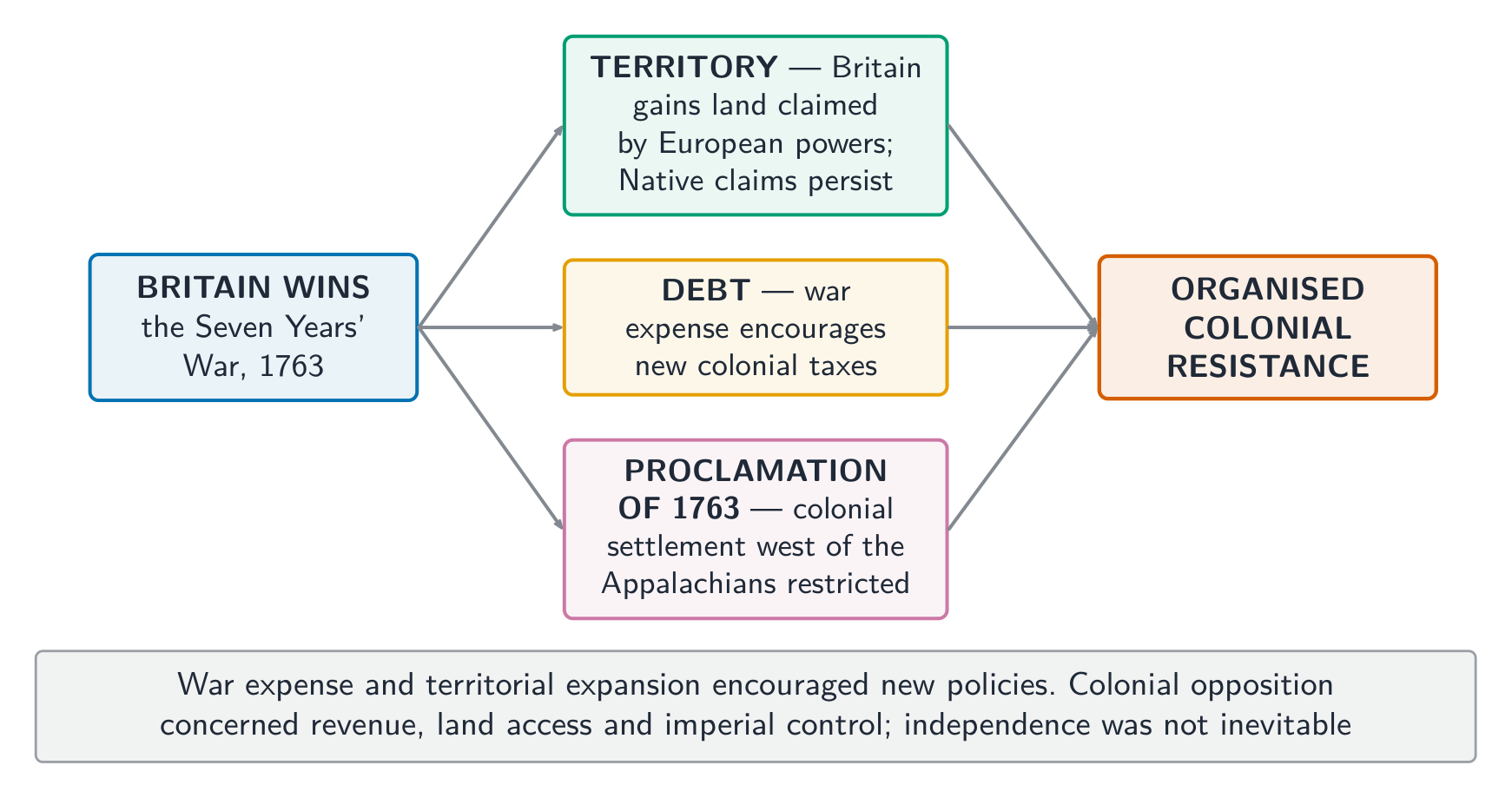
Colonial rivalry between Britain and France intensified as British colonists expanded into the interior. Their expansion threatened French–Indian trade networks and Native autonomy. The Seven Years' War 七年战争, known in North America as the French and Indian War 法印战争, ended with British victory.
Try it — cause and consequence. Before 1763, British colonial expansion threatened trade networks and Native control of land. After 1763, Britain held more territory but faced great war expense. Explain one cause of the war and one problem victory created. Name whose interests were threatened.
Worked reasoning. Inland expansion increased rivalry with France and threatened Native lands and trading relationships. Victory brought Britain a major expansion of territory 领土大扩张 and an enormous war debt 巨额战争债务. Officials sought revenue from the colonies and tighter imperial control. These policies challenged colonial economic interests and traditions of self-government.
Try it — one policy, different interests. The Proclamation of 1763 1763年公告线 restricted colonial settlement west of the Appalachian Mountains. British officials wanted to limit costly frontier conflict and control settlement. Colonists seeking land wanted access to western territory after helping win the war. Native groups sought to defend their lands while continuing European trade. Why could an attempt to reduce conflict produce colonial opposition? Why did imperial claims not mean Native peoples had surrendered their lands?
Worked reasoning. Settlement restrictions frustrated colonists seeking western land. Their opposition concerned land access as well as taxation. Native groups continued trade and resisted colonial encroachment: a European territorial claim did not remove Native communities or their resistance. Victory created problems of revenue and control, but independence was not an inevitable result.
Two earlier events frame this. At the start of the war, Benjamin Franklin's Albany Plan of Union 奥尔巴尼联盟计划 (1754) proposed one council for the colonies; no colony accepted it, which shows how little unity existed in 1754. At its end, the Odawa leader Pontiac led a coalition of Native peoples that attacked British forts around the Great Lakes - Pontiac's Rebellion 庞蒂亚克起义 (1763). That uprising helped prompt Britain to issue the Proclamation Line to limit frontier conflict.
The Seven Years' War as a cause: one victory, three consequences, one response
New British efforts to collect taxes 征税 without the consent of colonial assemblies, and to assert imperial authority, provoked organised resistance.
Paul Revere's engraving of British warships landing troops at Boston in 1768, sent to support the collection of the Townshend duties
Colonial leaders based their arguments on the rights of British subjects, on the ideals of the Enlightenment 启蒙思想, and on their own long experience of self-government - the assemblies built up during Period 2.
Resistance was not only argument. Facing shortages and, in some regions, British military occupation 军事占领, men and women both took part: boycotts of British goods, home manufacture, crowd action, and committees of correspondence. Leaders such as Benjamin Franklin 富兰克林 energised the movement, and the slogan of the period is "no taxation without representation" 无代表不纳税.
From imperial crisis to new nation, 1763-1798: British policies, colonial resistance and war, and building the republic
The chain of action and reaction - the answer bank for "describe one British policy, 1763-1776":
Sugar Act 糖税法 (1764): lowered the tax on molasses but enforced it strictly, with smugglers tried in naval courts without juries.
Stamp Act 印花税法 (1765): the first direct tax on the colonies, on newspapers, legal documents and playing cards. Nine colonies sent delegates to the Stamp Act Congress, the Sons of Liberty organised crowds, and merchants boycotted British goods. Parliament repealed the tax in 1766 but passed the Declaratory Act, insisting it could make laws for the colonies "in all cases whatsoever".
Townshend Acts (1767): taxes on imported glass, paper, paint and tea. Colonists answered with non-importation agreements; the Daughters of Liberty spun homespun cloth to replace British imports.
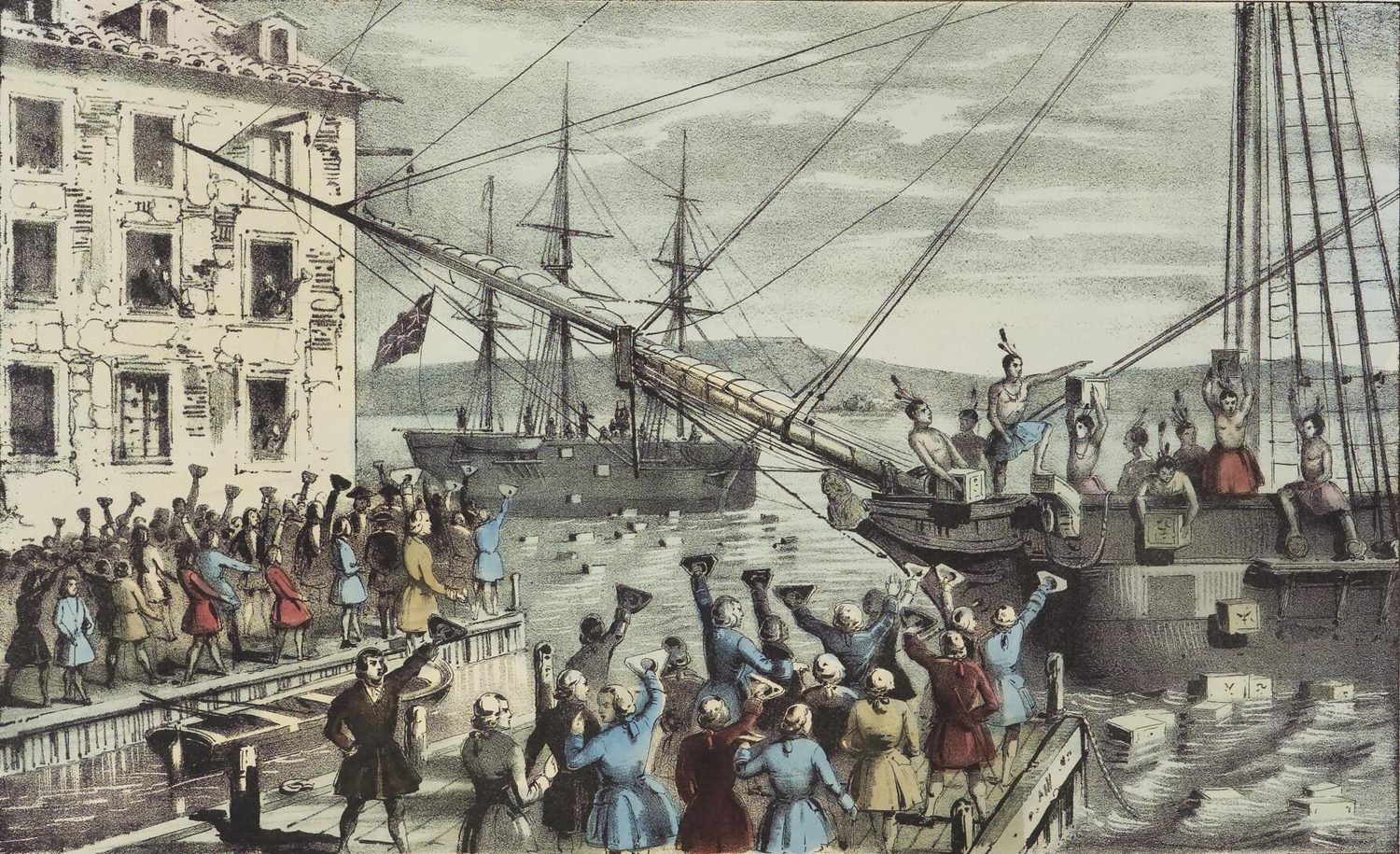
Tea Act (1773): helped the East India Company sell cheap tea in the colonies, with the tax included; Bostonians dumped 342 chests into the harbour.
Coercive Acts 强制法令 (1774), called the Intolerable Acts by colonists: closed Boston's port and limited town meetings. Twelve colonies sent delegates to the First Continental Congress 第一届大陆会议 (1774), and fighting began at Lexington and Concord in April 1775.
Different groups, different responses. Patriots resisted British policy, while about a fifth of colonists stayed Loyalists 效忠派, out of loyalty to the king, fear of disorder or ties of trade. Most Native nations sided with Britain, which had at least tried to limit settlement - the Mohawk leader Joseph Brant led raids on frontier settlements. Many enslaved people saw freedom in the British side: Dunmore's Proclamation 邓莫尔公告 (1775) promised freedom to enslaved men who fled Patriot owners to fight for the king. A "similarity or difference between two groups" answer can compare any two of these.
Enlightenment ideas led American political thinkers to emphasise individual talent over hereditary privilege, and to assert the natural rights 天赋权利 of the people and the sovereignty of the people 人民主权.
The title page of Common Sense (Philadelphia, 1776): a cheap pamphlet carried the case for independence to ordinary readers
Two documents carried those ideas to ordinary readers. Thomas Paine's pamphlet Common Sense (January 1776) sold more than 100,000 copies and argued in plain language that it was absurd for an island to rule a continent and that monarchy itself was wrong. The Declaration of Independence 独立宣言 (4 July 1776), drafted mainly by Thomas Jefferson, restated Locke's ideas: people have "unalienable rights" to "life, liberty and the pursuit of happiness", and when a government destroys these rights, the people may "alter or abolish it".
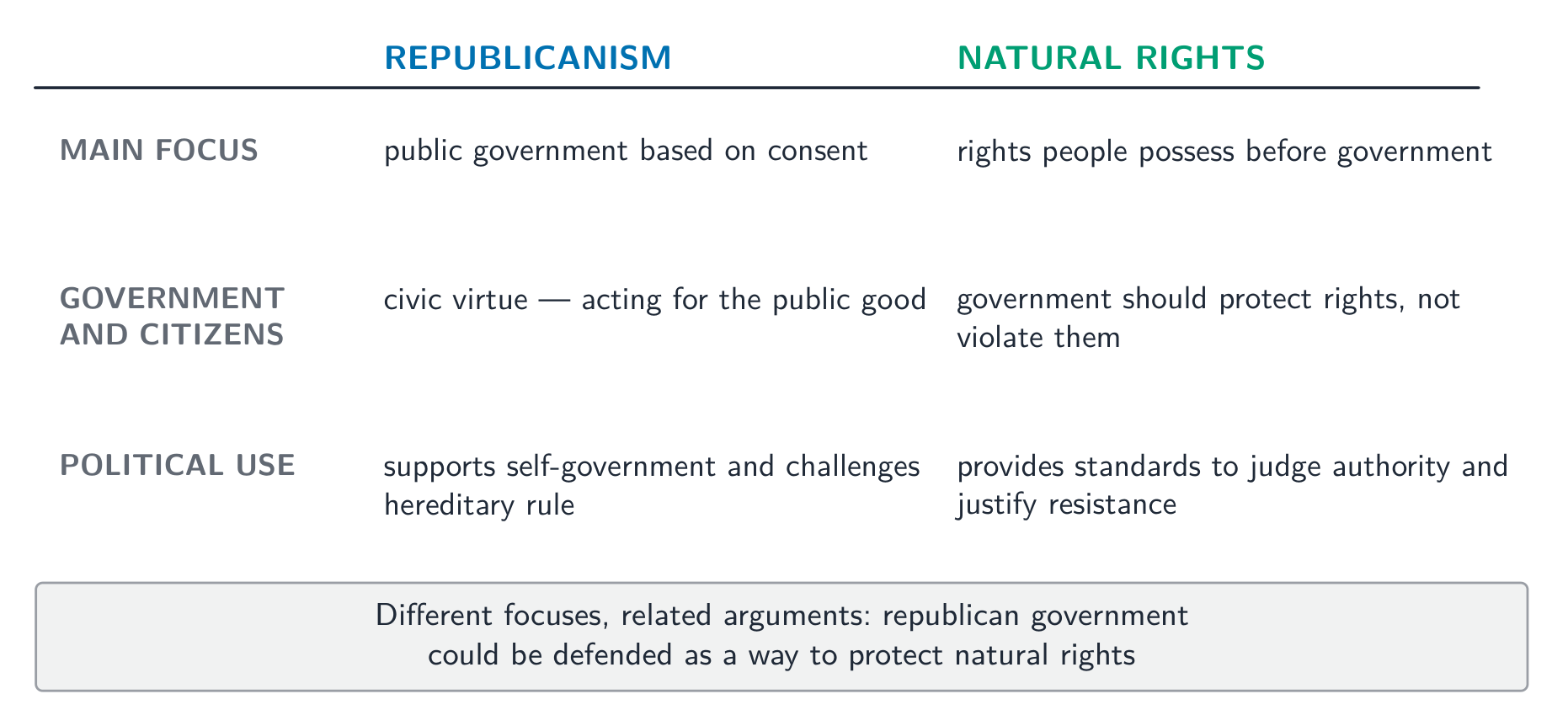
Try it — distinguish two claims. These are teacher-written claims, not historical quotations. A: People possess rights before government exists; violations can justify resistance. B: Public authority should rest on the people's consent, and citizens should place the public good above private gain. Match each to natural rights or republicanism and explain the difference in focus.
Worked distinction. A describes natural rights: government should protect rights that it did not create. B describes republicanism 共和主义: consent-based government and civic virtue, rather than hereditary rule and only private gain. Supporters could link the ideas by arguing that republican government would protect natural rights.
Try it — revise a claim. A student says natural rights mattered only during the break with Britain, and republicanism only afterwards. The CED explains that support for republican government based on natural rights appeared in Common Sense and the Declaration of Independence. Use that evidence to revise the student's claim.
Worked revision. Both ideas helped colonists criticise British rule and imagine a different government during the independence movement. Natural rights supplied standards for judging authority, while republicanism offered government based on the people's consent. The terms have different meanings but do not belong to separate, fixed stages. Naming them without explaining their role is not an argument.
Republicanism and natural rights are not synonyms: each answers a different question
Try it — explain victory. Britain had military and financial advantages, and the Patriot cause faced Loyalist opposition. Patriots had colonial militias, the Continental Army, Washington's leadership, commitment and resilience, and foreign assistance 外国援助 from European allies, including France. Why is “Britain was too weak to win” a poor explanation? Use an obstacle and two Patriot resources to revise it.
John Trumbull's painting of the British surrender at Saratoga, October 1777, the victory that brought France into the warFrom Saratoga to the Treaty of Paris
Worked explanation. British advantages did not guarantee victory. Militias and the Continental Army fought the war, while Washington's leadership helped sustain the Patriot effort. Commitment and European assistance helped the movement continue despite opposition and hardship. Neither British weakness nor one isolated Patriot advantage explains the whole outcome.
The turning point was Saratoga 萨拉托加战役 (1777), where an entire British army surrendered; it persuaded France to sign an alliance with the United States (1778), bringing French money, troops and, crucially, a navy. At Yorktown 约克镇 (1781) a French fleet blocked the sea while American and French armies trapped General Cornwallis's army, which surrendered. In the Treaty of Paris 巴黎条约 (1783) Britain recognised American independence, with a western border on the Mississippi River. Native allies of Britain were not consulted, and Britain handed over their land.
Try it — assess social change. The following evidence is paraphrased from the CED, not quoted from the original documents. In a 1777 freedom petition, Prince Hall and other free Black men used natural-rights and Christian ideas to argue for enslaved people's freedom. Pennsylvania passed an act for gradual abolition in 1780. The ideal of republican motherhood 共和母亲身份 valued women's role teaching republican values within families. Explain one change. Why does the evidence not prove immediate freedom and equal political rights for everyone?
Worked judgment. Rights language supported movements to abolish slavery 废奴运动; Pennsylvania's act shows a change in law, not immediate freedom throughout the country. Slavery continued and expanded into the deep South and adjacent western lands while antislavery 反奴隶制 sentiment grew. Republican motherhood changed ideas about the status of women 妇女地位 by valuing their political education within families, but did not itself establish equal political rights. A petition shows a demand, an act shows a legal change, and an ideal shows a valued role. These are different kinds of evidence with different limits.
Transfer — global influence. The American Revolution and the Declaration's ideals influenced movements in France, Haiti and Latin America. Does that mean these movements had identical aims or only one cause? Write a qualified claim that distinguishes “inspired” from “fully explains”.
Worked transfer. The Revolution and its rights language offered inspiration to movements in France, Haiti and Latin America. That evidence establishes influence, not identical aims or a single cause for each movement. Explaining a particular revolution requires evidence about its own circumstances and participants. Similarly, ideals encouraged challenges to inequality at home without automatically abolishing slavery or creating equal rights.
The Revolution's ideals ran further than intended - while slavery expanded at the same time
Exam transfer — 2025 AP US History, Set 1, Question 3(C), paraphrased. Briefly explain how one group responded to debates about British colonists' rights during 1765–1783. Try it: identify a group, its response and the reasoning linking that response to the rights debate. Naming “natural rights” or “the Revolution” alone does not explain a response.
Teacher-written model. Some Patriot colonists argued that British government had violated their natural rights. They therefore supported declaring independence in 1776 as a justified response to a government that failed to protect those rights.
Why this fits. It identifies a group and explains why a rights argument supported a particular response within the dates. The official scheme accepts colonists using natural-rights arguments to justify independence; it also accepts Loyalist defence of the Crown and other relevant responses. This is our model, not an official sample or the response of every colonist.
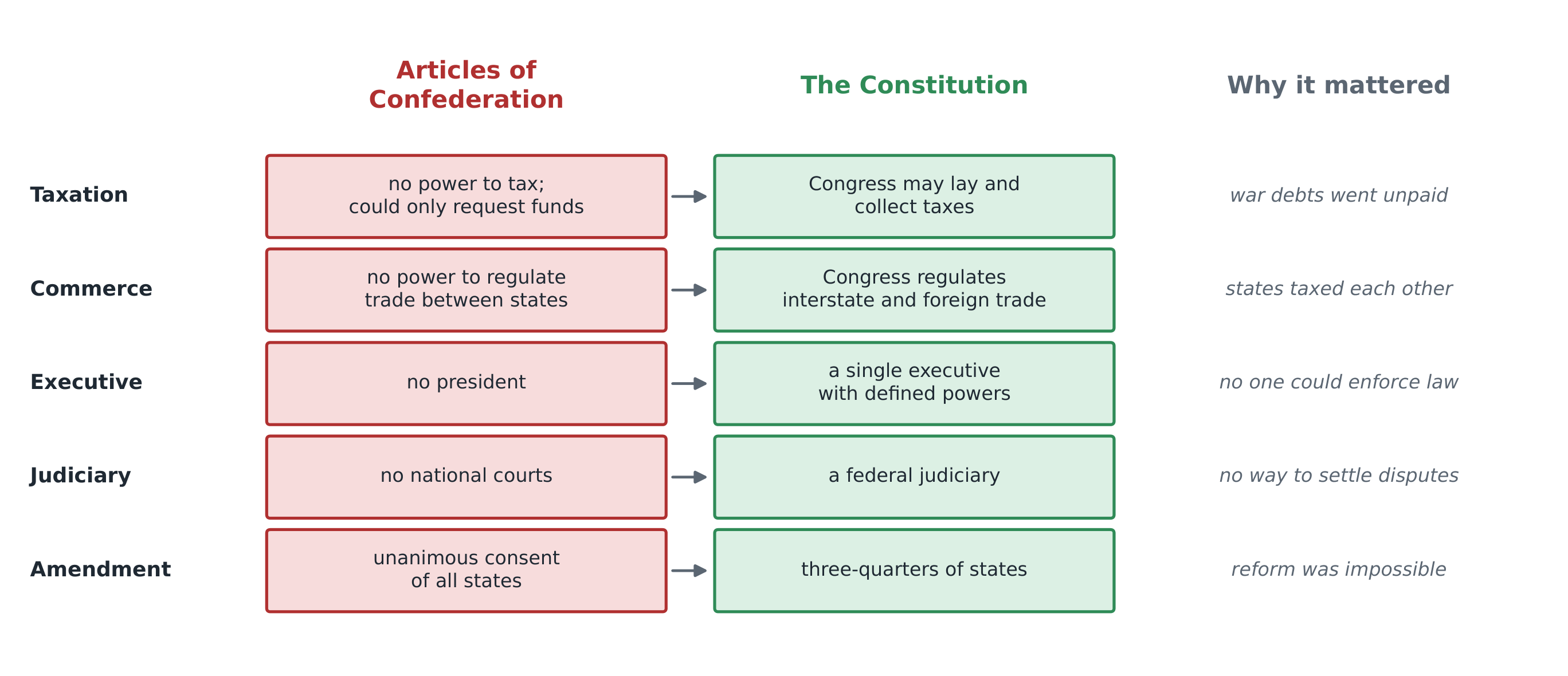
The Constitution was written to fix specific, named weaknesses - each row is one of them
After declaring independence, leaders wrote new constitutions and declarations of rights that reflected republican ideals, generally limiting executive power.
The Articles of Confederation 邦联条例 created a deliberately weak central government: no power to tax, no power to regulate commerce, no independent executive, and no general national court system (though Congress created a court for appeals in captured-ship cases). It succeeded in organising western settlement through the Northwest Ordinance 西北法令, but could not manage debt, trade disputes, or unrest.
The Northwest Ordinance (1787) set out how a territory became a state on equal terms with the original thirteen and banned slavery in the Northwest Territory, north of the Ohio River - a lasting success of the Articles. The failures came to a head in Shays' Rebellion 谢斯起义 (1786-87), when indebted Massachusetts farmers led by Daniel Shays closed courts to stop farm seizures. Congress had a small army but lacked reliable revenue to fund an effective response, and the rebellion convinced many leaders that a stronger national government was needed.
The Constitutional Convention 制宪会议 of 1787 produced a stronger national government built on compromise 妥协, including the Great Compromise 大妥协 over representation and compromises over slavery and commerce.
The Great Compromise combined the large states' Virginia Plan (representation by population) with the small states' New Jersey Plan (equal votes): a House by population and a Senate with two members per state. The Three-Fifths Compromise 五分之三妥协 counted three of every five enslaved people when deciding a state's seats in the House, which increased the power of slaveholding states, and Congress could not ban the Atlantic slave trade before 1808.
Ratification 批准 was contested. Federalists 联邦党人 argued the new government was strong enough to govern yet checked enough to be safe; Anti-Federalists 反联邦党人 feared centralised power and demanded protection for individual liberties, which produced the Bill of Rights 权利法案.
To win ratification in New York, Alexander Hamilton, James Madison and John Jay wrote the Federalist Papers 联邦党人文集 (1787-88); Madison's Federalist No. 10 argued that a large republic would control factions better than a small one. The Bill of Rights, the first ten amendments, was ratified in 1791.
The Boston Tea Party, 1773 (Currier lithograph): property destroyed to resist taxation without representation
Under George Washington 华盛顿 and John Adams 亚当斯, political leaders disagreed sharply over the relationship between the national and state governments, economic policy, and foreign policy. Those disagreements hardened into the first party system 第一政党体系.
The argument began with Hamilton's financial plan 汉密尔顿财政计划: the federal government would take over the states' war debts, create a Bank of the United States 美国银行 (1791) and raise money through tariffs and a tax on whiskey. Hamilton read the Constitution loosely - the power to do what was "necessary and proper" allowed a bank. Thomas Jefferson and James Madison read it strictly and feared a government serving northern merchants and bankers at the expense of farmers. Hamilton's supporters became the Federalists; Jefferson's became the Democratic-Republicans 民主共和党.
The new government also proved it could enforce its laws: when western Pennsylvania farmers attacked tax collectors in the Whiskey Rebellion 威士忌暴动 (1794), Washington led about 13,000 militia to end it - a sharp contrast with Shays' Rebellion. These are strong answers to "one effect of ratifying the Constitution, 1789-1800".
War between France and Britain after the French Revolution 法国大革命 forced hard choices, and the government pursued diplomatic initiatives to deal with the continued British and Spanish presence in North America. Washington's Farewell Address 华盛顿告别演说 urged national unity and warned against political factions and permanent foreign alliances.
In practice: Washington's Neutrality Proclamation (1793) kept the United States out of the war; Jay's Treaty 杰伊条约 (1794) got British troops out of their western forts but angered Democratic-Republicans as too friendly to Britain; and Pinckney's Treaty 平克尼条约 (1795) won from Spain the right to ship goods down the Mississippi through New Orleans. Under Adams, an undeclared naval war with France led Federalists to pass the Alien and Sedition Acts 外侨和煽动叛乱法 (1798), which made it a crime to publish "false, scandalous and malicious" writing against the government. Jefferson and Madison answered with the Virginia and Kentucky Resolutions 弗吉尼亚和肯塔基决议, arguing that states could judge federal laws unconstitutional - a states' rights argument that returns before the Civil War.
Meanwhile a distinctive national culture 民族文化 developed - in art, literature, and architecture - alongside continued regional variation.
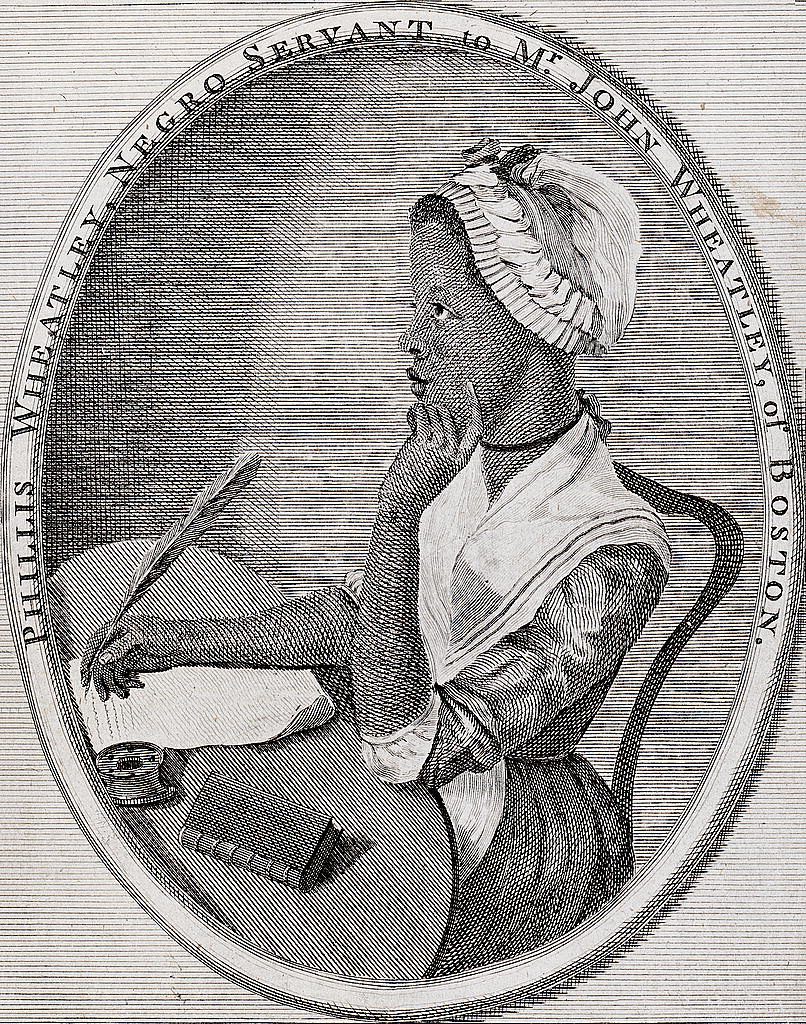
Phillis Wheatley, frontispiece of her 1773 Poems, the first book by an African American woman
American Indian groups repeatedly evaluated and adjusted their alliances with European powers and the new United States as circumstances changed.
Growing numbers of migrants moved west, intensifying competition over resources, boundaries, and trade 资源、边界与贸易. The relationship between the federal government and American Indian tribes remained ambiguous 含混不清, contributing to recurring conflict. In the Southwest, the Spanish expanded their mission system 传教团体系, supported by the bonded labour of local American Indians.
In the Ohio country, a confederation of Native nations led by the Miami war leader Little Turtle defeated a U.S. army in 1791. A larger army under Anthony Wayne won the Battle of Fallen Timbers 鹿砦战役 (1794), and in the Treaty of Greenville 格林维尔条约 (1795) the Native nations gave up most of present-day Ohio.
The Treaty of Greenville council, 1795: after Fallen Timbers the Native nations of the Ohio country ceded most of present-day Ohio
Modelled LEQ thesis for "the extent to which settler expansion influenced North America, 1754-1800": "Settler expansion influenced North America to a great extent: the push into the Ohio Valley helped start the French and Indian War, anger at the Proclamation Line fed the revolutionary movement, and after independence western settlement drove the Northwest Ordinance and repeated wars that forced Native nations to give up their lands, as in the Treaty of Greenville; yet the political shape of the new nation owed more to debates over taxation and rights than to the frontier."
The period's reasoning skill is continuity and change 延续与变化. The strongest answers hold both: political institutions changed radically, while slavery, westward expansion, and conflict with American Indians continued and intensified.
Exam transfer — 2025 AP US History, Set 1, Question 3(B). The prompt asks students to briefly describe one effect of the Seven Years' War from 1754 to 1765. Try it before reading the model: describe an effect within those dates, with relevant details. Would the Declaration of Independence in 1776 fit?
Teacher-written model. Britain's costly victory encouraged Parliament to raise revenue from its North American colonies. The Stamp Act of 1765 imposed a tax on printed materials in the colonies.
Check the prompt's dates first: an accurate fact outside the window does not answer the question.
Why this fits. The response describes a postwar tax policy within 1754–1765. The official scheme accepts further British taxation to pay for the war, the end of French colonies, or heightened tensions among colonists, British officials and Native groups. “Describe” requires relevant characteristics beyond an isolated term; it does not require a fixed two-part formula. The Declaration of Independence falls outside the dates of this prompt. This model is our teaching response, not an official sample answer or a guarantee of credit.
Each part needs only one or two sentences: answer the question, cite one specific piece of evidence, and explain how it supports the answer.
One missing power, a chain of weakness
Answer (a), (b) and (c).
(a) Briefly describe ONE change in British policy toward the colonies after the Seven Years' War.
(b) Briefly describe ONE colonial response to that change.
(c) Briefly explain ONE weakness of the Articles of Confederation.
Model answer.
(a) To pay its war debts, Britain imposed new taxes such as the Stamp Act (1765), and it restricted settlement west of the Appalachians with the Proclamation of 1763.
(b) Colonists organised boycotts of British goods and sent delegates to the Stamp Act Congress, arguing that only their own assemblies could tax them.
(c) Congress had no power to tax, so it struggled to pay debts and fund troops; Shays' Rebellion (1786–1787) showed how weak the national government was.
3.13
考试技巧
English
Explain how war expense and territorial expansion led to new revenue measures, settlement restrictions and resistance; avoid treating independence as inevitable.
Explain how republicanism and natural rights support an argument, using evidence rather than only naming them.
For the Constitution, argue from the specific weakness it fixed - no power to tax, no power to regulate commerce, no executive.
Keep Federalist and Anti-Federalist positions straight, and remember the Bill of Rights was the price of ratification.
The Revolution's effects on slavery and women are examinable, and both are partial: ideals spread further than rights did.
On continuity-and-change prompts, give one of each. An answer that only lists changes has answered half the question.
Common mistakes.
Writing that the colonists opposed all taxes. They opposed taxes passed by a Parliament in which they were not represented; their own assemblies taxed them.
Treating all colonists as Patriots. Loyalists, neutral colonists, Native nations and enslaved people made different choices for their own reasons.
Explaining victory with French help alone, or without it. Saratoga, the French alliance and Yorktown belong in one chain.
Mixing up the two rebellions: Shays' Rebellion (1786-87) exposed the weakness of the Articles; the Whiskey Rebellion (1794) showed the strength of the new government.
Assuming the Federalists of 1787-88 (who supported the Constitution) and the Federalist Party of the 1790s are simply the same people. Madison was a Federalist in 1788 and a Democratic-Republican by 1792.
Practice.
Briefly describe ONE British government policy enacted in colonial North America from 1763 to 1776.
Briefly explain ONE difference in how two groups in North America responded to British policy from 1763 to 1783.
Briefly explain ONE specific development that contributed to the colonists' victory over Great Britain.
Briefly explain ONE weakness of the Articles of Confederation and how the Constitution addressed it.
Briefly describe ONE effect of the ratification of the Constitution from 1789 to 1800.
Answers.
The Stamp Act (1765) taxed newspapers and legal documents directly, which colonists resisted through boycotts and the Stamp Act Congress.
Patriots boycotted British goods and took up arms, while many enslaved people fled to the British after Dunmore's Proclamation (1775) offered freedom to those who fought for the king.
The American victory at Saratoga (1777) persuaded France to ally with the United States in 1778, and the French navy made the victory at Yorktown possible.
Congress could not tax, so it struggled to pay debts and fund troops against Shays' Rebellion; the Constitution gave Congress the power to tax.
Hamilton's financial plan created a national bank and federal tax system, which split political leaders into the first two parties.
Vocabulary card meanings
Seven Years' War: The global war, ending in 1763, that left Britain dominant in North America.
French and Indian War: The North American fighting of 1754-1763 in the wider war that ended most French mainland rule there.
major expansion of territory: Britain's large gain of land in North America after 1763.
enormous war debt: The heavy borrowing Britain faced after defeating France.
Proclamation of 1763: A British line meant to limit colonial settlement west of the Appalachians.
collect taxes: Raising revenue from the colonies to help pay imperial costs.
ideals of the Enlightenment: Ideas of natural rights, consent, and limits on government.
military occupation: Stationing troops among civilians, resented in the colonies.
Benjamin Franklin: A colonial printer, scientist, and diplomat of the revolutionary era.
"no taxation without representation": The protest that Parliament had no right to tax colonists who elected no members.
sovereignty of the people: The claim that ultimate political authority rests with the citizens.
Republicanism: A politics of self-government by citizens, without a king.
foreign assistance: Help from abroad, especially France, during the War of Independence.
movements to abolish slavery: Campaigns to end the legal ownership of people.
status of women: The limited legal and political position of women after independence.
republican motherhood: The idea that women should raise sons as virtuous citizens.
antislavery: Opposition to the institution of slavery.
Articles of Confederation: The first US constitution, which created a weak central government.
Northwest Ordinance: The 1787 law for the Northwest Territory that also banned slavery in that territory alone.
Constitutional Convention: The 1787 meeting that drafted a new federal constitution.
compromise: A bargain in which each side yields part of its demand.
Great Compromise: The deal that gave states equal Senate seats and House seats by population.
Ratification: Formal approval that brought the Constitution into effect.
Federalists: Supporters of the Constitution and of a stronger national government.
Anti-Federalists: Opponents who feared a strong central government without a bill of rights.
Bill of Rights: The first ten amendments, listing limits on federal power.
George Washington: The first president and the commanding general of the revolutionary army.
John Adams: The second president, a Federalist from Massachusetts.
first party system: The early split between Federalists and Democratic-Republicans.
French Revolution: The upheaval in France that divided American opinion in the 1790s.
Washington's Farewell Address: The 1796 warning against permanent alliances and party spirit.
national culture: Shared stories, symbols, and habits meant to bind the new nation.
resources, boundaries, and trade: The concrete issues in early dealings with Indigenous nations and neighbours.
ambiguous: Open to more than one reading, as some early policies were.
mission system: Spanish religious settlements used to convert and control Indigenous peoples.
continuity and change: What stayed the same over time and what did not.