| English | 释义 | 拼音 |
|---|---|---|
| Jay Treaty | 杰伊条约 | jié yī tiáo yuē |
| Pinckney's Treaty | 平克尼条约 | píng kè ní tiáo yuē |
| Neutrality Proclamation | 中立宣言 | zhōng lì xuān yán |
| Democratic-Republicans | 民主共和党 | mín zhǔ gòng hé dǎng |
A French diplomat sails into trouble, 1793
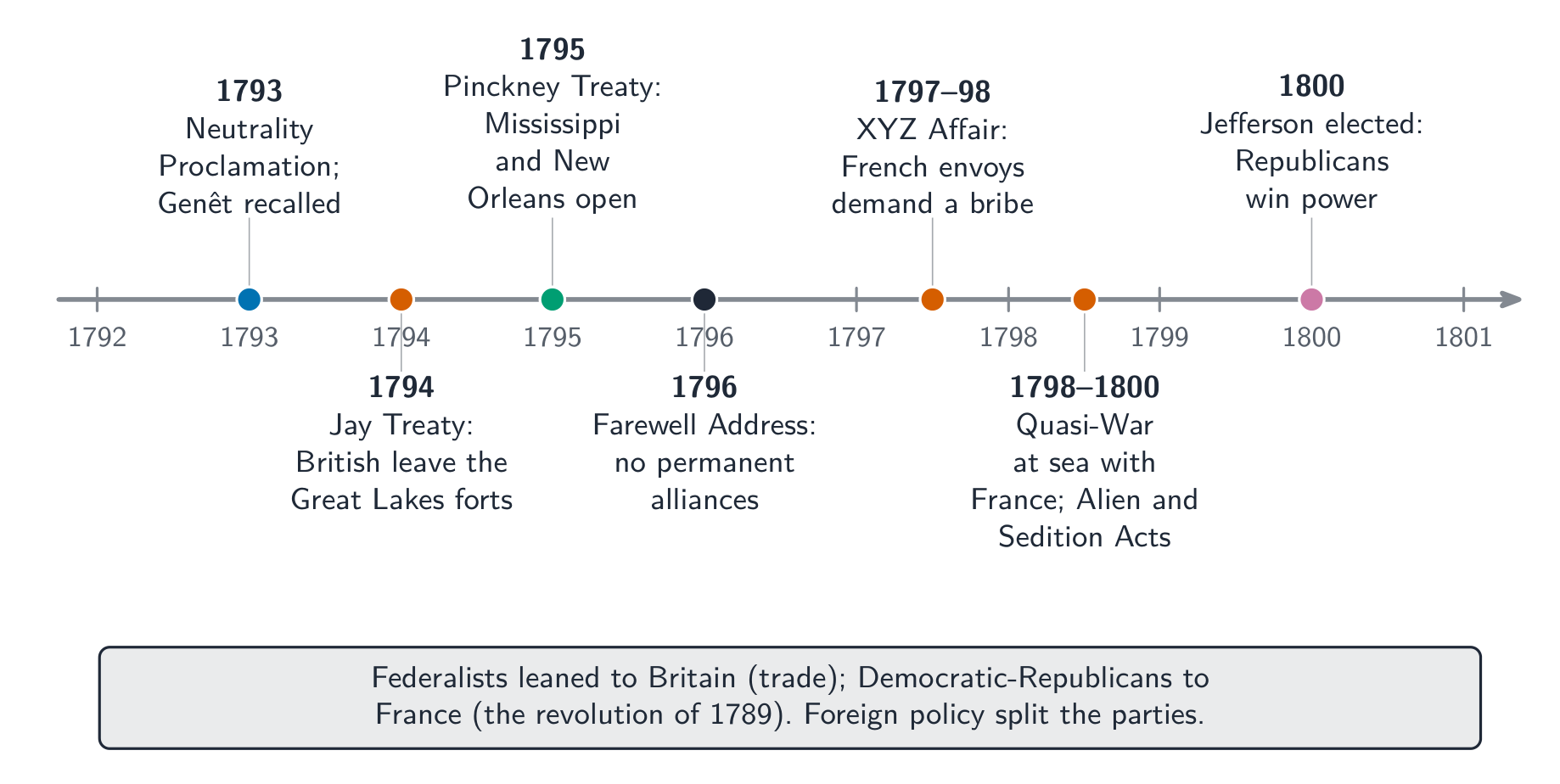
- In April 1793, Edmond-Charles Genêt, the new French republic's minister, landed at Charleston. France was at war with Britain, and Genêt began hiring American ships to attack British trade — without asking the government. Crowds cheered him; Washington had just declared the United States neutral. Washington demanded that France recall him.
- The young republic had to survive among powerful empires, and foreign policy helped create its first political parties.
Why did Washington demand Genêt's recall?
难度 1/5 · 今日首次完成可获 100 金币及少量额外奖励
Neutrality in 1793.
Diplomacy with empires nearby
- Britain still kept forts on American land around the Great Lakes, and Spain controlled the mouth of the Mississippi at New Orleans.
- The Jay Treaty 杰伊条约 (1794) got Britain to leave its forts; Pinckney's Treaty 平克尼条约 (1795) won Americans the right to ship goods down the Mississippi.
Match each treaty to what it won.
难度 2/5 · 今日首次完成可获 140 金币及少量额外奖励
Diplomacy with empires.
A European war divides Americans
- Washington's Neutrality Proclamation 中立宣言 (1793) kept the US out of the war between Britain and France.
- Jefferson's supporters favoured revolutionary France; Hamilton's favoured Britain, the main trading partner.
Foreign relations, native relations, or domestic politics?
Sort each element of the new republic's first decade.
Worked example: the first parties
- Federalists (Hamilton, Adams): a strong national government, a national bank, trade with Britain and support from merchants.
- Democratic-Republicans 民主共和党 (Jefferson, Madison): strict limits on federal power, farmers' interests and sympathy for France.
- The test: when France seized American ships after the XYZ Affair (1797–98), the two countries fought an undeclared naval "Quasi-War", and Federalists passed the Alien and Sedition Acts (1798) against their critics.
Match each position to its party.
难度 2/5 · 今日首次完成可获 140 金币及少量额外奖励
The first parties.
Put these events in order.
难度 3/5 · 今日首次完成可获 200 金币及少量额外奖励
1793, 1794, 1796, 1798.
Spain in California
- From 1769, Spain built missions along the California coast, starting at San Diego, under Father Junípero Serra.
- Native Californians were forced to work and convert; disease killed many.
Spain began building missions in California in 1769.
难度 1/5 · 今日首次完成可获 100 金币及少量额外奖励
Starting at San Diego.
A warning about both
- In his Farewell Address (1796), Washington warned against permanent foreign alliances and against the "spirit of party".
- Both warnings were already being ignored.
Washington's warning did not stop parties forming. By 1796, Federalists and Democratic-Republicans were competing openly, divided over foreign policy and federal power.
Washington's warning prevented political parties from forming.
难度 1/5 · 今日首次完成可获 100 金币及少量额外奖励
They already existed.
The young republic used the Jay and Pinckney Treaties to deal with Britain and Spain, and stayed neutral in the war between Britain and France. Disagreements over France, Britain, the bank and federal power created the Federalists and Democratic-Republicans, despite Washington's warning.
Explain how foreign policy contributed to the rise of political parties in the 1790s.
Causation.