Why it matters. Of the roughly 500 English colonists at Jamestown in the autumn of 1609, only about 60 were alive the next spring - the "starving time". Relief ships saved the colony in 1610; John Rolfe's tobacco experiments from 1612 later gave it a profitable export. Earlier trade in corn with the Powhatan people had also sustained the settlers. A crop, a market and a relationship with Native neighbours decided whether a colony lived or died - and in different combinations they explain why the colonies of 1754 looked so different from one another.
Period 2 runs from 1607 to 1754 - from Jamestown to the eve of the Seven Years' War. Its central question is why European colonies turned out so differently from one another.
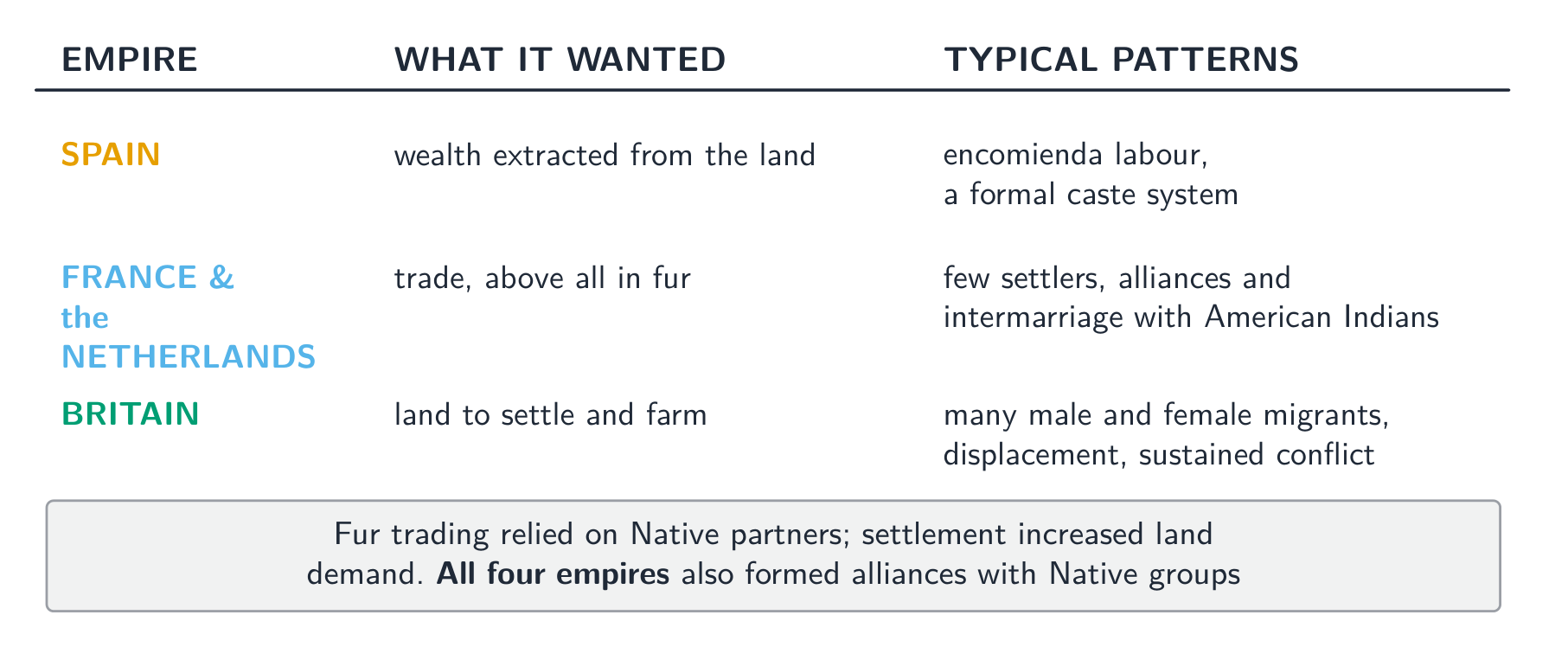
Imperial goals, migration and local conditions helped shape different colonial patterns:
Spain extracted wealth from the land, developing institutions built on subjugating 征服 native populations - the encomienda system carried over from Period 1.
France and the Netherlands sent relatively few Europeans and relied on trade alliances 贸易同盟 with American Indians, especially in fur 毛皮.
Britain attracted a comparatively large number of male and female migrants 男女移民, who came to settle and farm rather than only to extract.
Agricultural settlement increased British demand for Native land and contributed to displacement and conflict. This is a broad comparison, not a rule that British colonists never traded or made alliances. French, Dutch, British and Spanish colonies all formed alliances with Native groups; trade, cooperation and conflict could coexist. Native communities pursued their own diplomatic and economic goals.
Four empires, four goals - and how the goal predicted the relationship with American Indians
Try it — explain the different strategies. These are teaching summaries, not historical quotations. A colony has few European settlers and depends on Native partners for furs. Another has many farming settlers seeking additional land. A third extracts resources through institutions that subjugate Native communities. Match the patterns to French/Dutch, British and Spanish colonization. Explain the link between each economic goal and its relationships; do not only name an empire.
Worked reasoning. French and Dutch fur exports relied on Native trading partners and diplomatic relationships. British agricultural settlement increased demand for land and contributed to displacement and conflict. Spanish resource extraction relied on institutions that controlled Native labour and society, alongside conversion and other goals. These are patterns with variation, not complete accounts of every colony.
Transfer — test a universal claim. A student says, "Only French and Dutch colonists made Native alliances; British settlers never did." Use the course evidence that all four empires allied with Native groups to explain why the claim fails. A British alliance does not erase land conflict, and a French trading alliance does not establish that French colonization was always peaceful. Identify the place, period and purpose before generalising.
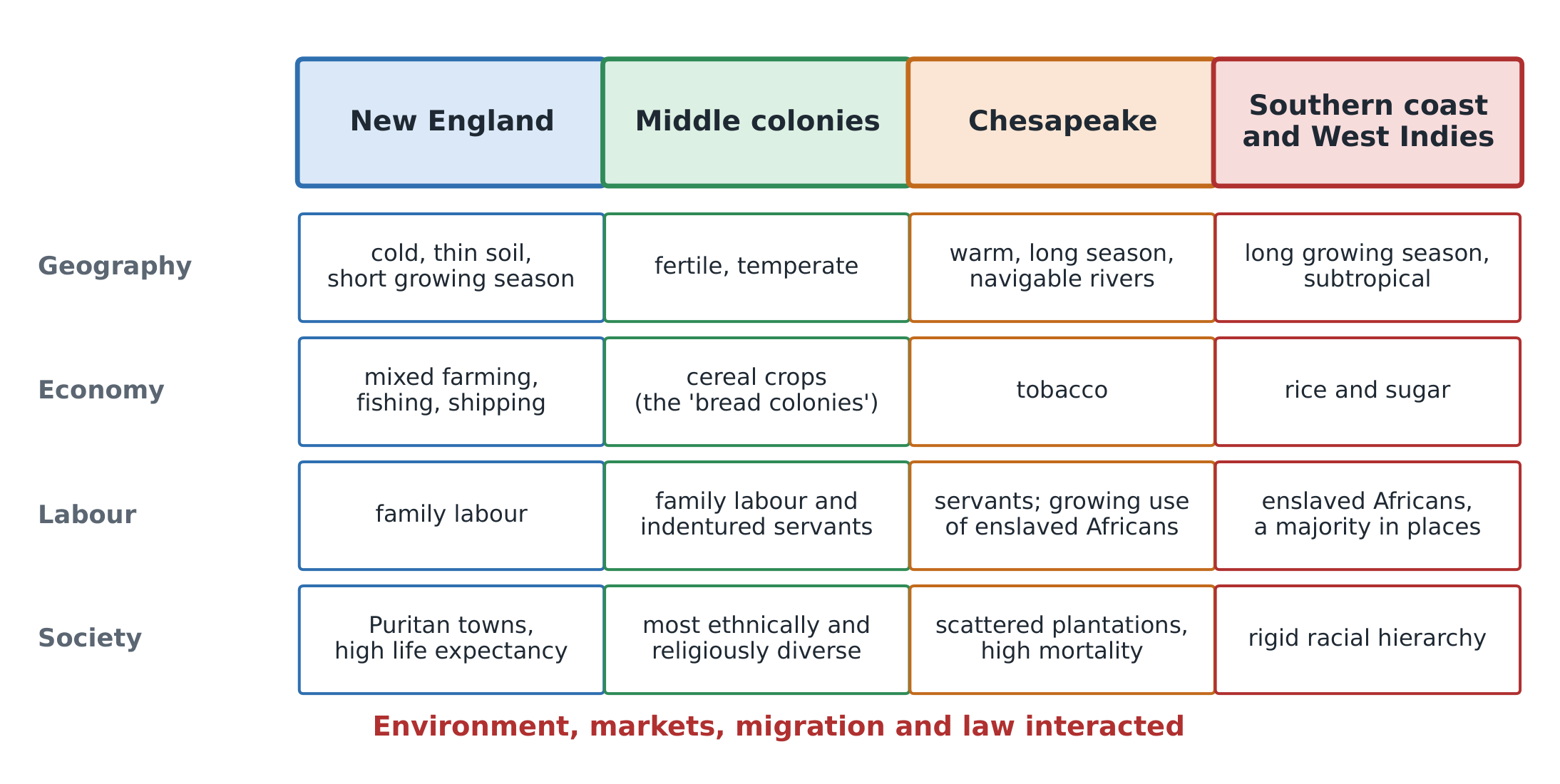
British North America was not one place. Four regions developed distinct societies.
Westover, a Virginia tobacco planter's brick house on the James River, built about 1750: Chesapeake wealth spread out along the rivers
The Chesapeake 切萨皮克 and North Carolina grew prosperous exporting tobacco 烟草, a labour-intensive crop. Labour came first from indentured servants 契约仆役 and increasingly from enslaved Africans.
The New England colonies, initially settled by Puritans 清教徒, developed around small towns with family farms 家庭农场, a mixed economy, and unusually high life expectancy.
The middle colonies supported a flourishing export economy based on cereal crops 谷物, and attracted the broadest range of European migrants, producing the most ethnically and religiously diverse 族群与宗教多元 region.
The colonies of the southern Atlantic coast and the British West Indies used long growing seasons for rice 稻米 and sugar 蔗糖, cash crops so labour-hungry that enslaved Africans became a majority of the population in places.
Regional patterns: environment, markets, migration and law interacted; no single factor determined societyBritish North America, 1607-1739: new colonies, self-government and slave law grew up alongside repeated wars
Agriculture and migration. In the Chesapeake, tobacco needed workers, so Virginia offered the headright system 人头权制度: 50 acres of land to anyone who paid a migrant's passage. Most migrants came as indentured servants - young, mostly male, working four to seven years in return for the voyage. In New England, by contrast, Puritans migrated as families in the 1630s, so the sex ratio was even and towns grew from the start. That contrast - single male servants for a cash crop, families for subsistence farming - answers both "similarity" and "difference" questions about agriculture and regional development. A similarity: farming shaped settlement in both regions, though religion was central to Puritan migration.
Religion in two colonies. Exam questions ask for a similarity and a difference between colonies:
Massachusetts Bay (1630) was founded by Puritans to be, in John Winthrop's words, "a city upon a hill" - a model Christian community. Church and government worked closely, only church members could vote at first, and dissenters were expelled: Roger Williams 罗杰·威廉斯 was banished in 1635 and Anne Hutchinson in 1638.
Rhode Island (1636), founded by Williams, separated church and state and allowed freedom of worship.
Maryland (1634) was a refuge for English Catholics; its Toleration Act 宽容法 (1649) protected all Christians who believed in the Trinity.
Pennsylvania (1681) was founded by the Quaker William Penn as a "holy experiment" with broad religious freedom and, at first, fair purchase of Lenape land.
Similarity: religion was a reason for founding all four. Difference: Massachusetts enforced one faith, while Rhode Island and Pennsylvania tolerated many.
Try it — compare using evidence. Use the regional notes to compare the Chesapeake with New England. Name one economic difference, describe the labour patterns, then explain how the difference connects to production. Include a similarity: both regions took part in Atlantic commerce.
Worked comparison. The Chesapeake exported labour-intensive tobacco and increasingly relied on enslaved Africans after extensive use of indentured servants. New England combined family farming with fishing, shipping and commerce. Different production patterns helped shape different labour arrangements, while both regions participated in Atlantic markets. These are dominant patterns; they do not mean slavery was absent from New England or that all Chesapeake workers had the same status.
Transfer — qualify a causal claim. "Warm weather caused slavery, and geography determined society." Explain one relevant environmental influence and two other factors. Long growing seasons supported some plantation crops, but export demand, migration, colonists' coercive decisions and laws establishing racial and hereditary slavery also shaped labour systems. Climate did not require people to enslave others. All British colonies participated in slavery to varying degrees; say where slavery was more common, rather than claiming it was absent elsewhere.
One political feature was shared. Distance from London, and Britain's initially lax attention 松散管理, let the colonies create self-governing institutions 自治机构 - colonial assemblies that later shaped resistance to imperial control.
Examples: the Virginia House of Burgesses (1619), the first elected assembly in English America; the Mayflower Compact 五月花公约 (1620), in which the Plymouth settlers agreed to govern themselves by majority rule; and New England town meetings. When James II tried to cancel the New England charters and rule through one appointed governor - the Dominion of New England 新英格兰自治领 (1686-89) - colonists overthrew it as soon as news of England's Glorious Revolution arrived.
An Atlantic economy 大西洋经济 developed in which goods - and enslaved Africans and American Indians - were exchanged around the ocean rim. Continuing trade increased the flow of goods in and out of American Indian communities, changing them too.
The trade is often drawn as a triangular trade 三角贸易: New England rum and manufactured goods to West Africa, enslaved Africans across the Atlantic on the brutal Middle Passage 中间航道 to the West Indies, and sugar and molasses back to New England and Britain. Real routes were more varied, but the idea links the regions: New England merchants profited from slavery without many enslaved people living there.
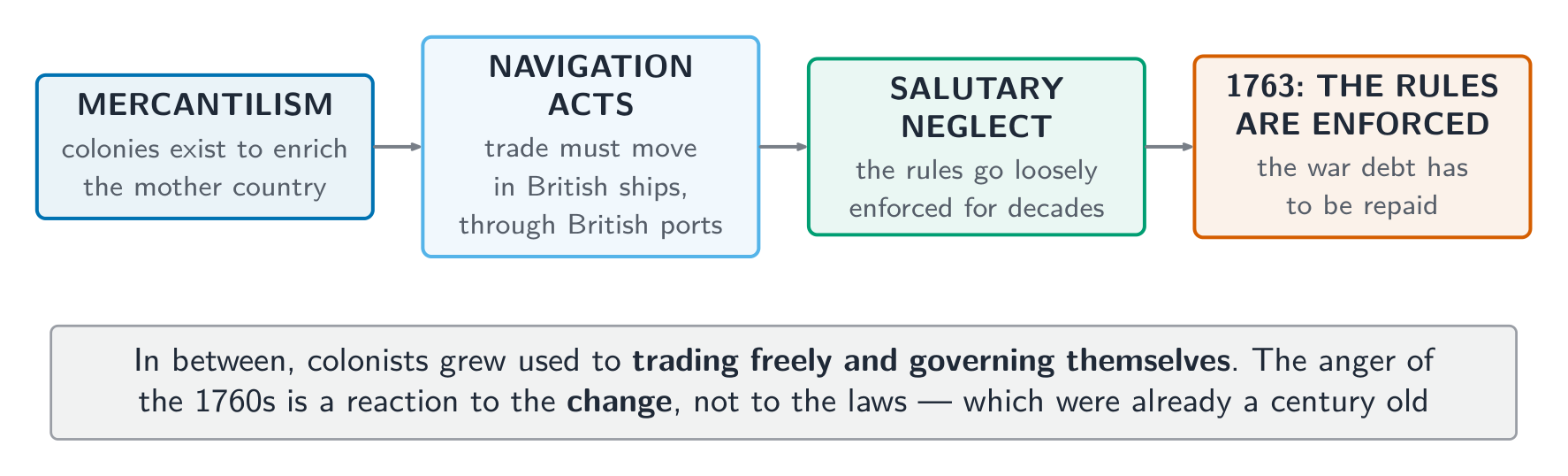
From the mid-seventeenth century, the British government tried to bring its colonies into a coherent imperial system, driven by mercantilism 重商主义 - the belief that colonies exist to enrich the mother country. The Navigation Acts 航海条例 restricted colonial commerce to English or colonial ships, required specified exports to go to England or its colonies, and routed most European imports through England.
Enforcement was loose for decades, a practice later called salutary neglect 有益的忽视. Colonists grew used to trading freely and governing themselves, which is exactly why tightening the rules after 1763 provoked such anger.
From mercantilism to the anger of the 1760s: the laws were old, the enforcement was new
Contact produced both accommodation 调适 and conflict 冲突, and the balance differed by empire and region.
Where trade mattered most - New France, the Dutch fur trade - alliances and intermarriage were common. Where land mattered most, conflict followed. British expansion led to sustained military conflict 军事冲突 with American Indians over land, resources, and boundaries.
Three New England and Chesapeake examples: the Powhatan wars in Virginia (1622 and 1644); the Pequot War 佩科特战争 (1637), in which colonists and their Native allies destroyed a Pequot town; and Metacom's War 梅塔科姆战争 (1675-76), also called King Philip's War, in which the Wampanoag leader Metacom led a coalition against expanding settlement. In proportion to population it was one of the deadliest wars in American history. In Virginia, Bacon's Rebellion 培根起义 (1676) began when poor frontier settlers attacked Native villages and then turned on the governor who refused to support them.
John Underhill's 1638 plan of the attack on the Pequot fort at Mystic (1637): colonists and their Native allies ring the palisade
How Native peoples adapted. Adaptation was active, not passive. Plains peoples such as the Comanche and Lakota adopted the horse (spread north after the Pueblo Revolt) and became mounted bison hunters and powerful military forces. Many groups traded furs for guns, metal tools and cloth, and used them in their own wars. The Haudenosaunee (Iroquois Confederacy) played Britain and France against each other to keep their independence. Some converted to Christianity or lived in "praying towns", often while keeping older beliefs. A strong LEQ thesis: "Native Americans adapted to European colonists chiefly through selective trade and shifting alliances, using European goods and rivalries to defend their own interests, while armed resistance became more common wherever settlers demanded land."
Resistance took organised forms. The Pueblo Revolt 普韦布洛起义 of 1680 drove the Spanish out of New Mexico for over a decade and forced lasting changes in Spanish policy - the clearest example in the course of native resistance succeeding.
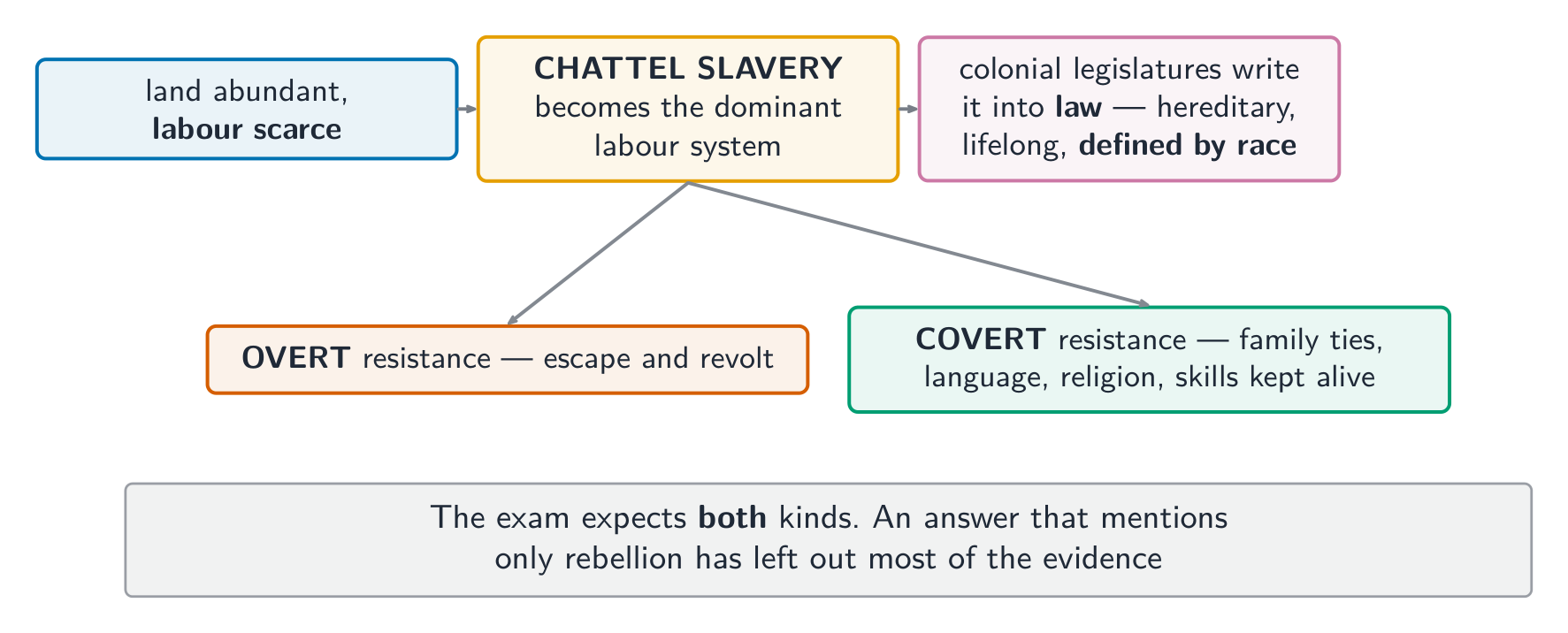
All the British colonies participated in the Atlantic slave trade to varying degrees, because land was abundant and labour scarce.
As chattel slavery 动产奴隶制 became the dominant labour system in many southern colonies, colonial legislatures wrote new laws creating a strict racial system 严格的种族制度. Slavery became hereditary, lifelong, and defined by race - a legal structure, not merely a practice.
Two Virginia laws show the change: in 1662 a child's status followed the mother's, so the children of enslaved women were born enslaved; and the slave code 奴隶法典 of 1705 defined enslaved people as property and denied them the rights of free people. Covert and overt resistance appeared together in the Stono Rebellion 斯托诺起义 (South Carolina, 1739), when about 60-100 enslaved people marched toward Spanish Florida, which promised freedom; colonists killed most of them and tightened the slave code.
Enslaved Africans developed overt and covert means of resistance: escape and revolt, and also the maintenance of family ties, languages, religious practices, and skills. The exam expects both kinds; an answer that mentions only rebellion misses most of the evidence.
How slavery hardened into a legal racial system - and the two kinds of resistance to it
George Whitefield, the English preacher whose open-air tours of the colonies drew huge crowds in the Great Awakening
Toward diversity: the presence of different European religious and ethnic groups produced a significant degree of pluralism 多元并存, most visibly in the middle colonies.
Touro Synagogue, Newport (dedicated 1763): Rhode Island's religious toleration made room for a Jewish congregation, one sign of colonial pluralism
Toward similarity: the colonies experienced a gradual Anglicization 英国化, adopting British goods, print culture, legal norms, and political ideas even as they developed autonomous political communities.
Transatlantic exchange also brought the Enlightenment 启蒙运动 and, in the 1730s and 1740s, the religious revivals of the First Great Awakening 第一次大觉醒, which challenged established religious authority. Historians debate how far the revivals helped prepare colonists for political revolution.
Name the preachers: Jonathan Edwards 乔纳森·爱德华兹, whose sermon Sinners in the Hands of an Angry God (1741) urged personal conversion, and George Whitefield 乔治·怀特菲尔德, who preached to huge outdoor crowds across the colonies in 1739-40. The revival split churches into "New Lights" and "Old Lights" and led to new colleges. On the Enlightenment side, Benjamin Franklin 富兰克林 - printer, scientist and writer - stands for self-improvement and practical reason, and the Zenger trial 曾格案 (1735) in New York ended in an acquittal after the defence argued that the criticism was true; it encouraged press freedom but did not change the law of seditious libel.
Modelled LEQ thesis for "the extent to which changes in colonial society, 1700-1776, contributed to a revolutionary movement": "Changes in colonial society contributed significantly to the revolutionary movement because the growth of colonial assemblies gave colonists experience of self-government and Enlightenment arguments supported rights claims; however, these changes became revolutionary only when Britain's new taxes after 1763 gave colonists a shared grievance."
The goals of European leaders and colonists increasingly diverged 分歧, and colonists' resistance to imperial control drew on local experience of self-government and evolving ideas about rights.
The unit ends with comparison 比较, the reasoning skill this period is built to teach: the regions differ enough that almost any claim about "the colonies" needs qualifying.
Briefly describe means characteristics
Worked example (a real AP exam question). The 2025 exam asked, as part A of a short-answer question, "Briefly describe one political development in British North America from 1607 to 1753." A teacher-written response consistent with the official 2025 Set 1 Question 3(A) scheme describes a development and its relevant characteristics: "Colonial assemblies such as the Virginia House of Burgesses developed powers over taxation and spending, which gave colonists practical experience of representative self-government before 1754." Notice the shape: Briefly describe requires relevant characteristics, more than an isolated term. This model describes what assemblies did; a name alone is insufficient. Marks are lost here by writing too much about the wrong thing, or by staying vague ("colonies became more independent").
Each part needs only one or two sentences: answer the question, cite one specific piece of evidence, and explain how it supports the answer.
Answer, cite, explain
Answer (a), (b) and (c).
(a) Briefly describe ONE difference between the Chesapeake and New England colonies in the 1600s.
(b) Briefly explain ONE reason for the growth of slavery in the Chesapeake in the late 1600s.
(c) Briefly explain ONE effect of the Great Awakening on colonial society.
Model answer.
(a) Chesapeake colonies grew tobacco for export on dispersed plantations, while New England was settled by Puritan families in tight towns organised around churches and mixed farming.
(b) Declining numbers of English indentured servants and greater access to the Atlantic slave trade encouraged Chesapeake planters to buy more enslaved Africans for lifelong labour. Some historians also link this shift to elite fears after Bacon's Rebellion (1676); the transition had begun before the rebellion.
(c) Revivalist preachers encouraged ordinary people to judge religious authority for themselves, which weakened established churches and encouraged a habit of questioning authority.
2.8
考试技巧
English
Explain regional differences through interacting factors: environment, export demand, migration, labour choices and law. Geography alone did not determine society.
Never treat "the colonies" as one place. A comparison question wants New England against the Chesapeake, with evidence from each.
Mercantilism is the theory, the Navigation Acts are the policy, and salutary neglect is the lax enforcement that made later enforcement feel like tyranny.
For slavery, give both overt and covert resistance; and note that slave codes made slavery racial and hereditary, which is the change being tested.
The Pueblo Revolt is the go-to example of successful native resistance; British-Indian conflict is the go-to contrast with French trade alliances.
Match your answer to the task verb. Briefly describe takes one or two accurate sentences, while Evaluate the extent needs a thesis that takes a position.
Common mistakes.
Saying the colonies were founded "for religious freedom". Massachusetts wanted freedom for its own faith and expelled dissenters; tolerance belongs to Rhode Island and Pennsylvania.
Confusing indentured servants (temporary, mostly English) with enslaved Africans (lifelong and, after the 1660s laws, hereditary).
Writing that slavery existed only in the South. It was legal in every British colony.
Treating Native peoples only as victims. Give examples of adaptation: the horse, the fur trade, playing empires against each other.
Dating salutary neglect wrongly: the Navigation Acts began in 1651; enforcement varied, with periods of tighter control before a major tightening after 1763.
Practice.
Briefly describe ONE way agriculture influenced migration to the Chesapeake in the 1600s.
Briefly explain ONE difference in how religion influenced the development of Massachusetts Bay and Pennsylvania.
Briefly describe ONE way Native Americans adapted to the presence of European colonists before 1754.
Briefly explain ONE way Virginia's laws changed slavery between 1660 and 1710.
Briefly explain ONE cause of conflict between English colonists and Native Americans in the 1600s.
Answers.
Tobacco needed many workers, so planters brought young male indentured servants, encouraged by the headright system's grants of 50 acres per migrant.
Massachusetts Bay enforced Puritan beliefs and banished dissenters such as Roger Williams, while Penn's Pennsylvania allowed broad religious freedom.
Plains peoples such as the Comanche adopted the horse and became mounted bison hunters and powerful military forces.
The 1662 law made slavery hereditary through the mother, and the 1705 slave code defined enslaved people as property.
English farming settlement kept expanding onto Native land, which led to wars such as Metacom's War (1675-76).
Grounding. CED Topics 2.2, 2.3, 2.5 and 2.6 support these comparisons and qualifications. The exam-linked response is checked against the official 2025 Set 1 Question 3(A) paper and scheme (local paper PDF5, scheme PDF6); it is a teacher-written model, not an official sample.
Vocabulary card meanings
subjugating: Bringing a people under another power's control.
trade alliances: Partnerships built around exchanging goods, especially furs.
fur: Animal pelts that were a major export from North America.
male and female migrants: Colonists who arrived as both men and women, affecting family settlement.
Chesapeake: The bay region of Virginia and Maryland, centred on tobacco.
tobacco: The cash crop that anchored the early Chesapeake economy.
indentured servants: People who worked for a term of years in exchange for passage.
Puritans: English Protestants who founded New England communities with strict religious aims.
family farms: Small holdings worked by a household, typical of New England.
cereal crops: Grains such as wheat grown for sale in the middle colonies.
ethnically and religiously diverse: Containing many peoples and faiths, as in the middle colonies.
rice: A grain grown on coastal plantations in the Lower South.
sugar: The sweet substance made from cane on Caribbean plantations that used enslaved labour.
lax attention: Loose imperial supervision of the colonies for long periods.
self-governing institutions: Colonial assemblies that made local laws and raised taxes.
Atlantic economy: The linked trade in goods and enslaved people around the ocean.
Navigation Acts: English laws that channelled colonial trade through English ships and ports.
salutary neglect: Britain's loose enforcement of trade laws while it still benefited.
military conflict: Wars among empires and with Indigenous nations in North America.
strict racial system: Laws and customs that fixed status by race, especially around slavery.
pluralism: The presence of many religious or ethnic groups side by side.
First Great Awakening: A wave of emotional Protestant revival in the colonies in the 1730s and 1740s.
diverged: Grew apart, as colonial and British interests did.