| English | 释义 | 拼音 |
|---|---|---|
| federalism | 联邦制 | lián bāng zhì |
| separation of powers | 三权分立 | sān quán fēn lì |
| checks and balances | 制衡 | zhì héng |
The president leads an army, 1794
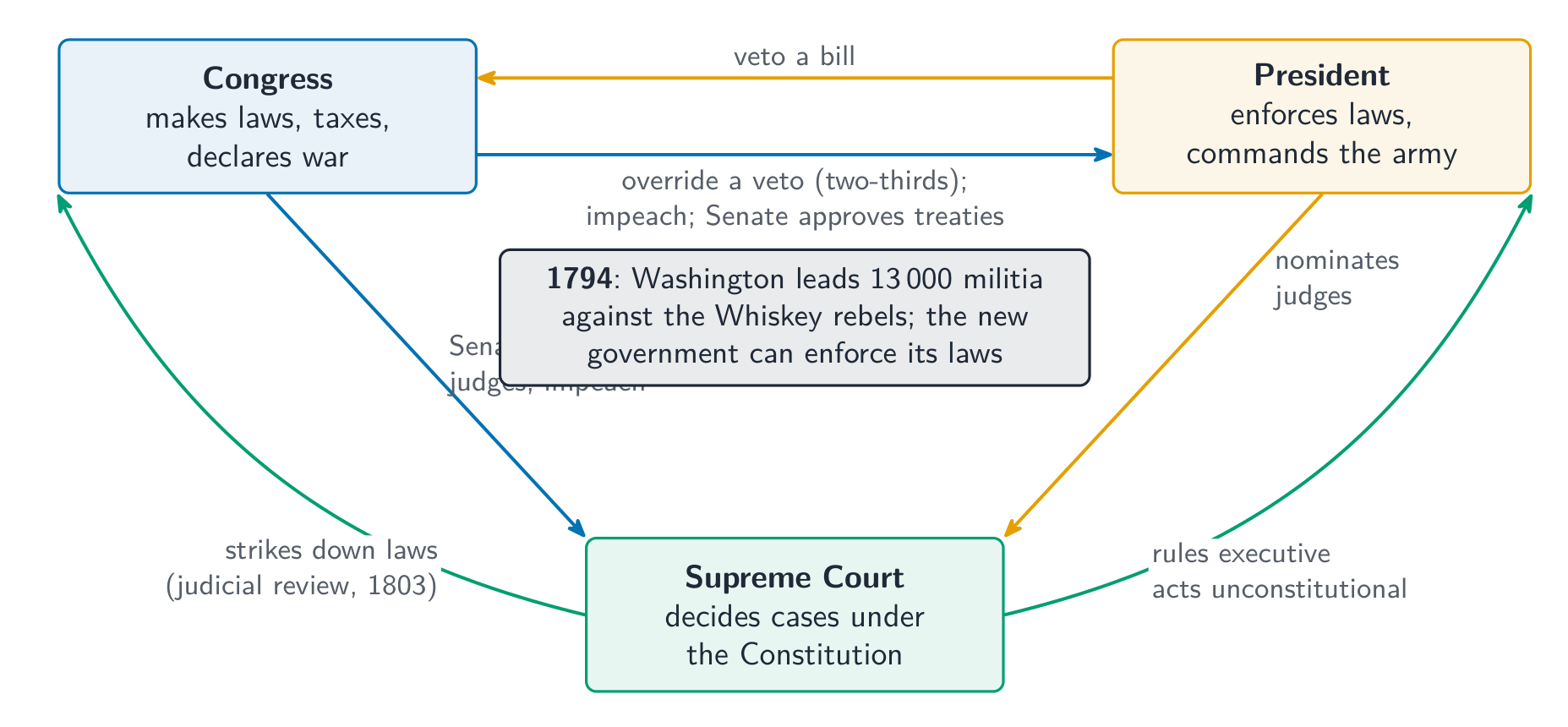
- In October 1794, President George Washington rode out at the head of about 13 000 militiamen to western Pennsylvania. Farmers there had attacked tax collectors to protest a federal tax on whiskey. The rebels melted away without a battle. The new federal government had shown it could enforce its laws — something the Articles' Congress could never do.
- The Constitution created a government that was limited in its powers but strong enough to act.
What did the Whiskey Rebellion show?
难度 1/5 · 今日首次完成可获 100 金币及少量额外奖励
About 13 000 militia.
Four features
- Popular sovereignty: power comes from the people. Limited government: it can do only what the Constitution allows.
- Federalism and the separation of powers: power is divided in two directions.
Federalism divides power vertically
- Federalism 联邦制 divides power between the national government and the states. Only the national government can coin money or make treaties; states run schools and local laws.
- Some powers, such as taxing, are shared.
A structural device, a change, or a continuity?
Sort each element of the new constitutional order.
Match each power to its level of government.
难度 2/5 · 今日首次完成可获 140 金币及少量额外奖励
Federalism.
Worked example: separation of powers
- Three branches: Congress makes laws, the president carries them out, and the courts judge cases — the separation of powers 三权分立.
- Checks: the president can veto a law; Congress can override a veto with two-thirds of each house; the Senate approves treaties and judges.
- The point: these checks and balances 制衡 stop any one branch from becoming too strong, while letting the government act when the branches agree.
How can Congress override a president's veto?
难度 1/5 · 今日首次完成可获 100 金币及少量额外奖励
Checks and balances.
The House has 435 members. How many votes are needed there for a two-thirds override, rounded up?
难度 2/5 · 今日首次完成可获 140 金币及少量额外奖励
435 × 2/3 = 290.
A dynamic government
- In 1789–91, Congress created the departments of State, Treasury and War, the federal courts and Hamilton's national bank.
- The Constitution could be amended, and its "necessary and proper" clause allowed Congress to stretch its powers.
Continuity as well as change
- The new government kept English traditions: common law, jury trials and a two-house legislature, like Parliament and the colonial assemblies.
- What changed was a written constitution, an elected president and a federal system.
The new government kept English traditions such as common law and jury trials.
难度 1/5 · 今日首次完成可获 100 金币及少量额外奖励
Continuity.
"Limited" does not mean "weak". The Constitution limited what the government could do, but gave it the power to tax, raise an army and enforce laws, as the Whiskey Rebellion showed.
A limited government is the same as a weak government.
难度 1/5 · 今日首次完成可获 100 金币及少量额外奖励
It could tax, raise armies and enforce laws.
The Constitution created a limited but capable government: power came from the people, was divided between nation and states by federalism, and was separated among three branches with checks and balances. It kept English traditions while adding a written constitution and an elected president.
Explain how the Constitution created a government that was both limited and effective.
Two-sided design.