| English | 释义 | 拼音 |
|---|---|---|
| Reconstruction Acts | 重建法案 | chóng jiàn fǎ àn |
| equal protection | 平等保护 | píng děng bǎo hù |
| Freedmen's Bureau | 自由民局 | zì yóu mín jú |
A senator in Jefferson Davis's seat, 1870
- On 25 February 1870, Hiram Revels of Mississippi took his oath in the United States Senate — the first African American senator. The seat he filled had last belonged to Jefferson Davis, who had left it in 1861 to become president of the Confederacy. Democrats had tried for three days to block Revels from being seated.
- During Reconstruction (1865–77), the federal government changed the Constitution to protect freed people — but those protections were soon weakened.
Why was Hiram Revels's seat symbolic?
难度 1/5 · 今日首次完成可获 100 金币及少量额外奖励
The first Black senator, 1870.
A change in the federal relationship
- After the war, Radical Republicans in Congress believed the federal government must protect the rights of freed people against Southern states.
- The Reconstruction Acts 重建法案 (1867) placed the South under military districts until states accepted new constitutions with Black male voting.
Three amendments
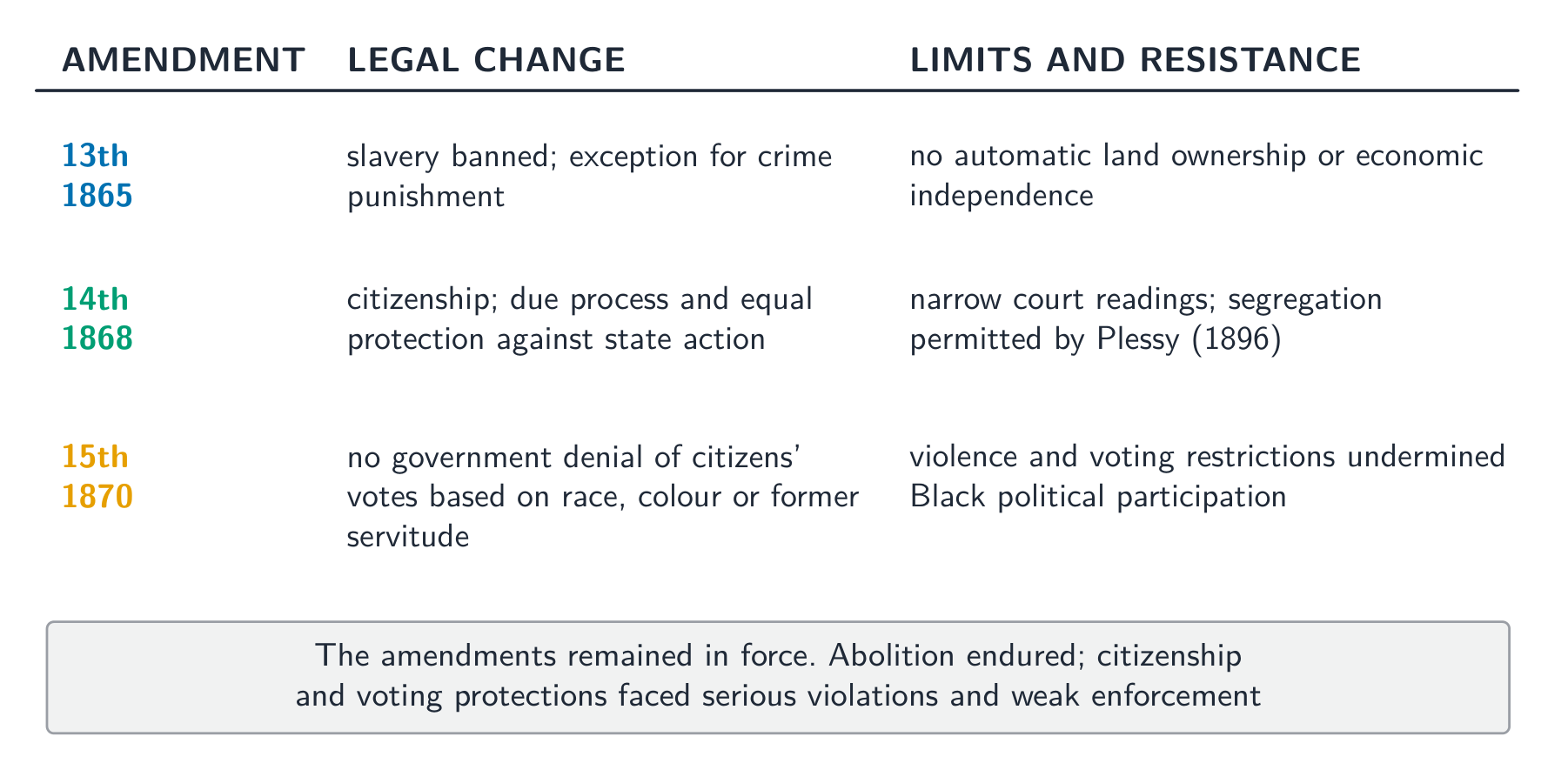
- Thirteenth (1865): abolished slavery. Fourteenth (1868): made everyone born in the US a citizen and promised equal protection 平等保护 of the laws.
- Fifteenth (1870): banned denying the vote because of race.
Walk the Reconstruction arc
Five years of guarantees, thirty of dismantling — and none of the three amendments was repealed.
Match each amendment to what it did.
难度 2/5 · 今日首次完成可获 140 金币及少量额外奖励
Three amendments.
Worked example: successes in the short term
- Officeholders: about 2000 African Americans held public office during Reconstruction, from local sheriffs to 16 members of Congress.
- Schools and families: the Freedmen's Bureau 自由民局 (1865) set up over 1000 schools, and freed people reunited families and founded churches.
- Laws: Southern states created the region's first public school systems.
About how many African Americans held public office during Reconstruction?
难度 2/5 · 今日首次完成可获 140 金币及少量额外奖励
From sheriffs to Congress.
The women's movement divided
- Elizabeth Cady Stanton and Susan B. Anthony opposed the Fifteenth Amendment because it did not include women. Others, such as Lucy Stone, supported it.
- In 1869, the movement split into two organizations.
Stanton and Anthony opposed the Fifteenth Amendment because it did not include women.
难度 1/5 · 今日首次完成可获 100 金币及少量额外奖励
The movement split in 1869.
Ultimate failure
- The Ku Klux Klan and other groups used terror to stop Black voting. Northern support for Reconstruction faded during the depression of the 1870s.
- In the Compromise of 1877, federal troops left the South, and white Democrats regained control.
What ended Reconstruction?
难度 2/5 · 今日首次完成可获 140 金币及少量额外奖励
Terror and retreat.
Reconstruction was not a complete failure. Its short-term gains were reversed, but the Fourteenth and Fifteenth Amendments stayed in the Constitution and were used again in the civil rights movement.
The Reconstruction amendments were removed from the Constitution after 1877.
难度 1/5 · 今日首次完成可获 100 金币及少量额外奖励
They stayed in force.
Reconstruction made the federal government the protector of rights: the Thirteenth, Fourteenth and Fifteenth Amendments ended slavery, created citizenship and equal protection, and protected Black voting. About 2000 Black officeholders served, but terror and fading Northern support ended Reconstruction in 1877.
Evaluate the successes and failures of Reconstruction.
Evaluation.