| English | 释义 | 拼音 |
|---|---|---|
| desegregation | 废除种族隔离 | fèi chú zhǒng zú gé lí |
| civil rights | 民权 | mín quán |
Little Rock, 1957
- In September 1957, nine Black students tried to enter Central High School in Little Rock, Arkansas. The governor sent the National Guard to block them, and white crowds screamed abuse. President Eisenhower then sent 1000 paratroopers of the 101st Airborne to escort the "Little Rock Nine" into school.
- After 1945, the courts, the president and ordinary people began to break down legal segregation.
Why did Eisenhower send troops to Little Rock in 1957?
难度 1/5 · 今日首次完成可获 100 金币及少量额外奖励
To escort the Little Rock Nine.
Old promises, new pressure
- Black veterans returned from fighting fascism to find segregation at home. In 1948 President Truman ordered the desegregation 废除种族隔离 of the armed forces.
- In 1947 Jackie Robinson broke baseball's colour line with the Brooklyn Dodgers.
The courts lead
- Lawyers of the NAACP, led by Thurgood Marshall, challenged segregated schools. In Brown v. Board of Education (1954), the Supreme Court ruled unanimously that "separate educational facilities are inherently unequal", overturning Plessy.
- But the Court ordered desegregation only "with all deliberate speed", and Southern resistance was fierce.
What did Brown v. Board of Education (1954) decide?
难度 1/5 · 今日首次完成可获 100 金币及少量额外奖励
It overturned Plessy.
Match each action to the branch of government.
难度 2/5 · 今日首次完成可获 140 金币及少量额外奖励
All three acted.
Worked example: the Montgomery bus boycott
- Spark: on 1 December 1955, Rosa Parks, an NAACP activist, refused to give her bus seat to a white man and was arrested.
- Action: Black residents, led by the 26-year-old Martin Luther King Jr., boycotted the buses for 381 days, walking or sharing cars.
- Result: in 1956 the Supreme Court ruled bus segregation unconstitutional. The boycott showed that mass nonviolent action could win civil rights 民权 — and made King a national leader.
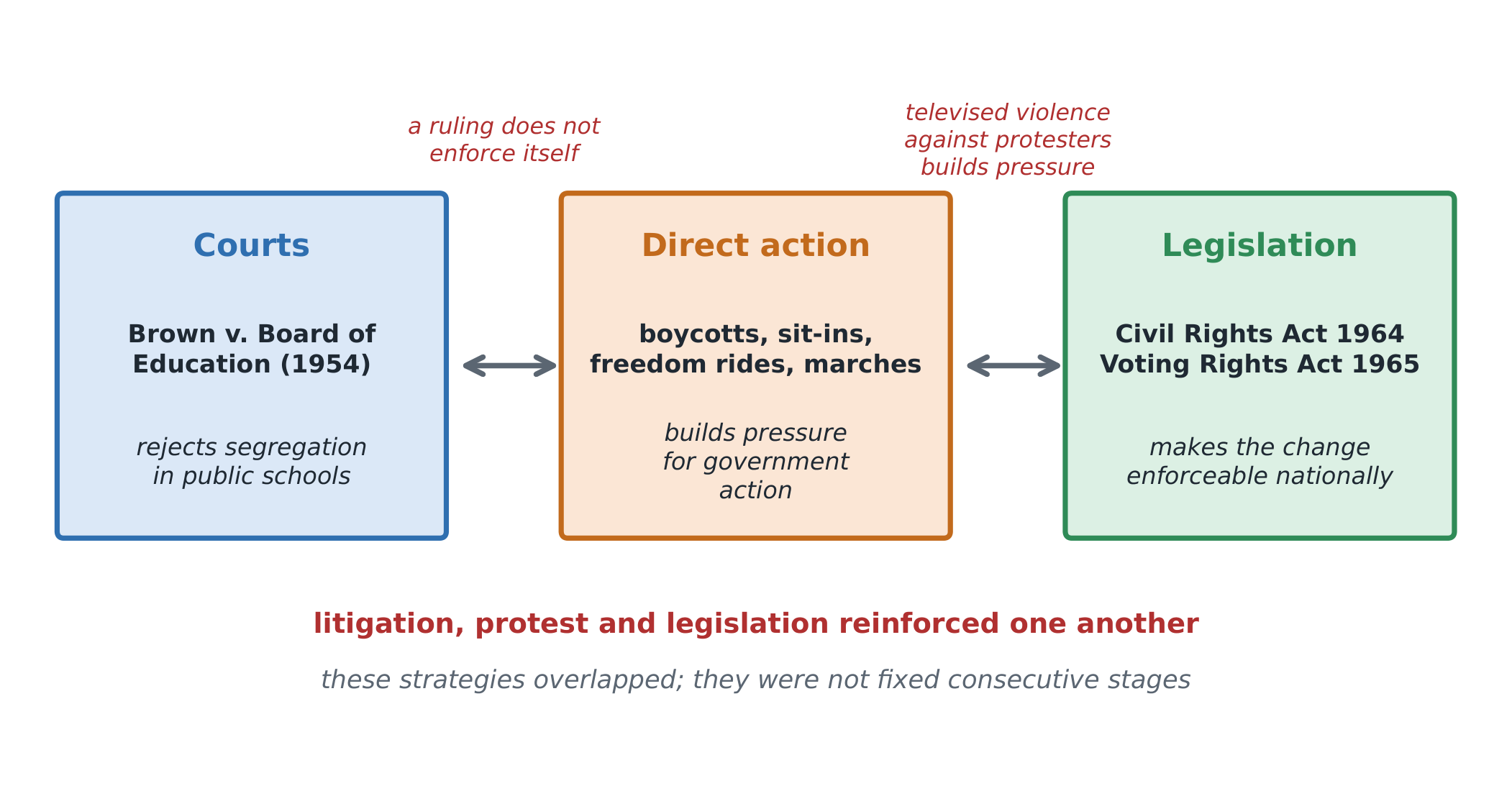
Follow civil rights through three arenas
Courts, direct action and legislation each convert pressure into the next.
Put the Montgomery events in order.
难度 3/5 · 今日首次完成可获 200 金币及少量额外奖励
1955–1956.
Massive resistance
- In 1956, 101 Southern members of Congress signed the "Southern Manifesto" against Brown. Some districts closed public schools rather than integrate.
- The murder of 14-year-old Emmett Till in Mississippi in 1955, and his killers' acquittal, shocked the nation.
The Southern Manifesto was signed by Southern members of Congress opposing Brown.
难度 1/5 · 今日首次完成可获 100 金币及少量额外奖励
101 signers in 1956.
Slow federal action
- The Civil Rights Act of 1957 was the first since Reconstruction, but weak: it created a commission and a civil rights division, with little power to protect voters.
- By 1960, fewer than 1% of Black students in the Deep South attended integrated schools.
Brown v. Board did not end segregation. It declared school segregation unconstitutional, but most Southern schools remained segregated for over a decade. Law, protest and federal force were all needed.
Brown v. Board ended school segregation in the South within a year.
难度 1/5 · 今日首次完成可获 100 金币及少量额外奖励
Most schools stayed segregated for over a decade.
After 1945, Truman desegregated the military, the Supreme Court struck down school segregation in Brown, and the Montgomery bus boycott showed the power of nonviolent mass action. Southern resistance was strong and federal action slow, so progress by 1960 was real but limited.
Explain how court cases and direct action worked together in the civil rights movement before 1960.
Causation.