| English | 释义 | 拼音 |
|---|---|---|
| domino theory | 多米诺骨牌理论 | duō mǐ nuò gǔ pái lǐ lùn |
| Gulf of Tonkin Resolution | 东京湾决议 | dōng jīng wān jué yì |
| credibility gap/ˌkredɪˈbɪlɪti ɡæp/ | 信任差距 | xìn rèn chā jù |
"Mired in stalemate", February 1968
- On 27 February 1968, the CBS news anchor Walter Cronkite returned from Vietnam after the Tet Offensive. On air, he told millions of viewers that the war was "mired in stalemate" and should end by negotiation. President Lyndon Johnson reportedly said: "If I've lost Cronkite, I've lost middle America." A month later, he announced he would not run again.
- Vietnam was a Cold War war of containment, a war of decolonisation, and the cause of a new kind of protest at home.
A war of containment
- After France lost its colony at Dien Bien Phu (1954), Vietnam was divided. The US backed South Vietnam to stop communism spreading — the domino theory 多米诺骨牌理论.
- In August 1964, after a reported attack on US ships, Congress passed the Gulf of Tonkin Resolution 东京湾决议 by 504 votes to 2, giving Johnson power to fight without a declaration of war.
The Gulf of Tonkin Resolution passed by 504 votes to 2. How many members voted?
难度 2/5 · 今日首次完成可获 140 金币及少量额外奖励
504 + 2.
What did the domino theory claim?
难度 1/5 · 今日首次完成可获 100 金币及少量额外奖励
A reason for containment in Vietnam.
A war of decolonisation
- For many Vietnamese, led by Ho Chi Minh, the war continued their fight for independence from France.
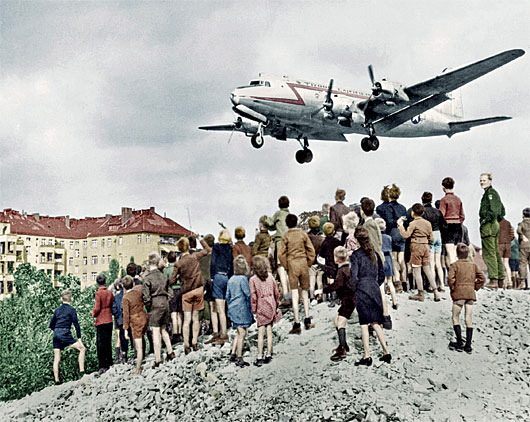
- The Berlin Airlift (1948–49) had shown containment without shooting; in Vietnam, containment meant a long ground war against a nationalist movement.
Follow Vietnam to the credibility gap
The Great Society and the war drew on one budget in the same years — that link is what a period-8 prompt rewards.
Match each view of the war to who held it.
难度 2/5 · 今日首次完成可获 140 金币及少量额外奖励
One war, three views.
Worked example: escalation and the credibility gap
- Escalation: US troops rose from about 23 000 in 1964 to about 536 000 in 1968.
- Official claims: commanders said the war was being won.
- Tet (January 1968): communist forces attacked over 100 towns, even the US embassy in Saigon. They were pushed back, but Americans stopped believing official claims — a credibility gap 信任差距.
US troops rose from about 23 000 in 1964 to about 536 000 in 1968. By how many thousand?
难度 2/5 · 今日首次完成可获 140 金币及少量额外奖励
536 − 23.
A constitutional question
- Who could take the country to war — Congress or the president? No war was ever declared.
- In 1973, Congress passed the War Powers Resolution over Nixon's veto, requiring the president to consult Congress and to withdraw troops after 60 days without approval.
A new opposition
- Students, clergy and others protested; in October 1967, about 100 000 marched on the Pentagon. At Kent State in May 1970, the National Guard killed four students.
- Nixon's "Vietnamization" withdrew US troops; the last left in 1973, and Saigon fell in 1975. About 58 000 Americans died.
Put these events in order.
难度 3/5 · 今日首次完成可获 200 金币及少量额外奖励
1954, 1964, 1968, 1973.
Tet was not a military defeat for the US. Communist forces suffered heavy losses. It was a political turning point because it made official claims of progress look false.
The Tet Offensive was a military defeat for US forces.
难度 1/5 · 今日首次完成可获 100 金币及少量额外奖励
It was a political turning point.
Vietnam began as containment of communism, but for many Vietnamese it was a war for independence. Escalation to over 500 000 troops, the Tet Offensive and a credibility gap turned Americans against the war, raised the question of who can make war, and led to the War Powers Resolution of 1973.
Explain why American public opinion turned against the Vietnam War.
Causation.