English
This topic looks more deeply at consumers, costs and firms.
ไทย
หัวข้อนี้ดูลึกซึ้งขึ้นเกี่ยวกับผู้บริโภค ต้นทุน และบริษัท
A-Level Economics · Economics A-Level · Topic 7 · หัวข้อ 7
 18:50
18:50
ระบบราคาและจุลเศรษฐศาสตร์ (ระดับ A Level)
มองดูผู้ซื้อเหล่านี้ ทุกคนมีงบประมาณจำกัด และสิ่งAdditionalที่ซื้อเพิ่มแต่ละชิ้นให้ความสุขน้อยกว่าก่อนหน้าเล็กน้อย ตอนนี้โรงงานเหล็กขนาดใหญ่: มันผลิต…
English narration · English + 中文 subtitles burned in · การบรรยายภาษาอังกฤษ · คำบรรยายภาษาอังกฤษ + 中文 ลอยตัวบนภาพ
This topic looks more deeply at consumers, costs and firms.
หัวข้อนี้ดูลึกซึ้งขึ้นเกี่ยวกับผู้บริโภค ต้นทุน และบริษัท

Source: Cambridge International syllabus · แหล่งที่มา: หลักสูตร Cambridge International
utility 效用 is the satisfaction a consumer gets from a good.
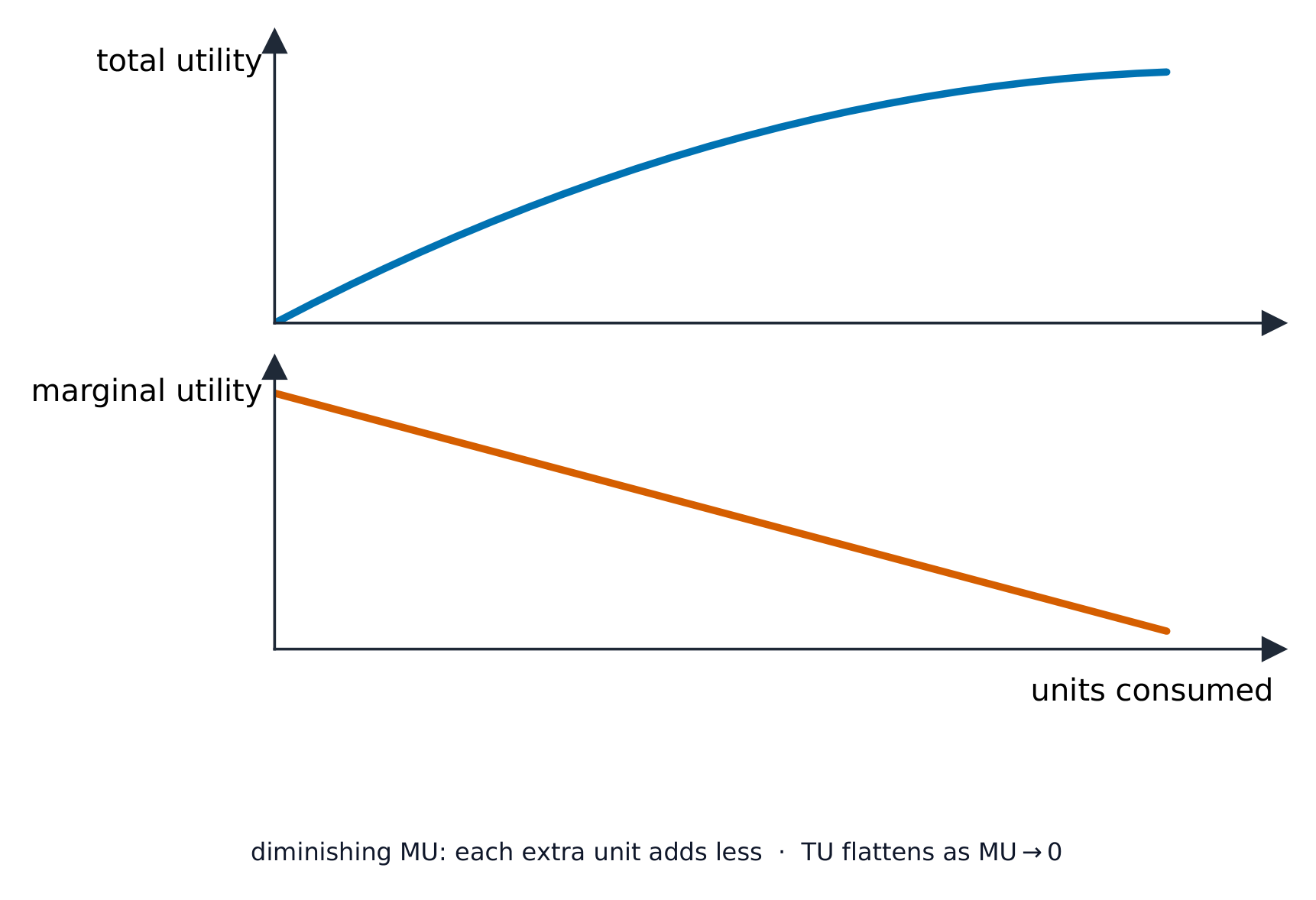
The law of diminishing marginal utility 边际效用递减 says each extra unit gives less extra satisfaction. Total utility still rises, but more and more slowly.
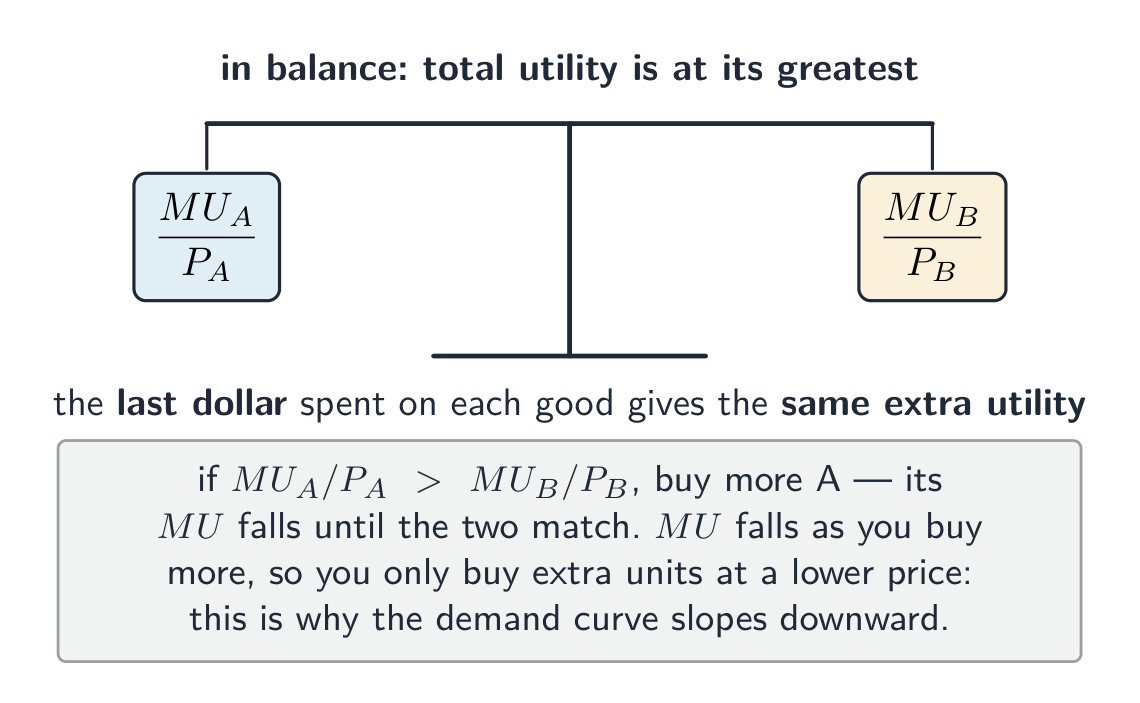
A consumer with a fixed budget gets the most total utility when the last dollar spent on each good gives the same extra utility. This is the equi-marginal principle 等边际原则:
Because marginal utility falls as you buy more, you only buy extra units when the price falls. This is why the demand curve 需求曲线 slopes downward.
The approach is hard to use in practice: utility cannot really be measured in numbers, and people do not calculate like this. It also ignores habit and advertising.
Utilityคือความพึงพอใจที่ผู้บริโภคได้รับจากสินค้า
กฎของ Utility边际ที่ลดลงระบุว่าแต่ละหน่วยเพิ่มเติมให้ utility เพิ่มเติมน้อยลง Total utility ยังเพิ่มขึ้นแต่ช้าลงเรื่อยๆ
ผู้บริโภคที่มีงบประมาณจำกัดจะได้ total utility สูงสุดเมื่อ dollar สุดท้ายที่ใช้จ่ายต่อสินค้าแต่ละชนิดให้ extra utility เท่ากัน นี่คือ หลักการ equi-marginal:
เนื่องจาก marginal utility ลดลงเมื่อซื้อมากขึ้น คุณจึงซื้อหน่วยเพิ่มเติมก็ต่อเมื่อราคาลดลงเท่านั้น นี่คือเหตุผลว่าทำไม เส้น demand จึงลาดลง
วิธีการนี้ใช้จริงได้ยาก: utility ไม่สามารถวัดเป็นตัวเลขได้อย่างแท้จริง และคนไม่คำนวณแบบนี้ นอกจากนี้ยังละเลยเรื่องนิสัยและโฆษณา
total utility rises more slowly as quantity increases · Total utility เพิ่มขึ้นช้าลงเมื่อปริมาณเพิ่มขึ้น
Add units consumed and see why extra satisfaction usually falls. · บวกหน่วยบริโภคแล้วดูว่าทำไมความพึงพอใจเพิ่มเติมมักลดลง
| English | ไทย |
|---|---|
| utility/juːˈtɪlɪti/ | Utility |
| total utility/ˈtəʊtl juːˈtɪlɪti/ | Utilityรวม |
| marginal utility/ˈmɑːdʒɪnl juːˈtɪlɪti/ | utility边际 |
| diminishing marginal utility/dɪˈmɪnɪʃɪŋ ˈmɑːdʒɪnl juːˈtɪlɪti/ | Utility边际ลดลง |
| equi-marginal principle/ˈekwi ˈmɑːdʒɪnl ˈprɪnsɪpl/ | หลักการ Utility边际เท่ากัน |
| demand curve/dɪˈmænd kɜːv/ | เส้นความต้องการ |

Source: Cambridge International syllabus · แหล่งที่มา: หลักสูตร Cambridge International
An indifference curve 无差异曲线 shows all the combinations of two goods that give a consumer the same total utility. It slopes downward (more of one good means less of the other) and bows in towards the origin.
A budget line 预算线 shows all the combinations the consumer can just afford with their income, at the current prices.
consumer equilibrium 消费者均衡 is the best the consumer can do: the point where the budget line just touches the highest possible indifference curve.
When the price of a good falls, the consumer buys more for two reasons:
These effects work differently for different goods:
เส้น indifference curve แสดง所有的 combinations ของสินค้าสองชนิดที่ให้ consumer same total utility เท่ากัน ลาดลง (มีสินค้าชนิดหนึ่งมาก berarti มีอีกชนิดน้อยลง) และโค้งเข้าหาจุดกำเนิด
เส้น budget line แสดง all combinations ที่consumer สามารถซื้อได้พอดีกับรายได้ของตน ในราคาปัจจุบัน
ความสมดุลของผู้บริโภค (consumer equilibrium) คือสิ่งที่ผู้บริโภครับได้สูงสุด: จุดที่ budget line สัมผัสกับเส้น indifference curve ที่สูงที่สุดที่เป็นไปได้
เมื่อราคาสินค้าลดลง ผู้บริโภคซื้อมากขึ้นเพราะสองเหตุผล:
ผลกระทบเหล่านี้ทำงานต่างกันสำหรับสินค้าแต่ละชนิด:
good B = income / priceB - slope x good A · สินค้า B = รายได้ / ราคาB - ความชัน x สินค้า A
Move quantity of one good and see the trade-off with the other good. · เปลี่ยนปริมาณของสินค้าหนึ่งตัวเพื่อดูการแลกเปลี่ยนกับสินค้าอีกตัวหนึ่ง
| English | ไทย |
|---|---|
| indifference curve/ɪnˈdɪfrəns kɜːv/ | เส้นอรรถประโยชน์เท่าเทียม |
| budget line/ˈbʌdʒɪt laɪn/ | เส้นงบประมาณ |
| consumer equilibrium/kənˈsuːmə ˌiːkwɪˈlɪbrɪəm/ | สมดุลของผู้บริโภค |
| substitution effect/ˌsʌbstɪˈtjuːʃn ɪˈfekt/ | ผลของการทดแทน |
| income effect/ˈɪŋkʌm ɪˈfekt/ | income effect |
| normal good/ˈnɔːml ɡʊd/ | สินค้าปกติ (normal good) |
| inferior good/ɪnˈfɪərɪə ɡʊd/ | สินค้าด้อยคุณภาพ (inferior good) |
| Giffen good/ˈdʒɪfən ɡʊd/ | สินค้าของ吉芬 |

Source: Cambridge International syllabus · แหล่งที่มา: หลักสูตร Cambridge International
Economists judge how well resources are used.
market failure 市场失灵 happens when the free market does not reach an efficient result. The main causes are monopoly power, externalities 外部性, public goods 公共物品, information failure 信息失灵, and factor immobility 要素不流动性 (factors cannot move quickly to where they are needed).
นักเศรษฐศาสตร์ตัดสินประสิทธิภาพการใช้งานทรัพยากร
ความล้มเหลวของตลาด (market failure) เกิดขึ้นเมื่อตลาดเสรีไม่บรรลุผลลัพธ์ที่มีประสิทธิภาพ สาเหตุหลักคืออำนาจผูกขาด externalities public goods ความล้มเหลวของข้อมูล (information failure) และ ความไม่เคลื่อนย้ายของปัจจัยการผลิต (factor immobility) (ปัจจัยไม่สามารถเคลื่อนย้ายไปยังตำแหน่งที่ต้องการได้อย่างรวดเร็ว)
The market is allocatively efficient where supply meets demand — price equals marginal cost. Market failure pushes it away from that point. · ตลาดมีประสิทธิภาพในการจัดสรรเมื่อ_supply_ตัด_demand_ — ราคาเท่ากับต้นทุนส่วนเพิ่ม ความล้มเหลวของตลาดทำให้ห่างจากจุดนั้น
| English | ไทย |
|---|---|
| productive efficiency/prəˈdʌktɪv ɪˈfɪʃənsi/ | ประสิทธิภาพการผลิต |
| allocative efficiency/ˈæləkətɪv ɪˈfɪʃənsi/ | ประสิทธิภาพการจัดสรร |
| Pareto optimality/pæˈriːtəʊ ˌɒptɪˈmælɪti/ | ประสิทธิภาพแบบพาเรโต |
| dynamic efficiency/daɪˈnæmɪk ɪˈfɪʃənsi/ | ประสิทธิภาพแบบพลวัต |
| market failure/ˈmɑːkɪt ˈfeɪlɪə/ | ความล้มเหลวของตลาด |
| public good/ˈpʌblɪk ɡʊd/ | สินค้าสาธารณะ |
| information failure/ˌɪnfəˈmeɪʃn ˈfeɪlɪə/ | ความล้มเหลวด้านข้อมูล |
| factor immobility/ˈfæktə ɪˌməʊˈbɪlɪti/ | ความไม่ยืดหยุ่นของปัจจัยการผลิต |
| marginal cost/ˈmɑːdʒɪnl kɒst/ | ต้นทุน边际 (marginal cost) |
| diminishing returns/dɪˈmɪnɪʃɪŋ rɪˈtɜːnz/ | ผลลดทอน |
| returns to scale/rɪˈtɜːnz tə skeɪl/ | ผลตอบแทนต่อขนาด |

Source: Cambridge International syllabus · แหล่งที่มา: หลักสูตร Cambridge International
Some costs and benefits fall on people outside the deal. We separate three levels:
We study externalities with marginal analysis 边际分析, using these curves:
The best outcome for society is where MSC = MSB. But the market produces where MPC = MPB. The gap between these creates lost welfare.
The lost welfare from making too much or too little is the deadweight welfare loss 无谓损失 — the triangle on the diagram between the social and private curves.
บางต้นทุนและประโยชน์ตกอยู่กับบุคคลภายนอกการทำธุรกรรม เราแบ่งออกเป็นสามระดับ:
เราศึกษา externalities ด้วย marginal analysis โดยใช้เส้นเหล่านี้:
ผลลัพธ์ที่ดีที่สุดสำหรับสังคมคือจุดที่ MSC = MSB แต่ตลาดผลิตที่ MPC = MPB ช่องว่างระหว่างสองสิ่งนี้สร้าง lost welfare
lost welfare จากการผลิตมากเกินไปหรือน้อยเกินไปคือ deadweight welfare loss — รูปสามเหลี่ยมในแผนภาพระหว่างเส้นทางสังคมและเส้นส่วนตัว
A negative externality means the social cost is above the private supply curve; the free-market quantity is then too high. · ผลภายนอกเชิงลบหมายความว่าต้นทุนทางสังคมสูงกว่าเส้นBundle_ส่วนตัว ปริมาณในตลาดเสรีจะสูงเกินไป
| English | ไทย |
|---|---|
| externality/ekˈstɜːnælɪti/ | externality (ผลกระทบภายนอก) |
| private cost/ˈpraɪvət kɒst/ | ต้นทุนส่วนตัว |
| private benefit/ˈpraɪvət ˈbenɪfɪt/ | ประโยชน์ส่วนตัว |
| external cost/ekˈstɜːnl kɒst/ | ต้นทุนภายนอก |
| external benefit/ekˈstɜːnl ˈbenɪfɪt/ | ประโยชน์ภายนอก |
| social cost/ˈsəʊʃl kɒst/ | ต้นทุนทางสังคม |
| social benefit/ˈsəʊʃl ˈbenɪfɪt/ | ประโยชน์ทางสังคม |
| marginal analysis/ˈmɑːdʒɪnl əˈnæləsɪs/ | การวิเคราะห์ขอบเขต |
| marginal private cost/ˈmɑːdʒɪnl ˈpraɪvət kɒst/ | ต้นทุนส่วนตัว边际 |
| marginal social cost/ˈmɑːdʒɪnl ˈsəʊʃl kɒst/ | ต้นทุนสังคมส่วนเพิ่ม |
| marginal private benefit/ˈmɑːdʒɪnl ˈpraɪvət ˈbenɪfɪt/ | ประโยชน์ส่วนตัวส่วนเพิ่ม |
| marginal social benefit/ˈmɑːdʒɪnl ˈsəʊʃl ˈbenɪfɪt/ | ประโยชน์สังคม边际 |
| negative externality/ˈneɡətɪv ekˈstɜːnælɪti/ | ผลภายนอกเชิงลบ |
| positive externality/ˈpɒzɪtɪv ekˈstɜːnælɪti/ | ผลภายนอกเชิงบวก |
| deadweight welfare loss/ˈdedweɪt ˈwelfeə lɒs/ | การสูญเสียสวัสดิภาพdeadweight |

Source: Cambridge International syllabus · แหล่งที่มา: หลักสูตร Cambridge International
In the short run 短期, at least one factor is fixed; in the long run 长期, all factors can change.
| Cost | Meaning |
|---|---|
| fixed cost 固定成本 | does not change with output (rent on a factory) |
| variable cost 可变成本 | changes with output (raw materials) |
| total cost 总成本 | fixed cost plus variable cost |
| average cost 平均成本 | total cost per unit: $AC = TC / Q$ |
| marginal cost 边际成本 | the cost of one more unit: $MC = \Delta TC / \Delta Q$ |
Worked example. Making $10$ units costs £500 in total; making $11$ units costs £540. Find the average cost at $10$ units and the marginal cost of the 11th unit.
Here $MC$ ($\text{\pounds} 40$) is below $AC$ ($\text{\pounds} 50$), so making the 11th unit pulls the average cost down — whenever marginal cost is below average cost, average cost falls.
In the short run, output is limited by the law of diminishing returns 边际报酬递减: as you add more of a variable factor (workers) to a fixed factor (machines), each extra worker eventually adds less output. This makes marginal cost rise.
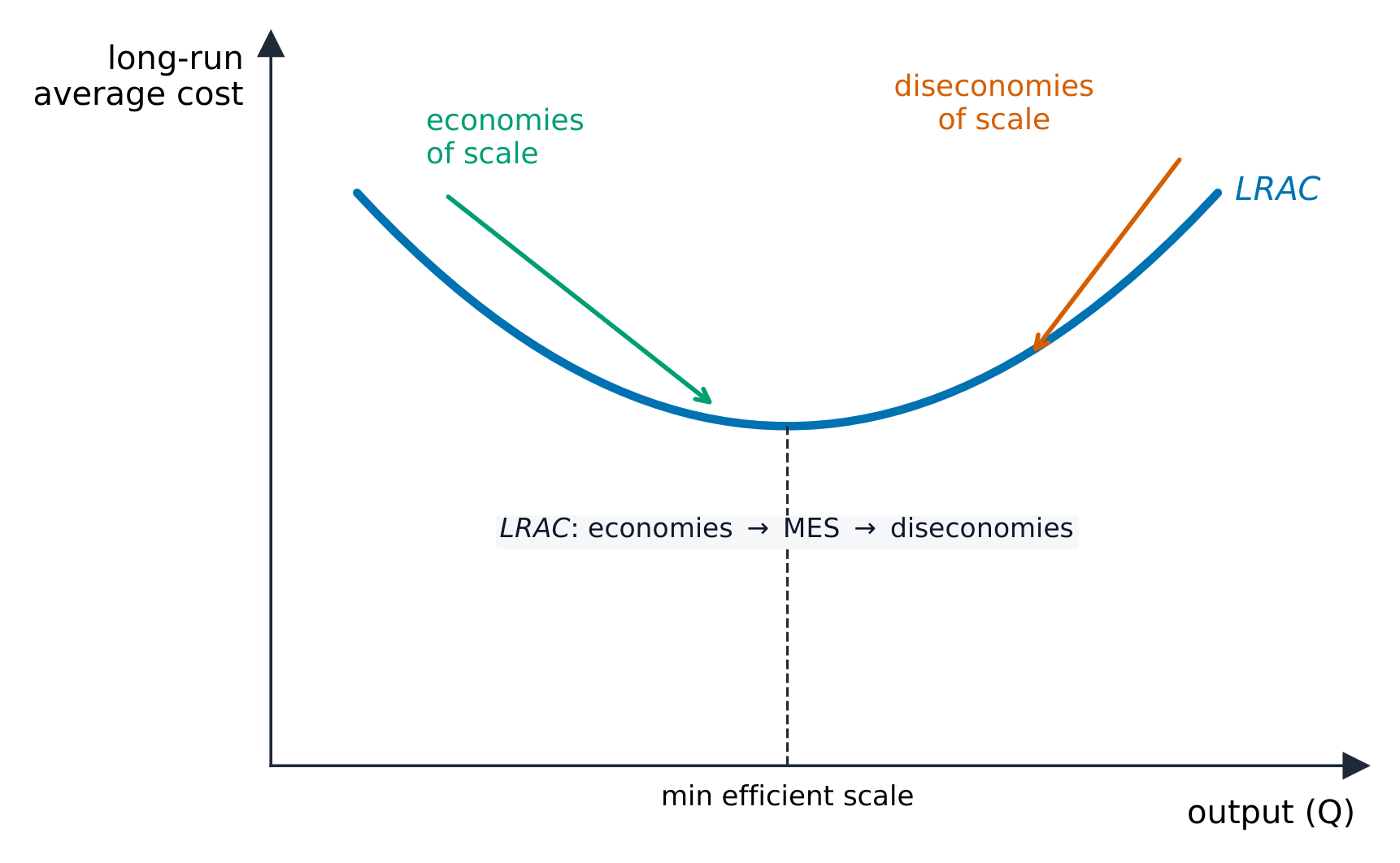
In the long run, all factors vary, so we look at returns to scale 规模报酬. As a firm grows, it can gain economies of scale 规模经济 (lower average cost from buying in bulk, using big machines, and specialising). If it grows too big, it may suffer diseconomies of scale 规模不经济 (poor communication and control), and average cost rises.
| Revenue | Meaning |
|---|---|
| total revenue 总收益 | all money from sales: $TR = P \times Q$ |
| average revenue 平均收益 | revenue per unit, which equals the price |
| marginal revenue 边际收益 | the revenue from one more unit: $MR = \Delta TR / \Delta Q$ |
Worked example. A firm sells $10$ units at £50 each. To sell an 11th unit it must lower the price to £48 on every unit. Find the total revenue at each output and the marginal revenue of the 11th unit.
The marginal revenue ($\text{\pounds} 28$) is well below the £48 price, because the lower price applies to all $11$ units, not just the extra one.
Profit is total revenue minus total cost. Economists include the opportunity cost of the owner's resources in cost, so:
A firm makes the most profit at the output where $MR = MC$.
Worked example. At its best output a firm makes $100$ units, sells each for £12 (its average revenue), and has an average cost of £9. Find the supernormal profit.
Because average revenue (£12) is above average cost (£9), the firm earns supernormal profit. If instead $AR = AC$, it would make only normal profit; if $AR < AC$, it would make a loss.
ในระยะ สั้น (short run) อย่างน้อย one factor มีค่าคงที่; ในระยะ ยาว (long run) ทุก factors สามารถเปลี่ยนแปลงได้
| Cost | ความหมาย |
|---|---|
| fixed cost | ไม่เปลี่ยนตาม output (ค่าเช่าโรงงาน) |
| variable cost | เปลี่ยนแปลงตาม output (วัตถุดิบ) |
| total cost | fixed cost บวก variable cost |
| average cost | total cost ต่อหน่วย: $AC = TC / Q$ |
| marginal cost | ต้นทุนของหน่วยเพิ่มเติมหนึ่งหน่วย: $MC = \Delta TC / \Delta Q$ |
ตัวอย่างที่คำนวณแล้ว. การผลิต $10$ หน่วยมีต้นทุนรวม £500; การผลิต $11$ หน่วยมีต้นทุน £540. จงหา average cost ที่ $10$ หน่วย และ marginal cost ของหน่วยที่ 11.
ที่ $MC$ ($\text{\pounds} 40$) อยู่ต่ำกว่า $AC$ ($\text{\pounds} 50$) ดังนั้นการเพิ่มหน่วยที่ 11 จะดึงต้นทุนเฉลี่ยให้ลดลง — ทุกครั้งที่ต้นทุนเพิ่มเติมต่ำกว่าต้นทุนเฉลี่ย ต้นทุนเฉลี่ยจะลดลง
ในระยะสั้น ปริมาณการผลิตถูกจำกัดโดยกฎของ ผลลดทอน: เมื่อเพิ่มปัจจัยแปรผันมากขึ้น (แรงงาน) เข้ากับปัจจัยคงที่ (เครื่องจักร) แรงงานแต่ละคนเพิ่มมา后会会产生 less output. This makes marginal cost rise.

ในระยะยาว ปัจจัยทั้งหมดแปรผันได้ เราจึงพิจารณาถึง ผลตอบแทนต่อขนาด เมื่อธุรกิจขยายตัว สามารถเกิด เศรษฐกิจต่อขนาด (ต้นทุนเฉลี่ยต่ำลงจากการซื้อจำนวนมาก การใช้อุปกรณ์ขนาดใหญ่ และการเชี่ยวชาญเฉพาะด้าน) หากขยายใหญ่เกินไป อาจเกิด ความไม่ประหยัดต่อขนาด (การสื่อสารและการควบคุมไม่ดี) ทำให้ต้นทุนเฉลี่ยเพิ่มขึ้น
| รายได้ | ความหมาย |
|---|---|
| รายได้รวม | เงินทั้งหมดจากการขาย: $TR = P \times Q$ |
| รายได้อย่างเฉลี่ย | รายได้ต่อหน่วย ซึ่งเท่ากับราคา |
| รายได้เพิ่มเติม | รายได้จากสินค้าหนึ่งหน่วยเพิ่ม: $MR = \Delta TR / \Delta Q$ |
ตัวอย่างวิธีทำ. ธุรกิจขาย $10$ หน่วย ในราคาหน่วยละ £50 เพื่อขายหน่วยที่ 11 ต้องลดราคาเหลือ £48 สำหรับทุกหน่วย จงหาค่ารายได้รวมที่ระดับการผลิตแต่ละระดับ และรายได้เพิ่มเติมของหน่วยที่ 11
รายได้边际 ($\text{\pounds} 28$) ต่ำกว่ามากเมื่อเทียบกับราคา£48 เนื่องจากราคาต่ำนี้ใช้กับทุก $11$ หน่วย ไม่ใช่แค่หน่วยเพิ่มเท่านั้น
กำไรคือรายได้รวมลบด้วยต้นทุนรวม นักเศรษฐศาสตร์รวมโอกาสต้นทุนของทรัพยากรเจ้าของไว้ในต้นทุน ดังนั้น:
บริษัทจะสร้างกำไรสูงสุดที่ระดับผลผลิตที่ $MR = MC$.
ตัวอย่างวิธีทำ. ที่ระดับการผลิตที่ดีที่สุด ธุรกิจผลิต $100$ หน่วย ขายหน่วยละ £12 (รายได้อย่างเฉลี่ย) และมีต้นทุนอย่างเฉลี่ยอยู่ที่ £9 จงหาค่ากำไรเกินปกติ
เนื่องจากรายได้เฉลี่ย (£12) สูงกว่าต้นทุนเฉลี่ย (£9) บริษัทจึงได้รับกำไรเกินปกติ หากเป็น $AR = AC$ บริษัทจะได้รับเพียงกำไรปกติ; แต่หากเป็น $AR < AC$ บริษัทจะขาดทุน
y = ax² + bx + c
Total revenue rises then falls as price changes. · รายได้รวม เพิ่มขึ้นแล้วลดลง เมื่อราคาเปลี่ยนแปลง
Average cost is U-shaped; marginal cost cuts it at the minimum. Different market structures price relative to these curves. · ต้นทุนเฉลี่ยมีรูปตัว U; ต้นทุนส่วนเพิ่มตัดผ่านที่จุดต่ำสุด โครงสร้างตลาดที่แตกต่างกันกำหนดราคาเทียบกับโค้งเหล่านี้
Change output. Marginal cost cuts average cost at its lowest point — the heart of the theory of the firm. · เปลี่ยนปริมาณการผลิต ต้นทุนส่วนเพิ่ม ตัด ต้นทุนเฉลี่ย ที่จุดต่ำสุด — ซึ่งเป็นหัวใจของทฤษฎีบริษัท
| English | ไทย |
|---|---|
| short run/ʃɔːt rʌn/ | ระยะสั้น |
| long run/lɒŋ rʌn/ | ระยะยาว |
| fixed cost/fɪkst kɒst/ | ต้นทุนคงที่ |
| variable cost/ˈveərɪəbl kɒst/ | ต้นทุนแปรผัน |
| total cost/ˈtəʊtl kɒst/ | ต้นทุนรวม |
| average cost/ˈævrɪdʒ kɒst/ | ต้นทุนเฉลี่ย |
| economies of scale/ɪˈkɒnəmiz ɒv skeɪl/ | ประหยัดขนาด |
| diseconomies of scale/ˌdɪsɪˈkɒnəmiz ɒv skeɪl/ | diseconomies of scale |
| total revenue/ˈtəʊtl ˈrevənjuː/ | รายได้รวม |
| average revenue/ˈævrɪdʒ ˈrevənjuː/ | รายได้เฉลี่ย |
| marginal revenue/ˈmɑːdʒɪnl ˈrevənjuː/ | รายได้边际 |

Source: Cambridge International syllabus · แหล่งที่มา: หลักสูตร Cambridge International
A market structure 市场结构 describes a market by the number of firms, the barriers to entry, and the type of product.
| Structure | Firms | Barriers | Product | Long-run profit |
|---|---|---|---|---|
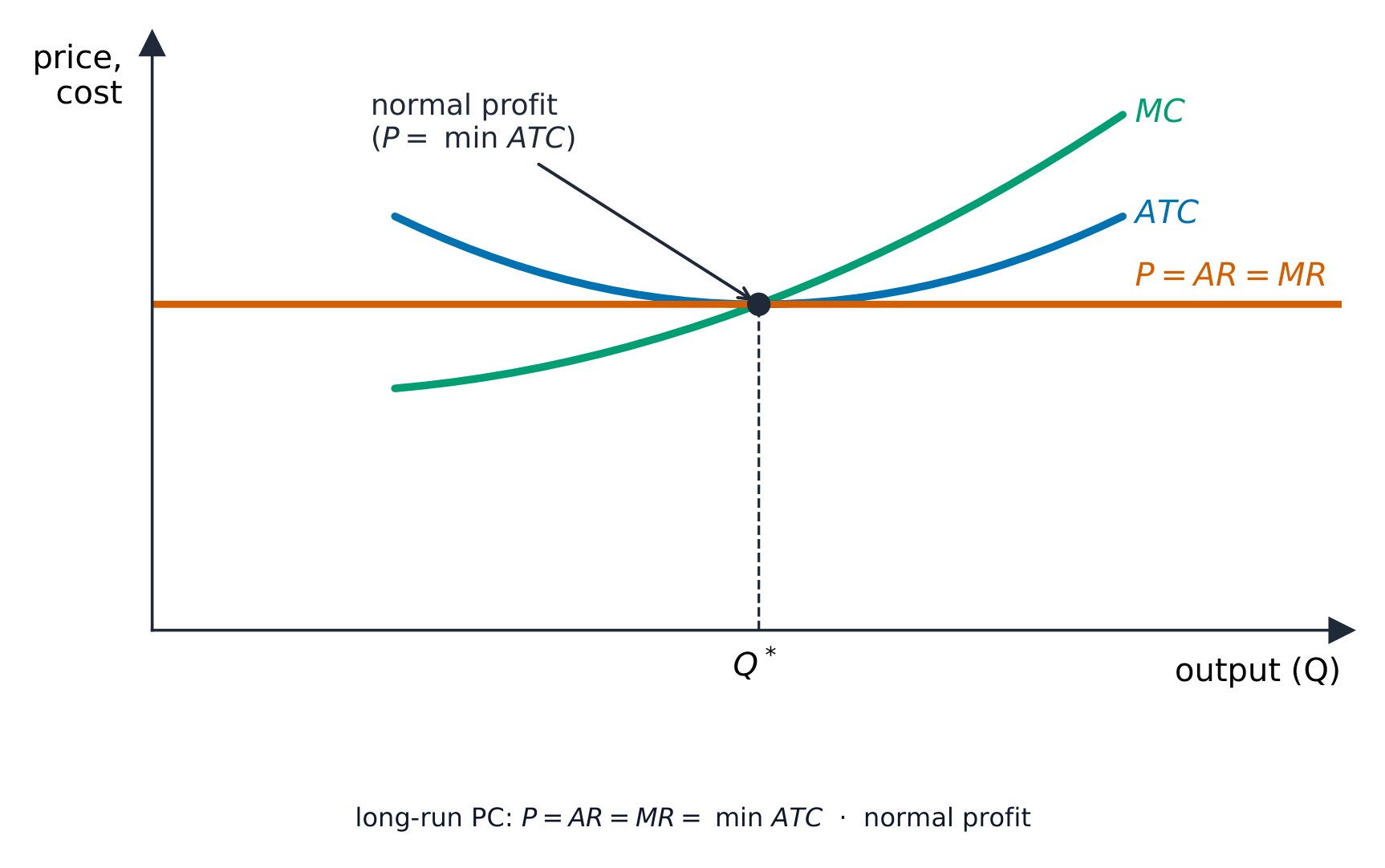
| perfect competition 完全竞争 | very many | none | identical | normal only |
| monopolistic competition 垄断竞争 | many | low | slightly different | normal |
| oligopoly 寡头垄断 | a few | high | varies | often supernormal |
| monopoly 垄断 | one | very high | unique | supernormal |
price discrimination 价格歧视 is charging different consumers different prices for the same good (for example, cheaper train tickets for students). It needs price-setting power, groups with different elasticities, and a way to stop resale between groups. It raises the firm's profit.
โครงสร้างตลาด อธิบายตลาดโดยจำนวนบริษัท อุปสรรคในการเข้าสู่ตลาด และประเภทของสินค้า
| โครงสร้าง | จำนวนบริษัท | อุปสรรค | สินค้า | กำไรระยะยาว |
|---|---|---|---|---|
| การแข่งขันสมบูรณ์ | จำนวนมาก | ไม่มี | เหมือนกัน | ปกติเท่านั้น |
| การแข่งขันแบบโมโนโพลิสติก | หลาย | ต่ำ | แตกต่างเล็กน้อย | ปกติ |
| โอลิโกปอล | เล็กน้อย | สูง | เปลี่ยนแปลงได้ | มักจะเป็นกำไรเกินปกติ |
| โมโนปอล | หนึ่ง | สูงมาก | เฉพาะ | กำไรเกินปกติ |

การเลือกปฏิบัติทางราคา คือการเรียกเก็บราคาต่าง ๆ จากลูกค้าคนละกลุ่มสำหรับ สินค้าเดียวกัน (เช่น บัตรรถไฟราคาถูกสำหรับนักศึกษา) จำเป็นต้องมีอำนาจกำหนดราคา กลุ่มที่มีความยืดหยุ่นต่างกัน และวิธีการป้องกันการขายต่อระหว่างกลุ่ม ทำให้กำไรของบริษัทเพิ่มขึ้น
How a firm prices depends on demand and supply; with market power it can charge above the competitive level. · การตั้งราคาของบริษัทขึ้นอยู่กับอุปสงค์และอุปทาน; เมื่อมีอำนาจตลาด สามารถตั้งราคาเหนือระดับการแข่งขันได้
| English | ไทย |
|---|---|
| normal profit/ˈnɔːml ˈprɒfɪt/ | กำไรปกติ |
| supernormal profit/ˈsuːpənɔːml ˈprɒfɪt/ | กำไรเกินปกติ |
| subnormal profit/ˈsʌbnɔːml ˈprɒfɪt/ | กำไรรดลง |
| market structure/ˈmɑːkɪt ˈstrʌktʃə/ | โครงสร้างตลาด |
| perfect competition/ˈpɜːfekt ˌkɒmpəˈtɪʃn/ | การแข่งขันสมบูรณ์ |
| monopolistic competition/məˈnɒpəlɪstɪk ˌkɒmpəˈtɪʃn/ | การแข่งขันแบบผูกขาด |
| oligopoly/ˌɒlɪˈɡɒpəli/ | โอளிโกปอลิ |
| monopoly/məˈnɒpəli/ | มอนوپولی |
| price taker/praɪs ˈteɪkə/ | ผู้รับราคา |
| product differentiation/ˈprɒdʌkt ˌdɪfəˌrenʃɪˈeɪʃn/ | การแยกแยะผลิตภัณฑ์ |
| collusion/kəˈluːʒn/ | การร่วมมือกัน |
| cartel/kɑːˈtel/ | คártেল |
| barriers to entry/ˈbærɪəz tʊ ˈentri/ | กำแพงเข้าสู่ตลาด |
| price competition/praɪs ˌkɒmpəˈtɪʃn/ | การแข่งขันด้านราคา |
| non-price competition/nɒn praɪs ˌkɒmpəˈtɪʃn/ | การแข่งขันนอกเหนือจากราคา |
| price discrimination/praɪs dɪˌskrɪmɪˈneɪʃn/ | การเลือกปฏิบัติทางราคา |
| internal growth/ɪnˈtɜːnl ɡrəʊθ/ | การเติบโตภายใน |
| external growth/ekˈstɜːnl ɡrəʊθ/ | การเติบโตภายนอก |
| merger/ˈmɜːdʒə/ | การควบรวมกิจการ |
| horizontal integration/ˌhɒrɪˈzɒntl ˌɪntɪˈɡreɪʃn/ | การบูรณาการแนวนอน |
| vertical integration/ˈvɜːtɪkl ˌɪntɪˈɡreɪʃn/ | การบูรณาการแนวตั้ง |
| conglomerate integration/kənˈɡlɒməreɪt ˌɪntɪˈɡreɪʃn/ | การบูรณาการกลุ่มธุรกิจ |
| niche/niːʃ/ | นิช |
| barriers to exit/ˈbærɪəz tʊ ˈeɡzɪt/ | อุปสรรคในการออกจากการตลาด |
| profit maximisation/ˈprɒfɪt ˌmæksɪmaɪˈzeɪʃn/ | การทำกำไรสูงสุด |
| revenue maximisation/ˈrevənjuː ˌmæksɪmaɪˈzeɪʃn/ | การเพิ่มรายได้สูงสุด |
| sales maximisation/seɪlz ˌmæksɪmaɪˈzeɪʃn/ | การเพิ่มยอดขายสูงสุด |
| satisficing/ˈsætɪsfɪsɪŋ/ | การทำใจให้พอใช้ |
| divorce of ownership from control/dɪˈvɔːs ɒv ˈəʊnəʃɪp frɒm kənˈtrəʊl/ | การแยกการเป็นเจ้าของออกจากควบคุม |
| principal-agent problem/ˈprɪnsɪpl ˈeɪdʒənt ˈprɒbləm/ | ปัญหาเจ้าของ-ตัวแทน |

Source: Cambridge International syllabus · แหล่งที่มา: หลักสูตร Cambridge International
Firms grow in two ways:
Many firms stay small because the market is small (local services), the owner wants to keep control, or there are few economies of scale. They survive by offering personal service or filling a niche 利基市场.
Firms also face barriers to entry and barriers to exit 退出壁垒 (such as costly machines that cannot be sold). High exit barriers can trap a firm in a loss-making market.
Firms grow in two ways:
หลายบริษัทยังคงมีขนาดเล็กเนื่องจากตลาดมีขนาดเล็ก (บริการท้องถิ่น), เจ้าของต้องการรักษาการควบคุม หรือมีเศรษฐกิจจากขนาดไม่มากนัก พวกเขาอยู่รอดได้โดยการให้บริการส่วนบุคคลหรือการทำตลาดใน ช่องว่างเฉพาะ
บริษัทยังเผชิญกับ อุปสรรคในการเข้าสู่ตลาด และ อุปสรรคในการออกจากตลาด (เช่น เครื่องจักรที่มีราคาสูงซึ่งไม่สามารถขายต่อได้) อุปสรรคในการออกจากตลาดที่สูงอาจทำให้บริษัทติดอยู่ในตลาดที่ขาดทุน
Classify real firm decisions by the objective they reveal. · จำแนกการตัดสินใจของบริษัทจริงตามวัตถุประสงค์ที่เปิดเผย
Source: Cambridge International syllabus · แหล่งที่มา: หลักสูตร Cambridge International
Not every firm simply chases the most profit.
In large companies the owners (shareholders) are not the managers. This divorce of ownership from control 所有权与控制权分离 creates the principal-agent problem 委托代理问题: managers (the agents) may pursue their own aims — bigger salaries or an easier life — instead of the owners' aim of maximum profit.
ไม่ใช่ทุกบริษัทจะมุ่งเน้นเพียงกำไรสูงสุดเท่านั้น
ในบริษัทขนาดใหญ่ ผู้ถือหุ้นไม่ใช่ผู้จัดการ ความ แยกออกของการเป็นเจ้าของและการควบคุม นี้ทำให้เกิด ปัญหาตัวแทน: ผู้จัดการ (ในฐานะตัวแทน) อาจแสวงหาเป้าหมายของตนเอง — เช่น เงินเดือนที่สูงขึ้นหรือชีวิตที่สบายขึ้น — แทนที่จะเป็นเป้าหมายของผู้ถือหุ้นในการทำกำไรสูงสุด
Classify real firm decisions by the objective they reveal. · จำแนกการตัดสินใจของบริษัทจริงตามวัตถุประสงค์ที่เปิดเผย
Work through it step by step, with instant-check exercises. · ทำทีละขั้นตอน พร้อมแบบฝึกหัดตรวจสอบผลทันที
Past Papers · ข้อสอบย้อนหลัง
Loading subjects… · กำลังโหลดวิชา…